#data-science-and-ml
1 messages · Page 164 of 1
 umbral hatch
 viscid urchin
and then there's https://course.fast.ai/
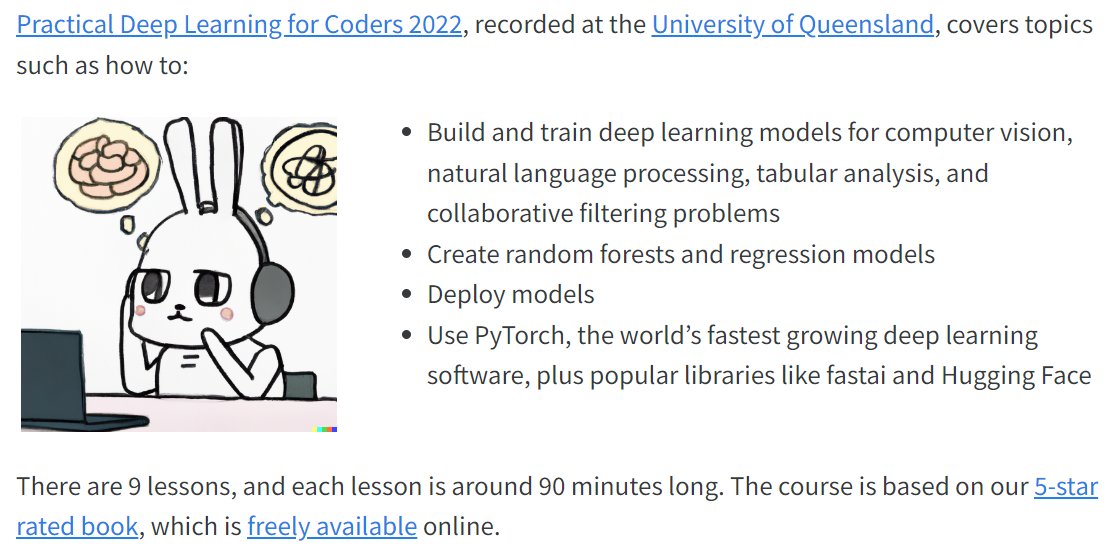
Practical Deep Learning for Coders
A free course designed for people with some coding experience, who want to learn how to apply deep learning and machine learning to practical problems.
umbral hatch
down the line what should it be? should i learn like advanced math and data and shit?
viscid urchin
Yeah, I see it as a repeated loop of learning a new ML idea, then going back and re-learning its math, and then going again
umbral hatch
for now tho just python? as a beginner of course
viscid urchin
Yeah just Python is fine. You can learn Triton or something to add to what you can do later.
umbral hatch
any other languages along python later on?
viscid urchin
A lot of people like to learn C++ or Rust, but to me this might be the power move second language for ML https://triton-lang.org/main/index.html
umbral hatch
can you tell me why?
viscid urchin
(This is what most of OpenAI's models are written in)
This lets you write code that runs on the GPU very efficiently, and do it cross-platform without needing a specific nVidia card.
umbral hatch
ah nice
viscid urchin
This would be an alternative to, say, learning CUDA directly
umbral hatch
what jobs can one land with data science?
viscid urchin
At this point, whatever you can dream almost; everybody wants data science.
umbral hatch
highly competitve? evne more than software engineering?
viscid urchin
Well, it IS software engineering, so it's hard to compare
viscid urchin
It's super hot so yeah, you could say so.
But how competitive depends on your level really
umbral hatch
super beginner
viscid urchin
You'll have a lot of competition, but if you know stuff, the market is thirsty.
umbral hatch
never back down never give up
viscid urchin
If you're actually interested in the topic, you should be able to stand out, in my opinion
There are a lot of people just doing it because it's supposed to be hot
umbral hatch
nah i kidna like it and interested in it
 limpid dew
Is it normal to get a career in data science without a degree?
 serene scaffold
limpid dew
Is it normal to get a career in data science without a degree?
serene scaffold
limpid dew
Is it normal to get a career in data science without a degree?
No, it pretty much never happens.
Data science is even more degree-requiring than software development.
umbral hatch
woah
limpid dew
serene scaffold
No, it pretty much never happens.
Thank you, thought that would be relevant to @umbral hatch
umbral hatch
limpid dew
Thank you, thought that would be relevant to <@1124881023881183243>
thanks. yeah it is, but i do want to have some experience and background, alongside some real projects
limpid dew
What kind of projects are you thinking of?
umbral hatch
limpid dew
What kind of projects are you thinking of?
for now, im barely learning loops. For a future project, it'd be something like asking the user for inputs what's your name, age...etc and then in the same project something interactive, multiplying the age, scrambling names. this is far down the line tho
limpid dew
Very cool! Also smart to keep it simple at first.
umbral hatch
yeah and for fun maybe start coding games and learning other languages. main reason i went into coding
 fallow coyote
How do you lot use databases with your ML programs? I'm trying to make my first ML program to see the likelihood of someone developing heart failure. I cleaned the data and then transferred it into an SQLite database
 wooden hill
ML program?
 glacial root
@serene scaffold do you know what the issue here is
sorry to ping, you're the only one here that i know is into nlp
fallow coyote
wooden hill
ML program?
Machine Learning program. Just something simple; using linear regression. Ill spend this week on it, send it to this channel for everyone to critique and then I'll attempt to make a proper project (which will have mini projects within it as I try to expand my knowledge and skills in ML programming)
wooden hill
fallow coyote
Machine Learning program. Just something simple; using linear regression. Ill sp...
OH! I should probably know that considering thats what Im going for 😅
serene scaffold
when you say "pairs", do you mean "two adjacent words"?
remember that lists are not arrays.
corpus[i:i+2] -- if you try to do a string slice that is out of range, you'll get an empty string.
!e
print("hello world!!!"[100:100000])
 arctic wedgeBOT
serene scaffold
!e
```py
print("hello world!!!"[100:100000])
```
arctic wedgeBOT
serene scaffold
!e
```py
print("hello world!!!"[100:100000])
```
:warning: Your 3.12 eval job has completed with return code 0.
[No output]
note that it did print("") rather than erroring.
glacial root
serene scaffold
when you say "pairs", do you mean "two adjacent words"?
remember that lists are ...
to adjacent items within the list, which starts out to be all chars but then they get grouped together
glacial root
serene scaffold
`corpus[i:i+2]` -- if you try to do a string slice that is out of range, you'll ...
i increment until one less than the length though
serene scaffold
for i in range(1000):
    pairs = dict()
    for j in range(len(corpus) - 1):
        key_list = list(pairs.keys())
        pair = ''.join(corpus[i:i+2])
do you see the problem?
also, look at the number of lines: https://paste.pythondiscord.com/NMA23TQ64ACSOJMZ4K5GC4OREA
glacial root
serene scaffold
```py
for i in range(1000):
pairs = dict()
for j in range(len(corpus) - ...
i end at one before the last char though and i'm joining two chars
i don't understand how it's going past the last character
serene scaffold
glacial root
i don't understand how it's going past the last character
look at what variables you're using for what.
for x in range(1000):
    pairs = dict()
    for y in range(len(corpus) - 1):
        key_list = list(pairs.keys())
        pair = ''.join(corpus[x:x+2])
this might make it easier to see.
serene scaffold
glacial root
i'm such an idiot
you are not
glacial root
serene scaffold
you are not
no these kinds of mistakes happen far too frequently for me
i should have known to check a few more times before asking for help
serene scaffold
glacial root
i should have known to check a few more times before asking for help
It's good to figure out what you can on your own, but don't be ashamed to ask for help.
glacial root
serene scaffold
It's good to figure out what you can on your own, but don't be ashamed to ask fo...
nah that's not the part i'm worried about
sometimes i just make so many mistakes like this
it's scary what's gonna happen in the future
serene scaffold
You're being too hard on yourself. Everyone starts out like this.
glacial root
hopefully this issue goes away as i practice more
serene scaffold
glacial root
hopefully this issue goes away as i practice more
I think it will.
 civic elm
Hi all, in machine learning, in particular feature update or (rollbacks?) how do you solve the "Any change can break everything" problem?
Basically I made some feature changes to my model inputs in jupyter notebook and it performed worse than an hour ago. how do we solve this?
 grand minnow
Has anyone tried using Helicone? I was set on using it to track the cost of tokens and requests per conversation, etc but the dashboard just kept showing the default sample data metrics 😭
I've verified that I am currently sending through their gateway tho... Does it lag?
 narrow tiger
If i have a rag from which I want to pass in context to an llm (to use relevent data)
should i send this in system prompt or user prompt?
how can it effect the outputs
 agile cobalt
how much it affects the output will vary depending on the model, but in general you'll want to put "trusted" data in the system prompt, "untrusted" data in the user prompt
you shouldn't rely on the model to distinguish between it, but it might help it understand how official or reliable that data is
narrow tiger
thanks that makes sense,
 untold cliff
Hello! I am trying to dive deep into tokenization and understand the need of the shift towards subword based tokenization.
One of the main points I see is how hard it might be to define splitting rules, especially for complex languages. I keep seeing turkish as an example but I don't know the language so I can't tell that much, but I think I can see ot even in english of a word is a somewhat complex combination of prefixes and suffixes (but no specific examples come to mind unfortunately)
Another main point I see is ambiguity, in the sense of which representation to use. I see example like "don't", should be considered one token or be split into "do" and "n't" or "not". And "U.S.A" or "New York-based" for example, how should it be split? And I'm wondering if it's that hard to agree on one common way of doing or if it is that hard to define rules for doing so. I see arguments saying that it depends on the use case, so for some cases one way of splitting is better than the other, but I can't think of any examples.
Can you shed some light maybe? Or give some clear examples? Thank you!
 final jolt
I feel like that is a complex question with not at all the same set of examples. realistically an LLM would understand "don't" as a single token and breaking that up would be model dependant. (and also would it even be useful?) The same can be said for splitting prefixes and suffixes, at least in English where you would fundamentally change the meaning of a word by doing so which I say would just cause more harm than good. A stronger argument could be made for your last example but by that same degree I feel like splitting the tokens just by some set standard would yield unreliable outcomes. given that New York-based would have a different meaning than New York, based or similar depending on the model in question.
The greater support or capability for natural language interaction makes the argument even harder to justify IMO.
 north plank
untold cliff
Hello! I am trying to dive deep into tokenization and understand the need of the...
north plank
untold cliff
Hello! I am trying to dive deep into tokenization and understand the need of the...
is it possible to use fuzzyword to generate and map such subwords? as a part of tokenization. Because how long can we count and create such subword lists?
 stiff night
Hello, I'm here to seek guidance. I have a project in which I have to train an AI model on segmenting tumors from breast mammograms. This is my first AI project so I'm kind of lost at the moment.
The dataset that I'm working with is the INbreast 2012 dataset on kaggle. I have managed to load the DICOMs and their corresponding tumor masks and train a UNet model on them, but I did not get any promising results. All metrics like dice and IoU are very small (less than 1%).
I'd really like any help if possible. Thanks in advance.
fallow coyote
I've been learning a lot of the statistics for ML. As I'm still at the beginning of my ML journey, how much of a focus should I have put in learning the linear algebra side?
 iron basalt
fallow coyote
I've been learning a lot of the statistics for ML. As I'm still at the beginning...
iron basalt
fallow coyote
I've been learning a lot of the statistics for ML. As I'm still at the beginning...
A lot. It will also enhance your understanding in others parts, like statistics. It's foundational as a building block due to modern computers being designed around it for performance.
fallow coyote
Ill finish off learning the stats. Tbf a lot of the stats I still can recall from high school several years ago. Just need to revise them. Then Ill go onto learning all the linear algebra stuff
 lapis sequoia
gans make me feel dirty about myself, they waste time, I thought they were harder than obj detection. Any of you young and good lads have any resources at your disposal for object detection?
viscid urchin
lapis sequoia
you think rlhf is not really RL?
viscid urchin
I wouldn't call it fake, but it's clearly different when humans are involved
lapis sequoia
yes, the reward are still through actual tangible data
iron basalt
lapis sequoia
gans make me feel dirty about myself, they waste time, I thought they were harde...
As in computer vision object detection?
 gray slate
viscid urchin
https://arxiv.org/html/2502.15840v1
gray slate
viscid urchin
https://arxiv.org/html/2502.15840v1
We find no clear correlation between failures and the point at which the model’s context window becomes full, suggesting that these breakdowns do not stem from memory limits
Interesting. Any thoughts about it?
Also, arxiv entering the 21st century with HTML! 🎉
Nice work, science! 😂
viscid urchin
gray slate
> We find no clear correlation between failures and the point at which the model...
Yeah that part is super interesting, I'm still trying to decide what my mental model for it is. It's not like the model can get 'bored'.. is it just the 'game of telephone' it is playing with only being given the last 30,000 tokens etc? Not sure.
gray slate
viscid urchin
Yeah that part is super interesting, I'm still trying to decide what my mental m...
I haven't read the full thing so don't have a good mental model of it. But I've got some decent mental models in general. I like Tim Scarfe's take on it, that they tend towards the mean while we push towards chaos: https://www.mlst.ai/p/agentialism-and-the-free-energy-principle
 lethal gull
Does anybody that has worked with VAE's know what ways i can increase model performance?
lapis sequoia
iron basalt
As in computer vision object detection?
yes
gray slate
lapis sequoia
yes
https://www.youtube.com/watch?v=8jXIAWg_yHU&list=PLjMXczUzEYcHvw5YYSU92WrY8IwhTuq7p&index=1
^ Full university course on computer vision from the creator of YOLO. Thi sis the best resource you're likely to find anywhere
 lyric furnace
guys
could anyone suggest me a machine learning documentation:
i am a kid and i am intrested in ML/DEEP LEARNING.
i am trying to learn linear algebra and stuff
could anyone please suggest me a doc, cause the docs i find is very complicated and not well explained
grand minnow
lyric furnace
could anyone suggest me a machine learning documentation:
i am a kid and i am i...
Have you tried a more hands-on learning course like https://kaggle.com/learn ?

Practical data skills you can apply immediately: that's what you'll learn in these no-cost courses. They're the fastest (and most fun) way to become a data scientist or improve your current skills.
fallow coyote
Can anyone help me try to decipher what a model matrix is and how to create one? Third fucking time I'm asking. If you cant be asked to help, at least guide me to a decent resource that can help me understand what a model/design matrix is because I cannot find anything remotely useful on the internet that tells me what I need.
final jolt
fallow coyote
Can anyone help me try to decipher what a model matrix is and how to create one?...
Ah yes be condescending and rude while asking for help. Excellent tactic
serene scaffold
fallow coyote
Can anyone help me try to decipher what a model matrix is and how to create one?...
I'm sorry you're frustrated. I've never heard of a model matrix or a design matrix.
We do our best in this server to connect knowledgeable people to newcomers, but everything is ultimately voluntary and no one is required to help or entitled to receive it.
This raises the question: why do you think you need to know about something for which scant resources exist?
 lavish wraith
Is pandas is equivalent of Excel
final jolt
I mean pandas is a library for data queries and other stuff. Excel is a spreadsheet program. Yes both can be used for data query and analysis but they are very different approaches
lavish wraith
For data analysis what's basic skills required ??
final jolt
I feel like that heavily depends on what data you may be analyzing, what your goal of the analysis is and what exactly are you wanting to do.
serene scaffold
lavish wraith
For data analysis what's basic skills required ??
keep in mind that you almost certainly need a degree--employers are going to be selective about who they trust to help them make consequential business decisions.
pandas is one of the most popular tools for data analysis, but you also need to understand statistics and have some domain knowledge in what you're analyzing.
lavish wraith
final jolt
I feel like that heavily depends on what data you may be analyzing, what your go...
Just find job as data analysis
final jolt
lavish wraith
Just find job as data analysis
Ah then very much what Stelercus said. A degree most likely as a minimum
 grand mantle
Hello guys. I am little bit confused on data sharing
I provide Instagram data but i can't extend number of clients
lavish wraith
I search lot of website skill required they said Excel ,sql,tableau ,numpy ,pandas,matplotlib ,seaborn
final jolt
lavish wraith
I search lot of website skill required they said Excel ,sql,tableau ,numpy ,pand...
I mean that is basically a catchall wordsalad but still something to start with in what of those things do you know? You are certainly going to need at least familiarity and understanding of those tools and libraries. Knowledge of usage and experience beyond that
final jolt
grand mantle
I provide Instagram data but i can't extend number of clients
Going to need more details like what you created your system with, what errors you are getting or basically just more details in order for someone to be able to help
grand minnow
lavish wraith
For data analysis what's basic skills required ??
Doesn't look like that there's a pre-requisite to learning data analytics. Why don't you give it a try? https://www.coursera.org/google-certificates/data-analytics-certificate
 ornate rose
Hey guys. I'm new to here (but not entirely new to python). I just wanted your opinions on this
I'm an advanced beginer in python ( I know the basics. Loops, ifs, whiles, input data types... all that kind of stuff) and i've worked on natural language processing using the NLTK library in python. so it's been quite a lot though ofcourse not being familiar with it makes me forget a lot of syntax in the library
I'm presently 17 and will be starting college pursuing a CS and Cognitive Science degree and I'll be working on a research paper on AI before resumption (September) with top level profs and graduates. This paper would be submitted to arXiv and top AI conferences like NeurIPs. I'd be aiming to pursue a FAANG internship though I'd settle for whatever I'll get but my main goal is to master Python Programming by the end of this year up to a given extent.
I'd love anyone that has inputs or advice they are willing to share so I begin working.
serene scaffold
^ I responded to this in #career-advice
fallow coyote
serene scaffold
This raises the question: why do you think you need to know about something for ...
Apologies if I was being brash. I'm going through a book (Introduction to Statistical Learning for Python or ISLP). It mentions something about a model matrix or design matrix which I believe is to set the template for your model (i.e. defining what X and y will be). ISLP uses its own custom module to create a design matrix. I'll continue on with my project and see how it goes. I'll post it up on here when I'm done with it.
viscid urchin
fallow coyote
Apologies if I was being brash. I'm going through a book (Introduction to Statis...
Does this help at all? https://en.wikipedia.org/wiki/Design_matrix
Each row in the matrix is an 'observation', at least as far as I understand them currently.
I guess this is what you're doing? https://intro-stat-learning.github.io/ISLP/models/spec.html
and I guess this is where the rubber meets the road

Never used this API, looks fancy
fallow coyote
viscid urchin
I guess this is what you're doing? https://intro-stat-learning.github.io/ISLP/mo...
Yes. That book I'm going through. It feels like a decent book to go through the basics of machine learning and the stastical maths behind (not so much the linear algebra side). I've made a design matrix from the book 'manually' but I dont understand what makes their custom design matrix module better if that makes any sense
viscid urchin
Not sure; my guess is that it helps you generate the matrix from the dataset, but I guess I'd have to look at their docs to know why it's cool
Perhaps the most common use is to extract some columns from a pd.DataFrame and produce a design matrix there we go I suppose
fallow coyote
I'll continue on with my current project and see how it goes from there. Thanks for trying to help. I have this weird obsession where I must know how everything works or else i cant use it to its fullest potential. I'm slowly getting better at just needing to learn the surface details then applying it straight way and after, go deeper into the subject
final jolt
viscid urchin
Not sure; my guess is that it helps you generate the matrix from the dataset, bu...
yea this is about all I can glean from the terminology in that book as well. Its more of a term used to describe the matrix created with extracted data vs a 'concept' of its own
 opaque condor
For making my own image network convelution
Do I make a file with each reference
Image
lapis sequoia
yo, RAG stuff, any good tid-bits or links?
lapis sequoia
opaque condor
For making my own image network convelution
Do I make a file with each referenc...
no, it should be labeled in each folder with what the image is.
 misty wraith
hi im new just trying to find my way around this server. im trying to learn python with data science as one of the goals
serene scaffold
misty wraith
hi im new just trying to find my way around this server. im trying to learn pyth...
hello and welcome to our wonderful data science channel
misty wraith
serene scaffold
hello and welcome to our wonderful data science channel
hi thanks took me a while to find this channel its a big server
 wooden sail
fallow coyote
I'll continue on with my current project and see how it goes from there. Thanks ...
wooden sail
fallow coyote
I'll continue on with my current project and see how it goes from there. Thanks ...
a "model matrix" is a particular flavor of linear statistical model, so what you're looking for is a "statistical model" https://en.wikipedia.org/wiki/Statistical_model#Formal_definition
A statistical model is a mathematical model that embodies a set of statistical assumptions concerning the generation of sample data (and similar data from a larger population). A statistical model represents, often in considerably idealized form, the data-generating process. When referring specifically to probabilities, the corresponding term is...
after some discretization/sampling and/or a choice of basis in a finite dimensional vector space, a "model matrix" is roughly equivalent to the assumption that your data is described by a statistical model with deterministic but unknown parameters, and those parameters are related to the observed data via a linear transformation
opaque condor
lapis sequoia
no, it should be labeled in each folder with what the image is.
So like fox image one fox image 2 etc?
lapis sequoia
opaque condor
So like fox image one fox image 2 etc?
what do you have? Is the data in files? and in those files, is the data labeled?
opaque condor
Not yet and I'm going over foxes and cats and dogs
 ionic dirge
Hi everyone, please, I need your help. I currently use Google colab on a mobile device to run datasets. I only just started. I need to analyze datasets from kaggle. How can I use these datasets on Google colab without downloading it?
 potent meadow
im doing a project for my uni and everything looks good except that the graph isnt showing anything
i cant fix it and i dont know where's the issue
can someone help? i can provide the code and other files and stuff but it's difficult to just upload everything here lol
viscid urchin
ionic dirge
Hi everyone, please, I need your help. I currently use Google colab on a mobile...
Easiest way to download kaggle data in Google Colab
ionic dirge
viscid urchin
Or https://www.geeksforgeeks.org/how-to-import-kaggle-datasets-directly-into-goo...
Thank you so much. Will check it out.
final jolt
potent meadow
im doing a project for my uni and everything looks good except that the graph is...
probably going to at least need some snippets of code and output screenshyot
potent meadow
final jolt
probably going to at least need some snippets of code and output screenshyot
can i dm you?
final jolt
You can but I can't promise I alone could help. And probably won't have a chance to look today 🙂
potent meadow
final jolt
You can but I can't promise I alone could help. And probably won't have a chance...
yea all good i will appreciate just trying :D ^^
im busy atm so i will send it later but appreciate you
opaque condor
lapis sequoia
what do you have? Is the data in files? and in those files, is the data labeled?
The basics
 wraith jay
i need some pandas help
def in_prop(formula):
    parsed = _parse_formula(formula)
    bools = [el in elements for el in propeties.keys()]
    return all(data)

filtered = df.loc[lambda x: ~in_prop(x['formula'])]
df['en diff'] = filtered.map(en_diff)
i want to filter elements in the formula column of the dataframe based on the result of the in_prop function, but i cant figure out how to do it
this code doesnt work
viscid urchin
Sorry if I'm being dumb, what is en_diff?
also propeties is spelled wrong
and where is data coming from?
wraith jay
viscid urchin
Sorry if I'm being dumb, what is `en_diff`?
im creating a new column for the filtered data which i appply a fucntion to
wraith jay
viscid urchin
and where is `data` coming from?
a json file
viscid urchin
Sure, but I mean, it's not in the code you show; is that variable in scope?
wraith jay
yeah
im doing this in jupyter notebook
heres the error im getting btw
TypeError: expected string or bytes-like object, got 'Series'
for this line filtered = df.loc[lambda x: ~in_prop(x['formula'])]
i just dont know how to do the filter
viscid urchin
Don't you want to say return all(bools)?
in in_prop?
Like..
def in_prop(formula):
    parsed = _parse_formula(formula)
    bools = [el in properties.keys() for el in parsed]
    return all(bools)
``` ?ohh right
viscid urchin
Or is that not what 'parsed' is all about?
wraith jay
ty
viscid urchin
If I understand you correctly I THINK the way to say it is:
filtered = df.loc[~df['formula'].apply(in_prop)]
``` but I'm not a pandas wizard.yeah data wasnt a variable. but the error still persists, i dont think its even calling the function yet
wraith jay
viscid urchin
If I understand you correctly I THINK the way to say it is:
```python
filtered =...
oh awesome that works
wait
nvm
viscid urchin
Remove the ~ if you want to invert it
and then you'd do df['en diff'] = filtered['formula'].map(en_diff)
limpid dew
Anyone know if there is a difference between embedding and one hot encoding?
grand minnow
limpid dew
Anyone know if there is a difference between embedding and one hot encoding?
One-hot encoding is simple and is used for categorical data when relationships between categories don’t matter.
Embeddings are advanced and crucial for tasks like natural language understanding in LLMs, where capturing meaning, context, and relationships is essential. Because it stores the info as vectors.
limpid dew
grand minnow
One-hot encoding is simple and is used for categorical data when relationships b...
But is the first layer of a DNN not encoding the one hot encoded vector into some latent space in the same way as imbedding algorithm?
limpid dew
grand minnow
I don't know what or how a DNN works
oh was that a chat gpt response?
glacial root
misty wraith
hi thanks took me a while to find this channel its a big server
note that this is the best channel in this server, you've come to a wonderful place ‼️
 quaint mulch
limpid dew
oh was that a chat gpt response?
quaint mulch
limpid dew
oh was that a chat gpt response?
This is the funniest thing I saw all day
quaint mulch
limpid dew
Anyone know if there is a difference between embedding and one hot encoding?
like, they are very different categories, so IDK how to answer that.
1hot can be considered pre-processing, not part of the model, and there are no learnable weights
limpid dew
quaint mulch
like, they are very different categories, so IDK how to answer that.
1hot can be...
but ins't enbedding just relating an index to a vector?
quaint mulch
embedding is just a concept for what's hapening on the 1st layer of DNN usually
the idea is it is projecting from data space to a latent space.
quaint mulch
limpid dew
but ins't enbedding just relating an index to a vector?
there are many ways to do embedding. usually, it is not.
Although it can be done that way.
quaint mulch
limpid dew
but ins't enbedding just relating an index to a vector?
you got an example where this is the case and we can take a look?
viscid urchin

GitHub
Cross Beat (xbe.at) - Your hub for python, machine learning and AI tutorials. Explore Python tutorials, AI insights, and more. - xbeat/Machine-Learning
limpid dew
Fundamentally, isn't embedding just a mapping from a set of binary features to an arbitrary vector?
quaint mulch
limpid dew
Fundamentally, isn't embedding just a mapping from a set of binary features to a...
No. In many cases, the features are non-binary.
take an image or a sound file.
limpid dew
Thank you that's helpful.
quaint mulch
or like, stock prices
viscid urchin
Oh sick, GItHub has notebook support these days? https://github.com/google-gemini/cookbook/blob/main/quickstarts/Embeddings.ipynb
 peak hamlet
viscid urchin
Oh sick, GItHub has notebook support these days? https://github.com/google-gemin...
peak hamlet
viscid urchin
Oh sick, GItHub has notebook support these days? https://github.com/google-gemin...
It’s had it for a long time
It got a few improvements recently though
Maybe a couple months back? You could search the changelog
viscid urchin
Neat
limpid dew
quaint mulch
No. In many cases, the features are non-binary.
Does the scaling of the feature correspond to a proportional scaling of the embedded vector?
viscid urchin
"learned vectors that place semantically or structurally similar items close together in high-dimensional space" is a definition I just found that I kinda like.
limpid dew
I like that as a high level explanation
viscid urchin
It's interesting I guess that this sense of 'embedding' is different from the broader mathematical term
limpid dew
Does have a bit of an LLM slant to it though
viscid urchin
Like, I was just thinking about whether a 'consistent hash ring' like you'd find in a distributed system is an 'embedding' of its nodes.. and I guess it is in the mathematical sense but not in the machine-learning sense.
limpid dew
I'm interesting in embedding dota2 and league heros/champions
limpid dew
viscid urchin
Like, I was just thinking about whether a 'consistent hash ring' like you'd find...
I'm afraid that's a bit over my head.
viscid urchin
Imagine you have a bunch of servers and you want each of them to store an even chunk of your data.. You might use an algorithm that assigns them to 'positions' on a 'ring' or 'clock face'
quaint mulch
limpid dew
Does the scaling of the feature correspond to a proportional scaling of the embe...
really depends on your embedding.
If it is just a matrix multiplication, then yes.
But in general, no.
limpid dew
quaint mulch
really depends on your embedding.
If it is just a matrix multiplication, then ye...
Could you point me to an example which doesn't correspond to a simple mapping of a feature to an vector (+ some scaling if the feature is nonbinary)
lyric furnace
grand minnow
Have you tried a more hands-on learning course like https://kaggle.com/learn ?
i didint knew that kaggle had this types of content, any way thank you for helping me out buddy.
quaint mulch
limpid dew
Could you point me to an example which doesn't correspond to a simple mapping of...
classic VGG? https://arxiv.org/pdf/1409.1556v6
limpid dew
quaint mulch
classic VGG? https://arxiv.org/pdf/1409.1556v6
Don't think I see anything about embedding in this paper but perhaps I missed in on my first skim through. Cook paper though!
quaint mulch
I mean, it is cited 140k times
Well, embedding is just a concept right? Usually the 1st layer we call it emebdding
in this paper they don't use the embedding concept, but you can think of the 1st layer as embedding
viscid urchin
limpid dew
Could you point me to an example which doesn't correspond to a simple mapping of...
Unless I'm misunderstanding you this qualifies right? https://jesusleal.io/2021/01/13/node2vec-tutorial-with-capitol-bikeshare-data/
@limpid dew Or you could say https://medium.com/%40eddiewctan/collaborative-filtering-and-embeddings-3d6a49034965 ?
Maybe I don't understand what you mean by 'simple mapping'
In the second one the embedding represents the 'latent factors' you are trying to optimize for
limpid dew
quaint mulch
in this paper they don't use the embedding concept, but you can think of the 1st...
Yeah, that's what I mean. The main point of my question is to say ins't one hot encoding -> the first layer the same as embedding.
viscid urchin
and then there's like BERT where the embeddings are totally contextual https://medium.com/%40davidlfliang/intro-getting-started-with-text-embeddings-using-bert-9f8c3b98dee6
limpid dew
I think the difference might be in how the vectors are treated after the first layer.
Perhaps the only difference is that, in embedding, the vectors are assumed to have the same basis, and therefore can be added together without increasing the dimensionality.
viscid urchin

Stack Overflow
Is there a way to feed a one-hot ([batch_size, seq_len, vocab_size]) vector to torch.nn.Embedding and get the same embeddings you would get from [batch_size, seq_len] integer tokens as an input and...
multiplying a one-hot by the weight matrix selects that row I guess
But presumably in practice your embeddings would have a much more efficient way of being looked up

fast.ai Course Forums
In Lesson 5, Jeremy talks about how he converted user and movie IDs to one hot encoded vectors and then multiplied it with the weight matrices. I just missed the point of this. The one hot encoded matrix is just an identity matrix right? Multiplying it with the weight matrix just gives you the weight matrix again. What was the point of that? A...
limpid dew
Perhaps it's more efficient but mathmatically is would be the same then.
that stack overflow article is helpful, thanks
I take that answer to mean that one hot encoding would be isomorphic to embedding.
 junior venture
hi guys
limpid dew
Hi ccccccp
junior venture
can you say where general
limpid dew
were general
junior venture
yeah
limpid dew
nice
limpid dew
?
viscid urchin
I can't think of a rule against it as long as it's not against any terms of service, but I guess be careful?
Maybe send a ModMail asking? Dunno.
limpid dew
I'm trying to build a model to beat betting odds for esports like dota or league.
looking for someone to help with the leage side of things as I only know dota.
each dota hero -> an embedding vector hense the questions earlier.
 rich moth
Holy smokes guys! I just made a univerisal complexity scoring tool that works across every digital domain I could throw at it, tabular, time series, images, text, you name it.
In a nut shell it quantifies how hard each example is, automatically sorts training data, from easy to hard, hard to easy, or random. On time series its boosted it to 192% on time series data.


 limpid dew
rich moth
Holy smokes guys! I just made a **univerisal complexity scoring tool** that work...
limpid dew
rich moth
Holy smokes guys! I just made a **univerisal complexity scoring tool** that work...
Can someone explain what this means?
rich moth
Sorrry to flood the channel, I just felt this was too awesome to not share 😄


 limpid dew
Could you give a little more detail?
What is a complexity scoring tool
do you mean Kolmogorov complexity?
rich moth
Sure! It bascailly quantifies how "difficult" or "complex" different data examples are for ML.
It repesents compleixty as a complex number Φ(x), which provides both Magnitude and Phase arg.
limpid dew
Yes but how do you define complexity?
rich moth
With a mathmathically formula I made
limpid dew
Would you share that with us?
rich moth
Not at this moment in time, no.
limpid dew
Interesting, why do you chose to represent the complexity as a complex number?
Is it because complex is in the word complexity?
rich moth
💯 😆
A better way would be to say Φ(x) gives us a single score that tells us both how hard a data example is and what kind of challenge it poses, so we can train models more efficiently.
limpid dew
You should check out Kolmogorov complexity. I think a similar version of what you describe has been done before.
 limber spear
rich moth
Holy smokes guys! I just made a **univerisal complexity scoring tool** that work...
limber spear
rich moth
Holy smokes guys! I just made a **univerisal complexity scoring tool** that work...
Heck no I call bs 😂 so it can sort categorical data automatically 
Still fire tho 🔥
limpid dew
limber spear
Still fire tho 🔥
idk about that
limber spear
limpid dew
idk about that
Well yea it still has to be tested
limpid dew
limber spear
Well yea it still has to be tested
joking. It's a cool idea
 rich moth
appreciate your guys feedback, bedtime now. but we can dig deeper tomorrow

Naturally makes sense text is the hardest for ML.
Languages, dialects, slang. ,translations. I mean the list goes, its chaotic.
Ok now bed time
limber spear
rich moth
Languages, dialects, slang. ,translations. I mean the list goes, its chaotic.
You may have to define it more. I was looking over @limpid dew ‘s conjecture of the Kolmogorov complexity. That conjecture is from the 1960’s for example
I did a brief online search and went into reading about Alan Turing’s research
Bro wakey wakey eggs and bakey 😅 have a good day chat or night
lapis sequoia
Time series is underrated. Very underrated. It requires patience.
 timber trail
lapis sequoia
Time series is underrated. Very underrated. It requires patience.
timber trail
lapis sequoia
Time series is underrated. Very underrated. It requires patience.
It's not hard mate 🤣
lapis sequoia
timber trail
It's not hard mate 🤣
No one said “hard”, I did not at least. I said patience.
 hearty token
For agglutinative languages where words boundaries are not defined by spaces, and where word segmentation is needed, what kind of definition should a "word" have? For instance, there are such things as compound verbs, these are conjugation of lone verbs that is in practice used as a single word, but in terms of meaning have their own spots in the dictionary. Should these be segmented or kept together? What is the benefit of keeping them together vs segmenting them? Practically speaking, for the usage of tokenization, would keeping them together be better?
my understanding is that since this is word segmentation, the segmented pieces doesn't need to be morphemes, and so keeping these compound verbs together would make more sense, but then there is also the fact of variation, the lone verbs in the compound verbs can take other forms as well, which doesn't betray its own part in other variaties. Would training on more segmented be better this way?
serene scaffold
hearty token
For agglutinative languages where words boundaries are not defined by spaces, an...
I would tokenize them separately and let the model figure out what it means when they appear sequentially
What language is this?
final jolt
It would depend on the language but I would say the tokenization should be done at the level where the entire word actually makes sense.
serene scaffold
Even for languages like English, it's already a thing to have "sub tokens", which is really just when you tokenize at the morpheme level.
serene scaffold
final jolt
It would depend on the language but I would say the tokenization should be done ...
Why? If I say "misunderstand", the "mis" has discrete meaning that can be applied in other words, even if it can't stand on its own
hearty token
serene scaffold
I would tokenize them separately and let the model figure out what it means when...
Ah I see
hearty token
serene scaffold
What language is this?
this is Burmese
ထီးဖြူဆောင်း မယ်တော်နတ်သည် ကွမ်းဆော် မင၏မယတဖစသည ။
e.g.
Is there a case where segmenting compound words together would make sense?
hearty token
final jolt
It would depend on the language but I would say the tokenization should be done ...
mm
serene scaffold
I would just always tokenize them separately and let the model figure it out.
final jolt
serene scaffold
Why? If I say "misunderstand", the "mis" has discrete meaning that can be applie...
well what would be the point of taking prefixes and suffixes off to re-use them when they have no meaning (in those cases) by themselves?
serene scaffold
final jolt
well what would be the point of taking prefixes and suffixes off to re-use them ...
They do have meaning by themselves, they just can't be used by themselves. You want the model to "know" what the prefix itself means
final jolt
I see I misread the end of their question about training and was only thinking of interraction. yes I do agree that breaking the words apart into their repeated components is worthwhile. It could even be worth doing both?
hearty token
serene scaffold
Why? If I say "misunderstand", the "mis" has discrete meaning that can be applie...
I notice that in some tokenizers, when this happens, the token appears not as "mis", "understand" but something like "mis##", "##understand" Is this a standard to mark that mis doesn't stand alone, or just specific to the tokenizer i saw?
serene scaffold
hearty token
I notice that in some tokenizers, when this happens, the token appears not as "m...
I've seen that notation used in BERT tokenizers.
hearty token
final jolt
I see I misread the end of their question about training and was only thinking o...
I was thinking. Maybe one case where it would be useful to put those together is in something like an aspect based sentiment analyzer? Because this is something reader-facing for business insights and whatnot. But then training the classifier is separately perhaps
hearty token
serene scaffold
I've seen that notation used in BERT tokenizers.
Gotcha. So it isn't really a standard across tokenizers.
iirc openai uses tiktoken and they don't do that
 naive axle
I was training a pytorch mobilenetv2 model on limited dataset - only have 1 image for a class so I used data augmentations to make it 10, even with training accuracy around 0.96 it cannot recognize images outside of training dataset their are not in the first 10 predictions . only difference I see in new image and training image is the background and size, and I applied gradient background/resize to training images hoping to resolve this issue. is it worth to use data augmentation on same source image and train model?
rich moth
 rich moth
https://drive.google.com/drive/folders/1XwHbWh9OEAnCoRS6_glW98BYxwZqtQYM?usp=sharing
A link to the visual results.
limber spear
rich moth
https://drive.google.com/drive/folders/1XwHbWh9OEAnCoRS6_glW98BYxwZqtQYM?usp=sha...
Are you planning to monetize this Plunder  if it’s the real deal Holyfield
Because this cuts across a ton of tech stacks. Like a butt-ton
Even our beloved Python stacks
Python is one of if not the goat 🙌
rich moth
limber spear
Are you planning to monetize this Plunder <:pikawow:1270942841358647399> if it’s...
That's the plan. I'm still working through all the possibilities for monetization. The cross domain applicability is what makes this kinda exciting The python language is just the begining, since the formula is language agnostic
limber spear
rich moth
That's the plan. I'm still working through all the possibilities for monetizat...
Yep. Be ready for the C community. A lot are boomers 😂
Laughing more about dynamics in the community. The C community is the old guard
Most don’t believe any of this data sciencey ai mumbo jumbo
glacial root
limber spear
Yep. Be ready for the C community. A lot are boomers 😂
nah but c is genuinely useful
in embedded systems applications c/cpp are pretty much necessary
limber spear
glacial root
in embedded systems applications c/cpp are pretty much necessary
I believe it. Conversations get very rigid very fast when I converse with the C community
They could easily claim that C drives Python
glacial root
limber spear
I believe it. Conversations get very rigid very fast when I converse with the C ...
that's probably cause people using c use it for very specific use cases, unlike python which is becoming the go to for most
lapis sequoia
Why are there people who talk about LLMs all of the time, but have never ever mentioned a transformer?
serene scaffold
lapis sequoia
Why are there people who talk about LLMs all of the time, but have never ever me...
it's not necessary to understand transformers to use LLMs, or design new use cases for them, or to evaluate their performance thereon.
serene scaffold
 karmic pond
Does anyone work in AI roles?
karmic pond
Does anyone work in AI roles?
Yes. Why do you ask? You'll find that you get better and more answers when you're more forthcoming.
karmic pond
@serene scaffold I would like to know what technologias should dominate to work with Azure, I have the pcap and it is Ml,DL
serene scaffold
karmic pond
<@253696366952316929> I would like to know what technologias should dominate to ...
sorry, but I do not understand your question.
viscid urchin
What's a pcap?
karmic pond
@viscid urchin The certificate
@serene scaffold knowing python and AI
Can I get a job related to Azure?
serene scaffold
karmic pond
Can I get a job related to Azure?
what do you think Azure is?
karmic pond
Ok
serene scaffold
karmic pond
Ok
I'm asking you a question.
@karmic pond I recommend you join this: https://hablemospython.dev/

La comunidad hispanohablante de Python más grande del mundo
opaque condor
So if I wanted to make my own AI data set it would go like this?:
Folders
                  Eggplant:
                               Eggplant_image1
Eggplant_image2
Eggplant_image3
Eggplant_image4```@serene scaffold Thanks bro
grand minnow
For anyone who uses LLM, how do you currently track your tokens for input and output?
rich moth
grand minnow
For anyone who uses LLM, how do you currently track your tokens for input and ou...
Some people track em' using specific tokenizers for that LLM. Autotokenizer from HF loads the correct and taliorred tokenzier for whatever model you're using
So anyways, after the tokenzier is loaded you can use .encode() method. You give it a your text string (prompt) and it gives you back lost of numbers which are your token IDS . To finally get the actual token count you use len() function on that list.
grand minnow
So basically... There's no active library/app that I can integrate to get the cost of tokens used per user?
rich moth
grand minnow
So basically... There's no active library/app that I can integrate to get the co...
Well, not to my knowledge, but I never bothered to search 🙂
grand minnow
Alright thanks
rich moth
I mean theres more than one way todo it thats for sure.
Maybe addtional feedback would be helpful
limber spear
Wanna see what real feature engineering in machine learning looks like 😏
 opaque condor
So if I wanted to make my own AI data set it would go like this?:
Folders
```Ve...
opaque condor
opaque condor
So if I wanted to make my own AI data set it would go like this?:
Folders
```Ve...
Did I write this example right?
lavish wraith
    figsize(8,8),
    subplots=True,
    layout=(2,2,),
    sharey=True,
    legend=False,
)
plt.show()
``` in plot method what does mean layout (2,2)  ``
(rows, columns) for the layout of subplots.```Yes according to docs https://pandas.pydata.org/docs/reference/api/pandas.DataFrame.plot.html
lavish wraith
in this example layout=(2,2) what does 2,2 mean it create 4 subplot ??
 final jolt
lavish wraith
in this example layout=(2,2) what does 2,2 mean it create 4 subplot ??
final jolt
lavish wraith
in this example layout=(2,2) what does 2,2 mean it create 4 subplot ??
That is 2 rows and 2 columns of subplots. Which is 4 total, yes
 limber token
Do you guys know of services that host zero shot classification models and serve them as REST APIs?
serene scaffold
limber token
Do you guys know of services that host zero shot classification models and serve...
zero-shot classification models don't require special considerations. you should be able to deploy it from any cloud VM.
limber token
serene scaffold
zero-shot classification models don't require special considerations. you should...
Oh yeah we currently serve the model from an AWS EBS, we were looking to cut costs because we use NVIDIA GPU instances to be able to leverage CUDA but those are too expensive
serene scaffold
limber token
Oh yeah we currently serve the model from an AWS EBS, we were looking to cut cos...
so the model requires a GPU to run in a reasonable amount of time?
limber token
My boss wants the reasonable amount of time to be a bit unreasonable so yeah lol
serene scaffold
I'm not aware of a cloud compute service that offers GPUs at a lower price than AWS, but I run all my stuff on my company's own hardware.
limber token
serene scaffold
I'm not aware of a cloud compute service that offers GPUs at a lower price than ...
I was thinking of ML platforms that offer the models themselves since we use a default huggingface one
serene scaffold
what model is it?
limber token
valhalla/distilbart-mnli-12-9
Is ONNX runtime something that would make sense here to try and lower GPU costs?
 slender pasture
Hi all,
Hope you are all doing well.
I wanted to see if someone could help me out on something that's been cracking my skull for 3 FULL days now in matplotlib/numpy
I want to use spectogram data to plot ontop of the spectogram, the plotting part is easy, but I cant wrap my head around the data.
spectrum, frequencies, time, image = spectogram()
Is there any way I can transform this data to get x, y, z points?
example of a before and after attached

Any help is appreciated.
I know
time = x axis
frequencies = y axis
But how do I transform spectrum, which is a 2d array, into z values in order to decide whether to plot a point there or not?
wooden sail
slender pasture
Any help is appreciated.
I know
`time = x axis`
`frequencies = y axis`
But how...
the 2d array already contains the z values. the plot shows them as color, but the values are numeric
the row and column index of the 2d array correspond to a frequency and a time, so you can then use that to e.g. plt.scatter(time_val, freq_val) whenever the spectrum value exceeds a threshold
slender pasture
Wow, thanks, I cant believe how simple that was.
I think my mistake was I was trying to implement all the logic within a the view_lim of the graph, to only calculate whats visible. And i kept mixing up the arrays.
Thanks so much @wooden sail
Now that I can get the Z data I'll try to clip spectrum to fit into the visible axis x and y limits. If you have any suggestions they are more than welcome.
Else I will post results later on.
Thanks!
wooden sail
slender pasture
Wow, thanks, I cant believe how simple that was.
I think my mistake was I was t...
i'm not sure i understood the clipping part, can you give an example of what you wanna do?
slender pasture
You know how you can zoom and pan around the graph?
Well I only want to calculate on whats visible in the current image.
I know that with the following I can get the limits of the graph that are currently visible
y0, y1 = self.ax1.get_ylim()
x0, x1 = self.ax1.get_xlim()
That way I can plot the line only on whats visible.
So i would have to find a way to clip spectrum to fit within x0, x1 and y0, y1
 wheat snow
hello!
i used a short python script to concatonate a few json files intoa csv and set the Timestamp column as index:
df['ts']= pd.to_datetime(df['ts'])
df=df.set_index(df['ts'])
df=df.drop(columns=['ts'])
df.index = df.index.tz_convert('Europe/Berlin')

df.to_csv('C:\\Privat\\Python_VSC\\Spotify\\MyData_2025\\Data_concat.csv')
ye i importated the new saved Data_concat into a jupyter notebook
unfortunatle the Dtype of the idnex is
dytpe("O")
so i cannot use commands like df.index.hours
viscid urchin
Why are you dropping the ts column after making it be the index?
Don't you just want?
df['ts'] = pd.to_datetime(df['ts'])
df = df.set_index('ts')
df.index = df.index.tz_convert('Europe/Berlin')
df.to_csv(r'C:\Privat\Python_VSC\Spotify\MyData_2025\Data_concat.csv')
``` ?this is waht the ts column looks like in the json itself:
2021-01-06T19:04:34Z```no need, unneccary column if i have it as the index
viscid urchin
Hmm, is that how that works? Interesting.
wheat snow
i mean i can use the index as basis for new columsn like Hours weekdays and so on
for x axsises
anyway ye, the json timestamp is UTC
i need it in Berlin Time so i converted it in the python script
yet as already mentioned when opening it in jupyter notebook i am loosing the dtype of that index
viscid urchin
Well, it's a CSV, everything starts out as a string, right? How are you asking pandas to cast the values on load?
wheat snow
viscid urchin
Well, it's a CSV, everything starts out as a string, right? How are you asking p...
.read_csv
hm
thats true
viscid urchin
Sure but you have to pass the dtype argument
(like, a dict mapping column names to types)
wheat snow
but trying to run df.index= pd.to_datetime(df.index) returns the following
ValueError: Array must be all same time zone
and thats true, cause some conversions are made to +2 and +1
i assume because of szummertiem change
anyway i have to analyze the difference and the value_counts of the different +02:00 and +01:00 that exist
probably a string splitter?
viscid urchin
Oh that's weird; so it won't let you tz_convert the ISO8601 strings?
wheat snow
viscid urchin
Oh that's weird; so it won't let you `tz_convert` the ISO8601 strings?
yup
but i know it worked before
cause it was an old project ijust picked up again
i mean i casted tz.convert in the pythjon script, and that works
trying to run it in the jupyter just returns me that i cannot use that command on the index
rich moth
is it a trading bot? just curious. felt like ive dealt with this before
wheat snow
cause it thinks its not a datetiem object
wheat snow
rich moth
is it a trading bot? just curious. felt like ive dealt with this before
nah, its csv spotify streaming history
rich moth
ahh ok
wheat snow
my top 1 song is still from kanye west
ims o cooked
307 plays of Stronger
2.3k hours is actually fine for 7 years
a more condensed version is found in #1365417667573583943
 verbal oar
gen ai course, video or book?
 zealous dawn
Hello, I have a little problem, got some embeddings done in clap (512vectors) and want to cluster them using HDBSCAN, I get OOM pretty quick because I've got the embeddings on 50k files. How can I fix this, it's kinda out of my league.
Tried some LLM answers was:
use k-NN to build a sparse distance matrix and metric='precomputed'
Dimensionality Reduction with PCA
verbal oar
pca is compression technique
dont sure but can stem or lemmatize words
to make fewer or have shorter words
also chunk files to not process at once 50k
I mean split
zealous dawn
verbal oar
also chunk files to not process at once 50k
but for clustering specifically I have to run them all at once for what I know
verbal oar
ah ok
zealous dawn
maybe im mistaken and maybe there is a way to split them on disk, but honestly I dont have that much expertise so im looking for a solution
and Id like to avoid taking smaller samples because then ill have to reorder all the files I have in the correct clusters
viscid urchin
zealous dawn
Hello, I have a little problem, got some embeddings done in clap (512vectors) an...
I know you say you want to use HDBSCAN, but this is incremental and might be worth a look? https://scikit-learn.org/stable/modules/generated/sklearn.cluster.Birch.html
You could start with that and refine it with HDBSCAN maybe?
scikit-learn
Gallery examples: Compare BIRCH and MiniBatchKMeans Comparing different clustering algorithms on toy datasets
I see a paper about streaming DBSCAN but I don't, sadly, understand it yet.
zealous dawn
viscid urchin
I know you say you want to use HDBSCAN, but this is incremental and might be wor...
I don't want to necessarily use HDBSCAN but I was trying with DBSCAN initially and moved to HDBSCAN which was the first that worked, I kind of want some granularity between clusters where for example it can detect if something is a car or a chainsaw, it should be distinct (the embeddings are made from audio files)
Ill take a look
 thick rapids
hey guys
do you suggest tensorflow over pytorch for machine learning
general purpose machine learning
agile cobalt
thick rapids
do you suggest tensorflow over pytorch for machine learning
no, over the last few years pytorch has greatly overtaken tensorflow in popularity
for some things you don't need of either of them though, just sklearn could be enough if you don't need of neural networks
thick rapids
agile cobalt
no, over the last few years pytorch has greatly overtaken tensorflow in populari...
At the moment I don’t need complex neural networks but I’m thinking of taking an advanced machine learning class and you know, better be prepared
 untold fable
from flask import Flask, render_template, request, jsonify
import requests
app = Flask(name)
Replace this with your Hugging Face token
HUGGINGFACE_API_KEY = "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"
Inference API URL
API_URL = "https://api-inference.huggingface.co/models/HuggingFaceH4/zephyr-7b-beta"
headers = {
"Authorization": f"Bearer {HUGGINGFACE_API_KEY}",
"Content-Type": "application/json"
}
@app.route('/')
def home():
return render_template("index.html")
@app.route("/api/chat", methods=["POST"])
def chat():
try:
user_message = request.json.get("message")
print("User Message:", user_message)
    prompt = f"You are a helpful medical assistant named Oxy. {user_message}"

    # Generate a reply using a local model pipeline (if installed)
    # Or you can use a simple hardcoded reply for now
    # Here's a dummy response for testing:
    response_text = ""

    if "fever" in user_message.lower():
        response_text = "It sounds like you have a fever. Stay hydrated, rest, and monitor your temperature regularly."
    elif "cold" in user_message.lower():
        response_text = "Symptoms of a cold include a runny nose, sore throat, and mild fatigue. Get rest and drink fluids!"
    else:
        response_text = "Sorry, I couldn't understand. Try rephrasing your question."

    return jsonify({"reply": response_text})

except Exception as e:
    import traceback
    traceback.print_exc()
    return jsonify({"reply": "⚠️ Something went wrong. Please try again."}), 500
Please react with ✅ to upload your file(s) to our paste bin, which is more accessible for some users.
untold fable
i need help why this is not workig
agile cobalt
untold fable
from flask import Flask, render_template, request, jsonify
import requests
app ...
the HUGGINGFACE_API_KEY (and anything with "key" or "secret" in the name overall) is supposed to be kept secret, API keys are used to identify who is making the request, may provide access to confidential information owned by the account that created them, and any operations that have a cost will be billed to whoever owns the API key
Be very careful not to share them.
Ideally shouldn't include it in the code in first place, but rather use environment variables or other ways of managing secrets
(go delete/revoke/regenerate it in your HuggingFace settings ASAP)
fallow coyote
agile cobalt
the `HUGGINGFACE_API_KEY` (and anything with "key" or "secret" in the name overa...
I remember seeing something about storing your api keys in an .env file. What exactly is an .env file and what makes them useful?
gray slate
fallow coyote
I remember seeing something about storing your api keys in an .env file. What ex...
it's a file with lines of text like:
NAME=value
OTHER_NAME="some other value"
you can source .env on it, and if you pip install envfile it'll load them up for you I think. at least it does in vs code
you can put .env into .gitignore so it doesn't get shared with anyone
fallow coyote
gray slate
it's a file with lines of text like:
```
NAME=value
OTHER_NAME="some other value...
But what about the overall usage of an .env file? As in what would you use an env file aside from storing and preventing others from using your API keys?
 calm thicket
fallow coyote
But what about the overall usage of an .env file? As in what would you use an en...
calm thicket
fallow coyote
But what about the overall usage of an .env file? As in what would you use an en...
env means "environment", as in environment variables. that's all it does
 leaden narwhal
Hello everyone, this next weekend I’m going to have a coding challenge and I’m going to need to tackle docker, aws s3, lambda and ec2, flask/fast and restapi and pytest. Does anyone have a comprehensive kaggle notebook or GitHub repository link in which I can get some practical experience. Thanks!
serene scaffold
leaden narwhal
Hello everyone, this next weekend I’m going to have a coding challenge and I’m g...
there's not going to be a kaggle notebook that covers all of these.
or possibly any, since you don't really use flask, fastapi, or pytest in a notebook.
and docker and aws aren't part of python.
 mighty grove
Hello! Anybody here with experience with the Awpy library?
serene scaffold
mighty grove
Hello! Anybody here with experience with the Awpy library?
Remember to always ask your whole question so that someone who knows the answer can start answering it. Never ask to ask.
leaden narwhal
serene scaffold
and docker and aws aren't part of python.
Of course but this is integrated into your work environment framework
 gritty vessel
Hey guys
How do you find relation between continous values and categorical values?
i checked the distribution of data what are the ways i can see if there is linear or non linear relation between them
pearson coorelation will not work as we need mean as well in it
but we cant find mean of categorical values
gritty vessel
its not used for coorelation I think
leaden narwhal
gritty vessel
its not used for coorelation I think
Have you tried an ANOVA
gritty vessel
annova has assumptions that data is normal distributed
leaden narwhal
Normalize it then


 leaden narwhal
GMP is your target right?
gritty vessel
and TIR!,WV,MIR are continous vars
gritty vessel
leaden narwhal
GMP is your target right?
yes
so i plotted the distribution of each TIr1,wv,mir whenever flag is 0 ,1,2
leaden narwhal
Have you done modelling yet
gritty vessel
no I am performing eda
trying to find if there is any relation between these vars with GPM Flag
after this I will move to Modelling
leaden narwhal
It’s used for not normal distributions
gritty vessel
yes I checked it
leaden narwhal
gritty vessel
yes I checked it
How were the results
gritty vessel
doing it now
I was watching a vid about it
still watching I have to watch mann witney test before this
gritty vessel
leaden narwhal
How were the results
I will update you after going through them
quaint mulch
gritty vessel
plot all 3 in one plot
use histtype='step'
https://matplotlib.org/stable/gallery/statistics/histogram_histtypes.html
gritty vessel
okie just a min
quaint mulch
so it looks like this, so you can compare https://stackoverflow.com/questions/26691836/multiple-step-histograms-in-matplotlib

Stack Overflow
Dear python/matplotlib community,
I am having an issue within matplotlib: I can't seem to plot multiple overlaid histograms in the same plot space using the following:
binsize = 0.05
min_x_data_...
another alternative is by adjusting alpha. this is a matter of preference

depending on the number of sample, if you only have 3 continous variable, you can also plot 3 scatters, each scatter, will plot 2
(Actually seaborn pairplot is the way to go haha) gives you everything you need


 gritty vessel
quaint mulch
(Actually seaborn pairplot is the way to go haha) gives you everything you need
gritty vessel
quaint mulch
(Actually seaborn pairplot is the way to go haha) gives you everything you need
for categorical values?
I bin the data based on the categories and then I create plot Like I am doing i nthese
quaint mulch
gritty vessel
for categorical values?
yes, like this

sns.pairplot(penguins, hue="species")
quaint mulch
gritty vessel
no, I mean the other way around.
for each figure, you plot the same variable e.g. TIR1
but you plot 3 different histogram for differeng GPM_Flag
gritty vessel
Oh ok got it
so we will find difference


I excluded Flag = 0 as it represents no rain
and its in dominance and because of that flag 1 and flag 2 were not visible properly
quaint mulch
desnity=True
coz you have imbalance data
and you can plot all 3 if you use density=True
it feels so weird to do back seat EDA but also fun
lol
gritty vessel
Why we are not considering frequency ?
quaint mulch
well, we are trying to compare the distribution no?
like if they have different mean/std / peak etc2?
if they have different shape?


 quaint mulch
yeap
gritty vessel
quaint mulch
well, we are trying to compare the distribution no?
like if they have different ...
yes we can say that I want to see whats the relation between them
quaint mulch
gritty vessel
You can say that flag0 causes TIR1_Temp to go down?
quaint mulch
gritty vessel
increasing flag increases the skew of WV_Temp?
quaint mulch
gritty vessel
TIR1_Temp is on higher side
sorry yes, lol
 quaint mulch
gritty vessel
quaint mulch
gritty vessel
i.e. negative skewness
gritty vessel
yes
quaint mulch
gritty vessel
maybe im blind lol, or just preference, but I prefer to look at these 3 plots, instead of that grid of 9.
gritty vessel
its easier to comapre when its three in one
quaint mulch
gritty vessel
yes we can say that I want to see whats the relation between them
do you mean statistical test, or just visualisation?
gritty vessel
just visulisation
quaint mulch
gritty vessel
I mean, is this good enough, or you want more?
gritty vessel
Good enough
it looks like Tir1 will be the major predictor
for flag
Im sending the pairplot
gritty vessel
quaint mulch
I mean, is this good enough, or you want more?
is it ok If i send it in some time? I have to go to mess for dinner or it will close
quaint mulch
lol hahaha, you don't have to send it to me, it is for yourself to dechiper
enjoy dinner, I have to sleep too
gritty vessel
 gritty vessel
quaint mulch
lol hahaha, you don't have to send it to me, it is for yourself to dechiper
gritty vessel
quaint mulch
lol hahaha, you don't have to send it to me, it is for yourself to dechiper
Haha Thank you
quaint mulch
hahaha, you need to ajdust alpha, maybe use KDE, and turn on density
Might be easier to redo it in pyplot manualy
but this might give you interesting insight, and I hope you get the gist
 steep cypress
hello 👋
had a question, how to approach multivariate time series anomaly detection with or without ML? Actually the inputs are signals in a steel manufacturing plant -- so signals of equipment at latter stage correspond to the same metal from earlier region.
There's data drift as well i.e. whenever the plant turns on after a config change, value range of many signals change. We have over 100 signals corresponding to many regions
would really appreciate some guidance and thoughts!
gritty vessel
quaint mulch
hahaha, you need to ajdust alpha, maybe use KDE, and turn on density
Might be ea...
oh yes i used kde but didnt turned on density I will go that got it I got the idea now
rich moth


 gritty vessel
steep cypress
hello 👋
had a question, how to approach multivariate time series anomaly detec...
gritty vessel
steep cypress
hello 👋
had a question, how to approach multivariate time series anomaly detec...
you can start with checking the trends of signals over a period of time
steep cypress
gritty vessel
you can start with checking the trends of signals over a period of time
@gritty vessel yes we do this for some signals with rule based methods.
 rose spade
How do I create and train my own AI Model in scratch for a voice recognition with text translation using PyTorch?
gritty vessel
https://discord.com/channels/267624335836053506/1365761594411450378 hey guys can you discuss with me what I can do on this
lapis sequoia
you do ml with python or c++?
gritty vessel
python
lapis sequoia
gritty vessel
python
dont be biased
viscid urchin
somearray.dtype
wheat snow
i remembered type(smth) exists
in normal python
can someone recommend a course/video series/webpage/book to learn about some matplotlib fundamentels and how i responsible setup plots with stuff like .subplot, .ax and that stuff.... and especially when and when to use the fig,ax setup method
glacial root
for a liscence plate recognizer would using easyocr be considered cheating
viscid urchin
Depends on the "rules"; it's certainly not cheating if you just need to get it done
glacial root
viscid urchin
Depends on the "rules"; it's certainly not cheating if you just need to get it d...
my goal is to learn as much as possible, and for that doing it from scratch would probably be best but also it would be super inefficent
so i think i'll stick to just doing implementations from scratch and using some libraries for projects
but it seems like easyocr takes off a little too much of the work
viscid urchin
easyocr turns it into a text classification problem vs. an image recognition one, yeah
glacial root
i see
my reason for doing this project is to use both
so the end goal is for it to be able to recognize the location of the liscence plate on an image and then print the plate number elsewhere
though i have a lot to learn before i can do this if i want to truly understand the concepts behind it
 rustic elk
I'm building a KNN using sklearn and using cross-validation to find the best value for k.
Is it overkill to test different numbers of folds and pick the most common k across them?
serene scaffold
rustic elk
I'm building a KNN using `sklearn` and using cross-validation to find the best v...
if you're doing k nearest neighbors and doing m fold cross validation, you can try several combinations of k and m, yes
rustic elk
Yes forgot to mention, different k values as well
serene scaffold
(it's usually called k fold cross validation, but we're already using k for k nearest neighbors, so I picked a different letter)
serene scaffold
rustic elk
Yes forgot to mention, different k values as well
pick a different letter for each variable
rustic elk
rustic elk
Yes forgot to mention, different k values as well
nvm it was implied in my first question
but anyways, thanks
rustic elk
I did it "manually" with the help of GridSearchCV from sklearn because I want to plot the results for each fold / k later
serene scaffold
sure
 toxic pilot
getting really wild fluctuations while testing with the valid set, but the train set seems to be doing fine... anybody know why this might be?

increasing batch size seems to help a little bit, so i guess im over fitting? it's a binary classifier and my average validation epoch accuracy is hovering at around 50-60% (so it looks like pretty much random classification)
 tawdry finch
i dont want to get into web development i want to becoma a data analyst or fo in the field of fintech, ai ml what should i do i know some basic python and currently learning flask and web scraping etc
i m a student by the way just cleared of high school
lavish wraith
print(my_array)
print(my_array.dtype)

my_series = pd.Series([1,np.nan,2,3])
print(my_series)```
what is difference numpy data type and pandas numpy and pandas also same handle missing valuethey're basically the same, pandas uses numpy
 clear topaz
Hello everyone!
Can anybody suggest some good resources to learn AIML? I am already good with basic data structures and have done some web scraping, so I think I am eligible to dive directly into concepts.
Oh... This chat seems to be really dead
grand minnow
clear topaz
Hello everyone!
Can anybody suggest some good resources to learn AIML? I am alre...
Did you check the pinned message?
clear topaz
Oh sorry forgot to mention that. And yes I did check the pinned messages, but I am still confused to find resources from https://jgreenemi.github.io/MLPleaseHelp/
grand minnow
It doesn't look that confusing. Its literally a resource list

 dreamy night
guys is there any good course available on statistics ? for ml and dl enthusiasts
grand minnow
dreamy night
guys is there any good course available on statistics ? for ml and dl enthusiast...
Have you looked at the pinned messages?
clear topaz
grand minnow
It doesn't look that confusing. Its literally a resource list
Sorry but, there are 104 of them... And I can't seem to decide the best one for my cause.
dreamy night
grand minnow
Have you looked at the pinned messages?
ohhh will check.thanks
grand minnow
clear topaz
Sorry but, there are 104 of them... And I can't seem to decide the best one for ...
Try the first one
clear topaz
Ok
serene scaffold
verbal oar
is code generation special case of nlg?
pretty much
toxic pilot
lavish wraith
```my_array = np.array([1,np.nan,2,3])
print(my_array)
print(my_array.dtype)
my...
same same. under the hood they’re implemented the same way
serene scaffold
numpy has been the backend for pandas, but that's largely an implementation detail.
verbal oar
so it looks like I must sample github for code?
because massive amounts of data is beyond my storage
looks like biggest roadblock is data collection when I have data I just use some llm model train on data and predict as usual
Data:
AI code generation models are trained on massive datasets of public code, including open-source projects.
maybe there is some code dataset?
it will be quicker than collecting
just want to see how it works assuming I have already data
I assume its not like
prompt: write hello
code: print("hello")
result: print("hello")
because it looks like pairs or rule based
toxic pilot
verbal oar
maybe there is some code dataset?
check kaggle or huggingface
verbal oar
ok
toxic pilot
verbal oar
I assume its not like
prompt: write hello
code: print("hello")
result: print("...
natural language generation is disntincly not rule based
rustic elk
How likely is that two distinct k values perform exactly the same in a knn algorithm ?
Precision scores (and acc) are exactly the same (15+ floating point precision)
toxic pilot
rustic elk
How likely is that two distinct `k` values perform **exactly** the same in a `kn...
its possible, but exceedingly unlikely
basically unless you have an incredibly noisy dataset or a very easily separable data set, it probably won't happen
 umbral hearth
tawdry finch
i m a student by the way just cleared of high school
umbral hearth
tawdry finch
i m a student by the way just cleared of high school
ارحب
rustic elk
toxic pilot
basically unless you have an incredibly noisy dataset or a very easily separable...
can it be caused by a mistake on my side ?
I am using sklearn, the algorithm is not my own
verbal oar
looks like bad param/params
toxic pilot
rustic elk
can it be caused by a mistake on my side ?
likely, yeah
rustic elk
shi
verbal oar
compare your to some example knn
toxic pilot
rustic elk
shi
might be your dataset as well
umbral hearth
I got a really quick question
Is it worth it to get the PCPP-32-1?
I got pcep and pcap and i feel like pcpp practices arent that important
verbal oar
like not scaled, normalized?
rustic elk
verbal oar
compare your to some example knn
I mean, mine is pretty straighfarward as well
 def feed_data(self, train_data):
    self.X = train_data.drop(self.response_column, axis=1)
    self.y = train_data[self.response_column]

    categorical_cols = self.X.select_dtypes(include=["object", "category"]).columns.tolist()
    numeric_cols = self.X.select_dtypes(include=["int64", "float64"]).columns.tolist()

    self.preprocessor = ColumnTransformer(
        transformers=[
            ("num", StandardScaler(), numeric_cols),
            ("cat", OneHotEncoder(handle_unknown="ignore"), categorical_cols),
        ]
    )

    self.X_train, self.X_valid, self.y_train, self.y_valid = train_test_split(
        self.X, self.y, test_size=self.test_size, random_state=self.random_state, stratify=self.y
    )
def fit(self):
    if self.best_k is None:
        raise ValueError("k value has not been set yet. Call find_best_k() or define it manually when creating the KNN")
    if self.X is None:
        raise ValueError("Training data has not been fed to network yet. Call feed_data() first.")

    self.final_model = Pipeline(
        [
            ("preprocessor", self.preprocessor),
            ("classifier", KNeighborsClassifier(n_neighbors=self.best_k)),
        ]
    )
    self.final_model.fit(self.X_train, self.y_train)

    validation_predictions = self.final_model.predict(self.X_valid)
    validation_accuracy = accuracy_score(self.y_valid, validation_predictions)
    validation_precision = precision_score(self.y_valid, validation_predictions, average="macro", zero_division=0) # type: ignore

    self.validation_metrics = {
        "Accuracy": validation_accuracy,
        "Precision": validation_precision,
    }

    precision_yes = precision_score(self.y_valid, validation_predictions, pos_label="yes", zero_division=0) # type: ignore
    precision_no = precision_score(self.y_valid, validation_predictions, pos_label="no", zero_division=0) # type: ignore

    accuracy_yes = (self.y_valid[self.y_valid == "yes"] == validation_predictions[self.y_valid == "yes"]).mean() # type: ignore
    accuracy_no = (self.y_valid[self.y_valid == "no"] == validation_predictions[self.y_valid == "no"]).mean() # type: ignore


    self.final_model.fit(self.X, self.y)

    return self
ok so you have standardscaler
rustic elk
I don't remember why I added it, I think I was getting perfect results without it
lemme check something
toxic pilot
rustic elk
```py
def fit(self):
if self.best_k is None:
raise ValueError("k val...
also shuffle your set for training
verbal oar
yes to avoid model of remembering
toxic pilot
actually idk if that impact will be huge if ur tanking your weights between each run
toxic pilot
umbral hearth
I got a really quick question
Is it worth it to get the PCPP-32-1?
I got pcep a...
definitely not
those certifications and stuff are pretty much entirely meaningless
rustic elk
removing StandardScaler my acc and pre goes down, also my network seems to prefer the smallest k value


 verbal oar
but scaling is best practice
rustic elk
(I am testing different number of folds and k's)
toxic pilot
rustic elk
(I am testing different number of folds and k's)
reduce your model size?
that might help a bit
rustic elk
wdym ?
toxic pilot
also it might just be your dataset
toxic pilot
rustic elk
wdym ?
seems like you’re under fitting
rustic elk
This is with StandardScaler(), seems better I think but its weird that 3 and 7 have the exact same performance idk


First time tackling with this stuff so yea
rustic elk
toxic pilot
seems like you’re under fitting
wdym by "size" though
toxic pilot
toxic pilot
seems like you’re under fitting
like reduce dimensionality
linear discriminate analysis or whatever
verbal oar
what this is about classifier of what?
toxic pilot
rustic elk
This is with `StandardScaler()`, seems better I think but its weird that 3 and 7...
you really just gotta tune all your parameters until it works out
and ofc it might be your dataset
verbal oar
so looks like noisy dataset and or need still some preprocessing
rustic elk
verbal oar
what this is about classifier of what?
yea, its binary one, just yes / no
toxic pilot
verbal oar
so looks like noisy dataset and or need still some preprocessing
maybe noisy, or also could be wayyyy too well separated
rustic elk
for k = 3 the results are good no ?

just weird but idk if I want to bother more with it
toxic pilot
rustic elk
pretty crazy results
rustic elk
why ?
toxic pilot
they’re good!
rustic elk
ah aright
verbal oar
overfitting?
toxic pilot
feel like pushing for more accuracy would be… pushing it
rustic elk
Exactly the same with k = 7 but ill leave it like that
toxic pilot
verbal oar
overfitting?
oh possibly
but usually if overfitting you’d see wild fluctuations in the validation
and there’d be a huge gap between accuracy during train and test
clear topaz
Damn, I gotta learn so much yet
My syllabus in AIML diploma hasn't even truly started ig
clear topaz
Lmao
toxic pilot
verbal oar
yes like these classic curves
also often for over fitting, test accuracy will be a non negligible percentage higher than train accuracy
i don’t think it’s over fitted
verbal oar
better seen on plot
rustic elk
verbal oar
overfitting?
I am cross validating for multiple num of folds and k values and picking the most common k among them
wouldn't that prevent it
toxic pilot
rustic elk
wouldn't that prevent it
i don’t think ur overfitting
toxic pilot
toxic pilot
but usually if overfitting you’d see wild fluctuations in the validation
^
rustic elk
idk what spam is
I am trying to predict the if a person is a responder on a campaign based on some past data
verbal oar
ok maybe now it will be easier to help
rustic elk
64 female urban free never 1.00 1.00 0.00 0.00 0.00 no
This is what the data looks like
first number is age and the rest are logins the last 4 weeks, 6 months, purchases in last 4 weeks, 6 months and total purchases
they arent between 0-1 it just happend to be to this example i copied
verbal oar
and last is no/yes i see
rustic elk
I don't even know if there is something wrong, the only odd thing is the similarity between 3 and 7 k values
thats all
verbal oar
I suggest to compare your code with some tutorial knn but watch out there will be different problem and dataset, but many things have in common
This article covers how and when to use k-nearest neighbors classification with scikit-learn. Focusing on concepts, workflow, and examples. We also cover distance metrics and how to select the best value for k using cross-validation.
rustic elk
aright ill see what I can do
rustic elk
verbal oar
https://www.datacamp.com/tutorial/k-nearest-neighbor-classification-scikit-learn
(pic from website)
Seems like the acc for k = [10, 14] is the same

so I guess is an "ok" phenomenon
toxic pilot
rustic elk
(pic from website)
Seems like the acc for k = [10, 14] is the same
yes but be a bit wary about these kinds of comparisons
rustic elk
Ill try to copy his code see what i get
toxic pilot
toxic pilot
yes but be a bit wary about these kinds of comparisons
different model, different data, so accuracy could mean different things
verbal oar
i saw weird jumps
rustic elk
I think i did an opsie
verbal oar
perhaps
toxic pilot
wait i’m not seeing where the problem is
fluctuations are p normal
just not huge percentages in fluctuations
opaque condor
How do I implement a stop so the network doesn't over fit to the data
serene scaffold
opaque condor
How do I implement a stop so the network doesn't over fit to the data
if you're doing the training in a loop, you can use an if statement to decide if the change in loss has flatlined, and break from the loop.
opaque condor
Thank you
verbal oar
self.final_model.fit(self.X_train, self.y_train)
...
self.final_model.fit(self.X, self.y)
is it ok?
not just one .fit?
toxic pilot
opaque condor
How do I implement a stop so the network doesn't over fit to the data
just find the derivative of the accuracy graph or the loss graph and see if it’s close to 0
another way to check is to just see if your epochs are seeing any improvements
toxic pilot
gritty vessel
c++ is faster
most of the data processing or ai/ml related libararies are implemented with C under the hood. python is a wrapper, and the overhead is not worth talking about
gray slate
basically hot loops go a language that's slow to write and fast to execute, cool ones go in one that's easy to read and fast to write
toxic pilot
gray slate
basically hot loops go a language that's slow to write and fast to execute, cool...
i write most of my models in rust o_o
 ripe rampart
toxic pilot
i don’t think ur overfitting
ripe rampart
toxic pilot
i don’t think ur overfitting
hi
 flint onyx
how would I do this question? 😭 have an exam tmr

would u1 be from bottom left to top right
and u2 perpendicular to that?
both passing through that black circle in the middle
arctic wedgeBOT
:incoming_envelope: :ok_hand: applied timeout to @rich moth until <t:1745818246:f> (10 minutes) (reason: attachments spam - sent 8 attachments).
The <@&831776746206265384> have been alerted for review.
limber spear
Oh snap. Plunder why are you spamming the channel 😂 post your plots in a single directory file or something
limber spear
flint onyx
how would I do this question? 😭 have an exam tmr
Are you supposed to draw vectors here 👀
Looks like you just have to draw 2 arrows here u1 and u2 in the direction of the PCA. Not sure about this. What do you think chat
rich moth
https://drive.google.com/drive/folders/1s9G7Db1IVL1JiPmEX4lRTexWLkBcevKA?usp=sharing
Thanks @limber spear . Here yall go
limber spear
This channel is too fire.
rich moth
all the data I've been looking at about this makes me wonder something about data's overall structure, almost like its "dimensional constraints". so I made this formula. but in it I have this phase and it seems this phase angle is basically acting like almost some type of trace for that idea.
im calling it like a "structural DNA", but it seems inherent it in all data types based on the complexity measurement tool which gives you Φ(x)
anyone? what do you guys make of this ? honestly
limber spear
rich moth
anyone? what do you guys make of this ? honestly
I’m learning set theory this semester. Worth a look into. It provides a framework to develop a mathematical theory of, get this—infinity.
 rich moth
well at first i though just the different curriculm method you used determined by the domain was the key, but then i saw something different in all the data . something about the inherent complexity on data thats based off magnitude and phase paint a realy important picture
verbal oar
can I transfer learn text to code I mean ready made text model which works on code?
because code is some kind of text
verbal oar
so use some text generating model to adapt to code
limber spear
Text to code. Like text to speech TTS
verbal oar
I see there are code gen models but text gen models are more
verbal oar
dont know yet
rich moth
Text to code.
limber spear
I don’t think even ChatGPT can do that at the moment. Or the trending DeepSeek model tbh
Claude. Pretty much every ‘cutting edge AI’ today 😂
verbal oar
yes claude can
limber spear
Explain explain
verbal oar
for example can generate some snippet of sentiment analysis
limber spear
Does it have speech to code
verbal oar
dont know
limber spear
But my point is. Your idea is innovative 👍
verbal oar
I didnt tested it i just got some code from someone one year ago and I thought he wrotes but said its claude output
limber spear
If big tech steals our ideas know it came from the Python community 😌
 polar shard
hi
verbal oar
https://claude.ai/login?returnTo=%2F%3F
its already there text to code
verbal oar
fine
This is neat
I wrote
write sentiment analysis
got text
then
write code for it and above code as in screenshot

I dont think my idea is innovati e text to code is already
 vivid skiff
what is the difference between torch.compile and torch.export?
verbal oar
compile is same here as in keras?
oh can also share link i stead of screenshot https://claude.ai/share/e1bbc591-3719-4fa1-898e-970d4fe3a733
still dont know how it works I mean input text output code
I saw somewhere it tokenizes code but what next?
limber spear
verbal oar
I dont think my idea is innovati e text to code is already
You have to think text to code <-> code to text <-> text to speech <-> speech to text. When YouTube videos or Zoom and Teams meetings are transcribed to text(subtitles), they are slow and 100% not accurate.
When you apply this idea to applications of text to code, there is nothing that comes to mind that is cutting edge ‘stable’ even with sentiment analysis
Mind you these are ‘production grade’ products 😂
Ok I have to backtrack. People worked hard on these products.
verbal oar
so this is scam which need developer to fix 😂 ?
I dont trust these tools I just want to learn
I dont care about it I just want to make money if its legal
personally for me I dont use it
I have mindset just do dont care
why I dont trust because code on which is trained is not shared
its like lets train model on leetcode
but better to train it on gh repos but still different people have different style of writing code
for me its little controversial
and also I dont trust text generation I dont just see proof it works
if it makes mistakes or make mistakes sometimes
toxic pilot
verbal oar
I saw somewhere it tokenizes code but what next?
the tokenized output is fed thru a transformer and then passed through a dense layer. the output is then decoded to plain text
verbal oar
ok explained thanks
toxic pilot
i suppose stacked LSTMs could also work but it’d be slow and very inaccurate
you need the attention layers of transformers
toxic pilot
limber spear
Text to code. Like text to speech <:blobhuh:658062568191033373> TTS
you’d use different methodologies for TTS and code generation
verbal oar
so just look at process of generating text and generalize it to code?
toxic pilot
verbal oar
so just look at process of generating text and generalize it to code?
well basically
verbal oar
different but similar
toxic pilot
that’s a pretty big oversimplification tho
verbal oar
just implementation differs
toxic pilot
verbal oar
just implementation differs
well no not really 0_o
toxic pilot
toxic pilot
you’d use different methodologies for TTS and code generation
wait no i’m stupid
i though you said speech to text 💀
limber spear
I was about to catch some Zzz’s 👀
The only difference between what some of us do in this space is 2 words, custom and proprietary. That is how I look at it
verbal oar
no speech to text no
Im talking about text generation and text to code
and similarities about it which I didnt talk
limber spear
It can get very complex very fast mq. For example have you looked into abstract syntax trees
verbal oar
claude gave me lstm based instead of transformer text generation
for text to code I reached limit :sweatsmile:
on nlp course I had sth about formal grammars etc
Ah ast right because it parses code
limber spear
Data science is a very new field, but in my opinion the foundation of it also includes foundations in computer science
verbal oar
yes better explored with context of it
limber spear
My hopes are that a lot in this field study rigorously. There is a lot to explore 🫡
verbal oar
yes for example feeling semantic web but why i need it and then you meet topic of nlp where you see usage of semantic web and ontology
yes btw wordnet is for text is there sth for code?
limber spear
Maybe lsp’s
toxic pilot
limber spear
Data science is a very new field, but in my opinion the foundation of it also in...
data science has been around forever
toxic pilot
limber spear
It can get very complex very fast mq. For example have you looked into abstract ...
wait this is actually pretty smart
you can feed your context as an AST and have the model predict the next node. then, deterministically convert the ast to the language in question
verbal oar
lsp as in language server or other meaning?
yes I think it was about language server protocol
which provides language intelligence tools
of course server provides not lsp
verbal oar
maybe lsp's
quaint mulch
flint onyx
would u1 be from bottom left to top right
and u2 perpendicular to that?
both pas...
that sounds good.
why are you not sure?
limber spear
toxic pilot
you dont need an lsp to do code generation
LSP’s drive every programming language
This is the backend of every programming language
You can dig further into compilers but that goes more to foundations in computer science
limber spear
toxic pilot
data science has been around forever
Computer science is a more robust field. I know because I dig into kernel code lol
What y’all cooking chat
I’m handwriting a cart decision tree build this week
limber spear
verbal oar
which provides language intelligence tools
This is probably where you want to research. Language intelligence tools
I’m not sure what do you think chat. Where are the tokenizers
toxic pilot
limber spear
This is the backend of every programming language
LLVM is the backend for many programming languages
limber spear
I’m well aware of llvm. Chris is in my LinkedIn network lol
toxic pilot
all lsp does is interface with the IDE to provide syntax highlighting and completions and so on
nothing to do with the backend of compilers
verbal oar
about to make some python code generation based on some gh repos, some prototype
toxic pilot
limber spear
I’m not sure what do you think chat. Where are the tokenizers <:deadge:129344055...
?
shouldn’t really matter. just use bert_cased or smth
might be useful to train a tokenizer on programming languages tho
limber spear
Let’s help make mq the next Steve Jobs chat
verbal oar
get rid of unemployment would be enough 😄
limber spear
And ethqnol his Steve Wozniak 😉
I can be some rando founding dev
‘No one cares about him. He is just a founding employee’
verbal oar
so frontend of app is done with streamlit or flask?
instead of just showing in console which is not user friendly
 weary timber

PyTorch Forums
Hello, i tried to implement a W-GAN but ran into a stubborn problem. The loss for both the generator and the critic starts at 0, and slowly the generators loss rise to 1.5 and the critics loss falls to -2.8, and after that the losses stay very close to those values. I tried everything but couldnt get it fixed. Here is the full code: import t...
please help me with this im desperate i tried everything 😢😢😢
toxic pilot
try decreasing batch size
flint onyx
quaint mulch
that sounds good.
why are you not sure?
ah thanks. I havent seen a question like this before thats why I wasnt sure
toxic pilot
weary timber
https://discuss.pytorch.org/t/w-gan-loss-gets-stuck/219562
and maybe tune up lr a bit
verbal oar
this is hugging face specific train and evaluate instead of fit and predict?
trainer.train()
serene scaffold
verbal oar
`trainer.train()`
I suppose. I think that with trainer objects, you specify the training and test data in advance, whereas with sklearn style models, you pass some or all of the training data (and not the test data) to fit.
toxic pilot
serene scaffold
I suppose. I think that with trainer objects, you specify the training and test ...
correct me if i’m wrong but learn/train is usually associated with supervised ml, while fit is more apt for unsupervised
serene scaffold
toxic pilot
correct me if i’m wrong but learn/train is usually associated with supervised ml...
Terminology is not used consistently in the Ai/ML world. sklearn used fit and predict for everything, and the way they use terminology is pretty influential in the python ecosystem.
toxic pilot
serene scaffold
Terminology is not used consistently in the Ai/ML world. sklearn used fit and pr...
sklearn is an unsupervised ml library no?
serene scaffold
No, it has lots of supervised models
limpid dew
what is KNN?
 serene grail
I'm guessing K Nearest Neighbors in this context
 stray gulch
serene grail
I'm guessing K Nearest Neighbors in this context
stray gulch
serene grail
I'm guessing K Nearest Neighbors in this context
yes, K Nearest Neighbors is a machine learning algorithm used for classification and regression
viscid urchin
Is this a safe-looking tutorial to send an ML learner re: perceptrons? It looks fine to me at first glance, but maybe someone knows of a nicer one? Buddy of mine is asking for a good reference.
https://medium.com/@becaye-balde/perceptron-building-it-from-scratch-in-python-15716806ef64
Medium
In this tutorial, we will build a custom Perceptron from scratch, then test it on the overused Iris dataset ;).
Maybe this one is better because it summarizes the back-story more? https://pyimagesearch.com/2021/05/06/implementing-the-perceptron-neural-network-with-python/
First introduced by Rosenblatt in 1958, The Perceptron: A Probabilistic Model for Information Storage and Organization in the Brain is arguably the oldest and most simple of the ANN algorithms. Following this publication, Perceptron-based techniques were all the rage in…
 past meteor
viscid urchin
Is this a safe-looking tutorial to send an ML learner re: perceptrons? It looks ...
past meteor
viscid urchin
Is this a safe-looking tutorial to send an ML learner re: perceptrons? It looks ...
Why do they want to learn about perceptron? It's very niche and not directly relevant, even if you want to move over to neural nets later
viscid urchin
past meteor
Why do they want to learn about perceptron? It's very niche and not directly rel...
I haven't exactly asked, but my guess is just that it's not that huge, plausible to code using just basic tools, etc?
They are sorta "my first supervised learning", right?
I may just be out of date though, hence the question I guess.
past meteor
It's fairly straightforward but I'd recommend just covering linear and logistic regression
limpid dew
I understand how trees work but could anyone explain to me how models which use trees like random forests learn the binary operators at each node? Is there some process which is analogous to back propagation?
serene scaffold
limpid dew
I understand how trees work but could anyone explain to me how models which use ...
There isn't any part of random forests that is similar to backpropogation.
with a random forest, you use all the decision trees that you made, and take all their predictions. you can either use the most frequent prediction as the system prediction, or weigh the prediction of each tree differently, or whatever you want.
toxic pilot
viscid urchin
They are sorta "my first supervised learning", right?
just tel him to do mnist or smth
 opaque sphinx
hi is anyone here familiar with google colab? having trouble with enabling t4 gpu runtime, need some help if possible. doing unsupervised learning here and my code seems stuck, found out that Im running with cpu so i changed to gpu t4 and theres a warning that says im not utilizing gpu
serene scaffold
opaque sphinx
hi is anyone here familiar with google colab? having trouble with enabling t4 gp...
You did Runtime > Change runtime type. Did you reset the notebook (namely the kernel?)
opaque sphinx
serene scaffold
You did Runtime > Change runtime type. Did you reset the notebook (namely the ke...
yes I changed to gpu t4 and i got this message

I tried googling it and someone mentioned i shud install pytorch and fastai to run it, when i did this came out instead
 serene scaffold
What library is your code using? Torch?
Oh, if you've maxed out your free GPU limit, you'll have to pay or wait.
Please always always share code as text
!code
arctic wedgeBOT
opaque sphinx
serene scaffold
Oh, if you've maxed out your free GPU limit, you'll have to pay or wait.
cant I use my own gpu to run it? instead of using google colab's
serene scaffold
@opaque sphinx please permanently remember this ^^^^
opaque sphinx
serene scaffold
<@711980135859093535> please permanently remember this ^^^^
alright sorry, new here so forgot the rules here, very sorry
import pandas as pd
import numpy as np
import matplotlib.pyplot as plt
import seaborn as sns
import warnings
import time

from collections                import Counter
from imblearn.over_sampling     import SMOTE

from sklearn.model_selection    import StratifiedKFold, train_test_split
from sklearn.preprocessing      import LabelEncoder, StandardScaler
from sklearn.ensemble           import IsolationForest
from sklearn.svm                import OneClassSVM
from sklearn.neighbors          import LocalOutlierFactor
from sklearn.metrics            import (
    classification_report,
    precision_score,
    recall_score,
    f1_score,
    make_scorer
)
from sklearn.inspection         import permutation_importance

warnings.filterwarnings('ignore')
When you execute code on google colab, it's running on their server, not your computer.
What kind of GPU do you have?
opaque sphinx
abit of context is I am trying to run to detect anomalies in a prescription dataset to detect errors, so i been running isolation forest, SVM and localoutlier factor, but the recall is too low, hence ive been doing tuning and using SMOTE for oversampling, but bcs of this I cant do so
opaque sphinx
serene scaffold
When you execute code on google colab, it's running on their server, not your co...
rtx3070
I also have a macbook M3 pro
opaque sphinx
serene scaffold
When you execute code on google colab, it's running on their server, not your co...
oof so is there no way to run it now on gpu unless i pay the 9.99$ a month?
been doing some reading online saying I need to run the model on pytorch, the documentation says i need to run tensorflow, but when I did the error came out again
serene scaffold
If they told you that you used up your free compute, they're not kidding. I think it resets every day
serene scaffold
opaque sphinx
been doing some reading online saying I need to run the model on pytorch, the do...
Pytorch and tensorflow are for neural networks. You use one or the other
And it should be pytorch.
serene scaffold
opaque sphinx
been doing some reading online saying I need to run the model on pytorch, the do...
What did you actually do to "run it on tensorflow"? Just importing tensorflow has no effect.
opaque sphinx
opaque sphinx
I tried googling it and someone mentioned i shud install pytorch and fastai to r...
I havent tried tensorflow, I chose pytorch but now I cant even change the runtime to gpu, it just shows this error
serene scaffold
Don't try tensorflow if you haven't already.
opaque sphinx
ok i wont
!ltt install torch torchvision >> /.tmp
!pip install fastai --upgrade >> /.tmp

import torch
assert torch.cuda.is_available(), "GPU not available"
i ran these, but the output is also gpu not available, then i try change the runtime, same error occurs
serene scaffold
You might not have installed the version of torch that has the cuda driver
 opaque sphinx
lemme google how to install cuda into google colab
limpid dew
You don't install it into google colab.
serene scaffold
Well if colab isn't letting you use the GPU, it doesn't matter
It will always say that cuda isn't available until it lets you use the GPU again
viscid urchin
Check out that 'start locally' page, it has a thing at the top where you can click on the versions you want and it will show you the install command.
opaque sphinx
serene scaffold
It will always say that cuda isn't available until it lets you use the GPU again
ah gotcha, only when the google colab resets again only then i can start doing
serene scaffold
Yes, or you can move all this to your computer
opaque sphinx
viscid urchin
Check out that 'start locally' page, it has a thing at the top where you can cli...
ok sir i will check it out thanks @limpid dew too
limpid dew
Try to run the code in a .py file locally on your pc (not using colab)
toxic pilot
serene scaffold
Don't try tensorflow if you haven't already.
idk man Keras is pretty darn good
also it’s so speedy
the only issue i have with tensorflow is that tf code is more difficult to understand
people also say it’s less “pythonic” which is not something i really care about but if you do, well… that’s something to consider
limpid dew
My understanding as someone who only uses pytorch, is that keras is more user friendly but pytorch gives the user more control and is therefore better for research applications.
toxic pilot
limpid dew
My understanding as someone who only uses pytorch, is that keras is more user fr...
i think pytorch is actually more userfriendly
thats just a personal opinion tho. ultimately i think the difference is minimal enough to not be worth talking about.
limpid dew
People like tensorflow better for production right?
toxic pilot
TF is supposed to be super versatile in a production environment, and pytorch has better tools for regular users
tbh i dont think it actually matters which you use. if you learn one, learning the other is trivial. personally i use pytorch tho
limpid dew
That seems right. I doubt there's much you can do with one library which you CAN'T do in the other.
serene scaffold
limpid dew
People like tensorflow better for production right?
I've never heard of anyone use tensorflow outside of academia
glacial root
yo isn't that against the server's terms/conditions
serene scaffold
!cleanban 1266449020306587688 Asking for jobs after being told not to.
arctic wedgeBOT
:incoming_envelope: :ok_hand: applied ban to @spiral locust permanently.
tawdry finch
i heard currently pandas and bs4 etc are outdated and replaced by more powerful libraries like polar, crawl4ai etc so anyone who knows or is a data analyst can you pls guide me on which libraries to learn as well as i am completely open to learn under someone
serene scaffold
tawdry finch
i heard currently pandas and bs4 etc are outdated and replaced by more powerful ...
please only ask your question in one place. you can cross-post your question in relevant channels, but everything should point back to one place to get the answer.
tawdry finch
serene scaffold
please only ask your question in one place. you can cross-post your question in ...
ok
rich moth


 rich river
[component_container-1] 2025-04-29 14:52:42.409273636 [W:onnxruntime:, graph.cc:1348 Graph] Initializer onnx::Conv_2881 appears in graph inputs and will not be treated as constant value/weight. This may prevent some of the graph optimizations, like const folding. Move it out of graph inputs if there is no need to override it, by either re-generating the model with latest exporter/converter or with the tool onnxruntime/tools/python/remove_initializer_from_input.py.
[component_container-1] 2025-04-29 14:52:42.461690793 [W:onnxruntime:, transformer_memcpy.cc:74 ApplyImpl] 2 Memcpy nodes are added to the graph main_graph for CUDAExecutionProvider. It might have negative impact on performance (including unable to run CUDA graph). Set session_options.log_severity_level=1 to see the detail logs before this message.
[component_container-1] 2025-04-29 14:52:42.462035032 [W:onnxruntime:, transformer_memcpy.cc:74 ApplyImpl] 12 Memcpy nodes are added to the graph sub_graph4 for CUDAExecutionProvider. It might have negative impact on performance (including unable to run CUDA graph). Set session_options.log_severity_level=1 to see the detail logs before this message.
[component_container-1] 2025-04-29 14:52:42.464001375 [W:onnxruntime:, session_state.cc:1168 VerifyEachNodeIsAssignedToAnEp] Some nodes were not assigned to the preferred execution providers which may or may not have an negative impact on performance. e.g. ORT explicitly assigns shape related ops to CPU to improve perf.
[component_container-1] 2025-04-29 14:52:42.464005845 [W:onnxruntime:, session_state.cc:1170 VerifyEachNodeIsAssignedToAnEp] Rerunning with verbose output on a non-minimal build will show node assignments.
has anyone ever used ONNX for exporting models? Im not sure how to solve this
import onnx
import torch
from perception.src.mask_rcnn_model import MaskRcnnModel

# Function to Convert to ONNX
def Convert_ONNX(model, target_path):
    # set the model to inference mode
    model.eval()
    target_height = 800
    target_width = 1100
    dummy_input = torch.randn(1, 4, target_height, target_width, requires_grad=True)
    dummy_input = dummy_input.cuda()
    # Export the model
    torch.onnx.export(
        model,  # model being run
        dummy_input,  # model input (or a tuple for multiple inputs)
        target_path,  # where to save the model
        export_params=True,  # store the trained parameter weights inside the model file
        opset_version=12,  # the ONNX version to export the model to
        do_constant_folding=True,  # whether to execute constant folding for optimization
        input_names=["modelInput"],  # the model's input names
        output_names=["modelOutput"],  # the model's output names
        dynamic_axes={
            "modelInput": {0: "batch_size"},  # variable length axes
            "modelOutput": {0: "batch_size"},
        },
        keep_initializers_as_inputs=True,
    )

if __name__ == "__main__":
    print(torch.cuda.is_available())
    maskrcnn_path = "maskrcnn_rgbd_2025-01-28_epoch_526.pth"
    maskrcnn_model = MaskRcnnModel(maskrcnn_path, 0)._model

    target_path = "MaskRCNNModel.onnx"
    Convert_ONNX(maskrcnn_model, target_path)
    onnx_model = onnx.load(target_path)
    onnx.checker.check_model(onnx_model)
    print(onnx.helper.printable_graph(onnx_model.graph))
 ocean hinge
Hello. I didn't know where else to ask this. I have experience as a game dev and a dell bhoomi dev. I am trying to switch career to data science. But idk where to start. Can anyone provide me a roadmap? Like what learn in a format? And where to learn?
 grand breach
the docker image i created for my document assistant RAG tool is as big as the virtual env i created for it ~ 10 gb - i tried multi stage build, minimal requirements.txt etc but nothing is reducing it's size
grand breach
is it ok to deploy if the image is 10 gb
rich river
rich river
```python
import onnx
import torch
from perception.src.mask_rcnn_model import Ma...
changing from keep_initializers_as_inputs=True to False solves all warnings regarding This may prevent some of the graph optimizations, like const folding
but I still havent figured out how to solve these warnings
[component_container-1] 2025-04-29 17:14:53.086686347 [W:onnxruntime:, transformer_memcpy.cc:74 ApplyImpl] 2 Memcpy nodes are added to the graph main_graph for CUDAExecutionProvider. It might have negative impact on performance (including unable to run CUDA graph). Set session_options.log_severity_level=1 to see the detail logs before this message.
[component_container-1] 2025-04-29 17:14:53.087215064 [W:onnxruntime:, transformer_memcpy.cc:74 ApplyImpl] 14 Memcpy nodes are added to the graph sub_graph4 for CUDAExecutionProvider. It might have negative impact on performance (including unable to run CUDA graph). Set session_options.log_severity_level=1 to see the detail logs before this message.
[component_container-1] 2025-04-29 17:14:53.089272371 [W:onnxruntime:, session_state.cc:1168 VerifyEachNodeIsAssignedToAnEp] Some nodes were not assigned to the preferred execution providers which may or may not have an negative impact on performance. e.g. ORT explicitly assigns shape related ops to CPU to improve perf.
[component_container-1] 2025-04-29 17:14:53.089276591 [W:onnxruntime:, session_state.cc:1170 VerifyEachNodeIsAssignedToAnEp] Rerunning with verbose output on a non-minimal build will show node assignments.
so youre sure there isnt anything wrong with the model or the loss calculation
?
rich river

I used netron to visualize the graph, maybe I cannot find which nodes go wrong and just assume it won't affect the performance and ignore it
ocean hinge
ocean hinge
Hello. I didn't know where else to ask this. I have experience as a game dev and...
Anyone?
verbal oar
https://claude.ai/share/7a73e89a-54c8-49eb-8f2a-4347d484e901
right for code generation code is long
I see some usage of tree sitter
temperature is related to simulated annealing or its in different context?
generally temperature is for controlling randomness as from description of open ai
but honestly im confused
 crimson jackal
Hey guys. I created a kind of street fighter game using pygame and i want to have a ai model for my oponnent. Can someone give some insight on how to do it with reinforcement ml? I know just a little about ml. Not much.
toxic pilot
weary timber
so youre sure there isnt anything wrong with the model or the loss calculation
doesnt look like it.
you could aslo try switching to gradient penalty instead
and if you're getting a bunch of fluctuations, maybe add a layer norm or batch norm somewhere in the middle
and also like tune your parameters, like maybe try doubling n_critic
 unkempt apex
ocean hinge
Anyone?
unkempt apex
ocean hinge
Anyone?
check the pinned messages
 copper umbra
Hey folks looking for advise on preferred UI
For years, I have been using anaconda spyder. I love the setup of that program. However, I need to find an alternative that has GIT repo integrations.
Which do you guys love
- I hate Jupiter notebooks
- Needs to have 3 windows at least- code, output (for print data check) , variables (click df and see the frame etc).
- Has highlight code and run options not run whole file from command line
agile cobalt
copper umbra
Hey folks looking for advise on preferred UI
For years, I have been using anaco...
maybe take a look at marimo
pretty sure that spyder should have a git integration though?
serene scaffold
copper umbra
Hey folks looking for advise on preferred UI
For years, I have been using anaco...
I use pycharm, which does all the things you mentioned wanting.
gritty vessel
toxic pilot
most of the data processing or ai/ml related libararies are implemented with C u...
correct
iron basalt
copper umbra
Hey folks looking for advise on preferred UI
For years, I have been using anaco...
I use vim, it has these things (except not clicking, keyboard based) as plugins (e.g. https://github.com/luk400/vim-jukit ).

GitHub
Jupyter-Notebook inspired Neovim/Vim Plugin. Contribute to luk400/vim-jukit development by creating an account on GitHub.
Variable value check is included here in it being the Python REPL, so you can just type the variable name.
verbal oar
I dont like light theme of jupyter notebook, what else dark or other theme?
too green text boring background
I also discovered I can use jupyter notebook inside vs code
viscid urchin
pytorch's docs actually have a tutorial about it, have you read through this yet? https://pytorch.org/tutorials/beginner/blitz/autograd_tutorial.html
If you have I'm guessing you want something more fundamental?
agile cobalt
understanding which aspect of it?
 pale thunder
I drew this with matplotlib like so. While it is kind of fine, is there some library that would be better suited to this kind of drawing?
fig, ax = plt.subplots()
for a, b in relevant_edges:
    ax.plot(*zip(a, b), color='grey')
for a, b in all_edges:
    ax.plot(*zip(a, b), color='blue')
for a, b in path:
    ax.plot(*zip(a, b), color='green')
ax.set_aspect('equal', 'box')
ax.axis('equal')
ax.scatter(*zip(*all_pts))
ax.scatter(*start, color='red')
ax.scatter(*end, color='green')
plt.show()
 wooden sail
pale thunder
I drew this with matplotlib like so. While it is kind of fine, is there some lib...
wooden sail
pale thunder
I drew this with matplotlib like so. While it is kind of fine, is there some lib...
maybe something like networkx? https://networkx.org/documentation/latest/tutorial.html
pale thunder
the biggest reason to go with networkx is usually that it can lay out the graph nodes comfortably, but here, I know the exact positions of each node.
viscid urchin
pale thunder
I drew this with matplotlib like so. While it is kind of fine, is there some lib...
There's Plotly https://plotly.com/python/
Something like...
import plotly.graph_objects as go
figure = go.Figure()
for a, b in relevant_edges:
    figure.add_trace(go.Scatter(x=[a[0], b[0]], y=[a[1], b[1]],
                         mode='lines', line=dict(color='grey'), showlegend=False))
# draw the rest of the stuff
# ..draw the points etc
x_pts, y_pts = zip(*all_pts)
figure.add_trace(go.Scatter(x=x_pts, y=y_pts, mode='markers',
                            marker=dict(color='black'), showlegend=False))
# then some kind of figure.update_layout(...) call
# and finally figure.show()
at least that's what I get from their docs, take it with a grain of salt.
Plotly's
ooh actually maybe seaborn would be the slickest here?
It's based on matplotlib but has cooler tricks https://github.com/mwaskom/seaborn

GitHub
Statistical data visualization in Python. Contribute to mwaskom/seaborn development by creating an account on GitHub.
It's got like..
x_pts, y_pts = zip(*all_pts)
seaborn.scatterplot(x=x_pts, y=y_pts, s=50)
I've never used it but I've heard it mentioned a number of times.
Plotly doesn't really seem less-verbose than your original code, it's just different.
viscid urchin
Hah, I had to look it up, and apparently it's an obscure joke relating to https://en.wikipedia.org/wiki/Sam_Seaborn
Samuel Norman Seaborn is a fictional character played by Rob Lowe on the television serial drama The West Wing. From the beginning of the series in 1999 until the middle of the fourth season in 2003, he is deputy White House Communications Director in the administration of President Josiah Bartlet played by Martin Sheen. The character departed f...
Hence the common import alias of import seaborn as sns :\
verbal oar
so similar to python is not from snake but from monty python
 teal depot
Hi, I'm new to Python and want to start AI/ML, but I don't know how to get started. Please help me with some recommended courses and tutorials.
grand minnow
teal depot
Hi, I'm new to Python and want to start AI/ML, but I don't know how to get start...
Check the pinned message
glacial root
what kinds of things are graph neural networks used for