#data-science-and-ml
1 messages · Page 161 of 1
 iron basalt
 glacial root
why is numpy not optimal
glacial root
why is numpy not optimal
This gets into details that don't really matter.
iron basalt
glacial root
oh you mean compared to c/c++?
Yeah.
glacial root
and how come python is the preferred language over c++
even if c++ is more efficient
is it just cause of simplicity
iron basalt
Because C++ came from the 9th ring of hell.
glacial root
lol
for real the people who made python are doing gods work
using a diabolical language to make a not diabolical language
iron basalt
Also, you won't be doing any of this manually, but instead using something like Pytorch, which while technically is also there in C++ (just Torch), there won't be any difference except extra pain from using C++.
So since you have a giant loop in plain Python, the solution is to either find a way to get rid of it by turning into some Numpy stuff, or reduce the iteration bounds (make it smaller).
for i in range(50000): is a red flag for Python performance.
iron basalt
glacial root
using a diabolical language to make a not diabolical language
It's written in C, which is more manageable (in terms of learning and all that (it only adds to C's insanity)), just often slower in terms of productivity.
glacial root
iron basalt
`for i in range(50000):` is a red flag for Python performance.
i see
but isn't it necessary cause that's all the training examples
and it's different for each image cause it depends on that image's activations
iron basalt
glacial root
i see
Well first, are you actually using this value in your updates? If it's just there to give you a measurement to print while training you don't need to compute this every iteration.
Also in that case it does not need to be exactly correct, you can do less than all of them since it's just to give you a feel.
glacial root
iron basalt
Well first, are you actually using this value in your updates? If it's just ther...
the value i was referring to was the partial derivatives for the gradient
cause i gotta get an average across all training examples
also the model will still train even if my pc goes into sleep mode due to inactivity right
iron basalt
glacial root
cause i gotta get an average across all training examples
You don't have to, you can do less, or even 1. See plain old SGD vs batching vs mini-batching.
glacial root
i've been away from my computer for a while
glacial root
iron basalt
You don't have to, you can do less, or even 1. See plain old SGD vs batching vs ...
how would only 1 work though
if i only do 1 then wouldn't it just always classify everything as the number that is in the one training example
iron basalt
glacial root
if i only do 1 then wouldn't it just always classify everything as the number th...
No, let put it this way. If I had a program that took in a bunch of 2d points that are arranged in a Gaussian around some center, like this:
 glacial root
i see
oh wait what
bell curve?
oh wait i see what you mean
the peak of the bell curve is where the cluster is
iron basalt
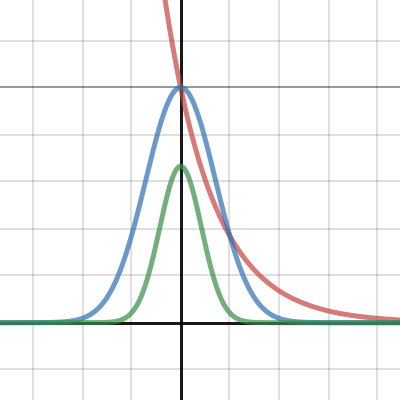
Desmos
I'm describing how these points where spawned, they tend to be mostly near the center.
And falls off exponentially.
 iron basalt
No, let put it this way. If I had a program that took in a bunch of 2d points th...
iron basalt
iron basalt
No, let put it this way. If I had a program that took in a bunch of 2d points th...
So given these points are your dataset. Initially you may have say a single point estimate, randomly chosen, so you can imagine there is some green point in this plot somewhere. And through many iterations, we adjust this a little bit each time. During each iteration, which get a random point, and move our point a little bit towards it (interpolation by alpha amount of the distance between them). Now if you keep doing this where do you think the green point will end up roughly?
glacial root
iron basalt
So given these points are your dataset. Initially you may have say a single poin...
i'm not understanding
do you mean that you start off with these datapoints, plus your random estimate, and then you get a random point which you move your estimate towards?
iron basalt
glacial root
do you mean that you start off with these datapoints, plus your random estimate,...
Yeah, we start with our own random point, and each time it gets pulled towards some randomly chosen point from the data.
glacial root
(i'm not gonna lie, i don't know how that works)
like i kind of guessed it and kind of see how it would make sense
iron basalt
It's pretty intuitive, that is why I chose simple 2D points.
glacial root
but i don't really fully understand how that results in an exact average
or is this an approximate
glacial root
oh wait yeah that makes sense now
iron basalt
If you only do like 3 iterations, probably way off.
glacial root
yeah not sure why i didn't see it completely before
so it converges towards the average
iron basalt
And note what happens when you pull too hard towards a point too.
iron basalt
If I pull with max strength, basically setting our point to the random one, it will just keep jumping everywhere, the result is not really a mix of all the points.
iron basalt
So instead we say like, move about 0.001 of the way there.
Like a small % of the way there.
glacial root
and how much we pull towards each point is our learning rate
iron basalt
Yes.
iron basalt
Not a neural network really, more broad.
glacial root
so it's more so just a way of averaging across large datasets more efficiently
man sometimes i worry
like earlier when i didn't see right away how it converges to the average
now i feel like that's just common sense
but i couldn't think of it
iron basalt
Well, now let me ask this, if you have a neural network with a single neuron, and you are "pulling" based on one of two labels (binary classification problem), rather than input point itself, could you use this idea? What would "pulling" be in this case? When we were pulling towards other points we relied on some idea of "distance" or "difference" between the points (where we currently are and some kind of "target"), and moved part of the way towards it.
glacial root
iron basalt
Well, now let me ask this, if you have a neural network with a single neuron, an...
well if it's a binary classification then we would probably have a threshold similar to that for an svm right
so then it would be pulled toward a side
iron basalt
glacial root
well if it's a binary classification then we would probably have a threshold sim...
In machine learning, the perceptron is an algorithm for supervised learning of binary classifiers. A binary classifier is a function which can decide whether or not an input, represented by a vector of numbers, belongs to some specific class. It is a type of linear classifier, i.e. a classification algorithm that makes its predictions based on...
 hearty depot
glacial root
why is numpy not optimal
hearty depot
glacial root
why is numpy not optimal
it runs on only cpu, when gpu is a lot quicker for stuff like matmul
glacial root
oh so what i said isn't bullshit
man sometimes i feel that even if im able to figure things out, there's this slight feeling that what i'm saying is meaningless yap
glacial root
hearty depot
it runs on only cpu, when gpu is a lot quicker for stuff like matmul
i see
iron basalt
I gotta go, but one more thing to ponder. In that random point thing we did. I said that each iteration we get a random point to move toward from the set. But what if it's not randomly picked? What if we took all the inputs and sorted them by x and y (in that order)? And then iterated over them in that order. Would it still end up giving a nice estimate in the end? What about with infinite iterations?
(Hint, imagine just two input points (or a bunch in each corner) on opposite ends of the image, where would the estimate end up?)
(With and without random picking)
glacial root
iron basalt
I gotta go, but one more thing to ponder. In that random point thing we did. I s...
well it would still converge to the average, it would likely take longer to get closer though, but with infinite iterations it still would converge to the average
glacial root
glacial root
man sometimes i feel that even if im able to figure things out, there's this sli...
also is this feeling likely just because i'm new to all of this
iron basalt
You can also just try simulating it yourself in Python.
glacial root
nah i mean in general
 quick cairn
how would i get ai into python?
glacial root
what does this question even mean
 fervent canopy
Search GitHub for API keys and export results to CSV. https://github.com/SanshruthR/GrepVault

GitHub
Search GitHub for API keys and export results to CSV. - SanshruthR/GrepVault
 jaunty helm
 bold rapids
I assume pandas
df[ df['LRank'] > df['WRank'] ]
 hallow badger
have any good project on gitHub you guys recommend to me
bold rapids
Hi
 silent haven
hello guys, i'm new to this server.
i'm here because i'm doing a uni project, i would like to know how to start learn ML, it would be of great help if you could recommend me some sources
i am not looking to make an LLM or anything of that sort, just something that looks at a few numbers and judges the severity of a situation, and prompts a few actuators
 jade prairie
which framework is easy to learn for CNN
 serene scaffold
jade prairie
which framework is easy to learn for CNN
serene scaffold
jade prairie
which framework is easy to learn for CNN
There is no easy way to learn about neural networks.
PyTorch is the most popular framework for implementing neural networks.
 fickle shale
Can anyone give me review of Deep learning by ian goodfellow book? Is good to read?or too depth and time waste?
 warm iron
Hey guys, I manually wrote a simple neural network with each mathematical operation. it is my first attempt to create something like this so I wanted to share it here. I am open to be critiqued! 🙂


 torn flint
That's impressive fr
I mean I'm a beginner, I wanted to code a nn from scratch I tried but it was tough so I kinda left that in the middle
Hope to redo it someday
 opaque condor
why do i have a type errorhttps://paste.pythondiscord.com/H22A
 lapis sequoia
torn flint
I mean I'm a beginner, I wanted to code a nn from scratch I tried but it was tou...
lapis sequoia
torn flint
I mean I'm a beginner, I wanted to code a nn from scratch I tried but it was tou...
check sentdex
he had great blog on it
i remember it used to be free but now he is monetising it with a book ig
opaque condor
opaque condor
why do i have a type errorhttps://paste.pythondiscord.com/H22A
What is the error that I'm missing if all the entire video that was using and reread everything over and over and over
 main fox
opaque condor
What is the error that I'm missing if all the entire video that was using and re...
main fox
opaque condor
What is the error that I'm missing if all the entire video that was using and re...
Isn't that the same code Wendigo had?
Also just from looking at it, your forward pass doesn't do anything
opaque condor
main fox
Isn't that the same code Wendigo had?
Yes I'm starting to try and learn convolution I couldn't find any tutorials and I know that if I try looking on Amazon for a book that doesn't have what I need it's going to take longer so I knew that Wendigo posting some code nothing we're working on convolution and I thought well I know that there's an error but if I can find out or at least have somebody guide me maybe they would learn if they came back to #data-science-and-ml
opaque condor
main fox
Also just from looking at it, your forward pass doesn't do anything
I know but it gives me an error for inputs which was already part of the original code
opaque condor
main fox
Isn't that the same code Wendigo had?
Here is the video wendigo used: https://youtu.be/pDdP0TFzsoQ?si=-qKX0vOd8VB5TU9j

New Tutorial series about Deep Learning with PyTorch!
⭐ Check out Tabnine, the FREE AI-powered code completion tool I use to help me code faster: https://www.tabnine.com/?utm_source=youtube.com&utm_campaign=PythonEngineer *
In this part we will implement our first convolutional neural network (CNN) that can do image classification based on the ...
 plain glacier
opaque condor
Here is the video wendigo used: https://youtu.be/pDdP0TFzsoQ?si=-qKX0vOd8VB5TU9j
plain glacier
opaque condor
Here is the video wendigo used: https://youtu.be/pDdP0TFzsoQ?si=-qKX0vOd8VB5TU9j
he's videos are really helpful, i recommend too.
 unkempt wigeon
opaque condor
https://paste.pythondiscord.com/R3OQ
unkempt wigeon
opaque condor
https://paste.pythondiscord.com/R3OQ
How did I miss that? Thank you sor....
unkempt wigeon
plain glacier
he's videos are really helpful, i recommend too.
He is I don't know how I missed the feed forward I hope to not repeat the same mistake in the future
 weary timber
torn flint
I mean I'm a beginner, I wanted to code a nn from scratch I tried but it was tou...
weary timber
torn flint
I mean I'm a beginner, I wanted to code a nn from scratch I tried but it was tou...
implementing something you just learnt is always tough, but trust me it will make you have a very good understading of nn's
glacial root
yo guys for a simple feed forward neural network, what learning rate range should i be using
serene scaffold
glacial root
yo guys for a simple feed forward neural network, what learning rate range shoul...
you can start with like .05 and decrease it by an order of magnitude if things aren't converging
glacial root
serene scaffold
you can start with like .05 and decrease it by an order of magnitude if things a...
i'm not sure what's going on, but everytime it only decreases the lowest element in the cost
like for one of the digits the average cost will be like 0.9 and it just won't even touch that
but then it goes for the one that's 0.07 or something
 cerulean violet
Guys is break dataset good for training my chatbot?
hearty depot
glacial root
yo guys for a simple feed forward neural network, what learning rate range shoul...
idt there is such thing as a "good" learning rate as it really depends on the data you are training on
if you want to optimize for convergence, i prop would recommend implementing an optimization algorithm like adam and also using some sore of initialization like kaiming if u r using relu and xavier for sigmoid
 acoustic seal
has anyone used paperspace gradient? im considering subscribing to it but it sounds a bit too good(?)
hearty depot
acoustic seal
has anyone used paperspace gradient? im considering subscribing to it but it sou...
Modal is better imo
acoustic seal
hearty depot
Modal is better imo
oo ill check that
 mystic peak
How do you give an ai a reward system
warm iron
glacial root
yo guys for a simple feed forward neural network, what learning rate range shoul...
In my opinion 0.01 is a good starting point
warm iron
mystic peak
How do you give an ai a reward system
That’s reinforcement learning 🤭 . You should read about that
glacial root
warm iron
In my opinion 0.01 is a good starting point
typically how do i avoid falling into valleys/local minima that are far from the actual minimum and ending up "trapped"
i think that's the main issue i'm currently having
hearty depot
glacial root
typically how do i avoid falling into valleys/local minima that are far from the...
That’s where stuff like Adam and other optimization algos come in to play
glacial root
hearty depot
That’s where stuff like Adam and other optimization algos come in to play
would this be called feature engineering?
or is that something different
hearty depot
glacial root
would this be called feature engineering?
nah its more like the algos for backprop
glacial root
oh i see
so there's multiple backprop methods
does the activation function also have a decent impact on this
hearty depot
glacial root
oh i see
https://arxiv.org/pdf/1412.6980
idk how strong u are with math but recommend reading this, a monumental paper
hearty depot
glacial root
so there's multiple backprop methods
ye there many diff optimization algos
glacial root
hearty depot
https://arxiv.org/pdf/1412.6980
idk how strong u are with math but recommend rea...
not too strong, just basic linear algebra and multivar calc
but i'll definitely look into it still
recently i've just been learning as i go when it comes to math
hearty depot
glacial root
does the activation function also have a decent impact on this
it does but i dont think u should worry about it at ur level
glacial root
so it's just the backprop algorithm i should be worried about for right now
hearty depot
glacial root
so it's just the backprop algorithm i should be worried about for right now
i think it's worth considering implementing cuz u can implement it without knowing the math behind this cuz u just need to copy formula
glacial root
hearty depot
i think it's worth considering implementing cuz u can implement it without knowi...
stochasthic optimization, or anything that has stochastic in it just means having to do with uncertainty right
hearty depot
glacial root
stochasthic optimization, or anything that has stochastic in it just means havin...
yeah in a sense for stochastic gradient descent ur taking a random subset of the data and using that to updae ur params
glacial root
hearty depot
yeah in a sense for stochastic gradient descent ur taking a random subset of the...
oh i see
so the purpose of taking a random subset rather than the whole thing is just for computational efficiency right
i remember 3blue1brown talking about creating groups of data and then doing backpropagation on each group separately, then averaging the results
not sure if that's exactly what it was, was something like that though
lapis sequoia
Hi! I have joined somewhere as an intern and have to start working from next monday in the field of data science i only have knowledge in numpy pandas matplotlib seaborn till intermediatry level so should I focus on machine learning more or should I make my understaning in the libraries more robust...
could anyone provide any advice
 serene grail
lapis sequoia
could anyone provide any advice
serene grail
lapis sequoia
could anyone provide any advice
I don't work in the field but other people will probably be able to help you better if you gave a more detailed job description.
Did they tell you what you will actually be doing on the job? "data science" is pretty vague
 austere prawn
I got a Pandas dataframe with lot of rows, but every pair of rows should be combined:
1 a x 50.0
1 a y 60.5
2 b x 10
2 b y 10.3
=>
1 a 50.0 60.5 21
2 b 10   10.3 3
What are my options to achieve this? Groupby, agg, transform or apply?
 grand breach
is it a good idea to label a small subset of data for image captioning task ?
 small wedge
austere prawn
I got a Pandas dataframe with lot of rows, but every pair of rows should be comb...
small wedge
austere prawn
I got a Pandas dataframe with lot of rows, but every pair of rows should be comb...
maybe you want to use groupby?
on that first column after the index
fervent canopy
Strategic Debate Arena: Words fuel your chess moves. https://github.com/SanshruthR/DebateMate

GitHub
Strategic Debate Arena: Words fuel your chess moves. - SanshruthR/DebateMate
 rich river
is super().__init__() required in pytorch models' __init__ function?
 drifting gust
fervent canopy
Strategic Debate Arena: Words fuel your chess moves. https://github.com/Sanshrut...
drifting gust
fervent canopy
Strategic Debate Arena: Words fuel your chess moves. https://github.com/Sanshrut...
I'm sold at pawn b4 - but I'd just be a spectator as I'm too lazy to debate
 ivory root
Hey guys, am still new to ML I just finished building my first supervised model but am still learning, am currently using collab and when I tried using CSV file not from the course I was following its not working am trying to upload it straight from my pc but it ain't working. If anyone met with this issue I would love you help
torn flint
Hi I'm training a cnn model, with like custom conv layers
Everything is fine just consecutive epochs the accuracy and everything turns 0
Please help me
drifting gust
I CAN HELP U
probably ur messing up ur forward pass bro
googles accuracy
"Neural network accuracy, a measure of how often a model correctly predicts outcomes"
yes bro it sounds like ur overfitting
or some other world ending phenominon
like gradient vanishing cause u have like 5 layers of conv nets
and no dropout (ds0nt is currently drunk and getting into troubles)
drifting gust
torn flint
Please help me
help sent
 unkempt apex
fervent canopy
Strategic Debate Arena: Words fuel your chess moves. https://github.com/Sanshrut...
unkempt apex
fervent canopy
Strategic Debate Arena: Words fuel your chess moves. https://github.com/Sanshrut...
ohh, how you got this idea??
austere prawn
small wedge
maybe you want to use groupby?
Yes thank you! I managed to do what I wanted using groupby, agg and transform. 👍
Next is a jupyter notebook question. Can I with a for loop output text and plots interleaved?
for i in (1,2,3):
    print(i)
    plot(i)
Outputs
1
2
Plot1
Plot2
Whereas I would like
1
Plot1
2
Plot2
lmao that's a good question

So, I used to read a lot of comics and watch a shit tonne of cartoon as a kid. In many of those marvel comics, the superior beings used to pretend that all of the heroes and the villains were just pieces
and everything was just a grand game
 austere prawn
fervent canopy
Strategic Debate Arena: Words fuel your chess moves. https://github.com/Sanshrut...
austere prawn
fervent canopy
Strategic Debate Arena: Words fuel your chess moves. https://github.com/Sanshrut...
This is amazing 😍
austere prawn
austere prawn
Next is a jupyter notebook question. Can I with a for loop output text and plots...
I figured out I should show my figures explicitly with fig.show() 👍😊
fervent canopy
austere prawn
This is amazing 😍
thank you sm 😄
torn flint
I just realised I should use ml algos instead of dl
Taking reference from existing kaggle notebook
Why to complicate things when it can be done easily
10 conv layers for a dataset containing 1000 items will obviously cause overfitting
 dry lynx
anyone know how make click farm for youtube if yes dm
austere prawn
torn flint
I just realised I should use ml algos instead of dl
What is dl?
dry lynx
austere prawn
What is dl?
Bro do you know how mak click farm
 arctic wedgeBOT
The rules and guidelines that apply to this community can be found on our rules page. We expect all members of the community to have read and understood these.
 austere prawn
torn flint
Deep Learning my dear
austere prawn
torn flint
Deep Learning my dear
So condescending 😂
serene scaffold
are we talking about data science?
torn flint
austere prawn
So condescending 😂
What am I supposed to say
dry lynx
oki
glacial root
what's haskell used for
torn flint
I've never used it but I feel it's something mathematical
austere prawn
torn flint
Seems like you're into coding since very long
11 years professionally 🙂
torn flint
austere prawn
11 years professionally 🙂
Sir 🙏🙏
Rather call you Mr David instead of "Bro"
austere prawn
🙏
glacial root
torn flint
Rather call you Mr David instead of "Bro"
yes 💯
must give due respect
he's a veteran programmer
glacial root
always great to meet an expert
 magic sorrel
How do you organize your files? I took a bunch of courses and now getting into data projects, but I have file all over the place. Some are python venv, some art jupyter, some pull from different data sets, some are just trying new methods. some are a continuous lists of hypotehsis test. is there a best practice or recommended way or organizing this?
 stuck tapir
magic sorrel
How do you organize your files? I took a bunch of courses and now getting into ...
stuck tapir
magic sorrel
How do you organize your files? I took a bunch of courses and now getting into ...
Make a main projects/datascience/ folder, then each project gets its own folder with things like data/, notebooks/, and models/. use a venv for each project and git to track changes, that'll keep things tidy
atl that works for me
magic sorrel
you are using vscode or jupyter ?
stuck tapir
magic sorrel
you are using vscode or jupyter ?
i use both occasionally, you can also use any of the above, the folder structure being neat is all the matters
magic sorrel
https://www.thinkingondata.com/how-to-organize-data-science-projects/ this one felt a little skimpy ...

Managing the organization of a data project means evaluate what are the objetives of your organization system, how do you want to structure your data, the way that you want to have a backup system and a version control and finally how to document all your processes.
https://github.com/drivendataorg/cookiecutter-data-science this one feels better, but a tad over complicated..
GitHub
A logical, reasonably standardized, but flexible project structure for doing and sharing data science work. - drivendataorg/cookiecutter-data-science
actually, maybe it's just right. - after thinking about it
austere prawn
Is it possible to run a regular python file as a jupyter notebook? I don't see why it couldn't with just a few markers for cell division.
from jupyter import MADE_UP_THING as next_cell

print(1)
next_cell()
print(2)
Technically yeah, you could create a tool to parse Python files and insert cell division markers. However, it's not a standard feature you'd essentially be building a custom conversion script.
austere prawn
stuck tapir
Technically yeah, you could create a tool to parse Python files and insert cell ...
Rough. 🤔
stuck tapir
austere prawn
Rough. 🤔
ikr
stuck tapir
grand breach
is it a good idea to label a small subset of data for image captioning task ?
yes, small labeled subsets are fine for bootstrapping. use active learning or pseudo-labeling to expand the dataset efficiently.
 tawdry sundial
where can i finetune llm online?
I am trying to finetune around 8B parameter models like llama
I tried on google collab but its slow and very limited
I find it hard to understand the pricing range for gpu renting
hearty depot
tawdry sundial
where can i finetune llm online?
I am trying to finetune around 8B parameter m...
modal is good imo
glacial root
austere prawn
Is it possible to run a regular python file as a jupyter notebook? I don't see w...
at that point why not just put it into a notebook file lol
tawdry sundial
hearty depot
modal is good imo
found runpod about 2x cheaper. however modal offers 30$ credit, worth a try
serene scaffold
tawdry sundial
where can i finetune llm online?
I am trying to finetune around 8B parameter m...
You might not be able to get that much computation power and time for free.
Oh you're willing to buy credit
tawdry sundial
settled for runpod and modal they seem like a good option
austere prawn
glacial root
at that point why not just put it into a notebook file lol
Several issues:
- Contains binary data
- Requires jupyter notebook
It would be neat to have them runable standalone as well. As to easier share them with other developers and git them as is. Also allow simpler editing with any editor.
But maybe this is exactly what jupytext is! Is it? 🤗
 river cape
Hey guys so I was playing around with RNN using the imdb dataset, so initially I added a maxlen of 50 for the pad_sequences,I just made my input vocabulary to 10000 and then followed this architecture
model.add(Embedding(input_dim=10000,output_dim=2,input_length=50))
model.add(SimpleRNN(32,return_sequences=False))
model.add(Dense(1,activation='sigmoid'))
I did get an accuracy of 75 on the validation set , but then this time , I did these changes to the architecture
model.add(Embedding(input_dim=88364,output_dim=80,input_length=2943))
model.add(SimpleRNN(32,return_sequences=False))
model.add(Dense(1,activation='sigmoid'))
and I am only getting a constant accuracy of 50% , how do I increase it? Is it possible to achieve 75%+ accuracy using SimpleRNN
hearty depot
austere prawn
Is it possible to run a regular python file as a jupyter notebook? I don't see w...
%run file.py
stuck tapir
river cape
Hey guys so I was playing around with RNN using the imdb dataset, so initially ...
the drastic accuracy drop likely stems from the increased vocabulary size and sequence length. with a larger vocabulary (88364), the embedding layer's weight matrix becomes significantly larger, making it harder to train effectively, especially with a simple rnn. similarly, the extended sequence length (2943) can lead to vanishing gradients, hindering learning. try reducing the vocabulary size, lowering the sequence length, or using lstm or gru layers, which handle long sequences better. also, experiment with different learning rates and optimizers, and consider adding regularization techniques like dropout. finally, verify your data preprocessing and ensure no unintended data leaks.
stuck tapir
austere prawn
Several issues:
1. Contains binary data
2. Requires jupyter notebook
It would b...
yeah, jupytext sounds like what you need. it lets you pair .py and .ipynb files for easier editing and sharing. i'm not sure about binary data, but it's worth checking out.
 narrow tiger
Isit possible to know why did the AI/llm give certain answer??
stuck tapir
narrow tiger
Isit possible to know why did the AI/llm give certain answer??
yeah kinda, they give answers based on patterns they’ve seen during training. not always clear why exactly, but it's not random.
narrow tiger
stuck tapir
yeah kinda, they give answers based on patterns they’ve seen during training. no...
I mean if i ask an AI "what is 2+2" and it replies 5 all i can say is it did so bcz it saw this in training data, and not exactly know "WHY" it replied with 5 , right?
stuck tapir
narrow tiger
I mean if i ask an AI "what is 2+2" and it replies 5 all i can say is it did so ...
yeah exactly, llms don’t really “understand” in the human sense. they generate outputs based on learned statistical patterns from training data. if it says “2+2=5,” it’s likely due to token prediction errors, spurious correlations, or overfitting to noisy data. no true symbolic reasoning or logical grounding behind the answer.
 tender hearth
narrow tiger
Isit possible to know why did the AI/llm give certain answer??
tender hearth
narrow tiger
Isit possible to know why did the AI/llm give certain answer??
explainability is a whole sub field of its own
read the anthropic blog post on golden gate claude if you haven’t already
narrow tiger
Thanks i will
stuck tapir
 bright comet
how to can i make an AI who helps me programming?
bright comet
how to can i make an AI who helps me programming?
there are many out there already, but you could also try
finetuning other llms to fit to the task you need (what type of programming etc)
or you could also train the model on a code dataset and add an interface to it
stuck tapir
tender hearth
explainability is a whole sub field of its own
yeah XAI and all that
 smoky ingot
hello i am new i wanna learn about ai so from where should i start plz guide me
stuck tapir
smoky ingot
hello i am new i wanna learn about ai so from where should i start plz guide me
start with basic ai concepts (ml, dl), then learn python and key libraries like numpy and scikit-learn. take online courses, build practical projects, and explore deep learning frameworks like tensorflow or pytorch. join online communities, and keep learning through blogs and papers. hands-on practice is crucial.
stuck tapir
check coursera (andrew ng), fast.ai, scikit-learn's site, and tensorflow/pytorch docs. for youtube, try 3blue1brown, sentdex, or Lex Fridman. consistent practice is key
smoky ingot
stuck tapir
check coursera (andrew ng), fast.ai, scikit-learn's site, and tensorflow/pytorch...
thank you
 eager horizon
im thinking about starting to make a resume and upload projects, what are all the avenues. Github Repositories, Resume, anything else?
serene scaffold
eager horizon
im thinking about starting to make a resume and upload projects, what are all th...
please only ask the same question in one place, to avoid duplicating effort. You asked this in #career-advice
jaunty helm
bright comet
how to can i make an AI who helps me programming?
from 0? with a lot of money and data
austere prawn
How to prevent seaborn from drawing multiple plots on top of other plot? I didn't have this issue before, it suddenly started to happen 🥴
jaunty helm
austere prawn
How to prevent seaborn from drawing multiple plots on top of other plot? I didn'...
likely because you plotted two axes-level functions wo creating a new axes in between (or something else that makes the two draw on different axes)
eg you could do
fig, axs = plt.subplots(ncols=2)
sns.scatterplot(..., ax=axs[0])
sns.lineplot(..., ax=axs[1])
or like
sns.scatterplot(...)
plt.subplot()
sns.lineplot(...)
It was enough to do
sns.stripplot(...)
sns.barplot(...)
Without any ax, I think. But I might misremember
(because I was doing ax stuff at some point)
All of this state-machinery in matplotlib is so confusing. 😕
serene scaffold
austere prawn
All of this state-machinery in matplotlib is so confusing. 😕
matplotlib sucks
just use plotly
austere prawn
What's the correlation? Completely independent things? Which is newer?
Seaborn is quite big and looks nice and is on top of matpotlib. It's also big and scary 😝
@serene scaffold
glacial root
bright comet
how to can i make an AI who helps me programming?
first learn what ai is
river cape
stuck tapir
the drastic accuracy drop likely stems from the increased vocabulary size and se...
Oh so due to the vanishing gradients , RNN becomes useless in this case . I see... Thanks for the info
austere prawn
austere prawn
What's the correlation? Completely independent things? Which is newer?
Seaborn ...
I missed to reply you @serene scaffold
serene scaffold
austere prawn
What's the correlation? Completely independent things? Which is newer?
Seaborn ...
not sure what you mean by correlation, but plotly doesn't share any code with matplotlib.
river cape
is it possible to build an llm from scratch? I do have the data and i do have graphical power to some extend
serene scaffold
river cape
is it possible to build an llm from scratch? I do have the data and i do have gr...
is it possible in general? yes--otherwise the ones that already exist would not.
is it possible to do it with the hardware and amount of training data that you have? very probably not.
austere prawn
serene scaffold
not sure what you mean by correlation, but plotly doesn't share any code with ma...
Yeah that's what I meant. Thanks.
river cape
serene scaffold
is it possible in general? yes--otherwise the ones that already exist would not....
Oh so we as a team , wanted to make llm that only answers questions regarding medicine , is fine tuning the way?
serene scaffold
river cape
Oh so we as a team , wanted to make llm that only answers questions regarding me...
you should probably use an existing LLM and RAG, without any fine-tuning.
river cape
serene scaffold
you should probably use an existing LLM and RAG, without any fine-tuning.
But it shouldnt leak the author name or the publishers name , or else we would be sued
Is it possible to achieve that using fine - tuning
austere prawn
serene scaffold
matplotlib sucks
just use plotly
Ah, and plotly is not tied to python. Seems good 👌
serene scaffold
river cape
Is it possible to achieve that using fine - tuning
fine-tuning can't guarantee that that won't happen
austere prawn
Did I just waste a week doing matplotlib stuff? 😱😝
river cape
serene scaffold
fine-tuning can't guarantee that that won't happen
So how to combat that issue
 runic ibex
can anyone help me build a RAG on prem with python. thinking of using railway app
stuck tapir
river cape
Oh so due to the vanishing gradients , RNN becomes useless in this case . I see....
yw
serene scaffold
river cape
So how to combat that issue
there's no way to guarantee that an LLM will or won't do something. You can include instructions in the prompt to do things a certain way, and if the LLM is good at following explicit instructions ("don't include any personal names in your response"), it probably never will. but if this is a situation where you're worried about getting sued, you need to include some post-processing on the LLM's response that will deterministically guarantee that the rule is followed.
serene scaffold
austere prawn
Did I just waste a week doing matplotlib stuff? 😱😝
if you spent a week trying to learn matplotlib, you increased your tolerance for suffering.
austere prawn
serene scaffold
if you spent a week trying to learn matplotlib, you increased your tolerance for...
That tolerance is already extremely high 😅
austere prawn
serene scaffold
if you spent a week trying to learn matplotlib, you increased your tolerance for...
First hurdle, quick question: Does plotly need internet connection to show plots?
serene scaffold
austere prawn
First hurdle, quick question: Does plotly need internet connection to show plots...
No
austere prawn
Ok good, I got an empty browser screen on my first try with some Javascript loading... So got scared.
opaque condor
https://paste.pythondiscord.com/R3OQ
Did I do anything wrong I am using what @unkempt wigeon
I keep on getting an input error
stuck tapir
opaque condor
https://paste.pythondiscord.com/R3OQ
Did I do anything wrong I am using what <@8...
you’ve got a stray self.conv1() in __init__, remove it, it’s trying to run the layer without input.
also your test loop accuracy logic could use some fixing,
austere prawn
serene scaffold
No
But it does seem like I need to do some special stuff: https://foongminwong.medium.com/plotting-data-with-plotly-offline-mode-in-an-air-gapped-environment-5844df874537#:~:text=Plotly's offline mode overcomes this,analysis without compromising security protocols.

Medium
When conducting demos in secure locations or areas with limited or no internet connection, displaying interactive visualizations of…
opaque condor
stuck tapir
you’ve got a stray self.conv1() in `__init__`, remove it, it’s trying to run the...
Which line?
austere prawn
Probably not done today. But thank you for the help
stuck tapir
opaque condor
Which line?
just remove
x = self.conv1()
from the ConvNet __init__
class ConvNet(nn.Module):
    def __init__(self):
        super(ConvNet, self).__init__()
        self.conv1 = nn.Conv2d(3, 6, 5)
        self.pool = nn.MaxPool2d(2, 2)
        self.conv2 = nn.Conv2d(6, 16, 5)
        self.fc1 = nn.Linear(16 * 5 * 5, 120)
        self.fc2 = nn.Linear(120, 84)
        self.fc3 = nn.Linear(84, 10)
hopefully that solves the issue.
opaque condor
why is that there i dont see anything
opaque condor
stuck tapir
just remove
x = self.conv1()
from the ConvNet `__init__`
```python
class ConvNet...
tell me what line
stuck tapir
opaque condor
tell me what line
41-51
stuck tapir
ywyw
in your test loop
if (labels == pred):
should be comparing each label, not the full tensors, so just replace it with
if label == pred:
Line 111
opaque condor
I already changed that a long time ago
acc = 100.0 * n_class_correct[i] / n_class_samples[i]
It's giving me this error
0 division error float division by zero
opaque condor
stuck tapir
ywyw
Ywyw?
stuck tapir
opaque condor
Ywyw?
your welcome,
opaque condor
stuck tapir
your welcome,
Ty I don't use abriveations often so thank you so much
opaque condor
opaque condor
0 division error float division by zero
From what I can see on my screen the accuracy looks like it should but it's giving me an error zero division error
stuck tapir
fixed it overall,
with torch.no_grad():
    n_correct = 0
    n_sample = 0

    n_class_correct = [0 for _ in range(10)]
    n_class_samples = [0 for _ in range(10)]

    for images, labels in test_loader:
        images = images.to(device)
        labels = labels.to(device)

        outputs = model(images)
        _, predicted = torch.max(outputs, 1)

        n_sample += labels.size(0)
        n_correct += (predicted == labels).sum().item()

        for i in range(len(labels)):
            label = labels[i].item()
            pred = predicted[i].item()
            if label == pred:
                n_class_correct[label] += 1
            n_class_samples[label] += 1

    acc = 100.0 * n_correct / n_sample
    print(f'Overall Accuracy: {acc:.2f}%')

    for i in range(10):
        if n_class_samples[i] == 0:
            acc = 0.0
        else:
            acc = 100.0 * n_class_correct[i] / n_class_samples[i]
        print(f'Accuracy of {classes[i]}: {acc:.2f}%')
Just added a zero check,
also, that error means that n_class_samples[i] is 0 for at least one class.
so recheck that,
Could've happened cuz of if (labels == pred): error
because you were comparing the entire labels tensor to a single pred, the condition was likely never true --> so n_class_correct[label] was never incremented, and in some cases, n_class_samples[label] wasn't either if it crashed
opaque condor
stuck tapir
fixed it overall,
```python
with torch.no_grad():
n_correct = 0
n_sample...
Would you like to chat about this and voice chat zero?
stuck tapir
opaque condor
Would you like to chat about this and voice chat zero?
cant vc, could chat
the first problem in your code was that you were like running a layer with NO INPUT BTW in __init__ where we define layers so that's what was causing that
and the second error arose by using the WHOLE tensor instead of indivisual comparison, which obv would result in 0 then, and then /0
opaque condor
Are you able to get on to voice chat because it'll make everything a whole lot faster if you can just listen and type also I did something bad to my visual code Studio key bindings so I guess I'm going to have to go to idle
opaque condor
And what about voice chat when it's not being used I'm sorry
stuck tapir
opaque condor
And what about voice chat when it's not being used I'm sorry
clarity?
opaque condor
F-zero is array being used one doesn't have anyone in it so therefore it won't be able to be used unless you would be comfortable with something else
stuck tapir
Ah, you mean class 0 didn’t appear in the test set, so n_class_samples[0] stayed zero? Makes sense right, that’s why the division by zero happened
opaque condor
How can I fix that division error?
stuck tapir
adding a zero check, like I did
    for i in range(10):
        if n_class_samples[i] == 0:
            acc = 0.0
        else:
            acc = 100.0 * n_class_correct[i] / n_class_samples[i]
        print(f'Accuracy of {classes[i]}: {acc:.2f}%')
and fixing if (labels==pred): to
if label == pred:
 hollow pagoda
hi im learning neural networks, in the first two screenshots i learned how to use polynomial transforms to add nonlinearities to the linear regression,
im trying to understand why it's said that you cant do this same thing for the hidden layers in neural networks, and the first solution is to perform sigmoid transformation on the data (it might be something obvious im misunderstanding)


i understand why the sigmoid one works to calculate logistic loss on a logistic regression but can you not use that synthetic feature from the first examples on the hidden layer and leave the equations linear?

apparently it makes it an 'activation layer' tho so ima continue reading but id appreciate feedback
opaque condor
do I need visual code Studio to process torch
hollow pagoda
hollow pagoda
hi im learning neural networks, in the first two screenshots i learned how to us...
according to openai it sounds like the poly transform of crossing to features is just one example and the NN finds the best one on its own?
 hollow pagoda
ok i get it now
 stuck tapir
opaque condor
do I need visual code Studio to process torch
stuck tapir
opaque condor
do I need visual code Studio to process torch
what do you mean by process torch?
stuck tapir
hollow pagoda
ok i get it now
polynomial transformations in linear regression help add nonlinearity by expanding the feature space, but neural networks need activation functions (like sigmoid or ReLU) to introduce nonlinearity in each layer. without activations, the network would just be stacking linear equations, limiting its ability to learn complex patterns. activation functions allow the model to adapt and find the best features during training. it's not just about adding nonlinearity; it's about learning the right transformations for each layer.
opaque condor
stuck tapir
what do you mean by process torch?
I put into the regular ide and it gave me it could either find it even though I know don't loaded into the system because I've managed to make a feed forward Network using torch
stuck tapir
opaque condor
I put into the regular ide and it gave me it could either find it even though I ...
Which regular IDE, IDLE?
opaque condor
Python
opaque condor
stuck tapir
Which regular IDE, IDLE?
The installation ide
stuck tapir
you don't need visual studio code to use pytorch; you just need the right python environment set up. make sure you have pytorch installed in your environment. you can check that by running pip show torch in your terminal or command prompt. if it's not installed, you can install it with pip install torch. let me know if you're still having trouble
jaunty helm
hollow pagoda
hi im learning neural networks, in the first two screenshots i learned how to us...
the non-linearity in nns is added thru activation functions; sigmoid's one of them, but nowadays ReLU (which is just max(0, value)) is more popular
why it's said that you cant do this same thing for the hidden layers
assuming you mean, why not more complex functions in neurons instead of simple weighted sums
the latter is very easy to compute, makes backprop a lot easier, and they can universally approximate anyways
hollow pagoda
stuck tapir
polynomial transformations in linear regression help add nonlinearity by expandi...
appreciate that
hollow pagoda
jaunty helm
the non-linearity in nns is added thru activation functions; sigmoid's one of th...
thank u too
rich river
my current project require libtorch-gpu, onnxruntime, cuda-toolkit and cudnn, and the overall image size is so big, any ideas?
silent haven
silent haven
i am not looking to make an LLM or anything of that sort, just something that lo...
pls reply
 odd meteor
rich river
my current project require libtorch-gpu, onnxruntime, cuda-toolkit and cudnn, an...
odd meteor
rich river
my current project require libtorch-gpu, onnxruntime, cuda-toolkit and cudnn, an...
You might wanna use cloud for this instead of running it on your local machine.
stuck tapir
hollow pagoda
appreciate that
your wlecome
stuck tapir
silent haven
i'm here because i'm doing a uni project, i would like to know how to start lear...
yeah classic ml would be fine for the uni proj, try google’s ml crash course or kaggle's beginner stuff to get hands-on fast. use sklearn for basic models like logreg or decision trees. also check "intro to ml with python" if you like coding while learning. lmk if you get stuck!
stuck tapir
rich river
my current project require libtorch-gpu, onnxruntime, cuda-toolkit and cudnn, an...
you could try using a lighter base image like nvidia cuda runtime instead of the full devel one, and only install the exact libs you need. libtorch and onnxruntime both have minimal builds too. also try multi stage docker builds to keep only runtime dependencies in the final image. if it's still too big, micromamba or conda-pack inside an alpine base can help shrink it further.
rich river
stuck tapir
you could try using a lighter base image like nvidia cuda runtime instead of the...
thank you
if it's still too big, micromamba or conda-pack inside an alpine base can help shrink it further.
I dont know anything about this
stuck tapir
rich river
thank you
> if it's still too big, micromamba or conda-pack inside an alpine bas...
no prob,micromamba is a super lightweight conda replacement, good for small docker builds. conda-pack lets you zip up a prebuilt env and move it into a smaller image. both help avoid bloated installs.
unkempt apex
silent haven
pls reply
you should elaborate more about your project
silent haven
unkempt apex
you should elaborate more about your project
smart water monitoring system basically, an iot project
We could use a normal algorithm or threshold but we decided to go for bonus point using ML
opaque condor
Can a label be in a folder?
unkempt apex
silent haven
smart water monitoring system basically, an iot project
take a reference from available projects
stuck tapir
opaque condor
Can a label be in a folder?
label as in what?
stuck tapir
silent haven
smart water monitoring system basically, an iot project
yo that’s clean , def go w/ unsupervised anomaly detect (iso forest or lstm) on flow/pressure/time. catch leaks + weird usage w/o fixed thresholds. bonus if u add turbidity/pH + do dirty water classify too.
silent haven
stuck tapir
yo that’s clean , def go w/ unsupervised anomaly detect (iso forest or lstm) on ...
thanks a lot dude, will inform on the status soon!
stuck tapir
silent haven
thanks a lot dude, will inform on the status soon!
your welcome, looking forward to it.
opaque condor
stuck tapir
label as in what?
For the images cuz I might add some of my own data to the network after it's been training
stuck tapir
opaque condor
For the images cuz I might add some of my own data to the network after it's bee...
like image classification?
opaque condor
Yes
stuck tapir
if yes then yea ofc thats how most people do it
warm iron
Any idea about the best / the most common image preprocessing techniques for the further use in CNNs? 🥲
serene scaffold
warm iron
Any idea about the best / the most common image preprocessing techniques for the...
preprocess what kind of images for a CNN that does what?
stuck tapir
warm iron
Any idea about the best / the most common image preprocessing techniques for the...
basics like resize, center crop, normalization, random flip, rotation, color jitter, maybe even blur,
mostly light unless youre training BIG time, then it'll be more complex
 past meteor
warm iron
Any idea about the best / the most common image preprocessing techniques for the...
past meteor
warm iron
Any idea about the best / the most common image preprocessing techniques for the...
If you're using a pre-trained model you should use the same preprocessing that was used during training
Typically whatever package you're using will have that readily available for the model you're using
warm iron
stuck tapir
basics like resize, center crop, normalization, random flip, rotation, color ji...
Thanks !
warm iron
serene scaffold
preprocess what kind of images for a CNN that does what?
Medical image data. CNN that will extract features from the images
stuck tapir
warm iron
Thanks !
your welcome,
 safe agate
austere prawn
Is it possible to run a regular python file as a jupyter notebook? I don't see w...
safe agate
austere prawn
Is it possible to run a regular python file as a jupyter notebook? I don't see w...
You can use a marimo notebook instead
jaunty helm
if you're on vscode w/ the jupyter extension, you can do this in a .py file
# %%
print('cell 1')

# %% [markdown]
# # Header
# some md text

# %%
print('code cell 2')
Never heard about 😲
safe agate
austere prawn
Never heard about 😲
You should check it out, it's great. I'm actually hosting a marimo workshop next month in this server.
past meteor
warm iron
Medical image data. CNN that will extract features from the images
Then definitely use the preprocessing from the pretrained model you’re using
And if you’re not using one, you probably should 😄
stuck tapir
warm iron
Why
consistency, optimal performance, avoiding errors
as for why to use pretrained models,
faster dev, better perfromance, resource efficiency
fervent canopy
warm iron
Why
Hyper is right about using pretrained models. You should almost always try to work with pretrained models unless you have access to a bunch of A100s and a shit tonne of data. By the rule of thumb, you should never try to reinvent the wheel
Pretrained models and fixed architectures exist for a reason
People almost always use Adam, Nadam or SGD
and as I like to say, the inventor of wheel must've got paid nothing, but the owner of ferrari does
small wedge
Facts
past meteor
warm iron
Why
I like the analogy that the first part of training CNNs is just about teaching it what elementary features are
So instead of starting from 0, take one that is pretrained and continue training that one to fit it to your domain
serene grail
past meteor
I like the analogy that the first part of training CNNs is just about teaching i...
Like detecting edges in an image, for example?
 next ember
guys i have a question
is this result okay for my work
its a "pv panel image segmentation with ai" project, 1st images are panel images, 2.s are my masks and 3rds are model prediction results.
I got > 0.96 dice_coef and > 0.95 accuracy with 30 epoch on around 200 train images. please mention me in your reply, thanks.
end goal is making true masks and model predictions close as much as possible

 woeful escarp
Hello, I am starting in ML, I would like to work in a project to improve, send me DM
river cape
past meteor
I like the analogy that the first part of training CNNs is just about teaching i...
Probably a Resnet would help I believe
next ember
woeful escarp
Hello, I am starting in ML, I would like to work in a project to improve, send m...
we can talk if you think you can help my question above
river cape
serene grail
Like detecting edges in an image, for example?
So intially in a CNN , we have a convolution operation(just another matrix multiplication task). In this operation , a small kernel or filter is slided across the image , thereby this filter helps to detect the edges of the image
and after detecting edges , we tend to get a lil higher level features
river cape
next ember
guys i have a question
is this result okay for my work
its a "pv panel image seg...
is your train accuracy and val_accuracy at 95% accuracy? or only train?
next ember
river cape
is your train accuracy and val_accuracy at 95% accuracy? or only train?
binary_accuracy: 0.9755 - dice_coef: 0.9494 - loss: 0.0506 - val_binary_accuracy: 0.9624 - val_dice_coef: 0.9227 - val_loss: 0.0842
past meteor
serene grail
Like detecting edges in an image, for example?
Correct
 merry ridge
I have a folder with tens of thousands of training images, and sometimes I just want to quickly scroll through and visually inspect them in windows to make sure nothing odd showed up in the pipeline. Windows doesn't seem to really like managing extremely large folders. It can take a minute or two for the folder to even open. Is there something I can download that makes navigating these files a bit easier in the same way someone might use voidtools instead of the default Windows search.
stuck tapir
fervent canopy
and as I like to say, the inventor of wheel must've got paid nothing, but the ...
fr
stuck tapir
past meteor
So instead of starting from 0, take one that is pretrained and continue training...
yeah it's like adopting a fairly smart child
stuck tapir
next ember
`binary_accuracy: 0.9755 - dice_coef: 0.9494 - loss: 0.0506 - val_binary_accurac...
🔥 solid results! you're hitting high accuracy and dice
looks like your model’s generalizing well.
stuck tapir
merry ridge
I have a folder with tens of thousands of training images, and sometimes I just ...
try XnView MP or IrfanView , both are lightweight image viewers that can handle massive directories super fast
you can also check out FastStone Image Viewer if you want a clean UI + quick scrolling. way smoother than default explorer.
stuck tapir
serene grail
Like detecting edges in an image, for example?
yea
stuck tapir
woeful escarp
Hello, I am starting in ML, I would like to work in a project to improve, send m...
bet dm
merry ridge
stuck tapir
try XnView MP or IrfanView , both are lightweight image viewers that can handle ...
This looks like exactly what I needed thanks
stuck tapir
merry ridge
This looks like exactly what I needed thanks
your welcome!
fervent canopy
If anyone is interested in YOLOv12 and comparing its performance with YOLOv11 and YOLOv8 in real-world scenarios, I made this

GitHub
Real-time monitoring, object tracking, and line-crossing detection for CCTV camera streams. - SanshruthR/CCTV_SENTRY_YOLO12
next ember
stuck tapir
🔥 solid results! you're hitting high accuracy and dice
looks like your model’s ...
Yay! I made it 🙂
stuck tapir
next ember
Yay! I made it 🙂
yup
stuck tapir
fervent canopy
If anyone is interested in YOLOv12 and comparing its performance with YOLOv11 an...
ooh, I have a project similar to this coming up, will look into it.
 waxen echo
is it easy to get into making like AI bots for games, or anything realistically?
serene scaffold
waxen echo
is it easy to get into making like AI bots for games, or anything realistically?
No, it's very hard
Unless you want to use existing APIs that don't require you do know anything about AI. But then that's a software development effort, not an AI one.
 cedar tusk
waxen echo
is it easy to get into making like AI bots for games, or anything realistically?
cedar tusk
waxen echo
is it easy to get into making like AI bots for games, or anything realistically?
ai bots are very hard for 2 reasons
1st is you need an interface that connects to the game or make a similar game yourself
2nd is depending on the game the amount of variables is too much. Obviously if you are doing pacman or pong its gonna be not that hard, but if its anything 3d for example its gomna become impossible to properly manage and calculate the inputs for the ai model.
 dry raft
this may be niche, but how can get a pdb file (protein data bank) structure into embeddings for a huggingface model?
I know that I can turn it into a set of coords and perform dimensionality reduction and then embed it as text, but I feel like that there is something more advanced that can truly capture the complexities of protein structure
the alpha-helices, beta-pleated sheets, cysetine bonds, etc
btw ping or dm me
i'll be off maybe
stuck tapir
dry raft
I know that I can turn it into a set of coords and perform dimensionality reduct...
totally , coords + dim red miss key stuff. better to use gnns (residues as nodes), or 3d grids. combine with seq models like esm2/protbert. use biopython/torchdrug to parse pdbs. depends on your goal, happy to help more!
safe agate
austere prawn
Is there a time and date set?
April 12 from 11 AM to 12 PM PST, it'll be announced shortly as well
 mighty lake
for data science, without going into any further detail, at what point should I move on to R
 plain leaf
yoo chat, i learnt langchain and thought cool, now i can build projects, but recently everyone started to bash langchain and are moving to llamaindex or PydanticAI, I need to get a job ASAP, I'm strong with fundamentals but struggling with these gazzillionn frameworks..some one please help and i need a production ready project to start applying for stuffs..
 vocal cove
serene scaffold
No, it's very hard
Unless you want to use existing APIs that don't require you ...
vocal cove
serene scaffold
No, it's very hard
Unless you want to use existing APIs that don't require you ...
Depends on your definition of hard then. You could always train an RL agent to play a game. You could also do a finite state approach which is how most NPC from back in the day worked.
I doubt he wants sth as sophisticated as like NPCs from MGSV, or MW 2022, or TLOU 2.
He could try making the ghosts from PACMAN.
gym has environments for most of those OG games for which you can make agents for.
vocal cove
mighty lake
for data science, without going into any further detail, at what point should I ...
Uhh, python is enough. R for me is a matter of preference, not objective advantage in a certain aspect.
In python you have matplotlib, you have pandas, you have scipy, you have numpy, all of which are amazing tools for datascience and even basic AI/ML (for when you want to make a NN from scratch).
That's my 2 cents on it. You can of course see if R has any advantage depending on what you want to do in specific.
 eager mantle
guys not to interrupt but can anyone tell me if these are good regression evaluation metrics for real estate predictions?

given that the mean house prices are over 1,200,000
vocal cove
eager mantle
guys not to interrupt but can anyone tell me if these are good regression evalua...
They seem rather large. Lower is better.
Sth I usually like is just checking the accuracy on train and test datasets.
It's a percentage, it takes your dataset into consideration (thus context), and is easier to debug for model performance.
eager mantle
Thanks
vocal cove
My pleasure. I'm curious to see what your acc is too now.
Vanishing gradients go burrrr
 eager mantle
💀
vocal cove
When you train tensor networks, you really start to feel orthogonality catastrophe.
eager mantle
tensor flop
vocal cove
This is reaching that okay accuracy on a rather tiny tensor network. I wanted to keep it to a simple, global optimization approach, but that leads to orthogonality catastrophe, and that leads to vanishing gradients, and that leads to poor convergence as my networks get larger in size.
I have a love/hate relationship with it. I like how it makes sense, but don't like how inconvenient it is.
eager mantle
vocal cove
I have a love/hate relationship with it. I like how it makes sense, but don't li...
kind of my entire relationship with hyperparameter tuning
vocal cove
eager mantle
kind of my entire relationship with hyperparameter tuning
Yeeep.
stuck tapir
plain leaf
yoo chat, i learnt langchain and thought cool, now i can build projects, but rec...
focus on building a real-world project with what you know
try a chatbot, recommendation system, or an AI-driven web app
that'll show solid fundamentals and real production-ready work
stuck tapir
mighty lake
for data science, without going into any further detail, at what point should I ...
if you're comfortable with Python and libraries like pandas, numpy, and scikit-learn, stick with it for now
move to R if you hit complex statistical analysis or need its specialized packages (e.g., ggplot, caret)
otherwise, Python is more versatile for most data science tasks
jaunty helm
if you're doing some niche statistics, R might have better support than python in some cases
example: in my very limited experience, if you want to do SEM, lavaan is more feature complete than semopy
stuck tapir
yep, that’s true
R shines for niche stats like SEM (lavaan) or bio stats
python’s catching up, but R’s libraries still lead in some areas
so if you’re deep into stats, R’s worth considering
jaunty helm
also another thing to consider: you can use both together
RMarkdown is like jupyter notebooks but you can run both R and python snippets; packages like reticulate also allow you access your pd.DataFrames in R code to bridge the gap
stuck tapir
yeah, exactly!
RMarkdown + reticulate is a great combo
lets you mix R and Python seamlessly, so you get the best of both worlds
perfect for projects that need both languages
 verbal oar
if I have android, adobe, google
how can I cluster them
like distance between adobe and google is smaller than between android and adobe
make vectors from words and see in visualization
is it possible to do?
then I would have cluster with tech and cluster with companies
I think they would not be placed as I expect
jaunty helm
verbal oar
if I have android, adobe, google
how can I cluster them
like distance between ad...
use an embedding model, which turns text into vectors, then you can use say cosine similarity to compare the vectors
verbal oar
yes I know it in theory ok I check it in practice thanks
maybe also inter and intra cluster (forgot was distance?)
and wcss
jaunty helm
verbal oar
then I would have cluster with tech and cluster with companies
tho I just ran a quick test with all-MiniLM-L6-v2, a bit old, but it thinks that android and google are closer, prob cause the former is a product of the latter
verbal oar
actually I have android and adobe words, google is just hypothetical
I did pos tagging on words now I have nouns and want to filter it further
yes closer of course example not good because complicates things
maybe other example algebra, android, adobe
Corresponding to math, tech, company
but I dont have any labels
also I have 700 words
stuck tapir
verbal oar
I think they would not be placed as I expect
yep, you can create word vectors for "android", "adobe", and "google" and calculate the distances between them. once you do that, you can use a technique like t-SNE to visualize them in 2D or 3D. you'll likely see clusters form, but they might not match your exact expectations
dry raft
stuck tapir
totally , coords + dim red miss key stuff. better to use gnns (residues as nodes...
thanks man!
i really needed this, tryna do my first independent paper
stuck tapir
dry raft
thanks man!
ywww
dry raft
stuck tapir
ywww
🙏😁
plain leaf
stuck tapir
focus on building a real-world project with what you know
try a chatbot, recomme...
the thing is i get really good ideas which are overly completed and requires me to learn complex stuffs, or else I get very basic no use ideas.. and i have decided to just make the shitty ideas, till i get comfortable with pushing the boundaries
stuck tapir
plain leaf
the thing is i get really good ideas which are overly completed and requires me ...
push your boundaries dude dw
get complicated ideas but then dedicate on manifesting them
dry raft
stuck tapir
ywww
btw, how do I then tokenize the GNN for my huggingface model?
idk if i mentioned it or not tbh
stuck tapir
dry raft
btw, how do I then tokenize the GNN for my huggingface model?
you can tokenize the gnn by first converting the graph structure into a format that huggingface can handle, like a sequence of node features or a graph-based input. you can use libraries like torch-geometric or dgl to handle graph processing, then extract node features and adjacency information. from there, you can tokenize the node features and edges into a suitable input format (e.g tensors) and feed them into the huggingface model. if you're using esm2/protbert, you might want to integrate the graph structure with the sequence model’s embeddings, but thats just imo
dry raft
stuck tapir
you can tokenize the gnn by first converting the graph structure into a format t...
i'm using protbert for the seq btw
dry raft
stuck tapir
you can tokenize the gnn by first converting the graph structure into a format t...
should I also learn some graph theory?
besides i'm learning discrete maths as abase for learning ml
stuck tapir
dry raft
should I also learn some graph theory?
yeah, learning some graph theory would definitely help
especially since you're working with graph-based models like GNNs. understanding concepts like graph representations, adjacency matrices, and node embeddings will make it easier to work with graph data and integrate them into your models. discrete math is a great base for this, as it covers the fundamentals you’ll need to grasp graph theory and more advanced ML concepts down the road
dry raft
stuck tapir
especially since you're working with graph-based models like GNNs. understanding...
nice!
 muted vine
hello
someone here can explain me how works the dialogflow IA?
to capture the text and directs to the correct intent
stuck tapir
dialogflow works by using nlp to match user text to the closest intent you’ve set up. you define sample phrases per intent, and it uses ML to detect which one fits best. once matched, it can trigger a response or webhook to handle logic. you can access the raw user input too if needed.
 knotty wolf
any data scientist aspirant bangali here?
serene scaffold
knotty wolf
any data scientist aspirant bangali here?
Always include your follow up question in the first question.
knotty wolf
serene scaffold
Always include your follow up question in the first question.
let's learn together
 twin sail
Hey Guys, I need some help with an automation project using Pywinauto. I'm stuck on a crucial part—analyzing tabular data inside a Pane. The problem is that this data doesn’t appear in the control identifiers, so I can't access it directly.
To work around this, I tried capturing an image of the table and using Tesseract OCR to extract the text. However, the accuracy is only around 80%, and some important data is being extracted incorrectly.
Would AI-based OCR be a better approach? Or is there another way to extract this data more reliably? Any suggestions would be appreciated!
serene scaffold
(tesseract is AI, but that's neither here nor there.)
stuck tapir
twin sail
Hey Guys, I need some help with an automation project using Pywinauto. I'm stuck...
table data isn’t exposed in the ui tree, so pywinauto can’t access it directly. use paddleocr instead of tesseract, it’s ai-based and much better at reading structured tables. also try inspecting with inspect.exe or pyuiautomation to see if deeper elements can be accessed
twin sail
stuck tapir
table data isn’t exposed in the ui tree, so pywinauto can’t access it directly. ...
Thanks i will try these tomorrow!
 dense needle
mighty lake
for data science, without going into any further detail, at what point should I ...
dense needle
mighty lake
for data science, without going into any further detail, at what point should I ...
late here but in addition to what others said about using R for stats stuff, I think EDA is easier in R and the plots in R are easier/better
*plotting using ggplot2 package
if you end up using R, dplyr is usually recommended as the go to package for cleaning/manipulating data but i recommend data.table instead
syntax is less intuitive but it is much faster for big data sets
disclaimer: i actually did data science stuff in R before I learned python. however, R was not my first programming language
 round parcel
can I do DL on an rtx 4060 laptop?
jaunty helm
round parcel
can I do DL on an rtx 4060 laptop?
depends on what you mean
like say a simple mnist classifier CNN isn't really resource intensive
on the other hand, small & usable LLMs eat at least a few gbs
 naive axle
I'm training an image classifier model using pytorch , in each epoch accuracy of training change from 0.08% then to 0.0%, what could be the most probable cause to oscillate training accuracy like this
small wedge
naive axle
I'm training an image classifier model using pytorch , in each epoch accuracy of...
a learning rate that's too high, a batch size that's too low, could be any number of things
naive axle
learning rate too high means like 0.001 or 0.1?
small wedge
.1 would generally be too high for any large model, .001 could work for a lot of models but the point is not the actual number that you set but the scheduling you're doing
usually to avoid the model jumping around right when it's about to reach convergence people will decay the learning rate
batch size also matters though, regardless of your learning rate that could cause a problem by giving poor gradient estimates
naive axle
got it
hallow badger
Gemini 2.0 flash create image sounds look very powerful, what do you're thinking about that
stuck tapir
round parcel
can I do DL on an rtx 4060 laptop?
yeah def, an rtx 4060 laptop can handle most dl tasks pretty well. you can train cnn models, run transformers, even fine-tune small llms if you manage vram smartly. just keep an eye on thermals and maybe use mixed precision where you can.
stuck tapir
naive axle
I'm training an image classifier model using pytorch , in each epoch accuracy of...
could be high lr, bad data, broken loss function, or something like all labels being one class. try lowering the lr, double-check the dataset, and print a few batches to make sure labels make sense
stuck tapir
naive axle
learning rate too high means like 0.001 or 0.1?
yeah so 0.1 is usually too high for anything deep
0.001 is often a good starting point, but best to test + use schedulers like reduceonplateau or cosine decay to avoid bouncing near convergence
stuck tapir
hallow badger
Gemini 2.0 flash create image sounds look very powerful, what do you're thinking...
looks promising yeah. flash models seem focused on efficiency and fast generation, especially for multimodal stuff. would love to see how it stacks up to sdxl or dalle when it comes to detailed image quality and prompt control
lapis sequoia
Yo so like, yolo object detection, yay or neigh? And why is CV so limited with deep learning or something?
stuck tapir
lapis sequoia
Yo so like, yolo object detection, yay or neigh? And why is CV so limited with d...
yolo? yay for speed, def. real-time object det like a beast. but kinda trades off accuracy vs slower models like faster rcnn. as for cv being “limited”, not really, it's just that most DL cv models need hella data + can't reason like humans (yet)
 quartz karma
Hi, if i have list of integer with arbitrary duplications as following {1,2,3,3,4,5,6,6,6,7,...,10000} and I sliced the list into sub lists with varing lengths so that there's no duplicate values in different sub lists. The sliced list is like this: {1,2,3,3} {4,5,6,6,6} {7,...} ... {..., 10000}
My question is, is there a simple mathematical function subID = F(x), where x is value of arbitrary element, subID is the identify number of the sub list that x is categorized to?
 stable hollow
Hopefully this is a really simple question but I have a line chart with a table of the values beneath it. It would be really nice for the first cell in each row to have the little symbol showing which line it is. Can this be done?
(example is from excel)
 lapis sequoia
Guys I need help , I am building a chat bot using RAG : the problem is that I feed data through pdfs , but I need to fetch that data directly from the website (url) , so it answers with the updated information from the website. Is that possible ?
unkempt apex
lapis sequoia
Guys I need help , I am building a chat bot using RAG : the problem is that I fe...
so you are feeding data through pdf, so where does that pdf goes?
on that website which you are referring?
jaunty helm
quartz karma
Hi, if i have list of integer with arbitrary duplications as following {1,2,3,3,...
so that there's no duplicate values in different sub lists. The sliced list is like this: {1,2,3,3} ...
doesn't{1, 2, 3, 3}contain duplicates?
or ig, you mean that for all sublists, no item in sublist_i can be in sublist_j
but then you don't have a unique way to do that, e.g. you could've cut it into
{1, 2, 3, 3, 4, 5}, {6, 6, 6, 7}, ...
yo so if the sublists are made by grouping duplicates together, like all same numbers stay in same sublist (and appear only once per sublist),
then nah, there’s no simple math function F(x) that maps x -> subID directly unless u track how many unique values showed up before x in the full list.
u basically need either a dict mapping x → subID (if slicing is done already),
or build F(x) by knowing the slice rules (e.g sublist ends when next dup shows up)
so unless the sublist pattern is strict + predictable, can’t define clean F(x),
stuck tapir
stable hollow
Hopefully this is a really simple question but I have a line chart with a table ...
excel doesn’t auto-sync chart markers into tables, so u gotta manually color + symbol-code the first cell to match the line chart legend
stuck tapir
lapis sequoia
Guys I need help , I am building a chat bot using RAG : the problem is that I fe...
instead of feeding static PDFs, u can scrape + chunk text live from the URL.
just use something like bs or newspaper3k to extract content from webpages, then pass it into your retriever like u did with pdfs.
 lofty knoll
Hello, good day to you. I need help. I'm having troubles in paste values of formula in python, how should I do this? I would want to loop all xlsx in a folder and paste as values all of the live formula included in files of the folder. 🙏
Thanks in advance 🙏
lapis sequoia
Hi! i am new with the data analytics and want to practise as i have gone throught the libraires like numpy pandas matplotlib seaborn -> but practise is what i lack so could anyone tell me which kaggle dataset or code i can use or what to do in this situation...
serene scaffold
stable hollow
Hopefully this is a really simple question but I have a line chart with a table ...
Remember to show code
stable hollow
serene scaffold
Remember to show code
I don't have any code because I don't know how to do this :(
I'm hoping somebody can help me make the code to do it
serene scaffold
Where do you want these tables to appear?
stable hollow
serene scaffold
Where do you want these tables to appear?
...
On my computer screen?
serene scaffold
In a notebook? On a web page? As a PNG?
stable hollow
Not sure I understand what you mean
serene scaffold
In a word document? In a pdf?
stable hollow
serene scaffold
In a notebook? On a web page? As a PNG?
In a notebook I guess but maybe we will export to png
glacial root
stable hollow
On my computer screen?
 austere prawn
glacial root
https://tenor.com/view/dead-my-honest-reaction-damn-skull-skeleton-gif-158859379...
austere prawn
glacial root
https://tenor.com/view/dead-my-honest-reaction-damn-skull-skeleton-gif-158859379...
Died from laughter? 😂
austere prawn
stable hollow
I'm hoping somebody can help me make the code to do it
Do you want to add something into your excel sheet?
Or do you want to draw the graph and the table data using python + jupyter notebook?
glacial root
austere prawn
Died from laughter? 😂
nah died from tomfoolery
glacial root
stable hollow
On my computer screen?
cause bro what 🙏
stable hollow
austere prawn
Do you want to add something into your excel sheet?
Or do you want to draw the g...
Ah I see the confusion -
I'm just trying to mimic what Excel is doing.
I've already got a line graph in seaborn and a matching table in matplotlib
Basically everything works except inserting these legend symbols into the cells
austere prawn
stable hollow
Ah I see the confusion -
I'm just trying to mimic what Excel is doing.
I've ...
Do you have some existing code now to print the table to share?
I have never seen legend icons repeated in table, but it does some like a great convenience for the reader 👍👍👍
stable hollow
austere prawn
Do you have some existing code now to print the table to share?
I have never se...
Ya lemme bring it up. Thank you btw!
safe agate
Ooh I'd be interested too on legend icons repeated in the table
jaunty helm
in the table sounds like a hassle
either you somehow put the string representation of what you want into a new column, or you hack jupyter's html to display what you want
(or maybe there's a 3rd way unknown to me)
stable hollow
austere prawn
Do you have some existing code now to print the table to share?
I have never se...
Here's the full script, looks like you can remove the comments to make it a notebook again
arctic wedgeBOT
stable hollow
Here's the full script, looks like you can remove the comments to make it a note...
Please react with ✅ to upload your file(s) to our paste bin, which is more accessible for some users.
stable hollow
jaunty helm
*in the table* sounds like a hassle
either you somehow put the string representa...
That's doable tbh as long as its not necessary to change stuff every time I want to do new data. Ideally this is all automated beyond pasting some data
austere prawn
The text I would guess is already in the table. The question is how to get an icon there that matches the legend's style. I think it would be A LOT of work
stable hollow
austere prawn
The text I would guess is already in the table. The question is how to get an ic...
rip
how come its not a lot of work to get it in the seaborn legend???
surely its just a bunch of shapes???
glacial root
for a digital camera pipeline should i be using opencv
serene scaffold
Did someone delete their own message?
hollow pagoda
does anyone know why normalization made V3 column clone V2
 hollow pagoda
serene scaffold
Did someone delete their own message?
hollow pagoda
serene scaffold
Did someone delete their own message?
yea me i just resent it
stuck tapir
lofty knoll
Hello, good day to you. I need help. I'm having troubles in paste values of form...
you can use openpyxl to load each .xlsx file, evaluate the formulas, and replace them with their values
stuck tapir
lapis sequoia
Hi! i am new with the data analytics and want to practise as i have gone through...
grab a beginner-friendly Kaggle dataset like Titanic (predict survival), Netflix Movies & TV Shows (EDA practice), Superstore Sales (sales insight, great for visuals), Spotify Dataset (music features, good for plotting/correlations)
hearty depot
lapis sequoia
Hi! i am new with the data analytics and want to practise as i have gone through...
imo best way to become is to scrape ur own data
i find kaggle is way too simple most of the time and more interesting data comes from data one sources themselves
main fox
Wondering if anyone familiar with NLP has come across a similar problem and can offer alternative approaches.
I was recently tasked with extracting evidence of a certain medical condition from PDFs. These PDFs are very non-standard in their form. They sometimes span hundreds of pages.
The particular evidence in question is valid if a patient has had a related screening in the last two years.
The dates of service for these procedures are also very non-standard. They can by yyyy-MM-dd, or of the form "Jan 12, 2025", etc.
Sometimes the patient refuses to have the procedure, so some sort of "assertion" needs to happen to check this. Also sometimes the evidence is related to a family member.
I ended up building a rule based program that just looks for keywords, parses dates using regex, looks if certain words like "refused" are present in a small context window. Being just regex/word matching, it runs very fast, and I know exactly how it works. But it can definitely miss charts that have valid evidence.
stuck tapir
main fox
Wondering if anyone familiar with NLP has come across a similar problem and can ...
yo that's a super common real-world nlp challenge
messy, domain-specific docs w/ inconsistent formats. honestly, your rule-based setup sounds solid for precision + speed. to boost recall, maybe try a hybrid setup: keep ur regex for speed, but add a lightweight ML/LLM layer (like a distilBERT fine-tuned on examples of positive/negative evidence chunks) to catch edge cases. you can also use spaCy’s dependency parsing for better assertion logic (e.g. link “refused” to the right subject). also worth extracting & normalizing dates w/ dateparser, it handles weird formats better than custom regex
serene scaffold
main fox
Wondering if anyone familiar with NLP has come across a similar problem and can ...
ripping text out of PDFs is a whole problem, regardless of what kind of text it is or what you plan to do with it.
main fox
We have OCR in place that is very accurate
I'll have to look more into spaCy
It wasn't until after I built the program that I noticed medspacy has something called "ConText" for the assertion part
Handwritten notes are definitely a mess sometimes
The rest of the text, including text in tables, is extracted with good accuracy
serene scaffold
Medspacy is still a thing?
I'm at the creator of it in like 2018
I met*
He was trying to decide if you wanted to build on my platform or start something new
And he built something new
hollow pagoda
hollow pagoda
hollow pagoda
does anyone know why normalization made V3 column clone V2
holy shit im dumb
main fox
serene scaffold
He was trying to decide if you wanted to build on my platform or start something...
Idk if it's relevant, but it came up when I was googling for how to handle assertions/negations
What platform you got? 👀
river cape
Hi , so I tried to train a model using colab , now after training the model , if I run the model.fit cell again , does it further train the same model
and if i want to train the model from scratch , should i restart the session?
jaunty helm
river cape
Hi , so I tried to train a model using colab , now after training the model , if...
sklearn? then no, .fit retrains the model
if you want something that can continue training, look for models that have .partial_fit
river cape
jaunty helm
sklearn? then no, .fit retrains the model
if you want something that can continu...
a neural network
river cape
jaunty helm
sklearn? then no, .fit retrains the model
if you want something that can continu...
the method .partial_fit is not avaiable in keras
hollow pagoda
river cape
the method .partial_fit is not avaiable in keras
wouldnt you increase epochs to train it further?
and just set the params to the latest results
cedar tusk
hollow pagoda
does anyone know why normalization made V3 column clone V2
just to make sure
can you check the mean and variance of both columns
maybe the correlation is 1
 hidden cloud
Hi guys ,
I’m a beginner
serene scaffold
hidden cloud
Hi guys ,
I’m a beginner
hello and welcome to our wonderful data science channel.
fickle shale
serene scaffold
hello and welcome to our wonderful data science channel.
Hii Bro! Can u give me some advice regarding deep learning how can i deep dive in deep learning?
hidden cloud
serene scaffold
hello and welcome to our wonderful data science channel.
Thanks
I wanna be a Data scientist what should I do as a beginner?
serene scaffold
fickle shale
Hii Bro! Can u give me some advice regarding deep learning how can i deep dive i...
don't start with deep learning. start with simpler models and work your way up.
serene scaffold
hidden cloud
I wanna be a Data scientist what should I do as a beginner?
focus on learning concepts, not tools.
you'll need a degree to get a job.
start by doing data exploration with datasets from kaggle.
serene scaffold
@stuck tapir your message was removed for seeking an employee, which is not allowed.
stuck tapir
oh dang mb
hearty depot
serene scaffold
don't start with deep learning. start with simpler models and work your way up.
i'd disagree if u ok at math
like if u know basic linear and what convexity is
u basically have enough to make most models by just copying architecture
for stuff that has a little bit more math like vae u can learn the stats on the way
serene scaffold
hearty depot
like if u know basic linear and what convexity is
the people who ask for help in this channel are usually complete beginners. if someone isn't a complete beginner, it's incumbent on them to say where they're at.
hidden cloud
serene scaffold
focus on learning concepts, not tools.
you'll need a degree to get a job.
start ...
Thanks
glacial root
serene scaffold
hello and welcome to our wonderful data science channel.
also the best python channel
 flint grotto
I want to study LLM, but all the books and materials are theses. I want to find books and materials, so please recommend some.
hearty depot
flint grotto
I want to study LLM, but all the books and materials are theses. I want to find ...
Read attention is all u need paper
Then read gpt2
Once uread this try to load the weights and try to perform inference
flint grotto
hearty depot
Then read gpt2
humm..okey.
muted vine
stuck tapir
dialogflow works by using nlp to match user text to the closest intent you’ve se...
do youu know if a nlp model like this is easy to create? like if i want to create my own dialogflow appliocation?
lapis sequoia
Ok, GridsearcCV hyperparameter tuning with cv=4; the roc_score and the accuracy score from that is not the same from using sklearn.metrics for accuracy and the roc auc score, right?
hollow pagoda
cedar tusk
maybe the correlation is 1
yea it was, it was a frequency (amt of times donating blood), and monetary ($ earned donating blood) i wasnt thinking
 left sapphire
any pandas users here know how to run map() while retaining references to the current row and column of each element?
I have a data format where I have dozens of columns with categorical IDs, i.e.
incident_type, materials_type, human_factors
102, 50, 3
140, 42, 5
and each of those integers matches a lookup table where incident_type:102=STRUCTURE FIRE, materials_type:50=COMPRESSED GAS, etc
so I need to know what column I am on while doing an applymap so I can sub in the correct lookup table value
glacial root
this may be a trivial question, but do people generally prefer importing individual methods or modules, or just importing the whole library and having to type out everything (not wildcard import, don't worry i'm not that stupid)
serene scaffold
glacial root
this may be a trivial question, but do people generally prefer importing individ...
You can't import methods, you can only import the class they belong to.
It also sounds like you're confusing modules and libraries
I think what you meant to ask was "do people prefer importing modules or importing individual classes and functions?"
glacial root
serene scaffold
You can't import methods, you can only import the class they belong to.
It also...
we can't?
i mean like the "from ... import ..."
glacial root
serene scaffold
I think what you meant to ask was "do people prefer importing modules or importi...
yeah this is what i meant
is a module not a group of methods?
like for example with numpy, there's the linalg module
serene scaffold
glacial root
is a module not a group of methods?
No. It sounds like you think "function" and "method" mean the same thing
A method is a function that belongs to a class. All methods are functions, but not vice versa
glacial root
wait yeah my bad i meant function
i gotta get rid of the habit of saying methods and parameters and instead say functions and arguments
serene scaffold
glacial root
i gotta get rid of the habit of saying methods and parameters and instead say fu...
it's less common to need to distinguish between parameters and arguments
 quaint mulch
fickle shale
Hii Bro! Can u give me some advice regarding deep learning how can i deep dive i...
quaint mulch
fickle shale
Hii Bro! Can u give me some advice regarding deep learning how can i deep dive i...
and also @hidden cloud
https://www.pythondiscord.com/resources/?topics=data-science
http://introtodeeplearning.com/
https://deep-learning-drizzle.github.io/
https://kidger.site/thoughts/just-know-stuff/
https://github.com/aprbw/ArianDLPrimer (I made the last list myself)
quaint mulch
flint grotto
where is LLM text books? recommend the books.
https://github.com/EleutherAI/cookbook does cook book counts as a book?
GitHub
Deep learning for dummies. All the practical details and useful utilities that go into working with real models. - EleutherAI/cookbook
quaint mulch
serene scaffold
I think what you meant to ask was "do people prefer importing modules or importi...
So what's the answer?
I'm actually curious too
I usually just import the modules.
But I see a lot of codes that does otherwrise.
Is it just personal preference, or there is a a best practice I am missing?
And what you do personally?
serene scaffold
quaint mulch
So what's the answer?
I'm actually curious too
I usually just import the modules...
It's pretty much a matter of preference and what feels right for the situation.
 spring field
it is also typically influenced by example code
like if I see that they import the module with an alias, I'll probably do the same in my code
if I see them importing specific names from a module, I'll also do that most likely
 neat crystal
how can i stop my language model ai from just using punctuation spamm to get cheat the system
my current debug to show yall the sample generation
arctic wedgeBOT
neat crystal
my current debug to show yall the sample generation
Click here to see this code in our pastebin.
stable hollow
austere prawn
The text I would guess is already in the table. The question is how to get an ic...

did it
austere prawn
Nice!
stable hollow
deriving the bbox position and spacing of the seaborn legend from the cell heights of the table, I am able to fake it
I am such a clever boy I deserve a treat
I know
as a little treat, I will take back the holy land from the nonbelievers
I can see it now - a holy war spreading across the land like unquenchable fire
fanatical legions worshipping at the shrine of my skull
a war in my name
everyones shouting my name
river cape
Heyyy guys I have a dissertation to make , could you recommend some problem statements that i should be working on ?
neat crystal
im making a ai and its already questioning me
Generated text after epoch 8:
<user> Hi how are you? <bot> '' what did you know ? ? ? ? ? ? ? ? ? ? ? ? ? ? ? ? ? ? ? ? ? ? ? ? ? ? ? ? ? ? ? ? ? ? ? ? ? ? ? ? ? ? ? ? ? ? ? ? ? ? ? ? ? ? ? ? ? ? ? ? ? ? ? ? ? ? ? ? ? ? ? to do ? ? ? ? ? ? ? ? ? ? ? ? ? ? ? ?
river cape
neat crystal
im making a ai and its already questioning me
Generated text after epoch 8:
<us...
what model are you using??
neat crystal
river cape
what model are you using??
What do you mean? uh i here i let you look
    model = Sequential([
        Embedding(
            vocab_size,
            embedding_dim,
            weights=[embedding_matrix],
            input_length=CONFIG["max_sequence_len"],
            trainable=True  # Fine-tune embeddings
        ),

        Bidirectional(LSTM(lstm_units, return_sequences=True)),
        Dropout(dropout_rate),

        LSTM(lstm_units, return_sequences=True),
        Dropout(dropout_rate),

        LSTM(lstm_units),
        Dropout(dropout_rate),

        Dense(vocab_size, activation='softmax')
])```im still learning but is this labeling accurate? or are those not layers

dense might be just the activation layer before output
neat crystal
hollow pagoda
im still learning but is this labeling accurate? or are those not layers
yes thats correct,,, i think? wait no yes no i think each of those is its own model? yes i think your right
hollow pagoda
ya i think each model computes their own layers, atleast thats what it looks like
 grand minnow
I made a chatbot that is powered by Google Gemini. How do I track and limit it so that it doesn't make me go broke?
 hoary wigeon
Hey guys, I need help.
I started my journey in Data Science in 2022 and have been working with classical ML algorithms since then. Now that I have some time, I want to upgrade my skills and stay up to date with the latest tech stack. I need guidance on where to start and the best resources to learn from.
 pearl barn
I have question what is the best course to learn python data analysis maven Analytics course or Jose Portilla course??
pearl barn
hoary wigeon
I started my journey in Data Science in 2022 and have been working with classica...
Me too
 static oar
I wanted to replicate a project from github which translates sign language to English and vice versa. I can't even run the original project, let alone create a new one. Appreciate your patience and time.
Here's the repo link: https://github.com/kevinjosethomas/sign-language-processing
GitHub
✌️ An ASL fingerspell recognition and semantic pose retrieval interface (arXiv, GitHub, YouTube) - kevinjosethomas/sign-language-processing
glacial root
anyone here know of any good resources to look up on setting up a digital camera pipeline
hearty depot
glacial root
anyone here know of any good resources to look up on setting up a digital camera...
Opencv is decent
 olive obsidian
Hi, hopefully this is the right channel but I'm sure someone around might have an idea about this. I'm working on a project where I'm receiving the position data from a sensor (x, y). I'm now looking into the Kalman filter to better forward predict the position of the sensor with a couple of milli seconds (~100-300ms).
I've been reading up on the Kalman filter and trying to implement it. I'm curious if someone around has done this before and might want to help me a bit.
The Kalman filter I want to create should keep track of the estimate with [x, y, vx, vy]. What I'm especially curious about is how I setup the state covariance matrix (P) ? Should I simply come up with some values for the P-matrix?
glacial root
hearty depot
Opencv is decent
is there any way to detect and correct lens distortions of an image with just that image or do i need multiple images with different perspectives
 random rune
Hello 🙂 could someone give me some clues on how to do my homework please 🙂 Apologies if this isn't the right place to post!


message me if you can maybe give me some clues - I want to figure it out for myself but I'm just needing a little push haha
I did manage to help some help from my classmate on task 2 in the end - i sort of understand it now

 untold fable
arctic wedgeBOT
untold fable
untold fable
arctic wedgeBOT
untold fable
Click here to see this code in our pastebin.
untold fable
pls check this out
opaque condor
@rich moth how did you manage to get your graphs to work
glacial root
hearty depot
Opencv is decent
do you know of any good resources to learn the theory behind it
cedar tusk
glacial root
do you know of any good resources to learn the theory behind it
lol youtube
glacial root
cedar tusk
lol youtube
all the youtube videos i've been finding either just give a very basic overview or they just straight up show the code (which i don't want, i want to be able to code it myself after learning the theory)
it wasn't like that for neural networks, i was able to find in depths theory videos for that, which allowed me to implement it myself using just numpy
hearty depot
glacial root
do you know of any good resources to learn the theory behind it
This is ok primer to classical cv
glacial root
oh wait this is exactly what i was referred to by someone else lol
i could not understand the first part of 2.1 though
i must be stupid or something
after the homogenous vector part i just did not know where things were coming from
hearty depot
glacial root
after the homogenous vector part i just did not know where things were coming fr...
Hm
I’d focus on getting good at linear first
A lot of ml will be painful if u don’t know linear and stats well
glacial root
i see
i know linear to an extent, but it could definitely be better
part of it thought was just that i didn't know where some of the equations were coming from
like for example with this

i get that lambda is a diagonal matrix (it is right?) but i have no clue as to what this is being used for
hearty depot
glacial root
i get that lambda is a diagonal matrix (it is right?) but i have no clue as to w...
Is lambda constrained to 0 to 1?
glacial root
hearty depot
Is lambda constrained to 0 to 1?
yeah
so that gives us r = mew * p + lamba * q
quaint mulch
I'm still not sure what do you want?
Do you need help to find more dataset than 600k?
Do you need help to refine the 7k instance?
Are you showing one project outcome and asking for feedback on this "report"?
Are you asking for another project idea?
quaint mulch
river cape
Heyyy guys I have a dissertation to make , could you recommend some problem stat...
Do you have more info about the dissertation? Any topic limitation?
Maybe show us some problem statements you have think about, and we can give you feedback it is too easy or too hard.
Maybe tell us your interests?
quaint mulch
hollow pagoda
im still learning but is this labeling accurate? or are those not layers
The input layers could have been multiple layers. Have to double check with the definition of the Embedding class. But it seems to be a single layer, since there is only one embedding_matrix. but looks like it is expecting a list, so it could have been multiple layers.
The output layer is most probbably not just an activation layer, because the name of the class is Dense, which is usually a linear layer.
quaint mulch
hoary wigeon
Hey guys, I need help.
Check which part you are comfortable with, and then just skip it and go for the next one.
also @pearl barn
https://www.pythondiscord.com/resources/?topics=data-science
http://introtodeeplearning.com/
https://deep-learning-drizzle.github.io/
https://kidger.site/thoughts/just-know-stuff/
https://github.com/aprbw/ArianDLPrimer (I made the last list myself)
quaint mulch
static oar
I wanted to replicate a project from github which translates sign language to En...
why can't you run it?
You got an error?
Copy paste the error?
quaint mulch
olive obsidian
Hi, hopefully this is the right channel but I'm sure someone around might have a...
Yes, you initialize it with your best guess.
If your guess is far-off, then it just takes more time/steps/data until your filter starts working better.
quaint mulch
glacial root
is there any way to detect and correct lens distortions of an image with just th...
This is a very tricking question, and the answer might range from "it is mathematicaly impossible with just one image" to maybe few lines of codes, depending on the details of your camera setup and what you are trying to do.
quaint mulch
random rune
I did manage to help some help from my classmate on task 2 in the end - i sort o...
are there any part of this function that you still do not understand?
quaint mulch
hearty depot
Is lambda constrained to 0 to 1?
No. @glacial root Lambda is not constaint, it ranges from -infinity to infinity
just scroll to the end of the page. It says so.
If you want a 3D line, then there is no constraint
if you want a 3D line SEGMENT, then you should constraint it
 quaint mulch
glacial root
i get that lambda is a diagonal matrix (it is right?) but i have no clue as to w...
quaint mulch
glacial root
i get that lambda is a diagonal matrix (it is right?) but i have no clue as to w...
No. Lambda is litereally just a number, not a matrix.
clue: it is not bold.
more technically, it is a variable belonging to a set of real numbers, functioning as a parameterisation of the line.
glacial root
oh wait yeah i forgot only bolded items are matrices
quaint mulch
glacial root
i get that lambda is a diagonal matrix (it is right?) but i have no clue as to w...
If you think that you are travelling from P to Q, then lambda just is the "percentage" of your travel.
at lambda = 0, you are at P
at lambda = 1, you are at Q
at lambda = 0.5 you are halfway between P and Q
etc2.
at lambda =-1, you are travelling the wrong way, you are as far aways as P is from Q, but on the wrong way
at lambda = 2, you have travelled past Q
@glacial root I made some edit
quaint mulch
glacial root
oh wait yeah i forgot only bolded items are matrices
bolded are vectors i think
quaint mulch
I just edited my explanation above, does it make sense now?
hollow pagoda
quaint mulch
The input layers could have been multiple layers. Have to double check with the...
how can there be multiple input layers? do you mean nodes
hollow pagoda
quaint mulch
If you think that you are travelling from P to Q, then lambda just is the "perce...
so in this screenshot of his, lambda basically represents x-axis (3d depth) with points plotted on y-axis and z-axis?

but lambda being x within the lines, like progression from point 1 to 2 as u explained
iron basalt
hollow pagoda
so in this screenshot of his, lambda basically represents x-axis (3d depth) with...
 olive obsidian
quaint mulch
Yes, you initialize it with your best guess.
If your guess is far-off, then it j...
olive obsidian
quaint mulch
Yes, you initialize it with your best guess.
If your guess is far-off, then it j...
Thanks @quaint mulch !
I'm thinking about the prediction step of the Kalman filter: P' = APAᵀ + Q. I'm still trying to get a good understanding of why the Aᵀ is required there. If I got it right it's meant to make sure that the result of the multiplication ensures a symmetric covariance matrix. Am I right?
 broken gyro
is this right place to ask about ai models?
jaunty helm
broken gyro
is this right place to ask about ai models?
sure
broken gyro
So I want to test some open source ai models and identify which ones can take max parameters + should be able to run without internet.
Am not familiar with using these models. Was suggested to find them on huggingface.
jaunty helm
broken gyro
So I want to test some open source ai models and identify which ones can take ma...
which ones can take max parameters
what does that mean
should be able to run without internet
any model you download and save on your pc should have the ability to be ran w/o internet, provided you have the correct software installed
 dense lantern
Can somebody help me why my x axis looks like that ?

I am using matplotlib but the x axis value doesn't line up
jaunty helm
dense lantern
I am using matplotlib but the x axis value doesn't line up
show code
dense lantern
fig, ax = plt.subplots()
for width_val in fts:
    x = [item[1] for item in width_val]
    y = [item[2] for item in width_val]
    ax.plot(x, y)
what's width_val and fts
dense lantern
it is a list of list with this format [[<width>, <x>, <y>]]
broken gyro
jaunty helm
> which ones can take max parameters
what does that mean
> should be able to run...
like some models have written 7b, 1.5b which can take these amount of parameters for training.
dense lantern
dense lantern
it is a list of list with this format [[<width>, <x>, <y>]]
This is width_val
fts is just a list of width_val
jaunty helm
dense lantern
```fts``` is just a list of ```width_val```
>>> import matplotlib.pyplot as plt
>>> from random import random
>>>
>>> fts = [[[random()]*3 for _ in range(5)] for _ in range(3)]
>>> fts
[[[0.6070407867652481, 0.6070407867652481, 0.6070407867652481], [0.21341951630147704, 0.21341951630147704, 0.21341951630147704], ...
>>> fig, ax = plt.subplots()
>>> for width_val in fts:
... x = [item[1] for item in width_val]
... y = [item[2] for item in width_val]
... ax.plot(x, y)
...
[<matplotlib.lines.Line2D object at 0x000001E4EABC64B0>]
[<matplotlib.lines.Line2D object at 0x000001E4EABC6750>]
[<matplotlib.lines.Line2D object at 0x000001E4EABC6A80>]
>>> plt.show()
```cant reproduce your x-axis thing jaunty helm
broken gyro
like some models have written 7b, 1.5b which can take these amount of parameters...
jaunty helm
broken gyro
like some models have written 7b, 1.5b which can take these amount of parameters...
wdym by "take max parameters" then
yes, e.g. 7b means that model has 7 billion parameters
dense lantern
I think I found the solution, the x is a string instead of float That's why the x isn't lining up
broken gyro
jaunty helm
wdym by "take max parameters" then
like model should be of small size (download size I guess? am not sure sorry xd) with more max parameters
I have not used any models so idk how to setup ,need help with that too
jaunty helm
broken gyro
like model should be of small size (download size I guess? am not sure sorry xd)...
"max" of what
I'm not really understanding what you mean by "max parameters"
a 7b model has exactly 7 billion parameters
a 1.5 b model has exactly 1.5 billion parameters
broken gyro
uhm, idk tbh 💀
jaunty helm
broken gyro
uhm, idk tbh 💀
what are you trying to do exactly
broken gyro
just test few models
jaunty helm
broken gyro
just test few models
basically you want to chat with models without internet? (and compare differences of models you can run without internet)
broken gyro
jaunty helm
basically you want to chat with models without internet? (and compare difference...
yea
jaunty helm
broken gyro
yea
imo the easiest backends (the software used to run those models) are either ollama or koboldcpp
personally I prefer koboldcpp but the 2 are p similar in terms of ease of use
- download a version of koboldcpp from releases fit for your hardware
- download a model (that's stored in GGUF format), e.g. this; you'll see a lot of versions of the same model, e.g.
Q4_K_M,Q6_K, you don't have to worry too much about it rn and just download theQ4_K_Mone - open
koboldcpp.exe, select the file you downloaded, clickLaunch, and start chatting
broken gyro
so it is gui based ?
jaunty helm
broken gyro
so it is gui based ?
yes, koboldcpp has a built-in gui
broken gyro
What if I want to setup cli based?
jaunty helm
broken gyro
What if I want to setup cli based?
then you can launch it without the gui
it sets up an endpoint at your localhost so you can send requests to it
if you have an AMD gpu and want to use specifically rocm, there's a fork
broken gyro
got rtx 3060
jaunty helm
broken gyro
got rtx 3060
you should be able to run a 7-12b model with 16k context give or take
austere prawn
Did someone post here recently about an alternative to jupyter notebook?
I've been using it for 2 weeks and it doesn't feel like the sweet spot of persistent and dynamic so I'm just looking for experimenting if there are alternatives available.
serene scaffold
austere prawn
Did someone post here recently about an alternative to jupyter notebook?
I've b...
someone probably mentioned marimo
austere prawn
serene scaffold
someone probably mentioned marimo
Yes! I recognize the name, thank you 😁
jaunty helm
austere prawn
Did someone post here recently about an alternative to jupyter notebook?
I've b...
there was also doing this in vscode
# %%
print('this is a code block')
# %% [markdown]
# # Title
# this is a markdown block
# %%
print('this is another code block')
What plugin of vscode would act on these comments? (I'm not a vscode user)
 agile cobalt
austere prawn
What plugin of vscode would act on these comments? (I'm not a vscode user)
agile cobalt
austere prawn
What plugin of vscode would act on these comments? (I'm not a vscode user)

Working with Jupyter code cells in the Python Interactive window
there is also the option of just using the terminal directly, either literally running in the terminal (e.g. VSCode's shift + enter can send the line(s) of code you have selected to run in the terminal), or anything else like IPython
jaunty helm
austere prawn
What plugin of vscode would act on these comments? (I'm not a vscode user)
just the normal jupyter extension
austere prawn
agile cobalt
there is also the option of just using the terminal directly, either literally r...
I have ipython but haven't tried plotting with it. And I haven't tried launching scripts in it. Maybe that's a path to investigate as well. 👍
hearty depot
austere prawn
Did someone post here recently about an alternative to jupyter notebook?
I've b...
quarto
it has nicer formatting too and better vim support
austere prawn
hearty depot
it has nicer formatting too and better vim support
Than marimo or than jupyter?
random rune
Hey 🙂 does anyone know anything about these functions? I'm so stuck on this...we have a dataset with the data being like 4000 bacterial strains in about 400 different conditions, and the correlation I've made with the conditions using .cor

this is something we did previously: - still not 100% sure what line 2 does, but I think it has something to do wth removing all the diagonals and repeated values

 harsh bane
Don't know if i can ask it in this channel, but what's the recommended cloud hosted chatbot akin to GPT4 to assist with python code? Or is GPT4 the best at that currently?
opaque condor
How can I import a neural model into a simulation like a panda 3D or pie game
 keen veldt
Got laid off - thinking of doing a masters in data science or AI. do any of you have any feedback on if such a degree would be helpful?
serene scaffold
keen veldt
Got laid off - thinking of doing a masters in data science or AI. do any of you ...
the most valuable DS or AI-related degrees are going to be in computer science. be skeptical of "Masters in Data Science" programs that emphasize how easy it is to get into the program or how much graduates of the program purportedly make.
glacial root
yo guys does anyone know what i'm doing wrong here

i'm trying to convert this to a color image
and to do so aren't we supposed to just make each element an array or tuple of 3 of that number?
so pretty much just setting the rgb values all to the grayscale value
wait nevermind that would just keep it as the same grayscale
but how else would we turn it into color
spring field
glacial root
but how else would we turn it into color
you can't, information has been lost, there's no way back
you can only estimate and "guess"
in terms of deep learning, you can train a network to do that (or grab a pretrained model from huggingspace (which you could finetune if necessary ig))
either way, I found this paper on the topic and it seems pretty interesting if you wanna dive deeper in how they achieved https://www.mdpi.com/2073-8994/14/11/2295
obviously there are probably also free (and not so free) online services that can do this as well (unless you need to do this for a large dataset in which case it'd likely definitely cost something)
glacial root
spring field
you can't, information has been lost, there's no way back
you can only estimate ...
nah i mean converting raw sensor data to an rgb image
this is the overall assignment

i'm so lost on all of this
is there anyone who could perhaps help me a little with this? my goal is to be able to code this myself but i just need some help finding the right direction in terms of concepts and some directions on how i would implement this
iron basalt
Skipping step 1, you need to learn the RAW sensor data format.
A camera raw image file contains unprocessed or minimally processed data from the image sensor of either a digital camera, a motion picture film scanner, or other image scanner. Raw files are so named because they are not yet processed, and contain large amounts of potentially redundant data. Normally, the image is processed by a raw converter,...
A camera raw image file contains unprocessed or minimally processed data from the image sensor of either a digital camera, a motion picture film scanner, or other image scanner. Raw files are so named because they are not yet processed, and contain large amounts of potentially redundant data. Normally, the image is processed by a raw converter,...
What you need to do depends on the camera and its settings.
spring field
Also this may be helpful https://stackoverflow.com/questions/71834629/how-do-i-convert-matrix-of-raw-values-to-matrix-of-rgb-values-in-code
Also Bayer filter

Stack Overflow
I have a bunch of values that seem to be 12-bit numbers. If I put them in a matrix and scale each one to a value 0-255 and then show them as an image, I get something that looks like a photo, but ...
iron basalt
Whether or not it's using Bayer etc depends on the camera. I'm assuming since this is an assignment they have certain assumptions for you to make. Otherwise you need to enumerate all possibilities and that is why there are big camera libraries.
For example https://en.wikipedia.org/wiki/Foveon_X3_sensor captures directly to RGB.
The Foveon X3 sensor is a digital camera image sensor designed by Foveon, Inc., (now part of Sigma Corporation) and manufactured by Dongbu Electronics.
It uses an array of photosites that consist of three vertically stacked photodiodes. Each of the three stacked photodiodes has a different spectral sensitivity, allowing it to respond differentl...
Not color filter array, and therefore no Bayer.
But it still needs some processing since it's not in sRGB, which is probably what is meant when they ask for "RGB."
spring field
the assignment suggests loading a colored image and converting it to RAW grayscale
so, I would presume Bayer
iron basalt
Likely, but technically could not be (or no CFA at all as I linked).
spring field
(what I've learned in my quick research on this is that this is a deep spot in this area of the field and I'm glad we have abstractions over it 😁)
iron basalt
Color is a huge rabbit hole.
And all the other parts too, like there are multiple ways to convert to grayscale, and you may need to use a different one depending on what you are doing with the result.
(Video game graphics programmers will know about this stuff (as they need to enter this rabbit hole for their work))
opaque condor
If I wanted to have a neural network control a puppet within a simulation do I have to make it so that can grab on to something like a blender ik bones
glacial root
iron basalt
https://en.wikipedia.org/wiki/Raw_image_format#Processing
thank you, typically where/how would i find raw image data?
glacial root
spring field
Also this may be helpful https://stackoverflow.com/questions/71834629/how-do-i-c...
thank you
oh this definitely helps
i just need to find out about how to find raw bayer image data
glacial root
ok so i found a raw image file on kaggle and tried using that, and i found a library called rawpy that processes the raw image file in just one line
it feels like cheating though
cause there's definitely a lot more work that goes into this
 narrow tiger
Is there any resources u can recommend on learning about agentic AI,
There are too many tools to learn so I need a reference as to what i should cover first.
Most videos I watch people just talk about theory like a lot of theory need something practical
And up to date
serene scaffold
narrow tiger
Is there any resources u can recommend on learning about agentic AI,
There are t...
Agentic AI is an approach to networking different models together. What is your goal for learning about agentic AI?
narrow tiger
serene scaffold
Agentic AI is an approach to networking different models together. What is your ...
creating custom AI agents,
For now something that can generate reports and charts from user prompt
serene scaffold
narrow tiger
creating custom AI agents,
For now something that can generate reports and char...
Do you want to train the models, or just network existing ones?
narrow tiger
By charts I mean
flow charts ERD diagrams and stuff like that
serene scaffold
We call those plots. Or data visualizations.
I guess flow charts don't fall under plots.
narrow tiger
serene scaffold
Do you want to train the models, or just network existing ones?
firstly I probably want to network existing ones
serene scaffold
narrow tiger
firstly I probably want to network existing ones
If you ever plan to learn how to train models, it would make more sense to start there
Because if you want to network models together, you need to understand how data goes in and out of the model.
narrow tiger
Yeah i want it to be general so like it shuld be ablt to create alot of stuff https://mermaid.js.org/
so basically if it can generate this memaid code That'll be a good start
^ so for something like this, it's still better to train your own model?
What will i train it on ? mermaid docs?
glacial root
yo guys do you think working on an edge detection algorithm using just numpy is doable? i know it'll definitely be decently harder than just a plan feed forward neural network but still worth doing right
only place i think i'll use another library is for getting the matrices of images and converting the edge matrix to an image
small wedge
absolutely doable yes, it sounds like a great project
glacial root
excellent, looks like my next task is decided
agile cobalt
glacial root
yo guys do you think working on an edge detection algorithm using just numpy is ...
creating one from scratch may be pretty hard, but implementing a widely used one should be relatively easy
glacial root
agile cobalt
creating one from scratch may be pretty hard, but implementing a widely used one...
by scratch i mean just without frameworks
i'll first watch some videos to learn the theory/math behind it
and then i'll try to implement it myself
jaunty helm
it shouldn't be too hard to make a simple edge detection kernel and convolve it with your image
safe agate
austere prawn
Yes! I recognize the name, thank you 😁
The event on marimo is coming up soon:
https://discord.com/events/267624335836053506/1350928346422186065
 arctic delta
Hey everyone, I have a small question about clustering. I now have a distance matrix between samples, but how can I cluster based on this matrix? Any clustering method is fine.
As far as I know kmeans does not provide such a precomuted metric
jaunty helm
arctic delta
Hey everyone, I have a small question about clustering. I now have a distance ma...
this with metric='precomputed'
scikit-learn
Gallery examples: A demo of structured Ward hierarchical clustering on an image of coins Agglomerative clustering with and without structure Agglomerative clustering with different metrics Comparin...
 slim storm
does anyone know a good model for imputing a dataset with both categorical and continuous features? ive tried a couple but none have really worked. IterativeImputer from sklearn doesnt support categorical features, and MultipleImputer from autoimpute just throws a weird error
serene scaffold
slim storm
does anyone know a good model for imputing a dataset with both categorical and c...
What formula do you want to use to impute them?
No matter what, the way that you impute categorical features will be different from continuous ones.
 cursive wing

🌟 Excited to Share My Latest Project! 🌟
I’m thrilled to announce that I’ve successfully developed a chatbot powered by the advanced Google Gemini 2.0 LLM!…
slim storm
serene scaffold
What formula do you want to use to impute them?
Ideally mice, from what i read that works for both categorical and numerical no? Maybe i misunderstood something
Im guessing if i use two different formulas they can still use all features as inputs to impute right?
lapis sequoia
- how to tackle the outliers to further clean the datasets
- how to figure out which visualisation might help you to clean or explore the dataset
- how to choose which ml model will be best for random dataset
keen veldt
serene scaffold
the most valuable DS or AI-related degrees are going to be in computer science. ...
Thanks. But it is at Reputed Unis - Northeastern, and BU
serene scaffold
keen veldt
Thanks. But it is at Reputed Unis - Northeastern, and BU
links?
even reputed unis will have masters in DS or in AI that are separate from their CS department, where all the actual academic rigor is.
keen veldt
serene scaffold
links?
MS Data Science(https://www.bu.edu/cds-faculty/programs-admissions/ms-data-science/)
MS Artificial Intelligence (https://graduate.northeastern.edu/programs/ms-artificial-intelligence/)
serene scaffold
keen veldt
MS Data Science(https://www.bu.edu/cds-faculty/programs-admissions/ms-data-scien...
a good place to look is at the admissions requirements. If they require prior coursework in computer science, that's a green flag.
The admissions requirements for northeastern are a red flag--you basically just have to send them unofficial transcripts, and they don't seem to care what courses you actually took.
glacial root
glacial root
yo guys do you think working on an edge detection algorithm using just numpy is ...
also before doing this, should i first try implementing a convolutional neural network or is it pretty intuitive to implement that into the edge detector if i have tried a regular feed forward neural network
keen veldt
serene scaffold
The admissions requirements for northeastern are a red flag--you basically just ...
Interesting, thank you!!! Perspective is appreciated.
serene scaffold
keen veldt
Interesting, thank you!!! Perspective is appreciated.
You are welcome
I'm getting ads for those universities now on other platforms.
 pale condor
glacial root
pale condor
glacial root
ts so beautifull
dense needle
serene scaffold
You are welcome
I'm getting ads for those universities now on other platforms.
i clicked an ad on IG for a data science program through caltech
decided it wasn't remotely worth, but i gave them some contact info and they have basically tried to flag me down a couple times lol
i was already not going to do it but it didn't inspire a lot of faith in the program
 distant linden
Hi guys, I'm a first year computer engineering student and I would like to approach the world of AI, could you recommend me handouts, forums or books to start studying AI from scratch?
 late vector
Why are there many ways to create graphs in R and Python?
I think it depends on preference and use cases.
late vector
distant linden
Hi guys, I'm a first year computer engineering student and I would like to appro...
I recommend the Python and Programming Discord servers for forums. For handouts, I recommand the documentation and GeeksForGeeks.
 civic vigil
Idk if this is the most appropriate channel but I'm trying to plot a confidence interval around a fit I did with scipy.optimize.curve_fit(). I asked chatgpt and it told me that I can do something like
var_f = J @ pcov @ J.T
Where J is the Jacobian. I don't need any help really I just want to make sure this is true bc i don't find it anywhere else other than chatgpt telling me
 worn cosmos
I'm looking to train a NN with mixed continuous/discrete input features AND mixed continous/discrete target features. What's a good place to start with this? I only really have experience with sklearn
iron basalt
distant linden
Hi guys, I'm a first year computer engineering student and I would like to appro...
Artificial Intelligence: A Modern Approach for an AI book.
glacial root
yo guys i'm having an issue with grayscale conversion, isn't this the correct way to do it?


 iron basalt
glacial root
yo guys i'm having an issue with grayscale conversion, isn't this the correct wa...
iron basalt
glacial root
yo guys i'm having an issue with grayscale conversion, isn't this the correct wa...
Don't round.
glacial root
iron basalt
Don't round.
this is what i got when i don't round
 iron basalt
glacial root
this is what i got when i don't round
iron basalt
glacial root
this is what i got when i don't round
Check your array's datatypes.
Pillow wants 8 bit pixels, grayscale.
glacial root
iron basalt
Pillow wants 8 bit pixels, grayscale.
oh wait yeah maybe that's the problem
it's probably set to float for me
glacial root
for edge detection, typically do we just omit the outer layer
 unique ridge
https://labelme.io/docs/export-to-yolo
is this command only for premium users? I tried to run it but it keeps failing:
usage: labelme [-h] [--version] [--reset-config] [--logger-level {debug,info,warning,fatal,error}] [--output OUTPUT]
               [--config CONFIG] [--nodata] [--autosave] [--nosortlabels] [--flags FLAGS] [--labelflags LABEL_FLAGS]
               [--labels LABELS] [--validatelabel {exact}] [--keep-prev] [--epsilon EPSILON]
               [filename]
labelme: error: unrecognized arguments: /annotations --class-names waste```
Labelme - AI Image Annotation & Dataset Creation
Create private, flexible AI datasets with our offline annotation app. Save hours with AI-powered tools.
odd meteor
worn cosmos
I'm looking to train a NN with mixed continuous/discrete input features AND mixe...
You need to start with learning PyTorch or other deep learning frameworks like TensorFlow, JAX etc.
If you ask me, I'd say, just zero in on PyTorch!
Once you've understood a bit about how PyTorch works and how to use it in training NN (there are nice videos on YouTube you can use to learn), then implement what you've learnt on your dataset.
You can use this video to learn PyTorch https://youtu.be/Z_ikDlimN6A?si=QtSTZSD7hc1SyFE8

Welcome to the most beginner-friendly place on the internet to learn PyTorch for deep learning.
All code on GitHub - https://dbourke.link/pt-github
Ask a question - https://dbourke.link/pt-github-discussions
Read the course materials online - https://learnpytorch.io
Sign up for the full course on Zero to Mastery (20+ hours more video) - https:/...
odd meteor
slim storm
Im guessing if i use two different formulas they can still use *all* features as...
You can use the SimpleImputer from sklearn.
from sklearn.impute import SimpleImputer
How to go about the imputation depends on your choice of imputation strategy. See the docs below for a detailed guide.
https://scikit-learn.org/stable/modules/generated/sklearn.impute.SimpleImputer.html
scikit-learn
Gallery examples: Release Highlights for scikit-learn 1.5 Release Highlights for scikit-learn 1.1 Release Highlights for scikit-learn 0.23 Combine predictors using stacking Permutation Importance v...
odd meteor
lapis sequoia
1) how to tackle the outliers to further clean the datasets
2) how to figure ou...
-
You can use IQR approach
-
This comes with experience and exposure. In summary, you'll get better at it with more experience.
-
There's no special way to know. Remember, "all models are wrong but some are useful"... So you have to experiment a lot with different algorithms.
worn cosmos
odd meteor
You need to start with learning PyTorch or other deep learning frameworks like T...
Thanks!!
 clear goblet
hi does anyone know any good website to get datasets i have one from my uni assignment but i wanna experiment myself
odd meteor
clear goblet
hi does anyone know any good website to get datasets i have one from my uni assi...
Check Kaggle and HuggingFace
hearty depot
clear goblet
hi does anyone know any good website to get datasets i have one from my uni assi...
I’d suggest scraping ur own
It provides opportunity for a lot more interesting data
 velvet phoenix
Guys I have a laptop with hybrid graphics which includes Nvidia graphics and whenever I'm trying to use pytorch from inside python it is not showing up over there so what is the issue
torch.cuda.is_available() is giving false
glacial root
hearty depot
I’d suggest scraping ur own
It provides opportunity for a lot more interesting ...
yo what are some intro computer vision projects i should work on
hearty depot
glacial root
yo what are some intro computer vision projects i should work on
Maybe try fine tuning an existing
Model like yolo
Or efficientnet
glacial root
hearty depot
Maybe try fine tuning an existing
would it be better to do this before or after implementing my own?
 zealous girder
What are some alternatives to the browser-based jupyter notebook for running ipynbs. Currently I am using VSCode, but I open to other alternatives
jaunty helm
zealous girder
What are some alternatives to the browser-based jupyter notebook for running ipy...
now I generally prefer using this instead because it works way better w/ vcs
Working with Jupyter code cells in the Python Interactive window
lapis sequoia
odd meteor
1. You can use IQR approach
2. This comes with experience and exposure. In summ...
Thanks!
 kind sage
Hey guys, I have a database of products from Amazon, but it's missing the "Date First Available" field. Does anyone know how I can scrape Amazon to get this information? Any tips or tools would be super helpful

 red heron
hey guys i was searching for an ML project which is not trendy but very much useful, if anyone has any idea, do lemme know :pepeHype:
 small rune
kind sage
Hey guys, I have a database of products from Amazon, but it's missing the "Date ...
small rune
kind sage
Hey guys, I have a database of products from Amazon, but it's missing the "Date ...
How did u originally scrape it?
kind sage
small rune
How did u originally scrape it?
i found it in kaggle
river cape
Do you think mcp servers is the next big thing?
 lofty thorn
river cape
Do you think mcp servers is the next big thing?
lofty thorn
river cape
Do you think mcp servers is the next big thing?
what are mcp servers.
weary timber

GitHub
a rag application to chat with library docs. Contribute to memopy/chat-with-docs development by creating an account on GitHub.
first (can be) useful project of mine
weary timber
if you have any ideas for new features pls tell me
quaint mulch
distant linden
Hi guys, I'm a first year computer engineering student and I would like to appro...
https://www.pythondiscord.com/resources/?topics=data-science
http://introtodeeplearning.com/
https://deep-learning-drizzle.github.io/
https://kidger.site/thoughts/just-know-stuff/
https://github.com/aprbw/ArianDLPrimer (I made the last list myself)
We're a large, friendly community focused around the Python programming language. Our community is open to those who wish to learn the language, as well as those looking to help others.
MIT Deep Learning 6.S191
MIT's introductory course on deep learning methods and applications.

Personal Website. Math, SciML, scuba diving!
GitHub
My personal list of what are the things to learn in deep learning. - aprbw/ArianDLPrimer
quaint mulch
worn cosmos
I'm looking to train a NN with mixed continuous/discrete input features AND mixe...
That is too vague for anyone to give a good feedback.
You can start by checking this website https://paperswithcode.com/sota
and find the closest setup to your setup and start from there.

12542 leaderboards • 5405 tasks • 11649 datasets • 159046 papers with code.
quaint mulch
clear goblet
hi does anyone know any good website to get datasets i have one from my uni assi...
https://paperswithcode.com/datasets
https://datasetsearch.research.google.com/
https://archive.ics.uci.edu/

11649 datasets • 159049 papers with code.
Discover datasets around the world!
quaint mulch
glacial root
yo what are some intro computer vision projects i should work on
MNIST?
glacial root
i've done that
worn cosmos
quaint mulch
That is too vague for anyone to give a good feedback.
You can start by checking ...
It was actually a very specific question
but thanks for the link this looks interesting!
quaint mulch
glacial root
i've done that
Well, you have finished the intro then haha, congrats.
You can browse this: https://paperswithcode.com/area/computer-vision
I also kinda like this: https://ai.meta.com/blog/yann-lecun-ai-model-i-jepa/
Browse 1595 tasks • 3537 datasets • 5429
glacial root
quaint mulch
Well, you have finished the intro then haha, congrats.
You can browse this: http...
thank you, i'll take a look
also i think my implementation was just regular machine learning and not much computer vision involved since i didn't make it able to detect in real time
the only computer vision element to it is the fact that it's images, but in terms of the way the model was trained, it was just like any other extremely simple feed forward neural network
right now i'm trying edge detection, i've done the sobel operator part and i need to try canny, which i'm not yet sure how to do so i'll have to figure it out
sobel though was a lot simpler than i thought it would be, just a basic kernel convolution
and i might try implementing the AlphaDog attack
 flat dragon
A = np.array([[1, 2, 3], [4, 5, 6]]) # Shape (2,3)
print(A)
A_expanded = A[:, :, np.newaxis] # Shape (2,3,1)
print("\nExpanded 3D Array:\n", A_expanded)
print("Shape:", A_expanded.shape) does it become tensor at this point? mathematically speaking where tensor is matrix but in higher dimension
im trying to get intuition behind np.newaxis
serene scaffold
flat dragon
im trying to get intuition behind np.newaxis
It just adds a new dimension. You had a 2d array (a matrix). Now it's a 3d array where it's a stack of matrices, but there's only one
 pale quarry
Hey guys am 4 th year CSE student,
Am assuming to work on data science for my mini project,
So I need you guys to recommend me ideas on what to do ,
Beginner or medium level
opaque condor
Is it a good idea to make your own simulation or use something already pre-made for a neural network lets say a 3D parkour ai
 white reef
Hey, guys!
I've been doing a research in natural language processing for conlangs and during the research I developed a framework called ALF-T5, which uses Google's T5 to adapt to any language for translation via fine-tune using transfer learning with PEFT 's LoRA technique. It serves as an universal language translator trainer, you can train ALF-T5 to any language translation pair and it will adapt, thanks to T5's language comprehension capabilities.
There's more info on the repository itself, which is available at: https://github.com/matjsz/alf-t5
If anyone wants to check it out, please don't forget to leave a star on the repository, it helps me a lot! Thank you for reading and have a nice day! :)
serene scaffold
white reef
Hey, guys!
I've been doing a research in natural language processing for conlan...
thanks for posting this. how did support for conlangs inform the design?
white reef
This started as a side-project to translate my own conlangs to English and vice-versa, thus creating the need for a bidirectional encoder-decoder structure, and kept evolving. The thing is that conlangs have scarce data, so it's not like a consolidated language, this way I was trying to find a way to train a encoder-decoder model to be able to translate even with few examples on the dataset
That's when I decided to use T5 as a base model, as it has the knowledge on natural language that I need and by applying transfer learning via fine-tuning, I could keep the capabilites from T5 that I needed and the data from the conlang that I wanted it to learn
Few shot learning was key on that, too
The framework was born from this and is key to perform the research now, so if this was useful for me, maybe it will be useful for someone else, too
serene scaffold
white reef
This started as a side-project to translate my own conlangs to English and vice-...
so it's really for resource-scarce languages in general, including those that happen to be constructed.
white reef
Yes, exactly!
serene scaffold
what conlangs are you most interested in?
white reef
I really like agglutinative ones, like Na'vi, but the one I was testing the framework on is one of my own, it's inspired by latin and is very straight-forward
I was reading the Na'vi PDF a couple days ago, boggled my mind
Those are really wild, but pretty interesting
serene scaffold
does Na'vi have any phonemes that are impossible for humans?
white reef
I'm not really sure, to be honest, but it's sure difficult to learn
I couldn't tackle everything, but as it seems, the language has its similarities to some human languages
serene scaffold
if there are "impossible phonemes", it would be because the Na'vi have different throat/mouth structures than humans. which is what I would expect.
white reef
That makes sense, since it was thought to be spoken by an alien species
Could it be possible?
To like, design a conlang that way
I never thought about that, to be honest with you
serene scaffold
why wouldn't it be?
serene scaffold
white reef
I never thought about that, to be honest with you
I'm a theoretical linguist who learned python. and then it just spiraled out of control from there.
white reef
Yeah, since we have the phonemes, we could think on some wild ones, that's right
white reef
serene scaffold
I'm a theoretical linguist who learned python. and then it just spiraled out of ...
Oh! That's awesome!
That explains a lot haha
I actually thought about pursuing a degree on linguistics, but choose CS instead
serene scaffold
you made the right choice, unfortunately.
white reef
I really like both, so even if linguistics is a hobby, they are my main passions, but I don't have that much knowledge on linguistics, it's very dense, there's a lot to learn
white reef
serene scaffold
you made the right choice, unfortunately.
It's a hard world for academics, and everything seems to be more and more corporate over time
But it's a fascinating field, really
It's really nice to know that there is another linguistics enjoyer here haha, with the difference that you are actually a professional. I just hopped in here, so I'm kind of getting the grip on the server, but it seems a nice place.
serene scaffold
that's because we ban everyone who makes it not nice.
white reef
That's fair haha, seems to be working
clear goblet
hi anyone know how you are supposed to optimise an ANN?
i keep trying to train mine and it only ever reaches .14 r^2 score
but what ive read up already is that some areas might be undersampled?

but ive no way of going around this since most of the data sits between this 4 - 8 range