#questions-2
1 messages · Page 148 of 1
 undone verge
once you start seeing some wacky präteritum forms it might make more sense
 half arch
You're not the only one who failed their german exam 


 celest pollen
Luzi, du siehst aus, als würdest du nicht genug schlafen | Why „Als” not „wie” ? And würden from Konjunktiv 🤨 It can’t be like „Luzi Du siehst aus, wie schliefst du nicht genug“?
 viral jolt
 final pond
Wien Universität won't apply me with b1<:catsscreamalya:830054024724086805>
final pond
Wien Universität won't apply me with b1<:catsscreamalya:830054024724086805>
they require B2 or above?
final pond
viral jolt
they require B2 or above?
Yes of course
I wanted to do Business informatics there
viral jolt
probably a german taught program in that case, no?
final pond
viral jolt
probably a german taught program in that case, no?
Nope, and I think we should change channel
undone verge
celest pollen
Luzi, du siehst aus, als würdest du nicht genug schlafen | Why „Als” not „wie” ?...
It is Konjuntiv because it is 'as if' (irreal)
and no, it doesn't work with 'wie'
'you look as if you hadn't slept enough'
celest pollen
als ob du nicht genug schliefst?
undone verge
als ob du nicht genug geschlafen hättest
or 'als ob du nicht genug schlafen würdest', of course
celest pollen
undone verge
als ob du nicht genug geschlafen hättest
this is plasquam ?
celest pollen
celest pollen
Luzi, du siehst aus, als würdest du nicht genug schlafen | Why „Als” not „wie” ?...
I know konjunktiv 2 and I know about (probably) all the possibilities of using "als" and I do not understand this sentence

 undone verge
that's not all the uses. This is a valid use of als, and a construction you just have to learn
if you know english, it really translates pretty directly to 'as if'
and it's als ob + konj. II (at the end) or als + konj. II directly
Du sprichst so, als könntest du diese Konstruktion nicht verstehen. Du wirst es doch bald beherrscht haben.
celest pollen
in this case, I understand konjunktiv e.g.
„Ich fände einen Job, wenn ich Zeit hätte.” - "I'd find a job if I had the time."
„Ich ginge gerne einkaufen, wenn ich Geld hätte.” - "I would love to go shopping if I had money."
„Er käme, wenn er Zeit hätte.” - "He would come if he had time."
celest pollen
but "Als würdest" I do not understand. Unless it can't be like that, because it was "corrected" by the translator
 mellow nova
or "als ob + object + k2 verb"
same thing
it's subjunctive in english too 'as if you were', not 'as if you are'
celest pollen
Okay, that's just the rule. Just like 2 + 2 or that "mit dem Fahrrad" and not "auf Fahrad"
mellow nova
👍
 sand bronze
If I have a nebensatz with a modalverb and a conjugated verb, where do I place the modalverb? Fx: "Er sagt, dass wir einen Hund gehabt haben". In this sentence I would like to add the modalverb "müssen" in Präteritum (mussten). So how does the wordstructure go? Is it like: "Er sagt, dass wir einen Hund gehabt haben mussten"? If so, then why?
undone verge
er sagte, dass wir einen Hund haben mussten.
because it's exactly as if you would write the Hauptsatz, just pop the conjugated verb to the end:
wir mussten einen Hund haben
-->dass wir einen Hund haben mussten.
sand bronze
Awesome, then I did it right in my Prüfung. Thx
 languid hollow
This is a pretty general language question, and I know the main answer is “learn vocabulary”, but how do I overcome the intermediate plateau? Or rather, what vocabulary/grammatical structures do I learn to do so? Danke!
mellow nova
there is no specific vocabulary to learn that will suddenly push you over this "threshold", just consume german media i.e netflix, books, news, podcasts etc and try to write down new vocab on an app like AnkiDroid
languid hollow
Fair enough, thanks for the suggestion
 grave laurel
https://youtu.be/r8HiWsBe5ko
Cari fragt Manuel in diesem Video, "wo kommst du her?"
Ich dachte aber, dass man "Woher kommst du?" sagt.
Sind beide richtig?
 long whale
grave laurel
<https://youtu.be/r8HiWsBe5ko>
Cari fragt Manuel in diesem Video, "wo kommst du ...
long whale
grave laurel
<https://youtu.be/r8HiWsBe5ko>
Cari fragt Manuel in diesem Video, "wo kommst du ...
Yes. :)
 cold urchin
Kein Englisch bitte 🙂
Okay liebe Leute, ich such nach drei Verben, und zwar:
- Wenn man spricht, bewegt man den Mund. Bewegen oder ein einderes Verb dafür?
- Ich hab einen €50-Schein und gehe in den Supermarkt, um etwas Billiges zu kaufen, um den Schein/das Geld zu ___? Also, ich will keinen €50-Schein haben, sondern €20+€20+€5... Auf Kroatisch sagen wir (zer)brechen xD Ich gehe in den Supermarkt, um €50 zu zerbrechen. Das impliziert aber, dass man im Endefekt weniger als €50 hat.
- Und welches Verb benutzt man dafür, wenn man am Ende den gleichen Betrag hat? Also von 50 zu 20+20+10 ZB.
cold urchin
Danke Susana!
Kroatisch kommt hier vielleicht nicht so oft vor, aber die Übersetzungen sind oft furchtbar, besonders auf Pons. Deswegen nutze ich die kroatische Sprache beim Deutschlernen seit Langem nicht mehr. Wenn es für jemanden anderen wirklich nötig wäre, Crodict ist viel besser als Pons.
Wechseln passt zu 3. perfekt, und zwar: für einen Geldschein oder eine Geldmünze Geldscheine oder Geldmünzen in kleineren Einheiten, die aber den gleichen Gesamtwert haben, geben
Aber das passt zu 2. nicht wegen "die aber den gleichen Gesamtwert haben".
Oder sagen die Deutschen auch in diesem Fall wechseln?
Cool, und weißt du, welches Verb am besten zur Frage 1 passt? Ist es bewegen oder gibt es (bessere) Alternativen dazu?
 plucky yacht
cold urchin
Cool, und weißt du, welches Verb am besten zur Frage 1 passt? Ist es bewegen ode...
plucky yacht
cold urchin
Cool, und weißt du, welches Verb am besten zur Frage 1 passt? Ist es bewegen ode...
Bewegen passt da eigentlich recht gut
cold urchin
plucky yacht
Bewegen passt da eigentlich recht gut
Danke dir 🙂
plucky yacht
Gerne
cold urchin
Was meint man, wenn man "die Ablage machen" sagt? Also, ich weiß, was eine Ablage ist, aber ich bin nicht 100% sicher, was würde ich machen sollen, wenn mein Chef ZB mir sagen würde, die Ablage zu machen.
long whale
cold urchin
Was meint man, wenn man "die Ablage machen" sagt? Also, ich weiß, was eine Ablag...
cold urchin
Dankeschön!
 hardy zinc
Sind diese korrekt?
5. Der Redner bat die lärmenden Zuhörer um die Ruhe.
6. Eine junge Frau kümmerte sich um ihren kranken Vater.
7. Ein Gast dachte an die bevostehende Abreise.
8. Der Professor unterhielt sich mit dem Studenten über die Examen.
hardy zinc
long whale
*um ~~die~~ Ruhe - Everything else is fine. :)
Thanks! Bitten um Ruhe is an idiom?
ah actually we say to ask for silence too in English ig
long whale
hardy zinc
Thanks! Bitten um Ruhe is an idiom?
Yes. :)
cold urchin
hardy zinc
Sind diese korrekt?
5. Der Redner bat die lärmenden Zuhörer um die Ruhe.
6. Eine...
- Ein Gast dachte an die bevostehende Abreise.
bevoRstehende*
hardy zinc
cold urchin
7. Ein Gast dachte an die bevostehende Abreise.
bevoRstehende*
oops, typo, danke
 frosty heart
my german teacher told me to use "wie ... als" to mean "as ... as" but when I looked it up the internet i found "so ... wie" is there a difference between that and "wie ... als" and what should i use when
 fervent kernel
frosty heart
my german teacher told me to use "wie ... als" to mean "as ... as" but when I lo...
fervent kernel
frosty heart
my german teacher told me to use "wie ... als" to mean "as ... as" but when I lo...
I'm pretty dure the correct one is so.. wie..
As good as new : so gut wie neu
long whale
frosty heart
my german teacher told me to use "wie ... als" to mean "as ... as" but when I lo...
Did they give an example as well? Because I can't really think of one. 🤔
 rapid sable
Hello
Can somebody tell me if this website is reliable please, in terms of grammar etc ?
https://allemand.org/lecture/familie/
 nimble viper
rapid sable
Hello
Can somebody tell me if this website is reliable please, in terms of gramm...
nimble viper
rapid sable
Hello
Can somebody tell me if this website is reliable please, in terms of gramm...
Yeah, just did it, reliable
rapid sable
Nice, thank you !
nimble viper
Bonne Chance pour ca!
 thorn zodiac
"Fühl’ ich mein Herz noch jenem Wahn geneigt?"
How come jenem is used and not something like dem?
 fluid flower
thorn zodiac
"Fühl’ ich mein Herz noch jenem Wahn geneigt?"
How come jenem is used and not s...
fluid flower
thorn zodiac
"Fühl’ ich mein Herz noch jenem Wahn geneigt?"
How come jenem is used and not s...
Jenem, for one, makes it sound more poetic than "dem" or "diesem". Also, jenem makes it sound like it's a little bit out of his reach, that he doesn't have control over it, as it doesn't indicate any space or timely occurrance of the event. In the case of "diesem", it sound like the poet has the object near him. So jenem causes a feeling of lesser control in this case (and this is my interpretation)
thorn zodiac
fluid flower
Jenem, for one, makes it sound more poetic than "dem" or "diesem". Also, jenem m...
Thanks for the detailed explanation
hardy zinc
Sind diese korrekt?
9. Der Minister ärterte sich über schlampereie Behörde.
10. Der lehrer beschäftigte sich mit einer Geschichte eines Heimatdorf.
11. Die Verkäuferin verliebte sich in einen neuen Briefträger.
12. Müllers wunderte sich über den plötzlichen Reichtum des Nachbarn.
undone verge
hardy zinc
Sind diese korrekt?
9. Der Minister ärterte sich über schlampereie Behörde.
10. ...
there's some problems...
9. meintest du vielleicht 'ärgerte sich'? Und Schlamperei ist ein Nomen. schlampige wäre m.W. das Adjektiv.
10. Lehrer, eines Heimatdorfes
12. heißt er 'Müllers' oder 'Müller'?
hardy zinc
undone verge
there's some problems...
9. meintest du vielleicht 'ärgerte sich'? Und Schlamper...
- Danke! Ya, ich meinte es. A typo.
- Right, because genetive ending is also applicable to neutrum. Danke
- Es heißt "Müllers", heißt es Plural dann?
Fixed
9. Der Minister ärgerte sich über Behörde Schlamperei.
10. Der Lehrer beschäftigte sich mit einer Geschichte eines Heimatdorfes.
11. Die Verkäuferin verliebte sich in einen neuen Briefträger.
12. Müllers wunderten sich über den plötzlichen Reichtum des Nachbarn.
undone verge
hardy zinc
9. Danke! Ya, ich meinte es. A typo.
10. Right, because genetive ending is also...
haha hmmm...gute Frage. Dazu kann ich mich nicht mit Sicherheit äußern. Aber der Name Müller ist normalerweise ohne -s geschrieben. Entweder ein komischer Name oder plural, ja. Und falls es plural ist, würde ich 'die Müllers' sagen. (noch mal: da bin ich mir aber nicht ganz sicher)
hardy zinc
Ahhh verstehe
Maybe it's the other way around?
The neighbour wondered about the wealth of Müller?
Wait we won't need "s" there then
🤔
alright anyway, it's not so important. The task's goal was to practice präteritum and prepositional verbs 😅
undone verge
doch, dann wäre's entweder:
singular: der Nachbar wunderte sich über Müllers Reichtum
oder
plural: der Nachbar wunderte sich über den Reichtum der Müllers
aber ja, die Sätze waren schon ziemlich gut 😛 du verstehst es schon
hardy zinc
ja, das stimmt
Eigentlich freue ich mich darüber, dass wie viele ich schon gelernt habe
 delicate tiger
hardy zinc
Fixed
9. Der Minister ärgerte sich über Behörde Schlamperei.
10. Der Lehrer besc...
delicate tiger
hardy zinc
Fixed
9. Der Minister ärgerte sich über Behörde Schlamperei.
10. Der Lehrer besc...
9: you can't leave a gap in nouns (->Behördenschlamperei)
hardy zinc
Danke
fervent kernel
When we speak "vielen"
Does it sound like "filen" in English
 steel patrol
fervent kernel
When we speak "vielen"
Does it sound like "filen" in English
steel patrol
fervent kernel
When we speak "vielen"
Does it sound like "filen" in English
It's a long wovel sound
Kinda like the "ee" in "need", for example.
But yes, the "v" in "vielen" is pronounced like an "f".
mellow nova
feel-in
 fresh yoke
Wo ist der Unterschied zwischen "Wörter" und "Worte" ?
 pearl vale
So I know r at the beginning of a syllable is ʁ, but what about at the end like in sehr or für?
It’s a vowel right?
I jsut don’t know which one
mellow nova
it's a vowel called the near-open central vowel
doesn't have a snazzy name
or in German I suppose "Fast offener Zentralvokal"
 fervent kernel
Does anyone know a website with examples of pronunciations of different words in German
Like how er at the end is said as aa
Especially letters like ü,ä,ö...
 swift bough
yeah
you can use Wiktionary for individual words
or you can look through this ipa list and there is a recorded pronunciation for each sound https://de.wikipedia.org/wiki/Liste_der_IPA-Zeichen
Diese Liste der Zeichen des Internationalen Phonetischen Alphabets (IPA) ordnet die Lautschriftzeichen nach Ähnlichkeit mit Graphem bzw. Lautwert von Zeichen des lateinischen Alphabets.
Alle IPA-Zeichen sind mit einer Beschreibung und Beispielen versehen. Als Beispielsprachen bevorzugt werden neben Deutsch die gängigen Schulsprachen, das heißt v...
also dict.cc has recordings of words too
fervent kernel
swift bough
you can use Wiktionary for individual words
Danke
fervent kernel
I can't speak the german words without spitting too much, Is their a fix
 wise pendant
fervent kernel
I can't speak the german words without spitting too much, Is their a fix
wise pendant
fervent kernel
I can't speak the german words without spitting too much, Is their a fix
Conscious deliberate practise.
If you have problems with that you probably over exaggerate the sounds too much
fervent kernel
Idk "shhh", "thhhaaa", "zzz" do make u spit
fervent kernel
fervent kernel
I can't speak the german words without spitting too much, Is their a fix
Ikr
wise pendant
fervent kernel
Idk "shhh", "thhhaaa", "zzz" do make u spit
Only if you over exaggerate as I said. Or maybe consult you local speech pathologist, if you think it's very difficult for you to speak without excess amounts of saliva.
What I'm saying is that you can speak normal German without having to deal with that. You might just need some practise to articulate sounds more often.
 half bloom
would this be a correct translation?
Hätte jede dieser Zellen die Größe eines Menschen, wärst du so groß wie 20 Mount Everest. - If every one of these cells had a size of a man, you would be big as 20 Mount Everest's.
 naive linden
half bloom
would this be a correct translation?
Hätte jede dieser Zellen die Größe eines M...
naive linden
half bloom
would this be a correct translation?
Hätte jede dieser Zellen die Größe eines M...
"Mount Everests"
but not 100% if it's "Everest's" or "Everests"
half bloom
ja das ist wahrscheinlich richtig
aber das wichtigste ist dass ich die Übersetzung gut gemacht habe :)
 obtuse isle
@half bloom jesi hrvat?
half bloom
jesam
obtuse isle
Cool
half bloom
ti?
obtuse isle
Ne al govorim na hrvatskom
 rough furnace
Is Am Montags correct?
 near folio
oder meinst du montags? Andere Bedeutung
 mossy cypress
Im Südtyrol Es sprecht sich nur Deutsch
Is that good? I did reflexive pronouns lately and trying to form sentences with it
long whale
mossy cypress
*Im Südtyrol Es sprecht sich nur Deutsch*
Is that good? I did reflexive pronouns...
Unfortunately not, no. You can't use the reflexive pronoun in this particular sentence. :)
mossy cypress
long whale
Unfortunately not, no. You can't use the reflexive pronoun in this particular se...
So it's just Es spricht nur Deutsch?
long whale
mossy cypress
So it's just `Es spricht nur Deutsch`?
*In Südtirol spricht man Deutsch OR In Südtirol wird nur Deutsch gesprochen - the German word "man" is used for "general you/one" (as in: one speaks German in S.) :)
mossy cypress
long whale
*I**n** Südt**i**rol spricht **man** Deutsch OR In Südtirol wird nur Deutsch ges...
I have to remember Im is used only as in + Dem, not the case here
The second one it sounds like past: I remember ge + infinite verb root + t/en
still have to find a way to learn weak and strong verbs tho
long whale
mossy cypress
I have to remember **Im** is used only as *in + Dem*, not the case here
The seco...
That's why I was a bit reluctant to give you the most common version of the sentence - it isn't past, it's using passive/Passiv, which I'm sure you haven't learnt about yet. :)
mossy cypress
long whale
That's why I was a bit reluctant to give you the most common version of the sent...
nha DW, it's still positive value to know thx
Maybe it's not the time to understand some sentences, but eventually the time will come
hardy zinc
Morgen. Ich habe eine Aufgabe bekommen: "Geräte – bestehen – fest + beweglich,Teile", jedoch verstehe ich nicht, was es heißt. Kann jemand sagen, was es auf Englisch heißt?
long whale
hardy zinc
Morgen. Ich habe eine Aufgabe bekommen: "Geräte – bestehen – fest + beweglich,Te...
Perhaps you'd first tell me what you think the individual words mean? It would help me to know what needs to be explained. :)
hardy zinc
long whale
Perhaps you'd first tell me what you think the individual words mean? It would h...
Geräte - Devices
Bestehen - to exist, but since we do prepositional verbs, it might be bestehen auf - to insist
fest - solid/firm? Though I assume it might be part of some word
beweglich - movable/flexible
Teile - parts
long whale
hardy zinc
Geräte - Devices
Bestehen - to exist, but since we do prepositional verbs, it mi...
Ah! So, it's the verb which is the problem.
hardy zinc
Yeah sort of
long whale
If you check here under II. 3. it should help: https://de.pons.com/übersetzung/deutsch-englisch/bestehen ;)
hardy zinc
Ohhh hmmm
Nice
Thanks
What about the adjective?
Or is fest an adverb?
Yeah looks like an adverb
Sind diese korrekt?
13. Das Kind fürchtete sich vor (den) Gespenster.
14. Die Kundin beklagte sich über die schlechte Qualität der Ware.
15. Die Ärztin freute sich auf eine schnelle Gesundung des Patienten.
16. Wir erkundigten uns nach der Abfahrtszeiten des Beamter.
17. Die Tante passte auf einen sechsjährigen Neffen auf.
18. Vor dem Krieg gehörte diese Inselgruppe zu Japan.
19. Geräte bestanden fest aus beweglichen Teile.
20. Der Forscher starb an einer seltenen Tropenkrankheit.
 potent cloud
hardy zinc
Sind diese korrekt?
13. Das Kind fürchtete sich vor (den) Gespenster.
14. Die Ku...
potent cloud
hardy zinc
Sind diese korrekt?
13. Das Kind fürchtete sich vor (den) Gespenster.
14. Die Ku...
- check dativ plural of Gespenst
16.check definite article of Abfahrtszeiten, check genitiv singular of Beamte.
19.check dativ plural of Teil.
If I didn't miss anything, the others look okay. 😄
long whale
19 - devices consist of fixed and movable parts (that's what it ought to say but doesn't)
hardy zinc
long whale
19 - devices consist of fixed and movable parts (that's what it ought to say but...
Oh, thanks. I didn't understand the meaning of fest then
long whale
- What it's saying right now is: "We were asking about the departure times of the official/government clerk"
hardy zinc
potent cloud
13. check dativ plural of Gespenst
16.check definite article of Abfahrtszeiten, ...
Honestly I didn't learn declining nouns which are not n-Deklination yet
long whale
Well... you don't want to ask at which times the official usually leaves, right? You want to ask about the departure times "of" the official. -> check which preposition can be used with "sich erkundigen"
@hardy zinc
hardy zinc
alright...
actually you know what
I think what I was supposed to say is to "ask the official about the departure times"
lol
- Wir erkundigten uns bei dem Beamter nach der Abfahrtszeiten.
 raw radish
hardy zinc
16. Wir erkundigten uns bei dem Beamter nach der Abfahrtszeiten.
raw radish
hardy zinc
16. Wir erkundigten uns bei dem Beamter nach der Abfahrtszeiten.
wennschon, dann “bei dem Beamten” because of der Beamte
and “den Abfahrtszeiten”
long whale
hardy zinc
lol
That is a LOT better - yeah, except for the ending of the official: der Beamte, die Beamten, Dativ singular: bei dem Beamten
long whale
raw radish
wennschon, dann “bei dem Beamten” because of der Beamte
typo: der Beamte ;)
raw radish
yee
hardy zinc
long whale
That is a LOT better - yeah, except for the ending of the official: der Beamte, ...
Oh, that I could've figured out myself xD
thanks
hardy zinc
raw radish
and “den Abfahrtszeiten”
I somehow thought it's feminine
raw radish
it is, but it is in dative
long whale
hardy zinc
I somehow thought it's feminine
The main thing is: it's plural. ;)
hardy zinc
😐
fervent kernel
is there a difference between warnen and verwarnen or both mean to warn?
long whale
fervent kernel
is there a difference between warnen and verwarnen or both mean to warn?
Yes, there is a difference. I told you the stove was hot and you touched it anyway, I'll say "Ich hatte dich gewarnt" (I warned you, i.e. I told you so). If you're caught speeding and the police officer just tells you off, "er hat dich verwarnt" (he cautioned you - officially) Does that help?
fervent kernel
so verwarnen is about punishment and violation?
 whole portal
Yeah, you can only verwarn someone after the fact
long whale
Yes, the police officer will tell something like "This time I'm only telling you, but next time you'll get fined".
"warnen" is what happens before you do something (potentially) dangerous. :)
fervent kernel
gotcha,thank you both
 crimson haven
Hi everyone, I have a question about addresses in Germany. Is the house number located after the street name? For example: Goethestraße 3–5
04109 Leipzig
Is the house number = 3-5
Or is the street name = Goethestraße 3–5?
half arch
The number is 3-5
undone verge
house number is 3-5
half arch
Goethestraße is the streetname
 tender vector
Kurze Frage,
Wie kann ich „memorize“ auf Deutsch sagen?
Es gibt ja merken und einprägen, was ist besser?
half arch
Merken>
tender vector
memorize new words, neue Wörter merken?
crimson haven
Sehr Dank 🙂
half arch
tender vector
memorize new words, neue Wörter merken?
Genau
tender vector
Danke sehr
undone verge
tender vector
Kurze Frage,
Wie kann ich „memorize“ auf Deutsch sagen?
Es gibt ja merken und ei...
auswendig lernen geht auch
tender vector
undone verge
auswendig lernen geht auch
Also wäre es „Neue Wörter auswendig lernen“?
half arch
Btw "Einprägen" klingt stärker, aber die meisten sagen "merken"
tender vector
Dankee, schönen Tag noch!
half arch
Immer gerne
 devout fjord
"Die Katze will ihnen einen Kaffee anbieten." how would i make this past tense? would i change the modalverb to präteritum?
undone verge
that would be the easiest way
devout fjord
is that way common in spoken german?
undone verge
you can also make it perfect with haben + infinitiv +modalverb infinitiv
in spoken german you will hear both in this case
devout fjord
"Die Katze hat ihnen einen Kaffee anbieten wollen" ?
 midnight mason
Die Katze wollte ihnen einen Kaffee anbieten (prä)
undone verge
devout fjord
"Die Katze hat ihnen einen Kaffee anbieten wollen" ?
yeah, that's perfect. What Mannered said is präteritum (as you already appear to know)
fervent kernel
Die Katze hat ihnen einen Kaffee anbieten wollen.
Die Katze wollte ihnen einen Kaffee anbieten.
is there a difference?
devout fjord
yes. i know (generally) präteritum is preferred when writing and perfekt is preferred when speaking. wasn't sure if there was any preferences when one considers modal verbs
undone verge
I prefer präteritum because it's much more simple, but both are 'normal' in the spoken language
midnight mason
undone verge
I prefer präteritum because it's much more simple, but both are 'normal' in the ...
same
devout fjord
because i hear that präteritum is preferred when speaking with modal verbs
if any native germans have more input abt this i would appreciate it :). just trying to get my german natural sounding
undone verge
pretty sure Mannered is a native
 silver stream
any resource for reading
devout fjord
ok great!
midnight mason
silver stream
any resource for reading
you can choose your level
if you are level a then choose reading for A1 or A2
devout fjord
i have a really stupid question. so muffig means stinky, right? would calling my boyfriend "müffchen" be cute or strange
midnight mason
Yes
devout fjord
cute AND strange ?
midnight mason
I would say it means stinky, grumpily, stuffily, etc.
midnight mason
devout fjord
cute AND strange ?
for cute you could use lieber, süßer, netter, toller, guter, usw.
devout fjord
yeah but those are boring and gross sounding lol
undone verge
T_T but you want to call him grumpy and stinky
devout fjord
in my opinion
undone verge
Schätzchen is normal and great
midnight mason
undone verge
Schätzchen is normal and great
very sweet
 ruby locust
In dieser Satz:
"Dauert nur etwa 15 - 20 Minuten dort hin zu laufen."
Was macht hin? Wird die Bedeutung sich unterschiedet ohne hin sein?
undone verge
hin means like 'towards'
it is important, because you are running with movement in a direction
ruby locust
Ah I see... (<--- Wie kann man sagt das auf Deutsch 😅)
undone verge
if you just said 'dort zu laufen' (ignoring the greater context of the sentence which would make this tenuous) it would mean more like you're running within the area.
undone verge
ruby locust
Ah I see... (<--- Wie kann man sagt das auf Deutsch 😅)
verstehe (wie sagt man das auf Deutsch)
midnight mason
undone verge
if you just said 'dort zu laufen' (ignoring the greater context of the sentence ...
yes and hin is connected to -> Fragepronomen -> Wohin gehst du
delicate tiger
devout fjord
i have a really stupid question. so muffig means stinky, right? would calling my...
"Müffelchen"; "Mufflon" https://de.wikipedia.org/wiki/Mufflon
ruby locust
Ach so., verstehe... (Kann man sagen?)
midnight mason
z.B Wo musst du hin?
undone verge
think of it this way: there's a difference between saying
I am running at the store.
I am running to the store.
ruby locust
midnight mason
yes and hin is connected to -> *Fragepronomen* -> **Wohin** gehst du
Ah ok. Das macht Sinn.
fervent kernel
ruby locust
In dieser Satz:
"Dauert nur etwa 15 - 20 Minuten **dort hin** zu laufen."
Was ma...
Is it 'dort hin' or 1 word: dorthin
?
midnight mason
fervent kernel
Is it 'dort hin' or 1 word: dorthin
?
dorthin
ruby locust
Ist das ein Typo?
 fervent kernel
midnight mason
dorthin
fervent kernel
midnight mason
dorthin
And if I say, using 'hinlaufen':
...Minuten, dort hinzulaufen.
Does it work?
undone verge
I think even for natives it can get confusing.
dorthin zu laufen vs. dort hinzulaufen....
fervent kernel
undone verge
I think even for natives it can get confusing.
dorthin zu laufen vs. dort hinzu...
Both work and mean the same thing?
undone verge
I was responding to the typo question. To me these both mean the same but maybe they are slightly different grammatically or to a native
fervent kernel
thanks!
midnight mason
fervent kernel
And if I say, using 'hinlaufen':
...Minuten, dort hinzulaufen.
Does it work?
An und für sich sind die Grundformen der Verben "hinlaufen" bzw. "wegwerfen", also zusammengeschrieben. => auch zusammengeschrieben, Beispiel "Ich überredete ihn, hinzulaufen / den Zettel nicht wegzuwerfen."
midnight mason
fervent kernel
And if I say, using 'hinlaufen':
...Minuten, dort hinzulaufen.
Does it work?
this is the explanation -> running towards; emphasis on 'towards'
did it help you @fervent kernel
fervent kernel
Die Bedeutung ist also sehr ähnlich, aber einer von ihnen betont die Richtung?
midnight mason
the verb form:
Infinitiv I: hinlaufen
Infinitiv II: hinzulaufen
Partizip I: hinlaufend
Partizip II: hingelaufen
Imperativ Singular: laufe hin/lauf hin!
Imperativ Plural: lauft hin!
midnight mason
fervent kernel
Die Bedeutung ist also sehr ähnlich, aber einer von ihnen betont die Richtung?
Das steht natürlich von der Bedeutung ab
fervent kernel
For example, let's take:
It is difficult to run towards there.
It is foolish to run towards there.
It is forbidden to run towards there.
Does one between 'dorthin laufen' and 'dort hinlaufen' work better, in some cases?
Maybe if the problem is in the path, or exactly at the destination point?
(I hope what I mean is clear, and sorry for the spam)
midnight mason
fervent kernel
Does one between 'dorthin laufen' and 'dort hinlaufen' work better, in some case...
zu laufen*
midnight mason
fervent kernel
For example, let's take:
It is difficult to run towards there.
It is foolish to ...
This really does not change the form. It will still be "dorthin zu laufen" or "dort hinzulaufen" -> dorthin zu laufen is better in this context
or you could use just "I wanted to run towards him.." -> Ich wollte zu ihm hinlaufen" (präteritum)
there is many variants with this kind of text
fervent kernel
Ok thank you very much.
So why is 'dorthin zu laufen' better?
midnight mason
fervent kernel
Ok thank you very much.
So why is 'dorthin zu laufen' better?
"to run" and "towards" -> in this context I would personally prefer using that. Some people may think the other option is correct. And because "zu laufen" point exactly where you want to run, ex. to a destination or a goal. It emphasizes the meaning as "to run towards place/destination/goal"
fervent kernel
is fahren used with both haben and sein?
mellow nova
yes
fervent kernel
do both mean to drive?
mellow nova
gefahren sein - Beifahrer
gefahren haben - Fahrer
I don't think ppl really pay all that much attention to it and usually just use sein tho
fervent kernel
okay thanks,btw is there a name for these two-auxiliary verbs?
mellow nova
Hilfsverben
midnight mason
mellow nova
Hilfsverben
Sein, haben und werden als Hilfsverben: im Perfekt und Passiv
fervent kernel
werden is an auxiliary verb either?
wise pendant
Some YouTube Channel recommendations you can go through
@final marlin
fervent kernel
mellow nova
Hilfsverben
i meant the verbs which is used with both sein and haben but have different meaning
mellow nova
🤷♂️
fervent kernel
okaz,thanks
long whale
fervent kernel
i meant the verbs which is used with both sein and haben but have different mean...
Interesting question. I don't think so, no. 🤔 I'm not sure whether it's a 100% rule, but the ones with haben are usually transitive (take a direct object), while the ones with sein are intransitive.
fervent kernel
midnight mason
"to run" and "towards" -> in this context I would personally prefer using that. ...
thanks again!
 narrow pier
Hallo, ich habe eine Frage, bitte ( wir sahen uns nicht einmal an, immer nur gerade aus ) so in this context, sich ansehen means to look at each other and aussehen means to not look at each other, but my question is, do they have other meanings, or just this one is common
fervent kernel
geradeaus sehen means to look straight ahead
aussehen means to look, in the context of appearance
narrow pier
but theres no ( sich )
narrow pier
 eternal sapphire
why do german verbs get so complex?
eternal sapphire
why do german verbs get so complex?
 yeah
yeah
fervent kernel
Like Sie sieht schön aus = She looks beautiful
fervent kernel
narrow pier
but theres no ( sich )
at the geradeaus sehen?
narrow pier
but in my sentence reflexive is used right? so that would differentiate them
narrow pier
fervent kernel
at the geradeaus sehen?
both
fervent kernel
sich ansehen = to look at each other
the reflexive form is not because they look at themselves, it means they look at each other
narrow pier
eternal sapphire
why do german verbs get so complex?
my teacher told me, that in the old times, when Deutschland was not a country, there just existed many clashes, which spoke very different dialects but different language ( the different dialects were almost like another language, so when all of the clashes joined hands togehter, their dialects also merged,) and its called ( Deutsch ), and my teacher said, thats why its so difficult
narrow pier
fervent kernel
the reflexive form is not because they look at themselves, it means they look at...
oh thank you , I meant the same thing, I must have wrote something wrong, and of course, for the sich aussehen its the same ???
fervent kernel
sich aussehen doesn't exist
narrow pier
so the immer nur gerade aus , is used as a opposite of what he said
naive linden
narrow pier
so the immer nur gerade aus , is used as a opposite of what he said
I think the "immer nur gerade aus" doesn't connect to the first part like you think. It's probably meant as "sehen immer nur gerade aus, (nicht zur Seite, nicht nach hinten)"
"Den Blick immer nach vorne richten, nicht ablenken lassen"
narrow pier
okay I finally get it thank you
narrow pier
fervent kernel
sich aussehen doesn't exist
thanks
 fervent parcel
tahnks
midnight mason
narrow pier
my teacher told me, that in the old times, when Deutschland was not a country, t...
Die Dialekte des Deutschen, die vor allem in den von Deutschsprachigen gegründeten Kolonien oder Gemeinden gesprochen werden oder bereits gesprochen wurden, sind den Dialekten der Regionen, aus welchen sie stammen, sehr ähnlich. Zum Beispiel ähnelt das Pennsylvania-Deutsch den rheinland-pfälzischen Dialekten und das Hutterer-Deutsch den Dialekten in Kärnten.
 ancient pulsar
Some1 could not attend a lecture, and then he asks me, how it went? Can I answer Es war nichts Ernstes
undone verge
do you want to say he didn't miss anything important?
thorn zodiac
"Ich mag den ned." what does "ned" mean in this context. (he was referring to a song but it doesnt seem related to Lied in anyway.)
I see it used at other times too, I assume its short for something but Idk what
 narrow junco
thorn zodiac
"Ich mag den ned." what does "ned" mean in this context. (he was referring to a ...
narrow junco
thorn zodiac
"Ich mag den ned." what does "ned" mean in this context. (he was referring to a ...
"ned" is a German dialect that is often used in northern Germany and also means "not"
thorn zodiac
Danke für die Hilfe 🙏
naive linden
ancient pulsar
Some1 could not attend a lecture, and then he asks me, how it went? Can I answer...
you could say "Es gab nichts besonderes" to the one missing if nothing special happened during classes
ancient pulsar
undone verge
do you want to say he didn't miss anything important?
yes
 scarlet acorn
Hallo, kann jemand mir helfen?Was ist der Unterschied zwischen obwohl und trotzdem? Zb- ich bin Krank, trotzdem bliebe ich nicht ins bett.
Ich bleibe nicht ins bett obwohl ich krank bin.
narrow junco
scarlet acorn
Hallo, kann jemand mir helfen?Was ist der Unterschied zwischen obwohl und trotzd...
Trotzdem ist ein anderes Wort für Obwohl
Beispiel:
"Obwohl ich krank war, blieb ich nicht im Bett."
"Ich bin krank, trotzdem bleibe ich nicht im Bett."
scarlet acorn
narrow junco
Trotzdem ist ein anderes Wort für Obwohl
Beispiel:
"Obwohl ich krank war, bli...
Dankeschön 😇
narrow junco
scarlet acorn
Dankeschön 😇
Bitteschön
long whale
Please don't confuse "ich bleibe" (I'm staying) and "ich blieb" (I stayed) ;)
@narrow junco@scarlet acorn
("ich bliebe" is Konjunktiv II which would not be used in either)
narrow junco
long whale
("ich bliebe" is Konjunktiv II which would not be used in either)
Danke^^
scarlet acorn
Dankeschön @long whale
 acoustic zinc
hi does anyone know how long it takes to get the native speaker role, if you already wrote the text?
 merry python
acoustic zinc
hi does anyone know how long it takes to get the native speaker role, if you alr...
merry python
acoustic zinc
hi does anyone know how long it takes to get the native speaker role, if you alr...
This can take up to 1-2 days, because a mod has to look at it (sometimes it goes much faster). Don't worry, you will not be forgotten and can already use the server without restrictions!
acoustic zinc
merry python
This can take up to 1-2 days, because a mod has to look at it (sometimes it goes...
okay thank you 👍
thorn zodiac
"Das Haus wird sich in einer kleinen oder mittelgroßen Stadt befinden."
I was trying to say something and was using deepl and it said this. I was wonbdering why kleinen and mitellgroßen arent "kleiner" and "mittelgroßer" since shouldnt they both be dative from the preposition?
It seems einer is dative but the rest arent (unless changed to plural but I dont see this). Can someone explain?
undone verge
thorn zodiac
"Das Haus wird sich in einer kleinen oder mittelgroßen Stadt befinden."
I was t...
you are right that they are in dative, however, because 'einer' is already standing there, all adjectives after 'einer' (same would go for definite article 'der') take an -en ending.
if the article already contains the case information, then the adjectives do not contain it.
as an example (please ignore the validity of the sentence overall) would be;
Das Haus wird sich in kleiner oder mittelgroßer Stadt befinden.
Das Haus wird sich in einer kleinen oder mittelgroßen Stadt befinden.
Das Haus wird sich in der kleinen oder mittelgroßen Stadt befinden.
thorn zodiac
undone verge
you are right that they are in dative, however, because 'einer' is already stand...
Why does it become an -en of all things? No kind of adjective chart that comes to mind would cause this. What is this grammar topics name?
Danke
undone verge

if the adjective charts you've been looking at say something different, then it is time to change charts 🙏
it's called Adjektivdeklination
thorn zodiac
undone verge
if the adjective charts you've been looking at say something different, then it ...
I looked at my chart and it says the same, I guess I wasnt aware/confident with using the dative indefinite articles for feminin . I thought the -en was an exception kind of thing. Turns out I need to learn the chart a bit better haha. (looks like this one is the odd one out in the dative category.)
Danke für die Hilfe 🙏
narrow junco
half bloom
würde "benieße in der Freihet" ein gultiger Satz sein?
no
half bloom
what about genieße die Freihet
 leaden prairie
Yea that one's makes sense
leaden prairie
half bloom
what about genieße die Freihet
It's spelled Freiheit though. You forgot an "i" ^^
wise pendant
half bloom
würde "benieße in der Freihet" ein gultiger Satz sein?
*gültiger
Never forget the Umlaut dots! u is a different letter to ü
half bloom
ich war mir nicht sicher ob sollte ich die Umlaute benutzen
wise pendant
half bloom
ich war mir nicht sicher ob sollte ich die Umlaute benutzen
Btw after ob there begins a subordinate clause, where the verbs all get send to the end.
"Ich war mir nicht sicher, ob ich die Umlaute benutzen sollte"
naive linden
Always use Umlaute, if you don't have it on your keyboard, can use "ue" instead of "ü", "ae" for "ä" and "oe" for "ö".
wise pendant
half bloom
ich war mir nicht sicher ob sollte ich die Umlaute benutzen
A brief addition to @naive linden 's comments:
You can just download a German keyboard. No need to use the double letter combinations. And with modern operating systems, that should not be an issue. We aren't anymore restricted by our hardware in modern times. There are even ALT combinations you could use without doing anything additionally on Windows. On Mac there are also combinations you could easily google.
We shouldn't promote lazy shortcuts, if the solutions themselves are easy to obtain
half bloom
i have a german keyboard installed :)
this time i was only not sure if they were there
 flat jacinth
"Was kann ich dafür, wenn du morgens nicht aufstehen kannst?"
What does "Was kann ich dafür" mean in this sentence?
Is it like, "it's not my fault if you can't wake up tomorrow?"
 grim vessel
flat jacinth
"Was kann ich dafür, wenn du morgens nicht aufstehen kannst?"
What does "Was ka...
grim vessel
flat jacinth
"Was kann ich dafür, wenn du morgens nicht aufstehen kannst?"
What does "Was ka...
it's a bit difficult to explain. you could translate it "how am i to blame?"
but yeah, it implies that it's not the speakers fault
a very common form of rhetorical question
undone verge
flat jacinth
"Was kann ich dafür, wenn du morgens nicht aufstehen kannst?"
What does "Was ka...
'what am I supposed to do about it'
half bloom
die Seele means soul?
grim vessel
half bloom
die Seele means soul?
yes
midnight mason
half bloom
what about genieße die Freihet
enjoy the freedom
rough furnace
Hi would this be correct?
Die beste Jahreszeit für mich ist Sommer, weil ich Ferien haben und es warm ist.
midnight mason
rough furnace
Hi would this be correct?
`Die beste Jahreszeit für mich ist Sommer, weil ich ...
Die beste Jahreszeit für mich ist Sommer, weil ich Ferien haben und es warm ist... was some of the mistakes
undone verge
conjugate verbs according to subject
ancient pulsar
naive linden
you could say "Es gab nichts besonderes" to the one missing if nothing special h...
danke
fervent kernel
is "mein brüder sagte er sei kein dieb" correct or sei must be wäre
undone verge
fervent kernel
is "mein brüder sagte er sei kein dieb" correct or sei must be wäre
it is fine 🙂 sei is konj. I
fervent kernel
but sagen verb is in past
undone verge
he said he is no thief
if you want to put konj. I in the past, it would be 'er sei kein Dieb gewesen'
not er wäre kein Dieb
but to me it seems fine and totally normal to say 'er sei kein Dieb'
fervent kernel
so there is no tense mismatch in sei,thank you
rough furnace
midnight mason
Die beste Jahre**s**zeit für mich ist Sommer, weil ich **F**erien haben und es w...
Just a quick question would it still be correct if I wrote it like this:
Die beste Jahreszeit für mich ist Sommer, weil es warm ist und ich Ferien haben.
 pine trail
rough furnace
Just a quick question would it still be correct if I wrote it like this:
Die be...
pine trail
rough furnace
Just a quick question would it still be correct if I wrote it like this:
Die be...
Yes, but it´s habe und nicht haben. (Singular)
rough furnace
pine trail
Yes, but it´s habe und nicht haben. (Singular)
Ooh, could you explain why 😅
undone verge
ich habe
du hast
er/sie/es hat
sie/Sie haben
wir haben
ihr habt
@rough furnace conjugation (verbs conjugate according to subject)
midnight mason
rough furnace
Just a quick question would it still be correct if I wrote it like this:
Die be...
habe*
undone verge
mannered now manneyellow 😄
midnight mason
But yeah, you could write it like that. Also @undone verge gave you good tips 🙂
rough furnace
But isn't that how haupsatz and nebensatz need to be written?
Could someone explain that thing then 🙂
undone verge
whether something is a Hauptsatz or a Nebensatz doesn't change that the verb has to be conjugated correctly according to the subject of the sentence.
Hauptsatz: Ich habe einen Hund.
Nebensatz: Ich muss Hundefutter kaufen, weil ich einen Hund habe.
what does change is the position of the conjugated verb 😄
rough furnace
Ok, then I get it. Sorry if I ask stupid questions, i'm kinda new to german ...
undone verge
no problemo, everyone here is learning! (even the natives, I'm sure)
 wraith sluice
hey guys i need help with my grammar, i have paragraph that i have written in german. i would really like some feedback to improve
here is the paragraph:
Die Essen auswahl in Berlin ist sehr abwechslungsreich. Ich mag «Street food» oder «nacht essen» und ich denke ich werde «street food» essen. Die Erste bildung ist en Wienersnitzel. Ein Classich Gericht von Österreich, aber es in Berlin sehr populär ist. Mein favorit «Street food» aus Deutschland ist Currywurst. Es smeckt sehr lecker. Ich werde currywurst zu ich habe Magensmerzts essen. Wann du sprichst um Berliner «streetfood», können sie nicht Döner vergessen. Die Allermeiste autentische Döner kommt aus Berlin. Zu haben eine Grosse turker vorbereiten deine essen, und nennen dich Brudi. Ist ein teil auf die autentische Döner Erlebnis.
 tall dagger
so sentence for sentence…
Die Essensauswahl in Berlin ist sehr abwechslungsreich.
In the second sentence, it depends on what exactly you want to say.
wraith sluice
well i mean to say i like streetfood and want to eat it in berlin
tall dagger
ok
So than:
Ich mag „Street food“ aber auch „Nacht essen“ gerne , doch ich denke ich werde lieber „Street food“ essen
wraith sluice
thank you so much
tall dagger
In the third sentence I don't know exactly what you mean by „Bildung“
wraith sluice
i meant picture
tall dagger
bildung is education
wraith sluice
i now see that it is bild
tall dagger
4 sentence:
Es ist ein Klassisches Gericht aus Österreich , aber es ist auch in Berlin sehr populär.
Mein „Lieblings Street food“ aus Deutschland ist Currywurst
You can say the next sentence like this
midnight mason
wraith sluice
hey guys i need help with my grammar, i have paragraph that i have written in ge...
Ich werde currywurst ~~(zu ich habe Magensmerzts ~~) essen, weil ich Bauchschmerzen habe.
wraith sluice
would not that mean i want to eat currywurst because my stomache hurts
midnight mason
"Wenn Wann du sprichst um Berliner «streetfood», kann mann Döner nicht vergessen."
wraith sluice
i want to say i want to eat xurrywurst until my stomach hurts
midnight mason
oh lol
midnight mason
wraith sluice
i want to say i want to eat xurrywurst until my stomach hurts
You just need to change "weil" and substitute with another word
do you know?
wraith sluice
ok thanku
 undone elbow
Can someone help me understand which sentence is correct and why: “Ich bin nicht nachts müde“ oder “ich bin nachts nicht müde“
pine trail
undone elbow
Can someone help me understand which sentence is correct and why: “Ich bin nicht...
The first one kinda indicates that your are tired at a another time of day, just not at night, the other one conveys that you are not tired at night specifically
undone elbow
Ok I see now, it changed the word nicht negates. Thank you!
tall dagger
@wraith sluice Sorry but my internet was down😕😬
fervent kernel
hi, how do you pronounce mich?
 night dagger
fervent kernel
hi, how do you pronounce mich?
night dagger
fervent kernel
hi, how do you pronounce mich?
Use forvo or dict.cc for that.
narrow pier
hi, I have a grammer question in this satz ( Ich teilte sie mir mit einem Bären ), why can not we say ( Ich teilte sie mit einem Bären ) in my sense, we already mention " ich", so why use "mir", its not a reflexiv verb, or is it?. cause the reflexive pronouns I have see were always Akkusativ, I hadn't not ever seen dativ
midnight mason
narrow pier
hi, I have a grammer question in this satz ( Ich teilte sie mir mit einem Bären ...
If the pronoun is the indirect object or after dative prepositions, the ‘ich’ changes to ‘mir’.
e.g. Das ist von mir. – That’s from me. ‘Von’ is a dative preposition.
narrow pier
midnight mason
If the pronoun is the indirect object or after dative prepositions, the ‘ich’ c...
but why is ( Ich teilte sie mit einem Bären ) wrong? is it a grammatical matter, and saying thats just how it is ??
midnight mason
Es gibt einige feste Wendungen, bei dem das Verb immer mit dem Dativ verbunden ist: z.B Es tut mir leid
midnight mason
narrow pier
but why is ( Ich teilte sie mit einem Bären ) wrong? is it a grammatical matter,...
I would just remove "mir" -> (sie mir mit)
 umbral galleon
narrow pier
hi, I have a grammer question in this satz ( Ich teilte sie mir mit einem Bären ...
umbral galleon
narrow pier
hi, I have a grammer question in this satz ( Ich teilte sie mir mit einem Bären ...
i don't want to go deeper into the grammar - it's not really my forte
the sentences you mentioned are both correct i'd say depending on the outcome you want to produce. hope this will shed some light on it 🙂
Ich teilte sie mir mit einem Bären - here you mention that you divide something and keep some of it for yourself
Ich teilte sie mit einem Bären - here u mention that you divide something and give it to a bear
hardy zinc
Sagt man "Radio Ersatzteile" oder "Radiosersatzteile"?
 icy flax
raus und rein kommen von heraus und herein, nicht wahr? Wenn ich in einem Gebäude bin, dann schreie ich einem Freund da draußen "eey komm rein!".
Ich verstehe aber nicht, (1) warum man dann "raus" für nen Hund sagt, wenn man ihn ausm Gebäude will, oder auch vor ein paar Tagen, als einige Jungendlichen hier im Server ein Schießspiel gezockt haben, und viele (2) "geh rein geh rein" gesagt haben.
Bei beiden (1) und (2) wäre "hinaus!" und "hinein!" zu erwarten, oder liege ich falsch dabei?
Bearbeitet: gefunden! raus/rein stehen beide in der Umgangssprache für hinaus/heraus und hinein/herein
midnight mason
fervent kernel
Or "it lasts for 2 hours"
Es dauerte zwei Stunden
narrow pier
midnight mason
Es dauerte zwei Stunden
ist das nicht ( die Vergangenheit )? ich glaube dass seine Satz im Gegenwart ist?
..
ich habe eine Frage bitte, im diesen Satz ( Die Erkenntnis traf mich wie ein Schlag ins Gesicht ) es bedeutet "The realization hit me like a slap in the face", Wenn man ( he hit me in the face ) im Deutsch sagen möchte, benütz man ( treffen ) oder was andere benützt man??
hardy zinc
Was könnte "Arzt – überlassen – Entscheidung – Frau (Kranker)" auf Englisch meinen?
(ich muss aus diesen Worten einen Satz setzen)
naive linden
narrow pier
ist das nicht ( die Vergangenheit )? ich glaube dass seine Satz im Gegenwart ist...
*dauert, you are correct
naive linden
narrow pier
ich habe eine Frage bitte, im diesen Satz ( Die Erkenntnis traf mich wie ein Sch...
"schlagen"
naive linden
hardy zinc
Was könnte "Arzt – überlassen – Entscheidung – Frau (Kranker)" auf Englisch mein...
||"Die Frau überließ die Entscheidung dem Arzt"||
hardy zinc
ja das scheint, auf Deutsch zu sein
Wie sagt man es auf Englisch?
Ich will den Satz [myself] setzen, aber ich bin nicht sicher was es meinen soll
hardy zinc
So the doctor left the decision up to the ill woman?
Decision [about a surgery], for instance?
naive linden
both this one and the other way around, the woman left the decision in the doctors hands, could work
hardy zinc
I see
Der Arzt überließ die Entscheidung der Kranken Frau.
Verstehe ich es korrekt, dass in diesem Fall ich Dativform später als Akkusativ hier setze?
ah yeah I see Lore's variant
Danke Leute
narrow pier
naive linden
"schlagen"
I wanted to say ( the sentence used " treffen " to say, it hit me like a slap, but what if you say ( he hit me ) is treffen used in this sentence too
long whale
narrow pier
I wanted to say ( the sentence used " treffen " to say, it hit me like a slap, b...
The more common verb for "to hit" would be schlagen.
narrow pier
ohh, I see, thank you both , ( @long whale @naive linden )
rough furnace
Would this be correct?
Ich gehe nach die Schule.
fervent kernel
rough furnace
Would this be correct?
> Ich gehe nach die Schule.
The preposition you'd have to use in this case would be "in"
 shadow birch
Does anyone have feedback on my use of past tense in the joint-clause after the comma?: "Als ich in Berlin war, bin ich nach Alexanderplatz gefahren"
pine trail
shadow birch
Does anyone have feedback on my use of past tense in the joint-clause after the ...
It´s mostly correct, but you have to change the nach to zum ( zum Alexanderplatz )
shadow birch
pine trail
It´s mostly correct, but you have to change the nach to zum ( zum Alexanderplatz...
Vielen Dank! 😊
rough furnace
If I refer to the word "Deutsch" should I use hat or haben?
rough furnace
Is that correct:
Wie findest du heute das Wetter ?
night dagger
rough furnace
Is that correct:
> ***Wie findest du heute das Wetter ?***
Basically, better would be "wie findest du das Wetter heute?"
rough furnace
How about this?
Was wirst du heute Abend machen?
 surreal zephyr
ja ganz gut
 neon totem
is "am Nachmittag meine Oma sieht fern" a correct sentence
pine trail
neon totem
is "am Nachmittag meine Oma sieht fern" a correct sentence
you should put the "sieht" in front of meine Oma: "am Nachmittag sieht meine Oma fern.
narrow pier
hi, so does ( die Vorahnung ) mean ( foreboding which means impending doom )
?
another question please, (Seit jenem begleitete sie mich in jeder Mittagspause zu der Bank ) does jenem have a fixed meaning or changes with context?
pine trail
narrow pier
hi, so does ( die Vorahnung ) mean ( foreboding which means impending doom )
not really, it is mostly used to imply that you are/ were aware of something ahead of time, e.g. when someone tells you that they are quitting their job and you already had the feeling that they were going to do it. In German you could say: "Ich hatte da schon so eine Vorahnung, dass du kündigst."
narrow pier
but in this context, that meaning dont apply so here it is ( Mir wurde schwindelig, ich musste mich an der Bank festhalten , " Was hast du " ? fragte sie mich besorgt " Nur so eine Voragnung "
if you want more context , I will explain it, very shortly
pine trail
narrow pier
but in this context, that meaning dont apply so here it is ( Mir wurde schwindel...
Yeah some more context would be nice. As far as I understand it the person might be feeling dizzy due to the "Vorahnung"
narrow pier
theres this boy who sits on a bench ( which is located in a forest ), with a bear, they share a view. the bear looks at the horizon but the boy only looks at the top of the trees, they never speak ( the bear is only his illusion ), so a girl asks her , where does he dissapear during the breaks, they are colleagues, she sees him very as a friendly person , so he tells the truth, when they both go to the sectret location, the bear is not there, and the girl is also blaming as to why, you accepted , you can only look at the ( Baumwipfel ) but the bear gets to look at the ( horizon ), and after this he relplies

The ( die Vorahnung ) is at the end
pine trail
Well i think it´s up to interpretation what it might be ( why it is at the end ) but maybe he starts to realise that he might have missed something incredible by not looking at the horizon. I think you can recognise this by looking at the sentence: "In all den Jahren hatte ich nie daran gezweifelt, dass ich jenseits der Baumwipfel etwas verpassen könnte."
rough furnace
Is this sentence correct:
Heute ist ein schöner Tag, weil es sonnig und warm sind.
pine trail
rough furnace
Is this sentence correct:
> ***Heute ist ein schöner Tag, weil es sonnig und wa...
sind has to be replaced with ist but everything else is ok
rough furnace
When to use sind then?
pine trail
rough furnace
When to use sind then?
When the noun of the sentence is plural. If we were to use this example:
Die Tage sind schön, da sie sonnig und warm sind
 warm moth
rough furnace
Could you also explain the difference between "Abend" and "Abends"?
warm moth
rough furnace
Could you also explain the difference between "Abend" and "Abends"?
Abend means the evening and abends means in the evening
rough furnace
But if I want to for example say on Thursdays, would I say "am Donnerstags" ?
pine trail
rough furnace
But if I want to for example say on Thursdays, would I say "am Donnerstags" ?
yes but Donnerstag und nicht Donnerstags
warm moth
you would say "am Donnerstag" or just "Donnerstags"
rough furnace
Is this correct?
Ich habe Deutsch jeder Dienstag und Donnerstag.
pine trail
rough furnace
Is this correct?
> ***Ich habe Deutsch jeder Dienstag und Donnerstag.***
*jeden
and it would sound a bit more natural in my opinion if you were to put the Deutsch at the end of the sentence.
rough furnace
So "Ich habe jeden Dienstag und Donnerstag Deutsch" ?
narrow pier
pine trail
Well i think it´s up to interpretation what it might be ( why it is at the end )...
thank youu
fervent kernel
can someone explain me that, In der Unterrichtsstunde komme es darauf an aufzupassen. in this sentence, deepl says komme es darauf mean "it is important" ,is it true? i didn't understand how it means that
half bloom
where can i find requirements for certain proficiency levels?
undone verge
fervent kernel
can someone explain me that, *In der Unterrichtsstunde komme es darauf an aufzup...
auf etw. ankommen generally translates to 'depends on (something)'. If you kinda stretch that a bit you maybe can see a little easier where the important meaning comes from
 midnight flume
Hi,
"Warum kann ich nicht auch so vernünftig sein wie sie?"
Shouldn't "sein" be at the end?
 muted moth
I am pretty sure, 'sein' can be at the end
mellow nova
midnight flume
Hi,
"Warum kann ich nicht auch so vernünftig **sein** wie sie?"
Shouldn't **"sei...
It's called something like Verbklammer or something (i don't remember the name exactly) you can put some clauses (comparisons are very common in this) after the 'end' of the clause, because it makes it clearer
both
"Warum kann ich nicht auch so vernünftig wie sie sein?" and how you have it written are grammatically correct, but how you have it looks much better
and makes more sense
midnight flume
thanks : )
whole portal
Oh wow
I've always wondered about this
It doesn't sound wrong but it sounds just ... notably different
 agile summit
heyo, i wrote a text to my future landlord (moving in in a month) about a week ago and he hasnt responded. i figure he probably forgot. im trying to write a new message to remind him, but i cant figure out how to make it sound like, casual and as just a reminder instead of "grrr u forgor >:((" lol. what i have so far is "Hallo Michael, ich frage mich nur, ob du vielleicht meine Nachricht verpasst hast. Ich war nicht in Eile, also ist es kein Problem"
keep going back and forth with different things but it doesnt sound right. then again im insecure with texts even in languages im better at so im not surprised lol.
if anyone feels like helping me think of something id really appreciate it :)
wise pendant
agile summit
heyo, i wrote a text to my future landlord (moving in in a month) about a week a...
Do you address your landlord informally?
It sounds quite casual what you wrote btw. I'm just not sure, what you mean with the last sentence
undone verge
Hallo Michael, wollte nur checken, wie es mit dem XYZ aussieht. 🙂
In my opinion you don't need all of the 'no rush' stuff. It's not impolite to check up on something that you haven't received a response about
wise pendant
I would probably phrase it as:
"Hallo Michael,
ich wollte mich nur eben erkundigen, wie es um XYZ steht. Du scheinst auf meine letzte Nachricht bisher nicht reagiert zu haben.
Vielen Dank schonmal im Voraus!
Mit freundlichen Grüßen
[Your name]"
undone verge
it's....beautiful 🥲
agile summit
ahhh!! thank you both so much!!
and yes we address each other informally because we got pretty friendly
these are beautiful lol
 i preciat <3
half bloom
Wer nach Gründen für die bisher zögerliche Haltung sucht, wird auch in Scholz' Partei fündig
what does fündig mean here?
muted moth
You will find something there
long whale
half bloom
Wer nach Gründen für die bisher zögerliche Haltung sucht, wird auch in Scholz' P...
"fündig werden" = to find something
fervent kernel
undone verge
auf etw. ankommen generally translates to 'depends on (something)'. If you kinda...
i thought an was preposition for aufpassen and was going to ask why there is it while there is no object,i didn't notice ankommen,thank u
midnight mason
half bloom
Wer nach Gründen für die bisher zögerliche Haltung sucht, wird auch in Scholz' P...
Another good example of what @long whale perfectly explained about "to find something (make a discovery)", is in den Archiven ist er endlich fündig geworden. -> in the archives he finally found what he was looking for
half bloom
so fündig is an adjective from to be found
long whale
half bloom
so fündig is an adjective from to be found
In theory only. In practice, it's only ever used in the expression "fündig werden".
(Unless you're into geology/mining, that is.)
 mental jetty
If I want to say "I will eat in five hours". Which one should I use?
- Ich werde in fünf Stunden essen.
- Ich werde um fünf Uhr essen.
Also, what is the difference between "Stunden" and "Uhr"?
fervent kernel
1 means i will eat in five hours,2 means i will eat at 5 o'clock
mental jetty
fervent kernel
1 means i will eat in five hours,2 means i will eat at 5 o'clock
Thank you
celest pollen
Einen Korb bekommen
Wenn wir sehr in jemandem verliebt seid und diese Persone uns sagt, dass sie jemand schon hat
Geld zum Fenster hinauswerfen
Wenn wir Geld für Sachen ausgeben, die wir nie benutzen werden
✅ ❌
muted moth
- ka, hab ich noch nie gehört
- richtig
 hollow apex
@muted moth
 celest pollen
Why "bei + dem" **__Kochen __**is **__der __**or das?
"Als Teenager mussten wir immer unserer Mutter beim Kochen helfen."
 wintry geode
hardy zinc
wintry geode
hardy zinc
Abend, Leute. Bitte, prüft meine Hausaufgabe. Ich musste aus der gegebenen Sätzen die Konjunktiv I Form setzen
- Meine Schwester sagte mir, dass sie zu Besuch komme.
- Mein Hund sei krank.
- Mein Bruder erzählte mir, dass er in Budapest gewesen habe.
- Mein Bruder behauptete, dass er den Bus verpasst habe.
- Die Prüfung habe ziemlich schwierig gewesen.
- Der Flug habe über zwölf Stunden gedauert.
- Niemand habe mich vom Flughafen abgeholt.
- Dein Chef wolle mit dir sprechen.
- Ich müsse noch einen Brief schreiben.
- Klaus habe sich einen Anwalt nehmen gemußt.
delicate tiger
✅ : 1,2,4,6,7,8,9,10; ❌ : 3,5
hardy zinc
Ahhh right
- Mein Bruder erzählte mir, dass er in Budapest gewesen sei.
- Die Prüfung sei ziemlich schwierig gewesen.
This is literally impossible to remember that I have to use sein instead of haben sometimes
Danke
delicate tiger
sai->sei
hardy zinc
oops 😅
midnight mason
hardy zinc
3. Mein Bruder erzählte mir, dass er in Budapest gewesen sei.
5. Die Prüfung sei...
"Ist" is also fine.
delicate tiger
midnight mason
"*Ist*" is also fine.
nicht wenn die Aufgabe ist, Sätze im Konjunktiv zu schreiben...
midnight mason
delicate tiger
nicht wenn die Aufgabe ist, Sätze im Konjunktiv zu schreiben...
tm sah nicht
viral jolt
@fervent kernel have you learned the german phonetic alphabets?
fervent kernel
viral jolt
<@456226577798135808> have you learned the german phonetic alphabets?
yes
viral jolt
that's cool. can you suggest a resource to learn it properly? i searched YouTube for a few days, but didn't find anything tutorial-ish that teaches it properly
found a series from 9 years ago but it didn't help explain properly how the sounds are made
fervent kernel
do you know phonology in general
viral jolt
nope not really.. just the basic idea / a few notations i encountered from my research
fervent kernel
I didn't use youtube outside of this https://www.youtube.com/c/DeutschmitBenjamin/videoschannel for german, I watched couple of his videos and I think that channel is the best youtube channel

YouTube
Hello YouTube German Learners!
Welcome to my channel! Here you can increase your listening comprehension, improve your pronunciation and learn to speak German fluently and naturally. Let's learn authentic German through movies, TV series and the news!
Do you want to understand "fast" speaking Germans without any problems and become a confident...
he's even better than all of those english pronunciation channels
but
I just did some research on wikipedia
 fervent kernel
it's german's
that channel is for german
but for general phology just use wikipedia
I'm not a professional tho
I just search X language phonology and read it
viral jolt
you seem to know the notations pretty well tho! i'll check out the playlist and also scour wikipedia. thanks for the suggestions ;)
fervent kernel
once you learn all those symbols and all you get it
also use wiktionary for pronunciaiton
viral jolt
sure thing, thanks!
narrow pier
hi
Als ich um die Ecke bog, staunte ich nicht schlecht ( When I turned the corner, I was astonished )
so I am astonished by the translation
in german it says ( Ich staunte nicht schlecht ) so I dont know about how to make sense of schlecht here, but ich you say ( nicht) , that negates the meaning so ( I was astonished " I was not astonished ) but in the translation its not like that??
pine trail
narrow pier
in german it says ( Ich staunte nicht schlecht ) so I dont know about how to mak...
well schlecht would mean bad or poor, so the nicht negates the word bad not astonished, so it would basically mean something like: "I was quite astonished" or rather " I was not poorly astonished". Poor/bad would refer to the quality of the astonishment and not that you are astonished in a bad way if that makes sense.
narrow pier
ob nicht doch eine Regung in seinem Gesicht auszumachen war (whether a movement could not be detected in his face) is this translation correct?
pine trail
narrow pier
ob nicht doch eine Regung in seinem Gesicht auszumachen war (whether a movement ...
"whether not a movement could be detected in his face." would be the translation
narrow pier
but, leo dict, says that ( die Regung ) means emotion or impulse
pine trail
It can mean both
narrow pier
ok thanks
 eternal saffron
I need help in Relativsätze :( , I'm very confused . Someone please help me . If can dm me pls. I'm having an exam CMG Tuesday .
mellow nova
what do you have problems with
 scenic sun
can someone translate this?
dessen stamm zu den sioux zählte und am Catawba river lebte
the first part of it seems complex for me
delicate tiger
"..., whose tribe was among the Sioux and lived on the Catawba River" (proper capitalisation helps)
scenic sun
thanks buddy
hardy zinc
Sind diese korrekt?
- Paula fragte Max, wo er gestern Abend gewesen sei.
- Sie fragte ihn, ob er gegen acht anrufen könne.
- Sie fragten euch, ob ihr am Wochenende in die Disco gehet.
- Sie fragte ihn, wann er im Krankenhaus Horst besucht habe.
- Sie fragte ihn, wann er Horst zuletzt gesehen habe.
- Ihr fragtet mich, ob ich ein Eis wolle.
- Er fragte sie, ob sie sich an der Universität einschreiben werde.
- Er fragte sie, ob sie ihren Wagen schon verkauft habe.
- Sie fragte ihn, wann er gestern nach Haus gegangen sei.
- Ich fragte sie, warum sie gestern nicht verabschiedet habe.
- Er fragte sie, ob sie sich alle Räume ansehen dürfen habe.
- Sie fragte ihn, ob er rechtzeitsig informiert geworden sei.
Meine Hausaufgabe bot an, die gegebenen Sätze in Konjunktiv I zu setzen
half arch
hardy zinc
Sind diese korrekt?
1. Paula fragte Max, wo er gestern Abend gewesen sei.
2. Si...
- Ich fragte sie, warum sie sich gestern nicht verabschiedet habe.
- Sie fragte ihn, ob er rechtzeitig informiert worden sei.
delicate tiger
half arch
10. Ich fragte sie, warum sie sich gestern nicht verabschiedet habe.
12. Sie fra...
konjunktiv!
hardy zinc
half arch
10. Ich fragte sie, warum sie sich gestern nicht verabschiedet habe.
12. Sie fra...
- Ich brauche die Kunjunktiv I Form
hardy zinc
Brauche ich noch "worden" und nicht "geworden"?
mellow nova
worden is for passiv
hardy zinc
https://konjugator.reverso.net/konjugation-deutsch-verb-werden.html sagt dass man "geworden" für Partizip Perfekt braucht
mellow nova
mellow nova
worden is for passiv
.
hardy zinc
Ok, danke für das Prüfen
fervent kernel
Hallo
devout fjord
can someone just confirm i am using this sentence structure correctly:
*ich durchdenke die Möglichkeit, in Deutschland zu studieren
Wenn ich die Möglichkeit habe, in Deutschland zu studieren, habe ich es zu durchdenken*
 queen atlas
Yes, structure is correct. But remember always write the beginning of the sentences with a capital letter
 tired knot
Yes but I would say: "......., muss ich es durchdenken"
queen atlas
But your sentence is also right. Just ways more noble
devout fjord
queen atlas
Yes, structure is correct. But remember always write the beginning of the senten...
oh yes of course haha
thank you
devout fjord
tired knot
Yes but I would say: "......., muss ich es durchdenken"
i would normally say that too but my B2 course is having me learn the form haben+zu+infinitiv. is there a reason i should use müssen+infinitiv instead?
tired knot
No but it just sounds better to me. It doesn't sound that noble to me. With haben sounds like it's old german
mellow nova
devout fjord
i would normally say that too but my B2 course is having me learn the form haben...
haben zu is more akin to sollen
like someone is commanding you to do it
I'll ping you what Susana said abt it in #questions
devout fjord
mellow nova
haben zu is more akin to sollen
hmm that's interesting to me. my textbook and german professor explain it differently. could it be regional?
mellow nova
perhaps, Susanna was very dead set on what she had to say abt it
rough furnace
Hi could anyone check if I made any mistakes?
*Hallo Ekaterina! Vergib mir, aber leider bin ich verspätet, weil mein Bus 15 Minuten zu spät gekommen ist. Sollten Sie sich stattdessen in dem Stadtpark treffen, wir können zum Beispiel Eis essen oder eine Pizza bestellen. Bis bald.
night dagger
mellow nova
haben zu is more akin to sollen
i interpret it closer to müssen rather than sollen 🤷
night dagger
rough furnace
Hi could anyone check if I made any mistakes?
> ***Hallo Ekaterina! Vergib mir,...
throw that in DeepL and see what it does
mellow nova
I'm gonna trust Susana on this one, no offense
night dagger
whole portal
But depends on the context ofc bla bla
lol exactly. always depends on the context, but I think this confirms why we both think it's normally closer to "müssen" instead of "sollen".
https://www.deutschplus.net/pages/Modalitatsverben#:~:text=Mit Hilfe der Modalitätsverben sein,mit einem Satz im Passiv.&text=Du hast dich anständig zu benehmen.
but there are apparently other possibilities which did not occur to me before :) - man lernt nie aus
rough furnace
night dagger
throw that in DeepL and see what it does
In what 😅
night dagger
rough furnace
In what 😅
 shut briar
Could someone help me transcript the first and third sentence? I can't understand what they're saying.
Vocaroo is a quick and easy way to share voice messages over the interwebs.
undone verge
voll krass! blank die Menschen und ihre Sinne total zu verwirren
I cant tell what the first word (or 2 words?) is. Any context?
is it... markie scheint die Menschen und ihre Sinne total zu verwirren?
is there possibly a name in there?
@shut briar
 light phoenix
Feuerkreis. ("Circle of fire", it's hard to say what is meant out of context. i would guess that it's an expression to say "wow, i'm surprised" or something like that; i guess the speaker is some kind of magical beeing; the last time i've read or heard this word is in the german classic "Der Sandmann" by ETA Hoffmann, - it's also used as a symbol for magic (and his insanity, but forget about that); so it would perfectly make sense to use it as some kind of expression that somebody "magic" would use BUT I'M JUST GUESSING.)
Magie scheint die Menschen und ihre Sinne total zu verwirren
Menschen wollen die Dinge, die sie sehen und hören für wahr halten; die Magie nutzt das für sich aus
Das ist ein ganz schlauer Trick. Heftig.
@undone verge @shut briar
undone verge
light phoenix
Feuerkreis. ("Circle of fire", it's hard to say what is meant out of context. i ...
Magie!! haha that was driving me crazy, thank you.
light phoenix
heh :3)
thorn zodiac
"ich habe/bin geritten" Why does "reiten" have two perfects? In my mind I think it has something to do with passive but I cant remember it /know it well.
whole portal
lmao
You say "Ich bin nach X geritten." but "Ich habe am Sonnabend geritten."
(Also haben if you wanna use it in a sexual context)
So it depends on whether you include that you rode somewhere or not
hardy zinc
Guten Tag. Gibt es eine Website wo man Redewendung prüfen kann?
Ich meine, was eine Redewendung heißt
 final marlin
hardy zinc
Guten Tag. Gibt es eine Website wo man Redewendung prüfen kann?
final marlin
hardy zinc
Guten Tag. Gibt es eine Website wo man Redewendung prüfen kann?
Du kannst einfach mal googeln.
hardy zinc
ja aber ich konnte keine einfach-zu-benutzen Website finden
Ich versuche nochmal dann
final marlin
hardy zinc
ja aber ich konnte keine einfach-zu-benutzen Website finden
Schreib mal in Google, Nomen-Verb Verbindungen
hardy zinc
final marlin
Schreib mal in Google, Nomen-Verb Verbindungen
Um, warum? Ich suche Website mit Redewendung, aka idioms
richtig?
night dagger
hardy zinc
Guten Tag. Gibt es eine Website wo man Redewendung prüfen kann?
https://www.geo.de/geolino/redewendungen/a/ das ist meine Lieblingswebsite für Redewendungen/Idiome

geolino.de
hardy zinc
Danke, ja. Es scheint dass meine Redewendung nicht korrekt war 😅
aber ich kann noch es nicht finden.. hmmmm
night dagger
was genau ist die Redewendung denn?
hardy zinc
Ich habe "Der Krug geht so lange zum Brunnen, bis er bricht" sucht
Jetzt habe ich es an Wiktionary finden können
shut briar
undone verge
Magie!! haha that was driving me crazy, thank you.
Yes! It's Magie. The guy was answering a question whether he thinks magic is real
shut briar
light phoenix
Feuerkreis. ("Circle of fire", it's hard to say what is meant out of context. i ...
''Für Wahr halten'' i kept hearing it as für Wahrheiten, thanks!
Also, are you sure it's Feuerkreis? The speaker is just a normal schoolboy. I thought it was vollkrass
light phoenix
shut briar
''Für Wahr halten'' i kept hearing it as für Wahrheiten, thanks!
Also, are you ...
Gerngeschehen! :)
I will listen to it again, give me a sec..
IT IS!!!
VOLL KRASS!
you were right! :)
it has to be this YANNY - LAUREL phenomenon
shut briar
light phoenix
VOLL KRASS!
Did I hear better than a native? 😅 Has to be a fluke
mellow nova
thorn zodiac
"ich habe/bin geritten" Why does "reiten" have two perfects? In my mind I think ...
verbs that can use both take haben for the transitive definition and sein for the intransitive
except a few verbs where it is regional, for example Austria will use haben but Germany sein
wise pendant
shut briar
''Für Wahr halten'' i kept hearing it as für Wahrheiten, thanks!
Also, are you ...
The l is in pronunciation very close to an i. So close in fact that the word solche is often just pronounced seuche [zɔɪçə] in standard German as well as some southern dialects pronouncing Fall for example as fui.
So it's very natural, that it sounds almost identical to us.
@light phoenix
rough furnace
night dagger
throw that in DeepL and see what it does
What is it supposed to say?
night dagger
rough furnace
What is it supposed to say?
If you translate it in reverse, it will provide corrections.
mellow nova
wise pendant
The l is in pronunciation very close to an i. So close in fact that the word sol...
wow I never would have thought those sounds were so similar
even I almost pronounce it seuche lol
undone verge
shut briar
Yes! It's Magie. The guy was answering a question whether he thinks magic is rea...
context is everything 😂 🙏
I was honestly imagining some small child on an educational kids program wearing a butterfly costume or something as 'camouflage' and the narrator was talking about how he was able to trick onlookers with his markings
shut briar
wise pendant
The l is in pronunciation very close to an i. So close in fact that the word sol...
That's amazing. I wouldn't think these sounds are similar either. One is a consonant and other is a vowel! I don't think I pronounce it seuche yet, maybe i'll start to soon
undone verge
nature's magie 😄
thorn zodiac
mellow nova
verbs that can use both take haben for the transitive definition and sein for th...
Danke
shut briar
Is there a similar reason why durch is sometimes pronounced deuch @wise pendant
mellow nova
I guess it may be similar but that r is always a vowel
like it's supposed to be a vowel
shut briar
undone verge
I was honestly imagining some small child on an educational kids program wearing...
😂 that's a good interpretation, it does sound like someone on a childrens tv show
undone verge
I am however going to incorporate 'feuerkreis' into everyday expressions lmfao
shut briar
mellow nova
like it's *supposed* to be a vowel
What? R? Vowel? Erläutern Sie bitte
rough furnace
night dagger
If you translate it in reverse, it will provide corrections.
It doesn't correct.
mellow nova
shut briar
What? R? Vowel? Erläutern Sie bitte
R after vowels and before consonants (I think it's more nuanced but I can't remember the exact rules) is a open vowel similar to an ending -e (like in Junge)
think of how you say the word "Er", the r isn't like in a word like "Geräusche"
it's more similar to e-uh
shut briar
Ah i see i see
I know this one
But in one pronunciation of durch r sounds like 'oi' not even a simple 'e'
I'm trying to find it
rough furnace
But anyway does anyone here see any mistakes?
Hallo Ekaterina! Ich entschuldige mich, aber leider bin ich verspätet, weil mein Bus 15 Minuten zu spät gekommen ist. Sollten wir sich stattdessen in dem Stadtpark treffen, wir können zum Beispiel Eis essen oder eine Pizza bestellen. Bis bald.
shut briar
mellow nova
but imo that makes sense
Are there any other words that do that? As in is it a pattern if it makes sense to you?
mellow nova
sorry I'm no expert lol I don't really have the vocabulary to know
shut briar
You are delli you are. In case you haven't noticed our usernames are the same color and yet it's always me who asks you 😌
Anyway I should just learn it as it is, maybe I'll under why later
mellow nova
shut briar
You are delli you are. In case you haven't noticed our usernames are the same co...
I just forget to ask questions here tbh 💀
delicate tiger
rough furnace
But anyway does anyone here see any mistakes?
> ***Hallo Ekaterina! Ich entschu...
Hallo Ekaterina! Ich entschuldige mich, aber leider bin ich verspätet, weil mein Bus 15 Minuten zu spät gekommen ist. Sollten wir **uns **stattdessen **im **Stadtpark treffen, wir können zum Beispiel Eis essen oder eine Pizza bestellen. Bis bald.
wise pendant
shut briar
Is there a similar reason why durch is sometimes pronounced deuch <@218389653240...
Just an educated guess, but the consonant ch /ç/ makes the preceding vowel fronted. Originally it was /durç/ but since the r got vocalized to ɐ, it created a situation where a back vowel precedes a ç. This directly contradicts the rule of pronunciation in German where ç cannot be after back vowels. Thus the back vowel is shifted to the front, creating a new diphtong /ue/ which is not a Diphthong native to German, so a German native might divert directly to the similar oi/eu/äu Diphthong.
rough furnace
delicate tiger
Hallo Ekaterina! Ich entschuldige mich, aber leider bin ich verspätet, weil mein...
Would this work?
Hallo Ekaterina! Ich entschuldige mich, aber leider bin ich verspätet, weil mein Bus 15 Minuten zu spät gekommen ist. Sollten wir sich stattdessen in dem Stadtpark treffen? Wir können zum Beispiel Eis essen oder eine Pizza bestellen. Bis bald !
near folio
rough furnace
Would this work?
> ***Hallo Ekaterina! Ich entschuldige mich, aber leider bin i...
Du hast immer noch die Fehler, die Directing markiert hat.
 topaz monolith
rough furnace
Would this work?
> ***Hallo Ekaterina! Ich entschuldige mich, aber leider bin i...
topaz monolith
rough furnace
Would this work?
> ***Hallo Ekaterina! Ich entschuldige mich, aber leider bin i...
So „Sollten wir sich“ is false. Its better when you say „Sollen wir uns…“
rough furnace
topaz monolith
So „Sollten wir sich“ is false. Its better when you say „Sollen wir uns…“
Thanks for feedback
topaz monolith
rough furnace
Thanks for feedback
No problem
nimble viper
“endlich so weit” < so this means ‘finally time’ in english? Eg. Could I say: Heute ist es endlich so weit, dass ich mit meinen Hausaufgaben anfange.
 whole portal
I mean no sane person would say that about their homework but yeah
final marlin
whole portal
I mean no sane person would say that about their homework but yeah
Du hast dich mit mir nie im echten Leben getroffen, deswegen sagst du das. Ich erzähle mir das Gleiche jeden Tag. 😤
nimble viper
“Jeden Freitag immer so och nö wieder
nur scheiße” < ‘Every friday so … not again, only shit’
? I don’t quite understand this, nor do I think my translation makes much sense. Is the original quote in German actually meaningful or just spam?
undone verge
yeah I think it's about right. "Every Friday is always so 'oh no, just crap again'. "
 upbeat thicket
nimble viper
“Jeden Freitag immer so och nö wieder
nur scheiße” < ‘Every friday so … not agai...
upbeat thicket
nimble viper
“Jeden Freitag immer so och nö wieder
nur scheiße” < ‘Every friday so … not agai...
It makes sense, but it‘s more like: Jeden Freitag [denke ich mir] immer so: „Och nö, wieder nur scheiße“ - Every friday I think again: Oh no, just shit again
 lament ingot
viral jolt
lament ingot
viral jolt
es ist wie immer 
thorn zodiac
When is "sich gegenseitig", "gegenseitig" and "einander" used?
If I understand wikitory right then you would use "sich gegenseitig" most of the time and "einander" if a preposition is used. Is " gegenseitig" ever used and if so when?
The specific sentence im having trouble creating is: "we must help each other"
undone verge
you can use gegenseitig alone as an adjective, for example.
 sleek bone
Do you refer to objects as die and der instead of es if you have previously mentioned them?
For example.
Die Rakete hebt ab. Die ist eine Rakete.
Instead of
Die Rakete hebt ab. Es ist eine Rakete.
Which one is correct and when should each be used?
whole portal
Well es and die are different word types but if you mean relative pronouns yes you stay consistent with the genus
 proven sphinx
sleek bone
Do you refer to objects as die and der instead of es if you have previously ment...
proven sphinx
sleek bone
Do you refer to objects as die and der instead of es if you have previously ment...
I'd actually prefer "Die Rakete hebt ab. Das ist eine Rakete."
But "Die Rakete hebt ab. Sie ist eine Rakete." also works.
"das" can be used for any word, really. At least in that context.
 worthy walrus
Das is like that but the relative pronoun of rakete is sie
whole portal
Yup
proven sphinx
Yeah, it's the difference between "That's a rocket" and "It's a rocket" in English.
worthy walrus
👍
proven sphinx
Going by what actually makes sense in this context though, you might actually say "Das ist eine Rakete!" to mean "Now that's a rocket!", as in you're impressed by the rocket.
wise pendant
There is a distinction that needs to be made:
Es ist eine Rakete.
and
Das ist eine Rakete.
works as a general statement, but if you want to reference a specific rocket later on you would use the pronoun according to the specific gender:
Sie ist rot.
Die ist rot. (common colloquial variant)
 long meadow
what would be a good adjective for Herausforderung ☠️
der Beruf ist... herausforderungsvoll??
is that a word
im losing my german
delicate tiger
"anspruchsvoll"
long meadow
oki thankss
thorn zodiac
"Sympathisch"
I see this word used as a reply sometimes and I looked it up and it means likeable but seems to me more like a fixed expression, what does it mean?
umbral galleon
@thorn zodiac in which context did you see that?
thorn zodiac
umbral galleon
<@194075010984443906> in which context did you see that?
It was something like
Person1:"I have work but idc"
Person2:"sympathisch"
Seems to be used like einverstanden i think
umbral galleon
for my understanding it's more like the direction of "nice"
or "sweet"
you are right with the translation, don't get me wrong there 🙂
 pearl cargo
In 'Die Studentin hat __ Tasche', would it be ein or eine?
Im trying out exercise book and I don't get it
long whale
pearl cargo
In 'Die Studentin hat __ Tasche', would it be ein or eine?
Im trying out exercis...
You need to check the gender of Tasche/bag in a dictionary if you don't know. If you aren't sure what "gender" means, best call up the faq.
celest pollen
Sara und Yara haben sich ( __die __) Briefe geschrieben
Here can be die?
long whale
celest pollen
Sara und Yara haben sich ( **__die __**) Briefe geschrieben
Here can be die?
Do you mean as in "Sara und Yara haben sich die Briefe geschrieben"? If you're talking about specific letters - yes.
celest pollen
Because when I listen to DW they left out "die"
https://learngerman.dw.com/en/they-wrote-they-have-written/l-38234674/e-38240642
Last answear ( bottom of site )
pearl cargo
long whale
You need to check the gender of Tasche/bag in a dictionary if you don't know. If...
So according to me, it'll be eine.. am I going the right way?
long whale
pearl cargo
So according to me, it'll be eine.. am I going the right way?
Yup. 💐
pearl cargo
omg thank you 🙈🙈🙈
long whale
celest pollen
Because when I listen to DW they left out "die"
https://learngerman.dw.com/en/t...
The link doesn't show this sentence, but basically, it's the same as in English: Sara and Yara wrote the/these letters to each other vs. Sara and Yara wrote [some] letters to each other. Does that help?
celest pollen
Because it's a spoken sentence
But I just missed "Die" in this sentence
Sara und Yara haben sich Briefe geschrieben
Sara und Yara haben sich die Briefe geschrieben
long whale
Yes. Both work. There's a difference in meaning.
Did you read my last post? The last one above your last post, I mean?
celest pollen
long whale
The link doesn't show this sentence, but basically, it's the same as in English:...
✅ 
 coral plank
Hello, i have a doubt. "Kennst du den Junge? Nein, aber ich kenne_____ Vater." will it be seine or seinen. thank you for your help
pearl cargo
Wouldn't it be seine?? Im not sure
long whale
coral plank
Hello, i have a doubt. "Kennst du den Junge? Nein, aber ich kenne_____ Vater." ...
Think: Does "kennen" require Akkusativ?
BTW, it ought to be "den Jungen" (but that's beside the point)
coral plank
so seinen is his so it will be seinen????????? 😦
long whale
coral plank
so seinen is his so it will be seinen????????? 😦
Have you checked the relevant table?
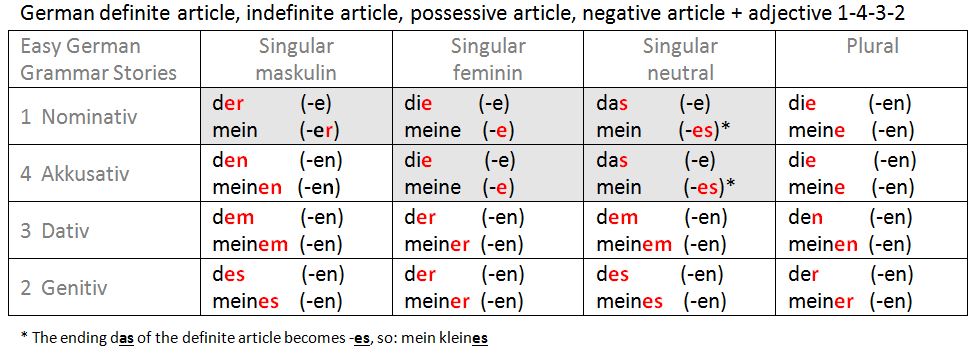 pearl cargo
long whale
https://www.easygermangrammarstories.de/attachments/Image/German-definite-articl...
pearl cargo
long whale
https://www.easygermangrammarstories.de/attachments/Image/German-definite-articl...
Since the singular maskulin as (en), it'll be seinen! 😶😶😶
long whale
singular maskulin Akkusativ - yes, exactly. ;)
worthy walrus
celest pollen
Sara und Yara haben sich ( **__die __**) Briefe geschrieben
Here can be die?
if those letters are specific
whole portal
As in we already know the letters from earlier sentences, else it would just be nothing instead of die
thorn zodiac
"Wann können wir eine Ihrer Katzen sehen?"
Can someone explain the part bolded for me? Why is "Ihrer" used and if its fixed? I looked it up on the dictionary and the capitalised form seems fixed.
Also would a suitable alternative be: Eine Katzen von dir ?
undone verge
it is like 'one of'. You always construct it with the article in singular (corresponding to gender) + plural genitive. So, here 'eine Ihrer Katzen': eine Katze --> eine, die Katzen --> Ihrer Katzen
Das ist eins meiner Bilder.
Das ist einer meiner Söhne.
thorn zodiac
undone verge
it is like 'one of'. You always construct it with the article in singular (corre...
Im a little confused, why can you use two different "ein" variants if the nouns are both plural? Also Im not sure I understand the explanation, what becomes dative? It seems my pronouns knowledge is weak 
undone verge
thorn zodiac
Im a little confused, why can you use two different "ein" variants if the nouns ...
what do you mean the nouns are both plural?
and sorry, I misspoke: genitive, not dative
so the pronoun/article 'one' is in the same gender and case as the singular noun. The genitive is always plural.
I want to say 'one of my sons'
to formulate one, I have to think: what is one son? Ein Sohn (masculine). So ein--> einer.
and what is 'of my sons'? it is plural genitive: meiner Söhne
all together: einer meiner Söhne
thorn zodiac
Ok I understand now thanks, gonna need to practice this 
fervent kernel
hardy zinc
So, mein Lehrer erzählte mir, dass man in die indirekte Rede Konjunktiv I benutzt. Er sagte auch dass man Konjunktiv II braucht, wann biden Pronomen und die Verbenform sind gleich den Gegenwarten.
Gibt es einige mehr Fall, wann ich Konjunktiv in die indirecke Rede benutzen muss?
z. B. ich habe
Der Minister wünscht einen genauen Bericht.
So, I und II:
Der Minister wünsche einen genauen Bericht.
Der Minister hätte gern einen genauen Bericht.
Richtig? So, welche ist korrekter?
Die Aufgabes Frage ist "Was stand in der Zeitung?"
whole portal
Stimmt beides
Konjunktiv 1 wird nicht so häufig verwendet aber es ist deswegen nicht schlechter oder so
 patent urchin
how to say, wo kann ich die Kette kaufen
but I want to say where can I buy that
is it wo kann man das kaufen
undone verge
buy a chain?
patent urchin
oder wo kann man die kaufen?
undone verge
wo kann man das kaufen
patent urchin
do we always use das? when we don't want to use noun?
undone verge
or...if you're talking about specifically a chain, die is also fine
patent urchin
yes specifically a chain
how can I look deper in to this subject? What's it called?
undone verge
pronouns, perhaps
patent urchin
thanks
patent urchin
undone verge
pronouns, perhaps
couldn't find it lol
undone verge
patent urchin
couldn't find it lol
I mean, I can't think of what else it would be called. Perhaps I misunderstand what particularly you want to know more about:
'das' als Demonstrativpronomen, Demonstrativpronomen, Nomen durch Pronomen ersetzen
hardy zinc
ist das korrekt:
- Wenn ich früher zu lernen angefangen hätte, würde ich früher fertigwerden."
?
undone verge
hätte ich früher mit dem Lernen angefangen, wäre ich früher fertig.
I would write it like that
hardy zinc
Ich habe diesen Satze:
Wenn ich früher zu lernen _______ _______, _______ ich früher _______. (anfangen,
fertigwerden)
undone verge
oof lol
then I guess it's right I would still put 'wäre ich früher fertiggeworden'
but it just depends on the tense you wanna go for I suppose
long whale
hardy zinc
I didn't learn passive yet
There is no passive there. Why did you think there was? 🤔
long whale
hardy zinc
I thought "wäre ich früher fertiggeworden" uses passive
No. "fertigwerden/fertig werden" = to become/get ready
hardy zinc
ohhhh fertigwerden uses sein
my bad, I always get confused by that haha
danke
Und ist das korrekt?
- Hätte ich am Abend Zeit gehabt, wäre ich sicher gerne gekommen.
undone verge
long whale
There is no passive there. Why did you think there was? 🤔
does it sound normal to you, to say 'wenn ich früher zu lernen angefangen hätte'? idk why but it sounds clunky to me, but breaking it into 2 clauses (wenn ichfrüher angefangen hätte, zu lernen) sounds even worse...
hardy zinc
hardy zinc
Und ist das korrekt?
> 2. Hätte ich am Abend Zeit gehabt, wäre ich sicher gerne ...
Eine Frage nach dieser Form. Is it just "if I had had time that evening, I would've come"?
Or maybe like "Should I have had time that evening, I would've come"
Right?
undone verge
yes, the first one sounds more natural as a translation to me
hardy zinc
It's a bit confusing that the verb comes first here
undone verge
It works similarly in english, too. You can say 'Had I eaten enough, I wouldn't have failed my exam.'
hardy zinc
🤔
undone verge
and in German, there is a construction with 'should' too, you just don't use it like that. example:
English: should you notice any errors, please tell me.
Deutsch: Sollten euch irgendwelche Fehler auffallen, sagt mir bitte Bescheid.
undone verge
well, I at random picked the verb 'auffallen' (like, 'stand out to you') and you construct it so: etwas fällt jemandem auf
yes exactly lol
hardy zinc
but why are you saying "you just don't use it like that" then?
undone verge
well, above you tried to write the sentence: "Should I have had time that evening, I would've come"
But it doesn't really work. We use this 'should X, then Y' more for talking about the present or future, not the past
You could say: Should I have time this evening, I'll come.
mellow nova
https://conjugator.reverso.net/conjugation-german-verb-werden.html ask in one channel only please
mossy cypress
Relative pronouns:
Is normal that I have to repeat Die, both as relative pronoun and as article?
I assume Schwierigkeiten is Akk, since it's the object of the sentence (but even if it's nominativ, it's still Die)

repeating Die 2 times is weird
mellow nova
you're not repeating the die, they refer to different things
but yes that would be right
it's like in English we say 'that that' a lot lol
mossy cypress
so die die ausländischen it's normal? Feels so weird lol
mellow nova
you'll get used to it
mossy cypress
lul thx btw
proven sphinx
mossy cypress
so *die die ausländischen* it's normal? Feels so weird lol
It may look weird, but those two "die" are not the same. The first one is a relative pronoun and the second one is a definite article.
It would also be correct to replace the first "die" with "welche", but that sounds a bit cumbersome these days.
mossy cypress
proven sphinx
It may look weird, but those two "die" are not the same. The first one is a rela...
yes, I know that but I had the doubt of repeating the same word
proven sphinx
mossy cypress
yes, I know that but I had the doubt of repeating the same word
Well, they're not the same word. That's what I'm trying to tell you.
mellow nova
would you really consider them different words?
proven sphinx
They fulfill completely different functions, so yes, they're pretty much different words.
mossy cypress
proven sphinx
Well, they're _not_ the same word. That's what I'm trying to tell you.
I mean they're not the same word, but visually it's the same letters
I understood the difference in grammar
mellow nova
Wouldn't be my definition but I guess that's not really a set in stone thing
proven sphinx
Are "bass" (the fish) and "bass" (the instrument) the same word just because they're written the same way? The answer is obviously no.
mossy cypress
but since I'm not really used to that, every little strange rule makes me to doubt
proven sphinx
Same thing here.
mellow nova
that's completely different
bass and bass are homophones, die and die are not
or homonyms i mean
whichever one they are idr
proven sphinx
mellow nova
bass and bass are homophones, die and die are not
Well, what about "bark" (the noise a dog makes) and "bark" (skin of a tree). Are those the same words?
They do sound the same.
And they're written the same way.
But they're still not the same word.
mellow nova
I think there is ana acceptable degree of divergence
mossy cypress
btw I'll go ahead with exercises lol
mellow nova
'The man, that that woman spoke to' "that" is the same word despite meaning different things imo
proven sphinx
mossy cypress
btw I'll go ahead with exercises lol
Sure, just ask again if you have any other questions.
proven sphinx
mellow nova
'The man, that that woman spoke to' "that" is the same word despite meaning diff...
Well, I guess it's a meaningless distinction anyway. You could write entire books on what exactly is a word and what isn't a word.
icy flax
proven sphinx
Well, I guess it's a meaningless distinction anyway. You could write entire book...
Zweifelhaft, mach es und wir glaubn an dich. ||jks||
Welches Gefühl wird durch diesen Satz erweckt? Scheint diese Passage alt oder zu religiös? Mir ist das Verb ,,liebkosten" neu. Ebenfalls zum Nomen "Pranke".
Dennoch wusste sie, dass sie als einzige anders dachte, weil die verführerische Pranke des Bösen ihr Gesicht liebkost hatte
midnight flume
Hi,
Can someone explain me how "Er ist der Ansicht, dass..." translates to "He believes that..." pls.
 pure elm
midnight flume
Hi,
Can someone explain me how "Er ist der Ansicht, dass..." translates to "He b...
pure elm
midnight flume
Hi,
Can someone explain me how "Er ist der Ansicht, dass..." translates to "He b...
I think der translates to "of the" here, so you could say "Er ist der Ansicht, dass er frei ist"
long whale
midnight flume
Hi,
Can someone explain me how "Er ist der Ansicht, dass..." translates to "He b...
"die Ansicht" is derived from "sehen", and it means 1. view, viewing (not very common, though!) 2. point of view, opinion. Since "He is of the opinion that..." is a little wordy, it gets translated as "He believes that..." ;)
long whale
icy flax
Welches Gefühl wird durch diesen Satz erweckt? Scheint diese Passage alt oder zu...
Not Raven, but to me, it sounds very much as if it came from a fairy tale/fantasy book. BTW, the verb is "liebkosen", "liebkosten" is Präteritum. ;)
 icy zephyr
der text beginnt damit, dass der Hamburger in jedem Schnellrestaurant wird gegessen. Wir verstehen aus dem ersten Absatz des Textes, dass es der 100. Geburtstag des Hamburgers ist. Ray Keoc von den Brüdern die Idee- für ein paar Dolar abgekauft
is there any grammatical error?
ich habe eine zusammenfassung geschrieben
celest pollen
Why an dem ? Why not "bei +dem"?
Der kleine Mann am Tisch trinkt einen Kaffee
Der kleine Mann **__beim __**Tisch trinkt einen Kaffee.
long whale
celest pollen
Why **__an dem__** ? Why not "**__bei +dem__**"?
Der kleine Mann **__am__** Tis...
"am Tisch sitzen" = to be seated at the table vs. "beim Tisch sitzen" = to be seated near the table
long whale
icy zephyr
der text beginnt damit, dass der Hamburger in jedem Schnellrestaurant wird geges...
1st sentence: subordinate clause word order means the conjugated part of the verb comes last (not the infinitive!). 2nd sentence: verstehen ersehen. 3rd sentence: the verb is "jemandem (Dativ) etwas abkaufen", not von jemandem etwas abkaufen. And the auxiliary is missing!
celest pollen
darauf & drauf
Gibt es ein**en** Unterschied?
( und btw. ein__en__ because 🟧 akk - es ? )
long whale
celest pollen
darauf & drauf
Gibt es ein**__en__** Unterschied?
( und btw. ein__**en**__ bec...
No difference in meaning, no.
es gibt + Akkusativ
celest pollen
mmmm i thought .....
 long whale
No. Yours is just a list of Akkusativpronomen. In "Es gibt X", "es" is the subject, X is the direct object.
celest pollen
Okay, so it's a "hard" rule, and there's no explanation for "why"
wise pendant
darauf can be thought of as the emphasized version of drauf, but it's often used differently.
drauf can be used as a verb prefix: drauflegen - to put on top (in this case only drauf is used)
whereas darauf is used standalone as the answer to worauf? "Darauf habe ich Lust" (in this case only darauf is used)
And then there are also situations where both can be used "Wie kommst du darauf?" "Wie kommst du drauf?"
celest pollen
Denke ich richtig? "sentence distribution"

 icy flax
long whale
Not Raven, but to me, it sounds very much as if it came from a fairy tale/fantas...
icy flax
long whale
Not Raven, but to me, it sounds very much as if it came from a fairy tale/fantas...
Die Frage wurde nicht spezifisch an jemanden gerichtet.
Danke dir, Susana.
icy flax
narrow pier
hi, which one is true and why, ( ich bin erstaunlich und ich bin erstaunt )
Both are possible to be said. Being Dopey, the truth for you is "ich bin erstaunlich". You're definitely the best dwarf.
I am amazing - ich bin erstaunlich
I am amazed - ich bin erstaunt
long whale
celest pollen
Denke ich richtig? "sentence distribution"
Not sure what "sentence distribution" means, but your sentence is correct. ;)
hardy zinc
Hallo. Ich muss einige Sätze in die Indirekte Rede einsetzen.
Zuerst habe ich "Sie müssen blabla". Wenn ich in Konjunktiv I es setze ein, wird es auch "müssen". So, es heißt dass ich Konjunktiv II (müßten) benutzen muss, richtig?
long whale
hardy zinc
Hallo. Ich muss einige Sätze in die Indirekte Rede einsetzen.
Zuerst habe ich "S...
Correct, yes.
So, es heißt Das heißt also, dass ich...
long whale
hardy zinc
How do you say "what about ..."?
Context?
hardy zinc
Hoped there'd be a literal translation
Alles klar, here's the context
[What about the case], wann wenn man Vergangenheit hat? Braucht man immernoch gleich Regeln für K II vs K I?
long whale
Wie ist es, wann wenn man...
hardy zinc
I'm trying to say if we're using the same rules to replace K II with K I when it's past. E. g.
Wir machten etwas
In K I it's
Wir haben etwas gemacht
But in perfect it's the same. Do we use K I or K II?
long whale
hardy zinc
I'm trying to say if we're using the same rules to replace K II with K I when it...
KII
hardy zinc
Danke
hardy zinc
Janik war sehr aufgeregt. Er wollte nicht mit den Gästen reden.
Ich muss einen Irrealen Satz daraus machen.
Ist das korrekt:
Wenn Janik nicht so aufgeregt gewesen wäre, hätte er mit den Gästen reden gewollt.
long whale
hardy zinc
> Janik war sehr aufgeregt. Er wollte nicht mit den Gästen reden.
Ich muss einen...
wollen is a modal verb -> double infinitive is required -> gewollt wollen
See https://deutschegrammatik20.de/verbformen/der-infinitiv/ under "Verbformen mit Modalverb"
hardy zinc
long whale
*wollen* is a modal verb -> double infinitive is required -> ~~gewollt~~ wollen
aha, verstehe! Wann benutzt man p II von Modalverben?
narrow pier
long whale
<@733708222216667158>
both are correct but vary greatly in meaning thank, übrigens was meintest du mit mir ist definitiv dwarf ( I am definitely the best dwarf. what do you mean? )
 @icy flax
and thanks for the reply
long whale
hardy zinc
aha, verstehe! Wann benutzt man p II von Modalverben?
Never. Except in dialect. ;)
long whale
narrow pier
both are correct but vary greatly in meaning thank, übrigens was meintest du mit...
Wrong ping. :D
That was Voodoo, not me.
 polar epoch
does anyone know the formula to answer these? i can't seem to find it
 long whale
Expressions of time with a preposition -> Dativ. For Wechselpräpositionen like "in": -> Where/Wo? -> Dativ vs. Where to/Wohin? -> Akkusativ
Does that help?
@polar epoch
 formal pagoda
-Woher kommst du gerade? Ich komme gerade ....... meiner Freundin.
(aus , von)
Was passt?
raw radish
formal pagoda
-Woher kommst du gerade? Ich komme gerade ....... meiner Freundin.
(aus , von)
...
definitiv NICHT das erste 
“von” ist auch etwas komisch. “I am coming back from my girl friend” doesn’t sound natural to me
formal pagoda
Es gibt andere Wahl, vielleicht passt!
(bei).. passt das besser?!
long whale
Seems fine to me, for "from my girlfriend's house/from seeing my girlfriend" 🤷
raw radish
yeah, this
narrow pier
long whale
Wrong ping. :D
oh sorry, i added a new mention
long whale
formal pagoda
Es gibt andere Wahl, vielleicht passt!
(bei).. passt das besser?!
No, definitely not. "bei meiner Freundin" = with my girlfriend; at my girlfriend's house ;)
formal pagoda
Ok then, thanks a lot!
whole portal
Well I mean technically the first one is possible depending on what you count as inside
raw radish
whole portal
Well I mean technically the first one is possible depending on what you count as...
whole portal
"Woher kommst du? Aus meiner Mutter." I mean that's a valid answer
formal pagoda
Daraus können wir halt schließen, das ist eine dumme Übung.
whole portal
von is the right answer here, it's totally valid imo
raw radish
wenn du wüsstest…
for colloquial use, “Ich komme von meiner Freundin” is fine, yeah. But you would really only use that while talking to friends or family
long whale
raw radish
for colloquial use, “Ich komme von meiner Freundin” is fine, yeah. But you would...
I'm now quite curious - what would you say instead?

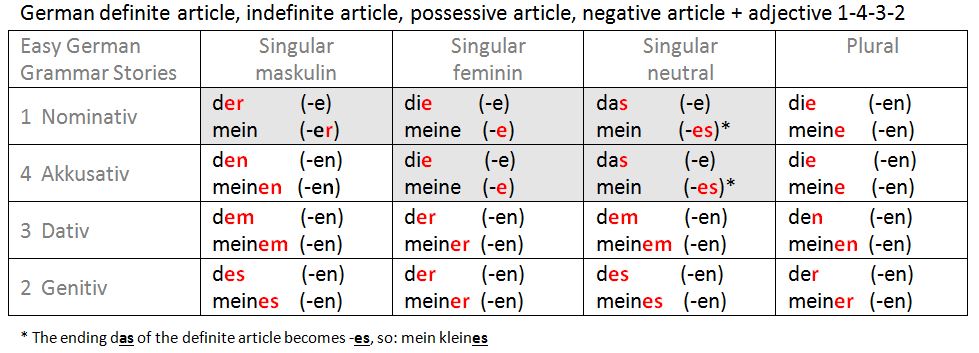 narrow pier
Hallo, ich möchte eine Frage stellen ----> ( Wenn ich auf einer Party mit Leuten ins Gespräch kommen möchte, frage ich nach ihrer TV-Lieblingsserie. Welche ist es`? Welche Charaktere magst du besonders??
Mein frage ist warum ist es ( Charaktere ) und nicht ( Charaktere )
wegen Akkusativ? Falls ja, deshalb ich möchte wissen ist es wegen ( Welche ) oder was ?
raw radish
narrow pier
Mein frage ist warum ist es ( Charaktere ) und nicht ( Charaktere )
wo ist da der Unterschied? 
narrow pier
sorry
raw radish
es ist Akkusativ mit “welche”, das stimmt :>
raw radish
es liegt nicht am Akkusativ, sondern am Plural :>
“Welche Charaktere” which characters
“Welchen Charakter” which character
narrow pier
ohh , ok, Stimmt, danke, ( when will it become akkusativ ) i think its Nominativ, in the sentence I sent right??
raw radish
I don’t know much about the cases tbh someone else might know
long whale
narrow pier
ohh , ok, Stimmt, danke, ( when will it become akkusativ ) i think its Nominativ...
The verb is "jemanden mögen" -> Charaktere is Akkusativ plural. The subject is "du".
(the verb must be in accordance with the subject: magst (du))
formal pagoda
Eine komische Frage, wie kann ich "Tell your thighs good evening for me/Tell your thighs hello for me" auf Deutsch sagen?
Es ist eine witzige Sprichwort hier zwischen Jugendliche
long whale
formal pagoda
Eine komische Frage, wie kann ich "Tell your thighs good evening for me/Tell you...
Either try yourself, first, please, or use deepl.com ;)
narrow pier
long whale
The verb is "jemande**n** mögen" -> Charaktere is Akkusativ plural. The subject ...
vielen dank
long whale
No. What are you trying to say?
Yes, it is. leiden = to suffer
If you wanted to say "I don't suffer at language school", it's fine, except for im die -> in der
im is a contraction of in dem
night dagger
da könntest du auch sagen: "ich kann die Sprachschule gut leiden"
long whale
night dagger
da könntest du auch sagen: "ich kann die Sprachschule gut leiden"
Ehh - no.