#questions-2
1 messages · Page 143 of 1
 plain umbra
As far as I know, Präteritum and Perfekt have simply the same meaning. The only difference is context of when you use them, e.g. speaking vs writing, or different regions of Germany.
Sometimes you will even have a native speaker that says they interpret one tense one way and the other tense the other way, but it's just a personal interpretation that's not a standard part of the language. Or at least, I've never seen otherwise.
It varies too much by region for it to be standard.
 nimble viper
Sure. Thanks Base. One question just for you specifically though,
How come you can explain these things so well if you only see yourself as Level B?
I feel like you know too much
plain umbra
I know a lot about grammar topics but I don't have much time to practice speaking and listening, and especially vocab, which are key skills for going from Level B to Level C.
nimble viper
I'm sure you'll get there long before me, that's for sure. 👍
plain umbra
Just depends which of us puts the most time in. 😄
nimble viper
I am equally as ... not proficient? Don't even know how to say it in english 😦 in every area 😂
At least I can call myself an 'all rounder' hey. But anyways, thanks for the clarification, wir sehen uns 👋
 mental jetty
Which one should I use in this sentence? geben oder schenken?
Du solltest deiner Freundin das Geschenk ___.
 long whale
mental jetty
Which one should I use in this sentence? geben oder schenken?
Du solltest deine...
long whale
mental jetty
Which one should I use in this sentence? geben oder schenken?
Du solltest deine...
In principle, you could use both/either. However, we try hard to avoid combinations like "Essen essen" or "Geschenke schenken". ;)
mental jetty
So geben it is?
What word could be replaced for "essen" if for example, "They are eating food"?
long whale
mental jetty
What word could be replaced for "essen" if for example, "They are eating food"?
And what else would they be eating, if not food? You'd just say "They are eating something". :)
mental jetty
long whale
And what else would they be eating, if not food? You'd just say "They are eating...
Sie essen etwas?
long whale
mental jetty
Sie essen etwas?
Exactly. :)
mental jetty
long whale
Exactly. :)
Thank you
mental jetty
Sein Haus ist groß
Ist der Genitiv oder Nominativ?
plain umbra
mental jetty
Sein Haus ist groß
Ist der Genitiv oder Nominativ?
In this sentence you have nominative only.
mental jetty
Ohhh, ok
plain umbra
mental jetty
Ohhh, ok
The subject of a sentence is always nominative.
I hope that's helpful for you.
mental jetty
plain umbra
The subject of a sentence is always nominative.
Ohhh
Danke
Das Haustier meiner Mitbewohnerin ist sehr groß
Can I use Mitbewohner or it should always be Mitbewohnerin?
 delicate tiger
mental jetty
Das Haustier meiner Mitbewohnerin ist sehr groß
Can I use Mitbewohner or it sho...
delicate tiger
mental jetty
Das Haustier meiner Mitbewohnerin ist sehr groß
Can I use Mitbewohner or it sho...
is your Mitbewohner male or female (-in)
long whale
mental jetty
Das Haustier meiner Mitbewohnerin ist sehr groß
Can I use Mitbewohner or it sho...
If it's a person and it ends in -in, it's a woman. :)
mental jetty
delicate tiger
is your Mitbewohner male or female (-in)
Male
mental jetty
long whale
If it's a person and it ends in -in, it's a woman. :)
Does the "meiner" change too?
long whale
mental jetty
Does the "meiner" change too?
Of course.
mental jetty
long whale
Of course.
What is the male counterpart of meiner?
long whale
Check endings table for "ein-" :)
mental jetty
Meines?
long whale
And what about the flatmate's ending? ;)
mental jetty
long whale
Check endings table for "ein-" :)
Das Haustier meines Mitbewohner ist sehr groß
Is this correct?
long whale
"meines" is fine. But what happens to "Mitbewohner" in Genitiv singular?
mental jetty
long whale
"meines" is fine. But what happens to "Mitbewohner" in Genitiv singular?
There's an es or s
Mitebewohneres/s?
long whale
Just -s
mental jetty
long whale
Just -s
Is this correct?
long whale
Yes.
mental jetty
Thank you so much
 sweet goblet
Frau Bronkhorst braucht ihre rechnung weil sie dringend nach Paris fliegen muss. Sein Flug geht schon in einhalb Stunde. Sie muss geben die Zimmerschlussel zum Zimmer 510 an. Is this correct?
long whale
sweet goblet
Frau Bronkhorst braucht ihre rechnung weil sie dringend nach Paris fliegen muss....
No. There are quite a few problems: check the possessive for a woman; check word order after "weil"; check spelling for "to fly"; check whether it's in half an hour or in one and a half hours. The infinitive after a modal verb comes last. :)
sweet goblet
sweet goblet
Frau Bronkhorst braucht ihre rechnung weil sie dringend nach Paris fliegen muss....
how about now?
delicate tiger
sweet goblet
how about now?
"Frau Bronkhorst braucht ihre ||Rechnung||, weil sie dringend nach Paris fliegen muss. ||Ihr ||Flug geht schon in ||eineinhalb ||Stunden." Try it yourself before checking the spoilers
no idea what the last sentence is supposed to mean
 celest pollen
Dann muss man sich was zu essen kaufen | „sich” Here is a reflexive or what ?
 upper ember
sich ist immer ein reflexives Pronomen, hat keine andere Funktion....
in deinem Satz könnte mans weglassen, aber es hört sich besser an, wenns im Satz steht (für mich)
 half falcon
 upper lynx
Commonly used phrase. Means something like "I did nothing to cause this", basically "Not my fault"
 swift bough
I understand it as "I can't help it" as well
upper lynx
Yeah that translation makes even more sense I guess
 last bolt
What is the opposite word to anfangen?
swift bough
it is sadly heavily context dependent.....but you could say beenden, enden, abschließen, stoppen, aufhören
if you have a certain context you are thinking of, post that here too and I can say which one makes most sense
last bolt
I dont have a context i was just reading a german text ,saw anfangen and got curious what its opposite was
 rare jetty
last bolt
I dont have a context i was just reading a german text ,saw anfangen and got cur...
rare jetty
last bolt
I dont have a context i was just reading a german text ,saw anfangen and got cur...
beenden (to end)
mental jetty
What is the difference of Saufen and Trinken?
 fervent kernel
mental jetty
What is the difference of Saufen and Trinken?
fervent kernel
mental jetty
What is the difference of Saufen and Trinken?
saufen is the very fast and not so clean drink but it is more commonly used as a word for drinking alcohol. so when you talk to your boss don't say saufen
mental jetty
fervent kernel
saufen is the very fast and not so clean drink but it is more commonly used as a...
So, if I'm running while drinking, I should say "Ich laufe und saufe"?
Or it should be "Ich laufe und trinke"?
fervent kernel
mental jetty
Or it should be "Ich laufe und trinke"?
Both are possible but if you say saufen then others will assume that you drink alcohol
and if you talk to people you don't know or just a little i would say trinken
long whale
mental jetty
So, if I'm running while drinking, I should say "Ich laufe und saufe"?
saufen is quite colloquial/slang-y, and you'd use it for "getting drunk" :)
 lone storm
Can someone please help me come up with an example for each of these plural formation patterns? I've got anki cards for each and I'd like to put an example on the back to remember instead of trying to remember it abstractly. I know these rules aren't absolute btw but apparently they should still be useful.
Masculine -e -> -en         Masculine -ig -> -ige
Masculine -and -> -anden    Masculine -ich -> iche
Masculine -ant -> -anten    -um -> -en
Masculine -or -> -oren      -us -> -en
Feminine -e -> -en          Masculine -ör -> öre
Feminine -ion -> -ionen     Masculine -ich -> -iche
Feminine -keit -> -keiten   Masculine -eur -> -eure
Masculine -ling -> -linge   Masculine -ier -> -iere
Neuter -lein -> -lein       Mascuine -en -> -en
(The source I learned these from has other patterns but I already have examples for them)
fervent kernel
long whale
*saufen* is quite colloquial/slang-y, and you'd use it for "getting drunk" :)
naa du kannst auch ne cooler weg saufen
 undone verge
der Löwe, die Löwen
der Doktorand, die Doktoranden
der Praktikant, die Praktikanten
der Doktor, die Doktoren
die Blume, die Blumen
die Nation, die Nationen
die Wahrscheinlichkeit, die Wahrscheinlichkeiten
der Schmetterling, die Schmetterlinge
das Büchlein, die Büchlein (you must've meant neutral)
lone storm
yes I meant neuter thank you very much!
undone verge
der Honig, die Honige
das Studium, die Studien
der Strich, die Striche
das Papier, die Papiere (neutral?)
the rest nothing's falling into my head except things that don't match
long whale
What's still missing?
undone verge
-ich-->-ige
-us-->-en
-ör-->öre
-euer --> -euere
-en --> -en
(all masculine)
long whale
der Frisör, die Frisöre ?
long whale
Well, since neither of us can even come up with an example... :D
lone storm
it should go to -iche right?
long whale
Even then, I can only think of "der Kranich, die Kraniche" (crane, as in: large water bird)
undone verge
der Strich die Striche was all that popped to my head
long whale
Yeah, some of those endings... I'm not sure those rules are really useful, if we both have such trouble coming up with examples. 🤷
lone storm
oh I guess -ör -> -öre would be a remnant of French loanwords originally spelled -eur?
long whale
lone storm
oh I guess -ör -> -öre would be a remnant of French loanwords originally spelled...
Yeah, and it's this alternative spelling I use.
der Friseur, die Friseure
plain umbra
Yeah, the issue with a lot of the "consistent" plural rules is that the reason they're so consistent is that there's only a tiny handful of nouns they apply to.
long whale
der Ingenieur, die Ingenieure
plain umbra
So it's worth keeping that in mind when putting together this kind of list.
If there's only 1 or 2 common words that have that pattern, it might be that learning the plurals directly is actually better.
lone storm
I don't know which rules only apply to a few words though 
long whale
This applies to nouns ending in -ig, for example. (I can think of any number of adjectives ending in -ig, but nouns, apart from Honig - which isn't even used in plural - not really. :)
plain umbra
The thing with the suffixes like -lein is useful though. For any compound noun (and the common suffixes work essentially the same as a compound noun) the gender as well as the plural is determined by the final word/suffix of the compound. So you can learn the "plural" of these specific common suffixes, just like you do for a normal noun.
lone storm
Yeah that's useful
plain umbra
This isn't every suffix though. Like if the suffix comes from another language, or if it's not a true suffix, you can't necessarily rely on that.
But for the basic German ones, it's good to know.
lone storm
This source had a rule for -chen but like everybody knows das Mädchen even if they know no German lol so I didn't need to ask
undone verge
I think it's better to learn the plurals (outside of the really obvious neuter and -keit, -heit ones) plain. You will automatically pick up on the patterns after a bit without ever 'memorising' a list of rules. And then you will have also developed a feel, which is important for speaking at a normal pace
long whale
lone storm
This source had a rule for -chen but like everybody knows das Mädchen even if th...
That's one of those you can apply to pretty much any noun as a diminutive, and it's far more common than -lein. Often induces a vowel change, though. :)
lone storm
meaning it gets an umlaut like Hände or a more complicated change?
long whale
lone storm
meaning it gets an umlaut like Hände or a more complicated change?
Yes: die Hand - das Händchen (small hand, little paw, for a child)
plain umbra
outside of the really obvious neuter and -keit, -heit ones
Yes, those are exactly the kinds of suffixes I'm referring to. You can learn those in the same way you learn normal nouns, if you want to.
undone verge
I think that -lein often also induces the vowel change. Vögellein, Büchlein
lone storm
long whale
Yes: die Hand - das Händchen (small hand, little paw, for a child)
ah right when forming the diminutive, I thought you meant when pluralising a diminutive
long whale
undone verge
I think that -lein often also induces the vowel change. Vögellein, Büchlein
Yes, of course.
long whale
lone storm
ah right when forming the diminutive, I thought you meant when pluralising a dim...
No, no: der Baum (die Bäume) -> das Bäumchen (small tree)
plain umbra
lone storm
Can someone please help me come up with an example for each of these plural form...
Another point I'll add to this is that some of these fit into a special category called weak nouns or N-declension.
So you might want to learn about that as a separate thing.
lone storm
which ones?
long whale
lone storm
which ones?
faq N-Deklination
 stoic mauveBOT
Weak Nouns
Weak nouns are called this way because they receive the same endings as adjectives inflected with weak endings. They take an additional ending -n in every case except nominative singular. This is also known as N-Declension and affects almost exclusively masculine nouns.
Nominativ: der Junge, die Junge__n__
Genitiv: des Junge__n__, der Junge__n__
Dativ: dem Junge__n__, den Junge__n__
Akkusativ: den Junge__n__, die Junge__n__
Some nouns end with a suffix -en to make the pronunciation easier:
der Mensch, den Mensch__en__
‼ Das Herz is the only non-masculine (neuter) noun with N-Declension❣
So how do we recognize these nouns? We can divide them into 3 big groups:
- nouns of Greek and Latin origin,
- nouns ending with
-e(most of these refer to people or animals), - other random German nouns (Mensch, Herr, Student, Nachbar, Prinz etc.)
Another way to divide the groups could be:
- nouns denoting male beings in general (der Bauer, der Knabe, der Herr, der Junge, der Kunde etc.)
- nouns indicating nationality or religious affiliation (der Chinese, der Russe, der Türke, der Jude, der Katholik, der Protestant)
- nouns designating male beings and ending in the foreign suffixes (
-ant,-arch,-ast,-ege,-ent,-ist,-oge,-om,-oph,-ot: der Kollege, der Student, der Psychologe, der Polizist, der Philosoph)
‼ der Käse and words ending with -ee aren’t weak nouns.
Genitive of Weak Nouns
You might have noticed from the examples above that weak nouns don’t have the additional -s in genitive like other masculine nouns.
Some exceptions are das Herz and nouns of group 3 that don’t refer to people nor animals (Name, Wille, Glaube, Buchstabe etc.), which take both the -n and -s endings.
Example: der Name, des Name__ns__.
lone storm
hm
not sure I'm ready for that quite yet
I've learned almost nothing but vocab so far
in terms of grammar all I've learned is gender and plural formation rules
I understand cases because I studied Latin and ancient Greek but I haven't learned exactly how they work in German yet
long whale
lone storm
in terms of grammar all I've learned is gender and plural formation rules
Mm... it is advisable to learn a noun with its gender and its plural form, particularly for everyday vocab: der Hund, die -e (meaning: die Hunde). I think those rules come in handy later on. :)
long whale
last bolt
Do vortragen and berichten mean the same
No. There are very few cases where that will be possible. "berichten" = to report; "vortragen" = mostly rather like: to give a presentation.
last bolt
Danke
How can i say completed?
Zumbeispiel: I completed chapter 7 of my Deutsch Kursbuch
long whale
also: abgeschlossen
mental jetty
I have a very (probably) weird yet short question: Is Eines genitive for One?
 mellow nova
it can be
 narrow pier
Hi guys, ( Das Wetter ist heute in Salzburg schön, aber kalt.)
Clara deutsch114.03.2022 12:11
Hauptsache sonnig. ☀️ 😎
⭐️⭐️⭐️⭐️
Korrektur:
Das Wetter in Salzburgist heute schön ...
this was another personons correction , but I wanted to make sure if the teacher isnt mistaken
??
mellow nova
correction is correct
mellow nova
is this part of your neck 'der Nacken'
 long whale
mellow nova
is this part of your neck 'der Nacken'
long whale
mellow nova
is this part of your neck 'der Nacken'
The part between her hands, mostly. Yes.
mellow nova
and Hals is the front part? or the inside-the-body part I think I have found out it is both 
long whale
mellow nova
~~and Hals is the front part? or the inside-the-body part~~ I think I have found...
I'd say Hals is that whole part of your body, plus the inside. If you want to specify the front part, that would be Kehle (but that one can also be used for the inside).
mellow nova
ohh ok  quite a few words for neck ty
 heady skiff
narrow pier
this was another personons correction , but I wanted to make sure if the teacher...
heady skiff
narrow pier
this was another personons correction , but I wanted to make sure if the teacher...
It is correct, when you seperate Salzburg and ist
narrow pier
heady skiff
It is correct, when you seperate Salzburg and ist
thank you i was confused
so google doesnt seem to be that of a big help about this
do you guys know of any german sitcom
like a german version of brooklyn 99 or how I met your mother, if someone knows please let me know
 icy flax
narrow pier
like a german version of brooklyn 99 or how I met your mother, if someone knows ...
icy flax
narrow pier
like a german version of brooklyn 99 or how I met your mother, if someone knows ...
There's "the German The office", aka Stromberg. Both @scenic drift and me watched one suggested by @long whale: Mord mit Aussicht https://www.ardmediathek.de/sendung/mord-mit-aussicht/staffel-1/Y3JpZDovL3dkci5kZS9Nb3JkIG1pdCBBdXNzaWNodCBPTkU/1. We all liked it (:
last bolt
narrow pier
like a german version of brooklyn 99 or how I met your mother, if someone knows ...
Check out "Extra" on youtube
 plush pelican
Saw this on Tagesschau's instagram: "Der älteste Mensch der Welt ist tot. Die Japanerin Kane Tanaka starb im Alter von 119 Jahren. Wie die Lokalregierung ihrer Heimatstadt Fukuoka bekannt gab, starb Tanaka bereits am 19. April."
Why is that "bereits" there? To me, that seems like the sentence reads, "As the local government of her home-town Fukuoka made known, she already died on April 19th," which sounds weird.
Why not just say that she died on April 19th? "starb Tanaka am 19. April."
Is that possible?
Another way of saying it in English might be to say, "she was already dead by April 19th", to emphasize the fact that it's been 6 days and the information only just came out, but that's a different tense, at least in English.
 wise pendant
bereits in that context means "earlier than one would assume"
Since the news of hear dead took some time to reach international media
plush pelican
wise pendant
bereits in that context means "earlier than one would assume"
Since the news of ...
interesting
It's a usage very slightly different than the English 😮
 keen nebula
Someone translate please
Let me tell you a story
 dusky rune
How would you write "Your favourite team is __"?
mellow nova
ask in one channel only 👍 not 3
keen nebula
no one answers ✅
mellow nova
wait more than 30 seconds
if it gets buried you can of course ask again but asking in multiple channels runs the risk of wasting the nice people that help out around here's time
by answering questions that have already been answered
for simple translations like that you could always just use deepl.com 👍
keen nebula
thats only my first question once someone answers i have two others that are related👍
mellow nova
This discord is not a translation service 👍 if you would like to attempt it yourself and get it corrected you can do that
otherwise be respectful and please use translation websites
keen nebula
👍
 half bloom
does anyone know a good site for movies with german synchronisation, there is gotta be many of them but i just cant find them
undone verge
do you have netflix?
half bloom
i do but i dont have a vpn
undone verge
oh yeah, I always forget about that
you could make an account with amazon.de and get prime video. idk if you meant free (in that case, just search the name of the show/series/movie 'deutsch online schauen' or something in german).
half bloom
otherwise i am limited to german produced movies and series which are not the best to say at least
undone verge
ah wait, I forgot that doesn'T work either. For some reason prime video makes you use a german payment method
even though amazon.de in general doesn't
makes no sense
 dense obsidian
done
half bloom
danke
 spiral vapor
hello, can anyone help out with the meaning of "Befehlsgeld"? when I try to look it up "Befehlsfeld" is taking over the search engine 

 proven sphinx
Hmm, you're right. It only has very few results on Google.
It's some extremely specific financial term that was only ever used a handful of times.
The very sentence you showed already gives you a definition for what it's supposed to mean anyway.
spiral vapor
I guess it's called like that because it was ordered to be made / it's value is determined by the government?
proven sphinx
Yeah, I suppose that makes sense. It's apparently a neologism, though.
spiral vapor
proven sphinx
The very sentence you showed already gives you a definition for what it's suppos...
Yes but I couldn't find a specific translation. Well, maybe there isn't any 
proven sphinx
spiral vapor
Yes but I couldn't find a specific translation. Well, maybe there isn't any <:bl...
Well, you can create new words in German by combining already existing ones. This is such an example.
spiral vapor
proven sphinx
It's some extremely specific financial term that was only ever used a handful of...
yes yes, it's from an economics book for a class, pretty outdated too 
spiral vapor
proven sphinx
Well, you can create new words in German by combining already existing ones. Thi...
Yup! Just a weird combo but I guess you gotta think hard about it sometimes
proven sphinx
spiral vapor
Yup! Just a weird combo but I guess you gotta think hard about it sometimes
"Rechengeld" is used much more often though, and it basically means like fake money, as in money that is meant to be fake, not counterfeit money.
Like Monopoly money.
proven sphinx
upper lynx
i've never heard Rechengeld in my life.
Normalerweise nennt man es ja Spielgeld, oder? Aber wenn ich "Rechengeld" auf Google suche, kommt halt Spielgeld, also muss es einfach ein Synonym dafür sein.
upper lynx
Ja, scheint so. Wenn jemand bei mir von "Rechengeld" sprechen würde, hätte ich keine ahnung was der von mir will.
Wobei wenn ich rechengeld google, kommt eher so geld für kinder zum lernen wie man rechnet
proven sphinx
Ja, vielleicht würde das eher Sinn ergeben.
upper lynx
Also, nicht für ein spiel, sondern eher so zum lernen, für die schule oder so
proven sphinx
Ich wusste gar nicht, dass es das gibt, aber gut. 😅
upper lynx
Ich glaube in der ersten Klasse hatte vielleicht unser Mathelehrer mal sowas gehabt... aber das ist lange her.
"Rechengeld" steht nichtmal im duden, "Spielgeld" schon.
proven sphinx
Na ja, jedenfalls ist dieser Satz oben einfach voller komischer Wörter. 😂
upper lynx
Ja, ich denke das buch ist aus den 50ern oder so
spiral vapor
lololol
upper lynx
I think all they mean is fiat currency tbh
proven sphinx
Yeah, I think so.
spiral vapor
Ich denke diese Version ist aus den 2000er, vielleicht 2004?
proven sphinx
spiral vapor
Ich denke diese Version ist aus den 2000er, vielleicht 2004?
Echt jetzt? 😂
upper lynx
not sure about all the strange words
spiral vapor
Es nutzt Data aus 2004 und bevor
proven sphinx
Das könnte diese seltsamen Begriffe vielleicht erklären.
upper lynx
Dann hatte der Autor wohl spaß sich irgendwelche komischen Begriffe rauszusuchen die keiner kennt
spiral vapor
proven sphinx
Echt jetzt? 😂
Ja, ich denke die Lehrerin ist so an diese Version gewöhnt, dass sie neuere Version nicht nutzen kann/will
upper lynx
The only words that seem important to me are the first 4 "Geld ohne intrinsischen Wert", which seems like they simply mean fiat money
proven sphinx
upper lynx
Dann hatte der Autor wohl spaß sich irgendwelche komischen Begriffe rauszusuchen...
Offenbar. 😂
spiral vapor
upper lynx
https://de.wikipedia.org/wiki/Fiatgeld
when I see fiat

this is what I think
upper lynx
https://en.wikipedia.org/wiki/Fiat_money
It is a common term
Fiat money is money without intrinsic value, as opposed to pieces of gold or something with intrinsic value
proven sphinx
spiral vapor
when I see fiat
The car brand comes from the Latin term.
spiral vapor
upper lynx
Fiat money is money without intrinsic value, as opposed to pieces of gold or som...
yesyes, just my first thought is this legendary car 
okok, but I gotta go back to reading, thanks a lot for the help < 3
half bloom
can someone send an example when is melden used as a non reflexive verb
actually i could really use a site with example sentences
undone verge

looks intimidating because it's in German, really isn't all that bad and has great examples. Another option is linguee (my favourite bilingual online dictionary with example sentences)
half bloom
danke
swift bough
Duden is pretty difficult for beginners to use
because it is monolingual, not bilingual
half bloom
"ich habe hingegen dem Regel, jemanden getöten" is this correct use of hingegen
upper lynx
Hmm, not really. The case is wrong, and also that sort of implies that people are not sure if killing someone is against "the rules"
half bloom
could you send an example of it being correctly used
 near folio
Inge hat ihr Spiel gewonnen, Hans hingegen verlor.
upper lynx
yup, that's a good example
half bloom
would a good translation of it be: on the contrary
upper lynx
"however" would generally fit better
or sometimes "on the other hand" as well
But on the contrary would also work I guess
half bloom
its very hard for me to translate and understand this kind of words because im not a native english speaker so whenever i want to translate it or look it up i than have to translate it again to my language
upper lynx
Well, I probably don't know your native language so I probably can't help you with that
It depends on the use case, it can be used as a konjunction or adverb
on the other hand is an adverb, however is a konjunction
upper lynx
if you scratch the "habe" that would work
half bloom
how would it be used as a konjuction
upper lynx
you did just use it as a conjunction.
Adverb would be something like "Er kocht gerne, aber hingegen isst er nicht gerne.". More uncommon usage.
upper lynx
honestly, hard to differentiate
conjunction is sort of anything connecting two words or sentence parts, adverbs modify verbs.
Maybe it is a Konjunktionaladverb, I don't know.
half bloom
guess i thought it was an adverb because i originally used it with habe
upper lynx
I think it is hard to differentiate sometimes, maybe there is some good way I don't know
half bloom
what about Anlass (on some places i found Anlaß but i guess its the same), somewhere i find it translated as cause/motive/reason and somewhere as ocasion, both correct? how is it used?
upper lynx
Anlaß is probably the spelling before the large spelling reform in 1996. They removed a lot of ß's and changed them to "ss". "dass" used to be spelled "daß".
Both translations of Anlass are correct.
"Es ist ein Kleid für einen festlichen Anlass" or "Der Anlass des Streites war das Lieblingsbier", for example.
 wheat spruce
hile
upper lynx
?
half bloom
whats Streit?
long whale
upper lynx
Anlaß is probably the spelling before the large spelling reform in 1996. They re...
Unfortunately, neither Anlaß nor daß are considered correct anymore in Standard German. :)
upper lynx
long whale
Unfortunately, neither ~~Anlaß~~ nor ~~daß~~ are considered correct anymore in S...
Yes, I wasn't trying to say they are. That's why I said it used to be spelled that way.
I was just explaining why it was spelled that way in that case. People might find texts older than 1996 and will see the old spellings of words, so it is important for them to know.
long whale
I only wrote that because you'd said "Both are correct" :)
upper lynx
Ahh, both are correct was referring to his comment!
cause he asked if both translations were correct
long whale
That, ehh, was not evident to me. :)
upper lynx
I see now how that could be misunderstood
half bloom
obwohl hat er jemanden sehen, bedeutet es nicht dass er ein Bürgermeister ist (ignore the absurd nonsense of a sentence this is, is the word order and the use of obwohl correct?)
long whale
half bloom
obwohl hat er jemanden sehen, bedeutet es nicht dass er ein Bürgermeister ist (i...
No. obwohl introduces a subordinate clause. And you need Partizip II of "sehen".
Comma before "dass"
half bloom
long whale
No. *obwohl* introduces a subordinate clause. And you need Partizip II of "sehen...
oh yeah total moment of stupidity for that sehen
long whale
You are very welcome.
half bloom
how do i use a subortinate clause with obwohl
anything i think of is
the other one 😅
wait wait
a simple one
ich bin hier, obwohl ich muss etwas tun
long whale
half bloom
ich bin hier, obwohl ich muss etwas tun
No. subordinate clause: conjugated part of the verb gets sent to the very end
half bloom
is it not a subortinate clause or is the word order just wrong
long whale
It is a subordinate clause -> the word order is wrong
long whale
half bloom
ich habe eine gute Note bekommt, obwohl ich nichts gelernt habe
Word order is now correct. Verb form in the main clause is wrong, though: "ich" does not work with "bekommt"
half bloom
what should have i used
long whale
half bloom
what should have i used
Excuse me? Please check conjugation table.
half bloom
oh the form of bekommen is wrong
lmao
i thought the whole verb cannot be used here for some reason
anyway
its evident that its too late
long whale
And again: You are very welcome
long whale
Ah. Yes.
fervent kernel
with reflexive verbs and um-zu, does the nominative pronoun always disappear?
e.g. Alex geht ins Badezimmer. Er wäschst sich.
= Alex geht ins Badezimmer, um sich zu waschen.
 kindred idol
Hey
Can someone teach me relativpronomen
I kind of have the gist of it but I’m confused on some parts
 opal narwhal
fervent kernel
with reflexive verbs and um-zu, does the nominative pronoun always disappear?
e....
opal narwhal
fervent kernel
with reflexive verbs and um-zu, does the nominative pronoun always disappear?
e....
Yes. And "um... zu" is only possible if the subject is the same as in the main clause (that's why it disappears).
 fallen vale
Kann ich Hilfe bei meinen Hausaufgaben haben?
ich muss ein Essay schreibe und jetz ich muss korrect es
ich weiss nicht was ist Falsch
 long meadow
Ja, ich kann dir helfen
long meadow
hier
long meadow
ja
fallen vale
ok
 gilded falcon
hallo zusammen ich bin neu
 ember mulch
How do I describe what I see in a picture. Is it more natrual to say "Auf das bild gibt es ein Mann" or "Auf das bild ist ein Mann", or something else?
undone verge
auf dem Bild
long meadow
Auf dem Bild ist ein Mann
last bolt
Was meint der Ausdruck "Das kann doch nicht wahr sein"
undone verge
(but) that can't be true!
undone verge
also just a tip, it makes more sense to ask 'was bedeutet der Ausdruck'
last bolt
undone verge
also just a tip, it makes more sense to ask 'was bedeutet der Ausdruck'
Vielen Dank
undone verge
?
 undone verge
ach so! ja und ne kein Problem. Ich war nur neugierig, was DeepL ausspucken würde
mellow nova
last bolt
Was meint der Ausdruck "Das kann doch nicht wahr sein"
babbel? 
last bolt
mellow nova
babbel? <:squint:779466596418322472>
Nein das war von meinem Deutsch-Kursbuch
half bloom
is there a difference between Feststellung and Observation?
 hardy zinc
Is this correct?
Anja geht zum Reisebüro. Sie möchte einen Flug buchen
->
Weil Anja einen Flug buchen möchte, geht sie zum Reisebüro
fervent kernel
yeah
hardy zinc
Sind diese korrekt?
- Weil Eva mit der Arbeit noch nicht fertig ist, kann sie nicht kommen
- Weil Lisa heute Geburtstag hat, kauft er einen Blumenstrauß
- Weil Max Italienisch lernen möchte, meldet er sich für einen Sprachkurs an
long meadow
yes
long whale
half bloom
is there a difference between Feststellung and Observation?
Oh yes! They are not synonyms at all.
narrow pier
hi guys,,,,,, ich ziehe von der Wohnung um
is that sentence correct , but means I am changing or I change apartment , correct?
 steel patrol

#Shorts UMZIEHEN oder SICH UMZIEHEN? (Deutsch lernen | Wortschatz erweitern |Grammatik)
⠀⠀⠀⠀⠀⠀⠀⠀⠀
💬Kommst du mit zum Sport?
⠀⠀⠀⠀⠀⠀⠀⠀⠀
💬Ja, ich ziehe aber zuerst um.
⠀⠀⠀⠀⠀⠀⠀⠀⠀
💬Hast du eine neue Wohnung?
⠀⠀⠀⠀⠀⠀⠀⠀⠀
💬Was für eine Wohnung?
⠀⠀⠀⠀⠀⠀⠀⠀⠀
💬Du hast doch gesagt, dass du umziehst. Dann hast du wahrscheinlich eine neue Wohnung.
⠀⠀⠀⠀⠀⠀⠀⠀⠀
💬Ne...
In short:
"sich umziehen" - to change one's clothes
"umziehen" - to move (house or flat)
narrow pier
thank you
mellow nova
to move out is ausziehen
long meadow
narrow pier
hi guys,,,,,, ich ziehe von der Wohnung um
Ich ziehe um
or
Ich ziehe aus der Wohnung aus
mellow nova
you can't 'umziehen' out of something
long meadow
((yayy,, im gold now!!)
mellow nova
long meadow
gehen = walking
laufen = running
rennen = fast running, its just a lot more speed than "laufen"
if you are missing your bus for example it would make more sense to use rennen
last bolt
I have seen laufen being used to refer to walking
long meadow
do you have an example
mellow nova
it doesn't explicitly mean running
last bolt
long meadow
do you have an example
Hast du den Bus genommen?
Nein ich bin gelaufen
mellow nova
the first dictionary definition is simply 'sich zu Fuß fortbewegen, gehen'
long meadow
it can be fast walking too
last bolt
Also if i say
I gehe ins Kino
Does it explicitely mean i walked to the theatre
long meadow
last bolt
Hast du den Bus genommen?
Nein ich bin gelaufen
then u would probably say "Ich bin zu Fuß gelaufen"
in that case it can be just walking
last bolt
mellow nova
not the walk part
So it can mean going by train or something
long meadow
long meadow
then u would probably say "Ich bin zu Fuß gelaufen"
to be more specific
mellow nova
ya sure ig
last bolt
So basically gehen just means i changed my location but not necessarily by foot
long meadow
yeah
Ich gehe heute zum Zahnarzt (today im going to the dentist)
can be with anything
ur just going
last bolt
Ah Danke
long meadow
and if u wanna be specific and say that u r walking there u can just add "zu Fuß" (by foot)
Ich gehe zu Fuß zur Schule
last bolt
So gehen means to change location
Laufen can be running
Rennen is for sure running
long meadow
yes
last bolt
Vielan Dank
mental jetty
Was ist richtiger?
1 Ich bräuchte einen roten Radiergummi.
2 Ich würde einen roten Radiergummi brauchen.
long whale
mental jetty
Was ist richtiger?
1 Ich bräuchte einen roten Radiergummi.
2 Ich würde einen rot...
1 (2 is fine, grammar-wise, but unidiomatic)
mental jetty
long whale
1 (2 is fine, grammar-wise, but unidiomatic)
Oh ok. Danke schön
narrow pier
hi, whats the difference between einschalten and anmachen???
 cursive stirrup
🤯 I'm native and never thought about that
But it's pretty much a synonym
you can use both when referring to, say, turning on the dishwasher
narrow pier
whats the difference between ( ich wasche das Geschirr)------>is not correct ,,, ( ich wache das Geschirr ab)----> is correct
narrow pier
cursive stirrup
🤯 I'm native and never thought about that
thank you
mellow nova
einschalten is solely for electronics
and anmachen is more colloquial in that regard
Schalter - switch
cursive stirrup
narrow pier
whats the difference between ( ich wasche das Geschirr)------>is not correct ,,,...
das Geschirr* (that stuff can be rude sometimes ik)
I think that is pretty much the same
narrow pier
cursive stirrup
das Geschirr* (that stuff can be rude sometimes ik)
I think that is pretty much ...
what do you mean its rude, correting it ??
cursive stirrup
narrow pier
what do you mean its rude, correting it ??
no, getting to know the "gender" of the different words can be uh...I didnt want to say bitchy, but...bitchy.)
narrow pier
mellow nova
einschalten is solely for electronics
i dont know what do you mean by colloquial , does it mean it can be used in formal situations
cursive stirrup
because there is literally no rule
when I was in 6th grade my german teacher went "if it sounds weird it's probably wrong"
narrow pier
cursive stirrup
no, getting to know the "gender" of the different words can be uh...I didnt want...
yes its very bitchy, idk but i had flash back that dishes in german only existed in plural
mellow nova
the idiomatic expression is 'be a bitch' bitchy means like someone that's rude/complains a lot
cursive stirrup
narrow pier
yes its very bitchy, idk but i had flash back that dishes in german only existed...
Das Geschirr is uh
like das Wasser I guess? there is no real counting it
its a plural but a weird one 😂
narrow pier
i dont know what do you mean by colloquial , does it mean it can be used in formal situations , am I correct @mellow nova or generous people of this server
long whale
narrow pier
i dont know what do you mean by colloquial , does it mean it can be used in form...
colloquial = (very) informal
narrow pier
mellow nova
einschalten is solely for electronics
.
narrow pier
long whale
colloquial = (very) **informal**
danke sehr ( idk either if its correct  )
)
long whale
narrow pier
whats the difference between ( ich wasche das Geschirr)------>is not correct ,,,...
We don't say Geschirr waschen, it's either "Geschirr abwaschen" or "Geschirr spülen"
cursive stirrup
long whale
We don't say ~~Geschirr waschen~~, it's either "Geschirr abwaschen" or "Geschirr...
true, completely shut off germany brain and was like "yup that seems kinda correct I guess" 😂
upper lynx
Geschirr does have a plural, but it is not used for this case. Just like fish has a plural, but you don't say "I eat fishes", even if it is more than one fish
 upper lynx
For example, if a store sells horse harnesses, you'd say they are offering many "Geschirre". But if you are saying "Geschirr abwaschen", you are sort of talking about your Geschirr as a whole. If you are talking about multiple different sets of Geschirr you might want to use the plural.
"ich wasche die Geschirre" would be fine to say if he is cleaning the harnesses of his horses, but not if he meant to say that he is washing dishes.
narrow pier
long whale
We don't say ~~Geschirr waschen~~, it's either "Geschirr abwaschen" or "Geschirr...
so the matter of choosing which verb to use, is to see it in context, there isnt an easy way to learn the differences actually ( but if you use waschen and the examiner understands would it be a big problem ) i always very concern myself with these topics
narrow pier
upper lynx
Geschirr does have a plural, but it is not used for this case. Just like fish ha...
i wrote Geschirr but changed it to Geschirre a moment later , well i guess i have to correct it , thanksss
upper lynx
For your own dishes you'd use the singular. If you are talking about multiple distinct sets you might use the plural sometimes
long whale
narrow pier
so the matter of choosing which verb to use, is to see it in context, there isnt...
Well - think of it as saying "I cleaned the dishes" -> it's perfectly understandable, just totally unidiomatic. :)
narrow pier
long whale
Well - think of it as saying "I cleaned the dishes" -> it's perfectly understand...
i get it
i dont know what those emoji really stand for, i hope haven't offended anyone, 
upper lynx
I don't know either, first time I've seen that emoji in my life
narrow pier
upper lynx
I don't know either, first time I've seen that emoji in my life
understandable, have a nice day
whats that place cold ( where you grow up chickens from )
does have any name
narrow pier
so its called ( der Brutapparat )??
narrow pier
mellow nova
it's called... wait for it... Hühnerhaus
you are being sarcastic??
narrow pier
mellow nova
it's called... wait for it... Hühnerhaus
so kann man das verwenden????
can i use it
upper lynx
Hühnerstall is most common I'd say.
And the place where the eggs are hatched is usually just called "Inkubator", or "Brutkasten"
narrow pier
upper lynx
Hühnerstall is most common I'd say.
thanks for the clarrification
fervent kernel
Gibt es jemandem, der gut in deutsch ist, sodass er oder sie mir mit einer Dialoganalyse helfen können?
es ist eine Dramaanalyse zur Komödie "Die Physiker" falls es jemanden interessieren sollte
icy flax
fervent kernel
es ist eine Dramaanalyse zur Komödie "Die Physiker" falls es jemanden interessie...
Ich hab den Anfang dieses Buchs mit einigen Freunden gelesen. Worum geht's? Also, bei der Dialoganalyse. Was genau musst du dabei besprechen?
last bolt
How do i write
I completed chapter 8 of my german textbook today
Should i use abschliessen or beenden or something else
long meadow
Ich habe heute das 8. Kapitel meines Deutschbuchs abgeschlossen.
fervent kernel
icy flax
Ich hab den Anfang dieses Buchs mit einigen Freunden gelesen. Worum geht's? Also...
Man wird irgendeinen Dialog gegeben
was natürlich aus dieser Komödie kommt, und dazu muss man dann eine Dialoganalyse schreiben
icy flax
Aus Google, Dialoganalyse
- Figuren: Wer spricht? Was ist ihr Verhältnis zueinander? ...
- Kontext: Wann und wo findet das Gespräch statt? Wieso findet das Gespräch statt? ...
- Inhalt: Was ist das Thema des Gesprächs? Wie verläuft das Gespräch
Das kriegst du leicht hin, oder? Wo genau liegen die Schwierigkeiten?
fervent kernel
icy flax
Aus Google, Dialoganalyse
> 1. Figuren: Wer spricht? Was ist ihr Verhältnis zuei...
Ja uns hat der Lehrer eine Liste mit viel zu viel scheiß gegeben
da sind Gott weiß wie viele Punkte drauf
und es ergibt irgendwie einfach wenig Sinn
icy flax
fervent kernel
und es ergibt irgendwie einfach wenig Sinn
vielleicht hat er eine verallgemeinerte Hinweise gegeben, die zu allen Passagen dienen sollte? Mach einf was machbar ist 
 tall torrent
hey, i have a question, which case do i have to use after "beschrieben", i can't find it anywhere
 queen root
tall torrent
hey, i have a question, which case do i have to use after "beschrieben", i can't...
queen root
tall torrent
hey, i have a question, which case do i have to use after "beschrieben", i can't...
huh
tall torrent
i mean
for example "Ich beschriebe (something)" and which case should I use in this place
undone verge
beschreiben
it's accusative
almost all verbs that begin with be- take accusative objects
tall torrent
undone verge
beschr**ei**ben
a, thanks, i thought about Partizip Perfekt, idk why
tall torrent
undone verge
it's accusative
thank you
 unique dune
fervent kernel
Gibt es jemandem, der gut in deutsch ist, sodass er oder sie mir mit einer Dialo...
unique dune
fervent kernel
Gibt es jemandem, der gut in deutsch ist, sodass er oder sie mir mit einer Dialo...
ja
 dusk sinew
What does auf suß mean
rare jetty
It's really tough to explain, it is kind of "youthlanguage". For example if I say "Ich mach einen auf süß", I'm saying "I'm feeling cute /I'm pretending to be cute"
I'd just suggest to not use it, since its a) very colloquial and b) very hard to build/use the right way
fervent kernel
unique dune
ja
kennst du den Aufbau dessen?
rare jetty
So you can meet them*
 mellow nova
that means
so you (formal) can meet them
and the verb is at the end because damit is a Subjunktion
 shy basin
Ye but I dont understand the structure of that makes sense
rare jetty
shy basin
How does it go into your head cause it's like all over the place
I'm native so idk, I just grew up with it

 rare jetty
Yup, smth like "Ich gebe Ihnen die Adresse, damit Sie sie treffen können"
mellow nova
joa 
unique dune
fervent kernel
kennst du den Aufbau dessen?
habs nicht mehr gaaanz so genau im kopf aber schick dm
fervent kernel
@unique dune sag mir ein Thema ich schreibe Sätze
Ich kann Vokabel für viele deutsche Themen
near folio
fervent kernel
<@398929630104649739> sag mir ein Thema ich schreibe Sätze
hallo, ich bin @unique dune und möchte dich auf die Themen in #study-tasks hinweisen
unique dune
near folio
hallo, ich bin <@398929630104649739> und möchte dich auf die Themen in <#6740101...
danke @unique dune
long whale
(Wonders will never cease...)
 short rampart
In meiner Gegend gibt es zu viel Verkehr, also es gibt viele Luftverschmutzung. Ich finde das ziemlich gefährlich, weil es viele Konsequenzen hätte. Gegen Luftverschmutzung könnten wir öfter mit öffentlichen Verkehrsmitteln fahren, weil sie weniger Abgasen produzieren.
would this be correct german? i'm not entirely sure whether gegen is used in this context and my word order might be off
swift bough
with gegen are you basically trying to say "in order to reduce emissions"?
I would write the whole thing a little bit differently
but it's not at all a bad attempt though
short rampart
swift bough
with gegen are you basically trying to say "in order to reduce emissions"?
yeah
I didn't know the right word for reduce so I tried to say "to prevent/fight against pollution"
swift bough
I think in this case, to reduce could be "verringern" or "reduzieren"
I would use one of those here
short rampart
ah thank you!
swift bough
and also there is a difference between "viel" and "viele"
in this case, you need "viel"
viel = much
viele = many
since you can't count Luftverschmutzung
swift bough
there is one other thing
"Ich finde das ziemlich gefährlich, weil es viele Konsequenzen hätte" this means "I think that's pretty dangerous, because it would have many consequences"
I do not think the use of Konjunktiv II here makes sense, because this is not hypothetical, since it actually is true.
upper lynx
Also it's "Abgase"
swift bough
yeah I didn't even know about that one
good catch
since in English it is toxic emissions
and vehicles produce multiple bad emissions
upper lynx
Abgase is plural too. Gas, Gase
swift bough
but I guess it makes perfect sense in german too because all of the gases come out together
mixed together
as one
ah
yeah ok
so it just does not need the N
I thought Abgase was singular for a sec
upper lynx
Abgas is the singular form
swift bough
yeah
upper lynx
But the plural is used more often
swift bough
totally brain farted on that
I literally just saw the word yesterday
because I watched a vid in German about how engines work
I completely forgot that it is plural already
upper lynx
No worries lol.
short rampart
In meiner Gegend gibt es zu viel Verkehr, also es gibt viel Luftverschmutzung. Ich finde das ziemlich gefährlich, weil es viele Konsequenzen hat. Um Luftverschmutzung zu reduzieren, könnten wir öfter mit öffentlichen Verkehrsmitteln fahren, weil sie weniger Abgase produzieren.
like that?
swift bough
like it's basically the same logic as english
too much traffic, not too many traffic
etc
no problem
 lean ibex
does anyone know what the difference between der, die, and das is? someone said it was gender related but them what do i do for objects and food and animals?
swift bough
lean ibex
does anyone know what the difference between der, die, and das is? someone said ...
those also have gender
Social gender does not equate to grammatical gender
 cold iris
Can I use wegen in a relative clause? Like: "Die Krankheit, wegen der ich in der Schule nicht war" Or is that nonsense? If not what would I use instead?
plain umbra
cold iris
Can I use wegen in a relative clause? Like: "Die Krankheit, wegen der ich in der...
Yep, that works.
 radiant pilot
cold iris
Can I use wegen in a relative clause? Like: "Die Krankheit, wegen der ich in der...
radiant pilot
cold iris
Can I use wegen in a relative clause? Like: "Die Krankheit, wegen der ich in der...
you're partially right
you wanna use (most of the time) genitive next to Wegen even though dative is also correct
hope you're having your fun admin
you must be bored i assume
plain umbra
Oh yeah, good point, I forgot to mention the case.
cold iris
radiant pilot
you wanna use (most of the time) genitive next to Wegen even though dative is al...
Wait I thought I did use the genitive, which is why it's "wegen der", since Krankheight is feminine. What did I do wrong?
radiant pilot
nichts zu danken
steel patrol

"Wegen" is very much a genitive preposition. Depending on the noun that proceeds it, you'll need to use either "der" or "des" as your definite article, for example:
"Wegen der Sonne, kann ich..."
"Wegen des Regens, kann ich nicht..."
@cold iris
"Die Krankheit, wegen der ich nicht in der Schule war..."
plain umbra
steel patrol
"Die Krankheit, wegen der ich nicht in der Schule war..."
It's wegen derer/deren because it's a relative pronoun.
For example, "wegen der Krankheit war ich nicht in der Schule" would be correct, but in this sentence, derer/deren.
steel patrol
Ok, I'll chill with typing then (and brush up on some basics while I'm at it, lmao)
cold iris
steel patrol
Ok, I'll chill with typing then (and brush up on some basics while I'm at it, lm...
yeah I learned about relative clauses like 8 years ago and I just keep forgetting what words I should use lol. I just got back into actually trying to improve my german
steel patrol
cold iris
yeah I learned about relative clauses like 8 years ago and I just keep forgettin...
Yeah, it really does help to try to keep everything relatively fresh in your mind, but at the same time it's not that easy (especially since some certain grammar structures etc are not used very often). But best of luck with getting back into it! What level did you manage to get to before you dropped it all those years ago, if you don't mind me asking?
cold iris
steel patrol
Yeah, it really does help to try to keep everything relatively fresh in your min...
I never took an actual CEFR exam but I'd say I was probably between B1 and B2. I took the sample exam on the Goethe website a few months ago and it recommended C1 and C2 exams but I'm definitely not C1 lol.
I've learned all the grammar rules and stuff that you'd learn in american highschool, including advanced stuff like passive and weak nouns etc but I've forgotten a lot. I just started taking college level German ccourses and I've improved a lot but am still definitely in the B level.
I removed my B level roll though because I was embarrassed about calling myself B and asking these basic questions lol but I might put it back
swift bough
cold iris
I never took an actual CEFR exam but I'd say I was probably between B1 and B2. I...
if it was one of those 15 question multiple choice test or something, yeah those always overestimate
they aren't accurate
cold iris
swift bough
if it was one of those 15 question multiple choice test or something, yeah those...
yeah it was one of those
steel patrol
cold iris
I never took an actual CEFR exam but I'd say I was probably between B1 and B2. I...
Ah, it must still live in your brain somewhere then! I reckon you'll need to spend some time (maybe like a few weeks?) on reviewing the material you already learned and then be able to proceed with further learning quite smoothly.
swift bough
it can't gauge anything accurately compared to a real test because the real test has a speaking, writing, and listening comprehension part to it afaik
and you get a separate score in all 3
plain umbra
cold iris
I never took an actual CEFR exam but I'd say I was probably between B1 and B2. I...
If it recommends you C1, that roughly means you're at B2. Of course they are not 100% accurate but just explaining that so you understand how it should be read.
cold iris
swift bough
it can't gauge anything accurately compared to a real test because the real test...
yeah and I had to relisten to some of the audio samples which I assume wouldn't happen in an actual exam
swift bough
especially not on the spoken part...well, you could probably ask them to repeat themselves, but it would just indicate that you aren't quite there yet
plain umbra
Btw as for the roles, for your case I recommend to pick the one that best reflects what kind of explanations you want people to give you. Like if you feel like you need total beginner explanations and corrections, choose Level A, even if you feel like you have a few B skills. It will encourage people to talk to you as a beginner rather than assuming you know that stuff already.
cold iris
Since I took the exam I've read through an entire German novel and have done about 900 anki cards. I definitely feel like I've improved a lot. But still not C1.
plain umbra
Although choosing to have no role is also fine. I just wanted to mention that as a useful tip.
cold iris
Yeah I think i'll get the B roll back. I just get self conscious sometimes lol.
swift bough
the B role can mean both B1 or B2 so you don't have to think of yourself as B2 if it makes you feel self-conscious or smth
cold iris
true
 soft lake
Konnten sie mir bitte helfen?
Gleich kommen unsere Nachbarn,
mit denen wir essen gehen wollen.
mit sie wir essen gehen wollen.
mit denen wollen wir essen gehen .
mit denen wir gehen essen wollen.
long whale
soft lake
Konnten sie mir bitte helfen?
This looks like a test...?
mental jetty
Welches ist richtiger?
1 Mein Lehrer verwendet häufig rote Kreide
2 Mein Lehrer benutzt häufig rote Kreide
 sonic glacier
both verbs are correct, but you need a space between "häufig" and "rote"
mental jetty
sonic glacier
both verbs are correct, but you need a space between "häufig" and "rote"
So I can use both interchangeably?
sonic glacier
for this sentence absolutely, yes
mental jetty
Well, what is the difference between verwenden and benutzen?
sonic glacier
well, for all sentences you can use them interchangeably actually xD
my brain was just a bit slow, sorry
mental jetty
sonic glacier
well, for all sentences you can use them interchangeably actually xD
my brain wa...
Ohhh
mental jetty
sonic glacier
well, for all sentences you can use them interchangeably actually xD
my brain wa...
Danke schön
sonic glacier
they mean the same thing, only that in the specifics "verwenden" is used for undefined lengths while "benutzen" is a timewise defined action (apparently, according to this || https://dict.leo.org/forum/viewGeneraldiscussion.php?idForum=4&idThread=343781&lp=ende&lang=de#:~:text=Verwenden ist etwas umgangssprachlicher%2C aber,hingegen eine zeitliche begrenzte Aktion.||, but we use them interchangeably in germany)
LEO.org: Ihr Wörterbuch im Internet für Englisch-Deutsch Übersetzungen, mit Forum, Vokabeltrainer und Sprachkursen. Natürlich auch als App.
mental jetty
Was ist richtiger?
1 Während du lernst, werde ich schlafen.
2 Während lernst du, werde ich schlafen.
fervent kernel
mental jetty
Was ist richtiger?
1 Während du lernst, werde ich schlafen.
2 Während lernst du,...
The first one seems more natural to me because usually (in a statement) the verb comes after the subject, but don't quote me on that, as I too am a beginner
long whale
Only 1 is correct.
mental jetty
long whale
Only 1 is correct.
But isn't the verb on second position in 2?
long whale
mental jetty
But isn't the verb on second position in 2?
"während" introduces a subordinate clause here -> conjugated verb gets shifted to the very end. Verb in Pos. 2 is for main clauses :)
mental jetty
long whale
"während" introduces a subordinate clause here -> conjugated verb gets shifted t...
Ohhh
long whale
And in your example, the subordinate clause (all of it!) takes Pos. 1
mental jetty
long whale
"während" introduces a subordinate clause here -> conjugated verb gets shifted t...
So if there's a subordinate clause, the verb would automatically move to the very end of the sentence?
long whale
mental jetty
So if there's a subordinate clause, the verb would automatically move to the ver...
in the subordinate clause, yes. The conjugated part of the verb, that is. :)
mental jetty
So, how could I say while I was eating, you were sleeping?
plain umbra
fervent kernel
The first one seems more natural to me because usually (in a statement) the verb...
German isn't a "subject before verb" language like English. The subject does usually stay adjacent to the verb, but it can be before or after, depending on other word order rules in place for a specific sentence.
mental jetty
"Während ich habe gegessen, hast du schlafen"?
plain umbra
The main rule for a statement in German is that the verb is second. The subject can then be either in 1st or 3rd position (in most sentences).
wise pendant
mental jetty
"Während ich habe gegessen, hast du schlafen"?
"Während ich gegessen habe, hast du geschlafen."
long whale
mental jetty
"Während ich habe gegessen, hast du schlafen"?
I said the conjugated part of the verb (which one is it?) gets shifted to the end of the subordinate clause. :) And you need the past participle of "schlafen". :)
last bolt
In the below sentence
"Wählen Sie ein Foto und schreiben Sie eine Gescichte dazu."
Can i replace dazu with darüber
mental jetty
long whale
I *said* the **conjugated part of the verb** (which one is it?) gets shifted to ...
Ohhh
long whale
last bolt
In the below sentence
"Wählen Sie ein Foto und schreiben Sie eine Gescichte dazu...
*darüber - yes.
wise pendant
last bolt
In the below sentence
"Wählen Sie ein Foto und schreiben Sie eine Gescichte dazu...
No, but with darüber 😉
plain umbra
Don't worry too much if you mess up choosing the right one. Prepositions (and therefore da-compounds) are difficult to choose correctly and it takes a long time to learn well.
long whale
last bolt
Da words are driving me mad
Why? "über den/dem/die/das" -> da+r+über ;)
last bolt
long whale
Why? "über den/dem/die/das" -> da+r+über ;)
I didnt mean in this particular context but in general
Currently i have understood it as
da+prep= prep+ that/it
Da+über= about that/it
But this doesnt work for dazu
long whale
last bolt
Currently i have understood it as
da+prep= prep+ that/it
Da+über= about that/it
Yes, exactly. It doesn't? Can you give an example?
long whale
last bolt
My earlier sentence
Well, in this case, you've got a choice of prepositions: eine Geschichte über ein Thema schreiben (the more common version) and/or eine Geschichte zu einem Thema schreiben. That's all. :)
long whale
last bolt
Zu means 'to' right?
Unfortunately, there is rarely a 1:1 translation for a preposition. Depending on context, there may be a great many possibilities for translating them. -> Prepositions need to be learned in context. :)
fervent kernel
 edgy lotus
Habt ihr eure/euren Tennisschläger mitgebracht?
edgy lotus
Habt ihr eure/euren Tennisschläger mitgebracht?
I think it's "eure"
Plural in Akkusativ
Don't quote me on that though
edgy lotus
i thought tennisschläger was singular
at least that is what my dictionary tells me ahahhahah
near folio
der Plural von Tennisschläger wird genauso geschrieben: Tennisschläger
fervent kernel
edgy lotus
i thought tennisschläger was singular
I think "schläger" is one of those words that are the same in plural because it ends in -er
fervent kernel
Gern
 drowsy jewel
Is halt acceptable in day to day language for stop or is it more formal vs other ways to say stop
plain umbra
drowsy jewel
Is halt acceptable in day to day language for stop or is it more formal vs other...
Depends on the context I would say.
drowsy jewel
Correct me if I'm wrong but i would say halt if I'm in a position to give orders right?
Like if I'm at work and somebody is doing something bad i would say halt
But if somebody is annoying me and i want them to stop what they are doing
What would be the correct word for that happenstance
plain umbra
I'm not really sure about "halt" since I don't hear it much myself but the normal way I hear people say to stop doing something is aufhören. "Hör auf" for the command form.
upper lynx
It depends. If you are moving furniture for example you'd rather say stop, if you want them to stop. But if they are annoying you'd say "hör auf".
narrow pier
hi so i am confused when you use wenn, you have to make a full statement, idk how to explain
but the example i have written is from ÖSD and its so strange right after the beginnen , there comes no sentence that related to the Verkäuferin s topic
,,,,,,,,die meisten Mädchen entscheiden sich für eine Lehre als Verkäufer wenn sie nach der Schule mit einer Berufausbilding beginnen,,,,,,,,, der beruf der friseurin befindet sich
auf platz
how does this make sense
proven sphinx
narrow pier
,,,,,,,,die meisten Mädchen entscheiden sich für eine Lehre als Verkäufer wenn s...
That's not a full sentence. It should say "Der Beruf der Friseurin befindet sich auf Platz 2." or something like that.
proven sphinx
So what is your problem with this then?
Die meisten Mädchen entscheiden sich für eine Lehre als Verkäuferin, wenn sie nach der Schule mit einer Berufsausbildung beginnen. Der Beruf der Friseurin befindet sich auf Platz 2.
Makes perfect sense to me.
narrow pier
what i meant to say was ( when they begin with an apprenticeship after school ) this senctence has to completed and it didnt in the test
proven sphinx
Everything until "beginnen" is just one sentence. Everything afterwards should be a separate sentence.
narrow pier
proven sphinx
Die meisten Mädchen entscheiden sich für eine Lehre als Verkäuferin, wenn sie na...
oh its saying ( when they begin with an apprenticeship , they decide on having one as Verkäuferin )
proven sphinx
narrow pier
oh its saying ( when they begin with an apprenticeship , they decide on having o...
Exactly.
narrow pier
i think the term was stated kinda reverse, which i want familiar with in germany
proven sphinx
narrow pier
i think the term was stated kinda reverse, which i want familiar with in germany
Well, you can do both in German. You can either start the sentence with "wenn" or do the main clause first and the subordinate clause with "wenn" later.
 final marlin
proven sphinx
That's not a full sentence. It should say "Der Beruf der Friseurin befindet sich...
final marlin
proven sphinx
That's not a full sentence. It should say "Der Beruf der Friseurin befindet sich...
Heute hast du früher Frei.
proven sphinx
narrow pier
thank you
Wenn sie nach der Schule mit einer Berufsausbildung beginnen, entscheiden sich die meisten Mädchen für eine Lehre als Verkäuferin.
narrow pier
proven sphinx
Well, you can do both in German. You can either start the sentence with "wenn" o...
I really understand what subordinate and main clause are in my language
proven sphinx
That would also work.
narrow pier
proven sphinx
Exactly.
Wenn sie nach der Schule mit einer Berufsausbildung beginnen, entscheiden sie sich für eine Lehre als Verkäuferin. ( if they already know who you are talking about , this would work too right, i was confused as to why we didnt use ( entscheiden sie sich ) but then i said , we named the people , why would you use a pronoun
proven sphinx
narrow pier
Wenn sie nach der Schule mit einer Berufsausbildung beginnen, entscheiden sie si...
Yeah, that would work as well. The original version is just more explicit.
narrow pier
proven sphinx
Yeah, that would work as well. The original version is just more explicit.
ok thanks man
 olive sluice
Was bedeutet hier „ein Stück weit“?
ein Stück weit schon schaut man da ein bisschen neidisch.
long whale
olive sluice
Was bedeutet hier „ein Stück weit“?
ein Stück weit schon schaut man da ein biss...
"a bit", "somewhat"
narrow pier
so the question was ( Welche Berufe sind für junge Menschen am interessantesten? ) and in the answr there was ( first place, second and last ) and always for the first and second it used the words ( sich begeistern and interessieren ) but i though since it said pick the most interesting it has to be one
olive sluice
long whale
"a bit", "somewhat"
Danke schön!
narrow pier
so the answrs are in the keywords right?
long whale
narrow pier
so the answrs are in the keywords right?
Generally speaking, yes. It's hard to understand what you were asking about, though. "sich für jemanden/etwas interessieren" = to be interested in so/sth; "sich für jemanden/etwas begeistern" = to be enthusiastic about so/sth :)
narrow pier
you mean in different contexts their meaning change??
the context was just , saying which jobs are more interesting or thrilling to boys and girls
long whale
narrow pier
you mean in different contexts their meaning change??
Not really, no.
narrow pier
long whale
Not really, no.
👍
celest pollen
Das Mittagessen schmeckte mir sehr gut✅
long whale
celest pollen
Das Mittagessen schmeckte mir sehr gut✅
I think I'd rather say "sehr gut". 🤔
narrow pier
sie müssen nett sein ( does this make sense , its kinda mine )
i wanted to say they must be nice ( my colleagues)
long whale
narrow pier
sie müssen nett sein ( does this make sense , its kinda mine )
Theoretically, you can use this for both "They have to be nice" and "I'm sure they're nice". In practice, you'd probably say something like "Sie sind bestimmt nett" if you mean the latter.

 next crane
mellow nova
der Montag -> akkusativ letzten Montag
next crane
mellow nova
der Montag -> akkusativ letzten Montag
Why Akkusativ here? 🤔
next crane


narrow pier
long whale
Theoretically, you can use this for both "They have to be nice" and "I'm sure th...
oh thanks, the person was trying to say( my colleagues have to be nice, because I can not work with unfriendly collegues
dense obsidian
allerwichtigste
narrow pier
thanks Ebaw
ok selbständig means to be self reliant, idk if it works in this context ( to need no ones help , all things can be handled by yourself )
but what if you wanna say ( We are a provine that is seeking independence )
proven sphinx
province?
narrow pier
idk what its called in english
proven sphinx
"independent" for countries/regions is always "unabhängig" in German.
narrow pier
is it used to say like ( financially stable )
proven sphinx
Stabile finanzielle Verhältnisse? I don't know.
Try to see if Google Translate/DeepL has something useful.
narrow pier
proven sphinx
Stabile finanzielle Verhältnisse? I don't know.
thanks , dude
narrow pier
proven sphinx
Stabile finanzielle Verhältnisse? I don't know.
it used Unabhängig
proven sphinx
Hmm.
"selbständiges Unternehmen" doesn't really make much sense to me, I think.
Ein unabhängiges Unternehmen?
I guess that might work.
narrow pier
but if you write somthing like ( financially stable ) the translator says( finanziell stabil )
proven sphinx
Yeah, that makes sense.
narrow pier
proven sphinx
Yeah, that makes sense.
i would go with the safe and easy ( stabil) but sorry ( is it stabile or stabil)
proven sphinx
narrow pier
i would go with the safe and easy ( stabil) but sorry ( is it stabile or stabil)
"stabil" is the main form.
But you can put it into various cases or genders, of course.
half bloom
is das Gefängnis a prison like a building, and der Knast more of a concept, like a prison sentence?
dense obsidian
no, both are the building. Knast is informal though.
half bloom
ah ok, thanks
sie hat mir gesagt, dass ich den Müll rausbringen muss, aber ich wollte es sowieso machen
is this the correct use of sowieso
dense obsidian
yes
half bloom
what would be a good way to organise verbs?
just a few categories to make it easier to remember
but i would focus more on the similar meaning rather than more grammar categories (separable, reflexive, strong...)
 half arch
half bloom
what would be a good way to organise verbs?
half arch
half bloom
what would be a good way to organise verbs?
regular - irregular - reflexive
Thats how I do it when I learn spanish
long whale
half bloom
but i would focus more on the similar meaning rather than more grammar categorie...
Mmm... Why ask when you already know what you want to do? 🤔
half bloom
i dont have any ideas about categories to put them in
 oak olive
Wondering if anyone might be able to help....
I am trying to say that my Doctor said that everything is all good....but idk...I am not used to using multiple verbs in one sentence and not sure if its cool or how i should word it...
This is what i have: "Mein Artz hat gesagt dass alles ist gut."
 viral jolt
Mein Arzt hat gesagt, dass alles gut ist; Verb am Ende. außerdem alles okay
last bolt
How do i translate
What kind of music would you like to hear?
Was für eine Musik möchten Sie hören?
Or should i remove eine from above
Or are both correct
last bolt
But in some sentences i have seen "was für ein/eine"
In which kind of sentences should i remove ein
long meadow
eh ok just use it, u can say it too
olive sluice
Was bedeutet hier „anschreiben“?
Wenn ich meinen Geldbeutel mal vergessen habe, schreibt der Wirt meines Stammlokals meine Bierchen eben an.
 wise pendant
olive sluice
Was bedeutet hier „anschreiben“?
Wenn ich meinen Geldbeutel mal vergessen habe,...
wise pendant
olive sluice
Was bedeutet hier „anschreiben“?
Wenn ich meinen Geldbeutel mal vergessen habe,...
Der Wirt schreibt sich die Anzahl Biere auf, sodass du sie nächstes mal bezahlst, wenn du wieder da bist. Also er schreibt dir die Schulden auf.
olive sluice
Danke :))
mental jetty
How did “Monsoon ist ein sanfter Hund” become correct, but “Monsoon ist einen sanften Hund” is incorrect?
Isn’t Monsoon the subject and hund is the direct object?
mellow nova
why would it be accusative
you should probably review what direct object means
both sides are the 'subject' since sein shows equivalence
same with 'to be' (the english equivalent)
long whale
mental jetty
How did “Monsoon ist ein sanfter Hund” become correct, but “Monsoon ist einen sa...
The verb "sein/ist" takes Nominativ on both sides. :)
mental jetty
Ohhhh
So if I say “Monsoon hat einen sanften Hund”, it is correct?
Ok, danke schön
delicate tiger
(grammar yes, content no)
long whale
Why ever not? :D
mental jetty
Is „Sind Sie sicher, dass er der Vater Ihres Kindes ist?“ correct?
mental jetty
long whale
Yes.
Vielen Dank
delicate tiger
long whale
Why ever not? :D
was soll denn ein "sanfter Hund" sein?
long whale
delicate tiger
was soll denn ein "sanfter Hund" sein?
A non-aggressive dog. "ein sanfter Riese", "ein sanftes Tier", so why not "ein sanfter Hund"? See 1 b here: https://www.dwds.de/wb/sanft
wise pendant
long whale
A non-aggressive dog. "ein sanfter Riese", "ein sanftes Tier", so why not "ein s...
Yes, but that combination of words is not used. At least I never heard anyone refer to a Hund as sanft.
long whale
You may not choose to say it, but "is not used" is a pretty global statement, isn't it? :)
wise pendant
I mean "in use" and "not in use" are the de facto definitions of natural vs unnatural use of language
long whale
Meaning you're the authority on the use of "sanft"? 🤔 Or did I get you wrong?
wise pendant
long whale
Meaning you're the authority on the use of "sanft"? 🤔 Or did I get you wrong?
In my local colloquial German (Around Hannover) they would use other words in that kinda situation, thus making you sound less natural when using that word combination to me
fervent kernel
Der Spielplatz liegt in einer Senke
 thorn zodiac
in the article im reading "Ausschreitungen" and "Krawalle" both translate to riots. Is this correct? if so why are there two different words?
upper lynx
Having two words for one thing is super common in any natural language(including english btw.). They are pretty similar words, mostly interchangable.
mellow nova
probably same reason english has riot, outcry, outrage, (civil) unrest, disturbance etc
celest pollen
Wie heißt es?
**unbedingt **- absolutely, absolute
**fast **- almost, nearly , most
**einfach **- just {adv} [simply]
**Besonders **– particulary, especially – szczególnie, przede wszystkim
**Tatsächlich **- actually, indeed [in truth],
**Eigentlich **- actually - właściwie, faktycznie
wortwörtlich - literally {adv} - dosłownie
**übrigens **- btw
**Eher **- rather, preferably
Was man eher normalerweise zu Freunden sagt.
all these terms, in grammatically
undone verge
what?
celest pollen
Just as we call "Personalpronomen"
Then what grammatical name can these words have
mellow nova
random loosely related adverbs
 crude heath
ok one of the resources im using translates "that'll be 18 euros please" as "das wären dann achtzehn Euro bitte"
why the FUCK is it wären
doesn't that mean "would be?"
not "will be?"
this has been driving me crazy
is there a different word you could use there or does it have to be wären?
and if it has to be wären, WHY????
half bloom
i think if you used will be then it would mean that it is not 18 euros now, rather later
mellow nova
crude heath
and if it has to be wären, WHY????
because it's polite
and it makes no actual sense to be future tense
crude heath
argh but it makes so much sense to be in future tense in english...
 crude heath
well in english it's "that will be 18 euros please"
mellow nova
yes.. which is future tense
crude heath
EXACTLY!
mellow nova
?
 crude heath
insane
bonkers
can't be true
it's just so unintuitive
like
if you said "that would be 18 euros" in english
that's implying that there's something stopping it from being 18 euros
and yet in german, it makes perfect sense to be said like that???
grrr
radiant pilot
K2= politeness
upper lynx
crude heath
ok one of the resources im using translates "that'll be 18 euros please" as "das...
Another common way to say it would be "Das macht dann 18 Euro, bitte". It is just a different language.
 novel jackal
celest pollen
Just as we call "Personalpronomen"
Then what grammatical name can these words ...
novel jackal
celest pollen
Just as we call "Personalpronomen"
Then what grammatical name can these words ...
Adverbs
novel jackal
crude heath
and if it has to be wären, WHY????
It doesn't have to be, no
novel jackal
crude heath
that's implying that there's something stopping it from being 18 euros
XD true
novel jackal
crude heath
that's implying that there's something stopping it from being 18 euros
But if you think about it, will makes little sense as well, if anything would make sense it's the present because you are paying right now...
crude heath
yeah a little while after Delli pointed it out i realised that
one of the cool things about learning another language is you realise how fucked up and stupid your native language is
half bloom
do people use gutaussehend
upper lynx
yup
 shut briar
Is übergehen a correct translation for move on to
She decided she would discuss A later and instead moved on to B
upper lynx
Yeah, you could say "Sie hat sich dazu entschlossen A später zu diskutieren und ging zu B über", or something.
hardy zinc
Wann benutzt man "Präteritum"?
wise pendant
hardy zinc
Wann benutzt man "Präteritum"?
Meistens in Literatur
oder in einigen Wörtern in der Umgangssprache
hardy zinc
oh verstehe
proven sphinx
hardy zinc
oh verstehe
Mostly for "sein", "haben", "werden" and the modal verbs.
mellow nova
they are thinking of werden as in the future tense auxiliary
hardy zinc
yeah XD
mellow nova
but werden on its own just means 'to become' so wurden would be 'became' (or used like the passiv sentence raven gave)
 potent cloud
Yeah there are a lot of people that confuse it in the beginning and think it literally just means ''will''
 deep vapor
Nichts fühlt sich besser an, als mit X etwas letztendlich zu erreichen. Dazu gehört auch, die darauf folgende Erklärung zu Kommilitonen und Familie außerhalb des Bereichs.
Does that sound okay?
Im basically describing how great it feels to do X-Niche. And following any achievement is the then necessary explanation to family and friends
or Zum Gefühl gehört auch, ...
oak olive
viral jolt
Mein Arzt hat gesagt, dass alles gut ist; Verb am Ende. außerdem alles okay
Danke! it looks great now lol, my problem was the second conjunctive sentence and the verb placement....forgot the comma which would have made it easier to see.
Appreciate the response.
 cursive rain
"Ich habe vor, zwei Monate in Portugal und drei in Spanien zu bleiben"
Does that sentence sound natural? Can I omit "Monate" instead of repeating it?
swift bough
cursive rain
"Ich habe vor, zwei Monate in Portugal und drei in Spanien zu bleiben"
Does that...
"bleiben" is not the appropriate verb here
you would use "verbringen"
and yes you do not need to say Monate twice
once is perfectly fine and actually more natural
I mean "bleiben" isn't necessarily wrong but I guess it's just used in another situation and I assumed you meant as in like a vacation so I would use verbringen
"bleiben" I guess almost just sounds more...forced? like there is something keeping you from leaving basically. but since you said "ich habe vor" you obviously plan exactly how long you're staying, which is why I would use verbringen
cursive rain
I seeeee
Maybe it's for work
Maybe the feds are after me
But for vacations definitely verbringen
swift bough
@cursive rain you can use the word verbringen outside the context of vacation as well, but just seems way less common to me
but is possible
cursive rain
I learned it as "spend time"
cursive rain
Alles was ich will, ist bei dir (Zeit/Weinacht) verbringen
swift bough
it's more like just "spend" because you can for example say "Ich habe den ganzen Sommer in Europa verbracht"
which would usually imply you spent the time there intentionally
whereas if you say "Ich bin den ganzen Sommer dort geblieben" it's not necessarily intentional
it could also be that you're trying to stay or get away from something in which case either verb would make sense
last bolt
Is möchte and hätte gern the same basically like can i swap them in the below sentence
Ich möchte/hätte gern ein Stück Pizza bitte
fervent kernel
does ‘Du musst die Tür aufmachen’ become ‘Mach die Tür auf’ in imperative form?
swift bough
fervent kernel
does ‘Du musst die Tür aufmachen’ become ‘Mach die Tür auf’ in imperative form?
yep
 junior flame
How to say this in german: "There is no dancing on Sundays"
Should we say: "Es gibt kein Tanzen sonntags" oder "Sonntags wird nicht getanzt."
If 2nd one is correct, why do we use passive here?
thorn zodiac
junior flame
How to say this in german: "There is no dancing on Sundays"
Should we say: "Es g...
The first one would be negating the noun and be something like "no dances on sunday". Ich bin nicht sicher, ob der letze Satz korrekt ist
potent cloud
thorn zodiac
The first one would be negating the noun and be something like "no dances on sun...
||der Satz;)||
hardy zinc
Sind diese korrekt?
- Das Zimmer der/einer Studentin ist klein
- Die Kamera des/eines Reporteres ist teuer
- Der Verkäufer des/eines Ladenes ist freundlich
- Die Ende der/einer Geschichte ist traurig
- Der Garten des/eines Professores ist groß
- Das Gepäck der Gäste ist schwer
- Die Waschmachine der Eva ist kaputt
- Das Wasser des/eines Flusses ist schmuztig
- Die Lage des/eines Hauses ist günstig
potent cloud
junior flame
How to say this in german: "There is no dancing on Sundays"
Should we say: "Es g...
The second one is just a grammar phenomenon with the passive voice, you can see here
 thorn zodiac
potent cloud
The second one is just a grammar phenomenon with the passive voice, you can see ...
thorn zodiac
potent cloud
The second one is just a grammar phenomenon with the passive voice, you can see ...
good resource I like. Ich werde es stehlen
potent cloud
hardy zinc
Sind diese korrekt?
1. Das Zimmer der/einer Studentin ist klein
2. Die Kamera de...
- ✅
- check Genitiv form
- same as 2
4.check gender of Ende - same as 2
- ✅
- To say der Eva is not necessarily wrong,but it is really dialectal. You can hear it in the South I think, they put articles before names.. But I advise you to change it, it is not standard. You can say von + Name. Or Evas. Careful, no apostrophe in german, yeah?
8.small typo
9.Correct grammatically, but I don't know if it makes sense.
hardy zinc
potent cloud
1. ✅
2. check Genitiv form
3. same as 2
4.check gender of Ende
5. same as 2
6. ...
2, 3, 5 - what's wrong with those forms? Here's the table I use: https://ru.easy-deutsch.de/wp-content/uploads/2018/03/Deklination-Genitiv.png
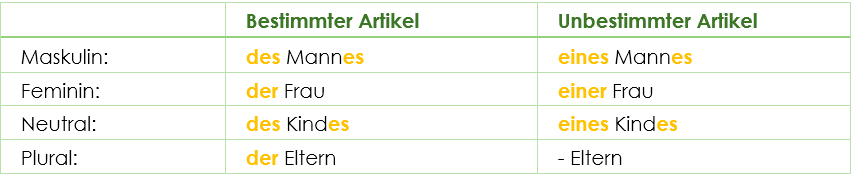
- Oh, I see
yeah
- thanks
mellow nova
you don't add -es to every single noun in Genitiv
only single syllable masc/neuter nouns
multi syllabic masc/neuter nouns just take -s when possible
hardy zinc
I see
- Die Kamera des/eines Reporters ist teuer
- Der Verkäufer des/eines Ladens ist freundlich
- Der Garten des/eines Professors ist groß
Thanks!
wise pendant
radiant pilot
where is the small typo in 8.?
tz
radiant pilot

celest pollen
Ich kann nicht mit das alles schaffen
I can not manage with all this
✅  ❌ ?>
❌ ?>
undone verge
doesn't look right to me
but I don't understand what exactly you want to get across even in english, so I can't suggest anything
mellow nova
do you mean like 'with all this (generally gesturing in front of you)'?
bc otherwise I don't think that makes sense even in English
celest pollen
ye
mellow nova
well your sentence is definitely not correct, maybe
Ich schaffe das alles nicht
undone verge
that would work for 'I can't manage all of this'
mellow nova
i think the context is being lost on me
like 'I can't manage under these conditions'? I don't really know what we're translating ngl
undone verge
yeah I also have no clue. Do you mean that you're annoyed/distracted by outside factors and can't concentrate?
celest pollen
For example, I just have a lot on my mind, ( cleaning, cooking, etc ) and I say this
cursive stirrup
"Ich habe viel zu tun" could work
mellow nova
Ich kann nicht mit allem fertig werden
undone verge
aufgrund der sich anhäufenden Haushaltspflichten kann ich nicht klar denken. 🙏
mellow nova
what a mouthful
undone verge
hehe
mellow nova
too many emojis
undone verge
ja sie häufen sich an, oder? 👀
mellow nova
undone verge
ich kann nicht mehr klar denken.
fervent kernel
undone verge
ich kann nicht mehr klar denken.
Du hast Alkohol getrunken?
last bolt
How can i say
I watered the plants in my garden
Whats the best verb for it i looked on leo.org and there are so many options
last bolt
Natürlich
 junior moth
Sorry if this is a weird question but for my final German project I have two different sections: write about your life at [the university i'm at] and also write about "deine Schulzeit" in past perfect. Problem is... I really dont know what the difference between these two would be and I'm not sure what specifically "deine Schulzeit" refers to? Is it like the whole time you've been a student (from kindergarten to college) or would it refer to something more specific? I kind of don't want to ask my teacher right now as she has a really bad case of COVID and I don't want to bother her if I don't have to :/
undone verge
Student = Uni
Schüler = Schule
your 'Schulzeit' is the time you spent at school before uni
that's why they're asking you to write about it in the past tense
mellow nova
isn't it more common to use Studierend- now for uni students for like inclusiveness or something
undone verge
idk...Student*innen is inclusive
Mitstudierende is a term I hear a lot at uni. Studierende too. But I think 'Student/Studentin' is still a common word
junior moth
Thanks! :D That's really helpful
mellow nova
wait she wants you to write that section exclusively in past perfect..? That's... odd
undone verge
I assumed it was a typo. I'm sure the assignment says present perfect?
mellow nova
would definitely make more sense
junior moth
ahh you're right! It does refer to the present perfect (it just says "im Perfekt" though). I always get confused with that as the present perfect refers to the past not the present despite the name lol. I knew what it refered to I just called it by the wrong thing I guess
mellow nova
Perfekt = present perfect
Plusquamperfekt = past perfect (or pluperfect if that helps you remember it better)
^^
mellow nova
i didnt ask for a political spiel but thanks anyways i suppose
dense obsidian
well you said it's more common but it's actually not. just wanted to get the facts correct.
plain umbra
@dense obsidian Please keep the politics out of questions channels. If you want to say it's less common, that's fine, but leave out the political commentary.
dense obsidian
didn't mean to offend anyone, i just don't like fake news. sorry.
undone verge
damnit i miss all the fun political spiels
 frank kraken
Can you say: "Es ist ein kurzes Lesen", when you are referring to a book? Or does "Es ist ein kurzes Buch" sound better?
Like in English, you can say "The Call of the Wild by Jack London is a short read," or "a quick read" (ein schnelles Lesen?) instead of "a short book."
mellow nova
the noun is die Lektüre (which does not mean the same as its false cognate in English 'lecture')
mellow nova
normally so...wie or just wie but this sentence is a little more complicated
undone verge
that's not even a simile, is it?
mellow nova
maybe if you changed it to 'she looks like someone who would play football'? It's been a hot minute
dense obsidian
Sie sieht aus, als spiele sie Fußball.
fervent kernel
Does Deutschland literally translate to the land of the people who speak German?
mellow nova
no it comes from much older words that would translate into something like 'the people's land'
 pure mountain
Doesn't most languages have that common origin when it comes about the etymology of their own nationality?
I bet most just means "our people's land'
It's interesting though
hardy zinc
Does this make sense?
"Ich mache es statt der Hausaufgabe"
fervent kernel
hardy zinc
Does this make sense?
"Ich mache es statt der Hausaufgabe"
statt die Hausaufgabe
fervent kernel
^