Recommended level(s): 


#botchannel
1 messages · Page 199 of 1
 lean flickerBOT
lean flickerBOT
lean flickerBOT
Purpose commands
:small_blue_diamond: **📒 purpose** <input>
Gives information about a role or channel.
Page 19/20 (20 entries)
 dim violet
help Genitiv
lean flickerBOT
No command or module called Genitiv found.
 near oriole
faq learn
lean flickerBOT
FAQ not found. I found the following similar entry: learn fast.
near oriole
faq begin
lean flickerBOT
FAQ not found. I found the following similar entries: beginner, beginner 2.
near oriole
faq beginner
lean flickerBOT
How to get started
The simplest way to learn German is to find topics you don’t understand yet and search for explanations of them. This list provides you with a guide for which topics to learn if you are completely new to German. Type the topic into Google (or YouTube) and start learning!
Introduction
1: Alphabet (especially ä, ü, ö and ß)
2: Basic greetings (hello, goodbye, etc.)
Part 1 - Simple Sentence
1: Noun gender & plurals
2: Nominative case (What are cases?)
3: Nominative pronouns (I, you, he, she, etc.)
4: Verbs in present tense
5: Definite/indefinite articles
6: Accusative case (for nouns)
7: Accusative pronouns
8: Word order of simple sentences
9: How to ask questions
See Part 2 on the next page.
Tips
- Always learn the gender of a noun when you learn a new noun
- Learn to use a translation dictionary (e.g. dict.cc, leo.org)
- Use
>faq resourcesto see our list of German learning resources - For listening and pronunciation practice, try watching movies or videos (incl. YouTube)
- You can listen to pronunciation for words on websites like dict.cc, forvo.com, and others
- Practice writing sentences every day (and asking people to correct them)
- Ask as many questions as possible
- Don’t be scared to make mistakes!!!! If you don’t let yourself make mistakes, you will never be able to learn German
Page 1/2
 earnest escarp
faq beginner
lean flickerBOT
How to get started - Part 2
Please make sure to read Part 1 before starting Part 2!
Part 2 – Beyond a Simple Sentence
1: Conjunctions (coordinating and subordinating)
2: Subordinate clause word order
3: Dative case
4: Dative verbs
5: Verbs with two objects (e.g. geben)
6: Prepositions (accusative, dative, and two-way)
7: Spoken past tense (Perfekt)
8: Written past tense (Präteritum)
9: Genitive case
10: Relative clauses
11: Adjective declension
Tips
- Make sure to practice writing and reading simple texts
- Some of these concepts are confusing to start with, so it’s a good idea to ask for help in #questions when you’re unsure
- You should use a declension chart to help with declension to start with, because you won’t be able to memorize it straight away
- After you feel confident with creating sentences, you can start learning the adjective declension properly by using the command >faq adjective declension and reading the guide provided
Page 2/2
 opaque ore
faq beginner
lean flickerBOT
How to get started
The simplest way to learn German is to find topics you don’t understand yet and search for explanations of them. This list provides you with a guide for which topics to learn if you are completely new to German. Type the topic into Google (or YouTube) and start learning!
Introduction
1: Alphabet (especially ä, ü, ö and ß)
2: Basic greetings (hello, goodbye, etc.)
Part 1 - Simple Sentence
1: Noun gender & plurals
2: Nominative case (What are cases?)
3: Nominative pronouns (I, you, he, she, etc.)
4: Verbs in present tense
5: Definite/indefinite articles
6: Accusative case (for nouns)
7: Accusative pronouns
8: Word order of simple sentences
9: How to ask questions
See Part 2 on the next page.
Tips
- Always learn the gender of a noun when you learn a new noun
- Learn to use a translation dictionary (e.g. dict.cc, leo.org)
- Use
>faq resourcesto see our list of German learning resources - For listening and pronunciation practice, try watching movies or videos (incl. YouTube)
- You can listen to pronunciation for words on websites like dict.cc, forvo.com, and others
- Practice writing sentences every day (and asking people to correct them)
- Ask as many questions as possible
- Don’t be scared to make mistakes!!!! If you don’t let yourself make mistakes, you will never be able to learn German
Page 1/2
 crystal sluice
faq beginner
lean flickerBOT
How to get started
The simplest way to learn German is to find topics you don’t understand yet and search for explanations of them. This list provides you with a guide for which topics to learn if you are completely new to German. Type the topic into Google (or YouTube) and start learning!
Introduction
1: Alphabet (especially ä, ü, ö and ß)
2: Basic greetings (hello, goodbye, etc.)
Part 1 - Simple Sentence
1: Noun gender & plurals
2: Nominative case (What are cases?)
3: Nominative pronouns (I, you, he, she, etc.)
4: Verbs in present tense
5: Definite/indefinite articles
6: Accusative case (for nouns)
7: Accusative pronouns
8: Word order of simple sentences
9: How to ask questions
See Part 2 on the next page.
Tips
- Always learn the gender of a noun when you learn a new noun
- Learn to use a translation dictionary (e.g. dict.cc, leo.org)
- Use
>faq resourcesto see our list of German learning resources - For listening and pronunciation practice, try watching movies or videos (incl. YouTube)
- You can listen to pronunciation for words on websites like dict.cc, forvo.com, and others
- Practice writing sentences every day (and asking people to correct them)
- Ask as many questions as possible
- Don’t be scared to make mistakes!!!! If you don’t let yourself make mistakes, you will never be able to learn German
Page 1/2
crystal sluice
faq resources
lean flickerBOT
Resources
 dense plank
lean flickerBOT
dense plank
lean flickerBOT
When do I use the dative case?
The dative case has a great number of usages, many of which are idiomatic, but is mainly used:
- to mark the indirect object of many transitive verbs (the indirect objectis that which receives the result of an action)
Ich habe dir ein Bier gekauft.
Sie gibt dem Mann das Buch.
Er zeigte ihm seinen Führerschein.
- to mark the object of some transitive verbs:
Dir fehlen die richtigen Materialien.
Es fällt mir bestimmt gleich wieder ein.
Das gefällt ihr gar nicht.
- after some prepositions:
Ich komme aus den USA.
Komm mit mir.
Ich lerne seit vielen Jahren Deutsch.
The following prepositions are always followed by the dative case:
aus, außer, bei, gegenüber, mit, nach, seit, von, zu
- after two-way prepositions when they do not indicate movement:
Das Bild hängt jetzt an der Wand.
Er joggt im Wald. (he is jogging in the woods)
Sie steht vor mir.
- to show possession, mainly of clothing or body parts:
Ich habe mir in die Finger geschnitten.
Er hat ihr die Nase gebrochen.
Die Mütze fiel mir vom Kopf.
- with many adjectives:
Ich war mir nicht sicher.
Ist dir kalt? (See >ex impersonal verbs for why there is no subject here.)
Er ist seinem Bruder sehr ähnlich.
Page 2/2
 knotty canopy
faq beginner
lean flickerBOT
How to get started
The simplest way to learn German is to find topics you don’t understand yet and search for explanations of them. This list provides you with a guide for which topics to learn if you are completely new to German. Type the topic into Google (or YouTube) and start learning!
Introduction
1: Alphabet (especially ä, ü, ö and ß)
2: Basic greetings (hello, goodbye, etc.)
Part 1 - Simple Sentence
1: Noun gender & plurals
2: Nominative case (What are cases?)
3: Nominative pronouns (I, you, he, she, etc.)
4: Verbs in present tense
5: Definite/indefinite articles
6: Accusative case (for nouns)
7: Accusative pronouns
8: Word order of simple sentences
9: How to ask questions
See Part 2 on the next page.
Tips
- Always learn the gender of a noun when you learn a new noun
- Learn to use a translation dictionary (e.g. dict.cc, leo.org)
- Use
>faq resourcesto see our list of German learning resources - For listening and pronunciation practice, try watching movies or videos (incl. YouTube)
- You can listen to pronunciation for words on websites like dict.cc, forvo.com, and others
- Practice writing sentences every day (and asking people to correct them)
- Ask as many questions as possible
- Don’t be scared to make mistakes!!!! If you don’t let yourself make mistakes, you will never be able to learn German
Page 1/2
 lofty hornet
faq resources
lean flickerBOT
Resources
 limpid elm
help
lean flickerBOT
Generic 2/2 commands
:small_blue_diamond: **serverinfo**
Shows information about the current guild.
:small_blue_diamond: **showcolor** <hex code>
Shows an image of the given color hex code.
Page 9/20 (20 entries)
limpid elm
roles
lean flickerBOT
Available roles
:small_blue_diamond: Level C
:small_blue_diamond: Limited Permissions
:small_blue_diamond: Locked Out
:small_blue_diamond: Moderator
:small_blue_diamond: Muted
:small_blue_diamond: Native Speaker
:small_blue_diamond: News
:small_blue_diamond: No Crown
:small_blue_diamond: Ouija
:small_blue_diamond: Pronunciation
:small_blue_diamond: Reading
:small_blue_diamond: Science
:small_blue_diamond: Sensitive-Topics
:small_blue_diamond: Server Bot
:small_blue_diamond: Session Holder
:small_blue_diamond: Streaming
:small_blue_diamond: TeaWordGame
:small_blue_diamond: Tired
:small_blue_diamond: Translation
:small_blue_diamond: Writing
Type `>purpose <role>` e.g. `>purpose Level A` for more detail about a role.
limpid elm
help
lean flickerBOT
Voice commands
:small_blue_diamond: **nowplaying**
Displays the currently playing song and its remaining duration.
:small_blue_diamond: **play** <prompt>
Queues a song to be played by the music bot. This command will only work if you are connected to a voice channel that has at least two members.
The given prompt can be either a YouTube link or a query that will be used to search YouTube and fetch the first result.
Please note that playing any sort of nationalistic, war-related songs, songs that violate our rules or abusing the feature in any way will get you blacklisted.
:small_blue_diamond: **queue**
Displays the songs that are in the song queue.
:small_blue_diamond: **skip**
Votes to skip the currently playing song.
For a skip vote to pass, more than a half of the members in the currently playing voice chat (rounded up) must vote for the skip.
:small_blue_diamond: **upcoming**
Displays the upcoming song and its remaining duration.
Page 15/20 (20 entries)
limpid elm
purpose words
lean flickerBOT
:x: 'words' is not a channel or a role.
limpid elm
faq cefr
lean flickerBOT
CEFR levels
If you see something like A1, B2 or C1, these represent the proficiency of a speaker in a language they're not native in, and are called CEFR levels. They are valid for any language, not only German!
Roughly speaking, A levels are beginners and C levels are experts. Remember that CEFR level are self-assessed and indicative!
You can see more specific names and descriptions on the Wikipedia page:
https://en.wikipedia.org/wiki/Common_European_Framework_of_Reference_for_Languages
🗨 How do I know what level I am?
If the table on Wikipedia is too generic for you, you can try using this one here:
https://rm.coe.int/168045bb52
Just check each column one at a time: if you can do all it describes, move to the next column. Your level is the highest where you can do the most things.
Alternatively, you can use this questionnaire to estimate your level more accurately:
https://www.laits.utexas.edu/fi/sites/laits.utexas.edu.fi/files/Self Assessment Checklist European.pdf
 dry fossil
faq cefr
lean flickerBOT
CEFR levels
If you see something like A1, B2 or C1, these represent the proficiency of a speaker in a language they're not native in, and are called CEFR levels. They are valid for any language, not only German!
Roughly speaking, A levels are beginners and C levels are experts. Remember that CEFR level are self-assessed and indicative!
You can see more specific names and descriptions on the Wikipedia page:
https://en.wikipedia.org/wiki/Common_European_Framework_of_Reference_for_Languages
🗨 How do I know what level I am?
If the table on Wikipedia is too generic for you, you can try using this one here:
https://rm.coe.int/168045bb52
Just check each column one at a time: if you can do all it describes, move to the next column. Your level is the highest where you can do the most things.
Alternatively, you can use this questionnaire to estimate your level more accurately:
https://www.laits.utexas.edu/fi/sites/laits.utexas.edu.fi/files/Self Assessment Checklist European.pdf
 cloud light
play بنت الجيران
lean flickerBOT
مهرجان بنت الجيران " بهوايا انتي قاعده معايا " حسن شاكوش و عمر كمال - توزيع اسلام ساسو [00:03:16] added to the queue.
 candid coral
explain dative
lean flickerBOT
When do I use the dative case?
The dative case has a great number of usages, many of which are idiomatic, but is mainly used:
- to mark the indirect object of many transitive verbs (the indirect objectis that which receives the result of an action)
Ich habe dir ein Bier gekauft.
Sie gibt dem Mann das Buch.
Er zeigte ihm seinen Führerschein.
- to mark the object of some transitive verbs:
Dir fehlen die richtigen Materialien.
Es fällt mir bestimmt gleich wieder ein.
Das gefällt ihr gar nicht.
- after some prepositions:
Ich komme aus den USA.
Komm mit mir.
Ich lerne seit vielen Jahren Deutsch.
The following prepositions are always followed by the dative case:
aus, außer, bei, gegenüber, mit, nach, seit, von, zu
- after two-way prepositions when they do not indicate movement:
Das Bild hängt jetzt an der Wand.
Er joggt im Wald. (he is jogging in the woods)
Sie steht vor mir.
- to show possession, mainly of clothing or body parts:
Ich habe mir in die Finger geschnitten.
Er hat ihr die Nase gebrochen.
Die Mütze fiel mir vom Kopf.
- with many adjectives:
Ich war mir nicht sicher.
Ist dir kalt? (See >ex impersonal verbs for why there is no subject here.)
Er ist seinem Bruder sehr ähnlich.
Page 2/2
cloud light
play zaz je veux
lean flickerBOT
ZAZ - Je veux (Clip officiel) [00:03:37] added to the queue.
 alpine mortar
faq cefr
lean flickerBOT
CEFR levels
If you see something like A1, B2 or C1, these represent the proficiency of a speaker in a language they're not native in, and are called CEFR levels. They are valid for any language, not only German!
Roughly speaking, A levels are beginners and C levels are experts. Remember that CEFR level are self-assessed and indicative!
You can see more specific names and descriptions on the Wikipedia page:
https://en.wikipedia.org/wiki/Common_European_Framework_of_Reference_for_Languages
🗨 How do I know what level I am?
If the table on Wikipedia is too generic for you, you can try using this one here:
https://rm.coe.int/168045bb52
Just check each column one at a time: if you can do all it describes, move to the next column. Your level is the highest where you can do the most things.
Alternatively, you can use this questionnaire to estimate your level more accurately:
https://www.laits.utexas.edu/fi/sites/laits.utexas.edu.fi/files/Self Assessment Checklist European.pdf
alpine mortar
faq cefr A1
lean flickerBOT
FAQ not found. I found the following similar entry: CEFR.
 grand tree
!beginner
 median sandal
faq cefr
lean flickerBOT
CEFR levels
If you see something like A1, B2 or C1, these represent the proficiency of a speaker in a language they're not native in, and are called CEFR levels. They are valid for any language, not only German!
Roughly speaking, A levels are beginners and C levels are experts. Remember that CEFR level are self-assessed and indicative!
You can see more specific names and descriptions on the Wikipedia page:
https://en.wikipedia.org/wiki/Common_European_Framework_of_Reference_for_Languages
🗨 How do I know what level I am?
If the table on Wikipedia is too generic for you, you can try using this one here:
https://rm.coe.int/168045bb52
Just check each column one at a time: if you can do all it describes, move to the next column. Your level is the highest where you can do the most things.
Alternatively, you can use this questionnaire to estimate your level more accurately:
https://www.laits.utexas.edu/fi/sites/laits.utexas.edu.fi/files/Self Assessment Checklist European.pdf
 lavish vessel
faq
lean flickerBOT
:x: The required argument name is missing.
lavish vessel
faq best way to learn
lean flickerBOT
Best way to learn German
There isn’t only one “best” way to learn German, especially since different methods work better for different people. However, this FAQ will outline the main aspects of learning efficiently, which you can cater to your needs.
If you’re a beginner, type >faq beginner in #botchannel to see our beginner guide.
Cover all skills
There are many combinations of activities you can use to study and practice a language. How do you know which combinations are suitable? The key is to make sure you cover each of the main skills with at least one activity. Some activities only train one skills, while some train multiple – either is fine, as long as all the 6 skills are covered somewhere in your studies.
The skills
• Reading
• Writing
• Listening
• Speaking
• Grammar
• Vocabulary
Which resources should I use?
It doesn’t really matter which resources you use, as long as you can follow along, and the information is correct and reliable. If you have any doubts about whether a resource is correct, feel free to ask. You do not need to find just one resource and stick to it – in fact, to learn best, it’s recommended that you use a large variety of resources and switch between them when needed.
Type >faq resources in #botchannel to see our list of resources.
On the next page
• Should I study all these skills every day?
• How much time should I dedicate to studying?
Page 1/2
 hardy rapids
faq learning german
lean flickerBOT
FAQ not found. I found the following similar entries: Best way to learn German, German letters, learn German fast.
hardy rapids
faq ressources
lean flickerBOT
FAQ not found. I found the following similar entry: Resources.
hardy rapids
faq Resources
lean flickerBOT
Resources
hardy rapids
!beginner
lavish vessel
help
lean flickerBOT
German commands
:small_blue_diamond: **lookup** <target> <phrase>
Translates the given phrase into the specified target language using dict.cc. Specify either en or de as targets.
:small_blue_diamond: **noun** <noun>
Provides a link to the declension of the given noun.
:small_blue_diamond: **verb** <infinitive>
Provides a link to the conjugation of the given infinitive.
:small_blue_diamond: **words**
A command that helps you train vocabulary using dict.cc.
Page 20/20 (20 entries)
lavish vessel
faq
lean flickerBOT
:x: The required argument name is missing.
lavish vessel
What are the names tho you dumb robot
 agile marlin
faq beginner
lean flickerBOT
How to get started
The simplest way to learn German is to find topics you don’t understand yet and search for explanations of them. This list provides you with a guide for which topics to learn if you are completely new to German. Type the topic into Google (or YouTube) and start learning!
Introduction
1: Alphabet (especially ä, ü, ö and ß)
2: Basic greetings (hello, goodbye, etc.)
Part 1 - Simple Sentence
1: Noun gender & plurals
2: Nominative case (What are cases?)
3: Nominative pronouns (I, you, he, she, etc.)
4: Verbs in present tense
5: Definite/indefinite articles
6: Accusative case (for nouns)
7: Accusative pronouns
8: Word order of simple sentences
9: How to ask questions
See Part 2 on the next page.
Tips
- Always learn the gender of a noun when you learn a new noun
- Learn to use a translation dictionary (e.g. dict.cc, leo.org)
- Use
>faq resourcesto see our list of German learning resources - For listening and pronunciation practice, try watching movies or videos (incl. YouTube)
- You can listen to pronunciation for words on websites like dict.cc, forvo.com, and others
- Practice writing sentences every day (and asking people to correct them)
- Ask as many questions as possible
- Don’t be scared to make mistakes!!!! If you don’t let yourself make mistakes, you will never be able to learn German
Page 1/2
 scarlet silo
info
lean flickerBOT

Information about sebxstixn#6482
Name
@scarlet silo
ID
825616295453786123
Joined
<t:1626772651> (5 months, 3 weeks and 5 days ago)
Account created
<t:1616912664> (9 months, 2 weeks and 4 days ago)
 crimson swallow
faq beginner
lean flickerBOT
How to get started - Part 2
Please make sure to read Part 1 before starting Part 2!
Part 2 – Beyond a Simple Sentence
1: Conjunctions (coordinating and subordinating)
2: Subordinate clause word order
3: Dative case
4: Dative verbs
5: Verbs with two objects (e.g. geben)
6: Prepositions (accusative, dative, and two-way)
7: Spoken past tense (Perfekt)
8: Written past tense (Präteritum)
9: Genitive case
10: Relative clauses
11: Adjective declension
Tips
- Make sure to practice writing and reading simple texts
- Some of these concepts are confusing to start with, so it’s a good idea to ask for help in #questions when you’re unsure
- You should use a declension chart to help with declension to start with, because you won’t be able to memorize it straight away
- After you feel confident with creating sentences, you can start learning the adjective declension properly by using the command >faq adjective declension and reading the guide provided
Page 2/2
lean flickerBOT
FAQ not found. Try >explain all.
 terse apex
explain all
 keen plaza

★ YÊU 5
- Sáng tác& trình bày: Rhymastic
#yeu5 #Rhymastic #jenhoang
- Video Editor: Jen Hoang
- Illustrated by Guagua
♪ Follow Rhymastic
- Youtube: https://www.youtube.com/channel/UCgz44a...
lean flickerBOT
:x: The bot cannot join the AFK channel.
keen plaza
★ YÊU 5
- Sáng tác& trình bày: Rhymastic
#yeu5 #Rhymastic #jenhoang
- Video Editor: Jen Hoang
- Illustrated by Guagua
♪ Follow Rhymastic
- Youtube: https://www.youtube.com/channel/UCgz44a...
lean flickerBOT
:x: There must be at least two users in a voice channel before the bot can start playing songs.
keen plaza
★ YÊU 5
- Sáng tác& trình bày: Rhymastic
#yeu5 #Rhymastic #jenhoang
- Video Editor: Jen Hoang
- Illustrated by Guagua
♪ Follow Rhymastic
- Youtube: https://www.youtube.com/channel/UCgz44a...
lean flickerBOT
Lyrics || YÊU 5 - Rhymastic [00:04:10] added to the queue.
 modest hull
faq verb
lean flickerBOT
FAQ not found. I found the following similar entry: verbs.
modest hull
faq verbs
lean flickerBOT
conjugation
Präsens (Present Tense)
When you use a verb in a sentence (or clause), you have to conjugate it (change the form) to match the subject of the sentence (or clause).
For example, in English, we write I eat but he/she eats. The verb has a different ending! The concept is the same in German, except German has more endings.
The first thing you need to know in order to conjugate verbs is: which ending fits which subject? Here is a simple verb “trinken” (to drink) as an example:
trinken
ich trinke
du trinkst
er/sie/es trinkt
wir trinken
ihr trinkt
sie trinken / Sie trinken
(Note: the conjugation for sie (they) and Sie (formal you) is always the same)
Vowel/Stem Changes
There are a few variations and exceptions, but the most important is vowel changes (also called stem changes). Some verbs get a vowel change, which only affects the du and er/sie/es forms of the verb. (However, modal verbs and wissen have their own special pattern, which also has a vowel change in the ich form.)
Example: ich schlafe, du schläfst
Other Changes
There are various other differences but I can’t describe them all here, so please read these websites or use Google to find more information: https://www.vistawide.com/german/grammar/german_verbs_present_tense.htm
https://www.thoughtco.com/german-present-tense-verbs-4074838
http://www.dartmouth.edu/~deutsch/Grammatik/PresentTense/Present.html
 silent hazel
faq beginner
lean flickerBOT
How to get started - Part 2
Please make sure to read Part 1 before starting Part 2!
Part 2 – Beyond a Simple Sentence
1: Conjunctions (coordinating and subordinating)
2: Subordinate clause word order
3: Dative case
4: Dative verbs
5: Verbs with two objects (e.g. geben)
6: Prepositions (accusative, dative, and two-way)
7: Spoken past tense (Perfekt)
8: Written past tense (Präteritum)
9: Genitive case
10: Relative clauses
11: Adjective declension
Tips
- Make sure to practice writing and reading simple texts
- Some of these concepts are confusing to start with, so it’s a good idea to ask for help in #questions when you’re unsure
- You should use a declension chart to help with declension to start with, because you won’t be able to memorize it straight away
- After you feel confident with creating sentences, you can start learning the adjective declension properly by using the command >faq adjective declension and reading the guide provided
Page 2/2
 severe tulip
faq cefr
lean flickerBOT
CEFR levels
If you see something like A1, B2 or C1, these represent the proficiency of a speaker in a language they're not native in, and are called CEFR levels. They are valid for any language, not only German!
Roughly speaking, A levels are beginners and C levels are experts. Remember that CEFR level are self-assessed and indicative!
You can see more specific names and descriptions on the Wikipedia page:
https://en.wikipedia.org/wiki/Common_European_Framework_of_Reference_for_Languages
🗨 How do I know what level I am?
If the table on Wikipedia is too generic for you, you can try using this one here:
https://rm.coe.int/168045bb52
Just check each column one at a time: if you can do all it describes, move to the next column. Your level is the highest where you can do the most things.
Alternatively, you can use this questionnaire to estimate your level more accurately:
https://www.laits.utexas.edu/fi/sites/laits.utexas.edu.fi/files/Self Assessment Checklist European.pdf
 tender trellis
info
lean flickerBOT

Information about hannah.#9056
Name
@eternal lodge
ID
930831278775889992
Joined
<t:1641998111> (3 days, 4 hours and 30 minutes ago)
Account created
<t:1641997870> (3 days, 4 hours and 34 minutes ago)
 bitter lantern
faq beginner
lean flickerBOT
How to get started
The simplest way to learn German is to find topics you don’t understand yet and search for explanations of them. This list provides you with a guide for which topics to learn if you are completely new to German. Type the topic into Google (or YouTube) and start learning!
Introduction
1: Alphabet (especially ä, ü, ö and ß)
2: Basic greetings (hello, goodbye, etc.)
Part 1 - Simple Sentence
1: Noun gender & plurals
2: Nominative case (What are cases?)
3: Nominative pronouns (I, you, he, she, etc.)
4: Verbs in present tense
5: Definite/indefinite articles
6: Accusative case (for nouns)
7: Accusative pronouns
8: Word order of simple sentences
9: How to ask questions
See Part 2 on the next page.
Tips
- Always learn the gender of a noun when you learn a new noun
- Learn to use a translation dictionary (e.g. dict.cc, leo.org)
- Use
>faq resourcesto see our list of German learning resources - For listening and pronunciation practice, try watching movies or videos (incl. YouTube)
- You can listen to pronunciation for words on websites like dict.cc, forvo.com, and others
- Practice writing sentences every day (and asking people to correct them)
- Ask as many questions as possible
- Don’t be scared to make mistakes!!!! If you don’t let yourself make mistakes, you will never be able to learn German
Page 1/2
 obtuse mist
session info 139
lean flickerBOT
6 days, 23 hours and 33 minutes ago - (AdvancedReading) held by Blüwüleinchen🦜
Recommended Level(s)
Recommended level(s):
Session Description
nur Deutsch Leserunde: die Unendliche Geschichte
Posted 1 week, 2 days and 8 hours ago
Lange nicht gehört meine fleißigen Leseratten, ich hoffe ihr habt eine entspannende Pause
Dieses Wochenende lesen wir endlich mal wieder! 🌷 📖🏜️
Wir werden aus dem Buch "Die Unendliche Geschichte" vorlesen und die Handlung in eigenen Worten zusammenfassen. Dabei können wir auch neue Wörter besprechen.
Wir treffen uns zur angegebenen Zeit im Lessons VC, wir werden auch den lessons-Kanal benutzen um Bilder und Definitionen usw auszutauschen.
Ihr findet eine Kopie des Buches in den angepinnten Nachrichten in diesem Kanal
Beim letzten Mal haben wir auf Seite 179 aufgehört, ganz am Anfang des Kapitels "Perelin, der Nachtwald".
Wie immer:
Wenn ihr Vorlesen wollt, könnt ihr bitte mal ein V vor eure Namen hinschreiben.
Und wenn ihr nur zuhören wollt, dann bitte ein Z hinschreiben.
Ich freue mich darauf, euch zu hören!!
Posted 6 days, 23 hours and 28 minutes ago
Hallo zusammen wir fangen gleich an mit dem Vorlesen. kommt in den Lessons vc wenn ihr mitmachen wollt
Type `>session list` to see a list of all sessions.
 silent totem
faq beginner
lean flickerBOT
How to get started
The simplest way to learn German is to find topics you don’t understand yet and search for explanations of them. This list provides you with a guide for which topics to learn if you are completely new to German. Type the topic into Google (or YouTube) and start learning!
Introduction
1: Alphabet (especially ä, ü, ö and ß)
2: Basic greetings (hello, goodbye, etc.)
Part 1 - Simple Sentence
1: Noun gender & plurals
2: Nominative case (What are cases?)
3: Nominative pronouns (I, you, he, she, etc.)
4: Verbs in present tense
5: Definite/indefinite articles
6: Accusative case (for nouns)
7: Accusative pronouns
8: Word order of simple sentences
9: How to ask questions
See Part 2 on the next page.
Tips
- Always learn the gender of a noun when you learn a new noun
- Learn to use a translation dictionary (e.g. dict.cc, leo.org)
- Use
>faq resourcesto see our list of German learning resources - For listening and pronunciation practice, try watching movies or videos (incl. YouTube)
- You can listen to pronunciation for words on websites like dict.cc, forvo.com, and others
- Practice writing sentences every day (and asking people to correct them)
- Ask as many questions as possible
- Don’t be scared to make mistakes!!!! If you don’t let yourself make mistakes, you will never be able to learn German
Page 1/2
scarlet silo
faq cefr
lean flickerBOT
CEFR levels
If you see something like A1, B2 or C1, these represent the proficiency of a speaker in a language they're not native in, and are called CEFR levels. They are valid for any language, not only German!
Roughly speaking, A levels are beginners and C levels are experts. Remember that CEFR level are self-assessed and indicative!
You can see more specific names and descriptions on the Wikipedia page:
https://en.wikipedia.org/wiki/Common_European_Framework_of_Reference_for_Languages
🗨 How do I know what level I am?
If the table on Wikipedia is too generic for you, you can try using this one here:
https://rm.coe.int/168045bb52
Just check each column one at a time: if you can do all it describes, move to the next column. Your level is the highest where you can do the most things.
Alternatively, you can use this questionnaire to estimate your level more accurately:
https://www.laits.utexas.edu/fi/sites/laits.utexas.edu.fi/files/Self Assessment Checklist European.pdf
obtuse mist
session begin
lean flickerBOT
Lessons VC has been unlocked.
 abstract meadow
session info 140
lean flickerBOT
3 minutes and 53 seconds ago - (AdvancedReading) held by Blüwüleinchen🦜
Recommended Level(s)
Recommended level(s):
Session Description
nur Deutsch Leserunde: die Unendliche Geschichte
Posted 1 day, 19 hours and 15 minutes ago
Hallo ihr fleißigen Leseratten
Dieses Wochenende lesen wir nochmal! 🦁 📖🏜️
Wir werden aus dem Buch "Die Unendliche Geschichte" vorlesen und die Handlung in eigenen Worten zusammenfassen. Dabei können wir auch neue Wörter besprechen.
Wir treffen uns zur angegebenen Zeit im Lessons VC, wir werden auch den lessons-Kanal benutzen um Bilder und Definitionen usw auszutauschen.
Ihr findet eine Kopie des Buchs in den angepinnten Nachrichten in diesem Kanal
Beim letzten Mal haben wir auf Seite 192 aufgehört, ganz am Anfang des Kapitels "Goab, die Wüste der Farben".
Wie immer:
Wenn ihr Vorlesen wollt, könnt ihr bitte mal ein V vor eure Namen hinschreiben.
Und wenn ihr nur zuhören wollt, dann bitte ein Z schreiben.
Ich freue mich darauf, euch zu hören!!
Posted 26 minutes and 15 seconds ago
Hallo zusammen!
Die Leserunde fängt in etwa 30 Minuten an.
Wenn ihr mehr Information dazu wollt, könnt ihr die Sessioninfos aufrufen, indem ihr >session info 140 in #botchannel eingebt
Bis dann!
Type `>session list` to see a list of all sessions.
 humble walrus
showcolor
lean flickerBOT
:x: The required argument hexCode is missing.
humble walrus
showcolor 000000
lean flickerBOT
 humble walrus
showcolor ff0000
lean flickerBOT
 tender trellis
help
lean flickerBOT
Stargazing commands
:small_blue_diamond: **📒 star**
Provides stargazing functionality for the server. The stargazing system highlights memorable moments from the server. The starboard can be configured dynamically, temporarily locked and posts from it can be displayed.
Page 1/20 (20 entries)
humble walrus
showcolor ffff00
lean flickerBOT
 humble walrus
showcolor ff00ff
lean flickerBOT
 humble walrus
showcolor 0000ff
lean flickerBOT
 obtuse mist
lesson end
lean flickerBOT
Lessons VC has been locked.
 rustic linden
faq cefr
lean flickerBOT
CEFR levels
If you see something like A1, B2 or C1, these represent the proficiency of a speaker in a language they're not native in, and are called CEFR levels. They are valid for any language, not only German!
Roughly speaking, A levels are beginners and C levels are experts. Remember that CEFR level are self-assessed and indicative!
You can see more specific names and descriptions on the Wikipedia page:
https://en.wikipedia.org/wiki/Common_European_Framework_of_Reference_for_Languages
🗨 How do I know what level I am?
If the table on Wikipedia is too generic for you, you can try using this one here:
https://rm.coe.int/168045bb52
Just check each column one at a time: if you can do all it describes, move to the next column. Your level is the highest where you can do the most things.
Alternatively, you can use this questionnaire to estimate your level more accurately:
https://www.laits.utexas.edu/fi/sites/laits.utexas.edu.fi/files/Self Assessment Checklist European.pdf
FAQ not found. I found the following similar entry: CEFR.
 lost mason
faq
lean flickerBOT
:x: The required argument name is missing.
lost mason
<faq
 candid timber
faq
lean flickerBOT
:x: The required argument name is missing.
 rustic viper
lessons
lean flickerBOT
Upcoming Sessions
:calendar: Want to add our sessions schedule to your Google calendar?
:small_blue_diamond: 2022-01-22 at 21:00 UTC (Your time: <t:1642885200>) held by Blüwüleinchen🦜
[ID: 141] (AdvancedReading)
nur Deutsch Leserunde: die Unendliche Geschichte
Recommended level(s):
:small_blue_diamond: 2022-01-29 at 21:00 UTC (Your time: <t:1643490000>) held by Blüwüleinchen🦜
[ID: 142] (AdvancedReading)
nur Deutsch Leserunde: die Unendliche Geschichte
Recommended level(s):
Type `>session info [ID#]` e.g. `>session info 3` for more detail about a specific session.
 copper rapids
faq beginner
lean flickerBOT
How to get started
The simplest way to learn German is to find topics you don’t understand yet and search for explanations of them. This list provides you with a guide for which topics to learn if you are completely new to German. Type the topic into Google (or YouTube) and start learning!
Introduction
1: Alphabet (especially ä, ü, ö and ß)
2: Basic greetings (hello, goodbye, etc.)
Part 1 - Simple Sentence
1: Noun gender & plurals
2: Nominative case (What are cases?)
3: Nominative pronouns (I, you, he, she, etc.)
4: Verbs in present tense
5: Definite/indefinite articles
6: Accusative case (for nouns)
7: Accusative pronouns
8: Word order of simple sentences
9: How to ask questions
See Part 2 on the next page.
Tips
- Always learn the gender of a noun when you learn a new noun
- Learn to use a translation dictionary (e.g. dict.cc, leo.org)
- Use
>faq resourcesto see our list of German learning resources - For listening and pronunciation practice, try watching movies or videos (incl. YouTube)
- You can listen to pronunciation for words on websites like dict.cc, forvo.com, and others
- Practice writing sentences every day (and asking people to correct them)
- Ask as many questions as possible
- Don’t be scared to make mistakes!!!! If you don’t let yourself make mistakes, you will never be able to learn German
Page 1/2
tender trellis
sessions
lean flickerBOT
Upcoming Sessions
:calendar: Want to add our sessions schedule to your Google calendar?
:small_blue_diamond: 2022-01-22 at 21:00 UTC (Your time: <t:1642885200>) held by Blüwüleinchen🦜
[ID: 141] (AdvancedReading)
nur Deutsch Leserunde: die Unendliche Geschichte
Recommended level(s):
:small_blue_diamond: 2022-01-29 at 21:00 UTC (Your time: <t:1643490000>) held by Blüwüleinchen🦜
[ID: 142] (AdvancedReading)
nur Deutsch Leserunde: die Unendliche Geschichte
Recommended level(s):
Type `>session info [ID#]` e.g. `>session info 3` for more detail about a specific session.
 sharp scroll
sessions
lean flickerBOT
Upcoming Sessions
:calendar: Want to add our sessions schedule to your Google calendar?
:small_blue_diamond: 2022-01-22 at 21:00 UTC (Your time: <t:1642885200>) held by Blüwüleinchen🦜
[ID: 141] (AdvancedReading)
nur Deutsch Leserunde: die Unendliche Geschichte
Recommended level(s):
:small_blue_diamond: 2022-01-29 at 21:00 UTC (Your time: <t:1643490000>) held by Blüwüleinchen🦜
[ID: 142] (AdvancedReading)
nur Deutsch Leserunde: die Unendliche Geschichte
Recommended level(s):
Type `>session info [ID#]` e.g. `>session info 3` for more detail about a specific session.
 dawn ginkgo

Provided to YouTube by Revelator Ltd.
Leute Sind Seltsam · Dziuks Küche
Vom Tisch
℗ 2019 NODOPROD INC.
Released on: 2014-06-05
Music Publisher: Kingston Songs Edition
Music Publisher: Kingston Songs Edition
Lyricist: Dziuks Küche
Composer & Arranger (?): Hammer Musik under exclusive license to NODOPROD INC.
Auto-generated by YouTube.
lean flickerBOT
Leute Sind Seltsam [00:04:05] added to the queue.
:x: This command can only be used by a moderator.
dawn ginkgo
skip
 quiet cape
sessions
lean flickerBOT
Upcoming Sessions
:calendar: Want to add our sessions schedule to your Google calendar?
:small_blue_diamond: 2022-01-22 at 21:00 UTC (Your time: <t:1642885200>) held by Blüwüleinchen🦜
[ID: 141] (AdvancedReading)
nur Deutsch Leserunde: die Unendliche Geschichte
Recommended level(s):
:small_blue_diamond: 2022-01-29 at 21:00 UTC (Your time: <t:1643490000>) held by Blüwüleinchen🦜
[ID: 142] (AdvancedReading)
nur Deutsch Leserunde: die Unendliche Geschichte
Recommended level(s):
Type `>session info [ID#]` e.g. `>session info 3` for more detail about a specific session.
 candid wasp
faq beginner
lean flickerBOT
How to get started - Part 2
Please make sure to read Part 1 before starting Part 2!
Part 2 – Beyond a Simple Sentence
1: Conjunctions (coordinating and subordinating)
2: Subordinate clause word order
3: Dative case
4: Dative verbs
5: Verbs with two objects (e.g. geben)
6: Prepositions (accusative, dative, and two-way)
7: Spoken past tense (Perfekt)
8: Written past tense (Präteritum)
9: Genitive case
10: Relative clauses
11: Adjective declension
Tips
- Make sure to practice writing and reading simple texts
- Some of these concepts are confusing to start with, so it’s a good idea to ask for help in #questions when you’re unsure
- You should use a declension chart to help with declension to start with, because you won’t be able to memorize it straight away
- After you feel confident with creating sentences, you can start learning the adjective declension properly by using the command >faq adjective declension and reading the guide provided
Page 2/2
crimson swallow
sessions
lean flickerBOT
Upcoming Sessions
:calendar: Want to add our sessions schedule to your Google calendar?
:small_blue_diamond: 2022-01-22 at 21:00 UTC (Your time: <t:1642885200>) held by Blüwüleinchen🦜
[ID: 141] (AdvancedReading)
nur Deutsch Leserunde: die Unendliche Geschichte
Recommended level(s):
:small_blue_diamond: 2022-01-29 at 21:00 UTC (Your time: <t:1643490000>) held by Blüwüleinchen🦜
[ID: 142] (AdvancedReading)
nur Deutsch Leserunde: die Unendliche Geschichte
Recommended level(s):
Type `>session info [ID#]` e.g. `>session info 3` for more detail about a specific session.
 buoyant nacelle
sessions
lean flickerBOT
Upcoming Sessions
:calendar: Want to add our sessions schedule to your Google calendar?
:small_blue_diamond: 2022-01-22 at 21:00 UTC (Your time: <t:1642885200>) held by Blüwüleinchen🦜
[ID: 141] (AdvancedReading)
nur Deutsch Leserunde: die Unendliche Geschichte
Recommended level(s):
:small_blue_diamond: 2022-01-29 at 21:00 UTC (Your time: <t:1643490000>) held by Blüwüleinchen🦜
[ID: 142] (AdvancedReading)
nur Deutsch Leserunde: die Unendliche Geschichte
Recommended level(s):
Type `>session info [ID#]` e.g. `>session info 3` for more detail about a specific session.
 rare prairie
help translate
lean flickerBOT
lookup <target> <phrase>
**Aliases: **lk, dictcc, dcc, translate
Translates the given phrase into the specified target language using dict.cc. Specify either en or de as targets.
Module: German
lean flickerBOT
Translations for I want to go home:
**:small_blue_diamond:** zurückwollen
to want to go back
**:small_blue_diamond:** weiterwollen *[ugs.]*
to want to go further
**:small_blue_diamond:** Ich trau' mich nicht nach Hause.
daren't go home.
**:small_blue_diamond:** reinwollen *[ugs.]*
to want (to go) in [coll.]
**:small_blue_diamond:** Ich will, dass du ...
want you to ...
Page 2/2 (10 entries)
rare prairie
dcc en abber ich bin auch Vorschlägen gegenüber jederzeit aufgeschlossen und vielleicht versuche ich es mal mit einer Bühne
lean flickerBOT
Translations for abber ich bin auch Vorschlägen gegenüber jederzeit aufgeschlossen und vielleicht versuche ich es mal mit einer Bühne:
**:small_blue_diamond:** Ich bin Vorschlägen gegenüber jederzeit aufgeschlossen.
I'm always open suggestions.
**:small_blue_diamond:** Ich bin erkältet. Ich auch.
have a cold. Me too.
**:small_blue_diamond:** Ich bin Politiker, das heißt, ich bin ein Betrüger und Lügner, und wenn ich kleinen Kindern keine Küsschen gebe, klaue ich ihnen ihre Bonbons.
I'm a politician, which means I'm a cheater and a liar, and when I'm not kissing babies I'm stealing their lollipops. [The Hunt for Red October
**:small_blue_diamond:** Ich bin nicht schwul, obwohl ich es gerne wäre, bloß um Leute mit Schwulenparanoia zu ärgern. *[Übs.* *Clara* *Drechsler]*
am not gay, although wish were, just piss off homophobes. [Kurt Cobain]
**:small_blue_diamond:** Ich will, dass du (es) merkst, wenn ich nicht da bin.
want you notice when I'm not around.
Page 1/2 (10 entries)
rare prairie
help
lean flickerBOT
German commands
:small_blue_diamond: **lookup** <target> <phrase>
Translates the given phrase into the specified target language using dict.cc. Specify either en or de as targets.
:small_blue_diamond: **noun** <noun>
Provides a link to the declension of the given noun.
:small_blue_diamond: **verb** <infinitive>
Provides a link to the conjugation of the given infinitive.
:small_blue_diamond: **words**
A command that helps you train vocabulary using dict.cc.
Page 20/20 (20 entries)
rare prairie
noun hund
lean flickerBOT
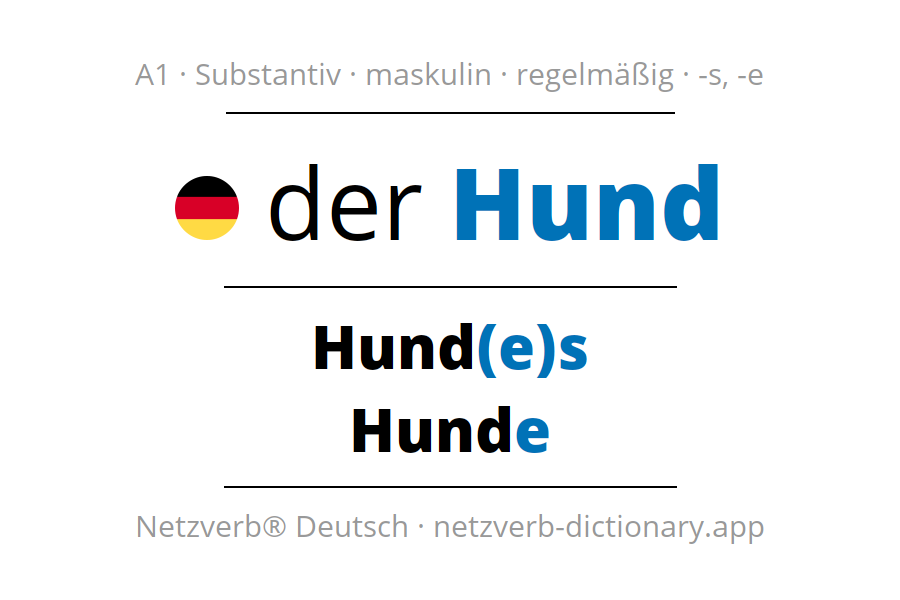
Deklination Substantiv Hund: im Plural, Genitiv, allen Kasus, ... mit Bedeutungen, Übersetzungen, Sprachausgabe und Downloads.
rare prairie
help words
lean flickerBOT
words
**Aliases: **wordtrainer, wordgame
A command that helps you train vocabulary using dict.cc.
Module: German
rare prairie
words
lean flickerBOT
**Wrong.** What does *funky* mean?
:regional_indicator_a: stonedead
:regional_indicator_b: funky
:regional_indicator_c: impulsive
:regional_indicator_d: post-surgery
rare prairie
verb gehen
lean flickerBOT

Konjugation Verb gehen: im Präsens, Präteritum, Konjunktiv, Perfekt, ... viele Beispiele, Grammatik, Regeln erklärt, Übersetzung, Übungen, Bedeutung und kostenlose Downloads.
 austere dagger
faq gender patterns
lean flickerBOT
Gender patterns
Unfortunately, many German words don't have immediately clear clues that reveal it, but thankfully, many common words do follow patterns that reveal their gender.
In general, you are advised to learn the article together with the word (and its plural!).
Plural forms always use die and follow plural declension rules, which are the same for all genders (yay 🎉).
For compound words, remember that only the last word matters.
Type >explain grammatical gender for an explanation on grammatical gender.
Here's a list of patterns to recognise word gender.
Note that exceptions may apply.
Page 1/4
 junior osprey
austere dagger
>faq gender patterns
junior osprey
austere dagger
>faq gender patterns
Thank you
austere dagger
junior osprey
Thank you
I think you may have to call up the faq yourself if you want to see the other pages, though. :)
junior osprey
austere dagger
I think you may have to call up the faq yourself if you want to see the other pa...
Ok
junior osprey
austere dagger
I think you may have to call up the faq yourself if you want to see the other pa...
What are your opinions on duolingo, thats what i am doing rn
junior osprey
austere dagger
Best call up the faq for duolingo. Think you can manage? ;)
Ok
sorry
i was talking to a friend
Ahem
as the germans would say
Du bist sehr nett 🙂
austere dagger
:) Very nice of you to say so, but please try to stay within the topic of the channel/s -> general conversations are for #general :)
junior osprey
Oh shit
this is the botchannel
hey uh is it ok if i ask you amquestion in dms bc i didnt let me send here
@austere dagger
 hazy totem
sessions
lean flickerBOT
Upcoming Sessions
:calendar: Want to add our sessions schedule to your Google calendar?
:small_blue_diamond: 2022-01-22 at 21:00 UTC (Your time: <t:1642885200>) held by Blüwüleinchen🦜
[ID: 141] (AdvancedReading)
nur Deutsch Leserunde: die Unendliche Geschichte
Recommended level(s):
:small_blue_diamond: 2022-01-29 at 21:00 UTC (Your time: <t:1643490000>) held by Blüwüleinchen🦜
[ID: 142] (AdvancedReading)
nur Deutsch Leserunde: die Unendliche Geschichte
Recommended level(s):
Type `>session info [ID#]` e.g. `>session info 3` for more detail about a specific session.
 undone sinew
faq beginner
 maiden willow
faq beginner
lean flickerBOT
How to get started
The simplest way to learn German is to find topics you don’t understand yet and search for explanations of them. This list provides you with a guide for which topics to learn if you are completely new to German. Type the topic into Google (or YouTube) and start learning!
Introduction
1: Alphabet (especially ä, ü, ö and ß)
2: Basic greetings (hello, goodbye, etc.)
Part 1 - Simple Sentence
1: Noun gender & plurals
2: Nominative case (What are cases?)
3: Nominative pronouns (I, you, he, she, etc.)
4: Verbs in present tense
5: Definite/indefinite articles
6: Accusative case (for nouns)
7: Accusative pronouns
8: Word order of simple sentences
9: How to ask questions
See Part 2 on the next page.
Tips
- Always learn the gender of a noun when you learn a new noun
- Learn to use a translation dictionary (e.g. dict.cc, leo.org)
- Use
>faq resourcesto see our list of German learning resources - For listening and pronunciation practice, try watching movies or videos (incl. YouTube)
- You can listen to pronunciation for words on websites like dict.cc, forvo.com, and others
- Practice writing sentences every day (and asking people to correct them)
- Ask as many questions as possible
- Don’t be scared to make mistakes!!!! If you don’t let yourself make mistakes, you will never be able to learn German
Page 1/2
 versed holly
faq beginner
lean flickerBOT
How to get started - Part 2
Please make sure to read Part 1 before starting Part 2!
Part 2 – Beyond a Simple Sentence
1: Conjunctions (coordinating and subordinating)
2: Subordinate clause word order
3: Dative case
4: Dative verbs
5: Verbs with two objects (e.g. geben)
6: Prepositions (accusative, dative, and two-way)
7: Spoken past tense (Perfekt)
8: Written past tense (Präteritum)
9: Genitive case
10: Relative clauses
11: Adjective declension
Tips
- Make sure to practice writing and reading simple texts
- Some of these concepts are confusing to start with, so it’s a good idea to ask for help in #questions when you’re unsure
- You should use a declension chart to help with declension to start with, because you won’t be able to memorize it straight away
- After you feel confident with creating sentences, you can start learning the adjective declension properly by using the command >faq adjective declension and reading the guide provided
Page 2/2
 shell hamlet
sessions
lean flickerBOT
Upcoming Sessions
:calendar: Want to add our sessions schedule to your Google calendar?
:small_blue_diamond: 2022-01-22 at 21:00 UTC (Your time: <t:1642885200>) held by Blüwüleinchen🦜
[ID: 141] (AdvancedReading)
nur Deutsch Leserunde: die Unendliche Geschichte
Recommended level(s):
:small_blue_diamond: 2022-01-29 at 21:00 UTC (Your time: <t:1643490000>) held by Blüwüleinchen🦜
[ID: 142] (AdvancedReading)
nur Deutsch Leserunde: die Unendliche Geschichte
Recommended level(s):
Type `>session info [ID#]` e.g. `>session info 3` for more detail about a specific session.
 ionic raven
faq beginner
 sweet thistle
faq gender
lean flickerBOT
Grammatical gender
German nouns are sorted in three different genders: masculine, neuter and feminine. These have nothing to do with sex or social gender.
The first thing genders will influence are articles like der, das, die. Each word has its own and you better get it right: some words that look identical can have different meanings depending on the gender they're used with. For example:
die Band = the (musical) band,
der Band = the (book) volume,
das Band = the tape.
Some words, mainly trademarks and loanwords, have multiple acceptable genders while having no change in meaning:
der Jogurt = das Jogurt
das Virus = der Virus
These may vary by region or colloquiality.
💢 But WHY, German, WHY ⁉
Gender is actually quite useful! Since sentence structure is less rigid than in English, grammatical case helps you tell the various elements apart (with some practice), and that works through genders: each gender has its own forms, which makes everything a little less ambiguous. Besides, as you've seen with Band above, it allows us to make up words with different meanings that look the same but are not ambiguous, and if that's not magic, I don't know what is. ✨
🙀 But how am I supposed to tell them apart? 🙀
Check out >explain gender patterns. 😉
tender trellis
faq cefr
lean flickerBOT
CEFR levels
If you see something like A1, B2 or C1, these represent the proficiency of a speaker in a language they're not native in, and are called CEFR levels. They are valid for any language, not only German!
Roughly speaking, A levels are beginners and C levels are experts. Remember that CEFR level are self-assessed and indicative!
You can see more specific names and descriptions on the Wikipedia page:
https://en.wikipedia.org/wiki/Common_European_Framework_of_Reference_for_Languages
🗨 How do I know what level I am?
If the table on Wikipedia is too generic for you, you can try using this one here:
https://rm.coe.int/168045bb52
Just check each column one at a time: if you can do all it describes, move to the next column. Your level is the highest where you can do the most things.
Alternatively, you can use this questionnaire to estimate your level more accurately:
https://www.laits.utexas.edu/fi/sites/laits.utexas.edu.fi/files/Self Assessment Checklist European.pdf
tender trellis
purpose Heritage Speaker
lean flickerBOT
Information about Heritage Speaker
Heritage Speaker
Indicates members who are Heritage Speakers of German.
This means that they were exposed to the language from a very young age (e.g. by their parents) but usually don't consider it their native language and never learned German in a formal school setting, for example.
You cannot assign yourself this role. You must request it by clicking the appropriate button here.
 vapid blade
sessions
lean flickerBOT
Upcoming Sessions
:calendar: Want to add our sessions schedule to your Google calendar?
:small_blue_diamond: 2022-01-22 at 21:00 UTC (Your time: <t:1642885200>) held by Blüwüleinchen🦜
[ID: 141] (AdvancedReading)
nur Deutsch Leserunde: die Unendliche Geschichte
Recommended level(s):
:small_blue_diamond: 2022-01-29 at 21:00 UTC (Your time: <t:1643490000>) held by Blüwüleinchen🦜
[ID: 142] (AdvancedReading)
nur Deutsch Leserunde: die Unendliche Geschichte
Recommended level(s):
Type `>session info [ID#]` e.g. `>session info 3` for more detail about a specific session.
 weary oar
lean flickerBOT
weary oar
lean flickerBOT
Bans commands
:small_blue_diamond: **isbanned** <user>
Checks whether the given user is banned.
Page 11/20 (20 entries)
 left cliff
emojistats
lean flickerBOT
Server Emoji Stats
Total Amount Of Emoji Uses
114207
Total Amount Of Emoji Reaction Uses
24419
Top Emojis
 (14266 uses, 12%, 61.54 uses/day)
 (11424 uses, 10%, 49.28 uses/day)
 (6301 uses, 6%, 27.18 uses/day)
 (6241 uses, 5%, 26.92 uses/day)
 (5897 uses, 5%, 25.44 uses/day)
 (5334 uses, 5%, 23.01 uses/day)
 (3492 uses, 3%, 15.06 uses/day)
 (3250 uses, 3%, 14.02 uses/day)
 (3005 uses, 3%, 12.96 uses/day)
 (2768 uses, 2%, 11.94 uses/day)
Top Reaction Emojis
- (1793 uses, 7% 7.73 uses/day)
- (1473 uses, 6% 6.35 uses/day)
- (1381 uses, 6% 5.96 uses/day)
 (1179 uses, 5% 5.09 uses/day)
- (1171 uses, 5% 5.05 uses/day)
 (1047 uses, 4% 4.52 uses/day)
 (956 uses, 4% 4.12 uses/day)
- (900 uses, 4% 3.88 uses/day)
 (865 uses, 4% 3.73 uses/day)
 (796 uses, 3% 3.43 uses/day)
humble walrus
emojistats desc
lean flickerBOT
Server Emoji Stats
Total Amount Of Emoji Uses
114214
Total Amount Of Emoji Reaction Uses
24422
Bottom Emojis
- Deleted Emoji (1 use, 0%, null/day)
- Deleted Emoji (1 use, 0%, null/day)
- Deleted Emoji (6 uses, 0%, null/day)
- Deleted Emoji (10 uses, 0%, null/day)
- Deleted Emoji (13 uses, 0%, null/day)
 (14 uses, 0%, 0.06 uses/day)
 (16 uses, 0%, 0.07 uses/day)
 (17 uses, 0%, 0.07 uses/day)
 (18 uses, 0%, 0.08 uses/day)
 (19 uses, 0%, 1.75 use/day)
Bottom Reaction Emojis
- (1 use, 0% 0.09 uses/day)
- Deleted Emoji (1 use, 0% null/day)
- Deleted Emoji (2 uses, 0% null/day)
- Deleted Emoji (2 uses, 0% null/day)
- Deleted Emoji (2 uses, 0% null/day)
 (3 uses, 0% 0.03 uses/day)
 (3 uses, 0% 0.01 uses/day)
 (4 uses, 0% 0.02 uses/day)
- Deleted Emoji (5 uses, 0% null/day)
- (5 uses, 0% 0.02 uses/day)
 candid quail
faq beginner
lean flickerBOT
How to get started
The simplest way to learn German is to find topics you don’t understand yet and search for explanations of them. This list provides you with a guide for which topics to learn if you are completely new to German. Type the topic into Google (or YouTube) and start learning!
Introduction
1: Alphabet (especially ä, ü, ö and ß)
2: Basic greetings (hello, goodbye, etc.)
Part 1 - Simple Sentence
1: Noun gender & plurals
2: Nominative case (What are cases?)
3: Nominative pronouns (I, you, he, she, etc.)
4: Verbs in present tense
5: Definite/indefinite articles
6: Accusative case (for nouns)
7: Accusative pronouns
8: Word order of simple sentences
9: How to ask questions
See Part 2 on the next page.
Tips
- Always learn the gender of a noun when you learn a new noun
- Learn to use a translation dictionary (e.g. dict.cc, leo.org)
- Use
>faq resourcesto see our list of German learning resources - For listening and pronunciation practice, try watching movies or videos (incl. YouTube)
- You can listen to pronunciation for words on websites like dict.cc, forvo.com, and others
- Practice writing sentences every day (and asking people to correct them)
- Ask as many questions as possible
- Don’t be scared to make mistakes!!!! If you don’t let yourself make mistakes, you will never be able to learn German
Page 1/2
 vivid zinc
sessions
lean flickerBOT
Upcoming Sessions
:calendar: Want to add our sessions schedule to your Google calendar?
:small_blue_diamond: 2022-01-22 at 21:00 UTC (Your time: <t:1642885200>) held by Blüwüleinchen🦜
[ID: 141] (AdvancedReading)
nur Deutsch Leserunde: die Unendliche Geschichte
Recommended level(s):
:small_blue_diamond: 2022-01-29 at 21:00 UTC (Your time: <t:1643490000>) held by Blüwüleinchen🦜
[ID: 142] (AdvancedReading)
nur Deutsch Leserunde: die Unendliche Geschichte
Recommended level(s):
Type `>session info [ID#]` e.g. `>session info 3` for more detail about a specific session.
lean flickerBOT
star
Provides stargazing functionality for the server. The stargazing system highlights memorable moments from the server. The starboard can be configured dynamically, temporarily locked and posts from it can be displayed.
:small_blue_diamond: **star random** [user]
Displays a random public star entry. If the user is specified, only starred entries from that user will be displayed.
:small_blue_diamond: **star recent**
Shows the most recent stars on the server. If the command is invoked in a public channel, it will display stars from all public channels. If it is executed in a group channel, it will display only the stars from that channel.
:small_blue_diamond: **star recentlist**
Shows the most recent stars on the server in a list form. If the command is invoked in a public channel, it will display stars from all public channels. If it is executed in a group channel, it will display only the stars from that channel.
:small_blue_diamond: **star show** <message id>
**Aliases: **star display, star view
Shows the starred post with the given message ID.
Module: Stargazing
 I don't understand
lean flickerBOT
I don't understand
lean flickerBOT
CEFR levels
If you see something like A1, B2 or C1, these represent the proficiency of a speaker in a language they're not native in, and are called CEFR levels. They are valid for any language, not only German!
Roughly speaking, A levels are beginners and C levels are experts. Remember that CEFR level are self-assessed and indicative!
You can see more specific names and descriptions on the Wikipedia page:
https://en.wikipedia.org/wiki/Common_European_Framework_of_Reference_for_Languages
🗨 How do I know what level I am?
If the table on Wikipedia is too generic for you, you can try using this one here:
https://rm.coe.int/168045bb52
Just check each column one at a time: if you can do all it describes, move to the next column. Your level is the highest where you can do the most things.
Alternatively, you can use this questionnaire to estimate your level more accurately:
https://www.laits.utexas.edu/fi/sites/laits.utexas.edu.fi/files/Self Assessment Checklist European.pdf
 storm topaz

Cotiza tu proyecto a mi IG: @antofa_lyrics
Se ofrece:
• Plazo de 2 a 4 días hábiles dependiendo de la duración, complejidad y pedidos del interesado.
• El precio más barato del mercado.
• Atención rápida y amable.
• Calidad del trabajo acorde a la paga.
• Servicio de diseño gráfico (miniaturas, diseño de historias IG, etc) GRATIS al recibir la ...
lean flickerBOT
Dele Cotele 3 / letra / Yohancito , Adán, Yordano, Pailita , Jairo, Balbi, Marcianeke, King, El Bai [00:07:14] added to the queue.
storm topaz
stop
lean flickerBOT
:x: This command can only be used by a moderator.
Not enough members to play songs. Bye.
 cunning crest
faq beginner
lean flickerBOT
How to get started
The simplest way to learn German is to find topics you don’t understand yet and search for explanations of them. This list provides you with a guide for which topics to learn if you are completely new to German. Type the topic into Google (or YouTube) and start learning!
Introduction
1: Alphabet (especially ä, ü, ö and ß)
2: Basic greetings (hello, goodbye, etc.)
Part 1 - Simple Sentence
1: Noun gender & plurals
2: Nominative case (What are cases?)
3: Nominative pronouns (I, you, he, she, etc.)
4: Verbs in present tense
5: Definite/indefinite articles
6: Accusative case (for nouns)
7: Accusative pronouns
8: Word order of simple sentences
9: How to ask questions
See Part 2 on the next page.
Tips
- Always learn the gender of a noun when you learn a new noun
- Learn to use a translation dictionary (e.g. dict.cc, leo.org)
- Use
>faq resourcesto see our list of German learning resources - For listening and pronunciation practice, try watching movies or videos (incl. YouTube)
- You can listen to pronunciation for words on websites like dict.cc, forvo.com, and others
- Practice writing sentences every day (and asking people to correct them)
- Ask as many questions as possible
- Don’t be scared to make mistakes!!!! If you don’t let yourself make mistakes, you will never be able to learn German
Page 1/2
 desert igloo
help
lean flickerBOT
Help commands
:small_blue_diamond: **help** [term]
Displays help information for modules and individual commands. The optional argument term is the search term to use. If no value is provided, the bot will display a list of all available modules. Otherwise, it will attempt to find information about the given term.
Page 5/20 (20 entries)
desert igloo
faq beginner
lean flickerBOT
How to get started
The simplest way to learn German is to find topics you don’t understand yet and search for explanations of them. This list provides you with a guide for which topics to learn if you are completely new to German. Type the topic into Google (or YouTube) and start learning!
Introduction
1: Alphabet (especially ä, ü, ö and ß)
2: Basic greetings (hello, goodbye, etc.)
Part 1 - Simple Sentence
1: Noun gender & plurals
2: Nominative case (What are cases?)
3: Nominative pronouns (I, you, he, she, etc.)
4: Verbs in present tense
5: Definite/indefinite articles
6: Accusative case (for nouns)
7: Accusative pronouns
8: Word order of simple sentences
9: How to ask questions
See Part 2 on the next page.
Tips
- Always learn the gender of a noun when you learn a new noun
- Learn to use a translation dictionary (e.g. dict.cc, leo.org)
- Use
>faq resourcesto see our list of German learning resources - For listening and pronunciation practice, try watching movies or videos (incl. YouTube)
- You can listen to pronunciation for words on websites like dict.cc, forvo.com, and others
- Practice writing sentences every day (and asking people to correct them)
- Ask as many questions as possible
- Don’t be scared to make mistakes!!!! If you don’t let yourself make mistakes, you will never be able to learn German
Page 1/2
desert igloo
faq resources
lean flickerBOT
Resources
lean flickerBOT
How to get started
The simplest way to learn German is to find topics you don’t understand yet and search for explanations of them. This list provides you with a guide for which topics to learn if you are completely new to German. Type the topic into Google (or YouTube) and start learning!
Introduction
1: Alphabet (especially ä, ü, ö and ß)
2: Basic greetings (hello, goodbye, etc.)
Part 1 - Simple Sentence
1: Noun gender & plurals
2: Nominative case (What are cases?)
3: Nominative pronouns (I, you, he, she, etc.)
4: Verbs in present tense
5: Definite/indefinite articles
6: Accusative case (for nouns)
7: Accusative pronouns
8: Word order of simple sentences
9: How to ask questions
See Part 2 on the next page.
Tips
- Always learn the gender of a noun when you learn a new noun
- Learn to use a translation dictionary (e.g. dict.cc, leo.org)
- Use
>faq resourcesto see our list of German learning resources - For listening and pronunciation practice, try watching movies or videos (incl. YouTube)
- You can listen to pronunciation for words on websites like dict.cc, forvo.com, and others
- Practice writing sentences every day (and asking people to correct them)
- Ask as many questions as possible
- Don’t be scared to make mistakes!!!! If you don’t let yourself make mistakes, you will never be able to learn German
Page 1/2
tender trellis
faq modality
lean flickerBOT
FAQ not found. Try >explain all.
tender trellis
faq explain all
lean flickerBOT
FAQ not found. Try >explain all.
lean flickerBOT
See a listed FAQ with >faq [name]
:small_blue_diamond: Swiss German
Aliases: gsw
:small_blue_diamond: Switzerland
Aliases: Schweiz, CH
:small_blue_diamond: Two-way prepositions
Aliases: two way prepositions, dual prepositions
:small_blue_diamond: Umlauts
Aliases: Umlaute, Umlaut, ä, ö, ü
:small_blue_diamond: Usage of Konjunktiv II
Aliases: KII 1
:small_blue_diamond: Usage of zu
Aliases: um zu
:small_blue_diamond: Verbs with prepositions
Aliases: verb prepositions, pferd's verb list
:small_blue_diamond: Vorgangspassiv
:small_blue_diamond: Weak Nouns
Aliases: N-Declension, N-Deklination, weak noun
:small_blue_diamond: weil, denn, da
:small_blue_diamond: What does GLaD mean?
Aliases: GLaD
:small_blue_diamond: wissen und kennen
Aliases: wissen vs. kennen, kennen vs. wissen
:small_blue_diamond: Word Order for Nouns & Pronouns
:small_blue_diamond: Word Order for Verbs
Aliases: word order verbs, word order of verbs
Page 4/4 (59 entries)
tender trellis
faq nicos weg
lean flickerBOT
nicos
Nicos Weg is a free online program aimed at helping people learn German. It includes video, audio, text, grammar explanations, notes, vocabulary, and exercises. It also includes very useful cultural and bureaucratic information, such as how to open a bank account, while teaching you the relevant grammar and vocabulary.
It’s fairly popular and well-recommended, but keep in mind that you can’t learn a language with only one resource, even if it’s a good one!
You can find the courses here: https://learngerman.dw.com/en/overview/
You can also see various other courses for learners by dw.com here: https://www.dw.com/en/learn-german/s-2469/
crimson swallow
help
lean flickerBOT
Meme 2/2 commands
:small_blue_diamond: **petdog** <member>
Pets the given member's dog.
:small_blue_diamond: **shootdog** <member>
Shoot the given member's dog, like the monster you are.
Page 3/20 (20 entries)
crimson swallow
words
lean flickerBOT
**Wrong.** What does *crabbed* mean?
:regional_indicator_a: Riesen-
:regional_indicator_b: Voralpen-
:regional_indicator_c: ungraduiert
:regional_indicator_d: griesgrämig
tender trellis
faq beginner
lean flickerBOT
How to get started
The simplest way to learn German is to find topics you don’t understand yet and search for explanations of them. This list provides you with a guide for which topics to learn if you are completely new to German. Type the topic into Google (or YouTube) and start learning!
Introduction
1: Alphabet (especially ä, ü, ö and ß)
2: Basic greetings (hello, goodbye, etc.)
Part 1 - Simple Sentence
1: Noun gender & plurals
2: Nominative case (What are cases?)
3: Nominative pronouns (I, you, he, she, etc.)
4: Verbs in present tense
5: Definite/indefinite articles
6: Accusative case (for nouns)
7: Accusative pronouns
8: Word order of simple sentences
9: How to ask questions
See Part 2 on the next page.
Tips
- Always learn the gender of a noun when you learn a new noun
- Learn to use a translation dictionary (e.g. dict.cc, leo.org)
- Use
>faq resourcesto see our list of German learning resources - For listening and pronunciation practice, try watching movies or videos (incl. YouTube)
- You can listen to pronunciation for words on websites like dict.cc, forvo.com, and others
- Practice writing sentences every day (and asking people to correct them)
- Ask as many questions as possible
- Don’t be scared to make mistakes!!!! If you don’t let yourself make mistakes, you will never be able to learn German
Page 1/2
scarlet silo
faq cefr
lean flickerBOT
CEFR levels
If you see something like A1, B2 or C1, these represent the proficiency of a speaker in a language they're not native in, and are called CEFR levels. They are valid for any language, not only German!
Roughly speaking, A levels are beginners and C levels are experts. Remember that CEFR level are self-assessed and indicative!
You can see more specific names and descriptions on the Wikipedia page:
https://en.wikipedia.org/wiki/Common_European_Framework_of_Reference_for_Languages
🗨 How do I know what level I am?
If the table on Wikipedia is too generic for you, you can try using this one here:
https://rm.coe.int/168045bb52
Just check each column one at a time: if you can do all it describes, move to the next column. Your level is the highest where you can do the most things.
Alternatively, you can use this questionnaire to estimate your level more accurately:
https://www.laits.utexas.edu/fi/sites/laits.utexas.edu.fi/files/Self Assessment Checklist European.pdf
scarlet silo
scarlet silo
>faq cefr
@stuck ermine ^^
 stuck ermine
@scarlet silo danke dir. ich bleibe grün. 🤪
scarlet silo
Kein Ding! ^^
 rapid onyx
words
lean flickerBOT
**Correct!** What does *Cadillac* mean?
:regional_indicator_a: reimports
:regional_indicator_b: attic
:regional_indicator_c: Cadillac ®
:regional_indicator_d: analogy
 amber patio
words
lean flickerBOT
**Wrong.** What does *Hirnkrebs* mean?
:regional_indicator_a: quarreling
:regional_indicator_b: brain cancer
:regional_indicator_c: seer
:regional_indicator_d: means of transport
amber patio
words
lean flickerBOT
**Correct!** What does *to decode* mean?
:regional_indicator_a: jdn. alarmieren
:regional_indicator_b: lufttrocknen
:regional_indicator_c: befreien
:regional_indicator_d: dekodieren
 latent snow
faq beginner
lean flickerBOT
How to get started
The simplest way to learn German is to find topics you don’t understand yet and search for explanations of them. This list provides you with a guide for which topics to learn if you are completely new to German. Type the topic into Google (or YouTube) and start learning!
Introduction
1: Alphabet (especially ä, ü, ö and ß)
2: Basic greetings (hello, goodbye, etc.)
Part 1 - Simple Sentence
1: Noun gender & plurals
2: Nominative case (What are cases?)
3: Nominative pronouns (I, you, he, she, etc.)
4: Verbs in present tense
5: Definite/indefinite articles
6: Accusative case (for nouns)
7: Accusative pronouns
8: Word order of simple sentences
9: How to ask questions
See Part 2 on the next page.
Tips
- Always learn the gender of a noun when you learn a new noun
- Learn to use a translation dictionary (e.g. dict.cc, leo.org)
- Use
>faq resourcesto see our list of German learning resources - For listening and pronunciation practice, try watching movies or videos (incl. YouTube)
- You can listen to pronunciation for words on websites like dict.cc, forvo.com, and others
- Practice writing sentences every day (and asking people to correct them)
- Ask as many questions as possible
- Don’t be scared to make mistakes!!!! If you don’t let yourself make mistakes, you will never be able to learn German
Page 1/2
 fathom quartz
sessions
lean flickerBOT
Upcoming Sessions
:calendar: Want to add our sessions schedule to your Google calendar?
:small_blue_diamond: 2022-01-22 at 21:00 UTC (Your time: <t:1642885200>) held by Blüwüleinchen🦜
[ID: 141] (AdvancedReading)
nur Deutsch Leserunde: die Unendliche Geschichte
Recommended level(s):
:small_blue_diamond: 2022-01-29 at 21:00 UTC (Your time: <t:1643490000>) held by Blüwüleinchen🦜
[ID: 142] (AdvancedReading)
nur Deutsch Leserunde: die Unendliche Geschichte
Recommended level(s):
Type `>session info [ID#]` e.g. `>session info 3` for more detail about a specific session.
 bright tree
faq beginner
lean flickerBOT
How to get started
The simplest way to learn German is to find topics you don’t understand yet and search for explanations of them. This list provides you with a guide for which topics to learn if you are completely new to German. Type the topic into Google (or YouTube) and start learning!
Introduction
1: Alphabet (especially ä, ü, ö and ß)
2: Basic greetings (hello, goodbye, etc.)
Part 1 - Simple Sentence
1: Noun gender & plurals
2: Nominative case (What are cases?)
3: Nominative pronouns (I, you, he, she, etc.)
4: Verbs in present tense
5: Definite/indefinite articles
6: Accusative case (for nouns)
7: Accusative pronouns
8: Word order of simple sentences
9: How to ask questions
See Part 2 on the next page.
Tips
- Always learn the gender of a noun when you learn a new noun
- Learn to use a translation dictionary (e.g. dict.cc, leo.org)
- Use
>faq resourcesto see our list of German learning resources - For listening and pronunciation practice, try watching movies or videos (incl. YouTube)
- You can listen to pronunciation for words on websites like dict.cc, forvo.com, and others
- Practice writing sentences every day (and asking people to correct them)
- Ask as many questions as possible
- Don’t be scared to make mistakes!!!! If you don’t let yourself make mistakes, you will never be able to learn German
Page 1/2
lean flickerBOT

 hasty burrow
emo cat
lean flickerBOT




 proud obsidian
We specifically give you a refresh button so you don't have to spam the command, so please don't. 
 cunning igloo
faq beginner
 rich ginkgo
faq beginner
lean flickerBOT
How to get started
The simplest way to learn German is to find topics you don’t understand yet and search for explanations of them. This list provides you with a guide for which topics to learn if you are completely new to German. Type the topic into Google (or YouTube) and start learning!
Introduction
1: Alphabet (especially ä, ü, ö and ß)
2: Basic greetings (hello, goodbye, etc.)
Part 1 - Simple Sentence
1: Noun gender & plurals
2: Nominative case (What are cases?)
3: Nominative pronouns (I, you, he, she, etc.)
4: Verbs in present tense
5: Definite/indefinite articles
6: Accusative case (for nouns)
7: Accusative pronouns
8: Word order of simple sentences
9: How to ask questions
See Part 2 on the next page.
Tips
- Always learn the gender of a noun when you learn a new noun
- Learn to use a translation dictionary (e.g. dict.cc, leo.org)
- Use
>faq resourcesto see our list of German learning resources - For listening and pronunciation practice, try watching movies or videos (incl. YouTube)
- You can listen to pronunciation for words on websites like dict.cc, forvo.com, and others
- Practice writing sentences every day (and asking people to correct them)
- Ask as many questions as possible
- Don’t be scared to make mistakes!!!! If you don’t let yourself make mistakes, you will never be able to learn German
Page 1/2
 ruby dove
faq resources
lean flickerBOT
Resources
tender trellis
explain gender pattern
lean flickerBOT
FAQ not found. I found the following similar entries: gender, Gender patterns.
tender trellis
explain gender patterns
lean flickerBOT
**Neuter words (das)**
- nominalised verbs (das Leben, das Lesen)
- metals (das Gold, das Kupfer)
- babies and cubs (das Baby, das Lamm)
- diminutives in
-chen/-lein(das Hündchen) - words ending in:
---mentdas Experiment, das Sakrament
---ma(usually of Greek origin) das Komma, das Thema
Page 3/4
 hasty valve
sessions
lean flickerBOT
Upcoming Sessions
:calendar: Want to add our sessions schedule to your Google calendar?
:small_blue_diamond: 2022-01-22 at 21:00 UTC (Your time: <t:1642885200>) held by Blüwüleinchen🦜
[ID: 141] (AdvancedReading)
nur Deutsch Leserunde: die Unendliche Geschichte
Recommended level(s):
:small_blue_diamond: 2022-01-29 at 21:00 UTC (Your time: <t:1643490000>) held by Blüwüleinchen🦜
[ID: 142] (AdvancedReading)
nur Deutsch Leserunde: die Unendliche Geschichte
Recommended level(s):
Type `>session info [ID#]` e.g. `>session info 3` for more detail about a specific session.
 indigo wigeon
faq beginner
lean flickerBOT
How to get started
The simplest way to learn German is to find topics you don’t understand yet and search for explanations of them. This list provides you with a guide for which topics to learn if you are completely new to German. Type the topic into Google (or YouTube) and start learning!
Introduction
1: Alphabet (especially ä, ü, ö and ß)
2: Basic greetings (hello, goodbye, etc.)
Part 1 - Simple Sentence
1: Noun gender & plurals
2: Nominative case (What are cases?)
3: Nominative pronouns (I, you, he, she, etc.)
4: Verbs in present tense
5: Definite/indefinite articles
6: Accusative case (for nouns)
7: Accusative pronouns
8: Word order of simple sentences
9: How to ask questions
See Part 2 on the next page.
Tips
- Always learn the gender of a noun when you learn a new noun
- Learn to use a translation dictionary (e.g. dict.cc, leo.org)
- Use
>faq resourcesto see our list of German learning resources - For listening and pronunciation practice, try watching movies or videos (incl. YouTube)
- You can listen to pronunciation for words on websites like dict.cc, forvo.com, and others
- Practice writing sentences every day (and asking people to correct them)
- Ask as many questions as possible
- Don’t be scared to make mistakes!!!! If you don’t let yourself make mistakes, you will never be able to learn German
Page 1/2
indigo wigeon
faq resources
lean flickerBOT
Resources
 unreal cliff
sessions
lean flickerBOT
Upcoming Sessions
:calendar: Want to add our sessions schedule to your Google calendar?
:small_blue_diamond: 2022-01-22 at 21:00 UTC (Your time: <t:1642885200>) held by Blüwüleinchen🦜
[ID: 141] (AdvancedReading)
nur Deutsch Leserunde: die Unendliche Geschichte
Recommended level(s):
:small_blue_diamond: 2022-01-29 at 21:00 UTC (Your time: <t:1643490000>) held by Blüwüleinchen🦜
[ID: 142] (AdvancedReading)
nur Deutsch Leserunde: die Unendliche Geschichte
Recommended level(s):
Type `>session info [ID#]` e.g. `>session info 3` for more detail about a specific session.
lean flickerBOT
How to get started
The simplest way to learn German is to find topics you don’t understand yet and search for explanations of them. This list provides you with a guide for which topics to learn if you are completely new to German. Type the topic into Google (or YouTube) and start learning!
Introduction
1: Alphabet (especially ä, ü, ö and ß)
2: Basic greetings (hello, goodbye, etc.)
Part 1 - Simple Sentence
1: Noun gender & plurals
2: Nominative case (What are cases?)
3: Nominative pronouns (I, you, he, she, etc.)
4: Verbs in present tense
5: Definite/indefinite articles
6: Accusative case (for nouns)
7: Accusative pronouns
8: Word order of simple sentences
9: How to ask questions
See Part 2 on the next page.
Tips
- Always learn the gender of a noun when you learn a new noun
- Learn to use a translation dictionary (e.g. dict.cc, leo.org)
- Use
>faq resourcesto see our list of German learning resources - For listening and pronunciation practice, try watching movies or videos (incl. YouTube)
- You can listen to pronunciation for words on websites like dict.cc, forvo.com, and others
- Practice writing sentences every day (and asking people to correct them)
- Ask as many questions as possible
- Don’t be scared to make mistakes!!!! If you don’t let yourself make mistakes, you will never be able to learn German
Page 1/2
crimson swallow
faq best way to learn
lean flickerBOT
Best way to learn German
Should I study all these skills every day?
If you want to study them all every day, you can, but some people may find it easier to focus on particular skills on particular days. For example, on Monday you might choose to do a lot of writing practice, and then on Tuesday you might plan some conversation practice with some speaking partners.
If you try to cover too many different things in one day, then you might be jumping around all over the place and not able to focus on each individual task. It’s also a really good idea to have a different schedule or set of tasks each day to keep things from getting boring. So setting a special schedule or set of tasks for each day of the week - like the Monday writing day, or every Friday you do some grammar exercises followed by watching TV shows, or any other combination you like – is a really good way to go.
How much time should I dedicate to studying?
Everyone has a different schedule and everyone learns at a different pace. It is recommended to study every day, preferably for 30 minutes or more, but taking 1-2 days off is okay. More important is how many hours you study in a week.
A casual pace will be roughly around 5-8 hours a week, a steady pace would be around 10-14 hours a week, and a fast pace (around the same pace as a university subject) will be 15-20 hours a week.
Anything less than 5 hours and you may find it hard to keep improving steadily (but feel free to try it and see how it works for you), while studying one subject for over 25 hours a week may quickly lead to burnout.
How you choose to spread those hours out over the week is not that important; for example, if you have a lot of time on the weekend but not during the week, it’s fine to do short study sessions on weekdays and then dedicate a bunch of time on Saturday and Sunday.
Page 2/2
tender trellis
faq
lean flickerBOT
:x: The required argument name is missing.
tender trellis
faq beginner
lean flickerBOT
How to get started - Part 2
Please make sure to read Part 1 before starting Part 2!
Part 2 – Beyond a Simple Sentence
1: Conjunctions (coordinating and subordinating)
2: Subordinate clause word order
3: Dative case
4: Dative verbs
5: Verbs with two objects (e.g. geben)
6: Prepositions (accusative, dative, and two-way)
7: Spoken past tense (Perfekt)
8: Written past tense (Präteritum)
9: Genitive case
10: Relative clauses
11: Adjective declension
Tips
- Make sure to practice writing and reading simple texts
- Some of these concepts are confusing to start with, so it’s a good idea to ask for help in #questions when you’re unsure
- You should use a declension chart to help with declension to start with, because you won’t be able to memorize it straight away
- After you feel confident with creating sentences, you can start learning the adjective declension properly by using the command >faq adjective declension and reading the guide provided
Page 2/2
sweet thistle
faq cases
lean flickerBOT
Cases
Cases
German has four grammatical cases (der Fall or der Kasus in German): nominative, accusative, dative, and genitive. A case alters a noun, pronoun, adjective, etc., in some way to mark its grammatical function in a phrase, clause, or sentence. For example, the main function of the nominative (der Nominativ) case is to mark the subject in a sentence:
Ich liebe die deutsche Sprache!
In this sentence, the pronoun ich represents the first person subject and is in the nominative case. Every noun, pronoun, adjective, etc. has form in every case and it is very important to learn all of them. For example, the accusative form of ich is mich:
Die deutsche Sprache liebt mich!
See >explain adjective declension to get started on that. Don't get discouraged by how much there is, it takes some time master.
To see an explanation of the usages of every case, see their individual articles:
>explain nominative
>explain accusative
>explain dative
>explain genitive
lean flickerBOT
When do I use the accusative case?
The accusative case is mainly used:
- to mark the direct object of many transitive verbs
Ich lese einen Roman.
Er hat die schöne Frau ermordet.
Sie besitzen kein Auto.
- after some prepositions
Danke für deine Hilfe!
Ohne dich kann ich nicht leben.
Sie hatten keine Einwände gegen den Plan.
The following prepositions are always followed by the accusative case:
bis, durch, für, gegen, ohne, um
- to indicate movement in a particular direction in two-way prepositions
Er steigt auf den Gipfel.
Sie hängt das Bild an die Wand.
Ich gehe gleich ins Bett. (ins = in das)
- by adverbials of time and measurement
A definite length or point in time:
Ich habe den ganzen Tag geschlafen.
Sie kommt nächste Woche zurück.
A measurement:
Das Kind ist vier Jahre alt.
Das Tier ist einen Meter groß.
Expressing distance with verbs of motion:
Ich ging die Treppe hinauf.
Ich lief den ganzen Weg zu Fuß.
- in common greetings and wishes
Guten Morgen/Tag/Abend!
Gute Besserung!
Herzlichen Glückwunsch!
Here there is an implicit verb such as 'wünschen', where the greeting/wish is the direct object.
Page 2/2
lean flickerBOT
When do I use the dative case?
The dative case has a great number of usages, many of which are idiomatic, but is mainly used:
- to mark the indirect object of many transitive verbs (the indirect objectis that which receives the result of an action)
Ich habe dir ein Bier gekauft.
Sie gibt dem Mann das Buch.
Er zeigte ihm seinen Führerschein.
- to mark the object of some transitive verbs:
Dir fehlen die richtigen Materialien.
Es fällt mir bestimmt gleich wieder ein.
Das gefällt ihr gar nicht.
- after some prepositions:
Ich komme aus den USA.
Komm mit mir.
Ich lerne seit vielen Jahren Deutsch.
The following prepositions are always followed by the dative case:
aus, außer, bei, gegenüber, mit, nach, seit, von, zu
- after two-way prepositions when they do not indicate movement:
Das Bild hängt jetzt an der Wand.
Er joggt im Wald. (he is jogging in the woods)
Sie steht vor mir.
- to show possession, mainly of clothing or body parts:
Ich habe mir in die Finger geschnitten.
Er hat ihr die Nase gebrochen.
Die Mütze fiel mir vom Kopf.
- with many adjectives:
Ich war mir nicht sicher.
Ist dir kalt? (See >ex impersonal verbs for why there is no subject here.)
Er ist seinem Bruder sehr ähnlich.
Page 2/2
vapid blade
faq cefr
lean flickerBOT
CEFR levels
If you see something like A1, B2 or C1, these represent the proficiency of a speaker in a language they're not native in, and are called CEFR levels. They are valid for any language, not only German!
Roughly speaking, A levels are beginners and C levels are experts. Remember that CEFR level are self-assessed and indicative!
You can see more specific names and descriptions on the Wikipedia page:
https://en.wikipedia.org/wiki/Common_European_Framework_of_Reference_for_Languages
🗨 How do I know what level I am?
If the table on Wikipedia is too generic for you, you can try using this one here:
https://rm.coe.int/168045bb52
Just check each column one at a time: if you can do all it describes, move to the next column. Your level is the highest where you can do the most things.
Alternatively, you can use this questionnaire to estimate your level more accurately:
https://www.laits.utexas.edu/fi/sites/laits.utexas.edu.fi/files/Self Assessment Checklist European.pdf
tender trellis
faq beginner
lean flickerBOT
How to get started - Part 2
Please make sure to read Part 1 before starting Part 2!
Part 2 – Beyond a Simple Sentence
1: Conjunctions (coordinating and subordinating)
2: Subordinate clause word order
3: Dative case
4: Dative verbs
5: Verbs with two objects (e.g. geben)
6: Prepositions (accusative, dative, and two-way)
7: Spoken past tense (Perfekt)
8: Written past tense (Präteritum)
9: Genitive case
10: Relative clauses
11: Adjective declension
Tips
- Make sure to practice writing and reading simple texts
- Some of these concepts are confusing to start with, so it’s a good idea to ask for help in #questions when you’re unsure
- You should use a declension chart to help with declension to start with, because you won’t be able to memorize it straight away
- After you feel confident with creating sentences, you can start learning the adjective declension properly by using the command >faq adjective declension and reading the guide provided
Page 2/2
FAQ not found. Try >explain all.
tender trellis
explain all
lean flickerBOT
See a listed FAQ with >faq [name]
:small_blue_diamond: absentive
Aliases: absentiv
:small_blue_diamond: Accusative
Aliases: Akkusativ
:small_blue_diamond: Adjective Declension
Aliases: adjective endings, Adjektivdeklination
:small_blue_diamond: Anki
Aliases: flashcards
:small_blue_diamond: beginner 2
:small_blue_diamond: Beide vs. Beides
Aliases: Beides vs. Beide, Beides, Beide
:small_blue_diamond: Best way to learn German
Aliases: learn fast, learn German fast, learn efficiently, best way to learn, fastest way to learn, most efficient way to learn
:small_blue_diamond: birthdays
:small_blue_diamond: Cases
Aliases: case, grammatical case
:small_blue_diamond: CEFR levels
Aliases: lvl, CEFR, cerf
:small_blue_diamond: conjugation
Aliases: praesens, präsens, present tense, verbs, verb conjugation, Konjugation
:small_blue_diamond: Contractions
Aliases: Verschmelzung, vom, Schmelzwort
:small_blue_diamond: DACH
:small_blue_diamond: Dative
Aliases: Dativ
:small_blue_diamond: doch
Page 1/4 (59 entries)
tender trellis
faq learn fast
lean flickerBOT
Best way to learn German
Should I study all these skills every day?
If you want to study them all every day, you can, but some people may find it easier to focus on particular skills on particular days. For example, on Monday you might choose to do a lot of writing practice, and then on Tuesday you might plan some conversation practice with some speaking partners.
If you try to cover too many different things in one day, then you might be jumping around all over the place and not able to focus on each individual task. It’s also a really good idea to have a different schedule or set of tasks each day to keep things from getting boring. So setting a special schedule or set of tasks for each day of the week - like the Monday writing day, or every Friday you do some grammar exercises followed by watching TV shows, or any other combination you like – is a really good way to go.
How much time should I dedicate to studying?
Everyone has a different schedule and everyone learns at a different pace. It is recommended to study every day, preferably for 30 minutes or more, but taking 1-2 days off is okay. More important is how many hours you study in a week.
A casual pace will be roughly around 5-8 hours a week, a steady pace would be around 10-14 hours a week, and a fast pace (around the same pace as a university subject) will be 15-20 hours a week.
Anything less than 5 hours and you may find it hard to keep improving steadily (but feel free to try it and see how it works for you), while studying one subject for over 25 hours a week may quickly lead to burnout.
How you choose to spread those hours out over the week is not that important; for example, if you have a lot of time on the weekend but not during the week, it’s fine to do short study sessions on weekdays and then dedicate a bunch of time on Saturday and Sunday.
Page 2/2
tender trellis
faq beginner 2
lean flickerBOT
beginner 2
Make sure to check Part 1 if you’re a beginner - >faq beginner
The simplest way to learn German is to find topics you don’t understand yet and search for explanations of them. This list provides you with a guide for which topics to learn if you are completely new to German. Type the topic into Google (or YouTube) and start learning!
Part 2 – Beyond a Simple Sentence
1: Conjunctions (coordinating and subordinating)
2: Subordinate clause word order
3: Dative case
4: Dative verbs
5: Verbs with two objects (e.g. geben)
6: Prepositions (accusative, dative, and two-way)
7: Spoken past tense (Perfekt)
8: Written past tense (Präteritum)
9: Genitive case
10: Relative clauses
11: Adjective declension
Tips
- Make sure to practice writing and reading simple texts
- Some of these concepts are confusing to start with, so it’s a good idea to ask for help in #questions when you’re unsure
- You should use a declension chart to help with declension to start with, because you won’t be able to memorize it straight away
- After you feel confident with creating sentences, you can start learning the adjective declension properly by using the command
>faq adjective declensionand reading the guide provided
crimson swallow
help
lean flickerBOT
Emoji Stats commands
:small_blue_diamond: **📒 emojistats** [order]
Shows statistics about the emoji usage of the server.
This includes the total amount of the top 10 emoji and emoji reaction uses.
By setting the order parameter to desc you can also view the 10 least used emoji and emoji reactions.
Page 18/20 (20 entries)
crimson swallow
emojistats
lean flickerBOT
Server Emoji Stats
Total Amount Of Emoji Uses
115414
Total Amount Of Emoji Reaction Uses
24657
Top Emojis
- (14453 uses, 13%, 61.93 uses/day)
- (11503 uses, 10%, 49.29 uses/day)
- (6386 uses, 6%, 27.37 uses/day)
- (6294 uses, 5%, 26.97 uses/day)
- (5927 uses, 5%, 25.4 uses/day)
- (5413 uses, 5%, 23.2 uses/day)
- (3518 uses, 3%, 15.08 uses/day)
- (3263 uses, 3%, 13.98 uses/day)
- (3027 uses, 3%, 12.97 uses/day)
- (2807 uses, 2%, 12.03 uses/day)
Top Reaction Emojis
- (1818 uses, 7% 7.79 uses/day)
- (1479 uses, 6% 6.34 uses/day)
- (1385 uses, 6% 5.93 uses/day)
- (1190 uses, 5% 5.1 uses/day)
- (1184 uses, 5% 5.07 uses/day)
- (1077 uses, 4% 4.62 uses/day)
- (979 uses, 4% 4.2 uses/day)
- (904 uses, 4% 3.87 uses/day)
- (869 uses, 4% 3.72 uses/day)
- (797 uses, 3% 3.42 uses/day)
crimson swallow
emojistats desc
lean flickerBOT
Server Emoji Stats
Total Amount Of Emoji Uses
115414
Total Amount Of Emoji Reaction Uses
24657
Bottom Emojis
- Deleted Emoji (1 use, 0%, null/day)
- Deleted Emoji (1 use, 0%, null/day)
- Deleted Emoji (6 uses, 0%, null/day)
- Deleted Emoji (10 uses, 0%, null/day)
- Deleted Emoji (13 uses, 0%, null/day)
- (14 uses, 0%, 0.06 uses/day)
- (16 uses, 0%, 0.07 uses/day)
- Deleted Emoji (17 uses, 0%, null/day)
- Deleted Emoji (20 uses, 0%, null/day)
- (20 uses, 0%, 0.09 uses/day)
Bottom Reaction Emojis
- (1 use, 0% 0.08 uses/day)
- Deleted Emoji (1 use, 0% null/day)
- Deleted Emoji (2 uses, 0% null/day)
- Deleted Emoji (2 uses, 0% null/day)
- Deleted Emoji (2 uses, 0% null/day)
- (3 uses, 0% 0.03 uses/day)
- (3 uses, 0% 0.01 uses/day)
- (4 uses, 0% 0.02 uses/day)
- Deleted Emoji (5 uses, 0% null/day)
- (5 uses, 0% 0.02 uses/day)
crimson swallow
emojistats desc
lean flickerBOT
Server Emoji Stats
Total Amount Of Emoji Uses
115414
Total Amount Of Emoji Reaction Uses
24657
Bottom Emojis
- Deleted Emoji (1 use, 0%, null/day)
- Deleted Emoji (1 use, 0%, null/day)
- Deleted Emoji (6 uses, 0%, null/day)
- Deleted Emoji (10 uses, 0%, null/day)
- Deleted Emoji (13 uses, 0%, null/day)
- (14 uses, 0%, 0.06 uses/day)
- (16 uses, 0%, 0.07 uses/day)
- Deleted Emoji (17 uses, 0%, null/day)
- Deleted Emoji (20 uses, 0%, null/day)
- (20 uses, 0%, 0.09 uses/day)
Bottom Reaction Emojis
- (1 use, 0% 0.08 uses/day)
- Deleted Emoji (1 use, 0% null/day)
- Deleted Emoji (2 uses, 0% null/day)
- Deleted Emoji (2 uses, 0% null/day)
- Deleted Emoji (2 uses, 0% null/day)
- (3 uses, 0% 0.03 uses/day)
- (3 uses, 0% 0.01 uses/day)
- (4 uses, 0% 0.02 uses/day)
- Deleted Emoji (5 uses, 0% null/day)
- (5 uses, 0% 0.02 uses/day)
crimson swallow
oh
 wintry trout
faq cefr
lean flickerBOT
CEFR levels
If you see something like A1, B2 or C1, these represent the proficiency of a speaker in a language they're not native in, and are called CEFR levels. They are valid for any language, not only German!
Roughly speaking, A levels are beginners and C levels are experts. Remember that CEFR level are self-assessed and indicative!
You can see more specific names and descriptions on the Wikipedia page:
https://en.wikipedia.org/wiki/Common_European_Framework_of_Reference_for_Languages
🗨 How do I know what level I am?
If the table on Wikipedia is too generic for you, you can try using this one here:
https://rm.coe.int/168045bb52
Just check each column one at a time: if you can do all it describes, move to the next column. Your level is the highest where you can do the most things.
Alternatively, you can use this questionnaire to estimate your level more accurately:
https://www.laits.utexas.edu/fi/sites/laits.utexas.edu.fi/files/Self Assessment Checklist European.pdf
 solemn inlet
faq beginner
lean flickerBOT
How to get started
The simplest way to learn German is to find topics you don’t understand yet and search for explanations of them. This list provides you with a guide for which topics to learn if you are completely new to German. Type the topic into Google (or YouTube) and start learning!
Introduction
1: Alphabet (especially ä, ü, ö and ß)
2: Basic greetings (hello, goodbye, etc.)
Part 1 - Simple Sentence
1: Noun gender & plurals
2: Nominative case (What are cases?)
3: Nominative pronouns (I, you, he, she, etc.)
4: Verbs in present tense
5: Definite/indefinite articles
6: Accusative case (for nouns)
7: Accusative pronouns
8: Word order of simple sentences
9: How to ask questions
See Part 2 on the next page.
Tips
- Always learn the gender of a noun when you learn a new noun
- Learn to use a translation dictionary (e.g. dict.cc, leo.org)
- Use
>faq resourcesto see our list of German learning resources - For listening and pronunciation practice, try watching movies or videos (incl. YouTube)
- You can listen to pronunciation for words on websites like dict.cc, forvo.com, and others
- Practice writing sentences every day (and asking people to correct them)
- Ask as many questions as possible
- Don’t be scared to make mistakes!!!! If you don’t let yourself make mistakes, you will never be able to learn German
Page 1/2
solemn inlet
faq resources
lean flickerBOT
Resources
tender trellis
explain gender pattern
lean flickerBOT
FAQ not found. I found the following similar entries: gender, Gender patterns.
tender trellis
explain gender patterns
lean flickerBOT
**Masculine words (der)**
- profession/role names (der Verkäufer, der Lehrer)
- many elements of time (der Tag, der Monat, der Winter)
- cardinal directions (der Norden, der Süden)
- words ending in:
---igder König, der Teig
---lingder Neuling, der Schwächling
---antder Praktikant, der Elefant
---ismusder Faschismus, der Sozialismus
Page 2/4
tender trellis
explain plural
lean flickerBOT
FAQ not found. Try >explain all.
tender trellis
explain all
lean flickerBOT
See a listed FAQ with >faq [name]
:small_blue_diamond: absentive
Aliases: absentiv
:small_blue_diamond: Accusative
Aliases: Akkusativ
:small_blue_diamond: Adjective Declension
Aliases: adjective endings, Adjektivdeklination
:small_blue_diamond: Anki
Aliases: flashcards
:small_blue_diamond: beginner 2
:small_blue_diamond: Beide vs. Beides
Aliases: Beides vs. Beide, Beides, Beide
:small_blue_diamond: Best way to learn German
Aliases: learn fast, learn German fast, learn efficiently, best way to learn, fastest way to learn, most efficient way to learn
:small_blue_diamond: birthdays
:small_blue_diamond: Cases
Aliases: case, grammatical case
:small_blue_diamond: CEFR levels
Aliases: lvl, CEFR, cerf
:small_blue_diamond: conjugation
Aliases: praesens, präsens, present tense, verbs, verb conjugation, Konjugation
:small_blue_diamond: Contractions
Aliases: Verschmelzung, vom, Schmelzwort
:small_blue_diamond: DACH
:small_blue_diamond: Dative
Aliases: Dativ
:small_blue_diamond: doch
Page 1/4 (59 entries)
tender trellis
explain gender patterns
 vale anvil
lessons
lean flickerBOT
Upcoming Sessions
:calendar: Want to add our sessions schedule to your Google calendar?
:small_blue_diamond: 2022-01-22 at 21:00 UTC (Your time: <t:1642885200>) held by Blüwüleinchen🦜
[ID: 141] (AdvancedReading)
nur Deutsch Leserunde: die Unendliche Geschichte
Recommended level(s):
:small_blue_diamond: 2022-01-29 at 21:00 UTC (Your time: <t:1643490000>) held by Blüwüleinchen🦜
[ID: 142] (AdvancedReading)
nur Deutsch Leserunde: die Unendliche Geschichte
Recommended level(s):
Type `>session info [ID#]` e.g. `>session info 3` for more detail about a specific session.
vale anvil
session info 141
lean flickerBOT
This session does not yet have any further details.
 onyx scarab
faq keyboard
lean flickerBOT
German letters
Being able to type German letters is quite important!
- Schon = already. Schön = beautiful.
- Mutter = mother. Mütter = mothers.
How to? There are several options.
🔸 US International layout: if you're using a US keyboard or a keyboard based on it, the transition is very easy! Everything stays as you know it, except for some symbol keys like ~, ` or , which can be pressed to add accents. For example `` + a = ä. You can also do RightAlt + s = ß.
To use US International on Windows, look for the Region & Language options and switch your selected keyboard layout to US International.
🔸 If you're on Mac, on most systems you can press and hold a letter to show several variants including umlauts. You can type ß by pressing Option + B.
🔸 Use a program like AutoHotkey to automatically type the symbols you need when you type certain shortcuts: https://www.autohotkey.com/
See the next page for more alternatives.
Page 1/2
 prisma badger
faq cefr
lean flickerBOT
CEFR levels
If you see something like A1, B2 or C1, these represent the proficiency of a speaker in a language they're not native in, and are called CEFR levels. They are valid for any language, not only German!
Roughly speaking, A levels are beginners and C levels are experts. Remember that CEFR level are self-assessed and indicative!
You can see more specific names and descriptions on the Wikipedia page:
https://en.wikipedia.org/wiki/Common_European_Framework_of_Reference_for_Languages
🗨 How do I know what level I am?
If the table on Wikipedia is too generic for you, you can try using this one here:
https://rm.coe.int/168045bb52
Just check each column one at a time: if you can do all it describes, move to the next column. Your level is the highest where you can do the most things.
Alternatively, you can use this questionnaire to estimate your level more accurately:
https://www.laits.utexas.edu/fi/sites/laits.utexas.edu.fi/files/Self Assessment Checklist European.pdf
tender trellis
faq beginner
lean flickerBOT
How to get started - Part 2
Please make sure to read Part 1 before starting Part 2!
Part 2 – Beyond a Simple Sentence
1: Conjunctions (coordinating and subordinating)
2: Subordinate clause word order
3: Dative case
4: Dative verbs
5: Verbs with two objects (e.g. geben)
6: Prepositions (accusative, dative, and two-way)
7: Spoken past tense (Perfekt)
8: Written past tense (Präteritum)
9: Genitive case
10: Relative clauses
11: Adjective declension
Tips
- Make sure to practice writing and reading simple texts
- Some of these concepts are confusing to start with, so it’s a good idea to ask for help in #questions when you’re unsure
- You should use a declension chart to help with declension to start with, because you won’t be able to memorize it straight away
- After you feel confident with creating sentences, you can start learning the adjective declension properly by using the command >faq adjective declension and reading the guide provided
Page 2/2
:x: This command can only be used by a moderator.
 frozen timber
info
lean flickerBOT

Information about Hapi#5711
Name
@frozen timber
ID
715515750726500403
Joined
<t:1639685307> (1 month, 1 day and 21 hours ago)
Account created
<t:1590662648> (1 year, 7 months and 3 weeks ago)
frozen timber
serverinfo
lean flickerBOT

German Learning and Discussion <a:partner:736180501668298783>
Created
2016-09-03 19:12 (5 years, 4 months and 2 weeks ago)
Channels
 Text: 65 (29 locked)
 Voice: 16 (3 locked)
Members
 61483
61483
Boosts
 Level 3 (26 boosts)
frozen timber
help
lean flickerBOT
German commands
:small_blue_diamond: **lookup** <target> <phrase>
Translates the given phrase into the specified target language using dict.cc. Specify either en or de as targets.
:small_blue_diamond: **noun** <noun>
Provides a link to the declension of the given noun.
:small_blue_diamond: **verb** <infinitive>
Provides a link to the conjugation of the given infinitive.
:small_blue_diamond: **words**
A command that helps you train vocabulary using dict.cc.
Page 20/20 (20 entries)
tender trellis
faq
lean flickerBOT
:x: The required argument name is missing.
tender trellis
help
lean flickerBOT
German commands
:small_blue_diamond: **lookup** <target> <phrase>
Translates the given phrase into the specified target language using dict.cc. Specify either en or de as targets.
:small_blue_diamond: **noun** <noun>
Provides a link to the declension of the given noun.
:small_blue_diamond: **verb** <infinitive>
Provides a link to the conjugation of the given infinitive.
:small_blue_diamond: **words**
A command that helps you train vocabulary using dict.cc.
Page 20/20 (20 entries)
lean flickerBOT
Stargazing commands
:small_blue_diamond: **📒 star**
Provides stargazing functionality for the server. The stargazing system highlights memorable moments from the server. The starboard can be configured dynamically, temporarily locked and posts from it can be displayed.
Page 1/20 (20 entries)
lean flickerBOT
:x: The required argument name is missing.
lean flickerBOT

Information about TheLonelyKing#3569
Name
@glad fjord
ID
493751449327763457
Joined
<t:1642524290> (1 hour, 57 minutes and 51 seconds ago)
Account created
<t:1537789918> (3 years, 3 months and 3 weeks ago)
 solemn pelican
sub translation
 open sun
lean flickerBOT
open sun
lean flickerBOT

Information about Hadi#5729
Name
@open sun
ID
781163757865795585
Joined
<t:1634757161> (2 months, 4 weeks and 1 day ago)
Account created
<t:1606314353> (1 year, 1 month and 3 weeks ago)
 stoic pilot
sessions
lean flickerBOT
Upcoming Sessions
:calendar: Want to add our sessions schedule to your Google calendar?
:small_blue_diamond: 2022-01-22 at 21:00 UTC (Your time: <t:1642885200>) held by Blüwüleinchen🦜
[ID: 141] (AdvancedReading)
nur Deutsch Leserunde: die Unendliche Geschichte
Recommended level(s):
:small_blue_diamond: 2022-01-29 at 21:00 UTC (Your time: <t:1643490000>) held by Blüwüleinchen🦜
[ID: 142] (AdvancedReading)
nur Deutsch Leserunde: die Unendliche Geschichte
Recommended level(s):
Type `>session info [ID#]` e.g. `>session info 3` for more detail about a specific session.
tender trellis
purpose heritage speaker
lean flickerBOT
Information about Heritage Speaker
Heritage Speaker
Indicates members who are Heritage Speakers of German.
This means that they were exposed to the language from a very young age (e.g. by their parents) but usually don't consider it their native language and never learned German in a formal school setting, for example.
You cannot assign yourself this role. You must request it by clicking the appropriate button here.
tender trellis
purpose native speaker
lean flickerBOT
Information about Native Speaker
Native Speaker
Indicates members whose native language is German.
You cannot assign yourself this role. You must request it by clicking the appropriate button here.
 maiden smelt
sessions
lean flickerBOT
Upcoming Sessions
:calendar: Want to add our sessions schedule to your Google calendar?
:small_blue_diamond: 2022-01-22 at 21:00 UTC (Your time: <t:1642885200>) held by Blüwüleinchen🦜
[ID: 141] (AdvancedReading)
nur Deutsch Leserunde: die Unendliche Geschichte
Recommended level(s):
:small_blue_diamond: 2022-01-29 at 21:00 UTC (Your time: <t:1643490000>) held by Blüwüleinchen🦜
[ID: 142] (AdvancedReading)
nur Deutsch Leserunde: die Unendliche Geschichte
Recommended level(s):
Type `>session info [ID#]` e.g. `>session info 3` for more detail about a specific session.
 mighty wagon
faq resourcrs
lean flickerBOT
FAQ not found. I found the following similar entries: resource list, Resources.
mighty wagon
faq resources
lean flickerBOT
Resources
 versed sky
faq cefr
lean flickerBOT
CEFR levels
If you see something like A1, B2 or C1, these represent the proficiency of a speaker in a language they're not native in, and are called CEFR levels. They are valid for any language, not only German!
Roughly speaking, A levels are beginners and C levels are experts. Remember that CEFR level are self-assessed and indicative!
You can see more specific names and descriptions on the Wikipedia page:
https://en.wikipedia.org/wiki/Common_European_Framework_of_Reference_for_Languages
🗨 How do I know what level I am?
If the table on Wikipedia is too generic for you, you can try using this one here:
https://rm.coe.int/168045bb52
Just check each column one at a time: if you can do all it describes, move to the next column. Your level is the highest where you can do the most things.
Alternatively, you can use this questionnaire to estimate your level more accurately:
https://www.laits.utexas.edu/fi/sites/laits.utexas.edu.fi/files/Self Assessment Checklist European.pdf
tender trellis
faq resources
lean flickerBOT
Resources
Available roles
:small_blue_diamond: Level C
:small_blue_diamond: Limited Permissions
:small_blue_diamond: Locked Out
:small_blue_diamond: Moderator
:small_blue_diamond: Muted
:small_blue_diamond: Native Speaker
:small_blue_diamond: News
:small_blue_diamond: No Crown
:small_blue_diamond: Ouija
:small_blue_diamond: Pronunciation
:small_blue_diamond: Reading
:small_blue_diamond: Science
:small_blue_diamond: Sensitive-Topics
:small_blue_diamond: Server Bot
:small_blue_diamond: Session Holder
:small_blue_diamond: Streaming
:small_blue_diamond: TeaWordGame
:small_blue_diamond: Tired
:small_blue_diamond: Translation
:small_blue_diamond: Writing
Type `>purpose <role>` e.g. `>purpose Level A` for more detail about a role.
Generic 1/2 commands
:small_blue_diamond: **getrole** <role name>
Assigns you a role with the given name, removing any previous assignable roles.
Note: Use >sub to subscribe to groups and ping a moderator for the native speaker role.
:small_blue_diamond: **info** [user]
Displays information about the given user. If no user is specified, information about you will be displayed.
:small_blue_diamond: **quote** <channel> <message id>
Quotes a message in the channel you are in. Specify the channel that the message was originally posted in and the message id of the message (accessible if you turn on developer mode in your Discord settings).
:small_blue_diamond: **removerole** <role name>
Removes the CEFR role with the given name from you.
Note: Use >unsub for group roles.
:small_blue_diamond: **roles**
Lists all roles on the server.
Page 8/20 (20 entries)
roles
Lists all roles on the server.
Module: Generic
:x: This command can only be used by a moderator.
crimson swallow
stats command inspireme
lean flickerBOT
Server Command Stats For Command >inspireme
Total Amount Of Command Invocations
24
Top Channels
:first_place:: #botchannel (14 uses)
:second_place:: #general (9 uses)
:third_place:: #beginner-german (1 use)
Top Channels Today
No data
Top Users
:first_place:: @junior sonnet (2 uses)
:second_place:: @crimson swallow (2 uses)
:third_place:: @errant reef (2 uses)
:medal:: @humble walrus (2 uses)
:medal:: @desert anvil (2 uses)
Top Users Today
No data
Successful Invocations
96%
Successful Invocations Today
No data
 carmine holly
help
lean flickerBOT
German commands
:small_blue_diamond: **lookup** <target> <phrase>
Translates the given phrase into the specified target language using dict.cc. Specify either en or de as targets.
:small_blue_diamond: **noun** <noun>
Provides a link to the declension of the given noun.
:small_blue_diamond: **verb** <infinitive>
Provides a link to the conjugation of the given infinitive.
:small_blue_diamond: **words**
A command that helps you train vocabulary using dict.cc.
Page 20/20 (20 entries)
 viscid gorge
lean flickerBOT
viscid gorge
lean flickerBOT

Information about Reckonart#1048
Name
@viscid gorge
ID
818917988370612275
Joined
<t:1641224595> (2 weeks, 1 day and 15 hours ago)
Account created
<t:1615315663> (10 months, 1 week and 2 days ago)
 oak sandal
help star
lean flickerBOT
star
Provides stargazing functionality for the server. The stargazing system highlights memorable moments from the server. The starboard can be configured dynamically, temporarily locked and posts from it can be displayed.
:small_blue_diamond: **star random** [user]
Displays a random public star entry. If the user is specified, only starred entries from that user will be displayed.
:small_blue_diamond: **star recent**
Shows the most recent stars on the server. If the command is invoked in a public channel, it will display stars from all public channels. If it is executed in a group channel, it will display only the stars from that channel.
:small_blue_diamond: **star recentlist**
Shows the most recent stars on the server in a list form. If the command is invoked in a public channel, it will display stars from all public channels. If it is executed in a group channel, it will display only the stars from that channel.
:small_blue_diamond: **star show** <message id>
**Aliases: **star display, star view
Shows the starred post with the given message ID.
Module: Stargazing
 jade island
faq beginner
lean flickerBOT
How to get started - Part 2
Please make sure to read Part 1 before starting Part 2!
Part 2 – Beyond a Simple Sentence
1: Conjunctions (coordinating and subordinating)
2: Subordinate clause word order
3: Dative case
4: Dative verbs
5: Verbs with two objects (e.g. geben)
6: Prepositions (accusative, dative, and two-way)
7: Spoken past tense (Perfekt)
8: Written past tense (Präteritum)
9: Genitive case
10: Relative clauses
11: Adjective declension
Tips
- Make sure to practice writing and reading simple texts
- Some of these concepts are confusing to start with, so it’s a good idea to ask for help in #questions when you’re unsure
- You should use a declension chart to help with declension to start with, because you won’t be able to memorize it straight away
- After you feel confident with creating sentences, you can start learning the adjective declension properly by using the command >faq adjective declension and reading the guide provided
Page 2/2
tender trellis
faq resources
lean flickerBOT
Resources
lean flickerBOT
Information about sensitive-topics
sensitive-topics
This role gives you access to the #archived-sensitive-topics channel where you can discuss adult and political topics within limits. This is an off-topic channel and not directly related to learning German.
Be sure to read and follow the channel's [guidelines](#archived-sensitive-topics message)
Enter >sub sensitive-topics in #botchannel to get access to this channel.
 dire pine
purpose Sensitive-Topics
lean flickerBOT
Information about Sensitive-Topics
Sensitive-Topics
No information is currently available.
dire pine
purpose Admin
lean flickerBOT
Information about Admin
Admin
Admins are essentially the same as Moderators, but have access to extra permissions, for example for bot management.
dire pine
getrole Sensitive-Topics
lean flickerBOT
:x: No such role exists. Possible roles are: Level A, Level B, Level C.
lean flickerBOT
Information about Science
Science
This role gives you access to the #science channel so you can discuss science in all of its wonderful forms. This is an off-topic channel and not directly related to learning German.
Enter >sub science in #botchannel to get access to this channel.
 proven crescent
faq beginner
lean flickerBOT
How to get started
The simplest way to learn German is to find topics you don’t understand yet and search for explanations of them. This list provides you with a guide for which topics to learn if you are completely new to German. Type the topic into Google (or YouTube) and start learning!
Introduction
1: Alphabet (especially ä, ü, ö and ß)
2: Basic greetings (hello, goodbye, etc.)
Part 1 - Simple Sentence
1: Noun gender & plurals
2: Nominative case (What are cases?)
3: Nominative pronouns (I, you, he, she, etc.)
4: Verbs in present tense
5: Definite/indefinite articles
6: Accusative case (for nouns)
7: Accusative pronouns
8: Word order of simple sentences
9: How to ask questions
See Part 2 on the next page.
Tips
- Always learn the gender of a noun when you learn a new noun
- Learn to use a translation dictionary (e.g. dict.cc, leo.org)
- Use
>faq resourcesto see our list of German learning resources - For listening and pronunciation practice, try watching movies or videos (incl. YouTube)
- You can listen to pronunciation for words on websites like dict.cc, forvo.com, and others
- Practice writing sentences every day (and asking people to correct them)
- Ask as many questions as possible
- Don’t be scared to make mistakes!!!! If you don’t let yourself make mistakes, you will never be able to learn German
Page 1/2
proven crescent
faq resources
lean flickerBOT
Resources
 stuck totem
faq cefr
lean flickerBOT
CEFR levels
If you see something like A1, B2 or C1, these represent the proficiency of a speaker in a language they're not native in, and are called CEFR levels. They are valid for any language, not only German!
Roughly speaking, A levels are beginners and C levels are experts. Remember that CEFR level are self-assessed and indicative!
You can see more specific names and descriptions on the Wikipedia page:
https://en.wikipedia.org/wiki/Common_European_Framework_of_Reference_for_Languages
🗨 How do I know what level I am?
If the table on Wikipedia is too generic for you, you can try using this one here:
https://rm.coe.int/168045bb52
Just check each column one at a time: if you can do all it describes, move to the next column. Your level is the highest where you can do the most things.
Alternatively, you can use this questionnaire to estimate your level more accurately:
https://www.laits.utexas.edu/fi/sites/laits.utexas.edu.fi/files/Self Assessment Checklist European.pdf
lean flickerBOT
How to get started
The simplest way to learn German is to find topics you don’t understand yet and search for explanations of them. This list provides you with a guide for which topics to learn if you are completely new to German. Type the topic into Google (or YouTube) and start learning!
Introduction
1: Alphabet (especially ä, ü, ö and ß)
2: Basic greetings (hello, goodbye, etc.)
Part 1 - Simple Sentence
1: Noun gender & plurals
2: Nominative case (What are cases?)
3: Nominative pronouns (I, you, he, she, etc.)
4: Verbs in present tense
5: Definite/indefinite articles
6: Accusative case (for nouns)
7: Accusative pronouns
8: Word order of simple sentences
9: How to ask questions
See Part 2 on the next page.
Tips
- Always learn the gender of a noun when you learn a new noun
- Learn to use a translation dictionary (e.g. dict.cc, leo.org)
- Use
>faq resourcesto see our list of German learning resources - For listening and pronunciation practice, try watching movies or videos (incl. YouTube)
- You can listen to pronunciation for words on websites like dict.cc, forvo.com, and others
- Practice writing sentences every day (and asking people to correct them)
- Ask as many questions as possible
- Don’t be scared to make mistakes!!!! If you don’t let yourself make mistakes, you will never be able to learn German
Page 1/2
 crystal gorge
faq perfect
lean flickerBOT
FAQ not found. Try >explain all.
crystal gorge
faq perfekt
lean flickerBOT
FAQ not found. Try >explain all.
 simple stone
beginer
tender trellis
getrole Level A
lean flickerBOT
:x: You already have the Level A role. Use >rr <role> to remove the role.
Generic 2/2 commands
:small_blue_diamond: **serverinfo**
Shows information about the current guild.
:small_blue_diamond: **showcolor** <hex code>
Shows an image of the given color hex code.
Page 9/20 (20 entries)
tender trellis
getrole coding
lean flickerBOT
:x: No such role exists. Possible roles are: Level A, Level B, Level C.
simple stone
HOW SHOULD I START LEARNING
tender trellis
videos, sites and apps
simple stone
I am new to German
tender trellis
you could also buy a learning book
tender trellis
simple stone
I am new to German
same
simple stone
tender trellis
you could also buy a learning book
simple stone
yes
 halcyon sail
sessions
lean flickerBOT
Upcoming Sessions
:calendar: Want to add our sessions schedule to your Google calendar?
:small_blue_diamond: 2022-01-22 at 21:00 UTC (Your time: <t:1642885200>) held by Blüwüleinchen🦜
[ID: 141] (AdvancedReading)
nur Deutsch Leserunde: die Unendliche Geschichte
Recommended level(s):
:small_blue_diamond: 2022-01-29 at 21:00 UTC (Your time: <t:1643490000>) held by Blüwüleinchen🦜
[ID: 142] (AdvancedReading)
nur Deutsch Leserunde: die Unendliche Geschichte
Recommended level(s):
Type `>session info [ID#]` e.g. `>session info 3` for more detail about a specific session.
 small canopy
faq cefr
lean flickerBOT
CEFR levels
If you see something like A1, B2 or C1, these represent the proficiency of a speaker in a language they're not native in, and are called CEFR levels. They are valid for any language, not only German!
Roughly speaking, A levels are beginners and C levels are experts. Remember that CEFR level are self-assessed and indicative!
You can see more specific names and descriptions on the Wikipedia page:
https://en.wikipedia.org/wiki/Common_European_Framework_of_Reference_for_Languages
🗨 How do I know what level I am?
If the table on Wikipedia is too generic for you, you can try using this one here:
https://rm.coe.int/168045bb52
Just check each column one at a time: if you can do all it describes, move to the next column. Your level is the highest where you can do the most things.
Alternatively, you can use this questionnaire to estimate your level more accurately:
https://www.laits.utexas.edu/fi/sites/laits.utexas.edu.fi/files/Self Assessment Checklist European.pdf
 sick grove
Why can’t I join voice chats?
lean flickerBOT
@sick grove, please read the Roles section in #getting-started for info on how to join VC and more.
 steep jay
ex word order
lean flickerBOT
FAQ not found. I found the following similar entries: word order verbs, Word Order for Verbs, Word Order for Nouns & Pronouns, word order of verbs.
 mortal sundial
faq beginner
lean flickerBOT
How to get started
The simplest way to learn German is to find topics you don’t understand yet and search for explanations of them. This list provides you with a guide for which topics to learn if you are completely new to German. Type the topic into Google (or YouTube) and start learning!
Introduction
1: Alphabet (especially ä, ü, ö and ß)
2: Basic greetings (hello, goodbye, etc.)
Part 1 - Simple Sentence
1: Noun gender & plurals
2: Nominative case (What are cases?)
3: Nominative pronouns (I, you, he, she, etc.)
4: Verbs in present tense
5: Definite/indefinite articles
6: Accusative case (for nouns)
7: Accusative pronouns
8: Word order of simple sentences
9: How to ask questions
See Part 2 on the next page.
Tips
- Always learn the gender of a noun when you learn a new noun
- Learn to use a translation dictionary (e.g. dict.cc, leo.org)
- Use
>faq resourcesto see our list of German learning resources - For listening and pronunciation practice, try watching movies or videos (incl. YouTube)
- You can listen to pronunciation for words on websites like dict.cc, forvo.com, and others
- Practice writing sentences every day (and asking people to correct them)
- Ask as many questions as possible
- Don’t be scared to make mistakes!!!! If you don’t let yourself make mistakes, you will never be able to learn German
Page 1/2
steep jay
faq resources
lean flickerBOT
Resources
steep jay
explain all
lean flickerBOT
See a listed FAQ with >faq [name]
:small_blue_diamond: absentive
Aliases: absentiv
:small_blue_diamond: Accusative
Aliases: Akkusativ
:small_blue_diamond: Adjective Declension
Aliases: adjective endings, Adjektivdeklination
:small_blue_diamond: Anki
Aliases: flashcards
:small_blue_diamond: beginner 2
:small_blue_diamond: Beide vs. Beides
Aliases: Beides vs. Beide, Beides, Beide
:small_blue_diamond: Best way to learn German
Aliases: learn fast, learn German fast, learn efficiently, best way to learn, fastest way to learn, most efficient way to learn
:small_blue_diamond: birthdays
:small_blue_diamond: Cases
Aliases: case, grammatical case
:small_blue_diamond: CEFR levels
Aliases: lvl, CEFR, cerf
:small_blue_diamond: conjugation
Aliases: praesens, präsens, present tense, verbs, verb conjugation, Konjugation
:small_blue_diamond: Contractions
Aliases: Verschmelzung, vom, Schmelzwort
:small_blue_diamond: DACH
:small_blue_diamond: Dative
Aliases: Dativ
:small_blue_diamond: doch
Page 1/4 (59 entries)
 minor crater
getrole Level A
humble walrus
words
lean flickerBOT
**Wrong.** What does *erfrieren* mean?
:regional_indicator_a: to codify sth.
:regional_indicator_b: to freeze to death
:regional_indicator_c: to defer sth.
:regional_indicator_d: to prioritize (sth.)
tender trellis
ex beginner
lean flickerBOT
How to get started
The simplest way to learn German is to find topics you don’t understand yet and search for explanations of them. This list provides you with a guide for which topics to learn if you are completely new to German. Type the topic into Google (or YouTube) and start learning!
Introduction
1: Alphabet (especially ä, ü, ö and ß)
2: Basic greetings (hello, goodbye, etc.)
Part 1 - Simple Sentence
1: Noun gender & plurals
2: Nominative case (What are cases?)
3: Nominative pronouns (I, you, he, she, etc.)
4: Verbs in present tense
5: Definite/indefinite articles
6: Accusative case (for nouns)
7: Accusative pronouns
8: Word order of simple sentences
9: How to ask questions
See Part 2 on the next page.
Tips
- Always learn the gender of a noun when you learn a new noun
- Learn to use a translation dictionary (e.g. dict.cc, leo.org)
- Use
>faq resourcesto see our list of German learning resources - For listening and pronunciation practice, try watching movies or videos (incl. YouTube)
- You can listen to pronunciation for words on websites like dict.cc, forvo.com, and others
- Practice writing sentences every day (and asking people to correct them)
- Ask as many questions as possible
- Don’t be scared to make mistakes!!!! If you don’t let yourself make mistakes, you will never be able to learn German
Page 1/2
humble walrus
words
lean flickerBOT
**Correct!** What does *to cull* mean?
:regional_indicator_a: vibrieren
:regional_indicator_b: archivieren
:regional_indicator_c: pflücken
:regional_indicator_d: werben
 ionic mountain
faq cefr
lean flickerBOT
CEFR levels
If you see something like A1, B2 or C1, these represent the proficiency of a speaker in a language they're not native in, and are called CEFR levels. They are valid for any language, not only German!
Roughly speaking, A levels are beginners and C levels are experts. Remember that CEFR level are self-assessed and indicative!
You can see more specific names and descriptions on the Wikipedia page:
https://en.wikipedia.org/wiki/Common_European_Framework_of_Reference_for_Languages
🗨 How do I know what level I am?
If the table on Wikipedia is too generic for you, you can try using this one here:
https://rm.coe.int/168045bb52
Just check each column one at a time: if you can do all it describes, move to the next column. Your level is the highest where you can do the most things.
Alternatively, you can use this questionnaire to estimate your level more accurately:
https://www.laits.utexas.edu/fi/sites/laits.utexas.edu.fi/files/Self Assessment Checklist European.pdf
steep jay
explain all
lean flickerBOT
See a listed FAQ with >faq [name]
:small_blue_diamond: Limited Permissions
Aliases: vc pending, vc-pending
:small_blue_diamond: Negation
Aliases: kein, nicht
:small_blue_diamond: nicos
Aliases: nicos weg
:small_blue_diamond: Nominative
Aliases: Nominativ
:small_blue_diamond: Omission of movement verbs
:small_blue_diamond: Passive
Aliases: Passiv
:small_blue_diamond: Past Tense
:small_blue_diamond: Prepositions of Place Part 1
Aliases: Nach-In-Auf-Zu
:small_blue_diamond: Resources
Aliases: resource list
:small_blue_diamond: roles
:small_blue_diamond: seeing verbs
Aliases: schauen, sehen
:small_blue_diamond: so und also
:small_blue_diamond: Stative Passive
Aliases: Zustandspassiv, statal passive
:small_blue_diamond: Structure of Konjunktiv II
Aliases: KII 2
:small_blue_diamond: Study Vocabulary
Aliases: unterrichten, lernen, beibringen, studieren
Page 3/4 (59 entries)
steep jay
ex um zu
lean flickerBOT
Usage of zu
Usage of ZU
Zu is a word that has a lot of uses.
As a preposition it means “to/towards”. (see >ex Dative and >ex Prepositions of Place Part 1)
But it can also be used to indicate an infinitive/gerund in a sentence, for example:
(1) Es ist schwierig, Deutsch zu lernen. = “Learning German is hard.” or ”It’s hard to learn German.”
As you can see, the zu is placed before the infinitive verb that has no prefix or a non-separable prefix. For verbs with a separable prefix, the zu goes between the prefix and the verb with no space in between:
(2) Ich habe heute bloß vor, Essen einzukaufen. = I only plan to buy food today.
You can also see it in the um...zu structure, where it means ”in order to”.
The um goes to the beginning of the phrase and zu works the same way as explained above.
(3) Wir sind zum Supermarkt gegangen, um etwas Brot zu kaufen. = We went to the shop (in order) to buy some bread.
(4) Ich lerne Deutsch, um mit Deutschen reden zu können. = I am learning German (in order) to be able to speak to Germans.
‼you can use um...zu only if the people doing both actions are the same. So in the examples above:
• in (3) we go and we buy bread
• in (4) I learn and I speak
❌ *ich gebe ihm ein Geschenk, um er glücklich zu sein - This and other weird stuffs are WRONG!
🌟 Bonus: When you want to say in order to, but the subjects are different, you use the subordinate conjunction damit.
steep jay
ex word order verbs
lean flickerBOT
Word Order for Verbs
Word Order - Verbs
The placement of the finite verb (or conjugated verb) is very important to the structure of a German sentence. While most other elements in a sentence can be moved, the position of the finite verb is fixed.
🔸 Main clause
A main clause is an independent clause that makes sense by itself. Here the finite verb is always the second element.
Der Mann gibt der Frau das Buch.
An auxiliary/modal verb (e.g. müssen) replaces the original verb (called the main verb) as the finite verb and results in the main verb being placed at the end of the clause. Additionally, the main verb is returned to its infinitive or past participle form, depending on the tense.
Der Mann muss der Frau das Buch geben.
🔸 Questions & Statements
The finite verb is always the first element.
Siehst du den Ausgang?
Interrogative words (or w-words) are considered to be in the zeroth position.
Worauf wartet ihr?
Auxiliary/modal verbs have the same effect as before:
Kannst du den Ausgang sehen?
Worauf habt ihr gewartet?
🔸 Subordinate clause
A subordinate clause depends on a main clause to make sense. It is often introduced by a conjunction as the first element and the finite verb is usually the last element.
Ich bin nicht zur Arbeit gefahren, weil ich krank war.
Du könntest ihm helfen, statt dich nur zu beschweren!
When a single auxiliary modal verb is introduced, it becomes the finite verb and the main verb is placed before it::
Er ist sich immer noch nicht sicher, ob er ihr alles erzählen soll.
If a double infintive is present, it is placed at the end and the finite verb comes before it.
Das ist das Haus, das ich hätte verkaufen sollen.
steep jay
ex word order of verbs
lean flickerBOT
Word Order for Verbs
Word Order - Verbs
The placement of the finite verb (or conjugated verb) is very important to the structure of a German sentence. While most other elements in a sentence can be moved, the position of the finite verb is fixed.
🔸 Main clause
A main clause is an independent clause that makes sense by itself. Here the finite verb is always the second element.
Der Mann gibt der Frau das Buch.
An auxiliary/modal verb (e.g. müssen) replaces the original verb (called the main verb) as the finite verb and results in the main verb being placed at the end of the clause. Additionally, the main verb is returned to its infinitive or past participle form, depending on the tense.
Der Mann muss der Frau das Buch geben.
🔸 Questions & Statements
The finite verb is always the first element.
Siehst du den Ausgang?
Interrogative words (or w-words) are considered to be in the zeroth position.
Worauf wartet ihr?
Auxiliary/modal verbs have the same effect as before:
Kannst du den Ausgang sehen?
Worauf habt ihr gewartet?
🔸 Subordinate clause
A subordinate clause depends on a main clause to make sense. It is often introduced by a conjunction as the first element and the finite verb is usually the last element.
Ich bin nicht zur Arbeit gefahren, weil ich krank war.
Du könntest ihm helfen, statt dich nur zu beschweren!
When a single auxiliary modal verb is introduced, it becomes the finite verb and the main verb is placed before it::
Er ist sich immer noch nicht sicher, ob er ihr alles erzählen soll.
If a double infintive is present, it is placed at the end and the finite verb comes before it.
Das ist das Haus, das ich hätte verkaufen sollen.
steep jay
words
lean flickerBOT
**Correct!** What does *enticing* mean?
:regional_indicator_a: abschrägend
:regional_indicator_b: abkrabbelnd
:regional_indicator_c: abwerbend
:regional_indicator_d: akkreditierend
 zinc juniper
How does the bot work?
obtuse mist
sessions
lean flickerBOT
Upcoming Sessions
:calendar: Want to add our sessions schedule to your Google calendar?
:small_blue_diamond: 2022-01-22 at 21:00 UTC (Your time: <t:1642885200>) held by Blüwüleinchen🦜
[ID: 141] (AdvancedReading)
nur Deutsch Leserunde: die Unendliche Geschichte
Recommended level(s):
:small_blue_diamond: 2022-01-29 at 21:00 UTC (Your time: <t:1643490000>) held by Blüwüleinchen🦜
[ID: 142] (AdvancedReading)
nur Deutsch Leserunde: die Unendliche Geschichte
Recommended level(s):
Type `>session info [ID#]` e.g. `>session info 3` for more detail about a specific session.
obtuse mist
help session
lean flickerBOT
session 3/3
**Alias: **lesson
Commands for the bot's session scheduling system.
Group moderators can edit and delete existing sessions for their group.
:small_blue_diamond: **session ping** <id> <message>
**Aliases: **session announce, session notify
Pings the group for a particular session with a given id with a given message.
:small_blue_diamond: **session post** <id> <message>
Adds the given message to the extended info of the session with a given id.
:small_blue_diamond: **session reschedule** <id> <time>
Changes the time that the session with the given id is scheduled for.
:small_blue_diamond: **session start** [channel name]
**Aliases: **session vc, session begin
Unlocks the Lessons VC. You may also include a channel name to temporarily rename Lessons.
e.g. >session start, >session start B2 Reading
:small_blue_diamond: **session templates** [names]
**Aliases: **session templatelist, session template
Lists all template names. However, if 1-4 template names are provided,
the raw text for those templates will be returned instead. To display the templates as embeds/previews,
use the >session showtemplate command instead.
Module: Session Schedule
obtuse mist
session reschedule 141 2022-01-22 08:00 AEST
lean flickerBOT
:white_check_mark: Session has been rescheduled.
obtuse mist
sessions
lean flickerBOT
Upcoming Sessions
:calendar: Want to add our sessions schedule to your Google calendar?
:small_blue_diamond: 2022-01-21 at 21:00 UTC (Your time: <t:1642798800>) held by Blüwüleinchen🦜
[ID: 141] (AdvancedReading)
nur Deutsch Leserunde: die Unendliche Geschichte
Recommended level(s):
:small_blue_diamond: 2022-01-29 at 21:00 UTC (Your time: <t:1643490000>) held by Blüwüleinchen🦜
[ID: 142] (AdvancedReading)
nur Deutsch Leserunde: die Unendliche Geschichte
Recommended level(s):
Type `>session info [ID#]` e.g. `>session info 3` for more detail about a specific session.
obtuse mist
session info 140
lean flickerBOT
4 days, 11 hours and 27 minutes ago - (AdvancedReading) held by Blüwüleinchen🦜
Recommended Level(s)
Recommended level(s):
Session Description
nur Deutsch Leserunde: die Unendliche Geschichte
Posted 4 days, 11 hours and 49 minutes ago
Hallo zusammen!
Die Leserunde fängt in etwa 30 Minuten an.
Wenn ihr mehr Information dazu wollt, könnt ihr die Sessioninfos aufrufen, indem ihr >session info 140 in #botchannel eingebt
Bis dann!
Posted 4 days, 11 hours and 20 minutes ago
los gehts!
Posted 6 days, 6 hours and 38 minutes ago
Hallo ihr fleißigen Leseratten
Dieses Wochenende lesen wir nochmal! 🦁 📖🏜️
Wir werden aus dem Buch "Die Unendliche Geschichte" vorlesen und die Handlung in eigenen Worten zusammenfassen. Dabei können wir auch neue Wörter besprechen.
Wir treffen uns zur angegebenen Zeit im Lessons VC, wir werden auch den lessons-Kanal benutzen um Bilder und Definitionen usw auszutauschen.
Ihr findet eine Kopie des Buchs in den angepinnten Nachrichten in diesem Kanal
Beim letzten Mal haben wir auf Seite 192 aufgehört, ganz am Anfang des Kapitels "Goab, die Wüste der Farben".
Wie immer:
Wenn ihr Vorlesen wollt, könnt ihr bitte mal ein V vor eure Namen hinschreiben.
Und wenn ihr nur zuhören wollt, dann bitte ein Z schreiben.
Ich freue mich darauf, euch zu hören!!
Type `>session list` to see a list of all sessions.
humble walrus
help remind
lean flickerBOT
remind
**Alias: **reminder
Has the bot remind you about things. Specify a time in a short time format (e.g., 1y, 7w 2mo, 1h30m) and a message for your reminder text.
:small_blue_diamond: **remind cancel** <id>
**Aliases: **remind delete, remind remove
Cancels the reminder with the given id. Use >remind all to get the IDs of your reminders.
:small_blue_diamond: **remind list** [user]
**Aliases: **remind all, remind show, remind mine
Shows a list of all your long-term reminders and their IDs.
Moderators may specify an additional user argument.
:small_blue_diamond: **remind** <time> <message>
**Alias: **reminder
Has the bot remind you about things. Specify a time in a short time format (e.g., 1y, 7w 2mo, 1h30m) and a message for your reminder text.
Module: Reminders
humble walrus
remind
lean flickerBOT
:x: The required argument time is missing.
 lavish delta
faq keyboard
lean flickerBOT
German letters
Being able to type German letters is quite important!
- Schon = already. Schön = beautiful.
- Mutter = mother. Mütter = mothers.
How to? There are several options.
🔸 US International layout: if you're using a US keyboard or a keyboard based on it, the transition is very easy! Everything stays as you know it, except for some symbol keys like ~, ` or , which can be pressed to add accents. For example `` + a = ä. You can also do RightAlt + s = ß.
To use US International on Windows, look for the Region & Language options and switch your selected keyboard layout to US International.
🔸 If you're on Mac, on most systems you can press and hold a letter to show several variants including umlauts. You can type ß by pressing Option + B.
🔸 Use a program like AutoHotkey to automatically type the symbols you need when you type certain shortcuts: https://www.autohotkey.com/
See the next page for more alternatives.
Page 1/2
lean flickerBOT
Available roles
:small_blue_diamond: Activities
:small_blue_diamond: Admin
:small_blue_diamond: AdvancedGrammar
:small_blue_diamond: AdvancedReading
:small_blue_diamond: Art
:small_blue_diamond: Booster
:small_blue_diamond: Bot
:small_blue_diamond: Coding
:small_blue_diamond: Curator
:small_blue_diamond: Dialects
:small_blue_diamond: Food
:small_blue_diamond: GLaD Member
:small_blue_diamond: Gaming
:small_blue_diamond: Grammar
:small_blue_diamond: Helper
:small_blue_diamond: Heritage Speaker
:small_blue_diamond: Hidden Group
:small_blue_diamond: Lesson Host
:small_blue_diamond: Level A
:small_blue_diamond: Level B
Type `>purpose <role>` e.g. `>purpose Level A` for more detail about a role.
 nimble frost
explain all
lean flickerBOT
See a listed FAQ with >faq [name]
:small_blue_diamond: absentive
Aliases: absentiv
:small_blue_diamond: Accusative
Aliases: Akkusativ
:small_blue_diamond: Adjective Declension
Aliases: adjective endings, Adjektivdeklination
:small_blue_diamond: Anki
Aliases: flashcards
:small_blue_diamond: beginner 2
:small_blue_diamond: Beide vs. Beides
Aliases: Beides vs. Beide, Beides, Beide
:small_blue_diamond: Best way to learn German
Aliases: learn fast, learn German fast, learn efficiently, best way to learn, fastest way to learn, most efficient way to learn
:small_blue_diamond: birthdays
:small_blue_diamond: Cases
Aliases: case, grammatical case
:small_blue_diamond: CEFR levels
Aliases: lvl, CEFR, cerf
:small_blue_diamond: conjugation
Aliases: praesens, präsens, present tense, verbs, verb conjugation, Konjugation
:small_blue_diamond: Contractions
Aliases: Verschmelzung, vom, Schmelzwort
:small_blue_diamond: DACH
:small_blue_diamond: Dative
Aliases: Dativ
:small_blue_diamond: doch
Page 1/4 (59 entries)
 acoustic imp
faq beginner
lean flickerBOT
How to get started
The simplest way to learn German is to find topics you don’t understand yet and search for explanations of them. This list provides you with a guide for which topics to learn if you are completely new to German. Type the topic into Google (or YouTube) and start learning!
Introduction
1: Alphabet (especially ä, ü, ö and ß)
2: Basic greetings (hello, goodbye, etc.)
Part 1 - Simple Sentence
1: Noun gender & plurals
2: Nominative case (What are cases?)
3: Nominative pronouns (I, you, he, she, etc.)
4: Verbs in present tense
5: Definite/indefinite articles
6: Accusative case (for nouns)
7: Accusative pronouns
8: Word order of simple sentences
9: How to ask questions
See Part 2 on the next page.
Tips
- Always learn the gender of a noun when you learn a new noun
- Learn to use a translation dictionary (e.g. dict.cc, leo.org)
- Use
>faq resourcesto see our list of German learning resources - For listening and pronunciation practice, try watching movies or videos (incl. YouTube)
- You can listen to pronunciation for words on websites like dict.cc, forvo.com, and others
- Practice writing sentences every day (and asking people to correct them)
- Ask as many questions as possible
- Don’t be scared to make mistakes!!!! If you don’t let yourself make mistakes, you will never be able to learn German
Page 1/2
 dry wraith
faq cefr
lean flickerBOT
CEFR levels
If you see something like A1, B2 or C1, these represent the proficiency of a speaker in a language they're not native in, and are called CEFR levels. They are valid for any language, not only German!
Roughly speaking, A levels are beginners and C levels are experts. Remember that CEFR level are self-assessed and indicative!
You can see more specific names and descriptions on the Wikipedia page:
https://en.wikipedia.org/wiki/Common_European_Framework_of_Reference_for_Languages
🗨 How do I know what level I am?
If the table on Wikipedia is too generic for you, you can try using this one here:
https://rm.coe.int/168045bb52
Just check each column one at a time: if you can do all it describes, move to the next column. Your level is the highest where you can do the most things.
Alternatively, you can use this questionnaire to estimate your level more accurately:
https://www.laits.utexas.edu/fi/sites/laits.utexas.edu.fi/files/Self Assessment Checklist European.pdf
 dense berry
help
lean flickerBOT
Stargazing commands
:small_blue_diamond: **📒 star**
Provides stargazing functionality for the server. The stargazing system highlights memorable moments from the server. The starboard can be configured dynamically, temporarily locked and posts from it can be displayed.
Page 1/20 (20 entries)
dense berry

Capsule 5 available on https://store.mosaert.com/
Directed by Luc Junior Tam and Sacha Wiernik
Choreographer : Marion Motin
Fashion designer : Coralie Barbier
Produced by Mosaert
Author/composer/singer: Stromae
Arranger: Luc Junior Tam
Recording studio: Studio Air
Mix: Lionel Capouillez
Mastering: Peter De Wagter (Equus)
Post production and ...
lean flickerBOT
Stromae - Défiler (bande originale de la capsule n°5 Mosaert) [00:09:02] added to the queue.
dense berry

Die Single STAY IN TOUCH jetzt überall:
https://alligatoah.lnk.to/StayinTouch
Dieses Lied ist Teil des "Rotz & Wasser"-Albums. Wer die Arbeit wertschätzen und unterstützen möchte, kann sich das Sammler-Bundle mit Vinyl, T-Shirt und Autogramm bestellen:
https://alligatoah.lnk.to/rotzundwasser
🎥 Eine Sache von Lukas Strobel
Konzept, Regie & Schn...
lean flickerBOT
Alligatoah - Stay In Touch [00:03:40] added to the queue.
lean flickerBOT
FAQ not found. I found the following similar entries: resource list, Resources.
zinc juniper
faq resources
lean flickerBOT
Resources
lean flickerBOT
:x: The required argument name is missing.
lean flickerBOT
FAQ not found. I found the following similar entries: beginner, beginner 2.
tender trellis
faq beginner
lean flickerBOT
How to get started - Part 2
Please make sure to read Part 1 before starting Part 2!
Part 2 – Beyond a Simple Sentence
1: Conjunctions (coordinating and subordinating)
2: Subordinate clause word order
3: Dative case
4: Dative verbs
5: Verbs with two objects (e.g. geben)
6: Prepositions (accusative, dative, and two-way)
7: Spoken past tense (Perfekt)
8: Written past tense (Präteritum)
9: Genitive case
10: Relative clauses
11: Adjective declension
Tips
- Make sure to practice writing and reading simple texts
- Some of these concepts are confusing to start with, so it’s a good idea to ask for help in #questions when you’re unsure
- You should use a declension chart to help with declension to start with, because you won’t be able to memorize it straight away
- After you feel confident with creating sentences, you can start learning the adjective declension properly by using the command >faq adjective declension and reading the guide provided
Page 2/2
tender trellis
help
lean flickerBOT
Help commands
:small_blue_diamond: **help** [term]
Displays help information for modules and individual commands. The optional argument term is the search term to use. If no value is provided, the bot will display a list of all available modules. Otherwise, it will attempt to find information about the given term.
Page 5/20 (20 entries)
tender trellis
help clause
lean flickerBOT
No command or module called clause found.
tender trellis
help clauses
lean flickerBOT
No command or module called clauses found.
tender trellis
help relative clause
lean flickerBOT
No command or module called relative clause found.
tender trellis
help relative clauses
lean flickerBOT
No command or module called relative clauses found.
tender trellis
help
lean flickerBOT
German commands
:small_blue_diamond: **lookup** <target> <phrase>
Translates the given phrase into the specified target language using dict.cc. Specify either en or de as targets.
:small_blue_diamond: **noun** <noun>
Provides a link to the declension of the given noun.
:small_blue_diamond: **verb** <infinitive>
Provides a link to the conjugation of the given infinitive.
:small_blue_diamond: **words**
A command that helps you train vocabulary using dict.cc.
Page 20/20 (20 entries)
tender trellis
faq
lean flickerBOT
:x: The required argument name is missing.
candid coral
faq best way to learn
lean flickerBOT
Best way to learn German
Should I study all these skills every day?
If you want to study them all every day, you can, but some people may find it easier to focus on particular skills on particular days. For example, on Monday you might choose to do a lot of writing practice, and then on Tuesday you might plan some conversation practice with some speaking partners.
If you try to cover too many different things in one day, then you might be jumping around all over the place and not able to focus on each individual task. It’s also a really good idea to have a different schedule or set of tasks each day to keep things from getting boring. So setting a special schedule or set of tasks for each day of the week - like the Monday writing day, or every Friday you do some grammar exercises followed by watching TV shows, or any other combination you like – is a really good way to go.
How much time should I dedicate to studying?
Everyone has a different schedule and everyone learns at a different pace. It is recommended to study every day, preferably for 30 minutes or more, but taking 1-2 days off is okay. More important is how many hours you study in a week.
A casual pace will be roughly around 5-8 hours a week, a steady pace would be around 10-14 hours a week, and a fast pace (around the same pace as a university subject) will be 15-20 hours a week.
Anything less than 5 hours and you may find it hard to keep improving steadily (but feel free to try it and see how it works for you), while studying one subject for over 25 hours a week may quickly lead to burnout.
How you choose to spread those hours out over the week is not that important; for example, if you have a lot of time on the weekend but not during the week, it’s fine to do short study sessions on weekdays and then dedicate a bunch of time on Saturday and Sunday.
Page 2/2
 turbid citrus
faq beginner
lean flickerBOT
How to get started
The simplest way to learn German is to find topics you don’t understand yet and search for explanations of them. This list provides you with a guide for which topics to learn if you are completely new to German. Type the topic into Google (or YouTube) and start learning!
Introduction
1: Alphabet (especially ä, ü, ö and ß)
2: Basic greetings (hello, goodbye, etc.)
Part 1 - Simple Sentence
1: Noun gender & plurals
2: Nominative case (What are cases?)
3: Nominative pronouns (I, you, he, she, etc.)
4: Verbs in present tense
5: Definite/indefinite articles
6: Accusative case (for nouns)
7: Accusative pronouns
8: Word order of simple sentences
9: How to ask questions
See Part 2 on the next page.
Tips
- Always learn the gender of a noun when you learn a new noun
- Learn to use a translation dictionary (e.g. dict.cc, leo.org)
- Use
>faq resourcesto see our list of German learning resources - For listening and pronunciation practice, try watching movies or videos (incl. YouTube)
- You can listen to pronunciation for words on websites like dict.cc, forvo.com, and others
- Practice writing sentences every day (and asking people to correct them)
- Ask as many questions as possible
- Don’t be scared to make mistakes!!!! If you don’t let yourself make mistakes, you will never be able to learn German
Page 1/2
turbid citrus
faq resources
lean flickerBOT
Resources
turbid citrus
faq keyboard
lean flickerBOT
German letters
Being able to type German letters is quite important!
- Schon = already. Schön = beautiful.
- Mutter = mother. Mütter = mothers.
How to? There are several options.
🔸 US International layout: if you're using a US keyboard or a keyboard based on it, the transition is very easy! Everything stays as you know it, except for some symbol keys like ~, ` or , which can be pressed to add accents. For example `` + a = ä. You can also do RightAlt + s = ß.
To use US International on Windows, look for the Region & Language options and switch your selected keyboard layout to US International.
🔸 If you're on Mac, on most systems you can press and hold a letter to show several variants including umlauts. You can type ß by pressing Option + B.
🔸 Use a program like AutoHotkey to automatically type the symbols you need when you type certain shortcuts: https://www.autohotkey.com/
See the next page for more alternatives.
Page 1/2
tender trellis
info
lean flickerBOT

Information about ja'#2107
Name
@torpid arch
ID
332448482122006529
Joined
<t:1642270297> (5 days, 3 hours and 12 minutes ago)
Account created
<t:1499332294> (4 years, 6 months and 2 weeks ago)
 dire marlin
help
lean flickerBOT
Emoji Stats commands
:small_blue_diamond: **📒 emojistats** [order]
Shows statistics about the emoji usage of the server.
This includes the total amount of the top 10 emoji and emoji reaction uses.
By setting the order parameter to desc you can also view the 10 least used emoji and emoji reactions.
Page 18/20 (20 entries)
tender trellis
play candyland but its low quality
lean flickerBOT
Candyland, But it is low quality [00:03:21] added to the queue.
tender trellis
play candyland but its low quality 1 h
lean flickerBOT
:x: The requested track is longer than 1h30m and cannot be played.
 solid moat
faq beginner
candid coral
solid moat
> faq beginner
faq beginner
lean flickerBOT
How to get started
The simplest way to learn German is to find topics you don’t understand yet and search for explanations of them. This list provides you with a guide for which topics to learn if you are completely new to German. Type the topic into Google (or YouTube) and start learning!
Introduction
1: Alphabet (especially ä, ü, ö and ß)
2: Basic greetings (hello, goodbye, etc.)
Part 1 - Simple Sentence
1: Noun gender & plurals
2: Nominative case (What are cases?)
3: Nominative pronouns (I, you, he, she, etc.)
4: Verbs in present tense
5: Definite/indefinite articles
6: Accusative case (for nouns)
7: Accusative pronouns
8: Word order of simple sentences
9: How to ask questions
See Part 2 on the next page.
Tips
- Always learn the gender of a noun when you learn a new noun
- Learn to use a translation dictionary (e.g. dict.cc, leo.org)
- Use
>faq resourcesto see our list of German learning resources - For listening and pronunciation practice, try watching movies or videos (incl. YouTube)
- You can listen to pronunciation for words on websites like dict.cc, forvo.com, and others
- Practice writing sentences every day (and asking people to correct them)
- Ask as many questions as possible
- Don’t be scared to make mistakes!!!! If you don’t let yourself make mistakes, you will never be able to learn German
Page 1/2
tender trellis
play ooyy megamix
lean flickerBOT
Best Of Ooyy - Megamix ♫ [01:20:00] added to the queue.
solid moat
info
lean flickerBOT

Information about gustav#1303
Name
@solid moat
ID
869261818638524487
Joined
<t:1642714858> (2 minutes and 4 seconds ago)
Account created
<t:1627318567> (5 months, 3 weeks and 4 days ago)
tender trellis
skip
solid moat
faq beginner
lean flickerBOT
How to get started
The simplest way to learn German is to find topics you don’t understand yet and search for explanations of them. This list provides you with a guide for which topics to learn if you are completely new to German. Type the topic into Google (or YouTube) and start learning!
Introduction
1: Alphabet (especially ä, ü, ö and ß)
2: Basic greetings (hello, goodbye, etc.)
Part 1 - Simple Sentence
1: Noun gender & plurals
2: Nominative case (What are cases?)
3: Nominative pronouns (I, you, he, she, etc.)
4: Verbs in present tense
5: Definite/indefinite articles
6: Accusative case (for nouns)
7: Accusative pronouns
8: Word order of simple sentences
9: How to ask questions
See Part 2 on the next page.
Tips
- Always learn the gender of a noun when you learn a new noun
- Learn to use a translation dictionary (e.g. dict.cc, leo.org)
- Use
>faq resourcesto see our list of German learning resources - For listening and pronunciation practice, try watching movies or videos (incl. YouTube)
- You can listen to pronunciation for words on websites like dict.cc, forvo.com, and others
- Practice writing sentences every day (and asking people to correct them)
- Ask as many questions as possible
- Don’t be scared to make mistakes!!!! If you don’t let yourself make mistakes, you will never be able to learn German
Page 1/2
 spring grotto
lean flickerBOT
spring grotto
lean flickerBOT
FAQ not found. I found the following similar entries: beginner, beginner 2.
lean flickerBOT
How to get started
The simplest way to learn German is to find topics you don’t understand yet and search for explanations of them. This list provides you with a guide for which topics to learn if you are completely new to German. Type the topic into Google (or YouTube) and start learning!
Introduction
1: Alphabet (especially ä, ü, ö and ß)
2: Basic greetings (hello, goodbye, etc.)
Part 1 - Simple Sentence
1: Noun gender & plurals
2: Nominative case (What are cases?)
3: Nominative pronouns (I, you, he, she, etc.)
4: Verbs in present tense
5: Definite/indefinite articles
6: Accusative case (for nouns)
7: Accusative pronouns
8: Word order of simple sentences
9: How to ask questions
See Part 2 on the next page.
Tips
- Always learn the gender of a noun when you learn a new noun
- Learn to use a translation dictionary (e.g. dict.cc, leo.org)
- Use
>faq resourcesto see our list of German learning resources - For listening and pronunciation practice, try watching movies or videos (incl. YouTube)
- You can listen to pronunciation for words on websites like dict.cc, forvo.com, and others
- Practice writing sentences every day (and asking people to correct them)
- Ask as many questions as possible
- Don’t be scared to make mistakes!!!! If you don’t let yourself make mistakes, you will never be able to learn German
Page 1/2
solid moat
faq resources
lean flickerBOT
Resources
solid moat
candid coral
>faq beginner
how can i join vc
lean flickerBOT
@solid moat, please read the Roles section in #getting-started for info on how to join VC and more.
candid coral
solid moat
how can i join vc
ex limited permissions
lean flickerBOT
Limited Permissions
See the last bullet point [here](#getting-started message) in #getting-started!
 frozen ermine
faq beginner
lean flickerBOT
How to get started
The simplest way to learn German is to find topics you don’t understand yet and search for explanations of them. This list provides you with a guide for which topics to learn if you are completely new to German. Type the topic into Google (or YouTube) and start learning!
Introduction
1: Alphabet (especially ä, ü, ö and ß)
2: Basic greetings (hello, goodbye, etc.)
Part 1 - Simple Sentence
1: Noun gender & plurals
2: Nominative case (What are cases?)
3: Nominative pronouns (I, you, he, she, etc.)
4: Verbs in present tense
5: Definite/indefinite articles
6: Accusative case (for nouns)
7: Accusative pronouns
8: Word order of simple sentences
9: How to ask questions
See Part 2 on the next page.
Tips
- Always learn the gender of a noun when you learn a new noun
- Learn to use a translation dictionary (e.g. dict.cc, leo.org)
- Use
>faq resourcesto see our list of German learning resources - For listening and pronunciation practice, try watching movies or videos (incl. YouTube)
- You can listen to pronunciation for words on websites like dict.cc, forvo.com, and others
- Practice writing sentences every day (and asking people to correct them)
- Ask as many questions as possible
- Don’t be scared to make mistakes!!!! If you don’t let yourself make mistakes, you will never be able to learn German
Page 1/2
solid moat
purpose
lean flickerBOT
:x: The required argument input is missing.
solid moat
purpose
lean flickerBOT
Not enough members to play songs. Bye.
 full oracle
faq beginner
lean flickerBOT
How to get started
The simplest way to learn German is to find topics you don’t understand yet and search for explanations of them. This list provides you with a guide for which topics to learn if you are completely new to German. Type the topic into Google (or YouTube) and start learning!
Introduction
1: Alphabet (especially ä, ü, ö and ß)
2: Basic greetings (hello, goodbye, etc.)
Part 1 - Simple Sentence
1: Noun gender & plurals
2: Nominative case (What are cases?)
3: Nominative pronouns (I, you, he, she, etc.)
4: Verbs in present tense
5: Definite/indefinite articles
6: Accusative case (for nouns)
7: Accusative pronouns
8: Word order of simple sentences
9: How to ask questions
See Part 2 on the next page.
Tips
- Always learn the gender of a noun when you learn a new noun
- Learn to use a translation dictionary (e.g. dict.cc, leo.org)
- Use
>faq resourcesto see our list of German learning resources - For listening and pronunciation practice, try watching movies or videos (incl. YouTube)
- You can listen to pronunciation for words on websites like dict.cc, forvo.com, and others
- Practice writing sentences every day (and asking people to correct them)
- Ask as many questions as possible
- Don’t be scared to make mistakes!!!! If you don’t let yourself make mistakes, you will never be able to learn German
Page 1/2
 exotic drift
faq cefr
lean flickerBOT
CEFR levels
If you see something like A1, B2 or C1, these represent the proficiency of a speaker in a language they're not native in, and are called CEFR levels. They are valid for any language, not only German!
Roughly speaking, A levels are beginners and C levels are experts. Remember that CEFR level are self-assessed and indicative!
You can see more specific names and descriptions on the Wikipedia page:
https://en.wikipedia.org/wiki/Common_European_Framework_of_Reference_for_Languages
🗨 How do I know what level I am?
If the table on Wikipedia is too generic for you, you can try using this one here:
https://rm.coe.int/168045bb52
Just check each column one at a time: if you can do all it describes, move to the next column. Your level is the highest where you can do the most things.
Alternatively, you can use this questionnaire to estimate your level more accurately:
https://www.laits.utexas.edu/fi/sites/laits.utexas.edu.fi/files/Self Assessment Checklist European.pdf
 flint salmon
sessions
lean flickerBOT
Upcoming Sessions
:calendar: Want to add our sessions schedule to your Google calendar?
:small_blue_diamond: 2022-01-21 at 21:00 UTC (Your time: <t:1642798800>) held by Blüwüleinchen🦜
[ID: 141] (AdvancedReading)
nur Deutsch Leserunde: die Unendliche Geschichte
Recommended level(s):
:small_blue_diamond: 2022-01-29 at 21:00 UTC (Your time: <t:1643490000>) held by Blüwüleinchen🦜
[ID: 142] (AdvancedReading)
nur Deutsch Leserunde: die Unendliche Geschichte
Recommended level(s):
Type `>session info [ID#]` e.g. `>session info 3` for more detail about a specific session.
crimson swallow
emoji stats
sweet thistle
faq gender
lean flickerBOT
Grammatical gender
German nouns are sorted in three different genders: masculine, neuter and feminine. These have nothing to do with sex or social gender.
The first thing genders will influence are articles like der, das, die. Each word has its own and you better get it right: some words that look identical can have different meanings depending on the gender they're used with. For example:
die Band = the (musical) band,
der Band = the (book) volume,
das Band = the tape.
Some words, mainly trademarks and loanwords, have multiple acceptable genders while having no change in meaning:
der Jogurt = das Jogurt
das Virus = der Virus
These may vary by region or colloquiality.
💢 But WHY, German, WHY ⁉
Gender is actually quite useful! Since sentence structure is less rigid than in English, grammatical case helps you tell the various elements apart (with some practice), and that works through genders: each gender has its own forms, which makes everything a little less ambiguous. Besides, as you've seen with Band above, it allows us to make up words with different meanings that look the same but are not ambiguous, and if that's not magic, I don't know what is. ✨
🙀 But how am I supposed to tell them apart? 🙀
Check out >explain gender patterns. 😉
 jolly nymph
faq gender
lean flickerBOT
Grammatical gender
German nouns are sorted in three different genders: masculine, neuter and feminine. These have nothing to do with sex or social gender.
The first thing genders will influence are articles like der, das, die. Each word has its own and you better get it right: some words that look identical can have different meanings depending on the gender they're used with. For example:
die Band = the (musical) band,
der Band = the (book) volume,
das Band = the tape.
Some words, mainly trademarks and loanwords, have multiple acceptable genders while having no change in meaning:
der Jogurt = das Jogurt
das Virus = der Virus
These may vary by region or colloquiality.
💢 But WHY, German, WHY ⁉
Gender is actually quite useful! Since sentence structure is less rigid than in English, grammatical case helps you tell the various elements apart (with some practice), and that works through genders: each gender has its own forms, which makes everything a little less ambiguous. Besides, as you've seen with Band above, it allows us to make up words with different meanings that look the same but are not ambiguous, and if that's not magic, I don't know what is. ✨
🙀 But how am I supposed to tell them apart? 🙀
Check out >explain gender patterns. 😉
 visual arrow
lean flickerBOT
visual arrow
lean flickerBOT
Upcoming Sessions
:calendar: Want to add our sessions schedule to your Google calendar?
:small_blue_diamond: 2022-01-21 at 21:00 UTC (Your time: <t:1642798800>) held by Blüwüleinchen🦜
[ID: 141] (AdvancedReading)
nur Deutsch Leserunde: die Unendliche Geschichte
Recommended level(s):
:small_blue_diamond: 2022-01-29 at 21:00 UTC (Your time: <t:1643490000>) held by Blüwüleinchen🦜
[ID: 142] (AdvancedReading)
nur Deutsch Leserunde: die Unendliche Geschichte
Recommended level(s):
Type `>session info [ID#]` e.g. `>session info 3` for more detail about a specific session.
halcyon sail
faq cases
lean flickerBOT
Cases
Cases
German has four grammatical cases (der Fall or der Kasus in German): nominative, accusative, dative, and genitive. A case alters a noun, pronoun, adjective, etc., in some way to mark its grammatical function in a phrase, clause, or sentence. For example, the main function of the nominative (der Nominativ) case is to mark the subject in a sentence:
Ich liebe die deutsche Sprache!
In this sentence, the pronoun ich represents the first person subject and is in the nominative case. Every noun, pronoun, adjective, etc. has form in every case and it is very important to learn all of them. For example, the accusative form of ich is mich:
Die deutsche Sprache liebt mich!
See >explain adjective declension to get started on that. Don't get discouraged by how much there is, it takes some time master.
To see an explanation of the usages of every case, see their individual articles:
>explain nominative
>explain accusative
>explain dative
>explain genitive
 fast portal
faq resources
lean flickerBOT
Resources
 fallen parcel
faq beginner
lean flickerBOT
How to get started
The simplest way to learn German is to find topics you don’t understand yet and search for explanations of them. This list provides you with a guide for which topics to learn if you are completely new to German. Type the topic into Google (or YouTube) and start learning!
Introduction
1: Alphabet (especially ä, ü, ö and ß)
2: Basic greetings (hello, goodbye, etc.)
Part 1 - Simple Sentence
1: Noun gender & plurals
2: Nominative case (What are cases?)
3: Nominative pronouns (I, you, he, she, etc.)
4: Verbs in present tense
5: Definite/indefinite articles
6: Accusative case (for nouns)
7: Accusative pronouns
8: Word order of simple sentences
9: How to ask questions
See Part 2 on the next page.
Tips
- Always learn the gender of a noun when you learn a new noun
- Learn to use a translation dictionary (e.g. dict.cc, leo.org)
- Use
>faq resourcesto see our list of German learning resources - For listening and pronunciation practice, try watching movies or videos (incl. YouTube)
- You can listen to pronunciation for words on websites like dict.cc, forvo.com, and others
- Practice writing sentences every day (and asking people to correct them)
- Ask as many questions as possible
- Don’t be scared to make mistakes!!!! If you don’t let yourself make mistakes, you will never be able to learn German
Page 1/2
 blazing ether
session info 141
lean flickerBOT
In 19 minutes and 18 seconds - (AdvancedReading) held by Blüwüleinchen🦜
Recommended Level(s)
Recommended level(s):
Session Description
nur Deutsch Leserunde: die Unendliche Geschichte
Posted 1 day, 12 hours and 4 minutes ago
Hallo ihr fleißigen Leseratten
Dieses Wochenende lesen wir nochmal! 🦁 📖🏜️
Aber dieses Mal an einem Unterschiedlichen Tag, nämlich Freitag der 21. um 21 Uhr UTC
Oben in dieser Benachrichtigung findet ihr eure Ortszeit.
Wir werden aus dem Buch "Die Unendliche Geschichte" vorlesen und die Handlung in eigenen Worten zusammenfassen. Dabei können wir auch neue Wörter besprechen.
Wir treffen uns zur angegebenen Zeit im Lessons VC, wir werden auch den lessons-Kanal benutzen um Bilder und Definitionen usw auszutauschen.
Ihr findet eine Kopie des Buchs in den angepinnten Nachrichten in diesem Kanal
Beim letzten Mal haben wir auf Seite 199 aufgehört, etwa in der Mitte des Kapitels "Goab, die Wüste der Farben".
Wie immer:
Wenn ihr Vorlesen wollt, könnt ihr bitte mal ein V vor eure Namen hinschreiben.
Und wenn ihr nur zuhören wollt, dann bitte ein Z schreiben.
Ich freue mich darauf, euch zu hören!!
Posted 1 minute and 17 seconds ago
Hallo zusamen!
Die Leserunde fängt in etwa 30 Minuten an.
Lest mal die Session-infos durch, wenn ihr mehr Informationen dazu benötigt. Die könnt ihr aufrufen, indem ihr den Bot-Befehl „>session info 141“ in #botchannel eintippt
Type `>session list` to see a list of all sessions.
obtuse mist
session begin
lean flickerBOT
Lessons VC has been unlocked.
tender trellis
session list
lean flickerBOT
Upcoming Sessions
:calendar: Want to add our sessions schedule to your Google calendar?
:small_blue_diamond: 2022-01-21 at 21:00 UTC (Your time: <t:1642798800>) held by Blüwüleinchen🦜
[ID: 141] (AdvancedReading)
nur Deutsch Leserunde: die Unendliche Geschichte
Recommended level(s):
:small_blue_diamond: 2022-01-29 at 21:00 UTC (Your time: <t:1643490000>) held by Blüwüleinchen🦜
[ID: 142] (AdvancedReading)
nur Deutsch Leserunde: die Unendliche Geschichte
Recommended level(s):
Type `>session info [ID#]` e.g. `>session info 3` for more detail about a specific session.
humble walrus
help lk
lean flickerBOT
lookup <target> <phrase>
**Aliases: **lk, dictcc, dcc, translate
Translates the given phrase into the specified target language using dict.cc. Specify either en or de as targets.
Module: German
humble walrus
sessions
lean flickerBOT
Upcoming Sessions
:calendar: Want to add our sessions schedule to your Google calendar?
:small_blue_diamond: 2022-01-21 at 21:00 UTC (Your time: <t:1642798800>) held by Blüwüleinchen🦜
[ID: 141] (AdvancedReading)
nur Deutsch Leserunde: die Unendliche Geschichte
Recommended level(s):
:small_blue_diamond: 2022-01-29 at 21:00 UTC (Your time: <t:1643490000>) held by Blüwüleinchen🦜
[ID: 142] (AdvancedReading)
nur Deutsch Leserunde: die Unendliche Geschichte
Recommended level(s):
Type `>session info [ID#]` e.g. `>session info 3` for more detail about a specific session.
sweet thistle
faq getting started
lean flickerBOT
FAQ not found. I found the following similar entry: How to get started.
sweet thistle
faq how to get started
lean flickerBOT
How to get started
The simplest way to learn German is to find topics you don’t understand yet and search for explanations of them. This list provides you with a guide for which topics to learn if you are completely new to German. Type the topic into Google (or YouTube) and start learning!
Introduction
1: Alphabet (especially ä, ü, ö and ß)
2: Basic greetings (hello, goodbye, etc.)
Part 1 - Simple Sentence
1: Noun gender & plurals
2: Nominative case (What are cases?)
3: Nominative pronouns (I, you, he, she, etc.)
4: Verbs in present tense
5: Definite/indefinite articles
6: Accusative case (for nouns)
7: Accusative pronouns
8: Word order of simple sentences
9: How to ask questions
See Part 2 on the next page.
Tips
- Always learn the gender of a noun when you learn a new noun
- Learn to use a translation dictionary (e.g. dict.cc, leo.org)
- Use
>faq resourcesto see our list of German learning resources - For listening and pronunciation practice, try watching movies or videos (incl. YouTube)
- You can listen to pronunciation for words on websites like dict.cc, forvo.com, and others
- Practice writing sentences every day (and asking people to correct them)
- Ask as many questions as possible
- Don’t be scared to make mistakes!!!! If you don’t let yourself make mistakes, you will never be able to learn German
Page 1/2
 last hawk
sub translation
obtuse mist
session end
lean flickerBOT
Lessons VC has been locked.
tender trellis
ex cases
lean flickerBOT
Cases
Cases
German has four grammatical cases (der Fall or der Kasus in German): nominative, accusative, dative, and genitive. A case alters a noun, pronoun, adjective, etc., in some way to mark its grammatical function in a phrase, clause, or sentence. For example, the main function of the nominative (der Nominativ) case is to mark the subject in a sentence:
Ich liebe die deutsche Sprache!
In this sentence, the pronoun ich represents the first person subject and is in the nominative case. Every noun, pronoun, adjective, etc. has form in every case and it is very important to learn all of them. For example, the accusative form of ich is mich:
Die deutsche Sprache liebt mich!
See >explain adjective declension to get started on that. Don't get discouraged by how much there is, it takes some time master.
To see an explanation of the usages of every case, see their individual articles:
>explain nominative
>explain accusative
>explain dative
>explain genitive
last hawk
explain nominative
lean flickerBOT
Nominative
The nominative case (der Nominativ) is one of the four cases of the German language. A case affects how a noun or noun phrase is inflected, and indicates the role of the noun or noun phrase in a clause.
How do I decline in the nominative case?
Definite articles: der, die, das
Indefinite articles: ein, eine, ein
Personal pronouns:
ich - I
du - you
er - he
es - it
sie - she/they
wir - we
ihr - you guys
Sie - (formal) you/you guys
For a full explanation, including adjectives, see >explain adjective declension
Page 1/2
tender trellis
ex nominative
lean flickerBOT
When do I use the nominative case?
The nominative case is mainly used:
- to mark the subject of the finite verb
Ich lese einen Roman.
Der Mann hat die schöne Frau ermordet.
Sie besitzen kein Auto.
- for the predicate complement of copular verbs (a verb that links the subject to the object)
Eine Maus ist ein kleines Tier.
Wir wurden gute Freunde.
Du bleibst immer mein Freund.
- for nouns or pronouns used in isolation, such as in exclamations or when addressing people
Ein schöner Tag heute, nicht?
So geht es nicht, du Idiot.
Ach meine Güte!
Page 2/2
tender trellis
what is a finite verb
what the hell is a predicate complement of copular verbs
oh
ok this is too confusing
i don't know what all these fancy words are
last hawk
yu probably just gotta learn the more simpler stuff
tender trellis
in isolation?
last hawk
but like
last hawk
I've found that it's best to learn about english cases first
and the detail of english
tender trellis
English has cases?
last hawk
aishbdfjikfm
I mean like verb place and sentence structure of our language
and then compare it tO german,
tender trellis
i know that
 ruby gale
tender trellis
what is a finite verb
ruby gale
tender trellis
what is a finite verb
finite verb = the verb that gets conjugated = the verb that changes its form depending on the subject.
For example, in English, you add an s to verbs when they are used in the third person.
He knows everything.
tender trellis
but i don't know the fancy schmancy names
last hawk
most people don't at fiRSt so just take time to stuDY the fancy stuff using the power of the inTErnet
tender trellis
i'm gonna need a simpler explanation for this stuff
why'd you capitalise all those letters
 glass isle
faq cefr
lean flickerBOT
CEFR levels
If you see something like A1, B2 or C1, these represent the proficiency of a speaker in a language they're not native in, and are called CEFR levels. They are valid for any language, not only German!
Roughly speaking, A levels are beginners and C levels are experts. Remember that CEFR level are self-assessed and indicative!
You can see more specific names and descriptions on the Wikipedia page:
https://en.wikipedia.org/wiki/Common_European_Framework_of_Reference_for_Languages
🗨 How do I know what level I am?
If the table on Wikipedia is too generic for you, you can try using this one here:
https://rm.coe.int/168045bb52
Just check each column one at a time: if you can do all it describes, move to the next column. Your level is the highest where you can do the most things.
Alternatively, you can use this questionnaire to estimate your level more accurately:
https://www.laits.utexas.edu/fi/sites/laits.utexas.edu.fi/files/Self Assessment Checklist European.pdf
rustic viper
lessons
lean flickerBOT
Upcoming Sessions
:calendar: Want to add our sessions schedule to your Google calendar?
:small_blue_diamond: 2022-01-29 at 21:00 UTC (Your time: <t:1643490000>) held by Blüwüleinchen🦜
[ID: 142] (AdvancedReading)
nur Deutsch Leserunde: die Unendliche Geschichte
Recommended level(s):
Type `>session info [ID#]` e.g. `>session info 3` for more detail about a specific session.
 undone bramble
play Masafaka
lean flickerBOT
SIDO - Masafaka feat. Kool Savas (prod. by DJ Desue) [00:04:24] added to the queue.
undone bramble
pause
lean flickerBOT
SIDO - Gürtel am Arm [00:03:38] added to the queue.
undone bramble
play Больше Бед
lean flickerBOT
Больше бед [00:02:45] added to the queue.
undone bramble
play грустная сука
lean flickerBOT
IC3PEAK - Грустная Сука / Sad Bitch [00:03:15] added to the queue.
 cosmic galleon
play Du bist ein Soldat
lean flickerBOT
Battlefield 4 Du bist ein Soldat Song by Execute [00:03:04] added to the queue.
undone bramble
play Блать
lean flickerBOT
смейся блатьсмейся блатьсмейся блатьсмейся блатьсмейся блатьсмейся блать [00:05:10] added to the queue.
undone bramble
play blyad'
lean flickerBOT
Bljad [00:03:06] added to the queue.
cosmic galleon
play Ich hasse Kinder
lean flickerBOT
Till Lindemann - Ich hasse Kinder (Official Video) [00:05:26] added to the queue.
undone bramble
play Sonne
lean flickerBOT
Rammstein - Sonne (Official Video) [00:04:13] added to the queue.
undone bramble
play Herzeleid
lean flickerBOT
Rammstein - Herzeleid (HQ) [00:03:42] added to the queue.
undone bramble
play DEUTSCHLAND
lean flickerBOT
Rammstein - Deutschland (Official Video) [00:09:23] added to the queue.
cosmic galleon
play Ausländer
lean flickerBOT
Rammstein - Ausländer (Official Video) [00:04:41] added to the queue.
cosmic galleon
play Radio
lean flickerBOT
Rammstein - Radio (Official Video) [00:04:51] added to the queue.
undone bramble
play Rammstein
lean flickerBOT
Rammstein - Deutschland (Official Video) [00:09:23] added to the queue.
undone bramble
play rammstein rammstein
lean flickerBOT
Rammstein - Rammstein (Official Video) [00:04:32] added to the queue.
cosmic galleon
play Amerika
lean flickerBOT
Rammstein - Amerika (Official Video) [00:04:19] added to the queue.
undone bramble
play самурай
lean flickerBOT
Miyagi - Samurai (Official Video) [00:03:53] added to the queue.
lean flickerBOT
Skip vote added. 1/2 votes required to skip.
cosmic galleon
skip
lean flickerBOT
Skip vote passed with 2 votes.
undone bramble
play Pain IC3PEAK
 desert mural
@undone bramble Be careful about posting the same message a bunch of times. The bot will mute you and mark it as spam.
undone bramble
apologies
desert mural
No problem. Just put some messages in between and it won't be a problem.
undone bramble
play TRRST
lean flickerBOT
TRRST [00:03:04] added to the queue.
lean flickerBOT
:x: You must be connected to a voice channel to use the play command.
 crude wedge
play engel
lean flickerBOT
:x: There must be at least two users in a voice channel before the bot can start playing songs.
crude wedge
play engel
lean flickerBOT
Rammstein - Engel (Official Video) [00:04:26] added to the queue.
crude wedge
help
lean flickerBOT
Timezones commands
:small_blue_diamond: **utc** <time>
Converts a given time with an optional time zone specifier to UTC.
Page 6/20 (20 entries)
crude wedge
help
lean flickerBOT
Voice commands
:small_blue_diamond: **nowplaying**
Displays the currently playing song and its remaining duration.
:small_blue_diamond: **play** <prompt>
Queues a song to be played by the music bot. This command will only work if you are connected to a voice channel that has at least two members.
The given prompt can be either a YouTube link or a query that will be used to search YouTube and fetch the first result.
Please note that playing any sort of nationalistic, war-related songs, songs that violate our rules or abusing the feature in any way will get you blacklisted.
:small_blue_diamond: **queue**
Displays the songs that are in the song queue.
:small_blue_diamond: **skip**
Votes to skip the currently playing song.
For a skip vote to pass, more than a half of the members in the currently playing voice chat (rounded up) must vote for the skip.
:small_blue_diamond: **upcoming**
Displays the upcoming song and its remaining duration.
Page 15/20 (20 entries)
crude wedge
play du riescht so gut
lean flickerBOT
Rammstein - Du Riechst So Gut '98 (Official Video) [00:04:25] added to the queue.
crude wedge
hol up does this work with german words
spiel ich tu dir weh
nope unless thats the wrong word for play
play ich tu dir weh
lean flickerBOT
Rammstein - Ich Tu Dir Weh (Official Video) [00:03:58] added to the queue.
crude wedge
play auslander
lean flickerBOT
Rammstein - Ausländer (Official Video) [00:04:41] added to the queue.
crude wedge
play steh auf
lean flickerBOT
LINDEMANN - Steh auf (Official Video) [00:04:03] added to the queue.
crude wedge
playing
lean flickerBOT
The bot is not playing any songs.
crude wedge
play steh auf
lean flickerBOT
LINDEMANN - Steh auf (Official Video) [00:04:03] added to the queue.
crude wedge
play donaukinder
lean flickerBOT
Donaukinder - Rammstein [00:05:20] added to the queue.
 inner depot
faq cefr
lean flickerBOT
CEFR levels
If you see something like A1, B2 or C1, these represent the proficiency of a speaker in a language they're not native in, and are called CEFR levels. They are valid for any language, not only German!
Roughly speaking, A levels are beginners and C levels are experts. Remember that CEFR level are self-assessed and indicative!
You can see more specific names and descriptions on the Wikipedia page:
https://en.wikipedia.org/wiki/Common_European_Framework_of_Reference_for_Languages
🗨 How do I know what level I am?
If the table on Wikipedia is too generic for you, you can try using this one here:
https://rm.coe.int/168045bb52
Just check each column one at a time: if you can do all it describes, move to the next column. Your level is the highest where you can do the most things.
Alternatively, you can use this questionnaire to estimate your level more accurately:
https://www.laits.utexas.edu/fi/sites/laits.utexas.edu.fi/files/Self Assessment Checklist European.pdf
 wicked zenith
faq beginner
lean flickerBOT
How to get started
The simplest way to learn German is to find topics you don’t understand yet and search for explanations of them. This list provides you with a guide for which topics to learn if you are completely new to German. Type the topic into Google (or YouTube) and start learning!
Introduction
1: Alphabet (especially ä, ü, ö and ß)
2: Basic greetings (hello, goodbye, etc.)
Part 1 - Simple Sentence
1: Noun gender & plurals
2: Nominative case (What are cases?)
3: Nominative pronouns (I, you, he, she, etc.)
4: Verbs in present tense
5: Definite/indefinite articles
6: Accusative case (for nouns)
7: Accusative pronouns
8: Word order of simple sentences
9: How to ask questions
See Part 2 on the next page.
Tips
- Always learn the gender of a noun when you learn a new noun
- Learn to use a translation dictionary (e.g. dict.cc, leo.org)
- Use
>faq resourcesto see our list of German learning resources - For listening and pronunciation practice, try watching movies or videos (incl. YouTube)
- You can listen to pronunciation for words on websites like dict.cc, forvo.com, and others
- Practice writing sentences every day (and asking people to correct them)
- Ask as many questions as possible
- Don’t be scared to make mistakes!!!! If you don’t let yourself make mistakes, you will never be able to learn German
Page 1/2
 raw parcel
faq Introduction
lean flickerBOT
FAQ not found. Try >explain all.
raw parcel
faq
lean flickerBOT
:x: The required argument name is missing.
raw parcel
explain all
lean flickerBOT
See a listed FAQ with >faq [name]
:small_blue_diamond: Duolingo
Aliases: duo
:small_blue_diamond: Eszett
Aliases: Scharfes S, ẞ, ß
:small_blue_diamond: FAQ
:small_blue_diamond: Formal and informal speech
Aliases: duzen vs. siezen, Sie, Du vs. Sie, siezen, du, informal, formal, du vs sie
:small_blue_diamond: Gender patterns
:small_blue_diamond: Genitive
Aliases: Genitiv
:small_blue_diamond: German letters
Aliases: german keyboard, keyboard
:small_blue_diamond: Grammar terms
Aliases: Glossary, Grammatical terms
:small_blue_diamond: Grammatical gender
Aliases: genders, der-die-das, gender
:small_blue_diamond: How to ask a question
Aliases: Translation, Homework
:small_blue_diamond: How to get started
Aliases: Starting out, beginner
:small_blue_diamond: How to use writing
:small_blue_diamond: Impersonal Verbs
Aliases: unpersönliche Verben, impersonal es
:small_blue_diamond: IPA
Aliases: Pronunciation, Sound transcription, International Phonetic Alphabet
:small_blue_diamond: lessons
Aliases: sessions, activities
Page 2/4 (59 entries)
raw parcel
faq beginner
lean flickerBOT
How to get started
The simplest way to learn German is to find topics you don’t understand yet and search for explanations of them. This list provides you with a guide for which topics to learn if you are completely new to German. Type the topic into Google (or YouTube) and start learning!
Introduction
1: Alphabet (especially ä, ü, ö and ß)
2: Basic greetings (hello, goodbye, etc.)
Part 1 - Simple Sentence
1: Noun gender & plurals
2: Nominative case (What are cases?)
3: Nominative pronouns (I, you, he, she, etc.)
4: Verbs in present tense
5: Definite/indefinite articles
6: Accusative case (for nouns)
7: Accusative pronouns
8: Word order of simple sentences
9: How to ask questions
See Part 2 on the next page.
Tips
- Always learn the gender of a noun when you learn a new noun
- Learn to use a translation dictionary (e.g. dict.cc, leo.org)
- Use
>faq resourcesto see our list of German learning resources - For listening and pronunciation practice, try watching movies or videos (incl. YouTube)
- You can listen to pronunciation for words on websites like dict.cc, forvo.com, and others
- Practice writing sentences every day (and asking people to correct them)
- Ask as many questions as possible
- Don’t be scared to make mistakes!!!! If you don’t let yourself make mistakes, you will never be able to learn German
Page 1/2
raw parcel
faq Noun
lean flickerBOT
FAQ not found. I found the following similar entry: weak noun.
 meager cloak
faq beginner
lean flickerBOT
How to get started - Part 2
Please make sure to read Part 1 before starting Part 2!
Part 2 – Beyond a Simple Sentence
1: Conjunctions (coordinating and subordinating)
2: Subordinate clause word order
3: Dative case
4: Dative verbs
5: Verbs with two objects (e.g. geben)
6: Prepositions (accusative, dative, and two-way)
7: Spoken past tense (Perfekt)
8: Written past tense (Präteritum)
9: Genitive case
10: Relative clauses
11: Adjective declension
Tips
- Make sure to practice writing and reading simple texts
- Some of these concepts are confusing to start with, so it’s a good idea to ask for help in #questions when you’re unsure
- You should use a declension chart to help with declension to start with, because you won’t be able to memorize it straight away
- After you feel confident with creating sentences, you can start learning the adjective declension properly by using the command >faq adjective declension and reading the guide provided
Page 2/2
 steel field
purpose
lean flickerBOT
:x: The required argument input is missing.
steel field
purpose
 hidden rose
play peppa pig theme
lean flickerBOT
PEPPA PIG THEME SONG! [00:00:53] added to the queue.
hidden rose
play peppa pig theme remix
lean flickerBOT
PEPPA PIG THEME SONG (Fake Hypocrite Trap Remix) [00:03:04] added to the queue.
hidden rose
stop
lean flickerBOT
:x: This command can only be used by a moderator.
hidden rose
skip
 glad fjord
help
lean flickerBOT
Meme 1/2 commands
:small_blue_diamond: **bonk** <member>
Bonks the given member.
:small_blue_diamond: **cat**
Display a random cat image.
:small_blue_diamond: **dog**
Display a random dog image.
:small_blue_diamond: **inspireme**
Displays an AI-generated inspirational quote.
:small_blue_diamond: **patcat** <member>
Pats the given member's cat.
Page 2/20 (20 entries)
lean flickerBOT
 lean flickerBOT
 lean flickerBOT
 lean flickerBOT
 lean flickerBOT
 glad fjord
oh
humble walrus
cat
lean flickerBOT
 halcyon sail
help
lean flickerBOT
Voice commands
:small_blue_diamond: **nowplaying**
Displays the currently playing song and its remaining duration.
:small_blue_diamond: **play** <prompt>
Queues a song to be played by the music bot. This command will only work if you are connected to a voice channel that has at least two members.
The given prompt can be either a YouTube link or a query that will be used to search YouTube and fetch the first result.
Please note that playing any sort of nationalistic, war-related songs, songs that violate our rules or abusing the feature in any way will get you blacklisted.
:small_blue_diamond: **queue**
Displays the songs that are in the song queue.
:small_blue_diamond: **skip**
Votes to skip the currently playing song.
For a skip vote to pass, more than a half of the members in the currently playing voice chat (rounded up) must vote for the skip.
:small_blue_diamond: **upcoming**
Displays the upcoming song and its remaining duration.
Page 15/20 (20 entries)
halcyon sail
faq voice commands
lean flickerBOT
FAQ not found. Try >explain all.
halcyon sail
tender trellis
faq tea word game
lean flickerBOT
FAQ not found. Try >explain all.
tender trellis
explain all
lean flickerBOT
See a listed FAQ with >faq [name]
:small_blue_diamond: Swiss German
Aliases: gsw
:small_blue_diamond: Switzerland
Aliases: Schweiz, CH
:small_blue_diamond: Two-way prepositions
Aliases: two way prepositions, dual prepositions
:small_blue_diamond: Umlauts
Aliases: Umlaute, Umlaut, ä, ö, ü
:small_blue_diamond: Usage of Konjunktiv II
Aliases: KII 1
:small_blue_diamond: Usage of zu
Aliases: um zu
:small_blue_diamond: Verbs with prepositions
Aliases: verb prepositions, pferd's verb list
:small_blue_diamond: Vorgangspassiv
:small_blue_diamond: Weak Nouns
Aliases: N-Declension, N-Deklination, weak noun
:small_blue_diamond: weil, denn, da
:small_blue_diamond: What does GLaD mean?
Aliases: GLaD
:small_blue_diamond: wissen und kennen
Aliases: wissen vs. kennen, kennen vs. wissen
:small_blue_diamond: Word Order for Nouns & Pronouns
:small_blue_diamond: Word Order for Verbs
Aliases: word order verbs, word order of verbs
Page 4/4 (59 entries)
 worthy bluff
cat
lean flickerBOT

 heavy jungle
faq beginner
lean flickerBOT
How to get started - Part 2
Please make sure to read Part 1 before starting Part 2!
Part 2 – Beyond a Simple Sentence
1: Conjunctions (coordinating and subordinating)
2: Subordinate clause word order
3: Dative case
4: Dative verbs
5: Verbs with two objects (e.g. geben)
6: Prepositions (accusative, dative, and two-way)
7: Spoken past tense (Perfekt)
8: Written past tense (Präteritum)
9: Genitive case
10: Relative clauses
11: Adjective declension
Tips
- Make sure to practice writing and reading simple texts
- Some of these concepts are confusing to start with, so it’s a good idea to ask for help in #questions when you’re unsure
- You should use a declension chart to help with declension to start with, because you won’t be able to memorize it straight away
- After you feel confident with creating sentences, you can start learning the adjective declension properly by using the command >faq adjective declension and reading the guide provided
Page 2/2
 lean flickerBOT
:x: No results found on YouTube. Perhaps try again?
YouTube is currently the only supported service, as streaming from YouTube is free.
 severe robin

Listen to this cover on SPOTIFY/APPLE MUSIC etc HERE: http://smarturl.it/ConorYBMF
🚨 BRAND NEW MUSIC VIDEO HERE 🚨 - https://www.youtube.com/watch?v=YqT9IUAbFzs
Click to SUBSCRIBE: http://smarturl.it/SubConorMaynard
Absolutely love this song. Tate McRae is sick. I hope you guys enjoy my version :) x
More from me...
Official Site: http://www...
lean flickerBOT
:x: The bot is already active in a different channel.
severe robin
stop
lean flickerBOT
:x: This command can only be used by a moderator.
severe robin
skip
lean flickerBOT
The bot is not playing any songs.
 glossy rain
faq beginner
lean flickerBOT
How to get started - Part 2
Please make sure to read Part 1 before starting Part 2!
Part 2 – Beyond a Simple Sentence
1: Conjunctions (coordinating and subordinating)
2: Subordinate clause word order
3: Dative case
4: Dative verbs
5: Verbs with two objects (e.g. geben)
6: Prepositions (accusative, dative, and two-way)
7: Spoken past tense (Perfekt)
8: Written past tense (Präteritum)
9: Genitive case
10: Relative clauses
11: Adjective declension
Tips
- Make sure to practice writing and reading simple texts
- Some of these concepts are confusing to start with, so it’s a good idea to ask for help in #questions when you’re unsure
- You should use a declension chart to help with declension to start with, because you won’t be able to memorize it straight away
- After you feel confident with creating sentences, you can start learning the adjective declension properly by using the command >faq adjective declension and reading the guide provided
Page 2/2
severe robin
Listen to this cover on SPOTIFY/APPLE MUSIC etc HERE: http://smarturl.it/ConorYBMF
🚨 BRAND NEW MUSIC VIDEO HERE 🚨 - https://www.youtube.com/watch?v=YqT9IUAbFzs
Click to SUBSCRIBE: http://smarturl.it/SubConorMaynard
Absolutely love this song. Tate McRae is sick. I hope you guys enjoy my version :) x
More from me...
Official Site: http://www...
lean flickerBOT
:x: The bot is already active in a different channel.
 halcyon vine
faq beginner
 odd barn
faq cefr
lean flickerBOT
CEFR levels
If you see something like A1, B2 or C1, these represent the proficiency of a speaker in a language they're not native in, and are called CEFR levels. They are valid for any language, not only German!
Roughly speaking, A levels are beginners and C levels are experts. Remember that CEFR level are self-assessed and indicative!
You can see more specific names and descriptions on the Wikipedia page:
https://en.wikipedia.org/wiki/Common_European_Framework_of_Reference_for_Languages
🗨 How do I know what level I am?
If the table on Wikipedia is too generic for you, you can try using this one here:
https://rm.coe.int/168045bb52
Just check each column one at a time: if you can do all it describes, move to the next column. Your level is the highest where you can do the most things.
Alternatively, you can use this questionnaire to estimate your level more accurately:
https://www.laits.utexas.edu/fi/sites/laits.utexas.edu.fi/files/Self Assessment Checklist European.pdf
 torpid field
lean flickerBOT
torpid field
lean flickerBOT
Upcoming Sessions
:calendar: Want to add our sessions schedule to your Google calendar?
:small_blue_diamond: 2022-01-29 at 21:00 UTC (Your time: <t:1643490000>) held by Blüwüleinchen🦜
[ID: 142] (AdvancedReading)
nur Deutsch Leserunde: die Unendliche Geschichte
Recommended level(s):
Type `>session info [ID#]` e.g. `>session info 3` for more detail about a specific session.
 regal totem
chlen
 untold lily
info
lean flickerBOT

Information about Nola1222#0001
Name
@untold lily
ID
188725806065909760
Joined
<t:1501922015> (4 years, 5 months and 2 weeks ago)
Account created
<t:1465066138> (5 years, 7 months and 2 weeks ago)
untold lily
Damn
 woeful spindle
faq beginner
lean flickerBOT
How to get started - Part 2
Please make sure to read Part 1 before starting Part 2!
Part 2 – Beyond a Simple Sentence
1: Conjunctions (coordinating and subordinating)
2: Subordinate clause word order
3: Dative case
4: Dative verbs
5: Verbs with two objects (e.g. geben)
6: Prepositions (accusative, dative, and two-way)
7: Spoken past tense (Perfekt)
8: Written past tense (Präteritum)
9: Genitive case
10: Relative clauses
11: Adjective declension
Tips
- Make sure to practice writing and reading simple texts
- Some of these concepts are confusing to start with, so it’s a good idea to ask for help in #questions when you’re unsure
- You should use a declension chart to help with declension to start with, because you won’t be able to memorize it straight away
- After you feel confident with creating sentences, you can start learning the adjective declension properly by using the command >faq adjective declension and reading the guide provided
Page 2/2
 quiet bane
cat
lean flickerBOT
 undone bramble
play Enjoy the Silence
lean flickerBOT
Depeche Mode - Enjoy The Silence (Official Video) [00:04:40] added to the queue.
Not enough members to play songs. Bye.
 plain skiff
help
 gusty sedge
faq beginner
lean flickerBOT
How to get started
The simplest way to learn German is to find topics you don’t understand yet and search for explanations of them. This list provides you with a guide for which topics to learn if you are completely new to German. Type the topic into Google (or YouTube) and start learning!
Introduction
1: Alphabet (especially ä, ü, ö and ß)
2: Basic greetings (hello, goodbye, etc.)
Part 1 - Simple Sentence
1: Noun gender & plurals
2: Nominative case (What are cases?)
3: Nominative pronouns (I, you, he, she, etc.)
4: Verbs in present tense
5: Definite/indefinite articles
6: Accusative case (for nouns)
7: Accusative pronouns
8: Word order of simple sentences
9: How to ask questions
See Part 2 on the next page.
Tips
- Always learn the gender of a noun when you learn a new noun
- Learn to use a translation dictionary (e.g. dict.cc, leo.org)
- Use
>faq resourcesto see our list of German learning resources - For listening and pronunciation practice, try watching movies or videos (incl. YouTube)
- You can listen to pronunciation for words on websites like dict.cc, forvo.com, and others
- Practice writing sentences every day (and asking people to correct them)
- Ask as many questions as possible
- Don’t be scared to make mistakes!!!! If you don’t let yourself make mistakes, you will never be able to learn German
Page 1/2
 dense relic
lean flicker
dense relic
lean flicker
Ich hab ein Problem in Hören, ich fühle mich es sehr schwerig, wie kann man das Hören verbessern
keen plaza
play remember the times we ahd
lean flickerBOT
Barlito - Times We Had (Lyrics) ''Remember the times we had, the times that you and me had'' [00:04:11] added to the queue.
keen plaza
play Young Boozle - TAKE OFF
lean flickerBOT
Young Boozle - TAKE OFF [00:00:32] added to the queue.
lean flickerBOT
Worst Soundcloud in History [00:02:02] added to the queue.
keen plaza
play N**'* In My Butthole BASS BOOSTED
lean flickerBOT
N****'* In My Butthole BASS BOOSTED [00:01:14] added to the queue.
keen plaza
play Kill6ix-Down Bad Freestyle
lean flickerBOT
Kill6ix-Down Bad Freestyle [00:04:24] added to the queue.
keen plaza
skip
lean flickerBOT
The bot is not playing any songs.
keen plaza
play Kill6ix-Down Bad Freestyle
lean flickerBOT
Kill6ix-Down Bad Freestyle [00:04:24] added to the queue.
sweet thistle
faq cases
lean flickerBOT
Cases
Cases
German has four grammatical cases (der Fall or der Kasus in German): nominative, accusative, dative, and genitive. A case alters a noun, pronoun, adjective, etc., in some way to mark its grammatical function in a phrase, clause, or sentence. For example, the main function of the nominative (der Nominativ) case is to mark the subject in a sentence:
Ich liebe die deutsche Sprache!
In this sentence, the pronoun ich represents the first person subject and is in the nominative case. Every noun, pronoun, adjective, etc. has form in every case and it is very important to learn all of them. For example, the accusative form of ich is mich:
Die deutsche Sprache liebt mich!
See >explain adjective declension to get started on that. Don't get discouraged by how much there is, it takes some time master.
To see an explanation of the usages of every case, see their individual articles:
>explain nominative
>explain accusative
>explain dative
>explain genitive
tender trellis
info
lean flickerBOT
Information about ja'#2107
Name
@torpid arch
ID
332448482122006529
Joined
<t:1642270297> (1 week, 15 hours and 53 minutes ago)
Account created
<t:1499332294> (4 years, 6 months and 2 weeks ago)
 formal juniper
faq beginner
lean flickerBOT
How to get started
The simplest way to learn German is to find topics you don’t understand yet and search for explanations of them. This list provides you with a guide for which topics to learn if you are completely new to German. Type the topic into Google (or YouTube) and start learning!
Introduction
1: Alphabet (especially ä, ü, ö and ß)
2: Basic greetings (hello, goodbye, etc.)
Part 1 - Simple Sentence
1: Noun gender & plurals
2: Nominative case (What are cases?)
3: Nominative pronouns (I, you, he, she, etc.)
4: Verbs in present tense
5: Definite/indefinite articles
6: Accusative case (for nouns)
7: Accusative pronouns
8: Word order of simple sentences
9: How to ask questions
See Part 2 on the next page.
Tips
- Always learn the gender of a noun when you learn a new noun
- Learn to use a translation dictionary (e.g. dict.cc, leo.org)
- Use
>faq resourcesto see our list of German learning resources - For listening and pronunciation practice, try watching movies or videos (incl. YouTube)
- You can listen to pronunciation for words on websites like dict.cc, forvo.com, and others
- Practice writing sentences every day (and asking people to correct them)
- Ask as many questions as possible
- Don’t be scared to make mistakes!!!! If you don’t let yourself make mistakes, you will never be able to learn German
Page 1/2
 radiant grail
sub sensitive-topics
 river pebble
faq beginner
lean flickerBOT
How to get started - Part 2
Please make sure to read Part 1 before starting Part 2!
Part 2 – Beyond a Simple Sentence
1: Conjunctions (coordinating and subordinating)
2: Subordinate clause word order
3: Dative case
4: Dative verbs
5: Verbs with two objects (e.g. geben)
6: Prepositions (accusative, dative, and two-way)
7: Spoken past tense (Perfekt)
8: Written past tense (Präteritum)
9: Genitive case
10: Relative clauses
11: Adjective declension
Tips
- Make sure to practice writing and reading simple texts
- Some of these concepts are confusing to start with, so it’s a good idea to ask for help in #questions when you’re unsure
- You should use a declension chart to help with declension to start with, because you won’t be able to memorize it straight away
- After you feel confident with creating sentences, you can start learning the adjective declension properly by using the command >faq adjective declension and reading the guide provided
Page 2/2
lean flickerBOT

Information about Maxim.C#2775
Name
@alpine isle
ID
932257008642555944
Joined
<t:1642449777> (5 days, 17 hours and 50 minutes ago)
Account created
<t:1642337791> (1 week, 56 minutes and 28 seconds ago)
tender trellis
faq beginner
lean flickerBOT
How to get started - Part 2
Please make sure to read Part 1 before starting Part 2!
Part 2 – Beyond a Simple Sentence
1: Conjunctions (coordinating and subordinating)
2: Subordinate clause word order
3: Dative case
4: Dative verbs
5: Verbs with two objects (e.g. geben)
6: Prepositions (accusative, dative, and two-way)
7: Spoken past tense (Perfekt)
8: Written past tense (Präteritum)
9: Genitive case
10: Relative clauses
11: Adjective declension
Tips
- Make sure to practice writing and reading simple texts
- Some of these concepts are confusing to start with, so it’s a good idea to ask for help in #questions when you’re unsure
- You should use a declension chart to help with declension to start with, because you won’t be able to memorize it straight away
- After you feel confident with creating sentences, you can start learning the adjective declension properly by using the command >faq adjective declension and reading the guide provided
Page 2/2
sweet thistle
faq getting started
lean flickerBOT
FAQ not found. I found the following similar entry: How to get started.
 stark garnet
faq beginner
lean flickerBOT
How to get started
The simplest way to learn German is to find topics you don’t understand yet and search for explanations of them. This list provides you with a guide for which topics to learn if you are completely new to German. Type the topic into Google (or YouTube) and start learning!
Introduction
1: Alphabet (especially ä, ü, ö and ß)
2: Basic greetings (hello, goodbye, etc.)
Part 1 - Simple Sentence
1: Noun gender & plurals
2: Nominative case (What are cases?)
3: Nominative pronouns (I, you, he, she, etc.)
4: Verbs in present tense
5: Definite/indefinite articles
6: Accusative case (for nouns)
7: Accusative pronouns
8: Word order of simple sentences
9: How to ask questions
See Part 2 on the next page.
Tips
- Always learn the gender of a noun when you learn a new noun
- Learn to use a translation dictionary (e.g. dict.cc, leo.org)
- Use
>faq resourcesto see our list of German learning resources - For listening and pronunciation practice, try watching movies or videos (incl. YouTube)
- You can listen to pronunciation for words on websites like dict.cc, forvo.com, and others
- Practice writing sentences every day (and asking people to correct them)
- Ask as many questions as possible
- Don’t be scared to make mistakes!!!! If you don’t let yourself make mistakes, you will never be able to learn German
Page 1/2
 magic thicket
lean flickerBOT
magic thicket
lean flickerBOT
Upcoming Sessions
:calendar: Want to add our sessions schedule to your Google calendar?
:small_blue_diamond: 2022-01-29 at 16:00 UTC (Your time: <t:1643472000>) held by Pferd
[ID: 145] (Grammar)
Grammar lesson on tenses in the passive voice.
Recommended level(s):


:small_blue_diamond: 2022-01-29 at 21:00 UTC (Your time: <t:1643490000>) held by Blüwüleinchen🦜
[ID: 142] (AdvancedReading)
nur Deutsch Leserunde: die Unendliche Geschichte
Recommended level(s):
:small_blue_diamond: 2022-01-30 at 16:00 UTC (Your time: <t:1643558400>) held by Pferd
[ID: 146] (Grammar)
Grammar lesson on the usage of the passive voice and alternative constructions.
Recommended level(s):
Type `>session info [ID#]` e.g. `>session info 3` for more detail about a specific session.
 cobalt bear
lean flickerBOT
cobalt bear
lean flickerBOT
Upcoming Sessions
:calendar: Want to add our sessions schedule to your Google calendar?
:small_blue_diamond: 2022-01-29 at 16:00 UTC (Your time: <t:1643472000>) held by Pferd
[ID: 145] (Grammar)
Grammar lesson on tenses in the passive voice.
Recommended level(s):
:small_blue_diamond: 2022-01-29 at 21:00 UTC (Your time: <t:1643490000>) held by Blüwüleinchen🦜
[ID: 142] (AdvancedReading)
nur Deutsch Leserunde: die Unendliche Geschichte
Recommended level(s):
:small_blue_diamond: 2022-01-30 at 16:00 UTC (Your time: <t:1643558400>) held by Pferd
[ID: 146] (Grammar)
Grammar lesson on the usage of the passive voice and alternative constructions.
Recommended level(s):
Type `>session info [ID#]` e.g. `>session info 3` for more detail about a specific session.
 analog wave
sessions
lean flickerBOT
Upcoming Sessions
:calendar: Want to add our sessions schedule to your Google calendar?
:small_blue_diamond: 2022-01-29 at 16:00 UTC (Your time: <t:1643472000>) held by Pferd
[ID: 145] (Grammar)
Grammar lesson on tenses in the passive voice.
Recommended level(s):
:small_blue_diamond: 2022-01-29 at 21:00 UTC (Your time: <t:1643490000>) held by Blüwüleinchen🦜
[ID: 142] (AdvancedReading)
nur Deutsch Leserunde: die Unendliche Geschichte
Recommended level(s):
:small_blue_diamond: 2022-01-30 at 16:00 UTC (Your time: <t:1643558400>) held by Pferd
[ID: 146] (Grammar)
Grammar lesson on the usage of the passive voice and alternative constructions.
Recommended level(s):
Type `>session info [ID#]` e.g. `>session info 3` for more detail about a specific session.
 tepid lake
session info 145
lean flickerBOT
In 5 days, 16 hours and 59 minutes - (Grammar) held by Pferd
Recommended Level(s)
Recommended level(s):
Session Description
Grammar lesson on tenses in the passive voice.
Posted 1 hour, 3 minutes and 30 seconds ago
This lesson will introduce the passive voice and how to build it in the six tenses. This lesson will be interactive and contain exercises throughout.
Type `>session list` to see a list of all sessions.
 hazy notch
faq beginner
lean flickerBOT
How to get started
The simplest way to learn German is to find topics you don’t understand yet and search for explanations of them. This list provides you with a guide for which topics to learn if you are completely new to German. Type the topic into Google (or YouTube) and start learning!
Introduction
1: Alphabet (especially ä, ü, ö and ß)
2: Basic greetings (hello, goodbye, etc.)
Part 1 - Simple Sentence
1: Noun gender & plurals
2: Nominative case (What are cases?)
3: Nominative pronouns (I, you, he, she, etc.)
4: Verbs in present tense
5: Definite/indefinite articles
6: Accusative case (for nouns)
7: Accusative pronouns
8: Word order of simple sentences
9: How to ask questions
See Part 2 on the next page.
Tips
- Always learn the gender of a noun when you learn a new noun
- Learn to use a translation dictionary (e.g. dict.cc, leo.org)
- Use
>faq resourcesto see our list of German learning resources - For listening and pronunciation practice, try watching movies or videos (incl. YouTube)
- You can listen to pronunciation for words on websites like dict.cc, forvo.com, and others
- Practice writing sentences every day (and asking people to correct them)
- Ask as many questions as possible
- Don’t be scared to make mistakes!!!! If you don’t let yourself make mistakes, you will never be able to learn German
Page 1/2
 ornate sail
sessions
lean flickerBOT
Upcoming Sessions
:calendar: Want to add our sessions schedule to your Google calendar?
:small_blue_diamond: 2022-01-29 at 16:00 UTC (Your time: <t:1643472000>) held by Pferd
[ID: 145] (Grammar)
Grammar lesson on tenses in the passive voice.
Recommended level(s):
:small_blue_diamond: 2022-01-29 at 21:00 UTC (Your time: <t:1643490000>) held by Blüwüleinchen🦜
[ID: 142] (AdvancedReading)
nur Deutsch Leserunde: die Unendliche Geschichte
Recommended level(s):
:small_blue_diamond: 2022-01-30 at 16:00 UTC (Your time: <t:1643558400>) held by Pferd
[ID: 146] (Grammar)
Grammar lesson on the usage of the passive voice and alternative constructions.
Recommended level(s):
Type `>session info [ID#]` e.g. `>session info 3` for more detail about a specific session.
woeful spindle
session
 oblique sparrow
sessions
lean flickerBOT
Upcoming Sessions
:calendar: Want to add our sessions schedule to your Google calendar?
:small_blue_diamond: 2022-01-29 at 16:00 UTC (Your time: <t:1643472000>) held by Pferd
[ID: 145] (Grammar)
Grammar lesson on tenses in the passive voice.
Recommended level(s):
:small_blue_diamond: 2022-01-29 at 21:00 UTC (Your time: <t:1643490000>) held by Blüwüleinchen🦜
[ID: 142] (AdvancedReading)
nur Deutsch Leserunde: die Unendliche Geschichte
Recommended level(s):
:small_blue_diamond: 2022-01-30 at 16:00 UTC (Your time: <t:1643558400>) held by Pferd
[ID: 146] (Grammar)
Grammar lesson on the usage of the passive voice and alternative constructions.
Recommended level(s):
Type `>session info [ID#]` e.g. `>session info 3` for more detail about a specific session.
oblique sparrow
session info 145
lean flickerBOT
In 5 days, 10 hours and 29 minutes - (Grammar) held by Pferd
Recommended Level(s)
Recommended level(s):
Session Description
Grammar lesson on tenses in the passive voice.
Posted 7 hours, 33 minutes and 33 seconds ago
This lesson will introduce the passive voice and how to build it in the six tenses. This lesson will be interactive and contain exercises throughout.
Type `>session list` to see a list of all sessions.
oblique sparrow
session info 146
lean flickerBOT
In 6 days, 10 hours and 27 minutes - (Grammar) held by Pferd
Recommended Level(s)
Recommended level(s):
Session Description
Grammar lesson on the usage of the passive voice and alternative constructions.
Posted 7 hours, 35 minutes and 6 seconds ago
This lesson will explain the usage of the passive voice and introduce alternative passive constructions. This lesson will be interactive and contain exercises throughout.
Type `>session list` to see a list of all sessions.
nimble frost
explain all
lean flickerBOT
See a listed FAQ with >faq [name]
:small_blue_diamond: absentive
Aliases: absentiv
:small_blue_diamond: Accusative
Aliases: Akkusativ
:small_blue_diamond: Adjective Declension
Aliases: adjective endings, Adjektivdeklination
:small_blue_diamond: Anki
Aliases: flashcards
:small_blue_diamond: beginner 2
:small_blue_diamond: Beide vs. Beides
Aliases: Beides vs. Beide, Beides, Beide
:small_blue_diamond: Best way to learn German
Aliases: learn fast, learn German fast, learn efficiently, best way to learn, fastest way to learn, most efficient way to learn
:small_blue_diamond: birthdays
:small_blue_diamond: Cases
Aliases: case, grammatical case
:small_blue_diamond: CEFR levels
Aliases: lvl, CEFR, cerf
:small_blue_diamond: conjugation
Aliases: praesens, präsens, present tense, verbs, verb conjugation, Konjugation
:small_blue_diamond: Contractions
Aliases: Verschmelzung, vom, Schmelzwort
:small_blue_diamond: DACH
:small_blue_diamond: Dative
Aliases: Dativ
:small_blue_diamond: doch
Page 1/4 (59 entries)
nimble frost
explain all
lean flickerBOT
See a listed FAQ with >faq [name]
:small_blue_diamond: Limited Permissions
Aliases: vc pending, vc-pending
:small_blue_diamond: Negation
Aliases: kein, nicht
:small_blue_diamond: nicos
Aliases: nicos weg
:small_blue_diamond: Nominative
Aliases: Nominativ
:small_blue_diamond: Omission of movement verbs
:small_blue_diamond: Passive
Aliases: Passiv
:small_blue_diamond: Past Tense
:small_blue_diamond: Prepositions of Place Part 1
Aliases: Nach-In-Auf-Zu
:small_blue_diamond: Resources
Aliases: resource list
:small_blue_diamond: roles
:small_blue_diamond: seeing verbs
Aliases: schauen, sehen
:small_blue_diamond: so und also
:small_blue_diamond: Stative Passive
Aliases: Zustandspassiv, statal passive
:small_blue_diamond: Structure of Konjunktiv II
Aliases: KII 2
:small_blue_diamond: Study Vocabulary
Aliases: unterrichten, lernen, beibringen, studieren
Page 3/4 (59 entries)
 worn osprey
faq negation
lean flickerBOT
Negation
Negations or negative sentences in German are formed with either kein or nicht.
You use kein if you want to negate nouns with an indefinite article or without an article, for example:
(1) Ich besitze kein Auto. (I don't own a car.)
(2) Ich habe keinen Hunger. (I'm not hungry.)
‼ kein is always placed right before the noun you want to negate. Also note that you need to decline kein.
If you want to negate anything else you use nicht, for example:
(3) Ich schlafe nicht. (I don't sleep.) [verb]
(4) Ich habe gestern nicht geduscht. (I didn't shower yesterday.) [verb]
(5) Ich gehe nicht gerne schwimmen. (I don't like to go swimming.) [adverb]
(6) Es ist nicht heiß. (It's not hot.) [adjective]
(7) Ich habe nicht dich, sondern ihn gerufen. (I didn't call you, but him.) [pronoun]
(8) Das ist nicht Peters Fahrrad, sondern meins. (This isn't Peters bicycle, but mine.) [proper noun]
(9) Der Zug kommt nicht um 18 Uhr an. (The train doesn't arrive at 6pm.) [preposition]
(10) Ich habe nicht das Essen bezahlt, sondern die Getränke. (I didn't pay for the food, but for the drinks.) [definite article]
‼ Note that nicht almost always comes before the word it negates, unless you want to negate a verb.
If that's the case, it depends on the tense of the verb and on whether there is an auxiliary verb or not. nicht is placed right after the verb if the verb is in present or past tense. For compound tenses or when the sentence has an auxiliary it is placed before the verb.
🌟 Confused by the terminology? See >ex Grammar terms
 tawdry narwhal
faq cefr
lean flickerBOT
CEFR levels
If you see something like A1, B2 or C1, these represent the proficiency of a speaker in a language they're not native in, and are called CEFR levels. They are valid for any language, not only German!
Roughly speaking, A levels are beginners and C levels are experts. Remember that CEFR level are self-assessed and indicative!
You can see more specific names and descriptions on the Wikipedia page:
https://en.wikipedia.org/wiki/Common_European_Framework_of_Reference_for_Languages
🗨 How do I know what level I am?
If the table on Wikipedia is too generic for you, you can try using this one here:
https://rm.coe.int/168045bb52
Just check each column one at a time: if you can do all it describes, move to the next column. Your level is the highest where you can do the most things.
Alternatively, you can use this questionnaire to estimate your level more accurately:
https://www.laits.utexas.edu/fi/sites/laits.utexas.edu.fi/files/Self Assessment Checklist European.pdf
 safe granite
faq beginner
lean flickerBOT
How to get started
The simplest way to learn German is to find topics you don’t understand yet and search for explanations of them. This list provides you with a guide for which topics to learn if you are completely new to German. Type the topic into Google (or YouTube) and start learning!
Introduction
1: Alphabet (especially ä, ü, ö and ß)
2: Basic greetings (hello, goodbye, etc.)
Part 1 - Simple Sentence
1: Noun gender & plurals
2: Nominative case (What are cases?)
3: Nominative pronouns (I, you, he, she, etc.)
4: Verbs in present tense
5: Definite/indefinite articles
6: Accusative case (for nouns)
7: Accusative pronouns
8: Word order of simple sentences
9: How to ask questions
See Part 2 on the next page.
Tips
- Always learn the gender of a noun when you learn a new noun
- Learn to use a translation dictionary (e.g. dict.cc, leo.org)
- Use
>faq resourcesto see our list of German learning resources - For listening and pronunciation practice, try watching movies or videos (incl. YouTube)
- You can listen to pronunciation for words on websites like dict.cc, forvo.com, and others
- Practice writing sentences every day (and asking people to correct them)
- Ask as many questions as possible
- Don’t be scared to make mistakes!!!! If you don’t let yourself make mistakes, you will never be able to learn German
Page 1/2
safe granite
faq resources
lean flickerBOT
Resources
 strange trail
faq contractions
lean flickerBOT
Contractions
A contraction (Verschmelzung or Schmelzwort) is a shortened form of a word or group of words created by omitting letters and sounds. Common examples of contractions in English are:
I'm = I am
won't = will not
let's = let us
-'re = are (e.g. we're walking home)
Contractions are often used in German, especially with prepositions and definite articles that take the accusative or dative (never the genitive). For example, zu dem is often shortened to zum, as seen here:
Pferd geht zum Zahnarzt.
Some contractions with prepositions are so common (see below) that they are effectively manadatory in normal speech. Writing the full form has the effect of emphasising the definite article, indicating that you are referring to a specific object. For example:
Pferd geht zu dem Zahnarzt, der ihm gestern empfohlen wurde.
Common contractions in German
These contractions are used very often and are acceptable in formal German.
ans = an das
am = an dem
beim = bei dem
im = in dem
ins = in das
vom = von dem
zum = zu dem
zur = zu der
Additionally, the pronoun es is often contracted when it comes directly after the verb in certain set phrases. For example, the greeting Wie geht es dir? is often contracted to Wie geht's dir?
Contractions in informal German
Contracting the article das to -s in prepositions is very commonly used in informal, spoken German, and sometimes appears in formal German in set phrases.
aufs = auf das
durchs = durch das
fürs = für das
übers = über das
ums = um das
unters = unter das
Contracting the article dem to -m is relatively common in spoken German with almost all prepositions. For example:
hinterm = hinter dem
überm = über dem
unterm = unter dem
Contracting the other articles can also occur, but this is relatively rare.
strange trail
info
lean flickerBOT

Information about Trimixx Costello™#4614
Name
@strange trail
ID
445599373213040653
Joined
<t:1627635366> (5 months, 3 weeks and 4 days ago)
Account created
<t:1526309569> (3 years, 8 months and 1 week ago)
strange trail
faq duolingo
lean flickerBOT
Duolingo
Duolingo is a decent resource to start with if you're a complete beginner, but it's neither efficient nor comprehensive!
What Duolingo will teach you about grammar is very limited, and none of the systems they use will help you practise much of it.
You can learn some vocabulary with it, but their method (based on the concept of spaced repetition) doesn't work for everybody, and the way Duolingo teaches is not very effective compared to the amount of time it requires from you.
So, if you find it useful, by all means keep using it, but remember not to fall for its gamification of language learning, and move past it when it stops being beneficial. Ignore the streaks.
In any case, keep in mind that Duolingo is not enough to learn a language, ever.
If you're looking for guidance or alternatives, check out >faq beginner in our #botchannel .
strange trail
faq beginner
lean flickerBOT
How to get started
The simplest way to learn German is to find topics you don’t understand yet and search for explanations of them. This list provides you with a guide for which topics to learn if you are completely new to German. Type the topic into Google (or YouTube) and start learning!
Introduction
1: Alphabet (especially ä, ü, ö and ß)
2: Basic greetings (hello, goodbye, etc.)
Part 1 - Simple Sentence
1: Noun gender & plurals
2: Nominative case (What are cases?)
3: Nominative pronouns (I, you, he, she, etc.)
4: Verbs in present tense
5: Definite/indefinite articles
6: Accusative case (for nouns)
7: Accusative pronouns
8: Word order of simple sentences
9: How to ask questions
See Part 2 on the next page.
Tips
- Always learn the gender of a noun when you learn a new noun
- Learn to use a translation dictionary (e.g. dict.cc, leo.org)
- Use
>faq resourcesto see our list of German learning resources - For listening and pronunciation practice, try watching movies or videos (incl. YouTube)
- You can listen to pronunciation for words on websites like dict.cc, forvo.com, and others
- Practice writing sentences every day (and asking people to correct them)
- Ask as many questions as possible
- Don’t be scared to make mistakes!!!! If you don’t let yourself make mistakes, you will never be able to learn German
Page 1/2
 rapid apex
faq cefr
lean flickerBOT
CEFR levels
If you see something like A1, B2 or C1, these represent the proficiency of a speaker in a language they're not native in, and are called CEFR levels. They are valid for any language, not only German!
Roughly speaking, A levels are beginners and C levels are experts. Remember that CEFR level are self-assessed and indicative!
You can see more specific names and descriptions on the Wikipedia page:
https://en.wikipedia.org/wiki/Common_European_Framework_of_Reference_for_Languages
🗨 How do I know what level I am?
If the table on Wikipedia is too generic for you, you can try using this one here:
https://rm.coe.int/168045bb52
Just check each column one at a time: if you can do all it describes, move to the next column. Your level is the highest where you can do the most things.
Alternatively, you can use this questionnaire to estimate your level more accurately:
https://www.laits.utexas.edu/fi/sites/laits.utexas.edu.fi/files/Self Assessment Checklist European.pdf
lean flickerBOT
Upcoming Sessions
:calendar: Want to add our sessions schedule to your Google calendar?
:small_blue_diamond: 2022-01-29 at 16:00 UTC (Your time: <t:1643472000>) held by Pferd
[ID: 145] (Grammar)
Grammar lesson on tenses in the passive voice.
Recommended level(s):
:small_blue_diamond: 2022-01-29 at 21:00 UTC (Your time: <t:1643490000>) held by Blüwüleinchen🦜
[ID: 142] (AdvancedReading)
nur Deutsch Leserunde: die Unendliche Geschichte
Recommended level(s):
:small_blue_diamond: 2022-01-30 at 16:00 UTC (Your time: <t:1643558400>) held by Pferd
[ID: 146] (Grammar)
Grammar lesson on the usage of the passive voice and alternative constructions.
Recommended level(s):
Type `>session info [ID#]` e.g. `>session info 3` for more detail about a specific session.
 fathom matrix
faq beginner
lean flickerBOT
How to get started
The simplest way to learn German is to find topics you don’t understand yet and search for explanations of them. This list provides you with a guide for which topics to learn if you are completely new to German. Type the topic into Google (or YouTube) and start learning!
Introduction
1: Alphabet (especially ä, ü, ö and ß)
2: Basic greetings (hello, goodbye, etc.)
Part 1 - Simple Sentence
1: Noun gender & plurals
2: Nominative case (What are cases?)
3: Nominative pronouns (I, you, he, she, etc.)
4: Verbs in present tense
5: Definite/indefinite articles
6: Accusative case (for nouns)
7: Accusative pronouns
8: Word order of simple sentences
9: How to ask questions
See Part 2 on the next page.
Tips
- Always learn the gender of a noun when you learn a new noun
- Learn to use a translation dictionary (e.g. dict.cc, leo.org)
- Use
>faq resourcesto see our list of German learning resources - For listening and pronunciation practice, try watching movies or videos (incl. YouTube)
- You can listen to pronunciation for words on websites like dict.cc, forvo.com, and others
- Practice writing sentences every day (and asking people to correct them)
- Ask as many questions as possible
- Don’t be scared to make mistakes!!!! If you don’t let yourself make mistakes, you will never be able to learn German
Page 1/2
 lavish ibex
faq beginner
lean flickerBOT
How to get started - Part 2
Please make sure to read Part 1 before starting Part 2!
Part 2 – Beyond a Simple Sentence
1: Conjunctions (coordinating and subordinating)
2: Subordinate clause word order
3: Dative case
4: Dative verbs
5: Verbs with two objects (e.g. geben)
6: Prepositions (accusative, dative, and two-way)
7: Spoken past tense (Perfekt)
8: Written past tense (Präteritum)
9: Genitive case
10: Relative clauses
11: Adjective declension
Tips
- Make sure to practice writing and reading simple texts
- Some of these concepts are confusing to start with, so it’s a good idea to ask for help in #questions when you’re unsure
- You should use a declension chart to help with declension to start with, because you won’t be able to memorize it straight away
- After you feel confident with creating sentences, you can start learning the adjective declension properly by using the command >faq adjective declension and reading the guide provided
Page 2/2
lean flickerBOT
German letters
Being able to type German letters is quite important!
- Schon = already. Schön = beautiful.
- Mutter = mother. Mütter = mothers.
How to? There are several options.
🔸 US International layout: if you're using a US keyboard or a keyboard based on it, the transition is very easy! Everything stays as you know it, except for some symbol keys like ~, ` or , which can be pressed to add accents. For example `` + a = ä. You can also do RightAlt + s = ß.
To use US International on Windows, look for the Region & Language options and switch your selected keyboard layout to US International.
🔸 If you're on Mac, on most systems you can press and hold a letter to show several variants including umlauts. You can type ß by pressing Option + B.
🔸 Use a program like AutoHotkey to automatically type the symbols you need when you type certain shortcuts: https://www.autohotkey.com/
See the next page for more alternatives.
Page 1/2
 severe rune
||spoiler||
 austere torrent
sessions
lean flickerBOT
Upcoming Sessions
:calendar: Want to add our sessions schedule to your Google calendar?
:small_blue_diamond: 2022-01-29 at 16:00 UTC (Your time: <t:1643472000>) held by Pferd
[ID: 145] (Grammar)
Grammar lesson on tenses in the passive voice.
Recommended level(s):
:small_blue_diamond: 2022-01-29 at 21:00 UTC (Your time: <t:1643490000>) held by Blüwüleinchen🦜
[ID: 142] (AdvancedReading)
nur Deutsch Leserunde: die Unendliche Geschichte
Recommended level(s):
:small_blue_diamond: 2022-01-30 at 16:00 UTC (Your time: <t:1643558400>) held by Pferd
[ID: 146] (Grammar)
Grammar lesson on the usage of the passive voice and alternative constructions.
Recommended level(s):
Type `>session info [ID#]` e.g. `>session info 3` for more detail about a specific session.
lean flickerBOT
No entries are currently available.
frozen timber
help
lean flickerBOT
Stats commands
:small_blue_diamond: **📒 stats**
Shows statistics about the command usage of the server.
This includes the total amount of invoked commands, the top 5 users who invoked the most commands, the top 5 channels with the most command invocations and the rate of successful invocations.
Page 14/20 (20 entries)
candid coral
faq prepositions
lean flickerBOT
FAQ not found. I found the following similar entries: Prepositions of Place Part 1, verb prepositions, dual prepositions, Verbs with prepositions, two way prepositions, Two-way prepositions.
 languid light
faq cefr
lean flickerBOT
CEFR levels
If you see something like A1, B2 or C1, these represent the proficiency of a speaker in a language they're not native in, and are called CEFR levels. They are valid for any language, not only German!
Roughly speaking, A levels are beginners and C levels are experts. Remember that CEFR level are self-assessed and indicative!
You can see more specific names and descriptions on the Wikipedia page:
https://en.wikipedia.org/wiki/Common_European_Framework_of_Reference_for_Languages
🗨 How do I know what level I am?
If the table on Wikipedia is too generic for you, you can try using this one here:
https://rm.coe.int/168045bb52
Just check each column one at a time: if you can do all it describes, move to the next column. Your level is the highest where you can do the most things.
Alternatively, you can use this questionnaire to estimate your level more accurately:
https://www.laits.utexas.edu/fi/sites/laits.utexas.edu.fi/files/Self Assessment Checklist European.pdf
 sweet thunder
<faq beginner
 eternal garden
sessions
lean flickerBOT
Upcoming Sessions
:calendar: Want to add our sessions schedule to your Google calendar?
:small_blue_diamond: 2022-01-29 at 16:00 UTC (Your time: <t:1643472000>) held by Pferd
[ID: 145] (Grammar)
Grammar lesson on tenses in the passive voice.
Recommended level(s):
:small_blue_diamond: 2022-01-29 at 21:00 UTC (Your time: <t:1643490000>) held by Blüwüleinchen🦜
[ID: 142] (AdvancedReading)
nur Deutsch Leserunde: die Unendliche Geschichte
Recommended level(s):
:small_blue_diamond: 2022-01-30 at 16:00 UTC (Your time: <t:1643558400>) held by Pferd
[ID: 146] (Grammar)
Grammar lesson on the usage of the passive voice and alternative constructions.
Recommended level(s):
Type `>session info [ID#]` e.g. `>session info 3` for more detail about a specific session.
tender trellis
info
lean flickerBOT
Information about ja'#2107
Name
@torpid arch
ID
332448482122006529
Joined
<t:1642270297> (1 week, 2 days and 49 minutes ago)
Account created
<t:1499332294> (4 years, 6 months and 2 weeks ago)
 kind fox
lean flickerBOT
kind fox
lean flickerBOT
Stargazing commands
:small_blue_diamond: **📒 star**
Provides stargazing functionality for the server. The stargazing system highlights memorable moments from the server. The starboard can be configured dynamically, temporarily locked and posts from it can be displayed.
Page 1/20 (20 entries)
 floral fiber
faq beginner
lean flickerBOT
How to get started
The simplest way to learn German is to find topics you don’t understand yet and search for explanations of them. This list provides you with a guide for which topics to learn if you are completely new to German. Type the topic into Google (or YouTube) and start learning!
Introduction
1: Alphabet (especially ä, ü, ö and ß)
2: Basic greetings (hello, goodbye, etc.)
Part 1 - Simple Sentence
1: Noun gender & plurals
2: Nominative case (What are cases?)
3: Nominative pronouns (I, you, he, she, etc.)
4: Verbs in present tense
5: Definite/indefinite articles
6: Accusative case (for nouns)
7: Accusative pronouns
8: Word order of simple sentences
9: How to ask questions
See Part 2 on the next page.
Tips
- Always learn the gender of a noun when you learn a new noun
- Learn to use a translation dictionary (e.g. dict.cc, leo.org)
- Use
>faq resourcesto see our list of German learning resources - For listening and pronunciation practice, try watching movies or videos (incl. YouTube)
- You can listen to pronunciation for words on websites like dict.cc, forvo.com, and others
- Practice writing sentences every day (and asking people to correct them)
- Ask as many questions as possible
- Don’t be scared to make mistakes!!!! If you don’t let yourself make mistakes, you will never be able to learn German
Page 1/2
tender trellis
purpose
lean flickerBOT
:x: The required argument input is missing.
 lofty monolith
purpose Level A
lean flickerBOT
Information about Level A
Level A
Members with this role indicate that they have a level of proficiency in German up to and including A2, which generally means that they are starting out with German or have some understanding of the basics.
Use >gr A to get this role.
Enter >faq cefr in #botchannel to learn more about what these levels mean.
lofty monolith
gr A
 brazen shadow
gr A
 fleet nymph
faq beginner
lean flickerBOT
How to get started
The simplest way to learn German is to find topics you don’t understand yet and search for explanations of them. This list provides you with a guide for which topics to learn if you are completely new to German. Type the topic into Google (or YouTube) and start learning!
Introduction
1: Alphabet (especially ä, ü, ö and ß)
2: Basic greetings (hello, goodbye, etc.)
Part 1 - Simple Sentence
1: Noun gender & plurals
2: Nominative case (What are cases?)
3: Nominative pronouns (I, you, he, she, etc.)
4: Verbs in present tense
5: Definite/indefinite articles
6: Accusative case (for nouns)
7: Accusative pronouns
8: Word order of simple sentences
9: How to ask questions
See Part 2 on the next page.
Tips
- Always learn the gender of a noun when you learn a new noun
- Learn to use a translation dictionary (e.g. dict.cc, leo.org)
- Use
>faq resourcesto see our list of German learning resources - For listening and pronunciation practice, try watching movies or videos (incl. YouTube)
- You can listen to pronunciation for words on websites like dict.cc, forvo.com, and others
- Practice writing sentences every day (and asking people to correct them)
- Ask as many questions as possible
- Don’t be scared to make mistakes!!!! If you don’t let yourself make mistakes, you will never be able to learn German
Page 1/2
fleet nymph
faq cefr
lean flickerBOT
CEFR levels
If you see something like A1, B2 or C1, these represent the proficiency of a speaker in a language they're not native in, and are called CEFR levels. They are valid for any language, not only German!
Roughly speaking, A levels are beginners and C levels are experts. Remember that CEFR level are self-assessed and indicative!
You can see more specific names and descriptions on the Wikipedia page:
https://en.wikipedia.org/wiki/Common_European_Framework_of_Reference_for_Languages
🗨 How do I know what level I am?
If the table on Wikipedia is too generic for you, you can try using this one here:
https://rm.coe.int/168045bb52
Just check each column one at a time: if you can do all it describes, move to the next column. Your level is the highest where you can do the most things.
Alternatively, you can use this questionnaire to estimate your level more accurately:
https://www.laits.utexas.edu/fi/sites/laits.utexas.edu.fi/files/Self Assessment Checklist European.pdf
dawn ginkgo

Provided to YouTube by Sony Music Entertainment
Das ist Berlin · Liane & The Boheme Bar Trio
Apt Pupil
℗ 1998 BMG Music
Producer: John Ottman
Mixing Engineer, Recording Engineer: Tim Boyle
Composer: Matthias Hen
Composer: Leo Leux
Lyricist: Bruno Balz
Lyricist: Hans Hannes
Auto-generated by YouTube.
lean flickerBOT
Das ist Berlin [00:01:40] added to the queue.
dawn ginkgo
stop
lean flickerBOT
:x: This command can only be used by a moderator.
dawn ginkgo
skip
crimson swallow
sessions
lean flickerBOT
Upcoming Sessions
:calendar: Want to add our sessions schedule to your Google calendar?
:small_blue_diamond: 2022-01-29 at 16:00 UTC (Your time: <t:1643472000>) held by Pferd
[ID: 145] (Grammar)
Grammar lesson on tenses in the passive voice.
Recommended level(s):
:small_blue_diamond: 2022-01-29 at 21:00 UTC (Your time: <t:1643490000>) held by Blüwüleinchen🦜
[ID: 142] (AdvancedReading)
nur Deutsch Leserunde: die Unendliche Geschichte
Recommended level(s):
:small_blue_diamond: 2022-01-30 at 16:00 UTC (Your time: <t:1643558400>) held by Pferd
[ID: 146] (Grammar)
Grammar lesson on the usage of the passive voice and alternative constructions.
Recommended level(s):
Type `>session info [ID#]` e.g. `>session info 3` for more detail about a specific session.
tender trellis
info
lean flickerBOT
Information about ja'#2107
Name
@torpid arch
ID
332448482122006529
Joined
<t:1642270297> (1 week, 2 days and 11 hours ago)
Account created
<t:1499332294> (4 years, 6 months and 2 weeks ago)
tender trellis
info
lean flickerBOT

Information about Great Granny 🌸~#5655
Name
@shell sluice
ID
544506140806086656
Joined
<t:1588280336> (1 year, 8 months and 3 weeks ago)
Account created
<t:1549890780> (2 years, 11 months and 1 week ago)
tender trellis
info
lean flickerBOT

Information about lluvia`#1404
Name
@primal fern
ID
636414615042916362
Joined
<t:1641683255> (2 weeks, 2 days and 8 hours ago)
Account created
<t:1571803468> (2 years, 3 months and 2 days ago)
tender trellis
info
lean flickerBOT
Information about MEL. H#0210
Name
@vale crown
ID
857489940665597952
Joined
<t:1643077257> (6 hours, 7 minutes and 21 seconds ago)
Account created
<t:1624511933> (7 months, 1 day and 3 hours ago)
halcyon sail
isbanned l_davies#3769
lean flickerBOT
:x: User 'l_davies#3769' not found.
lean flickerBOT
:x: User '934516884739608577' not found.
lean flickerBOT
:x: User '934469563838496810' not found.
austere torrent
info
lean flickerBOT

Information about twaanie#3078
Name
@austere torrent
ID
311567217995022338
Joined
<t:1604143815> (1 year, 2 months and 3 weeks ago)
Account created
<t:1494353813> (4 years, 8 months and 2 weeks ago)
lean flickerBOT

Information about busch#5379
Name
@tight stirrup
ID
881971244801613864
Joined
<t:1643045649> (18 hours and 11 minutes ago)
Account created
<t:1630348730> (4 months, 3 weeks and 4 days ago)
 fast agate
info
lean flickerBOT

Information about jaws#2130
Name
@fast agate
ID
751477261341032450
Joined
<t:1609282094> (1 year, 3 weeks and 5 days ago)
Account created
<t:1599236540> (1 year, 4 months and 2 weeks ago)
 solid falcon
faq beginner
lean flickerBOT
How to get started - Part 2
Please make sure to read Part 1 before starting Part 2!
Part 2 – Beyond a Simple Sentence
1: Conjunctions (coordinating and subordinating)
2: Subordinate clause word order
3: Dative case
4: Dative verbs
5: Verbs with two objects (e.g. geben)
6: Prepositions (accusative, dative, and two-way)
7: Spoken past tense (Perfekt)
8: Written past tense (Präteritum)
9: Genitive case
10: Relative clauses
11: Adjective declension
Tips
- Make sure to practice writing and reading simple texts
- Some of these concepts are confusing to start with, so it’s a good idea to ask for help in #questions when you’re unsure
- You should use a declension chart to help with declension to start with, because you won’t be able to memorize it straight away
- After you feel confident with creating sentences, you can start learning the adjective declension properly by using the command >faq adjective declension and reading the guide provided
Page 2/2
 smoky portal
help
lean flickerBOT
FAQ commands
:small_blue_diamond: **📒 faq** <name>
Provides commands for looking up explanations about popular learning-related topics. Use >faq <name> to see the entry with the given name.
Page 17/20 (20 entries)
solid falcon
faq resources
lean flickerBOT
Resources
tender trellis
info
lean flickerBOT
Information about ja'#2107
Name
@torpid arch
ID
332448482122006529
Joined
<t:1642270297> (1 week, 2 days and 21 hours ago)
Account created
<t:1499332294> (4 years, 6 months and 2 weeks ago)
tender trellis
faq