#blueprint
1 messages · Page 224 of 1
 bitter folio
like this? under health widget?

 gentle urchin
No, not like that
bitter folio
😅
bitter folio
in the event graph?
bitter folio
Do I do more with this?

 narrow sentinel
Any one able to help with why I would get a crash of editor with this
so reading up on this it seems somehow the function is being ran not on the game thread however I'm not sure how to force a function to run on a certain thread.
I don't have access to the source so can't do anything there
 maiden wadi
You don't need that for CreateWidget. It's only required in a local coop scenario when you need special widgets for that player.
gentle urchin
Neat, i always plug it 🤣
maiden wadi
It basically just changes what you get when you call GetOwningPlayer and such. Which will all be the same with a single player on the machine. 😄
maiden wadi
narrow sentinel
Any one able to help with why I would get a crash of editor with this
What engine version?
narrow sentinel
 maiden wadi
I don't remember that much about 26. Could have been patched out as a known bug. 🤷♂️
narrow sentinel
maiden wadi
I don't remember that much about 26. Could have been patched out as a known bug....
well this is the thing, I don't have access to anything internal to go too deep into much, however, is there a way to see what thread an actor is running on ?
so if it's running on game thread or not
 faint pasture
narrow sentinel
well this is the thing, I don't have access to anything internal to go too deep ...
faint pasture
narrow sentinel
well this is the thing, I don't have access to anything internal to go too deep ...
What does it mean for an actor to run on a thread?
Pretty much everything in blueprints in game thread
narrow sentinel
faint pasture
Pretty much everything in blueprints in game thread
hmm i'm confused then why when I tell a audio component to play I get a crash of editor
so it's bassically the Train Sim World public editor and let's just say it'm not massivly optimised, I don't have soruce to do anything internal to it and can only do stuff in BP, they however have done stuff to I believe have some things not run on game thread but run elsewhere
which means the actor i'm running the play function on must be not running on game thread
that was the error I got
don't know if anyone know what the crash part of that is talking about ?
 keen forge
Does anoyne here know how you'd go about creating a vertex based lighting system
similar to that of a PS1 game
faint pasture
narrow sentinel
that was the error I got
Nobody has time to read a 4 Mb text file
Show the important bit
narrow sentinel
Thats all i get
 dawn gazelle
narrow sentinel
Thats all i get
dawn gazelle
narrow sentinel
Thats all i get
This is an indication that when you're calling the play, you're not actually running on the game thread. In what blueprint and off of what event are you calling the play?
narrow sentinel
dawn gazelle
This is an indication that when you're calling the play, you're not actually run...
so I've tried calling play on the RVV and the RVM, Rail Vehicle View and Rail Vehicle Model. From what I can tell it seems these aren't running on game thread
but I'm not 100%
narrow sentinel
dawn gazelle
This is an indication that when you're calling the play, you're not actually run...
the event is a custom event
dawn gazelle
What types of blueprints are these?
narrow sentinel
so it's a derived class that Duvtail have made
they have one for their Rail Vehicle view and one for their rail vehicle model
don't know if that gelps

helps
if I was to create my own Actor Component would that defo be on game thread??
just thinking that maybe there is something within their BPs that force them to run on specific threads?
my thinking is if me creating my own Actor component to call the play function on for the audio component and my component lives on Game Thread that could end up being my only option
narrow sentinel
is there no way at all where I can check to see if something will run on game thread or not cause even when calling the play on the audio component from within a Actor component of my making thats within the RVV I still get the assertion error
dawn gazelle
Ok, at least it's an actor. So now it's just a matter of determining the correct event to use. You're saying you're using a custom event, but that custom event would be getting called from somewhere.
narrow sentinel
annoying thing is I did get this working at least once the other day
narrow sentinel
dawn gazelle
Ok, at least it's an actor. So now it's just a matter of determining the correc...
Let me get you a kind of trace of the flow
dawn gazelle
It won't matter. I can't troubleshoot a system I'm not familiar with. You'll have to find the correct event to call your play on. Right now, the one you're calling doesn't call on the game thread.
narrow sentinel
RVM i have bP actor component

the RVV received a call from an interface to play the annnouncement

There is then a call to the BP actor component that lives on each RVV which does the functionality to call the play on the audio component


the audio component lives in the RVV
narrow sentinel
dawn gazelle
It won't matter. I can't troubleshoot a system I'm not familiar with. You'll h...
well the custom event is my own making
so it's more so I need to find the location to add the custom event so when it's called its on game thread
out of interest
if say I move the play function into a blueprint actor but the actor component still resides on the actor that the play was being called on originally would I get the same outcome ?
reason I ask is cause my thinking is as the Actor component is UEs base logic and not Duvtails it would be spawned like normal and thus on game thread ?
narrow sentinel
so I've changed what I'm doing and this time I'm not running any functions at all on the RVV as I feel the RVV must not be running on game thread and hopefully it works
if this doesn't work then my next solution if that don't work my idea is a lost cause haha
So with everything on the rvm I still get assertion fail so this tells me both rvv and rvm must not be running on the game thread even though I'm sure it was working while ago
Is there no way at all to see where functions are being called on at all
What if I played sound at location would that spawn it in the world on the game thread or ?
 zinc talon
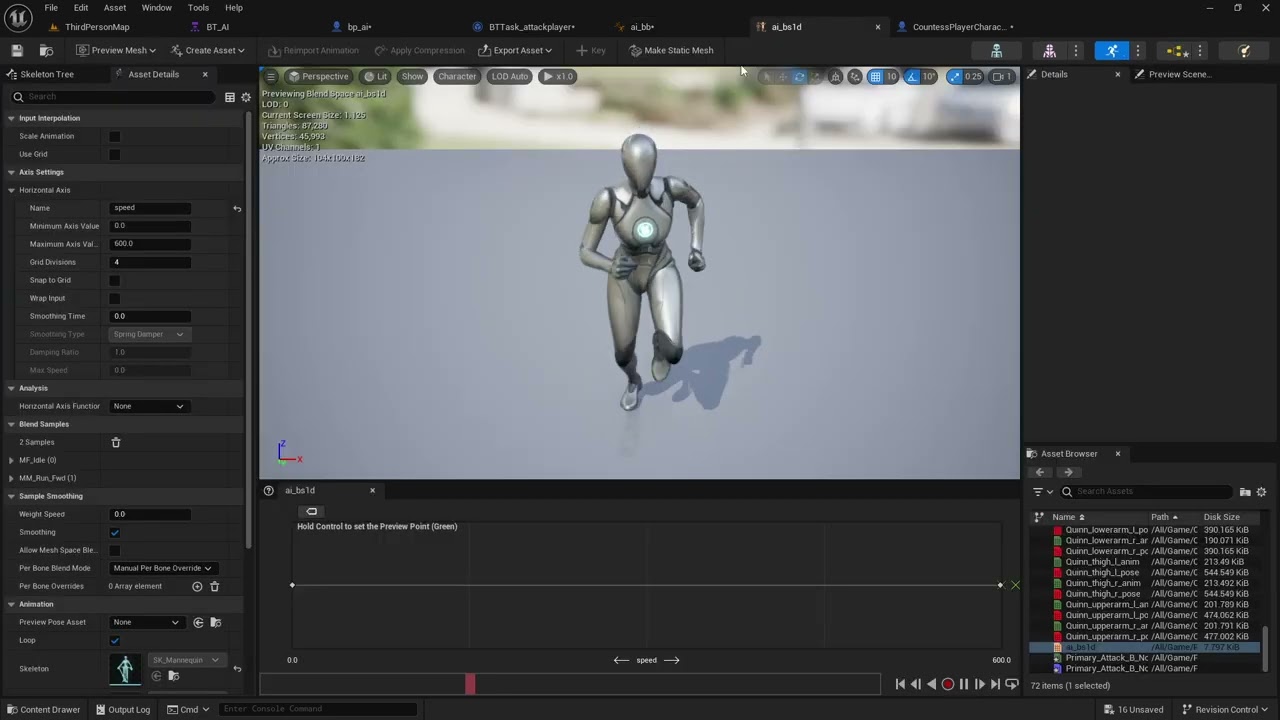
so i have enmy ai and i want to add attack animation and i didt like thes https://youtu.be/V1CI6stHcHo but is did'n work and i try to add input key and play montage to see if was the bleuprint of the ai the proplem but it's didb't work to so can somone help (i added a default slot)
 frosty heron
zinc talon
so i have enmy ai and i want to add attack animation and i didt like thes https:...
frosty heron
zinc talon
so i have enmy ai and i want to add attack animation and i didt like thes https:...
Where exactly did you add the input key to test? Print string after the input key to see if it's running at all
 delicate yacht
Hello, if I am making a weapon and I want it to apply damage on collision, should I have that function built inside the weapon blueprint?
frosty heron
If it's a trace, why not. But if projectile, handle it on the projectile upon impact
 copper chasm
I can't get "Get All Actors of Class With Tag" to work in JUST blueprint, right?
I need to do something in CPP?
maiden wadi
copper chasm
I can't get "Get All Actors of Class With Tag" to work in JUST blueprint, right?
Wut?
copper chasm
Right now I'm getting all actors of class, checking their individual gameplay container variables against "has tag" and doing it that way
copper chasm
maiden wadi
Wut?
there's some jank in Gameplay Tags that requires some tinkering in CPP to use completely, I think
maiden wadi
Ah. GameplayTags. Where are you storing them?
 jovial sinew
What's the equivalent to Begin Play in the Editor Utilities? I'm trying to bind to an event that's called when the slider changes (On Value Changed) on a custom editor widget. In blueprint, the event is bound on Begin Play - what would that be in for the Editor Utility?
maiden wadi
jovial sinew
What's the equivalent to Begin Play in the Editor Utilities? I'm trying to bind ...
Depends on the EditorUtility. But it sounds like you're in an EditorUtilityWidget? It should have an EventConstruct.
copper chasm
maiden wadi
Ah. GameplayTags. Where are you storing them?
Right now the character has a tagcontainer variable, and I add/remove to that as needed
jovial sinew
maiden wadi
Depends on the EditorUtility. But it sounds like you're in an EditorUtilityWidge...
Hey thanks, yes I'm using an EditorUtilityWidget and there is a construct event, but I'm building the logic on the actor so it needs to bind to it
maiden wadi
copper chasm
Right now the character has a tagcontainer variable, and I add/remove to that as...
You could do it in BP. GetAllActorsOfClass, Iterator over them and dump those with the correct tag(s) into a second container, return. But it'll be much slower than a C++ implementation.
copper chasm
Yeah, that's what I've been doing, just checking tags with hastag and a bool to put them into a container
it's just a prototype rn, if it gets off the ground i already have it in the todo
just trying to get this running right without opening ryder lol
maiden wadi
jovial sinew
Hey thanks, yes I'm using an EditorUtilityWidget and there is a construct event,...
You really shouldn't do this. Ever. For any reason. Even taking EditorUtility stuff out of the equation here.
UI golden rule: UI exists to display the state of gameplay objects and to give input to gameplay objects.
In short, your gameplay classes should never care about a widget. Making an actor care about a widget and it's slider forces that UI to exists for that actor in game, you link the classes together. Which you cannot actually even do with an EditorUtility class.
Instead, your widget should be given the actor ref. Bind an event in itself for it's own slider. When that changes, call a function on the Actor ref.
frosty heron
The UI lord has spoken 🗒️
Authaer can I get away with widget blueprints for like 800 items? Or they should be done with slates
maiden wadi
Depends, what's the usecase? Nameplates, or inventory?
frosty heron
Prefer to learn less things to progress but don't want to hit limitation
Inventories and damage text
jovial sinew
maiden wadi
You really shouldn't do this. Ever. For any reason. Even taking EditorUtility st...
Okay, thank you for clarifying. I've been trying to practice de-coupling but seems I'm doing it wrong. I thought sending an event dispatcher didn't mean the actor had to have a reference and just listened. But I guess binding does need/make a reference? How do I get the actor to just listen for an event without the UI being aware?
jovial sinew
maiden wadi
You really shouldn't do this. Ever. For any reason. Even taking EditorUtility st...
Nevermind, I'm re-reading your last line. I'm approaching the problem completely wrong anyways. Thanks again for the info.
maiden wadi
frosty heron
Inventories and damage text
It's exceptionally rare that you'll ever actually need to use slate for gameplay UI.
Inventory should be done in a Listview or Tileview. Main reason is that if you display 32 items, but that inventory has 500, a Listview or Tileview still only actually create 32 widgets. It's virtualized to show only what is required to show.
Damage text, I would do two widgets. Make yourself a primary widget that has a canvas in it. Make a second widget that is the damage text display. Make a way to be able to bind something somewhere when your player deals damage. The canvas widget can bind to that and if the event is relevant then create a damage widget and put it on the canvas at the right spot.
Pool your widgets you're using for display of course so you only ever end up with as many as you need and don't create a bunch of garbage.
maiden wadi
@frosty heron Also follow-up on the slate thing. Just to clarify, the exceptionally rare is the very rare cases where you actually need to create your own UWidgets and SWidgets. You can do most things without it though and there's really no reason to use slate for performance. I fell into that trap once. It is true that if you write strictly in slate, you get a bit extra performance from paint calls and such.
That said. You shouldn't care about that small performance so much, because you can get your performance back without writing slate, by simply using invalidation boxes correctly, and using less widgets.
Inventory is always my favorite on that one. You have so much going on in a tiny little widget. Background brush, border brush, probably a little glow effect brush, stack count text, status effect indicators, etc etc. I mean just these alone would be 4-7 Images, textblock, overlay. That's up to 9 widgets there, which you can entirely condense down to 3-4 immediately. Overlay, textblock and one image can manage all of that. Because the one image can be a material with all of the other brushes combined via some basic shader stuff.
On top of this, Invalidation boxes are the second best way to get good performance out of UI. The first being simply not having wasteful widgets. Invalidation boxes simply cache their children and do not allow them to tick or paint until something else invalidates them or that invalidation box. So you save a lot every frame by not running paint and tick code in the widget until it has been invalidated which only has to happen when something actually changes. Note that this means no effects going on in those widgets though. If you have a brush doing some neat material effects, you can't invalidate that or the effect won't play.
 teal tendon
hey guys I am making the detailed day and night cycle using the sun position calculator so can anyone tell me how do I calculate the accurate position of the moon using the get sun position node from the plugin, I mean the math behind it, would be a great help , thanks in advance
copper chasm
Building a context menu widget that populates based on options set on the object you're right clicking: Actor Components that feed into the widget on construct?
Make a base Actor Component, like AC_InteractionContext with something like "Examine" and then make children that would add things like "Talk" (on people), "Open" (on doors), etc - widget is created taking the base class as an input and the children can override where needed?
Essentially I'd like for everything to have a default interaction when left clicked, and then right click opens that context menu that provides more specific functionality if needed
frosty heron
maiden wadi
It's exceptionally rare that you'll ever actually need to use slate for gameplay...
Thank you for the insight, sorry for the late reply had to run to work.
 olive yarrow
What dumb easy thing am I missing to make this lerp move smoothly instead of teleport? 🤦♂️

 fiery swallow
olive yarrow
What dumb easy thing am I missing to make this lerp move smoothly instead of tel...
fiery swallow
olive yarrow
What dumb easy thing am I missing to make this lerp move smoothly instead of tel...
You're not actually moving the alpha from 0 - 1
A timeline can help you achieve that
It still won't be smooth though unless you save the starting point and end point is static, if either change it could effect the lerp in unexpected ways
olive yarrow
fiery swallow
It still won't be smooth though unless you save the starting point and end point...
Uuuugggghhhhh the thing I was trying to avoid for genuinely no good reason. Laziness I guess.
Thank you though, Seeker! Save my starting point?
fiery swallow
Timelines used this way work b best bwith lerps and two static locations, so yes. Save the starting point usually. The end is usually similar or static
The alternative is more annoying but doesn't require static locations
Set actor location every frame using Vinterpto, and then do a check that you are nearly equal to the target location in order to break the loop
I usually just have a delay until next tick on the loop and then run the code again and again until the if statement is true
Though that method is controversial because you're essentially faking what tick does
But it's what I do.


 reef totem
same results sadly
olive yarrow
fiery swallow
But it's what I do.
works for you, works for me. Thanks Seeker!
hmmm... the Z
new rotation is going for 0, add force or summat
olive yarrow
reef totem
forgot to tag
reef totem
tag?
reef totem
olive yarrow
forgot to tag
what do you mean?
olive yarrow
forgot to tag you*
there's a "launch character" i think... i dont have unreal open. Either way, i THINK you're lockings its z axis with the new Z being set to 0
olive yarrow
 I have glasses but that doesnt mean i read good
reef totem
im trying to launch the box haha
my idea is to use the built in physics to launch the box rather than hardcode the launch
olive yarrow
it's interesting how the box seems to follow a bone when you start the launch anim....
or thats my assumption, it seems to keep quite inline with the chest while throwing
reef totem
yeah its weird. It behaves as if the bucket is compleatly stationary. So it even bounces some when the rover rotates
olive yarrow
any parents on the box yer launching?
head up, my skill level is very low but im down to bounce ideas
 spark steppe
depending on what you want to achieve... maybe use a physics constraint (component)?
reef totem
i've tried physics constraint+bonesocket. I've also tried just contraints. The constraint cant be moved for some reason and the bonesocket+ constraint seems to be extremely unstable even once I got everything right. Super jittery
so Im back to square one. using a simple timeline to set the location and rotation of the bucket
reef totem
olive yarrow
any parents on the box yer launching?
parent would be a ball. Same stuff tho
reef totem
olive yarrow
head up, my skill level is very low but im down to bounce ideas
any suggestions are welcome at this point. Im out of ideas. Been at this for awhile lol
reef totem
spark steppe
depending on what you want to achieve... maybe use a physics constraint (compone...
okay I got it working with constraint. Now the issue is I cant move the constraints root location around to use it for the animation
any suggestions?
spark steppe
did you constrain the box to the "basket"?
then the "root" should move with it (without doing anything manually)
reef totem
when you say the box do you mean the rover or the box im trying to launch?

 spark steppe
box = the small cube
reef totem

so its launching, but im trying to move the root up. so it doesnt bonk my character on the head
reef totem
reef totem
it doesnt seem to move up when I use this
spark steppe
to be honest, keep it that way 😄
reef totem
lol I know, but this is a proof of concept
reef totem
the yellow thing around the box
spark steppe
and bucket? Oo
reef totem
bucket is the basket thing
spark steppe
yea sorry i cant help futher, i'm not familiar enough with all the settings in physics constraint component and i don't have UE in front of me right now
reef totem
gotcha no worries. This was about as far as I got with constraints, but until I can move them dynamically they wont be very useful
spark steppe
i would keep playing with them, i think the dynamics they add to the robot look kinda cool (even if it's maybe a bit too much right now)
bitter folio
using the laucnch character node with velocity plugged in, is there a way to make it so it laucnhes the player on the direction they look even if they are not moving
olive yarrow
@fiery swallow !!!! 😄 thanks again
 little orchid
I'm in a bit of a pickle with level bounds, I'm using a default open world level to test ship mechanics, that I'm building. One thing that I run into is that the level itself is set for level streaming and all that stuff, but once my ship takes off and I reach a certain point it's like the ship just gets destroyed even though I'm going up, the kill Z is quite a very large number and I have level bounds unchecked... , and in this default level I'm also using Ultra dynamic sky for its space preset, anyway I'm not sure how to stop it from destroying the ship, and no I do not have any other types of restrictions around the level or any type of collisions or whatnot.
gentle urchin
bitter folio
using the laucnch character node with velocity plugged in, is there a way to mak...
Yes just use their view direction
bitter folio
what about detecting if they are not moving?
gentle urchin
If velocity > 0 ..
 sudden nimbus
little orchid
I'm in a bit of a pickle with level bounds, I'm using a default open world level...
sudden nimbus
little orchid
I'm in a bit of a pickle with level bounds, I'm using a default open world level...
your ship has Spatially Loaded checked, uncheck that
little orchid
sudden nimbus
your ship has Spatially Loaded checked, uncheck that
THANKS!!! THAT WORKED!!
 tropic peak
each time I restart the editor this breaks:

and I have to implement the interface function again
what's causing it?
 steady night
hey ive made a custom macro but i cant fetch it :/ ?? ive set the "parent class or main class to the class of the player but i cant find it in the list :/? do i have to add a macro library or something ?
 fossil wharf
How can I isolate only left full arm using anim slot
 gentle urchin
sounds like something #animation can help you with
sudden nimbus
tropic peak
what's causing it?
I had this happen to me recently, I tried removing the interface from the blueprint and adding it back and I think it worked iirc-- not sure what causes that
tropic peak
sudden nimbus
I had this happen to me recently, I tried removing the interface from the bluepr...
thanks I'll try that, it caused me quite a lot of pain yesterday
sudden nimbus
tropic peak
thanks I'll try that, it caused me quite a lot of pain yesterday
let me know if that does the trick so i can commit that to memory
tropic peak
sudden nimbus
let me know if that does the trick so i can commit that to memory
sadly nope
that didn't work
I have to reimplement the function in the graph
sudden nimbus
tropic peak
sadly nope
is it a c++ interface?
tropic peak
no
sudden nimbus
huh.
tropic peak
there's nothing unusual about it really
sudden nimbus
oh right I think I literally just removed the interface in my case as it wasn't actually in use 😕
its definitely a strange thing-- the interface was sitting there for a long time and then suddenly it kept ejecting interface events when it was loaded in editor
tropic peak
yeah I didn't even touch it when it broke.. I was banging my head against the wall for 3 hours yesterday why my character doesn't move 🤦
it just broke on its own
frosty heron
fossil wharf
How can I isolate only left full arm using anim slot
Layered blend per bone node

 frosty heron
fossil wharf
During jump it acts like this xD
frosty heron
fossil wharf
During jump it acts like this xD
Well what do you expect to happend anyway?
 lunar sleet
Looks like a jump to me 😁
fossil wharf
I have animation montage. It should use isolated left arm.
Then it should combine the rest of animation with the isolated left arm animation.
frosty heron
Sure if you set it up correctly
fossil wharf
I did.
Everything works fine.
Except the fact that during the jump (different animation), the left arm looks dead
lunar sleet
Smells like bad weight painting to me
fossil wharf
?
lunar sleet
But unless you messed with the manny in skeleton editor prly not
fossil wharf
I did not import my own character or anything. It's basically third person template.
If the character is running, the arm works fine
Only during jumps xd
fossil wharf

This fixes the issue cheers


 slender idol
Hey, what is the correct way of setting up chorded inputs within an imc? For stuff like Holding Ctrl + G, should ctrl hold be part of a separate imc than what the G is?
 dark drum
fossil wharf
dark drum
fossil wharf
Just so you know, you'll only ever be able to play montages on the left arm with how this is currently setup. Setups get more complex when you start adding per limb montage slots. 😅
dark drum
slender idol
Hey, what is the correct way of setting up chorded inputs within an imc? For stu...
From my understanding, it only cares about the Input Action itself so it shouldn't matter what IMC it's in, only that there's an active ICM with it on.
fossil wharf
dark drum
Just so you know, you'll only ever be able to play montages on the left arm with...
how come
dark drum
fossil wharf
how come
Because you only have a left arm slot setup in the anim BP.
dark drum
fossil wharf
well i can set up right arm slot too
Then you'll want an upper body, a full body (sometimes just the default slot) then a left leg and a right leg. 😛
 wooden stratus
tropic peak
each time I restart the editor this breaks:
wooden stratus
tropic peak
each time I restart the editor this breaks:
ah thats a classic one, that issue also exist in UE4
There are multiple causes for blueprints not saving correctly even if you save them
- Is that a c++ project?
- Do you have live coding enabled?
fossil wharf
dark drum
Then you'll want an upper body, a full body (sometimes just the default slot) th...
its by default
 tropic peak
wooden stratus
2. Do you have live coding enabled?
tropic peak
wooden stratus
2. Do you have live coding enabled?
- there's a tiny bit of c++, 2. probably no
dark drum
fossil wharf
its by default
Unless you add the slot to the anim graph, they won't do anything. You have to setup how you would have them blend and what not.
wooden stratus
tropic peak
1. there's a tiny bit of c++, 2. probably no
Ok, that means you have atleast edited c++ files.
I'll assume that you didnt handle the files properly.
Basically, whenever you edit a header file, you need to close the editor and rebuilt from source. There was a good reason for that but forgot it right now.
Anyway, whenever you edit a header file, close the unreal editor and rebuilt from source.
If you dont, you'll get blueprint saving issues.
tropic peak
oh man I hate this. I'll do it when i'm done with the feature i'm coding now
wooden stratus
To fix this, you'll need to close the editor, delete your saved, intermediate and binaries directory in your project directory and rebuilt from source
You can use live coding or hot reload if you dont use live coding whenever you edit a cpp file but if you edit a header file always close the editor and rebuilt
steady night
hey Math Question im trying to do 5x line traces between the "Start Loc" and "End Loc" how would i didive the locations in the loop ?
 dark drum
steady night
hey Math Question im trying to do 5x line traces between the "Start Loc" and "...
dark drum
steady night
hey Math Question im trying to do 5x line traces between the "Start Loc" and "...
I would get the direction vector and distance from start to end. Then you divide the distance by intervals.
On your loop, use the index to multiply the interval distance and the direction vector and add it to the start location.
 graceful kite
I can't believe i have been banging my head against the wall so much becasue of this. Most of the things I've seen look to have the local enhanced subsytem in the pawn when aiming to control a camera. thank you
steady night
dark drum
I would get the direction vector and distance from start to end. Then you divide...
thanks ill look into that
 empty marten
Hey peeps,
When is it best to switch between using a cast to node and using BP interface instead? Is it literally a case of, the odd cast now and then is fine but if its a consistent thing then BP interface would be better or is there more to it?
 young meteor
Hey folks
How do I get from having a Blueprint Name to getting the actual Blueprints class defaults? (or just a specific default variable if it makes a difference)
I guess "Load Class Asset Blocking" and then cast to the Class?
That means I have to load everything related to that class at once. Is there a way to just retrieve a specific variable?
young meteor
empty marten
Hey peeps,
When is it best to switch between using a cast to node and using BP i...
My understanding is casting is completely fine and overstated from people saying it's "bad" or not "performant". The performance cost is basically nothing if you are not spamming casts many times every frame or something.
The consideration is more that you want to avoid writing casts in your code to many different Blueprints you might not need to load when playing.
So avoid creating a chain of casts to Blueprints you don't need loaded for sure, to minimize what you load into memory.
empty marten
young meteor
My understanding is casting is completely fine and overstated from people saying...
Thank you for responding. I'm definitely not doing something every frame. At the moment I'm just working on UI stuff and have a few widgets that require some communication between them when in use. I'm also just trying to understand BP Interfaces a bit more.
 thin panther
Interfaces are for implementing class agnostic behaviour, to have common behaviour on unrelated objects.
Say for example you have an interaction system. You might interact with containers, weapons, food, crops, NPC's etc. Or a faction system. You might have ownership of objects and NPC's which don't share a base class, but still have this small bit of common functionality.
Casts are when you have a direct inheritance chain. I.e., if you're only dealing with doors, you can feasibly cast to its bass class. Casting can incur a cost because of its hard reference which causes the target's default object to be loaded into memory. This also includes all dependencies in that class (assets, other hard refs to other blueprints, etc) . This can be bad, because assets are huge compared to the class, and memory can balloon. As you might have guessed, a base class that only includes common functionality and no assets is the way to avoid this.
It's worth noting, not just casting incurs that cost. Any time you use a blue hard ref to a class with assets in, the cost is applied, so make use of code only base classes and soft refs where possible
tropic peak
wooden stratus
Ok, that means you have atleast edited c++ files.
I'll assume that you didnt han...
unfortunately that didn't solve the problem 😦
 violet spoke
What are the hotkeys to collapse reroute nodes or something ?
I know only Q and shift+WSAD
teal tendon
hey guys I am making the detailed day and night cycle using the sun position calculator so can anyone tell me how do I calculate the accurate position of the moon using the get sun position node from the plugin, I mean the math behind it, would be a great help , thanks in advance


 violet spoke
xd
wooden stratus
tropic peak
unfortunately that didn't solve the problem 😦
Try to right click on the file in the editor browser and relink it
steady night
dark drum
I would get the direction vector and distance from start to end. Then you divide...
hey another one 😉

i wanna trace in the same direction as the "niagara effect" im spawning
so they both start in same spot but the spawned direciton is what im having issues with
or nevermind solved it
i was multiplying instead of adding *
tropic peak
wooden stratus
Try to right click on the file in the editor browser and relink it
I'll need to try that later, can't really restart now 😄
If I want to hold a list of ingredients for a workbench (imagine dough maker - you have two ingredients water/flour). How can I store the list of required ingredients? Should I use a struct? How can I define the struct for each workbench (they all have a different purpose/ingredients)
My point is, when I define a struct like this:

that's how it looks in the editor. I'm obviously missing something important here, and perhaps it should be a DT

with X amount of columns for ingredients
frosty heron
It can hold reference to a class
Instead object ref (instances)
You won't be able to fill it since you don't have any instances exist in editor time
At the basic level you can have a struct of item class and an int for quantity
steady night
adding a actor an Unique* in an actor variable will that could for that "Class Type or that instance of actor" ?
frosty heron
unique*?
steady night
 steady night
hmm yeah so whats the diff with add/addunique =?
frosty heron
If a reference already exist inside the array, it will not be added if you use add unique
steady night
ah ofc
makes sense
it just feels like when im using multishpere trace that it ignores actors if it already hit an actor kinda
frosty heron
it should return all the actor reference that the sphere collide with
steady night
well its not really :/
frosty heron
I would assumed the block would stop the trace
frosty heron
i mean I kinda know it just don't want to give definitive answer
steady night
yeah
maiden wadi
@frosty heron@steady night This is correct. Multi traces of any kind will collect items into the array that it overlaps and will stop tracing when it hits a blocking actor.
Think flamethrower against wall. You don't want to flame the other side of the wall but youstill want to flame everything in the area before the wall.
dark drum
I'm currently looking at setting up volume settings menu and I can set the sound mix volumes and what no no problem but does anyone know how I can get what the current mix volume for the specific sound class?
This is how I'm currently setting the sound class mix volume.

 final berry
Hello! So I'm trying to reduce the sizemaps of my actors, but not quite sure how to approach this.
My sizemaps are huge currently and a bit lost on how to go about it, can someone point me in the right direction? Pretty lost atm
gentle urchin
Hard references
To assets or other actors with assets
You want to avoid hard refs when you can, softpoint to assets and async load on demans
Sizemap will tell you which assets are referenced
You'll have to figure out how/where/why , and see if you can reduce that
Inheritance, baseclasses without asset refs, is usually involved to achieve this
final berry
Yea I see that the major problem is that the epic store pack I bought has massive textures, which are all referenced by a lot of actors because they are inside actors that use a couple variables from certain other actors/game instance
frosty heron
Soft ref is out of the scope for marketplace assets
It's something you implement by design
You decide what you want to load and when
 leaden sage
final berry
Yea I see that the major problem is that the epic store pack I bought has massiv...
leaden sage
final berry
Yea I see that the major problem is that the epic store pack I bought has massiv...
You can set the max texture resolution in the texture as most marketplace assets have much higher resolution then what is needed
final berry
Yea that will probably help, but I think the issue lies deeper currently 😅
gentle urchin
8k healthbar texture
leaden sage
I've seen plant pot leaf use a 4k texture aha
(well 3, 4k textures actually)
gentle urchin
For what only has 120x40 pixels avaliable
final berry
One asset had a 4k texture with a 100mb size. I compressed it to 8mb, effectively getting the same quality in-game as before 😅
frosty heron
Compression is prob another topic tho? Like if you have hundreds of items, you shouldn't be loading all of the icons and meshes when you are not going to see them all.
You can just load the one that players are seeing
If you are working with data table, be very aware of hard ref
final berry
Yea I think that's the major offender on my part
I have data tables that hard ref classes (for spawning in towers and enemies for example)
frosty heron
Right and those enemies will contain materials and meshes
final berry
I;m watching videos about soft references and other tricks now
😛
Yea and the towers do to
Still learning 😅
frosty heron
Like the class it self shouldn't matter ( maybe ) it's material, audio and textures are normally what clutter the size
final berry
I think I'm gonna need a major refactor, but better do it now 😛
gentle urchin
frosty heron
Like the class it self shouldn't matter ( maybe ) it's material, audio and textu...
If you softref the class, the class cam hard ref internally 🙂
dark drum
Soft class refs do create a hard ref to it's class type which is something to be aware of. I find for best results, you would have a soft class ref for a light weight parent class and then set it in the relevant child.
gentle urchin
That sounds weird?
Why would it create a hard ref to the class? Completely misses the point then
I wanna test this now but wont be at the pc for a while
 dry sleet
gentle urchin
Why would it create a hard ref to the class? Completely misses the point then
dry sleet
gentle urchin
Why would it create a hard ref to the class? Completely misses the point then
Because in order to resolve a soft reference, it must know to which class it will be resolved.
gentle urchin
If you do a resolve, sure but then yoi're back to the hard ref
You only need to know that its an actor class ..
Just like you only need to know a texture is a texture, not which one
dry sleet
If you can get away with resolving to AActor, then sure, only the AActor base will be loaded (and it already is).
But it you actually want to use the data in your class, and the soft ref is of that type, then you'll pay the linker cost for it.
Hence why the advice is to use lightweight code-only base classes for soft-ref'd actors.
You can cast to that cheap class and ignore any heavy data added to subclasses.
dry sleet
gentle urchin
If you do a resolve, sure but then yoi're back to the hard ref
At some point you naturally need to resolve? What's the use of a soft ref if you never load or resolve it?
gentle urchin
I have yet had the need to resolve to the actual class
dry sleet
Do you mean that you usually hold refs to stuff like AActor, UTexture2d, sprites, etc.?
Because those refs all demand that those classes are loaded -- but since they're engine internals they already are.
gentle urchin
The softref may be of type MyClass, but i never resolve it as such
dry sleet
Pretty sure that still demands linking, if it is specified as MyClass in the variables list.
But if you've set it as a soft ref to AActor, then yeah
gentle urchin
The variable is just an asset path,
dry sleet
With a type
gentle urchin
The 'type' is just a filter
dry sleet
Hmm, I'm not so sure about that.
gentle urchin
I say it with confidence, but its ofcourse all things i've heard, and not chevked

 gentle urchin
That makes it completely useless
dry sleet
Not at all
gentle urchin
What differs it from a regular hard ref then
dry sleet
Just do what everyone says: keep the base class you wish to resolve to data-only.
Because the data can be unloaded.
gentle urchin
That doesnt answer much at all
dry sleet
I'm still writing, though...
dry sleet
If you'd be patient enough
If you have some data asset, say a dialogue tree, and it's 10 Mb because you've written the entire Encylopedia Galactica in it, then if you soft ref it you don't need to load the actual asset content automatically. You only need to load the concept (CDO) of a dialogue tree, which is probably 1 Kb in size, because it's a bit of C++.
final berry
dark drum
Soft class refs do create a hard ref to it's class type which is something to be...
I'll keep that in mind, cheers!
dry sleet
The same goes for meshes and textures -- if you hard ref them, then the content of the asset will be loaded alongside the BP referencing it. However, if you soft ref them, all the engine needs is UTexture2D -- a tiny bit of C++.
Then you can say, at a convenient time (like when you're opening the inventory) -- "now please load the actual model".
gentle urchin
Thats what im currently doing
dry sleet
Then you're doing it right!
gentle urchin
Yet soft class still seems pretty useless to me
dry sleet
It's anything but.
gentle urchin
Yet your size map says differently
gentle urchin
Loading the same cdo as a hard ref, with no actual hard asset refs inside, achieves the same 10kb load
dry sleet
Data only base class

25 kB
If I needed to, I could extend ACharacter with an additional subclass before my big chunky BP_Character with all its models and what-not.
Often ACharacter is all you need, though.
dry sleet
gentle urchin
Loading the same cdo as a hard ref, with no actual hard asset refs inside, achie...
Sure, but now you have no control over loading.
gentle urchin
I got a feeling this is but a bug tbh
See some forum posts suggesting the same. Ill have to do a deeper dive
dry sleet
How could it be a bug when the docstring for soft refs mention it as a caveat?
gentle urchin
Wouldnt be the first time they've made mistakes there
 rare pasture
I wanted to know, to create professions like Woodcutting, Mining, and others, in what type of blueprint should I do it?
 bold shard
Can you convert a string to a tag without C++?
gentle urchin
dry sleet
How could it be a bug when the docstring for soft refs mention it as a caveat?
Tried with memreport in standalone?
dry sleet
No, I personally have no doubts that it is intended functionality, which is supported by most reports -- but knock yourself out.
gentle urchin
From epic staff;
TSoftClassPtr: Used for referencing class or blueprint types that might or might not be loaded i may read it with some confirmation bias but..
dry sleet
SoftClassPtr isn't really the same, though.
And it doesn't disprove anything that was just said about standard TSoftObjectPtr.
 chrome dust
I'm looking for help resolving this glitch. I've had ongoing issues with the attach track in sequencer working inconsistently when detaching for at least a year, and I've finally pinpointed the cause, but I don't know how to fix it.
I have two different actor blueprints. For sake of example, we'll say Cube-BP and Sphere-BP. Both are in sequencer as spawnable objects. If I use an attach track on Sphere-BP targeting Cube-BP in the sequencer, it will work as expected, unless Sphere-BP has 'Run construction script in sequencer' enabled in it's class settings. If it does, Sphere will remain a child of Cube in the outliner, regardless of whether the playhead is over the attach track or not.
According to the documentation, "Instead of scripting the attachment of objects, Sequencer provides Attach Tracks, which will automate the attaching and detaching, using the same mechanism (USceneComponent::AttachToComponent)." My assumption is that for whatever reason, the run construction script in sequencer flag is causing this USceneComponent::AttachToComponent script is not being voided when the playhead is outside the attach track, but I'm not sure why, or what to do about that...
Any thoughts?
 vagrant quest
does anyone know why the ProjectWorldLocationToScreen function returns screen locations that are massively distorted by distance? im trying to make waypoint system by using location of waypoint actors and at distances of only a few hundred meters the screen locations it gives are massively warped, always being above where the actor actually is
i tried different ways of getting actor world location and it does not change the problem
dark drum
gentle urchin
So i say again. Its useless
This is why hierarchy is important. Lets take projectiles for example. You might have a gun that can shoot different projectiles depending on what ammo the player has collected. When the weapon goes to spawn a projectile, it'll use a soft class reference of a projectile class. All projectiles would be children of this class. You can then update the soft ref as and when needed to the children classes without it force loading them. It will however force load the base class itself. However, if this is just a data class with core functions the size would be tiny as the heavy assets would only be in the children.
gentle urchin
if the size is tiny, it will be tiny as a hard ref aswell
so then what's the point ?
my randomclass with an actor ref vs actor soft ref is exactly the same size
dark drum
gentle urchin
if the size is tiny, it will be tiny as a hard ref aswell
The base class yes but not the child you could potentially select.
gentle urchin
gotcha
so with the hard ref it will load the actual class
while with the soft ref it loads the base but nothing more

 gentle urchin
While it now makes more sense, I still find it very strange that this is how it works
here i was , thinking the soft ref was purely a path
reef totem
reef totem
I am attempting to move a bucket on my robot, but I cant seem to get the constraint to move while physics are in place
gentle urchin
makes no sense for me that it should even load the cdo
reef totem
here it is in action
 fossil wharf
Hey, I have added mesh to a level map. How can I get a reference of it in my character bp so I can start rotating it on input action? (replicated too)
 maiden wadi
gentle urchin
here i was , thinking the soft ref was *purely* a path
maiden wadi
gentle urchin
here i was , thinking the soft ref was *purely* a path
SoftPtr is a path and a WeakPtr to the specified type. WeakPtr causes the hard ref to force the CDO to load. But it can hold instances of children of that CDO's class of course.
dark drum
gentle urchin
makes no sense for me that it should even load the cdo
This is the difference between using a soft class and a hard class ref. The default class that is selected is the same.

 tropic peak
wooden stratus
Try to right click on the file in the editor browser and relink it
tropic peak
wooden stratus
Try to right click on the file in the editor browser and relink it
relink?
dark drum
gentle urchin
tried it right after you said it 😛
Marking a class as abstract can be useful as well. It prevents it from being constructed/spawned. It's usefull for those base classes that wouldn't actually function if spawned because all the default values are never set or functions haven't been implemented.
 gentle urchin
yeah im using abstract for my dialogue system actually
While there's a million things i dislike about my works IDE and dev solution,
I like the fact that marking functions abstract includes comments made in the parent abstract method
very useful if it's not easy to put in a single name how it's meant to be used
maiden wadi
That's Super::Abstract.
dark drum
Does anyone have an example of when you would mark a class as const?
maiden wadi
In BP?
dark drum
maiden wadi
In BP?
yea.
maiden wadi
Odd. Never used a const class. O.o
dark drum
maiden wadi
Odd. Never used a const class. O.o
Yea i keep seeing it and often wonder what you would actually use it for.
 desert lance
Hey all, new here, so if I shouldn't be posting this here, let me know. But, I am having a hell of a time trying to get a cast to PPAnim instance to function correctly after I switch meshes and cast to the new mesh. Anyone have experience with PPAnim instances, who is willing to have their brain picked a little?
spark steppe
i'm not sure if it's a good idea to move both
since moving the harness should already change the transform of the constrainst
 gusty shuttle
Question, what's the best way to handle walking into a volume looking in a specific direction to trigger it? I know something with Forward Vector. Any keywords I could use for my search?
desert lance
gusty shuttle
Question, what's the best way to handle walking into a volume looking in a speci...
If you know the direction you need to be facing you can always just do a "get controller (or pawn) rotation" and between float (A,B) to check if they are facing that direction with a threshold
dry sleet
gusty shuttle
Question, what's the best way to handle walking into a volume looking in a speci...
Dot product!
It's the definite answer to checking if you're facing a certain direction in a game :)
gusty shuttle
Thanks guys, I'll try it out!
dry sleet
You get the camera's forward vector, and the forward vector of the volume, then get the dot product between those two vectors.
If it's positive, you're facing one way, if it's negative, you're facing the other.
 dry sleet
Dot product is nice because it gives you a sane scalar to work with!
Just +-0
1s, there's a nice website for noodling with this too
gusty shuttle
Humm, lemme tinker, I'll give it a shot
dry sleet
I think you should just be able to replace your LookAt node with DotProduct (followed by > 0.f) and pretty much be set.
 desert lance
Hey all, new here, so if I shouldn't be posting this here, let me know. But, I ...
desert lance
desert lance
Hey all, new here, so if I shouldn't be posting this here, let me know. But, I ...
Just adding an image to show what I am referring to here so maybe it makes more sense than words. Each time the cast occurs for a new mesh it increases to C_n+1. And for whatever reason it only works on 0 😦 Not meaning to be pushy, just wanted to add the pic, just in case. And yes, I know the code looks messy right now (troubleshooting)

 summer nexus
How do I change this settings in blueprint?
AxisConfig=(AxisKeyName="MouseX",AxisProperties=(DeadZone=0.000000,Sensitivity=0.07,Exponent=1.000000,bInvert=False))
AxisConfig=(AxisKeyName="MouseY",AxisProperties=(DeadZone=0.000000,Sensitivity=0.07,Exponent=1.000000,bInvert=False))```Are you not using the Input Actions and Input Mapping Context?
summer nexus
desert lance
Are you not using the Input Actions and Input Mapping Context?
I use the Enhanced input
gentle urchin
gusty shuttle
<@156052619838750720> Perfect!
Keep in mind 0 is 90 degrees
steady night
question: if i wanna move an "actor" as i would with an character (npc) whats the best way of doing so since it has no movement component +
maiden wadi
summer nexus
I use the Enhanced input
Then you set those on the InputMappingContext.
summer nexus
maiden wadi
Then you set those on the InputMappingContext.
I should not use Game User Settings to save and load settings for input then?
desert lance
summer nexus
I should not use Game User Settings to save and load settings for input then?
You can set dead zone and other modifiers in the Action like this
 maiden wadi
summer nexus
I should not use Game User Settings to save and load settings for input then?
maiden wadi
summer nexus
I should not use Game User Settings to save and load settings for input then?
Not usually, no. If you allow keybind remaps, it should go in a USaveGame. GameUserSettings is for local stuff to that machine. Graphic settings, Sound settings and such. Anything that could be considered portable to a user goes in a USaveGame because they're transferred around with the player to different machines. Settings like color blindness, controls, UI and gameplay preferences, etc.
gusty shuttle
gentle urchin
Keep in mind 0 is 90 degrees
Indeed, any tips to get it to like 45 degrees?
summer nexus
maiden wadi
Not usually, no. If you allow keybind remaps, it should go in a USaveGame. GameU...
Ah in project settings I need this too https://www.youtube.com/watch?v=sV1X4zXan6M
 gentle urchin
gusty shuttle
Indeed, any tips to get it to like 45 degrees?
gentle urchin
gusty shuttle
Indeed, any tips to get it to like 45 degrees?

This for debugging it if you wanna test some values
 brazen pulsar
TLDR; I need to activate set view target with blend from a behavior tree.
Long version; I've got a dialogue tree working off of a behacior tree (there's an online tutorial I can link), but I'd like to change the camera and angles based on what's being said. I've got the camera set upside down so I can tell when it works, but so far, it just moves the camera down.


 copper chasm
I have an actor component that does some basic math functions for RPG attributes on a base character class. For individual characters that are children of that class, should I give them the attribute variables directly and have the AC just run the functions to calculate/set them, or make child actor components for each of them
brazen pulsar
brazen pulsar
TLDR; I need to activate set view target with blend from a behavior tree.
Long...
Might have something to do with the blackboard variable being saved as an object, but read as an actor
Actually, general question, why can I get blackboard value as actor but not set blackboard value as actor?
 night osprey
(Programming related), base on my understanding of OOP, this should be allow but isn't in UE5. Let say I have parent class P, P has three children A,B, and C. When I create a P object-type variable inside of a class, I should be able to store A, B, and C in object type P, but default value option is grey out for some reason. Anyone know why that is?

So I have classes that derive from "ZombieBasic", but When I create an ZombieBasic type variable, I can't store children class as it default value, any help would be great
frosty heron
@night osprey Show the variable type
night osprey
it's a custom class call ZombieBasic
frosty heron
Can you go over your variable panel
I have a feeling it's object ref not class type
dawn gazelle
night osprey
(Programming related), base on my understanding of OOP, this should be allow but...
Likely because you're using an object reference rather than an object class reference. Actor references can only exist when the game is running, so no default value can be stored in them.
night osprey
dawn gazelle
Likely because you're using an _object reference_ rather than an _object class ...
yeah, it's object reference, but class reference does what I wanted to do
frosty heron
Yes they ain't the same thing
One is a reference to a class (purple) the other a pointer to an instance of a class (blue )
lunar sleet
dawn gazelle
Likely because you're using an _object reference_ rather than an _object class ...
Except for objects placed in level at editor time, iirc
night osprey
in c++, wouldn't parent pointers works on children classes too?
frosty heron
lunar sleet
Except for objects placed in level at editor time, iirc
They will be reachable by the blueprint instance you drop in a level but the abstract class it self exist without a world so it got no instance to refer to
lunar sleet
Yeah I meant for the object pointer not the class 😅
night osprey
also, I forgot to mention it's in gamemode class, so I can't just make it instance ediable, but yeah thank for help, looks like class reference is the way to go
frosty heron
night osprey
also, I forgot to mention it's in gamemode class, so I can't just make it instan...
What do you actually want to do?
night osprey
store children classes inside a variable, variable being the parent class
maiden wadi
I think the question meant more "what are you trying to do with this implementation that led you to thinking that you needed this?"
night osprey
night osprey
store children classes inside a variable, variable being the parent class
for example, I have a parent class ZombieBasic, civiliansZombie, solider Zombie will be children classes. I want to store those children classes in ZombieBasic type varible when I spawn them inside the level
dawn gazelle
Ok, so then you do need a object reference set to the type "ZombieBasic". This will allow you to store any ZombieBasic and its child class objects in the variable.
maiden wadi
The why still remains though Why does a parent class need to care about what inherits from it? This sounds like a data nightmare.
night osprey
how would you do it?
maiden wadi
No one can answer that until you give the why. Need use cases to give alternatives.
night osprey
"the why?" I already told you what I wanted to do
dawn gazelle
When you spawn any ZombieBasic or child class, that variable would be able to contain them.
 night osprey
yeah, the thing is I need to set the default value.
dawn gazelle
The default value is like saying "This is the thng inside the variable currently".
You don't need to do that.
When you spawn something, then you set the value of the variable to the thing you spawned.
frosty heron
night osprey
yeah, the thing is I need to set the default value.
You can't from the abstract class since there is no instance you can set it to
 hallow jungle
hey people, I'm having an issue, I have an WidgetBlueprint that is either added or not on viewport, so when its not on it has a NOT VALID value, and when its on is VALID, but i'm struggling to send it to the "not valid" value after its valid (and removed as in the image).
Chat gpt told me if i set it and dont put anything after the set it would be set to none but that was a lie haha
 lunar sleet
hallow jungle
hey people, I'm having an issue, I have an WidgetBlueprint that is either added ...
lunar sleet
hallow jungle
hey people, I'm having an issue, I have an WidgetBlueprint that is either added ...
Remove from parent doesn’t destroy it I think
It’s just the opposite of add to viewport
Why you’re trying to make it invalid is the question
hallow jungle
the widget is not supposed to show after a button is clicked, but is supossed to show when other 3 buttons are
i managed to get it to show on those buttons, but after I remove it from parent the widget wont show again after I click the buttons where its supposed to be shown
i reading it all again to see if confusing 🤣
fiery swallow
hallow jungle
hey people, I'm having an issue, I have an WidgetBlueprint that is either added ...
Thats actually true, it just doesn't get rid of widgets
If you want to remove and re add the widget
You likely don't want to clear its reference but rather set it's visibility to hidden / visible instead
hallow jungle
dang it will be so much easier that way, I completly forgot about it! Thanks Moxie!
 proper tulip
I have a 2D sound that plays when I jump, How would i get the sound to stop playing if i am falling? I dont have a falling state in my Animation Blueprint. (Not too sure if I need a falling state to do it.) Im using the default Jump (not entirely sure how the template jumping works either.)
 frosty heron
With character movement component there should be on movement changed event
 proper tulip
hmm
 mortal coral
How can I spawn and simultaneously possess a new character?
It's causing me issues that BeginPlay fires before I'm able to possess. This is not a problem on game startup, but in-game when spawning new characters creates issues
frosty heron
mortal coral
How can I spawn and simultaneously possess a new character?
It's causing me iss...
Single player game?
mortal coral
No
but networking is unrelated to the issue, this is a problem even just running on the server without other players
frosty heron
mortal coral
but networking is unrelated to the issue, this is a problem even just running on...
It's related since on posses gets called on server
So for single player you can just use that event
To do something on possess, instead of begin play
 dapper forge
Hello.
4.27. attach actor to component does not snap it onto the desired socket or position.. it stays where it was "attached"
what do?
mortal coral
Ah, that makes sense
There's no way to mimic startup behavior when spawning a new character though?
proper tulip
Okay 1 ) How would I connect this jump IA event to the rest of this code? And 2 ) Should I just use the Space Bar event?
frosty heron
mortal coral
There's no way to mimic startup behavior when spawning a new character though?
What behavior exactly?
You can use spawn actor deffered, if you want to do something before spawning the actor
But if you need to do something when a pawn is possessed, just use the on posses imo
mortal coral
frosty heron
What behavior exactly?
On game startup, characters are possessed prior to BeginPlay, because everything happens simultaneously
but OnPossess is a reasonable workaround
frosty heron
mortal coral
On game startup, characters are possessed prior to BeginPlay, because everything...
I never ventured inside the game mode so hopefully someone else can clarify
 coarse condor
I'm trying to get the player to just be slowed for a couple of seconds. The slow part of it works, but the speed doesn't come back even though I'm adding back the difference a few seconds later, any idea why it's not putting the speed back to normal?
 mortal coral
Thanks. On Possess will work for now at least 🙂
dapper forge
Im trying to teleport actor that touches the trigger, but it never gets teleported.
 frosty heron
dapper forge
Im trying to teleport actor that touches the trigger, but it never gets teleport...
frosty heron
dapper forge
Im trying to teleport actor that touches the trigger, but it never gets teleport...
The cast likely failed, or the overlap never happend (collision settings)
frosty heron
You can use print string to debug, print the other actor, print on cast failed and print on after set actor location
Are you able to print the values? I don't see how else to debug this
Kinda straight forward to find out
 wise ravine
how do I get a vector x a float (ping please)
 dapper forge
frosty heron
The cast likely failed, or the overlap never happend (collision settings)
dapper forge
frosty heron
The cast likely failed, or the overlap never happend (collision settings)
 frosty heron
Can you print strings @dapper forge , check the other actor value
dapper forge
frosty heron
Can you print strings <@198478108741992450> , check the other actor value
 frosty heron
What is oxygencabparent derived from? Try posting a video
dapper forge
i have 2 actors, 1 is teleporter, and second is OxygenCanParent. on screenshot is teleporter logic. OxyCanParent is just actor with mesh that is simulating phyiscs
when i drop oxycan into teleproter collision trigger, it does not teleport
frosty heron
Well simulating pyshics can be the reason ? I am not sure
dapper forge
i tried disabling the sim
frosty heron
From what I know, if you simulate pyshic you are detached from the root
dawn gazelle
wise ravine
how do I get a vector x a float (ping please)
You can create the multiplication node off of the vector and right click on the pins to change their variable type.
 frosty heron
dapper forge
frosty heron
dapper forge
My guess would be the part where you enabled physics
 wise ravine
dawn gazelle
wise ravine
dawn gazelle
oh i tried that without the vector being connected and it just converted both
but yes that works thanks
dapper forge
frosty heron
My guess would be the part where you enabled physics
huh
frosty heron
The static mesh component is most likely detached from the actor? I think.
Maybe you want to try other comp and teleport the component instead of the actor

 frosty heron
When you simulate physic as far as I know, it will be detached from the root
So even if you move the actor
It probably won't affect the static mesh comp that is set to simulate physics
You probably want to detect when the teleporter collide with the component
Not the actor
And move the component instead of the actor
dapper forge
the problem is, i cant move components or actors
it just refuses
ignores
what im tyring to do is attach actor to actor, and snap child onto position (key into door keyhole for example)
and it just never snaps onto socket, world pos, local pos
dapper forge
..
frosty heron
But if you are trying to attach simulated physics components then I have no idea
dapper forge
no, im not trying to attach sim physics
frosty heron
Well I never run into issues my self
Can confirm attach to component attach to actor works
 dapper forge
can you jump into public boole?
dapper forge
vc
 frosty heron
I haven't seen the right code
dapper forge
 frosty heron
dapper forge
frosty heron
dapper forge
there is 3 nodes
frosty heron
Socket name from what component?
dapper forge
socket name gets fed correctly, treid print string name
frosty heron
The parent is left blank
And it doesn't make sense to attach an actor to one of its own component
 ionic quiver
I'm getting a box collision and seeing what are the current overlapping actors. When the static mesh actor that is being overlapped is set to moveable, it detects 1, but when it's static, it's 0. I have both collisions set to custom, to eliminate that as the reason for this.
Anyone know why setting it to static breaks overlapping actors, and is there a way to keep it static but still get them?

 tawdry walrus
dapper forge
tawdry walrus
dapper forge
You need to get the actor you want to attach too and put it in the target input and get the component and put it in the parent input


 frosty heron
wise ravine
what is this doing/
frosty heron
wise ravine
what is this doing/
It's checking if the object implement a specific interface or not
wise ravine
frosty heron
It's checking if the object implement a specific interface or not
i mean the toggle on the end
it doesn't seem to execute anything
copper chasm
I have a Data Table that has in it a structure of booleans, I can check which stats get a bonus by character race - when I split out the structure pin I just get the structure, which I ASSUME has the bool data in it, I just don’t know how to check it without 6 different if statements (and that feels incorrect)
dapper forge
tawdry walrus
You need to get the actor you want to attach too and put it in the target input ...
im trying to attach cube to a static wall. what should handle attachment logic? cube should "attach" itself to a wall or wall shoudl attach cube to itself?
frosty heron
wise ravine
it doesn't seem to execute anything
Maybe the actor you pass doesn't implement the function
wise ravine
frosty heron
Maybe the actor you pass doesn't implement the function
it does i checked with breakpoints
frosty heron
Then look at the implementation
wise ravine
wise ravine
i'm trying to get this
^
wise ravine
haha then what is?
wise ravine
frosty heron
You probably pulled the wrong function
i would assume so
tawdry walrus
dapper forge
im trying to attach cube to a static wall. what should handle attachment logic? ...
The cube should attach itself to a wall if the wall is actor you will need to use if am not wrong "attach actor to actor" node or something like that
frosty heron
Make sure you grab the one with the message icon on the top corner
wise ravine
these interfaces are always confusing with their function naming
frosty heron
You are the one in control of the naming tho
wise ravine
that is probably why 🤷♂️
frosty heron
wise ravine
wont appear
Well do you have toggle function inside your blueprint interface?
If you do, call that function ( a letter icon should be present at the top corner )
 frosty heron
What optimisation
Quick tip, don't use interface for "optimization".
Mostly youtube bullshit
wise ravine
frosty heron
Quick tip, don't use interface for "optimization".
Mostly youtube bullshit
i mean because of the cast
frosty heron
wise ravine
how does it look optimization wise?
This code is soo redundant
wise ravine
redundant? haha how
frosty heron
Just get rid of the interface check at this point
frosty heron
If you want to use the interface then don't cast
Just plug hit actor straight to the toggle msg
You are not calling the toggle inside the blueprint interface, atm no interface is even used
Lastly make sure your bp light bulb, toggle event calls the toggle switch
wise ravine
frosty heron
If you want to use the interface then don't cast
yea but the interface check wasn't getting me a ref to the custom events in the actor
copper chasm
copper chasm
I have a Data Table that has in it a structure of booleans, I can check which st...
This is what I have right now, I feel like breaking the struct just to make an array is stupid, but I don't know how to get the bool info from the struct otherwise
 frosty heron
wise ravine
yea but the interface check wasn't getting me a ref to the custom events in the ...
frosty heron
wise ravine
yea but the interface check wasn't getting me a ref to the custom events in the ...
You don't need to if you use interface
You call the interface function
Which is implemented in the actor (bp light bulp) in this case
wise ravine
shi i see it , gimme a second i'll try it
frosty heron
Gonna go b to sleep gl
wise ravine
frosty heron
Gonna go b to sleep gl
alr thanks, night
dawn gazelle
copper chasm
This is what I have right now, I feel like breaking the struct just to make an a...
GameplayTagContainer would probably be better for this. Then you can add and remove specific tags to the container, and it can generate an array of all the tags so you can do what you need to with those tags.
 steel star
Ok what am i doing wrong here .. isn't there a "Set Physics Linear Velocity" node? All I see are these. And anyway, whats a drive/target?
Actually even better, why is there an Actor -> Get Component Velocity and not a Set? If it can figure out who is in charge of that to get the value, like .. just set it too?
 left valley
quick newbie question, what's the difference between a points:grid and a points:pathing grid in an EQS test? And when should either be used?
 sudden nimbus
left valley
quick newbie question, what's the difference between a points:grid and a points:...
sudden nimbus
left valley
quick newbie question, what's the difference between a points:grid and a points:...
grid just generates a grid of points, whereas pathing grid generates only points that are on the navmesh
left valley
makes sense to me, thanks
sudden nimbus
i believe it only returns points that have a navigable path from the context, and you can specify a distance limit to those points as well
copper chasm
dawn gazelle
GameplayTagContainer would probably be better for this. Then you can add and re...
The info I am accessing is inside a data table, I don’t feel like tags are useful in this specific instance (I do use them for other things)
Unless you mean putting a tag container in the structure for the DT, which like….maybe?
 undone bluff
steel star
Actually even better, why is there an Actor -> Get Component Velocity and not a ...
undone bluff
steel star
Actually even better, why is there an Actor -> Get Component Velocity and not a ...
add impulse with vel change set to true will let you set the velocity
keep in mind get component velocity is velocity relative to the root component, physics linear velocity is absolute
sudden nimbus
copper chasm
This is what I have right now, I feel like breaking the struct just to make an a...
as designed, assuming that arch up at the top is a return line to the for loop, this code either loops infinitely if any of the booleans are false, or does nothing if they all are true, this is probably not what you intended.
If you want to know if any of the flags are true or if any of them are false, then use Contains Item on the array you've built from the boost flags.

If you'd rather run the same code for each of the stats, you could do this:

note however that you should store that map into a local variable and then operate on that, otherwise it will make the map on each loop which is pretty wasteful (and then you can use a reference to the variable to clean up spaghetti as well)
As far as I know, there is no way to just iterate over the keys/values of a struct unless you do something like what you are doing (you aren't missing anything there)
I'm ignoring design questions here-- yes you could use gameplay tags (and they are awesome!) or any number of things that might be better designs. just focusing on the exact question
copper chasm
sudden nimbus
As far as I know, there is no way to just iterate over the keys/values of a stru...
Okay that was my big problem, was pulling out those bool values based on the DT. Hopefully I only have to make the array the one time 😅
Thank you
 frosty crescent
Any idea how I would implement
a(n) = 3n - 1
in blue print
 cyan spire
Hello, i have a question regarding Struct Arrays. I made a struct (Item Quantity and Item ID), i made a array of that struct in my variables. How can i "create" a struct member?

 versed sun
Make Structname
dawn gazelle
copper chasm
Unless you mean putting a tag container in the structure for the DT, which like…...
Exactly what I mean.
Then within your data table, you just define what tags are appropriate for the item in the data table. When you need to do some functionality based on those tags, you can create an array from the Tag Container and loop through them as you need and figure out what to do based on the tag being present.
 dawn gazelle
frosty crescent
Any idea how I would implement
a(n) = 3n - 1
in blue print
dawn gazelle
frosty crescent
Any idea how I would implement
a(n) = 3n - 1
in blue print
You mean like a function?
 undone bluff
cyan spire
undone bluff
cyan spire
get a reference from the array by index ("get (a ref)") then set members in the struct
the array element in the for loop only gives you a copy
frosty crescent
dawn gazelle
You mean like a function?
Maybe idk about functions haha ill look it up
Ty though seems like the answer
 wanton goblet
So I feel like this should be easy to do, but I can't figure out how I'm messing this up. I'm setting up a combat music system for combat states, including resetting when all enemies are out of combat or dead.
I have an array formed by a 'Get All actors of class' which gets all of the enemies in a given level, which have a Boss Behaviour component with 'InCombat' and 'IsAlive' bools, I then want to check if those states are true for all items in the array, but doing it the way I have doesn't get me that, it just gets a smattering of all the different bools, not the overall condition.
Basically I need a way to see if the conditions are false for all members of the array, with a variable total length of the array, but I haven't found a clear way to do that (all online tutorials show fixed arrays with explicit array item ids being tested individually)
 frosty heron
wanton goblet
So I feel like this should be easy to do, but I can't figure out how I'm messing...
frosty heron
wanton goblet
So I feel like this should be easy to do, but I can't figure out how I'm messing...
Make a function that loops on the array with for each loop with break.
When an element is false, you return false.
on completed return true.
wanton goblet
Can you please elaborate?
 wanton goblet
what would that function do, just the boolean check?
frosty heron
Yes
wanton goblet
ok
frosty heron
You want to find out how to check if all of the actor is dead right?
wanton goblet
dead or out of combat
frosty heron
Output can be a boolean, call it bDead
One function at a time, just check if they are dead. You can do the same with out of combat with the same logic

 dawn gazelle
You are looping, but you're not taking -all- of the items in the loop into consideration. Only the first thing you find.
wanton goblet
How would I check all of them without referencing their specific index
dawn gazelle
You probably want that loop in the function itself.
return false if one is found alive within the loop
on completed of the loop, return true (noting that they're all dead)
frosty heron
wanton goblet
same results, where did I mess up
The input is an array of boss ref
You don't want to do the loop there, you do the loop only in the function
You are still doing the same mistake
wanton goblet
apologies, I'm confused a little, why would the 'for each loop' need to be within the function?
I set this up but I still get the exact same result
frosty heron
The function loop thru a given array, checks if any of the element is false, if there is an element with a value of false then the function will return false
wanton goblet
 frosty heron
You are setting it up wrong and you are not doing what was told
What you are doing is extremely simple
On the false pin, return false
On true do nothing
On completed return true
wanton goblet
So what would break the loop then?
frosty heron
Well the break is not needed actually
Since the moment you return false
The function cease to run
 cold lion
Hi I am trying to make my door mesh dynamic and for some reason the cube I put just disappears after I touch the collision box? (and does not return to it's origin)


 wanton goblet
frosty heron
On completed return true
wanton goblet
frosty heron
On completed return true
I did this, exactly as you said but I get the same exact results

'

every enemy that dies triggers the print string
frosty heron
wanton goblet
I did this, exactly as you said but I get the same exact results
You didn't do as said tho
wanton goblet
How did i not?
frosty heron
You are setting there not returning
You are already half right before but now you removed the returned node
frosty heron
wanton goblet
What you have here will always return true
Regardless what happebd
Try to go over the node and understand why you get such outcome
wanton goblet
I did exactly what you said, and it still does not function correctly


All Dead never returns true
even when all enemies are dead
 wanton goblet
 frosty heron
Debug on your end, check if you actually set the instances boolean to false (the bool being is alive)
wanton goblet
That's set in the system here, and yes, it functions correctly

default to true
Ok, finally got it to work, the return node false was on the wrong pin

Thank you for your help, sorry for any frustration
 chilly geyser
Is there a way to increase / decrease the size of a widget based on arm length of a spring arm. (don't want a 1:1 ratio of increase/decrease)
I don't know what formula to use to get these results....
1800 : 25
1450 : 43.75
1100 : 62.5
750 : 81.25
400 : 100
dawn gazelle
Map Range Clamped?
chilly geyser
dawn gazelle
Map Range Clamped?
! don't know what this is, Dr. Google time, thank you!
dawn gazelle
 chilly geyser
dawn gazelle
chilly geyser
dawn gazelle
! Thank you! Didn't know this was a node! XD
I was trying to figure out what formula I needed to use haha
spark steppe
you could also use a floatcurve and sample the value (if you want non linear scaling)
undone bluff
@chilly geyser just making sure you see Ben's answer, your example results don't seem linear
 dire vine
Hello guys , one question
I have added one component named cesium globe anchor , and when i spawned the aircraft , tht component values are coming different on server and client
gentle urchin
spark steppe
you could also use a floatcurve and sample the value (if you want non linear sca...
Wasnt this not exposed to bp for the longest time?
frosty heron
dire vine
Hello guys , one question
I have added one component named cesium globe anchor ...
How is the component values set?
 fierce bay
Hello, I'm want to have a character that turns in the direction of the movement.
I checked in Character Movement “Orient Rotation To Movement” and unchecked “Use Controller Rotation Yaw” of my third person character, but it doesn't work.
and uncheck “Use Controller Rotation Yaw” for my third person character, but it doesn't work.
I've added an arrow on the capsule, but no rotation.
Any ideas?
dire vine
frosty heron
How is the component values set?
i am setting the lat long Alt at the time of spawning , and then i am giving possesion to the player controller.
the lat long alt variabl is the values in component
frosty heron
Show code
dire vine
 frosty heron
Does the entire logic here only get called by server?
frosty heron
So I would assume you edit the values in move to longitude?
frosty heron
Yea client wouldn't know that
Unless you are editing replicated variable
I would suggest to just do the calculation pre spawning, and set via expose on spawn
The client should get the same value when the copy in their machine gets created
dire vine
 frosty heron
Can't c in my mobile
 frosty heron
You need to be aware that w.e u doing there only done in the server copy tho
dire vine
ohkay
frosty heron
I would just init the variable via expose on spawn
dire vine
so you mean we need to re update that value once the object is spawned and possed by player
frosty heron
Otherwise you will need to use replicated variables
dire vine
ohkay
frosty heron
dire vine
so you mean we need to re update that value once the object is spawned and posse...
I mean it would be easier to just set a param on the spawn actor it self
So when the client receive a copy it will have that parameters
dire vine
ohkay, will try something like that
frosty heron
This only work soo far tho, as in you will get the same values initially but if they need to be sync all the time, then you will need to mark your variable replicated
copper chasm
dawn gazelle
Then within your data table, you just define what tags are appropriate for the i...
Ohhh, I see what you mean (sorry for the late response I go to bed like a grandpa) - probably not for the specific thing I'm doing (on character creation I'm just checking which attributes get a boost, probably not something that will need a tag in it forever) but I will for sure use this for things like feats and traits
Although I just realized that a bool telling me whether or not to boost an attribute is useless when trying to then dictate which attribute to boost, so maybe I'll rethink the entire process LOL
gentle urchin
copper chasm
I have a Data Table that has in it a structure of booleans, I can check which st...
wouldnt it be better to have the stats as some tmap in the DT, and just set them that way ?
or tag container, if you only care if they exist .
your method gets complicated whenever you decide to change the attributes
add one, remove another..
using tags fixes this
gives you nice flexibility
boost also sounds prettty generic and unspecified. In my case im using values in the DT to dictate the amounts
that way i can 'configure' new things directly in the DT, with my supporting system just handling things (unless its brand new, and need to also be implemented in the pawn (like changing movementspeed)
so any given thing (in my case items) can be given a set of attributes

this data just churns into my supporting system and 'simply works'
copper chasm
hrm
For right now, I'm trying to do character creation, and each ancestry has specific attributes that get boosted at level 1. In the DT I have all the base info for each ancestry (which at the moment includes which attributes to boost) which I want to feed into the attribute actor component to apply those boosts to the attributes
I don't think it needs to be some kind of permanent flag
(I don't actually HAVE character creation atm, I just have a debug character set to level 1 that I can swap ancestries on as an enum and I'm trying to make all the stats populate correctly)
maiden wadi
copper chasm
For right now, I'm trying to do character creation, and each ancestry has specif...
Just curious. Are you C++ capable? Even slightly?
gentle urchin
(This static data could in my example also have the growthrates of the stats per level, if they were linear
Or set them up with curves )
maiden wadi
GAS would solve this by just simply making an infinite duration GE with the stats for the ancestry. :/ Apply it and forget it.
gentle urchin
Thats also (as often times) a way of achieving it 😄
Extremely flexible system out of the box
But got some learning curve 🤣
copper chasm
I did some work in GAS, and then hit a roadblock with turn based stuff, so I dropped it
Between my adhd and having to jump up and down from my desk for stuff, I like BP for being able to pick up where I left off 😂
copper chasm
gentle urchin
(This static data could in my example also have the growthrates of the stats per...
It’s D&D rules - the stats change so infrequently and in such small jumps I didn’t bother with curves
Just “oh, you’re a level 1 elf? You get +2 to int and dex and -2 to con” or whatever, and then down the road you hit level whatever and can pick what to +2
There are probably a few ways to do this, but
copper chasm
I have kind of a GAS-esque system I’m working on in BP, maybe I could just set them up as tags and apply them as buffs and just hide the buffs from the player
Can you apply the same gameplay tag twice? I don’t think you can
 signal perch
When performing a line trace in the Construction Script, it does not detect collisions, but it works when connected to Begin Play. How can I solve this problem?
 lone garnet
Anybody ever come across a bug that seems to have been around since 4.22 in UE5, crash on anim instance set
cyan spire
Hello, can someone tell me how to set a new member in my "Unique Array" when the item id is the same from the first element as from the 2nd element? So if the ids match from my input array to my "unqiue" array? Im trying to filter out duplicate array items which have the same id :
 chilly geyser
spark steppe
you could also use a floatcurve and sample the value (if you want non linear sca...
chilly geyser
spark steppe
you could also use a floatcurve and sample the value (if you want non linear sca...
Sorry Just now seeing this. I'll check out this node too. Thanks!
chilly geyser
undone bluff
<@300810204138962944> just making sure you see Ben's answer, your example result...
Just saw it when I woke up thanks to your @ haha, Thank you.
 heady burrow
Im trying to rename/create an asset but it says the name is already in use, but its not, is there some cache that has to be refreshed or something like that? it happened to me before but went away, this time is here to stay apparently.
 fast compass
Is there a way to instantly finish my timer by handle? I do not want to just clear it, but finish it and run the event its assigned to do when it finishes

 stone field
So I recently stumbled on the possibility of being able to Disable BP nodes.
My question arises, could this be done conditionally at build time, or via some other magic means.
( I want to disable certain plugin bp node functionalities for platforms which do not support them, but which cause compilation errors if the nodes are present while plugin is disabled )
https://www.cbgamedev.com/blog/quick-dev-tip-51-ue4-ue5-disable-blueprint-node
copper chasm
heady burrow
Im trying to rename/create an asset but it says the name is already in use, but ...
try closing and reopening the editor tbh, there's probably a smarter way but
dry sleet
heady burrow
Im trying to rename/create an asset but it says the name is already in use, but ...
Did you previously have a asset with that name?
If that is the case, you probably have a redirector left.
Redirectors are assets that take the same name of assets you've renamed, so that the engine knows what the new name is if something is looking for the asset using the old file path.
The way you get rid of them is by right clicking the directory containing the newly-renamed asset, and choosing "Fix up Redirector References" (or something like that). After that process is done you'll be given the option of deleting the redirector.
Just be a little bit careful! After deleting a redirector, you must be sure that all the assets that were "fixed up" are saved properly, and never roll them back in Source Control (for instance) -- because now that redirector is gone and can't do its job anymore.
chilly geyser
How to set an array of bools to true/false?
stone field
chilly geyser
How to set an array of bools to true/false?
ForEach perhaps
chilly geyser
stone field
ForEach perhaps
Tried doing that but not sure how to execute it properly I think
stone field
chilly geyser
Tried doing that but not sure how to execute it properly I think
can show screenshot of your setup
 copper chasm
split the pin
chilly geyser
Tried searching like 10 Dr. Google pages for it
gentle urchin
fast compass
Is there a way to instantly finish my timer by handle? I do not want to just cle...
Trigger it manually aswell as clearing
chilly geyser
copper chasm
split the pin
Split isnt an option for it
gentle urchin
No.....
If false set false?!
Just set false
All of em
And you cant use the regular foreachloop
copper chasm
oh yeah i guess lmao
chilly geyser
Thank you!
copper chasm
no don't listen to me my coffee isn't done
gentle urchin
For Loop (0 to Last Index) -> set array element (boolArray, false)
copper chasm
gentle urchin
If false set false?!
sometimes our desire to be helpful overrides our ability to be correct 😭
chilly geyser
Like this?

I feel like that would just change the other variable x amount of times
chilly geyser
copper chasm
sometimes our desire to be helpful overrides our ability to be correct 😭
Can I see the loop you posted? Maybe Ill get an idea from that
copper chasm
chilly geyser
Can I see the loop you posted? Maybe Ill get an idea from that
Let me make sure it does what you're wanting before I post it, I would feel terrible sending you down the wrong road
chilly geyser
Nah, I might just get ideas if it doesnt work
Trying some things with this one right now >
Squize — Today at 11:38 AM
For Loop (0 to Last Index) -> set array element (boolArray, false)
copper chasm
that would look SOMETHING like this

idk if that's 100% correct, but that's getting the last index of the original array, running from 0 to the last index, and for each index, setting something
copper chasm
probably doesn't want the check I assume
copper chasm
gentle urchin
many ways to ~~skin a cat~~dip your toes
it occured to me while sketching this out at the dr's earlier that I have no idea how i'm going to make a character creation system in the first place, but I reckon I ought to make sure the thing I'm working on works before I try to eat that elephant
but also, I think if I just make an array of the attributes enum, I can just put an index in for each attribute that gets the boost and go from there
KISS
chilly geyser
It doesnt seem to be working, but when i read it, it seems like it should so maybe my code somewhere else is wrong
chilly geyser
 gentle urchin
That works when connected
chilly geyser
thats why I think its not working somehwere else
gentle urchin
Y
gentle urchin
😆
copper chasm
I do that shit too, I make sure my stuff is TIDY before I show it to folks lol
"I may be dumb but my coding practices are on point"
speaking of dumb, question - when I run in simulation and throw a delay node with a breakpoint at the end of my code, the code is correct, I have a map with values that show correctly in the code, but when I click on the map in the variables tab, the default values are still the same - that's supposed to happen, right? I'm like 99.9% sure it is, because duh default, but
variables in the variables tab will only ever show their default values, even in simulation?
chilly geyser
wish i could zoom by a half point lol
copper chasm
This is how I ended up solving my early early problem - not with tags or maps or booleans, just the same damn enumeration I've been using for everything else

womp womp
chilly geyser
how come all your nodes are like half opacity
copper chasm
I really need to make a character sheet, because printing values over and over to make sure they're right is a PITA
copper chasm
chilly geyser
how come all your nodes are like half opacity
i took that screenshot while running in simulation lol
chilly geyser
XD
copper chasm
my poor PC, I have like 4 instances of UE open and I'm playing mtga on my drawing tablet D:
chilly geyser

sorry that you have to squint, idk how else to show all of it lol
found the problem
rofl
from this post
nvm
copper chasm
you could theoretically throw it in that website, for future reference
copper chasm

blueprintUE is a tool for sharing blueprints for Unreal Engine. UE is a game engine which use visual scripting called blueprint.
copper chasm
yeah
chilly geyser
it un did my fancy stacking
copper chasm
I assume Var Prayer 1 Over Head Array has all of the Var Prayer 1 booleans in it?
copper chasm
that might work for debugging it, if you throw athat in after the array set node

maybe, or maybe after the completed node before the next set, unsure
chilly geyser
I debugged that its not setting it to false using a primitive method lol
gentle urchin
It does tho
chilly geyser
its not on mine
gentle urchin
The code is correct
chilly geyser
I know, seems to be correct when i first read it
gentle urchin
You got something else going on
chilly geyser
thats why i think theres something wrong with my code somewhere else
copper chasm
if you're doing it with a button, it's possible if more than one actors use that bool
maybe it's screwing with it
gentle urchin
So its either an order of operations or something else you got going on
chilly geyser
those two button are the only buttons I am clicking, and the only other thing than whats in the code that uses those bools, is the array
copper chasm
actor components really only mess with the actor they're attached to unless you tell them otherwise, right? so I don't need the actor components to set owner variables - if the AC has the variable, the owner of it can reference it whenever?
I guess I can test that
copper chasm
chilly geyser
those two button are the only buttons I am clicking, and the only other thing th...
you only have one instance of BP Third Person Character in your level?
copper chasm
idk why that's relevant, but I'm just riffin' trying to figure it out
also can you screenshot the details panel of Var Prayer 1 Over Head Array
chilly geyser
 gentle urchin
how areyou verifying that it's working/not working
chilly geyser
 gentle urchin
!?
gentle urchin
and how do you check them
 chilly geyser
really?
gentle urchin
ofcourse not
chilly geyser
it says true in top left when its on
chilly geyser
It just stays on
gentle urchin
so the original variable is independent from the array variable
chilly geyser
My array is wrong?
chilly geyser
😮
gentle urchin
but there's no array that takes references of variables
so you either have to refactor
to using only the array
chilly geyser
Nosebleed
gentle urchin
or make due with your bunch of variables that you manually must alter
 chilly geyser
so its a copy and not a refrence?
gentle urchin
yep
copper chasm
bingo
gentle urchin
it always will be
chilly geyser
so, how to fix?
gentle urchin
either set the variables manually
chilly geyser
gentle urchin
either set the variables manually
rough
gentle urchin
or refactor your code to only use the array
chilly geyser
Can I name the bools in the array?
gentle urchin
no
chilly geyser
super rough
copper chasm
that's probably what you want tbh
chilly geyser
What is the node to map?
gentle urchin
you'd create a new variable
 native vector
alright so I have this system where the player can pick up physics objects with a line trace. But when the player holds the object, the object teleports to the maximum distance of the line trace, leading to an issue where if a player were to pick up an object on a table for example, the object would teleport through the table. How can I make it so when the player picks up an object, it keeps the same distance as the line trace hit result to the player camera?
I hope that makes sense
copper chasm
 gentle urchin
select the key variable first (string? Name? GameplayTag?)
then on the right side swap pto map
gentle urchin
native vector
alright so I have this system where the player can pick up physics objects with ...
you'd set the location of the item to the trace location