
#Is FFF 3D printing food safe?
77 messages · Page 1 of 1 (latest)
 oak laurel
 unique crest
In my opinion it isn’t food safe unless you make sure your extruder is, your filament is, and you coat the print with something like a food safe resin to remove layer lines
 median musk
Yeah, the filament and filament path are one thing, but the presence of layer lines sort of throws all that out the window
oak laurel
https://filaments.ca/products/true-food-safe-pla-black-licorice-1-75mm
Can a company just say a filament is food safe, or there should be a third party certification?
median musk
No idea. Still that's just the filament, not the manufacture process
 hardy storm
If a company is claiming food safe, and don't have a 3rd party testing, risk of a lawsuit may be high. They should also probably have disclaimers about contamination from the printer, and surfaces needing to be smooth and air/water tight
unique crest
Yeah
 ionic prism
My standard answer is:
"Food-safety is a complex topic because in the traditional injection moulding industry, the material supplier and the product manufacturer need to meet specific standards and the finished must be smooth and easy to clean. Unfortunately 3D prints are inherently porous and aren't completely solid which makes parts difficult and near impossible to clean for food applications.
Despite some claims, the food safety approval that some filament manufacturers or resellers advertise is only based on the raw ingredients used. It can't guarantee that the filament they made meets food safety standards and if it could, there would still be no guarantee that your 3D printer is capable of producing a food safe part. To produce a truly food safe part, there would need to be a standard created for both filament manufacturers and a second standard for 3D printer operators to keep their printers safe and clean from contaminants.
With that in mind, some customers just care whether PLA+ is more dangerous than PLA or PETG. Depending on the raw materials used, PLA+ can offer similar food safety as PLA but regardless of a materials safety the technology has some inherent flaws which has prevented world recognized organizations from setting standards. Always do so at your own risk. We have heard of some customers just sticking with single-use applications, ideally the better choice would be to 3D print a pattern, make a mould and cast your part in a food-safe resin or investigate food-safe coatings that you could coat your 3D print with."
Effectively for the consumer, food safety is completely irrelevant because there's so many issues with the technology and it will give a false sense of safety. For industry I could see needing to know the plastic could be important, such as making a custom jig for manufacturing. They generally have a better understanding of their application and what they need.
 flat shell
100% not food safe. Even with very good cleaning anything less than pressure sterilizing it is going to be not able to kill bacteria that’s can live in between the layers of the plastic. Until we develop a plastic that contains some form of anti microbial additive or true 100% fusion fdm will stay out of my kitchen 🤷♂️
 grizzled turtle
100% safe for food contact when using approved filament. People say 3D prints are porous, but mine certainly aren’t. Bamboo, rattan, linen, cotton, and many species of wood are safe for food contact, but are highly porous. People talk about cracks, layer lines, etc. holding bacteria, but all dinnerware, cutting boards, and utensils get cracks and cuts that can harbor bacteria. I own a Yeti mug that has o-rings and a sliding closure that bacteria would love if I didn’t wash it properly People just don't understand what safe for “food contact” means. Bacteria can grow in/on anything, cracks or no.
The real problem with food safety is hygiene. I've see YouTubers (Including Prusa Research, shame on them) demonstrate that 3D printing is not “food safe” because they found bacteria in printed cups that held food for days in a warm environment. Duh. If you care anything about food safety, you would never do that. And to kill all bacteria, you must wash or rinse with 145°F water or higher.
When it comes to lead in brass nozzles, that is also a non-issue. "Free-machining" brass used in printer nozzles contains a very small percentage of lead, yes. Nozzles wear and it is true that trace amounts of lead can end up in your 3D printed object. But simple arithmetic shows that the amount of lead inside a 3D printed object cannot possibly exceed the amount of lead permitted by the FDA in food, foodwares, or even dietary supplements (in case you want to eat your 3D print).
grizzled turtle
In 2017, The ministry of Environment and Food of Denmark tested 24 filaments (not necessarily food safe ones) as well as 3 SLA resins and 1 SLS resin. Their findings showed no lead detectible in FDM prints except that which was due to additives in some colors. They also tested for metal and substance migration into a mug of milk sat for 3 hours and found no metals migration. Their conclusion: “For 3D printed products, the migration tests only found a migration of chemical substances from SLA printing. In an actual consumer scenario where a printed mug was assumed to be used for milk for a 1-year-old child, it is assessed that migration and exposure of the substances do not lead to health-related risks.”
Instead of pontificating ignorantly, one can easily visit websites of the FDA, EFSA, or other relevant authority and read up on food contact materials.
In the USA, there are three terms to consider: Food Grade, FDA Compliant, and NSF certified.
NSF certification has to do with sanitization in commercial establishments, so isn’t particularly relevant to us.
“Food grade” means that the material is either safe for human consumption or it is okay to come into direct contact with food products."
“FDA compliant” means to be food grade and the end user must also make certain that
- The material is used within the recommended safe temperature range
- The material is safe for the type of food that it is in contact with (fat percentage, acidity, moisture content and so on)
- The material will physically hold up to the environment it will be used in, including cleaning and sanitizing
Several 3D printing filaments are food grade including filaments.ca True-FS PLA, Taulman T-Glase, Taulman Nylon 680, Polymaker Polylite PC, Verbatim PET, many Ultrafuse PLA colors (but not all), Fillamentum HIPS, FilamentPM PETG, Centaur PP, colorFabb XT, HT, and NGEN, as well as many others. These companies can provide you with their certifications; some have the certificates online. Some are tested to FDA compliance, while others follow EU directives. It is worth noting that PLA, ABS, and PET are commonly used commercially in food packaging and serving.
Certified filaments are safe for food contact. Printing with steel, stainless steel, brass, diamond, or ruby nozzles is safe.
However, burning your filament or PTFE liner, printing in a cow barn or cyanide factory, leaving food in a container overnight, and washing in cold water are not food safe.
I like to use colorFabb nGen for cookie cutters, bowls, cups, kitchen utensils, toothbrush holders, etc. because it can be washed in any dishwasher. PLA can soften in a dishwasher, especially after repeated use or you use the drying coil.
flat shell
grizzled turtle
100% safe for food contact when using approved filament. People say 3D prints ar...
Do you have a microscope cause I’d love to compare prints 🙂
grizzled turtle
@flat shell I do have a gemological 🔬 😎. By the way, there are several anti-microbial filaments on the market: BnK Tech Purement, 3DXTech Bioguard, Copper 3D PLActive AN1, 3D Print Works Antimicrobial ABS, FiberForce Antibacterial PLA, Nanovia PLA VX, and Cicla 3D Nano-Infused Copper Antibacterial PLA. None of them are food safe. 😥
ionic prism
grizzled turtle
In 2017, The ministry of Environment and Food of Denmark tested 24 filaments (no...
I did have a conversation in 2018 with the FDA, they very much agreed with your opinions on lead in the brass nozzle but did highlight that food safe certification for a raw material doesn't apply to the 3D printed part. MyTechFun also has an interesting video on bacterial growth of printed parts https://youtu.be/lFtMIo00tfY
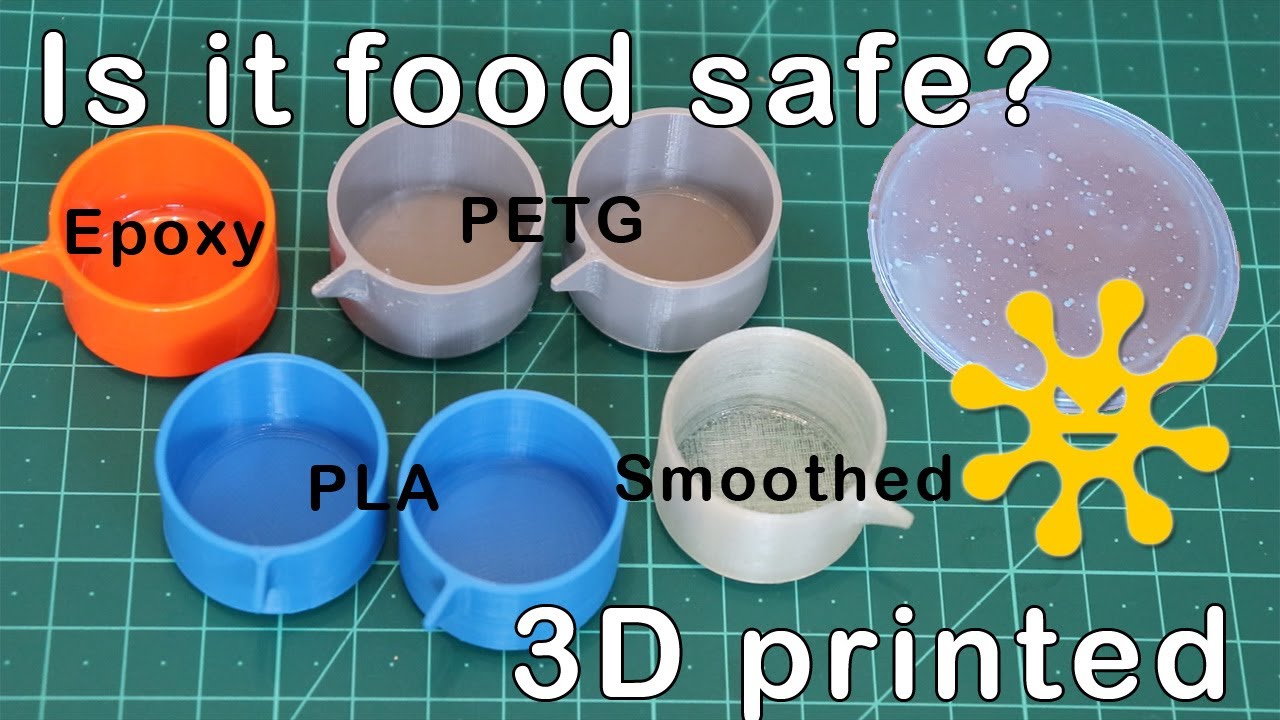
Let's talk about food safe 3D printing. I noticed on 3D printing forums, that users only ask about food safe filament type, like PLA or PETG, but some of these materials can be very toxic, depend of the coloring material or additives. It is important what type of nozzle we use, some of them contain lead. Very important task is Bacteria Buildup, ...
flat shell
grizzled turtle
<@253328034143272963> I do have a gemological 🔬 😎. By the way, there are sever...
I’ll shoot some pics tonight or in the am and send send them on over. Maybe we can add a few new ideas to the whole debate. 🙂
 urban creek
flat shell
I’ll shoot some pics tonight or in the am and send send them on over. Maybe we ...
urban creek
flat shell
I’ll shoot some pics tonight or in the am and send send them on over. Maybe we ...
Any updates i find this really interesting. I want to try some poly smooth vs abs vapor smothering
flat shell
urban creek
Any updates i find this really interesting. I want to try some poly smooth vs ab...
Shoot I knew I forgot something.
Let me start this print and I will right now 😅😅
urban creek
Your awesome
 sweet pumice
oak laurel
<https://filaments.ca/products/true-food-safe-pla-black-licorice-1-75mm>
Can a ...
sweet pumice
oak laurel
<https://filaments.ca/products/true-food-safe-pla-black-licorice-1-75mm>
Can a ...
By law or what? That’s a 100% legal sentence but that doesn’t mean it isn’t marketing wank…
I would argue that the FDA guidelines for anything regarding safety are not thorough enough to be considered safe.
oak laurel
sweet pumice
By law or what? That’s a 100% legal sentence but that doesn’t mean it isn’t mark...
Yes by law, if a company market a food safe product which is not by law, they can get in trouble.
oak laurel
sweet pumice
I would argue that the FDA guidelines for anything regarding safety are not thor...
If you have an FDA certification, then you are covered (at least in the US)
sweet pumice
oak laurel
If you have an FDA certification, then you are covered (at least in the US)
Sorry that was rather my point. You could still mess it up after the fact and the company isn’t liable however the marketing could still be misleading. Like you the user who has no idea what the FDA guidelines are for proper printing and handling of food grade materials and dye(really all the seller in this case is claiming) food safe(when you bought it lol)
I mean does the average consumer know anything about EtO or gamma sterilization? What if a piece of cat hair get into the filament? Who’s fault is that? The filament manufacturer? The customer? The cat?
oak laurel
sweet pumice
I mean does the average consumer know anything about EtO or gamma sterilization?...
If its during production it is the filament manufacturer fault
sweet pumice
Yes. What I’m saying though. Is the average consumer is not qualified or aware of any FDA requirements. The lie that the manufacturer is selling isn’t the filament it’s that you the consumer could in theory produce food safe parts on your ender 3 in your house. And so when you the average consumer tries and immediately contaminates the plastic and something bad happens to you. The manufacturer of that filament gets away with selling you the lie that it was possible. What about parents buying this stuff for their children? That know think a printer uses ink? Food safe what do you mean by food safe? Can a consumer even buy a printer that out of the box is food safe? Requiring zero knowledge of FDA guidelines, zero knowledge of UL guidelines. Both of those agencies state explicitly that food safety regulations require attention and care throughout the entire process from the raw materials(aka the filament) to the manufacturing(the printing done at home). Like I have no doubt that polymaker employees could figure it out.
Good luck finding an attorney qualified to sue them btw.
 merry creek
Even if the filament is "food safe" is your nozzle??
Brass deposits embedded in the layers of a 3d print.

This was a random print kicking around school we threw on the microscope.
Material and nozzle make and quality are all unknowns.
flat shell
merry creek
This was a random print kicking around school we threw on the microscope.
Mater...
Wooo throwing that science down 🙂
unique crest
yeah not trying to be mean but that isn’t really a useful result
grizzled turtle
sweet pumice
Yes. What I’m saying though. Is the average consumer is not qualified or aware o...
The average consumer isn't qualified to cook a hamburger or make a salad, either. So grocery stores are lying when they say that their food is edible? The U.S. Centers for Disease Control and Prevention (CDC) reports that "Every year, an estimated 1 in 6 Americans (or 48 million people) get sick, 128,000 are hospitalized, and 3,000 die from foodborne diseases." Exactly 0 illnesses have been reported from contaminated 3D prints. Perspective.
flat shell
@unique crest I mean would you say put an acidic liquid like juice in your cup for it to dissolve some brass into your drink?
Chemical Element
%
Cu
62.00 - 64.00
Al
0.0 - 0.05
Fe
0.0 - 0.10
Pb
0.0 - 0.10
Ni
0.0 - 0.30
Others (total)
0.0 - 0.10
Sn
0.0 - 0.10
Zn
Balance
That’s the main stuff on brass
urban creek
Brass in general is associated with cancer causing. So maybe get harden steel or copper plated
I just appreciate the microscope perspective and now i want to grab mine and get a good light
merry creek
We did some more investigating today with printed parts and we were both pretty shocked what we saw today.
I have prints I'm taking in tomorrow and my instructor is bringing prints he has at home with different nozzles types too. We are exploring this and are coming up with a plan for to dive deeper into the nozzle deposits for a future stream.

What filaments are "food safe"? Or advertised as such??
urban creek
merry creek
What filaments are "food safe"? Or advertised as such??
From what i have found. None but i May be wrong
urban creek
merry creek
We did some more investigating today with printed parts and we were both pretty ...
Do you have access to any poly smooth or maybe some abs that has been vapor smoothed as a variable to test with the microscopes
merry creek
I have some polysmooth mounted. This stream will only be looking at the filaments off the spool. The exploration of printed parts is in the works!
urban creek
merry creek
I have some polysmooth mounted. This stream will only be looking at the filament...
Awesome. Thanks ill keep watcher for stream updates
merry creek
I will be posting here and on Twitter
urban creek
merry creek
I will be posting here and on Twitter
 oak laurel
This is a good summary of what most people think (common knowledge)
https://www.youtube.com/shorts/3l-aZmI935k
 merry creek
I will be diving into food safety and 3d printing for my final presentation this quarter.
merry creek
Brass deposits embedded in a 3d print


 flat shell
merry creek
Brass deposits embedded in a 3d print
flat shell
merry creek
Brass deposits embedded in a 3d print
So this is now “printed” not raw filament? sorry I missed the stream
merry creek
It is a printed part that was just kicking around the Lab.
No worries about the stream, it was partially to document the process. I might do the same thing tomorrow, I don't think it worked the way I hoped.
flat shell
merry creek
It is a printed part that was just kicking around the Lab.
No worries about the...
I’ll do my best to be there 🙂
merry creek
It will be the same low budget kinda stream. No OBS, no streamdecks no GoPros... Just my phone, some chemicals and science!
Well.... Maybe a GoPro 🤔
flat shell
merry creek
Well.... Maybe a GoPro 🤔
Good enough for me 🙂
merry creek
I'm shooting for 11am Pacific
merry creek
Well I ended up killing my stream within a minute of starting. A tour came through the lab so I was presenting my filament microscopy project and my current nozzle project. Going to try for tomorrow 11:30am Pacific
flat shell
merry creek
Well I ended up killing my stream within a minute of starting. A tour came throu...
good thing I made it 👀 lol woops setting alarm
merry creek
I was going to go low budget on this one but I think I need to be able to cut away to my Zamboni scene if someone enters the Microscopy Lab.
It was cool having a tour ask about my work
merry creek
So stream, internet is down at school
urban creek
merry creek
Brass deposits embedded in a 3d print
Wow. Now lately we have been talking about white filament being harsher on the nozzle any chance you have any white that you can compare it too
merry creek
urban creek
Wow. Now lately we have been talking about white filament being harsher on the n...
For this project I am using just black PLA. I don't have enough time to do 2 sets for my final this quarter. I'm presenting is 2 weeks. I have to bring this all together next week and submit the research part.
urban creek
Oh no problem. Focus on your project
merry creek
I will be exploring white filament soon though
urban creek
Was just curious. I will try and break out my digital microscope and look and see what i can find
Nothing your fancy just look and compare nozzle hole size vs new
merry creek
That one would be a tough mount! I mount some nozzles and wellll it didn't go as planned
They all tipped over
 flat shell
merry creek
For this project I am using just black PLA. I don't have enough time to do 2 set...
flat shell
merry creek
For this project I am using just black PLA. I don't have enough time to do 2 set...
Best of luck presenting! 🙂
merry creek
flat shell
Best of luck presenting! 🙂
Ty @flat shell
merry creek
urban creek
Ill post pics here when i can
Hopefully I will be back in the lab Tuesday for more exploring. I have an idea for the nozzle mount to look at wear. Just print a mount for it that stands the nozzle up. Then just drop different nozzles into the fixture