
#Anemometer Weather Station Build Ideas
252 messages · Page 1 of 1 (latest)
 pulsar hornet
pulsar hornet
pulsar hornet
This is interesting https://community.weatherflow.com/t/project-tempest-into-helium-lorawan-network-just-started/20503

The Tempest Weather Community
just got a hurricane victim tempest station .and a idea…i like real accurate windsport knots,lorawan.mqtt,node-RED,SDR.rtl_433…and be a maker…
 foggy jasper
I swear sparkfun or someone used to sell weather station sensors
foggy jasper

Whether you're an agriculturalist, a professional meteorologist, or a weather hobbyist, building a weather station can be a rewarding project.
Could use this and wire it up to a Meshtastic node
Or for $80 they sell just the sensors. You could integrate that into a custom setup where the mesh node hardware is monitoring the sensors
pulsar hornet
Oh yeah nice find.
Oi. the anemometer uses a read switch. i wonder how long that would last : The anemometer (wind speed meter) encodes the wind speed by simply closing a switch which each rotation
foggy jasper
i think its a magnetic one? so probably awhile tbh
 mystic agate
yes cool lets check this project together we can add the spot then in our App it`s free @ ios ,playstore
we accept also DIY gateways with openmqtt_rtl_433 ,Lorawan Helium net , and i flashed also old android tv boxes with armbian installed rtl_433 github attached a sdr reciever and send the data to our mqtt 256 protocols😀
we are also in contact with weatherXm
and i plan to build this masterpiece anemo with a LTE ioT simcard connection
 pulsar hornet
Lora would be perfect to eliminate the extra cost of Sim/cell if you can get mesh network up
A lot less power requirement too
mystic agate
just the interval are limited with lora we prefer 20-60 sec. updates
pulsar hornet
Yeah, that interval sounds about right. With average calculations happening onboard
What are you testing exactly?
mystic agate
everything we just finished the openmqtt rtl_433 integration into our App
now we have almost all options just LTE ioT sim is missing
it would be cool to add some spots in MAUI
mystic agate
right now our favorite stations are Ecowitt ws80,ws90,and ws68 this station we can easy integrate with the custom host option from the ecowitt gateways
and now a DIY solution with openmqtt rtl_433 board serial connected to a Meshtastic node to node and then mqtt solution would be also great
pulsar hornet
Ultrasonic for$200, that's pretty good
I have an old tempest solar station but it's pretty closed, hard to hack
mystic agate
uhhh tempest we had so much trouble with this hardware the old generation was fine but the new hardware always failed
Ecowitt is much cooler and cheaper
pulsar hornet
UGG yeah. Can you get at the sensor data via serial without the WiFi hub involved?
mystic agate
do you know openmqtt project rtl-433?
pulsar hornet
Not particularly but I'm well versed in mqtt
mystic agate
One gateway, many technologies: MQTT gateway for ESP8266, ESP32, Sonoff RF Bridge or Arduino with bidirectional 433mhz/315mhz/868mhz, Infrared communications, BLE, beacons detection, mi flora / mi jia / LYWSD02/ Mi Scale compatibility, SMS & LORA.
you can get any cheap anemometer data send it to mqtt
same board like meshtastic use the web flash function
ecowitt ws 80
 pulsar hornet
I've got a meshtastic repeater at 8000ft here in Maui. Easy reach from kite Beach over LoRa
mystic agate
from this board serial to meshtastic i guess it easy to cover 1-2 kilometers or more
in short intervals
pulsar hornet
Getting 20km+ over Repeater
But I'll order one of those ecowitts to hack on.
Wow be nice to get meshtastic talking directly to the ecowitt over serial.
mystic agate
yes as simple as possible of corse
pulsar hornet
Any idea what the power draw is on the ecowitt?
mystic agate
im testing right diferent station lacross bresser and ecowitt over rtl_433
 pulsar hornet
The ecowitt looks similar to tempest in that Lora to the WiFi gateway?
Running serial from station to rtl board?
About to takeoff. Talk later. Nice meeting ya.
mystic agate

GitHub
Program to decode radio transmissions from devices on the ISM bands (and other frequencies) - merbanan/rtl_433
rtl_433 is like community hacking get the signals from stations and decode it
pulsar hornet
Oh nice.
mystic agate
on what spot you measure live wind in Maui? can you send me the location i`ll try to add the spot @mystic agate
pulsar hornet
We use the iKite/wind alert paid sensor. I scrape it and put it here wildc.net/wind.txt
pulsar hornet
i'm surprised nobody has even mentioned the tempest in project issues for rtl_433
pulsar hornet
oh just saw your dead end thread on the google group.
mystic agate
i started once save some signals from tempest for rtl-433 but then so many station broke down stoped working no remote reset etc i gave up on tempest

i use the solar panels etc.....
also the battery cant be easy changed at tempest thats really bad.. so much better on Ecowitt get a ws80 wind sensors are exactly the same like on the ws90
129 usd

and you have live knots in a 4,8 sec. interval
even this 80 usd setup works fine in a 16 sec interval
 mystic agate
pulsar hornet
We use the iKite/wind alert paid sensor. I scrape it and put it here wildc.net/...
mystic agate
pulsar hornet
We use the iKite/wind alert paid sensor. I scrape it and put it here wildc.net/...
can you send me a map link where the station is located? the link is not working or the station id?
 mystic agate
View live wind and station information for . Includes live wind data, emergency data, hourly and daily forecast information for . Set a notification trigger for your preffered wind speed and get notified.
here kahului
new version is coming soon with a activ wind direction flag

but the map needs to look better ....still some work to do..
main feature on this free app😀you can set a wind trigger for push not. and we integrated also the WG forecast

 pulsar hornet
Where is that data coming from? It's not accurate at the moment.
Should say 25kts avg
pulsar hornet
Ah, somebody's home station in their backyard probably
 pulsar hornet
Which map are you searching?
mystic agate
its in the app under search bottom corner right
pulsar hornet
So the rtl_433 lets you pull data from the sensor without the wifi gateway right ?
and how is that ws68 ? looks like the cheapest available.
mystic agate
pulsar hornet
So the rtl_433 lets you pull data from the sensor without the wifi gateway right...
yes
mystic agate
pulsar hornet
and how is that ws68 ? looks like the cheapest available.
so far im happy with the datas
 pulsar hornet
How far away is your rtl443 Rx on that station?
mystic agate
rtl_433 board i just started with the mqtt integration. The WS68 trnasmit the data to standart Ecowitt GW1100 gateway / distance station -gateway about 100 meters
im on it now with the openmqtt community to define a serail output interface on the rtl_433 boards . The idea is connect a openmqtt rtl_433 serial to a Meshtsastic node and transport the data over Meshtastic Repeater and the last Mesht. node sends the data to MQTT.
pulsar hornet
That would be perfect.
mystic agate
from the openmqtt board i get the wind data on serial


 pulsar hornet
Are there any serial pins on the ecowitt board?
pulsar hornet
@mystic agate I don't see a fault 11 anywhere
mystic agate
got it now from ttgo openmqtt rtl433 to a ttgo meshtastic transfer to a rak4631 meshtastic node


 mystic agate
TTGO -Heltec Board serial works also fine 👍. so is just the RAK boards mission

and the critical fault 11 .... but i`ts maybe to much data or buffer
ill ask the openmqtt guys if they could do a data serial output with logging configuration this would be a easy way to transfer datas over serial.
pulsar hornet
@mystic agate I wonder if this issue is because softserial on nrf might not work?
pulsar hornet
well #11 is not very descriptive : /* A (likely software but possibly hardware) failure was detected while trying to send packets. If this occurs on your board, please post in the forum so that we can ask you to collect some information to allow fixing this bug */ meshtastic_CriticalErrorCode_RADIO_SPI_BUG = 11
see if you can capture serial output when this happens. @mystic agate
pulsar hornet
This is the only the place in the code where that error is generated so it's something to do with the communication with the LoRa chip
/** start an immediate transmit */
void RadioLibInterface::startSend(meshtastic_MeshPacket *txp)
{
    printPacket("Starting low level send", txp);
    if (disabled || !config.lora.tx_enabled) {
        LOG_WARN("startSend is dropping tx packet because we are disabled\n");
        packetPool.release(txp);
    } else {
        configHardwareForSend(); // must be after setStandby

        size_t numbytes = beginSending(txp);

        int res = iface->startTransmit(radiobuf, numbytes);
        if (res != RADIOLIB_ERR_NONE) {
            LOG_ERROR("startTransmit failed, error=%d\n", res);
            RECORD_CRITICALERROR(meshtastic_CriticalErrorCode_RADIO_SPI_BUG);

            // This send failed, but make sure to 'complete' it properly
            completeSending();
startReceive(); // Restart receive mode (because startTransmit failed ```@mystic agateWhat's the circuit board inside the ecowitt units looks like ? any obvious serial port pads ?
mystic agate
i didnt open it but on the Ecowitt gateways you have the option custom host....
ecowitt you dont need to hack it`s a very user friendly system
one thing maybe a openmqtt board as receiver and then send the data to the helium /crankk or TTN net that would be a Ecowitt Lorawan for some use cases
guess that would be easy

I stumbled across a Bresser 5in1 Weather Station on Ebay. in my neigbourhood lots of old people have them in their Houses.
The weather station is capbale of measunging: Temperature, Windspeed, Humdity, Wind-Direction, Rain.
These Wether station only display a very limited dataset. I always tought:
What a waste: Can't we make this weather stati...
the most ecowitts are in rtl_433 some copy paste from this project for a LoraWan Ecowitt
pulsar hornet
Just putting this here for future reference. rak4631 serial ports

Looks like the serial module defaults to using Serial2 though.
pulsar hornet
ws68 : not any clear uart pins and totally mysterious microcontroller.


@mystic agatedo you have any old ws80 or ws90 units you can tear open and look for uart pins ?
pulsar hornet
@mystic agateoh also. can you share information on what settings you have to get your ttgo board running openmqttgateway to intercept your whitboy weather station ?
pulsar hornet
oh damn, it works.
 mystic agate
just made another setup a Heltec AB01 Lora Serial to a Meshtastic TTGO node and send every 10 sec a Mesht. message


TTGO setup serial pin 1 pin 3 send text
code Heltec AB01 ....bit a mess but it works aavg speed and gusts
float Racha;
float WindAcc;
float WindAVG;
float i;
long lastWindCheck = 0;
int powerpin=GPIO1;
int AnemometerPin = GPIO2;
//int AnemometerPin = GPIO3; //Define Interrupt Pin (17Rak 2 or 3 Ardu)
//int powerpin= GPIO2;
// volatiles are subject to modification by IRQs
volatile long lastWindIRQ = 0;
volatile byte windClicks = 0;
void wspeedIRQ()
// Activated by the magnet in the anemometer (2 ticks per rotation), attached to input AnemometerPin D5
{
if (millis() - lastWindIRQ > 10) // Ignore switch-bounce glitches less than 10ms (228KPH max reading) after the reed switch closes
{
lastWindIRQ = millis(); //Grab the current time
windClicks++; //There is 2.4011412KPH for each click per second.
}
}
void setup()
{
///////////////////WindMeter///////////////////////////
pinMode(AnemometerPin, INPUT);
pinMode(powerpin, OUTPUT);
// input from wind meters windspeed sensor
Serial.begin(9600); // open serial over USB
digitalWrite(powerpin,HIGH);
// attach external interrupt pins to IRQ functions
// turn on interrupts
attachInterrupt(AnemometerPin, wspeedIRQ, FALLING);
interrupts();
}
//---------------------------------------------------------------
void loop()
{
for (int i = 0; i < 10 ; i++) {
//Take a speed and direction reading every second for 10 seconds average
//if (++seconds_10s > 10) seconds_10s = 0;
//Calc the wind speed and direction every second for 10 second to get 10 seconds average
float currentSpeed = get_wind_speed();
//float currentSpeed = random(0, 105); //For testing
//Serial.println();
//Serial.print("currentSpeed:");
//Serial.println(currentSpeed);
WindAcc = WindAcc + currentSpeed;
WindAVG = WindAcc / (i + 1);
//Serial.print("Accum:");
//Serial.println(WindAcc);
//Serial.print("Average:");
//Serial.println(WindAVG);
//Serial.print("Iteracio:");
//Serial.println(i + 1);
delay(1000);
//Check to see if this is a gust for the 10 seconds reading time
if (currentSpeed > Racha) //windgust_10s[10])
{
Racha = currentSpeed;
}
}
Serial.println("Data to send ----------------");
Serial.print("windspeedavg=");
Serial.print(WindAVG);
Serial.print(",");
Serial.print("windgust_knots=");
Serial.print(Racha);
Serial.print(",");
//Serial.println("");
Racha = 0;
WindAcc = 0;
WindAVG = 0;
delay(5000);
}
//---------------------------------------------------------------
//Returns the instataneous wind speed
float get_wind_speed()
{
float deltaTime = millis() - lastWindCheck; //750ms
deltaTime /= 1000.0; //Covert to seconds
float windSpeed = (float)windClicks / deltaTime; //3 / 0.750s = 4
windClicks = 0; //Reset and start watching for new wind
lastWindCheck = millis();
//windSpeed *= 2.4011412;
windSpeed *= 0.8;
//Serial.println();
//Serial.print("Windspeed:");
//Serial.println(windSpeed);
return (windSpeed);//Knots *0.53
}
heltec board with 10k resistor and rx tx gnd

uart according pin out 15 14
 mystic agate
pulsar hornet
<@823335243360501780>oh also. can you share information on what settings you hav...
mystic agate
pulsar hornet
<@823335243360501780>oh also. can you share information on what settings you hav...
ttgo 433 fsk with frequency 868.35Mhz
you have to play with the frequency e.g. with setting 868.0Mhz ws90 didnt showed up only with 868.35
i could be also a cool combination send the data to helium every 3 min. and every 10 seconds to meshtastic over serial ....... the Lora Board should not deep sleep then😀
 pulsar hornet
wow cool!
mystic agate
pulsar hornet
<@823335243360501780>oh also. can you share information on what settings you hav...
There is only the WS80 and WS68 protocol the WS90 is not working on openmqtt.!! yet
pulsar hornet
Oh good to know.
pulsar hornet
@mystic agatewhats the resistor for ?
also, i got 11 miles transmission between my Tempest and Wifi Basestation by modifiying the internal antennas.
 pulsar hornet
@mystic agatelooks like your code is interfacing directly with the weatherstation sensors (counting clicks). Which sensor is that ?
mystic agate
Anemometer PCE-WS P . The Anemometer impresses with its compact design and various output signals. The Anemometer can be used for applications in warning technology, building automation and home technology. - Measuring range: 0.8 m / s ... 50 m / s - Measurement from: ≤0.8 m
mystic agate

GitHub
Open source low power FANET wind sensor. Contribute to thezenox/breezedude development by creating an account on GitHub.
pulsar hornet
Here is the translation from the german pdf image To activate full data output via UART, the pulldown resistor R4 is removed and a 10k Ohm pullup is installed instead. The 3.3V can be taken from C31 using a cable bridge, for example. The data output takes place via TP6. We solder this to pin 6 of U2 (probably RS485 preparation), which is connected to a free line in the lower half of the sensor. We can later connect the data line to the outside there.

that's pretty slick if I say so myself.
mystic agate
yes but a nice pcb
do you know ???on the tempest this contact are for external power but... is there maybe also uart in this contacts?
 pulsar hornet
@mystic agate interesting idea. I'll check with the scope and see if there is any signal
mystic agate
tempest is nice they write uart rx tx on the pcb😀

tempest new version hardware 😀 also rx tx
 pulsar hornet
I have an extra older version. Maybe I'll try hack in a meshtastic transmitter.
I didn't even see those even I opened it up before.
We should decide on a compact data format for transmitting wind data.
mystic agate
the top one is the old hardware version and the lower the new one
the old hardware is better.. i have 3 new gen. stations here they all failed after 3 days measuring and tempest replaced it but i`m done tempest to much troubles with this stations
pulsar hornet
i only have an old tempest and the power connection are only + and -
but I will be checking that uart RX pin for data in a little bit.
pulsar hornet
Here is output of a brand new sky sensor, old version : ```Reset info: 0x04 (PWR)
Extended reset info: 0x0401 (HV )
Init: 0x00
EUID: D0 CF 5E FF FE AC A1 B8
BOOTING (0) (): SK-4085
Factory Sensor Constants: 458400 3819 200 2147483647
Testing Network: PASSED
Release Mode
Initialize Sensors
Initialize I2C
APDS9200 Status: -1
Reset
Si1133 Status: 1
Testing UV/ALS: FAILED
Initialize Sonic
Enable sonic
Interval: 3000
Testing Sonic: PASSED
Initialize Rain Sensor
Disdrometer regular power mode
Disdrometer Start. Sample Rate: 16384
Testing Rain Sensor: PASSED
Scanning channel: 0
Scan complete
Scanning channel: 1
WeatherFlow sonic anemometer online, v2.4
Offset values: -111 535 442 400 Noise Floor: 24 (TOF), CutIn: 44 (TOF)
Wavelock values: 24 14 15 16
Pair Ratios: 1.000 1.000 1.000 1.000
CSpd C_TOF SPD TOF Dir (Dir) AB BC CD DA X Y Sonic Wavelock: PASSED
Sonic Interval: 3000
Sonic Ready
Setting Debug: 0
Scan complete
Scanning channel: 2
Scan complete
Scanning channel: 3
Scan complete
Scanning channel: 0
Scan complete
Scanning channel: 1
Scan complete
I think it might spit out data once it's setup and bound to a base station. Hopefully it will still spit out data even if base station is off once setup.
pulsar hornet
Not much luck on serial output or trying to enable debug mode or give it commands. I can initiate tests from the serial port though.
ran the serial lines out of the head.
 mystic agate
nice !!!!
pulsar hornet
Ws80 rak in head

 pulsar hornet
well turns out it's harder to run the 4631 without the baseboard than I thought.
pulsar hornet
But you can cut the baseboard down to make it smaller
 pulsar hornet
19:21:37.325 -> >> RF_FreqSel = 915M
19:21:37.325 -> >> Device_ID  = 0x02DC9
19:21:37.325 -> -------------------------------------
19:21:37.325 -> WindDir      = 173
19:21:37.325 -> WindSpeed    = 0.0
19:21:37.325 -> WindGust     = 0.5
19:21:37.346 ->
19:21:37.346 -> -------SHT30--------
19:21:37.346 -> Temperature  = 27.0
19:21:37.346 -> Humi         = 54%
19:21:37.346 ->
19:21:37.346 -> -------LTR390-------
19:21:37.346 -> Light        = 110 lux
19:21:37.346 -> UV_Value     = 0.0
19:21:37.346 ->
19:21:37.346 -> Not Detected Pressure Sensor!
19:21:37.346 -> Pressure     = --
19:21:37.346 ->
19:21:37.346 -> BatVoltage      = 3.24V
successful parsing from serial ```Serial Size : 237
19:21:37.325 -> ========== WH80 Ver:1.2.8 ===========
19:21:37.325 -> >> RF_FreqSel = 915M
19:21:37.325 -> >> Device_ID = 0x02DC9
19:21:37.325 -> -------------------------------------
19:21:37.325 -> WindDir = 175
Serial Size : 112
-> WindSpeed = 25
19:21:37.325 -> WindGust = 31
11:47:25.877 -> Wind : 175 25g31
getting serial data into rak from ws80 INFO | ??:??:?? 29 [SerialModule] Wind : 22 0.0g0.5al INFO | ??:??:?? 34 [SerialModule] Wind : 17 0.0g0.5al INFO | ??:??:?? 35 [SerialModule] Wind : 354 0.5g0.6 = 85% INFO | ??:??:?? 39 [SerialModule] Wind : 354 0.5g0.6al INFO | ??:??:?? 40 [SerialModule] Wind : 354 0.5g0.6mal INFO | ??:??:?? 43 [SerialModule] Wind : 0 0.0g0.6al
Now just have to work on calculating average of velocity and direction for an interval send
pulsar hornet
Rak powered by the ws80 and reading serial data and sending avg info to mesh
 pulsar hornet
Translated from German : Now comes the most difficult part: the lower half is glued with silicone. First remove the 4 screws. To open it, slowly and carefully cut it around with a cutter knife and when you get something into the slot with the knife, carefully pry it open all around. With a little patience and sensitivity, the case can be opened without leaving any traces.
[Picture follows]
If the lower part is open, you can carefully tighten the cables in the stilts from above so that you gain more freedom of movement. If these pinch, help with a little silicone spray and make sure that the cables are in a good position when entering the stilt.
[Picture follows]
Now the three screws on the lower circuit board are removed and the contacts from the battery compartment and supercapacitor are unsoldered and the circuit board is removed. The heater cable can be cut off close to the circuit board, cut the second cable of approximately the same length and simply pull out the old cable. The thermal switch is no longer used and can be removed to free up space
A
 pulsar hornet
It might just fit

 dense flax
pulsar hornet
It might just fit
dense flax
pulsar hornet
It might just fit
Hey, really interested to know how you will be sending this weather data across the mesh? will it be sent as txtmsg? Did you have to modify the meshtastic firmware at all?
pulsar hornet
Yes, I bodged the code into the textmessage handling section of the serial module
@dense flaxhere is the branch with the code mods if you want to check it out https://github.com/tavdog/meshtastic-firmware/tree/ws80-serial-char-arrays

GitHub
Meshtastic device firmware. Contribute to tavdog/meshtastic-firmware development by creating an account on GitHub.

 dense flax
pulsar hornet
Yes, I bodged the code into the textmessage handling section of the serial modul...
dense flax
pulsar hornet
Yes, I bodged the code into the textmessage handling section of the serial modul...
I wish I could find someone to help me bodge the code to read analog sensors from this module: https://store.rakwireless.com/products/rak5811-0-5v-analog-interface
RAKwireless Store
As an extension to the LoRaWAN®-enabled WisBlock system to provide analog input ports, the RAK5811 WisBlock 0-5V Interface Module is ideal for solutions that use analog signal.


I am totally lost whn I look at the meshtastic firmware, looks totally different then the simple arduino sketches I am used to working with 🙂
All I would need is to read the 2 analog inputs from this module, and send to the mesh at a set interval
pulsar hornet
@dense flaxyes the code base is rather complex. my bodgement in the serial module should work for you too. instead of reading the serial data during it's runonce method calls you could read the analog values and send to the mesh.
dense flax
Ok, would you be able to help me find the correct spot to do this, I am a total noob when it comes to coding....
pulsar hornet
are you really measuring analog values up to 5v ?
dense flax
pulsar hornet
are you really measuring analog values up to 5v ?
Yes, this module( RAK5811) has a 12 volt output to power a 12 volt pressure sensor (industrial) which will output a 0-5 volt signal based on the pressure it is sensing....
pulsar hornet
ah ok.
yeah shouldn't be too hard. what interval do you want to measure ?
the entire example loop for that board is just this ```arduino
void loop()
{
int i;
int mcu_ain_raw = 0;
int average_raw;
float mcu_ain_voltage;
float voltage_sensor; // variable to store the value coming from the sensor
for (i = 0; i < NO_OF_SAMPLES; i++)
{
    mcu_ain_raw += analogRead(WB_A1);                // the input pin A1 for the potentiometer
}
average_raw = mcu_ain_raw / i;

mcu_ain_voltage = average_raw * 3.0 / 1024;     //raef 3.0V / 10bit ADC

voltage_sensor = mcu_ain_voltage / 0.6;         //WisBlock RAK5811 (0 ~ 5V).   Input signal reduced to 6/10 and output

Serial.printf("-------average_value------ = %d\n", average_raw);
Serial.printf("-------voltage_sensor------ = %f\n", voltage_sensor);

delay(2000);
}```
@dense flaxdo you already have a project thread for this ?
dense flax
pulsar hornet
<@1220000333904744558>do you already have a project thread for this ?
No, I don't, and I wouldnt know how to crate one, but maybe should make a thread for it?
pulsar hornet

The Lark Weather Station is a compact, portable tool for precise weather data. Features real-time communication, controller compatibility, built-in storage, and waterproofing. Perfect for meteorology education.
pulsar hornet

 pulsar hornet
Live test at the beach

 pulsar hornet
Might just be open connectors though.
 trail needle
Ooooh I2C runs to the PH2 looks like
pulsar hornet
Hmm, yeah, thought was micro USB at first.
pulsar hornet
Current setup with serial wire
 trail needle
Nice
pulsar hornet
Regarding this station (ws80 and ws85) and possibly having working i2c : if this is not the case and serial is the only way to get data out if this thing, what's the best way to make meshtastic talk to this thing as a telemetry sensor ? I've got working code all bodged into the SerialModule but it just sends out a text message string with the wind data. I think it would bee really cool to enable this device as a telemetry sensor. It spits out a data about ever second but only useable data about every 5 seconds.
trail needle
IMO we can create a special serial mode for this hardware that parses and pipes it to Environmental Telemetry
trail needle
I can request to pick one up in the budget and try to help get it into the main firmware
Is the WS85 the one to get?
pulsar hornet
yeah the ws85 is the the most available and easy to modify for serial output. I could do the mod and send you the hardware if you don't feel like soldering stuff. This is what the mod looks like :

I could also send you a dump of what the serial output looks like.
But before we do that I'll probe those i2c pins to make sure we don't need serial.
pulsar hornet
Well whatdayaknow ? 9:22:28.762 -> Scanning for I2C devices ... 19:22:28.762 -> I2C device found at address 0x70
pulsar hornet
Hmm. well without any data sheet on i2c device this might be it could be a dead end since I have no idea how to pull data out of it.
ws85 circuit board pics https://photos.app.goo.gl/ntz6pVhERXGHsJ9K6 hard to probe anywhere that conformal coating is put on too.
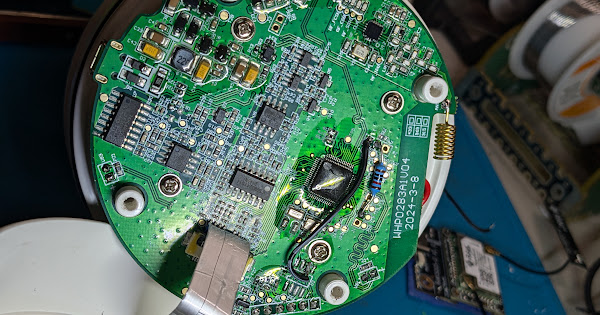
Google Photos
red arrow show sda/scl lines coming up into made circuit board.

 ancient forge
what are your thoughts on the lark station?
pulsar hornet
@ancient forgeit kinda works. I couldn't get it output serial but it did output i2c data. The problem with it is that it doesn't output the wind direction with very much precision, only N,S,E,W NW, NE, SE,SW. Most good anemometers will output wind direction in degrees. Overall it's a very flakey system and I wouldn't expect it to continue running if deployed permanently.
ancient forge
thanks - i will avoid then 🙂
pulsar hornet
@ancient forgewhat's your application ? station for a house or remote ?
ancient forge
remote
for parasailing.. we have two local peaks on a hill, they currently have windsocks, but kinda hard to see from the trail head
pulsar hornet
@trail needle just for your reference here is my fork with the bodgered SerialModule reading the wind data and calculating averages : https://github.com/tavdog/meshtastic-firmware/blob/c7f1c2b4b8c3a3beee38c7231e3d61fdb42bfef3/src/modules/SerialModule.cpp#L229
GitHub
Meshtastic device firmware. Contribute to tavdog/meshtastic-firmware development by creating an account on GitHub.
@ancient forgedo you mean paragliding ?
ancient forge
yah sorry
pulsar hornet
Where are you located ? fyi Meshtastic originated by a PG pilot wanting a messaging system for flying. . .
ancient forge
san diego
pulsar hornet
Ah ok. I got my P3 at Torrey pines.
ancient forge
that’s cool, didn’t know that 😉
pulsar hornet
I hear socal has a pretty robust meshtastic network.
ancient forge
yah… there are some dead zones with all the hills… but lotsa nodes
pretty easy to hit 100 nodes
 pulsar hornet
For WS85 i'm currently logging direction AVGgGUST cellVoltage supercap voltage like so : INFO | ??:??:?? 55 [SerialModule] WS85 : 30 0.0g0.0 2.4v 5.2v
Sending this out as text message as well. I'm going to embed the chopped down rak in the WS85 and monitor the voltages, see what happens. Last time I connected the battery terminals of the RAK to the 3.3v rail on the WS80 board and it didn't last through the night. I'm not sure if that's just super inneficient or what. The supercap charges up to 5.4V during the day from the solar panel. I assume it could handle a little extra current for the RAK but we'll see.
 weak basin
Is the anemometer supported in Meshtastic firmware?
pulsar hornet
@weak basinnot officially. I have it working with my own hacked SerialModule though.
weak basin
So a arduino hooked up to a node?
pulsar hornet
It's not an arduino but some custom chip with serial output.

I tried powering the RAK directly off the WX 3.3v rail but the super cap didn't last even an hour sooo.
The supercap voltage is that last voltage reading.
And now in the sun the supercap charges up in less than an hour.
BAT32G157 microcontroller
it output a mess of serial data that needs to be parsed and averages calculated which happens in custom code in the serialmodule.
weak basin
Is there work done for supporting anemometer in software?
pulsar hornet
not sure what you mean. thebentern did some work to support an i2c sensor called LARK
9.44mAh is apparently what's available from the supercaps.
I was measuring what that rak was using and it was about 10ma so no wonder it only lasted an hour.
I guess I'll just stick with external rak device with it's own solar.
weak basin
@pulsar hornet 35:33 of this video
https://www.youtube.com/live/a-lhgWwEGV0?si=P-fbjrdOkXNW066q

Join us for another episode of "Making Next Gadget," our weekly livestream series! This week, we'll dive into IoT in the Wild with Meshtastic. Our amazing co...


 weak basin
pulsar hornet
weak basin
pulsar hornet
has support been added in firmware?
pulsar hornet
yes.
The serial mode is called WS85
I need to work on making the integration between the WS85 wind meter and the rak solar module better. Now it's just a two pin serial wire connecting the two.
pulsar hornet
