#Callback Functions - JS
1 messages · Page 1 of 1 (latest)
 covert bone
 pseudo sierra
search for JavaScript closure
 minor wedge
Can you try to explain how you understand callbacks in your own words?
pseudo sierra
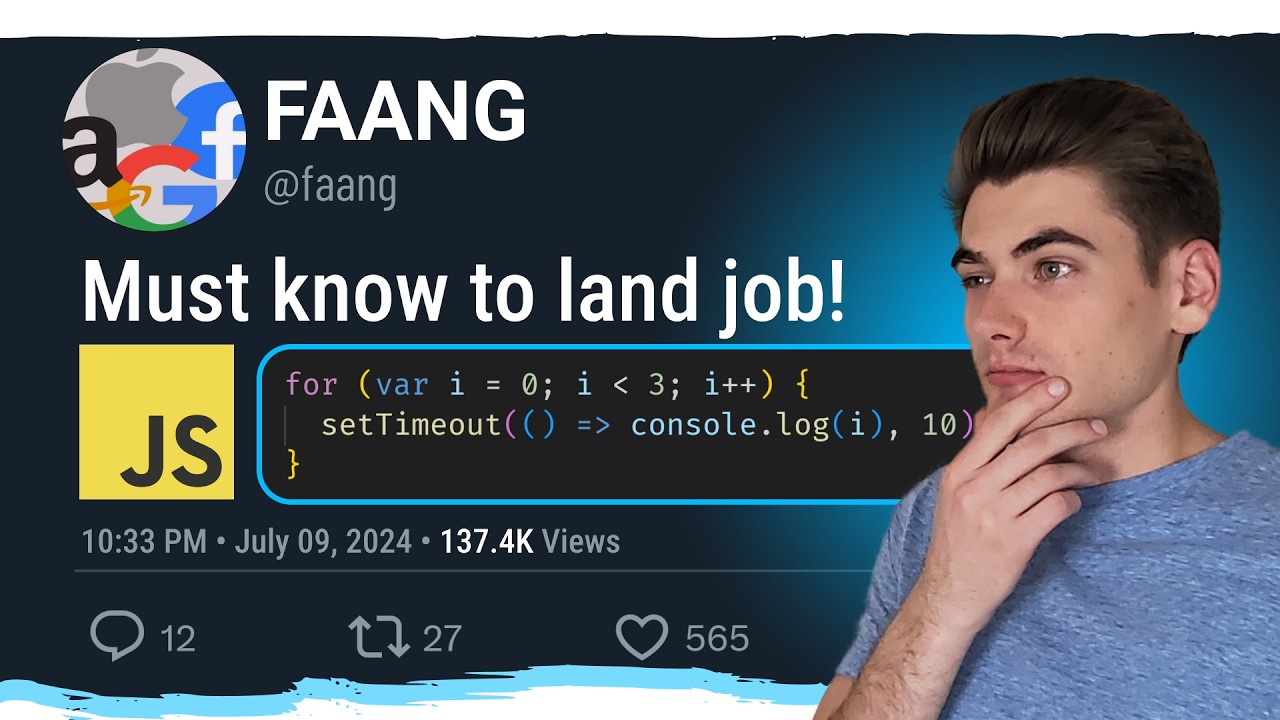
JavaScript Simplified Course: https://javascriptsimplified.com/?utm_source=youtube&utm_medium=video-description&utm_term=video-id-47SPG8TvUXA
FREE JS Array Methods Cheat Sheet: https://webdevsimplified.com/js-array-methods-cheat-sheet.html
FREE JS DOM Traversal Cheat Sheet: https://webdevsimplified.com/js-dom-traversal-cheat-sheet.html
FREE JS D...
closures and scope are like inner class in Java
because functions are first class citizen and an actual class in JavaScript
callback are executed by the run-time, check the first video, it's very visual
call back in general is just a pointer to some function / code and you tell that function that you call, please call me back when you need me
a bit like a push notification.
window.setTimeout(
   function(e)  // = The callback,
                // (e) the timeout event object
   {
       console.log("The event was : " + e);
   },
   100  // = 100ms
);
so this means that the run-time loop will execute "all your code"
and once it is done, it will call you back at least 100ms later
If your main code is SUPER SLOW, it might call you back minutes later, which is >>> 100ms
In normal web code, this never happens, so you normally get normal behavior of being call back within 100ms
Now you can write this code like this:
   function myCallBack(e)  // = The callback,
                // (e) the timeout event object
   {
       console.log("The event was : " + e);
   }

window.setTimeout(
   myCallBack, // Pointer or Reference to the function above.
   100  // = 100ms
);
or like this and name the anonymous function
window.setTimeout(
   function myCallBack(e)  // = The callback,
                // (e) the timeout event object
   {
       console.log("The event was : " + e);
   },
   100  // = 100ms
);
wait wait wait @pseudo sierra
pseudo sierra
In Java 7 and earlier this would be a fully fledge class instance
In Java 8+ that could be a "lambda", which is also a closure
covert bone
we're just learned the basics and yesterday we learned about promise
pseudo sierra
OK 😄
covert bone
@minor wedge now , callback functions uses basically for async tasks , and its the abiility to call a function from another function with parameters
pseudo sierra
Did you learn any other programming language before ?
covert bone
no
minor wedge
covert bone
<@310386501483757570> now , callback functions uses basically for async tasks , ...
It's somewhat okay for a basic understanding of callbacks. The main point to change is that it's not exclusively for async tasks. It's more general than that.
pseudo sierra
a callback is what I said above a pointer to code to be executed later, but LATER could be RIGHT NOW...
covert bone
ok
pseudo sierra
function f(g)
{
  g();
}

function g2() { console.log(1); }
f(g2); // LATER is RIGHT NOW
yesterday my mind went away like a balloon flys into the sky lol
pseudo sierra
To be honest, I never use async in my code
but then I don't write NodeJS back-end 😂
but Promise I use
or just normal events or jQuery
In NodeJS, you have to use await / async almost everywhere 💀


see the keyword propagates like a virus
but basically it means that your code is no longer async
because you await all the time, so you are making your code blocked for the stuff to complete 💀
and therefore potentially killing performance for readability
covert bone
I'm sorry , i swear that im not a mean guy , i just used to my friends's way of explanation like Malasai , norob , mellow and Maarifa
pseudo sierra
watch the 2 YouTube videos or similar ones that I posted, it's well explained 😉
 mint thicket
covert bone
I'm sorry , i swear that im not a mean guy , i just used to my friends's way of ...
mint thicket
covert bone
I'm sorry , i swear that im not a mean guy , i just used to my friends's way of ...
Callbacks basically mean passing a function as an argument to another function that will call it. That another function can call the passed function argument immediately or at a later time as fd26 mentioned.
 keen kestrel
covert bone
I'm sorry , i swear that im not a mean guy , i just used to my friends's way of ...
keen kestrel
covert bone
I'm sorry , i swear that im not a mean guy , i just used to my friends's way of ...
A callback is a function you pass into another function so that the other function can call it, either right away or later, depending on how it’s designed.
It is basically what it meant, a « callback ». Think of it like giving someone your phone number and asking them to call you when they’re done with something.
keen kestrel
keen kestrel
A callback is a function you pass into another function so that the other functi...
I just re altered what mellow said here^
keen kestrel
covert bone
<@310386501483757570> now , callback functions uses basically for async tasks , ...
Something to check here: do you understand what async is/does?
covert bone
we didnt reach async await yet , we only learned the basics of callback functions and yesterday it was promise @keen kestrel
minor wedge
covert bone
we didnt reach async await yet , we only learned the basics of callback function...
Think of it simply: a callback is a function that you pass as an argument to another function, so it can be called later when needed.
covert bone
ok
minor wedge
Here's an analogy:
You order a pizza and you tell the restaurant: Here’s my number, call me when it’s ready.
- You (the main program) start an action (ordering pizza).
- The restaurant (the other function) doesn’t call you right away - it calls you later, when the pizza is done.
- Your phone number is like the callback function - it’s a way for them to reach you when they’re done.
covert bone
i think that one i understood like 90%
minor wedge
minor wedge
Here's an analogy:
You order a pizza and you tell the restaurant: Here’s my num...
function orderPizza(callback) {
  console.log("🍕 Ordering pizza...");

  // Simulate time for the pizza to be prepared
  setTimeout(() => {
    console.log("✅ Pizza is ready!");
    callback(); // call you (the customer) when it's ready
  }, 3000);
}

function callCustomer() {
  console.log("📞 Calling customer: 'Your pizza is ready for pickup!'");
}

// Place the order
orderPizza(callCustomer);
The callback here is the callCustomer. When the pizza is ready, the customer will be called.
covert bone
this is lil bit more in depth , i made some simple exercises like :
function firsttemplate(getnumber) {
  return getnumber;
}

function secondtemplate(getanothernumber) {
  return getanothernumber;
}

function getlasttwo(getnumber, getanothernumber) {
  console.log(firsttemplate(5) + secondtemplate(5));
}

getlasttwo(firsttemplate, secondtemplate);
It's not much less complicated that what I did. If what confuses is the timeout I can remove it
function orderPizza(callback) {
  console.log("🍕 Ordering pizza...");
  preparePizza();

  console.log("✅ Pizza is ready!");
  callback();
}

function callCustomer() {
  console.log("📞 Calling customer: 'Your pizza is ready for pickup!'");
}

// Place the order
orderPizza(callCustomer);
its not the i dont know what settimeout is , we only used settimeout like setTimeout(someFunction,timer);
covert bone
covert bone
this is lil bit more in depth , i made some simple exercises like :
```JS
funct...
btw i fixed it alone and my friend told me , that's great
minor wedge
I see, well in this case I used an anonymous function but it's essentially the same thing. Anonymous function are functions that are not binded to a name.
covert bone
yea , arrow
minor wedge
Arrow function is a type of anonymous function. I'd rather you call them anonymous function than arrow function.
But they are essentially the same thing. The reason why I want you to think of them as anonymous function rather than arrow function is to make you understand a bit more the underlying concept rather than the javascript concept
covert bone
its just like that because we dont declare a name for the function
minor wedge
covert bone
its just like that because we dont declare a name for the function
Do you understand a bit more callbacks or you are still confused about them?
You really need to think about and treat functions as ordinary data, like integers, double, string, etc. You can bind them to variables, you can pass them as parameter, return them as value, etc.
covert bone
in the basics i get it but there is a tricky question that i need to solve , that is involving function within a function within a function
minor wedge
Okay, well if you want some help with that just send it here.
covert bone
but as you know me my dear friend , only guidance ❤️
Create a function that receives another function and executes it (inside its body).
Then, create another function that receives the first function and executes it.
function parent(childfunc) {
  childfunc();
}

function getfirst(parent) {
  parent();
}

getfirst(parent);
this is how i tried to fix it
minor wedge
Okay, good you're on the right track. What do you think is missing?
- parent -> receives another function and executes it.
- getFirst -> receives the first function (parent).
- ... Now, what does parent need in order to work correctly inside getFirst?
covert bone
you mean , one of those or what is missing in each thing ?
minor wedge
The last part.
covert bone
to be honest this is how our teacher wrote the exercise , he didnt ask to print something
minor wedge
I know but have you tried to execute this? What would happen if you execute this?
covert bone
childfunc is not a function
minor wedge
Mmh you excuted it right haha. Why do you think it does that?
It might help you to change names a bit
 thorny eagle
i did that too but i think at i need to gve the first function annonimus function
i tryed it but its gave me an error
minor wedge
function parent(parentCallback) {
  parentCallback();
}

function execute(callback) {
  callback();
}

callback(parent);
This will cause the same error but with parentCallback. Why is that?
covert bone
because i didnt pass any value into it ?
covert bone
but why ? he didnt asked us to pass any value or print something
minor wedge
You're right, he said "execute it". If you don't pass anything it will always cause an error
What is the "minimum" value you could pass to execute it?
Or is there more instructions that you teacher gave?
covert bone
i can pass anything , even MOSES idk
minor wedge
covert bone
i can pass anything , even MOSES idk
Nah you can't pass anything
In the execute (getFirst) function, we pass the parent function. The parent function requires what kind of param?
function parent(parentCallback) {
  parentCallback();
}
anonimus function maybe ?
covert bone
itay already saw the solution of the teacher and he saw that used arrow function
i dont want to see it , you know me @minor wedge
minor wedge
covert bone
i dont want to see it , you know me <@310386501483757570>
Didn't send anything you didn't know; I'm not showing the solution. The code above is what you have
thorny eagle
i tryed it but its not working
covert bone
I meant that i dont want to see the teacher's solution like itay saw
minor wedge
thorny eagle
i tryed it but its not working
How did you write it?
covert bone
he just told me that he used arrow function
minor wedge
covert bone
he just told me that he used arrow function
How do you define arrow function?
(I'm pretty sure I know your issue with arrow func XD)
covert bone
tbh i cant remember the syntax of arrow functions
minor wedge
covert bone
tbh i cant remember the syntax of arrow functions
Google it
thorny eagle
      function activateFunk6(someFunk) {
        someFunk(() => console.log("600"));
      }

      function activationFunk6(someFunk6) {
        someFunk6();
      }

      activationFunk6(activateFunk6);
||Your problem is the order of your calls. Try: activateFunk6(activationFunk6) instead||
covert bone
should i see it ?
minor wedge
No it's for Itayk and it's not the same problem as you
I don't want to spoil you the solution XXD
covert bone
it is acutally , same question
minor wedge
I know but the reason why your code and his code doesn't work is not the same
covert bone
❤️
ok ill go to smoke a cig , finish with itay first i guess
please stop with that cause itay already angry on me that im smoking lol
minor wedge
I will not
covert bone
i love you bro @minor wedge 😛
minor wedge
Have you look up how to define arrow function?
covert bone
const someFunc = (VALUE) => {
SOMETHING HERE;
};```but i dont need to activate the function that call the function ?
minor wedge
thorny eagle
but i dont need to activate the function that call the function ?
||my point is that you mixed up the calling order. You could change the names if you want to call it with the order you want||
covert bone
minor wedge
Make it anonymous
let x = function(){
// operations
};```This would work ||I just switch the name of the functions||
||```js
function activationFunk6(someFunk) {
someFunk(() => console.log("600"));
}
function activateFunk6(someFunk6) {
someFunk6();
}
activationFunk6(activateFunk6);
There's one thing you could change too. ||Like NugByte said, you don't have to print anything. How can you make your arrow function not return anything?||@thorny eagle
minor wedge
covert bone
```JS
let x = function(){
// operations
};```
Nop.
covert bone
im allowed to cry here ?
minor wedge
Show me the three main ways to define anonymous function (a function without name)?
covert bone
googling... 🙂
minor wedge
minor wedge
This would work ||I just switch the name of the functions||
||```js
function ac...
Do you understand @thorny eagle ?
covert bone
expression , arrow , iifes
covert bone
EXPRESSION:
    const sayHello = function() {
        console.log("Hello, world!");
    };
sayHello(); // Call the anonymous function via the variable```ARROW:
 const add = (a, b) => a + b;
    console.log(add(2, 3)); // Output: 5

    // For multi-line bodies, use curly braces:
    const greet = (name) => {
        console.log(`Hello, ${name}!`);
    };
greet("Alice");```i try to see i i fully understand
minor wedge
covert bone
ARROW:
```JS
const add = (a, b) => a + b;
console.log(add(2, 3)); // Output...
How would you pass an anynmous function without needing to assign it to a variable?
Can you just do
function() {

}

() => undefined

() => {

}
Is this valid js code?
Could the @cold rose work?
covert bone
for me , without inserting anyting , its bilnd haha
minor wedge
bilnd?
minor wedge
minor wedge
Can you just do
```js
function() {
}
() => undefined
() => {
}
```
;compile
 cold roseBOT
Program Output
/home/wandbox/prog.js:1
function() {
^^^^^^^^

SyntaxError: Function statements require a function name
    at wrapSafe (node:internal/modules/cjs/loader:1378:20)
    at Module._compile (node:internal/modules/cjs/loader:1428:41)
    at Module._extens
malassi | javascript | nodejs-20.17.0 | wandbox.org
minor wedge
covert bone
i didnt see the undefined
This is just so it doesn't crash because it has nothing
covert bone
ok it make sense..
minor wedge
You can use function() but you can't just define it randomely. You need to pass or bind it for it to work.
thorny eagle
how do i cover my code?
covert bone
btw Malassi , you want me or itay to open another ticket so it could be more clean and easy for each other ?
minor wedge
Maybe XD
covert bone
awesome , we will do that bro
minor wedge
thorny eagle
how do i cover my code?
You mean hide it? Like this:
||```
...
```||
thorny eagle
||```JS
function activationFunk6(someFunk) {
someFunk(() => console.log("600"));
}
function activateFunk6(someFunk6) {
someFunk6();
}
activationFunk6(activateFunk6);
Ok , itay will stay here
minor wedge
covert bone
btw Malassi , you want me or itay to open another ticket so it could be more cle...
Here's ways you can pass an anonyous function as a callback
function execute(callback) {
    callback()
}

execute(function() {

})

execute(() => {

})

execute(() => undefined)
I opened for me a new one
minor wedge
Oh
thorny eagle
thorny eagle
||```JS
function activationFunk6(someFunk) {
someFunk(() => consol...
What is the point of the function activateFunk6 if I call activationFunk6 directly?
The goal is for me to call activateFunk6 so that it activates activationFunk6, right?
minor wedge
thorny eagle
What is the point of the function activateFunk6 if I call activationFunk6 direct...
Completing the exercise XD
Honestly, in this context, the only purpose of doing this that way is to teach you about callbacks.
That said, there is some real cases where you could stumble on this pattern
thorny eagle
I know this is for educational purposes
But is this how the solution should be?
Isn't it supposed to be a function that calls a function that does an action?
I think I understand
Thanks for the help
minor wedge
thorny eagle
I know this is for educational purposes
But is this how the solution should be?
...
Yep and with the last version that's what you have
You have 2 functions, that takes a function in parameter. One takes the first one and execute it
According to what Nugbyte sent me, that's what you want to do and it basically doesn't return or do anything
In your case you're printing 600 but it shouldn't
function activationFunk6(someFunk) {
  someFunk(() => { });
}

function activateFunk6(someFunk6) {
  someFunk6();
}

activationFunk6(activateFunk6);
It should look like this
See here, I changed the way the arrow function is written. I added an empty body.
minor wedge
minor wedge
```js
function activationFunk6(someFunk) {
someFunk(() => { });
}
function ac...
;compile
cold roseBOT
malassi | javascript | nodejs-20.17.0 | wandbox.org
minor wedge
It compiles and run but it doesn't do anything
thorny eagle
ok i will fix it