#📚|english-questions
1 messages · Page 162 of 1
 hardy citrus
 plain crag
Look up its definition, and try to use it in conversation
If you don't use it, y...
plain crag
Look up its definition, and try to use it in conversation
If you don't use it, y...
I even forget the words that i use
Btw is reading books in English helps me to extend my vocab
plain crag
Do you forget them when you need them?
hardy citrus
plain crag
Do you forget them when you need them?
Yea exactly
plain crag
hardy citrus
Btw is reading books in English helps me to extend my vocab
Yes, it's a good way to increase your vocabulary
You learn words through context
If you make notes of the words you don't know, it'll be beneficial for increasing vocabulary
But you shouldn't try to cram several words at once in your head
hardy citrus
plain crag
Yes, it's a good way to increase your vocabulary
You learn words through context...
I've noted for now like 130 words
plain crag
hardy citrus
Yea exactly
That's common, and it happens with me too
plain crag
hardy citrus
I've noted for now like 130 words
What're a few of them?
hardy citrus
plain crag
What're a few of them?
Wait
Depicate
Insist
But I've learnt them
And sympathy
Ranging
I just don't remember them when i need them
plain crag
Depicate?
plain crag
hardy citrus
I just don't remember them when i need them
You need to keep using them, Ig
plain crag
First time hearing that word
hardy citrus
plain crag
First time hearing that word
Ig i heard it in a religious video like two months ago
plain crag
hardy citrus
I've noted for now like 130 words
I have a several lists consisting of 800+ words in total
hardy citrus
plain crag
I have a several lists consisting of 800+ words in total
I have an app with over 7000 words
1240+ ielts words
plain crag
It's hard to memorize random words
hardy citrus
6000+ toefl words
hardy citrus
plain crag
It's hard to memorize random words
Yea ngl i don't really use this all
App
plain crag
hardy citrus
I have an app with over 7000 words
What's the name of that app?
plain crag
Oh
 plain crag
Hm?
hardy citrus
This is the list
plain crag
Nice
hardy citrus
@plain crag do you know where can i find books to read
plain crag
Try these apps
Kobo Books
Smart Books
If you're gonna use Smart Books, you'll need to download Epub Reader to read them there
You can read offline on these apps, too
hardy citrus
Ok
 eager mantle
What does uncooperative mean?
 flat rune
unhelpful to someone
eager mantle
flat rune
unhelpful to someone
Can you write me a sentence so I can know how to use it properly
flat rune
eager mantle
Can you write me a sentence so I can know how to use it properly
In school, we had to make a presentation but my friend was being uncooperative so it was more difficult to finish it on time
eager mantle
flat rune
In school, we had to make a presentation but my friend was being uncooperative s...
That’s helpful enough thanks
 teal summit
The first one I would say no
And yes, a simile is a comparison that uses like or as
For example:
He is as tall as a giraffe
She sings like an angel
hardy citrus
What do
Distinct indistinct indistinctive mean
Anything that's concerning the word "distinct"
teal summit
hardy citrus
Anything that's concerning the word "distinct"
Different, easy to identify
You could say someone has a distinctive voice, meaning it’s easily recognizable
hardy citrus
teal summit
Different, easy to identify
When i put it on google in my language it says special
hardy citrus
teal summit
Different, easy to identify
How about bias
teal summit
hardy citrus
When i put it on google in my language it says special
I mean, different COULD mean special right
Bias is hard to define hmm
When your pre existing beliefs change the way you view something
Stereotypes arise from biases
 minor galleon
Yes, they are example of a simile. They have to be different, but share a similar thing, and have to be true.
For example:
✅ He is as wise as an owl
❌ He is as wise as a car (this does not make sense)
 heavy salmon
How are you all
 near fable
heavy salmon
How are you all
near fable
heavy salmon
How are you all
Hey this chat is for questions, use #💭|general
heavy salmon
Ok
flat rune
I got this explanation for "content" and does it means what is inside something?

"Nothing would content her" what does it mean?
 sudden frost
hello! does anyone here knows what does "net proceeds to the issuer" means?
plain crag
flat rune
"Nothing would content her" what does it mean?
Content is used as a verb here, and it means to make someone happy
flat rune
flat rune
I got this explanation for "content" and does it means what is inside something?
@plain crag what does it mean here?
plain crag
Yeah, it means what's inside something
But it you can use it to refer to media too
"This video is good content"
This is just an example
 quartz sandal
What does the idiom " chill under a mango tree " mean ? I assumed it means "to procrastinate" but I'm not sure...
near fable
quartz sandal
What does the idiom " chill under a mango tree " mean ? I assumed it means "to p...
It's just like relax
@supple holly am i right?
 supple holly
near fable
<@260420250728661002> am i right?
supple holly
near fable
<@260420250728661002> am i right?
Never heard of the phrase but 'chill = relax' so maybe
near fable
supple holly
Never heard of the phrase but 'chill = relax' so maybe
doesn't seem like an actual phrase
quartz sandal
near fable
doesn't seem like an actual phrase
I heard it while I was listening to the podcast but okay
supple holly
Yeah I don't think so either. People make stuff up to express themselves, no need to overthink it
near fable
quartz sandal
I heard it while I was listening to the podcast but okay
The podcast guy is just trying to explain stuff
That's not really actual phrase, I searched up

quartz sandal
near fable
That's not really actual phrase, I searched up
Alright, got it. Thanks for your reply
near fable
 thorny kiln
Can sb explain what is blunder mean in this sentence "your reputation won't be smeared because of his blunder"
supple holly
thorny kiln
Can sb explain what is blunder mean in this sentence "your reputation won't be s...
blunder usually means the same thing as mistake, or generally something bad that a person did by accident
flat rune
Hi, can anyone help me to understand the meaning of the following sentence "I'm the conscientious objector of the status quo"?
supple holly
flat rune
Hi, can anyone help me to understand the meaning of the following sentence "I'm ...
the person doesn't agree with the status quo (current politics stuff), and he objects it because he thinks that is the right thing to do
conscientious = (of a person) wishing to do what is right, especially to do one's work or duty well and thoroughly OR relating to a person's conscience
status quo = the existing state of affairs, especially regarding social or political issues.
flat rune
@supple holly ur answer is enlightened me! Thanks a lot!!
flat rune
flat rune
<@260420250728661002> ur answer is enlightened me! Thanks a lot!!
I guess this sentence grammatically incorrect?!
flat rune
flat rune
I guess this sentence grammatically incorrect?!
If so, Can anyone correct me this as well?
supple holly
flat rune
I guess this sentence grammatically incorrect?!
yes it is grammatically correct
flat rune
supple holly
yes it is grammatically correct
Thanks for confirming! Really appreciate it 🙌
 tawdry owl
Somebody here?
near fable
tawdry owl
Somebody here?
Yes
tawdry owl
near fable
Yes
can "all the way" and "to the end" be used interchangeably ?
what are exactly the differences between both of them
if i want to tell "i will read this book to the end for you guys"
can i say "i will read this book all the way for you guys" instead of that
near fable
tawdry owl
can "all the way" and "to the end" be used interchangeably ?
Not really
near fable
tawdry owl
if i want to tell "i will read this book to the end for you guys"
That means you'll read this book at last
near fable
tawdry owl
can i say "i will read this book all the way for you guys" instead of that
You'll read this whole book
tawdry owl
near fable
You'll read this whole book
i just found out that sometimes "all the way" is used instead of "to the end"
and i searched for it
near fable
Can you show me?
tawdry owl
some people say that all the way is more used with some verbs than "to the end"
tawdry owl
near fable
Can you show me?
such as "You'll go all the way to learn that language well"
near fable
Wait you edited in the end to ( to the end)?
tawdry owl
near fable
Wait you edited in the end to ( to the end)?
i did not understand what you meant
near fable
@azure linden son come here
 azure linden
daughter
tawdry owl

near fable
tawdry owl
can "all the way" and "to the end" be used interchangeably ?
@azure linden
azure linden
id ask someone else
near fable
@atomic lantern hey
 atomic lantern
tawdry owl
i just found out that sometimes "all the way" is used instead of "to the end"
atomic lantern
tawdry owl
i just found out that sometimes "all the way" is used instead of "to the end"
Both "to the end" and "all the way" are correct and mean the same thing. "To the end" is a bit more poetic because it sounds like you're going out of your way to do this for someone. Like saying "I will follow you to the end" kinda means that you're both give die together. "I will follow you all the way" means you'll be with that person every step of the way but that the end is not final. In the context of finishing a book it's more tame
If you say "I will read this book to the end" or "I will read this book all the way" they mean the same. When you say "I will read this book to the end for you" or "I will read this book all the way for you" that's when it becomes a bit more poetic. But it's personal choice which one to use
tawdry owl
atomic lantern
Both "to the end" and "all the way" are correct and mean the same thing. "To the...
it's really so confusing
i just found out this expr
atomic lantern
Basically they mean the same thing. You decide which one to use
tawdry owl
atomic lantern
Basically they mean the same thing. You decide which one to use
and actually i am trying to find which verbs are better for this expr than "to the end"
tawdry owl
atomic lantern
What do you mean which verbs to use
such as i found out this expr while i was watching a video
he was saying
you'll go all the way to learn python well
and i searched for that expr
it showed me it
atomic lantern
I've often heard it said in movies "I will follow you to the end my brother" (meaning I will die with you). "I will see this through" (could be come kind of bureaucratic problem that requires solving)
atomic lantern
tawdry owl
you'll go all the way to learn python well
"going all the way" usually means to give it everything you got to learn python
tawdry owl
atomic lantern
I've often heard it said in movies "I will follow you to the end my brother" (me...
actually it sounds like they specify themselves where they are supposed to be used instead of each other
atomic lantern
tawdry owl
actually it sounds like they specify themselves where they are supposed to be us...
Yeah

 native ingot
Could anyone help me with correct transcription for this one sentence ?
https://youtube.com/clip/UgkxvfiaoMrUXkG-VRh6kIns3l_X6IqwjXUZ

YouTube
5 seconds · Clipped by Yong Yi Wong · Original video "Learn English in 3 Hours - ALL You Need to Master English Conversation" by Learn English with EnglishCl...
 midnight harbor
native ingot
Could anyone help me with correct transcription for this one sentence ?
https:/...
midnight harbor
native ingot
Could anyone help me with correct transcription for this one sentence ?
https:/...
Well I think I took a very different tactic from you- I didn't- I picked some of the words that I-
The from should be a than though
 uneven tinsel
agreed
native ingot
YouTube
5 seconds · Clipped by Yong Yi Wong · Original video "Learn English in 3 Hours - ALL You Need to Master English Conversation" by Learn English with EnglishCl...
also can anyone point correct transcription ? 1: 57
 balmy flower
native ingot
also can anyone point correct transcription ? 1: 57
balmy flower
native ingot
also can anyone point correct transcription ? 1: 57
Unusual to come across I did one on each card so. Bare with me here.
native ingot
Very thank you.
balmy flower
native ingot
Very thank you.
sorry i made a mistkae
*mistake
it's bear with me
here
native ingot
Thank you James
 clear flint
Knowledge is proud that it knows so much
metaphor or personification?
I guess metaphor would be correct
 crimson torrent
Why words in online dictionaries are segregated by dots?

And different dictionaries segregate them differently.
 clear flint
so that you can read it correctly
 deft widget
I have a question. I have heard someone saying that "that is an actual Aussie moment right there". In that context, it was talking about the reaction of an Aussie. So, the meaning of "moment" equals that of "reaction". However, in dictionary, "moment" means a short period of time or occasion. I am confused in it.
supple holly
 hazy badger
Was is a single form so we can use it in i
hazy badger
Was is a single form so we can use it in i

crimson torrent
clear flint
so that you can read it correctly
I can't and it complicates things.
deft widget
I don’t really understand
 modest juniper
Could you help me find the correct answer to my question? When we talk about some web platform (such as Netflix), what preposition shoud we use? For example: "I like Netflix. I watch all of the series** on/at/in **this platform"
 tepid pawn
modest juniper
Could you help me find the correct answer to my question? When we talk about som...
tepid pawn
modest juniper
Could you help me find the correct answer to my question? When we talk about som...
"On".
 gilded wedge
@flat rune is it “since when did you care” or “since when do you care”??
 warm pawn
gilded wedge
<@456226577798135808> is it “since when did you care” or “since when do you care...
warm pawn
gilded wedge
<@456226577798135808> is it “since when did you care” or “since when do you care...
do
:)
i think
"Can u tell me about what club you are joining this year?"
"Since when do you care about my afterschool activities?"
flat rune
gilded wedge
<@456226577798135808> is it “since when did you care” or “since when do you care...
"Since when did you care!?"
Both work depending on the tense.
flat rune
deft widget
I have a question. I have heard someone saying that "that is an actual Aussie mo...
"X moment" coloquially means that it is an event where something happens.
Thus, "Aussie moment" is saying, in more formal terms, "This is the typical reaction (as a moment) an Australian has."
gilded wedge
@warm pawn @flat rune So umm this friend of mine well we’re not friend no more he’s a big liar and se messaged me and says “hey, how r ya and your school” i just dunno what tense should i use “since when did you care” or “since when do you care”
@flat rune what should i reply to “how are you”
This “since when do u care?”
Or this “since when did you care?”
warm pawn
gilded wedge
<@456226577798135808> what should i reply to “how are you”
This “since when do...
do
find a test online
type smth like
English level test
and it will pop up
 crimson narwhal
What result did you get?
 fervent horizon
What was ur result?!
warm pawn
Same as me actually :)
uneven tinsel
crimson torrent
idk why they're different between the two, but they're highlighting the syllables.
@crimson torrentactually...i guess it's not. https://www.merriam-webster.com/words-at-play/word-division-dots-and-syllable-pronunciation-hyphens#:~:text=Within a dictionary entry%2C the,with hyphens in the pronunciation.

A dot and a hyphen have meaning in the dictionary.
uneven tinsel
@crimson torrentso webster says on their website, it's to show the person where they can safely cut a word in half if it won't fit at the end of the page, and that it does not reflect the syllabication of the word.
but i suspect, this a just a webster thing. I'm saying that on other dictionaries, they might actually be using the dots as syllabication.
which could explain why it changes from dictionary site to site. because there's no set standard on what those dots mean.
midnight harbor
crimson torrent
Why words in online dictionaries are segregated by dots?
syllables
prom - e - nade
3 sounds
it shows you how to pronounce it
i can help
Ok
flat rune
hello
flat rune
midnight harbor
i can help
sry i accindently deleted the message
ok anyways
can you help me with this
midnight harbor
send it
flat rune
ok
hello , i am ---------- ---------and im 13 year's old , i am overweight in other words fat and i hate it because of the bullying i get on a daily bases and the constant state of anxiety and weakness i have , so today i decided to change my life around and start working out so that by the end of this summer i will have my glow up and finally be free and happy , and i will post my journey which will contain my diet and workout which will be also showing my progress so join me on this journey and let's get ripped together !!!!!!
can you correct it
midnight harbor
flat rune
hello , i am ---------- ---------and im 13 year's old , i am overweight in other...
Hello, I am ---------, and I'm 13 years old. I'm overweight, in other words fat, and I hate it because of the bullying I get on a daily basis and the constant state of anxiety and weakness I have, so today I decided to change my life around, and start working out so that by the end of the summer, I will have a glow-up and finally be free and happy. I will post my journey, which will contain my diet, workout and progress. So join me on this journey and let's get ripped together!
flat rune
thx
midnight harbor
np
flat rune
gilded wedge
<@933766259072438352> <@456226577798135808> So umm this friend of mine well we’r...
Present tense is do.
Near fluent
flat rune
crimson torrent
Why words in online dictionaries are segregated by dots?
Syllables and counting.
It's to emphasise pronunciation.
 frank creek
gilded wedge
<@933766259072438352> <@456226577798135808> So umm this friend of mine well we’r...
frank creek
gilded wedge
<@933766259072438352> <@456226577798135808> So umm this friend of mine well we’r...
Present tense
uneven tinsel
I feel like both answers shoulda been correct possibilities.
 native ingot
anyone hep me with correct transcription ?
YouTube
6 seconds · Clipped by Yong Yi Wong · Original video "Learn English in 3 Hours - ALL You Need to Master English Conversation" by Learn English with EnglishCl...
3:17
frank creek
uneven tinsel
I feel like both answers shoulda been correct possibilities.
Possibility means something might happen if you do it yourself whereas Opportunity means if someone gives you a set of circumstances that you adhere to, it might happen so i'd say opportunity
it depends on the country ig
If u see something kinda nasty lookin' on the street or u see idk maybe a frog got ran over by a car in your neighborhood laughs EWW Thats gnarly
frank creek
native ingot
3:17
.
frank creek
frank creek
If u see something kinda nasty lookin' on the street or u see idk maybe a frog g...
.
gilded wedge
@frank creek is it
“If only your home was right next to mine we could”
Or
“If only your home is right next to mine we could”
frank creek
gilded wedge
<@939636051155230730> is it
“If only your home was right next to mine we could”...
if only your house/flat/ apartment was next to mine we could
gilded wedge
frank creek
if only your house/flat/ apartment was next to mine we could
Ohh thanx!!
frank creek
Np
crimson torrent
uneven tinsel
<@464925368227332109>so webster says on their website, it's to show the person w...
Thanks. I very much appreciate it!
flat rune
frank creek
C1 is fluent
C1 is officially in that tier, but calling them both the same level of fluent is silly.
flat rune
frank creek
Near native
Native is its own category.
Fluent merely means you may communicate properly.
Native demands understanding of far more than merely communication.
flat rune
uneven tinsel
I feel like both answers shoulda been correct possibilities.
The easy difference is that possibility refers to the truth of a matter and that opportunity refers to whether or not something can happen.
uneven tinsel
i mean if we're being technical yes i suppose you're right...but in reality i'm pretty sure i've heard people use the word possibility for things less absolute in truth just because well...i mean people do that all the time.
ima blame the test director on this one
deft widget
flat rune
"X moment" coloquially means that it is an event where something happens.
So, "X moment" dose not have to be talking about reaction. It can be other things?
flat rune
deft widget
So, "X moment" dose not have to be talking about reaction. It can be other thing...
It can be. It depends on the context of the situation.
flat rune
uneven tinsel
i mean if we're being technical yes i suppose you're right...but in reality i'm ...
They are interchangeable in some contexts, but an L2 learner needs to learn the exact terms and meanings before moving to synonyms and their use.
gilded wedge
@flat rune
“If she weren’t in heels she might’ve jumped”
Or
“If she wasn’t in heels she might’ve jumped”
Which one is correct
deft widget
I have a question about prepositions. Someone cannot find the saving files in a game. Then, the person said "there is a problem with the steam cloud." Why it is "with" ,"not "in"?
gilded wedge
@flat rune @frank creek “none of these three names are/is my real name” are or is
 regal nymph
gilded wedge
<@456226577798135808>
“If she weren’t in heels she might’ve jumped”
Or
“If ...
regal nymph
gilded wedge
<@456226577798135808>
“If she weren’t in heels she might’ve jumped”
Or
“If ...
“If she wasn’t in heels she might’ve jumped” is the correct sentence
flat rune
gilded wedge
<@456226577798135808> <@939636051155230730> “none of these three names are/is my...
"None of these are my real name."
regal nymph
both weren't and wasn't are past tense however weren't is used in plural forms
regal nymph
regal nymph
both weren't and wasn't are past tense however weren't is used in plural forms
@gilded wedge like WE weren't, I wasn't
flat rune
gilded wedge
<@456226577798135808>
“If she weren’t in heels she might’ve jumped”
Or
“If ...
"Wasn't."
Weren't is also used, but I recall there being other conditions.
regal nymph
flat rune
Weren't is also used, but I recall there being other conditions.
you only say weren't if its plural
flat rune
regal nymph
you only say weren't if its plural
No. It is a matter of conditional, not plurality.
regal nymph
flat rune
No. It is a matter of conditional, not plurality.
plural does mater lmao, you cant say i weren't studying cause it implies multiple people
flat rune
The difference in coloquial use is non existence. The difference in reality has something to do if one thing would happen or not, but I forget the exact rule.
flat rune
regal nymph
plural does mater lmao, you cant say i weren't studying cause it implies multipl...
"If"
regal nymph
flat rune
"If"
doesn't change the fact they're talking about one person
flat rune
gilded wedge
<@456226577798135808>
“If she weren’t in heels she might’ve jumped”
Or
“If ...
I recall now.
"If X was" is for things that could be possible.
"If X were" is for things that could not be, but if they happened then the phrase that follows would hold true.
So, it is up to the context.
flat rune
regal nymph
doesn't change the fact they're talking about one person
The subject does not matter here. Singular, plural - what matters is the conditional phrase itself, not the subject.
deft widget
Does "hopping around" means scrolling through the internet aimlessly? Because I have heard someone saying "I was just hopping around, seeing whatever the internet recommended to me.
near fable
deft widget
Does "hopping around" means scrolling through the internet aimlessly? Because I ...
It's a slang to "wander or move about"
Going from one place to another of similiar types
I was just hopping in server voice channels
gilded wedge
flat rune
I recall now.
"If X was" is for things that could be possible.
"If X were" is f...
Ohh coz i was reading a book and it’s called “it ends with us” and its by colleen hoover and ummm wait lemme take a pic of it
flat rune
gilded wedge
Ohh coz i was reading a book and it’s called “it ends with us” and its by collee...
In all honesty, the two are used so interchangeably that I would not be surprised that they were used improperly.
 flat rune
Makes sense.
gilded wedge
I’m just confused
flat rune
Why so?
gilded wedge
It/he/she “is” and “was” so why is it “were”😭
frank creek
flat rune
Fluent merely means you may communicate properly.
Native demands understanding...
fluency includes knowing more than 80% of the language so it's not silly to say that a C1 is close to a native. I know it's like that cus I'm C2 g lol
C2 level of Eng is essentially a native level
U can look it up if u want
frank creek
regal nymph
both weren't and wasn't are past tense however weren't is used in plural forms
can be used that way in conditionals but always needs the "if" in front of the sentence
flat rune
gilded wedge
It/he/she “is” and “was” so why is it “were”😭
This was explained earlier. It pertains to the conditions in the phrase. It is "were" because, well, the lady is not wearing something that allows her to jump. If she could, then she would.
flat rune
frank creek
fluency includes knowing more than 80% of the language so it's not silly to say ...
Knowing "80% of a language" sounds downright hilarious tbh.
frank creek
gilded wedge
It/he/she “is” and “was” so why is it “were”😭
"was" theyre things that can become possible and With the "were" they are things that are not going to happen but you want them to happen for X reason
flat rune
80% as in...
What? Words? Definitions? Histories? Contexts?
flat rune
No, I just find the threshold way too vague for any meaning to come from it.
frank creek
Not just histories for god's sake
flat rune
In terms of communication, it is fine. I simply find "Knowing X% of a language" so bizarre a metric to measure.
flat rune
In the realm of communication, likely not. It is only conversational, I imagine.
As per "knowing the language", well.. What exactly does that constitute?
frank creek
Its never accurate cus the lang keeps changing every year
flat rune
It is not strange but it is inaccurate?
I mean no offense to you. I apologise if you were offended by my words, I'll keep this scenario in mind.
frank creek
Its not uncommon to say that you know a lot about the language, however there will always be something new about the language fam
Even for u cus u dont know everything abt ur main tongue
Same goes for me
In my lang
flat rune
frank creek
Even for u cus u dont know everything abt ur main tongue
Of course. English is too large to put a percentage on.
frank creek
Yes
Every lang is like that
Sometimes even learners know more than natives speakers
flat rune
I imagine so.
frank creek
because natives live day by day but learners look for more definitions and grammatical rules
So its not "silly" lad
don't act like a non-native speakers can't be like one native cus they can
flat rune
????
I believe you're pushing this perspective into my words more than I am saying anything regarding your competence.
My remarks are geared towards the idea of putting a percentage known in a language.
supple holly
The smart kids in class arguing be like
flat rune
Your competence, lack thereof, knowledge, or ignorance - whatever it may be, it has no bearing on the discussion.
frank creek
frank creek
It is an approximate of how much you can know the language
BRO lol
flat rune
I understand that and I find it silly.
frank creek
with 80% I never meant something attached to what you will know at that level
Lol
Cus its just impossible lol
No one is able to reach 100% of a lang
flat rune
Yes, knowing 80% of a language is weird, and putting a percentage on it is silly.
frank creek
Omg bro
I said that once and explained what it was and ur just going over it LIKE 1000 TIMES
flat rune
My friend, my reply is "it's funny" and your response is: "is this an insult?"
frank creek
What
I never said that lol
This ain't an insult nah
Would be dumb if it was one
My question is
As a native would you be able to get a C2?
Doing TOEFL
flat rune
You know, that is an interesting question. I've never tested my level in accordance to the TEFL program, I've only been given a TEFL teaching certificate.
frank creek
Well guess its a good time to test ur eng lad
Yo imagine that u get B2 xDDDD
That'd be me in sp tbf lol
flat rune
It wouldn't be the first time something like that happened with these tests.
frank creek
Yeah i know
flat rune
I recall when standardised tests were rolled to schools and the children were told to not breed thereafter due to low scores, lmao.
frank creek
Yeah xd its quite common to see native speakers flopping these sorta exams
it even happened to me in spanish
Im a native speaker and i got like
A1 HAHAHAHS
flat rune
frank creek
Yeah xd its quite common to see native speakers flopping these sorta exams
I wouldn't doubt it.
I may score higher in Greek.
frank creek
Why Greek
flat rune
I live here.
frank creek
I think its easier to do these exams with languages that you are learning cus when you are a native of a language you make mistakes as a native without thinkin abt it
So sum thats common to hear might not be the right answer and all that old fashion
So yeah
flat rune
It depends on the tests and the test makers, ultimately.
frank creek
True
flat rune
Because I learned English in the USA, I did not learn the grammar until I was around.. 18, maybe 19.
Greek is rich due to age but suffers because context mandates what word is used to the degree of redundancy, personally.
frank creek
Bro i don't know shit abt spanish fr
Ng but, I actually came to argue cus I was bored and Maccies hadn't come with my order
But ur interesting lad
flat rune
You're all fine, my friend. Be well.
clear flint
which language is this?
 flat rune
It looks Cyrillic in alphabet.
 wind moth
I have some answers but I'm not sure if you could check it out?
32B
33B
34D
35B
37A
40B
eager mantle
Deremits
Expulsion
Ascending
For instance
Conceive
Athletic
Scheme
Virtuous
Negociable
Resisted
Amicable
Intuition
Distortion
Testify
Arbitration
Self-serving
Analyze
Rationally
Deliberations
Regarding
Will preside
Secretary
Agendas
Schedule
Attend
Ascertain
Insist
Annex
Contradictory
Aggressor
Testimony
Assumptions
Base my decision
Insistence
Contradicted
Stimulus
Witnesses
Circumstances
Insurance
Reputation
Exponentially
Credibility
Instigated
Propose
Compromise
Conclusion
Representative
Instigator
Inevitable
Re-evaluate
Regards
Unfortunate
Intentional
Assert
Testified
Certainly
Admissions
Expulsion
Courage
Proclaiming
Rogue
Shackle
Delinquent
Aligned
Cultivation
Leaning
Temptations
Consumption
Accordance
Regardless
Tangible
Encapsulates
Embraced
Alignment
Consistently
Ambition
Resorting
Incompetence
Domesticated
Addle
Applauded
Arrogance
Caution
Unilaterally
Generous
Occupied
Surmise
Genuinely
Expulsions
Accord
Penalize
Resolved
Abstain
Despite
Derives
Desirable
Can someone help me what these words mean?
supple holly
eager mantle
Can someone help me what these words mean?
Have you tried using a dictionary? 
eager mantle
supple holly
Have you tried using a dictionary? <:sipstare:881039378649055293>
I found the words from a dictionary💀
supple holly
eager mantle
I found the words from a dictionary💀
Then have you read their definitions yet?
supple holly
What is your native language
You can try translating them to your native language to help you understand easier
eager mantle
supple holly
What is your native language
I speak 6 languages
But
Norwigian is the most understandable
For me
supple holly
Then try translating them to Norwegian
eager mantle
supple holly
Then try translating them to Norwegian
Let me try that
supple holly
Because if you ask someone to help you understand a word, they'll still have to look it up in the dictionary, and most likely repeat exactly what the definition is anyway
Better to do it yourself and save time
eager mantle
supple holly
Because if you ask someone to help you understand a word, they'll still have to ...
True
Thank you by the way
wind moth

tepid pawn
@eager mantle May you understand those words by using synonyms or an explication of 'em? 
eager mantle
tepid pawn
<@902535954139602974> May you understand those words by using synonyms or an exp...
Depends on what word it is
My shitty grammar
tepid pawn
Like that?
eager mantle
Yh
tepid pawn
eager mantle
Yh
Aggressor = abuser
Generous = kind
Arrogance = attitude of an arrogantly person
Demerit = a mark for doing something wrong
eager mantle
Oh thx
thorny kiln
What does "sigh over someone" mean
I can't see any definitions in dictionaries
Is it about loving someone or to desire someone
 tepid kiln
Hey. Is there anybody here who knows non-stardard usage of WILL?
I mean, it is considered to use WILL for requests, future, in conditional, hypothesis, threats etc. But there some advanced usage like expressing criticism (she will phone me, sth of that sort).
Who knows more advanced rules and examples of using WILL?
uneven tinsel
thorny kiln
What does "sigh over someone" mean
do you have more context to go with it? or is this some weird out of context phrase from a test?
I've never heard it before, so context would be nice.
it could be a romance thing from a novel or something.
 hollow night
One question: Do Americans use "toward" or "towards"?
 strong hearth
thorny kiln
What does "sigh over someone" mean
strong hearth
thorny kiln
What does "sigh over someone" mean
my best shot would be to have a crush on someone but it can depend on the context as said above.
near fable
For all those people who find it more convenient to bother you with their question rather than to Google it for themselves.
Ah
thorny kiln
As a person who couldn't find the meaning of a sentence in a text I have a question
"did you know you're pretty good at getting subtle barbs in?"
What do you understand from this sentence?
 tender socket
hello
flat rune
He does talk or talks? When we use "does" in a sentence then which one is correct "talk" or "talks"?

near fable
flat rune
He does talk or talks? When we use "does" in a sentence then which one is correc...
Talk
flat rune
👍
 south tree
Is there any GOOD video of youtube or something else about how to remember vocabulary faster?
flat rune
is there a possible way to use doctrinaire in a sentence like "professor Chandler made a/an ___ remark last week: he said the political science final exam would be the toughest he's ever seen."
doctrinaire meaning "rigidly devoted to beliefs"
cause professor chandler is kind of like trying to make other's think the science final is the toughest exam he's ever seen
minor galleon
south tree
Is there any GOOD video of youtube or something else about how to remember voca...
Yes - this guy called steve kaufman (he has subtitles on some of his videos in different languages) https://www.youtube.com/channel/UCez-2shYlHQY3LfILBuDYqQ
https://www.youtube.com/watch?v=wubFLbRdqzk (watch 'part' 3 and 5)
https://www.youtube.com/watch?v=sHs_ifYBjGs (You can watch the whole video , especially the last two 'parts'. You can skip part 2 and part 4)
He is very knowledgeable about language learning
near fable
south tree
Is there any GOOD video of youtube or something else about how to remember voca...
Also try #🌄|word-of-the-day
By practicing daily word at #955676721498185740
 outer lake
Does anyone knows a good website to test the english level?
near fable
outer lake
Does anyone knows a good website to test the english level?
Yes
@outer lake https://www.efset.org/

EF Standard English Test
Test your English with the EF Standard English Test (EF SET), the first free, online standardized English test built to rigorous academic requirements, and as reliable as fee-based exams.
Try the 50 min test there
outer lake
near fable
<@287771914846601216> https://www.efset.org/
Thanks
near fable
 marble whale
what does "i got dibs on your stuff" mean?
marble whale
what does "i got dibs on your stuff" mean?
dibs = claim
To have the right to claim something
I got gibs on your stuff means i have the right to claim your stuff

 near horizon

What does “to look about” or “a lookabout” mean?
I’ve searched for the meaning of it, but I couldn’t find it anywhete
marble whale
near horizon
I’ve searched for the meaning of it, but I couldn’t find it anywhete

TheFreeDictionary.com
Definition of look about in the Idioms Dictionary by The Free Dictionary
near horizon
marble whale
https://idioms.thefreedictionary.com/look+about
Ahh! Thankss
 plucky carbon
What's the meaning of communism? 
near horizon
“I want to go/get away on/for an active vacation” which one’s the correct use?
plucky carbon
I want to go for an active vacation?
plucky carbon
near horizon
“I want to go/get away on/for an active vacation” which one’s the correct use?
Im so confused 
near horizon
I was wondering if you could use “get away” instead of “go away”

“Go/get away” as in to take a vacation
plucky carbon
Ahh.
I see.
Go away is better to be honest.
I don't think "get away" is suitable.
near horizon
Oh okay, thanks
plucky carbon
No problem!
near horizon
Can you say “go away on/for a vacation”? Or is it just “go away”
plucky carbon
As if like " I wanna go away on a vacation"?
"I wanna go away for a vacation"
Hmm..
near horizon
plucky carbon
As if like " I wanna go away on a vacation"?
Yea
plucky carbon
Or maybe you can say " I wanna go on a vacation."
near horizon
Right
plucky carbon
:P
 tawdry vessel
Is it rude to say "Anyway, thanks..."?
minor galleon
It's not rude but it is informal @tawdry vessel
tawdry vessel
Ah, I see. Thank you.
 flat rune
Hey
Ok first let's decide on a title
_ _
_ _
Spending habits of different income groups in the UK?
How does that sound?
@quasi nebula
 quasi nebula
Is that intro right?
 flat rune
The line graph below indicates* the percentage of income spent* on food, education, and entertainment by different income groups* of the UK.
quasi nebula
flat rune
_ _
_ _
Spending habits of different income groups in the UK?
How does that so...
Yeah sounds right. We don't need to mention education, entertainment and food?
flat rune
quasi nebula
Yeah sounds right. We don't need to mention education, entertainment and food?
That's the title. Short and crisp
quasi nebula
flat rune
The line graph below indicates* the percentage of income spent* on food, educati...
What about introduction para? We need to right 30-40 words in it right?
flat rune
Spending habits of different income groups in the UK.
The line graph below indicates the percentage of income spent on food, education, and entertainment by different income groups (poorest, middle income, and the richest) of the UK.
_ _
_ _
Title and first para, looks good?
quasi nebula
flat rune
Spending habits of different income groups in the UK.
The line graph below ind...
Yeah that's sounds right thanks now what's next?
flat rune
Now we elaborate the findings represented by the chart
flat rune
I'm not sure about the word limit.
Since it's ATLEAST 150 words
We can go beyond that?
quasi nebula
There is no maximum limit maybe I am not sure
flat rune
How about you try to Frame a paragraph elaborating the graph and I'll correct you wherever necessary?
quasi nebula
Sure
Am not getting what should I campared . Should I take poor class and campared their spent on food, enter. And education or should I take all 3 class and and campared how much percentage they spent over food
flat rune
quasi nebula
Am not getting what should I campared . Should I take poor class and campared ...
First elaborate the findings
We can always edit to form a comparison

 clear horizon
quasi nebula
Is that intro right?
clear horizon
quasi nebula
Is that intro right?
No
quasi nebula
clear horizon
No
Then how?
flat rune
quasi nebula
Then how?
Think
flat rune
near horizon
What does “units” mean in this case?
Google is your helper
flat rune
near horizon
The most popular dictionary and thesaurus for learners of English. Meanings and definitions of words with pronunciations and translations.
 regal flame
@flat rune is it
"it's just depends on you"
or
"it just depends on you"
flat rune
regal flame
<@456226577798135808> is it
"it's just depends on you"
or
"it just depends o...
"It depends on you."
I wouldn't include "just", it sounds strange.
flat rune
near horizon
What does “units” mean in this case?
Components.
The theory needs actual information and evidence to back it.
near horizon
flat rune
The theory needs actual information and evidence to back it.
Ahh okay thanks!
 copper notch
Ah so...
Whats correct
Gary and Peter goes to the park. OR Gary and Peter go to the park.
I think "goes".
im not a beginner.
Also, only answer if you are 110% sure.
copper notch
copper notch
im not a beginner.
just confused with this _
copper notch
copper notch
I think "goes".
but its "go". So what to do?
i mean i need some concept here.
near horizon

You use “go” with compound subjects unless the sentence is “Gary or Peter goes to the park”
@copper notch
copper notch
Thank you so much @near horizon !
 opaque knot
Hi how to use "have had" in a sentence and what does it mean
marble whale
copper notch
Gary and Peter goes to the park. **OR** Gary and Peter go to the park.
they go to the park, because goes -- 1 person (he, she, or it)
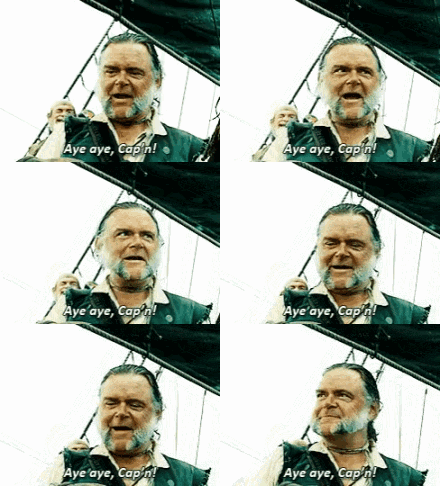
What does 'aye' mean?
 near horizon
marble whale
What does 'aye' mean?
near horizon
marble whale
What does 'aye' mean?
^
It could be like an exclamation as well, “Aye! What are you doing?” “Ayeee, it’s been a while, how’s it going?”
 stuck thicket
want to talk with me??????
 pseudo nova
What is the difference between something and summat.
plucky carbon
summat is just what brits say. its pretty much the same but they way they say it is different.

pseudo nova

 solar river
hi
supple holly
@flat rune I'll have to see the whole sentence to know where the comma should be
flat rune
ok
"Her clear and expressive singing style soon gained her wide spread popularity in the Spanish- speaking regions of North and South America"
the bolded is what i need to change
flat rune
ok
supple holly
also, widespread should be one word

 flat rune
do plants appear immutable after 24 hours
immutable meaning "unchangeable" in this sentence
marble whale
what is a 'tax bracket'?
flat rune
plucky carbon
summat is just what brits say. its pretty much the same but they way they say it...
Yeah more Northern English though
near fable
marble whale
what is a 'tax bracket'?
A range of similiar incomes in which a fixed tax rate must be paid
quasi nebula
Hello subs 🙂
 torn patio
Which is more correct if I´m in a video game or sports context?
Game style,
Playstyle,
Play-style,
Style game
Style of play
 floral reef
hi guys is amogus a real word?
supple holly
torn patio
Which is more correct if I´m in a video game or sports context?
> Game style,
...
Playstyle is the most commonly used word (and I think the only one used) in the list
supple holly
floral reef
hi guys is amogus a real word?
Yes it is
 cinder wigeon
Which is right?
Okie Dokie or
Okey Dokey ?
minor galleon
cinder wigeon
Which is right?
*Okie Dokie* or
*Okey Dokey* ?
they are both right
cinder wigeon
minor galleon
they are both right
👍
torn patio
supple holly
Playstyle is the most commonly used word (and I think the only one used) in the ...
ty
quasi nebula
How you doing?
copper notch
What's more formal: "Here you are" or "Here you go".
 cinder path
What's the difference between 'since' and 'for'?
Is this correct? "I've been following you on twitter since yesterday"
If so, why?
Thank you so much in advanced!
Isn't 'for' indicated that it happened in the past and is occurring in the present? Why doesn't it get considered here?
Absolutely
Thank you so much! I guess my previous knowledge was incorrect. Correct me if I'm wrong, but 'For' is used when an event or action has already occurred?
That helped a lot, thank you so much 🤍 🤍
near horizon
“Studying at night can hinder us from being able to sleep”
Am I using “hinder” correctly?
Or is “Studying at night can hinder our sleep” more suitable?
near fable
near horizon
“Studying at night can **hinder** us from being able to sleep”
Am I using “hind...
Yes
Studying at night can hinder our sleep sound better
near horizon
near fable
Studying at night can hinder our sleep sound better
Ah okay, if you had to choose between “prevent”, “impede”, and “hinder”, which would you pick?
near fable
near horizon
Ah okay, if you had to choose between “prevent”, “impede”, and “hinder”, which w...
Hinder
near horizon
Ah okay, thankss
near fable
Wouldn't choose prevent and impede at all
regal flame
@flat rune is this right
"i've learn a lot of mistakes so ihave decided X"
and what's the difference between "alot" and "a lot"
flat rune
regal flame
<@456226577798135808> is this right
"i've learn a lot of mistakes so ihave deci...
"I've learned a lot of mistakes" isn't correct.
"Alot" is an incorrect spelling of "a lot".
It sounds similar to "allot", which means to bestow properly.
hollow night
Can someone look at the following sentence and let me know if it's grammatically/syntactically correct?
Sentence: Phew! Alright, this should be the last of the goblins!
Context: Spoken by an adventurer after a fight with a group of goblins. At the end of the fight, he looked around and saw that there were no more goblins in the vicinity, so he said their group had probably killed every goblin in the area.
regal flame
flat rune
"I've learned a lot of mistakes" isn't correct.
ohh so how do u say it correctly
flat rune
regal flame
ohh so how do u say it correctly
"I've learned from plenty of mistakes, so I have decided X"
flat rune
hollow night
Can someone look at the following sentence and let me know if it's grammatically...
"That should be the last of the goblins!"
hollow night
flat rune
"That should be the last of the goblins!"
thanks for the feedback!
regal flame
flat rune
"I've learned from plenty of mistakes, so I have decided X"
oh thankyou!
@flat rune what is cliché?
when do u use it
flat rune
regal flame
<@456226577798135808> what is cliché?
It's a literary device. It refers to a motif in literature that's "common" to the point of possible annoyance.
regal flame
@flat rune what's the difference between
"if asian had blue eyes"
and
"if asian has blue eyes"
flat rune
regal flame
<@456226577798135808> what's the difference between
"if asian had blue eyes"
a...
"If an/the Asian had/has blue eyes"
Had and has are both fine. It only depends on tense.
regal flame
flat rune
"If an/the Asian had/has blue eyes"
Had and has are both fine. It only depends o...
what does it mean when it's had
 marble whale
regal flame
what does it mean when it's had
marble whale
regal flame
what does it mean when it's had
it's a hypothetical situation
 cedar narwhal

 spark jasper
i) is national
i) Most countries have signed an international agreement banning whaling.
g) It's much safer for a young child to ride a tricyle.
minor galleon
@cedar narwhal
regal flame
marble whale
it's a hypothetical situation
what's hypothetical
marble whale
regal flame
what's hypothetical
the situation "if one had... "
marble whale
regal flame
what's hypothetical
"if one has...'' isn't really used in English
marble whale
regal flame
what's hypothetical
"if the Asians had blue eyes" is correct
deft widget
When there are many options to choose, like the colour of the paper can be red, yellow, green or something, I can say "the colour doesn't has to be red. It can be something else. But, are there another way to say that in negative sentence? For example, it can be not red.(it may be grammatically wrong. I just want you to get what I mean.)
marble whale
deft widget
When there are many options to choose, like the colour of the paper can be red, ...
it might be not red
near horizon
Does “part of the time” mean sometimes?
“I feel as if I am joining another culture, at least part of the time”
deft widget
marble whale
it might be not red
Ok, I get it. By the way, is my sentence "it can be not red" grammatically correct?
Or natural?
 cyan forge
"Did you get country in front of her" What does it mean?
near fable
deft widget
Ok, I get it. By the way, is my sentence "it can be not red" grammatically corre...
It cannot be red
flat rune
marble whale
"pick-me-up" is slang for something that cheers someone up.
flat rune
regal flame
what's hypothetical
"Hypothesis" basically means "foundation" in the sense of "foundation to an argument or idea".
When speaking about hypotheticals, though, modern English speakers usually refer to imaginary arguments or thought experiments.
flat rune
flat rune
"Hypothesis" basically means "foundation" in the sense of "foundation to an argu...
I've not heard in that context before
flat rune
deft widget
Ok, I get it. By the way, is my sentence "it can be not red" grammatically corre...
"It can be not" is not correct.
"It cannot be" is correct.
flat rune
flat rune
When speaking about hypotheticals, though, modern English speakers usually refer...
That's the context I've heard it in most often
flat rune
flat rune
I've not heard in that context before
Literally, the term refers to a foundation to an argument. The idea presented based off of information and present evidence that will be used to search for a conclusion - that is what a hypothesis is.
Popular use whittled the term down to refer to thought experiments or things that cannot actually happen.
I always thought it meant what you said but it's not a solid idea and just thought that could possibly be built on to create that foundation. Sorry if you've already said something along those lines.
 mental arch
What does "Hut" means?
 formal wraith
Yooo
mental arch
In the music called Only by Nicki Minaj she said: hut-hut one, hut-hut two
formal wraith
What are you talking about
 formal wraith
I think it's not an unimmeable word
mental arch
Really?
 tepid crane
hello, i have a doubt
I need to know if it is true or not
- To those who i flirted
- To those whom i flirted
which one is correct, plz help me 🙁🥺🥺
 lime osprey
)
flat rune
tepid crane
hello, i have a doubt
I need to know if it is true or not
1. To those who i fli...
The second one
And add a ‘with’ after flirted
To those whom I flirted with
tepid crane
👍
 humble hemlock
tepid crane
hello, i have a doubt
I need to know if it is true or not
1. To those who i fli...
humble hemlock
tepid crane
hello, i have a doubt
I need to know if it is true or not
1. To those who i fli...
Second one
Whom is used with a person
humble hemlock
mental arch
I wanna know what hut means
I have some answers but they could be wrong
humble hemlock
deft widget
Ok, I get it. By the way, is my sentence "it can be not red" grammatically corre...
It cannot be red
The negative comes before the second verb in a sentence
regal flame
@flat rune is it dreamed or dreamt about you last night
crimson narwhal
regal flame
<@456226577798135808> is it dreamed or dreamt about you last night
The group of irregular verbs ending with t after the stem of the word is most likely to occur in both regular and irregular forms (e.g. dreamt/dreamed; burnt/burned)
hollow night
I am feeling unsure about a sentence I've written. So I would appreciate if one of you could take a look at the following sentence and let me know if it sounds weird or if you understand what I'm trying to say.
**Sentence: As punishment, please withhold the concert ticket you promised me as a reward.
**
Context: The boy was supposed to get a concert ticket as a reward for scoring an A in his Math paper. But later, he cheated to get the A. And he was found out. So he confessed to his dad and asked his dad to without the concert ticket that was supposed to be his reward.
flat rune
flat rune
I always thought it meant what you said but it's not a solid idea and just thoug...
It is solid enough to serve as a foundation for the sake of argument.
flat rune
mental arch
I've always hated this atrocious music. The slurs don't help.
At any rate, "hut-hut" is what is said in American football before tossing the ball back and beginning the game.
flat rune
regal flame
<@456226577798135808> is it dreamed or dreamt about you last night
There isn't a difference.
crimson narwhal
hollow night
I am feeling unsure about a sentence I've written. So I would appreciate if one ...
It's sounds okay.
hollow night
crimson narwhal
It's sounds okay.
thanks for your feedback!
humble hemlock
regal flame
<@456226577798135808> is it dreamed or dreamt about you last night
Depends on the dialect
If British English it’s the one ending in -t, however, if it’s American English it’s the one ending in -ed
flat rune
hii, is the following sentence 'the build-up at 4 minutes into the song is [xyz]' logically and syntactically correct? i've developed almost a pathological obsession with words and meaning, so I need to know
 past sand
Think of it as them trying to say 'it is unique and big' maybe 'never has been done before'
past sand
flat rune
hii, is the following sentence 'the build-up at 4 minutes into the song is [xyz]...
This makes sense to me as a native.
flat rune
past sand
This makes sense to me as a native.
ok thanks i was worried there was some obvious mistake in that sentence that i wasn't seeing
 kindred latch
Is it possible to say "I really enjoyed this level of accommodation", if I want to refer to the host being very helpful and service minded ? Or does "accommodation" mean the place, or standard of the place that I was staying in ?

 azure gull
Hey! I have a question!
"The shell was interesting and pretty and a worthy plaything; but the vivid phantoms of his day-dream still interposed between him and Piggy, who in this context was an irrelevence"
What does the part of the sentence in bolds mean?
near fable
near horizon
How is “filter” used here?
Select or remove particular information
If you use amazon.com or any website, you can see search by categories option, filter out some brand etc option
@near horizon

You can see the filter option up there

I can filter out prices range, discount etc
If i click on Rs. 2000 to Rs. 5000
It'll just me the products in this range
Read more, improve vocabulary
@kindred latch you can say that.
 blazing galleon
near horizon
How is “filter” used here?
blazing galleon
near horizon
How is “filter” used here?
I'd say "a medium that doesn't let everything through" only a portion
kindred latch
near fable
<@916655708601212948> you can say that.
ok, great, thank you!
near horizon
near fable
<@667026571122442242>
Ah thanks
near horizon
blazing galleon
I'd say "a medium that doesn't let everything through" only a portion
Got it
regal flame
humble hemlock
Depends on the dialect
tnx!!
@flat rune what is correct
should've not or shouldn't have done that
flat rune
regal flame
<@456226577798135808> what is correct
should've not or shouldn't have done th...
"Shouldn't have."
regal flame
flat rune
"Shouldn't have."
tnx
clear flint
the testee has to replace the underlinesd words with correct option
it shows test of reading or writing?
azure gull
"Now the shell was no longer a thing seen but not to be touched, Ralph too became excited."
What does this sentence mean?
regal flame
@flat rune is this correct if not can u say this on ur own words 
"i'm not letting you to get used to the fact that he'll always be there to help you"
flat rune
regal flame
<@456226577798135808> is this correct if not can u say this on ur own words <:SC...
"It isn't good to take advantage of his help."
regal flame
flat rune
"It isn't good to take advantage of his help."
thnx but how about the umm "used to" i don't want my friend always dependingon his gf
flat rune
regal flame
thnx but how about the umm "used to" i don't want my friend always dependingon h...
"used to" is replaced by "take advantage of", because there isn't an implication that this is a slow process, it is emphasising that such has already happened and any further use becomes detrimental.
regal flame
flat rune
"used to" is replaced by "take advantage of", because there isn't an implication...
oh got it tnx a lot!
 warped summit
What does "brick-and-mortar" mean?
 supple ridge
warped summit
What does "brick-and-mortar" mean?
supple ridge
warped summit
What does "brick-and-mortar" mean?
in the context of a store, this means that a store has a physical presence rather than being online
warped summit
Oh, thx
deft widget
I have a question. What is the meaning of "excuse you"?
modest juniper
How to ask the owner if we want to know the breed of an animal? For example, the breed of the dog.
- What kind of dog do you have?
- What sort of dog do you have?
- What is the breed of your dog?
- What breed is your dog?
Could you tell me which options are correct and which are wrong? Thanks.
midnight harbor
modest juniper
How to ask the owner if we want to know the breed of an animal? For example, the...
1 and 4 can be said, but 4 is preferred
midnight harbor
deft widget
I have a question. What is the meaning of "excuse you"?
Excuse me* unless you mean excuse yourself.
excuse me is a pardon or remark. someone says something weird to you, you can say "excuse me?"
someone says something you don't understand, you can say "excuse me? I didn't hear what you said"
you need to leave to do something, you can say "excuse me"
excuse yourself means that someone is giving you permission to leave just like the third example i gave
 broken ether
can someone please tell me what inversion in grammar is?
 short rain
Hey! Do someone know what is right:
At which day?
On which day?
At what day?
On what day?
 frank glen
broken ether
can someone please tell me what inversion in grammar is?
frank glen
broken ether
can someone please tell me what inversion in grammar is?
Sorry, what do you mean by inversion in grammar? If you mean about making questions in english, we do invert subject and the verb with the auxiliary verb before the subject
broken ether
frank glen
Sorry, what do you mean by inversion in grammar? If you mean about making questi...
it's used to add emphasis to the sentence
broken ether
short rain
Hey! Do someone know what is right:
At which day?
On which day?
At what day?
On...
on
short rain
On what or on which?
broken ether
both
short rain
And what sounds better? What would you prefer?
frank glen
broken ether
it's used to add emphasis to the sentence
yess, when it's not a question
broken ether
short rain
On what or on which?
if I'm talking about days that were said in the conversation I'd use which
short rain
broken ether
if I'm talking about days that were said in the conversation I'd use which
It's in a question like: „on which day do you want to meet?“
broken ether
frank glen
yess, when it's not a question
can you explain it to me?
frank glen
broken ether
can you explain it to me?
As far as I know inversion is used to sound more formal or surprising. I mostly saw people talking like that in "old movies"
short rain
short rain
It's in a question like: „on which day do you want to meet?“
Like this is right?
broken ether
short rain
Like this is right?
it sounds weird to me
i would say "when do you wanna meet"
@frank glen
short rain
broken ether
i would say "when do you wanna meet"
Ah I want to buy a domain and it have to end with „day“ 🥲
broken ether
can you answer him?
broken ether
frank glen
As far as I know inversion is used to sound more formal or surprising. I mostly ...
i get it
can you explain me how it works?
idk if u can
 plush plinth
guys what literary device is "Once more"
frank glen
short rain
It's in a question like: „on which day do you want to meet?“
since is a question you can't say on in the beginning, but instead you can say "which day on want to meet?"
frank glen
broken ether
can you explain me how it works?
to be honest I don't remember the rules to do, but wait let me google 
broken ether
broken ether
frank glen
since is a question you can't say *on* in the beginning, but instead you can say...
a grammar checker says "on" goes in the beginning
plush plinth
plush plinth
guys what literary device is "Once more"
🙏 help
broken ether
that's why I couldn't answer his question 
frank glen
gonna ping you in resources 
frank glen
plush plinth
guys what literary device is "Once more"
I can't recall. @flat rune could you please help him? 
plush plinth
the quote is from great expectations if you're wondering
plush plinth
flat rune
?
 flat rune
That isn't a literary device.
plush plinth
what is it
flat rune
He is asking for the name to be said once again.
Whenever someone says "once more", "come again", or "say again", it is a request for the speaker to repeat himself.
flat rune
That is up to you reading the work.
flat rune
short rain
It's in a question like: „on which day do you want to meet?“
"Which day do you want to meet on?"
plush plinth
flat rune
That is up to you reading the work.
"I wish I was a frog. Or a eel!" this is a literary device right
flat rune
broken ether
a grammar checker says "on" goes in the beginning
Prepositions isolate do not begin sentences.
Prepositional phrases, however, may.
 frank glen
Also Lounostripes can you explain when/how we can use inversion besides in questions? @flat rune
 left laurel
hi every one I have a question is it better to say and write I'd have or I would've?
flat rune
Hello everyone!
flat rune
Can you guys tell me what are the most common phrasal verbs used please?
left laurel
flat rune
Can you guys tell me what are the most common phrasal verbs used please?

Phrasal Verbs Defined & Most Common Phrasal Verbs | Grammarly Blog
Phrasal verbs are two or more words that together act as a completely new word, with a meaning separate from the original words.
marble whale
guys please check this sentence: 'we've been friends for like 3 years'
does it sound correct?
near fable
flat rune
Can you guys tell me what are the most common phrasal verbs used please?
Follow creativestar
near fable
marble whale
guys please check this sentence: 'we've been friends for like 3 years'
Yes
 blazing glacier
marble whale
guys please check this sentence: 'we've been friends for like 3 years'
blazing glacier
marble whale
guys please check this sentence: 'we've been friends for like 3 years'
yes
supple ridge
stalking is slow and secretive, chasing is fast and open
stalking often comes before chasing when an animal is hunting
oh nice. they should hire me lol
near fable
@flat rune https://youtu.be/i3OHZ0uV2ks

Mini Quiz
Phrasal Verb "Take"
Pre-intermediate Level
Learn English with a Teacher
 gusty cliff
You answered your question. Your brain relates these words to some words that you used to say.
Yes, because sometimes you are not used to saying or listening to them.
supple ridge
well, "distinct" has more definitions
yeah i think it's just that some words have more intricate definitions, even if it might not seem that way
gusty cliff
Like I said, for some reason, your brain relates them. And some words have more meanings, such as verbs, and phrasal verbs.
supple ridge
yeah I guess it's just a brain thing. it should get easier when you learn more words and you can start using english synonyms to learn them
I think a lot of times we remember what we were doing when we learn a word. Like I remember learning the spanish word "alquila" when I saw it on a sign and I got curious in its etymology. if you're just reading a passage from an article it might not be as memorable when you learn a word, and you might need a few more goes at it
more interesting-seeming words have the advantage I suppose
yeah but i bet you're going to learn the word "discombobulate" in one go for example
"to disconcert or confuse (someone)"
"this attitude totally discombobulate Bruce"
"I don't understand how the computer works, I'm totally discombobulated right now"
excellent, you got it
endure
synonym is 'persist'
yeah it was the first word i had in mind when you mentioned this actually
its possible that a spaced repetition thing might help. i haven't tried this method but i heard it helps when you have a situation like this, where some words you learn fast and some slow
oh yeah often (not always) "ex" and "in" are opposites. like inhale and exhale
yeah sometimes words stick and sometimes they don't. eventually if you come across it in enough contexts you finally catch on but it can be annoying until then
What I typically do is I just try to use context to understand the message as a whole; I don't pause and look for a translation unless I've seen the word a few times already and I haven't been able to figure it out yet. I don't fret because I know that the word will come up again eventually
The reason I do this is mostly just to keep my pace while reading/listening, so that I don't get bored of constantly translating and I can be more engaged in whatever content I'm trying to learn from
Because engagement is also important for comprehension/learning
If you don't understand the message then either just roll with it and keep listening/reading or if it's really bothering you then that's the point where you should look up the word
as in how will you know what the adjective means or how will you know that it is an adjective?
Often times when reading in your target language you're not going to understand all the words. You can use context to understand the overall message, though. Sometimes a word is critical to understand a message, in which case you might want to translate it
For example. If I say:
"I carefully, meticulously, and laboriously carved the statue"
even if you've never heard the word laboriously, and you don't know what it means, you can understand what this sentence means
It might be worth doing this part of the time, and also part of the time reading easier passages but without any translation
Because then you can rely much more on context
Yeah, adjectives are bit more ephemeral; it's easy to picture an elephant but it's hard to picture nervousness
lol. it's actually pretty tricky, don't worry
it means something that's only present for a short moment. for example, a feeling can be ephemeral
kind of like a mix of 'temporary' and 'fleeting'
it's there one moment, and the next it's gone
not to be confused with "ethereal," meaning angelic or beautiful
Yeah good luck, you already speak much better english than I speak spanish, I feel motivated now lol
linguist stephen krashen says that "language is the only thing worth knowing poorly". any amount of studying it is good
i don't know much about steve kaufman i can only study from one steve at a time lol
yeah it happens like that often
if it helps my quote is from a different steven
yeah no worries! best of luck on your studies
 bronze tundra
Hi guys, what is the difference between " are you irritated with you?" and "are you irritated by you?" thank you in advance .
 frigid lantern
bronze tundra
Hi guys, what is the difference between " are you irritated with you?" and "are...
frigid lantern
bronze tundra
Hi guys, what is the difference between " are you irritated with you?" and "are...
I haven't heard anyone saying "I'm irritated with you"
Is it common?
 flat kindle
frigid lantern
I haven't heard anyone saying "I'm irritated with you"
Is it common?
flat kindle
frigid lantern
I haven't heard anyone saying "I'm irritated with you"
Is it common?
Me too, never heard of that
bronze tundra
frigid lantern
I haven't heard anyone saying "I'm irritated with you"
Is it common?
Sorry ma, I have read it in Quora and the sentence was as question, sorry for my mistake "are you irritated with me?"
frigid lantern
No don't be sorry it's okay💖
regal flame
@flat rune can u say this with ur own words pleaseee
used to have a max limit friends on snapchat but then i forgot my password so i created a new one
flat rune
regal flame
<@456226577798135808> can u say this with ur own words pleaseee
used to have a...
I'm not sure why the two sentences are next to each other, but...
"I reached the maximum amount of friends I could have on snapchat. Unfortunately, I forgot my password, so I made a new one."
Some words stick, some don't.
 azure hull
hi all, i have finished preparing my resume and there are parts about 10 lines that i need to be get checked for errors, can anyone free dm me please ?
supple holly
azure hull
hi all, i have finished preparing my resume and there are parts about 10 lines t...
I can help you, but not right now cuz I'm at work
azure hull
@supple holly thanks!
supple holly
DM me later
flat rune

near fable
frigid lantern
HSKXKEMFLSVİWWLCŞĞGLLDFKMEPCKEGİEÖGŞEÖPFKSKVPDL
That's turkish laugh
marble whale
guys olease check my sentence: "Look what have I found"
or
"Look what I have found"
 hollow star
marble whale
"Look what I have found"
hollow star
marble whale
"Look what I have found"
"Look what I have found" -> the second option
frigid lantern
near fable
That's turkish laugh
Yes it is lol
crimson narwhal
marble whale
guys olease check my sentence: "Look what have I found"
It should be "Look what I have found" - the sentence uses a syntax called indirect (or abandoned) questions.
near fable
Yes
 storm hill
can you tell what is this?
 storm hill
thanks ❤️
 subtle parrot
hey
can anyone tell me the meaning of "The average outlier-compensated ranks from everyone are..."?
I don't understand the expression "outlier-compensated"
past sand
What kind of example?
A sentence would be "Hypothetically speaking, if we mix red paint and blue paint, we will make purple paint."
The example I gave earlier is good. Another example would be "He demonstrated that a person hypothetically could buy a bond and end up repaying the interest and principal through tax payments."
@flat rune
flat rune
What different between care and heal
near fable
flat rune
You need go to sleep OR You need to go to sleep
Second one
You need to go to sleep
near fable
flat rune
What different between care and heal
Heal means restore, get healthy again
For example, my broken leg is healing
Care just means watch out
Take care
Be cautious
flat rune
near fable
Care just means watch out
oh, not "care", but "cure"😅
near fable
flat rune
oh, not "care", but "cure"😅
Cure refers to physical illness
Eliminating illness from your body
While heal is not just physical
Heal your mind
Body
Soul
For example
flat rune
Thank you
near fable

flat rune
thank you!!
near horizon
“Basketball is largely a sport that is played in the United States”
What’s the adverb, “largely” modifying here?
Does it have the same meaning as “Basketball is a large sport”?
 merry jolt
near horizon
“Basketball is **largely** a sport that is played in the United States”
What’s t...
merry jolt
near horizon
“Basketball is **largely** a sport that is played in the United States”
What’s t...
in this case largely means mainly, mostly therefore that sentence is telling you that basketball is a sport played in the US but not so much in other countries. The verb largely is associated with in this case is "played" and no saying that basketball is a large sport doesn't have the same meaning
merry jolt
near horizon
Does it have the same meaning as “Basketball is a large sport”?
this sentence doesn't make that much sense to me in english but if i have to give a meaning it would be that basketball is a well-known sport and it is being played by many people
tepid crane
- when induction program will start?
- when will induction program start?
which one is correct, grammatically
flat rune
When will the induction program start?
merry jolt
tepid crane
but what is the difference
I suggest reading this article to understand why the second answer is the correct one
 crisp crow
What is the different from respond,reply and answear and what sentences can I use there words?
merry jolt
crisp crow
What is the different from respond,reply and answear and what sentences can I us...
I would say respond is a bit more formal than the other 2, but all of them have the same meaning.
There are some cases in which you usually use answer instead of maybe reply, for example you answer the phone but other than that I don't think there's any difference
flat rune
crisp crow
What is the different from respond,reply and answear and what sentences can I us...
Replies generally are written and specific. However, they also are similar enough to "reponse" that few care for the difference.
"Respond" means that one speaks in return. There's no medium required, it is purely reactive. "Answer" means that one is responding with the intent to clarify or solve something.
merry jolt
flat rune
Replies generally are written and specific. However, they also are similar enoug...
that is interesting, I always subconsciously use them in a certain way but without understanding why
flat rune
near horizon
Does it have the same meaning as “Basketball is a large sport”?
Large is for size - for a person, item, or object.
You may want to say "popular" or "big" instead, because it sounds like you are saying "basketball is a six metre long sport."
flat rune
merry jolt
that is interesting, I always subconsciously use them in a certain way but witho...
An easy way to see why things are done is to pause and question their context.
At least, whenever I have used/read "respond", it really only required a reaction. It can be biological (i.e. "the immune system's response to the virus"), physical ("he nodded in response"), or some-such, but we would never say "he nodded in answer."
merry jolt
yeah exactly
 low scarab
A person asks me "Is it bad for kids?"
Can i answer "rather for matures"?
cinder path
What's the difference between:
"He always goes to his mother’s house at New years."
"He always goes to his mother’s house for New Year."
cinder path
Also, what's the difference between:
"From...to"
And
"From...until"
In terms of time?
 violet glade
cinder path
Also, what's the difference between:
"From...to"
And
"From...until"
In ter...
violet glade
cinder path
Also, what's the difference between:
"From...to"
And
"From...until"
In ter...
From to means since
...but
From until means until
cinder path
I'm sorry I don't get it. How come it becomes since?
"I will do this from January to June."
"I will do this from August until May."
violet glade
cinder path
I'm sorry I don't get it. How come it becomes since?
"I will do this from Janu...
Since (from to) is the first sentence but it is a bit false. you need to use simple past tense
I did this from January to June
cinder path
But there's no 'since' in the sentence? I'm fairly confused in this English language haha. So you cannot use from...to in future tense?
So this is incorrect? "I will collect data from January to June."
What if I want to express it in the future?
Sorry if I have a lot of questions
violet glade
cinder path
So this is incorrect? "I will collect data from January to June."
What if I...
My teacher told me like this. If you are going to use from to (which means since meaning) you have to use past tense
so yes it is incorrect
cinder path
violet glade
My teacher told me like this. If you are going to use *from to* (which means **s...
From...to can only use past tense exclusively?
violet glade
cinder path
From...to can only use past tense exclusively?
Yes
cinder path
cinder path
So this is incorrect? "I will collect data from January to June."
What if I...
I'm so confused because I've seen a lot of literature include future tenses when using from...to
supple ridge
cinder path
So this is incorrect? "I will collect data from January to June."
What if I...
this example is definitely correct for the record. not sure why someone would have told you it isn't
violet glade
cinder path
I'm so confused because I've seen a lot of literature include future tenses when...
And i actually didn't see anybody who is using "from to"
cinder path
supple ridge
this example is definitely correct for the record. not sure why someone would ha...
Now I'm actually really confused, thank you so much for the second opinion. Also, thank you @violet glade for answering.
violet glade
No problem! I am so happy if it helped you :)
 chilly wren
is barefooted a word? something like, “she was walking barefooted.” ??
flat rune
low scarab
A person asks me *"Is it bad for kids?"*
Can i answer *"rather for matures"*?
No.
"It is for adults."
flat rune
cinder path
What's the difference between:
"He always goes to his mother’s house at New yea...
"for New Year" is incorrect.
It should be "for New Year's (celebration)".
flat rune
cinder path
I'm sorry I don't get it. How come it becomes since?
"I will do this from Janu...
"To" is for specific times, if any times at all.
"Until" is for time.
flat rune
cinder path
From...to can only use past tense exclusively?
No one really cares unless specific times are not mentioned.
"I will work from 9 to 5."
"I worked from 9 to 5."
Those are the only times it really is correct to say "to" in reference to time.
"I will be here only until nightfall."
"From 9 till 5."
"Ask X for time off until noon."
Etc.
flat rune
chilly wren
is barefooted a word? something like, “she was walking barefooted.” ??
She was barefooted is fine, yes.
marble whale
can anyone please explain the term 'on-demand' (like on-demand videos) in plain English?
minor galleon
marble whale
can anyone please explain the term 'on-demand' (like on-demand videos) in plain ...
as soon as, or when required