1 messages · Page 4 of 1
 little prism
idk which version I like more
this was the result
damn discord ruins that quality so much
 upper pasture
im good thanks
little prism
 dusty gull
I'm gonna be the last one standing
dusty gull
I'm gonna be the last one standing
Thank you
upper pasture
I dunno what to shoot, I don't know if I want to continue collecting M45 data, Widefield Orion, M31. Or start a new target
little prism
I still want to get an untracked shot of andromeda since my first one was out of focus. Idc if I have the tracker. It was my dream to have a good picture of andromeda (untracked)
upper pasture
I have 10 minutes of m31 data atm, I wanna collect more but i just cba imaging lmao
little prism
Out of focus .exe
 little prism
only 15min. I just wanted to shoot smth since clouds where about to roll in
little prism
@dusty gull Is it smart to restack my orion since I used a bad sample frame and it was not centered correctly
 hybrid basin
dusty gull
Everyone here is leaving lol
hybrid basin
dusty gull
Everyone here is leaving lol
I'm leaving too. Probably in 5-10 days.
I re-edited my last image. What do you think? Is it better than the version before?

 calm hearth
dusty gull
Everyone here is leaving lol
calm hearth
dusty gull
Everyone here is leaving lol
gonna be a while before I can track with my 8" dob that weighs like 11kgs 
dusty gull
little prism
<@714422875767177307> Is it smart to restack my orion since I used a bad sample ...
If you have no issue with star alignement then bad sample frame is probably not a problem
Unless it's is VERY bad
And if it's not centered as you want you can
As you want
 midnight flower
hybrid basin
I re-edited my last image. What do you think? Is it better than the version befo...
midnight flower
hybrid basin
I re-edited my last image. What do you think? Is it better than the version befo...
yes
its way more noisy
but the nebulosity is there
hybrid basin
midnight flower
yes
Ok thanks. I re-edited the stars now and now they look more natural.
 tidal tide
dusty gull
I'm gonna be the last one standing
tidal tide
dusty gull
I'm gonna be the last one standing
ya sure about that?
dusty gull
tidal tide
ya sure about that? <:AwkwardSmile:892230500427628574>
I won't be tracked for at least 6 months
So probably not the last one
 gentle cipher
dusty gull
I'm gonna be the last one standing
gentle cipher
dusty gull
I'm gonna be the last one standing
Sorry I'm leaving
I have to fight my way out
It's been an honor serving with you soldier
Don't worry I'm sure more untracked members will join
It's just this generation is going tracked
tidal tide
🫡
upper pasture
I probably won't be leaving for a while.
dusty gull
gentle cipher
Sorry I'm leaving
Nooo
gentle cipher
Onstep build is soon
dusty gull
Good for you
gentle cipher
Good luck to all the untracked folks
upper pasture
Goodluck to you
 paper valley
Good luck
calm hearth
this is with a 5" dob and 224mc?
dusty gull
calm hearth
this is with a 5" dob and 224mc?
Yes
little prism
gentle cipher
Good luck to all the untracked folks
It was an honour to have you to have you in this wonderful community
I hate the fact that some people are alr imaging the comet and I might not even see it once because the weather over here in Germany is awful
 gleaming walrus
Wow
 static cape
My first try at M42, shot with a Nikon D5300. About 200 pictures stacked. What do you guys think?:)

 hallow tapir
fonna try a galaxy untracked
dusty gull
hallow tapir
fonna try a galaxy untracked
Which one?
dusty gull
Oh yes very bright
 crimson fractal
M83
dusty gull
crimson fractal
M83
Looks fun to capture
I'll probably try it
But it's really low at my latitude and only visible in summer...
calm hearth


only managed to get 83 of these before clouds ruined the night
not sure if they are even useable
and every software that I've tried is completely unable to stack it
 tidal tide
what object?
 short galleon
Can u pls explain post processing comets in Siril?
calm hearth
tidal tide
what object?
M81
tidal tide
tried DSS yet?
calm hearth
yeah
it creates star trails for some reason
I have no idea why nothing works
the stars are clearly visible in every shot
even if they are all pretty awful
tidal tide
what stacking settings do you have?
calm hearth
 calm hearth
one sec
oh yeah dss always gives me an error

it still works but I don't know if it's making it worse
tidal tide
never seen that error, but if it still stacks i'd let it be
upper pasture
First time shooting a galaxy, 10 minutes of data.
 tidal tide
did you crop some of them or?
calm hearth
nope
trying it again now
I think before it was detecting noise as stars
no

doesn't work
they are all almost the same
tidal tide
you could try checking the reduce noise by using a median filter option
calm hearth
tried it, only wanted to stack one frame
calm hearth
ASTAP?
tidal tide
yeah, another program that can stack images
tidal tide
stars arent too round, could be the reason
tidal tide
do you have a screenshot of the full image?
short galleon
Hmm possible
calm hearth
 dusty gull
short galleon
Can u pls explain post processing comets in Siril?
dusty gull
short galleon
Can u pls explain post processing comets in Siril?
Post processing or stacking?
tidal tide
calm hearth
hmm, should still be able to stack
dusty gull
short galleon
I do stacking in DSS and I'm comfortable with it
So I do background extraction in siril (selecting all the areas except where there is the comet tail) and then it's some simple histogram stretch and noise reduction
short galleon
What about colour calibration
dusty gull
short galleon
What about colour calibration
Siril's be autocalibrate
tidal tide
calm hearth
mm, i've had that error but don't remember the fix
tidal tide
could you upload all the files? i could try stacking them
dusty gull
@calm hearth i suggest you try siril, it always worked way better for me
short galleon
calm hearth
U could try to convert all those images from fit to fits
There are some softwares for that i believe
calm hearth
yeah I think siril does that
dusty gull
calm hearth
doesn't align the images properly
What happens exactly?
calm hearth
dusty gull
What happens exactly?
this

this is the closest I've gotten to a stacked image
dusty gull
calm hearth
maybe I should use different capture software
Which one do you use?
For me Sharcap is really good and I capture in ser
calm hearth
ASIStudio
maybe I should change
it also doesn't let you preview the image
so it's quite a pain to use
short galleon
calm hearth
ASIStudio
Have u tried DSS? So far it has worked pretty well for me
calm hearth
isn't that for stacking?
short galleon
yes
calm hearth
yeah I tried it but it doesn't detect stars in more than one image
despite them all being almost identical
dusty gull
calm hearth
this
What I do to align (tell me if you do that too) :
I choose the reference frame to be one sub where the galaxy is roughly at the center
I set the star pair number down to 4
I open the psf setting and adjust threshold and roundness setting to select all the stars visible in autostretch view
calm hearth
I'll give it a try
dusty gull
calm hearth
it also doesn't let you preview the image

Yeah you should change lol
short galleon
lol true
short galleon
yea
calm hearth
dusty gull
What I do to align (tell me if you do that too) :
I choose the reference frame t...
I also tried yours

only one single image registered
dusty gull
calm hearth
https://file.io/lF65BJncaCBT
Thanks! I'll try later
calm hearth
yeah
even with a focal reducer I can't get a decent size
might as well just attach a camera lens to it and put it on a basic tracking mount
or a small refractor
midnight flower
that shit looks like acid trip
midnight flower
omg im gonna get nerd 😮 real
or the other guy
either way I should also get it 😮
hallow tapir
hm
calm hearth
Yeah I have no idea how siril can mess that up
crimson fractal
Astrosurface also stacks little amounts of stars rlly well
gentle cipher
If you tweak the settings you can make it work. I had the same issue
Stacking settings
Make sure to use sigma clipping
gleaming walrus
calm hearth
what is this?
This looks so weird
Hope u find an method soon
How many subs? @calm hearth
 muted jay
WIP 2k 1second subs with my old dslr
 dusty gull
muted jay
WIP 2k 1second subs with my old dslr
dusty gull
muted jay
WIP 2k 1second subs with my old dslr
Wow... As always
tidal tide
muted jay
WIP 2k 1second subs with my old dslr
Where colour 
calm hearth
gleaming walrus
How many subs? <@444540356030365696>
Didn't manage to get many, only around 100
But should still be enough for the core
muted jay
tidal tide
Where colour <:thonk:851486148001529877>
I just did a quick stretch... was too lazy to remove the color gradients. I'll do that when I have some more free time
tidal tide
muted jay
I just did a quick stretch... was too lazy to remove the color gradients. I'll d...
fair enough 
muted jay
(also the color mottle is quite annoying)
tidal tide
DSS is slowly gonna drive me to insanity

im just not gonna bother with the stars and have it just make it so the comet is sharp
 void condor
In general, I suck at using dss
tidal tide
 strange seal
dss comet stacking sucks if you set it to combine
strange seal
dss comet stacking sucks if you set it to combine
is it good enough if it's just on the comet mode?
strange seal
use stars only and comet only modes separately
dusty gull
I'm more and more considering to buy a commercial eq platform
It would support my 8inch when I'll upgrade and I'll don't have to worry about the precision
upper pasture
I might get some NAN data tonight
dusty gull
calm hearth
https://file.io/lF65BJncaCBT
I'm sorry I'm on a school trip... I'll try when I'll be back (in a few days)
gleaming walrus
calm hearth
Didn't manage to get many, only around 100
Maybe try stretching and stack after stretching
hallow tapir
funny untracked carina
 gleaming walrus
hallow tapir
funny untracked carina
gleaming walrus
hallow tapir
funny untracked carina
it's good
What was the total exposure time?
hallow tapir
gleaming walrus
it's good
What was the total exposure time?
5 minutes
gleaming walrus
Maybe a bit of processing will help
hallow tapir
Full image
 gleaming walrus
hallow tapir
carina is a bright target
gleaming walrus
hallow tapir
carina is a bright target
Yes I have taken from southern part of india
It will be near horizon
 Instagram
Not good though
gleaming walrus
hallow tapir
is this also a mosaic?
No I captured with 50mm
gleaming walrus
hallow tapir
can i see the full uncompresssed tho?
Will try to find, I hope it will be somewhere in my hard disk
hallow tapir
i wanna add more data tonight and add another bit to it to make a mosaic with coalsack in it
gleaming walrus
hallow tapir
i wanna add more data tonight and add another bit to it to make a mosaic with co...
awesome, I will also try soon,
Hopefully from a good dark skies
I captured LMC too but very noisy,
I captured it directly through the light pollution 🤣
it gets upto 7 degrees high at my location
 hallow tapir
i see tarantula
hallow tapir
this is prob my best smc pic untracked
 hallow tapir
gleaming walrus
Single sub
hallow tapir
gleaming walrus
Single sub
how long exposure?
in my single subs i see tarantula and the core very clearly
gleaming walrus
hallow tapir
how long exposure?
I think 8 secs
Will chk though
gleaming walrus
hallow tapir
in my single subs i see tarantula and the core very clearly
I am from Northern hemispere 
hallow tapir
wait you can imaging lmc in northern?
gleaming walrus
But south of northern hem
gleaming walrus
hallow tapir
wait you can imaging lmc in northern?
Yes, I am at 12-13 degrees North
hallow tapir
nice
gleaming walrus
Hopefully will soon try from a good dark skies, will get even south near the end of India
Test image of some region near Carina
Captured very less data
 dusty gull
I'm going to order and adaptater to connect my f1.8 lens to my asi 224mc 
5 times brighter because of f ratio and 7 times longer subs... I can't wait!
little prism
Niceee
dusty gull
@strange seal congrats!
hybrid basin
The German weather is currently really bad for AP, but I got 10min data of the Comet yesterday/today. I even saw it with binos in B5.

Probably my last untracked image.
strange seal
dusty gull
<@384553833268903948> congrats!
Thanks
tidal tide
strange seal
Thanks
lmc meganerd
wish i got more data on this about 20mins at F4.5 and ~190mm FL
 little prism
tidal tide
wish i got more data on this <:Sadge:853356003373350923> about 20mins at F4.5 an...
little prism
tidal tide
wish i got more data on this <:Sadge:853356003373350923> about 20mins at F4.5 an...
You should consider yourself lucky... The weather in eastern Germany is awful
I took one pic with clouds because I just wanted one pic. And its not gonna get better
little prism
tidal tide
wish i got more data on this <:Sadge:853356003373350923> about 20mins at F4.5 an...
but nice image:D
dusty gull
Finally processed M82!
 gleaming walrus
Wow! You guys are killing it with untracked, I have done only widefield untracked astrophotography so far
gleaming walrus
tidal tide
wish i got more data on this <:Sadge:853356003373350923> about 20mins at F4.5 an...
Can u send the uncropped version?
So that I can see how much the comet covers in the frame
And from what bortle scale are u capturing?
strange seal
49 mins with dob
 dusty gull
gleaming walrus
Wow! You guys are killing it with untracked, I have done only widefield untracke...
dusty gull
gleaming walrus
Wow! You guys are killing it with untracked, I have done only widefield untracke...
And your widefield untracked is awesome!
dusty gull
strange seal
49 mins with dob
Nice! What sub lenght?
dusty gull
I think so
dusty gull
strange seal
the great globular noise cluster?
Wdym?
dusty gull
Oh wait
dusty gull
Could you share the stacked file?
dusty gull
There's isn't that much data on this globular clusters so it's hard to tell
strange seal
with my computer
dusty gull
gleaming walrus
How did u stack so many frames
Substacks
gleaming walrus
dusty gull
Substacks
Oh ok
Stacking 1000 per stacks then stacking those stacked files?
dusty gull
strange seal
im getting more data tonight too
Maybe you should try longer exposures to denoise?
strange seal
gleaming walrus
Oh ok
Stacking 1000 per stacks then stacking those stacked files?
i did 5k frame substacks
strange seal
dusty gull
Maybe you should try longer exposures to denoise?
but then i get trailing
gleaming walrus
strange seal
with my computer
dusty gull
strange seal
but then i get trailing
U get trailing at more than 80ms???
strange seal
with my pixel scale and this targets dec yeah
i can bin 2. i can get 4x as much data with my drive size, better (double?) the SNR and 160ms subs.
just not sure if ill be lacking on the small stuff then
dusty gull
strange seal
with my pixel scale and this targets dec yeah
NPF says 120ms
dusty gull
strange seal
i used ryans calcluator
Where can I find it?
dusty gull
Ty!
strange seal
ehhh idk about bin 2
 crimson fractal
I have been taken over very easily with dob imaging :v
dusty gull
strange seal
pinned in <#794653768909979708>
how many pixels of trailing should I choose?
strange seal
2 ish
dusty gull
Do you take darks?
strange seal
ya
crimson fractal
@strange seal I assume u used astrosurface to stack ?
strange seal
yea
crimson fractal
So u stacked in 5k sub stacks then stacked those stacks together ?
crimson fractal
Alr may try a couple new targets with the moon atm
strange seal
im barlowing up for eta carina hopefully
dusty gull
strange seal
im barlowing up for eta carina hopefully
good luck
I tried to barlow Orion and it was a pain, and i tied ngc 2392 but gave up really quickly
Main issues are reframing and alignement
strange seal
i did orion but couldnt get any stars to stack. Likely had to dial in settings more
dusty gull
Oh you got some clusters!
Definitively
I'm gonna do a map for you
But you have at least a dozen @strange seal
strange seal
i saw some bright blobs with no diffraction spikes in the hubble pic
dusty gull
I only selected the "most obvious" ones and they perfectly match the reference pic so it's probably not noise
 strange seal
how do you know they are clusters?
dusty gull
strange seal
how do you know they are clusters?
strange seal
the pixels are like 2x as big
dusty gull
Idk about the fl though
strange seal
10" vs 8" newt
strange seal
dusty gull
I only selected the "most obvious" ones and they **perfectly** match the referen...
im guessing you overlayed some of the other data?
dusty gull
Wdym by overlayed?
strange seal
it looks sharper than my data
dusty gull
It's only your data but I BlurXed it
strange seal
holy blurx is too op
paper valley
That looks awesome
dusty gull
strange seal
holy blurx is too op
Yep but you can achieve similar results with other methods
To me the only big improvement over other "classic" methods is that it only sharpens the objects and do not add star artefacts or noise on the bckg
dusty gull
Yep untracked is hard
But sombrero is a kinda hard target for everyone
I mean it's details are hard to get right
strange seal
tbf this is only one night of good data and one night of data with bad walking noise, i can shoot it for a long time when its properly in season
i love siril .png
 dusty gull
And here's my process!
 tidal tide
gleaming walrus
Can u send the uncropped version?
So that I can see how much the comet covers in...
tidal tide
gleaming walrus
Can u send the uncropped version?
So that I can see how much the comet covers in...
from B4
 dusty gull
@strange seal 25! and yet some got deleted by denoise
 strange seal
very cool
dusty gull
Wow Exaxe got a lot of them too
 gleaming walrus
Ok, I don't need to crop much then 😅
strange seal
I don’t have any subs but I have the live view
calm hearth
oh nice
that's actually not too different to what I get
unfortunately my stacks are all terrible
 jolly robin
dusty gull
Wow Exaxe got a lot of them too
jolly robin
dusty gull
Wow Exaxe got a lot of them too
which galaxy is this?
 burnt bay
Sombrero
strange seal
@dusty gull went through on the autostretch and masked through all the ones i could see to keep them from the denoise.

31 resolved
static cape
M42. First try on my 80/400 with a Nikon D5300. 1000 1/3 of a second pics on iso 2500. You guys have any idea what causes the v-shape on the blue stars? Really happy with it tough!

 gentle birch
orion nebula 15 minutes untracked in bortle 8

 tidal wave
My first attempt at 55mm with the kit lens

Learned some things going out with the 55-250mm lens tonight
gentle birch
static cape
M42. First try on my 80/400 with a Nikon D5300. 1000 1/3 of a second pics on iso...
the V shape is probably from going wide open on your lens. lenses generally don't perform well wide open so you might want to look into stopping down once or twice
burnt bay
tidal wave
My first attempt at 55mm with the kit lens
How much data?
I wanna try with my 55mm
tidal wave
Just below 30 minutes
tidal wave
Just got a half hour at 135mm, went as long as my battery would let me
gentle birch
an hour integration
 paper valley
What was it shot with? Aperture and mm, thanks!
 glossy knoll
I have two trash telescopes it’s not really good on deep sky objects so i used my mom cameras i now use a Canon EOS 700D with Canon EF lens 50mm 1:1.8 STM ,what do i buy to upgrade with about 270$ and do i buy dwarf 2 ? ,bey the way I’m in light pollution i’m 14 so i can’t go out the city and i can’t buy too expensive things , and this is the first picture i got and stacked is about 60 photos the exposure time of every photo is 1 second and the ISO is 64000 i think
 upper pasture
glossy knoll
I have two trash telescopes it’s not really good on deep sky objects so i used m...
upper pasture
glossy knoll
I have two trash telescopes it’s not really good on deep sky objects so i used m...
At 50mm you should be able to do a longer exposure time than 1s, Find out what exposure time you can do untracked at 50mm, with the money, I would buy a new lens maybe.
glossy knoll
upper pasture
At 50mm you should be able to do a longer exposure time than 1s, Find out what e...
But i don’t know why when i make the exposure longer it turned whit is that because light pollution ?
hybrid basin
glossy knoll
But i don’t know why when i make the exposure longer it turned whit is that beca...
For most cameras is ISO 3200 (and some 1600) the best. Then should the frames be much darker. You should be able to take maybe 2s exposures (with round stars, but that depends on different factors). Have you edited the picture? I'd recommend Siril and Gimp for it (they're free).
hybrid basin
glossy knoll
I have two trash telescopes it’s not really good on deep sky objects so i used m...
You could get really good results with that lens and camera. Probably the most important upgrade for you isn't a new cam or lens but a tracker, because with it you relieve your shutter (and laptop when stacking...). Before you buy expensive stuff, you probably should learn it with your current first (you don't even need to buy a tracker), but I'm new in this hobby and 14 years old too.
static cape
glossy knoll
I have two trash telescopes it’s not really good on deep sky objects so i used m...
In what bortle class are you living? What @hybrid basin says, try lowering your iso to 1600 or 3200 and try a little longer exposures. What trash scopes do you have? Also already tried M42? I think it's a good idea to start with a nice and bright target.
glossy knoll
static cape
In what bortle class are you living? What <@739144555307204672> says, try lower...
I live in portal 9
The photo i captured is for andromeda
hybrid basin
glossy knoll
I live in portal 9
The light pollution shouldn't be such a big problem, as long, as there's no lantern directly before your lens. Yes, it's more difficult with much light pollution, but not impossible.
hybrid basin
glossy knoll
The photo i captured is for andromeda
Yes, but @static cape could be right, because you can learn really good with M42.
static cape
static cape
M42. First try on my 80/400 with a Nikon D5300. 1000 1/3 of a second pics on iso...
@glossy knoll this was the 3d time I've tried dso. first 2 times was with a 200 mm lens at f5.6 on 2 second exposures. I shot this with a sky watcher 80/400 which is also considered a trash scope I guess(?) but it really made a difference compared to the camera lens. I'm also a beginner but I think you just have to try different things and find out what works for you:)
glossy knoll
static cape
<@878929207537831936> this was the 3d time I've tried dso. first 2 times was wit...
No my telescope is a real trash scope even the focuser diameter is 1 inch not even 1.25 inch i can’t buy a adapter for it and bought a celestron omni 4 mm lens and a omni barlow and it doesn’t fit ,so i can’t use it
glossy knoll
upper pasture
What ISO do you use?
6400
glossy knoll
hybrid basin
For most cameras is ISO 3200 (and some 1600) the best. Then should the frames be...
I used siril the photo up i stacked with siril
glossy knoll
upper pasture
or maybe 3200
What is the best high IOS and short Exposure or low ISO and long Exposure?
upper pasture
Different ISO setting shouldn't change your maximum exposure time
Just find out how long of an exposure you can do at 50mm, and then just take some test shots at 1600 and 3200 ISO
what camera do you have?
glossy knoll
upper pasture
what camera do you have?
Canon EOS 700D
upper pasture
So, this is just a rough estimate, but at 50mm you should be able to do a 5 second exposure.
you could probably go to 6s with some very slight trailing
glossy knoll
I have searched in https://www.photonstophotos.net/ and found out that the best ISO of the camera is 6400
upper pasture
I would recommend testing different exposure times around 5s to really narrow down what you prefer
upper pasture
glossy knoll
I have searched in https://www.photonstophotos.net/ and found out that the best ...
6400 iso will be best for picking up signal, But the high ISO will introduce a lot of noise. and if the image to too bright you should lower the iso
glossy knoll
upper pasture
I would recommend testing different exposure times around 5s to really narrow do...
Is this problem of exposure time from the ISO or the light pollution ?
upper pasture
Exposure time is how long the shutter is open while collecting light for your image. You want to use the highest exposure time you can while doing astrophotography. If your image is too bright you must turn down your ISO.
Some people shoot at ISO 800
I shoot at 1600-3200. I stopped shooting at 6400 because of how noisy my images were
glossy knoll
upper pasture
Exposure time is how long the shutter is open while collecting light for your im...
Ok thank you very much but i will return to astrophotography in Wednesday do i add more data to my andromeda photo ,? or catch photos of M45 ?
upper pasture
I would shoot Widefield M45, Maybe try get california nebula in there. You would need quite a lot of time, but you have a pretty fast lens with the f1.8 50mm lens.
glossy knoll
upper pasture
I would shoot Widefield M45, Maybe try get california nebula in there. You would...
I want the brightest
upper pasture
Not sure, Search what their apparent magnitudes are
I would bet M45 is brighter, as its easier to see with the naked eye
strange seal
upper pasture
6400 iso will be best for picking up signal, But the high ISO will introduce a l...
Higher ISOs are less noisy and better for untracked
dusty gull
Higher ISOs reveal the noise (thats why it looks noisier) but actually decrease it
gentle birch
strange seal
Higher ISOs are less noisy and better for untracked
what about ISO invariant cameras?
should I still use a higher ISO and sacrifice the DR to get more faint data off the noise floor?
dusty gull
gentle birch
should I still use a higher ISO and sacrifice the DR to get more faint data off ...
Don't worry about the DR untracked, the signal that you get is too low so smaller DR won't change anything
gentle birch
I shoot at 3200 ISO on a nikon d750. is that good enough?
dusty gull
I don't really know about dslrs but that seems good to me
strange seal
gentle birch
I shoot at 3200 ISO on a nikon d750. is that good enough?
I used 12800 when I did untracked with that camera
gentle birch
strange seal
I used 12800 when I did untracked with that camera
curious but what's your main rig?
strange seal
Swsa+Roki 135+ D750/700D
gentle birch
no way
bro from the images you are putting out i honestly wouldn't be surprised if you had like a full blown mount with telescopes and mono cameras
 sterile violet
This is a take of mine from last night

I'm having this problem where the center of the image appears brighter than the corners, still tryina solve that.
tidal wave
Half and hour at 135mm with a 55-250mm lens and a canon T2i
 gentle birch
sterile violet
I'm having this problem where the center of the image appears brighter than the ...
gentle birch
sterile violet
I'm having this problem where the center of the image appears brighter than the ...
take flats
 neat scroll
question, how can i know how many pixels i've trailed?
 grave rapids
neat scroll
question, how can i know how many pixels i've trailed?
grave rapids
neat scroll
question, how can i know how many pixels i've trailed?
Count them
neat scroll
grave rapids
Count them
so here i've trailed arround 3?

because i took that with 1s exposure but according to this spreadsheet (https://docs.google.com/spreadsheets/d/1tSEbji6V4rYz81COybiD5LWaekULIQReJy7kZCxQy78/edit#gid=0) i sould only be able to do that with 0.04s


Calculation
Description
0.7,Pixel size in microns (μm)
650,Focal length in millimeters (mm)
-5,Declination of Target (degrees)
3,How many pixels of trailing -->,(3.2 for DSS max, up to 10 for Sequator)
Output
0.04,Maximum exposure time (seconds)
strange seal
neat scroll
because i took that with 1s exposure but according to this spreadsheet (https://...
What camera has 0.7um pixels?
 dry spade
neat scroll
my phone's, motog60 on the main cam
dry spade
neat scroll
my phone's, motog60 on the main cam
Your phone camera has a lens in the way (afocal) so I don’t think that rule applies.
dry spade
Doing the maths, your sensor is larger than the lens aperture, effectively 0.82x magnification. So i think you can multiply your focal length by 0.82, or divide your pixel size by 0.82, whatever.
Not that that helps a lot in your case.
neat scroll
yeah this makes no sense, it's still giving me a below 0.0s exposure time for that amount of pixel drift while i got the same amoun doing 1s
dry spade
Honestly I don’t use a calculator I just take a exposures of increasing length until I see trails. I am not a pro.
tidal wave
Same
gentle birch
pleiades from a full moon in bortle 8 after 25 minutes
 neat scroll
dry spade
Honestly I don’t use a calculator I just take a exposures of increasing length u...
neat scroll
dry spade
Honestly I don’t use a calculator I just take a exposures of increasing length u...
fair enough 
this is the best i've gotten so far, taken early jan. it has no calibration frames and it's only 13' of total data. tips on how to remove that weird vertical noise and that weird trailing effect on the stars at the edges are welcome
 gentle birch
that looks like pretty intense CA
neat scroll
gentle birch
that looks like pretty intense CA
chromatic aberration?
gentle birch
yup
neat scroll
gentle birch
but the noise can be fixed with dithering I believe
what's that?
gentle birch
if you're using a tracker, moving very slightly in between shots is what dithering is
very slight, we're talking a couple pixels
neat scroll
gentle birch
if you're using a tracker, moving very slightly in between shots is what ditheri...
 gentle birch
ah ic
mbmb
then walking noise shouldn't be an issue. weird
you need to take dark frames and bias frames
they'll help
glossy knoll
Every time i take photos with my camera after i stack it this dark spot pop’s up in it way is this from the lens of the camera ? I use only a camera and a normal camera lens and a tripod
 glossy knoll
Every time i take photos with my camera after i stack it this dark spot pop’s up...
glossy knoll
glossy knoll
Every time i take photos with my camera after i stack it this dark spot pop’s up...
The dark spot is bottom left the photo, bey the way this is the comet
tidal tide
glossy knoll
Every time i take photos with my camera after i stack it this dark spot pop’s up...
you take flats?
glossy knoll
tidal tide
you take flats?
No
tidal tide
glossy knoll
No
you should, it could very much be from a dust moat
glossy knoll
tidal tide
you should, it could very much be from a dust moat
Do i have to take flats and blacks in the same day i take the photos ?
tidal tide
glossy knoll
Do i have to take flats and blacks in the same day i take the photos ?
flats should be taken after or before the imaging session, so definitely same day, darks need to be the same temp so also right after
static cape
gentle birch
pleiades from a full moon in bortle 8 after 25 minutes
Some details? I got this on a 80/400, Nikon D5300. 1000+- 1/1.3 exposures. Expected a little more blue in there
 hybrid basin
tidal tide
flats should be taken after or before the imaging session, so definitely same da...
hybrid basin
tidal tide
flats should be taken after or before the imaging session, so definitely same da...
Lol then I need new flats, becaise my current ones are 1-2months old
hybrid basin
tidal tide
flats should be taken after or before the imaging session, so definitely same da...
I never take darks, because I heard, that they are almost useless with DSLRs, and I'm to lazy to sacrifice energy of my battery for them, when I still could take one or two more subs...
tidal tide
hybrid basin
I never take darks, because I heard, that they are almost useless with DSLRs, an...
this depends which performs better, bias or darks for you, but theres no point in taking both
gentle birch
i still take 25 or so darks it doesn't take long at all especially for untracked astro
hybrid basin
tidal tide
this depends which performs better, bias or darks for you, but theres no point i...
Ok, I think bias are good enough for me.
hybrid basin
gentle birch
i still take 25 or so darks it doesn't take long at all especially for untracked...
I'm not untracked anymore, but yes, it's much easier untracked
gentle birch
15 minutes of data
 static cape
gentle birch
you need a long integration time
static cape
gentle birch
you need a long integration time
Yeah but at 400mm the star trailing is already present at 1 second sadly
hybrid basin
static cape
Some details? I got this on a 80/400, Nikon D5300. 1000+- 1/1.3 exposures. Expec...
You could post your data. Its difficult to get the nebula visible, but some here are much better.
static cape
As in the stacked .fit? Want to give it a try? DM or in here?
 orchid obsidian
This is a noob question so please be gentle...
Right now I am starting out. I have no motorised mount I have my Nikon D200 and astroberry setup. I can remotely trigger the camera and get an image on the NAS server. I can put it on a tripod and manually point it at Orion and take some images. The calculator that @ornate spade pointed me at suggested I needed to take a 1.6 second exposure with a 200mm lens with orion at 3 deg Dec. I get that I can take 1 picture. But if I take many then orion will shift right in the frame. I am using linux so I then have to align the stars in the individual images and somehow process them. But if I am only taking 1.6 sec exposures I will only ever capture 1.6 secs of photons in each image and apart from them being shifted right the quality will be determined by the 1.6 secs right?
 ornate spade
orchid obsidian
This is a noob question so please be gentle...
Right now I am starting out. I h...
ornate spade
orchid obsidian
This is a noob question so please be gentle...
Right now I am starting out. I h...
Not sure if you can use deep sky stacker on linux, but there is probably a way. As far as I understand you are going to capture 1.6 seconds of light in each exposure, but if you stack a bunch of pictures it can figure out what is random noise and what is faint light from the object to effectively simulate a longer exposure. As far as I understand longer exposures are still better because you are going to be limited by the read noise with shorter exposures.
orchid obsidian
ornate spade
Not sure if you can use deep sky stacker on linux, but there is probably a way. ...
Ok I think I get it. But my physics brain says no more photons no more detail 😦
ornate spade
orchid obsidian
Ok I think I get it. But my physics brain says no more photons no more detail 😦
As far as I understand its a probability thing: if one photon from one pixel worth of area on average reaches the camera every 30 seconds, then a 30s exposure has a high % of recording that photon, but 15s exposures have a 50% chance of recording the same photon. So theoretically the exposures are the same, but in reality you have readnoise and you do need several photons to hit a pixel to be detectable. I could be wrong ofc.
orchid obsidian
ornate spade
As far as I understand its a probability thing: if one photon from one pixel wor...
Ah ok I see where you are going. IN 1.6 secs a bunch of photons will hit the sensor randomly. Then next 1.6 secs will also hit the sensor randomly etc. So the more 1.6 sec exposures the more of the senosr pixels will be hit!
orchid obsidian
So can anyone advise a good beginners guide to understanding image stacking and the differences between light dark bias flat etc.
tidal tide
orchid obsidian
So can anyone advise a good beginners guide to understanding image stacking and ...

Want to improve your astrophotography? Let's explore how to take Light Frames, Flat Frames, Bias Frames & Dark Frames that can be stacked to bring out incredible details of Deep Sky Objects. To show each step of this process, we will be imaging one the best targets in the night sky, the Orion Nebula. If you have an interest in astronomy and astr...
doesnt cover stacking (i think) but lights, darks, bias and flats
 tight jewel
anyone got any tips on how to keep orion nebula centered enough for it to be able to be processed in siril, i took 1 second subs last night but they really werent centered
neat scroll
you take a few, once the object moves you stop and re-frame the object
tight jewel
i tried but siril keeps giving error "script execution failed"
and
"Bayer pattern found in header (BGGR) is different from Bayer pattern in settings (RGGB). Overriding settings."
neat scroll
oh, you may either, be missing calibration frames. or should try using sequator
tight jewel
i use without dbf scripts in siril
it should work tho 
ill try swquator
sequator**
neat scroll
those didn't work for me either
idk i use sequator for stacking and siril to post process
for me the option that works the best is "select best pixels", accumulation stacks turn out darker and with more noise
tight jewel
okay ill try
orchid obsidian
I have a Nikon D200 with a 18-200mm F3.5-5.6 lens. Can anyone suggest a replacement prime lens for Astrophotography my initial target is Orion, Horsehead but I would also like to capture the milky way ribbon from home. Lots of videos suggesting 35-50mm lens.
To the experts if you could only have 1 lens for the above what would it be?
orchid obsidian
Noob questions again apologies. My setup will live remote from my desktop. My camera lens has autofocus. I am assuming I cannot use that and would need to manually focus the camera. The software lets me do a preview picture. Is the idea to manually focus the camera using the view finder on the centered target then I can remote control the shooting session? The calculations are showing I should take 1.-2 sec exposures will teh focus go out as Orion moves across my frame? How many exposures should I target before re-centering the image? Will the stacking process take care of realigning the images?
Cheers
tidal tide
orchid obsidian
Noob questions again apologies. My setup will live remote from my desktop. My ca...
you use live view and a bright star to focus, zoom in on it and move focus ring until the star in the frame is as small as possible. the focus can shit during the course of shooting due to temperature so it's recommended to check focus every once in a while. recentering depends on the focal length, i usually do 50-100 exposures before recentering although i shoot using lower focal lengths so it'll vary
orchid obsidian
tidal tide
you use live view and a bright star to focus, zoom in on it and move focus ring ...
My D200 does not have 'live view' that I am aware of. Am I misunderstanding?
tidal tide
orchid obsidian
My D200 does not have 'live view' that I am aware of. Am I misunderstanding?
oh, it doesn't. that makes it more difficult
maybe it's possible to get some sort of live feed to another screen?
orchid obsidian
tidal tide
oh, it doesn't. that makes it more difficult
Not that I can work out. I can manually focus then take a preview picture remotely using EKOS and see the result as a FITS image. I think on my camera it will be a heuristic process to get the initial focus. I thought there might be some kind of motorised focus for the lens that I could control remotely. something that would turn the focus ring remotely. But I would have to go to the paddock anyway to set it up initially and I guess set the focus then manually either through the viewfinder (hard) or using the preview image. Then control everything remotely and watch as the image files come in.
tidal tide
orchid obsidian
Not that I can work out. I can manually focus then take a preview picture remote...
hmm, you could maybe make a custom autofocuser with a motor, it could prob use just the images to focus, although it may be rather slow
orchid obsidian
tidal tide
hmm, you could maybe make a custom autofocuser with a motor, it could prob use j...
I am sure I will come across someone that has the same type of issue. The D200 is old, but I set myself the challenge of working out how to get respectable astro images from my own location. I appreciate it is all a bit heath robinson! I will have the tripod and camera and external power supply for the camera and the rpi Astroberry server in the paddock and everything else is software as far as I know. Still watching lots of video on Light, Dark, Bias and Flat frames.
tidal tide
orchid obsidian
I am sure I will come across someone that has the same type of issue. The D200 i...
maybe, you could ask for help in the DIY section, lots of great DIY-ers there
orchid obsidian
tidal tide
maybe, you could ask for help in the DIY section, lots of great DIY-ers there
I will thanks for responding. Very cloudy for the last couple fo nights so now sky view 😦
 sterile carbon
untracked andromeda only 6 minutes with canon t100 might get more tomorrow
 upper pasture
Untracked Moon  Single exposure at 200mm + Crop
 upper pasture
sterile carbon
untracked andromeda only 6 minutes with canon t100 might get more tomorrow
upper pasture
sterile carbon
untracked andromeda only 6 minutes with canon t100 might get more tomorrow
Nice image, You captured M33 too!
orchid obsidian
I should get my first chance with my new setup tonight to take my first ever AP's target is Orion. It's due south at its zenith about 20:15 should be dark enought by then. Still a bit confused on exposure settings. But the calculators all say between 1.5-2 secs exposures with my Nikon D200 and 200mm lens f.5.6 my exposure plan was to take 100 light 2secs 1600 ISO, 100 dark 2 secs 1600 ISO, 20 flat 2 secs 100 ISO, 20 bias 1/8000 ISO 100
Does that seem reasonable? Total light exposure time is only 200 seconds 3mins 20 Secs. Doesn't seem to be a lot. Am I missing something fundamental? I see lots of people stating 2hours 4 hours etc. on their images. Then I get to work through my new tutorial on Siril to process them.
tidal tide
Those getting over 2 hours are more than likely tracked, getting that much data untracked isnt really reasonable
on the exposure you should just experiment around until you have round stars, although a bit of preparation always helps
and on the flats you usually dont have the same exposure times, it depends how bright the light source is that youre taking the flats with, but usually you would target the exposure to be a second or more
i feel like starting at 200mm is a bit steep though, itll be rather frequent recentering and lower exposure times
I would try to start at 100-135mm so you could try to fit horsehead and flame into your orion shot as well
grave rapids
tidal tide
Those getting over 2 hours are more than likely tracked, getting that much data ...
orchid obsidian
tidal tide
Those getting over 2 hours are more than likely tracked, getting that much data ...
Thank you for the advice I will set the lens at 135mm that is effective F5.6 To get a bit more sky in. I can take some preview images to heuristically find the sweet spot for exposure length I guess. Keep extending it until I can see the hopefully nice round stars start to elongate.
 kindred charm
hi so i have a dob telescope and i was wondering how i would be able to untracked astro not like galaxies or nebulas or anything just simple but good planetary photography i.e. like good software
calm hearth
you could stack in autostakkert and process in registax or astrosurface, they are all free

bad orion shot from b7
gentle birch
1 light?
calm hearth
don't remember how many it was
I think about 200
but it was my first image with my camera so I had no idea how to set it properly

colour version
dusty gull
A few minutes of data on HVN
 strange seal
calm hearth
strange seal
calm hearth
Avoid autostakkert for stacking. Astrosurface is far better. Far sharper and cleaner.
gentle birch
strange seal
Avoid autostakkert for stacking. Astrosurface is far better. Far sharper and cle...
Don't they have the same stacking and rejection algorithms? Why do they differ? compression? variations in the algorithms? I'm only 14 and started in december so still much to learn 😁
strange seal
Yeah autostakkert it just not great at deep sky alignment.
neat scroll
How good is sequator for untracked then?
grave rapids
neat scroll
How good is sequator for untracked then?
worse than dss
neat scroll
really? dss barely works for me
grave rapids
well dss is objectively the better software
orchid obsidian
Is Siril any better than the software suggested? It seems very comprehensive.
orchid obsidian
orchid obsidian
I should get my first chance with my new setup tonight to take my first ever AP'...
Well total bust tonight. Cloudy all night then moon up. See what the weekend brings. Used the time to learn more about dark, bias, flat images and work out a methodology and process to achieve each. Who knew an old Boss white T shirt and elastic band would be useful in AP square eyes from the last week of reading and watching tutorial and instrucitonal videos. So much contradictory and opinion driven stuff. The PixInsight PDF was a lot more scientific but heavy going! So impressed with the performance of one of my old Rpi3 B+ I have repurposed to run AstroBerry. A bit of overclocking and memory tuning and it runs the INDI drivers Kstars, Ekos really well for the capture part. Cable tied to the camera tripod.
sterile carbon
untracked m33 and m31 about 10 minutes exposure time i stacked in deep sky stacker
 orchid obsidian
sterile carbon
untracked m33 and m31 about 10 minutes exposure time i stacked in deep sky stack...
orchid obsidian
sterile carbon
untracked m33 and m31 about 10 minutes exposure time i stacked in deep sky stack...
Can you share your settings? Focal Length, f stop, ISO, number of subs and exposure time. Did you use any darks, bias, flats?
tight jewel
untracked m42 taken from phone
 dusty gull
orchid obsidian
Is Siril any better than the software suggested? It seems very comprehensive.
dusty gull
orchid obsidian
Is Siril any better than the software suggested? It seems very comprehensive.
Imo it's the best software for untracked
Among dss, sequator, autostakkertand pix
crimson fractal
Astro surface
orchid obsidian
dusty gull
I was finally able to collect good data on M51 last night!
Amazing image. What lens and ISO settings did you have, did you use darks, bias and flat frames?
orchid obsidian
dusty gull
Imo it's the best software for untracked
That's good to know. as I will be processing whatever subs I get using it on my 12 core Ubuntu workstation and as this will be my very first attempt I will follow this guide. step by step. https://siril.org/tutorials/tuto-scripts/
This tutorial explains step-by-step how to process raw deep-sky images using, at first, the automatic processing capabilities of Siril scripts up to the stacking of the images, then the image improvement features of Siril to produce a final image for Web publication for example. It was made with version 0.99.8.1, the current stable version in Fe...
dusty gull
orchid obsidian
Amazing image. What lens and ISO settings did you have, did you use darks, bias ...
That's with my 5inch dob at 650mm and asi 224mc
I took 3minutes of darks
dusty gull
orchid obsidian
That's good to know. as I will be processing whatever subs I get using it on my ...
I think this is nice guide however scripts may not work really well untracked
The main advantage of siril imo is the possibility to easily change star detection settings and see the result
This remind me that I should write a tutorial for untracked processing....
Maybe during the holidays
orchid obsidian
dusty gull
The main advantage of siril imo is the possibility to easily change star detecti...
That would be great. I am still a bit confused on the workflow but by following that guide I hope to at least understand the fundamentals. Why would the scripts not work well untracked? Is it due to the large target movement across the frame and the alignment process?
dusty gull
orchid obsidian
That would be great. I am still a bit confused on the workflow but by following ...
Star detection settings may not be right (->not enough stars detected->only a few frames aligned) and it will probably align on the first image, instead of the central image so your object will be on a corner
Alright I'm doing the guide during holidays
In one week
orchid obsidian
dusty gull
In one week
Brilliant I look forward to reading it. Thanks for responding and helping in my AP education.
dusty gull
You're welcome! I'm glad if I can help
 nimble lintel
Has anyone here built their own EQ platform for a dob? Any good guide recommendations that also covers the wiring parts? Thinking of giving it a go myself but I'm lost in the countless guides on the internet
dry spade
nimble lintel
Has anyone here built their own EQ platform for a dob? Any good guide recommenda...
Was just talking about that last night in another channel #1019743407037501500 message
Lots of different ways you can do wiring. Most common is using stepper motors and a microcontroller but you can also buy an EQ1 drive motor if you’re not comfortable doing that. You can ask for help in the #🔨-do-it-yourself channel.
calm hearth
strange seal
Avoid autostakkert for stacking. Astrosurface is far better. Far sharper and cle...
also for planetary?
nimble lintel
dry spade
Lots of different ways you can do wiring. Most common is using stepper motors an...
Alright! I've also heard people use DC motors, any noticable differences between those and stepper ones?
dry spade
nimble lintel
Alright! I've also heard people use DC motors, any noticable differences between...
It’s the accuracy. With a stepper you know how far it rotates with each pulse you send to the motor so you can control the speed very accurately. With a DC motor you don’t have that accuracy, you have a knob that controls the speed and you turn it up or down until the stars don’t move in the eyepiece.
nimble lintel
Ah okay, that makes sense!
nimble lintel
If I were to buy an EQ platform, are there any brands to look out for and others to avoid?
Realising I might be a little too in over my head when trying to DIY one
dusty gull
nimble lintel
If I were to buy an EQ platform, are there any brands to look out for and others...
I'm about to buy mine too
Where do you live?
TMS looks like a very good reference in Europe
nimble lintel
Oh sweet! Can't wait to see what you capture with it :)
I live in Sweden 57.55 latitude
dusty gull
The ecliptica platforms are also a good option but not everyone agrees
nimble lintel
Ah alright, I'll look them both up, see what's available
nimble lintel
dusty gull
The ecliptica platforms are also a good option but not everyone agrees
I've heard about those too, seem to be out of stock everywhere unfortunately
Or extremely expensive at the websites that have it in stock
dusty gull
nimble lintel
I've heard about those too, seem to be out of stock everywhere unfortunately
They are made in Ukraine...
Tms platforms will be back soon
nimble lintel
Ah, I think I remember hearing that somewhere now that you say it..
nimble lintel
dusty gull
Tms platforms will be back soon
Ah alright, that's good
sterile carbon
orchid obsidian
Can you share your settings? Focal Length, f stop, ISO, number of subs and expos...
i took the exposures at 35 mm at f 4.5 about 81 8 second exposures and i was gonna take darks but got kinda lazy if i take anymore today if it’s not cloudy i’ll get some darks
and yeah i took it at iso 800
orchid obsidian
sterile carbon
and yeah i took it at iso 800
Thanks for the extra info. That gives me some confidence. No star trails at 8 seconds. I guess that is due to the wide field 35mm. The calculators are saying I should shoot bettween 1 and 2.5 secs depending on the calculator and methodology used using a 135mm lens. If these clouds ever go away I can see what focal length works best for my framing of Orion and the horsehead region. Uf U out 35mm f3,4 which is the fastest I have it says between 4.4 and 11.1 seconds across 3 different calculators. Probably overthinking it. I can see part of the challenge of this is until the images are processed you don't know whether they are going to yield a good result. As in life the 6 P's to the rescue!
orchid obsidian
If someone had told me 10 years ago that a clear night sky would be tantamount to bliss I would never have believed them 🙂
grave rapids
My second attempt at deep sky with my 8” dob and 224mc. My pix trial expired, and I think it shows lol
 orchid obsidian
Soo envious of you guys. 100% cloud cover right now remote station all setup and ready to go. But, 100% cloud cover for the whole weekend clearing Monday PM. Depressing.
 atomic olive
light pollution of the moon turned out to be too bad ,_,

I also completely forgot how to edit data
grave rapids
atomic olive
light pollution of the moon turned out to be too bad ,_,
dbe should fix it
atomic olive
grave rapids
dbe should fix it
background extraction?
grave rapids
yes
atomic olive
tidal tide
enable "add dither"
Thank you !
tidal tide
what was this taken with btw?
atomic olive
tidal tide
what was this taken with btw?
Oh.. what telescope did I use? Or the camera?
I used Nikon D3s
tidal tide
atomic olive
Oh.. what telescope did I use? Or the camera?
both ofc
tidal tide
hmm, it may be possible for us to combine our data, i have an hour on this target untracked.
tight jewel
atomic olive
And I used Lomo Astele 102MN
bros on the moon
atomic olive
tidal tide
hmm, it may be possible for us to combine our data, i have an hour on this targe...
Ohhh
atomic olive
tight jewel
bros on the moon
?
tight jewel
atomic olive
?
nevermind
atomic olive
👀
tight jewel
orchid obsidian
Tomorrow is looking good for my first imaging session. I have a plan and lots of advice on darks, bias and flats, focal length I will decide when I have something to frame up but probably have time for a few sessions at different focal lengths.
When you are looking at something quite bright (my first target is Orion) which star would you use to try and perfect the focus. I do not have live view on the camera (it's old like me) and my plan was to try and focus on Rigel and take a preview then adjust etc. until I can get a decent round star. Then reframe and go from there.
Any practical advice welcome as I am sure many of you have shot this target a bunch of times.
Here's what it should look like in my frame at 70mm if I have my setting correct. Current plan is to take 100 2.5 second 1600 iso subs. Then repeat at 135mm with a 100 1.5 second 1600 iso subs.
 hybrid basin
orchid obsidian
Tomorrow is looking good for my first imaging session. I have a plan and lots of...
hybrid basin
orchid obsidian
Tomorrow is looking good for my first imaging session. I have a plan and lots of...
The exposure time sounds good for that focal length. I'd recommend to just look a bit around, what the brightest object at the sky is, because I like to focus on planets like mars, but Rigel should be good too.
orchid obsidian
The other question I have is about white balance settings and colour temp for the various exposure types for DSLR photography. There is a lot of conflicting info out there.
dry spade
orchid obsidian
The other question I have is about white balance settings and colour temp for th...
It doesn't hugely matter because you will colour correct in the processing stage. Your flats will probably throw the white balance out anyway, unless you have a flat panel that emits a perfectly even spectrum. Turn auto white balance off and keep it fixed at the same level for everything.
orchid obsidian
dry spade
It doesn't hugely matter because you will colour correct in the processing stage...
So set it to daylight for instance? I am using an app on my samsung tablet for the white source and a white t shirt over the lens for the flats.
dry spade
orchid obsidian
So set it to daylight for instance? I am using an app on my samsung tablet for t...
Yeah, setting it to daylight should be OK. If you're shooting in raw format then I don't think it matters what mode you use. You just don't want it to change between subs for whatever reason (even then I'm not sure it matters).
strange seal
Yeah white balance is meaningless for raw
orchid obsidian
strange seal
Yeah white balance is meaningless for raw
So I can ignore it. The manual seems to suggest that it will mangle the image. there is no 'none' option I can find. I can set a custom colour temp. Also RTFM says that Adobe RGB is better than sRGB if images are to be processed as it has wider capability and information. Capturing raw unmolested images with this DSLR seems very difficult as it seems determined to mangle the image in some way.
orchid obsidian
I'll just set it to Auto for now. I have tried to turn everything else off, image optimisation, Hue Adjustment, Tone Compensation, Colour Mode (II to match AdobeRGB), High ISO NR off etc. Where there is no 'none' I have set Auto. Do you believe that setting RAW mode igonores all these options?
orchid obsidian
Would anyone be willing to process this very first attempt once it completes. It might be totally useless data. It is 135mm f5.6 iso1600 50 x 1.5 second exposures plus the same darks and I will take bias and flats also.
gentle birch
orchid obsidian
Would anyone be willing to process this very first attempt once it completes. It...
1 minute is not nearly enough for most objects. if you're doing deep space astro start thinking of integration in terms of hours
orchid obsidian
Yeah I know but I don't have a mount yet and I just have my camera! Are you saying that what I have is of no use?
gentle birch
no you can always pull out detail
but you can always just take more photos
i don't have a tracker so i shoot hundreds if not thousands of shots of the same thing
orchid obsidian
So you constantly move the framing?
gentle birch
nope. only every few minutes
orchid obsidian
Yep that's what I meant. I am capturing remotely from the camera which is about 200m away to be clear of obstructions. It takes approx. 10 secs or so to capture and then download the image. So the 50 images took approx. 500 seconds. Orion had moved considerably across in that time. I am just learning the dynamics of this. I could cut the time down by probably just using an intervalometer at the camera no uploading of the image just locally stored on the camera card and downloaded manually later. Is that what you do?
Sorry that is with the 1.5 sec exposure time.
I see amazing pictures with 135mm lenses being shown. The stars are tiny at that focal length when I setup.
In total it is 1.8GB of data zipped up.
tidal tide
welp, got done shooting, another almost 40gb of data to add to my collection
orchid obsidian
I am now a bit confused, All of the exposure calculators said that 1.5 seconds was correct for 135mm F5.6 lens pointing at Orion for my camera sensor pixel sizes etc. I took 50 exposures light dark etc. Siril has produced a result.fit file but has excluded 34 of the 50 Light images it looks like due to registration issues with the script.
23:14:14: Sequence processing partially succeeded, with 34 images that failed and that were temporarily excluded from the sequence.
23:14:14: Execution time: 1 min 38 s.
23:14:14: Registration finished.
23:14:14: 50 images processed.
23:14:14: Total: 34 failed, 16 registered.
I have manually skipped through all 50 images and the same stars are always in the frame albeit moving across the frame left to right. So I guess 68% of the light data I have is excluded from the final result.fit file.
How can I improve this?
Cheers
tidal tide
have you tried using deepskystacker?
orchid obsidian
I don't use windows and don't have a windows machine.
Maybe manually processing the images in Siril and then doing manual registration of the images if that is possible.
strange seal
That’s probably a better idea yeah
tidal tide
orchid obsidian
I don't use windows and don't have a windows machine.
ah ok, i dont have a lot of experience with siril, ive mostly used astap and dss
orchid obsidian
tidal tide
ah ok, i dont have a lot of experience with siril, ive mostly used astap and dss
Ok thanks. More reading I think.
orchid obsidian
strange seal
That’s probably a better idea yeah
Do you use Siril?
strange seal
I do yes
orchid obsidian
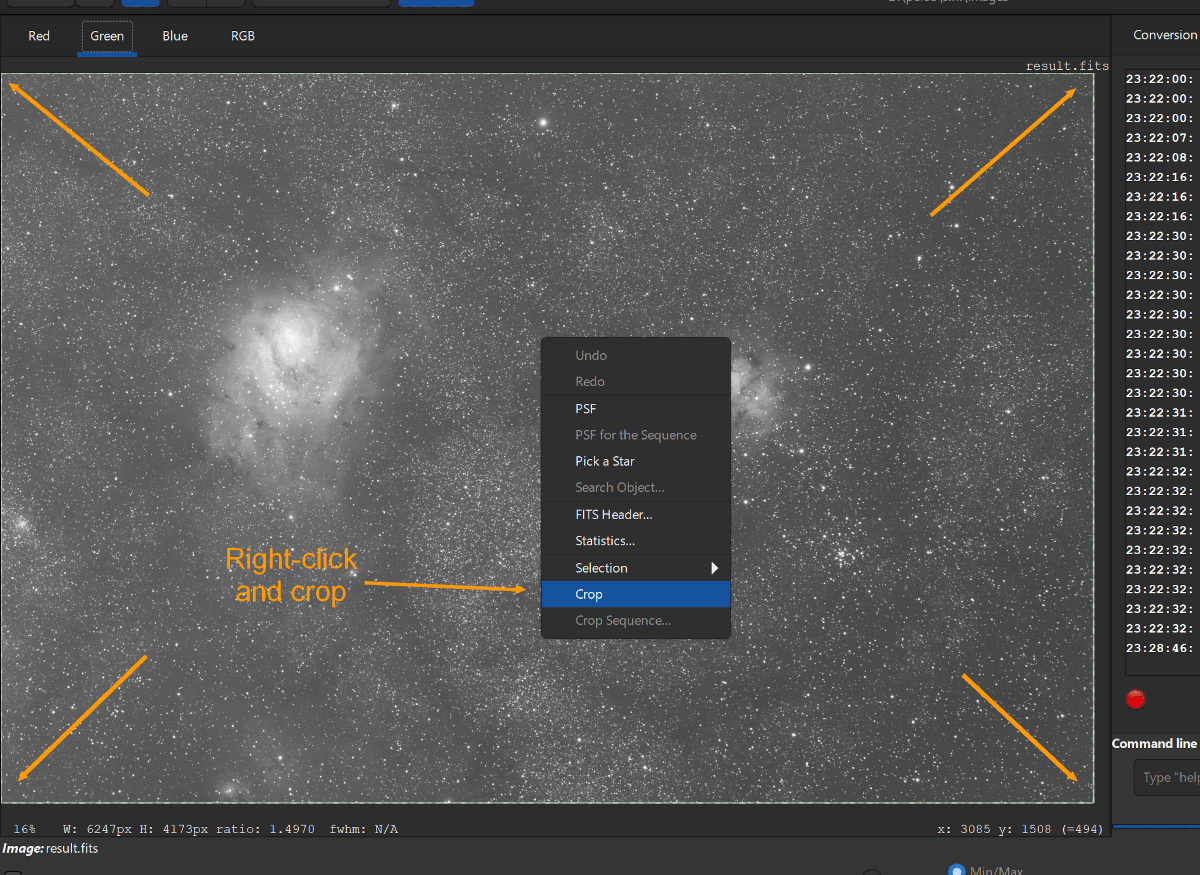
This is what I currently see in Siril after the script is finished.

That is with 34 out of 50 lights thrown away.
The only bright star I think we lose out of frame is Rigel towards the end of the run.
So to manually do this. Close Siril, delete the result.fit delete the process directory and start again.
Is the sequence?
Conversion of the Raw to a fit sequence then pre process then register manually.
gleaming walrus
The worst thing I done possibly 🤣
Used a Kit lens to shoot from a B7
Didn't stack the comet

1hr5mins of data
45+ mins of images were deleted due to focus
dusty gull
orchid obsidian
This is what I currently see in Siril after the script is finished.
Yeah don't use scripts
Are you the one I told that I'll make a tutorial soon?
static cape
D5300 + 200mm kitlens. About 20 mins and a 3 min edit in siril this morning before work. Will try a better job tonight!

Any tips on processing Andromeda? First time doing this one. I guess using starnet ++ wil also help
orchid obsidian
dusty gull
Yeah don't use scripts
Yes. It was the first clear night in about a week super cold. This is all new to me concepts, dynamics, processes. In the time I had I shot 50 1.5 sec 1600 iso images of Orion. 135mm lens f5 darks, bias, flats. What came out was worse than I could see with my 7x50 binoculars! I think the exposure calculators were saying 1.5 secs per shot but in reality that was nowhere near enough. In total 75 seconds of exposure. I followed this guide (https://siril.org/tutorials/tuto-manual/) to manually process the DBFL files and now have biases_stacked.fit darks_stacked.fit pp_flats_stacked.fit pp_lights_stacked.fit files. I think I could see a lot more with my naked eyes!
This has not discouraged me, just made me more determined to understand how to get the kind of images even if not at the same level of detail as you guys. I am keen to learn.
I take my hat off to you guys that are producing amazing shots untracked with unbelievable detail. I am pretty sure its not my D200 that is the issue 😉 Like the one above of Andromeda D5300 + 200mm kitlens. About 20 mins and a 3 min edit in siril. I was processing in Siril for a good couple of hours. BTW what is a 'kitlens'?
Questions:
Do you all capture just at the camera and then transfer files later or do you capture remotely?
On my 18-200mm lens when set at 135mm the point between being in or out of focus is an unbelievably small amount of movement on the focus ring. Do you all focus manually?
dusty gull
orchid obsidian
Yes. It was the first clear night in about a week super cold. This is all new to...
It's completely normal, you're learning as we all did...
I'll mention you when the guide will be done!
A kitlens is the lens that comes with cameras and is always.... Shtty
I have an astrocam so I capture with my pc
And manual focus is the only good way in astro (except with a dedicated autofocuser but you don't have that)
orchid obsidian
dusty gull
It's completely normal, you're learning as we all did...
I'll mention you when t...
Thanks. Also my 'kitlens' is a 18-200mm f3.5-f5.6 lens so is quite slow. I think I need to do a lot more trial and error on the exposure lengths. 1.5 secs was clearly nowhere near enough at 135mm f5.6 following the logic then a minimum of 6 secs compared to a f2.8 lens.
dusty gull
orchid obsidian
Thanks. Also my 'kitlens' is a 18-200mm f3.5-f5.6 lens so is quite slow. I think...
I got decent results at f6.3 with similar exposures if I remember well
Also the difference between 1.5s and 6s isn't huge
If you have the opportunity to buy a fix focal lenght fast lens, do it
You can probably find a second hand one for ~200€ that will be a LOT better than your kit lens
orchid obsidian
dusty gull
I got decent results at f6.3 with similar exposures if I remember well
Just trying to use what I have to start off and get the absolute best out of it before spending money.
dusty gull
orchid obsidian
Just trying to use what I have to start off and get the absolute best out of it ...
Of course of course! That's the right way to do it
orchid obsidian
'Persistance is omnipotent'
orchid obsidian
dusty gull
I've just received my roki lens
What Focal Length?
dusty gull
orchid obsidian
What Focal Length?
50mm
orchid obsidian
dusty gull
50mm

Buy 50mm F1.2 High Speed at Rokinon Lenses! The Rokinon 50mm F1.2 ED AS UMC for mirrorless cameras is a compact fast prime offering a portrait-length perspective equivalent to 75mm for Canon M mount, 75mm for Fuji X and Sony E mounts and 100mm for MFT mount cameras.
dusty gull
orchid obsidian
This https://rokinon.com/collections/manual-focus/products/50mm-f1-2-high-speed
Yep
tidal tide
that's some gathering power, damn
orchid obsidian
YOu guys must have the eye of a hawk to focus sharp at 50mm
dusty gull
tidal tide
that's some gathering power, damn
Yeah I can't wait to test it with my 224 mc
I'll probably have to stop it down to f2 though
orchid obsidian
Dare I ask how much?
orchid obsidian
Yes.
orchid obsidian
Looks like this would be the only lens they have for Nikon F for my D200. https://rokinon.com/collections/manual-focus/products/135mm-f2-0-full-frame-telephoto

Buy 135mm F2.0 Full Frame Telephoto at Rokinon Lenses! The Rokinon 135mm F2.0 ED UMC Lens is a manual focus telephoto prime lens useful for portraiture and most telephoto applications. Its fast f/2.0 maximum aperture is effective in low light and enables shallow depth of field control. With a rounded 9-blade diaphragm, shallow depth of field ima...
Thats 3 full stops faster than my 18-200mm at 135mm!
Maybe try and find one of these https://www.kenrockwell.com/nikon/135mm-f2.htm
dusty gull
orchid obsidian
Looks like this would be the only lens they have for Nikon F for my D200. https...
It's a really well reputated lens
tidal tide
QC though
tidal tide
quality control
tidal tide
not sure
dusty gull
It's weird because I saw this mentioned nowhere else
dusty gull
I tested my lens and it's great! Really sharp even at f 1.2
There's a bit of coma on one side though
Not a problem for what I plan to do and it disappear at f2.8
No ca visible except on the brightest stars
I'm happy
orchid obsidian
Single 60 sec iso1600 18mm f3.5
Pretty blurry. The Mily Way is between Procyon and Betelgeuse not that you can see it. Apart from blurry does this look over or underexposed?
 hybrid basin
Really dark sky... This is a completely unedited 30s exposure of my Xoami Redmi Note 8 pro at ISO3200.

Andromeda is clearly visible.
orchid obsidian
hybrid basin
Really dark sky... This is a completely unedited 30s exposure of my Xoami Redmi ...
That's amazing. A modern smartphone vs 17year old Nikon D200 I am struggling with.
gentle birch
untracked rosette in bortle 8
 orchid obsidian
gentle birch
untracked rosette in bortle 8
orchid obsidian
gentle birch
untracked rosette in bortle 8
Can you share your imaging settings for this. Focal Length, f stop, Exp, Iso etc. As I am learning and wanting to understand.
gentle birch
300mm f5.6 1.6" 3200ISO
orchid obsidian
gentle birch
300mm f5.6 1.6" 3200ISO
How many subs?
gentle birch
orchid obsidian
How many subs?
2300
orchid obsidian
Over an hour! How many times would you recentre the image. Is this using an intervalometer?
gentle birch
orchid obsidian
Over an hour! How many times would you recentre the image. Is this using an inte...
because this target is so dim an hour is barely enough. i might try getting more data as the skies clear up
orchid obsidian
gentle birch
because this target is so dim an hour is barely enough. i might try getting more...
Thank you for the extra info it helps. What camera are you using and are you using a EQ mount?
gentle birch
no tracking. just a camera and a tripod
nikon d750 and tamron 70/300 lens
with a tracker you could easily get the rosette
orchid obsidian
That is a long lens. f5.6 is the same as my 200mm 18-200 DX lens.
I am just finishing a wide field 18mm f3.5 session. 20 30 sec exposures iso 3200. I am hoping I can get something usable from it. I know I need longer!
gentle birch
we all start somewhere
orchid obsidian
gentle birch
we all start somewhere
Sorry, a few more questions. So your process would be to frame, focus using live view and a bhatinov mask? Then shoot using intervalometer. Download later?
gentle birch
orchid obsidian
Sorry, a few more questions. So your process would be to frame, focus using live...
i would frame, then focus by eye (no mask although i desperately need one) and shoot with an intervalomeyer
what do you mean by download later?
orchid obsidian
Download the images from the SDCARD(s) later. I am currently capturing by remote control of the camera. Each image is captured and uploaded to my network automatically. But cycle time is a little slow.. I am using Kstars/Ekos/Indi to setup the shooting session then execute it.
The camera is controlled by a raspberry pi which I have on my tripod and a usb connection.
gentle birch
yea i use an SD card that i just move all at once later
orchid obsidian
What tripod do you use. 3 way or 2 way. I need a new Photography tripod and looking for recommendations as there are so many.
gentle birch
i use the manfrotto 190X
orchid obsidian
gentle birch
i use the manfrotto 190X
Would you buy it again?
gentle birch
i didn't buy it. all my gear is just my fathers that i'm using
but definitely you can get a sturdier tripod for like 200
orchid obsidian
Currently looking for one of these. DR-6 Right Angle Viewfinder Attachment
grave rapids
my attempt at heart nebula, untracked unmodded b7. not exactly an easy target.
 gentle birch
grave rapids
my attempt at heart nebula, untracked unmodded b7. not exactly an easy target.
gentle birch
grave rapids
my attempt at heart nebula, untracked unmodded b7. not exactly an easy target.
A for effort man
grave rapids
gentle birch
A for effort man
I mean im happy that i resolved the structure at all, basically everything working against me
gentle birch
what was your integration?
static cape
dusty gull
I tested my lens and it's great! Really sharp even at f 1.2
Looking forward to the results!
dusty gull
static cape
Looking forward to the results!
My first target will be heart nebula!
The next we hopefully
hybrid basin
dusty gull
My first target will be heart nebula!
Its possible. I already tried it, and it was really good visible, but it isn't so colourful, because I only had 40min of exposure time.
dusty gull
hybrid basin
Its possible. I already tried it, and it was really good visible, but it isn't s...
What was your camera?
hybrid basin
dusty gull
What was your camera?
I don't think it's that important, but I have a unmodded Nikon Z50. I think more important was, that my lens is at F1.8...
 orchid obsidian
Given this is untracked which is my current mission. How are you guys working out the exposure per sub? Given you can't really see the end result until processes. Are you using a specific formula or calculator?
upper pasture
I captured 40 minutes of Cygnus data last night, A friend will be stacking it later. I'll post in here when it's done.
dusty gull
hybrid basin
I don't think it's that important, but I have a unmodded Nikon Z50. I think more...
OK thanks ! Because I have an astro cam so I think the ir sensitivity will help me quite a lot
F2 too
And your result looks nice!
hybrid basin
dusty gull
OK thanks ! Because I have an astro cam so I think the ir sensitivity will help ...
Nice, that should you help a lot.
hybrid basin
dusty gull
And your result looks nice!
Thanks
dusty gull
orchid obsidian
Given this is untracked which is my current mission. How are you guys working ou...
The longest sub exposure you can get without trails
upper pasture
upper pasture
I captured 40 minutes of Cygnus data last night, A friend will be stacking it la...
Should 40 minutes untracked unmodded reveal much dust?
dusty gull
upper pasture
Should 40 minutes untracked unmodded reveal much dust?
What's your équipement ?
dusty gull
dusty gull
The longest sub exposure you can get without trails
Except if you do eyepiece projection you can use the npf rule
dusty gull
upper pasture
about f/4.5
I'm afraid it won't show a lot of details but we'll see...
I once tried ~20min at f2 and it wasn't great
upper pasture
dusty gull
I'm afraid it won't show a lot of details but we'll see...
I once tried ~20min a...
I just hope that NAN is visible and maybe a bit of dust around Sadr
orchid obsidian
dusty gull
The longest sub exposure you can get without trails
So heuristics? Take a shot and keep extending the time until stars start elongating?
orchid obsidian
dusty gull
Except if you do eyepiece projection you can use the npf rule
What is eye piece projection?
upper pasture
This is my first time shooting Cygnus, so this is mostly just teseting the waters
upper pasture
orchid obsidian
What is eye piece projection?
I think it's projecting whatever is in your eyepiece onto a piece of paper or something similar. I might be wrong.
orchid obsidian
I used the NPF rule and calculators for my first ever attempt and I think it was a bust. One of the kind processing forum members is looking at the data I posted a link to (https://discord.com/channels/794642864218439681/1074798610237116508) to see if there is any useful information at all.
orchid obsidian
upper pasture
I think it's projecting whatever is in your eyepiece onto a piece of paper or so...
I thought this was related to telescopes. I don't have one. Just a DSLR with a 18-200mm f3.5-5.6 zoom. I am trying to get hold of a Nikon DR-6 which is a 90 degree viewfinder with 1-2x mag to assist with focusing as I do not have a live view camera.
dusty gull
orchid obsidian
What is eye piece projection?
It's when you take a pic of your eyepiece with your phone are camera+lens
Oh but you don't have a scope
So it's not what you do
orchid obsidian
dusty gull
It's when you take a pic of your eyepiece with your phone are camera+lens
N olive view no scope just a 18-200mm lens. I like the idea of getting my phone camera to pretend to be my eyeball though! How might that work?
I have an idea? See post in 3d printer shortly.
 viral rivet
guys hows this?
 static cape
viral rivet
guys hows this?
static cape
viral rivet
guys hows this?
Nice:) what equipment?
 lucid badger
viral rivet
guys hows this?
lucid badger
viral rivet
guys hows this?
I cleaned it up a bit for you
 viral rivet
static cape
Nice:) what equipment?
viral rivet
static cape
Nice:) what equipment?
4.5 in reflector and an old android (oppo f1f)
viral rivet
lucid badger
I cleaned it up a bit for you
thanks
 compact dust
orchid obsidian
This is a noob question so please be gentle...
Right now I am starting out. I h...
compact dust
orchid obsidian
This is a noob question so please be gentle...
Right now I am starting out. I h...
On Linux you should use Siril
 gaunt meteor
Ummm dslr and telescope. Ye

 orchid obsidian
compact dust
On Linux you should use Siril
orchid obsidian
compact dust
On Linux you should use Siril
Yes using Siril and following or trying to the tutorials they provided without much luck. The old adages are still as true today as ever. Garbage in Garbage out! Need to work on acquisition.
 radiant osprey
dusty gull
And here's my process!
radiant osprey
dusty gull
And here's my process!
untracked?
dusty gull
radiant osprey
untracked?
Yeah, it's my process of LMC's data
radiant osprey
can u please tell me how?
i would kill my self to get a mount if u just tell me how or is there a tutorial on youtube
strange seal
radiant osprey
can u please tell me how?
Just a whole lotta subs with a good camera.
strange seal
I have a uranus c. Using a dslr will be very bad. You’ll burn through 10-25% of your cameras total lifespan per target.
radiant osprey
using sharpcap right ?
strange seal
Yup
You want a shutterless mirrorless camera. Any half decent astrocam will do
Uranus c is nice because it’s a large sensor for its price
strange seal
I’ve seen good results from that camera
radiant osprey
the method of stacking using live stack right?
strange seal
Finding targets will be harder and it’s a little noisier but it works
strange seal
radiant osprey
the method of stacking using live stack right?
Nah don’t live stack. Record as a .ser file and stack after.
radiant osprey
raw
radiant osprey
strange seal
Nah don’t live stack. Record as a .ser file and stack after.
and when the object start to dissapear u pause it
strange seal
Yup then reframe. Then start recording again. If you hand track the target as opposed to letting it drift it works better. Otherwise you get walking noise.
If you have steady enough hands you don’t notice the blurring.
radiant osprey
but i think when the pic stack on deepskystacker , the pic will look bad bec there are pic that will look different from the other in the body on the screen
because the body moving
radiant osprey
can u show me a photo for u without tracker of galaxy or nebula
strange seal
3
About 10-20 mins on most targets. Sombrero was two nights so 50 mins.
60-130ms subs. Depending on target declination.
radiant osprey
how i stack a video?
strange seal
You record as ser. Then use astrosurface. You can also record as video but ser is faster.
radiant osprey
can i use deepskystacker?
 sharp heath
strange seal
sharp heath
strange seal
wow
strange seal
radiant osprey
can i use deepskystacker?
It’s very far from ideal no.
 cinder vault
tried some untracked AP last night, I'm convinced it's impossible - full respect to all of you people 😄
tidal tide
cinder vault
tried some untracked AP last night, I'm convinced it's impossible - full respect...
the struggles are real
cinder vault
I think I'll stick to my mount for now 😅
hybrid basin
strange seal
It’s very far from ideal no.
What would you recommend then? Astropixelprocessor?
strange seal
hybrid basin
What would you recommend then? Astropixelprocessor?
Astrosurface
hybrid basin
strange seal
Astrosurface
Thanks, I never heard that before, but then I have to try that.
radiant osprey
Astrosurface is for planet
crimson fractal
And dso
radiant osprey
i put a SER files on Astrosurface its so hard to use and there is no video tutorial on youtube
idont know how to stack
crimson fractal
@strange seal ur better at explaining then me
radiant osprey
strange seal
Astrosurface
can u tell me pls how to use Astrosurface to stack
it seems u can use pipp also
crimson fractal
Pipp dosent stack just aligns
strange seal
radiant osprey
can u tell me pls how to use Astrosurface to stack
Open the ser then go to the stacking tab. Click global alignment and set the number of stars to however many you can count. Click set ref then stack.
radiant osprey
i cant found stacking tab
u mean register
when i click on register it show me a screen to add darks and flats and stack but i cant click on stack
i found it
thank u man !
lucid badger
strange seal
Is all that untracked???????
 livid wing
Yes
viral rivet
in untracked i have to take small exposures due to which there are less stars for stacking what do u guys do to counter this ?
hybrid basin
viral rivet
in untracked i have to take small exposures due to which there are less stars fo...
I think there are mostly still enough stars for stacking. It could get only critical, if you do really short exposures with a small aperture. I also don't think the stacker uses all stars for stacking, so it shouldn't be the problem.
 south jackal
strange seal
You record as ser. Then use astrosurface. You can also record as video but ser i...
south jackal
strange seal
You record as ser. Then use astrosurface. You can also record as video but ser i...
What do you mean with ‘ser’?
grave rapids
south jackal
What do you mean with ‘ser’?
its a file ending, .ser
south jackal
Can’t do that with a regular camera I guess?
grave rapids
im not sure
livid wing
Untracked orion nebula 4 min exposure bortle 8
 orchid obsidian
livid wing
Untracked orion nebula 4 min exposure bortle 8
orchid obsidian
livid wing
Untracked orion nebula 4 min exposure bortle 8
Can you provide capture info. Lens F stop iso etc.
livid wing
Actually idont know the iso but i have a 700x76 telescope with zwo 224 camera any thing else i dont know ary
Sry
orchid obsidian
livid wing
Sry
Hey thanks. I am just starting out so collecting info on settings and results.
strange seal
lucid badger
Is all that untracked???????
Yes
strange seal
south jackal
Can’t do that with a regular camera I guess?
It’s astrocams only. Also don’t use a dslr for this type of photography
strange seal
Finna burn through 10-25% of your cameras total lifespan
tidal tide
gotta pluck out that mirror
viral rivet
hybrid basin
I think there are mostly still enough stars for stacking. It could get only crit...
ok thanks
neat scroll
strange seal
your tarantula looks very nice! 
upper pasture
Just under 40 minutes of data untracked and unmodded.

 upper pasture
Any tips or advice?
dusty gull
@upper pasture this is pretty nice! At what Iso and f ratio were you shooting?
upper pasture
dusty gull
<@876289210267602995> this is pretty nice! At what Iso and f ratio were you shoo...
It was 1600 ISO, at f/4.5
I was using an 18-55 kit lens so its not the fastest
I also had to crop pretty harshly due to poor recentering
dusty gull
upper pasture
It was 1600 ISO, at f/4.5
For this f ratio it's petty good
static cape
strange seal
It’s astrocams only. Also don’t use a dslr for this type of photography
What astro cam do you have?
strange seal
Uranus C. IMX 585.
static cape
Ah that looks great, should have invested in that instead of a dslr
orchid obsidian
upper pasture
thank you!
I am amazed at this. I am struggling with my NIkon D200 and Kit 18-200 f3.5-5.6 lens to get anything useful. My next opportunity will be Monday evening. I tried various exposures. Last one just to see what I could catch with this lens was 50 x 30 sec exposures 18mm f3.5 3200 iso this is what I see when I open a single exposure in ASTAP or Siril etc.

Data:
Heres the data:
SIMPLE = T / FITS header
BITPIX = 16 / Bits per entry
NAXIS = 2 / Number of dimensions
NAXIS1 = 3899 / Length of x axis
NAXIS2 = 2616 / Length of y axis
EXPTIME = 30 / Exposure time in seconds
JD = 2459990.45452546 / [Julian Day] The start time of the exposure
DATE-OBS= '2023-02-14T22:54:31.000' / [UTC] The start time of the exposure
CCD-TEMP= 999 / Sensor or camera temperature
GAIN = 3200 / ISO speed
DATAMAX = 3827 / Max value where still linear
DATAMAX2= 3827
DATAMAX3= 3827
DATAMAX4= 3827
APERTURE= 3 / Lens aperture
FOCALLEN= 18 / Focal length lens
CAMMAKER= 'Nikon'
INSTRUME= 'D200'
TELESCOP= ''
FILT-PAT= 'GRBGGRBGGRBGGRBG' / Filter pattern
BAYERPAT= 'GRBG' / Bayer color pattern
IMG_FLIP= 0
COMMENT Raw conversion by LibRaw-with-16-bit-FITS-support. www.hnsky.org
Pretty sure I need to focus more precisely almost impossible at 18mm lens and shorter ~5secs x hundreds maybe.
What do you all think?
radiant osprey
some edits on topaz gigapixels this software is so amazing
 dusty gull
radiant osprey
some edits on topaz gigapixels this software is so amazing
dusty gull
radiant osprey
some edits on topaz gigapixels this software is so amazing
Eh topaz isn't well reputeted among astrophotographs
It uses IA but it's not trained on astro pics so it creates false details (if I remember right)
You can use AstroDenoisePY instead
radiant osprey
topaz denoise maybe better than gigapixels
radiant osprey
dusty gull
You can use AstroDenoisePY instead
is it free?
radiant osprey
yes pls
tidal tide
i think it was pinned in some channel
dusty gull

AstroDenoisePyGUI 0.4.1:
Add support for tiff files with compression
bump version to 0.4.1
It's not as good as NoiseX but still does the job with a bit of trial and error
And it's free
radiant osprey
ty
radiant osprey
dusty gull
https://github.com/p7ayfu77/astro-csbdeep/releases/tag/0.4.1-gui
why i cant lunch it
how to download it
?
viral rivet
radiant osprey
how to download it
in assets click the first one (if you are in windows), then after that run the installer and install it
radiant osprey
i do that
but i dont find the program
i download it but i cant found it in the desktop
radiant osprey
same thing
viral rivet
open
viral rivet
i havent tried
radiant osprey
AstroDenoisePY doesnt lunch for me any one have a software for noise
viral rivet
It worked for me by installing all the dependencies
 radiant osprey
with me is nothing happend right
viral rivet
radiant osprey
with me is nothing happend right
like it opens and closes right?
radiant osprey
no i dont find it
the software
when i click on it it start download from first
andromeda galaxy with a old lens camera with zwo224 with bortle 8

30 min untracked
neat scroll
dusty gull
https://github.com/p7ayfu77/astro-csbdeep/releases/tag/0.4.1-gui
now this is cool, i had no idea there was denoise ai. noiseX is paid right?
nimble lintel
What program works best to stabilize and stack untracked DSO targets? Got a little data on orion, but haven't stacked deep sky before
Does PIPP work for deep sky stabilizing?
little prism
Deep Sky Stacker or for short DSS will be your best choice
nimble lintel
Got it, will that stabilize too? Or just stack?
little prism
nimble lintel
Got it, will that stabilize too? Or just stack?
also stabilise. It will make your life a lot easier :D
little prism
nimble lintel
Got it, will that stabilize too? Or just stack?
i highly recommend the video I send you
nimble lintel
Ah great! That's really helpful!
crimson fractal
dusty gull
https://github.com/p7ayfu77/astro-csbdeep/releases/tag/0.4.1-gui
yeah Rawtherapy is def much better
nimble lintel
Unfortunately DSS didn't really seem to work, I shot Orion but need to stabilize the video before stacking. Is there any program that can easily do this?
dusty gull
crimson fractal
yeah Rawtherapy is def much better
What is it?
nimble lintel
@dusty gull Do you possibly know what stabilizing / stacking program I should use to stack DSO? I recorded the raw8 footage in .AVI
crimson fractal
siril or astrosurface prob
neat scroll
same data (different stack tho) without and with denoise. it's a very big difference!
 crimson fractal
neat scroll
same data (different stack tho) without and with denoise. it's a very big differ...
crimson fractal
neat scroll
same data (different stack tho) without and with denoise. it's a very big differ...
It didn’t even touch the noise inside m42 tho ?
neat scroll
they're different stacks, but it did a bit, you can see a lot more detail
although it didn't remove the red noise, i'm guessing because that's to not delete actual data, if i used calibrations that wouldn't be there
i'm still very happy
crimson fractal
Hm mind giving the stack ? I can run denoise
neat scroll
neat scroll
same data (different stack tho) without and with denoise. it's a very big differ...
also i'm still testing denoise, this was done after stretching, i'm now trying before stretching (image stack is sending)
sure, it's pretty bad tho (don't know if i should send it any other way)
 neat scroll
also i'm still testing denoise, this was done after stretching, i'm now trying ...
neat scroll
neat scroll
also i'm still testing denoise, this was done after stretching, i'm now trying ...
doing before doesn't seem to work as well
dusty gull
nimble lintel
<@714422875767177307> Do you possibly know what stabilizing / stacking program I...
I personally use siril but I know some use astrosurface
dusty gull
crimson fractal
editing software but has a pretty decent denoise
Oh thanks, I'll take a look at it
nimble lintel
dusty gull
I personally use siril but I know some use astrosurface
Gotcha, I tried both of them a few minutes ago and astrosurface worked best for me
dusty gull
nimble lintel
Gotcha, I tried both of them a few minutes ago and astrosurface worked best for ...
I never tried it, what worked Better?