#math-help
1 messages · Page 17 of 1
 candid rivet
 undone basin
i dont get it
undone basin
i dont get it
do you have an example that you don't understand ? Because it is true that the integral of 5f is 5 times the integral of f (still true if you replace the 5 by any number)
 strange river
undone basin
i dont get it
strange river
undone basin
i dont get it
if I am understanding your question correctly, it typically doesn't matter whether or not you take a constant out of an integral. Personally, I take a constant out if it makes the integral visually easier to understand and compute. But regardless, you'll get the same end result because,,, it's constant 😎 lol
as for multiplying an integral by the reciprocal of a constant, the only situation that comes to mind when doing this is u-substitution. Sometimes to make a u-sub work, you'll have to multiply the integral by a constant to get the proper derivative to cancel things out. and in order to keep things equal, you'll have to multiply the entire integral by the reciprocal of the constant. Does this sound familiar?
 frail hearth
can anyone of you guys teach me compound interest please
 ivory wyvern
frail hearth
can anyone of you guys teach me compound interest please
ivory wyvern
frail hearth
can anyone of you guys teach me compound interest please
Compound interest is just the idea of a small amount of interest: for example, imagine taking 3% interest per year on a 100 dollar loan, and then imagine the seeing how that progresses over many years. The first year, it would be 103 (100 * 1.03) dollars you owe, then 106.09 (100 * 1.03^2) in 2 years. This seems like a small increment, but in only 20 years you will owe 180 dollars (100 * 1.03^20). The point is, that even a small interest rate will increase in size over time, as each year you increase the amount you owe by multiplying the money you owed last year by the interest rate, not just by paying the initial 3 dollars extra for the first year. So, instead of paying 60 dollars extra for 20 years (100 * 0.03 * 20 = 60), you’d pay 80 extra (100 * 1.03^20 - 100 = 80).

 solar mesa
why did it open with negative sign
 ashen pine
 ashen pine
frail hearth
can anyone of you guys teach me compound interest please
ashen pine
frail hearth
can anyone of you guys teach me compound interest please
I can teach you compound interest over voice call on discord if you are interested. Unfortunately i dont have a drawing pad or smth to do calculations
ashen pine
solar mesa
why did it open with negative sign
i think the equal to sign should be with the first piecewise definition
frail hearth
ashen pine
I can teach you compound interest over voice call on discord if you are interest...
Thank you, but i just finished my test on it...Ill update you on the results...
ashen pine
frail hearth
Thank you, but i just finished my test on it...Ill update you on the results...
Sure!
ivory wyvern
ashen pine
Here’s the full derivation
 ashen pine
ivory wyvern
Here’s the full derivation
ashen pine
ivory wyvern
Here’s the full derivation
Can we like do like this that if it has unique eigen values then it will be diagonalisable?
ivory wyvern
ashen pine
Can we like do like this that if it has unique eigen values then it will be diag...
Yep, we can
If an n×n matrix has n distinct eigenvalues then A is diagonalisable.
 obsidian spire
y_1 ' = k, y_2 ' = e^x. So you have kx = e^x and k=e^x. Since e^x=e^x, you have kx=k. So what value is x?
Then everything should be solvable
obsidian spire
I'm trying to review some problems for real analysis. If someone could check my answer I'd appreciate it.


 candid rivet
obsidian spire
I'm trying to review some problems for real analysis. If someone could check my ...
candid rivet
obsidian spire
I'm trying to review some problems for real analysis. If someone could check my ...
Looks good to me !
I just don't think the "< a^2 +1" is needed to conclude that (t_n) is bounded
And also if you have seen the 2 folowing properties:
If the series of a_n converges then a_n ->0 (for n -> +infinity)
If for all n 0<=a_n <= b_n and series of b_n converges, then series of a_n converges
Then you can say that at some point we know that a_n wil be lesser than 1, so 0 <= (a_n)^2 < a_n, and since series of a_n converges it implies that the series of (a_n)^2 converges
obsidian spire
candid rivet
Looks good to me !
I just don't think the "< a^2 +1" is needed to conclude that ...
I like your way of proving it, it's a lot faster and would be better on a test. Though we need |a_n| to make sure the inequality holds in all cases i think, and since it's absolutely convergent it works perfectly
candid rivet
obsidian spire
I like your way of proving it, it's a lot faster and would be better on a test. ...
absolutely, my 2nd property needs a_n and b_n to be positive real numbers !
 eternal elk
Why it's so challenging to understand permutations and combinations
 sacred marsh
 simple ferry
can anyone please help me with this I'm unable to understand
simple ferry
can anyone please help me with this I'm unable to understand
It's simply double derivative.
First Z with P then with T = L with T
Then, Z with T then with P = M with P
 sacred marsh
simple ferry
sacred marsh
simple ferry
What course are you doing to be studying this?
ashen pine
sacred marsh
What course are you doing to be studying this?
I guess thermodynamics
 deep marsh
Hi I'm studying calculus 1&2 , and this book is really helpful
simple ferry
sacred marsh
It's simply double derivative.
First Z with P then with T = L with T
Then, Z wit...
thankyou!!
simple ferry
ashen pine
I guess thermodynamics
yes
simple ferry
deep marsh
Hi I'm studying calculus 1&2 , and this book is really helpful
thanks for sharing!
 undone temple
I'm struggling a little bit to study linear systems. Can someone help me with this question?

 ember garnet
undone temple
I'm struggling a little bit to study linear systems. Can someone help me with th...
ember garnet
undone temple
I'm struggling a little bit to study linear systems. Can someone help me with th...
in this case if you add the two equations you'll get an equation with only one unknown variable, x
 barren oasis
undone temple
I'm struggling a little bit to study linear systems. Can someone help me with th...
barren oasis
undone temple
I'm struggling a little bit to study linear systems. Can someone help me with th...
yea just combine the right sides and the left sides and you will get
2x+y + x-y = 200 + 30 so when adding up that makes 3x=230 and you solve for x
 left knoll
undone temple
I'm struggling a little bit to study linear systems. Can someone help me with th...
left knoll
undone temple
I'm struggling a little bit to study linear systems. Can someone help me with th...
here you can either substitute the value of x from the second equation in the first one and then solve which is a long procedure or you can multiply both the equations with the common factor of either one of the variable and then subtract. by doing so, you are directly cancelling out 1 variable
obsidian spire
undone temple
I'm struggling a little bit to study linear systems. Can someone help me with th...
What everyone said above is correct. You can think of these systems a bit like if someone told you 'all of these equations are true'.
Since they are true, you are allowed to do various things with them, like add multiples of them to each other (since it's similar to adding 30 to both sides which doesn't change the equality of other equations), or make substitutions based on them. And this can allow you to isolate and solve the variables
undone temple
Thanks for the help guys. I'm getting confident solving some questions now!
left knoll
undone temple
Thanks for the help guys. I'm getting confident solving some questions now!
yaayyy!!
 tawny coral
I love the organic chemistry tutor for maths, I actually prefer them over his science-related videos
 vital dragon
tawny coral
I love the organic chemistry tutor for maths, I actually prefer them over his sc...
vital dragon
tawny coral
I love the organic chemistry tutor for maths, I actually prefer them over his sc...
bro saved me countless times last year
mine is professor leonard
he stopped uploading but he still has a ton of content
i also started watching 3blue1brown
obsidian spire
Professor Leonard on youtube worked well for me, I feel he gives pretty clear explanations
 junior zinc
how would l do 1b)
 tawny coral
vital dragon
i also started watching 3blue1brown
tawny coral
vital dragon
i also started watching 3blue1brown
yeahh I loved their videos with terence tao
junior zinc
junior zinc
how would l do 1b)
nvm i got it now, for anyone wondering it was [19.93,19.94]
 nocturne grail
Does anyone have a YouTube course they recommend for real analysis?
 stuck creek
Anyone have any recommendations to people trying to learn undergraduate level mathematics after an unrelated first degree?
Any short courses, diplomas or accreditations someone could strive for? Self learning curriculums?
(context! I'm trying to go into computational applied mathematics after my computer science degree and build the skill gap I have)
 weak lotus
stuck creek
Anyone have any recommendations to people trying to learn undergraduate level ma...
weak lotus
stuck creek
Anyone have any recommendations to people trying to learn undergraduate level ma...
MIT opencourseware
stuck creek
thanks I'll give that a look rn!!
 vital shard
nocturne grail
Does anyone have a YouTube course they recommend for real analysis?
vital shard
nocturne grail
Does anyone have a YouTube course they recommend for real analysis?
Mathepeter if ur German 🐺
 thick copper
greetings anyone got tips to get better at maths
Its been 4 months so far did two tests both tests came back to me with same percentage, exactly same percentage. The first one was easier (shorter) while the most recent was longer. Literally, no improvement from the start of my course according to the tests I took.
stuck creek
thick copper
greetings anyone got tips to get better at maths
what strategies have you tried so far?
 somber zenith
if a = c and b = c then a = b and also if a < c and c < b then a < b
math is beautiful!
 slender temple
can someone help me with this basic physics question?
 thick copper
stuck creek
what strategies have you tried so far?
thick copper
stuck creek
what strategies have you tried so far?
I mean I guess my best bet is too have a tutor to help me both in motivation and accountability and to cover more ground on topics. But to answer your question; revision practice questions. But I just generally, am the type of guy that is just not always in the moment. I just find it tough cause I am working with a low maths foundation score and jumping into tough concepts. I did not do terribly. Is just that I am surrounded with really good students. SOS
stuck creek
thick copper
I mean I guess my best bet is too have a tutor to help me both in motivation and...
Ahh I get that a whole lot honestly. That was me when I was doing my A-Levels.
I had a lot of foundational gaps because of the lack of drive in my earlier years.
Anyway, the thing that really helped me the most was having a tutor that not only helped with explaining topics one on one, but would sort of have these investigative moments with me.
Like our main goal would be to try and identify what prerequisites were missing, and like, help me understand how the concepts come together. It would give me a bit of a better way forward, and it would sort of make things seem less daunting to work towards since I have a plan and can also work on things on myself rather than only making progress when I'm with my tutor.
Still though, tough and a lot of work, but now having a bit of a clear outline on what IS necessary for me to learn X, and what I'm doing right so far, etc, made math really fun for me. Felt like a videogame where all the objectives were super clear, since sometimes I found in class my Teacher would sort of brush over some things and I really would not have a measure of improvement other than the tricky parts, which really were more like milestones rather than a better representation of my overall progress in maths.
I had moments where I'd make leaps of improvement because some certain things finally clicked etc.
Progress might feel jagged, but as long as you consistently work and identify weaknesses, you'll be growing 🫶🏾
Anyway this is just from what helped me personally.
Sorry if it's a very generic answer, oof, hopefully some other folks share their own tips. I get how tough the climb can feel especially when you don't have too many peers that specifically relate to your scenario.
left knoll
need help with this one
 left knoll

 indigo totem
hah, A level math
that stuff doesnt matter in uni
havent done a single proof in my life 💀
stuck creek
I mean it depends on your course lmao
ivory wyvern
stuck creek
Anyone have any recommendations to people trying to learn undergraduate level ma...
I think your best bet is to look at the course requirements for undergraduate degrees in applied mathematics/computational Mathematics and then go through the list of courses they have and attempt to study up that point. I would say though, if you graduated with a cs degree you will have to put a decent amount of time in, as you will have to go through a basic differential equations course, a decently comprehensive linear algebra course, multivariable calculus, and then multiple (2-3) applied mathematics courses so you have experience actually coding projects to show proof of your ability to use high level mathematics. I think it’s doable, as long as you are willing to devote a few months to focusing on these subjects
thick copper
stuck creek
Ahh I get that a whole lot honestly. That was me when I was doing my A-Levels.
I...
thanks
stuck creek
ivory wyvern
I think your best bet is to look at the course requirements for undergraduate de...
Gotcha gotcha, thank you for the pointers and thought you put into this response :))
Seems like there's a whole lot to go over and I'm super excited to buckle down and dive into it all!! Gonna graduate in a few months and take a gap year, then dedicate that time to studying maths on my own terms. Then maybe once I know more I could have a bit of a direction to go in.
I have no plans other than to learn lol, and I'm pretty content with that!!
Done a bit of applied mathematics but that's just one module (I do computer science (Games Technologies)), so it feels like this whole other world I'm gonna dive into its all really exciting
I'll probably end up being a lot more active on this server actually lol
TLDR:
YIPPIE
 dark oar
goodluck!
stuck creek
thank you!!
ivory wyvern
stuck creek
Seems like there's a whole lot to go over and I'm super excited to buckle down a...
Good luck!!
obsidian spire
thick copper
I mean I guess my best bet is too have a tutor to help me both in motivation and...
Getting better at stuff.. there is a lot that goes into that. Youre gonna want to come up with a way of studying you find fun and make it something very doable. Also something effective at helping you learn new stuff. A lot of times the biggest barrier to getting more studying in is just getting started. If you have a big problem with getting started, just focus on studying for 1 minute and see where it goes from there.
Also you want something that addresses any weaknesses you have. Ideally when you look at a math problem, you want to understand everything you are seeing mentioned there. If theres something you don't get, I'd say investigate it until you understand. Until you can close your eyes and explain what the thing is from memory. Everytime you fix a weakness like that, you grow stronger in math.
 ember garnet
 whole copper
what's the question?
whole copper
It was a joke
 timid delta
2+2=4
 dull viper
6 if you consider another plane
stuck creek
0 if you close your eyes
 lavish quartz
0 = 1
can you prove?
 small siren
whole copper
small siren
whole copper
Ah yes, the ol' Riemann zeta function. I solved it last Tuesday while microwaving pizza and petting my cat named Schrödinger.
Spoiler: it was simultaneously solved and not solved.
whole copper
lavish quartz
0 = 1
can you prove?
It’s not, but 0! == 1 is
lavish quartz
whole copper
It’s not, but 0! == 1 is
no 0 = 1, there is video on youtube. i saw that
small siren
lavish quartz
no 0 = 1, there is video on youtube. i saw that
0 = 1? let me just rewrite the universe real quick.
whole copper
lavish quartz
no 0 = 1, there is video on youtube. i saw that
i saw a video that earth was flat , on youtube asw
smh
indigo totem
lavish quartz
no 0 = 1, there is video on youtube. i saw that
i think i remember seeing that video in particular actually
and the reason why the proof is wrong is he divided by zero when he was factoring out things iirc
 brave loom
lavish quartz
no 0 = 1, there is video on youtube. i saw that
brave loom
lavish quartz
no 0 = 1, there is video on youtube. i saw that
If you are talking about proving 0=1 by exponential method, then let me tell you a fact, that the statement "if base are equal then power are equal" is not valid always
And why is everyone behind 0=1, try 0=2 someday lmaoo
obsidian spire
0 x infinity will equal any number you want
timid delta
obsidian spire
0 x infinity will equal any number you want
no
tending to 0 x infintiy
not absolute 0
 winged cove
Hello! I'm struggling to wrap my head around the relationship between angular motion and linear motion.
Anyone got a good resource/textbook to read on the topic? In context of 3D rigid body mechanics I suppose. I sorttt of understand how it works for spherical objects but that's about it.
I'm trying to program a physics system in processing atm and have been going over mechanics by myself in my free time
 ember garnet
left knoll
ember garnet
left knoll
A and C
left knoll
ye I got that
But idk rhe
Describe the sequence of transformations that maps rhe congruent figures
ember garnet
left knoll
Describe the sequence of transformations that maps rhe congruent figures
I guess to go from figure A to figure C you do a rotation by 90 degrees clockwise around the point (1,1) and then a translation by 4 units in the negative direction of the x axis
ember garnet
you're welcome
there can be various answers to this question but the one I wrote I think is one of the simplest
 ember garnet
I guess it's a translation because of the labels of the vertices
also they are congruent, and hence also similar
ivory wyvern
winged cove
Hello! I'm struggling to wrap my head around the relationship between angular mo...
for 3D rigid body mechanics I would reccomend Taylor and Thornton and Marion (both physics textbooks on classical mech). It will cover how to create inertia tensors and the basic ideas behind 3D rigid body mech
Heres the pdf that i use for my class for thornton and marion, though ive heard much better things about taylor (havent gotten to reading through it yet)
I believe chapter 10-11 will cover the content you are looking for
stuck creek
ivory wyvern
for 3D rigid body mechanics I would reccomend Taylor and Thornton and Marion (bo...
Thank you so much again!!
Awesome awesome
ivory wyvern
Yea np!
 pearl nacelle
Hi what is the midpoint rule ?
 ember garnet
pearl nacelle
Hi what is the midpoint rule ?
ember garnet
pearl nacelle
Hi what is the midpoint rule ?
you split the interval into n equal parts, and for each part you take the value of the function at the midpoint and multiply it by the length of each part. Then sum up all those products to get an approximation of the interval
pearl nacelle
ooooh thanks I understand wave it's like the same as a normal definite integral but without the limit, in the case of riman I just found this that explains it lul

But how could this be applied with the method of the fundamental theorem of calculus?
That theorem sounds super epic, lul
ember garnet
pearl nacelle
ooooh thanks I understand wave it's like the same as a normal definite integral ...
yeah that's the same thing
ember garnet
pearl nacelle
But how could this be applied with the method of the fundamental theorem of calc...
what do you mean?
pearl nacelle
No, the question doesn't make sense because the formula is exact, it was an idea xd
 ember garnet
pearl nacelle
No, the question doesn't make sense because the formula is exact, it was an idea...
ember garnet
pearl nacelle
No, the question doesn't make sense because the formula is exact, it was an idea...
yes, it's exact, but you could get an approximation if you multiplied the value of the function at some point in [a,b] by (b-a)
indigo totem
pearl nacelle
ooooh thanks I understand wave it's like the same as a normal definite integral ...
yoo hello fellow EE major
and uhh, good luck with the more advanced math concepts eh?
🫡
 ruby lodge
lavish quartz
no 0 = 1, there is video on youtube. i saw that
ruby lodge
lavish quartz
no 0 = 1, there is video on youtube. i saw that
ye it's a glitch the devs have patched it
 stable dirge
Can someone PLEASE help me with this lineal algebra problem?

 dreamy mist
stable dirge
Can someone PLEASE help me with this lineal algebra problem?
dreamy mist
stable dirge
Can someone PLEASE help me with this lineal algebra problem?
I would approach it by doing a small dimension version and try to either look at decomposition and spectral thm or look at rank thm, tips it would be helpful to start by quantifying what is a set and what is an independentl set and try to fit in.
 gentle creek
winged cove
Hello! I'm struggling to wrap my head around the relationship between angular mo...
gentle creek
winged cove
Hello! I'm struggling to wrap my head around the relationship between angular mo...
I did a paper on that, lmk if you need some help 🙂
gentle creek
@winged cove
winged cove
gentle creek
I did a paper on that, lmk if you need some help 🙂
Will do thank you!!
Taken a bit of a break from the work but gonna jump back into it this week >:3
winged cove
what did you do in your paper exactly by the way?
I'm super interested since I saw you said you're a CS student too!! :D
pearl nacelle
How i can do this derivative?

 fallen flax
pearl nacelle
How i can do this derivative?
fallen flax
pearl nacelle
How i can do this derivative?
it looks like a iterated integral
i am asuming F(x) is the antiderivative of f(x)
and f(0) =0
so it will sinply be f(z)= F(whatever the upper limit is)
could u resend the question without cropping the upper limit?
junior zinc
can someone explain the limit comparsion test to me and help me with this

 echo jungle
junior zinc
can someone explain the limit comparsion test to me and help me with this
echo jungle
junior zinc
can someone explain the limit comparsion test to me and help me with this
I think it is the last one.
I see it as you have a function g(x) that is larger than your function f(x). If g(x) converges than it kind of sandwhiches f(x).

You know that -1<sin(x)<1
So at it largest the numerator is 5 i think
x^1/3 > x^1/3 -4 so x^-1/3 > ( x^1/3 -4)^-1
junior zinc
this is the answer but i dont understand why
 echo jungle
Im also confused. And i have studied improper integrals this year.
 empty orbit
bet u cant teach me calculus
im willing to do whatever
anyone up for a bet?
no? alright text me if u wanna
 mystic thunder
empty orbit
bet u cant teach me calculus
mystic thunder
empty orbit
bet u cant teach me calculus
ok rohan
 dire aurora
Why does google say theres no formula for a composite number when i can think of a = bc where a is a composite number and b and c are integers, neither of which are not equal to 1 or a? Am i wrong?
empty orbit
dire aurora
Why does google say theres no formula for a composite number when i can think of...
bro all you did here is prime factorization
i think google said so because its not necessarily a "formula" and more of just a theorem?
empty orbit
mystic thunder
ok rohan
bro yes or no💀?
fallen flax
dire aurora
Why does google say theres no formula for a composite number when i can think of...
a composite number is a number which is not prime. if we have a formula for a prime we have composite numbers
for a prime watch a video on the riemann zeta function and u will understand why there is no formula
if u find one u will win a million usd from the millenium foundation
specifically the riemann hypothesis
dire aurora
fallen flax
a composite number is a number which is not prime. if we have a formula for a pr...
Why is mine not a formula for composite numbers?
dire aurora
empty orbit
i think google said so because its not necessarily a "formula" and more of just ...
Why is it not a formula?
timid delta
timid delta
What does formula mean?
It is a formula for composite but wont work for prime
Ok no it doesnt make sense to call it formula
Formula produces a value
What u just described is just a definition
fallen flax
dire aurora
Why is mine not a formula for composite numbers?
because u are defining a variable based on 2 other variables which are intern dependent on the first
most other formulas are defined discreatly or geometrically
composite numbers are defined as möbius func(n) = (-1)^2x-1 =-1 for odd prime factors and (-11)^2x=1 for even
prime numbers also give -1 and 1
thus u cannot define a composite number at an infinite scale without excluding primes from range
and we cant find a prediction on primes so we end up with NO formula
 little plank
Boys if anyone wanna ask me question you can i got air 250 in jee mains, i can spank up every question like its my gf
 silver quartz
well u still got jee advanced coming
fallen flax
little plank
Boys if anyone wanna ask me question you can i got air 250 in jee mains, i can s...
agar tera adv nahi nikla lath khaiga
a lot of olympiad ppl here who dint do good in mains
aukat me rehele
little plank
silver quartz
well u still got jee advanced coming
Ez brotha
little plank
fallen flax
a lot of olympiad ppl here who dint do good in mains
They suck fr
little plank
fallen flax
aukat me rehele
Kitni rank heh teri?
fallen flax
little plank
Kitni rank heh teri?
tere bap ne kitna peya?
fallen flax
little plank
They suck fr
oh sorry bhai tere se bat karna bhari hai
little plank
fallen flax
tere bap ne kitna peya?
Kya
 torn cairn
Today's deals are hot! #mysales #bigdreams #Succcess


 light pollen
 exotic zodiac
Can someone dm me the explaination
exotic zodiac
Can someone dm me the explaination
Ngl it might be quicker for you if you use smth like perplexity and ask it, I don’t mean to be the person that nudges people off/to AI stuff, just saying as I think you’re more likely to get a satisfactory answer quicker that way, and if I knew I’d help but I’m not there yet, sorry
 quasi bridge
exotic zodiac
quasi bridge
exotic zodiac
starting from the inside, summation of 2p from p = 1 to n is equal to 2 * (n(n + 1)/2) = n(n + 1) = n^2 + n
arcot(n^2 + n + 1) = arctan(1/(n^2 + n + 1)) = arctan(1/n) - arctan(1/(n + 1))
so, summation of arctan(1/n) - arctan(1/(n + 1)) from n = 1 to 19 would be equal to arctan(1) - arctan(1/20) = arctan((1 - (1/20))/(1 + (1/20)) (iirc, might be wrong)
and after that just take the inverse and that'll be your answer
 remote widget
i'd appreciate it if someone could please explain to me
also why is the normal force pointing to left shouldn't it be pointing to right?
 ivory wyvern
remote widget
i'd appreciate it if someone could please explain to me
also why is the normal f...
ivory wyvern
remote widget
i'd appreciate it if someone could please explain to me
also why is the normal f...
You are right that the normal force should be right, you can account for that by just multiplying the magnitude of the force by -1
ivory wyvern
little plank
Boys if anyone wanna ask me question you can i got air 250 in jee mains, i can s...
bro there are many students here in college, doing good in mains doesnt mean you can solve anything past calculus and basic linear algebra.
 signal vortex
Hello, I'm trying to review my calculus notes and i can't for the life of me understand how they got to here TT TT
 signal vortex
I tried it out again , I don't know if it's right or not
 fallen flax
signal vortex
I tried it out again , I don't know if it's right or not
fallen flax
signal vortex
I tried it out again , I don't know if it's right or not
yo hol up what did u do?
fallen flax
signal vortex
its for a forier series problem
yea i get that
what did u do in the chain integration?
i ligit blanked out and felt dumb
signal vortex
oh i used integration by parts
not sure if its standard procedure tho
then i simplified it
since the cos and sin have difficult values, the integrals look wonky
fallen flax
signal vortex
oh i used integration by parts
not sure if its standard procedure tho
it looks right but i would have takes cos as first func
cauz ilate
and doen that table method
ivory wyvern
signal vortex
Hello, I'm trying to review my calculus notes and i can't for the life of me und...
im confused, if you are integrating xcos(x) it will be 0, because of symmetry. Cosx is symmetric across the y axis, while x is not, so the terms should cancel out to 0

unless your function is -x when x<0, and x when x>0, in which case you can rewrite as this:

and a lot of the calculations become a lot simpler
signal vortex
ivory wyvern
iirc if you simplify my solution itll be 0, even my other formula results to 0
i have no genuine reason as to why we dont solve it till it gets to zero
but all chatgpt tells me that this is a standard answer for forier series
signal vortex
fallen flax
cauz ilate
honestly yeah, unfortunately this works best for me cuz im clumsy lol that and its what we used all sem 😭
little plank
ivory wyvern
bro there are many students here in college, doing good in mains doesnt mean you...
I can brotha
ivory wyvern
little plank
I can brotha

I know for a fact this isn’t covered in jee syllabus or any board exams
And the proof is not trivial
little plank
ivory wyvern
Homie hear me out u dumb or what? How can a person solve a question which hasnt been covered or even havent even told about concept
fallen flax
ivory wyvern
i am just curious, is this proof by contradiction?
like f(c)>=0 given f(c) continous in (c-r,c+r) ?
ivory wyvern
little plank
Homie hear me out u dumb or what? How can a person solve a question which hasnt ...
Then what do you mean? You only said you can solve any problem?
ivory wyvern
fallen flax
i am just curious, is this proof by contradiction?
The proof comes down to using contradiction to claim the integral of f(x) is 0 on the whole interval, and then constructing a series of nested compact intervals of nonzero length recursively inside of the big interval. Then, using a property taught, you can more that there exists 1 point inside of ALL of the intervals, we can call this x0, which then allows us to say 0 <= f(x0) < e for all e > 0 (basically f(x) is arbitrarily close to 0). Then, since by definition f(x0) = 0, we get a contradiction as one of the given points is that f(x)>0 for all points in the big interval.

 little plank
ivory wyvern
Then what do you mean? You only said you can solve any problem?
little plank
ivory wyvern
Then what do you mean? You only said you can solve any problem?
Gimi one more

 marble parcel
Does anyone know of any good YouTube videos on linear algebra?
exotic zodiac
quasi bridge
starting from the inside, summation of 2p from p = 1 to n is equal to 2 * (n(n +...
I didnt understand anything after the first line 😭
exotic zodiac
quasi bridge
so, summation of arctan(1/n) - arctan(1/(n + 1)) from n = 1 to 19 would be equal...
I searched it up its 21/19
fallen flax
marble parcel
Does anyone know of any good YouTube videos on linear algebra?
3blue1brown has a nice series
idk any other good ones cauz the ai/ml hype train has consumed the internet
ivory wyvern
marble parcel
Does anyone know of any good YouTube videos on linear algebra?
Honestly, if you want to learn linear algebra properly I’d use this book. 3b1b is also a really good resource to visualize but I think if you want a really good understanding of how to approach actually doing linear algebra problems, you should work through this
 quasi bridge
exotic zodiac
I didnt understand anything after the first line 😭
quasi bridge
exotic zodiac
I didnt understand anything after the first line 😭
oh okay, lemme simplify it a bit
alright, so that is how you solve the entire most summation


now if you apply summation of arctan(1/n) - arctan(1/(n + 1)) from n = 1 to n = 19
a lot of the middle terms will be cancelled
and you'd be left with starting term and the last term
i.e. arctan(1) - arctan(1/20)
on simplifying that you'd get arctan(19/21)
which is equal to arccot(20/19)
and at the end there is cot on the whole expression
so the answer would be 20/19
little plank
fallen flax
abe bhai kal tera adv hai
Pucha ni kesa gya...
fallen flax
little plank
Pucha ni kesa gya...
muche pata hai kaise gaya
ab bits par dhyan de
agar iit mila to achi bat
exotic zodiac
quasi bridge
i.e. arctan(1) - arctan(1/20)
thankyou!
little plank
fallen flax
muche pata hai kaise gaya
Best on best gya heh saukha tha
little plank
fallen flax
agar iit mila to achi bat
Delhi mil jeh gah par cse 80% chance only
fallen flax
little plank
Best on best gya heh saukha tha
abe saale es leye to lha mene agar iit mile to achi bat
ghamand nahi rakhte
josaa councilling tak padhte raho
paper is always easy results are never easy
little plank
fallen flax
ghamand nahi rakhte
Mehnat ki heh to ghamand to bnta heh bhai
little plank
fallen flax
paper is always easy results are never easy
Jee mains results were easy thats why i got air 250
fallen flax
little plank
Mehnat ki heh to ghamand to bnta heh bhai
beta tughe koi nahi samjha sakta
little plank
fallen flax
beta tughe koi nahi samjha sakta
Are bhai apki kitni rank heh
fallen flax
little plank
Are bhai apki kitni rank heh
mere tau tere 250 aye achi bat
shabash
khush raho
demag pakana band karo
dire aurora
Is this a valid proof? Good enough to be marked correct?
 fallen flax
thats not how u prove it
like for any inequality including am-gm, try to think in terms of convexity
the left part is a linear function while the right part is a concave dipped function
it will converge at x=y if u know what i mean
take log on both sides and the inequality is preserved
then either polya or jensen inequality can be used to prove it
so (x1+x2 +x3)^1/n= g
basically take f(x) = (e^1-x) -x
f''(x) >=0 with max at x=1
so u get inequality as
(x1x2x3.....)/a^n<= e^x1/n-1 •e^x2/n-1 ......
take the logs on both sides
and u will get a proper proof
slender temple
does anyone know anything about mechanical linkages, because I wanted to ask if the picture on figure a has any redundant constraints/joints?

 pine thunder
slender temple
does anyone know anything about mechanical linkages, because I wanted to ask if ...
pine thunder
slender temple
does anyone know anything about mechanical linkages, because I wanted to ask if ...
yes it does in figure a
The two sliders (links 2 and 3) are guided both by the fixed guides (ground) and again by the slotted disk (link 4).
 stable oyster
ivory wyvern
Honestly, if you want to learn linear algebra properly I’d use this book. 3b1b i...
stable oyster
ivory wyvern
Honestly, if you want to learn linear algebra properly I’d use this book. 3b1b i...
does it contain exercises?
ivory wyvern
stable oyster
does it contain exercises?
Yep, and there are solution manuals online if you need
 blissful drift
little plank
Jee mains results were easy thats why i got air 250
blissful drift
little plank
Jee mains results were easy thats why i got air 250
😶🤯
Mere to 89%ile hi aayi bs
 waxen pendant
blissful drift
Mere to 89%ile hi aayi bs
waxen pendant
blissful drift
Mere to 89%ile hi aayi bs
Bhai what book(s) did u use for maths while preparing?
blissful drift
Jo teachers btate gae matlab XI me thoda sa btate h SL loney and Irodov,,, but ho nhi pati thi zyada,,, HCV, Anurag Mishra,, Coaching Material,,None for Maths 😓 only coaching material
blissful drift
waxen pendant
Bhai what book(s) did u use for maths while preparing?
Mujhse pucch ke kya meri acchi thode hi h
waxen pendant
blissful drift
Mujhse pucch ke kya meri acchi thode hi h
😞 koi ni bhai
waxen pendant
little plank
Jee mains results were easy thats why i got air 250
Bhai could u tell me the books that u used?
blissful drift
Coaching material start to end solve krlo,, and fir jb vo na ho jae each and every question tb books pe aana
Mujhe sbne yehi advice di h aaj tk
waxen pendant
blissful drift
Coaching material start to end solve krlo,, and fir jb vo na ho jae each and eve...
Bhai maine koi coaching ni join ki hai
Not even online
little plank
waxen pendant
Bhai could u tell me the books that u used?
Physics wallah modules + hc verma for physics, i relied on modules and a few years pyq for maths
little plank
waxen pendant
Bhai could u tell me the books that u used?
First priority coaching material
I never had backlogs so yea...
waxen pendant
little plank
First priority coaching material
is coaching really required? or is self-study OK?
dude can i dm for some advice if u don't mind 😭
little plank
waxen pendant
is coaching really required? or is self-study OK?
Well people can crack jee without coaching but you know those people are 1 out of 15 lakh
little plank
waxen pendant
dude can i dm for some advice if u don't mind 😭
Sure but I might be busy.
 steady crow
Does anyone know a good video that can explain gamma and beta functions. A good textbook works too . It’s going over my head and most YouTube videos are not in depth
weak lotus
steady crow
Does anyone know a good video that can explain gamma and beta functions. A good ...
what is it that you do not understand? I can try to help you
weak lotus
steady crow
Does anyone know a good video that can explain gamma and beta functions. A good ...
this seems low-key good, has been a while since i saw them.
I do remember examples made them more clear
mystic thunder
how do i solve [x]+{x} >= 0?
ember garnet
mystic thunder
how do i solve [x]+{x} >= 0?
what do those brackets mean?
ember garnet
mystic thunder
[] greatest integer function, and {} fractional part function
{x} is defined as x - [x] ?
then your inequality becomes x >= 0
mystic thunder
ember garnet
then your inequality becomes x >= 0
oh you are right
thank you i forgor about that
i was tryna solve it w graphs and shi but ye tysm
 mental creek
discrete mathematics is painful
anyone have a good way to differ between permutations, combinations, selections and any other ennumeration techniques...
weak lotus
mental creek
anyone have a good way to differ between permutations, combinations, selections ...
Do you get the central notion concerning repetition and order?
If so, do you have difficulties with selecting/knowing when it is applied?
mental creek
weak lotus
Do you get the central notion concerning repetition and order?
im still learning
mental creek
weak lotus
If so, do you have difficulties with selecting/knowing when it is applied?
my main issue is the like 5 different ways we have learnt are spread over multiple documents and i just want something that makes it easy to see which one to choose and when
mental creek
weak lotus
If so, do you have difficulties with selecting/knowing when it is applied?
but yes to answer ur question...
weak lotus
mental creek
my main issue is the like 5 different ways we have learnt are spread over multip...
im sure you can find some online, wait
weak lotus
mental creek
but yes to answer ur question...
i found this in my lecture notes

left side, top to bottom:
non-order
order
top side, left to right:
without return
with return
central notion is the same i think
 strong igloo
what resources could i use to improve my math skills as someone who sucks at math
fallen flax
strong igloo
what resources could i use to improve my math skills as someone who sucks at mat...
there are many
of calculus there is professor leanord on yt
for algebra i guess khan academy was good but idk now
there are many opensource materials like mit opencourseware and harvard public resources
strong igloo
Thank you
fallen flax
and 3b1b makes good visuals
fallen flax
strong igloo
Thank you
welcom :)
strong igloo
I was looking to start over from algebra since i wasnt too good at it
then i failed statistics
fallen flax
strong igloo
I was looking to start over from algebra since i wasnt too good at it
i would suggest you use books
IMHO mir mokva and eastern bloc materials are yhe gold standard
cauz they were crazy for the IMO
strong igloo
i see
fallen flax
strong igloo
i see<:00001thinking:1303684989770272791>
u can find pdfs in any large archive
internet archive,zlib and stuff
those books are prolly the only good things the ussr produces which benefited humanity
steady crow
weak lotus
what is it that you do not understand? I can try to help you
I don’t understand how exactly we ended up with that definition. I think I need to read the proof to the function ? The pdf is pretty helpful but I still don’t get how exactly we end up with the gamma definition integral.
weak lotus
steady crow
I don’t understand how exactly we ended up with that definition. I think I need ...
Imma look at a different proof, I'll send it later. Not accessible rn. I'll let you know!
I have a proof somewhere and the intuition behind it
blissful drift
find the number of ways in which 6 persons out of 5 men n 5 women can be seated at a round table such that 2 men are never together.
pls help with this question
light pollen
I went over it rq, looks right to me, was too tired to sit down and think w a headache
https://www.perplexity.ai/search/find-the-number-of-ways-in-whi-3Mqt1fPrQXauuYta5CB3hg
hope it helps :)
Keep in mind it dissapears after a couple hours/days, but u can use it anytime, just be super careful w maths

Perplexity AI
Let's break down the problem step by step:
Given:
5 men and 5 women (total 10 people)
Need to select 6 persons and seat them at a round table
Constraint: No...
obsidian spire
dire aurora
Is this a valid proof? Good enough to be marked correct?
Nah man you kind of did it backwards. You started with assuming the result you were supposed to prove was true. You want to start with something that is just fundamentally true from which you can work towards the result. (a-b)^2 >/= 0 is an example of where you could start, since any real number squared is greater than or equal to zero. Then you could do all that manipulation to get to your result.
Starting with what you want to get and working backwards to something fundamentally true is a great way to find the right steps to prove something though, in the opposite order. Otherwise it can be hard to see what 'correct fact' to base the start of your proof off of.
obsidian spire
strong igloo
what resources could i use to improve my math skills as someone who sucks at mat...
I agree with many of clumsyoof's recommendations. I think prof leonard does some more basic math stuff too. Lots of free material, and free lecture notes available these days. You can check your work through a solutions manual, or people who like to answer questions on here.
Probably you want something like 30 minutes of problem solving (or 10 problems?) each day, and 30-60 minutes of reading, minimum each day.
 covert hatch
light pollen
I went over it rq, looks right to me, was too tired to sit down and think w a he...
covert hatch
light pollen
I went over it rq, looks right to me, was too tired to sit down and think w a he...
idk it doesnt seem logical to me
i dont think 5 men and 1 women could sperate them and not make them seat close to each other

like i think it should be like that correct me if i am wrong
light pollen
covert hatch
i dont think 5 men and 1 women could sperate them and not make them seat close t...
assume 0 to 5 men is a case, from 1 to 6

0m, 1w => case 1
1m, 2w => case 2
....
5m, 1w => case 6
covert hatch
yeah i understand, what i cant understand why it said possible, shouldnt it be impossible ?
light pollen
if you go down a little from there, you'll notice we only take case 2, 3 and 4
covert hatch
just noticed
light pollen
covert hatch
yeah i understand, what i cant understand why it said possible, shouldnt it be i...
that bit is indeed a bit confusing, i didn't get it myself tbh, but it does the calculations right
light pollen
covert hatch
just noticed
the rest of the cases are not taken into account, because the constraint, not having 2 men together, wouldn't be met
covert hatch
the calculation i agree with it is just the table that is confusing
covert hatch
light pollen
the *rest* of the cases are not taken into account, because the constraint, not ...
oooh
light pollen
covert hatch
the calculation i agree with it is just the table that is confusing
ignore the right bit of the table, and the last row, and you're good
covert hatch
light pollen
ignore the right bit of the table, and the last row, and you're good
thanks lol 
light pollen
light pollen
the *rest* of the cases are not taken into account, because the constraint, not ...
case 2, 3 and 4, meet the criteria though:
1 man, 5 women
2 men, 4 women
3 men, 3 women
thus, you see that the combination for cases 2, 3 and 4 are calculated
and where it says Step 3: Add up all cases, well, it just adds them up
hope it makes more sense now, feel free to ask for any further clarification though ;)
covert hatch
light pollen
hope it makes more sense now, feel free to ask for any further clarification tho...
yeah you did clarify it for me i appreciate it
🫡
light pollen
covert hatch
yeah you did clarify it for me i appreciate it
glad to hear :)
 mental moth
what are good partial differential equation online courses / textbooks
ivory wyvern
mental moth
what are good partial differential equation online courses / textbooks
I would first make sure you have a good background in ODE's and writing proofs, as both will be necessary. These are some books to get freshed up on ODE's:
(a) Hirsch, Smale, and Devaney's Differential Equations, Dynamical Systems, and an Introduction
to Chaos (currently in its Third Edition).
(b) Michael Taylor's Introduction to Differential Equations (currently in its Second Edition). An
old version of the textbook is available for download on the author's website:
https://mtaylor.web.unc.edu/notes/math-524-second-semester-ode/
(c) Strogatz's Nonlinear Dynamics and Chaos (currently in its Fourth Edition).
after that, if you are confident you have a good grasp upon the material and can write proofs for the theorems, you can move onto:
(a) Lawrence C. Evan's Partial Differential Equations https://math24.wordpress.com/wp-content/uploads/2013/02/partial-differential-equations-by-evans.pdf
(b) Michael E. Taylor's Partial Differential Equations I: Basic Theory
i do stress though you HAVE to be comfortable with writing proofs, and skipping rigorous study and jumping to PDE's is simply not possible
mental moth
thanks!
 sinful narwhal
ivory wyvern
I would first make sure you have a good background in ODE's and writing proofs, ...
sinful narwhal
ivory wyvern
I would first make sure you have a good background in ODE's and writing proofs, ...
do you have any recs on Fourier series and transform?
ivory wyvern
Considering you are in ECE, id reccomend these resources (in order of usefulness to you)
(a) Lecture Notes for EE 261 at Stanford: The Fourier Transform and its Applications
https://see.stanford.edu/materials/lsoftaee261/book-fall-07.pdf
(b) Stein and Shakarchi's Fourier Analysis: An Introduction (Princeton Lectures in Analysis, Volume 1)
(c) G.P. Tolstov's Fourier Series https://archive.org/details/tolstov-fourier-series-1962/mode/2up
(d) Fourier Analysis and Other Tools for Electrical Engineers: A Practical Handbook https://scholarsarchive.byu.edu/cgi/viewcontent.cgi?article=1029&context=books
TBH I think the best resource is literally just going through college courses in signals and systems, as you will find the most useful applications of these ideas there. For example, MIT OpenCourseWare has this course: https://ocw.mit.edu/courses/res-6-007-signals-and-systems-spring-2011/pages/lecture-notes/. Just reading through the lecture notes and using the help of above textbooks and youtube videos on the subject (of which there is plenty) will get you to understanding in this subject.
ivory wyvern
sinful narwhal
do you have any recs on Fourier series and transform?
https://www.youtube.com/watch?v=gZNm7L96pfY&list=PLB24BC7956EE040CD
for the lecture notes for EE261 at stanford, heres an associated playlist with video lectures of very high quality
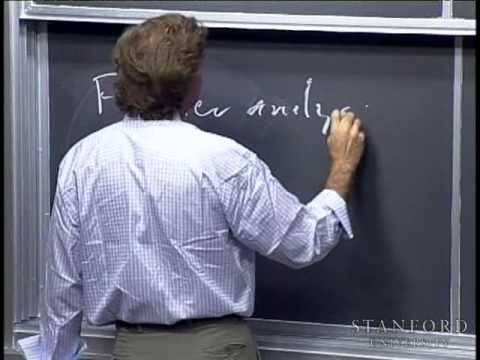
Lecture by Professor Brad Osgood for the Electrical Engineering course, The Fourier Transforms and its Applications (EE 261). Professor Osgood provides an overview of the course, then begins lecturing on Fourier series.
The Fourier transform is a tool for solving physical problems. In this course the emphasis is on relating the theoretical p...
sinful narwhal
ivory wyvern
Considering you are in ECE, id reccomend these resources (in order of usefulness...
thank you so much! :D
sinful narwhal
indigo totem
i love my man fourier
currently in a love-hate situation xD
learnt it all last week and i have my exam next week... its just too much information
indigo totem
sinful narwhal
currently in a love-hate situation xD
learnt it all last week and i have my exam...
i learn fourier transforms next sem, along with z-transforms, DFT, FFTs, etc
i learnt about fourier series in my math unit this sem, one of my favourite topics
sinful narwhal
indigo totem
i learn fourier transforms next sem, along with z-transforms, DFT, FFTs, etc
i'm currently learning it in two units. signal and systems theory and calculus 4. i've also learned Laplace and the z-transform... they're honestly extraordinary topics, but it frustrates me a bit not to have more time to master them
indigo totem
sinful narwhal
i'm currently learning it in two units. signal and systems theory and calculus 4...
whats calculus 4?
australian universities (or at least my one) has engineering math and advanced engineering math lol
sinful narwhal
indigo totem
whats calculus 4?
you can call it engineering math yea ahahah
i guess universities just give it different names
sinful narwhal
indigo totem
except when it becomes theoretical
for real! my calculus 3 professor would literally makes us WRITE in our exams. he would ask "what can you say about Taylors series?" "is this phrase true or false?" like- let us do actual CALCULUS
i understand theory is very important, but ill leave that with mathematicians
indigo totem
sinful narwhal
for real! my calculus 3 professor would literally makes us WRITE in our exams. h...
thats a really unique question lol
luckily all my exams have just been "solve this" or "evaluate this"
 dense rapids
sinful narwhal
you can call it engineering math yea ahahah
i guess universities just give it di...
dense rapids
sinful narwhal
you can call it engineering math yea ahahah
i guess universities just give it di...
I thought calculus 4 was real analysis, though
junior zinc
indigo totem
australian universities (or at least my one) has engineering math and advanced e...
what australian uni do u go to
 hard tartan
sinful narwhal
for real! my calculus 3 professor would literally makes us WRITE in our exams. h...
hard tartan
sinful narwhal
for real! my calculus 3 professor would literally makes us WRITE in our exams. h...
wth 😂 😂 😂
sinful narwhal
dense rapids
I thought calculus 4 was real analysis, though
nah thats literally calculus 1
calculus 4 is all about differential equations
sinful narwhal
hard tartan
wth 😂 😂 😂
i know... it was ridiculous ;-;
dense rapids
sinful narwhal
calculus 4 is all about differential equations
I see
indigo totem
junior zinc
what australian uni do u go to
its one in melbourne victoria, wont say the actual name here tho lol
junior zinc
indigo totem
its one in melbourne victoria, wont say the actual name here tho lol
ahh ok ok

 tulip egret
no
you're doing it correctly
look, your entered answer is exactly the same as the answer preview
ask your teacher if they can correct it on the teacher account
 lunar skiff
tulip egret
ask your teacher if they can correct it on the teacher account
lunar skiff
tulip egret
ask your teacher if they can correct it on the teacher account
Oh ok, thank you so much.
tulip egret
no problem, they should be happy to change it for you since your answer is quite literally the same as the answer expected
lunar skiff
tulip egret
no problem, they should be happy to change it for you since your answer is quite...
Well as I understand answer preview is just preview of answer that I entered, I mean it is not always true answer. But as you said, there is no possibility of other answers. It is weird. I think they did it wrong as you said again.
tulip egret
oh, is that so? i thought it was the expected answer, my bad
but yeah, in this case it seems like a possible computer rounding error that you can't possibly be expected to account for
at three significant figures, your answer is totally correct
lunar skiff
tulip egret
at three significant figures, your answer is totally correct
Yes it is the point
They don't want more than three significant figures and I did it according to that
I think it is their fault so I will send an e-mail 🙂
Thank you again ❤️
 paper reef
can anybody help me

 paper reef
Thank you so much
 gilded plaza
Anybody know specifically why they simplify to the highlighted part in this situation? Like it kind of makes sense to me but idrk how to apply it
 ivory wyvern
Are you talking about the reason they move sqrt15 to the top? If so, it’s mostly just the way more preferred by teachers, and it’s equivalent because you are just multiplying both the top and the bottom by the same number, sqrt 15, so that you can get a whole number on bottom instead of an irrational number
gilded plaza
ohhh gotcha, tysm!
 river tree
Hey guys do you know any good calculus playlist on youtube that teach calculus really good. I have semesters approaching and I can't find good recourses online cuz im not habitual to reading math books. Please help.
fallen flax
river tree
Hey guys do you know any good calculus playlist on youtube that teach calculus r...
professor leonard on yt
river tree
fallen flax
professor leonard on yt
Damn he got muscles
dire aurora
@obsidian spire sorry for the ping. I just wanted to ask you: when asked to approve this result, would it still be a valid proof to start from both ends and meet in the middle like they have done in the photo? Or is this also the same as assuming the result, which is invalid like you told me before?


Or is meeting in the middle valid because no result has been assumed or shown until the very end where they do in fact meet in the middle?
obsidian spire
dire aurora
Or is meeting in the middle valid because no result has been assumed or shown un...
When proving equality, often you have to prove things in two directions. 'Given this value A, I will reach the other value B', 'given value B, I will reach value A'.
They shortened the proof by showing, given one or the other, they are equal to the same value. A=C, B=C, then by transitivity, A=B.
It is possible for one value to imply another, but not the reverse. Like say (3)^2=b-> b=9, but 9=a^2, you could have a= -3 or 3. For example. Proving it in both directions is often needed for equality of numbers, sets, etc. Especially for things defined by a is true if and only if b is true.
dire aurora
obsidian spire
When proving equality, often you have to prove things in two directions. 'Given ...
I see. When a question asks to prove it probably means both directions and when it asks to show, its probably either direction. And sometimes, just working in one direction is sufficient to prove both directions.
Let me know if I got it wrong. Otherwise that was very helpful. Thanks!
indigo totem
dire aurora
<@708699779705602078> sorry for the ping. I just wanted to ask you: when asked t...
seeing this reminds me of why i love complex numbers and phasors
use em frfr
dire aurora
indigo totem
seeing this reminds me of why i love complex numbers and phasors
I don’t understand. Could you explain?
obsidian spire
dire aurora
I see. When a question asks to prove it probably means both directions and when ...
Whether you need to show in both directions or just 1 its usually about the wording of what youre trying to prove, the logic of it. The logic dictates what is needed to prove a statement is true.
'If p then q' statements can only be false if p is true and q is false. So you assume p is true, and show q must be true, which by logic proves it cannot be false so it's true. Many one way proofs are these sort of statements.
If p then q + if q then p, aka p if and only if q, are the sort of statements you usually need 2 direction proofs for.
Get into logic and truth tables to see more of the mechanisms of proofs
obsidian spire
What do you guys think of sage math?
dire aurora
obsidian spire
Whether you need to show in both directions or just 1 its usually about the word...
Got it
dire aurora
dire aurora
Got it
These equality proofs don’t have much wording but i know what to do for questions with more wording
Thanks!
dire aurora
For a question like cos(2x) = cos(90-x), where 0<x<360, how do i know which quadrants 2x should be if i want to take the inverse cosine of both sides, without refering to the graphs of cosine and sine?
I can use identities to manipulate that equation into (-2sinx+1)(sinx+1) = 0, the cases of which i know exactly which quadrant x should be in by looking at the right hand side of the equations formed by making the ratios alone the subject, which will always contain a constant. But when the right hand side isnt a constant, how am i supposed to know which quadrants the arguments should be in?
dire aurora
Okay never mind. ChatGPT explained it to me 👍🏼👍🏼
 slender spear
The sum of the numerator and denominator of a fraction is 14. Numerator is 4 less than the denominator. Find the fraction
The length of a room exceeds its breadth by 3 meters. If the length is increased by 3 meters and the breadth is decreased by 2 meters, the area remains the same. Find the length and breadth of the room.
Solve x + y = 2 x - y = 0
The area of a rectangle gets reduced by 9 m² if its length is reduced by 5 m and breadth increased by 3 m. If we increase the length by 3 m and breadth by 2 m, the area is increased by 67 m². The length of the rectangle is
1)9m
2)15.6 m
3)17 m
4)18.5 m
If the equations 3x + 4y = 12 and (a + b) * x + 2(a - b) * y = 3a - 1 has infinitely many solutions then a and b satisfy the equation is
a - 5b = 0
5a - b = 0
a + 5b = 0
5a + b = 0
slender spear
@candid moth
@candid moth The sum of the numerator and denominator of a fraction is 14. Numerator is 4 less than the denominator. Find the fraction
/calc The sum of the numerator and denominator of a fraction is 14. Numerator is 4 less than the denominator. Find the fraction
left knoll
slender spear
The length of a room exceeds its breadth by 3 meters. If the length is increased...

 slender spear
Thanks!
left knoll
Have to study math topics entirely from YouTube for a while, running into doubts and I end up switching videos in that case. Not able to cover enough ground due to that. I can send questions here right?
slender spear
left knoll
Have to study math topics entirely from YouTube for a while, running into doubts...
Sure!
Ofc man, that’s what this is got
left knoll
Yes I mean I just wanted to be sure because I am in a MESS 😭
slender spear
Oh it’s Alr, sry if I made u sad or anything
slender spear
left knoll
Yes I mean I just wanted to be sure because I am in a MESS 😭
Which grade r u in if I may ask
thick copper
I did not cover this in class

 quiet burrow
anyone know ai for math but not chagpt
obsidian spire
thick copper
I did not cover this in class
You multiply vector one by an unknown integer a, and vector two by unknown integer b. Add the two vectors with these variables introduced, see what values allow you to reach 71 for x and 33 for y.
 vestal tide
quiet burrow
anyone know ai for math but not chagpt
vestal tide
quiet burrow
anyone know ai for math but not chagpt
photomath pro
indigo totem
dire aurora
I don’t understand. Could you explain?
you can convert a sinusoidal function to a complex number and then a phasor, and then you can use basic multiplication and addition to simplify it down, and then convert it back to a sinusoid
left knoll

 split mural
Can anybody help me with stats?
 outer hull
What did I do wrong? - Dimensions & dimensional analysis


 lyric leaf
@outer hull in the equation give, the denominator is c^3 not just c, also i think going from the second to the third line theres a small mistake in copying down a number
 ember garnet
left knoll
ember garnet
left knoll
270 with leading zeros allowed, 243 without it
 true hemlock
a bit of a desperate attempt: I waited too long to study for two exams i have for my online classes. One of them is calc 2 and idk if I'll do really well on it. Any tips on how to salvage my grade/fix my mindset before I inevitably have to take the exam?
 lilac jungle
true hemlock
a bit of a desperate attempt: I waited too long to study for two exams i have fo...
lilac jungle
true hemlock
a bit of a desperate attempt: I waited too long to study for two exams i have fo...
Hi! My two cents;
- Calc2 is really about mechanical practice and quickly recognizing how are you supposed to tackle that specific type of problem, so try to have a battery of problems with most common strategies
- If possible check the specific examples given in class or your guide book, because much of calc2 are variations of the examples given (granted more obscure or difficult but still similar)
If you want to chat or some examples of what I mean feel free to dm me.
true hemlock
Thank you!
obsidian spire
true hemlock
a bit of a desperate attempt: I waited too long to study for two exams i have fo...
Depends on how much time you have. The way id do it with very little time is go over the theorems to make sure you can remember them on the chapters your class covered. Then do practice test. Then go over homeworks.
If its really not making sense id say read through the chapters first to see what is actually going on.
If they dont follow the textbook closely go over your lecture notes instead of the textbook for theorems and to understand
 ember garnet
 keen walrus
integral of 2 pi x [g(x)-f(x)] dx from x=5 to x=6
 exotic matrix
keen walrus
exotic matrix
keen walrus
Is that geometry
 zinc zodiac
hellooo can someone tell me where i messed up TvT

grade 11 functions btw, if its illegible i can type it -v-;
answer is supposed to be 1/35b but im not sure where the mistake is :'D
ember garnet
zinc zodiac
answer is supposed to be 1/35b but im not sure where the mistake is :'D
your mistake is on the third and fourth line
on the third line, when you write the division explicitly, (49 a^-4 b^2) should all be in the divisor.
when you turn the division into a multiplication by the inverse of the divisor, the inverse of the divisor should be 1/(49 a^-4 b^2)
the a's cancel out and the b is in the denominator
zinc zodiac
i was trying to get rid of the negative exponent though, which is why i split up the divisor so i could flip 49a^-4/1 to 1/49a^4
zinc zodiac
ember garnet
the a's cancel out and the b is in the denominator
ohh right
thank youuuuu :D
zinc zodiac
zinc zodiac
i was trying to get rid of the negative exponent though, which is why i split up...
could you explain why this is wrong though ;v;
ember garnet
zinc zodiac
i was trying to get rid of the negative exponent though, which is why i split up...
if you don't wanna have negative exponents then a stays in the numerator after inversing it by just changing the sign of its exponent
the inverse of a^-4 is a^4
it doesn't go to the denominator
ember garnet
ember garnet
when you turn the division into a multiplication by the inverse of the divisor, ...
so you could write this 1/(49 a^-4 b^2) as a^4/(49 b^2)
the a's still cancel out
zinc zodiac
ember garnet
it doesn't go to the denominator
i was taught that if you had like x^-y you could turn it into a fraction with 1/x^y
ember garnet
zinc zodiac
i was taught that if you had like x^-y you could turn it into a fraction with 1/...
yes that is true, however in your problem you are taking its inverse also
 zinc zodiac
ember garnet
yes that is true, however in your problem you are taking its inverse also
zinc zodiac
ember garnet
yes that is true, however in your problem you are taking its inverse also
thank youuuu, ill be more careful looking for inverses w/o needing to flip noww :3
ember garnet
zinc zodiac
yyayay i think i did it -v-
yes, that is correct now
but if you insist on getting rid of the negative exponents first, you could do it like this. It's the same thing

so first you take rid of the negative exponent and then you inverse, or you could first inverse and then change the negative exponent, better to do them one at a time so you don't make accidental mistakes
zinc zodiac
ember garnet
but if you insist on getting rid of the negative exponents first, you could do i...
ooo alrightt
zinc zodiac
ember garnet
so first you take rid of the negative exponent and then you inverse, or you coul...
yes i will write out each step moving forward -v-;
ember garnet
zinc zodiac
thank youuuu, ill be more careful looking for inverses w/o needing to flip noww ...
you're welcome :)
zinc zodiac
ember garnet
but if you insist on getting rid of the negative exponents first, you could do i...
this makes me so unreasonably happy i love that you can just kidnap the negative part and yeet it to the other side of the fraction lmao
ember garnet
zinc zodiac
this makes me so unreasonably happy i love that you can just kidnap the negative...
hahahaha yeah that's an interesting description of what's happening there 😆
 twilit crane
cool
welcome
 hardy tiger
 radiant mango
im just a 9th grader
radiant mango
im just a 9th grader
Same here
zinc zodiac
helloooo i need help againnn -v-;

apparently the only thing I got wrong was the 8 in the final answer should be negative
from my understanding though, the sec135 is negative but because its subtracted it becomes positive so its added..
ember garnet
zinc zodiac
from my understanding though, the sec135 is negative but because its subtracted ...
It's not the sec135 that is subtracted but the square of sec135. The square of sec135 is of course positive. So you are subtracting something positive. So in the end it should have a negative sign.
zinc zodiac
ember garnet
It's not the sec135 that is subtracted but the square of sec135. The square of s...
isn’t sec135 -√2 though ;v;
the negative sign is left out from what I know, the square cancels out the root, so then its subtracting -2
ember garnet
zinc zodiac
the negative sign is left out from what I know, the square cancels out the root,...
it's - [sec(135)]^2 = - [-√2]^2 = - (2) = - 2
zinc zodiac
ember garnet
it's - [sec(135)]^2 = - [-√2]^2 = - (2) = - 2
so the square cancels out the negative and the root?
ember garnet
zinc zodiac
so the square cancels out the negative and the root?
yes, this is a property of exponents
(ab)^2 = (a^2) (b^2)
here you basically have a = -1 and b = √2
(-√2)^2 = (-1 √2)^2 = (-1)^2 (√2)^2 = (1) (2) = 2
ember garnet
any real number squared is positive, or at least not negative
radiant mango
hardy tiger
Same here
niceee
left knoll
ember garnet
any real number squared is positive, or at least not negative
complex numbers are exception, aren't they?
ember garnet
left knoll
complex numbers are exception, aren't they?
true, I should have said any real number
 bold ibex
how do i find out the e value of 0.171 * 10^37 using a scientific calculator
mystic thunder
 ivory wyvern
bold ibex
how do i find out the e value of 0.171 * 10^37 using a scientific calculator
ivory wyvern
bold ibex
how do i find out the e value of 0.171 * 10^37 using a scientific calculator
In scientific notation that equivalent to 1.71e36. We find this by getting one digit in the 1s place, and the rest will be a decimal. Then e will be the value that you put into the exponential of 10^36, or 36.
dire aurora
Could someone please explain the solution to this question?

 blissful nexus
mystic thunder
blissful nexus
mystic thunder
first plug the values in to see if they work
if they don’t find left and right side limits
also consider like the biggest term to find this limit
so as x goes to infinity does (tan x) ^2n get larger than x^2?
actually idk this question is weird
i’ll see later
ember garnet
dire aurora
Could someone please explain the solution to this question?
Is this vector notation? If so, it should be D, but the question should also state that points A, O, and C are collinear
 maiden lake
ember garnet
Is this vector notation? If so, it should be D, but the question should also sta...
maiden lake
ember garnet
Is this vector notation? If so, it should be D, but the question should also sta...
Why is your name iamphysics lol
ember garnet
maiden lake
Why is your name iamphysics lol
lol what's wrong with it?
dire aurora
ember garnet
Is this vector notation? If so, it should be D, but the question should also sta...
I dont get why the answer is D
ember garnet
dire aurora
I dont get why the answer is D
why do you say that? did you find something else?
dire aurora
no. I just have no clue how its any of those options
ill try again
no clue
do i need to find an expression for AB?
 bright finch
How the fuck do I remember this for my exam. This is chaotic
 ember garnet
dire aurora
do i need to find an expression for AB?
ember garnet
dire aurora
do i need to find an expression for AB?
think about the geometric interpretation of the dot product

in the answer D, the projection of 2a onto b is b itself
dire aurora
we dont know that its a right triangle tho
ember garnet
because the angle ABC is a right angle, because AC is a diameter of the circle (which is not explicitly stated in the problem but it should, because without it you can't really answer anything)
ember garnet
dire aurora
we dont know that its a right triangle tho
if AC is a diameter, it is a right angle
if it isn't, no statement has to be true
dire aurora
B is a point on the circle, so triangle is not necessarily right
but thanks for helping get to the bottom of that. the question was poorly written
ember garnet
dire aurora
B is a point on the circle, so triangle is not necessarily right
the only necessary condition for ABC to be a right angle is that AC be a diameter of the circle
dire aurora
ember garnet
the only necessary condition for ABC to be a right angle is that AC be a diamete...
Is there a nice way to derive this statement so i can rememeber it better?
could it be related to something like the law of cosines?
ember garnet
dire aurora
Is there a nice way to derive this statement so i can rememeber it better?
it is Thales's Theorem
https://en.wikipedia.org/wiki/Thales's_theorem

In geometry, Thales's theorem states that if A, B, and C are distinct points on a circle where the line AC is a diameter, the angle ∠ ABC is a right angle. Thales's theorem is a special case of the inscribed angle theorem and is mentioned and proved as part of the 31st proposition in the third book of Euclid's Elements. It is generally attribu...
dire aurora
do you personally remember it by the thing itself?
chatgpt gave some cool derivations
ember garnet
dire aurora
chatgpt gave some cool derivations
To use it in your answers, you don't have to derive it or prove it -- it was proven more than 2000 years ago in Euclid's Elements
unless the question specifically asks you to prove it
It's an established, famous, and widely used theorem. I just remember it.
ember garnet
bright finch
How the fuck do I remember this for my exam. This is chaotic
you haven't learned this trick?

the only thing you need to remember is the sign flip for the middle term
maiden lake
ember garnet
lol what's wrong with it?
Nothing
Like to know the reason behind it
ember garnet
maiden lake
Nothing
Like to know the reason behind it
because I have a degree in Physics
bright finch
ember garnet
you haven't learned this trick?
this is huge thanks
maiden lake
ember garnet
because I have a degree in Physics
That's a ton
Congrats
ember garnet
maiden lake
That's a ton
Congrats
Thanks!
 sinful sedge
bright finch
How the fuck do I remember this for my exam. This is chaotic
sinful sedge
bright finch
How the fuck do I remember this for my exam. This is chaotic
Very easy bro, js solve 10-15 questions and then you are never gonna forget it
bright finch
sinful sedge
Very easy bro, js solve 10-15 questions and then you are never gonna forget it
Yeah the method listed above helped alot
Anybody know how I can identify and draw this equations conic

(I translated from portuguese dunno if im saying this correctly in english)
ember garnet
bright finch
Anybody know how I can identify and draw this equations conic
You need 3 dimensions to draw it, it has 3 variables. You can do it in desmos.
zinc zodiac
hellooo can someone help me clarify the answer to this -v-;

ik its a geometric series, so the formula for it is [a(r^n-1)]/(r-1)
my teacher is insistent that the answer is 33140, but i dont see how thats right because it wouldnt even count the emails from just two months; even without any new users, the amount of emails should be at least 342,000 🫠
ember garnet
zinc zodiac
my teacher is insistent that the answer is 33140, but i dont see how thats right...
it's around 777k?
zinc zodiac
yeah ok cause thats what i got too TvT
ember garnet
 zinc zodiac
alright yeah i got 777,216 too
welp i dont think my teacher is gonna accept that she's wrong and give me the mark but validation is nice -v-
ember garnet
zinc zodiac
welp i dont think my teacher is gonna accept that she's wrong and give me the ma...
show her this table above, it's undeniable
zinc zodiac
ember garnet
show her this table above, it's undeniable
i sent her an email this morning, if she responds with more defense for her answer then i will
thank youuu :]
ember garnet
zinc zodiac
i sent her an email this morning, if she responds with more defense for her answ...
I'd like to know her defense too :P
zinc zodiac
ember garnet
I'd like to know her defense too :P
i think she used 0.14 for r in the formula
but its meant to be 1.14 and im pretty sure 0.14 just gives you the amount of new users
ember garnet
zinc zodiac
but its meant to be 1.14 and im pretty sure 0.14 just gives you the amount of ne...
yeah
ember garnet
zinc zodiac
i think she used 0.14 for r in the formula
that would mean that the site loses 86% of its user base each month
after 9 months they would have 0 users
zinc zodiac
that genuinely made me lol omg
realistically though i bet they'd still send emails to users that left 🫠
ember garnet
zinc zodiac
realistically though i bet they'd still send emails to users that left 🫠
yeah true lol
blissful nexus
ember garnet
after 9 months they would have 0 users
lmfao i read through this 😭
why the teacher being so adamant
💔💔
zinc zodiac
sadly, lots of teachers i know dont like admitting theyre wrong, especially math teachers TvT
i will let you guys know if she admits though ^^
blissful nexus
zinc zodiac
sadly, lots of teachers i know dont like admitting theyre wrong, especially math...
omg lowk
reminds me of this one time
i used some notation in math and my teacher crashed out even tho it pretty much meant the same thing and made me write what she wrote
zinc zodiac
lmao T-T
my teacher is also really strict on notation and stuff, though honestly i get it cause the course is online so its much easier to cheat -v-
blissful nexus
zinc zodiac
my teacher is also really strict on notation and stuff, though honestly i get it...
brah but when i use the same notation when im talking to people who do math every single damn day and have like equally as important experience is fine 💔 🥀
its suddenly invalid when i use it in her class
zinc zodiac
hhhh we love stubborn strict teachers 🫠
bright finch
Guys the question I have is "Identify and draw the conic given by the equation:"

And when i put said equation in desmos all it gives me is this:

Is this what its supposed to be?
only reason it even shows up is because of that z = 1 slider thats not even originally in the question I had to add it to see something
 stark onyx
bright finch
And when i put said equation in desmos all it gives me is this:
stark onyx
bright finch
And when i put said equation in desmos all it gives me is this:
thats a 3d equation
use desmos 3-d, not desmos
 bright finch
stark onyx
thats a 3d equation
bright finch
stark onyx
thats a 3d equation
That was it tysm
 weary olive
(\log (\sqrt{a})-\log _{\sqrt{5}}(a)=2) need help

i already change the base surd 5 to base 10, i also done substitute the loga onto an unknown but after that i dont know what to do anymore
got a various answer, but none are correct by the validity test
what do you think
hotel? trivago
aint nobody reading this shit dawg :/
left knoll
@weary olive do u know how to solve atfter last step?

 zinc zodiac
i will let you guys know if she admits though ^^
zinc zodiac
zinc zodiac
i will let you guys know if she admits though ^^
SHE SAID SHE WAS WRONG AND SHE GAVE ME THE MARK 
ember garnet
zinc zodiac
SHE SAID SHE WAS WRONG AND SHE GAVE ME THE MARK <:Roar:837429513133490266>
good for you! she finally folded haha
left knoll
zinc zodiac
SHE SAID SHE WAS WRONG AND SHE GAVE ME THE MARK <:Roar:837429513133490266>
w teacher
 rigid mist
Can anyone help me with this. I dont understand

and if anyone knows any good resources for studying Logic that'd be very helpful
 timber trail
Has anyone ever taken or will take the Putnam? insights would be greatly appreciated
weak lotus
rigid mist
Can anyone help me with this. I dont understand
C is correct because the biconditional captures mutual implication
(if im not mistaking)
First one (your answer) is wrong because CPOS (contrapositive) is the other way around
i.e. The formula not X --> not Y is not logically equivalent to X --> Y. The correct contrapositive is not Y --> not X, and not; not X --> not Y
idk if i make sense
lmk
what can be good is finding examples and work with those examples
make it a lot less "abstract" if you see what i mean
gl!
rigid mist
tysm, i had a face palm moment when i saw the CPOS switched
but the weird thing is option D is also correct
It says that in the answer booklet but doesnt explain why. Ig the answer booklet could have a mistake in it
weak lotus
rigid mist
tysm, i had a face palm moment when i saw the CPOS switched
Now you know it. Mistakes are the best!
rigid mist
Is option D correct also btw?
keen walrus
Hey guys, I need help getting started. How would I solve this problem?
 left knoll
keen walrus
Hey guys, I need help getting started. How would I solve this problem?
left knoll
keen walrus
Hey guys, I need help getting started. How would I solve this problem?
it is a standard formula- the answer is log |x+ (x-a)^1/2 | + c.
you can rewrite the integration as dx/sqr( (x)^2- (5)^2)
where, your a=5
or you can put x=5 sec theta to solve the question
 tranquil yarrow
how come /tex isnt available (for me at least)
left knoll
tranquil yarrow
how come /tex isnt available (for me at least)
are u asking why not put x=tantheta?
tranquil yarrow
left knoll
are u asking why not put x=tantheta?
Oh no the #how-to-use-math-bot channel suggests there’s a command called /tex to put tex in but it doesn’t come up for me
left knoll
tranquil yarrow
Oh no the <#865670834210471966> channel suggests there’s a command called /tex t...
ah, i see. try using forward slash
'/tex'
 mortal chasm
Why is there a 0x^3 and 0x where did that come from

 left jungle
oh those are just placeholders
left jungle
mortal chasm
Why is there a 0x^3 and 0x where did that come from
a polynomial is an expression of the form a_n*x^n+a_n-1 times x^n-1..., when youre dividing you need to take this into account or else when you subtract, you will be subtracting the wrong degrees
tulip egret
never ever forget them when you do polynomial long division 😞
left knoll
mortal chasm
Why is there a 0x^3 and 0x where did that come from
doesn't matter if u write or dont write 0x^3 or 0x. you can still solve. 0's are added to eliminate confusion.
mortal chasm
left knoll
doesn't matter if u write or dont write 0x^3 or 0x. you can still solve. 0's are...
Yh i still got the same answer in the end
left knoll
mortal chasm
Yh i still got the same answer in the end
congrats!
if i am not wrong, the equation is not fully divisible by x-3 right?
mortal chasm
left knoll
congrats!
if i am not wrong, the equation is not fully divisible by x-3 right?
Theres a remainder so yh

 narrow tundra
 timber trail
Anyone here that has aspired to or has taken the Putnam? If so, could you dm me. Your advice would be greatly appreciated
 umbral thunder
paper reef
umbral thunder
paper reef
since this is definite integration i think u have to solve the numerator first and then u will get a normal limit with x only as a variable, that'll work since the limit only asks x -> pi/2
paper reef
umbral thunder
since this is definite integration i think u have to solve the numerator first a...
Oooohkii thankss

 ember garnet
mortal chasm
why is there a 3x i dont get it
ember garnet
mortal chasm
why is there a 3x i dont get it
expand (x+2)(x+1)
 carmine solar
 weak lotus
carmine solar
weak lotus
carmine solar
cant say the answer, cuz there is a whole lot to calculate, but can try and help you through it
if you take the first term, you can denote it as X
second term as Y
You can write x with the help of a geometric series and then you could take the real part of that expression, instead of expanding, you coudl - i think so, has been a while - just calculate it with numerical (dont know if you have a calculator lmao)
you know cos of pi/6
you calculate cos of k.theita
add those
put into X and you have p
use p to find the rest of the answer
carmine solar
Thank u
 weak lotus
 vivid coral
going to postive infinity
how do i say this
to the right of the x-axis
like you approach it from the right
💀
 misty belfry
Can someone explain why on the LHS beta become negative beta when using the cofunction, max confused

the last and second last step
I got itttttttttttttttttttttttttttttttt. Genuis of algebra. god some might say. hahahahahahahah
 tired fable
vivid coral
Can someone tell me what 5^+ means? Thanks, this is for Calc AB preparation
tired fable
vivid coral
Can someone tell me what 5^+ means? Thanks, this is for Calc AB preparation
Approaching positive 5 from the right side. So like 6, 5.5, 5.1, 5.001, ..., but only from numbers greater than 5
 spiral wraith
My approach to this problem is that arrange let's say men in n! ways
which will create n+1 gap and then I can use P(n+1,n) for arranging
But it seems wrong and I cannot figure out why?
 ember garnet
spiral wraith
My approach to this problem is that arrange let's say men in n! ways
which will ...
ember garnet
spiral wraith
My approach to this problem is that arrange let's say men in n! ways
which will ...
With P(n+1,n) you also include arrangements that have one unfilled gap which violates the condition that the men and women alternate
It's just n! n! for when the first person is a man and n! n! for when the first person is a woman, so in total there are 2 n! n! ways
spiral wraith
ember garnet
With P(n+1,n) you also include arrangements that have one unfilled gap which vio...
Thanks bruv!
spiral wraith
Cant get this one!
 ember garnet
spiral wraith
Cant get this one!
ember garnet
spiral wraith
Cant get this one!
what have you tried abou this?
weak lotus
 willow sparrow
guys i have some trouble learning induction
willow sparrow
guys i have some trouble learning induction
Can help you. What's the problem
spiral wraith
ember garnet
what have you tried abou this?
I am not able to understand the question to be honest!
ember garnet
spiral wraith
I am not able to understand the question to be honest!
4-permutations means selecting and arranging 4 distinct elements out of N elements.
In this question, N is 100. With the given conditions, some valid permutations are:
for (a):
- 95, 1, 2, 3 (where k = 1)
- 11, 95, 12, 13 (where k = 11)
- 4, 5, 92, 6 (where k = 4)
- 7, 8, 9, 99 (where k = 7)
for (b): - 95, 1, 2, 3 (where k = 1)
- 42, 43, 44, 91 (where k = 42)
spiral wraith
ember garnet
4-permutations means selecting and arranging 4 distinct elements out of N elemen...
Oh I get it now! thanks
spiral wraith
Need help with part D

 loud nexus
spiral wraith
Need help with part D
loud nexus
spiral wraith
Need help with part D
you gotta make cases and solve mate
willow sparrow
weak lotus
Can help you. What's the problem
sry Im late but I get that it's used in a lot of math important things but a lot says that it's unreliable specially that it can be that every case i pick the eq is right but it can be a coincidence , anyways i'm sure there is smth Im missing
weak lotus
willow sparrow
sry Im late but I get that it's used in a lot of math important things but a lo...
can you elaborate using an example?
 rough mist
Anyone know any good free courses for algebra based physics
Im gonna be taking a class with it including a lab so i kinda new a refresher lol
Or any good textbooks
maiden lake
Fake
 ebon relic
am i trippin or this question is wrong ?

 flat copper
 ember garnet
Yeah, it's 18
ebon relic
ember garnet
Yeah, it's 18
thanks
left knoll
ebon relic
am i trippin or this question is wrong ?
can we say that one side is 18 units and remaining 2 sides are 9 2½ units each? @ember garnet
ember garnet
left knoll
can we say that one side is 18 units and remaining 2 sides are 9 2½ units each? ...
If by 9 2½ you mean 9√2, then yes.
 vague wadi
Anyone have a good tool/way recommendation to self teach calc 1-3
 whole timber
vague wadi
Anyone have a good tool/way recommendation to self teach calc 1-3
whole timber
vague wadi
Anyone have a good tool/way recommendation to self teach calc 1-3
you can search for professor Leonard on Youtube. He has three playlists for calc 1-3. His explanations are very easy to understand and a good way to self study for calc imo.
tulip egret
<@&942391219206647828> i think this user was banned, but somehow this phishing message still remain 🤔
 tropic oyster
tulip egret
<@&942391219206647828> i think this user was banned, but somehow this phishing m...
tropic oyster
tulip egret
<@&942391219206647828> i think this user was banned, but somehow this phishing m...
thats strange. its gone most places. ill get it removed manually, thanks!
tulip egret
thank you !
 daring lotus
Heyy guys, im bad at math and i want to start from 0, any recommendations?
 green swift
daring lotus
Heyy guys, im bad at math and i want to start from 0, any recommendations?
green swift
daring lotus
Heyy guys, im bad at math and i want to start from 0, any recommendations?
i'd take the kahn academy test first to see where you are
hi all i am having trouble identifying if this limit exists or not for g(x) as x approaches 2 from both sides.
I am confused because I thought you need to look at both curves from each side to know if it exists or not. So it shouldn't exist since the other curve doesn't even go to positive 2 but my friends say otherwise.
Any input is welcome. thanks.
 ember garnet
green swift
hi all i am having trouble identifying if this limit exists or not for g(x) as x...
ember garnet
green swift
hi all i am having trouble identifying if this limit exists or not for g(x) as x...
what do you mean the other curve doesn't even go to positive 2?
the limit exists in both cases
ivory wyvern
green swift
hi all i am having trouble identifying if this limit exists or not for g(x) as x...
It going to 2 does not require continuity before, it just needs a small section to exist (of any non zero length) before x=2
 potent sundial
please help with this
 left knoll
potent sundial
please help with this
left knoll
potent sundial
please help with this
put e^.. term as t
and then solve
is it 4x or f(x)?
potent sundial
its psi x
left knoll
potent sundial
its psi x
could u send the question prrperly again?
eternal elk
nice

 cerulean dust
yo i had a question from Graph Theory, let's say there are 2 graphs and their degree sequence is the same, same numbers repeated for the same amount of times (for eg. graph1 has deg sequence as 3,3,3,3,3 and graph2 has deg sequence as 3,3,3,3,3 - same number repeated for the same amount of times), in such case, can we call the graphs Isomorphic without taking the One-One correspondence of Vertices and Edges ?
obsidian spire
daring lotus
Heyy guys, im bad at math and i want to start from 0, any recommendations?
Check out professor Leonard on YouTube for the basics. Look for a textbook with solutions in the back to practice problems from, and read through the textbook sections if the problems aren't making sense. Write down math words and write out what they mean, then double check yourself every so often.
Start with the earliest level of math that is confusing you, no matter how early that is. Getting the basics figured out makes the rest a lot easier.
potent sundial
Im - Imaginary part. Please solve this for r=0.5 and theta= pi/3

 azure narwhal
potent sundial
Im - Imaginary part. Please solve this for r=0.5 and theta= pi/3
azure narwhal
potent sundial
Im - Imaginary part. Please solve this for r=0.5 and theta= pi/3
what have you tried?

 cinder moat
potent sundial
Im - Imaginary part. Please solve this for r=0.5 and theta= pi/3
cinder moat
potent sundial
Im - Imaginary part. Please solve this for r=0.5 and theta= pi/3
This almost looks like you are supposed to to manipulate trigonometric identities
 tall knot
potent sundial
Im - Imaginary part. Please solve this for r=0.5 and theta= pi/3
tall knot
potent sundial
Im - Imaginary part. Please solve this for r=0.5 and theta= pi/3
alll u gota do is develop e^(i * theta) = cos(theta) + isin(theta) then multuply what u have at the bottom and the top by (2-2cos(theta))+2isin(theta) and try to isolate the imaginary part and the real part
 daring void
Guys im so slow in math and i feel so left behind in class, when teach puts exercises that we should be able to do, other people finish fast and im still struggling with the first ones, what can i do??
 fluid heath
daring void
Guys im so slow in math and i feel so left behind in class, when teach puts exer...
fluid heath
daring void
Guys im so slow in math and i feel so left behind in class, when teach puts exer...
Hello ! I think it is normal to feel so. Each have their pace and their way of learning. I advise you go home and redo the exercises you solved at school and try to solve others that are similar, by time you will be able to get faster and catch up with the rest.
daring void
fluid heath
Hello ! I think it is normal to feel so. Each have their pace and their way of l...
Thank you for the fast reply, im trying to balance my hobbies with school, knowing everyday except Wednesday i go to school at 8am and finish at 6 pm, how often should i practice maths? And what about my other subjects
fluid heath
daring void
Thank you for the fast reply, im trying to balance my hobbies with school, knowi...
Try to practice maths after each maths session, be it in a break or when u go back home and rest. No need to do long sessions, just 15 to 30 minutes revising the lessons and exercises you had at class, then in weekends or whenever you can, look for exercises about the same topic and try to solve new ones, even if theh are challenging and if you couldn t solve them.just ask your teacher for help. Otherwise i can help !
daring void
fluid heath
Try to practice maths after each maths session, be it in a break or when u go ba...
Alright thank you, ill keep you in mind and ill try
daring void
fluid heath
Hello ! I think it is normal to feel so. Each have their pace and their way of l...
Hey, just took my math exam today, i redid all the exercise she gave us the other day and turns out i was just not thinking, i understood everything and i answered to all the questions with no problem, hoping to get a good grade 🙏
Ill practice more often and share my progress!!
fluid heath
daring void
Hey, just took my math exam today, i redid all the exercise she gave us the othe...
Good job ! Keep it up.
 azure wolf
no math help?
damn
i feel like i have no purpose
 candid mothBOT
The renderer took too long to respond.
azure wolf
vro 😭
candid mothBOT
The renderer took too long to respond.


 tall knot
Could u give the full exercise?
azure wolf
tall knot
Could u give the full exercise?
It's from a poll i took (can't share)
just checking why the 1.45 exists... (couldn't find the proper correlation)
 woeful vale
Hey, could anyone help me understand how to calculate the dot product and cross product based on the graph from Task 1? I’m quite confused. Thank youuu guys
 tall knot
the dot means a scalar and the multiplication maybe means vectoriel?
left knoll
Any recommendations of apps or websites that give math lessons? Specifically for geometry? I'm starting a carpentry apprenticeship and would like to get my mental math skills better.
 elder socket
tks
ivory wyvern
woeful vale
Hey, could anyone help me understand how to calculate the dot product and cross ...
To calculate a dot product, split the vector into its two components (how much it moves in the x and y directions) and then multiply the x direction components together, and add them to the product of the y direction components. For example, for vectors <2,1>, <3,2> the dot product is 2 x 3 + 1 x 2 =8
you can see how to do the cross product by using this: https://www.youtube.com/watch?v=pWbOisq1MJU

This physics video tutorial explains how to find the cross product of two vectors (i, j, k) using matrices and determinants and how to confirm your answer using the dot product formula.
Vectors - Free Formula Sheet: https://www.video-tutor.net/precalculus-formula-sheets.html
Physics Video Lessons:
https://www.video-tutor.net/physics.htm...
woeful vale
ivory wyvern
To calculate a dot product, split the vector into its two components (how much i...
Ah, thank you a lot; I figured it out after that. The exam went well
left knoll
woeful vale
Ah, thank you a lot; I figured it out after that. The exam went well
glad to hear! if there was some angle give b/w the two vectors u could've solved it using sin theta and cos theta for cross product product and dot product respectively
ivory wyvern
woeful vale
Ah, thank you a lot; I figured it out after that. The exam went well
nw, sorry i dont check the server too often so i couldnt respond sooner
ivory wyvern
left knoll
glad to hear! if there was some angle give b/w the two vectors u could've solved...
do be careful though, the cross product equation using magnitudes and angles will only give you the magnitude of the cross product, not the vector quantity
 vernal sleet
IF p and q are the roots of x square+px+q=0, then value of p must be equal to
a) 0,1
b)1
c)2
d)o,-1
mystic thunder
vernal sleet
IF p and q are the roots of x square+px+q=0, then value of p must be equal to
1?
mystic thunder
nooooo
how
isn't products of roots = q
pq = q then p 1
dang
OH SHI
u gotta form a quadratic
equation
vernal sleet
mystic thunder
equation
bwahahahahahahahah
ivory wyvern
It cannot, as a side length will never be zero or infinity
 real birch
Hi! Could someone please explain how to do question d)(ii) without using cross product?
 tranquil yarrow
Cartesian? Carti seeyuh
 potent oriole
Hello im starting engineering and im really struggling my level is very bad im not able to solve problems so i always need to check the answer. I want to ask you about where can i find the answers like do u have an ai recommendation or books or YouTube channels.
 tropic lichen
guys i have a multivariable calculus midterm on friday 💔 but lowkey i haven't been to class much and even when i do go i don' learn much. the professor is so sweet but it's her first time teaching multi and you can tell. and my roommate took multi last semester (different prof) and they said it was h*ll on earth. im actually cooked does anyone have recs for multi resources? we don't have any assigned textbooks, and the recommended ones are like a couple hundred dollars each and im very broke. please if anyone has taken multi or calc iii please help ❤️
 civic summit
tropic lichen
guys i have a multivariable calculus midterm on friday 💔 but lowkey i haven't b...
civic summit
tropic lichen
guys i have a multivariable calculus midterm on friday 💔 but lowkey i haven't b...
have you tried https://tutorial.math.lamar.edu/Classes/CalcIII/CalcIII.aspx
Here is a set of notes used by Paul Dawkins to teach his Calculus III course at Lamar University. Topics covered are Three Dimensional Space, Limits of functions of multiple variables, Partial Derivatives, Directional Derivatives, Identifying Relative and Absolute Extrema of functions of multiple variables, Lagrange Multipliers, Double (Cartesi...
tropic lichen
civic summit
have you tried https://tutorial.math.lamar.edu/Classes/CalcIII/CalcIII.aspx
omg wow this is beautiful. tysm this is so much more organized than my lecture slides
civic summit
no problem 👍
indigo totem
tropic lichen
guys i have a multivariable calculus midterm on friday 💔 but lowkey i haven't b...
remember that you cant use the divergence theorem on an open surface and youre all good to go 👍
 opal frigate
Hey!
I have rather basic understanding problem regarding Relations and Functions and was wondering if someone would have interest and patience explaining it to me. I struggle with the "It just is this way, so use this formula and that's it" explanation.
I am a bit stuck on the wording as I am learning in German so please bear with me... I am in my first semester studying Computer Science, the approach on this university is more practical than theoretical, but maybe a bit of theory would help me now.
We just finished up the topic "Relations" so when you have.. and I hope I m using the right words ... for example 2 Groups like A={1,2,3} and B={a,b,c} and a specific Relation R which includes some of the tuples from AxB, what properties the R has, namely reflexive, symmetrical, antisymmetrical, asymmetrical and transitive. I understand that and find it pretty easy. We also did the same with AxA, and R resulting from operations like <, >, =, and so on. As I've said, I feel that I have understood all of that. The problem comes up the moment I have some kind of function, f.e. f(x) = x^(2) -1, or the other way of writing functions like y=x^(2)-1, where your "groups" are Real Numbers on Real Numbers or anything like that. I think the trouble lies in me having trouble with the idea of tuples before like a being an element of A and b being an element of B so you have (a,b) and looking for (a,a) or (b,b) to figure out whether the Relation is reflexive, vs doing the same with (x,y) or is it in fact (y,x) meaning what is R->R (Real Numbers) in comparison to A->B, and so on.
I am online for the next 8 hours, is someone interested in helping me?
** OR can point me towards a course or something explaining that well of course <3
weak lotus
opal frigate
Hey!
I have rather basic understanding problem regarding Relations and Functions...
i think what might help you is the fact that a relation, denoted by R which can be denoted by a function y = f(x), where you have input - denoted by x, and an output - denoted by y, is ordered.
Lets say we have the following relationship:
B, denoting Bigger then
a, denoting an object, lets assume a human (the tallest person on earth)
b, denoting an object, lets assume a human (any other person on earth, different from the one denoted in a)
Then Bab, states that: (i)
a is bigger then b.
Consider:
Bba, following from (i), we can deduce that Bba, is incorrect.
Why is this imporant? because its important to concider the fact that relations are ORDERED. They have a property where it DOES matter what element you take from your collections.
So lets now, with this in mind go to your example of y = x^2 - 1.
this is actually a alternative way of writing Rab, what it does is SHOW what happens when you take an element from A, put it into a "box", where the box here functions AS the function, and what result you get.
You could represent the problem in your questions as follows:
f(x): IR --> IR, with f(x) := y = x^2 - 1.
So what you do is take a number from IR, but it into f(x) and you get a result, which is y.
maybe its more clear when you consider the following:
f(x): IN --> IR, with f(x) := y = x^2 - 1
this is totally different; because you cant take ANY number, since your building blocks are elements of IN, which are 0, 1, 2,....
if youd pick numbers from IR\IN, then you dont do what the function asks you to do, that why the tuples i.e. ordered pairs are crucial to keep in mind.
To see what the property of a function is, you look at the definition of such a property and apply the given relation to the definition.
Lets take transitivity as an example:
A relation T, is transitive if (a,b) E T and (b,c) E T, then (a,c) E T?
apply this to f(x) = x^2 - 1, with f(x) = x^2 -1
(b = a^2 - 1) AND (c = b^2 - 1), THEN (c^2-1)?
lets say a = 2, then b = 3, so (2,3) E IR
let b = 3, then c = 8, so (3,8) E IR
following from the definition, since (a,b) and (b,c) E IR, it follows that (a,c) E IR.
8 = 2^2 -1
--> not true, so T is NOT transitive
Hope this helps!
opal frigate
I am still reading (it's a bit of a struggle with the writing, so it takes time), but I think I am starting to understand. Thank you so much! 
tropic lichen
indigo totem
remember that you cant use the divergence theorem on an open surface and youre a...
alright ill keep that in mind lol
 vital kernel
guys i need a little help in linear algebra
what letter (?) is that subscrit? that has a another subscrit that goes from 1 to d

I don't know that symbol at all
any idea?
tropic lichen
vital kernel
what letter (?) is that subscrit? that has a another subscrit that goes from 1 t...
yeah idk how to decipher that handwriting. it's like x (subscript(j1)) right? then keeps going j2 j3? i wanna say it's like j lambda? lambda looks like the only greek letter that would match but it doesn't fit exactly especially that like loop(?). i could also just be completely wrong
vital kernel
tropic lichen
yeah idk how to decipher that handwriting. it's like x (subscript(j1)) right? th...
yea bro but he (the professor) writes the lambda in a different way, and same thing for the j. hahaha impossibile to understand this symbol. i have decided to transcribe it as it is
thanks for the effort 🙂
tropic lichen
vital kernel
yea bro but he (the professor) writes the lambda in a different way, and same th...
good luck dawg, lin alg is already crazy hard i can't even imagine trying to learn it if i couldn't read my professor's handwriting
 bright hatch
any resources/tips on how to get good foundation in Algebra, Probability, and Statistics
tropic lichen
bright hatch
any resources/tips on how to get good foundation in Algebra, Probability, and S...
openstax has a bunch of free textbooks you can check out, and they're pretty good too. ive been using them for a couple of years now https://openstax.org/subjects/math

OpenStax offers free college textbooks for all types of students, making education accessible & affordable for everyone. Browse our list of available subjects!
 tired ferry
#math-help Can anyone tutor Differential Equations?

 delicate osprey
tired ferry
<#838057776584327198> Can anyone tutor Differential Equations?
delicate osprey
tired ferry
<#838057776584327198> Can anyone tutor Differential Equations?

YouTube
 wooden dune
 wintry geyser
Can anyone help me evaluate if I have transformed the matrix correctly?
wintry geyser
Can anyone help me evaluate if I have transformed the matrix correctly?
should be right.
tired ferry
delicate osprey
https://youtube.com/playlist?list=PLInywrvFyvq408vWA5OYXShA6rlT51TdS&si=zGgkLoHN...
Thankyou so much!
 toxic wolf
i’m freshman (15) and i don’t remember all of my multiples, which has lead me to rely on a calculator, how to relearn
i know 1s, 2s, 3s, 4s, 5s, 10s,11s and that’s it
delicate osprey
 ashen girder
every nightmare of engineers
ashen girder
every nightmare of engineers
not really
ashen girder
delicate osprey
not really
Atleast for me:(
In engineering youre forced to study it in most of the countries
left knoll
ashen girder
In engineering youre forced to study it in most of the countries
then dont do engineering if u atleast cant dedicate yourself to it
theres nothing without maths
its the basic u can do if u r opting for engineering
ashen girder
left knoll
then dont do engineering if u atleast cant dedicate yourself to it
im still studying it i never said that i wont study it
its just hard
left knoll
ashen girder
In engineering youre forced to study it in most of the countries
wuts this
ashen girder
left knoll
wuts this
im telling that i have to study maths
no matter
which country i am in
engineer requires maths
left knoll
ashen girder
im telling that i have to study maths
sure u have to it has no corelation with country
kk gl
potent oriole
Hello i haven't touched solidworks. I need to learn it. I have one week off but also a huge backlog in maths physics so i can't fully dedicate it only 4h maybe. Do you have any tips please
 lunar mica
anyone knows a AI that can scan a pdf file, then extracts a list of mathematical formuals in said file?
eternal elk
I've been struggling with this trigonometric identities for a week now, AND I JUST CAN'T UNDERSTAND
firstly I tried to understand the methods and then when I try to practice a problem, I just don't know how to begin
 pure oracle
I think you should see lectures on it
 shadow mural
hows the middle different from tje one on the right
 delicate osprey
shadow mural
hows the middle different from tje one on the right
delicate osprey
shadow mural
hows the middle different from tje one on the right
for the middle one u are twicing the value of g whereas in the rightmost one you are halfing the value. they are not equal
shadow mural
delicate osprey
for the middle one u are twicing the value of g whereas in the rightmost one you...
How r they equal
ivory wyvern
shadow mural
How r they equal
They are not, 1/(g/2) = 2/g. The left and middle are equivalent though
 bold prawn
how do yall study math?
sinful narwhal
bold prawn
how do yall study math?
lots of practice 
 cyan rock
eternal elk
firstly I tried to understand the methods and then when I try to practice a prob...
cyan rock
eternal elk
firstly I tried to understand the methods and then when I try to practice a prob...
Try to look for the possible substitution in the expression. You may have to rearrange terms first.
cyan rock
bold prawn
how do yall study math?
Read textbook section, attempt problems from said section.
weak lotus
bold prawn
how do yall study math?
what is also fun is when you have a solution, is trying a different method. which helps you understand it more xp
 static pine
each digit of a 9 digit number is 1. it is multiplied by itself. what is the sum of the digits of the resulting number?
delicate osprey
static pine
each digit of a 9 digit number is 1. it is multiplied by itself. what is the sum...
111111111* 111111111= 12345678987654320
the sum of resulting number is 9?
tulip egret
every digit is 1 and there are 9 of them
i trust that you've tried doing this already 🤔
 maiden lodge
static pine
each digit of a 9 digit number is 1. it is multiplied by itself. what is the sum...
maiden lodge
static pine
each digit of a 9 digit number is 1. it is multiplied by itself. what is the sum...
In recreational mathematics, a repunit is a number like 11, 111, or 1111 that contains only the digit 1 — a more specific type of repdigit. The term stands for "repeated unit" and was coined in 1966 by Albert H. Beiler in his book Recreations in the Theory of Numbers.
A repunit prime is a repunit that is also a prime number. Primes that are re...
Let R_n denote the repunit with n ones (e.g. R_3 = 111, R_9 = 111111111).
When n ≤ 9 there are no carries in the convolution that forms R_n^2.
Squaring R_n is the convolution of n ones with itself; the raw convolution coefficients are 1,2,3,…,n−1,n,n−1,…,3,2,1.
If n ≤ 9 none of those coefficients exceed 9, so they are exactly the decimal digits of R_n^2.
The sum of those coefficients is n^2 (because the sum of all entries in the convolution = (sum of the first vector)·(sum of the second) = n·n).
Hence for n ≤ 9 the sum of digits of R_n^2 equals n^2. That explains your example: R_9^2 digit-sum = 9^2 = 81.
 teal hatch

 delicate osprey
tulip egret
every digit is 1 and there are 9 of them
i trust that you've tried doing this al...
delicate osprey
tulip egret
every digit is 1 and there are 9 of them
i trust that you've tried doing this al...
I used a scientific calculator
 void sail
<@&942391219206647828> check this out
sorry for ping
bruh my friend was recently hacked and sent me the same exact messages lmao
void sail
again?!
screw it
<@&942391219206647828> im sorry for the ping again but it seems every channel is being hit with tis
 gaunt umbra
do people know how to not click on suspicious links
tropic oyster
void sail
<@&942391219206647828> im sorry for the ping again but it seems every channel is...
 thanku
void sail
gaunt umbra
do people know how to not click on suspicious links
way less than you realise
 opaque wagon
gaunt umbra
do people know how to not click on suspicious links
opaque wagon
gaunt umbra
do people know how to not click on suspicious links
out of 150k members, it is to be expected to have at least a few compromised accounts per day
 stark plaza
i want to brush up on all the basics of math is there any good sites i could go to to relearn it
 north linden
stark plaza
i want to brush up on all the basics of math is there any good sites i could go ...
north linden
stark plaza
i want to brush up on all the basics of math is there any good sites i could go ...
prolly khan academy videos
pretty good summarisation of concepts
 fast torrent
anyone online/?
 novel geyser
stark plaza
i want to brush up on all the basics of math is there any good sites i could go ...
novel geyser
stark plaza
i want to brush up on all the basics of math is there any good sites i could go ...
Watch unacademy jee basic math english
 glad iron
@everyone im really bad at math could some please just solve this because i dont understand shi
 tulip egret
did you really have to try and ping 150,000 people to get help on simple interest
you have all the variables given to you, put them in your calculator
solve for A
A=850+(850 x 0.045 x 10)
 pearl sentinel
glad iron
@everyone im really bad at math could some please just solve this because i dont...
pearl sentinel
glad iron
@everyone im really bad at math could some please just solve this because i dont...
U got all the values and formulas ig
Take 4 1/2 as 9/2
Rest is just substitution ig
 peak veldt

optimization question I dont understand
I've gotten as far as (w+4)(h+2)
for the border
i dont get it tho
left knoll
peak veldt
I've gotten as far as (w+4)(h+2)
its given w x h (area of flower bed ) = 646
so know u have a relation between w and h
let say A = (w+4)(h+2)
NOW PUT THE value of w in terms of h
and then evaluate
dA/dh = 0
.... as the minima or maxima would occur at the critical point only
the value of h that u will get will be either max or min value
if max .. then find out W using the earlier relation
if min .. u have ur answer
peak veldt
left knoll
its given w x h (area of flower bed ) = 646
so know u have a relation between w...
thanks
 solar bloom
hello guys, can anyone help me with this? its statics of rigid bodies. I started at Joint A then B - H, im having trouble solving joint g or c.
 timid delta
@solemn dirge
 umbral roost
Linear algebra exam in less than 5 hours, someone pls help. (This shouldn’t be difficult but I’ve done this many times and either yield -52 or 108 ; correct answer is 52.)

 wicked gulch
umbral roost
Linear algebra exam in less than 5 hours, someone pls help. (This shouldn’t be d...
wicked gulch
umbral roost
Linear algebra exam in less than 5 hours, someone pls help. (This shouldn’t be d...
Sorry if it is too late

 analog dove
heyguys i have to do a statistical analysis on a dataset for my econometrics class. requires R codeand OLS regression which i have done. in analysis i am doing t-tests, looking at confidence intervals, coefiicients, and p-values. and r^2 values. is there anything else i should talk about ?
umbral roost
wicked gulch
Sorry if it is too late
All good. Is there any reason the signs are different?
Im assuming it’s related to the position where (-1)^ij

Not entirely sure how to conceptualize this…
delicate osprey
umbral roost
Not entirely sure how to conceptualize this…
it is (-1)^i+j if I am not mistaken
umbral roost
You’re right sorry I forgot the +
Thank u guys for the help tho, really appreciate it
 timid meteor
yall i need help plz🙏

 patent kite
What have you tried? Or do you not have an idea where to start?
wicked gulch
 merry crystal
guys please help me...
merry crystal
guys please help me...

 spare ice
how would one do this limit with substitution 😅


 nimble seal
Can anyone help me understand Integration by Parts, prolly give a good resources that might help
 hexed cloak
umbral roost
Linear algebra exam in less than 5 hours, someone pls help. (This shouldn’t be d...
hexed cloak
umbral roost
Linear algebra exam in less than 5 hours, someone pls help. (This shouldn’t be d...
Just a quicker way using the sarus rule and a quicker expansion

The final product outputs 52
Also sorry for the terrible writing
 old delta
nimble seal
Can anyone help me understand Integration by Parts, prolly give a good resources...
old delta
nimble seal
Can anyone help me understand Integration by Parts, prolly give a good resources...
https://youtu.be/3zLQfuMZMF4?si=yEqbYmJqCJC_Zzfh this video might help you
spare ice
wicked gulch
ayyy okay thank you
 modest tusk
Need some help going through this problem. Ive already found the critcle value from the t-table which is 0.561, but I dont know what to do from there

 slim juniper
Anyone here know linear regression
tropic lichen
i have my discrete structures exam tomorrow and i can bring 1 piece of paper with me with notes on it. this is what i have so far, what do you all suggest i add? i have so much space and this is just the quick basics

 hexed cloak
tropic lichen
i have my discrete structures exam tomorrow and i can bring 1 piece of paper wit...
hexed cloak
tropic lichen
i have my discrete structures exam tomorrow and i can bring 1 piece of paper wit...
How much time have u guyys been working on these before the exam ?
 rancid plaza
tropic lichen
i have my discrete structures exam tomorrow and i can bring 1 piece of paper wit...
rancid plaza
tropic lichen
i have my discrete structures exam tomorrow and i can bring 1 piece of paper wit...
What year are you in?
This is very basics imo.
I'll recommend adding more amount functions. If any major theorem like the shroder bernstein are subjected. Write up proof steps.
I think this is more than enough (if this is exactly the domain that the exam is subjected to)
 raven galleon
rancid plaza
What year are you in?
This is very basics imo.
I'll recommend adding more amount...
raven galleon
rancid plaza
What year are you in?
This is very basics imo.
I'll recommend adding more amount...
my brother.. chill out w/ the disparaging comment😭
 narrow pier
Topologists?
I struggle with intuition when it comes to understanding what it means for a function to be continuous in topology
fallen flax
narrow pier
I struggle with intuition when it comes to understanding what it means for a fun...
the intuition for continuity is same regardless of any field in math
u are trying to find an error
by measuring a certain x close enough in f(x) u fill find a value close enough to said x
now u can say that continuity in topology is basically a function between metric spaces
i think most textbooks use a set of bases in metric spaces for the proof on topological continuity
but is practically the same intuition
also a lot of people find the neighbourhood to be more intuitive but i am not one of those people
opal frigate
hey!
if any german speakers here need help with Math, here is a Link to a site from a Fachhochschule (practical leaning University) in Vienna, Austria, which helps me quite a lot.
https://mathe.technikum-wien.at/
You can watch all kinds of explanations to fresh up things before the first semester (Basiswissen) and study up on things that you may or may not encounter during your studies (Studienwissen).
Here is where you find their videos, sorted by topic. https://mathe.technikum-wien.at/lernvideos Sadly it is a bit confusing in which sequence you should watch them, but mostly from top to bottom and left to right should serve you well.
There are also many, rather difficult test questions https://mathe.technikum-wien.at/index.php. You can sign up and track your progress, you can build your own tests and on top of that there are some scripts on there as well https://mathe.technikum-wien.at/gesamtskriptum.php. I have not checked them out yet, but they should be useful.
Sorry for my bad english, I hope this helps somebody as much as me!

Mathematik Übungsplattform - Online üben
Lernvideos - Online üben
obsidian spire
narrow pier
I struggle with intuition when it comes to understanding what it means for a fun...
Its a function f that for any open set in the codomain has an open set 'source' (preimage of f) in the domain. And the closed sets have closed set 'sources'. At least that's how I usually think of it.
rancid plaza
raven galleon
my brother.. chill out w/ the disparaging comment😭
i am sorry, i didn't mean to be disparaging
 steel plover
hey guys, can someone help me out w part c?
the answer is supposed to be 5.82 (to 2dp)


from my understanding arg (z-a-bi) is the half line from the point (a, b), which in this case is (6, 0)? and the argument is the angle this half line makes w the real axis?
raven galleon
rancid plaza
i am sorry, i didn't mean to be disparaging
nw brother
mystic thunder
help
 obsidian spire
mystic thunder
help <:cooked:1283014238662561842>
obsidian spire
mystic thunder
help <:cooked:1283014238662561842>
Youre going to be more familiar with the specifics of these symbols/jargon. But the key comes from them being mutually perpendicular and what direction cosines are in R^3. Not sure what A' refers to to, but consider what a matrix getting multiplied on the right or left to I_3 signifies.
 little nexus
mystic thunder
help <:cooked:1283014238662561842>
little nexus
mystic thunder
help <:cooked:1283014238662561842>
It just comes down to properties of direction cosiness and mutually perpendicular
 mystic thunder
little nexus
It just comes down to properties of direction cosiness and mutually perpendicula...
mystic thunder
little nexus
It just comes down to properties of direction cosiness and mutually perpendicula...
yeah but is the second one a property? of direction cosiness , I can only recall the first one
the sum of squares = 1
little nexus
mystic thunder
yeah but is the second one a property? of direction cosiness , I can only recall...
It's that for perpendicular vectors the dot product is zero
mystic thunder
little nexus
It's that for perpendicular vectors the dot product is zero
Ohh yaaa Thankk you so much 🥰
little nexus
mystic thunder
Ohh yaaa Thankk you so much 🥰
No worries. It was quite easy
 twin sinew
@jade wave
obsidian spire
Guys.. I haven't used calculators or websites that graph things for awhile. I'm curious can they handle weird functions that have alternate formulas for say rational numbers vs irrational numbers? Would it draw two lines.. with the implication none of these lines have intersecting x-values even though they look 'connected' from a casual glance?
sinful narwhal
obsidian spire
Guys.. I haven't used calculators or websites that graph things for awhile. I'm...
try checking the texas ti-nspire. from what I've heard, it's the best calculator when it comes to complex numbers and in terms of overall functionality