#math-help
1 messages · Page 11 of 1
 fair pecan
 undone ledge
fair pecan
i think there's a typo. The f(x) should be P(x), unless im overlooking something
undone ledge
fair pecan
i think there's a typo. The f(x) should be P(x), unless im overlooking something
Omg phew, I was staring at it for 20 mins frustrated I was thinking it was a typo too I will ask my teacher thanks!
 rare schooner
undone ledge
Omg phew, I was staring at it for 20 mins frustrated I was thinking it was a typ...
rare schooner
undone ledge
Omg phew, I was staring at it for 20 mins frustrated I was thinking it was a typ...
try solving it with P(x) to confirm if its a typo or not
undone ledge
rare schooner
try solving it with P(x) to confirm if its a typo or not
yeah it was haha.. thanks!
rare schooner
Good to hear 👍🏻
rare schooner
anyone have an idea whats the answer

 gloomy fiber
How can I draw this function? Can't I just divide it by e^1/(x+4) and draw the f(x)=(x+3)/(x+4)?

 candid rivet
gloomy fiber
How can I draw this function? Can't I just divide it by e^1/(x+4) and draw the f...
candid rivet
gloomy fiber
How can I draw this function? Can't I just divide it by e^1/(x+4) and draw the f...
i don't think you can be really accurate, but the idea would be to graph x+3 / x+4 and then multiply it by exp(1/(x+4)) which you can say is a function having certain limits on ±infinity and around 4, so in the end it is a function that you kind of know the shape and the limits.
If you want to go further you could calculate the second derivative to know if it concave/convex
 barren ferry
gloomy fiber
How can I draw this function? Can't I just divide it by e^1/(x+4) and draw the f...
barren ferry
gloomy fiber
How can I draw this function? Can't I just divide it by e^1/(x+4) and draw the f...
if you want to draw the function you can use this code :
import matplotlib.pyplot as plt
from math import exp
import numpy as np
N = 1000
function
def f(x):
return ((exp(1 / (x + 4))) * (x + 3)/(x + 4))
x = np.linspace(-1,1,N) # modify this interval
y = np.empty(N)
for k in range(N) :
y[k] = f(x[k])
plt.plot(x,y,"-",label="function")
plt.xlabel("x")
plt.ylabel("y")
plt.legend()
 rocky moth
The sum of the squares of two positive integers is
208
. If the square of the larger number is
18
times the smaller number, find the numbers.
should the no be x, 208-x
??
candid rivet
rocky moth
The sum of the squares of two positive integers is
208
. If the square of the l...
x<y
x²+y² = 208
18x=y²
so x²+18x=208 which implies x=-26 or x=8, but by definition x is positive, so x=8
Hence 8²+y²=208, y²=208-64=144, y=12 (and not -12 because y is positive)
 hushed condor
hello anyone can help me with b and c for this question?

 viral gorge
Hey there, is there any German speaker here who has probability and want to study with me  😭 , dm me 🙏
 mellow glacier
Anyone from poland here?
rare schooner
rare schooner
anyone have an idea whats the answer
anyone know the solution?
 dull bear
rare schooner
anyone have an idea whats the answer
dull bear
rare schooner
anyone have an idea whats the answer
Did you try to multiply the terms and then solve them individually?
like first you would simplify the algebraic stuff
and then put a differential on each term
and then use the power rule, product rule & stuff
IDK for sure i'm taking a guess here
rare schooner
Yeah I tried it thanks
 lusty moon
Does anyone have a book suggestion for self studying statistics and probability at undergraduate level?
rare schooner
lusty moon
Does anyone have a book suggestion for self studying statistics and probability ...
uh i'd suggest this.. i hear my friends saying it helped them begin their stats so..

Google Books
hope it helps
 worn rune
Thanks
 untold comet

 meager valve
chat
whats a overly complicated way to get 9 as an outcome from an equasion thats not like 6+3
 nova mist
idk how to simplify this.... :((((

I did the derivative correctly, I checked on mulitple calculators online
but I can't seem to get from that point to the correct answer which is apparently


this is the original problem....
 rancid olive
How do I do this???? I'm so confused...

 mossy solstice
rancid olive
How do I do this???? I'm so confused...
mossy solstice
rancid olive
How do I do this???? I'm so confused...


 vale oyster
 echo birch
I dont understand help-
echo birch
I dont understand help-
 vale oyster
meager valve
chat
whats a overly complicated way to get 9 as an outcome from an equasion that...
vale oyster
meager valve
chat
whats a overly complicated way to get 9 as an outcome from an equasion that...
found this on quora, interesting honestly

 coarse vault
anybody good at precalc trig dm me por favor
 left knoll
why we use parametric form ? when we use it in parabola why do we take at^2 and 2at and not somthng else like Y^2/4 nd Y^2
left knoll
left knoll
why we use parametric form ? when we use it in parabola why do we take at^2 and ...
y² = 4ax
in parametric form, we try to represent x and y in terms of a single variable which satisfy the equation of parabola
it need not to be (at², 2at) it can be something like (a/t², 2a/t) as well
the standard parametric form is (at², 2at) just cause it somewhat easier to solve?
left knoll
left knoll
the standard parametric form is (at², 2at) just cause it somewhat easier to solv...
oki got it
lusty moon
meager valve
chat
whats a overly complicated way to get 9 as an outcome from an equasion that...

 vale sage
 vale oyster
coarse vault
anybody good at precalc trig dm me por favor
vale oyster
coarse vault
anybody good at precalc trig dm me por favor
what do you need help with
left knoll
the question was to find derivative of (x² + 3x - 4)/(x² - 1) :P
left knoll
nova mist
x² + 3x - 4 = x² + 4x - x - 4 = (x - 1)(x + 4)
f(x) = (x² + 3x - 4)/(x² - 1) = [(x - 1)(x + 4)]/[(x - 1)(x + 1)] = (x + 4)/(x + 1)
use quotient rule from here
f'(x) = [(x + 1) - (x + 4)]/(x + 1)² = -3/(x + 1)²
which is just -3/(x² + 2x + 1)
vale oyster
left knoll
the question was to find derivative of (x² + 3x - 4)/(x² - 1) :P
yeah, i just simplified for easier calculation
vale oyster
left knoll
you've found derivative for completely different function ;-;
thats the same function, i just simplified it 
vale oyster
wait ill put it on a calculator for you
left knoll
vale oyster
thats the same function, i just simplified it <:iamfine:1162096975919972352>
;-; welp, alright ig so
left knoll
vale oyster
wait ill put it on a calculator for you
mhm
vale oyster
left knoll
mhm
was afk mb
Free Pre-Algebra, Algebra, Trigonometry, Calculus, Geometry, Statistics and Chemistry calculators step-by-step
left knoll
well, i didn't mean that you've done something wrong. you've solved for the wrong question T-T
vale oyster
man are you trolling me or something
left knoll
smh ;-;
vale oyster
left knoll
...
ohh my bad , its just popping me the first pic so i didnt notice
left knoll
vale oyster
ohh my bad , its just popping me the first pic so i didnt notice
no worries
 timid delta
Nice
 hasty badge
left knoll
What do I do when I can't solve a qsn
hasty badge
left knoll
What do I do when I can't solve a qsn
Get up turn go to bed and sleep ✨✨ haha
undone ledge

Hii can someone help me with qo8
Question 8*
Sorry if the picture is blurry I can retake it if you can’t read :>
 eager palm
eager palm
eager palm
@undone ledge
hasty badge
left knoll
That doesn't help on exam
Oh then take a nap 😭😭😭
Idk tbh i’m not even god a math i hate it actually so
I say u google it or smth
left knoll
Sure if my invigilator decides to let me live after the nap
I m very bad at math
Hehe guess I haven't worked enough
hasty badge
left knoll
Hehe guess I haven't worked enough
Oh no u did look ur trying by even asking ppl
left knoll
Nono I haven't practiced it enough thsts why
 random atlas
help

the answer is 0
i confirmed it through python
def sin_sum(x):
"""
Calculates the sum of sine of x, sine of (2pi/3 + x), and sine of (4pi/3 + x).
Args:
x: The angle in radians.
Returns:
The sum of sine of x, sine of (2pi/3 + x), and sine of (4pi/3 + x).
"""
return math.sin(x) + math.sin((2 * math.pi / 3) + x) + math.sin((4 * math.pi / 3) + x)
# Calculate the sum for x = 0
x = 0
result = sin_sum(x)
# Print the result
print(f"sin(x) + sin((2pi/3) + x) + sin((4pi/3) + x) = {result:.4f}") ``` severe cosmos
 ebon osprey
Hello can anyone help me pls Im having trouble with this problem
 undone ledge
eager palm
undone ledge
eager palm
thank you so so much!!
left knoll
random atlas
help
sin(4π/3 + x) = sin(π + (π/3 + x)) = -sin(π/3 + x)
sin(2π/3 + x) = sin(π - π/3 + x) = sin(π - (π/3 - x)) = sin(π/3 - x)
sinx + sin(π/3 - x) - sin(π/3 +x)
sinx + sin(π/3)cosx - sinxcos(π/3) - sin(π/3)cosx - sinxcos(π/3)
sinx - 2sinxcos(π/3)
sinx - sinx = 0
random atlas
left knoll
sin(4π/3 + x) = sin(π + (π/3 + x)) = -sin(π/3 + x)
sin(2π/3 + x) = sin(π - π/3 ...
Thanks
 cobalt mural
hey i got a) already i just dont understand b)

this is the answer in the back of the book but im not rly sure how they got that
 candid rivet
cobalt mural
this is the answer in the back of the book but im not rly sure how they got that
candid rivet
cobalt mural
this is the answer in the back of the book but im not rly sure how they got that
by definition the equivalence classes are the sets of elements that are equivalents.
Hence x is in the equivalence class of y if and only if (x,y) is in R, if and only if f(x)=f(y), if and only if x is in f^(-1) (b) where b=f(y)
 wary mason
@everyone! Telegram Premium giveaway and bitcoin prediction in our telegram channel!
 candid rivet
ebon osprey
Hello can anyone help me pls Im having trouble with this problem
candid rivet
ebon osprey
Hello can anyone help me pls Im having trouble with this problem
looks like a integration by parts, but there are probably properties/identities with the bessel function that I don't know
candid rivet
if it is a homework, keep trying if you have ideas, and once you're out of ideas read (and understand) the solution, and maybe a day or two later try to do the exercicse again without looking at the solution (and most importantly remember the techniques and tricks. For example, "to show this, i first prove this and then do that" )
If it is on a test, if you're stuck,give yourself 5 more minutes in which you read again the last questions, maybe also read the next question, and try solething if you've just got an idead. If not, skip the question. If near the end of the test, if you still have time or don't have enough time to start a new set of questions, come back to the questions that you've skipped.
 zenith pond

 plucky mango
I know that ai = (3,2,4) .
Which is the value of ak?
(i and k are indices)
🤓
 thorn wolf
hello, anyone got some tough analysis exercises (last year hs level) to practice? thank you
candid rivet
zenith pond
(a) P(X<=2)=P(X=1)+P(X=2) =p+pq
(b) P(X=4)=pq³
(c) 1-P(X<=4) = 1-P(X=1)-P(X=2)-P(X=3)-P(X=4) = 1-p-pq-pq²-pq³
i hope i'm not wrong it's been a while I haven't done probabilities
candid rivet
plucky mango
I know that ai = (3,2,4) .
Which is the value of ak?
(i and k are indices)
🤓
Is that all ? It lacks of information to be solved
plucky mango
candid rivet
Is that all ? It lacks of information to be solved
Yes that's why I cannot solve it
zenith pond
candid rivet
(a) P(X<=2)=P(X=1)+P(X=2) =p+pq
(b) P(X=4)=pq³
(c) 1-P(X<=4) = 1-P(X=1)-P(X=2)-P...
No it’s right I did it 3 hours ago
undone ledge

Hey guys can someone check my working out? I don’t have the answers with me…
We are supposed to differentiate
left knoll
undone ledge
yep correct
undone ledge
thank you so muchhh @left knoll
 fickle oriole

 rugged portal
can i get a check?


 small temple
 limber niche
can someone explain to me how to slove this question
limber niche
can someone explain to me how to slove this question
which letter?

 umbral nest
im in highschool, need help understanding how to use this formula in word problems

i understood the geometrical sequences right away but couldnt get the hang of arithmetic 😩
probably makes sense since i prefer multiplication to addition
one of the questions is
an architect is designing a theatre
- there have to be at least 1000 seats
- the first row has 16 seats
- every next row adds 3 seats
how many rows are there?
id like to use the formula but cant understand what n and an would be
umbral nest
i keep getting 329 rows 😭
so does chatGPT and wolfram alpha wtfff
the actual answer is 22 but i dont understand how to get there 🥲
left knoll
umbral nest
the actual answer is 22 but i dont understand how to get there 🥲
the answer is probably wrong
the answer would be 329
umbral nest
left knoll
the answer would be 329
yup
actually
ive solved it with the help of some friends
left knoll
wait
umbral nest
i used the wrong formula 💀
left knoll
umbral nest
i used the wrong formula 💀
gotta use S_n formula instead of a_n
umbral nest
yes
umbral nest
left knoll
gotta use S_n formula instead of a_n
yup 💀
learned that now 😅
then use the weird formula with the discriminaTION??
THE thingy
and then yeah
you get two answers but one is negative and the other is like 21.4
smthg
yay
left knoll
umbral nest
then use the weird formula with the discriminaTION??
discrimination 💀
lmao, it's discriminant
umbral nest
left knoll
lmao, it's discriminant
thank you 😔 im studying it in german, they sound similar and idk the english names lol
left knoll
umbral nest
thank you 😔 im studying it in german, they sound similar and idk the english na...
ah, no worries
left knoll
<@&942391219206647828>
 hazy wedge
bruh how tf you supposed to know if the coefficient factored out what is this

 candid rivet
hazy wedge
bruh how tf you supposed to know if the coefficient factored out what is this
candid rivet
hazy wedge
bruh how tf you supposed to know if the coefficient factored out what is this
i think the easiest is to evaluate for x=0 (or x=another value) an then try to see what the function should be equal for this x. For instance, in your first example f(-1) is the point where the graph changes, so the graph on the right, which you know is in the form y=2f(-x+c) with c a constant, has this same point for x=3, meaning that -3+c=-1, so c=+2
Try to graph f(x)=x and g(x)=x-1 and notice how the -1 is actually translating the graph of f to the right (and not left !)
hazy wedge
ive lost all hope
 silver pier
Can anyone explain me how C's conditional probability is solved


Can anyone explain what is means

 red bolt
The diagonals of the hypotenuse quadrilateral ABCD intersect at point S. If BC=CD, SC=4 and CD=6 then AC=?.
The solution to this problem is AC=9.
does somebody know how to do this
 maiden epoch
what do i do with sin^2(x) in this case? if it was just sinx then the result of substitution would've been t^3 dt
 fair pecan
maiden epoch
what do i do with sin^2(x) in this case? if it was just sinx then the result of ...
fair pecan
maiden epoch
what do i do with sin^2(x) in this case? if it was just sinx then the result of ...
im assuming the power of cos is 3 because i cant make it properly. You can do cos^2(x) = 1 - sin^2(x), that way you will have one cos(x) and (1-sin^2(x))*sin^2(x). Then just do substitution with t = sin(x), and dt = cos(x)dx
 snow merlin
maiden epoch
what do i do with sin^2(x) in this case? if it was just sinx then the result of ...
snow merlin
maiden epoch
what do i do with sin^2(x) in this case? if it was just sinx then the result of ...
its 10 fam
random atlas
i have not studied this topic in depth, so i don't know how to proceed furthur, should i open it up and then approach from a diff pov ?? HELP
random atlas

 vale wyvern
random atlas
vale wyvern
random atlas
does it have any info related to x?
if not, I can just tell you to expand and use the infinite GP sum formula, can't go any further
candid rivet
vale wyvern
does it have any info related to x?
if not, I can just tell you to expand and us...
Yes you can work with a finite sum (n=0 to N) and then take the limit as N->+infinity. If x²>=1 it diverges and if x²<1 it converges to 1/(1-x²)
random atlas
vale wyvern
does it have any info related to x?
if not, I can just tell you to expand and us...
actually I found this sum in a question of center of mass, the x here was the coefficient of restitution
value of it was given 81/100
vale wyvern
candid rivet
Yes you can work with a finite sum (n=0 to N) and then take the limit as N->+inf...
i wrote already "if you dont have any info on x"
you are basically making cases based on assumptions but yes its correct indeed
vale wyvern
random atlas
value of it was given 81/100
oh its easy then
you got the answer right?
random atlas
vale wyvern
you got the answer right?
Yes

 sick portal
I fucked up my final
 vale wyvern
undone ledge
vale wyvern
undone ledge
can you send the whole question?
vale wyvern
sick portal
I fucked up my final
dont give up! learn and prepare for the upcoming exams
undone ledge

Omg sorry I didn’t realise it was cropped
But questions c
I) and ii) I’m struggling with..
vale wyvern
undone ledge
I) and ii) I’m struggling with..
um, my moms calling, I will get back after some time, sorry
undone ledge
vale wyvern
um, my moms calling, I will get back after some time, sorry
That’s all good :))
sick portal
vale wyvern
dont give up! learn and prepare for the upcoming exams
Will try to lock in and actually put some effort next semester
vale wyvern
undone ledge
in this equation if you put
f(x) = 0
you get x- 3 = 0 -> x =3
x-1 = 0 -> x =1
and x^2 + 3 cant be equal to zero cause it will give out answer in complex numbers and it is given in the question that the range should be a real number,
so the graph should look somewhat like this


dont see the y intercept or the most bottom point here, I didnt make the exact graph
its like a rough
so the point of the graph is you see the graph is cutting x axis at 1 and 3 in the original equation
and if you remember in a equation if you add "d" (any number) to x (which has happened here as f(x) is turned into f(x + d)) the whole graph moves "d" units to the left
now you gotta move the graph to the left so that 1 x axis intercept remains at the positive side and the other goes in the negative x-axis side
I hope you understand now, try to do it once, if you have any doubt just ping me
left knoll
left knoll
is the answer A?
when you expand the summation/sigma, you'll get these sorta terms
C0C0 C0C1 ... C0Cn
C1C0 C1C1 ... C1Cn
C2C0 C2C1 ... C2Cn
and so on
in this question, we've a restriction on i and j that i ≠ j. in the table-ish form of expansion which we've wrote down, let's see the sum of each column with that restriction taken into consideration.
for the 1st column,
C1C0 + C2C0 + ... + CnC0 (there is no C0C0 term)
C0C0 + C1C0 + C2C0 + ... + CnC0 - C0C0
C0(C0 + C1 + C2 + ... + Cn) - (C0)²
C0(2^n) - (C0)²
and similarly for 2nd column, you'll get the sum to be C1(2^n) - (C1)²
when you add everything,
(2^n)(C0 + C1 + C2 + ... + Cn) - ((C0)² + (C1)² + (C2)² + ... + (Cn)²)
(2^(2n)) - 2nCn
if you're still confused, watch this video
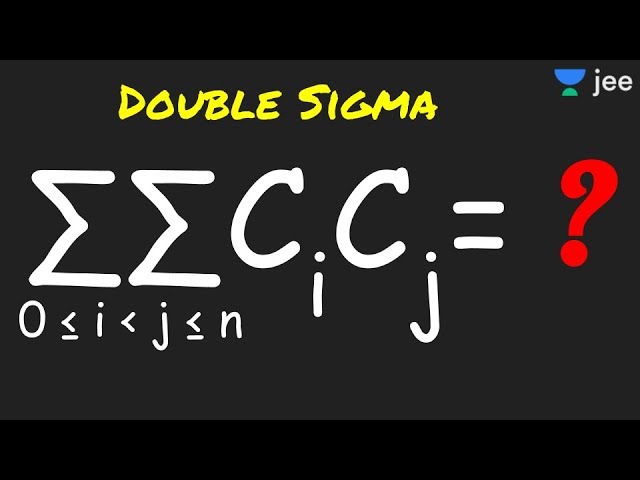
JEE PDFs : https://t.me/namochat To download notes, click here NOW: http://bit.ly/2TaSBke
SUBSCRIBE to Unacademy PLUS at: https://unacademy.com/plus/goal/TMUVD
Use Special Code :- "SAMEERLIVE"
(To avail 10% DISCOUNT)
To know more about Unacademy Plus, watch this video: http://bit.ly/2Hg3g7u
Talk to us on TELEGRAM App- (First Install the Teleg...
writing down terms in that table format method works for almost every double sigma problem
left knoll
left knoll
is the answer A?
Yea the ans is A . Thanks for helping
 pliant flax
Can anyone suggest a nice book for matrices and determinants for engineering mathematics with lots of solved examples
 naive dew
pliant flax
Can anyone suggest a nice book for matrices and determinants for engineering m...
naive dew
pliant flax
Can anyone suggest a nice book for matrices and determinants for engineering m...
You can look up ‘Advanced engineering mathematics by Erwin kreyszig’. It has a chapter on matrices and determinants but I’m not sure about the number of examples
left knoll
can anyone teach me statistics
undone ledge
vale wyvern
in this equation if you put
f(x) = 0
you get x- 3 = 0 -> x =3
x-1 = 0 ...
Ohhhhhhhhh omg thank you so much for taking time to help me!! You are amazing thank you sm 🙏🏽
 weak lotus
pliant flax
Can anyone suggest a nice book for matrices and determinants for engineering m...
vale wyvern
undone ledge
Ohhhhhhhhh omg thank you so much for taking time to help me!! You are amazing th...
weak lotus
pliant flax
Can anyone suggest a nice book for matrices and determinants for engineering m...
vale wyvern
undone ledge
Ohhhhhhhhh omg thank you so much for taking time to help me!! You are amazing th...
your welcome :)
 sharp plank
Can someone teach me 12th maths
 lofty elk
ther is someone here study computer science first year ?
vale wyvern
sharp plank
Can someone teach me 12th maths
youtube exists bro, try finding videos in your language and if you have any doubts just message here, we will help
vale wyvern
lofty elk
ther is someone here study computer science first year ?
#study-buddies may be a more suitable channel to find someone
 jade drum
pliant flax
Can anyone suggest a nice book for matrices and determinants for engineering m...
jade drum
pliant flax
Can anyone suggest a nice book for matrices and determinants for engineering m...
i know this is not a book but u can practise question from it
 dire aurora
Can someone please help with this question?

 heavy valve
expand:```
a^2 + 2ab + 2b^2 + 2bc + 2c^2 + 2cd + d^2 = 4ab + 4bc + 4cd
bring all terms to one side:```
a^2 - 2ab + 2b^2 - 2bc + 2c^2 - 2cd + d^2 = 0
factor:```
(a-b)^2 + (b-c)^2 + (c-d)^2 = 0
Notice that each value is squared, and thus must be positive. The only positive value which can be added three times and still equal 0 is 0.
so a-b=0, b-c=0, c-d=0 => a=b=c=d
 dire aurora
heavy valve
bring all terms to one side:```
a^2 - 2ab + 2b^2 - 2bc + 2c^2 - 2cd + d^2 = 0
``...
dire aurora
heavy valve
bring all terms to one side:```
a^2 - 2ab + 2b^2 - 2bc + 2c^2 - 2cd + d^2 = 0
``...
ohhh I couldn't find the perfect squares for the life of me because I didnt think to split up the 2b^2 into b^2 + b^2, for instance; where one is the last term of one expanded perfect square and the other is the first term of the next expanded perfect square.
a^2 - 2ab + b^2 + b^2 - 2bc + c^2 + c^2 - 2cd + d^2 = 0
(a-b)^2 + (b-c)^2 + (c-d)^2 = 0
dire aurora
heavy valve
Notice that each value is squared, and thus must be positive. The only positive...
thank you so much
left knoll
undone ledge
y = m - 3x and y = 2x² + 3x - 1
m - 3x = 2x² + 3x - 1
2x² + 6x - (m + 1) = 0
if the line "cuts" the parabola then the above equation will have 2 real and distinct roots so discriminant > 0
undone ledge
left knoll
y = m - 3x and y = 2x² + 3x - 1
m - 3x = 2x² + 3x - 1
2x² + 6x - (m + 1) = 0
...
Hmm.. I did that but the answer says it’s “m>-11/2

I understand how to get to that point I’m just a bit confused how to get to the end answer..
O.o
 left knoll
undone ledge
I understand how to get to that point I’m just a bit confused how to get to the ...
left knoll
undone ledge
I understand how to get to that point I’m just a bit confused how to get to the ...
discriminant = b² - 4ac
(6)² + 4(2)(m + 1) > 0
36 + 8m + 8 > 0
8m + 44 > 0
m > -44/8
m > -11/2
undone ledge
left knoll
discriminant = b² - 4ac
(6)² + 4(2)(m + 1) > 0
36 + 8m + 8 > 0
8m + 44 > 0
m...
:OOOO OMG…
THANK YOU SO MUCH ❤️
 signal flax
how do you type superscript
left knoll
signal flax
how do you type superscript
im on phone rn and gboard has that feature :P
 thorn surge
 pearl gazelle
Or abstract algebra.
pearl gazelle
Or abstract algebra.
computer engineer
kiddo
I was in your shoes back in the day
Susanna S. Epp
candid rivet
thorn surge
i don't understand the first and third =
but and easy way to solve this is to see that 1/ln(n) > 1/n for n bigger than 2 (and then it is just a comparison test for positive terms)


 polar glade
dire aurora
this is the answer
polar glade
dire aurora
this is the answer

 mystic thunder
dire aurora
Can someone factorise this fully please?
mystic thunder
dire aurora
Can someone factorise this fully please?
 dire aurora
Thank you very much guys
 ripe cargo

 whole oracle
 maiden epoch
where do I have a mistake? value cant be negative
 fair pecan
maiden epoch
where do I have a mistake? value cant be negative
fair pecan
maiden epoch
where do I have a mistake? value cant be negative
i think the problem is in the way youre trying to find V2
maiden epoch
fair pecan
i think the problem is in the way youre trying to find V2
I just made V2-V1 and V1-V2 and got the answer right
fair pecan
awesome
 tribal grove
any tips to be strong in mathematics , when a differen sum pop ups i feel like im blank and i totally forget the basics ? mainly having problem in calculas(lazy to go into the subjec )😭
 vale umbra
maiden epoch
I just made V2-V1 and V1-V2 and got the answer right
vale umbra
maiden epoch
I just made V2-V1 and V1-V2 and got the answer right
bro..thats because when we integrate, we basically add all points wrt to the axis.. u can see here that the area under y=x2 is greater than y3=x....there u are basically substracting lower value by higher value...therefore u get a negetive value
 naive dew
tribal grove
any tips to be strong in mathematics , when a differen sum pop ups i feel like ...
naive dew
tribal grove
any tips to be strong in mathematics , when a differen sum pop ups i feel like ...
Practice like your username
left knoll
random atlas
is the answer D?
left knoll
random atlas
Why but 1 and 2 ?
from the question, we can interpret that fox is a subset of cats but we can't anything about cats and window.
i) "no window is cat" - it means that they don't overlap each other but there could be such a case so it isn't always true
ii) "no cat is window" - it means
that window is a never a subset of cat but there is be a possibility where both window and fox are subset of cat but don't overlap each other.
iii) "some cats are fox" - it is always true as the question itself says that fox is a subset of cats
iv) "all cats are fox" - it can't be always true, as mentioned above there is a possibility where cats set and fox set both are the equal but it isn't "always" true
 bold atlas
yo peeps , help me out thinking this one out :
no of terms in expansion of 1 + x + x2 to power 11
random atlas
left knoll
from the question, we can interpret that fox is a subset of cats but we can't an...
Thanks for the explanation
polar glade
bold atlas
yo peeps , help me out thinking this one out :
no of terms in expansion of 1 + x...
formula: C(n+r-1,r) n:number of terms in parentheses r:power of number
bold atlas
polar glade
formula: C(n+r-1,r) n:number of terms in parentheses r:power of number
ik the formula but idk how to use in the case of multinomials, i tried making it before square and deducing it to binomial form but didnt get optimum answer.
left knoll
hey guys, need help
 left knoll
hey guys, need help
left knoll
left knoll
hey guys, need help
is there any restrictions on a and b? i.e whether they belong natural number set or something like that?
left knoll
bold atlas
ik the formula but idk how to use in the case of multinomials, i tried making it...
just use the formula and you'd get the answer.
in your case, n = 3 and r = 11
C(3 + 11 - 1, 11) = C(13, 11) = 13 * 6 = 78
left knoll
left knoll
is there any restrictions on a and b? i.e whether they belong natural number set...
no
 lavish copper

 gaunt saffron
cos^-1(1) = 0
so 9^0 = 1 and 2(3^0) = 2(1)
1-2+1=0
left knoll
take 3^(arccos(x)) = t
t² - 2t + 1 = 0
(t - 1)² = 0
t = 1
3^(arccos(x)) = 1
arccos(x) = log_(3) 1 = 0
x = cos(0) = 1

 dire aurora
Can someone please help with the above
gaunt saffron
dire aurora
let the fathers age = f and the sons age = s
f = s + 24 and f - 12 = 2(s-12)
solving simultaneously,
f = s + 24
and
f = 2(s - 12) + 12
f = 2s - 12
thus s + 24 = 2s - 12
s = 36 years old
dire aurora
gaunt saffron
let the fathers age = f and the sons age = s
f = s + 24 and f - 12 = 2(s-12)
s...
thank you so much

 dire onyx
dire aurora
Can someone please help with this?
dire onyx
dire aurora
Can someone please help with this?
part of tank filled in 6 mins = 1 i.e., = full
-> part of a tank filled in 1 min = 1/16 = 1/time taken to fill with inlet valve
part of tank emptied in 10 mins = 1
-> part of tank emptied in 1 min = 1/10 = 1/time taken to drain with outlet
part of tank actually filled = part of a tank filled in 1 min - part of tank emptied in 1 min
= 1/16 - 1/10
= -3/80
thus, part of tank filled = 1/time taken to fill if both working
-> 3/80 = 1/time taken to fill if both working
-> time taken to fill if both working = 80/3 mins = 26.7 mins
answer 26.7 mins
dire aurora
the textbook's answer is 15 min
ill check whats up tomorrow morning. Thanks a lot for your help!
gaunt saffron
dire aurora
the textbook's answer is 15 min
the rate the tank fills per minute is 1/6 (assuming a full tank = 1)
the rate the tank empties per minute is 1/10
thus the net rate per minute = fill rate - empty rate
= 1/6 - 1/10
= 5/30 - 3/30
= 1/15
thus the tank fills 1/15th of its capacity per minute
if a full tank = 1
then maximum capacity after time t equals...
1 = 1/15 * t
t = 15 minutes
neo had right idea just did oopsie for rate of fill
dire aurora
oh thanks for that. I knew neo was already right in the way that matters, just didnt have time to look. I didnt think about using rates when I looked at the question because i was hung up about using pronumerals to represent the question as other questions in that set of questions involved.
 rocky moth
thank you
 ebon sail
Please help me with this: Calculate the coefficient of x^50 in F(x) = (1+x+x^2+...) (1+x^2+x^4+...) (1+x^5+x^10+...)(1+x^10+x^20+...)(1+x^20+x^40+...)
I made it up to F(x) = 1 / [ (1-x)(1-x^2)(1-x^5)(1-x^10)(1-x^20) ]
But unable to do anything more
vale wyvern
ebon sail
I made it up to F(x) = 1 / [ (1-x)(1-x^2)(1-x^5)(1-x^10)(1-x^20) ]
I dont think you do this question using infinite GP formula
rather you would have to calculate each possible variation of powers of x taken from each term, so that when they are multiplied with each other they should add upto 50
It sure will take time, if this comes in my exam I would prolly skip over to come to it at last (if time is left) cause this is surely a time taking question
or maybe there is some another method which I am not sure of
 raw relic
@ebon sail use the multinomial theorem
dire onyx
dire aurora
the textbook's answer is 15 min
fuck
maiden epoch
The assignment was to calculate the eigenvector and "check for correctness by definition". why did she multiply the original matrix by the eigenvectors to check for correctness and got some random numbers?

I got same eigenvector values, but I dont get that "correctness check"
 deft jetty
seems like they multiplied the eigenvector by that matrix to see if it produces a scalar multiple of that eigenvector.
If it does then it confirms that it is indeed an eigenvector.
Definition of Eigenvector: Av = lambda*v
 lethal elbow
hey any body here
A line intersects Y-axis and X-axis at point P and Q, respectively. If R [2,5] is the mid - point of line segment PQ, then find the coordinates of P and Q................. PLEASE SOLVE IT
polar glade
lethal elbow
A line intersects Y-axis and X-axis at point P and Q, respectively. If R [2,5] i...
 lethal elbow
polar glade
lethal elbow
polar glade
thank yiu bro
left knoll
Hi ,I need Quick help with something (im sick ) my brain isn't working
I need the result in watts
But I got J / kelvin

 small temple
can someone solve this? the text in english is: If [1º expression], the value of [2º expression] is equal to
 lethal elbow
hey any body here
Find the ratio in which the line segment joining the points A[6,3] and B[-2,-5] is divided by x-axis.......................please solve it
left knoll
lethal elbow
Find the ratio in which the line segment joining the points A[6,3] and B[-2,-5] ...
there it is :))
 bold atlas
how do u integrate sqrt[(1+x^2)/x^3]
 vernal osprey
 vernal osprey
vernal osprey
vernal osprey
Does anyone help me solve this
I am using partial fractions
But I think the values of { A=-1 and B=10 } is wrong I guess !?
left knoll
vernal osprey
This is what I got as the answer, make sure to factorise the quadratic correctly and use an appropriate method to find A and B (I'm using the cover-up method in my example), I'm not too sure how you got A=-1 and B=10...
 left knoll
Yes, once you have factorised the denominator, remove (cover up) one of the terms and whatever value makes the covered up term equal to 0 you substitute in that value into the rational function, so in the case for A, we cover up (x-2) and substitute in 2 into the rest of the rational function which gives us 4, this only really works when we have linear terms in the denominator.
left knoll
yeah, its just faster and doable in your head
vernal osprey
Yeah thank you for your help 😀
left knoll
np
dire aurora
Could someone help with this one?
 dire aurora
Also, can someone explain this particular proof by contradiction? i dont understand the contradiction.

 dire aurora
undone ledge
Heyy… guys im stuck on question d and e could I please get some help….
dire aurora
undone ledge
Heyy… guys im stuck on question d and e could I please get some help….
find equation of line RT and then solve simultaneously (i.e by equating the y variable in both equations, or otherwise) with the cubic equation to find coords of P and T, with P being your answer. To do this, you need to the find the derivative of the cubic so you can find the coords of the local max, which is also T as given and lies on the line RT. Since T lies on the line RT, and you have a second point R at (40, 0) that also lies on RT, you can find the gradient of the line RT which lets you form the equation of the line RT in the gradient intercept formula given you have the y intercept of the line. The y intercept is coincidently already found as the y-coord of the local max of the cubic. If there was no such coincidence, you can find the equations of the line RT with the two-point formula of a linear function, or derive it yourself by means of equating two equations for the gradient of a function as the gradient between any two points of a line is the same i.e x1 - x/ y1 - y = m = x2 - x/ y2 - y, with an x and y variable in each equation left unplugged and plugging in the 2 two pairs of coord that you have.
for part e, use pythagoras theorem, where the magnitude of any length is the square root of the sum of the squares of perpendicular lines that form a right-angled triangle with the length. The same applies for the length of PT, where the lengths of such perperdicular lines are x2 - x1 and y2 - y1, where (x1, y1,) are the coords of one point and (x2, y2) are the coords of the second point. these have already been found at this stage as the coords of P and T and it is coincidental that two of the four coordinates for you are both 0 as this makes finding the length more logically obvious.
 random atlas
D
 cursive sun
hi all, i forgot my book at school and i really need one rn
does anyone have a copy of the as level economics cb?
thx
undone ledge
dire aurora
find equation of line RT and then solve simultaneously (i.e by equating the y va...
:DDD this is such a huge help thank you so so so much
left knoll
bold atlas
how do u integrate sqrt[(1+x^2)/x^3]
This integral is not solvable indefinitely 😦
 forest trail
Does anyone know how to solve this problem? The answers are on the right corner
 forest trail
dire aurora
forest trail
dire aurora
The lowest terms 2 can be described is 2/1 and a^2/ b^2 has to in the lowest terms but b^2 > 1 so it's contradictory
left knoll
forest trail
Does anyone know how to solve this problem? The answers are on the right corner
This is how I did it, the key trig identiy is cos2x=cos^2x-sin^2x, this allows you to get the exponents on the LHS in the same form.

There are also some more solutions but I only provided the exact-form ones like the answer in the question did
forest trail
ahh thank you that makes sense now
left knoll
np
dire aurora
forest trail
The lowest terms 2 can be described is 2/1 and a^2/ b^2 has to in the lowest ter...
Why is b greater than 1 and not possibly equal to 1 other than for the fact that they say so in the proof? Surely b is any integer not excluding 1
Because the premise is the assumption that root 2 is rational, as in that it can be expressed as a fraction/division of integers
Oh because root two is not a whole number. Oops. That makes sense. Thanks!!
 sleek prism
hmmmm hi?  happy new year first to all of you guys! just got a simple basic question
here is somebody who knows nothing about math not even a single simple thing not even the basics and its the exam year so too bad hah... i was searching but got exhausted of all the info. so my question is, can somebody just tell me where and how to start? good to mention: when it comes to numbers, my brain cells quit their job.
 strong drum
sleek prism
here is somebody who knows nothing about math not even a single simple thing not...
strong drum
sleek prism
here is somebody who knows nothing about math not even a single simple thing not...
khan academy
look for the website and they have courses from 0 to university level
so just start from the course you like
sleek prism
so i go there and search a course for beginners?
strong drum
sleek prism
so i go there and search a course for beginners?
yeah it's all free
you can donate if you want, and yeah there are course for beginners
sleek prism
imma check it out
sleek prism
strong drum
you can donate if you want, and yeah there are course for beginners
thanks a lot for your help 🫶
dire aurora
undone ledge
:DDD this is such a huge help thank you so so so much
Apologies for typo about the coords of P and T
undone ledge
dire aurora
Apologies for typo about the coords of P and T
hahah thats okay i figured it out :DDDD
lethal elbow
any body here
left knoll
me 🖐️
lethal elbow
the product of two consecutive positive integers is 306. We need to find the integers please solve this question
left knoll
n(n+1)=306, then solve for n
so n^2+n-306=0
n = 17
so it is 17 and 18
I rejected the other solution for n because it states that the numbers have to be positive
rocky moth
At present Asha’s age (in years) is 2 more than the square of her daughter Nisha’s age. When Nisha grows to her mother’s present age, Asha’s age would be one year less than 10 times the present age of Nisha. Find the present ages of both Asha and Nisha.
can anyone please solve it
left knoll
can you help me with this?

 acoustic aspen
rocky moth
can anyone please solve it
acoustic aspen
rocky moth
can anyone please solve it
Well, i know I'm neglecting my own assumption at the very end but that's the best I have. Even if it's not the correct or full answer, i hope it helps at least in some way

Okay, nvm. I found the correct answer on this site:
https://www.cuemath.com/ncert-solutions/at-present-asha-s-age-in-years-is-2-more-than-the-square-of-her-daughter-nisha-s-age-when-nisha-grows-to-her-mother-s-present-age-asha-s-age-would-be-one-year-less-than-10/


At present Asha’s age (in years) is 2 more than the square of her daughter Nisha’s age. When Nisha grows to her mother’s present age, Asha’s age would be one year less than 10 times the present age of
rocky moth
hey thanks alot
rocky moth
acoustic aspen
Well, i know I'm neglecting my own assumption at the very end but that's the bes...
tbh i hate these age-related questions
acoustic aspen
yo, same. I remember I was doing them like 3 years ago, so I am a bit embarrassed now that I couldn't make it but it's honestly so confusing. All it takes is a small error at the very beginning and you're doomed
rocky moth
actually it was made to be solved in one variable but since they asked 2 ages i was confused since 2 variables were needed to used
also language is kinda bad
dire aurora
forest trail
The lowest terms 2 can be described is 2/1 and a^2/ b^2 has to in the lowest ter...
Would you say this proof is lacking because, even though b^2 is not 1, a^2/b^2 = root(2) or, root of any non-square counting number for that matter, can still be true if a/b when raised to the second power causes the expression to then no longer be in smaller terms and have a shared factor other than 1? Why do you say a^2/b^2 has to be in lowest terms when only a/b explicitly has to be? for the proof to be sound, do you also have to show that if a/b is in lowest terms that (a/b)^2 must also? if so, how could you do this
dire aurora
we know that if a is a multiple of an integer, that a^2 is a multiple of an integer too. but that isnt enough to say that if a^2 is a multiple of an integer, that a is also a multiple of something. I feel like that is what the proof needs for it to be sound
ok i have what i need to make the proof rigourous !
lmk if u want to know
rocky moth
prove that (tan θ + 2) (2 tan θ + 1) = 5 tan θ + sec2θ . i think this question has a mistake
can anyone confirm this for me
dire aurora
sure
rocky moth
i think it should be 5tan θ + 2sec^2θ
rocky moth
thank you for confirming

 rocky moth
hey which software is this ?
dire aurora
desmos
rocky moth
thanks
dire aurora
on browser
Can someone prove this equation? I took a = sqroot(2) b = sqroot(5) and n = 2. Thanks
 rocky moth
i think this is outta my league
 tribal iris
dire aurora
Can someone prove this equation? I took a = sqroot(2) b = sqroot(5) and n = 2. T...
tribal iris
dire aurora
Can someone prove this equation? I took a = sqroot(2) b = sqroot(5) and n = 2. T...
I'm not sure, but perhaps one can argue that way. If you add the two inequalities, you get that (p+1)/n < b. In this case, you know that p/n is strictly less than a and p is chosen so that it is the maximum integer close to a. That is, (p+1)\n > a.
 cosmic kestrel
dire aurora
Can someone prove this equation? I took a = sqroot(2) b = sqroot(5) and n = 2. T...
cosmic kestrel
dire aurora
Can someone prove this equation? I took a = sqroot(2) b = sqroot(5) and n = 2. T...
if p/n<a then p/n+1/n<a+1/n. In the same time we know, that a+1/n<b. So (p+1)/n<b
Also (p+1)/n > a because p is the** greatest** integer that satisfies p/n < a
left knoll
Guys, can someone help?
 dire aurora
cosmic kestrel
if p/n<a then p/n+1/n<a+1/n. In the same time we know, that a+1/n<b. So (p+1)/n<...
dire aurora
cosmic kestrel
if p/n<a then p/n+1/n<a+1/n. In the same time we know, that a+1/n<b. So (p+1)/n<...
@tribal iris @cosmic kestrel Thank so you much
rocky moth
left knoll
Guys, can someone help?
which part of mathematics is this ?
left knoll
topology/functional analysis
left knoll
left knoll
Guys, can someone help?
You need to first construct a function f from \Pi_{t\in T}X_t to \Pi_{s\in S}\left(\Pi_{t\in T_s}X_t\right) that acts by sending each point in the product space to a "tuple of tuples", where each inner tuple corresponds to the coordinates in one of the T_s products. This function essentially reorganises the coordinates without changing them.
Then you need to show that f is bijective, this can be done by showing that each element in the domain has a unique image in the codomain and that every element in the codomain is an image of some element in the domain.
Next you need to show that f is continuous by using the definition of the product topology to show that the preimage of a basic open set in \Pi_{s\in S}\left(\Pi_{t\in T_s X_t}\right) under f is open in \Pi_{t\in T}. Since the product topology is generated by the basis elements that are the product of open sets in each factor space, you can show this by considering the preimage of such a basis element.
Finally, you need to show that f^{-1} is continuous, you need to show that the inverse function f^{-1}, which takes a "tuple of tuples" and reorganises it into a single tuple, is continuous. Again, you would use the definition of the product topology and the continuity of projection maps to show that the preimage of a basic open set is open.
You can conclude from here that f is a homeomorphism and thus the two product spaces are homeomorphic. — [Put the math into a LaTeX editor if you are struggling to read it].
Thank you so much, bro🫂
np
 azure kestrel
Hii, can anyone help me with this equation?

 loud dock
I’m not sure but maybe you have to calculate N for t=0 and t=10. Then you do the ratio of N(0) to N(10). All multiplied by 100 and you get the rate of increase. But I’m not sure if it answers to the question (PS : I’m French and I have doubts about my understanding of the question )
acoustic aspen
I believe you've got to count a derivative function
azure kestrel
i think its derivative function too, but im lost at how to start the equation
acoustic aspen
okay, hold up. give me a sec
azure kestrel
loud dock
I’m not sure but maybe you have to calculate N for t=0 and t=10. Then you do the...
it's okayy, i have doubts understanding it too T^T but thank youuu
acoustic aspen
N(t) = t^2 + 5t + 106
that means your derivative function will be:
N(t)' = 2t + 5
now, as we know, our t is 10, so we put that into our derivative:
N(10)' = 25
okay, well, here it's getting a bit tricky. How do we calculate the percentage rate is essential. I'll try too look it up
azure kestrel
could it be like how malo said, find for both 0 n 10 , n then find out the percentage ?
acoustic aspen
hmm, i don't think so. In the task it states clearly about the percentage rate in 2010. Year 2000 is only mentioned to set limits in which function operates. But at the same time, I'm not an english native so i might be getting lost in translation here
acoustic aspen
i've got an idea to solve it but you've got to give me some time xd it's a bit funky way to do it but it might work
azure kestrel
sure2, take ur timee
acoustic aspen
I am highly suspicious of my answer. I might have only complicated the whole task... Maybe Malo was indeed right oops xd

okay, yeah. my answer is incorrect. if rate can be over 100%, then 90*=/=100%
 azure kestrel
I like how you put effort into the mini stars 😭 ✋, since I have no idea how to do it, I'll def keep urs as a reference for now. Thanks Lenii!!
acoustic aspen
and Malo was completely right haha
 azure kestrel
acoustic aspen
okay, yeah. my answer is incorrect. if rate can be over 100%, then 90*=/=100%
azure kestrel
acoustic aspen
okay, yeah. my answer is incorrect. if rate can be over 100%, then 90*=/=100%
😭 its alrightt, i'll double check with my lecturer tomorrow then, thanks to both of you
acoustic aspen
no problem, had fun solving it myself haha. I guess you learn something everyday
azure kestrel
trueeee, but it def wasnt fun for me ;-; lmao
acoustic aspen
qwq oh i'm sorry. It's okay, I'm certain your lecturer will make sure you'll understand it so you don't have problems with such tasks in the future uwu
azure kestrel
acoustic aspen
qwq oh i'm sorry. It's okay, I'm certain your lecturer will make sure you'll und...
naurr don't apologise, you tried ur best to help me huhu,im the problem lmaoo anyways~
acoustic aspen
studying is process, just because you don't understand or cannot do something doesn't mean you're the problem uwu that's why we study, to be able to do things we aren't capable of yet. Anyways, good luck on your studying! you're doing great work!
 undone ledge

Hi I’m stuck on question 6 a) the main thing is I’m confused on the negative domain can I please get some help….
loud dock
undone ledge
You can try with a draw, you'll see where sin and cos intersect
left knoll
rocky moth
 rocky moth
left knoll
rocky moth
left knoll
Thank you for solving this question
cosmic kestrel
undone ledge
We know that sinx=cosx=root(2)/2 when angle=45°=π/4.
But you can also find out, that sin(x+π)=-sin(x) and
cos(x+π)=-cos(x), so sin(x+π)=cos(x+π) also.
You can see that via trigonometric circle. If we add π to our angle and move to the third quadrant, our point coordinates become negative, basically showing us values of sine and cosine
 cosmic kestrel
rocky moth
cosmic kestrel
rocky moth
 rocky moth
cosmic kestrel
rocky moth
cosmic kestrel
thank you
rocky moth
rocky moth
is the answer 68.7
sorry it must be 9.7
percent
my derivative calculation was wrong
first put vale of t in the quadratic equation to get 256 then calculate the derivative and after you calculate that put t=10 in equation to get 25
to calculate percentage
25/256 * 100 = 9.7...
so the answer is 9.7%
 azure kestrel
rocky moth
azure kestrel
rocky moth
THANK YOUUU 😭
 deep edge
Hello everyonee! Does anyone of you know how to solve this? Been trying to solve it for hours and I just can't :((
 rocky moth
i guess you should ask this question in science help section
acoustic aspen
rocky moth
that makes so much sense now damn
 grizzled dust
been trying to study AP calculus for a about an hour and a half later and i feel like ive made nop progress, ive been doing past exam questions and i still cant answer them without looking a the answers anyone got any advice or tips?
 young steppe
grizzled dust
been trying to study AP calculus for a about an hour and a half later and i feel...
young steppe
grizzled dust
been trying to study AP calculus for a about an hour and a half later and i feel...
you need to figure out what is holding you back and work on it
what specifically do you struggle on when working on past exam questions
young steppe
have you got all your derivative rules memorized
young steppe
you need to work on the basics then
the basics are most important part
you're taking AP Calc AB, right?
grizzled dust
yea
young steppe
ok
for practicing the basics of derivatives i recommend the khan academy practice questions

Khan Academy
The chain rule tells us how to find the derivative of a composite function. This is an exceptionally useful rule, as it opens up a whole world of functions (and equations!) we can now differentiate. Also learn how to use all the different derivative rules together in a thoughtful and strategic manner.
they are not as hard the AP questions but r good for practice
if you are struggling with grasping the idea of derivates and its rules
i recommend this youtube series

What might it feel like to invent calculus?
Help fund future projects: https://www.patreon.com/3blue1brown
An equally valuable form of support is to simply share some of the videos.
Special thanks to these supporters: http://3b1b.co/lessons/essence-of-calculus#thanks
In this first video of the series, we see how unraveling the nuances of a simp...
it goes over everything you'll lean in calc ab
its like the sparksnotes of calculus
grizzled dust
thanks
 polar glade
is anybody know markovchain?
left knoll
Can someone please confirm if this is correct for me?
 naive dew
left knoll
Can someone please confirm if this is correct for me?
naive dew
left knoll
Can someone please confirm if this is correct for me?
KE= 1/2 m v^2
Velocity squared
left knoll
naive dew
Velocity squared
Thank you
left knoll
rocky moth
Can anybody solve this problem for me
Area of half circle
Then square
Times one half circle by 4
Add to area of square
Minus from whole square aria
@rocky moth
 rocky moth
hey thanks @naive dew @left knoll
 spice girder
How do I become better at complex math problems? Like competition style?
mystic thunder
practice
mystic thunder
rocky moth
Can anybody solve this problem for me
class 10 ncert?
left knoll
mystic thunder
class 10 ncert?
It’s already done 👍
mystic thunder
left knoll
It’s already done 👍
I was just asking cuz this is in deleted syllabus😭
 naive dew
left knoll
What year are you in
naive dew
left knoll
What year are you in
Ill start undergrad this year
naive dew
What it's like?
left knoll
Never mind
rocky moth
mystic thunder
class 10 ncert?
exemplar
rocky moth
mystic thunder
I was just asking cuz this is in deleted syllabus😭
really ?
rocky moth
spice girder
yo this is sad
spice girder
 undone ledge
cosmic kestrel
We know that sinx=cosx=root(2)/2 when angle=45°=π/4.
But you can also find out, ...
undone ledge
cosmic kestrel
We know that sinx=cosx=root(2)/2 when angle=45°=π/4.
But you can also find out, ...
OMG thank you so much for the explanation🙏🏽
left knoll
naive dew
Does that help?
Yh
 amber vapor
can someone help me with this problem pls

 swift crypt
dire aurora
Also, can someone explain this particular proof by contradiction? i dont underst...
swift crypt
dire aurora
Also, can someone explain this particular proof by contradiction? i dont underst...
Like my shirt? Well, you already own it if you're a Curiosity Box subscriber. If you're not, don't miss out again! Get exclusive math and science stuff from me delivered right to your door four times a year: http://www.curiositybox.com
https://twitter.com/tweetsauce
https://www.instagram.com/electricpants/
Vsauce PO Box: PO Box 33168
...
He will explain better than me, the video is great
dire aurora
swift crypt
He will explain better than me, the video is great
Ive watched it hahah thanks. I get it now, including roots of any prime number
swift crypt
dire aurora
Could someone help with this one?
Did you solve this one ? I can help you if you didn't
dire aurora
Nope. But i only tried once. I can try again later
swift crypt
Soo it is not that hard try to express everything with a, like
c=a/3
b=a/2
And a is just a
and put all of that in equation
And you have
3a²+4(a²/4)+18(a²/9)-4a(a/2)-12a(a/3)
Now you have
3a²+a²+2a²-2a²-4a² and like you see
6a²-6a²= 0
swift crypt
dire aurora
Nope. But i only tried once. I can try again later
Hope you get it 😃
rocky moth
dire aurora
Also, can someone explain this particular proof by contradiction? i dont underst...
I can
do you still need it ?
rocky moth
dire aurora
Ive watched it hahah thanks. I get it now, including roots of any prime number
Didnt saw this message
rocky moth


Can anybody check my mistake
This is solution from the book and I think it is wrong

 grave elbow
where does 3/5L and 4/5L come from
 naive dew
grave elbow
where does 3/5L and 4/5L come from
naive dew
grave elbow
where does 3/5L and 4/5L come from
Lsin theta and Lcos theta
The vector components I guess
I’m not too sure
dire aurora
swift crypt
Soo it is not that hard try to express everything with a, like
c=a/3
b=a/2
And a...
Oh i thought you had to make the substitution at the end in order to show that c=a/3 and b=a/2. Are you allowed to substitute at the beginning
swift crypt
dire aurora
Oh i thought you had to make the substitution at the end in order to show that c...
Yes you can, i done a whole question, as i said it's not that hard
 candid rivet

and then you know 3x=4h, 4y=3h, x+y=l
and if you add the pythagorean theorem i think you get the values
candid rivet
amber vapor
can someone help me with this problem pls
i'd try with x=y and writing the functions with small o, like sqrt(1+X)=1+X/2 +o(X) or cos(x)=1-x²/2 +o(x²). Not sure if it is enough
candid rivet
spice girder
it's hard to guess what are alpha beta V
yet it looks alright
except maybe for the first one, V/a looks more like a tan(...)
 dim cloak
I am baffled

I honestly idk if I look stupid or anything
I am just having a hard time understanding
when there is a shape like that
naive dew
dim cloak
I am baffled
GHI has the angle H in the middle which is not marked hence the congruent triangle’s middle angle will not be marked that is K. the side marked HI is at the end of triangle GHI’s name hence the congruent side shall be at the end of the name of congruent triangle that is side KL
dim cloak
naive dew
GHI has the angle H in the middle which is not marked hence the congruent triang...
I am sorry I am still confused 😭
I am going to try to watch another video on it
dim cloak
naive dew
GHI has the angle H in the middle which is not marked hence the congruent triang...
wait
could you tell me more about that side thing
naive dew
dim cloak
could you tell me more about that side thing
Yeah?
grave elbow
candid rivet
and then you know 3x=4h, 4y=3h, x+y=l
and if you add the pythagorean theorem i t...
tysm ❤️
candid rivet
have a look at sarrus rule which is the formula of determinant 3x3
 untold shadow
candid rivet
have a look at sarrus rule which is the formula of determinant 3x3
untold shadow
candid rivet
have a look at sarrus rule which is the formula of determinant 3x3
thanks i got it
 proper vault
Does anyone have an idea on how to do Plastic Analysis?
 naive dew
rocky moth
naive dew
rocky moth
The 2nd one?
rocky moth
naive dew
The 2nd one?
well ya thats the main one
naive dew
@rocky moth
 rocky moth
naive dew
<@1112583520230047766>
rocky moth
naive dew
<@1112583520230047766>
really thanks
 candid rivet
 tardy hedge
how do you do this
tardy hedge
how do you do this
 tardy hedge
candid rivet
tardy hedge
candid rivet
Thanks👍🏻
tardy hedge
candid rivet
why did you take a to be = 0 tho
candid rivet
well the formula is often written with (b-a)/n and here we have 1/n
If you compare to the riemann sum formula you have no choice but taking b=k and a=0
@tardy hedge
 pliant valve
high im just wondering how to do this?
prolly basic but

for question b
disclaimer im dumb sorry
this is the matk scheme

and original graph
 pliant valve
pliant valve
pliant valve
for (a)
tardy hedge
candid rivet
well the formula is often written with (b-a)/n and here we have 1/n
If you compa...
Yea I got it, thanks!
 swift crypt
 void grove
Try sin and cos thing, something like sin42°=h/10 than cos, you can mark the base of triangle with x and y (y=15-x), cos42°=10/x, than find x, than y, than with cos or sin find the angle
 candid rivet
pliant valve
candid rivet
pliant valve
2^x=12 is the same as 2^(x-1)=6 so you want to look at the graph for y=6 and it gives you the value x such that 2^(x-1)=6 and you find x=3,6 approximately (the actual solution being 3.5849625...)
candid rivet
pliant valve
for (a)
thanks for sharing the graph it makes it easier to help
left knoll
void grove
Depends I’m on a car rn so can’t say for sure but it’s deffo Soh cah toa
Remember it’s ^-1
pliant valve
candid rivet
thanks for sharing the graph it makes it easier to help
tysm
grizzled dust
can someone explain how the top calculation jumps from that to the final answer?


 naive dew
Multiply 3y^2 and 1/root2y
grizzled dust
wait why do you have to multiply it?
 grizzled dust
can you also explain how it went from the last step to the answer?

 grizzled dust
thank you so much, calculus is stomping me since its my first time taking it
naive dew
grizzled dust
thank you so much, calculus is stomping me since its my first time taking it
Keep going
And remember calculus is not hard
Algebra and trigonometry are
 acoustic orbit
Any good youtube playlist for calculus?
grizzled dust
acoustic orbit
Any good youtube playlist for calculus?

YouTube
Topics: Review of Algebra/Trigonometric Concepts, Finding Limits, Derivatives and Derivative Techniques, Integrals and Integral Techniques, and Applications.
acoustic orbit
grizzled dust
https://www.youtube.com/playlist?list=PLF797E961509B4EB5
🔥
rocky moth
yes
left knoll
@rocky moth thank you! i'm sending you a dm
dire aurora
swift crypt
Yes you can, i done a whole question, as i said it's not that hard
I don’t think youre supposed to. It said to prove by completing the square. There should be some nice pattern that results.
 undone ledge
Hii can i please have some help with this question 10 and 11
undone ledge

 glossy loom
sorry not a math stdent
candid rivet
undone ledge
 swift crypt
dire aurora
I don’t think youre supposed to. It said to prove by completing the square. Ther...
swift crypt
dire aurora
I don’t think youre supposed to. It said to prove by completing the square. Ther...
Yes you are right
 blissful ridge
I need to solve b and it says: Depending on a, investigate whether the corresponding LGS has no, exactly one or infinitely many solutions. Specify the solution set if the LGS has an infinite number of solutions. (LGS) is linear equation system. I have no idea why in the solution they assume a = 0. Can someone explain it to me? My approach was a bit different and i looked for (a+4) and my thought was -4.


Is it just me or is discord not showing the pics?
 quasi bridge
glossy loom
how to do this chat?
quasi bridge
glossy loom
how to do this chat?
the idea for that question is nth term = (sum of n terms) - (sum of n - 1 terms)
S_n = 3n² - 4n
S_(n - 1) = 3(n - 1)² - 4(n - 1) = 3(n² + 1 - 2n) - 4(n - 1) = 3n² - 10n + 7
t_n = 3n² - 4n - 3n² + 10n - 7 = 6n - 7
 ebon relic
can someone please find R here
 polar glade
ebon relic
can someone please find R here
polar glade
ebon relic
can someone please find R here
 ebon relic
polar glade
ebon relic
polar glade
thanks!
left knoll
Given the function:
f(x,y) = 1+xy-x-y
On domain V = {(x,y) ∈ ℝ^2: x^2 ≤ y ≤ 4}. This function f(x,y) with domain V is used in parts a-c.
a) Is the domain V convex? Explain why or why not.
Afbeelding
anyone that can help me?

 somber berry
left knoll
Given the function:
f(x,y) = 1+xy-x-y
On domain V = {(x,y) ∈ ℝ^2: x^2 ≤ y ≤...
somber berry
left knoll
Given the function:
f(x,y) = 1+xy-x-y
On domain V = {(x,y) ∈ ℝ^2: x^2 ≤ y ≤...
inequality in two parts : x^2 ≤ y (1) and y ≤ 4 (2).
If we analyse each part separately :
- if we consider any 2 points on this curve y = x^2 (=values of y) and draw a straight line between them, it will lie within or on the curve. And so this part of the domain V is convex
- for the second case, values of y must be less or equal to 4. (in other words it should lie below or on the horizontal line y=4). If you take again two points and draw a straight line, considering the condition, it will always stay within or on the line y=4 (it's like a boundary)
So both parts of the domain V are individually convex, and their intersections form this domain V, which is also convex.
Is it what they asked?..
somber berry
 loud storm
y=-2x^2 +8x-16, find roots
loud storm
y=-2x^2 +8x-16, find roots
couldn't find it bc I always find a square root of a negative number :/
polar glade
loud storm
y=-2x^2 +8x-16, find roots
 left knoll
somber berry
Is it what they asked?..
left knoll
somber berry
Is it what they asked?..
OMG YES!! YOU.ARE.THE.BEST!! Can you help me with another math question too maybe??? thanks a lot btw!!!
somber berry
left knoll
OMG YES!! YOU.ARE.THE.BEST!! Can you help me with another math question too mayb...
hahah thank u and ur welcome! yes send me I'll see if I can
 worldly copper
Hello guys I am trying to solve this integral for over 2 hours now and I’m still getting 0 and the answer is pi/2

Can you help me
 raven lichen
I've done the inverse, however the mark scheme states that the surd must be a negative. can someone help explain why that is the case?

 severe burrow


Hi, I am unsure of my working, but is it correct? Then, when it says that the firm contracted to produce 15 goods of either type, does it mean Q1 = Q2 = 15?
left knoll
worldly copper
Hello guys I am trying to solve this integral for over 2 hours now and I’m still...
multiply and divide with sec²x which will create sec²x dx in numerator and sec²x + tan²x in denominator
sec²x + tan²x = 1 + 2tan²x
the integral after this step would be (sec²x dx)/(1 + 2tan²x)
after this you can use u-substitution to solve the integral
tanx = u
lmk if you're still confused, i'll send a proper typed out solution
 slate lintel
 left knoll
guys, is someone good with Laplace/Fourier transforms? please dm me
undone ledge
candid rivet
Thank you :)))
dire aurora
Can anyone help with b)?
 lethal elbow
use Euclid's division lemma to show that the square of any positive integer is either of the form 3m or 3m+1 for some integer m.
bro any body here
dire aurora
Does anyone have a method for answering these?

 proud tundra
dire aurora
Does anyone have a method for answering these?
proud tundra
dire aurora
Does anyone have a method for answering these?
put all the numbers under the root and compare
and the root of the two is approximately equal to 1.4
and the root of 6 = 2.45-2.5
to calculate the root of the number 6, we find the two nearest numbers of which to calculate the root and it will be an integer. the nearest ones to six are four and nine. the root of four - two, and of nine - three, so the root of six is something in between, that is 2.5
dire aurora
I used that logic for 14)a) as you can see but it wasnt rigorous enough

Turns out, through the calculator, the difference is so small
 dire aurora
Oh thanks so much
proud tundra
you must use logic with adding to the root when you are given integers multiplied by the root
and if you are adding an integer and a root, then you look for the closest value to the number under the root (example with six)
 proud tundra
- use photomath)
@dire aurora
 dire aurora
i dont see how that is to help me. i know the expansions already
 weary arrow
You use the (a-b)² expansion to solve it.
Set the first to a and the second to b, and you can square it easily
blissful ridge
can someone calculate this? i got the vector (15,7,-3 ) but the solution says 15,-3,-3 and i am so confused why. I even used an online calculator and it gave me the result i got and not the ones from the solution

Omg nvm I forgot a - sorry
then it makes sense i forgot to copy the -5
candid rivet
dire aurora
Can anyone help with this?
 left knoll
literally the same, there's this 5 hour YouTube video called precalculus, just see the topics you are not strong in and watch those

Learn Precalculus in this full college course. These concepts are often used in programming.
This course was created by Dr. Linda Green, a lecturer at the University of North Carolina at Chapel Hill. Check out her YouTube channel: https://www.youtube.com/channel/UCkyLJh6hQS1TlhUZxOMjTFw
⭐️ Lecture Notes ⭐️
🔗 Part 1 - Functions: http://lindagr...
 plucky sail
for me i watch professor leonard and spam practice problems
left knoll
here it is
left knoll
plucky sail
for me i watch professor leonard and spam practice problems
nah that guy distracts me
plucky sail
how 😭
left knoll
also anybody good at Laplace and Fourier transforms pleasee help mee
i don't even know how to go about understanding these problems
grizzled dust
plucky sail
for me i watch professor leonard and spam practice problems
wallahi
 blissful pumice
Oh, I guess that's normal when you get to university...
Idk about yr professor's style, but don't rely on the professor alone..
You can study the material from an external source!
+make sure to study each lecture after you finish, bcuz if you only attend it or accumulate the lectures and study them once, you won't succeed...
Resolve all the questions you learned and understand why they were solved this way?
also try to solve previous years’ questions for the professor you are studying with, do this before the exam It will help you a lot
Good luck ~

 sinful kernel
Differentiation
sinful kernel
 fast heath
really need help on this
fast heath
really need help on this
Equate them and differentiate on both side
For f(x) use division rule of differentiation
fast heath
sinful kernel
Equate them and differentiate on both side
For f(x) use division rule of differe...
I get to this point

our teacher skipped all examples of this exact thing so I'm just kinda lost lol.
fast heath
I'm mostly confused as to what I'm being asked by f'(x)=f'(1)
biggest issue being that I have a test for this topic tomorrow so I can't ask my teacher
rocky moth
fast heath
really need help on this
find for x ?
fast heath
rocky moth
find for x ?
" solve "
rocky moth
solve*
fast heath
I assume it is for x though
rocky moth
is answer given ?
fast heath
no
rocky moth
see I just learnt differentiation a week ago ill send my answer it might be wrong
fast heath
rocky moth
solve*
not solve for x just simply " solve "
fast heath
rocky moth
see I just learnt differentiation a week ago ill send my answer it might be wron...
thank you:)) I have to go to sleep rn but I'll read it first thing tomorrow morning cause I didnt end up figuring it out
 rocky moth
fast heath
I get to this point
rocky moth
fast heath
I get to this point
can you send your work
blissful pumice
fast heath
really need help on this
 blissful pumice
fast heath
I get to this point
blissful pumice
fast heath
I get to this point
the sign of 4 is positive... and here was your mistake.
u did subtraction instead of addition, so you weren't able to solve it, understand?
blissful pumice
rocky moth
The derivative of the fraction is not solved this way, you are still at the beginning, enjoy ~ 👀
rocky moth
blissful pumice
The derivative of the fraction is not solved this way, you are still at the begi...
ya that is why i said abt f prime a would be wrold
wrong*
 compact adder
if the square number is divsible by 3, it is in the form 3m, if the square number is not divisible by 3, the remainder is 1 i.e it is in the form 3m+1
 errant chasm
Hello everyone.Please , How to find the maximum and minimum values of the following expression: A=200sin(200πt)+210cos(840πt)
 silent storm
<@&942391219206647828>
fast heath
blissful pumice
the sign of 4 is positive... and here was your mistake.
u did subtraction inste...
oh you're right!! tysm I totally messed that up ':D
blissful pumice
rocky moth
ya that is why i said abt f prime a would be wrold
don't worry 👀
blissful pumice
fast heath
oh you're right!! tysm I totally messed that up ':D
any time ~
good luck in your test ~
rocky moth
silent storm
<@&942391219206647828>
i opened the ticket
left knoll
I need a solution if u could pls answer this and mention me (@me)
Find the rank of the word 'MUSTAFA' in the dictionary?
From the chapter Permutations and Combinations
 proper venture
 still nest
u guys got me?

 coarse solar
anyone who's done a british A Level Maths, does the SUVAT equations come up in the formula booklet given at the exam.
bold atlas
how can we find the point of intersection of a curve and trignometric function? like in this case i need the POI of these 2 curves

if possible tell me how to solve curve and trigno func generally rather than solving the question itself :))
left knoll
f(x,y) = 1+xy-x-y on the domain V = {(x,y) ∈ R^2: x^2 ≤ y ≤ 4 }
Find the critical points and the extreme values of f on the domain V.
Anyone that can help me?
weary arrow
For intersections you put the two to be equal to each other and solve
It's been too long since I had trigonometry so I don't remember much though
 weary arrow
Hmm
left knoll
bold atlas
how can we find the point of intersection of a curve and trignometric function? ...
idts you can algebraically find the point of intersection. these type of questions are made in such a way that you would be able to guess the point of intersection
in this case, it'd be (√2, √2)
 unborn igloo
Does anyone have any advice for high school students learning linear algebra,
I watched the 3B1B series, didnt finish it fully tho...
i wanna learn it for CS and Physics, so ig learning theoretical and application side would be nice.
pref not a textbook, just cuz I pref online, lmk tho!
 spice harbor
im kinda confused on how to do this, the question is find k.
Would be much appreciated if someone could explain

 ember socket
spice harbor
im kinda confused on how to do this, the question is find k.
Would be much app...
ember socket
spice harbor
im kinda confused on how to do this, the question is find k.
Would be much app...
There should be a equality sign can you send the whole question please
 shy schooner
blissful pumice
The derivative of the fraction is not solved this way, you are still at the begi...
shy schooner
blissful pumice
The derivative of the fraction is not solved this way, you are still at the begi...
Aren't you also supposed to consider the solution when what is inside the square is negative, because √x² = |x|. So I have S={2;4}

These aren't simple brackets, these are the absolute value brackets by the way. I don't know how you say in english.
Like |-x|=x
shy schooner
still nest
u guys got me?
Tell me when you have an answer
blissful pumice
shy schooner
Aren't you also supposed to consider the solution when what is inside the square...
Oh, I think you're right :)
I studied this last year so I think I forgot about it, sorry...
shy schooner
No worries, it's a common mistake to forget about the other solution ! It's actually one of the first times I don't make it 😭. Thank you, have a good night !
blissful pumice
shy schooner
No worries, it's a common mistake to forget about the other solution ! It's actu...
In fact, I was suffering from this problem last year XD
I felt like I wasn't studying well because I always forgot the other solution lol...
It was my last year of high school so I was depressed just because of this problem 😂
good night 👀 ~
shy schooner
blissful pumice
In fact, I was suffering from this problem last year XD
I felt like I wasn't st...
Same here ! I know right, it feels like a lack of work (and honestly maybe is) but still, no need to put yourself in such a bad mood ! It's just an equation ! 😂
I hope you're good with it now !
Bisous !
blissful pumice
shy schooner
Same here ! I know right, it feels like a lack of work (and honestly maybe is) ...
Yuuppp!
The problem is that I worry a lot, but that's okay... 😩
I hope you're well too, good luck!
worldly copper
Hey guys I’m trying to find the limit but every time get +infinity and the answer is actually -9/2. Can you please help me


 devout hamlet
does anyone have experience with discrete math style proofs?
specifically logic stuff
blissful pumice
devout hamlet
does anyone have experience with discrete math style proofs?
like what?
devout hamlet
this is a question i put on pause, but im trying to figure out what x should be such that for a>1 and M>0, a^x < M, where a,x,M are all real numbers
 blissful pumice
devout hamlet
this is a question i put on pause, but im trying to figure out what x should be ...
blissful pumice
devout hamlet
this is a question i put on pause, but im trying to figure out what x should be ...
oh.. idk... sorry :)
devout hamlet
haha no worries thanks anywho!
left knoll
50$ from steam
steamcommunity.com/gift/76566894433985451
@everyone
weary arrow
^ don't click that people
weary arrow
worldly copper
Hey guys I’m trying to find the limit but every time get +infinity and the answe...
Ohh I vaguely remember this lol can you send the formula for solving limits like this?
 lethal slate
Dumb question but what’s the best way to do fast mental multiplication
 left knoll
undone ledge
Can I please get an explanation for question 7
left knoll
undone ledge
Can I please get an explanation for question 7
is the answer π/4?
left knoll
o.o weird gimme a sec
undone ledge
left knoll
o.o weird gimme a sec
heheeh yeahhh... thank you :))))
left knoll
undone ledge
heheeh yeahhh... thank you :))))
oh gotcha!
g(x) = sin(2x - π/3)
g(x) is defined from [-a, a] to [-1, 1] (in the question, it's mentioned as R but it'll be just [-1, 1] as it's just a normal sin curve)
the inverse function of g(x) would be (arcsin(x) + π/3)/2 (arcsin is just sin inverse)
inverse function of g(x) is defined from [-1, 1] to [-a, a]
to find range of g inverse, just substitute x = -1 and x = 1 in g inverse. you'll get it to be [-π/12, 5π/12]
according to the options, π/12 is the only one which satisfies
lmk if you're confused at any step
undone ledge
left knoll
oh gotcha!
g(x) = sin(2x - π/3)
g(x) is defined from [-a, a] to [-1, 1] (in th...
woaaaaaaaaaaaaahhh THANK YOU SO MUCHHHH
 mossy scaffold

can someone pls help me with this

the answer is supposed to be this but i got a different answer
i got x >= -3 instead of x <= -3
left knoll
undone ledge
woaaaaaaaaaaaaahhh THANK YOU SO MUCHHHH
you're welcome!
left knoll
mossy scaffold
i got `x >= -3` instead of `x <= -3`
send your working
 lethal slate
Why write a big x on it?
Just write in red pen at the top then explain why you’re wrong at the bottom
mossy scaffold
lethal slate
Just write in red pen at the top then explain why you’re wrong at the bottom
thats the best advice i've ever gotten for writing notes
thanks
 lucid cairn
Hey yall can someone help? I really don't know where to start. (If you speak french it would be even more awesome).
The question is:"Show that for two real numbers a and b, suitably chosen, we can write:"
 mossy scaffold
lucid cairn
Hey yall can someone help? I really don't know where to start. (If you speak fre...
mossy scaffold
lucid cairn
Hey yall can someone help? I really don't know where to start. (If you speak fre...
 lucid cairn
mossy scaffold
lucid cairn
mossy scaffold
Can I ask you why did you remove the denominators from both fractions? (In the beginning)
 tribal lance
What exactly is confusing you?
That the fraction was removed from both sides instead of only one or why that is done?
lucid cairn
tribal lance
What exactly is confusing you?
That the fraction was removed from both sides ins...
I guess both questions
 calm echo
lucid cairn
Can I ask you why did you remove the denominators from both fractions? (In the b...
calm echo
lucid cairn
Can I ask you why did you remove the denominators from both fractions? (In the b...
There is a rule in mathematics, when there is an unknown value divided by a number and it is equal to an unknown value divided by a number, then you do what is called reflection, you multiply the top with the bottom and the bottom with the top.
calm echo
mossy scaffold
For this, your result it's will be like this
tribal lance
Having x insode the denominators is really a pain so we multiply a/(x-1) with (2x+1) and b/(2x+1) with (x-1)
This is valid as long as we multiply the numerator and the denominator
Then all the fractions end up with the same denominator
And we can then just remove the denominator completely
lucid cairn
Ok...I see
tribal lance
If i say that half of x is equal to half of y: x/2 = y/2
You can just multiply both sides by 2 and the fractions disappear
Then we need to find out what values we need to choose for a and b so that the statement is correct
lucid cairn
tribal lance
If i say that half of x is equal to half of y: x/2 = y/2
You can just multiply...
But in this case the 3 hasn't been multiplied by x-1 and 2x+1, has it?
Oh no wait
tribal lance
Well to get the denominator away we multiply both sides of by the denominator so yes kinda?
tribal lance
There are two distinct steps
- Change the right side to the same denominator
- Remove the fractions by multiplying the denominator away
 quasi breach

somber berry
worldly copper
Hey guys I’m trying to find the limit but every time get +infinity and the answe...
hi, did u find it? bc I couldnt do it too and I would like to know if u get the answer?
somber berry
left knoll
f(x,y) = 1+xy-x-y on the domain V = {(x,y) ∈ R^2: x^2 ≤ y ≤ 4 }
Find the critic...
the critical point is (1,1), and then normally u must calculate the curves for y=x^2 and y=4
amber vapor
can someone help me with b) pls

 sinful kernel
azure kestrel
Hi, can anyone help me with these phy questions pls 🥹 thanks
sinful kernel
azure kestrel
Hi, can anyone help me with these phy questions pls 🥹 thanks
Do you have the answers?
4- C
Conserve mechanical energy ig
KEi+KEf=PEi+PEf
 simple brook
Can you show me step by step how to find t in the second equation?
 candid rivet
simple brook
Can you show me step by step how to find t in the second equation?
candid rivet
simple brook
Can you show me step by step how to find t in the second equation?
2,4 =A log(Bt)
log(Bt)= 2,4/A
Bt = 10^(2,4/A)
t= (1/B) 10^(2,4/A)
where A and B are constant numbers
tell me if you need me to write it down without the use of A and B
 unkempt tinsel
does anyone know of any good resources to learn university level maths? specifically continuity and convergence at the moment
tribal lance
unkempt tinsel
does anyone know of any good resources to learn university level maths? specific...
https://www.khanacademy.org/math/calculus-1/cs1-limits-and-continuity
https://www.khanacademy.org/math/ap-calculus-bc/bc-series-new/bc-10-1/v/convergent-and-divergent-sequences
Khan Academy
Learn for free about math, art, computer programming, economics, physics, chemistry, biology, medicine, finance, history, and more. Khan Academy is a nonprofit with the mission of providing a free, world-class education for anyone, anywhere.
unkempt tinsel
tribal lance
https://www.khanacademy.org/math/calculus-1/cs1-limits-and-continuity
https://ww...
ay thank you so much!
left knoll
help. anyone with dyscalculia or learning methods to overcome fear of mathematical symbols and equations, i can do anything in the world but not maths, something inside of me just prevents me, suffering for years
simple brook
candid rivet
2,4 =A log(Bt)
log(Bt)= 2,4/A
Bt = 10^(2,4/A)
t= (1/B) 10^(2,4/A)
where A and...
Thank you so much xoxo
azure kestrel
sinful kernel
4- C
Conserve mechanical energy ig
KEi+KEf=PEi+PEf
There's no mark scheme for this ;-; but yea it was energy conserve method 😄 thanks

 tribal lance
they substitute with u=cos(t) thus u'=-sin(t) and du=-sin(t)*dt
du = -sin(t)*dt / divide by -sin(t)
dt = 1/(-sin(t))*dt
take (-sin(t))cos²(t) dt and substitute cos(t) with u and dt with what we just calculated and you get
u² * (-sin(t)) * 1/(-sin(t)) * du
the -sin stuff of course cancels out and you are left with u² du
the integral of the square leaves you with [1/3 * u³]
then you just gotta put the u=cos(t) back
seeing the sin just disappear like that really confused me but its just a byproduct uf the substitution
@little hamlet
 little hamlet
tribal lance
<@755830969591791697>
little hamlet
tribal lance
<@755830969591791697>
ayyy thank you so much
tribal lance
thank wikipedia, wolframalpha and photomath
i am really rusty with integrals 😅
little hamlet
tribal lance
seeing the sin just disappear like that really confused me but its just a byprod...
same, i was pretty confused and i thought abt doin integration by parts, pretty stupid yh, i knew it wouldve been a substitution but was too lazy not to do em, never again. really appreciate the help!!
little hamlet
tribal lance
thank wikipedia, wolframalpha and photomath
i am really rusty with integrals 😅
u still went out ur way to lend me a helping hand
🤝
tribal lance
Oh I just found something super strange
When i set Photomath to german, I can press the little zoom icon and get more detail but the english version has that paywalled


 naive dew
tribal lance
Oh I just found something super strange
When i set Photomath to german, I can pr...
naive dew
tribal lance
Oh I just found something super strange
When i set Photomath to german, I can pr...
Interesting, I’ll try it too😃
undone ledge
i just wanted to say that i am hella grateful for all the amazing people that help out in this gc, you guys helped me alot YOU GUYS ARE SO AMAZING 🍀 💗
unkempt tinsel
no yeah yall are amazing 🥹
 icy dragon
Hello guys i need help with limits, derivatives can someone help me
tribal lance
We sure can if you whittle the problem down a little
 muted grail
or mention it, at all, lol
weak lotus
icy dragon
Hello guys i need help with limits, derivatives can someone help me
sent it over!
undone ledge
Hey guys how do I do question 8c
Since it’s y=-3 doesn’t that make the gradient 0?
So I used the point-gradient form and I got the answer y=5
But the answer book says “ x=4”
I’m confused……..
 icy dragon
I need help from the beginning, i thought someone could send me some notes or recommend a course
tribal lance
undone ledge
Hey guys how do I do question 8c
Since it’s y=-3 doesn’t that make the gradient...
the answer line doesnt have a gradient because it goes straight up along the y axis
y=-3 is along the x axis and any line perpendicular to that is along y
those lines can be described by just an x intercept
so we need a straight line that intercepts (4,5) which is x=4
undone ledge
tribal lance
the answer line doesnt have a gradient because it goes straight up along the y a...
OH MY GOD THATS RIGHT THANK YOU SO MUCH
i overlooked that ahhh......
thanks!!!!!
tribal lance
yeah and the -3 just doesnt matter at all
kinda evil red herring
undone ledge
tribal lance
yeah and the -3 just doesnt matter at all
kinda evil red herring
so evil.... 
 gritty patio
Hi guys, does anyone of you use Obsidian to study Math, and if so, can you explain to me your workflow?
 astral hearth
hi guys can you help me with the integral of sin(x)/1+x^2. it looks easy but i cant do it somehow
left knoll
astral hearth
hi guys can you help me with the integral of sin(x)/1+x^2. it looks easy but i c...
that integral can't be solved by elementary means

 small vine
how do I use u-substitution in the integral e^(cosx) sin 2x dx ?
theres 2 chainrules right,,? so im a bit confused
astral hearth
left knoll
do you have the full solution it looks very complicated 🥲
left knoll
astral hearth
do you have the full solution it looks very complicated 🥲
the integral can't be solved T-T
the solution in terms of iota (imaginary number)
there are few integrals which can't be solved via elementary means
indefinite integrals
left knoll
small vine
how do I use u-substitution in the integral e^(cosx) sin 2x dx ?
theres 2 ch...
you're familiar with integration by parts?
left knoll
astral hearth
do you have the full solution it looks very complicated 🥲
btw are you sure that the question was sinx/(1+x²)?
astral hearth
yeah it was in one of my past exam questions
dire aurora
can anyone help do this one?
 sinful kernel
undone ledge
sinful kernel
undone ledge
What grade maths is this?
left knoll
astral hearth
yeah it was in one of my past exam questions
im pretty sure it's wrong cause it can't be solvable. can you check it with your teacher once?
candid rivet
astral hearth
yeah it was in one of my past exam questions
was it the integral but between maybe 0 and 1 ? sometime we cannot find a primitive of the function but we can calculate the integral for some values
 wanton cape
dire aurora
can anyone help do this one?
wanton cape
dire aurora
can anyone help do this one?
(√2+2-√6)/1
candid rivet
small vine
how do I use u-substitution in the integral e^(cosx) sin 2x dx ?
theres 2 ch...
you have to use the fact that sin(2x)=2sin(x)cos(x). Then it is a u sub and a integration by parts
 small vine
candid rivet
you have to use the fact that sin(2x)=2sin(x)cos(x). Then it is a u sub and a in...
small vine
candid rivet
you have to use the fact that sin(2x)=2sin(x)cos(x). Then it is a u sub and a in...
Yeah I completely overlooked the sin(2x)… thanks 🙏
dire aurora
wanton cape
(√2+2-√6)/1
Whats the working
rocky moth
undone ledge
i think answer is x=4
rocky moth
undone ledge
Hey guys how do I do question 8c
Since it’s y=-3 doesn’t that make the gradient...
just plot the graph
guys I am planning to learn calculus can anybody help me. i started derivatives but couldn't master them because of the log questions
left knoll
rocky moth
guys I am planning to learn calculus can anybody help me. i started derivatives ...
wdym by log questions?
rocky moth
logarithm
 obsidian fox
Think the ones that involves with logarithms
rocky moth
obsidian fox
Think the ones that involves with logarithms
ya
can anybody help me by giving me advice about how to do calculus and logarithms both
obsidian fox
these?
 rocky moth
yes
obsidian fox
or are you having trouble with apply the logarithmic rules, sometimes you have to use log rules to split the equation to make the dx easier.
Can you show an example of a problem
left knoll
obsidian fox
Can you show an example of a problem
this would be better ^^
rocky moth
i guess
like i think i can be able to doit by this rule
the thing I am thinking of going for learning logarithms properly first
rocky moth
left knoll
this would be better ^^
sorry but i dont have a proper problem
obsidian fox

Calculus 2 Lecture 6.1: The Natural Log Function
@rocky moth are you stuck with these?
 rocky moth
yes
rocky moth
obsidian fox
https://youtu.be/H9eCT6f_Ftw?si=nMOxI94EdzEwFno8
thanks
gotta watch them
dire aurora
can some one help with all parts of this question please?
 azure kestrel

Hi can someone help me with these pls? :"D there's no answer script to refer....I js want to know how to solve them
 iron lance
azure kestrel
iron lance
azure kestrel
for 5 (a),
since the question is asking you to use implicit differentiation to solve, you need to differentiate both sides of the equation w.r.t x and treat y as an unknown function of x.
for instance, differentiating the xy term would involve using the product rule.
d(xy)/dx = x (dy/dx) + y (dx/dx) = x (dy/dx) + y
finally, you need to isolate the dy/dx terms
azure kestrel
iron lance
for 5 (a),
since the question is asking you to use implicit differentiation to s...
OH I SEEE- okok now i get the vision : D THANKSSS!!!
 slender quiver
😻
iron lance
azure kestrel
OH I SEEE- okok now i get the vision : D THANKSSS!!!
glad to help
vale wyvern
dire aurora
can some one help with all parts of this question please?
in 15 a)
if you take LCM and get the equation its something like
((a+d)√c + bd)/(b√c +c)
since c is not a square (a+d)√c will always an irrational number
therfore numerator is also an irrational number
and denominator b√c is also an irrational number
therfore b√c + c is also an irrational number
since both numerator and denominator are irrational number they must be multiple of one or the other to become a rational number overall
so you can just assume the coefficient of √c and constant term are the same in order to be a multiple
so (a+c) = b
bd = c
and you mutliply them to get the equation
in 15 b)
since you already have
(a+d) = b
bd = c
you can put b = 1 to make it the equation in the question
then put in a = 1 -d
and d =c
to make it in a equation with only c
and then you can prove the eqn easily
I have cut short the answer, if you don't understand any part dont hesitate to ask
dire aurora
vale wyvern
in 15 a)
if you take LCM and get the equation its something like
((a+d)√c + bd)/...
'since both numerator and denominator are irrational number they must be multiple of one or the other to become a rational number overall.' Could you please explain why this is true?
I think thats the only part i dont understand but is what the whole solution rests upon
a rational number to me is a number that can be expressed as an irreducible fraction of integers. Does it have to be integers? I'm not sure; neither sure of whether its relevant but to me i tend to think of it involving integers only bcos of intuition. if it cant be expressed as an irreducible ratio of integers then it must be irrational
are you saying that if the numerator and denominator share a common factor that the fraction is rational despite the numerator and denominator each being irrational? if so, why is that so?
dire aurora
ohhhh i think you mean that the fraction shares a HCF that is irrational, while all the other respective factors are rational. so, when the HCF cancels, the expression can be written without any irrational terms.
if thats what you meant i shouldve understood you sooner. gonna try the question again
i got part a! that was so clever im amazed at how you were able to find it. but for part b i somehow proved the equation is equal to 1 and hence rational...
Here is my attempt at parts a and b. If you could please check them for me that would be great. Ill reexamine them tomorrow as well
 vale wyvern
dire aurora
'since both numerator and denominator are irrational number they must be multipl...
vale wyvern
dire aurora
'since both numerator and denominator are irrational number they must be multipl...
um I should have phrased it differently, my bad
I meant 'numerator should be a multiple of the denominator or vica-versa'
instead of the 'they must be multiple of one or the other' part
vale wyvern
dire aurora
ohhhh i think you mean that the fraction shares a HCF that is irrational, while ...
yep
vale wyvern
dire aurora
Here is my attempt at parts a and b. If you could please check them for me that ...
um- something's wrong in the 2nd part
the question says to show that its not rational
but 1 is rational
lemme check after some time whats wrong
left knoll
Help with understanding graph functions & piece wise functions, more so the graphing aspect like reading the graph or actually graphing it. For some reason I can understand functions/piecewise when not having to graph it but when it comes to graphing or reading the graph it evades me.
I have Schaums outline for precalc ( I have yet to open the book) intending to tn. If it takes me a while to reply, my apologies in advance I’ll be at work closing tn, but I will reply once able.

 icy wigeon


 pseudo basalt
left knoll
pseudo basalt
left knoll
F(x)=√{(x+16)(x-2)+16}/16(x-2)+x²-4
√{[x²-14x-16]/16x-32} +x²-4
Idk bro i am missing something
It is supposed to get fixed so 4(4x-8 )go away
left knoll
pseudo basalt
F(x)=√{(x+16)(x-2)+16}/16(x-2)+x²-4
I think you're right
 quartz dirge
left knoll
Hello, I can't solve this problem. I need help finding the domain.
quartz dirge
left knoll
Hello, I can't solve this problem. I need help finding the domain.
You have to find the x such that x+16≥ 16/2-x
So the domain should be {x | x≥value}
 keen bay
I always take the long path to solve prove that questions in trigo
keen bay
keen bay
I always take the long path to solve prove that questions in trigo
Or I js dont generally tend to solve it😔
candid rivet
icy wigeon
- Let's write b=f(a). we want to know how many b exist such that f(b)=1. We can see there are 3 solutions (approximately 0.5 , 1.3 and 1.7)
hence we want to know how many a exist such that f(a) is equal to one of these 3 solutions.
0.5 -> 3 solutions
1.3 -> 3 solutions
1.7 -> 3 solutions
so in total there are 9 different a such that (fof)(a)=1
candid rivet
icy wigeon
- Here it is the same as couting how many 3-tuple of distinct elements of B={1,2,3,4,5,6} which is exactly the binomial factor of 3 among 6, which is equal to 6!/[3! (6-3)!] = 20
candid rivet
keen bay
Any tips?
well first you have to know the trig identities, and then it's just a lot of practice. Also try to understand the solutions : like oh we need to write everything with cosine so these cancel out, or else...
and then eventually you'll recognize some patterns or some problems that look like something you already know how to solve
but really it is a lot of practice to become fast
rocky moth
A motor cyclist is moving along the line x-y=2 and another moter cyclist is moving along the line x-y = 4 find out their moving direction
i think the question is wrong
rocky moth
 novel harness
need help
novel harness
need help
yes
 unborn creek
They are parallel, they can't meet
 maiden hazel
hi! could someone please help me with this one? i have no idea how to do it and its due today.
Mr. Smith, an entrepreneur, decided to invest a sum of 50,000€ in a bank for a period of 4 months. He reinvested the final amount for 8 months and then again for 12 months. The interest rate on the deposit is 6% per annum. Calculate the future value of this investment and the amount Mr. Smith will receive from the bank. Please consider a 19% income tax.
 young grove
slender quiver
😻
young grove
slender quiver
😻
my name is samir lol
left knoll
To remember for tmmrw I’ll help
 serene moon

Help plzz
@novel harness brooo You need to look at this question, I need a lot of help.
 lyric leaf
The graph is 3x^2 + bx + c
c doesnt matter because its subtracted from itself in both equations
work out b using what it gives:
3(1^2) + b(1) + c - 3(0) - b(0) - c = 2
3 + b + c - c = 2
3 + b = 2
b = -1
so the graph is 3x^2 - x + c
find
P(2) - P(1)
= 3(2^2) - 2 + c - (3(1)^2 - (1) + c)
= 3(4) - 2 - 3(1) + 1
= 12 - 2 - 3 + 1
= 8
i think so at least?
@serene moon
ya looks about right
 serene moon
lyric leaf
The graph is 3x^2 + bx + c
c doesnt matter because its subtracted from itself in...
serene moon
lyric leaf
The graph is 3x^2 + bx + c
c doesnt matter because its subtracted from itself in...
okeyy ım understand thank you broo @lyric leaf
left knoll
Can anyone solve this?

 oblique lily
.
left knoll
left knoll
Can anyone solve this?
a=2,b=4 or a=4,b=2
rocky moth
show that (a+b)^2 , (a^2 + b^2). (a+b^2) are in AP . i think the question is wrong can anybody check
left knoll
rocky moth
show that (a+b)^2 , (a^2 + b^2). (a+b^2) are in AP . i think the question is wro...
the last term should be (a - b)^2
rocky moth
yeah thanks
 amber inlet
im really struggling with multivariable calc rn
do you guys have any good online resources that might help?
 gilded tulip
Hey guys,r these correct?

 swift lake
Does my answer to this look right?

 slate spade
Need some help with number 5


 rocky moth
 fickle swallow
