#science-help
1 messages · Page 6 of 1
 fair hearth
 willow sequoia
The upward force will be Kx and downward will be mg
And to calculate the magnitude of it u need the mass of the person and distance at which she stopped
 sharp berry
One message removed from a suspended account.
 bitter bloom
does someone here have an idea how to answer this?
 willow sequoia
sharp berry
One message removed from a suspended account.
willow sequoia
sharp berry
One message removed from a suspended account.
Yes but they haven’t given u either of m or x
sharp berry
One message removed from a suspended account.
One message removed from a suspended account.
One message removed from a suspended account.
sharp berry
One message removed from a suspended account.
One message removed from a suspended account.
One message removed from a suspended account.
willow sequoia
If resonance is there then + m is theres so both r almost the same thing
Either way the answer is the same
sharp berry
One message removed from a suspended account.
One message removed from a suspended account.
 thorny gyro
can someone please explain cross-aldol condensation between ethanal and propanal?
willow sequoia
U want the mechanism is it?
sharp berry
One message removed from a suspended account.
One message removed from a suspended account.
One message removed from a suspended account.
One message removed from a suspended account.
One message removed from a suspended account.
thorny gyro
thanks that helped a lot!
thorny gyro
sharp berry
One message removed from a suspended account.
thanks for the info!
however if I consider butanol has +I which reduces acidity
and para methoxy phenol has +M or +R effect which reduces acidity too! but +R is stronger that +I so para methoxy phenol's acidity will be much more lowered than that of butanol...in that sense butanol should be more acidic than para methoxy phenol. Can you clarify where this reason goes wrong?
sharp berry
thorny gyro
thanks for the info!
however if I consider butanol has +I which reduces acidity
...
One message removed from a suspended account.
One message removed from a suspended account.
thorny gyro
okay
sharp berry
One message removed from a suspended account.
thorny gyro
<@&942391219206647828>
 leaden plover
@merry raven
 merry raven
leaden plover
<@190552534019080193>
merry raven
leaden plover
<@190552534019080193>
thanks
 lament vapor
- A person on a raft is drifting downstream with the
current. Suddenly he dives off the raft and swims
upstream for a quarter of an hour. He then swims
downstream at the same velocity with respect to the
water and catches back up to the raft at a position
1.0 km downstream from where he started. What
is the speed of the current, in kilometres per hour?
(1.6 or 2km/h)
Can someone help me with this question please, i don't understand how you would pull any numbers from limited amounts of information
lament vapor
I’m assuming there will be three distances that you can calculate
 prisma totem
hii anyone here studying astrophysics?
 quartz comet
prisma totem
hii anyone here studying astrophysics?
quartz comet
prisma totem
hii anyone here studying astrophysics?
as a minor yeah
 worldly finch
can someone give some tips on understanding physics content (specifically the bPho year 12 challenge) except for doing ppq. Because realistically the same question wont come up and tbh so far I havent even found anything weven similar
quartz comet
worldly finch
can someone give some tips on understanding physics content (specifically the bP...
walking outside
worldly finch
quartz comet
walking outside
😐
 lyric dove
worldly finch
😐
lyric dove
worldly finch
😐
he is being serious lmfao
like you aren't gonna circumvent a complex issue by endlessly searching google
walking outside is analagous to spending time in a muse
worldly finch
lyric dove
he is being serious lmfao
yh but i dont think it will help me too much
if i could understand physicsd by walking outside i would be a genius with straight A*s
quartz comet
worldly finch
if i could understand physicsd by walking outside i would be a genius with strai...
i studied and walked outside with the mindset of "what did i see in class that i can explain to myself right now"
i aced it
you can to
physics is the study of what happens around us
you wont see any of it if you stay inside and study study study, thats overrated
 stoic ivy
help

 west yew
stoic ivy
help
west yew
stoic ivy
help
6
stoic ivy
THANKS BRO
 ebon canopy
does this pic mean that retinoblastoma spread to his brain?

does this pic mean that retinoblastoma spread to his brain?
(CT scan)
thorny gyro
ebon canopy
does this pic mean that retinoblastoma spread to his brain?
I guess the medic help is the best channel for this
 copper python
hNT REAL
 warped hound
I was wondering if you'd be interested in taking two short surveys. One is over fashion and sustainability; the other one is over art and perception. Your participation would help greatly! And all submissions are anonymous.
 west sun
Why, if the vapourisation (condensation) temperature of water is 100°C, is there still water in the air? Why is it all non-condensed
 noble marsh
west sun
Why, if the vapourisation (condensation) temperature of water is 100°C, is there...
noble marsh
west sun
Why, if the vapourisation (condensation) temperature of water is 100°C, is there...
Wdym ? 100° is the evapourasiation temperature, water is in gas phase at atmospheric pressure
 fringe compass
<@&942391219206647828> pls do sth about about this ma'am u can't keep spamming here like this
 clever scarab
<@&942391219206647828>
leaden plover
@white sleet they're at it again
 lofty stone
does anyone have good notes for counter current mechanism/concentration of urine?
worldly finch

can anyone explain why neutrinos can only be detected if above the threshold energy
 snow meadow
is this special relativity
worldly finch
im not sure, Im just researching neutrinos and I saw that they can only be detected if its above a threshold energy, but I was confused as why that is
snow meadow
interesting
im not sure how to help you with that one, sorry, ive studied very little on alpha and beta decay
idek inverse beta
worldly finch
its alr thanks anyways bro
 frosty wave
help

when doing thevinin
do you consider the dependent source
as vth + the voltage across 12 ohm
 lilac narwhal
could someone explain where 4.25 is coming from for the pKa?
 sharp berry
lilac narwhal
could someone explain where 4.25 is coming from for the pKa?
sharp berry
lilac narwhal
could someone explain where 4.25 is coming from for the pKa?
One message removed from a suspended account.
One message removed from a suspended account.
lilac narwhal
sharp berry
One message removed from a suspended account.
Ohh ok thank you! I thought I was going crazy lol
 polar moss
worldly finch
can anyone explain why neutrinos can only be detected if above the threshold ene...
polar moss
worldly finch
can anyone explain why neutrinos can only be detected if above the threshold ene...
The energy value is very less in terms of MeV. They react very feebly with nuclei, that too is a very rare occurrence. But they simply cannot interact with energies below the threshold. Could be that they lack charge(so electrons will remain unaffected because of the small mass). So only way they can interact with a nucleus is maybe when they have a minimum energy value (having sufficient mass to interact). I'll not go into spin contribution here. Won't make much difference. But that's what I think it is. Below threshold energy, the mass would be way too low for interaction. Just an opinion, nothing more.
worldly finch
polar moss
The energy value is very less in terms of MeV. They react very feebly with nucle...
ok thanks so much
i understand it more now cheers
 snow meadow
yeah
lyric dove
anyone get this (part b)? My professor words his problems in an odd way
 snow meadow
youre doing it right
did u put R and x in parantheses and square it?
thats like the most important part and u got it
instead of plugging in the values, just solve the equation without variables
lyric dove
snow meadow
youre doing it right
for part b?
lyric dove
yea im just having issues with rearranging the equation algebraically
snow meadow
oh ok ill help
lyric dove
This is what my professor did
 snow meadow
yeah
lyric dove
but my calculation yields a different answer lol
lyric dove
oh wait nvm I was dividing instead of subtracting zzz
worldly finch

Can someone draw a Hess cycle and show where the numbers are on the Hess cycle be
Because ugglinf to know where to put the numbers on the cycle
frosty wave
 glass bear
does anyone know how to do this?
glass bear
does anyone know how to do this?
surprised they dont allow u to use mesh current analysis 😭
wouldve made it easier
you can prol combine the resistors and do source transformation to make things easier
 snow meadow
frosty wave
you can prol combine the resistors and do source transformation to make things e...
snow meadow
frosty wave
you can prol combine the resistors and do source transformation to make things e...
thats what i thought of doing
 pulsar hull
Can someone help me understand how this is the right answer, idk how they got 2.07, I tried -log(0.16) it wasn't right

 broken plaza
worldly finch
Can someone draw a Hess cycle and show where the numbers are on the Hess cycle b...
broken plaza
worldly finch
Can someone draw a Hess cycle and show where the numbers are on the Hess cycle b...
 worldly finch
broken plaza
worldly finch
broken plaza
thank u so much
 green remnant
this is a reach but if anyone can point me in the right direction on how to do this i would appreciate it
 broken plaza
worldly finch
thank u so much
broken plaza
worldly finch
thank u so much
Np!!
 mighty cosmos
pulsar hull
Can someone help me understand how this is the right answer, idk how they got 2....
mighty cosmos
pulsar hull
Can someone help me understand how this is the right answer, idk how they got 2....
pH of a solution = the negative base 10 logarithm of the concentration of hydrogen ions [h+] in the solution
and in the case of 0.160 M HNO2 solution, the concentration of h+ ions is 160 mM right?
by taking the negative base 10 logarithm of h+ gives us: pH = -log[h+] = -log(160 mM), which gives 2.07
there might be a mistake in your method, try again
 mighty cosmos
 celest crane
why is y the place with the least Spring potential energy ?
celest crane
why is y the place with the least Spring potential energy ?
because it has a flat topography and lacks terrain features that could create springs (such as hills n mountains)
this type of landscape reduces the amount of runoff which prevents the formation of springs
and i think at the equator, the energy is at its lowest point bc the force of gravity is at its minimum
 split thunder
celest crane
split thunder
celest crane
At point Y, the spring is neither extended nor compressed (i.e it is in a neutral position).
PE = 1/2kx^2. As x increases in either direction (extension or compression), potential energy increases. So, this neutral point Y provides the lowest PE out of the 3 options
(i think)
 exotic lynx
celest crane
exotic lynx
celest crane
because the potential by gravitational pull and elastic potentional have the least difference at point Y and hence cancel outs eachother
(Look I'm a 10th grader... and that's all I can figure out from the figure so please correct me if i'm wrong 🥲 )

 ruby sequoia
pulsar hull
Can someone help me understand how this is the right answer, idk how they got 2....
ruby sequoia
pulsar hull
Can someone help me understand how this is the right answer, idk how they got 2....
When I wrote “holds true ONLY for strong acids”, I meant that substituting the concentration of the acid directly (without using Ka) only works for strong acids.
 broken plaza
 ember sluice
OFF TOPIC BUT I LOVE YOUR PFP ONG
lyric dove
Can anyone solve this problem and see if they calculated similar values? I received partial feedback earlier but am still stumped:
A 1000 kg car starting at rest reaches a velocity of 45 m/s in a distance of 25 m up a frictionless incline of 35 degrees. What is the work done by the engine on the car? (d) What is the average force and power exerted by the engine of the car?
 ember sluice
broken plaza
OFF TOPIC BUT I LOVE YOUR PFP ONG
ember sluice
broken plaza
OFF TOPIC BUT I LOVE YOUR PFP ONG
Tnx
split thunder
lyric dove
Can anyone solve this problem and see if they calculated similar values? I recei...
ngl i haven't done mechanics in ages so you might want a second opinion
also could not think of a way to comfortably do the power
split thunder
lyric dove
Can anyone solve this problem and see if they calculated similar values? I recei...
@quartz comet help
 fickle solstice
lyric dove
Can anyone solve this problem and see if they calculated similar values? I recei...
fickle solstice
lyric dove
Can anyone solve this problem and see if they calculated similar values? I recei...
Off topic but your car kinda looks like amogus.
lyric dove
split thunder
<@760572798174363678> help
yea I figured out the first part using trig
solving for power sux. @snow meadow any idea?
I did (distance * work)/time. I calculated time using kinematics, which this part is that which is under question
snow meadow
lyric dove
solving for power sux. <@301150894248951808> any idea?
hm lemme see
snow meadow
i did i
snow meadow
 quartz comet
split thunder
<@760572798174363678> help
quartz comet
split thunder
<@760572798174363678> help
I always do work with energy theorema
Best thing there is
snow meadow
idk if i got it right

 split thunder
quartz comet
I always do work with energy theorema
split thunder
quartz comet
I always do work with energy theorema
aye I tried using that approach
but i'm a bit shit w these types of questions
split thunder
lyric dove
I did (distance * work)/time. I calculated time using kinematics, which this par...
yeah that makes sense
 fathom oriole
physics centripetal forces, if anyone know how to solve would appreciate (how do I even draw the FBD lol)
 quartz comet
fathom oriole
physics centripetal forces, if anyone know how to solve would appreciate (how do...
quartz comet
fathom oriole
physics centripetal forces, if anyone know how to solve would appreciate (how do...

there could also be an outward force called the centrigal force
depends if you have to neglect or not
thorny gyro
Hi, please can anyone answer this within two days? I am having my exam and this is from a specimen paper.
In case you are wondering about the background.
It is a question from class 12th biology of ISC board (India)
And the question is from the chapter biotechnology and the topic is Gel electrophoresis and vectors

Please while replying ping me or send me a dm!
With love from India ❤️
thorny gyro
fathom oriole
physics centripetal forces, if anyone know how to solve would appreciate (how do...
Hope it helps.
DM for any queries
 ember sluice
 wide vigil
Ooh i flipped the fraction oopsie
ember sluice
wide vigil
Thanks
wide vigil
ember sluice
Thanks
no problem cutie🩷


 foggy star
 tawdry imp
someone help this dude already😂 😭
 cunning crescent
tawdry imp
cunning crescent
tawdry imp
What is it that you're asking?
Do you want to see the electron movements?
tawdry imp
cunning crescent
What is it that you're asking?
More like how the ketone splits to become branched but I sort of get it now
Ty tho
 chrome island
Can anyone pls explain me calorimeter? And when to use its formulas?
chrome island
tawdry imp
You will use Bf3 as a reagent and idk it’s mechanism either but you can use this as a trick to learn
My trick is, where you can see the hope of making H2O make it and it works most of the time

H20 will be made, which is a good leaving group
It’s a guess, sorry if the logic is incorrect in advance
chrome island
tawdry imp
More like how the ketone splits to become branched but I sort of get it now
Is this how you did? Pls share your answer too, thanks
thorny gyro
Please help me with this one-
Calculate the cell potential, E°cell, when H₂O₂ is oxidized by MnO4. The half-reactions are-
2H++O2 + 2e = H2O2 ; E° = + 0.68 V
MnO4+8H++5e¯ = Mn2+ + 4H2O; E° =1.51 V
chrome island
I have 2 answers and idk which one is correct, Ecell = 6.4V or -0.4 😭
I forgot electrochemistry, but as per I know, this will be solved by 🔺G= -nfEcell
Ecell won’t be added directly as it is an intensive property
n will be 10 when you try to equate the electrons
F will get cancelled
thorny gyro
chrome island
I forgot electrochemistry, but as per I know, this will be solved by 🔺G= -nfEc...
Same....i am out of practice as well and this question has to come🥲
thorny gyro
chrome island
I have 2 answers and idk which one is correct, Ecell = 6.4V or -0.4 😭
+/-0.83,+0.38 or +2.19...i think one of those is the correct answer
chrome island
Can you send your solution?
Because you have to reverse the anode reaction
And E cell will become negative
If reaction is happening it means net E will never be negative so I g the answer is 6.4


This is my solution
 frozen linden
U12=MCv(t2-t1), can anyone explain, if this is for constant pressure, volume or for temperature?
thorny gyro
chrome island
Can you send your solution?
It was a multiple choice question... Those 4 were the options given
thorny gyro
chrome island
Sorry dude then idk what is the answer
No problem... Ig i shd start to review tht chapter agn...i hate tht
thorny gyro
chrome island
But I will try once again
Good luck and Thanks buddy
thorny gyro
Idk...i dont like chemistry 🥲
chrome island
thorny gyro
No problem... Ig i shd start to review tht chapter agn...i hate tht
Good luck dude, it will be fun
Hopefully.
thorny gyro
Yeah😆
chrome island
thorny gyro
Idk...i dont like chemistry 🥲
I feel you dude
Do you think there is any mistake in my sol.?
thorny gyro
Feeling is mutual then😞
chrome island
🤝
thorny gyro
chrome island
Do you think there is any mistake in my sol.?
Can u solve this using nernst
thorny gyro
Yeah
thorny gyro
I forgot
chrome island
And conc
It should be solved by G= -nfEcell
See, my answer was 0.4
So maybe the answer is 0.38
Maybe
thorny gyro
Yeah....maybe
chrome island
chrome island
Here just minus 3.4 and 3
I added here because I took 3 positive
Hopefully it is correct, if not then pls do send me the solution
thorny gyro
chrome island
Hopefully it is correct, if not then pls do send me the solution
Inshaallah... Thnx agn🌸
chrome island
Can anyone explain difference between electron affinity, ionisation enthalpy in a little detail?
split thunder
frozen linden
U12=MCv(t2-t1), can anyone explain, if this is for constant pressure, volume or ...
it's constant volume!
you use Cv for constant volume and Cp at constant pressures
split thunder
frozen linden
U12=MCv(t2-t1), can anyone explain, if this is for constant pressure, volume or ...
constant temperature won't apply as you only ever use the mc(t2-t1) equations when temperature changes
the other equation being ∆Q = mCp(T2 - T1), where ∆Q is change in heat energy and Cp is specific heat capacity at constant pressure
frozen linden
Yeah right, It was used for concluding that for a constant temperature heat Supplied = work done , so i am kind of confused as to why is that relevant

I don't understand that statement at all, it says change in internal energy fo isothermal process then shows a formula where there is change in temperature
 safe sphinx
anyone can help me identify strcture
from spec
hydrocarbons are the bane of my exsistance
my discord on my laptop is taking 10 years too update

So IR
NMR

Carbon 13

Mass Spec

Mass is already there
and Imma assuming it's 5 carbons and 10 hydrogens
5 x 12 = 60 + 10 = 70

So #1 and #2 satisfies the rule of triplet and quartet
I know that is for sure correct
#3 is my guess on the 5th extra carbon on the C13
#4 is the middle Singlet with 3H
and #5 breaks the rule
It needs to have more than 4
but rn idk how to get there
 stuck oak
I just studied this, but can anyone help me with Klechkowski of Chromium (Cr) 😢ASAP
Someone plss
chrome island
It’s the n+l rule right?
Electrons will enter the sub shell which has low energy ig
Cr is a special case
 chrome island
🫂.
split thunder
frozen linden
this looks interesting.
can you send a picture of equation 4.9 and I'll have a look at this once I'm back from the gym?
 cinder mason
frozen linden
I don't understand that statement at all, it says change in internal energy fo i...
cinder mason
frozen linden
I don't understand that statement at all, it says change in internal energy fo i...
its doesn't show 'change' in temperature it shows that between state 1 and 2 there is no change in temperature due to which there is no change in internal energy in isothermal process
and as per the first law
Energy of system = Heat suppied - work done
0 = Q - W
Q =W
hence all heat will be converted into work
chrome island
Can anyone explain difference between electron affinity, ionisation enthalpy in a little detail?
split thunder
frozen linden
oh yeah. it does show ∆U = 0.
soooo like wiz was said
frozen linden
cinder mason
its doesn't show 'change' in temperature it shows that between state 1 and 2 the...
Ah makes sense , thanks
 thorn zodiac
In intel 8051, why setting any port to 0 makes it an output port and making it 1 acts as an input?
lyric dove
WHERE'S THE PHYSICS MAN WHEN I NEED HIM @quartz comet
quartz comet
lyric dove
WHERE'S THE PHYSICS MAN WHEN I NEED HIM <@760572798174363678>
Loads of other people are a lot better then me hahahaa
But what's up? What can I help you with
frozen linden
Any tips for thermo numericals?
lyric dove
quartz comet
But what's up? What can I help you with
all jokes my guy! I was just faced with an energy problem i have never seen before lol
quartz comet
lyric dove
all jokes my guy! I was just faced with an energy problem i have never seen befo...
Lemme help you thrn
lyric dove
A 950 kg car starting at rest reaches a velocity of 50 m/s in 120 m. If the coefficient of friction on the tires and ground is 0.35, what is the work done by the engine and friction on the car? (b) What is the average force of the engine on the car?
lyric dove
quartz comet
Lemme help you thrn
I never worked with friction and work simultaneously
quartz comet
There is an EQ for that
Since you are working with external forces
So your total energy is the the sum of difference in kinetic and potential
So T1 + U1 = T2 + U2
But external forces results in the following:
T1 + U1 = T2 +U2 + F_ext
Try working with that shoukd be good I thinj
You can also use kinematic equations
split thunder
frozen linden
Any tips for thermo numericals?
with thermo, I found being strong with fundamentals helped a ton in the long run. there is a lot of stuff that repeats (subtly and not so subtly) through all the levels so having a strong foundation really helps.
so rather than remembering formulas, I usually try to understand where the formula comes from, and I can write it down from there. Really you want to break things down into the lowest level (at your discretion) and be strong with all of these little pieces.
(i hope that is kinda what you were asking)
 sour bear
Does someone know how to solve this problem, we need to make this for a group project but aren't sure how: A 5 mL plasma sample (pH 7.4) from the patient treated with tramadol hydrochloride was extracted with 10 mL ether (true partition coefficient (P) ether:water = 75). The ether was evaporated dry and the extracted drug reconstituted in 2 mL of chloroform. The concentration of tramadol in chloroform is 10.8 μg/mL. Calculate the initial concentration of tramadol in the plasma sample.
 formal pasture
hi everyone i have a school project its about building a science project if the project good enough my project will be taken to the international space station DM if u want to help
 sturdy notch
Hi, do someone knows why this is the solution to the differential equation.

I believe we can write it with complex numbers but idk
also theta(0)= theta'(0)=0
quartz comet
sturdy notch
Hi, do someone knows why this is the solution to the differential equation.
est ce que cest lagrange?
ou pas?
sturdy notch
quartz comet
est ce que cest lagrange?
euh je pense pas je sais pas ce que c'est
quartz comet
tu veux fair un photo de question general?
tu dois fair ca?:
En déduire l’équation vibrationnelle normale pour un système conservateur avec des liaisons holonomes indépendantes (décrit par un lagrangien avec n généralisé
coordonnées), pour de petits écarts autour d’un équilibre stable.
Peut-être que cela peut vous aider ?


 sturdy notch
 sturdy notch
quartz comet
Peut-être que cela peut vous aider ?
sturdy notch
quartz comet
Peut-être que cela peut vous aider ?
woww ca me semble beaucoup plus compliqué que mon niveau, mais ça marche peut être
quartz comet
sturdy notch
woww ca me semble beaucoup plus compliqué que mon niveau, mais ça marche peut êt...
C'est science naturelles première année
 placid lodge
how does 1st has more resonance structures than the 2nd?

 deep plank
placid lodge
how does 1st has more resonance structures than the 2nd?
deep plank
placid lodge
how does 1st has more resonance structures than the 2nd?
arent they each others resonance? idk much though
placid lodge
deep plank
arent they each others resonance? idk much though
i thought so too but in the ans it says that 1st has more structures than 2nd and therefore 1 is more stable than 2
deep plank
placid lodge
i thought so too but in the ans it says that 1st has more structures than 2nd an...
i think stability is about formal charges
either way all of the elements have formal charge of 0 nah?
 placid lodge
deep plank
either way all of the elements have formal charge of 0 nah?
placid lodge
deep plank
either way all of the elements have formal charge of 0 nah?
thats the thing
its a question of hyperconjugation vs resonance
deep plank
deep plank
either way all of the elements have formal charge of 0 nah?
wait i actually drew this wrong
in resonance the elements do not change their places but i gave hydrogens to other carbons lol
but that way carbon makes 5 bonds which is impossible 
deep plank
placid lodge
its a question of hyperconjugation vs resonance
first time hearing about hyperconjugation so idts i can help w this one
placid lodge
deep plank
first time hearing about hyperconjugation so idts i can help w this one
oh npp!!
placid lodge
deep plank
but that way carbon makes 5 bonds which is impossible <:Hmm:1201053404940750868>
haha
i didnt notice these texts earlier, im sorry
deep plank
placid lodge
i didnt notice these texts earlier, im sorry
np 🤣
thorny gyro
<@&942391219206647828>
This guy is in every channel
split thunder
10J laddie
thorny gyro
Hey everyone, I have a physics question, it's about the spring. Could anyone explain it to me, I don't get why it's correct: if 2 boys were pulling each end of a spring with the same force exerted on the spring from the boys, why would the elongation of the spring be the same if the spring was attached to a wall and a boy was pulling the spring towards him with the same force (as the other boys)?
 past linden
thorny gyro
Hey everyone, I have a physics question, it's about the spring. Could anyone exp...
past linden
thorny gyro
Hey everyone, I have a physics question, it's about the spring. Could anyone exp...
this is about hooke's law i'm pretty sure
thorny gyro
 past linden
'the elongation or compression of a spring is directly identically proportional to the force applied to it'
the forces exerted are equal and same in both situations where he's pulling it from the wall and where he's pulling it with his friend
so even when the two boys are pulling, the friend cancels out as he exerts the same force
the net force is the same
thorny gyro
I will be honest, I still don't really get it, the friend force cancels out the other guys force?
past linden
I think yeah since they both exert the same amount of force it's basically like it doesn't matter if the friend on the other side was pulling or not
idk my wording is a bit weird but
thorny gyro
but if they cancel out, then there wouldnt be an elongation?
past linden
they don't exactly cancel out I guess moreso they're equal
 pastel sluice
one friend ends up becoming the wall. i feel like u could understand it in reverse. if u and a friend tried to walk into each other u arent going to go anywhere. same if u walked into a wall. that could either be a helpful explanation or completely useless. i have no clue what the theory is so im just assuming that how it would work (im no a smart man)
past linden

this is how I understood if i'm not mistaken
when forces are exerted from both sides, the spring elongates or compresses around its equilibrium position -> the equlibrium position is the midpoint in the two boys case
@thorny gyro does that make sense or
thorny gyro
It makes a lot of sense, but isn't the elongation supposed to be 18m and 18m for the first example and the second? isn't the second scenario not supposed to be 36 m? or am I the one understanding it wrong?
past linden
no no ur right cause in the two boys case the total elongation of the spring is 36m
but, we measure the elongation from the middle in the second case since there are two (equal) forces pulling from both sides
when we measure from the middle, it's still considered 18m to the boi
thorny gyro
oh ok nice, still weird that we measure it from the middle but the other stuff makes sense
thank you so much for explaining it to me
past linden
thorny gyro
thank you so much for explaining it to me
ofc glad i could be of some help
past linden
thorny gyro
oh ok nice, still weird that we measure it from the middle but the other stuff ...
you don't always measure from the middle, only when the two opposing forces are equal
the general rule is you measure from the equilibrium point which you can find with hooke's law (F = kx)
but when the forces opposing are equal just take the midpoint as the reference
past linden
thorny gyro
thank you so much again ❤️
ofc ofc ur most welcome
 restive quest
does someone knows WHERE i can found the meaning of each “term” in this equation? this is all i have but im not sure what “n” stands for, or that inverted triangle
 split thunder
well, for those 2 terms, the upside down triangle stands for divergence. It really is just a fancy way of representing a differential. The differential operator (divergence) is applied to a 3 dimensional vector function to produce a function that describes a rate of change. It represents the 'outgoingness' of the particle under consideration.
kinda looks like this:

well when considering velocity anyway
uhhh for n, I thibk it's just the number or so of the particle you're considering
but that could be totally wrong
split thunder
restive quest
does someone knows WHERE i can found the meaning of each “term” in this equation...
is there any more context you can give? is this equation being applied in a heat transfer sense, or a fluids sense, or so on?
ahhhh it's geology.
so n will be the concentration of the substance per gram of carrier
restive quest
split thunder
is there any more context you can give? is this equation being applied in a heat...
i was seeing atmosphere, im not sure about the context of it but it says is about “chemical transport”
restive quest
split thunder
well, for those 2 terms, the upside down triangle stands for divergence. It real...
thank u so much 🙏🏼
 fickle solstice
 autumn sky
how do i find out the excited orbit of electon ?
autumn sky
how do i find out the excited orbit of electon ?
I guess you gotta assume maximum spectral lines here, i.e., ground state to n=infinite.
Ow wait, wavelength is given. You can find the excited state
λ = Rz² (1/n² - 1)

 supple monolith
 split thunder
 empty fable
night mode notability enjoyer
well, it's likely because you're assuming all of the energy from the bullet is converted to gravitational potential in the block
in reality, that probably won't be the case
i think you would want to consider some rotational equations to help you find where the energy has gone
i don't remember any of them i'll go look now though
ok honeslty you're probably right and i have no idea what I'm talking about
split thunder
empty fable
what if you considered momentum?
split thunder
good looks
split thunder
empty fable
Nvm it’s fine I just didn’t add the masses correctly I think
I'm super curious about the solution though, how'd you do it?
empty fable
I’ll write it out and send it

It might not be as high level physics because I’m doing AS physics at,
ATM
split thunder
empty fable
It might not be as high level physics because I’m doing AS physics at,
gl w exams
empty fable
split thunder
that is one wacky question
Yeah it’s difficult to see
empty fable
split thunder
cheers
Thanks man, I’m so ass at physics so it’s a struggle
split thunder
empty fable
Thanks man, I’m so ass at physics so it’s a struggle
nahhhhhh you're already reading questions well, that's about half the battle
maybe a quarter
thorny gyro
supple monolith
Not sure but maybe as the branching increase, boiling point of alkaline chain decreases.
 unborn crown
could anyone here who has studied organic chemistry (uni level) give me some tips for studying this subject?
ebon canopy
A Type II error involves:
                (A) concluding a difference between groups exists after the experimental manipulation when, in fact, a difference does not exist
                (B) concluding a difference between groups does not exist after the experimental manipulation when, in fact, a difference does exist
(C) concluding a score is two standard deviations above the mean when, in fact, it is two standard deviations below the mean
(D) concluding a score is two standard deviations below the mean when, in fact, it is two standard deviations above the mean
(E) rejecting the null hypothesis when, in fact, it should have been accepted
----how is it B?
C and D and E are ruled out but not sure about A and B
 fathom ravine
Can someone tell me how the addition of 2 moles of HBr to CH2CHCOOCH2CHCH2 takes place?
exotic lynx
fathom ravine
Can someone tell me how the addition of 2 moles of HBr to CH2CHCOOCH2CHCH2 takes...
Not at all sure about the solution but as a newbie to organic chemistry I wanted to try it... try to provide the error and the solution if I'm wrong

 hallow glen
hello guys
do u know a good chanel in youtube for last year student in highschool (physics)
autumn sky
exotic lynx
Not at all sure about the solution but as a newbie to organic chemistry I wanted...
Br will attach to the secondary carbon becasue it has a more stable carbocation aka markonikov rule, futhermore, the left carbocation is resonance stabilized
it can be better understood as
 exotic lynx
autumn sky
Br will attach to the secondary carbon becasue it has a more stable carbocation ...
exotic lynx
autumn sky
Br will attach to the secondary carbon becasue it has a more stable carbocation ...
Thankss Bro, appreciate it...😇
thorny gyro
I can try but I can't understand the second one too
thorny gyro
Okay iam in 12th too and I am female if u want, I can add u and we can try and solve this together
To find the standard potential of the corresponding galvanic cell (ii), you can use the relationship between Gibbs free energy change (ΔG°) and standard cell potential (E°):
[ΔG° = -nFE°]
Where:
- (ΔG°) is the standard Gibbs free energy change (given as -62.5 kJ/mol).
- (n) is the number of moles of electrons transferred in the balanced equation.
- (F) is Faraday's constant (96485 C/mol).
- (E°) is the standard cell potential we want to find.
To find (n), examine the balanced equation. The number of moles of electrons transferred is determined by the stoichiometric coefficients of the species involved in the redox reaction.
Given the balanced equation:
[2 Ag^+ + CrO_4^{2-} + 2 e^- → Ag_2CrO_4(s)]
The number of moles of electrons transferred ((n)) is 2.
Now, rearrange the equation to solve for (E°):
[E° = -\frac{ΔG°}{nF}]
Substitute the given values into the equation and solve for (E°).
For part (ii), the standard potential of the Ag2CrO4/Ag,CrO4^2- couple can be calculated using the Nernst equation:
[E = E° - \frac{RT}{nF} \ln Q]
Where:
- (E) is the cell potential under non-standard conditions.
- (E°) is the standard cell potential (which you calculated in part (i)).
- (R) is the gas constant (8.314 J/(mol·K)).
- (T) is the temperature in Kelvin.
- (n) is the number of moles of electrons transferred.
- (F) is Faraday's constant.
- (Q) is the reaction quotient.
You would need to calculate (Q) using the concentrations of the relevant species in the cell.
I have added you
thorny gyro
can someone explain why we have to write a in terms of F to solve this?

 split thunder
thorny gyro
can someone explain why we have to write a in terms of F to solve this?
split thunder
thorny gyro
can someone explain why we have to write a in terms of F to solve this?
Well, F is what the question is asking for. The acceleration is also one of the 'knowns' (in the sense that it is known a is equal in both the block and object).
Since you know this, it becomes easier to approach the question with F and a in mind
If you are asking about the last line, it's because you know a is the same for both the block and object. Due to this, you can find F faster by substituting into the equation
cunning crescent
I think you cant balance it because you don't have the full equation - where does the H and Na go?
restive quest
does anyone have knowledge about classification of waters using their dominant ions (geochemistry), piper diagram? i have a doubt 😔
 outer jetty
I have a question about entropy , if for example we have gas as react and gas as product (same amount ) the variation is positive or negative
for me its negative cuz the system becoming more stable but idk
 dim elk
outer jetty
I have a question about entropy , if for example we have gas as react and gas a...
dim elk
outer jetty
I have a question about entropy , if for example we have gas as react and gas a...
positive change in entropy as the first reactant molecules turn into product.
as they are in same phase
outer jetty
dim elk
positive change in entropy as the first reactant molecules turn into product.
ye but why
can u explain to me the cause
cinder mason
outer jetty
for me its negative cuz the system becoming more stable but idk
stable as in more stable compound?
entropy doesn't depend on how stable the compound is
since same number of gas molecule is being formed
two possible cases arises
either the number of micro state remains same (so s=0)
or there is increase in micro state (if complex molecule broken into simpler ones,) which causes increase in entropy
think entropy in terms of number of possible arrangement of molecules or atoms
outer jetty
cinder mason
stable as in more stable compound?
order and disorder more disorder = less stable thats what I meant it wasnt clear sorry
So for this one : CO (g) + 1/2 O2 (g)=> CO2(g)
as the molecule is bigger its positive ?
And this one : Cl2(g) + H2 (l) = Hcl(aq) + HclO (aq ) its + cuz there is more particles ? or is it because we changing state
cinder mason
outer jetty
So for this one : CO (g) + 1/2 O2 (g)=> CO2(g)
yes entropy decreases here
so negative reason being even though there are same number of molecules
the co2 is has less freedom to move because of rigid structure of molecules as compared to reactants
hence lesser number of possible arrangement
cinder mason
outer jetty
And this one : Cl2(g) + H2 (l) = Hcl(aq) + HclO (aq ) its + cuz there is more pa...
due to it being in liquid form there is decreases the possible number state (as in liquid there is less room to move around)
@split thunder back me up
outer jetty
It was my first tought then I ask to chat gpt and it said the opposite
The shit is pure evil
outer jetty
cinder mason
due to it being in liquid form there is decreases the possible number state (as ...
Ty mate
cinder mason
outer jetty
It was my first tought then I ask to chat gpt and it said the opposite
never fully rely on chatgpt
that sht gets gaslight very easily
 cinder mason
"theory will only take you so far"
split thunder
yea @outer jetty gotta make some chlorine gas
cinder mason
split thunder
yea <@1077970358256291902> gotta make some chlorine gas
sniff*
good shit
split thunder
jokes aside I'm dogshit w chem oops
split thunder
cinder mason
sniff*
bro is really gonna be wiz "was"
cinder mason
split thunder
jokes aside I'm dogshit w chem oops
man entropy same everywhere haiyaaaaa
shame on newton
split thunder
very haiyaaa moment
split thunder
cinder mason
shame on newton
dude smoked too much crack
 thorny gyro
cinder mason
never fully rely on chatgpt
that sht gets gaslight very easily
thorny gyro
cinder mason
never fully rely on chatgpt
that sht gets gaslight very easily
so true, im currently studying chemistry and it say SO many things wrong 😭
dim elk
cinder mason
shame on newton

 quick steppe
Anyone able to answer a quick question?:
Say the concentration of an enzyme is 0.005 mg/ml and the reaction rate is 0.0054, what is the unit for the reaction rate measured in seconds? Is it mg/ml/s?
cinder mason
moles/l/s
 dire shuttle
quick steppe
Anyone able to answer a quick question?:
Say the concentration of an enzyme is ...
dire shuttle
quick steppe
Anyone able to answer a quick question?:
Say the concentration of an enzyme is ...
depends on the order of rxn
or wait you said measured in sec?
shouldnt be the unit be in sec^-1
quick steppe
dire shuttle
shouldnt be the unit be in sec^-1
Why would it be?
quick steppe
cinder mason
moles/l/s
You sure it's moles/l/s and not mmoles/ml/s? Just so if I do edit it, I don't get it wrong
cinder mason
quick steppe
You sure it's moles/l/s and not mmoles/ml/s? Just so if I do edit it, I don't ge...
yee
reaction rate is also depletion rate
moles/liter is standard unit to get concentration
source: trust me bro
dire shuttle
quick steppe
Why would it be?
oh no my bad i literally thought you were asking about the rate constant mb bro
yeah its mol lit^-1 sec^-1
i mean ml;
ml
it should be obvious tho
quick steppe
cinder mason
reaction rate is also depletion rate
moles/liter is standard unit to get concent...
So just molar?
quick steppe
dire shuttle
it should be obvious tho
Wdym?
thorny gyro


This was a question and this was the solution
Now my doubt:
Suppose we take 1000gm water and 500gm ethylene glycol.
Let it's freezing point be -100 degrees.
Now if we are cooling it to only -50 degrees then some mass of ice will form and rest part will be water .
The ice formed will be due to the fact that that mass obtained it's freezing point.
Now my point is when we are cooling it to -50 degrees, if we assume it to be the freezing point depression,and apply the formulas ,then the molality we are getting is the molality of that mass of ice freezed.
So shouldn't x be th mass of ice formed?
Please ping me when replying...dms are preferred kinda
quick steppe
thorny gyro
dude love the handwriting
dire shuttle
quick steppe
Wdym?
it should be obvious if the given info is in ml you should convert it to standard units or let it be like that according to the options
thorny gyro
Afaik Normal reaction from A should be zero when wheel turns and gets up
quick steppe
dire shuttle
it should be obvious if the given info is in ml you should convert it to standar...
It was obviously not obvious since I asked.
cinder mason
xD
dire shuttle
quick steppe
It was obviously not obvious since I asked.
Mate you have some issues if that was not obvious ☠️
quick steppe
dire shuttle
Mate you have some issues if that was not obvious ☠️
What are you even saying, your subjective opinion holds no significance. Perhaps stay silent?
 dire shuttle
quick steppe
What are you even saying, your subjective opinion holds no significance. Perhaps...
dire shuttle
quick steppe
What are you even saying, your subjective opinion holds no significance. Perhaps...
Why are you so mad?
quick steppe
Why are you assuming I am mad? I simply dislike your comment because you literally said one has issues if you don't understand enzyme kinetics, however considering your profile picture and your childish language, I am not surprised.
dire shuttle
You should be considering studying kinetics maybe that will help you more than my profile picture
quick steppe
Uff, what a comeback! Perhaps you should learn basic grammar and punctuation.
Anyways, you are not worth anyone's time, bye. 😊
split thunder
autumn sky
ok this is one cooked question
so I've tried thinking about it in terms of units, then by the step by step process of water freezing
 split thunder
autumn sky
split thunder
autumn sky
got about that far but no Idea what role specific heat capacity plays
not sure, but the terms can definitely work further to get a nice expression
supple monolith
Can someone help me draw the Lewis dot diagram for these
CO2, CHCl3, K2O
thorny gyro

A step-by-step explanation of how to draw the CO2 Lewis Dot Structure (Carbon dioxide).
For the CO2 structure use the periodic table to find the total number of valence electrons for the CO2 molecule. Once we know how many valence electrons there are in CO2 we can distribute them around the central atom with the goal of filling the outer shells...
thorny gyro
thorny gyro
https://youtu.be/dD0Xl4acUFg?si=zNgYS6D3qefbn3yV

A video tutorial for how to draw Lewis Structures in five steps. The video covers the basic Lewis structures you'll see in an introductory chemistry class.
Steps to Write Lewis Structures
- Find the total valence electrons for the molecule.
- Put the least electronegative atom in the center. Note: Hydrogen (H) always goes outside.
- Pu...
thorny gyro
supple monolith
Can someone help me draw the Lewis dot diagram for these
CO2, CHCl3, K2O
Hope it helps
thorny gyro
thorny gyro
Hope it helps
I cant remember anything from highschool tbh , but i remember this was as any chemistry lesson , so as i remember any highschool subject is there on yt
supple monolith
Ok thank you
 timber yoke
To create the Lewis dot diagram for potassium oxide (K2O), we first need to determine the number of valence electrons for each element:
- Potassium (K) is in Group 1 of the periodic table, so it has 1 valence electron.
- Oxygen (O) is in Group 16, so it has 6 valence electrons.
-
Start by placing the least electronegative element (potassium) in the center. Oxygen will surround it.
K O K
-
Distribute the valence electrons around each atom, pairing them up if necessary. Remember, each bond contributes two electrons.
K O K
: : :
:
: : : -
Complete the octet for each atom by forming bonds between potassium and oxygen atoms. Each potassium atom donates one electron to form a bond, and each oxygen atom shares two electrons to form a bond.
K O K
: : :
: : :
: : :
: : :
K ─ O ─ K -
Count the total number of valence electrons used in the diagram. Each bond contributes two electrons, and each lone pair contributes two electrons.
K O K
: : :
: : :
: : :
: : :
K ─ O ─ K
The Lewis dot diagram for potassium oxide (K2O) shows two potassium atoms bonded to one oxygen atom through ionic bonds. Each potassium atom donates one electron to the oxygen atom, resulting in a stable arrangement for both atoms.
@supple monolith
 thorny gyro
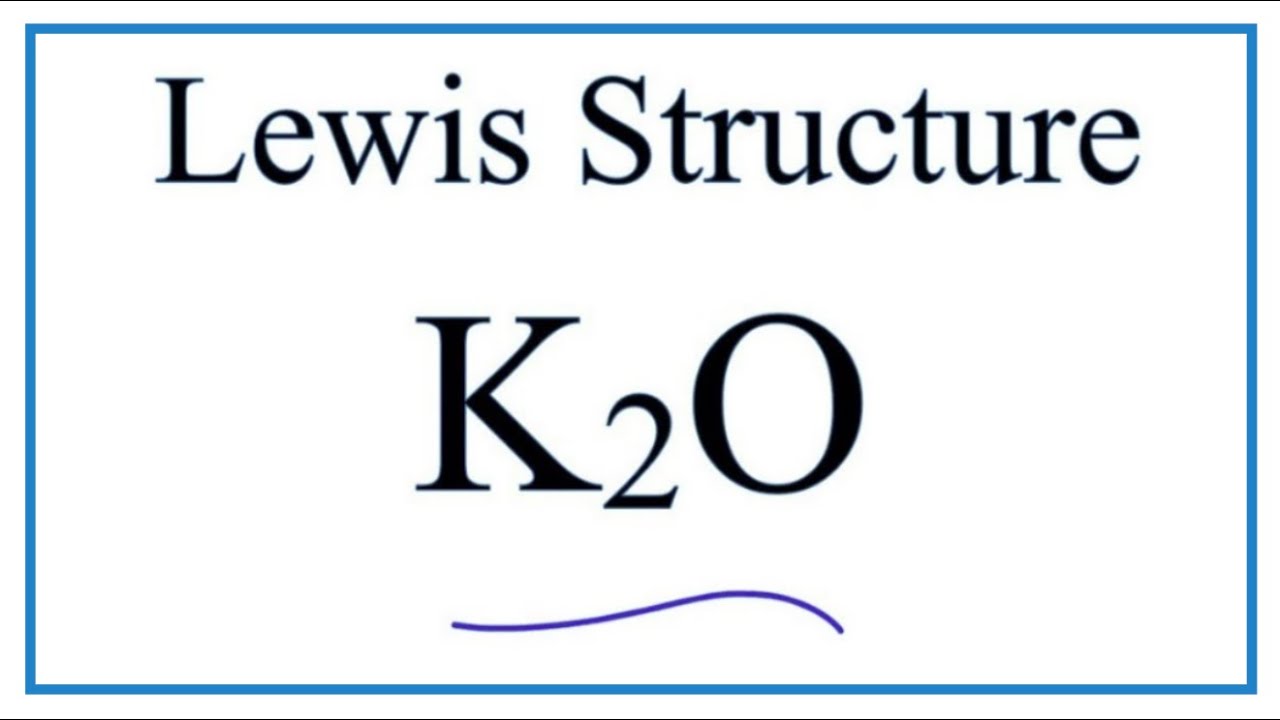
A step-by-step explanation of how to draw the K2O Lewis Dot Structure.
For K2O we have an ionic compound and we need to take that into account when we draw the Lewis Structure. We’ll first draw the metal and put it in brackets with its charge on the outside (video: finding ionic charge: https://youtu.be/M22YQ1hHhEY).
Next, we'll draw the Lewis...
 thorny gyro
supple monolith
Ok thank you
thorny gyro
supple monolith
Ok thank you
Yw
thorny gyro
Ig u have to
He explained it in the video tho , but idk if it was necessary or he was just showing as the steps
timber yoke
oops
supple monolith
?
thorny gyro
supple monolith
Thank you though!
Yw!
thorny gyro
hi can anybody tell me why cant n-ethyl-n-methylethamine be written as n,n-diethylmethamine?
sharp berry
One message removed from a suspended account.
cinder mason
Damn
autumn sky
thorny gyro
hi can anybody tell me why cant n-ethyl-n-methylethamine be written as n,n-dieth...
isnt the longest carbon chain the parent one?
thorny gyro
autumn sky
isnt the longest carbon chain the parent one?
oh💀
 outer beacon
How to prove Fermat’s principle( least time) in optics using laws of reflection and laws of refraction?
I can do the opposite but this one is giving me some trouble
quartz comet
outer beacon
How to prove Fermat’s principle( least time) in optics using laws of reflection ...
i have it writtin out
lemma show you

excuse me for my handwritting
work with triangles
v = x/t
differentiate
also, you know that its a principle that has been around for a pretty long time so think in classical ways
triangles, circles etc
aint no way there is some crazy advanced mathematics etc
i also think i have a small sign convention mistake, but the essence is there
copper python
6th question can anybody pls help

I keep doing mistakes in calculation what should I do
 unreal chasm
split thunder
copper python
6th question can anybody pls help
unreal chasm
split thunder
copper python
6th question can anybody pls help

drawing is a bit sketchy! d is the height of the triangle

 split thunder
 worn smelt
does anyone know why date can be a primary key when it isnt unique?
worn smelt
does anyone know why date can be a primary key when it isnt unique?
answer is b? so it's not that the date is unique, it's that since the lists are created weekly, you will only have one list of a certain type created on a specific day.
the two of these combined are unique.
think of it like your friends. you may have 2 friends born on the same day, but you will only have one friend from the Jones' household born on that day. Hence, you can use uhhhh date and family name as the primary key for your friends.
copper python
Thanks @split thunder
 somber bison
I have a scientific question about the 'final fate' of the universe. According to what I read about boltzmann's understanding of entropy, the second law is statistical. However, this idea was controversial because it implied there was a very small probability for entropy to decrease, rather than the previous understanding that entropy could only increase. It seems boltzmann was proven correct experimentally, when challenged on it by Planck and others. Given infinite time, is it not certain that all entropy has to reverse if there is any non-zero probability for it to occur? When people talk about the final fate of the universe, given an infinite amount of time I don't know why we would stop considering things after some finite amount of time. That would be less than the first planck second of an eternal universe.
What makes me doubt this is not understanding by what mechanism energy that has been lost in the form of light radiation could ever return, or energy lost through various other types of radiation that propagate through space? Perhaps the universe's final state is matter radiating itself out of existence over infinite time?
split thunder
somber bison
I have a scientific question about the 'final fate' of the universe. According t...
question
in the experiments, under what conditions was entropy able to decrease
somber bison
split thunder
question
in the experiments, under what conditions was entropy able to decrease
The experiment didn't show entropy reversed. Just that boltzmann's statistical calculation of entropy, that gave a probability of entropy reversing as real but extremely unlikely, produced a more accurate result confirmed by experiment than the methods at the time which didn't allow for the possibility of entropy doing anything but increasing.
This is from memory, but I'll double check my source.
worn smelt
split thunder
answer is b? so it's not that the date is unique, it's that since the lists are ...
ahh that makes sense thank you so much
split thunder
somber bison
The experiment didn't show entropy reversed. Just that boltzmann's statistical c...
oo makes sense, i mean the possibility of the universe's entropy (over an infinite amount of time) going down is definitely a cool thing to consider.
it is stastical, as you've mentioned. In a system, there is definitely the possibility for the reduction of entropy at certain points over time. For the universe, i don't think we would see this at a considerable scale.
if heat death ends up not being the fate of our universe, there could be some currently unheard of ways by which energy starts becoming available again (like in your last paragraph). Answer from me is, I have 0 idea. But, the heat death theory is my favoured one for now.
somber bison
split thunder
question
in the experiments, under what conditions was entropy able to decrease
I have the quotes here from the book Ernst Zermelo : An Approach to his Life and Work by Heinz-Dieter Ebbinghaus


I'm guessing the improved radiation formula was tested experimentally, but it didn't say anything about an experiment technically
somber bison
split thunder
oo makes sense, i mean the possibility of the universe's entropy (over an infini...
It would definitely take an inestimable amount of time and be supremely unlikely, occurring well after the heat 'death' of the universe. But given infinite time, even the most unlikely things have to happen.
I'm just not sure if it's very unlikely or if it truly has no chance to occur because of some scientific information I'm not aware of.
 next cedar
BOTANY: Hello does anyone know the parts here and what is happening in these pictures?

 ebon oyster
 exotic lynx
I've got the first part but second part is troubling me... please try to provide a brief solution for a beginner 🥲
 split thunder
ebon oyster
split thunder
ebon oyster
I'd guess not, cus ΣFy = 0, so it's more likely that 2G + T3 = T1y + T2y
sharp berry
exotic lynx
I've got the first part but second part is troubling me... please try to provide...
One message removed from a suspended account.
One message removed from a suspended account.
copper python
Please answer q3
 copper python
Please answer q3
copper python
copper python
Please answer q3
Just want to clear out the answer : since c =distance / time. And we know that time is reduced to half but speed of light i.e "c" is constant so to make it constant the distance is needed to be increased hence the universe is doubled over night. Is this the answer ?
exotic lynx
sharp berry
One message removed from a suspended account.
Not really... Actually I was studying by PW where the teacher gave this one out of many PYQ's
He said this one is of Jee Adv.
dim elk
exotic lynx
I've got the first part but second part is troubling me... please try to provide...
 exotic lynx
copper python
Please answer q3
exotic lynx
copper python
Please answer q3
That's HC Verma..?!!
I too have it, and I remember reading and thinking about that question
exotic lynx
copper python
Please answer q3
Ig we can conclude it by calculating the gravitational force btw Moon and Earth... since the size is doubled (assuming the densities to be same) the gravitational force would be quadrupled , as,
g = (GMm)/R^2
g' = (G2M*2m)/R^2
But there's an issue that if the size is doubled either the empty vacuum btw earth and moon should also get doubled or the distance btw their closest points would come even closer
sharp berry
exotic lynx
Not really... Actually I was studying by PW where the teacher gave this one out ...
One message removed from a suspended account.
worldly finch
what epq topic would you recommend me do as a person who does maths, chemistry and physics and i want to pursue engineering (preferably mechanical engineering). Initially I wanted to link my epq to some advanced mechanics mathmatics (since i dont do further maths) but im finding a topic for that quite tricky.
since i think i have to pose my dissertation as a question
split thunder
worldly finch
what epq topic would you recommend me do as a person who does maths, chemistry a...
 worldly finch
split thunder
worldly finch
split thunder
I mean there's so much you could do
worldly finch
i have a prompt anyways so its fine lol
split thunder
oh
worldly finch
what was ur idea if u had one tho>?
split thunder
lmaooo I was gonna ask your hobbies
Could always do sth hobby related so it's even more fun for you
worldly finch
ah fairss
split thunder
or any interests, blah blah blah. One of my mates who was an F1 enjoyer did sth relating to tires for his BEng final year. Another liked robots so he made a lil scanny bot. Lot of potential in stuff like that so it may be worth thinking about
worldly finch
split thunder
or any interests, blah blah blah. One of my mates who was an F1 enjoyer did sth ...
ah ok thanks bro
making something is quite interesting
split thunder
worldly finch
making something is quite interesting
ye you don't even have to make anything, can just do an investigation. In my case I made a software model for a renewable energy thing. Could be an analysis of golf swings even
worldly finch
split thunder
ye you don't even have to make anything, can just do an investigation. In my cas...
damn thats impressive
 exotic lynx
sharp berry
One message removed from a suspended account.
exotic lynx
sharp berry
One message removed from a suspended account.
My elder brother also says tha same😇 ... I'll definitely practice maximum possible jee mains pyqs
sharp berry
exotic lynx
My elder brother also says tha same😇 ... I'll definitely practice maximum possi...
One message removed from a suspended account.
 granite lichen
hello everyone, do you have a material about peroxosimal and glycerol exidation and as well as endogenous and exogenous pathway? like a video material or even just a document form?? thankyou
 proven quartz
Hiii! can anyone pls help me with these questions?? Thank youu T^T


 upper pebble
hope this helps!! ignore the writing 😅 @proven quartz
 upper pebble
proven quartz
Hiii! can anyone pls help me with these questions?? Thank youu T^T
upper pebble
proven quartz
Hiii! can anyone pls help me with these questions?? Thank youu T^T
replying to this.
proven quartz
upper pebble
hope this helps!! ignore the writing 😅 <@713400346948534306>
THANK YOUUU!!! I HAVE A TEST TMRW N YOU SAVED ME A MENTAL BREAKDOWNNN : " D n I hope your pillows are cold both side, thanks againnn
exotic lynx
sharp berry
One message removed from a suspended account.
Yeahh... luckily for me, I would get all the module, notes and other stuff of FIIT-JEE of my brother in a month asa he would be done with adv. .
sharp berry
exotic lynx
Yeahh... luckily for me, I would get all the module, notes and other stuff of FI...
One message removed from a suspended account.
 loud mirage
Any method to solve the circuit
electrical (count all currents and
durable)
guys plz help me i cant do it can someone solve this
 upper pebble
loud mirage
Any method to solve the circuit
electrical (count all currents and
durable)
g...
upper pebble
loud mirage
Any method to solve the circuit
electrical (count all currents and
durable)
g...
i dont get it what do u need to find?
loud mirage
count all electric current and electric voltage
upper pebble
ok
cinder mason
loud mirage
Any method to solve the circuit
electrical (count all currents and
durable)
g...
To find current
Use mesh law
copper python
Guys my sir made us write this I didn't understand where this delta cam from since d/dx (ln x) is 1/x

This is from error analysis
outer jetty
copper python
Guys my sir made us write this I didn't understand where this delta cam from sin...
Its for small changes since ln(1) = 0
copper python
So after 1st ln(x) they took it again as ln(1) ? Cuz I cannot understand working
 lavish obsidian
copper python
Guys my sir made us write this I didn't understand where this delta cam from sin...
lavish obsidian
copper python
Guys my sir made us write this I didn't understand where this delta cam from sin...
Usually we consider error in f(x) to be derivative of f(x) multiplied by ∆x
I think it comes from Taylor series I don't remember exactly
Also this is only when ∆x<<x which is the case for most situations as we assume it beforehand
copper python
lavish obsidian
Also this is only when ∆x<<x which is the case for most situations as we assume ...
that means we assume x as a very small integer such as 1 and write del x
 weak prawn
For a rigid body, let say a cube sliding on an inclined plane. When we make the free body diagram of the cube, we know that the normal reaction force vector changes its point of application according to the situation , we also know that friction = coefficient of friction × normal force .
So Can we determine a point where we can call/assume it the point of application of friction?
lavish obsidian
copper python
that means we assume x as a very small integer such as 1 and write del x
Uhh del x is the absolute error!!
And ∆x/x is relative error
Did your teacher not tell the basic definitions and stuff before going into errors in log etc.
copper python
he did tell us abt log but didnt told us abt the "errors in log"
 hushed sail
loud mirage
Any method to solve the circuit
electrical (count all currents and
durable)
g...
hushed sail
loud mirage
Any method to solve the circuit
electrical (count all currents and
durable)
g...
Merge R1 and R2 into one, then do ohms law for everything I guess
U can also search for Kirchoff's law it could help
U can also convert all of the remaining resistances into one sole resistance
It would be easier to solve
outer jetty
copper python
he did tell us abt log but didnt told us abt the "errors in log"
It has to do with absolute and relative variation but idk if your teacher already told you about that if he did not just keep this in mind , you will need it for incertitude calculus with * and / (using the proprety of log) and for + and - you'll use differentials
lavish obsidian
copper python
he did tell us abt log but didnt told us abt the "errors in log"
Ah man that sucks see if you can find Khan academy video or smth on it it might help you clear your basics
 random prawn
Just a quick bio question:By the end of Kreb cycle, how many ATP, NADH, FADH2 and CO2 are made?
Start with 1 glucose
 distant moss
random prawn
Just a quick bio question:By the end of Kreb cycle, how many ATP, NADH, FADH2 an...
distant moss
random prawn
Just a quick bio question:By the end of Kreb cycle, how many ATP, NADH, FADH2 an...
glycolysis : net 2 ATP 2 NADH, PDH: 2 acetyl CoA 2 NADH TCA: 6NADH 2 FADH2 2 GTP (i forget co2)
exotic lynx
sharp berry
One message removed from a suspended account.
The results of Mains April Exam just came yesterday, He scored ig 95%ile

 terse vapor
 mighty yoke
<@&942391219206647828>
mighty yoke
<@&942391219206647828>
ty ty
autumn sky
if all capacitors are identical each of capacitance C find the equivalent conductance between A and B

any insights?
thorny gyro
autumn sky
any insights?
search up star delta capacitor conversion
exotic lynx
Given answer is 2m/s.
 quartz comet
Does anyone has a full pdf of the solutions of classical mechanics by goldstein 3rd edition? cant seem to find full editions on google
 meager mantle
hey ! can anyone help me to understand chemistry first chapter of class 11th, can anyone find me a good yt video
im new just new to the science world
nah, the laws of chemical combinations
like the gay lussacs law and the avogardo's law and all
I know the laws but can't understand how to do the numerical's
numerical's of multiple proportion
yoo @night coral help me out ?
damn thanks
and also for the time graph of physics of motion in a straigt line ?
thnks arigatoo
exotic lynx
I guess it should be 40 cm length and 20 cm height. As for the minimum velocity we have to make the ball reach the edge of the last step and hence fall on the floor. The line of trajectory should be going tangent to the edge of the last step.
 floral tide
hey, does anyone know youtube channels i can use to study electric circuits?
quartz comet
floral tide
hey, does anyone know youtube channels i can use to study electric circuits?
organic chem tutor
floral tide
i like his videos but i would rather another channel if you have one
lavish obsidian
quartz comet
Does anyone has a full pdf of the solutions of classical mechanics by goldstein ...
Hey can I dm u about smth
 slate slate
hello guyz
hello
it asks abt no of atoms so shouldnt it be 6.74576x10^24 ??
ask me for any explanation ..
lyric dove
slate slate
it asks abt no of atoms so shouldnt it be 6.74576x10^24 ??
yes, this is exactly what I got!
lavish obsidian
lyric dove
yes, this is exactly what I got!
Yeah that solution is wrong
quartz comet
lavish obsidian
Hey can I dm u about smth
wassup
 crystal hare
Hey, I'm not sure whether this is the right place for programming questions but: I need to implement the secant method to approximate the root of a function. One of the given functions is f(x)=tanh(x) with initial values x1=-1 and x2=3. This leads to the output NaN because of the asymptotes of tanh. I asked the tutor for help and he told me that if I make the method return an error message for f(x1)*f(x2)>0, all cases with asymptotes should be solved. As you may guess, that didn't work. I asked chat gtp, which implemented an if statement leading to the root becoming infinity. I am at my wits end and could use some help. Here is my code:
double secant(double x1, double x2, double (*func)(double), int &schritt, const double tol )
{
double xn; // Variable für die lineare Approximation
schritt = 0; // Schrittzähler für Konvergenzgeschwindigkeit
//triviale Lösung
if ( func(x1) == 0 ||func(x2)==0)
{
std::cout<<"0";
}
//checken ob f(x1)*f(x1)>0 => return 0
if (func(x1)*func(x2)>0)
{
std::cout<<"Bedingung nicht erfüllt\n";
}
do
{
// Berechne neuen Wert für die lineare Approximation
xn = x2 - func(x2) * (x2 - x1) / (func(x2) - func(x1));
    x1 = x2; // für die nächste Iteration: x2 -> x1
    x2 = xn; // xn -> x2
    schritt++; // Inkrementiere
} while (std::fabs(x2 - x1) > tol); // Iteration wiederhohlen bis gewünschte Genauigkeit erreicht wird

return xn; // Ergebnis
}
Here is the code from chat gpt:
double secant(double x1, double x2, double (*func)(double), int &schritt, const double tol)
{
double xn; // Variable for the linear approximation
schritt = 0; // Step counter for convergence speed
do
{
    // Calculate the new value for the linear approximation
    xn = x2 - func(x2) * (x2 - x1) / (func(x2) - func(x1));

    // Check for NaN or extremely large values
    if (std::isnan(xn) || std::fabs(xn) > 1e10)
    {
        // Adjust interval away from asymptotes
        double mit = 0.5 * (x1 + x2);
        if (func(mit) * func(x1) < 0)
            x2 = mit;
        else
            x1 = mit;
    }
    else
    {
        x1 = x2; // Update for the next iteration: x2 -> x1
        x2 = xn; // Update for the next iteration: xn -> x2
    }

    schritt++; // Increment step counter
} while (std::fabs(x2 - x1) > tol); // Repeat iteration until desired accuracy is achieved

return xn; // Result
}
 icy tendon
chemistry,
is there a specific naming convention that helps us figure out the compound of hydrogen peroxide?
e.g: ''per'' adds one more oxygen than the ''ate'' form for some anions

 topaz hedge
Hey, everybody.
So there's this project I need to finish for tomorrow. My biology teacher said to do everything from 0, hence I've been sitting the past few hours on my laptop. My topic is "How to live in accordance to our biorythms". I wanted to find information on if people back then lived more according to their biological rhythms and what hinders us today on living a healthy life, but I couldn't find anything. Is there anybody who could help me?
quartz comet
topaz hedge
Hey, everybody.
So there's this project I need to finish for tomorrow. My biolog...
Food
Social media
Time changing periods
You can write a whole lot only on that
 scarlet mountain
 karmic galleon
similar question
 cunning crescent
does anyone have any good resources on how to determine what can be used as an internal standard when a stable isotope of your specific compound is not available for whatever reason?
karmic galleon
scarlet mountain
similar question
Thanks a lot
 cyan frigate

in these two questions we need to find the net flux but the apporach of both the questions are different and the final result isn't matching if done the other way
When to know to substitute the value of x in variable E.F and when to go by integration?
 hollow roost
Someone recommend me a way to complete backlogs 😭😭
 frigid night

HELP
I keep getting 1.8x10^4
no matter what when i try to calculate the gravitational potential energy i always get it to be x10^9 instead of x10^8
is my calculator just awful or is this the same for anyone else?
next cedar
Hello does anyone know why my uncertainties are super wrong

 keen tangle

 pale plinth
next cedar
Hello does anyone know why my uncertainties are super wrong
pale plinth
next cedar
Hello does anyone know why my uncertainties are super wrong
What class is this
next cedar
pale plinth
What class is this
Analytical chemistry
But i got the solution
Ty anyway
thorny gyro
I need an urgent physics help
This is the question I was given.
Those on right are capacitor plates. And the one which is rolling is cylinder.(Tell me what u can't understand and I will tell u about it)

This was how I solved it.

I used basic Newton's laws of motion
This was my sir's answer.
He considered the whole system and wrote equations so that no. Of equations decreases.

We are asked to find the acceleration, and surprisingly my ans and sir's ans are diff as u can see.
Can you tell me where is the mistake and who is doing the mistake...I am clueless
Concepts used: capacitors, Newton's laws of motion, rotation of bodies
I will be really grateful if you could solve this before 25th may...I am in urgent need of it...
 dreamy spade
thorny gyro
I need an urgent physics help
dreamy spade
thorny gyro
I need an urgent physics help
I can help u
but this topic need long conversation
from the first look I don't see here where do you use dielectric coefficient of the brick
also your expression for moment of inertia is incorrect (no it's my mistake)
 raw blade
dreamy spade
from the first look I don't see here where do you use dielectric coefficient of ...
raw blade
dreamy spade
from the first look I don't see here where do you use dielectric coefficient of ...
Yes yes.. I haven't noted down the expression of F so dielectric constant will be used in the expression of F..
The thing is, since m and m' are not undergoing rotation here, why do we have to include their moment of inertia in the equation? That's actually my main concern..
dreamy spade
raw blade
The thing is, since m and m' are not undergoing rotation here, why do we have to...
if you reduce the length of ropes to near the zero, we can effectively say that they are rotating around the cilinder's axis
raw blade
dreamy spade
if you reduce the length of ropes to near the zero, we can effectively say that ...
Thank you.. but is there any specific name of this concept? I mean, the fact that we have to reduce the rope's length to check effective rotation?
dreamy spade
raw blade
Thank you.. but is there any specific name of this concept? I mean, the fact tha...
I don't know if this concept has any name, but you can make yourself sure that rope's length doesn't affect rotation equations, because it will not also affect strict 3 Newton laws if you will try to write them for every point of cilinder
raw blade
dreamy spade
I don't know if this concept has any name, but you can make yourself sure that r...
I see.. thank you so much..
thorny gyro
dreamy spade
I don't know if this concept has any name, but you can make yourself sure that r...
Can you help us with the fbd and explain it to us, in that way it will be easy for both of us
dreamy spade
thorny gyro
Can you help us with the fbd and explain it to us, in that way it will be easy f...
It's a bit wide topic without specific problem you want to solve, I definitely can explain that but it will transform into lecture instead of post
thorny gyro
dreamy spade
It's a bit wide topic without specific problem you want to solve, I definitely c...
No no I meant, just the fbd of the system. We know the concepts, we are just new to the concept that we need to include m and m' in the equation for moment of inertia.
If you could solve the equation using basic Newton's laws of motion like I did , it will be very helpful
dreamy spade
I can explain you that in a call, I'm too lazy to write it all here
thorny gyro
Alright let me see if @raw blade is up for it. Actually it was his problem.
Thank you for the initiatives!
dreamy spade
thorny gyro
This was how I solved it.
I guess the mistake is that you equalized accelerations of both bricks, while brick m will have twice as much acceleration as brick m' has
because they are connected via movable block
yeah it seems like it's the main mistake in the solution
you wouldn't meet that problem if you solved that in your teachers way via total moment of inertia
thorny gyro
dreamy spade
I guess the mistake is that you equalized accelerations of both bricks, while br...
I thought of using constraint relation with the help of power developed by internal force is zero (T.v=0) and then relate the accelerations but got stuck after a while
dreamy spade
if you consider work of different forces and equalize it to zero you'll automatically obtain moment of forces equation, so you don't need to think about work here
accelerations relation can only be obtained with kinematic relations, as I already said. You just look at geometry of cilinder and get that a=2a' if the bottom of the cilinder is axis of rotation
thorny gyro
dreamy spade
accelerations relation can only be obtained with kinematic relations, as I alrea...
Can you do it somewhere and send a picture of it here?
dreamy spade
yeah wait a second
dreamy spade
thorny gyro
Can you do it somewhere and send a picture of it here?

you can see it from similarity of trianlges
raw blade
dreamy spade
thankk youu so muchhh yes i got it!!!
thorny gyro
That was so so so basic that I ignored it!
My mind is soo complex! 😭
dreamy spade
thorny gyro
That was so so so basic that I ignored it!
My mind is soo complex! 😭
it happens with all of us
 pure flower
Hello! Is there anyone who has gromacs installed and could help me w md
dreamy spade
wdym by nuclear density
rate of nuclear mass over nuclear volume? Or atomic volume?
meager mantle
can anyone suggest me a very easy to understand stoichiometry equations yt video
I'm little new to chemistry
quartz comet
meager mantle
can anyone suggest me a very easy to understand stoichiometry equations yt video
organic chem tutor
thorny gyro
Yes
 placid thorn
any chemistry ppl here?
 serene heron
placid thorn
any chemistry ppl here?
serene heron
placid thorn
any chemistry ppl here?
yes me but im in 12th grade-
lavish obsidian
Why can't I post any ss here
 dreamy spade
ember sluice
dreamy spade
ember sluice
I don't know palestinian or whatever language it is
cunning crescent
Palestinian💀
 kind sonnet
Palestinian 💀💀💀💀
lyric dove
ignorance 🧘♂️
placid thorn
serene heron
yes me but im in 12th grade-
ok boss
placid thorn
placid thorn
ok boss
i dmd u
placid thorn
serene heron
yes me but im in 12th grade-
i dmd u
 cedar bluff

 surreal canyon
Chemistry question
Does anyone have mechanism for reaction of 1,5-dicarbonyl and ammonia to form pyridine?
 mystic rose
In these images, how are the two cells in series?
Current is going to the voltmeter also, wouldn't it make it a parallel connection?

 vernal marsh
mystic rose
In these images, how are the two cells in series?
Current is going to the voltme...
vernal marsh
mystic rose
In these images, how are the two cells in series?
Current is going to the voltme...
Ideal voltmeter has infinite resistance hence no current passes thru it, it's just used to measure the potential
mystic rose
Got it, Thank you so much guys !
mighty yoke
Does anyone have any general tips/good recs for understanding how to write redox and acid/base titrations? the part where you have to add hydroxide and water is throwing me off so badly.
surreal canyon
Best advice I got is to forget about OH and to use H+.
If we have reaction in basic conditions, try to balance it in acid, then neutralise with OH-. To give an example:
KMnO4 + SO2 + KOH = K2MnO4 + K2SO4 + H2O
Ox: SO2 = SO4(2-)
Now use acid rules to balance:
SO2 + 2 H2O = SO4(2-) + 4 H+ + 2e-
Now add 4 OH- so it can neutralise H+ ions!
SO2 + 2 H2O + 4 OH- = SO4(2-) + 4 H2O + 2e-
Now you just cancel water.
SO2 + 4 OH- = SO4(2-) + 2 H2O + 2e-
Hopefully I helped!
mighty yoke
surreal canyon
Best advice I got is to forget about OH and to use H+.
If we have reaction in ba...
You did! I really appreciate it 🙏
thorny gyro

It says a is correct option but I think b should be
As if we use restriction enzyme and cut out the ampicillin resistant gene and in its place I put my desired gene then that colony of vectors won't be resistant to ampicillin and we will be able to identify transformant vectors having recombinant genes.
Can anyone clarify where I am wrong?
thorny gyro
No ori is intact...I am assuming I am just replacing the amp site and replace it with my gene of interest so that I know that I have transformant with recombinant
I don't get how in option a I'm supposed to identify if I did transfer gene of interest 😂
Like if I don't transfer it and let it grow in amp medium it will grow smoothly.
If I use (a) and replace the small site with my gene of interest then too it will grow smoothly in amp medium as I am not disturbing the amp resistant site.
However if I use (b) and ligate my gene of interest in place of amp resistant site then my recombinant would have my gene of interest and ori(as amp resistant site is replaced by my gene of interest). Then these won't grow in amp medium and I would know that these colony has been successful!
Also I dare say that this was a single choice correct question so if option b is correct then c will be correct too 😂
 tender hemlock
 calm creek
Use anki, for anatomy
 lost thunder
Learn positions, like anterior, posterior, distal, proximal, etc. Trust me in helped me figure out locations which helps with what's wrong
mystic rose
Can anyone explain the second part, Like how will the magnetic field point upward in the vertical plane?

 median laurel
mystic rose
Can anyone explain the second part, Like how will the magnetic field point upwar...
median laurel
mystic rose
Can anyone explain the second part, Like how will the magnetic field point upwar...
The best way to understand the direction of the magnetic field is to use the right hand thumb rule... thumb in the direction of current... imagine the X-axis as the same as the wire and Y- axis an an imaginary line perpendicular to the wire... now the way your other fingers curl is how the magnetic field will behave... so when you are in the vertical plane(+ve Y axis), your fingers will be pointing upwards...
I hope the explanation helps!
somber bison
Suppose you hover some arbitarily small distance outside of a black hole's event horizon, without falling inside. Would you be melted into plasma by blue shifted light from the rest of the universe due to the black hole's time dilation?
 tacit condor
Yes
The blue shifted radiation creates ionizing energy which if scientifically calculated is enough to melt your whole body into plasma
The ionizing energy and the intense thermal energy will melt you in a fraction of second
And this is all assuming that you're already not experiencing tidal forces and radiation pressure...if they came into play..you would be gone before even god knows
The radiation would have intense energy due to the gravitational blue shift*
@somber bison hope this helps
somber bison
tacit condor
<@708699779705602078> hope this helps
It helps a lot! It confirms my intuition of what would happen to an observer approaching a black holes event horizon. Forget whether the black hole is big or small, the accretion disk, or what its like inside of a blackhole, they would be turned into plasma by the blue shifted cmb before ever getting inside.
somber bison
Now I'm wondering would the blue shifted light be blasting in-falling matter to within nearly the maximum temperature allowed in the universe the planck second before it passed into the blackhole? And would this blasting change some properties of matter, that would get rid of some information paradoxes?
tacit condor
You never know it what if the velocity near it is too high that you are getting sucked in before the blue shift radiation reaches you and in the mean time your accelerating too keeping in mind that the radiation pressure as well as the gravitational shift is acting on you it is more likely you get spaghettified before actually turning into plasma
Or another case might be you turning into plasma while getting spaghettified..since your question was particular yes you would turn into plasma when maintaining a distance
Here distance supports only staying at one point not orbiting coz the centripetal force will be enough for you to not turn into plasma rather stay what you are if the right velocity is achieved
somber bison
I'm not as familiar with spaghettification but I think spaghettified plasma would certainly be a possibility. 😅
quartz comet
short in short, when you are in it, you wont even notice
and there are some theories whereas you surpase a black hole, you come into a white hole
if you shift long enough to a certain "side" of the black hole resulting in other universes

something like this
which is pretty cool because mathematically it shows that there is an infinite amount of these "boxes"
tacit condor
somber bison
Now I'm wondering would the blue shifted light be blasting in-falling matter to ...
Well I'm not actually certain if I could answer that question for you
We would require a deeper understanding of quantum gravity and space-time and how information is preserved in this universe
The particular scenario you mentioned can happen according to the theory of everything proposed by Stephen Hawking
As we know...everything has a possibility...here or in an alternate universe well it is a compelling idea that the matter would reach nearly the maximum temperature allowed but we need a deeper understanding
Sorry for the inconvenience
quartz comet
screams infinite parallel universe????
tacit condor
quartz comet
screams *infinite parallel universe????*
You never know
somber bison
tacit condor
You never know it what if the velocity near it is too high that you are getting ...
I'm a bit confused why the centripetal force would prevent you getting turned into plasma while rotating. Wouldn't rotating at a faster speed just make time dilation more intense (although according to what I've read its approaching infinity at the event horizon already?).
quartz comet
somber bison
I'm a bit confused why the centripetal force would prevent you getting turned in...
nah
somber bison
quartz comet
which is pretty cool because mathematically it shows that there is an infinite a...
Ya the Penrose diagrams are very interesting. You are reaching the end of time in the previous universe you were in before entering the blackhole (and potentially new universe?). Experiencing an 'infinite time' of cmb radiation all at once seems like it would really fry matter.
quartz comet
because the time dialation near the EH is so big that the centripital force does not have a big effect anymore
tacit condor
somber bison
I'm a bit confused why the centripetal force would prevent you getting turned in...
Oh I'm sorry I got a bit perplexed over there I actually meant of escape velocity not the centripetal force...centripetal force is just a mechanical term even if your orbiting at a certain velocity your more likely to turn into plasma..if not by the blue shift but also due to other relativistic effects
Then we come to conclusion
We turn into plasma
No matter what
When visiting a Blackhole
quartz comet
identifies as a quark gluon
tacit condor
What if we surpass a blackhole and imagine we enter another universe through a white hole...and what if we got into another black hole
Would that send us to over universe...or another universe??
quartz comet
tacit condor
What if we surpass a blackhole and imagine we enter another universe through a w...
That is an extremely interesting question actually
i thought the math checks out, but the physics doesnt
tacit condor
Yeaa I'm very much confused about what happens...but turns out we turn into plasma
💀
quartz comet
well
its a bit contradicting isnt it
a black is so massive it absorbes everything, even light
so we go in it right?
but a white hole should be its counterpart, meaning you cant get in it
so how could we possibly go from one to another when we cant get into the white hole?
we could also possible imagine that if you pass trough the black hole the other end is a white hole? because the gravity is so strong it just "pushes" you down if you see what i mean
and we havent discussed einstein rosen bridges
mental
tacit condor
Brain.exe gave up
copper python
quartz comet
and we havent discussed einstein rosen bridges
Yes but you cant possibilly travel from those
the link between black hole and white hole breaks
becaus the time being infinite to travel btw them
dire shuttle
quartz comet
this shi haunts me
quartz comet

does somebody know why they sum over 2 different indexes?(the place of the question mark)
its about oscillations
and finding the eigenvalues of an oscillation


this is the rest of the derivation^^
 charred badger
is there anyone doing masters in physics right now?
 warm hollow
Can anyone explain how to solve this? I know it's definitely beginner-level astronomy but I'm unsure how mass comes to play when calculating this with Keplers third law. It's probably a lot more simple than my overthinking brain is allowing me to see :')

 trim fern
warm hollow
Can anyone explain how to solve this? I know it's definitely beginner-level astr...
trim fern
warm hollow
Can anyone explain how to solve this? I know it's definitely beginner-level astr...
What’s au?
tacit condor
trim fern
What’s au?
In this context it's astronomical units
1AU is nearly 150M km
It's approx
T² is proportional to R³
trim fern
tacit condor
1AU is nearly 150M km
Oh that’s very huge
 dreamy spade
charred badger
is there anyone doing masters in physics right now?
dreamy spade
charred badger
is there anyone doing masters in physics right now?
yes
charred badger
dreamy spade
yes
hi i’m doing my bachelors right now and i needed some guidance regarding where to do my masters from. could you tell me where you’re doing your masters from
quartz comet
charred badger
hi i’m doing my bachelors right now and i needed some guidance regarding where t...
YO!
what you should do first is look what topic you like the most
Some universities are very specialized in some topics, which gives you an advantage for an eventual PhD.
Ill give an example, my university is excellent in quantum, astronomy, theoretical, condensed matter and nuclear physics.
So if for example I want to do quantum, its an option of staying at my uni. If they dont have the topic you want to specialize in, you should look for a uni that does in fact specialize. Look up the univerities with: Best university for masters in theoretical physics. I support going to the best unvirsitiy possible for you masters because it has a wayyy bigger impact then a bachelors. Most bachelors are very alike, whereas the masters is very very different. Even if it sounds irrealistic to go for example to MIT, it doesnt. Iv heared from people that if your grades are good, and you did research in your bachelors, did well on the GRE then you have a fair shot at getting in. Caltech, oxford, cambridge, all very good schools!
I wish you the best of luck!
I dont know where you are from, but Europe also has VERY VERY good universities, and probably more affordable
charred badger
quartz comet
Some universities are very specialized in some topics, which gives you an advant...
i’m from india and the education system makes it very hard for a general category student to get into good universities here because half of the seats are reserved based on caste system. So i want to get out of here for my masters and need a road map to help me with it, i’m working on my grades right now but really need guidance with the extra things that are needed to build my CV. i have my year break rn (got done with first year exams last week) and i’m looking for the best universities i can aim for, yes MIT and all the ivy league are the top ones but i honestly don’t feel like i can do it.
which university are you doing your masters from right now?
quartz comet
charred badger
which university are you doing your masters from right now?
Not in masters yet
But talk with people whom are and do phd
So i give you their advice
restive quest
can someone explain me how it choose "Region 4" without knowing Ka or pKa? i dont get the ""rules"" for this thing tbh


 solar badger
trim fern
solar badger
trim fern
theres no friction between the prism and base right
when the mass starts to accelrate downward a itll push the prism backwards i did this in 11th i just remember the concept
calculate the accelration using alpha and newtons third laws equations
ma = mgsinalpha probably
in respect to this calculate the accelration of the prism
dreamy spade
solar badger
ma = mgsinalpha probably
it's wrong
ma equals total force and total force consists not only of mg but also reaction force
that's why the bar will fall downwards at bigger angle than alpha
 past plover
dreamy spade
ma equals total force and total force consists not only of mg but also reaction ...
past plover
dreamy spade
ma equals total force and total force consists not only of mg but also reaction ...
you mean normal right
dreamy spade
past plover
you mean normal right
Normal is kind of reaction force.
Also friction is a reaction force
past plover
ohhh
past plover
dreamy spade
Also friction is a reaction force
yes
dreamy spade
these forces literally are reaction of the surface to body being placed on it
past plover
dreamy spade
these forces literally are reaction of the surface to body being placed on it
yepp
trim fern
I did that but I got the wrong answer
cunning crescent
does anyone have any resources on how to determine LOD and LOQ? especially in HPLC?
this stuff is giving me a headache
 prime sandal
I was thinking about doing AP chem. Is this a bad idea? I like math and science and want a challenge.
 polar vale
an electron moves along +x direction and mag field along -z direction what will be thwe trajectory of an el;ectron entering from origin
prime sandal
idk I haven't taken it but when my teacher taught us for fun I seemed to get it easily
alright
what did you score?
no
but my teacher briefly went over it
I was looking at the AP distribution score and 75% of people passed chem which was one of the highest passing rates of all APs
I was thinking of taking that senior year
I'm going into 11th
2 years before college although i am doing dual enrollment
good question
I should probably look
I have no clue lol
I just want to pole vault in college
haha yea I will think about it. I have about a month
before I finalize my schedule
Ok thank you so much!
What school do u go to?
College?
that's cool
So you do models and stuff
That's awesome
Sounds like it
what are you interested in building?
or designing I should say
oooo
That sounds so interesting
I just know I don't really want to be a lawyer haha
kinda
well for school at least
 proper monolith
one dimensional motion

I figured i could directly get the displacement since it was an equation of position
but the answer is very incorrect then
its supposedly B
 short bay
proper monolith
one dimensional motion
short bay
proper monolith
one dimensional motion
i guess you need to find the derivative of x in respect to t - to find the velocity function. And then find the integral v(t)dt from 0 to 5
x' = 3t^2-18t+15
oh it is the same function then after the intagration
correct answer is A
 stoic lantern
short bay
correct answer is A
stoic lantern
short bay
correct answer is A
No it's 39 I kinda figured it out
It's accelerating then retarding
Matches the answer key too
Oh my apologies that's my account
The one that posted question
 olive sable
Hello there! I would like to ask these two questions:
- Biology or Chemistry is a better career overall? Which one has better job opportunities and better salaries (specifically in Europe)?
- If I want to get into the pharmacy industry (without being a pharmacist) which one (biology or chemistry) is better for that?
past plover
short bay
oh it is the same function then after the intagration
why would any integration or differenciation be required if the equation is given in terms of distance and time and we need to find the distance
i think if the question asked the velocity then we would have to differenciate the equation
the answers A tho
 split bridge
proper monolith
one dimensional motion
split bridge
proper monolith
one dimensional motion
You need to find derivative of x with respect to t.
This is velocity.
Find where velocity=0 and this will give t where v =0.
Where the velocity is 0,particle must have taken a turn.
Then add the distances individually by drawing path of motion.
Or use v.dt from the time period of start to where it turned and then from where it turned to where it reached
Both these integration have to be separate and under modulus since distance is positive
Anybody know how to easily write in Latex in Anki and Obsidian?
I downloaded a gitbuh code which is an Obsidian plug-in for converting text to Latex.
How do I enable this in Obsidian or attach this code to Obsidian.
I haven't used GitHub before.
Kindly help.
trim fern
past plover
why would any integration or differenciation be required if the equation is give...
We have to find the distance not the displacement so you’ll have to check if and when the velocity changes it direction
short bay
it's 39 you are right
split bridge
Are there any study rooms specifically for JEE?
tacit condor
split bridge
Are there any study rooms specifically for JEE?
Nope
Ask in study buddies
Make some
And all of u can join one room
 buoyant sail
Can anybody explain me why does acid contain hydroxyl (OH-) ions ?????
trim fern
buoyant sail
Can anybody explain me why does acid contain hydroxyl (OH-) ions ?????
From what I understand
Acid don’t contain oh- ions but when you dissolve them in water they break into H+ and the conjugate base
Now there is some H+ ions in the solution but water dissociates to form H+ and OH- ions with its equilibrium constant equal to 10^(-14) which is the product of concentration of H+ and OH- ions
Now there are already some H+ ions in the solution due to the acid let’s say it’s concentration is 10^(-3) for example then the product of concentration of OH- and concentration of H+ is equal to 10^(-14) hence there will be 10^(-11) molar OH-
In short the OH- comes from dissociation of water into H+ and OH-
 sand coyote
buoyant sail
Can anybody explain me why does acid contain hydroxyl (OH-) ions ?????
sand coyote
buoyant sail
Can anybody explain me why does acid contain hydroxyl (OH-) ions ?????
It seems there might be some confusion here. Acids typically do not contain hydroxyl (OH-) ions; instead, they release hydrogen ions (H+) when dissolved in water.
Here's a simple breakdown:
Acids: When acids dissolve in water, they release hydrogen ions (H+). For example, hydrochloric acid (HCl) dissociates in water to produce H+ and chloride ions (Cl-).
HCl
→
H
+
+
Cl
−
HCl→H
+
+Cl
−
Bases: On the other hand, bases release hydroxyl (OH-) ions when dissolved in water. For example, sodium hydroxide (NaOH) dissociates in water to produce sodium ions (Na+) and hydroxyl ions (OH-).
NaOH
→
Na
+
+
OH
−
NaOH→Na
+
+OH
−
So, to summarize:
Acids release H+ ions in water.
Bases release OH- ions in water.
 flat ledge
Can someone explain to me how much mol O² is necessary to burn 24g of C?
basically:
C + O² -> CO²
with C = 24g
ik that I need to do
g
g/mol
but I don't know what value of g/mol I should take, C, O² or both.
C would make sense bc the other given value (g) is also given in C, but then again, the amount in mol of O² is asked...
(this is about the most simple example I could find. I did calculations like that before, but now that I'm revising everything, I've become unsure about it)
trim fern
You have 24 g of C, molecular weight of C is 12 hence no of moles of C is 24/12 = 2
The balanced chemical equation has equal no of moles of C and O2
Hence 2 mole of C would require 2 mole of O2
Molecular weight of O2 is 32
Hence 2 moles of O2 would weigh 2*32=64
flat ledge
Thank you very much. It's all clear now.
 nimble mortar
can any economist in here explain what is a country's GDP ?

 signal stump
nimble mortar
can any economist in here explain what is a country's GDP ?
signal stump
nimble mortar
can any economist in here explain what is a country's GDP ?
You add the sum total of all goods and the value of services produced in your country and get GDP
solar badger
signal stump
tin hcl and nano2 is part of
diazonium
even cl3
cl2*
wait
yup
I would replace the diazonium
thorny gyro
signal stump
You're still having problems?
signal stump
thorny gyro
You're still having problems?
Na na, this was from the same day.
You sorted it out
lyric dove
Am i missing something or is there no correct answer?
 tacit condor
lyric dove
Am i missing something or is there no correct answer?
tacit condor
lyric dove
Am i missing something or is there no correct answer?
There is no correct answer
Hunds rule violated in the last one
Otherwise it would've been correct
cunning crescent
B breaks Hund's rule
Only I can think of is that D is correct and that the order of the "boxes" doesn't matter. Can't remember enough to say if that's accurate or not
lyric dove
yea D violates the Aufbau principal but was somehow the correct answer for this practice quiz
nonetheless i think no answer is truly correct
stoic lantern
Yeah none is correct
 remote dragon
is a single electron which is not in motion paramagnetic or diamagnetic or none?
dire shuttle
lyric dove
yea D violates the Aufbau principal but was somehow the correct answer for this ...
maybe cuz they are degenerate orbitals thats y D

 hexed bolt
someone who studies genetics, can u explain what it topoisomerase
it's from textbook i use, but i don't understand it


 remote dragon
is a single electron which is not in motion paramagnetic or diamagnetic or none?
remote dragon
remote dragon
is a single electron which is not in motion paramagnetic or diamagnetic or none?
help pleaseeeee
 spark crown
hi guys is someone here studying chemical engineering or is a chemical enginner please
lyric dove
dire shuttle
maybe cuz they are degenerate orbitals thats y D
None because the Heisenberg principle
u can’t have an electron that’s not moving
like remember that u can’t know the location and momentum at the same time
oops I meant to ping @remote dragon
lyric dove
remote dragon
help pleaseeeee
.
quartz comet
lyric dove
u can’t have an electron that’s not moving
you should not really look at that
what they want you to do is look at the magnetic propertie of an electron i.e. the spin of such an electron + magnetic moment

you should look at the properties of para and diamagnetism
where paramagnetism is kinda known for having unpaired electrons whom will eventually allign with an external magnetic field
if you look at those chemical principles, not very good at it tbh :D, there is one where an unpaired electron has an unpaired spin and therefore an unpaired magnetic moment --> alligning with an external magnetic field --> paramagnetic
dire shuttle
lyric dove
oops I meant to ping <@789252722377228288>
XD its ok
dayum is paramagnetic and magnetic property shown by a single electron cuz i thought it was shown by a molecule/atom
like i know diamagnetic can be shown by the electron spin
if you consider it as a magnetic dipole
remote dragon
lyric dove
like remember that u can’t know the location and momentum at the same time
thank youuuu
remote dragon
quartz comet
you should look at the properties of para and diamagnetism
where paramagnetism...
the question I saw said that we put electrons and protons (not atoms) on a surface then we apply magnetic field. which of them act diamagnetic and which act paramagnetic. idk maybe i don't understand the question correctly. I can't even translate the question or else I'd send it.
lyric dove
quartz comet
if you look at those chemical principles, not very good at it tbh :D, there is o...
thx for the reply my guy
 quiet holly
can someone help me derive transformer efficiency if we provide grid and solar supply and load is connected
west yew
η= p(load)/p(load)+p(loss) X 100%
west yew
quiet holly
can someone help me derive transformer efficiency if we provide grid and solar s...
efficiency if you include power loss during the working of transformer
quiet holly
thanks
west yew
quiet holly
thanks
👍
thorny gyro
what the difference b/w magnetic and dipole moment
 mortal turtle
can anyone tell me if prostaglandin is a hormone or not?
 mild zealot
how to calculate explosion momentum
 hazy burrow
mortal turtle
can anyone tell me if prostaglandin is a hormone or not?
hazy burrow
mortal turtle
can anyone tell me if prostaglandin is a hormone or not?
No, they can be produced in almost every tissue and not by an especific gland
 fast shale
Hi is anyone here familiar with physics 2? Im having trouble with the course and am looking for help, thank you!
quartz comet
fast shale
Hi is anyone here familiar with physics 2? Im having trouble with the course and...
i think it depends a bit from uni to uni
but i can for sure help!
 silk lintel
quartz comet
silk lintel
quartz comet
Bro thank god I don't have to take pchem