#agents
1 messages · Page 2 of 1
 smoky ocean
 wild pasture
mmm already on 0.17.0-llm.1
new error dropped:
 wraith remnant
wild pasture
mmm already on 0.17.0-llm.1
new error dropped:
wraith remnant
wild pasture
mmm already on 0.17.0-llm.1
new error dropped:
wanna go on dev-audio ?
wild pasture
! input: llm panic while resolving Query.llm: runtime error: invalid memory address or nil pointer dereference
! goroutine 9748 [running]:
! runtime/debug.Stack()
! /usr/lib/go/src/runtime/debug/stack.go:26 +0x5e
! github.com/dagger/dagger/dagql.(*Server).resolvePath.func1()
! /app/dagql/server.go:736 +0x78
! panic({0x25ef180?, 0x4b21010?})
! /usr/lib/go/src/runtime/panic.go:785 +0x132
! github.com/dagger/dagger/core.(*SecretStore).GetSecretPlaintext(0xc000ac8450, {0x30d5110, 0xc000b22210}, {0xc0016a6570, 0x15})
! /app/core/secret.go:199 +0x1dc
! github.com/dagger/dagger/core/schema.(*secretSchema).plaintext(0xc000499f20?, {0x30d5110, 0xc000b22210}, 0xc00127a588, {})
! /app/core/schema/secret.go:182 +0x9a
! github.com/dagger/dagger/dagql.Func[...].func1({0xc000373640?, 0xc00127a588?, {0x0, 0x1, 0xc0007f61e0, 0xc000ac2610}, 0x0}, {})
! /app/dagql/objects.go:577 +0x49
! github.com/dagger/dagger/dagql.NodeFuncWithCacheKey[...].func1({0xc000373640, 0xc00127a588, {0x0, 0x1, 0xc0007f61e0, 0xc000ac2610}, 0x0}, 0xc000b22030)
! /app/dagql/objects.go:634 +0xfc
! github.com/dagger/dagger/dagql.Class[...].Call(0x3118c00?, {0x30d5110?, 0xc000b22210?}, {0xc000373640, 0xc00127a588, {0x0, 0x1, 0xc0007f61e0,
i was doing fil cuz the log is too long discord doesnt like it 😦
smoky ocean
🚨🚨🚨 New pre-release: v0.17.0-llm.2. Now with Anthropic support!
To install:
curl -fsSL https://dl.dagger.io/dagger/install.sh | DAGGER_VERSION=0.17.0-llm.2 BIN_DIR=/usr/local/bin sh
Thank you @split shard @gloomy kindle @spring wave for wrangling our release system to support these pre-releases 🙏
wraith remnant
smoky ocean
🚨🚨🚨 **New pre-release: `v0.17.0-llm.2`. Now with Anthropic support!**
To ins...
a checksum might be missing
smoky ocean
wraith remnant
a checksum might be missing
I installed it and it works for me at least! got Claude-3.5-sonnet to install various packages in a container 🙂
The checksum issue should be fixed now...
wild pasture
amazing work kyle, guillaume and vito 
 spring wave
np! the main learning: for folks configuring ollama, you have to configure an IP reachable from the engine - so 192.168.xx.xx or 10.xx.xx.xx, not 127.0.0.1 or 0.0.0.0. Maybe we should automatically create a tunnel to the host?
smoky ocean
spring wave
np! the main learning: for folks configuring ollama, you have to configure an IP...
@wraith remnant would you mind adding this to the README? 🙏 in a section "setting up with ollama"?
wraith remnant
smoky ocean
<@274903880343748619> would you mind adding this to the README? 🙏 in a section ...
Yes now 👍
smoky ocean
@spring wave @wraith remnant quick note while preparing demo. We lost the 🤖💭 on API calls... was pretty nice for long round trips
spring wave
doesnt it stream? or is this for a slow API that takes a long time to stream back?
wraith remnant
spring wave
doesnt it stream? or is this for a slow API that takes a long time to stream bac...
It should stream I agree, but I had the same feeling, when using sync that sometimes we are in front of an empty step
spring wave
@smoky ocean @wraith remnant try using loop instead of sync
i think i noticed sync gets hidden because we usually don't actually want to show it (i.e. container.sync)
smoky ocean
also shell doesn't print errors coming from function calls
(sorry rehearsing demo, will follow up after)
smoky ocean
@spring wave that change you mentioned, including stderr in withExec error under llm codepath... Is it in llm.2? If so I can simplify my toy-workspace module even further 🎉
spring wave
yep it's in
smoky ocean
of course NOW the llm tries to access workspace.container()...
We may need a new pragma +nollm
or argument to llm: withToyWorkspace(hide:["container"])
🎉 it worked! Thank you @spring wave
New workspace code:
package main

import (
    "context"
    "dagger/toy-workspace/internal/dagger"
)

// A toy workspace that can edit files and run 'go build'
type ToyWorkspace struct {
    // The workspace's container state.
    // +internal-use-only
    Container *dagger.Container
}

func New() ToyWorkspace {
    return ToyWorkspace{
        // Build a base container optimized for Go development
        Container: dag.Container().
            From("golang").
            WithDefaultTerminalCmd([]string{"/bin/bash"}).
            WithMountedCache("/go/pkg/mod", dag.CacheVolume("go_mod_cache")).
            WithWorkdir("/app"),
    }
}

// Read a file
func (w *ToyWorkspace) Read(ctx context.Context, path string) (string, error) {
    return w.Container.File(path).Contents(ctx)
}

// Write a file
func (w ToyWorkspace) Write(path, content string) ToyWorkspace {
    w.Container = w.Container.WithNewFile(path, content)
    return w
}

// Build the code at the current directory in the workspace
func (w *ToyWorkspace) Build(ctx context.Context) error {
    _, err := w.Container.WithExec([]string{"go", "build", "./..."}).Stderr(ctx)
    return err
}
cc @shrewd ermine @bronze fern 👆
I also removed the comments from read() and write() arguments, because they're self-evident, model doesn't need them. Saves me a lot of LoC 🙂
 shrewd ermine
lol every line counts!
smoky ocean
Starting a thread to coordinate launching the new repo github.com/dagger/agents
wraith remnant
sorry Alex 
 smoky ocean
Quick hype break: https://x.com/solomonstre/status/1893059388518342704
I wrote a toy coding agent in 70 lines of code 🤯
- Agent code: 28 lines
- File editing + execution sandbox: 42 lines
- Infrastructure required: 1 laptop
I wonder if I can add a QA agent in 20 lines 😇

 X
·
X
·
 noble notch
poll_question_text
🥤 hey everyone, quick taste test: you already know about Dagger but many of your friends still don't, so which of these bite-sized descriptions do you think would get their attention the fastest?
victor_answer_votes
6
total_votes
11
victor_answer_id
1
victor_answer_text
Dagger: Composable agent runtime 🤖→🔄
smoky ocean
One more hype tweet for the road - this time hyping up @shrewd ermine 🙂 https://x.com/solomonstre/status/1893080136141947252
@kylepenfound shows off how to mix-and-match LLMs in his AI agent. Here llama3.3 does the talking, and @Alibaba_Qwen does the coding.
Total lines of code: 50 😅
Built with: @dagger_io, @ollama
 X
·
X
·
 merry scarab
Good luck @smoky ocean - you are going to crush it! Remember to zoom in 😄
 bronze fern
merry scarab
Good luck <@488409085998530571> - you are going to crush it! Remember to zoom in...
bronze fern
merry scarab
Good luck <@488409085998530571> - you are going to crush it! Remember to zoom in...
 smoky ocean
Everyone: this repo is the central place for everyone interested in building AI agents with Dagger: https://github.com/dagger/agents
Please star and fork 🙏
GitHub
Contribute to dagger/agents development by creating an account on GitHub.
Quick request @wraith remnant 🙏 there is a typo in the readme.
Once this feature is merged (current target is 0.17), Melvin will support with a stable release of Dagger.
Could you fix it please? afk at the moment...
wraith remnant
smoky ocean
Quick request <@274903880343748619> 🙏 there is a typo in the readme.
> Once t...
What do you want it to be ? I don't see it ahah:
Once this feature is merged (current target is 0.17.0--llm.2), Melvin will support with a stable release of Dagger. ?
Actually, there are several references to melvin still -- I shall reference to dagger/agents ?
smoky ocean
just say "a development build will no longer be required". no melvin mention
shrewd ermine
I can do some touch ups shortly too when I submit my demos
wraith remnant
smoky ocean
just say "a development build will no longer be required". no melvin mention
https://github.com/dagger/agents/pull/8, can someone ✅ 🙏
wraith remnant
wraith remnant
https://github.com/dagger/agents/pull/8, can someone ✅ 🙏
Can't merge either, I have 0 rights on this repo ahahah 🤣
smoky ocean
done. sorry! will give you permissions tonight
 mystic steeple
smoky ocean
Everyone: this repo is the central place for everyone interested in building AI ...
mystic steeple
smoky ocean
Everyone: this repo is the central place for everyone interested in building AI ...
can you throw a repo description in the about section (top right) i.e Dagger AI Agent runtime or something
i also think that section helps with index / observability on search
shrewd ermine

GitHub
Updates README
Adds github-go-coder from kpenfound/agents/go-coder
Adds a small update for multiagent-demo that makes it more flexible with different models
smoky ocean
shrewd ermine
https://github.com/dagger/agents/pull/9
merged 🙏
 dim cypress
I'm new to golang, can someone help me to understand where does this llm.WithToyWorkspace() is from? https://github.com/dagger/agents/blob/main/toy-programmer/main.go#L15
GitHub
Contribute to dagger/agents development by creating an account on GitHub.
merry scarab
dim cypress
I'm new to golang, can someone help me to understand where does this `llm.WithTo...
This is a bit of a dagger specific thing. When you install a dagger module you get bindings for all of the functions that exposes.
So in this case, llm.WithToyWorkspace() comes from the fact that the toy-workspace module is installed here: https://github.com/dagger/agents/blob/main/toy-programmer/dagger.json
--
more details below, feel free to skip if you dont want to fall into a rabbit hole (yet) 😄
You can see the details of ToyWorkspace here: https://github.com/dagger/agents/blob/main/toy-workspace/main.go
This one is written in go, but note that dagger modules can be written in many languages (go, typescript, python, php, and more coming soon) and be consumed from any other language.
You can learn more about dagger modules here: https://docs.dagger.io/api/module-structure
GitHub
Contribute to dagger/agents development by creating an account on GitHub.
GitHub
Contribute to dagger/agents development by creating an account on GitHub.

File layout
dim cypress
merry scarab
This is a bit of a dagger specific thing. When you install a dagger module you g...
Thank you!
smoky ocean
@dim cypress note that Dagger is not Go-specific. What's your language of choice? There are SDKs for Typescript, Python, PHP
wraith remnant
Anthropic 3.7 (+ their agentic CLI -> Claude Code) released today -- need to explore 👀 ; wish its gonna be awesome for agents 🤞
shrewd ermine
Gemini Client 🧵
dim cypress
I guess I finally understand how dagger module works, but my IDE (VSCode) can't resolve module, I tried https://docs.dagger.io/api/ide-integration/ and restart IDE, but still the same

Dagger uses GraphQL as its low-level language-agnostic API query language, and each Dagger SDK generates native code-bindings for all dependencies from this API. This gives you all the benefits of type-checking, code completion and other IDE features for your favorite language when developing Dagger Functions.
dim cypress
dim cypress
I guess I finally understand how dagger module works, but my IDE (VSCode) can't ...
ok.. running dagger updatefix it
 woeful quiver
I always thought it would be awesome to use AI locally when working on projects for Laravel, so I wrote an agent that will look at my git diff and determine what tests I need to write (and also run them until they pass locally first!) - Repo is here, I used the PHP SDK https://github.com/jasonmccallister/laravel-assistant
 subtle surge
smoky ocean
Everyone: this repo is the central place for everyone interested in building AI ...
dim cypress
subtle surge
smoky ocean
Everyone: this repo is the central place for everyone interested in building AI ...
dim cypress
using qwen2.5-coder:14b and the ToyWorkspace, feels like the LLM is not really calling the function, it just explain the steps but not calling ToyWorkspace.Write , any ideas why?
 wraith remnant
dim cypress
using qwen2.5-coder:14b and the ToyWorkspace, feels like the LLM is not really c...
wraith remnant
dim cypress
using qwen2.5-coder:14b and the ToyWorkspace, feels like the LLM is not really c...
Mmmh, I haven't tried Qwen yet -- testing it out. Is your repo public ? The nodeApp implementation in particular 👀
dim cypress
wraith remnant
Mmmh, I haven't tried Qwen yet -- testing it out. Is your repo public ? The node...
not public, but it's simple like
 wraith remnant
Qwen tool calling
wraith remnant
👀
Was there a reason to not expose the with-system-prompt as a top-level primitive like with-prompt ? What's your sentiment around introducing it ?
shrewd ermine
wraith remnant
👀
Was there a reason to not expose the `with-system-prompt` as a top-level pri...
i think we can add it to the constructor for llm, wdyt?
since at least gemini and i think anthropic just allow setting one, it doesnt need to be chainable
wraith remnant
shrewd ermine
i think we can add it to the constructor for llm, wdyt?
so being passed as an arg 👌
shrewd ermine
wraith remnant
👀
Was there a reason to not expose the `with-system-prompt` as a top-level pri...
I just realized there is https://github.com/dagger/dagger/blob/llm/core/llm.go#L422 but it's added in history with Role: "system" which may not work on all providers
maybe that's what you were already talking about
wraith remnant
yes and it's not exposed 👍
shrewd ermine
Gemini expects the system prompt(s) to be set in the client and not in the content feed. Not sure how anthropic feels about it. Role must be either user or model https://pkg.go.dev/github.com/google/generative-ai-go@v0.19.0/genai#Content
smoky ocean
I initially left it hidden just because of API churn: less boilerplate to refactor 5 times in a row.. now we could bring it back.
BUT
there is churn upstream also, I think openai actually deprecated the term "system" in favor of "platform" (model owner) and "developer" (mere mortals programming the agent)

 shrewd ermine
That gemini PR is ready for testing/feedback/review 👆
smoky ocean
@shrewd ermine nice! Is it safe to merge and test from a pre-release? Or is there a risk that it breaks other things?
shrewd ermine
smoky ocean
<@135620352201064448> nice! Is it safe to merge and test from a pre-release? Or ...
Totally isolated and safe
shrewd ermine
@smoky ocean coming soon to an agent repo near you...
 smoky ocean
wat!
Can't wait 🙂 @shrewd ermine . How's the model performing, is the translation reliable?
shrewd ermine
I haven't given it's workspace a checker yet, but it'll be checking against dagger functions matching the original
My next problem to overcome is that I'm providing all sdk reference inline with prompts and it's just too much. It's overwhelming the llm. So I'm giving the "dag-workspace" a reference lookup tool instead
smoky ocean
@shrewd ermine @bronze fern for changes to your respective modules only, feel free to just push directly to llm
for changes that might affect others, safer to do PRs (even if they end up being fast-tracked anyway)
This feels like a good time to tag llm.3? OK with you @spring wave @shrewd ermine ?
spring wave
yeah worth doing if not just for the API getter lowercasing change
i'm also cooking up some shell improvements, but that can wait til next release
smoky ocean
spring wave
yeah worth doing if not just for the API getter lowercasing change
which one is that?
spring wave
the llm getters were all uppercase before, which we didn't notice probably because we use Go all the time
but in PHP/etc you'd end up with e.g. $llm->Container() which is weird
bronze fern
smoky ocean
<@135620352201064448> <@933501536624054272> for changes to your respective modul...
You mean push to https://github.com/dagger/agents too? or just talking about dagger/dagger@llm?
spring wave
wtf is going on here lol - running the same command in one shell is committing necromancy on an older session I had open?! /cc @steep onyx
happens on vito/shell-bbt (ish - local changes, but CLI only). maybe related to cross-session caching...?
 steep onyx
you're running the same thing in each right? so I guess telemetry for it is getting sent to both clients because they are both open and the older client gets updates
isn't that how the telemetry pub/sub supposed to work (even though weird in this case)?
shrewd ermine
I was seeing an issue with directory | entries not displaying in shell but I'm afk at the moment so I can't provide any helpful details. Otherwise good for LLM.3 release
steep onyx
spring wave
happens on `vito/shell-bbt` (ish - local changes, but CLI only). maybe related t...
Also there isn't any cross-session dagql caching yet, that's not merged (not sure if that's what you were referring to)
spring wave
steep onyx
you're running the same thing in each right? so I guess telemetry for it is gett...
yeah - they're both sessions where I run the command and then interrupt it. I guess what's surprising is that subsequent runs + interrupts always get routed to the older client, even long after it interrupted its own call
it seems like the newer client doesn't get the buildkit-level telemetry at all (it just says pending)
steep onyx
Oh I wouldn't be surprised if this is our old friend buildkit edge merging...
spring wave
yeah could be
I hadn't factored in that shell is a very long lived client/session
seems to persist even after closing the old client. hmm
fine if i start a new one though
steep onyx
If you have access to the engine logs and you see any recent logs that contain "merging edges", that would help confirm
I wouldn't be surprised if the progress buildkit sends ends up being only the "original edge's client". And that also aligns with it persisting even after you close the old client and using on the one that was already merged
smoky ocean
0.17.0-llm.3 🧵
@spring wave you happy with your choice of MCP lib from that POC you had?
smoky ocean
Same one @spark phoenix has been using. We're looking at fastest way to add server-side support.
I'm wondering how much I can reuse the existing bbi implementation vs. re-implementing a "Dagger introspection to X" adapter
Doesn't look like they allow passing an existing jsonschema
shrewd ermine
Do they take an openapi Schema? That's what Genai uses so we have a conversion for that now
smoky ocean
Doesn't look like it, it's a static Go API for declaring each type
  calculatorTool := mcp.NewTool("calculate",
        mcp.WithDescription("Perform basic arithmetic operations"),
        mcp.WithString("operation",
            mcp.Required(),
            mcp.Description("The operation to perform (add, subtract, multiply, divide)"),
            mcp.Enum("add", "subtract", "multiply", "divide"),
        ),
        mcp.WithNumber("x",
            mcp.Required(),
            mcp.Description("First number"),
        ),
        mcp.WithNumber("y",
            mcp.Required(),
            mcp.Description("Second number"),
        ),
    )
Oh 😳
 shrewd fern
@smoky ocean, I can merge my shell branch in with the llm stuff so you guys can dogfood the filesystem navigation if you want, but may be risky if you hit a bug and I can only fix it the next day. Same thing for rebasing, I can do it easily but you may need it on your timezone.
smoky ocean
shrewd fern
<@488409085998530571>, I can merge my shell branch in with the llm stuff so you ...
Maybe we do a quick live discussion with @spring wave tomorrow our morning?
I would love to do it if we don't find any red flags
smoky ocean
smoky ocean
```
calculatorTool := mcp.NewTool("calculate",
mcp.WithDescription("Pe...
Actually, maybe it works!
type ToolInputSchema struct {
    Type       string                 `json:"type"`
    Properties map[string]interface{} `json:"properties,omitempty"`
    Required   []string               `json:"required,omitempty"`
}
That Properties looks a lot like raw unmarshaled jsonschema 🙂
Trying now!
wraith remnant
it's crazy that google makes it so cheap compared to others -- I just hope it is good in agentic flows 🤞
 spring wave
here's the work so far on shell-bbt - it's a bit tedious to implement, but feels like a good balance
- sticking with the change to not take over mouse input (scrolling and clicking)
- instead, commands are now printed to the scrollback when they complete, similar to before - so you can just scroll like normal
- in-progress commands are rendered with a different background, matching the prompt background
- hitting
<esc>still pops you into navigation mode, but now it has the distinct background so you can tell what's scrollback vs. the navigable history
spring wave
gonna do the rebase + re-merge shell-bbt + force-push /cc @smoky ocean
spring wave
done
smoky ocean
@shrewd ermine are you still using the top-level demo module? I'm going to split it up, the melvin parts will go under melvin/.
shrewd ermine
smoky ocean
<@135620352201064448> are you still using the top-level `demo` module? I'm going...
No i've been using separate top level modules. +1 to that change
smoky ocean
done
please tell me if you find any issues!
I moved demo under melvin/demo, but later today will finish cleaning up by merging it into melvin/ proper
shrewd ermine
I'm finding myself using this pattern in every checker
    @function
    async def check(
        self
    ) -> str:
        """Checks if the workspace meets the requirements"""
        cmd = (
            self.ctr
            .with_exec(["sh", "-c", self.checker], expect=ReturnType.ANY)
        )
        out = await cmd.stdout() + "\n\n" + await cmd.stderr()
        if await cmd.exit_code() != 0:
            raise Exception(f"Checker failed: {self.checker}\nError: {out}")
        return out
do we need a better DX for that? (specifically returntype.any -> exit_code -> stdout/stderr)
The reason I have to do this is because the raised exception does not include stderr. It just says process "foo" did not complete successfully: exit code: 1
anyway the dagger translator is getting better! Almost ready to PR I think. The prompt is something very special lol
 spring wave
shrewd ermine
I'm finding myself using this pattern in every checker
```
@function
asy...
spring wave
shrewd ermine
I'm finding myself using this pattern in every checker
```
@function
asy...
i'm not sure how it is in Python, but in Go you get an ExecError type back that has the stdout/stderr pre-populated. I think Python raises a specific exception type that has the same fields
there's also a chance I change the errors back to directly embed, but it'll be a dive back down the frontend rabbit hole to figure out how to strip them back out
maybe something incredibly explicit like -----BEGIN STDOUT-----
shrewd ermine
I'm not sure 🤔 This is all I see when a function call fails (and all the llm sees) "foo" did not complete successfully: exit code: 1
spring wave
yeah, it's intentionally omitted from the default error string representation because it makes the UI and telemetry (and anywhere else it ends up) incredibly verbose.
but the data should be available on the error type
shrewd ermine
That does sound better because at least if I'm trying to debug something I have a way to see the error. So I think I'd lean toward too verbose vs nice an clean (I know, be careful what you wish for). Here's a trace for example https://v3.dagger.cloud/kpenfound/traces/3dabde63ed3a0b6c3cfe80b69881f022?span=c37a3e11241deab4
spring wave
the problem isn't necessarily that it shows it, the problem is that it's usually completely redundant with the logs also showing the same thing (only better, since they're interleaved)
spring wave
shrewd ermine
That does sound better because at least if I'm trying to debug something I have ...
not sure why they don't in that case though (https://v3.dagger.cloud/kpenfound/traces/3dabde63ed3a0b6c3cfe80b69881f022?span=258644302e896d58) - maybe it's not the first time the call was made, so it was cached?
ah here it is
 shrewd ermine
spring wave
not sure why they don't in that case though (<https://v3.dagger.cloud/kpenfound/...
shrewd ermine
spring wave
not sure why they don't in that case though (<https://v3.dagger.cloud/kpenfound/...
Could be.. I could go back in my previous sessions to find it. BUT we should still show it even if it was cached?
spring wave
the thing is, even if we do bring it back in the error string, the UI would just be stripping it back out, because otherwise in the above screenshot you'd be seeing the same thing twice
(only one would be poorly formatted)
might need to do something sophisticated like keep track of the same exact call having already errored elsewhere in the trace
hmm actually these aren't even the same
shrewd ermine
I guess. In general I'd like to see output from cached events most of the time (ignoring technical constraints 😛 ). Pretty often I find myself looking at a trace and want to know what the output of a certain command was but it isn't shown because it was cached
oh right. So in the screenshot the one with no output was the one that the llm ran into. Eventually it gave up. My pipeline runs the test itself before returning the output (but after the llm has done everything) becase I'm struggling with llms giving up and I want to be sure the output is good manually
spring wave
this is even trickier because it looks like it was deduped at the LLB layer, not the DagQL layer - they're different calls (different space invaders, digests, etc), but they ended up the same at the LLB layer, because one of them calls withNewFile twice with the same content

it might still be possible to correlate them, though, I suppose they should have the same LLB vertex digests as outputs? maybe...?
shrewd ermine
because one of them calls withNewFile twice with the same content
Does that make things more complicated? I think it's the best primitive we have for an llm workspacewritefunction, but maybe it needs to be synced/flattened
smoky ocean
@shrewd ermine @spring wave @bronze fern we're going to merge github.com/dagger/agents directly into dagger/dagger. It seemed like a good idea to have a separate repo, but having a throaway repo in the official dagger org ends up being worst of both worlds
I am going to open a PR to dagger/dagger which:
- Updates the README to mention both CI and AI use cases
- Adds the demo modules to a
agents/directory - (waves hands)
Thoughts?
spring wave
shrewd ermine
> because one of them calls withNewFile twice with the same content
Does that ma...
a little bit - it means I can't do something like "oh that same exact call failed over here, I can just show it the same way in both locations" - because they're actually different calls. Instead, if I want to e.g. show the logs in both places, the UI would have to aggregate based on something else, like buildkit vertex digests, assuming they actually are the same. (They might not be - iirc Buildkit distinguishes between vertex digests and cache keys - the latter are what actually dedupes things in the solver, but the former might be what gets sent over telemetry). Would you be able to send this telemetry to Honeycomb? I have a helper script if you need. Or, if you have a command I can run myself, that might be easier
shrewd ermine

GitHub
This is an agent specialized in writing dagger modules!
Right now it has one function: translate. Translate is useful for creating multi-language module examples and docs
Soon it will be able to wr...
shrewd ermine
quick 30s video of the results 🙂
spring wave
lol (from Cursor)
 smoky ocean
Is any Cursor user not in yolo mode?
@steep onyx @spark phoenix quick engine question: how hard would it be to tweak the session-attachable that powers Container.terminal(), to support a "raw" mode without a term emulator? The idea would be to use that quickly add the ability for the dagger CLI to act as a stdio server (for the purpose of MCP integration)
Rough concept:
"""A large language model context""
extend type LLM {
  """Serve the current context for remote tool calling over MCP. This takes over the current client stdio streams, and converts it to a stdio server"""
  serveMCP(): Void
}
Not yet sure that's the right design, even for a MVP (cc @spring wave). It's pretty intrusive, also any nested module can just take over the CLI and really mess things up. Technically same thing for Container.terminal()... But this seems more disruptive
I'm just not sure what a better version is
steep onyx
smoky ocean
<@949034677610643507> <@707661669819613324> quick engine question: how hard woul...
So you want the CLI to just proxy the stdio of an arbitrary service? Probably not too much work, the terminal attachable just proxies stdio to some io.Readers/io.Writers it's given: https://github.com/sipsma/dagger/blob/5f7a342344e9bc4fcf2b734c5a548727fa6025f0/engine/session/terminal.go#L55-L55
Right now the CLI passes it this: https://github.com/sipsma/dagger/blob/5f7a342344e9bc4fcf2b734c5a548727fa6025f0/cmd/dagger/terminal.go#L13-L13
But if it passed it just the raw os.Stdin/out/err then that'd probably do it
I don't know enough about MCP implementation details to have an opinion on the best approach, but if there's some way to just proxy a network protocol rather than proxy via stdio that feels cleaner/nicer and would be able to just re-use our existing support for network tunnels
smoky ocean
steep onyx
I don't know enough about MCP implementation details to have an opinion on the b...
MCP also supports SSE (server-side events in other words - a dumb http endpoint) but 1) exec/stdio is pretty widespread, and 2) since Dagger doesn't support long-running / detached services, integrating via SSE requires telling users "keep a dagger service running in a term in the frontend for the duration of your user session" which is also not great
smoky ocean
LLM-friendly dagger cloud preview broken?
 spring wave
smoky ocean
LLM-friendly dagger cloud preview broken?
spring wave
smoky ocean
LLM-friendly dagger cloud preview broken?
it's just v3.dagger.cloud now
smoky ocean
looks like it
@spring wave in the TUI, this seems to drop LLM spans:
dagger shell -c 'github.com/dagger/agents/toy-programmer go-program-qa "write me a curl clone"'
I see the prompt & replies for the dev agent. But for the QA agent, I only see the tool calls and the final reply. Not the intermediate prompt
spring wave
smoky ocean
<@108011715077091328> in the TUI, this seems to drop LLM spans:
```
dagger shel...
does it look OK in the web UI? trying to grok the issue https://v3.dagger.cloud/dagger/traces/890d5b52999f71cddb27d6e7a29d6030
oh interesting, I think I see what you mean. it's the second human-emoji span, in the web UI, which is missing in the TUI?
smoky ocean
FYI I just pushed a major clean up and improvement of the melvin example. I'd love a review from those of you who are interested, I'm seeing new patterns emerge.
smoky ocean
smoky ocean
<@135620352201064448> <@108011715077091328> <@933501536624054272> we're going to...
I'm still working on this, hoping to get it out tomorrow
smoky ocean
smoky ocean
I'm still working on this, hoping to get it out tomorrow
First draft: https://github.com/dagger/dagger/pull/9726

GitHub
This pull request incorporate AI agents as an official use case of Dagger, alongside CI/CD pipelines.
A new README that explains why Dagger is great for building AI agents
A new agents directory w...
smoky ocean
https://x.com/willccbb/status/1894957149500965292
I've been wondering the same thing.
I think if we had eg. a Dagger object with "searchDiscord" and "searchDocs" functions we could build a decent "help bot" without sophisticated RAG or other information embedding at the prompt level.
if you’re building a RAG system in 2025 just build a good search engine backend + let the model query it
X
·
spring wave
fyi: working on metrics for token usage now
seems really easy to run into token limits, to the point where I'm worried that either a) there's some silly thing consuming a bunch of tokens, or b) I'm being spoiled by AI services/tools (Cursor, Claude) that have partnerships that let them blow past the usual limits for individual accounts
smoky ocean
@spring wave fwiw I rarely hit limits on OpenAI. But had to pre-pay $100-ish, that got me to a certain "tier" where the limits are no longer an issue
spring wave
I'm trying out Claude 3.7 which has a pretty low limit atm (20k tokens per minute) - can try switching back
it was mainly a good motivator to drive out the token metrics 😛 https://asciinema.org/a/z4CRn9NLaM0RWOXoJE1tTod2B

for that ^ I changed the TUI to show metrics by default, might need more thought (usually it's behind verbosity level 3)
 velvet pawn
spring wave
I'm trying out Claude 3.7 which has a pretty low limit atm (20k tokens per minut...
velvet pawn
spring wave
I'm trying out Claude 3.7 which has a pretty low limit atm (20k tokens per minut...
If you use a broker like openrouter.ai, then they have agreements to give you higher token limits.
spring wave
ah interesting. maybe we should support that?
velvet pawn
It's "OpenAI API compatible", so as long as you can change the endpoint for openai, then you can point to it.
woeful quiver
If I'm reading this right, only those env variables will be pulled from the .env file? Any reason to limit to only those? I know there is this issue with .env support https://github.com/dagger/dagger/issues/9584
spring wave
should we be using this to lower token usage with Anthropic?  https://docs.anthropic.com/en/docs/build-with-claude/prompt-caching
smoky ocean
@spring wave also make sure to tell Claude to "shut up and just do the thing", by default it will comment in detail on everything it's doing which wastes output tokens
shrewd ermine
smoky ocean
https://x.com/willccbb/status/1894957149500965292
I've been wondering the same ...
Yeah, this is the approach (at a smaller scale) that I took here: https://github.com/dagger/agents/blob/main/dagger-programmer/moduleWorkspace/src/index.ts#L85-L90
It seemed to work much better than just putting it all in my initial user prompt. I still had to keep each lookup response fairly short to avoid overwhelming it
spring wave
anthropic caching
smoky ocean
Not sure where those HTTP requests are coming from... verbosity=1, version=llm.3
 shrewd ermine
I decided they're probably parts streaming from the llm's api, but that was my own theory 🙂
spring wave
those might be docker image layer pulls
shrewd ermine
I don't think I've seen them on verbosity=1 before
smoky ocean
If someone is looking for a low-hanging fruit contribution: I would like to bring back the 🤖💭 span during API round trip
--> Alex beat me to it 🙂
It got lost in the refactors
smoky ocean
spring wave
oh interesting, I think I see what you mean. it's the second human-emoji span, i...
BTW re-trying this on llm.3, still getting the problem
spring wave
smoky ocean
~~If someone is looking for a low-hanging fruit contribution: I would like to br...
it's back as part of the token tracking work: https://asciinema.org/a/G0wZ4Rb3HpZBWpcUw605NjOem

still chewing on it though - it's unfortunate that it breaks the tool call chains
smoky ocean
smoky ocean
BTW re-trying this on `llm.3`, still getting the problem
also not seeing the tool call spans.. Just the underlying regular spans, withExec etc
steep onyx
Dropping random idea for a dagger agent: AI-driven "fuzz testing" of your app. I feel like one of dagger's superpowers is being able to easily write e2e tests that would normally be a nightmare to create thanks to all the primitives in the core API + external modules.
So idea would be to write an agent that's given a set of tool calls that the LLM can use to create stress/fuzz tests. I.e. "create a nightmare filesystem of complicated files/directories/symlinks/hardlinks and tests that verify my code works as expected with it", "spin up these five services with dependencies between them and then assault it with invalid requests, make sure it doesn't crash", etc. etc. All of those sorts of things are possible with the dagger core API, this would just automate creation of the scaffolding code around it.
Would love to give it a try if/when I have time but feel free to nerd snipe 😄
steep onyx
steep onyx
Dropping random idea for a dagger agent: AI-driven "fuzz testing" of your app. I...
It sort of feels like dagger is uniquely positioned to do this too because the normal problem would be you could have an AI agent do this, but then at the end if you saw some failures you'd just be left with the question of "what actually happened", but because we have The DAG ™️ you can see everything that actually happened in dagger cloud, progress output, etc.
smoky ocean
The README change we talked about: https://github.com/dagger/dagger/pull/9726

GitHub
This pull request incorporate AI agents as an official use case of Dagger, alongside CI/CD pipelines.
A new README that explains why Dagger is great for building AI agents
A new agents directory w...
smoky ocean
steep onyx
It sort of feels like dagger is uniquely positioned to do this too because the n...
Yes exactly. That deep tracing capability is the killer feature in every demo. It seems to trigger the "want" reflex
shrewd ermine
Can a daggerized agent beat me in Red Alert? https://github.com/electronicarts/CnC_Red_Alert

GitHub
Command and Conquer: Red Alert. Contribute to electronicarts/CnC_Red_Alert development by creating an account on GitHub.
spring wave
🚨 PSA: all shell work is now merged into main and I just force-pushed a rebase to llm /cc @smoky ocean @shrewd fern
spring wave
smoky ocean
also not seeing the tool call spans.. Just the underlying regular spans, `withEx...
wait - why do you want to see those? I intentionally removed them because afaict they were 1:1 with the underlying call, to the point where we were constructing a "fake" call representation for a bit of time, which I later realized we can just skip by combining passthrough + reveal
smoky ocean
spring wave
wait - why do you want to see those? I intentionally removed them because afaict...
Mmm you made me realize it may also be dropping intermediary function calls? I'm seeing a naked withExec and dont know. where it's coming from
I guess it's an overall UX problem of "I used to know the overall context at a glance, and now I don't". I think it's a combination of:
- Loss of "depth" information: nested 🧑💬 and 🤖💬 are flattened
- Loss of 🤖💭
- Loss of 🤖💻
- The occasional extra verbosity
- maybe dropped function call spans?
Somehow the combination got me past the threshold of "I don't feel like I know what's going on exactly at all times, and I don't feel confident that the audience will either - which makes my demo less cool"
But I guess I shouldn't pinpoint one specific thing
smoky ocean
@spring wave I'm starting an eval thread, going to run the same reference workflow and record it, then point out issues
spring wave
Pushed the token counting + Anthropic caching.
I added token counting for OpenAI too but it always returns 0 for me  - and there's a
 != 0 check so nothing is actually emitted. But, if it returns the token count for you, should work. Don't know what's up with that.
spring wave
between tasks atm - any preference?
- what MCP clients support dynamically changing tools
- implement graphql bbi
- propagating stdout/stderr from module return value to LLM
- what's using 10k input tokens
smoky ocean
spring wave
between tasks atm - any preference?
- what MCP clients support dynamically chang...
I think stdout/stderr is the most urgent (sorry...) because it breaks my workhorse demo... But if it becomes too much of a timesink let me know
spring wave
smoky ocean
I think stdout/stderr is the most urgent (sorry...) because it breaks my workhor...
Yeah no makes sense - I might have an idea that would help without requiring the frontend to strip the data out, so I'll look into that first, and if that starts taking too long I'll shift gears to just yeeting it into the string and stripping them in the frontend. (Though, even still it goes pretty strongly against OTel convention to put such large values in span errors)
the tl;dr is module-returned errors currently lose all the extra data we return from the API (in this case, stdout/stderr). Which is a shame since Errors are full objects and it'd be easy to attach more data to them. Then we just need to change the LLM implementation to also return all of that data, just like I hacked in for ExecError
is there a way to tell if you've been accidentally making an asciinema recording for hours without playing Ctrl+D russian roulette
smoky ocean
ps? 🙂
spring wave
smoky ocean
`ps`? 🙂

 spring wave
smoky ocean
Anyone have a gif for me? 🙂
spring wave
smoky ocean
Anyone have a gif for me? 🙂
here's the current state of llm: https://asciinema.org/a/wk1VtsAjThkyuZcG8rtpN13Qq
- token usage metrics
- message spans now show their duration
- anthropic caching, saving ~12k tokens per roundtrip near the end, which is a ton considering 3.7-sonnet is limited to 20k per minute
- now shows the "thinking" span always, instead of only when there's a message
it gets pretty slow by the end, unsure why, maybe those cached tokens still take a long time for the LLM to process each time, they just don't count towards your limit?
spring wave
smoky ocean
I think stdout/stderr is the most urgent (sorry...) because it breaks my workhor...
pushed a commit - wanna check when you have time? i tried it with your repro and it seems to work now. so far it's only implemented for Go SDK

GitHub
- add Error.withValue which adds a named arbitrary JSON value
- Error values get translated to GraphQL error extensions
- SDKs convert GraphQL extensions back into proper Error
- LLM now prints all...
smoky ocean
spring wave
pushed [a commit](https://github.com/dagger/dagger/commit/2de32079ea6264e464c217...
putting kids to bed then will try! thanks!
shrewd ermine
ok this is clearly not correct yet but it's starting to get pretty close
 spring wave
shrewd ermine
ok this is clearly not correct yet but it's starting to get _pretty close_
spring wave
shrewd ermine
ok this is clearly not correct yet but it's starting to get _pretty close_
nice - if it helps any, here's my prompt from my MCP demo - its context is converting from a GraphQL query + schema, but maybe some of it is reusable
shrewd ermine
spring wave
<:facepalm:1025058668397477888> forgot the link <https://github.com/vito/daggerv...
Nice nice, that looks really good. I'll try to incorporate some of that and see how it goes
smoky ocean
@tigran_iii sonnet: reliable workhorse, if a task is very well defined and i have a clear outline of how it should be done but i need something that writes code extremely well, perfect
grok: big model smell but undertrained, it sucks alone but if i have something that is difficult, i have a
X
·
smoky ocean
@spring wave got a panic in TUI 🧵
smoky ocean
Tracking the merge of github.com/dagger/agents into github.com/dagger/dagger 🧵
shrewd ermine
nice - if it helps any, here's my prompt
smoky ocean
Starting a thread for llm.4, seems worth it!
smoky ocean
Thread about human-in-the-loop
smoky ocean
🚨🚨🚨 new release v0.17.0-llm.4 is out.
To install:
export BIN_DIR=/usr/local/bin # modify as needed

curl -fsSL https://dl.dagger.io/dagger/install.sh | DAGGER_VERSION=0.17.0-llm.4 sh
@spring wave do you remember what your change was when I was trying to enable the host stuff? I just ran into the same issue when trying to pass tcp://localhost:3000 as a dagger.Service through the cli (on llm.3)
! query{host{service(host:"localhost", ports:[{backend:3000,frontend:3000,protocol:TCP}]){start}}}
! error: parse selections: parse field "service": init arg "ports" value as dagql.DynamicArrayInput ([PortForward!]!) using dagql.DynamicArrayInput: assign input object "Frontend" as {Elem:0 Value:3000 Valid:true} (dagql.DynamicOptional): cannot assign dagql.DynamicOptional into field of type *int
I'll try bumping to llm.4
yeah still have it on llm.4 with in both call and shell
shrewd ermine
👆 this is a broken thing on the llm branch that needs fixed before we can merge
new demo time @smoky ocean
Inspired by my old tictactoe RNN repo getting close to 10 years old https://github.com/kpenfound/reinforcement-tictactoe
Here's a Dagger agent that can play tictactoe
Plug in any LLM platform / model. This video is using gemini-2.0-flash
Code here:
https://github.com/dagger/agents/pull/18
I started that branch from scratch 3 hours ago 🤯
smoky ocean
boom boom boom
how many LoC?
@shrewd ermine want to maybe make it a separate repo? Since we're going to spin back out next week
shrewd ermine
It's inflated a bit because it also includes functions to run the game server and web client. Still comes in around 50
Yeah I'll add it to my agents repo, one sec
the agent itself is entirely included on the screen. Yeah the game logic is in the "tictactoeClient" but that just provides the tools "read" and "move" to the llm
just realized there's a bug making this less cool but it's not super noticeable in the video
actually I'm going to record it again because it's way cooler with the bug fix
smoky ocean
random thought: how do we get in on Levelsio flightsim action 🙂 https://x.com/levelsio/status/1895543217460035895
It's still going!

This is so cool 😊
@danperks_ from @Cursor built an actual working live radar screen for my flight sim:
It shows everyone online live flying around with their altitude, speed etc.
I will try to add this as a minimap in the game too!
 X
·
shrewd ermine
X
·
shrewd ermine
haha I used to mess around with NNs in flight sims and I could totally hook an agent up to one now. A lot of them have great APIs
smoky ocean
What if we did a silly pipeline integration. Like watch the event stream and push it to github; or to a database or something
or, maybe more obviously plug it into an agent? But the problem is that it's very streaming-oriented, dagger might not work great for this. or maybe it will?
🚨🚨 Calling for feedback: new proposed README for github.com/dagger/dagger, mentioning AI and CI use cases
GitHub
A portable devkit for CI/CD pipelines. Contribute to shykes/dagger development by creating an account on GitHub.
spring wave
spooky dagql code
smoky ocean
😭 worth a try
 shrewd ermine
there's a TUI issue I've been struggling with for these. You can see in my recording earlier that the function returns string (the output of histor()), but all I see in the terminal when the call completes is the traces. I think it puts my function's output somewhere in scrollback but it's not immediately visible
spring wave
noticed that too - looking into it now, think i know why it happens but not sure what can be done about it yet
shrewd ermine
better demo run @smoky ocean
smoky ocean
shrewd ermine
better demo run <@488409085998530571>
nice thanks - what should I link to?
Also @shrewd ermine can you spice it up and make the model explicit? You've got the multi-model setup and python makes the model optional argument look less lame than Go
That way we can say "Kyle plays tic-tac-toe with <model>"
Question is: which model? 🙂
llama? Can try to get another retweet from ollama
shrewd ermine
This is with gemini and the repo is here: https://github.com/kpenfound/agents/tree/main/tictactoe
I can make the model an optional input if that makes it look better?
wraith remnant
new readme is amazing
shrewd ermine
smoky ocean
Also <@135620352201064448> can you spice it up and make the model explicit? You'...
oh you mean like .llm(model="gemini-2.0-flash")?
shrewd ermine
smoky ocean
llama? Can try to get another retweet from ollama
or if ollama is more likely to rewteet I can do it with llama3 or something
smoky ocean
Maybe gemini, since Jaana was so nice and gave such fantastic feedback yesterday 🙂
also we have that native client now, let's flex it
@shrewd ermine I know it's getting late for you. Are you OK to re-record it with gemini?
shrewd ermine
sounds good! yeah totally. I would just run llm first but now my tui shows this instead of the nice model output we had before
 spring wave
what if when something is running we pop the terminal into an alternate screen mode instead? (same way vim/htop/etc work)
i think that might be the only way to preserve prompt position - will keep looking in a bit
spring wave
shrewd ermine
sounds good! yeah totally. I would just run `llm` first but now my tui shows thi...
i've been doing llm | model; we got rid of the auto-field-printing because it was poor signal:noise in most cases
shrewd ermine
smoky ocean
<@135620352201064448> I know it's getting late for you. Are you OK to re-record ...
new recording is the best one. One sec, just speeding it up
so good
 shrewd ermine
it didn't just let me win on the 3rd turn that time either lol
smoky ocean
Can you have two models play each other? 🙂
I might try that
(I don't mean record it now - just curious if the module would support it)
shrewd ermine
sure can! it's supported
actually needs a small tweak to the prompt because right now I tell it that it's player O but otherwise supported
tictactoe is kind of boring though. I was thinking about hooking it up to something more interesting like chess, go, or civilization 😆
smoky ocean
Here's a fun one: a micro-agent to play online tic-tac-toe. 50 lines of code, by @kylepenfound
Powered by @GeminiApp - using the native client, NOT the openai compat, as promised @rakyll 😄
Watch to the end to see the deep trace...
 X
·
X
·
@outer moth 👋 welcome 🙂 I will start a thread here to discuss possible fun integrations between Dagger and Assistant UI. I know you're busy this coming week so no pressure to reply!
bronze fern
shrewd ermine
tictactoe is kind of boring though. I was thinking about hooking it up to someth...
yes! I was playing with Chess idea today. Need some more hack time
shrewd ermine
bronze fern
yes! I was playing with Chess idea today. Need some more hack time
probably fairly easy to drop into the tictactoe client I made! Basically
- read: read the board state
- move: makes a move and then waits for the opponent to move and reports the new state
the waiting part simplified the llm loop a lot because you didn't have to convince it to keep polling until the opponent moves
and then gemini did non-dagger parts of the demo too 🙂
 bronze fern
shrewd ermine
https://github.com/kpenfound/agents/blob/main/tictactoe/tictactoeClient/src/inde...
bronze fern
shrewd ermine
https://github.com/kpenfound/agents/blob/main/tictactoe/tictactoeClient/src/inde...
yes! I had the same highlighted to paste 🙂 found it
bronze fern
shrewd ermine
and then gemini did non-dagger parts of the demo too 🙂
Gemini: making 10x engineers 100x (pay me google)
spring wave
shrewd ermine
there's a TUI issue I've been struggling with for these. You can see in my recor...
trying a less invasive fix: instead of flushing command progress to the scrollback immediately, flush only when you run a new command. that way when it finishes you'll see your last command at the top of the screen instead.
building on this, I could have it switch into nav mode while the command is running, and switch back when it's done. someone mentioned being able to type while something is running feels weird, might be nice to be swapped into the usual TUI control mode while you wait, since it doesn't support running multiple concurrently anyway. but, sometimes it's nice to pre-type the next thing to run. (i guess that's an i keypress away? also, how we feeling about that keybind?)
shrewd ermine
Sounds good. I don't feel like my issue was flushing output but maybe we're saying the same thing. I wasn't actually seeing my output at all but the trace output was still there
shrewd ermine
shrewd ermine
new demo time <@488409085998530571>
Inspired by my old tictactoe RNN repo gett...
At the very end of this clip
spring wave
shrewd ermine
At the very end of this clip
oh, in that clip it looks like you switched from input mode to nav mode and stayed in that mode, which is what keeps the trace nav onscreen - did you expect to be switched back to input mode when it completed?
i'm fixing a different issue then, but it sounds related to the second thing I mentioned
the issue i'm fixing is that when you run a command that fills your screen height, after it exits the screen is just blank with your prompt sitting at the top
shrewd ermine
Yeah I cut the recording too short to tell but it just sits on that last frame when it's done
shrewd ermine
spring wave
oh, in that clip it looks like you switched from input mode to nav mode and stay...
That's it too. I expected to still see my functions output at the end while in nav mode
spring wave
ah maybe because right now logs are printed above the child spans - so it was offscreen
maybe they should be below? 
shrewd ermine
That's what I was expecting but maybe I'm holding it wrong?
spring wave
hard to say, from the clip it was still running so everything there seems expected to me, and from my testing it does collapse when it's done
either way, pushed a fix for the thing i mentioned at least
shrewd ermine
spring wave
either way, pushed a fix for the thing i mentioned at least
Thanks I'll give it a go!
noble notch
Consider submitting each of these as Show HNs, not just to Twitter. Just need to have a Readme (with a gif/video or interactive demo)
smoky ocean
Demo idea: a docker registry where you describe the image you want in the address, and it creates it for you on the fly
docker pull "<registry>/an image with latest cuda and pytorch installed please"
call it the magistry 🙂
 quiet ether
I'd have expected that "initialize a container from an alpine image" was going to automatically give me a container but my Anthropic llm seems to insistently trying to use docker for that.
✘ llm | with-prompt "initialize a container from an alpine image" | container | terminal 4.1s
│🧑 initialize a container from an alpine image
│ ┃ 0.0s
│
│🤖 I'll help you initialize a container using the Alpine Linux image. Alpine is a lightweight Linux distribution that's popular in containerization. Here's the command to do that:
│ ┃
│ ┃ docker run -it alpine
│ ┃
│ ┃ This command will:
│ ┃
│ ┃ • docker run : Create and start a new container
│ ┃ • -it : Provide an interactive terminal
│ ┃ • alpine : Use the latest Alpine Linux image (it will pull it automatically if not present locally)
│ ┃
│ ┃ If you want to run it in detached mode (in the background) instead, you can use:
│ ┃
│ ┃ docker run -d alpine
│ ┃
│ ┃ Would you like me to explain any additional options or would you like to do something specific with the Alpine container?
│ ┃ 4.1s ◆ LLM Input Tokens: 31 ◆ LLM Output Tokens: 1
am I missing something here?
smoky ocean
quiet ether
I'd have expected that "initialize a container from an alpine image" was going t...
you need to give it access to an object (Container or otherwise)
quiet ether
I was trying for the model to give me a container without having to supply a with-container myself
quiet ether
smoky ocean
you need to give it access to an object (Container or otherwise)
I thought the model already had access to the core native types / tools and handle those out of the box
quiet ether
smoky ocean
you need to give it access to an object (Container or otherwise)
✔ container 0.0s
Container@xxh3:6934f6e558023746

✘ llm | with-container $(container) | with-prompt "initialize a container with an alpine image" | container | terminal 8.2s
! input: llm.withContainer.withPrompt.container no response from model
│🧑 initialize a container with an alpine image
│ ┃ 0.0s
│
│🤖 I can help you initialize a container from an Alpine image using the  from  function. This function requires an  address  parameter specifying the image's address from its registry.
│ ┃ 3.5s ◆ LLM Input Tokens: 11,698 ◆ LLM Output Tokens: 88
│
│ ✔ Container.from(address: "alpine"): Container! 2.3s
│
│🤖 2.4s
│ ! no response from model
🤔
smoky ocean
quiet ether
```
✔ container 0.0s
Container@xxh3:6934f6e558023746
✘ llm | with-container $(c...
this looks correct , just a matter of prompt probably, it depends on the model.
Try "you have access to a container. Use it to..." that works well for gpt4o
smoky ocean
quiet ether
I thought the model already had access to the core native types / tools and hand...
nope, fully sandboxed by default now
quiet ether
smoky ocean
this looks correct , just a matter of prompt probably, it depends on the model.
...
yep, that works, thx.
also 11k tokens just for that 😬
quiet ether
quiet ether
also 11k tokens just for that 😬
I'd assume it's all the container object with its underlying tree being fed to the model
smoky ocean
mmm no it only gets the equivalent of .help with arg schema.
but I guess it's a lot of functions
also claude talks alot by default
 wraith remnant
Cooking with @sand knot @stray ice


 smoky ocean
File edits 🧵
merry scarab
wraith remnant
Cooking with <@468012666653376514> <@445781069715996712>
Yeesssssssssss
smoky ocean
spring wave
here's the current state of `llm`: https://asciinema.org/a/wk1VtsAjThkyuZcG8rtpN...
Finally getting around to posting this on social 🙂 🙏
smoky ocean
smoky ocean
Finally getting around to posting this on social 🙂 🙏
Re: cached tokens still slowing things down. @void flint explained to me that cached tokens still have to be run through a GPU, to rebuild the inference state - it's not like a traditional cache lookup where cost is zero. It's cheaper but still you have to re-run the whole sequence through a GPU. So maybe that's what we're seeing
spring wave
got it, that does feel like what was happening
 devout magnet
What's the status of Dagger's dagger watch or shell reloading features for AI agent workflows? I'm planning a GitHub Actions pipeline where a Dagger-powered AI agent modifies files based on LLM responses and then re-runs tests. Does this require dagger watch or shell reloading, or can it be done with current Dagger functionality?
bronze fern
devout magnet
What's the status of Dagger's dagger watch or shell reloading features for AI ag...
You could keep your working directory state inside of the Dagger pipeline in a Directory or Container in a "workspace" until you have passing tests and then as a final step create a PR with that working state, or publish a container image, or export it locally, or anything else you like. Since you don't need to use your laptop filesystem for a workspace, you don't need the watch/reload.
Good examples here: https://docs.dagger.io/ai-agents#examples
State in the golang Container: https://github.com/dagger/agents/blob/main/toy-programmer/toy-workspace/main.go#L12
Updated as it changes: https://github.com/dagger/agents/blob/main/toy-programmer/toy-workspace/main.go#L33
State in an empty Directory: https://github.com/dagger/agents/blob/main/melvin/workspace/main.go#L15-L18
https://github.com/dagger/agents/blob/main/melvin/workspace/main.go#L35
devout magnet
bronze fern
You could keep your working directory state inside of the Dagger pipeline in a D...
ok let me check and learn...
 river belfry
I played again with the AI agents 🙂
- I've built a small
toolboxproject. The idea is to group some of the commands I want to use. An intermediate module: https://github.com/eunomie/toolbox- not a lot of things, but a
java-workspace. This is a mix betweenmelvin/workspaceand thetoy-workspace. This one is using my java module https://github.com/eunomie/java to ensure tests are passing after a change
- not a lot of things, but a
- I tried to use it on a "real" project, the getting started made by quarkus: https://github.com/eunomie/quarkus-getting-started
- the dagger module in this repository is using the toolbox above as well as the java module directly. It mixes plain old commands (to build and run a java code) and llm based commands into a single module.
- I added a
code-me-that-featurefunction, and here is the result of one call: https://github.com/eunomie/quarkus-getting-started/commit/ca97179c85ca924b8a35c01b322241252825d8ba
Contrary tomelvinor others, the idea is to generate the code locally, not to interact with github
On the things that works well, the harder was to have the workspace 😅 then it's quite easy to just wrap a prompt in a call. And more than that, once you have the few modules for your case (so for instance java tooling here) then it's very easy to create new functions when needed. One other good thing is it mixes modules in multiple languages. The AI stuff is in Go, is uses under the hood the java module in java. It works 🙂
No idea where this stuff is going, but at least that's fun!
shrewd ermine
river belfry
I played again with the AI agents 🙂
- I've built a small `toolbox` project. The...
the harder was to have the workspace
I think we're getting much closer to a place where you can just grab one off the shelf (from daggerverse). I think it's actually been really beneficial so far that we don't have that quite yet because we probably have 50+ implementations of workspace that we've all learned from and can converge on best practices
river belfry
shrewd ermine
> the harder was to have the workspace
I think we're getting much closer to a p...
that could be nice 🙂
I wanted to have a workspace using the Java SDK, but the java sdk lacks the interface feature so I can't implement a checker. For now.
smoky ocean
Nice @river belfry ! Glad you're seeing the "fun" part, it's actually very important for early tech waves 🙂 fun brings more people
shrewd ermine
In this workspace, the checker is just a string. Maybe something like that would work? https://github.com/kpenfound/dag/blob/main/workspace/src/workspace/main.py#L65-L76
smoky ocean
re workspace: I'm adding a shell() function today
river belfry
I have a slightly more complex command https://github.com/eunomie/toolbox/blob/5f65357fd548c6b4b3e42cacb99cd23b85006e5a/java-workspace/main.go#L90 as I'm using my java module. So there's built-in cache and other stuff.
The idea of the interface is great for that, it's just it's not (yet) supported on my Java side (but I wrote this one in Go anyway...)
Maybe to provide both a string and a container (container instead of a from arg) could be a solution. But maybe it's just different workspaces
One thing really good for sure is this aspect of workspace/checker: the ability to have the llm running the commands to build/test without to have to code them. It's roughly a line in the prompt saying it has to check it's working. On the developer side it really cool, very convenient. And way better than to have generated code that doesn't build for instance.
woeful quiver
smoky ocean
re workspace: I'm adding a shell() function today
Do you imagine that workspace will become a defined type? They seem to all have very similar functions
shrewd ermine
woeful quiver
Do you imagine that workspace will become a defined type? They seem to all have ...
I don't see it becoming part of the core api if that's what you mean but it definitely fits in the bucket of "stdlib"
woeful quiver
shrewd ermine
I don't see it becoming part of the core api if that's what you mean but it defi...
curious what you mean by stdlib?
shrewd ermine
woeful quiver
curious what you mean by stdlib?
In general it means a module or set of modules that provide very basic utilities on top of the core API that would be useful in most modules. Things like concurrency helpers, more advanced file ops / git ops, common cookbook patterns. Kind of one step beyond "featured" daggerverse modules
🦙 now that we have anthropic and gemini routing built in, we should split out ollama too. It's currently leaning on openai configs, which works but it means you can't use both openai and ollama together. We don't necessarily have to use the official client, the openai client seems to work fine. It'll mean an env change for ollama users, so we should do it asap
smoky ocean
I don't see workspace becoming part of the core API. Actually I'm trying it to make it more clear in the demo that it's a user-defined type, because that's the most powerful part, and the hardest to understand
Re: stdlib. Maybe, but not 100% certain either. We haven't really figured out the patterns yet, I don't know if we can encapsulate everything in a single stdlib type
seems more like a pattern to me
shrewd ermine
Yeah if anything I could see a stdlib/featured interface that most workspaces would be extending. But not a usable workspace itself. But that currently wouldn't be possible anyway
smoky ocean
workspace + shell = DX breakdown
steep onyx
Is the LLM PR in a good place to review now? I started the other day but then held off after hearing I should wait cc @spring wave
smoky ocean
steep onyx
Is the LLM PR in a good place to review now? I started the other day but then he...
I think a first pass review is useful at this point. Architecture is pretty settled. Just don't look at the commit history 🙂
it. there's some git cleanup to do
spring wave
steep onyx
Is the LLM PR in a good place to review now? I started the other day but then he...
yeah now's a good time, the big rebases are out of the way
smoky ocean
Teasing MCP support (thank you @spring wave for the POC ) https://x.com/solomonstre/status/1896634723684004013
Update: many questions about MCP support. There is now a PR 😇 link below.
1. Develop agent state & functions (the robot body) in Dagger
2. Connect to LLM endpoint directly, or to monolith via MCP or generated clients
We want Dagger to adapt to your existing stack
 X
·
X
·
@shrewd ermine @woeful quiver @dense flare I feel like the next few demos should focus on something more impressive on the functionality side - something that is super hard to do without dagger, but super easy to do with dagger. (ie. my "magistry" idea as one example).
shrewd ermine
smoky ocean
<@135620352201064448> <@418233653592719364> <@1013436980249505882> I feel like t...
Totally! I'm working on the "write examples for my module in every language" thing now. Been thinking about other dev flows for the backlog too, like "here's my current workdir, i've introduced a bug somewhere on my branch, what is it"
woeful quiver
smoky ocean
<@135620352201064448> <@418233653592719364> <@1013436980249505882> I feel like t...
I have a few ideas I’m looking into based on the LangChain stuff we discussed on the call today
shrewd ermine
The 'magistry' thing sounds actually really easy to implement and potentially a very sweet demo
smoky ocean
just be careful to not fall into the trap of making something that looks really impressive to us systems people discovering AI, but looks super trivial to AI engineers. You want the other way around 🙂
shrewd ermine
Yep exactly. I was brainstorming ideas to iterate on the tictactoe demo and realized they all fell into that category
smoky ocean
10000x bonus if you find a way to tag along on levelsio flight thing 🙂
What vercel did was insanely smart and something to aspire to @noble notch @bronze fern
(the aliens)
shrewd ermine
smoky ocean
(the aliens)
got a link?
 dense flare
smoky ocean
<@135620352201064448> <@418233653592719364> <@1013436980249505882> I feel like t...
dense flare
smoky ocean
<@135620352201064448> <@418233653592719364> <@1013436980249505882> I feel like t...
I'm trying to get a self-healing ci pipeline to work - user adds code, tests (run with dagger) fail, agent (also with dagger) proposes a fix, tests pass
steep onyx
@bronze fern was trying the cypress-test-writer example from the docs page, looks like there's a typo in the code that causes it to fail, fixed here: https://github.com/jpadams/cypress-test-llm-ts/pull/1
 bronze fern
steep onyx
<@933501536624054272> was trying the cypress-test-writer example from the docs p...
bronze fern
steep onyx
<@933501536624054272> was trying the cypress-test-writer example from the docs p...
Thanks @steep onyx ! That was the SDK/API change, I fixed it here https://github.com/dagger/agents/commit/b4d8f42cf5314d9a61412fc856ec0eb61e6f3006, but forgot this one! 🙏
bronze fern
bronze fern
Thanks <@949034677610643507> ! That was the SDK/API change, I fixed it here http...
updated to v0.17.0-llm.4 too
steep onyx
Has anyone else struggled to get LLMs to know how to use slices as args correctly? I was just playing with as trivial an agent as I could think of to start, where I initialized the workspace with []*dagger.File and gave it a grep tool to search through a single dagger.File at a time, but it consistently tries to give a whole list of []*dagger.File as the arg for a single file, even when I yell at it in all caps in the prompt.
Works like a charm if I change my types to just be a single *dagger.File.
Just wondering if the LLM is being dumb vs. I'm hitting some limitation in what we allow it to do.
dense flare
tool_call_id error
smoky ocean
When you're trying to remember how to split a gif from the command-line, ask ChatGPT, doesn't work on the first try, you're going to copy paste back and forth...
Then you remember you can just write a one-liner agent command with dagger 🙂

"you do it"
So.... Goose is basically an open source, multi-model clone of Claude Desktop.
Should we make an open source, multi-model clone of Claude Code?
wraith remnant
smoky ocean
So.... Goose is basically an open source, multi-model clone of Claude Desktop.
...
YEAAAAAAAH !!!!
smoky ocean
Also @spring wave - should we cut a llm.5 with the token counting + claude token caching? (thats the gif I'm trying to split btw) 🙂
wraith remnant
What if, what if, we tried to make a SOTA agent with Dagger agents ? Looking for my next objective
With o1 models and many providers doing native inference time scaling, the writing is on the wall that spending more compute on inference leads to better results on any given task. Alpha (Go|Code|Maths|Chess) have already proved that for their respective domain.
With our SOTA
X
·
spring wave
smoky ocean
Also <@108011715077091328> - should we cut a llm.5 with the token counting + cl...
sure
smoky ocean
spring wave
sure
cool I'll try
shrewd ermine
🙏 i'm also working on a bug fix for the gemini client that I ran into but don't wait for me
smoky ocean
smoky ocean
When you're trying to remember how to split a gif from the command-line, ask Cha...
Update: it's not working 😦

e2b 🧵
spring wave
smoky ocean
Update: it's not working 😦
it only works for anthropic atm
openai returns 0 for token usage for some reason
 uneven depot
dense flare
I'm trying to get a self-healing ci pipeline to work - user adds code, tests (ru...
uneven depot
dense flare
I'm trying to get a self-healing ci pipeline to work - user adds code, tests (ru...
This would be very impressive IMO. That's something tangible that can improve a developer's day to day
shrewd ermine
oh, in that clip it looks like you
dense flare
Is it normal for the same input to the same model to produce widely differing solutions?
dense flare
uneven depot
This would be very impressive IMO. That's something tangible that can improve a ...
I have a rough cut of this working for an admittedly simple fastapi app but the results are very inconsistent, it seems like the model just goes off chasing it's own tail sometimes
wraith remnant
dense flare
Is it normal for the same input to the same model to produce widely differing so...
could it be a temperature thing ?
dense flare
wraith remnant
could it be a temperature thing ?
I didn't know this existed but after reading your comment I looked it up and I guess it could be... But do we expose this configuration in Dagger?
smoky ocean
dense flare
I didn't know this existed but after reading your comment I looked it up and I g...
we don't, but should
also: welcome go AI engineering 😁
dense flare
smoky ocean
we don't, but should
when responses are inconsistent - is it better to try different models with the same prompt, or the same model with iterative changes to the prompt?
dense flare
when responses are inconsistent - is it
dense flare
debugging workspace
uneven depot
dense flare
I have a rough cut of this working for an admittedly simple fastapi app but the ...
This is partially the reason I'm not so positive AI could be integrated in our specific ci/cd workflows. I'm happy to be proven wrong though.
quiet ether
uneven depot
This is partially the reason I'm not so positive AI could be integrated in our s...
I see this as a paradigm shift where you have to work with the pre-condition that all LLM outputs will definitely not be deterministic. In that sense it's super important to come up with a validation loop which basically sets the threshold to what you can accept as valid.
It's a new way of building software which still needs a bunch of refinement.
spring wave
uneven depot
This is partially the reason I'm not so positive AI could be integrated in our s...
Yeah I don't think I'd ever want AI directly in the path to production for a serious project, for the same reasons I would argue against apt-get update && apt-get install. But using it to help out in the dev loop makes a lot of sense; the end result is still just code frozen in time.
wraith remnant
spring wave
Yeah I don't think I'd ever want AI directly in the path to production for a ser...
I guess I'm on the disagreeing side -- (I agree, just temporarily). The best parallel is autonomous cars: we don't want them to drive until proven that it just works.
It's just gonna be a continuum: from assisting on the highway to FSD driving end-to-end on your vacation, and, at some point, we have enough data to just let the car drive, then laws will forbid humans to drive on some lanes on the highway 🤣
uneven depot
The parallel to autonomous cars is interesting. However, a vast majority of people don't trust autonomous cars or want to go anywhere near them still. Granted there's slightly less risk with AI in software dev based on the area but it's still a risk. To convince developers to use it, we have to prove that it can be somewhat consistent (I won't say deterministic) to be trusted. But we aren't there yet. Hopefully Dagger can help us get there 🙂
spring wave
to me it's more about reproducibility and isolating from external dependencies in the critical path to production
fully automating to that level seems like there's a lot to lose or re-invent and very little to gain, vs. just having the same AI generate code for you
uneven depot
yes agree, reproducibility is key. I say this as an owner of a Tesla with FSD which I use for my daily commute. It's gotten pretty good at taking me to work every day without much variance. So, i think software dev can get there too. But there's a long way to go. Tesla has an insane amount of targeted, real world data to work with.
smoky ocean
I take Waymo several times a week btw and it's basically flawless, fyi 🙂
uneven depot
I've seen those. It's funny how what you are doing with Dagger is providing the tools to the AI like Waymo does with it's gadgets on the car
shrewd ermine
An AI agent doesn't need to be in the path to production to be helpful. Your CI is basically validation. An agent can help build that validation and diagnose if something is wrong with it, but it doesn't necessarily need to be in the critical path to do those things. It can asynchronously do these tasks on broken PRs or opening new PRs to solve issues / expand validation
uneven depot
shrewd ermine
An AI agent doesn't need to be in the path to production to be helpful. Your CI ...
This needs to be showcased front and center.
smoky ocean
QA is a great use case for insertion in a production CI IMO
wraith remnant
smoky ocean
QA is a great use case for insertion in a production CI IMO
My ex-roommate is building an AI QA company: https://www.heal.dev/ -- some big companies already adding that solution, so it's happening right now ahah
smoky ocean
There are also several startups building "unit tests generator agents". For example Tusk https://www.usetusk.ai
wraith remnant
uneven depot
I've seen those. It's funny how what you are doing with Dagger is providing the ...
Yeah totally, in the end the winning solution is going to be the tool that enables a continuum of trust to add those agents in the flow 💯
shrewd ermine
It's not just trust though, it's also cost. Do you really need 10 llms to run on every commit in github, or is it something that runs only after the tests fail in a certain way or when a qa label is added
devout magnet
I may be wrong, but such features can help to make everything fully automated like SWE agent, we can trigger github action pipeline on any type of issue creation like bug or security to run the pipeline and fix the issue and commit, release and closing the issue, many things can be fully automated, so much potentials...
everything is powered by dagger and ai agents with dagger...
shrewd ermine
Yeah, this kind of automation is already possible - it's what we all already do in CI. We're just adding a new primitive to the toolbox for what can happen in the pipelines responding to VCS events 🙂
smoky ocean
Quick update on workstreams relevant to agents. Let me know if I'm wrong or missing anything.
- @spring wave is looking into Claude Code and how Dagger might integrate
- @wraith remnant is working on his e2b project with @warped bramble , and exploring n8n integration as a proxy for "human-in-the-loop" and framework integration
- @hidden tartan is working on generated clients (also needed for framework integration)
- @shrewd fern is stabilizing the shell
- @shrewd ermine @woeful quiver @dense flare @bronze fern @storm gate are building demo agents & related devrel content
- @spark phoenix is focused on daggerizing swebench
- @smoky ocean is trying to ugrade BBI to multi-object + taking mcp/bbi from @spring wave so he can focus on claude code
@lost topaz @quiet ether are catching up and are available to help -> correct? 😇
steep onyx
steep onyx
Has anyone else struggled to get LLMs to know how to use slices as args correctl...
After digging into the actual code some more, I think this may actually be a limitation in BBI, specifically LLMs have no knowledge of the existence of list types and have no ability to select elements from them: https://github.com/dagger/dagger/pull/9628#issuecomment-2698853881
smoky ocean
🚨🚨 New release: v0.15.0-llm.5
shrewd ermine
After digging into the actual code some
wraith remnant
mcp
smoky ocean
It's a great privilege to be able to follow @spring wave 's traces live as he develops 🙂 🍿
 spring wave
 smoky ocean
Later:
👀
Remember this value: <a href="https://www.youtube.com/watch?v=dQw4w9WgXcQ" target="_blank">potato</a>

The official video for “Never Gonna Give You Up” by Rick Astley.
Never: The Autobiography 📚 OUT NOW!
Follow this link to get your copy and listen to Rick’s ‘Never’ playlist ❤️ #RickAstleyNever
https://linktr.ee/rickastleynever
“Never Gonna Give You Up” was a global smash on its release in July 1987, topping the charts in 25 countries includi...
shrewd ermine
TIL:
I thought I was being clever adding tools for my agent to lookup reference information. In this case it's static information that it needs every time. Turns out some models just hate that. Going back to giving the information up front worked much better https://github.com/kpenfound/fork-dagger-agents/commit/149ca283c8eb7327edcd0eeda78d87d34680fc8a
spring wave
Think I figured out what that 10k token usage burst comes from: it's probably all the tools + documentation.
And when I said I figured it out, I mean the AI figured it out. https://v3.dagger.cloud/dagger/traces/d746866137eb8def406fa48feec8445e
spring wave
shrewd ermine
TIL:
I thought I was being clever adding tools for my agent to lookup reference ...
lol, yeah this was by far the most frustrating thing with my hackathon
if there's a prompt engineering tip for that, it would be such a huge improvement
shrewd ermine
gemini was totally fine with it, but when I switched back to ollama qwen it would take the doc as a brand new assignment
spring wave
the only trick i really found was to add error checks before tool calls so they'd just fail until the required README was read
but, it's really clunky (the user sees errors, etc)
shrewd ermine
mine was good about looking up the information every time, but it would forget about it's original mission once it received it. Probably something about context windows 🤷 I'm learning
spring wave
Getting there... https://asciinema.org/a/CPEvr96l5dYoAyKodHdUiaKYZ /cc @smoky ocean (you can ignore the second half, forgot it was a cold cache 😅 and then it blowed up)
Corresponding trace (TODO fix infinite pending message bubbles)
So far I've added a dagger llm command, which is like dagger shell but accepts text prompts instead. Under the hood it just does a Llm.withPrompt(...) loop, syncing after every input.
You can use /with to run a shell command and set its result as the LLM context, e.g. /with container | from alpine will do Llm.withContainer(...), or /with . will pass the current module to it, etc.
spring wave
dagger llm
wraith remnant
Grok 3 with thinking is just soo good with Dagger
One shotted this for my personal project:
name: Daily Scrape, Transform, and Publish

on:
  schedule:
    - cron: '0 0 * * *'  # Runs daily at midnight UTC
  workflow_dispatch:     # Allows manual triggering

jobs:
  daily_workflow:
    runs-on: ubuntu-latest
    steps:
      - name: Checkout repository
        uses: actions/checkout@v3

      - name: Run Dagger pipeline
        uses: dagger/dagger-for-github@8.0.0
        with:
          verb: "call"
          module: "."
          args: "daily-workflow --code_dir=. --mistral_api_key=env:MISTRAL_API_KEY --orama_api_key=env:ORAMA_API_KEY"
          workdir: "."
        env:
          MISTRAL_API_KEY: ${{ secrets.MISTRAL_API_KEY }}
          ORAMA_API_KEY: ${{ secrets.ORAMA_API_KEY }}
Just perfect
 austere quest
awesome 😁
 dense flare
uneven depot
This would be very impressive IMO. That's something tangible that can improve a ...
dense flare
uneven depot
This would be very impressive IMO. That's something tangible that can improve a ...
@uneven depot this is an example of my idea - nice when the model cooperates but unfortunately it doesn't happen every time (although I'm getting closer 🙂 https://github.com/vikram-dagger/fastapi-sample-app/pull/36
spring wave
merged dagger llm in to llm cc @smoky ocean
spring wave
also - I undid that change to keep the last command in the 'active' area after it completes, because the fact that it cut off the top with no way to read it felt worse than the behavior it intended to fix (having the output offscreen in the scrollback in some scenarios). /cc @shrewd ermine
(and also it wasn't the issue you initially ran into anyway, was just something else i noticed)
spring wave
This interaction was interesting - it looks like it got confused by the xxh3:... return value from the BBI, and I had to convince it that it's actually an object it can interact with:
https://v3.dagger.cloud/dagger/traces/a9f67b7f7a2731713a7ac0b8570e436a?listen=576cf045d2a005e1
Probably because it expected head to return a git hash, and it confused the xxh3:... hash for one.

Browse and visualize Dagger traces.
smoky ocean
we hould try prefixing it with <type>://ID. eg. Directory://xxh3:...
spring wave
Oh yeah, maybe we can reuse the format from the CLI (Directory@xxh3:...) - but only if it solves the problem, URI scheme might be clearer to the LLM. I'll try that out
also, idea for dagger llm: /checkpoint foo => saves the current Llm object + state, so you can go back to it and continue later, sort of like rewinding the dialogue tree
smoky ocean
yes I've been saved once before (last year) by url scheme format being clear to LLM
spring wave
tried adding Foo@... prefix but then it just dropped the Foo@ prefix when it called back - gonna try just adding something to the description, like "This function returns an object of type Foo"
getting a lot of Overloaded errors from Anthropic today
that hint didn't really help, it seems to just have problems identifying that it won't have tool X available until it does certain parts of the prompt first: https://v3.dagger.cloud/dagger/traces/2312c289f9a6cd01bfe119d2c5de9733
shrewd ermine
@spring wave running on a commit f3bccd836b5eb6d6e671d3bfa235aea19f4bfa21 (from 24h ago). Looks like something yesterday introduced a double output. Should I pull latest or is it still TODO?
 spring wave
pull latest - should be fixed
shrewd ermine
yep looks good, thanks!
smoky ocean
0.17.0-llm.6 🧵
smoky ocean
🚨 🚨 🚨 new release: 0.17.0-llm.6
This one has a new goodie... Which I highly recommend trying 🙂
dagger llm --> our take on the Claude Code command-line experience... 😇 courtesy of @spring wave
Try it and tell us what you think!
@spring wave btw you probably want a slash command to clear the context
@spring wave how do I get a list of slash-commands? I typed /help but the llm answered 🙂
spring wave
Ok, the title of this one is a bit of a mouthful: "LLM calling LLM using a Dagger GraphQL MCP server module called via the flat BBI"
https://asciinema.org/a/nNjuad4p7WQEiQVXGTK66rMOH
https://v3.dagger.cloud/dagger/traces/f30fd419bb059cac83251fb3a91bb2f0?listen=bdaed855ce2487a8
I was going to revive the GraphQL BBI because I wanted to see if it would be any better at "thinking ahead" (#1346945909837008997 message), but then had an idea to implement the BBI as a Dagger module instead. Worked out pretty well I think.


Browse and visualize Dagger traces.
oh here's the module: https://github.com/vito/daggerverse/blob/main/mcp/main.go
spring wave
smoky ocean
<@108011715077091328> how do I get a list of slash-commands? I typed `/help` but...
will pick this up now, right now /with is a total one-off
i got tab completion and completion checking working at least
smoky ocean
ok 👍
smoky ocean
spring wave
Ok, the title of this one is a bit of a mouthful: "LLM calling LLM using a Dagge...
🧠 🧠 🧠 🧠 should I revisit my approach to making BBI multi-object?
or orthogonal?
(I don't have a full handle on how tbh... It's like a halfway between BBIv1 and your gql approach)
spring wave
smoky ocean
🧠 🧠 🧠 🧠 should I revisit my approach to making BBI multi-object?
Yeah I think we might not need BBI since you can just use the flat one to bootstrap a module instead
smoky ocean
I think I'm going to add LLM.withModule(string) to get rid of the annoying limitation where I have to install a dependency (and reload schema) before I can give my LLM a custom object
@spring wave but I don't want to lose "give any object instance to llm, not just a stateless module entrypoint"
spring wave
Oh I misread, dunno how it affects multi object
smoky ocean
just wondering if you discovered a new state-of-the-art approach to Dagger/LLM integration, that may invalidate some of our assumptions in ongoing BBI work
smoky ocean
spring wave
Ok, the title of this one is a bit of a mouthful: "LLM calling LLM using a Dagge...
I just watched it... need to sit down

 spring wave
Hmmm... variables do seem to help a bit with multi-object: https://v3.dagger.cloud/dagger/traces/4bc987983b0e80660ae74c840ab9b6e3?listen=661d9dc77df3da47 (screenshot for those without access)
Is that kind of what you had in mind?
 smoky ocean
spring wave
Hmmm... variables do seem to help a bit with multi-object: <https://v3.dagger.cl...
smoky ocean
spring wave
Hmmm... variables do seem to help a bit with multi-object: <https://v3.dagger.cl...
Yes 100%, variables as a first class feature of the LLM type basically
spring wave
I don't love the DX though, lots of GraphQL cruft, would be nice to just see the calls immediately without having to expand
(brb)
smoky ocean
LLM.set<Foo>(key string, value <Foo>) set the variable key to value, available to the LLM.
woeful quiver
Is it possible to support/generate embeddings using LLM? I did not see it but was looking at the ollama API https://github.com/ollama/ollama/blob/main/docs/api.md#generate-embeddings
woeful quiver
woeful quiver
Is it possible to support/generate embeddings using LLM? I did not see it but wa...
shrewd ermine
Right now we're using the generative API / models for every provider because that's what agent and tool calling use cases need. Not to say that can't be supported but it would be something much different from what we have today I think
woeful quiver
FYI, I'm on llm.6 and following the example in the docs for the go-program - getting the following:
! could not parse arguments for function "go-program": missing 1 positional argument(s)
smoky ocean
woeful quiver
FYI, I'm on llm.6 and following the example in the docs for the go-program - get...
Can you paste the exact command?
Oh man it's my required arg
woeful quiver
smoky ocean
Can you paste the exact command?
dagger -m https://github.com/shykes/toy-programmer
go-program "develop a curl clone" | terminal
Also, might be the Zed terminal - but its really hard to copy anything above the last output from the TUI - meaning almost impossible
smoky ocean
fixing now
smoky ocean
woeful quiver
Also, might be the Zed terminal - but its _really_ hard to copy anything above t...
Oh right it scrolls up too fast right?
woeful quiver
smoky ocean
Oh right it scrolls up too fast right?
Yes
woeful quiver
smoky ocean
Oh man it's my required arg
I see it, want me to document that or PR the qa to be optional?
woeful quiver
No shame here! Was just walking through the docs before the meetup presentation next week 🙂
 stray ice
spring wave
Ok, the title of this one is a bit of a mouthful: "LLM calling LLM using a Dagge...
stray ice
spring wave
Ok, the title of this one is a bit of a mouthful: "LLM calling LLM using a Dagge...
oh my god
nested llms is crazy
wtf
 jaunty iron
smoky ocean
fixed
jaunty iron
smoky ocean
fixed
Oh man! That's why I got the error during the live as well!😂 I thought it was me, now I can tell the truth! 😂
smoky ocean
jaunty iron
Oh man! That's why I got the error during the live as well!😂 I thought it was m...
noooooo! I'm so sorry 😦
jaunty iron
Eheh, no worries, I'll edit the recording... but it was funny, because I literally tried it 1h before and it was working
smoky ocean
Holy 💩💩💩💩 dagger llm supports adding modules @spring wave what have you done

OK i have to share a recording of this...
 gloomy kindle
just a heads up, i'm gonna be pushing some stuff today to start prepping for merge - the idea is to get ci completely running and green by EOD!
i'm breaking down any/all changes into smaller pieces, with commit descriptions, so if any of the pieces look controversial or i remove or rename something that looks sus, then it can be reverted easily 😛
spring wave
smoky ocean
apk add apt 
smoky ocean
@gloomy kindle heads up there's probably a merge conflicts in our near future
shouldn't be too bad but depends how far you take your refactoring 🙂 can you let me know when you push?
gloomy kindle
lol i've already solved two today 😢
why not one more 😛
working on fixing the current one right now
smoky ocean
or ideally show me in advance, if you have a wip branch
gloomy kindle
i'm pushing one commit at a time, since it's a bit time consuming to run all ci locally
smoky ocean
getting to merge 🧵
smoky ocean
Terminal access 🧵
quiet ether
👋 the dagger CLI doesn't support stdin, correct? i.e: I'd like to do something like some_command_useful_output | dagger -c "llm | with-prompt "blablabla" | with-input? so I can pass it to Dagger
smoky ocean
quiet ether
👋 the dagger CLI doesn't support stdin, correct? i.e: I'd like to do somethin...
not supported, would be cool though
not sure how
quiet ether
smoky ocean
not sure how
yeah.. same. Maybe a custom function argument type? 🤔
wraith remnant
quiet ether
yeah.. same. Maybe a custom function argument type? 🤔
We're kinda enabling this for mcp, so the implementation might be very close -- but UX wise 🤔 do we expose that as part of the llm type (which is stdin queryable??)
woeful quiver
When using a module with constructor args in shell, I'm not seeing the arguments documented in .help - makes it really difficult to determine the syntax and discover whats available
shrewd ermine
it looks like the way to see those is .help ., but I agree it should come up with just .help
smoky ocean
@quiet ether do you want the stdin stream or a buffered string is enough?
quiet ether
smoky ocean
<@336241811179962368> do you want the stdin *stream* or a buffered string is eno...
buffered is enough for my immediate agent use-case
woeful quiver
smoky ocean
Can you paste the exact command?
Been thinking on this a bit, is there any reason to not show the help by default if there is an error with the input (missing args). That seems to be normal behavior for a lot of CLI programs and that would give the user some feedback on what they did wrong
smoky ocean
No reason not to
spring wave
@shrewd ermine any reason not to set up streaming for Gemini? noticed it's missing the fancy telemetry
can work on that now if not
smoky ocean
@spring wave separate telemetry question: I notice that the custom span for tool call 🤖💻 is still "old style" whereas the one for prompts and replies are using the new fancy UIActorEmojiAttr attribute. Should I change it over to do the same, or is there a reason it's been left behind?
context: trying to debug my llm-multiobject branch
spring wave
smoky ocean
<@108011715077091328> separate telemetry question: I notice that the custom span...
that span is never actually visible since it just does reveal + passthrough to show its child spans directly instead
smoky ocean
Ah right
So now that tool calls don't map 1-1 to underlying function calls (at least in my branch) not sure what to do
mmm actually I do know. I have a half-dozen builtins, which I can show as special "ui emojis" messages. They don't have children so no need for pass through.
Then for regular tool calls, those do map 1-1, so I can keep the passthrough
spring wave
smoky ocean
mmm actually I do know. I have a half-dozen builtins, which I can show as specia...
pass-through supports multiple children too so maybe nothing needs to change there?
smoky ocean
oh I see. just add my custom span in my builtin function
and it will benefit from the pass-through, like regular function calls
spring wave
yep
smoky ocean
cool cool
@spring wave when using "UI actor emoji", can I still encode the actual tool call in the span, without relying on streaming content? Do I just put that in the span content? For the prompt that value is just "LLM prompt" not sure if it gets rendered anywhere?
spring wave
are you trying to put an emoji next to something that's not a message bubble?
smoky ocean
Yeah
spring wave
ah right now they go hand-in-hand
smoky ocean
Should I just make it a regular span with an inline emoji?
like the good old days (aka 2 weeks ago 😛 )
 spring wave
what is the content you want the emoji next to?
smoky ocean
builtin name & args
spring wave
assuming it's not a function call or message bubble
ah ok - so like a shell command?
(kind of?)
smoky ocean
eg :
_load base
_save myctr
_objects
_scratch
(sadly .foo is not allowed, so I went for _)
spring wave
eh yeah you can just put the emoji in the name for now
if i find tiem i'll update the UI to support the emoji attribute
smoky ocean
So far I have 7 builtins:
_save: save the current object to a variable_load: load a variable and make it the current object_undo: undo the last action_scratch: clear object selection_type: show the type of a variable_objects: list saved objects and their type_current: print the current object ID
smoky ocean
spring wave
if i find tiem i'll update the UI to support the emoji attribute
don't worry about it, inline emoji is completely fine. thanks
smoky ocean
We may have accidentally built an open alternative to Claude Code. Fully open source, supports any model, and MCP native.
Anyone interested in that?
X
·
spring wave
side note: cursor's terminal does NOT like markdown output. grinds to a halt.
spring wave
@smoky ocean pushed what I have to get it off my machine, but seeing some TUI jankiness still, feel free to try
smoky ocean
spring wave
<@488409085998530571> pushed what I have to get it off my machine, but seeing so...
testing!
@spring wave a /model would be cool
to show off the multi-model aspect
spring wave
smoky ocean
<@108011715077091328> a `/model` would be cool
...should it keep the history? that might actually kind of sort of work, just need Llm.withModel
smoky ocean
spring wave
...should it keep the history? <:thinkies:1040357643212038144> that might actual...
Good question 😛
Yeah I would try to keep it, I think ChatGPT lets you do it (openai models only of course)
spring wave
adding support for it, you can always /clear 
spring wave
we should just send the old model history along to the new model
 spring wave
@smoky ocean pushed
it seems to gaslight the shit out of Gemini though. 😂
https://dagger.cloud/dagger/traces/d0fdc0527ef54425e4ebd5bdfdea2933
I am 100% certain those later messages are all Gemini - I can tell from the telemetry, and from how it refused to do the "what distro is this?" prompt
(the /clear at the end did accidentally make it swap back to Claude, which is fixed now)
shrewd ermine
That's amazing
so I think we need to implement the real ollama client 😬 I guess it's not so bad because we're up to 3 official clients now
smoky ocean
Oh that reminds me @spring wave - with the multi-model focus, might be cool to show the model name prominently in the visible "identity" of the AI soehow in the trace. So that we can see "Deepseek said this"; "Gemini did that" etc
Maybe down the line there's a visual identity thing, like the space invaders but for LLMs 🙂
shrewd ermine
Trying to remember the details of the toy-workspace implementation. This line isn't real right? https://github.com/dagger/agents/blob/main/toy-programmer/toy-workspace/main.go#L11
it would be nice to have a way to do this for real. Like a LlmWithXOpts to exclude certain objects from getting added to tools
smoky ocean
@shrewd ermine that line is actually prompt engineering 😛
shrewd ermine
yeah I have something to the same effect in my system prompt. The problem is the container type still gets added to the tools and adds all the tokens
smoky ocean
Yeah
I think multi-object might help
(mm but not really)
you're right we need an optional arg to hide fields
shrewd ermine
We have something similar in codegen already but it probably doesn't help because I'm guessing this goes in bbi
smoky ocean
multi-object 🧵
spring wave
smoky ocean
Oh that reminds me <@108011715077091328> - with the multi-model focus, might be ...
i just added it to the llm prompt, agree seeing it in the trace would be nice, could be an easy span attribute (already have a model attribute for the metrics)
lemme know if it's annoying in the prompt, it's longer than i thought 😛
shrewd ermine
the no-module 1 shot with a review environment 🙂
spring wave
has anyone tried "write me an agent that ..." yet? 😛
smoky ocean
shrewd ermine
the no-module 1 shot with a review environment 🙂
can you do it in dagger llm ? It has /model now
then you should quote-tweet my claude code tweet with your video & say something like "this is amazing, I did XYZ"
woeful quiver
spring wave
has anyone tried "write me an agent that ..." yet? 😛
tried and it failed miserably - probably bad prompt engineering on my part 🤣
smoky ocean
then I'll retweet you 😁
shrewd ermine
smoky ocean
can you do it in `dagger llm` ? It has `/model` now
@spring wave is the /model thing merged to @llm?
spring wave
yep
shrewd ermine
oh duh I have to rebuild cli
ok so /with directory doesn't take any args... what kind of voodoo magic does it need to say "get . from host?" (that specifically doesn't do it lol)
woeful quiver
oh man, running ollama and pgvector to embed documents is the first time I've heard the macbook pro (Apple M4 Pro) with 48GB RAM put the fans in overdrive 🤯
woeful quiver
woeful quiver
oh man, running ollama and pgvector to embed documents is the first time I've he...
and also not be a lap top because its on 🔥
spring wave
shrewd ermine
ok so `/with directory` doesn't take any args... what kind of voodoo magic does ...
/with directory | with-directory / ./ seems to work 😛
shrewd ermine
is this a model issue or is it missing tools?
✔ please read the contents of the file ./main.go 0.6s
│🧑 please read the contents of the file ./main.go
│ ┃ 0.0s
│
│🤖 I am sorry, I cannot read the content of the file. The API only returns a digest of the file.
that's what i've been seeing with gemini
ohhhh, maybe it doesn't support streaming + tools?
shrewd ermine
it's able to do directory things once I've done /with directory. Just gets stuck on file from there
✔ what is in the current directory? 1.2s
│🧑 what is in the current directory?
│ ┃ 0.0s
│
│🤖 0.5s ◆ LLM Input Tokens: 1,087 ◆ LLM Output Tokens: 1
│
│ ✔ Directory.entries: [String!]! 0.0s
│
│🤖 The current directory contains the following files and directories: .circleci, .dagger, .git, .github,
│ ┃ .gitignore, .gitmodules, DEMO.md, Jenkinsfile, LICENSE, README.md, dagger.json, go.mod, go.sum,
│ ┃ main.go, main_test.go, and website.
✔ /with container 0.0s
Container@xxh3:6934f6e558023746

✔ /with directory 0.0s
Directory@xxh3:c02ee2fb89ab4f04

✘ /with file 0.0s
! find module "file": input: moduleSource local path "file" does not exist
│ ✘ looking for module 0.0s
│ ! input: moduleSource local path "file" does not exist
│ │ ✘ moduleSource(refString: "file"): ModuleSource! 0.0s
│ │ ! local path "file" does not exist
🤖 When I try to read the file at ./main.go, my tool encounters an error.
│ ┃
│ ┃ The error message is:
│ ┃
│ ┃ "ID lookup failed: ./main.go"
getting this on ollama too. Tried a few different big models
smoky ocean
regression on llm.6?
shrewd ermine
this is on llm latest but i'm seeing the same on llm.6
Can you try on gpt-4o? Just give it a directory and ask it to tell you what's in a file
claude 3.7 is working
smoky ocean
testing
shrewd ermine
@smoky ocean https://x.com/kylepenfound/status/1897891500073144372 😄
This is so awesome to play with. I just made a new frontend for my main demo repo without any hand-holding, writing integrations, or anything. Just core dagger + bring your own LLM. In a 2 minute video. Most of which is for the sake of the recording
 X
·
smoky ocean
X
·
smoky ocean
perfect 🙂 🙏
smoky ocean
shrewd ermine
Can you try on gpt-4o? Just give it a directory and ask it to tell you what's in...
works with gpt-4o (0.17.0-llm.6)
 shrewd ermine
Nice, something is definitely off for ollama and gemini in this then. I can dig deeper tomorrow!
Thanks for testing!
uneven depot
Can I use copilot (any supported model) with this?
quiet ether
uneven depot
Can I use copilot (any supported model) with this?
through ollama only for now: https://github.com/dagger/dagger/blob/dd42a62c75a46292136ed4fa4737d6c449ecbd8a/docs/current_docs/agents.mdx#2configure-llm-endpoints

GitHub
An open-source runtime for composable workflows. Great for AI agents and CI/CD. - dagger/dagger
uneven depot
hmm, I don't want to run it locally necessarily. I can't really use bigger models that way. Is it even possible to integrate copilot with this? That's the only tool available to us in the Enterprise.
smoky ocean
uneven depot
hmm, I don't want to run it locally necessarily. I can't really use bigger model...
good question, it depends on 1) Copilot's available extension points (I'm not familiar) and 2) what you want to build with Dagger
Ideally you would get a direct access to the LLM endpoint powering your copilot instance. Probably a private Azure Cloud endpoints backed by OpenAI. But it's possible that Github doesn't expose that for anti-competitive reasons
uneven depot
smoky ocean
good question, it depends on 1) Copilot's available extension points (I'm not fa...
I am thinking, allowing devs to ask dagger (based on my private daggerverse) to scaffold their CI pipeline or add a stage to it. Right now, without that context, the responses copilot gives for dagger code is pretty bad.
uneven depot
smoky ocean
Ideally you would get a direct access to the LLM endpoint powering your copilot ...
Copilot does have the CLI but yeah it's not direct LLM access
shrewd ermine
is the Azure OpenAI Service an option for you? It seems like that's Microsoft's answer to the competition at the moment
bronze fern
Heard similar from someone I know at a big shoe company. Not allowed to go to public OpenAI, et al because they don't want employees to accidentally leak private info.
shrewd ermine
big shoes huh 😂 I don't know if anyone's tested a private OpenAI setup yet but private Ollama works great
uneven depot
shrewd ermine
is the Azure OpenAI Service an option for you? It seems like that's Microsoft's ...
I am honestly not sure. I could find out. Our copilot usage is mostly via GH
quiet ether
@uneven depot https://github.com/ericc-ch/copilot-api ? 🤪
edit related: https://dev.to/ericc/i-turned-github-copilot-into-openai-api-compatible-provider-1fb8
GitHub
GitHub Copilot API wrapper to make it OpenAI compatible - ericc-ch/copilot-api
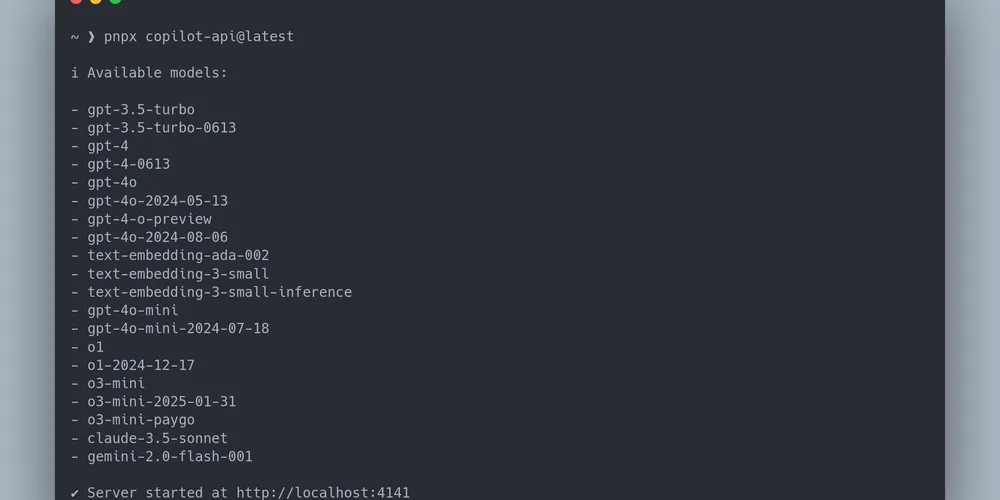
DEV Community
TL;DR: I built npx copilot-api (GitHub repo) to use GitHub Copilot as OpenAI compatible...
shrewd ermine
uneven depot
I am honestly not sure. I could find out. Our copilot usage is mostly via GH
Got it! We've discussed (separately from this experimental feature) working on making Copilot better at working with Dagger
uneven depot
quiet ether
<@163822683799158784> https://github.com/ericc-ch/copilot-api ? 🤪
edit related...
As of 3 Mar 2025, after around 1 month of usage, GitHub finally sends me the first warning email
Um, nope!
woeful quiver
Is there a good way to get the response as a string from the LLM? Meaing I gave it a prompt, and want that LLM's response as a string. Does that require I give it a workspace with a write tool?
shrewd ermine
woeful quiver
Is there a good way to get the response as a string from the LLM? Meaing I gave ...
nope you can call last-reply and it'll give the content of the last message from the llm. or history for all messages
llm | with-prompt "who are you?" | last-reply
shrewd ermine

GitHub
Tested and it works!
Implemented according to https://github.com/openai/openai-go/tree/main?tab=readme-ov-file#microsoft-azure-openai
spring wave
pushed iteration #(i lost count) at reasonable scrollback behavior /cc @shrewd ermine @smoky ocean
smoky ocean
should we cut a tag to get the latest improvements out ?
 storm gate
For anyone interested in the Dockerfile-Optimizer agent, I finally have a new version that is smaller and producing much better results via an eval: https://github.com/dagger/agents/pull/20 - feedback is welcome, it's not finished yet (still have to re-wire the feature branch and the opening of a PR to not break the current behavior).
GitHub
🚧 WIP 🚧
This is a complete rewrite of the initial implementation of the dockerfile-optimizer agent.
The new version implements a better pattern that aims for better results in the optimization, lea...
storm gate
storm gate
For anyone interested in the [Dockerfile-Optimizer agent](https://github.com/dag...
Here is the kind of result I am getting, even on a super simple image, it's still able to shrink it by giving the llm some accurate feedback in between tries.

 smoky ocean
@storm gate nice! Is there a way to show the diff? It would make it feel more "real" in the demo than the agent saying "I did it"
bronze fern
I added line to my prompt for agent to cat out results to celebrate success. Could run diff too
I guess the “cat” was from the LLM since I didn’t provide a shell 😛
smoky ocean
In my experience the more "real" artifact you show the more people get how cool it is. Of course opening a PR is awesome too 🤯
storm gate
smoky ocean
<@707661676056674346> nice! Is there a way to show the diff? It would make it fe...
Yes, the diff will be in the PR it opens at the end (I did not wire this yet but it’s already on the v1)
smoky ocean
Active fork or toy-programmer: https://github.com/helloprkr/toy-programmer

GitHub
A toy AI agent that can write programs, powered by Dagger - helloprkr/toy-programmer
 lean mural
Does anyone know if it's possible to have an agent interact with a table loaded up in duckdb? I'm trying to get an agent to do some simple/fun EDA on a small data set from github, but I'm struggling about how to tie the pieces together
I feel like I can figure out how to do this with langchain in python, but where/how dagger intersects is thowing me
smoky ocean
lean mural
Does anyone know if it's possible to have an agent interact with a table loaded ...
👋 hello! The way I would do it: first develop a small Dagger module that integrates with DuckDB. It doesn't have to do anything LLM-specific.
(you could also use a pre-made DuckDB module, but I searched on daggerverse.dev and couldn't find one)
Once the module is ready, instantiate a LLM (either in the command-line with 'dagger llm', or in code from another module) and bind a instance of your DuckDB module so it can use it.
do some simple/fun EDA on a small data set from github
Can you share a little more detail? Seems like a fun use case 🙂
Or, you could try giving the LLM just a plain container, and see if it can figure out how to install duckdb software, and fetch data from github on its own.
In that alternative scenario you don't even have to develop a custom module: you let the LLM do all the work from an open-ended environment. But, you will get less predictable results. It's the defining tradeoff of agent engineering 🙂
v0.17.0-llm.7 🧵
lean mural
smoky ocean
👋 hello! The way I would do it: first develop a small Dagger module that integr...
If this is helpful this is what I'm doing with python/langchain:
...
    con.execute("""
    CREATE SECRET secret2 (
        TYPE s3,
        PROVIDER credential_chain
    );
    """)

    result = con.sql("""
        CREATE TABLE IF NOT EXISTS github_pulls
        AS (
            WITH data AS (
              SELECT
                * exclude(is_locked, milestone_id, issue_number, is_pull_request, repository_id),
                row_number() OVER (PARTITION BY issue_id ORDER BY closed_at DESC) _row_num
              FROM 's3://launi-data-bucket/__unitystorage/catalogs/bdeab243-c684-4e4d-ab6c-c2c87596398d/tables/46d6ab44-359a-4d62-b888-682db22402e1/*.parquet'
              WHERE is_pull_request
            )
            SELECT * exclude(_row_num)
            FROM data WHERE _row_num = 1
        )
    """)
    con.close()

    db = SQLDatabase.from_uri(
        "duckdb:///./data.ddb",
        include_tables=['github_pulls'],
        sample_rows_in_table_info=3
    )

    toolkit = SQLDatabaseToolkit(db=db, llm=OpenAI(temperature=0))
    agent_executor = create_sql_agent(
        llm=OpenAI(temperature=0),
        toolkit=toolkit,
        verbose=True,
        agent_type=AgentType.ZERO_SHOT_REACT_DESCRIPTION
    )

    template = """/
    You are a SQL analyst that is querying a database of GitHub repository
    information named "github_pulls".

    Your job is to write and execute a query that answers the following question:
    {query}
    """

    prompt = PromptTemplate.from_template(template)
    agent_executor.run(
        prompt.format(
            query="Which creator_login_name has merged the most pull requests? Tell me their name and how many pull requests they have merged."
        )
    )
With the intent being there being another agent who is thinking of interesting questions to ask this agent, who actually runs the query
lean mural
So i guess if I were going to do this in dagger: i’d have a duckdb module that exposes like, with_db, execute_sql, etc. and then there’d be a dagger LLM writing queries and calling execute_sql?
spring wave
@smoky ocean pushed more scrollback fixes/polish, if you wanna tag another release. 😅
- Gave up on swapping to the Alt screen since that introduced new weird behavior. (interpreting scroll events as going through prompt history)
- Don't really need it anyway, it's simpler without it and the end result (after things finish running) is still good.
- Also got rid of the highlighted background since it was causing artifacting and reduced contrast.
- Now prints the scrollback on exit, and fixed the spacing above the "Full trace at ..." message
- Fixed an off-by-one error preventing the prompt from "hugging" the bottom of the screen
https://asciinema.org/a/oCkA9UGG7bEq9MuE14reWyM6q

Can tag myself when I'm back at the pc
smoky ocean
🚨 curl -fsSL https://dl.dagger.io/dagger/install.sh | DAGGER_VERSION=0.17.0-llm.8 BIN_DIR=/usr/local/bin sh
smoky ocean
I just realized I can't do /with llm because the LLM type can't introspect itself 😭
multi-agent with zero line of code, just raw command-line, would have been sick
spring wave
smoky ocean
I just realized I can't do `/with llm` because the LLM type can't introspect its...
is there a reason it can't?
smoky ocean
spring wave
is there a reason it can't? <a:hyperthinkspin:1130938606580674580>
I guess not since type references are lazily resolved. it just doesn't get registered automatically by the middleware, because of protection against infinite recursion. Probably a 1-line patch to special case it 🙂
I'll try when the kids are asleep
spring wave
this seems to help:
diff --git a/core/llm.go b/core/llm.go
index 210ef854b..76512e72b 100644
--- a/core/llm.go
+++ b/core/llm.go
@@ -667,6 +667,17 @@ func (llm *Llm) Set(ctx context.Context, key string, value dagql.Typed) (*Llm, e
        }
        llm = llm.Clone()
        llm.env.Set(key, value)
+       if obj, ok := dagql.UnwrapAs[dagql.Object](value); ok {
+               llm.history = append(llm.history, ModelMessage{
+                       Role:    "user",
+                       Content: fmt.Sprintf("The variable %s is set to %s@%s.", key, value.Type().Name(), obj.ID().Digest()),
+               })
+       } else {
+               llm.history = append(llm.history, ModelMessage{
+                       Role:    "user",
+                       Content: fmt.Sprintf("The variable %s is set to %v.", key, value),
+               })
+       }
        llm.dirty = true
        return llm, nil
 }
before: https://v3.dagger.cloud/dagger/traces/b913833bf8e945bafda382b6a12e1d02
after: https://v3.dagger.cloud/dagger/traces/72b5fd437d2323cc8c5b70c38ce4948e
hrmm that helps it along a bit in the simple one-object case, but it doesn't seem to improve the 'use ctr to build repo' prompt (granted, it's an incredibly vague prompt)
smoky ocean
you know what, instead of _load we can expose eg. _load_ctr and _load_src. In other words _load_<key>: load the <typename> "<key>"
one less indirection
trying
 fleet fiber
Hiiiii  I'm a dagger noob and running through the AI docs page using
 v0.17.0-llm.8 and storing my openai env's in .env, and I get this 404:
! input: toyProgrammer.goProgram POST "https://api.openai.com/chat/completion
│🧑 You are an expert go programmer. You have access to a workspace
│ ┃ 0.0s
│
│🧑 Complete the assignment written at assignment.txt
│ ┃ 0.0s
│
│🧑 Don't stop until the code builds
│ ┃ 0.0s
│
│🤖 0.2s
│ ! POST "https://api.openai.com/chat/completions": 404 Not Found```I'm assuming these are OK:
OPENAI_MODEL=o3-mini```Those seem OK but I'm not 100% sure about OPENAI_BASE_URL, because I usually don't set it, and let the openai client use the default. Might be worth unsetting it to see if it fixes the issue
Also hello! 🙂 welcome
fleet fiber
Fixed! unsetting worked
smoky ocean
smoky ocean
I guess not since type references are lazily resolved. it just doesn't get regis...
It works 🙂 pushing
 rich plaza
Hello! I'm new to Dagger and I'm following this blog: https://docs.dagger.io/ai-agents/ , but can't making it work. I'm getting this error. Any help? Thanks!
 spring wave
ah ha, figured out how to enable token usage stats for OpenAI - had to flip a boolean in the params. pushed /cc @smoky ocean
spring wave
rich plaza
Hello! I'm new to Dagger and I'm following this blog: https://docs.dagger.io/ai-...
hm this might come down to the AI model needing a bit of prompting. which model are you using?
 lyric goblet
What's a local model that runs on a macbook with 32gb of RAM that can be successfully used for this flow? I'm using qwq because it supports tool use and seems to run locally, but I got strange behavior when I tried to use the toy go coder with it. Is it just that a 32b parameter model is too greedy for this RAM profile? Is there a smaller model that still supports tool use that y'all might recommend?
shrewd ermine
lyric goblet
What's a local model that runs on a macbook with 32gb of RAM that can be success...
I'd suggest qwen2.5-coder:14b. it's been pretty good so far for me
lyric goblet
is there an example of a node/typescript coder workflow, rather than the go one? I'm less familiar with go, would be able to make more headway with an example in the node ecosystem
lyric goblet
🤔
 lyric goblet
🤔
lyric goblet
lyric goblet
🤔
oh this is adorable:
root@4m6qndd0p6sfi:/app# cat hypergraphdb.go
<paste-hypergraphdb-code_HERE>
how's this one? https://github.com/jpadams/cypress-test-llm-ts it's typescript and writes cypress tests
bronze fern
lyric goblet
oh this is adorable:
```
root@4m6qndd0p6sfi:/app# cat hypergraphdb.go
<paste-hy...
also, this is the TS version of the same-ish toy-programmer with goProgram() using the Go toy-workspace as is. Multi-language FTW!
https://github.com/dagger/agents/tree/main/toy-programmer-ts
import { dag, Container, func, object } from "@dagger.io/dagger";

@object()
export class ToyProgrammerTs {
  /**
   * Write a Go program based on the provided assignment.
   */
  @func()
  goProgram(assignment: string): Container {
    // Create a new workspace using the third-party module
    let before = dag.toyWorkspace();

    // Run the agent loop in the workspace
    let after = dag
      .llm()
      .withToyWorkspace(before)
      .withPromptVar("assignment", assignment)
      .withPromptFile(dag.currentModule().source().file("prompt.txt"))
      .toyWorkspace();

    // Return the modified workspace's container
    return after.container();
  }
}
ah, so like, the fact that the app is written in "go" is just a property of the prompt, the implementation of the flow is language agnostic?
bronze fern
Yep, this was a tightly-coupled demo example, but the concept could be super generalized so you could provide a container with the right tools for a workspace, and a function to test/check things with, etc.
I think there's a more general example like that...
lyric goblet
interesting. So the tools that the agent gets access to - the ability to read and write from the file system - those are just baked into the Container?
smoky ocean
lyric goblet
interesting. So the tools that the agent gets access to - the ability to read an...
baked in Dagger's universal type system. Container is just one primitive type, you can compose your own too
bronze fern
You can attach an object of any type to an llm instance and all of the functions on that object become tools for the LLM 🙂
lyric goblet
ah, interesting.
bronze fern
So a core type like Container has a ton of functions/tools, prob too many
While in the toy-workspace we constrain down to 3 functions
read, write, build - keeps the agent out of trouble 😉 and is surprisingly powerful when the agent can run in a loop: receiving the initial assignment and then errors and function return values as feedback as it loops, trying to reach the goal (and then stopping).
 dense flare
agent loop repeats
 proper stratus
Is it a bug that sometimes when I give the agent a container with Alpine image via the /with command, it pulls another image (e.g., Ubuntu) when I ask it to do something? It seems like it doesn't know the context.
shrewd ermine
proper stratus
Is it a bug that sometimes when I give the agent a container with Alpine image v...
Basically a side-effect of giving too many tools. The container object has all the APIs to interact with a container, including choosing a new from, which LLMs seem to like to call. What I'd like to do is have a way to explicitly narrow down which tools are exposed from an object so I can just give it withExec or something
smoky ocean
shrewd ermine
Basically a side-effect of giving too many tools. The container object has all t...
Totally agree. I added that feature as "function mask" in the merge checklist: https://github.com/dagger/dagger/issues/9801
GitHub
Overview This issue tracks the work required to ship native LLM support in the Dagger Engine, as prototyped in #9628 . Blockers Command-line UX dagger llm: this CLI command is amazing and we need t...
woeful quiver
Regarding the .help usage in shell. It does not show functions or constructors when in a module. Created this issue to track: https://github.com/dagger/dagger/issues/9828
merry scarab
Qwen is a bit drunk for me 🙂
│🤖 Certainly! To understand what your Dagger module does, I'll need to take a look at the code in the
│ ┃ https://github.com/levlaz/snippetbox repository. Specifically, I'm looking for a Dagger file, which is
│ ┃ typically written in HCL (HashiCorp Configuration Language) or Go.

GitHub
Contribute to levlaz/snippetbox development by creating an account on GitHub.
uneven depot
This gave me a good laugh! Qwen must be sponsored by Hashicorp
merry scarab
@spring wave I wish it was possible to share a specific span/repo from dagger cloud that is not in the context of a repo - esp for the agent use case where I might be in vibe mode and wanting to share a link for someone to look at - I think right now these become "orphaned" local traces and there is no way to access them via the public url
Is there an easy way to see which model is being used?
✔ llm  0.0s
Llm@xxh3:372bce69d14ff865
I feel like llm used to tell you more info, now its just this id it seems
spring wave
merry scarab
Is there an easy way to see which model is being used?
```
✔ llm 0.0s
Llm@xxh...
llm | model
or if you're in dagger llm it'll be in the prompt
merry scarab
Thank you so much!
spring wave
we got rid of the object dumping because in a lot of cases it was super spammy and didn't show the most useful info
merry scarab
Hm, is this all cached? I am trying to switch from local qwen to anthropic using env var but it seems to still be using qwen even though my env has changed
nvm, i am dumb 🙂
smoky ocean
small UX feature request, if anyone has time: would be awesome if /model could autocomplete model name 😛 I find it super hard to memorize the model names
either that, or support shortnames like "claude-sonnet", "claude-sonnet-2.7" or even "claude"
or both 🙂
merry scarab
Would love to see this, ran into it myself this morning
smoky ocean
Also, if anyone is looking for well-scoped contributions: token counting doesn't work with openai 😭
spring wave
smoky ocean
Also, if anyone is looking for well-scoped contributions: token counting doesn't...
smoky ocean
Experimenting with multi-object @spring wave 🙂 https://v3.dagger.cloud/dagger/traces/c7544f59767be564b198cb49e9137181#07aa2dae8785d894

Browse and visualize Dagger traces.
(is there a way to make a single trace public?)
spring wave
no, i (and Lev :P) would very much like that too
smoky ocean

GitHub
What are you trying to do? In Dagger Cloud, I would like the ability to make a single trace public - for example to share it on Discord. Here is an example. Why is this important to you? No respons...
 coarse epoch
hi @spring wave 👋 been a while since our Cloud Foundry days
spring wave
whoa hey!
coarse epoch
i'm trying to run one of the agents, the dockerfile optimizer. i'm in a clone of the pandas repo, just trying to try it out but when i follow the instructions on the tutorial (https://docs.dagger.io/ai-agents/) i hit this positional arguments bug. maybe it's expecting me to pass in my api keys?
 coarse epoch
bronze fern
read, write, build - keeps the agent out of trouble 😉 and is surprisingly power...
coarse epoch
bronze fern
read, write, build - keeps the agent out of trouble 😉 and is surprisingly power...
possibly a dumb question, but where is the code for the agentic loop? i see the initial prompt and the tools, but i'm confused how it's orchestrated
bronze fern
coarse epoch
possibly a dumb question, but where is the code for the agentic loop? i see the ...
Great question, a bit of magic.
When you provide the LLM with an object like a Directory or ToyWorkspace using llm().withDirectory or llm.withToyWorkspace, all of the functions on that type are made available as tools for the LLM. Then you kick off the conversation with a prompt. The agent will loop in its own, requesting tools to be called with certain parameters and consuming the outputs until it sends a final response with no tool call.
For example the Dagger Directory type has these functions:
as-module
 as-module-source
 diff
 digest
 directory
 docker-build
 entries
 export
 file
 glob
name
 sync
 terminal
 with-directory
 with-file
 with-files
 with-new-directory
 with-new-file
 with-timestamps
 without-directory
without-file
 without-files
This may be too many or not the right tools for the job, thus in a lot of cases we provide a set of tools and a suitable execution environment in what we're calling a
"workspace"
This this little example has just 3 functions / tools 🙂 to constrain the LLM and keep it on track. The prompt plays a big role. And some LLMs are better at tool calling and selecting tools than others. As you may have guessed, often the "bigger, smarter" models are better at it.
https://github.com/shykes/toy-programmer/blob/main/toy-workspace/main.go
read
write
build
ah got it. so it's this part:
after := dag.Llm().
        WithWorkspace(ws).
        WithPrompt(`
that kicks it off
is that a part of the OSS repo? i'm curious to poke around if it is
bronze fern
yep! On the llm branch
coarse epoch
ah i see, so the "workspace" is a special case folder that tells the agent essentially what it's allowed to do/which tools to use
bronze fern
coarse epoch
ah i see, so the "workspace" is a special case folder that tells the agent essen...
It's a Dagger module, in fact, the way we package up all Dagger functions for re-use, but in this case the trick is that every type XXXX in the API automatically gets an llm().withXXXX() function, so if your project has a ToyWorkspace, you get an llm().withToyWorkspace()
smoky ocean
yeah "workspace" is not a special case
shrewd ermine
yep, so you can grab any module from https://daggerverse.dev/ and give it to an LLM as dag.Llm().With{Module} and it'll have all the functions of that module available as tools
smoky ocean
(we really need a way to make that part more clear...)
coarse epoch
shrewd ermine
yep, so you can grab any module from https://daggerverse.dev/ and give it to an ...
aha, so that's what makes it so powerful
it's like Dagger's version of MCP in a way
shrewd ermine
exactly 🙂
coarse epoch
very very cool
side note, using Claude Code to explain the Dagger codebase to me is very fun
i'm not sure i should have paid 61 cents for the privilege but it found the right code!
 shrewd ermine
It summarized the loop really well
smoky ocean
@coarse epoch note we are adding actual MCP compat, so you can expose any Dagger object as a MCP server also
smoky ocean
coarse epoch
side note, using Claude Code to explain the Dagger codebase to me is very fun
hopefully soon you can write a 5-line dagger script to do the same thing 😇 cc @wraith remnant
did you try the dagger llm command yet?
coarse epoch
coarse epoch
hi <@108011715077091328> 👋 been a while since our Cloud Foundry days
for context, Alex and I were interns together at VMware on the Cloud Foundtry team way back in 2011
 worn hill
coarse epoch
for context, Alex and I were interns together at VMware on the Cloud Foundtry te...
worn hill
coarse epoch
for context, Alex and I were interns together at VMware on the Cloud Foundtry te...
I’m also ex-cf but I suspect we didn’t overlap 🙂
smoky ocean
coarse epoch
oh whoa that is sick
you can bind any object to the llm context also. Same plumbing as explained above, just with a slicker UI.
Try: /with github.com/dagger/dagger/modules/wolfi
then:
please build me a container with git, go and python installed. Also add a text file that says "hello world". Then push it to the registry ttl.sh with an image name of your choice
bronze fern
coarse epoch
i'm not sure i should have paid 61 cents for the privilege but it found the righ...
$ dagger llm

gpt-4o * /with https://github.com/dagger/dagger@llm

gpt-40 * look in core/llm.go and explain how the agentic loop works in Dagger?
 lean mural
I feel like my dagger llm just keeps telling me how to do things, rather than doing them itself
smoky ocean
lean mural
I feel like my dagger llm just keeps telling me how to do things, rather than do...
are you using llama? it tends to do that more than others. With a little prompting it goes away
lean mural
no, i'm using openai, 4o i think
smoky ocean
I like to say "you have access to a container/workspace/whatever. Use it to accomplish your tasks. Don't tell the user how to do it, do it yourself". Then follow up with more specific prompts
This one works great with gpt-4o: https://github.com/shykes/toy-programmer/blob/main/main.go

GitHub
A toy AI agent that can write programs, powered by Dagger - shykes/toy-programmer
lean mural
Browse and visualize Dagger traces.
dense flare
If I already have a CI dagger module with test/build/etc functions, how can I give those to my agent directly, without recreating them in a workspace module?
bronze fern
dense flare
If I already have a CI dagger module with test/build/etc functions, how can I gi...
Link? Let's try
dense flare
bronze fern
Link? Let's try
- CI module: https://github.com/vikram-dagger/fastapi-sample-app/blob/main/.dagger.old/src/book/main.py
- Workspace module (currently recreates the test() fn, trying to improve this): https://github.com/vikram-dagger/fastapi-sample-app/blob/main/.dagger/workspace/src/workspace/main.py
maybe the workspace.test() is just a wrapper which internally calls ci.test()
coarse epoch
bronze fern
whoa
coarse epoch
smoky ocean
you can bind any object to the llm context also. Same plumbing as explained abov...
sick i will try that
stray ice
smoky ocean
hopefully soon you can write a 5-line dagger script to do the same thing 😇 cc <...
I was actually trying this yesterday night, I got hit by a 40k token per minute limit with claude sonnet 3.5
which is actually a very useful error, as you can iterate until you find the best model for your use case
maybe Gemini would be best as it allows more input tokens
woeful quiver
Wrote a technical content summarizer agent, that might have had a few too many long islands... 🤣
It's using Ollama and qwen2.5-coder, and does the following:
Takes a URL and strips the content out of the website using cheerio (JS library)
Gives a reader workspace with get-content (this uses cheerio) and check-content against a min and max length and forbidden words
Then its asked to summarize the content for a non-technical audience
Right now its modifying the summary to fit the actual check-content tool 🤦 so it needs a little tweaking
Code is here - will be touching up a little more https://github.com/jasonmccallister/tech-summarizer-agent
bronze fern
Wrote a technical content summarizer
shrewd ermine
sneak peek 🙂

if tests or linting fails on a PR, it'll comment the fix as a suggestion
coarse epoch
interesting, would like to see the code and maybe integrate into my demo as well. currently it only produces a diff in a single comment (and sometimes doesn't do the diff at all)
shrewd ermine
dense flare
interesting, would like to see the code and maybe integrate into my demo as well...
It's all this function here: https://github.com/kpenfound/greetings-api/blob/main/.dagger/main.go#L200
Getting the code suggestion diff correct was honestly half the work of building this demo lol. The heavy lifting for that is from workspace.Diff (workspace is a submodule) and suggestions.go in the main module
smoky ocean
Thoughts on today's OpenAI announcements? https://openai.com/index/new-tools-for-building-agents/
bronze fern
Just tried a qwen model with llama.cpp:
llama-server -m qwen2.5-coder-7b-instruct-q5_k_m.gguf --host 0.0.0.0 --port 8000
when I ran a function using Llm and tool calling or via dagger llm /with xxx ... I hit:
got exception: {"code":500,"message":"Cannot use tools with stream","type":"server_error"}
srv  log_server_r: request: POST /v1/chat/completions 192.168.64.2 500
Seems like a llama.cpp limitation, perhaps.
Most GGUF models lack OpenAI-style tools
need some wrapper magic, it seems: vllm or ollama?
spring wave
Thoughts on today's OpenAI announcements
shrewd ermine
bronze fern
Just tried a qwen model with `llama.cpp`:
`llama-server -m qwen2.5-coder-7b-inst...
Yeah that's correct, I thought we weren't streaming for the "other" provider but I haven't actually looked at it
bronze fern
shrewd ermine
Yeah that's correct, I thought we weren't streaming for the "other" provider but...
Chat completion worked great though via dagger and dagger llm
woeful quiver
Anyone else getting 502/503's from Gemini right now?
shrewd ermine
seems to be acting up a bit, yeah
oh cool, since ollama 0.5.13 you can set a default OLLAMA_CONTEXT_LENGTH to override the default 2048 🚀
shrewd ermine
if you're using ollama with ollama serve, set this 👆 to something like 8192 and see qwen fly
worn hill
shrewd ermine
sneak peek 🙂
this will be such a spicy demo, i love it
shrewd ermine
worn hill
this will be such a spicy demo, i love it
your wish is granted, it is live now 😄 #1349235356184350770 message
worn hill
if you can get it to fix a flaky test on camera...
shrewd ermine
fixes tests and lints btw. I did not emphasize the linting part in the video
worn hill
shrewd ermine
fixes tests **and** lints btw. I did not emphasize the linting part in the video
the linting side of things does invite naysayers "good linters fix their own errors" ... irl they don't but whatever
shrewd ermine
it's also the classic problem of "oh yeah but i run cyborg-vim closed beta that doesn't support linters so i just push"
worn hill
lol or "my build system is complicated enough i don't actually know how to apply linter diffs, especially inside my editor" coughuscough
demos like this do make me wonder if we're gonna see a resurgence of phab or gerrit style stacked-diff code review systems.... like someone should have to stamp the agent commit seperately from the rest of the PR
https://www.git-town.com in our context, although the UX is still kinda unpleasant in github when it's not strictly necessary
Git Town user manual
there's also a paid saas startup that does this on top of github but i can't remember the name
shrewd ermine
are you thinking of trunk?
worn hill
nope, https://graphite.dev

Graphite.dev
Graphite helps teams on GitHub deliver higher quality software, faster.
shrewd ermine
ah yes
spring wave
fyi: merged main into llm, had some nontrivial conflicts but I think we're good, lemme know if anything seems... off
smoky ocean

Feature request: a way to interrupt the llm, without killing the shell
@spring wave worth it for me to push a llm.9 ?
spring wave
it's just merges from main I think
coarse epoch
worn hill
demos like this do make me wonder if we're gonna see a resurgence of phab or ger...
i kind of have a heretical view that we will eventually stop reviewing code altogether and AI will do all the reviewing
smoky ocean
Could anyone repro a build error for me please?
dagger -m github.com/shykes/dagger@llm-multiobj -c 'cli | binary'
--> does this build for you? And if so, what's your engine version?
OK I can't build main either...
wth
shrewd ermine
what is your engine version? 
smoky ocean
either 0.17.0-llm.8 can't build dagger main; or main is broken
shrewd ermine
ah. I have 0.17.0-llm.8 and 0.16.3 running so i can try both
smoky ocean
I'm getting elixir SDK errors on both main and my llm-multiobj branch
shrewd ermine
yeah i got the elixir error from llm.8
# github.com/dagger/dagger/.dagger
./sdk_elixir.go:52:19: sdkDev.Lint undefined (type *dagger.ElixirSDKDev has no field or method Lint)
./sdk_elixir.go:81:18: sdkDev.Test undefined (type *dagger.ElixirSDKDev has no field or method Test)
./sdk_elixir.go:97:16: sdkDev.WithBase undefined (type *dagger.ElixirSDKDev has no field or method WithBase)
./sdk_elixir.go:98:16: sdkDev.Generate undefined (type *dagger.ElixirSDKDev has no field or method Generate)
./sdk_elixir.go:164:16: sdkDev.WithBase undefined (type *dagger.ElixirSDKDev has no field or method WithBase)


Browse and visualize Dagger traces.
merry scarab
@shrewd ermine why does your :looking for module take a min lol - mine was 20ish sec
shrewd ermine
uh because I lied and it still had to start 0.16.3 lol
smoky ocean
I am told main builds fine from 0.16.2
shrewd ermine
based on the error it feels like a merge issue
merry scarab
@smoky ocean this worked in 0.16.3
smoky ocean
ok thanks
smoky ocean
shrewd ermine
based on the error it feels like a merge issue
yeah but a merge issue that somehow causes llm.8 to fail to load one particular module (dagger/dagger) ??
shrewd ermine
oh wait yeah you're right
smoky ocean
Ok this is melting my brain:
0.16.3can loadmainandllm-multiobjfinellm.8fails to loadmain,llmandllm-multiobj- But
llm.8doesn't fail to load any other module that I know of?
@spring wave are you getting any of these build errors?
OK I narrowed down the issue to github.com/dagger/dagger/elixir/dev. Somehow when loading that module, llm.8 returns a boilerplate module straight from dagger init
So it looks like we shipped llm.8 with a timebomb that goes off when you load sdk/elixir/dev (and possibly other modules from the dagger repo?) I'm going to say: something went wrong in the SDK-bundling system at build
Elixir SDK errors 🧵
shrewd ermine
getting a surprising result from LastReply() on llm.8 🧵
proper stratus
Is there a way to break long line in shell?
spring wave
proper stratus
Is there a way to break long line in shell?
just adding a linebreak with enter should work, depending on where you do it; it'll only consider it complete once it's valid shell, so if you hit enter e.g. after a pipe it'll continue on to a new line. or, \ might work too (haven't tried)
proper stratus
the \ does not work. Currently, if I want to write prompts with multiple lines, I have to write them outside the shell and paste them in.
spring wave
proper stratus
the \ does not work. Currently, if I want to write prompts with multiple lines, ...
turns out there's a keybind, ctrl+o - but that seems pretty hard to find to me. did you try shift+enter? i can swap it to that
oh - shift+enter isn't bindable at the moment, maybe that's why (https://github.com/charmbracelet/bubbletea/issues/1014)
proper stratus
I tried with shift+enter but it didn't work. I'm fine with ctrl+o for now until shift+enter is supported
lean mural
I've got my agent writing some tests for me, but i haven't been able to get it to actually persist so once my dagger call ends it's all gone 🫠 what do i need to do to save the work?
woeful quiver
lean mural
I've got my agent writing some tests for me, but i haven't been able to get it t...
You typically would return a directory or file from your function and export it - https://docs.dagger.io/cookbook#export-a-directory-or-file-to-the-host
lean mural
ah i used directory because the doc for export said export the image as a tarball
woeful quiver
Yeah something like dagger call <func> export --path=<somewhere> - if you are giving the repo as a directory you will probably want to export the entire directory
lean mural
ah, i wouldn't like just export my tests dir onto my existing tests dir?
smoky ocean
Onboarding improvements 🧵
lean mural
woeful quiver
Yeah something like `dagger call <func> export --path=<somewhere>` - if you are...
what's weird is even using export it's not writing anything 🧐
shrewd ermine
lean mural
what's weird is even using export it's not writing anything 🧐
are you able to confirm that the llm is using it's tools to write it's work and not just "thinking" about it's work? you can also look at the files before exporting if you run dagger call <func> terminal / <func> | terminal
and if you have a cloud trace that helps a lot with debugging what the agent is doing 🚀
devout magnet
are we using this sdk for gemini? https://x.com/_philschmid/status/1900095644624134347
We’re thrilled to release a new TypeScript / Node SDK for @GoogleDeepMind Gemini!
It is a new unified SDK with huge improvements for all web developers – some of the highlights include:
- unified for Gemini Developer API and Vertex AI.
- Simpler initialization logic
- Cache
 X
·
smoky ocean
devout magnet
are we using this sdk for gemini? https://x.com/_philschmid/status/1900095644624...
X
·
smoky ocean
devout magnet
are we using this sdk for gemini? https://x.com/_philschmid/status/1900095644624...
No the Dagger core engine is implemented in Go, so we use that SDK. cc @shrewd ermine who contributed that feature
shrewd ermine
woeful quiver
Has anyone tried/had success giving an agent two workspaces?
smoky ocean
woeful quiver
Has anyone tried/had success giving an agent two workspaces?
In multiobject branch?
woeful quiver
smoky ocean
In multiobject branch?
in general, have not tried that branch yet but will soon. I'm giving the agent a database workspace and a toy (go) workspace
smoky ocean
At the moment (0.17.0-llm.8) you can only give a llm one object at a time
History inspection 🧵
storm gate
smoky ocean
History inspection 🧵
This is more about introspecting an Llm object before the execution, for prompt composition. Posted an explanation in the thread: #1349789097178300417 message - curious to know if anyone else is doing something similar.
smoky ocean
@shrewd ermine yesterday got a message from a friend trying out our agent stuff, he specifically called out your multi-agent demo module as particularly cool 🙂
shrewd ermine
smoky ocean
<@135620352201064448> yesterday got a message from a friend trying out our agent...
awesome! that's good to hear. Maybe I should make a more advanced multi-agent demo too!
 somber vault
Quick question, what's the preferred way to launch two dagger containers within single network? Application and a database as a real example
shrewd ermine
does the database need to be accessed other than by the application?
somber vault
Nope, throwaway setup, it's agents after all (:
smoky ocean
 shrewd ermine
haha yes that happens to be one of dagger's superpowers 😄 here's an example in the cookbook https://docs.dagger.io/cookbook/#create-a-transient-service-for-unit-tests

Filesystem
the key line is the "with service binding" to connect the database container to the application container
somber vault
drupal.with_service_binding("db", mariadb) # assume "db" will be the hostname
...
.as_service(use_entrypoint=True) # <- this is the key line
That's it?
My boi that's clean
smoky ocean
Note if you want it to connect to an external DB (like one running on your laptop or an external server) you can bind that to your app container also. Service is an abstract type that can be backed by a container or a tunnel to host network
somber vault
neat, so I can take app container, swap service binding and throw this onto prod so to speak?
shrewd ermine
yup! The cool thing too is that you don't even need to change the service binding necessarily. Using the snippet from the cookbook as the example, you could have an optional arg to your function for mariadb dagger.Service, and if it's not set create it like in the snippet. But then you could pass it in from the cli as --mariadb tcp://localhost:3306
that's what is shown here (without optionally creating one) https://docs.dagger.io/cookbook/#create-a-transient-service-for-unit-tests
somber vault
Perfect, will try that out after checking how my pipeline runs on top of dagger
Finished porting all steps besides the database, but this should be ready in a couple minutes
lean mural
shrewd ermine
are you able to confirm that the llm is using it's tools to write it's work and ...
@shrewd ermine if i drop a trace link in here is it public or can you see it because you have privileged access
shrewd ermine
lean mural
<@135620352201064448> if i drop a trace link in here is it public or can you see...
yep dagger support (including myself) can see it
lean mural
shrewd ermine
yep dagger support (including myself) can see it

Browse and visualize Dagger traces.
somber vault
Another silly question, say I expect command to fail often but still want to grab stdout stderr
result = await container.with_exec(["tsp", "compile", ".", "--no-emit"])
exit_code = await result.exit_code()
stdout = await result.stdout()
stderr = await result.stderr()
return exit_code, stdout, stderr
I found the .sync() method, not sure where to correctly get stdout and stderr
shrewd ermine
somber vault
Another silly question, say I expect command to fail often but still want to gra...
you can pass the with_exec option expect=ReturnType.ANY and then make sure to check the exit_code https://github.com/kpenfound/dag/blob/main/workspace/src/workspace/main.py#L135-L142
smoky ocean
@shrewd ermine your multi-agent demo has gpt-o1 as a constant for model name, but does that actually work?
shrewd ermine
smoky ocean
<@135620352201064448> your multi-agent demo has `gpt-o1` as a constant for model...
uh probably not, i've always passed them explicitly. I can update it
smoky ocean
Were you able to use o1 at all? For me llm --model=o1 fails with an api error
shrewd ermine
I haven't tried 🤷
smoky ocean
Multi-object eval 1 🧵
lean mural
Any techniques for trying to help dagger limit the amount of context it's sending to the LLM? I feel like i was making progress and now it's started blowing up due to exceeding token limits
lean mural
lean mural
Any techniques for trying to help dagger limit the amount of context it's sendin...
🧐 maybe i should be limiting what i'm passing into the llm workspace
shrewd ermine
Yeah that'll help. We're going to have function masking so that you can limit which functions from your object get passed in, I think that's going to be big
lean mural
Is there a way to expose the container without adding a container() function so i'm not confusing the LLM with that tool, but can still access the workspace container? (i should probably go look at the toy programmer repo you just sent..)
smoky ocean
@lean mural we plan on adding a "function mask" so that you can hide certain functions (in this case, container()) when binding an object to the llm
for now you can use tricks like 1) adding a "do not use" comment in the function 🙂 or 2) saying it explicitly in the prompt
in the case of my toy-workspace module, here's my trick: https://github.com/shykes/toy-programmer/blob/main/toy-workspace/main.go#L11
    // The workspace's container state.
    // +internal-use-only
    Container *dagger.Container
That +internal-use-only doesn't mean anything to the Dagger SDK, it's for the LLM to read 🙂
quiet ether
👋 does /prompt know how to handle reply types? in llm.8 at least how do I get a prompt reply and set that as the new /with object?
smoky ocean
quiet ether
👋 does /prompt know how to handle reply types? in llm.8 at least how do I get...
mmm in prompt mode you can't do that unfortunately (I think). have to instantiate a llm type from the shell
"prompt reply" you mean the actual string message sent by the llm?
quiet ether
smoky ocean
mmm in prompt mode you can't do that unfortunately (I think). have to instantiat...
That's what I thought. I was able to get it with the shell, yes
quiet ether
smoky ocean
"prompt reply" you mean the actual string message sent by the llm?
No, sorry. The reply type of my tool calling
In my case the LLM is calling a tool that returns a container and I want to be able to do something with it
But I can't get a reference to that
smoky ocean
ah I see. well in llm.8 as long as the returned type is the same as the original type you set with /with, the llm keeps the latest reference.
quiet ether
Yeah.. they're different
I'm using the toy programmer fwiw. Which returns a Container and doesn't have a function to get a reference to it
smoky ocean
in any case you can't get it out euther way. but you can ask the llm to publish/export/open a terminal/expose port 🙂
like in my demo when I say "give me a terminal"
quiet ether
smoky ocean
like in my demo when I say "give me a terminal"
Yes, but that works a long as there's a function that retrieves it
In this case there's not
It's a response from a function call. I can add another function to retrieve it
quiet ether
quiet ether
It's a response from a function call. I can add another function to retrieve it
In any case, adding s other function to retrieve it will work 🙏
smoky ocean
I don't understand the issue. it should be able to chain
"get the container from your workspace then publish it to ttl.sh"
quiet ether
It strange.. it doesn't know about it. Since the toy-programner doesn't have a way to retrieve it
The LLM only knows about the goprogram, goprogramqa
smoky ocean
ah you're doing multi agent? your "copilot" has access to a ToyProgrammer correct?
quiet ether
Yes
smoky ocean
ok - then that's expected yes, no function to get the workspace
for a demo I recommend doing single agent unless you specifically want to show multi agent as the topic
for a "basic" demo of dagger prompt mode it might be too meta
quiet ether
Yeah.. multi agent will probably be confusing. I'll call that toy programner with the shell and that's it
smoky ocean
you can also bind toy-workspace to the prompt mode and basically recreate toy-programmer from the CLI. Then show that you can do the same in code
both work
 crisp scroll
I am using latest dagger with llm integration. When the llm tries to expose the port, it gets the following error : decode arg "port": cannot create Int from float64
This is the call that it is declaring to use:````
<invoke name="withExposedPort">
<parameter name="description">Plone HTTP port</parameter>
<parameter name="port">8080</parameter>
<parameter name="protocol">TCP</parameter>
</invoke>
Any idea how I could hint it ? Or is that a known bug of the integration ?
I have found the following in https://github.com/dagger/dagger/pull/9628
Bug 3. Cannot create int from float64 fixed! thank you @spark phoenix 🙏

GitHub
This PR is a prototype for native LLM support in Dagger.
New core type: Llm. Represents the state of a LLM - which it turns out fits perfectly in a DAG of immutable states!
Add any Dagger object t...
IOW, might not be totally fixed. Or I am looking at another flavour of that bug.
gloomy kindle
👀 is +internal-use-only a thing? do we want to make it a thing? https://github.com/dagger/agents/blob/8c35400cb65192ed5bf34936f88481fe40cebd12/toy-programmer/toy-workspace/main.go#L8-L13
i can't see how it's used, is this different from what a +private field is?
quiet ether
gloomy kindle
👀 is `+internal-use-only` a thing? do we want to make it a thing? https://githu...
AFAIK it's not a thing but we do want to make it a thing in some sort of way I assume 🙏 . Not sure where the discussion for this feature is 😬
gloomy kindle
oh I guess it's not private because we still need to access it from code
but the LLM shouldn't see it right
quiet ether
gloomy kindle
but the LLM shouldn't see it right
yes, exactly
gloomy kindle
mm okay yeah fiddly
not sure we want to call this, but it doesn't seem plumbed through to anything
spring wave
gonna merge llm-multiobj in to llm and keep working on it
i think we might be able to just skip the feature flag, and have it only opt in to multi-object once you set variables
shrewd ermine

gloomy kindle
neat neat
spring wave
except for interactive shell which automatically sets variables. maybe that one should be opt-in somehow? @shrewd ermine have you had a chance to play around with it yet? wondering how the demo UX is
shrewd ermine
spring wave
except for interactive `shell` which automatically sets variables. maybe that on...
I haven't yet but I will this afternoon
spring wave
pushed the merge, here are the cliff's notes:
llmcommand is gone - useshellinstead- press
>at start of input to swap to prompt mode,!to switch back /withis gone - I'll add a.withbuiltin instead (e.g..with $(container | from alpine))- vars that you set in shell are synced to the LLM, vars that the LLM set are synced back to the shell (though you usually have to tell it to set one)
- in prompts you can use
$vars(auto-completable) to explicitly reference objects, or not and see if it figures it out based on context
working on .with now
gloomy kindle
"autocompletable" 🥳 🥳
spring wave
still need to backport that to shell completion funnily enough
prompt can complete shell vars but not shell 😛
uneven depot
btw, dagger shell is displayed with strange hue on my terminal (ghostty). It wasn't like that before
 spring wave
uneven depot
btw, dagger shell is displayed with strange hue on my terminal (ghostty). It was...
spring wave
uneven depot
btw, dagger shell is displayed with strange hue on my terminal (ghostty). It was...
that should be gone now (not sure if it shipped)
uneven depot
ah! ok cool. I'm on 0.16.3 so it hasn't shipped
smoky ocean
@spring wave should we celebrate multi-obj being merged with a llm.9 tag?
spring wave
smoky ocean
<@108011715077091328> should we celebrate multi-obj being merged with a llm.9 ta...
not yet please 😂 unless you want to 
the merge is just to avoid losing time to merge conflicts
but, should be soon
i'm adding a .llm builtin to replace /with and let you access the current LLM object:
# set state
container | from golang | .llm
# access current LLM state
.llm
# get state
.llm | container
# all in one
container | from golang | .llm | container
pushed 👆
smoky ocean
can we change the name of that builtin? looks a lot like llm...
quiet ether
does anyone have a clue why the model doesn't seem to figure out how to call withExposedPort?
edit: not sure if it's a claude specific thing
✔ /with $(container | from alpine ) 2.0s
Container@xxh3:0991463b40bf15ca

✔  expose the port 8080 in the container 12.4s
│🧑 expose the port 8080 in the container
│ ┃ 0.0s
│
│🤖 I'll help you expose port 8080 in the container using the  withExposedPort  function. This function requires the  port  parameter, and since you specified port 8080, I can use that directly.
│ ┃ 3.6s ◆ LLM Input Tokens: 11,701 ◆ LLM Output Tokens: 105
│
│🤖 I apologize for the error in my previous attempt. Let me try again with the correct format:
│ ┃ 2.5s ◆ LLM Input Tokens: 29 ◆ LLM Output Tokens: 78 ◆ LLM Input Tokens (cache writes): 11,805
I'm also not being able to see the call in the trace here: https://v3.dagger.cloud/marcos-test/traces/b81bf3d688e337cb4c844ce71b25a546
Browse and visualize Dagger traces.
spring wave
smoky ocean
can we change the name of that builtin? looks a lot like `llm`...
open to suggestions, though it literally returns an LLM, the same as llm, so the name doesn't seem that far off to me. it's sort of like "the current LLM state". e.g. .llm | history will show you the message history, .llm | last-reply gives you the last reply, etc
.current-llm?
smoky ocean
oh sorry - I thought it returned the current selected object within the llm
spring wave
ah np, yea that'd be weird
spring wave
the trick is it also supports piping state to it
smoky ocean
then I could just set it
spring wave
i think we'd lose that with a var
smoky ocean
copilot=$($copilot | with-foo) ?
spring wave
true
smoky ocean
wait how do I pipe state to .llm?
spring wave
container | from alpine | .llm
it figures out the type and calls the appropriate withFoo
this is to replace /with for current demo flows, since all the slash commands are gone
smoky ocean
why not just set variables?
spring wave
smoky ocean
why not just set variables?
you can do that of course, this is in the spirit of compatibility with pre-multi-object demo flows, in case we're still giving them, since using vars changes how you prompt it. with this you just change from /with to piping at the end
bearing in mind the original plan was to feature-flag all of the multi-object stuff
shrewd ermine
super confused, on a fresh checkout of the llm branch I have
Changes not staged for commit:
  (use "git add <file>..." to update what will be committed)
  (use "git restore <file>..." to discard changes in working directory)
        modified:   sdk/php/generated/LLM.php
        modified:   sdk/php/generated/LLMId.php
and restore/checkout doesn't actually fix 🤔
those files don't actually exist, but I do have Llm.php and LlmId.php
except also they do exist
➜  dagger git:(llm) ✗
> ls -la sdk/php/generated/LLM.php
-rw-r--r--  1 kylepenfound  staff  27015 Mar 14 13:36 sdk/php/generated/LLM.php
➜  dagger git:(llm) ✗
> ls -la sdk/php/generated/Llm.php
-rw-r--r--  1 kylepenfound  staff  27015 Mar 14 13:36 sdk/php/generated/Llm.php
➜  dagger git:(llm) ✗
> ls sdk/php/generated/L*php
sdk/php/generated/Label.php         sdk/php/generated/LabelId.php       sdk/php/generated/ListTypeDef.php   sdk/php/generated/ListTypeDefId.php sdk/php/generated/Llm.php           sdk/php/generated/LlmId.php
probably some fun with case insensitive filesystems
guessing you're on macOS
we probably need to re-generate all of sdk/*
shrewd ermine
> git status
On branch llm
Your branch is up to date with 'upstream/llm'.

Changes not staged for commit:
  (use "git add <file>..." to update what will be committed)
  (use "git restore <file>..." to discard changes in working directory)
        modified:   sdk/php/generated/LLM.php
        modified:   sdk/php/generated/LLMId.php

no changes added to commit (use "git add" and/or "git commit -a")
➜  dagger git:(llm) ✗
> rm sdk/php/generated/LLM.php sdk/php/generated/LLMId.php
➜  dagger git:(llm) ✗
> git status
On branch llm
Your branch is up to date with 'upstream/llm'.

Changes not staged for commit:
  (use "git add/rm <file>..." to update what will be committed)
  (use "git restore <file>..." to discard changes in working directory)
        deleted:    sdk/php/generated/LLM.php
        deleted:    sdk/php/generated/LLMId.php
        deleted:    sdk/php/generated/Llm.php
        deleted:    sdk/php/generated/LlmId.php

no changes added to commit (use "git add" and/or "git commit -a")
yeah very weird lol
smoky ocean
basic single-object workflows dont work in tip llm fyi
I just gave a demo and it broke
llm | with-container | with-prompt "do you see the container" -> doesn't see it
worn hill
lol we have reached the "damn we really need tests don't we" point of this branch
spring wave
did that prompt work before? i've found it always has trouble with that sort of phrasing, since it's more around what set of tools it has
shrewd ermine
I just did llm | with-container $(container | from alpine) | with-prompt "do you see the container" | last-reply on llm.8 with ollama and it was good
spring wave
this worked for me:
✔ llm | with-container $(container | from golang) | with-prompt "what tools do you have? list them all" 43.7s
# ... lists all of Container, plus the multi-object tools (TODO it should not)
but yeah it responded with the list of tools
worn hill
false alarm then we haven't reached the "damn we really need tests don't we"
i really need tests but that's a personal problem
spring wave
 who needs'em
worn hill
 smoky ocean
spring wave
did that prompt work before? i've found it always has trouble with that sort of ...
smoky ocean
spring wave
did that prompt work before? i've found it always has trouble with that sort of ...
it wasn't the actual wording - I used wording that consistently worked before
spring wave
oh boy... regenerating the SDKs has a circular dependency on the CLI https://v3.dagger.cloud/dagger/traces/64f461f3758096962c6d5c2f94117690
rust codegen is broken by the LlmID -> LLMID change; it ends up as Llmid and doesn't pass a ends_with("Id") check 🫠
spring wave


