#[MEGA THREAD] Get Your Code Reviewed or Review Others
1 messages · Page 2 of 1
 lunar vale
 mystic solstice
lunar vale
split your anvilutils into more classes
mystic solstice
lunar vale
split your anvilutils into more classes
Based on what sort of delineations?
 cobalt trellis
The main issue I have with that source file is that you have multiple package-private classes in the same file without them being inner classes
Also the AnvilUtils class should be package-private, there are no non-package-private methods on there
mystic solstice
We really be programming in Java like it's Rust
Does every class really need its own file?
cobalt trellis
Then you also have non-static final fields be all uppercase in https://github.com/lthoerner/betteranvils/blob/cd1d226ea238f595df06cfb5204b0b7c45ad0b0b/src/main/java/com/lthoerner/betteranvils/AnvilUtils.java#L43-L47
cobalt trellis
mystic solstice
Does every class really need its own file?
Technically no, but if they aren't inner classes it gets messy real quick
https://github.com/lthoerner/betteranvils/blob/cd1d226ea238f595df06cfb5204b0b7c45ad0b0b/src/main/java/com/lthoerner/betteranvils/AnvilUtils.java#L41 should be a collection (ideally a set) with the underlying data type being EnumSet
mystic solstice
I have run into a need for this pattern more than once - is there a data structure that contains multiple enum variants, but prevents duplicates and can be set to prevent mutually exclusive options?
cobalt trellis
https://github.com/lthoerner/betteranvils/blob/cd1d226ea238f595df06cfb5204b0b7c45ad0b0b/src/main/java/com/lthoerner/betteranvils/AnvilUtils.java#L169-L170 there you have a static non-final field be all uppercase. Another issue with that line is that you access the JavaPlugin instance in a clinit ("static initializer") block wich can be dangerous if the class is loaded too early.
https://github.com/lthoerner/betteranvils/blob/cd1d226ea238f595df06cfb5204b0b7c45ad0b0b/src/main/java/com/lthoerner/betteranvils/AnvilUtils.java#L268-L271 Nullable integer assumed not null (useless auto-boxing, given that according to GH this is the only reference to this method).
https://github.com/lthoerner/betteranvils/blob/cd1d226ea238f595df06cfb5204b0b7c45ad0b0b/src/main/java/com/lthoerner/betteranvils/AnvilUtils.java#L285 Expensive #getItemMeta call that should be cached
https://github.com/lthoerner/betteranvils/blob/cd1d226ea238f595df06cfb5204b0b7c45ad0b0b/src/main/java/com/lthoerner/betteranvils/AnvilUtils.java#L320-L346 this list can be pre-baked for improved performance
https://github.com/lthoerner/betteranvils/blob/cd1d226ea238f595df06cfb5204b0b7c45ad0b0b/src/main/java/com/lthoerner/betteranvils/AnvilUtils.java#L350-L378 This should be a field in the enum constants for improved lookup speeds
https://github.com/lthoerner/betteranvils/blob/cd1d226ea238f595df06cfb5204b0b7c45ad0b0b/src/main/java/com/lthoerner/betteranvils/AnvilUtils.java#L384 Reliance on Enum#name for a Material. Use namespaced keys instead
https://github.com/lthoerner/betteranvils/blob/cd1d226ea238f595df06cfb5204b0b7c45ad0b0b/src/main/java/com/lthoerner/betteranvils/EnchantUtils.java#L20 This should be a Map<NamespacedKey, Enchantment[]> for improved lookup speeds (double-nested for loops are usually a code smell)
cobalt trellis
mystic solstice
I have run into a need for this pattern more than once - is there a data structu...
There is EnumSet and EnumMap - they prevent duplicates but mutually exclusive options are not a thing unless you add a wrapper around it
mystic solstice
Nullable integer assumed not null (useless auto-boxing, given that according to GH this is the only reference to this method).
I wanted to indicate that the item should always have a repair material if it got to that point, but I didn't want to return some magic value from repairMaterialCost, what is the proper way to do this? @cobalt trellis
cobalt trellis
throw an exception
mystic solstice
Good point
I think I'm using nulls too much when I should be using exceptions
I'm used to Option<T> and Result<T>
Should I be writing custom exception types?
 round fossil
Yes
You can return Optional
Or OptionalInt
But yeah else just exception or null
cobalt trellis
I generally prefer throw assertion errors for severe programmer errors, IllegalStateException for API timing issues and IllegalArgumentException for invalid/improper arguments
round fossil
Yeah those are a best practice in Java
mystic solstice
Expensive #getItemMeta call that should be cached
Where/how would I cache this? And where would be the other place that the cached value is used?
round fossil
Its cached lazily automatically
iirc
Nvm it isnt
But yeah it does clone the itemmeta every time you invoke getItemMeta
And clone() is expensive
No clue why spigot haven’t decided to go with the custom prototype pattern instead
mystic solstice
Another issue with that line is that you access the JavaPlugin instance in a clinit ("static initializer") block wich can be dangerous if the class is loaded too early.
How do I fix this? I don't want to use DI because the whole class is just static methods
mystic solstice
round fossil
No clue why spigot haven’t decided to go with the custom prototype pattern inste...
Like Factorio?
round fossil
Yeah its kind of a factory pattern
mystic solstice
round fossil
Yeah its kind of a factory pattern
No I mean Factorio the game
Its mod API uses prototypes
mystic solstice
For this exact sort of thing
round fossil
“Prototype pattern”
mystic solstice
I think that the idea of having ItemMeta be an abstract class is a little ridiculous
But maybe I'm just not familiar enough with Java
It seems like it would be more like an interface but idk
round fossil
No its good
Because it defines a type inheritable hierarchy
Cuz item meta is like, the nbt shit that gives items properties
mystic solstice
    // Determines the material used to repair the given item, or null if the item cannot be repaired with a material
    static DamageableMaterial getRepairMaterial(@NotNull ItemStack item) {
        // Only damageable items can be repaired
        if (!isDamageable(item)) {
            return null;
        }

        Material damageableItemType = item.getType();
        // Special cases for tools that are not made of the standard materials, or do not have a material prefix
        if (damageableItemType == Material.SHIELD) {
            return DamageableMaterial.WOOD;
        } else if (damageableItemType == Material.TURTLE_HELMET) {
            return DamageableMaterial.SCUTE;
        } else if (damageableItemType == Material.ELYTRA) {
            return DamageableMaterial.PHANTOM_MEMBRANE;
        }

        // General cases for most tools, weapons, and armor
        String damageableItemName = damageableItemType.name();
        if (damageableItemName.startsWith("LEATHER_")) {
            return DamageableMaterial.LEATHER;
        } else if (damageableItemName.startsWith("WOODEN_")) {
            return DamageableMaterial.WOOD;
        } else if (damageableItemName.startsWith("STONE_")) {
            return DamageableMaterial.STONE;
        } else if (damageableItemName.startsWith("IRON_") || damageableItemName.startsWith("CHAINMAIL_")) {
            return DamageableMaterial.IRON;
        } else if (damageableItemName.startsWith("GOLDEN_")) {
            return DamageableMaterial.GOLD;
        } else if (damageableItemName.startsWith("DIAMOND_")) {
            return DamageableMaterial.DIAMOND;
        } else if (damageableItemName.startsWith("NETHERITE_")) {
            return DamageableMaterial.NETHERITE;
        } else {
            return null;
        }
    }
How do I "prebake" this list?
round fossil
I think they want you to use a set
A HashSet or EnumSet specifically
Since the lookup is at best and at average O(1)
Anyway
Ur utility class isn’t really just a utility class
Since it depends on state
(The static variable which is used in some of ur static helper functions)
mystic solstice
🫠
mystic solstice
round fossil
Since it depends on state
It shouldn't but it has to
mystic solstice
Well, realistically it's doing almost all static things, but because it has to send logs and stuff it needs some state
mystic solstice
round fossil
The proper pattern here is singleton if you wanna have global state
How would I do that? I looked into it last night and I could only find arguments about whether it is good style rather than finding how to actually do it
round fossil
I’d say you initialize the singleton instance in ur plugin main class in onEnable
And then yeah just a normal static singleton
mystic solstice
Well I really have no idea what a singleton pattern even looks like tbh
public final class BetterAnvils extends JavaPlugin implements Listener {
    static BetterAnvils instance;

    public static BetterAnvils getInstance() {
        return instance;
    }
Is this it
round fossil
Pretty much
mystic solstice
round fossil
Pretty much
So then I call that in a static block anywhere in my code?
mystic solstice
Is it bad style to use static singleton for util classes and DI for other classes
round fossil
No
But util classes are stateless, and often pure
If ur util class does not achieve that then its not a util class but rather just a helper class with helper methods etc
DI is essential
Along with interface segregation principle, dependency inversion principle and liskov’s substitution principle
round fossil
Then its a sucky helper class
cobalt trellis
https://github.com/Geolykt/EnchantmentsPlus/blob/4xx/src/main/java/de/geolykt/enchantments_plus/util/RecipeUtil.java this is the only "utility" class of mine that I could find that is stateful
Hm, I just realized that I should cache Instant.EPOCH.toEpochMilli() properly in that class.
Whatever, not as if that method is called that often anyways
Yeah there is a bunch of stuff that is wrong with that class now that I look further into it.
round fossil
That’s technically just a non canonical multiton pattern
mystic solstice
Well my plugin had a fatal logic error which caused it to not do its main job
https://www.spigotmc.org/resources/betteranvils.111013/ So release 0.1.1
 rancid fern
No code
 low apex
ah do we have to set sourcecode ?
rancid fern
Yeah or share it
low apex
ok
 woeful pasture
low apex
https://www.spigotmc.org/resources/securityx-antibot-antiexploit-much-more-soon....
woeful pasture
low apex
https://www.spigotmc.org/resources/securityx-antibot-antiexploit-much-more-soon....
Is there any reason this isn't open source
woeful pasture
low apex
I just don't know how to do it
Mmm use github
low apex
woeful pasture
Mmm use github
ok
woeful pasture
low apex
ok

Learn how to use Git and Github 🐙🐱 in this interactive tutorial by sending a pull request to this repo in exchange for a free AngularFirebase sticker 🔥https://github.com/codediodeio/gimmie-sticker
I trust fireship though I've never watched this tutorial if you have any dev questions go to #help-development I think we should try to keep this not cluttered and stick to code reviews as much as possible
mystic solstice
woeful pasture
https://youtu.be/HkdAHXoRtos
Git is not a beginner-friendly tool but it is a very powerful tool, it takes practice but it is absolutely essential if you want to make it in software development 🙂
woeful pasture
mystic solstice
Git is not a beginner-friendly tool but it is a very powerful tool, it takes pra...
It's definitely more beginer friendly given you use the tools most IDEs provide nowadays
Don't even need command line knowledge anymore you just click 1 or 2 buttons and you're done. Though it can definitely be overwhelming given if you're brand new. But once your comfortable writing code in your IDE learning git next would be logical
mystic solstice
woeful pasture
It's definitely more beginer friendly given you use the tools most IDEs provide ...
Sure, though I find that a lot of said tools can actually make it harder rather than easier in certain cases (like JB Git GUI not allowing force push lol)
woeful pasture
mystic solstice
Sure, though I find that a lot of said tools can actually make it harder rather ...
I use vsc which has a really simple and nice interface for git. Otherwise github desktop is enough if your on windows or Mac
mystic solstice
woeful pasture
I use vsc which has a really simple and nice interface for git. Otherwise github...
Once you are used to how Git works, CLI is typically a lot quicker, but I agree that most beginners should try using VCS GUIs first
 sly jackal
or use github desktop
I never had to use the command line for git ever and its part of my job
mystic solstice
I'm just pointing out that it is faster for me, YMMV
I like being able to do quick things like git commit --amend --no-edit -a && git push -f
cobalt trellis
The --no-edit -a part is new to me. Disregarding it the command would edit the last commit and force-push it to the remote repository
That being said you should really really rarely make use of force pushes. i.e. only if you pushed stuff that should never be pushed and you realize it within a few minutes after getting pushed.
Wait a bit too long with the force-push and you have a garbled history
 river estuary

GitHub
An API for sending packets across servers. Contribute to PenguThePenguin/Ventis development by creating an account on GitHub.
(ignore the readme its outdated)
 jagged rock
I don't see the need for your subscription annotation system
I'd just make an interface
I also don't see the need for UUIDs to describe packet types
I'd preferrably just pass the class name instead so you don't ever need to do any registering
There's no javadoc, no comments
river estuary
jagged rock
I also don't see the need for UUIDs to describe packet types
It’s to reduce conflicts e.g 2 classes with the same name but with different package names
jagged rock
That's the difference between getName and getSimpleName though
When you call Class#getName it returns the full package and class name
river estuary
Ah I forgot about that when I updated today
It used to be get simple name
I thought uuids would use less bytes
jagged rock
Also this is a bit icky

GIven you're printing to the console
It allows the possibility of DOS / DDOS attacks if I just spam connections to your socket
river estuary
Yeah
round fossil
Another thing, learn what to include/exclude in .idea
Rn u just dumped all ur idea config files upstream
Ur StringUtils class is missleading
It almost has nothing to do with strings
Also name the package util, not utils, more generally prefer singular
round fossil
If possible go with singular that’s a convention
 lunar nacelle
 winged blaze
<@497417460748910624> util classes shouldn't have a public construction
winged blaze
<@497417460748910624> util classes shouldn't have a public construction
just make it final :D?
winged blaze
I always create a private constructor
cobalt trellis
To prevent the instance from existing
lunar nacelle
yes It is unable to access with private but with final you cannot even call it :l
lunar nacelle
:D? isn't that what util class should have?
cobalt trellis
Yes, alongside the private ctor
lunar nacelle
oh yeh right :d
it does abled to create but there will some error throwing isn't it?
 night knoll
 rancid fern
sly jackal
thats pretty funny
rancid fern
sly jackal
thats pretty funny
The code has it too
sly jackal
oh yeah u right
now it makes sense
i mean the minecraft font is fun and all but I wouldnt wanna code in it
atleast it seems to be a monospaced version
night knoll
 opaque plover
where can i find that font
opaque plover
where can i find that font
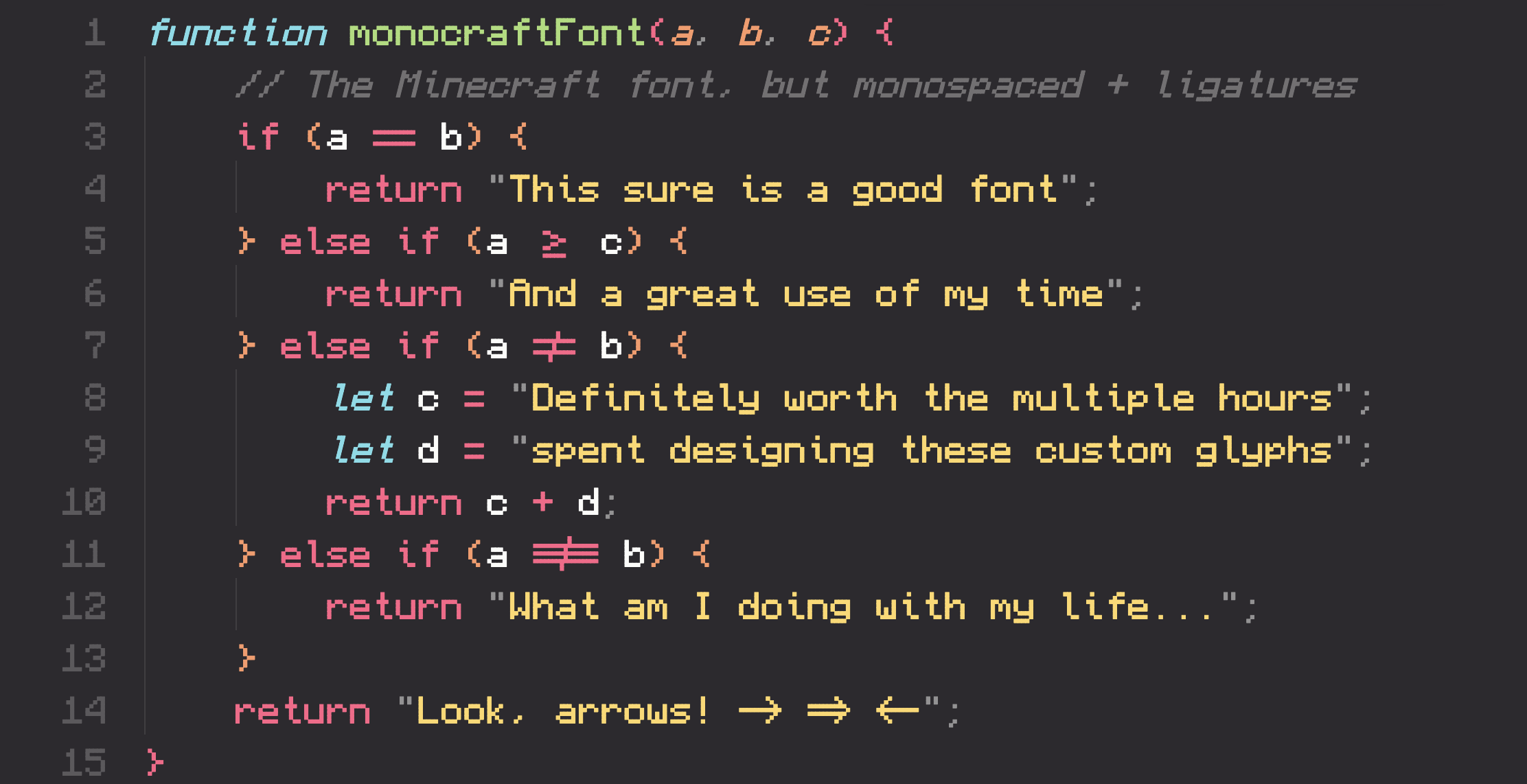
GitHub
A monospaced programming font inspired by the Minecraft typeface - GitHub - IdreesInc/Monocraft: A monospaced programming font inspired by the Minecraft typeface
opaque plover
night knoll
https://github.com/IdreesInc/Monocraft
ty
 stark scarab
night knoll
https://github.com/IdreesInc/Monocraft
stark scarab
night knoll
https://github.com/IdreesInc/Monocraft
nice
 late smelt
Even if I’m still working on it, why not

GitHub
Contribute to Jishuna/BetterPistons development by creating an account on GitHub.
jagged rock
I'd like to see constants for your int magic values
And guard clauses
index++ == 0 is also icky as you can have overflow issues if you run it enough times
woeful pasture
https://paste.md-5.net/jerehicuci.java any suggestions on improving this. My main goal is to add component support to inventories. Wondering if implementing IInventory was a bit overkill here, but if I don't and I use CraftBukkits MinecraftInventory what do I put in as the String title
 midnight spade
woeful pasture
https://paste.md-5.net/jerehicuci.java any suggestions on improving this. My mai...
midnight spade
woeful pasture
https://paste.md-5.net/jerehicuci.java any suggestions on improving this. My mai...
Maybe you can deprecate getTitle
And add getTitleComponent
woeful pasture
midnight spade
Maybe you can deprecate getTitle
hmmm good point I like that think I'll roll with it
woeful pasture
there isn't one for inventories
midnight spade
Ah damn
woeful pasture
choco pr incoming hopefully soonish
but yeah that's why I'm using NMS
currently components on spigot only cover Chat messages maybe some other edge cases
midnight spade
Also can you add a setTitle to inv open event?
To customize the title sent for that player only?
woeful pasture
yeah
woeful pasture
midnight spade
That you're implementing rn
setTitle is native to spigot
you don't need to use NMS
I pr'd it a while back
I believe paper has component methods for it now too
midnight spade
oo
woeful pasture
?jd-s
 rich fogBOT
midnight spade
rich fogBOT
midnight spade
Didn't know
woeful pasture
declaration: package: org.bukkit.inventory, class: InventoryView
midnight spade
If you do setTitle, does it update for open invs?
woeful pasture
midnight spade
If you do setTitle, does it update for open invs?
its more of a sendTitleChange than setTitle
midnight spade
Lovely
woeful pasture
setTitle sets the title for a view which is specific to a player
so the setTitle name makes more sense though it may be less intuitive to think about logically
midnight spade
Nice👍
woeful pasture
anyways thanks for the reccomendation
woeful pasture
midnight spade
Maybe you can deprecate getTitle
damn I didn't realize, but unfortunately can't even do that  https://hub.spigotmc.org/stash/projects/SPIGOT/repos/craftbukkit/browse/src/main/java/org/bukkit/craftbukkit/inventory/CraftInventoryCustom.java#34
its not even public
woeful pasture
I want recommendations on how to better this code. Essentially counting up blocks of certain types to get a total score.
I want this code to be as efficent as reasonably possible and I think there is lots of room for improvement here
https://paste.md-5.net/kuceleqite.cpp // TownValueCalculator.java
https://paste.md-5.net/ilafuxetut.java // MathUtils.java
sly jackal
does the materialvaluemanager create the materials beforehand?
or like lazily creates them
of not I would recommend that
woeful pasture
sly jackal
does the materialvaluemanager create the materials beforehand?
its loaded on server start from a json file
so its all in memory
its just a Set call
MaterialValueManager#material(Material) loops through a set and finds all matching materials. It can't be done with a map as certain materials can contain extra data. Right now its only spawners, but it could change going forward
night knoll
https://github.com/KarmaDeb/LockLogin2/blob/master/LockLoginSpigot/src/main/java/es/karmadev/locklogin/spigot/LockLoginSpigot.java
Not to review, just wondering if would be better to split it in different classes, as the principle of single responsability says

GitHub
LockLogin2 is the new version of LockLogin. With a better API and more stability - KarmaDeb/LockLogin2
round fossil
I mean yeah no
SRP says that a class must only change for a single major reason
so lets say that u have a class that parses strings into some other type of objects, then whenever you have to modify this class, the reason for modifying the class ought to be that the parsing had to be changed and not some other reason
now, that class looks like a facade class
so im unsure whether u actually want to chop it up into smaller classes
 civic shell
https://github.com/ToastArgumentative/LegendsReborn/tree/main
I am trying to do some cleanup and could use a fresh set of eyes to help optimize, and improve readability.
jagged rock
mHM there's a lot of room for improvement
I'd start by following naming conventions
Instead of this, make a PlayerClass interface with a method to apply to a player
 civic shell
Alrighty. done.
 dusty axle
You need to follow naming conventions, both in proper capitalisation but in the fact that everything is confusingly named (e.g. why does the “entities” package contain event listeners? Why are so many things vaguely labelled as a “manager”?)
This is an issue in many areas, but just using your EconomyManager class as an example it appears to be a singleton but you then have a constructor and create an instance of it in your main function (which leads to you unintentionally calling loadBalancesFromFile twice)
There’s just generally a lot of repetition and areas which could be better abstracted, and a lot of error prone code from my cursory scan of a few classes
rancid fern
Keep your example code in the main method rather than in the constructor

GitHub
Java API wrapper for enka.network . Contribute to kazuryyx/EnkaNetworkAPI development by creating an account on GitHub.
Use variables?
Don't catch Exception
 vivid reef
rancid fern
https://github.com/kazuryyx/EnkaNetworkAPI/blob/main/src/main/java/me/kazury/enk...
vivid reef
rancid fern
https://github.com/kazuryyx/EnkaNetworkAPI/blob/main/src/main/java/me/kazury/enk...
@unique gyro You should look up what OOP 101 is about, you rely too much on static
At this point you may as well code in a functional programming language
 spring reef
id say his static use is fine so far
the contexts are only overlapping by having public statics
 alpine anvil
the static use is fine in what ive just looked at
spring reef
f.e. in the EnkaNetworkAPI
i wouldnt give out base ui url or base url and handle them inside
yeah
encapsulate them
alpine anvil
could make it package private technically
spring reef
if you want do achieve that i would make a dao out of it
which one exactly
the cache?
you could also make it non static and instantiate it inside the api class
vivid reef
spring reef
you could also make it non static and instantiate it inside the api class
That'd be the proper way, there is no point in that being static
spring reef
other than that, why is CachedData and EnkaUserInformation in the util package
also i wouldnt have the CachedData manage its own expiration time
put the cacheddata closer to its purpose
like the cache or wherever its used
util is in most cases only a bunch of classes which you cant classify
going for cleancode methods like those could be refactored with extract method https://github.com/kazuryyx/EnkaNetworkAPI/blob/main/src/main/java/me/kazury/enkanetworkapi/genshin/data/GenshinUserInformation.java#L98
https://github.com/kazuryyx/EnkaNetworkAPI/blob/main/src/main/java/me/kazury/enkanetworkapi/enka/EnkaCaches.java#L21 is this really all needed inside the constructor?
the method is too long and complex
everyone looking over it doesnt want to look over it anymore
but inside the constructor?
rather make a load method and call it on startup or a specific event
https://github.com/kazuryyx/EnkaNetworkAPI/blob/main/src/main/java/me/kazury/enkanetworkapi/enka/EnkaGlobals.java#L8 here i would directly define a default, not only by a method call
everything else looks fine
in what specifically
looks redundant to me
you could leave it away as it seems
i mean the locale stuff since you already pass it in
or you could extract the localization parts from the caches
and make them static
no need to sacrifice the caches for the localization (in regards to static)
the localization part will be outside the caches
make an extra class which can be static
and just in my personal opinion, i would write a converter for stuff like this https://github.com/kazuryyx/EnkaNetworkAPI/blob/main/src/main/java/me/kazury/enkanetworkapi/genshin/data/GenshinUserInformation.java#L98 and make an interface like NameableObject or stuff with a getName method to inherit
not QoL but rather overoptimizing
you could but for what
in what way
a few object creations less doesnt make it run better
it still has to read the jsons
without the I prefix and im in
alpine anvil
if you have a class called Nameable the I prefix is fine imo
spring reef
we could also be fancy and make it an abstract class but thats technically the same
spring reef
alpine anvil
if you have a class called Nameable the I prefix is fine imo
yeah but then any other interface would need that prefix to stay consistent
also imo it doesnt look clean in the code when using it
for this one: the usercharacter shouldnt load its own game data. load it while loading the user and pass it via setter
or in the constructor as well
your DTO shouldnt have any functionality but holding data
where is that
you move that method to where you get the usercharacter from
yeah same for that
looks like a DAO method
yeah you move that out too
thats why i would make a DAO which holds a cache and database/your interface to get the data from
and that dao would be your interface to get/load your data
and also saving it
and everything else happens behind that dao so you dont have to bother in every other class
no its just passed via DI
you create it at your entry point (if you have any, you should), instantiate it there and pass it around from there
if you dont have one
just make the dao itself static
not overcomplicating, but maintaining the structure of your project.
you seperate your code, keep it modular and abstract the data sources from each other
- you encapsulate the data access logic, you dont have to bother how you get the data, but you do know you get it
it would also prevent the issues you have right now with your api class
which would need to stay static for the rest of your life and make its way into every other class
which isnt very optimal
with that current design you will soon or later be over-wiring your code and make it interdependent
yeah well, later you dont have this yet anymore
you will want to die while refactoring it
you do you, im just here to review
glad to help
now excuse me, i gotta destroy little kids in rocket league
night knoll
A class that allows to register multiple auth process with set priorities, meaning any other module will be able to add as many auth processes as it wants
https://github.com/KarmaDeb/LockLogin2/blob/master/LockLoginCommon/src/main/java/es/karmadev/locklogin/common/api/user/auth/CProcessFactory.java
https://github.com/KarmaDeb/LockLogin2/blob/master/LockLoginSpigot/src/main/java/es/karmadev/locklogin/spigot/event/JoinHandler.java#L430
https://github.com/KarmaDeb/LockLogin2/blob/master/LockLoginSpigot/src/main/java/es/karmadev/locklogin/spigot/process/SpigotAccountProcess.java
Any suggestion?
It currently it works
round fossil
does CProcessFactory require a concurrenthashmap
or can it work with a normal hashmap per say?
cuz if it needs a concurrent-supported map you wanna adhere to the liskov's substitution principle
local variables should be named lowerCamelCase also, some of your functions are too big
Optional<? extends UserAuthProcess> this makes almost no sense, since Optional is rarely just a producer
I like when you use this and super keyword if possible to distinct between other types of field as well as method invocations
night knoll
round fossil
does CProcessFactory require a concurrenthashmap
I use ConcurrentHashMap as a bad habit, something that for some reason, I do unconsciously
night knoll
round fossil
Optional<? extends UserAuthProcess> this makes almost no sense, since Optional i...
Should I return just UserAuthProcess and mark the method as @Nullable?
round fossil
night knoll
I use ConcurrentHashMap as a bad habit, something that for some reason, I do unc...
ConcurrentMap = ConcurrentHashMap is usually a better way
since it asserts the map does need the concurrency functionality
round fossil
night knoll
Should I return just UserAuthProcess and mark the method as @Nullable?
na but make it bivariant
Optional<UserAuthProcess>
night knoll
round fossil
ConcurrentMap = ConcurrentHashMap is usually a better way
Yeah but ConcurrentMap is not required for ProcessFactory, no data can be removed from that map, so a concurrent exception won't happen
That's what I've mean with "bad habbit", I use them, everywhere
round fossil
What
ConcurrentHashMap is for multithreading
If u just wanna avoid CME when used on a single thread then you dont need CHM
opaque plover
honestly morice just kudos to you for making an enka api wrapper, i think i can find a use for it sometime when I'm bored with Genshin again lol
night knoll
https://github.com/KarmaDeb/KarmaAPI2/blob/master/KarmaAPI-Core/src/main/java/es/karmadev/api/schedule/runner/async/AsyncTaskExecutor.java
Asynchronous task executor (not-minecraft/bukkit-related)

GitHub
KarmaAPI2 is the new version of the KarmaAPI. Contribute to KarmaDeb/KarmaAPI2 development by creating an account on GitHub.
spring reef
night knoll
https://github.com/KarmaDeb/KarmaAPI2/blob/master/KarmaAPI-Core/src/main/java/es...
i would suggest to refactor the entire class
then we can continue
there is so much boilerplate and i dont understand shit whats going on in there
night knoll
spring reef
i would suggest to refactor the entire class
no 🗿
night knoll
spring reef
there is so much boilerplate and i dont understand shit whats going on in there
Where? 🥺
round fossil
bro u need to understand that not every variable is a constant
esp those atom refs
the start function is imo way too huge
testing all that logic is gonna be tough
night knoll
round fossil
the start function is imo way too huge
Should I split it then?
Like a function to call the events and stuff?
round fossil
^ pretty much that
night knoll
spring reef
i would suggest to refactor the entire class
No way I'm doing this, it works now
I'm scary that if I touch something it will simply stop working
spring reef
night knoll
No way I'm doing this, it works now
perfect time to refactor
round fossil
refactoring does not change behavior tho @night knoll
for instance u may wanna extract smaller methods out from that bigger method
or change name of variables
night knoll
round fossil
or change name of variables
I dont think name variables are that important, are they?
jagged rock
They are
These don't follow conventions

You can use a guard clause

And make a setStatus method
Instead of whatever this garbage is
 night knoll
private final AtomicLong timeLeft = new AtomicLong(1);
(for instance?)
jagged rock
this does the same as a regular get() with an added if check
 night knoll
jagged rock
this does the same as a regular get() with an added if check
night knoll
jagged rock
this does the same as a regular get() with an added if check
Oh yes, that's because I though Map#get would throw exception if value was null (now I know that's not what happens)
round fossil
night knoll
```java
private final AtomicLong timeLeft = new AtomicLong(1);
```
(for instance...
yes
night knoll
Hands to work then
night knoll
You were so right about splitting the start method.
All those
events.stream().filter((e) -> e.trigger() == null || e.trigger().equals(TaskEvent.RESUME)).forEachOrdered((event) -> {
                            Object runner = event.get();
                            if (runner instanceof Consumer) {
                                ((Consumer<Long>) runner).accept(ELAPSED.getAndAdd(interval));
                            }
                            if (runner instanceof Runnable) {
                                ((Runnable) runner).run();
                            }
                        });
are now a single method without even arguments 😳
But I think it stills kind of "big"?
        if (!status().equals(TaskStatus.STOPPED)) return;
        setStatus(TaskStatus.RUNNING, false);

        AtomicReference<ScheduledFuture<?>> future = new AtomicReference<>();
        future.set(EXECUTOR.scheduleAtFixedRate(() -> {
            if (status().equals(TaskStatus.STOPPED)) return;

            if (status().equals(TaskStatus.RUNNING)) {
                long timeLeft = this.timeLeft.get();

                currentContext = TaskEvent.TICK;
                executeEvents(true);

                if (timeLeft == 0) {
                    if (!isRepeating.get()) {
                        future.get().cancel(true);
                        setStatus(TaskStatus.STOPPED, false);
                        //taskStatus.set(TaskStatus.STOPPED);

                        currentContext = TaskEvent.END;
                        executeEvents(false);
                    } else {
                        this.timeLeft.set(this.limit - this.interval);

                        currentContext = TaskEvent.RESTART;
                        executeEvents(false);
                    }

                    elapsedTime.set(this.interval);
                }

                if (updateTL.get()) {
                    this.timeLeft.set(timeLeft - this.interval);
                }
                updateTL.set(true);

                return;
            }

            if (status().equals(TaskStatus.RESUMING)) {
                currentContext = TaskEvent.RESUME;

                executeEvents(true);
                setStatus(TaskStatus.RUNNING, true);
            }

            if (lastTaskStatus.get().equals(TaskStatus.RUNNING) && status().equals(TaskStatus.PAUSED)) {
                lastTaskStatus.set(TaskStatus.PAUSED);

                currentContext = TaskEvent.PAUSE;
                executeEvents(false);
            }
        }, 0, interval, workingUnit));

        currentContext = TaskEvent.START;
        executeEvents(false);
every if check in there can be an own method
sly jackal
but should it
stark scarab
opaque plover
stark scarab
roast me https://paste.md-5.net/itibugudif.java
ok i know this kinda makes sense but it's so comical to have a constant for a dot
and the only thing that makes me want to commit homicide against you alex is the fact that your Daddy_Stepsister class name is not following the conventions
night knoll
WTF? It's real lmao
Daddy_Stepsister
I love this name
I take it, idc it doesn't follow name conventions
opaque plover
and some other things are that you can use early returns instead of nesting here (for the outermost if clause)
 night knoll
It's hillarous
opaque plover
though this is preferential ofc
opaque plover
night knoll
It's hillarous
stepsister is his license verification system iirc
opaque plover
yeah
stark scarab
the Stepsister class is prefixed with Daddy_ to avoid issues while shading and relocating because it contains a few other classes that might already exist (TickUtils, JoinListener and BooleanPersistentDataType)
 opaque plover
also alex this is also very preferential but it makes me cut onions, why are you iterating with an actual iterator instead of using for-each or something
this makes it look like it's decompiled code xd
opaque plover
stark scarab
the Stepsister class is prefixed with Daddy_ to avoid issues while shading and r...
then i'll allow it 
stark scarab
opaque plover
also alex this is also very preferential but it makes me cut onions, why are you...
i don't remember lol
probably it's useless
opaque plover
fair enough
stark scarab
as you can see from the bottom-most commented out method, I once wanted to generify it. currently most of those methods are copy/paste
but that won't work because some methods use -1 as magic value, others have "0" as best value while others have 0 as worst value, and some use -2 and -1 as magic values
wanna see another nasty thing?
this is a field instead of an init block to avoid IntelliJ's auto-formatting to move this below the other fields
 cobalt trellis
night knoll
https://github.com/KarmaDeb/KarmaAPI2/blob/master/KarmaAPI-Core/src/main/java/es...
cobalt trellis
night knoll
https://github.com/KarmaDeb/KarmaAPI2/blob/master/KarmaAPI-Core/src/main/java/es...
Why the need of all those atomic refs? Isn't volatile (if anything) enough for many of those?
As a general rule if CAS or other atomic ops are not used, then atomics are not useful
Your setRepeating method shouldn't use CAS either as that is pretty much a direct assignment at the end of all things
Also idk if it is wise to use COWList for taskEvents. If you write frequently to it it's usage is to be avoided
night knoll
cobalt trellis
Why the need of all those atomic refs? Isn't volatile (if anything) enough for m...
I asked ChatGTP what was the best way to deal with concurrency, he told me to use Atomics 🗿
So I used atomic on everything
And my scheduler is (in fact) concurrent, as it can be modified (and accessed) from multiple places at the same time
Is that, or I don't actually understand what concurrency is
cobalt trellis
Atomics are the best way, but only because of CAS
If you cannot use CAS or other atomic operations it is just a fancy field marked with volatile
Also https://github.com/KarmaDeb/KarmaAPI2/blob/master/KarmaAPI-Core/src/main/java/es/karmadev/api/schedule/runner/async/AsyncTaskExecutor.java#L88 is not thread safe due to it not using what should be CAS
round fossil
You don’t need atomics most of the time if you just process data concurrently
Its only good when you update some variable based on its old value when multiple of these updates can happen concurrently
Because essentially the hardware is called to compare and swap values (CAS)
Also must be said that concurrency does not equal multithreading, they correlate but should be differentiated from one another
round fossil
stark scarab
roast me https://paste.md-5.net/itibugudif.java
How precise do u wanna be?
Are we considering enterprise important?
stark scarab
round fossil
How precise do u wanna be?
I know that it's shit lol
round fossil
Na think its pretty good
Pretty readable when I tried to understand what was going on
stark scarab
what I don't like is that half of those methods are 90% the same
but it's only 90%, that's why I failed at refactoring them into one "generic" method
round fossil
Yeah well I wouldn’t mind too much there tbh
spring reef
stark scarab
what I don't like is that half of those methods are 90% the same
no you are right, the methods are too complex regarding to the many returns
your constructor is too big
each of those methods could be 3 individual methods
plus do you really need a linkedhashmap
also im not a fan of this final overuse and your variable names are too short
in fact you could also divide GroupManager into several context related classes as well. that would also lead you away from the "Manager" suffix which you really dont want to have
stark scarab
spring reef
in fact you could also divide GroupManager into several context related classes ...
why do I not want to have that?
stark scarab
spring reef
plus do you really need a linkedhashmap
yes
stark scarab
spring reef
each of those methods could be 3 individual methods
example?
spring reef
stark scarab
why do I not want to have that?
because a manager is never SRP. you want to maintain clarity and specificitiy which is not granted with a "manager"
spring reef
stark scarab
yes
hm ok
spring reef
stark scarab
example?
f.e.
old
    public double getFetchPricePerPlayer(final CommandSender commandSender) {
        try {
            if (yaml == null || !Daddy_Stepsister.allows(PremiumFeatures.FETCH_PRICE_PER_PLAYER))
                return getPercentagePrice(commandSender, main.getConfig().getString(Config.PRICE_FETCH));
            final Iterator<String> it = groups.keySet().iterator();
            Double bestValueFound = null;
            while (it.hasNext()) {
                final String group = it.next();
                if (!commandSender.hasPermission(Permissions.PREFIX_GROUP + group)) continue;
                final String pricePerPlayer = groups.get(group).priceFetch;
                if (pricePerPlayer.equals("-1")) {
                    continue;
                }
                bestValueFound = bestValueFound == null ? getPercentagePrice(commandSender, pricePerPlayer) : Math.min(getPercentagePrice(commandSender, pricePerPlayer), bestValueFound);
            }
            if (bestValueFound != null) {
                return bestValueFound;
            } else {
                return getPercentagePrice(commandSender, main.getConfig().getString(Config.PRICE_FETCH));
            }
        } catch (NumberFormatException exception) {
            return 0;
        }
    }
new
public double getFetchPricePerPlayer(final CommandSender commandSender) {
    if (yaml == null || !Daddy_Stepsister.allows(PremiumFeatures.FETCH_PRICE_PER_PLAYER)) {
        return getPercentagePrice(commandSender, main.getConfig().getString(Config.PRICE_FETCH));
    }

    double bestValueFound = findBestValueForGroups(commandSender);

    if (bestValueFound != 0) {
        return bestValueFound;
    } else {
        return getPercentagePrice(commandSender, main.getConfig().getString(Config.PRICE_FETCH));
    }
}

private double findBestValueForGroups(CommandSender commandSender) {
    Iterator<String> it = groups.keySet().iterator();
    double bestValueFound = 0;

    while (it.hasNext()) {
        String group = it.next();
        if (commandSender.hasPermission(Permissions.PREFIX_GROUP + group)) {
            String pricePerPlayer = groups.get(group).priceFetch;
            if (!pricePerPlayer.equals("-1")) {
                bestValueFound = calculateBestValue(commandSender, pricePerPlayer, bestValueFound);
            }
        }
    }

    return bestValueFound;
}

private double calculateBestValue(CommandSender commandSender, String pricePerPlayer, double currentBest) {
    double percentagePrice = getPercentagePrice(commandSender, pricePerPlayer);
    return (currentBest == 0) ? percentagePrice : Math.min(percentagePrice, currentBest);
}
 novel meteor
Minigames based on @jagged rock's tutorial
The first link is the minigame system, the other links are two games
Not really polished, but mostly functional.
https://github.com/steve6472/StevesFunnyLibrary/tree/master/src/main/java/steve6472/standalone/tnttag
https://github.com/steve6472/StevesFunnyLibrary/tree/master/src/main/java/steve6472/standalone/hideandseek
jagged rock
Not a fan of the world setup in the game class
And I'd split some things
Scoreboard teams are also icky to be done there, maybe make some sort of builder or utility class
Static game instance can cause some issues
When I make my minigames I make sure to split event listeners and schedules on the main phase into separate methods
novel meteor
jagged rock
Not a fan of the world setup in the game class
Don't really see a better way of doing this
jagged rock
I didn't really comment on this but instead of tying these listeners to each phase, I have 2 approaches I take depending on context

One is a "Permanent Phase" class which is a phase that immediately ends when started, but doesn't dispose until the entire game disposes

Something like this
novel meteor
That's a great idea
jagged rock
But sometimes you might want to toggle and this isn't generally the best approach
So I have a system I call "Vanilla Mechanics" which is a sort of registry for toggleable mechanics
You need to be careful with cleanup

But it works something like this
novel meteor
Yeah, that would be useful as well
Man, you really need to write these down XD
I'd pay for this shit
jagged rock
That takes time and writing my secrets doesn't pay my bills
novel meteor
yeah, fair point
jagged rock
I want to make sure everything is properly done and polished before I write an entire minigame guide so every amateur can make their own copy of hypixel
night knoll
jagged rock
I want to make sure everything is properly done and polished before I write an e...
Bad, people shouldn't be doing copies of hypixel. They should innovate hypixel
But that's not for this thread
 viral mantle
this is my code for scoring
thebridge plugin
and I was wondering if there was a better way of doing this?
I wanted to get other people's opinion
novel meteor
use early return when possible
if (!(game.getPlayers().containsKey(player.getUniqueId()) && event.getCause() == PlayerTeleportEvent.TeleportCause.END_PORTAL))
return;```or you get this

I think you would have to have the end enabled in the world for the teleport event to fire
but having the end enabled is gonna lower the performance
So doing this in the player move event might be better, but idk
viral mantle
novel meteor
I _think_ you would have to have the end enabled in the world for the teleport e...
ill wait for other people to reply aswell
so to see which is better
woeful pasture
 tawny tartan
https://paste.md-5.net/raveloface.java
tawny tartan
https://paste.md-5.net/raveloface.java
it'd be nice to see the NovaThread class to see how this works together
right now I'm just thinking how it may actually be better to use something like an ExecutorService or just Bukkits built in task system with a wrapper of sorts, though I don't know how your NovaThread works under the hood
jagged rock
Not a huge fan of the numerical switch
jagged rock
 frosty grove
<https://github.com/orbyfiedistrash/abstracraft-prototypes/tree/scoped-usage/abs...
frosty grove
<https://github.com/orbyfiedistrash/abstracraft-prototypes/tree/scoped-usage/abs...
where private variable
Interface full of null / empty methods, looks unfinished to me
jagged rock
viral mantle
and I was wondering if there was a better way of doing this?
Not a huge fan of the gamestate enum, rather use phases
I'd rename Pos to Position, loop through the entryset instead of looping through keys and calling get(key)
Guard clauses and all
frosty grove
jagged rock
Interface full of null / empty methods, looks unfinished to me
where
its finished
its complete
frosty grove
jagged rock
where private variable
also private vars suck
protected/package-private ftw
alpine anvil
jagged rock

atomicinteger

just make a dedicated class for this
alhamdullillah


That's enough
Also your database handling is trash
alpine anvil
jagged rock
alhamdullillah
yeah this is jank
frosty grove
frosty grove
<https://github.com/orbyfiedistrash/abstracraft-prototypes/tree/scoped-usage/abs...
this is outdated now, it got moved to the actual organization repo i made it for so its improved at least a bit
might be why it looked incomplete
frosty grove
jagged rock
Interface full of null / empty methods, looks unfinished to me
did u mean DependencyAnalyisHook tho?
or the Usage class
tawny tartan
jagged rock
<a:seizure:1077750023242125332>
Oh boy.
tawny tartan
woeful pasture
it'd be nice to see the NovaThread class to see how this works together
Yeah I can send it ltr. All it is, is a runnable
I could use ExecutorService but idk
woeful pasture
tawny tartan
I could use ExecutorService but idk
use an scheduled executor service than you can do completable future and scheduled tasks if you really need
opaque plover
https://github.com/RoughlyUnderscore/rust-guess-the-number/blob/main/src/main.rs i just started with rust and decided to create an utmost generic number guesser. i have no understanding of ownership, lifetimes, macros, &str vs String, etc, i've watched the tutorial on the very basics of rust syntax and created this. any criticism welcome

GitHub
Contribute to RoughlyUnderscore/rust-guess-the-number development by creating an account on GitHub.
round fossil
Doesn’t look too bad, but I suggest learning difference between &str vs &String (and just String I suppose)
Lifetimes aren’t hard basically the life of a variable, which is decided by its scope I don’t wanna compare it to Java cuz that might mislead you but yeah
opaque plover
round fossil
Doesn’t look too bad, but I suggest learning difference between &str vs &String ...
yup, I'm omw to that
opaque plover
round fossil
Lifetimes aren’t hard basically the life of a variable, which is decided by its ...
from my current knowledge lifetimes are basically manual garbage collection because rust doesn't have automatic garbage collection, is that correct?
round fossil
I think you wanna learn what macros, not necessarily being able to write ur own at this stage of the learning phase
round fossil
opaque plover
from my current knowledge lifetimes are basically manual garbage collection beca...
Yesnt
opaque plover
actually maybe you have a good tutorial? the one I'm watching rn is basically for people whose first language is rust, I was wondering if there was maybe a tutorial for rust for those who understand basic programming concepts. it's a bit annoying to listen to 7 minutes of somebody explaining control flow with if-else
I've heard the rust docs are a good tutorial by themselves but I want to stick to video if possible
round fossil
I think this is what I used mainly
opaque plover
thanks, I'll have a look 🙂
opaque plover
https://github.com/RoughlyUnderscore/rust-guess-the-number/blob/main/src/main.rs#L26 i changed the code so that it now accepts up to i128 and kinda gently handles overflow, but it looks REALLY scuffed. any ideas on how to implement it otherwise? (L26 is the start of the input accept loop)
GitHub
Contribute to RoughlyUnderscore/rust-guess-the-number development by creating an account on GitHub.
lunar vale

GitHub
fully customizable kits and shop. Contribute to crackma/PVPCore development by creating an account on GitHub.
novel meteor
lunar vale
https://github.com/crackma/PVPCore/tree/master/src/main/java/me/crackma/pvpcore
Went to Gui and Kits, those packages don't have spaces between methods, makes it really hard to read
Category in shop package is much better
https://github.com/crackma/PVPCore/blob/21d219e6cb7af54d2fdce57a8775907a457b3404/src/main/java/me/crackma/pvpcore/shop/ShopManager.java#L37C9-L37C142
Don't use §, use ChatColor instead at least.
Or better yet, components.
jagged rock
Or better yet, don't hardcode messages
woeful pasture
language files go brrrr
lunar vale
i dont like spaces and i prefer double s
i just do alt 21
or alt 0167
i dont touch category so i didnt remove the spacds
opaque plover
https://github.com/RoughlyUnderscore/rust-guess-the-number/blob/main/src/main.rs probably final version of my guess-the-number in rust. any criticism is appreciated 🙂
lunar vale
cobalt trellis
You mean `\u00A7`?
when you hold alt and press the numpad numbers
cobalt trellis
Yes I know but I do not use this accursed feature
 analog gyro
alpine anvil
analog gyro
alpine anvil
That isnt how it should be using futures
stark scarab
he's using futures everywhere just because players can have a configurable language
I already said to just keep a Map<UUID,Language> and Map<Language, Messages> and load the player into the map on join
and the whole usage of futures seems pretty odd too, it should rather be sth like this
return CompletableFuture.supplyAsync(() -> {
  ItemStack item = ...;
  String language = mySqlThingy.getLanguage(...);
  String message = myMessageThingy.getMessage("some-message", language);
  // apply to item
  return item;
});
instead of creating a future, then passing that to something else and completing it there
cobalt trellis
stark scarab
he's using futures *everywhere* just because players can have a configurable la...
Yep, that is the wrong usage.
How the hell do you even come to that conclusion?
Wait .... Languages are set via SQL???? Humanity is doomed.
stark scarab
also the whole code is repeating itself over and over again
cobalt trellis
Well that is irrelevant in comparison to the SQL
stark scarab
https://github.com/JEFF-Media-GbR/JsonConfigurationSerialization/blob/master/src/main/java/com/jeff_media/jsonconfigurationserialization/ConfigurationSerializableTypeHierarchyAdapter.java#L62 any ideas on how to improve this / avoid doing this dirty trick?
cobalt trellis
The intValue call can be done at a later time
And are you sure that this hack even works?
stark scarab
cobalt trellis
The intValue call can be done at a later time
true but I'd rather get rid of this hack as a whole
cobalt trellis
Especially when storing doubles (such as 0) or ints (anything < Integer.MIN_VALUE) or longs (anything < Integer.MAX_VALUE)
stark scarab
only place where i noticed that it's needed is when parsing ItemMeta, as the buildEnchantments method does an instanceof Integer check
and for that it works fine
    private static Number narrowNumberType(Number number) {
        double asDouble = number.doubleValue();
        long asLong = number.longValue();

        double longAsDouble = asLong;

        if(asDouble == longAsDouble) {
            if(asLong > Integer.MAX_VALUE || asLong < Integer.MIN_VALUE) {
                return asLong;
            } else {
                return number.intValue();
            }
        }

        return asDouble;
    }
I now changed it to this but it's still shit
cobalt trellis
stark scarab
true but I'd rather get rid of this hack as a whole
I don't use GSON so idk
cobalt trellis
Oh and return asDouble should be return number
stark scarab
true
it's kinda weird that gson parses something like "1" into a double in the first place
night knoll
I never used JsonSerializer nor JsonDeserializer, I don't know if I'm doing correctly, so I'm open to crticism
 feral burrow
https://github.com/hibatica/AdagraPlugin
My first plugin (apart from small useless plugins made while learning). Open for review.
sorry I was trying to fix the author of my git commits being invalid-email
I figured there was a better way lol
saveDefaultConfig(); done
public class ReadyListener extends ListenerAdapter {
    @Override
    public void onReady(ReadyEvent event) {
        System.out.println("Discord bot is ready!");
    }
}
like this?
as for combining the listeners, you say it can get messy when you have a bunch, wouldnt I have to separate them again?
ok that makes sense,
btw just so I understand this better, when I do an @EventHandler, is the server event manager finding the method that has the appropriate event in the paramaters? so the name of the method doesnt matter?
can I have the same event in two different classes?
ok
should I use reflection to register the events? you said my method is too much
thats because I might have another listener of the same name somewhere else
in the future
should I do ChatBridgeOnPlayerJoin.java ?
yeah
ok
thanks for the help
night knoll
Do you guys use this. Whenever possible
and super.
configmanager.class:
https://paste.md-5.net/roveqoniqe.cpp
hikaricp.class:
https://pastebin.com/q73a36Hv
databasehandler.class:
https://paste.md-5.net/ivebagefaz.java
main.class:
https://paste.md-5.net/utinejepoq.java
can u tell me my mistakes ?
jagged rock
Why is all of this static?
night knoll
jagged rock
Why is all of this static?
alright i changed to this
hikari
https://pastebin.pl/view/1acf7f72
configmanager
https://paste.md-5.net/bojugibimi.cpp
mainclass:
https://paste.md-5.net/oposequxel.java
is this good ?
do u prefer hikari static to nonstatic ?
I would remove setPlugin in the main class @night knoll
why
And your friends
Don't have to be static
friends
night knoll
night knoll
why
I mean it doesn't really make sense
night knoll
night knoll
And your friends
Fields
ah
like what if I just setPlugin(null)
but i need get plugin
Yes
put
plugin = this
In on enable
aight 1m
aight
this good
but what u think for my main
i mean
for my static values
and methods
am i do static they ?
example hashmap
jagged rock
You don't need static pretty much anywhere
 hard island
?mappings
rich fogBOT
Compare different mappings with this website: https://mappings.cephx.dev
night knoll
Guys what's the designer pattern called where:
You make a project out of interfaces, like everything, then impl them somewhere else
If it's encapsulating then idk
like bukkit api basically
also should I use that pattern or not
like rn I only use interfaces for objects that will clearly have different implementations
like a database, there might be a local, sql, etc
dusty axle
Inheritance? You’ve just described a basic object oriented programming concept lol
jagged rock
night knoll
Guys what's the designer pattern called where:
You make a project out of interf...
So.. an API
That's called multi platform code
You just make interfaces for everything
And then an abstract class with a couple abstract methods for each platform to impl
An abstract class sql databases which is then extended by an abstract class for remote sql databases
and you end up with 10k lines of code that do nothing
jagged rock
It's a class that can't be instanced directly and must be extended
night knoll
why not just use the interfaces atp
not ik what they are
but why have an abstract class for a database when there's an interface
jagged rock
You make an interface and an abstract class that impls it and provides like 90% of the code you need
jagged rock
Are done by the abstract class
jagged rock
And your impl only cares about loading the driver
night knoll
Do you think it's a good practice
night knoll
jagged rock
It's what I've been doing
What about apis like jda
lunar vale
jagged rock
and you end up with 10k lines of code that do nothing
should i do it for my database
databases
when they all use mongodb and have completely different methods
night knoll
lunar vale
when they all use mongodb and have completely different methods
Wdym
if you have a database for like
punishments
just have the generic methods
getPunishmentLogs(User)
saveLog(Log)
dusty axle
mongodb
Oh no
lunar vale
what about it
dusty axle
Every time I have used it I have regretted it
jagged rock
lunar vale
should i do it for my database
Yes
I usually structure my databases like this
 night knoll

GitHub
A plugin to help manage your players. Contribute to skinnynoonie/NoonieManagement development by creating an account on GitHub.
How would you guys recommend I do this
I was thinking about a Factory
Also would be nice for recommendations for the rest of the project
I just started it
round fossil
Looks alright
round fossil
You can have a static factory for the builder
But nah builder here is considerably a good choice
night knoll
yeah ik lol there's a lot of fields
ok then what I might do is include my Duration and NameableUserEntity class into the builder
round fossil
I would only use a factory to decouple the creation and instantiation of these objects if a lot of classes construct them and if you can abstract away the need to have that many arguments passed upon creation
round fossil
night knoll
ok then what I might do is include my Duration and NameableUserEntity class into...
Yea
I suggest you to read up on effective java
It covers creation of objects and good practices
frosty grove
GitHub
An abstraction layer for the Minecraft API. Contribute to RedstoneTools/abstracraft development by creating an account on GitHub.
wrote this for an open source project im a part of
already sent an early version of this once
night knoll
GitHub
A plugin to help manage your players. Contribute to skinnynoonie/NoonieManagement development by creating an account on GitHub.
I need constructive feedback on this local database
Everything works I tested it
round fossil
Depend on Plugin, not JavaPlugin
Avoid shortcut/acronym names like DB, only tome its allowed is if its http or something universally known, DB is arguably not.
Don’t use File, use Path.
Odd choice of return type in CF (hinting at Boolean)
@night knoll
Personally I would avoid coupling the async storage layer with the storage logic layer
(Look at humble objects principle)
night knoll
round fossil
Depend on Plugin, not JavaPlugin
Avoid shortcut/acronym names like DB, only tome...
Ok
So the depend on Plugin, why would you recommend that
round fossil
Let me ask you this what’s the benefits of depending on JavaPlugin?
If you depend on Plugin its easier to mock the dependency, and you decouple yourself from an abstract class
night knoll
DB, I mean it's in the database package and it implements database
Idk how to create a file using path api lol
The return type boolean idk what else I would use
And idk what coupling async storage means
What does couple mean
round fossil
Parent child implementation inheritance is one of the most coupled prone concepts in all of object oriented programming
When instances depend on each other directly
round fossil
Well no
I just suggest you to depend on Plugin as a type and not JavaPlugin
Since its more beneficial for you
night knoll
I could just make it not async
And the caller does all the threading
that does sound better imo
round fossil
I’d avoid that
Having an async service layer is always nice for the api consumer
Not having to deal with thread safety, atomicity designs, mem fences or race conditions
Etc
night knoll
So you want me to make something like
round fossil
Hace you looked at luckperms?
night knoll
AsyncManagementDatabase extends ManagementDatabase
night knoll
round fossil
Hace you looked at luckperms?
Nah
round fossil
We say that storageimplementation.java in this case is humble with respect to storage.java
night knoll
Oh I see
round fossil
night knoll
DB, I mean it's in the database package and it implements database
Idk how to c...
The path api is easy to learn, google around about it but essentially Path represents a path, to operate on these paths, like renaming files, creating and deleting files and directories and walk directories you use Files.java
round fossil
night knoll
DB, I mean it's in the database package and it implements database
Idk how to c...
Regarding Boolean, I think you could return something more useful, but that’s just me
spring reef
a state ¯_(ツ)_/¯
night knoll
round fossil
The path api is easy to learn, google around about it but essentially Path repre...
Oh
Ok I'm back
night knoll
round fossil
The path api is easy to learn, google around about it but essentially Path repre...
I thought Files. Was part of the file api so I didn't use that lol
And yeah I see what you mean about the database
the async one like wraps the implementation
night knoll
round fossil
If you depend on Plugin its easier to mock the dependency, and you decouple your...
Wdym
Decouple yourself from an abstract class
stark scarab
is it fine to use an assert here? isWildcard() already checks whether wildcardPrefix is null, but without the assert, IJ complains that it might be null. I do NOT want to add any additional logic as that'd be weird imho
 sly jackal
ignore ij
its dumb
if you really get triggered by the warning assert is fine
since it will never assert to false anyways
basically ij doesnt know that you catch this in isInWildcard
dusty axle
The implementation is isWildcard could be changed if it is overridden by a subclass, which is why IntelliJ doesn’t count it as guaranteed not null
night knoll
spring reef
a state ¯\_(ツ)_/¯
I actually saw an example of this in the book Clean code
and they said to throw and exception
stark scarab
dusty axle
The implementation is isWildcard could be changed if it is overridden by a subcl...
oh yeah that does make sense
stark scarab
is this a proper way of writing tests or is it fucked up lol

 round fossil
I mean I’d say you’re doing it a bit wrong (but thats from how I learnt)
Basically your tests are testing things that your test shouldn’t test, it should be covered in other tests
Like usually, if you wanna test the method Group::containsUser you don’t test Group::addUser and Group::setPermission
Those methods should be well tested in other unit tests
Also
Avoid writing testBlahBlah()
Every1 knows u’re testing ur code
You should look up proper test naming conventions
stark scarab
i remember junit refusing to run methods that didnt have "test" in the same even when they were annotated
or maybe it was the class that had to have Test in the name?
round fossil
that’s old junit I believe
stark scarab
I'm using this from the gradle docs
 stark scarab
round fossil
Like usually, if you wanna test the method Group::containsUser you don’t test Gr...
stark scarab
round fossil
Like usually, if you wanna test the method Group::containsUser you don’t test Gr...
well but I cannot test if the group/user permissions work if I don't create a group and user
round fossil
It is pretty nice to static import all of Assertions.java
round fossil
stark scarab
well but I cannot test if the group/user permissions work if I don't create a gr...
Yes but you misunderstand me
Creating a group should be covered in other unit tests
stark scarab
and then pass that group object around? I don't really understand
round fossil
ofc this implies the tests for Group::containsUser may fail if the tests from Group::addUser failed
Well I mean
Its just that you don’t wanna be performing any larger tests
Well what I wanted to say is that your unit tests almost become module tests @stark scarab
It is better to have more tests to cover ur code than to cramp them
frosty grove
you can read the stack trace so you'll know what fails right
why do you need such small tests
id have a test per group of methods
round fossil
frosty grove
why do you need such small tests
a unit test should only be short and simple, it must only cover a cohesive little piece of behaviour, else u will end up with the fragile test problem
frosty grove
tf is the fragile test problem
round fossil
google it
its quite a common symtom you get if you aren't experienced with unit tests and tdd
frosty grove
and isnt it better to test a system by emulating real use cases instead of a fabricated environment
frosty grove
round fossil
its quite a common symtom you get if you aren't experienced with unit tests and ...
well if your shit breaks its broken, and you can probably find it by looking at the stack trace
round fossil
frosty grove
well if your shit breaks its broken, and you can probably find it by looking at ...
its rly not that simple
frosty grove
i know what you mean but at the same time, testing addUser and containsUser in one test doesn't sounds like a problem to me
same system
round fossil
anyway SYSTEM TESTS are for testing the entire system, INTEGRATION TESTS for testing interactions of modules
frosty grove
if one breaks, the other is unusable anyways
what would you classify this as
had to write a custom test system
round fossil
you don't get the point because you haven't ever exposed yourself to a proper test environment more than just writing some unit tests here and there, but basically you wanna decouple ur test structure from ur code architecture, else you will end up with tests that will bring other code symptoms to your actual code architecture like fragility and inflexibility
when your test structure is coupled to ur code architecture tightly enough we call it the fragile test problem
frosty grove
hm ok
round fossil
I mean it becomes noticeable in larger code bases mostly
coupling methods here and there may not affect u
frosty grove
you need some kind of setup for most tests anyways tho which then couples it
like how do you check containsUser if you dont want to call addUser
round fossil
its fine to use addUser
its just that in that method where you test containsUser, you don't wanna test addUser
frosty grove
frosty grove
<https://github.com/RedstoneTools/picasso/blob/main/src/test/java/test/picasso/S...
but what type of test would you classify this as
round fossil
idk
i havent ever seen some1 do it that way
apart from overloaded static functions
frosty grove
i had to write a custom test system because junit loads all test classes
round fossil
ah I see
frosty grove
which was a problem for bytecode transformation tests
lunar vale
round fossil
you don't get the point because you haven't ever exposed yourself to a proper te...
i wish i knew what unit testing and proper structure looked like
spring reef
lunar vale
i wish i knew what unit testing and proper structure looked like
import static org.junit.jupiter.api.Assertions.assertNotNull;
import static org.junit.jupiter.api.Assertions.assertNull;

import org.junit.jupiter.api.Test;

class AreaCalculationSettingsTest {

    @Test
    void setSourceWhereMissing_ShouldGenerateNamesForUnnamedSources() {
        // Given
        AreaSource namedSource1 = new ProductWidthAreaSource("source1");
        AreaSource namedSource2 = new ProductWidthAreaSource("source2");
        AreaSource unnamedSource1 = new ProductWidthAreaSource(null);
        AreaSource unnamedSource2 = new ProductWidthAreaSource(null);
        AreaSource namedSource3 = new ProductWidthAreaSource("source5");

        AreaCalculationSettings areaCalculationSettings = new AreaCalculationSettings();

        areaCalculationSettings.addAreaSource(namedSource1);
        areaCalculationSettings.addAreaSource(namedSource2);
        areaCalculationSettings.addAreaSource(unnamedSource1);
        areaCalculationSettings.addAreaSource(unnamedSource2);
        areaCalculationSettings.addAreaSource(namedSource3);

        // Safety asserts to ensure that addAreaSource() doesn't do anything prohibited
        assertNotNull(namedSource1.getName());
        assertNotNull(namedSource2.getName());
        assertNull(unnamedSource1.getName());
        assertNull(unnamedSource2.getName());
        assertNotNull(namedSource3.getName());

        // When
        areaCalculationSettings.setSourceWhereMissing();

        // Then
        // Assert that all sources have names assigned
        assertNotNull(namedSource1.getName());
        assertNotNull(namedSource2.getName());
        assertNotNull(unnamedSource1.getName());
        assertNotNull(unnamedSource2.getName());
        assertNotNull(namedSource3.getName());
    }
}
or with a few more tests
import static org.junit.jupiter.api.Assertions.assertEquals;
import static org.junit.jupiter.api.Assertions.assertThrows;

import org.junit.jupiter.api.Test;

import com.example.xyz.model.Shelf;

public class ShelfBuilderTest {

    @Test
    public void widthMustBeGreaterThanZero() {
        // Given, When, and Then
        assertThrows(IllegalArgumentException.class, () -> new ShelfBuilder().setShelfWidth(0));
    }

    @Test
    public void mountingHeightMustBeGreaterThanZero() {
        // Given, When, and Then
        assertThrows(IllegalArgumentException.class, () -> new ShelfBuilder().setMountingHeight(-1));
    }

    @Test
    public void mountingHeightMustBeSet() {
        // Given, When, and Then
        assertThrows(IllegalStateException.class, () -> new ShelfBuilder().build());
    }

    @Test
    public void shelfHasCorrectMountingHeight() {
        // Given
        ShelfBuilder shelfBuilder = new ShelfBuilder()
            .setMountingHeight(1700);

        // When
        Shelf shelf = shelfBuilder.build();

        // Then
        assertEquals(1700, shelf.getMountingHeight());
    }

    @Test
    public void shelfHasCorrectWidth() {
        // Given
        ShelfBuilder shelfBuilder = new ShelfBuilder()
            .setMountingHeight(1700)
            .setShelfWidth(50);

        // When
        Shelf shelf = shelfBuilder.build();

        // Then
        assertEquals(50, shelf.getWidth());
    }

    @Test
    public void shelfHasDefaultThicknessOfThirty() {
        // Given
        ShelfBuilder shelfBuilder = new ShelfBuilder()
            .setMountingHeight(1700);

        // When
        Shelf shelf = shelfBuilder.build();

        // Then
        assertEquals(30, shelf.getThickness());
    }

    @Test
    void shelfHasDepth() {
        // Given
        ShelfBuilder shelfBuilder = new ShelfBuilder()
            .setMountingHeight(1700)
            .setDepth(42);

        // When
        Shelf shelf = shelfBuilder.build();

        // Then
        assertEquals(42, shelf.getDepth());
    }
}
thakns
stark scarab
frosty grove
you can read the stack trace so you'll know what fails right
that's not the point of tests lol
dusty axle
Agile™️
frosty grove
stark scarab
that's not the point of tests lol
if it fails it fails, ive never had a test fail and then i didnt look at the error
night knoll
Is this too much for a messages config
GitHub
A plugin to help manage your players. Contribute to skinnynoonie/NoonieManagement development by creating an account on GitHub.
It let's me organize messages like this:
plugins/MyPlugin/messages/SomeMessage.txt
And then I can do stuff like this
```Bukkit.broadcast(new PublicBanAnnouncement(target, issuer).getAsComponent());```
I think it's working fine now. If anybody is bored, I'd love it if someone could find a flaw in my parser by coming up with a test that breaks it https://github.com/mfnalex/PAPI-Replace/blob/master/core/src/test/java/com/jeff_media/papistringreplace/TestReplacer.java

GitHub
Contribute to mfnalex/PAPI-Replace development by creating an account on GitHub.
stark scarab
stark scarab
I think it's working fine now. If anybody is bored, I'd love it if someone could...
@round fossil pls rate my tests again, these are fine right?
round fossil
ye
stark scarab
:3
opaque plover
 novel meteor
Really tiny brigadier command "library" or whatever
Completely ignores bukkit permissions by default, too lazy to add support for it
Essentially a Spigadier, but for 1.20 and should work on higher versions so long mojang does not change anything.
https://github.com/steve6472/Brigit
alpine anvil
do you use netbeans
novel meteor
the what ?
No IntelliJ
alpine anvil
hmm
novel meteor
What made you think I used netbeans ?
 eager wasp
The code formatting
alpine anvil
^^
novel meteor
I should have put that as a disclaimer lol
Not changing that in my personal projects.
night knoll
Do you guys think something like this would be a good format
try {
Do stuff with command
}catch(E e) {
Send msg
}catch(E2 e) {
Send msg
}
opaque plover
night knoll
try {
Do stuff with command
}catch(E e) {
Send msg
}catch(E2 e) {
Send msg
}
Exceptions are a wonderful thing. They can let your code recover from unexpected situations in a nice and clean way, if you use them properly. That does not mean that you should always rely on them though. For example, imagine this: Most highways have guardrails in the middle to avoid cars going into oncoming traffic....
night knoll
opaque plover
https://blog.jeff-media.com/dont-jump-off-bridges-or-why-you-shouldnt-use-except...
The solution is exactly what I wanna avoid
alpine anvil
Why
rancid fern
night knoll
It just looks so messy
You can use command libraries if you want
night knoll
rancid fern
You can use command libraries if you want
even with command libaries
Sometimes it's not just checking the parameters
it's also doing a lot of weird stuff as the function lol
round fossil
night knoll
It just looks so messy
it looks less messy and it is a lot faster
night knoll
round fossil
it looks less messy and it is a lot faster
yeah but performance isn't rly needed for my simple task
round fossil
night knoll
yeah but performance isn't rly needed for my simple task
its a code smell
i dont remember
but there is a name for that particular paradigm
night knoll
Yeah I was reading everywhere that it is an anti pattern
it's just that
idk
I really do feel like it would be really nice
night knoll
round fossil
in most cases its gonna be an anti pattern
what if I have something as an action
like save
and if it doesn't work it blocks the code flow
should I just return a boolean or?
https://hastebin.com/share/temovuvura.java
Here's what I have
Hastebin is a free web-based pastebin service for storing and sharing text and code snippets with anyone. Get started now.
And I really don't know how I should break everything down lol
spring reef
night knoll
yeah but performance isn't rly needed for my simple task
doesnt matter
you shouldnt do it
spring reef
round fossil
i mean
dont be too nice at disgusting things
spring reef
spring reef
you shouldnt do it
exceptions aren't meant for code flow. they are a "here happened something which i'm not prepared for"
or for if everything explodes
spring reef
round fossil
but there is a name for that particular paradigm
exception driven programming maybe
night knoll
night knoll
https://hastebin.com/share/temovuvura.java
Here's what I have
how do I organize this
spring reef
night knoll
how do I organize this
already looks pretty clean
you can break the larger methods down into several smaller ones
would be called "extract method refactoring" then
night knoll
spring reef
you can break the larger methods down into several smaller ones
you can see I already did that
just that some methods will need a ton of paremeters
night knoll
public record PlayerConnectionListener(ManagementDatabase managementDatabase) implements Listener {

    @EventHandler
    public void onPreLoginEvent(AsyncPlayerPreLoginEvent event) {
        try {
            PunishmentPortfolio portfolio = managementDatabase.getPunishmentPortfolioAsync(event.getUniqueId()).get();
            handlePlayerIfBanned(portfolio, event);
        } catch (Exception e) {
            e.printStackTrace();
            event.disallow(AsyncPlayerPreLoginEvent.Result.KICK_OTHER, new InternalErrorMessage().getAsComponent());
        }
    }

    private void handlePlayerIfBanned(PunishmentPortfolio portfolio, AsyncPlayerPreLoginEvent event) {
        Punishment possibleCurrentBan = portfolio.getCurrentBan();
        boolean isNotBanned = possibleCurrentBan == null;
        if(isNotBanned) return;
        kickPlayerDueToBan(possibleCurrentBan, event);
    }

    private void kickPlayerDueToBan(Punishment banPunishment, AsyncPlayerPreLoginEvent event) {
        event.disallow(AsyncPlayerPreLoginEvent.Result.KICK_BANNED,
                new BanScreenMessage(banPunishment).getAsComponent());
    }

}
Is this a good way to handle bans?
I just wondering if the catch Exception on the catch block is appropriate:
} catch (Exception e) {
        e.printStackTrace();
        event.disallow(AsyncPlayerPreLoginEvent.Result.KICK_OTHER, new InternalErrorMessage().getAsComponent());
}```my first kotlin project, and it's a gradle plugin too: https://github.com/mfnalex/gradle-fix-javadoc-plugin
GitHub
Contribute to mfnalex/gradle-fix-javadoc-plugin development by creating an account on GitHub.
opaque plover
hypothetical question, not working on a project
is this way of working with operations a good practice? (chaining)
favicon.execute(OperationChain(Rotations.FLIP_HORIZONTAL).then(Rotations.FLIP_VERTICAL).do());
Looks fine
I mean I like when I can write a pre cached operation and then just invoke it at will w/o having to build it again and again
sly jackal
too bad you cant use operations
like +
but this looks similar to what I would do
except teh do feels kinda pointless
I would probably just put it into the favicon class or whatever
like a way to flip the images
night knoll
Hey everyone! 👋 I'm fairly new to the Minecraft development scene and I'm eager to improve. I'd really appreciate any constructive criticism on my plugin, PixelPaste. Whether it's praise or pointers, your feedback will be invaluable for my development journey. The code is open-source, and you can check it out directly via the GitHub link on the Spigot plugin page.
https://github.com/jaceg18/PixelPaste
Thanks in advance for taking the time to help me out! 🙏

GitHub
A lightweight minecraft plugin that allows you to turn images into builds. - GitHub - jaceg18/PixelPaste: A lightweight minecraft plugin that allows you to turn images into builds.
woeful pasture
https://github.com/jaceg18/PixelPaste the github is here
woeful pasture
night knoll
Hey everyone! 👋 I'm fairly new to the Minecraft development scene and I'm eager...
you really shouldn't do the commands the way you are doing them imho. Separate your concerns 1 command to 1 class.
the whole handler system seems redundant
sly jackal
*continued from #help-development message
night knoll
woeful pasture
you really shouldn't do the commands the way you are doing them imho. Separate y...
Each command should have it's own class?
woeful pasture
yeah having one executor for multiple commands doesn't scale in an organized manner. By doing handlers the way you are doing them right now you're solving a problem you could just solve by using the API
night knoll
woeful pasture
yeah having one executor for multiple commands doesn't scale in an organized man...
Makes sense, I am still unfamiliar with the API as a whole.
sly jackal
you would make a command executor for each /command you add I imagine
but you can always split it up into your subcommands too if you have a lot of them
woeful pasture
also not many people know this but if you want both ComandExecutor and TabCompleter you can implement TabExecutor
declaration: package: org.bukkit.command, interface: TabExecutor
night knoll
woeful pasture
also not many people know this but if you want both ComandExecutor and TabComple...
Thanks for sharing that.
woeful pasture
its just shorthand for both and doesn't do anything besides that
night knoll
Is there any obvious bottlenecks/flow issues in the code from what you guys have seen thus far?
From what I can tell while running it, it seems fine. But I honestly don't trust myself to use the API correctly.
sly jackal
tbh there are not a lot of places for bottlenecks in a relatively small plugin
if its working good in the server its nice
woeful pasture
any reason you are running this the next tick?
Bukkit.getScheduler().runTask(PixelPaste.getInstance(), () -> {
    for (int x = 0; x < width; x++) {
        for (int yz = 0; yz < height; yz++) {
            int[] coords = ("vert".equals(orientation)) ? new int[]{x, yz, 0} : new int[]{x, 0, yz};
            Location loc = initialLocation.clone().add(coords[0], coords[1], coords[2]);
            original.put(loc, world.getBlockAt(loc).getType());

            Material newType = (x == 0 || x == width - 1 || yz == 0 || yz == height - 1) ? Material.GLASS : Material.AIR;
            world.getBlockAt(loc).setType(newType);
        }
    }
    PendingConfirmation.storeOriginalBlocks(player.getUniqueId(), original);
});```Running it the next tick?
woeful pasture
runTask can pretty much just take the task another tick to run in many situations as of how the queue works
Bukkit.getScheduler().runTask(PixelPaste.getInstance(), () -> {
     originalBlocks.forEach((loc, originalMaterial) -> loc.getBlock().setType(originalMaterial));
 });```
same thing hereI see, there is a reason for this though. It's too keep the blocks placing on the servers main thread.
If you go far back in the code, when the method that has the code above in it is called, its called from another thread.
I may be wrong on my assumption here, I am still unfamiliar with the API. So if im wrong please tell.
woeful pasture
ahhh also for setting type I'm not sure how much you do this in one tick, but you might want to look at this thread that goes over distrobuting tasks over multiple ticks. I think the way you are doing it is fine unless the pastes get big

SpigotMC - High Performance Minecraft
This guide is meant for everyone with intermediate/advanced experience with Java and Spigot.
Ever wanted to fill in a huge chunk of blocks without the...
I could be wrong I just don't see anything about distrobuting the task over multiple ticks if needed
sly jackal
prolly devide it up into a block count or size
block count would work for any dimension
woeful pasture
sly jackal
block count would work for any dimension
tbh I think stuffing as many into one tick as possible works fine and won't slow down build times on smaller builds on a server with not a lot of stuff taking up that tick time
night knoll
woeful pasture
ahhh also for setting type I'm not sure how much you do this in one tick, but yo...
Thanks again, for the resource.
If you have the time, I would like to ask a question about a certain portion of my plugin.
I am currently using GCD Algorithm to find the Greatest Common Divisor among blocks to prevent skipping and divisible placing of the blocks. However, when there is NO GCD between 2 numbers, it'll do the whole thing at once, causing server lag. Is there a way to prevent this? I know I can just use 1 as the GCD but that makes it super slow when building.
Heres the relevant portion of the code
public static int gcd(int a, int b) {
        return (b == 0) ? a : gcd(b, a % b);
    }
I'm not going to include the whole class that uses this process, you could probably understand from context clues.
sly jackal
but I was saying if you get over some large amount of blocks to do, you would probably do the rest in a separate worker
night knoll
I don't think GCD is the best approach due to this, however I can't really think of another algorithm that can be directly implemented into my project without significant functionality changes.
sly jackal
idk about the maths but if you can detect that spike beforehand that is probably where you would devide and conquer
night knoll
Thats a good idea. Your basically saying split it up until multiple chunk task that have GCD's?
If and only if there is no GCD with the base size.
sly jackal
well like I said im not sure about the actual maths but that sounds like a good approach
if its fast to actually get the gcd but slow to act upon it in certain outcomes, then this would def be a good way
night knoll
Getting the GCD is instant. Slow part of it comes when I tried defaulting it to placing 1x1 block per tick because I couldn't find the valid GCD. Your idea of seperating the task in a way that allows each chunk task to have a GCD will work best.
woeful pasture
if your issue is placing blocks is lagging the server you should use the work distro thread I sent above as reference to create a system to control how many blocks are placed per tick
night knoll
Placing blocks doesn't lag the server. Placing them all at once does. There is a 'control system' already to an extent. Which is GCD to loop through to place GCDxGCD blocks per tick. But I could expand on it with that documentation to make a more full proof system.
jagged rock
Not a huge fan of how you manually hardcode each color and block type rather than using a config
night knoll
jagged rock
Not a huge fan of how you manually hardcode each color and block type rather tha...
Yea I know. I don't like it either.
opaque plover
round fossil
I mean I like when I can write a pre cached operation and then just invoke it at...
I guess a factory or provider can be used for this? never used neither haha
opaque plover
can you tldr the difference between a provider & a factory?
round fossil
ugh
idk much about provider
I think thats just some spin off of a factory
guice uses that for their dependency stuff
opaque plover
fair enough, I'll look it up when I'm home
 sleek shard
this seems like a fun thread - might aswel join it
night knoll
Why wont my NPC start moving? . The path is possible to reach from the starting location
Its repeately printing out the same debugs
[23:31:04 INFO]: Target Location: Location{world=CraftWorld{name=world},x=130.0,y=-60.0,z=-60.0,pitch=0.0,yaw=0.0}
[23:31:04 INFO]: Distance to target: 2.024280192220081
[23:31:04 INFO]: Setting NPC target to: Location{world=CraftWorld{name=world},x=130.0,y=-60.0,z=-60.0,pitch=0.0,yaw=0.0}
[23:31:04 INFO]: NPC is NOT navigating.
It works fine with teleporting the NPC but not using the navigator
spring reef
i would expect a start method on the navigator
night knoll
Nah It was an issue with out I was updating the index. I fixed it
spring reef
as a code reviewer i still would expect a start method on the navigator
night knoll
There is not a start method on the navigator
cobalt trellis
I think that class will be a bit too much of a pain in the future for me, but whatever ™️ https://gist.github.com/Geolykt/374679b451171d155a23d68ab6147b8a.
It's a 62-bit unboxed integer concurrent hashset - which makes use of next to no synchronization/locking. Unlike fastutil-concurrent-wrapper it also supports iterators!
round fossil
did u write any unit tests to test its thread safety
cobalt trellis
Not at all - especially considering that unit testing concurrent stuff is difficult to say the least.
That being said I am currently writing something that would catch most obvious defects.
cobalt trellis
Okay concurrent insertion seems to work mostly or at the very least I don't see anything out of the ordinary. Removal is fully untested though but that is mostly caused by that fact that my usecase only involves adding elements to the set (which is why the set cannot really shrink in size - that is once the memory is allocated it lives for the lifetime of the set).
round fossil
Ah nice, well I just really (and I think many others do) appreciate when the concurrency stuff is tested
Good shit geol :)
cobalt trellis
After writing some unit tests I came to the conclusion that the set somehow doesn't like the value 0. So yeah the impl is a bit bork right now but I didn't expect it to function well as-is anyways
cobalt trellis
Hm, looks as if that is caused by me not using CTRL_BIT_WRITE. Whatever, I'll ponder about this another day as the solution doesn't seem as straightforward as just using it. I guess I could just get rid of CTRL_BIT_WRITE which would allow for 63 bit integers but increment and decrement every single value by one for writing and iteration respectively.
cobalt trellis
And after squashing a bunch of bugs here it is - this time with unit tests which should catch all blatant defects: https://github.com/Starloader-project/stianloader-concurrent
I'll probably use that repo for my future datastructures since I love designing these concurrent types.
alpine anvil
this is gonna close soon
sly jackal
liar
opaque plover
shalt not be closed
sleek shard
neverrrr
night knoll
The important thing is startAuthProcess at line 430, basically my plugin allows external plugins to add an authentication process
GitHub
LockLogin2 is the new version of LockLogin. With a better API and more stability - KarmaDeb/LockLogin2
round fossil
you need to split the logic up in smaller functions
night knoll
In the whole startAuthProcess method?
round fossil
that one, and the other maratoh one for asyncprelogin
night knoll
Yes... I was thinking about it
night knoll
It's a method monster 😂
round fossil
also like
private static final String IPV4_REGEX =
"^(25[0-5]|2[0-4][0-9]|[01]?[0-9][0-9]?)\." +
"(25[0-5]|2[0-4][0-9]|[01]?[0-9][0-9]?)\." +
"(25[0-5]|2[0-4][0-9]|[01]?[0-9][0-9]?)\." +
"(25[0-5]|2[0-4][0-9]|[01]?[0-9][0-9]?)$";
private static final Pattern IPv4_PATTERN = Pattern.compile(IPV4_REGEX);
why separate
well there are a lot of questionable things
night knoll
I don't remember why I did like this, probably because on my mind looked better than having it directly on the method
round fossil
int random = new Random().nextInt(100);
this is quite expensive also
prob wna cache the random at least
night knoll
No, because it's a catpcha code
And I want some characters to be strickethrough, and others don't
round fossil
no
night knoll
Yes, that's right
night knoll
So, Math.random is the same as new Random but returning from 0 to 1 instead?
night knoll
I think I will generate a new SecureRandom instance each iteration instead 😈
 night knoll
SplittableRandom never heard of it
night knoll
Well, I don't really care if it's predictable
I just want it to have some letters to be "harder" to read
round fossil
yeah then use splittable
spring reef
round fossil
but if u want a faster one u can use SplittableRandom
ThreadLocalRandom 
spring reef
round fossil
this is quite expensive also
also it is not expensive
Math just hold one shared instance to not create it over and over again
you really only want to use Random when you use a custom seed
otherwise i can only strongly advice ThreadLocalRandom
round fossil
spring reef
also it is not expensive
It is considered to be one of the more expensive objects you can instantiate, just like Pattern objects
SplittableRandom is 3 times as fast as Random altho as said more predictable (and for multithreading you just split it) and it has reproducability even if you do parallel programming while thread local random in principle just isolates a random instance per thread
spring reef
round fossil
It is considered to be one of the more expensive objects you can instantiate, ju...
which only applies when you create many of them in a short period of time
spring reef
round fossil
SplittableRandom is 3 times as fast as Random altho as said more predictable (an...
which seems totally unnecessary in his case. just use ThreadLocalRandom and you are good to go. SplittableRandom only really gives you that advantage when you actually go multithread with multiple different thread which concurrently generate random numbers
otherwise also that advantage is negligible
round fossil
spring reef
which only applies when you create many of them in a short period of time
which they were doing
spring reef
but we should get away from that rocket engineer thinking and just stick to the best practices, which is indeed, to reduce the amount of Random objects created
spring reef
spring reef
but we should get away from that rocket engineer thinking and just stick to the ...
with whatever method