
#An equation I have been trying to solve for a long time
118 messages · Page 1 of 1 (latest)
 tepid moat
 alpine saffronBOT
tepid moat
I have been trying very hard to solve this equation without a calculator, but to...
alpine saffronBOT
tepid moat
I have been trying very hard to solve this equation without a calculator, but to...
- Do not ping the Moderators, unless someone is breaking the rules.
- Do not ping the Helper Moderators, unless there is a conflict between helpers.
- Do not ping other members randomly for help.
- Ask your question and show the work you've done so far. If you've posted a screenshot of a question, specify which part you need help with.
- Wait patiently for a helper to come along.
- If the Helper has answered your question, remember to thank them with the Mathematics Ranks bot and close the thread with:
+close
Feel free to nominate the person for helper of the week in #helper-nominations
If you're happy with the help you got here, and the server overall, you can contribute financially as well:
 still cloud
tepid moat
I have been trying very hard to solve this equation without a calculator, but to...
still cloud
tepid moat
I have been trying very hard to solve this equation without a calculator, but to...
what are u trying to find?
all x, or..?
tepid moat
the answer is 0.018664 < x < 1.71152, but I actually want to know how the work has been done
and no, I don't want graphing, nor newton's method
I want actually an exact answer
still cloud
tepid moat
the answer is 0.018664 < x < 1.71152, but I actually want to know how the work h...
it hasn't
WA numerically approximated it
tepid moat
still cloud
WA numerically approximated it
yeah, I mean an answer with Lambert W is accepted
still cloud
define $f$ such that $f^{-1}(x)=e^x-\ln x$
 lapis arrowBOT
fr
 tepid moat
Sorry man, but I dont get what you mean
but what I mean is, I want an answer that would produce an exact number
still cloud
lapis arrow
**fr**
i mean, it's not really
tepid moat
it can have logarithms and lambert W np
still cloud
tepid moat
it can have logarithms and lambert W np
yeah then just define ur very own function
and say that's the answer
if ur acceptig lambert W like that
tepid moat
still cloud
yeah then just define ur very own function
where R(xe^e^x) = x?
i mean smt like that?
 rapid cedar
tepid moat
I have been trying very hard to solve this equation without a calculator, but to...
rapid cedar
tepid moat
I have been trying very hard to solve this equation without a calculator, but to...
...why'd you block part of the problem?
tepid moat
rapid cedar
...why'd you block part of the problem?
This is actually work from past papers
we do work on classkick
and this is a screenshot
the teacher removed the classkick and what I have here is only the screenshot
as for why, I am not sure why I did
tepid moat
uhhh
I can show you the two statements I reached to
but as for how, I could if you actually need that
rapid cedar
Okay, I see, the problem is that you didn't try to isolate x.
And I'm not sure if you can.
I don't think you can actually generate the term needed for a Lambert W function.
Because you have e^x and ln(x).
tepid moat
rapid cedar
Okay, I see, the problem is that you didn't try to isolate x.
I did in scattered attempts in the last two months
rapid cedar
tepid moat
I did in scattered attempts in the last two months
No, I mean in the thing that you posted here. You just multiplied both sides by x.
tepid moat
rapid cedar
No, I mean in the thing that you posted here. You just multiplied both sides by ...
yes, that is try to isolate the X
I also reached to e^e^x < e^5 * x
though still of no use
rapid cedar
tepid moat
yes, that is try to isolate the X
...you isolate the x by introducing it to both sides when it's already on both sides?
tepid moat
rapid cedar
...you isolate the x by introducing it to both sides when it's already on both s...
That actually can help in some situations
I mean like, to solve 1/x < x you need to multiply both sides by x
but that is beside the point
rapid cedar
tepid moat
I mean like, to solve 1/x < x you need to multiply both sides by x
...yes, because that removes x from one side.
tepid moat
whatever it is, I tried my best, and that is what I got
can you provide us with help, if yes, then do
rapid cedar
Hmm. Well, e^(-x) (5 + ln(x)) > 1.
tepid moat
rapid cedar
Hmm. Well, `e^(-x) (5 + ln(x)) > 1`.
yeah that is what you do clasically with LambertW function problems
rapid cedar
Oh hey. e^(-x) (5 + ln(x)) - 1 > 0.
Which means that we're looking for roots of the function f(x) = e^(-x) (5 + ln(x)) - 1.
tepid moat
alright
rapid cedar
So maybe we can at least narrow down our search space by differentiating?
I mean, if it has extrema on either side of the x-axis then we know a root exists between them by the intermediate value theorem.
tepid moat
rapid cedar
So maybe we can at least narrow down our search space by differentiating?
Sorry if my way of explaining what I want wasn't clear, at the end I am new to these stuff.
I know the answer when it comes to numbers, I know the numerical answer
I want to solve it analytically, I want an answer that is exact, like maybe W(5ln(e^e)) or smt
rapid cedar
,w e^x > 5 + ln(x)
lapis arrowBOT


 Requested by techieliterate
tepid moat
Requested by techieliterate
tepid moat
I actually scoured the internet to find an answer
lapis arrowBOT
 Requested by techieliterate
tepid moat
rapid cedar
Maybe for an equation?
Requested by techieliterate
tepid moat
rapid cedar
Maybe for an equation?
same
rapid cedar
tepid moat
I actually scoured the internet to find an answer
...I really think you mean "scoured".
tepid moat
actually "scattered" what I meant lol
rapid cedar
tepid moat
actually "scattered" what I meant lol
I don't think that's correct either.
rapid cedar
Fair.
tepid moat
anyways
I think maybe what can help solve the problem is trying to find solutions to e^e^x = a + x
this guy did actually solve something that could really help us, though sadly he assumed that e^(x-a) and lnx touch on one point, thus that they are tanjet when they meet
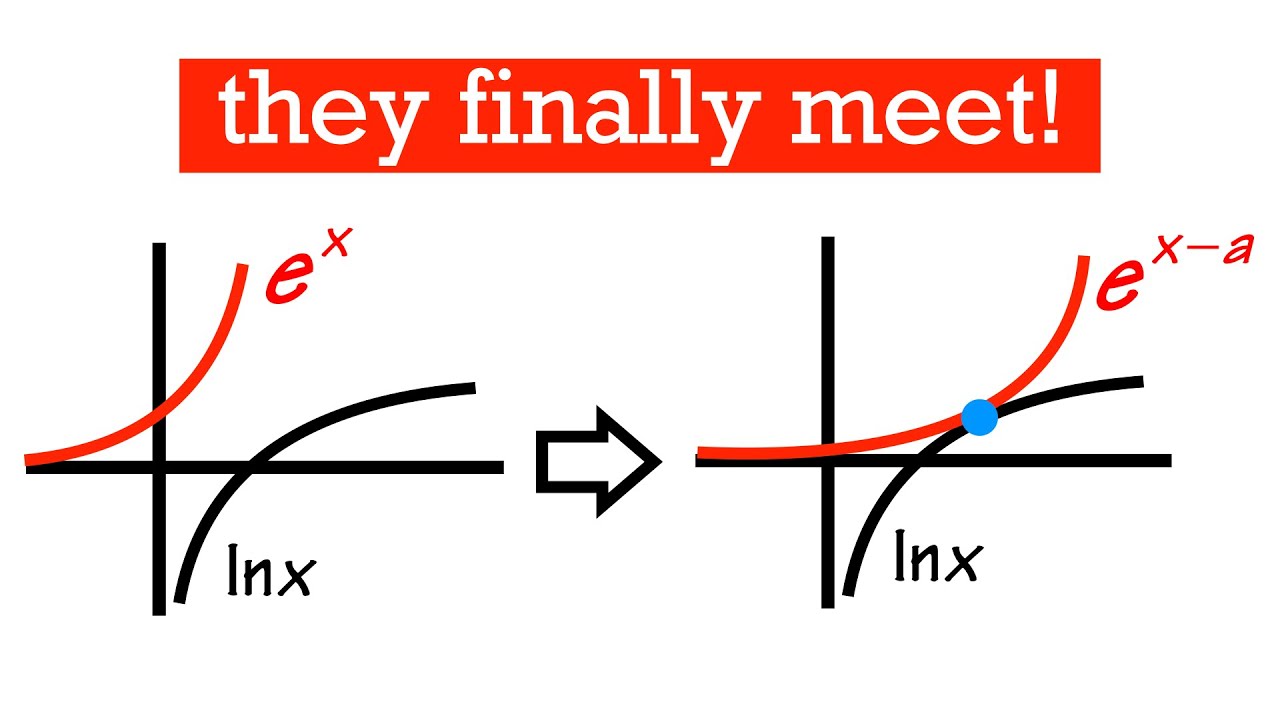
We will make b^x and log_b(x) tangent to each other here: https://youtu.be/uMfOsKWryS4
Exponential function and logarithmic function! We will discuss this hard calculus problem on how to move e^x horizontally so that it will finally meet ln(x). Check out this video for solving e^x=ln(x) in the complex world: https://youtu.be/EMu-kYY5rdE
Here’s...
rapid cedar
tepid moat
this guy did actually solve something that could really help us, though sadly he...
*tangent. And yeah, that was his goal. He wanted them to be tangent.
Okay, so I don't know how this works for the inequality, but I have a path forward if we're solving an equation, I think.
rapid cedar
Okay, so. e^x = 5 + ln(x), right?
tepid moat
yes
rapid cedar
Therefore x = ln(5 + ln(x)).
tepid moat
yes
rapid cedar
...oh wait, no, that's not gonna help at all. That's just gonna make everything worse.
tepid moat
wait
rapid cedar
Because obviously, if we plug that value in on the left, we just get a trivial equation. My idea was to plug it in on the right, but that creates a greater divide between the x's.
tepid moat
hmmm
rapid cedar
Wait!
tepid moat
wait
calculus?
because we can plug the x inside
and again
and again
and see the pattern
that might help
rapid cedar
I mean, sure. We can get an infinite family of equations.
I don't know if we can get one that's more solvable, though.
tepid moat
rapid cedar
I mean, sure. We can get an infinite family of equations.
man
ok I tried it on desmos
pluged it into itself mutiple times
one of the answers is showing up
I am sure calculus can help here somehow


the two answers given by the wolf math website ( I dont remember its name ) are x ≈ 0.0186639620506490... and x ≈ 1.71152201393235...
rapid cedar
tepid moat
the two answers given by the wolf math website ( I dont remember its name ) are ...
...Wolfram Alpha?
tepid moat
rapid cedar
...Wolfram Alpha?
Yes
 hexed frigateBOT
@tepid moat
<:HelpIcon:1304095958283321385>| Help Reminder
Hello rd8, this is a friendly reminder that your help request has been inactive for more than 24 hours. If you no longer need assistance, please consider closing the thread using the +close command. This thread will be automatically closed in 3 days if it remains inactive.
tepid moat
+close
hexed frigateBOT
tepid moat
+close
Please thank your Helpers before closing!
Please thank the helpers who assisted you by clicking the buttons below. You can thank each helper only once. Once you're done, click "Close Post" to close this thread.
hexed frigateBOT
hexed frigate
Thank you for your feedback! Techie Literate has been awarded 1  . They now have 869 . They have 2 daily left for today.