
#Binomial theorem
93 messages · Page 1 of 1 (latest)
 woeful acorn
 hexed egretBOT
woeful acorn
hexed egretBOT
woeful acorn
- Do not ping the Moderators, unless someone is breaking the rules.
- Do not ping the Helper Moderators, unless there is a conflict between helpers.
- Do not ping other members randomly for help.
- Ask your question and show the work you've done so far. If you've posted a screenshot of a question, specify which part you need help with.
- Wait patiently for a helper to come along.
- If the Helper has answered your question, remember to thank them with the Mathematics Ranks bot and close the thread with:
+close
Feel free to nominate the person for helper of the week in #helper-nominations
If you're happy with the help you got here, and the server overall, you can contribute financially as well:
 slow river
woeful acorn
slow river
woeful acorn
What have you tried?
woeful acorn
so like i have gotten so far till [1000 950]x^5 by just doing [x+1]^1000 summation
slow river
Okay, no.
woeful acorn
now i am trying by summation u+1 x^u 1+x^100-7
slow river
That's not what you want to do.
woeful acorn
oh
slow river
First, represent the sum in sigma notation.
 slow river
Right.
Now expand (1 + x)^(1000 - u) using the binomial theorem. You'll get a second series.
woeful acorn
i am getting smtg weird
slow river
What?
woeful acorn
lemme try again i am pretty sure i am wrog
slow river
Show me what you got.
slow river
woeful acorn
like
1000-u
x-u
...I mean... don't use u.
When you're not talking about u.
Look. Write out the whole double series.
And then post it.
woeful acorn
okay
slow river
woeful acorn
okay
Taking a while.
woeful acorn
 slow river
woeful acorn
slow river
woeful acorn
Did you not hear me when I said the whole double series?
woeful acorn
slow river
Taking a while.
i am on laptop, trying to write thru paint..
woeful acorn
slow river
Did you not hear me when I said the *whole **double series?***
wdym by double series 😭
slow river
woeful acorn
This series. Inside this series, expand (1 + x)^(1000 - u).
woeful acorn
woeful acorn
and so i did??
slow river
woeful acorn
and so i did??
That's not inside the other series.
woeful acorn
OH LIKE THAT
okay i am being dumb rn
i have never expanded a binomial inside a series like that tbh so i might need help with that
slow river
It's just going to be a second series, inside the first, with a different index.
 shadow grotto
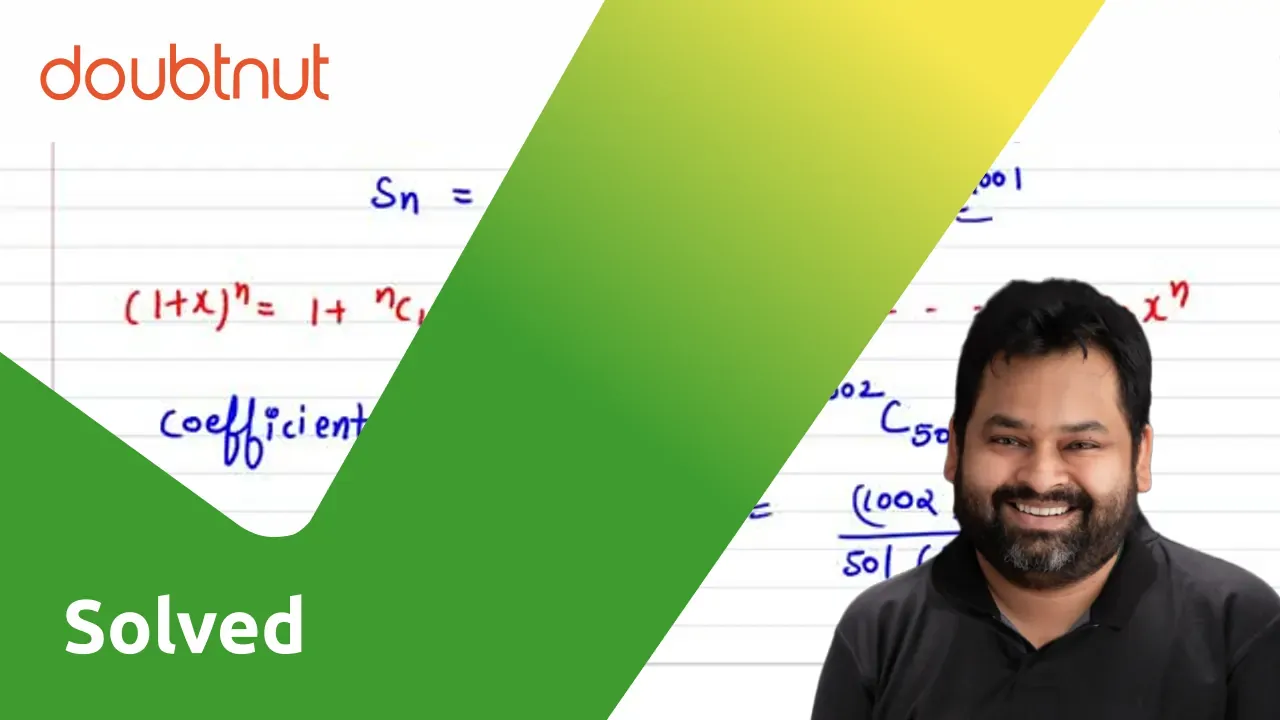
Doubtnut
To find the coefficient of x50 in the expression (1+x)1000+2x(1+x)999+3x2(1+x)998+…+1001x1000,we can denote this entire expression as S.Step 1: Rewrite the expression
We can express ( S ) as:(
S = \sum{k=0}^{1000} (k+1) x^k (1+x)^{1000-k}.
)Step 2: Identify the general term
The general term of the series can be written as:(
(k+1) x^k (1+x)^...
Try this..
slow river
I'm already helping.
shadow grotto
Okay sir
woeful acorn
shadow grotto
https://www.doubtnut.com/qna/32011
yea i did not get that
how it came 50-u


 toxic sapphireBOT
 slow river
toxic sapphire
slow river
toxic sapphire
@woeful acorn Like this.
woeful acorn
hmm
slow river
Distributive property.
slow river
Sigma is just shorthand for a big sum.
woeful acorn
yea okay so it would be basically
sigma x sigma
([n+1]x^n)*x^k
slow river
$\sum_{n = 0}^{1000}\sum_{k = 0}^{1000 - n}(n + 1){{1000 - n} \choose k} x^nx^k$
toxic sapphireBOT
Techie Literate
 woeful acorn
RIGHT
slow river
Which we can simplify further
 slow river
woeful acorn
OMG WAIT SO WE CAN SAY
n+k=50
so
k=n-50 and replace it???
slow river
woeful acorn
OMG WAIT SO WE CAN SAY
n+k=50
so
k=n-50 and replace it???
Almost.
slow river
woeful acorn
First, we don't need the series as k varies if k isn't going to vary.
Second, we only want the coefficient.
woeful acorn
yea so x^50 doesnt matter now?
slow river
Third, nCk is undefined for k < 0, so we only need the sum as n goes from 0 to 50.
woeful acorn
slow river
First, we don't need the series as k varies if k isn't going to vary.
OH RIGT
k has a definite value now
while n varies
 slow river
Right.
woeful acorn
so thats it??
slow river
I mean, you still presumably need to evaluate it.
woeful acorn
we would get some really big number
slow river
Yeah. WA runs out of time trying to calculate it.
woeful acorn
ig thats the answer our sir is expecting at 11th grade basics level
slow river
And it says "coefficients".
woeful acorn
right
slow river
So I'm not actually totally sure what it's looking for because obviously there's only one coefficient.