
#Find the limit (n->inf for the following limit)
794 messages · Page 1 of 1 (latest)
 lost badger
 dusty horizonBOT
lost badger
-
dusty horizonBOT
lost badger
-
- Do not ping the Moderators, unless someone is breaking the rules.
- Do not ping the Helper Moderators, unless there is a conflict between helpers.
- Do not ping other members randomly for help.
- Ask your question and show the work you've done so far. If you've posted a screenshot of a question, specify which part you need help with.
- Wait patiently for a helper to come along.
- If the Helper has answered your question, remember to thank them with the Mathematics Ranks bot and close the thread with:
+close
Feel free to nominate the person for helper of the week in #helper-nominations
If you're happy with the help you got here, and the server overall, you can contribute financially as well:
lost badger

This is what i've done so far
nvm now that I'm looking at it what I did is wrong
since a is just a constant value
 civic ember
this doesn't make sense

there is no series here anywhere
this is a sequence
$$ x_n = \frac{1}{\ln n} \sum _{k=0}^n \frac{1}{a^k} $$
 echo tapirBOT
aL
 lost badger
okay wait I think i misinterpreted the question
lost badger
is a_n not a partial sum of an infinite series?
i'm trying to understand the whole thing
civic ember
there is no series here
lost badger
1+1/a+...+1/a^n is a sum though
civic ember
yes, a finite sum
 fickle granite
lost badger
1+1/a+...+1/a^n is a sum though
fickle granite
lost badger
1+1/a+...+1/a^n is a sum though
a sum with n+1 terms which has another explicit form
you can turn it into a sum of 2 terms
lost badger
civic ember
yes, a finite sum
i'm confused here
civic ember
es una serie geometrica
 lost badger
for n->inf is it not the same as rewriting it as sum of 1/a^(k-1)
civic ember
$$ \sum _{k=0}^\infty a_k \quad\textbf{is a series} $$
echo tapirBOT
aL
 lost badger
a_1 = 1/a^0 = 1
a_2 = 1/a^1 = 1/a
...
civic ember
$$ \frac{1}{\ln n} \sum _{k=0}^n a_k\quad\textbf{ is a sequence} $$
echo tapirBOT
aL
 civic ember
follow rion's suggestion
lost badger
i don't understand what he means
echo tapirBOT
aL
 civic ember
recognise this?
lost badger
oh is this a geometric series
civic ember
geometric sum
lost badger
sum yeah sorry
fickle granite
lost badger
sum yeah sorry
I believe you should know how to simplify a geometric sum
 lost badger
can't find how to simplify this in my notes, i apologise
civic ember
well, you have to learn these things sooner or later
so you may as well learn them now
fickle granite
lost badger
can't find how to simplify this in my notes, i apologise
Please look for it, and learn it by heart
(well the proof is important too, but the formula is important enough to be remembered)
sorry that's a bad one
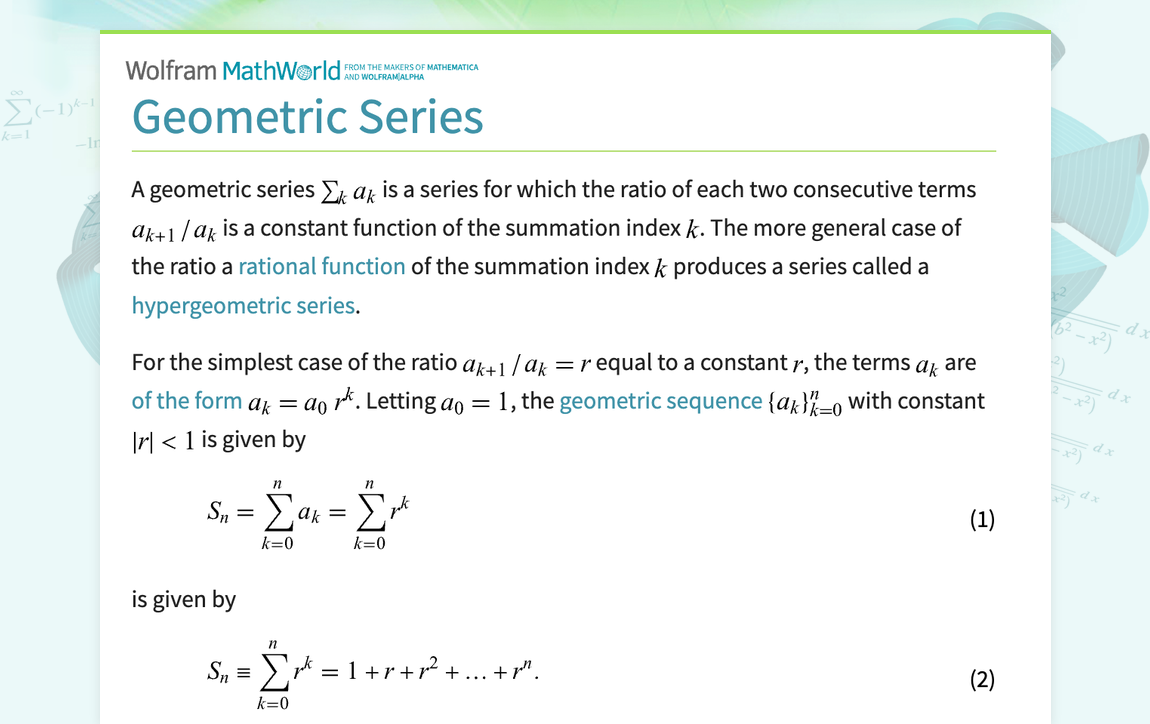
A geometric series sum_(k)a_k is a series for which the ratio of each two consecutive terms a_(k+1)/a_k is a constant function of the summation index k. The more general case of the ratio a rational function of the summation index k produces a series called a hypergeometric series. For the simplest case of the ratio a_(k+1)/a_k=r equal to a cons...
See from equation (1) to (6), which are applicable for any value of r except 1
lost badger
i'm confused on how to interpret this, is this then for r=1/a?
civic ember
correct
 fickle granite
lost badger
i found the criteria in my notes and i'm confused then for this
fickle granite
lost badger
i found the criteria in my notes and i'm confused then for this
It's a bit unrelated to our problem
lost badger
oh
civic ember
it's about convergence of the geometric series
fickle granite
It basically tells you what happens when n goes to infinity
but here we just want to simplify the sum
civic ember
it comes into play only for when we calculate the limit
lost badger
yeah i don't have anything directly related to the sum itself
civic ember
you can work it out by hand
fickle granite
Yeah, that's alright. I still kindly ask you to learn the identity I linked above, it is really important
lost badger
and another question, am i not supposed to input k=1 for the sum instead of k=0?
civic ember
doesn't really matter but k=0 right now
fickle granite
k starting from zero ensures the first term is 1
lost badger
right
fickle granite
(incidentally that's why I deleted the first link I posted, the sum started at k = 1)
lost badger
so then how is it meant to be rewritten? i'm confused here
civic ember
$$\frac{x^{n+1}-1}{x-1} $$
echo tapirBOT
aL
 civic ember
give it some thought, you'll see why
no doubt you have seen this in high school already when you calculated sum of geometric progression
lost badger
is a sum of geometric progression not a geometric series what
lost badger
civic ember
no doubt you have seen this in high school already when you calculated sum of ge...
and no i've never taken this
like ever
civic ember
of course you haven't
civic ember
echo tapir
**aL**
regardless this here is the sum
replace x = 1/a and calculate the limit
lost badger
so the sum of (1/a)^k = (r^(n+1) -1) / (r-1) ?
civic ember
yes, for r = 1/a
lost badger
yeah i just couldn't be bothered to input 1/a for every r
is there a specific name for this identity
 civic ember
you're not supposed to understand within the first 5 minutes of looking at it
you're supposed try and solve the practice problems and then you will understand
same way I could say "I don't understand" when I'm first learning spanish
I'm not supposed to! that's why we learn and practice
you have everything now to calculate limit of the sequence x_n
 civic ember
and also the term 1/log n
lost badger
yes but this is for a_n only
civic ember
this is correct
lost badger
then lim n->inf ((1/a)^(n+1)-1) / ((1/a) - 1 ) · log(n)
civic ember
1/log n
lost badger
lost badger
then lim n->inf ((1/a)^(n+1)-1) / ((1/a) - 1 ) · log(n)
like this
yeah i don't understand how to proceed otherwise
fickle granite
lost badger
yeah i don't understand how to proceed otherwise
Hang in there, you're close to the goal
lost badger
wouldn't it be different for a=1 and a<1 though
lost badger
i would assume so because 1^(n+1) = 1^inf
civic ember
nope
it's correct that for a <= 1 the sequence has infinite limit
but your reasoning is not correct
civic ember
lost badger
so you get 1/0, k/0 = inf
this makes no sense at all
For a = 1 you have the following
civic ember
$$ \lim x_n = \lim\frac{n+1}{\ln n} $$
echo tapirBOT
aL
 lost badger
then lim n->inf ((1/a)^(n+1)-1) / ((1/a) - 1 ) · log(n)
lost badger
lost badger
then lim n->inf ((1/a)^(n+1)-1) / ((1/a) - 1 ) · log(n)
i'm confused how did you simplify this
 civic ember
lost badger
i'm confused how did you simplify this
civic ember
lost badger
i'm confused how did you simplify this
if you try plugging in a=1 there you just get 0/0 which is nonsense
$$\lim x_n = \lim\frac{n+1}{\ln n} \geqslant \lim \frac{n}{\ln n} = \infty $$
echo tapirBOT
aL
 civic ember
if a < 1, by the same reasoning you conclude the limit is inf
lost badger
i just dont understand the way you developed it
is this not easier to solve by using stolz
yeah idk i can't reach an answer regardless
lost badger
stolz-cesaro theorem
civic ember
why
lost badger
since b_n = log(n), lim n->inf log(n) = inf
civic ember
maybe you could, but it's certainly not "easier"
lost badger
i mean i can't arrive at a solution with either method
civic ember
so you mean to tell me you are able to apply something like stolz cesaro and Not understand the basics of the problem?
just no
tell me why does stolz cesaro theorem apply in the first place?
lost badger
for {b_n} is strictly increasing (log(n) is strictly increasing) and lim n->inf {b_n} = inf you can apply it
civic ember
and a_n?
lost badger
since lim n->inf (a_n+1 - a_n / b_n+1 - b_n) = l (whether it be finite or infinite) = lim n->inf (a_n/b_n)
civic ember
and why does this limit exist?
lost badger
civic ember
and a_n?
a_n, b_n only have to be sequences of real numbers
civic ember
and in this problem, what do you take as a_n?
lost badger
1+1/a+...+1/a^n
civic ember
so you are left with what
lost badger
unless i did it wrong i ended up with lim (n->inf) 1/ log(1+1/n) · a^(n+1)
lost badger
we're not required to
civic ember

civic ember
what you are doing is hunting a bug with a tank
civic ember
lost badger
well i honestly am lost in general
and yet you are somehow magically able to make sense of stolz cesaro
no, I don't buy it
i call bullshit, I'm sorry
civic ember
please do

 lost badger
echo tapir
**aL**
lost badger
echo tapir
**aL**
to this
civic ember
I told you, for a=1 I don't use this formula because it's 0/0 which is nonsense
for a=1 you simply have 1+1+...+1 / log n
lost badger
i mean the reason i avoided that is because our teacher has strictly prohibited us from using l'hopital for limits of sequences
civic ember
im not using lhopital
lost badger
civic ember
for a=1 you simply have 1+1+...+1 / log n
okay, now i understand this
but an "infinite" sum of 1 is infinite?
civic ember
there is no infinite sum
i keep telling you
you have a sequence x_n and for each n the sum in the sequence is finite
lost badger
this is in the limit n->inf though
civic ember
still no infinite sum
civic ember
yes
echo tapirBOT
aL
 civic ember
lost badger
in the limit you're left with inf in the denominator
civic ember
lost badger
in the limit you're left with inf in the denominator
where do you get these infs? :S
 fickle granite
you normally don't have to prove it again, but should you not know it, I also urge you to learn those usual limits (they are also as important as the geometric sum, and high school material)
lost badger
i assume i just have a terrible understanding of sequences in general but
log (n)
lim n->inf (log(n)) = inf
fickle granite
That is correct, yes, but what happens if you divide it by n?
lost badger
if then you have that in the denominator how is it possible there's no inf in the denominator
civic ember
oh I see what's going on
you assume this right
$$ \lim \frac{a_n}{b_n} = \frac{\lim a_n}{\lim b_n}$$
echo tapirBOT
aL
 lost badger
yes
fickle granite
or lim b_n (exists and) is nonzero, finite and lim a_n is infinite
lost badger
so then how am i meant to proceed is my question
lost badger
yeah lim n->inf (1+...+1 / log(n))
civic ember
limit is inf
lost badger
i still don't understand exactly why is this limit = inf
civic ember
$$ \frac{n}{\ln n} $$
echo tapirBOT
aL
 civic ember
because this sequence is unbounded
lost badger
echo tapir
**aL**
i just realised by using l'hopitals rule lim n->inf for this is just 1/(1/n)
yeah okay proceeding
so lim = inf
lost badger
yes. then the numerator tends to infinite for lim n->inf
civic ember
$$ \frac{1}{\log n} \sum _{k=0}^n \frac{1}{a^k} \geqslant \frac{n+1}{\log n} \geqslant \frac{n}{\log n} $$
echo tapirBOT
aL
 civic ember
what do we conclude?
lost badger
i still don't understand why 1/log(n) · sum
civic ember
 civic ember
that's how the sequence is defined
lost badger
yeah i was just not thinking
civic ember
so, what do we conclude for a < 1
lost badger
i just don't get why larger than for the first two
civic ember
1/a > 1, yes?
lost badger
yes, for 0<a<1
civic ember
so sum 1/a^k > 1 +1+1+...+1 , yes?
lost badger
? i'm confused
civic ember
do you believe this now?
 lost badger
yes
lost badger
inf
civic ember
correct
and now if a > 1, you have a geometric sum
and that is bounded for all n
hence the limit of x_n is 0
lost badger
how is the limit 0 i don't get it
civic ember
$$ \sum _{k=0}^n \frac{1}{a^k} $$
echo tapirBOT
aL
 civic ember
this sequence is bounded
now we can talk about series
the limit of this sequence is the sum of the geometric series which is finite, because a > 1
lim 1/log n =0
hence the limit of the product of the two is 0
civic ember
lost badger
how is the limit 0 i don't get it
if I had 20 cents every time you said "you don't get it" after a few minutes of looking at something new I wouldn't need to go to work anymore
civic ember
civic ember
dont stop thinking please
.
you have to be able to solve this stuff on your own
and spoiler alert, this stuff is very basic, you will no doubt have more difficult problems to solve in your class
and don't test your teachers patience with saying something like "isn't it easier to apply stolz cesaro"
I promise you that won't end well
lost badger
i didn't mean to ever come off as rude whatsoever but not one single time has our teacher developed a problem like this
civic ember
and you also said you had been ill and not taken part in the classes
lost badger
yeah
civic ember
so maybe don't speak for your teacher if you weren't there
lost badger
🤷
civic ember
take responsibility, it's not your teacher's job to understand it for you
lost badger
i just don't understand certain stuff of this sort because i've never seen something of the like
civic ember
because this stuff is new to you
tell me why do you want to understand it in like the first few hours of seeing it?
or worse, the first 10 minutes?
lost badger
i don't really have the time to understand it within hours either
our first exams are coming up and all practise i've got is through this
civic ember
well, buckle up buddy, I told you there will be much harder exercises in the future
lost badger
i understand if i may have come off as impolite which was never my intention
i'm just very confused in general
civic ember
not impolite, but very impatient
lost badger
civic ember
the limit of this sequence is the sum of the geometric series which is finite, b...
for this, so |r|<1 then S always converges to a finite sum?
civic ember
r=1/a, yes
civic ember
yes, the geometric series converges if and only if |r|<1
lost badger
hope you don't mind me asking but it's something that confuses me since i started seeing series and any sort of (infinite) sums
okay nvm i don't know how to phrase it properly
civic ember
you can say in spanish
lost badger
like how is it possible the sum of r here converges if it's still an endless addition of 1+1/a+1/a^2+...+1/a^n?
is this something i'm just supposed to acknowledge? because i tried digging for proof and i couldn't understand it well
civic ember
that's a bad way to think about it, as an "endless sum"
that is not what a series is
$$ \sum _{k=0}^\infty a_k $$
echo tapirBOT
aL
 civic ember
this symbol doesn't mean it's an endless sum
it's just an informal intuition
that we write a_0 + a_1 + a_2 + ...
formally, the sum of the series is defined like this
$$\sum _{k=0}^\infty a_k = \lim _m \sum _{k=0}^m a_k $$
echo tapirBOT
aL
 civic ember
these are finite sums

for every m
this is called the sequence of partial sums
and if this sequence has a finite limit, then we say the series converges
lost badger
so it never really is an "infinite" sum
civic ember
formally no
it's a limit of a sequence of finite sums
and I am 105% certain that all of this is included in your lecture notes
lost badger
so sorry to disappoint but unfortunately no
lost badger
regardless it's better that i know this now than never
civic ember
learn the definitions
definitions and examples
without definitions, as you have already seen, you have nothing
and remember, just because you have the "right answer" doesn't mean your solution is correct
alright that's all for me
buenas noches y buena suerte
lost badger
thanks
lost badger
as a question related to this same exercise
through stolz-cesaro theorem I arrive at this limit
$\lim_{n \to \infty} \frac{1}{log(1+\frac{1}{n}) \cdot a^{n+1}}$
echo tapirBOT
lucho
 lost badger
would it be appropriate to simplify log(1+1/n) = 1/n since for log(1+x) = x for sufficiently small x?
so then the limit would end as
$\lim_{n \to \infty} \frac{n}{a^{n+1}}$
echo tapirBOT
lucho
 lost badger
after applying l'hopital, $\lim_{n \to \infty} \frac{1}{n \cdot a^{n}}$ if i'm not wrong?
echo tapirBOT
lucho
 lost badger
however for |a|<1 if you were to plug in n->inf this would be yet another 0 times inf scenario so not really useful
fickle granite
lost badger
would it be appropriate to simplify log(1+1/n) = 1/n since for log(1+x) = x for ...
The justification here is not too rigorous
You could say that ln(1 + 1/n) = (1/n) × n ln(1 + 1/n)
And now you basically know that the right factor has a limit
Which allows you to deal with the rest
lost badger
fickle granite
You could say that ln(1 + 1/n) = (1/n) × n ln(1 + 1/n)
it's not ln
or does this also apply to log base 10
lost badger
oh then i misread it
what would be the way to simplify it then?
if you don't mind me asking, that is
or rewrite it in a way that doesn't make me end up with log_10 (1) = 0
fickle granite
$\frac{1}{n \ln(1 + 1/n)} \frac{n}{a^{n+1}}$
echo tapirBOT
Rion
 fickle granite
lost badger
through stolz-cesaro theorem I arrive at this limit
fickle granite
lost badger
through stolz-cesaro theorem I arrive at this limit
Also that is only assuming this is correct, which I will leave to your discretion
lost badger
echo tapir
**Rion**
sorry again about asking basically the exact same thing, but does it really matter whether it's ln(1+1/n) or log_10 (1+1/n) for here
fickle granite
lost badger
sorry again about asking basically the exact same thing, but does it really matt...
n log10(1 + 1/n) does not converge to 1
lost badger
i'm confused about what's your point here, sorry
i mean yeah it's not the same i know
fickle granite
That your initial assumption is wrong, log10(1 + x) is not equivalent to x
lost badger
yeah i messed that up, that's my fault on my end
i mistook log10 for ln as it was solely written log
fickle granite
My bad
lost badger
no issue
lost badger
echo tapir
**lucho**
so then what could be a proper way to rewrite this?
since i only have an issue for a=1, 0<a<1
fickle granite
Ping me again in 30 minutes, I need to walk home
lost badger
okay, thank you
lost badger
@fickle granite
fickle granite
lost badger
so then what could be a proper way to rewrite this?
Assuming that it is in fact correct
lost badger
this is where i've arrived with s-c
 fickle granite
$$\lim_{n \to \infty} \frac{1}{\ln\left(1 + \frac{1}{n}\right) a^{n+1}} = \lim_{n \to \infty} \frac{1}{n \ln\left( 1 + \frac{1}{n} \right)} \frac{n}{a^{n+1}}$$
Rion
 fickle granite
This is true because both expressions are in fact the same thing
lost badger
yes, only issue i have with this expression is the log10 in the bottom
since 1/n will be 0 for n->inf. log10 (1) = 0
this is not a problem for 0<a<1 since a^n+1 will still converge to 0
fickle granite
yes but n log10(1+1/n) = n ln(1+1/n)/ln(10)
and what is the limit of n ln(1 + 1/n) ?
Hint: what is the definition of the deriative of ln at the point 1?
lost badger
fickle granite
and what is the limit of n ln(1 + 1/n) ?
should this not be just 0 still
fickle granite
lost badger
should this not be just 0 still
no
fickle granite
yes
so divide that by ln(10)
and you have that $\frac{1}{n \log_{10}\left(1 + \frac{1}{n} \right)} \to \ln(10)$
echo tapirBOT
Rion
 lost badger
i mean obviously this is still a finite number and no longer 0, so i no longer have the indeterminate form in the denominator
unless im just misinterpreting this
fickle granite
Which basically tells you that the convergence problem is limited to the other factor
lost badger
yes. only question i have here though is
since a^(n+1) is dependant on values of a, does a=1 not offer a problem here?
yes, i still have the issue with properly understanding the indeterminate forms
fickle granite
indeed, if a = 1, then you clearly have the other factor is just n
then, the limit would be the limit of n times ln(10), which you can easily conclude for
(though I don't know if you can apply Stolz Cesaro if the limit is infinite then)
lost badger
fickle granite
yes but n log10(1+1/n) = n ln(1+1/n)/ln(10)
n·1/ln(10) here no?
fickle granite
lost badger
n·1/ln(10) here no?
the denominator tends to 1/ln(10)
so 1/denominator tends to ln(10)
fickle granite
echo tapir
**Rion**
this
fickle granite
lost badger
let me rewrite it with texit
If you do, do me a favor and put your text in a verbatim block
 echo tapirBOT
lucho
 fickle granite
See the problem is that Discord formats the subscripts
so if you copy paste them
you lose them
same for other special characters
unless the text is completely verbatim
$n \log_{10}(1+\frac{1}{n}) = n \frac {\ln(1+\frac{1}{n})}{\ln(10)}$
Rion
 fickle granite
 lost badger
alright
fickle granite
echo tapir
**Rion**
Yes, this is true
lost badger
echo tapir
**Rion**
wait now that i'm double checking this, i'm only able to deduce the numerator in the second expression = 1 because i'm taking the limit independently for the numerator and rewriting n as 1/n in the denominator and then using l'hopital
is there a more "simple" or "intuitive" way to deduce this?
or is this something i should just learn by heart?
like
fickle granite
lost badger
wait now that i'm double checking this, i'm only able to deduce the numerator in...
n ln(1 + 1/n) tends to 1, I thought we established that
It's useful to know that
lost badger
$\lim_{n \to \infty} {n \cdot ln(1+\frac{1}{n})} = \lim_{n \to \infty} \frac {n}{n+1}
i think i wrote it right hold on
echo tapirBOT
lucho
Compile Error! Click the  reaction for more information.
(You may edit your message to recompile.)
 fickle granite
It stems from the fact that:
$$\ln'(1) = \frac{1}{1}$$
Because $\ln'(x) = 1/x$, but also:
$$\ln'(1) = \lim_{x \to 0} \frac{\ln(1+x) - \ln(1)}{x}$$
Rion
 fickle granite
you don't need l'Hospital for this
lost badger
echo tapir
**lucho**
Compile Error! Click the <:errors:504266556054962196> reaction for mor...
this is just 1
fickle granite
Yes
lost badger
so then this is just 1/ln(10) correct
fickle granite
echo tapir
**Rion**
Therefore the limit of this guy is also known
yes
now you take the reciprocal of that
lost badger
okay, so we end up with ln(10) · n/a^(n+1) no?
civic ember
another important tool in your arsenal is continuity
fickle granite
lost badger
okay, so we end up with ln(10) · n/a^(n+1) no?
The limit to evaluate is exactly that
civic ember
lim n ln (1+1/n) = 1 because lim (1+1/n)^n = e
fickle granite
(while the quantities aren't the same, you are allowed to simplify due to continuity of multiplication/composition laws or whatever)
So yes, the problem is basically reduced to checking the limit of n/a^(n+1)
- does it exist?
- is it finite?
- then what is the limit you are trying to evaluate?
lost badger
oh and again, so now in this case
0<a<1, infinite (a^(n+1) converges to zero, inf/0 = inf)
a=1, does it matter that the denominator a^(n+1) = 1^(n+1), for the lim n->inf, this wouldn't be indeterminate, correct?
civic ember
try to use comparison tests
lost badger
since a=1 and not just 1+something that tends to zero
civic ember
instead of appealing to some inf/0 arguments and whatnot
$$ \frac{n}{a^{n+1}} \geqslant n $$
echo tapirBOT
aL
 civic ember
if 0<a<1
and since the right side tends to inf
the left side must also have the same limit
fickle granite
aL do you know if Stolz-Cesaro can be applied if the limit that is found is infinite?
I can't find it on wikipedia
lost badger
afaik stolz-cesaro is appliable as long as the denominator b_n in its limit n->inf is = inf
hence why i did this first

at least in my notes it's a condition for s-c to be appliable
civic ember
fickle granite
aL do you know if Stolz-Cesaro can be applied if the limit that is found is infi...
iirc it is proved by second comparison
which assumes the limit of the ratio is finite
lost badger
this is exactly what is in my notes
 lost badger
so then, for 0<a<1, since n/a^(n+1) >= n, the limit n->inf (n/a^(n+1)) will be infinite
for a=1, it's still infinite since in this case 1^(n+1) = 1?
or am i assumming incorrectly
lost badger
okay, so to clarify since i'm still confused carrying over the fact that "1^inf is an indeterminate form" from high school
civic ember
it is correct that it is indeterminate
in the sense that it can be anything
but 1^inf is not valid arithmetic
lost badger
my question here is as in, since in this limit it's a=1, and not ie a=1+1/n, it shouldn't be considered an indeterminate form?
that's the way i'm visualising it here
fickle granite
lost badger
my question here is as in, since in this limit it's a=1, and not ie a=1+1/n, it ...
It is not indeterminate, but the question revolves about how you justify it
How would you do it?
lost badger
i mean i don't really know the way to justify it for a=1 if 1^inf is indeed an indeterminate form
civic ember
stop writing 1^inf please
fickle granite
a^(n+1) is then always equal to 1
and a sequence that is always equal to 1 (i.e. all its terms are 1)
converges to 1
period
civic ember
yes, n is a natural number
all natural numbers are finite
but it tends to infinity, meaning it gets arbitrarily large values
but they are all finite
lost badger
okay, that was my mistake, interpreting that in the limit it IS infinite and not just approaches
fickle granite
A pro tip: using indeterminate form arithmetic is a terrible habit imo
as aL said, avoid it like plague
and quit writing 1^inf
lost badger
okay
fickle granite
you'll only shoot yourself in the foot on the long run
lost badger
so then again, a^n+1 converges to 1
fickle granite
correct
civic ember
if a=1, yes
fickle granite
because it is ALWAYS equal to 1
lost badger
okay, thank you so much for clarifying this
civic ember
are you familiar with the definition of limit?
lost badger
i am, i just have a bad habit from high school of directly plugging in the value the incognita approaches
never really thought of it twice for some reason
civic ember
you can still do it in your head, but don't ever use it as justification for something
for example this sequence
lost badger
yeah, i'm not sure if for example it's valid justification for applying l'hôpital (which we were taught to)
civic ember
$$ \left(1+\frac{1}{n}\right)^n $$
echo tapirBOT
aL
 fickle granite
lost badger
yeah, i'm not sure if for example it's valid justification for applying l'hôpita...
fickle granite
lost badger
yeah, i'm not sure if for example it's valid justification for applying l'hôpita...
There are very formal hypotheses to the theorem, which you need to formally verify
civic ember
you could think of it in terms of "1^inf" because the base converges to 1 and the power is "inf"
but it's not the way to reason for the convergence/divergence of this sequence
1^inf simply means that the limit could be anything
it is ..well.. "indeterminate"
echo tapirBOT
aL
 lost badger
wait, why e^n
fickle granite
$\frac{n}{\exp(\alpha n)}$ for some $\alpha$
echo tapirBOT
Rion
 fickle granite
And this, buddy, is a usual limit that you are required to know (also by heart)
civic ember
from yesterday i think we had e^n/n is unbounded
therefore its inverse must converge to 0
fickle granite
$a^n = \exp\left(\ln(a)n\right)$
lost badger
oh wait
echo tapirBOT
Rion
 lost badger
yeah okay i forgot
 lost badger
i was thinking of a different form to solve this i guess
lost badger
yeah i'm very used to just solving these sort of limits through l'hôpital
even though it's not required
lost badger
is it not appliable here? since you do get an indeterminate form inf/inf
civic ember
it is applicable but you might not understand why
civic ember
remember that lhopital is defined in case of differentiable functions and so on..
lost badger
yes, i mean, i did think of it because you can do the derivative of both the numerator and the denominator
fickle granite
Though in our specific case, it is a usual limit you are expected to know ever since high school (at least in the French curriculum)
civic ember
yes but your numerator and denominator are not differentiable functions
they are sequences
civic ember
and you would be right
fickle granite
lost badger
i was just interpreting them as you would do for limit of a function
You could, but justification is required
civic ember
but you must understand why it won't change the limit
and it because of..
continuity
lost badger
i'm struggling to understand the concept of continuity applied here
civic ember
well im not sure if im supposed to speak about it then
i don't know where your analysis course is at
lost badger
it's not quite an "analysis" course but just a regular calculus course
civic ember
but if it is a real analysis course, you must talk about continuity sooner or later
fickle granite
lost badger
i'm struggling to understand the concept of continuity applied here
Let's say that you prove:
$\frac{\exp(\alpha x)}{x^\beta} \to \infty$ when $x \to \infty$. What makes you say that the statement will still hold when you replace $x$ with $n$ ?
echo tapirBOT
Rion
 fickle granite
An even harder question: say you prove that $\frac{\exp\left(\alpha n \right)}{n^\beta} \to \infty$ when $n \to \infty$. What makes you say that this will still hold when you replace $n$ with $x$ ?
echo tapirBOT
Rion
 lost badger
i can't get to prove why or why not tbh
lost badger
echo tapir
**Rion**
could I ask where does this stem from?
fickle granite
lost badger
could I ask where does this stem from?
= exp(ln(a))^n
lost badger
ohh it's (ln(a))(n)
lost badger
echo tapir
**aL**
so then, again, from this, how do you justify that this is 0?
i mean i can guess it i just can't think of a way to prove it
lost badger
so...
fickle granite
lost badger
so then, again, from this, how do you justify that this is 0?
Sorry for poofing, I am busy closing all old posts manually
lost badger
i understand, im just wondering how to finalise this
fickle granite
lost badger
so then, again, from this, how do you justify that this is 0?
The limit is zero, this is a common limit. I think it would be wiser to look for a proof online
because this is a really general result that you will use time and time again
I will give you a proof sketch
lost badger
for the sake of simplicity could i just use l'hopital here instead?
fickle granite
lost badger
for the sake of simplicity could i just use l'hopital here instead?
Yes, you can
lost badger
since i'm not gonna be asked to prove why is l'hopital appliable in this situation
appliable? applicable? idk
whatever but yes, 1/e^n which is in fact 0 for n->inf
the sole way i could figure out regardless is the growth of the function but since it's a sequence i'm not sure this ever applies
fickle granite
In the meantime, I will give you the proof of a first common result:

For any $m$ integer, $\lim_{x \to \infty} \frac{e^x}{x^m} = 0^$

Proof sketch is as follows:

1. We prove that for any $t$, we have $e^t \geq 1+t$

2. Prove that $\exp(x)^\frac{1}{m+1} = \exp\left(\frac{x}{m+1}\right) \geq 1 + \frac{x}{m+1} > \frac{x}{m+1}$

3. Both sides to the power $m+1$. What happens when $x \to \infty$?
Rion
Compile Error! Click the reaction for more information.
(You may edit your message to recompile.)
 lost badger
alright and also
i assume by continuity this has to be related to if a function f / f(n) = a_n where a_n is the general term of a sequence, lim n->inf a_n = lim n->inf f(x)
this is what i have in my lecture notes from our teacher as well
fickle granite
lost badger
i assume by continuity this has to be related to if a function f / f(n) = a_n wh...
Sorry for the late answer. Here are a couple of things to consider.
Punctually, a function $f$ is continuous at $x$ if and only if for every sequence $(x_n)$ that converges to $x$, we also have $f(x_n) \to_{n \to \infty} f(x)$
echo tapirBOT
Rion
 lost badger
on a different note, but i think similar to the concepts i was asking about yesterday
is this correct to do? similarly to how you could approximate H(n) ~ ln(n)

for this series i thought the only easy way to solve this is by applying Stirling's approximation and cancelling out the n^n terms, then rewriting the series as ```latex
$\sum_{n=1}^{\infty} \sqrt{2\pi n} (\frac {5}{e})^{n}$
lucho
 lost badger
and my reasoning here was, given 5/e > 1, then (5/e)^n is a strictly increasing factor multiplied by another strictly increasing factor sqrt(2pin) would mean this series diverges, correct?
obviously first proving each term is indeed strictly increasing
or is this reasoning not sufficient?
fickle granite
lost badger
is this correct to do? similarly to how you could approximate H(n) ~ ln(n)
The arrow here makes nonsense
fickle granite
lost badger
and my reasoning here was, given 5/e > 1, then (5/e)^n is a strictly increasing ...
Indeed
fickle granite
lost badger
or is this reasoning not sufficient?
What convergence test?
lost badger
fickle granite
The arrow here makes nonsense
bad habit yet again, i apologise
lost badger
fickle granite
What convergence test?
wait, wdym by this? i mean that if simply proving that those two terms are strictly increasing, this would mean the series is divergent
is that sufficient?
fickle granite
No, you established the divergence of another series
How do you justify that the initial series will also diverge?
I do not see it in what you have written
The idea is there but the writing needs to be better to have everything flow like it should
lost badger
oh is this the
i'm not sure if i'm correct but
testing for a_n+1/a_n, if >1 for the limit this means it'll diverge?
off the top of my head i'm not sure
fickle granite
Let me give you the proof sketch
lost badger
i remember seeing this in my notes or something of the like
fickle granite
- a_n ~ b_n, and both are positive, thus their respective series have the same nature. That is, the series are either both convergent or both divergent
- The series of b_n diverges (this is the only thing you proved so far)
- Conclude
Does this seem logical to you?
Sorry if I sound a bit too strict on the writing, but mastering this will significantly improve your reasoning skills, so it is important to practice
lost badger
i'm not sure, as far as i know i'd have to prove {a_n} ~ {b_n} first?
which i didn't quite do either but i'm not sure if i'm required to
fickle granite
You need to
lost badger
this is by doing lim n->inf {an}/{bn}, correct?
and if this is = 1, then they are equivalent
fickle granite
I mean you do say you use Stirling's approximation, but you never assert that a_n is equivalent to b_n
See what I am getting at?
lost badger
lost badger
this is by doing lim n->inf {an}/{bn}, correct?
i'd need to do this?
and therefore prove they are indeed equivalent
fickle granite
lost badger
i'd need to do this?
Well verify it yes
You already know that n! is equivalent to whatever the Stirling approximation gives you
So you just multiply that by 5^n / n^n
That will suffice to show that n! 5^n /n^n ~ Stirling(n) 5^n / n^n
lost badger
i should also just in case note stirling's approximation
lost badger
fickle granite
So you just multiply that by 5^n / n^n
okay, so if i understood it right
i should just write the approximation and multiply times (5/n)^n?
fickle granite
Equivalents cannot be added, but they can be multiplied
Yes
You should have seen this in your course about sequences and equivalents, I believe
lost badger
yeah the substitution principle afaik
fickle granite
Multiplying is a valid arithmetic for equivalents
So you go ahead and do that
It is a valid proof to get to a_n ~ b_n
lost badger
alright i'll write it and would you mind correcting the way i expressed it then?
fickle granite
Yes, but it is soon lunch time. I will read after lunch
lost badger
no problem
fickle granite
Ping me if I have not answered in 3 hours
lost badger
my question is though, the substitution principle applies to the limits of the multiplication of two sequences
is this then valid for the series too?
well i assume yes since then the respective series for (a_n·c_n) ~ (b_n·c_n) will then be of the same nature
lost badger

i could be more rigorous now that i reread this (ie instead of "terms" use "sequences") and maybe note "for a sequence that diverges, for lim n->inf a_n = inf (the limit of its nth term dne/is infinite) then the series of the sequence will also diverge..."
and in general im not 100% sure it's correct
and since ancn ~ bncn, then the series of ancn will also diverge
well and probably proving that they're unbounded above is overkill
fickle granite
Assumption: a_n, b_n, c_n are nonzero and a_n ~ b_n.
Conclusion: a_n c_n ~ b_n c_n
Now, from there, if a_n c_n > 0 and b_n c_n > 0, their series have the same nature
Two series aren't equivalent
lost badger
oops
fickle granite
Maybe the term "series" is ambiguous but the point is... a series is a limit of a partial sum
So a series is in fact a number
The series is said to be divergent when this number is infinity, or the partial sum does not have a limit
And convergent when the number is finite
So a series is not a sequence, you cannot say two series are equivalent
lost badger
okay, the equivalence is my mistake
but just by proving that their respective sequences (ancn, bncn) are both divergent should be enough, right?
fickle granite
But come to think of it, it suffices to show that a_n c_n is unbounded
lost badger
well, you don't even need to prove ancn diverges if you just prove the equivalence between these two
lost badger
in this case the one i'm proving is unbounded is bncn
and i already proved the equivalence between the limits of ancn and bncn
so ancn ~ bncn, unless i'm mistaken
fickle granite
Why does b_n c_n unbounded imply a_n c_n unbounded?
lost badger
and since ancn ~ bncn, then the series of ancn will also diverge
fickle granite
This might not be true
 fickle granite
For a sequence, if a limit exists and is infinite, the sequence is unbounded
But the sequence being unbounded does not imply a limit exists
For example take (-1)^n n
It is unbounded but you can't really say much about a limit
lost badger
wait, i'm not sure what you mean here
fickle granite
Your lecture notes suppose the existence of a limit
fickle granite
For a_n c_n
lost badger
i did not prove that lim n->inf ancn exists you're right
fickle granite
Having an infinite limit is not synonymous to unbounded
lost badger
i know that
then what would be the appropriate way to showing ancn ~ bncn? i'm a little bit lost here
you do already have an ~ bn
fickle granite
So you must show that b_n c_n has an infinite limit
It does not suffice to show that it is unbounded, because your theorem is not yet applicable
Does that make sense?
lost badger
it's not yet applicable because i haven't proven lim n->inf ancn exists, i guess
fickle granite
You can switch the roles of a_n and b_n here
fickle granite
You show that limit of b_n c_n exists and is infinite
Then, you conclude that the limit of a_n c_n exists, and is infinite too
lost badger
will that then suffice for proving ancn ~ bncn?
fickle granite
if a_n ~ b_n, it is already true that a_n c_n ~ b_n c_n
So it suffices to establish that a_n ~ b_n (which the Stirling approximation does)
lost badger
so i only need to prove a_n ~ b_n... but then that is supposedly true for just applying Stirling's approximation
fickle granite
I just want you to keep a clear mind about proving, so to recap
- verify that a_n ~ b_n. This is true because of Stirling
- Show that the limit of b_n c_n exists, and is infinite
- conclude on the existence and value of the limit of a_n b_n
- Conclude on the nature of the series of a_n c_n
Does this make sense?
lost badger
so you're proving the limit because the limit of the partial sum Sn is just the series
or am i mistaken here
what exactly would you need the limit for otherwise if you've already concluded ancn ~ bncn
fickle granite
Well if a sequence doesn't converge to zero, the associated series does not converge
lost badger
but if i just show that bncn is indeed unbounded, which means it doesn't converge, is that not enough?
since we've already stated that ancn ~ bncn, if bncn does not converge (it's unbounded above) then ancn is not convergent either?
and if the sequence bncn does not converge, its associated series will not converge; same applies for ancn
fickle granite
lost badger
since we've already stated that ancn ~ bncn, if bncn does not converge (it's unb...
While it does sound intuitively true, you have no result in your lecture notes that claim so
Your lecture notes only deal with the case where b_n c_n tends to infinity
Which is stronger than unboundedness
lost badger
okay, i get that
and is it necessary to develop the limit? or can i just immediately show that in the limit it'll be infinite since 5/e > 1
fickle granite
lost badger
and is it necessary to develop the limit? or can i just immediately show that in...
You must explain why the limit of b_n c_n is infinite, because it is part of the hypotheses to verify
Here it is in fact simple to explain
lost badger
lim n->inf sqrt(2pin) = inf, lim n->inf (5/e)^n = inf since 5/e > 1, then lim n->inf sqrt(2pin) · (5/e)^n = inf
lost badger
alright
because i couldnt bother with developing the limit like a first time limit student
fickle granite
You are allowed to compose limits
lost badger
alright
fickle granite
This is part of the results you learned in your sequence course
That is supposed to avoid you epsilon headaches
lost badger
yeah i dont really want to have to apply the full thing
but regardless, proven now the limit of bncn is indeed infinite, limit of ancn is also infinite
fickle granite
Yes, indeed
lost badger
then ancn is not convergent, its associated series will also not be convergent
that suffices, right
fickle granite
Yes
lost badger
okay, thank you
fickle granite
You are welcome
lost badger
this was in our practice test for our upcoming midterms so if this is the hardest it gets i hope i won't have much deducted if i were to make a mistake of the like
oh and just as a final question
it's very unrelated to this but i just wanna get it off real quick before i have to go if that's fine

during our lecture in differentiation for 2 variables here our teacher equaled h=k, k>0
i don't really understand why is this doable?
better said, why is that done
i have the exercise written down if that's needed
fickle granite
I am sorry I can't read for poop
Actually, please close this thread, make a new one and ping me in it
lost badger
okay
fickle granite
This one is getting too long
 scenic grottoBOT
lost badger
+close
scenic grottoBOT
lost badger
+close
Please thank your Helpers before closing!
Please thank the helpers who assisted you by clicking the buttons below. You can thank each helper only once. Once you're done, click "Close Post" to close this thread.
scenic grottoBOT
scenic grotto
Thank you for your feedback! Rion has been awarded 1  . They now have 13 . They have 2 daily left for today.