
#Can someone explain why λ₁ is -2 and not -1?
51 messages · Page 1 of 1 (latest)
 cerulean sonnet
 trail brookBOT
cerulean sonnet
trail brookBOT
cerulean sonnet
- Ask your question and show the work you've done so far. If you've posted a screenshot of a question, specify which part you need help with.
- Wait patiently for a helper to come along.
- Once someone helps you, say thank you and close the thread with:
+close - Feel free to nominate the person for helper of the week in #helper-nominations
- Do not ping the mods, unless someone is breaking the rules.
- If you're happy with the help you got here, and the server overall, you can contribute financially as well:
 kindred totem
$$ = (1+\lambda) (2+\lambda)(3-\lambda) = 0 $$
 long spindleBOT
aL
 cerulean sonnet
kindred totem
<@917051568350711818>
cerulean sonnet
kindred totem
<@917051568350711818>
https://youtu.be/H74flsYlQ1w?si=CRA4huht4q3Qa4nD the guy in this video got λ₁ = -2, how is it -2 instead of -1?
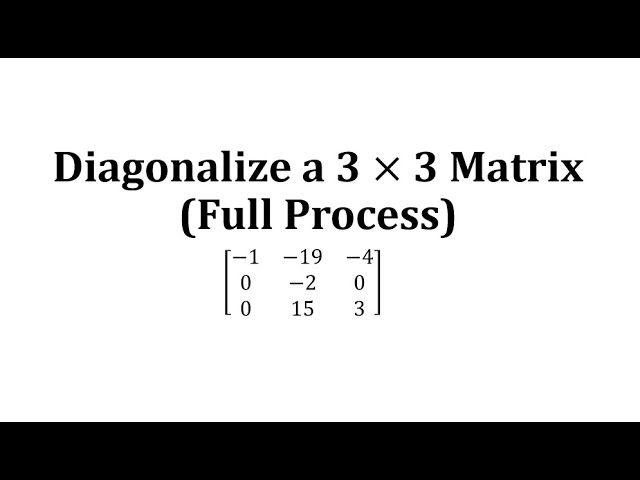
This video explains the complete process to diagonalize a 3 by 3 matrix.
kindred totem
why does it have to be -1
that's the end result he arrives at

he shows the initial matrix is similar to D, i.e diagonalized with respect to the calculated basis
cerulean sonnet
kindred totem
why does it have to be -1
This is how I did it
 kindred totem
that's not correct
cerulean sonnet
What did I do wrong?
 kindred totem
show me
cerulean sonnet
 kindred totem
now you have your eigenvalues
cerulean sonnet
kindred totem
now you have your eigenvalues
So should λ₁ not be -1 instead of -2?
cerulean sonnet
So that it’s in order?
kindred totem
are you concerned about the order of the factors?
cerulean sonnet
kindred totem
are you concerned about the order of the factors?
Yes
kindred totem
multiplication is commutative
cerulean sonnet
The order doesn’t matter?
kindred totem
try it
pick them in different order on the diagonal and follow the algorithm
you will get a different P
but it's nonetheless similar to the initial matrix
cerulean sonnet
Will the final answer be the same?
kindred totem
no
cerulean sonnet
As that of the video?
kindred totem
kindred totem
you will get a different P
.
cerulean sonnet
kindred totem
you will get a different P
So lambda 1 HAS to be -2?
kindred totem
no
kindred totem
kindred totem
multiplication is commutative
.
cerulean sonnet
I’m so lost
kindred totem
he just picked this order
but it's not mandatory
the end goal is to diagonalize the given matrix
cerulean sonnet
kindred totem
he just picked this order
Why though? That’s what I’m trying to understand
kindred totem
that means by definition you have to show it's similar to a diagonal matrix
cerulean sonnet
Just because?
cerulean sonnet
kindred totem
that means by definition you have to show it's similar to a diagonal matrix
Alright