

93 messages · Page 1 of 1 (latest)
 astral flax
This is talking about the fact that you can take z = xy, and use matrices and quadratic forms to "rotate" the coordinate system by an angle, theta, such that z = xy takes the form of another function that makes sense for later steps. But where in the world did the "Well, if we rotate coordinates:" portion come from? That went from 0 to 100 so fast for me. Can someone explain the structure of the expression?
 woven rootBOT
astral flax
This is talking about the fact that you can take z = xy, and use matrices and qu...
woven rootBOT
astral flax
This is talking about the fact that you can take z = xy, and use matrices and qu...
+close
 meager crater
$\begin{pmatrix}
cos(\theta) & -sin(\theta) \
sin(\theta) & cos(\theta) \
\end{pmatrix}$ is known as the 2d rotation matrix.
 haughty iglooBOT
Yojda
 meager crater
That means when you compute this matrix, you'll get your basis rotated.
haughty iglooBOT
Yojda
 astral flax
Yeah, I understand how that matrix causes a rotation, but I don't understand how they used that fact to convert the matrix form of z = xy to a rotated coordinate form
The substitution makes no sense to me
Why are the two rotation matrices different here?
 meager crater
Cause you have $\begin{pmatrix}
x & y
\end{pmatrix}$ and $\begin{pmatrix}
x \
y
\end{pmatrix}$ vectors
haughty iglooBOT
Yojda
 astral flax
Okay, that's a step closer to what's confusing me. What's the difference?
How do the multiplications work out differently?
I'm only used to a matrix being multiplied by a column vector, I don't know what to do with a row vector
meager crater
Because there are some multiplication rules about the size of your matrices
You can't multiply $\begin{pmatrix}
x \
y
\end{pmatrix} \begin{pmatrix}
cos(\theta) & -sin(\theta) \
sin(\theta) & cos(\theta)
\end{pmatrix}$
haughty iglooBOT
Yojda
 meager crater
So we write $\begin{pmatrix}
x & y
\end{pmatrix} \begin{pmatrix}
cos(\theta) & -sin(\theta) \
sin(\theta) & cos(\theta)
\end{pmatrix}$
haughty iglooBOT
Yojda
 meager crater
Now does $\begin{pmatrix}
x & y
\end{pmatrix}$ and $\begin{pmatrix}
x \
y
\end{pmatrix}$ represent the same vector? yes
haughty iglooBOT
Yojda
 astral flax
Making a little more sense. Why did they write (x' y') in the substitution? I thought x' and y' were the coordinates that were rotated or something?
Where I'm getting stuck is thinking that you can somehow show that the substitution equals the original expression with x and y
Am I misinterpreting something
meager crater
Okay, you have to think about what represents the matrix and what represents the vector
A matrix = your basis
A vector = just a vector
When you multiply a vector by a matrix (to the left), it means you represent your vector in another basis.
astral flax
So then x' and y' simply symbolize that they're altered by the rotation?
meager crater
Somehow
astral flax
Because the way I'm trying to make sense of the expression is like, how did $\begin{pmatrix}
x & y
\end{pmatrix}$ become $\begin{pmatrix}
x' & y'
\end{pmatrix}$ $\begin{pmatrix}
cos(\theta) & -sin(\theta)
sin(\theta) & cos(\theta)
\end{pmatrix}$
haughty iglooBOT
Noe
 astral flax
Sorry for the bad formatting
meager crater
Np
astral flax
And similarly for the column (x y) becoming the piece to the right
Because what I'm seeing is "before equals after", but...how?
meager crater
Because $\begin{pmatrix}
cos(\theta) & -sin(\theta) \
sin(\theta) & cos(\theta)
\end{pmatrix} \begin{pmatrix}
x \
y
\end{pmatrix} = \begin{pmatrix}
x' \
y'
\end{pmatrix}$
haughty iglooBOT
Yojda
 astral flax
Alright, now how does this work out with the weird row vector multiplication rule you mentioned before
Because if that can explain the correspondence, that may help
Also, wait a second. To get a valid substitution for the column (x y), wouldn't you need to multiply both sides by the inverse of that rotation matrix? To isolate the column (x y)
Wait a second...is this matrix the inverse of the rotation matrix?
 meager crater
It's not a problem, the rotation matrix is orthogonal, so $Q^{-1} = Q^T$
haughty iglooBOT
Yojda
 astral flax
WHAT
That's amazing, why didn't I think of that
Of course it's the inverse
Oh my gosh, wait, so let me make sure I'm understanding this
Still a bit foggy. This basically is a direct substitution using the definition of those rotated coordinates. For the first one, the row (x y), it just has to be in that order because row count of the right matrix must equal the column count of the left matrix
And the column (x y) on the end becomes what it does with just an inverse
Because rotation times inverse rotation just takes you back
Okay yeah this is much smoother now
meager crater
Now you can detail those substitutions to be sure you understand (that's not difficult)
astral flax
Plugging in x' and y' will give me values of z all the same, right? It's just now it's taking into account the rotation of the coordinate system with the extra variable, theta
I think I finally understand where it came from a bit better
How does the entire expression become a value in the end, by the way? Is $\begin{pmatrix}
x & y
\end{pmatrix} \begin{pmatrix}
x \ y
\end{pmatrix}$ syntactically a dot product somehow?
How do I make it a column :/
haughty iglooBOT
Noe
 meager crater
haughty igloo
**Noe**
meager crater
haughty igloo
**Noe**
Yes it is, because you have x^2 + y^2.
astral flax
Can you "kinda" see it as matrix multiplication that results in a 1x1 matrix?
Like does that even make sense
meager crater
Sure
astral flax
Oh
meager crater
I thought this too.
That's maybe an abuse of notation
But in fact, a 1x1 matrix could be interpreted as a scalar, in the same way as a 1xn matrix could be interpreted as a vector.
That's what I think
Anyway, you can see this as the "definition of a dot product"
astral flax
I'm so not used to this abstract stuff
Things like this make me question what the definition of things even are anymore
meager crater

Beginning the linear algebra series with the basics.
Help fund future projects: https://www.patreon.com/3blue1brown
An equally valuable form of support is to simply share some of the videos.
Home page: https://www.3blue1brown.com/
Correction: 6:52, the screen should show [x1, y1] + [x2, y2] = [x1+x2, y1+y2]
Full series: http://3b1b.co/eola
Fu...
So take a look at this
It saved me on my math courses
astral flax
I actually did watch this a while ago
Which is why I'm thinking back at the "just a collection of numbers" outlook he mentioned
meager crater
Yes, but you have all the series on linear algebra, not just this video
For example : https://www.youtube.com/watch?v=P2LTAUO1TdA&list=PLZHQObOWTQDPD3MizzM2xVFitgF8hE_ab&index=13
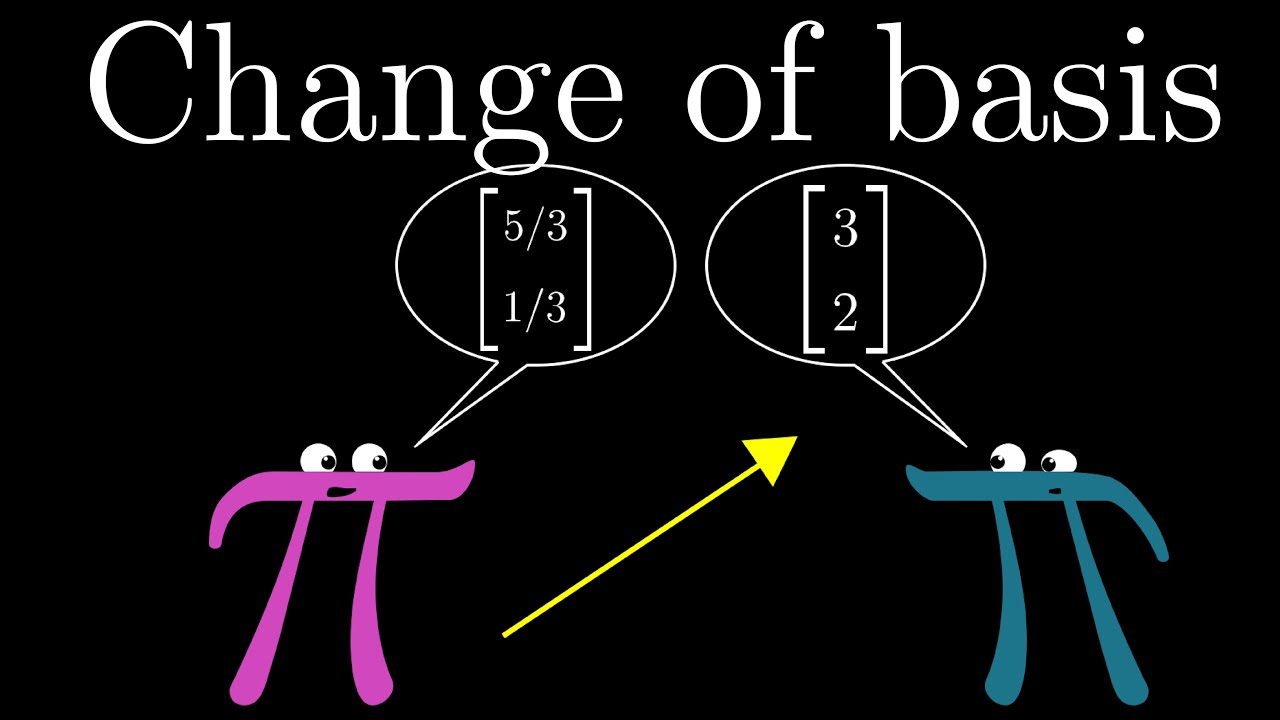
How do you translate back and forth between coordinate systems that use different basis vectors?
Help fund future projects: https://www.patreon.com/3blue1brown
An equally valuable form of support is to simply share some of the videos.
Home page: https://www.3blue1brown.com/
Future series like this are funded by the community, through Patreon, w...
Multiply a vector by a matrix = change basis
astral flax
@meager crater For context, this was all inside an explanation for deriving the Hessian matrix from quadratic approximations in several variables
meager crater
Okay, I didn't do this before. That's why I don't understand the end, with the saddle. But sounds interesting.
Hope I helped you to understand this linear algebra part.
astral flax
meager crater
Hope I helped you to understand this linear algebra part.
You absolutely helped a lot, thanks so much
 keen flareBOT
@astral flax has given 1 rep to @meager crater
astral flax
+close


