#Hard limit
34 messages · Page 1 of 1 (latest)
 unborn geyser
...wait, how does that rewrite go?
 rancid carbon
You are right...
I was thinking of 1/n as the power but it was -n
But I still want a proof of the limit
 regal zephyr
Just prove that it’s bound by 0 and monotone decreasing for all n, n greater 5 or something
rancid carbon
I can show that it's monotonely decreasing and has a lower bound on 0
That shows the its convergent
But it doesn't really mean that the limit is 0
I mean, it's also lower bound by -1 and -2 and -3 and so on but it doesn't mean that the limit is -1 or -2 or -3 and so n
regal zephyr
Ye I guess you would have to proof that 0 is the biggest lower bound before
regal zephyr
You basically say 0 is the biggest since any bigger one would be surpassed at some point but you have to of course proof that that point exists
regal zephyr
Ye basically
rancid carbon
🤔
regal zephyr
Not sure that that’s the easiest and best way to prove it tho. I’ll think about other strategies since this seems like quite a bit of work
unborn geyser
rancid carbon
so basically epsilon delta
Epsilon delta doesn't play well with factorials.
rancid carbon
I think so too, that's why I asked if there are other ways of proving this
unborn geyser
Think about it like this: n!/n^n = 1/n * 2/n * 3/n * ... * (n - 1)/n * n/n
rancid carbon
ye
unborn geyser
= (1 - (n - 1)/n) * (1 - (n - 2)/n) * ... * (1 - 1/n) * 1```@rancid carbon This video might help:
https://www.youtube.com/watch?v=ELRSCt66MQQ
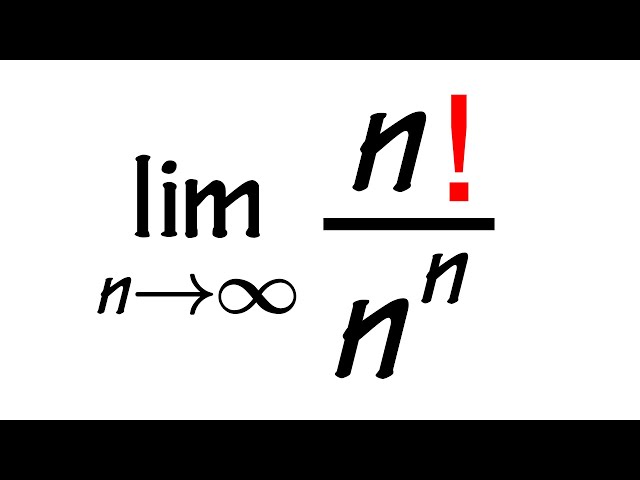
limit of n!/n^n as n goes to infinity, plus the list, and squeeze theorem
the fact: https://www.youtube.com/watch?v=HM-kwHR4VO4 or https://www.youtube.com/watch?v=2nUJMP_ZnnI&t=27s
www.blackpenredpen.com,
math for fun
rancid carbon
Thanks a lot
unborn geyser
In particular, note n! * 2^(n - 1)/n^n = 1 * (n - 1)! * (2/n)^(n - 1)
 flat jetty
rancid carbon
I mean, it's also lower bound by -1 and -2 and -3 and so on but it doesn't mean ...
flat jetty
rancid carbon
I mean, it's also lower bound by -1 and -2 and -3 and so on but it doesn't mean ...
If the limit would be < 0 there need to exist a point < 0 in your sequence (simply follows by the epsilon definition of a limit).
And its completely enough to show that your sequence is decreasing to 0, as long as you take the absolute value of your sequence (whats simply the same as your sequence, in this case).
