#general discussion
1 messages · Page 2 of 1
 long socket
 open whale
long socket
give me a example this time
open whale
long socket
give me a example this time
A relation is a set of ordered pairs
So for example
a is an element from {0,1}
b=a²
So b is an element of {0,1} as well
The relation b=a² is written formally as {(0,0),(1,1)}
If a is in {0,1,2}
Then b is in {0,1,4}
Their relation is {(0,0),(1,1),(2,4)}
open whale
long socket
so in a equation of x = y + 1
And {(1,2),(2,3),(3,4)}
long socket
but what is the notationif y is all the numbers in R?
 ebon depot
hey
to the last parliament, nice job in turning this into a forum channel
lets see if texit works
$1+2=3$
 vivid gulchBOT
Hebrews 12:1-2
 ebon depot
nice
ebon depot
long socket
but it its nice to hear the worded version
so its like for every y, the set contains (y, y+1)
is that good?
long socket
ebon depot
so its like for every y, the set contains (y, y+1)
what does the comma mean in this context?
ebon depot
long socket
what does the comma mean in this context?
so basically this means like if our x value is a, then the y value is a + 1
im changing y to a here so as not to confuse it with the y axis
the notation (a, b) is called an ordered pair
long socket
like coordinate pairs
ebon depot
yes!
exactly
except we are dealing with parametric form or parametrization here, where a is a parameter
long socket
hey hebrew, do you know anything about deriving the integers from the natural numbers?
I heard it uses something call equivalent relations or smth
open whale
long socket
but it its nice to hear the worded version
The set of all (y,y+1) where y is an element of R
long socket
Hey @dire sable
Found a way to say a number is smaller than another
if we can represent numbers as some sort of a set
It uses the proper subset relation btw
 dire sable
Hmm, interesting
Oh yeah, @long socket , there was an interesting video I've been wanting to share with you

A combinatorial proof that e ≤ 3.
Submitted for Summer of Math Exposition 2.
Collaboration with Enumerable: https://www.youtube.com/channel/UCBouaWpdXNk6Oo33rF9b7Ew
Special thanks to: https://mobile.twitter.com/dontthinkmeat
More on the binomial theorem: https://en.wikipedia.org/wiki/Binomial_theorem
#combinatorics #math
Chapters:
0:00 - I...
long socket
then it makes induction proofs possible
and makes inequalities a reality
just need to find a way to represent numbers as sets
btw, we are focused on doing things on the natural numbers
how do we adjust our stuff to integers?
long socket
hm
let n - n = 0
(assuming we defined subtraction)
we can prove that but that's for later
dire sable
If we define multiplication we could go with n-2n, otherwise just 0-n
long socket
dire sable
If we define multiplication we could go with n-2n, otherwise just 0-n
yeah
0 - n = -(n) = -n
let -n be the number that -n + n = 0
now how do we define operations with negative numbers?
dire sable
Yeah, and those numbers can be added to the set of natural numbers
I think operations with negative numbers can use the definition 0-n for simplicity
long socket
let's do addition first
what is 3 + (-2)?
A lemma we can use is n + (-m) = n - m
so 3 + (-2) = 3 - 2
which is 1
what about (-3) + (-2)?
another thing we can use is (-n) + (-m) = -(n + m)
so that turns into -(3 + 2)
which is -5
dire sable
We could also change it too 0-3-2, and use subtraction
dire sable
We could assume multiplication and division are defined for natural numbers and try to apply it to negative numbers
long socket
dire sable
We could assume multiplication and division are defined for natural numbers and ...
multiplication is buffed addition, but what about division?
long socket
dire sable
I guess division almost goes a bit into algerbra
really?
dire sable
Like if we have x/y=n, then that'd be x=yn solving for n
dire sable
Yeah
dire sable
Would defining division as the reciprocal of multiplication work?
dire sable
Yeah, it should be
long socket
then we're stuck then
unless
we use subtraction
division is informally defined as a / b = c, where c is the the number of times a has to be subtracted by b in order for a to reach 0
I said informally because how do we "keep tract" of operations?
dire sable
You could use multiplication too, so c is the value b has to be multiplied by to reach a
Also informally
long socket
in both definitions, we need a way to "keep tract" of operations
What math trick can we use?
dire sable
long socket
I said informally because how do we "keep tract" of operations?
Maybe we could just leave it as a=bc, and leave c as a variable while providing hardcoded values for a and b
That probably wouldn't work though
dire sable
Yeah, that's probably a good idea
dire sable
Yeah, I'm looking forward to how this question will be answered
long socket
Sup @dire sable
is it me or do I feel like we need to memorise every single identity when we reach calc?
long socket
also this -> https://www.youtube.com/watch?v=j5s0h42GfvM

There is actually a formula for the nth prime number! One was cleverly engineered in 1964 by C. P. Willans. But is it useful?
References:
Herbert Wilf, What is an answer?, The American Mathematical Monthly 89 (1982) 289-292.
https://doi.org/10.1080/00029890.1982.11995435
C. P. Willans, On formulae for the nth prime number, T...
dire sable
long socket
is it me or do I feel like we need to memorise every single identity when we rea...
Calc isn’t too bad with identities, the trig identities are a bit more difficult to memorize
At least that’s how it was for me
dire sable
long socket
also this -> https://www.youtube.com/watch?v=j5s0h42GfvM
Oh yeah, I saw this a while ago
Although the formula isn’t useful at all, I love how it basically demonstrates a way to program with purely math
long socket
dire sable
Although the formula isn’t useful at all, I love how it basically demonstrates a...
Wish it can be made faster
dire sable
long socket
Wish it can be made faster
Yeah, that’s what Riemann’s hypothesis is for
long socket
dire sable
Yeah, that’s what Riemann’s hypothesis is for
oh hello there
dire sable
Heyy
long socket
I wonder if anything new happened at math
dire sable
I can’t think of anything big
Oh, I won’t be able to respond for a bit, I’ll try to as soon as I can
long socket
okay then
long socket
why is it that you can simplify rational expressions when you multiply then by the lcd?
open whale
long socket
why is it that you can simplify rational expressions when you multiply then by t...
Wdym?
long socket
open whale
Wdym?
like the equation t/25 - t/30 = 1
you multiply both sides by 60
and it will simplify to t = 60
I wonder why
ebon depot
long socket
why is it that you can simplify rational expressions when you multiply then by t...
the fractions cancel out..
ebon depot
long socket
like the equation t/25 - t/30 = 1
isnt the lcd 150?
long socket
ebon depot
isnt the lcd 150?
how?
ebon depot
ah
ebon depot
long socket
I meant to say "t/15 - t/20 = 1"
then in that case lcd is 60 ur right
and yes t = 60
dire sable
long socket
I meant to say "t/15 - t/20 = 1"
For this, you would get $\frac{4t}{60}-\frac{3t}{60}=1\Rightarrow\frac{t}{60}=1\Rightarrow t=60$
vivid gulchBOT
Orthodox
 dire sable
The first part of that is gotten because you're multiplying by 1
$\frac{4}{4}\frac{t}{15} and \frac{3}{3}\frac{t}{20}$
vivid gulchBOT
Orthodox
 long socket
<@&727457814523674674> what are some useful equations manipulation?
long socket
ebon depot
wdym
It seems that I need to master moving stuff around in a equation
X + X/1 = 3/2 for one
The server said that you can shift the denominator of a rational expression
1 + x/x = 3/2
Turns to 1 + x = 3x/2 for some reason
ebon depot
ah
ebon depot
long socket
Turns to 1 + x = 3x/2 for some reason
thats weird
long socket
But does it still hold equality?
ebon depot
of course not.
oh wait nvm
to be safe, just do what you know
if ur not sure, dont perform the transposition
long socket
ebon depot
if ur not sure, dont perform the transposition
One, I did the thing
Second, not sure how would I solve for x without using quadratic techniques, which is something I didn't learn yet
ebon depot
long socket
Second, not sure how would I solve for x without using quadratic techniques, whi...
u dont need quadratic techniques
wait for 1 + x/x = 3/2 is wrong already
x/x is 1
1 + 1 = 2
which is not 3/2
long socket
1+x / x
ebon depot
AH
long socket
Not that
vivid gulchBOT
Hebrews 12:1-2 | Vote for PRP
 vivid gulchBOT
Hebrews 12:1-2 | Vote for PRP
 ebon depot
ok great
now u have x on one side and 3/2 x on another
so this time we subtract x from both sides...
$1=\frac12x$
vivid gulchBOT
Hebrews 12:1-2 | Vote for PRP
 ebon depot
this can also be written as $1=\frac x2$
vivid gulchBOT
Hebrews 12:1-2 | Vote for PRP
 ebon depot
therefore the answer is?
long socket
The subtract x part
ebon depot
just do the same operation on both sides
long socket
Lemme try
ebon depot
ok
so yeah the only thing u need to remember is that in any equation, u can add, subtract, multiply, divide, etc. the same thing on both sides
long socket
How do I deal with the mixed rational expression?
long socket
ebon depot
just get rid of that fraction
For what reason?
ebon depot
long socket
For what reason?
it makes it easier
like
u can solve normal linear equations
long socket
And if I subtracted normally, I get 1 = (x)(3-2x/2x)
ebon depot
but u need to realize that rational equations can be reduced to linears
ebon depot
long socket
And if I subtracted normally, I get 1 = (x)(3-2x/2x)
wait
can you show your steps?
one by one
 ebon depot
ok u did this part correct

but pls write it as 3/2 x not x 3/2 so we can follow notation properly
ok so u subtracted x right
u have 3/2 of x and 1 of x being taken away from it on the right side
3/2 - 1 is?
long socket
1/2
ebon depot
ok
long socket
ebon depot
u have 3/2 of x and 1 of x being taken away from it on the right side
Can you rephrase this?
ebon depot
so u have 1 = 1/2 x
ebon depot
long socket
Can you rephrase this?
ok lets make this concrete
i have 1 and 1/2 apples
i take 1 away from it
i then have only half an apple left
right?
long socket
Yeah
long socket
ebon depot
u have 3/2 of x and 1 of x being taken away from it on the right side
You might want to latex this
Something I running into is when I try to break down the equation, I just get another rational expression, not a nice and simple whole one
Like before
@ebon depot
vivid gulchBOT
Hebrews 12:1-2 | Vote for PRP
 vivid gulchBOT
Hebrews 12:1-2 | Vote for PRP
 vivid gulchBOT
Hebrews 12:1-2 | Vote for PRP
 vivid gulchBOT
Hebrews 12:1-2 | Vote for PRP
 vivid gulchBOT
Hebrews 12:1-2 | Vote for PRP
 long socket
Hold on
I can see how it works
In elementary math, they taught about how improper fractions can be converted to a mixed fraction
Guess that kinda applied to rational expressions, fractions with letters
Since p and q are numbers, you can use that fact pretty easily
@ebon depot guess I learned something
ebon depot
long socket
In elementary math, they taught about how improper fractions can be converted to...
yes
3/2 = 1 1/2
ebon depot
long socket
<@793495454833967134> guess I learned something
nice!
long socket
How else can I convert rational equations to linear equations?
ebon depot
long socket
How else can I convert rational equations to linear equations?
just multiplying by the denominator
ig thats all u can do
dire sable
vivid gulch
**Hebrews 12:1-2 \| Vote for PRP**
What you guys did from here is right
But this doesn't work

@long socket @ebon depot
$x+\frac{1}{x}=\frac{3}{2}$
vivid gulchBOT
Orthodox
 vivid gulchBOT
Orthodox
 dire sable
For the left distribute
$xx+x\frac{1}{x}\Rightarrow x^2+\frac{x}{x}\Rightarrow x^2+1$
vivid gulchBOT
Orthodox
 dire sable
So we have $x^2+1=\frac{3x}{2}$
vivid gulchBOT
Orthodox
 vivid gulchBOT
Orthodox
 dire sable
Hmm, there are no real solutions
Interesting, I might've just misread it
But
$x+\frac{1}{x}=\frac{3}{2}$ has no real solutions
vivid gulchBOT
Orthodox
 dire sable
@long socket @ebon depot Sorry for pinging you twice, but the first one was the beginning of it, here's the end
 hollow ice
ebon depot
ok u did this part correct
hollow ice
ebon depot
ok u did this part correct
bruh this one is obvious, since you can just do x+1 = 3, x=2 and get x=2
ebon depot
dire sable
But this doesn't work
oh yeah i forgot to point that out
ebon depot
dire sable
<@720103409511825421> <@793495454833967134> Sorry for pinging you twice, but the...
ok
he never wanted quadratic techniques tho 💀
dire sable
ebon depot
he never wanted quadratic techniques tho 💀
Yeah, that’s true, although it wouldn’t really have been possible without it
You did a good job explaining the rest of the problem though, I feel like I learned more about fractions as well❤️
ebon depot
👍🙂
dire sable
long socket
How are you and your math journey?
It’s been slow unfortunately, I got caught up in other schoolwork. Still been able to have fun in math class though, we’re going over integrals now.
How’ve things been going for you?
long socket
Almost done with linear equations in two variables
long socket
dire sable
It’s been slow unfortunately, I got caught up in other schoolwork. Still been ab...
Sweet, Claculus
I think I wanna write some informal things about natural numbers
dire sable
Oh, that could be fun
long socket
Then use that to make a game of some sort
A math game no less
Albeit it's going to be hard explaining proofs and set theory
dire sable
Yeah, but it’s probably going to be a fun challenge
long socket
Like before, what do you think with be the final boss of that game?
dire sable
If it’s a person, probably Godel, but if it’s an equation or concept, maybe like power sets
Or introduce some calc just for fun
long socket
dire sable
If it’s a person, probably Godel, but if it’s an equation or concept, maybe lik...
Not him again
long socket
dire sable
Or introduce some calc just for fun
Calc without negative numbers?
dire sable
Maybe the game could introduce negative numbers
long socket
Still am figuring out the formal definition of negative numbers
dire sable
Although it maybe like for the set of negative numbers and positive numbers, the exists one number from each set that add to 0
long socket
dire sable
Although it maybe like for the set of negative numbers and positive numbers, the...
Okay
And what happens when I use numbers that aren't opposites of each other?
Like 1 + -2?
dire sable
It only needs to exist, it’s not for all pairs
long socket
I meant what happens when I pick two numbers from each set and add them with the fact that they aren't opposites
And how do we even know that a number is the opposite of another number?
dire sable
The definition makes it so the within the negative numbers set there will always exist the opposite number. It’s kinda like the definition will run through all the possibilities to see if the definition holds
And by doing that it provides the negative numbers
long socket
But wait
We didn't define the operations to work with negative numbers yet
I can define the operations with natural numbers using my homemade Presessor Theorm
dire sable
I think the way the operation would work could be defined within the definition, as they are opposites
long socket
In my time dealing with the Z set, I use symbol - to kinda make the Z set possible
Btw, does it make sense to you?
That using a symbol in justifying ways is axiomatic?
long socket
dire sable
Since it’s been rigorously defined already
Hm?
dire sable
The Z set has been defined, so using it for further definitions works well
long socket
dire sable
The Z set has been defined, so using it for further definitions works well
Can you define it now?
dire sable
I’m not sure how to define it
long socket
I guess the set of all N numbers plus zero plus all N numbers with a minus sign in front
Notice the symbol being used
long socket
Also, I want to show you something
dire sable
Oh, okay
long socket

Pretty neat hashing function
Right?
With a bit more set theory, we can make whatever hashing function we want
@dire sable
Just in case
dire sable
Oh, sorry, I was just looking at it
long socket
What do you think?
dire sable
Yeah, it seems like it’d work very well
dire sable
Yeah, in both good and bad ways
long socket
The last time I've made some cool math stuff was the presessor therom
dire sable
Last time for me was pointlessly looking at collatz conjecture
long socket
Don't worry buddy. Someday, you might make a dent in math even if it's just a little bit
Math is built about very tiny bits of stuff that is useful
dire sable
Yeah, that’s true
long socket
My goal in math is of course to build it up from scratch
Using nothing but ZFC and logic
More or less
dire sable
Oh, that reminds me
long socket
Hm?
dire sable
long socket
Hm?
https://i.redd.it/4o4y99b2v6x91.png
Pythagorean theorem in purely logical form
 dire sable
It's on quora, so I'm not sure if it's real, but it seems to give a pretty in depth explanation
dire sable
Ah, yeah see ya, it was nice talking
long socket
@dire sable you there?
dire sable
Ohh
I won't be able to talk long, sorry
But for natural numbers, would it be possible to define them by a unit?
dire sable
I mean like kinda just declare that 1 exists, and build from there
I'm not sure if that's okay to do though
long socket
The axioms of natural numbers already did that
Zero exist and every number number that isn't zero has a successor
dire sable
Hmm, that makes sense
long socket
@dire sable
In the name of godel

This works somehow
My definition of negative numbers
dire sable
long socket
Oh hmm, it seems like some of this could also be used to define inequality operators
long socket
dire sable
Oh hmm, it seems like some of this could also be used to define inequality opera...
Defining -a + -b is tricky tho
Also what do you mean by that
dire sable
long socket
Also what do you mean by that
Like if a-b is outside of the set of natural numbers, it indicates that a<b
long socket
dire sable
Like if a-b is outside of the set of natural numbers, it indicates that a<b
I guess so

Distributive Property in clutch
Believe that the minus sign is a number(it is just -1) and you get that
dire sable
Yeah, that tends to work pretty well
long socket
Suck on that equivalence relations
I can just algebra just fine
For rational I may need a bit more help
dire sable
Yay for more operations
long socket
dire sable
Yay for more operations
And without much set theory too
long socket
@dire sable
Sup there
I'm dealing with linear inequalities and happen to run into fractions that I can't get rid of
The math problem is 2x + 5y < 7
Y = (-2x/5) + (7/5)
I graphed the thing and it seems to need transformation if I want to use b with 5y
dire sable
long socket
I graphed the thing and it seems to need transformation if I want to use b with ...
What do you mean?
Wait
,w graph 2x+5y>7
vivid gulchBOT
Sending query to Wolfram Alpha, please wait. 
Something went wrong!
An unexpected error occurred while processing your command!
The error has been reported and should be fixed soon.
If the error persists, please contact our friendly support team at our support guild!
Exception
aiohttp.client_exceptions.ClientConnectorError: Cannot connect to host www6b3.wolframalpha.com:443 ssl:default [None]
dire sable
Hmm
Well, @long socket you would graph y<-2x/5+7/5, such that it would be shaded under the line
The shaded area represents the solutions
long socket
dire sable
What do you mean?
I meant finding the b of that equation
It's in slope-intercept form
And the b part is a fraction
Makes it a pain to graph
dire sable
Oh, yeah, that’s true
But there’s no way to get rid of the fraction unfortunately
Oh, I need to head to school now, sorry
long socket
See you soon then
hollow ice
dire sable
It's on quora, so I'm not sure if it's real, but it seems to give a pretty in de...
It's bullshit
I've read the article
There's a reason why it's BS
The Godel encoding really just uses a notation to express the direct equivalent of the expression
Godel forms are not even necessary
One can simply use 2nd-order logic notation
dire sable
hollow ice
One can simply use 2nd-order logic notation
Honestly, I don’t really understand this, but thanks for letting me know! It’ll be interesting to look back on this if I gain more experience in the matter
hollow ice
Ah. Basically, there's primarily 1st and 2nd-order logic notation. 2nd-order is much more complex, but it lets you do more things.
dire sable
hollow ice
Ah. Basically, there's primarily 1st and 2nd-order logic notation. 2nd-order is ...
Whoops, sorry I didn't see your reply. That seems interesting, thanks for the description
long socket
hollow ice
Ah. Basically, there's primarily 1st and 2nd-order logic notation. 2nd-order is ...
Can you give a example to me and my fellow colleague?
long socket
How would one define a relation? @dire sable
Likewise, what is the formal definition of a property?
dire sable
Hmm, maybe for a relation, a comparison between properties of different parts of a set
While a property would be unique and/or non-unique characteristics of something that come together to form something that is unique
@long socket
long socket
Hm
It's a bit tricky to formally define
Say I have a relation y = x +1
So y is a member of the set Y
And x is a member of the set X
X is just N
Y is all of N's members plus 1
So 0 is in X but not Y
What can you see here?
dire sable
Could the properties of a set be defined in relation to other sets that are already rigorously defined?
long socket
What do you mean by that?
dire sable
In the example you gave, it's defining Y based off of N
long socket
Any two sets can work when defining a relation
As long as there is a way for members of one set relate to members of another set
dire sable
Ohh, so general relations between sets
long socket
Yep
dire sable
Hmm, could it be defined by iterating through elements of a set?
long socket
That works
open whale
Good morning!
long socket
Hello OP
open whale
Lol
long socket
Just discussing about relations
long socket
Go on
dire sable
Oh, hey Yoav
open whale
long socket
Go on
You'd go on, I think, as you were talking
long socket
Anyways
If I gave you two sets
A is 1, -1, 2, -2, 3, -3
And B is 1, 2, 3, 4, 5, 6
Can you find the relation?
dire sable
Would you be able to say it's a union between the absolute value of A, and the absolute value of 2A?
long socket
dire sable
Would you be able to say it's a union between the absolute value of A, and the a...
Challenge, no set operations
dire sable
Oh, hmm
long socket
open whale
You'd go on, I think, as you were talking
Yoav, can you define relations and properties for us?
open whale
A relation is a set of ordered pairs with the first element of each pair being from some set, and the other element from another set
Properties not so much
Unless you mean symmetry or transitivity and so on
long socket
open whale
A relation is a set of ordered pairs with the first element of each pair being f...
So a relation is just a set then?
Given x, how would you find y in that relation set?
dire sable
long socket
A is 1, -1, 2, -2, 3, -3
I haven't been able to figure this out, I was thinking A+3, but then there's be a 0 instead of 3
dire sable
long socket
Given x, how would you find y in that relation set?
Yoav, correct me if I'm wrong, but I think that could be arbitrary
open whale
long socket
Given x, how would you find y in that relation set?
What are x and y?
long socket
open whale
What are x and y?
A element in the set X and Y respectively
open whale
long socket
A element in the set X and Y respectively
ah
well, you can't find y because this isn't necesserily a function
open whale
long socket
But can you find the relation?
not any particular one
you can know it is from the set
$\qty{(x,y)\middle|y\in Y}$
vivid gulchBOT
yoavmal

 lethal wigeon
Im learning calculus at age 13
 wicked junco
Thats nice. I started at 15.
open whale
lethal wigeon
Im learning calculus at age 13
cool! make sure you focus on the intuition and not drown in the definitions
lethal wigeon
open whale
cool! make sure you focus on the intuition and not drown in the definitions
ok I will
lethal wigeon
wicked junco
Thats nice. I started at 15.
Thats cool also thanks
 inner nexus
Is there a formal definition/name of this animation on desmos: https://www.desmos.com/calculator/pteljfcfig
I thought that it kind of looked similar to a double pendulum
I made the graph cause I was bored
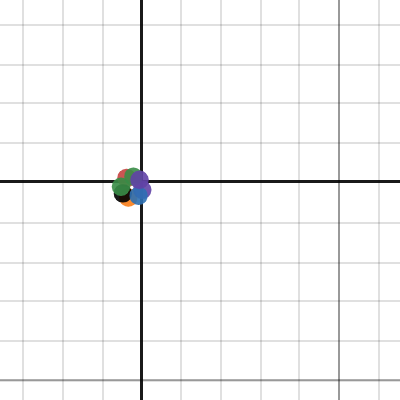
Desmos
long socket
hello people, what is the formal definition of the "element of " relation?
open whale
long socket
hello people, what is the formal definition of the "element of " relation?
No idea, but i'd imagine it's belonging or something like that
open whale
inner nexus
Is there a formal definition/name of this animation on desmos: https://www.desmo...
I'd say this looks very similar to Fourier sums
inner nexus
open whale
I'd say this looks very similar to Fourier sums
O ok thx I’ll take a look at that. But I’ve never rly heard of Fourier sums. Is it an advanced concept?
open whale
inner nexus
O ok thx I’ll take a look at that. But I’ve never rly heard of Fourier sums. Is ...
Depends on how you approach it
Effectively, it's about summing sine waves to get different functions
 shrewd haven
does the determinant of conics have any geometric significance?
i feel like it does but
i cant figure out how
 charred wolf
shrewd haven
does the determinant of conics have any geometric significance?
charred wolf
shrewd haven
does the determinant of conics have any geometric significance?

Mathematics Stack Exchange
The determinant $\Delta$ for the general equation of a conic $ax^2+2hxy+by^2+2gx+2fy+c=0$ is given by the following:
$$\Delta=\left| \begin{array} {ccc} a & h & g \ h & b & f \ g...
is this necro?
i mean there had been no activities here since last year
open whale
charred wolf
is this necro?
Sorta? We had different channels before, they're just archived now
Wait
I fell for it
💀
lethal wigeon
Can anyone help me learn calc 2 its so hard
open whale
lethal wigeon
Can anyone help me learn calc 2 its so hard
intuitively or formally?
 static rune
is pair of straight lines a smooth curve?
open whale
static rune
is pair of straight lines a smooth curve?
depends on how do you treat it
static rune
open whale
depends on how do you treat it
elaborate
vivid gulchBOT


 Requested by yoavmal#5800
open whale
Requested by yoavmal#5800
open whale
the issue here is
static rune
yeah its derivative is defined everywhere
static rune
so yeah its derivative is not defined on the point of intersection
open whale
static rune
so yeah its derivative is not defined on the point of intersection
again, it's complicated
if you treat it as a set of two lines
so you have
{line A, line B}
then you can easily make a function that does that
whereas saying a union of the set of all points in both lines
then, it is not smooth
open whale
static rune
is pair of straight lines a conic section?
depends, it can be
static rune
open whale
depends, it can be
when can it be?
open whale
static rune
when can it be?
when all points in the two lines also satisfy an equation of the form $a(x-b)^2-c(y-d)^2=1$
vivid gulchBOT
yoavmal
 static rune
open whale
when all points in the two lines also satisfy an equation of the form $a(x-b)^2-...
static rune
open whale
when all points in the two lines also satisfy an equation of the form $a(x-b)^2-...
why?
do they have to satisfy this equation too?
open whale
static rune
do they have to satisfy this equation too?
because that's how conic sections work
static rune
very helpful bro
static rune
open whale
when all points in the two lines also satisfy an equation of the form $a(x-b)^2-...
so other conics also satisfy this equation?
open whale
static rune
so other conics also satisfy this equation?
sometimes
well, not others
but conic sections are parts of a 3d form
static rune
open whale
sometimes
what
static rune
open whale
but conic sections are parts of a 3d form
so like ellipse circle parabola
?
open whale
static rune
so like ellipse circle parabola
yes
static rune
open whale
yes
but what is that equation?
open whale
static rune
but what is that equation?
$x^2-y^2=z^2$, with linear transformations accordingly
vivid gulchBOT
yoavmal
 static rune
open whale
$x^2-y^2=z^2$, with linear transformations accordingly
static rune
open whale
$x^2-y^2=z^2$, with linear transformations accordingly
what
you are expecting too much from me
open whale
static rune
you are expecting too much from me
google "conic sections"
sorry, google "en passant"
long socket
Is it possible to calculate the values of trig functions using only algebra and geometry and not calculus
static rune
open whale
sorry, google "en passant"
lmao
static rune
long socket
Is it possible to calculate the values of trig functions using only algebra and ...
for some
open whale
long socket
Is it possible to calculate the values of trig functions using only algebra and ...
yeah
but it's usually very tedious, and won't work for the majority of values
mainly because we do use calculus... to define trig functions
even in the geometric form, we need to define the length of a circle arc, and this is done using calculus
 topaz cobalt
What kind of maths ultimately ended up interesting you?@open whale
open whale
topaz cobalt
What kind of maths ultimately ended up interesting you?<@257927955664207884>
Googology, which is really big yet finite numbers
One way to make a really big number is using the tree game
The longest game for a given number, we'll use n, of unique colours, is denoted TREE(n)
TREE(1)=1, TREE(2)=3
And TREE(3) is so big you cannot express it in physical terms conventionally
TREE(4) is even incredibly unimaginably larger
One number even larger than that is your mom's weight
Just kidding I like fractal geometry
topaz cobalt
Heh cool
 crude plume
Internet Archive
By Jayant SharmaThis is the first and original publication of NumenCasus mathematical work
Hey @topaz cobalt
Here it is!
topaz cobalt
Yep, I'm reading it too
 normal arrow
i'll skim through it, i have homework to do
topaz cobalt
Nope, besides it will take me some time to figure out since I am sick lol
crude plume
Ok tell me the remarks when you get the concept!
topaz cobalt
Will do
crude plume
Actually the main purpose is partitions
normal arrow
wait
normal arrow
so, like, a number notation designed for one specific use?
crude plume
Yeah but it also has additions , multiplication ect
So We can also see it as aa new way to write numbers in the case of big partitions
normal arrow
"...powerful enough to revolutionize the mathematics." is kind of a clickbait then
normal arrow
it doesnt "revolutionize the mathematics", it kinda just solves one little problem
crude plume
I accept
topaz cobalt
normal arrow
"...powerful enough to revolutionize the mathematics." is kind of a clickbait th...
Never be afraid of overselling yourself
crude plume
Actually It was meant to write"It will revolutionize the mathematical world of Partitions"
normal arrow
font size 100 pt
topaz cobalt
normal arrow
font size 100 pt
Damn
normal arrow
so it says that uh
"This formula is best in the case of huge numbers such as 737747, ..."
crude plume
Tell fast
normal arrow
you scale this method to numbers like 737747?
 crude plume
Use manual method!
normal arrow
which is?
crude plume
Written in pdff
normal arrow
oh
oh i found it
isnt manual method the same as N.C. method but like only a one specific row
that yields only partitions of a specific scale
am i missing something?
crude plume
Actually yes
You are missing some notations not mentioned in this pdf
Because these are just basics
Those notations minimise the time to a great extent!
Please can you tell me if it is helpful or not!
crude plume
normal arrow
isnt manual method the same as N.C. method but like only a one specific row
Yeah because the chart method can be used in smaller numbers but it will be useless in huge numbers!
normal arrow
so you have no method of getting an amount of partitions for large numbers?
crude plume
We have it!
But that isn't in pdf
Because this pdf is just about basics
And the methods in this pdf will also work for huge numbers but if we want to find ""all partitions"" then it would be just some time taking!
Using advanced NumenCastical Functions will minimise the time by 95%
crude plume
crude plume
Yeah because the chart method can be used in smaller numbers but it will be usel...
Here I meant that we should use manual method in huge numbers because drawing N.C chart in case of large numbers will be time taking NOT WRONG!
normal arrow
well then whats the point of the thing if it doesnt offer a faster or more convenient way of getting the results
crude plume
Yes it minimises the time by 95%
I said above!
I just want you to rate my work please
@normal arrow
I don't think "minimising the time by 95%" is a small deal!
The best things I liked in NumenCasus are:--
Even a 2nd grade student can easily understand NumenCasus basics!
And also it is always accurate
normal arrow
im thinkin
that maybe you should look into the uh
generating functions
if you're lucky enough, you can find a closed form solution for amount of partitions of any number
crude plume
I know a formula for number of partitions already
n² maybe!
Because it is still in research
crude plume
But the main thing I am asking to you is to rate my concept a little so that I can get that I am doing right or not!
normal arrow
eh
you're trying to make a system being able to be used by even 2nd grade pupils but really
its only goal is solving a single problem
crude plume
Ok
normal arrow
its only worth developing a system if it allows solving a whole group of problems
like p-adics
or it makes computation easier/faster
for things like these, you should pretty much just say
"here's a closed form solution and few fun facts"
crude plume
Should I continue researching on it to find its other functions or It is worthless!
 frail vergeBOT
 crude plume
First of all the main thing you aren't understanding about NumenCasus is "Using it as a new system can be a choice, but it isn't a new system!" It can also be used like a Identity, theorem or formula.
I already said that "It may be a new system for writing positive integers but it is used in partition numbers only" and I don't think we can say it a whole new system then!
Just take it as a linear function!
frail vergeBOT
 normal arrow
crude plume
Should I continue researching on it to find its other functions or It is worthle...
normal arrow
crude plume
Should I continue researching on it to find its other functions or It is worthle...
try to find a closed form solution and prove it
crude plume
Ok
 ionic violet
Can somebody tell me what I should do? I had a 2 tutors in elementary, and 2 now. I am in 7th grade and have a good teacher who everyone understand but me. I had an 89 until today I got two 50’s and now have a 0. I think I might have dyscalculia. I don’t really study besides from when I was in elementary and now my 2 tutoring sessions, and I’ve never been that good. I just need help on what to do, I don’t want to fail. Any advice?
topaz cobalt
ionic violet
Can somebody tell me what I should do? I had a 2 tutors in elementary, and 2 now...
Study without outside stimulus
Maths is hard to learn, but it's doable
Also you can see a doctor to get diagnosed
But the first step is to study by yourself
Anything that stops you from is the issue
 short dock
hey!
anyone good at math here? i am working on finding a formula for prime numbers and i would love to work with someone !
normal arrow
there is one already
so you're kind of too late
unless you want to make a better one
which will require, like, a very deep understanding of mathematics
its basically related to an unsolved problem
open whale
short dock
anyone good at math here? i am working on finding a formula for prime numbers an...
how would you define a formula?
it's important to know what exactly are you trying to achieve
 real sable
Hey
real sable
normal arrow
its basically related to an unsolved problem
Zeta functions right? That’s kind of what I’m talking about solving
real sable
open whale
how would you define a formula?
Plug in “n” get the nth prime
short dock
essentially a function
open whale
real sable
Plug in “n” get the nth prime
well, i have the "formula" for you
it's a function so that
f(n) = nth prime
i think what you're really asking is
if there's a way to calculate it
short dock
yea
@open whale yes, since there is no known approach i am looking at areas of math that i think will help narrow down a solution
@open whalenumber theory obviously, statistics, and calculus for things like zeta functions
open whale
short dock
<@257927955664207884> yes, since there is no known approach i am looking at area...
As far as I recall there is no formula
normal arrow
there is one
Formulas for the nth prime number actually exist! One was cleverly engineered in 1964 by C. P. Willans. But is it useful?
References:
Herbert Wilf, What is an answer?, The American Mathematical Monthly 89 (1982) 289-292.
https://doi.org/10.1080/00029890.1982.11995435
C. P. Willans, On formulae for the nth prime number, The M...
 vale egret
whats the best way to learn quadratic inequalities
open whale
vale egret
whats the best way to learn quadratic inequalities
starting from absolute value inequalities
short dock
@normal arrowthat uses a floor function tho....not quite something im looking to find
normal arrow
trust me, if it can generate primes, then having a floor function is not a big deal
a bigger deal is making it easy to compute
and not some scary nested sum
 golden yoke
hi
golden yoke
im new here because I had a stupid thought that I know im not smart enough to figure out lol
so basically I made a 3d scatterplot of all rgb values (255x255x255) and the thing is very trippy.
it has some very strange properties depending on the perspective you look at it from, which got me wondering about a 2d grid question I saw before.
if you have grid of squares like a chess board, the whole thing is a big square but how many squares are contained within (regardless of size)? so in the chess board example a single space would be a square but 4 spaces 2x2 would also count for the question because it is also a square and the 4 squares inside of it would count separately as well.
if you see where i'm going with this the next question is obviously: how many cubes are in that 255x255x255 cube I made?
here's the cube and a small glimpse of the trippiness inside for reference, if it helps XD

 normal arrow
gay cube
normal arrow
can we come up with some fancy function that can solve intersections between quadratic and exponential like Lambert-W solves linear = exponential
open whale
normal arrow
can we come up with some fancy function that can solve intersections between qua...
generalize it to taylor, really
open whale
How does one phrase and prove Taylor's theorem, over the complex numbers?
Hmm
I'd suppose i'd want to clarify Taylor's theorem first
Sorry, differentiability
$f'(z)=\lim_{h(\in\mathbb Z)\to0}\frac{f(z+h)-f(z)}{h}$
vivid gulchBOT
yoavmal
 vivid gulchBOT
yoavmal
 open whale
Now, how do I convert this to real and complex methods
$f'(z)=\lim_{a+bi\to0}\frac{f(z+a+bi)-f(z)}{a+bi}$
vivid gulchBOT
yoavmal
 open whale
$f'(z)=\lim_{a+bi\to0}\frac{(f(z+a+bi)-f(z))(a-bi)}{a^2+b^2}$
vivid gulchBOT
yoavmal
 open whale
$f'(z)=\lim_{a+bi\to0}\frac{a(f(z+a+bi)-f(z))-b(f(z+a+bi)-f(z))i}{a^2+b^2}$
vivid gulchBOT
yoavmal
 open whale
Now I suppose we can decompose f to g+hi
Hmm, what if I do it earlier
$f'(z)=g'(z)+h'(z)i$
vivid gulchBOT
yoavmal
 open whale
$f'(z)=\lim_{d\to0}\frac{g(z+d)-g(z)}{d}+\lim_{d\to0}\frac{h(z+d)i-h(z)i}{d}$
vivid gulchBOT
yoavmal
 open whale
$f'(z)=\lim_{d\to0}\frac{g(z+d)-g(z)}{d}+i\lim_{d\to0}\frac{h(z+d)-h(z)}{d}$
vivid gulchBOT
yoavmal
 open whale
So g,h must be differentiable
But, that isn't enough, no?
There has to be some connection between them
$f'(z)=\lim_{d\to0}\qty(\frac{g(z+d)-g(z)}{d}+\frac{h(z+d)-h(z)}{d}i)$
vivid gulchBOT
yoavmal
 open whale
Well surely it's equivalent
open whale
vivid gulch
**yoavmal**
Then it must be that if f is not differentiable, at least one of those isn't
Right, well, what if I express each as a function on two variables?
$f(a+bi)=g(a,b)+h(a,b)i$
vivid gulchBOT
yoavmal
 open whale
Now I can take partial derivatives
So $\pdv{a}f(a+bi)=\pdv{a}g(a+bi)+i\pdv{a}h(a+bi)$
vivid gulchBOT
yoavmal
 vivid gulchBOT
yoavmal
 open whale
$\lim_{n\to\infty}\abs{f'(z)-f(z_n)}=0$
vivid gulchBOT
yoavmal
 vivid gulchBOT
yoavmal
 open whale
No, well,
I'll work with g only for now
$\lim_{n\to\infty}\frac{g(z+d_n)-g(z)}{d_n}$
vivid gulchBOT
yoavmal
 vivid gulchBOT
yoavmal
 open whale
$\lim_{n\to\infty}\frac{(g(a_n+b_ni)-g(0))(a_n-b_ni)}{a_n^2+b_n^2}$
vivid gulchBOT
yoavmal
 open whale
So this goes to infinity unless the left side converges
To 0
$\lim_{n\to\infty}\frac{g(a_n+b_ni)-g(0)}{\sqrt{a_n^2+b_n^2}}$
vivid gulchBOT
yoavmal
 open whale
vivid gulch
**yoavmal**
open whale
vivid gulch
**yoavmal**
Hmm
$f'(z)=\lim_{a+bi\to0}\frac{a(f(z+a+bi)-f(z))-b(f(z+a+bi)-f(z))i}{a^2+b^2}$
vivid gulchBOT
yoavmal
 open whale
$f'(z)=\lim_{a+bi\to0}\frac{a(g(z+a+bi)-g(z)+h(z+a+bi)i-h(z)i)-b(g(z+a+bi)-g(z)+h(z+a+bi)i-h(z)i)i}{a^2+b^2}$
vivid gulchBOT
yoavmal
 open whale
$f'(z)=\lim_{a+bi\to0}\frac{ag(z+a+bi)-ag(z)+ah(z+a+bi)i-ah(z)i-bg(z+a+bi)i+bg(z)i-bh(z+a+bi)i+bh(z)ii}{a^2+b^2}$
vivid gulchBOT
yoavmal
 open whale
$f'(z)=\lim_{a+bi\to0}\frac{ag(z+a+bi)-ag(z)+ah(z+a+bi)i-ah(z)i-bg(z+a+bi)i+bg(z)i-bh(z+a+bi)ii+bh(z)ii}{a^2+b^2}$
vivid gulchBOT
yoavmal
 open whale
$f'(z)=\lim_{a+bi\to0}\frac{ag(z+a+bi)-ag(z)+ah(z+a+bi)i-ah(z)i-bg(z+a+bi)i+bg(z)i+bh(z+a+bi)-bh(z)}{a^2+b^2}$
vivid gulchBOT
yoavmal
 open whale
$f'(z)=\lim_{a+bi\to0}\frac{(ag(z+a+bi)-ag(z)+bh(z+a+bi)-bh(z))+(ah(z+a+bi)-ah(z)-bg(z+a+bi)+bg(z))i}{a^2+b^2}$
vivid gulchBOT
yoavmal
 open whale
$f'(z)=\lim_{a+bi\to0}\frac{(ag(z+a+bi)-ag(z)+bh(z+a+bi)-bh(z))}{a^2+b^2}+i\lim_{a+bi\to0}\frac{(ah(z+a+bi)-ah(z)-bg(z+a+bi)+bg(z))}{a^2+b^2}$
vivid gulchBOT
yoavmal
 open whale
ok i'm on computer
i may have done wrong calculations
$\lim_{n\to\infty}\frac{f(z+a_n+b_ni)-f(z)}{a_n+b_ni}$
vivid gulchBOT
yoavmal
 open whale
$\lim_{n\to\infty}\frac{g(z+a_n+b_ni)-g(z)+h(z+a_n+b_ni)i-h(z)i}{a_n+b_ni}$
vivid gulchBOT
yoavmal
 open whale
ok
i have a better idea
if $f$ is differentiable in some region $s=\qty{z\middle|\abs{z-z_0}\leq r}$ around $z_0$
vivid gulchBOT
yoavmal
 open whale
and also $f(z_0)=f(z)$ for some $z\in s$
vivid gulchBOT
yoavmal
 open whale
then there is some $c\in s$ such that $f'(c)=0$
vivid gulchBOT
yoavmal
 open whale
is that correct?
open whale
that would require proof
how does the regular proof go? it uses weierstrass's extremum theorem
how do i convert that to complex numbers?
i need...
well, $\abs{f(z)}$ takes a minimum and maximum in the closed region
vivid gulchBOT
yoavmal
 open whale
can i say that if $|f(z)|$ is an extremum point and differentiable, then $f'(z)=0$?
vivid gulchBOT
yoavmal
 open whale
that requires fermat's theorem
how is fermat's theorem proven then?
,w fermat's theorem
vivid gulchBOT
 Requested by yoavmal#5800
vivid gulchBOT
Requested by yoavmal#5800
vivid gulchBOT
Wolfram Alpha doesn't understand your query!
Perhaps try rephrasing your question?
Click here to refine your query online
Requested by yoavmal#5800
open whale
hmm
what if i try prove it myself
if it is an extremum point, lets assume without loss of generality that a maximum point
in the reals
$x_0$ is a maximum point if there is some environment $\abs{x-x_0}<\varepsilon$ such that $f(x)\leq f(x_0)$
vivid gulchBOT
yoavmal
 open whale
how would that work in the complex numbers then?
wwell, no, i want to prove it first off
the derivative
so if there is some $\varepsilon$ that satisfies this, then $\lim_{h\to0}\frac{f(x_0+h)-f(x_0)}{h}=0$
assuming the function is differentiable, of course
vivid gulchBOT
yoavmal
 open whale
well, by definition, $\lim_{h\to0}\frac{f(x_0+h)-f(x_0)}{h}=0$ means that for all $\varepsilon>0$ there is $\delta>0$ such that for all $\abs{x-x_0}<\delta$, $\abs{\frac{f(x)-f(x_0)}{x-x_0}}<\varepsilon$
so
vivid gulchBOT
yoavmal
 vivid gulchBOT
yoavmal
 open whale
now, lets say x>x0
then we get
well, first off
$\frac{f(x_0)-f(x)}{\abs{x-x_0}}<\varepsilon$
vivid gulchBOT
yoavmal
 open whale
this is still true
$\frac{f(x_0)-f(x)}{\abs{x_0-x}}<\varepsilon$
and for convenience
vivid gulchBOT
yoavmal
 open whale
how do i show that
uhhh
well, lets assume the derivative is not 0
then, without loss of generality, $\lim_{h\to0}\frac{f(x_0+h)-f(x_0)}{h}>0$
vivid gulchBOT
yoavmal
 vivid gulchBOT
yoavmal
 open whale
such that $f(x)>f(x_0)$
vivid gulchBOT
yoavmal
 open whale
and this is a contradiction
open whale
vivid gulch
**yoavmal**
is that valid?
no, well, it loses all meaning since extremum points are uhh
nonexistent for most functions in the complex plane
no?
no, actually
hmm
maybe i can find a point that does it without the extremum theorem?
hmm, well, first the environment
it has to be between z0 and z
so
$\abs{c-\frac{z_0+z}{2}}<\abs{z-z_0}$
vivid gulchBOT
yoavmal
 open whale
$\abs{\frac{c-z_0+c-z}{2}}<\abs{z_0-z}$
vivid gulchBOT
yoavmal
 open whale
$\abs{\frac{c-z_0}{2}+\frac{c-z}{2}}<\abs{z_0-z}$
vivid gulchBOT
yoavmal
 open whale
alright, lets say i understand something here
lets take sine
cosine is better since it's at 0
$\cos'(0)=0$
vivid gulchBOT
yoavmal
 open whale
how do i show that it's true in the complex plane
well, the analytic continuation of cosine
$\cos(z)=\sum_{n=0}^\infty\frac{(-1)^nz^{2n}}{(2n)!}$
vivid gulchBOT
yoavmal
 open whale
so all i need to do is prove differentiation of polynomials
is valid there
but no, i want to do it without knowing the formula
lets say for a polynomial, how would i prove it
what if i simply state
there is some environment $\abs{z-z_0}<\varepsilon$
vivid gulchBOT
yoavmal
 open whale
so that for all z in this environment
$\operatorname{re}(f(z))<\operatorname{re}(f(z_0))$
vivid gulchBOT
yoavmal
 vivid gulchBOT
yoavmal
 open whale
right, i can work with this
is this correct though?
lets take it with cosine
,calc cos(0)
vivid gulchBOT
Result:
1
,calc cos(0.01i)
vivid gulchBOT
Result:
1.0000500004167
aha, it's not
right, because cosh is not
it's a minimum point
huh
maybe it can be a minimum point on one and a maximum point on the other?
does that count possibly?
so then i can say
$\abs{f(z_0)}>\abs{f(z_0+\varepsilon)}$ and also $\abs{f(z_0)}<\abs{f(z_0+\varepsilon i)}$
vivid gulchBOT
yoavmal
 vivid gulchBOT
yoavmal
 open whale
vivid gulch
**yoavmal**
open whale
vivid gulch
**yoavmal**
obviously no
since this is only two axis, it could go wacky all over the rest
however, it must be differentiable
so maybe not too wacky
what if i try to apply polynomial stuff here again
like, i know 0 is a minimum point of x^2
so what properties does z^2 have at 0
$\dv{z^2}{z}=2z$
vivid gulchBOT
yoavmal
 open whale
so the derivative in this case is a scalar of the actual point
it is always pointing away from the point itself
what if i take a more complex function
where this sin't true
such as
$z^2+z^4$?
vivid gulchBOT
yoavmal
 vivid gulchBOT
yoavmal
 vivid gulchBOT
yoavmal
 vivid gulchBOT
yoavmal
 open whale
$=0.2i-0.04$
vivid gulchBOT
yoavmal
 open whale
this is clearly not pointing in the direction itself
but it is very close to doing so, actually
so i'd imagine the limit does that
yep
open whale
vivid gulch
**yoavmal**
it's insignificant here, the main thing is the 2z still
and if i do -z, it pulls towards the point
and it'd be a maximum point itsead
ok, i can work with this
so
i want to find a point who's derivative is always pointing away in all directions
how do i say that without differentiating proper
$f(x)\cdot x<f(x_0)\cdot x_0$ i suppose?
vivid gulchBOT
yoavmal
 open whale
there is some environment that satisfies this
no, that isn't right
it should be
$f(x)(x-x_0)<f(x_0)(x-x_0)$
vivid gulchBOT
yoavmal
 open whale
this creates a difference between left and right
this isn't right, but it's closer
and it would create the appropriate angle in complex numbers
so now the absolute value matters
i want |f(x)|<|f(x0)|
but only in the reals
uhhh
hmm, derivative is
well
$\dv{f(z)}{z}-kz\to0$
vivid gulchBOT
yoavmal
