




1 messages · Page 1 of 1 (latest)
 hasty tinsel
I have been working on a video game called Traction Point for a couple of years now, and I just got the Steam page for the game published, so I figured "this thing is probably gonna happen" and I can create a project for it here as well 🙂
First things first, here's the link to the Steam store page if you want to check it out, and maybe add it to your wishlist: https://store.steampowered.com/app/1485840/Traction_Point/
I'll add a few screenshots below as well.
The game is a vehicular, physics-driven, puzzle/exploration game set in a sci-fi universe. You embark on a road trip together with your crew in the single-player campaign, and you can experiment and play around in the sandbox mode. I am making 99% of the game as a solo developer, funding the whole thing myself, and I plan to release the game in 2026.
Now, for the technical stuff you guys probably care about the most. The game runs on my self-made game engine which is actually written in C++, and has a bunch of tools and editors, mostly written in C#. When I found out about Zig around 2019 I immediately wanted to see if I could create a game using it, while still using the game engine I had spent years building. Because of this, Traction Point has a hybrid code base where most of the techy things under the hood are written in C++, while most of the gameplay-related things are written in Zig. For example, the whole AI system allowing NPCs to drive around the world is 100% Zig.
If any of this sounds interesting, I invite you to check out my YouTube channel where I do regular live streams and other development videos: https://www.youtube.com/@MadrigalGames
And if you would like to support the project, please head to the Steam page and wishlist the game. It really helps, and it will keep you posted when the game goes live next year.
Traction Point is a vehicular, physics-driven, puzzle/exploration game. Embark on a sci-fi road trip together with your crew in the single-player campaign, or experiment and play around in the sandbox mode.
Experience the joy of driving as you explore wide open fields, drive along cliff edges, investigate industrial complexes and research sta…
2026
Indie-developer making Traction Point, a vehicular puzzle/exploration game, using a self-made engine and tools.
I support loading multiple Zig libraries into the engine, either as DLLs or as WASM modules (using the WebAssembly Micro Runtime). The WASM support is still WIP, but it's already showing a lot of promise as a base for loading and running sandboxed mods. I plan to support first-class modding of the game and I already have an example mod which runs as a WASM module. Since Zig supports compiling to WASM out-of-the-box, it's super convenient to make mods for the game. You just need Zig and my small SDK to build a mod. This is true for DLL mods as well, of course.
 scenic mist
Extremely cool and honestly an incredible amount of work. Did you write the graphics layer? Are the vehicle animations all physics/impulse based? Do you have a basic level editor? What wasm runtime are you using?
hasty tinsel
Thanks!
I did write the renderer yes, though I am using NVRHI to abstract away some of the hairier details of D3D12 (and possibly Vulkan in the future): https://github.com/NVIDIA-RTX/NVRHI
All the vehicle movement is driven by the physics engine yes, in this case PhysX 5.5. It's basically using the vehicle SDK which comes with PhysX but I have modified it a little, and I have a custom differential for vehicles with more than 4 wheels.
I do have a level editor and it is actually a very capable one. I hope to release this to you guys a bit later, as part of the modding SDK.
 hasty tinsel
scenic mist
Extremely cool and honestly an incredible amount of work. Did you write the grap...
hasty tinsel
scenic mist
Extremely cool and honestly an incredible amount of work. Did you write the grap...
The WASM runtime is the WebAssembly Micro Runtime: https://github.com/bytecodealliance/wasm-micro-runtime
 latent birch
super cool! I've loved seeing your updates in #game-dev now and then! wishlisted ^-^
hasty tinsel
latent birch
super cool! I've loved seeing your updates in <#634812978994085888> now and then...
Thanks! Appreciated!
 vernal onyx
Wow! That level editor look impressive!
hasty tinsel
vernal onyx
Wow! That level editor look impressive!
Thanks! Here's a somewhat recent live stream where it's used a whole lot: https://www.youtube.com/live/xcNscRMVzew

Solo indie developer making Traction Point, a vehicle exploration puzzle game using a self-made engine and tools.Join the Discord channel: https://discord.gg...
hasty tinsel
 quasi barn
Great work!
quasi barn
Great work!
Hey cactus!
quasi barn
hello
 turbid coral
Hi. Very good work. I would like to ask how you chose physX for the physics engine?
hasty tinsel
turbid coral
Hi. Very good work. I would like to ask how you chose physX for the physics engi...
Any decent physics engine would probably do. I went with PhysX for this game since I already knew it kinda well + PhysX has pretty good support for vehicles.
hasty tinsel
Soon...
 hasty tinsel
turbid coral
If I can ask.
hasty tinsel
turbid coral
If I can ask.
Absolutely 😄
turbid coral
I think a low time ago I saw a video that they used wasm.
hasty tinsel
Just like the game itself is a DLL written in Zig, your mod can contain its own DLL which gets access to almost all of the same APIs as the game.
And yes, mods can also be compiled to WASM modules to make it a sandboxed environment.
Running in WASM mode does come with some limitations though, but I aim to expose about 90% of the API surface to WASM as well.
The main limitation being that a WASM mod cannot read memory owned by the core engine. It has to explicitly be made available to the WASM module. This obviously comes with some overhead (both perf and memory).
turbid coral
hasty tinsel
The main limitation being that a WASM mod cannot read memory owned by the core e...
Yeah. I but aren't wasm modules safer like it's not have direct access to the engine.
hasty tinsel
Yep, that's the entire point.
They cannot access anything not explicitly made available to them.
hasty tinsel
Yello! After a period of quiet I emerge from my cave with a new piece of shiny tech (hopefully the last big piece for a while since I am hoping to do mainly "gamedev" rather than "tech dev" next year).
Some of you know that I have a few tools built around node graphs, and some of you might even know that I made a particle engine on top of the node graph framework last year. That wasn't a particularily good fit since the node graphs are interpreted and were never designed for simulating thousands of particles simultaneously. Since then the system has been used for a few things in the game, eg. the big smoke pillar, but I haven't really been pushing the system as it has been kinda slow.
To solve this once and for all I started working on node graph nativization a few weeks ago. In a nutshell, rather than running the node graph through the interpreter we look at the flow of data and generate native code out of it, eliminating a lot of indirection in the process. It's still a work-in-progress and I haven't done any serious profiling yet, but the new system allows me to completely eliminate some of the code paths that are slow in the interpreted version, so I am hopeful! 🙂
As a first goal I wanted to have a simple node graph, running multiple execution cursors simultaneously, generated and running in the game when loaded as native code from a dll. You can see the node graph below. No particles or anything fancy yet, just the basics of running a graph.

The generated code for the node graph above can be seen below. In the image I've enabled the node ID display, so you can see which node goes where in the code by looking for their numeric ID. I think the code is actually pretty easy to read, and of course you can even debug it. I am keeping it pretty verbose for now, to make it easy to reason about and generate. We can make it tighter later if needed. The generated code consists of a node graph "kernel" and all of the nodes owned by it. The kernel is then wrapped in a NodeGraph object which can be run just like before.
Next up, porting a few more of the nodes to the new system. Each node that we want to use in a nativized node graph needs to have support for it. Ie. you need to tell the system how to generate the code for the node. This means writing a code gen function in C# with some framework calls and Zig fragments that the framework then puts together. For example, here's the code gen function for the Float Compare node:
[NativeCodeGen(typeof(FloatCompareNode))]
public static void GenerateNativeCode(NativeCodeGenContext ctxt, FloatCompareNode node)
{
    var codeGenNode = ctxt.GetNode(node.ID);
    var value1Pin = node.GetInputPinOrThrow("Value 1");
    var value2Pin = node.GetInputPinOrThrow("Value 2");
    var resultPin = node.GetOutputPinOrThrow("Result");

    codeGenNode.RegisterInlineDataForInputDataPin(value1Pin, node.Value1.ToString("0.000"));
    codeGenNode.RegisterInlineDataForInputDataPin(value2Pin, node.Value2.ToString("0.000"));
    codeGenNode.RegisterSymbolOnOutputDataPin(resultPin, "getResult()");

    var compOp = NativeCodeGenUtils.GetCompareOpSymbol(node.Comparison);

    codeGenNode.AddCustomFunction(@"
pub fn getResult(self: *Self) bool {
    const value1 = ", Fgmt.InputPinValue(value1Pin), @";
    const value2 = ", Fgmt.InputPinValue(value2Pin), @";
    return value1 " + compOp + @" value2;
}");
}
The C# verbatim strings makes the indentation a bit wonky, but other than that I kinda like it. The framework will have to be improved as we go.
To make all of this work I had to port Sprinter, the library for actually executing these node graphs, from C++ to Zig. Luckily it's a pretty small library, and I intend to keep both versions functioning since the interpreted versions aren't going anywhere. But it will take some time before the Zig version has full feature parity with the C++ version. Don't expect this to happen any time soon btw. I desperately need to put the final touches on Pre-Alpha 3 and kick it out the door. It will be a little light on gameplay improvements, but that can't be helped. Next year is all about gameplay and game content!
Bonus points to anyone who can tell me what the test graph above prints when run 😎
 near crystal
hasty tinsel
I have been working on a video game called Traction Point for a couple of years ...
near crystal
hasty tinsel
I have been working on a video game called Traction Point for a couple of years ...
The style looks like Hydroneer
hasty tinsel
near crystal
The style looks like Hydroneer
Thanks, I'll take that as a compliment 😉
near crystal
hasty tinsel
Thanks, I'll take that as a compliment 😉
Yeah looks pretty awesome, Cant wait to try it when it releases.
 pure turret
looks very good this game, gl
hasty tinsel
pure turret
looks very good this game, gl
Thanks! Go add it to your wishlist on Steam 😉
 gusty yoke
I think I remember seeing you stream some of this on Twitch years(?) ago. Congrats on getting to the point of announcing it on Steam! Just wishlisted.
hasty tinsel
gusty yoke
I think I remember seeing you stream some of this on Twitch years(?) ago. Congra...
Thanks! I've never been on Twitch though, so must have been YT (or someone else)
hasty tinsel
Yesterday on stream I finally got my most complex particle effect, the smoke pillar, running through generated zig code. The performance gains are pretty significant when compared to the old, interpreted, version. That means I can finally move on to other things 😎
Basically the effect now consists of a number of small Zig structs chained together like this:
const Node46 = struct { // Sprinter.Nodes.Math.RandomFloatNode
    const Self = @This();

    pub const InputPin = enum(u16) { Min = 0, Max = 1 };
    pub const OutputPin = enum(u16) { Result = 0 };

    const ReturnSingleValue: bool = false;

    kernel: *Kernel = undefined,
    rng: std.Random.DefaultPrng = undefined,
    singleValuePending: bool = true,
    singleValue: f32 = 0.0,

    pub fn init(self: *Self, kernel: *Kernel) void {
        self.kernel = kernel;
        self.rng = .init(@intCast(self.kernel.merlinEffectPtr));
    }

    pub fn getResult(self: *Self) f32 {
        if (ReturnSingleValue) {
            if (self.singleValuePending) {
                self.singleValue = self.getNewValue();
                self.singleValuePending = false;
            }
            return self.singleValue;
        } else {
            return self.getNewValue();
        }
    }

    pub fn getNewValue(self: *Self) f32 {
        const min = 0.900;
        const max = 1.100;
        return sprinter.math.getRandomFloat(self.rng.random(), min, max);
    }
};

//----------------------------------------------------

const Node49 = struct { // Sprinter.Nodes.Math.VectorNode
    const Self = @This();

    pub const InputPin = enum(u16) { X = 0, Y = 1, Z = 2, W = 3 };
    pub const OutputPin = enum(u16) { Result = 0 };

    kernel: *Kernel = undefined,

    pub fn init(self: *Self, kernel: *Kernel) void {
        self.kernel = kernel;
    }

    pub fn getResult(self: *const Self) sprinter.VecVariant {
        sprinter.maybeUnused(self);
        const x = self.kernel.node27.getX();
        const y = self.kernel.node27.getY();
        const z = self.kernel.node27.getZ();
        return sprinter.vec_variant.init3(x, y, z);
    }
};
 calm ocean
just wondering, why are you calling your objects NodeN?
hasty tinsel
calm ocean
just wondering, why are you calling your objects NodeN?
The code is generated from a node graph such as this one: #1424452403008110753 message
The nodes in the graph don't have names but they do have IDs (the numbers) so using them to make each node unique is pretty handy.
hasty tinsel
Oh, and when I say "generated" I mean it is written out by code I have lovingly hand-crafted, not by some LLM/AI thingy.
hasty tinsel
I just released Pre-Alpha 3 which can be downloaded from my proton drive at https://drive.proton.me/urls/MY0BVZXCB8#zXZckuAwAsqj
I am planning on putting out the Pre-Alpha as a Steam Playtest, but unfortunately that got postponed a bit (probably until after Christmas).
The focus for this release is moddability, and you want to try it out you can find instructions and SDKs at https://github.com/MadrigalGames/TractionPointModding

 haughty relic
this is very cool, visually looks like a mix betwen Scrap Mechanic and Astroneer
hasty tinsel
Thanks! You can try out the Pre-Alpha version using the link above!
 brave coral
hasty tinsel
brave coral
hasty tinsel
What did you use to create the UI for this ? (if you dont mind answering)
hasty tinsel
brave coral
What did you use to create the UI for this ? (if you dont mind answering)
Of course I don't mind 😄 All of the UI (HUD, Menus etc) use my self-made UI library called Goofy. I support a subset of SVG graphics and so most of the UI is vector based.
Here's a really old video about it: https://www.youtube.com/watch?v=O2s--D7o-zE
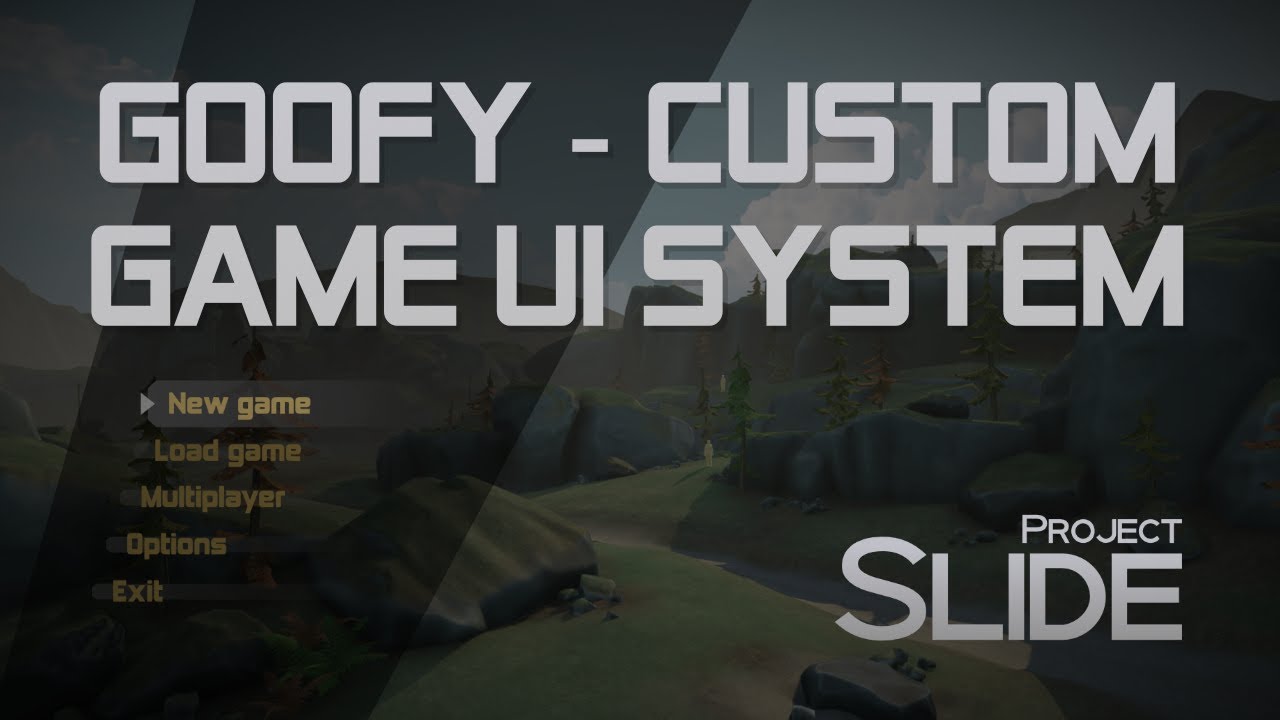
In this video we take a look at Goofy, Madrigal's custom game UI system, built for Project Slide. For more information, check out the development blog at: https://www.madrigalgames.com/
Libraries used:
https://github.com/memononen/nanovg
https://github.com/memononen/nanosvg
It has been vastly improved since the video was made, but the main concepts are the same.
brave coral
hasty tinsel
Of course I don't mind 😄 All of the UI (HUD, Menus etc) use my self-made UI lib...
And you use opengl right ? Seems really interesting and would like to learn Zig.
brave coral
For the UI?
brave coral
Ok thanks
hasty tinsel
The UI rendering is based on this library: https://github.com/memononen/nanovg

Antialiased 2D vector drawing library on top of OpenGL for UI and visualizations. - memononen/nanovg
I've just written a backend for it which works with my renderer, instead of OpenGL.
hasty tinsel
Btw, if you want to try my game audio authoring tool, Timbre, it is now available for download as part of the modding SDK mentioned above. Looky here: https://github.com/MadrigalGames/TractionPointModding/wiki/Basis-Toolbox
 latent birch
hasty tinsel
Of course I don't mind 😄 All of the UI (HUD, Menus etc) use my self-made UI lib...
latent birch
hasty tinsel
Of course I don't mind 😄 All of the UI (HUD, Menus etc) use my self-made UI lib...
this sounds interesting 👀
i don't suppose it's open source?
hasty tinsel
latent birch
this sounds interesting 👀
i don't suppose it's open source?
Nah, it's not open-source as the runtime relies on the APIs of my game engine. But tbh most of the heavy lifting is done by NanoVG (for rendering) and NanoSVG for SVG parsing. https://github.com/memononen/nanovg and https://github.com/memononen/nanosvg
My NanoVG backend is actually all here: https://gist.github.com/unvestigate/65e819b2cca2c732a28bd912e11091a2
It's an older version (I use NVRHI these days) but 90% of the code is the same.
So really, the only closed-source parts is a very basic widgeting system for menus as well as integration with AngelScript.
The UI views are populated from AngelScript and I can hot-reload the views as the scripts change allowing me to add and move things at runtime, which means I don't really need a WYSIWYG editor.
latent birch
hasty tinsel
Nah, it's not open-source as the runtime relies on the APIs of my game engine. B...
fair enough fair enough ^-^
building UIs using SVG is a really interesting idea, idk if i've seen it before
makes complete sense in hindsight tho
 nova sand
latent birch
building UIs using SVG is a really interesting idea, idk if i've seen it before
nova sand
latent birch
building UIs using SVG is a really interesting idea, idk if i've seen it before
you may find interesting that it's somewhat common in audio plugin guis
latent birch
nova sand
you may find interesting that it's somewhat common in audio plugin guis
that is interesting! though not particularly surprising, given how graphically complex some of those UIs are! ^-^
what do they typically use for that? juce or something?
nova sand
latent birch
what do they typically use for that? juce or something?
yes, juce is very popular and has its own gui framework
but people often use nanovg, cairo and other stuff
even imgui
latent birch
fair enough!
nova sand
rust plugins are becoming more common thanks to nih-plug which supports egui, iced and vizia so these are quite popular
latent birch
idk that much about the audio plugin space tbh, despite being interested in it ^-^
nova sand
basically, if you can easily embed it in a graphics context, it's good for plugins
nova sand
latent birch
idk that much about the audio plugin space tbh, despite being interested in it ^...
i'm working on a project that may interest you but i don't want to hijack this thread lol
but the topic comes up often in #audio-dev
latent birch
wait that channel exists?? hell yea
hasty tinsel
latent birch
building UIs using SVG is a really interesting idea, idk if i've seen it before
Rendering UIs using vector graphics is actually not that uncommon. It lets you have nice scaling UI elements regardless of rendering resolution.
Also, it should be noted, I don't actually render SVG shapes as-is at runtime. You really don't want to parse SVG data at runtime, as it is XML-based and kinda gnarly to parse.
Instead I parse the SVG data offline and convert it into a sort of bytecode which then translates directly to NanoVG rendering commands at runtime.
It does give you resolution independent rendering though. Here's me scaling up a tiny HUD element by a factor of 50 or so, to debug the rendering.
 latent birch
very nice ^-^
yea it makes complete sense, i'd just never really thought of defining the whole UI with svg before
i feel like picosvg or tinyvg could be quite nice for this too
hasty tinsel
Yeah, you basically just have to convert the data to commands, to render your vector graphics.
I just went with NanoSVG because it directly outputs "move to", "line to" "bezier to" etc. commands that you can pipe through to NanoVG.
hasty tinsel
Got Zig code hot reloading working in my game engine. 😎 Now if we could just get the new, faster, compiler working on windows I wouldn't have to wait so long for rebuilds. 😅
 jade mural
is the new compiler coming for windows with 0.16?
hasty tinsel
jade mural
is the new compiler coming for windows with 0.16?
I don't think so, but I'd be happy to be wrong here.
hasty tinsel
FYI, I am moving my live streams over to a new YouTube channel, so be sure to subscribe if you want to be notified when I go live: https://www.youtube.com/@MadrigalGamesLive

Live Stream channel for Madrigal, indie-developer making Traction Point, a vehicular puzzle/exploration game, using a self-made engine and tools.
 karmic matrix
@hasty tinsel Are you the person who created a WGPU youtube video several years ago? The 3D modeling of the game looks so familiar to me.
https://www.youtube.com/watch?v=DdMl4E7xQEY yes, this one!

In this video we take a proper look at the new WebGPU graphics API, support for which was recently added to the Basis engine. How did it go? For more information, check out the development blog at https://www.madrigalgames.com/
Porting my renderer to Vulkan: https://youtube.com/playlist?list=PLCcN1sD0WbbIayA9fS6gEI6LcEDZdm8bA
"I want to talk ab...
hasty tinsel
Yeah, that's me 😄
 glad pendant
I am sorry, are you by any chance from Finland? The "javascript" from the webgpu video screams finland 😄 It's cool video though!
hasty tinsel
glad pendant
I am sorry, are you by any chance from Finland? The "javascript" from the webgpu...
I am yes
glad pendant
love that accent. I am an ethnical hungarian, and gave it a go to learn finnish back in the days, but all I remember is Mina olet Citrus and sopo pupu. Keep up the good work on the traction point mate ❤️
hasty tinsel
Cheers dude! And good luck with learning Finnish, it's a weird language 😄
glad pendant
same messed up as hungarian! 😄
 onyx bluff
I'm mostly interested in the game engine
hasty tinsel
onyx bluff
I'm mostly interested in the game engine
Sure, lots of info on the YT channel: https://www.youtube.com/@MadrigalGames Or I am happy to answer any questions here as well 😄
Indie-developer making Traction Point, a vehicular puzzle/exploration game, using a self-made engine and tools.
 wet mango
awesome
hasty tinsel
https://youtube.com/live/2TaI4t7RZ98 Poking the bear called Vulkan today, come say hi!

Solo indie developer making Traction Point, a vehicle exploration puzzle game using a self-made engine and tools.Wishlist Traction Point on Steam: https://st...
 jovial cipher
is the game engine itself written in zig? or is it just the game, I remember seeing your WebGPU video a long time ago, I guess you were working with C++
Tho I can never have your consistency and persistence working on this project, congrats!
when did you transition to zig btw, is there a video for that
hasty tinsel
jovial cipher
is the game engine itself written in zig? or is it just the game, I remember see...
The game engine is still written in C++, yes. It's an engine I have had for a very long time and I didn't want to rewrite it (or rather, I figured it would take too long) so instead I added support for writing the gameplay code in Zig while the engine handles the lower-level things.
I've been using Zig since 2019 or so, first for smaller experiments with other projects (while still using the same engine). I started working on this game in 2023 and it has been written in Zig from the very beginning.
jovial cipher
hasty tinsel
I've been using Zig since 2019 or so, first for smaller experiments with other p...
I see, that's cool, continue!
 drifting locust
amazing work
hasty tinsel
drifting locust
amazing work
Thanks! 🙂
drifting locust
can you send a link to the game engine or is it all in house
hasty tinsel
The engine is not released as a general-purpose game engine you can just build games with. It's not quite that polished.
You can however make mods for the game already if you are in the steam playtest and the zig portions of the engine is available here: https://github.com/MadrigalGames/BasisModdingSDK

Modding SDK for the Basis game engine. Contribute to MadrigalGames/BasisModdingSDK development by creating an account on GitHub.
hasty tinsel
New blog post! https://www.madrigalgames.com/blog/how-i-made-traction-point-moddable-using-zig-and-webassembly/
The power of Zig and the security features of WebAssembly make for a flexible modding system.
hasty tinsel
Traction Point now builds with Zig 0.16 🎉 Looking forward to trying out the new incremental compilation. Should be very nice in combination with my hot-reloading support 😎
hasty tinsel
https://youtube.com/live/E7E56AY5dcw We're back, baby! First live stream in a looong time!
 hasty tinsel
https://youtube.com/live/VE9dRWV0u6A I'll be working on my in-game conversation system in a bit, come say hi!

Solo indie developer making Traction Point, a vehicle exploration puzzle game using a self-made engine and tools.Wishlist Traction Point on Steam: https://st...
hasty tinsel
https://youtube.com/live/Ov-9tSEGwT0 Let's add some sweet camera animations to our conversations in the game!

Solo indie developer making Traction Point, a vehicle exploration puzzle game using a self-made engine and tools.Wishlist Traction Point on Steam: https://st...
hasty tinsel
Conversation system coming together. Here's a test conversation I slapped together on today's stream. We have camera transitions, custom camera animations, placeholder TTS audio, branching dialogue, remembering state across conversations, etc. Combined with the normal mission scripting, I think this is going to be pretty powerful!
Here's the script that produces the above conversation:
VAR firstEntry = true
VAR hasSelectedOption = false

=== main ===
#dink
voice 1
{
    - firstEntry && not hasSelectedOption:
        ROWAN: Hi Vet, there you are!
    - not firstEntry && hasSelectedOption:
        {shuffle:
            - ROWAN: Anything else I can help you with?
            - ROWAN: Anything else?
            - ROWAN: Wanna talk about other things?
        }
    - else:
        ROWAN: Oh, you're back?
}

~ firstEntry = false

+ [Where's everyone?]
    ~ hasSelectedOption = true
    -> whereIsEverone
+ [Elevator powered on yet?]
    ~ hasSelectedOption = true
    -> askAboutElevator
+ [(Leave)]
    ROWAN: Bye!
    ~ hasSelectedOption = false
    -> END
-> DONE

= whereIsEverone
#dink
voice 1
SYSTEM (playcameraanim): 0
ROWAN: Mother's out on a scrap run with Steller.
ROWAN: Diego, went to get some water.
ROWAN: Not sure what Marty's up to actually...
-> main

= askAboutElevator
#dink
voice 1
ROWAN: No, not enough power cells in the receptacles yet.
ROWAN: In fact, why don't you go see if you can find some.
-> main
I completely rewrote my in-game interaction system over the weekend. Let's see how it works! https://youtube.com/live/k0doRkzQL7A

Solo indie developer making Traction Point, a vehicle exploration p...
hasty tinsel
New blog post! This time about making my gameplay Zig code hot reloadable. https://www.madrigalgames.com/blog/how-i-made-my-zig-gameplay-code-hot-reloadable/
Code hot reloading can be very useful for game development. Let's look at how I added support for hot reloading the gameplay code in Traction Point.
hasty tinsel
Continuing from yesterday's stream, we're gonna polish up and texture the new structure. Come say hi! https://youtube.com/live/hvkd48H4fc8

Solo indie developer making Traction Point, a vehicle exploration puzzle game using a self-made engine and tools.Wishlist Traction Point on Steam: https://st...
hasty tinsel
Here's what we created during the past two streams. Some lightmap fixup to do still, but I think it turned out pretty well!

 hasty tinsel
https://youtube.com/live/z64pWY0mh68 Let's do a little polish on the demo level!

Solo indie developer making Traction Point, a vehicle exploration p...
hasty tinsel
https://youtube.com/live/Tz_eBvZliF0 Porting some old particle effects to my new node-based system, live on stream!

Solo indie developer making Traction Point, a vehicle exploration p...
hasty tinsel
https://youtube.com/live/el2PU4zq35M Doing some gameplay related to physics collisions. Come say hi!

Solo indie developer making Traction Point, a vehicle exploration p...
hasty tinsel
https://youtube.com/live/quccxycNP4w Doing a little work on my driving AI today, come say hi!

Solo indie developer making Traction Point, a vehicle exploration p...
hasty tinsel
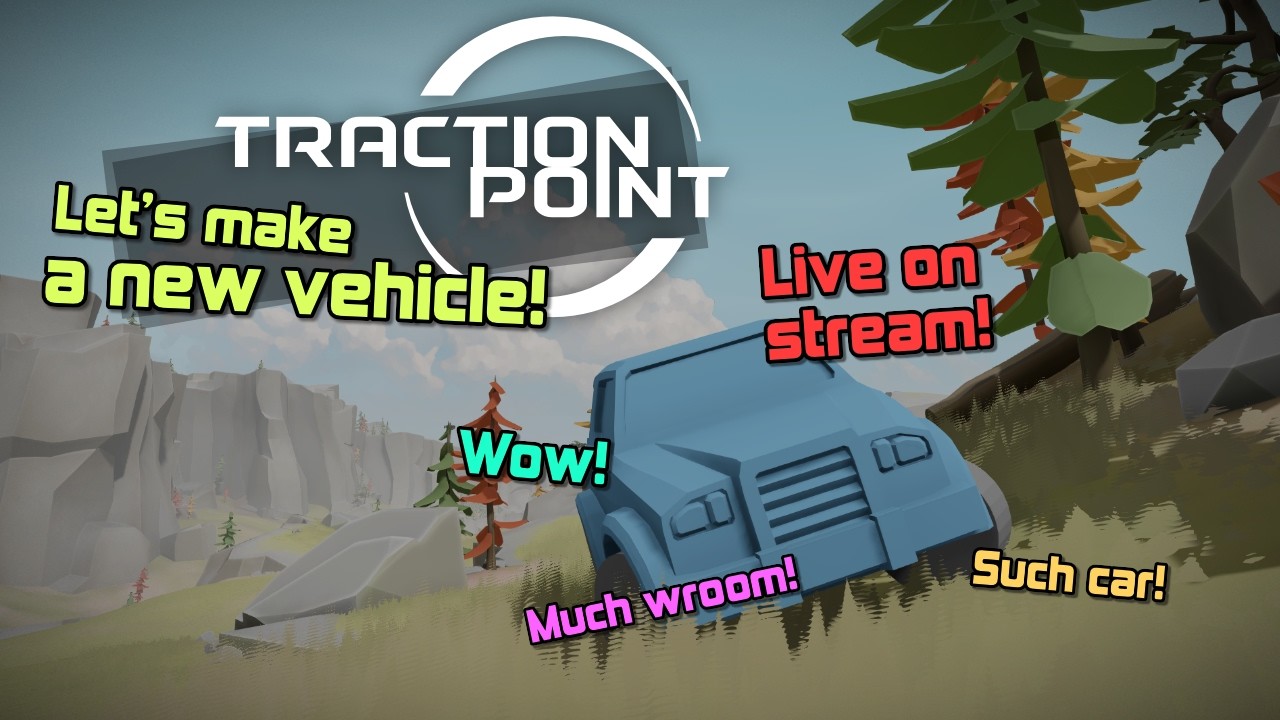
Making a new car for Mrs. Florence, a character in the game. I set out to make a station wagon, but it seems to come out as more of an SUV. Fun to drive though! Obviously very WIP model still...
hasty tinsel
https://youtube.com/live/h9o1ertsjWk New stream coming up! I'm gonna work on the new vehicle and try to get as far as I can during this stream. Might be a long one, come say hi!
Solo indie developer making Traction Point, a vehicle exploration p...
hasty tinsel
Here's the result from yesterday's stream (+ a little more this morning ;))
 hasty tinsel
So far I haven't used a whole lot of specular highlights except for the windshields, but figured I should try out making at least these vehicles a bit more shiny. So far so good. I still need to mask away the sheen where dirt has been painted, but I think this is gonna work with my mostly matte art style. Some objects just beg to be a little shiny.

 warped lintel
dam yo, those driving physics are so smooth
hasty tinsel
warped lintel
dam yo, those driving physics are so smooth
Thanks! Public demo releasing soon 😎
hasty tinsel
The project reached a bit of a milestone today, as I have finally completed a level for the game. I am sure I'll do some small polish passes, but overall the level should be done, and ready to be put into the campaign. It will also be featured in the demo, releasing later this summer!


 hasty tinsel
I made a video about my zig gamedev experience so far: https://www.youtube.com/watch?v=HXpUShkr2VQ

So, I am making a game using Zig. How is that working out?
Wishlist Traction Point on Steam: https://store.steampowered.com/app/1485840/Traction_Point/
Join the Discord Server: https://discord.gg/k8CxSpsCnB
Live stream channel: https://www.youtube.com/@MadrigalGamesLive
How I made my Zig gameplay code hot reloadable: https://www.madrigalgames.c...
 upbeat crow
hasty tinsel
I made a video about my zig gamedev experience so far: https://www.youtube.com/w...
upbeat crow
hasty tinsel
I made a video about my zig gamedev experience so far: https://www.youtube.com/w...
I'm finally watching this, and do have a comment re-error handling: I've been using this construct in my projects lately.
pub fn check(v: anytype) @typeInfo(@TypeOf(v)).error_union.payload {
    return v catch |err| fatal(err);
}

pub fn fatal(err: anyerror) noreturn {
    if (@import("builtin").mode == .Debug) @panic(@errorName(err));
    std.debug.print("Fatal error {t}.\n", .{err});
    std.process.exit(1);
}
Whenever I have a boundary between a library which returns errors, and me knowing that the error is unrecoverable, I wrap it with check. Eg, const item = check(array_list.addOne(allocator));
I did at one point have it take a @src() argument, but just got rid of it when I realized that I could call panic and just look at that stack trace. I figure a more refined version of fatal will get whatever stack information a release build is capable of collecting, and put up a pop-up with an easy to copy-paste error message with instructions on how to report bugs. I'm too far away from actually having users to bother with that so far.
hasty tinsel
upbeat crow
I'm finally watching this, and do have a comment re-error handling: I've been u...
Thanks! That's a very concise way of piping errors through a common handler. The basis.fatalErrorWithName() function I showed in the video basically does the "showing a nice dialogue box with extra information" step you talked about, but I've been annoyed at having to catch errors explicitly everywhere, because I haven't had a check()equivalent. This gives me some ideas.
I need to have a think where such a check function would go though, as it would have to be available in most files and it should have as short of a name as possible while remaining readable. This ties a bit into the “name shortening” pet peeve I briefly mentioned in the video.
upbeat crow
For me it's in root because fatal has different implementations on different mains, so I put near the top const check = @import("root").check;. I'm assuming you could do something like const check = basis.check;
hasty tinsel
Yep I could, that gets tiresome really quickly though, which was kinda my point in the video.
But these are small things…
upbeat crow
LOL, I paused the video to reply, then unpaused at got the exact moment you were complaining about the lots of imports.
"Hey you can do this." *Unpaused video "So I'm doing this and it's a bit annoying"
hasty tinsel
Yeah 😁 overall I like the way of being able to “redeclare” anything under any name. I just tend to want a certain set of names available in a lot of files and having to do the shortening manually everywhere is not optimal. It might just be my way of writing zig though….
I had a chat about it with Loris after he watched the video and he mentioned a possibility of zls helping with this in the future. Might be nice I guess.
upbeat crow
I was going to suggest reducing name stutter, but I rewound and it wasn't too bad. Eg: basis.resource.FooResourcePtr has resource twice, so why not basis.resource.FooPtr. Not saying it definitely makes sense for you, but name stuttering is an easy habbit to pick up from working in languages with poor namespacing.
Well. I guess I did suggest it
hasty tinsel
I think I might actually want to add a “common declarations” file and add the most used things there 🤔
upbeat crow
cd.check
hasty tinsel
Yeah, this codebase has code that has survived from 2019 or so, when I really didn’t know how to structure my zig 😆
The resource stuff has lots of that
upbeat crow
Don't let @vale halo hear me tell you this, but if you really wanted to invoke the dark magic:
Add a build step which takes an input path, a output path, and common declarations. Have it find all of the zig files in the build path, and copy them to the output path while appending the common declarations to the end of the zig file. Then have your zig mod in the build reference the output files.
hasty tinsel
Ooh, that’s evil!
upbeat crow
I hadn't thought of doing that before now, but it actually might not be a horrible idea for gameplay code specifically.
The other suggestion actually is to let files be bigger. sema.zig is 37+k lines of code. When I asked Andrew about having so many lines in one file, he said "The code has to go somewhere", which really stuck with me. Since then I've tended to just be ok with some files being really long.
For example, I made a prototype where I had a ~300 line main file, a ~100 line image parsing file, a big file of table for where all the sprites were in the spreadsheet. Then I had literally all of the gameplay code in the last file. I think if I had continued the project, the gameplay code would've maybe ended up in 3 files.
Anywho, finished the video. Thanks for making it I like seeing other's detailed feedback.
hasty tinsel
Yeah, I have a zig file containing the core engine c++ api's "beautified" version (ie. making the code a little bit more zig friendly) which is 8k lines atm.
I'm trying to be very pragmatic these days, and not care if a file is "too long" or whatever, unless it becomes an actual technical problem.
But yeah, regarding the shortening, I think I can easily add one more line to the top of the file, especially if it replaces shortenings I now do by hand
upbeat crow
Well, the compiler's limit is 4gigs, so good luck on hitting that.
hasty tinsel
I've already split my codebase into libraries so I usually begin my files with some combination of:
const std = @import("std");
const basis = @import("basis"); // core engine
const timbre = @import("timbre"); // audio
const goofy = @import("goofy"); // UI
const nemo = @import("nemo"); // scripting and world facts
const merlin = @import("merlin"); // particle effects
const means = @import("../means.zig"); // game root
So I think I can manage a const cd = basis.common_declarations; or whatever
hasty tinsel
upbeat crow
Well, the compiler's limit is 4gigs, so good luck on hitting that.
At my day job at a large studio, we've hit MSVC object file limits, having to compile with -bigobj or whatever the flag was. That in turn disabled some other things (this was years ago, don't remember exactly). But yeah, there can be weird limits sometimes, especially with macros or comptime code generating unholy amounts of code.
upbeat crow
Fun fact: Java's limit on number of enums is (was? been years) due to the invisible initializer function growing too big. The bytecode jumps inside functions using 16 bit numbers, limiting the function bytecode length to 65k.
 formal mural
wishlisted
hasty tinsel
upbeat crow
I'm finally watching this, and do have a comment re-error handling: I've been u...
I did play around with this approach a little and now I can do things like this:
var list = basis.check(basis.BoundedArray(i32, 4).init(0));

basis.check(list.append(0));
basis.check(list.append(0));
basis.check(list.append(0));
basis.check(list.append(0));
basis.check(list.append(0)); // Error
Having to type basis.check everywhere is a little annoying but of course it can be shortened a little. What's a bigger problem is that zls seems to completely lose track of the actual returned type, so in the above case it can no longer give me autocomplete suggestions for list, which is kind of a dealbreaker for me for everyday work use. It seems like there a hundred different ways to make zig errors work a little better for gamedev, but none that solves all the small annoyances, at least for me personally...
 vale halo
In my programs where I don't plan to handle OOM I usually do list.append(0) catch fatal.oom(), where fatal is my namespace containing error reporting functions. oom needs to be defined as returning noreturn to get the best ergonomics.
another trick is to "strategically" pick some functions for returning error{OutOfMemory}!whatever and using try in them, to finally collect their result in a single catch fatal.oom() call.
vale halo
hasty tinsel
I did play around with this approach a little and now I can do things like this:...
also this might help you maybe (it doesn't break zls)
const std = @import("std");

pub fn main(init: std.process.Init) !void {
    var list = checkExplicit(std.ArrayList(i32), .initCapacity(init.gpa, 5));
    check(list.append(init.gpa, 42)); // your current check impl
    std.debug.print("{}\n", .{list.items[0]});
}

fn checkExplicit(T: type, val: error{OutOfMemory}!T) T {
    return val catch @panic("oom");
}
Yeah, I actually already did a version of checkExplicit for just this purpose, but the above example becomes just kinda stupid with that, unless you capture the type into another constant first.
Something like var list = basis.checkT(basis.BoundedArray(i32, 4), basis.BoundedArray(i32, 4).init(0));
At this point we've left ergonomics behind a long time ago
You can do const List = basis.BoundedArray(i32, 4); and then use that, but at that point it's workarounds on top of workarounds.
 jade flax
Hey this is fantastic, I've been keeping up with your development on this game for a while!
I love Zig but have been torn between using Odin or Zig for my next game project,
Vendor packages aside, would you say you experienced any friction when it comes to actual game architectural patterns/workflows when using Zig? For example I read that theres no safe way to do ZII unless all pointers are marked as optional but not sure if in practice thats even a problem.
Now that you worked so much with Zig on a serious game project, would you say you'd pick Zig over the alternatives again if you could go back in time?
hasty tinsel
jade flax
Hey this is fantastic, I've been keeping up with your development on this game f...
Thanks! And yeah, I've gotten this very question a few times now.
I think I'd still choose Zig because I like the language a lot. I'm not 100% sold on Odin (or Jai for that matter which has some syntactical similarities to Odin but is otherwise pretty different) as a language.
That said, I think the toolchains and "ecosystem" for lack of a better word, around Zig could use a lot of work, and Odin being "batteries included" is pretty neat.
But more than anything, just choose one and go with it. Zig and Odin (and C3 and Jai and...) are all perfectly fine.
jade flax
awesome thanks for the quick reply, ya I like Zig too much to let it go so looks like it's the right choice for now, I haven't had the chance to try jai but since I actually have access to Zig it seems like the obvious choice right now, thanks! Looking forward to playing your game!
jade flax
perfect will do the moment I get a chance!
upbeat crow
hasty tinsel
I did play around with this approach a little and now I can do things like this:...
I don't use zls, so yeah that's not an issue I'd notice.
I did notice you're using bounded array here. When that got removed from the std, I promptly copied it to my own files, and started changing it. Specifically I removed the error return on append and instead made it an assertion. In your case here you could make it a fatal error. So that's another way to potentially tackle some of your issues here: cutting off the errors earlier in the stack, even if that means modifying said stack higher up than normal. Probably only worth it for heavily used things, but food for thought.