Booleans are a fundamental data type in nearly every modern programming language. So why shouldn't you have them in your language?
#Stop adding booleans to programming langugaes
1 messages · Page 1 of 1 (latest)
 zealous osprey
how does having 1 bit integers/2 inhabitant integers in a language solve the problem of truthiness?
to me it seems like you'd just be moving the problem from a designated type to another one
ie a programmer that's lazy enough to use a boolean instead of an enum would possibly be equally lazy without booleans and just use u1
 low bramble
zealous osprey
to me it seems like you'd just be moving the problem from a designated type to a...
low bramble
zealous osprey
to me it seems like you'd just be moving the problem from a designated type to a...
it's to solve the overloading of the boolean type
i think moving it around here is fine because it moves some uses of boolean into something more readable, and moves the other uses of boolean into something that already exists (and represents the issue more accurately imo)
 edgy zinc
zealous osprey
ie a programmer that's lazy enough to use a boolean instead of an enum would pos...
edgy zinc
zealous osprey
ie a programmer that's lazy enough to use a boolean instead of an enum would pos...
Me when I int
 austere aspen
i went into this post expecting to disagree with it, but i find myself convinced by many of the points
i do think a point could be made for a boolean type that is restricted to use in if statements
so u couldnt store it in a variable or anything
but u could avoid the clunkiness of is is
tho ig u could just replace is with == as syntax and thatd work fine
ok i retract my point
low bramble
austere aspen
ok i retract my point
fire
low bramble
austere aspen
i do think a point could be made for a boolean type that is restricted to use i...
yeah true, i mainly provided a list of examples for if just to show there's a solution
so there are a bunch of things i didn't write in there
(also, i added the part about if statements 4 hours ago, so if anyone doesn't remember that part from reading it, that's why)
 cloud raven
low bramble
https://goldenstack.net/blog/stop_adding_booleans
cloud raven
low bramble
https://goldenstack.net/blog/stop_adding_booleans
some interesting points, but you seem to have completely glossed over the need for short-circuiting operators. short-circuiting or and and make no sense for numeric types, and bitwise | and &, which do make sense for u1, don't short-circuit, which is sometimes very important
 wanton wyvern
low bramble
https://goldenstack.net/blog/stop_adding_booleans
wanton wyvern
low bramble
https://goldenstack.net/blog/stop_adding_booleans
what type would you use as the result of more complex comparisons? your example doesnt cover any typical use cases of booleans (only "use in if")
also did you know that in Python a bool is an int?
wanton wyvern
could you give me an example on how you would express this expression here?
pub fn @"suspend"(thread: *Thread) void {
        if (!thread.flags.started or thread.flags.finished or thread.flags.suspended)
            return;
    ...  // impl here
}
or a more general question: how would you handle typical boolean questions like isReached(), isCancelled(), ... in a way they are composable
low bramble
cloud raven
some interesting points, but you seem to have completely glossed over the need f...
kinda true, but i don't know why you couldn't add short circuiting bitwise operators
low bramble
wanton wyvern
what type would you use as the result of more complex comparisons? your example ...
well to be fair i think it actually covers quite a lot of the typical use cases of booleans
also i was gonna say that bools arent integers, they can just be converted to them implicitly, but i think this would lead to a lot of semantic arguments so im not gonna argue that
low bramble
wanton wyvern
could you give me an example on how you would express this expression here?
```...
i feel like in this specific case you could rework it to be a multi-case switch over something like thread.state, but that doesnt handle the general case either way
i mean there are definitely ways to do it for each case, its just that im used to booleans being important in programming so im not entirely used to figuring out how to do stuff without them
actually if you port it directly i guess you could do AND via like
if ((a, b, c) is (.x, .y, .z)) (using (a, b) as the tuple constructor)
wanton wyvern
low bramble
kinda true, but i don't know why you couldn't add short circuiting bitwise opera...
because the only work semantically for booleans/u1
wanton wyvern
low bramble
actually if you port it directly i guess you could do AND via like
`if ((a, b, c...
this would force a lot of de'morgan into your language, and would still require highly complex constructs like pattern matching to do something like a or !(x < low or x > high)
wanton wyvern
low bramble
well to be fair i think it actually covers quite a lot of the typical use cases ...
# class int(object): ...
# class bool(int): ...

assert isinstance(True, bool)
assert isinstance(True, int)

assert not isinstance(1, bool)
assert isinstance(1, int)

assert True == 1
is valid for python
which is a really weird way of doing it
wanton wyvern
low bramble
i feel like in this specific case you could rework it to be a multi-case switch ...
threads can have several independent states and modelling those 3 bits as booleans was simpler than modellinh as enums or a single enum, as finished does not imply start nor suspended.
a thread could be suspended and finished, but not started (and starting it would be an error)
low bramble
wanton wyvern
because the only work semantically for booleans/u1
not necessarily, and idk why that would be an issue anyway
low bramble
wanton wyvern
this would force a lot of de'morgan into your language, and would still require ...
oh i just meant it for the and case
low bramble
wanton wyvern
threads can have several independent states and modelling those 3 bits as boolea...
well i feel like this is two different things
if we didn't have booleans it wouldnt be simpler to use them
and for the suspended & finished thing, that just means you'd have to represent it differently idk
right now you have 3 bits but at least 1 invalid yet representable state
 teal skiff
Inside the function call, too, operations like
depth OR falsewill now emit a compile error, as they no longer make any sense...
Well, it doesn't make sense in the first place. A OR 0 = A
Oh, unless you mean an expression that evaluates to 0.
In that case, I'm not sure why it'd be better to get a compile error instead of a short circuit.
wanton wyvern
low bramble
oh i just meant it for the `and` case
de'morgen transforms or into and, so it would still be applicable, just with more nots 😄
wanton wyvern
low bramble
right now you have 3 bits but at least 1 invalid yet representable state
which is?
wanton wyvern
low bramble
not necessarily, and idk why that would be an issue anyway
short-circuit only works when an operation has boolan semantics tho, as it works on logic operators
low bramble
teal skiff
> Inside the function call, too, operations like `depth OR false` will now emit ...
it doesnt make sense, it's just an example of operations that are meaningless in context
low bramble
wanton wyvern
de'morgen transforms or into and, so it would still be applicable, just with mor...
yeah ik, there are prob other ways to figure out or though
low bramble
wanton wyvern
which is?
suspended finished and started, like u said
low bramble
wanton wyvern
short-circuit only works when an operation has boolan semantics tho, as it works...
short circuiting is just a special case of knowing the result of the expression without fully evaluating it, and you can just generalize it to cases like this
 cloud raven
absolutely not
low bramble
absolutely not what
cloud raven
fooThatTheCompilerKnowsButIDont +| sideEffectsICareAbout()
low bramble
i don't mean aggressively short circuiting btw and especially not without it being obvious in the operator
like im not saying that +| should, im just giving an example of where the result is known
cloud raven
i mean, if you're not saying to actually do short circuiting, i don't really understand your point
you really can't generalize short-circuiting to other operators in a sane way, it's a very boolean-specific thing
low bramble
im saying don't introduce it into things that did not previously short circuit
cloud raven
i thought u were saying it generalizes to ints, therefore it's fine to have it on ints so we don't need bools?
low bramble
oh to clarify, don't introduce it into operators that didn't do it previously
so u can just add some new character in the operator if you really need short circuiting
cloud raven
so what are you suggesting?
low bramble
although if you think about it's kind of weird for some operators to short circuit and some to not in a non-obvious way, in mainstream programming you kind of have to just know that boolean operators short circuit
low bramble
cloud raven
so what are you suggesting?
oh i realized we got pretty off topic
cloud raven
low bramble
although if you think about it's kind of weird for some operators to short circu...
this is why zig makes and and or keywords instead of operators
low bramble
cloud raven
so what are you suggesting?
if you really do need short circuiting it can be an alternative operator type on ints, a function on std.bool (or another operator if your language supports operator overloading), or both
but from my experience it has not been critical to have
since there are like a million ways to get the same behaviour anyway
cloud raven
the real solution is to just get rid of side effects too :3
but in all seriousness, i really don't think getting rid of booleans is the answer. making enums easy to use basically solves the only actual problem your blog post talks about, which is that bools in function args are very opaque (which i 100% agree with)
the comparison to null really doesn't make any sense to me tbh. null is a problem because of the pointer thing, not because it only has one value
low bramble
fwiw in any real language i would add booleans just because (1) the arguments for removing them could be stronger and (2) people are so used to them
the only reason i'm not going to have them in mine is because i'm being experimental anyway
cloud raven
there are a lot of types with one value (or even no values) that are very useful and important
cloud raven
low bramble
fwiw in any real language i would add booleans just because (1) the arguments fo...
yeah that's fair, being experimental and trying things out is as good a reason as any :)
low bramble
cloud raven
the comparison to null really doesn't make any sense to me tbh. null is a proble...
the issue isn't that it has one value, i was just drawing a comparison the issue is twofold: (1) it's added accidentally and (2) this addition has no meaning to the actual type
if the null pointer were instead replaced with an actual default value i think it would be much less catastrophic
so like, booleans are abstract in a similar way, but obviously without what is by far the main downside of null
cloud raven
i mean, integers are also abstract ¯_(ツ)_/¯
i don't think bools are meaningfully more abstract than integers
low bramble
yeah so we may as well merge booleans into integers :D fewer unique categories of stuff
cloud raven
they're just a bit more weird because they don't come up very often in every day life
cloud raven
low bramble
yeah so we may as well merge booleans into integers :D fewer unique categories o...
well, no, because booleans don't behave like integers
they have their own algebra that follows different rules
low bramble
cloud raven
i mean, integers are also abstract ¯\_(ツ)_/¯
i was considering removing integers and instead having @Set(123) or something
and integers are a std lib addition that work on top of that
cloud raven
damn
low bramble
the issue: (1) what would be the parameter type of @Set and (2) literally all the other issues you can think of off the top of your head
cloud raven
this is beginning to sound like that lisp concept i thought up where the entire compiler is implemented in-language using macros 
 cloud raven
i feel like u'd like lambda calculus
low bramble
and ended up being basically walmart lisp
low bramble
cloud raven
i feel like u'd like lambda calculus
it's kinda goated, unfortunately i kind of like types
cloud raven
it's ur lucky day https://en.wikipedia.org/wiki/Typed_lambda_calculus
A typed lambda calculus is a typed formalism that uses the lambda symbol (
    λ


{\displaystyle \lambda }
) to denote anonymous function abstraction. In this context, types are usually objects of a syntactic nature that are assigned to lambda terms; the exact nature of a type depends on the calculus conside...
low bramble
lambda cube moment
i was talking w friends about how if you have lambda calculus as an additional compile target, your programs are like 1000x more portable always
but using it for actual programming is a little cooked
cloud raven
low bramble
i was talking w friends about how if you have lambda calculus as an additional c...
we love blc
low bramble
yess
half-byte cat knower?
anway, i think removing booleans are about as far as i'm willing to go
removing integers i will think about once the language actually works
cloud raven
low bramble
half-byte cat knower?
i actually never even thought about the fact that id is cat 
i wonder how hard it'd be to make a zig blc backend
probably very annoying given you'd have to simulate memory :(
low bramble
Universe -> Universe moment 🧌
low bramble
cloud raven
i wonder how hard it'd be to make a zig blc backend
how hard is it to do this
cloud raven
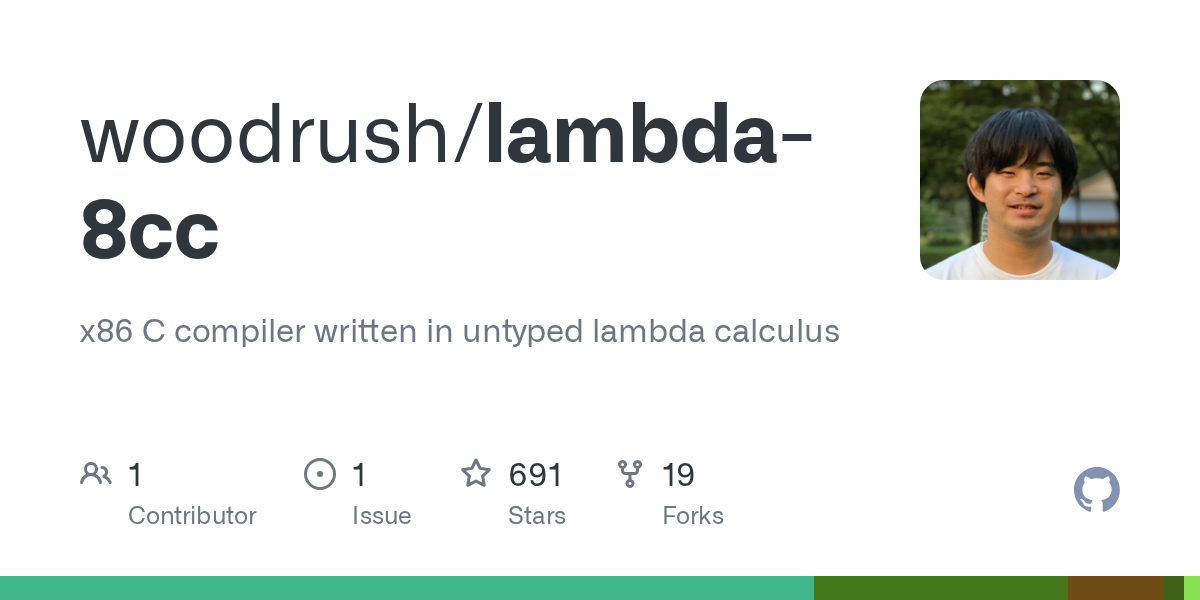
GitHub
x86 C compiler written in untyped lambda calculus. Contribute to woodrush/lambda-8cc development by creating an account on GitHub.
that's... insane
given it can compile to blc too, there's the zig backend 🙃
just use cbe and pipe it into that
low bramble
maybe once my language actually compiles (rn it only interprets) and i've written a bunch of code i'll do a retrospective
on not having booleans
 reef ridge
didn't read the whole thread, but I didn't see anywhere in the article comparison operators or boolean operators were handled.
also:
Does deep OR other_boolean have any actual meaning? I don’t think so.
sure it does. there's plenty of times where you have logic conditional on two things. just because they aren't true/false doesn't mean boolean algebra doesn't work on them, or make any sense.
it's the equivalent of:
traversal_mode == brief OR other_condition == whatever_truthy_variant_for_this_case
if you want that to be spelled out, that's fine with me.
only question I have is: what is the result type of the equality operator there?
low bramble
reef ridge
didn't read the whole thread, but I didn't see anywhere in the article compariso...
I didnt mean in the general case
I mean there are just a lot of cases where booleans are used for their cardinality instead of their operations
which includes this case
reef ridge
Ah yeah, definitely agree with the rough idea of the post. Just trying to ask in a challenging way to present the criticism
And I'm not sure what the result type should be of comparisons, if I didn't have bool. u1 would work but it would feel kinda clunky to me.
And I often store the result of a comparison in a local variable, so I can remember an earlier result while doing a related mutation or action, then have a different side effect afterwards.
 severe sparrow
@low bramble loved the read. very interesting idea to keep in mind  ✍️
✍️
 bold oxide
that one should use enums - or different methods - to select behavior in function params and avoid bool doesn’t alone mean bool isn’t useful nor needed.
low bramble
bold oxide
that one should use enums - or different methods - to select behavior in functio...
yeah, but i argued that you can move a lot of usages of boolean to integers
and a lot of other uses to custom enums
since bool is kinda overloaded
bold oxide
I disagree strongly. A set of flags (think config vars for instance) is booleans
and for instance that C ints decay into bools is actually a source of bugs
 crimson lotus
Ummm just use C ☝️ 🤓
edgy zinc
C has booleans
crimson lotus
In the stdlib
Not in the language well until c 23 or 22 idk but anything after c 10 is basicaly not c
edgy zinc
No, only in C89 did booleans not exist. C99 added them with the spelling _Bool and a header stdbool.h to give you a macro for bool. C23 just added the spelling bool as a keyword
austere aspen
i haven't read this, but i just came across this article and it reminded me of this https://justinpombrio.net/2025/09/22/imagining-a-language-without-booleans.html
low bramble
lol yeah i read that too
 pine halo
i feel like distinct types could solve a lot of these issues
low bramble
exactly
pine halo
i dont mean enum
low bramble
pine halo
i dont mean enum
wdym then?
pine halo
low bramble
wdym then?
like distinct types in odin