#shower thoughts drawing board- easier chain mail

1 messages · Page 1 of 1 (latest)

silent verge
#

Aight we all know chainmail is a tedious pain in the ass but what if that wasn’t the case?

Would It be possible to weave corkscrews of wire together ( kinda like how a chain link fence works but circles instead of diamonds ) then when you have your sheet size lay it on a flat surface snip the coils in place and then close the rings?

#

shower thoughts drawing board- easier chain mail

pliant wind
#

one could interlock two same way spirals, but you have not won a lot: you bought the "I coil it into one another" for having to make the spirals far wider than normal (you typically wind them tight on an arbor), and then having to cut them in very tight places, and bending them quite far to close..

silent verge
#

I know how to make chain mail yes I’ve done it before and yes I realize that if you only intersect them side by side you basically end up with rows of chain mail rings. What I meant by reverse is perpendicular like a basket weave of coils

#

Rough sketch but this

pliant wind
# silent verge I know how to make chain mail yes I’ve done it before and yes I realize that if ...

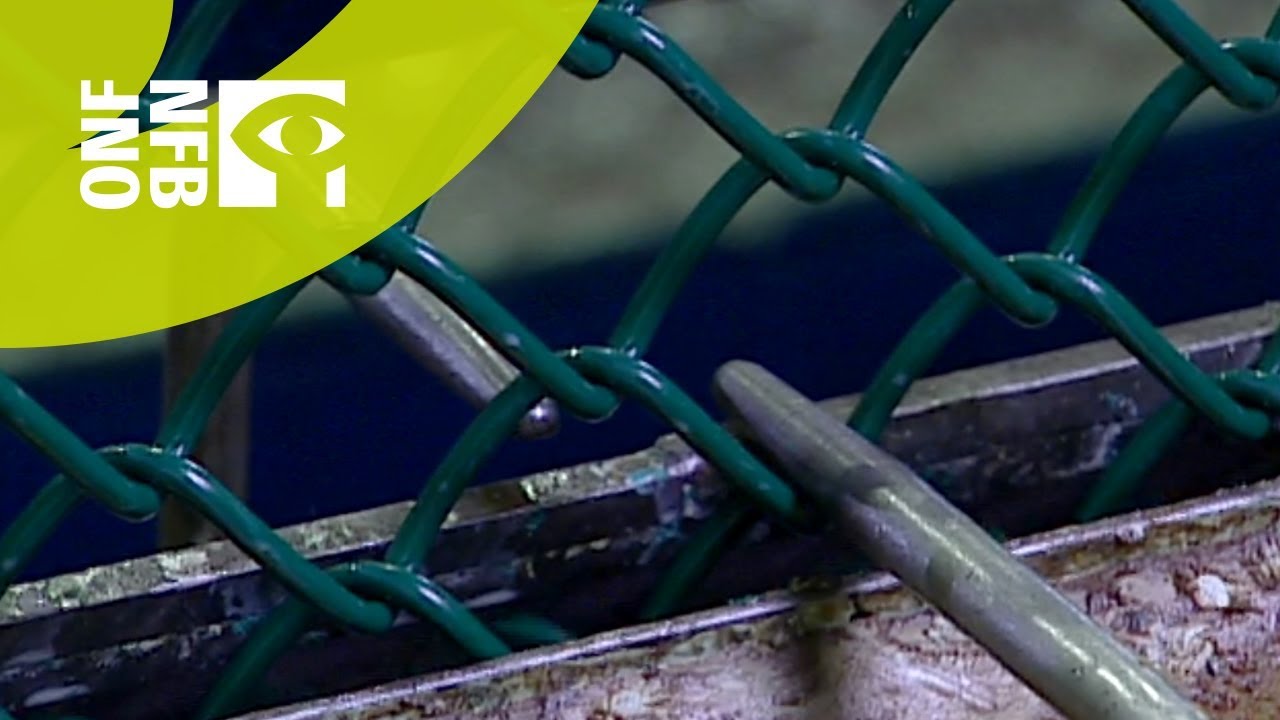
Chainlink fence is made with spirals of the same direction, interlinked like in the 2nd post, and then, in the end, just pulled. https://youtu.be/aIaif7IBeZA

NFB

How Do They Knit a Chain-Link Fence? is one of a series of short and snappy videos that reveal the mysteries behind how everyday things happen. Each of these fascinating little videos is without words. Ideal for teachers, How Do They... ? works across the curriculum. And the vieos answer questions kids often ask! How Do They... ? How Do They Kni...

▶ Play video
#

That method is fuly incompatible with chainmaile

#

as for your crisscross suggestion: Nope, doesn't work either, each "spiraling" of the up-down ones connect to nothing, as eliminating it to one rotation shows.

#

THIS is how industrial chainmail is made: a machine that adds one ring at a time by forming it right at the place it shall go.

silent verge
#

But if the cuts were made like this

#

Then when you but the reds together they would join across layers. Your example purposefully removed the useful sections. With maybe 3 rows and columns it would be clearer . Then after cutting those rings repeat the process perpendicular to the first. And I’m not asking about industrial processes I’m just trying to see if there’s a way to make handmade chain mail easier

placid yoke
#

but with metal...

silent verge
#

YES KINDA but the problem is it’s that is it would be pretty rigid like a fence

#

At some point I’ll do this experiment but I just don’t have the wire right now

pliant wind
silent verge
pliant wind
#

You overestimate how the stuff behaves. Also, with your pattern you could as well try to move closed rings onto the two wires in the first place, which would spare you half a dozen points where you break your fingers.

#

but you still won't be faster than looping up 4 closed rings on one open ring to make Quintetts, then connecting 2 quintetts by connecting a pair each, then putting them down flat and weaving in the missing rings to have a closed stretch.

silent verge
#

Speed isn’t my issue it’s I get frustrated with trying to thread the rings over and over.

I believe it can be done so the burden of proof falls on me. I will keep you updated when I obtain the wire to conduct the experiment I mainly made the post to spit ball over the idea until I gained the materials

pliant wind
#

I contend it might be tons of wasted work, especially considering you would need a special arbor to form the wider spaced spirals - typically you make the winding so tight, that wire is next to wire, which makes it very tricky to even do the interweaving.

silent verge
# pliant wind I contend it might be tons of wasted work, *especially* considering you would ne...

It might be but I’ll never truly know until I put it into practice. Also no you don’t. Just make a standard coil and then pull on the end to spread them. Simplified I know. But also I might get a couple springs from the hardware store to use as my coils just so I can test the principal. Although now I think about it I probably have some small springs I could use to test the theory if that’s all I’m doing. It doesn’t actually have to have the properties of the wire I would use just as long as the process works.

#

It will be more like jewelry chain mail instead of armor in terms of gauge but if the process works it should scale

pliant wind
#

Oh god, I rememeber the time I tried to use springwire to make chainmaile... It wouldn't stay closed.