#cyber-and-careers
1 messages · Page 107 of 1
 mossy pewter
I had looked into the RAF, but 12 years mandatory service is a big nope for me
lmao
nvm
google answered my questions
🙂
 spare kernel
mossy pewter
I had looked into the RAF, but 12 years mandatory service is a big nope for me
spare kernel
mossy pewter
I had looked into the RAF, but 12 years mandatory service is a big nope for me
The 12 years isn't mandatory. You can leave when you want
mossy pewter
spare kernel
The 12 years isn't mandatory. You can leave when you want
My uncle was RAF
he told me otherwise
medical discharge or no leaving was what he told me?
 quick forum
 mossy pewter
has it maybe changed?
quick forum
 spare kernel
It's a 12 year contract but they're not gonna force you to stay lol
mossy pewter
spare kernel
It's a 12 year contract but they're not gonna force you to stay lol
they do
that's how it works?
the only way to leave is medical discharge
and also, their cyber team is a reserve for the air force
so always a chance u get pulled into a warzone on the front lines lmao
 static tide
committing to 12 years of shit pay 😍
quick forum
It's possible but difficult to leave early
spare kernel
static tide
committing to 12 years of shit pay 😍
the dream
mossy pewter
yezzir
so appealing tho since it's so easy to get into
already meet all the requirements
but fuck that 12 year commitment
Would rather not be stuck there until my 30's
spare kernel
mossy pewter
so always a chance u get pulled into a warzone on the front lines lmao
RAF on the frontlines lol? They'd get some hotels built in the FOB to stay in
mossy pewter
spare kernel
RAF on the frontlines lol? They'd get some hotels built in the FOB to stay in
hahahahaha
fax
mossy pewter
spare kernel
RAF on the frontlines lol? They'd get some hotels built in the FOB to stay in
GCHQ CSF is the dream like
I figured they would really like RAF experience
but I think I could get there before my mid 30's
spare kernel
mossy pewter
I figured they would really like RAF experience
Yea I mean anything to do with the government / national security, they like former military. Idk tho, it's shit pay and not very fulfilling working at places like gchq, mi5 etc from what i've heard
mossy pewter
o really?
static tide
gchq is also shit pay
spare kernel
Lots of politics, nothing gets done
mossy pewter
Tbh I am not overlyyy concerned with pay, I just liked the sound of CSF since your protecting actual people rather than a corporation
and it is like the only real nation state work available for a UK resident
right?
or are there other avenues that could lead to OffSec operations?
I figured either military or GCHQ are the only real options
spare kernel
National Cyber Force, MI5, SIS, GCHQ might do offensive ops but no one would know
quick forum
mossy pewter
and it is like the only real nation state work available for a UK resident
CHECK pentesting puts you near government and CNI work at least
mossy pewter
spare kernel
National Cyber Force, MI5, SIS, GCHQ might do offensive ops but no one would kno...
GCHQ CSF has said they do OffSec operations iirc
lemme try find the post
quick forum
In a year of non-CHECK work, I have also done work I can't really talk about
spare kernel
I'm sure there's mil units that pull people from the raf, navy and army sigs to do offensive work tho
mossy pewter
quick forum
In a year of non-CHECK work, I have also done work I can't really talk about
v noice 🙂
slightly jeal
quick forum
Let me know when you've finished your BSc
 mossy pewter
quick forum
Let me know when you've finished your BSc
mossy pewter
quick forum
Let me know when you've finished your BSc
I for sure will 🙂
spare kernel
quick forum
CHECK pentesting puts you near government and CNI work at least
Def want to become a CHECK team member in a couple years
mossy pewter
will have a shitload of certs by then as well
 stoic cave
Wait, so you have a 12 year commitment in the RAF regardless of occupation? Or is that just for pilots
mossy pewter
stoic cave
Wait, so you have a 12 year commitment in the RAF regardless of occupation? Or i...
yes regardless of occupation
kinda shit 😦
was really interested in their 501 signals unit
they do all sorts of cool stuff
stoic cave
Damn, US only has those contract requirements for Pilots
mossy pewter
and again, you can be called into actual service at anytime when you are on the cyber force
which is also kind of a negative for me tbh
would rather not die lol
mossy pewter
stoic cave
Is that like reserves or something?
was lit typing that, yes
lol
have to go through bootcamp and weapons training etcetc
u beat me to it
I've had some email discussions with a Sergeant regarding it
Was super interested until I started hearing all the negatives 😦
stoic cave
Not going to tell you not to join, but you should join for the right reasons.
quick forum
@mossy pewter Mil Contracting >>>> Mil
mossy pewter
trueeeee actually
mossy pewter
quick forum
<@991789113168634002> Mil Contracting >>>> Mil
Also, out of interest, do THM take on any volunteer work?
mossy pewter
Ah fair play hahaha
quick forum
You can create rooms though
mossy pewter
chea, definetly going to get into that for sure
I think it'll be pretty useful for learning
Need to do some research on it
 warm hinge
What are your thoughts on WGU (Western Govern University)?
stoic cave
I can't speak to it, but I'm generally wary of online bachelor degrees. If you're older, from the US, you'll remember schools like ITT Tech
That being said, I haven't heard anything negative and if they're accredited that's a plus/requirement
warm hinge
stoic cave
I can't speak to it, but I'm generally wary of online bachelor degrees. If you'r...
Yes i remember ITT Tech, one of my good friends from high school went there and became a network engineer
I've heard good things also
I even went live on TikTok with shenetworks and she responded to my comments and said good things about SMU
so i figured WGU is the same
stoic cave
Yeah, ITT Tech was shut down for lying about job prospects, among other things
warm hinge
stoic cave
Yeah, ITT Tech was shut down for lying about job prospects, among other things
Really ?? No way
stoic cave
Yes
warm hinge
That I haven't heard. My friend has a legit job and everything
stoic cave
Or they closed themselves
I had thought they were shutdown

Forbes
The report details how ITT Tech systematically defrauded millions of students over decades, abused the federal financial aid system and left students weighed down with student loan debt and worthless credentials.
warm hinge
I haven't looked into them yet. Appreciate the feed back though, I'm a bit optimistic now that you didn't have anything negative to say about them so
warm hinge
stoic cave
https://www.forbes.com/sites/edwardconroy/2022/02/24/report-on-fraud-committed-b...
Wow
So they don't offer degrees or do they?
stoic cave
I'm not sure what they actually gave at the end
warm hinge
 stoic cave
I never looked into them before going to college
warm hinge
It closed in 2016
That's really interesting to be honest
I hope WGU isn't the same in any way shape or form
I didn't see in WiKi that they offered any degrees at ITT Tech
Just Certs
I guess the real assertion should be if the degree they offer at WGU will be accepted in most places to say the least.
stoic cave
It should be accredited
stoic cave
Find out who it's accredited by
warm hinge
stoic cave
Find out who it's accredited by
-NWCCU
-AWS Academy Membership Institution
-Cyberwatch Member
Also by CompTIA
So ITT Tech did offer Bachelors degree as well 🤔

That makes me weary of WGU now 
Honestly, i think it all depends on the person
And what you do with your degree and knowledge, i would assume
 flat sedge
stoic cave
I had thought they were shutdown
flat sedge
stoic cave
I had thought they were shutdown
Some of the campuses closed; one of the things that ITT (and other for-profit education did) is have multiple locations, but not all locations were accredited. Supposedly, it's the same program at all locations..... but in practice, the quality of graduates varied hugely, and degrees from unaccredited sites weren't worth the paper they were printed on.
stoic cave
flat sedge
Some of the campuses closed; one of the things that ITT (and other for-profit ed...
👍
 dire nest
Would you mind give me some clues about making portfolio that they like to accept as Fresher/Intern with zero experienced? Is it nice showing them what I research myself about specific network techs or cheatsheet/ networking code ?
 peak hazel
 nimble crow
Ew, New Jersey?
 pliant yacht
Do you guys have any knowledge about any good college to do Masters in cyber security from ? Any country
quick forum
quick forum
pliant yacht
Do you guys have any knowledge about any good college to do Masters in cyber sec...
Don't do a masters in cyber
mossy pewter
dire nest
Would you mind give me some clues about making portfolio that they like to accep...
This is how I got into my Bachelors
Just spoke about my interest in tech and security from I was 13
I had some voluntary software engineering and web dev work experience which helped too tbf
 kind glade
Is it worth it to have a lot of rooms completed on THM?
spare kernel
kind glade
Is it worth it to have a lot of rooms completed on THM?
Worth it for what? A job?
kind glade
spare kernel
Worth it for what? A job?
Yeah, from an employeer prespective
spare kernel
kind glade
Yeah, from an employeer prespective
It won't really mean much to them outside of showing that you actively engage in self-learning. The same way being in the top 1% doesn't matter to an employer
I personally wouldn't put the amount of rooms i've completed on my CV
You can put down that you use TryHackMe and other sites like HTB, especially if you don't have any experience. But as far as the amount of rooms, it doesn't really matter
kind glade
spare kernel
You can put down that you use TryHackMe and other sites like HTB, especially if ...
Thanks for your thoughts man
 serene umbraBOT
Gave +1 Rep to @spare kernel
flat sedge
nimble crow
Ew, New Jersey?
this late in the summer, it's very rare to see new internships get opened
stoic cave
kind glade
Thanks for your thoughts man
THM and HTB would go in an extracurricular category of the resume. Don't put it on as experience.
 polar rock

quick forum
kind glade
Is it worth it to have a lot of rooms completed on THM?
The skills you build are what have value, not the number of rooms completed
warm hinge
quick forum
Don't do a masters in cyber
Will a bachelors degree suffice? Why would you not what to do a Masters in cyber ? (extremely curious)
quick forum
The "don't do a masters in cyber" gets rehashed most days here
flat sedge
Multiple times a day, in some cases
warm hinge
quick forum
The "don't do a masters in cyber" gets rehashed most days here
I still don't quite understand. Does this mean the opinion about getting a masters degree changes often in here?
flat sedge
No, it means that this question gets asked (and answered) a lot.
flat sedge
Many people also see the answer and ignore it, because it wasn't what they were expecting or wanted to hear
warm hinge
I love those answers actually
More rational
So looks like the majority of the answers from knowledgeable people in here has been "no", yet others still seem to go for it knowingly.
I trust this a lot. Thank you! I will achieve it when I gain the experience, even if i want to at that point, don't think it would be entirely necessary if i just want to stay at a pentester role
quick forum
warm hinge
I still don't quite understand. Does this mean the opinion about getting a maste...
No, same answer every time but people want validation for their choices
warm hinge
quick forum
No, same answer every time but people want validation for their choices
You're correct. I need to stop doing this myself. I just like hearing other people's answers from (THM specifically) to do some reasoning on my own for when i decided to pick a a colloge. I found out here that the majority of the answers has been "not to get one" so therefore I will only go as far as getting my certs and possibly my bachelors degree if I get my financial aid accepted again
flat sedge
If you are going to do a B.Sc, I recommend a compsci and not a cybersecurity degree - it's a lot more broadly applicable, and it's served me to well for both breadth and depth across all the domains I've touched.
warm hinge
Ooooooh! I love that ! And let me tell you why I love that advice. I was literally thinking this myself the other day. I saw that computer science degree touches on cloud security and more !
Though I'm kinda iffy because there is cloud security courses in the cyber security program and not in the computer science program

 flat sedge
No. A CompSci will not touch on cloud directly (or at least it shouldn't...) but it will cover many first principles and foundational topics. That's a lot of certs that are IT specific and not CompSci. I don't think I'd trust that program.
warm hinge
flat sedge
No. A CompSci will not touch on cloud directly (or at least it shouldn't...) but...
You're correct, it's included in the security program not CompSci. Let me take more screen shots. The cyber security program has a pen testers course as well
warm hinge
flat sedge
No. A CompSci will not touch on cloud directly (or at least it shouldn't...) but...
So apparently there is a 3rd degree which is called "Network Engineering & Security, which i believe is catered to more of a 'management' role type if you want to go that route.
Here are the following Degrees and their courses and what they consist of. I feel as though the cyber sec degree is geared more towards what i want. What are your thoughts?
The Cybersecurity an Information Assurance program consist of:
-Secure Systems Analysis & Design
-IT Fundamentals
-Web Development
-Network and Security
-Scripting and Programming
-Information Assurance
-Ethics & Cyber Law
-Penteration Testing
-Hacking Countermeasures and Techniques
-Digital Forensics and Incident Response
-Technical Writing
-Risk Managment
-Wireless & Mobile Technologies
-Web and Cloud Security
-Data Management
The CompSci consist of:
-Computer Science (Includes: Computer Archeticure, Data Structures and Algorithins 1 etc...)
-Software (software Engineering etc.)
-Data Management
-Secure Systems Analysis & Design
-Operating Systems
-Technical Writing
-Scripting and Programming
-IT Fundamentals
-Business of IT
-Web Development
-Network and Security
There is also the Network Engineering & Security Degree which consist of:
-Scripting and Programming
-Web Development
-Network and Security
-Full Stack Engineering (Version Control specifically)
-Business of IT
-Networks
-Operating Systems
-Information Assurance
-Information Technology Mangement
-Data Management
-Web and Cloud Security
-IT Fundamentals
-Information Technology Managment
flat sedge
warm hinge
So apparently there is a 3rd degree which is called "Network Engineering & Secur...
That's not really management per se; that sounds very much like network admin and network security stuff.
warm hinge
By the looks, the cyber sec program has more courses that go over more things geared to pentesting roles rather than the comp sci? Would you still recommend going for the CompSci?
flat sedge
I think CompSci is a better degree. I don't know how respected WGU actually is, it's a pretty new university.
warm hinge
I would need to do more research on this. It is accredited by the following:
-NWCCU
-AWS Academy Membership Institution
-Cyberwatch Member
-CompTIA
warm hinge
flat sedge
I think CompSci is a better degree. I don't know how respected WGU actually is, ...
Not sure if this means anything but it's student loan default rate is less than half of the nationals average and well below their competition.
flat sedge
warm hinge
Not sure if this means anything but it's student loan default rate is less than ...
That doesn't mean anything.
warm hinge
Got it.
nimble crow
warm hinge
Not sure if this means anything but it's student loan default rate is less than ...
One, that's probably because they're new, and two, they heavily advertise to US military, meaning a lot of their students are on GI Bills.
That would significantly depress the rate of students needing loans and thus defaulting.
 lilac needle
Does anyone work in Digital Forensics? I have a job interview coming up for a forensics job and any advice would be greatly appreciated
 boreal zephyr
warm hinge
What are your thoughts on WGU (Western Govern University)?
boreal zephyr
warm hinge
What are your thoughts on WGU (Western Govern University)?
WGU is not a bad university for military or working professionals, especially for IT and cyber folks. They tailor their degree programs alongside industry certs, so you can obtain college credit and get a CompTIA cert or similar, at the same time. Additionally, WGU is self-paced. You could potentially get a degree very quickly, and come out of it very well credentialed. As others have said, it is heavily pitched to military for this reason. However, it is not an "engineering" school. You will not get an ABET degree from this school. That is a big deal in the US if you want to get into a large corporation, as it is often the factor that determines engineers from non-engineers.
warm hinge
Very interesting. I appreciate the feedback! So apparently SMU offers an ABET degree but they require a bachelors. I will look into this more. For now, i have made up my mind to get my bachelors at WGU @boreal zephyr
That coupled with extra-curricular activities such as THM, hackthebox, and my certifications in my resume will hopefully suffice to get into the role I want or at least an entry level role to start reaching my end goal
boreal zephyr
I wish you the best of luck! There are ABET bachelors out there, but they are rigorous. I know of people that have found success with WGU, and I personally have nothing bad to say about their programs. Feel free to reach out to me directly if you have questions.
warm hinge
boreal zephyr
I wish you the best of luck! There are ABET bachelors out there, but they are ri...
Wow, that's extremely comforting to know! I also have an ex friend that went there and has a job right now! I really appreciate your time and response on this and will definitely send you a ping down the line! Thanks a lot 🙂
serene umbraBOT
Gave +1 Rep to @boreal zephyr
warm hinge
nimble crow
That would significantly depress the rate of students needing loans and thus def...
Figured for the most part that it was because they were new. Thanks for your feedback
nimble crow
warm hinge
Very interesting. I appreciate the feedback! So apparently SMU offers an ABET de...
Southern Methodist?
warm hinge
nimble crow
Southern Methodist?
Yes, SMU
That's the one that shenetworks also recommended when she was live on TikTok
nimble crow
warm hinge
That's the one that shenetworks also recommended when she was live on TikTok
I just graduated from UNT up in Denton. If you're looking for college info, shoot me a DM.
 fringe rivet
Is https://pauljerimy.com/security-certification-roadmap/ still a bit up-to-date?
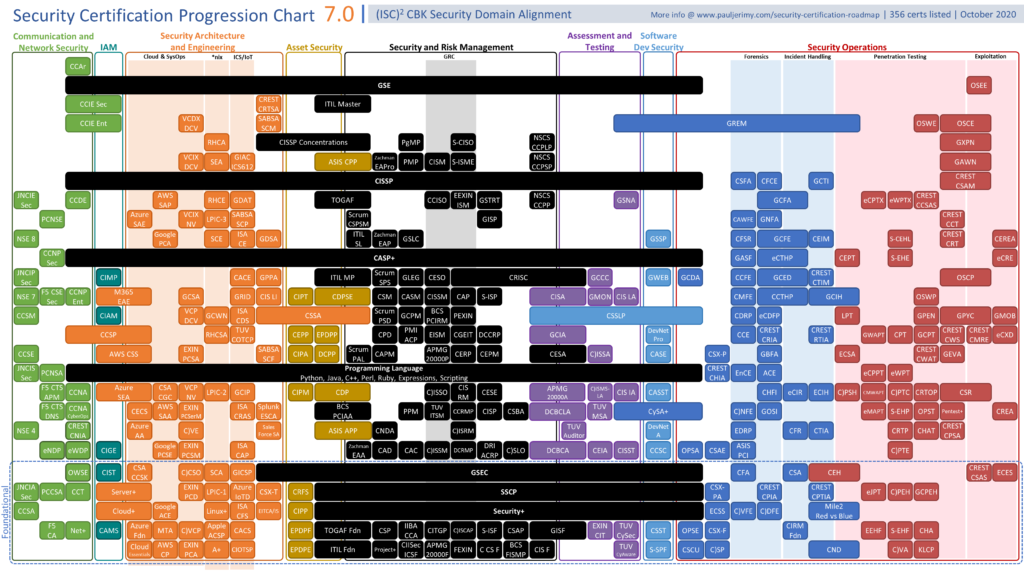
IT Security Certification Roadmap charting security implementation, architecture, management, analysis, offensive, and defensive operation certifications.
I think I'm a bit overqualified for a cert like OSCP (aside from AD skills) but other certs like OSEP seem too hard (also AD wise)
quick forum
fringe rivet
Is https://pauljerimy.com/security-certification-roadmap/ still a bit up-to-date...
It's still shit yeah.
fringe rivet
Alrightt 😂
fringe rivet
fringe rivet
I think I'm a bit overqualified for a cert like OSCP (aside from AD skills) but ...
OSEP also kind of seems outdated in the sense that it still teaches MS Office macros while MS is going to disable them
fringe rivet
Isn't AD like 1 out of the 25 chapters?
Ahh alright
🥲
Looks like I've got some homework to do
 tacit bobcat
fringe rivet
OSEP also kind of seems outdated in the sense that it still teaches MS Office ma...
tacit bobcat
fringe rivet
OSEP also kind of seems outdated in the sense that it still teaches MS Office ma...
I know that entire industries run on Excel macros...
peak hazel
I am curious is @fringe rivet going to aim for OSCP or OSEP ?
fringe rivet
peak hazel
I am curious is <@764591424502235157> going to aim for OSCP or OSEP ?
After doing some research I think OSED is the best choice for me as I'm more into binexp and vuln research
Although I wouldn't be surprised if I'm going to do OSCP in the near future regardless for job opportunities
peak hazel
Pentester academy has a few couses similar OSED to aid your journey like https://www.pentesteracademy.com/course?id=52 .
Pentester Academy
peak hazel
fringe rivet
Although I wouldn't be surprised if I'm going to do OSCP in the near future rega...
You got to go where the heart leads you 🙂 You can do it.
 undone shore
fringe rivet
After doing some research I think OSE**D** is the best choice for me as I'm more...
undone shore
fringe rivet
After doing some research I think OSE**D** is the best choice for me as I'm more...
It will be, yes, although if the exam is anything like OSEP in style, doing it without the build-up of the easier OSCP might be... interesting.
You definitely want OSED rather than OSEP though, from what I've seen of ya
mossy pewter
fringe rivet
OSEP also kind of seems outdated in the sense that it still teaches MS Office ma...
They are not completely getting rid of them
warm hinge
nimble crow
I just graduated from UNT up in Denton. If you're looking for college info, shoo...
Absolutely. Thank you 😊
serene umbraBOT
Gave +1 Rep to @nimble crow
peak hazel
If you were to hire pentesting mentor - what criteria and qalifications would you insist on as a mimimum ?
flat sedge
I wouldn't hire a pentesting mentor. Mentorship is as much personal relationship as it is professional; it's helping someone to guide their own career.
It sounds like you might be interested in hiring a tutor to teach you pentesting, that's a different thing entirely.
peak hazel
flat sedge
I wouldn't hire a pentesting mentor. Mentorship is as much personal relationship...
Yes, thats what I meant by mentoy - a tutor guide and just be on call for demos. What criteria would you look for in that person ?
flat sedge
I would ask in my present employment for the opportunity to shadow. And take a lot of notes about what they do, how they proceed, and try to understand the process of what they are looking for without being obtrusive.
I certainly wouldn't pay someone on the internet to tutor me
peak hazel
But you are lucky - not all of us have jobs with such opportunities ? 🙂 I did used to use one for teach some deeper AD stuff for work ages ago.
flat sedge
Pentest is not an academic discipline, it's an industry discipline. It has business value, and learning for it is best done as part of a practicum not in a teacher-student format
One of the difficulties of penetration testing is that it's going to be different on every engagement. Where do you think you are lacking with your pentest skills? Business side or technical? If technical, start learning the common products and configurations for those products. If Business, learning the reasons why a business engages a pentest is immensely helpful.
peak hazel
flat sedge
One of the difficulties of penetration testing is that it's going to be differen...
Ty! I think it's in the justification which I am sensing is why my learing isn't sticky. I understand in part the steps but I am failing to understand the reasoning ... why am I scanning for open ports and services when I can access why the web app or why should I run this type of nmap scan and not this and what are if I do ? It's a bigger rounded picture.
 pseudo creek
peak hazel
Ty! I think it's in the justification which I am sensing is why my learing isn't...
pseudo creek
peak hazel
Ty! I think it's in the justification which I am sensing is why my learing isn't...
honestly all that comes from having foundational knowledge... sounds like you need to work on your basics vs pentesting
Also, have you gone through a course like Practical Ethical Hacking by TCM? it is pretty comprehensive
peak hazel
pseudo creek
Also, have you gone through a course like Practical Ethical Hacking by TCM? it i...
I think you have hit the hammer with the nail! I am going thru the moties but not grasping theory. I got PEH but have not yet dived but will do otherwise doing the motions without knowing is mental block.
pseudo creek
peak hazel
I think you have hit the hammer with the nail! I am going thru the moties but no...
you can also ask here or other places for some specific questions
peak hazel
flat sedge
One of the difficulties of penetration testing is that it's going to be differen...
Thanks for your insight!
serene umbraBOT
Gave +1 Rep to @flat sedge
 peak wind
I will change my question a little maybe i didn't phrase it right. What is your guys view on a Senior SOC Analyst, does anybody here have some experience with this or maybe some insight?
I'm just asking out of curiosity to get more understanding from possible more experienced members or workers in this field...
spare kernel
peak wind
I will change my question a little maybe i didn't phrase it right. What is your ...
Are you asking what our personal views are on an individual who is a Senior SOC Analyst?? or are you asking what it is like to be a SOC Analyst?
peak wind
spare kernel
Are you asking what our personal views are on an individual who is a Senior SOC ...
No, i am currently a SOC Analyst for 2 years, doing mostly everything from investigation, triaging, creating and editing rules, playbooks everything mostly, with the help of our Senior IT engineers and this because we started the team from scratch with me being first in it.
I saw that most people here are going for the offensive side of cybersecurity and was curious if there are people who are currently working or worked as a SOC analysts and gone through level 1,2,3 or the senior one.
I kind of want to establish for further colleagues, for me and for the team itself some level mechanism, like to keep track of the experience everybody has or gets along the way, idk just thinking a bit in advance and wanted to hear some opinions from somebody more experienced in this...
pseudo creek
peak wind
I kind of want to establish for further colleagues, for me and for the team itse...
I've never been a SOC analyst but in general, senior can mean a number of things in various orgs. Generally a junior person is someone who takes guidance on their day to day tasks, with minimal independence. Now this doesn't mean someone is telling them every second of every day but they may be provided written guidance/procedures.
The transition from junior to less junior/towards senior is you can be provided guidance but need less handholding.
For my org, senior is a mid level title. At the senior level, you can be given general high level direction and no longer need handholding. You may also provide guidance/assistance to junior level employees.
Then you go above senior, you are the one determining the long term direction and strategy. You would provide guidance to senior level employees.
 rugged delta
peak wind
No, i am currently a SOC Analyst for 2 years, doing mostly everything from inves...
rugged delta
peak wind
No, i am currently a SOC Analyst for 2 years, doing mostly everything from inves...
Most people say they want to work in the offensive side but it's such a highly skilled and small selection of people that most won't get there. While there is a need for pentesters/red teamers, there's a higher need for defensive and engineering roles, process and compliance roles, investigation, etc... Hacking and CTFs are absoutely vital things to learn and should be encouraged for everyone but those skills need to be complimented with active training in defense etc... Those are where most of the unfilled cybersec roles lie...
peak wind
pseudo creek
I've never been a SOC analyst but in general, senior can mean a number of things...
Hey thank you for the detailed explanation, it's very helpful, i had a general idea about what senior could mean in a company but really great to hear others experiences, i see it the same way and it's good to know i got it somehow right 🙂 Many thanks for your insight.
serene umbraBOT
Gave +1 Rep to @pseudo creek
peak wind
rugged delta
Most people say they want to work in the offensive side but it's such a highly s...
Yeah i think so also, the offensive and defensive are interconnected and knowledge on both sides is clearly needed but i personally found myself more suited for the defensive part, at least for now.
I'm starting to get more and more into the offensive side also for better understanding of how things work but still want to continue with the defensive part of it when it comes to work.
Many thanks for the insight also 🙂
serene umbraBOT
Gave +1 Rep to @rugged delta
 glossy tree
peak wind
Yeah i think so also, the offensive and defensive are interconnected and knowled...
glossy tree
peak wind
Yeah i think so also, the offensive and defensive are interconnected and knowled...
Hey, Im about to apply for SOC analyst jobs, but I just recently finished my bachelors, what are skills/certs/projects that i should include in CV sir?
peak wind
glossy tree
Hey, Im about to apply for SOC analyst jobs, but I just recently finished my bac...
I came to this position from an operations side and with little experience in the cybersecurity domain, with more general IT knowledge. I don't have any certs except some IT courses from my country and some that i've obtained online from various sources like Udemy etc
In general with some IT knowledge and some experience on an IT position you can get hired pretty quick on an SOC analyst level 1 position, with little to no experience on a former similar position and without any certs.
Regarding needed certs CCNA and Security+ would really give you a boost i presume but can't say 100% because i don't have them, i said that maybe until next year gonna get at least Security+ just for the sake of having it and testing my knowledge..
warm hinge
As recruiters are asking more and more for soft skills, here's an event I saw dedicated to improving them.
Free and online, ofc on July 6th and 7th
Here's the link: https://event.50intech.com/summit
peak hazel
warm hinge
As recruiters are asking more and more for soft skills, here's an event I saw de...
Where is the full URL or please provide more details? I could be interested. Ty
serene umbraBOT
Gave +1 Rep to @harsh harness
warm hinge
@peak hazel
https://event.50intech.com/summit is the full url
from their page, it says that the evnt lasts 2 days
"Two afternoons of influential women in Tech sharing their key learnings, actionable advice, and answering your questions LIVE with every single masterclass having a 30-minute Q&A session !"
List of top soft skills and how to improve them, career advices
peak hazel
Cheers @warm hinge -I am not a woman but good skill to have anyway.
warm hinge
from what I read, it's opened to everyone, so if you're interested you could still go and see
 copper nebula
Hey guys hope y'all are doing good just want to know what's your opinion about 2 columns in a resume ? and your opinion about 2 pages in a resume for a student ?
stoic cave
copper nebula
Hey guys hope y'all are doing good just want to know what's your opinion about 2...
I personally don't like columns. In my mind it should be single column in a neat and orderly manner. Look at AwesomeCV which uses LaTeX and you'll see what I am talking about. As a student, and in general, resume should be a single page.
copper nebula
And Another thing is certificates of completion for example CISCO: Cybersecurity Introduction or PentesterLab Badges worth mentioning in a resume instead of projects ? Last can I drop my resume here for advices ?
 merry matrix
I would not mention “certificates of completion” over projects as projects are real demonstrations of technical abilities, whereas random certificates can be handed out by anyone, aren’t really proof of you doing any work depending on the course, and typically aren’t industry recognized.
You can drop your resume here (personal info redacted) for others to review 🙂
copper nebula
I don't have permissions I think to send any files 😥
 dire rivetBOT

 TryHackMe
Verify your TryHackMe Profile!
From TryHackMe with ❤!
 stoic cave
So, I think this already looks decent visually
But the thing that immediately caught my eye was the double column for skills when everything else is single column
Languages should go in skills as well
copper nebula
You think something like this is better
 flat sedge
I wouldn't list programming languages you don't feel comfortable actively working in
stoic cave
Primary, and then order the other two in order of proficiency
flat sedge
But really, listing more than 1 language per category of language is overkill
stoic cave
flat sedge
I wouldn't list programming languages you don't feel comfortable actively workin...
This
copper nebula
so do I add scripting in my core skills that's enough
flat sedge
1 garbage collected, 1 that requires you to manage memory, maybe an OS scripting language
stoic cave
I'm going to assume English is your second language, I would run this through something like grammarly in order to fix some of the smaller grammatical errors
flat sedge
think about it from a business perspective; what value does your scripting bring?
copper nebula
stoic cave
I'm going to assume English is your second language, I would run this through so...
actually its my 3rd xd
flat sedge
for the roles you've had, it is appropriate to list the industry tools you've used
if you used a tool for static and dynamic analysis', put those on
stoic cave
Yeah, that was my next thing. Your skills should be specific technical skills, not just broad categories
copper nebula
flat sedge
if you used a tool for static and dynamic analysis', put those on
like mobsf
stoic cave
One or two broad categories may be fine but I'd try to narrow it
flat sedge
no need to include python when talking about django, as ALL the backend code is python
Position of Responsibility is not a good section heading
If it's related to school, lump it into Extra Curriculars
copper nebula
Okay, so for skills do I add spoken languages and remove languages or put them in my core skills
flat sedge
Unless other languages are relevant to the role, I wouldn't include spoken languages
stoic cave
I think for mine I did "programming" for the coding languages and the languages for the spoken
But that's also true
copper nebula
And Another thing I'm a bit confused over my current internship I'm doing a Security Audit to a Mobile Application but I don't know how to label my role is "Security Engineer Intern" a good title
stoic cave
What's your title on your employment form?
I wouldn't give yourself your own title i dont think, what about you juun?
flat sedge
your title is something that gets covered as part of orientation
Don't just make it up
copper nebula
"Cyber-security consultant"
flat sedge
Were you actually a consultant as an intern?
stoic cave
Then that's what you put
flat sedge
consulting is very different than traditional roles
The role title should have also been on the job req that you applied for
copper nebula
flat sedge
Were you actually a consultant as an intern?
I'm in the internship, But I didn't apply for the job they offer me the internship
the primary task that I have is detection of flaws and vulnerabilities in a mobile app
stoic cave
Do you have an employee portal that you can use to see your current title?
copper nebula
No they don't have that, is it weird to ask my tutor about my current title
copper nebula
Okay I'll try to thank you so much for your time sir appreciate it
warm hinge
boreal zephyr
I wish you the best of luck! There are ABET bachelors out there, but they are ri...
Hey there I find it a bit odd that WGU is requiring for me to take the A+ exam since they didn't accept my high school diploma (because i didn't take any IT related classes), is this normal procedure ?
 remote gale
I have a question I want to ask is it compulsory to learn Data structures and algorithms if you want to crack big companies as a cybersecurity analyst?
Actually my college placements are going on. So on the second week of August there will be companies who will visit to hire us.
I have the basic knowledge of C, Bash nd Python. I also know how to write good code and about basic networking related things
My placement office coordinator thats what we call him here said it is necessary to have an excellent grasp of DSA as a fresher
He told me that my knowledge of networking and os wont do any good if I cant clear the first round
First Round: Technical round. Have to solve coding questions
Second Round: Technical interviee
Third Round: HR Interview Round
quick forum
DSA isn't really a cyber security thing.
Cyber security analyst isn't a software engineering role
remote gale
I see. Sir, can I ask how a fresher can crack a job in cybersec?
nimble crow
remote gale
I have a question I want to ask is it compulsory to learn Data structures and al...
DSA is software engineering, not really cybersecurity.
remote gale
nimble crow
DSA is software engineering, not really cybersecurity.
He was also my college professor
warm hinge
If anyone is interested I just found out about 'Cyber Now Labs' from watching Mike Meyers from Total Seminars live today. He really recommends it for job placement anywhere in the world.
I'm going to do some more research on this btw!
According to him they have a 90% job placement rate since they have a dedicated department for it.
warm hinge
It is a 21 week program that is quite costly apparently and not they don't just take anyone
warm hinge
warm hinge
It is a 21 week program that is quite costly apparently and not they don't just ...
They take anyone that pays? 😄
nimble crow
warm hinge
According to him they have a 90% job placement rate since they have a dedicated ...
There are a lot of ways programs like that can fudge their placement numbers up to and including just offering short contract work to graduates to say "hey, we found them a job".
Ask me how I know.
warm hinge
nimble crow
There are **a lot** of ways programs like that can fudge their placement numbers...
I wouldn't doubt this to be true with some organizations, yes.
warm hinge
nimble crow
Ask me how I know.
How do you know?
nimble crow
warm hinge
How do you know?
Lol, I attended one. It's not to say they're scams; I certainly learned a lot, but I was also halfway through my bachelor's in computer science. However, because it was paid for by a veteran jobs' program, they only get half the money up front, and the other half when students can submit a form demonstrating it got them hired.
So they offered me the opportunity to do some contract work for a week to meet the requirement, then never bothered to actually look at or use the work I did.
 sleek sedge
 coarse tartan
are you guys pro cause i need help
coarse tartan
are you guys pro cause i need help
what do you need help with?
warm hinge
nimble crow
So they offered me the opportunity to do some contract work for a week to meet t...
I'm sorry to hear that! I've never done any of these programs in the past.
Honestly, I think it's best to just apply for jobs and hone your skills to be able to get job offers.
nimble crow
I mean, they're not entirely scams, and I found my way here through having been through one such program, but be extremely skeptical about placement rates at graduation.
warm hinge
I mean not saying they are scams, but I always think it's best to just get a job opportunity.
Like I wouldn't do unpaid internships either as I don't think it is ethical.
Since unpaid internships are geared towards the privileged who can afford it.
Either way, I always say the best way to go is do a lot of projects, engage with community, refine your CV and apply for opportunities.
nimble crow
I mean, I wouldn't recommend paying out of pocket for it, as I certainly didn't.
peak hazel
How to answer this question at interview: During a pentest you come across an application not responding as expected, what will you do ?
 broken idol
Try and resolve it.
If use whichever task killer of the OS you're on and end it, restart it. and work from there.
And record when I closed until when I opened it, probably.
I'm not a pentester so I couldn't know for certain the true steps, I feel Juun or James could best answer this.
peak hazel
broken idol
And record when I closed until when I opened it, probably.
Thanks Scrubs! Hopefully more Pentesters chip in ?
static tide
contact the client 🤷♂️
the client would also appreciated asking them and getting it resolved in 10 mins rather than you spending hours of their money trying to get it in a working state yourself
but yeah the question is very vague so that’s how i’d answer it unless they clarified
peak hazel
Cheers for your answers! I clearly failed that question as I said that I would look to see why this is the case  Does this mean this app is out of scope ?
pseudo creek
broken idol
Try and resolve it.
If use whichever task killer of the OS you're on and end it...
Uhh I’d totally be wtf is a pentester tried to resolve issues with one of our systems / applications
broken idol
pseudo creek
Uhh I’d totally be wtf is a pentester tried to resolve issues with one of our sy...
The more you know, thanks.
serene umbraBOT
Gave +1 Rep to @pseudo creek
peak hazel
pseudo creek
Uhh I’d totally be wtf is a pentester tried to resolve issues with one of our sy...
Please can you clarify 🙂
pseudo creek
peak hazel
Please can you clarify 🙂
A pentester is not a system admin / application admin, it is out of their scope to resolve issues. Now a pentester could poke around to see if they see anything 'off' but they shouldn't really be doing things like restarting services
peak hazel
No! I just had a video Teams interview and this one question made my mind freeze.
peak hazel
pseudo creek
A pentester is not a system admin / application admin, it is out of their scope ...
Great insight! Thank you @pseudo creek
serene umbraBOT
Gave +1 Rep to @pseudo creek
pseudo creek
but I'm also on the side of jake, you could poke around for a few minutes to see if you find something unusual but you shouldn't wait too long to contact the client / responsible system / application admins
We also ask some vagues questions when interviewing as we like to see the persons thought process but I think we’ve only had a handful of people ask clarifying questions
peak hazel
pseudo creek
We also ask some vagues questions when interviewing as we like to see the person...
I should do this more often! Sometimes I am just stuck in Question/Answer mode I forget too do that. Great advise.
flat sedge
peak hazel
How to answer this question at interview: During a pentest you come across an ap...
Depends on what is meant by 'not responding as expected.' Scope confirmation that the host and ports are in fact in scope for the technique you're using. If the ports are being filtered, there's something else going on and that is likely to be a thing you don't have control over.
boreal zephyr
the client will want to know if one of their services isn’t functioning properly, as it may have an impact on the outcome of the pentest. It is not in the scope of a pen tester to triage. It would be in the scope to identify what service and gather pertinent information, how they found it, when, etc. then they should report it to the test lead and let them make a determination whether to continue the test or pause to inform the client so their own sysad team can triage.
If the client is internal, typically situations like this would be identified in the master test plan. If it’s an external client, likely would be covered in the SLA.
 static heron
Maybe this is where the benefits of starting in support show themselves 😄
nimble crow
Light the tower on fire and flip the table.
Find the server and perform an exorcism.
Smudge as needed.
rugged delta
If you find an unresponsive application on a pentest, the best advice would be to not touch anything, don't even disconnect from the box. Get in touch with the assigned contact (your team lead/the assigned client contact etc) and only discuss your findings with them. Let them negotiate the admin side of it and notify you about how to proceed.
If you find an unresponsive application on a red team exercise, they're obviously not paying too much attention to this box, or it's a trap. Wipe the logs, discconnect and pretend you were never there until discussing the final report. /s
quick forum
peak hazel
How to answer this question at interview: During a pentest you come across an ap...
It's not your job to fix the application. If you're meant to be testing it and it isn't working, you talk to the client.
If you aren't meant to be testing it, why are you looking at it?
If the client hasn't fixed it a good way through the job, you need to write it as a limitation in your report.
 glass zinc
rugged delta
If you find an unresponsive application on a pentest, the best advice would be t...
glass zinc
rugged delta
If you find an unresponsive application on a pentest, the best advice would be t...
"If you find an unresponsive application on a red team exercise, they're obviously not paying too much attention to this box, or it's a trap."
- Sorry, what trap? Why is an unresponsive app considered a trap?
quick forum
Honeypot
rugged delta
 fiery badge
in a week
fiery badge
in a week
Yeah you take the exam that week and pass it
glass zinc
It's tough, almost impossible I would say... but.. what have you got to lose by trying?
glass zinc
You haven't paid for it already?
rugged delta
fiery badge
is there a way to pass the CEH v11 exam
There's a lot of stuff to learn, unless you're familiar with the field already you won't do it in a week
glass zinc
Then, you will lose them if you try or not try?
I mean, you paid for it anyway. Is it possible or not is irrelevant
fiery badge
it is but i require a bit guidance
thats all
like atleast much to bolster my confidence to do it and work in a more efficient manner rather than just reading all of it
rugged delta
fiery badge
i passed in one mock and failed in the other
It really depends on your current knowledge and the amount of work you're willing to do. You'll need to satisfactorily cover the 20 modules of the course to a reasonable level
fiery badge
i can say 50 50 satisfaction
 vernal elm
20 years in the IT field and want to make the hop to cyber security. Been looking and applying for jobs, but no luck. I need to up my networking game.
 vernal elm
why do you say that?
mossy pewter
vernal elm
why do you say that?
Not overly well regarded
fiery badge
in india it is tho
mossy pewter
fiery badge
in india it is tho
Really?
fiery badge
yup
mossy pewter
Never seen anywhere else where people like CEH
Apart from shitty companies that r behind the times
 glossy jetty
Isn't even good to get past HR?
fiery badge
i have done CND OSCP and a few but CEH is itself a hindrance
mossy pewter
glossy jetty
Isn't even good to get past HR?
In UK, not particularly
glossy jetty
Copy
mossy pewter
For US Detroit area and Ontario Canada
fiery badge
so i gotta wind that exam in a week
mossy pewter
I have also not really seen it included
Those r the only places I really look at PenTest jobs
Not looking to move company atm but I like to keep an eye on what certs are valued
CEH is not one
In the areas I look at
mossy pewter
fiery badge
but i am yet to get a job because the pay is really low for us
Fair play
I mean u gotta do what the employers want at the end of the day
If my boss wasn't so obsessed with Microsoft exams I would NEVER go near them
Soooooo boring
glossy jetty
I bet they're at least better than Soti's 😛
 glossy jetty
😂 I had a good laugh
glossy jetty
The moment someone realises they're going to achieve fuck all with that 😂
fiery badge
"immune to malware and attacks" proceeds to get rekt in a coffee shop
with public wifi
 pearl panther
What is the best way to make a long post here? can we do threads somehow?
 forest osprey
pearl panther
What is the best way to make a long post here? can we do threads somehow?
forest osprey
pearl panther
What is the best way to make a long post here? can we do threads somehow?
Break itt up into pieces ig
forest osprey
Hey, is there any legitimate way to earn some money as a 16y/o within cyber?
mossy pewter
forest osprey
Hey, is there any legitimate way to earn some money as a 16y/o within cyber?
Bug bounty
Good for CV's as well
forest osprey
mossy pewter
Bug bounty
Are here lower tier bug bountys available?
I dont think i stand a chance against full development teanms from big companies haha
quick forum
forest osprey
I dont think i stand a chance against full development teanms from big companies...
I don't think you understand what bug bounty is
forest osprey
quick forum
I don't think you understand what bug bounty is
Huh?
quick forum
It's not a software development thing.
forest osprey
quick forum
It's not a software development thing.
Nah i mean, that i dont think i wontbe able to find exploits in applicatitons from such big companies
quick forum
You'd be surprised.
quick forum
I do not recommend bug bounty though, and you can't sign contracts until you're 18 so you can't do bug bounty.
forest osprey
quick forum
I do not recommend bug bounty though, and you can't sign contracts until you're ...
Hmm fair enough
Are prized ctfs maybe something?
mossy pewter
forest osprey
Nah i mean, that i dont think i wontbe able to find exploits in applicatitons fr...
maybe u aren't ready to make money in cyber yet then
just keep getting better
money will come eventually
also good point from James regarding not being 18
didn't even think of that
forest osprey
mossy pewter
maybe u aren't ready to make money in cyber yet then
Yeah thought about that one too
mossy pewter
forest osprey
Yeah thought about that one too
How are ur fundamentals
Networking, Programming, etcetc
forest osprey
mossy pewter
How are ur fundamentals
pretty good, started with programming
mossy pewter
noice 🙂
forest osprey
fluent with python, comfortatble with networking
mossy pewter
good u didn't jump straight into something like PenTesting
forest osprey
Oh, yeah. When i started hacking i only did HTB using walkthroughs lmao
had to create a new acc cos the old one had too many cheated boxes on, but learnt from it so
coarse tartan
hey anyone here knows what a diploma is?
quick forum
coarse tartan
hey anyone here knows what a diploma is?
Google definitely does...
coarse tartan
should you do diploma and then opt for engineering?
quick forum
Whatever you're asking, it needs one hell of a lot more context.
quick forum
A cybersecurity engineer position?
coarse tartan
yeep
quick forum
Have you looked at several listings on LinkedIn?
quick forum
You gotta research
coarse tartan
ninja where u from?
quick forum
It's a fundamental skill in infosec.
coarse tartan
quick forum
You gotta research
k
quick forum
Please stop the walls of text, you can type in sentences. Even multiple in a single message!
Why does it matter where I'm from?
 bold solar
👍
pearl panther
Is it ok to link to a Reddit post I made about career?
 slow zealot
I'm not sure if this question has been asked before but here goes; I'm currently in the army, I have sec+, I work helpdesk, and my contract ends 2026 in Feb. I'm trying to set myself up for success so I can get a great role as soon as I get out. I've been looking at Security Engineering or SOC Analyst as one of two career paths I want to take. I have found tons of information on how I could break into the Analyst role but not much on how to break into the Engineering role. What certs, training platforms, or/and other tools would guys suggest will get me at least decently employable in an Engineering role by 2025?
flat sedge
slow zealot
I'm not sure if this question has been asked before but here goes; I'm currently...
Does your current role have a clearance? If so, jumping into the world of gov contracting is probably the fastest way to get a job once you are out.
Depends on what you mean by engineering. Product dev? Systems engineering? Cybersecurity or infosec engineering? There's a lot of variability there.
If you are going for a SOC role, knowing a SIEM (like splunk or ELK) is very beneficial. Security engineering is probably going to be more a network security role, but not always.
And remember that titles, roles and duties aren't the same across industry.
slow zealot
flat sedge
Does your current role have a clearance? If so, jumping into the world of gov co...
By engineering, I was thinking of the guys who build and improve the systems that the SOC analysts use to monitor for threats.
slow zealot
flat sedge
Does your current role have a clearance? If so, jumping into the world of gov co...
Also, yes I have a clearance.
flat sedge
slow zealot
By engineering, I was thinking of the guys who build and improve the systems tha...
Unless you are working product dev specifically for infosec tools, that is more likely to be be infrastructure or architecture. "Building and improving systems" is a pretty vague category - are you talking about the actual product development, or the systems implementation based on an architecture?
slow zealot
flat sedge
Unless you are working product dev specifically for infosec tools, that is more ...
Let's say implementation based on an architecture.
flat sedge
slow zealot
Let's say implementation based on an architecture.
"SRE" is going to be the great thing to get familiar with
pseudo creek
Security engineering will rely on technical certs for whatever technologies. A networking cert is great as well as a cloud cert. Security+ is good and then eventually CISSP.
Having a clearance and working gov, I’d look at Azure cloud certs although AWS is still used
slow zealot
pseudo creek
Security engineering will rely on technical certs for whatever technologies. A ...
So, for technical certs, you mean Linux and Windows certs?
slow zealot
pseudo creek
Depending on what you want to focus on
I would love to work as a member of a team that DIRECTLY deals with addressing cyber threats but not just staring at logs all day.
pseudo creek
slow zealot
I would love to work as a member of a team that DIRECTLY deals with addressing c...
well if you want to work with a team directly dealing with cyber threats, then you want to go into DFIR
usually their title isn't security engineer but can be
DFIR Diva has a lot of good resources for that https://dfirdiva.com/

DFIR Diva
Digital Forensics & Incident Response Blog Geared Toward Beginners. Free & Affordable Training, Resources, DFIR Related Events for Beginners.
slow zealot
"A security engineer will also need to deal with initial design, implementation & configuration of both the tool and the integration, and testing. On an on going basis, engineer will also have to deal with maintenance, support, problem diagnosis, vulnerability and patch management, monitor vendor releases, any cert management, etc. So engineering has much more periodic tasks with regard to the upkeep of the tool." This is what I think of when I say engineering.
 paper grove
pseudo creek
DFIR Diva has a lot of good resources for that https://dfirdiva.com/
paper grove
pseudo creek
DFIR Diva has a lot of good resources for that https://dfirdiva.com/
I love her site. So many great resources
pseudo creek
security engineer is the most common job title in cyber security, it can mean a million things
pseudo creek
slow zealot
"A security engineer will also need to deal with initial design, implementation ...
so what do you mean by 'deals directly with cyber threats' because that job title isn't what I'd envision
like for DFIR, if it is determined a cyber threat may have occurred, the DFIR team would investigate, determine what happened and when, would also potentially find out what remediations may need to be put in place
slow zealot
pseudo creek
so what do you mean by 'deals directly with cyber threats' because that job titl...
By "deals directly with cyber threats" I meant for example improving the SIEM/SOAR tools because a bad actor was able to bypass security measures or a SIEM tool is showing too may false positives.
slow zealot
pseudo creek
security engineer is the most common job title in cyber security, it can mean a ...
This is why I was trying to be more descriptive rather just throw out job titles.
pseudo creek
slow zealot
By "deals directly with cyber threats" I meant for example improving the SIEM/SO...
yeah I think if you want to work with SIEM/SOAR tools, you'd want to start out as a SOC analyst, which may involve looking at logs initially... I'd get familiar Splunk
slow zealot
pseudo creek
yeah I think if you want to work with SIEM/SOAR tools, you'd want to start out a...
What if I want to skip being a SOC analyst and go straight to being the guy building and improving the SOC analyst's tools, is that possible?
pseudo creek
slow zealot
What if I want to skip being a SOC analyst and go straight to being the guy buil...
would depend on the company, if you got extremely familiar with those tools and were able to show that knowledge somehow, maybe
slow zealot
pseudo creek
would depend on the company, if you got extremely familiar with those tools and ...
Ok. btw, thanks for your patience.
serene umbraBOT
Gave +1 Rep to @pseudo creek
pseudo creek
no worries
pearl panther
@pseudo creek is it okay for me to share a link to a reddit post I made about career?
mossy pewter
https://itmasters.edu.au/free-short-course-pen-testing/
Cool course I found, comes with a free exam and certification at the end 🙂
Good for da CV if u can't sit any certs right now I'd imagine
pseudo creek
pearl panther
<@740248496283713617> is it okay for me to share a link to a reddit post I made ...
as long as it isn't part of some drama rule #2 or you don't post it all over the place rule #3
pearl panther
Cool. I just haven't gotten any replies on reddit and it seems like I won't so I just want to see if I can get some input from here.
This basically explains an opportunity coming up and how I feel about it, what advice can be given about it, and mostly I am wondering if its truly a once in a lifetime type deal. Mainly I am gathering this data to build a better argument for my wife, who doesn't want to relocate, however I am absolutely sick to death of my job and I need change.
mossy pewter
Well, sounds like u got pretty friendly with the guy and showed ur passion and drive
which is the hardest thing to find
u can teach anyone Cyber Security skills, but u can't teach passion
U have obviously proved that passion, hence why he wants you on his team
Definitely not once in a lifetime, but yes, I'd say it is a pretty great opportunity
pearl panther
Thanks
I think once in a lifetime is a bit extreme, but my feelings are essentially that if I don't gun for this, that I will be stuck at my shitty job for another 3-4 years while I finish my education and then try to find a job in cyber.
My main predicament is that we have two children and my wife wont work ... So I can't take very much of a pay cut to get a low tier tech job, like help desk, which generally is offering about $8 less an hour than what I make now.
My wife seems to think that this kind of thing is normal and that I should be able to build this type of relationship with any head of cyber security through LinkedIn, but I'm pretty convinced this has way more to do with their internal hiring habits than my charisma over LinkedIn messages ...
pseudo creek
pearl panther
I think *once in a lifetime* is a bit extreme, but my feelings are essentially t...
So as someone who works for a large organization, it is fairly normal. Reputation / Internal recommendations can get you a lot. Like if you've had good reviews from your management even in a different role, it can hold a lot of weight...
On the downside, they also often use opportunities like this to underpay people. It is cheaper to get an internal candidate in there than an external, especially if going from a non-tech role to a tech role.
pearl panther
My current leadership has been incredible through all of this. I'm not sure what the chain of communication actually looks like, but they've mentioned many times trying to talk me up to their own seniors, and trying to do the same for anyone at HQ if they can. This is another reason why I think this is so golden for me.
So what's the catch with pay? Should I do some more research and get more comfortable negotiating and expect to negotiate?
pseudo creek
you can try to negotiate, but they will probably use your current pay to justify underpaying you what they would otherwise pay someone else and they will tell you things like its a 'growth' opportunity and may promote you in a year or 2 depending on performance
pearl panther
bastards ...
but thank you for the insight
What are some other things I could potentially try to negotiate? Do you think it will stay pretty standard or do you think I could get a lower pay with some better benefits or stock options?
pseudo creek
you can ask, never hurts to ask for more vacation time and such
 faint ice
pearl panther
What are some other things I could potentially try to negotiate? Do you think it...
faint ice
pearl panther
What are some other things I could potentially try to negotiate? Do you think it...
some people shadow has heard have asked if the companies they work for can sponsor trips to defcon
 low crest
hey people, can I find a job with 0xD GOD rank without any acquaintances?
by without acquaintances, I mean the employer is not my acquaintance
low crest
pseudo creek
no
can I get a job with pentest + certificate?
quick forum
Yes
low crest
I dont have to start a "career", I just wanna earn some money to cover my university fees
low crest
quick forum
Yes
cool
quick forum
low crest
I dont have to start a "career", I just wanna earn some money to cover my univer...
Doesn't have to be a cyber job
low crest
quick forum
Doesn't have to be a cyber job
sorry, is this a question?
pearl panther
faint ice
some people shadow has heard have asked if the companies they work for can spons...
I’m actually signed up for a shadow program right now. Just waiting to get the session actually scheduled.
quick forum
low crest
sorry, is this a question?
No, it's a statement
pearl panther
faint ice
some people shadow has heard have asked if the companies they work for can spons...
But yeah I’ve thought about the trips a lot. I hope they do sponsor those things.
low crest
quick forum
No, it's a statement
ok, got it, thx for the answer
serene umbraBOT
Gave +1 Rep to @quick forum
 plucky marten
https://www.linkedin.com/jobs/view/3153694206
Someone from India who has PNPT can apply here. (:
mossy pewter
pearl panther
What are some other things I could potentially try to negotiate? Do you think it...
Am I remembering wrong or did u not say they were offering double ur current pay?
pay should not be an isssue or something u need to negotiate if they r offering double what ur on now
take it, upskill, then get a pay rise
mossy pewter
Did a bit of a rewrite to the LinkedIn bio for my current role.
All feedback is appreciated 🙂
 stoic cave
If thats under your role, I'd say its too much information @mossy pewter
Keep it bulleted like you do on a resume honestly
The stuff regarding your team is also OPSEC somewhat, and isn't specifically about you
If you want to expand like this, the account bio would likely be the best place
peak hazel
mossy pewter
Did a bit of a rewrite to the LinkedIn bio for my current role.
All feedback is ...
What you written would look very nice on a CV as it is detailed and provides useful information about your skills. Have you tried browsing Linkedin for other profiles ? This provides you with more insight. Expand on your OPSEC roles or discuss a THM pathway you have completed to link it to cybersec skills - just me thoughts 🙂
quick forum
Too verbose for a CV.
peak hazel
OMG! THis is HilArious: https://www.youtube.com/watch?v=UWe4aMPAyvc

👑 Visit https://brilliant.org/PIRATEKING/ to get started learning STEM for free, and the first 200 people will get 20% off their annual premium subscription.
🏴☠️ Shout out to Brilliant for sponsoring this video!
⚙️ My YouTube & Couch Setups: https://www.piratekingdom.com/tech
💰 Free Stuff 💰
💵 Get 5 FREE Stocks on WeBull (up to $3000): https://...
rugged delta
peak hazel
OMG! THis is HilArious: https://www.youtube.com/watch?v=UWe4aMPAyvc
"so if you want to find out what I offer I accepted, wait until you hear all about my sponsor..." boring sales pitch... skip... skip... skip... "I'm not going to tell you about the offer I accepted, for reasons..."
 calm badge
Hi everyone, I have an interview next week for a security engineer(soar engineer) position. I passed the initial interview it was about my experience in soc and before that. The job is about preparing playbooks to automate detection and response through SOAR. I will have to write python code for the most part.
For the second interview, I am supposed to prepare a case study. They haven't send me the details yet. What kind of case study should I expect since the job is mostly about managing the soar platform itself (which has its own learning curve) and writing python code.
stoic cave
Not sure how I feel about that. Is this common juun?
flat sedge
Usually some kind of problem to show reasoning ability is common
If they have given you a problem they are actively working on, that seems really sus.
stoic cave
Right, but you having to provide a case study?
flat sedge
Have to wait on the details of what they want
stoic cave
That seems like a lot of work for an interview
flat sedge
Case studies are an output to teach something to the rest of the team
This sounds like a mid- to senior level position
You should see the process that architects have to go through to get hired/promoted where I am
stoic cave
I mean, where you are, I'd see it as understandable. The thing that stuck out to me was bringing the work to the interview.
If it was a longer interview where you have to work through a problem, I don't think i would have asked you for more information
 soft parcel
What are your guys thoughts on WGU cybersec bachelors degree?
flat sedge
Too new of a program
soft parcel
Not reputable enough?
flat sedge
could be good, but no reputation that i can see yet
soft parcel
I see
soft parcel
flat sedge
could be good, but no reputation that i can see yet
Any programs that you know of that are?
flat sedge
for cybersec? I know some "good" programs exist, but I don't know of any off hand. Unless you have a very specific focus, compsci is a better major.
soft parcel
so WGU compsci major it is hahaha
 severe lagoon
Hello everyone, I'm doing MSC cybersecurity in the United Kingdom. I'm really worried about my career because everyone is looking for experience, but fortunately, I still have one year left to complete my degree. Can anyone recommend the best career path to enter the cyber security industry, as well as certifications which can land me on job without experience ? I appreciate it.
 inland temple
Hi, so i just graduated from college with an IT/cyber security degree and i feel like i didnt get the full extent of learning from online school so i've been trying to learn through different methods. I have having a hard time remembering things. The thing is once i do something i can remember doing it, i just cant remember like if i am just sitting here. Does anyone have any good ideas on having the information stick in my brain. I am also trying to start a career in cyber security but it seems like you need 3+ years before you can even get an entry level job. Any advice will help and be greatly appreciated.
rugged delta
severe lagoon
Hello everyone, I'm doing MSC cybersecurity in the United Kingdom. I'm really wo...
Most people working in cybersec have had some experience in IT/Programming etc. A lot of companies do want to hire people with experience but as well as your MSc, other cybersec certifications can go a long way with the HR bots/people. Certs like Security+, OSCP, CISSP and others help a lot and a lot of 3rd level colleges do have work experience placement or at least have resources to assist you in finding positions.
I would recommend checking out the Tribe of Hackers books by Marcus J Carey and the Hakin9 free edition of 'How to become a hacker' from their website...
https://www.amazon.com/Marcus-J-Carey/e/B07MFWJPGV?ref=sr_ntt_srch_lnk_1
https://hakin9.org/download/hakin9-open-become-hacker/

Follow Marcus J. Carey and explore their bibliography from Amazon.com's Marcus J. Carey Author Page.
Hakin9 - IT Security Magazine
Dear readers, Due to popular demand we decided to prepare a special issue dedicated to those of you that seek an answer to the ultimate question: “How to become a hacker?”. When you refer that question to
rugged delta
inland temple
Hi, so i just graduated from college with an IT/cyber security degree and i feel...
Cybersecurity is a very complex pursuit and none of us remembers everything all the time. It's good practice to take notes while you're reading about things, following courses and performing actions like building applications and performing admin or hacking tasks. There's lots of applications to help, like CherryTree or Notepad++ and others, and even a Notepad or similar app can help a lot.
It's also valuable to have a pen and paper to write notes and draw diagrams and scribble things as you go and then revise them later. Then practice, practice, practice. It's okay if it doesn't work when you're learning
stoic cave
severe lagoon
Hello everyone, I'm doing MSC cybersecurity in the United Kingdom. I'm really wo...
Do you have any prior experience in the computer space? With getting a masters, you've more than likely priced yourself out of entry level positions unfortunately. I'd look at a way to gain professional experience while still in school, internship/part time if possible, somewhere in the computer space. If you don't have security+, I'd look into it.
rugged delta
There are also lots of help facilities like man pages in Linux, cheat sheets for lots of things like Nmap etc and using a search engine is a skillset in itself
stoic cave
Keep in mind that Cybersecurity is not an entry level field. In most cases it takes some amount of experience in another facet of the computer space.
Sometimes things go your way though
rugged delta
Yep it's a long and fascinating journey with plenty of challenges but there's lots of tools and resources to help you out
inland temple
great info thanks
 stoic bramble
stoic cave
Keep in mind that Cybersecurity is not an entry level field. In most cases it ta...
stoic bramble
stoic cave
Keep in mind that Cybersecurity is not an entry level field. In most cases it ta...
I'm doing full time self study 😅
It's been 2 years from 0 programming knowledge
Sometimes I doubt my VR dream...
Any advice
:)
stoic cave
stoic bramble
I'm doing full time self study 😅
It's been 2 years from 0 programming knowledg...
Get some professional experience
Something like IT, where you can grow your skills and network
Self learning is very different from gaining experience on the job
inland temple
I personally tried to do internships in any IT field over the last year and got nothing. Even internships are difficult now
rugged delta
And most jobs will require continuous learning in this space
rugged delta
inland temple
I personally tried to do internships in any IT field over the last year and got ...
Most internships tend to be reserved for 3rd level placement these days
flat sedge
inland temple
I personally tried to do internships in any IT field over the last year and got ...
Internships require the candidate to be a student, either vocational school or university.
quick forum
If this is the UK, we have graduate programs too
inland temple
yes I was in school while applying to interships
stoic bramble
stoic cave
Get some professional experience
I wanted the shortest way(do or die) to VR so I dropped formal education and went straight googling and reading books
Stupid decisions but I'm learning a lot (0 programming to writing some windows shellcode now)
But as u said earlier...gaining real world experience is hard
stoic cave
VR?
stoic bramble
stoic bramble
I wanted the shortest way(do or die) to VR so I dropped formal education and wen...
Im still stuck with this
 distant pier
inland temple
Hi, so i just graduated from college with an IT/cyber security degree and i feel...
distant pier
inland temple
Hi, so i just graduated from college with an IT/cyber security degree and i feel...
Join your local BSides, establish local person-to-person connections and network with people who have gone before you into the industry. 😎
stoic bramble
stoic cave
VR?
How do you actually gain real world experience 🥲
stoic cave
As I mentioned before, start somewhere in the computer space. IT is a common starting point for a lot of people
stoic bramble
:) thanks
flat sedge
Open source tool dev is a great thing to have on your portfolio. If you can quantify what you've learned in a way that benefits the cybersecurity community as a whole, that's a great way to start your social network.
rugged delta
IT support is usually the entry point for most folks. Making connections is invaluable
stoic bramble
And can anyone land VR(vuln research, exploit dev) jobs without formal education degrees 😬
Ahh stupid questions :/
inland temple
distant pier
Join your local BSides, establish local person-to-person connections and network...
What is BSides?
distant pier
inland temple
What is BSides?
Local conferences organized by volunteers. More information here: http://www.securitybsides.com/
rugged delta
stoic bramble
And can anyone land VR(vuln research, exploit dev) jobs without formal education...
Vulnerability research and exploit dev are advanced topics and you would usually need to have a reputation with people in the field and quite a bit of experience to be taken seriously. Also if you don't know what you're doing in those fields and you cause an incident, accidentally or otherwise, you can be held liable for your actions.
For instance, as part of my cybersec college course we had projects for malware analysis and we were informed that, even though we were expected to find sources for active malware, we would be investigated by the police for any security breaches that occured.
stoic bramble
rugged delta
Vulnerability research and exploit dev are advanced topics and you would usually...
🧐 ohh
Thanks
Btw
Where did you go for cybersec ?
College?
serene umbraBOT
Gave +1 Rep to @rugged delta
rugged delta
stoic bramble
🧐 ohh
Thanks
Btw
Where did you go for cybersec ?
College?
I went to a 3rd level college in my country. Any time you are undertaking cybersecurity exercises, you need to do so within the framework of the law. That's why platforms like THM were developed, to provide a place where we could learn things that would otherwise be considered illegal, dangerous or dumb to do in the real world. We also had to study law in the cybersec space
stoic bramble
rugged delta
I went to a 3rd level college in my country. Any time you are undertaking cybers...
College s here don't have any cybersecurity options 💔
stoic bramble
stoic bramble
I wanted the shortest way(do or die) to VR so I dropped formal education and wen...
I am so wrong for this
But I guess Ill just have to find ways forward
No choice
rugged delta
stoic bramble
College s here don't have any cybersecurity options 💔
There's always professional certifications
 kindred pollen
Would like some advice on my current plan to get into the IT field. Have been working full time while going to school, have one more semester left to get my associates in Cyber/Information Security. I plan on working to get my A+ during this final semester and looking to make the transition from my current field and get into a help desk job to start my career since I have no prior experience. After I get settled into the field, will probably be applying for a program to work towards my BA.
rugged delta
Cybersecurity is a personal journey. People can guide and advise you but it's up to you to explore and to do the work. You'll get a lot out of it for what you put in
stoic bramble
rugged delta
There's always professional certifications
Like ?
stoic bramble
rugged delta
Cybersecurity is a personal journey. People can guide and advise you but it's up...
Yeh :)
rugged delta
stoic bramble
Like ?
Security+ and other CompTIA ones, CCSP/SSCP/CISSP and other ISC2 ones, the ISACA ones, OSCP and other Offensive Security certs, specific ones for AWS/Azure/GCP, Linux certs, Windows certs... There's certs for every level and every discipline and that list isn't comprehensive
stoic bramble
rugged delta
Security+ and other CompTIA ones, CCSP/SSCP/CISSP and other ISC2 ones, the ISACA...
Thanks a bunch :)
I'll look into this
serene umbraBOT
Gave +1 Rep to @rugged delta
rugged delta
kindred pollen
Would like some advice on my current plan to get into the IT field. Have been wo...
That's a good plan. Most people start in a helpdesk role during/after college. Certs like A+, Network+, Security+ are good introductions to the field at that level. Working towards your BA is a good idea and there's lots of other professional certs too.
stoic cave
You still need experience to go with those certs
stoic bramble
stoic cave
You still need experience to go with those certs
😬ahh yes
rugged delta
stoic cave
You still need experience to go with those certs
Of course but getting the certs is part of the journey and you have to start somewhere. Getting a few CompTIA certs is a good start without even having a job or while getting helpdesk work
kindred pollen
rugged delta
That's a good plan. Most people start in a helpdesk role during/after college. C...
Thank you for the feedback!
serene umbraBOT
Gave +1 Rep to @rugged delta
rugged delta
stoic bramble
It's going to be much harder than I thought :/
We all start at the beginning. We've all learned things through practice and we've all gotten help and advice along the way. Spend your time learning and practicing. Make that a habit and the rest will happen
stoic bramble
rugged delta
We all start at the beginning. We've all learned things through practice and we'...
Sure,
Thanks 👍🏿
I'm learning and practicing full time :)
Few weeks back, I was practicing my RE skills and successfully patched IDM(internet download manager)...it was a great success for me :)
I tried fuzzing with Winafl but didn't go far as I was fuzzing with i3 duo core 😂💔
serene umbraBOT
Gave +1 Rep to @rugged delta
fringe rivet
What kind of organizations would want exploit developers? I don't assume it's just NSO and the NSA (who get their exploits from NSO) right?
^I'm talking about binary exploit development, not webapp etc
stoic bramble
Nvm
I know nothing hah...
stoic bramble
Suggestions anyone...¿Any great org or college or anything for cyber security¿ Physical not online
 hollow ice
fringe rivet
What kind of organizations would want exploit developers? I don't assume it's ju...
hollow ice
fringe rivet
What kind of organizations would want exploit developers? I don't assume it's ju...
I imagine red team companies might. Things like Dragos
stoic cave
Find a program that fits your needs and has a good reputation, accredited, etc
 spark yoke
Hello every one I'm new to cyber security and want to ask a couple of questions. I'm currently doing self studys for cyber security and I use to go to school for Comp Science and after a while I realized that I actually wanted to major and focus of Cyber security. Of course for reasons i had to stop attending and now after a while I'm back on my studys and want to get a job in CS so I wanted to ask whats the best way to get a job in this field? i was thinking of going to a CC because i dont have a lot of money atm but I wanted to see what would benefit me the most? at my nearest CC they have programs such as certs for info security and cyber defense and an AS in cyber defense only
stoic bramble
stoic cave
Find a program that fits your needs and has a good reputation, accredited, etc
It's quite hard to find any good ones here
Anyway 👍🏿
fringe rivet
spark yoke
Hello every one I'm new to cyber security and want to ask a couple of questions....
Get a college degree, certs and do CTFs. but the answer depends on your location
hollow ice
spark yoke
Hello every one I'm new to cyber security and want to ask a couple of questions....
A lot of the low tier boot camps/certs from colleges are just money grabs operated by a third party. So you have to be careful it’s not a waste of money.
spark yoke
hollow ice
A lot of the low tier boot camps/certs from colleges are just money grabs operat...
yeah thats what im also worrying about
tbh im just trying to get my foot in the door right now but i know i need something that would give me the knowledge as well help me to get a entry level job
im thinking to also doing the EHC and Comptia Security + but other than these 2 what would also benefit me
?
stoic cave
Remember, you're going to need some level of professional experience for entry level positions in cybersecurity
Certs and degree will help but they don't always let you skip the line
hollow ice
Some people don’t like it, but yeah, entry level cyber security is mid tier it career. Yes some people do skip the line. But it’s much more difficult.
I’m not a good example but I was a sysadmin for 10 years before moving to cyber security full time. I could have moved sooner if I didn’t live in a terrible area and have serious imposter syndrome 🙂
Security+ for sure, but skip CEH if that’s what you meant. Let a job pay for that piece of paper if they require it.
stoic cave
Don't get CEH unless the job pays for it
Outside of India, it's pretty much useless at this point thankfully
spark yoke
hollow ice
Security+ for sure, but skip CEH if that’s what you meant. Let a job pay for tha...
thanks for the info
serene umbraBOT
Gave +1 Rep to @hollow ice
spark yoke
stoic cave
Don't get CEH unless the job pays for it
thanks
spark yoke
stoic cave
Remember, you're going to need some level of professional experience for entry l...
So how would i go about getting experince
?
stoic cave
Getting a job
spark yoke
lol
stoic cave
Helpdesk is a common starting point
spark yoke
stoic cave
Helpdesk is a common starting point
ok lol i was about to ask what would be a good job to start with?
stoic cave
Are you in school again
spark yoke
stoic cave
Are you in school again
yeah i reenrolled but i havent started yet
stoic cave
Ah ok
Internships will be available to you then too
If your school has an IT club or something, join it
If it doesn't, find a professor who will cosign
Ask your IT dept I'd you can shadow or see if you can get a student position up
spark yoke
stoic cave
Ask your IT dept I'd you can shadow or see if you can get a student position up
oh thats an amazing idea i really appreciate all of this info
 raven oar
Hey guys, I am recently graduated in Cyber security from college, and I have security+ on hand. Can anyone suggest what type of job is a good start point in this case?
 sonic widget
raven oar
Hey guys, I am recently graduated in Cyber security from college, and I have sec...
sonic widget
raven oar
Hey guys, I am recently graduated in Cyber security from college, and I have sec...
Congrats bro
 lost storm
Probably SOC Analyst
spare kernel
raven oar
Hey guys, I am recently graduated in Cyber security from college, and I have sec...
SOC analyst or help desk
They’re the most likely starting points. Especially if you didn’t put the time in during college to actually research the field you’re going into lol
coarse tartan
raven oar
Hey guys, I am recently graduated in Cyber security from college, and I have sec...
can we directly choose a cybersecurity course from college . or do have to learn everything online?
broken idol
coarse tartan
can we directly choose a cybersecurity course from college . or do have to learn...
Some colleges offer it, have a look in your area.
coarse tartan
broken idol
Some colleges offer it, have a look in your area.
where do u give the exam?
coarse tartan
broken idol
Some colleges offer it, have a look in your area.
and is the knowledge learnt online less important in the portfolio
broken idol
coarse tartan
where do u give the exam?
Well, with my college course it was all done in college.
Or at home last 2 years due to covid.
 royal walrus
Is it recommended to go for CEH as the HR admires CEH if we want a job?
stoic cave
royal walrus
Is it recommended to go for CEH as the HR admires CEH if we want a job?
Are you in India?
hollow ice
Is CEH highly sought after in India specifically?
 hoary sierra
I work for a company as Detection Engineer. We're looking for 2 positions Senior Adversarial Emulation Engineer and Senior Detection Engineer. How do I post to the Jobs-board
 jolly gyro
@hoary sierra You'll have to talk to Hydra I believe
 worthy shoal
hollow ice
Is CEH highly sought after in India specifically?
worthy shoal
hollow ice
Is CEH highly sought after in India specifically?
Yeah CEH is great in India and pretty bad in the rest of the world for the most part
hoary sierra
jolly gyro
<@256425002851631106> You'll have to talk to Hydra I believe
Thanks 🙂
serene umbraBOT
Gave +1 Rep to @jolly gyro
 stone plinth
i don't understand they say there is a big cybersecurity shortage and i couldn't find an internship
stoic cave
Because Cyber specific internships are hard to come by
it's not exactly a business area that orgs want to put really green people
flat sedge
stone plinth
i don't understand they say there is a big cybersecurity shortage and i couldn't...
Most of the manpower deficit is in mid and senior level security roles, not entry level
stoic cave
By expanding your search to include other areas of the computer space, you may have better luck
 vestal siren
i heard a lot of people go in via IT helpdesk, then try work their way up
stone plinth
i just feel like my degree is useless
stoic cave
IT is the starting point for a lot of people, yes
stone plinth
wish i didnt get a degree but started as helpdesk
stoic cave
Degrees are useful
stone plinth
i'm 4 th year student studying network and telecommunication engineering and couldn't even land an interview
stoic cave
Just because you didn't get a cyber specific internship, doesn't mean you can't apply for other areas
stone plinth
how much time is minimum for an internship ?
stoic cave
Internships after graduation aren't exactly common
Internships are generally 3 months if over the summer
stone plinth
lol i was asking for 1 month cuz that all i have left no wonder i couldnt find any
flat sedge
stoic cave
Internships after graduation aren't exactly common
that said, they aren't uncommon either. Typically internships are open to students who graduate in the same summer as the internship
stoic cave
Yeah, I saw a few when I was first applying out of school
Probably didn't see the bulk as I wasn't specifically looking
royal walrus
stoic cave
Are you in India?
Ya...India
undone shore
royal walrus
Ya...India
Might be worth it for HR then, but won't be for learning. By all accounts it's an absolute BS cert, but many Indian companies still seem to like it.
If you have to jump through the hoop, best advice is get the cert and forget everything ASAP -- chances are it will be out of date or outright wrong.
warm hinge
What would you guys suggest CySA or SBT L1 or Sec+ for a SOC Analyst role?
 manic mural
warm hinge
What would you guys suggest CySA or SBT L1 or Sec+ for a SOC Analyst role?
manic mural
warm hinge
What would you guys suggest CySA or SBT L1 or Sec+ for a SOC Analyst role?
I started with Sec +. Gives more foundational knowledge. CySA is a litte more advanced and Sec will set you up
warm hinge
I was thinking about SBT L1 as it is practical based examination😅
manic mural
warm hinge
I was thinking about SBT L1 as it is practical based examination😅
I have yet to take on of their cert exams so I cant speak on it, I only have CompTIA certs 🤣 and working on SSCP
 supple sorrel
Hey guys, did you see my post about the Virtualization Engineer job in #jobs-board ? Really cool opportunity for all my network engineers out there who have a talent in the virtualization side of things. 😁
peak hazel
What are your thoughts Pen-100 offsec vs CyberMentor PNPT ? Love to hear or if you feel Pen-100 is not worth it and hold out for main event 😉
pseudo creek
peak hazel
What are your thoughts Pen-100 offsec vs CyberMentor PNPT ? Love to hear or if ...
not really worth it...
I mean if you are doing the courses for PNPT, you'll get anything that is already in pen-100
glass zinc
I've had my first pentest intern interview today, I thought I could share the questions I received (although it was only 10mins long):
- SQLi - What it is, what types exist, how it's mitigated
- XEE - What it is, what types exist, how it's mitigated
Also, "sanitization" isn't really an answer to all of these. I recommended sanitizing the input of user to prevent both of these, in one of two ways:
- Removing all non-allowed character
- Returning an error as soon as one of these is identified and blocking the entire input
The counter question to that was: "What would you do if you had to accept all input, regardless of what it was". The answer for SQLi was prepare statements and for XEE was HTML encoding
Reading through THM, I never expected anyone to ask me what types of SQLi and XEE exist, so I didn't really bother memorizing it (I just understood it and knew it well enough from my head). But, as it turns out, someone actually asks that stuff
I was also directed to this website as a hint for the future: https://bobby-tables.com (hopefully I can share the link?)
merry matrix
glass zinc
I've had my first pentest intern interview today, I thought I could share the qu...
All good points to remember, if your goto answer is sanitization with limited follow up, you’re probably going to be expected to answer more.
quick forum
glass zinc
I've had my first pentest intern interview today, I thought I could share the qu...
Removing special chars is not the best answer for either. Look at the perfectly valid surname O'Brien which has an apostrophe.
The proper method is handling the input safely with prepared statements
glass zinc
True. Funny thing is I've used prepare statements and html encoding, but I just never really connected the dots to answer this properly the first time
glass zinc
quick forum
Removing special chars is not the best answer for either. Look at the perfectly ...
Also, I guess it's a case-to-case basis. I've only worked in non-sql databases in recent years, so the prepare statement never really applied to my day-to-day stuff unfortunately
quick forum
The owasp guides are really good
glass zinc
Yeah. Still got a ton of learning to do, but getting there. The interviewer actually asked about koth on THM, but I unfortunately haven't had success with that yet. Still, progress is being made 😄
quick forum
glass zinc
Also, I guess it's a case-to-case basis. I've only worked in non-sql databases i...
Not really case by case. If you're doing SQL, you should be using prepared statements or an ORM
glass zinc
quick forum
Not really case by case. If you're doing SQL, you should be using prepared state...
Case by case as in
- doing sql
- not doing sql
quick forum
Well, if you're not doing SQL then you don't have to worry about SQL injection....
glass zinc
Yeah, but the question was about sanitization techniques case by case. Eh, whatever, just miscommunication
 somber timber
im planning to buy subscription on INE to take ewpt and emapt. which subscription is recommended? does fundamental is enough? or should i go for premium?
 upper pelican
what area in cyber security do you guys think is most in demand?
pseudo creek
upper pelican
what area in cyber security do you guys think is most in demand?
probably GRC
warm hinge
upper pelican
what area in cyber security do you guys think is most in demand?
Honestly, any communications/writing role seems to be in demand IMO
And Cloud
peak hazel
somber timber
im planning to buy subscription on INE to take ewpt and emapt. which subscriptio...
I hope am not to late to save you $$$ . Please don't there are loads of better options to use like TryHackMe, Virtul Hacking labs and Proving Grounds. Why ? Recently a friend of mine subscribed to access matrieals he accessed 3 months: Same membership monthly plan but the prices had rocketed and loads of coursese were no longer available .
somber timber
peak hazel
I hope am not to late to save you $$$ . Please don't there are loads of better o...
My plan was to take fundamental plan, prepare for ewpt and emapt while take ejpt for free because i dont have ejpt. So dont buy subscription?
peak hazel
somber timber
My plan was to take fundamental plan, prepare for ewpt and emapt while take ejpt...
I can only advertise from my perspective but if you re feeling brave - give it a go and you may have better luck than myfriend.
Definitely! For insight from users - it's worth checking https://community.ine.com/

INE Community
Welcome to the INE Community Forums dedicated to our students' learning experience by encouraging interaction with each other as well as INE Staff & Instructors. The structure of these boards match my.ine.com to make navigation more intuitive.
somber timber
peak hazel
Definitely! For insight from users - it's worth checking https://community.ine.c...
it helps alot. thank you so much
serene umbraBOT
Gave +1 Rep to @peak hazel
 potent sundial
How useful is eJPT for somebody trying to start a career in cybersec?
quick forum
Not massively
potent sundial
then what cert would u recommend ?
warm hinge
potent sundial
then what cert would u recommend ?
Not James but usually the Security+ is a good one to start with
potent sundial
warm hinge
Not James but usually the Security+ is a good one to start with
I see, what abt going with Net+ first before that?
stoic cave
potent sundial
I see, what abt going with Net+ first before that?
Do you have any prior professional experience?
Net+ is fine, CCNA is also an option
 pallid flower
potent sundial
How useful is eJPT for somebody trying to start a career in cybersec?
pallid flower
potent sundial
How useful is eJPT for somebody trying to start a career in cybersec?
Definitely useful for learning purposes, especially if your plan is to get into pentesting. For getting a job, I don't think it'll help a bunch alone, but you gotta start somewhere. 👍
potent sundial
stoic cave
Do you have any prior professional experience?
no,im currently in 2nd year in uni
stoic cave
potent sundial
no,im currently in 2nd year in uni
With you still being in school, I would wait until you get closer to graduation and then get certs. That way they won't expire before you graduate. While you're still in school see if there are any clubs/societies that you can join that relate to IT/Cybersecurity, see if they allow students to work on helpdesk as like a work study, make a Homelab, and start writing a resume so that way you can try to get an internship next summer.
 daring steeple
How to Leverage Online Training To Achieve High Paying Careers
https://tryhackme.com/resources/blog/online-training-for-careers
 brazen gate
Hello. I have a question. I am in my final year of college, in a non-CS degree. I have started learning cybersecurity in February. I will likely take a programming job after I graduate in about a year. So, for the next two or three years, what would be the best course of action for me to prepare myself for a good entry-level cybersecurity role? How does work experience factor into the job I will get?
I unfortunately don't have a lot of peers who are in or are pursuing this field, some of the pointers I have picked up are to build a home lab, write blogs, beef up my LinkedIn profile, and bug bounty. Any tips on these would be appreciated as well, for someone with beginner/low-intermediate experience like me.
 stark marlin
brazen gate
Hello. I have a question. I am in my final year of college, in a non-CS degree. ...
stark marlin
brazen gate
Hello. I have a question. I am in my final year of college, in a non-CS degree. ...
Hey  , I would say build a good portfolio under your belt that other people can see, Like a blog, YouTube videos, participate in CTFs etc. also for learning path that depends a lot on which field you are aiming for like Red teaming or blue teaming i would say stick to THM/HTB like platforms in general but to specialize and learn more attacks in Red teaming for example you can setup your own labs, try doing certs like CRTO, CRTP,CRTE,OSWE, OSCP etc. For blue teaming on top of THM/HTB you can use cyberdefenders try to detect attacks on a red team lab and basically try setting up and learning a lot of the software's that are used like FTK Imager/Autopsy/Splunk. Also experience factoring really depends on the position and country you are applying as imo most places having developer background will help you in getting a entry/mid levelish cyber job though it can also not really factor depending on the location and what your future employer is looking for
brazen gate
Thanks! What should someone inexperienced such as myself consider when writing blogs? Should I just write on any topics that I feel like, as long as they are well-written? Or should I focus more on topics that are less talked about?
stark marlin
brazen gate
Thanks! What should someone inexperienced such as myself consider when writing b...
id say go with the flow and write with what you want/what you learnt , You could make some writeups and stuff as well you dont have to go niche or anything
i did the same with this one : https://enotes.nickapic.com

where like anything i learnt or was researching i just added no need for it to be hella extensive and stuff or being super niche
brazen gate
Oh that's quite nice
stark marlin

brazen gate
I'm actually transferring my notes to a Github repository myself
stark marlin
yeah you can make a github repo for it as well
brazen gate
But yeah, thanks for the advice! Am I welcome to share my blogs here (no spamming ofc), and which channel would be best suited for this?
faint ice
shadow prefers that their notes are private.... only shadow and one of shadows friends can read the notes as they sync it to a private vps server
stark marlin
brazen gate
But yeah, thanks for the advice! Am I welcome to share my blogs here (no spammin...
for github i did something like this maybe it helps? https://github.com/nickapic/Cyber-Security-Knowledge
GitHub
A Project where I try to learn something new every day, and this is a place to track it - GitHub - nickapic/Cyber-Security-Knowledge: A Project where I try to learn something new every day, and thi...
yeah those are not all my notes just the ones i dont mind making public
stark marlin
brazen gate
But yeah, thanks for the advice! Am I welcome to share my blogs here (no spammin...
i think you can share to #resources
faint ice
if you are doing writeups for tryhackme rooms there is also the #thm-community-media channel
stark marlin
yep that one as well
brazen gate
Ah, I will keep all of this in mind. Thanks 🙂
@stark marlin nice resources too
serene umbraBOT
Gave +1 Rep to @stark marlin
 tropic urchin
stark marlin
no problemo
tropic urchin
stark marlin
no problemo
Narrator: "But it was all problemo"


 pallid flare
What I find interesting is the regional differences on how important certs are for a job
In western europe I don't see a huge focus on certifications, at least not for any position I applied for
 quasi stream
Very country specific. I.e. USA, OSCP is nice, where CEH isn't. CEH is very india specific. Things like OSCP are nice but you want to be going CHECK-wards in the UK @pallid flare
 deep portal
Question: does Pentest+ satisfy the same requirements as the Security+ for DOD jobs?
 worn mason
can anyone show where to start plss!!
stoic cave
deep portal
Question: does Pentest+ satisfy the same requirements as the Security+ for DOD j...
You can see what satisfies each requirement on the DOD 8570 chart
stoic cave
worn mason
can anyone show where to start plss!!
Head over to #start-here to begin
brazen gate
People originating from India or who are working in India, what has your pathway from your bachelors degree to your current cybersecurity job been?
warm hinge
deep portal
Question: does Pentest+ satisfy the same requirements as the Security+ for DOD j...
@stoic cave Thanks for the info.
serene umbraBOT
Gave +1 Rep to @stoic cave
deep portal
warm hinge
https://public.cyber.mil/cw/cwmp/dod-approved-8570-baseline-certifications/
Thanks!
serene umbraBOT
Gave +1 Rep to @edgy saffron
deep portal
It seems like Pentest+ offers more job coverage
stoic cave
deep portal
It seems like Pentest+ offers more job coverage
For what specifically?
Pentest+ is a pentesting specific certification. One that does not include a practical I might add
deep portal
Some of the listed DOD IT jobs that I’m hoping to pursue very soon in the future.
stoic cave
Just be aware that the government doesn't do hiring the same as private @deep portal
You cant just apply for any position
Sec+ is a good cert to get as it covers both IAT I & II as well as IAM I
Which is where most people start unless they are already an industry professional
worn mason
stoic cave
Head over to <#806554132117979143> to begin
thank you :
serene umbraBOT
Gave +1 Rep to @stoic cave
 vernal flax
Having a virtual coffee with an application security engineer at a cybsersecurity company I'd like to work for. I have some general questions but as someone still in school, any recommendations on what else I should ask?
deep portal
stoic cave
Which is where most people start unless they are already an industry professiona...
Definitely appreciate your advice, my man
 dense plover
brazen gate
People originating from India or who are working in India, what has your pathway...
dense plover
brazen gate
People originating from India or who are working in India, what has your pathway...
BCA
 wind pumice
My University is changing the title of the course that I am enrolled in from "Computer Networks and Cybersecurity" to "Cybersecurity Technology". I have the option of having either title on my degree. They said there is really no difference between them, just how it looks on the degree. Does anyone have any opinion about which one sounds better?
rugged delta
wind pumice
My University is changing the title of the course that I am enrolled in from "Co...
I don't think it really matters all that much as long as you have good grades and you understand the concepts taught and you're able to discuss them in an interview and a workplace environment
 mortal shadow
Does having a bachelor's matter much? Or do employers mostly look for skill?
glass zinc
mortal shadow
Does having a bachelor's matter much? Or do employers mostly look for skill?
It matters unfortunately... There is no down side to having it
University forces you through a bunch of useless stuff, but it gives you the skills you need much faster. Employers know that
mortal shadow
I dont have university level courses meaning if I need a bachelor's I'm gonna have to do well in college and than transfer and take an extra year
Which sucks, also I know nothing about cyber security, I'm just getting started so if anyone can guide me to different specific career options that would be nice 🥺
glass zinc
mortal shadow
Which sucks, also I know nothing about cyber security, I'm just getting started ...
You've got that on TryHackMe, just go through the Intro to CS pathway
mortal shadow
When I tried doing it it said it's only for premium members and I cant pay that at the moment lul
glass zinc
mortal shadow
When I tried doing it it said it's only for premium members and I cant pay that ...
You'll have to google it then unfortunately. It should be easy to find anyhow
mortal shadow
Alrighty
rugged delta
mortal shadow
Does having a bachelor's matter much? Or do employers mostly look for skill?
I would recommend reading Tribe of Hackers . It gives good advice on how to progress and gain skills you'll need in cybersecurity. Also checking out and asking about certifications and other resources can help quite a lot
glass zinc
It teaches you skills you wouldn't have been aware of otherwise. I've been in SE for almost 5 years now, and there is almost no way I would have been able to understand or even comprehend the idea of a binary tree without my studies
stoic cave
mortal shadow
Does having a bachelor's matter much? Or do employers mostly look for skill?
If you have the ability, I would get it. Eventually, especially in the Technology field, you're going to more than likely need a bachelors, and then if you move into management/later in your Cybersecurity career, a masters
This advice is US centric btw
wind pumice
stoic cave
If you have the ability, I would get it. Eventually, especially in the Technolog...
Do you think the name of the degree makes any difference? Like "Computer Networks and Cybersecurity" vs. "Cybersecurity Technology"?
stoic cave
wind pumice
Do you think the name of the degree makes any difference? Like "Computer Network...
It depends. I'd select the one closest to what the actual material is
Also take a look and see if other schools use one name or the other
wind pumice
It's both. I asked the question a little earlier here. #cyber-and-careers message
stoic cave
Name recognition makes things easier
wind pumice
stoic cave
Name recognition makes things easier
What do you mean?
stoic cave
wind pumice
It's both. I asked the question a little earlier here. https://discord.com/chann...
You said "they said". I'm saying you should look at the course material and make the determination
stoic cave
wind pumice
What do you mean?
Everyone knows what a computer science degree is, that's name recognition.
Look around and see if schools are using the same names or similar to either of those titles
If you find a bunch of schools are using one over the other, it may be beneficial to chose that option for name recognition
wind pumice
stoic cave
Everyone knows what a computer science degree is, that's name recognition.
It seems to me that a lot more colleges go with the first title, "Computer Networks and Cybersecurity". Two of the courses were designed to prepare for the Network +, and part of the CCNA, respectively, so I guess that's why it was called "Computer Networks and Cybersecurity".
I don't know why they are changing it to a less popular name.
If it's because they feel the degree doesn't focus enough on networking, or if it's because they wanted to add the word "technology".
merry matrix
glass zinc
University forces you through a bunch of useless stuff, but it gives you the ski...
I think juun said this before but Computer Science is a branch of applied mathematics, and should be treated as such. I wouldn't call it "useless", because it really isn't if done correctly. The culture of whiteboard questions sucks but learning the fundamental stuff like data structures and algorithms makes you a better problem solver.
There's a bigger discussion to be had but a university is an academic environment, which occasionally has conflicting goals with people looking to become software engineers or similar roles.
At least, that's my 2 cents coming from someone who isn't out of college yet
flat sedge
merry matrix
I think juun said this before but Computer Science is a branch of applied mathem...
What math, and by extension comp sci, really teach is problem solving. And there is a disconnect between academia and workplace skillsets, but that's primarily in the reporting and demonstration of solutions.
The biggest difference is the primary focus as the same discipline is applied to these two discrete areas: One area is concerned with advancing human knowledge, the other is concerned with solving a problem to make money.
glass zinc
merry matrix
I think juun said this before but Computer Science is a branch of applied mathem...
It's just too broad in my opinion. In my country, for SE, you have to go through basic physics and electronics, which is just pointless. On top of that, focus on hardware is absolutely insane, to the level of knowing how to build a simple PC by going to the store and buying resistors and transistors to writing your own OS. It's cool, but it's too broad and useless for almost everyone
stoic cave
You're going to take courses outside of your wheelhouse in college, and that's a good thing. It expands your overall knowledge, makes you a more productive member of society, and a well rounded individual.
dire nest
How to show your interesting about cyber security that attract the HRs or Directors of company?
warm hinge
dire nest
How to show your interesting about cyber security that attract the HRs or Direct...
you could say, I love keep firewalls updated and that's because I have a friend that he programmes routers-firewalls for better security and performance of the network
 dense dagger
dire nest
How to show your interesting about cyber security that attract the HRs or Direct...
dense dagger
dire nest
How to show your interesting about cyber security that attract the HRs or Direct...
ur updated to current trends
pseudo creek
dire nest
How to show your interesting about cyber security that attract the HRs or Direct...
you can talk about your interest in CTFs and learning platforms like TryHackMe, also talk about generally things you like to learn/read about and any home lab you have
 safe knoll
dire nest
How to show your interesting about cyber security that attract the HRs or Direct...
safe knoll
dire nest
How to show your interesting about cyber security that attract the HRs or Direct...
turn up with their bank card details and social security numbers
fr tho just do ctfs and make writeups that u put on ur github that way you have something to show
 latent igloo
Hi, I have an interview coming up for a SOC analyst 1st line role. The company that I have a interview with focuses on Cloud environments (More heavily on Azure) and they currently have around 500 staff working for their company. It will be my first step into working in cyber security so I would like to ask a few questions for advice:
- How should I prepare for the interview? They have told me that there are multiple roles available but as it's my first step, this position will be better for me.
- Is there anything I should ask and find out about?
- Is there anything I should try to avoid, and also any questions I should avoid asking?
- Any other recommendations?
pseudo creek
latent igloo
Hi, I have an interview coming up for a SOC analyst 1st line role. The company ...
depending how much time you have, I'd wow them with knowledge on Cloud...
John Savill has a great Azure course on youtube (completely free)
https://www.youtube.com/watch?v=rZcyDHIYpO0
If you know nothing about cloud in general, listen to his Az-900 content first
https://www.youtube.com/watch?v=pY0LnKiDwRA&list=PLlVtbbG169nED0_vMEniWBQjSoxTsBYS3
You might also want to google "SOC analyst interview questions"
Things that you may want to know:
What are the shifts like? is there a 2nd or 3rd shift that you'd be expected to work? Is there weekend work?
Are there mentorship opportunities? Opportunities for learning and skill expansion? Opportunities for stretch assignments? Basic job growth questions.
What tools will you be using?
latent igloo
pseudo creek
depending how much time you have, I'd wow them with knowledge on Cloud...
John S...
I have had a quick chat with them today. During the chat I mentioned that I am working towards getting my AZ-900 and Sec+ and that I believe I will be ready to take both within the next 2 months. They said they were willing to pay for any certificates I want to take.
So based on our short discussion it does sound like there are opportunities for learning and skill expansion.
For an entry role, is SOC a good position to get into?
pseudo creek
latent igloo
I have had a quick chat with them today. During the chat I mentioned that I am w...
yup, its a great position