#archived-code-advanced
1 messages · Page 177 of 1
 final steeple
 granite viper
gotcha
final steeple
But the GC Unity uses doesn't actually move anything, since it's a non-compacting GC
Hence why it's not a problem there, for now
That's actually part of why Unity is taking so long to move to CoreCLR
The engine assumes a non-moving GC all over the place internally
 urban warren
What about UnsafeUtility.PinGCObjectAndGetAddress? or is that something different?
final steeple
That is safer yes
 plucky laurel
clarify about different values, what format is the graph in?
final steeple
Safer at a slight performance cost
You also need to call ReleaseGCObject after you've set the value after
 south ibex
plucky laurel
clarify about different values, what format is the graph in?
south ibex
plucky laurel
clarify about different values, what format is the graph in?
One node can return text + a bunch of options. Another can return images and audio
both have the same base class
plucky laurel
i mean, you said you are parsing, is it some json?
final steeple
var offset    = UnsafeUtility.GetFieldOffset(field);
var address   = (byte*)UnsafeUtility.PinGCObjectAndGetAddress(obj, out ulong handle);
ref int field = ref *(int*)(address + offset);
// set the field here
UnsafeUtility.ReleaseGCObject(handle);
what are you parsing it from/to?
granite viper
@urban warren do you need to have the fields you're controlling be raw values?
can you do a wrapper class
that would allow you to manage stuff behind the scenes without having to deal with reflection
and you can use generics to make accessing less obnoxious
urban warren
granite viper
can you do a wrapper class
Wrapper classes around what?
granite viper
you're doing the windcontroller thing right
urban warren
granite viper
you're doing the windcontroller thing right
yeah
south ibex
plucky laurel
i mean, you said you are parsing, is it some json?
just scriptable objects
south ibex
plucky laurel
what are you parsing it from/to?
anything that wants the data
granite viper
urban warren
yeah
So can you make the wind speed reciever field a class
That has a getvalue function or something
urban warren
granite viper
So can you make the wind speed reciever field a class
It's all general. The field could be from any component/asset
granite viper
I'm confused
Oh wait, I think I get it
You want to create a unity event style popup (for example) that allows you to select and sync a value from another class
urban warren
granite viper
You want to create a unity event style popup (for example) that allows you to se...
Yeah in broad terms
granite viper
So your issue isn't the reciever it's the field you're getting values from
I thought this was a more structured thing
plucky laurel
south ibex
anything that wants the data
if you want to serialize objects you can use some library like Json.Net, it handles graphs fine by itself, and result is a json string.
You can extend it with custom converters to handle unity types like textures etc
then you would convert a texture reference to its project guid
and vice versa
granite viper
I thought your issue was setting it bc you were talking about setting values
urban warren
granite viper
I thought your issue was setting it bc you were talking about setting values
Ah, yeah my bad. It is both read and write
urban warren
granite viper
Are these your requirements
Mine
granite viper
if I were trying to do this I would probably approach it like each shared value is a scriptableobject-like thing
doesn't have to be, but it's the closest example
final steeple
here's some fun
static class ReflectionUtility
{
    static readonly uint s_ObjectHeaderSize = GetObjectHeaderSize();

    public static ref TField GetValueRef<TType, TField>(ref TType value, FieldInfo field)
        where TType : struct
    {
        Debug.Assert(typeof(TType) == field.DeclaringType);
        Debug.Assert(field.FieldType.IsAssignableFrom(typeof(TField)));
        var offset = (uint)UnsafeUtility.GetFieldOffset(field);
        return ref Unsafe.AddByteOffset(ref Unsafe.As<TType, TField>(ref value), offset);
    }

    public static ref TField GetValueRef<TField>(object obj, FieldInfo field)
    {
        Debug.Assert(field.FieldType.IsAssignableFrom(typeof(TField)));
        Debug.Assert(field.DeclaringType.IsAssignableFrom(obj.GetType()));
        var offset = (uint)UnsafeUtility.GetFieldOffset(field);

        if (!obj.GetType().IsValueType)
            offset -= s_ObjectHeaderSize;

        return ref Unsafe.AddByteOffset(ref Unsafe.As<StrongBox<TField>>(obj).Value, offset);
    }

    static unsafe uint GetObjectHeaderSize()
    {
        var box = new StrongBox<byte>();

        fixed (byte* pValue = &box.Value)
        {
            ref byte a = ref *(byte*)Unsafe.As<StrongBox<byte>, nuint>(ref box);
            ref byte b = ref *pValue;
            return (uint)Unsafe.ByteOffset(ref a, ref b);
        }
    }
}
that is fun
@urban warren so in other words, you have some kind of central data store for all your shared values and it handles getting and setting centrally
so what you get in your local component is a wrapper class that talks to that db
no reflection necessary, and no weird writing of unsafe values
plus the intent is a lot clearer
in the code, that is
urban warren
I don't think I understand. How would that work?
Would I need to create a wrapper class for each field/set of fields?
urban warren
final steeple
```cs
var offset = UnsafeUtility.GetFieldOffset(field);
var address = (byte...
I think I am doing something wrong... It is about 3.5 times slower than reflection when I tested it
granite viper
super sketch framework:
class SharedDatabase {
  public static Dictionary<guid,SharedValue> values;
}

class SharedValue {
  public object value; // or spell it out a la serializedobject
  public T GetValue<T> () {
    return value as T;
  }
}

class SharedValueWrapper<T> {
  guid mySharedId;

  public T GetValue () {
    return SharedDatabase.values[ mySharedId ].GetValue<T>();
  }
}```Since it creates a GCHandle
granite viper
and the same idea for setvalue
your editor code would manage the creation and syncing of guids and such
SharedValueWrapper is what would be serialized in your component
since unity supports generics now you can make it generic and have clean conversions
you could even do operator overloads and stuff to make it invisible to get
urban warren
final steeple
You need to cache `GetFieldOffset`
Ahhh, that brings it down to inline with setting it directly
final steeple
final steeple
```cs
static class ReflectionUtility
{
static readonly uint s_ObjectHeaderSi...
this + caching GetFieldOffset is about as "safe" and performant as you can probably get it
urban warren
granite viper
super sketch framework:
```cs
class SharedDatabase {
public static Dictionar...
Ah, I see. The problem is I still need to get/set the value from the fields I don't see how that changes anything
final steeple
That's also going to be quite allocatey for value types
granite viper
there are no fields
final steeple
Since you're boxing them
granite viper
yeah, obviously you can replace that with a variant
or whatever you want
just sketching it out
urban warren
final steeple
this + caching `GetFieldOffset` is about as "safe" and performant as you can pro...
So question, would something like lists screw with the offset?
granite viper
lists are references
final steeple
Nope
final steeple
And even if they weren't, that API would still give you an adjusted offset
Otherwise the API would betray its purpose
urban warren
granite viper
I mean that you replace the fields
Oh, see I can't do that. You said it best, it is sort of like UnityEvents. So I can't go around replacing stuff (unless I am misunderstanding waht you are saying)
granite viper
@urban warren my point is that syncing the fields directly is unintuitive behaviour. It makes more sense to keep a single source of truth for the data
since as you said it's shared
granite viper
urban warren
Oh, see I can't do that. You said it best, it is sort of like UnityEvents. So I ...
I don't understand the problem
urban warren
final steeple
And even if they weren't, that API would still give you an adjusted offset
That's good, I was more curious because of caching the offset
final steeple
Yeah the offset won't change
granite viper
why can't you replace the fields with a class wrapper
final steeple
It's a runtime constant
urban warren
granite viper
I don't understand the problem
We can simplify it. Just imagine I am creating a 'better UnityEvent' that lets you call methods, set/get property values, and set/get field values
So I want it to work with any existing field/property/method without any modification
granite viper
I question the wisdom of allowing anything in your codebase to indirectly change anything else in your codebase
urban warren
final steeple
```cs
static class ReflectionUtility
{
static readonly uint s_ObjectHeaderSi...
This is neat! It requires a external dll thought right? Because of the Unsafe class?
final steeple
Yeah, System.Runtime.CompilerServices.Unsafe.dll

Provides the System.Runtime.CompilerServices.Unsafe class, which provides generic, low-level functionality for manipulating pointers.
Commonly Used Types:
System.Runtime.CompilerServices.Unsafe
You can download the package, open the nupkg in 7zip or whatever, browse to lib\netstandard2.0 and copy the .dll and .xml into your project
granite viper
I would make it an explicit wrapper class just because then it signposts that this value is not controlled by this class
urban warren
granite viper
I would make it an explicit wrapper class just because then it signposts that th...
For my use that would 100% defeat the purpose of the problem I am trying to solve by creating this lol
granite viper
what's the problem?
urban warren
To let you use an editor to connect systems together. Like lets say you have a cloud/sky system, a foliage shader, and a water shader. They all of controls for like 'wind`, so I want to let you connect all of them together in the editor so one will change all of the others
urban warren
yeah
granite viper
nvm then 😄
I would still probably have a central database to manage such values
but then the endpoints would be serialized as references to such and such class and field
so that when you're writing to it you're always writing to the SSoT
urban warren
That's the plan
urban warren
Hahaha, I appreciate it though!
@final steeple so like, this is really cool and I am kind of wondering why I haven't seen this before...?
Like it seems to good to be true... like... whats the catch...?
(Also, I do plan on reading more on the topic so I can actually understand better what is going on)
final steeple
It's just a really low-level thing, and low-level things tend to not be common knowledge
urban warren
final steeple
It's just a really low-level thing, and low-level things tend to not be common k...
Oh, alrighty then.
Also if I didn't say so already, thank you very much!
Every time I feel like I am getting fairly advanced and knowledgeable I stumble upon a new layer of more advanced stuff and realize just how little I still know haha
final steeple
It's an endless hole lmao
Once you think you've seen the bottom, you only learn it just gets deeper
granite viper
especially when you're in a managed lang like C#
you're pretty insulated from the underlying hardware
and data
final steeple
You say that, and then here I am writing assembly in C# 
granite viper
haha
final steeple

GitHub
A sample project for writing and executing assembly in C#. - GitHub - DaZombieKiller/ExecutableMemory.NET: A sample project for writing and executing assembly in C#.
granite viper
butwhy.gif
final steeple
I was using it for an experiment in doing code injection entirely in C#
If you can output assembly in C#, you can write that assembly into another process
final steeple
final steeple
```cs
static class ReflectionUtility
{
static readonly uint s_ObjectHeaderSi...
Late-night brain moment, GetObjectHeaderSize can just be
static unsafe uint GetObjectHeaderSize()
{
    var box = new StrongBox<byte>();

    fixed (byte* pValue = &box.Value)
    {
        return (uint)((nuint)pValue - Unsafe.As<StrongBox<byte>, nuint>(ref box));
    }
}
strongbox is a fun type name
final steeple
It's pretty handy when doing unsafe stuff with classes
granite viper
I just enjoy the double entendre
 hollow garden
how do yall learn all that unsafe shit
granite viper
by poking
hollow garden
looks like magic to me
final steeple
I don't even know myself
final steeple
Like, I legitimately do not know how I learnt all this stuff
I just picked it up as I went
hollow garden
fair enough
final steeple
and suddenly had a brain that was 90% unsafe code knowledge
granite viper
lol
urban warren
final steeple
I just picked it up as I went
That's just how it goes with stuff it seems
final steeple
I've lost count of how many times I've posted some low-level code or knowledge and the response is "wtf, how do you know this?"
it's like a code party trick
hollow garden
this happens everytime i post rust code im proud of
but i still know nothing about unsafe lmao
urban warren
final steeple
I've lost count of how many times I've posted some low-level code or knowledge a...
lol
hollow garden
hollow garden
but i still know nothing about unsafe lmao
Actually thats probably due to rust
urban warren
same
hollow garden
hollow garden
Actually thats probably due to rust
i physically recoil in horror at the mention of unsafe code
 round pawn
Hi, I'm rewriting Sebastian Lague's marching cubes algorithms, and I've checked the mesh building pipeline many many times over but can't find the cause of this spaghetti. Here's the two scripts:
MeshGenerator.cs:
https://pastebin.com/aXSekMEN
MarchingCubes.compute:
https://pastebin.com/Wsu8L6DC

Pastebin
Pastebin.com is the number one paste tool since 2002. Pastebin is a website where you can store text online for a set period of time.
Pastebin
Pastebin.com is the number one paste tool since 2002. Pastebin is a website where you can store text online for a set period of time.
The main function in MeshGenerator concerned with construction is UpdateChunkMesh()
Any pointers are much appreciated!
I'm *fairly* certain that the issue lies in the C# code, but I can't figure out where or how to fix it
 tender badger
Is this a good optimization method?
    void Update()
    {
        if (Random.value > 0.95) {
            if (!(itself.GetComponent<Animator>().GetComponent<Animation>() == null)) {
                if (playAnimation){
                    if (!itself.GetComponent<Animator>().GetComponent<Animation>().isPlaying) {
                        itself.GetComponent<Animator>().GetComponent<Animation>().Play();
                    }
                } else {
                    itself.GetComponent<Animator>().GetComponent<Animation>().Stop();
                }
            }
        }
    }
This update method was using 30% of my frame time, so I made it run every 20th frame on average with that random value and now it's only using 8%.
It feels like a really bad practice, but if it works it works...
 long ivy
yikes
 shadow seal
Would it not be better to use an actual number to track the frames before it runs all this?
Rather than relying on chance
long ivy
I hate everything about that snippet
shadow seal
And all those GetComponents, why?
tender badger
I considered that at first, but then I realized that that would just make it stutter. It would just cause a big lag spike every x frames where x is the value.
tender badger
long ivy
I hate everything about that snippet
If you have a suggestion, I would be very happy to receive it. I've been struggling with performance for the past half day, basically.
 hardy girder
shadow seal
And all those GetComponents, why?
hardy girder
shadow seal
And all those GetComponents, why?
Can you suggest a better way? I know there exists other ones but i'm not sure which one we should use.
shadow seal
tender badger
I considered that at first, but then I realized that that would just make it stu...
So now I might get 10 stutters in a row, then no stutter for 100 frames and poor animations?
hardy girder
shadow seal
So now I might get 10 stutters in a row, then no stutter for 100 frames and poor...
yes
granite viper
you can cache the result of getComponent into a variable
shadow seal
hardy girder
Can you suggest a better way? I know there exists other ones but i'm not sure wh...
GetComponent in Start, cache it into a variable
tender badger
hardy girder
Can you suggest a better way? I know there exists other ones but i'm not sure wh...
(He's working with me by the way, just explaining the "we".)
hardy girder
^
shadow seal
hardy girder
yes
Do you not see how that's bad?
long ivy
cache the Animation. Delete the Animator GetComponent entirely since it does nothing
hardy girder
shadow seal
GetComponent in Start, cache it into a variable
Will that increase performance by meaningful amount?
tender badger
Should I just do this? itself.GetComponent<Animator>().Play()
long ivy
not if you're calling it every frame
shadow seal
hardy girder
Will that increase performance by meaningful amount?
GetComponent is not something you want to do each frame, and is really easy to fix
Maybe then you won't need the chance run madness
tender badger
long ivy
not if you're calling it every frame
Well, once at the start I guess.
Is this better?
using System.Collections;
using System.Collections.Generic;
using UnityEngine;

public class SpaceSystemAnimationController : MonoBehaviour
{
    public GameObject itself;
    public bool playAnimation;

    private Animator animator;

    void Start()
    {
        animator = itself.GetComponent<Animator>();
    }

    void Update()
    {
        if (!(animator == null)) {
            if (playAnimation){
                if (!animator.isPlaying) {
                    animator.Play();
                }
            } else {
                animator.Stop();
            }
        }
    }
}
Yeah, avoids the GetComponents
tender badger
Hmm, I can probably check whether the animator is already stopped before stopping it.
Like this:
    void Update()
    {
        if (!(animator == null)) {
            if (playAnimation){
                if (!animator.isPlaying) {
                    animator.Play();
                }
            } else {
                if (animator.isPlaying) {
                    animator.Stop();
                }
            }
        }
    }
Actually, wait, I just realized I can combine those if statements with an &&.
long ivy
if this is a very hot code path, you can optimize even further by eliminating the null check (are you destroying individual components on a GO that makes this a fear?) and caching isPlaying too in your script to avoid the overhead of another call
tender badger
It's because I'm using this script with a prefab, and some instances of a prefab are animated whereas others aren't, so I have to do it.
 gentle topaz
that's when you split functionality
tender badger
Made it slightly better, I think:
    void Update()
    {
        if (!(animator == null)) {
            if (playAnimation && !animator.isPlaying) {
                animator.Play();
            } else if (animator.isPlaying) {
                animator.Stop();
            }
        }
    }
Are you saying I should have different prefabs for every state the prefab can take?
I suppose I can do that, it should only be 8 or so prefabs in total...
 raw schooner
void Update()
{
    if (animator == null)
        return;

    if (animator.isPlaying) animator.Stop();
    else if (playAnimation) animator.Play();
}
that will permanently stop the animator from playing
 sly grove
tender badger
Should I just do this? itself.GetComponent<Animator>().Play()
sly grove
tender badger
Should I just do this? itself.GetComponent<Animator>().Play()
itself is definitely unecessary 🤔
raw schooner
oo, true
gentle topaz
or rather it will flicker between stop and play if playAnimation is true
raw schooner
yeah
sly grove
tender badger
I suppose I can do that, it should only be 8 or so prefabs in total...
Look into prefab variants BTW
Although not totally following this discussion so not sure it's appropriate to your use case
tender badger
I'm guessing this amount of calls is undesirable:
 sly grove
The time it takes it what really matters
tender badger
Here's the thing:
For anyone out of the loop (I recognize some members that have replied to me a few hours ago), read this message and the five or so after that:
It will be very hard to support big galaxy sizes, if it's barely working at 5000...
shadow seal
Sounds more like a DOTS thing
tender badger
shadow seal
Maybe then you won't need the chance run madness
Ok, so, it used to be 33% of the CPU time without the chance stuff, and 8% with the chance stuff. Now it's 14% without the chance stuff. What if we do both the now better code and the chance stuff?
tender badger
shadow seal
Sounds more like a DOTS thing
Yeah, but they are actual textures.
shadow seal
I think it's really just weird to base running that code off chance
tender badger
Well, is there any other way to spread it out over frames, instead of having all of it run once every x frames?
shadow seal
tender badger
Yeah, but they are actual textures.
What's that got to do with the price of fish?
 sage radish
Are you saying each star has this animation controller script?
tender badger
shadow seal
What's that got to do with the price of fish?
Wait is DOTS an acronym? I thought you meant that I should handle each star as a dot instead of a sprite gameobject or something.
tender badger
sage radish
Are you saying each star has this animation controller script?
Yup. Is there some way to make it so one animation controller controls all of the stars, or well, at least all of the stars of a given type?
shadow seal
Because I remember I was able to have hundreds of thousands of cubes all moving in a scene using DOTS
gentle topaz
yeah so, this is kind of like trying to make minecraft where each block is its own gameobject
shadow seal
Pretty basic, but fun to watch
gentle topaz
at the moment
tender badger
shadow seal
Because I remember I was able to have hundreds of thousands of cubes all moving ...
Huh, that sounds pretty cool, how would I use that?
shadow seal
It's beyond me, I followed a tutorial
sage radish
ECS is good for simulating many entities. If all you need is to render them, you can do that with your own GPU instancing drawing.
tender badger
Can I see that same tutorial?
tender badger
sage radish
ECS is good for simulating many entities. If all you need is to render them, you...
Aaaand there we are again. (Not trying to sound passive-aggressive if it's coming off as such.)
I've come across this GPU instancing many times now, but I can't wrap my head around it.
sage radish
GPU instancing is something all modern GPUs are capable of. Instead of sending individual draw calls to the gpu for each sprite, you send one draw call saying "draw this star 5000 times" or however many times you need.
tender badger
sage radish
GPU instancing is something all modern GPUs are capable of. Instead of sending i...
Yeah, I understood the basic concepts from the tutorials I watched, but none of them showed how to actually do it.
Well, none of them showed how to do it in 2D - all of them were for 3D.
tender badger
The code I've found at least requires you to have some kind of mesh, which I don't think I have, and also a custom material which I don't really know how Unity materials work.
sage radish
Sprites are meshes. You just don't see them when working with SpriteRenderer.
Quads usually, which are just flat squares.
tender badger
It would be awesome if someone could take a look at my situation (I would be willing to VC + stream) and walk me through it step-by-step. I hate it to be begging for help like this, but it's the only way I see me getting GPU instancing in a reasonable time.
 craggy spear
Ero gave you a good way to write your method, but just wanted to add
This is a really confusing way to write this
if (!(animator == null))
Should do this instead
if (animator != null)
 tender badger
Question, does Unity cull automatically?
plucky laurel
frustum culling for game objects is supported out of the box, afaik
tender badger
Nice, I reduced a few more GetComponent calls and the FPS went up even more.
plucky laurel
other types of culling depend on many factors
tender badger
Back to the topic, does it apply to 2D sprites as well?
plucky laurel
it should, sprites are essentially 3d objects
tender badger
Because basically, if I zoom into my galaxy, I don't want it to render all of the stars outside of the view. (Of which there are many...)
plucky laurel
how are your stars implemented?
tender badger
2D Sprite prefab, then when you start the game it goes through the star list of the galaxy object and for every star it spawns a clone of the prefab.
plucky laurel
are the stars funtional?
if they are decorative, you can optimize it by using a particle system
tender badger
They are. Clicking on them pulls up information, and in the future will do other things. (Like double clicking to open the system map for that star and a button to jump your ship to said system.)
plucky laurel
that will reduce amount of gameobjects, and render in a single draw call, however static sprites should be dirt cheap to render
monobehaviors receive culling events btw, you can test how they work
tender badger
I've been told to use GPU Instancing, and from what I've seen it it works wonders, but I don't have any idea how to use them. I've watched tutorials, but they do things that...how to say, don't apply to my situation?
I guess I can try to make them static to see if it improves them at least a bit, as the stars don't move around.
plucky laurel
by static i mean just not moving
unless you are using a plugin or you write custom instancing solution the only thing you can do is tick "gpu instanced" flag on the material, but i have no idea how it works with sprites
tender badger
plucky laurel
by static i mean just not moving
Oh, lol. Well there's a tick box, might as well enable it and see if it helps.
tender badger
plucky laurel
unless you are using a plugin or you write custom instancing solution the only t...
Same. I can't do it on the default material, and I tried creating a custom one but that halved my FPS and made the textures not render at all.
sage radish
One benefit of rendering stars is that you don't have to worry about sorting, because they should be rendered with additive blending.
But I'm not sure if you can disable sorting on SpriteRenderers.
You can with particle systems
tender badger
Assuming I can, how would I do it?
plucky laurel
yeah particles are good at solving all kinds of things
bullet holes, footprints, muzzle flashes 1 particle system for each of those
you can set particle data on runtime, as arrays of positions/rotations
depending on how dense the galaxy is you can greatly speed it all up if you ditch gameobjects alltogether
tender badger
Can particles do on click things?
plucky laurel
particles just render
tender badger
I don't care about physics simulation, I just want them to be things you can click on to pull up a menu and stuff.
sage radish
@tender badger How long have you been using Unity at this point? This seems like a pretty big project.
plucky laurel
you dont need to worry about clicking, if you use particles to render the only change is that you disable the sprite renderers on stars
tender badger
Huh, that sounds like something.
plucky laurel
replace each individual renderer with "render once with particles"
basically manual batching lol
tender badger
How would I do that?
plucky laurel
tender badger
I mean the actual code, like, what methods/variables would I need to use.
plucky laurel
read the api
tender badger
Do I just search for particles on the Unity docs?
sage radish
tender badger
I wouldn't say it's a *big* project, although it's not small either.
Are you trying to make something like Space Engine?
sage radish
What kind of scale are we talking about? You talked about generating galaxies. The Milky Way has over 100 billion stars.
tender badger
There's a randomly generated galaxy, and I took a little inspiration from the GUI, but that's where the similarities end. SE has a realistically sized universe with billions of galaxies, each with billions of stars, as well as kinds of real life simulating and rendering. I'm only generating a single galaxy, based on far simpler math and with little to no active simulation, I'm aiming to have 100k stars be the upper limit (I would prefer 1 million, but that seems like a pipe dream considering anything above 10000 is laggy), and in general the galaxy is supposed to just be the environment for the actual game I will make. (You'll be controlling a spaceship and will be able to do things like mining resources and fight hostiles. It will all be in an arcade-y pixel art style with almost no actual physics simulation.)
So yeah, let's say I would prefer to get decent performance while rendering things in amounts on the order of 100000.
sly grove
You will need to use the stuff I mentioned that you found too hard to do that, unfortunately
e.g. DrawMeshInstanceIndirect
Or use DOTS and its renderer which is designed for that
Or maybe VFX graph
these are all options
tender badger
What is VFX graph? I don't think you explained that yet.
sage radish
tender badger
There's a randomly generated galaxy, and I took a little inspiration from the GU...
This sounds like a very cool game, but it sounds a lot bigger than someone with 1-2 weeks of experience can handle. It's definitely not unreasonable for one developer to make in a reasonable amount of time (it's not like this is No Man's Sky), but only if that developer already has at least a few years of experience. I promise you, a beginner is really going to struggle with this. And this sounds like something you're passionate about, you probably want to see it done properly. I recommend revisiting this idea in a year.
Consider focusing on one smaller aspect of the idea first. Something you can more easily handle.
sly grove
tender badger
What is VFX graph? I don't think you explained that yet.
It's Unity's GPU-based particle system
tender badger
sage radish
Consider focusing on one smaller aspect of the idea first. Something you can mor...
Yes, that's why I'm trying to get the map to work first.
sage radish
tender badger
Yes, that's why I'm trying to get the map to work first.
Is the gameplay loop always zoomed out far enough that thousands of stars are visible on screen?
Would you never zoom into the solar system the player's spaceship is currently in?
How would combat work if the view is zoomed out many light years away?
tender badger
I did want to make it a continuous map at first, but I decided that that probably would be too complex, so I think I'll probably make the galaxy view and star system view a separate scene.
And double clicking on any star in the galaxy view would open its system view.
Maybe I could even have a fake continuous zoom by making it so that when it loads the system view scene, it zooms in onto the central star a bit to basically trick the player into thinking it's continuous, but it's actually not.
And combat will not be in the map at all, but a dedicated screen. Sooooort of like combat in FTL, but different in some ways.
But if it was in the map, then well, just scroll in.
 regal olive
hey there could someone help me debug something?
I'm trying to make a restart level feature so I suppose the easiest way would be to reload the scene. But after doing that i'm having issues with null references even after removing event handlers on destroyed objects
sly grove
you'd have to share the specific code and errors exhibiting the issues
regal olive
 tender badger
sage radish
Is the gameplay loop always zoomed out far enough that thousands of stars are vi...
tender badger
sage radish
Is the gameplay loop always zoomed out far enough that thousands of stars are vi...
Oh, shit, sorry, missed that first message. Wouldn't have needed to type that wall of text if I saw this and just answered no, lol.
regal olive
sly grove
you'd have to share the specific code and errors exhibiting the issues
basically it says the black holes variable is null when i'm instantiating a new UI everytime the scene loads. That variable is assigned by the editor on a serialized field and works on the first time but not after reload
tender badger
But yeah, to go back to the main topic, it's not the main view, but I want to finish one part of the game first before starting to work on the next.
sly grove
regal olive
basically it says the black holes variable is null when i'm instantiating a new ...
you'd have to share more code. Please don't use screenshots. Read #854851968446365696
for example is this object DDOL?
Is it a singleton
regal olive
regal olive
basically it says the black holes variable is null when i'm instantiating a new ...
even the object "this" is null itslef idk why, if it's the previous instance shouldn't it be destroyed on reload
sly grove
What about the blackHoles variable? What type is it? Where is it being assigned? Etc
regal olive
sly grove
you'd have to share more code. Please don't use screenshots. Read <#854851968446...
can I go to a call and screen share? would be easier 😅
sly grove
no
regal olive
okay
sly grove
regal olive
even the object "this" is null itslef idk why, if it's the previous instance sho...
if this is null then your code is running on a destroyed object.
regal olive
ikr but why? if I remove the handlers OnDestroy
that's the main issue
it sould solve the problem
sly grove
regal olive
ikr but why? if I remove the handlers OnDestroy
you haven't shared enough code to make it apparent whjat's happening
Oh
Well I can see right away
your OnDestroy code is not correct
YOu can't unsubscribe lambdas like that
regal olive
yeah i was thinking about that... my bad. how should I do it then?
sly grove
You should be doing this:
// subscribe like this
GameEvents.instance.OnBlackHolePlaced += UpdateBlackHoleCounter;

// unsubscribe like this:
GameEvents.instance.OnBlackHolePlaced -= UpdateBlackHoleCounter;```the way you have it now it's saying "unsubscribe this brand new lambda function" which wasn't subscribed in the first place, so it does nothing
regal olive
right and i don't need to pass the variable on the subscription? does he know it automatically?
because i'm subscribing like this
sly grove
no - passing the variable happens when the invocation happens
regal olive
 sly grove
Yeah I know what you're doing right now - it's wasteful and unecessary
there' s no need to use this middleman lambda function
regal olive
oh thank you so much, today I learn
sly grove
and it makes it harder to unsubscribe too
The event subscription wants "a function that takes an int parameter and returns void"
That's what UpdateBlackHoleCounter is
you need nothing else
regal olive
Awesome, Been doin it wrong my hole life. So if the parameters of my function math the parameters of the event I should subscribe only with method's name
thanks man saved me hours ❤️
sly grove
regal olive
Awesome, Been doin it wrong my hole life. So if the parameters of my function ma...
lambdas are also okay but if you want to unsubscribe the lambda, you need to store it in a variable so that you're unsubscribing the exact instance you subscribed with.
Using the method directly, where possible, is much more straightforward
regal olive
Got it makes sense. It's kinda like pointers right? Didn't know that was a thing in c#
sly grove
Yes, it's a "reference" in C#, as you're not allowed direct pointer access
round pawn
How do I find the number code for a particular warning?
Is there a site or in the manual somewhere?
sly grove
wdym? Like CS0343 something like that? Just google it.
those would mostly be C# things not UNity things
Maybe this is helpful too https://github.com/thomaslevesque/GenerateCSharpErrors/blob/master/CSharpErrorsAndWarnings.md
It's not generally helpful I don't think though 🤔
round pawn
sly grove
wdym? Like `CS0343` something like that? Just google it.
Well, the warning I'm trying to suppress doesn't have a code, so I don't know what to do
sly grove
What's the warning
round pawn
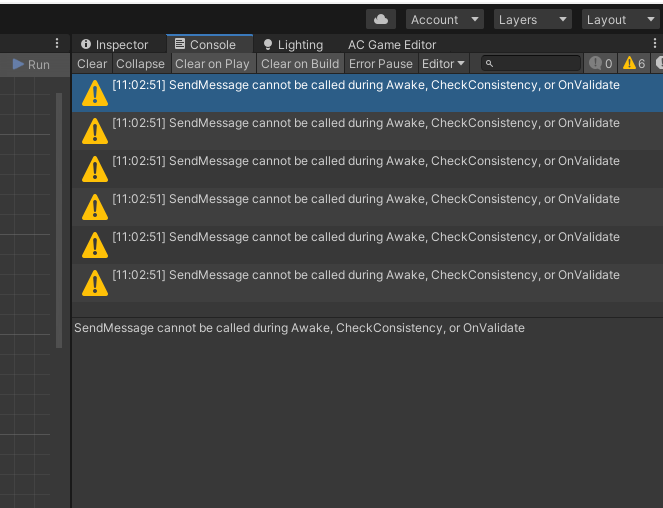
It's SendMessage cannot be called during Awake, CheckConsistency, or OnValidate
round pawn
Okayyy...
sly grove
it's a Unity thing
round pawn
wat do
sly grove
The way to fix it is to heed that advice
round pawn
I tried and it broke my code
sly grove
If you're actually calling SendMessage at all, I would actually recommend against doing that
SendMessage is almost useless for 99% of normal games
Show your code
round pawn
sly grove
If you're actually calling SendMessage at all, I would actually recommend agains...
It's AddComponent<>()
sly grove
Whatever component you're adding has a SendMessage in its Awake()
round pawn
I tried using UnityEditor.EditorApplication.delayCall = () => { }; but it chopped up my code and didn't work
round pawn
sly grove
Maybe explain what you're trying to do
Adding components in OnValidate() and then I need a reference to that object before the method ends. Give me a minute for the code
// create a new chunk
if (!chunk_present)
{
  Chunk new_chunk = CreateChunk(coord);
  chunks.Add(new_chunk);
}
chunks[chunks.Count - 1].SetUp(material, generate_colliders);
I'm running this for every chunk, but it doesn't work on them all when I use delayCall because chunks.count - 1 is taken before the chunk is added
round pawn
sly grove
chunks.Add clearly runs before that line below...
Can we just start over... Here's what I tried:
if (!Application.isPlaying)
{
  UnityEditor.EditorApplication.delayCall = () =>
  {
    // create a new chunk
    if (!chunk_present)
    {
      Chunk new_chunk = CreateChunk(coord);
      chunks.Add(new_chunk);
    }
    chunks[chunks.Count - 1].SetUp(material, generate_colliders);
  };
}
else
{
  // create a new chunk
  if (!chunk_present)
  {
    // CreateChunk initializes a GameObject and adds the Chunk component to it
    Chunk new_chunk = CreateChunk(coord);
    chunks.Add(new_chunk);
  }
  // SetUp adds the rest of the components, like mesh, collider, etc.
  chunks[chunks.Count - 1].SetUp(material, generate_colliders);
}
It didn't work for some reason, it doesn't create all the chunks that it should.
sly grove
I still don't know what this has to do with SendMessage
or what CreateChunk does
or why you need a delayCall
also why chunks[chunks.Count - 1] instead of just new_chunk
round pawn
OnValidate + AddComponent = SendMessage cannot be called during Awake, CheckConsistency, or OnValidate
sly grove
round pawn
`OnValidate` + `AddComponent` = `SendMessage cannot be called during Awake, Chec...
show the code for CreateChunk
and show the code for the script(s) on the objects being created
you've shared very little here
hard to help
round pawn
Chunk CreateChunk(Vector3Int coord)
{
  GameObject chunk = new GameObject($"Chunk ({coord.x}, {coord.y}, {coord.z})");
  chunk.transform.parent = chunk_holder.transform;
  Chunk new_chunk = chunk.AddComponent<Chunk>();
  new_chunk.coord = coord;
  return new_chunk;
}
Literally nothing special
round pawn
Pastebin
Pastebin.com is the number one paste tool since 2002. Pastebin is a website where you can store text online for a set period of time.
sly grove
round pawn
`OnValidate` + `AddComponent` = `SendMessage cannot be called during Awake, Chec...
Can you show the full stack trace of this error?
round pawn
round pawn
Can we just start over... Here's what I tried:
```cs
if (!Application.isPlaying)...
And both CreateChunk() and SetUp are called in OnValidate
round pawn
sly grove
Can you show the full stack trace of this error?
1 sec
sly grove
Also might be related to this https://forum.unity.com/threads/sendmessage-cannot-be-called-during-awake-checkconsistency-or-onvalidate-can-we-suppress.537265/
Unity Forum
Since we updated to a newer version of Unity, we've been getting this warning spammed to the console (and our log) hundreds of times. We are never...
round pawn
SendMessage cannot be called during Awake, CheckConsistency, or OnValidate (Chunk (4, 4, 1): OnDidAddComponent)
UnityEngine.GameObject:AddComponent<UnityEngine.MeshRenderer> ()
Chunk:SetUp (UnityEngine.Material,bool) (at Assets/Scripts/Chunk.cs:48)
MeshGenerator:InitChunks () (at Assets/Scripts/MeshGenerator.cs:368)
MeshGenerator:Run () (at Assets/Scripts/MeshGenerator.cs:90)
MeshGenerator:RequestMeshUpdate () (at Assets/Scripts/MeshGenerator.cs:110)
DensityGenerator:OnValidate () (at Assets/Scripts/DensityGenerator.cs:17)
Ok I guess AddComponent calls SendMessage itself 🤔
round pawn
But it points to each AddComponent
sly grove
that is probably how it calls the OnEnable/Awake methods on the new component
round pawn
It's new, I never had these warnings in 2019 I don't think
And the code I'm rewriting also only had these warnings when upgraded to 2020
The thing is my code works fine, I just am being irritated by the warning when I adjust the size of my map (creating new chunks)
 rose bronze
Can anyone help me here please?
asked in code-beginner couple of times but no one respond.
I am trying to do a multipart PUT request from Unity. any guide or maybe what is wrong with the below code attached.
a powerful website for storing and sharing text and code snippets. completely free and open source.
 paper sand
Anyone have a multiplayer game idea
 raw lily
So I have a scriptable object with a field like in the picture. Everything has been working fine but now I'm trying to make my first build and I get the following.
Assets\RTR\Script\Card\Effect\EffectData.cs(14,16): error CS0246: The type or namespace name 'MonoScript' could not be found (are you missing a using directive or an assembly reference?)
Did a bit of research without luck. Does anyone know what I could do to fix this?
 long ivy
remove all references to MonoScript in scripts included in your build. It's in the UnityEditor namespace
raw lily
long ivy
remove all references to MonoScript in scripts included in your build. It's in t...
The scriptable objects will still work properly with MonoScripts though?
Cause that's how effects are referenced in SOs
long ivy
you can't have any types from UnityEditor in a build at all, so no they're all broken
raw lily
So there's no way to pass a script as a field ever?
Like.. if I generate a new object from the SO and use that, that's fine correct? The only issue is the SO in the build folder?
long ivy
generate a new object how? In the editor pre-build? Sure. But the type MonoScript literally does not exist in a build, so you can't have it as a field on anything that goes into the build
raw lily
This was how card effects were definited in my code base, can you think of a simple way to make something like that work without having to redo everything?
That's bad news...
long ivy
you could probably do some hackery with custom PropertyDrawers to make something similar to the way you're using MonoScript
You might consider rewriting your effect scripts as SOs themselves, and assigning those instead
raw lily
long ivy
You might consider rewriting your effect scripts as SOs themselves, and assignin...
You create an instance of an SO in the editor but the effect is really just a script (unique code for each). Can you have an SO that you don't "create and instance of" in the editor?
long ivy
your SO could exist for the sole purpose of adding a specific effect script. You wouldn't need to worry about instances of them if they're just factories
what does your EffectData SO do exactly?
raw lily
long ivy
your SO could exist for the sole purpose of adding a specific effect script. You...

Has data about how the effect is handled, and then the script that contains it's unique behaviour.
long ivy
I assume it adds a OnPlayDiscoverEtc component to a GO at some point. Does it set any fields?
raw lily
long ivy
I assume it adds a OnPlayDiscoverEtc component to a GO at some point. Does it se...
It does add it to a GO. Wdym by set fields?
long ivy
where are Effect Target etc used? Do they get applied to the component EffectData adds to a GO?
raw lily
Some are used as params to call the MonoScript and some are logic within the code before/after it's called.
long ivy
well, two options are to make EffectData a generic type and define subclasses for each effect script, or you could make a SO for each effect script whose only job is to add that script to a GO supplied by your GameData SO
raw lily
I was doing research at the same time, and I think there's a way to almost change nothing. If I put a string instead of an effect script and then load them at runtime like this?

Wait.. what about an UnityEngine.Object type field?
I can still drag a MonoBehaviour into it it seems..
long ivy
that's what your option 1 is doing
raw lily
Yeah but then the type is no longer UnityEditor.MonoScript, it's UnityEngine.Object.
long ivy
I'm not sure this will work for you. I have no idea what happens if you try to serialize a MonoScript in this way
raw lily
Hmmm... I guess it's worth a shot.. it will reset all my SOs though..
The values I mean.
long ivy
How many do you have? hopefully you didn't wait until near the end to try an actual build :(
 raw lily
long ivy
How many do you have? hopefully you didn't wait until near the end to try an act...
raw lily
long ivy
How many do you have? hopefully you didn't wait until near the end to try an act...
I waited 3 months sooo... yeah.
long ivy
probably worth automating it with an editor script, then
raw lily
long ivy
probably worth automating it with an editor script, then
What do you mean?
long ivy
write an editor script that fetches all of your EffectData SOs and edits them. The laziest possible option would be to:
- add a serialized string to your EffectData SO
- run editor script which grabs all EffectData SOs, sets the string to the class name, and marks them as dirty
- save project
- delete MonoScript field
raw lily
Oh, good to know that's doable.
New problem though. What I posted above was from 7 years ago and I'm not sure you can add component from string anymore, will look into it.
 quartz stratus
raw lily
New problem though. What I posted above was from 7 years ago and I'm not sure yo...
quartz stratus
raw lily
New problem though. What I posted above was from 7 years ago and I'm not sure yo...
I didn’t even know you could do this at one point

 unreal lichen
Hi. I'm trying to implement dash to my object with rigidbody based movements. Is there any good implementation of dash using rigidbody? Or should i switch to transform while dashing?
I tried to actually
But since the object had move pretty fast physically and the dash direction can be in the different direction, the dash can miss the target sometimes
 austere jewel
It's a frustum not a fulcrum, but sure https://docs.unity3d.com/Manual/FrustumSizeAtDistance.html
 golden timber
Hello. I have a problem. I don`t want my camera to rotate
public class CameraRotation : MonoBehaviour
{
    void Update()
    {
        transform.rotation = new Quaternion(0, 0, 0, 0);
    }
}
Quaternion.identity is the default rotation
what you have written is not a valid quaternion
Don't manually create quaternions, even the default one imo
sly grove
Don't use the constructor at all 😵💫
golden timber
I have changed the value, but now it affects the rocket. Probably I am working with the camera wrong way. Could you tell me how is it usually used when you want a camera to follow your player?
Because I have placed the camera inside the player
austere jewel
If it affects the rocket, your script is also on the rocket
golden timber
on the camera
austere jewel
This really isn't a #archived-code-advanced question. More #💻┃code-beginner
golden timber
Sorry, didn`t notice))
 pine topaz
Managers usually needs to communicate with eachother, how would u guys do that connection ?
 pine topaz
Singletons are like hack of unity, i dont want to use it trying to find a more acceptable way which i can use on any language or engine
austere jewel
The singleton pattern has nothing to do with Unity
pine topaz
i know but as i said i define it as a unity hack
hollow garden
why
pine topaz
forexample u cant use anything like a singleton on UE
pine topaz
its not the point right, im trying to find more ideas about the problem
pine topaz
thats another way i dont wanna use 😄
Maybe DOTS or OOP can be a better solution, but i try inheritance from base class but im getting nullref exceptions somehow
hollow garden
well i can't think of any better solution here than a Singleton
pine topaz
not everywhere only on same gameobject, those 4 managers manage the single NPC
hollow garden
wait so these are on every npc?
pine topaz
yeah and its not good for optimization
hollow garden
well then Singleton is not really an option if it's gonna be on every npc
just sayin when you use the word Manager in a Unity script it usually refers to a Singleton
pine topaz
Yeah i probably need to find better words,
pine topaz
pine topaz
Maybe DOTS or OOP can be a better solution, but i try inheritance from base clas...
let me show u guys a bit
Civil is derived from Monobehav...
I also define all managers as public and getcomponents at start;
so i can use any manager from civil

//public class CivilDestinationManager : Civil
But under any manager when they try to communicate eachother i get nullreff like
CivilAnimationManager.doSomething();
Im not bad at OOP designing but couldnt figure it out on unity
 unkempt nova
Like I said in the other channel, I don't think this is inheritance related but we need more details to give more info
pine topaz
what detail can u need 😄
unkempt nova
The ones I listed repeatedly before : /
pine topaz
unkempt nova
The ones I listed repeatedly before : /
okay look this Civil class inherited from Interactable its an monobehaviour


This is the animationManager derived from Civil, it can debug xa value as 5, but destinationManager.enabled is "NullReferenceException"
unity (cant or dont idk) pass Script refs on inheritance
 cedar ledge
Anyone here familliar with UniTask? I'm trying to listen for connections, but Accept() blocks the main thread even though the function doing the listening is being called from a UniTask.Void()
sage radish
pine topaz
okay look this Civil class inherited from Interactable its an monobehaviour
CivilAnimationManager is hiding Civil's Start method by defining its own. That means _civilDestinationManager is never assigned a value. If you want Civil's Start method to run in CivilAnimationManager, you have to override it and call it:
// in Civil:
protected virtual void Start()
{
    ...
}

// in CivilAnimationManager:
protected override void Start()
{
    base.Start();
    ...
}
What about multiple inheritance , do i need override start on each one ?
sage radish
Yes.
pine topaz
I got another question about it, can i assing them as _CivilAnimationManager = this ? or something likethat
cause only scripts cant inherited from base Start
pine topaz
pine topaz
I got another question about it, can i assing them as _CivilAnimationManager = t...
On here first log is null, second one is CivilAnimationManager so its looks like working, let me full test
 cedar ledge
UniTask.Void(async () => await ThreadedNetworkSocket.ListenForConnections());
public async UniTask ListenForConnections()
{
            Socket Listener = new(SocketType.Stream, ProtocolType.Tcp);
            Listener.Bind(new IPEndPoint(IPAddress.Any, networkSettings.Port));
            Listener.Listen(10);
            Socket handler = Listener.Accept();
anyone know why this should block the main thread?
 flint sage
Probably parallel and concurrent aren't the same thing
I don't know Unitask but it looks like you're doing concurrent and not parallel
 pine topaz
On here first log is null, second one is CivilAnimationManager so its looks like...
pine topaz
pine topaz
On here first log is null, second one is CivilAnimationManager so its looks like...
doesnt work like this
cedar ledge
regular Task has problems with unity because unity really doesnt work multithreaded
UniTask was made specifically to solve that, but it seems like maybe I need to use regular task for this one part?
flint sage
A regular task is also often concurrent
cedar ledge
well what's the right way to listen for a connection in unity?
flint sage
    // Multithreading, run on ThreadPool under this code
    await UniTask.SwitchToThreadPool();

    /* work on ThreadPool */

    // return to MainThread(same as `ObserveOnMainThread` in UniRx)
    await UniTask.SwitchToMainThread();```
From a quick google, you want something like thisOr there might be other methods in unitask to defer to a different thread
cedar ledge
ok thanks
flint sage
You can also just use a threadpool yourself
 reef wren
is something similar to SerializeField available for functions to be used with UnityEvents?
i want to call a function using a button but i dont want the function to be public.
even protected function doesnt show up
pine topaz
sage radish
`CivilAnimationManager` is hiding `Civil`'s `Start` method by defining its own. ...
Works like a charm, can u explain e why do we still need base.Start(); even we are overriding it ?, also while overriding does base class Start method executes or just ignored ?
sage radish
pine topaz
Works like a charm, can u explain e why do we still need `base.Start();` even we...
Overriding does what it sounds like, completely overrides the base method. If you want the base method to still be called, you have to do so manually.
cedar ledge
reef wren
is something similar to SerializeField available for functions to be used with U...
You should create a UIMessenger class that has all the callbacks for buttons and such. The callbacks would then, in turn, call the actual function
but then the function would still need to be public
if a function is supposed to be called from a button, then conceptually, it should be public. it's being called from another script
pine topaz
sage radish
Overriding does what it sounds like, completely overrides the base method. If yo...
so manually executing is base.Start() right ?
sage radish
pine topaz
so manually executing is `base.Start()` right ?
Yes.
pine topaz
What about the compiling time, do i generate 4 different civil base classes for 4 different manager derived from it ?,
sage radish
pine topaz
What about the compiling time, do i generate 4 different civil base classes for ...
Shared code will still be shared if that's what you're asking.
pine topaz
sage radish
Shared code will still be shared if that's what you're asking.
Thanks ur answer give me a new perspective about inheritance on monobehaviours
Btw how would u do the connection between managers ?
reef wren
cedar ledge
if a function is supposed to be called from a button, then conceptually, it shou...
no. Conceptually speaking, we do have SerializeField attribute which allows us to modify a private variable from outside the script which contradicts this statement.
I prefer to keep the code logics separate from the UI logics and will try to avoid making every function/variable public. I understand that I can still use SerializeField for the button, and then subscribe to the private function from within the script which is totally fine and what I actually do. But it'll be time saving if I could somehow tell unity button to call private methods from inspector (something which Unity itself uses to call Update, FixedUpdate, etc but yes these are not related to Inspector)
I was expecting Unity to have some attribute for it. It would also help significantly more for such functions to have that attribute instead of them being a public function, so that its easier to debug. Its hard to debug a bigger code base when a public function gets triggered (from UI/Unity Events) randomly and you have no idea which function it could be.
Atleast with attributed function, you can simply do a find all reference and then eliminate the remaining possibilities by atleast 50%+
cedar ledge
instead of doing it in the inspector, you could add the function to the event in Start()
@reef wren
reef wren
cedar ledge
instead of doing it in the inspector, you could add the function to the event in...
that would still require me to have reference to the UnityEvent of the button
I'm talking about a normal canvas UI Button, not c# delegates/events/actions
cedar ledge
reef wren
that would still require me to have reference to the UnityEvent of the button
you mean like
myButton.onClick.AddListener(MyClickEvent);
?
 dull epoch
Hello everyone.
I am working on an RPG and i hit the wall of my knowledge, maybe one of you can help me out.
I am working on an Ability System currently and i would love to have a whole System to click my abilities togehter.
I was thinking to use scriptable objects but i quickly realised, for damage calculation and on hit effects, i would have to write own classes to implement these things.
Is there a way to build smaller Components and link them in a custom editor or something ?
unkempt nova
VFX and stuff will probably be in prefabs so that's not an issue for a SO. Damage Calculation can be done on the SO as well, it's scriptable. You can also link them together, so you could have one way to calculate damage as a SO and another way as another SO for plug and play ability building
If you're going with the SO approach, my best advice is DO NOT STORE ANY STATE INFO ON THE SO. It should only be used to hold references, and process data. Like damage seems fine. Just don't store current health in there or something
dull epoch
unkempt nova
If you're going with the SO approach, my best advice is DO NOT STORE ANY STATE I...
its all for server code so i am highly careful on my resource management. But yeah, the ability gets the PlayerStats component to calculate whatever the actual damage is (str increases melee dmg and stuff)
The plug and play thing sounds interesting and exactly what i was looking for. Can you go into more detail? I used to use an old unity version for way to long so my knowledge with SOs is quite limited.
unkempt nova
dull epoch
its all for server code so i am highly careful on my resource management. But ye...
Sounds good about the playerstats component feeding it data. I would make sure you stick to basic data types for any sort of networked code as well. You may need a separate SO for Network info or something, and have it as a child of a bigger SO that contains VFX references, etc. I'm not sure, just an idea
sage radish
dull epoch
Hello everyone.
I am working on an RPG and i hit the wall of my knowledge, mayb...
With [SerializeReference], you can easily write small classes and serialize them through a shared base class. You just need something to handle the GUI of selecting the types in the editor, like this package:
https://github.com/mackysoft/Unity-SerializeReferenceExtensions/
 unkempt nova
I'm running into issues trying to integrate mirror because I have non basic types in my ability SOs, figured I'd mention it
dull epoch
unkempt nova
Sounds good about the playerstats component feeding it data. I would make sure y...
its a fully closed authorian server. So i dont need to worry about datatypes on the backend. In the best case, only the instantiate of the ability will get called on the frontend and there a simple ref should do the trick. Once i have this ability mess running
dull epoch
unkempt nova
I'm running into issues trying to integrate mirror because I have non basic type...
using mirror myself, if you need help, maybe i am your person!
unkempt nova
Might have to remember that
dull epoch
sage radish
With `[SerializeReference]`, you can easily write small classes and serialize th...
waaait a minute ... this looks amazing and like the exact thing i need i think. Thank you so much i will read through it!
unkempt nova
Stable's idea is good, and I believe I wrote a script that helps with that for a modifiable stat system I abandoned a while back, might help
Been a while though so don't remember how it works, might be useful though for selecting. In this case I'm using it to select stats from a dropdown iirc
dull epoch
you two are a massive help. Thank you. This means i spend a lot more time to get it going but it seems like a proper longterm solution
 dull epoch
i need to completly overthink how to get the stuff done i have in mind but this tool seems like the right way
 zenith quarry
Finally solved that damn material problem I had
For anyone interested:
Use a hashtable and iterate trough all the objects that have the materials you want to swap for a highlight.
convert that hashtable to an array.
Now every renderer has to compare each of its materials to the materialarray and write down the index numbers.
When changing from a highlighted material back to the original you can now use the index numbers.
You can do that in the editor, no need on awake or runtime.
With that you can now use sharedmaterial, since unity doesn't instantiate materials anymore.
So happy that sht now works
 jovial totem
Is there a way I can move physics objects around the player. I have a big world and I am worried that our near the edges I’ll start getting floating point precision errors. So the solution is to keep the player at 0 and move everything around the player. However, my world has physics stuff in it, and if I move those I’m worried it will mess up the physics simulation. Is there a way I can do this?
Alternatively, how far out from origin do things have to be for the jitter to start being noticeable? Maybe my map size is within that bounds.
zenith quarry
You can move the whole world regularly back to origin if that helps you
Other than that you could section your world in levels and after async loading each level you move everything to origin
Something like that:

 frank peak
Okay, so I have an implementation of the a* algorithim that uses two or three scripts. Pathfinder.cs which has the primary method FindPath(PathNode start, PathNode end), and PathNode.cs which gets generated per tile at runtime in the TilemapHandler.cs script (which is responsible for perlin noise generation) and held in a list using the class PathNodeManager.cs. As to my tilemap, its a multi layered isometric z as y tilemap.
The issue I'm having is that my algorithim wont find neighbours, when i know for a fact that that list that is being checked against with .Contains(PathNode) contains the path node being checked. I have no idea why this is happenning but it is, and subsquently paths aren't being found. There certainly are paths, as obstacles (a bool IsBlocked) are set at tilemap generation using an if statement that checks if the tile is null (true for empty tiles like in tilemap 0 which is the plant layer), and if it isnt, the bool is set.
[Picture of the test tilemap]

https://pastebin.com/vmJDTSvg -- Pathfinder.cs
 hazy epoch
Why does a headless (batchmode) Dedicated Server build generate shader errors and warnings?
unkempt nova
What do they say?
hazy epoch
unkempt nova
What do they say?
 unkempt nova
Yeah, I don't have anything to offer other than it looks like it doesn't like your GPU. Might be ok if they're just warnings
If you're missing shaders, sounds like there's a fallback option you can enable
hazy epoch
Yeah. I thought of those things too, which lead me to ask the question why is it even doing anything with the shaders if there's no rendering (batch/headless mode).
sly grove
hazy epoch
Yeah. I thought of those things too, which lead me to ask the question why is it...
Thre's also a separate -nographics argument
that might be relevant
hazy epoch
sly grove
Thre's also a separate `-nographics` argument
I was under the impression that those arguments aren't needed with Dedicated Server builds. That it was built in. However, upon looking it up (to see if my assumption was correct), it seems these shader issues are a known issue.
https://forum.unity.com/threads/unity-2021-2-dedicated-server-target-and-stripping-optimizations-now-live-please-share-feedback.1143734/#:~:text=Starting in Unity 2021.2%2C when setting your platform,to apply these optimizations during the build process.?msclkid=f55b8254ae3211eca6b8ad65fa26e001

Unity Forum
Last year, we shared our goals for 2021. Three of our key focus areas have been improving workflows and usability, improving performance and iteration...
sly grove
Oh you're using the new dedicated server target
nice
I guess it still has some kinks haha
 kindred tusk
unkempt nova
I'm running into issues trying to integrate mirror because I have non basic type...
kindred tusk
unkempt nova
I'm running into issues trying to integrate mirror because I have non basic type...
You shouldn't need to sync SOs over mirror.
You can include them in the build and give each one a unique ID which is sent if necessary
unkempt nova
kindred tusk
You shouldn't need to sync SOs over mirror.
Yeah I was passing them as a parameter and needed them to send a message and it failed iirc
I do already have a SO "DB" with all of them, for a good unique ID and lookup
 pale wave
Can anyone teach me how to put a gun in my 3d game?
 novel wing
pale wave
Can anyone teach me how to put a gun in my 3d game?
novel wing
pale wave
Can anyone teach me how to put a gun in my 3d game?
Download gun model, drag in Unity. Then drag it into the scene
hazy epoch
pale wave
Can anyone teach me how to put a gun in my 3d game?
I think you're in the wrong channel.
kindred tusk
unkempt nova
I do already have a SO "DB" with all of them, for a good unique ID and lookup
ah right right.
Perfect
 worldly gorge
How could I learn to implement a reversed-z camera?
worldly gorge
A camera with a reversed-z Depth Precision buffer
 undone coral
hazy epoch
Why does a headless (batchmode) Dedicated Server build generate shader errors an...
undone coral
hazy epoch
Why does a headless (batchmode) Dedicated Server build generate shader errors an...
do a standalone build and start with -nographics -batchmode instead
unity cannot prove a dedicated server build will work for a given list of unity scenes so don't use it
it is a set of heuristics not something that Makes Sense
undone coral
zenith quarry
For anyone interested:
Use a hashtable and iterate trough all the objects that h...
why didn't you use a material with a property?
frank peak
hmm now my a* algo returns so many neighbours that it infinite loops. and the closed list just continues to build in some random direction. i must've messed up the code somewhere
sly grove
You should be ignoring any nodes you've already visited
frank peak
I think I am
an issue is that the closed list spins in circles and doesn't actually find a path

so the algo must not be implemented correctly
sly grove
If it's going in circles it's revisiting already visited nodes
frank peak
yeah i guess you're right eh
it really shouldn't be happenning tho
the starting line in the for neighbours loop should negate it
foreach (var neighbour in GetNeighbourTiles(currentPathNode).Where(x => !x.IsNodeBlocked && !closedList.Contains(x)))
sly grove
What kind of objects does GetNeighborTiles return
I.e. how are you representing your nodes
frank peak
as a PathNode object with an x, y, z, and a g, h and f cost as well as a bool for IsNodeBlocked
sly grove
What's PathNode look like? Is it a struct? Class? Are the instances reused? Is there an appropriate . Equals method?
frank peak
i think the way i was checkign neighbours and addign them to the list was bugged
cuz it was instatiating a new path node
i changed that to
this
            Vector3Int locationToCheck = new Vector3Int(currentPathNode.GridLocation.x + 1, currentPathNode.GridLocation.y + 1, currentPathNode.GridLocation.z);

            if (map.cellBounds.Contains(locationToCheck) && !closedList.Contains(GeneratePathNode(locationToCheck)))
            {
                neighbours.Add(pathNodeManager.pathNodes.Find(x => x.GridLocation.Equals(locationToCheck)));

            }
i might remove the !closedlist thing since that was from before (and it didn't do anything anyway as that check is already perfomed earlier)
hmm now im getting a nre from linq wtf
raw schooner
What does .Find() do? Would .First() be a better choice?
Looks like Find is FirstOrDefault but for lists
 deep scaffold
Hello,
I am working on project where i used newtonsoft plugin for unity, turns out plugin had problems when i build project on il2cpp and was failing some tasks, now i am trying to find way to invoke methods recived with signalR, before i was using cast to JArray, but now i dont have that luxury, I am getting this kind of objects/Lists which has method name at first place, then parameters.
 zenith quarry
undone coral
why didn't you use a material with a property?
zenith quarry
undone coral
why didn't you use a material with a property?
you mean like switching it so in the shader it gets switched?
I have it on a small shader but it is not always the fastest way, esp when you want to highlight multiple objects that have different shader. It is then faster to switch the material.
Also it is a better system for designer because creating highlightmaterials and saying which thing gets what highlighttype is much easier.
tender badger
Does GPU Instancing improve the performance of animated sprites as well?
tender badger
tender badger
Does GPU Instancing improve the performance of animated sprites as well?
Let me rephrase, what ways are there to optimize large amount of sprite animations? I imagine that it would be different from optimizing the sprites themselves.
sly grove
deep scaffold
Hello,
I am working on project where i used newtonsoft plugin for unity, turns o...
Are you trying to use dynamic?
 hushed sparrow
im trying to have a scriptable object remove itself from a list after a timed duration of turns, yet for some reason it wont? What am I doing wrong here?

 agile yoke
There could be many thing here around when what parts of this are called etc., but one problem that jumps out to me: If CH.CE is some kind of List, then RemoveAt will change the indices of all other entries after the one you remove in the list. If you don't update their Place field at that point, when they later try to remove themselves, they'll use an incorrect index
hushed sparrow
hmmm, that is true. Do you have any suggestions on going about this?
 fresh salmon
Yeah this.
If you just want to remove yourself you need to re-compute the other's indexes, OR...
agile yoke
The easy solution is using Remove instead of RemoveAt :)
fresh salmon
Remove yourself CH.CE.Remove(this);
 agile yoke
(Unless Place is used by other things too and needs to actually be correct; in that case you won't get away without updating indices)
hushed sparrow
aaaand now im getting this

this is how the character handler handles the condition list btw
 fresh salmon
Ah yeah, if you're iterating over the CH.CE list while removing you can't
With foreach at least
fresh salmon
You can use a for loop yeah
Reverse for loop to be precise
So removing an element won't mess with the indexes you're going to remove in the next iterations
hushed sparrow
like this?
 flint sage
That condition looks wrong
 soft hawk
It is wrong
i >= 0
if i'm not mistaken
what you have written there will only do 1 iteration on index 0 @hushed sparrow
 devout hare
well what's written is a syntax error
but if the rogue > is removed then it iterates either 0 or infinite times (or at least until integer underflow)
 craggy flare
when am pressing esc in playing sun temple asset...it pauses the game in unity editor and even if we change the scene on ESC then also game is paused in that scene also...how to solve this issue
hushed sparrow
this goes on way too long, i think ill keep it to <=

since its going reverse it just needs to check each time if its at or below 0, not above it
otherwise yeah it goes on infinitely
soft hawk
If you keep it at <= 0 it simply wont run, or if CE is empty, it'll run infinitely
<= 0 is just wrong
hushed sparrow
then what should i change it to?
it has to wait until its less than or equal to 0, what am i supposed to put there?
hushed sparrow
im trying to go from the last to first item of the list to activate its functions seperately for handling status conditions
granite viper
usually your ide has a utility for reversing a for loop
soft hawk
It's a reverse for loop
granite viper
but it looks like this:
for( int i = CE.Count - 1; i >= 0; i--) {

}```nope, need to sub one from CE.Count when assigning to i
soft hawk
Oh, right, mb
granite viper
cool beans
pale wave
how do I make my enemys
in my game attack me
sly grove
Have you tried insulting their honor?
regal olive
lol
pale wave
sly grove
Have you tried insulting their honor?
yep they just staired deep into my soul
 tranquil coral
Is there a way to script two different, identical animators to be "equal"? I have two identical objects, and when one runs its animator, I want my script to read that happened, and tell the other animator to do the same thing
sly grove
tranquil coral
Is there a way to script two different, identical animators to be "equal"? I hav...
A few ways:
- Just have the code that starts one animator start both animators instead
- Have the code that starts one animator invoke an event, and have another script listening for that event and start the second animator
- Make a StateMachineBehaviour on the animator that listens for the entry into a particular state, and starts the second animator
tranquil coral
alright, thanks
 shadow urchin
I honestly don't understand why Unity doesn't have a function that allows you just to jump into your game like Unreal does.....
sly grove
The play button..?
shadow urchin
sly grove
The play button..?
It doesn't allow any form of control, as in you don't have a mannequin or something to control via wasd
frank peak
ye you need a move controller for that kind of direct control
sly grove
shadow urchin
It doesn't allow any form of control, as in you don't have a mannequin or someth...
Unreal Engine is designed primarily for FPS games and gives you a default FPS character to control
Unity is designed to be more open ended
in any case you can just use Unity's standard FPS controller and get that same thing
shadow urchin
as a new user who is making a level, how does one explore it using some sort of reference model or object to test scaling?
sly grove
sly grove
shadow urchin
as a new user who is making a level, how does one explore it using some sort of ...
You're thinking about it backwards. You need to create your character first. This is a case of Unreal prescribing to you what the size of a character should be etc and then you building your level around that
Maybe not everyone has the same sized character
not every game is an FPS
it's too in-the-box
frank peak
so how could i visualize the path nodes? its a pure class. more debug.drawX?

(i already used debug.draw line to draw the path)
which isn't optimal but that can be changed lol
(also ignore the nre, its due to the town name being null -- ie you cant set the town name if you jump straight into the scene)
shadow urchin
sly grove
You're thinking about it backwards. You need to create your character first. Thi...
I attempted to add in a FPS starter asset and it already has script errors
sly grove
shadow urchin
I attempted to add in a FPS starter asset and it already has script errors
which one
shadow urchin
sly grove
which one

Get the Starter Assets - First Person Character Controller package from Unity Technologies and speed up your game development process. Find this & other Essentials options on the Unity Asset Store.
 sly grove
shadow urchin
sly grove
shadow urchin
this is not from the package you just linked
Standard Assets is a much older, very outdated package

This is the contents of the one you just linked
none of them are a folder called "Standard Assets"
shadow urchin
how would I go about removing that package then?
sly grove
shadow urchin
Just delete the "Standard Assets" folder
tender badger
Is there some kind of way to dynamically generate a mesh out of individual parts?
I'm slooowly starting to get the hang of GPU instancing, I think, but the problem is that every sprite drawn has to be the same. (Though I've noticed that it still let's me vary the size.)
Now, it's the draw calls that cause performance issues, right?
GPU instancing is one way of reducing them by combining a bunch of similar ones into a single one, but how about somehow taking a bunch of different sprites, and combining them into a single draw call?
I'm only really looking to change the color, so if there's some way to do that with GPU instancing I would take that as well.
dull epoch
Is there a clever solution for a unique ID system for Scriptable Objects? I have like 100 SOs of one type and i would love for them to have all a unqiue ID. I am certain there is a way to get it done but i dont find a good clever solution
soft hawk
You can't number them?
dull epoch
When i number them by hand i will at one point make a mistake so i would love to have an automated system do it for me.
I could add an editor script that finds all SOs of the given type and gives them an ID but, if i could, i would love to have an OnCreate event that does this stuff for me. Is there an option for that? My experienmce with SOs is quite limited.
tender badger
tender badger
I'm only really looking to change the color, so if there's some way to do that w...
I'm thinking about using a particle system where the particles are just a glow with a color and have the same positions as the sprites together with the instanced but uncolored sprites for this. Hell, if it's allowed, I could literally make the particles the same texture (but colored of course). (In case you wonder why I don't just use particles to begin with, I need the objects to be interactable.)
dull epoch
okay my question was dumb, sorry for bothering you all! Google found the solution rather quickly, sorry agian for asking
frank peak
any thoughts on how i can get my generated pathnode grid (dots) to align with the isometric grid (tiles)? some sort of maths im guessing, maybe matrices idk

actually i found a video thats really useful so far (https://www.youtube.com/watch?v=04oQ2jOUjkU)
Isometric games often use hand-drawn 2D sprites to add depth to a game without having to deal with full 3D rendering.
In this video, I cover how it works, the math you need to render isometric sprites on the screen, and how to find the isometric tile from a screen coordinate.
Music: Snake Hips - Lucas Pittman (via epidemicsound.com)
goes into the math needed to translate the position from XY rect to XY iso
 native plover
How can I find the distance between two points on a custom axis?
 native plover
sly grove
https://docs.unity3d.com/ScriptReference/Vector3.Project.html
native plover
sly grove
https://docs.unity3d.com/ScriptReference/Vector3.Project.html
I used the Plane class to calculate it
So the vector.project function doesnt retain all magnitude?
frank peak
weird, i had a formula that was literally just working 10 mins ago and now its doing this weird line thing

it was generating a isometric grid of dots but now it generates a line going from top right to bottom left wtf lol
back to square one i guess

does anybody have a formula for linearly transforming a set of cartesian coordinates to a isometric equivalent?
nvm lol
tender badger
What the hell...

So, it looks like I'm finally getting the hang of instancing, but there's still some issues.
For some reason it's not instancing every once in a while, which kind of ruins everything.
granite viper
looks like you're drawing both instanced and non-instanced
tender badger
Unity seems to be able to support up to 512 draws per instancing, but on average around once in 50 gameobjects it just refuses to instance it, which restarts the instancing process.
It's seemingly random. The first instance has 46, the second one 29, the third one 42, etc.
tender badger
granite viper
looks like you're drawing both instanced and non-instanced
I know, but I'm wondering what's different about these that they don't automatically get instanced.
granite viper
does the reason tell you anythign useful
in the frame debugger they usually tell you why something wasn't batched
tender badger
"Rendering different meshes or submeshes with GPU instancing"
Ok, this is extremely sus.
Notice how it's usually one set of instancing, then an individual one, the next set, etc., but then at the bottom it's two instancings?

If I click on the bottom-most one, it tells me that the previous one was reached the maximum instance count.
Now, this is very strange, because the one above it has only 16.
But then I counted all of the ones from the start up to and including the one that has 16, and it gave me 502. Nothing weird about that number, right? Well, if you count the individual ones, it's ten, which combined with 502, leads us to exactly 512.
If so, why aren't these just in one instance?
granite viper
I was actually going to ask you to do just that haha
tender badger
Those things are generated in a loop from a prefab, and the only thing that changes between them is size, position, and some values of a script component. If those things prevented it from batching, then none of them would be instanced. Yet most are, and it's just those few that aren't.
granite viper
The threshold at which inefficiencies begin depends on the GPU, but as a general rule, don’t use GPU instancing for meshes that have fewer than 256 vertices.
Interesting note on the docs page
tender badger
Well, that shouldn't apply, because even the one with only 46 instances has 368 vertices.
Even then, that would just be a performance/framerate thing, and it shouldn't influence how the CPU instances things.
@sly grove I've talked to about GPU Instancing a few times now, do you know what may be going on? This is so cursed.
 midnight violet
So I go from general over to here. Maybe thats the better channel. I am trying to get a public list as dropdown in other classes. Because of not being compiled, I only get a null reference from that list while accessing it.
granite viper
post code
midnight violet
public List<UIPages> linkablePages;
this is in class A, I want to get this into class B as a dropdown
midnight violet
[CustomEditor(typeof(UIButton))]
public class UIButtonEditor : Editor
{
    private SerializedProperty allPagesList;
    private ReorderableList charactersList;

    int index = 0;
    string[] pageNames;

    void OnEnable()
    {
        allPagesList = serializedObject.FindProperty(nameof(AppManager.linkablePages));

        pageNames = new string[allPagesList.Count];

        for (int i = 0; i < AppManager.AllPages().Count; i++)
        {
            pageNames[i] = AppManager.AllPages()[i].name;
        }
    }

    public override void OnInspectorGUI()
    {
        DrawDefaultInspector();

        index = EditorGUILayout.Popup(index, pageNames);
        var someClass = target as UIButton;
        // Update the selected choice in the underlying object
        someClass.buttonTargetPage = AppManager.AllPages()[index];
        // Save the changes back to the object
        EditorUtility.SetDirty(target);
    }
}
this is where I went so far, but its not working because of my static list is always null
midnight violet
granite viper
dropdown in the inspector?
Yep, dropdown in inspector
sly grove
what static list
midnight violet
sly grove
what static list
The AllPages() is basically a static return of the public list
sly grove
what public list
where do you initialize it?
you said it's null? That should be easy to rectify
midnight violet
So, the public List<UIPages> linkablePages is just inside a manager which I feed with drag and drop.
Now I want my other class to access this list. The static return and the code above is just my current state while trying to figure it out. I dont need the static if I can just link to the public List. Thats where I am stuck now
granite viper
how many bloody pages lists do you have lol
what does any of this have to do with the one line of code you posted at the beginning
midnight violet
Class A is a basic Mono Script, same goes for Class B
granite viper
which line is erroring, this one?
someClass.buttonTargetPage = AppManager.AllPages()[index];
midnight violet
Actually as soon as I access
EON.AppManager.AllPages();
I get a null error
granite viper
sounds like it's coming from inside AppManager
midnight violet
        public static List<UIPage> AllPages()
        {
            if (instance)
                return instance.linkablePages;
            else
                return null;
}``` This is the code for the list. I execute in edit mode the OnEnable and the static Listinstance is probably null then?
midnight violet
I am actually not sure. I am not familiar with Editor scripts so far. Let me check
granite viper
null errors are pretty easy to fix
just track the null back to the source
then check your assumptions and track it back to why it's null
then make it not null
midnight violet
Okay, so instance is null. I guess its null because onenable is not called from editor mode, even with the ExecuteInEditMode?
granite viper
yeah I wouldn't trust onenable in edit mode
midnight violet
But I guess I am just using this wrong, ExecuteInEditMode can't be used on single functions, correct? It has always to execute the whole class
midnight violet
granite viper
it's applied to the class
Okay, I guess thats where my confusion came from. Thats totally logic that both list and instance will be null. Thanks a lot for pointing me in the right direction 🙂 I guess its not advanced then anymore, as the rest should be simple editor code 🙂
granite viper
yw
midnight violet
So this is working now, but one issue I got is, that my prefab is in prefabmode resulting in scene mismatch.
[CustomEditor(typeof(UIButton))]
public class UIButtonEditor : Editor
{
    int index = 0;
    string[] pageNames;

    void OnEnable()
    {
        pageNames = new string[AppManager.instance.linkablePages.Count + 1];

        for (int i = 0; i < AppManager.instance.linkablePages.Count; i++)
        {
            if (i > 0)
                pageNames[i] = AppManager.instance.linkablePages[i].name;
            else
                pageNames[0] = "No page";
        }
    }

    public override void OnInspectorGUI()
    {
        DrawDefaultInspector();

        EditorGUI.BeginChangeCheck();

        index = EditorGUILayout.Popup(index, pageNames);

        if (EditorGUI.EndChangeCheck())
        {
            var someClass = target as UIButton;

            if (index > 0)
                someClass.buttonTargetPage = AppManager.AllPages()[index];
            else
                someClass.buttonTargetPage = null;

            EditorUtility.SetDirty(target);
        }
    }
}```I guess its a prefab constraint and therefore not possible with this approach
frank peak
so right now im generating a grid of path nodes (tiles that signify a moveable area) based upon these generated isometric tiles tile.x and tile.y position but its much too large, using 2 units of directional movement instead of 1. (ie the bottom node from the origin generates at 0,-2 instead of 0,-1)
the center grid are the re-arranged nodes position that im after, and the outside grid is how it generates

        public Vector2 TranslateToIso2(float x, float y)
        {
            float newX = x - y;
            float newY = (x + y);

            return new Vector2(newX, newY);
        }
and this is the method im using to translate the values
i figured it out, i had to do this instead:
        public Vector2 TranslateToIso2(float x, float y)
        {
            float newX = x - y;
            float newY = (x + y) / cellSizeY; // in my case this was 0.577

            return new Vector2(newX / 2, newY / 2);
        }
Hello, I want to ask something about Unity Standalone Build. Is Unity doesn't support borderless windowed when build? I read the documentation about FullScreenMode.FullscreenWindow https://docs.unity3d.com/2019.4/Documentation/ScriptReference/FullScreenMode.FullScreenWindow.html
But there is no way to change the resolution of the window at runtime without scale to fit the entire display screen. How I can achieve that? Is I must use user32.dll and handle the window on my own?
Sorry for my bad english

 crisp remnant
Hello all, I'm running into an issue related to reflection. I think I'm close, but it's running into a ReflectionTypeLoadException error. Essentially, I'm trying to look at all of the loaded assemblies and if it detects a class that is a subtype of another specified class, I want to add it as a component then be able to reference the methods and properties within.
So I have this code here, which works great when there is only one assembly with a class that is a subtype of SkModules.SkBaseModule. But if another assembly is loaded that contains one of these classes, it throws the ReflectionTypeLoadException error and skips the class, but still loads the other expected classes from within the assembly that is doing the checking. Does anyone know what I might be doing wrong?
        private void RegisterModules()
        {
            //Assembly ourAssembly = AppDomain.CurrentDomain.GetAssemblies().
            //SingleOrDefault(assembly => assembly == typeof(SkModules.SkBaseModule).Assembly);
            foreach (Assembly ourAssembly in AppDomain.CurrentDomain.GetAssemblies())
            {
                Type[] theseTypes;
                try
                {
                    theseTypes = ourAssembly.GetTypes();
                }
                catch (ReflectionTypeLoadException e)
                {
                    theseTypes = e.Types;
                }

                foreach (Type tclass in theseTypes)
                {
                    if (tclass.IsSubclassOf(typeof(SkModules.SkBaseModule)))
                    {
                        Component module = gameObject.AddComponent(subclass);
                        SkModules.SkBaseModule moduleTyped = (SkModules.SkBaseModule)GameObject.FindObjectOfType(tclass);

                        moduleTyped.CallerEntry = new SkMenuItem(moduleTyped.CallerEntry.ItemText, () => menuController.RequestSubMenu(moduleTyped.FlushMenu()));
                        menuOptions.Add(moduleTyped);
                    }
                }
            }
}```why are the types failing to load? Do they have a dependency on another type that wasn't loaded?
crisp remnant
Oh interesting, I hadn't considered that option. Let me verify
long ivy
also based on the docs for ReflectionTypeLoadException, your code probably throws nullrefs
crisp remnant
Okay, I think your initial assessment was correct. Going to attempt to load these dependencies properly. And thanks for the call out, I'll review the docs
That was correct, thank you! For some reason it wasn't showing the full error code, I'll have to review what was suppressing it. Still not loading the other classes though, for some reason. But now that this error isn't a stopping point I can continue debugging.
frank peak
below is my node grid (green = empty space, red = obstacles) and the blue line is the janky path

the pathfinding isn't not optimized. beyond calculating a tenative g cost as a check when f cost is basically the same, how could i go about optimizing this? just hmu and ill show code
 unborn otter
is there any way to use TextMeshProUGUI font replacing without placing materials in the Resource Folder ?
i am patching font style with my addressable now and by putting them into addressable means this can no longer be patched and they are shipped with APK

 silk canyon
how to get SceneInstance of current scene guys ?
 novel plinth
to get currently active scene SceneManager.GetActiveScene()
 dire totem
hello i need help
code length is 700 lines
is there anyone that can help me
i have been strugling for few days
here is the code
 thin mesa
#854851968446365696 to correctly share code
 thin mesa
you think an 800 line block of code should be just pasted into discord?
dire totem
and here is the error i get
dire totem
thin mesa
you think an 800 line block of code should be just pasted into discord?

i did it from this site
thin mesa
#💻┃code-beginner this is far from an advanced topic
dire totem
ok
 white dirge
Getting an error with no call stack and no obvious source (also nothing visibly wrong, I just want a clean console). How am I supposed to track this down?
Graphics.CopyTexture can only copy between same texture format groups (d3d11 base formats: src=21 dst=53)
 sand zealot
Hey yall, I had a question. I am planning out an isometric game and am wondering if anyone know the best approach to creating the tile. I initially created an isometric tilemap that randomly generates at the start, but I want to add animations to the tiles on load/unload so I am thinking of transitioning from tiles/tilemap to a programmatic grid/prefabs. Is this horrible for performance?
Probably should have thrown this question in code-general/code-beginner but there were already people asking questions there so I figured I would not throw a chunk of text in the middle of their convo 🙂
 cloud crag
visual studio has delay showing this
. I have to wait about 2 seconds to Alt + Enter. It's annoying. how to make it immediate?thanks
 flint sage
sand zealot
Hey yall, I had a question. I am planning out an isometric game and am wondering...
flint sage
sand zealot
Hey yall, I had a question. I am planning out an isometric game and am wondering...
Probably yes
sand zealot
flint sage
Probably yes
Is there a better alternative if I want to add logic/interaction to my individual tiles?
The tilemap does not seem to fit my needs, unless I am missing something. It seems like the tilemap is great if you are just painting static images and giving them colliders, but for my game, I want the tiles to be dynamic, interact with the cursor, load/unload based on camera position, etc (there will not be more than like 24 tiles on screen at a time)
 gaunt skiff
how do I use ECDsaCng in unity?

apparently System.security.Cryptography doesnot have that
I'm trying to implement this javascript code in unity C#
 flint sage
sand zealot
Is there a better alternative if I want to add logic/interaction to my individua...
flint sage
sand zealot
Is there a better alternative if I want to add logic/interaction to my individua...
Idk about tilemap that much but it should also only render the visible tiles
No idea how to do dynamic stuff with tilemap but I'd guess it's possible
sand zealot
Ok, I will look into tilemaps more then before creating my own grid, thanks for the speedy response 😄
frank peak
sand zealot
Is there a better alternative if I want to add logic/interaction to my individua...
tilemaps aren't so bad. i dynamically generate a 249x249x6 layers tile map with perlin noise and the perfomance is aight with 32x32 sprites

heres a relevant screenshot
the red and green dots are pathfinding nodes which are also generated
sand zealot
frank peak
Awesome! That is very similar to what I am looking for! Creating an isometric game myself as well.
frank peak
i used some tutorials for a* and for perlin noise, i can link you the code if you want
sand zealot
Ya! If you can link the a* vid that would be great.
soft hawk
So I am ready to start implementing an ML Agent in my game (Puzzle Fighter clone, fyi. Think tetris but color matters). I plan to use the bot I made to evaluate the Agent's moves, that part I think I'm good on. I guess my question is, what GameObject do I attach the Agent to? I have a GameBoard GO that is responsible for spawning pieces, and the conventional bot sits on that. I have the Piece GO which is what the player controller sits on and is what the agent will control. The only reason I am reticent to put the agent script on that is because the piece gets destroyed when it touches down on the board. Is that a problem?
Here's the current bot playing
gaunt skiff
anyone know what's causing this error?
 frank peak
you generated a method with intellisense but didn't fill the method out?
the line from the MS docs is
throw new NotImplementedException();
gaunt skiff
frank peak
the line from the MS docs is
`throw new NotImplementedException();`
where do I put this?
could you give the link to the docs page
frank peak
thats the line throwing the error, and which you need to remove.
just google the error and ms docs
gaunt skiff
uhh
gaunt skiff
frank peak
you generated a method with intellisense but didn't fill the method out?
this is the code
 frank peak
in other thread you clicked on it and it said file not found right? it probably doesn't exist yet tbh
gaunt skiff
yess
gentle topaz
so in other words, you cant use it because it doesnt exist
frank peak
maybe, if it exists lol
gaunt skiff
are you on windows? lol If possible can I get the dll
frank peak
i dont use cryptographics libraries
undone coral
soft hawk
So I am ready to start implementing an ML Agent in my game (Puzzle Fighter clone...
the agent should live on a utility game object whose lifetime is the same as the game
frank peak
im writing a game that allows modding in xml and c# lol security is so far from that
soft hawk
So the gameboard is fine?
gaunt skiff
frank peak
im writing a game that allows modding in xml and c# lol security is so far from ...
lol, but please could you check this path C:\Program Files\Reference Assemblies\Microsoft\Framework\.NETFramework\v4.0\System.Security.dll
undone coral
soft hawk
So the gameboard is fine?
i would create a game object at 0,0,0 named "MLAgent"
and attach the scripts there
frank peak
no
gaunt skiff
ok
frank peak
im busy lol
gaunt skiff
ok np :p
undone coral
soft hawk
Here's the current bot playing
can you currently run your bot without a unity scene at all?
this is essential to the next steps
of developing a deep learned agent
soft hawk
Uh hmm I'm not sure what you mean without a scene
undone coral
your game has to exist, essentially, as a pure C# function of the form
[Pure]
(IGameState gameState, Metadata metadata) Transition(int action, IGameState currentState) { ... }
this function and anything it calls transitively (which by definition must also be pure) must not use anything in the UnityEngine namespace
the best implementation of IGameState is a struct with fixed arrays, which i believe you already made
since your game doesn't interact with PhysX, you should be able to author this function without using UnityEngine
soft hawk
I haven't seen anything about these requirements in the unity ml-agents documentation
undone coral
you can find the library online that provides Vector3 but even that i would avoid
undone coral
soft hawk
I haven't seen anything about these requirements in the unity ml-agents document...
ml-agents is flawed
soft hawk
how so?
frank peak
any thoughts on how i can optimize my pathfinding beyond checking if (neighbour.GCost < currentNode.GCost) { //do stuff like reroutign the path }
undone coral
the straightforward answer is that interacting with a unity scene is too slow to train a deep learned agent
frank peak
relevant screenshot (blue line)
 undone coral
the philosophical answer is that ml-agents is designed for a very specific fake problem, where you set up something that is a potemkin village of a real problem, hide the exact answer for a brute for search to find, and eventually it does find it and it "works"
that is why there is no impactful published literature with ML-Agents
or bots for that matter
it kind of sets you up for failure
if you follow what it is designed for
soft hawk
I mean I could rewrite a bunch of stuff but I went into this with the assumption I would just use ML-Agents
undone coral
it's designed for creating demos
you can still use ML-Agents
but to create a competitive bot, it doesn't help you
it can get in the way
soft hawk
What do you mean by competitive?
undone coral
a deep learned bot that plays well
that can defeat your heuristic bot, for starters
you're going to discover that ml agents is too slow to train against the heuristic bot
as your bootstrapping step (that's why you authored it)
frank peak
why not use utility ai + finite state machines (stuff like monte carlo tree search) 🙂
undone coral
frank peak
why not use utility ai + finite state machines (stuff like monte carlo tree sear...
his heuristic bot is a monte carlo tree search
undone coral
that evaluates 100% of the expansion up to a certain depth 🙂
frank peak
thats sick
undone coral
it's more like a monte carlo brute force search
frank peak
hahhaha
soft hawk
The current bot cheats though, so it probably would be better than an ML agent, but that's not the problem I'm trying to solve. I want a bot that is lightweight enough for platform independance. Current bot is too slow and CPU bound, it will play stupider the slower the system it runs on
undone coral
i don't know if puzzle fighter tells you what the next piece is going to be
The current bot cheats though
you mean because it knows the next pieces?
undone coral
the alphago bot, which was more about the IT of botmaking than the bot itself, didn't have to predict the future
undone coral
soft hawk
It looks ahead an arbitrary number of pieces in the piece queue
this is okay imo
you're not doing a research project
getting it faster is really important
making a "pure" implementation will make it a lot faster
the way these deep learned bots work is very sensitive to how the game state is represented
soft hawk
I agree that why I designed it that way but I designed it mainly as a training aid
undone coral
so alphago worked because Go boards already look like matrices
you can evaluate the rules of Go as matrix math
i'm not saying you have to cross that bridge now
soft hawk
It "works", but it works on an i7 oc'd to the gills lol
undone coral
but consider they used like a megawatt of power an hour for two weeks to train the bot
or something obscene (and completely deflationary) like that
frank peak
dayumn is that alot it sounds like alot
undone coral
you will need the pure implementation because, for the purposes of figure out what is working
you're going to start with a puzzle fighter board that is
soft hawk
It's a lot but I think this game is much much simpler than Go, honestly
undone coral
5x5 large
puzzle fighter is a lot more complicated than go to a computer
go is simple in ways that mattered to their problem and the mythos around it was a big lie
you can express the go rules in matrix math
it's like it's purpose built for deep learning
evaluating frame by frame in the unity scene is going to be way too slow anyway
but i think you'll cross that brdige
like you can make a version that works with a 3x3 board or whatever
like as small as possible
so that you're not sitting there twiddling your thumbs
there's a lot to "prove"
on your journey to a bot that can at least be trained correctly without exceptions
soft hawk
ok well... I can sit down and play puzzle fighter at an above average level with minimal prior experience. I'm straight terrible at Go. That's why I think this will be easier
undone coral
lol
soft hawk
I'm certain I could train an ml-agent on a 5x5 board very quickly
undone coral
there's a lot of "easy" hiding inside games
that's the best strategy then
start with smaller boards
soft hawk
5x5 the current bot can solve 4 deep in less than 50ms
undone coral
maybe that's all it'll take to make slow things fast for now
like take the starcraft bot deep mind developed
there was a lot of hand wringing trying to explain that the bot did not have superhuman dexterity or whatever
but in real competitive starcraft 2, you only need to have excess dexterity compared to your opponent, not superhuman dexterity, and only for like 5 seconds out of a 15-30m match, to win
which if you watch their carefully scripted demos that's exactly what happens
the bot has better dexterity for 5s, and then the human expert concedes
it is still a huge achievement scientifically
but the game could have removed all of its basebuilding stuff
frank peak
you are blowing my mind with all this info