#archived-code-advanced
1 messages · Page 146 of 1
 gusty rivet
I am attemtping to add .csproj files to it (since unity generates them)
but it just ignores, all other file types are ignored as per .gitignore rules
but .csproj files are not
I somehow fixed it... it would remove to stop tracking changes, but if I delete the file, comit, and restore, it will not be re-added to the git
 sly grove
gusty rivet
would be this the proper place for asking about git and unity?
sly grove
gusty rivet
would be this the proper place for asking about git and unity?
I don't recommend putting csproj files in version control
They are auto generated by Unity
This will just cause unecessary churn
gusty rivet
yeah, I was trying to remove them from source control
and git was refusing to accept that I wanted them gone
sly grove
Yeah you have to do git rm --cached <thefile> then commit that
if it's already being tracked
gusty rivet
until I deleted them, commited, and then restored them from the trash bin
hmm, well, now I know that it won't stop being tracked just because it was told to be ignored
sly grove
yeah if it was already tracked, it will continue to be tracked
until you explicitly remove it
 fervent sage
gusty rivet
hmm, well, now I know that it won't stop being tracked just because it was told ...
fervent sage
gusty rivet
hmm, well, now I know that it won't stop being tracked just because it was told ...
I recommend looking up a good .gitignore for unity projects, there are a few there, I used one as a base
sly grove
yep - this is widely used: https://github.com/github/gitignore/blob/master/Unity.gitignore
 quiet rivet
Hello everybody,
Someone has used the Unity packages for integration with ROS?
For robotic simulation.
 undone coral
is this in editor?
fervent sage
undone coral
is this in editor?
yes
undone coral
first play in editor?
fervent sage
yes
undone coral
it seems painful i'm sorry
fervent sage
?
undone coral
this bug
fervent sage
oh? will it matter though? it seems fine when I build it
and I can play now in editor no problem
I have another issue now XD
I'm having a lot of trouble figuring out how I am meant to use asset bundles so they don't take gigabits of RAM.
I am downloading my bundles with:
UnityWebRequest request = UnityWebRequestAssetBundle.GetAssetBundle(url,version,0)
AssetBundle bundle = DownloadHandlerAssetBundle.GetContent(request);
Then saving that bundle to a variable in a singleton for access during runtime: data_bundle = bundle;
Then, when I need the images for my cards in the bundle, I load them all into a dictionary from the bundle like so:
imageCache[imageName] = bundle.LoadAsset<Sprite>(imageName);
And then when a card needs an image take it from the imageCache.
This is obviously wrong, I did the same thing with the resource folder, and I am now using more than double the RAM. Why? - what is the correct method to use AssetBundles?
undone coral
fervent sage
I'm having a lot of trouble figuring out how I am meant to use asset bundles so ...
my guess is that the asset bundle either contains a single, cross-platform compatible worse texture format, or multiple platform specific formats
you're kind of running into headache after headache of... reinventing the distribution of JPEGs
it's just tough
you're not doing anything wrong
fervent sage
undone coral
you're kind of running into headache after headache of... reinventing the distri...
Yes, but I can't find any clear solution on this. The only actual tutorials are for asset bundles, and not anything about how to do the code thurouly
 modest lintel
Looks like when using bundles your assets when decompressed are living entirely inside RAM..? And when using Resources they aren't fully stored there? Spitballing honestly
undone coral
fervent sage
Yes, but I can't find any clear solution on this. The only actual tutorials are ...
it sounds like your goal, which is to get TCG illustrations primarily
i can help with that
and i've used addressables
asset bundles have always been radioactive so i never bothered mastering them
how can i help the most
fervent sage
undone coral
and i've used addressables
Yes, how did you learn how to use addressables?
undone coral
fervent sage
Yes, how did you learn how to use addressables?
very painfully
fervent sage
.>
undone coral
lol
but i was doing something pretty idiosyncratic - addressables for WebGL
do you want to hear out the alternative?
fervent sage
undone coral
do you want to hear out the alternative?
Could I just hier you to tutor me to get this system done and working? - this should be easy but its a massive pain atm
undone coral
fervent sage
Could I just hier you to tutor me to get this system done and working? - this sh...
i hear you
you can DM me
it just happens that i run a card game
 woven crow
Hi,
What could cause some Unity components to stay after being destroyed ?
sly grove
woven crow
Hi,
What could cause some Unity components to stay after being destroyed ?
How are you destroying them
woven crow
I'm trying to debug a memory leak in my game, so i followed the unity guidelines : https://docs.unity3d.com/Packages/com.unity.memoryprofiler@0.1/manual/workflow-memory-leaks.html
- Snaphshot empty scene -> game scene -> empty scene and snapshot again
woven crow
sly grove
How are you destroying them
Destroy(themainGameObject)
But anyway if i swap to an empty scene they should be destroyed right ?
sly grove
woven crow
Destroy(themainGameObject)
If you maintain any C# references to components or GameObjects the C# half will stick around, even if you Destroy them
Destroy cleans up the native half, and tombstones the C# half
woven crow
I guess it's the case, and I suspect ML-Agent to keep references of my agents
sly grove
But C# is garbage collected - so if you have any references to the C# part, it will stick around
could be
woven crow
sly grove
If you maintain any C# references to components or GameObjects the C# half will ...
If you maintain any C# references to components or GameObjects the C# half will stick around, even if you Destroy them Thanks that was what i was wondering about
So if I understand correctly, everything inheriting from Unity.Object is managed by unity, but if I still keep a reference to a component somewhere, then everything related to this gameObject will stay in memory ?
But from my previous experiences, when I try to access to a destroyed component, either unity will tell me i'm trying to access to a destroyed component, or the value is "null"
sly grove
woven crow
So if I understand correctly, everything inheriting from Unity.Object is managed...
Yes you know why Unity is able to tell you that you're accessing a destroyed component? because there's a placeholder C# object left over that was marked as destroyed
that's how it knows the difference between a reference that was never assigned vs a reference that was assigned to an object that got destroyed
I wouldn't say "everything related to this GameObject" stays in memory. Just the bits and pieces you have references to
woven crow
I see, thanks for the explanation
I see, and in case something out of my control keep a reference to an object, and I want him to free it, what are my options ?
I guess I could unreference everything in this component relative to my game in OnDestroy
Cause I suppose using some kind of GC.Collect(identificador, GCCollectionMode.Forced); would be too dangerous to use in the gameLoop with Unity Execution order loop
sly grove
woven crow
Cause I suppose using some kind of ```GC.Collect(identificador, GCCollectionMode...
Calling GC.Collect isn't going to help you
It won't collect anything there's still a reference to
woven crow
I see, okay thanks
 small badge
woven crow
Cause I suppose using some kind of ```GC.Collect(identificador, GCCollectionMode...
small badge
woven crow
Cause I suppose using some kind of ```GC.Collect(identificador, GCCollectionMode...
"Forced" in this context just means that it will do any garbage collection immediately rather than waiting and doing it later; it doesn't change what it chooses to collect.
 olive totem
It's better to program defensively though, so don't allocate when it's not needed and reuse as much as possible
woven crow
Ok, well i guess c# is not designed to choose when to free anything, GC handles it by itself.
Yeah, but in my case with ML-Agent, there is a big part of Observation Data collection, and it's quite hard to do it without allocating tons of stuff
olive totem
The allocation itself isn't the problem, the potential reallocation is when you don't pay enough attention
woven crow
Yupp, and it became hard to debug afterwards
 tough tulip
sly grove
If you maintain any C# references to components or GameObjects the C# half will ...
tough tulip
sly grove
If you maintain any C# references to components or GameObjects the C# half will ...
umm are you sure about that? I just tested it out by destroying a monobehaviour which had a pretty big list inside, and the reference of a monobehaviour stored in an external list and also a static field. On destroying the monobehaviour, the memory did reduce in profiler
small badge
tough tulip
umm are you sure about that? I just tested it out by destroying a monobehaviour ...
The memory use will still go down somewhat because the "native" parts of the object have been destroyed. I guess it's possible that Unity will also try to "clear out" the object as much as it can, for example by setting serializable references on it (like your list) to null? I don't know about that.
tough tulip
small badge
The memory use will still go down somewhat because the "native" parts of the obj...
no im talking about the C# part. there's no way a native unity's gameobject is of size 100mb+ 😄
there's only one component attached to it. give it a try
sly grove
tough tulip
no im talking about the C# part. there's no way a native unity's gameobject is o...
is the list serialized?
undone coral
woven crow
Hi,
What could cause some Unity components to stay after being destroyed ?
what's your objective / what is the issue?
undone coral
tough tulip
umm are you sure about that? I just tested it out by destroying a monobehaviour ...
when you call Destroy on a Unity.Object, unity will destroy the engine (C++ land) backing object, whereas the mono-land pointer will still be valid
there aren't many things you have to Destroy though
 gray pulsar
undone coral
when you call Destroy on a Unity.Object, unity will destroy the engine (C++ land...
gray pulsar
undone coral
when you call Destroy on a Unity.Object, unity will destroy the engine (C++ land...
doesn't Unity have some fake-null thing going on, though? https://blog.unity.com/technology/custom-operator-should-we-keep-it not sure if this is still relevant
undone coral
for things like textures, you're better off using virtual texturing nowadays
undone coral
gray pulsar
doesn't Unity have some fake-null thing going on, though? https://blog.unity.com...
sure, that's some syntactic sugar
that i don't think trips up #archived-code-advanced people
i never need to know the difference between a null and a destroyed Unity.Object, i don't think anyone else does
woven crow
undone coral
what's your objective / what is the issue?
Basically trying to see where does my memory leak come from
undone coral
woven crow
Basically trying to see where does my memory leak come from
use the referenced memory profiling tools
i wouldn't characterize it as a leak though
woven crow
I have still tons of references of destroyed components in the snapshot
undone coral
you might load something, and not use it, but it's not a leak
undone coral
woven crow
I have still tons of references of destroyed components in the snapshot
textures, audio and other assets take up meaningful amounts of memory
components rarely do
what are you really trying to do?
undone coral
okay
and you're saying, "my thing that is designed to use incredible amounts of memory, is using incredible amounts of memory"
like what do you expect ML agents to do?
use less memory?
that is its modus operandi
the lifecycle of what it does uses huge amounts of memory
so what specifically are you observing?
are we talking about system or graphics memory?
for this sort of thing, if you appear to be doing everything right, seriously, buy more RAM
that is the #archived-code-advanced solution. for sure, for ML-Agents tasks that matter, that are scientifically interesting, you do not want to be wasting time on this
woven crow
with 6x fields, 8 envs, time scale x10, and the memory keep increasing
And now i'm investigating with the memory profiler, I still see tons of references to somes classes my characters uses
undone coral
woven crow
with 6x fields, 8 envs, time scale x10, and the memory keep increasing
And now i...
characters?
what is your application
like what are you trying to do
are you training an agent that...
or are you trying to run an agent that...
woven crow
It's a game, basically ML-agents IA vs BehaviorTree IA
undone coral
okay but what are you trying to do
for example, "I'm training a neural network based AI in a physics based ... 1v1 whatever kind of game ... with bootstrapping against a heuristic AI"
woven crow
Oh i see
Basically an autochess Game powered by ML-agent on one side, against BehaviorTrees enemies
woven crow
Yup it is, ml agent is working correctly also
undone coral
first, i would say, this is hopeless for a neural network to play, for all but the absolute most simplistic versions of this game, which you might as well first implement in an embedded library
if you're at the obstacle, "it's using too much memory," you're at the start of a very very long journey
if you want to do this is a serious way, yeah, go buy more RAM
and probably, write a non-physics version of this game in C++
a headless version
woven crow
The game is already working, the training works on a linux healdess server with 128G ram
My main concern is the memory increase during training, and I can't figure how to release it, at first the env are 400mb and some point each instances take more than 10G
So I can restart the trainingevery 8hours, it's fine, but I'd like to understand what's going on
And what I've seen, is that following the the unity guidelines : https://docs.unity3d.com/Packages/com.unity.memoryprofiler@0.1/manual/workflow-memory-leaks.html
- Snaphshot empty scene -> game scene -> empty scene and snapshot again
Tons of classes still stay in the last memory snapshot, and they shouldn't exist aanymore
undone coral
woven crow
Tons of classes still stay in the last memory snapshot, and they shouldn't exist...
okay
what is the learning task here?
why are you doing the training inside unity?
in a competitive AI task, you would only do inference inside your game engine
since this doesn't sound like a robot
i haven't found a single peer reviewed paper that uses ml-agents yet
okay, i found one for a PPO task
it just doens't make sense is all
it's not a physics driven game
it's not even 3d
the ml-agents code is going to be really buggy
do you want to fix bugs in the ml-agents package?
that's what you are signing up for
it doesn't "leak memory" so much as it is "not designed for some tasks"
i would recommend getting a 2TB RAM headless server for this
i don't know why you decided that 128G is enough, when it's telling you it's not
or don't do the training inside of unity, but i can't recommend that because you haven't told me what the task is
woven crow
The training task is "Fighting enemies and aim to win the fight"
And i'm following the normal way of training/inference with Unity Ml-agent, however, the memory increase is still there even if i'm not training (when y agent do not move and get killed)
Because everytime my agents succeed/fail, I reset the instance, and replaces agents and enemies with new ones. And the memory increase more and more
We already have a game release with ml agent
undone coral
PPO doesn't work for strategy games
woven crow
This one is another
Training is working, fighting is working
mobile inference is working
woven crow
And i'm 100% sure i'm doing something wrong, cause otherwise my memory usage would stay stable
and a stable 500mb/instance
undone coral
woven crow
And i'm 100% sure i'm doing something wrong, cause otherwise my memory usage wou...
you can use the memory leak tooling to look into it sure, but you already knew that. are you asking does it make sense to fix memory leaks in ML-Agents? i don't think so
i think you do your training in a system built and tested for it
if you want to do this in a serious way
it's probably not a memory leak
i don't know what it is
woven crow
We are using ml agent cause it facilitate inference on mobile devices
undone coral
the simplest solution is to use the larger memory AWS servers
yes but you can train differently than you can infer
there isn't any cross-platform inference in reality, but some people experiment with ONNX
woven crow
it's not in ML-agents, there are tons of references of my own classes in the "new scene snapshot"
undone coral
which Barracuda the ml-agents inference engine can use
woven crow
thoses references should not exist anymore
woven crow
Still there was some disagreement on the fact that destroying a monobehavior also free the references attached to it, as malloc and thm disscussed about
undone coral
i just can't see how this has anything to do with anything
Destroy isn't recursive
is that what you mean?
just because you Destroy an X x, doesn't mean a texture referenced in it x.y will also be destroyed
woven crow
I mean, if you have a component on a gameObject, and in another gameObject, a reference to this component
undone coral
you're being way too abstract
what exactly are you looking for?
is it a texture?
it should tell you
you said "strings mostly"
like what specifically?
the C# references to destroyed game objects are meaningless
they will not impact your RAM significantly
if they appear to be, that's a red herring
it means you're misinterpreting what it's trying to tell you
the memory profiler is telling you what is using up memory
so what is it? textures?
for eample, does your game do var material = renderer.material; material.color = Color...; renderer.material = material;?
Destroying an object with an instance material will not destroy th einstance material
and materials can sometimes take up a lot of memory, but it's unlikely
they'd have to be really radioactive
if you do
var x = new GameObject("").AddComponent<X>();
x.listOfStrings = new String[] { ... one million strings ... };
this.privateListOfStrings = x.listOfStrings;
Destroy(x);
you will still have an array of one million strings, because they are referenced
woven crow
I have my creatures in my game, they contains tons of stuff inside, abilities, characteristics, but also the last observation inputs (with their string id), the strings are the biggest part but it's not crazy. Thing is i'm destroying agent and recreating them every time a game restart in the simulations, so there are thousands of creation/deletion of agents
And in the last memory snapshot, I still find all thoses references to dead (and destroyed characters)
undone coral
woven crow
And in the last memory snapshot, I still find all thoses references to dead (and...
do you use DontDestroyOnLoad ?
woven crow
And thoses component have been destroyed, so their fields must also be null, unless something keep them alive
undone coral
are you sure you're Destroying the right thing?
no
destroying doens't set fields to null
woven crow
if nothing references the fields it should cause the fields would be garbage collected no?
undone coral
destroying isn't recursive in most circumstances
woven crow
I mean, I changed scene to another one
undone coral
yes, but garbage collection is not destruction, and your memory snapshot might occur before garbage collection, etc. etc.
woven crow
all gameObjects should be destroyed after scene change
undone coral
do you use DontDestroyOnLoad anywhere?
is this memory snapshot generated from the editor
or from the running player?
woven crow
No, I uses scriptableSingletons for my Singletons, but I made sure my singletons references doesn't keep any references to the creatures
undone coral
...do you though?
i mean
those references wouldn't matter
the arrays of strings
they could be referenced anywhere
and the profiler isn't going to tell you where
woven crow
Can't be sure for BehaviorDesigner and Ml-agents, they might keep references to my agents
undone coral
for example, a list of observations - i don't know how ml agents works, but it could reference them
it doesn't matter if it's a field
woven crow
The profiler tells me where the objects are referenced
undone coral
destroying an object does not destroy the fields in many circumstances*
well clearly that's a red herring
right?
i mean it's obviously wrong, so there must be something you're misinterpreting about what it's telling you
so if your profiler says this array of strings "isn't referenced" that doesn't mean it's not referenced
woven crow
Everything is referenced somewhere, otherwise they would not appear
you mean the profiler may not be accurate?
undone coral
this might be easier to use
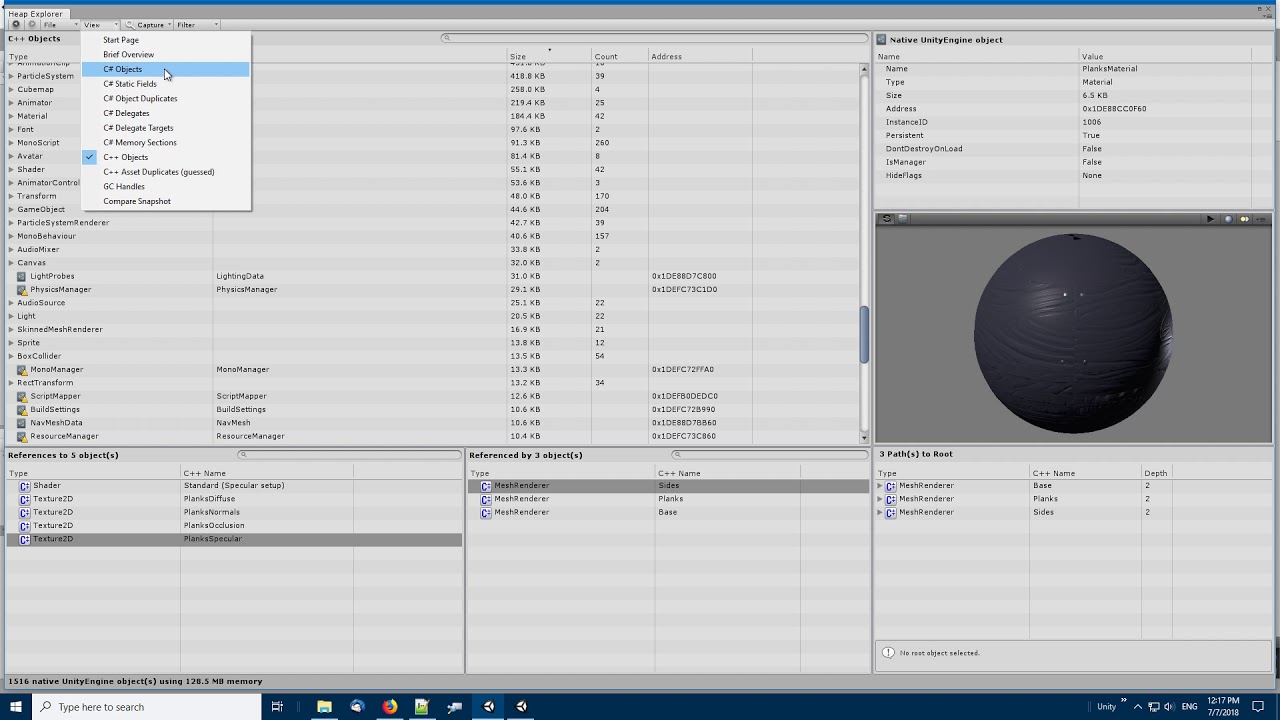

GitHub
A Memory Profiler, Debugger and Analyzer for Unity 2019.3 and newer. - GitHub - pschraut/UnityHeapExplorer: A Memory Profiler, Debugger and Analyzer for Unity 2019.3 and newer.
but really you should use a pro memory analyzer like dotMemory or Visual Studio's
woven crow
Anyway I just want to make sure of something, let's say I do
GameObject mygameObject = new GameObject();
var mycomp = mygameObject.AddComponent<MyComp>()
var lstr = mycomp.lstr1;
With:
public class MyComp : MonoBehavior {
  public List<string> lstr1;
}
And then I Destroy(mygameObject)
then lstr would still be existing, but mycomp would be = null right ? ( 1 frame after cause of Unity execution order destroy object after everything)
I'll try this memory Profiler thanks
 long ivy
woven crow
then lstr would still be existing, but mycomp would be = null right ? ( 1 frame ...
long ivy
woven crow
then lstr would still be existing, but mycomp would be = null right ? ( 1 frame ...
mycomp will never be set to null unless you do it yourself. It will look like it's null, due to Unity's overloaded quality operator as mentioned. lstr1 won't be eligible for GC until lstr goes out of scope. That distinction might be important in some circumstances, since Unity will expand the heap if there's sufficient memory pressure and will never release heap memory once claimed
woven crow
Okay thanks, yeah that's quite an important distinction
So yeah I understand better the previous aswers about this
small badge
I'm still philosophically opposed to Unity's overload of == null, but I have to admit I've been tripped up more often by the cases where it isn't used than the ones where it is.
woven crow
Until now, I didn't had to care at all about the duality of UnityObjects and c# Objects of components
So I guess it's not that bad haha
 brave sail
Guys, how can I make an infinity loop in a simple class (not MonoBeh) without alocationg new memory for Task.Yield or Task.Delay in every cycle of loop?
 frigid notch
brave sail
Guys, how can I make an infinity loop in a simple class (not MonoBeh) without al...
frigid notch
brave sail
Guys, how can I make an infinity loop in a simple class (not MonoBeh) without al...
Can you give more details?
For example if you want to make infinite loop for a countdown you can
private void Update()
{
countdown -= 1 * Time.deltaTime;
}
brave sail
frigid notch
Can you give more details?
I have an infinity async loop, and every cycle i'm awaiting for Task.Delay or Task.Yield, but each of that methods creates new class instances that will be removed by GC in the future, can I make my loop in a better way? or with a little bit more performance? : D
frigid notch
while(true)
{
}
or for()
{
}
brave sail
I don't want to use monobehaviour(
brave sail
My goal is to not make garbage from Task.Yield and Task.Delay
@frigid notch , okay, thanks, I guess I will rewrite my code to use Action/Events, and remove my loop (
frigid notch
brave sail
<@!878761053180272680> , okay, thanks, I guess I will rewrite my code to use Act...
Your welcome, goodluck mate.
tough tulip
undone coral
when you call Destroy on a Unity.Object, unity will destroy the engine (C++ land...
yeah looks like I was wrong.
so apparently, I tried running some more tests and found that other than local scope heaps, nothing from MonoBehaviour gets gc'ed.
my tests are based on WeakReference and also the unity's memory profiler for non serialized monobehaviour fields based on Praetor's response
tough tulip
brave sail
<@!878761053180272680> , okay, thanks, I guess I will rewrite my code to use Act...
still comes down to how you will invoke your Action/Event without monobehaviour or tpl
 thorny gulch
Hi all. i have Tap strap 2 connected to my pc with bluetooth. but Unity Editor seems not seeing it. when i build on Android, app works
But unity editor and building for pc not working.
what can be the problem?
Thanks
woven crow
tough tulip
yeah looks like I was wrong.
so apparently, I tried running some more tests and...
That's a big crazy tho, cause then if you have a lost reference somewhere to any component, and this component references others component that references other component, it may end up not freeing tons of memory
frigid notch
thorny gulch
Hi all. i have Tap strap 2 connected to my pc with bluetooth. but Unity Editor ...
You sure you have Android editor?
Also make sure to change game aspect and simulator
tough tulip
woven crow
That's a big crazy tho, cause then if you have a lost reference somewhere to any...
oh no would you look at that.. WeakReference doesn't work in Unity. I tested it out in .net 5 console app and it works just as expected. but in unity WeakReference causes the object to never get collected even if all other references are destroyed
woven crow
Oh okay, that's a specific case for WeakReferences
tough tulip
yes which also means that my test about fields not being gc'ed might be wrong
 flint sage
I'm skpetical that your test is done correctly tbh
thorny gulch
frigid notch
You sure you have Android editor?
what you mean androd editor
frigid notch
thorny gulch
what you mean androd editor
do you have windows builder?

@thorny gulch
thorny gulch
frigid notch
when you build it doesn't execute?
nope
frigid notch
switch platform?
thorny gulch
on android it works, when im connecting devices to the phone
building for windows and connectin devices to the pc, not working
frigid notch
wdym by not working
tough tulip
flint sage
I'm skpetical that your test is done correctly tbh
give it a try yourself. let me know if there was anything wrong anywhere. there are couple of threads supporting my findings tho :))
woven crow
I just found out my issue tho,
My agent were subscribing to a static Action, and never unsubscribing, and that was leading to keep all the references to everything
Pretty bad idea to use Static Actions
Even if it's convenient at first
small badge
brave sail
I have an infinity async loop, and every cycle i'm awaiting for Task.Delay or Ta...
UniTask ( https://github.com/Cysharp/UniTask ) advertises itself as a drop-in replacement for System.Task in Unity that removes those allocations; I haven't profiled its memory use myself to check, though.
 mortal orchid
https://pastebin.com/R59y6cBa When there is no collision I want the animation to run after 4 seconds. But the animation is running suddenly it does not wait for 4 seconds. kindly help with this.
Pastebin
Pastebin.com is the number one paste tool since 2002. Pastebin is a website where you can store text online for a set period of time.
 stable spear
oops misread
stable spear
mortal orchid
https://pastebin.com/R59y6cBa When there is no collision I want the animation to...
In order to stop a coroutine, you need to store the return value of StartCoroutine(), and use that
Also, you are launching a different instance of WaitAndRun() every frame that NotIsCollided is true
you could end up with 100s of WaitAndRun()'s running simultaneously, which is probably not what you actually want
mortal orchid
stable spear
Also, you are launching a different instance of WaitAndRun() every frame that No...
What could be the better approach?
stable spear
what is the goal ?
mortal orchid
stable spear
what is the goal ?

See there is a yellow bar slider
When the green segment collided with the red segment the bar would be in an idle state but the moment both segments do not collide with each other and 4 seconds have been passed then the yellow bar shaking animation has been started running and it will stop the moment they collide again
stable spear
Try this?
Coroutine waitCoroutine;
...
        if (moveRunner.IsCollided())
        {
            anim.speed = 1.5f;
            movementSpeed = 1500f;
            sliderAnim.SetTrigger("toIdle");
            if (waitCoroutine != null) {
                StopCoroutine(waitCoroutine);
                waitCoroutine = null;
            }
        }

        else if(moveRunner.NotIsCollided())
        {
            anim.speed = 1f;
            movementSpeed = 1000f;
            if (waitCoroutine == null) {
                waitCoroutine = StartCoroutine(WaitAndRun());
            }
        }
there's no implicit conversiom between a Coroutine and bool, so a waitCoroutine == null should work just fine along the above logic
stable spear
tough tulip
there's no implicit conversiom between a Coroutine and bool, so a waitCoroutine ...
thanks, I keep mixing up my C's
mortal orchid
stable spear
Try this?
```cs
Coroutine waitCoroutine;
...
if (moveRunner.IsCollided()...
Animation remains in Idle state
stable spear
are you sure moveRunner.IsCollded() / NotIsCollided are doing the right thing?
you might want to put Debug.Log("IsCollided"); and Debug.Log("NotIsCollided") in each respective branch to see if it is doing the right thing
mortal orchid
colliders are working perfectly fine because the animation was running just the 4 seconds delay was the issue.
tough tulip
mortal orchid
colliders are working perfectly fine because the animation was running just the ...
wait. if you're using a collider why not handle this in TriggerEnter/Exit itself?
there's no need to do this in an update
also, you should add logs once just for the sake. even im suspicious of IsCollided checks
mortal orchid
tough tulip
also, you should add logs once just for the sake. even im suspicious of IsCollid...

both logs working
tough tulip
mortal orchid
both logs working
log printing is one thing, and working as intended is one.
well, can you move the logs inside both waitCoroutine != null check, and also the waitCoroutine == null now
there's a possibility for such situation where:
i) NotIsCollided becomes true for 1 frame, Coroutine starts which waits 4 secs before triggering the animation
ii) Next frame or any frame before 4 seconds, IsCollided becomes true, hence cancelling our the Coroutine which was supposed to wait for 4 seconds before triggering the animation with delay
mortal orchid
tough tulip
log printing is one thing, and working as intended is one.
well, can you move th...
Yes, I understand that but I am sure about the colliders because both animations were working fine the issue was that the 4 seconds delay was not working. the shake animation started every time when a collision does not occur instead of 4 seconds delay that was the problem in original code,
The animation is not playing entirely when doxdust changes the code.
tough tulip
mortal orchid
The animation is not playing entirely when doxdust changes the code.
despite the animation working, there might still some very wrong logics with your old code. again i'd suggest you to print log once inside the coroutine null checks. disable collapse, and then check the log
mortal orchid
tough tulip
despite the animation working, there might still some very wrong logics with you...

I have moved the logs as you described in null checks
still collision and not collision printing on screen
as before
tough tulip
tough tulip
there's a possibility for such situation where:
i) NotIsCollided becomes true fo...
then this is what is happening in your case
mortal orchid
tough tulip
then this is what is happening in your case
Can you suggest how to tackle the issue?
tough tulip
mortal orchid
Can you suggest how to tackle the issue?
for starters, you'll need to fix IsCollided and NotIsCollided
it should be IsColliding only. and when its false, its not colliding. you shouldn;t need a second func
 mortal glen
is it possible to use an attribute like [Range(0, 19)] but have the value range differ based on for example a bool or enum?
example isHuman = true, [Range(0, 5)] else [Range(0, 10)]
 devout hare
You can use variables instead of number constants
int max = isHuman ? 5 : 10;
whatever[Range(0, max)];
or put the ternary directly as the parameter
small badge
mortal glen
is it possible to use an attribute like [Range(0, 19)] but have the value range ...
In principle yes; you can write an attribute that does this, but the code would be pretty complicated.
OdinInspector provides attributes that can be set up like that, but it's a paid asset.
mortal glen
@small badge I have Odin, but besides its being paid, it also has its own revcap.
(in its tos)
Thanks for the solution @devout hare
small badge
Yeah, it's a limiting option in a couple of ways (though if you're lucky enough to be making over $200k annual revenue a $250 annual fee is much more manageable).
devout hare
Oh yeah, a variable prob won't work in attributes
small badge
It won't, no. Even with Odin's solution the code would look something like [PropertyRange(0, "@this.isHuman ? 5 : 10")] (and the inspector code would parse the logic out of the string parameter).
tough tulip
mortal glen
example isHuman = true, [Range(0, 5)] else [Range(0, 10)]
guessing its not a custom inspector you're looking for, since you posted it here, you can do something like this:
[Range(0,1)][SerializeField] float scale;
float SomeVariable => scale * (_isHuman ? 5 : 10);```
bit of hacky but hey you could survive with this grand stag
I'm trying to grab this string from a web API anyone now how I could do that?

        string formulaJSON = "";
        // Get JSON for Formula
        using (UnityWebRequest webRequest = UnityWebRequest.Get(jsonMolecularFormulaURL))
        {
            // Request and wait for the desired page.
            yield return webRequest.SendWebRequest();

            string[] pages = jsonMolecularFormulaURL.Split('/');
            int page = pages.Length - 1;

            if (webRequest.isNetworkError)
            {
                Debug.Log(pages[page] + ": Error: " + webRequest.error);
            }
            else
            {
                formulaJSON = webRequest.downloadHandler.text;
            }
        }
        var Formula = JSON.Parse(formulaJSON);
Debug.Log(Formula);```what's the issue? that should get the json just fine, now you need to parse it into something
grand stag
long ivy
what's the issue? that should get the json just fine, now you need to parse it i...
I'm not 100% sure how to exclude the "C9H17N04" into it's own string
long ivy
I don't know what JSON library you're using, but if you wanted to use Unity's JsonUtility, you can just create a set of objects to deserialize the json into and grab it directly, e.g.:
[Serializable] struct MolecularFormulaJSON { public PropertyTable PropertyTable; }

[Serializable] struct PropertyTable { public List<Property> Properties; }

[Serializable] struct Property {
    public string CID;
    public string MolecularFormula;
}
and then
var result = JsonUtility.FromJson<MolecularFormulaJSON>(formulaJSON);
finally
Formula = result.PropertyTable.Properties[0].MolecularFormula;
grand stag
Thanks so much, I'll try that out
 drifting galleon
or if you are confident that the structure never changes, and you just want the C9H.... just use Regex
 young spoke
Im making a skateboarding game. I have everything done besides grinding and most tricks. I need help with having the player locking into the rail in the direction the player rides into it. I mostly just need ideas, not much help. For now
Please dm me rather than @ - ing me
ty
 untold moth
young spoke
Im making a skateboarding game. I have everything done besides grinding and most...
untold moth
young spoke
Im making a skateboarding game. I have everything done besides grinding and most...
Define the rail as a vector and project your current move direction into that vector. Use the resulting direction as the movement direction instead.🤔
 slender stag
I am making a stationary turret in my game, and the turret will only shoot if it sees the players position so if a player peaks out from a corner and hits the aims for the corner of the turret, they will destroy it without the turret hitting them because it doesn't see them.... how could I make it look at the colliders or the mesh of the player?
untold moth
slender stag
I am making a stationary turret in my game, and the turret will only shoot if it...
"if the player" what?
You could make it respond to taking damage. If it's damaged and the damage source in it's reach, it should turn and fire at the damage source.
slender stag
Problem is, if the players transform.position is behind a wall for example the turret will think it's impossible
slender stag
untold moth
"if the player" what?
Corrected to "of the player"
untold moth
slender stag
Problem is, if the players transform.position is behind a wall for example the t...
How can the player shoot while behind the wall?
Clipping?
slender stag
No, if they are behind a corner
Because my player is a tank, but if they get their Hull behind a corner, and their turret, they can hit the stationary turret and it won't respond
This is why I posted it in this channel, since I want to see how I can get the colliders (vertices) of the player and see if I can hit it
Or the mesh, not sure which one is better
untold moth
slender stag
This is why I posted it in this channel, since I want to see how I can get the c...
The simpler way would be to define several points along the tank mesh that the turret can target. Then if any of the points is not behind the wall, the turret can fire in their direction.
You could do that with vertices of course, but assuming you're gonna raycast to see if there's a wall in between, it might be super performance heavy.
slender stag
How much raycasts do you think should I make?
I am thinking maybe 5 or 6 at max
(Counting tranform.position raycast)
untold moth
Maybe 4 or so near the corners of the tank mesh.
8
So like cube or rhomboid corners.
Could also do something like frustum check for the turret. And see if the collider bounds are withing the frustum.🤔
But you'll still need some way to target the exposed area.
 timid coyote
Anyone around that can help me with a Projector setup?
slender stag
Yeah cause I want to use this method for my vertical autoaim for the tanks (tanks only shoot straight currently)
timid coyote
@slender stag ... Is the raycast basically the barrel of the firing tank?
slender stag
Currently, I use only the raycast for the bullet
(Bullet, uses Update every frame to shoot a raycast from its previous position to its current position, if it hits something it explodes and does its checks if it's a hittable object)
timid coyote
@slender stag... So yes, the raycast represent the bullet's trajectory.
If I remember my racasts correctly you'll get an array of all the HIT objects ... so all you need to do is check the first item and if it's not the tank, or a hittable collider on the tank then ther is no hit.
slender stag
That was not the question though
sly grove
slender stag
How much raycasts do you think should I make?
I would make an array of points (empty child objects) on your character representing the extremes of the character, so one of the extreme right and left, one extreme top and bottom, one in the center. Don't do a fixed number, just do one raycast per point in that array
then you can configure it differently for different characters etc
slender stag
Is LookAt also intensive?
sly grove
no
slender stag
Cause I could make it use lookat to see in which direction is the player, then shoot a raycast in that direction, to see if it hits the hull
 lean mason
can i get feedback on my singleton design pattern
thanks!

GitHub
A modern Singleton for C# with searching by arbitrary property, Instance properties, explicit instantiation and more. - GitHub - jpgordon00/CSharpSingleton: A modern Singleton for C# with searching...
 wise bobcat
is there any way that I can also serialize animations
slender stag
sly grove
I would make an array of points (empty child objects) on your character represen...
Actually.... what if I make a 360x180 camera
Make player objects white (for the camera) and all other objects black (fixed autocorrect)
 mint kraken
@wise bobcat animations are simply just position rotation scale stored in a timeline, so you can sample the anmation get all the data ,serialize it, but deserialize the data make a animation is the hard part
I'm using shader to play animation so I don't have the second part problem
wise bobcat
mint kraken
<@!722435402555719740> animations are simply just position rotation scale stored...
most likely unity reads and parse yaml serialized anims
however custom serialized anims would make things go hard
will any encryption work at this point?
tough tulip
why do you need encryption just to make animation work? Unity animations are well optimized at what they are doing
But yes, unity reads and parses the yaml for you and also generates the yaml for you when you animate something in unity. Unity also generates the clip from any fbx you import
 dire sparrow
Is there any RUDP Solution with proper documentation for C# that you know?
flint sage
Why would you want to encrypt your animations 0.o
mortal glen
is there a smarter way than to attach your player gameobject to a platform as a child?

going up and down will work good enough because of gravity
(i want the Zelda mechanic, where the platform keeps moving with you on it
tough tulip
dire sparrow
Is there any RUDP Solution with proper documentation for C# that you know?
my personal fav and simplest library https://github.com/RevenantX/LiteNetLib
it also supports serialization of custom classes/structs to byte
tough tulip
mortal glen
is there a smarter way than to attach your player gameobject to a platform as a ...
instead of parenting, add transform to a list within the platform monobehaviour.
get the delta change of platform position and add it to character
 lunar raft
So, I have a procedural model generation framework that I am thinking about converting to a multithreaded system and introducing dependencies. (Imagine generating two cubes and then creating a union of those two cubes.. so clearly the generation of the two cubes are independent actions... but the union action is dependent on the completion of the first two actions.)
Is there a good pattern/framework in Unity to do this?
 sage radish
lunar raft
So, I have a procedural model generation framework that I am thinking about conv...
sage radish
lunar raft
So, I have a procedural model generation framework that I am thinking about conv...
Unity's C# Job system supports job dependencies
lunar raft
sage radish
Unity's C# Job system supports job dependencies
Would this require that I convert my model generation to the Entity Component System?
sage radish
lunar raft
Would this require that I convert my model generation to the Entity Component Sy...
No, the C# Job system has no dependency on ECS, it's the other way around.
lunar raft
sage radish
No, the C# Job system has no dependency on ECS, it's the other way around.
Ooo. Neat... The challenge I've come across is that it's always been coupled together in example.
sage radish
lunar raft
Would this require that I convert my model generation to the Entity Component Sy...
But it does have some limitations to ensure thread safety, like only allowing blittable value types.
https://docs.unity3d.com/Manual/JobSystemSafetySystem.html

Here are some examples, none of which include ECS
https://github.com/stella3d/job-system-cookbook

GitHub
Examples of using the C# Job System in Unity 2018. Contribute to stella3d/job-system-cookbook development by creating an account on GitHub.
lunar raft
sage radish
Here are some examples, none of which include ECS
https://github.com/stella3d/jo...
Sweet! Thank you. This should help immensely.
lunar raft
Is it just me or did Unity complicate things by backpedalling on how beta packages are managed.
mortal orchid
https://pastebin.com/hSP4Aank I want the animation to be triggered after every 4 seconds when a collision does not occur. But the animation is running after 4 seconds just for once then after every collision Exit animation starts running suddenly without any wait. It would be kind if anybody could see it.
Pastebin
Pastebin.com is the number one paste tool since 2002. Pastebin is a website where you can store text online for a set period of time.
devout hare
mortal orchid
https://pastebin.com/hSP4Aank I want the animation to be triggered after every ...
Choose one channel, don't cross-post
mortal orchid
devout hare
Choose one channel, don't cross-post
apologies.
lunar raft
Is there a common fix for this. Googling is a dark and deep rabbit hole:
[Package Manager Window] Unable to perform online search:
Cannot connect to 'staging-packages.unity.com' (error code: ENOTFOUND). Verify your environment firewall policies allow connection to this host name. If your system is behind a proxy, verify your proxy environment variables (HTTP_PROXY and HTTPS_PROXY) are properly set.
UnityEditor.EditorApplication:Internal_CallUpdateFunctions ()
 fresh salmon
lunar raft
Is there a common fix for this. Googling is a dark and deep rabbit hole:
[Packag...
fresh salmon
lunar raft
Is there a common fix for this. Googling is a dark and deep rabbit hole:
[Packag...
That URL doesn't exist. Browser gives out a NXDOMAIN error too.

Doesn't exist on the internet*
lunar raft
fresh salmon
That URL doesn't exist. Browser gives out a NXDOMAIN error too.
FOund the answer. Remove the registry from the package manifest and let the package manager find it.
 regal olive
hey sup guys so my weapon has a firerate script that works fine like it is but i have more weapons so i want my weapons to have different firerates how can i do that
young spoke
untold moth
Define the rail as a vector and project your current move direction into that ve...
could you explain in more detail? thx
untold moth
young spoke
could you explain in more detail? thx
Ummm... There's nothing much to explain. You just need to know the direction that goes along the rail and project your facing/movement direction to to get the new movement/facing direction along the rail. Of course you also need to set/lerp the position to a point along the rail(at least initially).
young spoke
why is it that when I rotate my player when not playing the game it rotates of the z axis but on the y axis when playing the game?
 shell horizon
Ran into an obnoxious issue with script execution order and coroutines. Apparently everything after the first yield executes after all updates are finished. I need it to run at the same time or before start. Is there anyway to achieve this using coroutines or am I going to have to find another solution?
tough tulip
I just tested few days ago and mentioned it here as well. WeakReference prevents GC collection in Unity. Not sure if that will ever be fixed or if it's known even
I'm not sure if it's caused by incremental gc or not
tough tulip
shell horizon
Ran into an obnoxious issue with script execution order and coroutines. Apparent...
That's an intended behaviour yes
https://docs.unity3d.com/Manual/ExecutionOrder.html
What you can do is implement another script named early update or something with early execution order.
public IEnumerator Something;

void Update()
{
    if(Something!=null) Something.MoveNext();
}```

To run this, simply set the field to your IEnumerator functionMaybe because you are rotating about world space instead of local
shell horizon
@tough tulip That's exactly what I was looking for, thank you. And yeah I know it's intended I'm just a little annoyed that scene loading forces you to wait a frame
tough tulip
regal olive
hey sup guys so my weapon has a firerate script that works fine like it is but i...
Simplest approach is to change the cool down according to your current equipped weapon in that firerate script. For that you need to save firerate(the cool down float value) somewhere and it has to be accessible by code.
You can add a script to your weapon which has that data, or use a scriptable object for it
shell horizon
@tough tulip actually you wouldn't happen to know where in the script execution order the scene is loaded would you? I can't seem to find the answer anywhere
small badge
The scene is loaded in the background, it can take several frames. I don't know whether there are any guarantees about when calls like Start/Awake happen?
shell horizon
I'm not using the async load, so it finishes in one frame
I just need to know when that actually happens
untold moth
shell horizon
I just need to know when that actually happens
whenever you call it🤷♂️
shell horizon
you'd think, but nope
untold moth
wdym?
shell horizon
this code throws an error
SceneManager.LoadScene(2, LoadSceneMode.Additive); yield return null; SceneManager.SetActiveScene(SceneManager.GetSceneAt(2));
that the scene isn't loaded
small badge
The "synchronous" load is rather misnamed, yeah; it just means "asynchronous, but guaranteed to take at most one frame".
shell horizon
ahh, that makes much more sense
small badge
My assumption is that LoadScene() would call Awake() and Start() after the previous frame's EndOfFrame, but before the first (fixed)update calls in the new frame. I don't know if that's guaranteed, though.
(I guess I should say "current" rather than "previous".)
tough tulip
LoadScene starts with Awake on all active gameobjects in the scene
It should most likely be initialized somewhere between Update and LateUpdate
No guarantees though, haven't tested myself
untold moth
shell horizon
this code throws an error
` SceneManager.LoadScene(2, LoadSceneMode.Addi...
You sure you want to GetSceneAt(2)? Do you have 3 scenes loaded at the same time?
shell horizon
I wish it was a simple error like that, but no, that code loads the main scene and unloads the menu scene, while keeping the preload scene loaded
it works as intended, just the execution order really screws things up
untold moth
shell horizon
I wish it was a simple error like that, but no, that code loads the main scene a...
So you do have 3 scenes loaded at that point?
small badge
Would it be the end of the world to just wait another frame? I don't know that I would want to rely on anything that's trying to rush more than that.
shell horizon
The problem is I need to pass information to the new scenes scripts before their start functions run
So it needs to be precise
untold moth
shell horizon
The problem is I need to pass information to the new scenes scripts before their...
I don't think that's possible...🤔
Just initialize the scripts in Awake
tough tulip
shell horizon
The problem is I need to pass information to the new scenes scripts before their...
That's kinda easy to tackle.
Optionally you set the data somewhere in some static script, and use that data in your Start/Awake of new script
small badge
I very much doubt you can guarantee a window between creating an enabled object and Start() being run; you can't even do that when calling Instantiate().
If you need to execute code on a new object before Start is called you usually need to create it inactive/disabled, then activate/enable it after you've done your setup.
shell horizon
tough tulip
That's kinda easy to tackle.
Optionally you set the data somewhere in some stat...
Yeah, you're probably right. I'm working on a save/load system for a project that's pretty far along though, so it will be a pain to get everything set up like that. it seemed more natural/cleaner to me to just send all the information from the save load script to the objects, but I guess that's not possible with how scene loading works
untold moth
You can always wait until everything is initialized, then override with the loaded data.
tough tulip
shell horizon
Yeah, you're probably right. I'm working on a save/load system for a project tha...
you can go with tjm's approach, although you'd need to enable objects manually. but the problem is still there of previous scene being unloaded, you probably would lose previous data.
There are still few alternatives:
I) make current scene as ddol, load new scene, pass data, then destroy unwanted gameobjects and do Resources.UnloadUnusedAssets once
ii) load new scene as additive, pass data, unload old scene. although additive loading can lead to some weird behaviour with camera and audiolistener, so be cautious of it
young spoke
tough tulip
Maybe because you are rotating about world space instead of local
explain
shell horizon
tough tulip
That's kinda easy to tackle.
Optionally you set the data somewhere in some stat...
I think I'm gonna go with this, it seems like the easiest to implement, even if it seems messier. It would make things so simple if there was an option to just load a scene synchronously, though I'm sure there's a reason why there isn't. Anyway, @tough tulip @small badge thanks for the help 👍
tough tulip
The reason why it waits for a frame is because how synchronous code works. When a new scene loads, all previous gameobjects would be destroyed. If that happens, it would be a mess in Unity's internal gameobject callbacks like other Update/LateUpdate, and Destroy wouldn't be called.
Hence everything happens at end of frame, and this the 1 frame delay
For actual synchronous load, I don't know how AssetBundle.Load would work for this case, but you can also try Resources.Load which would work like Additive loading, and after load, just destroy unwanted gameobjects.
Destroy is anyway at end of frame
But yes don't go with these approaches. It's a way for absolute synchronous load, not your solution you re looking for
 humble leaf
@oblique narwhal Stop crossposting.
 worthy lodge
Is there a way to change materials or textures in the pre-build process?
I want to include different materials in an android version of my game, but am looking for a way to change them without changing them in runtime, which takes a lot of time
flint sage
Just write a script that changes it and then triggers the build
worthy lodge
flint sage
Just write a script that changes it and then triggers the build
Yeah but then I change it permanently, right?
flint sage
Well, change it back after the build is done?
untold moth
Afaik there are pre and post build callbacks that you can hook your code to.
 mint sleet
Hey, I got this issue after making a HTTP response.
I am able to get "response" but when I click on this it produces this exceptions:
ArgumentOutOfRangeException: Index and length must refer to a location within the string.
Parameter name: length
GUI Error: You are pushing more GUIClips than you are popping. Make sure they are balanced.

Do you have any idea?
and I can not click on Debug.Log messages, if I do it does not open.
flint sage
That's a bug in Unity
Looking at the stacktrace it tries to create a hyperlink but somehow fails
flint sage
No idea
Look at the editor log instead
Sanitize your log somehow so that it doesn't crash the console
Update unity to aversion where that's fixed
 frail dock
I have an issue where i'm generating a mesh and drawing a texture on it, but when i try to reapply to same uv to it it comes out twisted, anyone have a clue why?
this is my code:
    public List<Vector3> newVertices = new List<Vector3>();
    public List<int> newTriangles = new List<int>();
    public List<Vector2> newUV = new List<Vector2>();
    private Mesh mesh;

    private float tUnit = 0.0625f;
    private Vector2 tOne = new Vector2 (0, 8);


    void Start () {

        mesh = GetComponent<MeshFilter> ().mesh;

        float x = transform.position.x;
        float y = transform.position.y;
        float z = transform.position.z;

        newVertices.Add( new Vector3 (x  , y  , z ));
        newVertices.Add( new Vector3 (x + 1 , y  , z ));
        newVertices.Add( new Vector3 (x + 1 , y-1 , z ));
        newVertices.Add( new Vector3 (x  , y-1 , z ));

        newTriangles.Add(0);
        newTriangles.Add(1);
        newTriangles.Add(3);
        newTriangles.Add(1);
        newTriangles.Add(2);
        newTriangles.Add(3);

        newUV.Add(new Vector2 (tUnit * tOne.x, tUnit * tOne.y + tUnit));
        newUV.Add(new Vector2 (tUnit * tOne.x + tUnit, tUnit * tOne.y + tUnit));
        newUV.Add(new Vector2 (tUnit * tOne.x + tUnit, tUnit * tOne.y));
        newUV.Add(new Vector2 (tUnit * tOne.x, tUnit * tOne.y));

        mesh.Clear ();
        mesh.vertices = newVertices.ToArray();
        mesh.triangles = newTriangles.ToArray();
        mesh.SetUVs(0, newUV.ToArray());
        mesh.Optimize ();
        mesh.RecalculateNormals ();

        // makes it all twisted
        mesh.SetUVs(0, newUV.ToArray());
    }

first one is without the last line
second as you can see is cut and twisted for some reason
flint sage
Remove optimize and try again
frail dock
flint sage
Remove optimize and try again
it worked, but why? 🤔
flint sage
Chances are optimize reorders your mesh
flint sage
In this case, probably not much
frail dock
what if my mesh had like 80k triangles?
flint sage
This function causes the geometry and vertices of the mesh to be reordered internally in an attempt to improve vertex cache utilisation on the graphics hardware and thus rendering performance. This operation can take a few seconds or more for complex meshes and should only be used where the ordering of the geometry and vertices is not significant as both will change.
frail dock
hmm okay ty
 misty crescent
Anyone here used Unity as a Library? How can I run Application.Quit() WITHOUT exiting my parent app? Anyone from Unity know the answer to this?
drifting galleon
misty crescent
Anyone here used Unity as a Library? How can I run Application.Quit() WITHOUT ex...
try process.Close()
misty crescent
@drifting galleon from our React Native app or from within Unity?
Also isn't this whole problem because React Native is single threaded? Like because Unity runs on the same main thread or something?
drifting galleon
misty crescent
<@!215504142947319808> from our React Native app or from within Unity?
well you didn't specify how your apps interact. but if you've got a process handle to unity, then just call close on it or dispose the process. should close unity but keep your app alive
misty crescent
I'm using https://github.com/asmadsen/react-native-unity-view @drifting galleon
drifting galleon
haven't worked with that. so you probably need to dig a bit yourself
misty crescent
Is there any way I can interact with someone from Unity regarding this?
misty crescent
@drifting galleon I've gone through the repo's code, the guy is running Unity on the UI thread, which incidentally react native also uses
So my question actually becomes: can I run it on a separate thread or does it have to run on the main thread? That's something any Unity dev who's built this can answer
drifting galleon
sorry. but i have no idea
tough tulip
misty crescent
Anyone here used Unity as a Library? How can I run Application.Quit() WITHOUT ex...
 misty glade
UnityEngine.EventSystems.IPointerDownHandler doesn't seem to work well if the application isn't focused when the pointer down is executed. Anyone have any ideas/tips on how I can make that work better? Or is that just life
It basically doesn't capture the pointer down event until the application is focused/topmost for 0.5sec or more.. which is fine I suppose? but a little clunky feeling
misty crescent
tough tulip
<https://docs.unity3d.com/ScriptReference/Application.Unload.html>
i'm having trouble with Unload(). Like...some of my API calls fails when I try to get back inside the game
regal olive
Say I wanted to create an in-editor modeling tool ala ProBuilder. How could I go about storing the mesh data inside the scene itself (or rather a component instance)?
sly grove
regal olive
Say I wanted to create an in-editor modeling tool ala ProBuilder. How could I go...
It'd just have to be some data structure you devise that is serializable by unity
Then it'll be stored in the scene just like any other monobehavior data
That's pretty much how ProBuilderMeshFilter works
 thin merlin
Looking for a way to change the layer-based collisions via code (the thing in the image)
 sly grove
thin merlin
Looking for a way to change the layer-based collisions via code (the thing in th...
thin merlin
sly grove
thin merlin
Looking for a way to change the layer-based collisions via code (the thing in th...
thin merlin
I just found that before you sent it XD
 thorny lintel
Hello, i need to set transform.position of StarSystemPrefab i Instantiate to new with offset of size of sizeOfSector. So they will have Boxcolliders next to each other and not inside each other.
public class Universe : MonoBehaviour
{
    public Vector3 universeSize;
    public Vector3 sizeOfSector;

    private Vector3 transformPos;

    [Space]
    public GameObject UniverseRoot;
    [Space]
    public GameObject StarSystemPrefab;


    private void Start()
    {
        GenerateStarSystems();
    }

    private void GenerateStarSystems()
    {
        for (int x = 0; x < universeSize.x; x++)
        {
            for (int y = 0; y < universeSize.y; y++)
            {
                for (int z = 0; z < universeSize.z; z++)
                {
                    GenerateSystem(new Vector3(x, y, z));
                }
            }
        }
    }

    private void GenerateSystem(Vector3 location)
    {
        GameObject system = Instantiate(StarSystemPrefab, location, Quaternion.identity, UniverseRoot.transform);
        system.GetComponent<StarSystem>().SetSizeOfBoxCollider(sizeOfSector);
        system.name = String.Concat($"Star System: (x:{location.x}, y:{location.y}, z:{location.z})");
    }
}
You probably want this:
x += sizeOfSector.x
instead of x++ (same for y and z)
oh, and float instead of int
 ripe bloom
Yoooooo anybody have any experience integrating Google crashlytics into their unity app?
thorny lintel
stable spear
You probably want this:
```cs
x += sizeOfSector.x
```
instead of x++ (same for...
I think i just crashed Unity 😄
thorny lintel
stable spear
did you end up with an infinite loop?
i need different way of controling how many chunks will spawn cuase universeSize.x will be smaller after one run
lol
i see it
iam dumb
thorny lintel
shame on me
thx for help, but i think still need to solve how many i wanan spawn
best solution is to spawn 0 0 0 chunk in middle and around it a chunks
but i dk
stable spear
that loop will spawn a cube with (universeSize.x / sizeOfSector.x) objects in the x direction, etc
thin merlin
Physics2D.IgnoreLayerCollision(LayerMask.GetMask("Player"), GameManager.groundLayers[1]);
in GameManager.cs:
  groundLayers = new LayerMask[] { LayerMask.GetMask("Collision"), LayerMask.GetMask("JumpThruPlat") }; // can confirm that both layers are being recognized in the inspector
}```
Result from top code:
What gives? Why is it saying I'm entering "layer1"?
sly grove
thin merlin
```Physics2D.IgnoreLayerCollision(LayerMask.GetMask("Player"), GameManager.groun...
GetLayer not GetMask
Or rather
stable spear
thin merlin
```Physics2D.IgnoreLayerCollision(LayerMask.GetMask("Player"), GameManager.groun...
you're giving it a mask (which is a value from 0 to 4 billion) instead of a layer index (a value from 0 to 32)
sly grove
LayerFromName
thin merlin
LayerFromName or LayerToName?
sly grove
Fromname
thin merlin
doesn't seem to recognize it ...
 stable spear
NameToLayer
sly grove
Yeah that
stable spear
and change the type of the array to an int[]
thin merlin
but the array is supposed to hold layers, isn't it?
sly grove
I'm not sure that array is useful at all but my suggestion is for the IgnoreLayerCollision piece
thin merlin
oh wait, if it's a set of layers
LayerMask.NameToLayer("Collision", "JumpThruPlat") would work?
stable spear
IgnoreLayerCollision only allows you to specify two layer ids
no
NameToLayer returns the index of a SINGLE layer
GetMask() will let you use multiple layers
LayerMask.GetMask("Collision", "JumpThruPlat") is valid
but it returns a LayerMask
thorny lintel
stable spear
that loop will spawn a cube with (universeSize.x / sizeOfSector.x) objects in th...
yeah it just spawn 0,0,0 fist one rest now, i need to figure out how to set how many in each direction in that loop
stable spear
that's not what you want for IgnoreLayerCollision
thin merlin
so I need to use both GetMask for standard collisions (my purposes since switching to NameToLayer in general broke things) and NameToLayer for the Ignore. Got it.
stable spear
thorny lintel
yeah it just spawn 0,0,0 fist one rest now, i need to figure out how to set how ...
huh?
stable spear
thin merlin
so I need to use both GetMask for standard collisions (my purposes since switchi...
For functions that take a LayerMask (a set of layers), you use GetMask. For functions that take a single layer index (int), use NameToLayer
 thin merlin
so, I think I have the IgnoreLayerCollisions written properly ... private IEnumerator FallThroughPlatform() { Physics2D.IgnoreLayerCollision(LayerMask.NameToLayer("Player"), LayerMask.NameToLayer("JumpThruPlat")); transform.position = new Vector2(transform.position.x, transform.position.y-0.5f); print("Platforms disabled"); fallThroughPlat = true; int timer = 0; while (fallThroughPlat) { if (!GameManager.gamePaused) { timer++; } if(timer >= 60) { fallThroughPlat = false; } yield return new WaitForEndOfFrame(); } Physics2D.IgnoreLayerCollision(LayerMask.NameToLayer("Player"), LayerMask.NameToLayer("JumpThruPlat"), false); print("Platforms enabled"); }
but when I try to run it
It's acting like collision is still active between the two objects.
the platform:

the player:
 sly grove
thin merlin
so, I think I have the IgnoreLayerCollisions written properly ... ```private IEn...
sly grove
thin merlin
so, I think I have the IgnoreLayerCollisions written properly ... ```private IEn...
Your code only waits for 60 frames before re-enabling the collisions
Depending on framerate that's very short
thin merlin
60FPS
sly grove
Should probably be waiting a specific amount of time instead of frames
thin merlin
here's the thing: according to the print statements, it's not even causing the collision to be ignored at all
sly grove
That whole while loop can be replaced with a single WaitForSeconds
thin merlin
noted, but the problem right now is that I don't think it's actually trigger the collisions to be ignored
sly grove
Also when and where are you starting this coroutine?
 vapid mauve
going by the console output, the delay should be long enough for it to fall through
thin merlin
in the playercontroller's update I have this:

if down is being held and the jump button is pressed, it works. The fallThroughPlat is a class level varaible used by the coroutine.
sly grove
I can't read the console in that video ATM on mobile sorry 😐
vapid mauve
Ah ^^
sly grove
BTW unity has a built-in well trodden way of doing this effect with a PlatformEffector2D
There's some good tutorials about it floating around
thin merlin
I have jumping up through the platform figured out, what I'm trying to do is make the player fall through on command, like in Castlevania or any other game where you can drop through platforms with an input.
vapid mauve
you could debug output the IDs you get from NameToLayer and also debug output https://docs.unity3d.com/ScriptReference/Physics2D.GetIgnoreLayerCollision.html to see if it actually got set
sly grove
It honestly just looks like you're re enabling the collision way too fast
thin merlin
the print statement shows that's not the case though
it comes out a full second after
and the player object is grounded on the platform way before it comes out
sly grove
thin merlin
the player:
Does your player have any child objects?
Or the platform
And if so do any of those children have colliders?
And if so what layer are those colliders on
Child objects may have different layers from their parents
thin merlin
the player has children, and one of them has a collider on another layer. I could disable that ... but there are situations where it will need to collide with that layer.
essentially, the game gives the player the ability to rotate the entire level, and when the platform is sideways it becomes effectively a wall on both sides
sly grove
thin merlin
the player has children, and one of them has a collider on another layer. I coul...
Sure but for now that could be giving you trouble so let's test it
thin merlin
that's not the issue
just noticed, could this have something to do with it?

the platform effector itself?
sly grove
I didn't think you were using a platform effector
thin merlin
platformEffector.colliderMask = //what do I put here, then?
I think this is precisely what I need to make this work.
sly grove
A layermask
thin merlin
took some workarounds and trying different things but I've managed to implement the fallthru mechanic rather cleanly after learning about manipulating the collider mask. That was the missing piece!
 ocean cedar
Hey can anyone help with this question? cheers..
https://stackoverflow.com/questions/69889824/unity-mobile-how-to-access-location-in-background

Stack Overflow
How can I access location on mobile in the background in Unity?
My use case is for geofencing, check if the user is within a certain area every now and again and if they are alert them with a
thorny lintel
stable spear
huh?
As next ste i tried to fill that cube with smaller cubes 😄. But i cant Divide Vector3 Size of BigCube / Vector3 SizeOfSmall cube
 thorny lintel
How i find size and number of cubes i need to fill a Cube i know its size? 🙂
 mighty latch
thorny lintel
How i find size and number of cubes i need to fill a Cube i know its size? 🙂
mighty latch
thorny lintel
How i find size and number of cubes i need to fill a Cube i know its size? 🙂
What are you trying to do here?
thorny lintel
mighty latch
What are you trying to do here?
I need to fill This big cube with small cubes. How many cubes it depends on size of that small cubes i got it there must be min 4 and max ?
I know size of BigCube(Vector3)
mighty latch
Well, let's say your big cube is 5x5x5 and your small ones are 2x2x2, you could put 8 of them inside
Mathf.FloorToInt(bigCubeSize / smallCubeSize);
thorny lintel
mighty latch
Well, let's say your big cube is 5x5x5 and your small ones are 2x2x2, you could ...
so i need to know always size of small cubes
mighty latch
You can do it the other way around if you want a certain amount of cubes inside
But you must either know the size of the small cube, or the number of cubes you want to be inside
thorny lintel
mighty latch
But you must either know the size of the small cube, or the number of cubes you ...
what if i find a way to use greatest divisor of that Cube?
mighty latch
wdym?
thorny lintel
Like what is greatest number to / number 100 so i get int and not float
 compact ingot
thorny lintel
How i find size and number of cubes i need to fill a Cube i know its size? 🙂
compact ingot
thorny lintel
How i find size and number of cubes i need to fill a Cube i know its size? 🙂
this probably requires a non-trivial algorithm and some math
mighty latch
That doesn't answer my question: what information are you supplying here? You already know the size of your big cube, but do you know which size you want your small cubes to be? Or do you know how many of them you'd want to fit inside?
thorny lintel
mighty latch
That doesn't answer my question: what information are you supplying here? You al...
Lets say i wanna fit as max small cubes as possible.
All i know is sice of Big Cube. I wanna avoid to set manualy number of cubes.
mighty latch
I'm assuming that you also want your small cubes to be of int size?
thorny lintel
mighty latch
I'm assuming that you also want your small cubes to be of int size?
yes. So it fit perfectly.
It is to create Sectors in StarSystem
mighty latch
Well, the smallest size will always be one
long ivy
then the problem is simple, isn't it? small cubes should be the smallest int size possible, and therefore you can fit min(big.x, big.y, big.z) ^ 3 small cubes inside
mighty latch
If it's a cube, you can simply cube one of its dimensions
compact ingot
thorny lintel
It is to create Sectors in StarSystem
what exactly is your goal here?
in gameplay terms
mighty latch
The smallest will always be one because it is the smallest positive integer (not accounting for 0's bullshit) and any number's greatest divider is itself
thorny lintel
Iam generating one big StarSystem Cube (Box Collider)

Thats is that big cube
now i need it filled by small cubes (sectors) so i can make custom cords system and LOD and Spawn and so on
Basicaly Cubic Chunks with smaller chunks inside
compact ingot
alright, but where is the problem?
do you want to know good sizes for the sectors so they perfectly fill the big cube?
compact ingot
any number ^3 works
compact ingot
yes
thorny lintel
next. harder thing is to generate them in right Vector3 😄
Like this code up can palce sectors nicely next to each other
place*
compact ingot
1, 8, 27, 64, 125, 216, 343, 512
thorny lintel
i tried, and i got crash 😄
 compact ingot
i really don't understand your problem, you are asking in advanced code but this seems extremely trivial
thorny lintel
sorry, i thought it will be complicated
misty glade
also why are you += size, instead of 1
compact ingot
number of sectors in your code can be any number
but the code itself makes no sense
thorny lintel
yeah it is code that fillup memory and crash
iam waiting to crash it so i can fix it
sizeOfSector = new Vector3(sizeOfSystem.x, sizeOfSystem.y, sizeOfSystem.z) / numberOfSectors;
misty glade
like, if you have numberOfSectors=10 but sizeOfSector you're.. uhm.. using two different "things"... do you want 10 by 10 by 10 or do you want "as many cubes fit"
thorny lintel
i think best is to be 10 10 10 and set size acording to it? or?
misty glade
and obviously you're sure your Vector3 has x, y, z > 0?
probably? I don't really understand your code, but if you want that, then you just:
for (int x = 0; x <= numberOfSectors; x++)
  for (int y = 0; y <= numberOfSectors; y++)
    for (int z = 0; z <= numberOfSectors; z++)
not that wonky "size" and "number" (and also floats as your for loop counters is . odd)
thorny lintel
misty glade
not that wonky "size" and "number" (and also floats as your for loop counters is...
i pasted that for from Systems Generation
misty glade
when you need to GenerateSector then figure out your location and cast it to float based on x, y and z which are indexes - ie, float xloc = (float)x * sizeOfSector;
thorny lintel
    private void Start()
    {
        GenerateStarSystems();
    }

    private void GenerateStarSystems()
    {
        for (float x = 0; x < universeSize.x; x += sizeOfSector.x)
        {
            for (float y = 0; y < universeSize.y; y += sizeOfSector.y)
            {
                for (float z = 0; z < universeSize.z; z += sizeOfSector.z)
                {
                    GenerateSystem(new Vector3(x, y, z));
                }
            }
        }
    }

    private void GenerateSystem(Vector3 location)
    {
        GameObject system = Instantiate(StarSystemPrefab, location, Quaternion.identity, UniverseRoot.transform);
        system.GetComponent<StarSystem>().SetSizeOfBoxCollider(sizeOfSector);
        system.GetComponent<StarSystem>().GenerateSectors();
        system.name = String.Concat($"Star System: (x:{location.x - sizeOfSector.x}, y:{location.y - sizeOfSector.y}, z:{location.z - sizeOfSector.z})");

    }
this will make as many System i set i wanna
later i make it so center is in middle
misty glade
your for loops are fragile and will break for a variety of reasons, the obvious one i see is that sizeOfSector with 0f components will stackoverflow
thorny lintel
is there better way than loops?
misty glade
are you intending that all the sectors are just adjacent like that? ie, densely populated?
thorny lintel
It should work as boudaries to load data from game/server
when u pass to other box
misty glade
i mean functionally your code works but .. depending on the universeSize and sizeOfSector you're going to be instantiating a lottttttttt of shit, and i don't know what is in GenerateSectors()
also you don't need String.Concat, you're already using string interpolation
thorny lintel
oh, okey, thanks for tip
misty glade
So, I mean, this is a little advanced but your code indicates that you still need to learn some basics (so these questions might be better suited for beginner/general), but a better approach if that's the case might be to only load sectors adjacent to the player (and unload them if you don't need them) instead of literally loading the universe
thorny lintel
I tried some numbers.
 misty glade
you're trying to make a 64x64x64 grid?
thorny lintel
yeah for start 64
misty glade
ok so it's a question of scale
64^3 is a big number and it's likely you don't need anywhere close to that number of items
262,144 sectors
your player is maybe going to what, interact with a handful of them?
thorny lintel
Starmade, Game coded in Java

has this map and chunks system.
basicaly u dont load stuff outside of that big cube i think
misty glade
ok..?
just saying if you're trying to instantiate 260,000 items you're gonna have a tough time
even if the items don't have anything in them
Unity staples a lot of functionality to those items, so even if they don't do much or anything, unity is going to check in on every single one of them every Tick, meaning.. your game won't run
thorny lintel
There is no way to skip a Systems that are without players?
Unloaded Chunks?
Thx for help 🙂 yeah iam begginer 🙂
Just noticed that StarSystem should be 0 0 0 😄
Btw if you hear a explosion in Prague, u know why
Nope. u f*** up 😄
misty glade
hm?
mighty latch
The thing is that these guys are probably pros that found way to greatly increase performance with some workarounds
Like loading and unloading chunks dynamically
young spoke
I am using a spline with only two points. Everything works but I am looking for a way to attach the player to the spline halfway through the spline instead of at one of the two ends
compact ingot
young spoke
I am using a spline with only two points. Everything works but I am looking for ...
what spline? also if its just two points, its a straight line and you can do Vector3.Lerp(start, end, t) to get an intermediate position.
sly grove
young spoke
I am using a spline with only two points. Everything works but I am looking for ...
any spline library you use would most definitely have methods to interpolate along the spline path
young spoke
so would I have to use a spline editor tool? I am currently just using one through code
compact ingot
no
but you can use one of the methods in the spline library you are using to find a position on the spline
young spoke
ok
compact ingot
each library has one, its kinda what they are all about
young spoke
ill take a look at that, thank you
young spoke
compact ingot
each library has one, its kinda what they are all about
what do you mean by spline library?
compact ingot
the core implementation of the concept of a "spline" requires you to write an interpolation function. just use that to find your position.
where do you get that spline from? did you write it yourself?
 compact ingot
that is not a spline
young spoke
how so?
compact ingot
that is just linear interpolation
young spoke
ok
compact ingot
when you say "spline", people usually expect something like this:
 compact ingot
my first answer is all you need
 primal flame
I wonder if there is something like baked animation and Ik animation blending for humanoid? Like for example ringing the door bell - every time it's same animation reaching out for door bell, but the position you stand can vary, so can the end position for hand. But.. still it is the same animation with some xyz correction. Any help appreciated.
 livid kraken
primal flame
I wonder if there is something like baked animation and Ik animation blending fo...
livid kraken
primal flame
I wonder if there is something like baked animation and Ik animation blending fo...
Checkout the animation rigging package
primal flame
livid kraken
Checkout the animation rigging package
Which one?
livid kraken
There is one such package in the package manager
Made by unity juat get the latest version
livid kraken
Well Im pretty sure there are official tutorials that cover exactly what you need. It can be overwhelming but the package is very powerfull. What you need is to set up a two bine ik on the arm and then set the target to what ever you want from code
primal flame
doc says "correcting animation" - that is what I need. But can't find anything on the topic later in doc
 reef bloom
How can I send multiple UnityWebRequest (around 40-50) without making the game not responding?
I can't use yield wait because it is very slow for 40 calls I want to load all async.
long ivy
launch all of them, and then yield until all are done
reef bloom
long ivy
launch all of them, and then yield until all are done
that takes around 1 minute.
long ivy
are you storing the AsyncOperation, or are you yielding the AsyncOperation directly? if the latter, you're waiting for one to complete before going to the next
reef bloom
        {
            request = UnityWebRequest.Get(tokenAddress + x);

            yield return request.SendWebRequest();

            if (request.result != UnityWebRequest.Result.Success)
            {
                Debug.LogError(request.error);
                yield break;
            }```

This is the current code currently it sends 1 by 1
I tried sending it without the yield return and it made it crash.launch them first, then start waiting
var requests = tokens.Select(x => UnityWebRequest.Get(tokenAddress + x)).ToList();
var waiting = requests.Select(request => request.SendWebRequest()).ToList();

foreach (var wait in waiting) {
    yield return wait;

    // error checking here
}
So I cant find anything about correcting baked animations with IK. Just taking full control
long ivy
that's untested code btw, but you get the idea
reef bloom
long ivy
that's untested code btw, but you get the idea
Just added the error check and result check
it works thanks.
 pulsar isle
I want to search for a specific frame(let's say frame number 15) in a video, pause there, extract video frame into a Texture2D. Then seek another numbered frame and do the same etc. What would the process look from a high level perspective. I'm close but for some reason instead of getting the frame I seeked I get the previous I seeked. Like I seek to frame 15, pause there, extract the frame to Texture and I get something irrelevant like the frame 0, then I seek frame 15, pause there and now the correct frame is extracted.
 slate stone
Why is it when you pass an index in a button.onclick.addlistener, it only calls the last index of the array or list?.
modest lintel
because the captured index is probably being modified in the loop
small badge
pulsar isle
I want to search for a specific frame(let's say frame number 15) in a video, pau...
Depends entirely on the video player. Most players are designed first and foremost for streaming video to the user's screen in 1:1 time as efficiently as possible, so other operations - like seeking to exact frames, getting video data for specific times, etcetera - often aren't implemented rigorously. For example, when you seek to frame 15 and play, it might not start decoding video until it plays to the next keyframe on or after frame 15.
Whereas other players might be more rigorous, and would seek to the last keyframe before frame 15 and silently play forwards to it before reporting the seek as complete.
modest lintel
copy it, and then set it
pulsar isle
I'm using the Unity Video player , in API mode. https://pastebin.com/jMtdwnrE This is the basic thing I want to do in code. With the results I described. I know it depends on the frameReady events the Unity Video player provides so I'm missing something probably. I have managed to extract all the video frames in a Texture2D List for example that gets frame, pauses, extracts it and plays again but it seems that when you actually want to SEEK a frame the process gets different.
small badge
Yeah, my experience with the Unity Video Player is that it can't do that sort of thing. Forward play at roughly normal (or slower) speeds, with occasional asynchronous seeks, is the only behaviour I could get it to do consistently. You could try an alternative video player like AVPro Video from the asset store, but those tend to be very expensive for anything other than trial versions.
pulsar isle
Oh...really ? Why is that the case, I mean from an internal perspective. I'm not that experienced so if you have any ideas please share them as they will help me to become better. Just to clarify again(because I tend to not explain things properly when I'm blocked), the challenge I want to tackle is: having the ability to seek to whatever frame I please in a video and extract it to a Texture2D. Unfortunately, paid solutions are off for me :(.
small badge
Naturally I don't know the internals, so all I can do is speculate... and I can't really add anything to the speculation I posted above. For example, if you assume the video has keyframes every 10 frames, if you tell it to seek to frame 15 and play it probably won't start decoding frames until it gets to frame 20 (because the alternative would be to seek to frame 10 and decode frames 10-15 all at once, which it doesn't want to do because it could cause a stall when playing the video real-time).
That's certainly not the only possible reason, though; just one of many.
pulsar isle
Interesting.
So I'm a bit cornered it seems. Sigh.
Your input was quite valuable and I enjoyed the back n forth. Will research further.
The idea of creating a buffer of the first 20 frames extracted into Texture2D List, use them, clean them and redo the process MIGHT also solve my problem in a way.
Also I experimented with just extracting the current video frame(whichever that is) and using it on my models but that seems to affect the performance even compared to extracting and saving all frames in a list on Start() (for example).
 primal ivy
what does "Unity.Services.Lobbies.LobbyServiceException: HTTP/1.1 401 Unauthorized" mean? using Unity's multiplayer lobby system.
 onyx blade
primal ivy
what does "Unity.Services.Lobbies.LobbyServiceException: HTTP/1.1 401 Unauthoriz...
onyx blade
primal ivy
what does "Unity.Services.Lobbies.LobbyServiceException: HTTP/1.1 401 Unauthoriz...
401 errors are authentication errors, check your credentials
primal ivy
onyx blade
401 errors are authentication errors, check your credentials
Thanks, would that be as a part of my project settings?
not sure if this is a programming question anymore :p
onyx blade
it probably isnt programming related. I havent used that multiplayer system. I just know what a 401 is xD
primal ivy
onyx blade
it probably isnt programming related. I havent used that multiplayer system. I j...
well thank you, yeah its very new, so it might even be a bug to be honest :p
onyx blade
there are other frameworks you can use if its urgent
primal ivy
onyx blade
there are other frameworks you can use if its urgent
Alright thanks ^_^
 proven blaze
Can somebody help? How to remove OpenGL validation at runtime? Oculus does it inside their .so file - how can we do it in Unity?
 wind pine
I'm working with a 3rd person CinemachineFreeLook camera, and I want to clamp the rotation around the playerCharacter in one of the player states. I'm new to using Cinemachine, so does anyone know what I can do or even referance?
Any Documentation I've seen on it doesn't seem helpful in scripting it.
 amber kite
Is it possible to set properties for a material owned by an Image or CanvasRenderer component in script, similar to how it can be done for materials attached to meshrenderers?
fresh salmon
Don't cross-post.
Collaboration request must be made on the forums.
Read #📖┃code-of-conduct for the full set of rules.
 bleak geyser
What's the difference between a normal (unlit) shader and a compute shader~~, except that a compute shader runs on the GPU~~?
And when to use a compute shader, and when to use a (unlit) shader?
 cursive horizon
bleak geyser
What's the difference between a normal (unlit) shader and a compute shader~~, ex...
cursive horizon
bleak geyser
What's the difference between a normal (unlit) shader and a compute shader~~, ex...
Compute shaders are used to run 'work' on the GPU instead of the CPU.
Lit/Unlit shaders are used to render materials on objects.
both run on the gpu
gray pulsar
bleak geyser
What's the difference between a normal (unlit) shader and a compute shader~~, ex...
all shaders run on the GPU. A "normal" shader is for rendering, while a compute shader is for calculating things in parallel that are not being rendered
bleak geyser
So in normal shaders there cannot be any logic, just properties with values?
gray pulsar
they have logic
they just don't return any data back to the CPU
(I believe, I'm not an expert)
cursive horizon
bleak geyser
So in normal shaders there cannot be any logic, just properties with values?
(I am also not an expert, here's my best explanation)
A shader is just a program that runs on the GPU. Normally, you feed data into it and it renders stuff to the screen. Some of this data is passed in by Unity for stuff like lighting (but not if it's an unlit shader, for example!). That's the 'standard' way of using them. You can't really 'read' from them (and mostly wouldn't want to).
A compute shader is written the same way, but is intended to take data in, process it, and save it to a buffer where you can read it back. It doesn't render anything and it doesn't need access to stuff like lighting, because it's only working on the data you pass in. In this case, you are using the GPU more like a CPU rather than for rendering.
vapid mauve
In addition (and maybe obviously) when normal shaders run is pretty specified (e.g. a vertex shader running once per vertex per frame). While compute shaders are triggered manually and you tell it a bit more about how you want threads for that shader to be arranged
bleak geyser
cursive horizon
(I am also not an expert, here's my best explanation)
A shader is just a program...
Sure. This helped me a bit more, but I'll need to do more research. Thanks! And thanks @gray pulsar
cursive horizon
bleak geyser
Sure. This helped me a bit more, but I'll need to do more research. Thanks! And...
Sure thing. If you want more info, folks in #archived-shaders might be able to offer some more complete answers.
bleak geyser
Oh! I haven't seen that channel yet, thanks
compact ingot
Is there a way to generate fast loading textures from jpg/png at runtime… tried loading a compressed DXT array directly. Makes almost no difference, getting around 450 ms for 4K.
 steady tartan
Im confused... What am i missing?
 sly grove
bleak geyser
What's the difference between a normal (unlit) shader and a compute shader~~, ex...
sly grove
bleak geyser
What's the difference between a normal (unlit) shader and a compute shader~~, ex...
Lit/Unlit shader just refers to whether the shader uses the lighting of the scene in its pixel/fragment color calculations
A compute shader is special. While "normal" shaders are always about drawing things on the screen, a compute shader is just a general purpose program you can write that runs on the GPU. It can be used for literally anything you want.
 frozen imp
steady tartan
Im confused... What am i missing?
frozen imp
steady tartan
Im confused... What am i missing?
missed new keyword
fervent sage
How to trigger the OnSelect on a class inherriting Selectable?
- I have a button with down navigation set to be my Selectable, but when I press down arrow from it it does not trigger the OnSelect function. Am I missing something?
sly grove
fervent sage
How to trigger the OnSelect on a class inherriting Selectable?
- I have a button...
Does it do the color transition?
to the Selected Color?
fervent sage
sly grove
to the Selected Color?
No it does not
sly grove
fervent sage
No it does not
then something's wrong with the navigation setup you have
can you share some screenshots?

 fervent sage
sly grove
then something's wrong with the navigation setup you have
fervent sage
sly grove
then something's wrong with the navigation setup you have
Does the selectable object need a graphic?
sly grove
fervent sage
Does the selectable object need a graphic?
it does if you want the transition to work
If you have a Color Tint transition, the graphic is the thing that will be tinted that color
fervent sage
sly grove
If you have a Color Tint transition, the graphic is the thing that will be tinte...
I can give it a different graphic for the tint
sly grove
any graphic you want
fervent sage
it would only be for the selectable functionality
Yes as you see in the screenshot I have it but it still does not work
sly grove
show the inspector for the Login object?
fervent sage
sly grove
show the inspector for the Login object?
the second sceenshot
sly grove
my bad didn't notice there were two
fervent sage
I am trying to "navigate" to it by going from the password input field, I know that works because I can navigate to that one from the username input field
sly grove
yeah makes sense...
Are you sure you ever actually have Password selected?
I guess it's an input field so you probably are 🤔
fervent sage
sly grove
I guess it's an input field so you probably are 🤔
yeah
I can go back to the username
sly grove
I notice your ZoomHoverNavigation script is disabled
fervent sage
so I know that works
sly grove
is that intentional?
fervent sage
sly grove
I notice your ZoomHoverNavigation script is disabled
Yup that was it XD ty vm lol
 chrome osprey
Hey guys, I'm trying to call java code from Unity.
I made a project in android studio, made and built a module, and then copied the .aar file into Assets>Plugins>Android
I then tried to build, but am seeing this error

Any idea what I could be missing/doing wrong here
 fringe latch
Hi, I'm currently trying to create a game within Unity.
I'm confused on why I'm getting this error. Can anyone explain?
Thanks in advance.
 chrome osprey
Is it a serialized field?
fringe latch
fringe latch
Hi, I'm currently trying to create a game within Unity.
I'm confused on why I'...
Line 140
GameManager.instance.UpdateGrid(fleetList[currentShip].shipGhost.transform, newShip.GetComponent<ShipBehaviour>(), newShip);
no
chrome osprey
mm
newShip.GetComponent<ShipBehaviour>() may be returning null
best way to check is to debug your code and find out what's null
chrome osprey
gl
sly grove
fringe latch
Line 140
```java
GameManager.instance.UpdateGrid(fleetList[currentShip].shipGho...
it could be a lot of things on that line. You should break this up a bit so it's not so complex. Any of the following variables could be null to cause this;
- GameManager.instance
- fleetList
- fleetList[currentShip]
- fleetList[currentShip].shipGhost
- newShip
fringe latch
okay, thanks
misty glade
I'm designing my entities for my idle / battle multiplayer game and not sure if my design is good. Tentatively I'm going to make:
- PlayerClient : MonoBehaviour
- PlayerSerializeable
- PlayerBattle
Serializeable will be the POCO that's saved to the database and passed to the client on login. It'll be fully serializeable (as a document into the Cosmos DB and as a byte stream for network).
Client will be instantiated a singleton owned by the client and synthesized populated from the Serializeable. Save() calls will create & populate a Serializeable and send it to the server (where it will be checked for cheating, validated, and saved to the database).
Battle will be instantiated by the server & client at the start of a battle - it as a bunch of members that aren't needed permanently (like "current energy" and "current ability cooldown").
Thoughts?
I also worry that PlayerSerializeable will get kind of big over time .. and so passing it back/forth to the client/server might be expensive or bloaty - but on the flip side if I do lots of small messages to update/save state of only specific members, then I will have a fair bit of state-desync-bugs..
 gritty lagoon
Hi, I'm trying to integrate Vivox in my project. I'm following this guide https://docs.vivox.com/v5/general/unity/5_15_0/en-us/Default.htm#Unity/vivox-unity-first-steps.htm%3FTocPath%3DVivox%2520Unity%2520SDK%2520documentation|_____1 but i am stuck at this step:
To streamline the process of handling player identity, add "com.unity.services.authentication" to the manifest.json file.
Does anyone know how to add this package?
drifting galleon
gritty lagoon
Hi, I'm trying to integrate Vivox in my project. I'm following this guide <https...
like it says. add it to the manifest
gritty lagoon
yea but how do i know the version
drifting galleon
if you use 2021 you can just add it by name in the package manager. if you use 2020 just try 1.0.0 and then update it through the package manager if it works
drifting galleon
gritty lagoon
but it's a preview package so 1.0.0 wouldnt work
i've imported it into one of my 2022 projects. latest version is 1.0.0-pre.6
gritty lagoon
drifting galleon
i've imported it into one of my 2022 projects. latest version is 1.0.0-pre.6
thank you!
 real kestrel
 death target = hit.transform.GetComponent<death>();
                if(target != null)
I have a stair asset that shows up in the inspector but it wont destory when i shoot it?
Im new and was just tryimng to ask some on advanced sorry
compact ingot
real kestrel
I have a stair asset that shows up in the inspector but it wont destory when i s...
#💻┃code-beginner was the right place to ask
real kestrel
i did but they said to ask here they didnt know
compact ingot
people here also check beginner code
just because one person says they don't know, doesn't mean others won't either
real kestrel
could you help though cause nobody else helped either
compact ingot
only if you provide all the info to actually make the question answerable, this is probably the reason why nobody has helped you yet
real kestrel
what else do i need to provide?
untold moth
real kestrel
what else do i need to provide?
Nothing in that snippet above is relevant to "stair asset", "inspector" or "destroying" it. Provide the relevant code and explain what exactly goes wrong/what do you expect to happen.
misty glade
Anyone know why I have to manually import some DLLs for c# namespaces that .. should be included..?
Per https://forum.unity.com/threads/system-configuration-issue.470166/ I can't just import System.Configuration.ConfigurationManager, I need to manually bring the DLL to the plugins folder, and this feels smelly to me? (Yes, I'm aware there are other ways to handle client side configuration - especially ones that unity provides.. was just curious about why this works this way)
undone coral
misty glade
Anyone know why I have to manually import some DLLs for c# namespaces that .. sh...
it's not included in unity
 mellow mesa
Hello guys, I'm using unity localization 1.0.5. In the unity editor I see a selection of languages but I wanted to do it for the unity UI element - dropdown, but I don't know how, can you help me with that?
 drifting galleon
mellow mesa
Hello guys, I'm using unity localization 1.0.5. In the unity editor I see a sele...
drifting galleon
mellow mesa
Hello guys, I'm using unity localization 1.0.5. In the unity editor I see a sele...
you want to localize a ui element? or do you want to switch the language by using a ui element dropdown?
 near escarp
so the console says the importer object I've created is null even though I create a new instance of it. I wanted to try and use the ModelImporter to reduce keyframes in an animation clip and compress the clip. but is it not possible to create a ModelImporter this way or is there a different way I need to do it? or is it even possible to do in the first place?
 untold moth
near escarp
so the console says the importer object I've created is null even though I creat...
untold moth
near escarp
so the console says the importer object I've created is null even though I creat...
I think the importers are part of the asset import pipeline and you need to access them via a callback...🤔
untold moth
near escarp
so the console says the importer object I've created is null even though I creat...
near escarp
untold moth
I think the importers are part of the asset import pipeline and you need to acce...
yea so I would have to load an fbx asset? meaning I can't simply create an empty instance and use it to compress an animation clip. hmm
untold moth
near escarp
yea so I would have to load an fbx asset? meaning I can't simply create an empty...
I don't think so. You could probably trigger the reimport via script though🤔
near escarp
the issue is that I'm able to create a clone of an animation clip through code but even though I'm reducing the number of keyframes manually the file size still ends up being larger than the original clip. one clip went from 250 kb to 0.8 mb or something. but in the inspector it mentions Dense and Stream which I understand to be two compression methods. but I can't seem to find a way to access them and use them to compress my animation clip
near escarp
untold moth
I don't think so. You could probably trigger the reimport via script though🤔
but do you know if there's a way to access the unity compression system or something and use it to compress an animation clip so it takes up less file size?
because it's not a clip in a fbx model. it's a single stand alone animation clip. I was hoping I could use the ModelImporter to somehow inject my animation clip into it and use the compression feature but that doesn't seem to be a viable option
untold moth
Yeah, I don't think that's possible. You could probably try to remove some keyframes manually though.
@near escarpCould maybe use this to save the animation to a clip with fps and keyframe reduction:
https://docs.unity3d.com/ScriptReference/Animations.GameObjectRecorder.SaveToClip.html
 oblique spoke
how do i make realistic speech synthesis
mortal glen
can i design a timeline with a "default" model using a animator/mecanim controller and switch this default model per runtime?
near escarp
untold moth
Yeah, I don't think that's possible. You could probably try to remove some keyfr...
I need to use a script to remove keyframes as it would be too much manual work. but when I save the animation clip it won't be compressed meaning the file size will be larger than the original. but I'll try what you suggested below
untold moth
near escarp
I need to use a script to remove keyframes as it would be too much manual work. ...
When you save to clip, you can specify curve filter options that include all of the possible compression options if I get it right:
https://docs.unity3d.com/ScriptReference/Animations.CurveFilterOptions.html
small badge
mortal glen
can i design a timeline with a "default" model using a animator/mecanim controll...
Yes, as long as the same animations are compatible with the new model.
(I don't think timeline has any equivalent of AnimationOverrideControllers, so you can't easily switch out different animations when you use different models.)
near escarp
untold moth
When you save to clip, you can specify curve filter options that include all of ...
alright I'll just have to figure out how to use GameObjectRecorder but I'll look into that myself of course and come back if I'm completely lost haha. thank you very much!
small badge
near escarp
I need to use a script to remove keyframes as it would be too much manual work. ...
Just to check: When you say "file size" you don't mean the size of the file in the Assets folder, right? Because that file being larger than the original FBX doesn't necessarily mean that the imported animation will use more memory, you'd have to compare the memory use of the imported assets directly to know if your changes are reducing it.
mortal glen
small badge
Yes, as long as the same animations are compatible with the new model.
(I don't ...
the animations are all compatible. So how do I switch them?
small badge
mortal glen
the animations are all compatible. So how do I switch them?
Just bind the timeline track outputs to a different object; the timeline itself doesn't store what object each track outputs to, that's set up in the director and can be changed per-scene (or through scripting at runtime, I'm pretty sure).
regal olive
So I want to make my Unity game moddable, and I know how to import dlls and other stuff. But I 'm still lacking an decent amount of knowledge about using them properly. My question is, how to call a function I have in the Unity project via a newly created C# project? I know that I have to import a moddingAPI.dll for the game into the C# project, but I don't really know what I have to do. Let me explain:
Let's say, I have this function in my Unity game, It's not the moddingAPI.dll:
public class exampleClass : MonoBehaviour{

  public static void exampleFunction(){
    //Do various stuff in here, like getting important Camera references or something like that.
  }
}
How do I call this function with a moddingAPI.dll? Do I have to import my moddingAPI.dll in my Unity Game?
small badge
small badge
Just to check: When you say "file size" you don't mean the size of the file in t...
(Unless saving disk space in the assets folder is actually your goal, I guess, but that seems unlikely.)
thorny gulch
Hi all. any idea how can i stream my game view into Facebook(or other platform) directly from Unity.
near escarp
small badge
Just to check: When you say "file size" you don't mean the size of the file in t...
I do mean file size as in the physical size of the clip on the disk. this is the size I'm interested it and the size I wish to reduce. more specifically it's for uploading the clip to another platform where size is limited so I need the physical size of the animation clip to be as small as possible which is why I'm attempting to use keyframe reduction and compression. there is no fbx. I only tried to use the ModelImporter to simulate a fbx to hopefully use it as a tool to reduce the file size of a standalone animation clip
mortal glen
small badge
Just bind the timeline track outputs to a different object; the timeline itself ...
can I do this in code, and if so, where can I find an example?
steady tartan
Isnt there syntax sugar for this?
    private List<UserInputReceiver> userInputReceivers = new List<UserInputReceiver>();

    public delegate void UserInputReceiver(UserInput input);

    ...

    [ServerRpc]
    private void SendPlayerInputServerRpc(UserInput userInput)
    {
        foreach (var userInputReceiver in userInputReceivers) // For this
        {
            userInputReceiver(userInput);
        }
    }
 crimson umbra
As in a concise replacement for the basic foreach?
Linq has .Select (for IEnumerable arrays or lists), which should let you do that
small badge
mortal glen
can I do this in code, and if so, where can I find an example?
There should be functions to do so on PlayableDirector. I don't have an example, I'm afraid.
steady tartan
I think i prefer this lambda:
    private void SendPlayerInputServerRpc(UserInput userInput)
    {
        userInputReceivers.ForEach(receiver => receiver(userInput));
    }
thank you for the hint, I am going to dive in deeper
small badge
steady tartan
I think i prefer this lambda:
```cs
private void SendPlayerInputServerRpc(Us...
I don't think C# Linq provides IEnumerator.ForEach as standard, but it would be easy to write your own extension method for it.
crimson umbra
There's apparently a List<T>.ForEach in .NET 5.0, at the very least (in System.Collections.Generic rather than Linq) https://docs.microsoft.com/en-us/dotnet/api/system.collections.generic.list-1.foreach?view=net-5.0
But what I've used before is Enumerable.Select in Linq https://docs.microsoft.com/en-us/dotnet/api/system.linq.enumerable.select?view=net-5.0
Notably, ForEach returns void, while Select is supposed to return whatever your function (which is usually a lambda) spits out
*And Select uses deferred execution, so it's not what you want to use if you're using - ninja'd - side effects
small badge
As, so there is.
Using Enumerable.Select for things with side effects is a little awkward, because Select doesn't make any inherent guarantees about how many times it will evaluate the function - or even whether it will evaluate it at all. In practice myEnumerable.Select((a) => return MyFunction(a)).ToList() will probably run MyFunction exactly once for each element in the enumeration, but it's not guaranteed.
(I assume that's why ForEach is only in List, not the Linq extensions; it would be odd for that one method in the Linq extensions to have significantly different side effect guarantees from all the others.)
crimson umbra
This is my first time seeing the Action type, anyhow
... which is just a built-in generic delegate type, I see
olive totem
@steady tartan not sure why you're not just declaring an event and let methods subscribe to it, then you can invoke all functions with a single line of code
Delegates and events go hand in hand
small badge
Yeah, events would be even more syntactic sugar in this case.
steady tartan
olive totem
<@!220605553368498176> not sure why you're not just declaring an event and let m...
Ill figure out if i can properly separate server and client states with events 😄
olive totem
Your code will not look very different compared to what you have now, the difference is that you won't have a list with that delegate type but instead you'd have declared an event and invoke it, no need to loop through the list
public delegate void UserInputReceiver(UserInput input);

public event UserInputReceiver onUserInput;

...

[ServerRpc]
private void SendPlayerInputServerRpc(UserInput userInput)
{
    onUserInput?.Invoke(userInput);
}
(Or private event, if you prefer.)
olive totem
Yeah but how do you subscribe to it then
small badge
olive totem
Yeah but how do you subscribe to it then
From other methods in the class? I was just making clear that nothing requires events to be public, since I've seen people assume that before and the list was private in OP's original example.
olive totem
Sure doesn't need to be public but in this specific case I wouldn't see a big benefit to make it private. It would be more convenient if any class can subscribe to this event and you wouldn't have a need to create a separate function to pass a method to subscribe. The advantage of using event is that you can only invoke it from the class where you created it even if that event is public. You keep the convenience of accessibility from anywhere which makes sense in my opinion
Either way you could say an event already has its own list of subscribed methods so there's no need to create your own
regal olive
regal olive
So I want to make my Unity game moddable, and I know how to import dlls and othe...
uhm guys? I don't want to annoy you, but I really need an answer...
small badge
I'm afraid this is a community, not a premium support service; there's no guarantee anyone here will have the knowledge or time to answer any specific technical question. If you need prompt, guaranteed business-critical technical answers that's a service you will generally need to pay a lot of money for.
olive totem
@regal olive The ModdingAPI.dll does indeed need to have a reference to the assembly that has the function you want to call
fresh salmon
A link about a possible mod structure, if you're interested (no code, just architecture)
#archived-code-general message
regal olive
Hm that kinda makes sense, would this work?:
Unity Game Script:
using moddingAPI;
public class exampleClass : MonoBehaviour
{
  public static void exampleFunction()
  {
    //stuff
  }
}
moddingAPI.dll:
public class moddingClass : MonoBehaviour
{
  public static void callExampleFunction()
  {
    exampleClass.exampleFunction();
  }
}
newly created C# project with the moddingAPI.dll added:
using moddingAPI;
  public void callModdingAPI()
  {
    moddingAPI.moddingClass.callExampleFunction();
  }
Yes seems right
Would indeed be better design to just reference the ModdingAPI from any mod you plan to add, then mods don't need to have access to the assembly that has all actual functionality
I think that's what the post that @fresh salmon linked to proposes as well
regal olive
olive totem
Would indeed be better design to just reference the ModdingAPI from any mod you ...
What do you mean with "design" and how can I do it?
olive totem
I mean the way you structure the project so modding becomes easier to do
regal olive
ohhhhhhh design, I thought you mean de-sign (de-assign)
fresh salmon
Another example that conforms to my explanation
ModBase, present in the shared Class Library
abstract class ModBase {
  abstract void OnInitialize();
}
Mod, a class that a modder creates
using ModMaker;
class Mod : ModBase {
  override void OnInitialize() => Log("I'm alive!");
}
Loading the mods in Unity
using ModMaker;
class Loader {
  void LoadMods() {
    // Insert library loading shenanigans here...
    foreach (ModBase userMod in loadedMods) {
      userMod.OnInitialize(); // "I'm alive!"
    }
  }
}
Oh that looks clean
fresh salmon
That's the base of it, where Unity "talks to" the mod, but it should be able to do the inverse too, and that's more complicated
Maybe using dependency injection, passing an object that makes the link?
override void OnInitialize(Environment env) {
  env.FindPlayer().Kill();
}
So you have the liberty to expose (or not) whatever you want to your modders
regal olive
Hm makes sense, thanks a lot to you guys for adding this to my knowledge 
 tiny lotus
Hi there 🙂
Some of our players have this message
ShaderProgram is unsupported, but because jobified rendering is enabled the ShaderProgram can not be removed.
that spam there player.log.
It's very performance consuming and for us it's hard to read and find informations in logs when they send them.
We are in HDRP and Unity LTS. Do you know how to remove this warning or just avoid to write it in the log?
small badge
Googling the message returns a lot of results discussing it on the Unity forum; have you read all of those and investigated the things they found that caused it?
tiny lotus
small badge
Googling the message returns a lot of results discussing it on the Unity forum; ...
of course, if I post there is because I try all I found on forums
small badge
Just checking; a lot of people don't.
tiny lotus
^^, Discord is my last chance :p
We log the shader Level and the ComputeShader Comptability, every thing is ok, we add a custom command to check all shader with 'isSupported' and log is one is unsupported but without success :/
 zinc shard
is it posible to interqact with files with HLSL?
sly grove
zinc shard
is it posible to interqact with files with HLSL?
like.. files on the filesystem? No
definitely not
HLSL code runs on the GPU. The GPU for all intents and purposes can only access its own memory
you can certainly load data from a file into video memory from C#
Using either Textures or a ComputeBuffer/GraphicsBuffer
zinc shard
aight
i need to initially calculate some stuff for a thingy during level load and with the loading times already being really long, i want to move the calculqations to the GPU because its really doing nothing during the loading
its a mod for a game btw
sly grove
potentially possible with a compute shader - but it depends on what kind of calculations and what you plan to do with the results
mortal glen
@small badge thank you, I got it working 😄
zinc shard
sly grove
potentially possible with a compute shader - but it depends on what kind of calc...
Basically i need to do volume hermetics calculations
sly grove
zinc shard
Basically i need to do volume hermetics calculations
I'm not going to pretend to know what that is lol
zinc shard
Basically, in the game you build space stuff out of other parts
And what i want to ro
Do
Is i want to calculate when there's an enclosed space
With no gaps
sly grove
sounds complicated 😛
zinc shard
Yes
sly grove
zinc shard
Yes
Well the question of "can I do it on the GPU" is going to depend on the nature of those calculations.
Are they something that can easily be parallelized?
For example, computing the color of each pixel on the screen - easily parallelizable. Each pixel is its own distinct calculation. That's what GPUs are good at
there's no dependency between different pixels
So if you can model your problem in such a way, it would be a good fit for the GPU
zinc shard
Yeah i think it can be parallelized, as i can just first get all the places where two or more bounding boxes touch, and then give each thread one of such areas to calculate
Each part can touch multiple other parts, but each part could be given to different threads multiple threads, in pair with different other parts
sly grove
related to hermetic seals I think
stable spear
oh
sly grove
as in - are these two areas of space connected
in such a way that gas can flow between them
zinc shard
Yeah
If the volume is hermetic there are no gaps
I mean I'm not going to make it tolerate small cracks so building hermetic things isn't such a pain in the ass
stable spear
you have a mesh representing your shape?
sly grove
zinc shard
I mean I'm not going to make it tolerate small cracks so building hermetic thing...
If the game is made of discrete blocks (e.g. minecraft) this should be a simple matter of using graph search algorithms/floodfill like BFS/DFS
if it's arbitrary meshes, then it's a different animal
zinc shard
ye the parts are made of meshes
zinc shard
stable spear
you have a mesh representing your shape?
multiple meshes representing multiple shapes connected together
its a tough problem
also im not going to calculate all the meshes in a craft (bunch of parts slapped together), just gonna make a custom part and calculate stuff attached to it
stable spear
do any of the triangles intersect other triangles?
zinc shard
they might
stable spear
that's not going to be fun, heh
stable spear
If you can first reduce it by detecting the intersections and splitting the triangles up so they no longer intersect. Then its just a matter of tracing along the surface (faces), and identifying the closed areas
Is there an industry standard algorithm you know?
zinc shard
i dont think so