#archived-code-advanced
1 messages · Page 113 of 1
 silent matrix

You're his biggest hater and you thought I was harsh? 😄
He has a lot of haters
More haters than supporters
 fast egret
silent matrix
You're his biggest hater and you thought I was harsh? 😄
fast egret
silent matrix
You're his biggest hater and you thought I was harsh? 😄
lol
i asked so i can know your experience
i don't like to name call people
silent matrix
I don't like to name call nice people
But if you deserve it then you get what's coming to you
But I have to stay remotely nice so I stay family friendly
fast egret
silent matrix
More haters than supporters
how do you know
he has like 300 sponsors on github
should be zero of course
 fast egret
he posted this on his Patreon account, i have seen it
it's public
btw create a thread here
silent matrix
fast egret
how do you know
Something tells me that when he gets 1 like on his patreon per post (probably his own account) and gets desperate when he can't get a $5/month supporter for his NetworkAnimator, he doesn't have that much support coming in
I forgot the reason I actually came here lol
I was gonna ask a question
I'll be making an RTS next week after my release of the game I'm working on now.
When you are attempting to balance a game with live game stats, for example in Valorant where you have a lot of agents and you want to make sure there isn't an overpowered agent, so you log the wins vs losses and other stats to make sure it's balanced, is there a good BaaS that you can use to track all of these metrics? Or is it better to log your custom stats from your dedicated servers to some AWS EC2 instance, and then to say an AWS RDS so you can view the data in a table of some sort?
fast egret
silent matrix
I'll be making an RTS next week after my release of the game I'm working on now....
not an answer but I'll be making an RTS next week after my release of the game I'm working on now.
lockstep?
fast egret
yes
silent matrix
Well I'm not worried about the networking part of it, I was more asking about the BaaS
I'll figure out the networking lol
fast egret
i know
lockstep is not really easy nowdays, you need deterministic gameplay, can't use the unity navmesh, physics engine, etc
it's the hardest thing, what you are talking about is the easiest thing about an rts or a game in general
there are endless ways/services to collect the stats and review them etc
silent matrix
fast egret
there are endless ways/services to collect the stats and review them etc
I've never had the need to use one, that's why I'm asking lol
fast egret
silent matrix
I've never had the need to use one, that's why I'm asking lol

PlayFab
PlayFab is a suite of products that complement your existing backend infrastructure. Mix and match to meet your needs, or adopt the entire platform as a powerful base for current and future games.
silent matrix
fast egret
lockstep is not really easy nowdays, you need deterministic gameplay, can't use ...
Yeah I'll have to see what are the best solutions for each problem and system at hand
But I'll be abstracting every system so it doesn't matter anyways
For prototyping, when a Unit needs to check for other Units or Structures near it, it's just gonna iterate over every object and do a distance check
fast egret
i don't know the scope of the rts you are going to make
silent matrix
In production, it'll use spatial hashing or something similar
fast egret
but i expect years just building the core gameplay
silent matrix
fast egret
i don't know the scope of the rts you are going to make
3-6 months, simple stylistic art
fast egret
i hate mmos
silent matrix
I could be making a mistake on the short deadline, but we are also doing a prototype before announcing a release date, so if it ends up taking longer than we anticipate, that could change a lot of things
fast egret
silent matrix
I could be making a mistake on the short deadline, but we are also doing a proto...
have you tried to make an rts before?
In Age of Empires the time to complete each simulation step varies greatly: the rendering time changes if the user is watching units, scrolling, or sitting over unexplored terrain, and large paths or strategic planning by the AI made the game turn fluctuate fairly wildly. A few quick calculations show that passing even a small set of data about ...
silent matrix
fast egret
have you tried to make an rts before?
No
But we're also not making a traditional RTS
Not gonna go too into detail right now, but it's not the same
It's still got the more complex systems and optimizations required, but it isn't the usual RTS
fast egret
how many units
fast egret
silent matrix
For a prototype, less than 10 probably
what?
silent matrix
What
silent matrix
lol it's a prototype, why would I have 200 different units?
Maybe more than 10, I'm not sure
fast egret
silent matrix
lol it's a prototype, why would I have 200 different units?
a prototype means you know you can make the game
you test the worst case on a prototype, not some optimistic case
silent matrix
What takes the longest on an RTS?
fast egret
silent matrix
What takes the longest on an RTS?
a traditional RTS like Starcraft or Red Alert is not a simple game by any measure, not with unity at least
silent matrix
Is it the networking?
fast egret
there are other engines than unity people use to make RTSs
fast egret
silent matrix
Is it the networking?
everything
the logic for controlling units and moving them is quite complex
it's not just some pathfinding
silent matrix
We played a pre-alpha of a similar RTS we are targeting and people loved it
It had 1 unit type 🤣
and simple pathfinding
Obviously our release would have more, but I think we're targeting something a little simpler while still hitting an RTS market
silent matrix
What is your definition of an RTS?
fast egret
silent matrix
What is your definition of an RTS?
A game like Starcraft or/and Red Alert
this is an engine people use to make traditional RTS games
silent matrix
fast egret
this is an engine people use to make traditional RTS games
What if it's not a traditional RTS game
fast egret
silent matrix
What if it's not a traditional RTS game
then you need to explain what the gameplay is like
silent matrix
fast egret
then you need to explain what the gameplay is like
I'll put it this way. It's first person, so immediately if you're a hardcore RTS player, it's not for you
It's for a different market of players
silent matrix
We are trying to design it to have a high APM, but it's not gonna be as high as a traditional RTS
 fast egret
good luck of course
fast egret
but tons of people tried to do this
it never worked in a way that appeal to enough people
but if this what you are trying to do
i would just forget about lockstep and all that
you can use anything for this
it's just an fps
with some rts camera and stuff
fast egret
i don't know man, but best of luck to you
 cedar cradle
fast egret
3000 reviews is a failure tbh
cedar cradle
fast egret
3000 reviews is a failure tbh
thats roughly 100k sales, I wouldn't call that a failure
 serene pawn
cedar cradle
thats roughly 100k sales, I wouldn't call that a failure
serene pawn
cedar cradle
thats roughly 100k sales, I wouldn't call that a failure
maybe its a failure by his standards because all of his games make at least 10 million sales
 tender crow
Anyone here have experience coding dynamic mesh creation / editing via c# monobehvaior or possibly HLSL shaders?
 sly grove
tender crow
Anyone here have experience coding dynamic mesh creation / editing via c# monobe...
sly grove
tender crow
Anyone here have experience coding dynamic mesh creation / editing via c# monobe...
 tender crow
sly grove
https://dontasktoask.com/
tender crow
sly grove
https://dontasktoask.com/
I don't really have a particular question in mind rn 😄
 violet valve
silent matrix
I just used Silica as an example of how a different RTS can work
violet valve
silent matrix
I just used Silica as an example of how a different RTS can work
I'm working on an RTS game that is somewhat in the vein of StarCraft. Your question about "what takes the longest" is incredibly vague and I'm not sure if anyone is going to provide a useful answer to you. True of just about any game, whatever takes the longest is whatever you choose to put the most time into.
The best answer I can think of specific to RTS is designing systems for efficiency, but if someone isn't sure how they want to approach networking, I can see that being a big hang-up. In my case, I had a very clear idea how I wanted to handle broadcasting actions to groups of units top-down and the networking, replay and user interface piggybacked off that design. I had put a lot of time into figuring that out before actually building a game though. I'm going to be converting my unit logic in DOTS knowing that what I have now is a prototype, so I expect that step to be a big time consumer in my case.
silent matrix
violet valve
I'm working on an RTS game that is somewhat in the vein of StarCraft. Your ques...
I was just trying to see where his head was at given he’s saying it would take years to make a game like the one I am making, but I’m not making a traditional RTS so really the question wasn’t even practical
silent matrix
violet valve
The best answer I can think of specific to RTS is designing systems for efficien...
I wanted to abstract a lot of more complex systems. Take unit finding for example. If you have a tank and it needs to find units and structures near it, then ideally something like spatial hashing would be used. However, for prototyping, just an iteration and distance check will work for a small quantity of troops. I would abstract the system into a component like UnitFinder, which handles the logic. When I want spatial hashing and production code, I just change the implementation of that class and it reflects in the build
 sterile thunder
Hey all, I'm trying to get some perspectives on automated testing and testable architecture, was going to post here but it's a chonky question so dumped it on the forum, would love any insight 🙂 https://discussions.unity.com/t/where-to-focus-automated-tests-and-how-to-architect-for-them-coming-from-corporate-to-game-dev/1541564
 upbeat path
tbh, imo, automated testing of games is a waste of time, you will never be able to emulate the stupidity of users
sterile thunder
It's a balance for sure, testing every last method is def nonsense, but having no tests, it can be a little too easy to accidentally break something when making changes to the code, obviously clean architecture helps with this, but still
 dusty wigeon
sterile thunder
Hey all, I'm trying to get some perspectives on automated testing and testable a...
dusty wigeon
sterile thunder
Hey all, I'm trying to get some perspectives on automated testing and testable a...
In my opinion, automated test is a lost of time. The only things I would think of automatically test would be engine code but even then. The best, is to define what I call "Gym" where you can manually test each functionality quickly. Additionally, it can be a good idea to test more broadly from time to time. When doing so, keeping track of what has been tested is a most (Quest 1, Combat X, Mode Y, etc.).
sterile thunder
dusty wigeon
In my opinion, automated test is a lost of time. The only things I would think o...
I hear you, manual tests are always going to be needed, and having a "gym" where you have all systems to test in one area without needing to traverse a whole level is def a good shout. The main problem I see with relying on manual tests is that it's unrealistic to do a full suite of manual tests with every change. Sure, you do these tests before each release, or every few days/weeks, but when you catch a bug, it can be tricky to tell what change introduced that bug. With an automatic suite in place, you can confirm your change has broken something before even committing to the repo, which obviously massively cuts down debugging time... I guess the question is how to balance this so you're not increasing dev time by any more than you're decreasing QA time
dusty wigeon
sterile thunder
I hear you, manual tests are always going to be needed, and having a "gym" where...
In theory, automate test are wonderfull.
In practice, in video game development, they are a nightmare. This is due to multiple factor (Lot of interdependence, lots of non homogenous data, etc.)
sterile thunder
Something to further complicate things in our particular case, we're not really building a game, we're building a unity-based dev tools framework for making games (pre-build player rigs that interface with interaction systems, that sync through a server), so we really want to make sure that all our "customer-facing" functions (e.g, teleport the player to this location, send this message to all players, etc) all behave the same way each release. If something in these functions changes, then we potentially break all our customers' applications
dusty wigeon
This is not the same scenerio as building automate test for a game. It is as I stated, if you are building a testing for a game engine, then it makes a bit more sense.
Just by that nature of it being an engine and not a game, you have less interdependence and a lot less of non homgenous data.
sterile thunder
It still raises the same questions, especially when you're testing monobehaviours, like "should I be injecting dependencies from a higher level service so I can mock them in my tests"
I cover some of the considerations to the actual code itself in the post linked above ^
dusty wigeon
I believe you should not try to make Unit Test. It is going to increase the complexity of the code for your client.
Instead, aim to test from the extern and either use public variable or reflection to test the state of the resulting behavior.
sterile thunder
Yeah, I think I agree unit testing maybe seems of less gain here than integration/end-to-end tests
It's interesting though isn't it, most software teams outside game dev seem to put the most emphasis on unit tests
dusty wigeon
sterile thunder
It's interesting though isn't it, most software teams outside game dev seem to p...
I struggled a lot because of that when I studied in IT. It made little to no sense to me doing all those tests in the context of what I was doing. I tried really hard to figure out how to apply what I have seen during my learning time, but everything felt wrong. Making things long to develop, more complex and it increased the number of bugs because of that.
sterile thunder
Interesting, there's some real irony in that forcing in tests led to more complexity which actually increased bugs! Thanks for the thoughts 🙂
 scenic forge
In my game which has a scripting system, the scripting runtime has ~2000 E2E tests (I didn't hand write all those tests though, most are inherited from base class tests). It helped a lot when rewriting from tree walk interpreter to bytecode interpreter. The ability to fearlessly refactor knowing you didn't break something in a hidden way, is very valuable.
But it's hard to write good tests for games in general, because of how quickly games iterate and tests break, to the point where you are spending more time fixing fragile tests than the tests save you. Very specific parts of the games though like the scripting example above, can be very good candidates for testing and getting a lot of value out of it.
sly grove
TDD is amazing for very specific mechanics or features or tools
scenic forge
Your experience with TDD also scales with how fast tests are run/hot reload (which Unity is pretty bad at), and inversely scales with how often requirements change (which change basically all the time in game dev)
sterile thunder
scenic forge
In my game which has a scripting system, the scripting runtime has ~2000 E2E tes...
Hmmn interesting, did you have much in the way of unit or integration tests?
A boon we have is that our architecture (so far, we'll see if we can keep it up) handles state in a way where the domain doesn't actually need to reload between runs, so play mode tests should be faster to execute
 frail dome
let say I have a component called PlayUIClickSFX.cs
There is an Enum shown in inspector to select which type of UI click sound to play.
This script will get the button and automatically registered the onClick to play the sound.
In a normal workflow, I will just Call AudioManager.PlaySound(xxxx)
but since I'm trying to use DI, how can I do this?
Let's say I've already registered the AudioManager in the composition root. And it's available in the current scope already.
But monobeviour is unable to be inject automatically. I need to keep track of every PlayUIClickSFX instance in the scene and manually inject all of them when the DI finish resolving. But that's seems kinda bad? seems extremely bloat way to do thing.
Am I missing something obvious? Or is this just a case where using DI is not a way to do it.
 misty walrus
I am not sure which DI solution you are using, I haven't used one in a long time. But iirc for Zenject the default workflow would be to create a factory for your component.
frail dome
misty walrus
I am not sure which DI solution you are using, I haven't used one in a long time...
I'm learning VContainer.
frail dome
misty walrus
I am not sure which DI solution you are using, I haven't used one in a long time...
but that means I can't attach the script to button in the scene right?
sterile thunder
I'm hesitant to use a 3rd party DI framework, currently I'm just injecting my dependencies in through the constructor, obviously I don't want the higher level classes concerned with all the dependencies of the lower ones, so I'm isolating dependency retrieval in factory classes
Oh sorry weren't taking to me lol
misty walrus
frail dome
but that means I can't attach the script to button in the scene right?
Normally if the script is in the scene there might be some helper components in the library that injects any injectibles on the gameobject.
sterile thunder
But yeah you could have some factory that takes the gameobject your Audio manager sits on (or finds the audio manager through a singleton) and passes it to the dependent component through some Initialize method (or a constructor, if it isn't a mono)
misty walrus
frail dome
but that means I can't attach the script to button in the scene right?
https://vcontainer.hadashikick.jp/resolving/gameobject-injection
Have you checked this portion of the documentation?
frail dome
misty walrus
https://vcontainer.hadashikick.jp/resolving/gameobject-injection
Have you check...
yup. But it's ugly, let's say I have this script scattered all over the scene (because I have many button) I have to serialized them in the list of AutoInjectGameObject
Which honestly is not great? what if I forget? what if it's destroyed later and some item become null in the serialize list
etc etc
misty walrus
If one is not included, I would write a simple component that you attach to gameobjects, with a single serialized field allowing you to select the scope(s) to use.
Only concern would be the order of execution, you wouldn't want to inject the objects until proper registration is completed.
frail dome
I could do LifetimeScope.container.resolve<AudioManager>
but at that point, why not just make the damn thing a singleton right? XD
misty walrus
Normally the benefit would be the ability to
- abstract the functionality to an interface and register the implementation you wish
- have multiple scopes for parts of your code
 restive tinsel
After i meet with initargs all other dependency injection frameworks feels trash, you can do everything you do in zenject/vcontainer without writing any code with just single click in 1 second. I highly recommend you all
Plus no reflection at all
frail dome
misty walrus
Normally the benefit would be the ability to
1. abstract the functionality to an...
I'm actually doing the first one but using the ServiceLocator pattern. and doing Init() to cache ref to the manager or service myself.
I have my own composition root where I register manager & service.
Then for a local scope(scene) ref I just pass around dependency through method argument.
It's working great. but I'm trying to learn DI and see what's the hype is all about. TBH I still could not wrap my head around it
frail dome
restive tinsel
After i meet with initargs all other dependency injection frameworks feels trash...
sounds too good to be true. must have some catch right? I'll check it out though.
restive tinsel
frail dome
sounds too good to be true. must have some catch right? I'll check it out though...
Just check comments in asset you will see but its paid
frail dome
Usually, the backgroun jitter because your camera doesn't have interpolation. I assume your camera follow your player right? So if your player jitter, it will also jitter. One way to fix it is to interpolate and gradually follow the player. (Vector3.smoothdamp)
Then the reason your player jitter is because the you only update position in FixedUpdate. It will need interpolation. similar concept to the camera
frail dome
restive tinsel
After i meet with initargs all other dependency injection frameworks feels trash...
WOW, This looks SO GOOD. I'll try it. Thanks for the rec
 white pulsar
What happens in burst when there are multiple assemblies that have burstable jobs? does it just generate one assembly for all of them?
 novel cradle
guys dose visual scripting good for making games ? im wonder about a package named by game creator 2 which is for visual scripting if i want to create advance level game should i learn these and work with these or not?
 jaunty creek
Hi! I know that I can use submeshes to add different materials to a procedurally generated mesh, but is there a way to "draw" different materials onto the mesh? Fx. let's say I am procedurally drawing a planet. Would it then be possible to give it a grass material, except some places that should be sand?
 regal lava
jaunty creek
Hi! I know that I can use submeshes to add different materials to a procedurally...
regal lava
jaunty creek
Hi! I know that I can use submeshes to add different materials to a procedurally...
I think what you're looking for is how to texture blend a single shader
scenic forge
sterile thunder
Hmmn interesting, did you have much in the way of unit or integration tests?
Not much. Unit tests shine when you have an isolated but complex piece of code to test, in my case the scripting system has a bunch of very simple functions (like addition operator) where they are very simple and rarely ever change so they are not worth testing. Integration tests are great for when you have multiple isolated systems need to be integrated with each other, in my case the scripting system is just one system.
frail dome
It's the camera 😶
 terse oyster
Do you have any suggestions on how I could implement a system for merging player accounts across multiple games? Ideally, a player who creates an account for one game should be able to use the same credentials to access all other games. Currently, I'm using a basic username and password setup. In unity cloud
 timid spade
terse oyster
Do you have any suggestions on how I could implement a system for merging player...
timid spade
terse oyster
Do you have any suggestions on how I could implement a system for merging player...
That's very similar to OAuth system in some forum engines
 trail spoke
What does this error means? and is there a way to fix it ?
I think of using unity as a library as a bridge hosted in maui .net8 app then bidirectional methods calls
 thin mesa
this is not an advanced issue. just because you haven't received the help you wanted in another channel does not make it advanced
 floral marten
okay am I imagining this or was there a callback/attribute that would run for every scene on build, as well as in editor on entering play mode?
there's [RuntimeInitializeOnLoadMethod] but that is executed in builds, not when building scenes
thin mesa
there's the IProcessSceneWithReport interface with its OnProcessScene method
floral marten
omg that's the one thank you
 tender ingot
Has anyone done a successful A* Pathfinding ? Having some issues trying to wrap my head around it.
I know it's float A distance between the node and starting position and float B distance between the node and ending position and then A+B = total score. But when it gets close to the end position it goes back down in score again so having it sort based on score isn't working as it should do.
sly grove
tender ingot
I know it's float A distance between the node and starting position and float B ...
A* is a "point in time" kind of algorithm
it doesn't know or care about the passage of time or the progress of anything along any of its paths
I know it's float A distance between the node and starting position and float B distance between the node and ending position and then A+B = total score. But when it gets close to the end position it goes back down in score again so having it sort based on score isn't working as it should do.
It's not really clear what you're talking about here
I guess you're talking about your heuristic function?
The heuristic function you use depends on the specifics of your data model and your game
a typical heuristic function would be something like "straight-line distance to the destination"
but there's no guarantee that a path will always follow a series of nodes where the heuristic score is monotonically decreasing.
tender ingot
I know that now as from my testing its not really a clear path. I am trying to follow some tutorials online like from Sebastian to get it working:
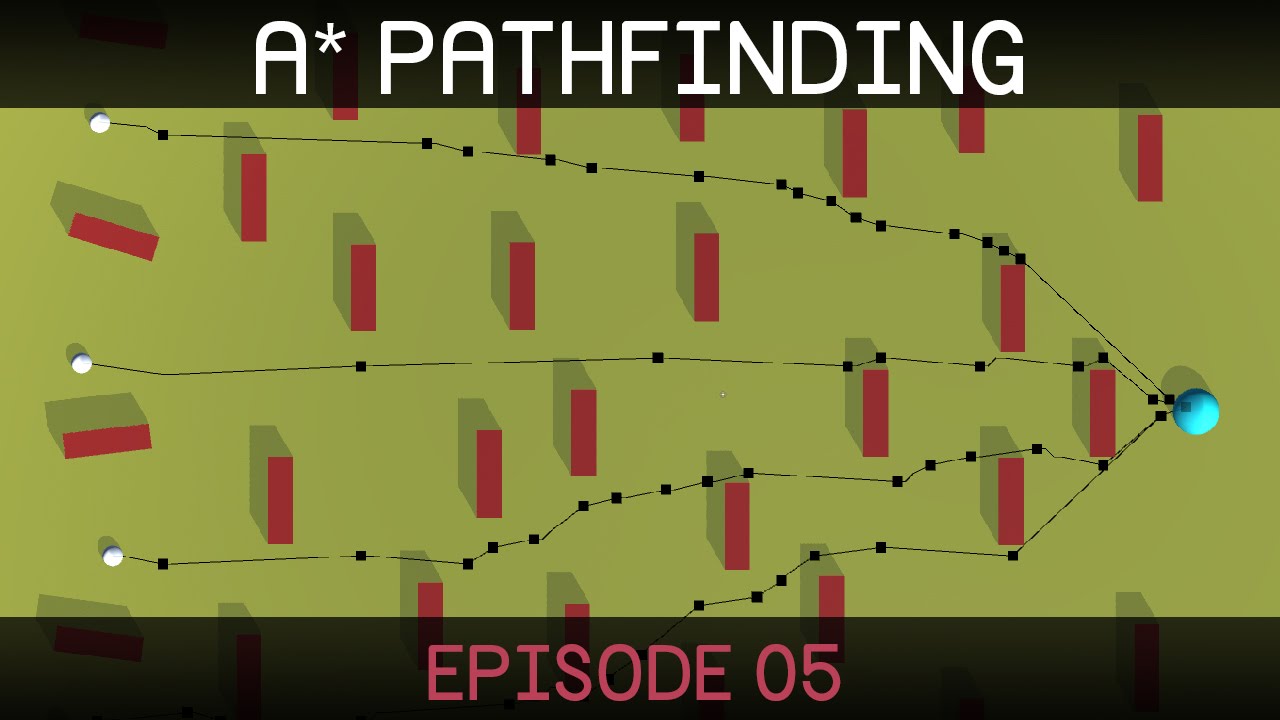
In this episode we're going to implement some units which can requests paths and follow them through the game world.
Source code: https://github.com/SebLague/Pathfinding
If you'd like to support these videos, you can do so with a recurring pledge on Patreon, or a one-time donation through PayPal. https://www.patreon.com/SebastianLague
https://...
sly grove
Do you have a specific issue you want help with?
tender ingot
Mine doesn't follow a certain path as of yet. Its just a train game where there is track and the tracks are the nodes and its supposed to find from one train station to the other as you assign the train to go from one station to the other. Problem is the train starts off where it should then might go across to another track on the other side then back over etc because the tracks sorted by score are not in a certain path due to the scoring issues.
I will have to revisit another way of doing it.
sly grove
tender ingot
Mine doesn't follow a certain path as of yet. Its just a train game where there ...
The only nodes in your fringe should be those directly connected to the current node (the neighbors) or a previously explored node
it shouldn't be possile for it to select unconnected nodes
If you look at the pseudocode for the algorithm:
https://en.wikipedia.org/wiki/A*_search_algorithm#Pseudocode
The only time members are added to the open set is when they are neighbors of the current node
the tracks sorted by score
This is only something you do during execution of the algorithm. Once a path is selected the scores are no longer relevant at all
tender ingot
No I did mine different to a traditional A* Pathfinding. I place tracks on the grid and as I place them a reference to that track is placed in a list. I use all the tracks placed in the game as nodes for it to calculate so there is nothing for it to just go directly from a point of map directly down to the other station with out following the tracks. But like I said I think this is not made for what I want it to do so might just try something different.
sly grove
I don't really understand what you mean honestly
tender ingot
Its all good dw
dusty wigeon
tender ingot
No I did mine different to a traditional A* Pathfinding. I place tracks on the g...
Obviously, if you are not correctly implementing A* and expect it to works it won't.
Maybe you want to use a weighted A* (It does not needs to be directly on distance.)? Because this is also a thing.
tender ingot
I have an idea of what might work instead of A* so will trial it out and go from there.
 ruby salmon
anyone ever had OnDestroy being called on objects for no reason, even when they are marked with DontDestroyOnLoad ? its so weird
 plain abyss
DontDestroyOnLoad just means it's not destroyed on load. It can still be destroyed in other ways
ruby salmon
hmm like what? apart from manually callling destory is there any other way?
seems like randomly some objects are destroyed, never seen it before, only seem to happen with my steam stuff
1 week from launch and i find unity doing weird weird shit
weird thing is update is still runnning even after the mysterious call to OnDestroy
sly grove
ruby salmon
hmm like what? apart from manually callling destory is there any other way?
Like destroying its parent
Or a particle system component destroying it
sly grove
ruby salmon
weird thing is update is still runnning even after the mysterious call to OnDest...
Pretty much zero chance of that, it would be a very serious bug
Make sure you're looking at the correct instance of the script
Print the instance id to make sure the one being destroyed is the same one getting Updated
ruby salmon
i really wish there was a way to know how things get destoryed, would be ideal if it told you which object did it
instead of leaving it completely unknown
all i know is ondestroy is being called on objects randomly and not by me
this causes steamclient to disconnect and not work
ruby salmon
sly grove
Print the instance id to make sure the one being destroyed is the same one getti...
good idea thanks
it is definitely happening
which means i can reinit from the update, bizarre..
terse oyster
timid spade
That's very similar to OAuth system in some forum engines
And how do I do that?
 gritty ore
ruby salmon
i really wish there was a way to know how things get destoryed, would be ideal i...
gritty ore
ruby salmon
i really wish there was a way to know how things get destoryed, would be ideal i...
Can't you use the debugger and look at the call stack?
ruby salmon
hmm never thought of that, would that work
dusty wigeon
As far as I know, it does not because of how unity calls the OnDestroy.
 long ivy
set a breakpoint/log in OnDisable instead
ruby salmon
wouldnt that just tell u when it happens, not how
long ivy
you'd have the stack trace and a debugger, so you'd know when and what
gritty ore
Should work just fine. I just verified with OnDisable anyway in my own project (because this was convenient). Set a break point in OnDisable, when it was hit, it shows where the disable call came from in the Call Stack window in Visual Studio.
ruby salmon
wow thats very cool thanks
been wanting that for ages
now im intrigued, hehe
whats the betting im doing it myself, or somehow im not
one of the first times ive used the debugger LOL.
doesnt always get destroyed annoyingly
hmm the game did not stop at the breakpoint
ah it did this time
@gritty ore how do i see the callstack?
ah got it, doesnt show anythign though, just one line
long ivy
what does the debugger tell you about the object to be destroyed? What scene is it in? hopefully you haven't been ignoring warnings about DDOL only being valid on root GOs
 long ivy
then it's likely Unity is destroying it, which implies it's not DDOL
ruby salmon
object is in the unity scene dontdestoryonload, DDOL works in children too doesnt it
gritty ore
Well, I actually tested OnDestroy and you are right. You can, however, do the same check in OnDisable and it seems to give an actual stack. OnDisable will be called before OnDestroy in the same process so hopefully works to give you that stack.
ruby salmon
good thinking
long ivy
ruby salmon
object is in the unity scene dontdestoryonload, DDOL works in children too does...
Children of a DDOL'd object will live only if the root GO is DDOL. Calling DontDestroyOnLoad for GameObjects with parents is a no-op and prints a warning to the console
ruby salmon
yeh i added it to them all
doesnt do anything
works on all my other stuff likle my language system etc
basically same as ondestory, nothing
some invisible force is destroy that obj
didnt expect it to work debuggers never show me anything of worth
StackTrace stackTrace = new StackTrace(true); may work?
yeh nothing, just points to itself, so there is no way to hunt it down i think
seems to come from UnloadGameScene
but doesnt actually get destroyed
should be a DontDestroyOnUnload too
long ivy
all signs point to this GO not being DDOL. I don't know how you can conclude it's not destroyed while seeing OnDestroy happen with your own eyes. It sounds like you have a zombie, where the GO was destroyed but you keep references to it from user code
ruby salmon
yeh i dont get it either, it is DDOL, doesnt get destroyed, still there, all scripts working
in fact i dont need to worry even , SteamClient.Shutdown(); was in OnDestroy() and that was the issue, so i just removed it and put it inside OnApplicationQuit() instead
but it is very bloody weird
ah what a wasted day, if id known ive have moved shutdown code and be done with it in 10 sec haha
completely not consistent too, happens only sometimes
is there some sort of limit on how long a static var lives ? thats the oither weird thing, again steam related, one of my static vars becomes null at some point
which ive never seen (outside of android culling a host app)
 tall ferry
ruby salmon
is there some sort of limit on how long a static var lives ? thats the oither we...
tall ferry
ruby salmon
is there some sort of limit on how long a static var lives ? thats the oither we...
No, as you've stated this is related to some other code. The fundamentals of code dont change here
The only other case would be if you were recompiling/reloading domain during play mode, where unity would clear the static variables
 muted root
Hello, I'm trying to load sounds from the streaming assets folder (so that new sounds and musics can be added in mods). I'm using UnityWebRequest and the sound files seem to be loaded properly, but I still get no sound, would anybody know why ?
    {
        UnityWebRequest request = UnityWebRequestMultimedia.GetAudioClip(path, AudioType.WAV);
        yield return request.SendWebRequest();

        if (request.result == UnityWebRequest.Result.ConnectionError || request.result == UnityWebRequest.Result.DataProcessingError || request.result == UnityWebRequest.Result.ProtocolError)
        {
            Warning(request.error + Environment.NewLine + path);
        }
        else
        {
            AudioClip clip = DownloadHandlerAudioClip.GetContent(request);

            AudioSource copy;
            if (isSound)
            {
                copy = Instantiate(sound, soundsContainer);
                copy.name = key.Capitalize();
                //Sometimes due to loading time, the same key can be loaded twice at a time
                if (!sounds.ContainsKey(key))
                    sounds.Add(key, copy);
            }
            else
                copy = music;
            copy.clip = clip;
            copy.Play();
            Debug.Log(clip);
        }
}```Here is my code
It's a pretty simple code. I'm just instantiating each sfx individually to keep them as references since they are often played. And there can be only one music at a time on a separate reference
I was using addressables before and the sounds and music were working fine
    private IEnumerator LoadAudio(string path, string key, bool isSound)
    {
        AsyncOperationHandle<AudioClip> handle = Addressables.LoadAssetAsync<AudioClip>(path);
        while (!handle.IsDone)
            yield return new WaitForEndOfFrame();
        if (handle.Result != null)
        {
            AudioSource copy;
            if (isSound)
            {
                copy = Instantiate(sound, soundsContainer);
                copy.name = key.Capitalize();
                //Sometimes due to loading time, the same key can be loaded twice at a time
                if (!sounds.ContainsKey(key))
                    sounds.Add(key, copy);
            }
            else
                copy = music;
            copy.clip = handle.Result;
            copy.Play();
        }
        else
            AddressableError(path);
}```This was my code with adressables and it was working fine.
Code is almost identical, except for the way I load the audioclip
    public void PlaySound(string sound)
    {
        if (sounds.ContainsKey(sound))
            sounds[sound].Play();
        else
            StartCoroutine(LoadAudio(Path.Combine(Application.streamingAssetsPath, "Sounds", "SFX", sound + ".wav"), sound, true));
}```And here is my playsound method to play a SFX, either from the cache or instantiate a new sfx reference
All sounds and music are wav if it helps
The unity request is a success, I can see my audiosource with audioclip in them albeit the name is empty for some reason but the field is not null
OMG.... I'm dumb... The sounds were disabled in Unity Editor... Dunno why... Well... It works now lol. Gotta love those stupid newbie mistakes 😅
 cedar veldt
Any expert would know how to instantiate on runtime skinned mesh renderers prefabs on player (when the player swaps armor pieces, for instance) ?
dusty wigeon
cedar veldt
Any expert would know how to instantiate on runtime skinned mesh renderers prefa...
 cobalt pivot
Chat
upbeat path
you know the fastest way to NOT get help is to do exactly what you have done
cedar veldt
dusty wigeon
<#497874004401586176>
If here people doesnt know, why on earth people on beginners lvl would know?
Nobody on earth seems to know because of root bone and bones array problem. Also nobody knows why swapping mesh on component skinned mesh renderer do not work
dusty wigeon
cedar veldt
Nobody on earth seems to know because of root bone and bones array problem. Also...
Your question was not clear, because instantiating a skinned mesh renderer is as simple as instancing a GameObject. If you want armor piece, you can simply export the whole character with it and disable it.
That being said, there is indeed a small twist for adding a SkinnedMeshRenderer on an already created bone structure. As you pointed out, simply changing the root bone is not enough (In fact it has nothing to do with it), you need to change the underlaying root array as well.
tender crow
Compute shader (FFTSpectrumViewer): Can't find kernel (0) variant with keywords: CHANNEL_BLUE CHANNEL_GREEN CHANNEL_RED. Does anyone know why I'm getting this error in the snipped code (FTTSpectrumViewer) provided in the hastebin. The error comes from the dispatch line on the computer shader
 untold moth
tender crow
Compute shader (FFTSpectrumViewer): Can't find kernel (0) variant with keywords:...
untold moth
tender crow
Compute shader (FFTSpectrumViewer): Can't find kernel (0) variant with keywords:...
What code..?🤔
tender crow
untold moth
What code..?🤔

Hastebin is a free web-based pastebin service for storing and sharing text and code snippets with anyone. Get started now.
the link and the snip are two different things
untold moth
tender crow
https://hastebin.com/share/esiwejezur.cpp
Is it a runtime error?
Which dispatch is it thrown at?
tender crow
First one
untold moth
And what is textureConverter? Where do you assign it?
tender crow
Hastebin is a free web-based pastebin service for storing and sharing text and code snippets with anyone. Get started now.
all the logic for this is around 400 line
the other stuff is water simluation; I've tried changing different keywords etc, nothing is null as well
untold moth
Is textureConverter assigned in the inspector?
tender crow
should be in the constructor
it's taking loading a compute shader from a different file, and I debug logged it and it seems correct
untold moth
Let's assume that's not the issue, is the shader compiled correctly? Are there any errors if you select it in the inspector?
tender crow
No errors in the inspector; clicked on it to make sure and added an error intentionally to test
untold moth
Okay. Can you try removing the multi compile options and see if that helps?
tender crow
should I get rid of the logic as well?
untold moth
tender crow
should I get rid of the logic as well?
Not if it compiles correctly.
tender crow
untold moth
Not if it compiles correctly.
Here's new error: (Happening on same dispatch line)
 untold moth
tender crow
Here's new error: (Happening on same dispatch line)
untold moth
tender crow
Here's new error: (Happening on same dispatch line)
Interesting. Is there a shader compile error now?
This might imply that the shader is not compiled correctly
 timber flame
In my 2d project, I have used spine. My question is about how you implement the animation logic and what architecture you choose, I use the built-in spine animation and not animator.
My approach is to define an animation asset and keep all of them in one collection.
Some conditions should be satisfied to play an animation,
public class AnimationDefinition: ScriptableObject
{
    [ValueDropdown("@GetAllNames()")]
        public string Type;

        [ValueDropdown("@AnimationLabel.GetAll()")]
        public string Label;

        public AnimationData[] List;

        public AnimationDirection Direction;

        [Range(0, 1)] public float SelectionProbability;
        public bool ShouldFlipOverridden = true;

        public AnimationGroup Group;
        public bool HasRootMotion;

        public AnimationCondition[] Conditions;
}

 obsidian stump
can we convert a game object to assetreferencegameobject through code.
dusty wigeon
obsidian stump
can we convert a game object to assetreferencegameobject through code.
It depends what you meant but, you should head to #📦┃addressables.
sly grove
obsidian stump
can we convert a game object to assetreferencegameobject through code.
You mean like, get an asset reference back to the prefab it was created from?
 sick flame
Hello guys,
Is there any way to disable
UnityShaderCache file under Android storage.
It caches the compiled shader binaries there, but I don't want this thing to happen.
 hushed fable
Don't cross-post.
 coral depot
sorry :)
 whole plaza
sick flame
Hello guys,
Is there any way to disable
UnityShaderCache file under Android sto...
whole plaza
sick flame
Hello guys,
Is there any way to disable
UnityShaderCache file under Android sto...
Bad idea
Unless you want your game to run at like 4fps
Compiled shaders need to be saved for later use and if you would to disable that you would have to constantly recalculate the shaders
sick flame
whole plaza
Compiled shaders need to be saved for later use and if you would to disable that...
I know, but I am intercepting the shaders during runtime and every time I would like to run my algorithm, I need to reinstall the whole game. Is is there any way to disable it?
whole plaza
Hmm very specific case, maybe your approaching it wrong ? You shouldnt like need to delete the shader cache, yk
Maybe ask in #archived-shaders to why you need do what youre doing
sick flame
whole plaza
Hmm very specific case, maybe your approaching it wrong ? You shouldnt like need...
Thanks, I will ask there!
obsidian stump
How to find out if there is any script attached to a gameobject when I don't know the name of the script.
sly grove
obsidian stump
How to find out if there is any script attached to a gameobject when I don't kno...
For what purpose? What do you mean "any script"?
You mean any component?
Any monobehaviour?
One of a specific subset of scripts you wrote?
Can you be more specific and explain what you're trying to achieve here?
Every GameObject always has a Transform component at the very least, so there will always be at least that component.
obsidian stump
I want to find out if there is any script on a particular gameobject or not.
sly grove
Can you clarify as I asked what you mean by "any script?"
the answer to your question depends on that.
obsidian stump
Any c# script.
sly grove
So MonoBehaviour
obsidian stump
Yes.
sly grove
if (myObject.TryGetComponent(out MonoBehaviour mb)) {
  Debug.Log("There is at least one MonoBehaviour on this object");
}```this isn't very useful though
which is kind of why I'm asking what you're trying to achieve here
 somber swift
Smells a lot like XY
obsidian stump
sly grove
```cs
if (myObject.TryGetComponent(out MonoBehaviour mb)) {
Debug.Log("There i...
How to get the name of that script.
obsidian stump
Just getting a script.
sly grove
If you explain your goal, we can try to give the best possible answer here. Otherwise we're just going to give you something that may or may not be very useful or efficient.
obsidian stump
I am trying to get the scripts from remote objects like addressable which I don't know and attaching it to new gameobject like addcomponent.
sly grove
WHy not just Instantiate the object/prefab you want to copy?
obsidian stump
I am working on a vr project remote rendering.
 narrow coral
Could someone take a look at my code please? I'm trying to make my slopes snap at 90 degree angles on the y axis and rotate them to face away from the player: https://pastebin.com/tG6rWv14
Pastebin
Pastebin.com is the number one paste tool since 2002. Pastebin is a website where you can store text online for a set period of time.
tall ferry
narrow coral
Could someone take a look at my code please? I'm trying to make my slopes snap a...
This is not an advanced issue. #💻┃code-beginner or #archived-code-general
You also are going to need to specify what code you're even referring to or what's not working. This is 300+ lines, people arent gonna go through all that logic without even knowing what's wrong.
narrow coral
tall ferry
This is not an advanced issue. <#497874004401586176> or <#763495187787677697>
...
No one responds to me in general, i've asked many questions there and never get a response. The issue is what I stated, the slopes aren't being rotated correctly
tall ferry
narrow coral
No one responds to me in general, i've asked many questions there and never get ...
Consider that in the message you're replying to, I told you exactly why no one responds exactly. If you insist on not specifying further then you'll continue to see the same results.
No one is gonna fight to help you. Make an effort and describe the issue properly. Narrow down the code too
narrow coral
tall ferry
No one is gonna fight to help you. Make an effort and describe the issue properl...
it's the snapGhostPrefabToConnector and AlignSlopeWithPlayerFacing methods. The slope snaps correctly at a 90 degree angle, but if you wiggle the mouse around a little bit then the slope starts rotating on the wrong axis and not in 90 degree angles
tall ferry
narrow coral
it's the snapGhostPrefabToConnector and AlignSlopeWithPlayerFacing methods. The ...
One thing you should really do, especially for these math related issues, is debug every step and see where values are no longer correct. One possible issue I see is that you're reading and using the .eulerAngles of a quaternion. There are many different euler angles that would equal the same rotation. Theres no guarantee you're getting the euler angles that you expect
 glacial obsidian
So I am working on uploading and testing a jam game. And my WebGL build is immensely laggy after sufficient time playing on OperaGX especially. But also on all browsers eventually. The profiler leads me to the culprit being this call:
SoundHandle.Instance.CreateChannel
Which I assume is the call for requesting an audio clip play. All my audioclips are preloaded, compressed in memory, and a 25% quality already. Im not sure why the audio slowly builds up to immense lag as the game continues, but it consistently lags after about 15 minutes. Im guessing something persists between scenes. Any idea how I can clear this memory or something to prevent lag? Its really killing the vibe as the desktop version is perfect
Additional context: Every single spike is just an audiosource.PlayOneShot playing.
Its astonishing really, I have no idea and google isnt yielding me much either.

Not that 60FPS is bad, but its also corrupted audio, which is my larger issue
 vernal kindle
Hello! I don't know if this is advanced enough but i have a problem that i'm struggling to find resources to be able to solve it myself.
I have an app where the user can create cards for a quiz game, They can load a BG image (Texture2D). and customize the card Question and Answer (string) and give the card a score value (int).
The part i'm struggling is in how i should approach saving that card to disk, maybe to a persistent path, and then load that saved data. The image part is where i'm stuck and i need to find a way to make a local copy to store inside the savePath, and then load that copy when the app is launched again.
Where i should look to be able to do this functionality? I need guidance since i'm lost on where to start. Also it's pretty much the first time i've ever interacted with saving and loading files that aren't string or int. Any help is appreciated 🙂
 exotic trout
vernal kindle
Hello! I don't know if this is advanced enough but i have a problem that i'm str...
exotic trout
vernal kindle
Hello! I don't know if this is advanced enough but i have a problem that i'm str...
Might wanna look at AssetBundles
vernal kindle
exotic trout
Might wanna look at AssetBundles
I'll look into it
 grand cipher
Hi everyone!
I have a question regarding data copying in Unity. Is there a way to copy from NativeList<T> to a standard List<T> in C#? I’m wondering if there’s a method that is faster than traditional iteration and value assignment, which tends to be quite slow.
Thanks for any tips!
grand cipher
glacial obsidian
Additional context: Every single spike is just an audiosource.PlayOneShot playin...
Show me from deep profiler
 stuck plinth
grand cipher
Hi everyone!
I have a question regarding data copying in Unity. Is there a way ...
stuck plinth
grand cipher
Hi everyone!
I have a question regarding data copying in Unity. Is there a way ...
with bounds checking on looping over the native collections can be surprisingly slow, ymmv but if you're able to use a C# array instead of a List you could try nativeList.AsArray().CopyTo(theArray) which might end up being faster
grand cipher
stuck plinth
with bounds checking on looping over the native collections can be surprisingly ...
Thanks, I’ll test this solution. I’m currently making a system reactor and the other components are using the list. I wanted to use the jobsystem but it will probably be slower.
scenic forge
I was about to suggest avoid copying at all by changing the consumer to accept IList<T>/ICollection<T>/IEnumerable<T>/etc, then I remembered most of Unity's native containers don't implement any of the standard interfaces.
You can still consider that route by having a wrapper class wrapping NativeList<T> which implements whatever interface you need, to avoid copying altogether.
 fathom jewel
Hi guys, Does anyone here know how to pass data from main scene to an entity sub-scene during runtime in unity ecs?
timber flame
I have different skins (made by Spine) for my 2d characters. Each character can move in different directions. There are a different animation corresponding to each direction. I have used on skeleton for all directions. My question is that I need to enable/disable skins by changing the character direction. Is there a better way to handle it?
I think it is better to create different skeleton animation for each direction and set skins for each initially then enable the gameobject based on the current direction :/
sly grove
fathom jewel
Hi guys, Does anyone here know how to pass data from main scene to an entity sub...
#1062393052863414313 but typically just by setting some value on a component
 hazy epoch
Okay. I know this is simple, but I'm a bit rusty right now.
private void Update()
{
    Vector3 direction = new Vector3(movementInput.x, 0.0f, movementInput.y).normalized;

    if(direction.magnitude >= 0.1f)
    {
        float targetAngle = Mathf.Atan2(direction.x, direction.z) * Mathf.Rad2Deg + cam.eulerAngles.y;
        float angle = Mathf.SmoothDampAngle(transform.eulerAngles.y, targetAngle, ref turnSmoothVelocity, turnSmoothTime);

        transform.rotation = Quaternion.Euler(0.0f, angle, 0.0f);

        Vector3 moveDir = Quaternion.Euler(0.0f, targetAngle, 0.0f) * Vector3.forward;

        controller.Move(moveDir.normalized * speed * Time.deltaTime);
    }
}
In that code, if movementInput.x is 0.0f and movementInput.y is 1.0f (basically you're pressing "D" to go "RIGHT" my character right now runs to the right in a wide circle AROUND the ThirdPerson CinemachineFreeLook camera, which rotates to keep its focus on the player. What I want to modify it to do, is have the player just run PERPENDICULARLY to the camera, to their right. What am I missing?
The same result should occur if movementInput.y is -1.0f (pressing "A" to go "LEFT") except the player should run to the left, perpendicular to the camera.
dusty wigeon
hazy epoch
Okay. I know this is simple, but I'm a bit rusty right now.
```cs
private void...

www.google.com
hazy epoch
Yes...that's what my code already does. It DOES move in relation to the camera. I just want to adjust it...as described.
dusty wigeon
Not sure I understand then
sly grove
hazy epoch
Okay. I know this is simple, but I'm a bit rusty right now.
```cs
private void...
what you're missing is making your camera not adjust itself to turn with the player
if you're getting a circle it means the camera is rotating as the player rotates
dusty wigeon
Anyone with experience with a crash on a CallStack like the following:
 sly grove
dusty wigeon
Anyone with experience with a crash on a CallStack like the following:
sly grove
dusty wigeon
Anyone with experience with a crash on a CallStack like the following:
what's the error?
dusty wigeon
sly grove
what's the error?
 sly grove
access violation is basically a segfault
dusty wigeon
Yeah, but on Unity side.
sly grove
yeah inside the C++ side of the engine
could be the equivalent of a null pointer exeption...
If it's your fault and not a bug in the engine, it'd be due to you passing bad data into some part of the engine
sly grove
Got a full stack trace?
dusty wigeon
This is the full stack trace
It is during the initial loading.
This is the parallel stacks. (What is happening on other threads)

While it decompress and read Addressables.
From what I understand
 azure meadow
I have a serialized field that I want to deprecate and migrate to a new one.
I can detect that if the old field has a reference, I write the new field and set the old one to null so it "auto migrates"
Where would that be a good place to do it? OnValidate? 🤔
(I can't use PreviouslySerializedAs since they are different fields, one is a pointer and the new one is a struct)
azure meadow
makes sense, will try 🦾
 patent bear
dusty wigeon
Anyone with experience with a crash on a CallStack like the following:
patent bear
dusty wigeon
Anyone with experience with a crash on a CallStack like the following:
What is RAM usage like? If allocation fails on consoles, unity generally fails silently and let's the game crash when something is accessed later on. I noticed this is happening in a load, which is why i ask (ram heavy operation).
Alternatively, are you using addressables? It could be trying to load an asset that had been unloaded. I had issues like that ages ago on a project. I thought that had been fixed but it's possible it still exists in some way.
whole plaza
dusty wigeon
It only happens on Switch and it is a 8/10 reporduction rate.
Could it be that youre overloading the ram ?
You only like have 3gb of ram useable
whole plaza
patent bear
What is RAM usage like? If allocation fails on consoles, unity generally fails s...
Oh... yeah shouldve scrolled down first
glacial obsidian
grand cipher
Show me from deep profiler
Hey, sorry. Had to work and then i prioritized just preventing this lag from too many sounds by removing a lot from my webgl build

heres the full set of instructions being called that are taking up now only 28% because deep profiling is also causing immense resource usage
A lot of the calls Up until AudioSource.PlayHelper dont mean much as every sound effect causes the lag spike. ANd every sound being played even long form music sounds corrupted
dusty wigeon
patent bear
What is RAM usage like? If allocation fails on consoles, unity generally fails s...
@whole plaza
If it was RAM usage I would have the same issue in a development build given that I do not have any extra memory allocated for dev build.
And yes I do use Addressables. However there is nothing that should be unloaded at that stade of the loading, I could always keep an eye on that though given that it seem to be something akin to MeshFilter being NULL.
At the moment, I'm doing the old delete stuff till it works.
glacial obsidian
Additional context to the frame the profiler is on is its loading a 0.2s long footstep sfx. So it realistically shouldn’t eat up 28% of my cpu time
dusty wigeon
glacial obsidian
Additional context to the frame the profiler is on is its loading a 0.2s long fo...
That is the full stack ?
glacial obsidian
i mean thats the full stack of calls leading to the huge CPU usage
which is all leading to the CreateChannel call for i guess running audio?
im wondering if as more sounds are created and played throughout the game if theres some large buffer that needs to be cleared or something to prevent huge processing issues
because this consistently happens the longer the game goes on for
PlayerLoop is called inside of the camera like FrameRender() something functionlity. But thats everything leading to it
 livid kraken
In our game the player can upgrade his weapon to have multiple shots and a lot of them. Right now each hit has it’s own light and sound source. Obviously at 50-60 hits this overwhelms the system. I’m looking for a smart way to somehow distribute lights and sound in the total hit area to make sense. Problem is that hits can be different types depending on the material. This only matters for the sfx however.
regal lava
Well, pooling the audio and preloading it for starters instead of using one-shots. Not too sure for lighting myself for something that's being generated in handfuls, but usually I just fallback onto investing heavily into emissive shaders.
As far as projectiles/abilities go
livid kraken
The audio is already pooled. Im looking for reducing the number of sources needed in the first place. Emissive shaders also won’t help Im talking about the actual hit vfx emitting light.
What I need is to somehow spatially distribute n light sources and y sound sources to the total hit area
But this is complicated since the hits are not always on the same plane… for example
Oh and it needs to be both spatial and by type since two different surfaces can produce different audio but be spatially close to each other
regal lava
Ah, yeah that sounds complicated, specifically for the lighting. For 3D audio I do kinda check on similar frames if nearby objects share similar audio clips, but this is mostly to prevent overlapping audio and reducing overall loud piercing audio
and instead just reduce what is played in that frame
The lighting however would probably be more noticeable if not done completely correctly, but similar idea would apply.
livid kraken
I mean the obvious solution is to first sort all hits into planes, then cluster them into groups, then subdivide the groups by type and then distribute the lights and sfx but this seems rather computationally heavy so this is why I am looking for a smarter solution.
grand cipher
glacial obsidian
is there anything below PlayerLoop?
untold moth
Player loop is at the very root of the hierarchy. They just have it in reverse mode
glacial obsidian
grand cipher
is there anything below PlayerLoop?
Yes but it’s just the render stack. Like the things that are 100% of the cpu time because they own are above every other call every frame
glacial obsidian
untold moth
Player loop is at the very root of the hierarchy. They just have it in reverse m...
Yeah it’s inverted because it was way easier to find the function I needed that way lol
patent bear
dusty wigeon
<@755084025416253440>
If it was RAM usage I would have the same issue in a dev...
Oof, a solid plan but sorry for the tedium. One last suggestion which may not work for you:
If you have any common assets in your addressables, out them in their own group (if the aren't already) and try loading them at boot and never releasing the handle. I've done that a few times to solve similar, though not the same, issues. It will increase team usage since they never get connected but they will also never get released. In my case i was seeing destroyed objects get accessed by engine code that would crash on a segfault later down the line.
 bold berry
can soembody maybe help i try to install nuget and i got .net 8 but it says version not supported
dusty wigeon
patent bear
Oof, a solid plan but sorry for the tedium. One last suggestion which may not wo...
I already do that.
Strangely, I tried to show out every Asset that is being loaded and the error went away.

I have not test this implementation, but the latest implementation of loading each asset one by one was working (yield each one individual).
upbeat path
bold berry
can soembody maybe help i try to install nuget and i got .net 8 but it says vers...
unity does not support nuget
bold berry
i actually need it for opentk
upbeat path
and? does not support means does not support
dusty wigeon
dusty wigeon
I already do that.
Strangely, I tried to show out every Asset that is being lo...
And this implementation does not work...
Strange, waiting on each individual object does work though. But it takes considerably longer to load.
patent bear
dusty wigeon
I have not test this implementation, but the latest implementation of loading ea...
Sounds like deadlock, but it's segfaulting instead of hard crashing? Loading everything/dependencies manually one at a time would be a solution to the fact addressable can only load one thing at a time. I wonder if there is any bundle thrashing, where some bundles are unloading dependencies incorrectly, though I haven't had issues like that for 4 years 😕
Do you have CRC checks disabled on the bundles? That isn't necessary for locally distributed builds. I had a project that went from an almost 60 second load to pretty much instant with that toggled. Might help get your workaround faster if that's not already how you have it set up.
There's also a platform thing you can do to speed it up, though that's getting into NDA territory. You might be already doing it, though.
dusty wigeon
patent bear
Sounds like deadlock, but it's segfaulting instead of hard crashing? Loading ev...
And yes, it is a segfault, mostly a one cause by accessing an array that is null.
You mean CRC disabled ? This is what I am doing at the moment.
Otherwise, I believe you spoke of the CPU boost for the Switch.
I'm still trying to found what could be the cause, it seem to be crashing relatively at the same moment I might be able to find what asset does the crash.
patent bear
dusty wigeon
And yes, it is a segfault, mostly a one cause by accessing an array that is null...
yup, yup, and sort of. I'm currently trying to debug something similar on PS5 and would really like to avoid an asset hunt due to the project size, so if you figure out a better way to debug this kind of issue, I'm all ears.
dusty wigeon
 wicked verge
don't cross-post and wait for someone to answer
 dull spade
Sry dude
 remote bough
What opinions do people have on using ScriptableObject Event system as the one proposed by 'Ryan Hipple' at Unite 2017 (https://www.youtube.com/watch?v=raQ3iHhE_Kk)?
I like the basic idea of using events to help decouple sender and receiver, but wonder if the further decoupling of using a scriptableObject as a middle man has actual value in practise or if it just over-engineered?

Scriptable Objects are an immensely powerful yet often underutilized feature of Unity. Learn how to get the most out of this versatile data structure and build more extensible systems and data patterns. In this talk, Schell Games shares specific examples of how they have used the Scriptable Object for everything from a hierarchical state machine...
regal lava
I'm a singleton enjoyer so I wouldn't know
 devout hare
I don't think it ever caught on
dusty wigeon
remote bough
What opinions do people have on using ScriptableObject Event system as the one p...
Terrible. Always, always use ScriptableObject as immutable data. There is multiple consideration to take otherwise.
remote bough
dusty wigeon
Terrible. Always, always use ScriptableObject as immutable data. There is multip...
Interesting, I don't think i've ever used scriptableObject as immutable, its always to provide data, but often the whole point is that data can be changed. granted sometimes that might only be settable at load time, but often its useful as a in editor means to view data and that data wants to change.
dusty wigeon
remote bough
Interesting, I don't think i've ever used scriptableObject as immutable, its alw...
It should not change. If it does, you need to consider that it behaves differently in an Editor and in a build.
remote bough
dusty wigeon
It should not change. If it does, you need to consider that it behaves different...
Ok I can see you point here, that while in the editor the values can be changed and will be saved, whilst in build they can be changed but not explicity saved. However theuse of a scriptableObject to hold data that can change is still important abiity
long ivy
opposing view: I like the SO architecture. Avoiding mutable data in SOs is good advice for people who don't understand the SO lifecycle, but we're in code-advanced so it's less applicable
dusty wigeon
remote bough
Ok I can see you point here, that while in the editor the values can be changed ...
If the idea is to use scriptable object to hold data that change during the execution of a good. Terrible idea.
remote bough
But with regard to using scriptableObject with events would actually make it more immutable in the way you are describing, espeically if they are only set up via the editor.
upbeat path
dusty wigeon
If the idea is to use scriptable object to hold data that change during the exec...
nonsense, SO's is the ONLY data container that Unity provides, making them mutable at run time is fairly trivial
dusty wigeon
remote bough
But with regard to using scriptableObject with events would actually make it mor...
You usually need to have a state for such system. (Subscribers) So, I would consider them to be mutable.
sly grove
It's fine if you know what you're doing and generally even more fine if the mutable data in question is not serialized on the SO.
Definitely a pitfall for new users though
dusty wigeon
upbeat path
nonsense, SO's is the ONLY data container that Unity provides, making them mutab...
This is not true, there is other alternative. I'm not saying that it is impossible also, but that it is usually a pitfall that I prefer to not get into.
upbeat path
dusty wigeon
This is not true, there is other alternative. I'm not saying that it is impossi...
name one
dusty wigeon
upbeat path
name one
Prefabs
regal lava
If you could move around POCO instance around the editor we'd just use those honestly
upbeat path
prefabs are not data containers nor are they mutable at all
dusty wigeon
Prefabs are mutable and they contains data. You instantiate one and you have both, the mutable and immutable representation of your data.
upbeat path
dusty wigeon
Prefabs are mutable and they contains data. You instantiate one and you have bot...
incorrect
remote bough
Ok whilst interesting the whole scriptableObject mutable/immutable is not really the point of what I was asking - it was ( as far as I can tell ) the idea of not simply having events and listeners, but to have a middleman that deals with registering and raising events. That is neither event source nor listener have any knowledge of each other, instead they both commuicate with this middleman class instead.
thin mesa
upbeat path
incorrect
that is correct. prefabs can be changed at runtime. naturally those changes do not persist across sessions in a build like they do in the editor, but it is possible to modify a prefab at runtime
upbeat path
if it does not persist then it is not truely mutable
regal lava
remote bough
Ok whilst interesting the whole scriptableObject mutable/immutable is not reall...
I prefer singletons for the managers. The whole argument about the talk is how you're bound by a single instance, but most of the time you only want one instance anyway
dusty wigeon
upbeat path
incorrect
SO is a monobehavior... Not sure how it is incorrect.
My point though is that prefab can be instantiate and it expected to be.
thin mesa
upbeat path
if it does not persist then it is not truely mutable
oh of course. then nothing is mutable except for anything that you save to disk. silly me
dusty wigeon
upbeat path
if it does not persist then it is not truely mutable
If you want to define it that way, than SO are not even mutable in a build...?
remote bough
the idea that SO should be immutable is interesting though. The fact that they do not enforce this, make them more problematic. However using them to say hold values for some object, that I can tweak in editor, and then teak later at runtime, does mean that sometimes the values are not what I've expected. I've always taken this just as a 'fact of life' if you are using them that way, but i'd not considered the approach of treating them as immutable - certainly something to think about.
upbeat path
dusty wigeon
If you want to define it that way, than SO are not even mutable in a build...?
no, they are in Editor and, as I said, making them mutable in a build is fairly trivial
sly grove
remote bough
the idea that SO should be immutable is interesting though. The fact that they d...
the difference comes in with what the state of serialized data in the SO is after playtime ends.
In the editor, serialized fields will be saved when changed at runtime and playmode stops
In a build, they will not.
dusty wigeon
upbeat path
no, they are in Editor and, as I said, making them mutable in a build is fairly ...
Everything is trivial to make mutable
remote bough
regal lava
I prefer singletons for the managers. The whole argument about the talk is how y...
I think we may be talking about different things. At 27 mins, they talk about using scriptableObject Events - i.e the SO is an event listener that can be registered with.
upbeat path
no, you could not make a Prefab mutable in a build
dusty wigeon
You can though, just save the difference in your prefered file format and load it whenever you start the build.
You can modify prefab before instancing.
Not that I would do that.
upbeat path
dusty wigeon
You can modify prefab before instancing.
only to a certain extent, many things in a prefab cannot be changed
remote bough
sly grove
the difference comes in with what the state of serialized data in the SO is afte...
True and is how i've always used them, but as @dusty wigeon points out that can lead to case of data not being what you expect. As I said i've always used them with what you say in mind, but I do think its interesting if you were to treat them as immutable , might make them less useful though
regal lava
remote bough
I think we may be talking about different things. At 27 mins, they talk about us...
Right, and that event listener needs to live somewhere if not on the scene. This is useful because when you change scenes, you don't need to worry about the SO being cleaned up, but similarly you can just use something like a singleton and control its lifetime instead.
dusty wigeon
At the end, whatever you want to use SO as immutable data or not is your choice.
There is technical implication such as how it behaves in a build vs in Editor.
And there is conceptual different such as how you expect them not to change.
remote bough
regal lava
Right, and that event listener needs to live somewhere if not on the scene. This...
Interesting. I guess the real selling point is that it allows manipulation of events/listerners in the editor interface, with a singleton you'd have to write an editor inspector. Other than that there is no difference - but in regards to my question then would you think a singleton class that acts as a middleman for events and listenrers is a good idea or getting overengineered?
regal lava
It's common practice, plus you get the benefit of calling it statically
upbeat path
remote bough
Interesting. I guess the real selling point is that it allows manipulation of ev...
tbh, in this case there is absolutely no difference
regal lava
while you still need that reference to the SO somewhere
regal lava
upbeat path
tbh, in this case there is absolutely no difference
also very much this
remote bough
Note to self - never ask about scriptableObjects in the future 😉 It would have been safer to ask which is the best game console 😉
upbeat path
you can always ask me, I have a much more open mind about SO's than most. Everyone else just seems to spout the party line
regal lava
My only major complaint about SOs is they can create a lot of asset bloat
dusty wigeon
SerializeReference for the win
regal lava
pretty much but no real official support never ever
remote bough
I knd of feel i use SO as global variable storage - which is probably bad 😉
upbeat path
remote bough
I knd of feel i use SO as global variable storage - which is probably bad 😉
may I DM you?
remote bough
upbeat path
may I DM you?
sure ... ? but i need to refill my coffeee brb
thinking about So being immutable I guess the way to enforce that would be to have private fields marked as serialize and a proeperty getter only that returns the field value?
dusty wigeon
remote bough
thinking about So being immutable I guess the way to enforce that would be to ha...
It would not be enough.
You can still change it with function call.
Being immuable is a concept. (In this case, given that is mostly impossible to easily make them that way.)
 small latch
I abuse serialized auto-properties with private setters on all my SOs 
remote bough
dusty wigeon
You can still change it with function call.
when someone says immutable I think of it like a struct, which sure its truley immutable, but you have to go out of your way to change it.
dusty wigeon
remote bough
when someone says immutable I think of it like a struct, which sure its truley ...
Yes, a struct is immutable. And this is what I mean. It should behave the same way. (Without the copy bit, you do not want to copy the SO as they represent a singular concept)
glacial obsidian
glacial obsidian
Back into this as I have a moment to look into it. I can’t find any documentation online on CreateChannel(). But it seems to (this is an inverted stack) continually become a more and more taxing call as the game progresses and plays more sounds. As if it’s not removing unused resources between scenes. I’d like to look into any documentation or class definitions but i just don’t know
So if anyone knows where like, deeply hidden unity code exists that’d be great. It’s closed source so probably no luck.
At worst, maybe I can make an official unity post for a unity dev to see. Anybody know how? I’d like to get to the root cause of why playing a 0.1s sfx is taking. 30% of the time for a 5 FPS frame. And why the audio corrupts slowly as the game lasts
remote bough
glacial obsidian
Back into this as I have a moment to look into it. I can’t find any documentatio...
Couple of thoughts
- does the performance issue exist on other platforms than webgl?
- Are you (implicitly) creating too many channels?
- Does webgl have limits on soundchannels (whatever they are in this context - maybe check out FMOD for more info) or perhaps just exceeding the number of channels it can handle.
- Can you track lifetime of these oneshots? Maybe they are longer, or just sticking around for a long time and over-whleming the audio engine.
- Can you build a small test project to replicate the issue ( maybe you already have?)
- does the profiling have a useful audio section? Not sure never looked myself
remote bough
glacial obsidian
Back into this as I have a moment to look into it. I can’t find any documentatio...
Could there be memory pressure/limits around webgl builds? - see this https://qa.fmod.com/t/separating-fmod-banks-to-get-around-unity-webgls-2gb-limit/20375

FMOD Forums
Hello! Recently, I posted this topic, and while my initial question has been answered, after some further reading I realized that the problem I’m trying to tackle is much bigger than I initially thought. Context HTML5 builds in Unity are not only single-threaded, but they also have a limit of 2GB of usable memory. To get around this, I figure...
glacial obsidian
It could be but I don’t have that many unique sounds. And definitely never that many overlaid at once. Unless there’s some like cache of played audio that isn’t being cleared that slowly builds to a limit.
Like in the scene where I typically started to experience lag ~10 minutes in each spike is per a 0.1s step sound. And the only other constant track is a background track that is like a 30s loop
remote bough
glacial obsidian
It could be but I don’t have that many unique sounds. And definitely never that ...
ok well thats weird, from what i remember of your other posts i just got the impression you were hammering audio oneshots. If that is not the case then its really weird. I still think a new simple testbed project and checking what profiling/debugging information unity supply for audio running in webgl might be a good starting point.
remote bough
glacial obsidian
It could be but I don’t have that many unique sounds. And definitely never that ...
Also what if you disable audio in the project, does it still exhibit issues over time? Might have to let it play for longer than expect to be sure, there isn't a memory issue elsewhere.
glacial obsidian
I am hammering them in previous scenes
But I experience lag independently afterwards regardless
Like once the like, idk usage builds, I have constant audio lag throughout and general performance issues
The scene that I had to majorly tone down had lots of repeated bush shaking sounds. And then nearing the end of that scene and any scene after that I experience lag
And removing those sfx does fix the issue. Adding constant audio sources rather than playclipatpoint didn’t resolve it. Just ditching them for the final jam product helped
I’ll try to replicate it tonight. Go home, create a basic scene where I hammer hundreds of quick identical sound effects
I can even push it somewhere so that if you want to experience it maybe you can. I’m assuming it’s not a system thing because it happens independent of browser and my pc is kinda a beef cake
remote bough
glacial obsidian
I can even push it somewhere so that if you want to experience it maybe you can....
If its a performance issue then systems will affect it as more powerful ones will take longer to exhibit the problem ( if at all ) and i'd also expect browser builds to suffer more as they appear to limit memory usage and maybe other stuff.
Is there a way to force stop all sounds when you leave scenes?
I wonder what happens if you destroy audiosource?
In the past i've sometimes used an intermediate scene to use unity unload code, but thats not an answer for most cases.
Its hard to know, but it does seem to me you might be abusing the audio system, if you mean you are playing lots of bush sounds at the same time, or overlapping) on the other hand if you mean you just call oneshot many times in a scene, but previous sounds had alawys finished then that shouldn't be an issue.
Final thought do you have any debug code? I'd be checking that any code logici is not literally trying to play the same oneshot every frame or something silly. It can easily happen.
glacial obsidian
I tried forcing garbage collecting at end of scenes to little change.
I’ll replicate this in a 0 fluff scenario for closer inspection
But that’ll be when I come home from work in an hour and a half or so
glacial obsidian
remote bough
If its a performance issue then systems will affect it as more powerful ones wil...
Additionally. Half of my sounds are permanent audio sources and half are temporary ones spawned by PlayClipAtPoit
glacial obsidian
Recreated the issue in a VERY tiny sense
the only files are one script and two audios. One audio is about 0.5s long, the other 9.2s.
I run the code for a few minutes to build up whatever is being built up. And even after wiping the scene which should theoretically make it a clean slate, the lag persists. Heres the short script:
using UnityEngine;
using UnityEngine.SceneManagement;

public class TestSceneManager : MonoBehaviour {
    public AudioClip _clip;
    public AudioClip _longerClip;
    public float DelayBetween = 0.5f;

    private float _timer;
    private bool _paused = false;
    private void Update() {
        _timer += Time.deltaTime;
        if (_timer >= DelayBetween && !_paused) {
            _timer = 0;
            AudioSource.PlayClipAtPoint(_clip, Vector3.zero);
        }
        if (Input.GetKeyDown(KeyCode.Space)) {
            _paused = !_paused;
        }
        if (Input.GetKeyDown(KeyCode.LeftShift)) {
            AudioSource.PlayClipAtPoint(_longerClip, Vector3.zero);
        }
        if (Input.GetKeyDown(KeyCode.W)) {
            SceneManager.LoadScene(SceneManager.GetActiveScene().buildIndex);
        }
    }
}
So like, its not specific to my game jam submission. Regardless of scene switching, if I play enough audio clips at any point ever, it seems to build up to some sort of limitation that causes lag and distortion. And that lag and distortion persists even through the GC runs that happen between scenes. Nothing even gets collected.
Here is deep profiler. This is while i have turned off the rapidly repeating sound, and just pressed the singular sound play button right after going to a new scene
 remote bough
glacial obsidian
the only files are one script and two audios. One audio is about 0.5s long, the ...
remote bough
glacial obsidian
the only files are one script and two audios. One audio is about 0.5s long, the ...
Ouch, this seams bad. Having dinner atm ,but I’ll see if I can test here later, if you could upload a webgl build somewhere that would be easier. But yeah unless you can find some reason why the number of clips playing is exceeding some documented value, I’d submit this simple test case as a bug to Unity
Out of interest what settings are you using for the audio clip importer? Post a screenshot?
Also does this happen in a standalone build?
glacial obsidian
This happens with build and run for webgl only
it doesnt happen in editor or windows builds
As for the audio, its default here. No quality loss, decompress on load. But this happens with it set to 10% quality and streaming or compressed in memory. Albeit much slower. That was my first attempt to mitigate it for the jam
remote bough
If we’re lucky it’s a bug that Unity can fix, but off hand I can’t see any good reason for this happening, which sadly means no good workarounds for you jam
glacial obsidian
I just removed the most commonly played audio from my webgl build lol
its been submitted already
but id like to know for the future
remote bough
Yeah please submit a bug, this seems like a ps good a report Unity would ever get, so hopefully will jump on fixing it
What was the jam?
Be back later
glacial obsidian
Themed Halloween Jam 19 or something akin to that
glacial obsidian
It seems to test most strongly in OperaGX
or the lag i guess sets in fastest and hardest.
it happens eventually on Edge and firefox too though
idk submitted a bug report
remote bough
glacial obsidian
the only files are one script and two audios. One audio is about 0.5s long, the ...
Hmm, bad news - I created a test with your code and couldn't see any issue with it running in a browser. Even when i set the delay to be lower than the length of the short audio clip and left it running for 5 minutes, nothing bad happened. Memory went up a bit according to chrome from 318mb to 324mb. That might be a concern, but over 5 minutes with the frequency of clips played every 0.3 seconds it doesn't seem like a memory leak. Plus after 5 minutes it seems to plateau at 324mb.
I tried this with a short clip uncompressed and then with it compressed to 10%.
Did your test use the same project that has the problem or was it in a fresh project? It really should be a fresh as if its fine there then you know there is an issue with your project and probably not with Unity.
Additionally you said the clip was imported with defaults, did you set overrides for webgl? I didn't, but I want to double check.
Almost 10 minutes - no issues still 324mb memory usage.
Build uses 'Code Optimisation = Shorter Build Time'
Publishing settings i'm pretty sure are all default.
EDIT - IMPORTANT
Maybe I spoke to soon - just did a second test as I added a spinning cube to visually check performance. Everything is still playing fine but after 10 minutes the chrome tab went from 156mb to 321mb memory usage. I did do a reload scene after the first minute and this time delay is 0.2 whilst the audio clip is 0.5 seconds long. I'll leave it for another 10 mins and see if there is any change. if there is, then perhaps there is a memory issue, otherwise not sure what is up.
19 minutes and still working fine and stays at 321mb usage - can't go any longer audio is too annoying.
glacial obsidian
Fresh project.
I didnt set overrides for the test, but yeah the audio is bad. It could be an opera GX exclusive issue. Or my opera GX exclusive. Because on Edge I saw some performance decrease but not nearly as significantly as I saw it on OperaGX
And the build setting was whatever the development build settings are because they become locked
I will say that, its nearly exclusive to operaGX. Or not exclusive exclusive, but significantly exclusive.
but I have the same hardware acceleration settings on all browsers i tested. So I cant be sure
I did submit the bug report with operaGX listed exclusive
glacial obsidian
remote bough
Hmm, bad news - I created a test with your code and couldn't see any issue with ...
But does it not - not reset when you switch scenes? Isnt it weird that that memory usage never returns to normal?
Maybe the lag is related to limited browser resources that I approach by hitting the 321Mb usage limit
that it builds up to
cant say
untold moth
glacial obsidian
Fresh project.
I didnt set overrides for the test, but yeah the audio is bad. It...
I'd point out that nowhere in the unity docs is it mentioned that opera is a supported browser.
https://docs.unity3d.com/Manual/webgl-browsercompatibility.html?utm_source=perplexity
untold moth
Chromium and chrome is not the same thing
glacial obsidian
Notes:
The Web platform also supports the latest version of the Chromium-based Edge browser.
Ofc its not edge
but they support chromium browsers
untold moth
There might still be differences in implementation that modify the behaviour.
Anyways, I don't think there's much you can do about it without access to unity source code.
glacial obsidian
I think opera GX meets the 3 specifications
but yeah
The browser is WebGL
2 capable.
The browser is HTML 5 standards-compliant.
The browser is 64-bit and supports WebAssembly.
untold moth
Your best bet is to fill a bug report and open a forum post. Then wait.
glacial obsidian
i submitted a ticket with opera gx mentioned directly
i assume ill get a response saying "not a bug ur browser sucks" if thats the case
and if its not the case theyll say something else or nothing
dusty wigeon
patent bear
yup, yup, and sort of. I'm currently trying to debug something similar on PS5 a...
So, yeah, it was a specific asset. I deleted it given that it was not important and it works perfectly fine.
The asset itself was pointing to a considerably large FBX which was not even addressed (causing it to be duplicated).
To find the assets, I just did a binary search on whatever the build crash or not. (Cutting the loading of assets in half each time) It took me pretty much the whole day.
patent bear
dusty wigeon
So, yeah, it was a specific asset. I deleted it given that it was not important ...
Congrats! Glad you could teach it down. I'm still going to avoid that since the project I'm on is massive and takes a couple hours to do a content build on (assuming shaders are already built 😐)
My current plan is to update the engine (which needs to happen anyway to update platform sdk versions) and crossing my fingers. Not the most technical of plans, to start.
dusty wigeon
patent bear
Congrats! Glad you could teach it down. I'm still going to avoid that since the ...
What is your version ? In Unity 2021 or 2022 I believe they sped up building drastically with incremental build. Also, if your project is not badly setup, you could potentially not build everything. Obviously it assume that you do not need it and you are using Addressable.
My project is 4G on Switch and it takes 10-15min to incrementally build on top of it. (With only code modification.)
And if you have stack trace, you could always drop it here. I might know something about by some sort of miracle.
patent bear
dusty wigeon
What is your version ? In Unity 2021 or 2022 I believe they sped up building dra...
We are on 2022 but the game is a large open world game for higher end platforms. The addressables are built programmatically off the open world so they can be streamed in, so splitting up the addressable and content is a bit tricky. Build is at 14gb, but that's with package compression with kraken turned on which is really good on ps5.
I am using incremental builds without addressable build but it's still a 25 minute process, end to end.
I'm trying to solve a different issue where the game has decided to crash at boot, in native vm setup, only in development builds. Once i get those running again I'd be happy to share a trace. I have some platform support, thankfully, but the issues seem unity specific so i don't know how helpful it will be.
dusty wigeon
patent bear
We are on 2022 but the game is a large open world game for higher end platforms....
25min is not that bad. Just enough to want to dual task.
It seem strange though that you would not be able to pin it down given that everything is pretty much already divided.
 lean flare
            {
                colorAdjustments.colorFilter = nightVisionColor;
            }

            if (volume.profile.TryGet(out LensDistortion thisLens))
            {
                thisLens.intensity = pov;
            }
this code only changes post processing volume component values when i make a change in the code and it compiles. in editor when changin the inspector values of this code, it doesnt update. it only takes changes after i change code and it compiles. pain in the ass please help...
patent bear
dusty wigeon
25min is not that bad. Just enough to want to dual task.
It seem strange though...
That's if I'm not rebuilding content and it's an incremental build. Addressable builds bump that to ~2 hours. The groups are divided programmatically (and in a system I didn't write). It's mostly a "do I want to commit time to this over other tasks?" because there are some other deliveries that are higher priority and I'm trying to not fall down a rabbit hole. Lowering the RAM usage overall actually helped a lot with stabilizing things, but I only just wrapped the save system and still have other platform requirements to get in.
I'll do it if it comes down to it but, like always, timelines never quite allow everything to get a "correct" solution.
dusty wigeon
patent bear
That's if I'm not rebuilding content and it's an incremental build. Addressable ...
Oh, I do know about the whole priority list. The previous issue I had could have been prevented if we had a better assets management.
patent bear
I love/hate that my reputation is as a fixer that comes in at the end of the project to make things work. It's stressful but I can't say it doesn't keep things interesting.
remote bough
lean flare
``` if (volume.profile.TryGet(out ColorAdjustments colorAdjustments))...
use sharedprofile instead? Also if using profile you need to handle destroying it if I remember correctly.
However I recently did this and i'm sure using profile worked as you expected. Does it maybe only work if you have the values overriden property enabled in inspector?
lean flare
remote bough
use sharedprofile instead? Also if using profile you need to handle destroying i...
nightVisionColorAdjustments.colorFilter.Override(camcorderManagerData.nightVisionColor); this is the solution. the override method is necessary to change the values
 robust nexus
so source ??= new T(); when T is contrained to a MonoBehaviour in addition to an interface will outright fail or will it still create the type but fail to properly get picked up via callbacks? I don't care about the MonoBehaviour portion here, just the constant details set on the interface portion. I'm mostly curious if we're allowed to do this anyways with Monobehaviours
 drifting solstice
you shouldn't construct MonoBehaviours at all, they should be made by unity
not sure what you mean by "fail to properly get picked up via callbacks"
robust nexus
Has the constructor been blocked off at the API level or will it just misbehave if constructed as new() but I attempt to use it's normal lifecycle? Either way this looks like a dead end, I'll have to redo this bit
robust nexus
drifting solstice
not sure what you mean by "fail to properly get picked up via callbacks"
The UE api callbacks (Start, Update etc)
drifting solstice
drifting solstice
those aren't callbacks
huh, nvm, apparently unity does call them callbacks
Event functions are a set of predefined callbacks that all MonoBehaviour script components can potentially receive.
that's not what "callback" typically refers to, but ok, i guess
 craggy spear
drifting solstice
also, UE?
craggy spear
drifting solstice
also, UE?
Unity Engine..
drifting solstice
i guess that makes sense, never heard it referred to like that. seems horribly ambiguous with Unity Editor and Unreal Engine
craggy spear
yeah, it's a very very... very rarely used acronym, because 99.999% of people use UE for Unreal
but from the context it was used, we know it's not meaning Unreal this time 😄
 sharp dune
Link to the github gist
Could someone check out this state machine I made, I want to know If I'm going in the right direction and if it's modular enough, because I think it's missing something
I feel like I'm going overboard with the generics.. Could someone plz lmk? Thank you in advance :)
wicked verge
drifting solstice
i guess that makes sense, never heard it referred to like that. seems horribly a...
I swear nobody interprets "UE" as Unity Engine
dusty wigeon
sharp dune
[Link to the github gist](https://gist.github.com/blockchain200/6b30768b574f63ed...
Your input should be in its own class.
Your state should not be directly referenciate in the code. (use a dictionnary (<type, state>) (Open-Close principle))
You should not move your character directly in the StateMachine. (Single Responsibility Rule)
There is should never be a situation where the current state is null.
Try to avoid using OnStart, OnUpdate and OnChange and use Enter, Update and Exit. (OnXXX is mostly use with event/callback. Also, it helps to distinguish between if it is a Unity callback or not.)
You might consider making your statemachine as a partial of you Character Class. It makes you able to share private value.
You need a CharacterState somewhere to hold a reference to your character or for other character specific needs.
You might want to not use abstract State or abstract StateMachine. (StateMachine.MoveInputActionValue from CharacterIdleState compiles ?)
StateMachine should not be a MonoBehaviour. It should be driven by a Character or other class.
sharp dune
dusty wigeon
Your input should be in its own class.
Your state should not be directly refer...
Thanks for the tips!
But I dont see why StateMachine shouldnt be a MonoBehaviour
dusty wigeon
sharp dune
Thanks for the tips!
But I dont see why StateMachine shouldnt be a MonoBehaviour
At least, it should not be driven itself.
StateMachine is usually an extension of the character
sharp dune
So i should have a controller class that passes in data to the CharacterStateMachine?
dusty wigeon
Having it live by itself is strange.
sharp dune
dusty wigeon
StateMachine is usually an extension of the character
That makes sense
dusty wigeon
sharp dune
So i should have a controller class that passes in data to the CharacterStateMac...
You can serialize the state inside the character if you want to have serializable value on it. That being said, the Speed or InputAction could directly be on the character
And, it is better use
public MyType MyVariable => myVariable;``` dire sparrow
    {
        ssCamera.gameObject.SetActive(true);

yield return new WaitForEndOfFrame();

        RenderTexture renderTexture = new RenderTexture(Screen.width, Screen.height, 24);
        ssCamera.targetTexture = renderTexture;
        ssCamera.Render();

        Texture2D endtex = new Texture2D(Screen.width, Screen.height, TextureFormat.RGB24, false);
        RenderTexture.active = renderTexture;
        endtex.ReadPixels(new Rect(0, 0, Screen.width, Screen.height), 0, 0);
        endtex.Apply();

        ssCamera.targetTexture = null;
        RenderTexture.active = null;
        Destroy(renderTexture);

        File.WriteAllBytes(Path.Combine(System.Environment.GetFolderPath(System.Environment.SpecialFolder.Desktop), "GG.png"), endTex.EncodeToPNG());

        ssCamera.gameObject.SetActive(false);
}```This works just fine in the editor, but gives a null reference error in the android logcat.
Literally no idea why its happening, it was working before
It could have stopped working after I migrated the project to unity 6
dire sparrow
dire sparrow
This works just fine in the editor, but gives a null reference error in the andr...
Can’t give any other details cuz this is literally what Logcat tells me
Along with the info that the problem is in this method
 devout hare
Make a debug build so that you see the line numbers
thin mesa
also consider just printing the state of each of the objects being used in that method so you can see which is null
upbeat path
Also this
File.WriteAllBytes(Path.Combine(System.Environment.GetFolderPath(System.Environment.SpecialFolder.Desktop), "GG.png"), endTex.EncodeToPNG());
is not gonna work on android
thin mesa
they have allegedly ruled that out as the issue
#archived-code-general message
dire sparrow
upbeat path
Also this
File.WriteAllBytes(Path.Combine(System.Environment.GetFolderPath(Syste...
Yes Im aware I commented that before building
dire sparrow
devout hare
Make a debug build so that you see the line numbers
Didnt know this ty
 peak badge
I'm trying to write optmized Compute Shader, and I'm noticing a bottle neck... but I am not sure how to identify the cause. Here's my profiler and my command buffer
        cmd.SetExecutionFlags(CommandBufferExecutionFlags.AsyncCompute);
        for (int i = 0; i < 200; i+=2){
            cmd.SetComputeBufferParam(computeShader, 1, "grid", grid);
            cmd.SetComputeBufferParam(computeShader, 1, "output", output);
            Dispatch(1);
            cmd.SetComputeBufferParam(computeShader, 1, "grid", output);
            cmd.SetComputeBufferParam(computeShader, 1, "output", grid);
            Dispatch(1);
        }
i.e. it runs my shader about 200 times per call.
Everything just says "Idle" and "waiting on graphics fence"... but shouldn't it be running async? Why is it waiting ?

I call it once per update.
    void Update() {
        Graphics.ExecuteCommandBufferAsync(cmd, ComputeQueueType.Default);
Is swapping the buffer actually resulting in a copy? I dunno why else it would need to wait
sly grove
peak badge
I'm trying to write optmized Compute Shader, and I'm noticing a bottle neck... b...
Are all the dispatches independent? I think the command buffer is probably inserting graphics fences because you're using the results from one shader call in the next perhaps?
remote bough
dire sparrow
```public IEnumerator SSWithoutUI()
{
ssCamera.gameObject.SetActive(...
You are not releasing your RenderTexture, but just destroying. Not sure if that could be responsible for null reference though.
Also i prefer to group similar operations together such as camera.targettexture and rendertexture.active.
I'd probably also explicitly destroy the texture2D, unless I expect to take alot of screenshots, in which case i'd keep it around at scope to the class.
    {
        ssCamera.gameObject.SetActive(true);

        yield return new WaitForEndOfFrame();

        RenderTexture renderTexture = new RenderTexture(Screen.width, Screen.height, 24);
        ssCamera.targetTexture = renderTexture;
        ssCamera.Render();
        ssCamera.targetTexture = null;

        Texture2D endtex = new Texture2D(Screen.width, Screen.height, TextureFormat.RGB24, false);

        RenderTexture.active = renderTexture;
        endtex.ReadPixels(new Rect(0, 0, Screen.width, Screen.height), 0, 0);
        endtex.Apply();
        RenderTexture.active = null;

        renderTexture.Release();

        File.WriteAllBytes(Path.Combine(path, "GG.png"), endTex.EncodeToPNG());

        DestroyImmediate(endtex);

        ssCamera.gameObject.SetActive(false);
}```@remote bough read 👇
!code
 thorn flintBOT

Posting code
📃 Large Code Blocks
Use links to services like:
https://gdl.space/, https://paste.ofcode.org/, https://hatebin.com/, https://paste.myst.rs/, https://hastebin.com/
📃 Inline Code
Surround code with three backquotes. Not quotation marks.
To format as C#, add cs to the first line:
```cs
// Your code here
```
Add a comment with a line number if there is an error message.
peak badge
sly grove
Are all the dispatches independent? I think the command buffer is probably inser...
It's just supposed to run one after the other
I dunno why the CPU thread would be waiting on the graphics fence though. It's all GPU code
untold moth
peak badge
I'm trying to write optmized Compute Shader, and I'm noticing a bottle neck... b...
What does Dispatch do? It is your own method right?
peak badge
yes
It just makes dispatching with the right number of threads easier.
cmd.DispatchCompute(computeShader, kernelID, dispatchX, dispatchY, 1);
Hmm... In this case it's really hard to tell without knowing what unity does under the hood.
Maybe use something like PIX to see what actual commands are issued to the GPU.
Also, I don't remember if compute shaders appear in frame debugger, but if they do that might provide some clues.
peak badge
untold moth
Hmm... In this case it's really hard to tell without knowing what unity does und...
The shader code actually seems to run fine... the problem seems to be in the renderer code which is sampling my computed texture

The texture is quite large... and it doesn't seem to like that
untold moth
I thought the issue was the CPU side fence after each dispatch..?🤔
peak badge
I'm not sure, to be honest.
The CPU shows as red... but I don't know what would cause it
untold moth
peak badge
The CPU shows as red... but I don't know what would cause it
wdym shows as red?
peak badge
untold moth
wdym shows as red?

It seems to indicate it's CPU bound... but I don't know why. It looks to me like there is a graphics fence, but I also don't know why
I think I'm executing it async, so it's weird
untold moth
Seems like a new feature in unity 6.
I'd assume that it means that the cpu time is > 16.6, since the target frame time is set to 60 fps.
peak badge
exactly
untold moth
You'll need to look at the profiler hierarchy properly
peak badge
Is the Render Thread running on CPU?
peak badge
Why... can't it run on GPU?
untold moth
Because GPU is highly specialized for running shaders and similar work. It can't run normal code, like the CPU does.
untold moth
Rendering is a complex process involving both cpu and gpu
GPU runs computationally complex(but specialized for GPU) work that runs on many small threads.
CPU runs normal code and controls what the GPU does.
peak badge

My command buffer executes super fast... the render loop seems to take all the time (?)
untold moth
peak badge
What is the context of that screenshot?
peak badge
This is from the profiler
untold moth
Don't crop out the rest of the profiler out. It's unclear whether it's from the CPU or GPU and player or editor mode.
 untold moth
Ok, so that's the Render Thread
I'm not entirely sure what RenderLoop stands for. Is there more info with deep profiling on?
Assuming it's the default rendering work that unity does, there are several assumptions that could be made. For example, that the number of batches is crazu high.
peak badge
where do you see the batches?
basically this image is sampled from a buffer that's about 150 megabytes
 untold moth
peak badge
where do you see the batches?
untold moth
peak badge
where do you see the batches?
In the rendering stats profiling module
untold moth
peak badge
basically this image is sampled from a buffer that's about 150 megabytes
Just sampling an image/buffer wouldn't be expensive regardless how big it is.
peak badge
Ok that's good, that's what I thought. It all fit's in GPU

it says 27 batches for 27 draw calls... isn't that just 1 to 1?
untold moth
Yeah, that's not much
You should try profiling the render thread with deep profiling on.
peak badge
untold moth
You should try profiling the render thread with deep profiling on.
I don't see any additional info
 untold moth
peak badge
I don't see any additional info
untold moth
peak badge
I don't see any additional info
I don't know if RenderLoop is something that was added in unity 6 or something specific to your project, but when I profile a scene in my 2022.3 editor, there's no such thing. Everything else makes total sense.
 peak badge
I'm using unity 6, URP
I'm not doing anything too unique. I have a shader graph with a custom node that samples my 150 MB texture
untold moth
peak badge
I'm not doing anything too unique. I have a shader graph with a custom node that...
Does the RenderLoop time go down if you disable the object that renders with your shader graph?
peak badge
Ok tell me if I'm thinking about this wrong:
if I initiate an Async compute buffer, and at the same time, I render a frame that uses that buffer... will it use a graphics fence?
peak badge
untold moth
Does the RenderLoop time go down if you disable the object that renders with you...
Yes, that's the object that's running the script
 untold moth
Yes. If whatever the compute buffer is writing to is also read by other shaders later in the frame, it would stall the whole pipeline.
peak badge
I thought reads aren't supposed to block
untold moth
The reads themselves don't, but any engine would usually add a resource barrier such as to avoid data corruption. You don't want to be reading from a memory that is being written to at the same time.
peak badge
Hmm, still doesn't make sense, if the compute buffer time is only about 0.08 ms
untold moth
If you really need to both write and read(and you're fine with reading 1 frame old data), then you can make a double buffer setup, where you write to 1 buffer and read from another on the same frame. Then the next frame you swap the two: read from the buffer that was written to the last frame and write to the other one.
untold moth
peak badge
Hmm, still doesn't make sense, if the compute buffer time is only about 0.08 ms
Well, I'm not saying that it's the cause of the issue. Just that it would indeed block.
Though, to be fair you had like 200 loops of 2 dispatches there, which would add up to 400 * 0.08 = 32ms, ignoring overhead.
untold moth
peak badge
No I think that's for 1 frame is 0.08ms
Where do you see that number?
peak badge

"Unnamed Command Buffer" - self time is 0.09 ms
I only call the command buffer once, it just contains ~200+ calls
untold moth
You're confusing the time it takes to dispatch a command/s vs the time it takes to actually execute it on the gpu. The 0.09ms is the former one, which is not expected to be long indeed.
peak badge
Aha... ok that makes sense if it's async
it's just so weird. If it's async, I don't know why the CPU would wait to render. Isn't the whole point of an async GPU call so that the render thread doesn't wait?
untold moth
Though, it still doesn't explain why the RenderLoop is taking that long. If it indeed is waiting for the GPU, you should be able to see similar time in the GPU module.
untold moth
peak badge
it's just so weird. If it's async, I don't know why the CPU would wait to render...
Normally, yes. But if you are using the result of that operation, then it needs to wait somewhere. Usually that's just before using that result.
peak badge
I think commandbuffer execution doesn't use graphics fences to wait for itself though
in the docs it says you don't need any, it will automatically wait for the first call to finish before the second call runs
untold moth
peak badge
I think commandbuffer execution doesn't use graphics fences to wait for itself t...
Again, the wait is probably during the rendering of the scene where you access one of the resources that you write to in the compute shader.
peak badge
That's so weird... I don't think that's how it behaved before
untold moth
If you can test in 2022.3 that might provide more clues. Either it doesn't happen, or does and the profiler has more info.
peak badge
Ok, I'll try to downgrade
The biggest thing I noticed is chaning my .cginc file that I use for my sampler resulted in pretty harsh performance loss (about 50%) when I made a small change. I assume .cginc is all run on GPU
untold moth
cginc are just include files for shaders, so yeah, obviously they run on gpu
peak badge
untold moth
cginc are just include files for shaders, so yeah, obviously they run on gpu
I downgraded but, huh... I'm still not sure what to make of this
 untold moth
peak badge
I downgraded but, huh... I'm still not sure what to make of this
untold moth
peak badge
I downgraded but, huh... I'm still not sure what to make of this
This seems to be unrelated to rendering at all. Something about modifying the pointer data of a pointer event.🤔
peak badge
Well it does say it ran out of memory, let me try to get a spike from before that

it's mostly "semaphore wait for signal"
untold moth
peak badge
This seems to be waiting for the GPU to complete rendering the frame.
peak badge
Ok, I think I have an idea. I don't think it needs to wait, it's just something about the way it's sampling.
It's sampling this 150 MB texture, but what if I sampled it myself to a smaller size, first
untold moth
peak badge
Ok, I think I have an idea. I don't think it needs to wait, it's just something ...
Did you have a look at the GPU module in the profiler yet? Because so far it's all speculation.
peak badge
untold moth
Did you have a look at the GPU module in the profiler yet? Because so far it's a...
I'm not sure how to interpret it. Is it saying that 7.8 ms is my script, and 0.5 is the sampler?
 untold moth
peak badge
I'm not sure how to interpret it. Is it saying that 7.8 ms is my script, and 0.5...
untold moth
peak badge
I'm not sure how to interpret it. Is it saying that 7.8 ms is my script, and 0.5...
Yes. The compute shader dispatches take around 7.5 sec to process.
peak badge
If so, I guess I can only optimize away about 6% through being clever...
untold moth
peak badge
If so, I guess I can only optimize away about 6% through being clever...
I don't know. Dispatching 400 compute shaders in one frame sounds excessive to me in the first place.
peak badge
It's doing computation
untold moth
Then perhaps that's what you should focus on omptimizing.
peak badge
The computation right now is actually very simple
it's just taking a simple average
of neighboring cells
untold moth
the fact that it takes 7ms on GPU definitely doesn't align with "very simple"
untold moth
presumably, you're running that "very simple" computation for every pixel in that 6k x 6k matrix?
peak badge
yeah
untold moth
And then you're doing that 400 times per frame
untold moth
That's a hell of a lot of computations
peak badge
it fits in the GPU ram, but I'm guessing it just takes a long time to load them into the cache
actually no it's like 400x per second, not per frame
closer to 200 per second right now
untold moth
Gpu, while has a lot of processing blocks, they are a lot slower than CPU cores. And it doesn't have 6000x6000 processing blocks either. So it has to process these in batches while loading in and out of internal caches.
untold moth
peak badge
closer to 200 per second right now
Well, don't you dispatch them per frame?
In update or something?
peak badge
Yeah but really I just want it to run as fast as possible
Right now it's dispatching 2 at a time, instead of 200 at a time
untold moth
You should spread the workload across frame. Maybe make one of these dispatches every frame.
peak badge
the only difference it makes is the visuals lag less
untold moth
Another thing to consider: do you actually need to run this computation that often on that much of data?
peak badge
yep
untold moth
Can you not just cache it and only compute again when there is actually a change or something.
peak badge
It's for procedural generation, so yes, it can be cached when it's done. But if it's faster it's better
untold moth
I don't know the whole context, but it feels like you're trying to run some kind of simulation that is really not fitting something like a realtime rendering application like a game.
peak badge
yeah it's simulation stuff
untold moth
Like, does the player actually see the result of all of these 6000x6000x200x2 computations?
every frame?
There's probably not enough pixels to fit it all in one screen.
peak badge
it's not necessary, of course, to show every frame. But not showing every frame would only save the 0.5 ms
that's the render time
the compute time wouldn't change
untold moth
Well that's what I'm saying: the compute time is the problem. Not rendering. You'll need to think of a way to optimize it or fake it.
peak badge
I can just reduce the render size. For actual gameplay purposes, I may only use e.g. 1024x1024... but during gameplay, I would also have more than one "layer" of computation
so I'm using a very big texture to stress test
untold moth
Then there's need for more optimization.
Also, the difference in performance with the real life scenario might not be linear. You should actually test the real life scenario instead of some hypothetical assumptions.
peak badge
Yeah that's fair. I think I learned what I needed to, which is that I think it's running into an actual GPU bottleneck, not just that I coded the async wrong
enjoy a small gif

Do you think there would be a performance difference in something like unreal? Or is it simply the GPU?
untold moth
peak badge
Do you think there would be a performance difference in something like unreal? O...
It is the GPU and what you're doing with it.
peak badge
untold moth
It is the GPU and what you're doing with it.
Is there a way to get native halfsize support?
Unity only works with fullsize floats, and halfsize would be fine for me
untold moth
peak badge
Is there a way to get native halfsize support?
native halfsize?🤔
untold moth
peak badge
Unity only works with fullsize floats, and halfsize would be fine for me
I think you should be able to use 16 bit precision in the shader just fine🤔
peak badge
you can't by default, which is the problem
grid = new ComputeBuffer(resolution * resolution , sizeof(float));
ComputeBuffers must allocate 32 bits at a time.
All read and writes are 32 bits at a time
untold moth
This is not inside the shader.
As for the data stride in the buffer, it does seem like it's limited to 4 bytes min indeed.
https://docs.unity3d.com/ScriptReference/ComputeBuffer-ctor.html
But I don't think memory is relevant to the issue.
peak badge
I think memory is the problem because just loading the memory into the registers takes time. The computations aren't hard, it's bounded by loading
untold moth
It would have to load it into the registers all the same.
It's not like the number of registers would double.
peak badge
Right but if the data is half size, it only needs half as much memory
untold moth
It doesn't matter though. The other half would just remain empty and unused.
Unless you do some kind of packing of parameters.
untold moth
You should be looking at macro optimizations before you look at the micro optimizations.
There's no guarantee a microoptimization would help, and in the worst case it might even hurt.
peak badge
Yeah, using my fake type didn't help.
 dreamy basin
Pls is any free texture download either from browser or asset store safe from copyright can I use it to publish my game
somber swift
dreamy basin
Pls is any free texture download either from browser or asset store safe from co...
Read the license, it will tell you
 fossil pine
Hello! Apologies for the meaty post, but I'm hoping someone can help me with this, because I'm at my wit's end with this one:
I use scriptable objects as states. The actual states are classes which inherit from the scriptable object SO_State, and these states are then instantiated as clones on game start, so that they can freely communicate with an instance of NPCController and NPCPossessed without messing anything up.
My issue is that the references to both of these script instances is spontaneously lost within the state clone, and I have no idea how. Here's how it works:
NPCController calls this:
foreach (SO_State state in states)
{
state.Initialize(this);
state.InitializeSpecific();
}
... which results in this method running in SO_State:
public virtual void Initialize(NPCController cntrl)
{
controller = cntrl;
npcBase = controller.transform.GetComponent<NPCBase>();
}
... and this method running in Possessed_State_Idle:
public override void InitializeSpecific()
{
npc = controller.transform.GetComponent<NPCPossessed>();
}
Through debugging I know for an absolute fact that each instance of Possessed_State_Idle has a valid reference to both controller and npc at this point. However, almost directly after this, Enter is called on the currentState (e.g Possessed_State_Idle):
public override void Enter()
{
npc.agent.SetDestination(npc.transform.position);
npc.timeToRoam = Time.time + Random.Range(standDurationMin, standDurationMax);
}
... and at this point, it has no reference to either controller or npc. There is literally no code that touches these references inbetween InitializeSpecific and Enter.
I'm just wondering if anybody has any clue as to what's happening here? Does it have something to do with instances of scriptable objects? Because this issue didn't exist back when I was using the original scriptable ojects themselves instead of clones.
I would be incredibly grateful if someone could offer some insight here. Thanks!
This is made even stranger by the fact that in the inspector, the clones literally show that these references are correctly assigned:

 upbeat path
It's impossible to advise based on the information you provide.
Please do not remove Debugging information.
I also recommend debugging the instance id's and names of all objects involved so that you actually know you are referring to the objects you think you are.
Once you have done this please post your amended code correctly along with the debug output
 teal needle
Weird, got a new macbook air m3 and all my projects fbx files refuse to load with an error that an fbx reader wasnt found.
Unity 6 for MacOS doesnt come with an fbx reader?
teal needle

Tried installing the exporter since it seem to have a formats.fbx package
or depend on
Did not work
drifting solstice
you'd need an importer, not an exporter
teal needle
I know but i was hoping it would add the missing fbx reader
although it doesnt seem like a common problem on macos , cant find many results about it
 modest yoke
Need some help, Im making a game and I want to have destructible buildings similar to teardown, but I want it to be optimized for quest 2 so having 3000 rigidbodies is not gonna cut it, Im trying to figure out if there is a way to cut holes into objects during runtime, can somebody help me?
sly grove
modest yoke
Need some help, Im making a game and I want to have destructible buildings simil...
Teardown was built using a custom built voxel engine specifically for that purpose
You will probably have a hard time reproducing teardown in Unity
remote bough
fossil pine
Hello! Apologies for the meaty post, but I'm hoping someone can help me with thi...
Going to be very difficult to help with this as there is just so much that could be happening in your project or code. Perhaps if you are lucky someone ran into a similar issue and give you a hint. So in cases like this, I’d sugggest the best advice is to populate every part of you code with debug statements ( unless you can step through the code in debug mode) and if the project is already complex, to create a new stripped down version of the state machine from scratch, testing as you go.
fossil pine
remote bough
Going to be very difficult to help with this as there is just so much that could...
That's good advice for the future, thank you! However, I did end up finding the problem. As I use instances of scriptable objects, I neglected the fact that each state instance allows for transitions to other states, and these states references never ended up being replaced by references to their clones, and so pointed back to the original state objects which never assigned the missing references in question (as well as causing other issues). I'm relatively inexperienced with working with instances of originals in this manner, so I guess I had to learn that the hard way. Thanks either way!
remote bough
fossil pine
That's good advice for the future, thank you! However, I did end up finding the ...
Nice catch. If I understand you correctly, yeah, this can catch you out and not just with scriptableobjects, but also with say duplicating objects in scene. It can be very easy to overlook and not obvious to find unless you are looking for it. One piece of advice now you have found the problem is there any form of logging/debugging code you can add to catch this situation, or even just add some comments? It may seem pointless after the fact, but you'd be suprrised how often you can get caught out by the same problem in the future and completely forget how you fixed it.
dusty wigeon
fossil pine
That's good advice for the future, thank you! However, I did end up finding the ...
I've dealt with system similar to that. If I remember correctly, we used weak reference instead of hard one. (Serialize the ID of the ScriptableObject, than use a look up table to find the correctly one.)
 dire bobcat
Hello. I'm part of an indie team developing a game. None of us are professionals and my job is to manage the code base. Now I'm reading Unity's eBook about SOLID in Unity and I'm enjoying applying the concepts. But I'm struggling with one specific thing. Managing dependencies. I want to give you an example from the project. I have a Tutorial Manager script, that manages the flow of the Tutorial. In the process of the tutorial, the player picks up weapons. So each time an Interaction is triggered the Tutorial Manager is notified by an event and the Tutorial Manager should call the AddWeapon(); Method on the player. So the Tutorial Manager somehow needs to have a reference to the player. I don't want to use a serializefield as that would cause Problems when changing the Player Prefab. The only other things I can think of are 1. using a DI Framework, which I was told in many tutorials, not to do unless we have a very big project (which we don't) or 2. To use something similar to the service locator pattern and to have the Player register itself on Awake. I even use an Interface for the player. But here again I was told it's an anti-pattern and I'm not supposed to use it. Any suggestions? I'm really struggling with finding any tutorial on this
dusty wigeon
dire bobcat
Hello. I'm part of an indie team developing a game. None of us are professionals...
You can use what we call SubPub pattern in this particular situation.
https://en.wikipedia.org/wiki/Publish–subscribe_pattern
That being said, having a sort of registry is a good idea. Instead of subscribing to the TutorialManager directly, I usually like to have a separate Script (Depending on the code quality, a simply static list), to manage all the reference to the given object.
https://www.geeksforgeeks.org/registry-pattern/
Simple implementation of Pub/Sub. There is multiple way of doing it, depending on your needs and wants.
    public class EventChannel<T>
    {
        [RuntimeInitializeOnLoadMethod(RuntimeInitializeLoadType.SubsystemRegistration)]
        private static void Init()
        {
            instance = null;
        }

        public delegate void EventChannelHandler(T evt);

        private static EventChannel<T> instance = null;
        public static EventChannel<T> Instance
        {
            get
            {
                if (instance == null)
                    instance = new EventChannel<T>();

                return instance;
            }
        }

        private List<EventChannelHandler> subscribers = new List<EventChannelHandler>();

        public void Susbribe(EventChannelHandler subscriber)
        {
            subscribers.Add(subscriber);
        }

        public void Unsubcribe(EventChannelHandler subscriber)
        {
            subscribers.Remove(subscriber);
        }

        public void Publish(T evt)
        {
            foreach (EventChannelHandler handler in subscribers)
            {
                handler?.Invoke(evt);
            }
        }
    }
 cursive horizon
dire bobcat
Hello. I'm part of an indie team developing a game. None of us are professionals...
cursive horizon
dire bobcat
Hello. I'm part of an indie team developing a game. None of us are professionals...
I wouldn't stress too much about it unless it's a persistent problem. It's totally fine to have one static reference to your player, or do a Find behind a load screen or whatever works. The player is special and it's ok to 'break the rules' for them
dusty wigeon
dusty wigeon
You can use what we call SubPub pattern in this particular situation.
https://e...
Implementation of a simple registry.
public class AgentRegistry : Manager<AgentRegistry>
{
    private List<AgentEntity> agents = new List<AgentEntity>();

    public void Add(AgentEntity agentEntity)
    {
        agents.Add(agentEntity);
    }

    public void Remove(AgentEntity agentEntity)
    {
        agents.Remove(agentEntity);
    }

    public AgentEntity GetByFaction(FactionType faction)
    {
        return agents.FirstOrDefault(x => x.Faction == faction);
    }
}
I guess that makes sense. I could even use a tag to get it. But I want to use this case to learn for different situations as well.
dire bobcat
dusty wigeon
You can use what we call SubPub pattern in this particular situation.
https://e...
Thank you. I will look into that#
 late hinge
hey !
Do someone is familliar with addressables in unit test ?
Addressables loading does not working in unit test , event with [UnityTest]
 wooden vigil
Does anyone know a sane, burst/job friendly way of zeroing out a NativeArray<int>?
Feels like I am missing something, I can't find an equivalent of Array.Clear() or Span<int>.Fill(0)
I -could- do NativeArray.AsSpan.Fill(0), but spans are a no-no in burst.
I've looking into unity's code and I could do something with pointers, but it's weird that there is no safe API for this.
sly grove
wooden vigil
I've looking into unity's code and I could do something with pointers, but it's ...
maybe overkill but you could do an IJobParallelFor that writes 0s in
Kinda depends on your requirements for the thing here
are you wanting to do this as part of some other job?
wooden vigil
yeah, at start of the job I want to zero out memory instead of allocating new, it's fixed size and needs to be updated when something else changes.
it definitely feels like an overkill, Unity does this internally:
public static unsafe void MemClear(void* destination, long size) => UnsafeUtility.MemSet(destination, (byte) 0, size);
sly grove
wooden vigil
yeah, at start of the job I want to zero out memory instead of allocating new, ...
but where do they run that
wooden vigil
when you first allocate it
sly grove
at the start of what job? What kind of job is it?
sly grove
wooden vigil
when you first allocate it
so are you allocating it in the main thread?
wooden vigil
yeah, buffer is shared between job runs
I could allocate a new one every time, but that's also a waste
sly grove
wooden vigil
yeah, at start of the job I want to zero out memory instead of allocating new, ...
so either do this on the main thread OR make a job that sets it all to 0 in parallel
which you can schedule in the job system nicely
wooden vigil
int[] and Span<int> have normal Clear() methods, I would expect NativeArray<int> to have it too
upbeat path
Arrays do not have a Clear method
scenic forge
How big is this buffer? I doubt it's big enough that you can do something better than memset.
sly grove
wooden vigil
so you can do Array.Clear(myIntArray)
that's equivalent to just Array.Fill though
which would be the same as UnsafeUtility.MemSet
wooden vigil
yeah it's all the same
just Unity didn't make a normal safe API for this
apparently
scenic forge
Zeroing out some memory is like one of the most frequently done operations, in any program. I highly doubt memset isn't already very well optimized.
wooden vigil
of course
it's just that there is no non-unsafe way of invoking memset on NativeArrays apparently
I will probably make an extension method for this
upbeat path
Considering everything to do with NativeArrays is Unsafe anyway, I wouldn't fret it
wooden vigil
Ha, look like burst doesn't complain about Span<int>, so myNativeArray.AsSpan().Clear() is the way to go
Burst complains about spans if you try to pass them in, so this is a no-no
    [BurstCompile]
    public static void DoSomething(in Span<int> mySpan)
stuck plinth
ugh, i was just converting some code to use Awaitable instead of Task and found out the hard way it doesn't continue on the calling context automatically, apologies to whoever i was telling the opposite to a while ago in here lol
i guess there's still reasons to use Task...
sharp dune
Not sure if i should put this in #archived-code-general or #archived-code-advanced but:
FallingCharacterState.cs
JumpingCharacterState.cs
WalkingCharacterState.cs
IdlingCharacterState.cs
CharacterStateMachine.cs
CharacterState.cs
StateMachine.cs
State.cs
Character.cs
Ive updated the FSM i made previously, I want to know If I'm going in the right direction and if it's modular enough
The general architecture is:
StateMachine is a generic class that handles the transitioning between the states and holds a reference to every state and also holds a reference to a class for context, each states type is the generic type. the class for context is another generic type
State is a generic class that holds methods for Enter, Update, and Exit state, and it has a constructor where you must pass in a class for context, via the generic type
Character is the class for context which holds a bunch of useful variables and properties to pass into the State and StateMachines
dusty wigeon
sharp dune
Not sure if i should put this in <#763495187787677697> or <#885300730104250418>...
Seem like a really strong base.
The only comments I would say is to let's the state decide whatever they want to run (It is basically what you are already doing, it would just make it more specific):
_isGrounded = Physics.CheckSphere(_groundCheckPosition + transform.position, _groundCheckRadius, _groundCheckLayer);
_characterController.Move(new Vector3(_movementX, _movementY, _movementZ) * Time.deltaTime);
I would create function such as :
public class Character
{
  public void IsGrounded ...
  public void Move() ...
  public void ApplyGravity() ...
}
For IsGrounded, you can use lazy evaluation instead of actively doing it and you can cache the result base on the frame count (Time.frameCount).
However, it is worth mentioning that usually you should do Physics Check in a FixedUpdate and because of that it would be better to that what you previously did for the ground check (In FixedUpdate).
sharp dune
dusty wigeon
Seem like a really strong base.
The only comments I would say is to let's the s...
Seem like a really strong base.
Thanks!
The only comments I would say is to let's the state decide whatever they want to run (It is basically what you are already doing, it would just make it more specific):
You mean make eachStatehandle transitions for other states, and not theStateMachine?
sharp dune
dusty wigeon
However, it is worth mentioning that usually you should do Physics Check in a Fi...
That's true
dusty wigeon
sharp dune
> Seem like a really strong base.
Thanks!
> The only comments I would say is to...
Nah, I meant instead of always doing a move and deciding whatever it should move or not base on the _movement variable, have the state directly call Move.
But, as I pointed out, it really is minor.
sharp dune
For IsGrounded, you can use lazy evaluation instead of actively doing it and you can cache the result base on the frame count (Time.frameCount).
You mean something like this?
if (Time.frameCount != lastCheckedFrame)
{
  isGroundedCached = CheckIfGrounded();
  lastCheckedFrame = Time.frameCount;
}
And in this case, it is even justifiable to do this way you did.
dusty wigeon
sharp dune
> For IsGrounded, you can use lazy evaluation instead of actively doing it and y...
Yes, something like that. Inside the IsGrounded property.
sharp dune
dusty wigeon
Nah, I meant instead of always doing a move and deciding whatever it should move...
Eh, it sounds kind of unnecessary
sharp dune
dusty wigeon
Yes, something like that. Inside the IsGrounded property.
👍
Thanks for the feedback, much appreciated
dusty wigeon
sharp dune
Eh, it sounds kind of unnecessary
It sounds strange to always move the character even when it shouldnt. If you are state without movement, you are essentially doing:
Move(0,0,0) each frame.
And, if you ever increase the complexity, you might needs different movement logic.
By example, if you want to handle swimming.
sharp dune
dusty wigeon
It sounds strange to always move the character even when it shouldnt. If you are...
I get your point, but i mean its unnecessary in terms of the performance change
And that extra logic might be extra overhead
dusty wigeon
sharp dune
And that extra logic might be extra overhead
How would you implement Swimming, Flying or even RootMotion ?
sharp dune
dusty wigeon
How would you implement Swimming, Flying or even RootMotion ?
Thats true, but when the time comes, then itll be more necessary
Because as of right now, my controller is simple
dusty wigeon
sharp dune
Thats true, but when the time comes, then itll be more necessary
This is usually the best way to approach such design. I believe that stating that was a most though, given that would be easy to continue on the same line which would eventually make things really ugly.
sharp dune
dusty wigeon
This is usually the best way to approach such design. I believe that stating tha...
Makes sense
 void bronze
Hi, hopefully a quick one. I have a native c++ .so file which I'm trying to load in my unity project. I also have the exact same native plugin as a .dll which works fine on my windows builds, however looking at my logs I keep getting this exception: DllNotFoundException: Unable to load DLL 'nestopia_libretro'. Tried the load the following dynamic libraries: Unable to load dynamic library 'nestopia_libretro' because of 'Failed to open the requested dynamic library (0x06000000) dlerror() = dlopen failed: library "nestopia_libretro" not found
I've read through the docs and done a lot of searching online. As far as I can tell I'm doing things the correct way. I've placed my plugins under Assets/Plugins/Android/libs/arm64-v8a or Assets/Plugins/Android/libs/armeabi-v7a etc. depending on the architecture. In my C# file I load the dll like this:
    [DllImport("nestopia_libretro")]
    public static extern void retro_init();
first of all i'd check the import settings, make sure it's enabled on all the platforms you're trying to load it on
void bronze
stuck plinth
first of all i'd check the import settings, make sure it's enabled on all the pl...
You mean this?
 stuck plinth
void bronze
You mean this?
stuck plinth
void bronze
You mean this?
well that looks OK, might be worth poking around in your android project/build files to make sure the SO is actually there and has the expected name?
void bronze
stuck plinth
well that looks OK, might be worth poking around in your android project/build f...
Yeah, that was one of the first things I check and they're defiently there
 subtle spindle
What do you use for mocks?
void bronze
subtle spindle
What do you use for mocks?
Is that question directed to me or are you asking what library people use to mock classes for testing?
subtle spindle
Second one
Moq works for me, but I've seen comments of people complaining about some errors
void bronze
I use it and seems to work fine for my setup. What errors?
subtle spindle
void bronze
I use it and seems to work fine for my setup. What errors?
This, but I use it for runtime tests and have no errors

 ruby prairie
have someone here already made a don't starve like game (2,5D with 3d map & 2d sprites), im having problems with an 2d sprite that looks like its moving everytime the camera moves around, is this a problem with how the sprite is being rendered or a problem with the camera itselfe? call me on my pv if you need more info, i wish i could send a video right now, but i cant currently
sly grove
ruby prairie
have someone here already made a don't starve like game (2,5D with 3d map & 2d s...
most likely a trick of perspective or something
but you'd have to share some details
certianly not a code issue it sounds like
 spring holly
not sure the best way to phrase this, but lets say that you have an object with a collision box, and an object slams into it. is it possible for that collision the record the amount of velocity the slamming object had, and turn it into an interger within a script?
upbeat path
spring holly
not sure the best way to phrase this, but lets say that you have an object with ...
 sterile thunder
I'm struggling to understand how to properly manage state when disabling domain reload... the docs say you need a method like this to reset any static data
[RuntimeInitializeOnLoadMethod(RuntimeInitializeLoadType.SubsystemRegistration)] static void Init() { Debug.Log("Counter reset."); counter = 0; }
But in my own testing, a regular OnEnable method seems perfectly fine, and there's no need to use this obscure attribute on a static method... I'm using Unity 6, has something changed in the most recent version around domain reload?
Also, I'm struggling to understand what "Disable scene reload" does in enter play mode settings... I thought it was something to do with reloading my scene from disk when I enter play mode, but even when its disabled, unsaved changes at edit time seem to still exist in play mode (ie, if I move a cube in edit mode, don't save, enter play mode, that cube is still moved).... likewise, any changes to the scene made in play mode are still reset when I exit play mode, regardless of whether scene reload is on or off, any idea this actually does?
long ivy
OnEnable is called any time the script becomes active, so if you want to reset statics it's the wrong place to do it because "whenever the script becomes active" is not the same as "resetting play state". It'll work, but it's a code smell imo. Also it will only work for MonoBehaviours obviously; anything with a different life cycle (static class, SO) would need another object to reset them which would also be a code smell for me.
Scene reload is explained here: https://docs.unity3d.com/6000.0/Documentation/Manual/configurable-enter-play-mode-details.html
sterile thunder
Right I see, you might want a monobehaviour that turns on and off at runtime but still persists its internal state, resetting the state in OnEnable works for domain reload, but would break things if the mono wants to persist state between different enabled/disabled's without the domain reloading, makes sense
Yeah, I've read through that docs page already, still not understanding.... it says the steps of "Destroy gameobjects" and "recreate from temp backup" will be skipped, but I don't know what this tangible means, what effect does this have on my scene? I'm not able to see any difference in behaviour between the two options
long ivy
https://docs.unity3d.com/6000.0/Documentation/Manual/scene-reloading.html "effects of skipping scene reload"
sterile thunder
"ScriptableObject and MonoBehaviour fields that are not serialized keep the values assigned to them during Play mode on returning to Edit mode"
So, if I have a field that isn't serialized, and it changes in play mode, next time I enter play mode, that value will persist?
Thing is, that doesn't seem to be what happens
`public class ReloadTest : MonoBehaviour
{
[System.NonSerialized] private int _nonSerializedCounter;
void Start() => Debug.Log($"Start called - non serialized counter = {_nonSerializedCounter}");

void Update() =>  _nonSerializedCounter++;

void OnDestroy() => Debug.Log($"OnDestroy called - non serialized counter = {_nonSerializedCounter}");
}`
With this script, with domain and scene reload off, let it play for a few seconds, you'll see OnDestroy log out a non-zero value for the counter, enter play mode again, and the counter will have reset back to zero
upbeat path
sterile thunder
"ScriptableObject and MonoBehaviour fields that are not serialized keep the valu...
Did you not read to the end of that paragraph?
This is why private fields you modify in Play mode might reset to their original values on exiting Play mode even when scene and domain reload on enter Play mode are disabled.
sterile thunder
upbeat path
Did you not read to the end of that paragraph?
`This is why private fields you m...
Yes, I did.
"Note that private fields are not serialized as part of the regular build pipeline but are serialized as part of the Editor’s hot reloading of scripts. This is why private fields you modify in Play mode might reset to their original values on exiting Play mode even when scene and domain reload on enter Play mode are disabled."
I also read that link, which says that if you add the [System.NonSerialized] attribute, it stops that serialization process. Which is exactly why I added that attribute in my snippet above.
sterile thunder
sterile thunder
"ScriptableObject and MonoBehaviour fields that are not serialized keep the valu...
I thought maybe the difference would be that the value would persist from play mode into edit mode, but not back into play mode again, but that doesn't seem to be the case either.
public class ReloadTest2 : MonoBehaviour
{
[EditorButton(nameof(LogValue))]
[SerializeField] ReloadTest reloadTest;
private void LogValue() => Debug.Log("Test value: " + reloadTest.NonSerializedCounter);
}
Entering play mode, letting my counter tick up, going back to edit mode, and then logging the value out in edit mode, still shows the counter has returned to zero. Even when the counter isn't serialized, and when reload scene is disabled
timber flame
Guys, could you help me for this problem?
I have different skins for each direction. I have used one skeleton for all animations.
I think there are two major approaches to tackle it
1- Create different gameobjects for each direction and set the skins related to that direction initially, then switch between them based on the current direction (caching)
2- Create just one gameobject then update skins based on the direction (performance issue)
void bronze
void bronze
Hi, hopefully a quick one. I have a native c++ `.so` file which I'm trying to lo...
I figured out the issue, so I'm positing here in case someone else has recently had a similar issue. The .so file needs to explicitly contain a lib prefix. My .so file was originally just nestopia_libretro.so and after renaming it to libnestopia_libretro.so it works.
 carmine lion
why this listener dont adds to the button even if all conditions true


 dusty wigeon
carmine lion
why this listener dont adds to the button even if all conditions true
dusty wigeon
carmine lion
why this listener dont adds to the button even if all conditions true
If you expect to see it in the editor you probably will not.
https://docs.unity3d.com/ScriptReference/Events.UnityEventTools.AddPersistentListener.html
carmine lion
dusty wigeon
If you expect to see it in the editor you probably will not.
https://docs.unity...
but button with this didnt call listener method
carmine lion
carmine lion
but button with this didnt call listener method
when clicked
dusty wigeon
Then debug it.
dusty wigeon
carmine lion
more detail
Use the debbuguer, add logs, reduce functionnality to the simplest.
Could be somethine like a RemoveAllListeners somewhere you forgot about.
Or the button is not the one you expect.
There is a lot of possible causes. One of them is that you are not utilizing the API correctly, which I do no think is the case here.
 regal olive
How do i compile script in unity project to dll ? I created a library in unity which uses unity. However, the internal method, class, etc were visible to script outside the library because they are in the same assembly as other script in unity project. So i wanted to compile the library to dll so that the internals is not visible to script outside the library.
 austere jewel
regal olive
How do i compile script in unity project to dll ? I created a library in unity w...
austere jewel
regal olive
How do i compile script in unity project to dll ? I created a library in unity w...
Why not make a package and use assembly definitions?
upbeat path
regal olive
How do i compile script in unity project to dll ? I created a library in unity w...
look at asmdefs in unity
regal olive
upbeat path
look at asmdefs in unity
ah i didn't understand asmdefs which is why i want to compile it
regal olive
Any good tutorial how to create asmdefs
regal olive
upbeat path
look at asmdefs in unity
Hmm txn for answer, i guess asmdefs is the correct way to do it
upbeat path
regal olive
Hmm txn for answer, i guess asmdefs is the correct way to do it
creating dll's external to unity and bringing the result into a Plugins folder is not hard, it's just not 'normal' Unity workflow
austere jewel
The docs are fine https://docs.unity3d.com/Manual/assembly-definition-files.html
If you're stuck on something specific we can help, but general tutorials are difficult to recommend as I never learnt using any of them
regal olive
austere jewel
The docs are fine https://docs.unity3d.com/Manual/assembly-definition-files.html...
i just wanted to hide the internals from script outside the library, nothing else
upbeat path
regal olive
i just wanted to hide the internals from script outside the library, nothing els...
google has lots of results for you
 regal olive
I created two assembly definition in separate folder. Then in one of the assembly definition, i added reference to the other. However, when i try to reference the class in the other assembly definition, it is still not visible, and visual studio or unity didn't throw error when i save the cs file
Why is that ? I dont understand
upbeat path
is the class marked as public?
regal olive
Yes
I even try to access internal class in the other assembly, which should throw error, but visual studio and unity didn't throw error when i save the file
upbeat path
can you see the asm def'd projects in VS
regal olive
upbeat path
can you see the asm def'd projects in VS
Which one is it
im not familiar with that
upbeat path
whatever you called them
austere jewel
regal olive
I created two assembly definition in separate folder. Then in one of the assembl...
Screenshot your asmdefs I reckon
regal olive
upbeat path
whatever you called them
Weird, when i open the file in visual studio, it is not visible in the solution explorer, but i can open it
upbeat path
probably need to switch on Player Projects in external tools and regerate project files
regal olive
upbeat path
probably need to switch on Player Projects in external tools and regerate projec...
What does it do ?
 raw dew
Anyone know how I can start learning about game AI and training machine learning modules in unity?
upbeat path
it generates project files.
asm defs should show as seperate projects in your solution explorer
regal olive
Ok try to do that
upbeat path
raw dew
Anyone know how I can start learning about game AI and training machine learning...
code monkey has a pretty good tutorial
regal olive
It did nothing.... except that now it has Assembly-Csharp.Player in solution explorer
The class or namespace still not visible
stuck plinth
what's in your asmdef?
raw dew
upbeat path
code monkey has a pretty good tutorial
yeah I saw it but I'm looking for something for more of humanoid characters
regal olive
austere jewel
Screenshot your asmdefs I reckon
 stuck plinth
regal olive
stuck plinth
regal olive
turn on auto referenced
regal olive
Okay wait
upbeat path
raw dew
yeah I saw it but I'm looking for something for more of humanoid characters
the concepts are identical, extrapolate
regal olive
stuck plinth
turn on auto referenced
I turned them on in both of asmdf, did nothing....
stuck plinth
try regenerating your project now? that should mean it's usable from assembly-csharp
raw dew
upbeat path
the concepts are identical, extrapolate
yeah but someone once told me to learn something about state machines and allat
regal olive
Okay wait
raw dew
raw dew
yeah but someone once told me to learn something about state machines and allat
would I need this for animations and all?
upbeat path
raw dew
yeah but someone once told me to learn something about state machines and allat
state machines have nothing to do with ML
regal olive
stuck plinth
try regenerating your project now? that should mean it's usable from assembly-cs...
It did nothing....
I just want to hide the internals why is this thing so hard 😭
stuck plinth
regal olive
It did nothing....
is unity showing a compile error or is it just visual studio not showing it properly?
raw dew
upbeat path
state machines have nothing to do with ML
wait what I swear someone here told me to learn those and path finding algorithms.
regal olive
stuck plinth
is unity showing a compile error or is it just visual studio not showing it prop...
None of then show compile error
stuck plinth
raw dew
wait what I swear someone here told me to learn those and path finding algorithm...
that's for real AI, not ml nonsense lol 😛
upbeat path
raw dew
wait what I swear someone here told me to learn those and path finding algorithm...
Indeed you need those but, as I said, they have nothing to do with ML
raw dew
stuck plinth
that's for real AI, not ml nonsense lol 😛
I'm confused 😦
stuck plinth
raw dew
I'm confused 😦
that's the kind of thing you use for game ai, the behaviour you program into enemies, not the buzzword tech thing
regal olive
stuck plinth
try regenerating your project now? that should mean it's usable from assembly-cs...
What else should i do, i regenerated my project but it did nothing
stuck plinth
regal olive
What else should i do, i regenerated my project but it did nothing
if there's no errors, do you have code referencing the types in the main assembly? if so it sounds like it's working and it's just a VS problem? 🤔
raw dew
stuck plinth
that's the kind of thing you use for game ai, the behaviour you program into ene...
Ohh so those aren't machine learning concepts just regular game AI concepts?
stuck plinth
raw dew
Ohh so those aren't machine learning concepts just regular game AI concepts?
yeah look at #1202574086115557446 for the ML stuff
regal olive
stuck plinth
if there's no errors, do you have code referencing the types in the main assembl...
I just removed a semicolon from a code and neither unity nor visual studio throws error...
What is going on
raw dew
stuck plinth
yeah look at <#1202574086115557446> for the ML stuff
I wanna work on the ml stuff tho, teach two humaniod characters to play tag
stuck plinth
regal olive
What is going on
oh wait, i misread your photo, you have EXCLUDE editor turned on, not include editor
make sure it's marked to be included in editor!
stuck plinth
the UI is kind of unclear on that option
raw dew
raw dew
I wanna work on the ml stuff tho, teach two humaniod characters to play tag
I just have no idea where to start and it's driving me insane
regal olive
stuck plinth
oh wait, i misread your photo, you have EXCLUDE editor turned on, not include ed...
IT WORKS TYSM
i selected the platform thinking it was target platform, not exclude 🤣
 misty glade
I'm setting up a 3d volume (in space) where I'd like a combination of background stars (I can just use a skybox) and interactable "real" stars. The idea is that you'd be able to select some of these stars, and see some popup UI in your ship. Alternatively, you'd be able to plot a course several star systems away (think EVE or NMS) and be able to view some HUD elements connecting the dots in space to your destination.
I'm wondering if there's a good approach to this. Part of me is thinking that I'll just render a very tiny mesh, so I'll have a lot of control over aspects of it (color, brightness, maybe some particle effects), but then part of me is worried that's gonna be a lot of triangles for what are essentially points on a skybox.
Any thoughts?
misty glade
Followup / different question - if I want to use System.Numerics.Vector3 - is there a way to make that play nice with Unity, or am I going to need to qualify those Vector3 uses in each and every place in my code as either System.Numerics.Vector3 or UnityEngine.Vector3
untold moth
misty glade
Followup / different question - if I want to use `System.Numerics.Vector3` - is ...
Yes, you'll need to qualify which one you are using every time. And you'll need to cast it to unity Vector3 when interacting with unity API.
raw dew
do I need to downgrade my python version for ml-agents cause there's so many errors rn?
 terse inlet
I would just create a static extension method that is -> numericsV3.ToUnityVector() and vice versa and I would define a line in your code where you fully convert and use one or the other
If its in hotpath/needs to be fast you can probably write a memory reinterpreter in unsafe code to go between the two.
stuck plinth
misty glade
Followup / different question - if I want to use `System.Numerics.Vector3` - is ...
if the verboseness is bothering you, you can write an alias like using UnityVector3 = UnityEngine.Vector3 or whatever name you prefer
misty glade
Yeah, it's bothersome to qualify them all, but in most places I'll be using them I'll need to be converting back and forth.. I suppose I could... "hydrate" the numerics vectors at the boundary (networking packets and deserialization coming in) into unity types, but that feels like a pain.. probably the least painful way though
ruby prairie
sly grove
but you'd have to share some details
do you think if i sent a video of the bug it would help?
terse inlet
ruby prairie
do you think if i sent a video of the bug it would help?
Wouldn’t hurt
ruby prairie
terse inlet
Wouldn’t hurt
can i sent it in the chat? or you prefer if i send to you through your DM?
terse inlet
uhh i dont know the rules but here is fine
 pliant cypress
I'm attempting to make an RPC interface using attributes, similar to how Photon Fusion works, like this:
[Rpc]
public void RPC_Test()
{
    Console.WriteLine("Received RPC");
}
My main goal has been to make this portable so I can use it unity, or any other c# project I do. At first, I was using PostSharp to inject code to handle encoding, sending, and receiving. But I realized pretty quickly that PostSharp isn't compatible with unity. I've been shopping around and it looks like reflection methods are rarely very compatible (Castle DynamicProxys, IL stuff, unsafe function pointer manipulation). Does anyone have any suggestions or leads I could look at for this?
sly grove
pliant cypress
I'm attempting to make an RPC interface using attributes, similar to how Photon ...
Roslyn code generators