#archived-code-advanced
1 messages · Page 18 of 1
 lament salmon
 iron urchin
So, in essence, it’s an engine limitation?
 frozen badger
Yeah but I dunno about the 16k x 16k figure, I feel like a lot of games have more
lament salmon
as to storing the map, you could store it in chunks all in their local space, but with a world offset
 compact ingot
its a limitation of digital computers
iron urchin
Well 16 K is arbitrary without defining a unit of measurement, and a scale. Right?
compact ingot
frozen badger
Yeah but I dunno about the 16k x 16k figure, I feel like a lot of games have mor...
well, they dont
compact ingot
iron urchin
Well 16 K is arbitrary without defining a unit of measurement, and a scale. Righ...
human scale
lament salmon
so meters
frozen badger
The example of minecraft which has like, 60 milllion in diameter plus a z axis of like 255
compact ingot
those that do, use a floating origin but that is super annoying to deal with
iron urchin
I mean within the virtual world. Defining what 1 m is on the screen.
frozen badger
I feel like if one dude in his basement can make a world that big that works it's not that hard of a limit
compact ingot
it doesnt really matter how big 1 unit is
frozen badger
Yeah it's more the number of units
lament salmon
its still taking the range of 1 from that float
frozen badger
Terraria has like, 17000 x 5000 or something?
compact ingot
1 unit in a game is usually what 1m would be to a human, maybe 1 foot
its not a hard cutoff
but just for giggles, make a unit sphere in unity and move it to like 16000, 0, 0
frozen badger
Ah, nevermind apparently it's 88920 x 64600
compact ingot
and you will start to see glitches in the mesh
compact ingot
frozen badger
Ah, nevermind apparently it's 88920 x 64600
certainly using floating origin
lament salmon
if you fall thru your map, and wait for a bit, your character might start to deform
this was trippy when i didnt know the concept of floating point imprecision
frozen badger
But... I worked on a pretty big survival game in unreal, and our world was like 400k x 400k
we had no floating origin as it was multiplayer and your position would just be shown as like, x 120 000
compact ingot
frozen badger
But... I worked on a pretty big survival game in unreal, and our world was like ...
is unreal 64 bit?
frozen badger
Doesn't that depend on the build? Anyway here is a ball at 45k in unity
 compact ingot
you need to move it to see it
iron urchin
According to Google
 compact ingot
actually you can see it without moving this is at 16k
 compact ingot
iron urchin
According to Google
compact ingot
iron urchin
According to Google
doesnt mean the coordinate system uses 64 bit
unity is a 64 bit app too, but all the graphics are 32 bit
iron urchin
compact ingot
doesnt mean the coordinate system uses 64 bit
Oh, I see.
compact ingot
furthemore the display quality isnt even the problem, its just that all your math gets progressively more wonky beyond 8k
integration errors accumulate much more quickly and comparisons will fall out of range
frozen badger
Well yeah, comparing floats to each other won't work very well
but then, shouldn't do that in the first place
compact ingot
duh
but if you compare ranges, i.e. your approximately function with a custom epsilon
those ranges might not work for large values
because values are spread further apart than your epsilon
iron urchin
As far as I just read, UE5 now handles double precision coordinate systems.
compact ingot
anyway, make a game keep everything within 8k from the origin and you're fine
compact ingot
iron urchin
As far as I just read, UE5 now handles double precision coordinate systems.
so we will get even bigger, more empty maps now 😄
iirc UE5 will also do floating origin automatically (as part of the world streaming)
frozen badger
In our case our physics started going wonky after numbers reached 800k
wouldn't floating origin mean physics wouldn't go wonky ever?
iron urchin
compact ingot
so we will get even bigger, more empty maps now 😄
Funny enough, this is exactly tied to the reason I started inquiring in this channel. I want to understand the limitations to filling that emptiness with digital psuedo-life and let the player discover it. With the advancements of a.i. in games (like ML Agents) can’t the world be alive and ever changing without the players input?
frozen badger
I mean it could anyway
compact ingot
iron urchin
Funny enough, this is exactly tied to the reason I started inquiring in this cha...
AI and procgen will only ever produce self similar environments
frozen badger
don't need machine learning for it
compact ingot
you can get away with it to some extent but an engaging environment will always have to be handcrafted
frozen badger
Machine learning is like a hammer and every programmer that touches it goes around seeing nails everywhere
compact ingot
ML wont solve the lack of creativity problem
frozen badger
The original Ultima Online actually had this
compact ingot
you can see that with Midjourney/Dall-E, those images are not capable of the same expressiveness as a handcrafted image and to a trained artist they look outright bad
frozen badger
which is a 1997 MMO
iron urchin
What I imagine is the rules of the world are handcrafted, the world itself is procedurally generated, and the player and non-player entities in it interacts and exist together and independently of one another.
frozen badger
It doesn't really sound concrete
compact ingot
iron urchin
What I imagine is the rules of the world are handcrafted, the world itself is pr...
you are imagining the perfect game that has been on the "want to make" list of every gamedev since 1985
such a game will never exist
iron urchin
I have a much more fleshed out idea, something I’ve been working on on the side for the past 15 years. However, I feel that we’ve gotten to a point where technology is actually caught up with our imaginations for what games can be.
frozen badger
yeah man I had this dream of making a game where the whole world was simulated like skyrim and characters would go around eating and sleeping and talking to eachother kilometers from the player
I felt that way 10 years ago
compact ingot
iron urchin
I have a much more fleshed out idea, something I’ve been working on on the side ...
no
iron urchin
compact ingot
no
Short and sweet lol
frozen badger
Still though, gotta warn ya, we all have that same exact idea
compact ingot
all modern tech in games is focusing on compressing the simulation more and more to the point where only the visible pixels are simulated
this is where ML is heading to
frozen badger
ML dialogue in games could be fun though
compact ingot
ML dialogue would be meaningless
iron urchin
I didn’t mean specifically dependent on machine learning. That just being one of the many expansions of the tools developers have. Compared to 20 years ago.
compact ingot
why would you care about dialogue that is inventend on the spot with no relation to any other systems in the game
frozen badger
Nah I mean, google had that one programmer that went nuts and started believing their text generator had become sentient right?
What you never wanted to just, hang out and talk with your crewmates in mass effect
iron urchin
I’m gonna have to look that up.
compact ingot
ML can interpolate
thats all its good for
if you interpolate too much, you get ugly artefacts
frozen badger
Yeah, sure. It's not great. But it's a step up from npc repeating dialogue
compact ingot
frozen badger
Yeah, sure. It's not great. But it's a step up from npc repeating dialogue
superficial improvement really
frozen badger
Still, If it can trick that google engineer into losing his job over it
I'm sure you can trick the people that marry hatsune miku into enjoying it too
compact ingot
we're already tricked into believing all sorts of crap that came out of ML and not a human brain
everything you watch on YT is brainwashing driven by an AI
frozen badger
AI tricked me into watching WIDE PUTIN 10 HOURS meme
iron urchin
To go back to the skyrim example, I think questing/Npcs controlled by aspects of ML and Neural networks could help to create a very unique and meaningful experience for gamers. If Npcs behaved based on weighted needs driven systems, you can create unique worlds and ecosystems with problems that need unscripted solutions.
frozen badger
Why do you think machine learning will help you in this case?
Why not just use, say, utility AI
iron urchin
You can hardcode things like movement and interaction, and let a reward/punishment ML system govern the actions and evolution of the entity behavior.
frozen badger
Yeah but why do you think that would be engaging to interact with?
compact ingot
but you do not specify at all what ML contributes to that
frozen badger
not to mention, how do you define "good" or "bad" for the ML?
compact ingot
and what data would you use to train it in the first place
frozen badger
is it good for the AI to stand in a corner all day, wait for the exact moment it needs "food" and then go "eat"?
Nearly every good machine learning project has a very simple "win" or "lose" condition, and the reason certain machine learning algorithms exploded in skill recently is that people managed to clearly define "win" conditions for them
AI is now able to kinda draw art because someone coupled it up with AI that tries to guess which picture is a picture of something that fits the description.
iron urchin
That’s where the programmers ingenuity and creativity come into play in defining tue rules of the world. What makes something good or bad for a human? or good for one person and bad for another. The framework for the digital existence has to be specified, but the uniqueness of the “life” the entity lives out and how that effects the digital world, in unscripted ways, is where the intrigue grows from.
What if every time you played Skyrim, the rules were the same but the experience was completely unique?
frozen badger
And when you have made all this right, you've made all these rules for how important it is to run out of your house when its on fire vs how important it is to eat when you're hungry
you've made Utility AI
and don't need the machine learning at all
and Utility AI has the thing you want anyway, just look at something like dwarf fortress or rimworld
or heck, the sims even
iron urchin
There are tons of tutorials on YouTube from complete beginner to extremely advanced.
frozen badger
Maybe we can help if you have a precise question
iron urchin
To slide back to the discussion at hand, I feel that utility AI is just limited to the possible decisions that are hard coded in, while with machine learning you can get to a point where the entity is using input data to create its own possible decisions.
 sly grove
frozen badger
iron urchin
To slide back to the discussion at hand, I feel that utility AI is just limited ...
sly grove
frozen badger
iron urchin
To slide back to the discussion at hand, I feel that utility AI is just limited ...
That is a common misconception
It's like thinking text generator AI will come up with its own letters
There have been examples of AI playing games really well and coming up with strategies that humans never knew about
but still entirely within the options coded by the player
iron urchin
Right. And if the entity can learn to access code that was not inherently accessible to it, you can create unique situations.
frozen badger
What do you mean learn to access code
It's not magic, it gets segfaulted by the OS just like any other program
It's like saying if we give dall-e 2 another 500 billion images it's gonna learn to reach out from the computer screen and grab a brush and paint in real life
It just seems entirely disjointed from what machine learning is actually capable of, or even good at
iron urchin
let me try to give a practical example. Imagine a child that sticks a fork in a light socket. That child is going to get a zap, and it’s not going to feel good. depending on how intelligent and perceptive the child is, the child may or may not ever do that again. That we have a learned behavior through a reward and punishment system.
if I replicated that whole scenario digitally, I could use utility AI to specify that if the child puts the fork in the socket the data that it collects will tell it that that was bad and to not do that again.
however through machine learning the entity would collect data and then make its own decision from the decisions available to it.
that’s the difference to my understanding, and I think one of those lends itself a lot easier to vastly unique and varying situations.
frozen badger
The issue is that, through defining all these rules for what is "good" or "bad" you really just end up with utility AI and there is no value added from "machine learning" it
you say it'll be more dynamic if the AI figures it out for itself but really all it figures out is how to follow the rules you've set out
which, you could just tell it to do
iron urchin
Then every entity would react the same to every stimuli. If you vary the weight of the stimuli for each individual entity then outcomes won’t be repetitious
frozen badger
That is also true for machine learning
every entity would react the same to the exact same stimuli
iron urchin
Not if the weights aren’t the same though.
frozen badger
So what, each individual character has their own neural net?
it's not "one" machine learning it's one per person?
In normal AI this is solved by just, giving characters traits that cannot be shared. Or indeed by them not ever receiving the exact same stimuli
iron urchin
I suppose so. To go back to a cruel perversion of the child getting shocked example. What say you have two children and one is a masochist. The masochist would then continue to zap itself, possibly until death, because it drives pleasure from the pain.
frozen badger
Right but that is already doable
no machine learning required
dwarf fortress does stuff like this all the time
iron urchin
I’ve heard of that game, but I’ve never looked into it. Perhaps I will now.
frozen badger
a third of my soldiers are too cowardly to fight for me and run away from danger, or my best smith goes berserk because he doesn't get to work with the materials he wants
iron urchin
So the AI gains traits that begin to form their personality and influence their decisions and reactions?
 rugged radish
machine learning is perfect for situations when you have a lot of data, and want to turn it into behaviors
if you have nothing, you yourself will end up being the source of data, and you will drive the network to learn the things you want it to learn
which only adds a lot of overhead and work and gives the same result as just writing code
frozen badger
Yeah. Like you have clearly defined outcomes and good/bad states, and data you can easily curate
like you could probably use machine learning to make a bot that fakes being a player in an MMO
iron urchin
What do you mean by fakes being a player?
frozen badger
Like, you already have player data for a hundred thousand players right?
So you make one AI that tries to separate bot players from real players, and one AI that tries to behave like a player
iron urchin
So basically how a chess computer works?
compact ingot
the state space of a MMO is way too large for an AI to learn it
iron urchin
I guess a Chess trainer to be more accurate
frozen badger
I would have agreed with you, but it doesn't have to be "good" right, it just has to behave like a player
it could stand in the auction house half the day
and that would be "like a player"
compact ingot
the best use case for AI so far is upscaling coarse data of any kind
its basically all that these fancy AIs from DLSS to Midjourney to Copilot do
compact ingot
in theory you could define A over here on the left and B over there on the right and have a NN that was trained on basically everything and it would invent a random permutation of the world constrained by A and B
frozen badger
created its own data
compact ingot
frozen badger
self taught
self taught by knowing the win condition of the game, not really self taught
compact ingot
yes, but that is a classifier
frozen badger
it wasn't taught the win condition it was just told if it won or not
compact ingot
it did not come up with the idea of winning
which is the whole point of creativity
frozen badger
I mean yeah but you said the best use case for AI was upscaling data
I am saying there was no upscaled data here
it solved a problem better than humans did
compact ingot
it interpolates between winning and loosing and invents a game inbetween
rugged radish
you also need access to resources google has to make something close
compact ingot
don't get confused by the convolutions inside the interpolation, the rules are the A and B
rugged radish
it will take forever to train it on consumer hardware
realistically you need a good dataset, most likely marked
iron urchin
so what is the true bottleneck that is stifling innovation in the video game industry? Is it really just lack of creativity on behalf of developers?
Or perhaps that just boils down to aversion to risk…
Game companies, at least the major ones, will only focus on products that have made money in the past…
sly grove
iron urchin
so what is the true bottleneck that is stifling innovation in the video game ind...
I'm a capitalist, but the bottleneck is capitalism. It rewards terrible games with profitable monetization strategies (skinner boxes), disincentivizes risk taking.
iron urchin
Great point. It’s as if games have become little businesses, as opposed to products businesses create.
Micro transactions have truly become the thorn in the side of the industry. At least, in relation to consumer satisfaction.
seems to me that most of this money is made off of trying to give players a pseudo-unique experience. Leveraging that inate desire in people to tell their own story, in a legitimate, non-faux way, would be a gold mine.
I’ve definitely driven this far off the subject of coding, so I’ll leave you all be. But I appreciate you all humoring me, and sharing your knowledge.
 mortal orchid
When Many enemies come to attack the player and when they collide with each other they go into this kind of drizziness state. I am using Aaron's A* package.
Here is the code
Pastebin
Pastebin.com is the number one paste tool since 2002. Pastebin is a website where you can store text online for a set period of time.
 uneven ocean
mortal orchid
When Many enemies come to attack the player and when they collide with each othe...
uneven ocean
mortal orchid
When Many enemies come to attack the player and when they collide with each othe...
I haven't looked at your code, but my first guess is that as soon as they don't move they face toward the camera. They alternate between not moving and being able to go a pixel toward you, so they snap back and forth between these two states.
mortal orchid
uneven ocean
I haven't looked at your code, but my first guess is that as soon as they don't ...
Yes, actually the animations are flickering. Initially, I passed the directions to the animations of the enemy but they were flickering all the time then I used the smoothed velocity to tackle this problem and it worked but when they came at the same time and collided it started to flicker again.
mortal orchid
mortal orchid
Yes, actually the animations are flickering. Initially, I passed the directions...
 uneven ocean
Well yeah the smoothed velocity would help if they were stopping for a short time to hold the animation state for longer
What you could do is to ignore the idle state
Set it up in a way that makes it so that it maintains the last state (left / right) until it switches to the other side, or maybe if you have a face for walking up and down too
If they walk left and stop walking left they shouldnt switch to the front facing posiiton
Only if they start walking in ANOTHER direction should they change their sprite
mortal orchid
uneven ocean
Set it up in a way that makes it so that it maintains the last state (left / rig...
There is no idle state there are just horizontal and vertical blend animations.
It is flicker between horizontal and vertical movement basically
 undone coral
compact ingot
actually you can see it without moving this is at 16k
undone coral
compact ingot
actually you can see it without moving this is at 16k
i forget, is it possible to translate the physics world bounds and resolve this issue?
compact ingot
undone coral
i forget, is it possible to translate the physics world bounds and resolve this ...
no, you'd have to move the stuff in the scene so player and stuff are closer to the origin
 midnight venture
iron urchin
so what is the true bottleneck that is stifling innovation in the video game ind...
midnight venture
iron urchin
so what is the true bottleneck that is stifling innovation in the video game ind...
I don’t think creativity of the old days has really gone anywhere. Indie and ”AA-indie” are at least as willing to try something different as AAA of 90s was and the budgets are comparable (not to mention you often can do more with similar value adjusted budget)
 bronze geyser
Is there a CPU effecient way to track whether or not a new GameObject had become active this frame? (And to get a reference to said gameobject)
compact ingot
bronze geyser
Is there a CPU effecient way to track whether or not a new GameObject had become...
You could make a component that on enable fires a static event with the reference. Put that on all objects you want to track.
bronze geyser
compact ingot
You could make a component that on enable fires a static event with the referenc...
Doesn't quite work here. I'm doing this for a modding project, so I would largely need be able to do this purely through runtime logic.
I don't suppose there's any way to hook into the GameObject lifecycle
compact ingot
Not from the outside
undone coral
bronze geyser
I don't suppose there's any way to hook into the GameObject lifecycle
you can check every frame and compare to the previous one
don't overthink it. it isn't cpu heavy
you're modding my bro. it do not matter
 fathom rover
is it okay to ask about modding related things here? 
 balmy cargo
anyone knows how to fix this ?

i just have a start function with this line
DatabaseReference reference = FirebaseDatabase.DefaultInstance.RootReference;
fathom rover
fathom rover
is it okay to ask about modding related things here? <:AkaHappy:3964220613394432...
because my unity is crashing trying to add a MonoBehavior to a GameObject at runtime on Linux 😭
lament salmon
balmy cargo
anyone knows how to fix this ?
did you do what the error suggests?
balmy cargo
yeah
bronze geyser
undone coral
don't overthink it. it isn't cpu heavy
I mean I imagine doing a FindAll for gameobjects 60 times a second is a bit much
That being said, I would probably reduce the call down to like every 6 frames
Frame perfect percision isn't required, but I largely just need to know when certain GameObjects have become active
midnight venture
Does the game spawn more of those game objects? If not, you should just cache game object references
And then GameObject.activeInHierarchy can be used to check if the object is active
 digital helm
Is it possible to calculate childs world rotation from local rotation?
Well i'm sure it is, but does anyone have an idea how
 upbeat path
digital helm
Well i'm sure it is, but does anyone have an idea how
upbeat path
digital helm
Well i'm sure it is, but does anyone have an idea how
no need to calculate it a GameObject contains both
digital helm
Yeah but
I have localRotation values
I wanna calculate into world rotation values
 devout hare
That makes no sense, just get the world rotation directly
If for some bizarre reason you only have local rotations all the way down, you have to add them together until you get to the root object
or multiplying if they're quaternions
digital helm
Okay basically what I'm trying to do is
Apply babylonjs's camera rotation values into unity
but because it's a different coordinate system the values aren't correct ofcourse
any advice how to convert?
devout hare
so actually nothing to do with world/local rotation then
first figure out what coordinate system BabylonJS uses, then find out how to convert between those two systems
here's an example for Blender -> Unity: https://forum.unity.com/threads/converting-positions-and-rotations-from-blender-within-an-internal-tool.1092433/#post-7046887
digital helm
It uses right handed y up
 blissful bay
Hi, this is a very specific issue, but I hope there is a solution... is there a way to start a coroutine defined in class A from class B and run it in a separate thread?
compact ingot
blissful bay
Hi, this is a very specific issue, but I hope there is a solution... is there a ...
no, if you want to use threads, use Tasks or Jobs
blissful bay
Well, that was fast
upbeat path
blissful bay
Hi, this is a very specific issue, but I hope there is a solution... is there a ...
The Coroutine will always run on the main thread but I suppose it would be possible to start a new thread from within the coroutine to do the actual processing
blissful bay
upbeat path
The Coroutine will always run on the main thread but I suppose it would be possi...
that would be great
upbeat path
becarefull though because most Unity API calls will only run on the main thread
blissful bay
to elaborate on the issue - I have a very demanding task that needs to be on a separate thread, but the class that has all the needed logic musnt be monobehaviour
and it appears to me that
sendThread = new Thread(() => SendFrame());
a wording like this simply doesnt cycle as it should
upbeat path
blissful bay
and it appears to me that
sendThread = new Thread(() => SendFrame());
a word...
Something like this should work
    IEnumerator StartThread()
    {
        ThreadStart newTh = new ThreadStart(myMethod);
        Thread th = new Thread(newTh);
        th.Priority = System.Threading.ThreadPriority.AboveNormal;
        th.Start();
        yield return new WaitUntil(() => !th.IsAlive);
    }

    void myMethod()
    {

    }
 soft ginkgo
Hello, anyone here who have samples/references on how to use unity authenticate with Google play games?
Tried my best following the manual but still stuck for like a month now
blissful bay
upbeat path
Something like this should work
```cs
IEnumerator StartThread()
{
...
Thanks, will try to make it work
 pliant crest
one way is use ECS
other ways depends on what you are trying to do
with that singleton
 brisk pasture
feel its too generic of a question, like without more details all i would say is remove the static stuff from it, and and stuff enforcing one instance, then simply pass it to things that depend on it instead
 tidal maple
i have a Managed Dll and i should be able to access it, but unity says it can't find it at runtime
 fickle obsidian
@regal olive I’m working through something similar and I find that the only option that I’ve found to work so far for me is implementing an observer pattern to handle manager-like communication between classes. You’re asking the right questions imo, as we all usually seem to agree that singletons are sometimes the right fit.
However, in the community of Unity it’s very rare that folks get into a robust/scalable implementation of other patterns as I believe most folks who can actually utilize these patterns do know how to implement them from a high level conversation, while others looking to “get there” are sort of left with a half measure.
pliant crest
i literally just pass the reference of the "manager" class to whatever needs it
when its instantiated
or assign it in the inspector before hand
if it already exists in the scene
 dawn haven
Hi, I want to get the percentage of color in my render texture for each color (as an example to know how many % of blue there are), how can I do that?
(I would like to retrieve this value as a float variable)
sly grove
dawn haven
Hi, I want to get the percentage of color in my render texture for each color (a...
wdym by "each color"?
how would you classify a given pixel as a color?
there's like 32 million possible colors for each pixel right?
dawn haven
basically I need to know if there is more orange or blue in my scene and for that I use this material:
 sly grove
dawn haven
basically I need to know if there is more orange or blue in my scene and for tha...
sly grove
dawn haven
basically I need to know if there is more orange or blue in my scene and for tha...
you'll need to classify each pixel as being "orange" or "blue", probably by converting the RGB to HSV and bucketing the hue
dawn haven
(not really in the whole scene but only for the inked surface so I can use a tag on the materials concerned)
I have to do that with the render texture or the materials?
sly grove
dawn haven
(not really in the whole scene but only for the inked surface so I can use a tag...
wait you're talking about scoring for a splatoon like game right?
Is this like a game jam people are doing? THere's been like 5 people asking about this lately
dawn haven
exactly
sly grove
you need to just do that analysis on the splatmap texture or whatever you're using for painting
dawn haven
sly grove
Is this like a game jam people are doing? THere's been like 5 people asking abou...
oh
nope
sly grove
dawn haven
oh
Oh wait duh I know why, it's because Splatoon 3 just came out recently.
dawn haven
probably i guess
 humble leaf
I guess Splatoon will become the new Backrooms like Dani-Grappling-Gun-Mechanic before it. 😆

 sly grove
dawn haven
sly grove
dawn haven
Seems like the shader you're using doesn't have a texture called "Mask"

 sage radish
It's not guaranteed to be a Texture2D. It could be a RenderTexture too.
Otherwise it would just return Texture2D
dawn haven

 jolly token
See the properties of it
dawn haven
How can I do this? I don't understand what this mean
jolly token
Yeah that
sly grove
dawn haven
_MaskTexture
yep that'll be the one you use in code
undone coral
dawn haven
you're at the start of a long journey
when the players run around and paint the ground, a piece of code does that right?
so you already know exactly when paint is added and removed
count there
you don't have to interact with the texture at all
splatfest... they probably have a little tutorial on this yeah?
dawn haven
I found how to do it but I just need to know how to convert a texture to a 2D texture ("as texture2D" doesn't work)
splatfest?
undone coral
blissful bay
to elaborate on the issue - I have a very demanding task that needs to be on a s...
what is your objective?
undone coral
dawn haven
I found how to do it but I just need to know how to convert a texture to a 2D te...
hmm
i'm describing another approach
do you know where the code is that paints the ground?
undone coral
dawn haven
I found how to do it but I just need to know how to convert a texture to a 2D te...
this is an xyproblem
you already know how much paint was added or replaced, it's in the code that paints the ground
did you find it?
undone coral
blissful bay
Thanks, will try to make it work
what's your objective? what is the code trying to do?
dawn haven
I know what you want to do but that would mean I have to know when the blue player is painting on orange paint to know when to take points off the orange player
undone coral
dawn haven
I know what you want to do but that would mean I have to know when the blue play...
have you looked at the code?
it sounds like you did not author it
are you using an asset?
it is okay. you should read it
it is going to illuminate for you how it works
undone coral
dawn haven
I know what you want to do but that would mean I have to know when the blue play...
you can use the exact approach of counting the pixels, pixel by pixel
dawn haven
I added the multiplayer myself so the code doesn't expect there to be two different colors on the ground, that's why I can't tell when the blue ink covers the orange ink
undone coral
i don't really know why you're being stubborn about this
you know when you draw on the texture. it is writeable and readable there.
you have to look at the code
undone coral
dawn haven
I added the multiplayer myself so the code doesn't expect there to be two differ...
that's why I can't tell when the blue ink covers the orange ink
?
undone coral
dawn haven
you also have a reference to the texture elsewhere
it's in the code. you have to read the code!!
blissful bay
undone coral
what's your objective? what is the code trying to do?
I need a loop that sends some data, enclosed in a internal class, so that I can "hide" it inside a library. Since the class is internal, it cannot inherit from monobehaviour, thus no update and no StartCoroutine
undone coral
@blissful bay if you use the code snippet that was shared with you as is, it is going to crash your editor
blissful bay
And the task is demanding, so I need to have it in a separate thread
undone coral
blissful bay
I need a loop that sends some data, enclosed in a internal class, so that I can ...
what does the code do?
what is the task?
you're authoring a library for someone else? or what is the idea?
blissful bay
Yes
blissful bay
Reading camera output, chunking it up into packets and sending them to a remote java application
blissful bay
I have a non-DLL version working, I have a DLL non-threaded version working, but I cannot combine then
undone coral
as in a Camera, not the webcam right?
blissful bay
Ye, sorry
undone coral
and the point of this is to show the unity camera feed in a web page? or what are you doing with it in the java application
blissful bay
Not necessarily a web page, an application
undone coral
instead of my guessing
like what is thea pplication? you've almost helped me understand
dawn haven
this is what paints the ground, I don't know how to tell if you are painting on a blank surface or if you are painting on a surface that has already been covered by enemy ink
 undone coral
blissful bay
Not necessarily a web page, an application
undone coral
blissful bay
Not necessarily a web page, an application
i make a unity streaming technology, i probably know more about this than anyone. i'm asking a really basic question
there isn't anything sensitive about what the application is
blissful bay
tbf Im not familiar with the other end of the app, I have the java script that recieves the data and converts it back to JPEGs, which are then displayed on an android app, but I havent really digged into it
undone coral
hmm
i'm asking what is the application, not the Application
if that makes sense
"i am making a basketball game that streams a camera to a remote android phone because the gameplay is XXX"
blissful bay
oh
undone coral
you've achieved a lot so far based on you've been writing in the chat for a while
i mean in the search results
blissful bay
Im making VR educational software and I want to stream what the teacher to see what the students are doing etc
blissful bay
lmao
undone coral
it took 10 minutes to get to that
blissful bay
sorry for me being a lil dumb
undone coral
are you a student?
blissful bay
ye
undone coral
okay
blissful bay
honestly really new to all this "backend" stuff, I mostly do the gameplay logic
blissful bay
not a hard one, why?
undone coral
you're on the start of a very long journey
undone coral
the problem is just way harder than you've discovered
i'm also familiar with how students use the word "just" and "working" lol
for example, punch the three words i just need into the search
blissful bay
understandable, lmao
undone coral
to see where you are in this journey
from the outside
this is a pretty good illustration
do you see what i mean?
blissful bay
I do
undone coral
so
blissful bay
so, how much difficulty does the threading add to the task?
undone coral
when you want to send the rendered output of a video game over the network, the image graphics transit over a lot of different boundaries that have very strict rules - the gpu, the unity render thread, the unity main thread, the api to the network stack...
trying to do this in real time is extremely hard. it isn't possible to do in unity on the oculus without a native android plugin yet, for example
for the application you're talking about, the best thing to do will be:
blissful bay
could you elaborate on "without a native android plugin"?
there is obviously something I am missing and I am well aware of it, and regarding my current main-thread version working - I am getting the input back just fine
 dawn haven
I managed for a while to add points to the player when he paints but how do I know if he paints on his own ink (this is to prevent the player from accumulating points by re-painting on his own ink)
 undone coral
public class SendView : MonoBehaviour
{
 string playerId;
 void Start()
 {
  StartCoroutine(Loop());
 }
 IEnumerator Loop() {
  while (Application.isRunning) {
   yield return new WaitForSeconds(1f);
   yield return new WaitForEndOfFrame();
   ScreenCapture.CaptureScreenshot("temp.png");
   var form = new WWWForm();
   var data = new MultipartFormFileSection(File.ReadAllBytes("temp.png"), "1.png")
   form.Add(data);
   var www = UnityWebRequest.Post($"http://server:8000/imagefor/{playerId}", form);
   yield return www.SendWebRequest();
  }
 }
}
this is probably your best bet
is this already similar to what you're doing?
@blissful bay
blissful bay
Waaay off
undone coral
the reason i'm suggesting this is
you can't send the graphics off the device in real time with low latency
not without writing something that is going to take you 6-12mo of full time work to achieve
even with high latency, it is going to take you a really long time. i would still say at least 3mo
based on what you know today
blissful bay
Which part are interested in, the sender itself, or the camera capture?
undone coral
so in this code, we're taking a screenshot every second
and uploading it to a remote server using a simple http post
blissful bay
I'm looking at at least 25 FPS
undone coral
that remote server can be a standards based one
blissful bay
Ideally 60
undone coral
blissful bay
I'm looking at at least 25 FPS
this is beyond your abilities
i mean, you can get there eventually. you would first have to scrap pretty much everything you already have
blissful bay
The script I already have already works in production tho
undone coral
you can certainly try recording pieces of video, for which there are plugins, then uploading those pieces. the video feed will be 5-10s delayed
undone coral
blissful bay
The script I already have already works in production tho
why are you saying stuff like this
blissful bay
Because
undone coral
lol
blissful bay
It is the truth
undone coral
i'm just teasing
c'mon
you don't comprehend yet that the multithreading isn't going to improve performance.
you don't really know what the problem is yet
i actually started writing what it was, and you asked no follow up questions about it
you're still convinced that if you "just" could get htis thread working
or whatever
blissful bay
Wait, let's get one thing straight, as I think we are missing the point
What do you think is the issue I have
undone coral
you don't know yet it will instantly give you errors
i think you have a 3d rendered game on a Quest device
and when you turn your image sending code "on" the game runs very slowly
and you've been working on trying to make this faster
you may have given it to someone else to use
and they got a headache
because it isn't running at 90fps
there might be a lot of stuttering too
75fps or 90fps... it might be running too slow
you might have an empty scene
and this is "working"
and maybe you tried the "library" in the "real" game and now you've discovered it's "too slow"
is this correct?
it might be running at 60fps but 60fps on an HMD is too slow
blissful bay
Alrighty so, I have 2 scripts - one without threading, one with threading, first one causes lag, second one doesn't (tested and proven) and my task is to turn the second one into a library, which I'm struggling with, so I came back to the first, simpler one, to try if it helps me uncover something I am missing
I have managed to turn the first one into a library, but it didn't help me with the second one at all, so I asked here
blissful bay
undone coral
and when you turn your image sending code "on" the game runs very slowly
This is true with the old script, not the new one
undone coral
well but the new one doesn't send picture at all now does it
not on the real device
the new script isnt' finished
it isn't "working" as you say
right?
and if you "just" had multithreading then it "will" work
blissful bay
It does, but I cannot turn it into a library
undone coral
i'm sorry, i am not trying to bully you or anything
i don't understand, is it running inside the unity game or not?
this new script?
i don't think it is right?
otherwise you wouldn't be here
blissful bay
Yes it does
blissful bay
The streaming works, but I need enclose it in a library, so it can be a marketable product on its own
undone coral
you're saying the streaming works...
what is working according to you?
you keep saying "working"
blissful bay
I am receiving JPGs at preset frame rate and dimensions
blissful bay
Doesn't need to be 144fps for the target use
undone coral
i am trying to say it will never be at 60fps with this approach
on the quest 2, it will probably not be able to send at even 25, and also have a real game happening at the same time
it can be an empty scene, but not a real game
so if you dispose of this objective of trying to do 60fps
or even 25fps
for this application, probably 3fps will work
and this is besides the latency - i have no opinion, i would guess a second of latency will be fine, maybe even 5s, realyl depends what the idea is
you will have a much easier time
if you make the goal fps lower
i understand you might occasionally observe "60fps" in some situations, but i am telling you know, me, someone who knows a lot more about this than you, that off a quest, in an ordinary condition like someone else's wifi network and accessing a remote server, it's not going to work
blissful bay
Im comparing your code to mine, Im usind UDP client to send the data
undone coral
you think it's about the network
we tried to talk about this. there are boundaries with rules
they're complex
you haven't run a profiler. you don't know yet what is slow
blissful bay
I am absolutely not denying that
undone coral
i am just trying to instill some perspective of what is hard. 60fps is really hard
it's way beyond what you are going to be able to do
target 3fps
then, you can use an HTTP API. which is way simpler, and it is already "multithreaded"
that is to say, in unity, the unitywebrequest api does blocking IO on a different thread, and it presents an easy to use async API
this would have the added benefit of obsoleting this java backend, which was a bad idea
@blissful bay stay focused on what i am writing
i think you can go to class, and you'll read that UDP is fast and TCP is slow
or something
this just happens to be a uniquely hard problem
i can also tell you that this thing you are developing
there are other people developing it, it sort of already exists, specifically for this purpose, specifically people doing VR trainings and seeing what the trainees are doing in a browser
they use agora, and they accept the performance limitations, and i had the same exact conversation with them. agora is the library you are trying to replace
so there's another thing you can do. you're a student, you don't have to make a library to sell
you can work on making a really great piece of technology! just focus on that
you can try ot learn this stuff and just make it free and work on it with clear goals
@blissful bay do you see what i am saying?
blissful bay
I am
undone coral
okay
agora is pretty good
like if this sounds all so annoying, "just" use agora 🙂
it has samples, the samples look very similar to what i showed
saving the screenshot is slow. you'll see examples in their repo for how to do it correctly
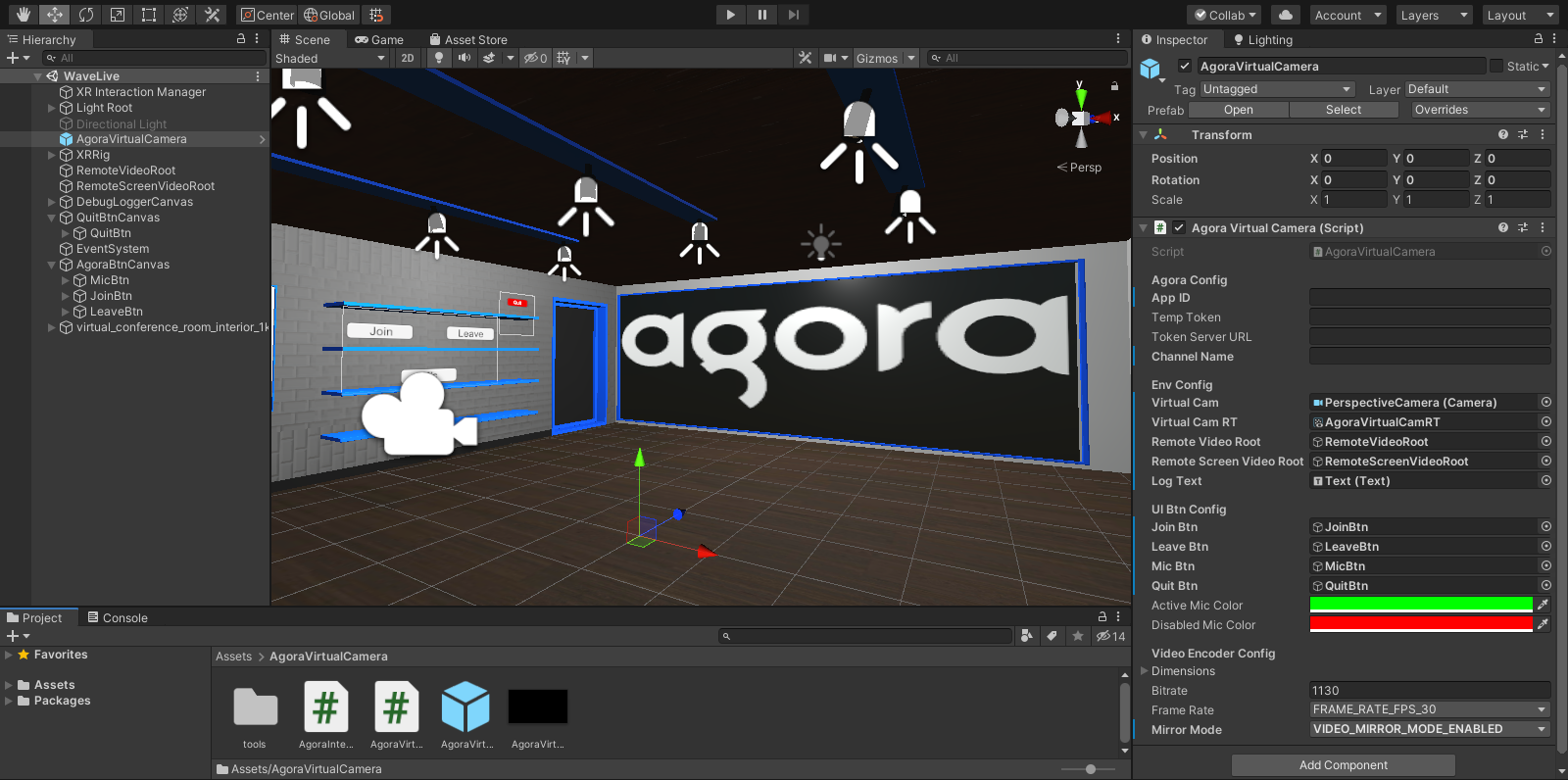
GitHub
An open source prefab that makes it easy to live video streaming from a Unity virtual camera into an Agora live video chat or live video streaming channel. - GitHub - AgoraIO-Community/Unity-Virtua...
@blissful bay exact same approach as yours
this all exists
just with a protocol that actually works
then you can use the agora react component
and agora signaling server
and show the feed in the browser
then you're done
you can do it in an android app too
blissful bay
the thing is - this part has been written by my colleagues and tbh I dont see a reason to rewrite it
undone coral
blissful bay
the thing is - this part has been written by my colleagues and tbh I dont see a ...
i am really not trying to bully you into doing anything that doesn't make sense
one perspective is that 3 developers do not do 3x the work of 1 developer. sometimes it adds up to less than 1 developer
blissful bay
what would be the benefit of changing a working piece of code?
undone coral
you're using that word again 🙂
blissful bay
let me reword that then - what is the benefit of changing a piece of code that does what it needs to do?
undone coral
because it isn't solving the problem
right now you're north korea trying to build a rocket ship
like you can launch a rocket repeatedly into the sky and is repeatedly crashing into the ground, and it goes a little higher every time
is it going to go into space? i don't think so
i'm sorry, you're right, afghanistan*
agora focuses on this one aspect that is 90% of the work
in this application
it's a very good value

Agora
In this quickstart guide, learn how to integrate Oculus Quest with Agora’s live video streaming capabilities to create a VR environment with endless possibilities.
@blissful bay using this will also help you focus on the domain specific problem of teaching using headsets
it will end this colossal distraction
@blissful bay share this colorful explanation with your friends, with the other students / grad students
tell them doctorpangloss thinks you guys are the Afghan Space Program right now
and i think they'll be convinced they should just use agora, and you will be in a much better place
blissful bay
there is one more issue - this is a commertial product, not a school project
undone coral
well
you said you were a student right?
are you?
like this is for an internship?
i don't know what to say, you pay for the agora fee, it is small
you pay for a unity license, you pay for the backend servers, you pay for agora
you can also try to do something impossible
blissful bay
undone coral
are you?
yes
undone coral
you can afghan space program
undone coral
lol to sort of
is this your company?
i am trying to understand
you're doing it again
you're not saying the thing
anyway agora is your best bet, good luck out there
blissful bay
alright, thanks for your time and sorry for being a dork, lol
undone coral
lol
no it's okay
i am trying to help for real
basically you can go back to them and ask for way more time
or moderate expectations somehow
blissful bay
and I am trying to apply your advice on what I need to do
undone coral
you're certainly going to be able to start a thread and loop send udp packets with it
i don't think you really need help with that
you will readrawtexturedata and it will be fine
you should probably google "vr training instructor watch"
and see that there are like 10,000 people in 1,000 different companies working on stuff like this
rugged radish
is there a way to make a compute shader kernel handle zero length buffers ?
if I don't set the buffer that is referenced in the kernel's code I get an error that the buffer was not set (it is known in advance it won't be used by the kernel)
and it's not allowed to create zero length compute buffers
right now I have to put dummy 1-length data in those cases, which makes the c# side of things somewhat ugly
 native plover
There will be many CustomRigidbodies, but not many GravityVolumes
 icy aspen
I am having a small problem with the playfab RegisterPlayFabUserRequest: I want to sign up users with a username and a password, this is my code:
public void Register()
    {
        var request = new RegisterPlayFabUserRequest
        {
            Username = username,
            DisplayName = displayName,
            Password = password,
            RequireBothUsernameAndEmail = false
        };
        PlayFabClientAPI.RegisterPlayFabUser(request, OnRegisterSuccess, OnRegisterError);
    }
The displayname, username and password get defined here in the update function:
displayName = displaynameInput.GetComponent<TextMeshProUGUI>().text.ToString();
        password = passwordInput.GetComponent<TextMeshProUGUI>().text.ToString();
        username = displaynameInput.GetComponent<TextMeshProUGUI>().text.ToString();
When i run this, this error pops up (it's from error.GenerateErrorReport()
I've read some stuff online and this is what i found: https://community.playfab.com/questions/36762/registerplayfabuser-fails-with-invalid-characters.html There seems to be a problem with TextMeshPro.
Does anyone know how to fix this?
An open forum for users of PlayFab to get answers to questions and to provide feedback on features and add-ons they'd like to see.
this was the error i was talking about

 regal olive
anyone know why this interface isnt available in Unity.Jobs
 sly grove
regal olive
anyone know why this interface isnt available in Unity.Jobs
sly grove
regal olive
anyone know why this interface isnt available in Unity.Jobs
Do you have the package installed?
regal olive
sly grove
Do you have the package installed?
Burst package?
sly grove
regal olive
Burst package?
Jobs package
regal olive
there's nothing like that in package manager
sly grove
I think by "kernel" they're talking about the compute shader "program"/"function" itself which are referred to as "kernels".
 dapper cave
in 2021.3 is Mathematics still dog slow compared to Mathf?
 wooden cedar
No idea, 2021 hasn't had a stable build that gave me a clean pass on my team's QA
But we need to support a large array of devices, so getting a true stable Unity build is very rare for us
dapper cave
wooden cedar
No idea, 2021 hasn't had a stable build that gave me a clean pass on my team's Q...
oh boy, thanks for the heads up 😅
I wish more people would share their in-production experience of each Unity version... it's become a game on itself to find a config that's not shit
 chilly nymph
wooden cedar
No idea, 2021 hasn't had a stable build that gave me a clean pass on my team's Q...
chilly nymph
wooden cedar
No idea, 2021 hasn't had a stable build that gave me a clean pass on my team's Q...
What are you testing?
dapper cave
there used to be a bool in Application, I think it was called Application.isQuitting or similar, that'd go true if the game is exiting, thing's gone. you know what it's called now?
(hope not one of these god damn events)
pliant crest
whats wrong with events?
pliant crest
dapper cave
(hope not one of these god damn events)
rugged radish
as PraetorBlue said, it's a compute shader kernel
I should've worded that more clearly
 maiden turtle
rugged radish
as PraetorBlue said, it's a compute shader kernel
I should've worded that more c...
maiden turtle
rugged radish
as PraetorBlue said, it's a compute shader kernel
I should've worded that more c...
I'd guess you need to make shader variants then, use ifdef and defines to make the buffer optional
rugged radish
maiden turtle
I'd guess you need to make shader variants then, use ifdef and defines to make t...
gave it a quick read, looks like it would work, but also sounds painful, considering how small the issue is
thanks 👍
 stuck onyx
is it possible after upgrading unity from 2020.3 to 2021 the script execution has increased quite a lot ? im on I2LCPP build
i had a quite heavy script that i tested on editor and device and it took almost 1 second to execute... now im doing exactly the same on device and its barely 200ms
maiden turtle
stuck onyx
i had a quite heavy script that i tested on editor and device and it took almost...
it's either internal optimizations or better code generation, totally possible
one or two functions got inlined in some hot loop
+200 speed
stuck onyx
maiden turtle
it's either internal optimizations or better code generation, totally possible
I see....
thanks
 obsidian glade
they don't - but a decoupled architecture that achieves its decoupling by using events will be easier to test
jolly token
Is it? Test setup for events are pretty fussy because their async nature
 orchid marsh
Targeting the individual credibility rather than the nature of async isn't beneficial.
I didn't see the mentioning of issues just that of asynchronous nature which could be fussy.
jolly token
How do you testing the event? If your code base has lots of events? With lambdas and counting events?
I guess basic unit test would look like this
int eventCount = 0;
EventPublisher pub1 = new();
pub.OnSomething += () => eventCount++;
pub.SomethingHappened();
Assert.Equal(1, eventCount);
When do integration test it will become more complex to set up
Because each event can expect other event to do anther thing 🤔
obsidian glade
the parts doing the work in making your code easy to test there are the interfaces rather than the events
having a simple interface for components to connect & interact, you don't necessarily need events to do that
the hard part of testing would come when you have a component you can't just instantiate as a prefab - perhaps some networking service or database IO, in which case you can replace the entire interface with a stub instead while the rest of your code can be tested as if it's there
jolly token
Even with integration tests you'd need to mock some behaviour, (e.g. Server response)
I find it is easier to mock things with interface and Tasks than bunch of event callbacks
jolly token
I guess it is code smell because it means your implementation is aware of test?
 tired creek
Hi, I am writing code that removes loose vertices from a mesh. Ive come up with the following:
public static void RemoveLooseVertices(List<Vector3> vertices, List<int> triangles)
        {
            SortedSet<int> looseVertices = new();
            HashSet<int> usedVertices = new(triangles);
            List<int> subtractions = new(new int[triangles.Count]);

            for(int i = 0; i < vertices.Count; i++)
            {
                if (!usedVertices.Contains(i)) looseVertices.Add(i);
            }

            foreach(int v in looseVertices)
            {
                for(int i = 0; i < triangles.Count; i++)
                {
                    if (triangles[i] > v) subtractions[i]++;
                }
            }

            for (int i = 0; i < triangles.Count; i++)
            {
                triangles[i] -= subtractions[i];
            }

            foreach (int v in looseVertices.Reverse())
            {
                vertices.RemoveAt(v);
            }
        }
However this is O(n*n) which is not good.
Does anyone know how to do this in O(n) time?
 flint sage
I doubt that is possible in o(n) unless you already have analyzed the mesh before hand
tired creek
flint sage
I doubt that is possible in o(n) unless you already have analyzed the mesh befor...
what data do you think i would need to generate for the mesh
flint sage
Actually, can't you just add all used verts to a hashset and then check what verts (from vertices) are missing, wouldn't that still scale linearly
Idk what that subtractions is all about tbh
tired creek
subtractions says how much do i need to subtract from a given triangle index
so trianges match up with correct vertices after i remove the loose vertices
jolly token
And for same reason you are sorting looseVertices which is actually indices?
tired creek
i am sorting looseVertices so i can iterate from the largest to lowest index, because otherwise I woudl invalidate looseVertices values by removing stuff from vertices
jolly token
tired creek
i am sorting `looseVertices` so i can iterate from the largest to lowest index, ...
Hmm you could keep your deleted vertices as empty spots, keep your indices unchanged, and when you need to add vertices fill from empty spots.
rugged radish
can't you just reassemble the vertices and indices
linear time complexity
newVertices
newIndices

iterate over input indices
using them, take out vertices from the input vertices
copy them into newVertices
add the new index to newIndices```

at the end you have new vertex and index listsI need to remove them because otherwise Unity will consider them when creating MeshCollider convex hull
jolly token
tired creek
I need to remove them because otherwise Unity will consider them when creating M...
Or you could set all of them as one of your valid vertices
 hasty nimbus
How to get all gameobjects in the scene in C#7.3 (not 8)
dawn haven
hi, i use cinemachine for my TPS camera, I want to make a port of my game for android but i can't put mobile axis in my freelook component :

Is there a way to replace that with the touch screen?
jolly token
hasty nimbus
How to get all gameobjects in the scene in C#7.3 (not 8)
Why would C# version matter? https://docs.unity3d.com/ScriptReference/SceneManagement.Scene.GetRootGameObjects.html
hasty nimbus
"Feature 'range operator' is not available in C# 7.3. Please use language version 8.0 or greater." but i have the problem that i cant upgrade
jolly token
Then don't use range operator
hasty nimbus
jolly token
Then don't use range operator
But how can i get all gameobjects in the scene without using a range operator?
jolly token
hasty nimbus
But how can i get all gameobjects in the scene without using a range operator?
Why do you need range operator, I just gave you a link
tired creek
@jolly token @rugged radish @flint sage
public static void RemoveLooseVertices(List<Vector3> vertices, List<int> triangles)
        {

            HashSet<int>[] tIndexesOfVertices = new HashSet<int>[vertices.Count];
            for (int i = 0; i < vertices.Count; i++)
            {
                tIndexesOfVertices[i] = new HashSet<int>();
            }

            SortedSet<int> looseVertices = new();

            for (int i = 0; i < triangles.Count; i++)
            {
                tIndexesOfVertices[triangles[i]].Add(i);
            }

            int offset = 0;
            for (int i = 0; i < tIndexesOfVertices.Count(); i++)
            {
                if (tIndexesOfVertices[i].Count == 0)
                {
                    offset++;
                    looseVertices.Add(i);
                }
                else
                {
                    foreach (int idx in tIndexesOfVertices[i])
                    {
                        triangles[idx] -= offset;
                    }
                }
            }

            foreach (int idx in looseVertices.Reverse())
            {
                vertices.RemoveAt(idx);
            }

        }
Changed to this and I think this is linear
pinging if you are maybe curious
tired creek
tired creek
Changed to this and I think this is linear
Either way this takes 5ms in debug mode when previous took 18ms
 blazing osprey
I have an issue with pun2 after changing my build to uwp, is this the right channel or should I use #archived-code-general?
jolly token
blazing osprey
I have an issue with pun2 after changing my build to uwp, is this the right chan...
#archived-networking ? or photon has own discord server
undone coral
tired creek
Hi, I am writing code that removes loose vertices from a mesh. Ive come up with ...
why?
undone coral
stuck onyx
i had a quite heavy script that i tested on editor and device and it took almost...
are you saying there is a performance regression in 2021?
blazing osprey
jolly token
<#497874116246896640> ? or photon has own discord server
huh
why is #archived-networking in the simulation category I collapsed that like a year ago and haven't opened it since
thank you
 last compass
Hey yall I have a big project
 lavish sail
last compass
Hey yall I have a big project
lavish sail
last compass
Hey yall I have a big project
and your skill level is?
last compass
Oh I am a producer of a project
lavish sail
I mean how much experience do you have with gamedev
jolly token
Your profile says you're 21
lavish sail
so you're sure you're ready to handle a "big project"
lavish sail
jolly token
Your profile says you're 21
having 4 years of experience at 21 is normal
last compass
I have been through many projects before big and small
lavish sail
alright then good luck
last compass
But i am looking for some programmers and I found this server
jolly token
lavish sail
having 4 years of experience at 21 is normal
I wouldn't count it as professional experience but yeah
 sleek ocean
I have 4 years and I started at 13
sleek ocean
jolly token
I wouldn't count it as professional experience but yeah
Don’t downplay because of age
last compass
I am gonna be honest I am not a professional at this
sleek ocean
I had friends make tens of thousands of dollars
lavish sail
years of experience don't even mean that much because it's all up to how much you've actually learned in them
last compass
but I have experience to be able to head into a new direction
sleek ocean
lavish sail
years of experience don't even mean that much because it's all up to how much yo...
Yeah it’s just his reason is when he started and not the one between
tired creek
undone coral
why?
why what
lavish sail
so you hire people to do all the development job?
last compass
I wouldn't put it like that because we all do the development job
everyone has their own part in it
like we have animators and we have artists
lavish sail
and what do you do exactly
last compass
you mean the language or what game
jolly token
sleek ocean
I had friends make tens of thousands of dollars
That's like minimum wage, sure
Can someone really say what to do in a big project if they didn't experienced professional environment
sleek ocean
jolly token
That's like minimum wage, sure
Can someone really say what to do in a big projec...
I mean like at 16 that’s a lot for a month
lavish sail
last compass
you mean the language or what game
what work do you do in the project? do you do 3d modelling? programming? sound? game design? animation?
sleek ocean
They dev on roblox so they make a lot more money but the games are more cash grabby
last compass
oh I see what you mean
lavish sail
sleek ocean
They dev on roblox so they make a lot more money but the games are more cash gra...
oh yeah, that's roblox nowadays
sleek ocean
I quit though because single player is a super niche meta
That isnt pushed very often
I also wanna make games that can run smoothly at any degree
Performance is a major issue
And I found a lot of issues in the engine
Overall it’s really for devs who want to make some money
lavish sail
Roblox is a highly commercialized platform so it's almost all about money really
sleek ocean
Yeah
last compass
basically, my job in the project is to help put it all together and help with everyone's job and basically make the project run smoothly make sure the tests all get performed and I make sure it gets published correctly
lavish sail
so you're just overseeing
last compass
if that's the words you want to use
lavish sail
ok then, it should work as long as you don't expect people to work for free
but generally it won't work with non-commercial collaboration
last compass
The languages involved are C#, JavaScript, and maybe some Python
if you are interested in trying out for the project you can DM me
orchid marsh
 lavish sail
^
sleek ocean
Wait how did you
lavish sail
that's where you go if you want to hire
orchid marsh
sleek ocean
Oh that’s an image
blazing osprey
sleek ocean
I have 4 years and I started at 13
I had 4 at 13
sleek ocean
blazing osprey
I *had* 4 at 13
As a writer it is highly offensive to be caught off guard in such a way
I shall log off for the day
blazing osprey
ok
undone coral
tired creek
Hi, I am writing code that removes loose vertices from a mesh. Ive come up with ...
I am writing code that removes loose vertices from a mesh.
why this part? what is your objective?
tired creek
im writing an implementation of a mesh splitting algorithm
undone coral
tired creek
im writing an implementation of a mesh splitting algorithm
there should be libraries that do this
 undone coral
ah
tired creek
and fill the holes
tired creek
undone coral
i mean what's your goal
to learn something
undone coral
you might want to look at poseidon CSG
"CSG" is the name for this class of mesh operations
like boolean operations
 long tangle
i was making a first person shooter and i was trying to make the camera stop rotating when looking completely up or completely down. I have come up with this code and i wanted to know if there is a better way to do this
 tired creek
long tangle
i was making a first person shooter and i was trying to make the camera stop rot...
tired creek
long tangle
i was making a first person shooter and i was trying to make the camera stop rot...
this is alright
you can look at functions Mathf.Clamp() and Mathf.Min/Max to explore other solutions
a nice trick is to write
cameraX = Mathf.Clamp(cameraX + angleDifference, -90f, 90f)
instead of
cameraX += angleDifference
this way the angle will never be outside the desired range in the first place
 terse bobcat
Hello does anyone know how to smooth the camera rotation i have liitle jitter
    {
        if (!HasAnimator) return;

        var MouseX = InputManager.Look.x;
        var MouseY = InputManager.Look.y;
        Camera.position = CameraRoot.position;


        XRotation -= MouseY * MouseSensitivity * Time.smoothDeltaTime;
        XRotation = Mathf.Clamp(XRotation, UpperLimit, BottomLimit);

        Camera.localRotation = Quaternion.Euler(XRotation, 0, 0);
        PlayerRigidBody.MoveRotation(PlayerRigidBody.rotation * Quaternion.Euler(0, MouseX * MouseSensitivity * Time.smoothDeltaTime, 0));
}```do you call this in FixedUpdate?
tired creek
also this should probably go in #💻┃code-beginner
terse bobcat
tired creek
also this should probably go in <#497874004401586176>
okay, but do you have a solution?
tired creek
not really
 queen meadow
Trying to figure out a good flow for interactive animated meshes. Shortly named Active Ragdolls, usually.
I want to create a zombie, that I can interact with in VR. Grab his head, stab him etc; while keeping some animations like swiping towards you as he is grabbed by his head. Now, I got Active Ragdolls going.. though they aren't perfect in any matter, with addition, if I try to play a walking animation... well they love to bounce.
My currently solution which feels the wrong direction, is to do Animated Mesh -> Ragdoll -> Active Ragdoll (play get up animation) [if the character successfully get up at some angle]->Animated Mesh. Interactions with the mesh, a cylinder trigger would cause the Animated Mesh -> Active Ragdoll. Maybe even a zombie swipe causes it to go into active ragdoll.
If anyone has a clean way to reproduce something like Blade & Sorcery and/or Boneworks (less soo, too clumsie for my needs).
Thanks!
lament salmon
queen meadow
Trying to figure out a good flow for interactive animated meshes. Shortly named ...
For my active ragdolls I setup them with ConfigurableJoints, and these extensions make settings their target rotation easy:
https://gist.github.com/mstevenson/7b85893e8caf5ca034e6
Nevertheless you will be doing a lot of tweaking

Gist
Extension methods for working with Configurable Joints for Unity - ConfigurableJointExtensions.cs
queen meadow
lament salmon
For my active ragdolls I setup them with ConfigurableJoints, and these extension...
Ah ye, I'm also using ConfigurableJoints and have my guy standing upright... though I'm totally cheating by constraining the hip rotations. Though I guess my questions leads to how do you get the character to get up again after falling down?
This is what my Active Ragdoll looks like so far. With the puppet on the left.
 lament salmon
queen meadow
Ah ye, I'm also using ConfigurableJoints and have my guy standing upright... tho...
lament salmon
queen meadow
Ah ye, I'm also using ConfigurableJoints and have my guy standing upright... tho...
Yeah, bipedal balancing is hard to do realistically, robotics engineers struggle with it IRL too... 😁
As to blending back to animation... you would usually have two animators/skeleton inside your character. First armature would always run the animations, and the second one has rigidbodies and joints enabled, copying their respective target rotations from the 100% animated version.
Then when your character gets back up/you want to disable physics, you just blend into 100% following animations, and finally back to using only animations
queen meadow
lament salmon
Yeah, bipedal balancing is hard to do realistically, robotics engineers struggle...
Ye trying to solve a robotics question is difficult. 😅
So are you suggesting that the Active Ragdoll will always be the visible model, the animated mesh would be hidden (with the animator Always Animating turned on). Then when checking if the character is upright, if it fails that test; then you want to disable the physics towards itself, and run the animation of getting up, then turn back on the physics when the character is upright again?
lament salmon
queen meadow
Ye trying to solve a robotics question is difficult. 😅
So are you suggesting ...
I mean it all depends on how you want your character to behave. But I think you got the basic idea of having 2 skeletons:
- The
Sourceskeleton, that always runs animations and yes, usingAlways Animating - The
Physicalskeleton with Rigidbodies & ConfJoints, that copies target rotations to each of it's bones fromSourceskeleton
If you want to 'disable' physics, just show the Source renderer
Use joint slerpDrive/angularDrive strength to simulate muscle strength
I'm by no means solving a certain problem you have here, but throwing at you this workflow/technique that works for me
queen meadow
Hm okay, and does animations need to be different in any way or can I use normal animations for example, walking and running.... currently causes a lot of bunch, maybe that's related with my fixed hip?
Right of course, I'm just throwing questions, since I'm at a very early state of learning active ragdolls, and it seems you have more of an idea than I do. Which I appreciate your guidance on this. 🙂
lament salmon
queen meadow
Hm okay, and does animations need to be different in any way or can I use normal...
In my own project I use a separate AnimatorController when the character is in 'Active ragdoll' mode, just for custom sets on animations when physics are enabled, so yeah thats a possibility
A lot of this is so usecase specific that you just have to try a lot of stuff out
queen meadow
Hm interesting. It sounds like you don't use the animated mesh only for puppeteering, if I am not wrong, with custom animations for some physical ragdoll differences.
lament salmon
queen meadow
Hm interesting. It sounds like you don't use the animated mesh only for puppetee...
My characters are fully animation driven by default, but when they get injured/die, the active ragdoll activates, and the source skeleton plays appropriate hit animations
queen meadow
Okay that makes sense, performance would tank otherwise. 🤣
lament salmon
A couple of GDC videos to check out:
https://www.youtube.com/watch?v=TmAU8aPekEo
https://www.youtube.com/watch?v=7S-_vuoKgR4
Not Unity related directly, but similiar concepts and good visualization

In this 2020 GDC Summer session, Respawn Entertainment's Bartlomiej Waszak explains how Star Wars Jedi: Fallen Order uses physical simulation blended with authored animations to create high-fidelity character motion.
Join the GDC mailing list: http://www.gdconf.com/subscribe
Follow GDC on Twitter: https://twitter.com/Official_GDC
GDC talks c...

In this 2017 GDC talk, Naughty Dog's Michal Mach explains how to drive physics objects with animation more predictably, with minimal distortions and almost absolute artistic control.
Register for GDC: https://ubm.io/2yWXW38
Join the GDC mailing list: http://www.gdconf.com/subscribe
Follow GDC on Twitter: https://twitter.com/Official_GDC
GDC...
queen meadow
When you are trying to get back up, are you still in active ragdoll?
lament salmon
queen meadow
When you are trying to get back up, are you still in active ragdoll?
I got some work to do on that part still, but it's a blend from physics back to normal 100% animated
queen meadow
lament salmon
I got some work to do on that part still, but it's a blend from physics back to ...
Alrighty, yeah this sounds like my mindset was in the right place. Thanks, I really appreciate this!
( I have lunch, gotta go eat 🍔 )
lament salmon
queen meadow
Alrighty, yeah this sounds like my mindset was in the right place. Thanks, I rea...
happy to help, it's a pretty niche thing that no one seems to discuss much 😁 bon appetit!
regal olive
queen meadow
This is what my Active Ragdoll looks like so far. With the puppet on the left.
Woah that’s some accurate looking collider sizes, did you use unity’s default Ragdoll builder?
queen meadow
regal olive
Woah that’s some accurate looking collider sizes, did you use unity’s default Ra...
I used the Ragdoll builder then throw away their character joints. I did have to tweak up the sizes just a little bit.
I am planning to write my own Ragdoll Builder, because it Unity's version doesn't work well for active ragdolls or at least my use.
But first need to get the darn thing working. 🙂
jolly token
Does RegexOptions.Compiled work well in IL2CPP?
queen meadow
lament salmon
happy to help, it's a pretty niche thing that no one seems to discuss much 😁 bo...
Thought to share where I was with a vid. 😄
lament salmon
queen meadow
Thought to share where I was with a vid. 😄
might want to start by trying larger damping values, to avoid the shakiness. Idk how active this channel is but theres always #⚛️┃physics
also ragdolls are a pain to debug, so one idea is to create a ScriptableObject that all ragdolls use to get their joint values
makes it easier to debug and test different values runtime
just a peek on my SO's inspector so you get the idea

and then multipliers and mass scales etc for each type of bodypart... you just adjust them until it works like you want
regal olive
queen meadow
Thought to share where I was with a vid. 😄
oh my god they are alive
 grave vortex
Can I set render order by render layer rather than material type?
 torn basalt
under the hood, where does transform.localscale get its info from to determing the xyz scale of an object?
 wild bane
I switched unsafe code on in Unity Editor and tried to get a pointer to a Transforms Vector3 position but I get an error that I cannot access that address..
I'm either doing something wrong here or it just can't be done with such things
(I also learned C++ earlier so I'm quite new with how pointers work in C#)
private unsafe Vector3* _playerPos;

private unsafe void Start()
{
    _playerPos = &GameManager.instance.playerFollow.position;
}```Even tried to just make it a var instead of Vector3* just to check if the type was incorrect, but after hovering on it it's say's it's a Vector3* so no issue with that, the problem is probably the way I try to access it or maybe I have to do something more than just turning the unsafe code on in Unity settings
 gaunt spoke
Hello, I believe you can use pointers on structs only if the struct contains primitive value types, maybe that's not the case for Vector3 ? I also really wonder why do you need to use pointers here, can you tell us a bit more about your use case ?
wild bane
Actually there's no real reason for me using pointers here, I was just testing stuff and I wondered if I can just get a pointer to a Vector3 position instead of getting the Transform reference and access it's position via the Transform at all times
 umbral trail
this is really dangerous because you're not checking the lifecycle of playerFollow so if it gets destroyed you'll crash
Also you can't take pointers of objects in the heap because they will move when heap compaction happens in the garbage collector
tired creek
Hi, can comeone tell me why consecutive calls of a function get faster?

Is the mesh data getting cached somewhere?
 errant plinth
Could be a warm-up effect
wild bane
umbral trail
Also you can't take pointers of objects in the heap because they will move when ...
Ah, I see, thanks
tired creek
flint sage
Could be jit, could be faulty measuring
            var timer = new Stopwatch();
            timer.Start();
            Destruct.SplitResult splitResult = SplitMeshAlongPlane(v, t, u, new PlaneSplitter(new Vector3(1f, 1f, 0f), 0f));
            timer.Stop();
            Debug.Log("Splitting " + t.Count + " triangle mesh took " + (float)timer.ElapsedTicks / Stopwatch.Frequency * 1000 + " ms");
I do measuring this way
Is this alright?
flint sage
Not really, if you want reliable results you should really be using benchmark.net but not sure if you can integrate that into Unity really
flint sage
Well you're only doing one iterate so you're prone to outliers
umbral trail
unity has built-in performance testing: https://docs.unity3d.com/Packages/com.unity.test-framework.performance@1.0/manual/index.html
flint sage
If you're running this on Start for example, you'll likely be influenced by unity initializing things
Hence why it could be slower
Ah cool, didn't know about that package
umbral trail
Add a 5 second delay and if that changes it, there was other stuff happening at the same time slowing it down
3 seconds seems a bit long for JIT
flint sage
You're probably right but we can't know since it's not a reliable way to test 😛
tired creek
flint sage
If you're running this on Start for example, you'll likely be influenced by unit...
i run this in update on button press
umbral trail
well I'd just use the profiler
lament salmon
flint sage
You're probably right but we can't know since it's not a reliable way to test 😛
Im curious, how is Stopwatch inaccurate?
flint sage
Stopwatch in itself is fairly accurate but the way they're testing isn't
 hushed moth
Hi, I am using webrtc, rendering the image on a material (skybox/panoramic e.g. skybox.SetTexture("_MainTex", tex)) and I noticed (profiler) when I start the stream then the GPU usage is going high (82% in profiler) RenderTexture.SetActive()
How can I lower the gpu usage?
undone coral
tired creek
Hi, can comeone tell me why consecutive calls of a function get faster?
i think because the first one is called when there is something in the editor slowing things down
it's a red herring
especially if you are splitting work across frames or something
 regal lava
Note: This function is very slow. It is not recommended to use this function every frame. In most cases you can use the singleton pattern instead.
I don't use them, but I can see them potentially being useful on scene loading. You can probably get away with using them in smaller projects, but once you've got a lot of stuff loaded, that seems awfully inefficient at finding the objects you want.
 ashen shard
there are much better ways of getting references
[SerializeField] and as mentioned singletons to name a couple
because you don't have to do any finding
xD
jolly token
Outside of efficiency and performance, it is still bad practice as it hides dependency and rely on global state without context
It does. Both methods make your logic "everything can be accessed everywhere"
Which may easy at scratching but horrible when maintaining
 magic ridge
tired creek
Hi, can comeone tell me why consecutive calls of a function get faster?
magic ridge
tired creek
Hi, can comeone tell me why consecutive calls of a function get faster?
are you using burst? If so it's possible it hasn't compiled until the second time. You can force this to not happen via Jobs/Burst/Synchronous Compilation
IMO singletons are fine in specific cases yeah, but too much and it can get quite bad
ie "SoundManager" so you can play a sound easily.
ashen shard
but what is the best then?
regal olive
m
jolly token
ashen shard
but what is the best then?
Dependency injection is most generic solution widely used to resolve this kinda issue
 hollow jay
I'm having a few problems understanding semantics in compute shaders, so if anyone can help that would be great:
[numthreads(32,1,1)]
void CSMain (uint3 threadId : SV_DispatchThreadID, uint3 groupId : SV_GroupID)
{
    //Use x and y of id to get position of Vertex
    uint i = threadId.x + groupId.x * resolution;
    uint x = i % resolution;
    uint y = i / resolution;
    uint mapIndex = x + y * resolution;

    float percentX = (float)x / (resolution - 1.);
    float percentY = (float)y / (resolution - 1.);

    vertices[mapIndex] = float3((percentX * 2. - 1.) * scale, 0.0, (percentY * 2. - 1.) * scale);
}
It seems that when the thread is not in group 0, threadId.x becomes 0. I tried to solve this by using the group's index, but that had the same result. Can anyone point me in the right direction to the cause of the issue? Thanks!
Oh, and here is the relevant C# code:
int groups = Mathf.CeilToInt(resolution / 32f);

//Dispatch shader
computeShader.Dispatch(0, groups, 1, 1);
use them in editor scripts, serialize the references in arrays
is generally how i do it
hollow jay
hollow jay
I'm having a few problems understanding semantics in compute shaders, so if anyo...
Update: I fixed the problem. I was supposed to be dispatching (resolution * resolution) / 32 groups, not just resolution / 32
 timber flame
What data structure do you prefer to use for open set in A* algorithm?
SortedDictionary or Dictionary itself?
SortedDictionary
Retrieval (smallest f cost): O(log(n)), Add: O(log(n)), Remove: O(log(n)), FindByKey: O(log(n))
Dictionary
Retrieval (smallest f cost): O(n), Add: O(1), Remove: O(1), FindByKey: O(1)
or use both? store nodes in both
compact ingot
timber flame
What data structure do you prefer to use for open set in A* algorithm?
SortedDic...
a priority queue (heap). As a matter of principle in implementing a performance oriented algorithm, you generally should not use general purpose implementations of data structures as they are in many cases wasting performance due to their generality. So if you bother to implement A* you should also bother to write or find fully optimised data structures for it. Big O is pretty meaningless for this purpose as well, you will care a lot more about performance on small sets and how big that O(1) actually is.
timber flame
compact ingot
a priority queue (heap). As a matter of principle in implementing a performance ...
Yes, thanks. Heap is more efficient than Red-Black tree for this purpose (open set in A*)
but to know if a node is in the open set or not O(1), a hash set is required, right?
and, isn't the internal implementation more performant? I mean .Net libs
compact ingot
timber flame
and, isn't the internal implementation more performant? I mean .Net libs
They are very good for the generic case but not optimized for any special case, the backing datastructure may even be theoretically optimal, but that is only the first line of optimization, ideally you want to allocate your own continuous region of memory for it and use all properties of your specific algorithm variation/expected data/use case to eliminate extra work that a generic datastructure would perform
it is generally not possible to implement a generic tree data structure that performs well for a wide range of cases. There is just no real optimization that is independent from the size and structure of the data actually contained in it.
 blissful moth
hey can anyone help me on how do i connect the joystick to the weapon looking point like this..any help will be great thanks
 inland delta
Better not to use this asset at all
blissful moth
inland delta
Better not to use this asset at all
you mean this?
inland delta
This "MoreMountains top-down engine" is not modular or easily extensible
Pretty coupled code
blissful moth
yes
compact ingot
TDE is a prototype engine, for a real game it gets in the way constantly.
blissful moth
blissful moth
hey can anyone help me on how do i connect the joystick to the weapon looking po...
the mobile controls are very buggy just wanted to know how they did this ..cant get through that code
compact ingot
if it’s not obvious how to set it up from the docs and ui, best not use it
blissful moth
yee ill check one last time if i can scrap something i can use
 lone minnow
Hello I'm not sure if this is correct channel to ask this
I'm trying to build player by code and my target platform is dedicated server but it's unavailable in the old Enum only in the new Enum NamedBuildTarget.Server
So I'm unable to call BuildPipeline.BuildPlayer
undone coral
blissful moth
the mobile controls are very buggy just wanted to know how they did this ..cant ...
is this exact demo scene not visible?
have you played virtual joystick games on mobile?
undone coral
inland delta
Pretty coupled code
retro genres are coupled
another perspective is, retro doesn't make sense for mobile
jolly token
lone minnow
Hello I'm not sure if this is correct channel to ask this
I'm trying to build ...
You can build dedicated server by setting subtarget to StandaloneBuildSubtarget.Server
target should be standalone you're trying to build

 fresh salmon
First one will get input on your FixedJoystick, on the horizontal axis, going right
Second one will get input when you press W on keyboard
So entirely different
Next time in #💻┃code-beginner or #archived-code-general, not an advanced question
 coarse cave
fresh salmon
Next time in <#497874004401586176> or <#763495187787677697>, not an advanced que...
coarse cave
fresh salmon
Next time in <#497874004401586176> or <#763495187787677697>, not an advanced que...
I am sorry sir
But in code-generel, there was no one capable of halping me
coarse cave
fresh salmon
First one will get input on your `FixedJoystick`, on the horizontal axis, going ...
I have a script. When I use the KeyCode.W the code works just fine. But when I use the FixedJoystick, the functions are being called too, but nothing is happening
Can I send the code please, its a car controler.
lone minnow
jolly token
You can build dedicated server by setting `subtarget` to `StandaloneBuildSubtarg...
I'm really trying to aim into dedicated server as It would help me better
jolly token
lone minnow
I'm really trying to aim into dedicated server as It would help me better
That's how you build dedicated server, are you saying you have problem applying it?
 surreal quarry
Is it even possible to use transform.Translate as the inDirection for Vector3.Reflect, or does it require rigidbody.velocity to work correctly? My projectiles use transform.translate for movement.
I've been trying to implement a bullet parrying system for a game, but currently it works in a way that the projectile spawns from behind of the enemies that shot the projectile, after trying to parry it back at the enemies.
It's like the projectile spawns from a different world position after the reflect function.
jolly token
surreal quarry
Is it even possible to use transform.Translate as the inDirection for `Vector3.R...
You should share the code, Reflect is just mathematic calculation
surreal quarry
surreal quarry
Is it even possible to use transform.Translate as the inDirection for `Vector3.R...
private void SendProjectileBack() {
//TODO FIX THIS
// The projectiles spawn from wierd position.
reflectDir = Vector3.Reflect(_enemyProjectile.transform.position, _normal).normalized;
_enemyProjectile.transform.Translate(reflectDir);
}
private void OnCollisionEnter(Collision collision) {
  if (!collision.gameObject.CompareTag("EnemyProjectile")) return;
  _normal = collision.contacts[0].normal; // get collision normal from box collider
  _enemyProjectile = collision.gameObject;
            // DEBUG
foreach (var item in collision.contacts) {
Debug.DrawRay(item.point, item.normal * 100, Random.ColorHSV(0f, 1f, 1f, 1f, 0.5f, 1f), 10f);
  }
SendProjectileBack();
}
probably caused by local - world space mismatch
try using world space in that Translate (I assume you move the projectile somewhere else, because that code will only move it 1 unit away)
surreal quarry
yeah, I'm moving it inside the projectile script itself
jolly token
surreal quarry
```cs
private void SendProjectileBack() {
//TODO FIX THIS
// The projectiles spa...
You are putting position as argument of Reflect, it should be direction
surreal quarry
jolly token
You are putting `position` as argument of `Reflect`, it should be direction
what would the best way to the get the projectile direction? Since I want to use other projectile types for the parry system too
jolly token
surreal quarry
what would the best way to the get the projectile direction? Since I want to use...
Using the same value you are using to move the projectile
dapper cave
is RectTransform.hasChanged no longer working? It used to only be true if the transform changed
oh fuck, I know what's going on, UI autolayout is chaning the rectTransform every frame even when unnecessary... wow
 misty glade
So, in my game I have this "radar" thing showing a planet that you're approaching. I've added a little static effect to it, but I want to add a little fake handheld camera movement to it, getting it to kind of wobble around in the frame. I've tried tweening it to a random point in a unit circle in a random amount of time, but it just looks stupid - like it's bouncing around.
Any ideas?
here's the shader "flickering" i'm using.. might be a little hectic, I'll probably turn that down a smidge
misty glade
Sigh.. this looks janky as heck. Any ideas?
(tweening to a random spot in the box for a random time between 0.1-0.6sec with an in-out ease)
jolly token
misty glade
Sigh.. this looks janky as heck. Any ideas?
Shader looks nice. If you wanna make it look like it's having connection issue, I don't think tweening would be good for that (too smooth). maybe just teleports with smaller range?
sly grove
misty glade
here's the shader "flickering" i'm using.. might be a little hectic, I'll probab...
this one looked good
misty glade
I was sorta wanting to do like a battlestar galactica camera shake .. but.. it's kind of hard to emulate. I suppose there's a reason those animators have entire studios of people doing this shit :p
zooms, blurs, off-centers etc
lemme finish tweaking this shader and then lemme know what you think (I'm making the saturation come up as you get closer to the destination)
a little long, sorry
but as you get closer.. the flickering gets more sparse and the saturation increases to 100% - it's almost not noticeable until you hit the destination and see the next planet (fully desaturated and full flickering)
jolly token
I like the concept 😄 just the smooth interpolation between position kinda looks unnatural
misty glade
does that look good? bad? weird?

Not sure what to fiddle with any longer.. have been looking at it too long to see "the whole"
maybe the in-out circ ease should be .. something else
jolly token
IMO you don't really need to interpolate this kinda thing
Because it should look like sudden change
misty glade
oh, you're just saying .. "flick" it to a new location every so often..?
that... might be weird?
(I'll try)
jolly token
Kinda, I'd tweak with cooldown and distance
 fervent parcel
Hello, in custom Editor, how do I go about making the Inspector scroll bar either hide or show permanently?

I am getting this jittery effect where the inspector resizes just because the bar disappears when I have smaller list size
misty glade
@jolly token not sure it's better .. thoughts?
jolly token
misty glade
<@307360612403642370> not sure it's better .. thoughts?
Hmmmmm yeah I think the sample one looks nice because it matches with timing that it jitters & only moves little bit horizontally
But I am no artist 😿
misty glade
neither am i lol
ah well you know what? this is good enough, i've probably burnt like 3 hours just fiddling with this
cuz now i'm making easter egg cows flying in space
jolly token
Lol
 gray pulsar
misty glade
<@307360612403642370> not sure it's better .. thoughts?
gray pulsar
misty glade
<@307360612403642370> not sure it's better .. thoughts?
Another 2c: I like this better than the original drifting, but I think it would be better if it blinked completely black for a second before repositioning. And the very small movements look better than the large movements.
How long is this going to be playing for, though? I feel like it'll be distracting if it is onscreen for long periods of time. If it is short, having the planet start small and grow bigger as you get closer could be another way to give it some movement. (I guess that might work okay even if it is a longer period of time)
misty glade
It's on the screen 100% of the time on the "idle" screen, but it's.. pretty small overall:

It shouldn't be too distracting actually, since most of the gameplay isn't "on" this page all that much.. you're taking care of your missions, seeing what upgrades you can buy, managing your crew, doing battles - all of which are on separate screens
you do come back here in between those things but .. mostly just to make sure you don't have anything to do
gray pulsar
misty glade
you do come back here in between those things but .. mostly just to make sure yo...
mmm, in that case I think the planet growing as you get closer instead of jumping around might be kinda cool
misty glade
i'm doing a planet in the game space that grows as you approach already.. so I was sort of thinking the header there would be like a "radar" or something
but I wanted to do the planet growing in the game space kind of like EVE online (which I used to play) - ie, you pretty much don't see it until you're at 99%
undone coral
misty glade
here's the shader "flickering" i'm using.. might be a little hectic, I'll probab...
use
var noise = amplitude * (Mathf.PerlinNoise(frequency * (Time.time + offset), 0f) - 0.5f)
 mint sleet
Hello folks!
I am coding and interpreter that sits in between my backend and unity.
I wonder what would be the best practice for model mapping? Writing each model in separate classes or putting them into, for example Models.css
maiden turtle
mint sleet
Hello folks!
I am coding and interpreter that sits in between my backend and un...
an interpreter of what? what sort of model?
 glass glade
i'm using this code to change the volume settings at runtime
ColorAdjustments colorAdjustments;
FindObjectOfType<Volume>().profile.TryGet(out colorAdjustments);
colorAdjustments.saturation = new ClampedFloatParameter(saturation, -100f, 100f, true);
the values are changing in the inspector, but are not visible in the game??
 strange cradle

I've got an interesting problem......
USB Steering Wheel with pedals and H-Shifter (Logitech G29)
Works on the Unity player, in Unity....
But if I build to an Android, only the button presses are detected....???
I can't seem to pick up on the axis movement at all....(on the phone)
Ps. Connected via USB OTG.... I'm soooooo close, I can taste it!
Button presses are working!!!
I just need to figure out what input Unity is expecting for the axis to work?
maiden turtle
glass glade
i'm using this code to change the volume settings at runtime
```
ColorAdjustment...
it's either not reread each frame, some calculation involving it having been cached, while setting that value via the inspector does not trigger any sort of update event. or you're looking at a wrong object in the inspector
maiden turtle
strange cradle
I've got an interesting problem......
USB Steering Wheel with pedals and H-Shift...
afaik unity's new input system's input device support is still worse than some 3rd party solutions, check if the device is supported at all
strange cradle
maiden turtle
afaik unity's new input system's input device support is still worse than some 3...
I've been reading the same....
I have no experience with the old system (or any input system to be honest, im usually just point and click style)
But at this stage, I'd be happy to do it in 'any' way that works...
I just need the values coming from the pedals and wheels 😢
maiden turtle
I've tried Rewired, I know this lib supports virtually any input device. But find out whether your thing is supported simply by unity first since you already have most of the setup
strange cradle
maiden turtle
I've tried Rewired, I know this lib supports virtually any input device. But fin...
Oh I see... Yes! I think it's supported....
I base that on Unity detecting movements when looking at debug log, and moving the wheel, from the Unity Player...
And also, when clicking the "Listen" button, in the Input Actions pop up, Unity detects both button and axis movements....
Everything seems to work great on the PC....
But when deploying to the Android (Real Device) then we lose the Analigue Axis (Pedals and Wheel), but all buttons are working fine on the Real Android Device (Showing it's not a usb connection issue)
glass glade
maiden turtle
it's either not reread each frame, some calculation involving it having been cac...
can i trigger an update by code? or how would this work 🙂
strange cradle
glass glade
can i trigger an update by code? or how would this work 🙂
I would put the code inside a method, and call that method...
For example, you could put all your Update code in a method called MyUpdate()
And then in the Update, you can call MyUpdate(), and then also anywhere else in the code too....
But, I feel like I shouldn't tell you this, because... I dont know "why" you want to do that... and there may be a better way to do what your trying to achieve...
This is just to answer you directly "How can I manually trigger an update by code"
maiden turtle
glass glade
can i trigger an update by code? or how would this work 🙂
not by setting thing in the editor directly. you have to either read from the inspectoror every frame, possibly checking if the values have changed, or wrap the input boxes by using a custom editor, triggering an event after setting the value manually
there's also OnValidate, which gets called when any value changes
you can use that if you don't need granular update info
glass glade
thanks a lot for your help so far 🙂 I think I explained the problem wrong, I want to decrease the saturation base on how much health the player has left, the inspector wont matter. The problem is when I try to set the saturation like before, one can't see any changes on the camera. In contrast if I decrease the saturation on the inspector manually the saturation decrease appropriate on the camera
maiden turtle
glass glade
thanks a lot for your help so far 🙂 I think I explained the problem wrong, I wa...
you're setting it on a wrong object probably
glass glade
maiden turtle
you're setting it on a wrong object probably
hmm I only have one volume active in the scene. The value for the saturation on this object is changing in the inspector but wont affect the camera
 maiden turtle
glass glade
hmm I only have one volume active in the scene. The value for the saturation on ...
maiden turtle
glass glade
hmm I only have one volume active in the scene. The value for the saturation on ...
it uses a custom editor. it might not be linked directly to the field. you may need to SetDirty, or something like that
maybe even SetDirty the camera
glass glade
thanks for your help 👍 , found the solution
use colorAdjustments.saturation.SetValue(new ClampedFloatParameter(saturation, -100f, 100f, true)); rather than colorAdjustments.saturation = new ClampedFloatParameter(saturation, -100f, 100f, true);
 cerulean scaffold
When I know that two floating point values should have the exact same value,
is this a valid approach to verify that they are indeed exactly the same?
aFloat.ToString("N16") == bFloat.ToString("N16")
sly grove
cerulean scaffold
When I know that two floating point values should have the exact same value,
is ...
if you want to check for them to be exactly the same just do a == b
undone coral
glass glade
thanks for your help 👍 , found the solution
use ``colorAdjustments.saturation.S...
if you want to animate volumes robustly, you should create a volume with the saturation at the max color value you want, and then modify its weight
cerulean scaffold
sly grove
if you want to check for them to be exactly the same just do `a == b`
I have a case where .ToString("N16") shows that two numbers are exactly the same, however when comparing the floats with == the result is false.
var mismatch = hashMessages
                .Cast<HashMessage?>()
                .FirstOrDefault(_x =>
                    _x.Value.VirtualTick == _message.VirtualTick &&
                    _x.Value.Hash != _message.Hash
                );


            if (mismatch != null)
            {

Debug.LogError(
                    $"Hash mismatch found!: Virtual Tick {_message.VirtualTick} with hash {_message.Hash:N16} has encountered hash {mismatch.Value.Hash:N16} with an approximate difference of {(_message.Hash - mismatch.Value.Hash):N16}"
                );```
`Hash mismatch found!: Virtual Tick 4 with hash 553,5958000000000000 has encountered hash 553,5958000000000000 with an approximate difference of -0,0000610351600000`they are different
why is your hash function producing a float anyway?
cerulean scaffold
It's so I can see how big the difference is
cerulean scaffold
sly grove
they are different
Isn't this correct?: Floating point numbers only have 7 digits. All other digits are always 0.
How then can 553,5958000000000000 be different from 553,5958000000000000?
devout hare
That's not correct. Floats are accurate to up to 7 digits. Their decimal representation can have any number of digits (including repeating to infinity)
sly grove
cerulean scaffold
Isn't this correct?: Floating point numbers only have 7 digits. All other digits...
"floating point numbers only have 7 digits" no not correct
they aren't actually represented in base 10 at all so some idea about how many digits they have in base 10 is not really meaningful
Try this @cerulean scaffold :
bytes[] b = BitConverter.GetBytes(hash);
int i = BitConverter.ToInt32(b, 0);
Debug.Log("data: " + Convert.ToString(i, 2));```If you want to compare two floating point values to see if they're practically the same disregarding rounding errors, there's https://docs.unity3d.com/ScriptReference/Mathf.Approximately.html
but as said, producing a float as a hash is a bit strange anyway
sly grove
cerulean scaffold
It's so I can see how big the difference is
most hash functions are "chaotic" in that a slightly different input should give drastically different outputs. "Difference" in hash outputs is generally not meaningful. Unless you are using a different definition of "hash" than everyone else.
undone coral
cerulean scaffold
I have a case where .ToString("N16") shows that two numbers are exactly the same...
are you trying to synchronize a float seconds in a multiplayer game?
cerulean scaffold
undone coral
are you trying to synchronize a `float` seconds in a multiplayer game?
Not seconds, I'm just trying to check if all clients connected to the host did some calculations with the exact same result each tick.
(It's for determnistick lockstep networking)
cerulean scaffold
sly grove
most hash functions are "chaotic" in that a slightly different input should give...
Yea I know that a float is strange as a hash.
I just need to ensure that some calculations result in the same floating point numbers (on two different machines with the same CPU architecture).
And it looks like there is a difference for some reason.
sly grove
cerulean scaffold
Yea I know that a float is strange as a hash.
I just need to ensure that some c...
No
bad idea
this will never work
due to hardware differences you will simply not get the same results for floating point arithmetic on different machines
same CPU architecture isn't the issue
Even different CPUs with the same architecture can and will give different results.
If you want to do lockstep networking you need to be doing fixed-point math only
cerulean scaffold
Yea, or if I use DOTS jobs for all my calculations it should also be deterministic
https://forum.unity.com/threads/dots-determinism-not-yet-or-is-it-restricted-some-tests.846991/
Floating point in burst is deterministic on the same architecture.

Unity Forum
Hello,
I make simple multiplayer RTS (lockstep) just for my training. Simulation is carried out with a fixed step on each client. Clients send each...
I do most of my calculations with DOTS jobs but I could have missed something.
undone coral
cerulean scaffold
Not seconds, I'm just trying to check if all clients connected to the host did s...
It's for determnistick lockstep networking
what's your objective?
undone coral
cerulean scaffold
Yea, or if I use DOTS jobs for all my calculations it should also be determinist...
Floating point in burst is deterministic on the same architecture.
i think we discussed this last time. they didn't test it well enough to know
in any case the language and architecture do not make things any easy for lockstep determinism
cerulean scaffold
undone coral
> It's for determnistick lockstep networking
what's your objective?
deterministic physics
Thanks for your help @sly grove, @devout hare and @undone coral !
cerulean scaffold
sly grove
Try this <@133257413435326474> :
```cs
bytes[] b = BitConverter.GetBytes(hash);
...
Btw, here is the actual difference between the two floats:
1000100000010100110011000100001
1000100000010100110011000100010
timber flame
To find k closest points from a point, the best way is to use Octree/ Kd-tree?
There is a 3d array and I would like to find k closest points (specific id) from a point.
Also, these points are chunk based. The easiest way is to keep the target points in chunks and then for a point, find its chunk, then the adjacent chunks and finally find the closest ones
(Points are Vector3Int) grid games
Suppose there are a bunch of specific items in the world and I want to find the k-closest items
 pine pendant
sly grove
If you want to do lockstep networking you need to be doing fixed-point math only
pine pendant
sly grove
If you want to do lockstep networking you need to be doing fixed-point math only
How would I replace the unity functions like physics.raycast() with a fixed-point version?
sly grove
pine pendant
How would I replace the unity functions like physics.raycast() with a fixed-poin...
you'd have to use a custom fixed-point or deterministic physics engine
That's what Photon Fusion does
pine pendant
Does unity have a deterministic physics engine?
pine pendant
does unitys current netcode solution support dots?
sly grove
Good question to ask in #archived-networking and/or #archived-dots
rugged radish
timber flame
To find k closest points from a point, the best way is to use Octree/ Kd-tree?
T...
depends on the number of points, and space dimensions
I needed the same thing, and after a certain threshold k-d tree was greatly outperforming full scan
for small n, chunk scans will be faster
not even that small n, I don't remember the exact numbers from my benchmark, but it was in the thousands
timber flame
rugged radish
depends on the number of points, and space dimensions
I needed the same thing, a...
yes, thanks
it is 3d
Can I use octree with chunks? or it is not required?
point in a chunk, then find the adjacent chunks and then use octree or directly use octree and find k-closest points
rugged radish
I only benchmarked k-d tree vs chunked, so can't say for sure
and in my case, I had 2d k-d tree
it scales better with dimensions
 placid jacinth
Other channels occupied, will put this here:
Just wondering if there is an alternative to Coroutines that I can use on a class that is not derived from MonoBehaviour?
Creating a library function and therefore don't really want it to be a component, but I still need something to occur over time not immediately.
:o
 wintry wind
LeanTween?
If not, they actually do something like you mention so maybe you can check their code
jolly token
placid jacinth
Other channels occupied, will put this here:
Just wondering if there is an alte...
Task
 stray pewter
I'm not sure if this is "advanced" (sorry) - but is there any way to interrupt a gameObject from being disabled and do something before it gets fully disabled, eg. run an animation?
stray pewter
placid jacinth
Other channels occupied, will put this here:
Just wondering if there is an alte...
to expand on cathei's answer - you can use C#'s Task or UniTask to do async/await style coding - which is very similar to coroutines - UniTask has some Unity specific improvements
 west scarab
stray pewter
I'm not sure if this is "advanced" (sorry) - but is there any way to interrupt a...
west scarab
stray pewter
I'm not sure if this is "advanced" (sorry) - but is there any way to interrupt a...
I don't think there is a Unity native way, I think ideally you would call an async function / coroutine that plays your animation, then disables the game object.
stray pewter
west scarab
I don't think there is a Unity native way, I think ideally you would call an asy...
yeah - interacting with another API that causes the gameobject to be disabled, was hoping I could hack my way around it.. oh well
@west scarab thanks anyway!
 split folio
placid jacinth
Other channels occupied, will put this here:
Just wondering if there is an alte...
split folio
placid jacinth
Other channels occupied, will put this here:
Just wondering if there is an alte...
Threads? native to C# i believe
 hushed fable
You are likely to make your code incompatible with WebGL when using Threads and Tasks, while UniTask should fallback more gracefully and avoid certain threading APIs that Tasks sort of implicitly rely on.
 sinful fossil
Does anyone know if we can add type specific methods to a class that uses a generalized type?
class Test1<T>
{

}

class Test1<Color>
{
    public void Blur()
    {

    }
}
The example shows a class being redefined and type specified (I know that is wrong). Is there a way to do what I am trying to do?