#archived-code-general
1 messages · Page 202 of 1
 rigid island
 simple egret
Keep your last frame's position and rotation in a variable. That way you can raycast from the last point towards the current point
And then if the ray hit anything, you have the hit point
 neon plank
Any tip about how can I avoid this with my ragdolls?
 simple egret
Probably nothing with code
 leaden ice
game devs have been trying to figure that one out for decades
rigid island
neon plank
Any tip about how can I avoid this with my ragdolls?
fix your colliders
neon plank
My colliders? In which sense?
rigid island
neon plank
My colliders? In which sense?
dont you have capsule colliders?
neon plank
simple egret
Probably nothing with code
I tried adding .sleepThreshold but didn't work
neon plank
rigid island
dont you have capsule colliders?
Yes, I have
 heady iris
this looke like you need more damping or less aggressive angle limits
rigid island
neon plank
Yes, I have
ok so check if they're not intersecting and that are thin enough to only wrap the limb
also add some angular vel friction on Rb
neon plank
heady iris
this looke like you need more damping or less aggressive angle limits
Less aggressive angle limits means increase or decrease the angle limit numbers?
heady iris
Allowing for wider angles, and reducing how much force is used to maintain that, if applicable
dunno how your ragdoll is set up
neon plank
It was a time ago I did this but I took a T pose object, make unity to create the ragdolls, and then I tried to apply that to my enemy, because applying it directly didn't work :/
rigid island
neon plank
It was a time ago I did this but I took a T pose object, make unity to create th...
the default ragdoll is ok but it does need tweak, did you check the colliders also? screenshot them in scene view
neon plank
heady iris
Allowing for wider angles, and reducing how much force is used to maintain that,...
How do I reduce the force required to mantain it? Don't know about a field which does that
heady iris
Is the ragdoll made up of CharacterJoints?
rigid island
here this might help (its timestamped to issue)
https://youtu.be/RB18IyKZiB0?t=735
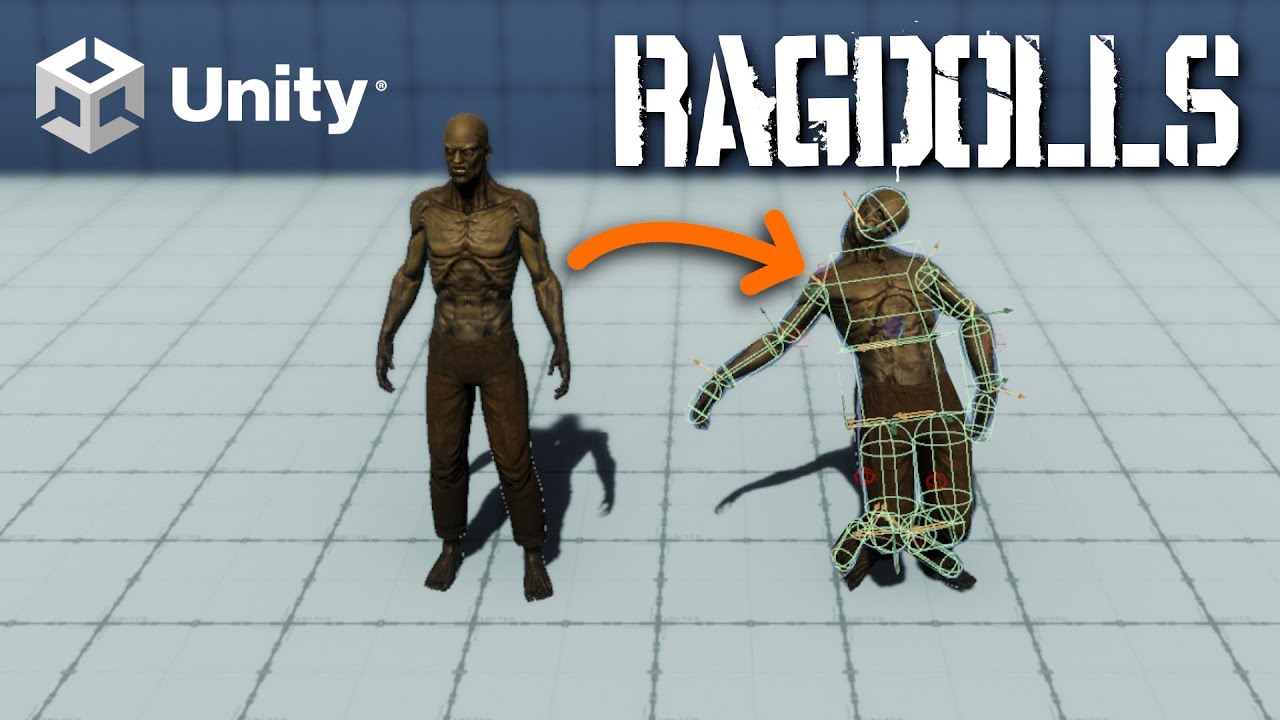
Learn the creation workflow for Ragdolls in Unity, how to toggle between an Animator and Ragdoll, and think through some optimization ideas when you have a large number of potential ragdolls in your game!
Ragdolls are a hugely popular mechanic in games that add, usually a funny mechanic into your game. What they always do though, is allow you t...
heady iris
if so, you can set the twist and spring limit spring and damper values.
Non-zero values will make the limits soft.
 thick socket
simple egret
And then if the ray hit anything, you have the hit point
thick socket
simple egret
And then if the ray hit anything, you have the hit point
brilliant thanks!
should I have to worry about if another object moved out of the path during that time though?
aka it might have passed through it last frame
but now raycasting this frame will have it hit nothing?
neon plank
heady iris
Is the ragdoll made up of `CharacterJoint`s?
I only use that type of joints
(I'm making a gif to show the colldiers)
In the gif there is a bit of overlapping, but that is because the arm doesn't want to rest
 simple egret
thick socket
but now raycasting this frame will have it hit nothing?
simple egret
thick socket
but now raycasting this frame will have it hit nothing?
For bullets that are fast enough (faster than 100m/s), you don't have to worry. You could fire a spherecast to account for the diameter of the projectile
thick socket
simple egret
For bullets that are fast enough (faster than 100m/s), you don't have to worry. ...
if my bullets travel at like 20 velocity I dont need to worry
should I still be using raycasts or just colliders if they are "fairly slow" like that?
(its not really a bullet but a fireball)
simple egret
A non-trigger collider and a rigidbody with continuous collision detection is sufficient
thick socket
simple egret
A non-trigger collider and a rigidbody with continuous collision detection is su...
why non-trigger?
atm Im using a trigger collider
simple egret
Because CCD only works with physical colliders
thick socket
oh interesting
simple egret
If you do not need the projectile to pass through anything, then regular collider
thick socket
a lot of the time I need it to pass through multiple things
enemies need their proj to pass through enemies and platforms for ex)
player proj just need to pass through platforms
simple egret
You can use layer-based collision detection then, make it ignore collisions between two layers via the Physics settings
thick socket
gotcha, was worried about how much "knockback" might happen if it wasn't a trigger
simple egret
A trick is to set the projectile's mass to the lowest value you can (near zero) and it won't apply any visible knockback
 strong cypress
Is there really no way to get these values from AnimationClip in code

 warm stratus
Hey, how to unload a loading scene? I currently have this code
private IEnumerator ChangeSceneAfterLoaded(string sceneName, float minimumLoadingTime)
{
    AsyncOperation sceneLoadingOperation = SceneManager.LoadSceneAsync(sceneName);
    sceneLoadingOperation.allowSceneActivation = false;
    yield return new WaitForSeconds(minimumLoadingTime);
    sceneLoadingOperation.allowSceneActivation = true;
}
what are you trying to do ?
with them
strong cypress
insert an animation event at runtime using the frame # (stored in a csv file)
But seems like you can only get start/end frames from ModelImporter
rigid island
strong cypress
But seems like you can only get start/end frames from ModelImporter
ohh you can ?
doesn't that give you the amount of frames needed ?
strong cypress
yeah but that is not attached to AnimationClip so can't access that detail in runtime
I will probably use an editor script to just extract the start/end frame and put it in a scriptable object or something
rigid island
hmm could get the length in seconds i suppose ? do some math to get the frames (idk how I stink at this)
thick socket
strong cypress
insert an animation event at runtime using the frame # (stored in a csv file)
why not insert the animation event before?
not sure why an event would need to be changed at runtime
figure in code you could change what the event does
rigid island
yeah i dont get the usecase for it as wel
thick socket
Tbf Im pretty nub with animation stuff tho
strong cypress
yeah i may just do that. it's a weird usecase
previously our attack system used timings instead of animation events
so the attack triggered a specific timing instead of based on a frame #
so it would be better for us to just refactor it to properly use animation events
thick socket
Ah I had that also
Trying to line up cooldowns+animation without animator events sucked
You would think a 0.3s animation and waiting for 0.3s would work
Only sometimes lol
strong cypress
yeah exactly
thick socket
I would put in animation events everywhere and refactor
Sounds like less time long run
rigid island
put like an Action to invoke as the Animation Event , then plug/listen whatever methods u want to it
UnityEvent also works if you're working with designers and need inspector to assign methods
strong cypress
rigid island
put like an `Action` to invoke as the Animation Event , then plug/listen whatev...
yeah i will refactor to do that
we assign all the listeners in code, so no need to do anything in the inspector
thanks
 hard viper
Let's say I want to make a list of classes that are all derived from a generic base class. Is there a simple way to do this?
 tulip cosmos
oops
rigid island
hard viper
Let's say I want to make a list of classes that are all derived from a generic b...
could you do?
List<TheBaseClass<object>>
heady iris
hard viper
Let's say I want to make a list of classes that are all derived from a generic b...
Not really.
MyType<Foo> and MyType<Bar> are completely different types
and MyType<object> is not a supertype of MyType<Foo>
This is a problem I ran into recently.
hard viper
I think I am regretting making my parent class generic, because now I don't have easy access to parent functions
heady iris
heady iris
This is a problem I ran into recently.
I have an EntityState abstract class that's derived by a variety of specific state types
each of which declares its own state machine type
tulip cosmos
Hello, I'm currently using Physics2D.Raycast for my turret to check if target can be seen. To achieve that, I'm iterating over every single enemies on the map (that can be up to 50 or more than a hundred little creatures) and do the following:
- Compare distance with the previous nearest enemy
- If nearer, Raycast (on the enemy layer only) to confirm it is a visible enemy
- Replace previous enemy if it is both nearer than previous enemy and visible
So this is how my turret works, problem now is I can have multiple turrets, and one is fine, but I tested with 40 turrets and I'm down from 400+ FPS to less than 30.
Any better implementation for my usecase ?
(Top down game btw)
heady iris
and each of which references an instance of that state machine type
I wanted to be able to put common logic in the EntityState class (e.g. a "try set state" method that would ask the state machine to enter the state you called that method on)
But that would require knowing the type of the state machine
So EntityState would need a type parameter
which would make it impossible to refer to any arbitrary EntityState
https://learn.microsoft.com/en-us/dotnet/standard/generics/covariance-and-contravariance
Covariance and contravariance allow for you to use more or less specific types in some situations
Never had it come up yet.
rigid island
tulip cosmos
Hello, I'm currently using `Physics2D.Raycast` for my turret to check if target ...
why not do an area casting like overlaps and skip the distance checks, only wait for enemy to be inside areas? (all you need is collider)
hard viper
right now I have:
FixedSpawnpointBase<T> : Monobehaviour, ISpawner
FixedSpawnpointType1 : FixedSpawnpointBase<MyType1>
FixedSpawnpointType2 : FixedSpawnpointBase<MyType2>
DifferentTypeOfSpawner : Monobehaviour, ISpawner
heady iris
heady iris
I wanted to be able to put common logic in the `EntityState` class (e.g. a "try ...
I wound up just copy-pasting the same logic into every derived type, lol
it feels like a situation where c++ templates would work
hard viper
I want to work with functions in FixedSpawnpointBase, on objects exclusively from derived classes
thick socket
tulip cosmos
Hello, I'm currently using `Physics2D.Raycast` for my turret to check if target ...
what navarone said...but also how close to each other are the turrets?
tulip cosmos
They could be anywhere on the map, depends where the player puts them
heady iris
hard viper
I want to work with functions in FixedSpawnpointBase, on objects exclusively fro...
well, that much is fine so far. you can write methods in FixedSpawnpointBase<T> that work with T.
thick socket
but you could even just put like 3-4 colliders on a turret each closer so you only iterate over the closest few and grab the closest one
if no target move further out
another option if fixed map size, is to have colliders not on turrets, but around the map to essentially "split" the map into sections
grab the closest section and iterate over it, if no enemy grab the next one
etc
imo the colliders on each turret would be easiest to implement
(the collider setup is how my enemies currently work, they do different actions depending on which collider player is touching)
hard viper
heady iris
well, that much is fine so far. you can write methods in `FixedSpawnpointBase<T>...
so... how do I make this not repeating

 wicked river
Need a little assistance. After trying to create a inventory/Ammo system I started getting this error:
 hard viper
assume it will get worse in future if I don't figure it out early
heady iris
hard viper
so... how do I make this not repeating
does ISpawner not cover everything you need to do here?
heady iris
wicked river
Need a little assistance. After trying to create a inventory/Ammo system I start...
restart unity. probably just an internal bug.
wicked river
let me try. Thanks
heady iris
heady iris
does `ISpawner` not cover everything you need to do here?
I see you're using a field on spawnHandler
tulip cosmos
thick socket
(the collider setup is how my enemies currently work, they do different actions ...
Okay ! I'm relatively new to Unity. I'll need some time to understand what you guys just suggested and look more into the available Unity functions  . That's what blindly following guides does to me... I'll be back if I have questions
heady iris
This error generally appears when you're doing something wrong with the Collections system.
(not System.Collections -- the Unity collections package)
thick socket
tulip cosmos
Okay ! I'm relatively new to Unity. I'll need some time to understand what you g...
I've watched a few videos from this guy that seemed to be up to date and good

YouTube
Husband & Wife #GameDev Team.
Left the business world to follow our dreams.
Humbly learning 1 day at a time.
Metroidvania game in production.
#indiedev #devlog #madewithunity
heady iris
wicked river
Nope I think I am causing the error 😭
You can go to Preferences -> Diagnostics, then check this guy

TempMemoryLeakValidation
Restart the editor. You should get more information about the source of the problem.
hard viper
FixedSpawnpointBase has functions that other ISpawners really don't need to implement
and that I need
wicked river
heady iris
(not `System.Collections` -- the Unity collections package)
awsome. Let me give that a try. Thank you
thick socket
@tulip cosmos ignore the timestamp but this video and the next one show how he uses SO and colliders to do something very similiar to what we were describing
tulip cosmos
Oh perfect, thanks !
heady iris
hard viper
FixedSpawnpointBase has functions that other ISpawners really don't need to impl...
Is it not possible to make FixedSpawnpointBase<T> figure out what to do in its own methods?
thick socket
tulip cosmos
Oh perfect, thanks !
jason weimann? is also very good...however his videos aren't always super straight to the point, but very good for "more advanced" topics
heady iris
hard viper
I need to store an object of type T
so? in FixedSpawnpointBase<T>, you can work with objects of type T
thick socket
tulip cosmos
Oh perfect, thanks !
Brackey for super basics...but at this point 5 years is a starting to get outdated
hard viper
heady iris
so? in `FixedSpawnpointBase<T>`, you can work with objects of type `T`
Yeah? I don't understand what you are asking
heady iris
Explain what ISpawner is. It looks like you aren't actually using that interface at all right now.
hard viper
ISpawner is an interface so spawnedentityhandlers (components on what is spawned) can report back their status, of if they despawned or died, so spawner knows if it is allowed to respawn
thick socket
hard viper
ISpawner is an interface so spawnedentityhandlers (components on what is spawned...
why not just add spawned items to a list and have the spawned thing remove itself from the list when it dies?
heady iris
so why not give it a TrySpawn method that tells it to check if it can currently spawn something, and to do so if possible?
I don't understand where the hangup is.
hard viper
ISpawner does not implement a generic TrySpawn because that really should not be public for some spawners
wicked river
Found the issue.
I was using a scriptableObject as the dictionary key and Unity really does not like that
Thanks for the help
hard viper
idk maybe I could make the interface do more work
heady iris
hard viper
ISpawner does not implement a generic TrySpawn because that really should not be...
maybe just a ConsiderSpawn or Tick or something
thick socket
wicked river
Found the issue.
I was using a scriptableObject as the dictionary key and Unity ...
I try to avoid dictionaries 😄
heady iris
wicked river
Found the issue.
I was using a scriptableObject as the dictionary key and Unity ...
I don't see why that'd be an issue.
heady iris
heady iris
maybe just a `ConsiderSpawn` or `Tick` or something
Something so that you can tell the spawner "think about spawning"
FixedSpawnpointBase<T> would then implement that method.
rigid island
thick socket
I try to avoid dictionaries 😄
why? they're extremely powerful
heady iris
hard viper
so... how do I make this not repeating
You want to avoid downcasting like this.
hard viper
hence why I ask
heady iris
casting to a more specific type
hard viper
because otherwise this is going to spiral out of control
thick socket
rigid island
why? they're extremely powerful
I've always just had lots of bugs and annoying things with them
not much harder to just make a struct/class to hold all the info I need
heady iris
wot
thick socket
or sometimes I would just realize I need slightly more info and want to store like 3 things instead of key/value
and key/value/value gets confusing 😄
rigid island
thick socket
and key/value/value gets confusing 😄
You can use almost anything as key/value they're very powerful
heady iris
    private class EntityInfo
    {
        public float t;
        public bool present;
        public bool entered;
    }

    private Dictionary<Entity, EntityInfo> entities = new();
an excerpt from a component that sends signals when entities enter an area, but only after they spend a long enough time in the area (same for exiting)
wicked river
heady iris
I don't see why that'd be an issue.
You are right, not the issue
heady iris
If the weirdness persists, do a Reimport All
thick socket
rigid island
You can use almost anything as key/value they're very powerful
unless I have an enum to use as the key I just dont like them
¯_(ツ)_/¯
heady iris
Assets menu up top -> Reimport All
heady iris
thick socket
unless I have an enum to use as the key I just dont like them
I have no idea what kinds of "bugs" you could run into here
rigid island
thick socket
unless I have an enum to use as the key I just dont like them
you're missing out tbh
heady iris
dictionaries with unity objects as keys are super useful.
thick socket
for what
heady iris
that's like asking what lists are useful for
rigid island
lol
thick socket
so basically anytime you would use a list...you just use a dict instead?
rigid island
its like one of the most basic form of "database" you can have
wicked river
can one event do to much 🤔
heady iris
A list is used to store an arbitrary number of things
A dictionary is used to relate an arbitrary number of things to other things
rigid island
wicked river
can one event do to much 🤔
huh?
heady iris
lemme find some random examples from my code
thick socket
maybe I just dont have many use cases
heady iris
private Dictionary<CompletionToken, float> countdowns = new();
CompletionToken is part of my game's AI. They keep track of when an entity has finished a (possibly very long) sequence of actions
I use this in a debug component.
When a token is marked "done", I do a 1-second countdown before throwing it out
rigid island
thick socket
maybe I just dont have many use cases
Have you ever used PlayerPrefs?
heady iris
so that it doesn't instantly leave my debug view
this dictionary holds those countdown values
wicked river
rigid island
huh?
Well if the scriptableObject in my dictionary is not the issue, then only thing I can think of is the Events.
Upon equipping an item I raise an OnEquipEvent and I have 4 classes waiting for a scriptableObject.
Inventory
UiManager
AmmoManger
EquipmentManager
is it possible the date can't get passed around fast enough?
thick socket
rigid island
Have you ever used PlayerPrefs?
yeah...not very long
I've got a massive playerInventory tho
rigid island
thick socket
yeah...not very long
same exact concept
 ionic isle
just made some good code!!!

 lean sail
thick socket
so basically anytime you would use a list...you just use a dict instead?
lean sail
thick socket
so basically anytime you would use a list...you just use a dict instead?
simple use case: say you want to associate a bunch of items to some ID. Typically GUID's are used which is just some long random string. A dictionary is useful here
You REALLY dont want to associate this with just index [0..n] because if you rearrange the items, you now have major issues where you lost the previous ID and would need some mapping for it, and now dictionary is relevant again
ionic isle
its only 20000 lines!
thick socket
rigid island
same exact concept
I do use 3 dicts there but most things I just use lists for
 scarlet kindle
I'm running into a problematic situation where I have a list of SOs that are cards, and i need to remove specific cards selected from the deck... I'm trying to use List.Remove(card) but it removes the first instance it finds of that card when there are more than 2 of the same card in the deck, is there a way I can use the unity GUIDs or something to identify the unique instance of these duplicate and remove a specific one from the List?
thick socket
lean sail
simple use case: say you want to associate a bunch of items to some ID. Typicall...
a lot of times it feels like I just need to store of bunch of stuff and not necessarily associate it to anything
heady iris
scarlet kindle
I'm running into a problematic situation where I have a list of SOs that are car...
If you have the same object in the list twice, then there is no way to distinguish them
They're literally the same thing
Perhaps you want to instantiate each card before putting it in the deck, so that each object in the deck is a unique instance
rigid island
wicked river
Well if the scriptableObject in my dictionary is not the issue, then only thing ...
ohh I just saw your last msg and didn't see ur previous ones. Not sure sorry
wicked river
no worries.
heady iris
wicked river
Well if the scriptableObject in my dictionary is not the issue, then only thing ...
No.
There's no such thing as "not getting passed around fast enough"
thick socket
scarlet kindle
I'm running into a problematic situation where I have a list of SOs that are car...
😄
heady iris
the events aren't happening asynchronously or something
thick socket
one of the cases where giving it an id and using a dict might be good
wicked river
heady iris
There's no such thing as "not getting passed around fast enough"
That's good to know. 2 things ruled out
thick socket
not sure if its what you are doing
scarlet kindle
heady iris
Perhaps you want to instantiate each card before putting it in the deck, so that...
so SO's can't have GUIDs, and GOs can. basically that's what you're saying right? i didnt want to instantiate all the cards as GOs but if i have to
thick socket
but you shouldn't be modifying data in SO during the game
heady iris
scarlet kindle
so SO's can't have GUIDs, and GOs can. basically that's what you're saying right...
No. I didn't say that.
thick socket
you could be making a copy of it
wicked river
thick socket
but you shouldn't be modifying data in SO during the game
Not editing at all. Just reading
heady iris
I presume you have a folder full of card assets.
And that you've put these card assets into the deck list.
Is that correct?
scarlet kindle
yes, there's a list of SOs that are in the deck list
heady iris
and you've dragged the same asset into the list more than once
scarlet kindle
yep
lean sail
thick socket
a lot of times it feels like I just need to store of bunch of stuff and not nece...
thats fine, i mean i doubt theres any dictionaries in something like flappy bird. really depends on the game
heady iris
If you have 52 cards in your deck, but there are only 26 unique assets and you've dragged each one in twice
 latent latch
You can give SOs GUIDs but if you use like createinstance youll have duplicate Guids
scarlet kindle
latent latch
You can give SOs GUIDs but if you use like createinstance youll have duplicate G...
ah ok
heady iris
then your list only contains 26 unique objects
latent latch
unless for some reason you want to create a new guid on instance creation
heady iris
the two copies of the card named "Foo" are references to the same object
there aren't two "Foo" objects
there are two references to the same object
It doesn't matter if you slap an ID on the card. The two references in that list will point to the same card with the same ID.
What you can do is create a new list and Instantiate each object in the old list, then put the result in the new list.
you will now have a list of 52 unique objects.
They will be unrelated to the 26 assets. Instantiate creates a copy.
the two "Foo" cards in your new list are references to two completely separate objects
(neither of which is the object corresponding to the asset)
scarlet kindle
ok that makes sense! So
cardStack = new StackList<Card>(); foreach(Card card in startingDeck.cardList) { ** // this was problematic, add Instantiate line here and Push the new object into the stack instead** cardStack.Push(card); }
heady iris
Right.
You would run into the exact same issue if you were using GameObjects (or any other unity object type, like MonoBehaviour)
You'd have multiple references to the same object, which are completely indistinguishable
I guess you could write a method that skips the first n-1 instances of an object so that it can remove the nth one
but that sounds annoying
scarlet kindle
so once I fix that, then the List.Find() should be able to identify the duplicate card types as unique instances?
heady iris
Right. Note that these new instances are not related at all to the instances that came from the assets
so
[SerializeField] Card card;

void Awake() {
  Debug.Log(card == Instantiate(card)); // returns false
}
If you still want to be able to check if a card is a specific kind, you might want to do something like this
public class CardDefinition : ScriptableObject {
  public string cardName;
  public float coolness;
}

public class Card {
  public CardDefinition cardDefinition;
}
So you wouldn't be directly using the scriptable objects.
scarlet kindle
yea i've been using a name variable as an identifier anyway
heady iris
You'd be creating a Card from a CardDefinition
That's what I wound up doing for items in a soulslike game
A scriptable object is used to define the weapon's characteristics. A weapon prefab includes a weapon spec
So your hand and deck would be made of Cards, which are a container for a CardDefinition and any other runtime data you need
scarlet kindle
yea I know that eventually I probably will need to do something like that, if I intend on having modifiers for specific instances of specific card prefabs (like adding a bonus to a specific instance of 1 attack card)
heady iris
maybe a list of modifiers applied to the card, if your game allows for that
yeah
now you've neatly separated the read-only definition of the card from the stuff that can change as the game progresses
public class CardDefinition : ScriptableObject {
  public string cardName;
  public float coolness;
  public int manaCost;
}

public class Card {
  public CardDefinition cardDefinition;
  public bool free;
  public int ManaCost => free ? 0 : cardDefinition.manaCost;
}
if you want to know if a Card is of a specific kind, you can check if card.cardDefinition == someDefinition
also, if you want to be able to see the List<Card> in the inspector...
just slap [System.Serializable] before the Card definition
it's not a MonoBehaviour because it doesn't really have a reason to be one. I guess you might do that if the cards are physical objects in your game world
where the card really does "exist" somewhere
scarlet kindle
yea I know that refactor is coming, i should probably do it soon... lol thanks a lot im gonna save this convo for later!!!
heady iris
np!
wicked river
heady iris
No.
So with the tem Memmory validation on, This is what I see and it just keeps going
 thick socket
lean sail
thats fine, i mean i doubt theres any dictionaries in something like flappy bird...
thick socket
lean sail
thats fine, i mean i doubt theres any dictionaries in something like flappy bird...
Fair, I wonder if I should be using dicts when pooling
Lists seem to work well tho
wicked river
heady iris
wicked river
So with the tem Memmory validation on, This is what I see and it just keeps goin...
That's really curious. It looks like Unity is leaking memory that was used when logging...?
heady iris
thick socket
Fair, I wonder if I should be using dicts when pooling
it makes sense if you're pooling many kinds of objects
instead of having a List<Foo> and a List<Bar>, you'd have a Dictionary<Type, List<Component>>, or something like that
note the moderate loss of type safety there
lean sail
thick socket
Fair, I wonder if I should be using dicts when pooling
the pool itself would just be a list or whatever collection you want (queue/stack)
but having many pools is different. you could reference each pool you want based on the prefab, which is conveninent since the prefab is the object you are pooling
wicked river
heady iris
That's really curious. It looks like Unity is leaking memory that was used when ...
I have zero clue as to what is causing this.
heady iris
What version of Unity are you using?
heady iris
lean sail
the pool itself would just be a list or whatever collection you want (queue/stac...
Oh right, that's the more useful variety
my suggestion would only have one pool for each kind of component
wicked river
heady iris
What version of Unity are you using?
2023.1.10
heady iris
lean sail
the pool itself would just be a list or whatever collection you want (queue/stac...
we were talking about this two days ago
heady iris
wicked river
2023.1.10
hm, that shouldn't be too buggy
that's just the Tech Stream release, not a beta or alpha
You could try updating to the latest 2023.1.x release.
(although, I ran into a weird slowdown when switching from 2023.1.6 to 2023.1.11...)
wicked river
heady iris
hm, that shouldn't be *too* buggy
Things where working just fine until I starting adding this ammo class. 🤣
heady iris
Does it stop if you get rid of the debug log statements?
The allocations are all full of debug text.
(also, it's whataburger time, so i must go)
lean sail
heady iris
Oh right, that's the more useful variety
its what NGO does in their sample projects, so i just took that part and its really nice
scarlet kindle
heady iris
np!
thanks again! looks like doing Instantiate definitely fixed the bug. for now i'll use this approach, until phase 2 of the project where I add in card upgrades. you the man/woman/child/person!!!
 rain minnow
thick socket
Fair, I wonder if I should be using dicts when pooling
rain minnow
thick socket
Fair, I wonder if I should be using dicts when pooling
you'd use a dict if you want the prefab as the key and its pool as the value when/if creating a pooling system . . .
 slim sphinx
 lucid dagger
dont think its that advanced
lucid dagger
dont think its that advanced
Can you be more spezific? What kind of code?
lucid dagger
its movement based i have a plane game where the object rotatesalong the z axis
however i want to cap the maximum angle it can rotate
so they cant do 360s basically
ive got how to rotate the plane but idk how to cap it
i was able to cap the x axis but i cant figure out the z
i can send you the code itd probably be easier to understand that way
im bad at explaning xD
 rigid island
lucid dagger
rigid island
lucid dagger
!ide
 tawny elkBOT

💡 IDE Configuration
If your IDE is not autocompleting code
or underlining errors, please configure it:
• Visual Studio (Installed via Unity Hub)
• Visual Studio (Installed manually)
• VS Code*
• JetBrains Rider
• Other/None
*VS Code's debugger plugin is unsupported.
We recommend using VS or Rider instead.
leaden ice
lucid dagger
i was able to cap the x axis but i cant figure out the z
i was able to cap the x axis but i cant figure out the z
However you capped the x axis, do the same for the Z axis.
Anyway you really need to get your IDE configured
 tribal sparrow
hey, I have a scene like this, and on my hexagones in the back i have a script that has OnMouseEnter and OnMouseExit functions to highlight the hexagons when i hover over them, everything works great except for the UI part. I want the hexagons to not get highlighted behind the UI elements. So basicaly i want the UI elemnts to block the mouse from triggering the OnMouseEnter function. Can anyone tell me the best way to do this?
 leaden ice
tribal sparrow
hey, I have a scene like this, and on my hexagones in the back i have a script t...
leaden ice
tribal sparrow
hey, I have a scene like this, and on my hexagones in the back i have a script t...
don't use OnMouseEnter
use the event system which is integrated with the UI
lucid dagger
ide configured ?
leaden ice
this means IPointerEnterHandler / IPointerExitHandler
Or the EventTrigger component
(also make sure your camera has a Physics Raycaster on it)
rigid island
lucid dagger
ide configured ?
Your IDE is your code editor
rigid island
lucid dagger
nothing wrong with visual studio xD
the IDE config wasnt about solving your issue, it was a suggestion on something you should definitely be doing before any coding
lucid dagger
the code still works tho only installed unity and vs on home pc today so i havent set it up
rigid island
just because it works doesn't mean you shouldn't configure it from here on
something you need to do before asking code questions.
(this helps rule out basic/syntax errors solved by IDE suggestion)
see #854851968446365696
 thin hollow
Is there a way to draw a line between two Vector3 coordinates without using debug.DrawLine?
I need to draw a lot of what's basically projectile streaks, the projectiles themselves are just an array of structs with current position and a velocity.
I tried using a pool of LineRenderer objects, but the lag gets unbearable with just a couple of thousand of them.
 spring creek
thin hollow
Is there a way to draw a line between two Vector3 coordinates **without** using ...
spring creek
thin hollow
Is there a way to draw a line between two Vector3 coordinates **without** using ...
"Just" a couple thousand? Might want gpu instancing, ecs, or might be able to get away with some fancy particle system tricks?
I dunno the best way to handle that at all though. Someone else may know. Just my initial thought
 cosmic rain
Yeah, if a line renderer is being laggy, you're probably reaching the limits of what you can do with the gameObjects workflow.
Might want to look at the profiler first though. Perhaps it's just something in your code, or there's some other way to optimize it.
thin hollow
cosmic rain
Yeah, if a line renderer is being laggy, you're probably reaching the limits of ...
My main problem is that, if I understand it correctly, LineRenderer cannot have more than one line in it? So I currently create thousands of clones of a single line renderer
latent latch
There's a low level GL library if you want to delve into that
cosmic rain
thin hollow
My main problem is that, if I understand it correctly, LineRenderer cannot have ...
They probably can't. At least not disconnected lines. Might be wrong though. Should look at the manual/docs for more info.
That being said, if you're actually using a pool, you could have enough of them pooled so that you don't need to instantiate them at runtime.
latent latch
 cosmic rain
Anyways, hard to say anything specific without more info(profiler data, code)
lean sail
Yea you cant have a real disconnected line renderer. The only workaround I know is some material with transparent sections or hiding parts of it but that still probably wont be feasible for this
thin hollow
Ok, so then how can I make debug.drawline work in final game then?
spring creek
thin hollow
Ok, so then how can I make debug.drawline work in final game then?
That is for debugging, so afaik you can't
lean sail
thin hollow
Ok, so then how can I make debug.drawline work in final game then?
Maybe you just want to use particles (trails specifically)
latent latch
VFX graph is pretty good if you wanna generate thousands of particles/strips if you've got a gpu to spare
thick socket
lean sail
the pool itself would just be a list or whatever collection you want (queue/stac...
sweet, thats what I've been doing
public Dictionary<Bullet, ObjectPool<Bullet>> bulletPools = new();
Can I relay to particle system the relevant info, or I will need to restructure my setup to use particles instead of structs with projectile data?
Ideally of course relay in the way of "here's an array of coordinates, draw particle at each one"
thick socket
thin hollow
My main problem is that, if I understand it correctly, LineRenderer cannot have ...
Im out of date on what you are talking about
but you basically just want a laser?
reading up...maybe not...you could just put particles on an object and move the object between the points you want
thin hollow
thick socket
but you basically just want a laser?
Naw, I need to visualize the bullets, and there can be thousands of them
thick socket
so just...bullet trails?
thin hollow
yes
thick socket
thin hollow
yes
have you tried looking on youtube?
cause I see a lot of tutorials that seem like what Im guessing you want
thin hollow
thick socket
cause I see a lot of tutorials that seem like what Im guessing you want
My issue is scale. I have implemented solution RN using line renderer, It just lags
Like 5 fps with 1200 trails
thick socket
2d or 3d
thin hollow
3d
thick socket
trail renderer might be what you need
disclaimer: I only do 2d stuff so have no idea wtf this stuff is 😄
cosmic rain
thin hollow
My issue is _scale_. I have implemented solution RN using line renderer, It just...
Again, profile the game. See what exactly is causing the lag..
thick socket
cosmic rain
Again, profile the game. See what exactly is causing the lag..
very true, however even if its not causing the lag running like 100k line renderers is bad idea imo 😄
spring creek
thick socket
very true, however even if its not causing the lag running like 100k line render...
100k?
cosmic rain
They are not running 100k. They were talking about a couple thousand. Which could still be too much.
thick socket
ah, thought he said trails for 1200 objects
cosmic rain
But without profiling it's hard to say.
thick socket
and multiple lines renderers per trail
lean sail
thin hollow
Can I relay to particle system the relevant info, or I will need to restructure ...
I don't really know what you mean, or the effect you're going for. But what you described above is a good use for particle trails and you can have way more than GOs
If you have 1000s of the projectile even, thatll cause lag too
thick socket
if hes pooling them and doesn't have a ton of colliders/rb I dont think that would be too bad?
cosmic rain
It's all speculations untill they provide proper profiler data...😅
lean sail
thick socket
if hes pooling them and doesn't have a ton of colliders/rb I dont think that wou...
You cant just throw pooling at everything, I'd say at 1000s of projectiles you will pretty much always experience lag
And if you dont, your user probably will on their not as good PC
thick socket
lol I've got a 3070 and 5y old cpu and forget thats still a good PC 😄
 fluid hill
Does anyone know why when I press the game scene in unity, I cant see my prefab? For context, im making a 3d space shooter and when i go to the game i cant see the shooter itself even when the camera is placed on it
thin hollow
Yeah, I'm trying to profile RN, and as I expected, if I don't spawn new line renderers - no lag, with no changes in code, the only thing that doesn't fire if I don't spawn them is this bit in foreach loop for each projectile struct:
if (p.line)
                {
                    if (!p.line.gameObject.activeSelf)
                        p.line.gameObject.SetActive(true);
                    p.line.SetPosition(0, p.curPos - (p.velocity * Time.fixedDeltaTime * 4));
                    p.line.SetPosition(1, nextpos);
                    p.line.endColor = clr;
                }
Placed ON it? Might be too close and is culled?
Show the inspector of the camera and the rest of the editor
thick socket
fluid hill
Does anyone know why when I press the game scene in unity, I cant see my prefab?...
#💻┃unity-talk is a great place to post picture and show stuff also if its not code related
lean sail
thick socket
```cs
public Dictionary<Bullet, ObjectPool<Bullet>> bulletPools = new();
```
For this, it can probably just be done with GameObject, so you arent limited to spawning bullets. Whatever takes from this system will do what they want
spring creek
Oh yeah, forgot the channel. Unity Talk is the right place
thick socket
lean sail
For this, it can probably just be done with GameObject, so you arent limited to ...
hadn't considered that thanks
I've got bulletpooling and a particle system pooling
might keep those separate but anything I pool thats an "object" I'll keep in bulletpooling 👌
cosmic rain
thin hollow
Yeah, I'm trying to profile RN, and as I expected, if I don't spawn new line ren...
What exactly do you see in the profiler though?
 marble spindle
is there any benefit to unity ObjectPool like u can write ur own in 10mins
cosmic rain
marble spindle
is there any benefit to unity ObjectPool like u can write ur own in 10mins
You can write a Vector3 in 10 mins as well.
There's also UnityAction, which is basically the same as Action.
There's no particular benefit, they just provide a default implementation. They probably also use it somewhere in the engine code too.
Also, saving 10 min of time is nice.
marble spindle
UnityAction + UnityEvent afaik has benefit of appearing in editor and Vector3 not the same thing. Now that I looked at it aint even sure u save those 10mins u need to learn the thing first 
 dusk apex
marble spindle
is there any benefit to unity ObjectPool like u can write ur own in 10mins
dusk apex
marble spindle
is there any benefit to unity ObjectPool like u can write ur own in 10mins
You'd save ten minutes 🤷♂️
cosmic rain
marble spindle
UnityAction + UnityEvent afaik has benefit of appearing in editor and Vector3 no...
UnityEvent, yes. UnityAction doesn't really affect anything afaik.
But yeah, you can say the same thing about almost any feature:
Why do you need a CharacterController component if you can implement one yourself in 10 min?
Probably a better one too.😬
dusk apex
Still waiting for a native non-PlayerPref save utility.
It's not required but.. then again, it's 2023.
latent latch
I wouldn't be surprised if unity's object pool had some extra secret batching methods which you can only do with the source so your methods would always be worse off ;)
marble spindle
That was my idea abt it but reliable reddit sources told me its not the case so wtf
rain minnow
marble spindle
is there any benefit to unity ObjectPool like u can write ur own in 10mins
funny you say this. i literally just created my own object pool for learning and building simple features. writing up a simple tutorial on it now . . .
latent latch
The real kicker to making a good object pool is making it smart enough to load and unload resources when needed
instead of just caching yourself a billion GOs for later use
dusk apex
Either way, you're pooling so there's only so much you can improve with your own custom pooler. It's a memory allocation vs garbage collection concern, where you'd just need to make time to properly unload stuff.
rain minnow
latent latch
The real kicker to making a good object pool is making it smart enough to load a...
exactly what i do; it's why i always make my own
i have the option to preload a certain amount instead of the entire capacity. you can add more until you hit capacity. it has the option to expand beyond capacity if needed, and will check to unload resources back to capacity when the current active amount is below a threshold
you can choose to recycle the objects which will always grab the oldest spawned item and re-use it (this method cannot expand, obviously) . . .
latent latch
Aye, sounds pretty good
rain minnow
you can go further and add delayed despawning to objects, similar to Destroy(gameObject, 3f). it's another collection to track but more functionality . . .
 left gale
I asked this yesterday in #🤖┃ai-navigation but channel does not seem very active, if anyone happens to know anything ...
my own 2 cents on the preceeding topic is... please god don't try to use game objects for "bullet"... unless its like super mario 3 bullets
left gale
left gale
I asked this yesterday in <#763502536354168882> but channel does not seem very a...
Are there free / near-free tools/services/software to 'make my voice into an ai-actor' that can then do tts (reading prewritten but not recorded, dialog) at runtime? This is for use in a mod, so it will not be 'sold' and there is also no budget.
Does anyone know how the chatgpt mod for skyrim handles this?
cosmic rain
left gale
Are there free / near-free tools/services/software to 'make my voice into an ai-...
Google "train text to speech ai model on voice samples".
rigid island
iirc mozilla has one too
 ionic ruin
building an entity component system. how should I conceptualize cameras
should cameras be entities
or components of entities
or properties of systems
or exist on their own, injected into systems that needed them
etc.
 main shuttle
ionic ruin
building an entity component system. how should I conceptualize cameras
main shuttle
ionic ruin
building an entity component system. how should I conceptualize cameras
Why not use Unity's ECS?
And if you don't want to, why not model it the same way?
ionic ruin
main shuttle
Why not use Unity's ECS?
And if you don't want to, why not model it the same way...
this is for a custom game engine i'm building with javascript. came here because I figured there'd be some experts here with wisdom for me
sorry should have clarified
Unity doesn't technically use a pure ECS right?
because components both encapsulate data and behavior
unity components act as both systems and components
right?
main shuttle
ionic ruin
Unity doesn't technically use a pure ECS right?
Unity has 2 forms now, the MonoBehavior way with components like you say, and the #1064581837055348857 way. As far as I know, DOTS ECS is 'pure' ECS, but you can ask those people, it usually comes down to semantics on what pure ECS means.
Still, this is a Unity server about Unity questions, so its quite weird to ask here about building your own game engine. I would assume your graphics library of choice also has a discord.
https://docs.unity3d.com/Packages/com.unity.entities@1.1/manual/index.html
The entities docs here, you can read up on what Unity ECS is.
 obtuse flame
So I want to add triggers to the red circle as well as the yellow once, however I want to make sure that the red doesn't get trigged if my object is on the yellow. Is there a nice way to do this or is it just put the yellow trigger slightly infront of the red one?

 glad nacelle
Hello, I'm using ffmpeg with unity by starting an ffmpeg process as can be seen in this image. It works as expected if I play the game in unity editor but If I take a windows build it isn't working. What should I do?

 thin aurora
glad nacelle
Hello, I'm using ffmpeg with unity by starting an ffmpeg process as can be seen ...
thin aurora
glad nacelle
Hello, I'm using ffmpeg with unity by starting an ffmpeg process as can be seen ...
You should see if this code crashes somehow
Wrap it in a try-catch and log any exception on the screen
Generally having a console system in your game to log messages and/or errors is a good idea since you also want to see those in a build somehow.
Otherwise idk, I never used this
glad nacelle
ohk,i'll try to put this in try-catch. Although it works perfectly in editor. But I thought maybe the ffmpeg folder not getting included in the build
thin aurora
Who knows
 cinder raft
hi everyone, i have just started working on unity 3d AR foundation , i got the scene set up for AR with the session origin and plane manager and anchor creater and all that stuff, i even got to spawn a character as anchors created but the issue is that i am having difficulty detecting the planes , they take long to detect and feels very glitchy , how can i fix this? and any suggestions on how to start working with AR to make a nice game
 swift falcon
I have two colliders. I am detecting their collision in the editor by Physics.BoxCastAll() to get their raycast hit.
I want to get the collide point between them.
targetHit.collider returns correct but targetHit.point returns Vector3(0,0,0) always.
The interesting part is, when i give a maxDistance to Physics.BoxCastAll(), it works but that is not what i want since i dont know the direction at first.
The code is:
https://gdl.space/exinazemiw.cs


 leaden ice
swift falcon
I have two colliders. I am detecting their collision in the editor by Physics.Bo...
leaden ice
swift falcon
I have two colliders. I am detecting their collision in the editor by Physics.Bo...
What is Layers.Area?
swift falcon
Oh let me add into the pastebin
leaden ice
you should also print targetHit.collider.name
swift falcon
leaden ice
swift falcon
https://gdl.space/tisasapiru.cs
Area => 1 << (LayerMask.NameToLayer("Area"));```
should work but you can do it more simply like this:
```cs
Area => LayerMask.GetMask("Area");```Oh didnt know that
leaden ice
leaden ice
you should also print `targetHit.collider.name`
Anyway I suggest this as a next step
hard viper
If I have a list of X,Y coordinates, and need to find clusters of coordinates in the list which form connected clusters, is the best way to do this a graph-based search algorithm? like DFS/BFS
leaden ice
hard viper
If I have a list of X,Y coordinates, and need to find clusters of coordinates in...
yes
you may need an n^2 first pass where you create an adjacency list using the distances
hard viper
Figured. Just wanted to make sure in case there was a lighter/simpler way. ty
leaden ice
There may be a fast way that involves spatial data structures like quadtrees
it depends on your needs
hard viper
i am basically looking through a grid, so it isn’t that shitty to do the search. I need to do a first pass that searches whole tilemap first anyway to find relevant tiles to be consilidated
heady iris
Are you trying to find clusters of coordinates that are nearby?
or is the idea that every pair of coordinates less than x distance apart are connected?
 spark stirrup
I have 2 scripts, a terrain generation script, and then a cave generation script. The caves generate below the terrain and now I need another script to cut through the the terrain to create entrances to the caves. I also have a water plane and a cave ceiling that I need to cut through as well. How can I do this?
heady iris
The terrain is the built-in Unity terrain, right?
So you need to cut terrain holes where the caves intersect the terrain surface.
spark stirrup
No I am using a script to generate a mesh using perlin noise
I can provide the script if you need
heady iris
I'm not familiar with mesh generation in Unity. It sounds like you need to subtract the cave mesh from the terrain mesh, I guess.
spark stirrup
What does that mean lol
heady iris
Boolean mesh operations combine two meshes. This is a subtraction of one cube from another cube, for example.

It'll depend heavily on what your generated meshes look like, and how you generate them.
So we do probably need to see those scripts
spark stirrup
heady iris
So we do probably need to see those scripts
My cave mesh and terrain mesh are 2 seperate meshes, and here is my terrain gen script:
thick socket
nvm, issue was I wasn't dealing with the colliders offset
spark stirrup
Would I be able to create a hole prefab that subtracts it's mesh from all meshes it collides with?
swift falcon
what can i use besides playerprefs to save data or can i make in order that playerprefs works when i build the game?
hard viper
Playerprefs saves data permanently (even if you uninstall).
We normally save JSON/BSON files for data that persists after application close.
swift falcon
i mean there are workin in editor but not when i build the actual game
hard viper
are you saving files into the project folder?
swift falcon
no
swift falcon
i don t think so
swift falcon
thanks i guess i will try it
 civic folio
What's the difference between interfaces and abstract classes?
 cunning trout
mainly, interfaces can only be extended and abstract classes can be instanciated, just like normal ones
heady iris
you can't construct an abstract class
An abstract class is like a class, but it can have abstract members with no implementation
Deriving classes must override those members.
civic folio
cunning trout
~~mainly, interfaces can only be extended and abstract classes can be instanciat...
extended?
heady iris
Interfaces are just a collection of properties and methods. They do not contain implementations of the methods (yes, I know about default implementations; ignore those for now)
You can only derive from one parent class. You can implement many interfaces.
An interface represents a contract. You promise you can do XYZ.
 cyan bronze
How to create different development modes inside editor?
For example I want:
Development mode
Game-designer mode
each mode changes the way how to work in editor. Scripts will compile based on this mode. Is it possible only using defines or there is some built in solution?
hard viper
civic folio
What's the difference between interfaces and abstract classes?
Abstract classes need to be inheritted from. C# only allows single inheritance, so you’d be using up your ONE parent. Interfaces do not.
Abstract classes can have implemented methods (methods that actually do things), virtual methods, fields, static fields… the works. Interfaces don’t (but do allow some of this stuff in C#9, which Unity doesn’t allow).
@civic folio Example of an abstract class: FixedSpawnpointHandlerBase is an abstract class full of concrete methods that handle spawning (taking in info, requests to spawn, requests to despawn, checking if already spawned, etc).
It is abstract because it has an abstract method to actually spawn something. Child classes are responsible for handling the actual spawning, because different types of objects might have different requirements.
civic folio
hard viper
<@509358217621667841> Example of an abstract class: FixedSpawnpointHandlerBase i...
What is there that I can't do with interfaces
hard viper
All the children inherit the methods defined in the abstract class.
If I used an interface, I would need to copy paste like 10 different functions, and 10 different fields etc to make everything match.
Example of an Interface: ISpawner is an interface for any spawner. It has just a few methods for entities to report if they died to the spawner. The spawner could be a fixed spawnpoint, but also could be something totally different (like an enemy that spits out enemies). Either way, the spawned thing needs a way to tell what spawned it that it is dead/despawned. ISpawner has 2 methods for that.
Because it is an interface, the enemy does not care if the spawner was a fixed spawnpoint or enemy or whatever.
But everything in an interface is abstract. (for the most part)
heady iris
civic folio
What is there that I can't do with interfaces
interfaces cannot define fields.
they also cannot define any inheritable behavior
hard viper
Every ISpawner NEEDS to define a completely custom method for each requirement of the interface.
If you want a bunch of classes to inherit the exact same function, that it inheritance, not interface.
And for referenced, my abstract FixedSpawnpointHandlerBase ALSO implements ISpawner
the two can be used together
civic folio
heady iris
interfaces cannot define fields.
how does that work for classes?
heady iris
well, they're classes
hard viper
abstract classes can define fields
civic folio
never mind
heady iris
it just allows you to have abstract members
and prevents instantiation of the class
that's about it
hard viper
abstract class just means you can’t make an instance of the class
you NEED to inherit to really use it
do you understand?
civic folio
yes
hard viper
as a rule of thumb, most interfaces have an extremely tiny set of methods. Because anything that implements it is forced to implement each of them
abstract classes can get fucking massive, because you are making methods to get inheritted.
My ISpawner interface is basically 4 lines long
my abstract FixedSpawnPointHandlerBase is about 200 lines long
because it actually has its functions and machinery filled out
Interface just means “I expect this class to have functions X, Y, and Z, with those return types and arguments.”
heady iris
an interface should be a set of methods that accomplish a specific task.
hard viper
and they should be super generic
heady iris
if Foo implements Damageable, Foo promises it can be damaged.
hard viper
ISpawner’s methods are:
-Get prefab the spawner makes
-Request spawner to spawn something
-Tell spawner that something it spawned died
-Tell spawner that something it spawned despawned without dying
any spawner should realistically be able to do those 4 things, no matter what shape or form it takes
It also doesn’t explicitly ask for the spawner to do something too specific.
Like with Fen’s IDamageable, you would want something like “RequestTakeDamage”, more than “ForceTakeDamage”. This way it is clear that the thing implementing the interface is deciding wtf to do when information is passed into it.
That’s all I got for now. Make sense?
RequestTakeDamage is smarter because we might want some things to implement invincibility or invincibikity frames later. And we don’t want to micromanage that shit. That is the responsibility of the IDamageable to decide what to do with the incoming damage request.
One last note; Interfaces CAN enforce properties. So you can’t make a field, but you can force anything that implements it to give a getter for something.
 split patio
do you know any toturial for making a game like "Dark Messiah Of Might And Magic " in unity or skyrim (just sword fight ) ?
i need these 3 things
1- first person melee combat just like Might And Magic (sword fight , defend and kick and the part 2 sowrd stuck and you have to press left button fast )
2- npc ai behaver ( i loved the part when enemy health was low they were ran away ) , walking
3-i need learn to make stronghold crusader ( the part i order units to move or make a place for workers and workers work like wood cutters )
I would appreciate any help you can give
also do ai in unity is a real thing ? like can i actually ask for code from it ?
( i want tutorials not the ai code thing was just a question )
warm stratus
Hey, How to unload these scenes?

 raw glade
is there any way to enable read/write of texture through script?
 knotty sun
raw glade
is there any way to enable read/write of texture through script?
knotty sun
raw glade
is there any way to enable read/write of texture through script?
I think not, if you want to make a Texture Read/Write you will need to make a copy
 late lion
raw glade
is there any way to enable read/write of texture through script?
late lion
raw glade
is there any way to enable read/write of texture through script?
Only if you're creating the texture. If a texture has already been created and loaded, then you can't change read/write after the fact. Read/write determines if Unity will unload the texture data from the CPU after it has uploaded it to the GPU. Once it's unloaded, it's unloaded and you can't get it back without reloading the whole asset from disk again, which you can't do from script.
raw glade
okay thank you
raw glade
knotty sun
I think not, if you want to make a Texture Read/Write you will need to make a co...
How do I make copy of the texture?
knotty sun
raw glade
How do I make copy of the texture?
new Texture
GetPixels
SetPixels
Apply
raw glade
knotty sun
new Texture
GetPixels
SetPixels
Apply
In order to get the pixels from the original texture, it has to be read/write enabled.
knotty sun
no, that is a Read operation not Read/Write
you can also use GetPixelData/SetPixelData
heady iris
read/write enabled must be checked either way. it keeps a copy of the texture in main memory.
isReadable is set to true if "read/write enabled" is checked
I presume you can blit the texture into a new texture that is marked as readable, though.
raw glade
heady iris
`isReadable` is set to `true` if "read/write enabled" is checked
yeah exactly
heady iris
mildly surprised you can't just ask to have the data copied back from the gpu
knotty sun
you can
raw glade
heady iris
mildly surprised you can't just ask to have the data copied back from the gpu
In my case, there's no need to send the data to the gpu. I'm creating a color palette replacer asset. right now each time user will have to enable read/write for the texture.
knotty sun
you only need Read/Write if you use GetRawTextureData. GetPixelData should work fine
raw glade
knotty sun
you only need Read/Write if you use GetRawTextureData. GetPixelData should work ...
it's not working.
heady iris
This method returns a NativeArray<T0> that points directly to the texture's data on the CPU and has the size of the mipmap level. The array doesn't contain a copy of the data, so GetPixelData doesn't allocate any memory.
if the data isn't stored in main memory, then this would not work
heady iris
raw glade
In my case, there's no need to send the data to the gpu. I'm creating a color pa...
the premise here would be:
- load the old (non-readable) texture
- create a new (readable) texture
- blit the old texture into the new texture
knotty sun
raw glade
https://docs.unity3d.com/ScriptReference/Texture2D.GetPixel.html
GetPixelData does not have that restriction
heady iris
just checked. throws an exception
UnityException: Texture 'Icon' is not readable, the texture memory can not be accessed from scripts. You can make the texture readable in the Texture Import Settings.
knotty sun
not documented then
heady iris
the data does not exist anywhere in main memory, so it is impossible to read it.
it would be useful if it explicitly mentioned isReadable, yes.
heady iris
it looks like this only copies data on the cpu side if both textures are readable
knotty sun
yep, needs GPU textures to bypass this
heady iris
you can use Texture2D.ReadPixels to copy from the current render target to any texture, which will let you pull data out of the gpu
 sage latch
I'm loading a scene and trying to run some initialization logic right after, but it happens in a weird order:
Debug.Log($"Loading scene");

var operation = SceneManager.LoadSceneAsync(sceneIndex, LoadSceneMode.Single);
yield return new WaitUntil(() => operation.isDone);

Debug.Log($"Loaded scene");
```And I get this order of events:
- Loading scene
- Start is called
- Loaded scene

Also tried callback but no difference```cs
Debug.Log($"Loading scene");

var isDone = false;
SceneManager.sceneLoaded += SceneLoaded;
SceneManager.LoadSceneAsync(sceneIndex, LoadSceneMode.Single);
yield return new WaitUntil(() => isDone);

Debug.Log($"Loaded scene");

void SceneLoaded(Scene scene, LoadSceneMode mode) {
  SceneManager.sceneLoaded -= SceneLoaded;
  isDone = true;
}
You're probably getting punked by the timing of the coroutine.
WaitUntil will check the condition after Update and before LateUpdate
So it will only allow the coroutine to proceed after Update is completely over (which means it'll be after Start runs in the new scene).
I do not know exactly when the scene actually gets loaded.
sage latch
ill try async await
sage latch
it is before
 rocky jackal
will OnCollisionEnter() also be called if a child object wich has a collider hits another collider ?
rigid island
rocky jackal
will OnCollisionEnter() also be called if a child object wich has a collider hit...
if parent has rigidbody iirc it should
scarlet kindle
I have a scroll rect canvas that contains some inner objects, it appears that the rect raycast target is in front of the children objects sitting in the masked canvas of it... is there any way to have IPointer events from the children trigger in this setup?
 floral coral
Is there a way for me to have a const/static/other way to make a variable global gameobject, that is in the scene? I have the main camera on an "arm" that is on a "swivel" to make a third person camera, and I want to be able to access the camera's "arm" and "swivel" like I would the camera with Camera.main
scarlet kindle
floral coral
Is there a way for me to have a const/static/other way to make a variable global...
try a singleton instance?
heady iris
you'll want to use static somewhere, yes
heady iris
scarlet kindle
I have a scroll rect canvas that contains some inner objects, it appears that th...
so the scroll rect is blocking you from pointing at its children?
scarlet kindle
heady iris
so the scroll rect is blocking you from pointing at its children?
yea that's what im observing in the EventSystem
if i move the removalcardUI object out of the deckviewer (and disabled it), the Ipointer events work on the card
i guess I could go with the old input system like OnClick? i'd rather not have to do that though
moved to UI
heady iris
ah, that'll do it
 wary grail
hey guys, I've got a very simple editor build script that builds for Windows, Linux and Mac with a single click, but Im running into a problem where for Linux, Im getting "cannot find clang.exe". The caveat is... if I manually switch the build target to Linux and build (either using my own script or the build button from unity) it works as expected... anyone has run into this issue before? (using Unity 2020.3.25)
heady iris
SuperUnityBuild is perfect for this kind of thing, btw
but if you want to track down the bug in your own script, are you sure you're correctly changing build targets in your script?
wary grail
Im basically just calling "BuildPipeline.BuildPlayer(options);" where the options set the target to be StandaloneLinux64, its as basic as it can be. I dont switch the editor platform because that interrupts my own script from running lol since the editor reloads
 grim mantle
hi can some1 help me pls? i have problem with paint texture when i use it unity gets super slow.
heady iris
wary grail
Im basically just calling "BuildPipeline.BuildPlayer(options);" where the option...
hm, yeah, I'm looking at how SuperUnityBuild does it, and it, ultimately, just calls BuildPipeline.BuildPlayer
I don't know much about build scripting unfortunately
Perhaps Unity is setting a $PATH variable depending on which editor platform you're set to?
dunno.
 acoustic sinew
Currently having an issue where my vertical mouse movement is not rotating the camera up or down. The horizontal motion is working, just not the vertical.
float mouseY = Input.GetAxisRaw("Mouse Y");

if (Mathf.Abs(mouseX) > 0.0f || Mathf.Abs(mouseY) > 0.0f)
{
    Vector3 rotation = new Vector3(0.0f, mouseX * rotationSpeed, 0.0f);
    transform.Rotate(rotation);


    Camera mainCamera = Camera.main;
    Vector3 cameraRotation = new Vector3(-mouseY * rotationSpeed, 0.0f, 0.0f);
    mainCamera.transform.Rotate(cameraRotation);


    Vector3 currentCameraRotation = mainCamera.transform.eulerAngles;
    currentCameraRotation.x = Mathf.Clamp(currentCameraRotation.x, 0.0f, 80.0f);
    mainCamera.transform.eulerAngles = currentCameraRotation;
}
else
{
    rb = GetComponent<Rigidbody>();
    rb.freezeRotation = true;
}```you're setting the main camera's euler angles
hmm
I wonder if the euler anlges are actually winding up ranging from -180 to 0 or something
you should log them to see what you're getting
Modifying euler angles like that can cause surprising results.
acoustic sinew
Wait, could it be that I have the rigidbody's rotation frozen in that direction?
heady iris
you never unfreeze it
so perhaps
the rigidbody will already be unhappy that you're setting the transform's position and rotation directly, mind you
well, just the position
acoustic sinew
That didn't make a difference unfreezing the rigidbody
heady iris
Log the value of currentCameraRotation.x before you clamp it
Rotating on one axis can mess with the euler angles on all three axes
I always store the desired pitch and yaw, and then construct a rotation from those values
acoustic sinew
Nothing is getting logged. Just getting "NullReferenceException: Object reference not set to an instance of an object
PlayerController.Update () (at Assets/Scripts/PlayerController.cs:50)" in the console lol
heady iris
well, then figure that out..
acoustic sinew
It's referencing mainCamera.transform.Rotate(cameraRotation);
heady iris
then mainCamera is null
acoustic sinew
Ohhhh, wait I just realized I'm an idiot lol. I haven't assigned anything as the "maincamera" and the only reason I'm seeing the camera move is because the camera is a child object of the "player" object 😅
heady iris
that'll do it :p
Also, you probably want to make that the local euler angles
not the world-space euler angles
since you're tilting the camera up and down
acoustic sinew
Now I'm getting some funky stuff happen lol I think it's due to the camera being a child object of the player. I'm gonna play around with that and come back for some more help later. Thanks
heady iris
That much is fine.
A pretty common strategy is to parent the camera to the player
then rotate the player around the local Y axis and the camera around the local X axis
I'm guessing your problem is that you're using transform.Rotate to rotate the camera
well, more specifically
not using Space.Self
transform.Rotate(cameraRotation, Space.Self);
you want to rotate the camera around its local X axis
X is right
so that will tilt it up and down
If you rotate it around the world X axis, it'll rotate in all kinds of directions
in fact, in this situation, you could just directly edit the localEulerAngles of the camera
mainCamera.transform.localEulerAngles += rotationDelta;
hard viper
is there a way to make physics2D sync transforms fpr one gameobject/collider? I want to call collider.bounds during initialization, but the position is totally wrong because it hasn't been synced yet to its transform
 zinc parrot
hey so is there ANY way for me to have an ETC render texture? I plan to write to it through a compute shader that does the ETC compression so its fast, but I need it as a render texture as I cant afford to have the memory cost of having both the render texture and a texture2d hangin out(plus the texture2d will take up space on both the CPU and GPU, doubling how much memory it actually takes)
I already have the rendertexture and texture2d at rgba32, but since they are 16kx16k textures, thats still 2 gigs for just the entire texture2d...
they are so large as they are atlas's I create on the fly during play since unity doesnt have any way to send an unknown amount of textures to a compute shader at once
 devout solstice
Ive got a couple classes in a namespace, and im trying to reference one of the classes thats not the main class, how can i do that
latent latch
how to call something from another namespace? Just include it at the top of your script.
heady iris
not sure what you mean by "main class" here
devout solstice
the class that matches the name of the file
devout solstice
latent latch
how to call something from another namespace? Just include it at the top of your...
i am
heady iris
that's only relevant if you want to be able to use the class as a component
Unity will look for a class whose name matches the file
devout solstice
well i need to be able to use it as a component
heady iris
then you need to make a separate file
devout solstice
i think
heady iris
this has nothing to do with namespaces, btw
latent latch
Don't stick monos in the same class
devout solstice
i dont
latent latch
no support for that with the editor unfortunately
devout solstice
i have multiple classes idk what its called but i have it like class : mainclass so the only mono is the main class
latent latch
would be nice cause I have like 100+ scriptable objects in such small scripts :(
heady iris
put them in separate files
devout solstice
man i was trying to avoid doing that
heady iris
well, you can't
hard viper
more files is better than more problems
devout solstice
ill just put them back into the same class
hard viper
single giant files generally cause more problems than they solve
devout solstice
least i dont have to put 50 scripts on a object or wtv
hard viper
anyway, I’m trying to troubleshoot issues with querying Collider2D ‘s bounds. The two main problems are: size is zero if disabled, and it can be desynced from the transform.
is there a way to accurately and reliably calculate the bounds of a collider?
latent latch
I don't really understand why unity complains about scriptable objects being in a single class. You're using the asset menu attribute to define what SO you're creating an instance of anyway.
and usually you want your data files to be somewhat together
 topaz plaza
Using Hinge Joints it happens that I can only trigger the door opening once. After it's finished moving I can't interact with it anymore. Any idea why that is? I can't find an option that gives me a way to interact multiple times with a door
lean sail
topaz plaza
Using _Hinge Joints_ it happens that I can only trigger the door opening once. A...
Unless your joint is destroying itself (due to the settings on the component) what you're describing is caused by something you coded and not the joint itself. Show the interaction code
topaz plaza
lean sail
Unless your joint is destroying itself (due to the settings on the component) wh...
I have no interaction code - I just added the joint and am moving via my Character Controller (+ extra rigid body) towards it
lean sail
topaz plaza
I have no interaction code - I just added the joint and am moving via my Charact...
The settings on the hinge joint then are probably applying too much force for your character to move it then. Try playing around with the settings, even just manually putting the force down to 0 when its stuck and see if its moving
topaz plaza
lean sail
The settings on the hinge joint then are probably applying too much force for yo...
It's quite weird to describe. I have limit -90 to 90 so make it open in both directions. If it hits the first limit I can go around it and "push" it to the other limit/side. After that it won't move anymore. Also if I keep pushing it lightly (not reaching the limit) I can bounce it forth and back forever. It just stops as soons as it hits a limit a second time
also now removing the limits I try to go around it and push it back and forth. At some point it goes harder and harder and then stops to move completly
topaz plaza
oh man nevermind
lean sail
topaz plaza
It's quite weird to describe. I have limit -90 to 90 so make it open in both dir...
Im unsure since that's not default joint behavior, maybe something else is moving so that its hitting a limit
topaz plaza
the stupid rigidbody I have attached is actually physically moving away each time I use a door
I need to make it kinematic
sorry
lean sail
No need to be sorry, joints are quite weird to work with
 wicked cedar
Hi, anyone know anything about how Steammanager works? whenever I build my game and load a scene that has the SteamManager prefab in it with the SteamManager Script, the game just crashes.
rain minnow
hard viper
anyway, I’m trying to troubleshoot issues with querying Collider2D ‘s bounds. Th...
when are querying the collider? in Update or Fixed?
hard viper
in start
rain minnow
just for that one frame?
rain minnow
hard viper
in start
if you copy and run the code just one frame in Update, does the same problem occur?
heady iris
does calling Physics2D.SyncTransforms do anything?
rain minnow
or you could sync the transforms. ah, beat me to it . . .
hard viper
Calling SyncTransforms works. But it affects EVERYTHING in the scene. And there isn’t a more localized option.
rain minnow
ouch . . .
hard viper
it wouldn’t be such a problem if I could just request a sync of a single transform as I need it.
rain minnow
I'm surprised they don't have that option . . .
latent latch
public abstract class EntityModification<SO> : Storable<SO>, IEntityModification where SO : EntityModificationSO {}
public class AbilityStatMod : EntityModification<AbilityStatModSO> {}

public class AbilityStatModSO : EntityModificationSO
{
    public override IEntityModification Construct(IEntity entity)
    {
        return new AbilityStatMod(this, entity);
    }
}

public class ArmorItem
{
     public bool EquipItem()
     {
        foreach (EntityModificationSO mod in Modifications)
        {
            //Can't do this because it's abstract
            //var newMod = (IEntityModification)new EntityModification<EntityModificationSO>(mod); <----

            var newMod = mod.Construct(IEntity entity); //Works fine
            newMod.AddModification();
        }

        .....
    }
}
Does this implementation seem off? I'm not too sure how to solve this otherwise.
Instead of invoking new, I construct it from within the SO because I override a method and return an interface
No clue how I got myself into this position
latent latch
Yeah, that's probably it unless I make the base class non-abstract, but instances of the base would make no sense. Unless there's a way to do some shennanigans with gettype, but I doubt that works since that's all runtime stuff.
 tall gyro
is there a way to make retrace lines show in the screen in unity 2d?
heady iris
rarytraces, you mean?
I want to move like Vector3.Slerp, but with a fixed distance, not a lerp percentage. Any ideas on how I'd do that?
If I could calculate the length of the slerp, I could easily calculate a t value.
I guess I could just sample a few hundred points and call it a day.
you know. i might also just make it so that I tell it how long the move should take, rather than actually setitng a speed
that avoids the problem entirely
 solid laurel
need help with a boomerang im creating. It goes out like fine, but doesn't go back to the player. Any way I can do this?
{
    [SerializeField] private GameObject particleOnHitPrefabVFX;
    [SerializeField] private float projectileRange = 10f;
    [SerializeField] private float returnTime = 0.5f;

    private float moveSpeed = 22f;
    private Vector3 startPosition;
    private float state = 1; //if state is 1, then it is away from player, if the state is 2, then it is coming back to player
    private Vector2 currentPosition;

    private void Start()
    {
        startPosition = transform.position;
        StartCoroutine(BoomerangStateRoutine());
    }

    private void Update()
    {
        MoveProjectile();
        StartCoroutine(BoomerangStateRoutine());
        DetectSwitchState();
    }

    private void DetectSwitchState()
    {
        if (Vector3.Distance(transform.position, startPosition) > projectileRange)
        {
            state = 2;
        }
    }

    private void MoveProjectile()
    {
        transform.Translate(Vector3.right * Time.deltaTime * moveSpeed);
        currentPosition = transform.position;
    }

    private IEnumerator BoomerangStateRoutine()
    {
        //if state is 1, do nothing
        //but if state is 2, lerp back to start position and destroy the gameobject
        if (state == 1)
        {
            yield return null;
        } else if (state == 2)
        {
            transform.position = Vector2.Lerp(currentPosition, startPosition, returnTime); //go back to original spot
            Destroy(gameObject);
        }
    }
}```Time to debug
Have you made sure that it's changing states and that you're changing the direction that it travels after.
solid laurel
I know its changing states but im not sure how to change the direction back
latent latch
        transform.Translate(Vector3.right * Time.deltaTime * moveSpeed);```
So you're constantly translating, even when you go into state 2, which is fine, but you also lerp in your state2 there to go back to your postionohh ok i see
solid laurel
scarlet kindle
don't you need a for loop?? in your StateRoutine
what for (im kinda stupid lol)
scarlet kindle
i dont think translate works the same way as setting the position. it synchronizes the whole motion
just setting position is a single frame command. if you want to move with the position you need a for loop for the lerp
solid laurel
ok
latent latch
oh yeah where are you updating the lerp time or am I blind
either way ya probably one to stick with one method
scarlet kindle
yea you could try translating instead if you dont want to lerp it
i think one liner without for loop would work in that situation
solid laurel
ok thanks
scarlet kindle
I have a case statement inside a for loop (not in code sample) and I'm trying to WaitUntil another MB returns true... however, I never get the response from the other MB inside the loop, and the loop just exits. I'm stumped as to how this can happen?
case "SCRY": scryUISelector.isComplete = false; handManager.Scry(Int32.Parse(item.Value)); yield return new WaitUntil(() => scryUISelector.isComplete); Debug.Log("ending scry"); break;
the Debug line never prints in the console. I watch the isComplete turn to true
latent latch
solid laurel
ok thanks
I suggest just forgetting the coroutine right now and just move the boomerange to the location you want, switch the state, then do the same backwards.
coroutines good for if say you're tossing 20 boomerangs and stuff like that
solid laurel
latent latch
I suggest just forgetting the coroutine right now and just move the boomerange t...
ok cool
ill try that rq
cosmic rain
scarlet kindle
the Debug line never prints in the console. I watch the isComplete turn to true
If the debug never prints, then the execution doesn't continue in that method. Is that a proper coroutine? Could it be that it's stopped(for example due to the host MB being disabled) before completion?
scarlet kindle
I am absolutely braindead, thanks
I didnt make the other MB's method a coroutine
oh wait
i dont have to do that
huh
So yea, the method calling the for loop & switch is an IEnumerator. The method from the ScryUISelector is not IEnumerator
leaden ice
scarlet kindle
So yea, the method calling the for loop & switch is an IEnumerator. The method f...
Is the code running at all? Put a log before the WaitUntil
scarlet kindle
yeah it is
debugger line goes up to the Scry method, then i go into the other and watch isComplete = true
it isnt stuck in an infinite loop either
idk if my debugger is just being weird
but, the for loop definitely terminates early, there are more actions left for it to process that it doesn't do
and if I remove the WaitUntil line, those actions do process (just out of order)
ok i think it's what dlich originally said, i didnt realize the caller of the Coroutine may be disabled by this point in time
 vagrant blade
 flat abyss
Alright guys? I'm using multiple colliders like this to detect things like the player and objects, etc. Is it possible to also detect which are overlapping with those colliders and return a list or something?


Which tiles* are [...]
lean sail
flat abyss
Alright guys? I'm using multiple colliders like this to detect things like the p...
Not sure I understand the question, but I assume you just need to separate your colliders onto different objects. Then associate that new object with a tile, because right now you'll have no distinction between which collider was hit
 slow veldt
Hey guys so im working on a player movement script for and im wondering if its a better practice to manipulate Rigidbody.velocity directly or to stick to Rigidbody.AddForce() .
I feel like using AddForce() is a better decision for the long haul but its gonna be a lot more work for making the controls feel snappy
slow veldt
yeah that's true, i think im gonna primarily try to use forces though. that way i can have the player be affected by explosions or other physics objects. I'm having to get pretty creative with it though lol. like for stopping the player instead of using rb.velocity = Vector3.zero I ended up having to use rb.AddForce(-rb.velocity, ForceMode.Impulse);
 fervent furnace
it should be -rb.velocity*mass? impulse uses mass
slow veldt
fervent furnace
it should be -rb.velocity*mass? impulse uses mass
i have my mass set to 1 so i didnt notice! i appreciate that
 next salmon
Do state machines and ai behavior trees function the same way? Are behavior trees just a node version of a state machine?
 shadow laurel
Hey, so I've been having trouble trying to fix this error (InvalidCastException) that keeps occurring (Shown in the screenshots) and I have narrowed down the location to the coroutine "ProcessDeathEvent" however, this should not be the case as the same coroutine works on a seperate game object with similar components. Linked below are the areas of code surrounding the bug
Process death Event Code:
https://hatebin.com/hsyzqnnagn
https://hatebin.com/qfwqaalpau
Check HP (Coroutine running) Code
https://hatebin.com/obygppcdjb
Could I get some help with this please?

 cosmic rain
shadow laurel
Hey, so I've been having trouble trying to fix this error (InvalidCastException)...
cosmic rain
shadow laurel
Hey, so I've been having trouble trying to fix this error (InvalidCastException)...
What makes you think that the coroutine is relevant to the issue?
leaden ice
Agreed, nothing in that stack trace seems related to the provided code. It seems to be an issue in some netcode editor scripts
 void birch
Can someone tell me if this is wrong and has an error or right (this is a player wasd movement script
 jovial spear
Hi, I would like to use Debug.drawray to debug a specific frame of my ingame logic. I use Debug.break to pause the editor at specific frame, but I see multiple rays... how to clear the old rays?
acoustic sinew
Currently trying to implement a jumping function into my game. I'm using a raycast to check if the player is grounded, and if so then when the player hits the spacebar it jumps.
Debug.Log(isGrounded);


if (isGrounded && Input.GetButtonDown("Jump"))
{

    rb.AddForce(Vector3.up * jumpForce, ForceMode.Impulse);
    Debug.Log("Jump");
}``` The raycast shows true, however the if statement condition aren't getting satisfied. I have "Space" configured as the positive setting in input for "Jump"

The Debug check for "isGrounded" does show "True" at the time I am pressing space.you need to pass a keycode, not a string
acoustic sinew
I've tried passing a Keycode for "space" but that just throws an error saying "Space isn't configured"
jovial spear
oh. sry. i stopped using the old input system 3 years ago
slow veldt
do Input.GetKey(KeyCode.Space)
although, assuming your input settings are correct, or even the default ones, idk why Input.GetButtonDown("Jump") wouldn't work for you so it might be something else
acoustic sinew
It might have been working, I just wasn't seeing "Jump" being printed cause "True" was getting printed so rapidly. However, I did see "Jump" for sure when using your recommendation. My player still didn't jump though, but that could just be changing force variables
slow veldt
in that case ur probably better off with the initial code haha. unity's input manager is pretty convenient.
 river swift
Hey guys... Is there a way to import the binaries to unity without sending with it the source code?
My problem is a designer that insists on messing with the code.
acoustic sinew
slow veldt
in that case ur probably better off with the initial code haha. unity's input ma...
Yup, that was the case. I just changed the "jumpforce" to something crazy and yeeted my character lmao
knotty sun
river swift
Hey guys... Is there a way to import the binaries to unity without sending with ...
Sure, you can build your code to a dll and then he can import that into a Plugins folder
slow veldt
knotty sun
Sure, you can build your code to a dll and then he can import that into a Plugin...
yeah oftentimes the most frustrating issues end up having the dumbest solutions all along xD
oh i meant to reply to killer3p0 (im losing my mind)
river swift
knotty sun
Sure, you can build your code to a dll and then he can import that into a Plugin...
That's a good idea.
Not sure it is doable right now, but might consider for the future.
The whole "it just added a serialized variable" is pissing me off so much
 short shadow
Currently well in over my head trying to understand projection matrices (in general but specifically in regard to cinemachine virtual cameras). I'm trying to get the frustum of a virtual camera, so I can check if a world point is within the frustum. My approach so far has been to try and get the 4x4 projection matrix of the lens and combine it with the local transform matrix to get the frustum.
In my head that makes sense but I have a feeling this is completely wrong.
Here's code of the class and the grid system it uses: https://gdl.space/papavaqeka.cs
Ignore the disgusting length of the function, I start messing with getting the matrix at line 112 of CameraManager.cs
Matrix4x4 vcamFrustumMatrix = GetVirtualCameraProjectionMatrix(vcam);
// Combine with camera game object's transformation matrix
vcamFrustumMatrix *= virtualCamera.transform.localToWorldMatrix;```

Have tried researching thoroughly, any help on how to approach please! Also if this should be in beginner please let me knowHow can I do mesh subtraction during runtime?
heady iris
you're still working on cutting holes for caves in your terrain, right?
spark stirrup
Yep
heady iris
yeah, I haven't got a good idea of how to pull that off in unity in particular
spark stirrup
I found ways to do it using the editor, but not during runtime which is important bc of my procedural generation
rigid island
spark stirrup
I found ways to do it using the editor, but not during runtime which is importan...
heady iris
This is a mesh-based terrain
one mesh for overworld terrain, one mesh for a cave system
that's my understanding
rigid island
ohhh mb then
heady iris
It sounds to me like you just need to subtract the cave mesh from the terrain mesh, but I have no idea how you'd accomplish that in Unity
spark stirrup
heady iris
It sounds to me like you just need to subtract the cave mesh from the terrain me...
That wouldn't make sense as the terrain isn't solid and is hollow and the cave mesh is placed below it
heady iris
oh, do you need to carve a path into the cave mesh?
spark stirrup
I would plan on randomly spawning a hole prefab that has a script to cut through meshes
heady iris
In that case it'd be a similar premise, but cutting both meshes
spark stirrup
heady iris
oh, do you need to carve a path *into* the cave mesh?
yes
Is this something that I could use?
https://forum.unity.com/threads/booleanrt-realtime-3d-boolean-operations-for-runtime-editor.157009/

Unity Forum
Hello Everyone,
I'm excited about the release of BooleanRT :D which is a real-time 3D boolean operations extension for Unity that allows you from...
heady iris
i'm imagining doing this
 spark stirrup
heady iris
i'm imagining doing this
spark stirrup
heady iris
i'm imagining doing this
Yes exactly like that
But I need it to happen inside of unity during runtime
 mellow root
I am getting CS1001: Identifier expected in "KeyCode" part of the code. How do I fix it?
            {
                index++;
}```That is not valid syntax.
mellow root
but it is valid
heady iris
I can assure you that it is not.
. is the member access operator.
It may only be used with a literal name
Foo.Bar.Baz is valid
If you want to store a list of cheat code keycodes, why not just make an array of KeyCodes?
Then you could do Input.GetKeyDown(cheatCode[index])
mellow root
I did try that but it led to like 10 errors
heady iris
well, then perhaps ask about those errors
swift falcon
sup nerds
rigid island
gottem
heady iris
consider reading #📖┃code-of-conduct before proceeding
rigid island
do you also want to get muted?
mellow root
heady iris
well, then perhaps ask about those errors
"error CS1922: Cannot initialize type 'char' with a collection initializer because it does not implement 'System.Collections.IEnumerable''
"warning CS0219: The variable 'index' is assigned but its value is never used"
"The name 'cheatCode' does not exist in the current context"
rigid island
swift falcon
ong stop being rude
then stop spamming the channel with nonesense
heady iris
mellow root
"error CS1922: Cannot initialize type 'char' with a collection initializer becau...
Share your !code .
tawny elkBOT
Posting code
📃 Large Code Blocks
Large code blocks should be posted as links to services like:
https://gdl.space/, https://paste.ofcode.org/, https://hatebin.com/
https://paste.myst.rs/, https://hastebin.com/
📃 Inline Code
Surround code with three backquotes. Not quotation marks.
To get C# formatting the first line should only contain cs or csharp.
Add a comment with a line number if there is an error message.
```cs
// Your code here
```
Do not share screenshots of code unless requested.
heady iris
You've got a number of separate problems here.
swift falcon
spamming, i don't see it
heady iris
This code does not include an array of KeyCode.
 neat forge
mellow root
https://gdl.space/raw/ugofatemos
neat forge
mellow root
https://gdl.space/raw/ugofatemos
You declare cheatCode in Start, it doesn't exist in Update
Edit: and index too
heady iris
also, I should point out that this just declares cheatCode in Start
fervent furnace
you initialize it in local scope
swift falcon
mellow root
https://gdl.space/raw/ugofatemos
interesting code
fervent furnace
it should be class field
heady iris
Local variables die when the method exits.
more specifically, they die when their scope ends
in this case, that happens to be when the method exits
So, yes, move that array out to the class
and use KeyCode!
KeyCode[] cheatCode = new KeyCode[] { KeyCode.C, KeyCode.H, KeyCode.E, KeyCode.A, KeyCode.T };
that oughta do it
now you can just check if Input.GetKeyDown(cheatCode[index])
heady iris
mellow root
``` if (Input.GetKeyDown(KeyCode.(cheatCode[index])))
{
...
You cannot construct a name at runtime like this.
mellow root
Alright, it works now but I'm getting an error after I have entered it "IndexOutOfRangeException: Index was outside the bounds of the array."
 runic granite
hi is there anyway to make many game object form shapes? for example i want to make many cube form a heart shape, i mean sure i can do it manually but is there any other good alternative instead of doing it manually?
rigid island
mellow root
Alright, it works now but I'm getting an error after I have entered it "IndexOut...
you're trying to use an index bigger than ur array size
remember arrays start at 0 index
so 5 elements is #4
etc
heady iris
I'm guessing this happens after you push all five cheat keys
 thick terrace
runic granite
hi is there anyway to make many game object form shapes? for example i want to m...
thick terrace
runic granite
hi is there anyway to make many game object form shapes? for example i want to m...
sounds like you need the animation system?
heady iris
You will want to check if you've hit them all and stop trying to index the array
heady iris
runic granite
hi is there anyway to make many game object form shapes? for example i want to m...
Unity's Splines package can help you instantiate objects along a path.
rigid island
heady iris
You cannot construct a name at runtime like this.
how would you do a sequence of certain order pressed xD
if (Input.GetKey(codes[0]))
        {
            if (Input.GetKey(codes[1]))
            {
                if (Input.GetKey(codes[2]))
                {
                    if (Input.GetKey(codes[3]))
                    {
if (Input.GetKey(codes[4]))``` ?nah, just increment the index
press c -> press h -> press e -> press a -> press t
-> IndexOutOfRangeException
boing
rigid island
ahh
mellow root
Yes, but when I press d (which is not part of the array) after I entered it, it gets treated as a key from the array. I have else to set index to 0 for that reason but it does not work after I entered the code.
leaden ice
rigid island
how would you do a sequence of certain order pressed xD
```cs
if (Input.GetKey(c...
In general you'd use a state machine
heady iris
ah, so you want to reset if you push the wrong key
leaden ice
runic granite
hi is there anyway to make many game object form shapes? for example i want to m...
Write code to do it?
heady iris
Sounds reasonable enough. Show your new code.
rigid island
yea i suppose if its a cheat sequence thingy
mellow root
heady iris
Sounds reasonable enough. Show your new code.
it was always in the code
fervent furnace
if !getkeydown will reset the index
heady iris
this would instantly reset index to 0 if you didn't happen to push the current index's key that frame
that sounds wrong
perhaps you wanted GetKey?
so that you have to press and hold the keys
C
CH
CHE
CHEA
CHEAT
mellow root
heady iris
this would instantly reset `index` to 0 if you didn't happen to push the current...
mellow root
heady iris
C
CH
CHE
CHEA
CHEAT
I tried doing this before, but it was to many inputs for Unity to handle since it didn't work, but 3 worked fine
heady iris
your keyboard might also not handle that many keys
If you want to reset progress if you push any other key, then you'd have to check for quite a few different keys
mellow root
that is also a posibility
heady iris
I don't think there's a convenient way to do that with the old input manager other than checking each keycode in sequence
I would just make it so that you have one second to push the next key
if you run out of time, it resets
mellow root
Idk maybe I'll convert it to the new input system, but this is what my teacher uses
So I got used to it by now
I got a big brain moment and it works, I just set the index to 0 after the cheat has been activated
thank you all
runic granite
leaden ice
Write code to do it?
how to do it? did you have any link to help me creating the code?
heady iris
you need to calculate points on the edge of the shape.
How are you imagining creating these shapes?
Do you want to be able to use a picture? Something you draw in the editor?
heady iris
If you specifically want to do math shapes, then you want a parametric equation: something that tells you x and y given another variable (usually called t)
you would sample the equation at a bunch of t values and create objects at them
 orchid bane
is int? serializable by unity?
leaden ice
orchid bane
is `int?` serializable by unity?
No nullable types are not serializable by default
latent latch
Can make your own nullable type if you want
leaden ice
orchid bane
is `int?` serializable by unity?
The rules for serializable types are clearly listed here:
https://docs.unity3d.com/Manual/script-Serialization.html
acoustic sinew
I'm using this to detect if the player is touching the ground. However, when the "isGrounded" never goes false even after the player jumps and is not close to the ground. isGrounded = Physics.Raycast(transform.position, Vector3.down, groundCheckDistance); Should I be using a collision check instead of raycaster?
 marsh mesa
it might be touching some sorta trigger collider
or the player's collider
you can use layermasks to prevent that from happening
acoustic sinew
Oh, I do have a capsule collider at the players feet
acoustic sinew
I am not
marsh mesa
Should i explain, or will u look it up on ur own?
acoustic sinew
I can look it up lol
marsh mesa
Oki then, hope that helps!
acoustic sinew
It certainly does, thanks
marsh mesa

Its the first time i got this error lol
seems like i accidentally made some number go beyond its limit?
am i getting it right
and i have no clue what the heck AABB a is, does anyone know?
acoustic sinew
So LayerMasks is the reason why I should be using different layers with all of my gameobjects
runic granite
leaden ice
https://blogs.lcps.org/academiesonline/2021/02/13/the-equation-of-the-heart/
Thank you 
marsh mesa
acoustic sinew
So LayerMasks is the reason why I should be using different layers with all of m...
Kinda
doesnt mean you have to use a diffirent layer for every object, its good to generalize
acoustic sinew
Oh boy do I have a lot to edit lol
marsh mesa
by the sounds of it, you are making a platformer, right?
and you want most of the objects with colliders to be considered ground
hard viper
layer masks are really useful
marsh mesa
ikr
acoustic sinew
Nah, I'm making an FPS shooter. But I don't want my character to be able to jump again or move if they're already in the air
marsh mesa
oh
hard viper
I have different categories for layer masks. With layer masks, you want the collision matrix not to have two layer masks that are identical
marsh mesa
but yeah, regardless, you can just give all the things that u should not jump off a layer separate layer
or do the opposite, make the layer only for ground stuff
acoustic sinew
Do layer orders matter?
hard viper
layer masks I have in my game: Terrain, Enemy, Entity, Player, CameraSpawner, CameraDespawner, EntityIgnoreEntity, EntityIgnorePlayer, SolidEntity, OnlyTouchEntity…
marsh mesa
if all the non ground objects have triggers, not colliders, you can just use 1 line to ignore triggers in your detections
hard viper
acoustic sinew
Do layer orders matter?
sorting layers yes. LayerMasks used for collision no
sorting layers tell you how sprites render on top of each other
acoustic sinew
Ahhh, okay
hard viper
a layer mask as a 32 bit integer. Each bit (0 or 1) correspends to if you are checking for a specific layer collision
marsh mesa
hard viper
a layer mask as a 32 bit integer. Each bit (0 or 1) correspends to if you are ch...
oh whaat
acoustic sinew
So a layer "Concealment" can be any where in the layer list and bullets can pass through it as long as I call it properly
hard viper
so if terrain is layer 1, and player is layer 5, a layer mask of 000…00010001 might mean we are looking for objects in either Player or Terrain layer
latent latch
basically a bitwise enum
acoustic sinew
0_o
hard viper
there’s a little inaccuracy in my explanation because of layer #0 etc, but that is the basic idea
this way you can do bitmath.
marsh mesa
I had so much headache with detecting specific layers, and all that time i could've just used integers
marsh mesa
acoustic sinew
So a layer "Concealment" can be any where in the layer list and bullets can pass...
yeah, you need to change stuff in the project settings too
you can make certain layers just not collide with each other
acoustic sinew
This just made my life easier cause I was wondering how I was gonna do that
hard viper
So let’s say I want to make a layer override to allow a given entity to actually ignore the player now. I could get a layermask for player (0000…001000), then say: excludelayers |= playerMask
marsh mesa
i mostly used layermasks for certain specific lines of code, so i didnt have to deal with the matrix
hard viper
or stop exculding player by excludeLayers &= ~playerMask
hard viper
marsh mesa
i mostly used layermasks for certain specific lines of code, so i didnt have to ...
you want to use the collision matrix
marsh mesa
hard viper
you want to use the collision matrix
no, not always
hard viper
collision matrix makes the physics system automatically not check for collisions between different layers
marsh mesa
i have my reasons not to use it
hard viper
which is much cheaper
you should use it. and then you can add overrides to specific colliders
but if you use the collision matrix, you don’t need to specify a bunch of specific overrides for every single collider you make
hard viper
you could avoid collision matrix, and just put layer overrides
but that’s just a lot more work in setting overrides
marsh mesa
I usually dont need objects to straight up ignore some colliders, i usually use em to check if thats the specific collider im looking for
hard viper
ignoring a collider is cheaper, because the physics system doesn’t need to start sending callbacks
marsh mesa
yeah but then my game wouldnt work in the way i want it to
hard viper
your collision code should almost always ALSO check for layer when handling collision
but for example, my player has no business colliding with a camera spawner.
I don’t even want to compute that collision. and i don’t want to deal with that callback being called OnTriggerStay for no reason
marsh mesa
ig i'll look into that, cuz i do have some cases like that
hard viper
in general, you want to avoid collisions between layers that have no business being involved with each other
mario’s fireballs do not need to check contact with mario, at all.
boos don’t need to check collision with ground… at all.
so instead of having a collision, and telling it to specifically ignore in the callback… just don’t have a collision
acoustic sinew
I there an easy way to mass select objects?
heady iris
you can search for objects with a specific component on them
t:Foo will find every object with a Foo on it
marsh mesa
hard viper
so instead of having a collision, and telling it to specifically ignore in the c...
oki, thanks!
acoustic sinew
I mean in the editor so I can change their layer
heady iris
acoustic sinew
I mean in the editor so I can change their layer
yes, that's what I'm suggesting
you can do that search in the hierarchy
hard viper
sure. and ALSO check the layer in the collision callback.
 gleaming imp
I'd everything back to normal
acoustic sinew
heady iris
yes, that's what I'm suggesting
Oh lol
heady iris
That syntax works in both the project view and the hierarchy
You can then ctrl-a in the hierarchy
 heady iris
i just did that manually lol
using UnityEngine;

public static class LayerMasks
{
    public static int entityLayer;

    public static LayerMask entityMask;
    public static LayerMask arenaMask;

    [RuntimeInitializeOnLoadMethod(RuntimeInitializeLoadType.AfterAssembliesLoaded)]
    static void Init()
    {
        entityLayer = LayerMask.NameToLayer("Entity");

        entityMask = LayerMask.GetMask("Entity");
        arenaMask = LayerMask.GetMask("Arena");
    }
}
it basically lets you make a class called Layers and Tags with machine constants for individual layers, layer masks, and tags
heady iris
automating it is probably smarter...
hard viper
just download a package lol
It makes your code look like:
if (collision.gameObject.layer == Layers.PLAYER) {
or collider.excludeLayers |= Layers.TERRAIN_MASK | Layers.PLAYER_MASK
which also makes it super easy to find code that depends on specific layers
heady iris
hard viper
just download a package lol
ok but what if I stubbornly did it myself in a way that's worse
huh? what then?

acoustic sinew
Well adding "LayerMask.GetMask("Ground")" to my raycast has now broken my player movement completely.
Maybe this means I should finish watching the tutorial
devout solstice
how could i check if a file is in the assets without throwing a error if it isn’t
i cant assign the file to a variable because if it isn’t in the assets there’s no file to assign the variable to, and it won’t detect the type
a that obv means i can’t just put the type into a if statement and call it a day because well same issue
thick terrace
i'm guessing you mean, how can you check if a C# type is available from a script that may or may not be in the project?
hard viper
devout solstice
how could i check if a file is in the assets without throwing a error if it isn’...
look up File.Exists