#archived-dots
1 messages · Page 231 of 1
 robust scaffold
If the float values do not change, that means that the UnsafeLists are aliasing unintentionally due to the new array's default pointers.
And if you want to just skip all these confusing type and memory issues, just malloc your own 2d array
 unkempt abyss
Had to disable the rest of the function to test that since there's a few bits that rely on it being a list, but doesn't matter since it still seemed to be reproducable with the follow up disabled - using NativeArray with UninitializedMemory, the values in the existing array don't change - NativeArray with ClearMemory and the first two floats are becoming 0f instead of whatever garbage was there before
My theory was that my UnsafeLists were getting disposed somehow, so the temp allocator was returning the same memory to put the new NativeList/NativeArray in, but could you explain more what you mean about the default pointers aliasing if this lines up with what you'd expect?
robust scaffold
unkempt abyss
Had to disable the rest of the function to test that since there's a few bits th...
the values in the existing array don't change
As in it's still causes the read again to become garbage?
 tribal pollen
So I'm Destroying Enemy entities when they die, but then I have some of leftover references to that that entity in a buffer of targetdata.
Anyone know a clean/nice way of removing these items from the buffer? if not I feel like i'd be iterating over every buffer of this datatype to find the ones I have to remove
unkempt abyss
robust scaffold
> the values in the existing array don't change
As in it's still causes the read...
With UninitializedMemory - no corruption, values stay the same between A & B
(although I'm not doing anything with the array after yet, just throwing out of the function)
robust scaffold
tribal pollen
So I'm Destroying Enemy entities when they die, but then I have some of leftover...
Unity ECS / DOTS does not search for references of entities that were previously destroyed by design. One of the core design philosophies is "no callbacks". So yes, you either have to make a system that continuously scans for destroyed entities and removes elements if the entity it references is destroyed or some other method.
robust scaffold
unkempt abyss
With UninitializedMemory - no corruption, values stay the same between A & B
No corruption, right. As expected. Yea, the UnsafeList pointers are aliasing with each other unintentionally.
tribal pollen
k. I think ill just add the extra overhead when I destroy the entities, instead of a system that polls for it
robust scaffold
unkempt abyss
With UninitializedMemory - no corruption, values stay the same between A & B
You have to think about what is going on when you create these containers. They're just pointers to buffers. If you nest containers within a container, a NativeList<UnsafeList> becomes a pointer to a buffer filled with pointers
robust scaffold
unkempt abyss
My theory was that my UnsafeLists were getting disposed somehow, so the temp all...
Pointers do not ensure that the memory chunk they are pointing to is "unique". Well C# pointers at least. So NativeX has a massive number of code to make sure it is.
To prevent "aliasing", or when two or more pointers point to the same chunk, or same part of a chunk, or memory.
When you create a NativeList<float>, float's a value type so it gets allocated a memory chunk that can be read and write to directly. No worries about aliasing. However, when you create a NativeList<UnsafeList>, that UnsafeList is another pointer. The first pointer to the "chunk" of memory is not aliased, checked by the creation of the NativeList, but that second set of pointers, the UnsafeLists, are not checked.
And when an UnsafeList is created, even if it's not new UnsafeList, it's a struct type so it needs to be initialized to default values.
That means a lot of null, 0, or whatever default needs to be written there
So when you create a NativeList<UnsafeList> without UninitializedMemory, it overwrites anything previously there. And doesnt notify any other pointer currently pointing to that chunk of memory because how could it know. It doesnt check.
And if you want to use NativeList, use [SkipLocalsInit] as a tag on the struct of the method. It's the same as UninitializedMemory but for all variable inside the function for Burst: https://docs.unity3d.com/Packages/com.unity.burst@1.6/manual/docs/OptimizationGuidelines.html#skiplocalsinit-attribute.
Of course, that doesnt "fix" the problem of aliasing UnsafeLists. If you were to create and then allocate the UnsafeLists in the NativeLists, then there's a possibility it may re-alias and you get the corruption again... probably not though.
unkempt abyss
Slightly confused still sorry, hope you don't mind if I get you to clarify where my thought process is going wrong here
robust scaffold
it's a bit of a rabbit hole, dont fault ya for not understanding what's going on in there
unkempt abyss
I create a NativeList with a capacity of say 10 using the temp allocator - the list asks the temp allocator for enough memory to store an array of 10 pointers to the UnsafeLists - but these lists don't actually get created yet. (they should just be unitialized pointers / pointers to garbage?) The temp allocator shouldn't allocate memory it's already given out to something else, so there shouldn't be any possibility for corruption here unless I've already told the temp allocator somewhere that memory is safe to give back out?
where is my understanding going wrong there? 😁
(thanks btw)
tribal pollen
What's the best way to remove an item from a Dynamic Buffer? I only see Clear() or RemoveAt(). I'd like to use RemoveAt but on a command buffer....
robust scaffold
unkempt abyss
I create a NativeList with a capacity of say 10 using the temp allocator - the l...
You are correct in that creating a list of 10 UnsafeLists creates 10 pointers to "uninitialized" UnsafeLists. But remember, UnsafeList isnt just a malloc buffer, it has a lot of other "status" variables like length, another pointer to it's buffer (which is the malloc buffer), and more. I think it's a size 16 struct.
Now if UnsafeList was a class, your assumption would be correct. The NativeList would be filled with null pointers that wont conflict with any other current memory allocations and you wouldn't have a problem. But UnsafeList is a struct. That means it's a value type that must, by default, first clear out a space in the memory for it to use. Even if it's not initialized to any value.
The UnsafeLists' buffer pointer will be null, it's size would be 0, and so on. But that still requires space in the memory to store that data.
unkempt abyss
Following with you there, thanks - but why is that data ending up where my other data is? 😁
robust scaffold
Now NativeList checks if it's pointer and buffer does not conflict with other data in the stack (Allocators is just one giant unmanaged memory chunk). It does not check if the UnsafeLists' pointers do not conflict with another data's pointers. Now this is where my knowledge gets a little fuzzy.
Give me a sec to look at the source code
robust scaffold
unkempt abyss
Following with you there, thanks - but why is that data ending up where my other...
What is the allocator of the original contour list?
unkempt abyss
TempJob - allocated from before the job is fired off & passed into the job on construction
robust scaffold
TempJob and Persistent use the same memory chunk. Temp uses a different chunk. Temp is extremely compacted which may mean aliased buffers but TempJob and Temp should not be close to each other.
unkempt abyss
but the lists within it are Temp
robust scaffold
Ah, there ya go.
unkempt abyss
(which are the ones getting overriden)
robust scaffold
This is not documented anywhere by Unity but tests by another programmer characterizing the Allocation memory buffers shows that Temp is extremely volatile and packed together. A lot speed and you dont need to dispose of arrays allocated in Temp because it is very easily overwritten
Let me see if I can find the article
robust scaffold
unkempt abyss
(which are the ones getting overriden)
JacksonDunstan.com covers game programming
robust scaffold
unkempt abyss
(which are the ones getting overriden)
JacksonDunstan.com covers game programming
Now this is what I think is happening, I have no proof because this is all engine code.
When you create a native container with same stride / alignment and size (like contour and contour2D), the Temp memory buffer thinks "oh, look at these already pre-aligned and allocated memory the same size and stride as the new one the programmer wants" and overwrites it with default junk data
 coarse turtle
Yea im pretty sure their extern malloc also has some additional logic to handle the different allocation strategies (I want to believe that it's a simple bump allocator - but no proof from my end 🤷)
robust scaffold
This "eager" buffer allocator allows for "internal" array allocation that do not need to be disposed of within the job since it just "reuses" same stride arrays from previous jobs assuming it is no longer needed
The UnsafeLists allocated in Temp outside the job are simply being reused without your permission and without notifying the original arrays, resulting in the pointers now pointing to junk.
Simply change the UnsafeLists of the external Contours to be TempJob and it should work without UninitalizedMemory
unkempt abyss
See, I'm agreed with you up to there - I can't see why the lists would be getting reused if I haven't disposed of them yet
robust scaffold
It's a "feature" of Allocator.Temp arrays. They do not need to be disposed.
They're invalidated automatically by the engine based on who knows what parameters, never documented and it's in C++ binary, so it may be doing so too eagerly
unkempt abyss
Since they're only valid for within a frame, you can technically not dispose them, but they shouldn't get reused within a frame? 🤔 This is all happening during one frame
robust scaffold
Yep
Thats how temp allocated nativeX work in jobs. They're being created before the first job is run based on the number of threads available then reused by all jobs within a single frame
Theoretically, using UninitializedMemory, you might be able to pass information between two jobs within a single thread but the order and whatever else Unity is doing to it behind the scenes may invalidate it or throw an error.
tribal pollen
how do you guys normally remove items from a dynamic buffer?
robust scaffold
tribal pollen
how do you guys normally remove items from a dynamic buffer?
Ah right, your question. Depends on if you want to maintain the order of the buffer.
tribal pollen
don't care about order right now
unkempt abyss
But if Temp stuff allocated within a frame could just be randomly sharing the same memory as something else allocated with temp... surely the temp allocator would be entirely useless? 🙃
coarse turtle
tribal pollen
how do you guys normally remove items from a dynamic buffer?
DynamicBuffer.RemoveAt/RemoveAtSwapback?
unkempt abyss
not seeing how it being initalized or not would make a difference here either, that would just change when it gets corrupted from when I declare it to when I start writing into it? 🤔
robust scaffold
tribal pollen
don't care about order right now
If you dont care about order, swap last index with the removed index then reduce the size of the buffer by 1. Extremely fast and no need for reorganization. I believe it's already implemented by unity with.... let me find it. Yea, remove at swapback
robust scaffold
unkempt abyss
But if Temp stuff allocated within a frame could just be randomly sharing the sa...
Who really know's what's going in Temp. from Jackson Dunstan: "There may be one fixed-sized block per thread, per job, or for all jobs but we don’t really know at this point. Even overflow allocations are allowed within the job."
tribal pollen
so this can't be done with boost?
robust scaffold
tribal pollen
so this can't be done with boost?
Boost?
robust scaffold
unkempt abyss
But if Temp stuff allocated within a frame could just be randomly sharing the sa...
Temp works, most of the time. But multiple temp allocations crossing Job and Main-Thread boundaries is very buggy, as you see there.
tribal pollen
I have an ECB but I don't see a way of using it to do the action
robust scaffold
tribal pollen
like that action would require .WithoutBurst.Run
I shouldnt. RemoveAtSwapBack simply swaps the values of 2 index's and then reduces the Size parameter of the DynamicBuffer by 1. Now if you want to compress the DynamicBuffer, that would be a structural change.
robust scaffold
tribal pollen
I have an ECB but I don't see a way of using it to do the action
Give me a sec, I gotta check the source
coarse turtle
The only operation I can see you use in your case, if you have an ECB is SetBuffer
unkempt abyss
that might be it
robust scaffold
tribal pollen
I have an ECB but I don't see a way of using it to do the action
Yea, you need write access but DynamicBuffer (not the elements in it) has burstable RemoveAtSwapBack()
/// <summary>
/// Removes the element at the specified index and swaps the last element into its place. This is more efficient
/// than moving all elements following the removed element, but does change the order of elements in the buffer.
/// </summary>
/// <param name="index">The index of the element to remove.</param>
public void RemoveAtSwapBack(int index)
{
    CheckWriteAccess();
    CheckBounds(index);
    ref var l = ref m_Buffer->Length;
    l -= 1;
    int newLength = l;
    if (index != newLength)
    {
        byte* basePtr = BufferHeader.GetElementPointer(m_Buffer);
        UnsafeUtility.WriteArrayElement(basePtr, index, UnsafeUtility.ReadArrayElement<T>(basePtr, newLength));
    }
}```Nothing there requires invalidating the buffer array provided by DynamicBuffer. So it's burstable. Now Parallel maybe not, depending on how you're structuring the parallel access
If you're doing the removal per entity and each entity does not access the buffer of another entity (aka not using GetBufferFromEntity), you can use RemoveAtSwapBack in parallel with burst.
 woven cradle
hey, when y'all have a chance I have a weird beginner question:
so in OOP, let's say i'd make a script with a public void TakeDamage(float f) function, which would subtract from the object's hit points and perform some other simple tasks/functions like running a private void Die() method if the object was reduced to zero hit points.
as far as I can tell, it's redundant to do something like slap this function on a component, because components are only meant to contain data. how would this be accomplished in DOTS?
robust scaffold
Entities
    .ForEach((ref DynamicBuffer<Element> buffer) =>
    {
        buffer.RemoveAtSwapBack(14);
}).ScheduleParallel();```it's redundant to do something like slap this function on a component, because components are only meant to contain data
You dont want to slap functions on components. Components should be data only. You can not call functions on components since all the ways to access components return temp values only.
coarse turtle
woven cradle
hey, when y'all have a chance I have a weird beginner question:
so in OOP, let's...
Multiple ways to check for a Die. You can have whatever job add a tag component to mark entities to die (if the health component <= 0), you can stash entities into a temporary buffer and have a job destroy any entities in said temp buffer depending on the health. It's all dependent on what data you read and how you want to execute logic on said data.
tribal pollen
Ok thanks, I must be fetching it in a bad way. lol
robust scaffold
how would this be accomplished in DOTS?
Now in DOTS, you would have another entity attach a component onto its target like a "flag" stating that it has taken damage and how much. Then in a system scanning for these "flags", it then picks it up, combines the flag's damage with the target's hit points, and then remove the flag.
That is if you can not directly apply the damage to the target's hit point
woven cradle
robust scaffold
> how would this be accomplished in DOTS?
Now in DOTS, you would have another en...
i think i understand, this is more what i was looking for. so in other words, attach a component to the entity on "damage taken", then have a system dedicated to recognizing these components (and any values within them), and then running logic based on them?
because the point of this question isn't necessarily to deal damage and have an object die, it's to perform other logic on damage taken (say, spawning particles, factoring resistances, the like)
robust scaffold
woven cradle
i think i understand, this is more what i was looking for. so in other words, at...
100%. That's DOTS. It doesnt need to be application or removal of components (since that is fairly expensive and locks up the main thread). You can instead have boolean toggles or bitwise flags in a persistent component.
unkempt abyss
robust scaffold
Temp works, most of the time. But multiple temp allocations crossing Job and Mai...
Thank you!!! I think I worked out what the problem is - the temp lists are created inside of one job and put into the other TempJob list that's shared between two jobs, then consumed in the second job - the temp allocation from the first job is then getting released since that job is done, and then it rewritten in the next job when it needs to allocate things
woven cradle
robust scaffold
100%. That's DOTS. It doesnt need to be application or removal of components (si...
interesting, that's a lot more intuitive than I initially thought.
in regards to this part though:
You can instead have boolean toggles or bitwise flags in a persistent component.
how exactly would this work? wouldn't I need to pass in a value for the amount of damage taken?
unkempt abyss
which matches up with the documentation:
Each frame, the main thread creates a Temp allocator which is deallocated in its entirety at the end of the frame. Each job also creates one Temp allocator per thread, and these are deallocated in their entireties at the end of the job. Because a Temp allocator gets discarded as a whole, you actually don't need to manually deallocate your Temp allocations (in fact, doing so is a no-op).
robust scaffold
unkempt abyss
Thank you!!! I think I worked out what the problem is - the temp lists are creat...
Ah. You did the forbidden thing. Temp allocations crossing Job - Main - Job thresholds. Bad bad. Use TempJob if you need that.
robust scaffold
unkempt abyss
or can I? 🤔
Ah, no. It'll cause your unity to crash without an error message.
robust scaffold
woven cradle
interesting, that's a lot more intuitive than I initially thought.
in regards to...
In an entity, you can have a "permanent" component called "Attacked". It can have a bitwise flag integer that signifies which "type" of damage the following float value corresponds to.
robust scaffold
woven cradle
interesting, that's a lot more intuitive than I initially thought.
in regards to...
So you have a system scanning entities with the two components Attacked and HitPoints. Maybe even Armor.
If Attacked.Damage <= 0, early return, skip that entity since no damage has been done since the last time it was checked.
If Attacked.Damage > 0, check Attacked.Type for the type of damage then multiply Damage with Armor, if it has any.
Then apply Damage to Hitpoint component and reset Damage = 0. All on the same Entity.
You can then parallel and, if you're feeling brave), loop vectorize it for lightning speed performance over 2 million entities.
coarse turtle
unkempt abyss
or can I? 🤔
probably best to allocate ahead of time with the size you need. Allocate something that's too small - you'll resize & do a memcpy (where the new size is old Capacity + 1).
woven cradle
robust scaffold
So you have a system scanning entities with the two components `Attacked` and `H...
starting to make more sense right now. there's some bits that I don't entirely understand yet (like loop vectorizing and bitwise flags) but i'm definitely getting it. thank you, this helped a lot!
unkempt abyss
this is one of those fun cases where there's a very awkwardly unknown upper bound 😦
dumb solution is two just merge my two jobs into one very long job
robust scaffold
woven cradle
starting to make more sense right now. there's some bits that I don't entirely u...
Dont worry about vectorization or bitwise operation. That's more complex stuff that really over-optimizes programs.
woven cradle
i see
unkempt abyss
since I can only create temp memory within the job, and I can't pass that out of the job (wait, why can I resize a tempjob list within the job then...? 🤔)
robust scaffold
unkempt abyss
this is one of those fun cases where there's a very awkwardly unknown upper boun...
You can maybe make a third (well new first) job that computes the required size of the internal UnsafeLists and then pass that to a deferred list constructor
As long as you never need to read the list in the main thread, you can pass along deferred arrays throughout your job chain.
unkempt abyss
hmm, I'll think about it, thanks 😁
robust scaffold
Of course, this wouldnt work with Entities. You'll need to use IJobParallelForDeferred and such
unkempt abyss
luckily no entities here 😅
 valid haven
I have avoided TempAllocators so far, but most of my collections are very large so the cost to allocate even in a job can be problematic for performance 🙂
robust scaffold
unkempt abyss
since I can only create temp memory within the job, and I can't pass that out of...
wait, why can I resize a tempjob list within the job
Race conditions. Even singlethreaded Job may interfere with Mainthread actions in the TempJob sphere. Which is why Job - Main boundary is very strict in what may pass between the two.
robust scaffold
unkempt abyss
luckily no entities here 😅
I think memory chunks resulting from malloc can pass between the boundary but I know performance is going to be destroyed using that. Otherwise, I dont believe there is any other way to dynamically allocate memory size and pass from a job back to the main thread to be read. You need to know the size of the arrays or memory before the job is even scheduled.
valid haven
unkempt abyss
Thank you!!! I think I worked out what the problem is - the temp lists are creat...
Why not just have a non-temp collection they both use to shuttle data between, making one job a dependency of the other?
if the issue is it changes size, just have an array[1] that stores the current index size that frame and pass that in to those jobs as well.

i.e. something like that
robust scaffold
valid haven
if the issue is it changes size, just have an array[1] that stores the current i...
But now you need to know the "sum" of the sizes of all the internal UnsafeLists and you might as well use a NativeMultiHashMap instead.
unkempt abyss
basically I've got one job that produces a jagged array (nativelist of unsafelists of vector3s), and another job that consumes them, where the jagged-ness is of unknown and almost unbounded size 😬
valid haven
and this job is spread over multiple threads and you need to avoid inter-thread locking?
unkempt abyss
there's multiple instances of it running over multiple threads but there shouldn't be any data shared between threads (other than explictly from job A into job B where b is scheduled after a)
(no data is shared between the instances, I'm just running it on a bunch of different data at once)
valid haven
you say they are unbounded in size, but in practice how big can they get?
unkempt abyss
I think 4194240 float3's in total, spread across the axis is any way
valid haven
and u are generating this how often?
unkempt abyss
most cases it's gonna be nowhere near that big, just the theoretical max is huge
might happen up to hundreds of time a frame when it does happen, but that frame wouldn't happen often
🙃
if this sounds cursed... it is
I think i can get away with job combining the producing & consuming jobs though
 half jay
Does burstable main thread need ecs 0.17 and ISystemBase?
valid haven
understood, I am trying to understand how expensive your memory allocations will be overtime if u keep allocating and disposing, even if in a job this can be expensive. If it happens often and at sizes anywhere near that, I would be concerned. In such cases I would likely just create a pool of paired permanent nativearrays, one of sufficient size to contain my objects and the other of size 1 to contain the current index count. Then just hand them out to jobs as needed.
robust scaffold
half jay
Does burstable main thread need ecs 0.17 and ISystemBase?
Yes
 cerulean pulsar
Hey, how do you guys decide when to put two pieces of data in one IComponentData, and when to put each in their own IComponentData? Feels arbitrary right now, except that the default delegate for Entities.ForEach limits you to nine parameters
robust scaffold
cerulean pulsar
Hey, how do you guys decide when to put two pieces of data in one IComponentData...
You rarely ever bump up against the ForEach limit. If you need that many parameters, consider splitting up the job
robust scaffold
cerulean pulsar
Hey, how do you guys decide when to put two pieces of data in one IComponentData...
As for how to organize the data, it really depends on what systems need the info. Aim for the smallest number of components but also the minimum amount of "wasted" data. Data in a component that is not used in the system is "wasted" space.
 green ledge
i agree with you when you said that patching DOTS into an alreasy existing game leads to more suffering, but if DOTS was intended to deal with large number of GameObjects, it's not a bad idea to implement it to a simple game since it gives you better performance by default . let's say a game that uses oop and gameobjects is running fine, maybe 125fps (I don't know, I am just throwing numbers), but with dots it would run even better, maybe 200fps+ (again just throwing numbers) but maybe it took more time to create the game, in my opinion it's worth it don't you think? again I don't know anything about dots so I could be completely wrong.
 amber flicker
Reality is most games are gpu bound but if you're cpu bound then it can def help.
 radiant oracle
What's the best way to learn the current DOTS syntax? Every time I come back to look at DOTS again the syntax changes and I find I'm doing everything the 'old way' and most tutorials and reference material (including officially released code) is outdated...
amber flicker
radiant oracle
What's the best way to learn the current DOTS syntax? Every time I come back to ...
Imo the samples are still a good reference. Syntax hasn't really changed in the past 6months - year. If & when they release what they've been working on behind closed doors, things will probably change again though so it might be worth waiting if you find the current stuff to changeable.
radiant oracle
I just remember looking through the movement component in the sample project and it was like...basically written as a Monobehavior and Dots was basically a wrapper for it
Like it wasn't actually 'coded in DOTs'
radiant oracle
Are all the dots sample projects compatible with 2020.3.20f1? Looks like they were made in 2020.1.9f1
robust scaffold
green ledge
i agree with you when you said that patching DOTS into an alreasy existing game ...
DOTS is not a magical bullet that gives free FPS. It helps a lot for certain games sure but it's a very niche genre.
Take chess, there are at most 33 gameobjects in a very basic chess, 1 for the board, 16 for the black player, 16 for the white. Converting that to DOTS is not going to give you more performance, in fact probably less
What would help would be maybe a visual where 5,000 games of chess were happening at the same time
Or a city traffic simulator like Cities Skyline where there are a lot of identical cars on city roads
valid haven
data oriented programming performance benefits can be felt in most game genres, where scaling entity counts higher is useful. For example I am working on a large world survival game and its beneficial to be able to increase the number of systems/entities updating in the world at any given time, even tho the majority of those entities wont ever be see on screen by the player at the same time. It is also useful for any game where u want to save cpu cycles and/or power on mobile.
You can also still obtain a lot of these benefits without using DOTs entities, simply by following good DOP practices and using jobs where it makes sense. Doesn't have to be all or nothing to get benefits.
radiant oracle
robust scaffold
DOTS is not a magical bullet that gives free FPS. It helps a lot for certain gam...
DOTS has other benefits. It's expandability is theoretically much better than OOP. Because the "Systems" are smaller than Object behaviors and are designed to be used on entirely different kinds of objects or even for completely different purposes. It's a pretty big project to try and re-organize your OOP setup.
green ledge
robust scaffold
DOTS is not a magical bullet that gives free FPS. It helps a lot for certain gam...
That's what I thought of them 😅 , I mean you can't call it free fps since you're changing the way you write code and organize things
green ledge
robust scaffold
Take chess, there are at most 33 gameobjects in a very basic chess, 1 for the bo...
Less performance? Are you sure? How and why? Up untill now i've never heard of disadvantages of using dots...
Thanks
half jay
Does anybody has problems with Unity 2020.3.20LTS and ECS. I updated ECS to 0.17 and com.unity.platforms was updated as dependency. After that i have errors
 coarse turtle
half jay
Does anybody has problems with Unity 2020.3.20LTS and ECS. I updated ECS to 0.17...
coarse turtle
half jay
Does anybody has problems with Unity 2020.3.20LTS and ECS. I updated ECS to 0.17...
You might need to downgrade the platforms package
ObjectPool was introduced in 2021.1
half jay
but this package upgraded with im changed ecs from 0.16 to 0.17. And ecs with 2021.1 not officially supported. Im trying to use HybridRenderV2 with android URP and Unity 2020.3
coarse turtle
Yea I'm just saying that ObjectPool was introduced in the engine in 2021.1 and you're on 2020.3. I updated to 2021.1, but I don't use Hybrid Renderer 🤔
 pliant pike
Is there no GetSingleton method on the EntityManager anymore? I'm sure their used to be 😕
 whole gyro
pliant pike
Is there no GetSingleton method on the EntityManager anymore? I'm sure their use...
whole gyro
pliant pike
Is there no GetSingleton method on the EntityManager anymore? I'm sure their use...
No, but you can call GetSingleton on an EntityQuery created from an EntityManager. Or if you are inside a SystemBase, you can call GetSingleton without setting up any queries.
robust scaffold
whole gyro
No, but you can call GetSingleton on an EntityQuery created from an EntityManage...
GetSingleton on a SystemBase does create an EntityQuery, it's just inside that method instead of having to write it out yourself
whole gyro
robust scaffold
`GetSingleton` on a SystemBase does create an EntityQuery, it's just inside that...
But isn't it caching the entity query in that case? In other words, its not creating the EntityQuery inside the GetSingleton method call, but simply using the one it sets up internally. I always assumed that it was equivalent to manually setting up the EntityQuery in OnCreate and calling GetSingleton on it in OnUpdate.
coarse turtle
whole gyro
But isn't it caching the entity query in that case? In other words, its not crea...
Yea that's pretty much it, since if it's created, it'll just search through its internal UnsafeList<EntityQuery> and find the query with the correct ComponentType
pliant pike
whole gyro
No, but you can call GetSingleton on an EntityQuery created from an EntityManage...
I'm using it in a monobehavior, but I guess that should still work, thanks
tribal pollen
Anyone know why I get "The entity does not exist" error when checking GetComponentDataFromEntity inside a foreach lambda that has the entity as an argument?
Like if the entity doesn't exist, how did I get inside this lambda and inside checks for certain tags on that entity
 left oak
If you're working on the entity in the argument, why don't you just pass the component data as an argument??
tribal pollen
I confused myself as i wrote that lol. It's checking tags on that entity which are valid, then it does the GetComponentDataFromEntity on the reference of a different data
I'm trying to check if the reference is null, but it passes that
if (targetData.Target == Entity.Null) return;
var dirToTarget = (positions[targetData.Target].Value - translation.Value);
positions is my GetComponentDataFromEntity
is there a safe way to check if an entity exists? clearly null isn't the way..
left oak
Well, the intended way is to just query for entities with the given tag, and operate on them if they exist in the query; no null reference check needed. I'd rethink whether you really need entity references in this case. If you do, I'd implement a system that cleans up entity references before entity destruction, so I'd know all entity references are up to date and valid.
tribal pollen
Well I have one entity that follows another entity so i have it keep a reference to the one it follows
 pallid moat
Hey everyone! I'm using HDRP with the hybrid renderer and can't seem to get my entities to render. Even though I followed all of the documentation properly, I never got the confirming console output when trying to upgrade to the hybrid renderer v2, so I'm thinking that's my main issue. My color space is set to linear, the script define symbol is there, and srp batching is enabled in the HDRP asset. Here's the code I'm using to spawn an entity (just in case that's actually the issue): https://pastebin.com/Sh5BrbYV
Pastebin
Pastebin.com is the number one paste tool since 2002. Pastebin is a website where you can store text online for a set period of time.
amber flicker
pallid moat
Hey everyone! I'm using HDRP with the hybrid renderer and can't seem to get my e...
Quick scan looks like you don’t have all the components needed to render. I’d suggest comparing to a mesh that’s been converted for comparison. In general this is why Unity try to push us towards conversion. I think there may be a helper method in one of the last updates but definitely check if eg a gameobject in a subscene renders
left oak
tribal pollen
Well I have one entity that follows another entity so i have it keep a reference...
Why don't you just parent the entity then? Everything could be automatically handled by the transform system group
tribal pollen
@left oak Kinda new to this lol. How would I do that?
left oak
tribal pollen
<@!344308581413289984> Kinda new to this lol. How would I do that?
np, take a look at this to start: https://docs.unity3d.com/Packages/com.unity.entities@0.17/manual/transform_system.html
tribal pollen
ah it's a special thing just for transforms?
left oak
tribal pollen
ah it's a special thing just for transforms?
Look at Section 5
You get a lot of utility from parenting, like included entity references
you also get this child's position in parent space
tribal pollen
Sounds like a nice piece i've been missing out on lol. Trying to figure out the syntax now. There's a lot of text on that page 😛
left oak
Yeah, but the diagrams help
It's easier to use with conversion, but can certainly be setup programmatically
 tight blade
So, I realize this question is way too broad and I'm kind of expecting crickets, but is there a "beginners guide to building your first DOTS project as a standalone that you can distribute to friends" out there anywhere that anyone knows of? 😅
tight blade
right now it builds and I just see a grey screen when the splash screen ends
 forest quest
tight blade
So, I realize this question is way too broad and I'm kind of expecting crickets,...
forest quest
tight blade
So, I realize this question is way too broad and I'm kind of expecting crickets,...
I don't know of one, but I would suggest ignoring everything geared towards optimization and focus on learning how to use ECS as a framework. Forget about burst and trying to make things multi-threaded. Forget about using the hybrid renderer or hybrid physics. You can make any class into a component by just adding IComponentData to it's implementation list. You will run into complexity with the way Unity has built their hybrid stuff, and I personally found I needed to write my own stuff to make the entity-gameobject hybrid shamelessly work the way I wanted it to work. If you do all this, then you can focus on just learning and following the principals of ECS. You won't benefit from the optimizations, but you will flatten the learning curve, you will still benefit from the stability benefits of sequential execution, system decoupling, and you will set yourself up for straight forward refactoring and optimization later.
tight blade
oh, sorry, I'm talking specifically about building. I'm pretty darn good with ECS / have a relatively complex little sim that works when I enter play mode
I just want to build the thing so that I can show it off
forest quest
oh, I don't know, I never had any issues with building
maybe that's because I didn't use unity's more experimental parts
tight blade
so, Im wondering if its related to the fact that I have "convert and inject gameobject" attached to the main camera
I use the CopyTransformToGameObject component so that I can control the camera position from ECS
maybe it doesn't like that
coarse turtle
Are you using the scriptable build pipeline?
tight blade
its an HDRP project, I can't remember if that's mutually exclusive
tight blade
no build errors. got 2 warnings - unable to find player assembly - UnityEngine.TestRunner.dll and UnityEngine.PerformanceTesting.dll -, but I feel like that shouldnt matter
tight blade
yeah, just grey screen once the unity splash screen ends
coarse turtle
o, yeah not sure - maybe it's a hybrid renderer issue? 🤔
coarse turtle
tight blade
I use the CopyTransformToGameObject component so that I can control the camera p...
could try Companion gameobject
I currently use that to control a camera
tight blade
ugh. okay nevermind. I really appreciate both of you helping but I'm just an idiot and committed the error I thought I wasn't stupid enough to make
The scene that as added to the build was not the one I was using to control the game
sorry, this wasnt DOTS related at all and I'm that guy tonight.
pallid moat
I might be understanding this wrong, but shouldn't these 3 objects be converted to entities and destroyed since I have the ConvertToEntity script on them?
 tight blade
cant tell what the problem is from that shot, can you screencap them in the inspector before entering playmode_
pallid moat
Here ya go. It's just three copies of a prefab with a meshrenderer, meshfilter, and a ConvertToEntity script.

 stone osprey
Quick question... when i use burst compatible structs as components for my entities. Are those allowed to inherit interfaces other than IComponentData ?
Like public struct Movement : IComponentData, IDisposable, IMyOwnInterface ?
 zenith wyvern
stone osprey
Quick question... when i use burst compatible structs as components for my entit...
zenith wyvern
stone osprey
Quick question... when i use burst compatible structs as components for my entit...
Yes but if you use your interface in burst it must be used as a generic implementation of your interface
half jay
i have this system. i want it to be burst compatible. It has few protected static methods in base system. Should i mark methods with [BurstCompile] attribute?

im look in DOTS compiler how its look like so attribute set to system. Is it enough ?

also should i move GetComponentData form singleton Entity into lambda and get data through GetComponentDataFromEntity
zenith wyvern
If you call a static function from inside a bursted function, it will be bursted
No need to decorate the static functions
 digital kestrel
how do we run an entities foreach loop with dynamic "with" clause
        foreach (ComponentType t in types)
        {
            Entities
                .WithAll<t>
                .ForEach((Entity entity, Translation translation, Rotation rotation) =>
                {

                }).ScheduleParallel();
        }
Might be better to use an IJobChunk/IJobEntityBatch job struct and pass in a query versus trying to use a ForEach statement
Cause it looks like you'll probably just want to construct the query using an Any clause
 karmic depot
Is it expected, that the Parent component on an instantiated prefab points to itself?
amber flicker
karmic depot
Is it expected, that the Parent component on an instantiated prefab points to it...
yes - it's a flat list of the hierarchy is the idea
 devout prairie
Any particular reasons why EndFrameParentSystem might be using a looot of time compared to all other systems
Additional question - when trying to take advantage of hybrid renderer ( for example thousands of bullets ) is there anything special that needs to be done to take advantage of batching? Does enabling GPU instancing in the URP Lit marerial affect this at all?
whole gyro
devout prairie
Additional question - when trying to take advantage of hybrid renderer ( for exa...
According to this thread, there is no need to enable GPU Instancing on materials when using hybrid renderer v2: https://forum.unity.com/threads/confused-about-performance-of-srp-batching-vs-gpu-instancing.949185/. It also sounds like you should disable Dynamic Batching in the pipeline asset so that it doesn't interfere with the newer stuff in hybrid renderer, although I might have misunderstood that part.

Unity Forum
Lets say I have an emissive material that is shared among hundreds of objects, but that the emissive value is also scaled dynamically and individually...
devout prairie
whole gyro
According to this thread, there is no need to enable GPU Instancing on materials...
Thanks i'll have a look. I did notice this thread from today in the DOTS Graphics forum ( https://forum.unity.com/threads/will-using-hr2-in-non-dots-project-help-with-rendering-performance.1175114/ ) but it's just a bit of a black box with information scattered around it's hard to know what's what exactly.
digital kestrel
devout prairie
Thanks i'll have a look. I did notice this thread from today in the DOTS Graphi...
welcome to DOTS lmao
can entities v0.20 come out already lmao
devout prairie
devout prairie
Any particular reasons why EndFrameParentSystem might be using a looot of time c...
Really interested in this question if anybody has any insight.. problem seems to occur on and off in different scenarios so it's kinda hard to discern why exactly the EndFrameParentSystem sometimes consumes a lot of time per frame
digital kestrel
devout prairie
Really interested in this question if anybody has any insight.. problem seems t...
have you looked at the profiler?

Unity Forum
Does anyone know why this part would be so slow? I'm not changing the parents of anything as far as I'm aware. The only structural changes I have are...
digital kestrel
coarse turtle
Cause it looks like you'll probably just want to construct the query using an `A...
it would be the same because i'd have to type out each componenttypehandle anyway
honestly might have to do some codegen or something
coarse turtle
but you can pass in an array of ComponentTypes to an EntityQueryDesc?
plus you can also combine EntityQueryDesc together 🤔
Well I'm not really sure what you're trying to achieve
 mental bison
does someone have an up to date example on how to handle trigger events?
 safe lintel
physics samples inside of https://github.com/Unity-Technologies/EntityComponentSystemSamples has one for triggers
devout prairie
mental bison
does someone have an up to date example on how to handle trigger events?
there's also an example here which feeds from the physics samples baron linked to:
https://dots-tutorial.moetsi.com/unity-dots-physics/use-dots-physics-for-collisions
karmic depot
anyone else noticed Companion GameObjects don't get destroyed, at least in the editor when quitting play mode?
 zealous musk
GhostStatSystem is making my game almost unplayable

what is it?
its unity. i restarted unity and now its gone. wtf guys.

 mystic quartz
Is there an idiomatic way to get player inputs from the player input component into an ECS system? I'm not converting an existing game. (I mean, I am, but what code existed is incredibly simple, and I'm redoing it from scratch.)
safe lintel
thats how I use it
also dots hybrid rendering, prepare to say goodbye to the v1 of the hybridrenderer https://github.com/Unity-Technologies/Graphics/pull/5842
GitHub
Purpose of this PR
This PR contains the Graphics changes for the new BatchRendererGroup API which is also used by the new Hybrid Renderer with DOTS 1.0.
It is meant to work with the C++ part. The P...
mystic quartz
safe lintel
<@!238862175622397952> https://github.com/Unity-Technologies/EntityComponentSyst...
That's a lot of preprocessor instructions. I'll look into it, though. Seems like a good place to start. Thank you kindly.
safe lintel
thought similarly originally, though after using it to me it seems fine and the least of my worries as far as any dots <-> unityengine based interaction
mystic quartz
Oh, is all that just for keeping things from breaking with multiple developers using source control?
coarse turtle
it's more of a state of unity since there are multiple input systems
and this example specifically uses the new input system
whole gyro
safe lintel
also dots hybrid rendering, prepare to say goodbye to the v1 of the hybridrender...
Not just that. It looks like v2 is also going away and the third iteration (basically v3 but not called that) is taking its place. They also mention DOTS 1.0!
safe lintel
wow it was there in the first sentence and i missed the 1.0
mystic quartz
coarse turtle
and this example specifically uses the new input system
That... Doesn't really explain anything. If that were a problem I would have had to do this when I've used the new input system before.
coarse turtle
Mb didn't read your message properly, to answer your question - yes
it's there to avoid breaking the system in case someone doesn't have the new input system enabled in their project
safe lintel
probably gonna sound like a broken record but wish the other dots repos were open. would feel a little bit better about the whole lack of communication
mystic quartz
coarse turtle
it's there to avoid breaking the system in case someone doesn't have the new inp...
Ah, alright. Thanks for clarifying.
whole gyro
safe lintel
probably gonna sound like a broken record but wish the other dots repos were ope...
Yeah I agree. I can kinda understand them keeping it private if they are making large breaking changes and don't want people to start using it yet. But why couldn't they just tell us that? And what is stopping them from discussing these changes on the forums?
I can guess that the answer is something related to unity being a publicly traded company...
Anyways, I'm just excited to see that DOTS 1.0 is still actively being worked on. Fingers crossed for a break in the radio silence by the end of the year.
safe lintel
i dont think its anything to do with them being publicly traded tbh, imo the whole roadmap productboard kind of disproves that(along with the safe harbour statement), i think its just par for the course with how unity operates, sometimes hot and sometimes cold as far as communication goes.
whole gyro
Hmm I dunno. Perhaps it has nothing to do with being publicly traded, but it really does feel like the unity folks were told not to discuss future DOTS changes anymore. There used to be very frequent posts by unity staff saying that various changes would land in the next version of entities in a month, or them participating in discussions of improvements and changes to the workflows. I find it hard to believe that they all just stopped being as active in the forums at the same time.
 karmic basin
whole gyro
Hmm I dunno. Perhaps it has nothing to do with being publicly traded, but it rea...
karmic basin
whole gyro
Hmm I dunno. Perhaps it has nothing to do with being publicly traded, but it rea...
Agreed
safe lintel
def agree that theres some general gag order as far as general communication, i just feel its more of a general strategy rather than in reaction to being publicly traded. feels reminiscent of how terrain was just ignored for the longest time, or the ire around state of unhappiness regarding render pipelines until they made a big post about it.
 zenith stirrup
safe lintel
def agree that theres some general gag order as far as general communication, i ...
zenith stirrup
safe lintel
def agree that theres some general gag order as far as general communication, i ...
it’s one thing to not talk about DOTS.
it’s another thing to not talk about why no one can talk about DOTS.
would be just fine if someone said what’s going on (SEC/expectations/research/…)
people are more understanding than they think
devout prairie
Rule number one of Dots Club - you do not talk about Dots Club
 light ore
Hello
I need to have some meshes from a scene as DontDestroyOnLoad
Before, I could easily achieve making them persistent with DontDestroyOnLoad codes
Now, I have converted those meshes to Entities, as they're under Subscenes
Is there any way to make those meshes or entities, persistent?
coarse turtle
light ore
Is there any way to make those meshes or entities, persistent?
Take a look at SystemStateComponents: https://docs.unity3d.com/Packages/com.unity.entities@0.17/manual/system_state_components.html
They're persistent component types that ensure that entities are not destroyed unless the SystemStateComponent is also removed
karmic depot
whole gyro
Not just that. It looks like v2 is also going away and the third iteration (basi...
interestingly, a PR in september targeted DOTS 0.5. Moving fast hah. Also, DOTS compatible picking in scene view seems to be coming to SRP
safe lintel
nice find with the picking, can only hope we will be able to edit entity data in the inspector soon enough to go along with that picking
karmic depot
safe lintel
nice find with the picking, can only hope we will be able to edit entity data in...
I think it was planned initially, but then someone from the team got a bit defensive when someone mentioned it. Might be they'll just say to use live conversion, which is annoying and doesn't even work with NetCode for example
 gusty comet
as far as we know, dots have more people working on it than ever, but terrain for the longest time did not have a full team behind it.
coarse turtle

Thrilled to announce we have formed a C#/.NET Tech Group within Unity, bringing Scripting (C# compilation, .NET Runtime integration...), Burst & VM/IL2CPP teams all together to further standardize, modernize, and innovate with .NET technologies within the Unity platform! ♥️
 Twitter
·
gusty comet
Twitter
·
gusty comet
Imho, radio silence is definitely related to being publicly traded
safe lintel
yeah in that editor thread they mentioned it would only be readonly, but really hoping they are changed their minds on that. I mean picking entities is handy but picking and editing is like what I come to expect, not just reading that data.
coarse turtle
probably too many siloed teams all moving at once which is why they're silent. 🤷
mystic quartz
Can you change the behavior of a system based on the existence of a component in an entity?
And by that I mean the system always applies with the presence of specific components, like normal, but the way it processes changes depending on the existence or non-existence of an extra component.
 drowsy oak
Hi all, just joined the discord. Brand new to DOTS and ECS. Hope to see you all around o/
left oak
@mystic quartz, the simplest way to do that is to have different Entities.ForEach() for the various possible combinations of components by using either the WithAll(), WithAny(), and WithNone() modifiers or by including different sets of captured variables in the ForEach lambda. This involves writing a lot of jobs with subtle differences in execution, but you gain the confidence that only the valid sets of ForEach run on any given frame. You could also simply do a HasComponent(Entity) check and then branch from there within a job, but I very much recommend the former over the latter
mystic quartz
left oak
<@!238862175622397952>, the simplest way to do that is to have different Entitie...
Yep, that's what I ended up doing. Seems to work.
coarse turtle
mystic quartz
Yep, that's what I ended up doing. Seems to work.
the other way is to use IJobChunk/IJobEntityBatch and use chunkwise logic
drowsy oak
It seems that you used to get access to a physics frame's triggerEvents in StepPhysicsWorld.Simulation.TriggerEvents (unless I'm mistaken), but it doesn't seem to be present. Has it been moved/api changed?
mystic quartz
Makin' a camera controller. I'm giving it a reference to an Entity for it to track, but I need to access the Translation component of that Entity in the ForEach. Tried a thing I found online that uses GetComponentDataFromEntity and WithReadOnly, but that just throws a load of InvalidOperationExceptions at me whenever I try to index the variable, which I think might come down to the possibility of reading from and writing to the same Translation.
Anyone know the pattern for what I'm trying to do?
safe lintel
paste how you're using it. also if you are using ForEach you can use GetComponent/SetComponent which compiles to cdfe
mystic quartz
safe lintel
paste how you're using it. also if you are using ForEach you can use GetComponen...
public class CameraDollySystem : SystemBase {
    protected override void OnUpdate() {
        float deltaTime = Time.DeltaTime;

        var translationComponentData = GetComponentDataFromEntity<Translation>();

        Entities.WithReadOnly(translationComponentData).ForEach((ref Translation translation, in CameraDolly dolly) => {
            var targetPosition = translationComponentData[dolly.target].Value;

            translation.Value = AMath.Approach(translation.Value, targetPosition, deltaTime, dolly.smoothingRate);
        }).Schedule();
    }
}```Found it. I needed to explicitly cast StepPhysicsWorld.Simulation to Unity.Physics.Simulation
safe lintel
@mystic quartz yeah you cant use cdfe for the same component in the foreach, so instead of readonly can set that entity's translation via cdfe. Also for reference the Get/SetComponent equivalent https://docs.unity3d.com/Packages/com.unity.entities@0.17/api/Unity.Entities.SystemBase.SetComponent.html / https://docs.unity3d.com/Packages/com.unity.entities@0.17/api/Unity.Entities.SystemBase.GetComponent.html
 remote crater
safe lintel
<@!238862175622397952> yeah you cant use cdfe for the same component in the fore...
remote crater
safe lintel
<@!238862175622397952> yeah you cant use cdfe for the same component in the fore...
SWEET! I thought I had that code, but I must have lost it in a backup restore
Weirdest thing I did ctrl+h for exist like twice and nothing showed up...
you da man baron von rick codin
mystic quartz
safe lintel
<@!238862175622397952> yeah you cant use cdfe for the same component in the fore...
so instead of readonly can set that entity's translation via cdfe
Dunno what you mean by that.
pallid moat
So I recently created a new HDRP project to test if the hybrid renderer v2 works on it, and it turns out it works perfectly. However, on my current HDRP project that I've been working on for months now, I can't get the hybrid renderer v2 to activate at all. Both projects follow the documentation exactly (hybrid renderer v2 enabled in script defines, color space is set to linear, srp batching enabled in the hdrp asset), but only the new test project is getting the confirming console output and is able to render an entity. The hdrp and hybrid renderer package versions are the same on both projects as well. Does anyone have any pointers as to what could potentially be causing this issue?
remote crater
Under Buildconfiguration, what are the components: Unity.Build.DOTSRUNTIME and do I need them to see entities in standalone?
robust scaffold
pallid moat
So I recently created a new HDRP project to test if the hybrid renderer v2 works...
2020.3 correct?
pallid moat
robust scaffold
2020.3 correct?
Yep, 2020.3
safe lintel
@mystic quartz
Entities.ForEach((Entity entity, in CameraDolly dolly) => {
  var targetPosition = GetComponent<Translation>(dolly.target).Value;
  var translation = GetComponent<Translation>(entity)
  SetComponent(entity, AMath.Approach(translation.Value, targetPosition, deltaTime, dolly.smoothingRate));
}).Schedule();
//or
Entities.WithNativeDisableParallelForRestriction(translationComponentData).ForEach((Entity entity, in CameraDolly dolly)=>{
var translation = translationComponentData[entity];
// etc
})
@pallid moat you got the ENABLE_HYBRID_RENDERER_V2 define in player settings?
pallid moat
safe lintel
<@!194521281058570240> you got the ENABLE_HYBRID_RENDERER_V2 define in player se...
Yep. I have it enabled in both projects, but I only get the confirming console output in the new test project I created.
cerulean pulsar
Having a NetCode issue with child entities and interpolated-only ghosts. Posted here with a minimal example if someone is willing to take a look: https://forum.unity.com/threads/snapshot-not-sending-child-rotation-for-interpolated-entity.1183633/
I have a server-controlled ghost, which rotates a ghost child entity. The data updates in the server world, but does not transfer to the client world ghost child entity. The strange thing is that the translation data of the ghost root entity does transfer. This problem appeared when I converted a hierarchical ghost from an owner predicted ghost to a purely interpolated ghost. Provided some GIF visualizations in the thread
Unity Forum
Goal:
I'm trying to present a ghost child entity (blue) of a client-interpolated ghost (red), but the server rotation data of the ghost child entity...
cerulean pulsar
cerulean pulsar
Having a NetCode issue with child entities and interpolated-only ghosts. Posted ...
Solved: overrides["Unity.Transforms.Rotation"].attribute.SendDataForChildEntity = true; See thread for more info on solution
 twin raven
Is there a DisablePhysics ComponentTag or something similiar for dots physics? I remember seeing this somewhere, but can't find it 🤔
Ah found it PhysicsExclude It's not mentioned in the documentation
karmic depot
Does .NET Standard 2.0 vs Framework 4.x matter in terms of DOTS packages?
drowsy oak
Trying to work out if this is an ECS/DOTS issue or InputSystem issue. My horizonal and vertical actions are updated fine, but my button actions (jump and orient) are always false. Am I missing something?
        InputSystem.Update();

        float horizontal = playerActions.Horizontal.ReadValue<float>();
        float vertical = playerActions.Vertical.ReadValue<float>();
        bool jump = playerActions.Jump.triggered;
        bool orient = playerActions.Orient.triggered;
        Debug.Log($"Jump: {jump}, Orient: {orient}");
Is this the correct way to handle InputSystem stuff in Systems?
 lethal pecan
Hi, does anyone know how to do raycasts inside a jobs struct?
pliant pike
drowsy oak
Is this the correct way to handle InputSystem stuff in Systems?
I don't think triggered works properly from what I can remember
I have a basic dots input system working here if it helps https://github.com/Calabitale/Flow-field-dots-nav-/blob/main/Flow Field Nav System/Scripts/PlayerInputSystem.cs

GitHub
A flow field navigation system that works in Unity dots system with jobs and burst - Flow-field-dots-nav-/PlayerInputSystem.cs at main · Calabitale/Flow-field-dots-nav-
drowsy oak
pliant pike
I don't think triggered works properly from what I can remember
I have tried moving my code into a monobehvaiour to test and the triggered value isn't even working there.
pliant pike
yeah that's what I mean I just used readvalue<float>() and that seems to work
drowsy oak
Ah cool thanks. Weird that non-preview package just isn't functioning according to the docs 🤔
Cool I'm just gonna use this for now:
bool jump = playerActions.Jump.ReadValue<float>() != 0 ? true : false;
Thanks for your help
devout prairie
pallid moat
Yep. I have it enabled in both projects, but I only get the confirming console o...
have you compared all of the dots packages to ensure the same versions between your test project and your working project?
 vagrant lotus
what allocator do i need for MeshCollider.Create() for the vertices and triangles NativeArrays?
 hollow jolt
when running a job is there a way to avoid using the main thread and only schedule it on the other cores ?
pliant pike
hollow jolt
when running a job is there a way to avoid using the main thread and only schedu...
of course that's the whole point use either schedule() or scheduleparallel()
hollow jolt
i see thanks , any ideas about how to use compute buffers with DOTS ?
pliant pike
hollow jolt
i see thanks , any ideas about how to use compute buffers with DOTS ?
nope, I think compute buffers are a whole different area than DOTS
 stiff skiff
drowsy oak
Cool I'm just gonna use this for now:
```
bool jump = playerActions.Jump.ReadVal...
stiff skiff
drowsy oak
Cool I'm just gonna use this for now:
```
bool jump = playerActions.Jump.ReadVal...
This doesnt seem to need the ? true : false
drowsy oak
stiff skiff
This doesnt seem to need the ` ? true : false`
It does if you want a bool 😅
amber flicker
pliant pike
of course that's the whole point use either schedule() or scheduleparallel()
Although I think worth saying that it's difficult to avoid having the main thread do work to schedule the job. So although your job can run on another thread, especially for smaller jobs, the time taken to schedule it can be much longer than the duration of the job itself.
E.g. for <100 entities (esp entities with components used in other jobs), Run() is often less total main thread cost than just the scheduling and dependency management in a Sched/SchedParallel (ignoring the time to execute / do the work).
amber flicker
drowsy oak
It does if you want a bool 😅
What do you think playerActions.Jump.ReadValue<float>() != 0 returns?
drowsy oak
Sorry, I misread your post, I thought you said it doesn't need the whole != 0 ? true : false.
You're right. I forgot c# syntax allows the conditional on it's own on the right side.
bool jump = playerActions.Jump.ReadValue<float>() != 0. Is fine on its own.
Or rather @stiff skiff said
pliant pike
I did not know that 
amber flicker
drowsy oak
Sorry, I misread your post, I thought you said it doesn't need the whole `!= 0 ?...
That's cool. Feels a bit fussy to bring it up but definitely more readable. Especially as you can have a true condition return false like that. i.e. bool isUp = !isDown ? false : true; 😄
drowsy oak
It is a nice syntax. VB sadly has to use an if that makes it all messy.
hollow jolt
where can i find the dots repositories on github ?
amber flicker
hollow jolt
where can i find the dots repositories on github ?
think they're still pinned?
hollow jolt
i mean we can download those in the package manager
and open the Library code
but i can't find it on github
amber flicker
not sure why you'd expect to? Unity don't want pr's
hollow jolt
pr?
amber flicker
pull requests, fixes, generally anyone contributing code outside of Unity
hollow jolt
ok thanks , ill just copy it from the Library folder then
drowsy oak
There is a needle mirror if you want it on github for looking at he code away from your project
amber flicker
btw if you only need access to the internal methods you can use the 'AssemblyInfo.cs' combined with assembly reference trick to make it accessible to your classes.
drowsy oak

GitHub
[Mirrored from UPM, without any changes. Maintained by Needle. Not affiliated with Unity Technologies.] 📦 Unitys C# stateless physics library.Built on top of the Unity C# DOTS framework, Unity Phys...
etc.
The whole list is here: https://github.com/orgs/needle-mirror/repositories

GitHub
This repository group contains versions of packages available in UPM, without any changes. Not affiliated with Unity Technologies. Maintained by Needle. - Needle – Mirror of packages from the Unity...
hollow jolt
drowsy oak
https://github.com/needle-mirror/com.unity.physics
neat just* wanted to lookup something without cloning it for reference
apparently the hybrid one writes to a compute buffer from a burst job if i understood it correctly
amber flicker
Just want to check you're aware you can generate project files for packages too? Can help follow code. e.g.
 drowsy oak
hollow jolt
neat just* wanted to lookup something without cloning it for reference
drowsy oak
hollow jolt
neat just* wanted to lookup something without cloning it for reference
Have you configured unity to generate the package projects for you? ne you ca jump ot the methods in Visual Studio
Ha just beat me to it!
hollow jolt
yea im aware of this , my laptop is a bit slow and the project is already pretty big so wanted to avoid downloading this
thanks
remote crater
How do I make this .scheduleParallel :https://pastebin.com/0LVReG0X
Pastebin
Pastebin.com is the number one paste tool since 2002. Pastebin is a website where you can store text online for a set period of time.
devout prairie
So does anyone have any pointers on reducing the load in EndFrameParentSystem.. it's showing up in Profiler as job called RenderGraph:ParallelRenderer (Burst):

Or even some way to trace why it's consuming so much time
devout prairie
remote crater
How do I make this .scheduleParallel :https://pastebin.com/0LVReG0X
i think make your ecb AsParallelWriter()
_endSimEntityCommandBufferSystem.CreateCommandBuffer().AsParallelWriter()
remote crater
Oh is that next line tied to the line above?
devout prairie
remote crater
Oh is that next line tied to the line above?
uhh.. yeah?
remote crater
devout prairie
uhh.. yeah?
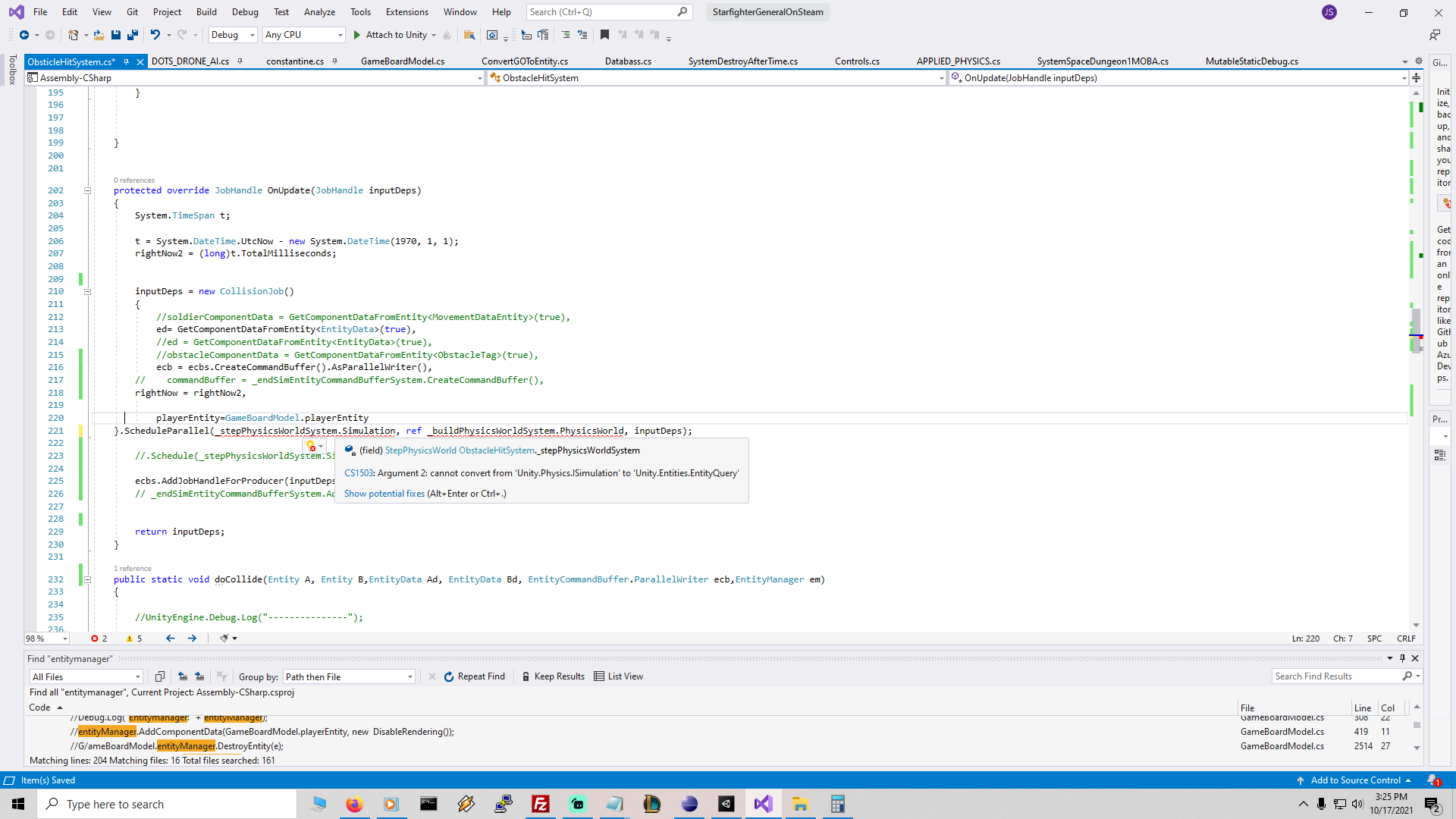
I changed the whole script to accommodate EntityCommandBuffer.ParallelWriter stuff. I've done this in SystemBases so I know the code works. I never did a parallelWriter in a JobComponentSystem. All the code works except that line .schedule parallel still.... https://crystalfighter.com/code/22JobScheduleparallelNotworking.png
 remote crater
devout prairie
uhh.. yeah?
remote crater
devout prairie
uhh.. yeah?
I'm not familiar of coding when one line of code flags an error if the one after it isn't there outside not doing method returns... This dots stuff is curious.
devout prairie
remote crater
I'm not familiar of coding when one line of code flags an error if the one after...
what error do you get? tbh i've done very little jobs mostly Systems
remote crater
The error is in this picture: https://crystalfighter.com/code/22JobScheduleparallelNotworking.png
Its the same error I got before refactoring my code to accept parallel writing...
Ok, so what I get is you just didn't understand my question.
That answers my curiosity of why a line of code would show an error if a line of code after it was not there.
That's good to know. We just back to the original problem now.
devout prairie
Well the error is showing that the first argument of the ScheduleParallel for the job expects an EntityQuery
So it might be worth doing a quick search for other examples of where ScheduleParallel has been used on a job and how a query is typically passed in
Here's an example from the Animation package:
 remote crater
Do you know if schedule parallel is even allowable in jobs?
Cuz I do parallel in some systemsbase scripts successfully now
Normally I end with: }).WithoutBurst().ScheduleParallel(this.Dependency);
You do not even need an EntityQuery my man.
devout prairie
It's obviously slightly different with a job, like in the above example..
devout prairie
So when you run the job you're passing in a query which represents the entities to run through the job
remote crater
I'm just helping you out... There is nothing that needs to be passed to .ScheduleParallel that involves an EntityQuery...
Its fun when two people with imperfect information come together to help each other.
I find this beautiful, not frustrating
devout prairie
It's literally telling you it wants a query..
remote crater
Frustrating is when you have no idea how to start going over a brick wall hurdle.
devout prairie
look at the example i posted above
remote crater
Where do you get the dependency from the above example?
I'm missing that part as well.
devout prairie
how du mean
remote crater
The line: .ScheduleParallel(m_ComputeSkinMatrixQuery,1,Dependency)
devout prairie
ahh i see
remote crater
The Dependency variable is not declared in the visible code.
devout prairie
Dependency is passed in to every SystemBase, it's already there
remote crater
in my system base, it is declared by setting it Dependency = Entities .Foreach
Oh!
wow!
ty
devout prairie
so i think in your case you're passing in Jobhandle inputDeps, that's i think the old way of doing it with JobComponents or something
using SystemBase is just magnitudes simpler than all that
remote crater
ok so I did have it then
mine is inputDeps
cool cool
I'm using this code because it works for collisions... Normally yah I use Systembase for everything
devout prairie
Here's basically how you can chain together two jobs in a SystemBase, really simple:
        protected override void OnUpdate()
        {
            Dependency = new ComputeSkinMatrixJob
            {
            }.ScheduleParallel(myQuery1, 1, Dependency);

            Dependency = new CopySparseBlendShapeWeightJob
            {
            }.ScheduleParallel(myQuery2, 1, Dependency);
        }
And here's another way using CombineDependencies:
protected override void OnUpdate()
        {
            var job1 = new ComputeSkinMatrixJob
            {
            }.ScheduleParallel(myQuery1, 1, Dependency);

            Dependency = JobHandle.CombineDependencies(job1, Dependency);

            var job2 = new CopySparseBlendShapeWeightJob
            {
            }.ScheduleParallel(myQuery2, 1, Dependency);
        }
As you suggested, I added the EntityQuery, but ScheduleParallel is explaining it cannot take 4 arguments: https://crystalfighter.com/code/23JobScheduleparallelNotworking.png The Visual Studio alt+enter potential fix did not work.
devout prairie
Ah it's a CollisionJob i didn't notice that.. let me have a quick look through the physics samples
is CollisionJob a custom job you've created?
remote crater
devout prairie
Ah it's a CollisionJob i didn't notice that.. let me have a quick look through ...
Dude, you da bull, check it out now my funk soul bovine, if you find me and starfighter doing well, ask for the manilla payoff, I'm stupid generous, and also a bit stupid 🙂
Here, I'll give the full code
It was working code for non parallel That I expanded
Enjoy...
It requires a custom component named EntityData... and that's just stuff custom to my game.
Remove all that and you can still be reading in collisions.
I ended up hitting same error as I did in my systembases
It would destroy an entity, while another systembase tried to post process the scheduler
Without parallel, one may destroy while other being used
You know what tho...
I'm probably going about this wrong.
Maybe I should flag it to be destroyed and use my destroyer process... That probably should work.
Unless stuff is being read/wrote same time multithread problems
devout prairie
Okay i think basically the ICollisionEventJob interface does not accomodate ScheduleParallel
remote crater
We good to go. Hey let me post one of my cool looking DOTS ECS videos, these things are funny
If I have future issues, I either need to do collision elsewhere or see how to do stuff before or after my parallel stuff... I get conflicts cuz my parallel isn't finding destroyed entities in my iCollisionEventJob
devout prairie
Yeah it's kinda the joy of dots/ecs is you get the benefit of being mega explicit over exactly what happens and when, but then you have to spend that extra time designing the systems and jobs to flow as linearly as possible etc
remote crater

Starfighter General: A soul gamer indie in the age of boring corporate spew.
This action MMORPG will have live game masters. Those who role play well whether good guy bounty hunter, bad guy pirate, emporer or whatever will attract the eye of a live Game Master for live sessions. Nothing held back, nothing off table, change the universe you pl...
No lie, Cow, I enjoy having a challenge. At least it aint mind twisty like circutboard chip coding where memory is the limit and not the processing... It flips the optimization habit processes in my brain and fries me. Unity DOTS is like mind expanding beauty.
devout prairie
Hehe looks nice. Reminds me of an oldschool space game that i can't put my finger on. Are you using hybrid renderer or gameobjects?
 safe coral
Is there a cross platform deterministic physics engine in DOTS?
Fixed-point/integer based
mystic quartz
Is there a way to query two related entities at the same time?
I've got a player, and a gun. The gun is necessarily related to the player (Transform, velocity, friendly-fire checking,) but also requires its own composition (Rate of fire, projectiles, hitscan, bullet prefab, effects, transform offset, burst, ect)
The system needs to know about the player in order to correctly use the gun, and the gun must be an entity so it can be composed.
tribal pollen
Anyone ever dealt with entities spawning at 0,0,0? despite setting transform location at the start
tribal pollen
like it's only happening for 1 frame, but it's messing some things up for me :\
mystic quartz
tribal pollen
like it's only happening for 1 frame, but it's messing some things up for me :\
Are you spawning the entity and setting the transform from two different places in the code?
mystic quartz
tribal pollen
no, same place
Yikes. Might have something to do with parallel processing, but I'm still new to this, so I wouldn't know for sure.
tribal pollen
it's even happening when i parent them. I can set a LocalToParent value, and in a different system it'll come back at 0,0,0 for 1 frame
I tried setting localtoworld instead of just translation or localToParent to see, but it didn't help
Ok so for at least one of my cases, this has something to do with the position in my prefab. despite me setting it right after I make it.
Am I creating it wrong? this is what I'm doing
Entities.ForEach((int entityInQueryIndex, in Spawner spawner, in Translation translation) =>
{
var spawnedEntity = ecb.Instantiate(entityInQueryIndex, spawner.EntityPrefab);
ecb.SetComponent(entityInQueryIndex, spawnedEntity, translation);
}
left oak
my guess is that it's spawning in time to be rendered, but not in time to be processed by the transform system group
the effect of that being the case is a single frame of entities being rendered at world origin
 uncut rover
tribal pollen
Ok so for at least one of my cases, this has something to do with the position i...
uncut rover
tribal pollen
Ok so for at least one of my cases, this has something to do with the position i...
This should help https://forum.unity.com/threads/how-to-update-localtoworld-translation.1150868/#post-7385411
Unity Forum
Hello guys,
Sorry if this is a noob question, I'm new to DOTS
I have this code shown below inside of an IJobParallelFor job...
@tribal pollen Basically it has to do with what @left oak said. The rendering system is using the localToWorld component. that component is updated by the transform systems in the simulation group. If you spawn you entity at the end of the simulation group it will not have an updated localToWorld value it will be (0,0,0) or whatever value the default is for your prefab. After the simulation group comes the presentation group that display your entity on screen. since the localToWorld is not updated it will show up at world origin. So you can either spawn your entity at the begin simulation group command buffer (delaying the instantiation by 1 frame) which will give time for the transforms group to update the position of your entity or you can compute and set yourself the local to world. Option 1 is the simplest one but be aware that the simulation will also have the localToWorld at (0,0,0) until the transform group is run. So if the physics system uses the localToWorld and run before the transform group it will also "see" the entity at (0,0,0).
amber flicker
yup exactly what @uncut rover said. Some people set the LTW manually for the first frame but I wouldn't really recommend it. One additional thing - instead of delaying instantiation to the first frame, another approach is to ensure your spawning system updates before the Transform System.
tribal pollen
@left oak @uncut rover @amber flicker Thanks, for all your help. I didn't get to do much with it this morning before work but I did quickly test and changing it to the StartInitialization buffer seems to have fixed the issue for my normal spawned entities.
However, it seems like the issue is still there for my Child entities, LocalToParent is starting at 0,0,0 (Note I'm not spawning parent and child at the same time, parent already exists when I spawn a child). I believe this 0,0,0 is the same location as the parent, not the world 0,0,0
I'm pretty sure i tested with both setting LTP value on creation and also just setting transform.
Is there a similar order oddity happening within the System's Hierarchical Transforms?
uncut rover
tribal pollen
<@!344308581413289984> <@!336973088698662912> <@!190954630623002624> Thanks, for...
I have not yet tried to spawn an entity and parent it to an existing one. All I know from the conversion system is that the is a Parent component on the child and there is a Child buffer on the parent. These are used by the transform system to compute localToParent matrix. I would start by checking if the parent component and child buffer are properly populated after instantiation. If they are not the transform system will most likely not work as expected.
light ore
Hi, Im on Unity 2021.2.0b16.3733, URP 12.1.0, Hybrid renderer 0.11.0-preview.44
And on android platform.
On attempting to build the project, I get the following error:
Shader error in Universal Render Pipeline/Unlit: The DOTS_INSTANCING_ON keyword requires shader model 4.5 or greater ("#pragma target 4.5" or greater), at /NewUnity Projects/Android 2021.2ecs/Library/PackageCache/com.unity.render-pipelines.core@12.1.0/ShaderLibrary/UnityInstancing.hlsl(50)
uncut rover
Use of UNITY 2021 and DOTS packages is discouraged (https://forum.unity.com/threads/notice-on-dots-compatibility-with-unity-2021-1.1091800/) that being said, some managed to make it at least partly work : https://forum.unity.com/threads/dots-and-2021-2-known-issues.1183456/#post-7579792

Unity Forum
Hi!
With the release of Unity 2021.1, DOTS is at a crossroads in terms of compatibility with the currently available Unity versions.
While certain...
Unity Forum
I know about the notice on compatibility, but out of pure curiosity I've opened my big project in 2021.2 and everything seems to be working just fine....
light ore
Surprisingly, on unity 2020 Dots hasnt been working for me, to say the rendering part at least.
Spent 3 days working thru many unity versions and I came to this-
Unity 2019.4, Entities do get rendered (HybridRendererV1 only is supported), but they dont support Skybox/Ambient/Environment lighting.
Unity 2021.1, and even Unity 2020,
The entities never get rendered, no matter how much time is spent on "Importing EntityScene" (on the bottom of unity program where it shows loading).
On the scene view, on clicking the Subscene object, its forever stuck on Importing...
I spent 6 hours yesterday on trying out diff things like new subscenes and hitting saves and whatnot, but it didnt ever show up.
But, Unity 2021.2.0b16, a beta version of unity, seems to show the entities properly (as of now too), and it supports Skybox/Ambient/Environment lighting (probably cuz of HybridRendererV2)
And to see it now stuck on the build error, makes it more... Ugh
Oh and, on the Unity 2020, Entities do show up on PC build platform (Idk if I had URP set up in the graphics, but it did show)
Switching to Android build, and making a few changes as setting the URP to work, and it didnt show up afterwards
:/
I wish I could downgrade the URP version of possible? Tho I'm not finding an option how to with my searches
uncut rover
I can tell you I've experienced issue with subscenes and unity 2020 when have Entities + UITK+ new input system. that resembles your "infinite" import issue. I tested the latest 2021.1 version but have a bunch of errors.
Can you share you build configuration for this project ? maybe it will give more hints on the issue.
coarse turtle
light ore
I wish I could downgrade the URP version of possible? Tho I'm not finding an opt...
Edit the Packages/manifest.json if you want to downgrade URP. I think if you're on 2021.2 URP should be v 12.x.0, 2020 should be on v 10.x.0.
karmic depot
coarse turtle
Edit the Packages/manifest.json if you want to downgrade URP. I think if you're ...
10.x for 2020 I think
coarse turtle
o right, 2021.1 should be 11.x.0, thnx 👍
safe lintel
@remote crater didnt follow the entire convo but afaik trigger/collision stuff doesnt support parallel yet. i think its on the physics guys todo in the future(not sure when though)
light ore
@uncut rover @coarse turtle
Pinging as if to reply to the conversation
Sooo there was a "temporary solution" posted on the forum by somebody where I had to edit the UniversalTargets.cs of the URP package, and now it builds with no issue.
And now, to my another surprise (whew its been many surprises lately), the mobile screen is flickering like crazy, as if brightness is going rapid up-down, you know (Checked the player settings and its alright it seems)
Welp, I'm going to instal unity 2020.3.6f1 with URP 10.5.0, which seemed to be stable for Somebody on the forum. Nevertheless I want to give it a try and see how it goes
Posts a dead emote
 muted star
Hello everybody, I want to use GetComponentDataFromEntity to modify the translation of an entity but for some reason it takes no effect. What can I do to address this?
public class UnitMoveToTargetSystem : SystemBase
    {
        protected override void OnUpdate()
        {
            var allTranslations = GetComponentDataFromEntity<Translation>(false);

            Entities.ForEach((Entity unitEntity, int entityInQueryIndex,
                in HasTarget hasTarget) =>
            // ref Translation translation,
            {
                var translation = allTranslations[unitEntity];

                translation.Value.x += 0.1f * deltaTime;
            }).Schedule();
        }
    }
you have to then assign translation back to allTranslations, yeah?
muted star
Wow that was easy, thanks I was really banging my head against a wall ^^
left oak
np, just keep in mind these are all copied by value, not reference
tribal pollen
LocalToParent keeps starting with a value of 0 >_<
 muted star
I'm stuck again. When I run this system I get an error. Any ideas what be going wrong here?

public class FindTargetSystem : SystemBase
    {
        protected override void OnUpdate()
        {
            var targetsQuery = GetEntityQuery(typeof(Target));
            var allTargets = targetsQuery.ToEntityArray(Allocator.TempJob);

            var allTranslations = GetComponentDataFromEntity<Translation>(true);

            Entities.WithReadOnly(allTranslations).WithNone<HasTarget>().WithAll<Unit>().ForEach(
                (Entity entity, int entityInQueryIndex) =>
                {
                    float3 unitPosition = allTranslations[entity].Value;

                    for (int i = 0; i < allTargets.Length; i++)
                    {
                        var targetEntity = allTargets[i];

                    }

                }).Schedule();

            allTargets.Dispose();

        }
}```|| InvalidOperationException: The previously scheduled job FindTargetSystem:OnUpdate_LambdaJob0 writes to the Unity.Collections.NativeArray`1[Unity.Entities.Entity] OnUpdate_LambdaJob0.JobData.allTargets. You must call JobHandle.Complete() on the job FindTargetSystem:OnUpdate_LambdaJob0, before you can deallocate the Unity.Collections.NativeArray`1[Unity.Entities.Entity] safely. Unity.Collections.LowLevel.Unsafe.AtomicSafetyHandle.CheckDeallocateAndThrow (Unity.Collections.LowLevel.Unsafe.AtomicSafetyHandle handle) (at <ca496b8c93454b2f9b9924292c19379f>:0) Unity.Collections.LowLevel.Unsafe.DisposeSentinel.Dispose (Unity.Collections.LowLevel.Unsafe.AtomicSafetyHandle& safety, Unity.Collections.LowLevel.Unsafe.DisposeSentinel& sentinel) (at <ca496b8c93454b2f9b9924292c19379f>:0) Unity.Collections.NativeArray`1[T].Dispose () (at <ca496b8c93454b2f9b9924292c19379f>:0) Code.Systems.FindTargetSystem.OnUpdate () (at Assets/Code/Systems/FindTargetSystem.cs:70) Unity.Entities.SystemBase.Update () (at Library/PackageCache/com.unity.entities@0.17.0-preview.42/Unity.Entities/SystemBase.cs:412) Unity.Entities.ComponentSystemGroup.UpdateAllSystems () (at Library/PackageCache/com.unity.entities@0.17.0-preview.42/Unity.Entities/ComponentSystemGroup.cs:472) UnityEngine.Debug:LogException(Exception)...||
|| Unity.Debug:LogException(Exception) (at Library/PackageCache/com.unity.entities@0.17.0-preview.42/Unity.Entities/Stubs/Unity/Debug.cs:19) Unity.Entities.ComponentSystemGroup:UpdateAllSystems() (at Library/PackageCache/com.unity.entities@0.17.0-preview.42/Unity.Entities/ComponentSystemGroup.cs:477) Unity.Entities.ComponentSystemGroup:OnUpdate() (at Library/PackageCache/com.unity.entities@0.17.0-preview.42/Unity.Entities/ComponentSystemGroup.cs:417) Unity.Entities.ComponentSystem:Update() (at Library/PackageCache/com.unity.entities@0.17.0-preview.42/Unity.Entities/ComponentSystem.cs:114) Unity.Entities.DummyDelegateWrapper:TriggerUpdate() (at Library/PackageCache/com.unity.entities@0.17.0-preview.42/Unity.Entities/ScriptBehaviourUpdateOrder.cs:333)||
whole gyro
muted star
I'm stuck again. When I run this system I get an error. Any ideas what be going ...
You have a race condition. You are disposing your native array on the main thread after scheduling the job, but possibly before the job runs.
You want to use WithDisposeOnCompletion(allTargets) on your forearch call.
tribal pollen
@muted star instead of calling allTargets.Dispose();
try adding
.WithDisposeOnCompletion(allTargets)
muted star
Thank you that was the problem. This error message really confused me 🙂
whole gyro
Also, it looks like you could add the entity translation as an argument to your ForEach() call since you don't need the random access of GetComponentDataFromEntity().
whole gyro
Ah okay, I was about to ask if this was the entire system or not. Looks good to me
whole gyro
Looks like an error with your UnitMoveToTargetSystem. Based on the error, I would guess that you don't have WithReadOnly(allTranslations)
muted star
Ah my bad yes just realized that
whole gyro
No worries. I normally can't decipher these errors in my own project so I'm glad I could help haha.
karmic depot
Does anyone have a hack to show BlobAssets in entity's inspector?
 viral sonnet
I don't know why DynamicBuffer doesn't scale. I've lots of complex systems but those that are just for clearing a DynamicBuffer take the longest. I've checked dependencies now and gone back to Run() for these systems, no real reason to be found.
one of these clearing systems takes half the time of the whole frametime. completely absurd 😦
devout prairie
Maybe as an alternative have a bool flag inside the IBufferElement's to mark as active or updated, and basically try just never clearing?
viral sonnet
makes no difference when it's inside the buffer, the mere existence of the ForEach with the DynamicBuffer slows it down. (the buffers aren't used, so size is 0) - What I really need to do is not iterate over every buffer so I'd need to build some IComp flag. Really annoying ...
and again, not sure what's going on that takes so much cpu time. the buffer is 0. meh, it's always what happens when I use DynamicBuffer. The NativeMultiHashmaps scale much better. And to think DynamicBuffers are NativeArrays really
was stupid to use them to begin with, per-frame data shouldn't exist on entities
I got rid of most of those cases but some trigger buffers are left over
devout prairie
just out of curiosity if you don't mind me asking - how else would you use a buffer other than a for each and why are the size 0?
ah i think i see what you mean, so you're using the existence of the buffer as part of the query in a way for the for each
devout prairie
so you've found even if the buffer size is zero it slows the ForEach job down?
viral sonnet
that's what happens
devout prairie
that's interesting 🤔
viral sonnet
i have a stress test running, 250k entities with such a DynamicBuffer and the Entities.ForEach takes around 10ms
I can ScheduleParallel it, to bring it down to 1.26ms but that's still too much for what's happening.
devout prairie
have you tested with just a tag instead of buffer to see what the difference is?
cos obviously the 1.2ms would depend on what else the job is doing
viral sonnet
Just using an Entities.ForEach with a tag that is on the same entity takes 0.75ms of iteration time
devout prairie
that's interesting to know..
devout prairie
so does the IBufferElementData contain a bunch of different members
like even if it's empty, is it say just a struct with one bool or is it a bunch of different data
viral sonnet
the buffer has a struct with 2 Entity structs, 3 ints and 1 ushort.
another system uses a more complex buffer and the timings are rather equal. so size doesn't matter too much it seems
devout prairie
i'd guess the job has to allocate and deallocate memory for that maybe that's the issue.. if there's say a job running a query of 250k entities and each entity could have any number of buffer elements, maybe the allocation is the overhead
viral sonnet
I don't know, from my experience now I'd say don't ever use DynamicBuffer when a) it's on a lot of entities and b) when it's fast changing data, like for only 1 frame
the buffers should be allocated by then
 hollow sorrel
did you set the InternalBufferCapacity
viral sonnet
I guess the buffers are all over in memory so that's why iteration is so slow
devout prairie
yeah just thinking about heap/stack business maybe slowing it down, cache misses galore etc
viral sonnet
hm, where would I set the InternalBufferCapacity? It's not a parameter in AddBuffer
hollow sorrel
you add it to the bufferelement
// InternalBufferCapacity specifies how many elements a buffer can have before
// the buffer storage is moved outside the chunk.
[InternalBufferCapacity(8)]
public struct MyBufferElement : IBufferElementData
{
}
try setting it to 0 to force buffers to always be out of chunk
viral sonnet
ah, thanks, ok I'll try that
hollow sorrel
by default it's occupying chunk space
viral sonnet
do you know what's the default value for InternalBufferCapacity?
ok that brought it down significantly, not as much as where I'd want it to be but from 10ms to 2.5ms
I think my archetype got way too big. Last I checked I could only bring 11 entities into the chunk
hollow sorrel
default seems to be 128 / elementsize (basically 128 bytes rounded up depending on your struct size)
but that's per entity so it adds up
also yea only 11 entities sounds like a pretty big archetype
viral sonnet
cool, saved a bunch of milliseconds, big thanks Scorr!
yeah, I need to split it up somehow. Not sure how though, lol. All the data is required. Still, I must be able to bring it down and split it into 2 other references. Hard to say how much I'll gain though
maybe I'll rather wait for the new entities version, at some point it should be possible to set the chunk size yourself
ah, i see with the capacity change to the buffers I can already fit 15 instead of 11 in a chunk
devout prairie
Have you considered splitting off some of you data onto different archetypes or entities assuming you're not using all of it in each job or system
viral sonnet
yeah, I wanted to finish the system before I make optimisations. now's a good time 🙂
 velvet panther
When I do this: using Unity.Collections ; I have access to NativeArray, but not NativeList, why? Unity 2020.LTS and latest Rider
velvet panther
 solar spire
have you imported the collections package?
solar spire
have you imported the collections package?
No. Is there someway I can download this without using Package Manager (like, direct from Github?)
solar spire
... Why?
velvet panther
Because I don't want to download it through Package Manager. The last few times I've given Package Manager access to the internet, it's downloaded multiple versions of just about everything ever seen, and took up many, many gigs.
solar spire
Well, if you don't have the package, you can't use the classes. Unity doesn't host it elsewhere, but needle hosts mirrors of everything. I'm sure you can find it
velvet panther
Found that. THANK YOU!!!
Why the attitude?
Having downloaded it, how do I install it?
For anyone else, looking for a NativeList, recommend you try JacksonDunstan's version. Can experiment without Burst ruining your iteration times: https://github.com/jacksondunstan/NativeCollections

GitHub
Native Collection Types for Unity. Contribute to jacksondunstan/NativeCollections development by creating an account on GitHub.
solar spire
velvet panther
Having downloaded it, how do I install it?
Put the package in your Packages folder
karmic depot
how would I make an authoring component for a singleton entity? For example for a ScriptableObject or a prefab, so that it only adds a singleton once.
safe coral
karmic depot
how would I make an authoring component for a singleton entity? For example for ...
Make your singleton prefab and create a bootstrapper object that checks for the existence your the singletons on start and instantiates them if they're not there.
Is that what you're asking?
Oh sorry, didn't realize I was in DOTS.
safe lintel
@velvet panther the package manager will just keep a cache of all packages you've downloaded in your appdata (local or localroaming) folder. it doesnt download things you havent personally needed. you can just delete that folder, but it will always 'fill up' again as you download packages.
devout prairie
yeah it's a bit irritating i think people have been asking for years for a way to change the default package cache, pretty sure it also caches paid assets which in some cases are huge
coarse turtle
you can change the directory of where it gets downloaded if anything and put it on an different drive
devout prairie
is it possible to do that now?
coarse turtle
Been that way for a few years
devout prairie
how is this wizardry achieved?
tbh it's not something i've looked at for a few years, other than to notice i have a pretty big chunk of space being eaten up by the package cache
karmic depot
there's an environment variable you can set IIRC
coarse turtle
devout prairie
how is this wizardry achieved?
https://docs.unity3d.com/2019.3/Documentation/Manual/upm-cache.html See Customizing shared location
karmic depot
UPM_CACHE_ROOT I think edit: was too slow hah
devout prairie
ah yeah, i guess this would cover assets also then
velvet panther
safe lintel
<@!588426769003053075> the package manager will just keep a cache of all package...
I've been tracking this probelm for a couple of weeks, on and off again. It's got nothing to do with what i use, or have ever used. I run very lean. CInemachine, TextMeshPro and thats about it. Yet it downloads multiple versions of every package of Unity, every time it's given access to the internet. Worst was about 10+gigs, hence I noticed it.
Each time I bring it up, someone is dsimissive about it, in some way or another, as though it can't happen, or I've done something. I haven't. It's just happening, so I've cut off Unity from having any access to the internet
velvet panther
solar spire
Put the package in your Packages folder
Which of the MANY folders in there?
velvet panther
devout prairie
yeah it's a bit irritating i think people have been asking for years for a way t...
I'd seen mentions of this problem for a couple of years, first time I've experienced it, that I know of. It might have been going on for a long time and I simply hadn't previously noticed it. eg. I've never used HDRP, but there were half a dozen versions in there, for no good reason.
I recently started using Burst... the verified version for 2020,LTS... the next day... 1.6 and a bunch of earlier ones were in there, taking up a couple of gig. This is what first drew my attention to this behaviour.
devout prairie
yeah mines about 8gb at the moment and has a couple at least of versions of most of the packages
safe lintel
just deleted mine to see what exactly happens on a new project
devout prairie
i think the behaviour of assets has changed but it used to be assets would also mirror onto the c drive and it was almost impossible to prevent
having lots of large assets was a problem
safe lintel
collab, nunit, rider, visualstudio, vscode, test-framework, textmeshpro, timeline are the default for the package cache, theres also a larger npm cache that instantly went to 1.7gb that I assume is copied from the unity editor folder? package folder is only like 50megs though
@velvet panther I mean there should be the expectation that in a complex program like unity there will be a fluctuating amount of data with regard to custom projects. cutting unity off from the internet seems excessive to me but idk. you could setup a scheduled task to delete that folder. and if its really doing stuff that seems out of the ordinary and is a repeating factor, you could easily report it as a bug
velvet panther
safe lintel
<@!588426769003053075> I mean there should be the expectation that in a complex ...
Mine blew out to over 14gig the day I was paying attention to it. I was able to strip it back to under 2gig a couple of times, before it would balloon back out to 10-ish gig.
Every X
every XR thing ... for example, small, but all there... added, over and over. Your excuse making is weird. NO APP should be downloading such things without express permission.
As for bug reporting. I've been using Unity for long enough to know how fruitless that experience is.
My general thoughts on the package manager are that it's better than the hub, but not any other part of Unity. And that's right at the bottom of the barrel. Worse than SRP.
speaking of DOTS, when can we use Span<T>?
remote crater
If I add an IComponentData not used anywhere in program except to be assigned to Entities, will they even be added? I'm trying to just tag something... for some reason the entity doesn't have the iComponentData attached.
coarse turtle
velvet panther
speaking of DOTS, when can we use Span<T>?
Can technically use it whenever, but IIRC Span doesn't natively exist in Unity's mono environment, you need to import the DLL into Unity
A builtin unsafe alternative is using stackalloc
or just stick with NativeArrays with Temp allocation
safe lintel
maybe unity does need a timed decay setting in which to purge that folder, but if you dont want to report something that is causing you that much frustration well I guess whatever then
devout prairie
remote crater
If I add an IComponentData not used anywhere in program except to be assigned to...
Check the very top in the Entities inspector, there's a header called Tags
 remote crater
devout prairie
Check the very top in the Entities inspector, there's a header called Tags
remote crater
devout prairie
Check the very top in the Entities inspector, there's a header called Tags
It was not a tag tho. It showed up, but I couldn't find it since I had so many datacomponents. Thanks It does show even if not used.
amber flicker
coarse turtle
Can technically use it whenever, but IIRC Span doesn't natively exist in Unity's...
Now it does as of 2021.2 🥳 - not that 2021 is recommended with dots of course.
remote crater
My next question and I'm done asking for a while... If you Entity e = EntityManager.Instaniate(pooledEntity); You can then add and remove components. But if you do this with an EntityCommandBuffer Instantiate (pooledEntity) then EntityCommandBuffer RemoveComponent (pooledEntity)... What happens is the pooledEntity gets modified. How can I instantiate a pooledEntity in EntityCommandBuffer then modify the cloned instantiated entity without messing up the original pooledEntity?
devout prairie
remote crater
My next question and I'm done asking for a while... If you Entity e = EntityMana...
based on what you've typed, you're doing removeComponent on the pooledEntity.. so you'd want to do:
var newEntity = ecb.Instantiate(pooledEntity);
ecb.RemoveComponent<MyComponent>(newEntity);
You can do that1?1
I thought the entity wasn't made until ECB instantiated after process
It makes a reference straight then and there? wow! I would have never guessed that!
devout prairie
yeah i'm not sure exactly how that works, i assume it returns a dummy reference and allows you to use that in additional commands
velvet panther
coarse turtle
or just stick with NativeArrays with Temp allocation
cheers, am using Stackalloc very heavily, and looking forward to cleaning up around Span sommetime in the future.
int**[] for now... 😉
remote crater
That's really cool MidnightCow... The Unity Devs reallythought it out
Makes you wonder if they know about phantom references why we can't link Gameobjects as entities in scene
Should be trivial... Maybe they didn't care.
devout prairie
i think that's just more to do with using reference types and managed objects which is kinda anti-data-oriented
basically anything that is a class and not a struct or anything that is stored in managed memory is going to drag down your ecs systems performance so it kinda defeats the purpose
if i understand your meaning
coarse turtle
amber flicker
Now it does as of 2021.2 🥳 - not that 2021 is recommended with dots of course.
Oh yea cool, I remember reading that
good to know too cause I just updated to 2021.2 lol
muted star
Hey everyone, how can I get the entities from a chunk (not the components)?
Something like this would be nice var entities = chunks[0].GetEntities()
I'm asking because I'm currently trying to optimize a job, so far it's gone horribly wrong. Maybe my approach is just wrong.
The current job is receiving NativeArrays instead of batches since I don't know how to get the entities from a batch
coarse turtle
muted star
The current job is receiving NativeArrays instead of batches since I don't know ...
I think you want to look at IJobChunk/IJobEntityBatch instead as they natively allow you to do chunk iteration.
To get the Entities of the chunk it'd would look like so
struct SomeJob : IJobEntityBatch {

  public EntityTypeHandle EntityType;

  public void Execute(ArchetypeChunk chunk, int batchIndex) {
    var entities = chunk.GetNativeArray(EntityType);
    for (int i = 0; i < chunk.Count; i++) {
      Entity e = entities[i];
      // Do something with e
    }
  }
}
// In SystemBase
new SomeJob { EntityType = this.GetEntityTypeHandle() }.Schedule(someEntityQueryToIterateThrough, Dependency);
https://docs.unity3d.com/Packages/com.unity.entities@0.17/manual/ecs_ijobentitybatch.html
karmic depot
Can I fill in a BlobArray by passing existing BlobAssetReferences instead of actual values?
or rather, is this legal: BlobArray<BlobAssetReference<SomeRegularStruct>>?\
remote crater
devout prairie
based on what you've typed, you're doing removeComponent on the pooledEntity.. ...
You MidCow, that code did not work, I get: ArgumentException: All entities created using EntityCommandBuffer.CreateEntity must be realized via playback(). One of the entities is still deferred (Index: -1).
Let me show my code, I think its similar to what you gave.
Pastebin
Pastebin.com is the number one paste tool since 2002. Pastebin is a website where you can store text online for a set period of time.
Above is declared entity e, and the array is my object pool buffer of one entity each.
uncut rover
karmic depot
or rather, is this legal: `BlobArray<BlobAssetReference<SomeRegularStruct>>`?\
In entities 17 it is not, it will be in the next versions. The issue is that a validation method in hte entities pacckage does not allow for generic type.it can be fixed if you make a local copy of the entitites package https://forum.unity.com/threads/blobarray-with-valuetype-generic-parameters-fails.1045639/
Unity Forum
As of Entities 0.17.0-preview.41 I cannot have a BlobArray with a value type containing generic parameters that are constrained to be value type....
karmic depot
uncut rover
In entities 17 it is not, it will be in the next versions. The issue is that a v...
I already commented that validation out. So there's no errors. I meant more like, is that a bad idea to store a reference inside a blob
uncut rover
As long a you release it properly I don't see an issue, but I'm no expert ;).
karmic depot
what do you mean release?
uncut rover
Blob asset are unmanaged memory allocation so they need to be disposed/released when no longer needed. if you dispose of the 'high' level blob it will not automatically dispose of the blob inside it, so you should probably do somthing not to leak memory.
karmic depot
are you sure about that? I thought they become part of the subscene and get disposed along with it
uncut rover
hmmm... I don't know if subscene do something 'magical', I'm not using them rigth now (issue with UITK+entites+Input system, long story...) but blob are not restricted to subscene so I don't see why subscene in particular would make the blob behave differently. Maybe the blobassetstore does the job. To be honest I make a blobasset reference on start up of my game and never destroy it so either I'm leaking memory or something magical happen on game shutdown. Either way, I will probably need to test it further at some point (once I figure out how to profile such cases) but I would not bet on thing happening automatically.
devout prairie
remote crater
You MidCow, that code did not work, I get: ArgumentException: All entities creat...
hmm i think i'd need to see more of the context.. it could be that RemoveComponent doesn't work but definitely AddComponent works fine the way i showed..
solar spire
velvet panther
Which of the MANY folders in there?
There should be no folders in there other than previously manually installed packages.
velvet panther
solar spire
There should be no folders in there other than previously manually installed pac...
I know. I know... I've heard this everywhere I've mentioned this issue. And I'm by no means the only person having this problem. On my workstation, this hasn't happened.
velvet panther
No, the one in the user root library.
solar spire
Then that's not where you install packages manually into a project.
You can also just add packages from any location from disk https://docs.unity3d.com/Manual/upm-ui-local.html
velvet panther
I'm not currently discussing that, I'm replying to the bloat!
That didn't work. I tried that means from disk.
solar spire
My reply was directly discussing that
velvet panther
My mistake, I thought you were making the same claim that everyone makes about the packages folder in the library, that it shouldn't have all that extra stuff in it.
I've cleansed the manifest, etc. It still happens. Deleted all but one install of Unity (only using 2020.LTS on this) and it's still happening if I turn off Little Snitch for a sec.
solar spire
I just have a symlink for my packages directory. I just stick the entire Unity cache on a large drive
safe lintel
hey vertx while youre here, I think the dots wiki in the pinned messages should be removed, its kinda old and no one updates it and some of the info is a little bit "eh" and I dont have the desire to go sort it out(as a previous contributor)
solar spire
Sure, is there anything that should replace it? Or are we all just waiting for Unity to come out of hiding before recommending ECS 😛
devout prairie
when Unity Unity's..
 safe lintel
Not sure theres any replacement but tbh the regular forums are better(though not really organized🙃)
remote crater
Amatuer cow, I'm on 28 min now in one of my projects I am working on
key is to work on more than one project at once
Then when one is loading, you're coding in another
remote crater
devout prairie
hmm i think i'd need to see more of the context.. it could be that *RemoveComp...
Why does this line alone trigger the error then? e=ecb.Instantiate(firstEntity[index]); I can't set addComponent to e if I can't get e like you say. That was really sus code anyway. I never expected to work...
Full error: https://pastebin.com/Y0w10apH
So my original question stands: How do you use an EntityCommandBuffer to instantiate an entity from an entity then add or remove components without affecting the original entity?
devout prairie
remote crater
Why does this line alone trigger the error then? e=ecb.Instantiate(firstEntity[i...
this is why i'm saying more context would be useful.. like is 'e' the actual Entity passed in to your ForEach for example.. the way i suggested was basically this which works for me at least with AddComponent:

Bear in mind also if it's a parallel job you should use a parallel ecb and pass entityInQueryIndex into the job
remote crater
Entity e;// Just declared.
I can post full code after a nap, adrenal fatigue got me. brb in a few min/hrs.
devout prairie
remote crater
Entity e;// Just declared.
For when you're back - i just tested, added TestComponent to my prefab entity and then removed it from Instantiated clone with the ECB as follows so it definitely works..
 remote crater
devout prairie
For when you're back - i just tested, added TestComponent to my prefab entity an...
remote crater
devout prairie
For when you're back - i just tested, added TestComponent to my prefab entity an...
This line works: ecb.Instantiate(firstEntity[index]); This line does not: Entity e=ecb.Instantiate(firstEntity[index]);
wow
it was the var
somehow the var is generic enough to break typecasting or something
var e=ecb.Instantiate(firstEntity[index]); works
Thanks Cow, you da man... cow... maybe minotaurish thinger
devout prairie
remote crater
Thanks Cow, you da man... cow... maybe minotaurish thinger
ahh glad to hear you got that working
remote crater
Thank you very much once again!
I actually smashed through two brick walls today.
One the reason entities were not rendering on my standalone had something to do with an HDRP configuration file. I'll figure the details later.
The reason I could not delete stuff before was because when I instantiated from an entity(pseudo object pooler), it was removing disabled and such from live components, rendering them able to be destroyed.
So now stuff is pretty good. I hope to finally get a standalone working and see how much I can render for real!
Also my players will like an update to benchmark their rigs.
Very cool, very cool, very cool, praise God. Ok, nap time for real. Remember, anyone who helps me, If I make bank, you make bank, but you gotta remind me. I get help from TONS of cool people. That's one thing that has made the Internet great as long as I've been on since 1994, the silicon valley tech worker desire to help others.
muted star
coarse turtle
I think you want to look at IJobChunk/IJobEntityBatch instead as they natively a...
Thanks, I got it to work performantly with IJobEntityBatchWithIndex


 haughty rampart
muted star
Is it just me or is SystemBase slightly slower than JobComponentSystem?
haughty rampart
muted star
Is it just me or is SystemBase slightly slower than JobComponentSystem?
jobcomponentsystem will be deprecated. systembase is the new standard
digital kestrel
muted star
Is it just me or is SystemBase slightly slower than JobComponentSystem?
how is systembase slower if it gets more fps?
according to your picture
muted star
It had lower average fps but maybe that was because of a mistake on my part, I may have had a memory leak I didn't notice
digital kestrel
also does anyone's VS debugger get stuck in "Application.EnterPlayMode"
it's been 5 minutes
half the time my debugger gets stuck and crashes
muted star
No but you may try to enable fast enter playmode
digital kestrel
i have that enabled already
what's the difference between GetEntityQuery and EntityManager.CreateEntityQuery
haughty rampart
digital kestrel
what's the difference between GetEntityQuery and EntityManager.CreateEntityQuery
GetEntityQuery is a convienience method of SystemBase
digital kestrel
makes sense, they're functionally the same though
haughty rampart
pretty much
digital kestrel
nice
coarse turtle
digital kestrel
what's the difference between GetEntityQuery and EntityManager.CreateEntityQuery
GetEntityQuery also allows the SystemBase to track the EntityQuery as a dependency, if you use EntityManager.CreateEntityQuery it bypasses the system dependency tracking. (If you're not careful in tracking dependencies you might incur an issue where a job attempts to access data that requires a prior job to finish.)
karmic depot
GetEntityQuery also attempts to cache the query
devout prairie
Anybody ever had the issue where suddenly most of the systems have just vanished
i removed a plugin folder and replaced it with newer version and now when i run most of the dots systems are just gone, including my own systems
This is all i'm left with..

No errors or anything, all entities/physics/etc packages still installed etc as before
karmic depot
devout prairie
No errors or anything, all entities/physics/etc packages still installed etc as ...
are the PackageCaches all in place?
devout prairie
yeah they seem to be, in Library/PackageCache
i wonder if i delete them all they'll automatically replace
karmic depot
they should, yea
devout prairie
deleting whole library folder, see what happens
tribal pollen
How do people generally handle most of unity's UI related things in dots? for example, GUI hub, displaying text/damage numbers in game or opening temporary skills/option panels?
Do you display them with normal unity components with monobehaviours, then use events to update them?
I could see that working for the UI hub, curious if there's a more pure ECS way.
Also, really curious how we'd spawn damage numbers to display...
Sorry if this is vague or basic 😛
coarse turtle
tribal pollen
How do people generally handle most of unity's UI related things in dots? for ex...
Yea that's one way, I think the lack of a decent UI solution makes it fuzzy to figure out a better way. You can try hybrid components and have entities manage gameObjects, but it feels a bit clunky
For 2D I just ended up writing out mesh data to display text and have a render pass draw it out in URP.
Shameless plug: https://forum.unity.com/threads/in-development-nimgui-a-1-draw-call-immediate-mode-gui-for-unity.1171601/
But I'm building this out so you can use immediate mode API to draw out UI via SystemBase or MonoBehaviour which is pretty much what I'm describing with building out the meshes and having a renderpass draw out the UI.
Unity Forum
NImGui stands for Nimble Immediate Mode General User Interface and is designed to be a replacement library to Unity's runtime ImGui.
I have always...
tribal pollen
all good need something like that to be standards.
Is there a nice list of hybrid components somewhere?
if I simplified things to attempting to spawn damage numbers (3d world), what's the best way?
coarse turtle
tribal pollen
all good need something like that to be standards.
Is there a nice list of hybr...
Hybrid components can pretty much be any MonoBehaviour. As long as during conversion you call conversionSystem.AddHybridComponent(component) https://docs.unity3d.com/Packages/com.unity.entities@0.17/manual/hybrid_component.html
So you convert your entities as usual and unity internally tracks and create a hidden gameobject
I don't know how well it works with Unity's UI, mainly because I imagine you have to convert everything (including the canvas)
tribal pollen
Yeah the requirement of a canvas is why I couldn't just spawn some of the things I tried.
coarse turtle
I say start simple, figure out a way to get data from entities (maybe via events or write data to static container and at the end of the frame read the data from a monobehavior and display it)
you might need to double buffer if you're doing a lot of stuff in parallel and writing to a static container so that you don't mess with read/write access (so after jobs are completed, copy it over to a new buffer to avoid race conditions).
tribal pollen
If i wanted to create UI items during gameplay, how would I attach them to a canvas?
I feel like I could get a static GUI to work in a couple of ways like you just said, but the playtime display changes are a bit more confusing
coarse turtle
Well I'm more describing writing data that needs to be displayed to a static container (not a static GUI)
so it'd look sometihng like this
tribal pollen
well anything that's existing when you start the scene
so the stuff that doesn't exist statically, and might only be displayed for a few seconds at a time. Those spawned UI pieces are still pretty unclear to me right now
an image or prefab would be fine, but text and numbers that could change. idk
coarse turtle
// In a SystemBase
NativeArray<int> data = SomeStaticClass.NativeArray1; // Or use SharedStatic
NativeArray<int> data2 = SomeStaticClass.NativeArray2; // Our double buffer
Deps = Entities.ForEach((...) => {
  data[x] = some_data;
}).Schedule(Deps);

Deps = Job.WithCode(() => {
  for (...) {
    // Copy the data to double buffer, so we have a safe readonly data
    // for our gameObjects
    data2[i] = data[i];
  }
}).Schedule(Deps);

// In a monobehavior attached to a gameobject
void Update() {
  for (int i = 0; i < SomeStaticClass.NativeArray2.Length; i++) {
    // Your text mesh is cached and already created or pooled
    // and managed by a MonoBehavior
    someTextMesh.text = $"Data: {SomeStaticClass.NativeArray2[i]}";
  }
}
kk then I guess that textmesh would be part of a prefab with that mono attached, and then you spawn it, having it's mono fetch the data
coarse turtle
Yea something like that
tribal pollen
kk, my thought's weren't far off the mark, I just didn't think to attach a mono to a textmesh prefab lol
thanks man.
karmic depot
The Entities.ForEach statement contains dynamic code that cannot be statically analyzed. what the hell does that mean, lol
devout prairie
devout prairie
deleting whole library folder, see what happens
Hmm no didn't work, my systems have all still vanished :/

What in the f* could cause this.
karmic depot
devout prairie
What in the f* could cause this.
at this point you probably need to debug the place where the systems are auto-registered
devout prairie
Even the unity package systems are missing
animation, physics, whatever else
last thing i want to do is have to setup another project and copy all of my assets etc over
digital kestrel
how do you guys reset / reload a scene
SceneManagement.LoadScene doesnt seem to reset the World
digital kestrel
i finally got 100k entities rendered using texture based bone animations
no LOD or culling though
shits pretty nice
devout prairie
digital kestrel
i finally got 100k entities rendered using texture based bone animations
did you use an asset for that or write your own shaders etc?
digital kestrel
i used shader graph
used a custom function node and basically injected all the instancing code into it
i wish there was an asset
look at the Austin Untiy ECS demo
has everything you need
@devout prairie
devout prairie
digital kestrel
has everything you need
That's interesting thanks, i've been tempted to look into this
Have you looked at implementing AI in some way?
digital kestrel
what kind of AI
devout prairie
I wonder what different approaches there could be to automating 100k characters
digital kestrel
you basically need to be really good at parallelizing your code
and optimizing it for BURST
devout prairie
digital kestrel
what kind of AI
well they have to be moved around right.. just wondering how that could be approached
digital kestrel
i use A*
devout prairie
true yeah
digital kestrel
Nav mesh would work too
devout prairie
do you have physics bodies for collision or raycasting for ground or anything like that?
devout prairie
is your ground flat?
digital kestrel
if you want them to stay grounded you can sample a heightmap or something
and set it to that height
devout prairie
yeah i was thinking heightmap is an option
digital kestrel
my ground is flat, yeah
i haven't gotten that far yet unfortunately
wish i could be more helpful
devout prairie
just thinking out loud tbh i'm using Rival at the moment and it scales really well to thousands of ai with collisions etc
but not 100k hehhe
devout prairie
digital kestrel
wish i could be more helpful
no it's cool as i say just thinking out loud
digital kestrel
yeah i think Rival raycasts each character controller against the ground
devout prairie
digital kestrel
was good at like 30k in a build on my PC
i'm using the SimpleAnimation system which is good for animating skinned characters but tempted by the idea of doing the shader based texture skinning/animation
digital kestrel
it's unfortunately not the most efficient way, but it's very good for a generic controller
i saw that
I talked to other ppl here who said that they're(Unity) basically going to develop a tool for ECS that does all of it for you anyway
so all the legwork you do now might not be very efficient use of time
i tend to agree
devout prairie
yeah it's a really good robust controller with lots of great features, maybe not applicable to 100k characters but it does work well for very reasonable numbers
digital kestrel
the shader based stuff I would say is easier and more efficient to do imo
than using the DOTS animation package
which relies on the DOTS Node package too
with barely any documentation. very steep learning curve
not as efficient as shader based gpu skinning either
devout prairie
yeah the dots animation package is i think a really nice starting point for what it is, but for skinning for sure there are more hyper-efficient ways
i think currently the simpleanimation system is building/updating the graph each frame etc
significantly faster than skinnedmeshrenderer though
digital kestrel
yeah i forgot the reason why
i think they were loading the skinning info into a compute buffer and calculating the transforms in a compute shader
devout prairie
tbh i think the overhead of Animator has a lot to do with it
digital kestrel
not really sure
the disadvantage of baking bone transformations into a texture is
devout prairie
so i think possibly the skinning and deform stuff was fast, but damn the animator is just a pain to use and slow
digital kestrel
that there are no blend trees for lerping different animations
devout prairie
was limited to circa 1-200 characters depending on complexity
digital kestrel
also the Austin demo limited it to 2 bones per vertex instead of the typical 4
devout prairie
yeah so is there no way to lerp with that system
not possible to sample the textures themselves to lerp or something
if you find a way to do 100k ragdolls with skinned meshes let me know 🙂
digital kestrel
lol
devout prairie
i've built a ragdoll system that works with physics joints and basically overwrites the AnimatedLocalToRoot components on the skinned characters
it's faster than traditional unity ragdolls but i think could be faster still
devout prairie
well it uses a ragdoll built with unity.physics joints
then the systems that transfer data are parallel and bursted
safe lintel
how many ragdolls can you get going before a slowdown?
i think i had issues where it slowed down between 250-500
 spice steeple
hi, is subScene.sceneGUID static, and if so is there a way to access it in the editor somewhere, without having to do it through scripts?
digital kestrel

Had fun rendering 100,000 slimes at a time :)
 mild ledge
Lets say I want to use DOTS just for the bullets in my game and have everyrhing else be normal. Is that possible and not a total clusterduck to achieve ?
amber flicker
A post with content for the first time in months? https://forum.unity.com/threads/very-poor-performance-on-mobille-when-having-a-lot-of-system.1184056/#post-7590175
Unity Forum
[PerforamnceBug]
Recently I found CPU Time(about 10ms+) is very high in my project when running on SnapDragon845 Android Devices.This project have...
 minor sapphire
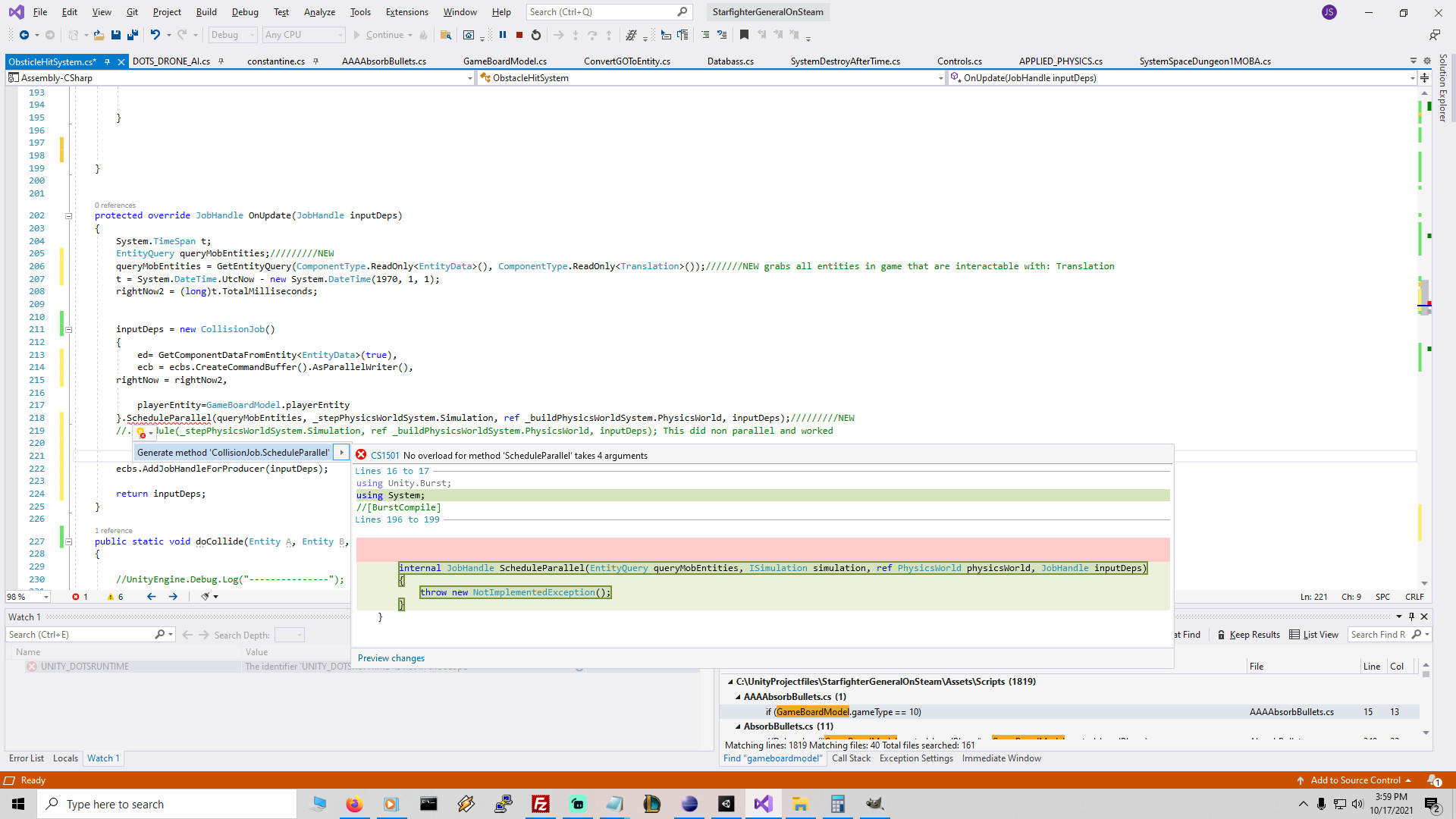 devout prairie
To be fair, that sounds to me like an incredible performance optimization to an already incredible system..
runs away
amber flicker
You can use ISystemBase now if you want to see what it's like. It is an improvement but also a massive headache to avoid everything managed. I'm sure they'll make it easier. I'm more interested to hear of the optimisations to the type handle stuff.
 deft stump
you guys have any sample code of getting the distance between 2 objects written inside normal Jobs?
or wait does the math library have that? (checking)
devout prairie
deft stump
or wait does the math library have that? (checking)
well you can do like:
math.distancesq(pos1,pos2) or math.lengthsq(pos1-pos2)
karmic depot
is branching code totally not supported in Entities.ForEach?
 frosty siren
karmic depot
is branching code totally not supported in Entities.ForEach?
frosty siren
karmic depot
is branching code totally not supported in Entities.ForEach?
what u mean?
karmic depot
frosty siren
what u mean?
I'm trying to do sort of a "add or update" on a NativeMultiHashMap, using TryAdd. I'm getting an error The Entities.ForEach statement contains dynamic code that cannot be statically analyzed
there's an "IsUnsupportedBranch" check in CecilHelpers, which I think triggers that. But I don't understand those analyzers
digital kestrel
amber flicker
A post with content for the first time in months? https://forum.unity.com/thread...
"no date yet..."
ruh roh
I remember they promised Unity 2021 DOTS support by like December
It's practically Nov and no update
karmic depot
digital kestrel
I remember they promised Unity 2021 DOTS support by like December
whaaat, where?
digital kestrel
karmic depot
whaaat, where?
somewhere in the forums ...
karmic basin
It was more in line with " incompatibility above 2020.3 at least until end of the year"
We have no estimate whatsoever, so could be Q2 2022, or worse
we just don't know
digital kestrel
karmic basin
It was more in line with " incompatibility above 2020.3 **at least** until end o...
yeah that was it ... if Joachim comes out this morning and says "no date yet" then that means they're no where close to next release
i would guess late Q1 or Q2 like you said
karmic depot
I wonder if they have a dependency on changes needed to Unity Editor, so they can't even say if next version of Entities will be released to the public.
devout prairie
Any reason why dots animation and physics may play slowly or at a different rate, independent of framerate?
Having yet another weird issue.
karmic depot
devout prairie
Any reason why dots animation and physics may play slowly or at a different rate...
Framerate larger than x*fixed rate, where x is max steps per frame. perhaps?
does Entities.ForEach exclude Prefabs by default?
coarse turtle
karmic depot
does Entities.ForEach exclude Prefabs by default?
yea
even in entityqueries they're not included by default
unless you enable the option to query them in the EntityQueryDesc
whole gyro
Hey @digital kestrel, with your animation system, are you able to read the animated bone positions on the CPU? For example, let's say I wanted a character to be holding an item in their hand, but the character's arm and hand are being animated using your texture-based animation shader. Is there a way to do this?
I guess one option is to have the shader moving all the mesh vertices, and separately some CPU code that also reads the animation textures and writes to bone positions.
I'm currently using the animation package, but it seems a bit overkill. I don't need blending or multiple bone weights per vertex.
digital kestrel
not really
if you knew the final position, you'd just pass that to the GPU instead of handling the skinning in a shader
you would have to recalculate it on the CPU which would defeat the purpose
the advantage might be that you can skip the calculation for everything else (other body parts)
which could save you some time
whole gyro
well gpu would be moving all the vertices for you. cpu would just be moving the bones
digital kestrel
all the bone positions are baked into the texture
so the CPU doesn't do any bone transform calculations after the initial pass
it just sends the animationa's normalized time value and uses that to sample the texture which has the bone positions
whole gyro
Yeah, I understand that part. I meant cpu could sample the baked texture and move some bone entities around. This allows for things like item attachments.
digital kestrel
yeah
you could bake all of the transforms for the hand
and store that on the CPU and just apply it exactly how you would on the gpu
like you said
no need to store it in a texture, just store it as a separate float4x4
whole gyro
yeah good point about not needing a texture on cpu side
digital kestrel
it would be a lot more efficient since you're only calculating one bone per mesh instead of all N bones, and applying world transforms would be trivial
especially if you vectorize it correctly
whole gyro
yeah seems it could work well
digital kestrel
if you need blend trees, i wouldnt use texture based animation
whole gyro
I guess another considering is to do all the animation on the cpu side with the baked bone positions. I think I would need a separate mesh/entity for each bone. However, I like the idea of my characters being a single mesh, even if I don't need multiple bone weights. Makes it easier to apply material properties to the entire character.
whole gyro
digital kestrel
if you need blend trees, i wouldnt use texture based animation
I haven't looked at how blending is typically implemented, but couldn't it theoretically be done in the shader?
But yeah, at that point, I would just use the animation package.
whole gyro
Thanks for the insight @digital kestrel! Not sure if I'm ready to switch to baked animations yet but good to know what is possible.
digital kestrel
whole gyro
Thanks for the insight <@!542556051317325835>! Not sure if I'm ready to switch t...
good luck, let me know how it goes!
i might release it on the asset store for like $10 lol
karmic depot
How am I supposed to pass BlobAssetReference to a IJobEntityBatch? I'm trying through a public field on the job and doing ref var array = ref TheReference.Value.SomeArray and debugger shows random numbers instead of what I expect 🤨
karmic depot
 rotund token
Pass the actual blob asset or clone the value
rotund token
Pass the actual blob asset or clone the value
ref blobAsset or a copy?
rotund token
just pass in BlobAssetReference
var myAsset = MyBlobAsssetReference;
job.withcode(() => { ref var array = ref myAsset.Value.SomeArray; }).Schedule()
should work from memory
(been a while since I've used a blobassetreference that isn't attached to an entity, i have my own custom memory system that i use instead for memory not on entities)
karmic depot
interesting. thanks I'll try that tomorrow
robust scaffold

Holy shit, Unity is alive.
No info but the CTO is once again on the forums. Entities 0.20 ETA has moved from "Heat Death of the Universe" to "Sometime next year".
devout prairie
Misgivings over timescales aside, i think it's insanely cool that the co-founder is still balls-deep in the technology. A great many software companies have long since sold off and being run by money managers. I really genuinely believe what Unity is doing with dots/ecs will be massively transformative, but i do think it will take some time to achieve.
It can be frustrating i think but it's really cool to be in for the ride, and given access to the tech while it evolves. It feels less like a marketing exercise and more like a genuine contribution to realtime/game-engine technology.
digital kestrel
He started Unity at 19 lol
pliant pike
I didn't even realise he was the Co-founder
safe lintel
yeah, its awesome hes super hands on with dots. I dont think I wouldve been an early adopter if we didnt have someone at his level of clout in unity being this enthusiastic about it
haughty rampart
how do we know 0.20 got moved from "Heat Death of the Universe" to "Sometime next year" ?
safe lintel
we dont really 🥲
gusty comet
anyone know:
If I use ConvertToEntity scripts on an object with lightprobes component attached, will the lightprobes still work correctly?
robust scaffold
haughty rampart
how do we know 0.20 got moved from "Heat Death of the Universe" to "Sometime nex...
Personally, I think it's because the gag-order on all employees talking about Entities (the main DOTS package) seems to be lifted. The CTO is out there once again answering questions and describing intended DOTS usages so the next package seems to largely re-solidified around a timeline. That means release sometime... soon-ish.
half jay
I have android app and in scene there are a lot of simple box colliders may be about 200k. Im using only one raycast and thats all. No collisions events or any rigidbody objects. So i have this profiler screen. Any tips or suggestion what should i check or what going on ?

 last jasper
does Hybrid renderer v1 work with per-entity material properties in 2020.3.20f1? I try the override property declaration/hybrid per instance and it does not seem to work
amber flicker
last jasper
does Hybrid renderer v1 work with per-entity material properties in 2020.3.20f1?...
What’s keeping you on v1? Built-in!
last jasper
nope, webGL
v2 doesn't work for webGL but v1 does 😦
The mad thing is I have another project where the per-entity props worked fine and I can't seem to figure out why it doesnt in this one
half jay
i have problem with v2 on android and unity 2020.3.20f1
amber flicker
last jasper
The mad thing is I have another project where the per-entity props worked fine a...
Slightly surprised v1 worked without just a new material
last jasper
https://elliotb256.itch.io/ecscombat this one is using v1
same material on all ships, and a '_TeamColor' material property
ahh, my mistake - I'm using one of the pre-defined render properties, not my own in that project: https://github.com/ElliotB256/ECSCombat/blob/master/Assets/Battle/Misc/SetTeamColorsSystem.cs - maybe that is the issue
The user manual states that V1 supports custom material props but that doesn't appear to be the case, unless I'm doing something daft https://docs.unity3d.com/Packages/com.unity.rendering.hybrid@0.11/manual/hybrid-renderer-v1.html
devout prairie
devout prairie
Any reason why dots animation and physics may play slowly or at a different rate...
Just a quick update on this, in case anybody has a similar issue.. the problem was in the ProjectSettings->Time settings..
I think the default is something like this:

Whereas i had cloned the Unity Physics Samples project, deleted all assets and scripts, and imported my own assets and scripts into this. It took me some time to realise the the Physics Samples project uses these settings, which essentially seemed to slow everything down:

Physics samples also has some code that sets:
Application.targetFrameRate = 60
I'm not exactly sure of what the implications are of all this, how these settings interact, but that's where the issue was.
gusty comet
still seeking an answer on this:
frosty siren
gusty comet
still seeking an answer on this:
https://discord.com/channels/48922216872751923...
you can use ConvertAndInject and keep your gameobject rendering in monobehaviour world. But i don't know will light probes work with DOTS rendering, i think not
gusty comet
frosty siren
you can use ConvertAndInject and keep your gameobject rendering in monobehaviour...
ill just duplicate the object and remove the renderer, that way the probes stay on a non-ECS version, im assuming they will still project the emission onto an ECS renderer, just wondered if converting the probes to ECS too would work
safe lintel
they should, probes get a companion gameobject on conversion @gusty comet tbh Im not too familiar with companion gameobjects and subscenes
I view anything outside of just plain vanilla rendering kind of experimental when it comes to dots graphics, light baking is kinda glitchy, the actual results with stuff like spotlights only show as point lights, occlusion is buggy etc
karmic depot
speaking of Companions, I recommend adding DOTS_HYBRID_COMPONENTS_DEBUG define to see companion objects in scene hierarchy when needed
velvet panther
When writing a sequencing system, and wanting to ensure that it's possibly suited to Burst/Jobs if needed for performance, should it be that all the system exist in one class, and use structs for any separations of data/state and methods? And are static arrays OK?
gusty comet
safe lintel
I view anything outside of just plain vanilla rendering kind of experimental whe...
yeah im planning to only use ECS for the actual renderers, i've already got duplicate items as children to take care of colliders etc, so I may as well put the probes on them, that way it wont need to create companion gameobject for the probes themselves.
karmic basin
devout prairie
Physics samples also has some code that sets:
`Application.targetFrameRate = 60`...
IIRC this helped me prevent an error spam where Unity complains you didnt disposed a collection in time, i.e. having an Allocator.TempJob and a framerate high enough to exceed the 4 frames limitation
 north bay
Uhmmm

Unity Forum
I was recently informed that in a forum post it was implied DOTS is no further a priority for Unity and is being abandoned. Something that I find hard...
 devout prairie
karmic basin
IIRC this helped me prevent an error spam where Unity complains you didnt dispos...
devout prairie
karmic basin
IIRC this helped me prevent an error spam where Unity complains you didnt dispos...
Yeah it actually says something about that in the comment next to that line of code
 full epoch
good news finally 🙂
pliant pike
I new it wasn't dead  ....(I didn't)
haughty rampart
dots was never dead
digital kestrel
They had to smooze the board before they could say anything to the peons >.>
half jay
Does Hybrid Renderer V2 need Vulkan API for android?
stiff skiff
It would be nice if they actually proved a timeline however
Because  Can be anywhere between next week to Q2 next year and beyond
pliant pike
timelines are bad because predicting how long this stuff takes is nigh on impossible
isn't there a saying with programming, that however long you think its going to take its going to be at least twice as long
 shut hare
is querying for reference types as fast as for the data structs ?
lets say a Player monobehaviour and a PlayerData struct
haughty rampart
shut hare
is querying for reference types as fast as for the data structs ?
you cannot use reference types with dots. there are some .....workarounds but you really shouldn't
shut hare
haughty rampart
you cannot use reference types with dots. there are some .....workarounds but yo...
Yeah you can i saw that in the FPSSample i wondered what was the drawback
[DisableAutoCreation]
 public abstract class BaseComponentSystem<T1> : BaseComponentSystem
     where T1 : MonoBehaviour
 {
     ComponentGroup Group;
     protected ComponentType[] ExtraComponentRequirements;
    string name;

     public BaseComponentSystem(GameWorld world) : base(world) {}

    protected override void OnCreateManager()
     {
         base.OnCreateManager();
        name = GetType().Name;
         var list = new List<ComponentType>(6);
        if(ExtraComponentRequirements != null)
            list.AddRange(ExtraComponentRequirements);
         list.AddRange(new ComponentType[] { typeof(T1) } );
        list.Add(ComponentType.Subtractive<DespawningEntity>());
         Group = GetComponentGroup(list.ToArray());
     }

     protected override void OnUpdate()
     {
        Profiler.BeginSample(name);

         var entityArray = Group.GetEntityArray();
         var dataArray = Group.GetComponentArray<T1>();

         for (var i = 0; i < entityArray.Length; i++)
         {
             Update(entityArray[i], dataArray[i]);
         }

        Profiler.EndSample();
     }

     protected abstract void Update(Entity entity,T1 data);
 }
i am looking for a solution to have an event when a player is instantiated without the start() callback so i turned to ecs
it looks like you can query monobehaviours
haughty rampart
i am not quite sure what that code does. nevertheless, it is vastly outdated
haughty rampart
shut hare
i am looking for a solution to have an event when a player is instantiated witho...
is this the only thing why you turned to ecs?
shut hare
no ofc not but i'm trying to keep it at bay until its done
haughty rampart
shut hare
i am looking for a solution to have an event when a player is instantiated witho...
also what exactly do you want? you want to instatiate a player and NOT call start?
amber flicker
shut hare
is querying for reference types as fast as for the data structs ?
It’s much slower to iterate. There’s no underlying linear memory layout with managed stuff (for a start)
shut hare
haughty rampart
i am not quite sure what that code does. nevertheless, it is vastly outdated
its a wrapper for systems to no do the for loop and only output the entity and behaviour in a custom Update
shut hare
haughty rampart
also what exactly do you want? you want to instatiate a player and NOT call star...
basically yes i want to stay away from the unity callbacks i can do this once built but in the editor if on play mode i can't really iterate for players in the scene
haughty rampart
why do you not want to use the callbacks??
shut hare
amber flicker
It’s much slower to iterate. There’s no underlying linear memory layout with man...
Much slower than OOP ?
haughty rampart
if you want to use monobehaviours anyway, using dots to query for them is just a stupid idea
shut hare
haughty rampart
why do you not want to use the callbacks??
I'm making a multiplayer game with my own networking and unity callbacks gets in the way
haughty rampart
shut hare
I'm making a multiplayer game with my own networking and unity callbacks gets in...
you are still using monobehaviours though
amber flicker
shut hare
Much slower than OOP ?
No. But if performance is your concern, you’ll have to run some tests with the type of data you have and the kind of transformations you want to do.
shut hare
amber flicker
No. But if performance is your concern, you’ll have to run some tests with the t...
Alright thanks for the info
haughty rampart
i don't think you have an idea what dots is for. if you don't want the callbacks, just use your own methods
muted star
How do I use RequireForUpdate correctly? If I use it like this the system seems to stop running for some batches which match the query.
        {
            endSimulationEcbSystem = World.GetOrCreateSystem<EndSimulationEntityCommandBufferSystem>();

            unitsWithoutTargetQuery = GetEntityQuery(new EntityQueryDesc
            {
                All = new[]
                {
                    ComponentType.ReadOnly<MoveOrder>(),
                    ComponentType.ReadOnly<Unit>(),
                    ComponentType.ReadWrite<Translation>()
                },
                None = new[]
                {
                    ComponentType.ReadOnly<HasTarget>()
                }
            });
            RequireForUpdate(unitsWithoutTargetQuery);
}```Looks okay at first read. You're saying you still have units without target that dont get processed ?
Never saw = new[], always saw = new ComponentType[] can you really be non-strict here ? 🤔
haughty rampart
karmic basin
Never saw `= new[]`, always saw `= new ComponentType[]` can you really be non-st...
yes.
karmic basin
Oh good 🙂
I don't see anything wrong in FlightFight code 🤷♂️
Something else might interfere
muted star
karmic basin
Looks okay at first read. You're saying you still have units without target that...
Yes, but it works fine without the RequireForUpdate call so it's no big deal
karmic basin
If you really wanted to interrupt the system another way would be to calculate count on the entity query and early exit in update
 sacred rune
Is there an equivalent to MonoBehaviour.OnRenderObject() but for DOTS/ECS?
coarse turtle
sacred rune
Is there an equivalent to MonoBehaviour.OnRenderObject() but for DOTS/ECS?
none out of the box, I imagine the equivalent would be writing a frustum cull test and determining if the entity's bound is within view
 kind turret
are the terms "DOTS" and "ECS" interchangeable? i've been calling everything ECS
 sturdy rune
Dots is data oriented technology stack, Unity's new approach to game development based on data oriented design. Ecs is entity component system, a piece of the dots "stack", Unity's way of connecting game design to systems and data.
So no. One is a component of the other, one is made of many components
velvet panther
kind turret
are the terms "DOTS" and "ECS" interchangeable? i've been calling everything ECS
Pretty much. Jobs and Burst are part of the technology stack upon which ECS is apparently being built. But everyone thinks of DOTS as ECS, and ECS as DOTS, and considers Jobs and Burst to be just helpers, and separate things. Which they are. You can use Jobs and Burst without having anything to do with ECS.
the "TS" in DOTS stands for "technology stack" but it was a contrived name, to give them some sense of accomplishment when they realised that ECS was years away from being ready. Hence the switch in naming, from talking about ECS and performance by default to "DOTS", so they can claim some parts of it are done. (Jobs and Burst are fully operational).
solar spire
The name DOTS existed since they announced ECS, Jobs and Burst. They still talk about performance by default, they were separate and similar concepts introduced at the same time.
If you're talking about its elements, say them by name, if you're talking about them under an umbrella say DOTS.
People will know what you're talking about if you mix them up, but don't go talking about Jobs as if it's ECS for example.
kind turret
ok thanks
velvet panther
solar spire
The name DOTS existed since they announced ECS, Jobs and Burst. They still talk ...
These "facts" don't matter, as DOTS has become synonymous with ECS, in the minds of most, and the manner in which most discuss them. Few talk about Jobs at all, even less about Burst.
Look around the boards, the forums, in here... Stackoverflow, Reddit, conversatiosn in the real world. Anywhere you like. Many even write "DOTS/ECS" or "ECS/DOTS" when discussing them, just a way to be sure they've covered all bases.
solar spire
People constantly do mix them up and don't want to bother being specific, what's your point?
Why you feel the need to scare quotes facts as if what I'm saying isn't true is beyond me
velvet panther
why you want to be scared by quotes?
solar spire
It's a real term, feel free to google it
velvet panther
I know exactly what it is. I don't think you do.
solar spire
I'll let you be unbearable by yourself then 👍
velvet panther
In this case, when using quotes around "facts", I'm drawing attention, in this construct. The use of the "scare" quotes is to draw attention to those things (the "facts") as separate from the subjective manner in which the terms have become commonly known. What you've presented as historical factuality no longer matters in the majority of conversations about ECS, because most consider it to be DOTS, and vice-versa. I'm, believe it or not, siding with you, on the original naming, meanings and terminology, whilst pointing out that that original definition is now a bit quaint.
One thing's for certain, it probably wasn't a good idea to let Unity's __A__cronym __R__esearch __S__pecialists & __E__nthusiasts also do the new logo.
muted star
Does anyone have an idea why is this exception thrown when I run this code?
var ecb = endSimulationEcbSystem.CreateCommandBuffer().AsParallelWriter();

Entities.ForEach((
                Entity unitEntity,
                int entityInQueryIndex,
                ref Unit unit) =>
            {
                var destroyedTargets = GetBuffer<DestroyedTargetsBufferElement>(unitEntity);

                if (destroyedTargets.Length >= 20)
                {
                    var maxLevel = unit.unitExperienceBlobAssetReference.Value.maxVeterancyLevel;

                    if (unit.veterancyLevel != maxLevel)
                    {
                        ecb.SetComponent(
                            entityInQueryIndex,
                            unitEntity,
                            new Unit
                            {
                                moveSpeed = unit.moveSpeed,
                                veterancyLevel = 3
                            }
                        );
                    }
                }

            }).ScheduleParallel();

            endSimulationEcbSystem.AddJobHandleForProducer(Dependency);
}```Unity.Entities.JobChunkExtensions.FinalizeScheduleChecked (System.Boolean isParallel, System.Int32 unfilteredChunkCount, Unity.Jobs.JobHandle prefilterHandle, Unity.Collections.NativeArray`1[T] prefilterData, System.Void* deferredCountData, System.Boolean useFiltering, Unity.Jobs.LowLevel.Unsafe.JobsUtility+JobScheduleParameters& scheduleParams, System.Boolean& executed, Unity.Jobs.JobHandle& result) (at Library/PackageCache/com.unity.entities@0.17.0-preview.42/Unity.Entities/IJobChunk.cs:270)
Unity.Entities.JobChunkExtensions.ScheduleInternal[T] (T& jobData, Unity.Entities.EntityQuery query, Unity.Jobs.JobHandle dependsOn, Unity.Jobs.LowLevel.Unsafe.ScheduleMode mode, System.Boolean isParallel) (at Library/PackageCache/com.unity.entities@0.17.0-preview.42/Unity.Entities/IJobChunk.cs:246)
Unity.Entities.JobChunkExtensions.ScheduleParallel[T] (T jobData, Unity.Entities.EntityQuery query, Unity.Jobs.JobHandle dependsOn) (at Library/PackageCache/com.unity.entities@0.17.0-preview.42/Unity.Entities/IJobChunk.cs:150)
Code.Systems.UnitExperienceSystem.OnUpdate () (at Assets/Code/Systems/UnitExperienceSystem.cs:38)...```Never mind I think I found the problem...
the variable destroyedTargets needs to be read only so I need to figure out how to do that now
left oak
muted star
the variable destroyedTargets needs to be read only so I need to figure out how ...
muted star
Nice that works 🙂
Here's another weird one, if I access the maxVeterancyLevel from my blobAssetReference it works fine but as soon as I use the ECB ParallelWriter.SetComponent I get a null reference error.
protected override void OnUpdate()
        {
            var ecb = endSimulationEcbSystem.CreateCommandBuffer().AsParallelWriter();

            Entities.ForEach((
                Entity unitEntity,
                int entityInQueryIndex,
                ref Unit unit) =>
            {
                var destroyedTargets = GetBufferFromEntity<DestroyedTargetsBufferElement>(true)[unitEntity];

                var maxLevel = unit.unitExperienceBlobAssetReference.Value.maxVeterancyLevel;
                ecb.SetComponent( // If I comment out this method call everything is fine
                    entityInQueryIndex,
                    unitEntity,
                    new Unit
                    {
                        moveSpeed = unit.moveSpeed,
                        veterancyLevel = 3
                    }
);```Exception with burst compilation disabled:
InvalidOperationException: The BlobAssetReference is null.
Unity.Entities.BlobAssetReferenceData.ValidateNotNull () (at Library/PackageCache/com.unity.entities@0.17.0-preview.42/Unity.Entities/Blobs.cs:279)
Unity.Entities.BlobAssetReference`1[T].get_Value () (at Library/PackageCache/com.unity.entities@0.17.0-preview.42/Unity.Entities/Blobs.cs:365)
Code.Systems.UnitExperienceSystem+<>c__DisplayClass_OnUpdate_LambdaJob0.IterateEntities (Unity.Entities.ArchetypeChunk& chunk, Code.Systems.UnitExperienceSystem+<>c__DisplayClass_OnUpdate_LambdaJob0+LambdaParameterValueProviders+Runtimes& runtimes) (at <f74c023565104fd3b6e455b2c48d320a>:0)
Code.Systems.UnitExperienceSystem+<>c__DisplayClass_OnUpdate_LambdaJob0.Execute (Unity.Entities.ArchetypeChunk chunk, System.Int32 chunkIndex, System.Int32 firstEntityIndex) (at <f74c023565104fd3b6e455b2c48d320a>:0)
Unity.Entities.JobChunkExtensions+JobChunkProducer`1[T].ExecuteInternal (Unity.Entities.JobChunkExtensions+JobChunkWrapper`1[T]& jobWrapper, System.IntPtr bufferRangePatchData, Unity.Jobs.LowLevel.Unsafe.JobRanges& ranges, System.Int32 jobIndex) (at Library/PackageCache/com.unity.entities@0.17.0-preview.42/Unity.Entities/IJobChunk.cs:386)
Unity.Entities.JobChunkExtensions+JobChunkProducer`1[T].Execute (Unity.Entities.JobChunkExtensions+JobChunkWrapper`1[T]& jobWrapper, System.IntPtr additionalPtr, System.IntPtr bufferRangePatchData, Unity.Jobs.LowLevel.Unsafe.JobRanges& ranges, System.Int32 jobIndex) (at Library/PackageCache/com.unity.entities@0.17.0-preview.42/Unity.Entities/IJobChunk.cs:353)```well, it looks like you're recreating the Unit component data, but not assigning the blob asset reference to this new component data, so it's null
muted star
Ah, yes that's it. Thanks for the help! I'll take a break
left oak
np, when it comes to ECS, code-by-error feels like the default process, haha
muted star
Is GetBufferFromEntity inefficient like GetComponentDataFromEntity?
Another question: Is it generally a better idea to store the BlobAssetReference on a singleton entity instead of a lot of entities?
sturdy rune
velvet panther
These "facts" don't matter, as DOTS has become synonymous with ECS, in the minds...
So a person who is literally asking for the correct nomenclature should ignore the answers that include the correct nomenclature and explanation, and instead rely on your advice, which is to not worry about the correct nomenclature? You're hilarious lol
left oak
@muted star BufferFromEntity & ComponentDataFromEntity do have a price compared to captured variables, but if you're referencing data that doesn't belong to the Entities.ForEach, there aren't many ways around it. You could certainly put your BlobAssetReference on a singleton, and if there's only one Blob you're referencing throughout the entire Entities.ForEach, there's no reason not to, I feel.
velvet panther
sturdy rune
So a person who is literally asking for the correct nomenclature should ignore t...
did you miss all the caveats? "subjectively", "most", "majority" etc?
muted star
 velvet panther
left oak
<@!133257413435326474> BufferFromEntity & ComponentDataFromEntity do have a pric...
velvet panther
left oak
<@!133257413435326474> BufferFromEntity & ComponentDataFromEntity do have a pric...
is there a way to use Blobs without ECS?
left oak
velvet panther
is there a way to use Blobs without ECS?
"No", in the sense that they belong to the Unity.Entities namespace. However, you could probably use them without much reliance on Entities