#archived-dots
1 messages · Page 196 of 1
 scarlet inlet
            {
                ECB.RemoveComponent<UpdateUECSEntityAfterSubmission>(id);
}).WithStoreEntityQueryInField( ref _entityQuery).ScheduleParallel();```or any variance of this
 pliant pike
I have a question is it normal for something to be inordinately quicker singlethreaded than multithreaded or could I be doing something wrong?
I have a job calculated on 1million entity's takes roughly 315ms across all 14 cores or takes 230ms on 1 the main core
 karmic basin
There's a slight overhead of schedulling in multithread. So yeah if it's a single job or on a few entities it might be faster to .Run() right away
pliant pike
yeah I know there a slight overhead but my job is way over a small overhead
karmic basin
yeah I see that haha
scarlet inlet
yep webgl works and frankly it's amazing that it does
pliant pike
how can you be sure a job is using Burst does it show in the profiler, isn't burst automatic now?
pliant pike
ok cool, thanks, that's what I'v been doing, using withoutburst to get things working, then schedule(), and run() and scheduleparralell() for the end result
scarlet inlet
is there a way to know if entities with a specific component exist?
this is last today question I think 🙂
😭
pliant pike
I think you can use an Entityquery or HasSingelton if there is only one
scarlet inlet
_entityQuery.IsEmpty apparently not super straightforward operation
pliant pike
I mean that's kind of the whole thing of entityquerys and jobs no need to check if there isn't an entity because they won't do something unless there is
karmic basin
RequireForUpdate if it's to prevent a system from executing if comp is not found
 ivory wagon
Someone using 2D Entities? I'm getting erros when importing
 zenith wyvern
scarlet inlet
yep webgl works and frankly it's amazing that it does
zenith wyvern
scarlet inlet
yep webgl works and frankly it's amazing that it does
Have you actually gotten past the point of just rendering in webgl with dots? I was able to render stuff but it started breaking in weird ways as my project developed
Stuff just started silently failing and I would get indecipherable exceptions constantly
scarlet inlet
@zenith wyvern that is this demo: https://twitter.com/sebify/status/1353689203184459778


Moved to entity command buffer plus new hybrid renderer increased performance noticeably especially on entity creation. I had to record with phone because the gpu couldn't cope with it. https://t.co/VvwFcILnsn
 Twitter
·
Twitter
·
ofc what you see in that tweet is not webgl, wasm is not so powerful
but it's the same with a crappy frame rate
zenith wyvern
Good to know, I'll have to revisit it then, thats exciting
pliant pike
does the entitycommandbuffer actually work well to create entity's now?
scarlet inlet
however IL2CPP is bugged! at least on this demo it breaks
I just finished to profile it, while it works, it's still slower than I thought
zenith wyvern
Oh so you had to disable il2cpp on the build configuration? Maybe that was my problem
scarlet inlet
no I mean, some parts break
pliant pike
when I tested before it was about the same with just a raw for loop to create as it was to use an ecb job
scarlet inlet
I can't spawn more than the first batch of balls
but it breaks also on windows, it's a bug with IL2CPP I Should report it

 warped coral
is it better to query empty dynamic buffers, or delete them when empty and readd when using again
 north bay
To me it sounds a lot more complex to add/remove the buffers than iterating over the empty ones
warped coral
ok
warped coral
currently whats the proper way to convert scenes to entities? Like if I'm making a mud and I wanna make some room scenes
am i able to make some kinda prefab that i can spawn at runtime?
 fluid kiln
You'll probably want to look at subscene conversion
So guys I thought my way to handle abilities was pretty solid but now I'm seeing a problem.
Say I have a string of systems as I like to call it that goes like this:
SystemA WithNone<Cancelled>
SystemB WithNone<Cancelled>
SystemC WithNone<Cancelled>
SystemD WithNone<Cancelled>
SystemE WithNone<Cancelled>
SystemF WithNone<Cancelled>
Any of these systems can add the component cancelled to the entity to "break" the chain. But now since this requires structural changes of adding the component cancelled, I need to use the entity command buffer and that means the component isn't added before the end of the frame. Is my understanding wrong or is there any way to make this scenario work?
If I "break" at System C on an entity, I don't want system D, E and F to act on that entity.
warped coral
i think you'd have to have sync points immediately
instead of adding/removing component, maybe you could use a bool? the adding/removing components.. i think that's good only if there are common sync points between them
like if the systems occur in order on the same frame then uh... yeah idk.... if you wanna add/remove then i guess a sync point between each of the systems needs to be there but idk if you want that
fluid kiln
Probably gonna have to use a bool but I feel like it's dirty, to have access to query filters like WithNone but instead use if(component.bool == true) return;
warped coral
yeah i know.. i also dont like how we can't skip processing empty dynamic buffers. And uh... i really wanna be able to use a change filter but with dynamic buffers for stat modifiers and stuff and i can't figure it out cuz like.. the stat modifiers always need to be ticking down their durations, and then ideally it would stop processing when they're empty and then i would recalculate the stats but change filter on dynamic buffer that's always recalculating would always be dirty, unless i keep deleting/readding the dynamicbuffer, but then on delete the stats can't just do a changefilter<DynamicBuffer<StatModifier>> cuz it aint there so idk
fluid kiln
Haha yeah I get you
Instead of having the stats modifiers ticking down, why don,t you have buff / debuff entities that have a duration and that are in charge of adding and removing the modifiers from the stats?
warped coral
i cant figure out how to do stats that only recalculate when dirty in an elegant manner. I'd have to manually mark each stat dirty in a system before i use every stat and that's just so complicated. with monobehaviours it was a simple property that just recalculated if dirty and then returned the value
oh.. like status effect components in the old monobehaviour
fluid kiln
The way I see it buffs and debuffs should definitely have their own entities since they'll have names, icons, a list of modifiers, etc
warped coral
so.. every character would have a list of entity fields that reference each buff/debuff entity... and then uhh..
fluid kiln
You have event that on apply add the modifiers to the target of the debuff
And another for when it ends, to remove the modifiers
warped coral
so... on character would just have a DynamicBuffer<StatusEffectRef> or something... and then uh... the statuseffect would be a component that also references the character entity... ok i think i get it
what if i want stat modifiers that grow or decay over a duration?
fluid kiln
You could have different types of duration components, one like StandardDuration, other one DecayingDuration and they are treated by different systems
warped coral
so.. instead of adding the stat modifier... idk.. somehow when i retrieve a stat, it needs to calculate the correct value from the growth/decay statmodifiers applied to it
unless i always calculate it every frame but that seems like a terrible idea... and yeah idk i'm always stuck on how to make an elegant system that recalculates only when needed
i can't just use events with systems cuz they have a definite order to them and stuff... so.. idk
idk how to do it argh i've been stuck on this and idk
fluid kiln
I'm also trying to figure out events and order atm with the problem I mentioned above
Maybe someone has more insight :/
karmic basin
I need to use the entity command buffer and that means the component isn't added before the end of the frame. Is my understanding wrong
Not at the end of the frame. When the ECB you targeted will execute
each systemGroup provides one, and you can add yours
actaully 2, at beginning and end
fluid kiln
Right, but we agree it wouldn't make sense to execute the entity command buffer every system?
Well technically could I execute it only when I chose to add the cancel component?
karmic basin
Nah. Is it okay if you read all modifiers inputs and compute them on a final value. Then check the Cancelled component only when trying to cast your ability ?
fluid kiln
I guess I could do that. Just feels dumb to calculate if the target is in range if say, the ability is on cooldown, or vice-versa
karmic basin
something like that, depends on what yo have now of course
fluid kiln
But that might actually make more sense
So I would do all the checks, then add "ReadyToCast" or something, and then in another group, actually cast it
karmic basin
can't you Query abilities WithNone<OnCooldown> ?
fluid kiln
Only if it has ReadyToCast, otherwise dump it
Yeah but it was just an example as there will be multiple conditions
karmic basin
yeah readyToCast sounds good
fluid kiln
Thanks for making me think outside the box hehe, I appreciate it
karmic basin
👍 happy coding
fluid kiln
karmic basin
each systemGroup provides one, and you can add yours
Does any component system group I create come with an entity command buffer or do I have to manually configure it? Also, do I always access it with World.GetExistingSystem<EntityCommandBufferSystem>() or is there a different way to get the buffer from within system groups?
 dull copper
just found about this https://twitter.com/_kzr/status/1341302567884623872

From Burst 1.5, you can directly call Burst-compiled functions without manually handling function pointers. It's quite handy when using heavy math functions. https://t.co/XiF22xEcPc
 Twitter
·
Twitter
·
 vagrant surge
@dull copper been there for a while, its a great thing
dull copper
function pointers has been there for a while but it's a whole lot more complicated to author them
this is just static class and function inside it
I'm still wondering why they need that static class for it
it's still adding a bit of boilerplate if you only need a single static function to get burst compiled
but I can totally live with that
for utility things like in that, it's really nice
do note that Burst 1.5 isn't even released yet, it's still in preview
warped coral
the only way to assign into a dynamic buffer is to do a for loop right? foreach and enumerators dont allow assignment?
and if i wanna remove stuff, i gotta do for(int i = buffer.Length-1; i >= 0; i--) right?
 ocean tundra
you cant use foreach
but you dont have to use loops with dynamic buffers
i do buffer.Add and dont need a for loop
warped coral
i cant make different dynamic buffers that use the same struct on the same entity?
like... if i want to categorize different stats and have a buffer for each one, although they all use the same Stat struct?
so a Primary stat buffer, Secondary stat buffer, etc. all using the same Stat struct isn't possible?
ocean tundra
No you cant
have to have different types
if you try it it will replace the existing buffer
or you can use different entities
warped coral
dang... that's kinda painful.. and generics with structs isn't useful either i guess.. so i can't use generics methods to do stuff
ocean tundra
eg you have a player entity and a player primary stats, secondary stats... ect all linked
just dont use generics
untill unity confirms they work its not worth it
soooo painful
warped coral
ok
ocean tundra
thats why i use code gen
warped coral
idk what code gen is
ocean tundra
can easily make 100s of stats and their buffers ect
all the systems are basicly the same, just with different types
warped coral
how do i name the entities in the entity debugger through code? or is that not possible?
fluid kiln
There's a set name emthod on the entity manager I believe
warped coral
oh ok thanks
ocean tundra
@warped coral make sure to wrap each use of it with #IF UNITY_EDITOR
it only exists/works in the editor
warped coral
oh.. it's an editor only method? ok thanks for the heads up
fluid kiln
That's annoying haha
dull copper
you can also just use asmdefs and put editor only stuff in separate assembly
ocean tundra
Maybe make a extention method and use that instead, then the extention method can have the #IF Editor
dull copper
or use Editor -folder that's treated special for that
altho I have no idea how this all works with DOTS
ocean tundra
na that method dosnt work like that
editor folder stuff dosnt really help with dots
warped coral
is it a terrible idea to put a fixedstring32 on every stat so i can change around the stats in future game versions? or should i hardcode stats to an index within an enum and never change them?
ocean tundra
use a enum
as that is actually a int under the hood
and you can set the enum to any number
but also if you r going to add a new stat, you would likly release a update containing code
fluid kiln
I just want to double check with everyone how they get their Entity Command buffer, is it always through the CreateCommandBuffer() from the EntityCOmmandBuffer system?
ocean tundra
@fluid kiln that sounds right, im away from my DOTS code atm. i think i use the EndSimulationBufferSystem
warped coral
yeah i mean idk... if i have 8 stats and access the buffer by the enum index... or... if i just put a name on all of them and then find them by name... i know using a name is slower and takes more memory. just dunno... if i wanna be able to modify stats and stuff in the future
ocean tundra
and you also need to add the dependancy
usually, new stats = new game features
that would require a full game update to be released
a enum/number is a good choice as you can keep adding untill you max out the int
warped coral
then previous saves become incompatible usually? cuz idk.. hardcoding it seems like.. its gotta be set in stone then
fluid kiln
Stats should be linked to types or a serializable index
Not a string
Therefore your saves are always compatible
ocean tundra
not really, you just need to be carfull
follow good update rules
in API develppment when something is release just NEVER remove the old stuff
fluid kiln
The name of the stat would be a field that has no purpose other than to be displayed to the user
ocean tundra
so you can Add and Change stats
warped coral
so i can never just remove and replace older enum indexes
ocean tundra
but deleting them you dont, instead you might disable, but the code/types/ids are still reserved and used by the old stats
fluid kiln
Well you could as long as you save load takes that into account
warped coral
unless maybe i have a system for that? that manually does swaps or something if my enum structure changes?
ocean tundra
yea and eventually you could do a big patch that breaks saves
or more likly your controlling the save/load process so you can fix/remove/cleaup that dead data on loads
warped coral
my player creation looks like this. is there any way to turn it into ecs in an elegant way? ```
async Task<Entity> NewPlayer(Session session, string characterName) {
session.Name = characterName;
string password = string.Empty;
session.WriteLine("Do you want to create a password?");
if (await session.ConfirmResponse()) {
session.WriteLine("Password?");
password = await session.ParseResponse();
}
Entity entity = EntityManager.CreateEntity();
EntityManager.AddComponent<Disabled>(entity);
EntityManager.AddComponentData(entity, new Player(characterName, password));
players.Add(characterName, new PlayerInfo(entity, password));
EntityManager.AddBuffer<CommandText>(entity);
EntityManager.AddBuffer<LogText>(entity);
CreateStats(entity);
AssignDefaultStats(entity);
session.WriteLine(string.Format("{0} created.", characterName));
return entity;
}
im using the entitymanager a lot and that feels bad
fluid kiln
Why isn't your player a prefab?
warped coral
im still new to ecs and have no idea how the conversion works
ocean tundra
basicly you just build/create with normal gameobjects and prefabs
while in editor
and then during build, boom converted
warped coral
it converts it into entities that are fully compatible with the serializeutility so i can save/load just fine?
ocean tundra
yea
it convertes into subscenes
which you then load/unload like normal scenes
i havnt messed with serializeutility in ages, but it was a major pain before
basicly it would save all your pure dots easy as, but if you had a mesh or any old gameobject stuff, it would just give you a gameobject with everything attached, which you then need to manually figure out how to save
warped coral
i've made a serialization system for uh.. just monobehaviours before.. to save and load gameobjects automatically... but i guess using ecs.. i wanna just never use any object references... i dont wanna deal with that stuff again
warped coral
hmm yeah... i'm currently making a mud so i dont need all that stuff.. but i do plan on adding graphics otherwise nobody will play it... and also without graphics using unity would be a waste so... yeah anyway at that time i'll probably use my serialization thingy to do it somehow
ocean tundra
why do you want to create one?
warped coral
unless maybe i make all the graphics not need saving... like just keep stuff in a resources folder and load them by keeping a name on every entity that needs it
warped coral
is the conversion workflow hard to learn or use?
warped coral
like if i just wanna make rooms and turn them into entities
ocean tundra
last time i couldnt even use subscenes
fluid kiln
Actually the doc doesn't answer my question
ocean tundra
tried just this week was super easy
warped coral
and i still dunno how i wanna place the new player into the newbie start room
like i assume i'll make a bunch of room prefabs.. convert them when user makes a world.. but idk how i'll like.. find a specific room?
to place new players in?
idk i guess ill figure it out
with monobehaviours it was easy.. cuz everything has coordinates. with rooms in a mud i have no clue
warped coral
hmm..
so.. rooms will be entities... uhh.. i'd need something to contain all the room references? so i can loop through to find a room by its coordinates?
 gusty comet
What is the point in .Schedule if it just blocks on the main thread till its completed?
warped coral
what if i wanna create or destroy rooms at runtime.. and make sure it's still able to save and load ... idk. i think in old school muds every room was in an array, and every exit was in an array... i guess i gotta use a dynamicbuffer of entityref for rooms too or something idk i gotta figure it all out but im confused atm
ocean tundra
@warped coral look at conversion more, you build your whole map in a normal scene, with gameobjects and components, you can setup spawn/start points, all your rooms and connections and then you get nice entities to work with
warped coral
ok
ocean tundra
@gusty comet schedule will only block in places without threads i think
eg webassembly
gusty comet
What about jobhandle.complete then?
ocean tundra
yea that will force a block untill the jobs are done
gusty comet
doesn't that block thee main thread till the jobs finished if itsnot a parrallel job?
ocean tundra
you shouldnt .complete stuff
gusty comet
Don't you have to in some cases?
ocean tundra
maybe really weaird cases...
i do everything i can to NEVER complete
just not worth the block
gusty comet
Is there a way to get an entity from a component?
warped coral
yeah
karmic basin
fluid kiln
Does any component system group I create come with an entity command buffer or d...
system groups are just a fancy name for your usual systems, but nested. And to create your ECB you just inherit EntityCommandBufferSystem and choose a name for your subclass :p then yes you retrieve it like usual
gusty comet
warped coral
yeah
How?
warped coral
entitymanager
gusty comet
Whats the method name? There is no GetEntity method
warped coral
oh wait... maybe it was from system
warped coral
oh i was thinking of singletons
oh right i asked that same question before
and found that you couldn't
my memory is bad
warped coral
if the compiler doesn't throw an error then it's all good right
gusty comet
I am creating some entities in a job then later back on the main thread I am attaching a gameobject to the entities with AddComponentObject
        EntityQuery m_Group = GetEntityQuery(typeof(SpawnPoint), typeof(Ped));
        var array = m_Group.ToComponentDataArray<SpawnPoint>(Allocator.Temp).Reinterpret<float3>();

        array.Sort(new DistanceComparer(position));
        m_Group.CopyFromComponentDataArray(array.Reinterpret<SpawnPoint>());
        var entities =  m_Group.ToEntityArray(Allocator.Temp);

        for (int i = 0; i < entities.Length; i++)
        {
            var go = GameObject.CreatePrimitive(PrimitiveType.Cube);
            EntityManager.AddComponentObject(entities[i], go);
and even if it is safe, this bit of code is probably going to be slow af.
EntityQuery m_Group = GetEntityQuery(typeof(SpawnPoint), typeof(Ped));
        var array = m_Group.ToComponentDataArray<SpawnPoint>(Allocator.Temp).Reinterpret<float3>();

        array.Sort(new DistanceComparer(position));
        m_Group.CopyFromComponentDataArray(array.Reinterpret<SpawnPoint>());
what are you trying to do
gusty comet
I have a bunch of potential spawn point entities spawned I generate them every frame in a job based on cameras current position.
I am trying to order them by distance
so when I loop through them the closest spawn points will be used first
warped coral
why do the spawn points need to be entities? you cant just use uh... vectors?
gusty comet
There is way more data than just the point on them
warped coral
oh ok
gusty comet
I originally tried to
make all the data in a single struct then store them in a nativelist
but I was getting errors about accessing that array in a parralel job
warped coral
did u copy the array to an array in localscope for you to use or were you trying to access it as a field on the system?
ocean tundra
@fluid kiln Dont create new ecbs, instead use the built in ones
each ecb nees a sync point to playback
karmic basin
He wanted more than the default ones 🤷♂️
ocean tundra
oh
gusty comet
@warped coral Yeah actually iirc the error was related to using the array on the main thread
the only way I could get it to run was to use a non parallel job and call complete first
so I decided to make them entities instead.
karmic basin
@gusty comet why don't you just query entities with the SpawnPoint tag with a simple Foreach ?
gusty comet
@karmic basin Because I want to loop through them in order from closest entity to furthest
karmic basin
so you tried to have let's say a native list in the system's scope and sort spawns by distance ? Didn't work ?
gusty comet
It did but when I got back to the main thread and tried to loop through the nativearray it caused errors
The only way I could get that to work was to schedule the job as non parralel and call complete on it (at this point I wasn't using a system just jobs)
ocean tundra
why did you go back to the main thread? you should do it all within the job
var spawnpoints = .....
entities.foreach(something here){
var sorted = spawnpoints.sort
do stuff....
}
gusty comet
Because I needed to call api code that isn't available in jobs yet rofl
        EntityQuery m_Group = GetEntityQuery(typeof(SpawnPoint), typeof(Ped));
        var array = m_Group.ToComponentDataArray<SpawnPoint>(Allocator.Temp).Reinterpret<float3>();

        array.Sort(new DistanceComparer(position));
        m_Group.CopyFromComponentDataArray(array.Reinterpret<SpawnPoint>());
        var entities =  m_Group.ToEntityArray(Allocator.Temp);

        for (int i = 0; i < entities.Length; i++)
        {
            var go = GameObject.CreatePrimitive(PrimitiveType.Cube);
            EntityManager.AddComponentObject(entities[i], go);
can't do that in a job
ocean tundra
remove the Gameobject.Create and have a prefab entity?
then you can do ecb.Instante(prefab)
gusty comet
Yes but according to the docs the gameobject mirrors the entity and I need it to do the opposite
karmic basin
Why ? Because the DistanceComparer ? with dots mathematics it's an easy method call and you can Instantiate your prefab instead of a primitive cube
It's not meant to
ocean tundra
yea mixing GO's and Entities is not great, Entities need to be the 'source of truth'
karmic basin
The link is supposed to be one-way
fluid kiln
karmic basin
He wanted more than the default ones 🤷♂️
Unless I'm missing something I don't understand how 2-3 sync points is enough. Like I can imagine some big system chains. Let's say
- Input that creates an event to cast an ability
- Ability checks if the player meets conditions to cast
- Ability is cast applying modifiers to the player
- Something else that requires structural changes...
That means there'll always be a certain amount of frame delays...
ocean tundra
number 1 dosnt need to create a entity, you could just set a value on a player entity component
gusty comet
The gameobject I am creating will eventually be moved on a navmesh through navmesh agent and if the entity is constantly mirroring itself onto the gameobject , the gameobject will never move
ocean tundra
@fluid kiln again 2 can set a value that it can cast
karmic basin
hum I think that's exactly what you say that's gonna happen, your GO will constantly b set back to the ENtity's position...
ocean tundra
3 would then create the entity, using a ecb
fluid kiln
Yeah but then instead of having ForEach that are meaningful, they'll be filled with ifs... Isn't that anti-pattern? idk
gusty comet
So I guess I have to use navmeshquery instead
karmic basin
but you have no choice, at least that's how Companion GameObjects work
gusty comet
was really hoping to just be able to hack my way around it
ocean tundra
@gusty comet i belive there are job save pathfinding now, but still confusing to use
gusty comet
its very primitive
you basically have to build the path node by node yourself in a system
ocean tundra
yea
you could break it apart more, GO (not companion) that does ONLY nav mesh => read into your entity => your entity to its companion
gusty comet
thats what I am trying to do now
ocean tundra
that inital GO/pathfinding bits, can all be seprate systems and components
karmic basin
@gusty comet it should be clearly stated in this page that the conversion link is one-way https://docs.unity3d.com/Packages/com.unity.entities@0.17/manual/conversion.html
gusty comet
Yes from Entity>GameObject
so I tried to get around this by making some hacky code that "works" but what I am wondering is
is this safe
EntityQuery m_Group = GetEntityQuery(typeof(SpawnPoint), typeof(Ped));
        var array = m_Group.ToComponentDataArray<SpawnPoint>(Allocator.Temp).Reinterpret<float3>();

        array.Sort(new DistanceComparer(position));
 m_Group.CopyFromComponentDataArray(array.Reinterpret<SpawnPoint>());
        var entities =  m_Group.ToEntityArray(Allocator.Temp);

        for (int i = 0; i < entities.Length; i++)
        {
            var go = GameObject.CreatePrimitive(PrimitiveType.Cube);
            EntityManager.AddComponentObject(entities[i], go);
so you have a PathfindingRequest component you add, that triggers your system to either link/create a pathfinding GO, use a SystemState Component to store that link, another system that loops on thatSystemSate component to read (there is some sort of job save read Transform API somewhere)
karmic basin
oh so you're already trying an alternative, I see. Then you've think about it more than me
ocean tundra
basicly try to have your main entity as pure ecs as you can, then for inividual old gameobjects you build a system to create/grab them from a pool, use them untill done, and release back to the pool, never directly attaching them to your 'pure' entity
warped coral
do authoring monobehaviours also need to be in their own file
gusty comet
yes
ocean tundra
@warped coral Normal monobehaviour rules so i guess yes
warped coral
oh ok
ocean tundra
@warped coral Also you know about [GenerateAuthoringComponent]?
warped coral
no... im reading the conversion stuff in the manual and im confused
warped coral
authoring component... and then.. a conversion system.. and uhhh.. something about setting up the thingies so they create entities.. before i actually convert over the data or something
karmic basin
@warped coral maybe focus on making your ability system work before adding more confusion 🙃
gusty comet
Yea not gonna lie the entire gameobject conversion process could be documented better
karmic basin
Or maybe that will ventilate your mind :p
warped coral
idk i wanna figure out the conversion stuff so i can make rooms and then figure out how to create new players in a specific room
gusty comet
why not just give every player their own world?
warped coral
i wanna be able to make predefined rooms... I could go with procedural but i'd like to be able to manually make stuff first
karmic basin
gusty comet
Yea not gonna lie the entire gameobject conversion process could be documented b...
I find it more clear now. Had to read blogs and check how Unity does it for Transform to figure it out. But yeah I'm sure I'm still not 100% on some parts ^^
gusty comet
I also wish it would let us define if the gameobject or entity is in charge when using companions xd
karmic basin
Then the next day they publish the rlease with docs :p
warped coral
IConvertGameObjectToEntity is getting uhh deprecated right.. so i skip over that part in the manual?
ocean tundra
@warped coral whoa what? it is?
karmic basin
Nope
it allows you to plug more during the conversion
And that's where yo ucan add for example Hybrid COmponents that don't exist yet in ECS
I mean in dots
like Particle System
warped coral
oh i probably mistook it for something else
gusty comet
I wish we could add value types to entities
karmic basin
Probs the ConvertTotEntity Mono component. Now yo should use subscenes instead
gusty comet
I have so many components that just have float3 and int in them
ocean tundra
@gusty comet but then how would you tell 2 ints apart?
karmic basin
gusty comet
I have so many components that just have float3 and int in them
Nothing wrong here
ocean tundra
you can code a (implicit??) converter to reduce your code a bit
so you could do stuff like em.AddComponentData<type>(entity, new float3(x,y,z))
karmic basin
Yeah like 1 authoring GO that converts to many components 👍
ocean tundra
its a little bit better
yea or for the authoring flow, you can have 1 monobehaviour that adds many components
warped coral
is it usually better to use authoring game objects instead of generating authoring components from ecs components? it's better cuz gameobjects get broken down into ecs right?
karmic basin
ocean tundra
yea or for the authoring flow, you can have 1 monobehaviour that adds many compo...
yeah that's what I mean, MB, not GO 🙂 🙂 🙂
my bad
@warped coral start with components and the [GenerateAuthoringComponent] directive
Even if it adds way more MBs
Don't overthink too much at the beginning 🙂
warped coral
ok
karmic basin
Otherwise you get stuck in your head and everything is confused
warped coral
should i store the coordinates on each room.. or just keep some kinda massive hashmap with the coordinates as the key and the room entities as the values?
karmic basin
(off topic: the getting started doc of Project Tiny is 94 pages long... help....)
fluid kiln
fluid kiln
Unless I'm missing something I don't understand how 2-3 sync points is enough. L...
I want to reiterate because what I'm realizing right now is kind of shaking my whole understanding of ECS and I'm kind of stumped.
So far I had figured out how to implement functionality using ECS. I would actually do a LOT of structural changes because in my head that allowed me to optimize my ForEach loops and control what entities they are called on.
I would also use a lot of event type components to do some work.
For example: When input of type "destination" (point to move) was detected, I would create an entity with a component "Destination Request" that contains the destination and an enum "Request Priority" that would be an enum with some values like [Input, Crow Control, Cinematic, Forced]. This request would then be picked up by a DestinationSystem that would override the value of the destination component only if the priority was higher. (Crowd control > Input). Now what I'm understanding, is because I create this destination request entity, there is a delay of 1 frame between the input and the actual movement.
This type of structural changes are everywhere in my code and I know it's caused by my flawed understanding of the framework. But I still can't wrap my head around doing otherwise. Without the DestinationSystem, EVERYWHERE in my code where I want to change the player's destination, whether it is from input or crowd control, I would have to REWRITE the code snippet: if (priority higher) set destination.
Using a lot of systems with a lot of triggers seemed very fluid to me on the conceptual level. This is more a rant than anything else so I don't expect much from you guys but maybe someone can help me "click" on how to design systems.
 robust scaffold
Does anyone know how to manually set the update order of ISystemBase? UpdateBefore/UpdateAfter only work with standard SystemBase.
karmic basin
warped coral
should i store the coordinates on each room.. or just keep some kinda massive ha...
That's a whole design question. you could use coords, a grid system, load scenes on the fly, ....
robust scaffold
karmic basin
(off topic: the getting started doc of Project Tiny is 94 pages long... help.......
At least Tiny has documentation and a getting started. Entities just chucks the user into the deep end with autogenerated documentation.
warped coral
if i use a hashmap.. that's not good for looping is it?
karmic basin
robust scaffold
At least Tiny has documentation and a getting started. Entities just chucks the ...
Haha, true that 😁
robust scaffold
warped coral
if i use a hashmap.. that's not good for looping is it?
You cannnnn but what it does is converts the hashmap into an array using memcopy then uses the array's IEnumerable to iterate.
 coarse turtle
robust scaffold
Does anyone know how to manually set the update order of ISystemBase? UpdateBefo...
coarse turtle
robust scaffold
Does anyone know how to manually set the update order of ISystemBase? UpdateBefo...
Maybe try [UpdateInGroup((...), OrderLast = true/OrderFirst = true)]
I've only used ISystemBase once w/ UpdateInGroup
robust scaffold
coarse turtle
Maybe try `[UpdateInGroup((...), OrderLast = true/OrderFirst = true)]`
Yea but I need to chain systems one after the other. UpdateInGroup thankfully works. I'm running the main chunk of simulation inside FixedStep since I'm not using it for physics.
ocean tundra
@fluid kiln yea i have that issue too, some ways ive seen to address it is tag components (unity said ages ago they will optmize these to have less cost on structural changes), unity also said component enabling is comming (when??? so you can have your destinationRequest compoent disabled untill you need it), sub enities, so you have smaller entities in a linked group as its smaller a structural change is less costly
and finally the enabled bool
coarse turtle
There's still some primitive ordering with OrderFirst/OrderLast though it would still be subjected to how unity determines the order based on its read/write dependencies
fluid kiln
ocean tundra
<@!165566485157249024> yea i have that issue too, some ways ive seen to address...
Enabling or disabling components would be greaaaatt
ocean tundra
no clue on what the satus of that feature is, i last heard about it like 6 months ago
karmic basin
fluid kiln
I want to reiterate because what I'm realizing right now is kind of shaking my w...
Your Destination Request component is okay. Again many ways to implement based on your game. And again, NOT next frame, if your input reading is before an ECB, you can then have a system acting on it after the ECB but on the same frame
 hollow sorrel
@fluid kiln
you could use streams as events to produce and consume same frame without sync points https://forum.unity.com/threads/event-system.779711/
robust scaffold
I never liked using the ECB. Every time I tried, I get better performance just running a job with entityManager on the main thread.
ocean tundra
i also code in expected frame delays for things, 1 or 2 frames at 60 or 120 isnt really noticable
in my head it also spreads some processing across frames
but not sure if its actually worth it 😛
but again i do networked stuff, so there is a network delay i often need to hide anyway
of like 200ms at worst
fluid kiln
karmic basin
Your Destination Request component is okay. Again many ways to implement based o...
How many sync points is too much? Because right now I'd like to create 2-3 of my own like "InputEntityCommandBufferSystem" and etc...
hollow sorrel
yes, most of the time 1 frame delay does not matter
unity by default already has ~2 frames delay due to how the engine rendering works so if you don't notice now you prob won't notice +1 frame
karmic basin
fluid kiln
How many sync points is too much? Because right now I'd like to create 2-3 of my...
Nobody can tell exactly -> Profiler is your friend
warped coral
the generated authoring component for my room component doesn't have string fields for the name or description
ocean tundra
@warped coral strings prob arnt converted
fluid kiln
Alright thanks guys I'll persevere ^^
fluid kiln
hollow sorrel
<@!165566485157249024>
you could use streams as events to produce and consume s...
Looks interesting I'll give it a read!
warped coral
so.. i gotta manually make a gameobject conversion thingies to do it?
karmic basin
If that works dont overthink it @fluid kiln You'll come back later to refactor eventually, when you get a good grasp on the pattern
robust scaffold
warped coral
the generated authoring component for my room component doesn't have string fiel...
Strings are special in DOTS. You'll either need to use a byte array to represent your string or use one of the FixedString32 variants. I dont believe autogeneration supports either though.
fluid kiln
warped coral
so.. i gotta manually make a gameobject conversion thingies to do it?
The way I understand it is that strings aren't usually data you actually want on your entities
warped coral
so... i gotta manually do what... uh.. start from gameobject and somehow convert to entity?
fluid kiln
You could have a resource file that stores your strings and then an index on the entity that points to that string
warped coral
what if i have lots of rooms with unique uh... descriptions
robust scaffold
Yep. A component containing either an int for an index to a managed string[] array or a ComponentData containing a FixedString32 variant.
fluid kiln
karmic basin
If that works dont overthink it <@!165566485157249024> You'll come back later t...
Yeah I agree. For some reason I thought that a few frame delays was unacceptable as I was noticing it on screen, but maybe it's due to something else
warped coral
oh
coarse turtle
warped coral
what if i have lots of rooms with unique uh... descriptions
@fluid kiln's approach still works, you pretty much access the unique description via ID
this is how my card flavor text works
in my own game
warped coral
so every room then needs a unique id.. hmm
could i use the room's coordinates as its id instead? a float3 or something as the key
fluid kiln
Not necessarily. Every room would have a DescriptionId that point to a file with this id
ocean tundra
you should use a blob asset instead for description
robust scaffold
warped coral
and store the strings in a hashmap
That works. Is there no way you can just use a int id? If you want to fall down the rabbit hole of over optimization, you can encode a unique ID into individual bits and use the resulting int to access a hashmap. But it's better to just assign each room a unique and sequential int index and use that.
ocean tundra
its not like description data would change
and a blob asset can exist within a component
warped coral
is saving and loading blob assets with serializeutility complicated?
robust scaffold
The blob asset exists as a reference pointer. You're basically storing a UnsafeArray<byte> that's readonly.
ocean tundra
@warped coral i think it would give you a list of blob assets, that you need to save and reconstruct on loading
robust scaffold
And making a blob asset is so painful. The only benefit of using blob assets is that multidimensional arrays are accessed linearly in the memory instead of arrays of references that a UnsafeArray<UnsafeArray<>> would result in.
warped coral
oh
ocean tundra
I found blob assets pretty easy to create, just a bit wordy tho 😛
robust scaffold
Yea, real shame the generic extension methods I had to make them got shafted with the new blob asset verification.
warped coral
so... is a hashmap with coords to room ok or is it subpar compared to using an array
and what about having the coords turned into an array where like.. the x y z get converted to indexes
robust scaffold
warped coral
so... is a hashmap with coords to room ok or is it subpar compared to using an a...
Honestly, it's okay. Comparing the performance hit between a hashmap (Dictionary since you cant store strings inside a NativeHashMap) and array is negligable.
gusty comet
Getting a werid exception.
ArgumentException: A component with type:GameObject has not been added to the entity.
Happens for this line
var agent = EntityManager.GetComponentObject<GameObject>(entity);
But i am already adding it with this code
EntityManager.AddComponentObject(entity, go);
Anyone know what causes this?
ocean tundra
@gusty comet I imagine you cant use Gameobjects, instead needing to use components
but im not sure
gusty comet
Ill try
robust scaffold
gusty comet
Getting a werid exception.
```
ArgumentException: A component with type:GameOb...
Is go of type GameObject that you manually made and implements IComponentData?
It cant be Unity's GameObject.
gusty comet
Then whats different between this and AddComponent?
zenith wyvern
One is for IComponent, one is for Monobehaviours
gusty comet
Still getting the same error with NavMeshAgent which is a monobehavior
ArgumentException: A component with type:NavMeshAgent has not been added to the entity.
It sounds like you're calling GetComponent before it's been added.
gusty comet
Let me double check
warped coral
does this look alright ```
//Room entity components.
[GenerateAuthoringComponent]
public struct Room : IComponentData
{
//public FixedString32 Name;
//public FixedString512 Description;
public int3 Coordinates;
}
//Exit entity components.
public struct Exit : IBufferElementData {
//public EDirection EDirection;
//public Entity Destination;
public int3 Destination;
public Entity Door;
}
//Door entity components.
public struct Door : IComponentData {
public bool isClosed;
}
public struct Lock : IBufferElementData {
public bool isLocked;
public float LockStrength;
public int Key;
}
GenerateAuthoringComponent only creates an entity with one component. You'll need a separate authoring system or monobehavior to connect the rest to that entity.
But yea, seems about right.
warped coral
oh yeah i haven't split the stuff into their own files yet
gusty comet
@zenith wyvern Nah its only being called after its been added
//in onupdate

        Entities.WithAll<Coord, Ped>().ForEach((Entity entity, int entityInQueryIndex, ref Coord point) =>
        {
            if (spawnedPeds == null)
                 spawnedPeds = new List<GameObject>();
            if (spawnedPeds.Count < 300)
            {

                var go = GameObject.CreatePrimitive(PrimitiveType.Cube);
                go.transform.position = point.position;
                var test = go.AddComponent<NavMeshAgent>();
                spawnedPeds.Add(go);


                EntityManager.AddComponentObject(entity, test);
            }
         }).WithoutBurst().WithStructuralChanges().Run();
        barrier.AddJobHandleForProducer(Dependency);

        Entities.WithAll<Ped, Coord>().ForEach((Entity entity, int entityInQueryIndex, ref Ped ped, ref Coord pos) =>
        {
            if (math.distance(pos.position, Camera.main.transform.position) >= 125)
            {

                var agent = EntityManager.GetComponentObject<NavMeshAgent>(entity);
                spawnedPeds.Remove(agent.gameObject);
                GameObject.Destroy(agent.gameObject);
                EntityManager.DestroyEntity(entity);
            }
        }).WithoutBurst().WithStructuralChanges().Run();
        barrier.AddJobHandleForProducer(Dependency);
@gusty comet Cant have Coord in WithAll and as a parameter in the Foreach ref...
just remove it from WithAll
gusty comet
@ocean tundra in which foreach? both?
ocean tundra
yea
robust scaffold
gusty comet
<@!155490373123178497> Nah its only being called after its been added
```
//in...
You dont really need the WithAll on the second Entities.ForEach. The lambda parameters already contain the references.
ocean tundra
in the 2nd you have with all ped and cord, and you also ref those
gusty comet
so take the withall out?
warped coral
i cant generate authoring components for buffers?
if i store exits in a buffer how do i add them to rooms during authoring
ocean tundra
if generateauthoingcompoent dosnt work you can write one yourself
but i did read that it works
warped coral
it doesn't show up in the component list for adding components. this is what my exit bufferelement looks like ```
//Exit entity components.
[GenerateAuthoringComponent]
public struct Exit : IBufferElementData {
//public EDirection EDirection;
//public Entity Destination;
public int3 Destination;
public Entity Door;
}
I dont believe buffer components are supported by authoring.
ocean tundra
maybe there only supported with a single field?
warped coral
ok so... i gotta somehow uhh.. do the things to convert gameobject over?
ocean tundra
gusty comet
does return break out of a parrallel entities.foreach like it break would in a foreach loop?
or does it just return one iteration?
gusty comet
is there a way to break out of the foreach?
ocean tundra
not that i know of
dont worry about it too much atm
when you need extra performance you can look at writing manual chunk jobs, and you would be able to break out of the chunk loop easy then
warped coral
can i use some kinda hashmap or dictionary inside component data?
like is there some kinda fixedhashmap or something
or can i make a fixedlist<mystruct> and cap the capacity to 12 for each direction?
ocean tundra
dynamic buffer is all you can use
i wish too that other collections can be inside components
 safe lintel
I think you could use a class component and stuff a native collection inside it
ocean tundra
but then no burst or threads
warped coral
eww class components
north bay
You can use unsafe collections on components but they do not have leak detection and some of them behave differently from their native counter part
ocean tundra
unsafe collections sound so ... unsafe 😛
warped coral
im conflicted.. should i use a dynamic buffer for room exits...or just keep a fixedlist on the room component and populate for all directions even if it doesn't have an exit for that direction
cuz the generate authoring thingy is telling me that when i do the thing on an IBufferElementData, it expects only 1 field... and if i use a struct, the entity field doesn't get converted to a gameobject so... idk.... anyway idk how i should structure the rooms on the entity side
hmm.. i probably wanna index by direction so it's easy to move around
ocean tundra
implement IConvertGameObjectToEntity
and use that instead of autogenerateauthoring
warped coral
ok
gusty comet
[NativeDisableUnsafePtrRestriction]
    private NavMeshWorld world;
    protected override void OnCreate()
    {
        world = NavMeshWorld.GetDefaultWorld();
    }


    protected override void OnUpdate()
    {

        var w = world;
        Entities.WithNone<SpawnPoint>().ForEach((Entity entity, int entityInQueryIndex, ref Coord pos, ref Ped ped) =>
        {
            var q = new NavMeshQuery(w, Allocator.Temp);
         }).ScheduleParallel();
InvalidOperationException: OnUpdate_LambdaJob0.JobData.w.world uses unsafe Pointers which is not allowed. Unsafe Pointers can lead to crashes and no safety against race conditions can be provided.
If you really need to use unsafe pointers, you can disable this check using [NativeDisableUnsafePtrRestriction].
Why am I getting this error even though I have used to correct attribute?
ocean tundra
probably needs to be on the type NavMeshWorld
zenith wyvern
You need to use .WithNativeDiableUnsafePtrRestriction in the entities ForEach and pass the navmesn world that function I think
gusty comet
@zenith wyvern I think you're right but can't figure out how to use it do you have an example by any chance?
@ocean tundra it is or am I missing something?
safe lintel
something like Entities.WithNativeDiableUnsafePtrRestriction(NavMeshWorld.GetDefaultWorld())
gusty comet
@safe lintel
.WithNativeDisableUnsafePtrRestriction(NavMeshWorld.GetDefaultWorld).ScheduleParallel();
Assets\code\PedestrianAndTrafficSystem\Peds\PedMoveSystem.cs(43,12): error CS0411: The type arguments for method 'LambdaJobDescriptionConstructionMethods.WithNativeDisableUnsafePtrRestriction<TDescription, TCapturedVariableType>(TDescription, TCapturedVariableType*)' cannot be inferred from the usage. Try specifying the type arguments explicitly.
Adding the type like it says with <NavMeshWorld> results in this error
Assets\code\PedestrianAndTrafficSystem\Peds\PedMoveSystem.cs(43,12): error CS1061: 'ForEachLambdaJobDescription' does not contain a definition for 'WithNativeDisableUnsafePtrRestriction' and no accessible extension method 'WithNativeDisableUnsafePtrRestriction' accepting a first argument of type 'ForEachLambdaJobDescription' could be found (are you missing a using directive or an assembly reference?)
warped coral
do i gotta mark structs with system.serializable for serializeutility to work on them
safe lintel
ive not actually used any of the navmesh world stuff but thats how you use WithNativeDisableUnsafePtrRestriction in the foreach lambda.
gusty comet
So does that mean navmeshquery isn't compatible with parralel jobs in component systems?
warped coral
why do i get this error on my roomauthoring component and what does it mean? ArgumentException: RoomAuthoring and RoomAuthoring have a conflict in the stable type hash. Use the [TypeVersion(...)] attribute to force a different stable type hash for one of them.
safe lintel
@gusty comet in https://github.com/zulfajuniadi/unity-ecs-navmesh/blob/bb4fe6ed2f847d6f2acd3547c3d3207214ec7a2c/Assets/NavJob/Systems/NavAgentAvoidanceSystem.cs hes getting that stuff in oncreate() and using a persistent query and just passing that into the job rather than getting it inside the job(note the api is older here)
warped coral
oh crap wait.. its cuz i have a RoomAuthoring class and a Room with [GenerateAuthoringComponent] on it i think
karmic basin
@warped coral do you even think a minute when you're stuck before calling for help ? 😛
Calm down, take a breath, let your brain compute the problem and give yourself some time to try things 😉
gusty comet
@safe lintel just gives the same error as before but this time on the query variable instead of the world variable.
warped coral
yes sensei
 low tangle
your changing your lambdas in the wrong order too
everything up front, then foreach, then run|schedule
gusty comet
Wow its actually not possible to use NavmeshQuery in an entities.foreach even tho its usable in jobs
gusty comet
I've tried everything
low tangle
you just dont start it from inside a foreach
dont start the jobs from within a foreach, and chain any other jobs with them
gusty comet
I treid creating it in oncreate and using it in foreach
didn't work
I tried creating it in onupdate and using it in foreach
also didn't work
well
let me specify
not possible in parallel job
idk about regular one
ocean tundra
Personally i always use https://arongranberg.com/astar/ for pathfinding
but i did have to do the raw movement myself
but it was probably faster that way as i could scheduleparallel
the slowest part is the start, where it has to cacualte a path, then take that path and turn it into a dynamicbuffer of points
pretty sure i had to so some without burst or run or something slow
gusty comet
does a* work with default unity navmesh?
low tangle
single job query
[AlwaysUpdateSystem]
    class NavMeshSystem : SystemBase
    {
        const int humanoidType = 0;

        protected override void OnUpdate()
        {
            var s = new NavMeshQuery(NavMeshWorld.GetDefaultWorld(), Unity.Collections.Allocator.TempJob, 10);
            Job
                .WithoutBurst()
                .WithDeallocateOnJobCompletion(s)
                .WithCode(() =>
                {
                    var start = s.MapLocation(Vector3.zero, Vector3.one, humanoidType);
                    var end = s.MapLocation(new Vector3(10, 0, 10), Vector3.one, humanoidType);

                    s.BeginFindPath(start, end);

                    while (s.UpdateFindPath(1, out int itterationPerformed) == PathQueryStatus.InProgress) { }

                    var status = s.EndFindPath(out int pathSize);

                    Debug.LogFormat("status:{0}", status);

                }).Schedule(Dependency);

        }
    }
I've never used this api before so sorry for it not really being 'real' code
@gusty comet
to turn this into a ecs api, you would run a async collect all requested agents into a native array, and access them from a foreach job, that does roughly that ^ for each
safe lintel
i wish unity was further along with whatever the dots navigation package is, im surprised of all things its taking the longest to materialize, I wouldve thought it lend itself to dod much easier than something like animation?
gusty comet
what version of ecs are you using @low tangle? My job.Schedule() doesn't exist for me
neither does WithDeallocateOnJobCompletion
low tangle
gusty comet
Yeah it works fine in regular jobs but once you scheduleparralel not so much.
ocean tundra
@gusty comet no it has its own way of making navmeshs (grids)
or can create its on fancy navmesh
all dynamic at runtime too
warped coral
is it not good to have fixedstrings inside of structs
ocean tundra
not really
DOTS is all about DATA, and strings isnt actually data
strings are usually human representation (readable) data
warped coral
where would i put them if i want them to save as part of serializeutility?
the room names and descriptions
ocean tundra
i wouldnt
instead ill have IDs for them
and save/store that list somewhere
eg a scriptableobject
gusty comet
you can use scriptables
warped coral
but what if the names and descriptions change at runtime and i wanna save those on the server
ocean tundra
then on game start or load take that object and use it to look up the readable values
gusty comet
@warped coral send the name as a byte array when the player joins it
ocean tundra
dont "what if' otherwise you can spend forever on things
decide if the will or wont
if they do then yea you can sync the values on start or something
warped coral
ok.. i mean i want to be able to uh... have everything modifiable and persistent
gusty comet
What is everything?
but regardless what you're trying to do is pretty straighhtforward
warped coral
i wanna use the room coordinates as the key for accessing the room infos... how do i do that with entities
ocean tundra
well if you want everything modifiable then your basicly building a engine not a game
gusty comet
why are you making your rooms entities?
ocean tundra
but i get where your coming from, my goal in all games is to allow mods
low tangle
version that writes out to entites at the end
lets see if I cant convert it to a parallel for now
warped coral
i want my rooms to be able to have components for different behaviours and stuff
ocean tundra
@warped coral so really sit down and thing what a mod can do
eg ive been working on a RTS, so units make a good mod
so i structure the unit with JSON and on game load i take a existing general unit prefab, and make a new prefab from it, with all the new mod values set
gusty comet
@low tangle oh wow thanks bud this is exactly what I was trying to make
thanks for the reference I was sure it was impossible, I wish the errors for ecs were a little more obvious I see what I was doing wrong now at least
low tangle
yeah no worries, almost done converting it to parrellfor if that navmeshquery supports it (maybe)
gusty comet
ocean tundra
but i get where your coming from, my goal in all games is to allow mods
Have you tried binding any scripting languages to ecs yet then?
ocean tundra
no i havnt, i've considered it but decided it wouldnt be worth just yet
so far just data
low tangle
might have been how I did it, but the system to query interface was messy (reflection)
still working on better codegen to pull it off
ocean tundra
i wouldnt use a scripting language anyway, with things like roslyn its possiable to just compile and run c# code
low tangle
but theres some burried nuggets in there if you can get lua components as featureful as c# ones
yes, but its also sketchy even with sandboxing
low tangle
people love to waste time attempting to excape sandboxes
ocean tundra
haha yea
low tangle
not everything is that kind of mod though
I only make multi player games
so cheating/being a dick to others is a thing that happens pretty often
ocean tundra
again tho roslyn can really restrict c# code during compile
yea mp + modding = even harder
😛
i would file hash the game directory + mod directorys and make sure they match
which kinda helps
then im all server => client and very strict about not sending info to clients who dont need it
and client isnt a simulation its basicly a 'view' into part of the simulation
cant change anything
zenith wyvern
I saw they added "support" for modding by letting us load dlls that work with burst? How would I even learn how to do that
warped coral
so.. i should just leave all the strings out of ecs? And just keep them in some dictionary?
ocean tundra
@zenith wyvern Oooo when? where?
I last heard about it as a early idea, use unity to compile some c# code into a burst dll and then load it
but that was AGES ago
@warped coral I would do a dictionary per string type
eg titles, description, ui labels ect
warped coral
if i access the room name and description together often, should i make one struct for those
low tangle
ocean tundra
i would file hash the game directory + mod directorys and make sure they match
doesn't help at all, if its on the client you can't trust it
file tampering is the first thing people spoof
ocean tundra
you will have maybe 1 or 2 systems to read that data and send it to UI
@low tangle yea i know its not secure
was more for normal people to make sure they are on same versions (mods + game)
and had some mod packs active
low tangle
yeah
warped coral
whats the benefit of multiple dictionaries
ocean tundra
more for you
low tangle
read from one, write to another
ocean tundra
easier to tell what something is
warped coral
would this be ok as a dictionary value public struct RoomInfo { public FixedString32 Name; public FixedString512 Description; }
warped coral
oh yeah.. and store it within a normal dictionary?
ocean tundra
when you update the UI you send the ids of things
and the ui controller thing can just look up the values
low tangle
thats fine, that kind of non changing data is meant for blobs
you'd really just access it like a scriptable object, check and toss into a UI field
UI and ecs dont mix
warped coral
i don't understand blobs... is that different than authoring the rooms using subscenes
 deft stump
think of blobs as scriptable objects
low tangle
there like a blob of components and dynamic buffer like data you can get a handle to and read from even within jobs
docs probably got a page on them
let me find it
ocean tundra
what i did is have a UI controller and would get a reference to that somehow in create (it was a monobehaviour)
then in a entities.foreach without burst run i would send it what things it needs (eg selected units)
low tangle
yeah, thats totally fine
you can also inject the monobehaviour with a entity, and addcomponentobject the mono
and then query it up within the system, keeping no direct references and the ecs pattern intact
you just have to without burst, run only
warped coral
uhh... soo.. how are blobs made. what makes them different than like... subscenes.... Sooo... a blob can be its own file like a scriptable object?
ocean tundra
@warped coral I normally have a method on my scriptable object .ToBlob or something that does that blob builder stuff
low tangle
intresting, theres a blob cache built into conversion system now
https://docs.unity3d.com/Packages/com.unity.entities@0.17/api/Unity.Entities.BlobAssetStore.html
warped coral
oh... that sounds neat... i wanted to use scriptable objects for making rooms and stuff but didn't know how to tie it into ecs
gusty comet
@low tangle Did the navmeshquery support parrellfor? About to give it another try now just diidn't see a point wasting time if not
low tangle
if you want to do it all data friendly your gonna want to convert all your static data like room descriptions, with unique ids for each (name or otherwise)
then hash them all into a hashmap<key, blobassetref>
low tangle
gusty comet
<@!105600936646316032> Did the navmeshquery support parrellfor? About to give i...
its meant to, I just havent finished yet. people barged into the office and wanted attention
your gonna want to write one of these, but I'm sure you havent done the syntax yet, so I'll finish it up in a second
warped coral
so.. if i do that.. i can access blob asset stuff from within ecs?
can they be used with burst and stuff
low tangle
yes thats exactly what they are for
warped coral
oh
zenith wyvern
From burst changelogs
Added support for PlayMode / Desktop Standalone Players to load additional burst compiled libraries for use in Modding.
tyvm
now... to just figure out how
i bet it wont also trigger ecs code gen tho...
but i guess for modding i shouldnt let users make any old System, instead provide hooks....
warped coral
how do you turn scriptableobjects into blob asset references? do i reference them (the scriptable object) on an authoring component and uhh.. do it when i convert?
fluid kiln
How can I include a native collection within a job as readonly so I don't get these exceptions: InvalidOperationException: The previously scheduled job AggroSystem:OnUpdate_LambdaJob0 writes to the Unity.Collections.NativeHashMap`2[Unity.Entities.Entity,Distance] OnUpdate_LambdaJob0.JobData.closestEnemyMap. You are trying to schedule a new job DistanceSystem:OnUpdate_LambdaJob0, which writes to the same Unity.Collections.NativeHashMap`2[Unity.Entities.Entity,Distance] (via OnUpdate_LambdaJob0.closestEnemyMap). To guarantee safety, you must include AggroSystem:OnUpdate_LambdaJob0 as a dependency of the newly scheduled job.
ocean tundra
@fluid kiln you need to dependancy track
so you have a job that writes
and another that reads
the read job needs to combide dependancies with the write job
and be ordered after the write
fluid kiln
It says aggro system writes to the collection but it doesn't it just reads
ocean tundra
then mark it as read only
entities.withreadonly
its cause unity cant tell if your only reading so assumes writing too
ocean tundra
either way you should still combine dependancies
ocean tundra
even if it works now
evenutally you will add more systems and the scheduler becomes more aggressive and it dosnt know theres a link between the 2 jobs
so will schedule them at the same time
boom explosion
ocean tundra
in the write job
make a public method GetDependancy () {returns Dependancy}
and in the read BEFORE you schedule/Entities.foreach
get the write job system, and go Dependancy = CombineDependances(this.Dependnacy, wirteJobSystem.GetDependancy)
ps sorry for no real code 😛
it might be JobHandle.Combine or something
fluid kiln
No worries I got it. Thanks!
low tangle
@gusty comet yeah no dice on the parallel for version, you will have to stick with that part being on one thread
the NavMeshQuery is holding onto a native container inside, and preventing you from writing to it from more than one thread
attempted to create one query struct per each entity, but those cant store into a nativearray due to having a native container inside
if they were marked as unsafe, you could. but theres also some missing api versions, like a dispose(jobhandle)
I'd just stick with a single thread version
warped coral
i can store blobassetreferences within blobassets right?
to ref other stuff from within? like i can do with scriptable objects?
gusty comet
@low tangle Yeah I figured there wasn't really a way to make it happen. Kinda sucks tbh. but hopefully navmesh will be built into dots by default
Is there something like https://docs.unity3d.com/ScriptReference/Physics.OverlapCapsule.html in dots rn?
 gusty comet
huh i just found a weird bug i think
 var r = Unity.Mathematics.Random.CreateFromIndex((uint)entityInQueryIndex);
                var x = (r.NextInt(0, 1) == 0) ? pos.position.x + r.NextFloat(0, 40) : pos.position.x - r.NextFloat(0, 40);
                var z = (r.NextInt(0, 1) == 0) ? pos.position.z + r.NextFloat(0, 40) : pos.position.z - r.NextFloat(0, 40);
x and z are always very similar when i run it for example they will always be between a range of 190 to 260 every iteration.
warped coral
if i wanna use a nativehashmap... i need to initialize it with a capacity and allocator, and manually dispose it?
gusty comet
Iirc it autoresizes
warped coral
oh... ok thats good
gusty comet
Its basically what nativelist is to list but for dictionaries
warped coral
do i need to dispose it manually
i remember using a native thingy sometime ago and i had some memory leak warning
gusty comet
So whats up with gerenating random numbers in ecs
THey always generate to be similar to the last one if done inside of a job
warped coral
thx
zenith wyvern
Not sure, I've never even seen that CreateFromIndex method. I think you would have to give it different indices to get different numbers
gusty comet
I am
zenith wyvern
Oh like within the same loop they are similar?
gusty comet
Yeah
Entities.WithNone<SpawnPoint>().ForEach((Entity entity, int entityInQueryIndex, ref Coord pos, ref Ped ped) =>
        {

            if (math.distance(ped.destination, pos.position) <= 10 || ped.needsNewDestination == 1)
            {
                var r = Unity.Mathematics.Random.CreateFromIndex((uint)entityInQueryIndex);
                var x = (r.NextInt(0, 1) == 0) ? pos.position.x + r.NextFloat(0, 40) : pos.position.x - r.NextFloat(0, 40);
                var z = (r.NextInt(0, 1) == 0) ? pos.position.z + r.NextFloat(0, 40) : pos.position.z - r.NextFloat(0, 40);
                var targetPos = new float3(x, pos.position.y, z);
                Debug.Log(targetPos.ToString());
                var startLocation = s.MapLocation(targetPos, Vector3.one, 1 << 3);
                ped.destination = startLocation.position;
                ped.needsNewDestination = 0;
            }
this makes all the peds converge toward the same area about
zenith wyvern
Not sure, I don't know enough about RNG to know if that's expected or a bug
        ///     // Random numbers drawn from loop iteration j will be very different
        ///     // from every other loop iteration k.
Seems like a bug based on the docs
gusty comet
maybe its cause I am calling Next so often
cause i am not seeing any reason for my code to be producing very similar targetpositions for every entity
zenith wyvern
Maybe the RandomTests in the mathematics package could give you some insight. I just tried looking and it's a lot of big words I've never seen before so I got scared and ran away
 gilded bay
I'm looking to implement the job system in my game. I have my networking stuff (UDP and TCP) running on different threads, but I'd rather not pass it back to the main thread, rather pass it to a job thread instead (so I can use the unity API without sucking the main thread dry)
Anyone have any info on that for me?
Would I just be able to keep a separate job or two open for my entire game?
zenith wyvern
You can't use any Unity API in a job
gilded bay
So I have UDP and TCP networking in my game
we're only talking about the server for now
each TCP connection runs in a different thread
and UDP runs in it's own separate thread
Is my only solution here to just pass the info back to the main thread?
to use the unity API
gusty comet
what info
gilded bay
messages received by UDP and TCP
I'd like to multithread that part somehow
but it needs to be able to use the unity API
gusty comet
Ok this is pretty easy to do
spin up a new io thread(no reason to use a job for this since you're not going to be using any unity api at all any how
gilded bay
yep already done that
gusty comet
use that thread to serialize data
and
pass it to and from your network thread

GitHub
Basic implementation of Disruptor for Unity3d. Contribute to dave-hillier/disruptor-unity3d development by creating an account on GitHub.
in form of a ring buffer
so basically
Serialization Thread > RingBuffer > Net Thread
keep in mind its single producer single consumer only though
so only one thread can write to this
anda only one thread can read
you can't write to it from 5 diff threads
this will give you a way to communicate between threads without locks
gilded bay
I've already got thread communication done with concurrentqueues
gusty comet
instead you can send pointers of data to other thread by using structuretoptr
gilded bay
is this different?
gusty comet
Yes
Concurrent queues just use lock behind the scenees
so its going to be much slower than ringbuffer
but
gilded bay
So then how do I multithread the part where unity's API handles all of the data
like updates positions, etc
gusty comet
why not just do the same you've done with netmessages?
gilded bay
damn that sucks
gilded bay
I don't think you can use TCP without spinning up a new thread for every client
otherwise it kicks the other client off
gusty comet
Yeah I don't really know much about tcp I don't use it
may I ask why you're not using a reliableudp library instead?
gilded bay
I hate using libraries
not sure why, just feels better to use what's built into C#
works fine too
gusty comet
I really don't think that is correct for networking
zenith wyvern
If you want to be able to multithread your game logic ECS and jobs can do that for you, they even have their own networking library in dots. But at that point you might as well just throw whatever you've already done in the garbage and get ready to screw around for months while you figure everything out
gusty comet
Networking isn't something you should roll your own solution for unless you're knowledgable in networking or are trying to learn. Lots of ways players can exploit your game and cause downtime if you aren't careful

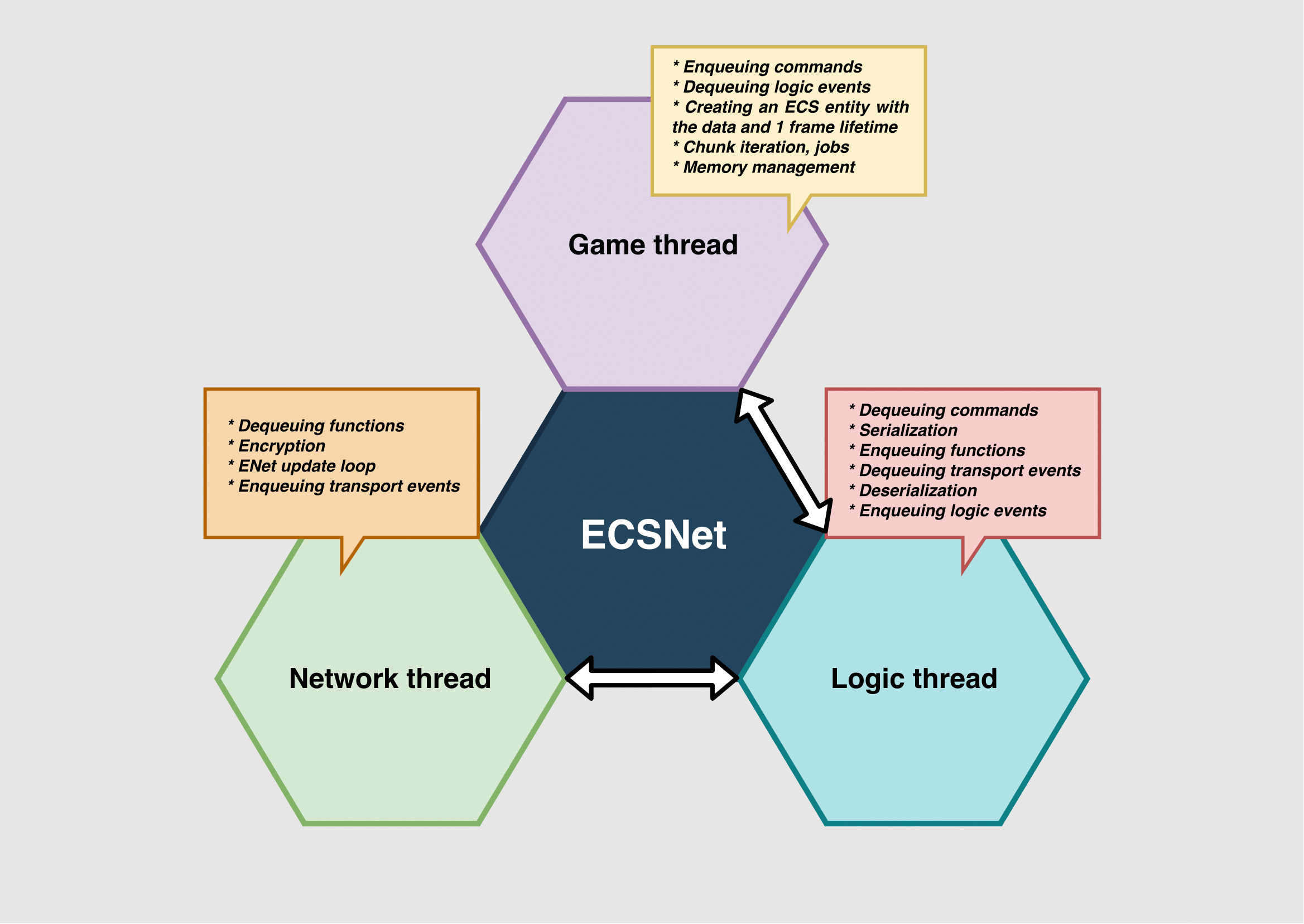 gilded bay
So what exactly is the point of jobs if you can't multithread API code
like why not just use a thread
gusty comet
I use jobs to perform heavy calculations over a large number of entities
zenith wyvern
Dots has it's own API for game logic integrated with ECS
You can build a game with it but it's still early and not in any way comaptible with most of the existing API
gusty comet
rendering/physics can be done and very sparse amounts of animations and navigation can be done in jobs with ecs
might be missing a few things
zenith wyvern
Physics is entirely dots, has nothing to do with existing unity physics
gilded bay
How big is the performance increase when using dots properly?
gilded bay
How complicated?
gusty comet
Once you wrap your head around it its pretty simple, but it has a lot of gotchas alaong the way
zenith wyvern
Up to each individual - for me it took a very long time to wrap my head around everything
And at the end of the day it's still so early you can't expect to actually finish a game with it.
It's possible certainly but yeah
gilded bay
Is unity's regular physics system multithreaded though? I see that on my PC, unity likes to evenly use all 8 threads
zenith wyvern
Yes, but the real performance boost in dots comes from Burst
It's truly insane how fast it can crunch through complicated math
 untold night
@gilded bay - This book is extremely useful for understanding the DOTS mentality: https://www.amazon.com/Data-oriented-design-engineering-resources-schedules/dp/1916478700/ref=asc_df_1916478700/?tag=hyprod-20&linkCode=df0&hvadid=266029226349&hvpos=&hvnetw=g&hvrand=11695572038639340120&hvpone=&hvptwo=&hvqmt=&hvdev=c&hvdvcmdl=&hvlocint=&hvlocphy=9033320&hvtargid=pla-569068014630&psc=1
zenith wyvern
And every package integrated with dots uses burst, including physics, so you can expect it to go real fast
I own that book and personally did not find it very helpful. Your milage may very
gilded bay
yeah I learn better by reading online articles
So does the whole ECS thing have it's own physics? Like rigidbodies and shit?
Or would you have to create your own physics
zenith wyvern
Yeah, physics is coming along pretty well
There's a unity version and havok version
Both with pros and cons, but both will outperform built in by miles and mils
gilded bay
What about standard components, such as wheel colliders and everything like that
zenith wyvern
You can check it out for yourself https://github.com/Unity-Technologies/EntityComponentSystemSamples/tree/master/UnityPhysicsSamples

GitHub
Contribute to Unity-Technologies/EntityComponentSystemSamples development by creating an account on GitHub.
gusty comet
you can leave things like vehicles as regular gameobjects still
gilded bay
So say you wanted to do something to an ECS rigidbody. Is it the same as regular unity? rigidbody.velocity
or are there more steps
zenith wyvern
If you just went to affect velocity, not really. If you want to manually respond to collisions, then it gets pretty complicated compared to built in
gilded bay
yikes
zenith wyvern
If you want something simple, it's not the way to go. If you want something scalable, then it is
Scalable in terms of performance and the code you're writing. It forces you to think about your data in terms of how your CPU uses it
untold night
they do plan to have some apis that are simpler/closer to monobehaviour way down the line but still backed by dots
zenith wyvern
Yeah they did say that a long time ago. I wouldn't count on it any time soon
untold night
I wouldn't expect it until at least next year. This year they're focusing on improving the code gen for systems, which I think will be the foundation for the simplified facade APIs
gusty comet
I think they need to add more general functionality before they worry about a simplified api
deft stump
@gilded bay the best way for me to wrap around dots properly was to think in sql databases.
recursive linked you the book but the long and short of it is.
entities = index / primary key.
components = coloumns.
systems = sql statements.
gilded bay
Yeah that makes a little more sense
gusty comet
is it just one system per file?
gilded bay
https://forum.unity.com/threads/unity-job-system-is-not-working-as-expected.809706/
Someone said you cant use unity api in jobs but this guy calls transform position?
Unity Forum
I'm learning unity DOTS technology and tried to create a small project which instantiates some prefab and moves it to the final target. project is...
gusty comet
the transform position he is callling is a member of TransformAccess which is not the same as transform
So basically
they recreated parts of the unity api that can be used
so far they have a rendering api, physics api, very early animation api and a very limited way to deal with navmesh
gilded bay
alright
gusty comet
is it safe to reference a component on another component?
ocean tundra
no
Components are Sturcts, if you store a component in another component it will create a copy
gusty comet
same for entities?
ocean tundra
thats why foreach uses ref, so when we set a value its to the same instance
umm less of a issue storeing entities
entities = id
so you can safely save that
BUT when using it you need to be sure that entitiy exists
you can use EntityManager.Exists for that
gusty comet
awesome thank you roy
any suggestion how i can make something like this work in ecs then since I can't refrence components though?
public class node
{
    public node previous;
    public float3 position;
    public node next;
}
basically i have an editor script i can use to create "nodes" each node has a previous and next set so Ic an do like node.next.position
and so that the ai doesn't go off the navmesh
ocean tundra
so its for a navmesh path?
super high level you can change node to Entity
but if its for a navmesh path theres a better way
gusty comet
can an entity refeerence another entity
its for a waypoint system
not a navmesh path
but its basically the same
ocean tundra
yea
ok
so you can remove next and previous
and then change node to a Buffer component
so waypoint path, the 'unit' moved down it then back?
gusty comet
it loops
the unit moves from one point to the next, then back to the first point created when finished
ocean tundra
a entity will have a buffer of path points (nodes) and a 'pathingwaypoints' component,
that component store next path INDEX
gusty comet
will the index of the buffer be the same order I add them in?
ocean tundra
yes
gusty comet
awesome this sounds like a great idea!
ocean tundra
and then in your pathing system you do something like:
entities.foreach(ref pathingWaypoints, in translation position, in dynamicbuffer nodes)
var nextNode = nodes[pathingWaypoints.NextIndex]
do some check to tell if needs to go to next index...
another check to see if at end of path
probs need to store path direction too
gusty comet
I think its so weird you have to use a buffer if you need an array on an entity
ocean tundra
sorry that system should have translation as ref, and maybe a speed component/stat too, and you update translation as the unit moves
buffer,, array, all just names they are the same thing under the hood
could probably have called them dynamicarrays and everything will be fine
gusty comet
yes but the fact they attach to the entity
instead of being in a field on a component
is odd to me
ocean tundra
oh yea that is odd
but makes sense
when you read more about memory layouts it all clicks and makes sense why they did it this way
for SPEEED!!!!
zenith wyvern
gusty comet
can an entity refeerence another entity
Yeah you can store an entity reference in a component
 dense wren
How does Graphics.DrawProcedural differ from commandBuffer.DrawProcedural
Is it a case Graphics is immediate while the latter depends on when the buffer is run?
 stiff skiff
Ran into a funky problem. Hoping someone has some ideas.
if (thingy) {
Entities
  .WithoutBurst()
  .WithChangeFilter<SomeComponent>()
  .ForEach(() => {...}
} else {
Entities
  .WithoutBurst()
  .ForEach(() => {...}
}```Copy paste took more effort then expected xD
This is some code I have in a system based on SystemBase
And it seems to not actually be running properly due to them being the same query, but the changefilter being applied based on the condition
if (thingy)
{
  myQuery.ResetFilter();
}
else if (!myQuery.HasFilter())
{
  myQuery.AddChangedVersionFilter(ComponentType.ReadOnly<SomeComponent>());
}```If I do this instead, and use an old Entities.With(myQuery) using the ComponentSystem instead. Everything works fine
Basically I want to run my ForEach with an optional change filter. And it's not liking this 😦
stiff skiff
The issue is that internally, it will generate 2 functions to generate the 2 queries
however since they are the same beyond the filter, the 2nd generation attempt will grab the cached first query :/
And then set the filter on "both" due to it
 pulsar jay
maybe you could alter your second query as a workaround?
like querying for an additional component etc.?
pulsar jay
Wasnt there a way to reuse queries and set/remove filters with entities.foreach too?
stiff skiff
I can technically leave out the filter, have it store the query and do the filter there manually
But at that point I'm working around additional Unity ECS bugs, and I don't want to
pulsar jay
Isnt that essentially what you are doing with ComponentSystem now?
 rancid geode
stiff skiff
So back to `ComponentSystem` it is
rancid geode
stiff skiff
So back to `ComponentSystem` it is
If you need so bad to use ForEach instead of IJobChunk, you can just create 2 systems and make "thingy" be a condition that both knows (so you will have only one of the two system actually executing)
rancid geode
stiff skiff
```csharp
if (thingy)
{
myQuery.ResetFilter();
}
else if (!myQuery.HasFilter()...
oh, just remembered about the WithStoreEntityQueryInField, you could try use to do the same logic as here and have only one ForEach
not sure if it will work
deft stump
hey bruno, sorry for calling your attention, but is there a way to cache subscene entities onto an NHM without using a System to do it?
rancid geode
not sure what you mean by that @deft stump
deft stump
so for context:
I have 6 x 3 panels in a grid.
this grid is a subscene.
now, I want to store these panel entities onto an NHM.
but, when I try to do it in a custom Authoring -> Play -> NHM is empty. (maybe because it's in a subscene that's why it won't store? I dunno why)
so the only jank solution i made is to make a System that checks / adds all the Panel entities onto the NHM.
And enable the critical Systems that needs to do the actual work once I validated it's all in there.
stiff skiff
pulsar jay
Isnt that essentially what you are doing with ComponentSystem now?
The manual filter? Yes.
pulsar jay
Just saying that you could do the same with SystemBase which should be more future proof. But @rancid geode 's idea to use WithStoreEntityQueryInField might be the better solution
stiff skiff
Yeah using WithStoreEntityQueryInField was the plan, it's the only way to do this with SystemBase
The reason I wanted to switch to SystemBase was to get rid of the "hack" we already used. I could switch and change the hack to a different hack to work around a bug, or I can keep things the way they are and know that I won't get any new unknowns due to switching to SystemBase
 honest plinth
dense wren
How does Graphics.DrawProcedural differ from commandBuffer.DrawProcedural
Is it...
honest plinth
dense wren
How does Graphics.DrawProcedural differ from commandBuffer.DrawProcedural
Is it...
Yeah, Graphics.<something> will have immediate results. Putting commands into a command buffer will make the commands run at a later point when the command buffer is executing. You can run the command buffer immediately by calling Graphics.ExecuteCommandBuffer of course, and can reuse the same built command buffer over multiple frames
dense wren
Why might I want to defer execution over just running it immediately?
deft stump
dense wren
Why might I want to defer execution over just running it immediately?
can you elaborate?
asking about .Schedule() vs .Run()?
 amber flicker
dense wren
Why might I want to defer execution over just running it immediately?
amber flicker
dense wren
Why might I want to defer execution over just running it immediately?
It's rarely "I want to do this later" and more usually "I want to use other threads/workers/cores" - as soon as you do that, you have to schedule the job (ie not run it immediately on the main thread) - and in the context of Unity, the order and scheduling is related to the safety system and what components you're reading/writing. apologies, looks like I was missing context
north bay
Isn't he talking about the graphics command buffer?
deft stump
@amber flicker srry for ping, but I have a quetion.
I have 6 x 3 panels in a grid.
this grid is in a subscene.
now, I want to store these panel entities onto an NHM.
but, when I try to do it in a custom Authoring -> Play -> NHM is empty. (maybe because it's in a subscene that's why it won't store? I dunno why)
so the only jank solution i made is to make a System that checks / adds all the Panel entities onto the NHM.
And enable the critical Systems that needs to do the actual work once I validated it's all in there.
Whats the alternative?
amber flicker
oh.. haha.. I suppose I should scroll up huh 😅
amber flicker
deft stump
<@!190954630623002624> srry for ping, but I have a quetion.
I have 6 x 3 panels...
I would probably store this data in a blob on conversion. It's not actually that tricky and works well with conversion workflows. Otherwise, a runtime system that populates a NHM is fine.
Though if, like me, you later need that NHM accessible via a SB (SystemBase) as well an ISB, that will be painful.. so blob I think? Not sure if you can store a NHM directly in a blob though - not tried. Anyone else know?
deft stump
hrmmm will ISB replace SB?
amber flicker
deft stump
hrmmm will ISB replace SB?
in the long term, it'll be preferable.. but not anytime soon in general
zenith wyvern
dense wren
Why might I want to defer execution over just running it immediately?
As I understand it if you use "DrawNow" functions then Unity can't integrate it with lighting and shadows correctly
amber flicker
helps squeeze out performance where you need to - it makes a system fully bursted
gusty comet
What is isb?
amber flicker
yea, like Peaj says. ISystemBase - it's like SystemBase but a struct, burstable and a tonne of limitations right now. For example you can't use ECBs in them.
Very early days
pulsar jay
interesting. how do you keep track of the changes? just reading the source?
amber flicker
the release notes but also follow the forum quite closely and there were a couple of posts about it
 acoustic spire
What's the best practice to develop with DOTS atm: creating entities at runtime or use "Convert To Entity" components? Isn't the last one a temporary thing?
pulsar jay
acoustic spire
What's the best practice to develop with DOTS atm: creating entities at runtime ...
Conversion workflow is the recommended way atm. Probably best using subscenes
 warped fog
Why is creating entities at runtime not recommended? It makes more sense in my head to create the archetype and manually creating the entity rather than converting... Is there a reason for this?
coarse turtle
you can still create entities at runtime, but for certain things like with rendering or physics, there's a lot you may need to set up manually which can be confusing I imagine
pulsar jay
@warped fog you can absolutely do that. Its pretty tough for more complicated objects because the consist of a lot of components (a lot more than monobehaviours) and you loose support of nearly all editor tools
warped fog
Aaaaaah.
acoustic spire
pulsar jay
Conversion workflow is the recommended way atm. Probably best using subscenes
Happily, I'm on right way with subscenes. Speaking about conversions, you can convert from "generator component" (it takes object count and their common properties as input) or can just manipulate bunches of GameObjects in editor when at runtime they will be converted with built-in converter (1 object to 1 entity). What's better?
pulsar jay
Even just parenting entities in code is quite cumbersome
warped fog
Thanks @pulsar jay that explains it. Good to know.
pulsar jay
acoustic spire
Happily, I'm on right way with subscenes. Speaking about conversions, you can co...
Hard to say. I guess both would work but in both cases the GameObjects you create should preferably be prefabs
I suppose ECS would only convert it once and "reuse" it then
acoustic spire
you mean instead of separate scene nodes?
pulsar jay
no I just meant if you are scattering tree prefabs for example the tree should be a prefab
but either way creating the gameobjects at edit time and putting them in a subscene should be fastest because subscenes store them in entity format which can just be copied to memory
acoustic spire
it makes sense, thanks
scarlet inlet
I wrote some code assuming that GameObjectConversionSystem.GetEntities would return the children of the primary entity. Apparently I was totally wrong and I still can't figure out what GetEntities actually is
but my question is now: how am I supposed to get the children of a gameobject I am converting to entities? Shall I just traverse the hiearchy?
ocean tundra
Yea i had that issue
theres something like, GetPrimaryEntity
and then off that you can get the LinkedEntityGroup
not sure if theres a better way but it worked
scarlet inlet
hmm using the EntityManager somehow I presume
physicsWorldEntityManager.GetBuffer<LinkedEntityGroup>(primaryEntity); ?
scarlet inlet
thanks
ocean tundra
if you find a better way let me know 😛
scarlet inlet
I read an article about GetEntities, I didn't understand it...it seems that a lot of options are thrown there just to solve very specific cases, but add confusions when the specific cases are unknown. Thoughts?
ocean tundra
i think GetEntities is cause a gameobject can have more then 1 entity
using something like CreateAdditionalEntity
scarlet inlet
yes that's what I read from the article, didn't understand the use case at all
ocean tundra
ummm
so for me
im building a networking system
each networked entity has a 'shadow' entity
the idea being is your gamplay entity needs pretty much 0 changes in order to be networked
all my network data for that entity is on the shadow, then synced over to the client shadow as well
So i can use CreateAdditionalENtity during conversion so i dont have to make those entities at runtime
saves me a very small amount of cpu for startup 😛
probably not worth
scarlet inlet
two entities in the same world?
scarlet inlet
in the same world
scarlet inlet
and both have two entities per gameobject
ocean tundra
so your Gameplay entity => server shadow ===MAGIC===> client shadow ==> client gameplayEntity
yup
ocean tundra
cant read a buffer from command buffers
command buffers is write only
you can add a buffer
and setup its values
and if you need random read to a buffer
gusty comet
oh wait
ocean tundra
theres something like BufferFromEntity or something
gusty comet
there is GetBuffer<T>(Entity