#archived-dots
1 messages · Page 195 of 1
 warped coral
 safe lintel
burst compiled everything(systems)
safe lintel
id assume so
safe lintel
ugh like 90% of my systems refer to the collisionworld from physics so i cant switch everything over to ISystemBase 😅
 coarse turtle
hmm how would you get another ISystemBase from a struct system 🤔
 amber flicker
That’s what I want to know too
Was Script saying those methods are internal?
Super painful to rewrite all lambdas as ijc’s.. not what I was hoping for 😔
safe lintel
yeah there is a utility thing thats all internal atm
safe lintel
from my perspective it doesnt matter because all the current systems id be doing that for arent the struct types 🙂
 stiff skiff
Awwww yeah upgrade from 0.14 to 0.17 without any issues. Hell yeah
Not that its useful, but it was fun to try 😅
amber flicker
Yea upgrade was fine - only wanting to use isystembase where I’m running into a wall of issues
safe lintel
@stiff skiff hows perf for you? i feel like my project is 5-10% slower but im way too lazy to do any thorough testing
stiff skiff
Yeah Im interested in those, but I saw no docs on the unmanaged systems
amber flicker
‘docs’? What are those?
stiff skiff
safe lintel
<@!137177294518091776> hows perf for you? i feel like my project is 5-10% slower...
Sadly we don't have our performance tests in place, so I wouldn't know
Docs are those things I hate writing, but am required too xD
Especially if I need to write them in readme.io's garbage of an editor
amber flicker
I say upgrade was fine but currently my perf is absolutely crippled by jobs that shouldn’t be running 🧐
 north bay
It feels slower than 0.16 but maybe I'm just imagining, haven't actually tested it.
stiff skiff
Talking about docs.. how come they are able to release the new package.. without automatically publishing the new documentation on the site?
safe lintel
yeah anecdotally the transform group in my default test scene was at around 0.4-5ms and is now 0,6ms
amber flicker
Transform system was supposed to have ‘modest gains’
north bay
Half of the important stuff to me is still missing, unmanaged EntityCommandBufferSystems, unmanaged ghost prediction information, unmanaged physics world
etc
amber flicker
Not to mention .enabled
north bay
And I guess they didn't want to add lambda support since they are working on code gen right now
north bay
amber flicker
Not to mention .enabled
Enabled is a thing for ISystemBase it's one the SystemState ref
But it generally feels a lot less finished then previous iterations idk
amber flicker
That’s just system enabled that’s always been there no? I mean re ICDs
north bay
Ah yea, no I bet that's months away
LIke they push out this huge thing => unmanaged systems but half of the functionality is just missing
stiff skiff
north bay
Half of the important stuff to me is still missing, unmanaged EntityCommandBuffe...
What is unmanaged ghost prediction?
amber flicker
north bay
LIke they push out this huge thing => unmanaged systems but half of the function...
It’s actually closer to 95% (missing) though
stiff skiff
Yeah never use any new features in a release, it's just not worth it
wait 1 or 2
though sadly this means 3 to 6 months now 😅
safe lintel
i did notice an interesting physics component named CollisionWorldProxy, allows dataflowgraph nodes to access the collision world, not sure how long thats been there
amber flicker
I’m going to have to spend the time butchering my code cuz I want to see what perf difference there might be 🙃
 hollow sorrel
didn't 0.17 basically release 2 months ago internally (going by the date on the changelog), guessing that's when it got feature locked and shipped for qa(?)/getting other packages like physics up to date
but other updates got released basically as is including the issue of not having everything updated at same time
safe lintel
i thought we were qa 😉
north bay
True lol
hollow sorrel
so maybe internally they could be further ahead than we think (wishful thinking)
north bay
Won't believe that until I get my roadmap
hollow sorrel
yea i doubt they have qa for entities atm as well but does it really take 2 months to update other packages 
stiff skiff
I would love any kind of roadmap, or communication, in an official capacity
amber flicker
hollow sorrel
yea i doubt they have qa for entities atm as well but does it really take 2 mont...
This was the first time all dots packages were tested together... not at all surprised a bunch of issues turned up.
Pace overall though really does feel staggeringly slow
safe lintel
just some official communication would go a long way of soothing the slow development
stiff skiff
I'm just worried there are some really big changes on the roadmap that I'd like to see coming
amber flicker
Just posted this as it’s the top level info I would have liked to have known re .17. Please add/make corrections: https://forum.unity.com/threads/entities-0-17-changelog.1020202/page-2#post-6754924

Unity Forum
Quick overview of first things you may hit that I would have liked to be aware of (please correct any inaccuracies- this is from an hr of checking out...
stiff skiff
amber flicker
Just posted this as it’s the top level info I would have liked to have known re ...
You might want to provide an example of the mentioned cryptic error. They will certainly ask for it
Also that error IS weird..
because System.IntPtr is a struct...
 karmic basin
I see netcode 0.6.0 prev7 on my side
january 22
Dynamic buffers serialization over the network ❤️
 ocean tundra
How can i load a subscene into a custom world?
coarse turtle
@amber flicker I chuckled at my little hack to reference struct based systems
Edit: You don't need the unsafe declaration, I was testing something earlier
amber flicker
coarse turtle
<@!190954630623002624> I chuckled at my little hack to reference struct based sy...
Nice! May steal 🙂
coarse turtle
Yeah I put it into an assembly definition reference so I can access stuff
Also one last thing, since SystemRef is a ref struct, you can't store it as a member to your systems - so you pretty much do World.GetOrCreateISystemBase<T>() in OnUpdate
 fluid kiln
Would it make sense to have a system that calculates the distance in between all "characters" entities and save it in a lookup rather than calculating distance in multiple systems using sphere casts and transforms? If yes, how do I loop over every permutations of characters and in what data structure do I store the distance so I can reference it with two entities to get their distance?
This would be for an aggro system and an ability range system
I imagine having it sorted so I can get the closest character would be useful too
 pliant pike
I'd do it in a separate system, and just store the float distance on the entity
fluid kiln
Yeah that makes sense. How can I loop over every entity twice since we can't nest Entities.ForEach tho?
pliant pike
do you mean because your checking entities against one another?
fluid kiln
Yeah exactly
pliant pike
use an entityquery for the distance component and whatever other component that's on the entity for the job
fluid kiln
Ding ding, never used Entity queries before but that sounds like the answer
thank you i'll look into it
pliant pike
no prob
fluid kiln
Say I want to get both the entities and the components from my query should I do something like this?
        var characters = characterQuery.ToEntityArray(Allocator.TempJob);
var translations = characterQuery.ToComponentDataArray<Translation>(Allocator.TempJob);```Or am I better to do GetComponent<Translation>(characters[i]) in my foreach?
Would the order of characters and translations be guaranteed? And does doing query.To...() twice executes the query twice?
pliant pike
GetComponent is basically random memory access and so slower and not optimal
both of the those ToEntity and ToComponent are basically there own separate jobs
you should only really need the ToComponent
if you iterate through the entitys that you want with the job
fluid kiln
        distanceMap.Clear();
        var characterQuery = GetEntityQuery(typeof(Character), typeof(Translation));
        var characters = characterQuery.ToEntityArray(Allocator.TempJob);
        var translations = characterQuery.ToComponentDataArray<Translation>(Allocator.TempJob);
        for (int i = 0; i < characters.Length; i++)
        {
            for(int j = i + 1; j < characters.Length; j++)
            {
                distanceMap.Add(new EntityCouple() { e1 = characters[i], e2 = characters[j] }, math.distance(translations[i].Value, translations[j].Value));
            }
        }
        characters.Dispose();
        translations.Dispose();
I need both the entity and the translation to calculate their distance and insert the entity as key in the map
 zenith wyvern
There's no guarantee those arrays will align. Make sure you pass the exact same query to both arrays
Err, the same archetype to both queries rather
Then they are guaranteed to align
pliant pike
you could just have a single query actually
zenith wyvern
Oh yeah I guess so
fluid kiln
Don't I have 1 query?
pliant pike
yeah it is
zenith wyvern
Yes don't mind me I'm dumb
fluid kiln
Haha no worries, so there's no faster way to do this?
zenith wyvern
You could do some kind of fancy spatial partitioning. This is nice because it's simple though
zenith wyvern
You should put the actual "work" into a Job.WithCode though
pliant pike
I mean I would do an entities foreach(Entity entity, float distance) =>
instead of the two for loops
pliant pike
you would only have one for loop then
zenith wyvern
Yeah basically the foreach would take the place of your outer loop
pliant pike
just iterate through all entities against that one
fluid kiln
Correct me if I'm wrong but wouldn't that create 2 queries?
1 would be my entity query, and 1 my foreach?
With my double for loop I only have 1 query?
zenith wyvern
Well you should be creating the query in OnCreate and caching it in the system
pliant pike
well if you use a different query for the foreach
 viral sonnet
anyone else getting this error in 0.17 - InvalidProgramException: Passing an argument of size '10720'.
Unity.Entities.SystemBase.Update () (at Library/PackageCache/com.unity.entities@0.17.0-preview.41/Unity.Entities/SystemBase.cs:412)
fluid kiln
Ooh I can use the query in the foreach? Sorry I haven't worked with those before
zenith wyvern
And if you're using the same archetype I wouldn't be surprised if Unity was usiing the same query behihd the scenes
fluid kiln
But then I lose the index i that allows me to only get the combinations instead of the permutations
pliant pike
you can't really do that though can you, you get a error conflict if you use the same query in the foreach and an Entityquery
zenith wyvern
If can pass int entityInQueryIndex as the first parameter in the Foreach
 olive kite
i am getting a null World.DefaultGameObjectInjectionWorld in the new update, anyone experiencing the same?
viral sonnet
restart unity
olive kite
tried.
do we need to manually create the world now? there isn't a world on start after update
viral sonnet
huh, weird, I had the same error and it went away with a restart. No, I wouldn't have heard anything about it. Something that fundamental would get a notice in the upgrade guide
seems from the test changes, we have to put a partial now before every class that inherits SystemBase. doesn't throw any errors if you don't
warped coral
how should i do stuff like on-hit effects in ecs? Where the character has a buff that adds secondary damage to each of their attack/spell hits
oh wait
nevermind im overthinking things arent i
 opaque escarp
Currently having an issue wherein entities I instantiate during the ConvertGameObjectToEntity thing don't seem to save with Subscenes when closing them. If I run the game with the subscene open, it's fine, but on closing it loses them.
Outside of subscenes, they seem to be instantiatied fine and have their entity references updated according to their new parent just fine with just a LinkedEntityGroup thing.
For the subscene, I've tried manually adding a SceneSection to the entities, but am unsure how to programatically get the scene guid of the creating object. Any ideas?
op looks like there's a dedicated CreateAdditionalEntity method, that'll probably resolve the issues
Edit: it did
warped coral
how do i make a system where like... i can do stuff like +x% damage with spells or +x% accuracy to ranged attacks.... Conditional stat bonuses and stuff like that...
nvm i think i know
does WithChangeFilter work for dynamicbuffers?
opaque escarp
yes, adding and removing elements at least. Any time write access is gotten
ocean tundra
How do we use ISystemBase? I cant figure out how to Entities.Foreach
zenith wyvern
You can't use a foreach. You have to manually write the job and schedule it yourself. It seems like a lot of jobs might be broken when trying to schedule in a bursted OnUpdate though and cause weird errors - IJobChunk works at least
safe lintel
why would jobs be broken in the burst onupdate?
zenith wyvern
Apparently IJobChunk is the only job type you can schedule from bursted onupdate right now. I assume it's a bug
coarse turtle
#archived-dots message this is a dumb way if you want to grab system structs
 low tangle
that doesn't look like it saves any typing?
thats the entire meat of it? why wouldn't you just do World. ^
coarse turtle
SystemRef and world.Unmanaged.GetOrCreate are internal
coarse turtle
yeah I was too lazy to do that haha
low tangle
its not like they update this package every week or something where you would be annoyed about doing it all the time :^)
coarse turtle
true lol
viral sonnet
oh man, my framerate has halved with 2021.1b3, Entities 0.17 and NetCode 0.6 against 2021.1b2, Entities 0.16 and NetCode 0.5. Tomorrow it's time to figure out which part slows everything down. My bet is on hybrid renderer - aaand I'm not able to reproduce it anymore. best performance problems are the once that go away without doing anything 😂
ocean tundra
@zenith wyvern Sweet thanks, will probably stay with class SystemBase for now then
safe lintel
@zenith wyvern ive used entitybatch without any(noticeable) problems
zenith wyvern
Tertle on the forums said it wasn't working for him, weird
 quaint niche
Hi, I'm using ECS and I'm generating trees at runtime. There is a lot of leafs then (~300/tree). I thought about merging the leafs of a tree into a single combine mesh. Has there is several trees, I tought it was a perfect candidate for Jobification, but I can't figure out how to do that. I always end up with a Job which contains a non value reference. Is what I try to achieve possible ? Or should I go another way to increase performance (dynamic batching + GPU instancing - I haven't checked if this is already done. I guess dynamic batching I guess so as the leafs all comes from the same prefab. GPU instancing not sure)
Any help or advice there would be welcome. Thanks !
amber flicker
does anyone here create blobassets at runtime?
amber flicker
hmm do you just create blobs using a new BlobBuilder -> blobBuilder.CreateBlobAssetReference?
north bay
ref var resourceRoot = ref builder.ConstructRoot<BlobArray<TResource>>( );
Already throws errors for me
amber flicker
it would be nice if there were a BlobAssetStore associated with a world at runtime as it'd be convenient to usethe AddUniqueBlobAsset... wondering if I can just create an instance
north bay
TResource is constrained to unmanaged
This is the error I get error ConstructBlobWithRefTypeViolation: You may not build a type BlobArray`1 with Construct as BlobArray`1[] is a reference or pointer. Only non-reference types are allowed in Blobs.
Means we cannot use blob arrays as the root anymore?
amber flicker
didn't know that was possible before.. I don't get compile errors from a normal ICD in the root
 rancid geode
Did anyone notice the new DOTS packages section the 0.17 manual? Seems handy for when searching what is available already https://docs.unity3d.com/Packages/com.unity.entities@0.17/manual/index.html
karmic basin
oh yeaaaah no more google or bookmarks :D, thanks
 deft stump
dots timeline sure is interesting
rancid geode
it already links to the @latest link, so just one bookmark from now on :p
amber flicker
has anyone worked out if it's possible to grab an ISystemBase within a SystemBase?
I assume it's not?
karmic basin
I didnt look yet. Shot in the dark, we can't GetOrCreateSystem from the EM ?
amber flicker
karmic basin
I didnt look yet. Shot in the dark, we can't GetOrCreateSystem from the EM ?
sadly doesn't look like it
karmic basin
That would be too easy right ? ^^
amber flicker
I currently have some NativeHashMaps stored in a system that both ISBs & SBs would now need to access and I'm wondering where to put this data now. Would welcome people's thoughts. Roughly 50% of my entities (which can be many) store some mutable value in the hashmap. Options I'm thinking so far:- 1)Blobs - have to be created at runtime, recreated occasionally and shared references managed, 2) Shared statics? Is this a good option for NHM? 3) Singleton with e.g. unsafe hash map? 4) same as existing but duplicated - one system for managed, one for unmanaged, 5) something else? Storing on entity is an option but requires additional ICDs & entity reference I'd rather avoid I think.
karmic basin
I would go for 5 and profile before trying unsafe stuff, but you have more experience than me 🙂
coarse turtle
quaint niche
Hi, I'm using ECS and I'm generating trees at runtime. There is a lot of leafs t...
Have you looked at the mesh low level api's? You can use meshdataarray and nativearrays to create vertex and index buffers via job system and apply this data to a mesh.
amber flicker
karmic basin
I would go for 5 and profile before trying unsafe stuff, but you have more exper...
Wanted to avoid for complexity rather than perf reasons but yea.. didn't expect this issue
karmic basin
Yeah it adds steps but still it stays in the pattern ? So I think in my head I hope for performance in the future. But sure your own native containers are more straightforward usually and you can make sure they are performant 🤔
I don't have the answer I'll let the pros speak 😅
viral sonnet
am I the only one who doesn't find any ISystemBase docs in the 0.17 manual?
coarse turtle
viral sonnet
am I the only one who doesn't find any ISystemBase docs in the 0.17 manual?
no you're right, the docs aren't online yet
warped coral
how do i do uh.. secondary stats in ecs? Stats that are dependent on other stats and will automatically update when the other stat changes?
does anyone know
karmic basin
I would stack stat-modifiers ComponentDatas, and have a system that compute them all in the end
Making it all relative would make it like hell
warped coral
yeah... that's what i usually stick to. Idk how to do an elegant system where like.. i have attributes that increase secondary stats. Can't wrap my head around it...
and then statmodifier passives that increase one stat based on another stat.. automatically
dunno how
fluid kiln
Hey guys, is there no way to write into a system's fields from a job?
coarse turtle
If it is an unmanaged/blittlable field you can use NativeReference<T> in your System or a pointer
Here's an example:
public unsafe class SomeSystem : SystemBase {
  NativeReference<int> intRef;
  int* intPtr;

  protected override void OnCreate() {
    // Dispose these in OnDestroy()
    intRef = new NativeReference<int>(Allocator.Persistent, ...);

    intPtr = (int*)UnsafeUtlity.Malloc(4, 4, Allocator.Persistent);
  }

  protected override void OnUpdate() {
    var localIntRef = intRef; // Need to have a local copy
    int* localIntPtr = intPtr;
    Job.WithCode(() => {
      localIntRef.Value = 20;
      *intPtr = 1;
    }).WithNativeDisableUnsafePtrRestriction(localIntPtr).Schedule(...);
  }
}
Native Collections aren't bittable are they? :/
coarse turtle
they're structs
that contains pointers, but with collection checks, they contain a dispose sentinel which aren't blittable
there are also the Unsafe variants if you need them
fluid kiln
I'm trying to have a system that populates a map field that can be used by other systems
coarse turtle
like a nativehashmap?
fluid kiln
Yeah exatcly
coarse turtle
Yeah i dont see why that wouldn't work
fluid kiln
So like NativeReference<NativeHashMap<int,int>> ?
coarse turtle
No you can just do NativeHashMap<int, int>
coarse turtle
not exactly, remember that native containers store pointers
so you have a copy of the container, but the pointer points to the same content
fluid kiln
oooohh
So even if I assign it into a local variable, the field points to the same collection
Cool thanks!
viral sonnet
@warped coral start with that, you can either put the stats in a comp or buffer. what do you prefer?
a comp has all the stats, that's a downside, buffer is an array though and not as fast
you could also split the stats in smaller comps. produces lots of code though and I don't think it's really necessary
zenith wyvern
fluid kiln
I'm trying to have a system that populates a map field that can be used by other...
Just keep in mind that if you use a native container for this you're going to have to manually managed dependencies between systems yourself, unless you use an unsafe container attached to an entity, which comes with it's own issues as well
If you can get away with representing your map as a dynamic buffer on an entity it will make your life a lot easier
warped coral
if i'd like to maybe add more stats later on... and keep the game versions compatible.. i should use a buffer?
currently i have a DynamicBuffer<Stat>
fluid kiln
Yeah I think I'm in over my head with all of this. Where exactly in ECS are you supposed to implement helper methods? I was trying to recreate something like how PhysicsWorld has usable methods PhysicsWorld.CastRay(...), etc. Am I over thinking this? Should I use struct methods?
zenith wyvern
Only use a method on your component if it deals specifically with that component's data and nothing else
fluid kiln
My use case for anyone interested: I want to compute the distance between all my "player entities" and be able to easily query for the distance between two players from any other system
zenith wyvern
Otherwise make a static function on a helper class
fluid kiln
But what if my method needs background data?
zenith wyvern
You pass it into the function with anything else it ineeds
It's the only way to keep everything job/burst safe
fluid kiln
But where in the first place do I store the distance between all entities?
warped coral
wouldnt you use a system for that
zenith wyvern
You could have a native container or a dynamic buffer that gets passed around if needed
Hard to say without knowing the exact use case
fluid kiln
A singleton with a map component... I think I got too hooked up in weird stuff that I forgot the simple solutions lmao
Just to be clear tho, system methods cannot be burst?
zenith wyvern
That's pretty much how I represent my map in my game - a singleton entity with dynamic buffers that hold data for different aspects of the map
warped coral
oh yeah singleton entities
fluid kiln
I'd say no because the system themselves are managed
zenith wyvern
If they're member functions no they can't be bursted unless it's the new ISystemState struct which should probably be avoided if you're just starting out
It has to be a standlone static function to be burst safe
fluid kiln
Got you. Thanks a lot
viral sonnet
@warped coral updating is not a relevant question if you're using comps or buffers. you can make both work either way
the question is, do you want to give up speed for convenience in coding that thing.
because buffers need a lot less code, it's usually just a for loop with some conditions. with comps (i use them) there are massive walls of code 🙂
And I use multiple comps for the same stats. BaseStats, BuffedStats, FinalStats. Basically for every stage I have a different comp
i could possible make them generic but i don't really know how in ecs. not worth my time yet
and generics possible give up speed again. hard to test with no implemented solution then and no base metric for performance
fluid kiln
Okay well now I'm stumped. If I can't have NativeHashMaps on components, where am I supposed to store them?
zenith wyvern
You would have to store it in a system and pass it around, or use unsafe containers which can be stored on a component
Or use a managed component
fluid kiln
I would use dynamic buffers but not being able to lookup with custom keys makes things difficult
zenith wyvern
Yeah it's definitely not suitable for all cases unfortunately. An UnsafeHashmap should work for you, you just have to make sure you manually dispose it before the entity is destroyed or else it will leak memory
fluid kiln
I'll look into it. Thanks
warped coral
@viral sonnet hmm.. so.. i should have multiple buffers and systems? one for primary, then one to auto-update secondary based on primary?
 keen spruce
I would just make it work and then iterate as you go because otherwise you will spend forever trying to come up with the perfect design on paper
simple but limited is better than non-existent. if its too slow optimize.. otherwise its fine
 robust scaffold
ISystemBase is the harbinger of the return to Struct based Jobs. We're going full circle now. From Classes to Structs to Lambdas and back to Structs.
I havent used hybrid renderer in so long though. Cant even get a cube to show up
zenith wyvern
For v1 you need to disable SRP batcher in the URP configuration assets
And jobs have always been struct based haven't they? Everything else is just a wrapper to save typing. Which is very good and valuable
robust scaffold
My main struct job was the old IJobForEachEntity_XXXXXXXX which were deprecated a long time ago. Replaced by lambdas. Now it's looking like it's going to be resurrected from the dead.
zenith wyvern
Not that I know of. Even back then I think those were just compiled into IJobChunks
safe lintel
still wish they never removed IJFE
zenith wyvern
Which has always been the core of ECS jobs
There is a replacement coming isn't there?
Some middle ground between IJobChunk and IJFE
Forget what it's called
robust scaffold
Yea, I need to figure out how to use IJobChunks. It's the only job type working with bursted isystembase
safe lintel
yeah theyre still working on it i think
robust scaffold
IJobEntity I think thats what they called it. Saw it for a second on the forums a while back.
zenith wyvern
Yeah that's the one
I can see why people liked IJobForEach but their reasoning for getting rid of it is good. The generic overloads are just hilariously bad
safe lintel
@spark glade
so saw this linked in the entities docs, com.unity.compositor for use with animation. might be able to bypass the nightmare of connecting nodes in code soon? or now?
zenith wyvern
Huh, ECS version of the ancient Unity animator I guess?
safe lintel
yeah, i guess theres no conversion of existing animators(dunno if there ever will be?) tho.
zenith wyvern
Looks like the manual has been updated too, more stuff on conversion and livelink
Finally some docs on hybrid components https://docs.unity3d.com/Packages/com.unity.entities@0.17/manual/hybrid_component.html
robust scaffold
Does Hybrid Renderer and URP not work together with lighting? None of my objects are picking up any lighting I put in the scene.
zenith wyvern
v2 supports most lighting
robust scaffold
My default background skybox changes with lighting changes but not the quad I stuck into the scene.
Same plain old lit shader.
Without lighting, the plane should be black. Yet the color doesnt change.
zenith wyvern
Looks like you're using a subscene but it's still open, does it work if you close the subscene?
Did you verify the lighting works if you turn it back into a normal gameobject?
robust scaffold
Subscenes open or closed shouldnt matter. And ah figured it out. Forgot to turn on lighting.
Ah, URP only directional lights supported. Welp. Okay.
safe lintel
@zenith wyvern joachim just said in that 0.17 notes thread We don't yet recommend using ISystemBase. It doesn't have all functionality yet. We are still working on getting full coverage.
zenith wyvern
Ahh, makes sense
robust scaffold
Do they expect us to listen? We're here suffering through DOTS in the first place.
Of course we'll suffer through the broken and barely functioning ISystemBase as well.
safe lintel
well they dont recommend it for production either, i think they know we wont listen
warped coral
when is it ok to have methods inside a component?
would it be bad to make stats entities themselves so i can add statmodifier components to them individually
zenith wyvern
I wouldn't. Then you can't query for them alongside whatever they're being applied to
warped coral
idk im confused. do dynamic buffers still get processed even when empty?
i think i want different kinds of statmodifiers. The standard permanent, the temporary kind, the conditional kind, and the gradual decay/growth kind. With the gradual and temporary kinds, i'd like a system to not process them when they dont exist
zenith wyvern
If you have a job that includes a dynamic buffer in the query then yes it will run whether or not it's empty. You can use change filters so it will only run when the buffer changes (on a per chunk level)
To make a system like that that's extendable and works well would require pretty deep knowledge of Unity's ECS I think. May want to start simpler until you're more familiar
warped coral
hmm.. i know i need the gradual/temporary kinds to constantly tick down their time and then remove them when they're done. but dunno if i wanna use a dynamic buffer. If i use a component, then the systems that process them will automatically turn off... If i put the statmodifiers on the character, i'd have to have a string on them for their name to know which stat it affects i think. if i make an entity for each stat and also put a stat component on each stat entity, and then stat modifiers for each stat entity, i could just process each one and not need to look up to make sure each stat modifier affects the right stat i think
robust scaffold
You can use multiple systems.
One to handle the time reduction and another or multiple to handle adding and processing of the time dependent statuses themselves.
The time reduction system is simple:
private override void OnUpdate()
{
  var elapsedTime = Time.DeltaTime;
  Entities
    .WithReadOnly(elapsedTime) // Not sure if necessary but good to have.
    .ForEach((ref DynamicBuffer<TimeStatus> statuses) =>
    {
      for (var i = 0; i < statuses.Length; i++)
        statuses[i] -= elapsedTime
    }.ScheduleParallel();
}```Then with another system, read and process whatever happens with that time.
Always good to compartmentalize your code. If you need to time change to happen before or after the read/process status step, use [UpdateBefore/UpdateAfter]
warped coral
yeah... i'm more concerned with how to structure the stuff though. Like uh... where to put my stat modifier components so its easy to tell what affects what stat, and easy to loop through for calculating the stuff for the stats
robust scaffold
Depending on how you create those stats. Hardcoded? Simple. Use an enum and a giant switch statement with hardcoded effects.
From files? That'll be a lot more difficult.
warped coral
im thinking of making stats have their own entities in addition to having their own components... dunno if that's a bad idea. I'm not hardcoding the stats. So i have to use dynamic buffer or components with strings i think
i dont really wanna make a component and system for each stat either
robust scaffold
I've been using a sort of "centralized" status entity.
One entity with all the various modifiers and effects that status has. Then pass around the entity variable itself like a referance.
So something like a status on a player entity would have a struct like:
public struct TimeStatus : IBufferElement
{
  public Entity StatusType; // "Reference" to the centralized entity.
  public float TimeRemaining;
}```Then use GetComponentDataFromEntity<>(true); to get the exact data that the status effect has on the entity
This really only helps if you have a lot of entities with that TimeStatus. Using the GetComponentData is not that efficient. It's a balance between a cache miss vs memory usage.
warped coral
hmm i do like how flexible that is.. although it seems like it creates a lot of entities to manage although i'm not sure if that's bad for performance or whatever
robust scaffold
Really depends on how complex your status is. If it's just a simple health reduction over time, then just bake in the effect using an enum stating that the health will be reduced and a float value.
If it's really complex with further dynamic values or one you would like to change globally instantly, then use a separate entity and pass around its reference.
warped coral
hmm ok i'll try that and see how it goes
if each stat is an entity, whats a good way to retrieve values for specific stats on a character?
robust scaffold
Use GetComponentDataFromEntity<>(true) then use the Entity variable as the index to the ComponentDataFromEntity array.
warped coral
like how should i store the entity variable?
robust scaffold
It's a variable like int or float. Just stick it in a struct.
warped coral
oh... so like.. dynamic buffer of some struct where the struct has stat name and stat entity?
robust scaffold
Ehhhh, you cant use strings in dynamic buffers. Well, you can with NativeString but try to avoid it.
warped coral
what about FixedString32
robust scaffold
Yea, but what's the benefit of wasting memory space for string values? Nothing in unity currently can display strings directly from an entity. It has to be converted to managed value first.
If you need it to represent something, use an Enum or just a plain int value. Far less memory usage.
I have a lot of entities that have localized names. I just use an int to represent it in another string[] that is then used by the UI.
warped coral
what if i want to add more stats later on and keep game versions compatible with older versions and stuff
robust scaffold
Well okay. Your code.
warped coral
actually i guess i could just make an enum for most stuff. for elements or damage types i could just add everything under the sun and it should be foolproof
karmic basin
zenith wyvern
Looks like the manual has been updated too, more stuff on conversion and livelin...
Oh yesssss finally, I spent the afternoon reading blogs about the conversion workflow 😔
 spark glade
safe lintel
<@!647967244478971910>
spark glade
safe lintel
<@!647967244478971910>
Oooohhh!
opaque escarp
I've been trying to get animations to work with the DOTS Animation Graph thing. I've confirmed I can deform the model by changing the values the SkinMatrix buffer directly, but I can't seem to get anything to play, it's always the bind pose. What I've tried is creating a Base Graph Asset Model and in it adding an Animation Clip node (and accompanying clip) and linking it to the Output, then assigning the graph to an AnimationGraph component on the game object. Is there something else that needs to be done?
ocean tundra
Hey all
Any ideas how I could work around this issue:
'The EntityArchetype was not created by this EntityManager'
Basically during conversion (subscene) im building a list of networked components (translation and rotation) and then building a Archetype, and then during play I create a 'shadow' entity using the Archetype i've created during conversion
Maybe I could store the component types in a buffer?
Turned out storing component types worked perfectly 🙂
Wow I just enabled hybrid renderer V2 and its spewing TONS of 'A Native Collection has not been disposed, resulting in a memory leak. Allocated from:...'
For anyone else getting them, if your using many worlds make sure only 1 has the hybrid renderer on
 rancid shell
It is typical to have something like a component that represents something being processed, and a component that represents when this process is completed?
ocean tundra
Yea i often have tag compoents for that
so i can have a ForEach.WithNone<TAG> which will loop everything that needs to be processed
and within that i often use a command buffer to add that tag component
 rotund schooner
anyone know any rigorous benchmarking done on dots physics vs PhysX?
 rugged lark
Hello all. I've been interested in using Unity to do simulations and discovered DOTS. Just getting up to speed and excited to find a group to learn with. Does anyone have any recommendations on learning materials they found helpful? Or if there are any good established patterns for composition oriented game programming I'd appreciate hints that direction as well. Meanwhile I'm googling my little heart out.
I did have a question right off the bat. If I have a chunk of entities that should be evaluated by a Movement system, is it better to have a Movement component on those entities at all times and just tweak a value inside the component to represent the vector, setting to 0 if it is not moving? Or is it better to add a Movement component only to those units that will be moving in the next frame? I know adding and removing tags causes a structural change and a sync point, so for the purposes of reducing those I assumed you'd want to just leave a Movement component on the entity and have the system check to see if it is 0 and ignore it. I know this will make the system iterate over all of the entities, instead of being able to create a separate chunk of moving entities and iterating over that smaller subset. Can someone provide some guidance on what the best practice might be in this situation?
robust scaffold
Hybrid renderer is garbage. Stick with plain Entities and bootstrap to Mono manually.
zenith wyvern
rugged lark
I did have a question right off the bat. If I have a chunk of entities that shou...
You should avoid per-frame structural changes as much as possible. Even iterating thousands of entities takes almost no time (assuming the work the system is doing is relatively cheap) compared to the cost of a structural change. And if you really want to you can use change filtering to avoid doing work unless a component is accessed as read-write by another system
You should profile of course but if all your system is doing is adding to a float3 and you run it bursted with ScheduleParallel you'll most likely find it takes literally a fraction of a millisecond, even for thousands of entities
rugged lark
@zenith wyvern thank you for your insight. As I was reading about EntityCommandBuffers I got the impression that there would always be at least one sync point per frame. Is that a faulty assumption?
zenith wyvern
If you're using the command buffer to perform a structural change then yes it will cause a sync point whenever the command buffer runs
rugged lark
I guess the root of my question is whether or not I can expect at least one sync point every frame already. If so then entity command buffers seems like the way to go to make sure there will only ever be one per frame. But if you're implying that there isn't necessarily a requirement to have 1+ sync points per frame, but instead multiple frames can cycle without a sync point occurring, then I'll just go the first route and try to optimize for as few component modifications as possible.
zenith wyvern
As far as I know there's no reason you would absolutely require at least one sync point every frame. Practically speaking most non-turn-based games are probably going to have one or more, but it's not a 100% thing. But it's not like just because you have one structural change that you can add a dozen more and it won't slow you down. Rearranging the memory of the chunks from the structural changes is expensive even aside from the fact that it's forcing all jobs to complete before it happens.
You can use batch operations on entity queries to try and reduce that a bit but really you should just try to avoid it if you can. Sometimes you can't. The scenario you described did not sound like it required a structural change, at least
rugged lark
Thanks again. Honestly I was hung up on the timing of sync points more than the computational cost. It seems optimizing for the minimum number of changes is probably the best option all the time.
zenith wyvern
For performance critical code yes. Don't get too hung up on it in every case - sometimes you just need a new component so you can have a new system act on it. That's an unbelievably useful tool that you shouldn't discount either
The point to stress is to avoid doing it every single frame if possible.
 half jay
i have crash with log and i cant understand what can be wrong
looks like in this sytem
quaint niche
coarse turtle
Have you looked at the mesh low level api's? You can use meshdataarray and nativ...
Thanks haven't tried that. I'll go check if I can make something work with this !
 warm panther
Q: Can I force the physics world to fully rebuild? I have a bug with static colliders that I need a workaround for.
World.GetExistingSystem<BuildPhysicsWorld>().PhysicsWorld.CollisionWorld.Reset(10000, 10000);
That does not do the trick. 😶
My problem is (still) that some static colliders don't work; if I add a PhysicsBody, that works only if it's not static (so dynamic or kinematic are fine).
This occurs of the entities are moved into another chunk in late conversion.
(in this case by adding a sharedcomponentdata)
An unreliable workaround is creating or destroying another static body.
I have a bug report repro project where that works, but it doesn't work for every constellation of bodies and components.
warm panther
Unity Forum
This might be a bug / unintended behaviour of Subscenes with Unity Physics. It has been a lengthy derailment of the Subscene workflow thread, but...
Forum topic with screenshots and 60kb sample project for the morbidly curious.
I think I will just workaround with kinematic bodies for now even though that's a couple hundred colliders.
warm panther
Scheduling Question: If I want some code to run exactly and only when ever a certain Jobhandle has been completed... how would I do that?
Basically to do somethign with the job's results without actively calling complete() right after schedule.
 light mason
Can someone please point me to a tutorial on what dots data flow is
robust scaffold
Data flow?
robust scaffold
warm panther
Basically to do somethign with the job's results without actively calling comple...
Depends, does it have to be on the main thread? You can just make another IJob and schedule it with the previous JobHandle.
warped coral
does changefilter become dirty if i do a foreach with read&write even if i dont write into the component but just read to check if i should modify it
robust scaffold
warped coral
does changefilter become dirty if i do a foreach with read&write even if i dont ...
Yes. ReadWrite automatically places a change tag on the component type.
warped coral
so.. if i wanna use change filter i gotta do a separate read first to check before i write?
robust scaffold
Yes
warped coral
that seems weird... so i store a local bool.. do an entities.foreach "in" to just read... then if the bool is dirty i do entities.foreach "ref" to read & write... ok
robust scaffold
Ultimately, everything is compiled into an IJobChunk. Read through this and you might understand. https://docs.unity3d.com/Packages/com.unity.entities@0.17/manual/chunk_iteration_job.html
That's the section referring to change filter specifically.
warped coral
ok
warm panther
robust scaffold
Depends, does it have to be on the main thread? You can just make another IJob a...
Needs to distribute data to some game objects.
Mainthread.
warped coral
does the order stay the same if i do a entities foreach scheduleparallel and then another scheduleparallel in the same onupdate?
will the first always be done before the second
robust scaffold
warped coral
does the order stay the same if i do a entities foreach scheduleparallel and the...
Yep, order is fixed the moment you create call the schedule parallel.
warped coral
cool
robust scaffold
warm panther
Mainthread.
Then consider using this:
// Inside the OnUpdate
if (AlreadyRun && JobHandle.IsCompleted)
  PassInformationToMono()
else if (!AlreadyRun)
AlreadyRun = true;```Ok something like that it is then. 🙂 Thank you.
robust scaffold
Then again, I've never seen a job last longer than 1 frame. Just use JobHandle.Complete() and pass info to main thread.
warm panther
Well currently it's not working at all and I need to find out why 😉 But that's more because my native arrays are screwed up.
Ah ok it's not that, I'm just missing a dependency on the physics system.
How do I make a JobComponentSystem depend on the output of EndFramePhysicsSystem (actually just StepPhysicsWorld)?
stiff skiff
half jay
i have crash with log and i cant understand what can be wrong
If you move the "RemoveComponent" to an ECB, you can work around the crash
Does the crash always happen? And does the crash happen if you comment out the Buffer clear?
I'm guessing it's some combination of the 2
zenith wyvern
warm panther
How do I make a JobComponentSystem depend on the output of EndFramePhysicsSystem...
AFAIK every physics system has a GetOutputDependency method. You combine that jobhandle with your system's Dependency before it runs whatever job you want to run after physics
You can also use AddInputDependency to make it run before physics systems
warm panther
zenith wyvern
AFAIK every physics system has a GetOutputDependency method. You combine that jo...
After over a year with DOTS, I still don't understand this part.
        protected override JobHandle OnUpdate(JobHandle input_dependencies)
        {
            //Space. The final frontier
            if (!_spaceQuery.IsEmpty)
            {
                input_dependencies = JobHandle.CombineDependencies(_stepPhysicsWorldSystem.GetOutputDependency(), input_dependencies);

            //...
                //Schedule job... ???
                var job = ScheduleBatchRayCast(_cw, rc_inputs, rc_hits);
            ///... ?!
Like this? How does that even work.
zenith wyvern
Yeah
warm panther
What goes in the question marks? The job doesn't depend on anything.
(or is there an implicit dependency?)
zenith wyvern
Oh I don't know, I've never used physics before
I assume it schedules a job in some physics system somewhere
warm panther
Well this is more about JobComponentSystem than Physics.
It could be any job really.
I don't understand how JobComponentSystem actually does something with inputdependency.
Ah..
zenith wyvern
If it has no dependency then I assume you shouldn't need to run it before or after any other system
zenith wyvern
Yes afik it uses that jobhandle to communicate dependencies with the rest of the framework
warm panther
So the /// ?! is return input_dependency
warm panther
Not for this, at least that's the official example from the docs.
and I wouldn't know how to schedule this job from a SystemBase.
zenith wyvern
The same way you do in JobComponentSystem, you just have the Dependency property instead inputDependencies
warm panther
Ok.
        protected override void OnUpdate()
        {
            //Space. The final frontier
            if (!_space.IsEmpty)
            {
                Dependency = JobHandle.CombineDependencies(_stepPhysicsWorldSystem.GetOutputDependency(), Dependency);
I guess.
zenith wyvern
Exactly
safe lintel
@light mason you refering to data orientated design or dataflowgraph?
warm panther
btw that's the one case, the one singular case, where a += operator overload would be awesome 😛
(well unless you want to combine multiple deps ofc.)
zenith wyvern
It's been suggested, according to Joachim using an operator overload would cause unnecessary extra work that doesn't happen otherwise. No idea why
warm panther
Yeah Dependencies are like Friendship.
light mason
warm panther
Pure magic.
light mason
This DataFlowGraph graph thing , never seen it before
safe lintel
its primarily used for animation atm(but imo it could be used for stuff like ai), theres a guided tour in code samples on the package manager
its essentially this but in code. this screenshot is from the compositor package, and it visualizes the animation package's nodes(which is built upon dataflowgraph) as a visual graph
warm panther
For a second I thought I understood, but no, I don't understand -.-
safe lintel
tldr its a node graph
warm panther
this is what I do, square brackets are things I tried in OnUpdate()
{
1. combine dependencies with outputdependency of EndFramePhysicsSystem
2. schedule job
3. combine dependencies again (of scheduled job)
4. [complete() job]
5. [complete() Dependency]
6. set input dependency [toComplete] on BuildPhysicsworld system
}
But I get:
InvalidOperationException: The Unity.Collections.NativeArray`1[Unity.Physics.RigidBody] RaycastJob.world.m_Bodies has been deallocated. All containers must be valid when scheduling a job.
light mason
@safe lintel interesting , under the hood is it ESC ish api ? Why does it fall under the dots umbrella?
Is it because it’s bursted and jobs?
safe lintel
well its burst and job friendly with hooks to use it with ecs
light mason
Doesn’t nodes feel like anti dod
warm panther
                var cw = _buildPhysicsWorld.PhysicsWorld.CollisionWorld;

                //Schedule job.
                var job = ScheduleBatchRayCast(cw, rc_inputs, rc_hits);
This was the (a) problem, I got the Collisionworld in OnCreate and I guess that was too early.
safe lintel
yeah that would generally be before any systems run
warped coral
if i store an Entity ref struct, like Entity Entity field. And then i change the entity itself, not actually writing to the entity ref, it won't be set dirty for change filter right?
like struct EntityRef has an Entity field. I modify the entity somewhere else
ocean tundra
@warped coral no the component storing the entity field wont trigger changes
only Entities.ForEach(ref ComponentType c) triggers changes
low tangle
light mason
Doesn’t nodes feel like anti dod
nodes are still DOD, the package is built around the idea of walking graphs, node or otherwise
because tree structures are much more easy to construct in this kind of setup. I think they also ended up pretty performant as well.
remember when it comes down to it, the first parts of dod are, observe your data directly, restructure it to something better to machine process. then write logic that modifies and looks around said data structure as needed.
objects self modify and hide their own data behind virtual pointers. thats indirect access to your data and not full control
nodes are just a concept for bit of data that has a relationship(s) with other bits of data
warped coral
oh ok
fluid kiln
I have two consecutive systems, the first which adds a component to an entity using the entity command buffer, and the second with a for each lambda requiring that component. Will the second system pick up the entity with the added component on the same frame? If not, how can I add a component and use it in another system on the same frame?
zenith wyvern
An easy way would be to [UpdateInGroup(typeof(InitializationSystemGroup] the first system which runs the command buffer in EndInitializationCommandBufferSystem. Then any system past InitializationSystemGroup would pick up the new entity/component
fluid kiln
For some reason I thought initialization system group was only the first frames at launch 🤦♂️
zenith wyvern
Nope. It works well for exactly the scenario you're describing
fluid kiln
Thanks, exactly what I needed!
zenith wyvern
 gusty comet
Is the "hyrbid" approach that they talked about when ecs first came out still the best approach when you want entities that still have some monobehavior logic?
It used to be you could set up a way to bind a gameobject to an entity but its looking like now you can just convert an existing prefab to work in the pure ecs. Thats nice and all but what if I need to be able to bind a game object to a particular entity?
low tangle
hybrid components are for legacy components that are just data, not logic (mesh renderers, mesh filters, old colliders, box colliders, line renderers)
gusty comet
What about navmesh agents?
low tangle
it allows you to keep a entities centric processing and lifetime
fluid kiln
There's no support for navigation in DOTS rn
gusty comet
so it just cant be done at all? no work around?
low tangle
navigation you write yourself, or use the legacy navmesh
there is always a work around
gusty comet
Ok so what is a valid work around if your entity needs to reference a monobehavior?
low tangle
just know you have to switch to a main thread system using .run and usually .withoutburst
 frosty siren
there is 2 or more nav approach on forum
low tangle
which both are tradeoffs
gusty comet
can I just do SharedComponentData<GameObject> ?
low tangle
you can directly attach them to the entity with .AddComponentObject on the entity manager
gusty comet
oh awesome
low tangle
which is what HybridComponents do internally, but there is more to them
I'd suggest you get a feel for the whole framework before you start hyper focusing on managed stuff
because the hybrid stuff is the real pain in the ass stuff
fluid kiln
For navigation, I try to just avoid it until they support it in pure ECS
low tangle
plain ol entities and dynamic buffers + schedule and lambdas work very well
zenith wyvern
As of the latest version there's actually docs on hybrid components https://docs.unity3d.com/Packages/com.unity.entities@0.17/manual/hybrid_component.html
low tangle
yeah, just know that they are for simple components
low tangle
not your monobehaviours that do work
but you can attach your mono's
which can be useful for slowly converting logic
gusty comet
So just to be clear I can write a monoscript, attach it to an entity with AddComponentObject then call methods within it from inside an entity system as long as I do so within the main thread?
and I appreciate all the info guys thanks for the link too
fluid kiln
You can do anything you want on the main thread 😉
But you lose all the advantages of burst
But yeah afaik
low tangle
yep you can do that
its just kinda meh
but were just programmers not cops
you can do whatever you want
gusty comet
I agree but I am not about to roll my own navigation system as an alternative to it.
fluid kiln
Nah no way lmao
zenith wyvern
I think June is right, it's better to only attach data stuff. You can even attach sprites. Then you can just treat them like normal entities and ignore the monobehaviours
That's the ideal setup
Imo
low tangle
personally what I like to do with systems like that is rewrite them to be hidden in a way
fluid kiln
Yeah but he wouldnt be able to use navmesh logic
low tangle
create a system that queries up a bunch of NavigationQuery components, with the minimal amount of data needed for a query, then write out the results to all of the components (like a async function call)
zenith wyvern
Isn't there a jobified version of navmesh somewhere?
fluid kiln
There's a forum post but nothing official afaik
low tangle
there is yeah, I dont have it bookmarked as I dont do navmesh stuff
in said system you can create a linear list of the entities and slam the nav api and write out all the results in a final lambda
low tangle
then you get to pretend it was done within the ecs systems, even though its a single bubble on the main thread somewhere
yeah thats it
fluid kiln
zenith wyvern
https://docs.unity3d.com/ScriptReference/Experimental.AI.NavMeshQuery.html
Anyone know what package this is in? I never found it
zenith wyvern
You shouldn't need to mess with ECS to use that if you don't want to
low tangle
built in iirc
fluid kiln
Let me see
low tangle
yeah I think thats a internal unity package / module
fluid kiln
Cause I tried to read the doc but it wasn't clear how to use it
zenith wyvern
Yeah if it's in "UnityEngine" that means it's not a package I think
fluid kiln
But is that usable in pure ECS?
fluid kiln
I mean with burst
low tangle
(IJob, IJobParallelFor),
zenith wyvern
I haven't used it but just glancing it it yeah it looks like it's burst compatible
low tangle
if you haven't written a unity job before (one of the two above) I'd start with some of the simple examples
people need to make more use of the 'regular' jobs
instead of lambdas
zenith wyvern
It would be pretty sad if it wasn't, jobs are pretty slow without burst
gusty comet
Ok so if there is built in navmesh functionality then I can just use this in my populatespawnjob
Thanks guys!
fluid kiln
I like the lambdas 🥴
gusty comet
So has anyone messed with the animation package for dots yet?
Is it even at a slightly usable state?
fluid kiln
My game is pretty advanced in terms of functionality and I've managed so far with only Entities.ForEach
And I'm comfortable with that xD
low tangle
there a lot of more complex things you might need to do, that are much much easier if you run some regular jobs or a for with them
and the job hashmap visitor
fluid kiln
gusty comet
Is it even at a slightly usable state?
Good question
low tangle
gotta have them macros
zenith wyvern
I do use your visual studio snippets thing @low tangle, thanks for those
fluid kiln
If any of y'all cook up a working example of the experimental navmesh, please share 🙂
gusty comet
Ill drop you a link when I figure it out
low tangle
I'm still a bit hungover today, not energetic enough to write any yet
fluid kiln
ty dude, i'd rather work on my other systems atm
gusty comet
Looks pretty straightforward tho
low tangle
it is, its similar api to the physics queries that came much earlier
warped coral
does it cause a sync point if i use entitymanager to read stuff? Like.. i only want to recalculate a stat value when i get from its value property and the stat is dirty. At that point, i need to use the entitymanager to read some values... is that ok or will that cause a sync point?
zenith wyvern
It forces any jobs that write to that component to finish immediately (if they aren't already), but that's about it
warped coral
ok
fluid kiln
GetComponent() HasComponent()
low tangle
'yes' is a good way to think of it. dont stress the sync points too much, just make sure when you do properly start making schedule lambdas, you use the built in EntityCommandSystems that are sprinkled thoughout the default system order
try not to add any new ones
job structs for not dots physics (physx) queries
they can be chained into results before a lambda if you feed in the jobhandle
fluid kiln
I feel like most people on this discord have deep understanding of the framework on a low level and I'm just out here enjoying ECS's architectural simplicity without really knowing what's going on (:
low tangle
allowing async queries of old physics
fluid kiln
I'm slowly getting there tho
low tangle
fluid kiln
I feel like most people on this discord have deep understanding of the framework...
nothing wrong with that at all. thats why I enjoy the ecs setup so much
the framework behind it, nativearrays, hashmaps, are all super clean and easy to grok
fluid kiln
I thought I'd be a OOP guy for my whole life, but this... this has changed me lmao
I don't understand why games are made in OOP in the first place anymore
low tangle
inertia
fluid kiln
Every problem I have I can find a way to solve it with systems, as with monobehaviours I'd have to work and rework shit for hours
The modularity of them is just mindblowing
fluid kiln
low tangle
inertia
word
warped coral
it's fine to scheduleparallel without ecbs if the foreach stuff doesnt cause a sync point?
zenith wyvern
OOP is great if you want something simple and straightforward. It just doesn't scale well unless you're a genius
And sadly I am not a genius
low tangle
you mean you dont like making manager.cs thats 3k lines long?
https://media.discordapp.net/attachments/613124043494916097/802303342524366858/gdsi45gbbxc61.png?width=436&height=600

 zenith wyvern
So DOTS works well for me
fluid kiln
I'm not much of a planner guy, I like to implement stuff as I go, ECS is perfect for that
For OOP you have to have your entire game's class diagram completed before coding
For minimal efforts
warped coral
thats a nice cat
low tangle
big boi
fluid kiln
This takes 20 systems but at least I know I can extend on it so easily, also shout out to NetCode
gusty comet
Is it any good? I been hesitant to check it out since the last four(?) networking apis unity released has been deprecated.
fluid kiln
Well I've been waiting since 2018 for a networking api, then I find out the only thing available is using a weird data oriented format
It's rough on the edges, but I really hope they don't deprecate it cause I find it underrated and pretty solid
fluid kiln
I'm not too knowledgeable on profiling, but it runs fairly well
zenith wyvern
Netcode is completely integrated with ECS, there shouldn't be any garbage afaik
fluid kiln
Yeah, that!
gusty comet
Ok cool.
Unet allocated so much on its own and the raknet api was even worse when it was still around
zenith wyvern
However it's still incredibly early
If you're going to use it don't go in with high expectations
gusty comet
Ill prolly stick with ENet for now then haha
fluid kiln
Tbh I don't see much I couldn't do
I say if you wanna take the lunge of faith and believe this is the next big net framework, go for it
gusty comet
I mean all you really need to write a multiplayer game is a good way to serialize data and a socket to send it so I'd hope its not lacking those two functionalities at least
fluid kiln
You can have synchronized components, RPCs, input buffers, owner prediction
It's designed around server authority tho
But it's seemless with the owner predictions 💋 muah muah muah 💋
gusty comet
Owner predictions? You mean like lag compensation?
zenith wyvern
Yeah it's very specifically designed for FPS/twitch action style games
According to Unity they will eventually develop stuff more suitable for things like RTS or Fighting games
fluid kiln
Yeah, basically your client processes the input and checks it against the server on the same tick
I don't see why you couldn't do an RTS with NetCode
afaik RTS should be server authoritative
Maybe performance?
I thnk it's designed around a low amount of ghosts (synchronized entities)
zenith wyvern
As I understand it for an RTS you would want something 100% deterministic, which dots is not yet
fluid kiln
Ah okay
You definitely don't want to sync your 1000s of units every frame accross the network
zenith wyvern
If everything is deterministic you only need inputs
That's how things like AOE were made back in the day
fluid kiln
Damn
gusty comet
why only send input though lol
fluid kiln
How would it compensate input loss?
Sending only inputs with a few rpcs and synchronized component is the way to go
gusty comet
Why? You can send the output of the input and then verify that its a valid value on the server
and save the server processing time by making each client process their own input
zenith wyvern
There's lots of articles about it https://www.informit.com/articles/article.aspx?p=2461064&seqNum=3#:~:text=Age of Empires uses a,by each of the peers.
Although there are notable exceptions, the concept of networked multiplayer games didn’t really catch on with mainstream gamers until the 1990s. This chapter from Multiplayer Game Programming: Architecting Networked Games first gives a brief history of how multiplayer games evolved from the early networked games of the 1970s to the massive indus...
This was like 20 years ago, and these games supported thousands of units
And if you're only processing inputs (and they are reliable) it makes things like replays really easy
fluid kiln
gusty comet
Why? You can send the output of the input and then verify that its a valid value...
In a server authoritative context, you want all the computing to be on the server
At least, most
fluid kiln
In my click to move system, I process the raycast on the client, but I send its end point and whether or not the client has right clicked to move or not
gusty comet
The only thing I calculate on the server in my game is stuff that cannot be verified without having to recalculate it. Like gunshots
fluid kiln
I haven't worked with it enough to argue
But in owner prediction, having the server simulate the movement for example is mandatory for the synchronization
Sending the input allows you control things on the server, but it depends what kind of game you're making
gusty comet
The way I have always done it is calculate all movement on client, send the positions to the server and perform a distance check, if its too far then I just lerp the client back towards the last known position.
fluid kiln
Does it jitter at all?
But yeah there's no right way to do it, it's an architectural decision.
gusty comet
Yeah, when its live on a server and not local host it will jitter a little
but I don't see that as an issue personally
fluid kiln
Server authoritative gives you the more robust solution, at the cost of more calculations
I'm interested to see how I'm gonna implement some more complex systems as I go.
So far I only have auto-attacking and movement
gusty comet
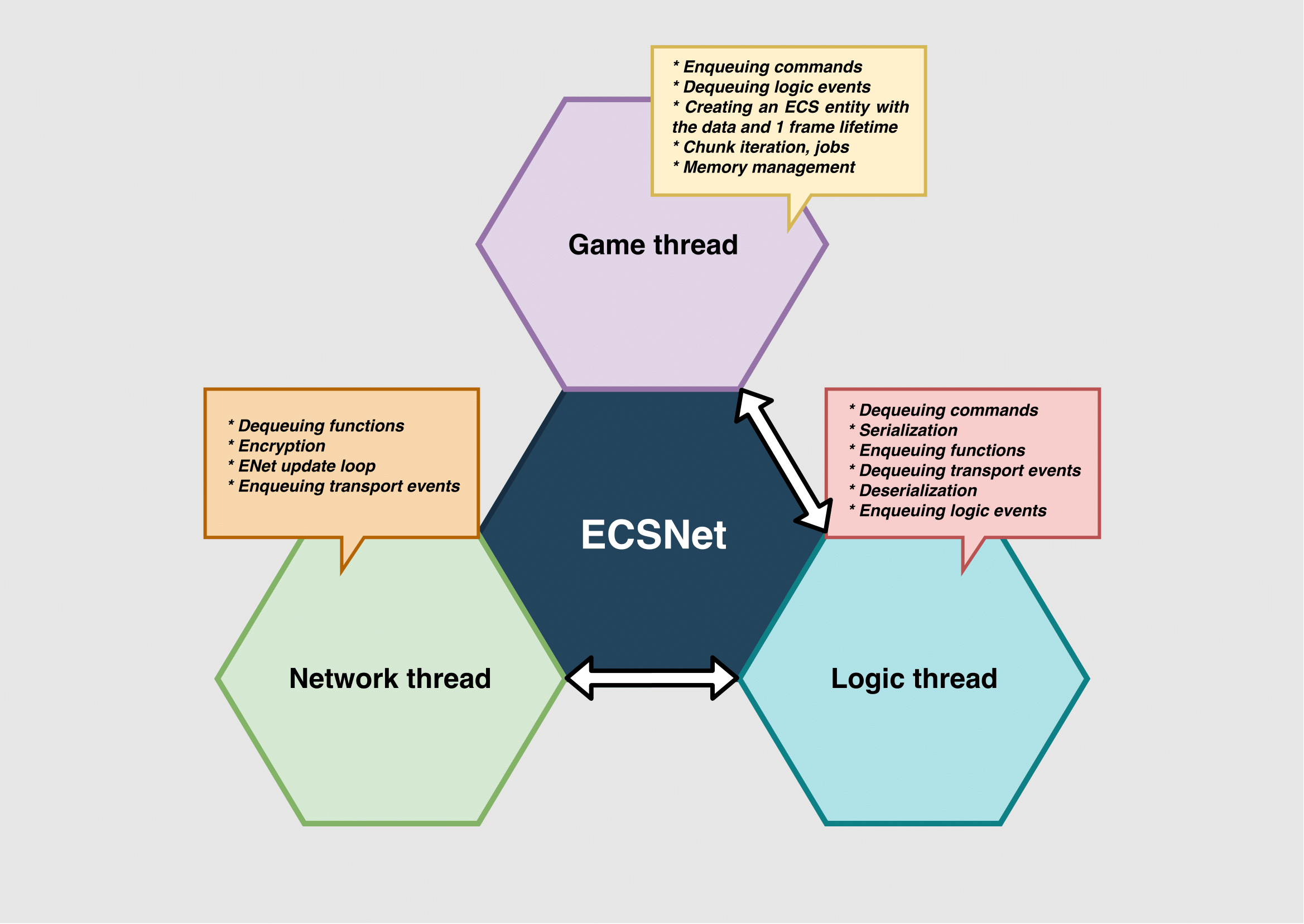
My setup is similar to this, however I am not using ecs at all for it just I/O threads
https://forum.unity.com/threads/showcase-enet-unity-ecs-5000-real-time-player-simulation.605656/
Unity Forum
Happy holidays everyone.
I would like to show you my progress in creating a high level api based on Unity ECS on top of the ENet network library.
The...
fluid kiln
I think the only reason you'd really want to send input only is to protect from cheating
Looking back at Fall Guys launch which had client deterministic movement, yikes
It's a solid and safe way to do it.
Ofc you can do it with client simulation
It's just less straightforward
gusty comet
It really just depends on the type of game you're making
and also make sure you're still checking the input is valid on the server
fluid kiln
There's nothing inherently wrong with also running simulation on the client, but crucially the results of the client's simulation are not used to determine what happens for other players. Where the simulations diverge due to non-determinism, network delays, etc, you correct the player's local sim to match the authoritative description from the server. So a client that sends only input can still coexist with client-side simulation.
There's still the question of how to make it secure and non-exploitable. Doing that with raw input is easy - validate that the input is in the range you accept
So I guess it greatly simplifies the security
gusty comet
Yeah, it is simpler and if you're not targeting a large number of connections per server it wont be an issue.
fluid kiln
The basic idea is to send commands rather than game state. If you have a function F(X) = Y and you need everyone's Y to be the same, you can send X instead of Y. The reason why this happens in the first place is because sometimes commands are more efficient than game states bandwidth-wise. In an RTS game, there can be 200+ units at one time so sending a command is better than replicating 50 positions, rotations, healths, etc.. There are several other benefits like 100% game state cheat proof and small replay sizes.
I guess that guy nailed it

Game Development Stack Exchange
I am trying to understand how networking in games work as I am trying to make an online game myself. I can't grasp how it is possible to synchronize the players, in order to make the game determini...
gusty comet
Yeah that is a good example on when to do it.
warped coral
is it possible to get a dynamic buffer on the same entity from inside a componentdata struct
fluid kiln
Not without the entity manager
You're probably looking at a system that queries both your buffer and your component
fluid kiln
zenith wyvern
Only use a method on your component if it deals specifically with that component...
To quote sark
warped coral
oh hmm
so... how do i avoid recalculating a stat's value every frame? I only want it to be calculated when i retrieve it and it's dirty. It needs to be able to get a dynamic buffer to recalculate
fluid kiln
Is your stat a component or an entity?
I read somewhere you can have a system update only on components that had their value changed but I'm not sure how
warped coral
i have a dedicated entity for each stat. The entity also has a stat component that holds the value property that I want to access and recalculate if dirty. The entity also has dynamic buffers on it for stat modifiers
fluid kiln
So I'd have a component tag called Dirty
In your recalculate system, call WithAll<Dirty>()
warped coral
but... then.. whats the process to retrieve a stat. Like if a character uses an ability
fluid kiln
Why would that affect that?
warped coral
usually it would just be accessing the property
fluid kiln
On your stat entity, you can add a Dirty component when its value is changed
warped coral
now it has to do what... uh... add the dirty tag and somehow wait for the system that processes dirty stuff to finish?
fluid kiln
You stat should only need to be recalculated once per frame
warped coral
yeah thats what i dont want...
fluid kiln
Why not?
warped coral
only when i access it like i can do with monobehaviours.. otherwise i loop through all the stat modifiers and recalculate the value every frame while i'm not using it
fluid kiln
You can't have properties on a struct
warped coral
uhh why
ocean tundra
Oooo RTS MP discussion
fluid kiln
fluid kiln
You can't have properties on a struct
That's not true
But you shouldn't have logic in your components
ocean tundra
To throw into that, you can have massive units synced without dertimistic
https://www.forrestthewoods.com/blog/tech_of_planetary_annihilation_chrono_cam/
Technical deeptime into the unique networking architecture of Planetary Annihilation.
coarse turtle
You can use properties in a struct if you need to
LocalToWorld contains get properties for convenient Position, Rotation values
warped coral
then how do i do what i need in ecs? like... i only need stats to recalculate when i access it and it's dirty. I could easily do that with monobehaviours but im not sure how to do something similar in ecs
fluid kiln
Unless?
In ECS, your logic is a string of systems
THe way I see your problems:
SYSTEM_THAT_EDITS_STAT ---> SYSTEM_THAT_RECACULATES_STAT ---> SYSTEM_THAT_USES_STAT
warped coral
ahhhh that makes things a lot more clear... so when i use an ability, i queue it, and then switch a bool for that stat so the recalculator system knows it's about to be used.. then it gets used.. or something like that... wait.. but then... when i use an ability.. it has to have multiple systems... one for parsing the command.. and another for the actual logic then... so they can update at different moments... i think it's much clearer now
fluid kiln
Using an ability will most likely have multiple system
warped coral
yeah my way of thinking about it was flawed
fluid kiln
ABILITY_IN_RANGE_SYSTEM
ABILITY_DAMAGE_SYSTEM
ABILITY_COOLDOWN_SYSTEM
ocean tundra
It may be even more specific then that
fluid kiln
Oh yeah
ocean tundra
ABILITY_FIREBALL_IN_RANGE_SYSTEM
fluid kiln
It'd try to abstract it as much as possible
fluid kiln
Say you have a Fireball ability entity
With a range component, damage component and cooldown component
You can have 1 system for each component
Instead of 1 system per ability
ocean tundra
yup
ocean tundra
my rts was grouped with ranged attacks and melee attacks
cooldown was shared between them
fluid kiln
Then I have this monstrosity
ocean tundra
but the actual 'attack' was different
fluid kiln
Yeah I want to abstract attack to be an ability
So I can use the same logic
I basically just have an AttackingSystem that recast Attack everytime it's off cooldown
Like an auto attack
warped coral
how do your systems uh... communicate so like... if the range check fails then the whole ability doesn't go?
fluid kiln
When I right click on an enemy to attack it, I add the Cast component to the ability, with an Entity target
You have 2 options as to how to handle the string of systems
One is to have more tag component say "InRange"
If your ability doesn't have "InRange" you character moves towards the target
Or you can fail the cast by remove the Cast component from the ability
And do some logic on top
warped coral
that... seems confusing
fluid kiln
Basically it's important to order your systems appropriately, then they communicate with eachother through tags
It's definitely complicated, but once you've got it down
Any ability will work through your system
See it as like a conveyor belt idk
In an assembling machine
warped coral
uh.. what would the process be for a fireball ability?
what systems happen first and then next and then whatever
fluid kiln
Let's say a simple ability that has only a range, and damage
warped coral
ok
fluid kiln
When the player input indicates he wants to cast Fireball
(And keep in mind this is how I do things but not the ultimate solution)
I would add a Cast component to the Fireball ability with the target entity (the entity we want to throw the fireball at)
First system would be RangeCheckSystem
With a foreach (Ability, Range, Cast)
That checks the range against the caster and target locations
if the caster is within range do nothing
if not, add a CancelCast to the ability entity with a reason "Out of range"
next a damage system
With a foreach (Ability, Damage, Cast) .WithNone<CancelCast>
That removes hp from the target
Then a cleanup system
Foreach (Ability, Cast) that removes the tags that were added like CancelCast
warped coral
oh.. i think i know how this is going... like.. every system acts as a gate... and it has to satisfy each system
fluid kiln
Basically!
Instead of a CancelCast component, you could just remove the Cast component
fluid kiln
And create a CastError entity
That displays a message to the user "Out of range"
There's many ways to go about this :p
ECS is weird at first, but once you have the "click" to stop thinking in OOP, it's really magical xD
And the cool thing is that later on you can seemlessly add functionality to this. Imagine instead of targeting an entity your ability is an AOE. Well you'd have two components, one called ENtityTargetting and the other called CoordinateTargetting for example, and have two systems that process these targettings methods differently
Without compromising the damage, cooldown and any other functionality of the ability
I hope I'm not spamming, sorry ^^
karmic basin
More than stop thinking OOP, yo uhave to explicitely think DO. System ordering is of course a thing, but even more is data layout, to stick as much as possible to hardware computing
fluid kiln
Only because you're used to it
karmic basin
for human brain yes
fluid kiln
karmic basin
More than stop thinking OOP, yo uhave to explicitely think DO. System ordering i...
Care to elaborate?
What's good and bad data layout?
karmic basin
In short (then i'm going to bed)
data input and output
and archetypes and how chunks will lay in memory
for maximised parallel query and processing
Selecting good data candidates and how to describe them is a good part
fluid kiln
And the designing of your components can affect that?
My knowledge of DOTS is really high level so idk
karmic basin
Yes, and how often they will mutate, and so on
Like you said earlier, many ways to simulate a problem
zenith wyvern
For performance-intensive areas you want to minimize structural changes as much as possible, give ScheduleParallel a chance to do it's job easier on nice uniform chunks of data. We have lots of tools to do that thankfully
karmic basin
If I read well you're doing netcode ? that already gives you some kind of pattern with the commands sync, serialising, client prediction, and so on IMO
anyway going to bed, gnight all
fluid kiln
nn
So... have I been doing things wrong if I've been using Schedule instead of ScheduleParallel? 😬
And I just tried using ScheduleParallel and I've got a bunch of container errors :/
ocean tundra
Schedule is fine
coarse turtle
depends on scale really
coarse turtle
if you dont need the work to be split on extra threads, then schedule is fine
ocean tundra
ScheduleParallel will support greater numbers
coarse turtle
most of my work is done using schedule/run
fluid kiln
Okay so I'll make the switch when/if I get there lmao
ocean tundra
im working on some networking stuff and doing everything i can to use ScheduleParallel as i dont want too much networking overhead
fluid kiln
ANy guidelines on what "work" should be done in parallel
ocean tundra
but much of my gameplay stuff has all been schedule
zenith wyvern
And yeah if you're using a native container then scheduleparallel won't work unless it's read only or you use a parallel safe version of the container, which may not even work for some use cases
ocean tundra
@zenith wyvern Is NativeStream safe for ScheduleParallel?
zenith wyvern
I believe so
fluid kiln
zenith wyvern
And yeah if you're using a native container then scheduleparallel won't work unl...
Wow so the native collections aren't even suitable for parallel work?
coarse turtle
usually there's an associated parallelreader/parallelwriter with native containers 👀
so you can do something like NativeHashMap.ParallelWriter
zenith wyvern
fluid kiln
ANy guidelines on what "work" should be done in parallel
Basically any performance intensive work that has the possibility to cross chunks
NativeArray "just works" in parallel jobs - assuming you don't do anything crazy with your indexing. And yeah, other containers will generally have AsParallelWriter
fluid kiln
Alright I appreciate the help!
ocean tundra
So when i was messing with NativeStreams yesterday, I had to use those WithDisable...... methods
Any ideas if thats going to be a issue?
zenith wyvern
AFAIK you shouldn't need to disable safety checks, it's only an issue if you're trying to access the same index from separate threads. In the collections test folder you should check the NativeStreamTests, it shows how to use it properly in parallel jobs
ocean tundra
I didnt know about the nativestream tests, will check those out. Been super hard to figure out its use
fluid kiln
Is it bad practice to add and remove components often? You mentioned minimal structural changes but I find that to solve a problem, I often have to resort to systems talking to themselves via components
I think most of my systems have entity commad buffers adding and removing components
ocean tundra
I often add and remove stuff, but been trying to keep it to tag components
zenith wyvern
If it's working for your game, don't worry too much about it. Profile first then you can decide how to proceed.
ocean tundra
I'm not sure if it was implement yet or still coming but Unity was talking about doing optmizations around tags so adding and removing them would have low/no cost
zenith wyvern
My general rule is to avoid per frame structural changes if possible
Beyond that I do it whenever it's convenient
low tangle
use tag components, they are a great tool. yes they do trigger structural changes, but for most of the time getting started it will not matter. you can go back in and refactor things very easily due to the separation of logic (systems) and data (components)
fluid kiln
Yeah I'll take the approach "Optmize later" while I learn about DOTS
ocean tundra
yup thats what I do 😛
low tangle
please do, its super easy to refactor systems
fluid kiln
Exactly :p
ocean tundra
even unoptmized DOTS is wayyyy faster then monobehaviour
fluid kiln
I don't plan to do a RTS so I don't know if it'll ever even get to that point
low tangle
focus on making the game or learning dots then
warped coral
does an entities.WithChangeFilter<thing>().ForEach(ref thing) make itself dirty
zenith wyvern
No. It would make it dirty for the next system that uses changefilter for <thing>
zenith wyvern
If you mean on the next frame, no
If you're manually updating your systems, no idea. Probably
warped coral
ok i guess that's good. so only when another system modifies it then it'll count as dirty for it
zenith wyvern
Yeah
Well
When another system queries for it as ref
Or writes to a ComponentDataFromEntity/BufferFromEntity for that type
If you include it as ref in a query, whether or not it actually writes to it isn't relevant
warped coral
oh ok
ocean tundra
@zenith wyvern Is there a better way to optmize the change filter?
maybe a manual job (Chunk job?)
zenith wyvern
Not sure what you mean by optimize the filter
ocean tundra
like if i have a foreach ref component
if something... wirte to component
it will trigger the change filter for every entity with that component, even if i didnt actually write
zenith wyvern
Yeah, if you want to avoid that you need to have conditional logic on the first job that writes to the component, so the job only runs on certain conditions. In my roguelike I have jobs based on user input that set off a whole chain of change filter jobs behind the first one.
If that won't work you need to remove your component from the query and pass in a componentdatafromentity instead. The component won't be "changed" unless you write to the componentdatafromentity inside the job
Just keep in mind ComponentDataFromEntity is really really slow
gusty comet
Is it ok to reference an Entity on a component attached to a diff entity?
ocean tundra
@gusty comet Yup, storing entity references is ok
But if the entity stored gets destroyed and you try to access it you will get a error
You can use EntitiyManager.Exists to check to see if its still around
gusty comet
Alright thanks @ocean tundra
I have one other question, is having a nativearray on a component acceptable?
zenith wyvern
You can only have an unsafe array on a component, and that comes with complications. Dynamic buffers are generally the way to associate a resizable list with an entity
gusty comet
Awesome thank you sark
gusty comet
If I use AddComponentObject to attach a gameobject to an entity, does that mean the gameobject is destroyed when I destroy the entity
zenith wyvern
No. conversionSystem.AddHybridComponent will create a hidden gameobject associated with the entity, and attach your component(s) to it. That game object has it's position automatically synced with the entity and will be destroyed with the entity
zenith wyvern
I don't know, I don't use subscenes
ocean tundra
How do you use things like prefabs then? just built them all via code?
zenith wyvern
No, I just use ConvertToEntity on everything
It works the same as subscenes but you don't need to bother with ConvertVersion nonsense
ocean tundra
oh yea, i thought they marked that obsolete?
zenith wyvern
Not that I know of
ocean tundra
i swear i just read something about that the other day...
oh no "We still support more granular approaches like the ConvertToEntity MonoBehaviour and some function calls in GameObjectConversionUtility, but those should be avoided and are only kept around for dependencies we will remove in the near future."
zenith wyvern
Ahh well, I've had nothing but horrible experiences with subscenes. So I'm not using them until I have to. Or maybe I'll just abandon unity at that point if they don't make them any more user friendly
ocean tundra
i got to go sorry, but good luck
my experence with them in latest has been good
but wait and see
fluid kiln
Any costs to use ecb.AddComponent on an entity that already has the component? Should I check with HasComponent first or is it not necessary?
deft stump
fluid kiln
Any costs to use ecb.AddComponent on an entity that already has the component? S...
it won't add it if it exists
gusty comet
So I was looking at the docs for hybrid components and wont this code just keep adding the component over and over again ever single frame?
[ConverterVersion("unity", 1)]
public class DoohickeyConversionSystem : GameObjectConversionSystem
{
    protected override void OnUpdate()
    {
        Entities.ForEach((Doohickey doohickey) =>
        {
            AddHybridComponent(doohickey);
        });
    }
}
@gusty comet The key point there is GameObjectConversionSystem
That system will only run 1ce as part of conversion
gusty comet
Thank you roy.
ocean tundra
All good man
gusty comet
I really like how clean code can be with dots. Can't wait for more of the engine to be exposed
ocean tundra
yea me too
Feels really nice adding bits
but i still run into the issue where large complex bits can be really complicated
😛
but i think thats mainly cause DOTS is missing bits, so i end up building those bits my way and integrate too closely with whatever im trying to make
gusty comet
so is there a way to get all components of a certain type in the scene as a nativearray
ocean tundra
There is but why?
So you need to make a entity query, and then it has a toarray (or to nativearray) method on it
but ive never needed to do that
gusty comet
I am getting spawn point locations, each entity is a potential spawn point. In my spawn system I want to get each potential spawn point, decide if its actually valid. If not destroy the entity, after all invalid spawns are filtered out I want to convert them to a nataivearray so I can use array.sort on them to sort the spawn points based on distance to the observer
ocean tundra
the steps up to destroying the entity would work well as a Entities foreach
ocean tundra
but i dont know about sorting
sorting would be a seprate step
the entities foreach can use run
and you can use WithStoreEntityQuery to save the query
deft stump
You're not guaranteed of order they've been queued in
ocean tundra
then use that query to ToNativeArray
gusty comet
Because I want to sort the potential spawn points of my ai to areas only near my character
if I spawn 10 ai i want them to spawn at the 10 closest spawn points to my player
and array.sort and a custom comparer works fine to do that
public struct DistanceComparer : IComparer<float3>
{
    float3 value;
    public DistanceComparer(float3 distanceToTarget)
    {
        value = distanceToTarget;
    }
    public int Compare(float3 a, float3 b)
    {
        var targetPosition = value;
        return Vector3.Distance(a, targetPosition).CompareTo(Vector3.Distance(b, targetPosition));
    }
}
why not use 2 systems for this.
1st system would Entities.ForEach all spawn points and then store the nearest points in a DynamicBuffer.
then...
2nd system would go through the DynamicBuffer and spawn them
gusty comet
sounds like a lot of work, what would be the benefit of this?
ocean tundra
I think the 2 systems would actually be less work
gusty comet
how?
ocean tundra
sounds like more as 2 > 1 😛 but you would have 2 tidy small systems
zenith wyvern
NativeArray<float3> arr = _query.ToComponentDataArray<SpawnPoint>(Allocator.Temp).Reinterpret<float3>()
ocean tundra
and get to use all the standard ways of doing stuff
zenith wyvern
But yeah I'd probably do it via a foreach as well myself. Pass in the player position to a ForEach over your spawn points
gusty comet
wouldn't I have to do like 3 recursive loops?
zenith wyvern
Eeehh yeah I guess if you're getting the top 3 a sort may be best
Foreach would be fine if you were just getting closest one
There's an async version of the function I posted above as well, you can use that instead if you don't want to block any jobs on the main thread
gusty comet
Alright is that an expensive function to call?
zenith wyvern
Not really. It's creating a copy so if you have like 3 million of these spawn points you might want to think twice
Otherwise it's fine
Just remember to dispose it if you allocate it non-temp
Also keep in mind you're not getting references or pointers to actual components. Just copies. So changes won't have any effect to the actual components until you write them back
gusty comet
Alright thanks for the info, don't think ill have any issues though just reading data for now.
zenith wyvern
Also you shouldn't use Vector3 math if you don't have to. The new math library will generally perform better in burst with float3s
math.length == Vector3.Distance
ocean tundra
How do you manually create a system these days?
doing World.CreateSystem seems to work but it doesnt show or run
zenith wyvern
You're creating it manually but you want it to auto update?
Did you DisableAutoCreation on it?
ocean tundra
Yup disabled auto create
zenith wyvern
You can do DefaultWorldInitialization.AddSystemsToRootLevelSystemGroups
Seems like an odd thing to be doing though if you went out of your way to not create it in the first place
ocean tundra
Cause i have to setup a few confusing bits first
NativeContainers and network streams
zenith wyvern
I would suggest using a singleton component or something with RequireForUpdate
Bit easier to understand when looking at just that system
ocean tundra
but you cant have native containers in a component?
your right it would make more sense as entities
zenith wyvern
You could with a managed component, but I more mean for the purposes of preventing the system from updating until you're ready. You only create the component it's depending on once you want it to go
With RequireForUpdate it won't run until then
ocean tundra
hmmm
makes sense
but i also need 1 of the same system per player
again i could move that to entities..
zenith wyvern
Oh, yeah, that sounds like manual creation might be the way to go then. I haven't messed with networking so you probably know better than me what makes more sense
ocean tundra
also a managed component wont do, i want to use burst
😛 no idea if this is the right way
feels rightish 😛
ocean tundra
Anyone know if EntityGuid is safe to use as a unique id?
amber flicker
ocean tundra
Anyone know if EntityGuid is safe to use as a unique id?
Unique? I'd say yes. Stable? No idea
karmic basin
@ocean tundra Unique in its World for the duration of this session. So I wouldn't store it in a database I guess but I didn't have to inspect its values yet so don't know really.
 scarlet inlet
Hello, calling for help here again. Has anyone ever used RemoveComponentForEntityQuery?
well I just realised that it is super new
 fading nest
So ideally I need to be able to use build my game for WebGL buuuut I've already done a decent chunk of work on it in DOTs
I hear that Tiny supports WebGL builds but I am having some teething troubles transferring acrosss, does anyone know a good way for doing this, or adding Tiny to my project?
For references I am basically pure DOTS about from camera and some text UI
 agile dome
Does DOTS normally not support WebGL?
fading nest
it wasn't working for me and I thought I read somewhere it doesn't
but perhaps there was some other reason it wasn't working for me 😅
fading nest
fading nest
it wasn't working for me and I thought I read somewhere it doesn't
but I think it's quite easy to find out of date information about DOTS so maybe that isn't true
agile dome
Burst might be problematic?
fading nest
okay
well that's nice to hear
now I just need to work out why it didn't work fine for me xD
scarlet inlet
however that doesn't mean that it is always bugs free
i.e. today I found problems with IL2CPP
hmm let me try if my currrent demo runs just to be sure I am not getting confused
deft stump
man it would be great if we at least 1 dots dev would come in here so he can hear our complaints...
when is our enable/disable components!
karmic basin
-> forums