#💻┃code-beginner
1 messages · Page 762 of 1
 red igloo
I'm kind of confused cause I have this > transform.position = _portalRef.Exit.position; which already teleports the player to the exit portal so how would I teleport the player to the entrance portal when in the exit portal?
 warm gull
i verified my trigger is what's not working, not the code. I will get back to you guys on whether or not the code works once i fix the trigger!
i appreciate all the help
 languid pagoda
red igloo
I'm kind of confused cause I have this > `transform.position = _portalRef.Exit....
languid pagoda
red igloo
I'm kind of confused cause I have this > `transform.position = _portalRef.Exit....
can you not just use _portalRef.Enter.position
 slender nymph
red igloo
I'm kind of confused cause I have this > `transform.position = _portalRef.Exit....
slender nymph
red igloo
I'm kind of confused cause I have this > `transform.position = _portalRef.Exit....
hint: they are both exit portals
 wintry quarry
red igloo
I'm kind of confused cause I have this > `transform.position = _portalRef.Exit....
wintry quarry
red igloo
I'm kind of confused cause I have this > `transform.position = _portalRef.Exit....
From the perspective of the exit portal the entrance portal IS the exit portal
Don't think of them in absolute terms. They are both exits and both entrances depending on where you start from
Each portal just considers itself the entrance and the other the exit
warm gull
Got it! My polygon successfully switches sprites upon colliding with the powerup. My mistake was having trigger checked but I was using onCOLLIDERenter2d. but now my powerup is solid and i bounce off of it.
If I re-tick trigger to make it not be a solid object and switch it to onTRIGGERenter2d, I get a green squiggly under OnTriggerEnter2D stating it has an incorrect signature
bam. fully working. thanks for the help guys
When I change sprites, I can hit "reset" on the Polygon Collider component for it to reset the bounds to the new sprites shape. Can I do that in the exact same function that changes the sprite in the first place?
red igloo
wintry quarry
From the perspective of the exit portal the entrance portal IS the exit portal
Alright thanks for the help! got it working.
 wintry quarry
red igloo
Alright thanks for the help! got it working.
wintry quarry
red igloo
Alright thanks for the help! got it working.
nice
warm gull
warm gull
When I change sprites, I can hit "reset" on the Polygon Collider component for i...
got that working! now the players collider is always accurate to the sprite currently used. Only issue now is that with the collider being removed and replaced, the sprite goes up a few times at once as opposed to the intended one time. But I imagine that will be fixed when I change the powerup to a prefab that disappears on contact
i might call it here for today, im happy with my progress
 umbral hound
Can anyone tell me why my gravity is fluctuating? It goes from gravity (0.025f) to 0f and back repeatedly
// Gravity
if (m_CharacterController.isGrounded)
{
    m_GravityPower = 0f;
    m_MoveDirection.y = 0f;
}
else
{
    if (m_UseGravity)
    {
        m_GravityPower -= m_Gravity;
    }
    m_MoveDirection.y = m_GravityPower;
}
For some reason the character controller is not grounded even when it is?
 stable coral
I'm using a run of the mill third person cam script on a free look cinemachine, this is my movement script for the player. When I rotate the camera the player jerks back and forth and speed is adjusted when that happens. Here is the code for my movement ```private void MovePlayer()
{
movementDir = orientation.forward * verticalInput + orientation.right * horizontalInput;
rb.AddForce(movementDir.normalized * movementSpeed, ForceMode.Force);
    if (movementDir != Vector3.zero)
    {
        player.forward = Vector3.Slerp(player.forward, movementDir.normalized, Time.deltaTime * 5f);
    }
}```
I tried looking some stuff up but failed to find anything I understood. Could someone help me understand the way to do it?
Video reference
From what I understand it's because the players rigidbody movement and position is directly affected by the camera's direction, which is what I want for the movement but the double edged sword is that it affects the position as well. which I'm not sure how to differentiate that. But if my understanding is misguided let me know.
wintry quarry
umbral hound
For some reason the character controller is not grounded even when it is?
Yeah that's how CharacterController.isGrounded works. It only returns true when the last Move call pushed it into the ground.
I recommend not using it
umbral hound
wintry quarry
Yeah that's how CharacterController.isGrounded works. It only returns true when ...
Got it resolved
Just added a
CharacterController.Move(Vector3.up * -0.001f);
 rocky canyon
is this a legitimate way to populate Scriptable Objects w/ default values?
 fast relic
rocky canyon
is this a legitimate way to populate Scriptable Objects w/ default values?
fast relic
rocky canyon
is this a legitimate way to populate Scriptable Objects w/ default values?
why can't you just give them default values?
rocky canyon
couldn't think of how to do that..
since theres no Start() or Awake() that runs
maybe im just being stupid
 sour fulcrum
there is awake and onenable but they are weird
rocky canyon
you mean they'll work when Creating via the project window?
fast relic
but also can't you just straight up give the fields default values? like
float myFloat = 15.0f;
ohhhhhhh!
thank you bud!
didn't even see that
sour fulcrum
fast relic
but also can't you just straight up give the fields default values? like
```cs
f...
personally i dont like default values in code for serialized values cuz they can be misleading when troubleshooting
fast relic
yeah, fair
rocky canyon
fast relic
but also can't you just straight up give the fields default values? like
```cs
f...
lol.. totally suppose i could have..
rocky canyon
fast relic
juts use the built in [`Reset`](https://docs.unity3d.com/ScriptReference/Scripta...
aye!! 💪
i like it
i've hesitated to use SO's for sooo long I actually forgot what little i knew about em 😆
i've just used simple Classes instead
sour fulcrum
SO’s are amazing
rocky canyon
fast relic
they're really useful
i just finished up my SaveData system... now im working on the Menu.. and im thinking they could be useful to store
like the current settings data
and have it saved to the json file when game is exited or whatever (if they differ from defaults)
rocky canyon
fast relic
they're really useful
always been told to only use them for non-changing data
sour fulcrum
rocky canyon
always been told to only use them for non-changing data
the people who say that are cowards
rocky canyon
only.. so i think that may have subconciously made me neglect them
fast relic
rocky canyon
always been told to only use them for non-changing data
not necessarily
rocky canyon
sour fulcrum
the people who say that are cowards
lmfao!!
spit out my drink on that one
fast relic
i use them for channelling events sometimes haha
sour fulcrum
i tend to overuse SO's so im probably a little bias
rocky canyon
my last loading system had a SaveData class that i declared twice
once as the original (loaded into from the local save file)
and once as a run-time version..
and then i realized thats silly.. and i can use just (1) for both
sour fulcrum
public class ScriptableManifestManifest : ScriptableManifest<ScriptableManifest>
i love them
rocky canyon
but yea... i figured it was 💯 true about that non-changing data..
b/c u could always read from em and do w/e u need to do
sour fulcrum
can also make them at runtime but gotta handle it correctly
or as ways to handle selectable functions in editor in some contexts
 timber tide
SOs make up for what little control you have over serialized classes
one day we'll get interface serialization out of the box with serialized references
fast relic
timber tide
one day we'll get interface serialization out of the box with serialized referen...
i wish haha
sour fulcrum
eg. for a card game prototype i had a workflow where each ability a card had was a unique class inheriting from a scriptableobject, with 1 asset instance of that said class existing in the project so i could drag and drop it places. Then the functions on the scriptableobject run purely with the context being passed into them and static references so they don't need to store anything unique at runtime, eg.
public class Frontline : MoveData //MoveData is inheriting ScriptableObject
{
    public override IEnumerator OnActivate(MoveInfo moveInfo)
    {
        Debug.Log("Frontlining!");
        moveInfo.ally.player.MoveCardPosition(moveInfo.card, 0);
        RoundManager.RefreshCurrentStack();
        yield return new WaitForSeconds(1f);
        EndMove(moveInfo);
    }

    public override void Initialize(Card card)
    {
        Debug.Log("Initiliazing Frontline");
        card.onBeforeMove.AddListener(Activate);
        base.Initialize(card);
    }
}
 rocky canyon
thats dope
 cosmic dagger
sour fulcrum
i tend to overuse SO's so im probably a little bias
cosmic dagger
sour fulcrum
i tend to overuse SO's so im probably a little bias
Same. If I don't attempt to use SOs for a system or idea I'm working on, then I'm doing smth wrong . . .
cosmic dagger
timber tide
one day we'll get interface serialization out of the box with serialized referen...
This would save countless headaches and attempts at creating custom editors. Currently, my problem . . .
rocky canyon
cosmic dagger
Same. If I don't attempt to use SOs for a system or idea I'm working on, then I'...
is this a safe metric relative to someone like me? that's not beginner but also not advanced by any means..
using Classes for data storage and knowing I could use a new() instance to set my defaults was a game-changer for me..
been sleeping on SOs for quite a while (well, i'll change that.. from today on I'll try to use SOs atleast once per prototype scene)
since im trying to fill out my exposure to things in Unity i've embarked on a journey of putting myself out there outside my comfort zones.. using the New Input System, utilizing SOs, next up UIToolkit.. and so on
ohh and events... 🤫, I mean i've used events.. but not like i ought to be using them.. and as frequently
cosmic dagger
rocky canyon
is this a safe metric relative to someone like me? that's not beginner but also ...
I actually thought you used them more. The applications are so broad: events; config data; enums (what I use most); modular behavior, as in, containers for methods (very granular approach), etc . . .
rocky canyon
cosmic dagger
I actually thought you used them more. The applications are so broad: events; co...
nah i've only ever used them for things like PlayerSettings and Projectile Settings, etc
like this

i've never actually tried to use them anywhere else besides to load up default values for a script w/ lots of variables
cosmic dagger
Yeah, they're great for any kind of settings . . .
rocky canyon
ya, i guess the discussion is about whether u can or should rather, use em for runtime / or variables that'll change
and then having to read them prior
idk..
 ivory bobcat
Like classes and other serialized types, it's great for exposing data to the inspector. The main difference compared to the other two would be where the data lives. With structs and classes, the data would likely be living on some component instance attached to a game object in the scene whereas with SOs the data would be attached to an SO instance (not associated with any specific scene object)
ivory bobcat
rocky canyon
ya, i guess the discussion is about whether u can or should rather, use em for r...
You could mutate the data but it'll not persist if no longer referenced so normally I'd just have a regular manager hold data using an MB component.
sour fulcrum
The more I can keep out of scenes the better and the more I can keep out of prefabs assets the better. (Imo)
Things that should just do things should not be reliant on knowing things in editor. ScriptableObjects are good at knowing things
Less points of failure
cosmic dagger
rocky canyon
like this
To use your first pic as an example; on a Jump component, you have an _action SO variable with a reference to an SO asset called Jump that has the variables needed to jump. If you get a powerup to double jump, you'd assign the SO asset called DoubleJump attached to the powerup to the _action variable. When you press the jump button, both SOs will display a different action because of their settings. This is easier than overriding many variables and doing so again to revert back . . .
As I mentioned before, I mainly use them for SO enums; much more versatility, because you can have fields and methods . . .
sour fulcrum
cosmic dagger
As I mentioned before, I mainly use them for SO enums; much more versatility, be...
(And for modders they are a godsend in comparison)
cosmic dagger
Oh, didn't know that . . .
sour fulcrum
eg. if a game handles some form of content via enum and an outside modder wants to expand that content
Another example of cool SO use that some people might find problematic is that if you have a reliable source of serialized information (eg. a singleton) you can use static getters to make information easily and globally accessible that is actually sourced from scriptableobjects that could be swapped out, eg. I often handle colors with something like
    static ColorLibrary _instance;
    public static ColorLibrary Instance
    {
        get
        {
            if (_instance == null)
                _instance = GlobalManager.Instance.colorLibrary;
            return _instance;
        }
    }

    public ColorWordsGroup damageColor;
    public ColorWordsGroup healthColor;
    public ColorWordsGroup currencyColor;

    public static Color Damage => Instance.damageColor.associatedColor;
    public static Color Health => Instance.healthColor.associatedColor;
    public static Color Currency => Instance.currencyColor.associatedColor;
This lets code access relevant coloring easily (via ColorLibrary.Damage etc.) but lets me control that colour from a single source
 cosmic dagger
Yes, these are great for default/global settings . . .
I usually have a debug class with colors for info, warning, error, etc . . .
I use an SO for all of the UnityEngine.Time class fields, so I'm pulling them only once and using those values instead of calling into the engine inside of multiple components . . .
rocky canyon
cosmic dagger
To use your first pic as an example; on a `Jump` component, you have an `_actio...
ohhh... i feel like i might know why..
i dont think my projects have ever grown or matured enough for me use them enough
like now that i think about it, if the types of games i made were to be say.. a game w/ a big inventory or a game w/ a big skill tree or even a more simple game like mine, a shooter, had more powerups or weapon combinations or variations i feel like i'd use them out of design choice.. orr if my game was just getting really big.. or i was working on something like an rpg or some complicated ui/ux gameplay system i might be forced to use them more out of necessity
ivory bobcat
rocky canyon
idk..
So imo:
-Managers for data that should persist between scenes (and possibly the entirety of the applications life)
-Scriptable Objects for non mutable data that should persist between scenes (and Editor play sessions)
rocky canyon
i might just need to use em just to practice.. or expand faster 😄
rocky canyon
ivory bobcat
So imo:
-Managers for data that should persist between scenes (and possibly the...
i've gotten savy to using classes for almost all my persistent game stuff..
i just like the monobehaviour being attachd i guess 😊
but thats still not an excuse
rocky canyon
ivory bobcat
So imo:
-Managers for data that should persist between scenes (and possibly the...
ohh i think i could actually think of some use-cases i'd run into where i'd need data like that..
i just haven't really gotten to there yet.. most of my data lives in their own sub-system classes
and all hardcoded i guess u could say
ahhh.. eureka moment lol
 willow iron
what would be the best way to detect a click on a 2d sprite from camera that will be moving?
rocky canyon
cosmic dagger
Yes, these are great for default/global settings . . .
makes perfect sense considering its the same icon as other settings.. like the renderpipeline stuff and the postprocessin volumes n whatnot
figured it out.. my game isnt classy enough
rocky canyon
willow iron
what would be the best way to detect a click on a 2d sprite from camera that wil...
raycast
ivory bobcat
willow iron
what would be the best way to detect a click on a 2d sprite from camera that wil...
You've got quite a few options but they all will likely use some form of ray casting (whether directly or indirectly)
fast relic
willow iron
what would be the best way to detect a click on a 2d sprite from camera that wil...
just an IPointerClickHandler should work fine
rocky canyon
if it were ui or something i'd say the IPointer interfaces
or i guess it can work there too.. idk never used it on sprites
fast relic
rocky canyon
if it were ui or something i'd say the IPointer interfaces
you can use them on non-ui objects if you have a physics 2d raycaster on your camera
rocky canyon
fast relic
you can use them on non-ui objects if you have a physics 2d raycaster on your ca...
ahh thats right 🫰
 spiral summit
I need your help
 frosty hound
Don't cross post. #💻┃unity-talk
rocky canyon
click anything in the scene and press F
fast relic
rocky canyon
thought it was just a PhysicsRaycaster
there's a PhysicsRaycaster for 3d and a Physics2DRaycaster for 2d
since 2d and 3d physics are pretty much completely different systems
rocky canyon
the more you know..
i know they're diff systems but i just had thought they shared the same component for Raycasting.. that doesn't make too much sense when i say it out loud
cosmic dagger
rocky canyon
ohhh... i feel like i might know why..
i dont think my projects have ever grown ...
true. i bet your projects are bigger than mine. I just have an empty scene with cubes and components attached to try and create systems that work . . .
fast relic
i feel called out because an empty scene with cubes (well, squares even) and components is exactly what i have rn
cosmic dagger
When I see what other people have, like Spawn's triangle shooter, that's when I flood with a bunch of ideas that I could implement . . .
sour fulcrum
prototyping my beloved
i have so many abandoned ideas
so hard to commit to things and push past getting stuff actually going
eg. i spent a day or two messing with an idea where you'd do some kinda town/city building thing as a way to teach basic computer networking but i got stuck on something and into the pit it goes
 rocky canyon
cosmic dagger
true. i bet your projects are bigger than mine. I just have an empty scene with ...
rocky canyon
cosmic dagger
true. i bet your projects are bigger than mine. I just have an empty scene with ...
cubes and a skybox in one project, and another w/ nothing but a sprite

i've actually adopted that work-flow for alot of systems.. they "theorhetically work" b/c the values are there.. but nothing to represent them just as yet 😄
cosmic dagger
rocky canyon
cubes and a skybox in one project, and another w/ nothing but a sprite
I like the first one. The colors really pop. I'd use that for a scene/testing . . .
cosmic dagger
sour fulcrum
eg. i spent a day or two messing with an idea where you'd do some kinda town/cit...
I'm stubborn, so I'll stop working on it until I come across a solution. Sometimes that'll be days or weeks, or sadly, months . . .
cosmic dagger
rocky canyon
i've actually adopted that work-flow for alot of systems.. they "theorhetically ...
I recently tested my stats system and modular damage system to ensure they work. It is satisfying to see the correct values appear. I just wish I could get the custom editor working for the stat system . . .
rocky canyon
cosmic dagger
I like the first one. The colors really pop. I'd use that for a scene/testing . ...
ya, thats my setup for now.. left one is scene objects and systems
the right is a bootstrapper at heart but ive been using it to test singletons, static utility/helper classes, and UI stuff
soo far this is like the optimo setup for me.. been much more organized and therfor productive by having 2 different projects one being more "back-end" unseen stuff
and the other being the visual and physics gamestuff
 chrome apex
If I want a camera to follow a rigidbody, it's best to follow it with code in late update, rather than something like parenting it, correct?
 grand snow
chrome apex
If I want a camera to follow a rigidbody, it's best to follow it with code in la...
grand snow
chrome apex
If I want a camera to follow a rigidbody, it's best to follow it with code in la...
yes thats right. making the camera a child would quickly fuck up as soon as the rigidbody rotated too
 limber turtle
i haven't gotten anything done in the past 4 weeks because i've been going back and forth on this one issue and now i'm just going to give up and find an easier solution. is it possible to use aron granberg's a* solution in tandem with custom movement programming? the enemy i am trying to make is hopefully going to move around the player and shoot at them instead of just moving directly towards them
slender nymph
yes, that's what it was designed for. you use the pathfinding to just generate the path, then use that path literally however you want
limber turtle
oh
so if my enemy has line of sight with the player i can make it ignore the pathfinding and just start moving in its own way
 tepid remnant
Is there an easy way to implement a timer that resets a variable after it has elapsed? I have an int that I having change on player input, then return to the original value after half a second has passed. If the player presses a button in that half second, the timer should restart
slender nymph
limber turtle
so if my enemy has line of sight with the player i can make it ignore the pathfi...
i mean, you can still use the pathfinding there. but sure, if you want to instead do your own pathing for whatever reason when you have los then you absolutely can
slender nymph
tepid remnant
Is there an easy way to implement a timer that resets a variable after it has el...
use a coroutine
limber turtle
alright
tepid remnant
slender nymph
use a coroutine
ty
limber turtle
i guess i'm going back to aron granberg's then
slender nymph
remember, you don't have to set the target destination for a path to the player's position. you can use whatever valid position you'd like.
limber turtle
what do i do about this
 slender nymph
well the last warning actually provides a suggestion for what you can do about it, and presumably the error is related
limber turtle
i don't know what webplayer or standalone is
do i just have to change the build settings?
slender nymph
what is your current build target
limber turtle
where do i find that
i have never made a build before so all i know about build settings is that you can use it with scene management
slender nymph
presumably you have selected "Web" as your build target . . . in the build settings.
limber turtle
i'm definitely being stupid and/or blind right now
i can find a build profiles window but not build settings
slender nymph
it's that
limber turtle
 slender nymph
well there you go, you have windows selected, not web
limber turtle
the message said it wouldn't work with web
slender nymph
i never said to switch to web. i am simply pointing out that isn't the issue.
 wanton osprey
Is there any way i can integrate c++ into unity?
slender nymph
not directly, no. you can use c++ to write native plugins that your c# code can then access
if you want to use c++ why not choose an engine that actually supports it directly, like unreal?
wanton osprey
so theres no way to code a unity game in c++
 hexed terrace
there is no point even trying
wanton osprey
slender nymph
if you want to use c++ why not choose an engine that actually supports it direct...
i dont want like those AAA game like high graphical type
slender nymph
then make your art style different?
you do know that the engine doesn't dictate your art style, right?
wanton osprey
slender nymph
then make your art style different?
well i dont know how to make it in unreal so the lighting isnt like high quality
i want something like unitys
and unreal just confuses me
slender nymph
then learn c#
wanton osprey
im trying but i also want to learn c++
slender nymph
but if unreal is confusing you, then unity will too
hexed terrace
you either learn Unreal lighting or learn C# for Unity..
wanton osprey
slender nymph
but if unreal is confusing you, then unity will too
well ive made 2 games in unity
 placid jewel
C# is fairly similar to C++ relatively speaking, so you might as well learn C#
placid jewel
wanton osprey
well ive made 2 games in unity
without c#?
placid jewel
Then keep using it?
wanton osprey
placid jewel
Then keep using it?
i want to learn c++
placid jewel
You can do that too
slender nymph
wanton osprey
i want to learn c++
then use an engine that supports it
placid jewel
No one is stopping you from knowing multiple languages, in fact for overall developer skills it's probably a good idea
wanton osprey
placid jewel
No one is stopping you from knowing multiple languages, in fact for overall deve...
thats why im doing it
placid jewel
Ok
wanton osprey
i want to keep using unity but also want to learn c++
placid jewel
Then learn C++ seperately to Unity and learn C# with respect to Unity
wanton osprey
ok
placid jewel
I don't see how it's a problem
placid jewel
Damn
wanton osprey
im just gonna learn c# then c++
placid jewel
wanton osprey
im just gonna learn c# then c++
Best of luck, hopefully you'll see that they are similar enough that the load is fairly light to learn both
 tender mirage
basically this script gets the scriptable object assigned to the tile below and the above script is what i don't get. i'm lost at the process of dictionaries
 radiant voidBOT
hexed terrace
!code
radiant voidBOT
hexed terrace
!code
Posting code
📃 Large Code Blocks
Use links to services like:
https://paste.mod.gg/, https://hastebin.skyra.pw/, https://paste.ofcode.org/, https://paste.myst.rs/
📃 Inline Code
Surround code with three backquotes. Not quotation marks.
To format as C#, add cs to the first line:
```cs
// Your code here
```
Add a comment with a line number if there is an error message.
tender mirage
hexed terrace
for long code blocks like that, don't paste in chat - use a paste site
Yeah, i've been told before. it takes my skull more then once to listen up appearently. will fix it right away
hexed terrace
Dictionaries have <key, value> ... TileBase is your key. You pass in the key and get out the value (TileData)
tender mirage
Could someone help me explain how exactly dictionary work?
How does this connect TileBase with the TileData scriptable object script?
A tool for sharing your source code with the world!
hexed terrace
When you add data to the Dictionary, you give it a key and value
limber turtle
the red squares are the obstacles, right? i don't know what happened with the scan but i think something went wrong

i'm just going through a tutorial right now and idk what caused this
tender mirage
hexed terrace
Dictionaries have <key, value> ... TileBase is your key. You pass in the key and...
Yeah, i was intially misslead to believe that dictionaries were tables when people told me to use dictionaries instead of tables for my variables
hexed terrace
I dunno if Dictionaries are classed as tables or not
tender mirage
hexed terrace
When you add data to the Dictionary, you give it a key and value
that helps alot to calrify
i was still thinking they might've been tables.
understanding what it is, is what's throwing me off. i was trying to add more then 2 arguments inside of a dictionary
which didn't go so well.
 rich adder
limber turtle
the red squares are the obstacles, right? i don't know what happened with the sc...
rich adder
limber turtle
the red squares are the obstacles, right? i don't know what happened with the sc...
those I believe are just "nodes"
limber turtle
i disabled this and now everything is blue
 limber turtle
rich adder
those I believe are just "nodes"
limber turtle
rich adder
those I believe are just "nodes"
no, traversable area is shaded in blue
it thinks that the whole area is unwalkable
rich adder
oh alright. been a while since i used the A* pathfinding project
limber turtle
i disabled that but now everything's blue, including the area i don't want to be traversable
slender nymph
this isn't a code issue
hexed terrace
limber turtle
where do i go for help with this
it looks like Aron G's A* pathing finding asset? If so.. you go to the documentation for that asset, and then his support channels
languid pagoda
So my game will be on steam but am also releasing it for sale on my website, I need a clean way to differentiate which version of the game the player is running.
I thought about either using #if STEAM and calling it a day but there are some problems with that. It messes up serialization, for example if you wrap a variable in an #if and assign it from the inspector then the condition of that isn''t met the variable resets to default value the next time it is met. Additionally I would have to build the game twice per platform each update.
I also thought about using launchParameters from steam and just having if() wrapping the calls but that is messy. Any other ideas?
 broken hull
using System.Runtime.CompilerServices;
using UnityEngine;

public class PlayerAnimation : MonoBehaviour
{
    private Animator myAnimator;
    private const string IS_WALKING = "IsWalking";
    [SerializeField] private Player player;
    private void Awake()
    {


    myAnimator = GetComponent<Animator>();
        myAnimator.SetBool(IS_WALKING, player.ISWalking());
    }
}
using System.Runtime.CompilerServices;
using UnityEngine;


public class Player : MonoBehaviour

{

    [SerializeField] float moveSpeed = 7f;
    [SerializeField] float rotateSpeed = 10f;
    private bool isWalking;
    private void Update()
    {
        Vector2 inputVector = new Vector2(0, 0);

        if (Input.GetKey(KeyCode.W)) inputVector.y += 1;
        if (Input.GetKey(KeyCode.D)) inputVector.x += 1;
        if (Input.GetKey(KeyCode.S)) inputVector.y += -1;
        if (Input.GetKey(KeyCode.A)) inputVector.x += -1;

        inputVector = inputVector.normalized;
        Vector3 moveDir = new Vector3(inputVector.x, 0, inputVector.y);
        transform.position += moveDir * moveSpeed * Time.deltaTime;
        isWalking = moveDir != Vector3.zero;
        transform.forward = Vector3.Slerp(transform.forward, moveDir, Time.deltaTime * rotateSpeed);
    }
   public bool ISWalking() {
        return isWalking; }
}
I’d really appreciate it if someone could help me find the error in this animation
the transitions between animation is not working
 glossy cosmos
guys, help me. I tried use "Input.GetKeyUp" but when I start a game, It loses camera. What I have to do???
slender nymph
what object is that component attached to
wintry quarry
glossy cosmos
guys, help me. I tried use "Input.GetKeyUp" but when I start a game, It loses ca...
can you explain what you mean by "it loses camera"?
You should also explain what you are trying to accomplish
Note that this code is almost certainly wrong:
 glossy cosmos
slender nymph
what object is that component attached to
glossy cosmos
slender nymph
what object is that component attached to
My script attached to empty object
wintry quarry
0 * 10f * Time.deltaTime is just going to be 0
So effectively all this code will do is move the object UP by one unit
from the 1 you have
glossy cosmos
wintry quarry
`0 * 10f * Time.deltaTime` is just going to be `0`
I do it for y coordinate
wintry quarry
And since the object is not the camera and it's just an empty object, it doesn't really matter if you move it
wintry quarry
glossy cosmos
I do it for y coordinate
what are you trying to accomplish and what do you mean by "it loses camera"?
what's actually going wrong here?
wintry quarry
glossy cosmos
I do it for y coordinate
the thing you have for Z is pointless
slender nymph
i'm betting this is also a 6.1+ issue and they are just ignoring the console
glossy cosmos
wintry quarry
what are you trying to accomplish and what do you mean by "it loses camera"?
when I start a game I see "No camera selected"
wintry quarry
glossy cosmos
when I start a game I see "No camera selected"
that is not related to your code
Drag the game view window side by side with the scene view so you can see them both
and you don't have to rely on the camera preview thing
glossy cosmos
but when I didn't use Input.KeyUp the camera worked well
slender nymph
look at the console
glossy cosmos
a.. ok
broken hull
broken hull
```cs
using System.Runtime.CompilerServices;
using UnityEngine;
public class ...
can anyone help me with my problem i'd really appreciate it
glossy cosmos
there is
 slender nymph
broken hull
can anyone help me with my problem i'd really appreciate it
slender nymph
broken hull
can anyone help me with my problem i'd really appreciate it
in the code you've shown, you set the animation parameter a single time in Awake, which only happens once on the first frame of an object's lifetime. where else are you setting the animation parameter?
slender nymph
glossy cosmos
there is
!input 👇
radiant voidBOT
slender nymph
!input 👇
How to Set Input
To set Active Input Handling, go to:
Project Settings > Player > Active Input Handling
• Input Manager (Old): Use the original Input settings.
• Input System Package (New): Uses the new input system package.
• Both: Use both systems.
glossy cosmos
thx
slender nymph
for future reference, don't ignore the console. it's typically best to have it visible while playing, and for extra points Error Pause is useful since it will pause execution on any error
broken hull
slender nymph
in the code you've shown, you set the animation parameter a single time in Awake...
SHOULD I TRY PUTTING IT ON ```cs
private void Update (){
}
that would execute eveery frame
glossy cosmos
slender nymph
for future reference, don't ignore the console. it's typically best to have it v...
youre my hero, thx
broken hull
slender nymph
in the code you've shown, you set the animation parameter a single time in Awake...
it works
thanks man
 old remnant
Hey, I am a bit new and I need some advice regarding the input and animation change.
I've connected the animation as it should and I thought I'd want to try out something new with the bool values to change my animation.
This is what I've currently got scripted, but doesnt work, anyone see the issue?
    public Rigidbody2D rb;
    public float moveSpeed = 5f;
    private Vector2 _moveDirection;
    public InputActionReference move;
    public Animator animator;


    private void Start()
    {

        animator = GetComponent<Animator>();

    }


    // Update is called once per frame
    void Update()
    {
        _moveDirection = move.action.ReadValue<Vector2>();


        if (_moveDirection.magnitude > 0.1f)
        {
            animator.SetBool("IsMoving", true);
        }
        else
        {
            animator.SetBool("IsMoving", false);
        }
    }

    private void FixedUpdate()
    {
        rb.MovePosition(rb.position + _moveDirection * moveSpeed * Time.fixedDeltaTime);
    }
I did have
if (_moveDirection != Vector2.zero)
before but it didnt work either
wintry quarry
old remnant
Hey, I am a bit new and I need some advice regarding the input and animation cha...
You should debug this by opening the animator window while the game is running and see what's going on with the animator state machine and the parameters
"doesn't work" is a bit too vague
willow iron
does anyone know have a tutorial for the physics2Draycaster? im trying to find information on it, but all of the tutorials im finding regards 2d raycast instead of physics2DRaycaster, and the documentation isn't very specific. trying to make a script that detects clicks on 2d sprites with colliders on them but cant figure it out
wintry quarry
willow iron
does anyone know have a tutorial for the physics2Draycaster? im trying to find i...
Physics2DRaycaster is for working with the event system
if you want to perform your own 2D raycasts you'd use Physics2D.Raycast and other related functions in your own code
wintry quarry
willow iron
does anyone know have a tutorial for the physics2Draycaster? im trying to find i...
wait sorry
if you want to detect clikcs on 2d objects yes you can and should use Physics2DRaycaster and the event system
What issues are you having with it specifically?
Do you have:
- An Event System in the scene
- A Physics2DRaycaster on your camera?
- A Collider2D on the sprite object?
- The appropriate code in your script attached to the object with the collider?
willow iron
wintry quarry
Do you have:
- An Event System in the scene
- A Physics2DRaycaster on your camer...
i havent really started coding yet, just trying to figure out where i should start. This list should help me get started though!
wintry quarry
willow iron
i havent really started coding yet, just trying to figure out where i should sta...
old remnant
wintry quarry
You should debug this by opening the animator window while the game is running a...
I haven't tried the debugger tool yet, how do I bring it up?
 scarlet pasture
Hey can sombody help me, i actually dont understand why my Code somtimes Shoots and Walk at the saim time. I hope somone can help me there => https://paste.mod.gg/koplnovylfkx/0
A tool for sharing your source code with the world!
i know that this Script is a little bit so bad, i did one enemy Ai and now im working on it, it is a little bit hard to make a boss, but i learned that i need to start a little bit slower 

wintry quarry
old remnant
I haven't tried the debugger tool yet, how do I bring it up?
The animator window I said
"debugging" is just the act of investigating and solving bugs
wintry quarry
scarlet pasture
Hey can sombody help me, i actually dont understand why my Code somtimes Shoots ...
Can you clarify the issue? What's the desired behavior and what's happening instead?
scarlet pasture
i want that he only shoots, and not running, but he runns and shoots at the same time
wintry quarry
scarlet pasture
i want that he only shoots, and not running, but he runns and shoots at the same...
what is "shooting"? Spitting?
scarlet pasture
yeah
wintry quarry
I don't see anything in here that would prevent walking and spitting at once
I see basically two disjoint state machines in here
one for movement, one for attacking
Can you point to the code that is intended to prevent shooting while moving?
I think what you need to do here is merge your two state machines into one
spitting and moving should be separate, mutually exclusive states
 edgy sinew
ich laufe  ur german bro?
You can also just update a bool variable accordingly ... bool canShoot
If you wanted to keep the 2 disjoint/independent state machines setup
@wintry quarry Oh shit dude! I just saw you on a Unity Discussions lmfao. Thanks for the help 😂
https://discussions.unity.com/t/how-do-i-copy-a-terrain-to-another-project/813270
old remnant
wintry quarry
You should debug this by opening the animator window while the game is running a...
Ah right, in that case I just have a simple idle > walk and condition is just true or false with the "IsMoving" bool

the idle works fine ofc but it just doesn't wanna transition into walk when I am making a input (move around)
the only thing I think might be the problem is this though
(_moveDirection is the vector2 values)
 wintry quarry
old remnant
the idle works fine ofc but it just doesn't wanna transition into walk when I am...
wintry quarry
old remnant
the idle works fine ofc but it just doesn't wanna transition into walk when I am...
and what'st the state of the parameter in the animator when that's happjneing?
You should be able to see right there if it's being set properly
scarlet pasture
edgy sinew
ich laufe <:kekwait:1068131295483408394> ur german bro?
do u mean me?
wintry quarry
Also that code can be simplified without if/else: cs animator.SetBool("IsMoving", _moveDirection != Vector2.zero);
old remnant
wintry quarry
and what'st the state of the parameter in the animator when that's happjneing?
the "IsMoving" parameter is just always ticked off, so it must be on script side
old remnant
wintry quarry
Also that code can be simplified without if/else: ```cs
animator.SetBool("IsMovi...
oh thank you
wintry quarry
old remnant
the "IsMoving" parameter is just always ticked off, so it must be on script side
Time for Debug.Log
scarlet pasture
wintry quarry
Can you point to the code that is intended to prevent shooting while moving?
what do u mean
old remnant
wintry quarry
Time for Debug.Log
I uhhh, may have made the casual rookie mistake haha
wintry quarry
scarlet pasture
what do u mean
you said:
i want that he only shoots, and not running, but he runns and shoots at the same time
But I don't see any code that seems intended to cause that behavior. If it exists, point to it. If it doesn't exist, then that is the cause of your problem.
old remnant
my animator parameter had a lowercase i but uppercase on the script hahsa
thank you for your help though!
scarlet pasture
 grand snow
oof but now you know for the future that its case sensitive!
scarlet pasture
i mean this should prevent that the Frog dont jump ands shoot at the same time
wintry quarry
scarlet pasture
that will prevent you from spitting if you're already spitting.
It won't prevent you from spitting if you're walking or jumping or whatever
old remnant
grand snow
oof but now you know for the future that its case sensitive!
The crazy part I've been pulling my hair for over an hour trying different methods of the scripts hahah woops
scarlet pasture
wintry quarry
that will prevent you from spitting if you're already spitting.
It won't prevent...
i know how to fix it, i have a idea thanks
 grave frost
am I using this contact filter wrong?? Why is it getting things that aren't on the provided layer? It keeps listing the spawn area pictured in the third image as one of the first things in the buffer. The first image is the script this code is from, showing the inspector.
private void FixedUpdate()
{
  var mousePos = _mousePosition.action.ReadValue<Vector2>();
  Vector2 worldPoint = _camera.ScreenToWorldPoint(mousePos);
  var hit = Physics2D.OverlapCircle(worldPoint, _radius, _filter, _colliderBuffer);
  for (var i = 0; i < hit; i++)
    Debug.Log(_colliderBuffer[i].gameObject.name);
}
[SerializeField] private LayerMask _layerMask = 1 << 8;
private ContactFilter2D _filter;

private void Awake()
{
  _camera = Camera.main;
  _colliderBuffer = new Collider2D[_bufferSize];

  _filter = new ContactFilter2D
  {
    layerMask = _layerMask
  };
}


 wintry quarry
grave frost
am I using this contact filter wrong?? Why is it getting things that aren't on t...
wintry quarry
grave frost
am I using this contact filter wrong?? Why is it getting things that aren't on t...
yes you're using contact filter wrong
_filter = new();
_filter.SetLayerMask(_layerMask);``` this will do it properlyor:
  _filter = new ContactFilter2D
  {
    layerMask = _layerMask
    useLayerMask = true
  };
}```I would recommend just exposing the contact filter directly in the inspector though
grave frost
oh i didnt even think of that
wintry quarry
instaed of:
[SerializeField] private LayerMask _layerMask = 1 << 8;
private ContactFilter2D _filter;```
And using code in Awake. You should just do:
```cs
[SerializeField] private ContactFilter2D _filter;```I ended up doing
[SerializeField] private ContactFilter2D _filter = new()
        {
            layerMask = 1 << 8,
            useLayerMask = true
        };
because it said I couldnt convert from int to ContactFilter2D.
wintry quarry
correct, because it's not an int, it's a ContactFilter2D
Sorry I adjusted the example above
you don't need to set any default
but if you do want to set a default you can do it as you showed
scarlet pasture
how can i shoot somthing in the right directionn, like if the Enemy Shoots left the bullet also should go left? how can i detect the righ5t direction and how do i code that?
because i used a method the looks if the local scale.x is 1 shoot in that direction and the same code logic for the other, but i have the feelinng that this is not the normale way to do that.
wintry quarry
scarlet pasture
how can i shoot somthing in the right directionn, like if the Enemy Shoots left ...
transform.right or transform.up depending on how your sprite is laid out
scarlet pasture
thanks!
 cerulean bear
I'm getting a null reference exception on this
Startingtransform.position = gameObject.GetComponent<Transform>().position;
Startingtransform.rotation = gameObject.GetComponent<Transform>().rotation;
Startingtransform is null
also you never have to use GetComponent to get an object's transform, every gameObject and component has a transform property that already references it
wintry quarry
cerulean bear
I'm getting a null reference exception on this
```cs
Startingtransform.position ...
Startingtransform.SetPositionAndRotation(transform.position, transform.rotation);
save yourself typing^
cerulean bear
oh ty
stable coral
does anyone here use cinemachine alot or have good experience with third person game creation
wintry quarry
stable coral
does anyone here use cinemachine alot or have good experience with third person ...
#🎥┃cinemachine and don't ask to ask, just ask
stable coral
wintry quarry
<#763497743976497222> and don't ask to ask, just ask
I'm slightly confused by your statement but thank you for providing the channel I wasn't aware of that 😄
wintry quarry
stable coral
I'm slightly confused by your statement but thank you for providing the channel ...
what I mean is - just ask about your question - if someone knowledgeable is there they will answer it
grand snow
"hello may i ask question about thing" ❌
"hello i have error x and i tried y" ✅
cerulean bear
slender nymph
also you never have to use GetComponent to get an object's transform, every game...
oh ok
stable coral
Ah I understand. I asked earlier but I don't think anyone was available at the time.
Then again that was yesterday.
 slow fossil
Hello, java developer here,
Is it also possible to create instances of an abstract class with objects? Basically I'm trying to make a tower defence game from scratch and wondered what would be a good architecture
 grand snow
abstract classes cannot have instances made but ofc if you inherit from that then thats fine
slow fossil
oki thanks
grand snow
the point of abstract is to have abstract methods and properties which then must be implemented
scarlet pasture
does somone know why the Spit is not flying? better said moving?
 wintry quarry
slow fossil
Hello, java developer here,
Is it also possible to create instances of an abstr...
wintry quarry
slow fossil
Hello, java developer here,
Is it also possible to create instances of an abstr...
Don't use inheritance for this IMO.
Use composition.
I.e. an archer tower would have components on it:
- Tower component
- ArcherBehavior component
a sword tower would have:
- Tower component
- SwordBehavior component
Unity is made for composition
timber tide
you can declare by the abstract type assuming you do insert a more derived type in the editor, but new-ing an abstract class is ano
slow fossil
wintry quarry
Don't use inheritance for this IMO.
Use composition.
I.e. an archer tower woul...
so you separate the object from it's behavior? I'll read about it thx
wintry quarry
scarlet pasture
does somone know why the Spit is not flying? better said moving?
Debug.Log
Check what speed is, what dir is, whether there's an rb2d on it, etc
wintry quarry
slow fossil
so you separate the object from it's behavior? I'll read about it thx
no you separate different components of the behavior on the object into smaller reusable parts
scarlet pasture
wintry quarry
Debug.Log
Check what speed is, what `dir` is, whether there's an rb2d on it, etc
okay i will do that, its just a little bit strange because i coded this one time and it work befor
wintry quarry
like Tower would have things common to all towers - the size, the collider, the cost, the experience curve, etc.
ArcherBehavior would actually "do" the archer tower stuff
scarlet pasture
but yess i will try it give me one second
u was right

now Rigidbody
but why?

can i say give the Object a Component? instead of saying get a Component?
grand snow
you can add components with code yes
scarlet pasture
i will add it via editor for performance but i also want to know how to give one
can u teach me how?
scarlet pasture
Thanks
grand snow
you are right to realise that its better to just add the component before hand in editor
scarlet pasture
hahah
 slow fossil
wintry quarry
like Tower would have things common to all towers - the size, the collider, the ...
slow fossil
wintry quarry
like Tower would have things common to all towers - the size, the collider, the ...
So something like this? Where the tower base and the archer behavior defining what the archer does?
 scarlet pasture
grand snow
you are right to realise that its better to just add the component before hand i...
scarlet pasture
grand snow
you are right to realise that its better to just add the component before hand i...
wait u mean i should Add a Component via Runtime or do u mean i should search the Component?
wintry quarry
slow fossil
So something like this? Where the tower base and the archer behavior defining wh...
I'm not sure what the arrows represent in this diagram
slow fossil
wintry quarry
I'm not sure what the arrows represent in this diagram
Where the archer have all the attributes of tower and functions of archerbehavior
slender nymph
scarlet pasture
wait u mean i should Add a Component via Runtime or do u mean i should search th...
Add component at edit time, reference the prefab via that component instead of as a GameObject, then Instantiate will return the reference to the component you want so no GetComponent call on the instantiated object required
grand snow
^ yea that
wintry quarry
slow fossil
Where the archer have all the attributes of tower and functions of archerbehavio...
But what do the boxes represent?
scarlet pasture
okay thanks!!
slender nymph
scarlet pasture
okay thanks!!
After you change the prefab variable's type make sure to drag the object back into it even if it still appears assigned
slow fossil
classes are boxes
arrows represent the inheritance and in this case also the composition
wintry quarry
slow fossil
classes are boxes
arrows represent the inheritance and in this case also the com...
Then no, this is not what I was talking about.
There wouldn't be an Archer class
there would be a GameObject named Archer or "Archer Tower" with two components attached to it - Tower and ArcherBehavior
(and probably others too but we're just focused on these)
slow fossil
I see
timber tide
slow fossil
So something like this? Where the tower base and the archer behavior defining wh...
My way of doing this is have that single Tower class as the controller. This class would have basic information as Radius, Rotation to attack, and cost to build. Now, for the mode to attack I would accept some sort of ShotData class data that when radius and rotation is satisfied I would Shoot(ShotData shot, position, direction).
Some things to think about when doing this controller + projectile class is that you've two parts, the controller to spawn the objects, and the behaviour of the projectile itself.
wintry quarry
It kinda depends how much variance there actually will be in the tower behavior, and how much of it you can shove down into the projectile prefab for example
timber tide
The projectile itself doesn't need information about how many projectiles are spawned, only how it moves. So this data to say make a fan like shape of projectiles must be presented before that
slow fossil
Isn't it laggy to create lots of projectiles?
I just thought of doing a Attack() function that gets called when there's an enemy in range to not have any sort of delay
timber tide
Ignore optimization and deal with it later if you need it
slow fossil
I don't understand the shotdata part
the tower class would have an enum with all possible projectiles?
timber tide
Ok how about this. You have three types of data that define how this projectile(s) is instantiated, and data for how that projectile moves. First data component would define targeting like radius, firing like attack speed, and build costs. Second data type would provide how many projectiles are spawned and in what pattern as an example. Third data type would be how this projectile moves such as homing and perhaps variables like gravity.
Heck, can do a 4th data type for Hit data for when that projectile collides
TowerData, FiringSessionData, ProjectileData, HitData
Tower -> main driver
FiringSession -> Temporary class needed to a coroutine execution of a sequence of projectiles or anything a bit more complex you don't want to do inside of the towercontroller
Projectile -> projectile driver
HitData -> Only exists in data really so no instantiated really needed... similarly FiringSession could just be data too but if you want to run any sort of coroutine it needs to be on the scene instantiated
slow fossil
How to have an enemy detection range?
My goal : When an object type Enemy enters the range of my tower, it attacks
I'm looking at Enemy[] enemies = FindObjectsOfType<Enemy>(); but it is said to be deceprated
How can I detect an object when it enters a range x?
wintry quarry
slow fossil
Isn't it laggy to create lots of projectiles?
I just thought of doing a Attack(...
Projectile vs not projectile shouldn't be a decision to make based on performance. It's a game design question
wintry quarry
slow fossil
How can I detect an object when it enters a range x?
Trigger colliders or using overlap queries
slow fossil
wintry quarry
Trigger colliders or using overlap queries
oki thanks
 sage mirage
slow fossil
So something like this? Where the tower base and the archer behavior defining wh...
sage mirage
slow fossil
So something like this? Where the tower base and the archer behavior defining wh...
Its a bad looking diagram bro
 polar dust
slow fossil
Where the archer have all the attributes of tower and functions of archerbehavio...
polar dust
slow fossil
Where the archer have all the attributes of tower and functions of archerbehavio...
The arrows are the wrong direction there.
Archer has ArcherBehavior, so the arrow should point from Archer to Behaviour
A depends on B
 marsh vale
hey hey can anyone help me out here? i have no idea how to turn this off
 fast relic
marsh vale
hey hey can anyone help me out here? i have no idea how to turn this off
fast relic
marsh vale
hey hey can anyone help me out here? i have no idea how to turn this off
the error says it exactly
you can either use the new input system (the recommended way) or change your player settings
marsh vale
yeah i want to know how to switch it off for just this practice project
slender nymph
!input
radiant voidBOT
slender nymph
!input
How to Set Input
To set Active Input Handling, go to:
Project Settings > Player > Active Input Handling
• Input Manager (Old): Use the original Input settings.
• Input System Package (New): Uses the new input system package.
• Both: Use both systems.
marsh vale
ill definitly use the new one since ive heard great things but I need to learn the unt y fundermantals first
tyty
fast relic
marsh vale
ill definitly use the new one since ive heard great things but I need to learn t...
i would say the input system is part of the unity fundamentals
marsh vale
i will be learning that next then
but im just following this video, its just introducing some very basic things
pong game
and its using unitys old movement system
fast relic
you should still try to do something yourself, try to modify it - just following it blindly won't teach you much
marsh vale
ill be completing this tutorial then im going to make a new project with one cube, and try adding basic controls to it using the new system.
thats my plan
fast relic
i'm not really a fan of "completing" or following tutorials in general - i feel like trying to adapt the tutorial or expand on it somehow will teach you a lot more than just following it
but hey, you do you
maybe you can try learning about the input system, then coming back to the pong game and making it use the new input system
old remnant
Anyone can see why my char can flip when I move to the left?

 paper peak
VS studio says .velocity is obsolete for rigidbody, is this true for any kind of project?
Atm im working on a 3D game with 2D view
slender nymph
yes. it should also be telling you what to use instead
paper peak
Yeah it tells me to use linearVelocity instead
But github copilot really insists that linearVelocity doesnt exist
slender nymph
don't trust AI, trust the compiler
 teal viper
paper peak
But github copilot really insists that linearVelocity doesnt exist
teal viper
paper peak
But github copilot really insists that linearVelocity doesnt exist
This is a relatively new change, so a lot of data the ai is trained on points otherwise.
If you're gonna use AI, make sure it does proper documentation search before answering.
polar dust
its nice of the Unity team to make changes to their API to mess up the spambots output
teal viper
I don't think that was the purpose...
To be fair, that change was as surprising to humans as it is to AI.
polar dust
yeah, I'm only kidding 😅
it's funny to ask gpt about the property and it INSISTS .velocty is correct despite telling it otherwise
It's a very strange invention
 tawdry valley
Hi, i am trying to build a 3d rigidbody character controller and i am facing a problem. When i jump my character constrantly goes up and gravity doesn't show any effect. What could be problem?
private void Jump()
    {
        if (!_isGrounded)
            return;
        _isGrounded = false;

        rb.linearVelocity = new Vector3(rb.linearVelocity.x, 0, rb.linearVelocity.z);
        rb.AddForce(Vector3.up * jumpForce, ForceMode.Impulse);
    }
 wintry quarry
tawdry valley
Hi, i am trying to build a 3d rigidbody character controller and i am facing a p...
wintry quarry
tawdry valley
Hi, i am trying to build a 3d rigidbody character controller and i am facing a p...
Show your full script
 ionic orchid
 frigid sequoia
Is there not a way to get a more direct access to the values of an audio mixer than to search it with a string??
 tawdry valley
wintry quarry
Show your full script
tawdry valley
wintry quarry
Show your full script
using System;
using UnityEngine;

public class PlayerMovement : MonoBehaviour
{
    [SerializeField] private Rigidbody rb;
    [SerializeField] private Transform body;

    [SerializeField] private float moveSpeed = 5f;
    [SerializeField] private float jumpForce = 7f;
    [SerializeField] private float groundCheckDistance = 7f;
    [SerializeField] private LayerMask groundLayer;

    private Vector2 _moveInput;
    private bool _isGrounded;

    private void OnEnable() {
        InputManager.Instance.OnJumpPressed += Jump;
    }

    private void Awake()
    {
        rb.freezeRotation = true;
    }

    private void Update()
    {
        _moveInput = InputManager.Instance.GetMoveInput().normalized;

        CheckGround();
    }

    private void FixedUpdate()
    {
        Move();
    }

    private void Move()
    {
        Vector3 direction = (body.forward * _moveInput.y) + (body.right * _moveInput.x);
        Vector3 targetVelocity = moveSpeed * Time.fixedDeltaTime * direction;
        Vector3 velocityChange = targetVelocity - rb.linearVelocity;
        velocityChange.y = rb.linearVelocity.y;

        rb.AddForce(velocityChange, ForceMode.VelocityChange);
    }

    private void Jump()
    {
        if (!_isGrounded)
            return;
        _isGrounded = false;

        rb.linearVelocity = new Vector3(rb.linearVelocity.x, 0, rb.linearVelocity.z);
        rb.AddForce(Vector3.up * jumpForce, ForceMode.Impulse);
    }

    private void CheckGround()
    {
        _isGrounded = Physics.Raycast(body.position, Vector3.down, groundCheckDistance, groundLayer);

        Debug.DrawRay(transform.position, Vector3.down * groundCheckDistance, _isGrounded ? Color.green : Color.red);
    }
}
First step is always check if the boolean you think is true/false is actually the value you think it is
Add a debugLog on the "_isGrounded" check on jump
tawdry valley
i checked my jump method trigger once then i hit space
frigid sequoia
Well, if you set the y velocity to zero, of course the gravity is not gonna do anything
tawdry valley
i also removed that line and tried again 🙁
is that could be a unity bug or something?
fast relic
tawdry valley
```
using System;
using UnityEngine;
public class PlayerMovement : MonoBehaviou...
well if you're using ForceMode.VelocityChange you probably need to apply the gravity yourself
wintry quarry
tawdry valley
is that could be a unity bug or something?
It's not a Unity bug
frigid sequoia
Yeah, aren't you reseting the Y velocity each frame on the move part?
tawdry valley
fast relic
well if you're using `ForceMode.VelocityChange` you probably need to apply the g...
Thanks man. i changed VelocityChange from my move method and jump fixed
frigid sequoia
But still should not be gaining heigh infinitely right?
fast relic
tawdry valley
Thanks man. i changed VelocityChange from my move method and jump fixed
if you wanna use velocitychange for more control you can just apply the gravity manually
it's just a simple acceleration
wintry quarry
tawdry valley
Thanks man. i changed VelocityChange from my move method and jump fixed
It wasn't that. It was because you're adding the y velocity to the force in your normal movement code
Velocity change mode itself was not the problem, but would certainly amplify it
You still have the issue
It's the second to last line in your move() function
Delete that
It looks like it was left over from some earlier movement code
tawdry valley
so should i directly give direction?
wintry quarry
I didn't say that no
tawdry valley
but didn't i overrride Y when i move?
fast relic
tawdry valley
but didn't i overrride Y when i move?
the problem is that you're applying your y velocity as the change in velocity (an acceleration)
so you're literally taking the y velocity and adding it (per second) to the velocity
frigid sequoia
Your move method should prob not be doing anything to the y velocity anyways
fast relic
-# also you should normalize your move direction
tawdry valley
i do that
fast relic
oh yeah right, missed it
 drifting cosmos
when I start the game and my mouse is off the game tab like in scene view it gives me an error but if i have it on the game tab then swap to scene it still works im tracking the mouse every frame im not sure if this is a problem or if its just an editor thing
fast relic
drifting cosmos
when I start the game and my mouse is off the game tab like in scene view it giv...
what's the error?
drifting cosmos
fast relic
what's the error?
Screen position out of view frustum (screen pos inf, -inf, 0.000000) (Camera rect 0 0 1920 1080)
UnityEngine.Camera:ScreenToWorldPoint (UnityEngine.Vector3)
MeleeRangeController:FollowMouse () (at Assets/Scripts/MeleeRangeController.cs:43)
MeleeRangeController:Update () (at Assets/Scripts/MeleeRangeController.cs:36)
fast relic
inf, -inf is interesting
 winged ridge
drifting cosmos
Screen position out of view frustum (screen pos inf, -inf, 0.000000) (Camera rec...
winged ridge
drifting cosmos
Screen position out of view frustum (screen pos inf, -inf, 0.000000) (Camera rec...
Unity bug for the screen position, no worries
drifting cosmos
winged ridge
Unity bug for the screen position, no worries
oh okay thanks
ionic orchid
ionic orchid
Some one plz
willow iron
hello! trying to use cinemachine, but it seems that cinemachine no longer uses priority to switch cameras? priority is now a checkmark that is set to default off. If priority is no longer the main way of changing virtual cameras, then how do transitions using code work?
 cloud moss
For reasons I cannot ascertain, Visual Studio is not interfacing with its tools for Unity plugin. I’ve made sure I actually have it installed (quintuple-checked, at this point), I’ve made sure Unity has its own Visual Studio plugin installed, and I’ve made sure Visual Studio is set as the external editor in Unity. I’ve tried uninstalling then reinstalling both Visual Studio and the Unity tools plugin for it, I’ve tried restarting the programs themselves and my entire PC, and it just isn’t doing anything beyond what non-Unity Visual Studio would do. Visual Studio is 2022 (17.14.19), Unity is 6000.0.26f1.
Update: deleted the vs-related files in the root folder and regenerated the project files, that did the trick
Not sure why jumping through hoops to fix this was necessary but it's been fixed nonetheless
teal viper
cloud moss
Update: deleted the vs-related files in the root folder and regenerated the proj...
The sln/csproj files were likely generated when your ide wasn't configured properly.
There's the "regenerate project files" button in external tools that usually fixes such issues.
glossy cosmos
guys help. In my 3D Unity project, I can’t assign a PNG from my assets to a UI Image on the Canvas. Why isn’t it accepted as a Source Image?
what should I do?
I do it, don't pay attention
 rough granite
glossy cosmos
guys help. In my 3D Unity project, I can’t assign a PNG from my assets to a UI I...
rough granite
glossy cosmos
guys help. In my 3D Unity project, I can’t assign a PNG from my assets to a UI I...
How is this a code question
 gaunt raptor
can someone help me to import 3D model from blender into unity, i've add the fbx using import new assets to the project but the material and texture in blender doesnt work in unity. if you know some youtube tutorial or documentation that you can share to me or even better guide me via share screen i will appricate it. Thank youu
 keen dew
also not a code question
gaunt raptor
keen dew
also not a code question
oops sorry, where should i ask this question
keen dew
#🔀┃art-asset-workflow and don't ask for a private tutor, just show the problem there and if somebody knows they'll answer
gaunt raptor
okay thankyou
scarlet pasture
hey does somone know why this code better said debug.log never gets shoot


i mean i used it correctly and i dont see a problem?
timber tide
did you mean to say it never executed the line where debug.log is at?
because waiting for callbacks from the animator may never happen
scarlet pasture
yeah i want to know why my debug.line never gets runned
scarlet pasture
timber tide
because waiting for callbacks from the animator may never happen
but i debuged the "isHurt" bool and his values was to true every time after getting hit one time, even i said in the code to set it on false
timber tide
personally I wouldn't yield against the animator. You should have your own statemachine that is calling the animator, you shouldn't need to rely on the animator to tell you the state
but if you do want extra logic to execute when an animation does play, I would suggest using animation events and injecting directly into the timeline
scarlet pasture
timber tide
personally I wouldn't yield against the animator. You should have your own state...
i use this way of animation plays bercausde i dont want to use events for every "Animation Ended"
timber tide
Ah, yeah I see. Maybe duplicating the animations with different events but that does seem annoying. Could potentially modifiy a single clip at runtime and swap out what that event does.
but at that point you might as well just call the method if it's supposed to execute at frame 1
 compact sandal
I added a flamethrower and enemies to burn, but now want a fire particle to appear when i actually burn them. Where do i start with this?
fast relic
compact sandal
I added a flamethrower and enemies to burn, but now want a fire particle to appe...
right click, create -> effects -> particle system and just mess around with some settings
 lyric grail
is it normal that errors dont get shown in like a res underlining in visual studio?
 hot wadi
There are all kinds of error. What issue are u facing?
wintry quarry
lyric grail
is it normal that errors dont get shown in like a res underlining in visual stud...
!ide
radiant voidBOT
wintry quarry
!ide
💡 IDE Configuration
If your IDE is not autocompleting code or underlining errors, please configure it.
Select one:
•  Visual Studio (Installed via Unity Hub)
• Visual Studio (Installed manually)
•  VS Code
•  JetBrains Rider
• :question: Other/None
 hot cliff
using System.Collections;
using System.Collections.Generic;
using UnityEngine;

public class PlayerController : MonoBehaviour
{
    [SerializeField] private float moveSpeed = 1f;

    private PlayerControls playerControls;
    private Vector2 movement;
    private Rigidbody2D rb;
    private Animator myAnimator;
    private SpriteRenderer mySpriteRender;


    private void Awake() {
        playerControls = new PlayerControls();
        rb = GetComponent<Rigidbody2D>();
        myAnimator = GetComponent<Animator>();
        mySpriteRender = GetComponent<SpriteRenderer>();
    }

    private void OnEnable() {
        playerControls.Enable();
    }

    private void Update() {
        PlayerInput();
    }

    private void FixedUpdate() {
        AdjustPlayerFacingDirection();
        Move();
    }

    private void PlayerInput() {
        movement = playerControls.Movement.Move.ReadValue<Vector2>();

        myAnimator.SetFloat("moveX", movement.x);
        myAnimator.SetFloat("moveY", movement.y);
    }

    private void Move() {
        rb.MovePosition(rb.position + movement * (moveSpeed * Time.fixedDeltaTime));
    }

    private void AdjustPlayerFacingDirection() {
        Vector3 mousePos = Input.mousePosition;
        Vector3 playerScreenPoint = Camera.main.WorldToScreenPoint(transform.position);

        if (mousePos.x < playerScreenPoint.x) {
            mySpriteRender.flipX = true;
        } else {
            mySpriteRender.flipX = false;
        }
    }
}
was following a tutorial on youtube but then i got this error. how do i fix this? its basically a movement script for my sprite
 wintry quarry
hot cliff
```lua
using System.Collections;
using System.Collections.Generic;
using UnityE...
wintry quarry
hot cliff
```lua
using System.Collections;
using System.Collections.Generic;
using UnityE...
You didn't name your input actions asset correctly
In the tutorial they named it PlayerControls
You named yours something else
hot cliff
wintry quarry
You didn't name your input actions asset correctly
okay i fixed it. but now its not moving my position, the animation works but no change in position. is there something wrong with my settings?
wintry quarry
hot cliff
okay i fixed it. but now its not moving my position, the animation works but no ...
Try disabling the animator for a minute
Also make sure your movement speed variable is set to something reasonable in the inspector
ivory bobcat
This is the beginner coding channel. If it's not related to coding and you're unsure where to ask, try #💻┃unity-talk
 distant robin
great
 coral patio
Hey knowledgeable people, is it possible to get persistent unique ids for game objects by default? Reason: we have about 3000 collectables and are working on a save system so we need to be able to spawn or despawn them in. Or is there an particular better way I am missing?
Our idea was to write in arras of object with some BSON and other data as a save file
 inland apex
When the joined player jumps , in the host's screen the joined player jumps and eveything works fastly . But in joined player screen its slow ( not so much ) . Does anyone know what is the problem ?
slender nymph
inland apex
When the joined player jumps , in the host's screen the joined player jumps and ...
don't crosspost. keep it in #1390346492019212368
!code also 👇
radiant voidBOT
slender nymph
!code also 👇
Posting code
📃 Large Code Blocks
Use links to services like:
https://paste.mod.gg/, https://hastebin.skyra.pw/, https://paste.ofcode.org/, https://paste.myst.rs/
📃 Inline Code
Surround code with three backquotes. Not quotation marks.
To format as C#, add cs to the first line:
```cs
// Your code here
```
Add a comment with a line number if there is an error message.
scarlet pasture
hey, i want that the frog should play a "Hurt" Aimation if he gets Attacked by the Player, but i have the feeling that if the Player Attacks the Frog boss to much he will be in a Hurt Loop, i thought about this Game Design. If the Boss is currently dont Attacking he is allowed to play the Hurt Animation, but if he is Currently Attacking i wil not allow to play the Hurt Animation, only allowiungt o blink white for a short time, how can i code that.
 cosmic quail
scarlet pasture
hey, i want that the frog should play a "Hurt" Aimation if he gets Attacked by t...
cosmic quail
scarlet pasture
hey, i want that the frog should play a "Hurt" Aimation if he gets Attacked by t...
public void Hurt()
{
    if (isAttacking)
    {
        // blink
    }
    else
    {
        // hurt animation
    }
}
i need to this guard on every state?
A tool for sharing your source code with the world!
cosmic quail
scarlet pasture
https://paste.mod.gg/tnxeasuozotv/0
uhh.........
i'd make a hurt method that gets called when you hurt the enemy
scarlet pasture
cosmic quail
uhh.........
i'd make a hurt method that gets called when you hurt the enemy
will do that
slow fossil
Should I choose layer or tags ?
I basically want to create a way to differentiate enemies from anything
sour fulcrum
component checking
https://docs.unity3d.com/ScriptReference/GameObject.GetComponent.html
 hot wadi
slow fossil
Should I choose layer or tags ?
I basically want to create a way to differentiat...
hot wadi
slow fossil
Should I choose layer or tags ?
I basically want to create a way to differentiat...
I usually use layer for physics stuff like raycast, collision… What I would do is using a separate layer to apply on what can attack or be attacked, and tags to categorize them into different types of enemies if I want different interactions (traps, NPCs, other players .etc). It’s just my opinion
sour fulcrum
Personally I don't know of any reason why you would use tags over component checking period
layers are good for avoiding broad groups of interactions though yeah
keen dew
Tags are fine for broad things that don't have any other functionality than checking what it is. For example for ground checks, much cleaner to just set a ground tag instead of making an empty component and attaching it to every ground element
hot wadi
I use physics cast to check ground and layer is required
keen dew
but yeah if you're going to need the component anyway there's no point in first checking for an enemy tag and then doing getcomponent on it
sour fulcrum
keen dew
Tags are fine for broad things that don't have any other functionality than chec...
Even then I have the fairly freaky opinion that using physics materials as kinda "scriptable tags" is preferable
 tender onyx
Hey y'all, I'm wanting to add colored outlines to drops in my games so the player can tell it's level easier. I have an outline material and URP setup, but I can't seem to change it's color. Multiple materials seem to break the renderer, only rendering the last option. This "SHOULD" read the level from an applied scriptable object and set a color according to the level, but it keeps throwing errors... any ideas? Everything else is fine, just the outlines...
Pastebin
Pastebin.com is the number one paste tool since 2002. Pastebin is a website where you can store text online for a set period of time.
 wintry quarry
also directly modifying fields on another script like that is 😬
rough granite
wintry quarry
also directly modifying fields on another script like that is 😬
curious is it really that bad to not use data encapsulation?
 ripe shard
rough granite
curious is it really that bad to not use data encapsulation?
ripe shard
rough granite
curious is it really that bad to not use data encapsulation?
When you modify the internal state of another object, the other object must be implemented in a way to always expect these changes. The more fields you expose the more difficult this gets. So to contain this problem you expose data as readonly properties and generally only mutate internal state through methods on that object. This way the object can control its internal data consistency.
wintry quarry
rough granite
curious is it really that bad to not use data encapsulation?
certainly.
Especially something like these stats which no doubt have far-ranging effects in the game including being displayed in UI somewhere (probably)
tender onyx
sour fulcrum
(if there's errors we'd need to see them)
Also, what do you mean by "cache them"? Never heard of that before (only found out what a singleton was 2 days ago 😭 )
 wintry quarry
tender onyx
Also, what do you mean by "cache them"? Never heard of that before (only found o...
wintry quarry
tender onyx
Also, what do you mean by "cache them"? Never heard of that before (only found o...
save them in a variable instead of using GetComponent every time
wintry quarry
tender onyx
Also, what do you mean by "cache them"? Never heard of that before (only found o...
which line is this error on?
(line 13, what is that?)
of PowerUp.cs
tender onyx
Says line 13 of powerup (The PowerEffect.Material void), but opening the error goes to my loot script
wintry quarry
tender onyx
Says line 13 of powerup (The PowerEffect.Material void), but opening the error g...
PowerEffect.Material(gameObject);```this is line 13
it's pretty clear that PowerEffect is null
you need to assign it
in the inspector
tender onyx
wintry quarry
of PowerUp.cs
It's assigned from my loot script when an enemy is killed, that way it can randomly select one. Once it's spawned the powereffect sets itself
wintry quarry
tender onyx
It's assigned from my loot script when an enemy is killed, that way it can rando...
It's not assigned
or you wouldn't be getting that error
wintry quarry
tender onyx
It's assigned from my loot script when an enemy is killed, that way it can rando...
Are you talking about this?
            GameObject lootObj = Instantiate(item, spawnPos, Quaternion.identity);
lootObj.GetComponent<PowerUp>().PowerEffect = dropped;```Awake runs BEFORE you assign it here
tender onyx
wintry quarry
It's not assigned
When instantiated, it assigns itself
 wintry quarry
Awake runs BEFORE you assign it here
wintry quarry
wintry quarry
Awake runs BEFORE you assign it here
Nah you have the timing wrong
By the time Instantiate is finished running, Awake will have already run and thrown the error
slow fossil
hot wadi
I usually use layer for physics stuff like raycast, collision… What I would do i...
I see thanks
tender onyx
wintry quarry
By the time Instantiate is finished running, Awake will have already run and thr...
What would be better than? Start or OnEnable or somethin?
wintry quarry
neither
make a custoim initialize function
Instead of:
lootObj.GetComponent<PowerUp>().PowerEffect = dropped;```
You want to be doing:
```cs
lootObj.GetComponent<PowerUp>().Init(dropped);
And instead of:
    private void Awake()
    {
        pickedUp = false;
        PowerEffect.Material(gameObject);
    }```
You'd do:
```cs
    private void Awake()
    {
        pickedUp = false;
    }

    public void Init(PowerAbstract effect) {
      PowerEffect = effect;
      effect.Material(gameObject);
}```I'll give that a shot
wintry quarry
some of the naming is a bit confusing to me though
tender onyx
wintry quarry
Instead of:
```cs
lootObj.GetComponent<PowerUp>().PowerEffect = dropped;```
You ...
"lootObj.GetComponent<PowerUp>().Init(dropped)" Won't work since It won't change a ScriptableObject to a GameObject
wintry quarry
tender onyx
"lootObj.GetComponent<PowerUp>().Init(dropped)" Won't work since It won't change...
Sorry I made a mistake
fixed it now
tender onyx
So no more error, but still no change to the color
wintry quarry
tender onyx
So no more error, but still no change to the color
what kind of color change are you expecting
Isn't Level always 0?
slow fossil
I have them both in my abstract class
    private void OnTriggerEnter(Collider other)
    {
        print("Something entered");
        if (other.CompareTag("CanBeAttacked"))
        {
            enemiesInRange.Add(other);
        }
    }
    private void OnTriggerExit(Collider other)
    {
        print("Something exited");
        if (other.CompareTag("CanBeAttacked"))
        {
            enemiesInRange.Remove(other);
        }
    }
But it doesn't produce anything in the console

same thing when I move the two
slender nymph
slow fossil
I have them both in my abstract class
```
private void OnTriggerEnter(Colli...
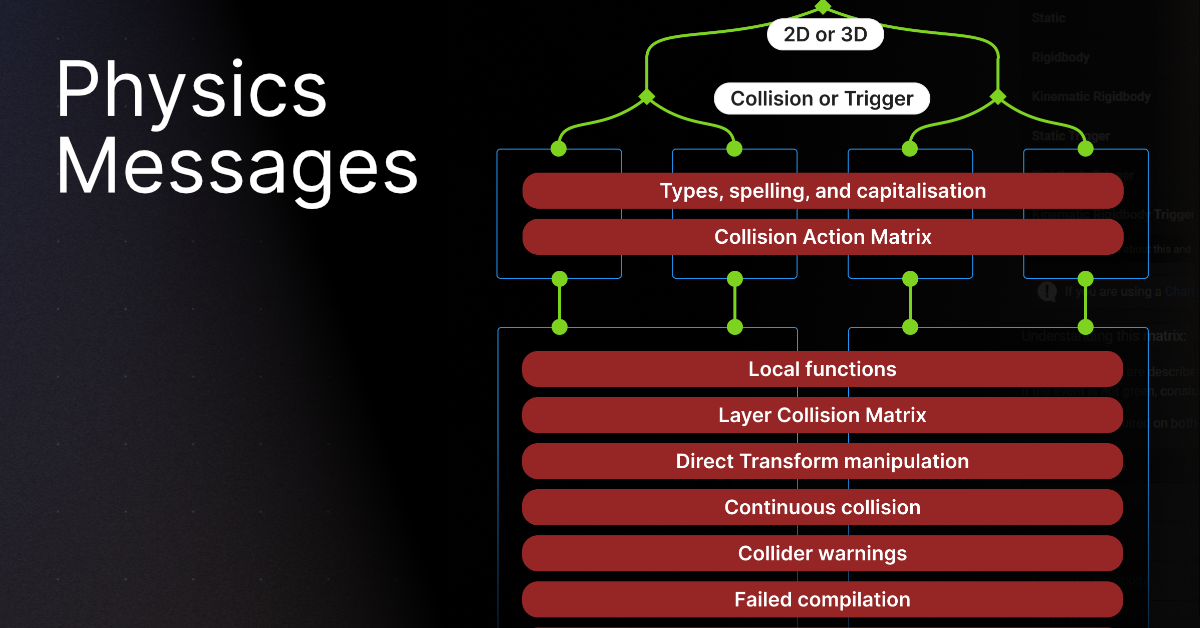 slow fossil
Do I have to call OntriggerEnter or is it called automatically like Update?
rocky canyon
its a physics method.. runs every fixedupdate()
slow fossil
I see
wintry quarry
slow fossil
Do I have to call OntriggerEnter or is it called automatically like Update?
it runs automatically when the trigger overlap happens
it does not run every FixedUpdate
but you need to have the correct configuration in the scene, which Box's link will help you check
rocky canyon
hmm, didn't know that. so its an event sorta
well the engine must know when the overlap happens in order to trigger it automatically.. right?
wintry quarry
of course
rocky canyon
im actually confused now
the physics engine is running in a fixed timestep tho?
a tick
wintry quarry
The timing for OnTriggerEnter can be found here:
https://docs.unity3d.com/6000.0/Documentation/Manual/execution-order.html
Basically it's right after the physics simulation step, if a new trigger overlap occurs
rocky canyon
i'll give it a read.. i've never actually read that page.. just referenced the diagram 😅
wintry quarry
and yes the physics sim is on a cadence with FixedUpdate
rocky canyon
okay.. that makes me feel a bit better lol thought i was fried
wintry quarry
I only had issue with you saying "***every ***FixedUpdate"
wintry quarry
also FixedUpdate is before the physics sim step, this is after, which is sometimes relevant
rocky canyon
slow fossil
Do I have to call OntriggerEnter or is it called automatically like Update?
there's ya a solid answer.. see:☝️ context n all 😄

aye, honestly never seen/clicked into the contextual links
https://docs.unity3d.com/6000.0/Documentation/Manual/collider-interactions.html oh neat... here's a solid page ive never seen before either.. this one would be useful many-a-times i've been in
slow fossil
I think the problem is totally unity... And not me haha
slow fossil
I use some sphere collider to hold everything together
slender nymph
okay and which object has the rigidbody on it
slow fossil
I have never used Rigibodies
basically, I have a cube with an ArcherBehavior and a ball with a PeonBehavior
I have something like that
abstract class Tower : MonoBehaviour {
  protected List<Collider> enemiesInRange;
  protected SphereCollider rangeCollider;

  protected SphereCollider initiateCollider()
    {
        if (range > 0)
        {
            SphereCollider rangeCollider = gameObject.AddComponent<SphereCollider>();
            rangeCollider.isTrigger = true; // Can detect things
            rangeCollider.radius = range; //size of range

            return rangeCollider;
        }
        else return null;

  }
  private void OnTriggerEnter(Collider other)
    {
        print("Something entered");
        if (other.CompareTag("CanBeAttacked"))
        {
            enemiesInRange.Add(other);
        }
    }
    private void OnTriggerExit(Collider other)
    {
        print("Something exited");
        if (other.CompareTag("CanBeAttacked"))
        {
            enemiesInRange.Remove(other);
        }
    }
}
Tower
public class ArcherBehavior : Tower {
  public Awake() {
    initiateCollider();
  }
}
archer
and the enemies have the same collider initialization
slender nymph
I have never used Rigibodies
there's your problem.
if you would actually bother going through that link i sent before you'd see that a rigidbody is required to send collision and trigger messages
slow fossil
Aren't collider enough just for the function enter and exit?
slender nymph
there must be at least one rigidbody involved in the trigger overlap to send the trigger message
slow fossil
very well
 drowsy flare
Unity version control keeps nagging me about changes in files that are unchanged. When I diff them they are identical. Is this a known issue? Any workarounds?
slender nymph
is it your own files or is it stuff from unity like Text Mesh Pro related stuff? i ask because i recall a recent editor patch fixed an issue with version control noise related to some specific unity stuff
drowsy flare

 drowsy flare
slender nymph
is it your own files or is it stuff from unity like Text Mesh Pro related stuff?...
drowsy flare
slender nymph
is it your own files or is it stuff from unity like Text Mesh Pro related stuff?...
It's not files I touch, but I can imagine them being touched somehow in the background
slender nymph
what version of the editor are you using
drowsy flare
slender nymph
what version of the editor are you using
6000.2.8f1, and version control 2.9.3
I'll try upgrading to latest-latest
 rancid tinsel
could someone explain the difference between these two?

 marsh vale
anyone reccomend any good videos to learn unitys new player movement system
slow fossil
Any idea why is the OnTriggerEnter and OnTriggerExit is triggered twice for two sphereCollider?

 solar hill
rancid tinsel
could someone explain the difference between these two?
solar hill
rancid tinsel
could someone explain the difference between these two?
image 1 gets the actual sender's id from the rpc parameters while image 2 wrongly uses the local client id which would just be the server's own id instead of whoever sent the rpc
i think
solar hill
slow fossil
Any idea why is the OnTriggerEnter and OnTriggerExit is triggered twice for two...
send the code
radiant voidBOT
Posting code
📃 Large Code Blocks
Use links to services like:
https://paste.mod.gg/, https://hastebin.skyra.pw/, https://paste.ofcode.org/, https://paste.myst.rs/
📃 Inline Code
Surround code with three backquotes. Not quotation marks.
To format as C#, add cs to the first line:
```cs
// Your code here
```
Add a comment with a line number if there is an error message.
rancid tinsel
solar hill
image 1 gets the actual sender's id from the rpc parameters while image 2 wrongl...
that sounds correct, because on both host and client I was getting clientID = 0
man this whole multiplayer thing is so confusing, but definitely a lot simpler than I was worried about
slow fossil
    Object n°1
    private void OnTriggerEnter(Collider other)
    {
        print("Something entered");
        if (other.CompareTag("CanBeAttacked"))
        {
            print("and it's an enemy");
            enemiesInRange.Add(other);
        }
    }
    private void OnTriggerExit(Collider other)
    {
        print("Something exited");
        if (other.CompareTag("CanBeAttacked"))
        {
            enemiesInRange.Remove(other);
        }
    }
    SphereCollider rangeCollider = gameObject.AddComponent<SphereCollider>();
    Rigidbody rb = gameObject.GetComponent<Rigidbody>();
  Object n°2
    SphereCollider rangeCollider = gameObject.AddComponent<SphereCollider>();
they both have colliders (range set to 1)
I suspect it has to do with both edges being detected as entering and leaving
 indigo valley
Hey everyone! ive been running into an issue with a scriptable object asset i created and cant figure out why, so thought id try some luck asking here.
My asset says that the assocaited script cannot be loaded and to fix compiler errors, but there are no compiler errors, and adding anything to the script and saving, even if its a comment or a blank space, makes the asset work again. But it breaks again during the next project open or whenever i switch scenes.
Any idea what it could be?
Ive tried reimporting all and the file name and class name are the same, all the classes are system serializable
grand snow
indigo valley
Hey everyone! ive been running into an issue with a scriptable object asset i cr...
Do you have more than 1 scriptable object class definition in a file?
indigo valley
grand snow
Do you have more than 1 scriptable object class definition in a file?
nope
i have a different scriptable object by itself and that one never had any issues
grand snow
If the class definition is in a file with the same name (MyCoolSO.cs -> public class MyCoolSO : ScriptableObject{) it should work fine
What you describe reflects what I had in the past when I had the class def share a file with another
 naive pawn
slow fossil
I suspect it has to do with both edges being detected as entering and leaving
naive pawn
slow fossil
I suspect it has to do with both edges being detected as entering and leaving
yes, both colliders in a collision/trigger event will receive the collision/trigger message
indigo valley
grand snow
If the class definition is in a file with the same name (MyCoolSO.cs -> ``public...
yeah thats what i read online as well, but it has always been that way, the names always matched
grand snow
How do you make the assets? CreateAssetMenu attribute?
Do newly made assets work correctly?
indigo valley
grand snow
Do newly made assets work correctly?
i tried making a new asset and it didnt work, same issues as before
radiant voidBOT
grand snow
!code
Posting code
📃 Large Code Blocks
Use links to services like:
https://paste.mod.gg/, https://hastebin.skyra.pw/, https://paste.ofcode.org/, https://paste.myst.rs/
📃 Inline Code
Surround code with three backquotes. Not quotation marks.
To format as C#, add cs to the first line:
```cs
// Your code here
```
Add a comment with a line number if there is an error message.
indigo valley
yeah sure
A tool for sharing your source code with the world!
grand snow
It doesnt need the Serializable attribute but I see no reason for this to break
are you doing anything strange with meta files or asm defs?
indigo valley
grand snow
are you doing anything strange with meta files or asm defs?
nah i havent touched any of that so far
i dont even need to edit the script itself, editing any script in the project also makes it work again
coral patio
Hey knowledgeable people, is it possible to get persistent unique ids for game objects by default? Reason: we have about 3000 collectables and are working on a save system so we need to be able to spawn or despawn them in. Or is there an particular better way I am missing?
Our idea was to write in arras of object with some BSON and other data as a save file
fast relic
coral patio
Hey knowledgeable people, is it possible to get persistent unique ids for game o...
Object.GetInstanceID should do the trick
though the ids do not persist between sessions!
coral patio
fast relic
though the ids do not persist between sessions!
Yeah that's not necessarily helpful as it doesn't persist hence no way of loading a save file 😭
fast relic
coral patio
Yeah that's not necessarily helpful as it doesn't persist hence no way of loadin...
i see
you'd probably have to generate them yourself then
coral patio
I feel like I'm dumb this seems such a common use case for almost any game that I feel like Im missing something. Yeah maybe.
fast relic
coral patio
I feel like I'm dumb this seems such a common use case for almost any game that ...
is it? i can't think of a scenario i ever needed a persistent unique id for objects
coral patio
fast relic
is it? i can't think of a scenario i ever needed a persistent unique id for obje...
Well any RPG like game. Removed chests, boxes, non-respawning game placed game elements seems like common for those type of games
fast relic
coral patio
Well any RPG like game. Removed chests, boxes, non-respawning game placed game e...
i mean just a simple sequential id should work fine for them
sour fulcrum
generally any implementation needs to be fairly specific to the game its built for so it's hard to make something general like that
coral patio
Okay so I assume best way to go write a custom script which adds a unique id to any object when creating in the inspector is prob the best idea so they can be saved
fast relic
that should work fine
timber tide
I just generate GUIDs on everything even though Unity does have some utility I prefer to have the control
asset IDs are fine though and they wouldn't change between session. Not guarantee if you do patch the game though
coral patio
Sounds good guys thanks!
ripe shard
coral patio
Hey knowledgeable people, is it possible to get persistent unique ids for game o...
the standard way is to serialize a per instance-GUID as a string in a field on a root-level component of a gameobject you want to identify. then store those GUIDs in your save. On restore find the objects with those GUIDs and inject the saved data into them. If you want your save-system to restore dynamic objects, you would need to make a asset-lookup and store a unique asset ID next to the instance IDs in your instanced objects that points to the prefab from which they can be restored (this works similarly to how netcode spawns/despawns objects in clients).
 onyx geyser
well, I spent all day learning the basics for C#, would the next best thing be to look at several hundred tutorials and disect how they go about making their games?
now that I can probably vaguely understand how anything works at all in this software?
 eternal needle
onyx geyser
well, I spent all day learning the basics for C#, would the next best thing be t...
eternal needle
onyx geyser
well, I spent all day learning the basics for C#, would the next best thing be t...
if you feel confident in your c# abilities, then maybe take a look at unity !learn and start learning the engine. think of features that you'd want to implement and try creating them. Lookup tutorials to help you get there but most tutorials are horrible code quality
if this is your first language, a day in c# likely isnt going to be that much honestly
sour fulcrum
maybe make a calculator in unity 😄
onyx geyser
well, i've had prior knowledge, so most of what I learned was more like- getting a bit deeper and learning how it actually works, but I think I might have some confidence in how to make some things
Time to make a highly complex leveling system that genuinely doesn't actually work
eternal needle
!learn
radiant voidBOT
eternal needle
!learn
:teacher: Unity Learn ↗
Over 750 hours of free live and on-demand learning content for all levels of experience!
eternal needle
just realized the link didnt send before
sour fulcrum
the smaller the project the better and it's hard to accidentally overscope a calculator. also skill checks you on using unity to handle inputs (pressing buttons) variables (the current values of the calculator) and outputting to text
onyx geyser
suppose that's true
well suppose I SHOULD ask, how decent of a teacher is W3Schools
buddy of mine sent it to me ealier and said it was decent
sour fulcrum
as a resource? extremely solid. as a teacher? pretty bad imo
I find it very helpful when im new to something and need a pretty isolated, working example snippet of how something works fundementally
onyx geyser
so as a newbie it's probably pretty good because it showcases a fundemental process of using it?
but outside of that, it's better as just a resource?
sour fulcrum
Yeah, it happens to most people so don't take it personally but its very easy for new people to get choose paralysis on mix-maxxing the best possible resource they could be learning from
A lot are going to vary in different ways but anything relatively ok is better than nothing
onyx geyser
heard
 gaunt vortex
how do i fix this
 sour fulcrum
A lot of non-interactive education kinda ends up being teaching how to follow given instructions which can help drill certain ideas in and get comfortable working with stuff but a lot of getting to the point where you can actually think of an idea and start making it comes down to learning how to learn, where you can dumb down your idea into micro steps and determine what you dont know how to do so you can then learn that isolated thing
kinda rambly i've been awake way too long 😄
onyx geyser
well, Maybe it helps i've been straying a little bit to see how to combine a few of the things I learned, though it made me wish I knew more about User controls
it didn't much on ReadLine(), I tried to figure out how to use an If else with ReadLine and couldn't get it, it was one of the few that got me
as well as a lack of information on what exactly Type Casting is used for, other than that it's "rarely used"
it kinda lacked on If else and boolean, restricting it to numbers and never really interacting with anything else
sour fulcrum
onyx geyser
as well as a lack of information on what exactly Type Casting is used for, other...
for beginners it really do be rarely used, but casting tends to be when you know a little bit about something but you may need to know more about it (it's very related to the concept of inheritence so if you don't really know that you might not get it)
onyx geyser
Inheritence, like, the idea of passing down something? A statement passing down information to another statement kind of deal?
I don't wanna get ahead of myself on guessing
sour fulcrum
kinda but more in the context of something as a whole
can i assume youve played minecraft
onyx geyser
yeah
gaunt vortex
gaunt vortex
how do i fix this
how do i fix pls
onyx geyser
gaunt vortex
how do i fix pls
what've you tried? it just says installation failed
gaunt vortex
onyx geyser
what've you tried? it just says installation failed
idk i just get that whenever i try to install android stuff
i closed the hub and ran administrator but that didnt do anything
sour fulcrum
so for example mobs, a lot of mobs share the same fundamentals (moving, being hit, doing stuff etc. etc.)
instead of making classes for each mob and redoing all that kinda stuff, you can make a "base" class for Mob and then "inherit" "from" Mob in order to use it as a foundation and build ontop of it
but yeah this is probably slightly abit ahead of where your at so no stress if it's abit much
onyx geyser
ok.. have you looked online for any information on this specific quote?
gaunt vortex
onyx geyser
ok.. have you looked online for any information on this specific quote?
yea
onyx geyser
sour fulcrum
so for example mobs, a lot of mobs share the same fundamentals (moving, being hi...
a method? I think that's what it is?
it's a base you can work off of right?
I think i get it, it's like an empty character you can apply a model, animation, and stats too, in the gamey kinda way of putting it
right?
sour fulcrum
methods and the class itself yeah. you probably don't need to know the specifics of how that works just yet but the broad idea is nice to be aware of
sour fulcrum
onyx geyser
I think i get it, it's like an empty character you can apply a model, animation,...
more or less yeah but the concept of this kinda layered functionality can be applied to anything really
A Microwave might inherit from Appliance which might inherit from Furniture etc.
onyx geyser
so it's layed "what you can do, i can do" type of thing
that would explain why I didn't really get it
I think i still managed to use it at some point in my strange code
if it's the same thing were thinking of
sour fulcrum
more specifically "what you are, i am (and potentially more)
 worthy veldt
im trying to make an object that can show me tile coordinate that object's in while the game is not running,
tried if (Application.isEditor && !Application.isPlaying){ Debug.Log(convertWorldPosToGridPos(transform.position)) } in update but it doesnt work.
how do i do it, people in unity forum claim it worked, am i missing something ?
https://discussions.unity.com/t/how-would-i-get-a-script-to-execute-only-in-editor-but-not-at-runtime/645157/5
onyx geyser
sour fulcrum
more specifically "what you **are**, i **am** (and potentially more)
were talking about Convert.tosomething() right?
I think I get how that works a bit better
naive pawn
worthy veldt
im trying to make an object that can show me tile coordinate that object's in wh...
do you have the ExecuteAlways attribute on the class
 young drift
Hi I'm beginner in shader, I'm trying to make a simple linear gradient in Unity in shader code that have controls with the start and end but when my _GradientEnd is 1, and my start is 0, my expected output should be all red as that's my end color, cause I assume 1 should be like 100% but why is my output still like a 50/50 gradient?


 north kiln
young drift
Hi I'm beginner in shader, I'm trying to make a simple linear gradient in Unity ...
north kiln
young drift
Hi I'm beginner in shader, I'm trying to make a simple linear gradient in Unity ...
I'm confused at why you think it would be red? Your range is 0->1 between the two colors
worthy veldt
naive pawn
do you have the `ExecuteAlways` attribute on the class
yea google AI suggested that, it worked 🙂
tawdry valley
Hi, i am trying to build a rigidbody charachter controller. I am not sure should i override linearVelocity or addForce. Which is better for movement?
timber tide
setting velocity is for very specific scenarios. You wouldn't use it as the main driver to your controller
because every time you set the velocity you forgo any forces that were placed upon that body
Friction, dampening, elastic behaviours wouldn't even apply
tawdry valley
But many tutorials and AI examples i generated doing the movement method like that
 midnight plover
AI examples is a bad way to learn. They can help you if you know what the output means. tutorials are depending on what you are trying to achieve. Sometimes it makes sense to fully control the velocity, sometimes it does not.
keen dew
It depends what kind of movement you want and what is moving (platformer character, car, etc.) Setting velocity directly gives precise control over the movement, but it won't look natural without a lot of extra work.
tawdry valley
midnight plover
AI examples is a bad way to learn. They can help you if you know what the output...
Thanks, can you suggest me any tutorial or resource to build a 3d rigidbody character controller?
tawdry valley
keen dew
It depends what kind of movement you want and what is moving (platformer charact...
character
midnight plover
tawdry valley
Thanks, can you suggest me any tutorial or resource to build a 3d rigidbody char...
Again, it depends on what you want to do. Did you look into the official unity tutorials about character controller (the unity one) and other movement scripts?
!learn
radiant voidBOT
midnight plover
!learn
:teacher: Unity Learn ↗
Over 750 hours of free live and on-demand learning content for all levels of experience!
 cedar peak
my restart button isnt working no matter what i do
can i share the project to anyone to see if you are able to fix it
midnight plover
cedar peak
my restart button isnt working no matter what i do
can i share the project to a...
You can show your code (hence the channel name) and tell us, what the restart button is supposed to do and what is happening right now.
cedar peak
its supposed to respawn the player
this is the code public void Restart()
     Debug.Log("Clicking restrt.......................");
     Scene currentScene = SceneManager.GetActiveScene();
     SceneManager.LoadScene(currentScene.name);
 } ```
it wont work no matter what!code
radiant voidBOT
midnight plover
!code
Posting code
📃 Large Code Blocks
Use links to services like:
https://paste.mod.gg/, https://hastebin.skyra.pw/, https://paste.ofcode.org/, https://paste.myst.rs/
📃 Inline Code
Surround code with three backquotes. Not quotation marks.
To format as C#, add cs to the first line:
```cs
// Your code here
```
Add a comment with a line number if there is an error message.
midnight plover
cedar peak
its supposed to respawn the player
this is the code public void Restart()
``` ...
not work means, your log is not firing? or only the sceneload is not working?
cedar peak
its showing everything else is just fine
but when i click it wont respond
even the debug message isnt showing up
midnight plover
How did you attach the method to your button then?
And what is the "button". UI? 3D? give some info about the setup pls
 midnight plover
cedar peak
i wrote it in game manager unversal 2d
midnight plover
cedar peak
i wrote it in game manager unversal 2d
Is that a standard UI button? Do you get any errors in console?
cedar peak
yes standard no errors
midnight plover
Does your button react to your mouse hover?
cedar peak
no
cedar peak
how do i tell theres nothing in the hierarchy
midnight plover
How do you know there is no cat in a room...
cedar peak
..im still learning
its fixed
1 more thing
when the game starts if i try going left(jumping off ) it wont let me and theres no colliders in the air on the left so i have no clue whats stopping me
radiant voidBOT
midnight plover
!code
Posting code
📃 Large Code Blocks
Use links to services like:
https://paste.mod.gg/, https://hastebin.skyra.pw/, https://paste.ofcode.org/, https://paste.myst.rs/
📃 Inline Code
Surround code with three backquotes. Not quotation marks.
To format as C#, add cs to the first line:
```cs
// Your code here
```
Add a comment with a line number if there is an error message.
cedar peak
A tool for sharing your source code with the world!
midnight plover
yep, thanks
 warped valve
Need some help with basic character movement. My player is moving and rotating sporadically when I'm not even touching the controls.
https://paste.mod.gg/vgixmfjfxtxi/0
A tool for sharing your source code with the world!
midnight plover
cedar peak
https://paste.mod.gg/afvuxpkacuet/0
And when you move left, it will just stop at a certain position?
cedar peak
yes but only at that certain place otherwise i can move left just fine
midnight plover
warped valve
Need some help with basic character movement. My player is moving and rotating s...
I would start commenting out code blocks to figure out, where the system starts rbeaking
midnight plover
cedar peak
yes but only at that certain place otherwise i can move left just fine
A certain place? Please clarify
cedar peak
i can go further left from the grass
 midnight plover
are you sure, there is no small 2d collider stopping you at whatever point?
cedar peak
yea id figured the same but if i try to jump i acts like theres a wall of collider
in the image im moving left and somethings stopping me
 midnight plover
Just for testing. Can you move your visual level to the left or right and see, if the invisible border goes with it?
worthy veldt
!code
radiant voidBOT
worthy veldt
!code
Posting code
📃 Large Code Blocks
Use links to services like:
https://paste.mod.gg/, https://hastebin.skyra.pw/, https://paste.ofcode.org/, https://paste.myst.rs/
📃 Inline Code
Surround code with three backquotes. Not quotation marks.
To format as C#, add cs to the first line:
```cs
// Your code here
```
Add a comment with a line number if there is an error message.
 split mason
Hi!!
so i got started with multiplayer, people around me suggested using Photon Fusion 2, but i am stuck as their documentation doesnt really explain things in details, can someone suggest some sources to get implementation practical guidelines for photon fusion 2?
(plus dont really know where to post this kind of discussion, if i am not allowed to do it here then do let me know.Thanks.)
chrome apex
My player is a rigidbody that has a collider that's horizontal to the ground.
It's comprised of two capsules that don't touch and they make a "T" shape.
Anyway, when I move push the player forward, it often catches on the side-to-side part of the collider and starts flipping towards the ground.
What should I do here? Increase angular drag (and maybe drag) and add more forces when moving/rotating?
I don't think switching the collider to a box would help with that. Maybe I'd need to remove the upper part of the T collider?
 echo ruin
chrome apex
My player is a rigidbody that has a collider that's horizontal to the ground.
...
echo ruin
chrome apex
My player is a rigidbody that has a collider that's horizontal to the ground.
...
If it’s not supposed to rotate at all, you can just lock rotation straight on the rigidbody
 hardy prairie
chrome apex
My player is a rigidbody that has a collider that's horizontal to the ground.
...
hardy prairie
chrome apex
My player is a rigidbody that has a collider that's horizontal to the ground.
...
freeze constraints
or use probuilder to merge them if you still want the rotation
midnight plover
split mason
Hi!!
so i got started with multiplayer, people around me suggested using Photon ...
I think there are some good docs from photon about how to do things, as far as I remember. What are you stuck on?
#1390346492019212368 could also be the better palce for general questions about networking if you dont have a specific code question
split mason
midnight plover
I think there are some good docs from photon about how to do things, as far as I...
just the basics tbh, like how to initially set things up in unity(not the get photon app id etc etc, like the network runner and networkdatabase manager yk)
split mason
midnight plover
<#1390346492019212368> could also be the better palce for general questions abou...
thanks!!
midnight plover
split mason
thanks!!
thats not covering a lot? https://doc.photonengine.com/fusion/current/tutorials/host-mode-basics/1-getting-started
Fusion Host Mode Basics explains the initial steps required to start a Fusion project. A general understanding of Unity and C# is expected.
split mason
midnight plover
thats not covering a lot? https://doc.photonengine.com/fusion/current/tutorials/...
its like direct to the implementation yk, i was looking for something like how different things are working but ig gotta really hit and trial through things to get my required things set up(cuz its a 2d kinda game so yep)
midnight plover
split mason
its like direct to the implementation yk, i was looking for something like how d...
Yeh, you just gotta adapt to your needs. But there is no tutorial that could magically know what you need 😉 Just try and read on the docs when you need a function from photon that might already be covered.
The difference between 3d and 2d is not really relevant for photon afaik. If you need to clamp 2d positions, you basically sent a vector3 with z = 0 for example. So thats more up to general coding than networking with photon or netobjects or whatever multiplayer variant you chose
split mason
midnight plover
Yeh, you just gotta adapt to your needs. But there is no tutorial that could mag...
well the major part i am stuck at is mostly in docs/tutorials its like peer to peer, and even if its host mode, then it goes like a single host and a single client, i got like a single host and multiple clients so yep, but ig not everything is to be spoon fed🏃🏻
midnight plover
split mason
well the major part i am stuck at is mostly in docs/tutorials its like peer to p...
yeh, also that is covered in the tutorial I have sent you from photon docs. Host mode, shared mode and what not 🙂 youll get the hang of it, im sure
split mason
thanks thanks!!!
chrome apex
echo ruin
If it’s not supposed to rotate at all, you can just lock rotation straight on th...
It is supposed to rotate when I'm moving the mouse.
chrome apex
hardy prairie
or use probuilder to merge them if you still want the rotation
What do you mean with this other comment
Can't freeze them
rough granite
chrome apex
It is supposed to rotate when I'm moving the mouse.
The rigidbody lock rotation for each axis locks physics rotation not code
naive pawn
chrome apex
My player is a rigidbody that has a collider that's horizontal to the ground.
...
perhaps reduce friction.
also not a code question
 wraith delta
hello, i have this code, shot a ray from the player to the middle of the screen, that's working while the player is centered aswell but i have an offset on the player with cinemachine
    private bool TryGetRaycastHit(out RaycastHit hit)
    {
        Ray screenRay = Camera.main.ViewportPointToRay(new Vector3(0.5f, 0.5f, 0f));
        Vector3 rayOrigin = origin.position;
        Vector3 targetPoint = (screenRay.origin + screenRay.direction * 100f);
        Vector3 rayDirection = (targetPoint - rayOrigin).normalized;

        //Debug.DrawRay(rayOrigin, rayDirection * distance, Color.red, 1f);

        return Physics.Raycast(rayOrigin, rayDirection, out hit, distance, mask);
    }
the ray should go from the player to the center of the screen, any solution?
tried transform.TransformVector() but it doesnt work as expected
 chrome apex
rough granite
The rigidbody lock rotation for each axis locks physics rotation not code
chrome apex
rough granite
The rigidbody lock rotation for each axis locks physics rotation not code
Idk what this has to do with this. I'm just saying I don't want to lock rotation on any axes
chrome apex
naive pawn
perhaps reduce friction.
also not a code question
That's actually a good idea. Physics material, right?
naive pawn
yes. consider moving to #💻┃unity-talk or #⚛️┃physics if you want to continue
keen dew
wraith delta
hello, i have this code, shot a ray from the player to the middle of the screen,...
Do you mean you have a 3rd person view like this and you want a ray from the player character like the arrow?
 hardy prairie
chrome apex
What do you mean with this other comment
hardy prairie
chrome apex
What do you mean with this other comment
You can use probuilder to merge the two capsules together
Then they will act as one object
But if you want to seperate them then it wont work
 wispy bison
Hi, I'm a beginner and I need some guidance.
I'm trying to make a system where a character launches projectiles randomly from a "deck" of cards. Each projectile has physics and the same set of stats but with different values like speed, power, etc.
Later on, I want to program a menu where the player can see their full deck with all the different projectiles and add new ones.
Right now the projectiles in the "deck" are prefabs in a list. Is there a better way to do this? I've heard scriptable objects being talked about but I'm not sure what that is.
I just want to know if I'm on the right track or if there's an even better way to accomplish this before I go down a rabbit hole. Thanks!
frosty hound
SOs are containers that hold data. If you're doing something like an inventory or item system (including cards), they're a good usecase because you can create an SO for each thing and define a bunch of the values of it.
Such as an Item SO that lets you give it a name, price, description, etc.
rough granite
frosty hound
SOs are containers that hold data. If you're doing something like an inventory o...
I hear you shouldn't use mutable data though
wispy bison
I see. Right now I have all the data in a single script.
But with an SO the object would have its script that controls all the physics, and then a separate Scriptable Object attached to it for all the stats?
rough granite
wispy bison
I see. Right now I have all the data in a single script.
But with an SO the obje...
SOs cant be attached to GameObjects like Monobehaviours can it'd be a reference in the code or serialized field
But you'd probably want a controller script that has a list of every SO card and a single prefab that can be instantiated with anyone of the SOs
wispy bison
Thank you! So I can keep the list with prefabs that I have now, and when I want to do the inventory screen, that's when I'd start using the scriptable objects?
frosty hound
The SO doesn't "control" anything, it's purely a data container.
A card in your case would be given the SO that contains its information (as a reference would be easiest). Then your game logic would use that to do whatever it needs to.
When the card "attacks" for example, you can pull out the damage values from the SO on that card to calculate the final outputs.
wispy bison
I guess where I'm confused is that what I'm drawing from the deck are random projectiles prefabs. So where could I use the SO? Like in the stats of the projectiles, or in the inventory showing all the projectiles?
frosty hound
If youre projectils are wildly different, then keeping them as separate prefabs and just putting all that information directly on them as properties or even hardcoded into their unique controller scripts, is fine. I don't think you necessarily need SOs here unless you want an easy to modify their individual design values without opening the prefab.
SOs really shine when you have a template prefab that you modify/dress up based on the SO its given.
wispy bison
Got it! Thank you
wraith delta
@keen dew yeah, i mean, its working, the problem is the camera offset applied to the player
keen dew
Right. After the first raycast you need to do another from the player character to what the first raycast hit
Note that this is a problem that doesn't have a satisfactory solution, only a lot of tinkering to make it work somewhat satisfactorily
wraith delta
i was trying to add the offset directly to the target, or the origin so the ray goes straight, but after that it goes crazy
is taking the target from the world and not the 2d canvas space, like if the ray is long enough it will reach the center of the screen inside the world
keen dew
There is no center of the screen inside the world. It's a continuous line from the camera to infinity
You have to pick a point from that line (which is what the original raycast is doing)
 amber warren
Hi im trying to make a function in a vr game where two flasks with different colour liquid can be mixed together howevr i cant get the script to work
hexed terrace
amber warren
Hi im trying to make a function in a vr game where two flasks with different col...
!ask
radiant voidBOT
hexed terrace
!ask
:thinking: Asking Questions
:mag: Search the internet for your question!
:book: Use the API Scripting Reference and User Manual and this troubleshooting site for commonly posted issues.
:wrench: Attempt to debug your issue.
:thought_balloon: Find an appropriate channel by reading the name and description in #🔎┃find-a-channel
:grey_question: And don't ask to ask, ask a full question illustrating with screenshots if needed.
-# For more posting guidelines, go to #🌱┃start-here
hexed terrace
!code
radiant voidBOT
hexed terrace
!code
Posting code
📃 Large Code Blocks
Use links to services like:
https://paste.mod.gg/, https://hastebin.skyra.pw/, https://paste.ofcode.org/, https://paste.myst.rs/
📃 Inline Code
Surround code with three backquotes. Not quotation marks.
To format as C#, add cs to the first line:
```cs
// Your code here
```
Add a comment with a line number if there is an error message.
 bitter pine
how do i turn the playback rate of an audisource up when a bool is true?
so ive got a sprinting system and i want the speed of an audio clip to speed up when running, but there doesnt seem to be a playback rate var of anykind?
rocky canyon
that can be done w/ really short footstep sound clips..
where u control when they play..
so ur code will play them quicker together when sprinting
[] [] [] [] [] vs
[] [] [] [] []
 polar acorn
bitter pine
so ive got a sprinting system and i want the speed of an audio clip to speed up ...
polar acorn
bitter pine
so ive got a sprinting system and i want the speed of an audio clip to speed up ...
I don't think there's a playback speed variable, but you can raise the pitch to simulate it being faster?
https://docs.unity3d.com/6000.2/Documentation/ScriptReference/AudioSource-pitch.html
bitter pine
i shall give it a try
rocky canyon
rocky canyon
[] [] [] [] [] vs
[] [] [] [] []
    [Header("Step Intervals")]
    public float walkInterval = 0.6f;
    public float runInterval = 0.3f;

    void Update()
    {
        if (Input.GetKey(runKey))
        {
            currentInterval = runInterval;
        }
        else
        {
            currentInterval = walkInterval;
        }

        // then a timer
        timer += Time.deltaTime;

        if (timer >= currentInterval)
        {
            PlayFootstep();
            timer = 0f;
        }
    }```
something like this is what i was referring to @bitter pine you can also use pitch as Digiholic mentioned to compliment itso ur play short clips at different rates
rocky canyon
good stuff good luck 🍀
bitter pine
though i changed up the way they split, mine wait till its done, play a coroutine with waitforseconds then play the next, is your way better in some way?
or?
rocky canyon
no.. not necessarily.. i wouldn't ever say one way is better than another if they achieve ur desired outcome
bitter pine
kk
rocky canyon
bitter pine
though i changed up the way they split, mine wait till its done, play a coroutin...
i just like simple timers in the update..
but for more refined control i do use coroutines just like u mentioned
if its anything more than "you hit the timer limits -> do the thing -> and reset the timer"
i'll use a coroutine
 night raptor
Not that it probably makes any difference in this case, but I generally prefer doing timer -= currentInterval. Just zeroing the interval essentially adds half a frame delay in average (so do coroutines I assume, unless specifically taken into account). If the game lags immensely the sounds could in theory get stacked for upcoming frames (if subtraction was used) so timer %= currentInterval would probably be fine too. I assume we don't want to have a loop either to play multiple sounds the same frame so the modulo should just discard the extra intervals that might be stacked up in the timer variable.
Again, doesn't make much difference usually, but just a small detail that is very easy to add
rocky canyon
ya, we all have our timer preferences
some ppl like adding the next interval onto the limit
others like to reset timer completely..
some people like counting up and some people like counting down lol
night raptor
In theory there is a small difference in framerate independence so it's not only about preference but it's mostly notable for things happening in very fast intervals.
It's bit similar to how velocity += acceleration * Time.deltaTime isn't fully framerate independent but most don't care taking that into account (even though it's not particularly hard) due to how little the difference is. Well that is framerate independent way to increase the velocity but if applied like that to a moving object, it will not be
 drowsy tiger
has anyone have experience with "resistance" in joints? I have a configurable joint, which acts like a hinge joint, inherently a motor.
What I'd like to do, is, prevent the connected body to NOT rotate, until the motor is rotating it. The motor is just a very simple clockwise/anticlockwise input setup. But whatever the motor is controlling, sometimes changes its initial configuration, due to gravity. which makes sense. I'd rather not disable gravity on the controlled rigidbody, but resist it
I've tried zeroing out angular velocity, but it kinda just falls slowly. I don't want to actually apply a countering force, because when I tried this, this ends up creating forces of its own.
Playing with confiugrableJoint.targetRotation has yielded a nicer results, but I have no idea how to actually calculate it and set it. Just Quat.Angle(initial, current), seems to give the correct angle, but its not very accurately simulating
rocky canyon
night raptor
Not that it probably makes any difference in this case, but I generally prefer d...
so what ur saying is if i wanted complete accuracy i shuldn't be resetting my timer to zero
hot wadi
This is not very code-related
night raptor
rocky canyon
so what ur saying is if i wanted complete accuracy i shuldn't be resetting my ti...
Yes, setting it to 0 will overwrite what you had already cumulated in timer. Afaik that should add half a frame of delay in average to each time you are resetting the timer. Let's say your game would run 50fps (deltaTime = 0.02) and you wanted to reset the timer 10 times a second. You would end up resetting the timer every 0.011 seconds by average (0.1 + 0.02 / 2.0). Often not impactful but something to keep in mind to know where it is fine and where not.
rocky canyon
sounds to me he's manipulating the joints via code.. so its 50% related.. but I posted a response in #⚛️┃physics cuz they probably have a better hang of joints in general and all the physics components
rocky canyon
night raptor
Yes, setting it to 0 will overwrite what you had already cumulated in `timer`. A...
ah, i kinda knew this but never had anyone explain it to me 👍
thanks for the insight.. i'll look into this a little later..
i'm working on a new code-base luckily.. soo i wont have dozens of timers to refactor or atleast look at
even has a nice flow-chart Unity’s time logic definitely gonna add this to the bookmarks
timer drift lol
night raptor
rocky canyon
ah, i kinda knew this but never had anyone explain it to me 👍
thanks for the i...
Usually my timers would look like this to also take care of the case where you need to do that whatever thing multiple times a frame (especially important if interval < expected deltaTime):
void Update()
{
    timer += Time.deltaTime;

    //while can be replaced by íf-statement if we won't have timer >= interval * 2
    //due to high deltaTime or/and low interval
    while (timer >= interval)
    {
        DoWhatever();
        timer -= interval; //the important part
    }
}```ohh i think i had a eureka moment... soo its like if the timer passes the threshold.. but is not an exact divider you'll have some "remainder" that gets yeeted
night raptor
rocky canyon
ohh i think i had a eureka moment... soo its like if the timer passes the thresh...
Exactly
rocky canyon
ahh i get it now 👍 thanks friend
drowsy tiger
if we're discussing on that level of delta, that means the second time around that remainder actually adds up to your timer, and hence its a little faster the second time around
rocky canyon
yup, makes perfect sense to me now.. just never have used it for anything precise enough to notice
i've heard stories of when you run a game for hours on end you'd def notice a difference.. if ur timers have been running since bootup
void Update()
{
    float dt = Time.deltaTime;
    totalTime += dt;
    minuteAccumulator += dt;

    while (minuteAccumulator >= interval)
    {
        Debug.Log($"A minute passed! Total time: {totalTime:00}s");
        minuteAccumulator -= interval; // the magic part
    }
}```yea that -= interval is smart 🧠
imma do my timers like this from now on
trying to think of any edge cases where this wouldn't work perfectly fine for me..
but can't think of any off-hand.. soo imma roll with it
instead of: resetting timer to 0
we're basically resetting only the part we used keeping the remainder to carry over on the next duration,
neat 👀
night raptor
precicely
rocky canyon
only took me 4 years and a handful of months to figure out something soo basic 😆
i think i've been cautioned before but was always too ankles-deep in work to consider figuring it all out.
im pretty sure they were like "it'll work for basic simple timers (only controlling (1) thing).
glad i stopped this time and looked into it
ohh.. and the while() instead of the if() makes more sense too
didn't think of that until just now.. it would correctly log (2) times if we had some stupid long lag spike or something
instead of the if() just jumping over one
night raptor
rocky canyon
instead of the *if()* just jumping over one
Well, it will keep the extra time in the timer and take care of that in the next frame but the issue arises when the game is constantly running on deltaTime more than interval in which case the if will execute every frame but the timer will keep going up which is often not wanted. In this case however when what we want to do is play a sound effect, we probably don't want to fire the same sound effect multiple times on the same frame even though we would be behind the schedule. Also trying to catch up by playing the sound effect in consecutive frames after a lag spike would probably not sound very pleasent either. That's why I suggested using timer %= interval which would just remove all but the remainder. Depends on the case what we want to do, but in most cases I choose the while together with -=
rocky canyon
good stuff.
yup, so it just depends on teh use-case of the timer 🙂
"all things are relative" - someone i bet
night raptor
rocky canyon
i've heard stories of when you run a game for hours on end you'd def notice a di...
Something that can usually be taken into account in the code but the issue is essentially that single precision floating point values are only precise up to around 7 significant digits. If you need to present the current time since start using float you would be limited to millisecond precision once 10k seconds have passed (around 3 hours). In some math intensive calculations that might be enough to cause noticeable defects. For that reason there's also the Time.timeAsDouble and such methods in the Time class which use the double precision floats (double) with which you will never in million years run out of precision. Too bad most GPU's only support single precision floats so to avoid these issues on shader effects to which time is passed requires some tricks (like resetting the time passed by intervals that don't cause a flicker). note that the 10k seconds and millisecond calculation is only accurate to a magnitude level, the point was just that on thousands of seconds, you would start getting bit limited by precision
rocky canyon
i did used to have a GameTick script that kept up with multiple frame-rates / tick-rates
and would just fire off events that all my other systems relied on..
i used it mainly for AI / Enemy Sensor Arrays..
like it could think x amount of times every second...
it gave a bit of "randomness" to the enemies movements
i think i'll redo that system using that while method just for exercise
 flint rover
is there anyone who wouldnt mind hopping in a call with me to help me out?
rocky canyon
you'd need to use an external website to get support groups or..
edit: Unity Developer Community has VC channels.. but this is more of a community channel..
you ask out in the open publicly..
a. - to get help from everyone
b. - to help everyone that way someone can search thru the conversations and find useful information for themselves.. if they're having the same problem
radiant voidBOT
<:error:1413114584763596884> Command not found
There's no command called
colab.
edgy sinew
⭐ Hello guys, what is your recommendation for Hands IK on 2-handed weapons? ⚔️
I've set up some "rotation & position" config so, any item can attach fine to the Player's right hand,
But with 2 handed weapons, well, now there has to be a real-time IK target indicating which spot on the weapon to hold (left hand)
And furthermore then aiming the weapon, totally breaks both hands IK, rotations etc, and looks terrible...
Thanks for your help guys... trying to avoid needing like 4-5 config rotations per weapon lol
eternal needle
rocky canyon
didn't think of that until just now.. it would correctly log (2) times if we had...
itd be a bit rare to run into this case considering the max delta time is 0.33. a simple use case would be something like a gun that you'd expect could fire more than once per frame (like a minigun)
rocky canyon
put a target gameobject on the weapon.. should be able to set the IK's target or hint to that
edgy sinew
rocky canyon
put a target gameobject on the weapon.. should be able to set the IK's target or...
Fair enough... seems like the most obvious solution so I was avoiding that
rocky canyon
eternal needle
itd be a bit rare to run into this case considering the max delta time is 0.33. ...
yea, i just like to brainstorm a little deeper into things b4 i use them..
i know i probably wont run into edge-cases that wouldn't work with it..
but as a thought exercise i just like to make my rounds
👍 thanks for the headsup tho 🙏
rocky canyon
edgy sinew
Fair enough... seems like the most obvious solution so I was avoiding that
lmao.. why u just trying to avoid common solutions?
edgy sinew
flint rover
is there anyone who wouldnt mind hopping in a call with me to help me out?
Tbh just post the question. screenshots & code too. I'm sure we can solve it quickly
rocky canyon
i can look for alternatives a bit later during lunch.. if its not cool enough for ya 🤪 lol
edgy sinew
rocky canyon
lmao.. why u *just* trying to avoid common solutions?
Idk i was tryna be fancy and just have a local position / rotation config per object 
but yeah the invisible game objects way is probably easier
rocky canyon
edgy sinew
Idk i was tryna be fancy and just have a local position / rotation config per ob...
u could use it just for target positioning..
edgy sinew
Actually my "config per object" would then hold references to those invisible hint objects
rocky canyon
and break out ur rotation and stuff in something different
you using Unity's Animation Rigging package?
edgy sinew
rocky canyon
you using Unity's Animation Rigging package?
heck yeah
flint rover
edgy sinew
Tbh just post the question. screenshots & code too. I'm sure we can solve it qui...
ok so its probably a simple fix but heres my code which the error provided is refering to

 rocky canyon
or something like FABRIK
rocky canyon
edgy sinew
heck yeah
heck ya, its a solid package ngl
i love using it for procedural animations
think like a Kraken's tentacle
rocky canyon
flint rover
ok so its probably a simple fix but heres my code which the error provided is re...
Object reference being Null. just means the script is trying to access a variable or something that isn't technically assigned
edgy sinew
it's so great. like to make my sprint animation more dramatic, i just tilt the spine1 spine2 spine3 forward lol
flint rover
rocky canyon
Object reference being Null. just means the script is trying to access a variabl...
so what should i do to fix it?
rocky canyon
so it says thisThing.DoFunction()
but the code is like umm.. which thisThing? i can't locate it
rough granite
flint rover
ok so its probably a simple fix but heres my code which the error provided is re...
The if in Awake is reversed
flint rover
rough granite
The if in Awake is reversed
thats confused me even more ngl
edgy sinew
flint rover
so what should i do to fix it?
What exactly are you trying to do?
Looks like Singleton stuff here
rocky canyon
flint rover
ok so its probably a simple fix but heres my code which the error provided is re...
in ur error the last bit is the Script thats causing the error.. and the Line Number
 edgy sinew
Sharing data between different scripts?
rocky canyon
rocky canyon
in ur error the last bit is the `Script` thats causing the error.. and the `Line...
sooo.. on that line.. what code is it accessing?
rough granite
flint rover
thats confused me even more ngl
Your if(instance != null) instance = this; is wrong
rocky canyon
ohh that could be it ^
flint rover
rough granite
Your if(instance != null) instance = this; is wrong
ok what should it be?
edgy sinew
And wouldn't it have to be created, if there is no instance?
rough granite
flint rover
ok what should it be?
If(instance == null) instance = this;
rocky canyon
it was flippity flopped lol
edgy sinew
Or technically, as a MonoBehaviour, the one object it's placed on, would be the instance
flint rover
rough granite
If(instance == null) instance = this;
i tried this before and its still giving the same error
i also tried without the if statement completely and its just instance = this
edgy sinew
flint rover
i tried this before and its still giving the same error
What are you trying to accomplish exactly... are u following an outdated tutorial by chance 🧐
rocky canyon
is the script in the scene?
flint rover
edgy sinew
What are you trying to accomplish exactly... are u following an outdated tutoria...
yeah its like 5 years old but i cant find a better one
edgy sinew
flint rover
yeah its like 5 years old but i cant find a better one
Send it bro i'm sure i have a better one
rocky canyon
5 years isn't that old tbh but it could be a faulty tutorial
rough granite
flint rover
i tried this before and its still giving the same error
Are you ever creating the Attack_Script class?
flint rover
edgy sinew
Send it bro i'm sure i have a better one
https://www.youtube.com/watch?v=e2PRI19Igbo im following this tutorial
Ever wanted an Easy solution at coding a 2D Melee Combo System inside the Unity Game Engine?
Correctly coding it can be frustrating: the majority of solutions you'll think of or find on the internet will be either overly complicated or not even work.
No worries! WIth this tutorial you'll be able to code your own 2d melee combo system in unity ...
rough granite
rough granite
Are you ever creating the Attack_Script class?
Does your Idlebehaviour class (the one with the null pointer error) have any reference to this Attack_Script instance?
flint rover
rough granite
Are you ever creating the Attack_Script class?
what does this mean?
rocky canyon
is it in your game?
night raptor
eternal needle
itd be a bit rare to run into this case considering the max delta time is 0.33. ...
Only case where this would actually be much of an issue is where the interval is very short (potentially much shorter than we expect deltaTime to be). Ended up in a bit of tangent from the way I personally like to do timers, in most cases I just figure it wouldn't hurt changing an if to a while. Depends on the actual use cases whether this would ever make any difference in practice, in most cases not. As I explained later, it also doesn't always even make sense to do the same thing multiple times a frame
flint rover
rough granite
Does your Idlebehaviour class (the one with the null pointer error) have any ref...
i put this in which isnt in the tutorial but it removed the error in that code
 rocky canyon
it wont work if it stays in the Project Window.. and never actually added to the game.. or on a gameobject
flint rover
rocky canyon
it wont work if it stays in the Project Window.. and never actually added to the...
so your saying make it into a prefab?
rocky canyon
doesn't have to be a prefab.. but it must be in the Hiearchy
rough granite
flint rover
i put this in which isnt in the tutorial but it removed the error in that code
When you run the game the attackscript var is null do you have anything that references it, ie share the code for idlebehaviour
edgy sinew
Usually things are created in Awake / Start, or static or something else whatever
Then you need references to those things
Here it seems like you are trying to get a particular instance of the AttackScript,
The question is, from where? @flint rover 🤔
rocky canyon
 flint rover
rough granite
When you run the game the attackscript var is null do you have anything that ref...
flint rover
rough granite
When you run the game the attackscript var is null do you have anything that ref...
heres idlebehaviour code
 drowsy tiger
statemachinebehaviours are attached on animator states inside the animator window
flint rover
if it helps im at 10 mins on the youtube vid i sent before
rough granite
flint rover
heres idlebehaviour code
So no you have nothing that tells idleBehaviour what Attack_Script to use