
#Math-Physics Forum
191 messages · Page 1 of 1 (latest)
 lone cloak
 vivid roost
Cool
lone cloak
well then what to start with huh
i could try and follow my math doc i made a little while back
vivid roost
Start with something "easy" ig
lone cloak
but i might just let people join for now
and then ill get started on smth
hmm
logarithms could be nice
i could do some trig stuff
or go head first into calculus
 sick turret
This is the onkel containment forum
vivid roost
Containment class: keter
vivid roost
But w(a)³⁰h techonologies will find a better way to contain it soon
sick turret
Of course. This is a great source of energy.
Oi, onkel, how much enkephalin do you produce?
lone cloak
idk
sick turret
Well, calculate it.
 vivid roost
isn't that a symbol for thickness or was that smth else
lone cloak
thats the symbol for a partial derivative
or at least part of it
e.g. ∂/∂x is a partial derivative with respect to x
vivid roost
uhhh i kinda get it i think
 tight flame
hey Onkel
I have a theory
1/0.1=10 ; 1/0.01=100 ; 1/0.0001=10 000
see the smaller the divider the bigger the quotient
so could this mean that 1/0=infinity ???
(just entered high school so I might be missing some obvious things)
sick turret
not onkel, but don't think so.
or rather, it's def not so
1/(1/infinity) would be infinity since infinity*1/infinity = 1, but no number times 0 equals 1
lone cloak
tight flame
hey Onkel
I have a theory
1/0.1=10 ; 1/0.01=100 ; 1/0.0001=10 000
see the small...
No
That’s taking the limit from the right side so your getting smaller into the positives
If you try getting smaller into the negatives you get negative infinity
Therefore it suggests that negative infinity = infinity which is a contradiction
Hence 1/0 is undefined because it simply cannot be defined by a concept or number
But it’s good that your thinking that way though
You accidentally stumbled upon the concept of a limit
sick turret
I wonder if that's how it was discovered at first
sick turret
Oh no, the horror
tight flame
I'm so smart 😏
sick turret
It was all calculated
 paper maple
can I use this chat to get homework help
lone cloak
first order of business, lets try and see what peeps' avg level of education is (in broard strokes)
 steep gladeBOT
**:bar_chart: What is your rough education level in Maths and or Physics? **
🇦 Middle School
🇧 Lower High School
🇨 Upper High School
🇩 College/University
lone cloak
steep glade
**:bar_chart: What is your rough education level in Maths and or Physics? **
just so i can determine where to start]
vivid roost
Whats the differents between all of them
lone cloak
i mean its levels of schooling so its pretty rough
tight flame
you forgor kindergarten for Cj
lone cloak
tru
vivid roost
i'll just do middle school ig
lone cloak
the first 'lesson' is already 6pages long
vivid roost
Oh no
sick turret
lone cloak
the first 'lesson' is already 6pages long
Only?
lone cloak
its introduction basic trig so i could do more
but i want to focus on building intuition first tbh than complexity
welp, first doc complete
https://docs.google.com/document/d/18XlX8d-03BmzXy25WLGXdkjdUPAcd2ikNHNSgAHiXP4/edit?usp=sharing
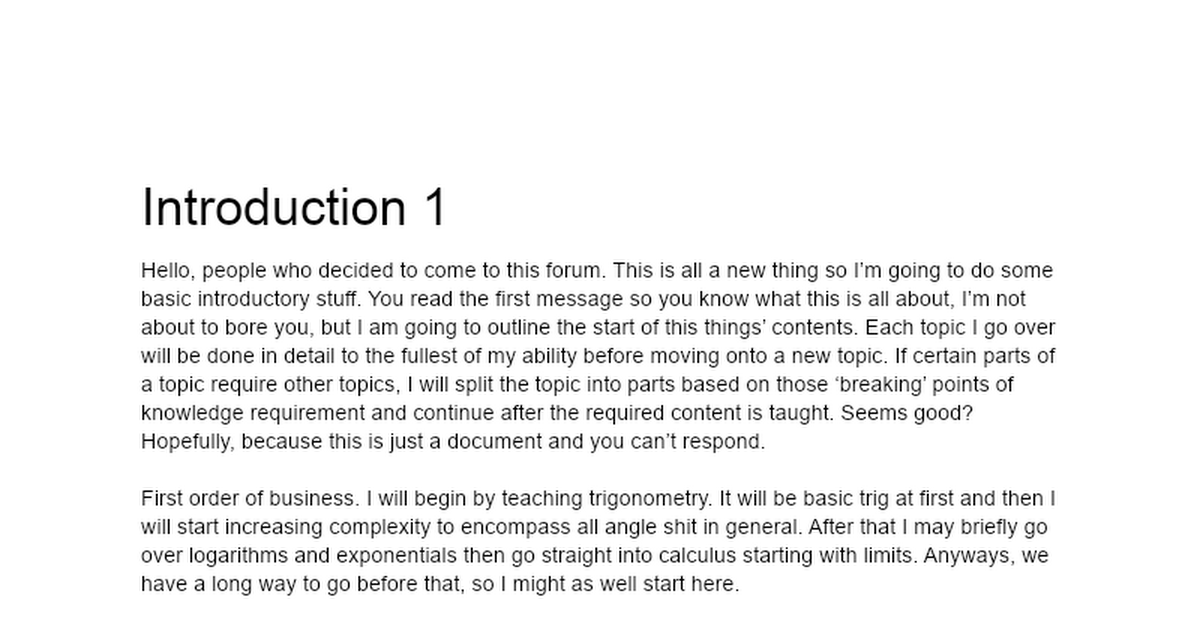
Google Docs
Introduction 1 Hello, people who decided to come to this forum. This is all a new thing so I’m going to do some basic introductory stuff. You read the first message so you know what this is all about, I’m not about to bore you, but I am going to outline the start of this course’s contents. Each t...
lone cloak
lone cloak
welp, first doc complete
https://docs.google.com/document/d/18XlX8d-03BmzXy25WLG...
have fun
ask questions and all that while im awake :)
vivid roost
i'll do it tomorrow if ya don't mind
lone cloak
all up to u
vivid roost
K
 hallow delta
Where
lone cloak
just click the 'deg'
 paper maple
@lone cloak found this at my class board this morning do you have any idea what it represents?
 lone cloak
that is schrodingers equation
with the hamiltonian operator expanded
thats a lot of words idk if i could explain
might as well go left to right then
i, thats the imaginary unit defined as i^2 = -1 (rigorous definition), or i = sqrt(-1) (simpler definition)
h-bar, is the reduced planks constant. around like 1.05?x10^-34
the curly-d/a are the partial 'signs' that make up the partial derivative of the wave function, psi.
the wave functions describes how an object described by it behaves
this is then equal to (usually) the hamiltonian operator operating on the wave function psi
in its expanded form you have the kinetic energy on the left side of the + and the potential energy on the right side of the +
m is just the mass of the thing, and more often that not you'll see the second partial derivative of psi with respect to space as just del^2.
then as potential energy's equations/formulae vary on what object is being described you just asign it as a general potential function V that depends on x and its acting on the wave function psi.
heres the equation in its non-expanded hamiltonian form, dw about the weird brackets around the psi that just indicates in a way what 'state' a particle is in

as the psi is in a 'ket', its just a normal/standard state
heres the expanded form

i use the term 'expanded' loosely here
 steel jewel
lone cloak
steel jewel
lone cloak
eh not really but thx
 hallow delta
And what does bizarre mark in the sqrt 1/2gx^2/y-x?????35
sick turret
Is that just very poorly written tan?
lone cloak
Ye it’s my poorly written tan
And g is just acceleration due to gravity
So 9.81ms^-1
sick turret
lone cloak
Ye it’s my poorly written tan
How did you screw it up that much?
Like, that line is a t? The a looks like c or e, and the n looks like a cross between a squished m and a y.
My phys teacher would've stabbed me with her metal ruler for that.
lone cloak
its just that my a's and e's usually get conjoined with the next letter so they look sorta similar in my handwriting if im 'rushing'
sick turret
Uh huh
lone cloak
Still working on it btw
lone cloak
do you know what differentiation is?
its the opposite of that
and for a simple graphical use of it, it can be used to find the exact area under a curve
hallow delta
Ok so
Derivative s
It’s how you find the slope on a particular point on a graph yes?
and to do that you find its limit?
hallow delta
halb
😭
 lone cloak
thats not too bad
it looks like a lot due to the symbols
but its really just integrating a function, differentiating a function and the adding them alongisde some constants with its original function (also multiplied by a constant)
hallow delta
What is integratin a function
lone cloak
finding the area under the curve of that function
just like how differentiating is finding the gradient/slope of that function
hallow delta
how does it work
lone cloak
like how do you do it? or the proof/justification behind it?
hallow delta
Specifically the ki integral thing e(t)dt, both would be cool to know
I know that the ki is a constant
And et is error from which I can tell is basically a constant
And Dt is Chang in time
lone cloak
the way you integrate it depends on the function itself so i cant really say how you would integrate a general function e(t)
hallow delta
But I don’t know what the big goofy s thing Symbol means or what it does
hallow delta
Pretty much
lone cloak
okay let me prepare some things first
bare with me for a few more mins
okay
first order of buisness
lets take a general function f(x)
lets say the function looks smth like this

now if we wanted to find the area under this graph between, lets say 2 and 6, we could estimate with a varying number of trapeziums, triangles, rectangles etc
so between this section here

to highlight it, this section here

lets consider this little slice of the graph

we can turn this area into a bunch of these little slices, which i am not gonna painstakingly draw out on desmos rn
this little slice as a width of, lets say, 𝛿x (delta x)
like so

now if we consider what happens when this 𝛿x gets really small, then the f(𝛿x) essentially becomes the y-value at the point thats 'picked' out from the x-axis
damn you dirac delta function, forever ruining the word 'pick' for me
so if we make all of these little slices of the area have width 𝛿x, then as we take the limit as this width apporaches zero, then it essentially does the same thing
we make these slices so thin that we essentially get a continuous area, instead of a mere approximation
now of cause to actually get an area, we need to multiply this 𝛿x 'space' thats been shrunk by the 'height' of this space.
or in other words, the y-value thats being picked out
we then add up the areas of these little small slices, and we get the area
boom thats integration
at least an explaination of it
and this can be algebraically defined by this blury ass img here

the area is equal to the sum of all the areas of these slices
which is equivalent to

where dx is the 𝛿x and the weird-s symbol is the idea of taking this infinite sum
all good then?
at least so far?
lone cloak
?
hallow delta
Was in internet shadow realm
 lone cloak
yeah electricity sucks
vivid roost
wdym i like electricity
hallow delta
Thank you btw
tight flame

 unborn tendon
paper maple
hey onkel look at this
unborn tendon
paper maple
hey onkel look at this
hey wait, why do you have a french electricity lesson?
paper maple
we study in french