#Steam Sim Tweaks
1304 messages · Page 2 of 2 (latest)
 patent merlin
 wide imp
yeah
patent merlin
And that information confirms that the locomotive did not get lighter, just the info plates changed
interesting
wide imp
The S282A did get lighter, it was 125 tonnes without resources before
patent merlin
are you sure?
wide imp
pretty sure yeah
wide imp
S060 has gone from 45 tonnes to 41 tonnes without resources
Keep in mind that I was screwing with the info plates with Rearranged S282, and I think I messed it up at some point
patent merlin
I can't find this changelog...
I'm trying to figure out because I'm like 95% sure that the info plates used to show total mass for locomotives and tenders, and now don't - I'm not entirely sure though. I was looking at those a lot when working on aux tenders and trying to figure out how to add resources
but that was in B97 and it's been a bit...
 drowsy ingot
I can't find in the changelog either, but here's a screenshot proving it: #dv-valley-views message
The thing is, you'd say the vehicle weighted X in the definition, and it included the "default" weight of some resources.
Namely coal and water.
So the DE6 did weight 132t or something (plate displayed 125).
But now the definition only has the actual empty weight (tender is now 10t instead of 50t).
I can't confirm now tho, computer is kill.
What is in the changelog however is this:
- Finished mass calculation to now take into account water and coal onboard the vehicle
patent merlin
Oh, wait, prior to B99 the train mass just included assumed values for those, and now it's actually using the real values?
How did I miss that...
but that would then still result in the final mass being similar if prior to B99 the 282A was 125t (ignore firebox and boiler contents) and post B99 it's 125ish tons when those are full
Or am I still missing something?
drowsy ingot
Nope, the mass should be similar.
The boiler should hold just under 17t completely filled.
patent merlin
ok, that was the debate that started this whole conversation
wide imp
With the DM1U

 exotic thistle
 sullen girder
Will this be added back to build 99?
sullen girder
Will this be added back to build 99?
Tbf, alot of this mod's features were added to the base game
sullen girder
Yea but now we can’t change boiler pressure
 unkempt echo
they are using a colloquial definition of power here that is confusing the matter. fully open cutoff will give greatest effort, the force moving the locomotive.
Power, however, is effort times speed, and this is limited first by the rate of steam through the regulator, not the cutoff, as this determines the maximum power available (in terms of steam energy moving through it).
Low cutoff, however, increases the power available, because the greater expansion the steam undergoes the more energy is extracted - high cutoff uses the steam energy very inefficiently. Low cutoff brings the power at the wheels much closer to the steam power through the regulator
 alpine locust
unkempt echo
they are using a colloquial definition of power here that is confusing the matte...
alpine locust
unkempt echo
they are using a colloquial definition of power here that is confusing the matte...
My confusion was caused because I thought that the regulator would allow greater or equal flow as the reverser at the design speed of the locomotive which would lead to maximum power at reduced efficiency. I still would guess that some locomotives designed for low speeds and high tractive effort were designed like that. Although I have no real life example.
patent merlin
design speed has more to do with the wheel size and configuration.
In practice you want a throttle body that can release steam about as fast as you can make it - but that's hard to do and still be able to control that steam.
So total steam availability comes down to the throttle body (in whichever form that takes)
unkempt echo
most locomotives only have it about as fast as it can generate steam, yeah - it's not that useful to have a huge burst of power that cannot be sustained in most cases. Only a few locomotives that are intended for like, heavy loads and very specific hills, that they know the boiler stores enough steam energy for, would really consider it a bonus
and the throttle limit on the cutoff is effectively infinite, if your steam chest never depleted, so it would be a very bad idea to try match your throttle body to that
(it's not actually infinite but I would not be surprised if, at boiler pressure, full cutoff, etc., a 10k hp locomotive's cutoff could allow like 1000k hp of steam to pass through)
patent merlin
Get it up to speed and, well yeah...
if you could keep the steam chest pressurized like you could in B98... full cutoff = ridiculous torque, and surprisingly torque that increases infinitely with speed
it's one of the reasons that the trick to hill climbing in B98 was to over fire and get a running start.
Now that throttle flow rate is simulated the trick to hill climbing is to pull the cutoff back to keep steam chest pressure up
(and don't stall)
patent merlin
lol, yeah, don't slip either
 blissful rapids
Slip, and you lose half of the momentum the 1,000 tonnes behind you had.... And doomed yourself to stall out of harbor lol.
unkempt echo
I feel like the B99 steam chest is a bit too large - if you do slip, it takes way too long to lose the pressure and stop slipping, and then it takes ages to refill to the pressure you need to get it moving again
maybe half the size would handle better
 alpine torrent
unkempt echo
I feel like the B99 steam chest is a *bit* too large - if you do slip, it takes ...
alpine torrent
unkempt echo
I feel like the B99 steam chest is a *bit* too large - if you do slip, it takes ...
ah, catch the slip with independent brake, to avoid waiting for the chest twice
unkempt echo
difficult to let off without just slipping again due to the pressure increase
alpine torrent
let off partially and slowly
unkempt echo
and most of the time if you see locos slipping irl, they don't do two dozen spins before they lose pressure, it's usually a couple turns at most
alpine torrent
yeah I also don't like the values they picked, but i think using the brake could be a way to deal with it
wide imp
The B99 S282A seems to have a factor of adhesion of 3.65, which seems super low for me as an American, but I'm looking at the FoA for the Kreigsloks and they are about 3.2 or 3.3
DRB class 50 and 52 have about the same tractive effort but are even lighter
alpine locust
unkempt echo
(it's not actually infinite but I would not be surprised if, at boiler pressure,...
What steam locomotive has 10000 HP? Also I highly doubt that the inlets of a steam cylinder can let in 500000 HP worth of steam. Which would have an energy of about 2 million KW of energy
unkempt echo

Union Pacific 4014 is a steam locomotive owned and operated by the Union Pacific (UP) as part of its heritage fleet. It is a four-cylinder simple articulated 4-8-8-4 "Big Boy" type built in 1941 by the American Locomotive Company (ALCO) at its Schenectady Locomotive Works. It was assigned to haul heavy freight trains in the Wasatch mountain rang...
and they probably can because the inlets have to let in full pressure within the cutoff limit - if it still develops power at minimum cutoff, usually like 4% or so, the inlets are allowing 25x the loco's maximum possible during that window
and that's with the inlet not fully opening, so on a full 100% cutoff stroke? million hp worth of steam could move easily
patent merlin
Assuming you could get million hp worth of steam into the steam chest...
unkempt echo
yeah, that's the limiting factor
it's not like electricity where the wire is directly heated and would melt from carrying that much power - the valve is large and not the power carrier, it only needs to open wide enough for the steam to move on its own
 primal meadow
very low cutoffs will have negative effects on steam passage as you pretty much reach the same situation as with a half-closed regulator
the sections never get large, so you have steam moving very fast through the openings, which means high losses
drowsy ingot
The Big Boy has like what, 4 throttle valves controlled by a single lever?
wide imp
yeah
 patent merlin
that sucker moves a lot of steam (subjectively measured of coures)
wide imp
unkempt echo
and most of the time if you see locos slipping irl, they don't do two dozen spin...
Here are some DRGW K-36's pushing a rotary snow plow as evidence. AFAIK they're superheated with dome throttles, so there's a fair amount of piping past the throttle. They do slip but they get back into the power easily; granted, the Cumbres and Toltec probably has better engineers on average than the Valley lol https://youtu.be/hbLyXtzLX3I?si=MVqFLp6Z5V75emyV&t=366
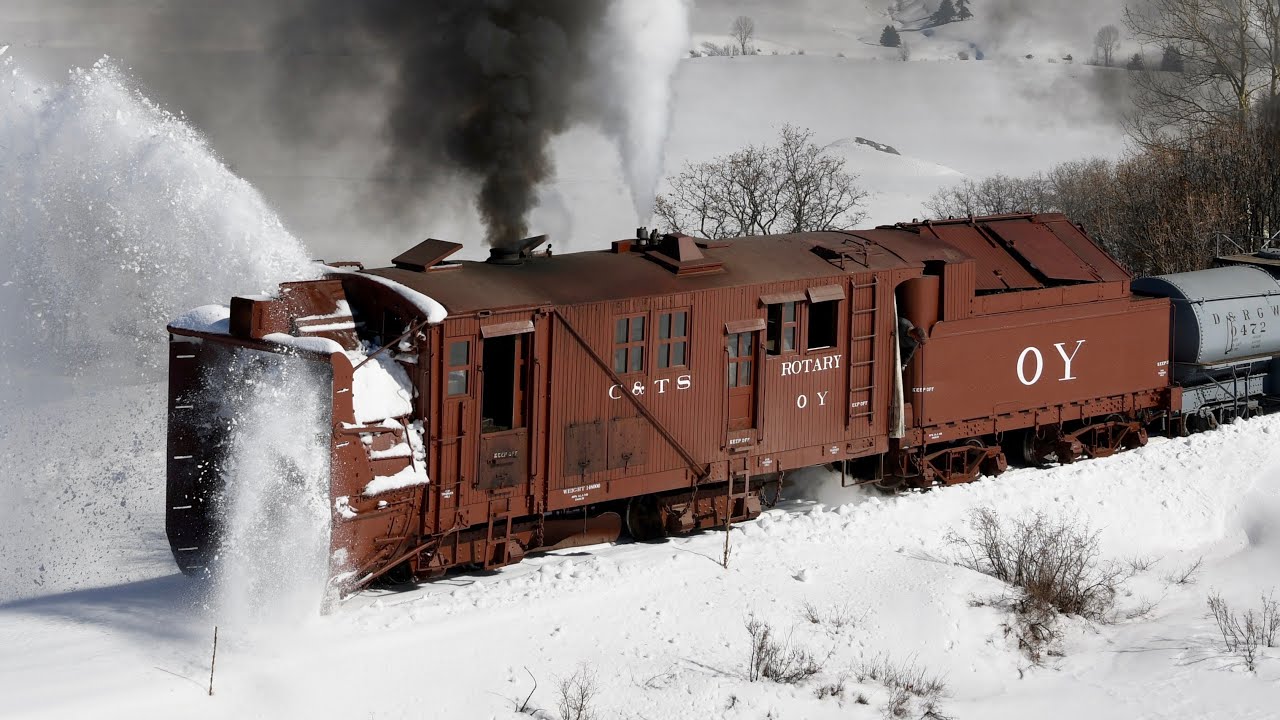
CUMBRES AND TOLTEC SCENIC RR: cumbrestoltec.com
Friends of the Cumbres and Toltec: cumbrestoltec.org
Rotary Snow Plows are large pieces of railroad equipment with a rotating metal wheel that slices through large snow drifts and throws them to the side of the tracks, clearing the way for other trains to pass through. These days, very few of the...
The really fast chuffing is the plow, the slower chuffing is the two engines
patent merlin
the fast pulsing you hear sometimes is the second engine slipping a ton you can tell because its smoke stack matches the frequency...
unkempt echo
it is, yeah - but even here the most I see is I think four full wheel turns in a slip? while the s282 will happily spin dozens sometimes
patent merlin
I think that has more to do with the engineers responding than it does the mechanics of the locomotives
patent merlin
you don't even have to close it that much - a little closing combined with the bit of bleed from the slip.
Also opening the cutoff a bit will help end the slip sooner as you bleed more pressure off and then don't add it back on as fast.
So, a little less throttle, a little more cutoff, and sand if the conditions suck, and you can probably fix it with minimal effort in 3-4 spins.
Go to DV and:
- Wheel slip isn't always obvious for minor slips (just a hair too much force)
- Moving the throttle and cutoff quickly, even a little bit, is hard
- Hitting sand at the same time is almost impossible
- Wheel slip has a point where it just loses all adhesion (a real engineer would rarely get to that point, but it's easy to do in DV if you aren't hearing the early slips)
 alpine locust
patent merlin
you don't even have to close it that much - a little closing combined with the b...
alpine locust
patent merlin
you don't even have to close it that much - a little closing combined with the b...
Minor slip actually produces the most tractive effort... In german we call it macroschlupf which increases wear on the wheels but boosts power put down. It makes a humming/buzzing sound that tells the driver the locomotive is on the cusp of slipping. You also don get sparks until you severely slip for a long time. Sanding while slipping definitely helps (maybe 10-50 percent more tractive effort) but it's generally not advised, you have to catch the slip before you sand or risk destroing the wheels and you want the sand for braking if you run out in an emergency because some idiot used it up accelerating with sand all the time is not great. Also counterintuitively it worsens adhesion for trains after you and can lead to power and signal problems if everyone sand at the same spot. Also wheel slip happens more often than you think. Rails don't have uniform adhesion there are spots that have very little and others that are grippy. In Bad condition you can start to slip at 20 kn on a 90 t locomotive. With time you are likely to learn the spots where you slip but that can always change. Especially with falling leaves in autumn.
drowsy ingot
When testing out the BB this was actually something I was running into.
The front wheelset was slipping slightly and the rear set wasn't, so the exhausts and rods didn't match up, but it wasn't fast enough to make sparks.
Unsure if the benefits of it are modelled in DV, but it is possible to do it.
alpine locust
drowsy ingot
Unsure if the benefits of it are modelled in DV, but it is possible to do it.
Would that be possible as a mod?
alpine locust
drowsy ingot
When testing out the BB this was actually something I was running into.
What BB🤔 satiric?
wide imp
Was trying to figure out if it was a secret still lol. Big Boy, if anyone else is wondering
patent merlin
Top secret - the DVRT Police will be meeting with you shortly - right after we mod in the DVRT police
wide imp
just strap a beacon to a DE2 lol
 patent merlin
that intercity livery - I swear that was a lego train livery...
primal meadow
another "controlled" slip from yesterday
with both the humid weather, manual sander and leaves it was quite harduous getting the engine back
wide imp
interesting. Barely even sounds like a slip. That's neat
primal meadow
wide imp
interesting. Barely even sounds like a slip. That's neat
yeah, i've noticed in anything but dry conditions you barely heat anything
we had to brake quite a lot too, and wheelsliding was very easy to obtain - it made no sound at all, the only way to know was the mechanical lubricator stopping and leaning outside looking at the combination lever
 crimson condor
drowsy ingot
Unsure if the benefits of it are modelled in DV, but it is possible to do it.
crimson condor
drowsy ingot
Unsure if the benefits of it are modelled in DV, but it is possible to do it.
they seemed to with the duplex full power with a light brake to keep the front just slightly slipping. (like eighths, where dv show a spark but doesnt play the sound) Made a Ton more power than off with the power down to control slip
 velvet umbra
I've run mainline engines in yard settings (<20kmph) but most of my work is more the restoration side of things. From the limited experience I've had irl, playing simulator with this mod felt the most 'realistic' out of anything I've played. I'll need to play more of b99 to see how it stacks up though!
WIsh I could've given you feedback back when you were still working on this mod haha!
wide imp
velvet umbra
I've run mainline engines in yard settings (<20kmph) but most of my work is more...
Heck yeah. Well I'd still welcome your feedback on how DV's steam engines feel in B99
 errant musk
wide imp
Here are some DRGW K-36's pushing a rotary snow plow as evidence. AFAIK they're ...
errant musk
wide imp
Here are some DRGW K-36's pushing a rotary snow plow as evidence. AFAIK they're ...
Bit off-topic but why rotary even NEEDS a water car?
I was under the impression they used melted snow
They preserve their equipment with treated water I presume?
unkempt echo
maybe it's needed to supplment in certain snow conditions
wide imp
errant musk
I was under the impression they used melted snow
Never thought about that before. I think you're right, I bet they like to treat their water and make sure they know exactly what's going into the boiler
alpine locust
wide imp
Never thought about that before. I think you're right, I bet they like to treat ...
Rain water is already relatively well filtered
 sterile sequoia
However, rainwater and snow that have been on the ground for some time ago may already contain many contaminations.
It seems that they are very careful about managing the water that goes into the boiler, so unless it's a serious issue, they probably won't pick up snow to supply water to the boiler.
velvet umbra
wide imp
Heck yeah. Well I'd still welcome your feedback on how DV's steam engines feel i...
It's pretty good, not nearly as pronounced as your model, which I enjoyed (made it feel like the engine was really its own being not just something you input commands into) I honestly couldnt comment which one is more realistic though
unkempt echo
best solution might just be to find a reference locomotive that has sufficiently detailed plans and figure out the chest volume
wide imp
I did estimate chest volume, but I estimated it assuming the S282 had a front end throttle. If altfuture now thinks it has a dome throttle, then it's reasonable for the chest volume to be much bigger
unkempt echo
were dome throttles common with such short domes? I feel like to have the whole throttle assembly comfortably in there it would have to be relatively tall
this would also be a good candidate to swap with locomotive modification/upgrading beyond gadgets
it's not even a 282 but this does appear to have dome throttle so I suppose so
 wide imp
Yeah I think they can be made pretty short
unkempt echo
s200 doesn't look that far off s282 though and I think this diagram is trying to indicate front-end throttle

but it's not detailed enough to be sure
weirdly hard to find any diagrams of s100 for how common it was
wide imp
Yeah S200's all had front end throttles... then again, the S282 isn't explicitly a S200
you can see the throttle linkage there on the side
unkempt echo
I mean the wheel spacing is definitively not right for the in-game one, but it's small enough to easily overlook
wide imp
There are tons of differences if you look at em long enough
I have wondered if the original S200's didn't have a sand dome. It would explain the home-made looking turkish sand domes, the lack of sand dome on that drawing, and the existence of this photo from 1955

maybe they just manually sanded with shovels when necessary? There are stories from logging railroads of "sanding" with the dirt the track was laid on...
unkempt echo
I don't feel like doing the calcs but maybe they felt it wasn't needed because it had enough weight on drivers for most conditions without sand?
particularly with s100s around though it does feel like s200 is probably best fit. Just an odd variant for the valley
wide imp
Maybe, depends on the terrain
S100 and JŽ class 62 have twice the sand domes to make up for it lol
 unkempt echo
funnily enough there's s200 drawings without additional domes that have sander pipes

but not found a good quality photo that shows such (maybe seen one of an australian loco but it's way too low res to be sure it's a sand pipe)
does seem like 90% were modified with sand domes though
wide imp
Maybe it had a small sand box somewhere
drowsy ingot
@valid shoal if you didn't have this image yet.
The S200's cylinders feel smaller than the S282...
drowsy ingot
Air tank?
 valid shoal
wide imp
Maybe it had a small sand box somewhere
valid shoal
wide imp
Maybe it had a small sand box somewhere
They have sandboxes under the running boards
drowsy ingot
🤔
valid shoal
unkempt echo
s200 doesn't look that far off s282 though and I think this diagram is trying to...
You can see the outline behind the air tank in the profile drawing here
valid shoal
yes
drowsy ingot
Maybe, a lot of euro locos don't really have the domes.
unkempt echo
there are also many photos that don't have sand pipes that I can see
valid shoal
Any photos of the preserved ones won't have sand lines because they were removed before it was put on display
the ones with sandboxes would be very hard to see since they're tucked into the brake rigging

You can see the nozzle for the lead driver under the cylinders
valid shoal
wide imp
S100 and JŽ class 62 have twice the sand domes to make up for it lol
The s100 and 62 have two domes to allow for bi-directional sanding
one dome sands ahead of the drivers the other sands behind
wide imp
Well, you could just have twice the pipes going to the same dome, but yeah that makes sense
valid shoal
if you tried to use the front dome while going backwards you'd just sand the rails for whatever cars are in front of you
wide imp
sure but there's no reason you need two domes for that
valid shoal
having only one pipe per dome per side simplifies it significantly because you don't need a valve to direct it
you can have it be gravity fed
Which is what the s100s and 62s have
drowsy ingot
And it's like what, 100, 200kg of it?
wide imp
A lot of sanders aren't just gravity fed though, I would assume the S100s and S200's had steam powered sanders?
unkempt echo
you don't need a direction valve with two pipes, just separate opening valves like separate domes would have
valid shoal
but also having it all on one dome means you're effectively halving the possible amount of sand you can use for either direction
for big road locos this isn't a problem since they spend 90% of the time going forward
unkempt echo
not if you double dome capacity?
wide imp
drowsy ingot
And it's like what, 100, 200kg of it?
200 kg on the S060, 600 on the S282
valid shoal
for switchers this isn't ideal because you're constantly going both directions
unkempt echo
it is probably that they have some reason they can't or don't want to have larger domes, maybe parts options, maybe visiblity
valid shoal
two separate domes has been US standard since the 1890s
valid shoal
unkempt echo
it is probably that they have some reason they can't or don't want to have large...
having one large dome would require moving the steam dome backwards which would be suboptimal for a switcher
unkempt echo
a switcher at a loading instead of sorting yard will likely always have a bias in which direction it uses, for the direction the cars go after loading or before unloading, so will require more refilling than a single shared large dome
you could put the large dome behind the steam dome?
valid shoal
the further back the dome is the longer the dry pipe is, which means more throttle lag which is the opposite of what you want in a switcher
unkempt echo
US convention is a sufficient answer but doesn't mean it's optimal
valid shoal
dome in the back means the lines to the front wheels will be longer and have more curves to clear appliances etc, meaning more places for sand to clog up
with air sanders this isn't a problem but the USATC locos all had gravity sanders to make them as cheap as possible to produce
wide imp
Steam dome could easily be twice as big if it was rectangular on the class 62
 valid shoal
that still has the issue of long ass lines to the rear wheels
having them separate allows for the shortest possible lines
and simplifies construction
plus makes field repair easier, it's a lot easier to lift two smaller domes off the loco with a bunch of army guys in the middle of a war zone than one large and awkward dome
as for why they didn't change it for the 62, probably a case of "if it ain't broke, don't fix it"
The s200s got modified for two reasons that I can find: maintenance and capacity
having the sandboxes tucked behind the air tanks makes accessing them a pain in the ass because you have to tear apart the entire air brake system to get to them and they're restricted in overall size due to the location
wide imp
I guess the lower ones are easier to fill up from the ground
valid shoal
honestly not sure on that front
my theory for why it was done is because the loco was built to a British specification unlike the s100s and s160s which were US designs simply meant to fit the British loading gauge
and the locos the British were already using in that theatre of the war (Stanier 8Fs) had sandboxes under the running boards
all of the photos I've found so far of S200s (if they show lettering at all) show them lettered W-D not USATC which means they were under British control
 valid shoal
valid shoal
valid shoal
also if anyone is interested in doing some research, I've been trying to figure out why this and another photo of an s200 I've found show it with indirect motion (like the s100) where literally every other photo shows it with direct motion
the only clue i have right now is that both indirect examples appear to have alco plates but I've found others with alco plates that are direct
this is the other photo
 valid shoal
drowsy ingot
The S200's cylinders feel smaller than the S282...
valid shoal
drowsy ingot
The S200's cylinders feel smaller than the S282...
The s200 has 21" x 28" cylinders
wide imp
Here's some info about the sanding system on the "USA 2-8-0 Austerity locomotives", aka the S160's, written by some Scots
 valid shoal
so the s160s have steam sand, the s100s do not
wide imp
seems like it
valid shoal
wide imp
S100 and JŽ class 62 have twice the sand domes to make up for it lol
You can see the linkages for the sanders on the side of the domes here
dunno if the in game one has that
they're at the base of the domes near the pipes
If the s160s had steam sand there's a decent chance the s200s did too tbh
I'll have to see if my FOIA request produces anything useful on that front
wide imp
valid shoal
dunno if the in game one has that


So no to both. The S282 has steam going to the forward sanders but not the rearward ones lol
Hmm, the Alco S160 specs mention a sand box, but still mention steam sanders. The Lima spec document I have doesn't mention sand at all

Here's what I'm looking at BTW. I got them from some website, I forget where now.
 primal cape
wide imp
So no to both. The S282 has steam going to the forward sanders but not the rearw...
primal cape
wide imp
So no to both. The S282 has steam going to the forward sanders but not the rearw...
That 060 looks so naked lol
2 domes, air sanders on these

 winter iris
When will there be a new update for the new build?
wide imp
right now I'm focusing on Rearranged S282, so IDK
crimson condor
I'm excited for that too so....
winter iris
crimson condor
I'm excited for that too so....
me too
 raw schooner
wide imp
right now I'm focusing on Rearranged S282, so IDK
raw schooner
wide imp
right now I'm focusing on Rearranged S282, so IDK
Are there any plans for new arrangements with this update?
wide imp
raw schooner
Are there any plans for new arrangements with this update?
I don't think so, they'll probably have to wait until the next update
Steam Sim Tweaks
I just realized that thread creators have the power to add slow mode to that thread
up to 6 hours lmao
raw schooner
Never knew that
crimson condor
oh god lol
errant musk
wide imp
up to 6 hours lmao
Realistic pre-telegraph railroad communication
 surreal copper
wide imp
right now I'm focusing on Rearranged S282, so IDK
surreal copper
wide imp
right now I'm focusing on Rearranged S282, so IDK
do you have a rough idea how long it will take to get that one working again?
 eager glacier
surreal copper
do you have a rough idea how long it will take to get that one working again?
eager glacier
surreal copper
do you have a rough idea how long it will take to get that one working again?
about now to whenever it releases
that’s about how long it should take
raw schooner
SOON™️ Intensifies
 lunar solar
SOON?!
patent merlin
I've been thinking about things and it occurs to me that the tweak I'd want at this point is really simple: Give me an on/off injector, or make it require full on and be able to be fined down for a bit.
wide imp
I was thinking about that a while back. The sim technically simulates a feedwater heater... I guess you could say it's an exhaust steam injector though. Ideally I'd also change the control so that it's pull-push like it is IRL
You'd need some kind of feedback so that you know when it's primed. Could just be audio based but ideally you'd be able to watch the overflow as well
primal cape
Generally you can hear a clunk when it primes
And when you first open it steam will spit out a bit the overflow part then when it primes that stops
primal meadow
wide imp
I was thinking about that a while back. The sim technically simulates a feedwate...
oh, so it doesn't heat water when there's no regulator?
 plush halo
wide imp
You'd need some kind of feedback so that you know when it's primed. Could just b...
plush halo
wide imp
You'd need some kind of feedback so that you know when it's primed. Could just b...
How do you prime a steam locomotive? I've never heard of this term before.
primal meadow
plush halo
How do you prime a steam locomotive? I've never heard of this term before.
pull on the regulator strongly enough that water is pulled with steam into it
oh wait you were talking about injectors
raw schooner
wide imp
You'd need some kind of feedback so that you know when it's primed. Could just b...
Dude if you could sim injectors in dv my life would complete
patent merlin
for purposes of the game, you could probably make the priming more predictable so with a little practice people could nail the timing of it
raw schooner
You would have to do some lms nonsense because iirc the s282 doesn't even have injectors modeled
wide imp
primal meadow
oh, so it doesn't heat water when there's no regulator?
The game does heat feedwater even when there's no throttle. What I meant was that on the S282, you always get the efficiency of a feedwater heater, which according to zeibach was necessary for game balancing. In his testing, without the feedwater heater the injector would kill boiler pressure immediately
 still dune
Wait. The S282 has a feedwater heater?
wide imp
plush halo
How do you prime a steam locomotive? I've never heard of this term before.
The injector uses pressurized boiler steam to send tender water into the boiler (using venturis, P1V1 = P2V2, and magic). You need to let it establish a flow of water first, just letting water flow out an overflow pipe, before it will send that water into the boiler. Once you see a good stream of water at the overflow pipe, and not just steam, then you know the injector is primed and ready to go.
How you do that depends on the injector. Sometimes there's a separate lever for priming, and sometimes you just pull the main injector lever a bit to prime, then once you see a stream of water out the overflow pipe you pull the lever all the way, then you can back off to whatever strength you want.
wide imp
still dune
Wait. The S282 has a feedwater heater?
Basically the simulation code says that the feedwater entering the boiler is always... Like 130 degrees C or something
Wait that doesn't sound right does it
Lemme check
wide imp
Feels weird that it would be above 100
wide imp
Maybe it's pressurized by then. I'm not too familiar with the physics of it
still dune
Why do you think your the only person, it's to hot, everyone else is cooped up in there soviet apartment complexs enjoying the AC
primal meadow
wide imp
Basically the simulation code says that the feedwater entering the boiler is alw...
that is some strong feedwater heater
ACFI i think ran at around 95-115°
primal meadow
wide imp
Maybe it's pressurized by then. I'm not too familiar with the physics of it
supposedly the pump part that brings the water to boiler pressure is placed before the heating part so that the pump doesn't have to go through thermal stress (and varying tightening conditions)
drowsy ingot
110 for the S282.
still dune
Does the S060 have a feedwater heater?
drowsy ingot
S060 enters at some raw 25.
primal meadow
drowsy ingot
S060 enters at some raw 25.
which is a lower temp than what you'd get with an injector
wide imp
drowsy ingot
110 for the S282.
I'm seeing those for the default values, but I'm also seeing that it's connected to steamEngine.EXHAUST_TEMPERATURE on the S282... But also that port just stays at 0?
wide imp
primal meadow
which is a lower temp than what you'd get with an injector
Yes but all the energy to heat the feedwater comes from the boiler, so the boiler has to do all the work of heating the water from ambient up to boiler temp, regardless of whether that happens in the boiler or in the injector
drowsy ingot
¯_(ツ)_/¯
wide imp
Like, it seems like the feedwater heater outputs a temp of 0 degrees on my computer
primal meadow
wide imp
Yes but all the energy to heat the feedwater comes from the boiler, so the boile...
yeah but the injector consumes steam in the simulation, right?
wide imp
Nope
primal meadow
ohhh so here's that then
drowsy ingot
Hmmm let me check that out.
primal meadow
something on our locos that is also interesting to see IRL and that does not make sense without knowing how the boiler is set up, is that the pressure gauge needle drops about .4bar when you start the injector, and jumps back immediately when you cut it - that because they both are on the auxiliary dome, feeding off of the same drypipe that has limited diameter
wide imp
primal meadow
yeah but the injector consumes steam in the simulation, right?
It adds cold water to the boiler, which lowers the specific enthalpy, which lowers the boiler pressure, but it never consumes steam
primal meadow
interesting that it was chosen to have it not consume steam and balance that with a lower water temp output
pretty much currently it works like a pump that'd work with an outside source of energy
wide imp
Well it doesn't consume steam IRL too, apart from a little bit leaking out the overflow
The steam used mostly goes back into the boiler
primal meadow
yes but it's not steam anymore
like, it consumes steam because the steam is fully condensed into water to make it able to pass the checks
obviously the "weight of steam" is going back into the boiler but it has to be heated and boiled again
drowsy ingot
Yeah the port is connected, and the exhaust temp does not seem to be set by anything.
wide imp
drowsy ingot
Yeah the port is connected, and the exhaust temp does not seem to be set by anyt...
Because RUE is reporting 0 degrees but since it's never set after being initialized I wonder if that's right
drowsy ingot
If the port were not connected, it'd return the default value. Which is what happens in the S060. But the S282 is connected, yet the steam engine code does not set the value at all anywhere.
wide imp
primal meadow
like, it consumes steam because the steam is fully condensed into water to make ...
Huh I never thought about that. That makes sense. But would that be thermodynamically equivalent to just sending in water at ambient temperature? That's what Zeibach said when I asked him about it and my Computer Science brain just assumed that was right
drowsy ingot
Steam exits the boiler, enters the injector, enters the boiler.
Unless you have leaks, no steam leaves the system.
wide imp
But CLC is saying it enters the boiler as water
drowsy ingot
Of course, it may condense, but that is just part of the temperature decrease.
wide imp
Yeah that's what I was thinking. It seems like you can simplify that math to just setting the feedwater temp to 25 degrees
wide imp
drowsy ingot
If the port were not connected, it'd return the default value. Which is what hap...
I agree. Maybe I'll write a patch to see what value the boiler is really getting
primal meadow
wide imp
Huh I never thought about that. That makes sense. But would that be thermodynami...
yeah actually i believe that is right
drowsy ingot
Just enable the steam data display in the locomotive, no need for patch.
wide imp
Steam data display?
drowsy ingot
Value being that default if no port is connected, or the port value if it is.

Sorry, SimDataDisplaySimController
It's a disabled GO in every locomotive.
The S282 should be plotting those ports, if it isn't just add the port you want to the array before enabling the GO.
wide imp
Huh I somehow never looked at that
drowsy ingot
¯_(ツ)_/¯
I was trying to debug CCL ports and thought "wait, wasn't there something for this" and there it was.
wide imp
Whoa that's sick
unkempt echo
"steam" is only consumed if you consider the steam distinct from the water, which I assume the simulation doesn't, at least by masses? Some pressure/enthalpy should be consumed by the pumping, but H2O is never removed, just some phase changes happen
patent merlin
unkempt echo
"steam" is only consumed if you consider the steam distinct from the water, whic...
several things do consume steam.
The reason the injector doesn't consume steam is because it works without steam. Since there's no alternative pump available in the game to preload the boiler, the injector has to work on "magic" even when there is no steam.
IRL you'd prefill the boiler cold with enough water to get to about the midpoint of the sightglass. But if you run the sight glass low and then service the loco (which turns off the fire) you can get to a state where the water is below the crownsheet.
unkempt echo
I meant the injector specifically not subtracting steam amount, versus just changing the energy and state of it, but fair
obviously the steam chest consumes steam
wide imp
unkempt echo
"steam" is only consumed if you consider the steam distinct from the water, whic...
It stores a certain mass, at a certain enthalpy, and then calculates how much of that is water vs how much is steam.
The boiler has functions for adding energy (from the firebox), removing steam, and adding/subtracting water
 visual oracle
mmmm...thermodynamics
primal cape
wide imp
The injector uses pressurized boiler steam to send tender water into the boiler ...
For Sellars injectors what we do is open the water to full, open steam to about half way and you can hear it lift and then pull it all the way and trim the water back to just above where the noise changes
You don’t really get much visual indication as the overflow goes out under the cab floor
You can see a bit of water/steam leak out the overflow valve itself when it isn’t primed but that’s all