
#feedback on the current state of my engine
50 messages · Page 1 of 1 (latest)
 hollow token
 lunar quail
Feedback for the Application alone:
- Why
class Applicationowns other classes likeWindow?
What's the reason it owns… a window? And why only one? And exactly one?
A game engine should manage windows, but a single window, especially directly inside the Application, always present, is definitely misplaced.
Most likely you'll want to use a window manager. For some automated tests, you won't want windows at all, and for some games you will want multiple windows.
- Why
class Applicationhas virtual dtor?
Is there any reason you want to pay the cost of abstraction? What do you want to use the abstraction for?
It looks like you've learned some ancient C++ tutorials and you are stuck using virtual functions, but have you ever asked yourself why are you using them?
- Why
class Applicationis notfinal?
Do you plan to make multiple Application versions with the same base?
Why do you need multiple different applications inside your game engine?
Have you considered programming multithreaded application or using multiple programs managed by another one?
- Why do you use headers in such a huge project as game engine?
Why don't you reduce compile times by using modules?
What's the reason you're copy‐pasting headers using preprocessor?
It's likely yet another huge issue related to previous feedback.
- Why
Applicationctor has parameters such as:width,height,windowName?
What's common between them and the application itself?
It seems it's echo of the wrong ownership. This approach will lead to passing random arguments all over the codebase, and eventually lead to std::moveing huge amount of data, copying or even costly casting in order to read, creating huge and redundant mess in your ever‐growing codebase.
- Why
Application::runis pure virtual?
What's the reason you require inheritors to implement it?
Why it has no default implementation?
It's likely related to previous feedback.
- What's
Application::run?
Why it's not documented?
When you ask for feedback, the code should be at least documented.
What does it do? Does it starts an application? Which one?
If so, can the application not be started? If not, why does the run ever exists instead of Application's ctor?
- Why you've explicitly deleted copy special member functions, but kept other smfs implicit?
What's your purpose here? Do you plan to change Application's ownership? If so, why?
It seems you should likely stick with the rule of three/five/zero.
- Why
widthandheightarguments are signed?
Do you plan using negative values? All of them?
You're likely using wrong type as size can't be negative.
Finally, why are you using ambigous int?
hollow token
lunar quail
- Why `Application` ctor has parameters such as: `width`, `height`, `windowNa...
txd dude, I'll be fixing as much as I can asap
hollow token
lunar quail
Feedback for the [`Application`](https://github.com/RickIsGone/Gears-game-engine...
also, regarding modules, the intellisense for vscode doesn't support them yet, so I'm deciding whether I want to be looking at files filled with errors until they make it work or not, also I'm not certain of what I should make into a module and what I should keep as a header + implementation file
cause I was actually thinking about switching to modules
hollow token
lunar quail
- Why `Application` ctor has parameters such as: `width`, `height`, `windowNa...
https://pastebin.com/mUZgEa7J im trying to switch to modules and the file should be right tho im getting lots of errors
Pastebin
Pastebin.com is the number one paste tool since 2002. Pastebin is a website where you can store text online for a set period of time.
file(GLOB MODULES "engine/*.cppm")
target_sources(Gears PUBLIC FILE_SET Gears_modules TYPE CXX_MODULES FILES
   ${MODULES}
)
```and im also making sure to be compiling the modules correctlythe errors:
Pastebin
Pastebin.com is the number one paste tool since 2002. Pastebin is a website where you can store text online for a set period of time.
lunar quail
As a rule of thumb, look at the first error message only.
However, at this point you're asking for help, not feedback.
 junior raptor
lunar quail
Feedback for the [`Application`](https://github.com/RickIsGone/Gears-game-engine...
junior raptor
lunar quail
Feedback for the [`Application`](https://github.com/RickIsGone/Gears-game-engine...
I'm under impression modules aren't really production-ready yet. I wouldn't call not using them a mistake
junior raptor
lunar quail
- Why `Application` ctor has parameters such as: `width`, `height`, `windowNa...
Why you've explicitly deleted copy special member functions, but kept other smfs implicit?
It automatically deletes the move functions too, there's no need to do that manually.
Why width and height arguments are signed?
Making them unsigned doesn't help you guard against negative values. They'll just silently overflow and you'll end up with the same issue.
hollow token
junior raptor
I'm under impression modules aren't really production-ready yet. I wouldn't call...
kinda
iirc they only work decently with clang and MSVC currently
hollow token
lunar quail
- Why `Application` ctor has parameters such as: `width`, `height`, `windowNa...
also, the glfw functions take int as the window measure
that's why I put them as int and not uint32_t
hollow token
hollow token
also, the glfw functions take int as the window measure
tho the vulkan functions take uint32_t as parameters
hollow token
hollow token
iirc they only work decently with clang and MSVC currently
and even there they are kinda buggy
lunar quail
junior raptor
I'm under impression modules aren't really production-ready yet. I wouldn't call...
I'm using modules with GCC and MSVC on a daily basis. Some exotic features like partitions and pmfs are not working on GCC, but i'm far way from calling it not production ready. It's thwarting people still refuse it, rationalizing against using questionable arguments. But some people still use C, so I'm not surprised. Yet calling it not production ready is far from factual.
lunar quail
junior raptor
> Why you've explicitly deleted copy special member functions, but kept other sm...
I've asked about all smfs and it was a rhetoric question ※ C.21
It automatically deletes the move functions too, there's no need to do that manually.
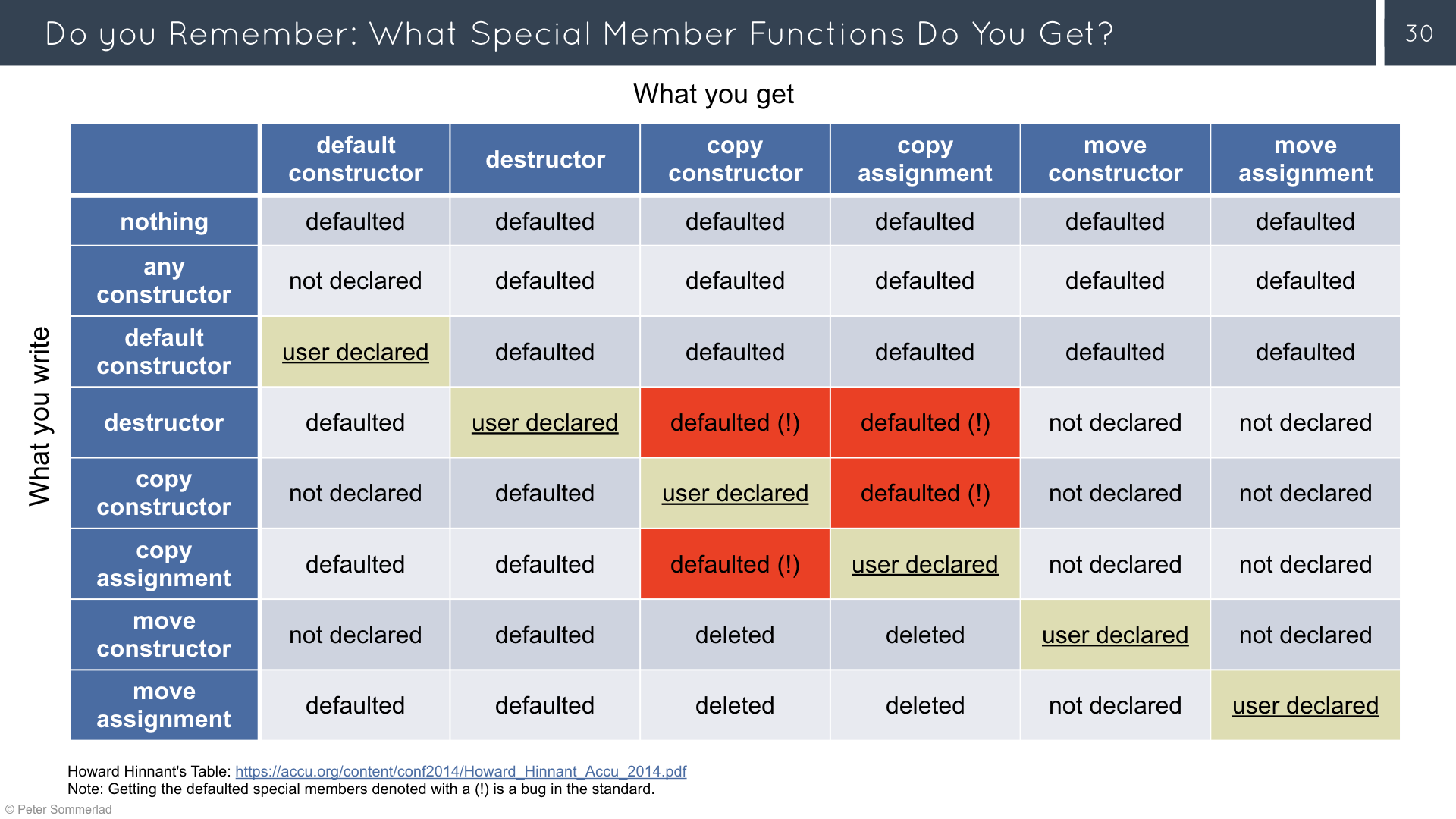
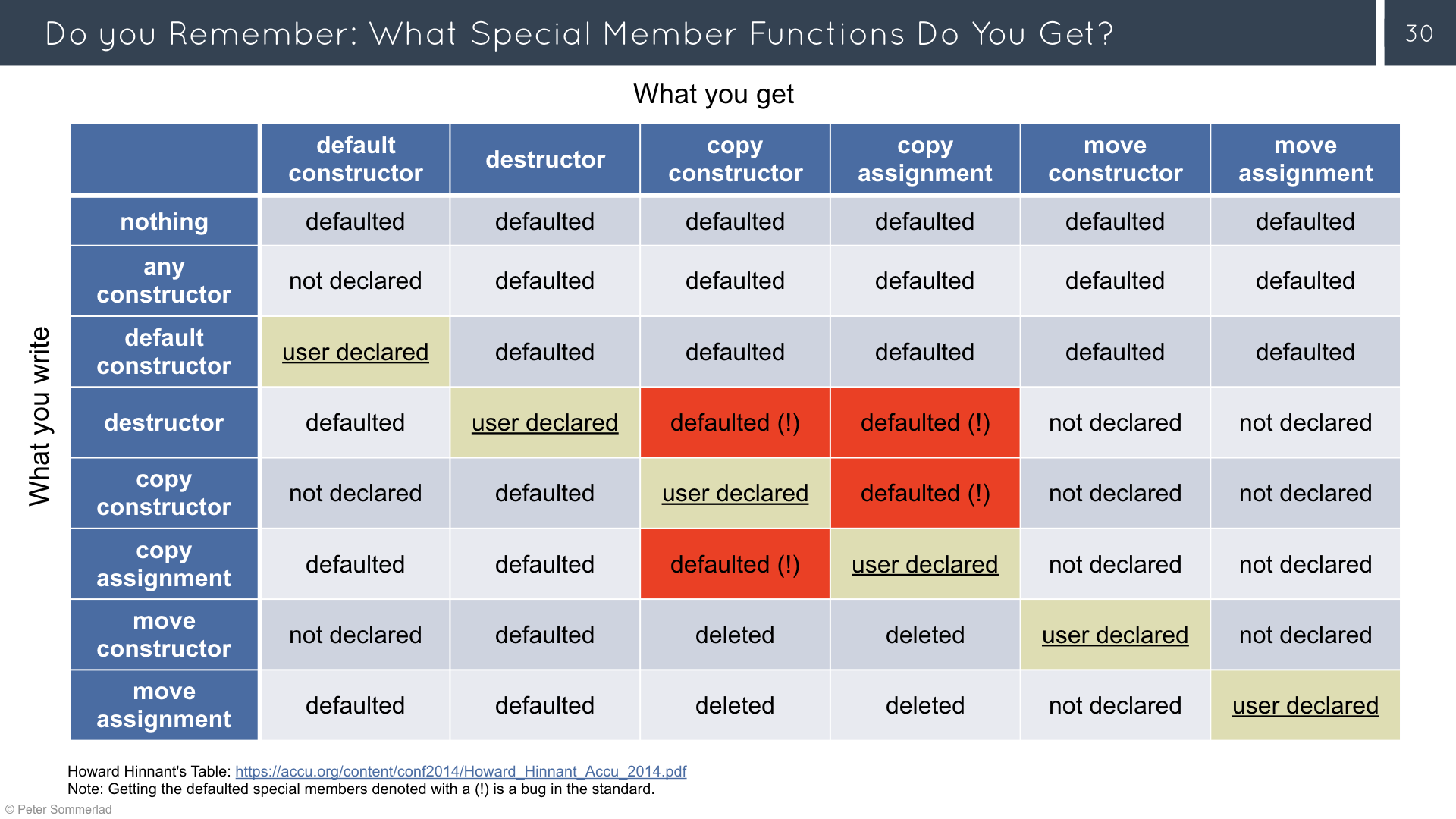
That's not true. They won't be implicitly created, but won't be deleted ※ Howard Hinnant's Table
Finally, size can't be negative. Using signed for size is irrational. The fact some API uses wrong type is not a justification for using it too. Using wrong types confuses end‐users and makes code unclear and hard to read and understand.
The C++ Core Guidelines are a set of tried-and-true guidelines, rules, and best practices about coding in C++
hollow token
either way
I made the window measure uint32_t
tho with the modules I'm still getting weird errors
and I'm trying to switch from the Application class from owning a Window to having a std::vector of Window*
tho I'll have to refactor a lot of code
lunar quail
It's always better to do so early — less work in the future.
junior raptor
lunar quail
I've asked about all smfs and it was a rhetoric question ※ [C.21](https://isocpp...
If we're linking core guidelines, here's another one 😛
https://isocpp.github.io/CppCoreGuidelines/CppCoreGuidelines#Res-nonnegative

They're not infallible though, there's some BS in them. (E.g. they recommend brace initialization everywhere... Maybe you don't disagree with that, but I'm sure you'll find things you disagree with.)
junior raptor
They won't be implicitly created, but won't be deleted
Well, fair, but my point still stands. Deleting copy operations is enough to make the class non-copyable and non-movable
lunar quail
junior raptor
If we're linking core guidelines, here's another one 😛
https://isocpp.github.i...
That's unrelated. We're not avoiding negative values as we can't have them on size (well, as long as the value is correct).
junior raptor
lunar quail
That's unrelated. We're not avoiding negative values as we can't have them on si...
I believe that's exactly what it advises against, but 🤷♂️
I guess I'm just pointing out that most of this feedback is opinionated.
lunar quail
The code logic should prevent overflows, not the type itself.
What ES.106 tells is that unsigned alone won't prevent negative values.
It's hard not to have opinionated feedback against signed size, yet I believe this aspect is exhaused.
hollow token
lunar quail
The code logic should prevent overflows, not the type itself.
What ES.106 tells ...
I've switched what i thought should've been a module to one
 bright tulip
are you making pullrequests on your own project each time?
hollow token
im pushing on dev for when the change doesnt work yet and i have to work on it on another pc
tho im currently on the same pc so thats kinda useless
hollow token
lunar quail
The code logic should prevent overflows, not the type itself.
What ES.106 tells ...
I've basically fixed everything apart from the window ownership, which I'm still rewriting to be a std::vector<Window*>
and probably the ctor part
hollow token
hollow token
I've basically fixed everything apart from the window ownership, which I'm still...
nvm, I switched to writing a WM class and I'll just make it own that
 gray hamlet
what it s the scope of the project?
hollow token
make a functioning game engine