#templates-archived
1 messages · Page 160 of 1
 marble jackal
And suggestion: use the template below, it will filter out sensors which do not have a correct value, making sure you don't get an incorrect result because the float function defaults to 0
{% set hum = [ 'sensor.living_room_humidity', 'sensor.kitchen_humidity', 'sensor.office_humidity', 'sensor.master_bathroom_humidity', 'sensor.guest_bathroom_humidity' ] %}
{{ expand(hum) | selectattr('state', 'is_number') | map('float') | average }}
using float without a default (or other safeguard) will cause errors in the near future
 silent vector
Is it possible to say is a number < 69 in this list?
{{ (state_attr('weather.openweathermap', 'forecast') |
        map(attribute="temperature") | list)[0:16] }}
@silent vector You want to check if any of those numbers is below 69?
{{ (state_attr('weather.openweathermap', 'forecast') | map(attribute="temperature") | list)[0:16] | select('<', 69) | list | count > 0 }}
Yes that's what I wanted to do. Thank you.
silent vector
For some reason this template is not working. In the logbook I can see the variable entity_id did go to paused.
- wait_for_trigger:
      - platform: template
        value_template: '{{ is_state(''entity_id'', ''idle'') or is_state(''entity_id'', ''paused'') }}'
If I used a fixed entity_id (not a variable) it works. But when using the variable it doesn't. The script is getting the variable from a service call and evaluates Correctly in other areas of the script.
 mighty ledge
silent vector
For some reason this template is not working. In the logbook I can see the varia...
mighty ledge
silent vector
For some reason this template is not working. In the logbook I can see the varia...
don't put entity_id in quotes, it's a variable not a string
if you put quotes around a word in templates, you're literally turning that word into the letters it represents.
silent vector
Whoops, that fixed it.
mighty ledge
for example, if a variable named foo contains the phrase "Hello", when you access it, you'd just use {{ foo }} and the template will return "Hello". However, if you put foo in quotes {{ 'foo' }} the template will return the literal letters foo
silent vector
I understand now. Thank you for the explanation.
 tepid onyx
Just saying hello buddy. You guys have helped me a lot I'm appreciative. I've been lurking for months. Understand this is not a chat channel.
marble jackal
There's #the-water-cooler for chatting
tepid onyx
Understood. Thanks fes
 mild mica
marble jackal
And suggestion: use the template below, it will filter out sensors which do not ...
mild mica
marble jackal
And suggestion: use the template below, it will filter out sensors which do not ...
Oh thank you. Is there a place you can suggest so I can learn more about the templating system? I looked over the official docs and got a little confused...
marble jackal
There are a number of pinned posts here in this channel
otherwise, just start using them, ask for advice once in a while and learn while doing 🙂
 scarlet sapphire
@mighty ledge you did help me awhile ago with my rest api sensor for mygekko for the template switch. I need to convert this now into an restful api item but not sure how to map the api url accordingly. could you please help me taking a lot at that?
 wooden tusk
How to match a light MQTT json response in a state_value_template?
Cant get the following to work:
state_value_template: "{% if value_json.val == false %} off {% elif value == true %} on {% endif %}"
Response topic:'''{
"ctime" : "2022-05-16T16:53:32+0200",
"props" : { },
"serv" : "out_lvl_switch",
"tags" : [ ],
"type" : "evt.binary.report",
"val" : false,
"val_t" : "bool"
}
scarlet sapphire
scarlet sapphire
<@372843932096397333> you did help me awhile ago with my rest api sensor for myg...
I am trying to understand the relationship between resource: http://192.168.1.12/status.xml and json_attributes_path: "$.response.system" from this example: https://www.home-assistant.io/integrations/rest
My rest sensor currently uses resource: https://live.my-gekko.com/api/v1/var/lights/status am I correct to assume my new resource: would be resource: https://live.my-gekko.com/api/v1/var/ and my json_attributes_path would be $.lights.status ? I tried it out but it didn't work
mild mica
marble jackal
And suggestion: use the template below, it will filter out sensors which do not ...
dumb question, where would i place it in my template? just replace the value_template stuff? also do i need to do 2 seperate platform: template entries for my sensors?
marble jackal
mild mica
dumb question, where would i place it in my template? just replace the value_te...
Yes, that would replace the template you posted
And you can define multiple sensors under platform: template. However, that is the legacy format
 shut silo
Hi, i got an automation with a wait_for_trigger action. Any way to check if that trigger has fired? I want to do further actions if that happens and also if not.
marble jackal
yes, if a trigger fired, there will be a wait.trigger object
shut silo
Sounds like what I'm looking for. Any docs for that?
marble jackal
shut silo
Awesome. Thanks for that.
So this will work?
{{ 'Ladeautomation' if is_state('wait.trigger','none') else 'ACHTUNG' }}
mild mica
marble jackal
And you can define multiple sensors under `platform: template`. However, that is...
what is the updated format?
marble jackal
mild mica
what is the updated format?
It's in the link right under my post 🤨
mild mica
marble jackal
And suggestion: use the template below, it will filter out sensors which do not ...
also is there supposed to be an extra comma in here? im not to sure what the format is
 inner mesa
not that I see
mild mica
marble jackal
It's in the link right under my post 🤨
sorry, i thought you mean the link had the older format.
okay. code serve was yelling about it. i will try it
marble jackal
mild mica
sorry, i thought you mean the link had the older format.
It has both
marble jackal
mild mica
also is there supposed to be an extra comma in here? im not to sure what the fo...
What do you mean with an extra comma, where would that be?
mild mica
i have no idea, i just know the studio code server is yelling about it
i have the message end of the stream or a document separator is expected missed comma between flow collection entries`
oh i guess i had the formatting messed up
sorry
im dumb
mild mica
i can't get the template to work. it just returns 0....
is it because in the object the state is <state sensor.master_bathroom_humidity=52.1; and when we map it to float its turning to 0 because of all strings?
mild mica
          {% set hum = [ 'sensor.living_room_humidity',
                         'sensor.kitchen_humidity',
                         'sensor.office_humidity',
                         'sensor.master_bathroom_humidity',
                         'sensor.guest_bathroom_humidity' ] %}
          {{ expand(hum) }}
          {{ expand(hum) | selectattr('state', 'is_number') | map('float')  | average }}
np. you're helping me
that extra {{ expand(hum) }} is me trying to figure things out
marble jackal
{% set hum = [ 'sensor.living_room_humidity', 'sensor.kitchen_humidity', 'sensor.office_humidity', 'sensor.master_bathroom_humidity', 'sensor.guest_bathroom_humidity' ] %}
{{ expand(hum) | selectattr('state', 'is_number') | map(attribute='state') | map('float') | average }}
That is what it should be
mild mica
yay
marble jackal
I forgot to select the states
marble jackal
Jep
mild mica
i am trying to convert to the new format
https://www.codepile.net/pile/nra40XgE
but when HA starts it says that config is invalid
Invalid config for [sensor]: required key not provided @ data['platform']. Got None. (See /config/configuration.yaml, line 11)
 gritty sentinel
Hello. How can I get a list of the entity-ids of lights in a group?
mild mica
the code editor is also saying i am missing property platform
marble jackal
gritty sentinel
Hello. How can I get a list of the entity-ids of lights in a group?
If you are talking about a Home Assistant light group, they are listed in an attribute called entity_id
marble jackal
mild mica
the code editor is also saying i am missing property `platform`
Did you put the code in sensor.yaml?
mild mica
ya
gritty sentinel
Awesome. Thank you.
marble jackal
That's not the right place, it belongs to the template integration, not the sensor integration
mild mica
marble jackal
Did you put the code in `sensor.yaml`?
wait, does it need to be sensor.yaml? in my configuratoin.yaml i have
sensor: !include sensors.yaml
now i am confused....
it sounds like i can put it in either on? just need to format it differently depending on where i put it?
marble jackal
These new format template sensors belong to the template integration
The legacy format belongs to the sensor integration
mild mica
what should my configuration.yaml file look like for that? have a template: !include template.yaml?
marble jackal
Yes
Or put it directly in configuration.yaml
But I would go for the separate file
mild mica
okay
so i ahve the template file. i just renamed my sensors.yaml to that
same format, but now it says property template is not allowed. i assume it is safe to delete it?
marble jackal
Remove the first line with template:
You already have that in configuration.yaml
And remove two spaces of every other line 😅
mild mica
so is everything going to move over to the template ?
marble jackal
No, there are a lot of other sensor types which will stay under sensor
For example the workday sensor
Other sensor platforms
mild mica
for what i was doing, does it matter where i put it?
marble jackal
Well the new format supports some new stuff, like state_class which is used for long term statistics
I don't know if you want to keep track of this average humidity, not creating a sensor which allows you to look back at the humidity for a longer period would be easier with the new format
And I don't know if they are planning to remove the old format in the future
 native sparrow
I've been wondering about new format vs old. I have mixture of both and would be a big job to migrate. Can't imagine that removing the old would go down well with the user base.
mild mica
is there a place that compares the old and the new ?
 toxic dome
native sparrow
I've been wondering about new format vs old. I have mixture of both and would ...
toxic dome
native sparrow
I've been wondering about new format vs old. I have mixture of both and would ...
I did it after support for the new format was added to packages. It was mostly find and replace honestly. The only tricky bit is if you have a lot of places where what you had put for the entity ID and the friendly name don't match. I really didn't care enough about my UI to battle with that so I just changed name to be something that slugifies to the right ID in all cases. If that name really bothered me then I changed it in the UI (since I add unique ID to everything I can) but most of the time it was good enough and my only priority was that automations kept working
I guess the one thing that could get weird is if you used a lot of friendly_name_template. Technically that's still supported since name allows you to provide a template but I have no idea what the entity ID would be in that case. I would guess you are pretty much required to add a unique_ID in that case so the entity ID can be changed in the UI. Otherwise the entity ID would either be the slugified template or the slugified value of that template at the time the template sensor was added to HA, both of those options are bad IMO (slugified template is pretty ugly, slugified value of the template is even worse since it changes). I've never used that option before so I don't know what happens there.
But yea other then that :%s/value_template:/state: and :%s/_template:/: does most of it
native sparrow
Fair comments but I’d guess the vast majority just copy stuff and hack it together to get things working without understanding it. I’m probably in that category but have been working to try and improve my knowledge.
toxic dome
well I will say I think you'll find the new structure definitely provides vast room for improvement. Trigger template entities are pretty game-changing if you take the time to figure them out. Like I basically don't have automations that change helpers anymore (maybe one? its very rare for me now). Instead I refactored all of those helpers to be trigger template entities
So like to give an example I had an input_select I used for my sleep tracker. When a webhook comes in from sleep as android it set the select to the current value from the app. When I changed the value another automation then fired a notification command to start/stop/pause the sleep tracker. Now both of those automations are gone, its a single trigger template select. The webhook trigger sets its state and any time its changed (whether in an automation or somewhere else) it fires the select_option service
I did that kind of stuff all over. Major reduction in both helpers and automations. Kind of complicated YAML but at least everything about those sensors (setting the state and what happens when it changes) is all in one place
mighty ledge
native sparrow
Fair comments but I’d guess the vast majority just copy stuff and hack it togeth...
Don’t migrate over then, no reason to
Speaking from experience, I’d only get worried if all template integrations swap to the new style
And right now we are 30/70 new vs old
And it’s been this way for 6 months with no movement
Expect all new template integrations to follow the new style and expect added features to only get added to the new style
And by features I mean yaml configuration features, not the jinja templates themselves
native sparrow
Will add migration to my list of things to do. All my recent work is in Template:
mild mica
i'm in a new place and kinda wanna make sure i d
ont need to rewrite anything in the next year or so
mighty ledge
native sparrow
Will add migration to my list of things to do. All my recent work is in Template...
I'd just keep doing that and convert whenever you see something that helps reduce an existing template
mighty ledge
mild mica
i'm in a new place and kinda wanna make sure i d
converting might just help you learn then
the only "drastic" change is friendly_name_template doesn't really have a 1 to 1 conversion in combination with unique_id. You might have to edit your entity_id's afterward in that situation.
 burnt lion
Hi everyone, can you guys help me with a template?
Here's the problem, my NAS server send it back to me the amount of free disc. But, sometimes it send it in M,G,T(Mega, Giga, Tera). For example, if i request my 1 HD, the answer will be 160G. And if i do the same request for the 2 HD, the answer will be 3.6T.
How can i template that? I tried the {{ value.replace('G','') }}, but i can only replace 1 information for time. I need all data in G, to do so, i need to multiply when the value is in T for 1000, do nothing when is in G, and divide by 1000 when is in M.
My code so far:
- platform: snmp
name: 'Free space NAS'
host: 192.168.68.107
baseoid: 1.3.6.1.4.1.5127.1.1.1.8.1.9.1.5.1
community: 'public'
version: "2c"
value_template: "{{ value.replace('G','') }}"
unit_of_measurement: "GB"
accept_errors: true
scan_interval: 300
mighty ledge
You’ll have to search for each character and then covert the value for each one you find
Tb would need to be multiplied by 1000 to get gb, where GB would just need to strip the units
You’ll need an if case for each conversion
burnt lion
i really dont know how to do that, im really stupid for templating
mighty ledge
Basically if GB in value, then strip the gb and output the value. If TB in value, strip the TB and multiply by 1000
Well I’m on mobile so I won’t be able to write it out
burnt lion
the way it's now its working only for the G units
mighty ledge
You should try starting with a basic if statement inside the template editor
burnt lion
because it dont need any conversion, just the removal of the letter G
inner mesa
{% set value = "1.3T" %}
{% set size = value[:-1]|float %}
{% set unit = value[-1] %}
{% set size = size * 1000 if unit == 'T' else size %}
{% set size = size / 1000 if unit == 'M' else size %}
{{ size ~ 'G' }}
Damn, you guys are awesome, ill try out, thanks
 silent barnBOT
@lucid bramble posted a code wall, it is moved here --> https://hastebin.com/riwihaqilo
@lucid bramble posted a code wall, it is moved here --> https://hastebin.com/exabofower
@lucid bramble posted a code wall, it is moved here --> https://hastebin.com/ukaxeyowob
 lucid bramble
Not sure how to post the code 😦 keeps being moved to hastebin
silent barnBOT
Please use a code share site to share code or logs, for example:
- https://dpaste.org/ (select YAML for the language)
- https://www.codepile.net/ (select YAML as the language)
- https://paste.debian.net/ (you guessed it, select YAML as the language)
Please don't use Pastebin, since it can randomly add spaces to the main view. Please also don't share text as images since it makes it harder for people to help you. Remember that others may have colour blindness, impaired vision, etc.
Command '~share' was invoked by: RobC
lucid bramble
Ok so let me try again.
Need some guidance on creating a condition in an automation.
Scenario is :
Have Zone `"Home"
Have Zone B which is about 2 mins from Home
Want to have a condition where I only want the automation to trigger when User A enters Zone B but hasn't been home for more than 15 mins that way it won't trigger when Zone B is entered when coming from home.
- condition: state
  entity_id: person.usera
  state: not_home
  for:
    hours: 0
    minutes: 15
    seconds: 0```
The complete code is here: https://dpaste.org/hQ4CkThis conditon doesn't seem to work
native sparrow
Loving the new iif
inner mesa
lucid bramble
Ok so let me try again.
Need some guidance on creating a condition in an automa...
your syntax is wrong. Did you run a config check?
you have a condition sitting within a trigger
The other issue is that it will never be true, since the trigger is entering a zone. You cannot both be in not_home for 15 minutes at the same time that you just entered zone.b
one way to do this sort of thing is to create a template binary_sensor that reflects what you care about, and use that in the test
lucid bramble
Maybe my statement wasn't clear.
Zone Home ----> 2 mins to Zone Portal/Gate ----> Outside
I'd like to have a notification when User comes back home and arrives at the Portal Zone
inner mesa
or you can simply use a state trigger with from: 'not_home' and to: zone.b
ok, and you'll be "not_home" between home and zone.b
lucid bramble
Yeah but that will get it triggered when it leaves home as the Portal Zone is 2 mins away from home. I thought of having the Portal Zone overlap with home but don't find this clean
exactly
so I wanted to make sure you were not home of at least 10 mins
which would mean you are coming from the other side of the gate
inner mesa
I would use a template binary_sensor with {{ is_state('person.b', 'not_home') }} with a delay_on: '00:15:00' and delay_off: '00:02:00' or whatever makes snese
so it turns on when the test is true for 15 minutes and turns off when it's not true for at least 2 minutes. that way, it will be "on" when coming from outside and "off" when coming from home
lucid bramble
Hum.. ok not being the best in templating I'm not sure how to fully get this one done but l'll try to figure it out. But I understand the idea. So the condition would be the binary sensor state
inner mesa
yes, specifically that it's "on"
lucid bramble
I think I got it: Will have to check the next time the user comes back :
- binary_sensor:
    name: "User Outside"
    state: "{{ is_state('person.user','not_home')}}"
    delay_on: '00:15:00'
    delay_off: '00:05:00'
You may want to tune delay_off in case the user comes home and then goes right out again. I thought you cared about entering zone.b, in which case it could be 30s
You just want it to be on long enough for the zone trigger, but to turn off as soon as possible after that
 low blaze
I have a shelly dimmer that is reporting itself to home assistant as a light. I can see the attribute of brightness (79) but I want brightness_pct, but I can't seem to pull that value in a template. Am I calling it incorrectly or do I need to figure out a conversion from brightness to pct on my own as a template sensor?
If i call the brightness {{ state_attr('light.t2_humidifier_level', 'brightness') }} I get 79, if I add _pct I get "none"
I can just make a template sensor that divides brightness by 2.55 I just don't know if there is a way already possible
inner mesa
What attributes does it have? It's not just a matter of adding _pct, but that it actually has the attribute
low blaze
it does not have the brightness_pct attribute
so I just made a template sensor for it with brightness/2.5 | round (0) and looks all good
is there a way to template a light into a "switch"
i have a nice switch group that I want to turn this "light" on/off with but can't because one it's not a switch
oh nevermind i know what I should do
i'll make a template switch that turns the light off and on
I can call a light.turn_on inside a template switch right?
marble jackal
low blaze
I can call a light.turn_on inside a template switch right?
yes, that's possible
 stuck remnant
hi, I have a binary sensor that shows up as unknown and I don't know why
- binary_sensor:
- name: "Outside cold"
delay_off: "36:00:00"
state: >
{{ state_attr('weather.home','temperature') < 11 }}
- name: "Outside cold"
I also had delay_on: "36:00:00" but I took it out hoping that was the cause it kept showing up as unknown
and still no dice
marble jackal
What does the template show in  > templates
stuck remnant
state: >
False
nevermind, I went around it: took out the delay off as well and just made an input helper using that for the offset
marble jackal
okay
stuck remnant
but thanks for your help, TIL I can check templates using that tool!
marble jackal
How do you set this input_boolean now?
stuck remnant
marble jackal
stuck remnant
https://pastebin.com/eC43CvTF
I don't think that will work reliably with a period that long. If you reboot in that period it won't work anymore, I just tested that with a light and a for of 5 minutes
stuck remnant
That does seem to make sense but I think I had it like this before and it worked
What would you recommend instead?
marble jackal
What is your goal with this sensor?
wooden tusk
I need help with the state_value_template. I cant figure out why its not working. 😦
state_value_template:
"{% if value_json.val == false %} off {% elif value == true %} on {% endif %}"
Response topic:
{
  "ctime" : "2022-05-16T16:53:32+0200",
  "props" : { },
  "serv" : "out_lvl_switch",
  "tags" : [ ],
  "type" : "evt.binary.report",
  "val" : false,
  "val_t" : "bool"
}
@wooden tusk To format your text as code, enter three backticks on the first line, press Enter for a new line, paste your code, press Enter again for another new line, and lastly three more backticks. Here's an example
Don't forget you can edit your post rather than repeatedly posting the same thing.
For over 15 lines you must use a code share site such as https://dpaste.org/ (pick YAML for the language), https://www.codepile.net/ (pick YAML for the language), or https://paste.debian.net/ (pick YAML for the language).
Command '.format' was invoked by: pdobrien3
mighty ledge
wooden tusk
I need help with the state_value_template. I cant figure out why its not working...
"{{ value_json.val }}"
Tried that too but is not working. I then thought the problem were the true vs on.
stuck remnant
marble jackal
What is your goal with this sensor?
it's for having all the heating automations in my house to switch off once a certain outside temp is achieved anually. So far, below 11*C with an offset of 36 hours seems to do the trick
mighty ledge
wooden tusk
Tried that too but is not working. I then thought the problem were the true vs o...
What is the template going into?
wooden tusk
Mqtt light
stuck remnant
marble jackal
What is your goal with this sensor?
conversely all the cooling elements automations get turned on when my 'outside heat' sensor is triggered. This way, I don't have to mind climate all around the year
mighty ledge
wooden tusk
Mqtt light
And what do the docs say for expected payloads for on or off?
ON or OFF
Change payload_on: true and payload_off: false and that template I wrote above will work
wooden tusk
I’ll test! Thank you so much!
It’s just strange because the command topic works. How come i need to define the payload_on/off to true/false?
mighty ledge
wooden tusk
It’s just strange because the command topic works. How come i need to define the...
Because the docs say they default to ON and OFF
wooden tusk
Just tested and the entity is still unknown. The payload now only carries True or false.
wooden tusk
light:
  - platform: mqtt
    name: "Storage Roof"
    state_topic:   "pt:j1/mt:evt/rt:dev/rn:zw/ad:1/sv:out_lvl_switch/ad:6_0"
    command_topic: "pt:j1/mt:cmd/rt:dev/rn:zw/ad:1/sv:out_lvl_switch/ad:6_0"
    payload_on:  '{"props":{},"serv":"out_lvl_switch","tags":[],"type":"cmd.binary.set","uid":"b1045ae0-d2bc-11ec-901b-194ce6613fff","val":true,"val_t":"bool"}'
    payload_off: '{"props":{},"serv":"out_lvl_switch","tags":[],"type":"cmd.binary.set","uid":"b1045ae0-d2bc-11ec-901b-194ce6613fff","val":false,"val_t":"bool"}'
    state_value_template: "{{ value_json.val }}"
    payload_on: true
    payload_off: false
qos: 2```So no template?
mighty ledge
You have it defined twice too
Gimme a minute and I’ll review the docs again
@wooden tusk are you sure your command topic matches your state topic?
also, are you sure that in order to turn the light on, you need to have '{"props":{},"serv":"out_lvl_switch","tags":[],"type":"cmd.binary.set","uid":"b1045ae0-d2bc-11ec-901b-194ce6613fff","val":false,"val_t":"bool"}'?
wooden tusk
The only difference is the "mt/evt" vs the "mt/cmd" part
mighty ledge
Ok, but you're 100% sure you need the entire payload to be that whole mess?
wooden tusk
Not sure, found the example in the MQTT Futurehome
I can try wo the whole part. Then just keep the "Val" attribute
 thorny snow
Hi to all :-),
wouldn't anyone advise how to make a "light" entity usage chart? Respectively, how many hours a day is it on? 🙂
mighty ledge
thorny snow
Hi to all :-),
wouldn't anyone advise how to make a "light" entity usage chart? ...
#integrations-archived , ask about history stats
thorny snow
mighty ledge
<#672220541343760384> , ask about history stats
Ok, thanks 🙂
mighty ledge
At a bare minimum, I would expect this to work:
light:
  - platform: mqtt
    name: "Storage Roof"
    state_topic:   "pt:j1/mt:evt/rt:dev/rn:zw/ad:1/sv:out_lvl_switch/ad:6_0"
    command_topic: "pt:j1/mt:cmd/rt:dev/rn:zw/ad:1/sv:out_lvl_switch/ad:6_0"
    payload_on:  '{"props":{},"serv":"out_lvl_switch","tags":[],"type":"cmd.binary.set","uid":"b1045ae0-d2bc-11ec-901b-194ce6613fff","val":true,"val_t":"bool"}'
    payload_off: '{"props":{},"serv":"out_lvl_switch","tags":[],"type":"cmd.binary.set","uid":"b1045ae0-d2bc-11ec-901b-194ce6613fff","val":false,"val_t":"bool"}'
    state_value_template: "{{ value_json.val }}"
    qos: 2
assuming that your json in the topic is what you posted above
worse case, if that doesn't work then this might work
light:
  - platform: mqtt
    name: "Storage Roof"
    state_topic:   "pt:j1/mt:evt/rt:dev/rn:zw/ad:1/sv:out_lvl_switch/ad:6_0"
    command_topic: "pt:j1/mt:cmd/rt:dev/rn:zw/ad:1/sv:out_lvl_switch/ad:6_0"
    payload_on:  '{"props":{},"serv":"out_lvl_switch","tags":[],"type":"cmd.binary.set","uid":"b1045ae0-d2bc-11ec-901b-194ce6613fff","val":true,"val_t":"bool"}'
    payload_off: '{"props":{},"serv":"out_lvl_switch","tags":[],"type":"cmd.binary.set","uid":"b1045ae0-d2bc-11ec-901b-194ce6613fff","val":false,"val_t":"bool"}'
    state_value_template: "{{ 'on' if value_json.val else 'off' }}"
    qos: 2
however you might need to go the json configuration route due to your complex payloads
light:
  - platform: mqtt
    name: "Storage Roof"
    schema: template
    state_topic:   "pt:j1/mt:evt/rt:dev/rn:zw/ad:1/sv:out_lvl_switch/ad:6_0"
    command_topic: "pt:j1/mt:cmd/rt:dev/rn:zw/ad:1/sv:out_lvl_switch/ad:6_0"
    command_on_template:  '{"props":{},"serv":"out_lvl_switch","tags":[],"type":"cmd.binary.set","uid":"b1045ae0-d2bc-11ec-901b-194ce6613fff","val":true,"val_t":"bool"}'
    command_off_template: '{"props":{},"serv":"out_lvl_switch","tags":[],"type":"cmd.binary.set","uid":"b1045ae0-d2bc-11ec-901b-194ce6613fff","val":false,"val_t":"bool"}'
    state_value_template: "{{ 'on' if value_json.val else 'off' }}"
    qos: 2
Thanks! Im testing now
Tried the first: The state value is not working, but the command is.
mighty ledge
wooden tusk
Tried the first: The state value is not working, but the command is.
did you try the last one?
that's the one I think you need
wooden tusk
So no conditional check against true/false in the state_value_tamplate?
mighty ledge
wooden tusk
So no conditional check against true/false in the state_value_tamplate?
did you look at the 3rd one I posted? It has the true/false check...
{{ 'on' if value_json.val else 'off' }}"
wooden tusk
yes, but the if conditional is not validated against anything
mighty ledge
yes it is?
value_json.val returns true or false
you don't need to say if value_json.val == True, that's implied
wooden tusk
Sweet!
When adding schema template the configuration fails, the payload_on is not allowed
marble jackal
that would be something for #integrations-archived
 stuck dock
moved to integrations
mighty ledge
wooden tusk
When adding schema template the configuration fails, the payload_on is not allow...
Just copy and paste what I wrote. The fields are completely differnt
wooden tusk
mighty ledge
Just copy and paste what I wrote. The fields are completely differnt
It seems like the state_value_template is not valid
mighty ledge
wooden tusk
It seems like the state_value_template is not valid
how so? did you copy/paste the entire configuration?
instead of modifying what you had
wooden tusk
yes, should it be state_template instead?
state_value_template is not in the doc
For schema template
mighty ledge
it should be whatever the docs say
marble jackal
It is in the docs in this example: https://www.home-assistant.io/integrations/light.mqtt/#brightness-and-rgb-support
mighty ledge
which is state_topic
wooden tusk
"The system cannot restart because the configuration is not valid: Invalid config for [light.mqtt]: [state_value_template] is an invalid option for [light.mqtt]. Check: light.mqtt->state_value_template. (See ?, line ?)."
mighty ledge
light:
  - platform: mqtt
    name: "Storage Roof"
    schema: template
    state_topic:   "pt:j1/mt:evt/rt:dev/rn:zw/ad:1/sv:out_lvl_switch/ad:6_0"
    command_topic: "pt:j1/mt:cmd/rt:dev/rn:zw/ad:1/sv:out_lvl_switch/ad:6_0"
    command_on_template:  '{"props":{},"serv":"out_lvl_switch","tags":[],"type":"cmd.binary.set","uid":"b1045ae0-d2bc-11ec-901b-194ce6613fff","val":true,"val_t":"bool"}'
    command_off_template: '{"props":{},"serv":"out_lvl_switch","tags":[],"type":"cmd.binary.set","uid":"b1045ae0-d2bc-11ec-901b-194ce6613fff","val":false,"val_t":"bool"}'
    state_template: "{{ 'on' if value_json.val else 'off' }}"
    qos: 2
that's not for schema: template
marble jackal
Yeah, I was not reading properly 🙂
wooden tusk
state_template works for the schema. Restarting now
mighty ledge
it's a shitty document
wooden tusk
Boom! It works! 🙂
mighty ledge
👍
wooden tusk
So happy with your patience! Thanks alot!
low blaze
Can the value of an input_number's minimum and maximum value be an "entity" ?
inner mesa
seems not:
min float REQUIRED
Minimum value.max float REQUIRED
Maximum value.
 orchid oxide
so following up on this: #automations-archived message
the context id is different every time, so i can use the user id to say assume that if the user id is none, it was triggered by an automation or a service, but if i want to use the context id, id need to have the automation save the context id to an input_text and check against that, or is there a simpler way to do the latter?
low blaze
thanks @inner mesa
low blaze
@inner mesa out of curiosity if a template value/entity value could have been put in that box, what would the documentation say instead? (because its possible to read that as you must give it something, as opposed to reading it as you must give it an integer).
inner mesa
it would say "Template" if it supported a template, which is a way to provide the value of an input_number, but I don't know if there's a consistent way to specify just an entity
 warm heron
hey so I want to create a sensor whose value contains the sum of all entities of domain power that contain the string "Home-NAS". how would I select the entities by name?
current "code" in configuration.yaml
sensor:
  - platform: template
    sensors:
      Home-NAS_Power:
        friendly_name: "Home-NAS Power Consumption"
        unit_of_measurement: 'W'
        value_template:
 crystal sparrow
Hey folks.
The following trigger has stopped working since I updated to 2022.5 a few days ago. Can anyone point me in the right direction as to why?
trigger:
  - platform: template
    value_template: >-
      {{ now().strftime('%a %h %d %H:%M %Z %Y') ==
      (((state_attr('sensor.phil_s_mi_a1_next_alarm', 'Time in Milliseconds') |
      int / 1000) - 30 * 60 ) | timestamp_custom('%a %h %d %H:%M %Z %Y'))}}
nothing about that in the changelogs on github?
warm heron
crystal sparrow
Hey folks.
The following trigger has stopped working since I updated to 2022.5 a...
also what was your previous version?
and have you tried "disassembling" the template step by step in the developer tools "template" tab? you should find where it goes wrong
marble jackal
crystal sparrow
Hey folks.
The following trigger has stopped working since I updated to 2022.5 a...
Try:
{{ now() >= as_datetime('sensor.phil_s_mi_a1_next_alarm') - timedelta(minutes = 30) }}
That will work way better as your string comparison
mighty ledge
low blaze
Can the value of an input_number's minimum and maximum value be an "entity" ?
It can for a template number.
marble jackal
warm heron
hey so I want to create a sensor whose value contains the sum of all entities of...
What is the domain power? Are you sure they are not sensors?
warm heron
its all sensors but they are of device class power I read that here https://www.home-assistant.io/integrations/sensor/
marble jackal
You said domain, not device_class
warm heron
still relatively new but slowly getting the hang of that weird yaml system with pseudo code
marble jackal
{{ states.sensor | selectattr('attributes.device_class', 'defined') | selectattr('attributes.device_class', 'eq', 'power') | selectattr('name', 'search', 'Home-NAS') | map(attribute='state') | select('is_number') | map('float') | sum }}
wait I can just search for name
damn okay thanks I will try this!
ok actually I made a mistake and they dont have the attr device_class but instead the attribute "level_2" which needs to equal 'Power'.
HA doesnt accept anthing else than "name" in selectattr() tho?
(selectattr('attributes.level_2', 'eq', 'Powers')
->
UndefinedError: 'homeassistant.util.read_only_dict.ReadOnlyDict object' has no attribute 'level_2')
inner mesa
you need to add selectattr('attributes.level2', 'defined')|
warm heron
no wait I think I mis-explained it
my sensors have something along the lines of these attributes (OpenHardwareMonitor integration)
Level 0: HOME-NAS-1903
Level 1: Intel Core i7-4790K
Level 2: Powers
Name: CPU Cores
Minimal value: 3.4
Maximum value: 75.6
I need to select all sensors of them that have "Powers" as level_2
mighty ledge
you need to figure out the actual attribute name
warm heron
but it only lets me put in 'name' as a selector
mighty ledge
you can put anything as the selector
marble jackal
I used device_class didn't I?
warm heron
mighty ledge
you can put anything as the selector
apparently not : UndefinedError: 'homeassistant.helpers.template.TemplateState object' has no attribute 'level_2'
marble jackal
Just replace it with the attribute you need to check on
mighty ledge
warm heron
apparently not : UndefinedError: 'homeassistant.helpers.template.TemplateState o...
is that the actual attribute name?
To me, it seems suspect seeing that you listed it as Level 1 above
marble jackal
And if it is, Rob already mentioned how to prevent this error, and I put it on the right place in my template
mighty ledge
so which is it, level_1 or Level 1
warm heron
developer tools shows me
level_0: HOME-NAS-1903
level_1: Intel Core i7-4790K
level_2: Powers
name: CPU Cores
minimal_value: 3.4
maximum_value: 75.6
unit_of_measurement: W
friendly_name: HOME-NAS-1903 Intel Core i7-4790K Powers CPU Cores
ok, so it's level_1 and doing what rob said, but changing the attribute from device_class to level_1 will work
marble jackal
Okay, then just adjust the template I proposed (and corrected) accordingly
mighty ledge
{{ states.sensor | selectattr('attributes.level_2', 'defined') | selectattr('attributes.level_2', 'search', 'Power') | selectattr('name', 'search', 'Home-NAS') | map(attribute='state') | select('is_number') | map('float') | sum }}```but according to your stuff, that won't work either
warm heron
OHH now I get it I need to check if it has said attribute first
mighty ledge
You need to keep in mind that these filters are case sensative
warm heron
since everything has 'name' you dont need to for 'name'
thanks a bunch!
is there also case insensitive search?
marble jackal
name, state and entity_id are not attributes, so that is why attributes. is not needed there
marble jackal
No, rejectattr()
warm heron
ahh thanks!
warm heron
warm heron
is there also case insensitive search?
this and something with a placeholder? or match not entire words?
i.E. I want to exclude sensors with a Name containing either Core or Cores
warm heron
marble jackal
Search for `Core` as it matches both?
didnt work for me for some reason
marble jackal
warm heron
developer tools shows me
```yaml
level_0: HOME-NAS-1903
level_1: Intel Core i7-...
The name shown here containing Core is an attribute
The name which is not an attribute will be the same as the attribute friendly_name
warm heron
I just figured it out I need to use attributes.name so it works reliably
thank you all I now have accurate power consumption tracking for my PCs without needing seperate hardware!!
well I think I still have one issue:
VS Code editor complains that my multiline doublequoted string needs to be sufficiently indented..
marble jackal
.share the code of the template sensor
Hmm, bot down? Use a code sharing site like dpaste.org or codepile.net
warm heron
https://imgur.com/a/kZOCj5F
what would be the correct indentation for this?
ohh I just tried a screenshot and uploaded it to imgur since this channel doesnt allow them
is this okay tho?
 dreamy sinew
why would you send a picture of text instead of just sending the text?
warm heron
hassbot always screws up my messages along with the code but I'll do
marble jackal
Use the multiline format for a multiline template :)
silent barnBOT
@warm heron posted a code wall, it is moved here --> https://hastebin.com/adejacamiz
marble jackal
        value_template: >
          {{
            states.sensor
            | selectattr('attributes.level_0', 'defined') | selectattr('attributes.level_0', 'search', 'NAS')
            | selectattr('attributes.level_2', 'defined') | selectattr('attributes.level_2', 'search', 'Powers')
            | rejectattr('attributes.name', 'search', '#')
            | rejectattr('attributes.name', 'search', 'Core')
            | rejectattr('attributes.name', 'search', 'Graphics')
            | map(attribute='state') | map('float') | sum
          }}
And your template should be intended, so your gaming power sensor needs more indentation
warm heron
thanks! now it seems to work!
warm heron
now I just gotta dynamically create attributes dynamically so I can
- see which sensors are being collected and
- use the sensor in more ways reliably
warm heron
hmm so could I have code in my custom_sensors.yaml that creates a sensor for each of the openhardwaremonitor integrations configured?
more or less having a template at the
platform: template
sensors:
level?
something along the lines of this logic:
foreach (host in platform(openhardwaremonitor)) {
  sensors.add(
    PC_Nr:
      foreach (item in List[CPU, GPU, DRAM, Motherboard, PSU].defined("Powers")) {
        item: getHighestNum()
      }
  )
}
where item would be the according abbreviation for the hardware type
crystal sparrow
@marble jackal @warm heron Sorry for not replying earlier, I had to go afk for a few hours.
@marble jackal This doesn't appear like it will work as the following resolves to "None" in the developer tools template checker.
{{ as_datetime('sensor.phil_s_mi_a1_next_alarm') }}
@warm heron I was on 2022.4 previously. I have tried to "disassemble" the template. I must be missing something.
e.g.
now().strftime('%a %h %d %H:%M %Z %Y') =
 - {{ now().strftime('%a %h %d %H:%M %Z %Y') }}

Alarm 'Time in Milliseconds' formatted to match now():
 - {{ ((state_attr('sensor.phil_s_mi_a1_next_alarm', 'Time in Milliseconds') | int / 1000) | timestamp_custom('%a %h %d %H:%M %Z %Y')) }}

Alarm milliseconds formatted minus 30 minutes:
 - {{ (((state_attr('sensor.phil_s_mi_a1_next_alarm', 'Time in Milliseconds') | int / 1000) - 30 * 60 ) | timestamp_custom('%a %h %d %H:%M %Z %Y'))}}
Gives me:
now().strftime('%a %h %d %H:%M %Z %Y') =
 - Tue May 17 22:55 BST 2022

Alarm 'Time in Milliseconds' formatted to match now():
 - Wed May 18 08:00 BST 2022

Alarm milliseconds formatted minus 30 minutes:
 - Wed May 18 07:30 BST 2022
@marble jackal Just realised that you probably meant to include states in there. Like this?
{{ as_datetime(states('sensor.phil_s_mi_a1_next_alarm')) }}
Yes I'm going to try this for tomorrow morning:
{{ now() >= as_datetime(states('sensor.phil_s_mi_a1_next_alarm')) - timedelta(minutes = 30) }}
 modern sluice
Hello, can somebody tell me how to change the end of this template to check if the sensor's last date was > 24 hours ago please? {{ now().timestamp() > state_attr('sensor.weather_station_last_rain', 'timestamp')|float(0) }}
the date/timestamp comes over like this: May 17, 2022, 5:50 PM
scarlet sapphire
Hello, I do have template switches with on / off actions in place to control my lights. Now I would like to add blinds that have a state between 0 and 100%, how can create a template supporting this?
the example only lists on/off state but I need to specifiy state in percent
tepid onyx
use service: cover.open_cover and service: cover.close_cover
 tepid onyx
@modern sluice : {{ (as_timestamp(now())-as_timestamp(states.sensor.weather_station_last_rain.last_changed)) | int > 86400 }}
modern sluice
thank you, that's what I didn't know (how it needed to be converted)
marble jackal
crystal sparrow
<@723160143314812971> Just realised that you probably meant to include `states` ...
Yes, correct. I forget to include states()
 sacred sparrow
Can anyone tell me whats wrong with the |selectattr('attributes.brightness', '>=', 254) part of the code?
data:
  brightness_pct: '{{ states(''input_number.home_lights_brightness'') }}'
target:
  entity_id: >-
    {{ states.light|selectattr('state', 'eq',
    'on')|selectattr('attributes.brightness', '>=', 254)|rejectattr('object_id',
    'search', 'office_play_light_bar_top')|rejectattr('object_id', 'search',
    'office_play_light_bar_bottom')|map(attribute='entity_id')|list }}
What is probably wrong, is that there are lights which don't have the brightness attribute even when they are on
For example lights converted from a switch
sacred sparrow
ah that makes sense
marble jackal
And why not search for office_play_light_bar_. You'll hit two birds with one stone then
marble jackal
sacred sparrow
ah that makes sense
Select on brightness being defined instead of the lights being on
sacred sparrow
good idea!
marble jackal
They will be on anyway when brightness is defined
sacred sparrow
what do you mean?
marble jackal
selectattr('attributes.brightness', 'defined')
Lights which are off don't have a brightness attribute
So you will filter out the lights which are off and the lights for which the brightness can't be set in one go
sacred sparrow
    'search', 'office_play_light_bar_top')|rejectattr('object_id', 'search',
'office_play_light_bar_bottom')|map(attribute='entity_id')|list }}```You are still doing two searches which can be combined in one
sacred sparrow
{{ states.light|selectattr('attributes.brightness', 'defined')|selectattr('attributes.brightness', '>=', 254)|rejectattr('object_id', 'search', 'office_play_light_bar_')|map(attribute='entity_id')|list }}
marble jackal
Looks good, does it work in > template?
sacred sparrow
it does but I still get an error when I run it in an automation
service: light.turn_on
data:
  brightness_pct: '{{ states(''input_number.home_lights_brightness'') }}'
target:
  entity_id: '{{ states.light|selectattr('attributes.brightness', 'defined')|selectattr('attributes.brightness', '>=', 254)|rejectattr('object_id', 'search', 'office_play_light_bar_')|map(attribute='entity_id')|list }}'
Error rendering service target template: UndefinedError: 'homeassistant.util.read_only_dict.ReadOnlyDict object' has no attribute 'brightness'
sacred sparrow
marble jackal
Looks good, does it work in <:devtools:619094051878207520> > template?
shows up as:
  "light.kitchen_back",
  "light.kitchen_centre",
  "light.kitchen_front",
  "light.living_room_back_left",
  "light.living_room_back_right",
  "light.office_front",
  "light.office_play_light_bar_bottom"
]```
which are all hue lights..Are you sure you reloaded the automation?
The bottom one should have been filtered out though
scarlet sapphire
dreamy sinew
https://www.home-assistant.io/integrations/cover.template/
thank you, looking at this now
 olive lagoon
Hey,
Im trying to create a "device" from MTQQ information, that gets total energy used (Electricity), but its not showing up in the energi dasbhard?
- platform: mqtt
state_topic: "heater/18760NE2240322014631/EnergyTotal"
unique_id: "EnergyTotal"
name: "Energy Total"
device_class: energy
state_class: total_increasing
unit_of_measurement : kWh
marble jackal
Does it show the correct state in > states?
 dusky jacinth
The site that communicates with xml tells me to import the unit_status value into ha, how should I write grep?
dusky jacinth
Can you help me with a personal chat? I can't attach a picture...
silent barnBOT
Please use imgur or other image sharing web sites, and share the link here.
Image posting is blocked in most channels to discourage people from sharing text as images. Sharing text as images assumes that everybody sees the world as you do, which isn't the case. Some people are colour blind, or have visual impairment that means they can't make sense of an image of text.
Command '.images' was invoked by: petro
mighty ledge
dusky jacinth
Can you help me with a personal chat? I can't attach a picture...
use link above to share images
dusky jacinth
I just joined so I don't have the authority. How can I get the authority?
mighty ledge
you'll never get image athority
0 people can post images
use the link above to share images
silent barnBOT
Please use imgur or other image sharing web sites, and share the link here.
Image posting is blocked in most channels to discourage people from sharing text as images. Sharing text as images assumes that everybody sees the world as you do, which isn't the case. Some people are colour blind, or have visual impairment that means they can't make sense of an image of text.
Command '.images' was invoked by: petro
mighty ledge
read hassbot
@dusky jacinth are you going to ask your question and use imgur or give up?
dusky jacinth
Why do you have to use impgur?
mighty ledge
it's the rules...
read hassbot
are you completely ignoring the bot post above?
click the imgur link and post the image, it's not hard
olive lagoon
mighty ledge
<#872496321574088765>
Thanks
mighty ledge
dusky jacinth
Why do you have to use impgur?
giving up it i see
dusky jacinth
I'm sorry that I didn't say anything, but I'm Korean, so when interpreting English, you said it could be interpreted differently from your intention, and it's a rule, but post the picture as soon as I sign up for the discode? There's no such thing in the notice And if I have to post a picture, you have to explain what picture I have to post And there's no part to upload even if you go into the website. How would I understand if you leave out all the descriptive words and just tell me what's not in the notice?
mighty ledge
dusky jacinth
I'm sorry that I didn't say anything, but I'm Korean, so when interpreting Engli...
You cannot post images. No one can post images.
mighty ledge
dusky jacinth
I'm sorry that I didn't say anything, but I'm Korean, so when interpreting Engli...
You have to use an Image sharing website.
mighty ledge
dusky jacinth
I'm sorry that I didn't say anything, but I'm Korean, so when interpreting Engli...
Then you post a link to the website with the image here.
Read this ⬇️
silent barnBOT
Please use imgur or other image sharing web sites, and share the link here.
Image posting is blocked in most channels to discourage people from sharing text as images. Sharing text as images assumes that everybody sees the world as you do, which isn't the case. Some people are colour blind, or have visual impairment that means they can't make sense of an image of text.
Command '.images' was invoked by: petro
mighty ledge
Like this https://imgur.com/a/oYtHhDL
dusky jacinth
Thank you.
The site that communicates with xml tells me to import the unit_status value into ha, how should I write grep?
dusky jacinth
mighty ledge
Like this <https://imgur.com/a/oYtHhDL>
Thank you
 nimble copper
Is there a way to return a list of full state objects for all the entities in an area? {{ area_entities('kitchen') }} returns a list of entity_ids.
Ultimately, trying to find all the entity's in an area that match a specific device_class
marble jackal
expand() will do exactly what you want
marble jackal
nimble copper
Is there a way to return a list of full state objects for all the entities in an...
{{ expand(area_entities('kitchen')) }}
nimble copper
Thanks @marble jackal
{{ area_entities('kitchen') | expand | selectattr('device_class', 'eq', 'temperature') | list }}
That should be right? But I get an error
UndefinedError: 'homeassistant.helpers.template.TemplateState object' has no attribute 'device_class'
marble jackal
Filter on those entities which have a device_class attribute first
selectattr('attributes.device_class', 'defined')
And device_class is an attribute, so what to have now won't work
 coral geyser
Hey, i have issue with RestAPI Sensor. I create temperature sensor with API provide by memmert (it's incubator in RJ45) but when create the sensor this returns "unknown". Do you any solution ?
marble jackal
@nimble copper and what do you want as result, because now you will get a list with state objects
marble jackal
coral geyser
Hey, i have issue with RestAPI Sensor. I create temperature sensor with API prov...
Not with any further information.
.share your current configuration
silent barnBOT
Please use a code share site to share code or logs, for example:
- https://dpaste.org/ (select YAML for the language)
- https://www.codepile.net/ (select YAML as the language)
- https://paste.debian.net/ (you guessed it, select YAML as the language)
Please don't use Pastebin, since it can randomly add spaces to the main view. Please also don't share text as images since it makes it harder for people to help you. Remember that others may have colour blindness, impaired vision, etc.
Command '.share' was invoked by: TheFes
coral geyser
marble jackal
Not with any further information.
look integration channel
marble jackal
You want help right? Now I have to go looking in another channel for the information I would need to assist you? That's a bit strange isn't it?
coral geyser
marble jackal
You want help right? Now I have to go looking in another channel for the informa...
Yes need help, I didn't mean to make a duplicate post
coral geyser
marble jackal
You want help right? Now I have to go looking in another channel for the informa...
https://dpaste.org/xyFBH Configuration.yaml
coral geyser
marble jackal
You want help right? Now I have to go looking in another channel for the informa...
https://dpaste.org/BOUtp API Webpage
mighty ledge
the api just returns "Temp1Read": 37.0, ?
mighty ledge
remove ?Temp1Read and post what that looks like
coral geyser
Not Found. But i have this page
With this
wait 2 sec ..
https://dpaste.org/iWweO "commands.cgi"
mighty ledge
and you're sure there's no { or } before or after those chucks when you go to those URLs?
coral geyser
no this API is very very bad
mighty ledge
ok
keep your tempread url
and use this template
value_template: "{{ value.split(':')[-1].split(',')[0].strip() }}"
this would also work
value_template: "{{ ('{{{0}}}'.format(value.replace(',')) | to_json).Temp1Read }}"
mighty ledge
no, use the ?Temp1Read= one
mighty ledge
this would also work
value_template: "{{ value.replace('"Temp1Read": ', '').replace(',','') }}"
coral geyser
https://dpaste.org/1OKUV Configuration.yaml it's ok ?
coral geyser
ok
coral geyser
yes
mighty ledge
value_template: >
  {{ value.replace('"Temp1Read": ', '').replace(',','') }}
ok x)
mighty ledge
sorry
coral geyser
no worry
mighty ledge
that should work even with no response
coral geyser
ok i restart hass
I LOVE YOU ❤️
It's Work
Now that I get the temperature, how set type of device ?
mighty ledge
coral geyser
Now that I get the temperature, how set type of device ?
Add a unit of measurement an device class to temperature
coral geyser
mighty ledge
Add a unit of measurement an device class to temperature
thanks for help 🙂
coral geyser
mighty ledge
Add a unit of measurement an device class to temperature
value_template: >
{{ value.replace('"Temp1Read": ', '').replace(',','') }}. How close ">"
 ebon yoke
i want to create a template sensor which should be the number of seconds between the last two events of another sensor
or to turn it slightly around.. each time a switch is triggered, i want to record the number of seconds since the last time it run into a template sensor
marble jackal
coral geyser
value_template: >
{{ value.replace('"Temp1Read": ', '').replace(',','') }}. Ho...
The multiline part is closed when you enter a new key in the dict
inner mesa
ebon yoke
or to turn it slightly around.. each time a switch is triggered, i want to recor...
something like:
template:
- trigger:
    platform: state
    entity_id: switch.fr_table_lamp
  sensor:
    - name: seconds_later
      state: "{{ (now()|as_timestamp - trigger.from_state.last_changed|as_timestamp)|round(1) }}"
Okay Thanks
 fierce hornet
I have made a simple template that rounds the value of a zigbee temp sensor. But because I'm using zigbee2mqtt the sensor reports unknown for the first few seconds after a HA reboot. Because of this the template drops to 0. How can this be solved?
{{ states('sensor.beneden_temp') | float | round(1)}}
Isn't really a big issue when just viewing the state. But when viewing the history it's not that great
dusky jacinth
The site that communicates with xml tells me to import the unit_status value into ha, how should I write grep?
 acoustic wedge
Hi, I'm looking for a way to display the list of all my lights in state on. That's doable. But I'd like to exclude all lights which already belong to a light group. Is that possible?
inner mesa
Sure, should be able to add rejectattr('entity_id', 'in', expand('light.whatever'))
dreamy sinew
but if you have multiple light groups that'll get expensive quick
acoustic wedge
Thanks, but I don't want to specify the group, since I have many. I'd like to reject an entity that belongs to any group.
inner mesa
You can make a list of all entities in light groups and use that instead, but I can't type it on my phone
The basic idea is to start with states.light, filter for entities that have an entity_id attribute, expand them, and set a variable to the result
acoustic wedge
You mean I compute all light entities in lights groups then reject entities in that list
I think I got it
acoustic wedge
I'm trying to set the list of all lights except the ones in groups, I use that:
{% set lights_in_groups = states.light | selectattr('attributes.entity_id', 'defined') | expand | map(attribute='name') | list %}
lights_in_groups {{ lights_in_groups }}
{% set all_lights_except_in_groups = states.light | rejectattr('attributes.entity_id', 'defined') | reject('in', expand(lights_in_groups)) | expand | map(attribute='name') | list %}
all_lights_except_in_groups {{ all_lights_except_in_groups }}
But the all_lights_except_in_groups continues to include lights in groups. What's wrong with my template please?
mighty ledge
acoustic wedge
I'm trying to set the list of all lights except the ones in groups, I use that:
...
you keep using expand
you just need
{{ states.light | rejectattr('attributes.entity_id', 'defined') | map(attribute='entity_id') | list }}
states.light does not need to be expanded
inner mesa
yeah, that's better 🙂
acoustic wedge
mighty ledge
you just need
```
{{ states.light | rejectattr('attributes.entity_id', 'defined'...
That will give me the list of all the lights which are not groups, right?
mighty ledge
right
acoustic wedge
But from this list, I'd like to reject all the lights which are in the list lights_in_groups, so I need to add an | reject('in', lights_in_groups) | right?
acoustic wedge
Yes that what I'm doing, but the result keep containing the items from the previous list
mighty ledge
did you copy exactly what I wrote?
acoustic wedge
Yeah
mighty ledge
and is your previous template correct that you're comparing it to?
acoustic wedge
But you agree that this template gives the list of all lights which are not groups. What I'm looking for is the list of all lights excluding the ones which belong to groups
mighty ledge
That single line will return a list of entity_id's that are not groups
do you have a template that gets entities that are in groups?
and is it correct
acoustic wedge
Yes
mighty ledge
post it
acoustic wedge
Here it is: {% set lights_in_groups = states.light | selectattr('attributes.entity_id', 'defined') | expand | map(attribute='entity_id') | list %}
inner mesa
you're still expanding
mighty ledge
yeah, that's not doing what you think it's doing
acoustic wedge
inner mesa
you're still expanding
If I don't expand, I have only the list of the light groups
mighty ledge
right, but you can't concatentate lists like that
acoustic wedge
I obtain a unique list this way
mighty ledge
it's only giving you the last iteration
acoustic wedge
Sorry, I'm a little bit lost
mighty ledge
yes, that's what I'm trying to tell you
do you want entities that are in light groups?
dreamy sinew
{{ states.light|rejectattr('entity_id', 'in', expand(light_groups)|map(attribute='entity_id')|list }}
Okay, thanks a lot guys. So I was using expand the wrong way
dreamy sinew
2 edits for better variable names
mighty ledge
still not sure why you're expanding in that phnx
inner mesa
{{ states.light|selectattr('attributes.entity_id', 'defined')|map(attribute='attributes.entity_id')|map('list')|sum(start=[]) }}
mighty ledge
{% set entities_in_groups =  expand(states.light | selectattr('attributes.entity_id', 'defined') | map(attribute='entity_id') | list) %}
{{ states.light | rejectattr('attributes.entity_id', 'defined') | rejectattr('entity_id', 'in', entities_in_groups) | map(attribute='entity_id') | list }}
yes, but he wants a list of lights that aren't in groups
inner mesa
right, reject all of those
mighty ledge
so he needs the second line, where he rejects the groups themselves, and the group contents
dreamy sinew
so you have to expand what is in the group
mighty ledge
dreamy sinew
so you have to expand what is in the group
ah, I assumed line 1 did that, i'd just do it there
{% set entities_in_groups =  expand(states.light | selectattr('attributes.entity_id', 'defined') | map(attribute='entity_id') | list) | map(attribute='entity_id') | list %}
{{ states.light | rejectattr('attributes.entity_id', 'defined') | rejectattr('entity_id', 'in', entities_in_groups) | map(attribute='entity_id') | list }}
also, this doesn't work:
{{ [[1,2], [2], [3,4]]|map('list')|list }}
you still get the list of lists which i'm not sure expand would be happy with that
inner mesa
that's why I did this: #templates-archived message
acoustic wedge
mighty ledge
```
{% set entities_in_groups = expand(states.light | selectattr('attributes.en...
Okay, because I was testing and it was not working.
Thanks guys.
dreamy sinew
oh neat. didn't know sum worked that way
mighty ledge
dreamy sinew
also, this doesn't work:
```{{ [[1,2], [2], [3,4]]|map('list')|list }}```
that works fine with expand
mighty ledge
lol, yep I get it
inner mesa
seems suboptimal to expand only to just get the list of entity_ids again
mighty ledge
But it's pretty powerful
acoustic wedge
I love these discussions that I start and where I'm lost after some posts of people helping me 😄
inner mesa
usually the OP is long gone by now 🙂
mighty ledge
it's just rabble at this point
acoustic wedge
That won't be polite 😉
acoustic wedge
Yeah sure, but I'm trying to understand what you're saying but things are going too fast for my slow brain
inner mesa
this beats remote debugging of somebody's network/DNS issues any day of the week and twice on Sunday
sometimes it helps me solve my own problems (although my own templates are usually much simpler) or provides ideas for useful enhancements
mighty ledge
I forgot about sum on lists
{% set eig = states.light | selectattr('attributes.entity_id', 'defined') | map(attribute='attributes.entity_id') | sum(start=[]) | unique | list %}
that's probably the shortest way to get entities in groups
non-repeating entities if you have nested groups
inner mesa
without the map('list') it complained about adding tuples and lists
mighty ledge
working for me 🤷♂️
I don't have light groups though
I wonder if their entity_id list is a tuple
inner mesa
neither do I. I was working with regular groups
inner mesa
this is what I was using:
{{ states.group|selectattr('attributes.entity_id', 'defined')|map(attribute='attributes.entity_id')|sum(start=[]) }}
TypeError: can only concatenate list (not "tuple") to list
mighty ledge
ooooh
let me try that
Hah
so light-groups are lists
group-groups are tuples
ffs
inner mesa
really, yeah
mighty ledge
{% set eig = states.group | selectattr('attributes.entity_id', 'defined') | map(attribute='attributes.entity_id') | sum(start=()) | unique | list %}
change your start to a tuple and it works
without mapping to a list
inner mesa
yeah, that's the syntax that I forgot about
mighty ledge
FYI, it's really odd that jinja allows you to add tuples
inner mesa
it's annoying because it shows up with [] looking like a list in the template editor
mighty ledge
well I guess it's not odd, python allows it too
I must be remembering C#
The template resolver turns tuples into lists
inner mesa
3. Profit
mighty ledge
comma separated string, lists, tuples -> lists
{{ "'x','y'" }}
try that
it's clearly 'x','y' and it should be a string
if you want to get around the template resolver....
{% set x = "'x','y'" %}
{{ {'ret': x } }}
force it into a dictionary, and it won't type the values
this is how you can cheat the system
because you can template the entire data section and force your will on any field without it typing the field
 dusty hawk
I have the following sequence in a script. The If-then will not evaluate to True. My (not shown), else condition always executes. I've tried a template condition form as well as the short form. Note: repeat.item.code has the correct non-x value.```sequence:
- if:
- "{{ repeat.item.code }} != 'x' }}"
then: - service: shell_command.irsend
data:
code: "{{ repeat.item.code }}" - service: notify.persistent_notification
data:
message: "Processed code -{{ repeat.item.code }}-"
- "{{ repeat.item.code }} != 'x' }}"
Is there a form that works?
nimble copper
Is there a way to filter a list of entities and remove any that don't have an area_id?
inner mesa
I think it'll work with that change, but you may need to use - condition: "{{ xxx }}"
dusty hawk
Sigh, thanks. I've got passed in variables on the brain and poor eyesight it seems
IT WORKS
inner mesa
nimble copper
Is there a way to filter a list of entities and remove any that don't have an `a...
I thought that I could make something out of this, but have failed: https://www.home-assistant.io/docs/configuration/templating/#areas
perhaps someone smarter than me can figure it out
I will go sit in the corner now
nimble copper
inner mesa
I thought that I could make something out of this, but have failed: <https://www...
I thought the same thing. I thought something like this might work select('area_id', 'ne', 'None')
Alas, it does not.
gritty sentinel
Hi all. Is there a tool to debug templates other than the template evaluation tool in the front-end? That tool goes a long way but it doesn’t help as much when template errors creep up due to the way scripts and automations are called (e.g. when I’ve messed something up about the context, like not quite setting a for: loop that invokes a template up correctly)
Even a way to do a crude “print” statement to a log from inside of a template would go a long way.
inner mesa
you can log the contents of a template with a persistent_notification, or system_log. I do it all the time
you can also review the trace for the automation or script
gritty sentinel
I just figured out the former; it’s slightly more laborious but gets the job done. Thank you. How do I do the latter? I wasn’t aware of tracing
gritty sentinel
Oh man. I’ve only been working on this platform for a month and didn’t know. This could be game changing :). Thank you!
inner mesa
it's pretty darn great. it'll show you the value of variables, state changes, etc.
if you're editing automations in YAML by hand, just make sure you add an id: tag to them so they will record trace info
actually, says that in the docs:
Automations created in YAML must have an id assigned in order for debugging traces to be stored.
gritty sentinel
Thank you. Already figured out the problem via the ol’ “print debug” method. Now assigning id: to all the automations.
ebon yoke
inner mesa
something like:
```
template:
- trigger:
platform: state
entity_id: swit...
can this be added in the UI or do i have to do this in the yaml?
marble jackal
No, template sensors have to be created in yaml
scarlet sapphire
Hello, how can I split the 100.00 out of this value attribute? it's a range from 0 to 100 with two decimals, so it can be multiple digits long or not:
"0;100.00;;0;90"
{% set value = "0;100.00;;0;90" %}
{{ value.split(';')[1] }}
thank you, can you explain the second row to me please so I do also understand it and not just copy it?
ebon yoke
i want to take today's weather and embed that as a SVG or something on an image
dreamy sinew
scarlet sapphire
thank you, can you explain the second row to me please so I do also understand i...
split() will break up a string on whatever you specify into a list. result would be ["0", "100.00", "", "0", "90"]
you can access values in a list by its index starting with 0
[1] pulls out the 2nd value
ebon yoke
inner mesa
something like:
```
template:
- trigger:
platform: state
entity_id: swit...
what if i'm only interested in the last time it went on.. not necessarily all status changes?
scarlet sapphire
dreamy sinew
you can access values in a list by its index starting with 0
thank you, this is really helpful to me
only open question I have for now is that I still need someone to explain json_attributes_path from https://www.home-assistant.io/integrations/rest/ to me
it's not mentioned in the descriptions
to get the template switch to actually work 🙂
inner mesa
ebon yoke
what if i'm only interested in the last time it went on.. not necessarily _all_ ...
Create a trigger-based template sensor that looks for that and track the last_updated time for that
ebon yoke
"looks for that"? how? 🙂
i did this: https://bpa.st/OG3Q
so that should only trigger when the switch goes from off to on, but the problem is still the state
trigger.from_state.last_changed.. how can i filter that to only include the "on" state?
or maybe this will work.. look at the second to last change
mighty ledge
you mean filter out the from_state if it's on? Your trigger is already doing that
scarlet sapphire
@mighty ledge glad to see you! any chance you can take a minute and look at my Q above? you helped me last time so well on the rest topic
mighty ledge
what's the question
scarlet sapphire
I would like to move my rest sensors to https://www.home-assistant.io/integrations/rest/ but I don't understand how json_attributes_path works
I would like to understand how to split resource: https://live.my-gekko.com/api/v1/var/lights/status&username=1&key=2 into the resource + json attributes path
I tried all the versions I could think of but was unsuccesful
and I did not find documentation on that topic
because my template switches will require multiple sensors from the same endpoint and this does not work with the rest sensors
mighty ledge
I can't view the resource, but json attributes path is a json path
scarlet sapphire
    "item0":    {
        "name":    "BB 1",
        "page":    "EG",
        "sumstate":    {
            "value":    "state[0=Off|1=OnImpulse|2=OnPermanent]; sum[0=Ok|1=ManualOff|2=ManualOn|3=Locked|4=Alarm]",
            "type":    "STRING",
            "permission":    "READ",
            "index":    250000
it won't be covered in HA's documentation because it's not an HA thing, it's a a json path. It's universal in many packages/languages
scarlet sapphire
this is the output I am getting for above
I see
so lights.item0.sumstate.value would be a json path then?
mighty ledge
post the full json
scarlet sapphire
ok
so the root query
I would like to differentiate json paths for blinds and lights but I am not sure how to translate that from resource to resource + json path
silent barnBOT
@tawny kernel posted a code wall, it is moved here --> https://hastebin.com/nudiqabuma
scarlet sapphire
but that's what the API is giving me
mighty ledge
yeah but it seems like you're not copying and pasting the entire json
scarlet sapphire
I am
scarlet sapphire
oh great
mighty ledge
Paste your json on the left, but it has to be valid
then you play with the path until it's correct
scarlet sapphire
https://www.my-gekko.com/files/ombis/3014/EN_TUT_Query API.pdf here is the API doc
scarlet sapphire
you can see example outputs that are the same as the one I pasted
mighty ledge
and use $.a.b as the path, you'll get
[
  2
]
as the result
scarlet sapphire
mighty ledge
Paste your json on the left, but it has to be valid
well it says it's not
mighty ledge
that's what I'm trying to tell you
can you copy the result from YOUR endpoint
not from that doc
scarlet sapphire
I did
this is copied from my endpoint
I only changed username and key for privacy reasons
can send you a screenshot of the api output in the browser if you want
so I guess the way the API works is not compatible with the rest integration?
is there any other way to achieve this?
mighty ledge
are you getting information when you just don't provide a path?
you said you were accessing this in other ways right?
scarlet sapphire
yes, in a browser
mighty ledge
but from hA?
scarlet sapphire
and it's also working with the restful sensor integration
yes
you helped me getting this working
it's in template switches with rest sensors
mighty ledge
ok, then it's valid json
not sure why it's not copying correctly from your endpoint
scarlet sapphire
ok, i got it working with https://live.my-gekko.com/api/v1/var/status&username=1&key=2
maybe that's the root key I need
ok, the tool says:
[
  "$['lights']"
]
would be the path for lights
mighty ledge
I have $.lights
but typically, you'd want to select the light that matters to you
i'm not sure if the order changes
scarlet sapphire
[
"$['lights']['item0']['sumstate']['value']"
]
is the output I get to come down to the value I need
do I need to convert that into $.lights etc? because when I do that the json says no match
for the json attribute path
mighty ledge
yes, but json_attributes_path is for all attributes
you can't have it point at a non-dictionary
it cannot end in value, it has to end at sumstate
mighty ledge
then you'll get 4 attributes if you specify them in json attributes: value, type, permission, index
scarlet sapphire
can I still add &username=1&key=2 somehjow to this?
because the path explorer doesn't care about auth but I need to auth against that API
tried with username and password fields but it didn't like it
mighty ledge
🤷♂️ how did you do it in the other sensors?
scarlet sapphire
sensor:
  - platform: rest
    name: lights endpoint
    resource: https://live.my-gekko.com/api/v1/var/lights/status?username=1&key2
    json_attributes:
    - item8
    - item10
    - item12
this way
but I can have only one sensor per endpoint here and I do need multiple that's why I am trying to switch it over
mighty ledge
all you need is the ?username=... after whatever you're accessing
scarlet sapphire
in the attributes or in the attributes_path ?
scarlet sapphire
ohhhhhh
that makes sense
let me test this but if this works, one of the attributes will be "value"
is there a way to get back to "item8" as a value or do i need to specifiy this for every single sensor?
mighty ledge
you specify the path and the atttributes you want to extract
there's no way around that
scarlet sapphire
Error fetching data: https://live.my-gekko.com/api/v1/var/lights/status?username=1&key2 failed with All connection attempts failed
same url works in the browser
mighty ledge
it should be working if it works in the browser with the username and pw
scarlet sapphire
mighty ledge
you specify the path and the atttributes you want to extract
makes sense, why can't the path be value or sumstate though so I can extract all light items directly from there?
scarlet sapphire
mighty ledge
it should be working if it works in the browser with the username and pw
yepp, that was on me, fixed. connection succesful, no contents yet though
"JSON result was not a dictionary or list with 0th element a dictionary"
is now in the logs, so we are one step further, thanks already again for your great guidance
ebon yoke
mighty ledge
you mean filter out the from_state if it's on? Your trigger is already doing th...
Yeah, but i want the last time it was on
scarlet sapphire
        json_attributes_path: "&.lights.item0.sumstate"
        json_attributes:
          - "value"
          - "type"
          - "permission"
          - "index"
is that I have
scarlet sapphire
mighty ledge
then you'll get 4 attributes if you specify them in json attributes: value, typ...
this is what you meant, isn't it?
mighty ledge
yes
scarlet sapphire
still getting "JSON result was not a dictionary or list with 0th element a dictionary" on it
is there a way to debug why?
mighty ledge
whats your url
scarlet sapphire
works in browser
shows json
I copy the json into jsonpath.com
filter for lights.item0.sumstate
and get positive result
path output is [
"$['lights']['item0']['sumstate']"
]
mighty ledge
it should be working then
scarlet sapphire
any way to figure out why it isn't?
mighty ledge
it's telling you that sumstate is not a dictionary
but it is
so, either your config is wrong or your url is wrong or something between there
if you can hit the endpoint in a browser and see the response, then take said response and plop it in with the path tester, and the path points to your data, then you should get data back.
scarlet sapphire
yes that part works
[
{
"value": "0;;;0"
}
]
path view [
"$['lights']['item0']['sumstate']"
]
I literally click the link in the code
mighty ledge
your output should be
[
  {
    "value": "state[0=Off|1=On]; dimValue[%]; RGBcolor[24Bit]; sum[0=Ok|1=ManualOff|2=ManualOn|3=Locked|4=Alarm]",
    "type": "STRING",
    "permission": "READ",
    "index": 100000
  }
]
that's the view without /status in there but that didn't work in the json explorer
let me retry without status
you then asked how we did it for the other sensos and that had the status in the url
mighty ledge
I can't see your URL or your endpoint, so you're driving the sitauation here. If this was an endpoint that was accessible from the internet I could give you better pointers.. sorry.
scarlet sapphire
JSON result was not a dictionary or list with 0th element a dictionary
same error
scarlet sapphire
mighty ledge
I can't see your URL or your endpoint, so you're driving the sitauation here. I...
fair point, did DM you full output for both
can you access that?
mighty ledge
sry give me a min
scarlet sapphire
sure
not implying any expectations on timing or anything at all, just want to ensure you have what you ask for
HAH
I got that to work
i found this https://github.com/home-assistant/core/issues/41753
changed attribute_path to: json_attributes_path: "$['lights']['item0']['sumstate']"
and it's now filled with the 4 attributes you said
mighty ledge
so is it working then?
scarlet sapphire
I think it is
this is fantastic
thank you so much for your help again
my offer for a virtual drink still stands and is obviously doubled now
my missing piece was the username in the resource and understand that json_attributes_path properly
you did explain this and this path utility is really helpful
and I think I can replace the sensors with this
you are the best!
mighty ledge
np
scarlet sapphire
mighty ledge
np
I am serious, let me know how I can thank you best for this!
mighty ledge
scarlet sapphire
I am serious, let me know how I can thank you best for this!
My profile has a link to my patrons page if you're interested. Optional of course
scarlet sapphire
btdt
scarlet sapphire
so based on this success, I got outlets and switches to work, now working on blinds. I am using template cover and reading in the current position of the cover in percent, i.e. 100. template cover seems to expect another input though, am I using the wrong type or do I need to convert it somehow?
Received invalid cover is_on state: 100.0 for entity cover.garage_door. Expected: open, opening, closed, closing, true, false
this is the value template I currently use to get that:
value_template: "{{ state_attr('sensor.blinds_endpoint', 'item8').sumstate.value.split(';')[1] }}"
ok, I switched it to position_template, that seems to work, the slider is appearing
what I don't get from the documentation though, what do I need todo to make the slider actually work to set the position?
mighty ledge
scarlet sapphire
what I don't get from the documentation though, what do I need todo to make the ...
You use the set_position action section to call whatever service you want.
ebon yoke
I have a template sensor that should trigger every time a state goes into on and that then should update the sensor with the number of seconds since the last time the state went into on. I have this half-way done, the problem is that i get the last time the state change regardless if it was on or off.
I'm just interested in the ons
 frail pike
Trying to create a Template for grabbing every 2 hours from the Hourly forecast in order to combine it with the weather-chart-card that I am using:
https://github.com/Yevgenium/weather-chart-card
This forecast shows 7 forecast in its graph, and the simplest way to extend this is to make it check against a every other hour forecast instead Hourly.
I am struggling getting the template made to grab every other forecast object however.
Any suggestions or help with how to grab "every other" item in the forecast array?
If it can be made simpler that this, that would be great:
{{
state_attr('weather.home_hourly','forecast')[0],
state_attr('weather.home_hourly','forecast')[2],
state_attr('weather.home_hourly','forecast')[4],
state_attr('weather.home_hourly','forecast')[6]
}}
nimble copper
I'm trying to filter out all entities that have an area_name of None or System. Not sure what I need to change after != to make this statement work?
for sensor in sensors if area_name(sensor) != (none and 'System') -- this doesn't work.
marble jackal
frail pike
Trying to create a Template for grabbing every 2 hours from the Hourly forecast ...
Something like this maybe?
{%- set ns = namespace(forecast=[]) %}
{%- for forecast in state_attr('weather.home_hourly','forecast') %}
  {%- if loop.index is odd %}
    {%- set ns.forecast = ns.forecast + [ forecast ] %}
  {%- endif %}
{%- endfor %}
{{ ns.forecast }}
Truly magical. Exactly what I was looking for. Huge thanks.
marble jackal
nimble copper
I'm trying to filter out all entities that have an `area_name` of `None` or `Sys...
{% for sensor in sensors if not area_name(sensor) in [ none, 'System' ] %}
 wary lantern
Anyone here knows of there is a way to get the value of the card type: energy-grid-neutrality-gauge as a template?
I could do it with math function, but I also cannot find a way to get sensor.energy_consumption_tarif_1's difference since midnight
scarlet sapphire
mighty ledge
You use the set_position action section to call whatever service you want.
ok, how can I feed the slider value I select back into the API call setting the position? is there a variable I can feed into the API call?
I basically call blind1?position=xx% how do I feed the slider position into xx ?
mighty ledge
Yes the position variable
scarlet sapphire
so this includes the togo position in % automatically?
mighty ledge
The set_posion action section where you can put service calls has the pre defined variable position that contains the current slider value.
scarlet sapphire
ahh very nice
thank you. and I guess I can just put the variable into the api call or do I need todo some kind of conversion to have this in percent?
mighty ledge
It’s 0 to 100
scarlet sapphire
fantastic, thank you
mighty ledge
Np
scarlet sapphire
seeing this all coming together and making this whole automation stuff work thanks to HA is really great, Kudos to all the folks buiilding this!
scarlet sapphire
blinds are working now!
mighty ledge
👍
scarlet sapphire
only thing missing is the icon template. this seems to be a syntax error, what do I need to change?
{% if {{ state_attr('sensor.blinds_endpoint', 'item9').sumstate.value.split(';')[1] |float }} < 90 % }
{{ }} and {% %} should only be at the beginning or end of a jinja line
they should not be nested
post your entire config
scarlet sapphire
ah I copied that over from the position template
ok one mom
position template is working, I can use the slider now thanks to you
so icon_template is the only thing left
Can I just use the position variable for the icon template as well?
guess that would make it easier
mighty ledge
ok, all you need to do is remove the {{ }} inside the {% %} in your first line
scarlet sapphire
so it looks like this? {% if state_attr('sensor.blinds_endpoint', 'item9').sumstate.value.split(';')[1] |float < 90 % }
Invalid config for [cover.template]: invalid template (TemplateSyntaxError: unexpected '}') for dictionary value @ data['covers']['bb_gross']['icon_template']
ah I guess I might need to remove the last space between % and }
YEPP, that did the trick
thank you again
is there an easy way to add the slider directly to the lovelace view? it only adds up/down/stop for now
I only see the slider when I click on the element, not on the default cardf
but this is all working, really incredible
mighty ledge
covers don't have sliders
if you want to make a slider, you have to make an template number or use automations to have a input_number move your cover with an automation
scarlet sapphire
but I have the position slider once I click on the element?
what's the difference
silent barnBOT
@scarlet sapphire Your message has been deleted as it contains a link or a domain name 'pasteboard_dot_co' that is on the blocked list because of: 'Virus detected!'.
Please re-post by removing/changing the domain name/link. Your original message has been DM'ed to you.
scarlet sapphire
o_O
silent barnBOT
Please use a code share site to share code or logs, for example:
- https://dpaste.org/ (select YAML for the language)
- https://www.codepile.net/ (select YAML as the language)
- https://paste.debian.net/ (you guessed it, select YAML as the language)
Please don't use Pastebin, since it can randomly add spaces to the main view. Please also don't share text as images since it makes it harder for people to help you. Remember that others may have colour blindness, impaired vision, etc.
Command '.share' was invoked by: petro
mighty ledge
use those
mighty ledge
scarlet sapphire
what's the difference
the more info page has more controls, the only way to expose them as a separate entity is to do what I said previously
scarlet sapphire
ok, I don't want to expose them as seperate entity, just add it to the default view, is that possible?
(together with the other controls)
mighty ledge
template:
- number:
  - unique_id: bbgross_number
    name: Rollo BB grob
    state: "{{ state_attr('sensor.blinds_endpoint', 'item9').sumstate.value.split(';')[1] |float }}"
    set_value:
        - service: rest_command.blinds_item9_position
          data_template:
            position: "{{ value }}"
        - service: homeassistant.update_entity
          entity_id: sensor.blinds_endpoint
    min: 0
    max: 100
    step: 1
exactly the same concept as your template cover
scarlet sapphire
I will check it out, thank you. with a seperate entity, I have no way to sort it together with the cover entity on lovelace views though, do I?
mighty ledge
you can put it in the same area
scarlet sapphire
ok, thanks. will tune the frontend aspect later, having blinds working now at the same time is opening up so many opportunities, automatic control based on sun etc, I will focus on that for now. thanks again for your detailed explanations!
scarlet sapphire
mighty ledge
```
template:
- number:
- unique_id: bbgross_number
name: Rollo BB grob
...
it says "incorrect type, expected strings" for min/max there
putting it in "" for now to see if that works
ebon yoke
is there a way i can get a sensor that gives me the number of seconds between each "on" for a state?
scarlet sapphire
ebon yoke
is there a way i can get a sensor that gives me the number of seconds between ea...
ebon yoke
scarlet sapphire
like this? https://community.home-assistant.io/t/how-to-keep-track-of-time-betwe...
yes, pretty much exactly the same
but i don't see a solution there?
scarlet sapphire
ebon yoke
but i don't see a solution there?
mighty ledge
ebon yoke
is there a way i can get a sensor that gives me the number of seconds between ea...
a template sensor will do that
ebon yoke
i'm not interested in the number of times it has run the last hour
i'm interested in the number of seconds between each "on"
ebon yoke
mighty ledge
a template sensor will do that
well, how? 🙂
i have the following template:
scarlet sapphire
scarlet sapphire
putting it in "" for now to see if that works
it works, with this, thanks again petro!
ebon yoke
- trigger:
      platform: state
      entity_id: switch.pumpe_teknisk_rom
    sensor:
      - name: pump_interval
        state: "{{ (now()|as_timestamp - trigger.from_state.last_changed|as_timestamp)|round(1) }}"
the problem is that this gives me every state change.. i'm only interested in the state change where the state is "on"
mighty ledge
template:
- trigger:
  - platform: state
    entity_id: xyz.abc
    from: 'off'
    to: 'on'
  sensor:
  - name: foo
    state: >
      {% if this is defined and this is not none %}
        {{ (this.last_updated - trigger.to_state.last_updated).seconds / 3600 }}
      {% else %}
        None
      {% endif %}
    device_class: duration
    unit_of_measuremeht: h
you might need to make 2 triggers templates sensors.
one that detects off to on, and another that detects on to off.
that woudl be...
mighty ledge
ebon yoke
but i'm not interested in the time between last off and last on
i'm interested in the time between last on and current on
mighty ledge
ebon yoke
"this"
mighty ledge
ebon yoke
i'm interested in the time between last on and current on
right but the last time it was on is when it was switched to off
ebon yoke
well, not exactly.. i want the time when it was turned to on
because it will be running for a while as well
marble jackal
Only create the to_on temlate sensor then, and trigger the other sensor on a state change of that sensor
compare the from_state with the to_state

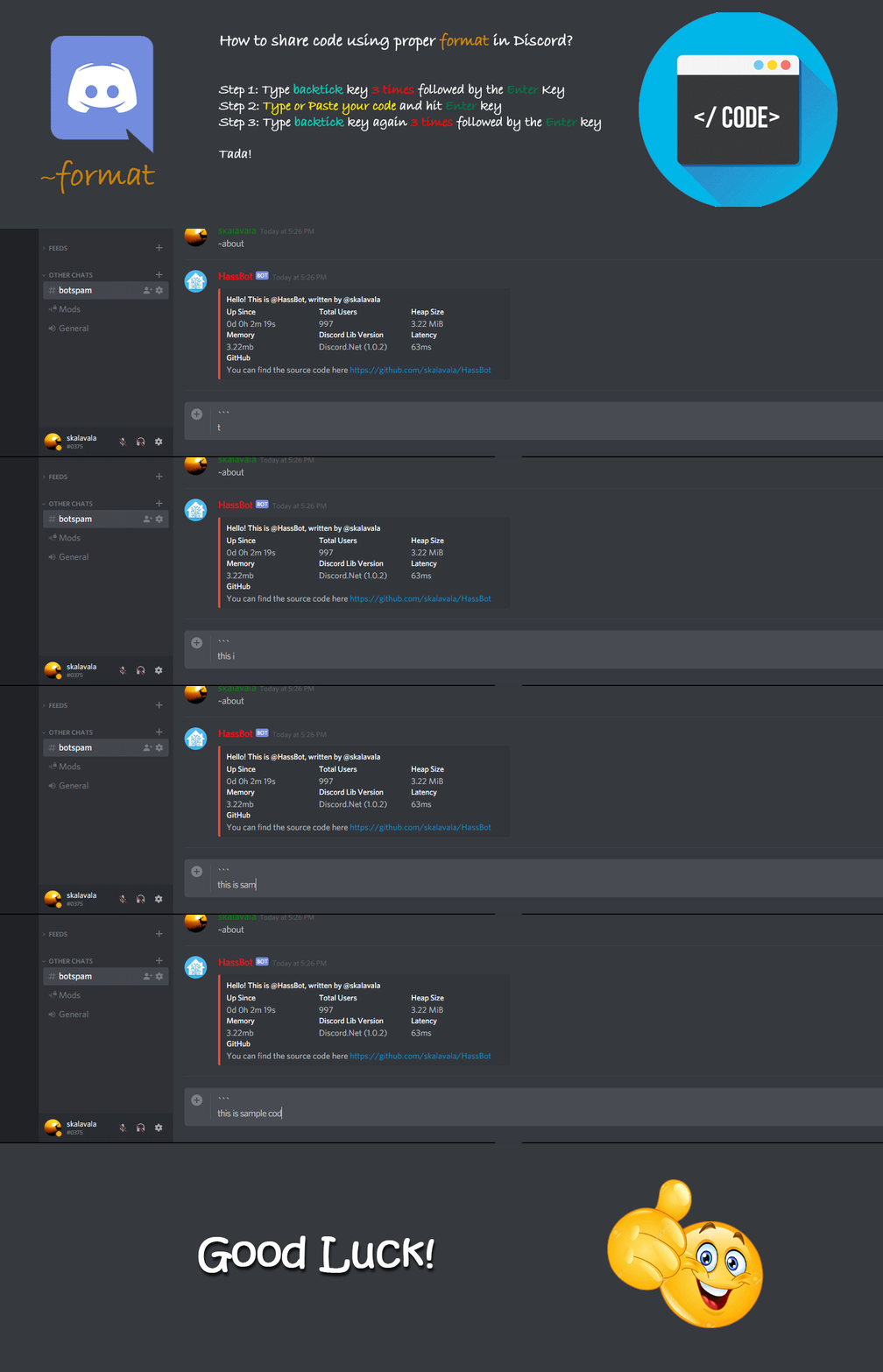 ebon yoke
red
marble jackal
Nice drawing!
ebon yoke
hehe, yes
mighty ledge
mighty ledge
```
template:
- trigger:
- platform: state
entity_id: xyz.abc
from: 'o...
red
mighty ledge
mighty ledge
<https://www.codepile.net/pile/R7A3OwmK>
blue
ebon yoke
device_class: duration is not valid, is it?
mighty ledge
it is valid, but you need to be on 2022.5
mighty ledge
if you arn't, remove it and it'll still work
ebon yoke
i'll skip it
ebon yoke
how can i do this pre-2022.5 then?
mighty ledge
you can't do it safely
you could post the value to MQTT topic which you make into a sensor.
and before you post the value, you'd perform the math
Why do you want this anyways?
ebon yoke
i want to see if the interval between each pump run is increasing or decreasing
it's nice to see if we're being flooded or if stuff is cooling down
this is the spring flood water into our basement
scarlet sapphire
ebon yoke
it's nice to see if we're being flooded or if stuff is cooling down
I hope it's nice to see that you are NOT beeing flooded ;-p
ebon yoke
hehe, it is
silent barnBOT
@ebon yoke Your message has been deleted as it contains a link or a domain name 'pasteboard_dot_co' that is on the blocked list because of: 'Virus detected!'.
Please re-post by removing/changing the domain name/link. Your original message has been DM'ed to you.
ebon yoke
which imagehosting service do you guys use?
silent barnBOT
Please use a code share site to share code or logs, for example:
- https://dpaste.org/ (select YAML for the language)
- https://www.codepile.net/ (select YAML as the language)
- https://paste.debian.net/ (you guessed it, select YAML as the language)
Please don't use Pastebin, since it can randomly add spaces to the main view. Please also don't share text as images since it makes it harder for people to help you. Remember that others may have colour blindness, impaired vision, etc.
Command '.share' was invoked by: TheFes
marble jackal
but that is for code, not for images
scarlet sapphire
none of these support images
marble jackal
I posted that because @ebon yoke was using pasteboard
scarlet sapphire
yepp and that does support images 🙂
ebon yoke
which supports images?
ebon yoke
hehe
marble jackal
there is also a bot message for that 😅
silent barnBOT
Please use imgur or other image sharing web sites, and share the link here.
Image posting is blocked in most channels to discourage people from sharing text as images. Sharing text as images assumes that everybody sees the world as you do, which isn't the case. Some people are colour blind, or have visual impairment that means they can't make sense of an image of text.
Command '~images' was invoked by: TheFes
scarlet sapphire
ty
marble jackal
but don't share images of code please
mighty ledge
Images of code = bad
scarlet sapphire
agreed
mighty ledge
think of it this way, if I’m going to fix the code, am I going to want to rewrite the whole thing or copy and paste and alter?
scarlet sapphire
I think he was trying to share a non-code image
marble jackal
Aaah, you could just do some OCR, and fix all the mistakes it made before reposting a corrected version right! 😇
scarlet sapphire
petro-as-a-service ?
mighty ledge
ERROR: ServiceNotFound
ebon yoke
it wasn't an image of code, no
i just wanted to show the intervals
but again.. how do i solve my issue?
i'm not able to get out what i need
this should be possible to solve pre 2022.5, no?
marble jackal
Why not upgrade to 2022.5?
ebon yoke
i don't dare to upgrade anything right now
h-a runs the pumps
and if they stop, then our basement is flooded
so if something breaks with z-wave or certain integrations, then i'm stuck at running pumps manually
= not an option
ebon yoke
mighty ledge
red or blue?
is it possible to solve for red pre 2022.5?
mighty ledge
You have to get inventive
MQTT, something
you need to store the last off->on in a temporary spot using an automation
ebon yoke
can't i just store that in a sensor?
mighty ledge
no
ebon yoke
why not?
mighty ledge
because you can't circular reference
that's why this was created
why aren't you updating?
marble jackal
Maybe this would work?
https://www.codepile.net/pile/wgRn8eg0
mighty ledge
That would probably work
mighty ledge
because that's the last state
ebon yoke
ok, i'll attempt
mighty ledge
why aren't you updating anyways?
ebon yoke
see above
marble jackal
His basement will flood if the update fails 😛
mighty ledge
ah
ebon yoke
i don't dare.. ha is currently running the pumps.. i can't risk integrations being deprecated or something like that failing
ebon yoke
marble jackal
Maybe this would work?
https://www.codepile.net/pile/wgRn8eg0
will device_class: timestamp work pre 2022-5?
marble jackal
check if the config check complains
mighty ledge
yes
that's old
2021.8 ish was the last change to that device_class
it existed prior to that
ebon yoke
is this under template: ?
is that yaml code valid? i'm just a bit curious about the usage of '-'
mighty ledge
You have to use template: because it's the new style only
marble jackal
This is under template yes
ebon yoke
and missing indentation?
mighty ledge
with triggers
marble jackal
Which indentation would be missing
ebon yoke
the outer-most
marble jackal
well, officially it could use two spaces more for list items
But this will work
If you use VSCode with the Prettier extension it will auto-add them on saving 😉
I could add it, but it looks like you are copying it right now
Added it anyway now
It will not work before the switch has been turned to on twice