#templates-archived
1 messages · Page 132 of 1
 mighty ledge
Are you going to share the value?
 silent barnBOT
:8ball: 8Ball prdiction:
Question: Will Zyankali provide the mystery value?
Answer: No
Command '.8ball' was invoked by: mono
 ivory delta
Well, that's pretty definitive.
 dreamy sinew
Lol
 hybrid tide
Been working a loop using a chunk of code provided by Mono. However, I can't figure out how to deal with a default condition:
{% if trigger.event.context.user_id == '0c3242344a8ef4c5eb0668feaeecf2332' %}Locked by Google
{% else -%}
{% for person in states.person -%}
  {% if trigger.event.context.user_id == person.attributes.user_id %} App Lock - {{ person.name }}
{%- endif -%}
{%- endfor -%}
{%- endif -%}
If the user_id isn't the first option, and it isn't in the person.attributes.user_id, I'd like to it be "unknown". But I feel like I've painted myself into a corner here...
Sorry...wrong attribution, Tinkerer provided the loop.
 inner mesa
Seems like that could be done by a set of filters and assigned to a variable. Then you can make a decision on whether it found something
But I’d have to play with it and I need to eat. I’ll come back if someone hasn’t figured it out
dreamy sinew
(states.person|selectattr('attributes.user_id', 'eq', trigger.event.context.user_id)|first).name
hybrid tide
Yeah. That's the one that mono gave me last night, but if the user_id doesn't exist in the person list, it blows up because you get an empty result.
Trying to get it to check the person list, if it exist in there output the name. If not, check my hardcoded options. Finally if nothing can be found output "unknown"
inner mesa
So grab the result right after the selectattr, check it, then decide whether to move forward
inner mesa
{% set person = states.person|selectattr('attributes.user_id', 'eq', trigger.event.context.user_id)|list %}
{{ (person|first).name if person|length > 0 else "unknown" }}
oh. piping to length will catch "empty" responses?
inner mesa
sorta - that's how to determine if the search found something
I don't think this is a great way to handle it, though. Why would you get an event with a user_id that doesn't correlate to a person?
hybrid tide
there's a user called "cloud_user" which isn't in the user table
inner mesa
If it's just null or 0 or user_id doesn't exist at all, then that's easier to check for explicitly
then you can just check for that
hybrid tide
not sure if there are others
inner mesa
anyway, I think what I have up there should help
hybrid tide
Thank you
 mortal sundial
`## Some one home
- platform: template
sensors:
someone_home:
friendly_name: Someone Home
device_class: presence
value_template: >-
{{ is_state('person.xxx', 'home')
or is_state('person.gggg', 'home') }}`
Is it possible to have this sensor act by the domain person and not individuals?
 inland stag
Hi everyone, why is my template energy sensor sometimes dropping to 0 when it is just a sum of three other sensors?
dreamy sinew
mortal sundial
`## Some one home
- platform: template
sensors:
someone_home:
friend...
'home')|list|length > 0 }}```thanks
inland stag
dreamy sinew
.share your template
silent barnBOT
Please use https://paste.ubuntu.com/ to share code or logs. Please don't use Pastebin, since it can randomly add spaces to the main view.
Command '.share' was invoked by: phnx
inland stag
  - sensor:
      - name: "Total Energy"
        state: >
          {% set phase1 = states('sensor.energy_phase_1') | float / 1000.0 %}
          {% set phase2 = states('sensor.energy_phase_2') | float / 1000.0 %}
          {% set phase3 = states('sensor.energy_phase_3') | float / 1000.0 %}
          {{ (float(phase1) + float(phase2) + float(phase3)) | round(3) }}
        device_class: energy
        unit_of_measurement: "kWh"
        state_class: measurement
        attributes:
          last_reset: '1970-01-01T00:00:00+00:00'
if any of those are ever unavailable they'll eval to 0.0
mighty ledge
could just add an availability template to it
inland stag
ok, so I can leave state like it is and add availability_template to set it to unavailable when one of the phases is unavailable?
 fossil venture
inland stag
fossil venture
inland stag
thank you very much guys!
 cold mica
@dreamy sinew @ivory delta Yesterday i tried and then went to sleep . Where can i find the value , iam a bit lost what i need to share is it this? supported_color_modes: hs color_mode: hs brightness: 255 hs_color: 0, 100 rgb_color: 255, 0, 0 xy_color: 0.701, 0.299 friendly_name: Canvas FA77 supported_features: 17
ivory delta
Use the template I asked you to use.
cold mica
which template you mean?
cold mica
other question, i got this work now how i want ```template:
-
sensor:
-
name: "canv"
state: >
"{% if state_attr('light.canvas_fa77', 'brightness') | int >= 220 %} bright
{% elif state_attr('light.canvas_fa77', 'brightness') | int >= 200 %} bright2
{% elif is_state('light.canvas_fa77', 'on') %} on
{% else %} off
{% endif %}"``` how can i use this entity in Picture Elements Card ? When i use the Sensor.canv it dont Work anymore with changing Pictures
-
ivory delta
You should ask in #frontend-archived
 patent sparrow
https://pastebin.com/qcATGiVc
https://pastebin.com/VvVG18xP
This data_template: code works correctly but when I save the Automation and refresh the page, the linebreaks are reformatted/screwed up, changed from the first link to the second link (lines 6,7,8), what am I doing wrong?
inner mesa
First, data_template: was deprecated over a year ago - use data:
ivory delta
Second, if you let the UI interfere, you can expect to see it formatting your code in odd ways
They appear functionally equivalent to me, so what's the problem?
inner mesa
I don’t think the spacing is particularly important there
ivory delta
Second one is 'better', just because the opening tags are all on their own line. The UI knows better in this case.
You shouldn't have to read halfway along a line to see where something new starts.
patent sparrow
ivory delta
Second one is 'better', just because the opening tags are all on their own line....
i think you've got them switched?
ivory delta
Aha, I clicked the links in the wrong order 😂
But yeah... #templates-archived message
If you're doing something advanced enough to need multiline templates, you're probably better off using a real editor.
patent sparrow
is there a way i can not have the UI "interfere" ? other than move the whole automation into raw yaml ?
ivory delta
Nope. You use the UI or don't. It's not customisable.
patent sparrow
ahhh okay
ivory delta
If you're comfortable with YAML and Jinja, I'd recommend switching to YAML mode and just SSHing in with something like VS Code.
You get a lot more control over how your config is organised too if you start splitting the files out.
A good example from one of the users here: https://github.com/DubhAd/Home-AssistantConfig/tree/live/automation
But for more on splitting your config, head over to #integrations-archived
 edgy umbra
I want to change the color if both speakers are playing, works fine for one speaker but the template below seems not working Anyone know whats wrong on this? Thx
  ha-card {
    --primary-text-color:
    {% if is_state('media_player.sonos_keuken', 'playing') and (states('media_player.badkamer', 'playing') %}
     #EBEBEB
{% endif %} ;```states('media_player.badkamer', 'playing') isn't valid, and you have too many opening parentheses in your template.
edgy umbra
Got it fixed in the meanwhile, thanks anyway for the help mono. 😉
This is the working version.
ha-card {
--primary-text-color:
{% if is_state('media_player.sonos_keuken', 'playing') and is_state('media_player.badkamer', 'playing') %}
#FFA229
{% endif %}
;``` proper holly
Coming over from automations. I need a template sensor that turns "on" when message attribute of calendar.district_calendar CONTAINS "No School" they put all sorts of other information like "No School - Teacher Workday" or No School - Teacher Training", but they all contain "No School" as a string. Help!
inner mesa
{{ "No School" in "No School for frogs" }}
or for your actual use case: {{ 'No School' in state_attr('calendar.district_calendar', 'message') }}
@proper holly
proper holly
Wow, so easy. Will put into testing! Thanks!
inner mesa
you can test in  -> Templates and change the attribute to whatever you want in -> States
proper holly
Worked perfectly. Thanks for the help!
Thanks @inner mesa
One more question, they have a few that are "NO School" with a capital "O" in "NO". Can I make it non-case sensitive?
@inner mesa
inner mesa
you can use filters to force a case on both sides
something like {{ "No School"|lower in "No School for frogs"|lower }}
proper holly
Ah fantastic. Whole new world!
 pliant dagger
Hello there template masters.
I"m trying to figure out why this is throwing an error
  sensors:
    living_room_window_sensor:
      value_template: {% if 'states.binary_sensor.living_room_window' %}
        {% if states.binary_sensor.living_room_window.state == "off" %}
          open
        {% else %}
          closed
        {% endif %}
        {% else %}
          n/a
        {% endif %}
friendly_name: 'Living Room Window Sensor'```I get the following error message when I lint it ```(<unknown>): found character that cannot start any token while scanning for the next token at line 4 column 24
I don't understand what the issue is. I've tried with quotes without
this was working
 jagged obsidian
either put it in a single line under quotes or open a multiline with >
pliant dagger
I don't fully understand. Sorry my yaml skills are lacking but they're getting better
jagged obsidian
ivory delta
If you want to put a template on multiple lines, you must write value_template:> and not wrap your template in quotes.
 wintry moon
is there anything like relative_time to count "age" of kids? I'd like to create 2 sensors for kids - older one getting value "x years, y months" and younger: "xx weeks"
or even "x weeks, y days"
mighty ledge
pliant dagger
I"m trying to figure out why this is throwing an error
```- platform: template
...
Your syntax is also wrong. You have if - else -endif -else -endif. You cannot have an else without a starting if. Your second else onward is wrong and should be removed. EDIT: Nevermind, you just formatted that in an odd manner. Disregard.
mighty ledge
wintry moon
is there anything like relative_time to count "age" of kids? I'd like to create ...
You have to calculate it yourself if you want years and months
and once you get to months, it becomes ballpark numbers.
years and weeks are easy to calculate. Months are not because calculations require a static number of days and as you know months alternate between 28, 30 and 31 days
 marble jackal
pliant dagger
I"m trying to figure out why this is throwing an error
```- platform: template
...
marble jackal
pliant dagger
I"m trying to figure out why this is throwing an error
```- platform: template
...
I reformatted it a bit, your first if statement doesn't seem to be an if statement..
      value_template: >
        {% if 'states.binary_sensor.living_room_window' %} {# if what?! #}
          {% if states.binary_sensor.living_room_window.state == "off" %} {# better use if is_state('binary_sensor.living_room_window', 'off') #}
            open
          {% else %}
            closed
          {% endif %}
        {% else %}
          n/a
        {% endif %}
      friendly_name: 'Living Room Window Sensor'
should use is_state which would handle that entity existing properly
{{ map.get(states('binary_sensor.living_room_window'), 'n/a') }}```@pliant dagger ^ simplified lookup
mighty ledge
dreamy sinew
should use `is_state` which would handle that entity existing properly
shouldn't we just do the proper setup for that device? I just noticed it's a binary sensor:
template:
- binary_sensor:
  - name: inverted living room window
    state: "{{ is_state('binary_sensor.living_room_window', 'off') }}"
    device_class: window
probably
mighty ledge
I wish we could expunge these old templates when device_classes and translations didn't exist
dreamy sinew
lol
mighty ledge
even from my head 🤣
 runic viper
hi everyone, Im trying to use the value of a script field on wait_for_trigger template and it errors saying that the variable is undefined, is that expected? this is the block (time_away is the field that I defined on the script :
- wait_for_trigger:
      - platform: template
        value_template: '{{is_state(motion_sensor_entity_id, ''off'')}}'
        for:
          minutes: '{{ time_away|int }}'
need to share the full thing
runic viper
@dreamy sinew this is it https://paste.ubuntu.com/p/dbKhXxkFdn/
dreamy sinew
seems fine. have you tried tracing the run with the new debugging tools?
runic viper
yeah, execution wise looks fine, but the logs say Error rendering 'My Script' for template: UndefinedError: 'time_away' is undefined is like the fields defined on the script are not passed downstream, like they're not available on the for: section
btw, I tried creating a variable as well, and it's the same...
by new debugging tools you mean the diagram of the execution, right?
mighty ledge
runic viper
yeah, execution wise looks fine, but the logs say `Error rendering 'My Script' f...
are you just running the script? If yes, then you aren't providing the script with defaults for it to run without error
i.e. clicking 'run'
the examples do not auto populate the data, so you have to provide it yourself or give defaults to the variables
pliant dagger
thank you @mighty ledge so are you guys saying that we don't really need the value templates to convert on/off to open/closed anymore? Except in the case of my living room window where its backwards, which is the result of using an external sensor. Took me some time to figure out how to monitor a dual slide window but that did the trick
mighty ledge
pliant dagger
thank you <@!372843932096397333> so are you guys saying that we don't really nee...
binary sensors 'under the hood' are treated as on/off. But in the UI they are translated based on whatever device class you use. If you use a 'window' device class, it will appear in the ui as "Open/Close"
pliant dagger
ah gotcha, thank you for educating me. A lot of this stuff was stuff I setup years ago
but I'll gladly go through and clean it up. Will require changes to my automations to monitor a different device and the state of said device from being open/closed to on/off
mighty ledge
yah they are like 3 years old now tho
pliant dagger
mainly my alarm code in appdaemon I'll just have to add an 'or' statement in there
mighty ledge
I made that change at some point, so it was only a matter of time
ya
I ditched appdeamon too
kicked that pile o mess to the door. You can do most things in native automations now
pliant dagger
Yeah me and yaml aren't the best of friends lol
mighty ledge
pyscript then
pliant dagger
probably
mighty ledge
appdaemon is so bloated now
pliant dagger
I'll have to look into that
I like the ability to reuse one script multiple times
which I'm sure there is a way to do that natively as well
mighty ledge
Most of my appdaemon apps were 100s of lines, on conversion most of them are shorter with yaml.
pliant dagger
thats always a bonus
I'll have to research that and see where I can convert things
mighty ledge
There were 2 that I didn't want to convert and I just made custom integrations
which were shorter than the appdeamon apps
and easier to understand
pliant dagger
I also use NodeRed for things but I keep that to a minimum
flows get so big and messy
mighty ledge
I never bothered with NR, I don't think like that
pliant dagger
I thought it would be something neat initially
and it was
but the flows can get complicated and it was easier just to write a few lines of python to do the same thing
mighty ledge
ya
the api for integrations now is super duper simple
and you can fake out configurations by passing a True back from the config validator if you want to bypass all the voluptous
pliant dagger
oh dang
ok so how does one set the device class?
aww can't paste pics in here
but I'm looking at a binary sensor for a door
mighty ledge
pliant dagger
ok so how does one set the device class?
customization
pliant dagger
Thanks @mighty ledge
 sonic oracle
template:
  - sensor:
      - name: "energy_current_hour_watts"
        unit_of_measurement: "W"
        state: "{{ (states('sensor.energy_current_hour') * 1000) | float }}"
What did i do wrong?
inner mesa
You didn’t add |float
States are strings
Just move the one you have to after states()
sonic oracle
thanks that removed the errors although the sensor still doesn't show up in the dev tools
inner mesa
did you reload template entities or restart HA?
sonic oracle
both actually
sonic oracle
Package templates setup failed. Component template cannot be merged. Expected a dict.
is there a way around that?
inner mesa
put it in configuration.yaml
sonic oracle
thanks alot 👍 i don't really understand though how that made a difference 🤔 i mean if i do: template: !include template.yaml it works aswell
runic viper
mighty ledge
are you just running the script? If yes, then you aren't providing the script w...
nope, well, yes, but I'm providing the data, btw thanks for answering
inner mesa
sonic oracle
thanks alot 👍 i don't really understand though how that made a difference 🤔 i...
if you put that in configuration.yaml, that's why
I also think that Paulus did something that may help. https://github.com/home-assistant/core/pull/54085
 eternal saddle
just starting out and I'm looking for advice on setting color_temp via left-right button on tradfri. I'd like to adjust the color_temp up or down similar to the automation brightness step. Wondering if I need to do this in a script, or a template in the automation?
mortal sundial
Hi Guys,
I would like to turn on a switch when my last active sensor changes state.
The sensor is changing every time it detects mouse movement on my computer.
I don't want the trigger to fire all the time when I use the mouse.
I tried to do a template trigger but it can't get it working.
Something in this direction:
{{ now() - states.sensor.last_active_sensor.last_updated > "5 minutes" }}
Is this even possible?
ivory delta
Is this for an automation?
If so, just set the run mode to single and put a 5 minute delay as the last action.
inner mesa
{{ now() > states.sensor.last_active_sensor.last_updated + timedelta(minutes=5) }} 🤷
 lost wyvern
So can Jinja just support full python expressions? Or are these custom filters and tags specifically for HA
inner mesa
HA Templates support Jinja + some extensions as described in https://www.home-assistant.io/docs/configuration/templating/, but the objects themselves support methods from Python
inner mesa
{{ "foo:bar:blah".split(':') }}, for instance
and Python data structures, like dicts, lists, datetime, etc.
mortal sundial
ivory delta
If so, just set the run mode to single and put a 5 minute delay as the last acti...
thx
mortal sundial
{{ (states('sensor.office_desk_peripherals_power')|float > 30.0) and ((as_timestamp(now()) - as_timestamp( states.sensor.last_active_sensor.last_changed))|float < 10) }}
`
Entering the above code into the developer template tools:
This template updates at the start of each minute. <<<<---- How would i reduce this interval?
 warm ibex
Can somebody help me. I have some states for each user where it records the time and date of when the user unlocks the door. Everything behind this works. Including the states which change there time and dates when that user unlocks the door. I have this sensor (unlocked_by) which is what the conditional Lovelace cards use to determine who was the last to unlock the door. However, both David and Vicky work but if I add anymore such as spare card or another user it doesn’t work. Could somebody help me? I’m completely stuck
https://paste.ubuntu.com/p/r9Crz3mr35/
Sorry if I’ve posted this wrong. I’m a little new. Any help is appreciated.
I basically need the sensor to determine which state is the latest time and date and then update with the corresponding users name
ivory delta
🤦♂️
I did just say to use a code sharing tool, right?
Delete your post, do it properly.
And delete the post back in #automations-archived too while you're at it.
Please use https://www.hastebin.com/ or https://paste.ubuntu.com/ to share code or logs
warm ibex
ivory delta
Delete your post, do it properly.
Done, apologies.
fossil venture
@warm ibex See if this works. If it does you can add as may cards to the list and elif statements as you want https://paste.ubuntu.com/p/DHwN7shPBq/ if it does not work the input datetimes need to be converted to timestamps first. EDIT: I just tested it. It works.
warm ibex
fossil venture
<@!729742507537072229> See if this works. If it does you can add as may cards t...
Hi Tom, I’m very grateful for your input on this. When I add this it says the entity is not available. Any ideas? I get an invalid template error expected token 'end of statement block', got '=')
fossil venture
The if statements should use the comparison operator == not =. Sorry.
Only the set statement should use =.
fossil venture
warm ibex
Hi Tom, I’m very grateful for your input on this. When I add this it says the en...
Like this: https://paste.ubuntu.com/p/YYx7ctxS4C/
warm ibex
fossil venture
Like this: <https://paste.ubuntu.com/p/YYx7ctxS4C/>
Hi Tom, omg 😱 you are amazing! You’ve fixed all my issues. I was near to breaking point.. thank you so so much!
 dull dune
Hey guys, I'm trying to add two additianal sensor for smarter status reporting of a poolcover. Can I simply just add the bottom two sensors to the template sensor here? There are comments in the paste that should explain what I'm trying to do/understand
inner mesa
mortal sundial
`{{ (states('sensor.office_desk_peripherals_power')|float > 30.0) and
((as_t...
It depends on where you’re using it. If you’re creating a template sensor, you can add a time_pattern or other type of trigger to indicate when and how often it should be reevaluated
mortal sundial
i'm using it with a template sensor
inner mesa
Great, then follow the docs to add a trigger
 worn kraken
Can a template reference itself or does that result in a loop as the templates own value would change? For instance.. - sensor:
- name: "DTE Daily Energy"
state: >
{% set minuteKwhUse = states('sensor.dte_summation_minute') | float / 1000 / 60 %}
{{ (float(minuteKwhUse) + states('sensor.dte_daily_energy') | float) | round(3) }}
unit_of_measurement: kWh
device_class: energy
state_class: measurement
worn kraken
In that case, wouldn't you need two sensors and an automation?
ivory delta
No...? Make a template sensor that exposes the value you want for minuteKwhUse, then create another template sensor that uses the result and performs the next step.
No circular references 🎉
 copper quail
Does anyone know of a way to force decimal places?
When using round(2) – if I have a float with a value of 13.4004, it'll round to 13.4 instead of 13.40
dreamy sinew
but if the value is 13.405 it would round to 13.41
ivory delta
'{0:.2f}'.format(your_number_here)
You'll still want to round first so you're not just truncating the extra digits.
dreamy sinew
though the template tester will still chop it for reasons
ivory delta
It doesn't here...
dreamy sinew
 ivory delta
Ah, my example with pi isn't useful 😄
Will it return correctly in a template sensor?
dreamy sinew
but $%0.2f works
ivory delta
This is returning 1.20 for me:
{{ '{0:.2f}'.format(1.20000) }}
dreamy sinew
force it into a string
ivory delta
Is it that thing where the Dev Tools works differently if you only have a single template in there?
dreamy sinew
probably
ivory delta
Yup
dreamy sinew
its getting natively converted to a number
ivory delta
Just got rid of the rest, can confirm.
copper quail
gotcha. It's NBD.
worn kraken
templates
dreamy sinew
cold starting a thread is a good way to be ignored
worn kraken
ivory delta
No circular references 🎉
ahh. ok. nevermind that then
ivory delta
Please stop tagging me.
silent barnBOT
When using Discord's new Reply feature it defaults to pinging the person you reply to, which can get frustrating for the target. Click @ ON to @ OFF to stop this - on the right side of the compose bar.
Command '.reply' was invoked by: mono
worn kraken
For my template, I am still getting a circular reference when split. it looks like it still complains of circular references
- name: "DTE Daily Energy"
state: >
{{ ( states('sensor.dte_minute_energy') | float + states('sensor.dte_daily_energy') | float ) | round(3) }}
unit_of_measurement: kWh
device_class: energy
state_class: measurement
dreamy sinew
you are still referencing the sensor within itself
ivory delta
Are you just trying to keep a running total?
worn kraken
agreed, doesn't seem like templates can update themselves. I am trying to run a total in a template
ivory delta
And if this is for use with the new energy dashboard, #energy-archived can help more.
worn kraken
ok. I will try there. I need to convert from minute based kwh usage to hourly in order to use utility_meter
for totals in general, it doesn't appear that templates are appropriate
ivory delta
Templates are a calculation of known values, not a tracker of any form of history.
And I think you misunderstand power/energy. If you have something that can report power, the rest is easy... but still #energy-archived
silent barnBOT
@grave cargo posted a code wall, it is moved here --> https://paste.ubuntu.com/p/mKgcFkQ45Z/
@grave cargo posted a code wall, it is moved here --> https://paste.ubuntu.com/p/rc8WwTZ8GY/
ivory delta
🤦♂️
silent barnBOT
@grave cargo Rule #6: Spam will not be tolerated, including but not limited to: self-promotion, flooding, text walls (longer than 15 lines) and unapproved bots.
Please take the time now to review all of the rules and references in #rules.
For sharing code or logs use https://paste.ubuntu.com/.
Command '.rule6' was invoked by: mono
ivory delta
44 lines of text across two posts. Nice.
Energy questions go in #energy-archived. Share a short description of your issue there and include the rest in a paste from a tool like the one in the bot message.
 thorny snow
Thanks and sorry for trying to explain my issue with to much text 🤣
 stone marsh
Is it possible to use customize_glob to add a friendly name that truncates the suffix? All of my energy sensors end in "_energy" and I would like to strip energy off and make the friendly name the rest of the entity id
ivory delta
You're describing a RegEx replacement.
Not quite the same as a glob but similar idea.
stone marsh
Can that be done through customize_glob so I can bulk hit all of my entities?
ivory delta
Nope.
stone marsh
Could the template update the friendly name?
ivory delta
Nope.
ivory delta
Templates just are. They're calculators. They don't impact other things.
 hot swift
Hello, is it possible to somehow get the last_changed or last_updated attribute on a template sensor? I have a template sensor that just tracks the position of a cover. I would like to make a sensor to track if it's moving or not, and i thought sensors had last_changed attribute?
hot swift
Okay, it's just under developer tools and attributes there is not anything like that. Is it because it's a hidden attribute and can just be used in automations?
ivory delta
In templates, but yes.
It's not an attribute in the sense of entities having attributes. It's just a property of that state object.
hot swift
Yeah in templates. Okay I will try playing around some more with it.
I just don't really get any results when I try it out in template. This is the templates. And the output is blank for the first two, and None for the last.
{{ states["sensor.cover_position_livingroom_1"].attributes.last_updated }}
{{ states["sensor.cover_position_livingroom_1"].attributes.last_changed }}
{{ state_attr('sensor.cover_position_livingroom_1', 'last_updated') }}
{{ state_attr('sensor.cover_position_livingroom_1', 'last_changed') }}
 waxen rune
@hot swift I checked a couple of mine. They seem to behave a bit differently.
Normal sensor:
{{ state_attr('sensor.tellstick_id_22_temperature', 'lastUpdated') | timestamp_local }} = 2021-08-13 23:49:50
{{ states.sensor.tellstick_id_22_temperature.last_updated | timestamp_local }}= 2021-08-13 21:50:38.842806+00:00
Template sensor:
{{ state_attr('binary_sensor.balkongdorr_sovrum_tmpl', 'lastUpdated') | timestamp_local }} = None
{{ states.binary_sensor.balkongdorr_sovrum_tmpl.last_updated | timestamp_local }}= 2021-08-11 09:36:08.678170+00:00
Also note "lastUpdated" vs ".last_updated".
Based on this, does {{ states.sensor.cover_position_livingroom_1.last_updated | timestamp_local }} give you anything useful?
ivory delta
Based on this, does {{ states.sensor.cover_position_livingroom_1.last_updated | timestamp_local }} give you anything useful?

Which is... what phnx said 🤯
waxen rune
Yes. But for some, me included, it is easier to see an actual example. Anyway, i hope AnthonMS got what they needed.
 placid pilot
I'm having conceptual difficulties. I am looking at KASA HS110 power adapters, and I'm trying to figure out where in the HA UI I can see the attributes of the device (so I can create templates etc.) I have seen example templates with entries such as: washing_machine_pump_volts: friendly_name_template: "{{ state_attr('switch.washing_machine_pump','friendly_name') }} Voltage" value_template: "{{ state_attr('switch.washing_machine_pump','voltage') | float }}" unit_of_measurement: "V"
But I don't see where I can find the relevant information ie: voltage? How do I 'list' the attributes of a device, so I can create the relevant sensors for my setup?
fossil venture
Developer Tools / States
placid pilot
Hmm, in my case, that doesn't give me any more information. If I look at the switch.washing_machine_pump entity. I don't see any attributes other than friendly_name.
ivory delta
The attributes available depend on the integration you use.
 wet vault
placid pilot
Hmm, in my case, that doesn't give me any more information. If I look at the swi...
wet vault
placid pilot
Hmm, in my case, that doesn't give me any more information. If I look at the swi...
The tplink integration creates 5 entities per port/switch. One switch.washing.. and 4 sensors. These sensors entities would be named sensor. Washing_machine_pump_voltage , current, total consumption & today's consumption.
The switch entity wounld only have the state: on/off attribute.
placid pilot
@wet vault 👍 thank you
 dire shadow
i have a command_line sensor that outputs a huge float in celsius. using the example template from the docs seems to throw off the conversion to fahrenheit. without the template the conversion is correct. is there something else i need to do to trim the sensor output? e.g from 119.72000133989536 °F to 119.7 °F
- platform: command_line
  name: Core Switch Temperature
  command: "ssh -o StrictHostKeyChecking=no -o GlobalKnownHostsFile=/dev/null -o UserKnownHostsFile=/dev/null homeassistant@10.0.2.2 -i /ssh/id_ed25519 \"show system environment temperature | json\" | jq '.tempSensors[] | select(.name==\"TempSensor1\").currentTemperature'"
  unit_of_measurement: "°C"
  # value_template: "{{ value | multiply(0.001) | round(1) }}"
I'm not following. You have value_template there that should effect the rounding, but you've commented it out. What exactly is the problem?
dire shadow
yes, when it's uncommented it rounds but the conversion to fahrenheit is incorrect, 32.0 °F
hot swift
waxen rune
<@223052069525913601> I checked a couple of mine. They seem to behave a bit diff...
Thank you for this reply, it helped a lot! I have briefly tested it out with these two templates:
{{ state_attr('sensor.cover_position_livingroom_1', 'lastUpdated') | timestamp_local }}
{{ states.sensor.cover_position_livingroom_1.last_updated | timestamp_local }}
The first returns None, but the second returns "2021-08-14 18:07:54.015289+00:00", so now I think I can make my binary_sensor that checks if it's currently changing/moving.
Thanks again
dire shadow
dire shadow
yes, when it's uncommented it rounds but the conversion to fahrenheit is incorre...
nevermind, just needed to remove the multiply
mighty ledge
hot swift
Thank you for this reply, it helped a lot! I have briefly tested it out with the...
The timestamp local on that isn’t doing anything FYI.
So you can just remove the | timestamp_local
 nocturne nexus
I've been working on this for weeks and feel so close, yet so far away... Hoping someone here can help me. All I want to do is take my automation that I'll post, but make it trigger off of ANY moisture sensor in my HA setup without having to list each one out. I THINK I need to do this with a template, but I can't figure out how to format it. Am I on the right track?
inner mesa
You could certainly do it with a template, but that might work
Did the UI build that?
I suspect that platform: device is wrong
inner mesa
You want entities with device_type: moisture
nocturne nexus
Rob, you gave me a sample code a few weeks back, but when I use it, it take like a minute before it actually triggers.
{{ states|selectattr("attributes.device_class", "==", "moisture")|selectattr("state", "==", "on")|list|length > 0}}
nocturne nexus
Do you see any reason why it would take so long to trigger when using this vs. watching the state change on a single sensor?
inner mesa
No
nocturne nexus
Hmm. I've rebooted my RaspPi since trying that last. Let me put that template as the trigger again and try now.
inner mesa
Test it in dev tools
nocturne nexus
I did, and it still took a long time to change to true.
inner mesa
Try states.binary_sensor instead of states
nocturne nexus
Just that by itself of inserted into that original template somewhere?
nocturne nexus
{{ states.binary_sensor|selectattr("attributes.device_class", "==", "moisture")|selectattr("state", "==", "on")|list|length > 0}}
Like that?
Sorry for my ignorance...
inner mesa
Yes
nocturne nexus
Oh, wow. That triggers in like 2 seconds now instead of 30+
inner mesa
Are you on a pizero?
inner mesa
Weird
nocturne nexus
When using the first template, it was also listing a motion sensor in my alerts in the actions section. When I just changed it to this new one, it accurately uses the name of the triggering water sensor!
nocturne nexus
Is there some way I can buy you a beer?
inner mesa
No, just happy it’s working
nocturne nexus
Well thanks sir. Now I can move on to the next thing. That was the biggest thing bugging me that I couldn't recreate since moving away from SmartThings.
inner mesa
All I did was further restrict the entities under consideration to binary_sensor
nocturne nexus
So made it only look at binary sensors vs every sensor out there?
inner mesa
Vs every entity
inner mesa
Np
 low blaze
I’m trying to write a template that has 2 If statements and an else but I’m not getting it correct
If a, then x ; if not a, but b, then y, Else z
I keep getting a return of z on the second and third evaluation
So I can get x, but never y when I should
I did it this way ; if a then x else if b then y else z
And then endif twice. I’m thinking my issue is placement of the endif and else
low blaze
Yea gimme a sec will retype, it’s just going into iOS as a watch complication
(So I didn’t save a draft)
Else if or us elif something else?
low blaze
‘’’{% if states("sensor.held_lvpd") == "True" %}
VPD
{%else%}
{% if states("sensor.herbybig4_true") == "True" %}
HLD
{%else%}
!!!
{%endif%}
{%endif%}’’’
Sorry on iOS. Not sure if there is a back tick
inner mesa
there is
low blaze
‘ is apostrophe I assume.
inner mesa
so like I said, elif
inner mesa
{% if states("sensor.held_lvpd") == "True" %}
VPD
{% elif states("sensor.herbybig4_true") == "True" %}
HLD
{%else%}
!!!
{%endif%}
Just looked up elif makes sense never seen that syntax thanks
Thank you kindly Rob
Hmm doesn’t seem to work
Maybe I have a typo somewhere let me double check
inner mesa
it's better written like this, assuming that the sensors and values are correct:
{% if is_state("sensor.held_lvpd", "True") %}
VPD
{% elif is_state("sensor.herbybig4_true", "True") %}
HLD
{% else %}
!!!
{% endif %}
 floral shuttle
can we template the used unique_id's of our entities somehow? Ive just found an identical unique_id used in my template: sensor and binary_sensor doesn't hurt, but Id like to prevent that nonetheless. Having an easy check for unique_id's would be nice for that
mighty ledge
floral shuttle
can we template the used unique_id's of our entities somehow? Ive just found an ...
No, unique ids are static, if you let it create the unique_id it will handle that for you.
floral shuttle
mighty ledge
No, unique ids are static, if you let it create the unique_id it will handle tha...
I meant to have them listed, so we can see which unique_id's have been used already. I don't want to 'template' a unique_id'.... Sometimes we have to manually add a unique_id, (tbh, I manually added them all in migrating the template sensors to the new platform, to be sure they were identical to the object_id's)
ivory delta
Generate a UUID, use that. The chances of generating the same UUID twice are... beyond astronomical.
You'll start seeing collisions in about 2^50 ie. about 10^15 keys. Your chances of seeing a collision if you've populated your database with just 1000 billion keys are still negligible.
floral shuttle
you mean with a tool like this: https://www.uuidgenerator.net ?
ivory delta
Or if you have a Linux machine, literally type uuidgen on the command line.
floral shuttle
ok, will do that next time I need a manual uuid... (although I like the UID to be related to the entity...) still, Id like to know if/how one can list all used unique_id's. We should be able to do so, as they are attributes of the entities?
ivory delta
They're not attributes, they're just ID's in the registries. You know where to raise feature requests if you want them surfaced.
 open coral
hello everyone. I am trying to get my HA to read XML data from my pool manager.
I have the following in my configuration.yaml:
https://pastebin.ubuntu.com/p/2WTC4TkdtD/
if I put the address in my browser I get:
<pm5>
<item type="34" id="4033" label="T1" unit="°C" value="27.5"/>
</pm5>
My goal is to "extract". the value (27.5) so that HA can interact with it... but I am struggling with how to get HA to read just the " value" component.
I saw someone on the forms use grep after the address (https://community.home-assistant.io/t/use-xml-result-from-rest-api/6195/9?u=aziwa), but im not sure if thats the right path, if it is i would need help to right the grep.
any help really appreciated 🙂
fossil venture
open coral
hello everyone. I am trying to get my HA to read XML data from my pool manager.
...
I'm hopeless with regular expressions but try this: value_template: "{{ value|regex_findall_index('value=\"(\d*\.?\d*)') }}"
open coral
thanks @fossil venture , i get the following error with that:
unknown escape sequence at line 39, column 62:
... |regex_findall_index('value="(\d*.?\d*)') }}""
^
fossil venture
Try it like this ```
value_template: >
{{ value|regex_findall_index("value="(\d+.?\d*)") }}
 open coral
saves ok, and I am able to reproduce what you did in the template developer tools, this is the logs:
line 39 is the value_template
fossil venture
You have not copied what I wrote correctly. See how my template is on two lines? https://paste.ubuntu.com/p/8cBJ7McJG5/
open coral
you good sir @fossil venture are a genious!! its working perfectly!!!
2 days iv been trying, thanks so much for your help!!!
open coral
hi again @fossil venture , I saw your post on the forum, looks great,
im getting "unknown" however with that code you posted. any ideas? (i assume the ' after value should have been " ?)
ue_template: '{{ value["pm5"]["item"]["value**"**] }}'
fossil venture
Try it without the pm5 value_template: '{{ value["item"]["value"] }}'
And yes that single quote should have been a double.
open coral
nope, still unknown
nothing in the logs
dunno if this helps?
or if i did it correctly
but it says " UndefinedError: 'value' is undefined
open coral
ok?
do you mean I cannot just add it in the "templates" in dev tools? or the parsing? sorry im easily confused 🙂
inner mesa
I mean pasting that in -> Templates isn't useful because it's not actually going to make that REST request
inner mesa
the template must be evaluated in the context of that REST sensor
open coral
ok
fossil venture
Yeah you actually have to create the sensor and restart.
inner mesa
you could use curl or similar from the command line, capture the output, and seed a variable with that to test the template, if you want
fossil venture
thats where we started. Restful avoids nasty xml searches with regex as it converts xml to json.
Oh sorry, you mean to test. Yeah it works.
open coral
dunno if this is any help but i tried this:
fossil venture
Nope. The template editor is not going to do xml -> json. Only the rest sensor will do that. You have to actually create the sensor.
open coral
ok let me try
so basically I would create it with this?
  - resource: http://10.1.1.42/cgi-bin/webgui.fcgi?xmlitem=34.4033
    scan_interval: 60
    sensor:
- name: "PoolTempRest"```Not quite. you are missing the value_template. see my example here: https://community.home-assistant.io/t/bayrol-pool-manager/256262/9?u=tom_l
open coral
oh sorry, i thought i was just creating the rest sensor in order to test the value_template line
when i add the value_template: '{{ value["pm5"]["item"]["value"] }}' with or without the ["pm5"] it doenst work
i get "unknown" in the state of the sensor after a reboot
 hard pond
I'm in need of some guidance... I am trying to create a binary sensor for my OpenSprinkler set up that will tell HA if any of the zones are running. I have 6 entities that i have to account for and the docs just look confusing to me. any help would be appreciated...
fossil venture
open coral
oh sorry, i thought i was just creating the rest sensor in order to test the val...
Stick with your command line sensor then.
open coral
will do. thanks for the help today!
fossil venture
Oh crap. I see why, we should be using value_template: '{{ value_json["pm5"]["item"]["value"] }}' try it if you can be bothered.
open coral
trying 🙂
nope, still unknown with:
rest:
  - resource: http://10.1.1.42/cgi-bin/webgui.fcgi?xmlitem=34.4033
    scan_interval: 60
    sensor:
      - name: "PoolTemprest"
        value_template: '{{ value_json["pm5"]["item"]["value"] }}'
What do you get if you just use: value_template: '{{ value_json }}'?
You might have to look in developer tools / states to see the whole value.
open coral
trying that now.
in the meantime, if it helps, i used a xml -> json converter online for the xml that the poolmanager outputs and get this:
{
"item": {
"@type": "34",
"@id": "4033",
"@label": "T1",
"@unit": "°C",
"@value": "28.0"
}
}
fossil venture
Yeah I did a few too. I remember that silly one that prefixes attributes with @
open coral
arg now having other issues, cant find the sensor. got to go anyway but will try and pick this up later, thanks again for your help!!
silent barnBOT
@hard pond posted a code wall, it is moved here --> https://paste.ubuntu.com/p/JyNc38Fvwq/
hard pond
Nevermind, I just ended up adding 6 triggers to the automation...
 slim cliff
Looking for a little help with a template here
I use an integration (twente mileu) which retruns 3 seperate sensors, all three sensors return a date (next garbage pickup date for that specific garbage type)
For a dashboard I would need a template / sensor which returns only the first upcoming date and garbage type of the three sensors
I was thinking a value template to check which date comes first and use the value of this sensor as the value for the template output, and a friendly_name_template which takes the name of the date that comes first, but to be honest I hardly know where to start
Anyone with a similar example or something to move forward?
inner mesa
Share an example of the state of one of the sensors
slim cliff
2021-08-20
dreamy sinew
{{ [states('sensor.sensor1'), states('sensor.sensor2')]|min }}
slim cliff
Ahhh
dreamy sinew
Oh that would just get the date
inner mesa
I would create a dict of the state and name
Then do that for the dict and index for the name
slim cliff
I have no idea how the dictionairy and index work :P
But, the idea from phnx works great, and I suspect I can figure the rest out from there =D
inner mesa
for fun:
{% set date1=states.input_text.test %}
{% set date2=states.input_text.test2 %}
{% set mapping={date1.state:date1.name, date2.state:date2.name} %}
{{ mapping[[date1.state, date2.state]|min] }}
Interesting, thanks, I'll try that!
      afval_next_up:
        value_template: >
          {{ [states('sensor.non_recyclable_waste_pickup'), states('sensor.organic_waste_pickup'),states('sensor.plastic_waste_pickup')]|min }}
        friendly_name_template: >
          {% set pickup = states('sensor.afval_next_up') %}
          {% if pickup == states('sensor.non_recyclable_waste_pickup') %}
            Rest
          {% elif pickup == states('sensor.organic_waste_pickup') %}
            GFT
          {% elif pickup == states('sensor.plastic_waste_pickup') %}
            Verpakkingen
          {% endif %}
It's not elegant, but it works :P
inner mesa
I don't recommend a self-referential template
but that's essentially what I had in my example, but with a bunch of if/elif instead of a dict
it's a shame that template sensors don't have a common variables section
slim cliff
Would help a bunch
Thanks for your help! I'm happy with my sensor! now to make a nice button card for it :)
dreamy sinew
Oh, min() accepts an attribute parameter
{{ '{}: {}'.format(sensor.name, sensor.state) }}```"Template Designer Documentation — Jinja Documentation (3.0.x)" https://jinja.palletsprojects.com/en/3.0.x/templates/#jinja-filters.min
@slim cliff
And @inner mesa too I guess
 somber radish
My entity state stays in 'unavailable' anyone can point me to what i am doing wrong ? ```template:
- binary_sensor:
- name: "shellymotion01 Brightness"
unique_id: shellymotion01_brightness
state: >
{% if is_state('sensor.shellymotion01_luminosity')|int > 1700 %}
bright
{% else %}
dark
{% endif %}
icon: >
{% if is_state('sensor.shellymotion01_luminosity')|int > 1700 %}
mdi:brightness-5
{% else %}
mdi:brightness-4
{% endif %}```
- name: "shellymotion01 Brightness"
sensor.shellymotion01_luminosity has a value of 1989 according to developer tools
ivory delta
Your templates are invalid. Try them in Dev Tools > Templates.
somber radish
ivory delta
Your templates are invalid. Try them in Dev Tools > Templates.
Oh i never noticed that template tab in dev-tools 😱 Thanks ! i thought the syntax was correct as VSC and 'check config' didnt complain
ivory delta
The config check in the UI is very basic and won't know if your templates work. It only looks for YAML syntax.
To check properly:
silent barnBOT
Always run the configuration check command when you make changes. Don't trust the UI check - it misses some problems.
Command '.check' was invoked by: mono
somber radish
That should actually be a note in the UI itself ...
ivory delta
There's not space to describe everything in the UI... but if you feel it should be changed, you can suggest a feature request.
somber radish
            bright
          {% else %}
            dark
{% endif %}``` fixed itI understand but, the green Configuration valid! in the UI sounds quite definite.
open coral
hi @fossil venture (and others) - im trying again with the rest function you helped me with yesterday.
with the following code:
rest:
  - resource: http://10.1.1.42/cgi-bin/webgui.fcgi?xmlitem=34.4033
    scan_interval: 60
    sensor:
      - name: "PoolTemprest"
        value_template: '{{ value_json }}'
I get this from the states in dev tools when i call up the status of PoolTemprest:
{'pm5': {'item': {'@type': '34', '@id': '4033', '@label': 'T1', '@unit': '°C', '@value': '27.3'}}}
just need to filter out all the rest exept 27.3 🙂 any ideas? we are so close!
fossil venture
Huh. Well there you go. It does the silly @ thing too. Try value_template: '{{ value_json.pm5.item["@value"] }}'
open coral
it worked! well done!! thanks again! 🥳 🙏
fossil venture
open coral
it worked! well done!! thanks again! 🥳 🙏
Don't forget to add unit_of_measurement: "°C" to the rest sensor config or you won't be able to graph it correctly.
open coral
good catch! will do
is it possible to create a new line in the configuration.yaml file?
i am creating a combined sensor with multiple (6) states combined, making it difficult to eddit and work on:
value_template: '{{ "on" if (is_state("switch.status_light_on_annex", "on") and is_state("switch.status_light_on_covered_terrace", "on") and is_state("switch.status_light_on_covered_terrace", "on")) else "off" }}'
I would like to be able to have a line break between each item to make it easier to work with, is there a way?
silent barnBOT
@wintry garden posted a code wall, it is moved here --> https://paste.ubuntu.com/p/wnYXCGFXNR/
 charred dagger
You could make a script that you call from the frontend which does this.
@open coral: https://yaml-multiline.info/
 wintry garden
Hi! I'm having trouble making a simple service call with templates in my lovelace-ui file. Here is a simple representation of my dashboard: https://paste.ubuntu.com/p/fsBqX2HxpH/
Currently making service call in the UI logs "{{ states('input_select.broadlink_remote') }}" as a string instead of the state. I also tried without the outer " " and get the following error:
invalid key: "OrderedDict([("states('input_select.broadlink_remote')", None)])" in "/config/racelandDashboard.yaml", line 29, column 0
I was under the impression that I could use templates in the UI
open coral
thanks @charred dagger - helpful
wintry garden
(I already checked if the template is correct using the template tab in dev tools)
charred dagger
wintry garden
I was under the impression that I could use templates in the UI
You can not.
wintry garden
got it, I'll find a workaround
silent barnBOT
@tepid apex posted a code wall, it is moved here --> https://paste.ubuntu.com/p/QZNV2Bhygf/
 tepid apex
im trying to create a sensor to display the correct year/month/days that a person is old, but cannot get it to work. If this person did not have a birthday this year it will display for example -2
if the person had his birthday, the value is correct
how can i change this in a way to calculate the exact amount of months the person is old for this year?
state_attr("sensor.anniversary_verjaardag_caroline", "date") is for example '1990-09-27', this returns -2 now 🤣
dreamy sinew
that kind of date handling gets pretty dumb in a hurry. What is the intended purpose of this sensor?
ivory delta
the exact amount of months the person is old for this year
Full months? Partial months? Julian, Gregorian, lunar?
inner mesa
it's a crime that all months aren't exactly the same length
dreamy sinew
we need a metric calendar and time scale
inner mesa
I was just going to say that 🙂 But it would guarantee that the US wouldn't use it
dreamy sinew
eh, as long as all the computers use it i won't care
i already use day-month-year and 24h notation so meh
ivory delta
inner mesa
it's a crime that all months aren't exactly the same length
Lunar months are 
slim cliff
dreamy sinew
Oh, `min()` accepts an attribute parameter
This is a little too advanced for me, I can't even found out where to put this :P
Is it a value_template?
dreamy sinew
i had an example directly below of a full template you could use
typed out on mobile even 😉
slim cliff
Sorry I might have quoted the wrong message than :P
I was actually talking about the code you posted
The {% set sensor .... code, this is a value template?
dreamy sinew
the whole thing is a template together
you can drop that as is into the > template page, just swap out for your sensors
slim cliff
Sorry to ask, but,, how would I use it..
Something like the followign?
  {% set sensor = [states.sensor.non_recyclable_waste_pickup, states.sensor.organic_waste_pickup, states.sensor.plastic_waste_pickup]|min(attribute='state') %}
{{ '{}: {}'.format(sensor.name, sensor.state) }} ```Oh wow, That's way cleaner... I had no idea that was an option XD
Let me give this a go
dreamy sinew
i had a suspicion that it was possible but had to look it up
slim cliff
Getting an error after swapping out for my sensors, TypeError: 'attribute' is an invalid keyword argument for min()
dreamy sinew
that's odd
slim cliff
checking my sensors, but I think I swapped the correct values..
dreamy sinew
docs clearly state its possible
https://jinja.palletsprojects.com/en/latest/templates/#jinja-filters.min
but i just tested it and get the same error
slim cliff
Ahh that's reassuring :P
slim cliff
No not at all!
Thank you for helping me, thank you for teaching me things about this genius application!
ivory delta
| sort(attribute='block_total') | first should still work, right?
Update the first line to be this, Giblet:
{% set sensor = [states.sensor.non_recyclable_waste_pickup, states.sensor.organic_waste_pickup, states.sensor.plastic_waste_pickup] | sort(attribute='state') | first %}
slim cliff
That totally works!
ivory delta
Slightly more verbose, does the same thing.
slim cliff
The combined brainpower in here is staggering XD
ivory delta
phnx contributes way more toward that total than I do.
Most of what I know about the 'clever' stuff with templates, I've picked up from phnx and petro.
slim cliff
Still, the combined know-how and willingness to help is what makes this an awesome community
 hollow girder
hello, is there a easy way to remove one month to a date? I think there was a recent update to that, but I can't find any reference to that
inner mesa
Rephrase?
hollow girder
a easy way do do now() - 1 month?!
ivory delta
That'd be a timedelta.
Plenty of examples in the chat history if you'd like to search for that term.
hollow girder
thats it... tks
inner mesa
hollow girder
a easy way do do now() - 1 month?!
Ah, the universal language of pseudo code 🙂
hollow girder
😆
 past wigeon
I'd like to create a sensor that is the absolute value of another sensor. So templates seems to be the way to go about it.
But I can't figure out how to use mathemtical operator with template.
There's abs() mentioned here: https://jinja.palletsprojects.com/en/latest/templates/#jinja-filters.abs but do I have to use jinja-filters.abs(x, /)¶ ?
past wigeon
so something like:
value_template: "{{ state('sensor.iotawatt_input_solar2_wh')|abs }}" ?
inner mesa
Not quite. States are strings, so you need to convert it to a float first
value_template: "{{ state('sensor.iotawatt_input_solar2_wh')|float|abs }}"
past wigeon
ah
I don't even know if that will fix the issue I'm seeing with the energy bit, I get no data showing for my solar. My only guess is that I'm reading an negative value
inner mesa
I think that was an issue, but #energy-archived could say for sure
past wigeon
it's showing as "unavailable" in the developer tools
  sensors:
    solar1_wh:
      friendly_name: "Solar11"
      unit_of_measurement: Wh
      device_class: energy
      value_template: "{{ state('sensor.iotawatt_input_solar1_wh')|float|abs }}"
states
past wigeon
in the developer tools, sensor.iotawatt_input_solar1_wh is :
inner mesa
Not state
inner mesa
Where?
past wigeon
in "Developer Tools"
inner mesa
Yes, but where?
inner mesa
Ok, that’s unrelated to templates
That’s just a table. The data structure is called states
past wigeon
that it's plural is a bit confusing 🙂
inner mesa
I’ve felt that way as well
Consider that it’s a data structure of all states and you’re grabbing one out of it
inner mesa
I posted a link in #energy-archived
past wigeon
hmm, my sensor while showing in the "developer tools" with what I'm hoping is the right unit and type, isn't showing in energy
tepid apex
ivory delta
> the exact amount of months the person is old for this year
Full months? Partia...
so the full months that passed since the birth date
ivory delta
That should be pretty easy then. Work out full years first (difference between the two, rounded down, multiplied by 12), then work out the remaining full months (similar logic, no multiplying).
ivory delta
past wigeon
hmm, my sensor while showing in the "developer tools" with what I'm hoping is th...
#energy-archived can help
 lofty hound
well hello there everyone 😄 i'm trying to setup a template that add's together the 3 current hour estimated solar production to make one value and its throwing a "Error loading /config/configuration.yaml: while parsing a block mapping
in "/config/configuration.yaml", line 73, column 13" and a "expected <block end>, but found '<scalar>'
in "/config/configuration.yaml", line 75, column 34"
here's my code, any help would be greatly appreciated 🙂 thank you!
sensor:
- platform: template
sensors:
estimated_total_hourly_energy:
friendly_name: "total estimated hourly energy" #(line:73)
value_template: "{{ (states('sensor.energy_current_hour')|float + states('sensor.energy_current_hour_2')|float + states('sensor.energy_current_hour_3')|float) }}
unit_of_measurment: "kWh"
inner mesa
could you please format it properly?
silent barnBOT
To format your text as code, enter three backticks on the first line, press Enter for a new line, paste your code, press Enter again for another new line, and lastly three more backticks. Here's an example
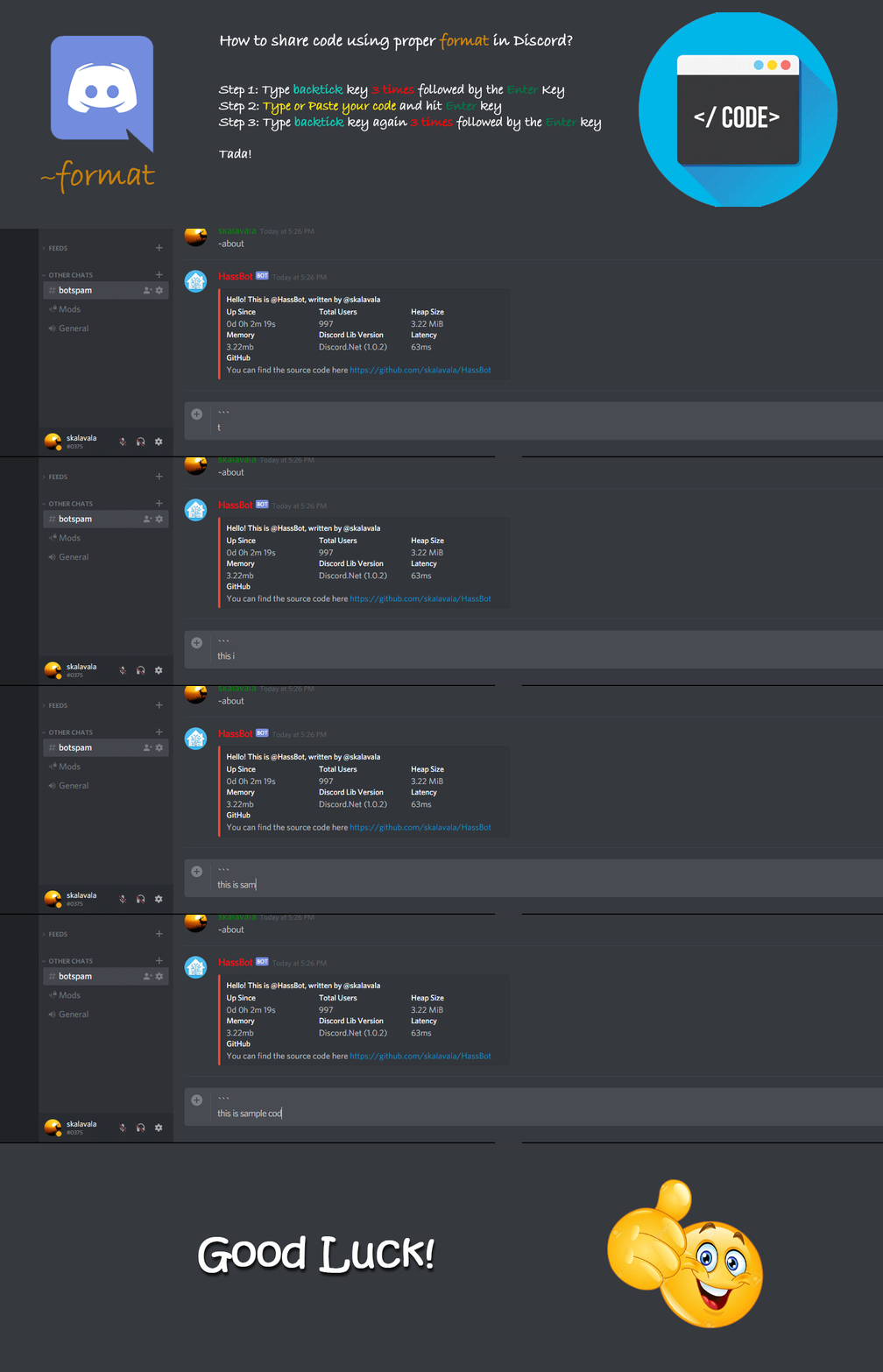
Don't forget you can edit your post rather than repeatedly posting the same thing.
For over 15 lines you must use a code share site such as https://paste.ubuntu.com/.
Command '~format' was invoked by: RobC
inner mesa
offhand, it looks like you're missing a closing "
lofty hound
  - platform: template
    sensors:
        estimated_total_hourly_energy:
            friendly_name: "total estimated hourly energy"
            value_template: "{{ (states('sensor.energy_current_hour')|float + states('sensor.energy_current_hour_2')|float + states('sensor.energy_current_hour_3')|float) }}"
            unit_of_measurement: "kWh"
first, 2 spaces per indentation level
lofty hound
quote added. good catch, changed error to
Error loading /config/configuration.yaml: while parsing a block mapping
in "/config/configuration.yaml", line 1, column 1
expected <block end>, but found '<block mapping start>'
in "/config/configuration.yaml", line 77, column 2
inner mesa
second, the outer set of parens are unnecessary in the template
lofty hound
the {{'s?
lofty hound
the one around the states? gotcha
inner mesa
I suspect that the problem is indentation
you're just inconsistent across the definition
lofty hound
well. that's how all my other things on config are indented.... why's it only messing up on this one?
infact i went to change the other's to only two spaces and it broke those uhh.. integrations
lofty hound
i am, 3 spaces for each "tab" notepad++ is nice like that
inner mesa
looks like 4 to me
lofty hound
well its 3, one before the - the - and one after the - for example
#icantcount nvm your right
its still consistent across the board
inner mesa
I don't see anything else wrong with it other than the indentation, and indentation is important and meaningful in YAML
lofty hound
i've noticed lol.
inner mesa
not sure what to tell you, then
lofty hound
so when i do binary_sensor: - platform for example should the - line up under the binary_sensor ?
inner mesa
it's a list under binary_sensor:, so...
binary_sensor:
  - platform: template
    sensors:
      foo:
        value_template: "{{ xxx }}"
i ask because right now they're all bumped in two spaces. has the - and then another space. as you just exampled to me, so sensors: in that case is also 4 spaced in, correct?
inner mesa
it's all relative to the parts around it
in any case, I just added what you posted above. fixed the spacing, and it checks fine for me
- platform: template
  sensors:
    estimated_total_hourly_energy:
      friendly_name: "total estimated hourly energy"
      value_template: "{{ (states('sensor.energy_current_hour')|float + states('sensor.energy_current_hour_2')|float + states('sensor.energy_current_hour_3')|float) }}"
      unit_of_measurement: "kWh"
i adjusted to
  - platform: template
    sensors:
      estimated_total_hourly_energy:
        friendly_name: "total estimated hourly energy"
        value_template: "{{ states('sensor.energy_current_hour')|float + states('sensor.energy_current_hour_2')|float + states('sensor.energy_current_hour_3')|float }}
        unit_of_measurment: "kWh"
with no luck, i'll copy your code in and hope it fixes it
lofty hound
oh dang it, i prolly ctrl+z'd too far and didn't check. good eyes
well i copied your code in and it works fine now 😄 thanks for your help and expanding my understanding of this powerful platform! 😄
dreamy sinew
value_template: "{{ [states('sensor.energy_current_hour'), states('sensor.energy_current_hour_2'), states('sensor.energy_current_hour_3')]|map('float')|sum }}"
 spice crow
Hey!
I am pretty new to templating, but i have manage to do some stuff. Now i am stuck.. I am trying to translate this to swedish, since it shows if my cat is inside/outside, and since when. The code takes status from another sensor, and then translate it's to "Inside sedan 18:02" etc.. "Sedan" means "Since", the thing is i can't manage to make it from "Inside/Outside" to instead show "Hemma" or "Ute" Witch is the translate i wan't. I can't really understand how i knows to translate "where" to inside, since "where" from the sensor is 1 or 0, depending on my cats status. Hope someone can help, thanks!
ivory delta
Something like {{ 'Hemma' if is_state_attr('binary_sensor.pet_doris_2', 'where', 'inside') else 'Ute' }} should do it
inner mesa
cat_tracker:
spice crow
ivory delta
Something like `{{ 'Hemma' if is_state_attr('binary_sensor.pet_doris_2', 'where'...
Wow, that worked like a charm. Hat off to you man, thank's so much!
spice crow
inner mesa
`cat_tracker:`
What is cat_tracker? I use surepetcare integration
 granite wharf
Anyone have any suggestions where I should list a webpage that generates template elements? I made a template-generator to track profit and loss on crypto purchases. Just saving myself some coding hassle, but I think it would be useful to others who are speculating in crypto and tracking via HA.
ivory delta
You could share it on the forums, then it's easy to search for.
silent barnBOT
@keen cloak posted a code wall, it is moved here --> https://paste.ubuntu.com/p/fbHGBK7tsr/
mighty ledge
silent barn
@keen cloak What are you asking?
silent barnBOT
@wheat cargo posted a code wall, it is moved here --> https://paste.ubuntu.com/p/hj39T55QKT/
mighty ledge
silent barn
You have to add device_class: as a customization
It doesn’t get automatically assigned. Integration just performs a mathematical integration on the data coming from a sensor. It doesn’t assume it’s a power device_class.
charred dagger
That was solved in #energy-archived. integration will set device_class to energy if it's fed a sensor with device_class power. But only after at least two state updates as it turns out. See https://github.com/home-assistant/core/pull/54802
But avoid double posting, @wheat cargo.
 wheat cargo
sorry, I posted it here and then thought #energy-archived would be a better place
thanks for the commit fixing it
charred dagger
No worries... and I guess you can't delete a message after the bot has had it's way with it...
mighty ledge
charred dagger
That was solved in <#872496321574088765>. `integration` *will* set `device_clas...
Ah good to know, must be a newer addition
charred dagger
Definitely
spice crow
ivory delta
Something like `{{ 'Hemma' if is_state_attr('binary_sensor.pet_doris_2', 'where'...
Hey.. again! Well, it seems like it worked but when she left in the morning i realised it only changed the time, and it still said "Ute" and not "Hemma", since "where" isn't "Inside", it's 1 and 2, depending on where she is, i changed that, but it still won't work.. any ideas?
dreamy sinew
have to share what you chagned
 neon pivot
Hey, I have an LED strip controller where 50% brightness is actually 100%, and setting anything higher than 50 overheats/bricks the device. Does anyone know of a way to limit or rescale the dimmer so that 100% on the bar sends 50% to the controller? Most important thing to me is that it should not be able to be set higher than 50
marble jackal
Is thera a device_entities() equivalent for area's? I want to somehow get the entities associated to an area.
ivory delta
marble jackal
Is thera a `device_entities()` equivalent for area's? I want to somehow get the ...
See this conversation: #templates-archived message
marble jackal
Thanks.. I've been informed by Frenck in the Dutch HA discord that template support for areas is in the pipeline
silent barnBOT
@broken urchin posted a code wall, it is moved here --> https://paste.ubuntu.com/p/BzxW4Mt4Qt/
 broken urchin
Hey, could anyone with knowledge of „Create sensor with attribute of entity using templates“ look at this? I really dont know what else I could try to get this sensor working…
silent barnBOT
Rule #6: Please do not post codewalls (text longer than 15 lines) - use sites such as https://paste.ubuntu.com/ (just not Pastebin).
Please take the time now to review all of the rules and references in #rules.
Command '~codewall' was invoked by: RobC
broken urchin
(sorry for the codewall ._.)
inner mesa
What is wrong?
I do note this, which can’t have a space in it:
aussentemperatur city:
charred dagger
And there's sensor: three times.
inner mesa
You’ve only said ‘none of them seem to work’
That too
But there are several different formats there, so no sure what’s going on
broken urchin
Good points. I cleaned everything up, used the structure of the official home assistant wiki site.
Still, If I search the entity (newly created sensor) in the developer tools sektion of HA, it wont show up
*section
inner mesa
After restarting HA? All that would go in configuration.yaml, BTW
 valid hatch
Not sure if this is the right channel for this. I have a group, group.people, which includes some person entities. I also made a template sensor which counts the number of people at home:
template:
  - sensor:
    - name: Number of people at home
      unique_id: 'number_of_home_people'
      state: "{{ states | selectattr('entity_id', 'in',
        state_attr('group.people','entity_id')) |
        selectattr('state','eq','home') | list | count }}"
There is a delay of about a minute between a person being detected as away, and the sensor updating to reflect this new reality. Why is that? Also, if there is a way to improve this template sensor, would love to hear it. I feel like there should be a way to start at expand('group.people') but I couldn't figure it out.
inner mesa
If HA doesn’t know what entity state changes to track, it updates every minute
You can add a state trigger to your template sensor listing the entities it should monitor
valid hatch
Right—I imagine that would only update when the group overall is home/away
ivory delta
Why don't you just expand the group?
{{ expand('group.people') | selectattr('state','eq','home') | list | count }}
inner mesa
I was thinking that, but I think you can just use the same state template in the trugger
ivory delta
Any time the group changes, the template will be re-evaluated.
broken urchin
inner mesa
After restarting HA? All that would go in configuration.yaml, BTW
Yes. I had a look into the logs:
Logger: homeassistant.config
Source: config.py:437
First occurred: 18:07:12 (1 occurrences)
Last logged: 18:07:12
Invalid config for [template]: required key not provided @ data['trigger']. Got None. (See /config/configuration.yaml, line 30).
I dont understand why I need a trigger, according to this info state-based template sensors are formatted like I did
( https://www.home-assistant.io/integrations/template/#state-based-template-sensors )
ivory delta
Which line is line 30 of your configuration.yaml?
valid hatch
I think mono's solution is correct!
It simplifies the expression, and the template dev tool tells me it will monitor for the group as well as each entity in the group
Thanks, @ivory delta
ivory delta
Your approach would make more sense if you were looking for something dynamically... but then you could still use select or selectattr filters.
broken urchin
ivory delta
Which line is line 30 of your configuration.yaml?
Line 30:
template:
- sensor:
- name: „Temperature….
ivory delta
That's 3 lines. Which is line 30?
broken urchin
ivory delta
That's 3 lines. Which is line 30?
template:
ivory delta
Great. Now stop pinging me.
silent barnBOT
When using Discord's new Reply feature it defaults to pinging the person you reply to, which can get frustrating for the target. Click @ ON to @ OFF to stop this - on the right side of the compose bar.
Command '.reply' was invoked by: mono
inner mesa
Where did you put that?
ivory delta
It sounds like you have something nested where it shouldn't be.
broken urchin
sorry mono
inner mesa
It goes in configuration.yaml, not in sensor.yaml
broken urchin
I already moved the code to the configuration.yaml file
ivory delta
.share the whole file, hide any secrets
silent barnBOT
Please use https://paste.ubuntu.com/ to share code or logs. Please don't use Pastebin, since it can randomly add spaces to the main view.
Command '.share' was invoked by: mono
inner mesa
if I paste exactly your definition into my configuration.yaml, it checks fine
broken urchin
When I „check configuration“ do, everything is fine too. But when rebooting I still get the error :
„Invalid config for [template]: required key not provided @ data['trigger']. Got None. (See /config/configuration.yaml, line 30).“
Here the stuff thats above the code in my configuration.yaml file:
https://paste.ubuntu.com/p/by4Q7S63Bp/
inner mesa
what version of HA are you using?
something from a stone tablet?
please don't say something like 2021.2
broken urchin
Version core-2021.4.6
Installationstyp Home Assistant Container
Entwicklung false
Supervisor false
Docker true
Virtuelle Umgebung false
Python-Version 3.8.7
Betriebssystemfamilie Linux
Betriebssystem-Version 5.10.17-v7+
CPU-Architektur armv7l
inner mesa
keep updating
you're 4 releases behidn
I suspect that's before the new template sensor format was supported
it's August, and that's from April
broken urchin
ok.. will try it. Started backup process..
 ivory harbor
hey yall, I'm trying to wrap my head around templates and for some reason this feels like PhD level math to me right now....
my goal is to use a sensor on my mailbox to create a virtual switch where the state of the switch corresponds to if we've gotten mail
ivory delta
What information does the sensor give you?
ivory harbor
open / closed
so do I want something like value_template: "{{ is_state('switch.source', 'open') }}" ?
ivory delta
How do you plan to know if you've had mail and if you've checked the mail?
inner mesa
Then you really need to latch that with an input_boolean
ivory harbor
ivory delta
How do you plan to know if you've had mail and if you've checked the mail?
I think I can do that with the automation. EG first open of the date, set the virtual switch to on. If switch is on, and opened again, set it to off. Regardless of state, set to off at midnight every night
(funny enough we literally just got mail 10 seconds ago and I got the notification 😂😂)
ivory delta
So you don't need a 'virtual switch'. Just use the automation.
inner mesa
Right, if all you care about is the moment when the door is opened
ivory harbor
what if I want to be able to use the state of 'mail' in other places?
ivory delta
Use the boolean 🤷♂️
ivory harbor
not to sound dense... but what do you mean? I understand what a boolean is generally, but not in HA.
silent barnBOT
Command '.input_boolean' was invoked by: mono
ivory delta
Maybe that's what you meant by a virtual switch. It's a helper that tracks a boolean state.
ivory harbor
🤯
ivory delta
A word of warning with your suggested approach...
If switch is on, and opened again, set it to off.
If you get two mail drops in one day, you'll think you've had none.
inner mesa
ivory delta
If you have no reliable way to know you've checked the mail, maybe stick with clearing the boolean at midnight.
ivory harbor
@ivory delta yeah, it's imperfect. If I were to also go check it manually before mail has arrived, it'd think I have mail
ivory delta
No need to check before it arrives if you know when it's been opened by someone else 😉
ivory harbor
I mean... I could also do image recognition of our mailman with our doorbell camera 🙂
inner mesa
Maybe you’ll find that it’s a trained bear
ivory harbor
where I live, that actually happens 😂😂
ivory delta
I have a similar setup but with two sensors. Input boolean gets turned on when someone rings the doorbell. Input boolean gets turned off when I open the door. If it's on, that means someone has rung the bell and the door hasn't yet been answered.
I have flashy lights and stuff that continue for as long as the boolean is on. It's my 'go answer the door, you lazy swine' notifier.
ivory harbor
measuring the delta between ring and open would give me so much social anxiety for the person waiting 😅
ivory delta
So don't measure it 😉
inner mesa
If it’s important, they’ll ring again
ivory delta
For me, it's so I know if my wife beat me to the door. If she's closer and answers it first, the light stops flashing.
ivory harbor
thanks yall, this info on the booleans is super helpful and, in reading the documentation, obvious
@ivory delta I'm just joking, I see the utility in it for sure
 nocturne trout
I'm not sure if this is the right place, or if #integrations-archived would be more appropriate, but.....
I use a lot of custom: button-cards and would like to change the properties of them (name, color, etc) based on values/states of OTHER sensors/entities. Unlike templates in HomeAssistant, they use Javascript formatting and I'm struggling to learn it. Can anyone point me to a good resource where I can try and gain some knowledge about the commands/syntax required? Thanks!!
ivory delta
You'd want to ask in #frontend-archived about frontend stuff (including JavaScript 'templates')
nocturne trout
ivory delta
You'd want to ask in <#460846676358332417> about frontend stuff (including JavaS...
Got it- Thanks!! 😃
fossil venture
When using default to guard against a variable not always being defined like this {{ my_variable | default }} what does it actually default to?
 tardy jolt
is there a minimum time until a sensor define via a template makes it to the list?
ivory delta
fossil venture
When using default to guard against a variable not always being defined like thi...
If you don't provide a default value, an empty string. You may want to specify an actual default:
| default('foo')
ivory delta
tardy jolt
is there a minimum time until a sensor define via a template makes it to the lis...
Nope. As soon as you restart/reload, as long as you haven't done it wrong.
fossil venture
ivory delta
If you don't provide a default value, an empty string. You may want to specify a...
Yeah I had a play in the template editor and ended up with {{ value_json.wifi_sta.connected|default(false) == true }}
tardy jolt
ivory delta
Nope. As soon as you restart/reload, as long as you haven't done it wrong.
i do not think i did it wrong since I see some of them
the ones with unit of measure %
but the ones without or kg or other
do not appear
here is the full
as a note I see them in the normal graph so the entities exist
 wicked smelt
So I got one question! I've been using a lot of time on templates and trying to figure out why my template is not working still I got a True result in developer tools. What I actual found out, I think that actual there is a difference between "True" and "true". Can someone explain this to me? Is it a string and a boolean, if so I think it should be handled as the same.
Here are two examples when using wait_template,
This will allow the automation to go on,
{% if states('light.dimmer_stue') == 'on' %}
    true
  {% else %}
    false
  {%endif%}
Neither one of there are working. Result for both of these are True
{{ states('light.dimmer_stue') == 'on' }}
{{ is_state('light.dimmer_stue', 'on') }}
fossil venture
true is a boolean True is a string. Home Assistant is case sensitive, as it is built with Python, which is case sensitive.
For what you want to do. Just do this: {{ is_state('light.dimmer_stue', 'on') }}
This will return true/false
However Lovelace and other parts of the frontend (like the template editor) will display the state as True/False.
Confusing but pretty.
wicked smelt
will states('') also do the same? Also, I cant trust the template editor as it will state True/False, even if its true? I need to recheck my script
fossil venture
Actually I got that wrong. The template editor will display true/false. It's only Lovelace that capitalises the states.
wicked smelt
ah, okey, thanks will try again
 bronze horizon
I've got some hard drive stats being reported on MQTT, but I'm having a hard time setting up the value template because the payload contains objects named "C:", "D:" etc so can't figure out how to escape or deal with the colon, e.g. value_json."C:".use value_json.C:.use etc all give yaml errors.
 frigid marsh
I have a question! I have a scenario where a user can do without a couple of cards, to remove complexity from a common view. Can we check against a currently logged-in user? Is there such thing as a "user template"?
 sonic slate
I'm changing a bunch of things in an older configuration section that contains template sensors in the old format, and guess would want to update that. See for instance in this example in the docs, each sensor has some sort of ID (e.g. solar_angle and sunrise), are these the unique IDs in the new format?
mighty ledge
sonic slate
I'm changing a bunch of things in an older configuration section that contains t...
Sorta, but not really
I’m the old config, those made up the object_id. Now the unique_id or name derives the object_id
broken urchin
inner mesa
I suspect that's before the new template sensor format was supported
Solved. Updating fixed it. Thanks for your time and help. 🙂
edgy umbra
Hi, can anyone help to show two labels below each other in a custom button card. I have the template below but if i add another state it show behind the first state...
            [[[
              if (states['media_player.telenettvbox'].state == "off") return 'Uitgeschakeld';
              else return states['media_player.telenettvbox'].attributes.media_title;
]]]```Add a line break. Share your attempt at having multiple lines.
edgy umbra
After allot of attempts i now have a two custom button cards below each other using a stack in card but it's partly working with to many space between the names and the card itself is a mess. 🙂
Tinkerer, any change to explain how i can add a line break. 🙂
ivory delta
You could try this: https://www.google.com/search?q=html+line+break
If that doesn't work, \n is the new line character.
edgy umbra
Found it using "<br>".
silent barnBOT
@fresh tree posted a code wall, it is moved here --> https://paste.ubuntu.com/p/5nSW2XBNzg/
thorny snow
I'm getting the following error in log:
2021-08-21 19:22:12 ERROR (MainThread) [homeassistant.helpers.template] Template variable error: 'person' is undefined when rendering '{{ is_state(person.michael, 'home') }}'
ivory delta
You're missing the quotes.
thorny snow
ahh 🙂
 keen nacelle
Stupid question I can't find the ansswer to: How do you get the length of an array? I've got a rest sensor pulling in some JS. I simply want the length of an array.
 autumn matrix
Just asked the question in #automations-archived but i'm looking for a way to determin what user triggered the switch so that I can decide which speaker should turn on. When my wife stars playing music her spotify account should be used. When I hit the same button in the interface my spotify account should be used. I was told this can be done with templates but I don't see how this should be done in a script. Any hints on were to start?\
inner mesa
keen nacelle
Stupid question I can't find the ansswer to: How do you get the length of an arr...
|length 🙂
keen nacelle
inner mesa
`|length` 🙂
Bless you!
autumn matrix
autumn matrix
Just asked the question in <#672220450977349653> but i'm looking for a way to de...
Got it working 😉
past wigeon
Question: I have a iotawatt that is being read every 30s, I retrieve the cumulative value of the amount of energy produced by my solar panels. The value returned is negative. I have a template that will calculated the absolute value as the energy screen requires a positive value.
This is done using a template:
      friendly_name: "Solar Total Energy Output"
      unit_of_measurement: Wh
      device_class: energy
      value_template: "{{ states('sensor.iotawatt_output_total_solar_wh')|float|abs }}"
      attribute_templates:
        last_reset: "{{ state_attr('sensor.iotawatt_output_total_solar_wh', 'last_reset') }}"
        state_class: "{{ state_attr('sensor.iotawatt_output_total_solar_wh', 'state_class') }}"
the problem is that when I restart HA, where the original sensor just has no value (the graph of the history will show a gap)
the problem is that during that time, that template sensor will be set to a value of 0.
This totally mess up the energy screen or the energy_meter which if the reset happened at midnight, will see say a value of 3.5MWh , followed by 0, and then again 3.5MWh . So my daily meter now has a value of 7MWh
how can I define the template so that it doesn't return 0 during the time the entity sensor.iotawatt_output_total_solar_wh has no value?
fossil venture
Use an availability template.
availability_template: "{{ states('sensor.iotawatt_output_total_solar_wh') not in ['unavailable', 'unknown', 'none' ] }}"
past wigeon
fossil venture
Use an availability template.
can this use in combination with a normal template?
fossil venture
What is a "normal template"? Just add it as an extra option to your template sensor.
past wigeon
fossil venture
That's the one.
silent barnBOT
@autumn matrix posted a code wall, it is moved here --> https://paste.ubuntu.com/p/99XDGmrN8J/
autumn matrix
Could someone help me out with this. I wanna trigger an action based on who pushes a button in the home automation interface
          {{ (expand(states.person) | selectattr('attributes.user_id', 'eq',
          trigger.to_state.context.user_id) | first).name == 'Ronald' }}
However, this does not seem to work and i'm struggling to find the attributes to use
valid hatch
Is there a way to convert color_name to RGB values in a template? There is a homeassistant.util.color.color_name_to_rgb function that does what I want.
ivory delta
You don't have access to that within templates. You could look at the code for that and try to reproduce it though.
autumn matrix
@ivory delta is that in response to @valid hatch or to me?
ivory delta
Nice, double tagging...
I answered the most recent question. If I want to reply to an earlier one, I'll use the reply function to make it obvious
ivory delta
autumn matrix
Could someone help me out with this. I wanna trigger an action based on who push...
There was a similar question answered recently. I don't remember if it was in here or in #automations-archived, but the search function should find it.
autumn matrix
Yesterday I asked it myself but replied with it that I found the solution. However when I tried to use the solution it didnt work so finding the answer continues
ivory delta
Ok. What doesn't work?
autumn matrix
Well I thought this would work in a script because it gave True when using it in the template developertools
{{ ((expand(states.person) | selectattr('attributes.user_id') | first).name) == 'Ronald' }}
However when I log in with another user it also returns true as a boolean
ivory delta
What do you mean when you log in? What's the trigger?
autumn matrix
The trigger is a button in the interface/app.
In this particular case; when my wife clicks the button it should use her spotify account, when I clicks the same button in the interface it should select my spotify account. For this I need to determin the user that clicks the button
ivory delta
Use a sharing tool for long posts. Don't edit extra in to fool the bot.
You'd have to debug the automation to see what details you get in the trigger object.
 stone briar
autumn matrix
However when I log in with another user it also returns true as a boolean
stone briar
autumn matrix
However when I log in with another user it also returns true as a boolean
If you look at just the output of {{ expand(states.person) }} it shows state objects for all persons on your home assistant instance. My guess is that your account shows up first, so when you | first you're always selecting the first object. I suspect they're displayed in creation order.
ivory delta
No... the first follows a filter.
Oh, yes...
But that's a mistake in their second paste. Original is okay.
stone briar
I don't see anything in that conditional that's comparing against "user who triggered this".
autumn matrix
Yeah I suspect the same indeed. Trying to understand trace function but this doesnt give me the information I need
stone briar
wow..how the hell did I miss that? sigh
autumn matrix
Yes tried that one as well but in the template tester I got UndefinedError: 'trigger' is undefined
ivory delta
Yes, because you're outside of an automation...
stone briar
won't work there.
ivory delta
ivory delta
They have the button. The issue is knowing what's in the trigger.
Take this over to #automations-archived, TiggerTime.
autumn matrix
So I should ask what information is in the trigger of a button?
fossil venture
There is no "button" trigger. Here are the variables available for each trigger platform: https://www.home-assistant.io/docs/automation/templating/#trigger-state-object
ivory delta
Already dealing with this in #automations-archived 🙂
 boreal siren
is there a guide explaining the {{ }} and {% %} syntax?
fossil venture
{{ }} prints a result, {% %} evaluates statements, see: https://jinja.palletsprojects.com/en/latest/templates/
 karmic prism
Afternoon all , first time here i need to sum up some sensors
well derive some from existing sensors
i can create mysensor and set the state with '{{ states('sensor.existing') | float }}'
where i fail is with '{{ ( states('sensor.existing') | float / states('sensor.sensor2' | float )}}' it should give a numerical value but i get '0.0'
ivory delta
What are the values of the two sensors?
karmic prism
also i have around 12 energy monitoring plugs and i need to add each watts together to get a total is there a straightforward way to do this they are named energy01 to energy12
well typically something like 320 and 0.95
ivory delta
Not typically. What is it now when you say your other template gives 0?
Also... you have a mistake in the second half. Look closely and compare it with the first half.
karmic prism
well 267 and 9.725 and the result is 0.0 everytime
ivory delta
fossil venture
karmic prism
where i fail is with '{{ ( states('sensor.existing') | float / states('sensor....
You are missing a closing brackett hetre: states('sensor.sensor2' | float
karmic prism
maybe I should start at the beginning 🙂
I have a current cost meter which delivers a watts value every 6 seconds via a serial port this works in the new energy tab as is but its wrong
first issue is that really its not watts its VA and the Vis assumed to be 240 where the nominal V is 230V but it drifts due to grid load
so my first attempt is VA * (gridactual volts / 240)
I have a smartplug on a lightly loaded ring near the breaker box which gives me a reasonable reference voltage.
So thats the first correction the next one is that va and watts are not the samething unless the load is resistive. so for example i might be drawing 75 watts with a VA of 125
However my unmeasured loads e.g shower , cooker immersion heater are primarily resistive and the powerfactor is close to one.
so what i want to do is correct for my knownloads and leave the unknown loads with a power factor of 1
It won't be quite right as i cant really get a read of the led lights but since there are 10 at 90 watts total its not a problem if they actually register a bit high.
ivory delta
So what are you actually asking for help with?
karmic prism
ok part one correcting the VA measured with assumed 240V to a VA with the realtime voltage
i've created a sensor which takes real volts and divides by 240 giving around 0.93 to 0.97 that works but when i create a sensor using VA x (my power factor) it results in 0.0
i know that state is recorded as a string but i thought | float would cast it to a float
actually using / in the first place was a lucky error as the templating tool says i'm trying to divide by zero
ivory delta
karmic prism
actually using / in the first place was a lucky error as the templating tool say...
Your logic isn't wrong. Your template is.
karmic prism
so that means i must be getting a float that equates to zero
ivory delta
No. It means your template is wrong.
Read your template.
Good:
states('sensor.existing') | float
Bad:
states('sensor.sensor2' | float
karmic prism
ok can i paste a few lines
karmic prism
yes i missed a closing ) but even with it corrected it still gets a result of '0.0'
ivory delta
And this? #templates-archived message
karmic prism
the adding of sensor values ?
karmic prism
which is where i'm messed up since thats what it gives as a result
ivory delta
Go to the Dev Tools, experiment until it gives a value,.
You said you fixed the parentheses, so this will work:
{{ ( states('sensor.existing') | float / states('sensor.sensor2') | float ) }}
karmic prism
i have '{{ ( states('sensor.vawatts') | float * states('sensor.mypf') | float )}}' and it results in '0.0'
karmic prism
hmm {{ states('sensor.vawatts') }} = 292
{{ states('sensor.mypf') }} = '0.971'
{{ states('sensor.mypf') | float }} = 0.0
ivory delta
Yeah, no...
{{ '0.971' | float }} gives... 0.971
What you're describing makes no sense.
karmic prism
yes but seems to be the case in practice your string converted fine
i don't know why the string held in states('sensor.mypf') isn't converting but thats what is happening
karmic prism
ok i think mypf sensor is bogus
i replaced it with a helper numeric object and it works
so maybe i need to give it an entityid
ivory delta
sensor.mypf is an entity ID.
karmic prism
ok so its not that
my definition is
- sensor:
name: "mypf"
unit_of_measurement: 'W'
state_class: measurement
device_class: power
state: >
'{{ (states("sensor.energy03_energy_voltage") | float / 240.0) | round(3) }}'
 burnt wigeon
I'm working on a sensor template for a zooz_multirelay(which defaults to the type outlet). I'm using an input to read a reed switch for my garage door. I'd like to change the color if the door is open in the lovelace dashboard.
is there a template item for icon color?
inner mesa
no
the docs show what's available
you'd need to use card_mod or a card that explicitly allows you specify the color, like custom button card
burnt wigeon
well that's annoying, seems like the most basic thing, but I'm guessing that topic has been overly beaten.
ivory delta
HA is an open source project. You're welcome to add that functionality.
inner mesa
It has been discussed often, and there are a number of options to do it. I mentioned two
some cards support state_color, which is a boolean that indicates whether the color should change depending on whether an entity is on or off. that color can be selected via a theme variable. https://www.home-assistant.io/lovelace/entities/#state_color
but i prefer to use something like custom button card, which is very flexible at changing color, icon, etc.
mighty ledge
ivory delta
HA is an open source project. You're welcome to add that functionality.
devs will never allow that. Source: They haven't in the past.
karmic prism
Thanks for the assistance, finally stomped my bugs 🙂
 iron rose
Hey, trying to get some data out of makers api (hubitat) but cant get the template or rest working
this is what the api responds with: [{"capabilities":["Refresh","EnergyMeter",{"attributes":[{"name":"energy","currentValue":"6.49","dataType":"NUMBER","values":null}]},"ReleasableButton",{"attributes":[{"name":"released","currentValue":null,"dataType":"NUMBER","values":null}]},"Switch",{"attributes":[{"name":"switch","currentValue":"off","dataType":"ENUM","values":["on","off"]}]},"PushableButton",{"attributes":[{"name":"numberOfButtons","currentValue":"3","dataType":"NUMBER","values":null},{"name":"pushed","currentValue":"1","dataType":"NUMBER","values":null}]},"HealthCheck",{"attributes":[{"name":"checkInterval","currentValue":"3720","dataType":"NUMBER","values":null}]},"Configuration","Actuator","PowerMeter",{"attributes":[{"name":"power","currentValue":"0","dataType":"NUMBER","values":null}]},"HoldableButton",{"attributes":[{"name":"held","currentValue":null,"dataType":"NUMBER","values":null}]},"SwitchLevel",{"attributes":[{"name":"level","currentValue":"99","dataType":"NUMBER","values":null}]},"Sensor","DoubleTapableButton",{"attributes":[{"name":"doubleTapped","currentValue":null,"dataType":"NUMBER","values":null}]}]}]
and i want this part as a energy template: {"name":"energy","currentValue":"6.49"
any suggestions?
ivory delta
There are lots of bits that look like that. Which one?
iron rose
ivory delta
There are lots of bits that look like that. Which one?
First line: [{"capabilities":["Refresh","EnergyMeter",{"attributes":[{"name":"energy","currentValue":"6.49"
Tried with a rest but cant get it to display
value_template: "{{value_json.attributes}}"
json_attributes:
- currentValue
but i might be off?
ivory delta
Yeah, a little 😂
It'll be something like... value_json[0].capabilities[2].attributes[0] to get to the object you want.
That's nasty... arrays could change order, so it'll break if it does.
 formal ember
hey all, I am trying to work out the best way to show on a little graph card or something the real time energy being consumed on some devices. I have power monitoring smart plugs on these devices and some template and statistic sensors which I will post below. The statistic sensor works, but the template sensor of realtime_power returns a state of unknown. Any ideas what I have done wrong here?
- platform: statistics
  name: power_per_minute
  entity_id: sensor.kitchen_fridge_smartplug_energy_total
  sampling_size: 60 # This is assuming you are getting 1 sample a second.  Adjust otherwise.

- platform: template
  sensors:
    realtime_power:
      friendly_name: Realtime Power
      value_template: "{{ state_attr('sensor.kitchen_fridge_smartplug_energy_total', 'total') / (1000 * 60) }}"
you're using the wrong entity_id in the realtime power
formal ember
mighty ledge
you're using the wrong entity_id in the realtime power
oh crap, what should be there?
mighty ledge
You screwing with me?
Look at what entity is getting created from your statistics configuration…
 rare sage
Hi Guys, I am trying to show a sensor's negative value only but as positive. Does anyone know how i can do this?
- name: "Battery Discharge"
unit_of_measurement: "W"
device_class: energy
state: >
{% set batter_cons = states('sensor.battery_watts') | int %}
{% if batter_cons < 0 %}
{{ -batter_cons | int }}
{% else %}
0
{% endif %}
marble jackal
use | abs to return the absolute value or multiply with -1
{{ batter_cons | abs }} or {{ batter_cons * -1 }}
as you already defined batter_cons as an integer, there is no need to use the int filter again in your template
marble jackal
use one of the two suggestions instead of {{ -batter_cons | int }}
rare sage
Let me see if i can figure it out
Very noob with templates still new for me
Woohoo
That seems to work.. Thanks
formal ember
mighty ledge
You screwing with me?
Sorry had just woken from an evening nap after putting my son to sleep… now that you’ve said it, it’s very obvious
edgy umbra
Anyone know how i can use this in a custom: button-card?
{% for light in state_attr('light.all_lights', 'entity_id') if is_state(light, 'on') %}
{% set ns.res = ns.res + 1 %}
{%endfor%}
{{ ns.res }}```You could make a template sensor from that Jinja code and reference it
It looks overly complicated
or maybe you have to do it that way for a light.group
edgy umbra
I want to count the lights that are on and use it as a label in a custom: button card.
inner mesa
yes, I understand. I was thinking that something like {{ expand('light.all_lights')|selectattr('state', '==', 'on')|list|count }} would do it, but I don't know if that would work for a light.group
in any case, the answer to your question is to create a template sensor with whatever template you want and then just refer to to it in your custom button card definition
edgy umbra
Seems that your template works fine, now figuring out how to add that to a custom: button-card...
inner mesa
ok, I've said twice to put it in a template sensor
edgy umbra
Yes going to do that, thanks Rob.
inner mesa
ok, just checking 🙂
 reef onyx
I'm tryting to make a working value_template for a rest sensor
Config: https://www.hastebin.com/pevegohevu.yaml
That request gives me this data: https://codebeautify.org/jsonviewer/cb52ffad
What i'm trying to do is getting the points, points_this_week and time_this_week for the students. Right now i get error messages like this:
homeassistant.exceptions.InvalidStateError: Invalid state encountered for entity ID: sensor.irene_duolingo_xp_stats. State max length is 255 characters.
reef onyx
Not really sure what i'm doing. Just some copy paste configuration 🙂
ivory delta
The state is limited to 255 characters. You're able to store more in attributes, so just move your data around a bit, vacum.
reef onyx
but the data i want is just a couple of bytes
ivory delta
That's not what the error message says. The value of your template is resolving to something longer than 255 chars or it wouldn't complain.
Stick your JSON into Dev Tools > Templates and then use your template to see which parts it grabs.
reef onyx
i have tried to make a sensor like this:
sensor:
- name: "Irene Duolingo XP points"
value_template: "{{ value_json.students.0.xp.points[0] }}"
but i get this as a result
oh. it looks like i can't attach an image here
silent barnBOT
Please use imgur or other image sharing web sites, and share the link here.
Image posting is blocked in most channels to discourage people from sharing text as images.
Command '.images' was invoked by: mono
ivory delta
But text is better 😉
ivory delta
Test it in Dev Tools > Templates.
reef onyx
the old template did to much 🙂
mighty ledge
{{ value_json.students[0].xp.points }}
i will try that @mighty ledge
@ivory delta How do i add all the data to test?
ah. i see it now at the demo template
It looks like {{ my_test_json.students[1].xp.points }} worked
0 works too for the other student
But it doesn't work in the config
the only difference is value_json in the config instead of my_test_json in the tempalate dev tool
ivory delta
reef onyx
But it doesn't work in the config
Be more specific please
ivory delta
You said it doesn't work. That could mean anything.
reef onyx
no log file errors
the state is unknown
Template dev tools: https://imgur.com/a/xCA4eHd
Config: https://www.hastebin.com/isijuluqeb.yaml
States dev tools with state unknown: https://imgur.com/a/LnWqy7U
 fringe temple
Wondering how to build my own entity from my media player(s) to reflect a log of the content played. I see the attributes I want to use and can access via template with state_attr('media_palyer.chromecast', 'media_title') and similar properties but how do I build a custom sensor with each of these for use in a lovelace logbook card? Any suggestions?
Thinking this may have been done by folks getting parental controls or similar visibility into media
dreamy sinew
a normal template sensor can do that
fringe temple
@dreamy sinew is there any trick to only logging state changes when new content is played? i.e. next song, or next episode is played and no logged state for when the player is not in use?
dreamy sinew
probably not. it'll update to whatever that attribute value is
fringe temple
ok maybe the logbook card can be customized to ignore certain sensor states... I'll toy around with this
 floral blaze
Can someone help me with this, im kinda stuck, i want to make a binary sensor out of an attribute. With the template function in Dev. Tools i came up with this;
binary_sensor:
- platform: template
sensors:
toon_current_temperature:
friendly_name: "toon current temperature"
device_class: sensors
value_template: >-
{{ state_attr('climate.thermostat', 'current_temperature')}}
dreamy sinew
binary sensors are on/off only
inner mesa
And your indentation looks incorrect
floral blaze
how would one go about, making a sensor out of an attribute?
waxen rune
Like phnx and RobC pointed out, mind the type, sensornot binary_sensor and the indentation.
Probably something like this.
sensor:
- platform: template
  sensors:
    toon_current_temperature:
      friendly_name: "toon current temperature"
      value_template: >-
      {{ state_attr('climate.thermostat', 'current_temperature')}}
hmm
i was going to come back with this;
- platform: template
sensors:
thermostat_current_temperature:
friendly_name: "Current Temperature"
unit_of_measurement: '°C'
value_template: "{{ state_attr('climate.thermostat', 'current_temperature') }}"
which seems workable (sorry for not using code format), but it doesnt show up
ill try yours @waxen rune
inner mesa
please format code:
silent barnBOT
To format your text as code, enter three backticks on the first line, press Enter for a new line, paste your code, press Enter again for another new line, and lastly three more backticks. Here's an example
Don't forget you can edit your post rather than repeatedly posting the same thing.
For over 15 lines you must use a code share site such as https://paste.ubuntu.com/.
Command '~format' was invoked by: RobC
dreamy sinew
if you were still under the binary_sensor key it would still be wrong
floral blaze
got everything working, thanks for your input guys!
reef onyx
There must be something basic that I miss in my config. With my untrained eyes everything looks OK
Config: https://www.hastebin.com/isijuluqeb.yaml
States dev tools with state unknown: https://imgur.com/a/LnWqy7U Template dev tools: https://imgur.com/a/xCA4eHd
And there are no errors in the log related to what I try to do
inner mesa
how do you know that that's what you're getting back from the REST call?
reef onyx
Curl
But it’s a good question. Is it positive to verify the response somehow? It is a quite large response and I guess it is to be stored as a state
If I take that config and add -H for each header line and add \ for line breaks curl get that data
inner mesa
you could set it as an attribute
reef onyx
Oh. How?