#templates-archived
1 messages · Page 109 of 1
 pure pulsar
 rain condor
ah @coarse tiger @charred dagger setting the right chmod on id_rsa fixed it, I was testing as non root and it worked but when testing as root it complained that it had to many permissions chmod 600 id_rsa
 charred dagger
TIL. Thanks for reporting back
 buoyant pine
++
@pure pulsar FYI there's no karma on this server if that's what you were trying to do
 inner mesa
I just figured they were trying to wake thomasloven up

 peak juniper
Not sure where to post this but figured this might be the best place. When I switch my LG TV off via the frontend it turns off immediately but takes a while for the icon to update on my frontend. Is there a way around this by making some kind of template that shows off it's toggled off
peak juniper
state seems to be delayed too
inner mesa
then not much that you can do
peak juniper
is there any way to say if I turn the TV on via the template switch, it shows on for a few seconds until it can check if the TV is on and vice versa for when it turns off?
inner mesa
sure. you define the state value
use an input_boolean or something
you probably can't make the TV or the integration respond faster, but you can just maintain your own "optimistic" state
or just leave the value off entirely, and it will just assume
buoyant pine
Yeah, the reason for the delay is because that integration is polling, not push
Home assistant might ask for the state right away after changing it, but if that's the case the TV must not report an updated state when that happens so it doesn't get updated until the next polling interval
peak juniper
If I left the value_template out of the template switch, it would only show on or off if toggled or you say it would assume..what..based on what?
inner mesa
as in the docs:
value_template template (optional, default: optimistic)
Defines a template to set the state of the switch. If not defined, the switch will optimistically assume all commands are successful.
buoyant pine
I'd say you just leave it as is and deal with the delay
peak juniper
Home assistant might ask for the state right away after changing it, but if that's the case the TV must not report an updated state when that happens so it doesn't get updated until the next polling interval
@buoyant pine thanks for the explanation. It really is such a minimal delay but it's the little things that if I have the power to tweak, great, if not, then I guess I can live with it 😄
that's probably the best option, aside from an overly complex setup which will probably not work 100% as intended
I imagine I could set its value_template to an input boolean, which is managed by automations polling the state of the TV
so if I set the switch to off, it will set the input boolean to off, and an automation would turn the TV off based on the state change of the input boolean
then if I set the switch on, the TV will turn on and automation watching for state changes to the mediaplayer can set the input boolean to on...
do you think that kind of makes sense?
probably not worth it at all mind you
inner mesa
sure
peak juniper
haha, maybe I'll leave it - I feel like too many things you don't expect to go wrong can go wrong when you overcomplicate things
thanks both for being sounding boards though 🙂
 feral turtle
Howdy
a simple question it' possible de define a severity value lovelace Gauge from an input number ?
 ivory delta
The gauge card doesn't care that it's an input_number. Your question is about the gauge card, you're better off asking in #frontend-archived
 storm gazelle
Hey, does anyone see what's wrong here? Just checking if a device is offline
binary_sensor:
  - platform: template
    sensors:
      LR_unavailable:
        value_template: >-
          {{ is_state('light.yeelight_2','unavailable') }}
(getting an error)
 silent barnBOT
Please don't say I have an error or describe an error. Share the whole actual error message so we can help you.
Command '.error' was invoked by: Tediore
 arctic sorrel
100% probability it's the slug 😉
If we can spot that without the error, just think how much easier it'd be with the error message to help us
storm gazelle
Yeah, good point. The error is about formatting I suppose, but I have some hard time trying to copy text from console after I read your msg.
buoyant pine
Regardless the error message should tell you what the solution is, something like (try lr_unavailable)
storm gazelle
OK maybe I just don't understand the terminology.
It tells me about invalid slug, and so do you
I have no idea what it is xD
buoyant pine
Heh...it's the thing in the fourth line in what you posted
storm gazelle
daaaaaamn
buoyant pine
See the link Tinkerer posted above
storm gazelle
Thanks!
buoyant pine
No caps in entity IDs (and the slug determines the entity ID)
arctic sorrel
The error message also is telling you what to use instead
storm gazelle
Hmm, you're right. I was focusing too much on technical output and missed that
ivory delta
Something something forest, something something trees.
 nocturne chasm
Can’t see the something something through the something something
buoyant pine
|| something something 🤏 something something ||
nocturne chasm
|Docker|
buoyant pine
Yes
nocturne chasm
Aw crap. Forget it
buoyant pine
|| text ||
nocturne chasm
Yea...that
buoyant pine
|| 🤏 ||
 thorny snow
I'm failing on the syntax for making a template sensor that parses a json object and gets one value out... it's a small json object read from a file sensor already and I just want to put the json values into separate sensors.
thorny snow
I get the states of the entity and I to_json it but testing the template in devtools trying to access the values inside gives me no output. But printing the whole json object out as json works fine
AH got it {{ (states('sensor.XXX') | from_json).name }} that wasn't so hard 😄
Hmm, but just because it works in devtools, doesn't mean it works in the configuration file. 😦
thorny snow
I'm so confused... why couldn't I write this {{ (states('sensor.XXX') | from_json).name }} in a value_template on a template sensor?
It works just fine in the devtools template editor
silent barnBOT
5 Rules for better support:
- Be very specific about the issue/problem you are facing (a problem clearly stated is a problem half solved)
- Absolutely NO negative comments about individuals, developers or the community
- Read the documentation (RTFM). It is an open source product, you are allowed to contribute, but not whine
- Every setup is unique in its own way. Share your config, code, logs and other relevant info via https://hasteb.in/ or https://paste.ubuntu.com/ - don't post walls of text in the channels
- Keep the channel live by being friendly, offer help where you can, learn when you can't!
- Remember to review #rules
We are thankful to all the members who dedicate their personal time helping others.
Command '.rules' was invoked by: boneheadfraggle
 waxen rune
ok, that worked 🙂
 fossil hearth
Hi guys :)
hi, does anyone know how to narrow down this further? the result is too big
curl -X GET http://192.168.40.210:61208/api/3/processlist/name/rpi-temperature
For isntance i want it to show the status in the api
The result is too big for the rest api, must narrow it down .
charred dagger
Where? A command line sensor?
If so, you can use value_template. That parses json
thorny snow
oh... the solution was to not do a one liner.... the syntax was correct but i had to split it apart like so: value_template: >- {% set value = states('sensor.host_network_control') | from_json %}
{{ value.tunnel }}
fossil hearth
Where? A command line sensor?
@charred dagger yes command line sesnor 🙂 and i have 5 rpi-temperature running :/
charred dagger
@thorny snow {{ (states('sensor.host_network_control') | from_json).tunnel }} should work then.
thorny snow
@thorny snow
{{ (states('sensor.host_network_control') | from_json).tunnel }}should work then.
@charred dagger I agree, that's what made me confused... when I checked the config it gave me an error.
fossil hearth
@charred dagger
sensor test:
  - platform: command_line
    name: Used mem
    command: "/usr/bin/curl curl -X GET http://192.168.40.210:61208/api/3/processlist/name/rpi-temperature"
    value_template: '{{ value_json["rpi-temperature"][0][["status"]] }}'
output of the curl: https://paste.ubuntu.com/p/wqy3bPynvt/
😄
what should i do 😳
sorry ignore the name i was testing ( used mem) its irrelevant
fossil hearth
Its all good i did it 🙂
fossil hearth
how can i change the color if my state is "S" in customize for my dashboard
fossil hearth
sensor.rpi_milksensor_script_process_1:
  icon: mdi:application
  icon_color:
      templates: if (state === 'S') return 'rgb(67,167,47)'; else return 'rgb(219,27,8)';
whats my problem here 😦 ?
 dreamy sinew
need to use actual template syntax
silent barnBOT
Jinja is used by Home Assistant's template engine, see the Jinja Template Designer Documentation
Command '.jinja2' was invoked by: phnx
https://www.home-assistant.io/docs/automation/templating/
https://www.home-assistant.io/docs/configuration/templating/
Command '.templating' was invoked by: phnx
 mighty ledge
@fossil hearth you need to wrap it in quotes. or use multiline notation. Also, that code requires that CustomUI is installed.
sensor.rpi_milksensor_script_process_1:
  icon: mdi:application
  icon_color:
      templates: >
        return (state === 'S') ? 'rgb(67,167,47)' : 'rgb(219,27,8)';
@dreamy sinew thats CustomUI js templating
dreamy sinew
ah
mighty ledge
yeah, it's a thing of the past
but some peeps still use it
problem is, beginners don't know the difference
dreamy sinew
mods too apparently 😛
mighty ledge
Na, I mean, beginners search the forums for "change color based on state" and they find all the CustomUI templates and think it will work
dreamy sinew
i definitely recognized it as JS but thought it was just standard bad syntax errors
 torn meteor
i think i asked this before, but is there a way to "wrap" a configuration entity in a device, so that it can be assigned to an Area?
dreamy sinew
no
torn meteor
so there is absolutely no way to put orphan entities in a room.
ivory delta
That's a great idea. Put them in the basement where orphans belong.
buoyant pine
No, only Devices™️ can be assigned to areas
Even then, areas still aren't particularly useful
torn meteor
would you suggest a group object instead? oh wait, groups can't be added to areas either
i suppose it's down to custotmizing the front end then
charred dagger
Areas affect the auto generated layout and can be used with most services that take a list of entities, so they're definitely useful.
buoyant pine
Ah, didn't realize that about the auto-generated layout
torn meteor
(yeah, i'm still using the default automated layout. Room A has lights 1,2,3, but the "Lights" group is 20 miles down the page for entities that belong to Room A as well)
ivory delta
There's always groups. I believe they take priority over areas.
torn meteor
Do groups appear as lovelace cards like areas do?
ivory delta
As in do multiple entities appear together in a single card? Yes
I have a group with most of my lights in (so I can turn that group off in one go) and they appear together.
torn meteor
ok. That works then 🙂
 hollow obsidian
how can I build a list starting from a string with value separed by / ?
 rugged laurel
{{"foo/bar".split("/")}}
ivory delta
What does your template output?
ivory delta
What does states('sensor.vento_tosko')[1] output?
hollow obsidian
[1] give ''
' '
I was planning to ask [3] to extract the thirs, but i neeed to convert into a list. isn't it?
ivory delta
Ok... let's step right back... what's the full output of that sensor's state?
hollow obsidian
the full output, retrieved with PPRINT() is
'\n 3.2\r\n Km/h - WNW\r\n\n'
so I want to extract the WNW
ivory delta
Without pretty print. Without any templating or functions. Just the value of states('sensor.vento_tosko')
hollow obsidian
4.8 Km/h - WNW
ivory delta
Try {{ states('sensor.vento_tosko').split(' - ')[1] }}
ivory delta
it is '34 / doen / yeep / poke / wsw'
i need t extract the third element
So all of this was bad information. That doesn't help us help you.
Start with facts 🙂
 small hemlock
hi, to provide an additional layer of security, I would like to add a security token (for instance a hash of the current date and a shared key) to the body of an MQTT payload that I publish to the broker via an automation. What would be the best approach to do this (generate the token and dynamically add it to the payload)?
 coarse tiger
how do you want to verify the token?
small hemlock
Verification is done on the receiving end via a python script
coarse tiger
so then you can just create a token with templating and save it to a file with e.g. https://www.home-assistant.io/integrations/file/#notifications in the automation.
you can then either read that with your python script or place it in /www? does that solve your problem?
small hemlock
Hmmm, how would I go about creating the token through templating? Should I use a custom filter for that? Or can I just use python code in Jinja? (Encryption libraries)
ivory delta
I think you're limited to what's available in Jinja 2 and whatever native stuff Python can do with basic data types (strings, lists, tuples, etc).
But this all begs the question: why? If your MQTT isn't public, it's already secure.
small hemlock
Yeah, I might be overthinking it... :)
I'm gonna check out templating just for the fun of it, if it takes too long, I'll do it without
 weary garnet
okay so how does one take a test template from the one in developer tools and apply it? Where does it go?
waxen rune
that kind of depends on the template 🙂
waxen rune
well, if you describe what you are trying to achieve and share your template it's more likely to get your question answered
weary garnet
its a long story you ready?
waxen rune
well, shoot. but try to stay on the path
weary garnet
okay so i have a thermostat through MQTT and it sends its data thru the climate entity/intergration.. in Celsius.. I am from the states and would like to view it in Fahrenheit. change the unit of measurement doesnt work it doesnt convert the data.. I went into the template tool and wrote something in to do it ... it works but now I dont know what to do with it.
buoyant pine
Sounds like you want a template sensor
weary garnet
well thats what i tought too but config keeps yelling at me saying nope
ivory delta
The one command the bot doesn't understand 🤣
buoyant pine
Ehh, it should be .template but that's taken by another command and I keep forgetting
So...let's see the config @weary garnet
silent barnBOT
Please use https://paste.ubuntu.com/ or https://www.hastebin.com/ to share code or logs.
Command '.share' was invoked by: Tediore
weary garnet
oh boy i will try this but it tends to not work as I am beind PIhole
buoyant pine
If it's under 15 lines you can post it here
silent barnBOT
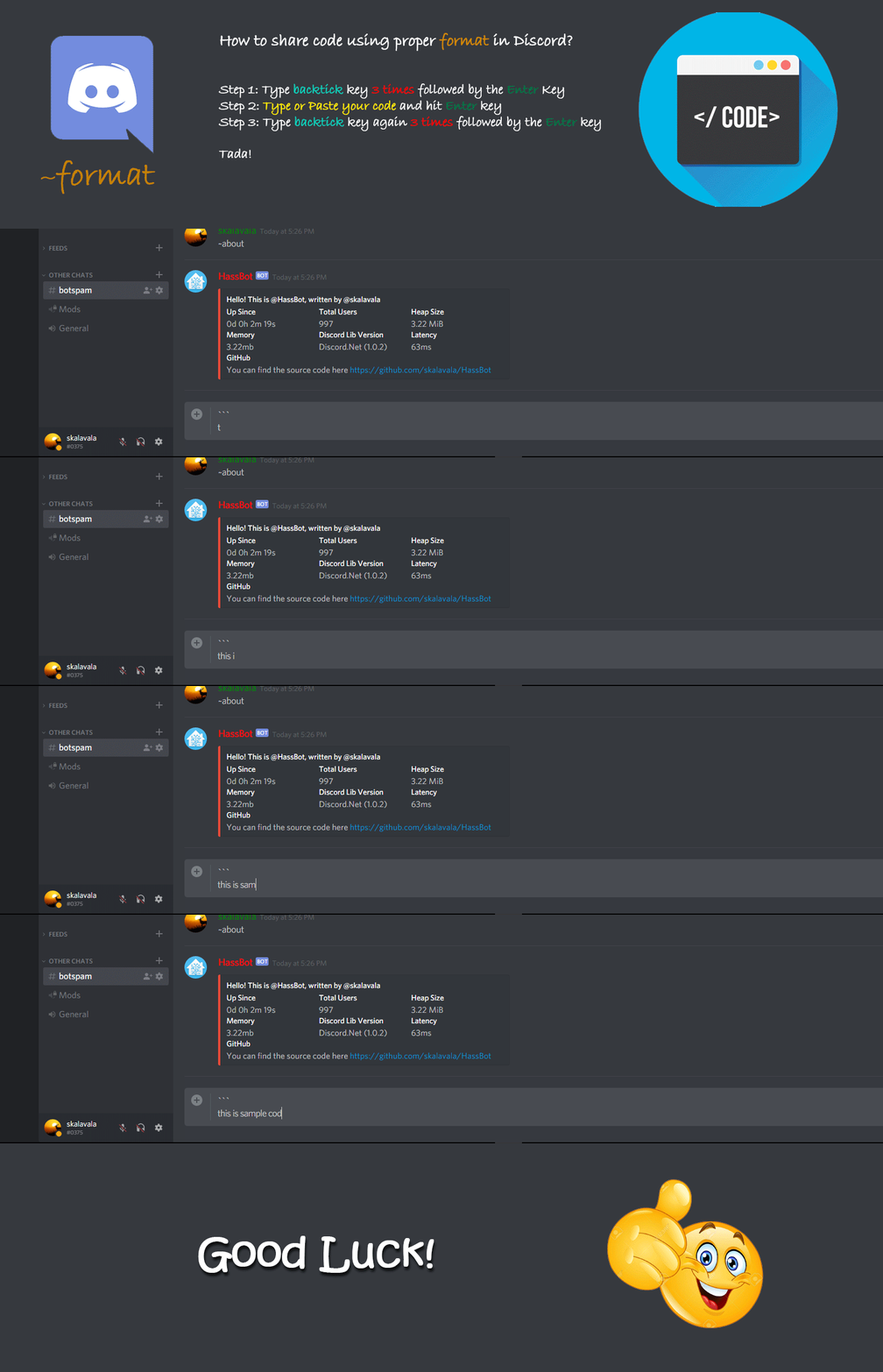
To format your text as code, enter three backticks on the first line, press Enter for a new line, paste your code, press Enter again for another new line, and lastly three more backticks. Here's an example
Don't forget you can edit your post rather than repeatedly posting the same thing.
For over 15 lines you must use a code share site such as https://paste.ubuntu.com/ or https://www.hastebin.com/.
Command '.format' was invoked by: Tediore
weary garnet
- platform: template
sensors:
set_temperature:
entity_id: climate.bathroomfloor
friendly_name: Set Temperature
unit_of_measurement: 'F'
value_template: '{{ (((states.climate.bathroomfloor.attributes.temperature) * 9 / 5) + 32) | round(1) }}'
weary garnet
Invalid config for [sensor.template]: expected dictionary for dictionary value @ data['sensors']. Got None
extra keys not allowed @ data['set_temperature']. Got OrderedDict([('entity_id', 'climate.bathroomfloor'), ('friendly_name', 'Set Temperature'), ('unit_of_measurement', 'F'), ('value_template', '{{ (((states.climate.bathroomfloor.attributes.temperature) * 9 / 5) + 32) | round(1) }}')]). (See ?, line ?).
buoyant pine
Indentation issue
Note the indentation here: https://www.home-assistant.io/integrations/template/#configuration
weary garnet
show me please
buoyant pine
Particularly under sensors:
weary garnet
and ya know in the yaml checker it checks off fine
buoyant pine
In the future please follow this when sharing code here instead of pastebin, otherwise it's really hard to see the indentation: #templates-archived message
What YAML checker?
weary garnet
when you go to edit any yaml
buoyant pine
?
buoyant pine
Ah, I don't have add-ons so I didn't know what you were talking about
Yeah, don't trust that heh
weary garnet
okay so yea that checked out..
for each value i want converted it needs its own template entry yes?
buoyant pine
Yeah
weary garnet
ill let you know how it goes...
waxen rune
I left to get a coffee and some popcorn. When I come back there's no story left. This forum is too efficient.
 left fossil
Right, masters of templating. I have a little flask app, delivering some content to a local host from a csv that changes. I've got restful sensor, and if I go to template editor with {{states('sensor.cinema_paradiso')}} I get https://hastebin.com/bagufisemu.json What I'm trying to get to is the text that would fill 'Fairy Tale: A Trust story' (a few others, but that'll probably be enough tog et me started) Tried a few things and cannot make it work
I have tried multiple options, I am a failure 😂
ivory delta
{{ states('sensor.cinema_paradiso').data.Name['0'] }} should do it
If that last key hadn't been a number, you could've done it without the weird square bracket notation like this: {{ states('sensor.cinema_paradiso').data.Name.one }}. Keys starting with numbers don't play nicely with templates.
left fossil
I am getting UndefinedError: 'str object' has no attribute 'data' For what it's worth, the haste in automatically read as json, in theory the flask app should be returning json (jsonify) but who knows.
 deft timber
You need to first convert the state value to a json :
{{ (states('sensor.cinema_paradiso') | from_json).data.Name['0'] }}
Winner winner!
Thank you. I've been trying to work out how to feed stuff from my Python stuff into HA, and thought I'd have to create a whole integration - this is definitely the better option
ivory delta
I should've realised that it wouldn't auto-cast the string to an object. I hope the rest makes sense to you 🙂
left fossil
Yeah, I wasn't far off of it, and all the language is basically python string manipulation familiar enough that it makes sense 😂
ivory delta
Yes. The templates in HA use a mix of Python and Jinja 2 stuff.
left fossil
Yeah it's not perfect, but it's close enough 😂
thorny snow
I am trying to figure out this automation, but it doesnt work. Can someone see whats wrong?
alias: Ny automasjon
description: ''
trigger:
- platform: template
value_template: ' {% if (''states.sensor.nordpool_kwh_oslo_nok_3_10_025'') > (''states.sensor.off_peak1_sensor'') %}{% endif %}'
condition: []
action: - service: switch.turn_on
data: {}
entity_id: switch.telldus_tzwp_102_plug_in_switch_switch
mode: single
inner mesa
Not without more info on what you’re trying to do and what isn’t working
Your template is pretty broken, though
Syntax is all wrong
silent barnBOT
When working with templates, don't forget:
- You can test them in Developer tools -> Templates
- HA before 0.115: rule 1 and rule 2 (https://www.home-assistant.io/docs/automation/templating/#important-template-rules)
Command '~template' was invoked by: RobC
thorny snow
Works fine in developer tools, i am trying to run a automation when the electricity price exceeds off peak
buoyant pine
Just do "{{ states('sensor.whatever') | float > states('sensor.whatever2') | float }}"
thorny snow
Thank you @buoyant pine ! 😊 I get true and false in dev tools, but it will still not trigger the automation. Im pretty new to templates
silent barnBOT
To test an automation there's three stages you can follow. Testing the action, the condition and action, and the whole automation:
- Use Developer tools (
 )-> States to find the automation, click
  and then push Execute. If this fails your problem is in the
 action:section, and details should be found in your log file - Use Developer tools -> Services and call
automation.triggeron the automation withskip_condition: false. If the first passes but this fails then the problem is in yourcondition:block - Use Developer tools -> States to find the trigger entity, click the name, then change the state (at the top) to something that'll trigger the automation before pushing Set State. If this fails then the problem is with your
trigger:section.
If they all work, and your automation didn't run, it's probably turned off.
Command '.test' was invoked by: Tediore
 azure tinsel
is there any way to see logged in user as template? {{ hass.user }} or something ?
 brazen harbor
@azure tinsel I saw this yesterday: https://www.home-assistant.io/lovelace/markdown/#template-variables. For that card there is a {{user}}, though I am not sure if that is the use case you are interested in.
azure tinsel
i does not work on template.. but ill try, thank you
yeah.. it does work on that markdown card
sadly i wanted to use it on another card but maybe it is not available 🙂
brazen harbor
Is there a way to reuse parts of yaml in a template sensor? I have the following template that works, but uses a lot of repeating characters. Here is a just one component of it:
{{ state_attr('sensor.radarr_disk_space', 'X:\\')[0:state_attr('sensor.radarr_disk_space', 'X:\\').find("/")] | float + state_attr('sensor.radarr_disk_space', 'Y:\\')[0:state_attr('sensor.radarr_disk_space', 'Y:\\').find("/")] | float }}
 brisk temple
you can shorten if if you define the repeating characters {% set repeat = whatyouwantrepeated %}
then just use repeat in your template
brazen harbor
Like this:
{% set repeat1 = state_attr('sensor.radarr_disk_space', 'X:\\') %}
{% set repeat1 = state_attr('sensor.radarr_disk_space', 'Y:\\') %}
{{ repeat1[0:repeat1.find("/")] | float + repeat2[0:repeat2.find("/")] | float }}
that second line should be repeat2
brazen harbor
Oh yea, oops, that's my bad. Meant to change that. But other than that, is it the correct idea?
brisk temple
ya
 grim flicker
I would like to round a value to 2 decimals so far i have this which does work but doesnt round the number any thoughts?
{{ states('sensor.meterstand_kwh_hoog') | round(2) - states('input_number.stroomverbruik_hoog_per_maand') | round(2) }}
try {{ (states('sensor.meterstand_kwh_hoog') - states('input_number.stroomverbruik_hoog_per_maand')) | round(2) }}
grim flicker
that will give this error TypeError: unsupported operand type(s) for -: 'str' and 'str'
brisk temple
{{ (states('sensor.meterstand_kwh_hoog') | float- states('input_number.stroomverbruik_hoog_per_maand') | float) | round(2) }}
should float not int
 wooden cypress
Hi All,
Hope this is the right channel.
Quick question with the Alarm Panel i see it only allows for certain states to be used such as armed, disarmed, armed_night etc. is there a way in the config to tell it that sleep is armed_night or do I need to modify these values before they are processed by HA ?
grim flicker
that last one worked thanks
brisk temple
@grim flicker your states were strings which is why the | float was needed
grim flicker
i´m just starting to use templates so i have allot to learn
grim flicker
so now i want to calculate what the usage costs are so i want to do the value *0.22 and want to round it to 2 decimals
i have tried a few options but they dont round
{{ (states('sensor.meterstand_kwh_hoog') | float - states('input_number.stroomverbruik_hoog_per_maand') | float) * 0.22 | round(3) }}
this doesnt round
brisk temple
what are you trying to multiply 0.22, just the input_number?
waxen rune
this examples rounds {{ ( states('sensor.washing_machine_voltage') | float - states('sensor.washing_machine_voltage') | float ) | round(0) }}
brisk temple
oh he wrapped the sensor and input_number, needs to wrap the * 0.22 as well
brisk temple
it's a separate equation
waxen rune
sometimes it's easier to set it up like this. makes the actual math simpler:
      value_template: >-
          {% set t1 = (states('sensor.burner1') | float ) %}
          {% set t2 = (states('sensor.burner2') | float ) %}
          {% set t3 = (states('sensor.burner3') | float ) %}
          # And then the actual math, not your case below
          {{ ((t2-t1)/(t3-t1) * 100) | round(2) }}
thank you i will try this. What does | float do
inner mesa
Converts the value to a floating point number
silent barnBOT
Jinja Template Designer Documentation
For more examples and samples, visit see this page
Command '~jinja' was invoked by: RobC
grim flicker
@waxen rune i have this code but it doesnt output anything. do you have any ideas why? https://hastebin.com/iyukiyifob.yaml
when i copy the template part in the developers section to test it. the value is coming out. so it must be the rest of the code that isnt working
brisk temple
has sensor.meterstand_kwh_hoog changed state
grim flicker
yes it changes every 10 seconds its loaded out of my meter
inner mesa
Is the automation enabled?
brisk temple
change it to value
azure tinsel
how can i get min value ot temperature from sensor for today?
with statistics i can get for last X hours, but i want only for today, for example if its 00:05 now and i have only one measure on sensor.temperature - this to be min
silent barnBOT
Command '.min_max' was invoked by: Tediore
azure tinsel
this one need two sensors
and will give you min from them
but will not give you min value for today from one sensor
this one only compare two sensors
buoyant pine
Ah right
azure tinsel
something like history stats
i use history stats to counting running time for today, and it is OK, it resets at 00:00
buoyant pine
It was the first thing I thought of, but I realized I haven't looked at the docs for it lol
azure tinsel
but statistics platform does not
mighty ledge
@azure tinsel you can use the SQL integration but you need to build the lookup yourself.
azure tinsel
yeah.. but i need to switch everything to mysql? or i can use that with the default sqlite database ?
mighty ledge
yeah you'd probably need to swap over
azure tinsel
thanks
waxen rune
@grim flicker Sorry, old example code. Good to see you solved it!
azure tinsel
@mighty ledge it maybe can be done with sqlite too, thanks for the hint
mighty ledge
Yeah I don't know how sqlite works with multiple fingers in the pot
azure tinsel
sqlite> select min(state) from states where entity_id = "sensor.bedroom_temperature" and created > date('now');
18.8
looks OK
i will only query it
if it crash something ill migrate to mysql 🙂
 wraith shell
Hi everyone. I have retrieved a date with a scrape sensor from a website which is showing in HA in this format: 07/11/2020 - 16:45
is there any way to transform this format to something readable by HA so I can use this date in automations?
date will alwats be in the future
like 20/11/2020 - 16:45
always*
 north locust
i have 2 things set up in templates , but how do i integrate them into cards ?
{{ (states('sensor.speedtest_download') | float * 1) | round(0) }}
{{ (states('sensor.speedtest_upload') | float * 1) | round(0) }}
and afval_vandaag:
friendly_name: 'Afval Vandaag'
value_template: >-
{% if states('sensor.areareiniging_gft') != None and as_timestamp(states('sensor.date')) == as_timestamp(states('sensor.areareiniging_gft')) %}
Gft
{% elif states('sensor.areareiniging_pmd') != None and as_timestamp(states('sensor.date')) == as_timestamp(states('sensor.areareiniging_pmd')) %}
Plastic
{% elif states('sensor.areareiniging_restafval') != None and as_timestamp(states('sensor.date')) == as_timestamp(states('sensor.areareiniging_restafval')) %}
Restafval
{% else %}
None
{% endif %}
silent barnBOT
To format your text as code, enter three backticks on the first line, press Enter for a new line, paste your code, press Enter again for another new line, and lastly three more backticks. Here's an example
Don't forget you can edit your post rather than repeatedly posting the same thing.
For over 15 lines you must use a code share site such as https://paste.ubuntu.com/ or https://www.hastebin.com/.
Command '.format' was invoked by: boneheadfraggle
waxen rune
@north locust what is the problem, does the templates work already?
waxen rune
@wraith shell I am sure there is a much better way, but I did this when I needed what you're after.
Basically it breaks down the data into a list of separate characters and then put them together again and as a last step format as time stamp.
Maybe worth a try? Just note it will only work as long as your indata always have the same number of characters.
{% set t = states('sensor.yoursensor') %}
{% set t = t | list  %}
{% set day = t[0]+t[1] %}
{% set month = t[3]+t[4] %}
{% set year = t[6]+t[7]+t[8]+t[9] %}
{% set hour = t[13]+t[14] %}
{% set min = t[16]+t[17] %}
{{ as_timestamp(year + month + day + " " + hour + min ) | timestamp_local }}
Output in my case: 2020-11-07 16:45:00
north locust
@waxen rune In the developer template it outputs fine , but adding it in my congiguration.yaml gives problems ...
waxen rune
do you want the template directly in the card or do you create a template sensor?
north locust
afval_vandaag:
friendly_name: 'Afval Vandaag'
value_template: >-
{% if states('sensor.areareiniging_gft') != None and as_timestamp(states('sensor.date')) == as_timestamp(
Gft
{% elif states('sensor.areareiniging_pmd') != None and as_timestamp(states('sensor.date')) == as_timestam
Plastic
{% elif states('sensor.areareiniging_restafval') != None and as_timestamp(states('sensor.date')) == as_ti
Restafval
{% else %}
None
{% endif %}
waxen rune
please use the backticks
silent barnBOT
To format your text as code, enter three backticks on the first line, press Enter for a new line, paste your code, press Enter again for another new line, and lastly three more backticks. Here's an example
Don't forget you can edit your post rather than repeatedly posting the same thing.
For over 15 lines you must use a code share site such as https://paste.ubuntu.com/ or https://www.hastebin.com/.
Command '.format' was invoked by: boneheadfraggle
north locust
this one doesnt need to be in a card
waxen rune
so much easier to read
north locust
want to make an automation with it
but everytime i add it in my config.yaml , log spits out errors
waxen rune
it seems cut off, can you please share the complete code? from sensor:
waxen rune
ok, have you tried out each value and condition separately in dev tools so you know they work as intended?
waxen rune
line 27 is cut off
waxen rune
ok, have you tried out each value and condition separately in dev tools so you know they work as intended?
the state None is unusual, maybe should have quotation marks? but as long as it works in dev tools, it should work.
ivory delta
None is a keyword in Python, it should be valid in that context.
waxen rune
what was the solution?
peak juniper
Is there any way to create a state template for a history stats sensor
For example:
- platform: history_stats
name: Current Game History
entity_id: sensor.xbox_online
value_template: '{{ states.sensor.xbox_online.state }}'
type: time
start: '{{ now().replace(day=1).replace(hour=0).replace(minute=0).replace(second=0) }}'
end: '{{ now() }}'
so it dynamically shows me how much I've played the specific game I'm playing at that moment
brisk temple
does it display what game your playing?
peak juniper
the config doesn't accept the template
so the sensor.xbox_online shows what game I'm currently playing
let's saying it's "Assassin's Creed" currently
ivory delta
That's because you can't just make things up and expect them to work. The docs don't say it takes a template for the value. 😉
peak juniper
then I would want the sensor to essentially show:
  - platform: history_stats
    name: Current Game History
    entity_id: sensor.xbox_online
    state: 'Assassin's Creed'
    type: time
    start: '{{ now().replace(day=1).replace(hour=0).replace(minute=0).replace(second=0) }}'
    end: '{{ now() }}'
It tracks a single state. Make a sensor for each state you want to track.
peak juniper
That's because you can't just make things up and expect them to work. The docs don't say it takes a template for the value. 😉
@ivory delta haha yeah, I realise that - just wondering if there were any work arounds
ivory delta
Yes... make more sensors.
peak juniper
Defeats the point of the dynamic nature of the sensor, but I get your point. It's not possible.
ivory delta
Well the sensor isn't designed to be dynamic, you just want it to be. You could probably get clever using Grafana+Influx if you record the data for sensor.xbox_online there.
peak juniper
Yeah, that's a shame. I'll have a look into Grafana, etc.
ivory delta
You could always log a feature request on the forums for something that does what you're after. Or even make something if you have the skills - HA is open source.
brisk temple
can I wrap an or combined with a and {{ is_state('calendar.school_year', 'on') and (states.calendar.school_year.attributes.message | regex_search('break', ignorecase=true) or states.calendar.school_year.attributes.message | regex_search('holiday', ignorecase=true)) == true }}
template editor seems to be fine with it
ivory delta
Yes, combining boolean logic is valid syntax.
brisk temple
thx
 celest wave
Hello folks,
Have a small question, may be someone can bring some lite for me.
Is it possible to pass variable in template states request ?
`- condition: template
value_template: "{{ states.sensor.VARIABLE.state == 'ON' }}"
- condition: template
value_template: "{{ states(sensor.VARIABLE) == 'ON' }}"`
brisk temple
there's no global variables, so you would have to define it elsewhere, an input_* usually is what people do
celest wave
The case here is to have single script which will be ran with passed variable and do the work based on these vars..
ivory delta
This appears to be in a script/automation, so you can use variables.
That's how to re-use variables within a script.
And this is how to pass them in: https://www.home-assistant.io/integrations/script/#passing-variables-to-scripts
celest wave
Yep, I saw and read these docs, the main problem here is to use variables inside template in states request. I believe if I pass it as in code block above, it will not be taken as variable.
ivory delta
IIRC you have to get clever with how you build the states('sensor.sensor_name') part of the template.
What do you want to pass in as a variable?
celest wave
different sensors.. for example sensor.sensor1 , sensor.sensor2 , sensor.sensor3 etc..
ivory delta
How are you choosing what to pass in? Could you pass in the whole name (i.e. 'sensor.sensor1')?
Or are you only passing in 'sensor1'?
celest wave
Yes, actually I can pass 'sensor.sensor1' in variable.
Will it work in the way states('VARIABLE_value') ?
ivory delta
Close
If you're passing in the full string as the variable 'name', you should just be able to do "{{ states(name) == 'ON' }}"
You only quote strings. If you're using a variable, skip the quotes.
celest wave
I will try it, thank you! Sry if the question was stupid, I am newbie in HA. 🙂
ivory delta
It's not stupid at all. One other thing... 'ON' is probably wrong. States are normally 'on'/'off'.
buoyant pine
Yep, everything is case sensitive
ivory delta
And you can test your templates using something like this (just change your sensor name, that's one of mine):
{% set name = 'binary_sensor.front_door_contact' %}
{{ states(name) == 'on' }}```ON is working in my case, it is came from my other device Megad2561 via mqtt
ivory delta
(in > Templates )
Yep, everything is case sensitive
@buoyant pine Unless you do|loweron everything 😄
celest wave
I already understood that it is case sensitive and had some problem when saw 'On' in mqtt and it cannot be changed...
Resolved by: state_template: "{{ value_json.state|regex_replace(find='OFF', replace='off', ignorecase=False)|regex_replace(find='ON', replace='on', ignorecase=False) }}"
😄
ivory delta
Oof... that's a long way to force lower case.
celest wave
Unless you do |lower on everything
Didn't know about it on those moment .. )
buoyant pine
Heh, yeah | lower is the way to go
ivory delta
Here's your built in filters for Jinja 3: https://jinja.palletsprojects.com/en/3.0.x/templates/#list-of-builtin-filters
Don't use the lower() syntax, use the pipes (|lower).
celest wave
Saving this link right now )
ivory delta
Tediore - could you pin that link?
buoyant pine
ivory delta
Here's your built in filters for Jinja 3: https://jinja.palletsprojects.com/en/3...
No


 celest wave
Thanks guys! 🙂
thorny snow
I've got a zwave sensor that spits out 22 or 23. I want to template it so it's more of a nice readable Open/Closed... but somehow I'm messing that simple process up. CAn anyone take a look at this and tell me what I'm doing wrong?
I've put it in my 'sensor:' section
ivory delta
{{ 'open' if is_state('sensor.guest_room_door_access_control', '22') else 'closed' }}
And remember things are case-sensitive. 'Closed' isn't the same as 'closed' for states.
thorny snow
Why would it matter here? aren't I just basically saying use the name Closed as output?
couldn't I call it anything I wanted?
ivory delta
For a sensor.
Follow conventions so they're predictable when you use them elsewhere.
If it was for the UI, you could call it what you want.
thorny snow
perhaps the UI is what I want...
ivory delta
But Lovelace won't know how to interpret 'Open'/'Closed' because they're not the right values for the state of an opening.
thorny snow
i guess i wasn't aware there was a difference
waxen rune
and for a door sensor you might want to use a binary_sensor like this:
    entredorr_tmpl:
      friendly_name: 'Entrédörr'
      device_class: door
      value_template: "{{ is_state('binary_sensor.entredorr', 'on') }}"
If it's a templates binary sensor you can use device class
thorny snow
I thought about using a binary sensor, but when i looked at the doc, it looked like it was looking for certain values.. 22/23 was not them, even though to me, that seems like a binary value
ivory delta
Template binary can turn anything into an on/off type sensor.
thorny snow
ahhh ok
waxen rune
in my example it's in your case 22 "or else" and I think that's fine
thorny snow
This line threw me: These sensors only have two states: 0/off/low/closed/false and 1/on/high/open/true. K
ivory delta
Which is why I said about 'Closed' not being the same as 'closed'. HA's states are lower-cased.
Once you make a sensor with the right states, everything else will understand it.
thorny snow
That makes sense. I thought the area I put closed, I could put whatever I wanted the value to display
rugged laurel
Docs are "guidelines", you can do more than what's documented, if every possible use case was documented, it would be so much that you would never find anything
ivory delta
You could... but it wouldn't follow the same pattern as everything else.
thorny snow
I thought I could put "MIL LEFT THE DOOR OPEN!!!"
ok... i'll go back to the drawing board. Also, i noticed you all short handed the templates. Is there a tutorial on doing that? looks much easier
ivory delta
Like the others have said... you're basically making a binary sensor. Might as well use the right tool for the job.
thorny snow
Aight, so oddly enough this works for the icon, but the door always says Closed in lovelace.
https://paste.ubuntu.com/p/JS9PztXtgr/
I tried switching the '22' -> 22 thinking it was something to do with the string vs int but that didn't do the trick
ivory delta
What was your config for the sensor in the end?
Or is that the binary sensor?
Because if it's a binary sensor, you need to understand this bit:
value_template template REQUIRED
The sensor is on if the template evaluates as True and off otherwise. The actual appearance in the frontend (Open/Closed, Detected/Clear etc) depends on the sensor’s device_class value
thorny snow
I moved it to the binary sensor section of my config and the code above is what I used.
so i need to change the open == on and closed to off?
making that change.
buoyant pine
No, the value template should just be "{{ is_state('sensor.guest_room_door_access_control', '22') }}"
The template needs to evaluate as True or False
ivory delta
It just says 'is the state of sensor.guest... equal to 22?'
buoyant pine
Put that in the template tool at dev tools > template
ivory delta
'Is it 22?' only has two answers... yes or no 🙂
That's what makes the binary sensor binary.
buoyant pine
binhairy sensor
thorny snow
I template very rarely (obviously) so I'm extremely green and confused on it.
ivory delta
Don't worry, binary stuff is tricky.
They say there are only 10 types of people. Those that understand it and those that do.
thorny snow
lol
So one additional question. That worked btw, but i've got other door sensors (non zwave) is there a way to template them all in a similar way? I like the way this one shows up in my lovelace
buoyant pine
There are two kinds of people: those who can extrapolate missing data
fossil hearth
the api give only temperature as value decimal
how to get that value using template ? 🙂 this is a commnad line with curl get
Done thanks 🙂
 spare kernel
hi! Can someone help me about my problem? 🙂
 blazing burrow
when i try to use this template in the template editor:
{% set zipped = dict() %}
{% set options = state_attr('input_select.options', 'options') %}
{% for i in (range(1,3) | list) %}
  {% set key = options[i-1] %}
  {% if key in options %}
    {% set _ = zipped.update( {key: i} ) %}
  {% endif %}
{% endfor %}
{{ zipped }}
i get the error: SecurityError: access to attribute 'update' of 'dict' object is unsafe.
spare kernel
I have home thermostat which i set up with sonof R3 basic wifi and one reley, because i have radiators valves with temeprature senzors. So, the only way to have some kind off smart on/off thermostat is this way. When sonoff switch is on heating is off, ande when sonoff switch is off, heating is on. Sounds stupid but it works. So my question is ; I have made generic thermostat and pair it whit xiaomi sensor and sonof switch, but problem is state of switch..When I set desired temperature of 25 sonoff switch set to on and heating is off
blazing burrow
i'm trying to "zip" the list of options from an input_select with their respective indices
could anyone offer guidance? i had hoped i could do it with a dict comprehension, but it didn't quite work out as i'd hoped
rugged laurel
use namespace
blazing burrow
?
inner mesa
Variables defined/used inside a loop vanish once outside the loop
Namespaces fix that
fossil hearth
{"sensors":{"28-00000b988fef":"38.0","28-00000b98f5e6":"36.25","28-00000b9905e1":"40.375","28-00000b9920f3":"44.5","28-00000b994f64":"40.437","28-00000b9951c4":"36.812","28-00000b996c8c":"39.75","28-00000b99a737":"32.875","28-00000b99a884":"33.062","28-00000b99b4f0":"39.062","28-00000b99f29e":"37.812","28-00000b99fa3c":"34.062","28-00000b9a170e":"40.125","28-00000b9a1ca5":"41.562","28-00000b9a2529":"31.875","28-00000b9a3025":"42.062","28-00000b9a444d":"45.625","28-00000b9a4668":"46.125"}}
how to get the first sensors value ?
value_template: '{{ value_json["sensors"][0]["28-00000b988fef"] }}' Seems not to be working
ivory delta
{{ value_json.sensors["28-00000b988fef"] }}
There's no array in what you've shared, so you don't need to do [0] to get the first thing.
You just reference them by name instead.
You might also want to turn the result into a float (decimal number) instead of a string too:
{{ value_json.sensors["28-00000b988fef"] | float }}
 ionic hazel
I have a template to turn on my TV, and another to turn on my AV Receiver. Can i combine them into one?
ivory delta
Templates that turn things on? What is this strange magic you speak of?
ionic hazel
yea i figured something was wrong as i was saying that
it's a switch and a template sensor
*value template
  - platform: template
    switches:
      denon_heos_music:
        friendly_name: Denon HEOS Music
        value_template: >
         {{ is_state_attr('media_player.denon_avr_x1500h', 'source', 'HEOS Music') }}
        turn_on:
         service: media_player.select_source
         data:
           entity_id: media_player.denon_avr_x1500h
           source: 'HEOS Music'
        turn_off:
         service: media_player.turn_off
entity_id: media_player.denon_avr_x1500h```not the same thing as a template then?
ivory delta
It makes use of templates. That doesn't make the whole thing a template.
It's more of an #integrations-archived question really 🙂
ionic hazel
got it. thanks Mono!
fossil hearth
You might also want to turn the result into a float (decimal number) instead of a string too:
{{ value_json.sensors["28-00000b988fef"] | float }}
@ivory delta Did not work 😦
  - platform: command_line
    name: Ds1test
    command: "/usr/bin/curl curl -X GET http://192.168.40.210:8080/rest/api/v1.0/temperature "
    scan_interval: 3
    unit_of_measurement: C
    value_template: '{{ value_json.sensors["28-00000b988fef"] | float }}'
Use the Dev Tools to test it. > Templates
You'll see there's an example like this:
{% set my_test_json = {
  "temperature": 25,
  "unit": "°C"
} %}```aha 🙂
ivory delta
You can set your JSON there... and below that, experiment 😉
fossil hearth
❤️
You can set your JSON there... and below that, experiment 😉
@ivory delta am i doing it right
{% set my_test_json = {"sensors":{"28-00000b988fef":"42.312","28-00000b98f5e6":"51.937","28-00000b9905e1":"39.062","28-00000b9920f3":"39.062","28-00000b994f64":"37.625","28-00000b9951c4":"37.812","28-00000b996c8c":"38.0","28-00000b99a737":"33.687","28-00000b99a884":"33.25","28-00000b99b4f0":"38.937","28-00000b99f29e":"37.75","28-00000b99fa3c":"34.187","28-00000b9a170e":"36.562","28-00000b9a1ca5":"37.75","28-00000b9a2529":"32.375","28-00000b9a3025":"40.187","28-00000b9a444d":"42.125","28-00000b9a4668":"41.312"}} %}

The temperature is {{ value_json["sensors"]["28-00000b988fef"] }} {{ my_test_json.unit }}.
thanks 🙂
ivory delta
That looks okay. Does it work for you?
fossil hearth
no 😦
ivory delta
Do it in small steps. Try {{ value_json.sensors }} and see what that shows.
fossil hearth
still nothing
ivory delta
Oh... don't use value_json... use my_test_json here 🙂
Or rename my_test_json to value_json.
The name doesn't matter as long as they match.
This works for me:
{% set value_json = {"sensors":{"28-00000b988fef":"42.312","28-00000b98f5e6":"51.937","28-00000b9905e1":"39.062","28-00000b9920f3":"39.062","28-00000b994f64":"37.625","28-00000b9951c4":"37.812","28-00000b996c8c":"38.0","28-00000b99a737":"33.687","28-00000b99a884":"33.25","28-00000b99b4f0":"38.937","28-00000b99f29e":"37.75","28-00000b99fa3c":"34.187","28-00000b9a170e":"36.562","28-00000b9a1ca5":"37.75","28-00000b9a2529":"32.375","28-00000b9a3025":"40.187","28-00000b9a444d":"42.125","28-00000b9a4668":"41.312"}} %}

The temperature is {{ value_json["sensors"]["28-00000b988fef"] }}```The temperature is 42.312
fossil hearth
Thank you soo much works for me
i will test it live
you are the best ❤️
my rockstar 😛 hahaha
but when it comes to live its not working ... this is crazy ..
  - platform: command_line
    name: testingnow
    command: "/usr/bin/curl curl -X GET http://192.168.40.210:8080/rest/api/v1.0/temperature "
    scan_interval: 3
    unit_of_measurement: C
    value_template: '{{ value_json["sensors"]["28-00000b988fef"] }}'
the only reason why am using command-line is becase rest will exceed 255 characters
and i got this command working otehr places its a coppy paste and edit ..
ivory delta
I think you can use REST for long responses. You just can't set the state to something longer than 255 characters.
By default, the sensor state would be set to the full JSON — here, that would exceed the 255-character maximum allowed length for the state, so we override that default by using value_template to set a static value of OK.
blazing burrow
@inner mesa i guess i don't get how namespaces help? the template won't allow me to use update on a dict, which should be in scope
blazing burrow
ahh ok, lemme see
like this?
{% set ns = namespace(zipped={}) %}
{% set options = state_attr('input_select.options', 'options') %}
{% for i in (range(1,3) | list) %}
  {% set key = options[i-1] %}
  {% if key in options %}
    {% set _ = ns.zipped.update( {key: i} ) %}
  {% endif %}
{% endfor %}
{{ ns.zipped }}
I believe so. Does it work?
inner mesa
Same with options
blazing burrow
oof, oh yeah
blazing burrow
{% set ns = namespace(zipped={}, options=state_attr('input_select.options', 'options')) %}
{% for i in (range(1,3) | list) %}
  {% set key = ns.options[i-1] %}
  {% if key in ns.options %}
    {% set _ = ns.zipped.update( {key: i} ) %}
  {% endif %}
{% endfor %}
{{ ns.zipped }}
same error here, but removing the ns. on line 4 actually does render
it renders {}
actually it renders if i remove the one on line 5 too
inner mesa
That set line in the loop looks wrong
rugged laurel
You are not allowed to use update
rugged laurel
We are running sandbox
blazing burrow
i think i need to do something like ns.zipped[key] = i?
rugged laurel
allowing update, would mean you would acually update the state objects
blazing burrow
wait what? ns.zipped in my template is a dict i create and populate
so there isn't really a way to do this then?
for example, if my input_select has ['A', 'B', 'C'], i want to end up with something that has {'A': 1, 'B': 2, 'C': 3}
rugged laurel
You can change the ns elements inside the loop
blazing burrow
... is that not what the template above attempts to do?
i have that
{{ state_attr('input_select.options', 'options') }}
{{ range(1,4) | list }}
gives me
['A', 'B', 'C']
[1, 2, 3]
so now want to zip those together
in python it's zip(list1, list2), done lol
 wooden tangle
hey just wondering if someone could help me getting the cost for electric usage? please
 warm isle
 wooden tangle
yes i did
inner mesa
it's just an extremely vague question
wooden tangle
i have code in the yaml but its not adding up
silent barnBOT
Please use https://paste.ubuntu.com/ or https://www.hastebin.com/ to share code or logs.
Command '.share' was invoked by: mono
inner mesa
answer could be "visit website of power provider"
wooden tangle
yea but right now i only got a ps4 plugged into it
so cant be that much
only flashed the plug an hour ago
inner mesa
did you manually do the math?
ivory delta
||nope||
wooden tangle
yes i did but i tried to use it but didnt do much
warm isle
2 things could be happening
- energy meter not calibrated
- energy cost is off
ivory delta
Explain the math you want to use.
And explain why you think the HA sensor is wrong.
You're not giving us much information here, so we can't tell you what's wrong.
warm isle
7€/h playing ps4 🤣
uffff
wooden tangle
2 things could be happening
- energy meter not calibrated
- energy cost is off
@warm isle ill try the first one now
54w /1000 then * .136 right
ivory delta
13.6c / kWh?
wooden tangle
yea
ivory delta
So... where's your kWh? I only see W and €
ivory delta
You need to give us all the information. Don't just give small pieces...
Anyway, I'm outta here. Good luck.
wooden tangle
ok
warm isle
my guess now is that you use the watage instead of kwh for calculating prices
wooden tangle
so i can use the total kwh?
warm isle
uuuuuuhhhmmmmm
How would you otherwise calculate € out of it
warm isle
templates
what does "{{ (states('sensor.charger_hourly') }}" give you
http://<<ip or url>>/developer-tools/template
wooden tangle
gives me 0.01
warm isle
odd.. and the full
{{ (states('sensor.charger_hourly') | float * 0.136) | round(2) }}"
wooden tangle
0.0014
inner mesa
that makes no sense
warm isle
that looks right, but why you get 7.75 ? restarted while there
ivory delta
(pssst... current hour)
inner mesa
that's the |round(2)
warm isle
yea, set back the round to 4
ivory delta
This conversation started before the hour. Things have changed.
warm isle
your template tells you 0.0014
so thats right, restart ha and look if the numbers changing
youmaybe looking at the wrong sensor
warm isle
dont forget to press the check config button
wooden tangle
will do
warm isle
is this still a thing btw? back in the days with hassbian it was a terrible thing when you just restarted 😄
buoyant pine
Template sensors can be hot reloaded now
warm isle
not taking changes now 😛
ivory delta
Spoiler alert... the current config is right but you didn't tell us about all the changes you made in the previous hour.
The sensor has a history. It still has the 'wrong' data from before you changed it.
wooden tangle
is there a way to clear the history?
ivory delta
Delete your database.
And this is why providing all of the information in the first place is so important.
Several people were trying to troubleshoot a non-issue.
warm isle
@blazing burrow how is your isue going?
not that I'm able to help, but intrested if you where able to solfe it
blazing burrow
no, i moved onto something else for a bit
warm isle
Would 'need' something simalar for a telegram bot, one of the many abandoned things
wooden tangle
db deleted and restarted,same values still there
blazing burrow
mine is for mapping named options in an input_select to integers to send to wled api
i have a reasonable solution already, just looking for something cleaner/more general
warm isle
aah I know these stuggles
blazing burrow
lol
warm isle
feel free to ping me when you got it, interested:)
blazing burrow
👍
warm isle
.away zZzzZZz late in 🇦🇹
silent barnBOT
Underknowledge is away! zZzzZZz late in 🇦🇹 :wave:
blazing burrow
i could do it in a second in python, in like a bunch of different ways 😅
inner mesa
<6 hours later> Success! I finally have it working exactly as well as it worked 6 hours ago!
blazing burrow
victory! lol
waxen rune
@wooden tangle Just curious, did you solve it?
waxen rune
I noticed you have configured utility meters, does they work as expected?
wooden tangle
for the usage yes but not the cost
waxen rune
ok, I haven't followed everything here, but if you put {{ states('sensor.charger_daily') | float }} into dev tools, what's the response?
that seemed to be the utility meter, right?
wooden tangle
0.01
waxen rune
{{ ((states('sensor.tumble_dryer_total_daily_energy') | float) * 10) }}
just want to make sure here..
sorry
wooden tangle
np
waxen rune
{{ ((states('sensor.charger_daily') | float) * 10) }}
wooden tangle
0.1
waxen rune
ok, and finally {{ ((states('sensor.charger_daily') | float) * 0.14) | round(2) }} where you replace 0.14 with your price per kwh
wooden tangle
0.0
waxen rune
there it is 🙂 no cost so far today
remove the round and take it * 1000 just to see it works
waxen rune
..or try the {{ ((states('sensor.charger_monthly') | float) * 0.14) | round(2) }} , I guess the monthly have a value a bit higher still?
wooden tangle
0.0 because i just reset it all
waxen rune
oh
wooden tangle
it had the history of previous mistakes but ill leave it now and see
waxen rune
if you take it * 10000 instead of you price, you should see results pretty soon
waxen rune
no?
ivory delta
It's working, just leave it.
It was working before the discussion even began,.
At some point before Galaxy started asking for help, they'd already had the right configuration. They just gave poor information.
wooden tangle
might just go and boil the kettle 😂 , yea kinda just had to reset i guess
waxen rune
just a note: but when I said "take it * 10000 instead of you price, you should see results pretty soon", I meant in dev tools, that can hardly introduce bad data again?
or am I missing something more here?
ivory delta
A little, yes. The templates that Galaxy shared were good. No apparent problems with how they looked and they gave all the right results in dev tools.
The only problem is that before they asked for help, they must have already tried incorrect templates on their live sensors. Their database had bad history, so they thought there was a problem still.
wooden tangle
i appreciate the help from the 3 of you guys, hopefully it will be fine from here on out.
and yea it was that and trying maths equations too
looks good so far
just used the kettle to boost it
 blazing cobalt
Hi everyone! I'm trying to make an automation to set the time value of an input_datetime entity to the next hour (eg. if the current time is 15:19 set the time value to 16:00). Am using the automation editor, have set up the trigger and the action (call service input_datetime.set_datetime), it's just the template stuff for the service data that I'm having trouble figuring out. I think I want to pull the hour from states('sensor.time') and add one to it (watching out for the case around midnight where it needs to go back to zero), and then express that as a time in the correct format for the service to understand, but I'm not sure how to do that - or if there's a more elegant way?
 lyric comet
I am new to HA but I wonder if something like this would work
{{((as_timestamp(now()) + (59 * 60 + 59))) | timestamp_custom('%Y/%m/%d %H:00:00 ')}}
So it adds an hour less one second and then you have the year,month and hour and just set the minutes and seconds to zero.
blazing cobalt
Thank you, sounds like it could work. I don't need the date, just the time, but I can leave those bits out. I'm not quite sure how to put it into the automation editor in the right way for it to understand it either, I'm pretty new to this too
Ok getting there with that part at least
lyric comet
Google suggests that you can not template the setting of the value on an input entity and I can't get the developer tools to let me, what were you going to the use the field for. You could use a time trigger directly if you just want to trigger something on the hour.
ivory delta
You don't use the template to set something. You use the template as part of something.
It's valid to pass a template as the argument to a service. Its value will be evaluated and passed to the service.
Example:
action:
  service: "homeassistant.turn_{{ trigger.to_state.state }}"
  data:
entity_id: group.landing_switches```Ok thanks, so I know I can set the service data to time: '{{template}}' - I just need to figure out the template
Also some stuff from google led me to believe that now() isn't necessarily up to date and I should use sensor.time
ivory delta
It used to be that now didn't update templates. I think that may have changed.
You'll find out if you test your templates in the Dev Tools. It has a hint under the right hand side to say what will trigger re-evaluation.
blazing cobalt
Oh ok, that's useful thanks
This template does not listen for any state changed events and will not update automatically.
inner mesa
correct, once a minute as of 0.117: https://www.home-assistant.io/blog/2020/10/28/release-117/#breaking-changes
ivory delta
The 'will not update automatically' is a little misleading 😄
It's just less frequent. If once per minute is good enough for your use case, stick with now().
And that only matters for triggers anyway. If you're using it in an action, it'll evaluate on demand.
blazing cobalt
Oh ok that's great then, thanks - now() will be fine
inner mesa
sorry, should have been clearer about what was correct 🙂
blazing cobalt
All good, thank you 🙂
Using @lyric comet 's original suggestion, this seems to work now: time: '{{ ((as_timestamp(now()) + (59 * 60 + 59))) | timestamp_custom("%H:00") }}'
Tho I don't know what happens around midnight
ivory delta
You can test it in the Dev Tools and find out
blazing cobalt
Ok I remembered about modulus, and I decided to try another approach, now I seem to have got the hang of formatting it. Now I've got time: '{{ (now().hour + 1) % 24 }}:00'
Test run seems to work, gonna see what happens in 5 minutes
ivory delta
Oh, that's a nice approach 😻
ivory delta
You did the work in the end 😉
thorny snow
Hi!
I am trying to get sensor data from a string, which looks like this:
data:
- datetime: '2020-11-15T16:00:00.000Z'
value: cloudy - datetime: '2020-11-15T17:00:00.000Z'
value: rainy
I am trying to make a sensor, which grabs the weather conditions at particular times for today and tomorrow. Im not a programmer and Ive been trying to get the data but i have not succeeded.. can anyone help me on my way?
fossil hearth
HI 🙂 how to make this work ? {% if value_json.getitem('404 Not Found')) %} ?
i wanne check if value_jason contain that
mighty ledge
@fossil hearth {% if value_json[‘404 Not Found’] %}
{% if “404 Not Found” in value_json %}
fossil hearth
invalid template ..
silent barnBOT
@fossil hearth posted a code wall, it is moved here --> https://paste.ubuntu.com/p/YfKn4K2mVB/
fossil hearth
all gd i just had to restart it
fossil hearth
@fossil hearth you need to wrap it in quotes. or use multiline notation. Also, that code requires that CustomUI is installed.
sensor.rpi_milksensor_script_process_1:
  icon: mdi:application
  icon_color:
      templates: >
        return (state === 'S') ? 'rgb(67,167,47)' : 'rgb(219,27,8)';
@mighty ledge installed the custom UI sucsefully but still not working ? do i need to add a command somhwere ?
thorny snow
Hi everyone, I am looking for a way to perform an action on several entities based on a regex on their names.
I'd like to run a loop like that : {% for entity_id in all_entities | regex_match("switch.schedule_*") %}
to perform the action on all my switch.schedule_*
These entities are generated directly through a card, from the UI, so I do not really know how many there is and this can change during the run
But I'd like an input_boolean to deactive/active all.
wraith shell
@waxen rune thanks a lot, that's a great idea!
waxen rune
Don't know what you mean, but I'm glad to help 🙂
mighty ledge
@fossil hearth clear your cache and reload the page
 sinful bison
Hi :)
does anyone have a way to use this as a trigger
"{{ expand('group.battery') | map(attribute='state') | map('int') | select('lt', 15)|list |count > 0 }}"
but have it ignore 'unavailable' state ?
map(attribute='state', default="100") don't work because 'unavailable' is a value
well i didn't think hard enough 🤦 I've been on this for week, but just now think about map('replace', 'unavailable', '100')
 desert crane
thoughts on how to elegantly add trigger.for into else portion of
switch.turn_{{ 'off' if trigger.to_state.state == 'home' else 'on' }}
too screwy for oneliner?
charred dagger
What do you want it to do?
desert crane
it being instant on home value and wait for x minutes for else value
buoyant pine
What does your trigger look like?
buoyant pine
Yep, I've gotcha
desert crane
dont want to make multile automations and keep it clean if possible 🙂 things must wait when i leave but not keep me in dark-cold for x minutes when i return
buoyant pine
So do you just care about home/not_home with this automation?
desert crane
thats what it does yeah, just want to modify the else 'on' into else trigger.for 10 minutes ... 'on'
buoyant pine
Let's jump to #automations-archived
desert crane
ok
 amber zodiac
@arctic sorrel https://hasteb.in/goveludu.yaml probably
This again lists multiple URLs under same category . How do I differentiate different URL triggers?
arctic sorrel
I didn't say that'd solve that problem
arctic sorrel
https://www.home-assistant.io/integrations/feedreader/ - look at the examples
    action:
      service: persistent_notification.create
      data:
        title: "New HA Podcast available"
        message: "New Podcast available - {{ as_timestamp(now()) | timestamp_custom('%I:%M:%S %p %d%b%Y', true) }}"
        notification_id: "{{ trigger.event.data.title }}"
trigger.event.data contains information about the new entry, the docs show that at least title and content exist
Also says:
Any field under the
<entry>tag in the feed can be used for exampletrigger.event.data.contentwill get the body of the feed entry.
So, you can use similar logic for anything else in that tag
amber zodiac
I have looked at all examples... no example is about differentiating triggers from different URL feeds. How does trigger.event.data help me differentiating content from different feeds? That would be different for all feed URLs every single time a new feed gets published in rss.
I dont think you are even reading my problem than spamming me to read the same link (and earlier devices link which seems nothing to do with my query)
arctic sorrel
Good news, we're all volunteers here. I don't have to help you, and I'm done here
amber zodiac
And btw "trigger.event.data.content" is broken. It doesn't work. No feed content gets fetched. Do I need to open github issue for that?
Ok thanks very much. So much for slamming new users to every channel and posting unrelated links than understanding the query. And then giving lecture on "teaching to fish " , even if someone tries
buoyant pine
Dude, this is free help. No one is obligated to help at all and there's no guarantee any help you receive will fix the problem. Sorry if it's not up to your standards, maybe you can apply for a refund
amber zodiac
Yeah may be "volunteers " stop ranting that they are teaching to fish and the other person should try. When the other person does try and make something work, all they do is posting same links which have nothing related to next related query.
And then its easy to say " I dont know if it works or not or even related . Its free help. I am a mod. I can misguide new users without any responsibility and spam them to various channels for related questions "
Right ? Wow
arctic sorrel
🤣
You ain't seen me rant... and I've posted you at the relevant links to the questions you've posted.
Also, no, I don't know how to do everything. There's 1713 integrations. I don't use all of them, nobody does.
buoyant pine
None of us here are trying to misguide users or "spam them to various channels"
There are channels for a reason. People who help look at specific channels
arctic sorrel
Turns out that my answer above is right though, it will work with the right tag in trigger.event.data
amber zodiac
Yeah making large emojis helps. Nice. Speaks loud of how responsible you are as a volunteer (mod) .. lol
ivory delta
Well that looked fun 😄
 surreal stratus
Can someone help me getting my solar template to work
SENSOR.YAML
sensor:
- platform: template
sensors:
#This is converting the Solar Energy to KWH#
solaredge_energy_today_kwh:
friendly_name: 'Solar Today'
unit_of_measurement: 'kWh'
value_template: "{{ (states('sensor.solaredge_energy_today') | float / 1000) | round(2) }}"
This is in my Config.YAML
inner mesa
?
surreal stratus
I have solar panels and want to get the information to the dashboard. I did my googles and it told me to create a template for the sensor
its all very confusing
inner mesa
What is wrong?
surreal stratus
When I add this information to my config file. I thought I should get a new entity called "solaredge_energy_today_kwh"
but i dont seem to get anything. I might be all wrong in how this works tho
thorny snow
How do you get these informations Pixels ? You get some solar panel but what's giving you the production metrics ?
inner mesa
You mention both sensor.yaml and ‘config.yaml’ Where did you put that?
surreal stratus
@inner mesa i put the info above in my config.yaml
I dont have a seperate senor.yaml file
surreal stratus
it was a comment to myself to keep a bit organized in the config yaml
silent barnBOT
Always run the configuration check command when you make changes. Don't trust the UI check - it misses some problems.
Command '~check' was invoked by: RobC
inner mesa
Ok, that’s gonna be confusing
thorny snow
Ok; I have a bunch of small inverter thats why I do not have the same setup. On my side I am using an ESPhome integration.
How do you request your inverter ?
surreal stratus
I used the HACS they have a solaredge add on
I entered my site ID and it was able to pull up all the info
inner mesa
You didn’t format your code, so it’s hard to know whether it’s correct...
surreal stratus
Would a screencap be better?
inner mesa
No
surreal stratus
How to formate my code?
silent barnBOT
To format your text as code, enter three backticks on the first line, press Enter for a new line, paste your code, press Enter again for another new line, and lastly three more backticks. Here's an example
Don't forget you can edit your post rather than repeatedly posting the same thing.
For over 15 lines you must use a code share site such as https://paste.ubuntu.com/ or https://www.hastebin.com/.
Command '~format' was invoked by: RobC
surreal stratus
'''
silent barnBOT
@surreal stratus posted a code wall, it is moved here --> https://paste.ubuntu.com/p/DzfQCyVxqx/
thorny snow
yep, before and after the code section 😉
inner mesa
Sigh
surreal stratus
Sorry, did i do that correct?
thorny snow
yes
ivory delta
Except for this bit:
For over 15 lines you must use a code share site such as https://paste.ubuntu.com/ or https://www.hastebin.com/.
No codewalls please.
arctic sorrel
~codewall @surreal stratus 😉
silent barnBOT
@surreal stratus Rule #6: Please do not post codewalls (longer than 15 lines) - use sites such as https://hasteb.in/, https://paste.ubuntu.com/, or others.
Please take the time now to review all of the rules and references in #rules.
Command '~codewall' was invoked by: Tinkerer
thorny snow
Hum, I'm not a jinja killer, but (states('sensor.solaredge_energy_today') | float / 1000) | round(2) shouldn't it be ((states('sensor.solaredge_energy_today') | float) / 1000) | round(2) ?
How do you test it ?
surreal stratus
I tested in the template tab
inner mesa
That should be okay as-is
surreal stratus
That should be okay as-is
@inner mesa okay. should I get a separate entity?
silent barnBOT
Always run the configuration check command when you make changes. Don't trust the UI check - it misses some problems.
Command '~check' was invoked by: RobC
surreal stratus
Check shows up as green
waxen rune
have you restarted or reloaded the templates?
surreal stratus
I have. I get a log error saying that the sensor took too long to respond
Should I do something for it to show up in the front end?
inner mesa
it doesn't sound like you ran the config check
waxen rune
I'm curious if there is a problem with the template (which seems fine to me) or with the actual sensor sensor.solaredge_energy_today
surreal stratus
it doesn't sound like you ran the config check
@inner mesa I thought the green check box thingy was the check. Going back to google to get more info
inner mesa
no, I've posted the bot message twice now
surreal stratus
oh ok! i see it
doing it now
sorry suppppperrr new to this. Still trying to get my bearings
inner mesa
I think the bot messages are invisible to new HA users 🙂
thorny snow
Is there a way to perform an action on all entities matching a pattern ?
inner mesa
depends on what that action is
surreal stratus
2020-11-16 11:49:53 WARNING (MainThread) [homeassistant.components.sensor] Updating solaredge sensor took longer than the scheduled update interval 0:00:30
Could this be because im using Duck DNS and not on my home network
thorny snow
I am using a card which is creating some switch, everyone can create several ones. I would like a "super button", so an input_boolean to set all of them off or on.
inner mesa
thorny snow
I was thinking about doing something like :
{% for entity_id in all_entities |  regex_match("switch.schedule_*")  %}
{{- entity_id }}
{% endfor %}
I don't think I could make that format work
it's the right idea, but comma-separated worked for me
wooden tangle
whats an other way to reset entity history. i tried deleting the db but its still there
mighty ledge
@wooden tangle you can only delete the history if home assistant is off.
@thorny snow
{% set ns = namespace(entities=[]) %}
{% for s in states.switch if s.object_id.startswith('schedule_') %}
{% set ns.entities = ns.entities + [ s.entity_id ] %}
{% endfor %}
{{ ns.entities | join(', ') }}
petro; ns is for generating a var with all entities ?
mighty ledge
namespace allows you to create a variable that persists across for loops
i created the variable 'entities' inside the namespace named ns
so to access, you use ns.entities
thorny snow
ok, got it, but I think I do not need to create this var. Thanks a lot for this I did not known
states.switch seems contains everything I need
mighty ledge
are you going to add more switches?
if so, you'll probably want to use the template.
otherwise you'll shoot yourself in the foot when you add another switch
thorny snow
Yes I'll add more switches, thats the point otherwise I could have done it without templates :/
mighty ledge
Then you'll want to use the template
thorny snow
yep
I tested it and it works well, (without ns part, since there is a fault with the ',')
mighty ledge
You may run into problems if you have an extra comma at the end
that's why I went with NS
thorny snow
ok
wooden tangle
so as in turn it off then on or off for abit
mighty ledge
with NS, you can just simply join the list together with commas
Turn off home assistant. Delete database. Turn on Home assistant.
this will require you to use SSH
thorny snow
ok, I was doing it with {%- if not loop.last %},{%endif%}
So I am doing the check with : {%- if not loop.last %},{%endif%}
sorry wrong paste : {% for i in states.switch if i.object_id.startswith('schedule') %}
which check if entity_id is starting with schedule; this is almost what I need: I would liked to check friendly_name. So if object_id is entity_id, what is friendly_name ? 😂
🤞 I hope I can adress it from there ....
wooden tangle
just done it and nothing changed strangely
thorny snow
I tested i.friendly_name i.name i.attributes.friendly_name as described in https://www.home-assistant.io/docs/configuration/state_object/
I cannot find what is the name of the dict entry to get the friendly_name .... What is i here ? a state objects ?
What does return states.switch ?
inner mesa
it's an attribute
this spits out the friendly names for me:
  {%- for i in states.switch if i.object_id.startswith('fr_') -%}
    {{ i.attributes.friendly_name }}
  {%- endfor %}
My switch is entity_id is switch.schedule_68da99 and when having a look on developper tab; it has : friendly_name: schedule_bed2_weekend
so it is its friendly_name; this switch has been generated by scheduler_card; this have set the optional friendly_name
inner mesa
ok
thorny snow
Is there a way to list content of states dict ?
inner mesa
all the attributes?
inner mesa
{{ states.switch.fr_wallmote_switch.attributes }}
thorny snow
I'm tired about blind shots ^^ I need lights ...
inner mesa
{'node_id': 36, 'friendly_name': 'FR Wallmote Duo Switch'}
thorny snow
Here I would liked to search "FR 3 in your example ^^
i.friendly_name.startswith('FR ')
thorny snow
But you gives me * {{ states.switch.fr_wallmote_switch.attributes }} * which seems good, but where can I set it and see he result ?
thorny snow
WOW Big thank !
thorny snow
Amazing ... The french translation for template is "modèle" which can be quite good but in this context I never understood this tab ^^
inner mesa
you can type whatever you want there and it evaluates in real-time
thorny snow
I though it was to generate some text to make some "strange" reports
this tool will definitively help me so much
thanks for turning this light on ^^
mighty ledge
@thorny snow object_id is the object_id. entity_id = domain.object_id. So for switch.laundry, the domain is switch, the object_id is laundry, and the entity_id is switch.laundry.
to get the friendly name off the states object, it's simply just .name instead of .object_id
thorny snow
So it should be that : {% for i in states.switch if i.name.startswith('schedule') %}, isn't it ?
mighty ledge
if you use i as the states object, yes.
you can also get the friendly name through the attributes
i.attributes.friendly_name
thorny snow
When I'm doing it in the dev tool I got the right value : switch.schedule_68da99=schedule_bed2_weekend
But When I set it into my automation template with this if ... I get this issue
mighty ledge
what are you using in the dev tools?
thorny snow
voluptuous.error.MultipleInvalid: not a valid value for dictionary value @ data['entity_id']
In the dev tools (template tab 😉 @inner mesa ) it works as you described
mighty ledge
post your configuration in the automation and post what you're putting in dev tools
thorny snow
- alias: Start/stop chambre enfant schedule
  trigger:
    platform: state
    entity_id: input_boolean.bed2_schedule
  action:
    data:
      entity_id: >-
        {% for i in states.switch if i.name.startswith('schedule') %}
         - {{ i.entity_id }}
        {% endfor %}
    service_template: switch.turn_{{ trigger.to_state.state | lower }}
yes you're right, but I did not yet understood why ^^
How yep thx, I mixed up the configs
mighty ledge
this is because the entity_id field accepts a list or a single value
thorny snow
got it
mighty ledge
a listed item is denoted with a dash (-) in yaml, but templates only output single values
inner mesa
didn't that change in 0.117?
yet it still didn't work when I tried it earlier
that was during the 0.117 beta
inner mesa
and that's why I mentioned the comma-separated version
dreamy sinew
with the new template stuffs you can output a list object and that'll work
thorny snow
- alias: Start/stop chambre enfant schedule
  trigger:
    platform: state
    entity_id: input_boolean.bed2_schedule
  action:
    data:
      entity_id: >-
        {%- for i in states.switch if i.name.startswith('schedule') -%}
        {{ i.entity_id }}
        {%- if not loop.last %},{%endif%}
        {%- endfor %}
    service_template: switch.turn_{{ trigger.to_state.state | lower }}
you just want service: there, not service_template:
thorny snow
What's teh difference .... I was thinking I was needing it as soon as I was using some jj2 ...
inner mesa
the _template version of service and data were deprecated back in 0.115
it's probably showing a warning now
you don't need them anymore - templates are always accepted in data: and service: blocks
thorny snow
ok, thanks
dreamy sinew
{%- for i in states.switch if i.name.startswith('schedule') -%}
{% set ns.switches = ns.switches + [ i.entity_id ] %}
{%- endfor %}
# with new stuff
{{ ns.switches }}
# old method
{{ ", ".join(ns.switches) }}```looks like more characters
mighty ledge
I already posted that solution a while ago but he didn't want it
inner mesa
it's the same thing
mighty ledge
dreamy sinew
lol yup
inner mesa
it has the same result as what I posted
thorny snow
nope petro; you posted : {{ ns.entities | join(', ') }}
dreamy sinew
same thing
mighty ledge
yep
thorny snow
and this gaves me a syntax issue and since RobC posted before the {%- if not loop.last %},{%endif%}, (that I am usually using in ansible) I used his syntax
mighty ledge
@inner mesa in .117 you don't need to join the list with commas, but I'm not sure if it will work because thats a special case
mighty ledge
entities has always been a special case. We pass a comma separated string to entities and it works. It's the only field where a comma separated list will work
otherwise you'll need a 'real' list object or a single item
thorny snow
But I keep in mind your syntax about namespace, it will help me I think 😉
inner mesa
I noticed that when I tried to create a list of states
mighty ledge
yeah it's an oddball for sure
for the most part, this will work now as @dreamy sinew said:
{% set ns = namespace(switches=[]) %}
{%- for i in states.switch if i.name.startswith('schedule') -%}
{% set ns.switches = ns.switches + [ i.entity_id ] %}
{%- endfor %}
{{ ns.switches }}
the fact that it can live outside of data:, but with reduced functionality is also weird. but less typing, I guess.
mighty ledge
what do you mean?
dreamy sinew
that will output a list
inner mesa
entity_id: can live both inside and outside data:
mighty ledge
@dreamy sinew yah 117 and 118 should accept that now
inner mesa
but outside of data:, you can't use templates
mighty ledge
Ah yes, that's also a caveat
dreamy sinew
i think inside data was a workaround for that reason
and no one went back to deprecate out the outside one
dreamy sinew
yeah, definitely not now
mighty ledge
and it's nice for shorthand
dreamy sinew
it isn't and won't
inner mesa
you mean the _template: variants?
dreamy sinew
oh
inner mesa
I thought it did spit out a warning, unless it changed
I've seen people ask/complain about it
looks like it's just a tooltip in VSCode
 dire flare
I'm just now diving into templates finally (like three years later) - I'm trying to create a sensor to pull the temperature attribute out of the weather.home component does anyone have like a good baby step to get my feet yet
because I already messed it up trying to add it to my sensors.yaml lol
mighty ledge
use the template editor in dev tools
dire flare
yeeeet
thank you
That helped - I got the temperature to pull out correctly now I know it's in my sensor.yaml file I'll keep pecking away thanks!
Go figure... it was my indentation again I mentioned in the automation channels lol
IT WORKED THANKS @mighty ledge wooooooo
Now I can run my freeze protection on the pool using the weather card data instead of a thermometer I have in the ground lol
mighty ledge
@dire flare Is the sensor you have in the ground bad? I feel like I would trust that over the weather 🤣
arctic sorrel
{{ -3 < ((as_timestamp(now()) - as_timestamp(states.image_processing.doods_front_camera_snapshot.last_updated)) < 2 ) }}
is basically
{{ -3 < MAGIC < 2 }}
It'll return true if MAGIC is between -3 and 2
Go and drop ```
{{ as_timestamp(now()) }}
What is?
 limpid anvil
When I put {{ as_timestamp(now()) }} in developers, I get a string with explanation updates the start of each minute
ivory delta
You don't care about how often it updates, you care about what it represents.
It's a timestamp that represents 'now'.
limpid anvil
I'm guessing your template means... if processing is from now between -3 and under 2, proceed?
arctic sorrel
The number is a value in seconds
ivory delta
The time is in 'seconds since the beginning of 1970'.
arctic sorrel
All that template does is make sure that the entity has just updated
limpid anvil
Yes, I want to adjust it, because I get notified with your script. It shows me There was motion at the front at 2020-11-16 21:16:01.
We saw nothing of importance.. While I see the current camera snapshot and processed image attached
I'm guessing it's being processed too quick because I'm using tflite model
arctic sorrel
Well, you've two things to check:
- That the
image_processingentity has information - That the monster script produces output that's got "interesting" things
limpid anvil
I don't really understand the interesting things input number either 😛
arctic sorrel
You're trying to fly before you've worked out to crawl
limpid anvil
You are absolutely right!
arctic sorrel
Get Doods producing useful output
Until you get that working, don't do anything else
limpid anvil
Tensorflow models are processing way too long
I'll try more troubleshooting. Not sure what direction to look at
I've reduced the resolution of my main camera stream and made sure cpu usage is minimum... Yet doods comes and uses every % of CPU, and causing delay.
arctic sorrel
To be expected on your hardware