#machine-learning
1 messages · Page 2 of 1
 floral iris
 spring pilot
Oh, cool!
floral iris
I've been reading through a pdf of Doug McIlroy's "A Research UNIX Reader" and her name has popped up pretty often. He seems quite impressed with her work on dc.
spring pilot
That would be interesting....
floral iris
(dc - an arbitrary precision calculator -- not trying to be obscure)
spring pilot
Not "bc" by any chance?
 weak oyster
dc rox
floral iris
He does credit her ("Morris and Cherry") for bc.
weak oyster
 $ date ; dc
Sun Jan  5 02:21:44 UTC 2020
5 3 * p
15
q
 $ date
Sun Jan  5 02:21:50 UTC 2020
<flashbacks to Forth>
spring pilot
Yes.
floral iris
So is the difference between bc and dc just that bc is infix? $ bc bc 1.06.95 Copyright 1991-1994, 1997, 1998, 2000, 2004, 2006 Free Software Foundation, Inc. This is free software with ABSOLUTELY NO WARRANTY. For details type `warranty'. 1 + 2 * 3 + 4 11 1 * 2 + 3 * 4 14
weak oyster
I usually use galculator in Linux for RPN work, whereas on Android I have VKRPN by Valter Kiisk.
@floral iris I think p is used in dc for print but that something else is used in bc (probably just a CR/LF).
spring pilot
It is CR/LF.
spring pilot
It's been a long time since I had to do that.
floral iris
I was a Hewlett-Packard calculator snob too. 😄 Now I just use Python.
weak oyster
 $ bc
bc 1.06.95
i = 9 ; j = 7 ; i * j
63
quit
 $
Another of today's discoveries was The Unix Circuit Design System and the cdl language: https://mirror.math.princeton.edu/pub/unixarchive/Applications/Circuit_Design/
(Just a cpio archive there...)
weak oyster
dc is good on the command line when you're already there for some other reason.
spring pilot
Huh? I'm always in the terminal. It's just what I grew up with.
weak oyster
 $ echo "5 3 * p q" | dc
15
 $
🙂
weak oyster
 $ echo '8 k 22 7 / p q' | dc
3.14285714
 $ echo '4 k 22 7 / p q' | dc
3.1428
 $
Python 2.7.6 (default, Nov 23 2017, 15:49:48)
[GCC 4.8.4] on linux2
Type "help", "copyright", "credits" or "license" for more information.
>>> from math import *
>>> pi
3.141592653589793```Python 2 is depricated. 😉
floral iris
python3 means I have to type one more character
spring pilot
And now my daughter is probably startled awake and wondering why I was laughing so hard.
floral iris
This is kinda cute too, straight bash: $ printf '%x\n' $((77*466)) 8c2a
floral iris
What's doing that?
spring pilot
The R statistical programming language. It comes pre-loaded with a raft of constants, including pi....
floral iris
Ah... I used R pretty regularly when I was doing a lot of stats. I really liked it but it would be a big job getting back up to speed now.
spring pilot
> pi
[1] 3.141593
>
I wrote an intrusion detection analytics platform in R back when I ran my own company....
floral iris
And yet another Bell Labs connection... R is a free version of the proprietary S system.
spring pilot
Only these days they back-port new R developments to S.
floral iris
I don't doubt it.
I remember getting weirded out by the S3 and S4 class systems though. It seemed like I should be using one or the other but I never could decide which one. 😕
I get the impression though that it's very popular for analytics these days.
spring pilot
A lot of people are moving to Python. Things like Microsoft's AzureML are R-based, though.
floral iris
Ease of programming in Python... So many people know it and it's easy to learn if you don't...
spring pilot
Yes, Python is great for prototyping. When it's time to do production work, though, you need something faster
weak oyster
$ gforth -e '22e 7e f/ f. bye'
3.14285714285714
 $
 $ gforth -e 'pi f. bye'
3.14159265358979
 $
Well, I don't know how far we've advanced the frontiers of machine learning knowledge tonight 😄 but I'm gonna get up and try to get some stuff done. To be continued, I'm sure. Enjoyed the chatting.
spring pilot
Yep, take care. (I'm actually working on unsupervised pattern discovery....)
 river willow
Quick general question; Does the values in my input layer need to be between 0-1? For some reason I made that assumption a while ago, but now when I've read more I don't see why that would be the case. Will be using ReLU if that matters.
Edit: Kinda answered my own question thru experimentation. Doesn't seem to be an issue with values outside that range, but I suspect normalized values is a big plus.
 vestal coral
Has anyone seen this article? It might change the way we think about neural networks. https://www.quantamagazine.org/neural-dendrites-reveal-their-computational-power-20200114

Quanta Magazine
The dendritic arms of some human neurons can perform logic operations that once seemed to require whole neural networks.
spring pilot
If you'd like an overview of current state of AI, check out "Artificial Intelligence: A Guide for Thinking Humans," by Melanie Mitchell. (Full disclosure: Melanie is a friend and former research collaborator of mine.)
 finite fox
@arctic talon hi hi
finite fox
gr8
 arctic talon
ready to look at the guide?
arctic talon

Adafruit Learning System
Train Raspberry Pi to look around your house using an online web page
finite fox
sure
on this page
Adafruit Learning System
Train Raspberry Pi to look around your house using an online web page
arctic talon
or i have the one at the end of the last page
finite fox
i dont care
pick whichever you think is most demonstrative
split the second page before Capturing Sample
call the second page Visit Teachable Machine
arctic talon
ok
finite fox
the second half is confusing, it skips to the end
guides should be in chronological order
arctic talon
ok--well, idk if it skips to the end but it does skip pictures showing me dragging and dropping images to the page
finite fox
rioght
arctic talon
ok i can add those
arctic talon
oh i see wait, i accidentally hvae some stuff from the raspberry pi capture instructions still here
my bad
will rm that and add more imges
arctic talon
did you look at the next page after this one?
finite fox
yep
finite fox
close but...
i meant to split at the scerenshot i pasted
i will fix
dont do anything
arctic talon
Ok, so did that but should i swap titles?
finite fox
you split in the wrong spot
arctic talon
sorry
ok
i think i'm confused because they should really set up the teachable machine project as the first thing they do
arctic talon
ok cool
finite fox
do you need these pictures
do you have them backed up somewhere
if not back them up now
finite fox
ok add text at the top of this page
Accounts
so it doesnt skip to an image "transistor" without intro
arctic talon
ok, will take over page
finite fox
you'll also need to re-shoot the bottom pic
cause it has images in it, and it shouldnt (?)
arctic talon
yeah so i think that's the pic i am missing
can easily reshoot
do you want me to move the "Choosing Samples" text from "Visit TM" page to "Create Categories" page?
finite fox
i dont think so...yet
its ok where it is for now
lets get the create categories page in good shape 🙂
arctic talon
k
wrote some things!
can make more bulleted if you prefer
also need to write instructions on how to input the categories into TM
doing that now
finite fox
yep
so this page...
Accounts
has some pix
but it gets confusing becuase it doesnt match the previous section
so remove and just have one 'creating categories' for electornics page
then we will either use cam OR upload
when you refactor https://learn.adafruit.com/admin/guides/2858/editor/18466 add screenshot showing how many pix you took, what they look like-ish
Accounts
arctic talon
ok
arctic talon
ok
finite fox
and add text above/below so its side/side
arctic talon
i'm moving that to Create Categories pge
finite fox
dont use for high-res images cause of course the resolution is smaller 🙂
yah
im on that page
arctic talon
right i see now
finite fox
oh yah
arctic talon
from old job
finite fox
ok lol
arctic talon
lol
arctic talon
lol k
finite fox
gr8 use of side2
can you add one more pic to https://learn.adafruit.com/admin/guides/2858/editor/18466
Accounts
showing after you add the iamges
the 'roll' of images
you can do just one category
and let em know they should repeat for alll categories
arctic talon
k
done with Create Categories
@finite fox done
will capture an image of me uploading for Raspberry Pi Camera page
finite fox
ok
k00l
reviewing
good - i think this camera roll image is going to confuse people tho cause its in a corner of a whitebox? plz shoot the pix of the cap so its larger and with flat background...
otherwise its a corner detector 🙂
Medium
Publication bias is shaping our perceptions of AI
ok moving ahead
remove samba instructions - always point to extenral resource, ideally official raspberry pi
because samba setup changes
arctic talon
the problem is the external instructions are already out of date
the command to restart server doesn't work
😦
finite fox

The MagPi magazine
Use Samba/CIFS to share a Raspberry Pi directory with other computers on a network
yeah LINUX
is this guide better?
i really odnt want to have the instructions live on this guide
it will bite us
arctic talon
looking
finite fox
ok i am going to pass out, please add images to remaining pages
arctic talon
yep seems so
finite fox
its got good bones 🙂
finite fox
i made a few pages 'published' which means i reviewed
dont publish other pages, cause thats how i keep track
ill do the rest l8r
arctic talon
ok sure
finite fox
after my eyes work again
arctic talon
thanks for staying up so late
arctic talon
bye!
 hoary fern
 rancid fossil
I don't know, can you be more specific? If you want help with IBM PowerAI, I probably can.
 rich schooner
hey guys, would anyone mind checking out my stack overflow question and answering it if posiible?
https://stackoverflow.com/questions/60367118/keras-neural-network-accuracy-is-always-0-while-training

Stack Overflow
I'm making a simple classification algo with a keras neural network. The goal is to take 3 data points on weather and decide whether or not there's a wildfire. Here's an image of the .csv dataset t...
thx in advance for any help given
 timid python
I found this, its a python library and if you need to do some work with datasets and AI it is wonderful :)
https://www.streamlit.io/
Streamlit is an open-source app framework for Machine Learning and Data Science teams. Create beautiful data apps in hours, not weeks. All in pure Python. All for free.
 dusty thorn
Hello all I am not sure if computer science help is out of reach of this community but I have been looking at loading in the Kaggle Grasp and Lift data set into some AI that is not related to the kaggle competition and I was wondering if anyone could give me some guidance or advice on how to do this I have previously used torch and numpy to load an ISIC dataset of dermascopic images of skin lesions into an AI but I don't believe the same will work since the Kaggle dataset is EEG recordings not images. Any guidance?
Here is the link to the kaggle data set if it helps: https://www.kaggle.com/c/grasp-and-lift-eeg-detection/data

Identify hand motions from EEG recordings
weak oyster
cool
weak oyster
Hello, I want to learn machine learning soon. Do you know good website or book to learn?
rancid fossil
Google offers a couple of good ones: https://teachablemachine.withgoogle.com/ and https://colab.research.google.com/notebooks/intro.ipynb
 dim valve
i got a remote machine learning research internship as a HS student im a bit familiar with tensorflow, sklearn, opencv, and numpy but im not doing vision related stuff for this intern and i don’t have too much experience with ml
are there any recommendations for ml books (python or r preferably)??
im self taught in multivar calc, linear algebra and statistics (self-studied for ap stats, got a 5)
i also have tensor and vector analysis books too from a friend who's a math major
so i think im fine with math
but not sure with ml so that's why i thought it would be nice to have a ml book/pdf
ive made cnns for facial recognition and cancer detection but those are the only two ml-projects ive made so far and know basic stuff like random forest, svms, regressions, knns etc.
so im not really confident rip
rancid fossil
Nice writeup here with some good advice: https://cs231n.github.io/convolutional-networks/
Pull quote: "In practice: use whatever works best on ImageNet. If you’re feeling a bit of a fatigue in thinking about the architectural decisions, you’ll be pleased to know that in 90% or more of applications you should not have to worry about these. I like to summarize this point as “don’t be a hero”: Instead of rolling your own architecture for a problem, you should look at whatever architecture currently works best on ImageNet, download a pretrained model and finetune it on your data."
I'll also point out that Keras is your friend.
dim valve
ah yes forgot to mention keras, but thank you for the link @rancid fossil
rich schooner
hey everyone...I'm working on a machine learning project where I'm using a neural network to solve a binary classification problem, however, my dataset(in .csv format) is relatively small. It only has around 60 yes/no cases and although it was able to train, the accuracy wasn't very good. My solution to that was just duplicating the dataset and on each duplication, making tiny changes to the numbers, i.e., adding +-1 or multiplying by 0.999 to each number. By doing this I grew the size of the dataset to around 1100 new cases and it achieved much higher levels of accuracy. I was wondering if this is an actual technique used by ML researchers and if it is, does it have an actual official/academic name?
 fast hill
It is a known technique, but I'm not sure it has an official name. https://machinelearningmastery.com/train-neural-networks-with-noise-to-reduce-overfitting/

Training a neural network with a small dataset can cause the network to memorize all training examples, in turn leading to overfitting and poor performance on a holdout dataset. Small datasets may also represent a harder mapping problem for neural networks to learn, given the ...
rancid fossil
I think the general term is "data augmentation"
rich schooner
Alright thanks. I have to write a paper on it and so I didnt want to come across as unprofessional or smthg lol by not using the proper term
 white fulcrum
So I'm still not sure what happens in this channel, is this channel that observers the growth of machine learning, or is it kind of like a collaboration to try to make a machine learning algorithm?
fast hill
It's just for discussions and questions on the topic of machine learning.
white fulcrum
Oh, I see
 daring lichen
I mentioned it briefly in the IoT channel, mixed in with another comment, but has anyone seen the SparkFun Artemis Module? I have been using it for ML and it is a great idea as it makes implementing a MCU in a project much easier and less of a hassle since you don't have to piggyback boards. The only problem is the MCU itself is an Apollo3, which is not quite ready for use in the maker community, and requires a lot of small adjustments to make most libraries work with it. This made me think of having a similar board, but one which runs off an M4 instead. This would be more supported and still offer the machine learning potential (which is why I brought it up in this channel) and could be programmed without a USB to serial converter, which would make it even easier to use, just to name a few advantages of the M4. Anyone have thoughts about this? It seems like something that would fit in well to the M4 board collection.
rancid fossil
I have one of the Artemis modules, but I'll admit I haven't hooked it up or done anything with it yet.
daring lichen
Right now, the only similar option I can find to the 'micro controller and supporting circuitry on a surface mount board' is a ESP style module, but they don't seem quite as elegant/friendly. Do you know of anything similar? I would also be more than happy to work on such a thing if anyone else would be interested.
 ornate flower
@rich schooner you might want to look into approaches that work well with small samples instead of data augmentation for example k-shot learning. Data augmentation can lead to serious overfitting.
@oblique harness fastai is a good overview for deep learning https://course.fast.ai/ They have their own library built on pytorch, but you can implement any of it using tensorflow/keras
rich schooner
@ornate flower i looked into k-shot learning and its definitely a really interesting approach. Could you recommend any tutorials which teach u how to implement it(preferably in python) since all the resources i could find were heavy in the theory and math?
ornate flower
Have you checked paperswithcode.com? That is a great place to start if you are looking at cutting edge stuff but want some code examples. but here is a simpler tutorial https://blog.floydhub.com/n-shot-learning/

FloydHub Blog
Is it possible to use machine learning with small data? Yes, it is! Here's N-Shot Learning.
 muted ocean
Has the pyBadge replaced the pyEdgeBage for machine learning?
muted ocean
I was wondering what the preferred development board would be. The Clue Board looks amazing.
 stone dirge
The EdgeBadge has a built-in microphone which you can add externally to the Pybadge, but functionally I think they are equivalent.
daring lichen
@muted ocean I think the preferred development board depends on what you are trying to accomplish. Clue and EdgeBadge have a lot of built in functionality, but there are also other boards better suited for breadboard type prototyping, if that is what you are looking for. Are you hoping to train your own models or use prebuilt models?
muted ocean
I'm looking to use either prebuilt or custom trained. I'm looking to use them for projects to take a sense/sensor like sound, light, motion and filter them with ML back to a robot or desktop system/Raspberry PI. I'm looking to eventual build a workshop around the concepts.
I'm also looking USB HID support in the device. I'd like to take custom inputs and map them to common HID devices.
daring lichen
Very interesting, hope you the best with it. Sounds like any M4 based board would work well.
 oblique mirage

Using the genetic algorithm and neural networks I trained up 5 snakes who will then fuse to become the ultimate snake...
Check out the source code
https://github.com/Code-Bullet/SnakeFusion
Music:
EDM Detection Mode by Kevin MacLeod is licensed under a Creative Commons Att...
 keen tide
I recently got into machine learning ( like in December) and was wondering if anyone had any recommendations for free machine learning courses I could take to further my knowledge
ornate flower
@keen tide depends on what you are most interested in. Fastai has great content on DNN (https://course.fast.ai/), for RL David Silver has a great series of lectures online https://www.youtube.com/watch?v=2pWv7GOvuf0 (Ideally you should be confident in DNN already), along with deepminds Spinning up RL (https://spinningup.openai.com/en/latest/). For more classic approaches check out the courses on kaggle https://www.kaggle.com/learn/overview Also worth using kahn academy to solidify your maths skills if necessary.

#Reinforcement Learning Course by David Silver# Lecture 1: Introduction to Reinforcement Learning
#Slides and more info about the course: http://goo.gl/vUiyjq
Practical data skills you can apply immediately: that's what you'll learn in these free micro-courses. They're the fastest (and most fun) way to become a data scientist or improve your current skills.
Also it is worth checking out https://paperswithcode.com/ if you want to get a bit more serious and start thinking about cutting edge methods.

Papers With Code highlights trending ML research and the code to implement it.
and the next step would be read a few papers a week, http://www.arxiv-sanity.com/ is a great way to keep up on that front.
keen tide
Alright thank you
rich schooner
I was training a neural network and when it finished, it produced this graph:
when the graph looks like this, what does it mean?
rancid fossil
It trained really fast, and the 100% test accuracy implies that you may not have enough test data. Since the accuracy went down, it may have overfitted.
rich schooner
so do u think that maybe with a bunch more training data it would perform better?
rancid fossil
That would be my guess, but all I have to go on is the accuracy graph. Do you have a loss graph?
rich schooner
i dont have a loss graph(ill make one) but i increased the training and validation data and this is the new accuracy
rancid fossil
That looks pretty solid, but it looks like it's basically done by epoch 20 or so. It's faintly odd that it's usually more accurate on the test data.
rich schooner
ok i did a bunch of stuff to it, including adding dropouts and experimenting with batch size, and this is the final graph
 lunar raptor
yo, im trying to understand the calculus behind propagation in neural networking
here, im confused as to how chain rule is applied here
rancid fossil
That looks like it's just a simplification (the ∂z and ∂a terms appear to cancel out)
lunar raptor
ah ok
 clever blade
That's the whole point of the chain rule. 🙂
I wrote some stuff about this on the fast.ai forums, maybe it's helpful: https://forums.fast.ai/t/understanding-gradient-calculation/42770/7

Deep Learning Course Forums
The forward pass of a fully-connected layer computes the following: f[1] = w[1,1]*x[1] + w[2,1]*x[2] + ... + w[n,1]*x[n] + b[1] f[2] = w[1,2]*x[1] + w[2,2]*x[2] + ... + w[n,2]*x[n] + b[2] ... f[m] = w[1,m]*x[1] + w[2,m]*x[2] + ... + w[n,m]*x[n] + b[m] where: m is the ...
 onyx pasture
has anyone worked with edge ai
fast hill
Haven't worked with it myself, but there's a TinyML community out there which is pretty interesting for low-power edge AI.
clever blade
In general ML can be used instead of heuristics. If you're reading something from a sensor and are using heuristics or rules to make sense of the data, you might be able to get better results if you're using an ML algorithm.
A typical use case that comes up in a lot of TinyML demos is anomaly detection of vibrations. Take an MCU with an accelerometer to do vibration readings. If the readings are out of the ordinary, send some kind of notification.
white fulcrum
Just curious, but does anyone know any simple ML programs that can be easily tested, and is easily accessable?
rancid fossil
I'm not quite sure what you're asking, but you can quickly get started with simple exercises with Keras (local) or Colab (online).
clever blade
There is the TinyML book by Pete Warden and the other guy, that has a lot of examples.
daring lichen
@white fulcrum I'm not sure if you mean just ML or TinyML, but I recently started learning Tensorflow and created an easy to follow, stripped down introduction to TinyML. I used an Artemis board, but the Adafruit M4 based boards work with it as well. It's as simple and accessible as I could make it, offering even a way to use it just through the serial monitor, or with a few buttons and LEDs. It is up to date unlike most other TinyML guides I tried using before. It can be found on my Github: https://github.com/TSprech/Easy-Tensorflow-Lite

GitHub
A much simpler approach to the basics of implementing machine learning on microcontrollers, specifically Arduino - TSprech/Easy-Tensorflow-Lite
white fulcrum
That was my bad for not being clear, I'm just uncertain about where I should begin with ML
daring lichen
I used this course: https://www.udemy.com/course/deep-learning-tensorflow-2/ I picked it up on sale a little while back for $10 but it will probably go back on sale. I would recommend it, goes by quickly but is understandable.

Udemy
Neural Networks for Computer Vision, Time Series Forecasting, NLP, GANs, Reinforcement Learning, and More!
At least that was my starting place, there are many out there.
 kindred flume
@white fulcrum Honestly, do not start with Deep learning or even tensorflow for that matter.
onyx pasture
keras is relatively easy to use but i would recommend actually learning what it does first
kindred flume
If all of my machine learning classes that I teach I start with very basic machine learning techniques like logistic regression then we move through the others such as decision tree, random forest, SVM, and end it with perceptrons. Then there is a whole other class on deep learning.
onyx pasture
i did a course on sololearn for ML i think
it went through more basic ideas and ended with neural networks
kindred flume
To understand NN/DL I would suggest you look into perceptrons.
white fulcrum
Got it, I'll start learning about ML with what you all recommend.
kindred flume
You can learn a lot of this stuff from just videos on youtube as well
clever blade
You can start with deep learning just fine and then work your way back to classical ML algorithms, but most courses expect you to do it the other way around. So if you start with deep learning, the course may assume you already know basic ML.
white fulcrum
Got it, so far, ML seems like a lot of fun, and something that takes more than a month of study
 keen bluff
Hi I’ve never done any machine learning or anything like that, but I know I little bit of python. Do you really need to know a lot of stuff before doing tinyml?
fast hill
There are plenty of different levels of difficulty, depending on what you're doing. You don't need to know much to follow a tutorial, but tackling some more advanced stuff is still active PhD-level research.
onyx pasture
a lot of the documentation is very specific
as in if you don't have like a nano ble sense ur screwed
daring lichen
@keen bluff I don't want to double up on this topic in the chat, but I actually tried making a decent (still not perfect) extremely simple introduction to taking machine learning from Google Colab to train all the way to computer independent Arduino TinyML because I faced the exact problem @onyx pasture mentioned of needing a Nano BLE Sense for anything, and decided to fix that. My example works on pretty much any ML capable (often one with an M4 controller, such as Grand Central, Bluefruit, etc), and is meant to be beginner friendly as too many guides are either too advanced or outdated. The link to that Github for it and a little more info can be found about 12 comment back in this chat as a response to Rotom. This will also let you judge how comfortable you are with the ML/python skill required. Hope this helps!
onyx pasture
thats pretty nice
i also found another library called eloquent tinyml and it worked for me
for a nodemcu
daring lichen
Thank you, and yes, that library really helps streamline things. What I discovered to be the hardest part is creating your own properly trained model, as I found the TFLite converter is extremely temperamental for TinyML
onyx pasture
yeah tbh I haven't really tried to do my own classification problems since I don't have any sensors or anything
daring lichen
What kind of problems do you mostly work with?
onyx pasture
I'm still a beginner so I haven't done a lot
I think the only successful project I did was the starting sine model prediction on a nodemcu
I also tried using one of sklearn's datasets, but it had multiple input features
and that gave me a bunch of errors when working in arduino
daring lichen
It seems like you've seen similar problems I have. It's been difficult recently to get decent, up to date, guides with how quickly machine learning evolves, and getting support is hard because there are hundreds of new issues on Tensorflow's Github every week.
onyx pasture
Yeah
And documentation for a lot of things is lacking
I also tried purchasing a new development board but theres not very many helpful resources
clever blade
It's also still very early days for TinyML. There's no "killer app" for it yet.
daring lichen
Yeah, trying to find a board was tough because at first it seems like you have only a handful of options, but so many dev boards work with it. The problem is that it's so new like matthijs said, no one really has tried venturing outside the box.
clever blade
Of course you also don't need to use TensorFlow. You can implement the logic yourself and simply use the weights from the trained TF model. It can be a bit of work to implement this but it might be less work than getting TensorFlow to run on the board. 😉
rancid fossil
TensorFlow Lite can be a useful approach for that.
 slim wing
hey guys, is there a good book about machine learning for beginners? (hopefully an ebook)
clever blade
@slim wing I always recommend Introduction to Machine Learning with Python from O'Reilly.
slim wing
Thanks a lot!! 😃
 cunning atlas
Hello.
Does anyone know where I might find the link to the code for @lilac chasm’s project from show and tell?
For the OV7670 streaming to the TFT using a SAMD51.
onyx pasture
you might want to take a screenshot of that project or something
cunning atlas
I don’t think they made a post for it.
onyx pasture
maybe you could try asking in another channel
 lilac chasm
For the OV7670 streaming to the TFT using a SAMD51.
@cunning atlas It’s in a private repo for the time being. Will make it public once the code’s not a tangled mess.
weak oyster
How would i train a yolo3 model for eye tracking?
clever blade
@weak oyster There are plenty of YOLO implementations on GitHub, for all training frameworks. The most important thing is that you need a dataset where all the eyes have been labelled. However, using object detection to do tracking isn't the most efficient method. Often people use object detection to find the eyes and then use a separate tracking method for following them in the next frames, until you lose them and then do object detection again.
weak oyster
Exactly what i was thinking
 harsh maple
Would a convolutional network work well in this instance for pattern regonition of the eyes @clever blade? I understand the low levels of MI but havnt done much implementation (Just curious)
clever blade
@harsh maple Yes, something like YOLO is a convolutional network.
(Of course, you can also use simpler methods such as Haar cascades. You don't need a neural network for this, but they are usually the most accurate solution.)
harsh maple
Well I wasnt talking about a nerual convolutional network, just a simple convolutional network but glad to know in the end what should be used
clever blade
What is the difference between a neural convolutional network and a simple convolutional network, @harsh maple ?
harsh maple
A nerual convolutional network uses a neural network to generate the convolutional filter while the "convolutional network" (I think technically in this case it is just called a convolutional filter) uses a matrix hard coded and defined by the implementor is my understanding.
clever blade
Ah I see what you mean. Yeah there are methods like that, such as Viola-Jones.
harsh maple
I guess when its running in production there is no difference since using a nural network is just for training to get a end multiplation matrix. Very interesting, reading about it now, I really need to dive into ML, I've just been focusing on using DSP SIMD in M4 processors for acceleration and not the actual implementations/application of MI to things like say, finding eyes
clever blade
Well, there are some differences. With something like Viola-Jones you run a small pattern matcher over the image (i.e. like a convolution with a fixed matrix) but then you train something like an SVM to predict stuff using these patterns. With a neural network, the prediction is not done using a separate model (such as SVM) but in the neural net itself.
rancid fossil
I'm just lurking, but this is really good info, thanks!
 night lynx
what if i want to do "object" tracking in 1 dimension?
do any of these algorithms work on an image with height = 1 pixel?
night lynx
signal processing
night lynx
i'm not sure how though because they need a 2d image. i could just duplicate the samples vertically to get something that looks a bit like a bar code
night lynx
my data looks like this
green = detected data, red = empty
see how all the green lines begin with the same pattern?
i need to do three things: 1. detect the lines that have that pattern, 2. detect where in the line that pattern is to a high degree of accuracy, 3. decode the rest of the data in the line
but this is complicated because the pattern looks different depending on signal quality and also moves around (it is not always lined up like in the picture)
my current algorithm assumes that the pattern will always fall between the two vertical green lines but this is not always the case
the noise and signal level can both be different and also there can be blurring and ghosting in the signal
fast hill
Some of the 2D image-recognition architectures probably wouldn't be very suitable because their connectivity is explicitly geometric, so they can pick up local 2D structures like edges. But since a 1D data set has so much less information, you can get away with a lot fewer neurons and throw a fully-connected net at the problem if you want.
night lynx
hmm okay, i'll keep that in mind, thanks
 shrewd ginkgo
Hi all, I've been distracting myself by thinking about long term ideas today and I'm wondering if I could expand an existing idea about a touch screen that would manually record which cats are inside or outside. The original idea was just to have a touch sensitive display where I would adjust it each time I let a cat in or out. But in overthinking it further just now, I was wondering if this could reasonably be done with ML and a camera pointing down at the bottom corner of the slider and recognizing: door closed, door open but empty, Annie going in, Annie going out, Beth going in, Beth going out. I guess I need to collect images from the camera over a couple of days, run the training step on some bigger machine, and then download the results to the edge device where the camera is. Does that seem like a reasonable approach? It'll be a while before I get the time to work on, but I could do some reading in preparation if people think it might work.
night lynx
somebody already did this
i think they only had one cat though
a guy managed to train ML to recognize when his cat was trying to bring dead animals into the house, so i think it is definitely feasible
onyx pasture
if you aren't super confident in your ability to create your own cnn i would suggest trying to maybe find some software that allows you to create a custom network
shrewd ginkgo
Well, from what I'm hearing TensorFlow isn't so hard to get to do this. I've been programming for over 50 years, and with about 60 languages under my belt I no longer find anything with computers that I can't grok easily.
onyx pasture
if you're thinking of running the network locally on the device, you might find some constraints, but otherwise I don't think there should be too many issues
clever blade
Another option is to use an RFID reader if the cats are chipped.
shrewd ginkgo
I've thought about that@clever blade but I think the reader would have to be pretty close and the cats seem to prefer going through as close to the open door as they can (i.e. as far away from where I could mount a sensor), and I think detecting the difference between coming in and going out might entail too much.
rancid fossil
A separate pair of beam break sensors could help determine direction of travel
weak oyster
any danger in having a IR led near my eye?
clever blade
I wouldn't put the pointy bits in your eye.
stone dirge
@weak oyster There is lots of information available -- here is an example https://www.renesas.com/us/en/doc/application-note/an1737.pdf depends on how near/how long you are exposing your eye to it.
harsh maple
Afternoon all, Im trying to work on my first ML project that takes data from a 8x8 IR sensor and just outputs a binary true or false if there is fire present. I was wondering if anyone had a good recomendation on what sort of algorithm I should start with, I would think it needs a form of short term memory but I'm not certain on what other constraints I should be looking for in the infinite examples online.
I could probably do this with just some basic logic, but I want a ML project gosh darn it!
onyx pasture
are you just running the machine learning algorithm on your computer
harsh maple
Idea being to do any sort of training and tinkering on the computer, Im streaming my data over TCP for the moment from a ESP32, but with the end implementation running on a M4 ARM processor once I get everything figured out. I have been learning in depth the M4 SIMD instruction set so I plan to use that to accelerate predictions.
onyx pasture
you might only be able to do image processing and not video processing
the hard part for me was just finding the right software to do it
make sure your dev board is supported by whatever program you are using
harsh maple
I feel like image is a strong word here, there are only 64 "pixels", and I get them from a 0-1 float value so I thought they would make quite good inputs for basic ML algorithms. 64 input to 1 output. But I dont really need "video", just short term memory to infer between two frames which can be upwords of 30 seconds apart
onyx pasture
I feel like making your own CNN is pretty possible
but the problem comes with running it on the cortex m4
i had to use this website called edge impulse to make optimized code
but i dont know if the website supports very many inputs
harsh maple
Well for a convolutional network the M4 has a SIMD instruction for matrix multiplation, I would think for small images it would make for a good CNN processor, but I also would have thought a CNN would both be over powered, and I thought they lacked memory.
harsh maple
Certainly. Im just not sure its the right tool for the job
onyx pasture
yeah
i guess you can try using a basic neural network?
if you are concerned about memory
maybe try other learning algorithms such as svms
Eloquent Arduino Blog
Machine learning on Arduino, programming & electronics
this blog has posts about running machine learning on smaller microcontrollers
harsh maple
That might be a good thought. Ill also look into SVMS. Im not as worried about the implementation, just finding what ML algorithm would be the right tool for this job.
That article mentions SEFR which looks promising, it produces a binary output
onyx pasture
yep
since its binary classification there will probably be lots of optimized algorithms out there
harsh maple
Sure, thanks, I will read up on SVMS, SEFR, and if those dont fit just look into different neural network topologies which might fit.
fast hill
Though for fire detection a neural network might not be needed. "Any pixel has a temperature above 500 degrees? Probably a fire!"
The net would just be learning a simple threshold rule in training, most likely.
harsh maple
True that, its just the sensor is far away, and its not black and white as saying if this pixel is over 500 because the sky and reflections from the sun will set pixels to be max value. However I am conditioning the data to slowly average out in order to prevent the environment from giving me false positives.
fast hill
Gotcha
harsh maple
It may be as simple as just looking for abrupt changes in temp I guess.. Will be setting crap on fire later today to see what my data looks like 🔥
 wet jewel
sorry, but thats kinda funny!!!!(setting crap on fire today)......am reminded of The IT Crowd, where he has the fire extinguisher, and it's on fire, and he says "I'll just set that over here with the rest of the fire..."
onyx pasture
I'm trying to work on a new tinyml project on audio classification
does anyone have any ideas or examples of what I could do
clever blade
My toy idea for this was wakeword detection for a robot that tells silly jokes. You'd say "tell me a joke", which activates the robot. It picks a random joke from its database and sends it through text-to-speech. @onyx pasture
onyx pasture
Thanks for the idea
I may also do wake word detection but I don't want my family to think I'm insane when I'm saying the same word over and over
kindred flume
@onyx pasture arduino also supports KNNs
kindred flume
It's really awesome but the most critical is optimizing the n
Oh also, arduino has 1 class SVMs
Useful for anomaly detection
Could be useful for fire detection as it's an anomaly
@harsh maple
harsh maple
Awesome, thanks I will look into it @kindred flume
 real sparrow
can OpenCV run on a RasPI3B+ or is a big struggle ??
which OS is best for this , Raspian??
stone dirge
@real sparrow it can be installed - see this guide https://www.pyimagesearch.com/2018/09/26/install-opencv-4-on-your-raspberry-pi/ -- I have no idea how the performance it -- I use a Pi4
real sparrow
ohhh coool -- PS im tryinghard not to reinvent the wheel , this is why i ask
stone dirge
the may be out of date -- it was for stretch --
the link came from here https://www.pyimagesearch.com/opencv-tutorials-resources-guides/
real sparrow
i know i had to use python 3.7.5 , 32bit on a PC because of library conflicts in OpenCV
hmmm im guessing Raspian is being updated so , OCV can be pip easy or may already be installed???
mmmm i take clues from as many sources as possible -- because , one may have a nugget of code or whatever
stone dirge
certainly worth trying the pip3 install
real sparrow
yesss i will do - thanks
kindred flume
It runs pretty good tbh
I'm using it for some research and it runs great. Pip install it
Also going to try openvino but that's a different story
 finite yoke
I am planning on creating a CNN model that can identify an abnormality within an image. However, I want only a certain 'piece' within that image to be identified (ie. the eye’s in an image of a face). How do I make that work? Do I have to use another algorithm, if so, what is it called?
clever blade
That is called object detection.
I wrote about a popular type of CNN design for this on my blog: https://machinethink.net/blog/object-detection/ -- If you're specifically looking for eyes, you can also use a simpler algorithm (known as Viola-Jones or Haar cascades).
An in-depth look at how fast object detection models are trained
finite yoke
Oh ok, thank you so much!
kindred flume
@finite yoke use an autoencoder and segment the image
Object detection wouldn't necessarily find anomalies
clever blade
It depends on their use case. I assumed the intention was to first identify the eyes, then do anomaly detection. But if detecting the eye itself is part of the anomaly, then object detection won't work indeed.
kindred flume
In the case of detect the eyes then anomalies it would be CNN->autoencoder
fast hill
Unless you mean a very low-res sensor, you'll probably be happier with a Raspberry Pi sort of board instead of an Arduino. The software infrastructure with OpenCV and Tensorflow is also friendlier there.
Something like this would also be an intermediate solution: https://openmv.io/

OpenMV
The OpenMV project is about creating low-cost, extensible, Python powered, machine vision modules and aims at becoming the “Arduino of Machine Vision“.
onyx pasture
^ that also works with edge impulse, which is a pretty helpful online software for building networks
clever blade
Check out the TinyML book by Pete Warden & co for examples on how to use CNNs on microcontrollers.
 willow quarry
Ive been swapping between microcontrollers trying to find a good one and i guess was trying to get ai on the mega to work
i also tried using the pca9685 to control servos with the rpi but I couldnt really work it out even with adafruits tutorial
I can get one thing to work on one microcontroller but cant get another to wokr
kindred flume
I wouldn't recommend it tbh. I'd recommend you use a raspberry pi for the CNN.
Not sure what you're using it for but you'll get better processing time on the pi
 raven bronze
nvidia embedded is now supporting ONNX Runtime
harsh maple
Thats interesting, I was just looking into ONNX recently, looking at their deploy hardware section Qualcomm and Rockchip are listed amung some IP vendors so this has some interesting implications.
I was wondering the other day if it was possible to create a compiler with this standard as input to output a C implementation with the ability to hook in platform specific libraries for SIMD for cheap edge devices. With the thought you could use tools such as colab to create basic models
raven bronze
https://developer.nvidia.com/blog/announcing-onnx-runtime-for-jetson/ to learn more if you have jetson device

Microsoft and NVIDIA have collaborated to build, validate and publish the ONNX Runtime Python package and Docker container for the NVIDIA Jetson platform, now available on the Jetson Zoo. Today’s…
 tawdry narwhal
Hey folks....check out my latest project in Hackster - https://bit.ly/32gJUbj

Hackster.io
Usage of Deep Learning with Intel's OpenVino to create smart pest detection for plants. By Arijit Das.
finite yoke
So I have been using VS Code for a while now and everything was working well. I am coding in python and learning regression, however the run button just vanished. Like I am unable to run my code and I closed and reopened the application but nothing seems to work. Any idea why this is happening? (BTW, I'm on Mac)
 light plume
Do you want to learn about the latest technology in deep learning used by the experts in teaching and industry such as fastai, PyTorch and Jupyter? I highly recommend this free course from Jeremy Howard and the University of San Francisco https://www.youtube.com/watch?v=_QUEXsHfsA0

Welcome to Deep Learning for Coders! Be sure to watch these videos through https://course.fast.ai to get access to the searchable transcript, interactive notebooks, setup guides, questionnaires, and so forth. We don't recommend watching the videos directly on YouTube.
In this...
light plume
@ripe night would CircuitPython be able to implement fastai and PyTorch? Would love to hear your thoughts on this!
 ripe night
@light plume not likely. The closest thing I can think of is tensorflow lite. It runs from arduino now but we could likely build an api to it from circuitpython
light plume
@ripe night well I see that nrf53 has TensorFlow Lite support https://devzone.nordicsemi.com/nordic/nordic-blog/b/blog/posts/nrf-tensorflow-support but from what I understand people are moving away from TensorFlow to PyTorch. So perhaps there will be a better embedded version of that soon?
ripe night
I haven't heard of one but an embedded version would be the place to start.
light plume
I'm a fan of nRF5 SoC's and I use them for my work quite often
Adafruit use them on a number of boards too
I believe on some of their feathers?
@ripe night how's your coverage of FPGA going lately? Is it hard to go into areas like that when you know your fanbase is 90% interested in ESP32 S2? I think you're doing great work btw and I hope you steer people into areas they never thought about before.
light plume
I hope you're keeping track of the ULX3S board. Jump on https://gitter.im/ulx3s/Lobby and prepare to be amazed by the amount of work going into supporting this board. I am also a big fan of iCEBreaker but I think ULX3S is going to be big

Where developers come to talk.
clever blade
The people moving from TensorFlow to PyTorch are mostly researchers. At this point, it's still a lot more tricky to put PyTorch into production than TF. Also note that TF Lite and TF Lite Micro are totally separate runtimes from the main TF. In theory someone could make a PyTorch-to-TFLite converter and you'd be able to run your PyTorch models on TFLite-enabled boards (but keep in mind that TFLite and TFLite Micro are way less powerful than the full versions of TF and PyTorch).
rancid fossil
Some engines (like IBM's Power AI Vision platform) generate models in a variety of formats (some of them PyTorch). This bit me when I wanted to export a model and run it on another platform!
finite yoke
Hi! I had a quick question. I am currently making a CNN model, and there was no pre-made dataset available for my use case, so, I made my own. I collected images online, and split them up in train, test, and validation. I was able to collect all the images, but, I cannot find a way to load this custom dataset in to my code. All the tutorials I have come across, are all for datasets that are pre-made online.
So, I was wondering, if you guys know any tutorials or know how to load the data in that was custom made by myself. Thanks in advance!
fast hill
That would probably be dependent on the framework and environment in which you've created your model.
 rapid dock
this may be a stupid question, but what's a language similar to python syntax that works well for machine learning/creating a neural net, or is python already a suitable choice? All I have knowledge in is python. Please @ me, I won't notice a response otherwise. 🙂
fast hill
@rapid dock Python is indeed commonly used, with frameworks like TensorFlow or PyTorch.
 upbeat stratus
lisp have been dropped fror machine learning?
i'd think it'd be great since it can literally build and return functions
fast hill
Modern ML tends to be more about churning through big matrices than representing logic in the code and recursive data structures.
upbeat stratus
interesting
rancid fossil
Lisp is still used, but it's not as currently popular as CNNs and the like. There are a few businesses using Lisp that are quietly doing quite well, as they can field new functionality very fast.
clever blade
I don't think Lisp has really been used for "machine learning" so much, but rather for symbolic AI.
raven bronze
CNN and others is now also by microsoft getting bigger to .NET languages too
as SciSharp Stack is open sourced what brings python to .net as what comes to Machine learning, Data Science and AI
 gloomy lake
Madbodger who are some of those companies, I'm curious. LISP certainly has its ardent fans. From what I've observed even in fields like NLP they are moving from a symbolic approach to 'throw deep learning at it'. Oversimplifying of course but it does seem symbolic AI is pretty dead
rancid fossil
One of the companies using Lisp internally is Sabre, who builds an airline reservations backend.
gloomy lake
oh that's very interesting. They're huge
ornate flower
@finite yoke I would highly recommend fastai as a starting point. Watch some of their videos, and also try their library. If you are doing a image recognition then trying retraining something like resnet50 will give you a good baseline. Depending on your use case other networks might be better. https://www.fast.ai/2018/08/10/fastai-diu-imagenet/ would maybe be a good starting point.
Making neural nets uncool again
googles teachable machines could also be a quick and easy way to explore your usecase if you are less interested in the actual ml.
rapid dock
I'm trying to get this python camshift algorithm to work, but every time i run it the output window won't respond.
Please @ me, I won't notice a response otherwise.
rapid dock
I don't get an error in the shell, and camera does turn on...
rancid fossil
@rapid dock Sometimes waitKey() doesn't work very well
 marble bison
hey all, starting to learn and play with TensorFlow/styleGAN mostly for fun/creative reasons. Wondering if there are any StyleGAN specific discords anyone is familiar with?
ive tried searching, and I think this is the best I've come up with so far! (adafruit/machine-learning)
marble bison
kinda surprised that there's no UI projects for stylegan (or if there are, just hard to find) so I started on one. It's a bit ugly and clunky now but it can launch into an anaconda virtualized workspace and issue python commands (nodejs + python)
 true bronze
what would be the easiest AI/machine learning i should search for and learn so i can understand the basic algorithms and all that other good stuff
clever blade
@true bronze This is pretty interesting: https://create.arduino.cc/projecthub/alankrantas/use-sefr-ml-on-arduino-nano-for-color-recognition-b59e24

Arduino Project Hub
An experiment of using SEFR, a fast and simple tiny machine learning classifier to detect colors on an Arduino Nano 3.0 (ATmega328P). By Alan Wang.
 wicked parrot
Not sure if there is a tinyML library for CP yet
wicked parrot
Oh gotcha
true bronze
just python
clever blade
If you're asking in general (not related to embedded) then there are literally hundreds of beginner courses / videos / blogs on AI & ML these days.
Personally, I'd recommend the fast.ai course.
wicked parrot

Udemy
Machine Learning models, Neural Networks, Deep Learning and Reinforcement Learning Approaches in Keras and TensorFlow
Here’s one
true bronze
ok
clever blade
And the book Introduction to Machine Learning with Python from O'Reilly.
true bronze
ok
i will take a look at the book
don't feel like paying right now
cause idk if i will like it or not
clever blade
Like I said, lots of other courses etc online. Many for free.
keen tide
I've a question about NEAT algorithms
Im working on my own implementation, but Im having issues with my connection mutations
Occasionally my program will create a connection with the same in node as out node
is this allowed, because I feel like it shouldn't be
if anyone has an answer or can help me could you please ping me as I only have ping notifs on
 astral glen
requesting some help with installation of Tensorflow
should I just stick to guide on official website or a few suggestions from yt vids show installation of stuff like anaconda, cmake so any guides that are latest ?
rancid fossil
It depends somewhat on what you're doing. Anaconda installs a whole bunch of stuff at once, which is handy if you want to use many different libraries and don't want to install them individually. However, if you're just using Tensorflow, it's easy enough to install on its own. Note that some things depend on Tensorflow 1 and some on Tensorflow 2, and for some platforms, there's a GPU-enabled version.
If you're doing heavy processing, it can be useful to build Tensorflow for your particular setup. This is a fairly long process, but will take advantage of whatever features your CPU (and GPU, if supported) offer for best speed.
Note that I rarely use Tensorflow directly, these days I'm either using Keras (if I'm doing machine learning directly) or software like Rasa that uses Tensorflow internally.
clever blade
I'd add to this that TensorFlow is always changing, so whatever some YouTube video shows may be out of date information already.
rancid fossil
Good point. This is why I normally let packages that use TensorFlow install it themselves as a dependency. That increases the likelihood that the combination will work together.
clever blade
I personally use Anaconda to manage the packages, but that's because I often need to switch between different environments. Especially on the Mac it can be a hassle to keep your Python installs clean otherwise.
rancid fossil
I switch environments pretty often as well, but I'm using virtual environments to do so.
clever blade
The problem on the Mac is that the system Python is 2.7. If you use Homebrew to install Python 3, it will often automatically update the Python version on its own accord, and then everything breaks. With Anaconda, the Python interpreter goes into your environment.
rancid fossil
I have Python 3.4, 3.6, 3.7, and 3.8 on my Mac and switch between them as required. It does take a little fiddling to make Homebrew leave things alone.
I have Anaconda installed as well, but the conda tools don't play nice with my shell, so I generally don't use them.
astral glen
@rancid fossil so for stuff as basic as making an AI that detects numbers or letters
I can use anything right
these kind of projects intrest me the most
if Im being honest
make a car
strap a rpi
rancid fossil
Yes, some frameworks are easier to use than others, but most of them cover the basics
clever blade
Note that things move fast in this field. If something is "5 years old", there may be better techniques by now.
astral glen
I was gonna do this instead as I own gta V
but my laptop will die
as playing that game alone is just taxing on it
rancid fossil
Reminds me of "Rogue-O-Matic" (which is WAY more than 5 years old)
clever blade
Not that neural networks are always the best way to solve problems 🙂
astral glen
I mean I'm ok with making an AI to play chess
that will do me just fine to get started
clever blade
An AI to play chess is very different from an AI that controls an autonomous car, though.
astral glen
hmm maybe because of possible combinations
but I think it will be less taxing to run chess+AI (thing??) instead of GTA V and AI
but yea now that I think about it
it does seem harder
ok ok comming back to topic here
Which pathway to go
like any course or youtube series you would reccomend to get me started
I was thinking about making a self balancing robot
get rid of PID for AI and see how that section goes
have seen those videos of AI learns to walk
just wanted to see how actual stuff would go
rancid fossil
Here's one with some good reading: https://cs231n.github.io/convolutional-networks/
Course materials and notes for Stanford class CS231n: Convolutional Neural Networks for Visual Recognition.
astral glen
just thinking of installing linux on a VM and run basic stuff on it first and then move on
kinda dont want to install and uninstall stuff from windows again and again
clever blade
If you're interested in AI for controlling robots (at least in virtual environments), you could look into Reinforcement Learning, such as the OpenAI Gym.
rancid fossil
A YouTube search for "AI car learns to drive" yields interesting hits
astral glen
what would u call the Hello world of making an AI for a real robot
something like this?!
Here's one with some good reading: https:// cs231n.github.io /convolutional-networks/
@rancid fossil I'll be giving it a read
rancid fossil
Maybe this? https://www.donkeycar.com/

Donkey® Car
An opensource DIY self driving platform for small scale cars. RC CAR + Raspberry Pi + Python (tornado, keras, tensorflow, opencv, ....)
 austere patio
Interested in doing machine vision on legos
rancid fossil
Heh, me too
austere patio
Orly....
rancid fossil
I'm not very far along, but even that progress is gratifying
austere patio
Is there a repo I can work on?
rancid fossil
I haven't deployed anything to a repo yet, it's pretty early days. I'm trying to build a good data set of labeled images, but it's slow going. Daniel West gives some good ideas on the subject.
What I have so far is basically a bunch of pieces of test code that do various pieces of the problem in various ways.
 ebon epoch
Hello just throwing this out there, I'm trying to come up with a proposal topic on tinyml or edge computing for my master's thesis. I'm thinking about exploring self-learning algorithms on devices such as the ESP-32 (since I thought this was the most available device).
Do you guys have any suggested topics of research, or any tips/leads on this? Or on how the area is?
I apologize if this really sounds like a noob or a weird question, it just so happened that due to circumstances, I don't have anyone to talk to about this since we're like just 3 active MS students (that I know of) under my adviser (who doesn't have a lab) and these two other students have different fields than I do. My fault really for not starting and suggesting to my adviser, that perhaps we should start a research group and that I could contact his advisees if he's busy to do so.
Anyway, just thought to finally ask that somewhere since I've been reading on papers the past weeks with no one to talk to haha.
If no one replies to this that's totally fine too haha.
 crisp idol
There is a workshop on TinyML at Hackaday Remoticon in a week: https://hackaday.io/project/175078-remoticon-tiny-ml
You might find some people to talk to there.

TinyMLUsing Machine Learning on Micro controllers to Recognize SpeechEventbrite link: https://www.eventbrite.com/e/remoticon-tickets-115886905855
ebon epoch
@crisp idol thanks so much for linking this! Will check this out! 😄
fast hill
@ebon epoch There are some more interesting and lesser-known chips than the ESP32 if you wanted to do something more targeted specifically to TinyML. The Greenwaves GAP8 is pretty cool, as is the Maxim MAX78000, for instance.
 ionic horizon
is this the right place to diacuss problems with the braincraft hat?
I am trying to go through the tensorflow lite guide and i have tried multiple times but when i try to run the Graphic labelling demo it always throws a error No module named'rpi_vision'
is this a known issue?
I have gone through the steps several times
rancid fossil
Sounds like you need to install that module (presumably with pip). When you installed TF Lite, were there any dependency/build errors?
ionic horizon
sorry just got it working for one the activate script didn't have execyte permissions
execute
but omg it was amazing
it recognizes a coffee mug
but then i pointed it at one of my dogs expecting it to say 'dog' b
but instead it said 'Siberian Huskie'!
which she is
rancid fossil
Heh, I kept getting "Schipperke" when I pointed one at my cat which confused me until I realized it was a breed of dog.
ionic horizon
but I always thought she was a mix with malamut (she is a rescue)
so the really amazing thing was when I pointed it her a 4th time it said 'malamut'
ionic horizon
we knew our last dog was some kind of terrier and the code identified as a west highland terrir. sorry no moreid'ing dog posts I am just amazed at what te braincraft and rpi 4 ca do
i have a kinda crazy project in mind. Where we live we sometimes get black bears so I am hoping to build a 'besr detector' so we are warned before we let the dogs outside or go out in the yard ourselves
we also get bobcats si i will train for those too
willow quarry
hello I'm trying to build a self driving car (just the program) so should I use yolov4?
harsh maple
My understanding is in order to make self driving application many modular components are needed, for the vision system one of which you could use yolo
Yolo isnt that great for road marking for example, that is another component
 quasi pike
Hello all, has anyone here worked with the briancraft hat at all?
quasi pike
Good morning. Is anyone around to help me with a setup issue for my braincraft hat by chance?
stone dirge
@quasi pike As I recall, I just followed the guide https://learn.adafruit.com/running-tensorflow-lite-on-the-raspberry-pi-4/overview --What problem are you having?
quasi pike
I am not able to get the display to work properly
I followed the guide, but no video
The audio, buttons, joystick, dotstar and such all work...
so I am thinking an os update broke something?
stone dirge
Does the display show the console monitor on boot?
stone dirge
Di you do the "advanced" install?
quasi pike
Yew
yes
and I even reset my sd card and tried from scratch just in case...I am at a loss
The script said it completed, but no video. when doing lsmod I see the modules in place, and I have a /dev/fb1 and /dev/fb2
stone dirge
I don't know what to suggest -- It worked for me....
quasi pike
nods I was afraid of that. I'm not sure if it is defective, or I am 😛
stone dirge
Have you posted to the forums for "official" support?
quasi pike
Not yet, I was hoping someone had my experience and it was something silly. I've had good success in the past asking here
A lot of which was from you in fact 🙂
stone dirge
Wish I had something to offer. Probably best to post to the Forum so thay can assess if it is defective.
quasi pike
nods
stone dirge
Good luck!
quasi pike
Though for the record, I was following the setup guide here https://learn.adafruit.com/adafruit-braincraft-hat-easy-machine-learning-for-raspberry-pi
it is referenced by the one you linked
stone dirge
Yes, that is the right one - the other is for gettin the tensorflow demo doing, but that on is the right place to start.
quasi pike
My pi 4 is only 4Gb...does it require the 8gb version?
stone dirge
No -- Mine is 4Gb as well
when you plug it in , does the backlight come on? mine does then when it boots, I see the console login prompt
quasi pike
Yes, the backlight comes on, but it is a black screen
No console, no nothing
when trying the camera test after it is also blank
stone dirge
Here is mine on boot
quasi pike
Yeah, mine doesn't do that unfortunately..and, STL? 😛
stone dirge
STL?
quasi pike
For that case. It is 3d printed no?
stone dirge
yes --- there was a guide with the parts so I had them printed by "print-a-thing" https://learn.adafruit.com/braincraft-camera-case
I don't have a printer -- but have been pleased with "print-a-thing".
quasi pike
I have an Ender 3, it comes in handy for printing cases and such
quasi pike
Well, let me just say if price is what's stopping you, they're only around 200 dollars now
But, they make you spend more as you see the next shiny upgrade 😛
stone dirge
Yes - that is amazing. I'm just not ready to invest the time into owning one. yet
weak oyster
quasi pike
it is referenced by the one you linked
Can you confirm if you installed RPI lite or full. i think Display module script provided by Adafruit is not working on RPI lite version
quasi pike
weak oyster
Can you confirm if you installed RPI lite or full. i think Display module script...
I installed the lite version per the instructions.
weak oyster
quasi pike
I installed the lite version per the instructions.
someone else in adafruit forums had the same prob I suggested installing the full version and it worked for them. maybe you can try too
quasi pike
weak oyster
someone else in adafruit forums had the same prob I suggested installing the ful...
If you read my thread on the forums, Melissa resolved the issue to work as documented. Apparently a driver update was the cause of the issue.
quasi pike
weak oyster
someone else in adafruit forums had the same prob I suggested installing the ful...
It should now work as documented. (It did for me)
willow quarry
Is there a way to merge multiple TFRecord files?
 trim badger
I got the braincraft display working, but I did have to use 270 instead of 180 for the display orientation to face me:
sudo python3 adafruit-pitft.py --display=st7789_240x240 --rotation=270 --install-type=fbcp
 wise wren
anyone cooking up a braincraft hat with a TPU?
 agile rapids
@willow quarry If you still need help with that, a Dataset might help: https://www.tensorflow.org/guide/data
 finite yoke
i have the new mac m1, and ive been trying to install tensorflow. i was able to download it into an environment through terminal using the apple modified tensorflow, but i need to import it into xcode. does anyone know how to do that? or has been able to do it on the m1? i keep getting errors, and idk what else to do. thanks!
rancid fossil
Hmm, are you using it with Python? What errors are you getting?
rancid fossil
You may need to install a different package
 hybrid kindle
What would be some good ways to learn about/work with RNNs(Recurrent Neural Networks)?
 muted laurel
Read Karpathy, then Chollet.
 rapid zealot
I have an idea for something that I'm assuming is very simple, but i hoping for some quick pointers on where to start. i have a use case where i need to know where I am at in a particular song that can be heard on a mic. Think Shazam with a position. The song will be known but will need to be listened for and identified. The plan is to trigger different things based on the time of the song playing. Any pointers would be very appreciated...
clever blade
Not sure why you're assuming this is very simple. 😉
Something like Shazam works by taking a "fingerprint" of the song, which is like a summary of the song. See also: http://coding-geek.com/how-shazam-works/
rapid zealot
i guess the reason why i thought it was simple is because it would be like Shazam for only one song. Like 'Not Hotdog' 😆

App Store
What would you say if I told you there is a app on the market that tell you if you have a hotdog or not a hotdog. It is very good and I do not want to work on it any more. You can hire someone else.
clever blade
I think the approach would need to be quite different. It depends on what kind of song it is and when you want to trigger certain events, but a basic sound classifier might work.
 tawdry garden
hi ummm yeah I'll be totally honest
I have an ML assignment
and I'm comletely out of my depth
and so I'm going to shamelessly ask for help
by the way, hi everyone. Hope everyone is doing well
😆
so I'm supposed to use python
 slender turtle
@tawdry garden What are you trying to do?
tawdry garden
@slender turtle I'll explain in a second
are you familiar with polynomial feature regression?
slender turtle
I may have done something with it at some point not not very familiar
That being said from by quick look it doesn’t seem like too complex
@tawdry garden Do you know what libraries you are supposed to use or do you have to implement everything manually?
tawdry garden
so what exactly does r2 mean?
yeah I made some progres...
so I have a question where it asks me to justify whether or not there is a nonlinear association
between each predictor and label

trying to undestand what this mean
does t his just mean that the higher
r^2 the more likekly the model explains it
so if the model is polynomial in nature
then
we can say that it has a polynomial relationship
slender turtle
The R^2 seems to be how accurately the polynomial fits the data
 tepid herald
Hello everyone! I have a question... Can Feather M4 Express support speech recognition(or any machine learning ai project) ????
Is there a tutorial, because I cant find it😫
clever blade
@tepid herald https://www.tensorflow.org/lite/microcontrollers has a list of microcontrollers they support

TensorFlow
The ATSAMD51 should be powerful enough but I'm not sure if there are special things you need to do to make it work on the Feather M4 Express.
tepid herald
Ohh
Thank you very much!
Yeah, ther is the pybadge
And it uses atsamd51j19
And feather m4 uses atsamd51j19a
I thought it would also work on it, but wasnt sure
clever blade
Even if something like TensorFlow doesn't work on it, you can still implement it yourself. I have some ML code running on an Arduino Uno, for example.
tepid herald
tepid herald
There is no good tutorial on internet
Well, i didnt find them...
clever blade

GitHub
The TinyML "Hello World" sine wave model on Arduino Uno v3 - hollance/TinyML-HelloWorld-ArduinoUno
tepid herald
Thank you very much😅 🤭
 marble python
hybrid kindle
What would be some good ways to learn about/work with RNNs(Recurrent Neural Netw...
marble python
hybrid kindle
What would be some good ways to learn about/work with RNNs(Recurrent Neural Netw...
andrew karpathy has done so much stuff with neural networks it's insane
wait dexter already said that CRAP
 true hamlet
Hey, I just got a Jetson Nano 2gb and a raspi cam to go with it. I have 0 experience with machine learning and just decided jump in. What are some good starting projects?
clever blade
Object detection is fun: it draws bounding boxes around objects that the model has been trained to recognize, such as bananas etc.
true hamlet
Right on, I'll look into that first. Thanks!
true hamlet
can I feed multiple videos and get multiple outputs saved with segnet so I don't have to start it manually for a number of small clips?
 hallow quarry
Good evening guys, how are you?
I have a problem with my Naive Bayes algorithm for filtering Spam Emails. Can anybody help me?
Thanks!
fast hill
hallow quarry
Good evening guys, how are you?
I have a problem with my Naive Bayes algorithm ...
You'll need to ask a question before anyone can potentially answer it. Describe the problem, what you've tried, etc.
 abstract swallow
Hi everyone. I am trying to implement Tinyml on Adafruit Feather nRF52840. The model sketch is based on the Magic Wand sketch issued by TensorflowLite library.
The model was uploaded successfully for one day, but for the following days I got several problems like “Port not correctly ejected”, no data can be received on the port, and unable to upload the sketch. Let me know if any of you may encounter the same problems and have some clues about it. Thanks for your kind help!
clever blade
Is the sketch writing a lot of data to the serial port?
abstract swallow
clever blade
Is the sketch writing a lot of data to the serial port?
Thanks for your quick reply! Yes. The sketch writes lots of data, as we are collecting IMU data.
The error message is "Failed to upgrade target. Error is: No data received on serial port. Not able to proceed."
We are also wondering whether the hardware of Adafruit Feather nRF52840 can support ML models, as the Tensorflow lite website doesnt include Adafruit Feather nRF52840 as the supported device then.
clever blade
It's the same chip as the Arduino Nano 33 Sense BLE so I'm sure it will work.
However, if you're sending out lots of data on the serial port, your computer may not be able to connect to it. I don't know anything about the Adafruit Feather nRF52840 board but perhaps you can put it into bootloader manually by double-clicking the reset button (like you can with Arduinos)?
abstract swallow
clever blade
It's the same chip as the Arduino Nano 33 Sense BLE so I'm sure it will work.
Thanks for your tips. I manually reset the bootloader so many times, and sometimes even the bootloader doesnt work 😂 The sketch worked for one day, and suddenly broke for the other days when I tried to set the Bluetooth connection, and send the data to Central.
 tribal meteor
i'm training a new wake word for a little open source project and could use some extra voices for training data.
if you're into it. use the voice note function to record yourself saying "hey, russell" 10 times (one long recording) , like you would say "hey, siri" or "hey, google" and send it off to me. thanks in advance 🙂
tepid herald
tribal meteor
i'm training a new wake word for a little open source project and could use some...
What microcontroller are you using?
tribal meteor
i'm using a raspi, using an open source project called mycroft
weak oyster
so i just want to know if this would work. so im building a candy wrapping machine for my business with 5 adafruit motor control boards and there running around 8 steppers. design aside i was wondering if i could implement tensor flow or machine leanring into my machine. I have multple sensors for homing and yea. im very new to this stuff
fast hill
This sounds of a case of: "I have a problem. I know, I'll use ML for it! ... Now I have two problems."
slender turtle
fast hill
This sounds of a case of: "I have a problem. I know, I'll use ML for it! ... Now...
Is this the new version of "Some people, when confronted with a problem, think ‘I know, I’ll use multithreading’. Nothhw tpe yawrve o oblems"?
 serene torrent
Or the standards problem https://xkcd.com/927/
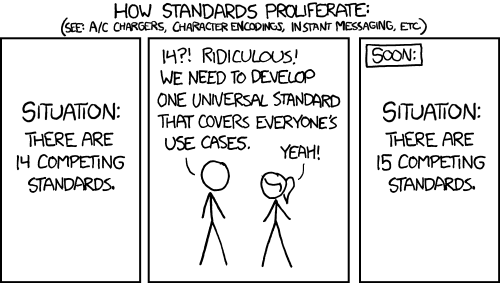
Fortunately, the charging one has been solved now that we've all standardized on mini-USB. Or is it micro-USB? Shit.
You don't always want to add something new to the situation, or else more problems XD
clever blade
If you want to get investors you always need the latest hot thing. Which is why everything has ML in it now.
wicked parrot
clever blade
If you want to get investors you always need the latest hot thing. Which is why ...
If we tried to put ML in the things my team designs at work I’d need a new job because I haven’t learned how to do ML yet lol
clever blade
Just add a linear regression somewhere and you're good to go.
wicked parrot
I’ll just add it to the unit tests
I’ll get the intern right on it
Which is funny because I do have an intern on my team and I had to carve out the unit tests from my task for the intern to have something to do
Also, apparently a lot of schools are not teaching git anymore
I guess machine learning is learning how to determine if I should push code or not and automatically do it for me
 uncut otter
i kind of taught myself python and linux and have made a tflite model that detects different lego for a lego sorter
its amazing how accessible this is these days
that was all in about 2 weeks to
so many youtube tutorials and good pieces of code available
wicked parrot
My issue is more of a time constraint than a learning constraint.
serene torrent
Today we can easily build robots to sort Lego, 20 years ago not everyone even had a computer...
serene torrent
Indeed
wicked parrot
Hard to believe it was 20 years ago that I was in 3rd grade
serene torrent
Lol
 cosmic kelp
serene torrent
Today we can easily build robots to sort Lego, 20 years ago not everyone even ha...
cosmic kelp
serene torrent
Today we can easily build robots to sort Lego, 20 years ago not everyone even ha...
Hmm. 20 years ago was 2001. I thought everyone had a computer by about 1991. Maybe I ran with a fast crowd... 🤔
serene torrent
I think I was on a Pentium III? Forget what was new then
serene torrent
cosmic kelp
Hmm. 20 years ago was 2001. I thought everyone had a computer by about 1991. May...
Yeah, fast crowd XD cellphones were certainly not in everyone's hands yet
wicked parrot
My parents had a gateway 2000 from 1998 in 2001
They bought it new in 1998
Had a speedy 56k modem lol
 wicked parrot
Weird, in 2010 still only 77% of us households
cosmic kelp
Hmm. I guess I was in that 8.2% then. Had that first Mac and have had something ever since. Actually, a MacPlus.
serene torrent
My house has had computers for the longest time
Now computers outnumber people in my house like... 14:1
clever blade
The funny thing is that ML goes back pretty much to the beginning of computers.
And some of the techniques that are considered to be ML go back 100s of years.
serene torrent
Yup! Not a new thing, just newly exploding
clever blade
Although a lot of the recent achievements really have been breakthroughs.
serene torrent
Indeed
Same sort of thing happened with electricity -- conceptually was around for several hundred years, and then exploded in the last couple centuries
clever blade
Many products that claim to do ML really use simple techniques though. Basically replace a heuristic by a trained model. Not everything is fancy deep neural networks.
serene torrent
Yee
cosmic kelp
And a lot of the stuff that does extremely fancy AI (with pedigrees going back to the 70s and costing hundreds of millions in research dollars) is pretty useless.
E.g., CyCorp. I did a fair bit of work with their ontology, very cool and amazing at some level, but on the whole (sadly) kinda useless. They of course still sell it for huge bucks.
First saw it in action at SRI in 1979. Still around and still for sale.
rancid fossil
@uncut otter I'm working on the same notion: thinking a RasPi with a camera and some servos to direct bricks into chutes. I have a basic model up and running but need more training data and I'm building a brick hopper and conveyor.
true hamlet
I posted this in projects, but it might be better here: I'm using a jetson nano with PyTorch, when trying to use train.py i get an error saying no files in the val directory.
Does anyone have experience with this, and what is the purpose of said folder?
true hamlet
true hamlet
I posted this in projects, but it might be better here: I'm using a jetson nano ...
This video explains it around the 6minute mark. This stuff is neat, but the Jetson tutorials have me feeling like a scavenger hunter hopping through both the videos and written guides to get the whole picture.

Learn how to train image classification models with PyTorch onboard Jetson Nano, and collect your own classification datasets to create custom models.
Hello AI World - https://github.com/dusty-nv/jetson-inference
Jetson AI Fundamentals - https://nvidia.com/jetson-ai-fundamentals
NVIDIA Developer Forums - https://forums.developer.nvidia.com
clever blade
The "val" folder should contain a set of validation images, which are like training images except it should be images you did not use for training. The validation set is used to make sure your model works OK on images it has never seen before.
true hamlet
What are differences between the different model choices (such as AlexNet, GoogleNet, ResNet?) Does this refer to a format, or just pre-trained info?
rancid fossil
A little of both. The way these models are built is a network is defined (with varying numbers of different kinds of layers), then it is trained up on a corpus. So a given model is a particular network trained on a specific corpus. Many of them are trained on ImageNet.
The tradeoffs are generally model size/complexity and accuracy, and some are better at some tasks (like segmentation), others at classification, etc.
A common use case is for "transfer learning" where you take the pretrained model, swap out the last layer (or few layers) and retrain those on your specific data. This allows you to leverage the built-in learning embedded in the model, so you can train up a custom one without having to assemble a huge amount of data and spend enormous resources training.
Note: models can differ as to the form of data they take as input: many of them are configured for 224x224 pixel images with RGB color, but there are lots of other possibilities.
true hamlet
rancid fossil
Note: models can differ as to the form of data they take as input: many of the...
Does this mean I need to worry about converting images taken with my phone to said format, or am I overthinking?
clever blade
Usually the training scripts will do the image conversion for you.
Note that AlexNet and GoogleNet are obsolete architectures by now.
Usually (but not always), the larger the model, the better the results. ResNet-50 gives better results than ResNet-18, for example.
true hamlet
Assuming everything else is the same, the larger the suffix will potentially increase accuracy while also (presumably dramatically?) increasing training time?
rancid fossil
They're pretrained, so the training time isn't a problem. A well designed net will outperform a poorly designed one, but most of the ones in use these days are well designed, so in general, large ones will outperform small ones, but of course they take more memory and CPU to run.
true hamlet
I meant when transfer learning, I should have clarified sorry
rancid fossil
Normally you only train the last layer (or few layers), and the rest of the network already "knows" how to recognize stripes, shapes, colors, etc.
Since you're only training a small part, the size of the rest of the network isn't a particularly large factor in training time.
clever blade
It also depends on the size of your dataset. If you have relatively little data, a smaller model usually works better (because a big model will simply remember your dataset rather than learn anything from it, i.e. overfitting).
 mint pollen
I want to use ML for two accelerometer data heavy projects.
-
impact detector for a fencing mask that can classify movements as not impacts and classify impacts on direction and severity. This would be for scoring and safety.
-
sword helper that would attach to a training sword for a variety of purposes: the other side of the impact detection system that could assess whether the sword hit another sword or the ground or a mask/jacket, and a solo-trainer "coach" that can assess important characteristics of practice like edge alignment, acceleration curve, etc.
This seems like one of those things that would be possible but a pain to do programmatically (and I did for my senior project years ago), and ML seems a good fit based on the examples from TensorFlow Lite I've seen.
This is my first time messing with this sort of stuff. Any ideas on how to collect a good training dataset, how big it should be, and what kind of learning approach to take? A neural network sounds right, but I'm not sure how supervised I should go with it or any of those other details.
I have access to a lot of people skilled with swords, so no worries there.
rancid fossil
It's an interesting problem. Ultimately, you'll need supervised learning, with a labelled data set, but you might be able to use unsupervised learning to help divide the dataset into categories.
Since the problem doesn't map to the usual ones for which pre-trained models are available, you may not be able to take advantage of transfer learning, so you'd need a pretty big data set.
 rugged obsidian
( creating a dataset sounds like fun though. You get to hit people with swords. for science. )
 robust vapor
And not-people. Have to train on the not-people, too...
 sharp juniper
Suggestions:Put the accelerometer on the inside of the bell, not the mask. For epee, anywhere counts other than the floor, so use the body cord to eliminate floor touches. For foil, the electronic scoring system already generates valid touches, so again, use the body cord and the accelerometer.
For saber, same as foil. Accelerometer will need to distinguish point touches from blade touches. ML will help by training against an active plastron on a dummy.
clever blade
You probably also don't need a neural network for this. In general, you'd start by training a simple baseline model on the data (such as a logistic regression). Often you'll find that this already gives good enough results. In any case, it's an iterative process: gather training data, train a model, tweak the model, gather more / different training data, train the model again, experiment with a different model design, gather more data, and so on.
mint pollen
Oh, I should clarify, the swords I use are two-handed, not epee or foil or sabre. So, choppy and stabby. And slice-y, and I think I could measure that one too, which is part of why this is exciting.
3 types of wounding strikes, 4 quadrants/direction vectors, 2 edges of the blade = 24 categories I can categorize for the learner.
sharp juniper
Gotcha. Instead of making a simple task complex you’re trying to make a complex task simple.
 neat owl
You might want to look at random-forest. It's better with a smaller training dataset, plus it's a classifier that gives a "confidence".
 crimson wagon
I am trying to get tensorflowlite running on Clue, I have seen lots of talk from 2019 onwards but little info. Is there a writeup?
or at least cookbook-ish pages
everything I "fixed" just gives 2 new errors
arduino compile errors galor
 maiden pulsar
I've been having a lot of fun with the VQGAN+CLIP technique that's really popular right now. yesterday I built a little discord bot that lets you generate images either from just text, or a provided image + text prompt


right now it's just running on my desktop, so it maxes out my GPU for a few minutes for each image. does anyone have any suggestions for a cheap hosting solution for GPU stuff? i'd love to be able to move this somewhere where it can run all the time
serene torrent
I'll run it and charge you processing time :P
 rocky swan
does anyone have some experience with pullet? I need some help 🙏
 slow depot
Is it bad if I put a PDF here with some questions(about 25 questions) about the Adafruit Machine Learning Kit and Microsoft Lobe? (My questions)
mint pollen
Trying to figure out the initial data-gathering stuff for the "Smart Sword v2.0." The magic_want_model_data.cpp file has this helpful tidbit:
// Automatically created from a TensorFlow Lite flatbuffer using the command:
// xxd -i magic_wand_model.tflite > magic_wand_model_data.cc
// See the README for a full description of the creation process.
But the readme for the Adafruit TensorFlow Lite Helper Library where the file is found doesn't say anything about the data creation process.
I've tried following this example and replacing the external sensor values with the Circuit Playground built-in LIS3DH calls: https://www.survivingwithandroid.com/arduino-tinyml-gesture-recognition-with-tensorflow-lite-micro/ ; but I'm confused as to why it is calibrating like it does and if that's what I want to do. As far as I can tell, it records the "neutral" position (starting position) and uses that to adjust all the other values. However, because gravity, if it is oriented any other way it will register as movement. I suspect it has something to do with the MPU6050 being a gyro and accelerometer? So I'm going to go back to how I did this before on my non-ML system and just use a threshold of acceleration and use the acceleration delta rather than the raw values.
tl;dr: I'm not actually sure whether I'm doing the data-gathering for the model I want to build right, but this has actually been pretty fun all things considered.
 vocal stone
Does anyone know about the bme688 Bosch gas sensor. Does the adafruit (680) library have any ai support? Somehow the bme688 is set up to perform an algorithm of machine learning to match a gas.
I bought an huzzah esp32 feather, a bme688 feathering and several adafruit bme688 sensors.
Any pointers for what to read?
What I know so far:
A huzzah feather firmware by Bosch controls an 8x bme688 sensor wing to get a lot of resistor readings at different temperatures when identifying a gas.
AI software compares a positive & a negative test array to produce code that will scan for a positive hit rapidly. (I am assuming N different gasses can all be sniffed by the generated algorithm).
So far, that algorithm is run via the 8x bme688 sensor board with promises of being able to run via the cheaper 1x sensor by adafruit.
ripe night
vocal stone
Does anyone know about the bme688 Bosch gas sensor. Does the adafruit (680) libr...
bme688 support is in the works here: https://github.com/adafruit/Adafruit_CircuitPython_BME680/pull/43

GitHub
For #42.
This at least allows getting a gas resistance value that varies with the BME688. There are a few key things that are not covered in the datasheet. Getting this working required looking thr...
vocal stone
Thanks!
vocal stone
A primary use of the bme688 sensor is to detect gasses against baseline measurements.
The BSEC2.x library drives the bme688 to perform measurements.
It would be nice if that library can be added when the bme688 library is added AND it be callable via python.
Otherwise, reading out a resistance value is pretty meangless [to me].
A user can duplicate the AI work done by Bosch but that is a difficult path for someone that is thinking they just want to detect a banana.
 sleek fable
Hey guys
 eternal ravine
What's the best way to learn more about ML and Python??
rancid fossil
Heh, define "best". I'm doing it by building a Lego brick sorter.
clever blade
Introduction to Machine Learning with Python by O'Reilly teaches both.
eternal ravine
rancid fossil
Heh, define "best". I'm doing it by building a Lego brick sorter.
Ooh, sounds fun
eternal ravine
clever blade
Introduction to Machine Learning with Python by O'Reilly teaches both.
OK. I learn best by dissecting others' code, and not by books. Thank you anyway!
Is there a good website to find ML python code on besides Kaggle?
rancid fossil
Do searches on terms like "TensorFlow" and "Keras" and you should find lots of them. Terms like "tutorial" are useful too. That said, towardsdatascience.com, pyimagesearch.com, and machinelearningmastery.com offer some good stuff, and of course tensorflow.org/tutorials and keras.io/examples
eternal ravine
rancid fossil
Do searches on terms like "TensorFlow" and "Keras" and you should find lots of t...
Sweet! Thanks.
clever blade
That book I mentioned actually has a lot of code in it. It's like a more professionally done version of a typical online tutorial.
eternal ravine
clever blade
That book I mentioned actually has a lot of code in it. It's like a more profess...
Cool! I'll check it out.
 glad pewter
I have finally thought of a useful project, but now how to create. Input device, I need to bulk load photos. Should I look at a scanner or the tenserflow hat? Is there away to build my own scanner or is the hat fast enough?
eternal ravine
glad pewter
I have finally thought of a useful project, but now how to create. Input devic...
Tensorflow hat for sure
true hamlet
Hey I'm trying to train my Jetson Nano on classification. Under the validation folder, what kind of pictures should I be putting?
or are they just images for the train folder to bump heads against and train the model, so to speak
fast hill
I believe the validation set is to test whether the model has been well-trained or not. If it gets the training set correct but fails on the validation set, then it hasn't generalized the classification enough to work correctly, instead just keying on some random specific details of the training set to fake the answers.
true hamlet
Okay, I think I am following
 robust phoenix
Hello everyone, I have a dataset with audio files with .wav extension. I want to output a cpp(unsigned char) from these audio files. I don't know both pyhton and tensorflow. I created a copy-paste algorithm with my research. First of all, I modeled my dadasets with TensorFlow speech recognition. Then I translated this model into Tensorflow lite. Then I tried to get cpp output. And I got no results. Is the path I followed correct to achieve the result I want? Or is there another way I can follow?
rancid fossil
I'm not sure what you mean by cpp output? Something like the WAV data in hexadecimal values in a C array?
robust phoenix
I am using esp32. I have a dataset with .wav files. I want to make an Arduino code out of them.
robust vapor
Make an Arduino code with a dataset? Do you mean importing data parsed from wav files?
Code is a set of commands, and data is just raw or formatted information.
robust phoenix
I have an ESP32 board with microphone. I want to generate an Arduino code from the datasets(rabbit, true,wrong vs) I have. For example, when I model the dataset with "rabbit" sounds and say rabbit into the microphone, I want it to print "rabbit" on the screen.
muted laurel
Maybe Shawn can help. https://youtu.be/dU01M61RW8s

In this tutorial series, Shawn introduces the concept of Tiny Machine Learning (TinyML), which consists of running machine learning algorithms on microcontrollers.
In this episode, we create an (as simple as possible) Arduino sketch to load our TensorFlow Lite model file and run inference. The model is used to predict values of a sinewave, whic...
 steel parcel
Greetings!
Where would you start from to develop a solar panel system and storage, which could produce enough and necessary energy given a certain type of lifestyle? so based upon your life needs "lifestyle" / " cost of living ", can give as a result an average of what you would need to carry out a system that can make you live without paying the bills.
cosmic kelp
steel parcel
Greetings!
Where would you start from to develop a **solar panel system and sto...
Why are you asking this question under #machine-learning?
cosmic kelp
Well, does Adafruit sell any solar panel systems?
The biggest they sell is a 9 watt panel. That's hobbyist size. If you're talking about one for your house you might try a forum or Discord server devoted to solar living or something. If you really want to ask the Adafruit community you might try under #general-tech but your results are going to be pretty random if you're looking for solar specialists.
 whole birch
steel parcel
Greetings!
Where would you start from to develop a **solar panel system and sto...
whole birch
steel parcel
Greetings!
Where would you start from to develop a **solar panel system and sto...
Yeah, probably not the channel for it, but; 1) determine the energy consumed for your lifestyle, eg; "Watt-hr" - an easy way to find this is your electric bill 2) use some tools to estimate your solar viability, eg; https://sunroof.withgoogle.com 3) dive into the timeseries of solar vs. time - you'll need a battery large enough to get you through the lowest point - but it also has charge history associated with it, and may not be fully charged at the start of that lowest point.
Enter a state, county, city, or zip code to see a solar estimate for the area, based on the amount of usable sunlight and roof space.
tepid herald
Hi! I am trying to use tensorflow micro in a normal esp32(nodemcu) with a normal microphone(max4466 with analog output) and I cant find any tutorial. Everyone uses I2S microphones but adafruit shows a tutorial with a max4466 for its pybadge(that is why I think it is possible). Tensorflow for ESP32 library is not complete for this case. Can someone help me to figure out how to use this type of mic in the tensorflow microspeech example? Thanks!!!
 devout sluice
i'm trying to follow the tensorflow for microcontrollers hello world guide, but i keep getting the error make -f tensorflow/lite/micro/tools/make/Makefile hello_world_test. how do i fox this? it appears when i run the test makefile
rancid fossil
That appears to be a make command, not an error
devout sluice
sorry, had the wrong thing copied. it was a search for a /google/ directory, which didn't exist
find: ‘../google/’: No such file or directory was the exact error
rancid fossil
That's looking for a google directory in the parent directory, and it is (apparently) not there
devout sluice
how do I fix it?
rancid fossil
That's a good question. Presumably there's some other files that need to be fetched and installed in the proper place, but I'm not familiar enough with that guide to say for sure.
tepid herald
Hello!! I want to make a Tensorflow Keyword Spotting model for C in TF v 2.1.1. but it is not working. I am using this colab, but it fails when I change to the version I require. When creating the model, after training (with freeze.py) it gives a strange file. Can someone hlep me please!
https://colab.research.google.com/github/tinyMLx/colabs/blob/master/4-6-8-CustomDatasetKWSModel.ipynb#scrollTo=lBj_AyCh1cC0
Thank you,
Best regards!
 rancid fossil
tepid herald
Hello!! I want to make a Tensorflow Keyword Spotting model for C in TF v 2.1.1. ...
rancid fossil
tepid herald
Hello!! I want to make a Tensorflow Keyword Spotting model for C in TF v 2.1.1. ...
I'm not sure what you mean by "it gives a strange file"
tepid herald
Thank you for responding, it gives me this file instead of creating a a .pb file
KWS_custom_saved_model
Foto de Arsenio

It creates that. But when I do it with version 2.4.1 it does it correctly:
Foto de Arsenio
 rancid fossil
Hmm, that's interesting.
tepid herald
🥲 do you know how to solve it??
rancid fossil
Alas, I don't. My first impulse is to say "just use the version that works", but I'm guessing you want a more thorough answer.
tepid herald
Yes haha, I need an expert... But thank you
muted laurel
I tried to build a small neural net in CircuitPython based on https://towardsdatascience.com/neural-net-from-scratch-using-numpy-71a31f6e3675 but stopped when I realized that ulab.numpy doesn't provide an obvious way to get X.T (the transpose of array X). More thought required.
fast hill
muted laurel
I tried to build a small neural net in CircuitPython based on <https://towardsda...
muted laurel
Okay I'll give it a try.
 twilit viper
Uh. I just came here to not ask about building the next Skynet like Dexter over here, but if I were to ditch the Google Assistant and Siri and Alexa, for something different, would Almond be a good thing to get into, or should I just roll my own with TensorFlow Lite and use a bunch of little feathers or whatever for input?
My main gripe with the assistants, other than the fact that they constantly listen and record (fOR diAgNOstiK purRpoSSes oNLy dUh) they are also completely useless if my Internet goes out.
Oh, I am using Home Assistant on a Raspberry Pi 4 for this, by the way.
(and maybe this would get me into the audio side of things, building smart speakers)
rancid fossil
@twilit viper A third option is something like EasyVR: https://www.sparkfun.com/products/15453

The EasyVR 3 Plus Shield is a voice recognition shield for Arduino boards integrating an EasyVR module.
twilit viper
rancid fossil
<@!438791522285256715> A third option is something like EasyVR: https://www.spar...
Feels a little expensive for just the hat. But, bookmarked it in case.
I'm wondering if I could scavenge a few of my Artemis-based feathers and turn them into... Something...
Basically something that isn't double the cost of a an Echo Dot or the little Google thing, whatever it's called.
 vernal moss
There's also um.... bugger. I'm blanking on the name. Hold please.
twilit viper
I don't really need it to play music, per se, I can redirect that over to my home entertainment system.
twilit viper
I'll look at it! Thank you.
vernal moss
http://mycroft.ai/ apparently.

Mycroft is an open source privacy-focused voice assistant. It can be installed on Linux, Raspberry Pi, our reference devices, or your own custom hardware.
twilit viper
Yeah, I was curious about Almond (and the Ada voice assistant for Home Assistant)
Oh sweet, I'll check that out!
vernal moss
Hmm evidently they're sold out and the images are on Debian Jesse. There are pre-orders for Mark II, but it's been a real slog for them to get going. (I have a friend who has a ton of their hardware, and did a presentation to our local user group on it. I ran to him to find out the name when I couldn't remember.)
So... caveat. But it still might be worth looking at.
It still works and you can install it on RPi/Linux to try it out.
twilit viper
The main thing I see is that it requires Pi 3/4. I mean. Good luck finding like 3-4 of those to replace my Google Assistants.
vernal moss
Oof yeah.
twilit viper
Yeah, that's why I was hoping for something that'd run on something with tensorflow lite or similar
vernal moss
Fair enough. Well, I evidently can't help you there. 😄
twilit viper
You helped! This gives me ideas.
vernal moss
Oh good!
twilit viper
I'm going to have to do some testing later tonight. I'll keep y'all updated.
vernal moss
Thanks!
 split crater
I just built the coolest machine learning program in python, it identifies your age and address validation against USPS API and the DMV for a website login purposes
for account signups to stop catfishing and scamming and botting
now I just need to learn how to use flask and ue
vue
twilit viper
split crater
now I just need to learn how to use flask and ue

GitHub
Flask-based URL shortener. Contribute to tbjers/url-shortener-flask development by creating an account on GitHub.
there's a bare minimum, yet fully functional, Flask app
And Vue is so... last decade. You should check out Svelte.
 hazy bane
twilit viper
Uh. I just came here to not ask about building the next Skynet like Dexter over ...
hazy bane
twilit viper
Uh. I just came here to not ask about building the next Skynet like Dexter over ...
I wasn't thinking of using ML for this, but if it's useful to you, check out https://pypi.org/project/SpeechRecognition/ which - IIRC - out-of-the-box uses CMU Sphinx, offline. No need for Internet. People can then write their own assistants on top of that -
https://www.analyticsvidhya.com/blog/2020/11/build-your-own-desktop-voice-assistant-in-python/
https://www.activestate.com/blog/how-to-build-a-digital-virtual-assistant-in-python/
https://www.c-sharpcorner.com/article/creating-a-voice-assistant-using-python-and-its-libraries/
https://www.codewithharry.com/videos/python-tutorials-for-absolute-beginners-120/
https://github.com/ggeop/Python-ai-assistant

PyPI
Library for performing speech recognition, with support for several engines and APIs, online and offline.

Voice assistant has gained a lot of popularity in this era of smart homes and devices. Learn how to build a desktop voice assistant in Python

This tutorial shows how to build your own digital virtual assistant in Python, complete with voice activation plus response to a few basic inquiries.

This article is about creating a voice assistant using python programming.
Have you ever wondered how cool it would be to have your own A.I. assistant? Imagine how easier it would be to send emails without typing a single word....
twilit viper
hazy bane
I wasn't thinking of using ML for this, but if it's useful to you, check out htt...
hey, thanks for this! I'll definitely look into this as well
 spring drift
I use https://www.adafruit.com/product/4757 + mozilla deep speech, but it looks like deep speech was abandoned, so I'll need to find another speech to text converter, and it requires a raspberry pi 4 which you mentioned is a bit hard to find
twilit viper
spring drift
I use https://www.adafruit.com/product/4757 + mozilla deep speech, but it looks ...
That's neat, added that to my wish list. Thanks for the tip. Since this is just a bonnet to get speakers and mics, I wonder, could you slap that guy on top of a Jetson Nano? I have two of those bad boys. They're a bit big, but I think I could get creative with creating an enclosure.
Or are the Raspberry Pi and Jetson GPIO headers not comparable?
eternal ravine
vernal moss
http://mycroft.ai/ apparently.
Mycroft is the coolest thing. I am personally writing an Instructable on it right now, and I have made multiple Voice Assistants with it.
I highly recommend
muted laurel
we have been a dozen people
 mossy garnet
Hello guys would someone mind helping me to take a course on computer vision and image processing fundamentals. Has anyone studied the course kindly share resources and ur experience bcas I'm finding difficult
eternal ravine
Not the most active channel
rancid fossil
My machine learning project is not progressing rapidly
 pliant crescent
Wondering if anyone has any suggestions on where to get started on ML. I've got a pi and camera taking pictures of my bird feeder, and I'd like to attempt to pull out images that actually have birds in them. I have no idea where to start.
wicked parrot
pliant crescent
Wondering if anyone has any suggestions on where to get started on ML. I've got ...
Try Edge Impulse, they have some great tutorials for animal based recognition. They walk you through training your model and the steps you need to identify birds in a frame
 lapis island
pliant crescent
Wondering if anyone has any suggestions on where to get started on ML. I've got ...
lapis island
pliant crescent
Wondering if anyone has any suggestions on where to get started on ML. I've got ...
speaking of edge impulse, i just saw this possibly relevant article swoop by on their twitter feed - https://www.hackster.io/justinelutz/solar-powered-tinyml-bird-feeder-142f61

Hackster.io
Use an ESP-32 Cam and an Edge Impulse model to take photos of your avian friends visiting your solar-powered bird feeder! By Justin Lutz.
pliant crescent
lapis island
speaking of edge impulse, i just saw this possibly relevant article swoop by on ...
Yeah, I saw that too. Thanks. I was able to get things working, but training a model has been tough. The images I get from the camera aren't great. The quality is great, but the birds don't stand out from the background very well, and they are pretty small so I think it's having a hard time picking them out.
lapis island
pliant crescent
Yeah, I saw that too. Thanks. I was able to get things working, but training a m...
cool! (sorry for the lag, i dont discord often)
 twilit ravine
mossy garnet
Hello guys would someone mind helping me to take a course on computer vision and...
twilit ravine
mossy garnet
Hello guys would someone mind helping me to take a course on computer vision and...
Coursera and EdX both have some fun computer vision and machine learning classes using python and matlab
fast hill
I have a large corpus of scanned pages of my own handwritten notes. Does anyone know of a tool that would use a language model to train an OCR engine specifically on my handwriting to annotate those pages?
rancid fossil
I remember seeing some projects for handwriting recognition, but they were simple demo ones that just recognized digits. While you could probably build one of those into a handwriting engine optimized for your handwriting, it would be a fair amount of effort. Hopefully someone else is aware of something that's closer to your use case.
fast hill
rancid fossil
I remember seeing some projects for handwriting recognition, but they were simpl...
Yeah. It's cursive, so the engine would probably want to deal with whole words at a time. It sounds like something that ought to exist given the current state of ML, so I probably just need to Google harder, heh heh.
weak oyster
google/bing voice search still doesn't recognize my English after 2 millenias...
 pulsar bear
fast hill
I have a large corpus of scanned pages of my own handwritten notes. Does anyone ...
pulsar bear
fast hill
I have a large corpus of scanned pages of my own handwritten notes. Does anyone ...
Evernote claims to be able to read cursive. Microsoft One Note (free) also most.
 verbal eagle
This might be something to see if an FOIA request might be able to get USPS to release their software? (Much like what happened with the NSA's Python training.)
 wide bone
fast hill
I have a large corpus of scanned pages of my own handwritten notes. Does anyone ...
wide bone
fast hill
I have a large corpus of scanned pages of my own handwritten notes. Does anyone ...
apple ML seems like pretty good for what it is. Also comes with a nice interface