#circuitpython-dev
1 messages · Page 340 of 1
 cunning verge
 ionic elk
had to change things like tuple to Tuple[str, int] in the commented interpretable section thingies
the mypy targets? what's the right thing to call those
 manic glacierBOT

I have this to offer to further reduce the size of circuitpython. It looks like it lets de_DE fit on feather_m0_express feather_m0_supersized and metro_m0_express along with the changes in this PR: https://gist.github.com/jepler/1f40cdadfabe61661c5fbad8ab58f030
It removes a little-used (I believe!) feature, calling the built in function pow with 3 arguments: pow(a,b,c). This is perhaps useful if you want to implement the RSA cryptosystem in pure Python code, but otherwise not much. ...
 tulip sleet
@onyx hinge how much does it save?
manic glacierBOT

Is it possible that this is being overzealous about resetting modules, and is messing with pins related to the REPL?
tulip sleet
i am about to add some stuff necessary to support deep sleep, etc., that will exist even without CIRCUITPY_ALARM=1, and may use up your savings 😦
 onyx hinge
@tulip sleet my local build of metro_m0_express for de_DE of that PR has 140 bytes free after that change. Before, that PR had -244 bytes free in my local build
we talked about disabling EPD on m0 devices, but I don't remember if we concluded that was something to investigate or not.
tulip sleet
i think that would be fine. I also think we could try turning off _pixelbuf
_pixelbuf is 3200 bytes
As I said, I view this as temporary until gcc 10. I don't think we should spend a lot of time getting a couple hundred bytes here and there. It's a tremendous time sink.
onyx hinge
you said there's a preview build available?
manic glacierBOT
onyx hinge
Thanks, I pointed a draft PR at it so we can check it out
manic glacierBOT
The esp_idf submodule has been mistakenly updated to an old ref, please correct it.
Should self->num be assigned -1 here so that the closed socket can be recognized? Otherwise, wont a subsequent call risk doing lwip API calls on some subsequently created socket?
 idle owl
@tulip sleet Something is up with the way Learn is processing the file. I just uploaded a new version, and it came out the same size. Here is the smaller file:
Trying one more thing.
Nope. Emailing learn.
tulip sleet
sounds good; they made a lot of changes recently, and I guess this is a regression
idle owl
Wait it's not Learn.
I just checked the new version of the exported file. It's huge.
Eagle is doing something
This is how big it should be.
tulip sleet
seems like a bug... do you recognize that resolution number as typical?
what version of eagle are you using?
I 'll try it too. I wonder if it's peculiar to the board or to the eagle version
idle owl
@tulip sleet https://learn.adafruit.com/assets/97223 I decreased it in Photoshop.
9.6.2 Eagle @tulip sleet
That resolution is pretty typical I think.
I only ever change the resolution
tulip sleet
i tried the same thing in Linux Eagle 9.6.2, same size, and the resulting image is the right size.
tulip sleet
is this on Mac?
idle owl
Yeah
tulip sleet
did you update to Big Sur yet?
idle owl
Absolutely not.
tulip sleet
my only Mac is Big Sur; I only use it for BLE testing
yeah, I guess, try reinstalling. I wonder if the resolution is being confused by the "hi-dpi" stuff on Mac
but why would it show up now?
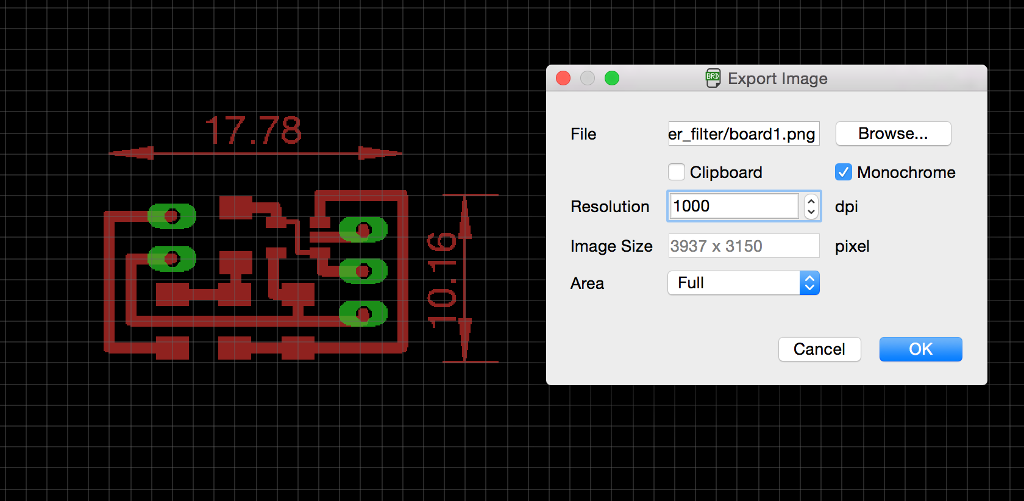
Hi, I'm experiencing a bug in Eagle that i'm not able to fix. When i export a PNG image of the board (monochrome, 1000 dpi) the dimension of the exported png are doubled. if i measure the size from eagle and then from an image editor software (illustrator, gimp, photoshop) the dimension are always...
idle owl
I haven't the slightest. Wondering if it's been happening and I haven't noticed.
tulip sleet
was reported ages ago
did you do the export while using the laptop screen only, as opposed to desktop monitor, or vice versa?
I think it might depend on the resolution of the screen
idle owl
Desktop monitor, but I always have displays connected and use them as my main screen.
tulip sleet
so for hi-DPI screen, it gets it wrong??
anyway, photoshop to the rescue, but now you'll have to check in the future
idle owl
Yeah. Trying a fresh install now.
Same thing.
And I deeply uninstalled it with an app that clears everything.
tulip sleet
True on hi-dpi screen on windows too https://forums.autodesk.com/t5/eagle-forum/bug-export-image-produces-wrong-resolution-when-windows-10/td-p/8215012
I am using Windows 10 on a high resolution laptop (Dell XPS 13). The Windows "Make everything bigger" setting is set to the default of 300%. (If this option is turned off - ie: set to 100% - everything in eagle is microscopic). When I choose Export Image, it shows me the correct image dimensions in ...
idle owl
I don't have it scaled though
It's using the default resolution afaik
Just checked another one, and it's also huge.
So I have no idea how long that's been going on.
Sigh.
Laptop display isn't even scaled.
None of the connected displays are scaled.
Folks are still reporting it. Well bugger.
manic glacierBOT
@hathach could you take a quick peek at this? I've been trying different ways to get USB to connect to my F103 board, but so far I've had no luck. My current version is just lifting the clock, pin and IRQ settings from the F103 BSP in TinyUSB but it's still not working. Backtrace shows it seems to be stuck checking return tud_cdc_n_get_line_state(0); and return _cdcd_itf[itf].line_state;
 tulip sleet
@onyx hinge I do not understand why your gcc10 PR is failing. The download filename looks correct.
might be worth turning off the progress messages, which just make the log huge
idle owl
@gilded cradle Setting brightness of the NeoPixels LEDs using MagTag library is not working.
Or maybe I'm trying to do it wrong.
 gilded cradle
I hadn't tried it. How are you doing it?
idle owl
I tried two ways. One I have pixels = magtag.peripherals.neopixels and I did pixels.brightness = 0.2, and I tried doing magtag.peripherals.neopixels.brightness = 0.2 as well in case saving it to a variable broke something, neither works.
Using pixels as the pixel object works everywhere else.
so pixels.brightness should work.
gilded cradle
What if you did something like magtag.peripherals.neopixels[0].brightness = 0.2?
idle owl
tuple object cannot assign attribute brightness
console error.
AttributeError: 'tuple' object cannot assign attribute 'brightness'
gilded cradle
Ah, ok. I'm not 100% sure brightness is implemented on the esp32-s2. Do you know if you can adjust it without using the library?
idle owl
I can adjust it on the external strip. Let me try with the onboard.
gilded cradle
ok
idle owl
Raw CP using neopixel allows setting the brightness, though oddly, setting it to 0 makes them max brightness. But setting them to 0.1 for example, makes them dim.
@gilded cradle ^
gilded cradle
Hmm, ok. That's good to know. Can you open an issue on the magtag library? I'm wondering if the 0 for max brightness is a bug that should be opened for circuitpython as well.
idle owl
@gilded cradle Probably.
@tulip sleet Setting the NeoPixels on MagTag to brightness = 0 makes them max brightness. CP problem or NeoPixel problem?
gilded cradle
I'm guessing CP problem, though now that you mention it, it could be a lib problem.
idle owl
I kind of doubt it's NeoPixel, but maybe.
tulip sleet
🤷 would have to explore, but try same thing on, say, a PyBadge
gilded cradle
Good idea @tulip sleet
 tidal kiln
any ideas on this behavior?
https://forums.adafruit.com/viewtopic.php?f=59&t=171983#p840155
gilded cradle
@idle owl didn't you run into something similar to what @tidal kiln mentioned?
idle owl
Not that I'm aware of? Or am I forgetting something?
gilded cradle
Ok, maybe I'm just remembering you had an issue with a long running script
@tidal kiln maybe @tulip sleet has some ideas?
tulip sleet
i have not seen this before, but it could be blocked on output, that's possible. I haven't seen that behavior on other boards. If I put the host to sleep and then wake it up, I see skipped counts (I was doing doing a 5 or 10 second sleep in that example.)
idle owl
@tulip sleet Huh. I can set brightness on an external strip to 0 and it turns it off. Set it on a PyBadge or MagTag onboard NeoPixels using board.NEOPIXEL, and it makes them max brightness.
Let me try it using 6.0.0 on the PyBadge.
tulip sleet
is it reproducing the desired color at the wrong brightness, or is it messed up?
idle owl
Color is same. But let me try something other than red.
gilded cradle
I wonder if it is esp32-s2 specific
gilded cradle
Oh, ok. So looks like a non-processor specific bug. Is that something that could be fixed in the library?
idle owl
Both using same neopixel lib.
I have no idea.
@tulip sleet 0 makes them max brightness, 0.0 makes them off.
gilded cradle
It could be that 0.0 is really like 0.000000000001
gilded cradle
So it sounds like something that should be fixed in cp
idle owl
@tulip sleet CPX is same behavior.
tulip sleet
check somethign without _pypixelbuf, like trinket
tulip sleet
i mean attach a strip
tulip sleet
maybe qt py?
idle owl
QT Py is a NeoPixel
yeah
@tulip sleet QT Py works properly. brightness = 0 turns off the LED.
Which narrows it to _pypixelbuf ?
Because QT Py required adafruit_pypixelbuf lib.
onyx hinge
@tulip sleet rookie mistake
sudo tar -C /usr --strip-components=1 -xaf ‘gcc-arm-none-eabi-10-2020-q2-preview-x86_64-linux.tar.bz2’
tulip sleet
@idle owl go ahead and file an issue; I don't see an obvious issue in th _pixelbuf code
idle owl
@tulip sleet Ok will do.
manic glacierBOT
Tested on MagTag, PyBadge, CPX and QT Py. The issue is not present on QT Py which requires adafruit_pypixelbuf. It is present on all other boards, which may narrow it down to an issue in _pixelbuf.
Used simple code that uses board.NEOPIXEL to turn the pixels red, and then tested brightness:
-
Setting
brightness = 0makes the on-board NeoPixels max brightness. They are the appropriate color when this occurs (as in they are not getting incorrect color info). -
Setting `brightn...
idle owl
@gilded cradle Limor's suggestion on the MagTag lib works, though I don't understand it. I closed the brightness issue on the MagTag library.
gilded cradle
Ok, thanks for the update @idle owl
 slender iron
@tulip sleet I'm around if you want to chat
tulip sleet
@slender iron on the phone but will ping you later - tnx
slender iron
k, lets pick a time after you are off the phone. I've got a couple more things to do this afternoon
tulip sleet
just got off! wasn't sure how long it would be
slender iron
👍
 ornate breach
hey @slender iron would you be able to review my pidcodes PR? this one specifically: https://github.com/pidcodes/pidcodes.github.com/pull/586

GitHub
adding variant of CP Sapling with SPI Flash. SPI Flash build requires separate PID for passing CircuitPython CI Tests. This is to ensure merge-ability.
manic glacierBOT
LGTM, though I'm unable to test it.
I think this is specific enough that as long as it's working for you, we can move forward with it without needing a second test check.
Looks like this is a consequence of using the blocking I2C Master Mode. We'll need to replace it with the interrupt mode for repeated starts:
<img width="687" alt="Screen Shot 2020-11-24 at 3 06 50 PM" src="https://user-images.githubusercontent.com/5904176/100145797-daf58f00-2e66-11eb-97ac-56859209e917.png">
Actually, looks like I misread - the reset problem will cause conflicts pins that have been released, but it shouldn't allow pins in the claimed array to be claimed again. This could be an issue with the bit shifting in the pin claiming system.
ionic elk
@slender iron tackling this pin claiming thing on the ESP32-S2, and then my immediate docket is free. What would you like me to focus on next, bugfixes, server or i.MX?
 solar whale
Just a heads up -- not ready for an issue yet -- I updated my Mac to "Big Sur" and now my esp32s2 builds are failing -- I don't have time to dig into it today, but if anyone else has upgraded, let me know if you are also having issues.
Linux builds are fine...
ionic elk
I could try but I was about to upgrade today and now you're giving me cold feet 😬
Confirm jerryns bug... or keep my productivity for the rest of the week?
 supple gale
i have an upgraded mac but usually dont build there. lol
 idle wharf
@solar whale, there is one known issue with the IDF on Big Sur and then an ask for the Apple Silicon to be supported. Maybe the known issue is the same failure you saw?
https://github.com/espressif/esp-idf/issues?q=is%3Aissue+is%3Aopen+Big+Sur

GitHub
Espressif IoT Development Framework. Official development framework for ESP32. - espressif/esp-idf
Actually that is specific to using monitor in the idf.
solar whale
yes -- and I see the same error messages
supple gale
I think there is also an issue with Big Sur and Silabs support. Not that it is needed unless your serial port adapter is using one.
solar whale
@supple gale yes -- no SiLabs driver yet. But the board does show up as @crimson ferry discovered so I was trying to build so I could flash it.
idle owl
@gilded cradle Would you suggest any other libraries for the MagTag other than the following: adafruit_magtag adafruit_bitmap_font adafruit_display_text adafruit_io adafruit_requests.mpy neopixel.mpy simpleio.mpy
gilded cradle
Let me check what I'm using...
gilded cradle
I had bus_device for some reason, but it appears to be working without it.
idle owl
Fair enough. Thanks for checking.
gilded cradle
np
idle owl
I've only used the neopixels and buttons from MagTag lib so I have no idea if I missed some other lib needed.
Thanks!
gilded cradle
I had the il0373 before, but that shouldn't be required with the newer versions of CP. In fact, I'm removing it soon.
idle owl
@gilded cradle Actually, I have a favor to ask. I'm doing a libraries page in the MagTag guide like you did in the Matrix Portal guide, but I have no idea why most of those libraries are necessary. If I fill in everything else, can you write up the quick blurbs that explain why each lib is needed?
gilded cradle
Sure. I think I copied/pasted from the PyPortal guide that you did for that. 😉
idle owl
Hah! I don't know if I did that one either though. Because I don't remember doing a page like that, nor do I have any idea what went into the PyPortal library. 😄
@gilded cradle https://learn.adafruit.com/admin/guides/3176/editor/20938
Accounts
gilded cradle
You can copy text from the matrixportal guide for requests and io and text stuff. For simpleio, it's used for the tone generation.
idle owl
Ok doing that now
gilded cradle
Awesome
idle owl
@gilded cradle Are you eventually doing a guide for the MagTag library? Because I did not find the bits I needed very intuitive and had to do a lot of trial and error to get things working.
Also wondering if calling the buttons A-D is the best idea since we labeled them with arrows on the silk.
gilded cradle
I was planning on doing a creating projects guide like I did for MatrixPortal
idle owl
Ah fair enough
Plus A-D won't make sense if the board is rotated or upside down which I think we added support to do.
Hmm.
Though up down left right won't match either!
Hey, here's a terrible idea, use up/down/left/right and have it detect the board orientation and change the button names based on orientation. 😄
slender iron
@ionic elk if you are comfortable with tcp server you could do that. or imx is good. there is some progress on the metro
gilded cradle
@idle owl, it's not really a terrible idea. Possibly a bit hard to implement, but it might be useful for updating display orientation and such.
ionic elk
Anything specifically on the IMX, or just get in there and root around for unfinished stuff
idle owl
@gilded cradle I mean the whole reason we went with arrows was because we intended to make the board rotatable.
So it's not totally off base.
gilded cradle
Ah, I went with A, B, C, D because that's what they were named on board.*
idle owl
Named on the board... like schematic-wise?
Oh
board.
I read that wrong
I'm tracking now
gilded cradle
🙂
idle owl
I mean I guess we had to call them something. Silly they ended up that way though, imo, since we went to all the effort to do the arrows.
gilded cradle
We can make more properties and call them up down whatever
idle owl
Fair enough!
manic glacierBOT
@microDev1 can you point out specific modules where you have also had this problem? Turns out this was just that the SPI module didn't have pin claiming in it. The other Busio modules have it, as does DigitalIO and AnalogIO, but if you've encountered it elsewhere I can fold a fix into my PR.
Resolves #3715. Tested on a Saola Wrover.
 orchid basinBOT
I somehow missed this. Verified both work.
manic glacierBOT

Would like to request a PID for an incoming Feather board :+1:
Thanks!
onyx hinge
gcc10 giveth and taketh away... Build aloriumtech_evo_m51 for nl took 38.73s and failed make: Entering directory '/home/runner/work/circuitpython/circuitpython/ports/atmel-samd' Use make V=1, make V=2 or set BUILD_VERBOSE similarly in your environment to increase build verbosity. /usr/bin/../lib/gcc/arm-none-eabi/10.1.1/../../../../arm-none-eabi/bin/ld: build-aloriumtech_evo_m51/firmware.elf section `.text' will not fit in region `FLASH_FIRMWARE' /usr/bin/../lib/gcc/arm-none-eabi/10.1.1/../../../../arm-none-eabi/bin/ld: region `FLASH_FIRMWARE' overflowed by 18984 bytes
slender iron
@onyx hinge didn't you try gcc10 a month or two ago?
onyx hinge
@slender iron who remembers the past ...?
slender iron
let me try to build that here locally
onyx hinge
we did make some changes "for gcc10 compat"
While this PR originally switched to gcc10, it wasn't working out right now https://github.com/adafruit/circuitpython/pull/3231

GitHub
While this PR originally switched to gcc10, it wasn't working out right now. However, we can safely add these extern declarations to help next time we take a bite at it.
-
wget http...
slender iron
right, and early versions of the branch actually had gcc10 I think
yup, it overflows here by 7272 bytes
it's -O2
so we can -Os it
slender iron
haha, ok. I was hoping you were joking
manic glacierBOT

Are you sure this resets the IOMUX too? Also, you need to make sure the idf isn't changed.
Looks good! Thank you!
@jepler Yup! That's ok with me. Want to turn it off everywhere or for all SAMD21s at least?
slender iron
@onyx hinge thank you for all of the byte-finding
manic glacierBOT

 onyx hinge
@slender iron sure thing
manic glacierBOT
@hierophect There is a translation conflict still.
Please let us know what value works for you.
What is the issue? That UART output looks ok.
Ah, true! I think the alternative to that would be to provide the full json string yourself. That's what most uses already do.
It works with 5.3.1 on both right?
onyx hinge
@slender iron OK I changed that patch so it's disabled on all samd21 builds, hopefully it'll come through CI okay
slender iron
👍
manic glacierBOT
The REPL pins are USB pins. The drive wouldn't work if USB was broken.

Correct, I don't seem to have any issues with 5.3.x. I have tried 5.3.x with both the Feather NRF52840 Express and the Itsybitsy NRF52840 Express without problems. When I tried the example code with 6.0.0 it seemed to fail and not advertise, whereas with 5.3.1 I can immediately see "Circuitpython HID" appear in the device list of a host device. I haven't yet stepped through line by line to see if it fails anywhere.
Here you go:
Solder Party (arturo182) Feather ESP32-S2 TFT,bootloader,0x239A,0x00E7
Solder Party (arturo182) Feather ESP32-S2 TFT,arduino,0x239A,0x80E7
Solder Party (arturo182) Feather ESP32-S2 TFT,circuitpython,0x239A,0x80E8
I'm not sure what the easiest way to step through is, if there's a way to feed it through the REPL line by line easily.
ornate breach
thanks @slender iron 🙂
manic glacierBOT

@arturo182 hihi since you've formed a company, when you can financially get a USB VID that is the best long term solution
somebody must have ninja'd me

Thanks @hierophect. I'll be ordering a production run soon. If you want one, let me know and I'll ship one off to you.
ionic elk
@slender iron I'm trying to find an example of us manually resetting the IOMUX in any of our implementations, and I don't see anything
the fastLED implementation doesn't touch it
is it gpio_iomux_in?
manic glacierBOT
The ESP32-S2 IOMUX can be set back to digital function 0 which is the default.
How do you know this/what functions have you seen used to do it? I'm finding the IOMUX to be scant on both online and inline documentation.
supple gale
solar whale
Just a heads up -- not ready for an issue yet -- I updated my Mac to "Big Sur" ...
I tested a build on my BIg Sur mac and the uf2 was generated correctly (Unexpectedmaker_feathers2)
I had to install everything from bare metal as i had done a clean install from USB. So install whatever tools needed, clone the repo, setup the idf and build. I didnt try esptool to flash as I'm doing some other things with the feathers2
Only issue was something with the fish shell and python . I will look at that at some point but building under bash worked fine.
manic glacierBOT

Yes, same.
Wifi and I2C hangs (in my case on the 2nd CTRL-C
Leave either out it doesn't hang. Nothing is actually being done to the
wifi or i2c in my code besides the import and instantiate an i2c object. I
assume wifi is instantiated on import.
On Tue, 24 Nov 2020 at 07:27, Mark notifications@github.com wrote:
If I comment out the import wifi I cannot cause this to reproduce.
Before any reboots, if I uncomment out import wifi it will lock up the
next Ctrl-C.So it appear...
manic glacierBOT
 manic glacierBOT
Now it includes bssid info.
cc @bennyE @astrobokonon
When a TLS connection is closed by the server it usually sends a
notice. We see this incoming byte with lwip_ioctl and try to read
it. The read returns 0 but we keep trying anyway. Now, we quit
trying when we get zero back. If the connection was still alive
it'd either read a byte or delay until a byte could be read.
manic glacierBOT
Not sure what happened here but those were very broken :D
Update the frozen Adafruit_CircuitPython_Requests submodule, so we get the Session class that's needed by the ESP32-S2 wifi API.
At first I didn't understand what you were saying about "TLS internal" bytes, since I saw the call to esp_tls_get_bytes_avail, and that is documented as returning the number of application data bytes. But, there's also the call to lwp_ioctl which would return TLS internal bytes. What I'm wondering is, it seems that esp_tls_FOO calls handle the tls and non-tls cases. It makes me wonder why the lwip_ioctl is needed at all; I conjectured it was from pre-TLS-support days but that's not the case...
hmm - which boards have it frozen? it isnt a great library to freeze...there's been a lot of churn in the network libraries and probably will be more to come
 manic glacierBOT
oooh yeah that makes sense, ok!
manic glacierBOT

@hierophect hihi, which board you are testing with ? the only f103 I have is bluepill. It did runs tinyusb stock example, so hopefully it is only setup issue.
 bitter bronze
@tulip sleet, @crimson ferry I am back with another problem as a result of the earlier help I was given. The error I see is Traceback (most recent call last): File "code.py", line 154, in <module> File "adafruit_hid/keyboard.py", line 100, in pressAttributeError: 'int' object has no attribute '_add_keycode_to_report'
I have more information if needed. My guess is that is the result of changes in the libraries since I developed the code a long time ago.
The libraries used by the code are:
import adafruit_trellism4
from adafruit_hid.keyboard import Keyboard
from adafruit_hid.keycode import Keycode
from adafruit_hid.consumer_control import ConsumerControl
from adafruit_hid.consumer_control_code import ConsumerControlCode
These libraries are freshly loaded in the lib directory on the CIRCUITPY
Any thoughts about what is causing the error? Thanks
bitter bronze
Code is in neotrellis.txt in https://github.com/chuckuntulis/neotrellism4-code

GitHub
Working to debug some ongoing problems. Contribute to chuckuntulis/neotrellism4-code development by creating an account on GitHub.
The README.md has a bit more information. Since this is my first attempt to communicate via GitHub, please let me know if you have any suggestions about content or protocol for using this tool.
@split ocean thanks for developing the Neotrellism4 code. I have used it for a long time and it has been very helpful for speeding up Emacs tasks and starting scripts. If you know of any HID library changes that may affect your original code, please let me know.
manic glacierBOT
I was also planning to freeze it in my esp32-s2 feather.
Maybe there should be a manual or automated job that updates all the frozen libraries either periodically or before a release that way all the boards that freeze libraries will get the latest versions in the release?

Hi,
First off, thanks for an awesome library!
I have a string of 300 LEDs that I want to update in sync with music using a chase down the line effect, however, the "show" method is very slow and causes the system to fall behind when processing the music.
I'll share my example code that's running it. I'm currently using a C# application to send a 7 band spectrum from 0-100 for volume, then python is decoding that set of bytes into the proper numbers and when the data is completely rec...
manic glacierBOT

@jepler I would love to test this but I don't have the proper audio hardware at the moment.
I'll post an update if I am able to hack something up to test this out. :)
manic glacierBOT

I couldn't get into the python development environment.
I can't connect to the board with uPyCraft .

If "config->sta.bssid_set = true;" (or false) is being used, this will make the following line always go to else (or not?) :
Line 147:
if ((config->sta.bssid_set == 0) && (config->sta.channel == 0)) {
tulip sleet
@forest badgeuntilis changing Keyboard() to Keyboard and the same for ConsumerControl is not what to do. That changes a creation (instantiation) of a Keyboard object into just a reference to the class. Instead you do:
import usb_hid
#...
kbd = Keyboard(usb_hid.devices)
See https://circuitpython.readthedocs.io/projects/hid/en/latest/ for an example.
manic glacierBOT
[adafruit/circuitpython] New comment on issue #3762: \(Large numbers of\) Neopixel too slow \- Again
Hi, this is not really a bug, so it's more appropriate to bring it up in https://forums.adafruit.com. Could you post there, with more details?
Are you running this on a microcontroller board or on an RPi or similar? I'm not sure, based on the network code. I don't see a main program here, either.
Depending on the board, there is a native implementation of some of NeoPixel in an internal module called _pixelbuf. On small boards such as Trinket, that code is not native, but is in Pyth...
@hierophect I am able to see this on basically all of the io modules.

manic glacierBOT
Update... Pin claiming seems to work until IO7 after which pins aren't claimed properly.
tulip sleet
@slender iron more considerations about switching from DurationAlarm to some kind of absolute time-based alarm:
-
time.monotonic()is universal (not based on presence of longints), unliketime.time()andtime.monotonic_ns(). So the most basic time alarm type is probablyMonotonicTimeAlarm. -
If we had more than one kind of time-based alarm, we wouldn't be able to tell them apart on wakeup: all we know is that we woke up due to a time-based sleep. So we can't construct an
alarm.wake_alarmwhose type is guaranteed to match the alarm type on the other side of reset, unless we stored state about the original object, which I am somewhat reluctant to do. That could argue for aWakeUpReasonrather than using an alarm object, because it collapses the different time alarms into a single thing. Or, we just say that we always create, say, aMonotonicTimeAlarmregardless of what kind of alarm was set (aDurationAlarm, aTimeAlarm, aStructTimeAlarm, etc.). ... I am a bit inclined toward the latter since it reduces the number of parallel classes.
Interesting to look at other API's: Java and Rust timers provide both absolute time and interval-from-now options.
 blissful pollen
@tulip sleet When I was playing with deep sleep for arduino you can use small bits of RTC memory could you store an alarm type in there to reference when you woke up?
Though guess you still don't know which alarm it was...
tulip sleet
you can only set one time alarm at a time, so that's not such a big deal. mainly we want to distinguish between time alarms and pin alarms (there are also touch-based alarms on ESP32-S2)
Yes, we could use RTC memory for that, but it's a significant complication, and conceivably on some platforms we wouldn't have it, though I'm not sure there are any. I think returning an "equivalent" alarm is ok. For pin alarms, there's a bunch of parameters (which pin(s) (can be multiples), edge triggering, etc.
the time alarms are all implemented the same way at the lowest level. ESP32-S2 API just has sleep for a duration (though it's actually converted to an absolute timer-tick value internally !)
blissful pollen
From a user point of view the set MonotonicTimeAlarm with helpers for other time types seems easy to understand and use from an API usage. At least from the projects I want deep sleep for. The two I use cases I have are a set wake up every minute (8:01 8:02 etc.) and the just sleep for 60 seconds elapsed.
manic glacierBOT

Trying to mount an sd card or just a small test on bno055 as below both report: OSError: [Errno 5] Input/output error
code used:
import time
import board
import busio
import adafruit_bno055
Use these lines for I2C
i2c = busio.I2C(board.SCL, board.SDA)
sensor = adafruit_bno055.BNO055_I2C(i2c)
User these lines for UART
uart = busio.UART(board.TX, board.RX)
sensor = adafruit_bno055.BNO055_UART(uart)
while True:
print("Temperature: {} degrees C".format(sen...
tulip sleet
good; yes usually you would do something like MonotonicTimeAlarm (time.monotonic() + 60) to do 60 seconds from now. If you knew what time it was due to an external clock, then you could relate that to a time.monotonic() time and do something similar, if say you wanted to wake up next Tuesday, etc.
I originally implemented only a DurationAlarm(), e.g. DurationAlarm(60), but that's only relative time, and it's from the time you actually start sleeping, so it could be off by the lag between creation and sleep.
thanks for your comments! it's v helpful to have others consider their use cases
blissful pollen
Welcome. Feel free to ping me if you need testing the PR when its ready. I have wanted CP deep sleep for a while now.
onyx hinge
@tulip sleet bluez-firmware has been updated to 1.2-4+rpi6, but based on the changelog they haven't fixed the problem
manic glacierBOT
@microDev1 found it, it was a variable size issue with in pin claiming mask operations.
tulip sleet
@onyx hinge that's right, there's a fixed firmware still under test: https://github.com/RPi-Distro/bluez-firmware/issues/6
 idle owl
@gilded cradle Thanks for the review!
gilded cradle
np
idle owl
@onyx hinge ❤️ again for the workflow_dispatch trigger.
 lapis hemlock
@slender iron Scott, if I told you that ulab has now complete numpy/scipy compatibility (i.e., code can be ported verbatim from CPython), would you still insist on sub-modules as defined in circuitpython?
slender iron
ionic elk
<@!252717193496756235> I'm trying to find an example of us manually resetting th...
I don't know off of the top of my head
 prime flower
@slender iron Should MiniMQTT also have a Session class like adafruit_requests does? I don't see why not..
slender iron
tulip sleet
<@!252717193496756235> more considerations about switching from `DurationAlarm` ...
I think you could have on absolute time alarm that has two exclusive kwargs. one for time vs epoch and one monotonic
manic glacierBOT
@hathach I have an APMF103ZE, which is a clone of a larger F103.
At this point, though, I think it's time to just close this PR. I don't know from my testing whether the current issue is actually on our end or whether it's some issue with the knockoff, and I don't have a better board to recommend because there are essentially no F103 dev units meeting CPy's minimum size requirements outside of China. Most users will find that the F4 and F1 lines have almost identical costs at this stat ran...
slender iron
lapis hemlock
<@!252717193496756235> Scott, if I told you that `ulab` has now complete `numpy/...
Yes, because the goal of many small modules is to allow them to be enabled and disabled on a per-board basis. One monolithic module would lead to later errors later in execution when a function is attempted to be used. My understanding is that you can still create a wrapper library that imports all the pieces back together if you want numpy compatibility. Or you can have your cross compatible code import numpy multiple times under the individual module names.
slender iron
prime flower
<@!252717193496756235> Should MiniMQTT also have a `Session` class like `adafr...
Session is a name from normal requests. I don't think you need it if you already have an object for the connection. requests is weird because it has the top-level functions
ionic elk
@slender iron I asked since you commented that IOMUX needed to be reset to digital 0 - I'd like to know how you found that out. I've seen very little official information that discusses IOMUX, only some blogposts that note it's a bit like the STM32 altfunction system, underneath the GPIO mux.
slender iron
@ionic elk have you looked in the technical reference manual?
prime flower
slender iron
Session is a name from normal requests. I don't think you need it if you already...
Ok, that's what I had originally (MQTT constructor takes in a socket pool and ssl context as-is) - thank you for the guidance.
slender iron
ionic elk
I looked in the define tables for how to set IOMUX, but I don't see anything that correlates to a "digital function 0"
slender iron
what are define tables?
ionic elk
Just the big list of defines they use instead of an enum to plug into IOMUX Set In or whatever it is
slender iron
ah, did you look in the datasheet for it?
manic glacierBOT

The F103 issue I had was running TinyUSB with freertos, and the same issue was on CPY. It was fixed by making the USB interrupts lower (15 if I remember) than the RTOS interrupts.
My opinion is F103Cx is very attractive due to it's low cost, but that specific IC hasn't the flash for CPY, and when you go to higher boards...it's not so price effective.
I've got a board with L432CE, which Micropython already supports, so I think it'd be a good target chip...not due to price, but it's low-p...
slender iron
I think it's in the DS actually
ionic elk
Thanks for the reference manual, I actually thought they were all online with their docs
slender iron
 analog bridge
Is there a framework in CircuitPython to support OTA updates ?
slender iron
@analog bridge no but the partition layout has space for it
analog bridge
I was thinking of grabbing updates from the S3 bucket.
manic glacierBOT

Helping with a connection issue on Discord ([#help-with-circuitpython message](#help-with-circuitpython message)), I was able to connect to an Apple Airport Express set u as "Create a Network" in bridge mode, with
FeatherS2 with ESP32S2
6.1.0-beta.1 on 2020-11-20
adafruit-circuitpython-bundle-6.x-mpy-20201120
@k0d I did try your fix (thanks again for trying it), and I didn't find that it made any impact, at least in my case. If you have an F103 board that is capable of running Circuitpython and would like to pick up this port, I'd be happy to reopen it - I just can't justify spending any more of my time on it. But as you said, the cost appeal of the F103 is mostly for the bluepill type C8 and CB, which are too small for Circuitpython. Once you get up into the R and Z series the price is essentiall...
analog bridge
@slender iron this would make a great into the the weeds topic. We can even setup update priority depending on release tags.
slender iron
I'm assuming it'd be the python code to manage the update, not circuitpython internals
ionic elk
@slender iron I'm considering whether it'd be better to simply make our own version of gpio_reset that configures the pins how you'd like them - with better default pullup settings, etc
analog bridge
my approach with this is to have a module for it
added ota update topic to cpy meet notes
slender iron
@ionic elk I think that's fine to have our own.
 ember iris
When circuit python runs into an error and decompresses the compressed error strings--is that handled on the board--and is that handled by the makeqstrdata.decompress function, or is there another program that handles it as well?
onyx hinge
idle owl
<@!426200547024961539> ❤️ again for the `workflow_dispatch` trigger.
so happy it worked out
slender iron
@ember iris it's done within circuitpython's internals. let me find it
GitHub
CircuitPython - a Python implementation for teaching coding with microcontrollers - adafruit/circuitpython
ember iris
and that is all done on the controller itself right?
slender iron
yup
ember iris
thank you!
slender iron
np 🙂
ember iris
So if I add a new compression scheme, (lzw give or take) the code+codebook/dictionary+compressed translations would all have to be smaller than the current codebook+compressed translations right?
slender iron
yup, that's the challenge
ember iris
excellent, then I think I'm following this so far, I really appreciate it
slender iron
we use it in all of our builds and a few of them are almost full
np! it's a fun challenge 🙂
the history of that file can show you how it's evolved too
ember iris
I didn't even think to look at that-that'll be super helpful!
slender iron
🙂
tulip sleet
@ember iris of interest: https://github.com/adafruit/circuitpython/issues/531
GitHub
The contents of QSTRs can be quite repetitive. Perhaps a dictionary compression scheme would use less memory to store the strings.
 stuck elbow
@tulip sleet do you remember off the top of your head where the HID descriptors are defined in the code?
hmm, tools/hid_report_descriptors.py
tulip sleet
tools/hid_report_descriptors.py. There are also some descriptors in a submodule, but we don't use those
stuck elbow
thanks
tulip sleet
tools/usb_descriptor/adafruit_usb_descriptor/hid.py are NOT used
that could probably be rationalized
ember iris
tulip sleet
<@!459119350851567626> of interest: https://github.com/adafruit/circuitpython/is...
Thank you! This is helping a lot with figuring out where to look and where a lot of this code is coming from!
tulip sleet
I was just thinking about this early this morning. I was wondering whether we could compile each language's messages once and just stick them in flash at a fixed place. IN other words, assemble the translations post-compilation. But there'd have to be a table of message ids to offsets into the compressed string data. That might take extra space (or maybe we are doing that already, I don't know -- I was going to talk to @onyx hinge about it but haven't had time yet)
hmm, not a good idea because there'd be unused messages for any particular build that would take up space
supple gale
is it normal that a small amount of heap memory is lost during each CTRL-C CTRL-D cycle?
This doesnt happen if i remove the import wifi
Its small, around 20 bytes
stuck elbow
I think there is a pull request that fixes some of that in review
supple gale
ahh, thanks
Another question, I have some debug printf in the common_hal_busio_i2c_deinit and the common_hal_busio_spi_deinit and never see these routines entered. Should they be?
esp32s2
tulip sleet
the deinit routines are either called by user code or in some cases to deinit board.SPI() or a display SPI object
manic glacierBOT
At first I didn't understand what you were saying about "TLS internal" bytes, since I saw the call to esp_tls_get_bytes_avail, and that is documented as returning the number of application data bytes. But, there's also the call to lwp_ioctl which would return TLS internal bytes. What I'm wondering is, it seems that esp_tls_FOO calls handle the tls and non-tls cases. It makes me wonder why the lwip_ioctl is needed at all; I conjectured it was from pre-TLS-support days but that's not the case...
tulip sleet
@slender iron i am running into another dilemma re falling off the end of the program into deep sleep: in some cases it is deliberate, and you don't want the end processing to scribble on the screen stuff like "Code done running. Waiting for reload": you want the screen to stay pristine. But in other cases, you do want the (potentially naive) user to know, hey, yes, your program is done.
I am kind of inclined to say that an explicit deep sleep will leave the screen pristine. A fall-off-the-end will write status messages. You might think the difference is whether an alarm was set deliberately or not, but I can also imagine a simple program that, say, fetches and displays something, and then just finishes, expecting you to reset the board if you want it to run again, vs, say, getting a status message when the default hello-world program finishes.
So I'm thinking a fall-off-the-end would not normally be used deliberately. Limor was already confused by the example I gasve her of falling off the end
slender iron
@supple gale usually a reset does a bulk reset
tulip sleet
she expected an explicit call
fall-off-the-end going into deep sleep is simply a power-saving trick
slender iron
my worry is that calling a function will be too similar to light sleep
we could have the screen update after only when an exception happens
tulip sleet
the name of the function now is supervisor.exit_and_deep_sleep()
slender iron
I like that name
tulip sleet
but if it's a new user, the user likes to know when the program finishes, or whether it's just hanging, hence they want to see an "all done" -type message
supple gale
looking at init.c in common_hal/board i see
// reset_board_busses() first because it may release pins from the never_reset state, so that
    // reset_port() can reset them.
    #if CIRCUITPY_BOARD
    reset_board_busses();
    #endif
    reset_port();
    reset_board();
    reset_status_led();
}
Where reset_board_busses() is where the deint are called
tulip sleet
or not even a new user, just a user debugging something that doesn't have sleep as part of its modus operandi
slender iron
@tulip sleet so you are arguing for what?
@supple gale board busses only applies to board.I2C. not all I2C
supple gale
ahh
tulip sleet
that it's fine to deep sleep on program end, but we're not going to suggest it as a coding idiom, because it will print status messages
instead if you wnat to sleep and freeze what's on the screen , call exit_and_deep_sleep()
the last remaining q is if you set alarms but don't call exit_and_deep_sleep, whether the alarms actually take effect. (so there's deep sleep just to save battery, and there's programmatic deep sleep)
exit_and_deep_sleep() could take the list of alarms, instead of it being a separate call .RIght now it's a separate call so you can fall off the end and have the alarms take effect
slender iron
right
I think that's all OK. it makes it clearer that something else will happen if you exit any other way like exceptions
tulip sleet
thanks, I think it will be clearer, with less implicit semantics. I like the idea of deep-sleeping to save battery if we can even on error, but that's a separate thing.
slender iron
yup, and we'll have more flexibility then too
tulip sleet
one other thing: I like yoru idea of TImeAlarm taking different disjoint keyword args for say, duration/monotonic/struct_time, but then fetching them back is a bit problematic. I could have three properties, I guess, returning None for the ones that aren't right. Ideally maybe there'd be an abstract superclass, but that's painful in the native modules (I think - I can find no examples)
slender iron
just normalize it to epoch time
tulip sleet
that rounds to the nearest second, I guess that's ok
sleeping is not that accurate anyway
slender iron
well, you can have a fraction of a second
tulip sleet
time.time() is an integer, but only exists on longint builds
so I'm not sure we can have alarms on non-longint builds
slender iron
the main thing is the reference point, epoch (1970) or monotonic (arbitrary)
I wouldn't have different kwargs for type
tulip sleet
i thought you suggested that? TimeAlarm(monotonic_time=x) vs TimeAlarm(struct_time=...) vs TimeAlarm(time=x), so not that?
I think you could have on absolute time alarm that has two exclusive kwargs. one for time vs epoch and one monotonic
slender iron
I suggested two options, not three
time and struct_time would be the same thing
you just check the argument type
you need two because you could have two seconds counts with different reference points
tulip sleet
so just TimeAlarm(monotonic_time=x) and TimeAlarm(time=x)
and what would be the read-only property to get the value back?
slender iron
time?
slender iron
heh, right
I guess you could go the other way and only support monotonic relative time
tulip sleet
RIght now I said this in the doc:
//| def set_deep_sleep_alarms(*alarms: Alarm) -> None:
//|     """Set one or more alarms to wake up from a deep sleep.
//|
//|     When awakened, the microcontroller will restart and run ``boot.py`` and ``code.py``
//|     from the beginning.
//|
//|     An alarm equivalent to the one that caused the wake-up is available as `alarm.wake_alarm`.
//|     Its type and/or attributes may not correspond exactly to the original alarm.
//|     For time-base alarms, currently, an `alarm.time.MonotonicTimeAlarm()` is created.
//|
//|     If you call this routine more than once, only the last set of alarms given will be used.
//|     """
//|     ...
so you get back an "equivalent" alarm
slender iron
ya, makes sense
tulip sleet
ok good, I am not too far off the mark 🙂
ornate breach
hey @slender iron I have a question about the 'haxpress' circuitpython builds
when you specify the SPI Flash device, does that mean you have to use that SPI flash or is it more for reference?
tulip sleet
The SPI flash devices listed in mpconfigboard.mk are the only ones supported for that build.
we do that to save space; we don't support all possible
ornate breach
okay, so that makes sense
onyx hinge
@slender iron @tulip sleet removing epaper display looks like it saves ~3.7kiB on feather_m0_express, going from 2196 bytes free to 5992 free bytes. So not a huge benefit, but there when we need it.
tulip sleet
the reason we sometimes list more than one is for manufacturing flexibility
onyx hinge
for haxpress we could probably list a few more flash chips (some boards have 2 or 3 listed), but what would the short list be?
ornate breach
I ask because the SPI Flash i use in my SPI Flash build is ~$1, but the adafruit preferred is like ~$0.58
onyx hinge
I think each chip uses a few dozen words of flash
ornate breach
I only have the AT25DF081A listed
8Mb (1MB)
I'm just curious how it checks the SPI Flash and validates that you are actually using what is specified. I probably just need to look deeper
tulip sleet
it gets the mfr ID fields back from the chip (JEDEC id) and vets them
slender iron
@onyx hinge I wonder if we should split it out of displayio like we did the audio stuff
onyx hinge
I assume you found an example of specifying multiple parts ```EXTERNAL_FLASH_DEVICE_COUNT = 3
EXTERNAL_FLASH_DEVICES = "S25FL116K, S25FL216K, GD25Q16C"
doing a code search locally (git grep) for EXTERNAL_FLASH_DEVICES will help find where the magic happens
@slender iron I considered that, or more properly speaking, I considered that you would suggest it. I can see doing it, but this first effort gives us a good idea of the code size savings either way.
onyx hinge
pushed to a branch in my fork but I won't PR it
slender iron
since it's often unimplemented
onyx hinge
yup
tulip sleet
so we would leave in gizmo, hallowing, and some feather display support built in?
onyx hinge
there's an epaper gizmo, though
tulip sleet
hmm
onyx hinge
I think the circuitplayground displayio build has trimmed other things out though
tulip sleet
it doesn't even have longints, i think
but if there's an epaper feather, then not sure how to choose which to omit
ornate breach
One thing I was curious if it's possible to make consistent is the i2c address argument in initializing i2c devices.
import board

i2c = board.I2C()

import displayio
import adafruit_displayio_ssd1306
display_bus = displayio.I2CDisplay(i2c, device_address=0x3D)
display = adafruit_displayio_ssd1306.SSD1306(display_bus, width=128, height=64)
sensor = adafruit_bmp280.Adafruit_BMP280_I2C(i2c, address=0x77)
for bmp280 it uses address where displayio uses device_address
I'm sure there are other instances. But I'm not sure it's worth filing an issue for a small nuance between libraries.
manic glacierBOT
LGTM, no testing performed.
I'm not sure what the easiest way to step through is, if there's a way to feed it through the REPL line by line easily.
There isn't. If you have a JLink or similar debugger you can do it from the C side of CircuitPython. Let me know if you'd like guidance on how to dig into it.
We should have time to look into this once we get the S2 a bit more settled.
For folks following along. The best places to get details about the chip and the IOMUX are the datasheet and the technical reference.
Yes, the wifi subsystem is initialized on import. It's done here: https://github.com/adafruit/circuitpython/blob/main/ports/esp32s2/common-hal/wifi/__init__.c#L94-L134
slender iron
@ornate breach I think it's too late to change it
manic glacierBOT
ornate breach
I figured 🙂
slender iron
good to keep in mind for new apis though
ornate breach
yeah, I think it shows a nice progression and standard. Also, curious if there is any drivers written yet for the QT42 capacitive touch sensors yet?
I've got a accessory board I'm working on that uses one, but I don't want to reinvent the wheel if someone has done the footwork already
manic glacierBOT
No harm in updating this. However, it is already out of date. We don't suggest freezing it in for that reason.
bitter bronze
tulip sleet
See https://circuitpython.readthedocs.io/projects/hid/en/latest/ for an example.
@tulip sleet Thanks again. That solved the problem
manic glacierBOT
slender iron
@ornate breach not that I know of. the place to check is the bundles
ornate breach
👍
I'll double check the bundles. It's my before work starts end of the year goal to get a driver written for it
I don't feel like it should be too hard
manic glacierBOT
Thank you! This was added by a person new to C.
I don't know anything about uPyCraft. If it is running successfully, you should see a drive appear. You can build a debug version of CircuitPython and see what UART logging you get with that.
If "config->sta.bssid_set = true;" (or false) is being used, this will make the following line always go to else (or not?) :
Line 147:
if ((config->sta.bssid_set == 0) && (config->sta.channel == 0)) {
bools are ints under the hood. So it works the same. https://en.wikipedia.org/wiki/C_data_types#stdbool.h
The single failure is a network error. Looks good.
@todbot Any update? Maybe we can close this.
Don't be so tough on yourself :stuck_out_tongue_winking_eye:
manic glacierBOT

Hi @tannewt, I've not been able to reproduce this error on 6.1.0-beta.1 on Metro ESP32S2. So okay for this to be closed I guess. Thanks!
manic glacierBOT
I did not fully follow the implementation of allocate_memory_node or supervisor_move_memory, but I feel I understand them at the high level anyway, and the high level is solid. If there are bugs we can shake them out.
Question: Are these no longer needed because supervisor allocated regions get normal GC?
Nice simplifications enabled by these changes, thanks!

@hierophect it looks like HAL_I2C_Mem_Read uses a uint16_t for the address to read, implying that it can only send one or two bytes before doing the repeat start and read. While this would be useful for most use cases, it would imply putting a limit on the size of the out/send buffer for write_then_readinto which would be a change to the API.
Off the top of my head I can't think of a case where I've needed to write more than 2 bytes to set up a read, so it would probably work for mos...
manic glacierBOT
I resolved the merge conflicts locally, but three builds still don't fit without other changes. I may look at it further to see if I can find the necessary savings. @cwalther is there any part of this we can disable on flash-constrained builds, or is it all-or-nothing?
manic glacierBOT

@tannewt let's say I have soldered the flash chip out. I want to execute from the sd card. Is this possible?
 bronze kernel
Guys. Do circuitpython libraries work on MicroPython?
I want to use CircuitPython neopixel library
I work on ESP32
Ping me if you answer
solar whale
@supple gale @idle wharf FYI -- I was able to get things working on my Big Sur Macos system -- had to remove the ~/.espressif folder then reinstall the esp-idf... also using with bash. I was also able to flash the file to the umfeathers2 on /dev/tty.usbmodem01 --- no need for SiLabs driver anymore!
solar whale
Also successfully built/flashed metro_esp32s2 and magtag.
orchid basinBOT

Added more information about the board and updated the links for purchasing the board.
i would also request someone to update the seeduino_xiao.jpg in the assets, large directory to any one of the images available on Seeed's website or Google.
Thank you
 mild fog
Anyone know of any documentation or examples of creating custom services and characteristics for BLE with circuitpython?
manic glacierBOT

You can compile a version that uses a part of the internal flash for the filesystem.
tulip sleet
mild fog
Anyone know of any documentation or examples of creating custom services and cha...
Assuming you want to act as a peripheral, you could take a look at the services in https://github.com/adafruit/Adafruit_CircuitPython_BLE_Adafruit. Unfortunately there is no Learn Guide for detailed use of the BLE library yet. A key thing to know is that the class variables assigned to instances of Characteristic and the like are characteristic specifications. The actual characteristic objects are created at run time.
mild fog

GitHub
Small robust microcontroller and sensors for conductinh high school physics investigations - Geoffysicist/PhysBrykPy
This has been helpful
manic glacierBOT
@hierophect yeah, the F1 flash & ram is typically too small to run circuitpython. I am sure it is only clock, pin set-up thing etc since I got my F103 bluepill running in the tinyusb repo. Therefore we could come back to this later on if needed.
manic glacierBOT
As a probably obvious observation removing all the I2C hardware/software init and deint removes the crash as well. I was a bit bored yesterday so did that to confirm. Have a great safe Thanksgiving to those celebrating that. Here in Canada I went skiing :)
manic glacierBOT
I confirm that I have seen the drive appearance, but only these contents are displayed in the terminal environment. I cannot enter the development environment starting with ">>>"
 quartz wedge
@tulip sleet is that deep_sleep code you are referencing above available for circuitpython on the magtag?
manic glacierBOT

Trying to run this project
https://learn.adafruit.com/pyportal-iot-plant-monitor-with-aws-iot-and-circuitpython?view=all
In this code: esp32spi_simpletest.py
What pins should I use? The uncommented definitions are not defined.
code snippet:
esp32_cs = DigitalInOut(board.ESP_CS)
esp32_ready = DigitalInOut(board.ESP_BUSY)
esp32_reset = DigitalInOut(board.ESP_RESET)
If you have an AirLift Shield:
esp32_cs = DigitalInOut(board.D10)
esp32_ready = DigitalInOut(board.D7)
es...
 lone axle
the next PR on circuitpython-org will be #600 🎉
tulip sleet
@quartz wedge I am working on the sleep code right now. It will probalby be in the next beta.
quartz wedge
tulip sleet
<@394843072632061952> I am working on the sleep code right now. It will probalby...
awesome. Thanks!
lone axle
in the docs language is there a way to specify multiple possible types for a param? and/or object types like BuiltInFont? i.e. in this param it can be either str or BuiltInFont:
:param str text_font: The path to your font file for your data text display.
@lone axle Union[type1, type2]
that is from type annoation, e.g.
def foo(x: Union[int, float]): ...
lone axle
thank you!
tulip sleet
THere is also Optional[type1] ,which means a type1 object or None.
manic glacierBOT
Those pin definitions are not for ESP32-S2, they are for ESP32 when used as a wi-fi co-processor. You'll want code more like this for the ESP32-S2: https://learn.adafruit.com/adafruit-metro-esp32-s2/internet-connect
 onyx hinge
@tulip sleet didn't you point me at a Linux screen shot annotation program? I can't remember/find it now
tulip sleet
ksnip -- it's actually multi-platform
it has attractive numbers in circles for multi-step directions
onyx hinge
thank you!
manic glacierBOT
@mpechner, @anecdata is correct. Please try his suggestion and if you have issues we can help with support in the adafruit forums: https://forums.adafruit.com
lone axle
@onyx hinge if you are looking for more options ive been using and liking Flameshot on Linux.
it has resizable box with many editing and export options.
tulip sleet
I use flameshot too, but it doesn't allow supplying an existing image to annotate
lone axle
Ah I see
tulip sleet
but it's the fastest to just pick up a screenshot
lone axle
I also wish it had a way to copy the last thing again onto the clipboard.
tulip sleet
ksnip has some extra annotations, like the red number here:
manic glacierBOT
manic glacierBOT
manic glacierBOT
Initial working version of light sleep and deep sleep, after several API iterations. Started coding from https://github.com/tannewt/circuitpython/tree/sleepio/ .
alarm.time.TimeAlarmimplemented for both monotonic time and epoch time values.alarm.pin.PinAlarmobjects can be created, but cannot yet be used to sleep. (So not yet completely implemented.)- Three ways to wait for alarms:
alarm.wait_until_alarms(alarm1, ...): Wait for alarms without sleeping. Does not distur...
 thorny jay
Has anybody seen a CircuitPython / DisplayIO port of the Tetris Animation to display Clock, number and even text? https://github.com/toblum/TetrisAnimation

GitHub
Library to draw numbers on a LED matrix in a tetris style - toblum/TetrisAnimation
 cursive condor
nope, but it's an interesting idea 🤨
ornate breach
Yay, my broad was added to MU editor (or rather it was merged into their master) so it should be part of the next Mu release
manic glacierBOT
initial testing with the UF2 you provided has been successful so far :)
manic glacierBOT
I have eliminated the crash in my test code. I have to do a bit more dissection to verify which change actually fixed things.
manic glacierBOT
 arctic fractal
ValueError: Layer must be a Group or TileGrid subclass.
# Main tab
main_tab = displayio.Group(max_size=3)

# Create button
graph_btn = Button(x=0, y=0, width=WIDTH/3, height=HEIGHT/6, style="RECT", fill_color=black, outline_color=0, label="Graph", label_font=font, label_color=white)
temperature_btn = Button(x=WIDTH/2, y=0, width=WIDTH/3, height=HEIGHT/6, style="RECT", fill_color=black, outline_color=0, label="Temp", label_font=font, label_color=white)

# Button group
button_group = displayio.Group(max_size=3)
button_group.append(graph_btn)
button_group.append(temperature_btn)

main_tab.append(button_group)
What am I missing?
stuck elbow
hard to say, which line is the error at?
arctic fractal
line 73 so quite a bit of stuff before this
stuck elbow
which one is it in what you pasted?
arctic fractal
5
stuck elbow
so graph_btn = Button(x=0, y=0, width=WIDTH/3, height=HEIGHT/6, style="RECT", fill_color=black, outline_color=0, label="Graph", label_font=font, label_color=white)
sorry, I can't really tell what happened here with the information you provided
arctic fractal
no worries, im new to circuitpython so im most likely doing something very wrong
stuck elbow
my guess is that some global or attribute gets set to something wrong somewhere earlier
 turbid radish
?serverinfo
 digital shoreBOT
 adafruit
Owner
adafruit#3230
Region
us-west
Channel Categories
8
Text Channels
56
Voice Channels
6
Members
25949
Roles
34

ID: 327254708534116352 | Server Created
·
tulip sleet
@onyx hinge I need to make space for additions for sleep on the M0 boards. Turning off complex arithmetic nets almost 1700 bytes. I'm thinking this will affect fewer people than disabling native _pixelbuf.
onyx hinge
I think that's most likely
Let's try to get the movable heap stuff in right after that if we can
.. do you know how much you need for sleep?
tulip sleet
i'll look
bbbiab
@onyx hinge de_DE is overflowing metro m0 by 672 bytes
sleep is not actually enabled on the M0 boards; it's just some new stuff in microcontroller and supervisor that tell you why you were running and why you were reset. Eventually we'd want sleep even on these boards, maybe.
Did you see that gcc 10 actually got back 1-2k bytes on a build? or were the results weird?
onyx hinge
Some builds got way over full with gcc10, I didn't look at the m0 boards though.
tulip sleet
i have it downloaded; i could try some by hand.
gcc10 saved 732 bytes on de_DE on metro m0, bringing it to 60 free bytes (on my sleep tree)
blissful pollen
@tulip sleet is there someplace I can easily grab the UF2 for your sleep mode PR? Wanted to try it out and never grabbed a different persons build before (or else I'll figure out how to grab the PR and just build it)
tulip sleet
blissful pollen
<@!329766224093249548> is there someplace I can easily grab the UF2 for your sle...
I have to get a clean PR build to have the artifacts show up. Hold on and I'll drop a uf2 here. Do you want MagTag? And do you want uf2 or bin?
blissful pollen
I have the feathers2 set up but if you have MagTag ready the bin works, don't think i've got the UF2 loader on it yet
blissful pollen
Awesome thanks! (I should still figure out how github works to pull/build PRs)
I'll play around with the feather and post in the PR for sure what I find
tulip sleet
Here is a sample program. The key lines for sleeping are the two at the end.
Do read the documentation in ``shared-bindings/alarm/init.cand inalarm/time/TimeAlarm.c` because there are various tricky things to know
blissful pollen
Will do thanks. I did read the esp32s2 docs when I was trying it on Arduino earlier too
manic glacierBOT

The driver for the ssd1327 does not appear on pypi.
Driver: https://github.com/adafruit/Adafruit_CircuitPython_SSD1327
The search page: https://pypi.org/search/?q=ssd1327
manic glacierBOT
After talking to @dhalbert on Discord, he plans to disable complex arithmetic to get space for deep sleep. This may leave enough space to let us incorporate this pull request too.
manic glacierBOT

Tested with the FeatherS2 and been working great. One quirk, not sure if it is intended. My program connects to wifi, waits a few seconds and sleeps. If I start the program with USB connected, and then remove the USB the code never detects the removal and wifi is active during deep sleep (I'd assume actually in wait_until_alarm). May just be an item to document.
Tested with the FeatherS2 and been working great. One quirk, not sure if it is intended. My program connects to wifi, waits a few seconds and sleeps. If I start the program with USB connected, and then remove the USB the code never detects the removal and wifi is active during deep sleep (I'd assume actually in
wait_until_alarm). May just be an item to document.
The non-detection of USB being removed is a known issue, and might be fixed by https://github.com/hathach/tinyusb/pull/563. I...
manic glacierBOT
I was helping someone with a PyPortal-using-BLE issue, and it turns out the ESP TX/RX pins on a few Airlift-style boards are labeled only RX and TX, even though they are only connected to the ESP32.
This PR adds ESP_TX and ESP_RX names to the existing TX and RX pins, which is upward compatible.
However, I think that it would actually be better to remove the TX and RX names and also board.UART(), since these are not externally available pins.
If you agree, let me k...
manic glacierBOT

It looks like this is being caused by PR #86 to the adafruit/Adafruit_CircuitPython_CircuitPlayground library . By adding a property of "_unsupported" to the Express class, which raises a NotImplementedError when accessed, it causes any process (like 'dir(cp)) which accesses that property to stacktrace. I guess the question is whether it is more valuable to have a good message when someone tries to access a non-existent feature or to have commands like dir() work.

Thanks for the notice, I haven’t been on Discord for a few days.
I’m working on the code size, but with no great gains yet. I have one optimization that recovers 64 bytes, but not enough for the metro_m0_express. Will push that shortly, also fixing the conflicts.
I did not fully follow the implementation of allocate_memory_node or supervisor_move_memory, but I feel I understand them at the high level anyway, and the high level is solid.
Thanks for the review. For that matter, I thi...
Correct (unless there are bugs). As long as they live on the GC heap, they are covered by the linked list starting from MP_STATE_VM(first_embedded_allocation). Once they are moved off it, they don’t need it anymore.
That was the goal… although it didn’t end up saving all that much space on the whole.
manic glacierBOT
@brentru - please take a look at your convenience!
manic glacierBOT
Just so it isn’t forgotten, since I can’t seem to reopen #3702:
I believe the fix proposed there is wrong: It prevents printing an exception twice, which I do in #3696 (once to measure the length of the traceback, once to get the text) and which people may want to do for other reasons, it’s available from Python via sys.print_exception(). (For some reason, it also causes the terminalio screen to be drawn over the stage screen, haven’t investigated that yet.)
The problem observed i...
manic glacierBOT

Is the CPython behaviour specified somewhere?
manic glacierBOT
Good question. As far as I can find, only by absence: https://docs.python.org/3/reference/datamodel.html#traceback-objects says how traceback objects are added, but there is nothing that says that any previously accumulated traceback would be cleared when an exception is raised outside of an except block.
 cobalt grail
I got my MagTag to crash when I fed it some BMP files. Half of them gave back an unsupported format error message, but half of them rebooted the MagTag. Should I create an issue for this, and in that case in what repo?
 lament sentinel
displayio seems like the relevant place which is in the main CP repo. That's where I'd go
A scary amount of C code in this area, so does seem like the kind of thing that would shoot you on a bad day
mild fog
Does anyone know if there are any plans for a circuitpython/feather NFC board?
lament sentinel
Based on https://www.adafruit.com/product/364 it looks like there's some footprint issues for the antenna

The PN532 is the most popular NFC chip, and is what is embedded in pretty much every phone or device that does NFC. It can pretty much do it all, such as read and write to tags and cards, ...
mild fog
Well, the antenna could be larger than the feather board itself, but that's also just one antenna pictured, there are many kinds/sizes I would imagine.
lament sentinel
OK, so I guess I'm sticking with "no" as my answer.
mild fog
Yeah, it was a long shot
lament sentinel
There may be better information from someone else, so don't lose hope
manic glacierBOT
@dhalbert 563 only detect suspend and wakeup. Disconnection is not detected on esp32s2 as it is with stm32 https://github.com/hathach/tinyusb/issues/564 . It probably needs extra test and code to detect this
lone axle
there is this little stemma breakout NFC device, perhaps it could fit on a feather or similar form factor. Not sure if there are plans in the works to make that sort of all in one device though.
lone axle
is there any place other than here that the builtins are documented? https://circuitpython.readthedocs.io/en/6.0.x/docs/library/builtins.html I noticed that list.insert() is not on this page, but is possible to use.
onyx hinge
@lone axle I don't know whether there's a circuitpython lib for that stemma NFC device though
lone axle
ah. very good point. I hadn't noticed that.
I just grabbed a few of them in a recent order. Maybe I can cobble together a working diver library.
onyx hinge
rise to the challenge
ornate breach
@lone axle you’ve given me an idea
I’m gonna make some kind of RFID microcontroller board for IoT projects
🙂
lone axle
Nice!
manic glacierBOT
I did not fully follow the implementation of allocate_memory_node or supervisor_move_memory, but I feel I understand them at the high level anyway, and the high level is solid. If there are bugs we can shake them out.
manic glacierBOT

I'm using Adafruit CircuitPython 6.1.0-beta.1 on 2020-11-20; MagTag with ESP32S2
the adafruit-circuitpython-bundle-6.x-mpy-20201126 library on a MagTag.
I'm getting intermittent crashes when connecting to wifi. For most of the day yesterday it happened once in a while and if I re-saved in Mu, the connection would work on the second try. Then last night it would not stop crashing and I gave up and went to bed. This morning I'm trying to write the bug report and now it won't crash at all. M...
manic glacierBOT
turbid radish
?serverinfo
digital shoreBOT
adafruit
Owner
adafruit#3230
Region
us-west
Channel Categories
8
Text Channels
56
Voice Channels
6
Members
25951
Roles
34
ID: 327254708534116352 | Server Created
·
ornate breach
sooo close to 26K
manic glacierBOT
Building this branch merged together with #3767, BOARD=metro_m0_express TRANSLATION=de_DE has 744 bytes free.
This is good to go except that we need 3767 to go in first so we have the flash space.
One minor thing. Overall it looks like a huge improvement. Thank you! I restarted the CI hoping to see how well it fits.
I'd also like @jepler to take a look. He did a number of the displayio uses.
manic glacierBOT
Cherry-picked in #3767 for use in #3695.
 lone sandalBOT
 lone sandalBOT
 lone sandalBOT
 manic glacierBOT
I did a quick survey of the libraries and learn and did not find any uses of complex literals like '1j'.
I belatedly checked and each build that freezes in Adafruit_CircuitPython_NeoPixel builds in _pixelbuf, according to the support matrix.
pirkey_m0 freezes DotStar but does NOT have _pixelbuf. Other DotStar-freezing builds have _pixelbuf. Does this mean that pirkey_m0 should remove DotStar? I doubt it can add _pixelbuf, but I could be wrong. @tannewt mind filing a PR that calls for the right thing to be done?
My mistake, the line to freeze dotstar into pirkey_m0 is commented out, so no action is needed. My over-eager grep found it and I didn't look carefully.
manic glacierBOT
PR #3773 breaks out the space savings from #3767, so if it's merged this build should be OK.
lament sentinel
@lone axle this will be fun ```PS C:\Users\bcr00\Source\bcr\blinka-cli> python .\blinka.py --verbose font --fontpath C:\Windows\Fonts\arial.ttf --fontsize 24
🤓 options = Namespace(verbose=True, locale='en_US', command='font', fontpath='C:\Windows\Fonts\arial.ttf', fontsize=24, func=<function do_font at 0x00000125EFA21280>, tempdir='C:\Users\bcr00\AppData\Local\Temp\tmpnimjj5ku')
🤓 Making a font from C:\Windows\Fonts\arial.ttf 24
🤓 Here is a letter e
**
**
*****```
lament sentinel
NotImplementedError: unicode name escapes
``` aww. What, we don't want to cart around a megabyte of Unicode metadata?
This raise a question about unused or never released board...
pIRkey was never released by @ladyada as a product, maybe just in a Top Secret with a few prototype.
This could be the story for PyGamer Advance.
Those are ghost board visible on https://circuitpython.org/downloads
If those start to make problem, it is a bit sad.
orchid basinBOT

Hey there! I am submitting the CP Sapling M0 for the CircuitPython.org site. I believe everything is in order. (There was some weird modes created for images with .iCloud extensions which I think I just need to click the download button in my computer file system if this is an issue for merging)
Let me know if I need to change anything else :)
orchid basinBOT
I downloaded the images locally since iCloud cached them earlier. Re-committed and that made it so the only changes are the files I added for the CP Sapling. Should be good to go now.
manic glacierBOT

@dhalbert @ladyada
However, I think that it would actually be better to remove the TX and RX names and also board.UART(), since these are not externally available pins.
Agreed! I'm ok with renaming the internally connected pins to ESP_ as well.
One or two Guides would have to be updated as well.
Which guides are effected by this change?
onyx hinge
@tulip sleet is it true that I could hypothetically read the feather sense sensors from adafruit blinka's ble lib?
tulip sleet
yes, the adafruit-circuitpython-ble-adafruit library is already written to make that easy
onyx hinge
nice! I don't need to do it right this second, but I was going to refer to it in this guide as a possibility
 tulip sleet
https://blog.adafruit.com/2020/11/30/its-circuitpython-monday-use-code-adathx-for-20-off-circuitpython-and-15-off-the-rest-of-the-shop/
Your purchases support the further development of CircuitPython. Thanks!

Adafruit Industries - Makers, hackers, artists, designers and engineers!
That’s right folks – Cyber Monday is CIRCUITPYTHON Monday here at Adafruit this year! In addition to our 15% off site-wide sale we are offering 20% off products from our CIRCUITPYTHON category for …
turbid radish
🐍🔮It's CIRCUITPYTHON MONDAY at Adafruit! Use the code ADATHX to get 20% off CircuitPython boards and 15% off items storewide! 🔮🐍
lone sandalBOT
 orchid basinBOT
The date_editted field doesn't do anything. Please remove for now.
manic glacierBOT
Looks good - uart removed, new ESP_ pins are correctly labelled for esp control.
manic glacierBOT
May also need to update MiniESPTool examples (https://github.com/adafruit/Adafruit_CircuitPython_miniesptool/blob/master/examples/miniesptool_simpletest.py)
This looks like it will not need revision because it will just pick up the new names, e.g.:
tx = getattr(board, "ESP_TX", board.TX)
rx = getattr(board, "ESP_RX", board.RX)
You're welcome @ornate breach. Good job on the PR.
orchid basinBOT
Fixes #601. This also hides some unknown boards until we can get them added and adds a missing date_added date to the BLM badge.
manic glacierBOT
thorny jay
Wait, there is a meeting today? Like in 45 minutes from now... I am NOT ready!
onyx hinge
<@&356864093652516868> Hi all! Our weekly meeting will be in about 40-45 minutes from now. If you can, please add your notes to the document -- it's super helpful. https://docs.google.com/document/d/1ADivzRhU6vQCSee7Yj0RAtvy0B4hE6tAQ8hr_N8h6sw/edit?usp=sharing

Google Docs
CircuitPython Weekly for November 30, 2020 Welcome to the CircuitPython Weekly meeting notes! Feel free to add your Hug Reports and Status Updates early. During the meeting, we go through them as a round robin sorted by username. If you can’t make the meeting and would still like to participa...
manic glacierBOT
I updated https://learn.adafruit.com/adafruit-pyportal/pinouts#step-3020486, which mentions the pin names, and also the sample AirLift BLE program here: https://learn.adafruit.com/adafruit-airlift-breakout/circuitpython-ble#copy-and-adjust-the-example-program-3076274-17
orchid basinBOT
II noticed sorting by date descending was working fine, so made some adjustments to the date ascending sort to just return the opposite of date descending rather than do a similar compare.
 modern wing
Lurking today, in the back of the room. Don't mind me, I'm here for the donuts and coffee. Put my status in the Notes Doc. 🍩 ☕
 trim elm
Lurking
modern wing
Howdy 🙂
idle owl
@gilded cradle I will be pinging you later for some help with the MagTag library because I have something I want to do and would like to avoid spending hours trying to figure out how when I'm betting you know how immediately. 😄
turbid radish
Lurking
tidal kiln
lurking
turbid radish
Last call on neat stuff for tomorrow's newsletter
gilded cradle
Sounds good @idle owl
onyx hinge
hmmm whenever the newsletter falls on april 1 I think you should do an all pet-photos edition @turbid radish
turbid radish
I'll have to run that by PT, he's the punner-in-chief
onyx hinge
@ionic elk you're not muted
gilded cradle
@ionic elk your microphone is working 😉
idle owl
@slender iron Are you running the meeting today?
ionic elk
ty sorry!
solar whale
rock -paper-scissors
onyx hinge
(not just for beginners)
🐍🔮It's CIRCUITPYTHON MONDAY at Adafruit! Use the code ADATHX to get 20% off CircuitPython boards and 15% off items storewide! 🔮🐍
modern wing
20% off CircuitPython, 15% everything else (with some exceptions) 🙂
Haha, beat me to it Jeff 🙂 Thanks
tulip sleet
^^ (added to notes at end of community news)
onyx hinge
https://github.com/adafruit/circuitpython/pull/3767 https://blog.adafruit.com/2020/11/28/deep-sleep-support-coming-to-esp32-s2-circuitpython/
GitHub
Initial working version of light sleep and deep sleep, after several API iterations. Started coding from https://github.com/tannewt/circuitpython/tree/sleepio/ .
alarm.time.TimeAlarm implemented ...

Adafruit Industries - Makers, hackers, artists, designers and engineers!
The MagTag was made for “deep sleep” thanks to the always-on EInk display. Thanks to a new pull request, we’re getting the beginnings of light and deep sleep support. We can get d…

Hackster.io
Currently supporting wake from timers only, with wake from pin inputs still to be implemented, the functionality is awaiting merging.

GitHub
a simple displayio gui framework for circuitpython - joeycastillo/circuitpyui
onyx hinge

@anne_engineer Just finished testing with a custom NAU7802 FeatherWing. Developing a CircuitPython library for it was a worthwhile educational experience. https://t.co/FdBd1mtznC
 Twitter
·
Twitter
·
https://twitter.com/mariocruz/status/1331423755361464320 https://forums.adafruit.com/viewtopic.php?f=60&t=172185&p=840476#p840476


I am working on a stock ticker with @adafruit #MatrixPortal. Possible Christmas gift idea in a beautiful wooden case. Thx to @dastels for some quick guidance on the forums https://t.co/Bnp8zBB5wq
Twitter
·
https://github.com/adafruit/circuitpython-weekly-newsletter/tree/gh-pages/_drafts - submit a pull request. You may also tag @anne_engineer on Twitter, or email anneb AT adafruit.com

GitHub
Community newsletter for Python on Microcontrollers. Please feel free to put your current news, projects, etc. as a PR or Issue. - adafruit/circuitpython-weekly-newsletter
You can edit files directly on GitHub in any of your repositories using the file editor.
Thanks to other folks who comment on PRs as well -- is it time for you to "level up" and become a reviewer?
yup, I think that's why.
GitHub
CircuitPython - a Python implementation for teaching coding with microcontrollers - adafruit/circuitpython

The easiest way to program microcontrollers
GitHub
A bundle of useful CircuitPython libraries from the CircuitPython community. - adafruit/CircuitPython_Community_Bundle
 old smelt
Late and Lurking
modern wing
@prime flower How big of a server rack are you looking for?
prime flower
Maybe a 6U.
onyx hinge
"future (non binding)" hee hee
modern wing
I'd check out StarTech on Amazon -- I've heard good things about them, and there might be sales going on from the holiday.
If you have friends in the datacenter industry, there are sometimes mini server racks that are used for shipment then typically discarded. Around a 10U, sometimes bolted to a pallet. Nothing that a socket set that can't handle.
Keep in mind the post holes -- some are square open holes, some are telco/audio gear threaded holes.
onyx hinge
CircuitCron-py
modern wing
Also, consider used from Craigslist/Facebook Marketplace/etc. It's usually a buyer's market. Server racks take up a lot of space, have a limited resale market, and folks want to get rid of them fast.
prime flower
@modern wing Thanks for the advice, I'll keep the post holes in mind.. My friends who work in datacenters work for DoD/contractors which decommission instead of discard.
Mute buttons are 🔥 right now

Simple Microsoft Teams/Zoom mute button using @CircuitPython and the new @adafruit QT Py microcontroller.
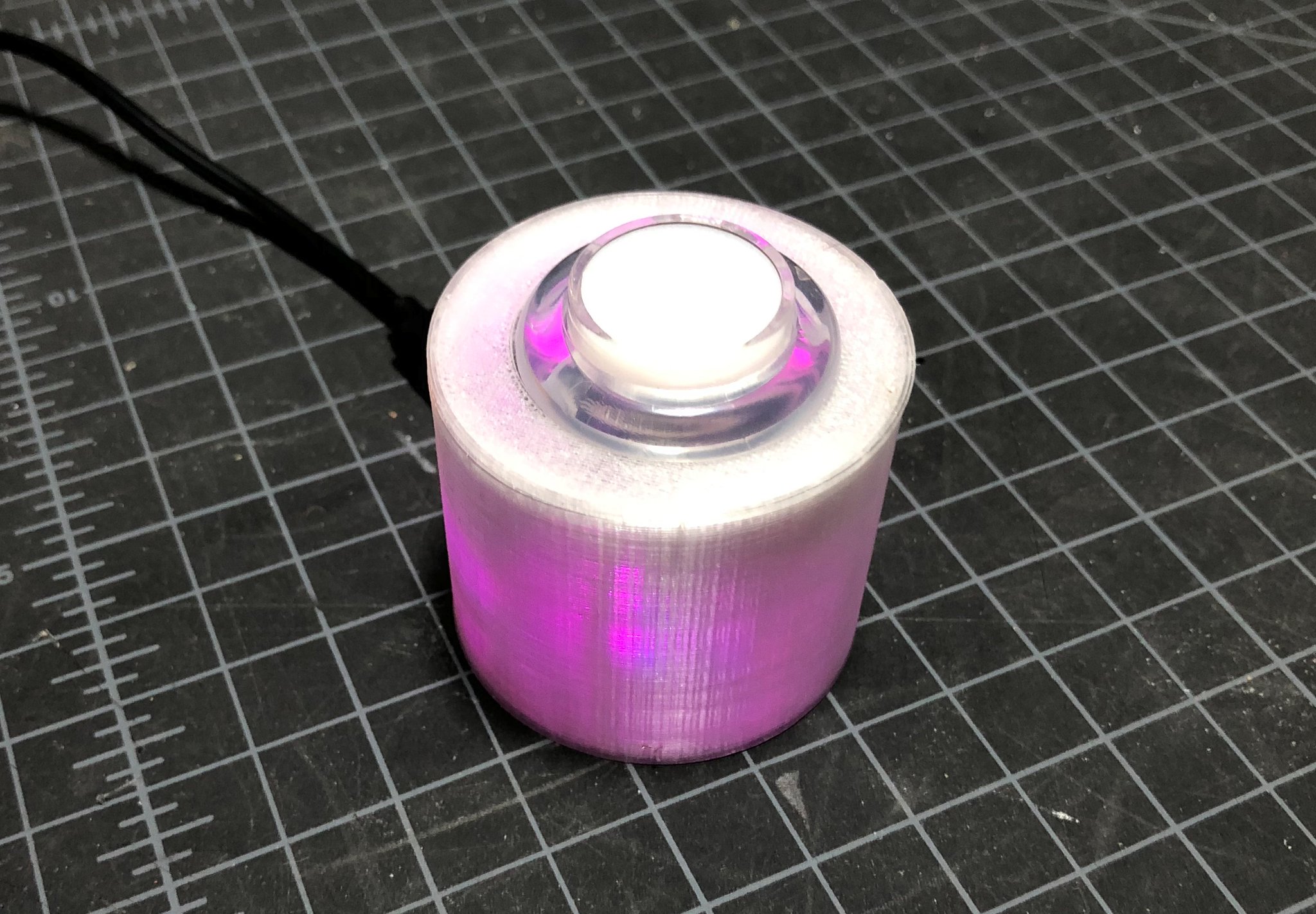 Twitter
·
ionic elk
Twitter
·
ionic elk
Just from the mental image of Brent having his boards in a pile in his closet, which is the case for my desk, does anyone have good sorting solutions for dev boards in general?
prime flower
@ionic elk fortunately my boards are very well organized and fully labelled
thorny jay
🦃
prime flower
https://www.adafruit.com/product/1149 I am a big fan of the double sided tote box and labelling them.
gilded cradle
Sounds like a good MagTag project
ionic elk
I should pick some of those up
modern wing
@ionic elk HakkoUSA has some wicked good clearance sales on AntiStatic bags (100 for ~$1.50). Them along with Sterlite containers from your local big box stores is my strategy.
And colored electrical tape + sharpie marker on the containers for labeling.
ionic elk
My boards are all generally pretty small (featherwing size) but I need rapid access to them since I use them so often
where do you get the boxes, amazon?
prime flower
https://www.adafruit.com/product/2938 < and these for sensors, I have one for each "type" of sensor (humid, temp)
studybudy microbit app is interesting
onyx hinge

GitHub
An IoT Trivia app that shows you how to take a JSON web API such as the opentdb.com API and stream and display it on a FeatherS2 in an OLED display. - mytechnotalent/CircuitPython_IoT_Trivia
idle owl
It turns out the boards are really hard to bork with static. I've been putting ESD foam in the bottom of containers, but I was told it's not necessary.
ionic elk
I didn't realize Adafruit had so many of these boxes, I should just pick up some from them
 balmy stirrup
GitHub
The micro:bit Study Buddy is a micro:bit Electronic Educational Engagement Tool designed to help students learn a new classroom subject with the assistance of a micro:bit TED (Talking Educational D...
prime flower
thanks!
onyx hinge
portal library unification & substantial harmonization (PLUSH)
modern wing
@idle owl Yeah, most of the boards we work with need a lot of effort to zap. But I've had antistatic prevention workflows hammered into me for work, so it feels....weird to not be wearing a strap or work on a mat.
idle owl
@modern wing Yeah it's weird tossing a board into a plastic container. I still put the foam in with them.
Or had been. I have a bunch of new containers, but no new foam. So...
onyx hinge
2   "Feather MIMXRT1011"
2   "SparkFun Qwiic Micro"```
These three seem to each have evil twinswe could (in theory anyway) add a check to the CI to make sure all these strings are distinct
old smelt
Thanks! Have a great week!
balmy stirrup
Thanks!
thorny jay
Thanks
onyx hinge
true story??
solar whale
yes
onyx hinge
wow 🙂
idle owl
@gilded cradle Ok... So I managed to get text displaying. And instead of trying to figure out how to align a background image, I changed the image so the core of it is on the right. However. Is there a way to have separate text elements of different sizes? I'm trying two add_text and set_text but it displays them sequentially, not at the same time.
@solar whale I have Yubikeys for everything, works on GitHub as well.
@gilded cradle e.g. I want a line that's scaled to 2 like a title of sorts, and then the rest of the lines are normal sized.
Right now, the only way to get separate lines is adding \n in my string. As far as I can tell.
modern wing
@solar whale @idle owl There's a sale currently for Yubikeys direct from the manufacturer: https://slickdeals.net/f/14588965-yubico-black-friday-savings-any-2-yubikey-5-series-20-off-or-yubikey-security-nfc-50-off-at-13-50?src=SiteSearchV2Algo1

Slickdeals
Yubico has its Security Key NFC on sale for $13.50. Shipping is $4 or shipping is free with the purchase of 2 keys. Thanks august_leo
Yubico is also offering $20 Off when you purchase T ...
gilded cradle
@idle owl I'm not quite sure what you're referring to when you say it displays them sequentially
idle owl
@gilded cradle It displays the first line, then refreshes and displays the second line where the first one was. Even though I have it set to put the second line further down.
sequentially as in sequence in time. One after the other.
gilded cradle
You have different text_position values?
idle owl
Yes.
gilded cradle
Could you send me your code so I can see what it looks like? I'm wondering if it's a bug.
idle owl
Sure. Hold on.
gilded cradle
In the library I mean
idle owl
Right
@gilded cradle Current working code.
Comment out the image or I can send it to you for the code to run.
gilded cradle
I'm going to try running the label code.
idle owl
Right I figured. Simply reminding you there's a background image in the code.
gilded cradle
Oh, You need to pass an index to the second set_text to tell it to update the right one
idle owl
How does an index work?
gilded cradle
I need to do some restructuring so you can pass initial text and that will make it easier.
Oh, first one is assigned 0 (default value), then 1, etc.
So you give the index as the second variable in set_text
So, pass a 1 in the second set_text
idle owl
Ok trying that now
gilded cradle
magtag.set_text("Button A: Holiday Color Cycle\nButton B: Sparkle"
                "\nButton C: Comet\nButton D: LEDs off", 1)
Ok, cool
gilded cradle
You're welcome. Sorry it wasn't so straightforward.
idle owl
No worries, this is how APIs evolve.
gilded cradle
yep 🙂
tulip sleet
@gilded cradle @idle owl How about if magtag.add_text returned the index, so you don't have to count:
TEXT_A = magtag.add_text(...)
magtag.set_text(..., TEXT_A)
@tulip sleet there's a PR in for that, but it just needs to be run through black
slender iron
Here is the notes document for Monday’s CircuitPython Weekly meeting. It is at the normal time of 11am Pacific / 2pm Eastern here on Discord. Everyone is encouraged to attend! Please add your hug reports and status updates even if you’ll be attending the meeting - it’s super helpful! If you are unable to attend but would still like to include updates, feel free to include them in the notes and we’ll read them off during the meeting. Hope to see you there! <@&356864093652516868> https://docs.google.com/document/d/1uYFVByF7eecqYPOPFCLeQt_Bx_3AAErUC_YBZUkLzjY/edit?usp=sharing

Google Docs
CircuitPython Weekly for December 7th, 2020 Welcome to the CircuitPython Weekly meeting notes! Feel free to add your Hug Reports and Status Updates early. During the meeting, we go through them as a round robin sorted by username. If you can’t make the meeting and would still like to participa...
slender iron
slender iron
Here is the notes document for Monday’s CircuitPython Weekly meeting. It is at t...
 crimson ferry
What's the process for library merges to get released?
slender iron
I think any circuitpython librarian can create a new release
once that is done, it gets picked up by the bundle automatically
crimson ferry
The time between merge and release can create issues. Would it be rude to release my own PRs, as long as they were reviewed and merged by someone else? I don't have any library role, but I'm also happy to be a reviewer... mostly test, not so much code review.
lone axle
Someone from the core team could answer more definitively. But I don't think it would be rude at all. I do make releases for my own PRs after they are reviewed and merged by someone else.
slender iron
@crimson ferry we can get you access to do it 🙂
crimson ferry
Thanks!
slender iron
hrm, gotta ask about it first. turns out it costs a little money first
crimson ferry
I don't want to cause any issues, just want to help wherever it's practical
slender iron
np, ladyada is looking into it
 sleek swan
hey quick question; is it possible to play a sound while I change led colors simultaneously?
right now I have to wait until the wav ends before turning leds on
manic glacierBOT

Try connecting with putty. On the board I'm using currently the Saola M1 all i have to do is put in the com port I don't need to put in the baud rate or anything the board figures it out ymmv
gilded cradle
@sleek swan are you referring to the MagTag or a different board?
sleek swan
@gilded cradle circuitplayground express
I dont see how I could this without threading
gilded cradle
Ah, I seem to recall an example that could do this using generators. Let me see if I can find it.
sleek swan
amazing
gilded cradle
I think somebody came up with it at PyCon last year
@sleek swan https://github.com/adafruit/PyCon2019/blob/master/Attendee_Examples/music_and_lights_using_generators.py

GitHub
Quickstart and example code for the PyCon 2019 Circuit Playground Express, sponsored by Digi-Key and Adafruit! - adafruit/PyCon2019
sleek swan
wow that's superb thank you @gilded cradle will try it out right away 😄
gilded cradle
yw, poke around at other examples too
manic glacierBOT
Overall this is looking good! A few comments and suggestions but nothing earth shattering.
Why is the requests library being updated?
I think there is something in wifi/__init__.c you'll want to call instead because there may be other cleanup needed (like closing open sockets.)
I think we should raise an exception here, like sys.exit does, instead of deep sleeping directly. That way the life cycle can be managed in main.
This is good to go except that we need 3767 to go in first so we have the flash space.
slender iron
@onyx hinge isn't 3767 in?
 opal crystal
That was me dismissing the comment with a push.
manic glacierBOT
The last commit eliminates the goto and shortens the code by 4 bytes.
But do take a critical look at it if you want to merge right away, I may be too tired for such things right now. 🙂
onyx hinge
yeah I am feeling confused by the double pointer and the change from *emb = node->next; to emb = &((*emb)->next); .. it seems like one of them must have been wrong
or maybe I am misreading it altogether
opal crystal
The double pointer is so I don’t have to make a special case for the start of thee linked list. What you’re quoting is not a change from one to the other, they are different things.
onyx hinge
I was starting to see that
opal crystal
The first removes a node from the list. The second advances through the list.
opal crystal
Or maybe read old and new code separately rather than reading the diff, the diff looks more confusing than it is.
onyx hinge
that may well be true in this case
it was exactly because the two different operations changed order that I was confused
idle owl
@gilded cradle Is there an easy way using the magtag library to clear the display? I need to photo the build for this project and I'd rather have an empty display for those images. Does calling refresh() with nothing else going on clear it?
Trying that.
Nothing happening, but that doesn't mean that's not what it's supposed to do. I'll comment out all the display code for now to get the images.
That worked. I'll uncomment everything when I'm ready for it.
idle owl
Do I have anything to gain by preloading the font if I'm adding three lines of text at the beginning of my file, before the main loop, and it stays static? There's a preload_font property in the MagTag lib. Wondering if I should be using it. @lone axle You've done a bit with this lib, do you know?
I'm thinking I'm not going to gain much since it's rendered first and stays static. But I honestly have no idea how all of that works.
lone axle
I am not 100% sure either tbh. I think you are right though the gain may not be much in that use case.
I think the effeciency boost shines more if you are changing the text a lot.
lone axle
@idle owl it was pointed out this morning in the help-with channel that this guide page has an instance of the .mpy lib vs. module lib switched around. Im going to fix that in a moment. Just wanted to give someone heads up of the small change. https://learn.adafruit.com/adafruit-airlift-featherwing-esp32-wifi-co-processor-featherwing/circuitpython
idle owl
@lone axle Perfect, thank you!!
manic glacierBOT
I'm not sure how to help. It definitely sounds related to your network setup. Let me know if you'd like tips for debugging it. A start may be repeatedly scanning and seeing how often you don't see your ssid in the list.
@DavePutz What do you think?
@skieast Could you fill us in on where you are at? We'd like to get this fixed this week. Jeff or I can pick up where you left off if needed.
gilded cradle
@idle owl did you get the display clearing figured out?
I think using set_background with a color value is the right way to do it.
manic glacierBOT
This raise a question about unused or never released board...
pIRkey was never released by @ladyada as a product, maybe just in a Top Secret with a few prototype.
This could be the story for PyGamer Advance.Those are ghost board visible on https://circuitpython.org/downloads
If those start to make problem, it is a bit sad.
We'll remove them if they start breaking the build but no need to do any work before that.
The downloads page is sorted by download count so that w...
Looks good to me! Thank you!
@kahveciderin It is not possible with the current code. As deshipu points out, you could have a code.py on an internal filesystem to configure and run off the sd card.
Would you mind rebasing this? I'm a bit worried that the diff includes a lot of extra changes.
If you are uncomfortable with git, then I can do it for you.
This is superseded by #3767 I believe. (If not, I can reopen.)
I don't see the value in showing multiple exceptions for a single error. It gives the impression that more than one thing went wrong. i.e. I think CPython is probably not doing it correctly. I do understand, though, the value of #3696 to get a previous traceback. Would it be worth adding a parameter to mp_obj_print_exception() to indicate that we don't want to clear i.e. when calling supervisor.get_previous_traceback() ? That would involve changing the 15 or so places in the code where mp_obj...
@gregdavill I'm going to close this because I believe there are orangecrab and fomu conflicts still. Please either comment or make a new PR when ready.
We're closing this for now because getting the dev kit going requires understanding hyperflash config. We'll reopen when ready to work on it again or create a new PR.
lone sandalBOT
 manic glacierBOT
I don't see any issues. What do you have left to do?
There was one question I asked Dan about an optimization, but otherwise as far as I am aware it is ready (minus the couple conflicts I now see which should be easy to fix).
idle owl
@gilded cradle That makes more sense. I commented out all the code that did anything with the display except for the refresh before the loop, and it cleared it. I figured it was good enough for me to get images.
gilded cradle
ok
idle owl
Thanks for the reply and the suggestion!
manic glacierBOT
That way we have one set we use for all of Adafruit's connected
devices.
It looks fine, but no idea how to test.
.. except for build failures anyway. doxygen needs to be directed away from the newly added md files?
manic glacierBOT
- Remove BrokenPipeError and prefer to return the number of bytes
received. (May be zero.) - Add two minute backup timeout to reduce the chance we hang on
recv accidentally.
manic glacierBOT
Why is the requests library being updated?
The requests library was updated in an upstream merge, but it appeared to me that the commit used was not the merge commit to the library, but the PR commit, which made it not be on the master branch for the library. This updates it to the PR commit.
Changed to RESET_REASON_UNKNOWN for all ports where it's not implemented. RESET_REASON_UNKNOWN came and went a couple of times; I meant to use it.
I changed this to call wifi_reset(), which calls esp_wifi_stop() indirectly. I don't see explicit closing of open sockets, though.
Originally I did do the equivalent of sys.exit(), but there was some issue about distinguishing that exception from normal exit. However, I can make a specific DeepSleep exception so that main knows what's going on. Is that what you had in mind?
ESP32-S2 light sleep is pretty deep in terms of power saving, but allows the program to resume from where it left off. That's why I included it here. But I agree the side effects are significant. I should document what you need to do to really do a light sleep. It looks like if common_hal_wifi_radio_get_enabled(wifi.radio) is what to check about whether wifi is active. Does that sound right to you?
You're right, these disappear. I was copying a similar style from elsewhere (I think microprocessor).
manic glacierBOT
OK. Other chips have various idiosyncratic wakeup mechanisms.
nRF allows an OR'ing of pin DETECT signals (detect low or high). It also has a latch that detects whether the enabled pins were detected, though not necessarily simultaneously. So, e.g., it could wake up when you press buttons 1,2,3, but they don't have to be simultaneous.
SAMD51 has tamper-detect pins with debouncing.
STM is more confusing.
(see above).
I realized today that I need to make sure the filesystem caches are all flushed, etc., so doing it in main.c seems right.
manic glacierBOT
Another possibility is to not have separate wait_until_alarms() and sleep_until_alarms(). Instead, we just have a isngle routine (we have to pick one of the names). If light sleep is possible because wifi is off, etc., then go ahead and do it. Otherwise just wait. There could be a property .light_sleep_possible that would tell you whether you were going to sleep or not, though I'm not sure what the program would do with that if it didn't like the answer.
I was wondering if we should even distinguish between light and deep sleep, because the routine names show what happens (you exit or you just wait). So whichever routine you call, it tries to sleep as deeply as possible, given the constraints of the semanatics for that routine.
 split ocean
@slender iron your speedup on .json fetching rocks! It was taking me about 1:40 to grab a reddit .json w 10 entries in it, now it takes about 20 seconds!
manic glacierBOT
The esp32s2 brings WiFi support and with that the possibility to have a mechanism for OTA updates.
There are two domains for OTA update implementation:
- [ ] User Code Update
- [ ] CircuitPython Update
User Code Update
For this my plan is to expose the circuitpy drive as a network drive.
CircuitPython Update
The plan here is to have the user code handle firmware grabbing and for the flashing part I agree with what @tannewt suggests.
add an esp32s2 specific...
manic glacierBOT
@skieast Could you fill us in on where you are at? We'd like to get this fixed this week. Jeff or I can pick up where you left off if needed.
I thought i was getting somewhere but didnt happen. So not at any state really. I had put it aside for the weekend but will take another look tomorrow.
manic glacierBOT
The same problem occurs with another piece of nodemocu-32-s2.
manic glacierBOT
@60999 Please try to connect with another terminal program, such as putty or Tera Term, as suggested by @dingramax.
I am confused about which board firmware you're using: you say you're using muselab_nanoesp32_s2, but your board is "nodemocu-32-s2", so they don't match. Is it "mocu" or "mcu"? Could you post a pointer to that board? It's possible the pin connections are different.
manic glacierBOT
Naming possibilities:
- Combine
wait_until_alarms()andsleep_until_alarms()into one name or the other, or intotry_to_sleep_until_alarms()(orattempt_sleep_until_alarms()). - Drop the
deepinexit_and_deep_sleep_until_alarms(), and/or addtry_to
The q is whether to try to point out that these routines might not really sleep, or whether to use the word sleep as time.sleep() does, which may not really sleep.
tulip sleet
@slender iron when you're up and available, let's talk about some sleep API naming. tnx
 zealous barn
I did something without thinking it all the way through, and not sure how to recover. I created a code.py file which does "microcontroller.on_next_reset(microcontroller.RunMode.BOOTLOADER)" then "microcontroller.reset()" -- so now this device boots into bootloader, and when ciruitpython is updated via uploading a new UF2 image, it reboots, sees that code.py file, and reboots back to the bootloader mode.
Any ideas on how to erase the SPI flash filesystem from bootloader mode?
manic glacierBOT
Try connecting with putty. On the board I'm using currently the Saola M1 all i have to do is put in the com port I don't need to put in the baud rate or anything the board figures it out ymmv
I used putty to get the same results.
Is the firmware incompatible? It's also an esp32-s2 chip.
@60999 Please try to connect with another terminal program, such as putty or Tera Term, as suggested by @dingramax.
I am confused about which board firmware you're using: you say you're using
muselab_nanoesp32_s2, but your board is "nodemocu-32-s2", so they don't match. Is it "mocu" or "mcu"? Could you post a pointer to that board? It's possible the pin connections are different.
I use esp32 S2 chip esp-12k development board: nodemocu-32-s2, burning Firmware of
muselab_ nanoe...
onyx hinge
@zealous barn the uf2 bootloaders on atmel sam and nrf microcontrollers do not have the capability to interact with the SPI flash.
you could upload a first firmware which does this and returns to the uf2 bootloader, or if it's not important that all the content be erased then you can format the filesystem from within circuitpython.
manic glacierBOT


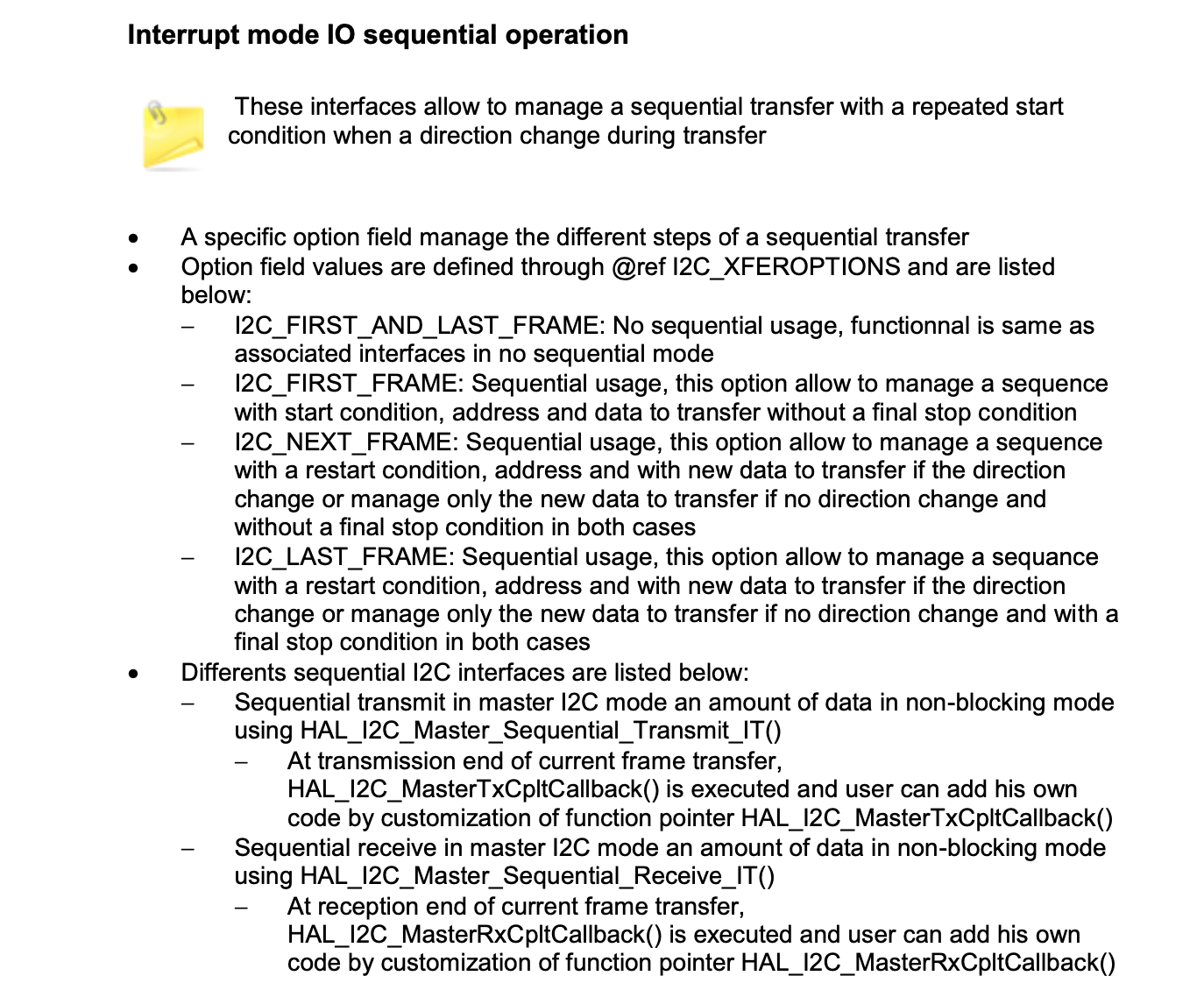
 solar whale
@zealous barn If you r board is one of these, you can erase the File system by loading one of these .uf2 files https://learn.adafruit.com/welcome-to-circuitpython/troubleshooting#old-way-for-the-circuit-playground-express-feather-m0-express-and-metro-m0-express-2978458-27
zealous barn
Unfortunately, not one of those boards (it's my own Programmable USB Hub -- ironically, I'm working on a tool to make it easier for end-users to upgrade Circuitpython and my firmware).
zealous barn
onyx hinge
you could upload a first firmware which does this and returns to the uf2 bootloa...
How would I do that, I'm in a infinite loop of bootloader mode - I can't get to circuitpython
Maybe my best bet is to build a custom "erase" UF2
solar whale
@zealous barn I have not done this in awhile but I think you can just modify this line to for it to recreate the Files system https://github.com/adafruit/circuitpython/blob/main/supervisor/shared/filesystem.c#L96
zealous barn
solar whale
<@!577892380871491617> I have not done this in awhile but I think you can just m...
Thanks for the pointer! Change the call in main.c to "filesystem_init(safe_mode == NO_SAFE_MODE, true);" and I now have a erase UF2 for my board. Thanks so much!
slender iron
split ocean
<@!252717193496756235> your speedup on .json fetching rocks! It was taking me ab...
Great!
slender iron
tulip sleet
<@252717193496756235> when you're up and available, let's talk about some sleep ...
I'm up now if you want to chat
@zealous barn you can also click reset when the status neopixel is yellow to enter safe mode
zealous barn
slender iron
<@!577892380871491617> you can also click reset when the status neopixel is yell...
I tried that, but couldn't get the timing right (and my board doesn't have a neopixel to help with knowing when)
The custom erase UF2 was easy to create and does the trick
slender iron
you could do an always safe mode version of circuitpython too
that way you wouldn't lose the filesystem
zealous barn
Would you suggest USER_SAFE_MODE, or some other flag?
zealous barn
Thanks
slender iron
np
manic glacierBOT
We won't be supporting the C3 because the USB device is a built in USB to UART and JTAG converter. It isn't a generic USB device peripheral. Sorry! Let Espressif know you'd like a full USB peripheral.
 river quest
Now that we have DEEP SLEEP for CircuitPython, it means we get cute Blinka art with a sleepy snake 🙂
slender iron
@onyx hinge you looking at S2 I2C problems?
manic glacierBOT
#3696 and #3454 could be helpful for user code updates. That way you don't need to overwrite the current, known good file.
Could we prevent the duplicate traceback in a different way? We could clear the traceback before computing it a second time.
I think it's fine as is. 4 bytes isn't worth it.
Thanks! I replied to that comment. I think it's ready to go once it's updated.
manic glacierBOT
Thanks for the continued work on deep sleep api. 👍
I will start running tests on my microS2... will be monitoring the deep sleep current as well... I think we will have the least current consumption in timer alarms as every other type of alarm requires more RTC peripherals to be on.
Looking forward to adding Touch and ULP based alarms as well... :)
manic glacierBOT
It looks fine, but no idea how to test.
onyx hinge
@slender iron yeah I can give you an update after we finish cooking
slender iron
kk, no rush. I can test your I2S PR
fyi micro bit v2s are in the store: https://www.adafruit.com/product/4781

Meet the new BBC micro:bit v2 - Upgraded with a powerful new processor that has tons more capability and also adds more sensing with a new speaker and microphone!The latest micro:bit will ...
onyx hinge
@slender iron OK I'm around now
slender iron
k, me too
onyx hinge
What I think I've learned is, the micro is running but USB has failed or frozen. I believe that because I put a "show a rainbow on the neopixel" in my program, and I see it loop
slender iron
huh, interesting. I just had an opposite freeze. cp stopped but usb responding
onyx hinge
https://gist.github.com/3c1c89ec2e0c5a18f4f7550d4eb0c2dc is my test code, running on a kaluga

I made some changes that made it better, but not fixed, and not good changes...
.. in mp_hal_stdin_rx_chr I added +vTaskDelay(1); and the necessary headers
in the debugger I can't figure out how to step through the USB task to understand what it's doing at this time
slender iron
you are more advanced with the debugger than I am
I'm trying to add a thing now that will spit out a backtrace whenever a ctrl-c is done over the usb serial
onyx hinge
hm this is a different crash profile ... this one was due to writing code.py, and on the next reset I had a freshly formatted filesystem.
slender iron
we've definitely seen that
kattni filed an issue for it
yielding when erasing flash sounds like a bad idea
since code is loaded from flash
manic glacierBOT
I just had an event like this. Host is Linux. I had written out code.py and the last thing on the console was
Press any key to enter the REPL. Use CTRL-D to reload.soft reboot

Auto-reload is on. Simply save files over USB to run them or enter REPL to disable.
code.py output:
Traceback (most recent call last):
  File "code.py", line 29
SyntaxError: invalid syntax
The full backtrace of all threads in gdb said this
Thread 7 (Thread 1073734432):
#0 0x400324cd in xQueu...4096 is the size of the flash block in esp32s2?
slender iron
it's the block size of external flash
onyx hinge
oh of external flash of course
onyx hinge
{
#ifdef CONFIG_SPI_FLASH_YIELD_DURING_ERASE
    vTaskDelay(CONFIG_SPI_FLASH_ERASE_YIELD_TICKS);
#endif
}
``` From the function signature it looks like spi_flash_os_yield should be in IRAM? Is 0x4002b038 an address in IRAM?I don't remember off the top of my head
onyx hinge
looks like yes it is
starting at 0x4008_0000 is external, 0x4000_0000..0x4007_1fff are internal.
onyx hinge
it must be, the function disassembles to a call to vTaskDelay
slender iron
disabling it probably messes up usb when erasing
are any of the other tasks not in IRAM?
onyx hinge
        bool "Enables yield operation during flash erase"
        default y
        help
            This allows to yield the CPUs between erase commands.
            Prevents starvation of other tasks.
yeah several are
slender iron
that could be the issue
onyx hinge
including the main circuitpython thread which was executing (I was getting error flashes on the neopixel)
but maybe it was within a cache? who knows.
onyx hinge
spi_flash_os_yeield is within usb_device_task so I think that USB can't continue operating until the write completes
I thought there was some code where the actual write was delayed a bit .. must not be?
manic glacierBOT
slender iron
that's what was confusing me
onyx hinge
OK