#circuitpython-dev
1 messages · Page 91 of 1
 manic glacierBOT
 manic glacierBOT
I'm going to close this, given all the work on SD card mounting and presentation in the last few releases before 10.0.0 final. Please re-report if you find strangeness.
manic glacierBOT
manic glacierBOT

first of all thanks for rapid response @dhalbert
you suggestion work fine
Goal
Disable SPIM3 on a custom nRF52840 board and reclaim the 8 KB SPIM3_RAM reservation so that APP_RAM increases from 192 KB → 200 KB (more Python heap).
Environment
- Repo:
adafruit/circuitpython(current main) - Port:
ports/nordic - Board:
sensera2(custom) - Bootloader: Adafruit nRF52 Bootloader on Raytac MDBT50Q (copied UF2 to
MDBT50QBOOT) - Build host: Linux (Ubuntu-like)
...
 vernal sage
Just a heads up I think I had the build_memory_info.py wrong for the PSRAM for the C61, should be 32MB and not the 2MB for the board. The C5 branch has it correctly for that variant

 tulip sleet
@slender iron I am working on https://github.com/adafruit/circuitpython/issues/10657, which may merit a 10.0.1 in a day or two, since the read/write ability is not what we promised. Also will see if there's anything else worth fixing fast.
 slender iron
vernal sage
Just a heads up I think I had the build_memory_info.py wrong for the PSRAM for t...
slender iron
vernal sage
Just a heads up I think I had the build_memory_info.py wrong for the PSRAM for t...
ok thanks! I'll have you review the PR when it is ready. (I'm out for a week starting tomorrow)
tulip sleet
trouble was if you set the blockdev write operation to MP_OBJ_NULL, nobody is going to be able to write it.
I'll get Tim to review.
slender iron
I can look later today too
manic glacierBOT

allow phase and polarity to be changed after the SPIDevice has been created.
Something like this is required for the latest approach taken in: https://github.com/adafruit/Adafruit_CircuitPython_SPA06_003/pull/1
If this causes builds to overflow, the added code could be shrunk a little by making a single configure() function that accepts both phase and polarity instead of two separate properties.
 fluid hull
I have been meaning to ask this for a while, with regards to bluetooth LE in CircuitPython, I am trying to set some very specific advertising data directly with a byte array and am having the hardest time converting some code that worked fine in arduino using the bluefruit library. Both cases are on an nRF52840 Express Feather.
On the circuitpython side, the low level _BLEIO API mentions anything over 31 bytes automatically becomes extended advertising and the high level adafruit_ble library just says 31 bytes max on advertising data. The trouble I have is that I need to advertise a Complete local name (0x09), a Shortened local name (0x08), a 0x01 flag of 0x06, a tx power level (0x0A), A connection interval range(0x12) and The part that I cannot figure out how to do in circuit python at all a custom complete list of 128bit service class UUIDs (0x07) that is 16 bytes long. for a total of 52 bytes.
I cant even figure out how to set the 0x07 via the library.
On the arduino bluefruit library I was able to set everyting at once win a byte array and used Bluefruit.Advertising.setData(ADV_DATA, sizeof(ADV_DATA)) to set the most of this all at once.
I was still hitting the 31byte size limit so I was able to half bake my solution by excluding the full name
for setting the 0x07 I figure I need to use somthing in the adafruit_ble.advertising.standard portion of the libray but I am starting to get lost in the docs
manic glacierBOT
- Fixes #10657.
#10648 mistakenly prevented USB writes all the time. Fixing it was more complicated than one might think
- The old way of doing
self->blockdev.writeblocks[0] = MP_OBJ_NULL;turns off write for everyone, and is not a good way of setting read-only for host but not CircuitPython or vice-versa. So use theblockdevMP_BLOCKDEV_FLAGs exclusively. viafilesystem_is_writable_by_python()and ``filesystem_is_writable_by_usb(). - The above change caused
boot_out.txtnot to...
fluid hull
^ @lone axle or @tulip sleet I'm pretty sure I'm stuck without either of you. In short, is there any way I can set a specific 16 byte (in byte array) advertising packet component of type 0x07 with some equivalent command to arduino bluefruit's Bluefruit.Advertising.setData() command
tulip sleet
fluid hull
^ <@382939733107408897> or <@329766224093249548> I'm pretty sure I'm stuck witho...
i am looking at the code now...
fluid hull
appreciate it, i just wanted to post the short version since I managed to think out my problem by explaining it the long way first 😅
I have actually been stuck on this for years but only now am trying to do it all in circuitpython, and Ideally get the full deal 51 bytes of advertisement out at once.
tulip sleet
BLE extended advertising
manic glacierBOT
The current C implementation of SPIDevice doesn't provide these properties, and the current Python implementation makes them public properties (.phase and .polarity) but setting them does nothing after instantiation, since they're just attributes.
Since you can call spi_device.spi.configure() yourself already, is that good enough?
[adafruit/circuitpython] New comment on pull request #10658: mutable polarity and phase on SPIDevice
Since you can call spi_device.spi.configure() yourself already, is that good enough?
This doesn't seem to be possible currently:
Traceback (most recent call last):
  File "code.py", line 65, in <module>
  File "/lib/adafruit_spa06_003.py", line 393, in __init__
  File "/lib/adafruit_spa06_003.py", line 453, in _configure_spi_device
AttributeError: 'SPIDevice' object has no attribute 'spi'
But making spi_device.spi property available would solve my problem as well since ...
[adafruit/circuitpython] New comment on pull request #10658: mutable polarity and phase on SPIDevice
But making
spi_device.spiproperty available would solve my problem as well since I could then call configure() on it.
That property is available in the Python version, so I mistakenly thought it was already available in the C version too.
Maybe the phase and polarity should not be available as non-underscore names in the Python library.
I am inclined to say that is the easiest choice. Otherwise we are just reflecting all the SPI properties in SPIDevice.
manic glacierBOT
[adafruit/circuitpython] New comment on pull request #10658: mutable polarity and phase on SPIDevice
So we need native SPIDevice to allow access to .spi?
[adafruit/circuitpython] New comment on pull request #10658: mutable polarity and phase on SPIDevice
@tannewt yep, that is my understanding. Will update this PR with that.
Looks good to me. Thank you!
[adafruit/circuitpython] New comment on pull request #10658: mutable polarity and phase on SPIDevice
I guess a significant issue is that it violates locking, since now anyone holding the SPIDevice can change it while someone else is using it, like a display.
[adafruit/circuitpython] New comment on pull request #10658: mutable polarity and phase on SPIDevice
Not true with the properties because when entering the context spi.configure() is called. Exposing spi doesn't really help you because spidevice will call configure() again. We could change make the accessor do it but that doesn't make much sense to me either because other non-registered devices lose the auto-configure.
I think the properties are the right way to go because spidevice can still manage the configure.
[adafruit/circuitpython] New comment on pull request #10658: mutable polarity and phase on SPIDevice
Exposing spi doesn't really help you because spidevice will call configure() again.
I didn't realize it called it again.
Oh, well, never mind, I am wrong. Though the C code is wordy, I think the additional compiled code is actually quite small, because everything is just fetches, and assignments, and the QSTR's exist already.
slender iron
@lone axle @tulip sleet does it make more sense to add factory class functions? SPA06_003.overI2C() and SPA06_003.overSPI() that inits the device and then calls the constructor?
waiting for the spidevice accessors to land in the core is gonna be a pain
tulip sleet
is it an issue you might want to use an existing SPI?
 lone axle
those functions would accept the bus right? either I2C or SPI, and cs object for the SPI one?
tulip sleet
i am afk in 10 mins
slender iron
lone axle
those functions would accept the bus right? either I2C or SPI, and cs object for...
right, they'd be like the existing I2C or SPI specific constructors
but only have the relevant kwargs and defaults
So, for SPI you'd still pass in the bus and cs but not the polarity and phase
lone axle
Okay, yeah I think that sounds good.
tulip sleet
and the SPIDevice would be available as an attribute? Or used automatically (you don't need to handle it yourself)?
(I am not following the register stuff)
lone axle
My understanding is SPIDevice would get created inside of overSPI() and then passed to the constructor. In the constructor it will create the register_accessor from it which will then use the spi_device automatically internally. The user won't have to handle it at all. The object would technically still be available at something like spa.register_accessor.device but I can't think of a reason any code outside the driver would really need to access it.
slender iron
lone axle
My understanding is SPIDevice would get created inside of `overSPI()` and then p...
Yup! Better names welcome. I thought about just .I2C() but that may imply a new object type
manic glacierBOT
[adafruit/circuitpython] New comment on pull request #10658: mutable polarity and phase on SPIDevice
closing this based on further discussion in discord.
slender iron
I think I fixed the C6 on idf 5.5.1
just pushed to my branch and will double check it next thursday when I'm back. 👋
manic glacierBOT

CircuitPython version and board name
circuitpython-stubs 10.0.0 on macos 26.
Code/REPL
N/A
Behavior
N/A
Description
Just updated to python 3.14 and got the following error:
❯ uv run circuitpython_setboard feather_m4_can

Traceback (most recent call last):
  File ".venv/bin/circuitpython_setboard", line 4, in
    from circuitpython_setboard import set_board
File ".venv/lib/python3.14/site-packages/circuitpython_setboard/__init__.py", l...From the 3.14 release notes:
importlib.abc
Remove deprecated importlib.abc classes:ResourceReader (use TraversableResources)
Traversable (use Traversable)
TraversableResources (use ...
manic glacierBOT
from @bablokb:
I usually loop on
display.busy, but it turns out that there are displays where you cannot trust the busy-pin.Fixing this in the alarm-module wont help in my use-case. I would prefer to have an option that makes
display.refresh()synchronous.
@bablokb What else could display.refresh() do to check that the refresh is not yet done, if the busy pin is not reliable? Is it not reliable because the refresh may write multiple times to the display?
 nimble sparrow
manic glacier
nimble sparrow
manic glacier
Hmmm. I'm getting some really weird behaviour off of this
Just trying to figure out if it's something silly in user code...
tulip sleet
nimble sparrow
Hmmm. I'm getting some really weird behaviour off of this
are you using the PR1059 build? Let me know or post in the PR or open a new issue
tulip sleet
See test program inhttps://discord.com/channels/327254708534116352/1424778936914673766
lone axle
Just noticed the search on the downloads page seems to associate a weirdly large amount of boards with the string fruit j. Adding an a does narrow the list substantially as does searching jam without fruit.

I would have thought it was finding "adafruit" somewhere on the ones it's returning but many are 3rd party and don't seem to mention that in any relevant fields, though I'm not certain what all it searches.
manic glacierBOT

Problems with the busy-pin have been observed with some of the Pimoroni Inky-Impression displays. These displays are made for the Pi, but also work with any MCU (they basically use SPI). The only thing you can do here is wait.
The Pimoroni Inky-Frames have a different problem: here the busy pin is attached to a 74HC165D shift-register (parallel in, serial out). CircuitPython core cannot handle this case, but you can loop from the python-code. The core could only wait.
manic glacierBOT
The only thing you can do here is wait.
I am not sure what you mean here. Do you mean waiting for some "sufficient" time interval?
manic glacierBOT
Exactly: don't pass a busy_pin to make display.busy wait.
manic glacierBOT

Forgive me if this is a silly question, but does this enable USB Host support, or does it still require the usb_host module?
manic glacierBOT
- Fixes #10660 (@alec-bike)
from importlib.abc import Traversable
was made available as
from importlib.resources.abc import Traversable
in Python 3.11. The old location was deprecated with a warning in 3.13 and removed in 3.14. We support back to 3.9, so try to import in both places.
tulip sleet
@lone axle I will do a 10.0.1 release today to fix a regression (can't write to /sd from the host via USB). Above PR (circuitpy_setboard 10661) is not vital, but I'll include it if you have time to review. Anything else you might want in 10.0.1 (any frozen libraries that were updated)?
lone axle
tulip sleet
<@382939733107408897> I will do a 10.0.1 release today to fix a regression (can'...
Sounds good, I will take a look at that one in a moment. I am also going to submit a minor docs fix for a TileGrid x TilePaletteMapper thing. Not vital either but just noticed it.
tulip sleet
happy to include that too
lone axle
I don't think any frozen libraries have been updated.
manic glacierBOT
This makes the docs and stubs accept TilePaletteMapper as a type for pixel_shader on TileGrid as it is supported for that.
Thanks for the fix!
Looks good to me and tested successfully.
 turbid radish
Argh, the code in this PyPortal guide broke, likely in past PortalBase & PyPortal refactoring. The code looks ok if you comment out the QR lines as they are not working. The debug output shows proper JSON reading but it appears to be trying to post the JSON string and not the JSON fields to the display https://learn.adafruit.com/electronic-history-of-the-day-with-pyportal - is anyone familiar with such?


Learn one electronic/science fact every day!
 tulip sleet
turbid radish
Argh, the code in this PyPortal guide broke, likely in past PortalBase & PyPorta...
tulip sleet
turbid radish
Argh, the code in this PyPortal guide broke, likely in past PortalBase & PyPorta...
I am not familiar with this at all but would check whether, in pyportal.show_QR(bytearray(response[5]), qr_size=3, x=220, y=10), the desired field is really at [5] or not.
turbid radish
Yes, if I change the "bytearray(response[5])" to response[5] the qr code works. That bug is easy. It's the opaqueness of PyPortal that somehow changed after the guide came out
The JSON fields are not being printed out anymore, just 50 characters of the JSON text
tulip sleet
turbid radish
The JSON fields are not being printed out anymore, just 50 characters of the JSO...
taking a look... [also I will get you a newsletter blurb after I release 10.0.1]
 orchid basinBOT

Automated website update for release 10.0.1 by Blinka.
New boards:
- m5stack_dinmeter
 fiery pecan
turbid radish
The JSON fields are not being printed out anymore, just 50 characters of the JSO...
fiery pecan
turbid radish
The JSON fields are not being printed out anymore, just 50 characters of the JSO...
I've ported the code to Fruit Jam OS and found a fix for that issue. Namely, you have to force the HTTP Content-Type header of the JSON data files to be application/json. I've attached the now-working code.
fiery pecan
tulip sleet
taking a look... [also I will get you a newsletter blurb after I release 10.0.1]
Unless you already figured it out, 👆
tulip sleet
fiery pecan
Unless you already figured it out, 👆
No, I was eating. Thank you! @turbid radish
@turbid radish updated PyPortal version:
fiery pecan
tulip sleet
<@378006884122361856> updated PyPortal version:
BTW, one of the comments within that file, that I've copied below, is only relevant for my Fruit Jam OS port in particular:
# originally `pyportal.get_local_time()`
thanks - I thought I had deleted the comment but I forgot to save the change. Revised version
turbid radish
Thanks folks!
manic glacierBOT

Forgive me if this is a silly question, but does this enable USB Host support, or does it still require the
usb_hostmodule?
This PR is about adding better support for USB serial devices when they are connected to the USB host port of a CircuitPython board with USB host capability. The existing way of doing USB host stuff is to use the usb module, which mostly follows the PyUSB API. There are also some higher ...
manic glacierBOT
Somewhere between 9.2.4 and 9.2.5 some 32GB SD cards started failing with OSError: can't set 512 block size. I can reproduce this with a Micro Center card I have on PyPortal.
Test program:
import board
import sdcardio
import storage
import time

spi = board.SPI()
cs = board.SD_CS

print("mounting sd card...")
sdcard = sdcardio.SDCard(spi, cs)
vfs = storage.VfsFat(sdcard)
storage.mount(vfs, "/sd")
print("sd card mounted")

count = 0
while True:
    print("sleep 1", count)
count +=...CircuitPython 10.0.1 released!
Highlights:
- Fix 10.0.0 regression preventing writing to a filesystem other than CIRCUITPY via USB.
https://blog.adafruit.com/2025/10/09/circuitpython-10-0-1-released/
manic glacierBOT
Bisect shows this is due to
- #9385.
There are changes here:
https://github.com/adafruit/circuitpython/pull/9385/files#diff-89b411ec6aed2fc00953e3e6be4c8f704026b1bfd05d44b5732512fce9ae9f40
and here:
https://github.com/adafruit/samd-peripherals/pull/46
Lots to look at here.
manic glacierBOT
Thank you for the response! I've asked on the Discord and hopefully I'll get a response. I won't derail the thread here, but essentially I'm trying to use a Seeed XIAO ESP32S3 as a USB host to connect to a device that uses serial communication. And I'm having a horrible time trying to figure out how to do it (every time I try to do usb.core.find(find_all=True), I get RuntimeError: No usb host port initialized).
Something like you've proposed here would probably make my life much easie...
 lone sandalBOT
 manic glacierBOT
 manic glacierBOT

PS: I got the 857 keyboard, will start to test with it and post more update
nimble sparrow
Is there much interest in an audiomp3-style static module supporting tracker audio (mod/xm/it/s3m)?
Having gone through the pain of integrating libxmp manually for a separate non-MP/CP esp32 project it turns out taking that and mashing it through Cursor to convert it to a shared module is actually pretty successful. I'm half way through reviewing the code for anything dumb.
manic glacierBOT

I'm using a Seeed Studio XIAO NRF52840 SENSE board that has a LSM6DS IMU on-board.
This IMU is powered from a GPIO pin on the NRF52840 MCU.
I'd like to have the IMU be able to wake the board from deep-sleep using an alarm.pin.PinAlarm.
It works OK for waking from light sleep, but the GPIOs are turned off during deep sleep.
It appears that it is possible to maintain GPIO states (and also to wake from pin changes) during sleep states in this MCU.

Have you verified that you actually get a lower power consumption using deep sleep instead of light sleep?
From my experience you can get down to 2uA in light sleep on nrf boards and deep sleep gives basically no further reduction.
So if light sleep works for you, it might be an option to just use that instead.
orchid basinBOT
adafruit_connection_manager also has this problem on https://circuitpython.org/board/pyportal_titano/
I started looking into this and found the code responsible for the URL is here: https://github.com/adafruit/circuitpython-org/blob/e82ee56d3f7eee57b046f10c35d2e6a6306e9d61/_includes/download/board.html#L186
We might need to have a manual entry for the docs link instead of trying to automatically generate it from the library name. I don't think a "one size fits all" algorithm is going to be ...
manic glacierBOT
A user in discord was not able to use Thonny on PyGamer with recent versions of CircuitPython. Testing showed 10.0.0-alpha.6 works, but alpha.7 does not.
I tested RP2040, ESP32-S2, and nRF52840, so this seems confined to SAMD. They don't have this problem and work fine with 10.0.1. I tested with a clean CIRCUITPY.
orchid basinBOT
An exceptions list with the correct links sounds like the easiest thing. We could check for the proper link dynamically in some cases.
I wonder if connection-manager has the wrong project name in RTD.
manic glacierBOT

LAST_SWCORE_PWRUPdoes not seem reliable even without any debugprobe attached. It always reads2(which is pwrup1 according to the docs), but I am only testing with a single GPIO and I am using pwrup0 which should turn up as1.Also, after a chip reset I see a
1instead of the documented0.
Hi, I am currently implementing the P1.x low power modes from scratch in RISC-V assembly, and am only using the RP2350 datasheet to write this program. I came across this confusion at fir...
I'm getting about 650µA in light-sleep (with BLE connected, flash on, and IMU on), and about 90µA in deep-sleep.
manic glacierBOT
Yes, I totally misunderstood the docs regarding LAST_SWCORE_PWRUP.
My work on this has stalled recently due to other things (and because I was out of ideas), but I will revisit it and check if I do the correct things you are pointing out. From my guts feeling, it still does not explain the random behavior I can see: instant wake up after going to low-power. This happens a few ms after low-power is reached. Ok, this sounds like a wake up from an alarm that wasn't cleared, but the random beh...
manic glacierBOT

I wonder if this is a card size issue - 8 gb micro SD cards seem to work OK - I had two different no-brand cards that were recognized and mounted fine - the name brand Lexar 32gb cards don't work on the PyPortal and Titano although they work find on FruitJam and Metro RP2350.
manic glacierBOT
I haven't re-tested smaller cards on a SAMD board like the PyPortal, but there's something definitely wrong on SAMD in particular.
One other difference between alpha.6 and alpha.7 is that we switched from gcc 13 to gcc 14 in #10386. It's possible this is a compiler problem, or perhaps a missing volatile or similar that only caused a problem due to the compiler switch.
manic glacierBOT
Support for M5Stack Tab5 board
Tab5 is a highly expandable, portable smart-IoT terminal development device for developers, integrating a dual-core architecture and rich hardware resources. The main controller adopts the ESP32-P4 SoC based on the RISC-V architecture, with 16MB Flash and 32MB PSRAM. The wireless module uses the ESP32-C6-MINI-1U, supporting Wi-Fi 6. Its antenna system can freely switch between the built-in 3D antenna and an external MMCX...
orchid basinBOT
This is easy to see/reproduce without the web installer functionality by clicking the "DOWNLOAD BOOTLOADER combined.bin" button at the bottom of the page. It leads to the same looking AWS not found error
manic glacierBOT

@todbot or @RetiredWizard, I know it's a bit of a long shot but is there any chance yous still have the Feather RP2350 FW where CIRCUITPY_DISPLAY_LIMIT is >1?
I was trying to compile my own on W11, but am having issues with the make file D:
orchid basinBOT

Added schematic and source to the end of the page
Since I'm using this board, I decided to add the best and most concise tech resource and info that I've found so far.
Sorry accidentally closed the PR
manic glacierBOT

I know it's a bit of a long shot but is there any chance yous still have the Feather RP2350 FW where CIRCUITPY_DISPLAY_LIMIT is >1?
I believe Scott was targeting 10.x to implement multi-display support using better memory management. I started work on an updated version back in April but quickly realized I was going to need so much hand holding it would have been easier for Scott to do it himself. I'm not 100% sure what state this firmware is in but I was able to get four Fourwire display...
manic glacierBOT
I just published an external C module for micropython that does smooth acceleration/deceleration, though it's STM32-specific currently since it uses the pyb.Timer capabilities. It may be useful for CircuitPython work with some modification. https://github.com/bikeNomad/stepper-driver
manic glacierBOT

I got similar issues due to missing handling of "running status". Could it be the case ?
Hi, I'm experiencing Web Workflow crashes too, on connection.
Adafruit Feather ESP32S3 no PSRAM, CP 10.0.1
Pls let me know if I can help testing something
manic glacierBOT
One other difference between alpha.6 and alpha.7 is that we switched from gcc 13 to gcc 14 in #10386. It's possible this is a compiler problem, or perhaps a missing
volatileor similar that only caused a problem due to the compiler switch. It's easy to test this.
Switching to gcc 13 for 10.0.1 did not help.
manic glacierBOT
I don't know, maybe? I never figured out why missing messages were happening or a better way to reproduce the problem. If you're able to reproduce something similar, it would be interesting to hear more details (hardware, circuitpython version, code, symptoms, etc).
manic glacierBOT
Note to future me: Running status is a MIDI feature where a message can omit the status byte when it would be the same as the status byte of the the previous message. From what I read, early MIDI devices with DIN-5 connections sometimes used this to save bandwidth, but it's perhaps less common for it to be implemented by newer devices that use USB.
I'm pretty sure that my Fruit Jam MIDI tester and synth code didn't consider the possibility of receiving running status messages, and I'm unsure...
manic glacierBOT
After reviewing the relevant MIDI specs, it does seem quite plausible that my USB keyboard controller might have been sending running status messages and that might be the cause of the dropped and stuck notes. I need to figure out a way to test for that.
manic glacierBOT
I'm on a very reproducible situation where I get messages with running status through BLE, and actual midi library cannot handle it transparently. For example I sent a group of CC [BA, 63, 6A, BA, 62, 6B, BA, 6A, 00, BA, 6B, 65, BA, 63, 7F, BA, 62, 7F] [FA]
What I receive is BA 63 6A -- 62 6B -- 6A 00 -- 6B 65 -- 63 7F -- 62 7F FA (-- is where status are omitted).
Should this be on another issue then ?
manic glacierBOT
That does sound like a somewhat different situation since you're using BLE not USB host, but I'm glad you mentioned it here. I'd overlooked running status when reading the specs, and I wouldn't be surprised if that turns out to be the root cause for this issue. When you say "actual midi library", if you mean you're using Adafruit_CircuitPython_MIDI, then that repo might be a better place to report your problem.
manic glacierBOT
@RetiredWizard thanks for that! Can confirm I'm able to get two Adafruit 4383 displays working.
<img width="1821" height="410" alt="Image" src="https://github.com/user-attachments/assets/6c92c6c4-59d3-4e98-a1b5-82dba0215066" />
manic glacierBOT
Added to the Adafruit CircuitPython MIDI repo but it seems not really live. Let's see
manic glacierBOT
Not clear if preserve_dios works properly in fake deep sleep. Also, what happens to pins on wakeup? Looks like they get reset early, and there may be a significant delay before the user can wrest control again, due to possible wifi autoconnect.
manic glacierBOT
After modifying my Fruit Jam portable MIDI synth code and some more careful spec reading:
- USB MIDI packets should be 32-bits, always including a CIN field for status. So, running status shouldn't be a problem here.
- I can eliminate the dropped & stuck notes by increasing the
usb.core.Device.read()timeout. I had been using short timeouts like 3 ms. When I up that to 50 ms or more, the dropped/stuck notes problem goes away, and I can't hear any adverse affect on synthio synthesis or...
 tiny peak
FYI for folks interested in USB MIDI & synthio (cc @devout jolt and @fleet hollow ), I came up with an interesting result today while trying to see if MIDI running status was responsible for the dropped & stuck notes issue with USB host MIDI. Seems like the actual problem was me using an overly short timeout for usb.core.Device.read(). After I upped the timeout to at least 50 ms, I wasn't able to get any more dropped or stuck notes by bashing on my test keyboard. See https://github.com/adafruit/circuitpython/issues/10554#issuecomment-3399500236
originally I had been using a 3 ms timeout because I was reusing code for polling gamepads and HID keyboards (which often give USBTimeoutError) in combination with a displayio animation loop that I was trying to run at a realatively high FPS.
By my ear, using a USB MIDI polling loop with blocking reads on a 50 ms timeout sounds fine. I didn't notice any issues with latency or synthio glitching. Seems like all the background task stuff works fine while read is blocked, apparently?
I suppose using longer timeouts might get you into trouble if you wanted to run a sequencer track alongside of live MIDI input, but otherwise it seems pretty okay.
I'm trying to figure out if it makes sense to just use longer timeouts, perhaps with a documentation change to that effect... or, if maybe there's a need for better MIDI read support in the core.
manic glacierBOT
If anybody wants to try my revised version of the Fruit Jam portable MIDI synth with the dropped & stuck notes fix (longer timeouts), the code is available at: https://github.com/samblenny/fruit-jam-portable-midi-synth/releases/tag/v0.3.0
manic glacierBOT

Also seeing errors on .flush here
manic glacierBOT
I would suggest that you also add alias pin names for the ADCs:
{ MP_ROM_QSTR(MP_QSTR_GP40_A0), MP_ROM_PTR(&pin_GPIO40) },
{ MP_ROM_QSTR(MP_QSTR_GP40), MP_ROM_PTR(&pin_GPIO40) },
{ MP_ROM_QSTR(MP_QSTR_A0), MP_ROM_PTR(&pin_GPIO40) },
and so on for A0-A7. This would make writing portable code easier.
manic glacierBOT
- Fixes #10663
(There may be other issues fixed by this; I need to check.)
Refactoring and additions done in #9385 and https://github.com/adafruit/samd-peripherals/pull/46 to add SAMD51 SPITarget had a bug involving parsing a struct by value. It mostly worked but caused timing problems. My original debugging on this found that adding a short delay fixed the problem (after a Heisenbug print statement made it going away), but I needed to dig deeper as to why.
The main fix is in http...
manic glacierBOT
If CIRCUITPY_SDCARD_USB is enabled on atmel-samd boards, it causes a USB disconnect a few seconds after an SD card is mounted and presented via the second LUN.
This is a bug discovered during #10645, so USB SD card presentation was turned off for atmel-samd.
#10668 seems to fix this problem, so after that is merged, I'll make a separate PR to turn CIRCUITPY_SDCARD_USB back on for atmel-samd.
This also seems to fix #10669 (discovered during #10645), but I'd rather do re-enabling USB SD card presentation in a separate PR in case there is some other issue.
manic glacierBOT

Initial SPITarget tests still showing issues with the data flowing both ways.
manic glacierBOT

I refactored the common-hal/canio/can.c to alloy for use of both CAN controllers in the ESP32C6.
Having purchased the "TOUCH" version of waveshare_esp32_c6 with LCD, I also had to create this new board that uses way different pinouts.
Only tested without filters as I am using it as a CAN-to-CAN bridge.
Listener.c DOES need to be modified to select the proper &TWAI if filters are to be used ( MATCH )
manic glacierBOT
Initial SPITarget tests still showing issues with the data flowing both ways.
So I should test with the #10504 programs? Do you see any difference in behavior? Thanks.
manic glacierBOT
Yes, both sides are M4 running PR artifact. I don't see a difference in behavior, there are patterns to the data, it's not fully random, but I can't discern the pattern. But neither the controller nor target receive what was ostensibly sent.
Target code is like the last comment in 10504, but I added an explicit delay between write and read, and even with BUFLEN = 2 I can't get good data either way.
<details>
<summary>controller code.py.</summary>
import time
import board
...I was in contact with a colleague I believe of Randall-Scharpf on Discord and he started to look into it: #help-with-circuitpython message
DMA is only used for transfers >= 16 bytes, so if you test with shorter transactions, then the DMA code won't be invoked at all.
I had forgotten about #10504, but I wouldn't hold this PR up for to attempt a fix for that in any case: this fixes some higher priority things.
manic glacierBOT
Right, this PR seems to be independent. I did try some transfers > 16 bytes, but no help, so it does seem there is something separate and more fundamental going on with SPITarget.
manic glacierBOT
CircuitPython version and board name
Adafruit CircuitPython 10.0.1 on 2025-10-09; Adafruit MatrixPortal S3 with ESP32S3
Code/REPL
import board
import digitalio
import displayio
import terminalio
import framebufferio
import rgbmatrix
import supervisor
import gifio
import adafruit_ticks

base_width = 64
base_height = 64
bit_depth = 1
chain_across = 1
tile_down = 1

serpentine = True

width = base_width * chain_across
height = base_height * tile_down

displ...In case anyone wants to reproduce using the same gif....
manic glacierBOT

Originally posted on the Adafruit Circuit Python forum, reposting here for the Silabs team.
After some time away from CP I am now trying again with a new development. While I wait for my custom board to come back from fabrication I am starting to get code going with the MGM240P.
First issue...the internal pull-ups or pull-downs don't seem to work. I am using CP 10.0.1. My code is...
Configure temperature sensor alert GPIO (PB1) as an input, with a pull-up
temp_alert = digitalio.Digital...
manic glacierBOT
@Brandon-Hurst Could you help with this? Thanks.
@Silabs-ChatNguyen Could you help with this? Thanks.
 quartz folio
@lone axle Thanks for your repsponse to my feature request a few wekes ago to enhance the .json description in the library bundles. I submitted a PR and just wanted you to know that you can find me here if you want to chat about it. https://github.com/adafruit/circuitpython-build-tools/pull/131
GitHub
Adds the description field from the pypi pyproject.toml metadata to the bundle's json description for each library. If the description is not present, the field will be populated with the ...
manic glacierBOT
This doesn't actually have anything to do with gifio. I was able to recreate the issue by simply reading a binary file and sending output to the matrix panel.
I'm thinking the problem is either related to file I/O or rgbmatrix/framebufferio.
I first created a binary test file:
a = open('test.dat','wb')
for i in range(100000):
    byt = i % 256
    x = a.write(byt.to_bytes(1))
a.close()
And then used the following test program:
import board
import digitalio
import displayio
i...
I can confirm this issue on CircuitPython 10.0.1 on the ESP32-S3 N16. This connection failure occurs (or a subsequent unrecoverable internal error) when trying to connect to a BLE MIDI peripheral.
Since most MIDI devices use a RANDOM_PRIVATE_RESOLVABLE address, this bug effectively prevents reliable BLE MIDI client functionality on the ESP32-S3.
Did anybody have any progress or workarounds? Highly appreciated, thank you! :)
lone axle
quartz folio
<@382939733107408897> Thanks for your repsponse to my feature request a few weke...
Nice thank you! I'm out for a few days, but I'll look into this next week if no one beats me too it.
slender iron
@lone axle @tulip sleet at my laptop now. need anything from me urgently? I'm just getting going
tulip sleet
nothing urgent ; I have a couple of PR's (one is in samd-peripherals)
lone axle
Nothing urgent for me either. Spa06 SPI is ready for another look by you I think, but not urgent
slender iron
will try to breeze through my email
manic glacierBOT

CircuitPython version and board name
Adafruit CircuitPython 10.0.1 on 2025-10-09; Raspberry Pi Pico W with rp2040
Code/REPL
# code.py

import mount_sdcard, basic_wifi_test

******************************************

# mount_sdcard.py
# 08/10/2025

import board, busio, sdcardio, storage, sys

sck = board.GP18
si = board.GP19
so = board.GP16
cs = board.GP17

#  SPI setup for SD card
spi = busio.SPI(sck, si, so)
sdcard = sdcardio.SDCard(spi, cs)
vfs = storage....I don't see any issues with this and just merged in the peripherals changes.
Thanks for these tweaks! I didn't realize the C6 had two TWAI!
reserved_can_instance &= ~(1 << self->instance);
This sets the bit and then ~ inverts them.
Use a loop for this. That way it'll work if a chip with more than 2 comes along. The compiler can unroll if desired.
Guard this based on some defines the IDF provides for the number of TWAI. Otherwise, chips with only 1 instance won't work.
Remove this since it is a new board.
manic glacierBOT
@tannewt All set for final approval. I updated the samd-peripherals commit and re-tested on PyPortal.
It doesn't look like the property accessor is implemented correctly:
https://github.com/adafruit/circuitpython/blob/3d94daa7cdd3563915eaeb93b35480bf531b6e1b/ports/silabs/common-hal/digitalio/DigitalInOut.c#L148-L158
switch_to_input() does look correct:
https://github.com/adafruit/circuitpython/blob/3d94daa7cdd3563915eaeb93b35480bf531b6e1b/ports/silabs/common-hal/digitalio/DigitalInOut.c#L62-L73

The STM32U585 on board the Arduino Uno Q (release date 2025-10-25).
Preliminary port based on:
- https://docs.arduino.cc/resources/schematics/ABX00162-schematics.pdf
- https://www.st.com/resource/en/datasheet/stm32u585ai.pdf
- https://docs.arduino.cc/resources/datasheets/ABX00162-ABX00173-datasheet.pdf
Draft until verification on actual hardware.

CircuitPython version and board name
Feather Reverse TFT ESP32-S3 v10.0.1
Code/REPL
none
Behavior
Opening editor and connecting via USB to see if BLE mode is on from REPL header, but similarly if too long it disappears offscreen.
Description
If BLE mode is on / header text is too long then abbreviate sections? Take last 2 segments of ip, and middle truncate device id for BLE: Circ..984C, could even abbreciate wifi and BLE to `W: 1.259 | B: ~9...
Thanks for the initial PR!
Don't include every MCU pin in board. They are automatically available in microcontroller.pin. board should only reflect board-specific names (aka silkscreen) or uses (connected to other things on the board.)
This is relatively minor. The big changes that caused issues was the IDF refactor to support different libcs (newlib or picolibc).
This version has better P4 support and also support C5 and C61.
- Fixes #10669.
Now can be merged since #10668 was merged.
Tested on PyPortal on Linux and Windows. No longer disconnects when code.py mounts the SD card and it is presented via USB.

CircuitPython version and board name
Adafruit CircuitPython 10.0.1 on 2025-10-09; Adafruit Camera with ESP32S3
Code/REPL
import os
import time
import ssl
import binascii
import digitalio
import adafruit_pycamera
import board
import wifi
import socketpool
import adafruit_requests
from adafruit_io.adafruit_io import IO_HTTP, AdafruitIO_RequestError

aio_username = os.getenv("ADAFRUIT_AIO_USERNAME")
aio_key = os.getenv("ADAFRUIT_AIO_KEY")

print(f"Connecting to...@tulip sleet want to get your fix in, make 10.0.2, branch 10.0.x, merge idf 5.5.1 and release 10.1.0-beta.1?
(assuming the idf 5.5.1 review goes ok)
tulip sleet
slender iron
<@329766224093249548> want to get your fix in, make 10.0.2, branch 10.0.x, merge...
whether to have 5.5.1 in 10.0.x or 10.1.0 was exactly what I was going to ask you. I was going to defer the 5.5.1 merge past 10.0.2. Is there anything else we might do for 10.1? If the beta is good we could do 10.1.0 pretty soon. In the meantime there are possibly significant bugs I would fix and merge in 10.0.x while 10.1.0 is cooking
C6 is fine now?
manic glacierBOT
There are some build failures showing up in non-Espressif (in atmel-samd so far):
../../shared-module/max3421e/Max3421E.c:86:6: error: no previous prototype for 'osal_task_delay' [-Werror=missing-prototypes]
   86 | void osal_task_delay(uint32_t msec) {
I'm not sure about other stuff for 10.1. Maybe dsi displays? Rynn is up now so I'm off
lone sandalBOT
 manic glacierBOT
Does assigning a VID and PID make sense here? By my reading of the UNO Q datasheet (see page 13: 4.2 Block Diagram), it doesn't look like the STM32U585 has access to the USB-C port. It seems the board is set up for Debian running on the Dragonwing MPU to program the STM32 over SWD and do RPC bridge stuff over UART and SPI channels.
tiny peak
Anybody have thoughts on how (if?) it might make sense to go about porting CircuitPython to the UNO Q? The board is set up so the Dragonwing MPU runs Linux and has the direct connection to the USB-C port (including display output if you use a USB-C dock with PD and HDMI). The STM32U585 MCU is wired up to the Arduino header GPIO but not the USB port. It's apparently meant to be programmed over SWD from Linux on the Dragonwing. It also has UART and SPI channels to the Dragonwing. Presumably those are used to implement the Arduino App Lab bridge RPC functionality.
I wonder if it might make sense to run Blinka on the Dragonwing using a newly written Arduino sketch for GPIO access?
manic glacierBOT
I did some version testing on this, with a somewhat reduced version of the given test program. Sometimes just doing a reset, as opposed to a power cycle, will not produce the USB disconnect. So I always unplugged and plugged in the board to test.
9.2.9 does not have the problem.
10.0.0-alpha.5 caused a safe mode on boot up three or four times in a row.
10.0.0-alpha.6 does not have the problem.
10.0.0-alpha.7 usually disconnects, and so do other versions past that one.
A settings.toml with...
manic glacierBOT
Thank you Scott. That worked, so it does appear the issue is with the Silabs CP port. My code has changed to the following, and I verified with a DVM PB1 is pulled up.
Appreciate the support.
# Configure temperature sensor alert GPIO (PB1) as an input, with a pull-up
temp_alert = digitalio.DigitalInOut(board.PB1)
temp_alert.switch_to_input(pull=digitalio.Pull.UP)

Yes, I will add them, just trying to get PID for now.
tulip sleet
tiny peak
Anybody have thoughts on how (if?) it might make sense to go about porting Circu...
I think it will take a bit of time for the ecosystem to evolve. There may also be alternative ecosystems that one could build on. Consider the philhower Arduino RP2xxx core, for instance, which is totally independent of official Arduino. There may be alternative RPC impls, for instance. I don't think we have to be first here.
orchid basinBOT
Automated website update for release 10.0.2 by Blinka.
 devout jolt
tiny peak
FYI for folks interested in USB MIDI & synthio (cc <@352910176736772096> and <@5...
devout jolt
tiny peak
FYI for folks interested in USB MIDI & synthio (cc <@352910176736772096> and <@5...
Interesting, thanks! I forget, is usb.core.Device.read() async compatible so that other tasks run during the timeout? (this is something I can test and answer for myself when I get back to my gear, but if anyone knows...). Because then that would obviate the need for a short timeout
devout jolt
tiny peak
I'm trying to figure out if it makes sense to just use longer timeouts, perhaps ...
I've been pondering if there's a way to add a "MIDI driver" to the core, because responding to MIDI clock in a timely fashion is basically impossible in the interpreter and it's easy for DAWs like Ableton to spew so many MIDI CCs as to flood the input read buffer. Plus it'd be nice to have a fast place in the core for the state machine needed for reconstructing MIDI mesages (e.g. handling running status, sysex, per-message variable-length reads, etc) and maybe message filtering to reduce interpreter code load
slender iron
devout jolt
I've been pondering if there's a way to add a "MIDI driver" to the core, because...
I think this would be great! I suggested modeling the API based on how you'd do it in CPython but I'm not sure folks do MIDI in CPython.
slender iron
tiny peak
Anybody have thoughts on how (if?) it might make sense to go about porting Circu...
I don't think it is worth it. It isn't even out yet and we don't know how popular it will be.
tulip sleet
@slender iron I made a 10.0.2 but all the espressif builds failed when fetching requirements (cryptography in particular but that may just be the first one). Only difference I can see is that Python 3.13.8 was the version used. The last release used 3.13.7. There was an emergency fix for a particular decorator thing and 3.13.9 was released a few days ago, but not sure it is related.
I can't find other people who have suffered from this problem yet.
slender iron
hrmm. I had to cap the cryptography version in my idf update
tulip sleet
it's saying it can't find a usable cryptography version. I wonder if the GitHub Actions infrastructure has some version skew in it
slender iron
it could be that the cache key of deps changed
tulip sleet
also 3.13.9 is not going to be in deadsnakes due to some weirdness in how they tagged it
I was thinking of clearing the caches
we used to have to update the cache key occasionally but I thought we fixed that
slender iron
I bet old builds succeeded because they had old cryptography
clearing won't help. you need to change requirements-dev.txt
tulip sleet
it just says cryptography, with no version restrictions. I think this is an esp-idf-specific requirement
slender iron
right, the esp-idf installs the version it wants and then we upgrade it when installing requirements-dev.txt
tulip sleet
cryptography 46.0.0 came out Sept 16, 46.0.3 was Oct 15
tulip sleet
OH
slender iron
the idf tools cache must have been evicted
tulip sleet
ok, I will make a PR
slender iron
the last green build has a cache hit for the idf tools that the failing build misses
thanks!
another way to fix is to make requirements-dev.txt not update
tulip sleet
do it in the other order, since we may need some stuff it installs that is not part of the ESP-IDF-installed Python stuff?
I think I will not try that now; could be a rathole
manic glacierBOT
thanks for the feedback. I'll remove those and add board related signals as well.
I wonder what is available on multiple headers on the bottom, or are those only the Broadcom chip signals?
cryptography must be < version 45 to be compatible with ESP-IDF, but was attempted to be installed anyway. This broke the 10.0.2 build after an old python modules cache stopped being used.
tulip sleet
@slender iron I have to go out shopping for a bit
slender iron
tulip sleet
do it in the other order, since we may need some stuff it installs that is not p...
don't change order, just make pip not eagerly update the package
manic glacierBOT
manic glacierBOT
orchid basinBOT
Automated website update for release 10.0.3 by Blinka.
tiny peak
devout jolt
Interesting, thanks! I forget, is `usb.core.Device.read()` async compatible so ...
The implementation for usb.core.Device.read() does call RUN_BACKGROUND_TASKS() while it's waiting for a response from TinyUSB. I'm not sure if that counts as a yes to your question or not. For example, in game loops where you might want to update the position or sprite of TileGrid tiles at 30 or 60 fps from a python loop, I'm not sure if blocking on a USB read would mess that up or not. Might also be an issue with audio latency if you wanted to make a synth that merged MIDI input with physical keypress input by captouch or buttons.
tiny peak
devout jolt
I've been pondering if there's a way to add a "MIDI driver" to the core, because...
I actually had some sucess with filtering out MIDI clock messages in Python. The trick is to use a bytearray and memoryview with read() inside of a generator function, then yield the memoryview. In the calling loop, if you use byte comparisons to filter realtime messages rather than using layers of OOP stuff with heap allocated objects, it can run pretty fast. I used that approach successfully to take input from my Arturia BeatStep's sequencer.
This is an example of code for the generator: https://github.com/samblenny/fruit-jam-portable-midi-synth/blob/v0.3.0/sb_usb_midi.py#L111-L134
This is an example of code to filter out realtime messages (by way of ignoring their CIN values): https://github.com/samblenny/fruit-jam-portable-midi-synth/blob/v0.3.0/code.py#L156-L231
manic glacierBOT
The bottom JMEDIA 60-pin header has 1.8V signals for the Dragonwing MIPI camera and display support. The JMISC 60-pin header has line/headset audio plus a mix of 3.3V GPIO from the STM32 and 1.8V GPIO from the Dragonwing.
tulip sleet
CircuitPython 10.0.3 released!
https://blog.adafruit.com/2025/10/17/circuitpython-10-0-3-released/
Highlights of this release
- Fix SPI DMA on
atmel-samdboards, which fixes SD card mounting problems. - Restore SD card USB presentation on
atmel-samdboards. - No changes in this release for non-
atmel-samdboards.
tulip sleet
**All: **there is now a 10.0.x branch, so if you have a bug fix PR, make a PR against 10.0.x. To get this branch into your fork, do git fetch adafruit 10.0.x:10.0.x (assuming adafruit is the name of your remote to adafruit/circuitpython
manic glacierBOT
Well I'm embarrassed, it looks like I ran into this last December but forgot about it https://github.com/adafruit/circuitpython/issues/9854. Looking back at the earlier issue I had submitted it appears that supplying WiFi credentials prevents the problem for occurring which I confirmed with my latest test script.
I've confirmed that again but I did notice that when WiFi credentials were provided in settings.toml, after about the time the display would have stopped updating (10-15 seconds) ,...
I appear to have duplicated this with #10671 so I'll close this one
 orchid basinBOT
This adds any missing boards for CircuitPython as of 10.0.3 and a missing Blinka board.
manic glacierBOT

CircuitPython version and board name
Adafruit CircuitPython 10.0.1 on 2025-10-09; Adafruit QT Py ESP32-S3 no psram with ESP32S3
Code/REPL
spi = board.SPI()
i2c = board.STEMMA_I2C()

# Setup SD card
tft_sdcs = board.A3
sdcard = sdcardio.SDCard(spi, tft_sdcs)
vfs = storage.VfsFat(sdcard)
storage.mount(vfs, "/sd")

# Set tft pins for QTPy EYESPI BFF on ESP32-S3
tft_cs = board.TX
tft_dc = board.RX
tft_reset = None
tft_backlight = board.A1 # Jumpered EyeSpy BFF L...Further testing shows that crash does not occur for following versions of CircuitPython:
- 9.2.7
- 9.2.9
manic glacierBOT

CircuitPython version and board name
Adafruit CircuitPython 10.0.3 on 2025-10-17; Seeeduino XIAO RP2040 with rp2040
Board ID:seeeduino_xiao_rp2040
Code/REPL
displayio.release_displays()
i2c = busio.I2C(board.D5, board.D4)
# CircuitPython 10: Utilisation de i2cdisplaybus pour créer le bus I2C
display_bus = i2cdisplaybus.I2CDisplayBus(i2c, device_address=0x3C)
# adafruit_displayio_ssd1306
display = adafruit_displayio_ssd1306.SSD1306(display_bus, width=SCREEN_W...Back in late August, there was some discussion here about adding an HMAC implementation to CircuitPython, perhaps by getting the MicroPython implementation working or by using HMAC from some of the recent Matter work. Did anything ever get merged from that? Do we have an official HMAC implementation?
tulip sleet
tiny peak
Back in late August, there was some discussion here about adding an HMAC impleme...
I did some work on that a while ago, and there is a CircuitPython-specific HMAC impl (taken from elsewhere and trimmed) here: https://github.com/adafruit/CircuitMatter/blob/circuitpython/cm_hmac.py. It was just enough to get CircuitMatter partly working.
orchid basinBOT
Great idea! I think for the Code Editor, relying only on serial for editing files would be a good idea as well. I'll create an issue there as well.
Thinking further on this, I think there may be an issue where the File System isn't writeable if there is a CIRCUITPY drive available. That being said, I think there may be a way to close it programatically.
tiny peak
tulip sleet
I did some work on that a while ago, and there is a CircuitPython-specific HMAC ...
Ah, okay. Nice. So, it sounds like the reason I wasn't able to find an HMAC implementation in the core or the library bundle is that there isn't one in either of those places so far.
Is that something that would make sense to add? If so, any suggestions on where? I'm thinking about HMAC in the context of a current LoRa sensor project (sender authentication & replay protection) and a future TOTP token generator project. It seems like there are other uses.
tulip sleet
tiny peak
Is that something that would make sense to add? If so, any suggestions on where?...
I started looking at providing a C-module interface to the cryptographic stuff in mbedTLS, including HMAC, but it looked like a lot of work, and maybe rather port-specific (though I can't remember) so I was just trying to get it to work in Python to start with. Then we could go back and C-ize the slow or large things.
tiny peak
for HMAC-SHA256 at least, doing the whole thing in Python might be pretty reasonable, so long as there's a SHA256 implementation available in C.
If I undersand correctly, the Python part would just need to do a bit of XORing to prepare the inner and outer keys, then a little data plumbing to hash the prepared keys and message or fingerprint
Since hashlib.Hash.update() takes a ReadableBuffer, it should probably be pretty efficient to compute the inner fingerprint digest by feeding it the inner key in one update, then add the message in a second update. Similar for the outer hash.
tulip sleet
I was more concerned with sha256 support. It's in extmod/modhashlib.c but not turned on, I forget why not (maybe it was size, and may now not be relevant given that we grew the 4MB Espressif builds).
Matter is a kitchen sink of cryptography needs. Some notes I made a while ago:
atter crypto notes:

uses Elliptic curve
NIST P-256 curve (secp256r1) aka prime256v1
uses SPAKE2+

needs DRBG
needs TRNG
needs SHA56 hash as Crypto_Hash
HMAC using Crypto_Hash, i.e., HMAC-SHA256
needs ECDH
uses ADEAD AES-CCM for messages
Also see various issues about cryptography, including https://github.com/adafruit/circuitpython/issues/4504 and https://github.com/adafruit/circuitpython/pull/2823
tiny peak
oh, hmm... If there's no hardware accelerated support for SHA256, or at least a C implementation, that would kinda suck
tulip sleet
we have a python implementation right now that Brent worked on and is used for something, I forget, maybe MQTT related
as mentioned in one of those issues, trying to subset CPython cryptography would be painful -- it's kinda monolithic and complicated
the problem I think I was finding with CircuitMatter was less the raw algorithms like SHA256 and elliptic and more all the wrappers like ECDH, SPAKE2+, etc. I didn't try to understand all these, but just tried to find smaller implementations
yes, right now, it's very slow in Python
tiny peak
Where does work on CircuitMatter stand in the grand scheme of things? Is that something you expect to be working on more soon?
tulip sleet
we were pretty interested in it, because there were Matter devices people would want to control from CircuitPython. But it's a lot of code, and there were some issues about using non-certified key pairs or whatever on various platforms. Some allowed that, some didn't. I wrote this down somewhere, but I can't find it right now.
Matter has not broken through as ubiquitous in the consumer market (yet).
there are devices, but it's been slow going
tiny peak
hmm... FWIW, if you want additional help with some of that, it's an area I'm interested in. The two things I care about for my own stuff are IoT/LoRa sensor MAC and replay protection along with HMAC for TOTP tokens
tulip sleet
It's beginning to come back to me... We got simple Matter peripherals working, but they were only controllable from certain platforms. I think Apple and maybe Amazon (?) excluded non-"certified" devices, and I forget the certification details.
another longer term thought is whether to wait for the zephyr port and see what we can use from that
tiny peak
oh... so maybe more of a bureaucratic than technical challenge. sounds like that could potentially be a big hassle.
Is the timeline for the Zephyr port still feeling obtainable with the hands available to work on it?
tulip sleet
Here is a note I made last January internally while trying to get CircuitMatter running on CircuitPython:
CircuitMatter: got further running on CircuitPython. In the key generation phase there is something that’s recommended to be run at least 10-100k times for cryptographic security, which is completely impractical in CircuitPython (would take >3 hours). Temporarily reduced that to move forward. It may make sense to do key generation to be done on a host computer, and then move the keys over for use on CircuitPython.
tiny peak
my impression after poking at Zephyr stuff for a while was that it could end up being a pretty heavy lift to reconcile Zephyr's config-at-compile-time orientation with the CircuitPython way of doing things. Like, doable, but not a small amount of work.
tulip sleet
MicroPython is working on pin reuse at runtime, and we brought that up years ago with the Zephyr folks. We think we might be able to just not assign the pins in the device tree, and still be able to use the drivers in some fashion.
Matter chose some crypto thing that is flawed if you don't take extra special precautions (the 10-100k times thing, I think that was). I think when the choice was made the flaw wasn't known.
tiny peak
is it flawed to the extent of perhaps slowing adoption?
tulip sleet
II think not in general, because the keys are cooked into the device at build time. But I am hazy on this now.
tiny peak
okay, well, my takeaway is that I should probably just do my own thing for my immediate HMAC needs. If you find yourselves looking for extra help with Matter stuff or plumbing up better crypto library support to the core, I'm around and interested.
It could be entertaining to spend more time on IoT and home automation stuff
tulip sleet
The easiest thing might be to get sha256 available for all ports with networking, and then you could find a minimal hmac implementation. I stole one written for MicroPython.
we will circle back and reconsider Matter when Scott comes back more full time. Maybe beginning of the year
tiny peak
tulip sleet
The easiest thing might be to get sha256 available for all ports with networking...
from your perspective, is the path clear to do this now that 10.0 has changed the 4MB ESP32 partition layout?
tulip sleet
tiny peak
from your perspective, is the path clear to do this now that 10.0 has changed th...
I don't remember why it wasn't done in the past! Maybe it was just lower priority. aesio's initial motivation was for some Covid-related apps.
i spent a little time looking but I don't see discussions.
obviously it would be great to use the hardware assists if they were available. I think there might be some support for some hw here: https://github.com/adafruit/circuitpython/pull/10027#issuecomment-2643174909
not sure if that is mbedTLS or in pico-sdk
tiny peak
okay, well, I'll see what happens as I get to looking at this. I'm trying to run a LoRa thing on battery power. Doesn't need to be high security, but I want at least some minimal half-decent HMAC. If the available hash algorithm implementations are all super slow, I might need to look at this soon. But, I could probably get by with HMAC-SHA1 if that's an option.
tulip sleet
Scott may be able to correct my deficient memories on this.
 wraith crow
tiny peak
okay, well, I'll see what happens as I get to looking at this. I'm trying to run...
wraith crow
tiny peak
okay, well, I'll see what happens as I get to looking at this. I'm trying to run...
I haven’t actually looked at it myself, but @lone axle has an HMAC module in his spell jam project. I Think he needed it for AWS access. It could very well just be the code that Dan pointed to earlier though
manic glacierBOT
I'm trying to reproduce this, and haven't succeeded yet. I don't have a GC9A01A display, but FourWire displays are write-only, so that shouldn't matter. I am using a different BFF with an SD card socket.
The test code is missing all the imports, and also has i2c = board.STEMMA_I2C(). If you remove the i2c line does it make any difference? Could you edit the OP to include exactly the code that is causing the safe mode? Thanks.
manic glacierBOT
Yes, sorry. Here is a stripped-down version that goes into safe mode after a couple of reloads (reset, ctrl-D, ctrl-D did it most times for me). Left all library loads in from the original just in case that matters. BMP images also attached.
green_hour_hand_ellipse_600dpi.bmp
[green_minute_hand_ellipse_600dpi.bmp](https://github.com/user-attachments/files/22994061/green_minute_hand_ellipse_600dpi.bm...
To answer your question as to whether removing the i2c initialization still results in safe mode, I removed that initialization line (and the APDS setup lines) and still encountered the safe mode failure.
tulip sleet
<@&356864093652516868> The (bi)weekly CircuitPython meeting will be in a little under three hours at 2pm US ET / 11 am US PT. Add your hug reports and status reports to https://docs.google.com/document/d/1LMG6qyV-DP5TUlEeVBjLp1mIY5y-KvM_xqybEOMvSCI/edit?usp=sharing even if you can't attend. Thanks!
 thorny jay
The diwali-monday-october-20 is only for shipping? Not for meeting?
tulip sleet
thorny jay
The diwali-monday-october-20 is only for shipping? Not for meeting?
It is not a US holiday. I don't see a Diwali shipping notice, but I guess you did.
thorny jay
tulip sleet
It is not a US holiday. I don't see a Diwali shipping notice, but I guess you di...
tulip sleet
got it. it is a float holiday so there is less staff present
lone axle
I'm going to be applying a patch with adabot, and then doing a release for all patched libraries. For anyone with github emails enabled you may see messages for some. I'll do another pass to clean up anything needed afterward as well.
manic glacierBOT
This looks fine and has fewer changes than I thought you'd need. Two questions.
What was the reason to switch to include <...> here an elsewhere?
Did you change these just for the 2MB board? I don't know why these are no in some esp-idf-config/ file instead of here as board-specific.
orchid basinBOT
CX (including C6) doesn't have native USB so it won't show as a CIRCUITPY drive.
manic glacierBOT
<> is better because it denotes a system header that we don't control. We do -isystem for this too and it changes error reporting in these headers.
It only applies to C3 - 2M boards which we don't have a version in esp-idf-config. These settings reduce flash size because optimized libc is compiled into the firmware image. The ROM has a non-optimized version we use with this setting instead.
manic glacierBOT
The broadcom port runs CircuitPython bare bones on older Raspberry Pi single board computers. The main reason for it was to have HDMI output. Now with RP2 DVI and future DSI support, this is much less valuable.
The broadcom port is unmaintained and lacks a lot of functionality (WiFi and multicore for example). So, we should remove it in CP11.
Maybe in the future Zephyr will support it and we'll inherit support from there.
Thanks for spending the time on this!
 solar whale
👋
tulip sleet
<@&356864093652516868> Bi-weekly meeting starting now.
manic glacierBOT
thorny jay
Hi
solar whale
Sounds good
lone axle
Sounds good
lone axle

GitHub
FlickeringFlame to use in Pumpkin Projects. Contribute to gurgleapps/FlickeringFlame development by creating an account on GitHub.

GitHub
A spooky animated eye for your Jack-o’-lantern, using a 240x240 TFT display (GC9A01) and Pico. It gazes and changes colors, adding a high-tech touch to your Halloween decor. Inspired by our previou...
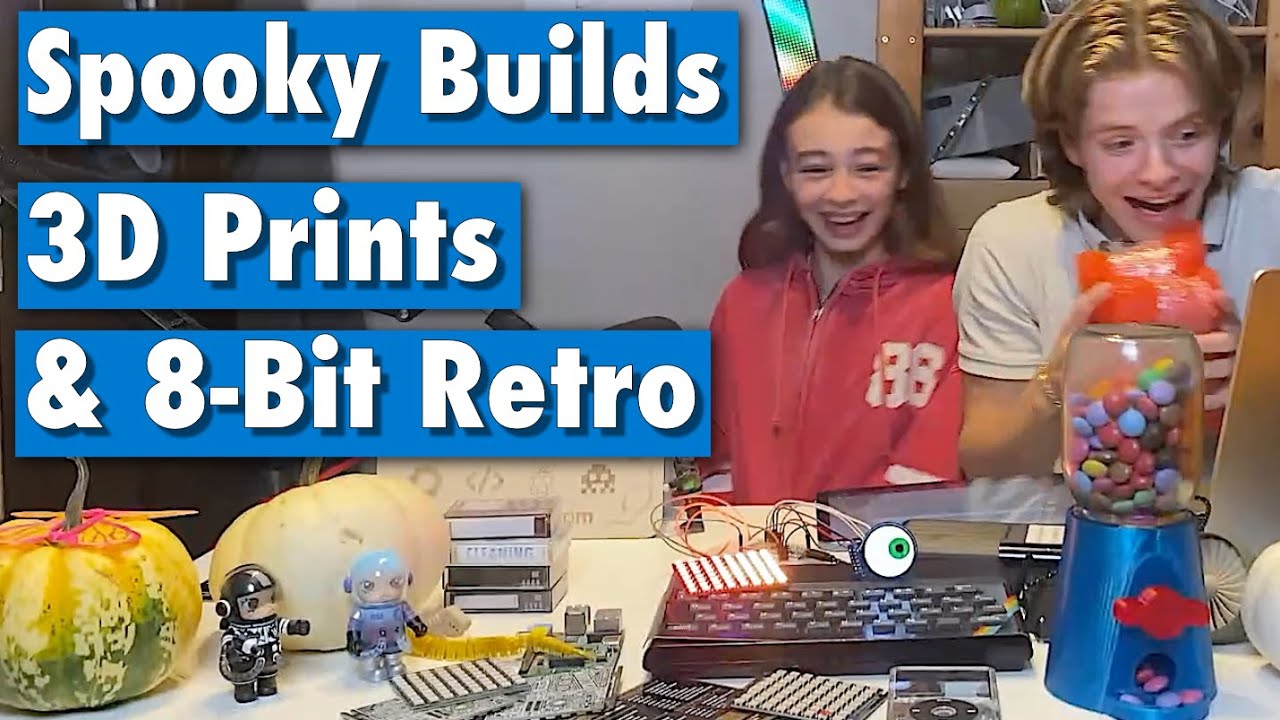
Episode 18 on GurgleApps: We continue our spooky Raspberry Pi Pico Halloween project 🎃 and test out a brand-new 3D-printed sweet dispenser.
For retro fans: On our homemade arcade machine, we’re taking on Gradius (aka Nemesis) - and try out the conversion for the 48k ZX-Spectrum🌈.
📚Chapters
00:00 Introduction
01:19 3D Print of the W...

: Cali chip giant insists single-board computer house will remain independent
turbid radish
 slender iron
tiny peak
Where does work on CircuitMatter stand in the grand scheme of things? Is that so...
slender iron
tiny peak
Where does work on CircuitMatter stand in the grand scheme of things? Is that so...
I think circuitmatter will be after P4 and Zephyr work. Zephyr will enable thread support on more boards including the new nrf54 series.
thorny jay
TL;DR: Tell your preferred AI about the hardware you have and CP code you want... chances are it will create working code!
Thank you Dan.
lone axle
Thanks for hosting Dan, have a great week everyone.
wraith crow
Thanks 😁
tulip sleet
You're welcome, and thanks everyone for attending.
@slender iron I'll make a 10.1.0-beta.0 release after I do the post-meeting stuff. is the alpha.0 tag at the 10.0.x branch point?
manic glacierBOT

about 300 ns high, 900 ns low, for a zero
about 700 ns high, 500 ns low, for a one
@dhalbert Those pairs add up to 1200 rather than 1250ns, intentional?
tulip sleet
Here is the notes document for the next CircuitPython (Bi-)Weekly Meeting on Monday, November 3, 2025. It is at the normal time of 11am Pacific / 2pm US Eastern here on Discord. Add your hug reports and status updates to the document before the meeting. If you are unable to attend but would still like to contribute, feel free to add your notes and we’ll read them off during the meeting. Hope to see you there! <@&356864093652516868>
https://docs.google.com/document/d/1l1zrqcAtX0VFLKH0gB8Cjm_yunue9TulW6c8-hHB6Xc/edit?usp=sharing
manic glacierBOT
@dhalbert Those pairs add up to 1200 rather than 1250ns (for 800kHz protocol), intentional?
"about". It's what worked and what it came out to be in the code.
tulip sleet
@tiny peak it occurred to me that another reason we didn't do sha256 was that the original requirement was on nRF BLE boards for a covid tracking app, so there was no mbedTLS impl to call
manic glacierBOT

CircuitPython version and board name
Adafruit CircuitPython 10.0.3 on 2025-10-17; M5Stack DinMeter with ESP32S3
Code/REPL
import _bleio

from adafruit_ble import BLERadio
from adafruit_ble.attributes import Attribute
from adafruit_ble.advertising import Advertisement
from adafruit_ble.advertising.standard import ProvideServicesAdvertisement
from adafruit_ble.services import Service
from adafruit_ble.characteristics import Characteristic, ComplexCharacteristi...BLE provides different types of writes (with or without responses as an additional "option"), like normal and extended writes. Normal writes are "immediate" writes whereas extended writes usually carry a longer payload stream and induce one-or-more partial write messages (...PREPARE_WRITE...) concluded with an execute-write message (sort of like a sql-database commit).
At least for the nordic and espressif ports I didn't notice any exposed options relating to these write types. It would ...
...always just seconds after submitting: maybe additional values for 'properties' as used in bleio.Characteristic would be the proper solution - so values like WRITE_LONG or WRITE_RELIABLE (to adapt the terminology implied by NimBLE as with ble_gattc_write_flat(), ble_gattc_write_long() and ble_gattc_write_reliable() in the espressif port).
tiny peak
tulip sleet
<@1220648290941669377> it occurred to me that another reason we didn't do sha256...
Interesting. I think I saw the PR for that one along with a later issue discussing whether to keep aesio around. I poked at hashlib on the RP2350 and ESP32-S3 Feather boards, which I plan to use for the LoRa sensor thing I'm working on, and they both support sha1. HMAC-SHA1 should be good enough for my current project. I may take a look at SHA256 again after that and before I move on to the TOTP project.
orchid basinBOT
Automated website update for release 10.1.0-beta.0 by Blinka.
New boards:
- espressif_esp32c61_devkitc_1_n8r2
manic glacierBOT
In case it helps in isolating the issue, I have tested the script above with CircuitPython 9.2.7 installed and cannot get it to crash.
tulip sleet
CircuitPython 10.1.0 Beta 0 released!
- Update
espressifESP-IDF to v5.5.1 and support ESP32-C61.
https://blog.adafruit.com/2025/10/20/circuitpython-10-1-0-beta-0-released/
 serene token
Question for CP devs: What was the original intent of adafruit_rgb_display?
I seem to recall reading somewhere that it came from Micropython's module with a similar name, but it feels a bit half baked to me. displayio is a fairly decent high level display library, but there doesn't seem to be any decent low level display library for CircuitPython. rgb_display feels to me like that's what it wanted to be, but it falls rather far short of that. It lacks any kind of buffering options, and it can't load images itself. (It can display PIL format images, but there's no PIL port for CircuitPython, so there's no way of loading images in the correct format.)
I ask, because I recently started working on a project that displayio is not very well suited to, and I have significant experience using real world low level display libraries for video game rendering. I'm seriously considering expanding rgb_display to turn it into more of a full fledged low level display library with buffering capabilities and at least the ability to load PNG images into buffers with the same format as is used by the screen (for fast blitting). If the original intent of adafruit_rgb_display was to become something like this, or if this is even just something that would be accepted if I put in pull requests for it, I'd be substantially more likely to actually do it.
serene token
Another question, closely related to this one: I've just found what looks like a massive design flaw in adafruit_rgb_display, that cannot be fixed without potentially breaking compatibility with Micropython. If I was to copy adafruit_rgb_display into an entirely new module, fix the design flaw, potentially reorganize it to make it better suited as a low level display library, and then add the above mentioned things, is that something that might be of interest for adding to the offical Adafruit modules?
(Note that I wouldn't be able to do this for all 9 drivers in rgb_display, as I only have one them. I'd only be able to do it for ST7789, but others more familiar with the other 8 could probably fix them fairly easily.)
lone axle
serene token
Question for CP devs: What was the original intent of adafruit_rgb_display?
I s...
I cannot speak to the original intent of it, as it came about before I got involved. I first got involved around the time that displayio came out and became the more defacto standard that we use for most stuff.
But I can give you my take on it. I think it likely wasn't intended to be low level specifically to be more performant, but rather it was just made very early on and targeted what were at the time less powerful chips with less RAM. displayio makes a nice API, but is more demanding of the resources on the microcontroller.
Once the displayio ball started rolling it became the thing that we default to using for most projects, though there are a few instances like camera preview and I think gifio maybe? where some things get done outside of displayio in order to speed them up.
adafruit_rgb_display remained fairly primitive because it doesn't really get actively developed nearly as much as the displayio based libraries.
@serene token IMO improvements to rgb_display, or splitting to new library if needed with the aim to be higher performance than displayio would be welcome if you're interested in working on that.
New library vs. update existing depends a little on what the issue you found is and what kind of compatibility it breaks and how much existing code would need to be updated.
serene token
The issue I found is the rotation thing I posted an issue for on Github. The rotation argument applies to images being rendering to the display, rather than doing hardware rotation in the initialization. Existing code that uses the drawing functions relies on the current behavior, so fixing this would break that code. If this is acceptable, I think I can provide a fix for the ST7789 driver, but I don't have the time to fix the 8 other drivers. I wonder if displayio handles this correctly... If it does, I might be able to lift it's initialization code for those drivers and fix all 8 of them...
lone axle
as far as I am aware rotation works as expected for all displayio drivers, I have tried on several, but not all of them.
The PIL image thing could be intended for use specifically with Blinka the compatibility layer for linux SBCs. Many Blinka based graphics examples use PIL, I would guess the functions in rgb_display that deal with PIL formats were made for that context rather than CircuitPython on microcontroller.
displayio drivers are sort of split between python code and the core implemenation though. I'm not sure how rotation is handled. Porting the displayio rotation handling may involve looking inside the core implementation.
lone axle
@serene token it looks to me like rotation was first added here: https://github.com/adafruit/Adafruit_CircuitPython_RGB_Display/pull/38 and hasn't really had significant changes since then. It does appear to me like it's only supported in the pillow demos, not an object level property that effects everything drawn (like displayio API is).
I think it's fine to break compatibility with that in order to add a more functional rotation capability. We would need to coordinate updating Learn guide code as nesseccary still though if it changes behavior of anything that does use it.
serene token
I'll do some digging and see what I can find. I should be able to follow the chain of function calls in displayio to figure out where the rotation stuff is.
I think you are right on the PIL/Blinka thing. The rgb_display Learn guide is pretty Blinka oriented. I'm not going to try to reimplement PIL image loading, but displayio has some image loading code I could probably adapt (that's already in the right format for these displays, unlike PIL). If I do this, I'm going to aim for something similar SDL/Pygame, with surface objects that contain image data with functions for copying and such. I don't actually need to touch image() itself, if the image loading functions create surface objects that are rendered to a buffer surface using internal methods. The only compatibility breaking would be the rotation thing. And honestly, I might even be able to avoid that, but it would be much faster to let the display driver hardware do rotation than to handle it in CP before sending the buffer data to the display.
So I guess I'll start looking into displayio code to see if I can find initialization code for handling rotation for all of the different drivers. I won't be able to test most of the drivers myself, as I don't have all the displays needed to do that, but it's at least a start, and I'd rather not do just half the job (or one ninth, in this case), if I can avoid it.
Thanks for the information. That certainly helps. I'm not 100% sure I'll have time for this, but since I need it for my project, I'm hoping I'll be able to manage it.
slender iron
tulip sleet
<@252717193496756235> I'll make a 10.1.0-beta.0 release after I do the post-meet...
the alpha.0 one should be on the idf merge commit (one merge after 10.0.x)
slender iron
serene token
I'll do some digging and see what I can find. I should be able to follow the ch...
generally displayio drivers don't change madctl to handle rotation. they could from python but don't. for adding a newer low level api, I'd suggest copying the way you'd do it in CPython. That way it it will be cross-compatible.
I do also intend on implementing displayio on top of LVGL at some point to leverage any hardware accelerators that fancier chips have. this would also allow for lower level primitives outside of displayio too
manic glacierBOT
I believe we handle with and without response already. We use the bitmask of the characteristic itself to choose which one to do IIRC.
Do characteristics know if they want extended writes or not?
We'll also be targeting Zephyr in the future so it'd be good to consider how they implement it too.
I believe that we do want to check to see if service->is_remote is false. This set value block could be moved a little lower to the non-remote case.
It doesn't make any sense for a client to set a default value. Maybe we'd need a default value for an indicate only characteristic before the first indication but I bet that's rare.
CircuitPython version and board name
Adafruit CircuitPython 10.0.3 on 2025-10-17; ProS3 with ESP32S3
Code/REPL
import board
import displayio
import paralleldisplaybus
from adafruit_hx8357 import HX8357

displayio.release_displays()

spi = board.SPI()

tft_cs = board.IO12
tft_dc = board.IO13
tft_write = board.IO14
tft_read = board.IO15
tft_reset = board.IO16

display_bus = paralleldisplaybus.ParallelBus(
    data0=board.IO0,
    command=tft_dc,
chip_selec...Also, wiring for bus in IO0-IO7.
Just tried CircuitPython 10.1.0-beta.0 and it does the same thing.
manic glacierBOT
I have caused a hang, though not safe mode, in a trimmed down version of the program that just mounts the SD card and initializes the display. I will continue to work on this. Thanks for mentioning that it took several runs to cause. It takes about can take 2-3 runs, with ctrl-D in between to cause the problem.
If I disable the USB MSC presentation of the SD drive, the problem goes away. (I had to fix some problems with the disabling logic to make sure that the disabling was happening prope...
Is there an SD card in the socket? If so, if you remove it, does that make any difference?
Very good @dhalbert . In my tests the crash is always to safe mode. In case it matters, I am doing these tests on a Raspberry Pi 3b using Mu (I have noticed varying serial port behavior on my RP3b and Macbook Air).
No socket on the board and nothing currently wired up.
Also, it now appears to be crashing hard enough that it goes straight to the bootloader. Pressing boot when it flashes yellow puts it in safe mode so the files can at least be accessed.
You said it was a https://www.adafruit.com/product/5872 ? That is a FeatherWing that uses SPI mode. Did you mean a https://www.adafruit.com/product/2050 ?
manic glacierBOT
I meant PID 5846. I don't have any SD card inserted.
I just tried with ESP32-S3-DevKitC-1-N32R8 and nothing is displayed, but at least it's not hard faulting. I may be more board specific.
serene token
slender iron
generally displayio drivers don't change madctl to handle rotation. they could f...
Would it be better, then, to not change madctl and to handle rotation in software? I've had some time to think about it, and while this would be more expensive, I think I can do it in a way that isn't massively more expensive than hardware rotation. Doing it this way, I think I could build an API that won't need to change anything at all within the existing code. Instead rotation would be handled as part of the initialization of the rendering buffer/surface, and the code for blitting would rotate during the blit by adjusting the ordering of the for loops.
As far as what I would do in CPython, I'd do it about the same way as I'm already thinking. I don't really design differently for embedded versus other platforms (in Python), except where it is necessary to fit within the limitations imposed by embedded devices. That said, I do design for optimization more than the average programmer, regardless of platform. I have some experience in video game programming starting in the early 1990s, in DOS/QBasic, where memory was limited to 640kB and CPU speed was on par with mid-range microcontrollers today (286 through 486). If the goal is to ensure that it will also work for Blinka, I don't think that will be problem at all. (I'd actually love to implement a lot of what I want to add in C, but I don't have the time for that, and it would be significantly harder to avoid compatibility issues. Maybe at some point in the future, once it's done in pure Python...)
I'm not familiar with LVGL, but a quick look at the Github page suggests it is promising. I didn't see much about lower level stuff, but the hardware acceleration is certainly a big benefit. And if it does provide even some basic low level stuff, it shouldn't be too hard to build something more complete on top of that.
manic glacierBOT
Ah sorry, this was the circuitpython editor at code.circuitpython.org
manic glacierBOT
I think this is the second time I have found myself tracing back the code to lib/tjpgd/src/tjpgd.c:
		case 0xD9:	/* EOI */
			return JDR_FMT3;	/* Unsuppoted JPEG standard (may be progressive JPEG) */
before realizing that I needed to uncheck the progressive option when creating my JPEG file for CircuitPython.
This PR adds the progressive hint from the core comment to the reported gifio error. It does also increase the message size a little so I considered catching the error i...
Either pre-commit updated circuitpython.pot or I messed something else up, I didn't mean to make changes to that file.
manic glacierBOT
Just for posterity: Hiding the REPL display output is still possible by hiding the REPL (UI-)elements themselves:
for item in displayio.CIRCUITPYTHON_TERMINAL:
    item.hidden = True
The contained elements are the CP logo, the status line plus the actual REPL content. Put this in boot.py and it'll be a blank screen (except for a short flicker before this code is actually executed).
manic glacierBOT
It doesn't make any sense for a client to set a default value. Maybe we'd need a default value for an indicate only characteristic before the first indication but I bet that's rare.
That's exactly the case in my project - but due to the devices communication logic, I don't care about the initial value at all.
Either pre-commit updated circuitpython.pot or I messed something else up, I didn't mean to make changes to that file.
circuitpython.pot is updated when you change or add messages. Locally, make sure your branch is up to date, so it includes the latest messages. Then you can run make translate at the top level, which will update circuitpython.pot`. However, things might be OK now.
orchid basinBOT
CX (including C6) doesn't have native USB so it won't show as a CIRCUITPY drive.
Right, but I think he's suggesting using the serial method we use for boards without native USB even on boards with native USB.
slender iron
serene token
Would it be better, then, to not change madctl and to handle rotation in softwar...
I think we didn't do madctl because we didn't assume that every display had it. I wonder if it would allow us to scroll in any direction. I kind of doubt it.
By model after CPython I mean using an existing library to do what you want and then implementing it for CircuitPython. However, if it is all Python anyway then it could be portable.
I'm not wanting to put a bunch of optimization effort into displayio as-is because LVGL will change it all
manic glacierBOT
This reliably goes to safe mode without setting up the display at all. Two important things:
- use
spi = busio.SPI(board.SCK, board.MOSI, board.MISO)instead of theboard.SPI()singleton. - wait 5 seconds after mounting. This gives enough time for the USB presentation to the host computer to happen.
So I think this has to do with the SPI object management. I discovered this by accident while trying to reproduce the previous test on a Pico W, which doesn't have a board.SPI(), so I had...
manic glacierBOT
From: https://forums.adafruit.com/viewtopic.php?p=1070425#p1070425
displayio has a slow performance case where overlapping dirty rectangles cause pixels to be recomputed more than once.
We could do merging or flattening of all the rectangles but that is complicated.
As a quick optimization, we could sum the areas of all of the dirty rectangles. If the number of dirty pixels is more than the screen itself, then it'd be faster to do a full refresh because it only does each pixel once.
manic glacierBOT
This was the first time I've submitted a PR against an ESP32 change in a while and I made a couple of mis-steps during the branch creation. I could just give up on this one and create a new PR from a fresh branch.
Assuming this is a change that we want, let me know if you want me to do anything to clean this up.
manic glacierBOT
I think this is a worthwhile change. You could decide if you want it against 10.0.x (so it will go in the next stable bugfix release or main (will go to 10.1.0-beta.x series). Just bring your repo up to date, then apply the single message change, then do make translate, and then push the commit and make the PR.
orchid basinBOT
Since this hasn't been updated, but I believe all the necessary info/decisions are done, I should be able to update the code for this to make it an alias.
Updated to meet requested changes. Looks good otherwise.
tiny peak
For the discussion of perhaps speeding up displayio, something that might be worth considering is whether it would be possible to implement a more direct method of mapping from palette colors to buffer data for blitting as an easy performance win. My vague not-too-carefully-researched impression is that there might be a lot of room for optimization there.
tiny peak
@tulip sleet continuing the HMAC and hashlib sha-n algorithm discussion from the other day... I wrote what I think is probably a reasonably efficient Python function to do RFC 2104 HMAC using hashlib.new() to get a selectable (string argument) hash algorithm. Code at: https://github.com/samblenny/lora-greenhouse-monitor/blob/v0.1.0/sb_hmac.py. It passes all the RFC 2202 test cases for SHA-1: https://github.com/samblenny/lora-greenhouse-monitor/blob/v0.1.0/test_sb_hmac.py. Both the ESP32-S3 and RP2350 Feather boards have 'sha1' as their only implemented hash algorithm for hashlib.new(). So, this works for my LoRa thing now, but it would be nice if 'sha256' could be added.
serene token
slender iron
I think we didn't do madctl because we didn't assume that every display had it. ...
That makes sense with madctl. I'll implement rotation in software then. That's a solid reason. If optimization is needed, per-driver optimization can be added later.
As far as modeling after something in CPython, I'm going to try to model it on Pygame. I can't guarantee I'll mirror it exactly, mainly because it doesn't all make sense applied to microcontrollers. I'm also considering adding some features that Pygame doesn't have, if I have time after implementing the important stuff. (I have some experience writing a very basic 3D rendering engine, and I'd like to add a few features from that, but they aren't things I need for my current project, so they are more like stretch goals.) But yeah, doing it in pure Python should make it highly portable, especially if I can avoid having to make alterations to the existing code.
tulip sleet
tiny peak
<@329766224093249548> continuing the HMAC and hashlib sha-n algorithm discussion...
I think it would not be hard to get sha256 working on the boards with mbedTLS. There is adafruit_hashlib, which has sha256? Have you checked how slow it is?
tiny peak
I haven't looked at that at all. I just read the code for hashlib to see how the 'sha1' stuff worked
manic glacierBOT
You could decide if you want it against
10.0.x(so it will go in the next stable bugfix release ormain(will go to10.1.0-beta.xseries).
This isn't really a "bug" that needs fixing right away so main is probably fine. I'm thinking that if it goes in main, it's a little easier because you don't have to manually re-merge it later. If I have that backwards let me know...
tulip sleet
tiny peak
I haven't looked at that at all. I just read the code for hashlib to see how the...
you could just import adafruit_hashlib as hashlib I think, to test it.
it does sha1 in Python too, so you could test your existing code against it, which might give a lower bound on the slowdown.
manic glacierBOT
I'm thinking that if it goes in main, it's a little easier because you don't have to manually re-merge it later. If I have that backwards let me know...
We would regularly merge from 10.0.x to main before any 10.1.x release, which is usually trivial. So 10.0.x is actually a little easier.
I'm going to close this because I don't know git well enough to repair my local branch. It will be far easier to recreate a clean local branch against 10.0.x and resubmit the change with that.
wraith crow
@tulip sleet pre-commit is rebuilding circuitpython.pot and dropping two messages. The two messages are no longer used in the 10.0.x modules so that makes sense but the local/circuitpython.pot in the 10.0.x repository is out of date. Should I just go ahead and submit my PR and ignore the fact that it's including the new version of circuitpython.pot?
tulip sleet
wraith crow
<@329766224093249548> pre-commit is rebuilding circuitpython.pot and dropping tw...
it's supposed to make a new version. You have to have an updated circuitpython.pot if you add messages, and pre-commit is checking for that. You can do it yourself instead of taking what pre-commit does. Just do make translate at the top level. It should be the same thing. So, yes, check in the updated circuitpython.pot.
then when it's checked in the PR build it will not complain.
it is running make check-translate to check
The PR pre-commit will not fix things for you. You need to do that in your PR.
just like it will not fix formatting complaints
wraith crow
running pre-commit locally does seem to run the make translate locally but I'll run it again to be sure.. it looks like the circuitpython.pot that I'll be including also drops a couple message changes that are not included in my PR, namely the removal of the runtime.c warning messages and a storage message "filesystem must provide mount method". Should I leave those changes in or manually remove them from the circuitpython.pot I submit?
tulip sleet
don't bother to change anything manually. It's computing what should be in there, and if there are no errors when the PR builds, then it should be fine.
manic glacierBOT
I'm resubmitting #10686 against 10.0.x
This PR adds the progressive hint from the core comment to the reported gifio error.
 main furnace
What has Dexter been up to? https://github.com/rsbohn/waffle8/tree/main/sketch
 scenic ibex
Anyone have any luck getting pre-commit to work on python3.12/Ubuntu 24.04? I'm having a really tough time despite trying multiple package managers and even creating virtualenvs with 3.10
slender iron
scenic ibex
Anyone have any luck getting pre-commit to work on python3.12/Ubuntu 24.04? I'm ...
what is happening with it?
scenic ibex
Let me dig up some logs really quick
This is happening even with 3.10, but I was getting some different errors with 3.12, let me grab those too
as a note, running on 3.10/ubuntu 22.04 worked fine
scenic ibex
Hmm
I did also upgrade all the pip packages according to requirements-dev/doc.txt, and do pre-commit clean between runs
Python 3.12 (conda env) on 24.04 (reupload, sorry)
scenic ibex
I believe I do also:
pip install setuptools
Defaulting to user installation because normal site-packages is not writeable
Requirement already satisfied: setuptools in /home/username/.local/lib/python3.10/site-packages (80.9.0)```let me try installing it via conda versus pip though...
Nope, same issue
tulip sleet
scenic ibex
I believe I do also:
```
pip install setuptools
Defaulting to user installation ...
I am using 3.12.3 with Ubuntu 24.04 in a venv and it's OK.
you do need to run everything in a venv
scenic ibex
Hmmm, okay, maybe my setup is just corrupt or weird or misconfigured then. I'll try to just create a clean venv or something and go from there. Thanks!
tulip sleet
python3 -mvenv myvenv
source ~/myvenv/bin/activate
should do it, then pip3 install -r requirements-dev.txt
I had a similar but not identical problem here about a year ago: <#circuitpython-dev message>. Updating absolutely everything in my venv fixed it.
manic glacierBOT
Just FYI. Confirmed that your test code (modified to access CS pin on my EYESPI-BFF/QtPy ESP32-S3 hardware) crashes CircuitPython 10.0.1.
import board
import busio
import sdcardio
import storage

# Sleep a bit so we can see print() output.
time.sleep(2)

#spi = board.SPI()
spi = busio.SPI(board.SCK, board.MOSI, board.MISO)

tft_sdcs = board.A3
sdcard = sdcardio.SDCard(spi, tft_sdcs)
vfs = storage.VfsFat(sdcard)
storage.mount(vfs, "/sd")
print("SD card mounted")

# Sleep long e...Additionally (and maybe not relevant), if I run this test code with CircuitPython 9.2.7 installed I get an SCK pin in use error when I try reloading the program. I have to reset the board to clear this error. I do not get this error if I use spi = board.SPI().
serene token
serene token
That makes sense with madctl. I'll implement rotation in software then. That's...
Looks like this is going to require significant implementation in C. Using ulab.numpy, I managed to get the data transfer speed from a 2D numpy array to the screen up to...4 to 5 FPS (depending on rotation). The rotation itself isn't super expensive (seems like around 25ms), but the transfer itself seems to taking 180ms to 210ms, for a 320x240 16-bit display (153.6kB framebuffer, for around 850kBps peak transfer speed). With a baud rate of 24,000,000 (can the RP2350 SPI actually go that fast?), I would expect closer to 3MBps, but evidently CircuitPython can't manage that.
tiny peak
Looks like this is going to require
manic glacierBOT

Adds a new board for Waveshare ESP32 S3 Touch LCD 1.47. The implementation is based on the official Waveshare documentation on the board ESP32-S3-Touch-LCD-1.47.
The display driver is a new model JD9853, and the init sequence is ported from Waveshare's Arduino example.
The pin assignment follows the pin definition from Waveshare Wiki.
manic glacierBOT

@bablokb Thanks for sharing the PPK2 screenshots, they are very useful. Could you confirm if I understood correctly, you got 154µA@5V during sleep with SRAM retention? Is that in the dormant mode?
manic glacierBOT
No, this is neither dormant mode, nor with SRAM retention. These are figures from my powman experiments. On wake up, the system resets so nothing in SRAM is retained.
In dormant-mode with state retention (aka "light-sleep") I am down to 1.9mA. See #10023 for details and a lengthy discussion about why it seems to be better to have no alarm-implementation for the RP2350 rather than to have at least a working implementation.
manic glacierBOT
@bablokb Oh, okay. So 1.9mA is the absolute minimum the RP2350 can reach with SRAM retention? Shoot, I need my system way lower than that. Looks like I need to look for a different microcontroller. Thanks
Yes, 1.9mA is the current state of art. Theoretically, powman can also keep SRAM state but that would only help if you can continue where you left of. And I have not seen any working code that does this.
For real low power usage you either need a mcu that is optimized for that purpose, or use some external circuitry. But that would also not keep state.
@bablokb Oh, okay. So 1.9mA is the absolute lowest power sleep state the RP2350 can reach with SRAM retention? Shoot, I need my system way lower than that. Looks like I need to look for a different microcontroller. Thanks
Actually ~210uA is the lowest the RP2350 can go with 256kB of SRAM retained (SRAM power domain 1, specifically), specifically using low power mode "P1.6" as i mentioned above.
(note, this is using low power mode P1.6, ie not the RP2350's "S...
manic glacierBOT
Yes, 1.9mA is the current state of art. Theoretically, powman can also keep SRAM state but that would only help if you can continue where you left of. And I have not seen any working code that does this.
For real low power usage you either need a mcu that is optimized for that purpose, or use some external circuitry. But that would also not keep state.
Interestingly, one RISC-V assembly program I have been recently experimenting with, is the possibility of allowing the system to simpl...
There has been some work done on this, e.g. here: https://github.com/mamba2410/rp2350-powman-sleep, see also
https://forums.raspberrypi.com/viewtopic.php?t=384176#p2297511
But this does not sound as if it were really usable ("I managed to get this working, mostly!").
Anyhow, before investigating this, I will first try to make the system enter sleep correctly for gpio-wakeups.
There has been some work done on this, e.g. here: https://github.com/mamba2410/rp2350-powman-sleep, see also https://forums.raspberrypi.com/viewtopic.php?t=384176#p2297511
But this does not sound as if it were really usable ("I managed to get this working, mostly!").
Anyhow, before investigating this, I will first try to make the system enter sleep correctly for gpio-wakeups.
Thanks for linking the page! This is fascinating work, I was not aware this already existed! Hopefully ev...
manic glacierBOT
Best of luck in your gpio-wakeup testing! feel free to reach out for any help or questions, i'd be happy to help in any way i can.
Thanks! I think you just triggered a change of my project priorities 😅️
manic glacierBOT
@dwrrehman 188 µA sounds much better. In my case I don’t need the CPU to continue where it left off. I just need to keep an API key in SRAM retained. If I don’t need the CPU to resume its previous state, could allowing it to start from reset (or something along those lines) reduce the power consumption even further?
manic glacierBOT
Definition looks fine to me. Please request a new PID from Espressif for the touch variant instead of using the UF2 PID. Thanks!
This looks like the UF2 bootloader PID. Please request a new set for this board.
You can store it in nvram and then you could even turn of power.
Be aware that all of this discussed here is very experimental, we don't even have official support for the alarm-module for the RP2350. Your out-of-the-box experience will be better with an ESP32-S3 or a Nordic mcu.
 digital shoreBOT
 adafruit
Owner
.adafruit
Members
39,040
Roles
37
Category Channels
8
Text Channels
65
Voice Channels
7
Threads
16
Boost Count
16 Boosts (Tier 3)

ID: 327254708534116352 | Server Created
·
manic glacierBOT
@dwrrehman 188 µA sounds much better. In my case I don’t need the CPU to continue where it left off. I just need to keep an API key in SRAM retained. If I don’t need the CPU to resume its previous state, could allowing it to start from reset (or something along those lines) reduce the power consumption even further?
It seems allowing the CPU to start from reset will give you equivalent low power consumption, 188uA, (low power mode P1.5/P1.6, where 1 bank of ...
manic glacierBOT

CircuitPython version and board name
Adafruit CircuitPython 10.0.3 on 2025-10-17; Adafruit-Qualia-S3-RGB666 with ESP32S3
Code/REPL
import board
import displayio
import time

from adafruit_display_shapes.line import Line
import dotclockframebuffer #type:ignore
from framebufferio import FramebufferDisplay #type:ignore

displayio.release_displays()

# Init code copied from https://learn.adafruit.com/adafruit-qualia-esp32-s3-for-rgb666-displays/qualia-rgb666-w...Bug seem to be absent from the 10.1.0-beta.0 version
orchid basinBOT
CX (including C6) doesn't have native USB so it won't show as a CIRCUITPY drive.
Right, but I think he's suggesting using the serial method we use for boards without native USB even on boards with native USB.
Yeah that's the one.
I thought I vaguely remembered being able to do it in the past (but must have been native devices as you say Scott), and merged that with wanting to do it for some of the usb-serial boards I was using (to make it easier to test the wifi workflow).
That comb...
manic glacierBOT
Thanks @tannewt for the pointer! https://github.com/espressif/usb-pids/blob/main/allocated-pids.txt#L813C3-L813C7, got a new set of PIDs and updated the PR here with the assigned value.
Thanks!
 upper radish
Look, ma - no hardware! Work continues on the CircuitPython web assembly (wasm) port to further integrate the supervisor and hal with the JavaScript runtime via Emscripten. Now one step closer to being able to write and run your CircuitPython board's code.py in the browser, without a CircuitPython board. 
 manic glacierBOT

Thanks for the tips, I FINALLY GOT IT WORKING!!! The program continues to work with the next function where it went into sleep mode with full SRAM saving.
But there's some magic! The do_sleep and exit_sleep functions are placed in memory, and exit_sleep is modified with attribute((naked)), so that it can make an unconditional jump to another part of the program without breaking the stack.
do_sleep remembers the return address and the stack size allocated for it
app_loop optimaze O0
...Freetos still needs to learn this technique.
manic glacierBOT

Add new board: Waveshare ESP32-S3 Touch LCD 2.8
Tested
- Display works as intended from boot
- QMI8658C IMU verified using the community
qmi8658.pydriver (pin aliases OK) - CST328 touch controller tested with a custom driver (datasheet-based)
- MicroSD card verified with correct pin aliases
- LCD and button aliases verified
- SPI, I2C, I2S, and UART aliases confirmed working
Not tested
- Battery...
manic glacierBOT
@Skorpionm Thanks for sharing! Do you also have the complete program somewhere?
manic glacierBOT
manic glacierBOT
Reopening: this question came up again and the reason the tm_isdst value is discarded should really be documented.
manic glacierBOT

CircuitPython version and board name
Adafruit CircuitPython 10.0.3 on 2025-10-17; M5Stack Cardputer with ESP32S3
Board ID:m5stack_cardputer
Cardputer ADV
Code/REPL
from adafruit_tca8418 import TCA8418
import board
import busio
import time
import cardputer_keyboard

cardputer_keyboard.detach_serial()
cardputer_keyboard.KEYBOARD.deinit()

i2c = busio.I2C(board.KB_A_1, board.KB_A_0)

tca = TCA8418(i2c)

# set up all R0-R4 pins and C0-C3 pins as keypads
KEYPADPI...
This happened Friday too, looking into it. Will rebuild to start.
orchid basinBOT
Likely an issue on the learn api side of things. Pushing a fix and will rebuild this site once completed.
orchid basinBOT
Rebuilt, and images are visible. Can leave this open for a few days to ensure it's gone for good.
manic glacierBOT
Thank you for the PR! It looks like there are a couple minor formatting issues that can be fixed locally automatically if you install pre-commit. Instructions to do that are here: https://learn.adafruit.com/improve-your-code-with-pylint/check-your-code-with-pre-commit
turbid radish
I've implemented a tone() function for Fruit Jam. I was hoping to have a few eyes on it to ensure I didn't do anything "bad" https://adafruit-playground.com/u/AnneBarela/pages/fruit-jam-tips-and-tricks
manic glacierBOT
Just ran pre-commit locally and fixed the two formatting issues. Let me know if anything else needs updating. Thank you!
manic glacierBOT
manic glacierBOT
 onyx hinge
This might be of interest in CircuitPython. The VESA video standard includes a series of formulas called GTF (generalized timing formula) which can be used to set the details of a video mode. adafruit pico-mac uses a version of hstx code nabbed from CircuitPython but I added gtf video mode support: https://github.com/adafruit/pico-mac/pull/10 so e.g., it can do 800x480@60Hz, 1280x720@50Hz, etc., as the underlying video signal resolution.
However, in a "the tail that wags the dog" way, the video generation + USB host support ends up dictating almost all of the other timing details of the fruit jam, leaving you with just 4 core CPU speeds (132 / 176 / 264MHz) to choose from.
Anyway, if someone was motivated I think it would be possible to adapt this back into CircuitPython but it'd be a fair bit of work.
GitHub
Tested at 800x480 and 1280x720 (HD!) using https://www.adafruit.com/product/1667 as the display.
This increases the overvoltage from 1.15V to 1.20V and changes the PSRAM timing slightly, which made...

I wanted pico mac to be able to run at the top resolution that the RP2350 can handle reliably: 1280x720@50Hz HD. Oh, and the emulated mac is running with 4MB of RAM.
behold! it superficially works.
while I was getting ready to push this to my forks of pico-mac & umac I got a crash in the debugger that may just be due to extensive overclocking? I dunno yet. so, sadly, you can't grab & try it yet.
I'm off to do some IRL stuff but I hope to get this pushed soon.
@adafruit
#retrocomputing #fruitjam #mac #macintosh #macclassic

 A Social Front Organization
·
manic glacierBOT
A Social Front Organization
·
manic glacierBOT

CircuitPython version and board name
Adafruit CircuitPython 10.0.3 on 2025-10-17; Adafruit CircuitPlayground Express with samd21g18
Code/REPL
# SPDX-FileCopyrightText: 2025 Tom Hoffman
# SPDX-License-Identifier: MIT

# Modular Playground CircuitPython Euclidian Sequencer

DEV_MODE = True

# We use the gc library to check and manage available RAM during development
if DEV_MODE:
    import gc
    gc.collect()
print("Starting free bytes (after gc) = " + str...Sorry, one more thing I missed the first time.
Remove this please. There is already microcontroller.pin to access pins from the MCU perspective instead of the board.
Only include pins used or broken out by the board here.
Whoops that's not the best version of the code. Better one attached. The incrementClock() function near the bottom is the one where you can trip it to MemoryError.
manic glacierBOT
Since 9.something, we removed a memory allocation scheme that tended to reduce fragmentation. I think that may be what you are running into here.
You might try doing some pre-allocation. For instance, this loop is appending to a list:
        for i in range(self.steps):
            # adding 0.0001 to correct for imprecise math in CircuitPython.
            current = math.floor((i * slope) + 0.001)
            result.append(current != previous)
            previous = current
se...Thanks dhalbert. Yeah on one hand I keep thinking "Oh, I just need to focus on optimization," and little things like that list that could be converted to a 10 number array (there are currently max 10 steps), but the reality is Circuit Python on CPX just goes from "You've got almost 10k free" to MemoryError with one seemingly innocuous line of code.
manic glacierBOT
Oh, I see! Thanks for pointing that out! I’m still getting familiar with how this works. I removed most of the fallback list and kept only the user-accessible pins; all other aliases remain the same.
Please let me know if this looks good. Thanks!
manic glacierBOT
CircuitPython version and board name
Adafruit CircuitPython 10.0.3-1-g92170768f6 on 2025-10-22; Adafruit Fruit Jam with rp2350b
Code/REPL
import math
import supervisor
from adafruit_fruitjam.peripherals import Peripherals
from adafruit_fruitjam.peripherals import request_display_config
import array
import audiocore
import time
import displayio
from adafruit_display_shapes.circle import Circle

def play_tone(frequency, duration, volume=0.5):
"""Play a ton...Is this maybe another PSRAM DMA thing?
manic glacierBOT

I'm using displayio with small OLED displays, e.g. a SSD1306 based one with 64 x 32 px.
Example code:
import displayio
displayio.release_displays()
import board, busio
i2c = busio.I2C(board.GP3, board.GP2) # SCL, SDA
from i2cdisplaybus import I2CDisplayBus
display_bus = I2CDisplayBus(i2c, device_address=0x3C)
import adafruit_displayio_ssd1306
adafruit_displayio_ssd1306.SSD1306(display_bus, width=64, height=32)
print("0123456789")
The display shows 3 lines of text, where the first 2 ...
manic glacierBOT
Eventually related to https://github.com/adafruit/circuitpython/issues/10445 and https://forums.adafruit.com/viewtopic.php?p=1058992&sid=0105da6d9bd0e527909672a7c0fb8fbb#p1058992
I will try this in boot.py :
import supervisor
# Turn off the status bar if you haven’t already
supervisor.status_bar.console = False
supervisor.status_bar.display = False

This did not occur on my Fruit Jam during testing
manic glacierBOT
OK, re-reading the micropython docs, I think what is confusing me is the relatively invisible bottleneck of compilation time memory use. Once the program is compiled and running, I can have 10k bytes free after compilation, but adding one character too many could cause a compilation time error, even if it has little impact on the memory usage by the running program. I'm going to do some experimenting with breaking out mpy libraries.
manic glacierBOT
This did not occur on my Fruit Jam during testing
Weird, what version of CircuitPython are you running on your Fruit Jam?
manic glacierBOT
OK, yes, making a library gets around the compilation bottleneck. I think this is a documentation problem. I'll write up a little piece explaining it.
Thanks for your sleuthing. We have written up some info about this: https://learn.adafruit.com/welcome-to-circuitpython/library-file-types-and-frozen-libraries#creating-an-mpy-file-3118108 and https://learn.adafruit.com/welcome-to-circuitpython/frequently-asked-questions#memory-issues-3129414
tulip sleet
@slender iron do you have a few minutes to talk about SPI issues? thanks
slender iron
tulip sleet
<@252717193496756235> do you have a few minutes to talk about SPI issues? thanks
yup!
manic glacierBOT
Do you have an SD card inserted? If so, does it make any difference which make & model of SD card? Does it make any difference if you power the Fruit Jam from a computer's USB port or from a power adapter? What type of display did you have connected to the HDMI out?
It looks like you're already using some of the Maximising MicroPython Speed tricks, but a couple other things you could try:
- Limit the number of names you put in the global scope (i.e. top level code goes in
def main(): ..., then have a call tomain()be about the only code that runs from outside of a function) - Use
# ...style comments rather than'''...'''style heredoc comments because heredoc comments ...
manic glacierBOT
because heredoc comments can get included in the compiled bytecode.
This should not happen: they are discarded and are not in the bytecode in MicroPython/CircuitPython. But they still need to be parsed and that might cause memory fragmentation.
But they still need to be parsed and that might cause memory fragmentation.
Perhaps that's what I experienced then. My impression from old experiments with trying to cram stuff onto a Trinket M0 and a Casio calculator with MicroPython was that avoiding heredoc syntax did seem to help. Not sure exactly why.
slender iron
Anyone have an example of using Terminal from user code? I need it as a reference for issues like: https://github.com/adafruit/circuitpython/issues/10695
manic glacierBOT
I did have an SD card inserted but removing it didn't change anything. I also tried running from a power bank, not connected to a host computer and still got the same result. I've tried two displays, one is an old Dell monitor and the second is https://www.adafruit.com/product/2261. Both monitors have been working with multiple Fruit Jam apps like Fruitris, LarsioPaint, etc.. and I haven't noticed similar blanking on recent versions of CP.
I'll see if I can recreate when I have a few minutes, I'm slammed this pm
wraith crow
slender iron
Anyone have an example of using Terminal from user code? I need it as a referenc...
I googled "circuitpython terminalio library" and google AI gave me an example. It's probably not helpful for your answer but I do some manual adjustments to the root_group on HUB matrix panels to remove the snake/status line and then manually resize the terminal height/width....
slender iron
I'd prefer if folks would just create their own terminal
though that would only work for their output
wraith crow
I though that was what I remember you saying in the past....
slender iron
if only I had DSI working then I could use the same setup for testing the terminal 🙂
lone axle
@slender iron its not for Terminal directly, but I think this simple example for ColorTerminal should be compatible by just swapping out the class and removing the color specifiers: https://github.com/adafruit/Adafruit_CircuitPython_Color_Terminal/blob/main/examples/color_terminal_simpletest.py
That is the closest to an example that I am aware of. iirc I got a snippet for it from deep dive one day and started building IRC app from that but eventually added color support. I should make the plain Terminal version and add it to the docstrings for Terminal class.
manic glacierBOT
It took a minute or two for it to appear during game play, the code above caused it to happen ~80% of the time the play_tone method was called....
manic glacierBOT
The documentation that finally got me on the right track was this bit:
When a module is imported, MicroPython compiles the code to bytecode which is then executed by the MicroPython virtual machine (VM). The bytecode is stored in RAM. The compiler itself requires RAM, but this becomes available for use when the compilation has completed.
If a number of modules have already been imported the situation can arise where th...
manic glacierBOT

reverting to previous stable release of circuitpython
manic glacierBOT
nimble sparrow
slender iron
if only I had DSI working then I could use the same setup for testing the termin...
Oh neat, is that something on your list? I did wonder if we'd see MIPI/DSI make its way in with esp32p4 boards proliferating
orchid basinBOT
The change to adabot was not relevant for the .org site in this case, but it's on my list to check periodically to keep things up to date.
tulip sleet
@slender iron Last night I converted espressif SPI to use a finaliser (took about 45 minutes), and ~~it fixed the SD card crashes!~~So I'll spend the time (with LLM help for speed) to make that change for all the ports. EDIT: not so fast: still not working with a release build as opposed to a debug build.
I think I will make this PR against main instead of 10.0.x, since it's rather wide ranging
lone axle
On the Fruit Jam I think that switching from CircuitPython to something else like apple 2e or 286 emulators, perhaps any arduino/C project? and then back to CircuitPython again results in /saves/ being readonly instead of writeable to CircuitPython. I believe that erase_filesystem() gets it back to working as intended.
Is this worthy of filing an issue about? Or just something that is a fact of life switching between types of firmware on the same device?
tulip sleet
lone axle
On the Fruit Jam I think that switching from CircuitPython to *something else* l...
saves is not used by the non-CPy emulators, is that right? They should just leave it alone. It might appear as read-only if it gets corrupted. and CPSAVES does not appear when CPy is not running, is that right?
lone axle
non-CPy emulators don't use /saves/ as far as I am aware, but I'm not entirely sure what if anything they do with the flash storage so perhaps there is something I'm unaware of.
I think it might be getting corrupted or erased, I believe I had files on it before switching to and then back from the emulators and afterwards it shows no files and gave me fiflesystem readonly error when I tried to write from cpy code.
CPSAVES does not appear when CPy is not running, that is correct.
I could do a few more tests to be more sure of the exact behavior if it's something we consider problematic. I noticed once a few weeks back when I did the apple 2e guide, and again just recently after switching back to CPy from the 286 emulator.
On some level though I'm not sure there is much that CPy could do about it if some other program happens to break or erase some or all of the flash. It shouldn't do so without reason, but if it does it's beyond our control it seems to me.
maybe just document somewhere what to do if writing to /saves/ reports the filesystem error
slender iron
nimble sparrow
Oh neat, is that something on your list? I did wonder if we'd see MIPI/DSI make ...
Yup! Just got it working on the P4 yesterday. https://github.com/tannewt/circuitpython/tree/mipidsi
tulip sleet
lone axle
I could do a few more tests to be more sure of the exact behavior if it's someth...
Do you load the emulator with a UF2 or a .bin?
slender iron
lone axle
On the Fruit Jam I think that switching from CircuitPython to *something else* l...
It is probably worth filing an issue. We should see what portions get erased and maybe we can improve our detection of whether we need to recreate it
lone axle
tulip sleet
Do you load the emulator with a UF2 or a .bin?
UF2.
nimble sparrow
slender iron
Yup! Just got it working on the P4 yesterday. <https://github.com/tannewt/circui...
Great work
What panel did you test with?
manic glacierBOT
CircuitPython version and board name
Adafruit CircuitPython 10.0.3 on 2025-10-17; Adafruit Fruit Jam with rp2350b
Code/REPL
# write to a file in saves
with open("/saves/testfile.txt", "w") as f:
    f.write("test content")


# read from a file in saves
# with open("/saves/testfile.txt", "r") as f:
#     print(f.read())
Behavior
After this sequence of events the saves drive ends up in a broken state:
- Start with CPy loaded and CPSAVES drive workin...
lone axle
I am noticing that having escaped newlines in a string in python code inside of a .. code-block:: python in a docstring in the core causes the docs build to fail. i.e.
message = "Hello World\n"
Because in the .rst file that gets generated it seems the newline has been converted to literal in that context rather than staying escaped within the python string inside the generated .rst file it's:
           message = "Hello World
   "
Does anyone know if there is an easy way to fix that or an example of any code blocks in the core that have escaped newlines in them I could look at?
double slash is the answer.
message = "Hello World\\n"
should have tried more things before asking
slender iron
nimble sparrow
What panel did you test with?
The one that comes with the ev function board
I have a waveshare bar display I'm going to try next
manic glacierBOT
Also moveed init function docstring so it appears above the rest of the docs next to the function signature and re-worded it to be a little more specific about argument names.
@tannewt I was wrong about the adafruit_color_terminal example, it's init API is not the exact same as terminalio.Terminal.
This new example in the docs can serve as a place to point folks for how to use the builtin Terminal class to gain usage of the top bar area.
manic glacierBOT

Agreed with this ticket that there should be a neat way of doing this.
Workaround:
display.root_group[1].hidden = True  # logo
display.root_group[2].hidden = True  # status bar
supervisor.reset_terminal(display.width, TERMINAL_HEIGHT)
display.root_group[0].y = 0
Where TERMINAL_HEIGHT is the number that makes supervisor_start_terminal set status_bar->pixel_height to the height of the screen? Needs to be more than display.height but not sure how much.
The default CircuitPython terminal is meant to be the structure we'd like it to be. If you'd like just a terminal, then you can create your own full size one. @FoamyGuy just updated the Terminal docs with example code to do this. See #10698
manic glacierBOT
- Fixes #10680 and perhaps other issues.
This is a multi-part fix for race conditions occurring on VM shutdown when an SD card mounted in user code is exposed via USB MSC. There can be filesystem operations initiated by the host that are in process when code.py ends., which cause crashes or USB disconnects. In the process of debugging this, I found several other things to clean up and add.
SPI resetting when VM shuts down
Previously, many ports had spi_reset() or reset_spi() ...
nimble sparrow
slender iron
The one that comes with the ev function board
How're you handling panel init sequence, I guess like any other displayio bus but probably a custom "driver" instance in your test code?
slender iron
nimble sparrow
How're you handling panel init sequence, I guess like any other displayio bus bu...
Yup, same as FourWire: a byte sequence of commands that the driver IC's library will create
nimble sparrow
slender iron
Yup, same as FourWire: a byte sequence of commands that the driver IC's library ...
Neat! Mind sharing your test code? I'll see about adapting it to the panel on the Tab5 (an ILC that uses MIPI) to check this carriers over to other P4 boards.
slender iron
@nimble sparrow this is for the EV function board. I have a tab5 too but was going to try and get a waveshare bar display going first
nimble sparrow
I'll give it a go, seems like a good test as the ILI9881C has a fair bit of code for it
manic glacierBOT
Overall this looks good. You should be able to remove more never_reset machinery. You will still need to pass never reset into the pin tracking because we still bulk reset them.
I think you can remove never_reset machinery for SPI now too since there is no bulk reset.
slender iron
nimble sparrow
I'll give it a go, seems like a good test as the ILI9881C has a fair bit of code...
Thanks! That'd be super helpful
Init sequence format is documented here: https://docs.circuitpython.org/en/latest/shared-bindings/busdisplay/index.html#busdisplay.BusDisplay
slender iron
manic glacierBOT
Tested on Metro ESP32-S3, Fruit Jam, Feather nRF52840 with AdaLogger FeatherWing, ESP32-S3 TFT Feather with AdaLogger, PyPortal. All mounted SD card manually except for Fruit Jam. The USB presentation worked and I was able to read files. I could write files when the SD card was mounted readonly=True. No crashes. The display worked fine on the TFT Feather (SPI) and on the PyPortal (not SPI).
Ready for approval to merge.
orchid basinBOT

Images automagically compressed by Calibre's image-actions ✨
Compression reduced images by 16.6%, saving 1.1 MB.
| Filename | Before | After | Improvement |
|---|---|---|---|
| assets/images/boards/original/seeed_xiao_esp32s3.jpg | 264.8 KB | 114.1 KB | 56.9% |
| assets/images/microcontrollers@3x.png | 621.1 KB | 516.9 KB | 16.8% |
| assets/images/heroes/Gamer_Hero.png | 239.1 KB | 18... |
nimble sparrow
@slender iron I'm going badly wrong somewhere even in just getting Tab5 to bring up. I don't suppose you had any tweaks you had to make to the build environment beyond default? Newer esp-idf or anything?
manic glacierBOT

I came here to repeat the request: I have an RP2350A board with the SPH0645LM4H and wish I could use it for my midi keyboard project.
manic glacierBOT

I have added additional pins from the seeed xiao esp32s3 plus board to the already existing seeed xiao esp32s3 (sense) board port. I also formatted the mpconfigboard.h so that the arguments line up.
I have tested using the KMK firmware which relies on circuitpython, and the pins work as intended.
turbid radish
upper radish
Look, ma - no hardware! Work continues on the CircuitPython web assembly (wasm) ...
DO let me know when you are looking to release, even for testing. cpnews@adafruit.com
manic glacierBOT
These pins are available, but I don't see them labeled anywhere with Dn pin numbers. They seem to have specific functions in the schematic. Are there other uses of them with Dn` numbers? Thanks.
PDF Schematic is in this .zip file: https://files.seeedstudio.com/wiki/SeeedStudio-XIAO-ESP32S3/res/XIAO_ESP32S3_Plus_V1.0_SCH_PCB.zip
If you look on their website, they provide the Dn numbers on the pinout.
<img width="1273" height="890" alt="image" src="https://github.com/user-attachments/assets/59f7b871-462c-450a-aed8-5c9482082669" />
Would it make sense to add alias names for some of them? Do they have a dedicated purpose? I'm thinking about the MT* and I2S_* names? I don't know what they are normally connected to, if anything.
manic glacierBOT
CircuitPython is only aware that there might be a CPSAVES partition if CIRCUITPY_SAVES_PARTITION_SIZE > 0. I'm not sure there's anything in flash that makes it clear it exists.
Do the non-CircuitPython firmware images know about the layout of flash? Do they use CIRCUITPY at all?
CircuitPython version and board name
Adafruit CircuitPython 10.0.3 on 2025-10-17; Adafruit-Qualia-S3-RGB666 with ESP32S3
Code/REPL
#
# Qualia ESP32-S3 RGB666 40p TFT JSON test
#
import os
import ipaddress
import ssl
import wifi
import socketpool
import adafruit_requests
import time
import adafruit_connection_manager
import adafruit_ntp
import rtc
import supervisor
import json
import microcontroller
# Display libraries
import displayio
import busio
import boa...I think the I2S_* names are connected to the b2b connector usually, but the MT* pins aren't connected to anything other than the pads on the bottom of the board for both versions. Though, I'm not sure if I'm understanding what you're trying to ask me clearly. Like when you ask if they are connected to anything, do you mean if they are connected to a different part of the board serving a different purpose?
manic glacierBOT
@dwrrehman
The status-bit makes me scratch my head... As you wrote
To re-enable a GPIO wakeup on a given pin after a low-power mode GPIO wakeup, I had to write to PWRUP0 twice: once with {STATUS=0b1,ENABLE=0b0}, and then again with {STATUS=0b1,ENABLE=0b1}. I deduced I had to do this, due to the datasheet saying the following under the ENABLE field of the PWRUP0 register:
ENABLE: Set to 1 to enable the wakeup source. Set to 0 to disable the wakeup source and clear a pending wakeup ...

I picked up a VL53L4CX recently, but didn't notice the lack of CircuitPython support until after it arrived. I decided to dig into it, to see if I could make it work. As noted above, the VL53L4CD library worked OK, but only up to ~2m.
I noticed a lot of similarity between the ToF sensors, so I decided to try the longer distance VL53L1X (4m) library. The library itself has some checks that prevents it from working out of the box. Fixing the ID/type check made it functional, but only up to...
manic glacierBOT
Hi, @bablokb,
Thanks for the question! :) I'll see if I can illuminate whats happening a bit more, if you'd like!
Below I've included the implementation of powman_enable_gpio_wakeup for our reference.
254 | void powman_enable_gpio_wakeup(uint gpio_wakeup_num, uint32_t gpio, bool edge, bool high) {
255 |     invalid_params_if(HARDWARE_POWMAN, gpio_wakeup_num >= count_of(powman_hw->pwrup));
256 |
257 |     // Need to make sure pad is input enabled
258 | gpio_set_input_enabled(gp...Thanks, this is very helpful and I really appreciate that you take the time to explain these details.
On the bright side, i have a hunch that it might be due to interactions of some other piece of code with the POWMAN system, for example, generated C code / CPU instructions involved in controlling something else on the RP2350 other than POWMAN's low power mode interface itself, and this seperate system is somehow sending events, IRQs, or something else which is causing the CPU to wake up....
manic glacierBOT
One idea which also came to mind, if that indeed may be the case, is to try holding in a "reset" state all peripherals on the RP2350, prior to going to sleep in the low power mode you are using (P1.x). This could in theory be done by writing almost all ones to the RESETS register, found in RESETS_BASE in the RP2350's address map, and described in section 7.5., titled "Subsystem Resets", and the RESETS register is described on page 506. My idea would be that, hypothetically If you were t...
Yes, the external debugger seems to cause problems, see the comment above by @eightycc https://github.com/adafruit/circuitpython/issues/9491#issuecomment-2952711328. I am not using it though. Regarding the other suggestions: I will put them on my list and test them.
manic glacierBOT
Since there are pads that have silkscreen labels for MT*, add those as second names for the D* pin names.And go ahead and add the I2S* names too. We have the room and it will make any code that people write clearer. Thanks.
manic glacierBOT

@w4iei It's not exactly clear what you plan to do with that I2S microphone within a midi keyboard project, but since you are using an RP2350, you can read data from it using the aforementioned pio-i2s library. Here's an example of that: pio_i2s_input.py. If you would like more guidance, you will need to provide an exact use-case of the microphon...
tulip sleet
<@&356864093652516868> Here is the notes document for today's CircuitPython Weekly Meeting. Sorry for the delay in posting the link. It is at the normal time of 11am Pacific / 2pm US Eastern here on Discord. Add your hug reports and status updates to the document before the meeting. If you are unable to attend but would still like to contribute, feel free to add your notes and we’ll read them off during the meeting. Hope to see you there!
https://docs.google.com/document/d/1S9clW6due_EaWHqmgnT70mtlas0AKxHrAGwpB4jYd6Q/edit?usp=sharing
tulip sleet
tulip sleet
<@&356864093652516868> Here is the notes document for today's CircuitPython Week...
manic glacierBOT
Thank you kindly for your reply.
I plan to do f0 estimation, to listen to a piano key being played, to do a an acoustic sensor calibration (e.g. map which sensor is activated when a specific note is played). I will give your example code a try.
I think I solved the problem. I added some delays (mainly to give the system time to flush out trace-messages). CP has two APIs for that: mp_hal_delay_ms() and mp_hal_delay_us(). The former runs additional code, the latter is just a busy-wait. After switching to the latter I don't see the random behavior anymore.
There is still some way to go to make this usable in the context of CP, but at least the basics are working now.
slender iron
tulip sleet
<@&356864093652516868> Here is the notes document for today's CircuitPython Week...
The US just changed times. Folks should double check the timing if outside the US.
manic glacierBOT
@w4iei Here's an example of using ulab.utils.spectrogram (essentially FFT) to recognize chromatic notes using an I2S microphone: https://gist.github.com/relic-se/70697aeed6056ef6223daae03afed411. It's not perfect, but it'll likely be a good starting point.
tiny peak
Am I remembering correctly that Adafruit_CircuitPython_Bundle will pick up new library releases auto-magically if you just wait a day or two?
tulip sleet
tiny peak
Am I remembering correctly that Adafruit_CircuitPython_Bundle will pick up new l...
The bundles are updated nightly.
tiny peak
thanks!
slender iron
nimble sparrow
<@252717193496756235> I'm going badly wrong somewhere even in just getting Tab5 ...
What error are you getting? I think my branch should be up to date. I'm going to try and get it merged into main before I leave for vacation on Wednesday.
manic glacierBOT
Adds support for MIPI DSI (Display Serial Interface) displays via a new mipidsi module. This enables high-speed serial communication with DSI displays using differential signaling.
The module provides:
- Bus class: Manages DSI bus with 1-4 data lanes
- Display class: Handles display configuration and framebuffer
Module is:
- Disabled by default globally
- Enabled only for ESP32-P4 (has hardware MIPI-DSI support)
🤖 Initial code generated with [Claude Code](https://claude.com/claud...
lone axle
Last two weeks sorry. I just merged the numbers manually instead of leaving them seperate.
manic glacierBOT
nimble sparrow
slender iron
What error are you getting? I think my branch should be up to date. I'm going to...
No meaningful error. Before I even got to the point of giving any mipi code a go I first (as usual) tried to bring up a bare minimum CP build on the Tab5 and ran into a brick wall even at that basic level. I'm wondering if there's some sort of init issue I'm just not seeing, but I'm looking at the Tab5 code for UIFlow (M5S's Micropython fork) and can't see anything obvious
slender iron
nimble sparrow
No meaningful error. Before I even got to the point of giving any mipi code a go...
My branch has a board def but I haven't loaded it yet. Will try later
tulip sleet
thanks @lone axle !
nimble sparrow
slender iron
My branch has a board def but I haven't loaded it yet. Will try later
Let me give it a go. I'd happily take having missed something silly.
lone axle
Have a great week everyone 
wraith crow
Thanks everyone
tulip sleet
I edited the meeting notes template to say to send meeting items to cpnews@ (and leave out all the other alternatives). I thought I had done that already but I must have just done it in the actual meeting notes last time.
lone axle
Here is the notes document for the next CircuitPython Weekly Meeting. It is on 11/17 at the normal time of 11am Pacific / 2pm US Eastern here on Discord. Add your hug reports and status updates to the document before the meeting. If you are unable to attend but would still like to contribute, feel free to add your notes and we’ll read them off during the meeting. Hope to see you there! <@&356864093652516868> https://docs.google.com/document/d/1RWdada5krhZGWCBcpPSpDC7PajNVID8J8i5QZuM4gMk/edit?usp=sharing

Google Docs
CircuitPython Weekly Meeting for November 17, 2025 Welcome to the CircuitPython Weekly meeting notes! Feel free to add your Hug Reports and Status Updates before the meeting, alphabetically by your username. During the meeting, we go through them in order. If you can’t make the meeting and would...
lone axle
lone axle
Here is the notes document for the next CircuitPython Weekly Meeting. It is on 1...
nimble sparrow
slender iron
My branch has a board def but I haven't loaded it yet. Will try later
Ah ok I feel mildly better, same issue with your board def as mine
manic glacierBOT
@relic-se This sample is exactly what I needed. Big thank you!!
wraith crow
slender iron
<@662938364173090869> this is for the EV function board. I have a tab5 too but w...
I haven't looked at it in a while but I just pulled out my function board and tried the artifact from your PR. I tried running your mipidsi code.py file and setting the root_group to displayio.CIRCUITPYTHON_TERMINAL but I'm not seeing anything on the display. I assume I'm missing something basic....
manic glacierBOT
I see, thank you for clarifying. I have already added the I2S names if you go a couple of lines down.
manic glacierBOT
Thanks, this is great. Could you do just one more stylistic thing? Group the pin aliases and surround them with blank lines. This makes it easy to see that there are multiple names for a single pin, and to proofread the list. See https://learn.adafruit.com/how-to-add-a-new-board-to-circuitpython/pin-and-device-names#pin-aliases-3169489. So, for example:
    ...

    { MP_ROM_QSTR(MP_QSTR_D12), MP_ROM_PTR(&pin_GPIO39) },
    { MP_ROM_QSTR(MP_QSTR_I2S_SCK), MP_ROM_PTR(&pin_GPIO39) },
...Should I do it for the camera pins too or should I just leave them be.
Do it for any pins that have more than one name.
slender iron
wraith crow
I haven't looked at it in a while but I just pulled out my function board and tr...
Did you connect the reset line and backlight? What verion of the board do you have?
manic glacierBOT

ESP32-C6 has Thread radio alongside WiFi. I am looking to set up a Matter over Thread device, preferably using CircuitPython. Is this possible right now, or is this in the roadmap?
manic glacierBOT
No luck getting the M5Stack Tab5 going with this yet. The USB C is connected to GPIO24/25 which is connected to the serial/jtag peripheral. The USB A is the high speed OTG. We can switch the USB C to the FS OTG with an eFuse edit but then we cannot access the serial/jtag peripheral for bootloading.
CIRCUITPY_ESP_USB_SERIAL_JTAG doesn't enable it for some reason either. More debugging will be needed for this.
We did a bunch of work on CircuitMatter late last year but haven't gotten back to it. We hope to get back to it next year. Once we get that going over wifi, we'll likely add thread.
So, not possible now. Hopefully in the future.
nimble sparrow
manic glacier
@slender iron glad I'm not going insane.
manic glacierBOT

Sorry for the late reply, and thank you for the follow-up.
Yes, I did review the Python-only approach using rp2pio and adafruit_pioasm, and it’s definitely viable for lower-throughput or less timing-sensitive devices.
However, for WIZnet Ethernet chips, I found that a native PIO_SPI layer offers practical advantages that go beyond interpreter overhead:
The design closely follows the Raspberry Pi SDK’s PIO SPI implementation used for the CYW43 Wi-Fi chip, which is already validated and ...
Thanks again for the thoughtful feedback. I wanted to clarify why I proposed a native PIO SPI implementation and ask whether you’d consider accepting it (or advising on the right shape for it).
The design closely follows the Raspberry Pi SDK’s PIO SPI used by the CYW43 Wi-Fi driver, combining PIO state machines with DMA-backed transfers. This architecture is already validated for continuous, high-speed register access on RP2040 and gives deterministic inter-byte timing that WIZnet parts ar...
serene token
Semi-random questions about Fruit Jam OS:
First, is fruit_jam_ja.zip Javanese or Japanese? Typically Japanese is jp not ja, but I would expect to see support for Japanese before Javanese. (Though a quick Google shows that Java has a larger population than Japan, so maybe I'm wrong?)
Second, what the heck is fruit_jam_en_x_pirate.zip?
Anyhow, I thought I would ask. I don't see any notes on the various releases saying what their languages are, and the locale codes aren't always consistent...
fiery pecan
serene token
Semi-random questions about Fruit Jam OS:
First, is `fruit_jam_ja.zip` Javanese...
I assume the latter is something similar to the "Pirate Speak" language found in Minecraft.
fiery pecan
fiery pecan
I assume the latter is something similar to the "Pirate Speak" language found in...
However, given that it has the same SHA256 hash as the other fruit_jam_en_*.zip files, maybe not. 🤷
 stuck elbow
serene token
Semi-random questions about Fruit Jam OS:
First, is `fruit_jam_ja.zip` Javanese...
stuck elbow
serene token
Semi-random questions about Fruit Jam OS:
First, is `fruit_jam_ja.zip` Javanese...
Javanese is jv, see https://en.wikipedia.org/wiki/List_of_ISO_639_language_codes
ISO 639 is a standardized nomenclature used to classify languages. Each language is assigned a two-letter (set 1) and three-letter lowercase abbreviation (sets 2–5). Part 1 of the standard, ISO 639-1 defines the two-letter codes, and Part 3 (2007), ISO 639-3, defines the three-letter codes, aiming to cover all known natural languages, largely ...
country codes are different from language codes, because languages are not countries
serene token
fiery pecan
I assume the latter is something similar to the "Pirate Speak" language found in...
This would be my guess as well, but it's just a guess...
serene token
stuck elbow
Javanese is jv, see https://en.wikipedia.org/wiki/List_of_ISO_639_language_codes
Well that is truly odd. For language specifically, I've always ever seen Japanese as jp in filenames. That even includes certain official fonts used by the Japanese government in official documentation. ISO has Japanese listed as ja though, and jv does make more sense for Javanese, so I guess ja must be for Japanese here.
Thanks! I was not aware of the official standard there. I was clearly only aware of what must be an ad hoc language code or maybe the frequent use of country code in places where language code would make more sense.
stuck elbow
serene token
This would be my guess as well, but it's just a guess...
it's for the speak like a pirate day
lone sandalBOT
 serene token
stuck elbow
it's for the speak like a pirate day
serene token
stuck elbow
it's for the speak like a pirate day
That sounds cool. Thanks for the confirmation!

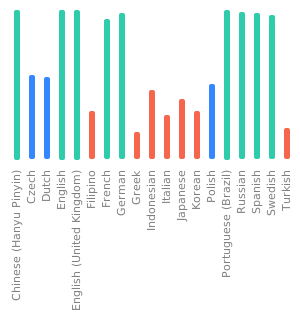 wraith crow
slender iron
Did you connect the reset line and backlight? What verion of the board do you ha...
wraith crow
slender iron
Did you connect the reset line and backlight? What verion of the board do you ha...
Nope :laugh: that was the basic thing I was missing. Thanks! I now have output on the display. There still seems to be a couple of glitches but I'm not sure there not my doing yet. The EV version is 1.4 although the display says it's for the 1.2/1.3 version so there may be a mismatch there but it probably doesn't matter....
manic glacierBOT
When I run the mipidsi init code you posted to discord the bottom two lines (23 & 24) are overwritten/corrupted by some combination with lines 21 and 22.
manic glacierBOT
Looks clean! I pushed a commit to fix up the pins.c formatting, and have a couple of other comments. I won't get a board to test until tomorrow.
I think this could be with mp_obj_malloc_with_finaliser if we add __del__ below.
    { MP_ROM_QSTR(MP_QSTR_deinit), MP_ROM_PTR(&mipidsi_bus_deinit_obj) },
    { MP_ROM_QSTR(MP_QSTR___del__), MP_ROM_PTR(&mipidsi_bus_deinit_obj) },
Use the arg name to be more precise and to save a little space.
mp_raise_ValueError_varg(MP_ERROR_TEXT("%q must be 16 or 24"), MP_QSTR_color_depth);
Temporary build failures due to
This is a scheduled macos-13 brownout. The macOS-13 based runner images are being deprecated. For more details, see https://github.com/actions/runner-images/issues/13046.
The macOS-13 based runner images are being deprecated, consider switching to macOS-15 (macos-15-intel) or macOS 15 arm64 (macos-latest) instead. For more details see https://github.com/actions/runner-images/issues/13046
so maybe we should update the .github/...
lone axle
I noticed that the downloads page lists the latest dev release as CircuitPython 10.1.0-beta.0 and when I download a UF2 its filename contains 10.1.0-beta.0. But inside of boot_out.txt it lists 10.1.0-alpha:
Adafruit CircuitPython 10.1.0-alpha.0 on 2025-10-20; Adafruit QT Py ESP32-S3 no psram with ESP32S3
That commit has both tags, unfortunately. We'll be doing beta.1 soon which should make that go away.
commit 6fe19f77da0537b124b5c5c3a4138e11bcc97306 (tag: 10.1.0-beta.0, tag: 10.1.0-alpha.0)
Merge: 799f13ce6f 8b1fcb444d
Author: Scott Shawcroft <scott@adafruit.com>
Date:   Mon Oct 20 11:00:34 2025 -0700

    Merge pull request #10676 from tannewt/idf5.5.1

    Update ESP-IDF to 5.5.1
@slender iron did you omit socket.recv() in SocketPool.Socket to save space and encourage reusing buffers? Wondering if we might add it for completeness (as I look at ESP32SPI).
slender iron
tulip sleet
<@252717193496756235> did you omit `socket.recv()` in `SocketPool.Socket` to sav...
Yeah, I think I only included the versions where you provide the buffer to require thinking about it
@tulip sleet I think we actually want to refcount mipidsi.Bus because multiple displays could use it
tulip sleet
is FourWire ref-counted the same way?
it relies on SPI underneath, but there's all the copying.
slender iron
fourwire takes a CS pin to differentiate
it's a bit weird because mipidsi.Display is stored next to the buses because the display is actually FramebufferDisplay
tulip sleet
could there be more than one mipidsi.Bus or should it be singleton? I don't know what the hw supports
slender iron
most MCUs I see only support one Bus
some of the newer Pis with broadcom chips have multiple
could statically allocate it
probably still want to refcount its use so that it can turn off when not in use
tulip sleet
that makes sense
slender iron
your finalizer comment made me think about it 🙂
tulip sleet
if the pins are dedicated to only DSI then that makes a difference, I guess. If they can be used for something else if it's not running then more regular deinit is useful.
slender iron
none of the MCUs I looked at share them with anything else
they are 1.2v logic so that may be why
(when single ended)
manic glacierBOT
I statically allocated it instead because we'll only ever have one and multiple displays may use it. One may live outside the VM as a "display bus" from a framebuffer display.
Temporary build failures due to
This is a scheduled macos-13 brownout. The macOS-13 based runner images are being deprecated. For more details, see https://github.com/actions/runner-images/issues/13046.
The macOS-13 based runner images are being deprecated, consider switching to macOS-15 (macos-15-intel) or macOS 15 arm64 (macos-latest) instead. For more details see https://github.com/actions/runner-images/issues/13046
so maybe we should update the `.github/.....
manic glacierBOT
ehh:
fatal error: /Applications/Xcode_16.4.app/Contents/Developer/Toolchains/XcodeDefault.xctoolchain/usr/bin/lipo: mpy-cross/build/mpy-cross and mpy-cross/build-arm64/mpy-cross-arm64 have the same architectures (arm64) and can't be in the same fat output fileehh
fatal error: /Applications/Xcode_16.4.app/Contents/Developer/Toolchains/XcodeDefault.xctoolchain/usr/bin/lipo: mpy-cross/build/mpy-cross and mpy-cross/build-arm64/mpy-cross-arm64 have the same architectures (arm64) and can't be in the same fat output file
Intel macos is only supported for free runners on macos-13. So I think we need to punt on Intel macos mpy-cross now.
See https://github.com/actions/runner-images/discussions/10810
Good on the allocation fixup. If this works for you, fine to merge. Or I could test tomorrow when my board arrives.
manic glacierBOT
I don't know if this is something that should be addressed in this PR or if it's a separate issue but I worked up some code that demonstrates the bottom of the screen refresh issue I'm seeing.
when I run this code.py the program stops at the first input prompt but the MIPI DSI display doesn't show the correct output at the bottom of the screen, then when you press enter, the screen is updated and when it stops at the second input prompt (which inserts a display.refresh() while waiting for...
manic glacierBOT

This commit fixes the inverted color for the e-ink display.
Previously, the text was white on a black background; now, it's a black text on a white background.
I am already using this display and with this patch I would have to change my application program. No big deal, but I don't think one choice is better than the other, so we could just leave it as it is.
I am already using this display and with this patch I would have to change my application program. No big deal, but I don't think one choice is better than the other, so we could just leave it as it is.
I understand you concern but when i wrote this code
label.Label(terminalio.FONT, text="HELLO WORLD", color=0xffffff)
without this fix it draws the text in white it's so weird.
All the colors are inverted in the code, and the initial screen that displays the console is also affected. For beginners, it would be better to have correct functionality to avoid dealing with this issue. I lost many hours trying to identify what I had done wrong, but it wasn't me.
It was that the colors were inverted.
manic glacierBOT
Also I'm new to the world of CircuitPython maybe it's not the right fix but there is something wrong.
If you have an idea let me know.
manic glacierBOT
To summarize:
-
Normal build:
- Log console on the e-ink display : text white on a black background
- default background: black
label.Label(terminalio.FONT, text="Normal"): text whitelabel.Label(terminalio.FONT, text="With 0", color=0x000000): text blacklabel.Label(terminalio.FONT, text="With f", color=0xffffff): text white- same with
displayio.Palette
-
Build with this PR:
- Log console on the e-ink display : black text on a white background
- d...
manic glacierBOT
On MagTag, which is kind of the prototypical use of an e-ink display, the default background is black, and the "Normal build" examples work as you describe above. On displays like a monochrome or grayscale OLED display, the default background is also black (not lit). @tannewt may have a comment about why we chose black as the default background on e-inks.
manic glacierBOT
Even on color displays the background defaults to black.
manic glacierBOT
On displays like a monochrome or grayscale OLED display, the default background is also black (not lit)
Make sense.
But In my mind the e-ink default background was white. Is maybe an misconception of my part, as I may be foll as I see almost all example on internet with a white background.
We can close the PR if it doesn't make sense.
slender iron
@tulip sleet I'm done working for now. I did test the ev display yesterday and it worked. I saw the issue @wraith crow saw too but it can wait.
tulip sleet
slender iron
<@329766224093249548> I'm done working for now. I did test the ev display yester...
great - I'll merge and make beta.1
manic glacierBOT
But In my mind the e-ink default background was white. Is maybe an misconception of my part, as I may be fool as I see almost all example on internet with a white background.
There's no fool here. We're trying to make the background color be consistent across many displays, so that you could port code between display types without changing the colors. (There are other changes you might need to make, such as display size and refresh strategy.)
manic glacierBOT
_Originally posted by @RetiredWizard in https://github.com/adafruit/circuitpython/issues/10703#issuecomment-3489121482_
I don't know if this is something that should be addressed in this PR or if it's a separate issue but I worked up some code that demonstrates the bottom of the screen refresh issue I'm seeing.
when I run this code.py the program stops at the first input prompt but the MIPI DSI display doesn't show the correct output at the bottom of the screen, then when y...
Merging so we can get a version to test into a beta. I created #10708 to address the problem @RetiredWizard found.
manic glacierBOT
With this PR, we are no longer building Intel or universal macOS mpy-cross now. mpy-cross is being built with macos-latest, which is macOS 15. But without paying, we can no longer build on macos-15 on an Intel platform.
update for 10.1.0-beta.1
manic glacierBOT
manic glacierBOT
It looks like GitHub changed their mind, and macos-15-intel is available: https://github.com/actions/runner-images/issues/13045. We could add it back, or just wait and see if anyone has an issue with no more Intel mpy-cross binaries available.
manic glacierBOT
I mentioned this on the PR but just in case it's important I did not see this issue at all when using gifio.OnDiskGif to update the display with an animated gif.
wraith crow
@lone axle Were the Fruit Jam OS release assets supposed to change to the source files?
never mind, I just looked too soon 😁
lone axle
It does take a few minutes to generate and upload.
wraith crow
Couldn't wait 😂
 ebon oracle
Hi folks! I'm new to this Discord server but not to MicroPython/CircuitPython.
I'm running into an issue in a library I wrote for inclusion in the Community Bundle,
having set up my repo using the adafruit cookiecutter template.
When I push to Github, the circuitpython-build-bundles step fails because mpy-cross errors out
on syntax pasting adjacent f-strings:
Run circuitpython-build-bundles \
Traceback (most recent call last):
  File "/tmp/tmp5wl87qxs", line 163
SyntaxError: invalid syntax
The syntax it's complaining about is this:
def __repr__(self) -> str:
    return (
        f"Box(x={self.x}, y={self.y}, w={self.w}, h={self.h}, "
        f"score={self.score}, target={self.target})"
    )
However, I just built mpy-cross from the CircuitPython HEAD and it doesn't
complain about this syntax.
I suspect that mpy-cross needs to be updated in the GitHub actions or the bundling script
but I don't know how to do this.
ebon oracle
It looks like the mpy-cross the actions are using lives in the circuitpython-build-tools module.
ebon oracle
I fixed my code, but maybe the mpy-cross needs to be updated.
tulip sleet
ebon oracle
I fixed my code, but maybe the mpy-cross needs to be updated.
thanks for the report. I posted in your issue and made a PR.
ebon oracle
Thanks! I just submitted a PR for the library: https://github.com/adafruit/CircuitPython_Community_Bundle/pull/266

GitHub
This library provides CircuitPython support for using the Seeed Studio Grove Vision AI V2 board with models from the Sensecraft AI web tool. With this, it's easy to use pre-trained models (...
manic glacierBOT

Hi! I’d like to work on this.
OS: Windows/Linux | Language: C/C++
Plan: <one line what you’ll change>
ETA: 2–3 days
main furnace
Is there a 'hello world' for adding a C module to CircuitPython?
fiery pecan
main furnace
Is there a 'hello world' for adding a C module to CircuitPython?
It looks like there was one historically: https://learn.adafruit.com/extending-circuitpython

Turn the dials to 11 by writing CircuitPython modules in C.
orchid basinBOT
Automated website update for release 10.1.0-beta.1 by Blinka.
New boards:
- m5stack_tab5
- microchip_curiosity_circuitpython
- waveshare_esp32_s3_touch_lcd_1_47
- waveshare_esp32_s3_touch_lcd_2_8
nimble sparrow
Oops, not sure the Tab5 board was meant to stay in 😩
tulip sleet
nimble sparrow
Oops, not sure the Tab5 board was meant to stay in 😩
it was added as part of https://github.com/adafruit/circuitpython/pull/10703
nimble sparrow
Ah, did the issue with serial/JTAG get resolved?
tulip sleet
I don't know. We can always take it back out
I think you're the only other one with a Tab5. You could try the 10.1-beta.1 build after it finishes
nimble sparrow
Yeah I'll give it a go
tulip sleet
CircuitPython 10.1.0-beta.1 released!
Highlights of this release
- Add mipidsi module to support MIPI DSI displays. Currently enabled for ESP32-P4.
- Fix problems with presenting user-mounted SD cards over USB.
https://blog.adafruit.com/2025/11/06/circuitpython-10-1-0-beta-1-released/
 brazen loom
good morning! quick question. I added a board to the circuitpython repo, it was already merged. When should I do the download page PR for the website?
lone axle
brazen loom
good morning! quick question. I added a board to the circuitpython repo, it was ...
I think it's fine to do anytime after the PR in the core is merged.
brazen loom
awesome! thanks
upper radish
turbid radish
DO let me know when you are looking to release, even for testing. cpnews@adafrui...
I think things are strong enough to consider an experimental release for folks to test. https://github.com/johnnohj/circuitpython/tree/wasm-mk2 I'd love to have some experienced eyes look over the implementation because it's at an unusual point where it could lean harder into true CircuitPython build patterns, or else maintain its middle path. I've tried my best to provide clear documentation, and suggest the best way to try out is using the CircuitPython web-editor fork: https://github.com/johnnohj/web-editor/tree/wasm
This is an unusual port because it requires so much beyond the built files and relies heavily on the JavaScript runtime environment. All help tightening this port up greatly appreciated!
manic glacierBOT

I'm seeing a hardfault with 10.1.0-beta.1 using a slightly different display 3.5" TL034WVS05.
Same board, display and unmodified code works with CP 10.0.3 stable.
This was setup in a attempt to reproduce the glitch behavior of this thread and forum issue.
 sly talon
Hello. I just picked up a waveshare S3 7"/touch. It's the 'A' rev, so resolution is the same as the 4.3, and the product page only shows the 7 has part while the 4.3 doesn't.
Theres a beta release for the 4.3. Can someone point me to a guide to making board packages, and I'll try my hand at setting up the 7.
** 7 has UART, 4.3 doesn't
sly talon
OK, I totally misread that, not the 4.3 after all.
fiery pecan
sly talon
Hello. I just picked up a waveshare S3 7"/touch. It's the 'A' rev, so resoluti...
Can someone point me to a guide to making board packages, …
https://learn.adafruit.com/how-to-add-a-new-board-to-circuitpython
Add your new CircuitPython compatible board to CircuitPython!
manic glacierBOT
I think we're just talking about what happens if you overwrite the first part of flash with something smaller than the CircuitPython core. Like I noticed before that the contents of CIRCUITPY are preserved after using Arduino.
manic glacierBOT

CircuitPython version and board name
Adafruit CircuitPython 10.0.3 on 2025-10-17; Adafruit Pixel Trinkey M0 with samd21e18
Board ID:adafruit_pixel_trinkey_m0
UID:6A4C909D434C585020312E320C2619FF
Code/REPL
import time
import board
import neopixel
# --- Configuration ---
NUM_LEDS = 160


# Number of LEDs in your external strip
DATA_PIN = board.DATA             # External data pin (D0 pad on Trinkey)
BRIGHTNESS = 0.5 # Set between 0.0 and 1.0 to...I was thinking about this some more and it occurs to me that some IDE's like MU or Thony attempt to set the clock on the microcontroller. When I connected Thonny to a QT Py M0 I receive the follow message:
Adafruit CircuitPython 10.0.3 on 2025-10-17; Adafruit QT Py M0 with samd21e18
WARNING: Could not determine epoch year (argument num/types mismatch), assuming 1970
If you are using an IDE to connect to the microcontroller, you might try using a simple terminal program like tio if y...
manic glacierBOT
Good suggestion, thank you!
Editing in an ordinary file and copying to the USB drive does not exhibit the problem. (Pycharm on Linux, copying code.py to /media/davs2rt/CIRCUITPY/)
I was trying to use Thonny when the problem appeared. Changing sync_time to False helped. The first warning goes away. I also switched to "local_rtc = False". I still get the latter two warnings, but I'm no longer in safe mode and code.py executes on cold boot.
So, I would still describe it as a bug. Thonny ...
 sacred blade
Hello, i've got an adafruit feather rp2350, but would like to use it with micropython (mostly to use the second core, and native modules).
I've tried to create a new board definition, based on the pico2 but with the correct board definition ("adafruit_feather_rp2350") for pico-sdk.
Build and flash ok, but no usb enumeration on boot ...
What are the main differences between a pico2 and a feather_rp2350 that could cause this to fail ?
I'm thinking mainly about a different flash chip, with different clock or initialisation requirements, but then got confused about boot2 and what is initialising the flash...
I'm going to trace the startup process with swd, but if someone's got a hint, that would be great !
stuck elbow
sacred blade
Hello, i've got an adafruit feather rp2350, but would like to use it with microp...
you may get better help with micropython on the micropython's github discussion forum
tulip sleet
sacred blade
Hello, i've got an adafruit feather rp2350, but would like to use it with microp...
did you look at the Feather RP2040 definition in MicroPython (is there one?)?
 jaunty juniper
@tulip sleet committed the change to ESP32SPI (also noted the default blocking state is not documented in the core or the library, we could add that at some point)
tulip sleet
thanks!
tulip sleet
jaunty juniper
<@329766224093249548> committed the change to ESP32SPI (also noted the default b...
I noticed one more thing which I just commented on, and maybe I will add a commit dcoumenting the default blocking state
manic glacierBOT
I think this is another manifestation of #8038. If there's an exception when Thonny is talking to the board, in some cases that exception can cause safe mode.
manic glacierBOT
CircuitPython version and board name
Adafruit CircuitPython 10.0.3 on 2025-10-17; Adafruit-Qualia-S3-RGB666 with ESP32S3
Code/REPL
#
# Qualia ESP32-S3 RGB666 40p TFT Display Backlight Test
# Borrowed one of the learn guide display examples (color bars display)
#
import time
import displayio
import busio
import board
import dotclockframebuffer
from framebufferio import FramebufferDisplay
import random

print("\nQualia Backlight Test\n")

# 4-inch square RGB-6...Adding the files for the circuitpython.org download section to support the Waveshare ESP32-S3 Touch LCD 2.8 board. https://github.com/adafruit/circuitpython/pull/10691
manic glacierBOT
On the Qualia board, the display backlight is controlled by a set of jumpers and possible PWM on pin A1, if you solder a jumper closed. See https://learn.adafruit.com/adafruit-qualia-esp32-s3-for-rgb666-displays/pinouts#step-3155525. Also see https://learn.adafruit.com/adafruit-qualia-esp32-s3-for-rgb666-displays/backlight-settings for electrical information.
The actual backlight on/off is controlled in the I/O expander, and supported in the Qualia library. There is a shortage of pins and we...
manic glacierBOT
Thank you @dhalbert. I had not appreciated that one had to solder the PWM jumper to simply set the backlight intensity (not PWM control it).
manic glacierBOT
to simply set the backlight intensity (not PWM control it).
You are actually controlling the intensity with PWM. PWM is pulse width modulation. So the narrower the pulses the lower the average voltage. Your eyes average the on/off cycles and perceive it as intensity.
tulip sleet
@lone axle and anyone else:
The adafruit_esp32spi library and a few others have a redundant module naming structure that looks like this:
adafruit_esp32spi/adafruit_esp32spi.py, which means you usually do from adafruit_esp32spi import adafruit_esp32spi.
Do you think it is worth fixing these in the long run, putting all the stuff in adafruit_esp32spi.py into __init__.py? Then you could just do import adafruit_esp32spi. We could make this backward compatible by doing that and then having an adafruit_esp32spi.py that just does from . import *. Eventually we could get rid of the extra layer.
This structure is present in esp32spi, the wiznet library, the mqtt library, and maybe one or two others.
There are also other .py files that have unnecessary prefixes in the library, like adafruit_esp32spi/adafruit_esp32spi_socketpool.py, which could just be adafruit_esp32spi/socketpool.py. Again could be fixed and made backward compatible with a from <something> import *.
Maybe I am just being crabby because I'm C-izing the esp32spi library, and I'm ending up with very long C function names like common_hal_adafruit_esp32spi_adafruit_esp32spi_esp_spicontrol_get_socket(). But I've always found the identical name nesting to be confusing.
lone axle
tulip sleet
<@382939733107408897> and anyone else:
The `adafruit_esp32spi` library and a few...
I am on board with a plan to ultimately eliminate the extra layer of naming. I actually ran across the same naming quirk last week in this repo: https://github.com/adafruit/Adafruit_CircuitPython_ATECC/blob/main/adafruit_atecc/adafruit_atecc.py and considered whether it was worth refactoring.
tulip sleet
yep, that was one of the other ones
there are a lot of examples to change, unfortunately, for esp32spi code
at the very least, we should prevent this from happening in future libraries, but I think these are all historical and people don't generally do that anymore
lone axle
That is true, it will be a lot to update. But a fiarly minor change in most cases. Checking on learn guides that have code broken out into non-embedded blocks will take a little time but I think there won't be too many to update.
having the backwards compatibility in place for a while gives us time to spread it out a little too. And then we can aim to remove in conjuncunction with some future major release.
tulip sleet
a google site search for "adafruit_esp32spi.adafruit_esp32spi" would probably find nearly all
I will open an issue and then do a PR, with new and old compatibility. I also plan to merge https://github.com/adafruit/Adafruit_CircuitPython_ESP32SPI/pull/218 soon
in the meantime I will do my C-izing in the collapsed naming scheme
tulip sleet
... I did some more reading about this. In larger Python codebases the stuff in __init__.py is largely confined to imports and other housekeeping stuff, and there's usually not real code in it. Of course, most of our libraries are not large codebases at all.
Instead of moving the contents of adafruit_esp32spi.py into __init__.py, we could just put from .adafruit_esp32spi import * in __init__.py. That would reduce the level and still make it backward compatible (forever).
There is also a whole thing about "namespace packages", which are packages without __init__.py, and have special rules. MicroPython (and therefore us) do support them, but not split across filesystems.
manic glacierBOT

I am running into the same issue with Circuitpython 10.0.1 on an Adafruit ESP32-S3 Reverse TFT-Feather board.
  File "adafruit_ble/__init__.py", line 212, in start_advertising
MemoryError: Nimble out of memory
I think I tracked it down to the BLE workflow. That seems to get started automatically once there's a bonded/paired device - iff I understand that here correctly: https://github.com/adafruit/circuitpython/blob/fa4caf835ff194c7c8ba4dede7caf69e5f011602/supervisor/shared/bluet...
manic glacierBOT
If the "crashes" are all Nimble out of memory, then the issue is just that the storage allocated for BLE is insufficient for both the workflow and your program.
Right. But the unexpected part - at least for me - was that the BLE workflow automagically starts at all just because there's some bonded device.
Yeah, it assumes the bonded device is one that might want to talk over the workflow.
We should probably look at whether we can adjust upward the amount of memory BLE can use.
fiery pecan
Is the nonintuitive nature of the set pins, □ PIO instruction, when driving the built-in LED, something to be expected? I described my experience here: #help-with-circuitpython message
manic glacierBOT
I am going to leave this open because maybe we want to raise an error on attempts to set the brightness, or take an optional PWM pin. @tannewt you may have a comment.
manic glacierBOT
I kind of wondered if the behaviour to my trying to set the brightness using display.brightness was not optimal. The brightness parameter is in the directory, but produces an error when set.
manic glacierBOT

tried to use this to build and after having issue I noticed that this PR is > 2 ys old and still open.
Unfortunately outdated, maybe I raise a PR when fixed.
Just mentioning some: arm toolchan needs v14, xz-utils, some issues in pip install (on wheel and cryptohtaph)
But the idea is worth following. Image will be 3.4G and I dont want to have all toolchain / pip modules breaking my system, no offence,
manic glacierBOT
I switched to a more (relatively) modern HDMI TV and it took longer for the screen to actually blank, it would get a bit unstable more frequently but only blank occasionally.
I switched the play command to play_tone(660,30.) to ensure it played long enough to cause the screen blank.
manic glacierBOT
It looks like GitHub changed their mind, and
macos-15-intelis available: actions/runner-images#13045. We could add it back, or just wait and see if anyone has an issue with no more Intel mpy-cross binaries available.
I'm happy to wait and see.
Looks like DotClockFramebuffer needs to take in PWM pin for the backlight. It implements the brightness functions for the FramebufferDisplay but doesn't do anything meaningful for them. I bet I punted on it when I added it.
CircuitPython defaults its terminal to white text on black background. It doesn't care what type of display is showing it.
I agree eink is often black on white but there is no advantage for the display itself. So, white on black is just fine.
CircuitPython's rp2pio.StateMachine.write_readinto() will use DMA as-needed to ensure the entire buffer is written or read without inter-byte delays. I don't think you need a whole C module to ensure that.
The rp2pio.StateMachine() object also t...
manic glacierBOT
@Frogomeli: what you could try: use update_refresh_mode() to pass in a new start-sequence. According to the datasheet, the 0x21 command will invert black and white if you pass the correct settings to the command.
manic glacierBOT
Thank for all of your support.
In the end I fill all the screen with white color and set the color black on all texts.
It's not a big deal.
manic glacierBOT
The old way didn't flush all caches and left artifacts.
Fixes #10708
manic glacierBOT
See also https://github.com/adafruit/Adafruit_CircuitPython_Qualia/issues/12. Not sure how to do the division of labor on this functionality.
lone sandalBOT

 grizzled dust
N00B questions here: Using adafruit_logging module, created a wrapper around it to implement a lightweight RotatingFileHandler (in order to avoid overrunnign the small onboard storage). (Q1): Is this sometihng the project could use/want in the core? Currently, the code is in .py, but I should be able port to C if need be. and I'm comfortable with git branching and pull requests,. However, I've gone through the project and the Contributing.md, but for the life of me cannot figure out where adafruit_logging derives from. It looks like logging comes straight from MicroPython but is then wrapped. (Q2): Suggestions on where to look? I'm sure it's obvious...
lone axle
grizzled dust
N00B questions here: Using adafruit_logging module, created a wrapper around ...
AFAIK adafruit_logging is intended to be an adapted subset of the CPython logging module. If the CPython one has a RotatingFileHandler included I think it'd be fine to include in the circuitpython one as well.
If that is not something that is built-in to the CPython one we'd probably elect to keep it as an example file or elsewhere rather than incorporating it into the library itself.
The code for the circuitpython implementation is here: https://github.com/adafruit/Adafruit_CircuitPython_Logging I don't think it uses the micropython implementation, but I'm not sure. I don't believe that adding that would reqauire any changes in C in the core though because this module is implemented purely in python.
grizzled dust
Wow, thank you. And LOOK --> RotatingFileHandler is in there already. I was fed bad info with my web search (which claimed adafruit_logging did not have a RotatingFIleHanddler). Thanks, anyway.
tulip sleet
grizzled dust
Wow, thank you. And LOOK --> RotatingFileHandler is in there already. I was ...
was it an AI result?
manic glacierBOT
CircuitPython version and board name
Custom board with the MGM240PA32VNA
Code/REPL
import time
from adafruit_ble import BLERadio
from adafruit_ble.advertising.standard import ProvideServicesAdvertisement

# Create BLE radio
ble = BLERadio()

# Set the BLE device name
ble.name = "SimpleBLE"

# Create a basic advertisement packet
advertisement = ProvideServicesAdvertisement()
advertisement.complete_name = ble.name

print("Advertising as:", ble.name)

# Start a...Yes, I did a cross of the definition for pico2 (mainly setting the target arch as rp2350) and for feather_rp2040 (setting flash size and usb PID & VID), with no success.
tulip sleet
sacred blade
Yes, I did a cross of the definition for pico2 (mainly setting the target arch a...
did you just use the flash info from feather_rp2350?
The pico2 UF2 should sort of work on the Feather RP2350
EXCEPT that you may need to set
#define PICO_XOSC_STARTUP_DELAY_MULTIPLIER 64
in the equivalent place
and all the USB stuff should be RP2350
sacred blade
"The pico2 UF2 should sort of work on the Feather RP2350" -> Yes, that was my hope, but it doesn't. I've tested with #define PICO_XOSC_STARTUP_DELAY_MULTIPLIER 64, too.
tulip sleet
to confirm, does the CircuitPython Feather RP2350 UF2 work fine on your particular board?
I don't know that MicroPython presents a drive. I think not. Does USB serial come up?
sacred blade
tulip sleet
to confirm, does the CircuitPython Feather RP2350 UF2 work fine on your particul...
Yes, circuitpython 10.1.0-beta1 works flawlessly
tulip sleet
MicroPython has been moving away from presenting a FAT MSC drive, and instead uses LittleFS on many boards and requires you to use mpremote and similar to read/write files to the filesystem
If the serial port is there, but the drive is not, that's what's going on.
sacred blade
Does USB serial come up : no, no usb enumeration after boot
tulip sleet
hmmm. I am off for 45 minutes or so, will take a further look later
sacred blade
Ok, thanks.
tulip sleet
point me to your repo & branch
sacred blade
I'm wondering if it's not a difference in the flash setup... with the fact that micropython is using pico-sdk 2.1.x and circuitpython a 2.2.x version, with many changes in rp2350 boot seq...
I'll upload my test on github and give you the link.
sacred blade
@tulip sleet : here is the branch : https://github.com/Anton-2/micropython/tree/adafruit-feather-rp2350 with the port definition in https://github.com/Anton-2/micropython/tree/adafruit-feather-rp2350/ports/rp2/boards/ADAFRUIT_FEATHER_RP2350
tulip sleet
sacred blade
<@329766224093249548> : here is the branch : https://github.com/Anton-2/micropyt...
I don't think the pico-sdk version should matter, because it's all MicroPython. But I would check to see if your build env is working. Build the pico2 and see if that UF2 works on a pico2, if you haven't done that already
I looked at boards/ differences and they look fine to me. Only significant difference is that the PICO2 doesn't define the VID and PID.
I looked athe RP2040 vs the PICO and there are similarly very few differences
sacred blade
"Build the pico2 and see if that UF2 works on a pico2, if you haven't done that already" -> yes just tested it now. Same repository, BOARD=RPI_PICO2 make -j 10 deploy -> works on a pico2
tulip sleet
sacred blade
"Build the pico2 and see if that UF2 works on a pico2, if you haven't done that ...
maybe you did this already, but make sure you are doing a clean build for the FEATHER_RP2350 bild
I can try a build locally
sacred blade
make clean is enough or there is a "more clean" option ?
tulip sleet
that should be good enough
sacred blade
.. but it does'nt change the result.
tulip sleet
ok the RPI_PICO2 build works on a real Pico 2 and on the Feather RP2350... Now I'll try the Feather build
tulip sleet
sacred blade
make clean is enough or there is a "more clean" option ?
did you do make clean BOARD=ADAFRUIT_FEATHER_RP2350? OR you can just remove the build-ADAFRUIT_FEATHER_RP2350
sacred blade
did "make clean BOARD=ADAFRUIT_FEATHER_RP2350"
tulip sleet
i'm doing your board build, but in the latest micropython
sacred blade
Ok. But there is something strange in my board/setup as a Pico2 build (or the official uf2 from micropython) does'nt work on my feather...
tulip sleet
@sacred blade still trying things...
my guess is that the Pico 2 build is working for my Feather because my board doesn't happen to need the XOSC MULTIPLER 64. That would vary sample to sample. I've tried removing nearly all the pins, removing the PID and VID, and defining the flash size with a constant, as is done in ADAFRUIT_FEATHER_RP2040, none of which work
I also shortened the name, which seemed to be truncated in the UF2 file by one character
sacred blade
I suspect that the difference is in the flash setup. Circuitpython does some clever thing with a database of flash parameters matched with chip ref (and indeed there is two flash chip listed for the feather, explaining the sample difference, maybe)
Micropyhon hopes that pico sdk will do the job, according to the board choosen by set(PICO_BOARD xxxx)
tulip sleet
the sample difference for the multiplier is due to variations in the XOSC components. But I think may be the flash too. I am trying a few more things related to that.
first I am replacing the pico-sdk .h for the feather with the pico2 one.
there is also a difference in the power setup
... ok yes, after that replacement it works, so the difference is in the pico-sdk .h file
tulip sleet
sacred blade
I suspect that the difference is in the flash setup. Circuitpython does some cle...
OK, it is because
#define PICO_BOOT_STAGE2_CHOOSE_W25Q080 1
is missing from the .h for the feather in the pico-sdk
If I add that, it works, so try adding that in mpconfigboard.h
sounds like we need a PR
sacred blade
Already did, it is in a comment, but i'll try again...
tulip sleet
i also made the flash size 4MB, haven't undone that yet
sacred blade
Tested with #define PICO_BOOT_STAGE2_CHOOSE_W25Q080 1 -> not working.
But if my feather got the other flash chip ( GD25Q64C ? ), it could explain why the W25Q080 or base pico2 variant is not working ?
sacred blade
Hard to read but with a good magnifier I can confirm that your bet is correct. It's indeed a winbond Q64JVX.
tulip sleet
sacred blade
Hard to read but with a good magnifier I can confirm that your bet is correct. I...
--- a/src/boards/include/boards/adafruit_feather_rp2350.h
+++ b/src/boards/include/boards/adafruit_feather_rp2350.h
@@ -82,6 +82,8 @@
 #ifndef PICO_FLASH_SIZE_BYTES
 #define PICO_FLASH_SIZE_BYTES (8 * 1024 * 1024)
 #endif
+#define PICO_BOOT_STAGE2_CHOOSE_W25Q080 1
+
is working for me. I think putting it in mpconfigboard.h is not enough because something else like the stage 2 builder is not looking at that
WHY this is necessary I am not sure.
I have to stop for a while, but it would be worth looking at what's going on in the bootloader build
sacred blade
Ok, thanks a lot for the time taken, it works for me too with #define PICO_BOOT_STAGE2_CHOOSE_W25Q080 1 in the sdk file !
Would never have found it...
tulip sleet
divide and conquer all the way... what is different? pico-sdk files AND your files
eliminate the differences one place then start putting them back
i don't know what's different about MicroPython. If bare pico-sdk works without that define, then what's up?! I can believe CIrcuitPython does its own thing.
need to test whether a simple pico-sdk project works with that board definition
without the extra #define
sacred blade
I've got to drop, it's getting late here. Thanks again.
lone sandalBOT
 tulip sleet
sacred blade
I've got to drop, it's getting late here. Thanks again.
tulip sleet
sacred blade
I've got to drop, it's getting late here. Thanks again.
FYI, defining
#define PICO_BOOT_STAGE2_CHOOSE_GENERIC_03H 1
explicitly doesn't work. It has to be PICO_BOOT_STAGE2_CHOOSE_W25Q080
tulip sleet
<@&356864093652516868> The (bi-)weekly meeting is in about 1.5 hours, today at 2pm US ET // 11 am US PT. Add your notes to https://docs.google.com/document/d/1RWdada5krhZGWCBcpPSpDC7PajNVID8J8i5QZuM4gMk/edit?usp=sharing. Thanks!
orchid basinBOT
What is the model of the hub? What OS are you running?
manic glacierBOT
Heads up @v923z - the "ulab" label was applied to this issue.
lone axle

GitHub
This is CircuitPython 10.1.0-beta.1, a beta release for 10.1.0. It has known bugs that will be fixed before the final release of 10.1.0.
Highlights of this release
Add mipidsi module to support MI...

Extension for Visual Studio Code - Sync files from pc to board for CircuitPython development.

IKEA
IKEA is launching 21 new smart home products focusing on lighting, sensors, and control — all built to work with Matter, the universal smart home standard. A significant step in making smart home technology easier to use, more affordable, and better adapted to real-life needs in the home.

The Blockly open source library, assets, and key members of the Blockly team transition from Google to the Raspberry Pi Foundation.

new products and new humans are getting launched in the next 24 hours. adabox 22 is packed, sealed, and queued for launch, landing right as we welcome our ne...
 errant grail
lone axle
errant grail
lone axle
Thanks for hosting Dan. Have a great week everyone!
wraith crow
Thanks Dan!
tulip sleet
thanks everybody!
manic glacierBOT
I wonder if this is really ulab-related: it may just have to do with a large (or any) allocation after the previous code. If you omit iter_bmp = IterableBitmap(source_bitmap), does it not fail?
manic glacierBOT
without iter_bmp = IterableBitmap(source_bitmap) and after changing the np.array argument to a placeholder list it does execute without crashing.
It also doesn't crash if I leave iter_bmp = IterableBitmap(source_bitmap) in, but don't pass it as the argument to np.array(). So perhaps this is an issue with the way I set up the interable interface, or the fact that it's being defined at the python layer?
I also narrowed this down a little further by removing Bitmap from the iterable cla...
lone axle
I am thinking that https://github.com/adafruit/Adafruit_CircuitPython_Register_SPI could be archived and omitted from the adabot reports. The latest versions of https://github.com/adafruit/Adafruit_CircuitPython_Register now have unified support for SPI and I2C. So the separate SPI library won't need to be used.
tulip sleet
is it still in the bundle?
tulip sleet
Here is the notes document for the next CircuitPython (Bi-)Weekly Meeting, on Monday, December 1, 2025. It is at the normal time of 11am Pacific / 2pm US Eastern here on Discord. Add your hug reports and status updates to the document before the meeting. If you are unable to attend but would still like to contribute, feel free to add your notes and we’ll read them off during the meeting. Hope to see you there! <@&356864093652516868>
https://docs.google.com/document/d/1wqJsxaeDVgu5a84WERN982k61Woc9vpRqD6HiSgmG2w/edit?usp=sharing
tulip sleet
tulip sleet
Here is the notes document for the next CircuitPython (Bi-)Weekly Meeting, on Mo...
manic glacierBOT
I'm thinking this might be due to some resources that might be getting reserved for BLE workflow, even if it's not wanted. I'll check on that.
lone axle
tulip sleet
is it still in the bundle?
it was never in the bundle. It got created but was never fully finished or released.
tulip sleet
lone axle
it was never in the bundle. It got created but was never fully finished or relea...
Archiving makes sense; I agree
lone axle
I'll update the readme with a pointer to the other register library and archive.
manic glacierBOT
Shouldn't change functionality at all.
Smoke tested on the nRF52840 DK.
lone sandalBOT
 onyx hinge
@tulip sleet some months ago I think we discussed that I want to move my port of the decimal package out of my personal github, and I think we decided to transfer it into the circuitpython org.
if you have a few minutes of time available, I'd like to go ahead and transfer https://github.com/jepler/Jepler_CircuitPython_udecimal into the circuitpython organization; I do not have the permissions necessary to do so. After that I'll make a PR to change its URL in the community bundle [or should it move to the circuitpython.org bundle?]
I've also invited "adafruit-travis" to be an owner of the project so that Adafruit folk can manage it.
GitHub
Reduced version of the decimal library for CircuitPython - jepler/Jepler_CircuitPython_udecimal
tulip sleet
let me see who owns some other circuitpython org projects in pypi
do you want to replace jepler in the repo and library name?
Jepler_CircuitPython_udecimal and jepler_udecimal/
onyx hinge
I have some setting in discord that lets me hold shift over a message and get more options; one is a no-confirmation delete button
I think it's "advanced > developer mode"
tulip sleet
worked for me too!
onyx hinge
thank you for working with me on this!
tulip sleet
thanks for doing it; all transfers completed, as far as I can tell. I should write up all the ownership and username stuff instead of just remembering it.
I transferred the repo to the org. You have to be a member of the org.
you could be a member of the org; there are other outside collaborators
onyx hinge
that's OK, I don't usually need to do anything in there these days 🙂
I think everything should be in order for the rare possibility that you'll need to cut a new release of udecimal. https://github.com/adafruit/CircuitPython_Community_Bundle/pull/267
orchid basinBOT
Fixes: #1668 - Filter section for Downloads page has manufacturers in fairly small scrollable section
Ruby to 3.4.7 for .tool-versions file (only impacted if you use that file with tools such as asdf or mise)
orchid basinBOT
Thanks!
The MicroChip Curiosity board is actually a different board, not yet announced by Microchip. I've been working with the developer on this. So just remove the files for that board for now.
orchid basinBOT
Ok, curiosity board is now hidden. We can update with more details when it's released.
manic glacierBOT
FYI I'm working through the CI build issues and will rebase once I figure it out and then request a review.
manic glacierBOT


CircuitPython version and board name
Adafruit CircuitPython 10.0.3 on 2025-10-17; PCA10059 nRF52840 Dongle with nRF52840

boot_out.txt:
Adafruit CircuitPython 10.0.3 on 2025-10-17; PCA10059 nRF52840 Dongle with nRF52840
Board ID:pca10059
UID:AC2D4B6D80A68DEA
boot.py output:

boot.py:
import storage
import supervisor
storage.disable_usb_drive()
supervisor.runtime.autoreload = True
Code/REPL
x # Yes - this program makes pca10059 crash!
Behavior
No r...
manic glacierBOT
If you remove one or more of the lines from boot.py, does it make any difference?
manic glacierBOT
I left boot.py how it was - but here is a sequence with the expected output and a crash:
First start with a well defined filesystem
>>> import storage; storage.erase_filesystem()
-> need powercycle
Copy boot.py via usb mount
$ cat boot.py
import storage
import supervisor
storage.disable_usb_drive()
supervisor.runtime.autoreload = False
$ cp boot.py /media/maerki/CIRCUITPY/
Expected behaviour
Powercycle
>>> x
Traceback (most recent call las...I have a couple of PCA10059's on one. I tried 10.0.3 on one, and could not reproduce your error.
When did you get the PCA10059, and did you flash the UF2 bootloader onto the board? Or did you try loading CircuitPython a different way?
If you flashed the UF2 bootloader a long time ago, I am suspicious that it is out of date. For recent versions of CircuitPython, you really need a newer bootloader to accomodate the larger amount of firmware space that CircuitPython now uses. Normally the UF2...
tulip sleet
@slender iron @lone axle would you have time for an ESP32SPI library/native-module discussion today when you are both on? There are some different directions for me to go in here, and i want to bounce some ideas off you. Thanks.
slender iron
I'll be on in 15 min or so. Just put rynn down
lone axle
Yep, I am available as well.
slender iron
Ok, I'm here
manic glacierBOT
I just bought a couple of the xiao esp32-s3 sense boards, and have found that Circuitpython does not support the new (OV3660?) camera sensor. The example code on the Seeed Wiki doesn’t work.
My test code just tries to capture a single image:
import os
import espcamera
import board
import sdcardio
import storage
import time
import busio
import errno

sd = None
try:
    sd = sdcardio.SDCard(board.SPI(), board.SDCS)
    vfs = storage.VfsFat(sd)
    storage.mount(vfs, '/sd')
print...@slender iron mutable module attributes: https://github.com/micropython/micropython/pull/7591. This is more than 3 years old so I assume we merged it
example in py/modsys.c
manic glacierBOT
Please test #10719. It was digging into how to enable it and it was simple enough to just do it.
manic glacierBOT
Hi Dan
Thank you very much for your time and precise responses so far.
I have two dongles, both very new. I always flashed the bootloader using picoprobe and never used something older than 0.9.2. Something is leading us astray...
The second dongle was brand new and below you see what I did do it. Conclusion: Exactly the same error. But rarely 10.0.3 gives a correct stack trace. It has something to do with the boot sequence - there must be some state around in the registers or the filesystem...
 tardy plume
I need help. I need to create a variant of a new board for circuitpython. It could be called, for example, "NRF52840 _RAW" it would be exactly like https://circuitpython.org/board/ADM_B_NRF52840_1/ but without #define MICROPY_HW_LED_STATUS (&pin_P0_19) I need to use this pin. Can someone help me? I'm not familiar with github and I don't have the necessary tools for compilation, I have more projects where I would use such a clean board. Therefore, it would be very helpful to me if such a board was officially supported and had updated firmware.

The ADM_52840 is a Breakout board to test an NRF52840 module from HolyIOT. Nothing very difficult, apart from the soldering part which requires a stencil in order to solder all the pads of the module. However, since internal pads are routed using vias, it’s possible to solder them all with a good...
tiny peak
tardy plume
I need help. I need to create a variant of a new board for circuitpython. It cou...
as a starting point, you can read this: https://learn.adafruit.com/building-circuitpython/build-circuitpython

How to build CircuitPython yourself on different platforms
and also this one which talks about using git and github:
https://learn.adafruit.com/contribute-to-the-adafruit-learning-system-with-git-and-github/grab-your-fork-2

From fork to merge, this guide covers all the steps necessary for a successful Git and GitHub workflow.
manic glacierBOT
Could you try it again without using mpremote? Just connect to the REPL via a terminal program (we like tio) and type x at the >>> prompt.
Both Thonny and mpremote do tricky things to execute stuff in the REPL. They go into paste or raw mode, etc. mpremote is also not tested to work with CircuitPython, only MicroPyton.
manic glacierBOT
Hi Dan
$ tio /dev/ttyACM0
Adafruit CircuitPython 10.0.3 on 2025-10-17; PCA10059 nRF52840 Dongle with nRF52840
>>> x
Traceback (most recent call last):
  File "<stdin>", line 1, in <module>
NameError: name 'x' isn't defined
The crash has gone! And my problem is solved so far. Thank you very much!
Do you want me to investigate why the nrf52840 crashes (sniff at the UART traffic)?
manic glacierBOT
I think this may be another manifestation of #8038. But a log of what mpremote is sending and what happens would be great. I wonder if mpremote has some debug logging option for that.
But a log of what mpremote is sending and what happens would be great.
I trace it and send you a log tomorrow. If I do not find a trace utility for mpremote I will tweak pyserial.
tardy plume
tardy plume
I need help. I need to create a variant of a new board for circuitpython. It cou...
So I tried, after many experiments, I managed to compile the code without that line, but it doesn't work. When I run my code, the board resets and I get the error
and the version from the circuitpython website doesn't work either
PROBLEM IN THONNY'S BACK-END: Exception while handling 'run' (ConnectionError: EOF).
See Thonny's backend.log for more info.
You may need to press "Stop/Restart" or hard-reset your CircuitPython device and try again.
Process ended with exit code 1.
─️
Unable to connect to COM40: port not found
Process ended with exit code 1.
─️
| 10.1.0-beta.1-1-gf15d4b2554-dirty \Auto-reload is off.
Running in safe mode! Not running saved code.
You are in safe mode because:
CircuitPython core code crashed hard. Whoops!
Hard fault: memory access or instruction error.
Please file an issue with your program at github.com/adafruit/circuitpython/issues.
Press reset to exit safe mode.
manic glacierBOT
Fix
This PR allows NVM to be bigger than 8kBytes.
Bug
Assume mpconfigboard.h specifies: #define CIRCUITPY_INTERNAL_NVM_SIZE (136*1024).
But len(microcontroller.nvm) will return 8192 as the uint16_t wraps.
# Wrap uint16_t (wrong)
>>> (136*1024)%(2**16)
8192
# No wrap uin32_t (correct, this PR)
>>> (136*1024)%(2**32)
139264
With this PR applied, len(microcontroller.nvm) will return 139264 which is, as expected, 136*1024.
Test
I te...
manic glacierBOT