#circuitpython-dev
1 messages · Page 90 of 1
 manic glacierBOT

@anecdata I've made this a new issue -- thanks for the report.
Is the PulseOut code necessary to cause the problem, or could I get rid of that and just make web requests?
@bablokb We have been recommending the 10.0.0 beta releases instead of updating 9.2.8. Is this for your own use? Is there something that is preventing you from just using beta releases? Thanks.
manic glacierBOT

I didn't see any hard faults on beta.3 or PR artifacts until I added some PulseOut code. The beta.3 client hard faulted easier than the PR artifacts client. I didn't see hard faults with PulseOut on the PR artifacts until I turned up the number of pins / length of pulse sequences / timing range of pulses, and certainly didn't exhaustively test all of those variables... I was after replicating the original issue by introducing interrupts into the socket mix. I didn't know if this was realistic...
If it crashes, it still should be fixed. This might even be a PulseOut bug rather than a networking bug.
An interesting test would be to see if you see no crashes in 9.2.4 and you do see crashes in 9.2.5. That would point to the addition of LWIP dynamic storage management as the root cause.
manic glacierBOT

We are about to rollout about 100 devices in schools in Africa. We don't even have electricity there. I don't want to roll out a beta-version of any kind. Although I could provide a sort of 9.2.9 or 9.2.8-fix version, deployment would be much easier with an official version. The local persons in charge for deployment could just follow the guideline to download the latest official stable version.
And I think this is what stable versions in software development are for: they receive importan...
manic glacierBOT
That's a very good reason! I will make a release.
[adafruit/circuitpython] New tag created: 9.2.9
 orchid basinBOT

Automated website update for release 9.2.9 by Blinka.
manic glacierBOT
The 9.2.4 client is still running from overnight. The 9.2.5 client hard faulted around 12:30 AM. Both clients have the full PulseOut code.
manic glacierBOT
CircuitPython version and board name
Adafruit CircuitPython 10.0.0-beta.3-8-ga96f1123d9 on 2025-09-06; Pimoroni PGA2350 with rp2350b
Code/REPL
import board
import adafruit_pio_uart

adafruit_pio_uart.UART(board.GP32, board.GP33, 9600, 8, None, 1, 1, board.GP34, board.GP35)
Behavior
ValueError: program[6] waits on input outside of count
Description
Tried various combinations, then tried a modified [pin finder](https://gist.github.com/anecdat...
manic glacierBOT

With this version of Device.c I get this error starting Fruit Jam OS launcher and an unlabeled generic usb mouse, the "absolute newest" 10.x version doesn't have a problem starting up with this mouse (although I think it may not always see the mouse initially but once you start moving it everything seems to start working):
Note that you have to add the "use_mouse" parameter to the launcher.conf.json file to test mouse use in the launcher.
Traceback (most recent call last):
File "c... tulip sleet
https://blog.adafruit.com/2025/09/07/circuitpython-9-2-9-released/
CircuitPython 9.2.9 released!
- Fix network crashes on Pico W; fixes regression since 9.2.5.
manic glacierBOT

With this version of Device.c I get this error starting Fruit Jam OS launcher...
If I understand your description correctly, that sounds like what I would expect from CircuitPython code that is using the usb.core API without anticipating the possibility of USBError and USBTimeoutError. In my experience, it works best to:
- Have an outer loop that will retry
usb.core.find(),usb.core.Device.set_configuration(), etc. when any of the code in either of the inner or outer loop get...
Also, I suppose it might be a good idea to include exception information int the documentation at:
https://docs.circuitpython.org/en/latest/shared-bindings/usb/core/index.html#usb.core.Device
The current docs mention that USBError and USBTimeoutError exist, but there's no indication of which methods and properties can raise them under which circumstances. Basically, most of the methods and properties touch the TinyUSB tuh_* API. That means they can get a failure result back from Tin...
manic glacierBOT

Has there been any consideration of back-porting the "updated" UF2 bootloader to work with (perhaps a new dot release of) CP 9? I realize this might be problematic unless you can have a single firmware / uf2 image build of CP9 work with both the old and new bootloaders, but if so (for UF2 capable controllers) it might make "field updates" much simpler even with CP9 (vs having to do a full install to get the new CP10 uf2 bootloader)
manic glacierBOT
@jbrelwof The updated TinyUF2 bootloader is only a thing for 4MB Espressif boards. It is compatible with 9.1.x and beyond.
manic glacierBOT
There may be a race condition in usb.core.find() where it's relying on TinyUSB's tuh_mount_cb() and tuh_umount_cb() callbacks to track device addresses. Those callbacks can get delayed by the mysterious thing that goes away if you wait for 20ms after getting a USBError.
Currently, _next_device() from shared-bindings/usb/core/__init__.c relies on common_hal_usb_core_device_construct() from shared-module/usb/core/Device.c to decide which addresses should be included in the `fin...

@dhalbert I'm running my original complete code with 10.0.0-beta3. I'll report what I see.
manic glacierBOT
@anecdata here is another version of the fix, but this makes port_malloc(), port_free(), port_realloc() all do the tlsf (heap) operations in critical sections, not just LWIP operations. Would you mind testing this also? Thanks very much.
Actually, it's way more complicated than I thought. In TinyUSB, there's a device state progression from connected to addressed to configured.
- The
USBErrorfor vid / pid failure results originate fromtuh_vid_pid_get()using theTU_VERIFY()macro to check for theaddressedstate, which gets set in [an early stage](https://github.com/hathach/tinyusb/blob/77e142ed76e87ee...
I have it running on both PicoW clients, looking good so far... will report if anything happens.
By my reading of the code, it seems CircuitPython's usb.core.find() is usually racing with TinyUSB's asynchronous class driver configuration mechanism. Also, it seems that TinyUSB's class drivers may be operating in parallel with CircuitPython USB drivers?!?
tuh_mount_cb()andtuh_umount_cb()have the wrong semantics for the way theusb.core.find()is using them. Whatfind()actually needs is a way to check if the device has made it to the end of TinyUSB's [`ENUM_GET_FULL_CONFIG...
They both got hard faults within minutes
Adafruit CircuitPython 10.0.0-beta.3-3-geaca0bb751-dirty on 2025-09-07; Raspberry Pi Pico W with rp2040
Hard fault: memory access or instruction error.
Did these hard faults occur noticeably faster than the testing you described in the original post of this issue, with the #10615 fix?
Not statistical, but seems to be. These are happening in minutes (twice now each), with the other versions, it was more like half hour to several hours (or more).
Since you gave us client and server examples, I'll try some other things and see if I can make this better.
When I used ripgrep to check the circuitpython repo, including lib/tinyusb submodule, for TinyUSB's MIDI driver configuration option (rg CFG_TUH_MIDI), it looks like the MIDI driver is not enabled by default. Could be wrong about that.
manic glacierBOT

Yes! I just tested the code I submitted and indeed it runs fine on the Roland keyboard it used to hang up on.
So I guess that's a wrap! Thanks, all!
That's good to hear. Note that the PR I linked earlier hasn't been merged. Tannewt wanted a slightly different approach, so there's a second attempt PR in progress here:
 lone sandalBOT
 manic glacierBOT
That's a very good reason! I will make a release.
@dhalbert Thanks! I appreciate your support very much!
manic glacierBOT
@anecdata is still seeing some crashes under heavy load with competing interrupt-heavy operations, which I am looking into: #10618. But for everyday use, I think the current fix should be noticeably better.
That should be fine for our use-case. We only make sporadic use of it to download collected data via a web-interface. The web-interface itself does open many parallel connections, but nothing else is happening during that period.
manic glacierBOT
@jbrelwof The updated TinyUF2 bootloader is only a thing for 4MB Espressif boards. It is compatible with 9.1.x and beyond.
Thanks, that's good to know. Do current "main head / latest" 9.x builds for Espressif boards use the new TinyUF2 bootloader? And if it the current release version doesn't already, will there be a future official 9.x release that does? Seems like that might be a bit of a hassle if the only thing it would change is closing this loophole for 4MB espressif boards. ...
manic glacierBOT
sadly, I'm still seeing:
Exception: [Errno 113] ECONNABORTED <class 'OSError'>
It ran for an hour with no errors. Then, errors started happening on every other request to the post. The GET to the same URL started erroring about 2 hours after startup. When errors started, it would fail every other request. Then, after about 16 hours, every
FWIW, I re-wrote this using the Arduino core in C/C++ and it didn't throw any errors.
The CircuitPython UF2 does not include TinyUF2. That is a separate installation. The explanation for what changed in the bootloader is here: https://learn.adafruit.com/adafruit-esp32-s2-feather/update-tinyuf2-bootloader-for-circuitpython-10-4mb-boards-only. We combined two partitions into one, so starting in 10.something we could add features to the build that would not have fit in the old smaller partition. In 9.1.0, we removed features that depended on there being two partitions (OTA update...
 slender iron
I haven't had great sucess capturing traces externally. I was trying with imx more than rp2350. I was trying to use an orb trace to do it.
I had the best success with ETB on the SAMD21 where you can look back at what happened before a crash
I'm around now and will be off and on this week. First step is to get debug logging going via DEBUG=1 build and capturing the uart
 lone axle
<@&356864093652516868> The CircuitPython meeting will occur here on Discord about 40 minutes from now at 2pm Eastern 11am Pacific. Notes and hug reports can bee added to the shared notes doc https://docs.google.com/document/d/10SvxnkxPP0HhgSv0_x4WXYV0ySvnUcm6KjmpRXEPlUQ/edit?usp=sharing. We look forward to hearing from everyong.

Google Docs
CircuitPython Weekly Meeting for September 8, 2025 Welcome to the CircuitPython Weekly meeting notes! Feel free to add your Hug Reports and Status Updates before the meeting, alphabetically by your username. During the meeting, we go through them in order. If you can’t make the meeting and would...
 turbid radish
If you all see good items, please send them to cpnews@adafruit.com
 onyx hinge
Hi all, just listening in.
If I can have a few minutes in text chatwith some of y'all (dan/scott/maybe tim?) before you go, I have a question that I didn't feel rose to the level of needing to be in the weeds.
turbid radish
Thanks Tim
tulip sleet
sure
lone axle
Thanks everyone, have a great week
onyx hinge
basically -- I've decided that for my personal projects, I want to start moving off of github. I've selected codeberg as my new home for open source development.
The question is whether CircuitPython Community Bundle is interested in accepting projects whose home is not on github.
If no, I'll leave jepler_udecimal where it is. If provisionally yes, I am interested in being the guinea pig for this.
tulip sleet
if you can do submodules from there, I don't see anything wrong with that
onyx hinge
I think there's no problem at the technical level with git, but for instance if you need to report a problem against jepler_udecimal you'd need a codeberg account.
(or you can still @ me on an issue on github in the community bundle repo, I'll have a github account indefinitely and for adafruit work)
(and I guess it'd have to be the same for anyone who PRs the addition of their project to the community bundle)
lone axle
Agree'd having non-GitHub repos in the community bundle sounds fine to me. We'll want to make sure Circup / Adabot / Build tools don't have any problem with it, so having a willing guinea pig is good.
tulip sleet
that is a consideration for the library author about being able to get feedback easily. If it's easy to get a codeberg account, then seems fine
onyx hinge
oh yeah there may be problems at other levels of the tooling. guinea pigs good.
tulip sleet
make sure we use git and not gh, and don't use a github Python library, etc
 solar whale
@lone axle Where can I find the new work that has been done on the SPI register bits? Just curious?
lone axle
The reports generator might assume github repos in some places, but I'm not sure if it actually grabs stats from the submodule repos in the community bundle, or just the community bundle itself.
onyx hinge
yeah lots of adabot stuff is using github API queries. those would not work against other forges.
lone axle
solar whale
<@382939733107408897> Where can I find the new work that has been done on the SP...
I don't have it pushed anywhere yet. I'll try to get a branch up with it this after noon and send you a link when it is.
onyx hinge
If it turns out to be a whole thing I'm prepared to leave jepler_udecimal on github.
solar whale
lone axle
I don't have it pushed anywhere yet. I'll try to get a branch up with it this af...
Thanks -- No rush.
onyx hinge
anyway, that was my question, thanks for taking a moment to talk to me about it!
lone axle
Thanks for popping in!
Here is the notes document for next Monday’s CircuitPython Weekly Meeting. It is at the normal time of 11am Pacific / 2pm US Eastern here on Discord. Add your hug reports and status updates to the document before the meeting. If you are unable to attend but would still like to contribute, feel free to add your notes and we’ll read them off during the meeting. Hope to see you there! <@&356864093652516868> https://docs.google.com/document/d/1uoxUASzgEdYKXVSxoizL9sWmy7A4cxbn5Zr8vzxTOSI/edit?usp=sharing

Google Docs
CircuitPython Weekly Meeting for September 22, 2025 Welcome to the CircuitPython Weekly meeting notes! Feel free to add your Hug Reports and Status Updates before the meeting, alphabetically by your username. During the meeting, we go through them in order. If you can’t make the meeting and woul...
lone axle
lone axle
Here is the notes document for next Monday’s CircuitPython Weekly Meeting. It is...
 full plume
onyx hinge
If it turns out to be a whole thing I'm prepared to leave jepler_udecimal on git...
full plume
onyx hinge
If it turns out to be a whole thing I'm prepared to leave jepler_udecimal on git...
Is this something where you'd specifically prefer to "not have it on github", or just that there's somewhere else you'd rather host the "root" repo and related workflow bits? If you want the main workflow for jepler_udecimal somewhere else but you're not opposed to having a it on github, would simply mirroring it on github be enough for this to "just work" even if some of the CP dev-ops tooling is github specific?
onyx hinge
@full plume at a minimum, I will be leaving "archived" copies of all my stuff on github indefinitely. jepler_udecimal doesn't see much development, so if there's much trouble moving it to codeberg while remaining in the bundle, I'll probably just leave it on github unarchived indefinitely instead.
 fleet hollow
@onyx hinge Have you considered self-hosting a Gitea server?
onyx hinge
@fleet hollow yes I've considered that too (gitea or forgejo, which is a fork of gitea. codeberg uses gitea forgejo) and decided that for now anyway I didn't want to host my own service
in theory someone will be able to sign up on codeberg if they want to make a pull request or issue, while I would almost certainly not allow signups on a self-hosted forge instance
I think a goal of forgejo is to figure out "how to do federation, similar to mastodon" but I don't know how much progress is happening there. https://radicle.xyz/ is also interesting, taking a distributed network approach.

Sovereign code infrastructure.
 fiery pecan
slender iron
I haven't had great sucess capturing traces externally. I was trying with imx mo...
fiery pecan
slender iron
I haven't had great sucess capturing traces externally. I was trying with imx mo...
I tried it myself sometime after posting that. I first had to set up debugging, as explained in #circuitpython-dev message. Although I was initially having trouble reserving an unused buffer in SRAM, once I finally found a way to do that, the rest of the instructions from the linked repo were relatively easy to follow. In the end, I was able to get a list of memory addresses. At least from my understanding, the output was the most recent program counter values reached before interrupting the GDB continue command.
 tiny peak
@slender iron I'm guessing you haven't had time to look at it yet, but I made a new PR for the USB stuff and I also found a plausible explanation for what's going on with that magic 20ms delay. The PR doesn't address that part as I'm not sure what the best approach would be. Seems like it might make sense to modify TinyUSB with an option to disable its class drivers and add a new tuh_something() function for checking when a device is fully enumerated (minus the class driver bit that currently happens).
Current situation is that CircuitPython's awareness of which device addresses TinyUSB considers to be valid relies on callbacks which are part of TinyUSB's asynchronous interface configuration and class driver binding mechanism (which is somewhat incompatible with how the PyUSB API works)
tulip sleet
tiny peak
Current situation is that CircuitPython's awareness of which device addresses Ti...
Would it be possible to note when the callbacks occur, and if we ask to early for the information, return an error or None or some "Not yet" indication, to indicate that the user program should ask again later?
If you think TinyUSB could use a new feature, then feel free to open an issue there.
tiny peak
That's basically what's happening now. The issue is that TinyUSB doesn't appear to have a notion of an enumerated device where the enumeration process ends with assigning an address and checking the descriptor info (to pacify devices that change their behavior based on what descriptor and string requests you make).
... rather, the enumeration ends with an asynchronous process (i.e. relies on tuh_task() being called many times by RUN_BACKGROUND_TASKS) of interface configuration and driver binding.
It's only at the end of the asynchronous driver binding, which can take some time, that CircuitPython gets notified of a device becoming available. I'm less clear about potential delays when a device is unplugged.
There are 2 problems:
- TinyUSB is binding drivers in some cases while the PyUSB API presents the abstraction that devices will appear in an unconfigured state (no longer true if TinyUSB has set a configuration and opened endpoints)
- The async stuff can be really laggy
So, if I haven't significantly misunderstood something, there's kind of an impedance mismatch between how CircuitPython is using TinyUSB and how TinyUSB was built to be used (automatic class driver binding)
To resolve this, it seems like there would need to be a moderately significant API and enumeration state machine change on the TinyUSB side, coordinated with a change on the CircuitPython side, maybe?
tulip sleet
if we were not trying to emulate PyUSB, do you think a better API could be developed on the CircuitPython side?
tiny peak
It might be a lot more efficient to just use TinyUSB's class drivers. In particular, for MIDI, I think it has some capability to convert MIDI events into a stream?
Not all relevant device types have class drivers though. For example, IIRC, there's no gamepad class driver
tulip sleet
The reason for PyUSB was just to have some "standard" API, and to maybe make user code compatible so it could be used through Blinka
tulip sleet
as another example, we tried to emulate pyserial for usb_cdc.Serial, but it's not exactly the same, and pyserial itself has some idiosyncrasies, and trying to be completely compatible with it was not sensible.
This is much further away, it sounds like, but maybe it would be easier not to try to be so close, and put a layer for our own API on top of PyUSB for the Blinka case (if that is even worth it...)
tiny peak
Having worked with the PyUSB-like usb.core.* API a lot in the last year, I have kinda gotten the impression that its shaped in a rather awkward way for microcontrollers. If the fast endpoint polling happened in C-land somewhere, then events popped up in Python-land through a buffered stream API, I expect the CPU load could be a lot lower.
As a counter-point, there's such a wide variety of USB devices that it's really, really nice to be able to write device drivers in userspace rather than kernelspace (hence PyUSB)
On the balance, my personal inclination would be to see how far it's possible to go by smoothing out rough edges with the current PyUSB-like API.
tulip sleet
i haven't used usb.core at all myself, except to look at it, so I can't say very much useful. But it's obviously worth thinking about this some more.
we can think about a better API in the long run. maybe add some polling calls if that would help
tiny peak
FWIW, I'd be inclined to just polish up the current usb.core stuff and see how things look once that's done
A key test would be whether it's possible to write MIDI synth stuff that doesn't drop notes using the current API
tiny peak
slender iron
Pyusb does have a similar issue because of an os kernel
Good point. I wonder if the impedance mismatch could be mostly resolved my providing a way for usb.core.Device.detach_kernel_driver() to get TinyUSB to unbind its class driver. Currently, it only knows about detatching keyboards from the CircuitPython core.
manic glacierBOT
The current implementation of usb.core.Device.detach_kernel_driver() looks like this:
void common_hal_usb_core_device_detach_kernel_driver(usb_core_device_obj_t *self, mp_int_t interface) {
    #if CIRCUITPY_USB_KEYBOARD_WORKFLOW
    usb_keyboard_detach(self->device_address, interface);
    #endif
}
So, it's only aware of the possibility of the CircuitPython core having claimed keyboards.
For better compatibility with desktop PyUSB, the detach implementation could be extended...
An alternate approach would be to upstream a new TinyUSB configuration option to disable its class drivers since CircuitPython doesn't use them. Doing it that way might save a fair chunk of code space in the firmware image.
An alternate way of looking at the automatic class driver binding thing is that it's similar to kernel device drivers with desktop PyUSB. From that perspective, usb.core.Device.detach_kernel_driver() should be able to unbind TinyUSB drivers (which it is not currently able to do). See:
manic glacierBOT
To bring this back into sharper focus on error handling... I'm concerned about the automatic TinyUSB class driver binding stuff because it's redundant (drivers are active but CircuitPython doesn't use them), it's asynchronous (relies on RUN_BACKGROUND_TASKS), and the usb.core.find() implementation currently depends on class driver callbacks (tuh_mount_cb() and tuh_umount_cb()).
The current find() implementation sometimes fails to find devices or finds devices that give USBError...
slender iron
tiny peak
Good point. I wonder if the impedance mismatch could be mostly resolved my provi...
May just be a bug. We're the only users of detach. I wanted to make universal host drivers so matching pyusb made sense
orchid basinBOT

I was searching through the downloads with the Bluetooth filter and some devices I own didn't come up. Some of the Feather ESP32S3 variants weren't tagged, although Bluetooth is mentioned in the description and other ESP32-S3 boards are tagged with it. This adds the Bluetooth/BTLE feature to those boards.
I ran Jekyll locally and the filter results returned changed from 205 to 209
tiny peak
slender iron
May just be a bug. We're the only users of detach. I wanted to make universal ho...
By my reading of the code, I doesn't look like TinyUSB actually provides any way to unbind a driver. So, to get detach working, that would need to change. Might be a lot simpler to just have a TinyUSB config option to totally turn off all the class driver stuff though. For that to work, there would also need to be a way to check if the enumeration process was complete (in the absence of class driver mount/umount callbacks)
Implementing those changes would probably be fairly straightforward. My main hesitation would be how to test it (upstream supports a whole lot of hardware), and how the necessary API changes might interact with all the other stuff that uses TinyUSB other than just CircuitPython.
manic glacierBOT
Thinking about the TinyUSB enumeration state machine some more, and considering what RetiredWizard mentioned on Discord over the weekend about additional control transfer in progress mutex logic... It seems plausible the TinyUSB enumeration state machine might not be adequately keeping track of when a control transfer is in progress. The enumeration process makes a bunch of async control transfers, and it also has some provisions for debouncing as a solid physical connection is established at...
manic glacierBOT
Turns out it's even more complicated... I was wrong about CircuitPython not using TinyUSB class drivers. Reading more carefully, supervisor/shared/usb/tusb_config.h defines non-zero values for CFG_TUH_HID (hid keyboard class driver option) and CFG_TUH_HUB (hub class driver option). Those options control the creation of TinyUSB's static array of class d...
manic glacierBOT
Looks like TinyUSB actually has a relatively elaborate HID class driver that covers keyboards, mice, and HID gamepads: tinyusb/src/class/hid/hid.h
Maybe it would be better to implement a way of accessing the HID class driver rather than detaching it?
manic glacierBOT
As I read more of the code, it seems like CircuitPython actually uses the Hub and HID class drivers to implement the supervisor's HID keyboard input feature. But, as far as I can tell:
- No other class drivers are enabled
- The
usb_keyboard_detach()function is a bit of a misnomer because it actually controls the TinyUSB HID driver. So, it's not limited to just keyboards
If I read the code correctly, common_hal_usb_core_device_detach_kernel_driver() should actually be working just fin...
To make use of the HID class driver for gamepad input, seems like a possibility would be to modify tuh_hid_report_received_cb() in circuitpython/supervisor/shared/usb/host_keyboard.c to check for gamepad reports and divert them to a buffer somewhere that could be read with some kind of stream interface by a new HID gamepad API. Same approach would prob...
tiny peak
tulip sleet
we can think about a better API in the long run. maybe add some polling calls if...
Tonight I've been looking into how the supervisor uses TinyUSB's HID class driver for keyboard input (which I wasn't aware of until just recently). From what I'm seeing, it seems plausible that the existing tuh_hid_report_received_cb() callback function in supervisor/shared/usb/host_keyboard.c might be pretty easy to modify for also reading mouse and gamepad input. Something on the order of just maintaining a cursor (x,y) coordinate and gamepad report FIFO as globals in the supervisor, then letting whatever new usb_hid_something API provide access to those.
Not sure if it would be a good idea to do that, but it's possible that might work for an input device API that was a whole lot less complex than building drivers on top of usb.core.Device. Seems like both mechanisms could coexist just fine and people could choose what they want to use by calling usb.core.Device.detach_kernel_driver(), or not.
No clue what the implications of that approach would be for Blinka
The main possible benefit would be getting to use TinyUSB HID driver's support for HID gamepads. I'm not sure how that would compare to using a CircuitPython gamepad library built on top of the usb.core API. It's possible the TinyUSB class driver approach might allow for much lower CPU use and a correspondingly higher frame rate for games.
manic glacierBOT
CircuitPython version and board name
Adafruit CircuitPython 10.0.0-beta.3 on 2025-08-29; Pimoroni Pico Plus 2 W with rp2350b
vs.
Adafruit CircuitPython 10.0.0-beta.3 on 2025-08-29; Adafruit Feather M4 Express with samd51j19
Code/REPL
import time ; time.sleep(3)  # wait for serial after reset
import sys
import board
import busio

def write(size, ch):
    print(f'writing {size} bytes...', end=" ")
    written = u1.write(f'{size * ch}')
    time.sleep(1)
pr...I wouldn't mind having it in the core but I'd want to to be faithful to the CPython API and behavior.
Otherwise, a community library would be good.
TL;DR;
We can have a "faithful" implementation of importlib.reload(...) , but there's not much else in importlib we could plausibly replicate. So is only reload() enough to justify adding it to the core vs a library?
importlib.reload()
I hav...
If there is a subset implementation that can be done, even if it's only a small part of the CPython library, if that part is useful, then it could be a library. If that subset implementation can be done in Python, then that's even easier.

Sorry for the delay in the review.
No worries, actually now it's me who is delaying things.
I'm still interested in this as I do need this for one of my projects, but I'm too busy at the moment. I hope to revisit this in a month or two.
manic glacierBOT
I wouldn't mind having it in the core but I'd want to to be faithful to the CPython API and behavior.
Otherwise, a community library would be good.
how faithful is it compared to CPython's importlib.reload(...)?
My current implementation is available at https://github.com/Lumensalis/LumensalisCPLib/blob/main/lib/LumensalisCP/pyCp/importlib.py.
I've done quite a bit of "reload magic" over the years, and I'm comfortable stating that this mimics CPython reload semantics rather well....
If there is a subset implementation that can be done, even if it's only a small part of the CPython library, if that part is useful, then it could be a library. If that subset implementation can be done in Python, then that's even easier.
The implementation is a subset, but is also in pure python - no firmware tweaks required (although some might make it even better). The "open questions" from my perspective (and the reason for the extended commentary) are:
- where should a PR go ...
slender iron
tiny peak
Not sure if it would be a good idea to do that, but it's possible that might wor...
I think we have a bug to make a pyserial equivalent core module with a similar approach.
I'd follow what you can do in Python on Linux.
manic glacierBOT

Is your goal of this issue to fix ctrl-c? I suspect it is due to the underlying SDK UART calls blocking rather than CP's loop to wait. It is possible that our waiting loop isn't checking to see if it is interrupted.
User 'mephistophomin` in discord installed the MicroPython mpy-cross, and could not figure why their .mpy files were incompatible.
Test for M in the header, and give a better error.
manic glacierBOT

See https://docs.espressif.com/projects/esp-adf/en/latest/design-guide/dev-boards/user-guide-esp32-c3-lyra.html
This commit adds support for audio out and the status LED.
The audio out on this board is in PDM over the I2S encoder hardware.
It's not 100% clear to me why the default neopixel_write implementation
doesn't work, but it seems that deleting the RMT channel triggers some
sort of glitch signal that clears the WS2812C LED.
Tested CircuitPython web interface over wifi, seria...
3. I've been operating under the understanding that adding new error strings is to be avoided if at all possible.
Error strings are better than error numbers because they are human readable and therefore human actionable. I only want to avoid similar error messages that could be combined.
I'd only use error numbers to match a CPython API. Otherwise Exception subclasses can be used to make new error machine actionable as well.
Thanks!
The PDMOUT change alters what audiobusio.I2SOut does, so it precludes also using regular I2SOut maybe on some other pins. would be more inclined to make PDM-out be a run-time choice as an optional argument for I2SOut
Would audiopwmio work with the onboard circuitry? Could you try it?
Don't use this. It was present for historical reasons.
You can make this just be empty.
Did you choose this setting deliberately?
Don't use #ifdef here. We try to always use #if, and we turn on errors if the macro is undefined. So add this to py.circuitpy_mpconfig.h. But see main review comment.
This looks like an improvement to me. Thanks!
I think the related issue is a better place for discussion about other aspects of the USB debugging you are doing (like the mystery delay.)
I should have added in the commit message that this was copied from boards/espressif_esp32c3_devkitm_1_n4
Will try removing this setting.
I noticed you are doing this against 9.2.x. Could you do it against main? We are only making bugfix releases to 9.2.x, and very sparingly.
I'm really not sure how it's intended to function, just a hurdle when it gets blocked. My goal is to highlight differences in behaviors, (hopefully unify them where possible across implementations in future), but in the mean time be able to write CircuitPython-portable UART code.
Unfortunately, I only have this one C3 board. It did strike me as very strange that the neopixel didn't work with CircuitPython but it worked with the esp-idf examples.
The PDMOUT change alters what
audiobusio.I2SOutdoes, so it precludes also using regular I2SOut maybe on some other pins. would be more inclined to make PDM-out be a run-time choice as an optional argument forI2SOutWould
audiopwmiowork with the onboard circuitry? Could you try it?
Admittedly I'm a bit out of my depth with the hardware here, but I did try using audiopwmio initially. It can drive the speaker pins on this board but the sound isn't right, it's tinny and sc...
 manic glacierBOT
Could you split this into two PR's: one for the board specifically, but without the PDM out, and then one for I2S PDM out? Then we can discuss the PDM stuff.
I didn't even know Espressif had I2S PDM output. I looked at some other chips and I don't see anyone else doing that, but it sounds like it's quite a bit nicer than PWM out, and maybe we could recommend it for simple audio output on Espressif, since DAC's are not present on many of their chips, and when they are, they're not great.
but I did try using
audiopwmioinitially. It can drive the speaker pins on this board but the sound isn't right, it's tinny and screechy.
Do you mean you drove the on-board speaker through the LPF, and it sounded bad? The carrier frequency might be too low, I guess.
manic glacierBOT

Do you mean you drove the on-board speaker through the LPF, and it sounded bad? The carrier frequency might be too low, I guess.
The hardware stuff is beyond me, but this board has an class D amp, and I presume an LPF in front? All I know was that the audio signal was on GPIO3, and I tried to use that with audiopwmio. Sound came out, but it didn't sound right.
Will do with 2 PRs on main.
This was mostly resolved by the merging of
Only remaining problem is that you need to use a try/except block to catch USBError and wait for about 15-20ms after getting a USBError. That will allow TinyUSB's tuh_task() background task runner to clear some mysterious fault condition that will otherwise delay the tuh_mount_cb() and tuh_umount_cb() callbacks and cause find() to continuously produce more exceptions.
This was resolved by the merging of
https://github.com/adafruit/circuitpython/pull/10616
Unplug events will now raise USBError.
This was resolved by the merging of
Situations that would previously produce bad descriptor data should now instead raise a USBError.
Just updated the checklist above for issues that were resolved by merging
I am testing this with the tip of main right now. I am seeing ECONNRESETs as you were, about 30-50% of the time. As an experiment, I am running the server on my Linux machine, with the very similar code below. Interestingly , in that case I see EBADF a lot, not ECONNRESET, at least 75% of the time. I've only had one hard crash so far, but was unable to get a stack trace.
I'll also try the more pervasive critical section code I mentioned above in https://github.com/adafruit/circuitpyt...
manic glacierBOT
Not sure if this will help, but this is an example of how the usb.core.Device implementation checks for keyboard interrupts while it's waiting for blocking USB IO calls:
tiny peak
@slender iron Thanks for the USB PR merge! It's exciting to have hotplugging working more reliably.
manic glacierBOT
TinyUSB apparently relies on frequent calls to tud_task() and tuh_task() to clock its state machine and task queuing mechanisms. The reproducer code above might prevent RUN_BACKGROUND_TASKS from running often enough for TinyUSB's internal state to stay in sync with what's happening on the USB bus.
A simple experiment to verify this would be to sprinkle some RUN_BACKGROUND_TASKS calls around the usb.core implementation and see if anything improves.
Also possible that calls to device.read() are generating so many USBTimeoutError exceptions that a significant fraction of CPU time is getting spent on the heap allocation and argument parsing involved in creating an exceptions. That could be tested by modifying read() to return 0 (no bytes transferred) instead of raising an exception.
I see checks like that in the reads, but not in the writes on any of the three ports
atmel-samd specifically has a code comment:
non-blocking and will return immediately after setting up the write
but atmel-samd is the odd one that allows you to keep writing after the buffer is full with hardware flow control pins defined (new bytes shifted in, old bytes shifted out)
Is there some other code in a different place that handles transferring buffered write data to the UART hardware?
I regularly see EBADF too, but it recovers and continues. Server shouldn't matter, except that delay that allows read to complete before the connection is reset could be platform-dependent?
BTW, I reloaded 10.0.0-beta.3-8-g9e7a03cbc2 on 2025-09-05 (PR artifact) again yesterday afternoon on both clients, and made a safemode file to log the hard faults. One has 21 entries, the other has 45, so 1-2 per hour -ish. I just wanted a baseline rate for any further testing.
I assume it's SDK-level calls in each case
If it is an SDK level call, those would probably not be checking mp_hal_is_interrupted(). Maybe that's the problem?
manic glacierBOT
Tried removing this, but the build failed with
#error CIRCUITPY_ESP_USB_SERIAL_JTAG and CIRCUITPY_CONSOLE_UART cannot both be enabled.
Tried the reproducer with the current absolute newest build (1a6c2b9), and it still acts the same way. (PR #10616 does not change this bug)
I tried adding RUN_BACKGROUND_TASKS; to every public method of usb.core.Device, including read(), but it made no difference. Still crashes the same way.
Seems RUN_BACKGROUND_TASKS probably doesn't schedule tud_task() and tuh_task() often enough. If I call tud_task() and tuh_task() directly, it doesn't crash:
diff --git a/shared-module/usb/core/Device.c b/shared-module/usb/core/Device.c
index c07ffda114..3c04321bf2 100644
--- a/shared-module/usb/core/Device.c
+++ b/shared-module/usb/core/Device.c
@@ -9,6 +9,7 @@

 #include "tusb_config.h"

+#include "lib/tinyusb/src/tusb.h"
 #include "lib/tinyusb/src/host/hcd.h"
#include "...The usb tasks should be scheduled to run every tick (1/1024th of a second).
Oops. Previously I said I had tried audiopwmio. I had looked at that briefly but didn't try it because it's not included in any of the esp32 builds.
What I had tried was the default I2S output that was really bad sounding.
Will reopen against main branch
The usb tasks should be scheduled to run every tick (1/1024th of a second).
That appears to be the essence of the problem. Scheduling at that rate apparently does not clock the TinyUSB state machines fast enough.
I tested again with the https://github.com/adafruit/circuitpython/issues/10618#issuecomment-3264114116 version, but as a debug build (so I could get a stack trace, running against the Pico 2 W server. After about an hour I got an assertion failure (with context):
onnecting
Sent 2443 bytes
Received 1460 bytes bytearray(b'378F6203BCB62124B302C1ABCED96BBC8DABC3FB5A435D75DF818CCBAAB8F4F80BD858D3CB60BE5D5C9EB8BFBDC907F8F0A64494F5A99C0B091129B6B26775EE30AC3FB67BBE88BAA057A2342FEC57D1CF2745BF2B...The fix I'm planning to implement is to make sure that tud_task() and tuh_task() are both called once at the beginning of the implementation for each relevant property or method of the usb.core API. That way we don't need to worry about racing against timer ticks.
I think it would be worth discussing this in https://github.com/hathach/tinyusb as an issue or in discussions to raise this for @hathach's attention. My understanding is that normally one call per tick should be fine, for this speed of USB. He may want to investigate further.
Another thing to consider is that this is happening with an RP2350 running a tight loop that's banging on usb.core.Device.read() as fast as it can. It's possible the CircuitPython background task mechanism is getting bogged down and the tasks aren't getting scheduled and/or run at the intended rate.
slender iron
tiny peak
<@252717193496756235> Thanks for the USB PR merge! It's exciting to have hotplug...
Thanks for digging into it!
tiny peak
I think I've got a workable fix for the issue where polling usb.core.Device.read() too fast can make the board crash
Dan has some related concerns about whether my fix is masking a deeper issue in TinyUSB. Might be. Dunno.
But, seems like pretty good odds that a bunch of stuff will start working more reliably if we just call tud_task() and tuh_task() at the beginning of each usb.core public property or method to make sure the TinyUSB task queues are all caught up.
For whatever reason, relying on the 1024 Hz timer schedule of RUN_BACKGROUND_TASKS seems to be insufficient
manic glacierBOT
See https://docs.espressif.com/projects/esp-adf/en/latest/design-guide/dev-boards/user-guide-esp32-c3-lyra.html This commit adds support for the status LED.
It's not 100% clear to me why the default neopixel_write implementation doesn't work, but it seems that deleting the RMT channel triggers some sort of glitch signal that clears the WS2812C LED.
Tested on this board:
- console/REPL over USB/UART (connection works but is not stable)
- web interface and editor over wifi
- audiomp3 p...
manic glacierBOT
I'm gonna make a draft PR with the changes I've been trying today. But, @dhalbert, I think you're right that this needs a deeper look. With further testing, my fix just makes it so that instead of crashing every time, it will only crash some of the time.
 wraith crow
In supervisor/shared/usb/tusb_config.h is this correct?
// Always use PIO to do host on RP2.
#if !CIRCUITPY_MAX3421E
#define CFG_TUH_RPI_PIO_USB 1
#else
#define CFG_TUH_RPI_PIO_USB 1
#endif
It seems strange to do the same thing on both branches, I would have thought that MAX3421E implemented a host stack that wasn't PIO based but I guess it's possible that on the RP2xxx chips it is?
manic glacierBOT
Does file IO for the CIRCUITPY drive depend on background tasks? Is it possible that too much polling could be backing up some queue for tasks related to the FAT filesystem on CIRCUITPY?
I'm puzzled by what I'm seeing with a Fruit Jam rev C and macOS 15.6.1 on an M1 mac mini:
- Sometimes I can
catortoucha file on/Volumes/CIRCUITPYwith no trouble while my reproducer above is banging onDevice.read() - Sometimes when I do seemingly the same thing, the command line command will blo...
tiny peak
wraith crow
In supervisor/shared/usb/tusb_config.h is this correct?
```
// Always use PIO to...
I saw that too and wondered about it. No idea why it's like that though.
manic glacierBOT
This attempts to fix a problem where a Fruit Jam board crashes if you access the CIRCUITPY drive while code.py is rapidly polling a gamepad using usb.core.Device.read(). For details on the problem see
This fix is only marginally effective. It's still kinda crashy, but marginally less so than without the changes. I'm posting this here so people can poke at the code or try the CI build if they want.
Draft PR is here if people want to try my partial fix:
I'm running low on ideas for how to proceed with this. If somebody else wants to take a look, go for it.
manic glacierBOT
- Fixes #10619.
@anecdata was unable to create any PIO UART with a pin >=32. @Supermath101 noted in discord an apparent error in the pin validation.
I believe this is a fix, but I'm not sure how to test thoroughly. @anecdata, could you test? Thanks.
manic glacierBOT
Mostly there.
I have Pimoroni PGA2350 firmware (very generic, all pins except 49 is PSRAM CS) on a Pimoroni Pico Lipo 2XL W. Can't test 43 and 49 due to special use on the physical board.
I can init 6 PIO UARTs normally (2 bidirectional PIOs per state machine). Everything is fine up to pin 39. It seems like if I use any pins above that in a PIO UART, at least I have to reset or I get RuntimeError: All state machines in use, and if I use more than 1 or 2 pins in the 44-47 range, I can ...
manic glacierBOT
It seems the RuntimeError: All state machines in use occurs when too many of the PIO UARTs are from pins >= GP32.
This works, without a reset:
adafruit_pio_uart.UART(tx=board.GP0, rx=board.GP1,cts=board.GP2, rts=board.GP3)
adafruit_pio_uart.UART(tx=board.GP4, rx=board.GP5, cts=board.GP6, rts=board.GP7)
adafruit_pio_uart.UART(tx=board.GP8, rx=board.GP9, cts=board.GP10, rts=board.GP11)
adafruit_pio_uart.UART(tx=board.GP12, rx=board.GP13, cts=board.GP14, rts=board.GP15)
adafru...If you allocate the UARTs with a different order, with the high pin ones first, does it make any difference?
manic glacierBOT
Interesting, exception on the 3rd UART:
adafruit_pio_uart.UART(tx=board.GP31, rx=board.GP44)
adafruit_pio_uart.UART(tx=board.GP36, rx=board.GP37)
adafruit_pio_uart.UART(tx=board.GP32, rx=board.GP33)  # RuntimeError: All state machines in use
#
adafruit_pio_uart.UART(tx=board.GP8, rx=board.GP9)
adafruit_pio_uart.UART(tx=board.GP4, rx=board.GP5)
adafruit_pio_uart.UART(tx=board.GP0, rx=board.GP1)
I wonder if it has to do with the order of choosing the pins. In the last example, you backtracked to GP31 and GP44. In the low pin examples, you were choosing the pins in increasing pin-number order.
adafruit_pio_uart.UART(tx=board.GP45, rx=board.GP46) behaves the same in different orders as adafruit_pio_uart.UART(tx=board.GP31, rx=board.GP44)
 drifting token
Hi folks. I got an Espressif esp32-c3-lyra-v2.0 dev board recently and am trying to get CircuitPython set up. This board has no DAC, but it does have a pin connected to a Class D amp that is connected to speaker pins. The Espressif sample code in the esp-adf uses the I2S hardware in a PDM mode to use only the data pin to drive the amp, and it sounds half decent.
The quickest way to a prototype was to#ifdefthis board into the audiobusio code and use the PDM mode, but @tulip sleet correctly pointed out that this prevents the use of I2S on this board. It would be better to somehow pass a param into I2SOut() to specify PDM mode.
I'm entirely unfamiliar with how these APIs are designed, need recommendations on the appropriate way to approach an API change:
- Add a keyword arg to
I2SOut()for PDM mode specifically for this board. I'm not sure but I think I need to update the API across all the ports to allow for this. - Allow passing in
Nonefor thebit_clock,word_selectandmain_clockpins, and implcitly go into PDM mode on ESP32 hardware when only thedatapin is provided. It does look like I need to handle this error checking in theshared-bindings, but otherwise shouldn't have to touch any other ports. - Implement this as
audiopwmioinstead. It looks likeaudiopwmiodoes not exist on the Espressif port, so I'd have to implement it from scratch.
manic glacierBOT
I think you could load the PGA2350 firmware onto any Pico with 16MB flash (PSRAM shouldn't matter)
tulip sleet
drifting token
Hi folks. I got an Espressif esp32-c3-lyra-v2.0 dev board recently and am tryin...
Sorry that I missed that Espressif doesn't have audiopwmio at all. I haven't found another chip family that does PDM Out with the I2S peripheral, though they all do PDM In, to support PDM microphones.
PDM is better than PWM for audio, is my limited understanding. It's easier to implement the filtering. So I think implementing actual audiopwmio is not worth it.
your alternatives above:
- Yes, an optional keyword arg, and then an additional arg to the
common_halconstructor on all ports, which most would just ignore.
It would also be possible to have different signatures forthe constructor across the ports, based on pre-processing flags, but we haven't done that before, and I'd be reluctant to start. - This kind of implicit mode changing is obscure, and there might be other reasons to omit those values, conceivably.
- as I mentioned, probably not worth it
if you made a draft PR that just included the common-hal changes, one of us could do the API side, or guide you through it. The API addition is not actually that hard. So add an extra arg to the constructor, and temporarily make it always turn PDM mode on. Then you could test it.
slender iron
I think it'd be ok to implement audiopwmio using PDM on ESP.
It's two techniques to fake an analog voltage on a single pin
In contrast to mod:audioio, the pin(s) specified are digital pins, and are driven with a device-dependent PWM signal.
tulip sleet
i was thinking that they end up doing the same thing, albeit with a different-shaped waveform, but the filtering required is different. it could be renamed to audiopulseio.PulseAudioOut to be more general, but maybe that's being pedantic,
drifting token
@tulip sleet thanks. Adding a flag to I2SOut() certainly seems the simplest for me.
audiopwmout is easy to use, and a lot of samples use it, so I think there is an argument to go that route from the API perspective. From a high level it's a pin that drives an amp/speaker?
I'm not familiar with the internals, does audiopwmout handle all all the DAC config internally and hide that from the user?
tulip sleet
drifting token
<@329766224093249548> thanks. Adding a flag to I2SOut() certainly seems the sim...
it doesn't use a DAC at all. It uses a PWM peripheral driven at a "carrier" frequency which it modulates. The API is here: https://docs.circuitpython.org/en/latest/shared-bindings/audiopwmio/#audiopwmio.PWMAudioOut
for chips with true DACs, there is audioio, which controls a DAC to produce true audio output, no filtering needed.
manic glacierBOT
I don't want to do this. It is TinyUSB's job to ensure it is in a good state to handle a read() call.
The easiest way to debug a lockup is with a debugger. It'll give you a backtrace to the code that is in an infinite loop.
I agree with Dan, your best bet may be trying to reproduce with TinyUSB examples to isolate the issues to TinyUSB and then file an issue there.
Okay. Sounds reasonable. I'll leave this for you or Thach to sort out then.
That sounds a bit beyond what I have the bandwidth to tackle at the moment. I think I'll leave this one for somebody with more experience in those things.
It looks like the background task is queued every host frame that needs it:
https://github.com/adafruit/circuitpython/blob/1a6c2b96db62dbe7e1dbec2b57d67f5778e20a69/ports/raspberrypi/common-hal/usb_host/Port.c#L64-L73
It also gets queued after USB interrupts:
https://github.com/adafruit/circuitpython/blob/1a6c2b96db62dbe7e1dbec2b57d67f5778e20a69/supervisor/shared/usb/usb.c#L219-L235
 vernal sage
I am (foolishly) trying to build an image for a ESP32C61. I managed to get a reproducable circuitpython-firmware.bin after updating esp-idf and few esp api changes. What is a reasonable size for the bin with no wifi/ble? I have an espressif dev board showing up today so I'll try it regardless and try to work backwords to get at least wifi working
manic glacierBOT
To make something like this work for import, we'd need to support some way of recursively descending into zip files to get at the .py/.mpy files inside. For example, given
/lib/foo/__init__.py
/lib/foo/bar/__init__.py
/lib/foo/baz.zip
               \ __init__.py
               \dragons.py
and
from foo.baz import dragons
The import mechanics would need to, after failing to find /lib/foo/baz.py or /lib/foo/baz/..., add a step to check for /lib/fo...
slender iron
vernal sage
I am (foolishly) trying to build an image for a ESP32C61. I managed to get a rep...

GitHub
CircuitPython, an education focused port of MicroPython. - GitHub - tannewt/circuitpython at idf5.5.1
it needs latest esp idf
vernal sage
I'm quite please with how similar our branches are for the amount of cpp/c I touch. Mostly the same besides the make file and updating GPIO_PIN_MUX_REG refs since it seems to not be implemented or deprecrated with the C61. I'll probably switch to your branch and cherry pick the board specific bits tonight and see how much farther I can get with flashing
full plume
CircuitPython and C++?
manic glacierBOT
@tannewt and I were discussing this as part of a triage of 10.0.0 issues. Scott thinks it may possibly be due to doing DMA from PSRAM; see #10598 and #10600 for fixes for taht. It would be worth seeing if this issue occurs on an RP2040 or on RP2350 with PSRAM disabled.
I remember seeing those and wondering if they might be related. How does one go about disabling PSRAM? Is there a config option for it?
I remember seeing those and wondering if they might be related. How does one go about disabling PSRAM? Is there a config option for it?
It is only on if CIRCUITPY_PSRAM_CHIP_SELECT is set for the board
Here's some code I wrote to do more or less what you're talking about, if I understand you correctly:
https://github.com/samblenny/fruit-jam-two-gamepad-demo/blob/v0.1.1/bundle_builder.py#L86-L122
That code is part of the bundle builder script I use to extract libraries from the official bundle and create project bundle zip file for Playground guides.
I suppose maybe you'd need something in C rather than Python. But, FWIW, I use that code and it works well for me.
Also, AFAIK the current import mechanics in CircuitPython cannot look for "lib" modules in more than one place.
CircuitPython supports multiple sys.path entries just like CPython.
manic glacierBOT
That seems to totally fix the problem? I just tried a test build with this change:
diff --git a/ports/raspberrypi/boards/adafruit_fruit_jam/mpconfigboard.h b/ports/raspberrypi/boards/adafruit_fruit_jam/mpconfigboard.h
index 08c3271552..207babe13e 100644
--- a/ports/raspberrypi/boards/adafruit_fruit_jam/mpconfigboard.h
+++ b/ports/raspberrypi/boards/adafruit_fruit_jam/mpconfigboard.h
@@ -40,7 +40,7 @@
 #define DEFAULT_SD_CARD_DETECT (&pin_GPIO33)
 #define DEFAULT_SD_CARD_INSERTED true
...Great! The next step would be to see if there are PSRAM buffers being passed to TinyUSB or something like that, and fix as in #10598 or #10600.
manic glacierBOT
For the read destination buffer, it's just getting allocated wherever CircuitPython decides to put it when the reproducer's buf = bytearray(max_packet) line gets run.
Poking around the TinyUSB source code a bit, it seems like the CFG_TUSB_MEM_SECTION and CFG_TUSB_MEM_ALIGN macros may have something to do with restricting what DMA does. Not obvious to me if that's relevant to this issue or maybe aimed at a different thing with alignment.
TinyUSB's tinyusb/src/class/msc/msc_host.h fil...
Hmm... the tuh_msc_* stuff may be irrelevant. It doesn't seem like CircuitPython uses that section of the TinyUSB API.
I looked at the fixes in those two PR's but I've no clue how to go about applying similar changes to DMA that might be happening in the TinyUSB implementation. That stuff is a bit over my head. I'll step aside an leave this to other folks. I can test potential fixes though.
manic glacierBOT
This may be a clue. This works:
    adafruit_pio_uart.UART(board.GP34, board.GP35)
    adafruit_pio_uart.UART(board.GP36, board.GP37)
    adafruit_pio_uart.UART(board.GP38, board.GP39)
    adafruit_pio_uart.UART(board.GP40, board.GP41)  # 40,41 not exposed on 2XL
    adafruit_pio_uart.UART(board.GP42, board.GP43)  # 43 VBAT SENSE on 2XL
    adafruit_pio_uart.UART(board.GP44, board.GP45)
I recall getting a ValueError: Cannot use GPIO0..15 together with GPIO32..47 exception...
Digging even further, looks like MicroPython discovered this awhile back, as did Raspberry Pi (and it appears there was a fix in SDK 2.1.0).
manic glacierBOT
How about we merge this and I open a long-term issue saying more precise diagnostics or documentation would be good when PIO programs use the full range of GPIO?
manic glacierBOT
Yes, makes perfect sense. It all works if you stick to the rules.
onyx hinge
@tulip sleet @lone axle I think trying to move udecimal to a different git forge is probably going to end up creating problems / showing limitations with adabot that would be time consuming to properly address.
That being the case, wdyt about transferring the udecimal git repo into the circuitpython organization on github? It's used in (just) two projects on Learn, fwiw, one of which was even by somebody besides me.
@tulip sleet can you add me back to circuitpythonistas at your convenience?
lone axle
onyx hinge
<@329766224093249548> <@382939733107408897> I think trying to move udecimal to a...
that sounds fine to me. I added circuitpythonistas role to you as well.
onyx hinge
ugh, oops, I have made a mistake. time of making mistake = in the past.
https://pypi.org/project/circuitpython-jepler-udecimal/ and https://pypi.org/project/jepler-circuitpython-udecimal/ both exist.
onyx hinge
OK I can just archive the wrong one. this is fine 🙂
manic glacierBOT
I re-titled this issue to focus just on the control-c blocking, and may open separate issues on other differences in UART behavior across ports (with and without hardware flow control). For each, to decide if it's OK, a bug, or a doc issue:
- multi-stage receive buffers and buffering behavior (e.g., shift vs. ignore new bytes)
.in_waitingbehavior [especially in light of differences above].writtenbehavior- hardware flow control blocking writes vs. non-blocking or timeout
vernal sage
I managed to get a "working" firmware.bin last night for esp32c61 after getting around this error assertion "flash_mmap_malloc_internal_cb != NULL && flash_mmap_free_internal_cb != NULL" failed: file "spi_flash_mmap.c", line 195, function: spi_flash_mmap. If I remember correctly that was deprecated so I'm not sure where it's even pulling that in from. I've nuked esp-idf and made sure it's circuitpython-v5.5.1, rm'd ~/.espressif. I hit this error last night and got around it but I can't seem to remember how now. Any other artifacts I am missing?
commit f4fddd2d05b44d1d606b546b596d17de0a73e9eb (HEAD, origin/circuitpython-v5.5.1)```try running it again
I just hit the same exact bug 🙂
did you call install.sh again?
vernal sage
Try running what part again? Yeah I just tried checking out circuitpython-v5.5.1 directly and did the install.sh again
vernal sage
Oh the build completes and it flashes, once I reset the board I hit that assertion
vernal sage
Last night I had it past that and it made it through the bootloader and was calling app and then I started to hit other things
slender iron
I'm hitting that assertion from within CP
lone axle
@solar whale sorry it took me a few days to circle back. I had some weird stuff from a prior attempt at a combined driver that I wanted to cleanup before sharing.
Here is my working branch for register_spi: https://github.com/FoamyGuy/Adafruit_CircuitPython_Register_SPI/tree/updates_and_things. The main changes I made so far were adding functionality to set the command bit in the MSB of address byte, and changing it to only write a single byte when it is sending the address/RW command. With those changes I'm able to successfully use a bmp580 via SPI.
I have not addressed the polarity of the RW command bit yet, we'll need a mechanism for that since some devices use opposite.
solar whale
lone axle
<@343570430042308609> sorry it took me a few days to circle back. I had some wei...
Thanks -- I'm curious about how you implemented it. I'll take a look at it and see if I can get it to work with the RFM library...Hopefully I'll have time to play with it in the next week or so.
lone axle
an argument passed to the constructor for polarity would be nice. But the Bit/Bits classes usage as descriptors, and the goal of a combined driver that can work for either I2C or SPI without having to duplicate all of the descriptor definitions make it tricky. I'm not sure if constructor argument will end up being possible.
solar whale
As I recall, the main issue I had was just how to modify the existing code to use it. Can you please post an example of how you use it for the bmp580.
solar whale
lone axle
an argument passed to the constructor for polarity would be nice. But the Bit/Bi...
I have only run into needing to switch the polarity for the stmpe610 which has been deprecated...but there are a lot of them "in the field"
lone axle
solar whale
As I recall, the main issue I had was just how to modify the existing code to us...
I believe this version of the spi bmp5xx driver should be working with the version of register_spi in my working branch: https://gist.github.com/FoamyGuy/fa1b7aad14990a0f3470c1c403a06e31
It works essentially the same way as adafruit_register.i2c_bits and similar classes. Descriptors defined at the class level sort of "magically" get accessed as int or boolean types after being defined.
solar whale
Thanks -- I have to shake off a few cobwebs and delve back into it. I needed a good project!
manic glacierBOT
lone axle
solar whale
Thanks -- I have to shake off a few cobwebs and delve back into it. I needed a ...
If you are interested in it from the angle of combined drivers that do both I2C and SPI, I've submitted my attempt at an implementation of that here: https://github.com/adafruit/Adafruit_CircuitPython_BMP5xx/pull/2
manic glacierBOT
On the smallest boards, we use terse error messages to save space. Usually this is fine, but the module not found error is confusing, because on casual glance it can make it appear that a module being imported is missing, instead of some subsequent import being missing. Use the regular more verbose message instead, which names the missing module.
I've seen several users be confused by this and resort to asking a support question. This happened most recently in discord.
Example and tes...

This looks good to me. I tested successfully on a TrinketM0 using a build from this branch and do see the complete error now:
code.py output:
Traceback (most recent call last):
  File "code.py", line 5, in
  File "neopixel.py", line 17, in
ImportError: no module named 'adafruit_pixelbuf'
@slender iron I managed to fix my checkout and at least am not crashing immediately on the mmap assertion, any pointers where to look next for this?
slender iron
How'd you fix it? What does it do?
vernal sage
vernal sage
make fetch-port-submodules
cd esp-idf
git checkout origin/circuitpython-v5.5
g reset --hard
# new shell
. ./esp-idf/export.sh```I think something was lingering in the esp-idf component submodules
manic glacierBOT
manic glacierBOT
I removed all the PulseOut code and I'm still getting plenty of ECONNRESET. This is with the improved critical sections from https://github.com/adafruit/circuitpython/issues/10618#issuecomment-3264114116.
slender iron
vernal sage
```rm -rf esp-idf/*
make fetch-port-submodules
cd esp-idf
git checkout origin/ci...
Try 8bd1a8eb6d from my branch. I can get a prompt on the C6 now
vernal sage
I'll give it look. Dropping the spiflash is interesting since right now I am failing esp_flash_api.c:rom_spiflash_api_funcs->start(chip); but I think I may have some bad pin defs for the spi psram
full plume
going by git-blame comments, it looks related to optimizations - specifically related to word vs byte copies. If it's aligned on a 32 bit boundary, it will copy 32 bit words first, then one 16 bit and/or one byte for the remainder. Wouldn't be surprised if the standard glibc version does even more complicated stuff (beyond just dealing with 64 bit words), so there could be plausible justification for having "our own version". That said, seems like it should be primarily a MicroPython level change. You'd think it would be simple to have GitHub pull up a pretty diff between a source file and it's "ancestor" in another repo (like micropython/micropython), but nooooo.... or maybe it's just me missing something obvious. But an old school side-by-side MK1-eyeball compare shows the main difference being extra conditional compilation directives in CP to skip the optimization unless CIRCUITPY_FULL_BUILD is true - save space for tiny boards?
fiery pecan
full plume
going by git-blame comments, it looks related to optimizations - specifically re...
That's the most recent git blame, but it goes back much further: https://github.com/dhylands/micropython/blob/f14b92b9e13c9cb9f54a1d740dbea1eeedeccb5b/stmhal/string0.c#L4

GitHub
The Micro Python project. Contribute to dhylands/micropython development by creating an account on GitHub.
fiery pecan
fiery pecan
That's the most recent `git blame`, but it goes back much further: https://githu...
Additionally, according to https://github.com/micropython/micropython/issues/337, there was a migration to a "HAL". Around the time the aforementioned file was created, there existed an (almost) identical copy of that file in stm/string0.c, without the keyword "hal" in the path. I'd assume it was literally copied from that. The oldest git blame of that file is here: https://github.com/dhylands/micropython/blob/ed65605edc5c1376947a34723b9c750400b5a028/stm/string0.c#L4

GitHub
MicroPython - a lean and efficient Python implementation for microcontrollers and constrained systems - micropython/micropython
GitHub
The Micro Python project. Contribute to dhylands/micropython development by creating an account on GitHub.
wraith crow
I think I have the firmware fully working for the Olimex RP2350pc, the only problem is that in addition to the Circuit Python changes, it took commenting out three lines of code in tinyusb->rp2040_usb.c. I suspect that means I need to open an issue with hathach/tinyusb but does that mean I need to write some sort of non-circuitpython standalone reproducer?
tulip sleet
wraith crow
I think I have the firmware fully working for the Olimex RP2350pc, the only prob...
Not necessarily. You could explain what you needed to do, and why those lines should be deleted.
wraith crow
Ok thanks. I suspect It’s not as simple as deleting the lines, but I think there’s a pending PR that holds promise. Unfortunately, when I try applying it I still have issues. I think I’ll try explaining my situation on that PR first though
lone axle
There wasn't any bootloader update required for Metro RP2350 between beta.2 and beta.3 was there? I have a metro that I just upgraded via UF2 and afterwards it comes up with only CPSAVES. no CIRCUITPY
full plume
fiery pecan
Additionally, according to https://github.com/micropython/micropython/issues/337...
Yeah, I'm sure there's a much deeper backstory (which I'm not familiar with) related to the string0.c history in microPython. I was just looking into why we have our own customized version of string0.c in CircuitPython.
 upper radish
Included has been a labor of, let's call it love, for the past few weeks; this proof-of-concept was developed with help from Claude Code and has grown out from another CircuitPython-related project. This fork https://github.com/johnnohj/web-editor of the CircuitPython.org web-editor includes a web assembly build of CircuitPython under a new 'Virtual' workflow option, giving users access to a CircuitPython interpreter inside the browser. Focus has been on implementing a functional REPL experience. References to other features serve as suggestions for future integration. Instructions included to spin up a local dev server on localhost:3000 - I hope this effort provides at least a novel curiosity for those interested to try. 
 full plume
upper radish
Included has been a labor of, let's call it love, for the past few weeks; this p...
full plume
upper radish
Included has been a labor of, let's call it love, for the past few weeks; this p...
Very cool concept! I'm really tempted to give this a try, but I'm afraid it might be too much of a distraction until I get a few other things finished. Definitely on my "check out soon" list though.
upper radish
full plume
Very cool concept! I'm _really_ tempted to give this a try, but I'm afraid i...
Any and all insight - doubtless more expert than mine - welcome once you're able to circle back around and give it a try
slender iron
@lone axle do you have time to chat about the i2c/spi unification?
lone axle
slender iron
<@382939733107408897> do you have time to chat about the i2c/spi unification?
I can now if you're able.
wraith crow
In case anyone's interested in my tinyUSB journey https://github.com/hathach/tinyusb/pull/2474

GitHub
Describe the PR
hw_endpoint_lock_update is unimplemented for the rp2040 port. This PR takes a stab at implementing it. Without it, if the USB port is disconnected, say with tud_disconnect, a race c...
manic glacierBOT

CircuitPython version and board name
Adafruit CircuitPython 10.0.0-beta.3 on 2025-08-29; Adafruit Feather RP2040 with rp2040
Code/REPL
import board
import time
import neopixel
import digitalio

import alarm

import adafruit_debouncer

from adafruit_led_animation.color import RED, GREEN, BLUE, PURPLE, BLACK, GOLD


class Main:

    def __init__(self):
        ########################
        # set up key

self.keypin = digitalio.DigitalInOut(board.A1)...There are a couple of active TinyUSB PRs that sound possibly related to this issue:
vernal sage
How do you enable coredumps for espressif? More specifically how do add the espcoredump component? It seems like anything I add in the Makefile and it just gets pruned
manic glacierBOT

I think the issue you're seeing is because the alarm.pin.PinAlarm() does not specify a pull=. Try changing the line to this:
pin_alarm = alarm.pin.PinAlarm(pin=board.A1, value=True, pull=True)
make sure to add it to the CMakeLists.txt file too
vernal sage
So far I've come to the conclusion that it is hanging in the xPortStartScheduler esprv_int_set_threshold call. Just skipping that for giggles and I end blow past the yield but some progress
slender iron
what version of my branch are you based on?
vernal sage
I pulled the two commits last night after you squashed
vernal sage
I am partly chocking it up to the c61 still being alpha in 5.5 given logs like this
W (1060) clk: esp_perip_clk_init() has not been implemented yet
This is where things are at though: https://github.com/dbd/circuitpython/commits/dbd-esp32c61/ Mostly c61 specific besides these two
6ad2bc082c [ports/espressif/digitalio] update GPIO_HAL_GET_HW reference for IDFv5.5
63e04bfa3d [ports/espressif] stop relying on GPIO_PIN_MUX_REG for IDFv5.5
All this effort for just 2MB of PSRAM
I (764) esp_psram: Speed: 80MHz
I (1286) esp_psram: Adding pool of 2048K of PSRAM memory to heap allocator
@anecdata I have been testing with variants of your client and server programs. I can reproduce with a server that's running on Linux as opposed to a server running on Pico 2 W or ESP32-S3. The ESP32-S3 server seems identical in behavior to the Pico 2 W server.
One unusual thing about the client is that it asks to send the whole payload, but only tries to .send() once. It will send a max of 1460 bytes at a time. It will also receive partial packets, but doesn't attempt to drain the socket ...
manic glacierBOT
I think in theory, server shouldn't matter, but the exceptions we're seeing (ECONNRESET and EBADF) may indicate something is not quite right - maybe about the server closing the connection? That time.sleep() shouldn't be necessary after the server closes the connection, but even in 9.2.4, there are a lot more exceptions at the client without it.
The 1460 is per frame? But deep down, I assumed TCP handles splitting, recombining, sequencing, error-checking, etc. The client closes after...
I'll try that. The documentation isn't too clear on that point... Most of the other places a pull is specified, you need to supply a direction. I'm assuming that in this case if you say 'pull = True', it means pull in the opposite direction from the expected value?
I'm assuming that in this case if you say 'pull = True', it means pull in the opposite direction from the expected value?
Right, it means there should be a pull, as opposed to there not being a pull.
manic glacierBOT
I think there may be some race condition going on about the socket transitioning to disconnected.
The .close() in the server is supposed to wait until all the data is sent, but that means delivered to the client computer, not necessarily read by the client program (I think). Maybe the problem is that the socket state is checked after it is closed and is detected as a reset.
1460 is the maximum data size in a single packet, right.
I think there are two problems here. One is a critica...
manic glacierBOT
The EINPROGRESS on the ESP32-S3 was a bug that caused a previous error to be reported. When I fixed that, it started doing continuous ECONNRESET, like Pico W.
I've switched and will focus on the guard-all-port-storage firmware, lower the buffer size to 1024 to eliminate the variable of multi-packet transfers, play with the timeouts and time.sleep()s, with and without PulseOut interrupts, and with a 'nix (macOS) server in the mix.
manic glacierBOT
- Fixes #10618
- Make all
port_*storage operations use critical sections, not just those for LWIP. - Fix a bug in espressif that was raising the wrong error code on a
connect()failure. Discovered in passing.
This is a draft for now because there still seem to be occasional crashes on CYW43, and I want to understand why a connect failure is ECONNRESET instead of ECONNREFUSED, as it is on Linux.
@anecdata FYI
#10631 puts that guard-all-port-storage into a draft PR.
manic glacierBOT
ECONNRESET is the standard LWIP response (really ERR_RST, internally) when trying to connect to a server that isn't running. There is no LWIP ERR_REFUSED to translate into ECONNREFUSED, which is what one sees on a Linux client trying to connect to a non-running server. So ECONNRESET is what is expected. Why it happens sometimes in this testing is another question.
vernal sage
@slender iron Success!
0;🐍REPL | 5.0.0-beta.0-4145-g24b25d4d23-dirty
Adafruit CircuitPython 5.0.0-beta.0-4145-g24b25d4d23-dirty on 2025-09-13; ESP32-C61-DevKitC-1-N8R2 with ESP32C61
>>> import gc
>>> print(f"Mem free: {gc.mem_free()/1024/1024:.2f} MB")
Mem free: 1.98 MB
I'm not sure how to account for the hard faults I saw earlier with "picow-guard-all-port-storage" Adafruit CircuitPython 10.0.0-beta.3-3-geaca0bb751-dirty on 2025-09-07; Raspberry Pi Pico W with rp2040. I haven't seen any in 2 hours on 2 Picos - one without PulseOut talking to a Pico2 server, the other with PulseOut talking to a macOS server. I didn't think I'd changed the code materially, just minor timing tweaks.
Have you seen a hard fault with "picow-guard-all-port-storage"? Sounds like...
Have you seen a hard fault with "picow-guard-all-port-storage"? Sounds like you had. I'll let this run longer, then revert to the posted client code for an overnight run.
I thought I did, but very rarely. I also saw the assert(), but only two three times out of dozens of other runs, and you have to make a DEBUG=1 build on Pico-W for the asserts to be checked. I have not seen any hard faults when running the same code on an ESP32-S3 client.
manic glacierBOT
I've been running the client code on 10.0.0-beta.3-3-geaca0bb751-dirty, as posted in the original comment except buffer size 1024. The only tweak I've made to the servers is in the finally: to vary the delay with time.sleep(0.1 + random.random() / 10) (to avoid potentially getting synchronized into some exception state). I haven't seen any hard faults, and very few exceptions. There may still be something lurking, like the close happening prematurely, but I'm not seeing any reason not t...
manic glacierBOT
Great! Would you be willing to change to running the artifacts from #10631 for a while, available here: https://github.com/adafruit/circuitpython/actions/runs/17701277214 ? That includes the original 10.0.0-beta.3-3-geaca0bb751-dirty fixes plus some others. Thanks.
manic glacierBOT
Running Pico W against macOS server, looking good so far.
(Having issues updating a QT Py S3, will have to work on that one later.)
(Having issues updating a QT Py S3, will have to work on that one later.)
You may need to update the bootloader if it is a 4MB flash QT Py: https://learn.adafruit.com/adafruit-qt-py-esp32-s3/update-tinyuf2-bootloader-for-circuitpython-10-4mb-boards-only
I did, with erase, several times (esptool and webserial), but the CP firmware doesn't take after that (it lights the neopixel solid orange and ejects all other USB devices). I'll try a different board.
tulip sleet
@crimson ferry it is hard to tell the 4MB and 8MB QT Py S3's apart -- it's only the chip labeling
esptool.py chip_id may help:
$ esptool.py --port /dev/ttyACM0 chip_id
 esptool.py --port /dev/ttyACM0 chip_id
esptool.py v4.8.1
Serial port /dev/ttyACM0
Connecting...
Detecting chip type... ESP32-S3
Chip is ESP32-S3 (QFN56) (revision v0.1)
Features: WiFi, BLE, Embedded Flash 4MB (XMC), Embedded PSRAM 2MB (AP_3v3)
 crimson ferry
I never bought any No PSRAM, it's definitely a 4/2 S3 that was working, but maybe part of flash is bad. But I have it working on a reverse TFT S3 now.
crimson ferry
sorry, I was wrong, apparently did buy a no-PSRAM o_O
tulip sleet
The no-psram board was introduced first, I believe. It has a noticeably lower SKU number
manic glacierBOT
Between 10.0.0-alpha.4 and alpha.5, this code.py started crashing on SAMD51, specifically PyPortal:
import board
import sdcardio
import storage
import time

spi = board.SPI()
cs = board.SD_CS

print("mounting sd card...")
sdcard = sdcardio.SDCard(spi, cs)
vfs = storage.VfsFat(sdcard)
storage.mount(vfs, "/sd")
print("sd card mounted")

while True:
    print("sleep 1")
    time.sleep(1)
It prints sleep 1 once and then hangs.
I'm testing on other ports as well. On an RP2040 Metro i...
manic glacierBOT
Pico W and S3 have been running solid >16 hours, no hard faults, occasional client exceptions (mostly ETIMEDOUT, some I/O Error, and a few EINPROGRESS on Pico W; ETIMEDOUT and a few EINPROGRESS on S3).
manic glacierBOT
There was a CI failure on one board on the first run, unrelated to the PR. For some reason I was unable to re-run just that job: CI tried to re-run everything, which I cancelled.
Looks good to me from an operational / testing perspective.
@tannewt Do you have a comment on the neopixel_write fix here?
vernal sage
@slender iron was wifi working on your c6 from your branch?
vernal sage
Ah got it working updating the ordering and setting the storage type
slender iron
vernal sage
<@252717193496756235> was wifi working on your c6 from your branch?
You are working ahead of me so I haven't tested it on the C6 yet.
vernal sage
Oh sorry thought you said you had a prompt on one before. I'll split out my changes for esp-idf stuff and the c61 bits so you can cherry-pick just the one if you need it
At this point I think it is just bt, pcnt, rmt and twai_ll. I atleast have bt buildable, it got weird since the kconfig just points to source the esp32c6 but I think I did that in sane manner, but that was hanging or core dump. I don't recall which. The rest I haven't dug into since I was prioritizing wifi.
manic glacierBOT
Thanks for the board addition and the mention Dan. I've suggested a way to limit the changes to the board directory.
Please don't add this here. Instead in board.c add a espressif_board_reset_pin_number to customize the reset state of that pin. Here is an example: https://github.com/adafruit/circuitpython/blob/11ecd40eb7949e84b19c7a2171777eb28d30fca7/ports/espressif/boards/vidi_x/board.c#L93
Looks fine to me once the CI is happy. Maybe just push a new commit for testing?
Maybe this has to do with USB background task queuing. We try and only run the USB background task when there is work to do but maybe we're missing some. Every USB interrupt should queue the background task but maybe that isn't enough.
slender iron
vernal sage
Oh sorry thought you said you had a prompt on one before. I'll split out my chan...
Where are your changes? I'd love take a look
manic glacierBOT
The CI failure was just some one-off CI timeout.
vernal sage
slender iron
Where are your changes? I'd love take a look
Still need to test the PinAlarm changes but digitalio seems to be working along with the reset_all_pins
manic glacierBOT
My question here is why aren't we seeing this problem on other WS2812 RGB LED's? Is the one on this board unusual in some way?
The neopixel_write changes seem innocuous and could be enabled for all uses, to increase compatibility, not just for this board.
I don't know why. That's why I'd rather isolate it.
manic glacierBOT
Just tested the CI build on Fruit Jam rev D. Works great.
This seems to work well. Tested on Fruit Jam rev D.
tulip sleet
@lone axle hi - I'm working on https://github.com/adafruit/circuitpython/issues/10461, but I can't seem to get any sound out of the Fruit Jam whatsoever, whether with speakers or headphones. I've tried a couple of wavefiles. Here is a simple test audio player that does not seem to be working:
from audiocore import WaveFile
import adafruit_tlv320
import time
import board
import busio
import audiobusio

i2c = board.I2C()
dac = adafruit_tlv320.TLV320DAC3100(i2c)
dac.headphone_output = True
dac.speaker_output = True
dac.configure_clocks(sample_rate=16000, bit_depth=16)

audio = audiobusio.I2SOut(board.I2S_BCLK, board.I2S_MCLK, board.I2S_DIN)
wave_file = open("/mak16.wav", "rb")
wave = WaveFile(wave_file)

while True:
    print("play")
    audio.play(wave)
    while audio.playing:
        pass
    time.sleep(1)
Is there something you can see I'm doing wrong? Tested with mono 8 bit and 16 bit 16 kHz wav files.
lone axle
tulip sleet
<@382939733107408897> hi - I'm working on <https://github.com/adafruit/circuitpy...
try checking what dac.dac_volume and either dac.speaker_volume or dac.headphone_volume are set to based on which you have output device hooked up to.
tulip sleet
can i have both devices hooked up?
tiny peak
maybe unrelated to your problem, but audio quality will be much worse on the headphone output if you don't do dac.speaker_output = False before dac.headphone_output = True. Sounds a lot better if you pick one or the other.
tulip sleet
dac.dac_volume=-20.0
dac.headphone_volume=-52.7
dac.speaker_volume=-20.1
I have only ever done one or the other. I'm not sure if both will go at the same time.
tulip sleet
set dac.headphone_output = False, no help. I am using some Apple earbuds that have a mic too. Maybe I should try TRS instead of TRRS
the example is just cribbed from the issue
tiny peak
you could try increasing the headphone volume with dac.headphone_volume += 10 or maybe += 20. Maybe start with the earbuds not in your ears
tulip sleet
is dac_volume = -20 OK?
tiny peak
somewhere on github there's a sample app I wrote that uses a synthio test tone with serial console commands to let you interactively tweak all the volume settings
tulip sleet
or should I increase that too? IIf I understand right, there are two gain stages
tulip sleet
tiny peak
somewhere on github there's a sample app I wrote that uses a synthio test tone w...
wraith crow
I don't know how the interaction with headphone_volume and speaker_volume work but I'm generally running with dac_volume higher than that
tiny peak
I recommend using headphone_volume and speaker_volume as gain controls to adjust for differences in sensitivity between audio output devices (which vary in impedance and loudness). Then, once balanced, you can use dac_volume as the regular volume adjustment control for your user facing UI.
If you look at the FruitJamOS repo where it does volume adjustment stuff, that will give you an idea of a good target range for dac_volume. Tim knows more about that.
lone axle
There appears to be something else going on I think
I'm not getting any sound attempting to play wave files either now when doing it direct with TLV library as shown in the code above. Playing them through the Fruit Jam library is working though.
tiny peak
Is this right (from example code above:
audio = audiobusio.I2SOut(board.I2S_BCLK, board.I2S_MCLK, board.I2S_DIN)
looking at my volume adjuster sample app, I did this:
audio = I2SOut(bit_clock=I2S_BCLK, word_select=I2S_WS, data=I2S_DIN)
makes sense to me, the issue is from a while ago and maybe Tim was using different pins due to a pin swap
tiny peak
my memory is fuzzy, but was it the MCLK and WS pins that got switched around rev C?
lone axle
tiny peak
looking at my volume adjuster sample app, I did this:
```
audio = I2SOut(bit_clo...
which rev of fruit jam hardware did you have?
tulip sleet
I have the product one with the wrong IR resistor
you must have been testing with an early one. OK, I think that's it
tiny peak
lone axle
which rev of fruit jam hardware did you have?
I have a rev B and a rev D, but that sample code was for rev D.
lone axle
yeah, init should be like this:
audiobusio.I2SOut(board.I2S_BCLK, board.I2S_WS, board.I2S_DIN)
I do think I was using the one with swapped pins when I made the issue.
tulip sleet
the speaker is ridiculously quiet even with dac.speaker_output = True
I made the gain 0 instead of -20
tiny peak
that's odd. Are you using the Fruit Jam kit speaker, or something else?
tiny peak
you might also try Tim's FruitJamOS stuff to see what you think of its default volume range
The driver is set up to be pretty quiet to avoid accidental hardware damage
In most use cases it will probably be necessary to provide UI controls for increasing the volume, and perhaps to restore a saved volume
for a while people were blowing up their speakers
tulip sleet
i was in the loop for the code review but didn't actually try it 🙂
wraith crow
just me blowing up speakers I think 😁
lone axle
I am thinking of bumping the default volume a little higher still. At the same time as swapping to use floats 0.0 - 1.0 for volume in fruit jam library. I tested before with synthio but have found the waves included in the boot animation and some of the projects still come out on pretty low.
tiny peak
at one point tannewt zapped the DAC on one of his prototype boards too, IIRC. Seems like he mentioned that on one of his last Deep Dive shows.
manic glacierBOT
The reason for this is that the TLV320DAC3100 and the ESP32-C6 shared a reset line, board.PERIPH_RESET (aka board.ESP_RESET) on the Fruit Jam. To set up the C6 requires pulling its reset line low, which will reset the state of the TLV320.
The TLV320 does not need to be hard-reset in general. You can reset it over I2C with a RESET command, and there's nothing in the library that deals with the reset pin.
I will add a warning to the Fruit Jam guide to init the ESP32-C6 first, and that any...
Closing since this is not something CircuitPython itself can fix.

TLV320 does need to be hard reset before first init as sometimes it comes up in a wierd state
manic glacierBOT
This is a deinit check problem in IncrementalEncoder, which I will fix.
manic glacierBOT
Hi folks, thanks for reviewing this with perfect timing. I've been asking myself this as well. I ended up needing a 2nd esp32-c3-lyra board and it arrived today, and I don't have this problem on the 2nd board, so it seems to me that the first board I was testing on has a broken hardware pixel that I worked around.
I'm pretty confident the pixel on the first board is bad since there's some additional glitches under slightly more intense usage - there's clearly something a bit off with the...
manic glacierBOT
I was testing this on my modified tinyUSB build and ran into a memory error when trying to run Fruitris so I tried on the stock Fruit Jam and got the same error:
/apps/Fruitris/code.py output:
Traceback (most recent call last):
  File "/apps/Fruitris/code.py", line 37, in <module>
  File "adafruit_fruitjam/peripherals.py", line 113, in request_display_config
MemoryError: memory allocation failed, allocating 307200 bytes
...ran into a memory error when trying to run Fruitris...
Thinking about it, that makes sense. My sample code doesn't use any large buffers, and it calls release_displays(). For RAM intensive code, if enough buffers get allocated to fill up internal SRAM, or to significantly fragment it, then all the various DMA-fix dynamic allocations could end up fighting for a scarce or non-existent SRAM heap space.
Perhaps, instead of dynamically allocating SRAM buffers, `shared-module/usb/core/...
cc @relic-se
This one might be of interest to you.
manic glacierBOT
- Fixes #10487
- In
raspberrypirotaryio.IncrementalEncoder, make object be marked as deinited if constructor fails. - In all
rotaryio.IncrementalEncoderimplementations, implement and usecommon_hal_rotaryio_incrementalencoder_mark_deinit()consistently and same forrp2pio.StateMachine.
Note that in some previous implementations, both IncrementalEncoder pins were NULL'd out on deinit. This was not really necessary, because the deinit test just checks that one of the pi...
 thorny jay
tulip sleet
I made the gain 0 instead of -20
thorny jay
tulip sleet
I made the gain 0 instead of -20
I played with the FruitJamOS, and I could not figure out where the sound was supposed to get out of...
I connected the speaker, and expected to hear something, but not really (using the boot animation, and using the music game).
Then I connected/added a headset, and there I could hear a little bit. (it was not clear to me if I had to disconnect the (official) speaker.
Also, it was not clear exactly where to glue the speaker, or let's say in what direction... there is a mark on the PCB, but that place is full of component. I did not see clear instruction on the learn guide (but I did not search much).
PS1: I installed everything one or two weeks ago maybe, so I might not have the latest version.
PS2: I have two FruitJam, but I only tested one, I could test one with the speaker and the other one without the speaker.
PS3: I don't hear very well, but people around me had the same issue.
 tidal meteor
Just to let you know that "Make Magazine" just published my article about CircuitPython on the Oxocard Connect : https://makezine.com/projects/programming-the-oxocard-connect-with-circuitpython/
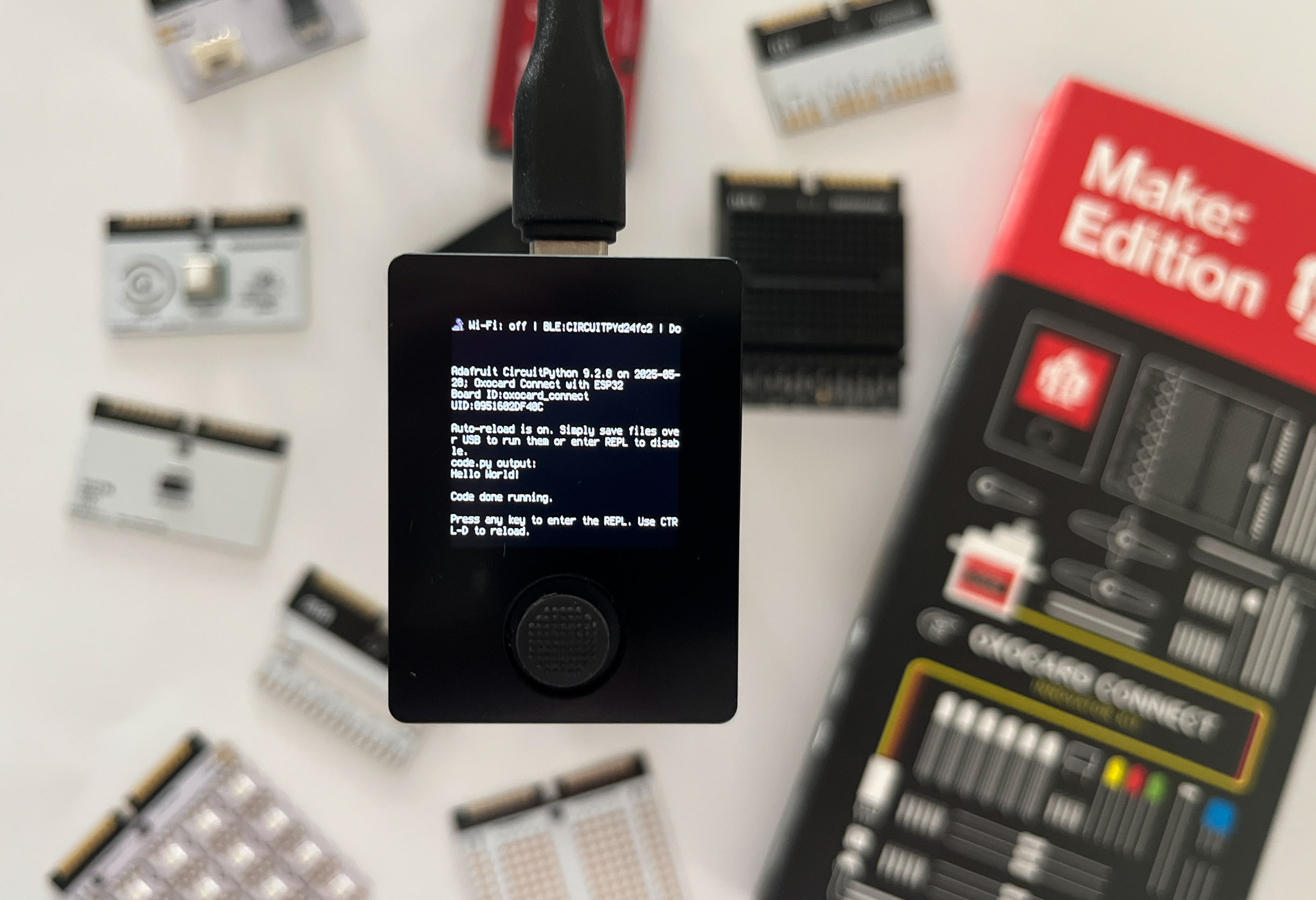
Our nifty Oxocard microcontroller comes with a beginner-friendly NanoPy language — but it also runs super-popular CircuitPython.
tulip sleet
thorny jay
I played with the FruitJamOS, and I could not figure out where the sound was sup...
I had the same q about the speaker, and ended up using thick foam tape to mount it over the components. But I asked ladyada later, who said it would be better to mount it on the cover plate over its space.
The current volume settings are quite low and will be tweaked.
tulip sleet
tidal meteor
Just to let you know that "Make Magazine" just published my article about Circui...
Great! I have sent that on for publication in our weekly newsletter. Send news like this to cpnews@adafruit.com
tulip sleet
thorny jay
I played with the FruitJamOS, and I could not figure out where the sound was sup...
I inquired: you can mount the speaker front side against the top plate use the self-stick ring. This will be added to the guide.
manic glacierBOT

The idea of audio effect/mixer chaining was theorized in one of the first audio effects PRs, https://github.com/adafruit/circuitpython/pull/9640#issuecomment-2389776124, but never actually implemented.
The updates in this PR are relatively simple. Instead of returning None within play(...) methods of audio objects which allow both input and output (effects and mixer), it instead returns a reference to itself.
With this minor update, rather than building audio chains the old way:
...
I have seen this kind of chaingingchaining more with properties than function calls, but it's neat how they can be stacked.
I think it would be good to document that self is returned for all these cases, using :return: and :rtype:, and probably give an example of chaining for each case
wraith crow
thorny jay
I played with the FruitJamOS, and I could not figure out where the sound was sup...
Most of the fruit jam programs default to headphone output. To direct audio to the speaker you can add the “audio” parameter to the launcher.conf.json file

Launch apps, play games, edit code and more with Fruit Jam OS.
lone axle
I've made a note on my list to update that page with the audio controls.
I'm going to update the fruit jam lib to use 0.0 - 1.0 range first so the docs can reference that from the beginning.
I will expand the guide more generally to mention the default behavior of audio and how to change it.
wraith crow
Until foamyguy’s updates, For speaker {“audio”:{“output”:”speaker”}} 😁
manic glacierBOT
One more idea for clarity, in all these places.
return MP_OBJ_FROM_PTR(self);
This is just a cast and makes it clearer you are returning self.
wraith crow
thorny jay
I played with the FruitJamOS, and I could not figure out where the sound was sup...
I would also recommend updating the firmware, libraries and fruit jam os frequently, it’s still early days and things are changing
thorny jay
wraith crow
I would also recommend updating the firmware, libraries and fruit jam os frequen...
Fully understand that.
I wanted to start a list of "imperfection" from an "end-user point of view".
- Sound was issue number one.
- Switching to terminal display between FruitJamOS and "FruitJamApplication" is also "uggly" and I would prefer the terminal to be hidden, and just a black screen.
- Maybe some lack of common behaviour between application (like how do I get out of a game/application)
- Maybe common setting (like sound level) but I have seen issue or stream that let me to believe that this is worked on.
I am not sure the best "channel" to share "opinion" about the "look and feel" of the resulting CP+FruitJamOS+Application combo.
manic glacierBOT
I think it would be good to document that
selfis returned for all these cases, using:return:and:rtype:, and probably give an example of chaining for each case
I've got some basic documentation in there. If you have any suggestions on the language used, I'd be happy to update. Thank you for the review!
lone axle
thorny jay
Fully understand that.
I wanted to start a list of "imperfection" from an "end-...
An issue on the Fruit Jam OS repo is probably the best place to start a discussion: https://github.com/adafruit/Fruit-Jam-OS/issues
Switching between terminal and display is not something that the Fruit Jam OS layer has control over I don't think. CircuitPython itself automatically shows the terminal when it starts up. The "launching apps" mechanisms involves restarting circuitpython so it will show the terminal when that happens unless behavior in the core is changed I think. In any case I'd want a change like that to be optional if possible because I find the switching kind of charming in a way even if it's jarring by modern UX standards.
As for common behaviors: ctrl+c should be able to exit out of any app/game. Then can go back to the launcher with ctrl+d. Other games/apps do provide other mechanisms as well like pressing q at the end of the game will exit a few of the ones I made but it is up to individual apps to provide any behavior beyond the ctrl+c / ctrl+d that is built-in to CircuitPython.
manic glacierBOT
@todbot You use synthio a lot, and I do not. Would you have any comment? Thanks!
manic glacierBOT

It seems that both this and bt pull in coex now. Not sure if coex is worth including for everything but just a heads up since h2 and p4 chips have wifi disabled. I just OR'd the configs in my branch to make sure when testing just bluetooth without wifi that everything gets linked but either way I think it will require some additional casing to handle the p4 which lacks both.
vernal sage
Didn't realize that was going to post here and made the comment so it wouldn't get lost in discord. Apologies if comments on drafts are discouraged
manic glacierBOT
That was indeed the issue. I would suggest putting extra wording in the learn page saying that "pull = True" means that it'll apply a pull opposite to the desired trigger value.
Can do. Which Learn Guide were you thinking of? https://learn.adafruit.com/deep-sleep-with-circuitpython/alarms-and-sleep#pinalarm-deep-sleep-3081649 ?
There is an additional explanation in the documentation, but that is not always an obvious place to look: https://docs.circuitpython.org/en/latest/shared-bindings/alarm/pin/index.html.
orchid basinBOT

Hi @makermelissa , I am the creator of the Noise Nugget and I just noticed this. Thanks a lot!
manic glacierBOT
yes, that's the one. i do tend to hit the learn guides first in most cases.
I temporarily added usb_background() to the msec tick routine for keypad and created a keypad.Keys(), which enables tick interrupts. The PyPortal now disconnects/connects twice early on, and then mostly stays connected, but sometimes disconnects for a short period with intervals of around 5-12 minutes (it's not consistent).
manic glacierBOT
@tannewt Now that I've seen how you approached this PR, I think I could probably get a static buffer version of this working to test whether it would have fewer problems with SRAM heap allocation. No promises on results, but I'm gonna take a look at it.
manic glacierBOT
@RetiredWizard I wasn't able to reproduce your error with Fruitris. Were you doing anything special?
My setup:
- Fruit Jam rev D board
- CircuitPython UF2 file from this PR's CI build
- Fruit Jam Fruitris 1.0.0-alpha.5 project bundle zip file
- EVGA XR1 lite HDMI capture card
- Adafruit generic SNES gamepad or 8BitDo SN30 Pro gamepad (both work fine for me)
I did have to make a couple attempts to get all t...
manic glacierBOT
Apparently having a launcher.conf.json file with:
{
    "use_mouse": "True",
}
is the difference, however it didn't look like the keyboard plugged into the usb port of the fruit jam was working properly even when the program loaded with no launcher.conf.json file. The arrow keys seemed to work but the P to pause, Q to quit and Ctrl-C were all ignored.
Oh, one other possible difference is that I'm using the packaged version of Fruitris from https://github.com/RetiredWizard/Fruit-Jam-OS_MyApps. Other than some minor audio changes from a pending PR I don't think there are any differences from the version from @relic-se respository
manic glacierBOT
oh.. so to trigger this, it's not just a matter of using Fruitris, but I would need to install Fruit Jam OS?
manic glacierBOT
This is a revision to @tannewt's earlier PR that used dynamic allocation in the SRAM heap:
This is intended to fix https://github.com/adafruit/circuitpython/issues/10562
Changes relative to tannewt's PR:
- Use a fixed size static global buffer
- Remove exceptions about allocation failures
- Implement several length checks to avoid possible buffer overflows. When a requested length is too long, it will be silently truncated to...
Just made a PR with a static buffer version of the code from this PR if anybody wants to compare:
I tested a local build of this code with my reproducer code from https://github.com/adafruit/circuitpython/issues/10562 and with Fruit Jam Fruitris 1.0.0-alpha.5. Both worked fine.
I did not try installing Fruit Jam OS, so I haven't actually seen the problem that RetiredWizard reported. I'm not sure if this code will fix that. But, since I removed the dynamic allocation stuff, it seems possible.
tiny peak
CI maintainer folks, I got a build error on this PR which seems to have been caused by a http 403 from attempting to fetch a Ubuntu 24.04 image from Azure. The error only happened for one build. Looks like something weird is going on.
manic glacierBOT
What are the memory implications for programs that don't use USB (at least not USB-host)? Would it make sense to put the buffer-size constant in one of the global/port/board make-files to allow easy tweaking? At least you should check if USB_CORE_SRAM_BUF_SIZE is already defined so a make-invocation can override it.
manic glacierBOT
What are the memory implications for programs that don't use USB...
As this stands now, RP2350 boards would have 256 bytes of internal SRAM dedicated to the usb dma-safe buffer. (see ports/raspberrypi/mpconfigport.mk in the changed files). Other ports and boards would have no change unless unless they opted into the dma-safe stuff by setting `CIRCUITPY_ALL_M...
manic glacierBOT
Also, it might work fine to set the default buffer size to something much lower, like 128 or perhaps 64. The supervisor uses TinyUSB's HID class driver in a way which probably (maybe? not sure) does not depend on anything in shared-module/usb/core/Device.c for fetching configuration descriptors.
I'm not sure what other code might depend on being able to read large configuration descriptors in one control transfer call. I think it would probably work fine to write code that made a series of...
lone axle
tiny peak
CI maintainer folks, I got a build error on [this PR](https://github.com/adafrui...
I think it sometimes just fails the network requests. I can be re-run, but I'm not sure if only for a single device.
it may have been an issue with the server hosting the file at the time the request was made.
 plain oasis
While creating a PR for the MMA8451 library i noticed that the ruff formatter when run locally fails to start because rule E999 is available anymore but selected by default. Is there any specific configuration required to run ruff locally?
Makes it a bit problematic to check if it meets the rules before pushing.
manic glacierBOT
Apparently having a launcher.conf.json file with:
{
    "use_mouse": "True",
}
Fruitris doesn't utilize that property at the moment, but my guess is that the initialization of that device within Fruit Jam OS before loading the application might have been the cause.
is the difference, ~however it didn't look like the keyboard plugged into the usb port of the fruit jam was working properly even when the program loaded with no launcher.conf.json file. The arr...
lone axle
plain oasis
While creating a PR for the MMA8451 library i noticed that the ruff formatter wh...
What version of ruff are you using, and how do you launch it? We typically use pre-commit to run ruff and the other checks, and it seems to be working okay inside that repo:
~/Adafruit_CircuitPython_MMA8451$ pre-commit run -a
check yaml..................Passed
fix end of files............Passed
trim trailing whitespace....Passed
ruff-format.................Passed
ruff........................Passed
reuse.......................Passed
I have installed it from pypi so currently 0.13.0 and ran ruff check directly assuming it uses the provided ruff.toml
This contains E999 but ruff fails with
Cause: Rule
E999was removed and cannot be selected.
lone axle
looks like that is quite a bit newer than the one specified in the pre-commit files: https://github.com/adafruit/Adafruit_CircuitPython_MMA8451/blob/467029d217e2c9c42d5cb2195286731a2caba2b2/.pre-commit-config.yaml#L12-L13
I think you'll either have to use a lower version, or run it via pre-commit instead of directly.
I'm not opposed to updating to a newer version of ruff, but that will require a much wider change in the cookiecutter and all the rest of the library repos, since we use the same configuration in all of them. It would be good to get rid of deprecated configs ultimately.
plain oasis
Good to know. Just noticed that while checking the PR after the first verification failed. Then for a local check removing E999 or using an older version is probably enough.
btw. regarding the open PR i am open to feedback if a different approach is preferred to ensure a proper delay after the MMA8451 reset. A simple 1ms delay is in theory enough but as the startup time is not really specified in the datasheet a dynamic retry loop may be more reliable.
lone axle
I think the latest version is good, I reviewed the PR, thanks for working on that.
manic glacierBOT
@todbot You use synthio a lot, and I do not. Would you have any comment? Thanks!
Looks neat! I remember advocating for something similar with digitalio long time ago.
I didn't realize mixer.play(playable, voice=num) existed. Is that equivalent to mixer.voice[num].play(playable)?
My only concern (as w/ everything in the core modules now) is that the added feature will push out other modules on ports that are at the limit.
Thanks!
@todbot I'm not worried about size - the code growth should be tiny or non-existent in this case.
manic glacierBOT
I have to run this morning but I'll load this up this afternoon. Thanks!
manic glacierBOT
Thanks for the review, @dhalbert and @todbot ! This update will definitely tidy up a lot of audio examples.
slender iron
vernal sage
Didn't realize that was going to post here and made the comment so it wouldn't g...
They are welcome! Thanks!
manic glacierBOT

Thanks for submitting a pull request to CircuitPython! Remove these instructions before submitting.
See https://learn.adafruit.com/contribute-to-circuitpython-with-git-and-github for detailed instructions.
- Consider whether to submit this PR against
mainor against (if it exists) the branch for the current stable release or an upcoming minor release. The branch will be namedi.j.x, for example,9.2.x. Bug fixes and minor enhancements can be submitted against the stable release b...
I'm not sure I want to do so far as a static allocation. Silently failing if a request is longer than the buffer isn't good and allocating more than you need seems subpar too. One thing we could do is share the temporary buffer amongst all devices. Right now it is per-device.
Allocating the large framebuffers late after startup will also be risky. It's much better to do the largest allocation first and keep it.
slender iron
@vernal sage want to PR your changes into my branch?
actually I can just pull in the commits
manic glacierBOT
It sounds like we may not go this way but Fruitris does now start with the mouse option and the artifact from here.
Trying some variations using Adafruit CircuitPython 10.0.0-beta.3 on 2025-08-29; Adafruit Feather M4 Express with samd51j19 on two Feather M4s...
The controller's 8 pre-loaded bytes should get rotated from controller to target, and the target's 8 pre-loaded bytes should get rotated back to the controller. Instead, it looks like the controller reads back some of what it wrote, and the target gets gibberish. The controller initiates a transaction every second. The target is only doing a ...
manic glacierBOT
...Silently failing if a request is longer than the buffer isn't good and allocating more than you need seems subpar too...
Some things to weigh here as you consider how to move forward with this:
- What counts as "failure"? The TinyUSB transfer calls are designed to return their actual length of transferred data which may be less than the requested length. This is a pretty normal way for C IO functions to behave. The PyUSB API is also designed to be consistent with this by returning t...
slender iron
@gilded cradle I'm using code-beta.cp.org with an ESP32-C6 via the internal usb to serial converter. On connect I'm seeing the device reset. Is the editor doing this or my OS?
vernal sage
I did a bit more testing from from branch, I think the C61 is done at this point since it is missing RMT/PCNT/TWAI. I flashed a TinyC6 and the default neopixel test was running from. I tried to flash the MetroS3 but that likely needs a partition update as well the lib changes you mentioned your PR
slender iron
kk
I'm starting with C6 testing and will do the others this week
Thanks for the help!
just pushed my branch with your changes plus the string0 change
vernal sage
I foolishly didn't check the C61 block diagram before starting this whole thing so I'll probably have the C5 branch up tomorrow. All I want from a board is matter/thread and some PSRAM. Hopefully that is just the boilerplate stuff though given the TinyC6 worked fine
manic glacierBOT
but Fruitris does now start with the mouse option and the artifact from here.
Do you mean this PR does successfully fix the memory allocation error that you were seeing on the other PR?
orchid basinBOT

Bumps rexml from 3.4.1 to 3.4.2.
Release notes
Sourced from rexml's releases.
REXML 3.4.2 - 2025-08-26
Improvement
Improved performance.
GH-244
GH-245
GH-246
GH-249
GH-256
Patch by NAITOH Jun
Raise appropriate exception when failing to match start tag in DOCTYPE
GH-247
Patch by NAITOH Jun
Deprecate accepting array as an element in XPath.match, first and each
GH-252
Patch by tomoya ishida
Don't call needless encoding_updated
GH-259
Patch by Sut...
manic glacierBOT
but Fruitris does now start with the mouse option and the artifact from here.
Do you mean this PR does successfully fix the memory allocation error that you were seeing on the other PR?
Yes
manic glacierBOT
On a Metro ESP32-S3, there is no automount after a hard reset, because there are no `DEFAULT_SD_*``. (The card detect pin on the SD card socket is not wired up.)
I did simulate a default SD card by wiring to an SD breakout and add DEFAULT_SD_* values for those pins. It did not work, and caused USB disconnection as on PyPortal.
When manually mounting the SD card with the on-board socket in code.py, the card does show up as a drive in Linux, but the board reliably does an auto-reload res...
wraith crow
@lone axle I just noticed in the recent learning guide PRs, you left it so that volume_override_danger set both the volume and the new safe limit. In your deep dive you had mentioned that you thought they should be separate. Did you change your mind? If not, and you don't have time, I can throw a quick PR in tonight to set them as you had defined in the deep dive.
lone axle
wraith crow
<@382939733107408897> I just noticed in the recent learning guide PRs, you left ...
I didn't change my mind, must have just overlooked it. If you're up to it can you go ahead and swap them to 0.0 - 1.0 volume values like ones from this this PR: https://github.com/adafruit/Adafruit_CircuitPython_FruitJam/pull/22 I will do that soon in any case if not. Once that is updated in all the places where the volume API is used I'll move those PRs out of draft.
wraith crow
okay, I'll submit a PR later tonight that does both...
lone axle
Thank you!
 gilded cradle
@slender iron I'll have to take a look
slender iron
I'm monitoring the esp_log via uart to see that the device restarts due to the serial to jtag triggering it
could be a linux thing
or maybe some restart trigger leaking over from a shared serial library?
gilded cradle
@slender iron I don't think it's resetting. Does the reset cause it to disconnect?
slender iron
no, but it does the startup blinks again
it doesn't fully connect afterwards anyway. I was just starting to debug it
does it work for you?
gilded cradle
Yeah, it seems to work fine for me on mac.
I was able to connect, open code.py, edit it, save it, and run it.
manic glacierBOT
- As long as the buffer is big enough, getting a shorter than requested actual length should be a rare thing.
This won't be under the program's control if we silently allocate a shorter buffer internally. I agree that the argument should be checked but it should be a sign of the device's response length, not an intermediate limitation.
2. I would expect this could easily lead to fragmentation of the SRAM heap.
My code doesn't allocate until a transfer with a PSRAM buffer is don...
Thank you for the new board definition. It looks like you didn't update your submodules and then added them all to your commit. Please explicitly add files to your commits to avoid this mistake.
To fix this, I think you can 1) checkout the submodules from the parent branch 2) switch to your PR branch 3) git add all of the different modules and then git commit --amend to integrate them back into this PR's last commit. You'll need to push with --force-with-lease to replace this current...
Do we know what is causing the buffer allocation in Fruitris and why it occurs before the new framebuffer is allocated?
Taking a quick skim through the adafruit/Fruit-Jam-OS repo, I didn't see any sign of calls to gc.collect(), and it's obviously pretty graphics intensive and the launcher uses some USB host stuff. My guess is that that stuff leads to a fragmented SRAM heap by the time the launched program gets loaded? Maybe?
slender iron
gilded cradle
I was able to connect, open code.py, edit it, save it, and run it.
Thanks for testing it! I'll dig more tomorrow
manic glacierBOT
Part of what I was thinking with the static buffer approach is that it would buy folks some extra breathing room by making heap fragmentation less likely. That way they wouldn't have to think as much about managing memory allocation when writing Python code. OTOH, you could definitely make an argument that people should consider memory management more in their Python code by calling gc.collect() and allocating large buffers early.
 willow totem
How do I see the partition size circuitpython creates on the fruit-jam? I want to consider matching the app / user-fs ratio for the WipperSnapper installer. Tried using picotool partition info but didn't show anything / recognise the setup (CPY v10).
I've gone with 8mb/8mb for "reasons" (adafruit_fruitjam.menu.flash.16777216_8388608), but this is the choice list: https://github.com/earlephilhower/arduino-pico/blob/master/boards.txt so was wondering if there was a better option.
crimson ferry
willow totem
How do I see the partition size circuitpython creates on the fruit-jam? I want t...
check mpconfigboard.h for the port and the board… the only thing I didn’t see there was where the saves partition goes
willow totem
crimson ferry
check mpconfigboard.h for the port and the board… the only thing I didn’t see th...
where's that then? I looked at https://github.com/adafruit/circuitpython/blob/main/ports/raspberrypi/boards/adafruit_fruit_jam/mpconfigboard.mk and then just now here too: https://github.com/adafruit/circuitpython/blob/main/ports/raspberrypi/mpconfigport.mk but couldn't see any relevant numbers
oh 🤦♂️ the .h in generic port folder, sorry
crimson ferry
(and .h in board folder, where the saves partition is defined… but where does it go? 🤷♂️)
willow totem
the size and offset thing, I forgot it's possibly dynamic as such too, just above here (link goes to some flash autodetect thing I was referencing for something else ) https://github.com/adafruit/circuitpython/blob/ffc42b9f0f4aa5e812de5302bc217e1dd5a0f8b6/ports/raspberrypi/supervisor/internal_flash.c#L81C35-L89C6
crimson ferry
I wish all boards had a saves partition, even if it was small… Some place to put things more complex than bytes in flash by code.py
willow totem
yeah it's a good one. I also like the idea of accessing log files that way, read-only to the user
not sure the longevity of flash and logging but ignoring that...
lone sandalBOT
 manic glacierBOT
gc.collect() isn't involved here. It manages the VM Python heap.
The framebuffer error is caused by the "outer" heap fragmentation which separately manages the internal SRAM and the external PSRAM. The internal SRAM is only used for buffers that are used by DMA (like the framebuffer) and buffers that need to be accessed when PSRAM access is disabled (like the USB buffers.)
The framebuffer error is caused by the "outer" heap fragmentation which separately manages the internal SRAM and the external PSRAM.
Oh... interesting. So what can be done to manage outer heap fragmentation? Is that something people writing Python code have any control over?
manic glacierBOT

CircuitPython version and board name
Adafruit CircuitPython 9.2.0 on 2024-10-28; M5Stack Dial with ESP32S3
Code/REPL
import board, os
from digitalio import DigitalInOut, Pull

import usb_hid, time # , neopixel
import time, busio, rotaryio, terminalio, displayio

import adafruit_focaltouch

KEYCODE_ON_RINGBUTTON = KEYCODE_ON_MULTITOUCH = KEYCODE_ON_TOUCH= [1,2,3] # Faked for Github
TOUCH_DEBOUNCE=.0005
textColour=0xfe8a2c

print(os.uname().machine)

# create ...So what can be done to manage outer heap fragmentation? Is that something people writing Python code have any control over?
Don't try to allocate almost all of it into a framebuffer. :-P Not really, they don't have much control. There should be very few allocations there so the hope is that fragmentation doesn't become an issue.
mmm... I hear you. Well, let me know if you come up with something else you'd like tested or if you want a modified version of my static allocation PR.
slender iron
anyone use a c6 over serial with code.cp.org?
tulip sleet
@slender iron re the automount bugs: i have not yet found the cause of the disconnects on atmel-samd. forcing tud_task() calls every msec doesn't solve the problem. There are differences in supervisor/port.c and usb.c between ports that work and those that don't. I added a task-ready check but it didn't help.
The 70-second auto-restart on Linux also happens on RPi Linux, so it's generic. I have a USB trace that shows some activity from the host at that time, tickling the SD drive, it appears.
We talked at the Wednesday meeting about maybe turning the automount stuff off for 10.0.0. Our we could have it on only for Fruit Jam and other boards where the automount can be done before, but that doesn't solve the 70-second restart on Linux. Happy to talk about this if you have time.
tulip sleet
slender iron
anyone use a c6 over serial with code.cp.org?
are you testing with beta-code or code?
there is a fix in code that is not in beta-code, I thnk, that Tim made a day or two ago and I approved
manic glacierBOT
While talking to Dan I realized I could simply free the temp buffer after using it instead of saving it for next time. This should prevent the fragmentation and reduce the number of concurrent allocations. Will do that now and then push it here.

This would've been incredible... Only having the option for PWNIn is quite limiting!
Now I must reconfigure my entire program into C++, which is what I tried to prevent from learning Circuit Python in the first place :/
Will do that now and then push it here.
If I understand correctly, you're proposing to do a heap allocation and deallocation of the full size buffer for every Device.read(). That might be okay. But, could you hold off on merging that until we have the chance to test how much additional latency it adds?
I'm concerned that MIDI polling in particular is already apparently too slow such that it drops notes.
There's some progress on adding this feature to the core, but it's been slow moving. If you're using a Pico device (RP2040/RP2350) and don't require realtime audio processing, you can use this library instead for the time being https://circuitpython-pio-i2s.readthedocs.io/en/latest/
If I understand correctly, you're proposing to do a heap allocation and deallocation of the full size buffer for every
Device.read(). That might be okay. But, could you hold off on merging that until we have the chance to test how much additional latency it adds?
Yup, just pushed. Please give it a test. I only made sure it compiles for Fruit Jam.
I'm concerned that MIDI polling in particular is already apparently too slow such that it drops notes.
I suspect MIDI needs a separat...
Closing for now. Will open a new one for 5.5.1 update once I've smoke tested it.
Closing for now. Please open a new PR with the ability to share mdns between AP and station.
manic glacierBOT
@relic-se Currently trying to make a realtime audio visualizer with my ESP32-S3 and a recently purchased SPH0645LM4H. Unfortunately, my options look quite limited unless I switch to a PDM microphone,, or use Arduino. I have a spare MAX9814 around but I'm pretty certain I fried it in my last project 🎶
manic glacierBOT
This makes me nervous. Feels a bit sketchy. Maybe it's totally fine. IDK.
I tested the build for the latest changes and it works fine with my MIDI synth and gamepad stuff. The amount of stuck notes on the MIDI synth didn't seem any better or worse than before these changes. If RetiredWizard tries this and it works okay with Fruit Jam OS + Fruitris, then as far as I'm concerned, this is good to go. I have some reservations about _abort_transfer(), but it's probably fine. Whatever. Fixing the crash is more important.
I suspect MIDI needs a separate higher level API that is implemented using TinyUSB's MIDI support for buffering. What is the way to do it in CPython on Linux?
Not sure. Aside from PyGame's pygame.midi I haven't run across much in the way of MIDI coding using Python on full size computers. It's more common to see stuff using C/C++ or one of the special purpose music programming languages (Pd, Max, Faust, Supercollider, ChucK, Sonic PI, etc). ...
manic glacierBOT
I'm actually on a mini-vacation this weekend, but what kind of vacation would it be without the Fruit Jam along? :grin: I managed to get this artifact loaded up and Fruitris does run without giving the memory error.
manic glacierBOT
I was able to shrink down my example code
import board, os
from digitalio import DigitalInOut, Pull
import usb_hid, time
import time, busio, rotaryio, terminalio, displayio
import adafruit_focaltouch

print(os.uname().machine)

# create the switch, add a pullup, start it with not being pressed
button = DigitalInOut(board.KNOB_BUTTON)
button.switch_to_input(pull=Pull.UP)
button_state = False

def get_touches(debug_str=""):
    touch_touched = None
    try:
if 'touches' in dir(tou...I have what I think is a V1.0 MSStack Dial. I loaded both 10.0.0 beta.2 and beta.3 on the board (.bin, since there is no named TInyUF2 version).
I was unable to cause a crash. Your simpler program runs, printing a lot of stuff on the display. I click the button and touch the screen, and nothing bad happens. Was there something specific you did?
The difference between V1.0 and V1.1 seems to be STAMP S3 vs STAMP S3A. But there don't appear to be spec differences that would cause a problem.
G...
lone sandalBOT
 manic glacierBOT
Summary of testing
PyPortal (SAMD51): mount SD manually card in code.py, and then print a count once per second
- After only one or two seconds, the program stalls. CIRCUITPY never appears. Eventually the program starts up again, as visible on the display, and there are one or more reconnects/disconnects on USB serial.
- A USB trace shows that there is occasional USB MSC activity (SCSI status commands) for tens of seconds. Eventually there is some fatal error in Linux USB subsys...
manic glacierBOT

Sorry to comment on something so old and seemingly unfixed / unresolved.
But is it possible to get _bleio back for esp32 boards with psram, but tell it to not use the psram?
I was hoping to talk to a BLE temp sensor and tried using adafruit_ble to no avail since it relies on _bleio and it has been indefinitely disabled for ESP32. @dhalbert said in May 2023 that "ESP32-S3 boards have limited native _bleio support turned on." But I guess that was later changed in december the same year?
...
manic glacierBOT

CircuitPython version and board name
CircuitPython 10.0.0-beta.3, MagTag 2025 edition
Code/REPL
from adafruit_magtag.magtag import MagTag
from os import getenv
import gc

url = getenv("PWD_URL")
print("Getting data from URL "+url)
magtag = MagTag(
  url=url,
  json_path=[[], [], ["ssid"], ["passphrase"], ['timestamp'], ['qrcode']]
)

def update(magtag):
  try:
    result = magtag.fetch(auto_refresh=False)
    print("Retrieved data: "+str(result))
magtag....This seems like it might be due to the host computer you are connected to going to sleep while "fake deep sleep" is happening. Is it true that host computer goes to sleep during the several hours you mentioned?
ESP32 boards for both 9.2.9 and 10.0.0-beta.3 have native _bleio enabled. This has been true fora while now.
@dhalbert : I can reproduce this when the Magtag is disconnected from the computer. I just posted the console log for illustration.
I am testing a much simpler version below. The board is currently disconnected from the computer. Will post an update in a few hours when I have tested it more.
from adafruit_magtag.magtag import MagTag
from os import getenv

url = getenv("PWD_URL")
print("Getting data from URL "+url)
magtag = MagTag(
  url=url,
  json_path=[['timestamp']]
)

title_font = g...ESP32 boards for both 9.2.9 and 10.0.0-beta.3 have native
_bleioenabled. This has been true for a while now. Is there something not working? Which board are you using?
Ah, ok, that's weird. I am running:
Adafruit CircuitPython 9.2.9 on 2025-09-07; Adafruit Feather ESP32S3 4MB Flash 2MB PSRAM with ESP32S3
Board ID:adafruit_feather_esp32s3_4mbflash_2mbpsram
UID:8B8F268D0BC5
Mine does NOT seem to have _bleio. Even when i look using the REPL >>> help('modules'). I was trying to us...
If the magtag.fetch() fails, I think you will get an (uncaught) exception. So you could catch all exceptions and try again or just go to sleep.
Thanks but there is a try-except block in my main code already. (Not in my test code though - adding that now).
ESP32 is a specific chip, and ESP32-S3 is another specific chip -- it's confusing! _bleio was enabled for 4MB ESP32-S3 in earlier 10.0.0 dev releases, so try 10.0.0-beta.3.
manic glacierBOT
I think mine is a Stamp S3. (that's what it says on the bottom)
I think, I'm using the latest adafruit_focaltouch library, I have v 1.5.6.
If you don't want all that junk on the screen, set debug=False on the focaltouch initialization.
Try letting the code run overnight. It takes a while for it to crash.
manic glacierBOT
I can confirm that it fails with the simpler code above, even with the Magtag disconnected from a computer.
manic glacierBOT
From https://forums.adafruit.com/viewtopic.php?t=220287:
I can't initialize two PWMOut on two pins that use the same slice (for example, GP2 and GP3). But if I try, depending on which pin I initialize first, and what parameters I give to the second initializer, I get three different error messages, two of which are misleading. This makes PWM conflicts difficult to debug.
Adafruit CircuitPython 9.2.8 on 2025-05-28; Raspberry Pi Pico with rp2040
>>> import pwmio
>>> import boa...
manic glacierBOT
Here is a minimum reproducible example that fails to update after a few hours when the Magtag is plugged into a USB power supply, not a computer. Also, note that I have two Magtags and I can reproduce this failure on both boards, which suggests this is a software issue, not a hardware issue.
from adafruit_magtag.magtag import MagTag
import terminalio
import random

sleepTime = random.randint(1,30)

magtag = MagTag()

magtag.add_text(
    text_font=terminalio.FONT,
text_position=(20,2...This seems to generate safe mode pretty quickly. I get one or two [Errno 5] Input/output error beforehand.
import board
import adafruit_focaltouch

def get_touches():
    try:
        touch_touched=touch.touches
    except OSError as e:
        print(str(e))
    except RuntimeError as e:
        print(f"RuntimeError", str(e))
    return touch_touched

touch = adafruit_focaltouch.Adafruit_FocalTouch(board.I2C(), debug=False)

while True:
get_touches()OK, so not even a fetch is involved. When you say "a few hours", is that time actually consistent?
Could you try 9.2.9 as well? Thanks. It would be useful to know if this is a regression.
manic glacierBOT
OK, so not even a fetch is involved. When you say "a few hours", is that time actually consistent?
I don't know. It takes too long to babysit.
Could you try 9.2.9 as well? Thanks. It would be useful to know if this is a regression.
Unfortunately no, according to the instructions for installing CircuitPython:
WARNING: The updated Adafruit MagTag 2025 Edition will not work with CircuitPython 9.2.x or earlier. Make sure you in...
manic glacierBOT
Thanks anyway, I have an older MagTag and can test.
tiny peak
The CircuitPython meeting is today, right?
lone axle
tiny peak
The CircuitPython meeting is today, right?
yes
tulip sleet
<@&356864093652516868> (Bi)-weekly CircuitPython audio meeting is in about 1.5 hours, 2pm US ET, 11am US PT. Add your notes to https://docs.google.com/document/d/1uoxUASzgEdYKXVSxoizL9sWmy7A4cxbn5Zr8vzxTOSI/edit?usp=sharing
vernal sage
@slender iron did you ever get a C5 to repl?
Of course as soon as I ask, openocd wants to play nice. Back to gdb it is
slender iron
vernal sage
<@252717193496756235> did you ever get a C5 to repl?
I haven't tried the C5. My goal is to test the most common chips to ensure we can switch to 5.5 for those
C5 and C61 are just a bonus
manic glacierBOT
This looks good -- thanks! Thanks to @samblenny and @RetiredWizard as well.
It makes no sense to me that there would be 70 second autoreloads on one platform only since it feels like host behavior.
Disabling on SAMD is fine with me since that could be a lower level USB bug.
closing because the issue was resolved by
lone axle

Hackster.io
Use CircuitPython and Adafruit Matrix Portal S3 to recreate "Space Invaders". By Djair Guilherme.
A browser-based IDE for CircuitPython supported microcontrollers. No installation needed. Handy and powerful.

To use CircuitPython Online IDE: https://circuitpy.dev
or https://urfdvw.github.io/circuitpython-online-ide-2/

Notebookcheck
OpenAI has unveiled GPT‑5-Codex, an improved AI coding agent designed for software engineers, featuring autonomous code review and software flaw detection, with multi-platform integration. It operates in a secure sandbox and includes safeguards due to its high capability in sensitive domains.

I just published the first release of my @circuitpython.org Z Machine emulator for the @adafruit.com Fruit Jam. It can run #Zork and other version 3 #zmachine games. Works with Fruit Jam OS too. Download the release here:
github.com/ZContent/CPZ...

 Bluesky
·
Bluesky
·


GitHub
A native Z Machine for the Adafruit Fruit Jam running Circuit Python for playing Zork and similar games - ZContent/CPZ_Machine
lone axle
Thanks for hosting Dan! have a great week everyone.
manic glacierBOT
tulip sleet
@slender iron: Chromium bugs related to DTR/RTS:
original description of problem:
https://issues.chromium.org/issues/420689824
fix to above was broken:
https://issues.chromium.org/issues/437068905
bad fix was undone by finch killswitch:
https://chromium-review.googlesource.com/c/chromium/src/+/6828531
actual bug was fixed:
https://chromium-review.googlesource.com/c/chromium/src/+/6830530
tulip sleet
Here is the notes document for the Monday October 6, 2025 CircuitPython (Bi-)Weekly Meeting. It is at the normal time of 11am Pacific / 2pm US Eastern here on Discord. Add your hug reports and status updates to the document before the meeting. If you are unable to attend but would still like to contribute, feel free to add your notes and we’ll read them off during the meeting. Hope to see you there! <@&356864093652516868>
https://docs.google.com/document/d/1Tbs6tWOH9oaIUS1076qzb8weuu53jphB2x7t-8VxvgQ/edit?usp=sharing
tulip sleet
tulip sleet
Here is the notes document for the Monday October 6, 2025 CircuitPython (Bi-)Wee...
crimson ferry
os.uname() is getting deprecated(?), but sys.implementation has private methods. What is the canonical way to programmatically get the port, chip ype, etc.?
manic glacierBOT
When you say "a few hours", is that time actually consistent?
I modified the test so that it is deterministic. See below. I confirmed the number of iterations is not consistent: I got a failure of 61 and 16 trials, on the same MagTag. If you want to start with a fresh count each time, you need to run the two commented lines via REPL.
from adafruit_magtag.magtag import MagTag
import terminalio
import microcontroller

## INIT NVM via REPL
# i = 0
# microcontroller.nvm[0:8] = i.to_bytes(...thanks, we don't really have port available directly, but I can infer it... I'll lean toward sys.platform and sys.implementation
is RP2040 different enough from RP2350 to have sys.platform be the chip and not the port (as opposed to Espressif)?
tulip sleet
crimson ferry
is RP2040 different enough from RP2350 to have `sys.platform` be the chip and no...
look at os.uname().sysname and .nodename ?
if we had platform, it might be more helpful, but very little room for it on small SAMD21 builds
I don't know where MicroPython is going with this. That comment about deprecating uname is pretty old
os.uname() is Linux only on CPython
crimson ferry
I think for now I just need to distinguish ports (probably sticking to S3 and RP2350 in those ports)... some data interfaces behave differently by port... so I can do conditionals on port. If I absolutely have to, I can vary by chip.
tiny peak
Question for folks interested in making games: Has anybody put any thought into the problem of doing 2D or 3D graphics on Adafruit boards at a higher frame rate than what's currently possible with CircuitPython displayio? I expect that would be possible in Arduino, but doing game logic in C is less pleasant than a higher level language. I've also been considering things like Love2D on Raspberry Pi, the TinyGL software rendering library, etc.
Broader context for my question is, I've got an idea for a game I'd like to build using 3d wireframe graphics, or perhaps simple 3d shaded graphics. I'm wondering if I could somehow coax CircuitPython into giving me a tolerable frame rate on a Fruit Jam board, maybe by adding some new performance-oriented graphics API to the core. OTOH, it might make more sense to build on a different software stack, like maybe Lua and TinyGL on top of Arduino or Pico-SDK.
tiny peak
Or phrasing my question a bit differently: Would it be totally ridiculous to even consider attempting to add a limited OpenGL-like (TinyGL) software rendering API to CircuitPython?
Or from a third angle: What do core devs think of the potential long term maintenance impact for adding more game-framework-like features to CircuitPython vs. an approach of porting (or creating) a Lua-scriptable game framework to run on top of existing Arduino libraries (or Pico-SDK)?
fiery pecan
tiny peak
Question for folks interested in making games: Has anybody put any thought into ...
Someone has done that for the https://www.adafruit.com/product/5289 already: https://github.com/bernhardstrobl/Pico3D
GitHub
Open World 3D Game Engine for the PicoSystem & RP2040 Microcontroller - bernhardstrobl/Pico3D
tiny peak
fiery pecan
Someone has done that for the <https://www.adafruit.com/product/5289> already: h...
oh wow! very interesting.
 blissful pollen
tiny peak
Or from a third angle: What do core devs think of the potential long term mainte...
blissful pollen
tiny peak
Or from a third angle: What do core devs think of the potential long term mainte...
I love the idea of more libraries to help support games (though I'm sure a lot of it could be pure python). I did some investigation on speeding up DisplayIO a couple years ago. The short answer is the framework isn't set for "fast" speeds you may want in a 3d engine. You would likely need a new module to support the calculations. I haven't looked at it lately though.
At the same time directly blitting a Gif from OnDiskGif was able to get decent rates. So it is possible.
wraith crow
It doesn't appear that the adafruit_fruitjam library in the bundle circup uses has been updated with the most recent PR (5 days ago)....
fiery pecan
tiny peak
oh wow! very interesting.
However, the device it runs on doesn't exactly fall under the category of "Adafruit boards" that you initially asked for. Although it was sold on Adafruit's website at one point in the past, it's technically manufactured by Pimoroni.
tiny peak
fiery pecan
However, the device it runs on doesn't exactly fall under the category of "Adafr...
eh, close enough. The code is very interesting. Looks like they use geometry exported from Blender and feed that into a custom rendering engine that keeps one core busy. Then the c++ game logic runs on the other core. So, that at least validates the idea that software rendering of mildly complicated geometry ought to be doable. I'd expect that though. The bigger question would be how to package a rendering API such that you could do game logic in a scripting language that wasn't terrible for beginners to use.
tulip sleet
@tiny peak Scott might have more to say. displayio was inspired by the display architecture of memory-limited game systems, with tiles and sprites.
We have talked about doing lvgl. I'm not sure how good that is for gaming.
tiny peak
I don't think lvgl would really help much as it seems heavily oriented towards making 2D GUI stuff for touchscreens (lots of IO widgets for making forms and control panels)
For making stuff like platformer games, or perhaps the kind of 3D you'd need for a lo-fi flight simulator or racing game, it would be useful to have a library that's oriented towards a game rendering loop. Like, the loop would target 60 or maybe 30 fps, and each time through it would check inputs, update all the world state, then render a new frame from scratch.
tiny peak
For 3D stuff, it would also be helpful to have code to help with things like culling, shading triangles, animating the camera, and such.
It would also be really nice to have something that could sync the animation loop with the PicoDVI vertical refresh.
I'm not sure if it would be practical to modify CircuitPython to be compatible with that style of animation loop.
lone sandalBOT
 lone axle
wraith crow
It doesn't appear that the adafruit_fruitjam library in the bundle circup uses h...
lone axle
wraith crow
It doesn't appear that the adafruit_fruitjam library in the bundle circup uses h...
I made a release in fruit jam repo just now. It should get picked up for the bundle / circup tomorrow.
@tiny peak I don't have much experience with it, but there is also a stage module https://learn.adafruit.com/circuitpython-stage-game-library/overview which is more aimed towards game graphics as I understand it.
full plume
tulip sleet
<@1220648290941669377> Scott might have more to say. displayio was inspired by t...
You can do custom graphics under LVGL, and some people have used it for games. Although that's really not it's primary purpose, it does have a decent 2D canvas and I've used it in C++ projects (Win11 build of my ESP32 Christmas tree firmware - using LVGL canvas to emulate 1050 NeoPixels...)
 stuck elbow
tiny peak
For making stuff like platformer games, or perhaps the kind of 3D you'd need for...
stuck elbow
tiny peak
For making stuff like platformer games, or perhaps the kind of 3D you'd need for...
but you don't need C code for that, you can make that framework in python, using displayio or stage under the hood
full plume
IMHO getting non-trivial 3D graphics in CircuitPython would be a major uphill battle which might not be feasible to run on most current CircuitPython boards. Python support for 3D graphics has been a side quest of mine for a long time - I went so far as building a python wrapper for OpenGL at one point. It's been a few years since I went searching for a decent solution - most of my use cases involve highly interactive visualization of very large data sets. I've yet to find something that does that well with Python bindings.
stuck elbow
full plume
IMHO getting non-trivial 3D graphics in CircuitPython would be a _major_ uphill ...
yeah, 3d without hardware acceleration is really not great
full plume
Python support for 3D rendering has gotten better though - I've played with Panda3D a bit and it seems promising for gaming. However, getting it running well on a CircuitPython controller could be challenging.
Most Python "3D" systems are wrappers around C/C++ libraries. AFAIK there's not a trivial way to port CPython-API based wrappers to build as Micro/CircuitPython extensions. It's also likely that those wrappers (and the underlying C/C++ 3D engines) use some form of RAII based on CPython reference counting, which is not going to play well with Micro/CircuitPython's GC memory model.
FWIW there is cheat/hack that indirectly lets you have a UI with 3D from an embedded controller - which I haven't technically done with CircuitPython but I'm certain it could work well. You run the UI in a browser page, with REST/WebSockets keeping all the "moving parts" in sync but all the display and rendering done on the client. I've done this with Next.JS apps using three.js, where the entire UI is deployed as static javascript (+html,css,...) served from a micro SD card on an ESP32.
So it's not on a directly connected display (like the dvi out on a FruitJam), but it is "self contained" (i.e. you don't need anything installed outside your controller - just something with a decent browser which can connect over WiFi). It even works with my Android phone.
fiery pecan
full plume
So it's not on a directly connected display (like the dvi out on a FruitJam), b...
That sounds similar to using https://app.lizardbyte.dev/Sunshine/ to stream games from a gaming desktop, to a PC handheld (such as the Steam Deck).
 frail swallow
using an xiao 2040 and can't see to get it in read/write so I can write a config. boot.py is correct to my knowledge.
I tried an nvm route but also had issues and couldn't get it working.
[Errno 30] Read-only filesystem
import storage, usb_cdc
import board, digitaliobtn = digitalio.DigitalInOut(board.D2)
btn.switch_to_input(pull=digitalio.Pull.UP)
storage.remount("/", readonly=False)if btn.value:
storage.disable_usb_drive()
else:
storage.enable_usb_drive()usb_cdc.enable(console=True, data=True)
crimson ferry
nvm should work no matter what... can you post the code and exception?
@frail swallow is the intention for this boot.py to allow writing to the CIRCUITPY drive from code.py?
frail swallow
yes, I just need a place to store/update a config, allowing code.py to create/update the config
frail swallow
Let me set back up nvm and see
crimson ferry
is there an exception in your boot_out.py?
slender iron
@tiny peak I'm open to adding another module to support 3d rendering
likely that'd need to be based on some 3d engine for microcontrollers
and ideally the api would match something from CPython
I don't know of any microcontrollers with 3d accelerators. most are for 2d
phone class SoCs will have 3d GPUs but they are much more closed ecosystems
fleet hollow
@slender iron @tiny peak I'd love to see _stage.render expanded to support framebufferio.FramebufferDisplay. From there python-ugame/circuitpython-stage could be updated to support the Fruit Jam and other boards with picodvi. 3D acceleration would be cool, but getting 2D graphics to render faster is of higher priority imo in order to enable more detailed action games (platformers, etc).
vernal sage
@slender iron esp32c5 branch is up if you want to poke, definitely some stability issues that I need to sort out but it does boot to repl fine after an initial reset. Seens like there are some issues with SPI at >40m when tuning

GitHub
CircuitPython - a Python implementation for teaching coding with microcontrollers - Commits · dbd/circuitpython
tiny peak
Thanks to all the folks who gave feedback on the graphics stuff. Sounds like there's general interest in adding better support for a faster way to do game graphics. I didn't know stage was a thing, so I'm definitely gonna need to look into that a bit.
stuck elbow
tiny peak
Thanks to all the folks who gave feedback on the graphics stuff. Sounds like the...
it's very minimalistic, I made it before displayio was there
tiny peak
It sounds like there are at least two different levels of capability that people are interested in. First would be just faster 2D graphics, perhaps achievable by modifying the stage module so it can be used with more boards. Second would be some kind of 3D capability using a software renderer (perhaps TinyGL).
stuck elbow
it could be possible to do 2d graphics with a framebuffer instead of computing the pixels on the fly like displayio does, it would use more memory, but would be faster for some kinds of graphics
tiny peak
I'm particularly interested in lofi 3D capability suitable for building stuff with visual complexity on the order of old school MS Flight Simulator.
tiny peak
Not sure. I'm not knowledgable enough about the implementation details of such things. I just know I'd like to make a flight simulator.
stuck elbow
mode7 let you do fake perspective like this https://nesdoug.com/wp-content/uploads/2020/04/fzero.gif

and you could rotate it too
tiny peak
oh, that looks very Outrun
stuck elbow
there are some arcade flight simulators that used this
tiny peak
I'm thinking FPV racing course kinda thing
stuck elbow
lotus esprint ;-)
but it's all flat
you can have other airplanes and vehicles, and maybe trees or buildings as sprites, but no things like skyscapers or mountains

here's a hang glider simulator for snes using mode 7
tiny peak
oh... cool
stuck elbow
and a star wars space shooter https://i.ytimg.com/vi/WajVBFqDA1s/maxresdefault.jpg

note how they curved the horizon of the death star
tiny peak
hmm... interesting. One thing about old game console video modes, if I understand the history correctly, is that a lot of that stuff used hardware acceleration. So, on a board without such accelerator chips, I'm not sure there would be much benefit over just using a software renderer in the style of TinyGL or Pico3D.
I've been thinking in the direction of: What if Love2d, but with OpenGL 1.1-ish level graphics implemented with a software renderer, and maybe in Python?
stuck elbow
it's much cheaper to display a single rotated and scaled texture, than to render hundreds of textured triangles with occlusion
tiny peak
interesting. In any case, I'd like to figure out something that would let me do 3D graphics that look like old Bruce Artwick games.
 tiny peak
maybe a generation or two ahead of that if possible, but yeah. terrain and obstacles with either wireframe or shaded triangle stuff. possibly textures, but I care less about those.
stuck elbow
so those were done with a framebuffer and a Breshenham line drawing algorithm, and some basic projection math, later maybe some occlusion stuff
it was done purely in software on early pcs, amigas, atari st, etc.
tiny peak
I've toyed with the idea of trying to implement something from scratch according to the principles described in Artwick's "Applied Concepts in Microcomputer Graphics" book.
Trouble with that approach is it would be pretty unfamiliar to folks who are used to modern stuff. That's why I've also been wondering if I could maybe port a scaled down version of Love2D to Fruit Jam if I used a software renderer. Might be easier for folks to understand. Dunno.
stuck elbow
yes
stuck elbow
you can easily do love2d-level stuff with displayio already, you just need a python library that would implement the familiar functions
tiny peak
yeah. To me, for 2D stuff at least, it seems like the first choice path ought to be adding a module to CircuitPython, or modifying an existing module. The trick would be to come up with an API and implementation that works for action games where the whole frame gets re-rendered at a reasonably high frame rate.
stuck elbow
tiny peak
yeah. To me, for 2D stuff at least, it seems like the first choice path ought to...
why do you need a module? the game engine stuff doesn't need to be in C, displayio pretty much already covers the parts that need to be fast
stuck elbow
displayio is not slow, the displays you are using are slow
you have to push all those pixels over a single wire
a rewrite won't help with that
tiny peak
I think we're in danger of wandering off topic for this channel. I don't want to hassle the other folks in this channel with arguments. I'm gonna peace out for now. Maybe we can discuss more later.
stuck elbow
this channel is for circuitpython development, so it's on topic here, we can create a thread if you worry about others
slender iron
my thinking for displayio is to have a second implementation of it based on LVGL for higher end (aka not RAM limited) MCUs. LVGL already has a way to accelerate 2d stuff with MCU accelerators and we could expand that as desired
displayio performance as it is scales with the number of pixels that need to change. a pico 8 celeste style game with limited motion should be plenty fast. a scroller like mario will be tougher because each pixel needs to change. I always aspired to using the scroll ability of SPI display but it is often in the wrong direction
slender iron
vernal sage
<@252717193496756235> esp32c5 [branch](https://github.com/dbd/circuitpython/comm...
Nice! I'm not surprised since C5 support was just added
vernal sage
Whats a reasonable amount of time for a board to start? I'm sure there is a range but 14 seconds does seem kind of rough. I suppose this could in #help-with-circuitpython but this is more an issue with changing from flash storage to ram so wifi/bluetooth are initialized at boot every cold cycle
code.py output:
0;🐍10.0.0.114 | BLE:Off | code.py | 5.0.0-beta.0-4141-g0613f28042-dirty
 ==========  TIME  ==========
22:23:38 - 23/9/2025
==========  DONE  ==========

0;🐍10.0.0.114 | BLE:Off | Done | 5.0.0-beta.0-4141-g0613f28042-dirty
Code done running.

Press any key to enter the REPL. Use CTRL-D to reload.

Auto-reload is on. Simply save files over USB to run them or enter REPL to disable.
code.py output:
0;🐍10.0.0.114 | BLE:Off | code.py | 5.0.0-beta.0-4141-g0613f28042-dirty
 ==========  TIME  ==========
22:23:52 - 23/9/2025
==========  DONE  ==========
Also that reliability with the C5 was just bt trying to read nvs before it was initialized, so it would core dump, warm cycle before flash was reset and then would start up into safe mode. Switching to no NVS storage seems to have things working pretty well
slender iron
14 seconds with wifi starting isn't super crazy to me. It does at least one scan to find the channel to connect to
it should be two seconds or so without wifi
one second for safe mode blinks and one for bluetooth blinks
vernal sage
Ah okay, those blinks seem to line up with what I'm seeing
tiny peak
slender iron
my thinking for displayio is to have a second implementation of it based on LVGL...
Does LVGL 2D acceleration do anything useful on MCUs below the level of Cortex M52/M55/M7/M85 with Helium support?
lone sandalBOT
 tiny peak
From a quick look at the LVGL and ARM Developer docs, I'm wondering if Adafruit sells any boards besides possibly the Metro M7 and Teensy 4.x that would have the right instruction set features to benefit from LVGL's 2D acceleration stuff.
tulip sleet
tiny peak
From a quick look at the LVGL and ARM Developer docs, I'm wondering if Adafruit ...
Does the M33 in the RP2350 have some useful instructions?
tiny peak
as far as I can tell, M33 doesn't do the Helium vector instruction stuff
it's not clear to me if M33 has any lesser instruction set features that can be used by LVGL for acceleration
At first glance, my impression is that the stuff mentioned on the LVGL 2D acceleration docs page doesn't seem like it would apply to the RP2350. Might be wrong about that though. IDK.
tulip sleet
tiny peak
as far as I can tell, M33 doesn't do the Helium vector instruction stuff
interesting article confirming what you said but also pointing out M5x: https://www.techinsights.com/blog/arm-brings-helium-small-cpu
tiny peak
slender iron
likely that'd need to be based on some 3d engine for microcontrollers
From reading what people have to say here, on reddit, HN, and so on, I get the impression that not a lot of people do 3D stuff in desktop python, and it's quite rare on small microcontrollers. Like, 3d game engine for microcontrollers may not be a thing. (obligatory mentions: yes PyGame, Panda3d, Ursina, Pico3D do exist, but they don't seem very popular).
My point is that it doesn't seem like there is an existing game engine or framework for Python that people consider to be in the same league as other choices like Love2D, Defold, Pico-8, Godot, Unity or Unreal, etc. From what I read about PyGame, its API apparently lacks important features that are needed for many types of 2D games.
stuck elbow
I wrote a bunch of games, both in love2d and in pygame, and I never noticed pygame missing anything
but it's a library not a framework
tiny peak
one of the specific complaints I saw about pygame was that if you wanted to do a scroller with camera tracking, you had to implement all the coordinate translations on your own.
and people also mentioned they thought the API was generally pretty low level so you ended up having to build a lot of stuff on your own (things people missed having from engines that included more stuff by default)
haven't tried it myself, so I don't have much context to weigh those claims
The overall impression I got was, if we want to find good APIs to emulate -- stuff that lots of people like for building games of different styles -- it might be worth looking at how some of the popular Lua-based frameworks and engines work.
My tentative plan for the moment is to try some tutorials and experiments with Love2D, PyGame, and maybe some other stuff, then revisit all this later when I have more experience.
stuck elbow
tiny peak
and people also mentioned they thought the API was generally pretty low level so...
that is all true, as I said, it's a library you can use to build your own game engine, not a framework that already does everything for you
then again, plain love2d doesn't have much implemented either, I remember I had to do my own sprites, which pygame already had
my impression is that most of the lua and javascript game frameworks are based on this idea that you get a clean canvas, and draw all the game graphics on it from scratch every frame, which really doesn't work that well with non-accelerated platforms
displayio was based on the gameboy, nes, snes etc. platforms, where you have a number of tile grids and sprites, and where you only update the parts that have changed from the last frame
full plume
my impression is that most of the lua
manic glacierBOT
Thanks for more research on the NeoPixel.
The creation ID used here is not in https://github.com/creationid/creators/blob/main/creations/espressif.md#0x00c3_xxxx---c3-dev-boards . Could you open an PR there? Also I would say use a creation ID that is consecutive with other C3 boards.
Hi @AmaarEbrahim are you able to address this? It would be good to get this fixed for the 10.0.0 release. Thanks.
Hi - I made some small style suggestions. If you are fine with these I can merge them myself so you don't have to.
After that I'll merge the PR. Thanks for continuing to work on thiis.
Improve variable name.
    int i2c_id = pinsToI2c(sda, scl);
    if (i2c_id == -1) {
        return;
    } else {
        self->i2c_id = i2c_id;
        self->i2c_regs = MXC_I2C_GET_I2C(i2c_id);
    }
Declare temp as spi_id below, for clarity.
int err = 0;
Use a different name, for clarity.
    int spi_id = pinsToSpi(mosi, miso, sck);
    if (spi_id == -1) {
        return;
    } else {
        self->spi_id = spi_id;
        self->spi_regs = MXC_SPI_GET_SPI(spi_id);
    }
declared below as i2c_id, so remove this
Thanks for more research on the NeoPixel.
The creation ID used here is not in https://github.com/creationid/creators/blob/main/creations/espressif.md#0x00c3_xxxx---c3-dev-boards . Could you open an PR there? Also I would say use a creation ID that is consecutive with other C3 boards.
I tried to copy the model based on
0x0032_A000 ESP32-LyraT
Since this board seems to be the esp32-c3 equivalent of that one (though other than supporting audio, they are pretty different).
We have people register creation ID's at https://github.com/creationid/ so we can keep track of them. Pretty quick to do -- you could look at some of the merged PR's for examples (and look at the README).

[adafruit/circuitpython] New comment on pull request #10413: Add busio support for ADI MAX32xxx port
Hi - I made some small style suggestions. If you are fine with these I can merge them myself so you don't have to.
After that I'll merge the PR. Thanks for continuing to work on thiis.
All of these look good! If you are able to merge those yourself, I appreciate it :)
I thought #10474 might address this, but tested the July 11 artifacts, and this issue persists.
Adafruit CircuitPython 10.0.0-alpha.8-6-ga6cd2391ac on 2025-07-11; Pimoroni Pico Plus 2 W with rp2350b
manic glacierBOT
This makes sense to me. MICROPY_INTERNAL_EVENT_HOOK is invoked by mp_event_handle_nowait(), so this is a simple change that removes a difference from upstream. Thanks!
manic glacierBOT
slender iron
tiny peak
From a quick look at the LVGL and ARM Developer docs, I'm wondering if Adafruit ...
It isn't just instruction set that matters. Sometimes it is a separate peripheral. ESP32-P4 has one we can likely use too.
manic glacierBOT
Closing this for now, since we didn't hear back. Happy to re-open as needed.
This PR is a proof of concept, but need some discussion on how to handle this "properly".
The esp32-c3-lyra board has no DAC, but the i2s data pin is connected directly to an audio amplifier.
Using the audiobusio library, I was able to play music on this board, but it sounded terrible.
Comparing the i2s implementation in CircuitPython vs the working sample in the esp-adf dev kit, it turns out that the dev kit isn't using true i2s, but the i2s hardware has a PDM output mode. This p...
orchid basinBOT
Not actually relevant to cp.org in this case, but it is on my list of things to check for updates on.
manic glacierBOT
- This PR builds and I can play audio on the esp32-c3-lyra using the
audiomp3decoder. - Other esp32 ports also compile without errors
fleet hollow
stuck elbow
it's very minimalistic, I made it before displayio was there
In your opinion, would supporting _stage on the RP2350 result in a performance boost over displayio for tile-able graphics? I've started some porting work to get it running with framebufferio.FramebufferDisplay, but I'm not quite there yet to be able to run tests.
stuck elbow
fleet hollow
In your opinion, would supporting `_stage` on the RP2350 result in a performance...
stage works on the rp2350 just fine, and since it does less than displayio, it's faster
fleet hollow
stuck elbow
stage works on the rp2350 just fine, and since it does less than displayio, it's...
Ah, I thought it _stage disabled on platforms that weren't directly supported by the library (pybadge, etc). Still, I think framebuffer support is needed for picodvi output.
stuck elbow
fleet hollow
Ah, I thought it `_stage` disabled on platforms that weren't directly supported ...
ah, yes, it only works with fourwire displays
manic glacierBOT
stuck elbow
you would have to pretty much rewrite it for anything else
full plume
@slender iron just a heads up - not quite PR ready yet but that's the plan.... I've added some extra tracking inside gc.c / gc.h and calls to get at the extra info in modgc.c. It keeps a running total of how much is allocated at any given time, so you can call gc.mem_alloc_live() and get the result effectively instantly (especially compared to gc.mem_alloc(). I also added gc.mem_quick_free_live() and gc.mem_quick_used_live() (apologies for lazy naming - that will be fixed) which "walk the heap" like gc.mem_free() / gc.mem_alloc() but run around 300% faster. Source is at https://github.com/jbrelwof/circuitpython/tree/gc_extensions if you're curious.
My use case is a fairly complex profiling harness which tracks elapsed time and GC allocation. Since there can be dozens of before/after samples per single "main loop" iteration, the overhead for gc.mem_alloc() rendered the system nearly unusable when doing a "full depth" profile with memory tracking enabled. Using gc.mem_alloc_live() drops the overhead to around 20% compared to profiling completely disabled - whereas the overhead was more like 95%+ with gc.mem_alloc().
manic glacierBOT

Build Request
I'm working on a project that requires LoRa, and the Seeed Studio Xiao ESP32-S3 with the SX1262 Hat fits my use case perfectly.
Unfortunately, there isn't a specific firmware build/port for it, only the same board but with the Sense/Camera hat, and I don't know enough about the build process of CircuitPython to make a new port for this particular board+hat combo.
**Would someone with experience updati...
slender iron
full plume
My use case is a fairly complex profiling harness which tracks elapsed time and ...
I think I'd prefer these go in a new module. gc exists in CPython and we're already not matching it. I'd rather not make it worse. A new module also makes for an obvious way to enable and disable it
memorymonitor is an example
tulip sleet
@slender iron I am going down a rathole of automount issues. in main.c we have this code, which is about 6 years old:
static void stop_mp(void) {
    #if MICROPY_VFS
    mp_vfs_mount_t *vfs = MP_STATE_VM(vfs_mount_table);

    // Unmount all heap allocated vfs mounts.
    while (gc_nbytes(vfs) > 0) {
        vfs = vfs->next;
    }
    MP_STATE_VM(vfs_mount_table) = vfs;
    // The last vfs is CIRCUITPY and the root directory.
    while (vfs->next != NULL) {
        vfs = vfs->next;
    }
    MP_STATE_VM(vfs_cur) = vfs;
    #endif
it looks like it is assuming that there are no non-gc-able vfs mounts between gc-able vfs mounts in the linked list. I think that assumption could be incorrect, what with CPSAVES and automounting. Maybe it still works by accident.
also I see a a number of places callling gc_nbytes() to see if something is gc-able, but we now have bool gc_ptr_on_heap(), which is more efficient, and should work just fine, I think.
this is not urgent. I can talk to you tomorrow about this, just giving advance warning
there is also a catch-22 on auto-reload if you write to a code.py-mounted filesystem. When you write to that filesystem, it will trigger an autoreload, stopping the VM, and the filesystem will get unmounted, because it is gc-able. So writes to user-mounted filesystems should not trigger auto-reload ever.
(I started writing a lun_is_automounted() routine and then stumbled into the rathole above.
manic glacierBOT
Builds for 3rd-party boards are usually done by the manufacturer or a community member, so it depends on their priorities. I tend to agree with you that a basic build for the Pro would be useful, and perhaps even handle all of the hats in Python libraries.
Also note that the SX1262, afaik, is not yet supported in CircuitPython. If it was, it could be used with the https://github.com/adafruit/Adafruit_CircuitPython_RFM9x or https://github.com/adafruit/Adafruit_CircuitPython_RFM libraries. La...
For the Sense, their is camera support for the OV2640 in the core espcamera module. But there is no core support for LoRa, so it would makes sense for that to be library-based on top of the Pro board.
manic glacierBOT
Builds for 3rd-party boards are usually done by the manufacturer or a community member, so it depends on their priorities. I tend to agree with you that a basic build for the Pro would be useful, and perhaps even handle all of the hats in Python libraries.
My main ask is directed to the community members. It's kind of a shot in the dark, but I needed some help so I'm aiming for a kind soul out there. 🙏
Also note that the SX1262, afaik, is not yet supported in CircuitPython.
That's fin...
manic glacierBOT
Is 8MB vs. 16 MB flash the only difference between the vanilla Xiao ESP32-S3 to the Xiao ESP32-S3 Plus? It would be relatively easy given one to do the other. I'm sure you can get community help along the way. You probably want to start with the learn guide for building CircuitPython. Then probably use the Sense as a base, and strip away the camera (and any other differences). It may also help to review the [PR](https://github.com/adafruit/...
I don't see anything about the Wio-SX1262 that uses the B2B connector. The connections from the Xiao to the Wio seem to be only via the main header pins.
manic glacierBOT
I don't see anything about the Wio-SX1262 that uses the B2B connector. The connections from the Xiao to the Wio seem to be only via the main header pins.
Check this schmatic (pdf)
It's listed in the web page that I linked in my original post.
Also... could be out-of-date product pages or actual differences, but the Xiao ESP32-S3 with the SX1262 Hat page shows an ESP32-S3 with 8MB fla...
manic glacierBOT
Keep the issue open, you may find a kindred spirit who also wants the base board or the Plus.
The way I read the schematic, the LoRa pins on the B2B connector are duplicates of the main header pins. LoRa uses GPIO 1-5 and also the SPI pins GPIO 7-9, leaving 3 GPIO pins unused on the main headers. All of these [pins](https://github.com/adafruit/circuitpython/blob/main/ports/espressif/boards/seeed_xiao_esp32_s3_sense/pins...
Keep the issue open, you may find a kindred spirit who also wants the R8 (flash only), N8R8, or the N8R16 base board(s).
The way I read the schematic, the LoRa pins on the B2B connector are duplicates of the main header pins. LoRa uses GPIO 1-5 and also the SPI pins GPIO 7-9, leaving 3 GPIO pins unused on the main headers. All of these [pins](https://github.com/adafruit/circuitpython/blob/main/ports/espressif/board...
It would help to share your code, and a link to the library.
manic glacierBOT
I would if I could. It's in a private repo, and it's got a lot of layers.
The hard part is that the module I have for the SX1262 I got from someone else on GitHub, and it requires passing in the pins, not the SPI interface. I'm not sure why that is, but maybe I can refactor it to take a new parameter for an SPI class instead of each individual pin.
manic glacierBOT
I recommend that you try the build for the Adafruit QT Py ESP32-S3. This board is pin-compatible to the XIAO standard.
manic glacierBOT
I don't know which Xiao board you actually have in hand, but there are two QT Py ESP32-S3:
• 8 MB flash, no PSRAM (this would match the Xiao with 8 MB flash, no PSRAM - Or, * MB flash and 8 MB PSRAM but the PSRAM wouldn't get used)
• 4 MB Flash + 2 MB PSRAM (I don't think this could be used with any of the Xiao)
Other alternatives are boards that match the flash and RAM config of the board you have, and have the pins you need exposed. Some possibilities are:
https://circuitpython.org/boar...
manic glacierBOT
There is a guide for adding new boards as well: https://learn.adafruit.com/how-to-add-a-new-board-to-circuitpython
You can rely on GitHub to build the new board too if you are ok with waiting. Add your board based on the guide and then push to your own branch. GitHub Actions should then run and build the board for you. If you only add new files in the board folder, then it'll only build the new board.
Another alternative that comes to mind is the
audiopwmioAPI, which is a "natural" place for beginners to go, since it's used in a bunch of examples. The API would look the same, except that the name is wrong by one letter. Perhaps adding a flag or PWM vs PDM, or anaudiopwmio.PDMAudioOutAPI.
This is my preferred approach. The docs already note that the platform gets to decide the frequency of the PWM pulses so we can make it a little less specific to encompass PDM.
lone axle
@slender iron I made some progress on register refactor. Submitted https://github.com/adafruit/Adafruit_CircuitPython_Register/pull/59 draft with a SPI implementation.
I still have to do the I2C implementation and some more cleanup and testing. But open to get feedback when you have time to look.
manic glacierBOT
Good news, I found the root cause: if the EPaperDisplay is updating during the call to MagTag.exit_and_deep_sleep(), it may fail to restart the code. I just created pull request 96 for the MagTag library, which solves the issue by going into light sleep while waiting for the display to finish updating.
Another alternative that comes to mind is the
audiopwmioAPI, which is a "natural" place for beginners to go, since it's used in a bunch of examples. The API would look the same, except that the name is wrong by one letter. Perhaps adding a flag or PWM vs PDM, or anaudiopwmio.PDMAudioOutAPI.This is my preferred approach. The docs already note that the platform gets to decide the frequency of the PWM pulses so we can make it a little less specific to encompass PDM.
So have...
manic glacierBOT
Thanks for the diagnosis! I think this is still a bug. You should not have to depend on the library to fix the problem, since you may not even be using the library. exit_and_deep_sleep() should wait for the display update or cancel it.
slender iron
lone axle
<@252717193496756235> I made some progress on register refactor. Submitted https...
Nice! Will look now
manic glacierBOT
- Fixes #10632.
- Does not deal with #10510, which touches some of the same code, but I'll put that in a separate PR after some further consultation.
SD card USB presentation
- Add new
.h-only compile optionCIRCUITPY_SDCARD_USB, which will enable/disable presenting SD card as a USB MSC LUN. - Enable on all ports except
atmel-samddue to some bug that causes USB disconnection. I tested most of the other ports, and they don't have this problem. I'll open a separate issue ...
tulip sleet
tulip sleet
<@252717193496756235> I am going down a rathole of automount issues. in `main.c`...
@slender iron I have something read-only/read-write stuff to ask you about if you are free. I have something in half an hour
manic glacierBOT
So have some sort of #ifdef or variable in
board.cto define thatPWMAudioOutuses PDM on this board?
Nope, just implement audiopwmio for Espressif using PDM for everyone.
Also I'm just ramping up on this. I couldn't find an
audiopwmioincommon-hal, should I be looking to implement this inports/espressif/common-hal/pwmio?
Yup! Add ports/espressif/common-hal/audiopwmio with the implementation and enable it by setting CIRCUITPY_AUDIOPWMIO=1. I'd suggest using starting w...
Minor things. Want to document this behavior somewhere? Maybe the workflow markdown?
Want to uncomment this or delete it?
Will file or directory deletions still trigger a reload?
manic glacierBOT
Yes, the FAT, where directory data lives, is at vfs->fatfs.fatbase and above. The dirty bit and other volume metadata is below fatbase.
Volume structure is documented at https://download.microsoft.com/download/0/8/4/084C452B-B772-4FE5-89BB-A0CBF082286A/fatgen103.doc
manic glacierBOT
Want to document this behavior somewhere? Maybe the workflow markdown?
I added a paragraph to the #### SD card drive section in workflows.md.
manic glacierBOT
I have this kind of problems in various projects. Since I often use external circuitry to shut down instead of using alarm.exit_and_deep_sleep_until_alarms(), it is important to wait for the update to finish.
I usually loop on display.busy, but it turns out that there are displays where you cannot trust the busy-pin.
Fixing this in the alarm-module wont help in my use-case. I would prefer to have an option that makes display.refresh() synchronous.
vernal sage
What was the reason neopixel_write uses rmt instead of ledc for espressif? Seems like ledc has the wider class of support so you could use it on the C61 and C2
 devout jolt
vernal sage
What was the reason neopixel_write uses rmt instead of ledc for espressif? Seems...
devout jolt
vernal sage
What was the reason neopixel_write uses rmt instead of ledc for espressif? Seems...
I think ledc is only for PWM of “dumb” LEDs, not for addressable LEDs
manic glacierBOT
@tannewt thanks for the input. I'm not likely going to get to this next week, so it'll be a little while.
I'm not sure if there's any chance anyone else will take a look at this... if so you might want to leave this PR open as a reference. However, since the actual fix will look pretty different in terms of the affected files, you can close this and I'll submit another PR when I get around to this.
full plume
slender iron
`memorymonitor` is an example
Yeah, fixing the names and moving it the API wrapper to a separate module are part of getting it "PR ready". But it will still require changes in gc.h and gc.c, although those are all wrapped in #if CIRCUITPY_GC_TRACK_LIVE... so you can choose whether or not to add the tracking logic at compile/build time.
tulip sleet
@slender iron it turns out an ordinary file open() from CircuitPython don't use filesystem_lock() or blockdev_lock() at all. The open just checks filesystem_is_writable_by_python() ., which checks MP_BLOCKDEV_FLAG_USB_WRITABLE, which is only set/cleared by filesystem_set_writable_by_usb().
So the USB MSC side may do blockdev_lock(), but the CIrcuitPython side pays no attention to that. The filesystem_lock() and blockdev_lock() are used in the common workflow routines.
slender iron
tulip sleet
<@252717193496756235> it turns out an ordinary file `open() `from CircuitPython ...
oh oops! I thought I had that covered. That'd explain why it doesn't work
slender iron
full plume
Yeah, fixing the names and moving it the API wrapper to a separate module are pa...
You can move them behind the same flag that enables the module
tulip sleet
slender iron
oh oops! I thought I had that covered. That'd explain why it doesn't work
Can we talk on audio/video about this one more time? I will take notes! I am still not sure about who should grab the lock when. One trouble is that tud_msc_is_writable_cb() grabs and holds the lock immediately, and that's called as soon as the host side sees the device, even before there's any intention to write any files from the host side.
i have somebody coming over briefly in the next 15-30 minutes, so short or could be after that.
slender iron
tulip sleet
Can we talk on audio/video about this one more time? I will take notes! I am sti...
rynn just went down so I'm free for 45 minutes at least
manic glacierBOT
you can close this and I'll submit another PR when I get around to this.
Works for me. Thanks!
One additional doc thing.
auto-mounted on the host. Writes to user code mounted drives will not trigger a reload.
@bablokb : After some thought, I agree that it would be cleaner to make a blocking option on MagTag.refresh() instead. Specifically, if MagTag.refresh(blocking=True) then the function waits to return until the display has finished updating. That wouldn't change the behavior of exit and deep sleep. I just added another commit to my pull request for MagTag.
manic glacierBOT

Added this board,
WeAct Studio RP2350B Core
More info about this board.
https://github.com/WeActStudio/WeActStudio.RP2350BCoreBoard
https://micropython.org/download/WEACTSTUDIO_RP2350B_CORE/
I have tested the firmware file on this board and works fine.
manic glacierBOT

Hello,
Could you add support for Seeed Studio XIAO nRF54L15?
There is already support for the Nordic DK: https://circuitpython.org/board/nordic_nrf54l15dk/
Regards
manic glacierBOT
Hi - the other nRF54L15 support is only under the zephyr-cp port, and is extremely incomplete. It was a test vehicle for nRF under zephyr. When we make more complete implementations under zephyr, we can easily add more boards then.
Hi, we need an allocated PID for this, ideally from WeAct itself (if it has a VID), or from https://github.com/raspberrypi/usb-pid. Failing that, it would be from https://pid.codes/ . USB_PID = 000F is the PID for the Pico 2. See https://learn.adafruit.com/how-to-add-a-new-board-to-circuitpython/customizing-the-board-files#usb-vid-and-pid-3137314, including the pointer to the FAQ for this.
manic glacierBOT
How to find VID And PIDs?
I gone through those links still not sure how find these values.
I have/own this board, can you point me how to find these IDs?
I got these values from device properties.
manic glacierBOT
The 0x000F PID is for the UF2 bootloader, but is not for when the board is running CircuitPython. You can't find the proper PID unless the manufacturer or someone else has registered a PID already. See https://learn.adafruit.com/how-to-add-a-new-board-to-circuitpython/frequently-asked-questions#faq-3130481.
I don't think WeAct has its own VID (vendor ID). They could ask Raspberry Pi for a PID (product ID) by going to https://github.com/raspberrypi/usb-pid. Or you or they could ask for on...
I'm not from WeAct, So not sure,
I can see other boards from Weact then thought of adding this board.
What are the next steps to add this board?
There are some non-USB Espressif boards from WeAct, and there are two older WeAct RP2040 boards that we provided PID's for. But we are not doing that. You could contact WeAct and see if they want to register boards at https://github.com/raspberrypi/usb-pid. Otherwise you yourself could register the board at https://pid.codes/.
manic glacierBOT
Closing as this is not likely to be merged as-is.
manic glacierBOT

@nstielau any chances for collaborating on liteRT on cp? I'm in ESP32 & predictive maintenance.
 copper crescent
Not sure where to put this really but there's a mismatch between the board_id in https://github.com/adafruit/circuitpython-org/edit/main/_board/ai_on_the_edge_cam.md and the circuitpython source https://github.com/adafruit/circuitpython/tree/main/ports/espressif/boards/prokyber_ai_on_the_edge_cam which is breaking downloads.
I assume the "org" side is what needs the fix (renaming the images/md etc)?
lone axle
copper crescent
I assume the "org" side is what needs the fix (renaming the images/md etc)?
It could be fixed on either side I think, but I would lean towards updating the org site data instead of the core repo.
IIRC the folder name in the core repo needs to match the board_id value inside of the cp.org data file for that board.
Thanks for reporting this I'll try to get a fix in for it today.
orchid basinBOT
Fixes an issue reported in discord: #circuitpython-dev message
tested this change locally by running dev server and confirming that the S3 button now leads to the proper page that contains firmware files instead of an empty list.
manic glacierBOT
The zephyr port can build for any board with a zephyr board def. We don't release those until they've been tested though.
The zephyr port can build for any board with a zephyr board def. We don't release those until they've been tested though.
I found zephyr board def here:
https://github.com/Seeed-Studio/platform-seeedboards/tree/main/zephyr/boards/arm/xiao_nrf54l15
copper crescent
lone axle
It could be fixed on either side I think, but I would lean towards updating the ...
thanks for fixing 👍
manic glacierBOT
- Fixes #10510
- Ensure that a filesystem visible via USB is read-only to the host if it is read-write to CircuitPython and vice-versa.
- Type-check
storage.mount(filesystem=, ...)argument to ensure it is aVfsFatobject.- Currently it only checks that it implements
mount. But elsewhere in the code there are assumptions it is anfs_user_mount_t, which is a `VfsFat. - If/when we provide other filesystem types (as MicroPython does), we will relax this. I left the old val...
- Currently it only checks that it implements
manic glacierBOT
One minor thing.
re: PLAT_PRINT, it's fine to add but note that LLM power complete is much better at completing it and ESP_LOG.
Just delete it. We can always reference MP or older CP.
tulip sleet
@slender iron I have release notes for 10.0.0 rc.0, so I think I will just go ahead.
orchid basinBOT
Automated website update for release 10.0.0-rc.0 by Blinka.
New boards:
- espressif_esp32c3_lyra_v2
- prokyber_ai_on_the_edge_cam
orchid basinBOT

Images automagically compressed by Calibre's image-actions ✨
Compression reduced images by 19.9%, saving 1.5 MB.
| Filename | Before | After | Improvement |
|---|---|---|---|
| assets/images/microcontrollers@3x.png | 770.5 KB | 621.1 KB | 19.4% |
| assets/images/heroes/PyPortal_Hero.png | 339.0 KB | 215.1 KB | 36.5% |
| assets/images/heroes/Gamer_Hero.png | 352.9 KB | 239.1 KB | 32.2%... |
tulip sleet
https://blog.adafruit.com/2025/09/30/circuitpython-10-0-0-rc-0-released/
Highlights of this release
- Allow chained calls for audio effects and audio mixer.
- Bug fixes.
full plume
slender iron
You can move them behind the same flag that enables the module
Will do - once I figure out all the bits & pieces for adding it as a separate module
slender iron
@tulip sleet I'm tempted to have you do 10.0 today. I'm out 10/8-10/15 so doing it now gives me time to help fix bugs. Otherwise we'd wait two weeks
tulip sleet
slender iron
<@329766224093249548> I'm tempted to have you do 10.0 today. I'm out 10/8-10/15 ...
I was thinking the same, tonight or tomorrow afternoon. I'm out in the earlier evening today, and will be out until early afternoon tomorrow.
slender iron
I'm out Friday during the day as well
tulip sleet
so tonight if we don't hear anything bad. I want to xref the OPEN INSTALLER guide in the Factory Reset pages, but that should be quick
we are not going to get a bunch of rc.0 testers -- those people have already been testing all the betas, and the recent changes are simple or isolated.
slender iron
yup, agreed
orchid basinBOT
Automated website update for release 10.0.0 by Blinka.
tulip sleet
CircuitPython 10.0.0 released!
https://blog.adafruit.com/2025/10/01/circuitpython-10-0-0-released/
See the release notes for changes from 9.x.x.
manic glacierBOT

Sorry for the late reply, and thank you for the feedback.
The reason I implemented a native PIO_SPI is as follows:
-
Performance and Overhead
While it’s possible to drive PIO purely from Python, the WIZnet chips require very frequent register accesses. In practice, the Python interpreter overhead accumulates and can noticeably reduce throughput and responsiveness. The native implementation removes this overhead and ensures more stable operation. -
High-Speed Transfer
Communication ...
manic glacierBOT
The W6300 will need library changes for the extra pins to take advantage of the quad SPI?
manic glacierBOT

I've added a new board: M5Stack DinMeter
The compiled firmware was tested in the context of an ongoing project of mine and appears fully functional.
Explicitly tested hardware-features that work:
- Display
- Rotary & Button
- Bluetooth LE
- Grove Ports A & B (albeit only GPIO functionality was tested)
I didn't test WIFI, Grove I2C and power-management - but as those aren't board specific features, I expect for them to work just as well.
As a side note: I didn't know whether a new board is considered as something that should be targeted for the current release-branch (10.0.0 as of just yesterday) or onto the main branch. Maybe this could be added as an additional guidance to https://learn.adafruit.com/how-to-add-a-new-board-to-circuitpython/submit-a-pull-request
OK, the duplicate USB VID/PID check fails - what would the appropriate PID for this board be?
Thanks for the board def! You can request a PID here: https://github.com/espressif/usb-pids
As a side note: I didn't know whether a new board is considered as something that should be targeted for the current release-branch (10.0.0 as of just yesterday) or onto the main branch. Maybe this could be added as an additional guidance to https://learn.adafruit.com/how-to-add-a-new-board-to-circuitpython/submit-a-pull-request
I've added an alert to that page about branches and a note on the getting setup page. Right now main is essentially 10.0.x so this is to the best branch. We ...
manic glacierBOT
- In practice, the Python interpreter overhead accumulates and can noticeably reduce throughput and responsiveness. The native implementation removes this overhead and ensures more stable operation.
Did you try the Python-only version first? I'm worried this is a lot of specific code for us to maintain. Having it in a library of yours using rp2pio directly means you can maintain it easier.
manic glacierBOT
Thanks for the board def! You can request a PID here: https://github.com/espressif/usb-pids
manic glacierBOT

CircuitPython version and board name
main branch
Code/REPL
No code
Behavior
(circuitpython) outside/circuitpython - (main) > gmake -C mpy-cross

gmake: Entering directory '/Users/bwhitman/outside/circuitpython/mpy-cross'
- Verbosity options: any combination of "steps commands rules", as `make V=...` or env var BUILD_VERBOSE
In file included from ../py/emitnx64.c:16:
../py/emitnative.c:2423:5: error: variable length array folded to constant arra...Which version of arm-none-eabi-gcc are you using? See https://learn.adafruit.com/building-circuitpython/linux#cortex-m-builds-3049646
manic glacierBOT
14.3.rel1
outside/circuitpython - (main) > which arm-none-eabi-gcc
/Users/bwhitman/Downloads/arm-gnu-toolchain-14.3.rel1-darwin-arm64-arm-none-eabi/bin/arm-none-eabi-gcc
outside/circuitpython - (main) > gmake -C mpy-cross
gmake: Entering directory '/Users/bwhitman/outside/circuitpython/mpy-cross'
- Verbosity options: any combination of "steps commands rules", as `make V=...` or env var BUILD_VERBOSE
In file included from ../py/emitnx64.c:16:
../py/emitnative.c:2423:5: error: varia... autumn jasper
hey guys. I noticed that with CircuitPython it is not possible to use the usb host functionality with the Raspberry Pi Pico's built in micro usb port. This seems to be possible otherwise: https://github.com/rppicomidi/midi2usbhost
I'd like to maybe add this functionality to CP. Any idea where I should start looking?
tulip sleet
autumn jasper
hey guys. I noticed that with CircuitPython it is not possible to use the usb ho...
We use the PIO USB Host if we want host capability. Otherwise you lose a lot of ease of use in the development cycle. For instance, the REPL would need to be done over serial, CIRCUITPY would not be expose,d etc. Do you have a particular use case in mind that would want to use the built-in host capability rather than something like https://www.adafruit.com/product/5723 ?

You're probably really used to microcontroller boards with USB, but what about a dev board with two? Two is more than one, so that makes it twice as good! And the Adafruit Feather ...
The RP2350 fixes all the known errata for native USB host on RP2040.
autumn jasper
tulip sleet
The RP2350 fixes all the known errata for native USB host on RP2040.
Actually this is the Raspberry Pi Pico 2 I'm using.
I'll look into PIO USB Host.
tulip sleet
autumn jasper
I'll look into PIO USB Host.
you can always add a USB socket breakout. And https://www.adafruit.com/product/6200 has two USB host ports (there's a USB hub on board)

We were catching up on a recent hackaday hackchat with eben upton and learned some fun facts: such as the DVI hack for the RP2040 was inspired by a device called the IchigoJam. we ...
CircuitPython 10 (and earlier) has usb_host support on Pico 2 (and Pico)
autumn jasper
tulip sleet
CircuitPython 10 (and earlier) has usb_host support on Pico 2 (and Pico)
Yes, but not with the built in micro usb port, correct?
Where you would use something like an OTG cable and power the Pico externally
Like the github repo I linked earlier
tulip sleet
that's right, that usb_host support is PIO. We have a lot of USB breakouts. Do you want micro-B or would you prefer a USB-A
autumn jasper
Ok. Actually I needed to use the built in micro usb because I soldered a design of mine to a protoboard with a JST connector hooked up to VBUS so I could power the Pico 2 externally and then use an OTG cable
so to use a USB A port for usb host functionality I would have to desolder some of that ahaha
I'll probably solder a newer version accounting for that
tulip sleet
well ... you could do hours of software dev or alter the design 🙂
autumn jasper
I just assumed that CircuitPython would be able to achieve what that github repo did
autumn jasper
tulip sleet
well ... you could do hours of software dev or alter the design 🙂
yeah that's true hahaha
so... to clarify: with PIO usb host I could potentially use 2 GPIO pins for Data + and Data -?
tulip sleet

This panel mount cable is great for making USB Host connections with a panel-mount setup. On the rectangular panel-mount side you get a USB Type A connector, the other end has ...
you have to use 2 PIO pins for data +/-
two consecutive pins are required
autumn jasper
thanks for the help! I'll probably just add another JST connector for Data + and Data - and cook up my own USB A port
manic glacierBOT
@tannewt What do you think is the right thing to do here?
https://github.com/adafruit/Adafruit_CircuitPython_MagTag/pull/96 fixes the library, but not the general problem. I haven't yet looked to see if it would be possible to wait for the refresh before shutting down. I'm not sure we need a blocking option in the call, but we do need to block before shutdown.
tiny peak
re the RP2040 USB host stuff using the Pico's microUSB port instead of PIO... IIRC, somebody around here (can't remember who... perhaps RetiredWizard?) was recently looking at how to do something similar to add support for the Olimex RP2350pc. If I'm not totally misremembering, I think that board has its USB A jacks wired up to use the onboard USB peripheral instead of PIO. There may be some github issue and pull request discussion about it. My impression from what I remember of the discussion was that it wasn't an easy thing to get working with CircuitPython? Might be wrong about that.
wraith crow
tiny peak
re the RP2040 USB host stuff using the Pico's microUSB port instead of PIO... II...
@tiny peak @autumn jasper I was working on getting the microUSB working with the native tinyUSB stack. I have a CircuitPython PR ready that was needed to allow non-PIO USB Host to work when USB device was disabled but I also ran into an issue in tinyUSB that was resulting in a safe mode crash. I was able to work around the safe mode crash by commenting out a section of the tinyUSB code. I added the information to an open tinyUSB PR but I believe the fix I had could create problems when USB Host was used for something other than a keyboard or mouse. I think it may have simply ignored some data if it was received out of order or before earlier packets were processed (I didn't get deep enough to really understand what tinyUSB was doing and I don't know the USB protocol). I'll probably go ahead and submit the CircuitPython PR just so folks can look it over but I'm not sure it's going to make sense unless someone capable of digging into the tinyUSB problem has the time and inclination to do so.
manic glacierBOT
This PR adds the ability to use both CIRCUITPY_USB_DEVICE=0 and CIRCUITPY_USB_HOST=1 on raspberrypi rp23xx boards to indicate that the native usb pins DP/DM should be configured in HOST mode using the TinyUSB stack.
TinyUSB does not properly handle non-pio RP2350 host mode though so this PR doesn't currently enable the desired functionality. There is an un-merged TinyUSB PR (https://github.com/hathach/tinyusb/pull/2474) which may be applicable to the problem but doesn't solve the problem ...
autumn jasper
wraith crow
<@1220648290941669377> <@224258212432445440> I was working on getting the microU...
I'll try compiling CP with your PR right now!
And after altering the board files for the Pico 2? Or is that not needed here?
autumn jasper
the flag "CIRCUITPY_USB_HOST=1" should be added, correct?
wraith crow
autumn jasper
the flag "CIRCUITPY_USB_HOST=1" should be added, correct?
Yes and CIRCUITPY_USB_DEVICE=0 and CIRCUITPY_USB_VIDEO=0, you'll also need to add CIRCUITPY_CREATOR_ID and CIRCUITPY_CREATION_ID, for testing you can just use the USB_VID/USB_PID for those values but eventually you would need to create proper values.
I don't think the tinyUSB stack will handle USB_MIDI but you can give it a try. Also, with this build attempting mouse input the way it's currently being done with many short timeout calls is causing a tinyUSB panic. Keyboard input seems to work fine. I do have a hack to Device.c that basically turns off the timeout on usb reads and avoids the panic, however then mouse reads become blocking.
Overnight, it occurred to me that keyboard input must be checking if any USB input is ready before attempting to read the USB data and if I could modify the timeout function on the generic USB read to do the same thing before starting a USB xfer then tinyUSB would not have to attempt and abort so many transfers which would probably avoid the panics I'm seeing on mouse reads. When I get going this morning, I'll dig in that direction 😁 that was a dead end....
wraith crow
autumn jasper
And after altering the board files for the Pico 2? Or is that not needed here?
You might be able to simply use the artifact from the PR, assuming the GPIOs that are exposed on the olimex RP2350pc work for you.
Using this technique you won't get a CIRCUITPY drive or be able to use the native USB port (microUSB) as a REPL terminal. To interact with the device, you'll need to define UART pins and connect a terminal or USB FTDI cable. board.c should construct your host port in board_init and CIRCUITPY_CONSOLE_UART_RX/TX sets up the console
manic glacierBOT
- Fixes #10595 (@meowcoder)
Do proper native object casting to allow subclassing deqeue. Added a test which works, and would cause crashes before the changes here.
 crystal fractal
Trying to build CP on macOS 15.7 on Intel, getting the following error, looking for advice:
$ gmake -C mpy-cross
gmake: Entering directory '/[redacted]/circuitpython/mpy-cross'
- Verbosity options: any combination of "steps commands rules", as `make V=...` or env var BUILD_VERBOSE
GEN build/genhdr/mpversion.h
QSTR updated
GEN build/genhdr/qstrdefs.generated.h
Module registrations updated
GEN build/genhdr/moduledefs.h
Root pointer registrations updated
GEN build/genhdr/root_pointers.h
In file included from ../py/emitnx64.c:16:
../py/emitnative.c:2423:5: error: variable length array folded to constant array as an extension [-Werror,-Wgnu-folding-constant]
 2423 |     MP_STATIC_ASSERT(MP_OBJ_STOP_ITERATION == 0);
      |     ^~~~~~~~~~~~~~~~~~~~~~~~~~~~~~~~~~~~~~~~~~~~
../py/misc.h:57:51: note: expanded from macro 'MP_STATIC_ASSERT'
   57 | #define MP_STATIC_ASSERT(cond) ((void)sizeof(char[1 - 2 * !(cond)]))
      |                                                   ^~~~~~~~~~~~~~~
1 error generated.
-e See https://learn.adafruit.com/building-circuitpython; Adafruit Discord #circuitpython-dev
gmake: *** [../py/mkrules.mk:104: build/py/emitnx64.o] Error 1
gmake: Leaving directory '/[redacted]/circuitpython/mpy-cross'
$ git rev-parse --short HEAD
a54ddb329b
$ gmake --version
GNU Make 4.4.1
Built for x86_64-apple-darwin24.0.0
Sorry, since you are building mpy-cross, the version of arm-none-eabi-gcc is irrelevant here. It's the version of regular gcc that is important. What is gcc --version?
manic glacierBOT
(circuitpython) outside/circuitpython - (main) > gcc --version
Apple clang version 17.0.0 (clang-1700.3.19.1)
Target: arm64-apple-darwin24.6.0
Thread model: posix
InstalledDir: /Applications/Xcode.app/Contents/Developer/Toolchains/XcodeDefault.xctoolchain/usr/bin
<@&356864093652516868> Reminder: The (Bi) Weekly meeting is scheduled to occur here on discord today at 2pm US Eastern / 11am US Pacific, just under 90 minutes from now. As always, notes and hug reports can be added to the shared doc https://docs.google.com/document/d/1Tbs6tWOH9oaIUS1076qzb8weuu53jphB2x7t-8VxvgQ/edit?usp=sharing and we look forward to hearing from everyone who can attend.

Google Docs
CircuitPython (Bi-)Weekly Meeting for Monday, October 6, 2025 Welcome to the CircuitPython Weekly meeting notes! Feel free to add your Hug Reports and Status Updates before the meeting, alphabetically by your username. During the meeting, we go through them in order. If you can’t make the meeting...
lone axle
<@&356864093652516868> Bi-Weekly meeting is getting started now.
manic glacierBOT
I suspect you need it for the iterator too since you are accessing the i_get field in the struct. Otherwise the struct may be of an objinstance IIRC.
I agree that we don't need a blocking kwarg because you can already to the same thing by looping on display.busy.
I think deep sleep should wait until the display update is complete, probably by waiting for the busy pin as well.
lone axle
Have a great week everyone 👋
tulip sleet
Thanks for hosting!
manic glacierBOT

When I originally created the PR to add support for the SparkFun STM32 MicroMod, SparkFun provided me with the following PID/VID:
PID: 0x0027
VID: 0X1B4F
I missed a follow-up post from SparkFun about 5 months later which provided a corrected PID for this device:
PID: 0x0029
See https://community.sparkfun.com/t/circuitpython-support-for-micromod-stm32-need-usb-pid/42486/5
lone axle
Here is the notes document for next Monday’s CircuitPython Weekly Meeting. It is at the normal time of 11am Pacific / 2pm US Eastern here on Discord. Add your hug reports and status updates to the document before the meeting. If you are unable to attend but would still like to contribute, feel free to add your notes and we’ll read them off during the meeting. Hope to see you there! <@&356864093652516868> https://docs.google.com/document/d/1LMG6qyV-DP5TUlEeVBjLp1mIY5y-KvM_xqybEOMvSCI/edit?usp=sharing

Google Docs
CircuitPython Weekly Meeting for October 20, 2025 Welcome to the CircuitPython Weekly meeting notes! Feel free to add your Hug Reports and Status Updates before the meeting, alphabetically by your username. During the meeting, we go through them in order. If you can’t make the meeting and would ...
lone axle
lone axle
Here is the notes document for next Monday’s CircuitPython Weekly Meeting. It is...
slender iron
@tulip sleet just updated my 5.5.1 branch and S3 is working for me. esp32 and c3 also worked the last time I tested. c6 it boot looping
gonna try and jam out an epaper driver for liz before I leave
tulip sleet
slender iron
<@329766224093249548> just updated my 5.5.1 branch and S3 is working for me. esp...
what got updated?
slender iron
not sure exactly but I removed some debug prints I'd left in
from debugging the c6
they weren't committed so it makes sense that it worked for thach
manic glacierBOT

CircuitPython version and board name
### Description

I’m building a **custom nRF52840 board** (`BOARD=sensera2`) and want to **disable SPIM3** and reclaim the **8 KB** reserved “SPIM3_RAM” back into **APP_RAM**. I created a **board-local linker script** without `SPIM3_RAM` and pointed my board to it, but the final build **still shows** `SPIM3_RAM: 8 KB` and **APP_RAM stays at 192 KB**.

It looks like the build system may still be using the **template**/generated linker instead...cmake is not used for ports/nordic, so the board.cmake file is not going to do anything. Are you thinking of MicroPython or the zephyr port?
See references to SPIM#_BUFFER_RAM_SIZE in https://github.com/adafruit/circuitpython/blob/64b32f6e385361592025a1cd7be40121e556992f/ports/nordic/mpconfigport.h#L21-L38. It isn't conditionalized there, but you could conditionalize it. It feeds into boards/common.template.ld. You will also need to set #define NRFX_SPIM3_ENABLED 0 somewhere.
manic glacierBOT
This was recently discovered and fixed in MicroPython: https://github.com/micropython/micropython/issues/18116 and https://github.com/micropython/micropython/pull/18145. We can pull this change in.
manic glacierBOT




@eightycc Thank you for your work on this!
I have a Pico Plus 2 purchased from before the release of the Pico Plus 2W. I've been watching this thread for a while hoping for support for the RM2 module over spice. I would love to see support for at least the pico plus 2 since it was practically made for it. I would be happy to volunteer to help if there is anything I could do to help this happen.
It works fine in Micropython, but I just enjoy using Circuitpython for most of my projects. I atte...