#circuitpython-dev
1 messages · Page 84 of 1
 manic glacierBOT


Looks like we condition the second drive on CIRCUITPY_SDCARDIO but not the stricter automounting test:
I don't know why the drive letter would change.
- Set working directory for subsequent file.
- Add
pathlibfor easy file discovery.
Thanks for submitting a pull request to CircuitPython! Remove these instructions before submitting.
 wraith crow
@slender iron Did you miss the PR I made to your pathlib fork or am I missing something about the proposed fixes?
 slender iron
wraith crow
<@252717193496756235> Did you miss the PR I made to your pathlib fork or am I mi...
slender iron
wraith crow
<@252717193496756235> Did you miss the PR I made to your pathlib fork or am I mi...
Should be in my branch now. I force pushed it
wraith crow
Looks like you got one of the commits, but I don't see the second one
manic glacierBOT

It looks like you missed the second commit.
This line results in the parent being returned as "Slash" which didn't function as a posixpath object. Changing to the following returns "/" which does function properly
return pathlib_posixpath_from_str(MP_OBJ_NEW_QSTR(qstr_from_str("/")));
Same issue as below:
return pathlib_posixpath_from_str(MP_OBJ_NEW_QSTR(qstr_from_str(".")));
manic glacierBOT

@tannewt,
The The drive letter may have been changed because I connected another MCU to the USB cable I was using to see what would happen. It came up as O:. When I reconnected the Alpha board to the same cable the drive letters were swapped. HTH
slender iron
wraith crow
Looks like you got one of the commits, but I don't see the second one
I just did it by eye. Thanks for commenting on the PR
@lone axle the clicks are garbage collections
 lone axle
The "loud chirp" or more "scratchy" sound? or both are the same root cause?
manic glacierBOT
Well the user code displays seem to be working with m_malloc now. I've held off working on moving displays to the static storage as I think that will be related to the primary display features and I thought it would be better to work on that in a follow up PR.
 mortal kernel
slender iron
<@849815081251766292> you around?
mortal kernel
slender iron
<@849815081251766292> you around?
Right here.
slender iron
got time to chat?
mortal kernel
You bet.
lone axle
Nice! the audio sounds clean to my ear.Tthe letters disapearing and white static visual artifacts seem gone as well. The fly-on and sprite frame animations feel a bit slower than before. Was the color sweep causing issues?
manic glacierBOT

Fixed up CI by adding an additional CIRCUITPY_BOOT_BUTTON_NO_GPIO pre-processor macro for RP2 boards w/o a BOOTSEL GPIO pin connection. All RP2 boards are now coded this way, but I don't think there's any advantage to special-casing the ones that do have a GPIO pin connection.
Noticed an opportunity for a bit of code refactoring and took it.
slender iron
lone axle
Nice! the audio sounds clean to my ear.Tthe letters disapearing and white static...
I think the color sweep was stuttering the audio a bit
The letters disappearing was caused by DMAing the audio out of PSRAM
working on a more robust fix for it now
manic glacierBOT

Writes the wifi MAC address in the boot_out.txt making it better documented and discoverable.
This is what is done on pico W. P4 and H2 are excluded by testing for the wifi module.
The ESP already uses the MAC as UID, but with nibbles in a different order and it's not made clear that it is.
 blissful pollen
slender iron
The letters disappearing was caused by DMAing the audio out of PSRAM
blissful pollen
slender iron
The letters disappearing was caused by DMAing the audio out of PSRAM
Just curious how did you stop the gc from interfering with the display/audio?
slender iron
I removed the use of enumerate
it generates tuples that then get unpacked immediately
but still need to be collected
blissful pollen
ah cool, thanks for the info. Good to know.
 jaunty juniper
oh that's sneaky
slender iron
yup, I kinda want to look into how it is implemented
in case I can pass the iterator a "I'm going to throw away the tuple" flag so it can reuse one
blissful pollen
I guess the other option is to disable the GC during the animation (or similar high processing times) but not sure if that has any side effects
jaunty juniper
I wonder what the Micropython people think about that
slender iron
it is pretty large in this case because the bitmaps are loaded into it
the collect was taking 120ms
manic glacierBOT
This places the VM heap in PSRAM by default. audio_dma now directly allocates its buffers to ensure they are dma_capable.
manic glacierBOT
[adafruit/circuitpython] Issue opened: #10241 Setting the rotation on a display loses the REPL in 10
CircuitPython version and board name
Adafruit CircuitPython 10.0.0-alpha.2 on 2025-04-04; Waveshare ESP32S3 Touch LCD 2 with ESP32S3
Code/REPL
>>> import board
>>> board.DISPLAY.rotation = 0
Behavior
This causes a black screen with blinka in the corner.
Note that it doesn't change the rotation, the default being 0.
A quick test of builds from S3 seems to point to #10208
Description
No response
Additional information
No response
mortal kernel
@danh A big thank you for the flashing tips! Just got back around to it about 10 minutes ago and that's all it took to build and flash the uf2 bootloader. The J-Link .deb package installed without a hitch and JFlashLiteExe worked on my first try.
UF2 Bootloader v3.16.0-19-g4365018 SFHWRO
Model: SAME54 Xplained
Board-ID: SAME54P20A-Xplained-v0
Not completely related, but I noticed that the top status bar disappears when setting the rotation in 9.x, until ctrl-D.
manic glacierBOT

This looks good, very close to Pico W code (and a little better, because it defaults to the weak version completely if no wifi). Thanks!
 onyx hinge
Miss y'all. Here are some snaky snakes.

 stuck elbow
onyx hinge
Miss y'all. Here are some snaky snakes.
stuck elbow
onyx hinge
Miss y'all. Here are some snaky snakes.
Enjoy Barcelona
onyx hinge
ooh good guess! It's actually https://en.wikipedia.org/wiki/Tarot_Garden but the artist Niki de Saint Phalle was inspired by Gaudi.

The Tarot Garden (Italian: Il Giardino dei Tarocchi, French: Le Jardin des Tarots) is a sculpture garden based on the esoteric tarot, created by the French-American artist Niki de Saint Phalle (1930–2002) in Pescia Fiorentina, località Garavicchio, in the municipality of Capalbio, province of Grosseto, Tuscany, Italy. The park was opened to t...
 orchid basinBOT

Should help curate the home page a bit better so we can limit guides with blurry images or guides that are out of date, etc.
mortal kernel
For anyone struggling with OpenOCD, I've found pyocd to be a great alternative.
 hazy nebula
Hi @tulip sleet this is ross from mchp
 tulip sleet
mchip curiosity
 manic glacierBOT
Sounds good! Can you have the first display use the single static allocation?
You mean if it hasn't been used by picodvi, board.DISPLAY, or anything else yet. Yea, if I do that it will save allocating the dynamic storage for a single user display. I'll give it a go :grin:
Actually maybe I'm misunderstanding, I think it already grabs the static storage first.
Refactor looks good! One other question before approving.
Do you only want this if there is no separate BOOT button?
manic glacierBOT

Fixed some lost changes that should have been in the last commit, I think I missed adding changes and reset them by accident. Hence the mismatched macros etc.
I'm having no luck even calling rclc_support_init(&_my_default_support, 0, NULL, &_my_default_allocator); with the default allocation settings, as an isolated call with no followup. Is there any kind of memory protection I need to be taking into account here? It seems like other modules use m_malloc etc without much issue.
manic glacierBOT

Okay, I may have changed my mind. What if we did create a new
audioreverbsmodule, renamed this effect to "RoomReverb" or "Freeverb". Then, we could aim for "SpringReverb" and "PlateReverb" additions in the future? I'm not certain exactly how those would work or if they're feasible for the target platforms, but it would definitely give us sufficient variety. Other potential reverb types could be "ReverseReverb" and "Flerb" (has a "flanging" sound).
@tannewt @dhalbert Any preference on ...
The advantage of a separate module is that we can turn it off if there are space problems. So I don't think it's bad. Didn't we have audioeffects for a while but it became too big?
As for further reverbs, how different are they in terms of code? Could you make a parameterized reverb that handles all of those in a single class with parameters, or is there something different in the calcuations?
manic glacierBOT
Switching to draft while I track down an issue with I2C displays not showing up until after a ctrl-D restart. I think it has something to do with the bus not being a dedicated display bus but I'm going to need to stare at it for a bit more....
manic glacierBOT

The advantage of a separate module is that we can turn it off if there are space problems. So I don't think it's bad. Didn't we have
audioeffectsfor a while but it became too big?
There was never a singular audioeffects module to my knowledge since we moved to separate modules in initial talks. Nonetheless, I am in agreement.
As for further reverbs, how different are they in terms of code? Could you make a parameterized reverb that handles all of those in a single class with pa...
@dhalbert I believe this PR is ready for merge (pending a review with write access), but would you like me to rebase it 9.2.x or keep it on 10.x (main)?
manic glacierBOT
@dhalbert I believe this PR is ready for merge (pending a review with write access), but would you like me to rebase it 9.2.x or keep it on 10.x (main)?
With an answer to 9.2.x or 10.x I can do a final review/merge too, to save others time.
manic glacierBOT
It's there for some flexibility that we may not need. For example, an individual board could undefine CIRCUITPY_BOOT_BUTTON_NO_GPIO and define a GPIO pin with CIRCUITPY_BOOT_BUTTON.
manic glacierBOT
We don't have anything else in the 9.2.x pipeline right now, so this may not appear in a 9.2.8 that soon. If you feel this is an important bug fix, you can do 9.2.x and it will be merged over to main. But otherwise main is fine, and you can point people to the 10.0.00 alpha and beta releases.
Note there is a failed build.
manic glacierBOT
Making active again, this is the second time the SH1107 I2C display has sent me down a wild goose troubleshooting path. I'll open an issue on the library and hopefully remember now that when the I2C display starts acting flaky that it might not be the core code....
manic glacierBOT

CircuitPython version and board name
Adafruit CircuitPython 9.2.7 on 2025-04-01; Adafruit Metro RP2350 with rp2350b
Code/REPL
# No code needed to trigger the bug, just:
# 1. Connect HSTX DVI adapter to an HDMI capture card with HDMI passthrough to a TV
# 2. Power up the board with an empty code.py
# 3. Let CircuitPython supervisor initialize the default picodvi.Framebuffer config
Behavior
When I connect the Metro's HSTX port to a DVI adapter and co...
tulip sleet
SST flash debugging
manic glacierBOT
If you want an executive decision, I'd say leave it in main, because we want to steer people toward trying the 10.0.0 builds.
manic glacierBOT
CircuitPython version and board name
Not working:
Adafruit CircuitPython 10.0.0-alpha.2 on 2025-04-04; Adafruit Feather RP2040 USB Host with rp2040
Adafruit CircuitPython 10.0.0-alpha.2 on 2025-04-04; Adafruit Metro RP2350 with rp2350b
Adafruit CircuitPython 9.2.7 on 2025-04-01; Adafruit Metro RP2350 with rp2350b

Working:
Adafruit CircuitPython 9.2.7 on 2025-04-01; Adafruit Feather RP2040 USB Host with rp2040
Code/REPL
# SPDX-FileCopyrightText: Copyright (c... zinc walrus
@jaunty juniper, I know you've got a lot on your plate at the moment, so this is not at all pressing, but I've raised an issue on your CircuitPython_hsvtorgb_rainbow repo.
I'm busy too, so I can't troubleshoot in detail today, but I'll probably revisit it this weekend. Any suggestions you might have on how to debug would be welcome.
GitHub
The rainbow_wheel() function is extremely convenient, with higher resolution than the original FastLED 8-bit algorithm, however its return values can't be directly fed to NeoPixels because they...
manic glacierBOT
Tested with the Fruit Jam next and got some more positive results there.
Adafruit CircuitPython 9.2.7 on 2025-04-01; Adafruit Fruit Jam with rp2350b
Adafruit CircuitPython 10.0.0-alpha.2 on 2025-04-04; Adafruit Fruit Jam with rp2350b
Both find the gamepad and are able to read data from it.
I'm going to try swapping to a known good USB A breakout. All of the Metro testing was done with a new one that I haven't used previously. I have a few that I've used successfully with mice and ...
I tried with a different USB Host cable breakout on the Metro RP2350 and confirmed it still is unable to find the SNES like gamepad under both 9.2.7 and 10.0.0-alpha.2
On the Metro RP2350 the gamepad is able to be found and have data read from it when it is connected via a CH334F USB hub (https://www.adafruit.com/product/5999). All testing prior to this comment was performed with the USB jack breakout (https://www.adafruit.com/product/4449) connected directly to the Metro.
On the Metro RP2350 under both CircuitPython 9.2.7 and 10.0.0-alpna.2 the gamepad does work if it's connected thru a CH334F hub, but not when connected directly.
manic glacierBOT
Apparently the AF Feather RP2350 does it also.
manic glacierBOT
I bet we can scale the HSTX clock down to get 60hz. 720x400 may work better for you because that mode is ideally 70hz.
manic glacierBOT
I'd suggest getting a backtrace via a DEBUG=1 build. That should explain further why it is crashing.
m_malloc will crash if the VM isn't active but if you are doing an import rclcpy then it should be.
I'd assume that CIRCUITPY_BOOT_BUTTON would take precedence.
Note we generally don't use defined/undefined for CP macros. Instead we always test their value and have a default value #ifndef in py/. This ensures the code that uses it includes the correct headers.
Ok, sorry about that. I hadn't looked at the updated code. Will do shortly!
Will DEBUG=1 override the Circuitpython USB with the esp monitor? I was looking around for docs on that but didn't come up with anything initially. Currently trying a new build with the Espressif Devkit C.
I'd go further and put this in a freeverb module (check pypi to make sure it doesn't exist). That way each reverb implementation can have its own module and inclusion.
slender iron
@wraith crow have time for a voice/video chat about the display limit changes?
manic glacierBOT
Just posting this to highlight the question of whether this memory cleanup is necessary or would be done by the port_free(_heap) called by stop_mp
wraith crow
slender iron
<@899160869777342464> have time for a voice/video chat about the display limit c...
Sure, probably voice only, my video setup is not in great shape
wraith crow
sure, pythonisita is fine
manic glacierBOT
Whoops, looks like this is actually a wifi coordination issue:
assert failed: tcpip_send_msg_wait_sem /IDF/components/lwip/lwip/src/api/tcpip.c:449 (Invalid mbox)
This is actually the kind of problem I expected, just not for it to manifest as a hardfault. I'm glad it's not a problem the allocator.
 nimble dawn
Any idea when As7343 will be released?
manic glacierBOT
We just chatted about this. I'd like to see the environment variable removed and the dynamic array removed as well. Instead, we should return the static allocation for the first display allocation and then return dynamic ones after. The dynamic ones should deinit on their own when finalized. This should remove much of the code and remove the dynamic cap entirely.
Thanks for working on this @RetiredWizard!
@hathach Want to take a look at this? Maybe a low speed device that doesn't work when directly connected.
wraith crow
@slender iron supervisor_background_tick iterates the displays (via displayio_background) to perform refreshes do we still want that functionality?
slender iron
wraith crow
<@252717193496756235> supervisor_background_tick iterates the displays (via disp...
Ah, yes we will.
wraith crow
I can (at least temporarily) maintain a list of displays for refresh purposes. I suspect there also may be a way to have the displays register a refresh routine when it's allocated but if that's possible I'd need to do some research to figure it out.
slender iron
ya, I think you'll want a list somewhere that isn't the VM heap. if it is in a VM object, then it'll keep all of the displays around
wraith crow
okay, I'll work on that approach
slender iron
thank you!
manic glacierBOT
Looks good to me, and was an easier change than I thought. But it will reduce performance on boards with PSRAM -- I wonder by how much. We may need to revisit this in some way.
This is kind of tricky, because it involves knowing where the PSRAM base and the SRAM base are. But there's plenty of other magic here, like 0x11000000. Unfortunately there don't seem to be good #defines for this in the pico-sdk header files. There is XIP_NOALLOC_BASE for RP2040, but that's not the right value for RP2350 start of PSRAM.
I'd like to re-run the failing job, but I think this is too old to re-run. It was a transient failure, though, I believe, so never mind.
manic glacierBOT
[adafruit/circuitpython] New comment on pull request #10238: Two enhancements for Fruit Jam launcher
@RetiredWizard Thanks for the additional comments. I'll need to be better about testing my Claude generated code. I've fixed in a slightly different way by fixing the QSTRs.
- Fixes #9595.
- Related to https://github.com/adafruit/Adafruit_CircuitPython_asyncio/pull/71
Remove deprecated task queue operations. Use the shorter names instead:
push_head->pushpush_sorted->pushpop_head->pop
I'm going to make this a draft for now. When https://github.com/adafruit/Adafruit_CircuitPython_asyncio/pull/71 is merged and released, I will update the frozen libraries so we get the new versions and can run the tests.
[adafruit/circuitpython] New comment on pull request #10238: Two enhancements for Fruit Jam launcher
I was planning on giving pathlib a pretty thorough workout by incorporating into the PyDOS directory system. Currently I'm using a Python workaround for the vfsFat mount point issue (can't traverse up a path to the root) and was hoping that I might see a way to put the workaround in the pathlib core code. I'll probably put that on the back burner now though :grin:
manic glacierBOT

 manic glacierBOT
The CYW43 driver does have something equivalent to listen_interval. See https://github.com/georgerobotics/cyw43-driver/blob/dd7568229f3bf7a37737b9e1ef250c26efe75b23/src/cyw43.h#L627C24-L627C38. In MicroPython, you can choose one of three power modes for wifi, but it could also be more flexible: https://docs.micropython.org/en/latest/library/network.WLAN.html#network.WLAN.PM_PERFORMANCE
So I'll fix this, and open an issue for CYW43 support.
orchid basinBOT
Can you do a Shift-reload? I see it on Firefox 137.0 on Linux and also on Firefox 137.0.1 on macOS 15.4.
orchid basinBOT

I just installed Firefox on iOS, it’s never loaded the site, and see a similar issue:
Similar results in Safari iOS. Safari MacOS looks as expected.
I'm still not seeing this problem, either on iOS (Safari or Firefox), or any other platform. Do you have an iOS phone? Any difference between on WiFi and cellular data?
@jwcooper Any ideas about this?
Can't repro on Firefox or Safari, does it load on reloading the page ?
Can you have the "network" panel open in firefox when loading the page and not seeing the logo ?
Any errors in the console ?
I can actually see an error in the srcset:
/assets/images/logo-dark.png 1x, /assets/images/logo-dark@2x.png 2x, /assets/images/logo-dark3x.png 3x
The 3rd one should be logo-dark@3x.png.
If I understand the srcset, it picks an image depending on the screen "retina" type. On my mac I have 4...
@todbot should be fixed, if you can test with a shift-reload. Your displays are too good!
Thanks @Neradoc!!
manic glacierBOT
I tried cpu.frequency clock settings at 1MHz increments between 104MHz and 150MHz for 720x400. Most of those worked on my circa-2013 Samsung TV (60Hz, 70Hz, 72Hz, and 75Hz refresh). But, none would sync with my AverMedia GC551G2 capture card. According to the EDID info as detected by Linux display settings, the card only supports 640x480, 720x480, 720x576, 1280x720, 1280x800, and 1920x1080.
When I forum searched previously to see what people like for taking 720x400 captures from old DOS ga...
orchid basinBOT
 gusty siren
For those familiar with CAN bus and canio, I made a (very limited) CircuitPython-friendly database "file" generator / parser that takes in a kcd file and spits out a CircuitPython file. I don't love working in CAN and don't want to really be on the hook for maintaining the thing, but is this something that Adafruit would like to see and inspect if it is worth supporting? If so, I can send the source code <150 lines to Adafruit with an MIT license/whatever or figure out how to use the cookie cutter thing and publish some open source package.
manic glacierBOT
Figured out how to actually read and decode the capture card's EDID info using edid-decode on Debian.
This is the relevant part of the output for the video modes supported by the AverMedia GC551G2:
$ ls /sys/class/drm/*/edid
...[listing of edid files to try]
$ edid-decode /sys/class/drm/card0-HDMI-A-2/edid
...
Block 1, CTA-861 Extension Block:
  ...
  Video Data Block:
    VIC  63:  1920x1080  120.000000 Hz  16:9    135.000 kHz    297.000000 MHz (native)
VIC 97: 3840x2160 60.00...hmm... that previous video mode list may have been inaccurate. I managed to accidentally plug the USB cable in only part way. So maybe the capture card was running in USB 2.0 mode instead of 3.x? This is the result I got from edid-decode after I fixed the cable and started over. It's pretty similar:
  Video Data Block:
    VIC  97:  3840x2160   60.000000 Hz  16:9    135.000 kHz    594.000000 MHz
    VIC  96:  3840x2160   50.000000 Hz  16:9    112.500 kHz    594.000000 MHz
VIC 95: ...@lone axle @short tendon https://forums.adafruit.com/viewtopic.php?t=217785 some typos in the secrets.py cleanup. Not sure who did the PR for this.
 lone axle
tulip sleet
<@382939733107408897> <@1152454697614069811> <https://forums.adafruit.com/viewto...
lone axle
tulip sleet
<@382939733107408897> <@1152454697614069811> <https://forums.adafruit.com/viewto...
Thank you, that is updated now. It was in a code block directly on the page, not in the repo code.
slender iron
@tiny peak I want to see if we can make vblank longer to get our refresh rate lower
@tulip sleet I had a really good idea (hopefully) for improving gc collect times..... leaf allocations!
ones that promise to not include pointers
tulip sleet
slender iron
<@329766224093249548> I had a really good idea (hopefully) for improving gc coll...
!
only pointer is the type field?
is there a bit available to indicate that?
tulip sleet
would framebuf fall into that category?
slender iron
I kinda think we could redo the vm gc to mimic tlsf it has metadata per-allocation instead of separate tables
the framebuf object wouldn't but the buffer itself would
basically the specific types would know they are leaf allocations
tulip sleet
If there are also objects with nothing but data except for the type field (e.g.g array.array), could also save time
slender iron
the actual bytearray for example
exactly
bitmaps too
I was hacking this by allocating the bitmap via port_malloc
adding leaf allocations to the vm though means it still gets marked and swept
tulip sleet
oh, I didn't realize there was a separate allocation of the holder object vs the data block
this is an excellent idea
slender iron
I think there often is
and we can change it if there is
here is array and bytearray: https://github.com/micropython/micropython/blob/db854270719bfa4dda003d38893c1b8f39bf58de/py/objarray.c#L110

GitHub
MicroPython - a lean and efficient Python implementation for microcontrollers and constrained systems - micropython/micropython
just doing bitmaps yesterday dropped gc time from 200ms to 40ms
(for a bitmap heavy fruit jam program)
I think the psram is pretty slow
tulip sleet
slender iron
interesting that 1161 says all allocated chunks have a type word
(from 2015)
I could just mimic FTB
for now
 ionic elk
could somebody remind me what the best call is for sending runtime string information to the REPL? I just need to print an integer error code
I know there are a few options but I've forgotten which is safest.
is it mp_printf?
manic glacierBOT
@blackketter @EternityForest : I have started on a PR to fix this. One thing I noticed it there seems to be a standard of "min", "max", and "none" for power savings / power management. I've seen the same terms used in ESP-IDF and in the CYW43 driver. It's something like this (this is from my work in progress):
//|     MIN: PowerManagement
//|     """Minimum power management (default). The WiFi station wakes up to receive a beacon every DTIM period.
//| The DTIM period is set by th...mp_printf(&mp_plat_print, ...)
manic glacierBOT

For my case, I just want to disable wifi power savings as much as possible to reduce latency and improve reliability. My experience with ESP32 on my network (Apple AirPort Extreme, mostly) was that connectivity was unreliable until I disabled power savings when developing on Arduino.
Indeed, I've found that the circuitpython web workflow can be unreliable and I'm betting that this is the cause.
 lone sandalBOT
 turbid radish
I've been making some additions to Awesome CircuitPython
ionic elk
Is it possible to use the esp32-s3's built-in jtag while running circuitpython, over the USB or UART port? Using the devkitC, which has both. Circuitpython docs have a TODO section for the S3. Want to check before I go all in on using my jlink.
manic glacierBOT
I've identified two root causes that are causing this bug:
- Failure to set the IOC bit in the flash configuration register was causing the part's WP# and HOLD# pins to be incorrectly configured for quad SPI operation. Additionally, a bug in CP flash initialization was causing the IOC bit to be reset after it was set.
- Sector protection scheme unique to this flash part was resulting in quiet failure of sector erase commands. A special ULBPR command is necessary during flash initialization...
mortal kernel
ionic elk
Is it possible to use the esp32-s3's built-in jtag while running circuitpython, ...
I've had my best results connecting a J-Link to the debug connector on a Metro ESP32-S3 board. Getting it to work requires blowing a configuration fuse on the ESP32-S3 and externally strapping a GPIO pin. Here's an incomplete gist that explains it up through blowing the fuse and external strapping: https://gist.github.com/eightycc/b27d0da6d2864b758d59eeb083552344
ionic elk
idk if I can swing that haha
mortal kernel
There's also an issue with CP resetting the JTAG pins that needs to be dealt with. Let me know if you do want to try and I'll fill you in on more details.
ionic elk
I guess I'm seeing now that using the jtag pins in general requires an irreversable fuse burn
mortal kernel
Yup. I did try to use the CMSIS-DAP that gets exposed on the USB port, but could never get it to work.
ionic elk
Disabling Jtag from ever working over USB again. I'd rather just use USB, if it's an option
is there a debug flag that will disable CPY drive access and allow JTAG to work over the USB line?
mortal kernel
Actually the fuse I documented leaves it configurable by external strapping.
ionic elk
oh I see yes, STRAP_JTAG_SEL
That probably does make the most sense and should also work on my DevkitC
is the 33 in espfuse.py --chip esp32s33 -p /dev/ttyACM0 burn_efuse STRAP_JTAG_SEL a typo?
guess it must be, not in the help option
ionic elk
it's also espefuse.py, not espfuse.py
thanks for the link! I've just burned that and I'll see if it gets me up and running.
mortal kernel
Good eyes and lousy typing on my part🙏
You'll need to patch the ESP Makefile and add a flag to the build command to stop CP from resetting the JTAG lines. Let me look it up.
ionic elk
this is some pain, probably worth an addition to the readme
mortal kernel
It's a WIP. I've moved on to some other issues for now but do plan to do a more complete write-up as time allows.
ionic elk
oh no not yours sorry! I meant the general espressif readme for circuitpython
your readme is great and this info would be great to share more widely
thank you for sharing it
mortal kernel
You'll need to add these lines to ports/espressif/Makefile:
ifeq ($(ENABLE_JTAG), 1)
    CFLAGS += -DENABLE_JTAG=1
endif
sorry I didn't mean to sound like a jerk judging your gist right after you offered help 😱
mortal kernel
No worries, you didn't.
When you build, add ENABLE_JTAG=1 to your make command line.
ionic elk
I wonder why that's not in there by default
mortal kernel
🤷♂️
ionic elk
any advice on the actual openocd command to run? The ones from my old notes are apparently obsolete
can't use openocd -f interface/jlink.cfg -f boards/esp32s2-saola-1.cfg etc
also, weird that the espefuse tool says 'STRAP_JTAG_SEL' (Set this bit to enable selection between usb_to_jtag and pad_to_jtag through strapping gpio10 when the docs clearly say gpio3
mortal kernel
Yes, I noticed the inconsistencies in the ESP doc re: the pin number, too. GPIO3 is the one that works!
For OpenOCD you want to pick up is the one provided by ESP-IDF. The easiest way to do that is to run the openocd command from inside the ESP-IDF venv.
openocd -f interface/jlink.cfg -f target/esp32s3.cfg -c "adapter speed 2000"
Ok, that's pretty much what I've been running so far
we'll see if the new build with ENABLE_JTAG puts it over
mortal kernel
Don't forget the strap!
BTW, DEBUG=1 is the way to go on the build. Otherwise, you don't get symbols and compiled code is too optimized to make sense of.
ionic elk
yep got that in already
trying to get some info out of a precompiled library so I've run into the limits of what mp_printf can get me
mortal kernel
Took me a ton of time to figure this all out, so I'm delighted to share it.
From my perspective, it's an indispensable tool to have in the kit.
ionic elk
hmmm, still no chip info
Open On-Chip Debugger v0.12.0-esp32-20240318 (2024-03-18-18:28)
Licensed under GNU GPL v2
For bug reports, read
    http://openocd.org/doc/doxygen/bugs.html
Info : auto-selecting first available session transport "jtag". To override use 'transport select <transport>'.
adapter speed: 1000 kHz
Info : Listening on port 6666 for tcl connections
Info : Listening on port 4444 for telnet connections
Info : J-Link V11 compiled Apr 27 2021 16:36:21
Info : Hardware version: 11.00
Info : VTarget = 0.000 V
Info : clock speed 1000 kHz
Error: JTAG scan chain interrogation failed: all ones
Error: Check JTAG interface, timings, target power, etc.
Error: Trying to use configured scan chain anyway...
Error: esp32s3.cpu0: IR capture error; saw 0x1f not 0x01
Warn : Bypassing JTAG setup events due to errors
Warn : [esp32s3.cpu0] Unexpected OCD_ID = ffffffff
Error: [esp32s3.cpu0] Examination failed
Warn : target esp32s3.cpu0 examination failed
Warn : [esp32s3.cpu1] Unexpected OCD_ID = ffffffff
Error: [esp32s3.cpu1] Examination failed
Warn : target esp32s3.cpu1 examination failed
Info : starting gdb server for esp32s3.cpu0 on 3333
Info : Listening on port 3333 for gdb connections

For CYW43, is this different from https://github.com/adafruit/circuitpython/pull/6976 ? (issue is still open in MicroPython)
FWIW, I believe NINA firmware uses PS_MIN_MODEM by default.
mortal kernel
Not to worry, I've seen that. First, check your strapping. The ESP32 stores it internally on a full POR, so just a reset won't change the JTAG selection.
If that's not the answer, double tap the board into the bootloader and give it another try.
I'm going AWK for an hour or so, I'll check back then.
ionic elk
I messed up some JTAG pins. I think I'm good now!
Thanks again for your help @mortal kernel !
I may try and get this stuff compiled in some public espressif port documentation
jaunty juniper
oh I'm getting a EADDRINUSE on bind() after an auto reload, I'll make a note and re-explore it later see if I can repro, some socket/status is not cleaned up at the end of code or there's some async in it, it seemed to resolve itself after a moment
 crimson ferry
espressif or raspberrypi?
jaunty juniper
espressif, 9.2.7
I was actually using your tcp_server_CircuitPython_NATIVE.py to do some tests
crimson ferry
would be interesting to repro, thought that was fixed a year ago
jaunty juniper
crimson ferry
would be interesting to repro, thought that was fixed a year ago
do you have an issue reference ?
on latest, this code cause this output (with a telnet to the IP, and a ctrl-D in the middle)
manic glacierBOT
I tested with a Metro RP2040 and a two-channel I2S audio amp (Adafruit Pi Speaker Bonnet). The channels are swapped most of the time but not quite all the time. There are actually four different PIO programs in the code for left_justified or not, and for swapping the order of bit_clock and word_select or not. Those two pins must be consecutive, but we allow them to be in either order.
| bit_clock | word_select | left_justified | Left/Right swapped | using swapped bit_clock/word_s...
jaunty juniper
it then gets better but it took around 2 minutes of regular ctrl-D for listen() to not raise EADDRINUSE
crimson ferry
there's the usual web of issues and PRs, but this is the key one I think implementing setsockopt and SO_REUSEADDR https://github.com/adafruit/circuitpython/pull/8954
does it fix to add setsockopt to work across reloads? https://github.com/adafruit/Adafruit_CircuitPython_HTTPServer/blob/09e5431071d9e484726df87841a5b9bbe33b6d76/adafruit_httpserver/server.py#L271
manic glacierBOT
Unless you want to take a swing at allowing independent dry/wet mix control globally, I vote we keep it standardized for now and then expand all effects in the future to support this functionality. This question might be better poised on a separate issue/PR, but how would you handle
BlockInputsupport in that scenario?
I think I may leave it and get this PR in and we can look at how to handle mix better across the board later. I think for BlockInput on separate wet/dry I'd just let t...
jaunty juniper
crimson ferry
does it fix to add setsockopt to work across reloads? <https://github.com/adafru...
yeah it does
crimson ferry
cool, I should update the server examples to be more robust
manic glacierBOT
For CYW43, is this different from https://github.com/adafruit/circuitpython/pull/6976 ? (https://github.com/micropython/micropython/issues/9455 is still open in MicroPython)
@anecdata: Well, that's interesting! I had no idea that was in cyw43. I'm adding it to wifi.Radio.
❗ Note this bug, fixed this fall: https://github.com/georgerobotics/cyw43-driver/issues/122. I am not sure if we have updated to that or not.
I can take advantage of that in the code I'm writing.
FWIW, I believe N...
jaunty juniper
crimson ferry
cool, I should update the server examples to be more robust
I'll make a note to open an issue, a reload (and therefore close/deinit of the listening socket) should still not keep an "addr in use" I don't think ?
manic glacierBOT
Thanks for getting this merged, @dhalbert !
manic glacierBOT
looks like our CYW43 power settings
https://github.com/adafruit/circuitpython/blob/main/ports/raspberrypi/bindings/cyw43/__init__.h
are different than MicroPython in various other ways
https://github.com/georgerobotics/cyw43-driver/blob/dd7568229f3bf7a37737b9e1ef250c26efe75b23/src/cyw43.h#L604
crimson ferry
jaunty juniper
I'll make a note to open an issue, a reload (and therefore close/deinit of the l...
I seem to recall a bit of discussion about this, but can't find it. IIRC, without setsockopt, the server could re-bind after some timeout. I think the EADDRINUSE arises if the code exits abnormally and the socket is left in TIME_WAIT state... looks like that may be happening at a low enough level to survive reload? although there could be something else going on here
ionic elk
This is a dumb question I'm sure but how is Circuitpython handling the espressif configuration steps normally handled by menuconfig? I've gotta figure out how to port some settings from a kconfig file to a circuitpython-appropriate format
slender iron
CP has a number of sdkconfig files that get merged together depending on the mk settings
boards can also supply one
manic glacierBOT
After talking with Tannewt I'm going to try and get dynamically allocated displays working without the VM managed display and bus arrays. I don't think that approach is going to bear much resemblance to this attempt so I'm closing this now and will hopefully have a new PR within the next week or so.
Made CIRCUITPY_BOOT_BUTTON_NO_GPIO default to 0, changed usage to #if from #ifdef. Added compile-time check prohibiting CIRCUITPY_BOOT_BUTTON and CIRCUITPY_BOOT_BUTTON_NO_GPIO.
manic glacierBOT

I downloaded the 9.7.2 for ESP32-S3 and not my feather screen will not work. I can still get to the Feather TFT screen so I know my screen is not broken. It's almost like the drivers are not correct and will not communicate. any help would be appreciated.

With (much) older versions of CircuitPython I was able to get into .UF2 boot mode from inside a running CircuitPython app.
The current instructions / documentation in circuitpython.org for version 9 suggest to code like so:
import microcontroller
microcontroller.on_next_reset(microcontroller.RunMode.UF2)
microcontroller.on_next_reset()
However, this currently does not work for me for any ESP32S3 boards I have access to.
Any ideas ?
Thomas
Hi, I can't reproduce your issue:
- what board are you using ? I assume the Feather ESP32-S3 TFT ?
- what UF2 file are you installing ? Make sure it's not the reverse TFT on the non-reverse feather or vice versa.
https://circuitpython.org/board/adafruit_feather_esp32s3_tft/
https://circuitpython.org/board/adafruit_feather_esp32s3_reverse_tft/
manic glacierBOT
I would ask: what does "does not work" mean ? But you have the last line wrong, so if that's the code you are actually using (and not a typo here), you would have gotten a TypeError: function takes 1 positional arguments but 0 were given exception.
This is what you want:
import microcontroller
microcontroller.on_next_reset(microcontroller.RunMode.UF2)
microcontroller.reset()
It works for me (tested on a TFT feather and a QTPY).
If you code was correct and you still get the issu...
manic glacierBOT
I tried this with a:
- adafruit_feather_esp32s3_reverse_tft
- firebeetle2_esp32s3
- yd_esp32_s3_n16r8
I tried with all of them under 9.2.7
With the firebeetle2_esp32s3 I also tried 9.0.5 to see for me if it was working in an earlier version but it did't
What does not work mean:
- all three board are not showing a USB drive after the reset I "see" the debug com port.
- I do not see a Typerror Message!
Here what I get in PUTTY:
Press any key to enter the REPL. Use CTRL-D to reload.
Adafruit...
manic glacierBOT
Additional info:
When I call:
import microcontroller
microcontroller.on_next_reset(microcontroller.RunMode.BOOTLOADER)
microcontroller.reset()
I get a "new" COM-Port and a "bad" ESP32S3 device in the Windows "device manager"

I just tested the UF2 code above on a ESP32-S3 Reverse TFT Feather with a fresh install of CircuitPython 9.2.7, and it works correctly, it reboots into the FTHRS3BOOT UF2 drive.
What version is your TinyUF2 Bootloader ?
manic glacierBOT
Also: I am asking this in part also, because with all three boards I can not get into the .UF2 "drive by pressing the BOOT / RESET combination.
Is the UF2 bootloader even installed ? How did you install Circuitpython if you can't get into the UF2 bootloader ? The installer on the board page ? (you want the full/uf2 install) Or did it work and no longer does ?
I will try again with CP 9.2.7 I falsely stated above that I tested with the Reverse TFT Feather with 9.2.7 but when I checked it was version 9.2.4.
I updated the bootloader from https://circuitpython.org/board/adafruit_feather_esp32s3_reverse_tft/ using the open installer.
After a manual reset the drive FTHRS3BOOT appeared.
Also when typing now:
import microcontroller
microcontroller.on_next_reset(microcontroller.RunMode.UF2)
microcontroller.reset()
The FTHRS3BOOT appears.
Thank you snkY...
I have no idea how I got "rid of" the bootloader on the adafruit_feather_esp32s3_reverse_tft
On the firebeetle2 there is no bootloader option on https://circuitpython.org/board/firebeetle2_esp32s3/
So I uploaded firmware.bin at pos 0 with the help of the website: https://adafruit.github.io/Adafruit_WebSerial_ESPTool/
Can anyone give me idea how / where I can find the bootloader for the firebeetle2 and with what parameters I need to upload the UF2 Bootloader into the board.
manic glacierBOT
You can download the UF2 bootloader from the tinyuf2 repo
Not sure why it's not linked on the download page.
manic glacierBOT
After using combined.bin from tinyuf2-firebeetle2_esp32s3-0.30.0.zip and rebooted, the drive FIRE2BOOT appeared.
Then I copied the CP 9.2.7 .UF2 file into the FIRE2BOOT drive.
After a reset the CIRCUITPY drive appeared and I can confirm that the sequence:
import microcontroller
microcontroller.on_next_reset(microcontroller.RunMode.UF2)
microcontroller.reset()
Brings me again into the FIRE2BOOT drive!
Great!
One small thing remains and this may be specific to the firebeetle2:
When I press...
Holding BOOT and pressing RESET puts the board in the ROM bootloader.
The UF2 bootloader should start by double pressing RESET -- you may need to try a few times to get the timing right -- see more details here
manic glacierBOT
I think the CI errors may be build errors?
manic glacierBOT

i suppose no further development :(. Do you still have the modified Makefile?
orchid basinBOT
I ran a script to list available bootloaders from tinyuf2 (0.21.0) on ESP32S2/3 and match with board ids, adding bootloader_id to those boards. There are maybe some more that could be added manually after checking that they are the right ones (like the espressif_esp32s2_devkitc_1 variants).
orchid basinBOT
manic glacierBOT
At startup, RP2350-based boards do not run boot stage 2. This is due to a change in the way _stage2_boot() is invoked. For the RP2040, boot stage 2 was invoked directly by boot ROM. For the RP2350, stage 2 is invoked by crt0.S under the control of PICO_EMBED_XIP_SETUP. Since CP does not set PICO_EMBED_XIP_SETUP, it defaults to 0, causing _stage2_boot() to not be copied onto the stack and executed. See https://github.com/raspberrypi/pico-sdk/issues/1903.
RP2350 boot ROM tests flash,...
lone sandalBOT
 manic glacierBOT

Yeah possibly, please try to update pio-usb 0.7.1 which includes this fix https://github.com/sekigon-gonnoc/Pico-PIO-USB/pull/176 for direct low speed attach
manic glacierBOT
I tried today with pico-usb 0.7.1 on Metro RP2350 with the controller directly connected to the metro USB host pins, it is still not finding the device during the scan on that version as well.
mortal kernel
@tulip sleet The cascade mechanism implemented for nvm.toml does not allow overrides once a key has been set in one of the upper sheets. Maybe we want to change that?
tulip sleet
got it; let's see if @slender iron has any thoughts about that
manic glacierBOT
For most flash memory parts, the sector protection mechanism can be disabled by clearing the part's status register. The Microchip SST26VFxxxB parts do not use status register bits to control sector protection. Instead, they require issue of a global block protection unlock (0x98) to disable sector protection. This PR does the following:
- Implements a new flash configuration parameter
use_global_protection_lockto indicate that the flash part requires use of the global block protection ...
mortal kernel
tulip sleet
got it; let's see if <@252717193496756235> has any thoughts about that
@slender iron Just got pinched by this, again. I think it's worth making nvm.toml truly cascade similar to CSS.
slender iron
mortal kernel
<@252717193496756235> Just got pinched by this, again. I think it's worth making...
I don't want to keep using nvm.toml in the long run anyway. With the move to Zephyr, we'll just do whatever they do
lone axle
How does git decide what is a file deletion and what is a change to a new file? I've realized in this PR: https://github.com/adafruit/Adafruit_Learning_System_Guides/pull/3014/files#diff-fd7f25eb86acad20ec568992e5a8b5c883efb0d83da8d8ec3662374ca9767885 the file PyPortal/PyPortal_NeoPixel_Color_Picker/secrets.py was deleted as far as I can tell. But git / github seems to report that this file was actually moved to create a settings.toml file in a different subdirectory.
The result of this behavior, which is why it caught my attention, is that the deletion of of that secrets.py file is not really listed in the list of changes on the PR. Searching "NeoPixel" in the 'filter changed files' reports no results either, where-as a search for "User_Interface" does return a result for a different directory which also had files from inside of it deleted (which git counted as a real deltion instead of a move).
 manic glacierBOT
then it is probably race condition of some kind, I will try to order the gamepad along with mouse that cause repeated hub connection issue as well for troubleshooting. Quick question, does it work now with rp2040 ?
manic glacierBOT
I tried with a build for the Feather RP2040 USB Host using pio-usb 0.7.1. I am still seeing the same behavior on that version as with circuitpython 10.x on that device. No devices found with scan and unable to read data.
jaunty juniper
lone axle
How does git decide what is a file deletion and what is a change to a new file? ...
I guess it does some heuristics to decide that a deletion and addition was a move, but my understanding is that there is actually no notion of "move" or "rename" inside git, it's just how it's presented when reading the changes. Some tools can extract more information by analyzing the history, but for example renaming a file or directory breaks that file's history in git/github
tulip sleet
we've had this problem a lot when merging MicroPython. It tries too hard to mark things as move with edits
lone axle
Interesting. It's innocuous in this case, but slightly disconcerting how well it "hides" the deletion from the reviewers front end in github.
tulip sleet
this is about the other way round, but there may be some clues about how to prevent it. One way is to split it across commits
tulip sleet
<@&356864093652516868> weekly meeting is in less than hour. Add your notes here: https://docs.google.com/document/d/1q0T9l-qybjcu0ID3zVOcn2vIgiXJgV_teC48ew8GNrI/edit?tab=t.0
orchid basinBOT
manic glacierBOT
@EmergReanimator Please re-test with the build artifact from #10249. Thank you!
orchid basinBOT
manic glacierBOT
@tomiahola Please re-test with the build artifact from #10249. Thank you!
lone axle

Interview with Kwabena Agyeman from OpenMV https://openmv.io/
Embed AI into anything, anywhere, running on batteries for years with the OpenMV N6 and AE3.
We are a backer!
Website: https://openmv.io
LinkedIn: https://www.linkedin.com/compan...

OpenMV
The OpenMV project is about creating low-cost, extensible, Python powered, machine vision modules and aims at becoming the “Arduino of Machine Vision“.

In systems engineering, information systems and software engineering, the systems development life cycle (SDLC), also referred to as the application development life cycle, is a process for planning, creating, testing, and deploying an information system. The SDLC concept applies to a range of hardware and software configurations, as a system ca...

Python Developer's Guide
The main branch is currently the future Python 3.14, and is the only branch that accepts new features. The latest release for each Python version can be found on the download page.(See below for a ...
manic glacierBOT
@HidingCherry, are you doing a full reset or power cycle of the RP2040-GEEK board? The boot.py file is only run on hardware reset.
Also, most OSes cache USB descriptors, so some changes like manufacturer & product strings, will not be updated in lsusb.
Whenever I change supervisor.set_usb_identification() settings, I plug it into (another) computer that's been freshly power-cycled. This guarantees I'm not hitting any OS USB descriptor cache and that boot.py is being run.
btw, the...
lone axle

Join Ladyada as she breaks down how recent tariff shifts impact electronic component availability and pricing, reshoring trends, and what may happen to engineering/BOM and DIY project costs. Get the inside scoop on navigating supply chain challenges while keeping your builds affordable and excellent!
Visit the Adafruit shop online - http://www...
manic glacierBOT

I unplug and replug it on the same port.
I have the same code running on both builds.
Still the waveshare_rp2040_geek gives me the wrong descriptor after several tests, but raspberry_pi_pico works without issues.
I can test with different ports later this week, but I'm pretty sure the results will be the same.
I will test with current firmware ofc
lone axle
It does work with circup (when it's build suceeds at least)
lone axle
 thorny jay
A library could be in two bundles...
thorny jay
A library could be in two bundles...
I think typically this would not happen. Is there an instance of one library in two different bundles that you know of?
I think there is nothing technologically preventing it. But I also think it wouldn't break anything if it were to happen off the top of my head at least.
turbid radish
Thanks all!
lone axle
Thanks for hosting Scott, have a great week everyone!
jaunty juniper
if a library is in 2 bundles, circup would use the first it finds in order of bundles I assume, unless the last one overwrites the first one ?
mortal kernel
Have a fine week, everyone!
thorny jay
Could the repetitive part be pre-recorded?
Do we know how much time each section takes?
The juicy parts are "hug report", "status update" and "in the weed".
I could live without the number of pull request or updated libraries.
lone axle
That is true, It could be ambiguous which bundle it would pull from or go by whatever order happens to be hardcoded in circup. Theoretically the actual library files should both the same though as they should both be built from the same git release automatically in each bundle.
thorny jay
So circup will not be confused if a library move from one bundle to another?
lone axle
not confused in a way that makes a functional difference as far as I understand it.
slender iron
thorny jay
Could the repetitive part be pre-recorded?
Do we know how much time each section...
timecodes in the doc will tell you how long each section is. repetitive stuff at the beginning is three minutes or so. The tradeoff would be editing time to add it
slender iron
Here is the notes document for next Monday’s CircuitPython Weekly Meeting. It is at the normal time of 11am Pacific / 2pm US Eastern here on Discord. Add your hug reports and status updates to the document before the meeting. If you are unable to attend but would still like to contribute, feel free to add your notes and we’ll read them off during the meeting. Hope to see you there! <@&356864093652516868> https://docs.google.com/document/d/1kpHthhyD6M3mV8NQJG-J0e0iFCaIiq1rwGCaE1qnFzM/edit?usp=sharing

Google Docs
CircuitPython Weekly Meeting for April 21, 2025 Welcome to the CircuitPython Weekly meeting notes! Feel free to add your Hug Reports and Status Updates before the meeting, alphabetically by your username. During the meeting, we go through them in order. If you can’t make the meeting and would st...
slender iron
slender iron
Here is the notes document for next Monday’s CircuitPython Weekly Meeting. It is...
manic glacierBOT
The 27mhz pixel clock ones could be interesting! I don't think we'll want to go faster than that.
I'd like to try extending the vblank period to fix this instead of changing the clock rate. Theoretically we can extend vblank to refresh the frame at the intended rate.
Will
DEBUG=1override the Circuitpython USB with the esp monitor? I was looking around for docs on that but didn't come up with anything initially. Currently trying a new build with the Espressif Devkit C.
No, it puts the IDF logging out the default UART.
Need this?
#ifndef CIRCUITPY_BOOT_BUTTON
#define CIRCUITPY_BOOT_BUTTON_NO_GPIO       (1)
#endif
One question. Thanks for the update!
mortal kernel
I'm back. Here's where I left off: I can change PLL_SYS output to any multiple of 48 MHz. Initially, I'm setting it to 144 MHz. At a small performance hit, that frees up PLL_USB to drive the HSTX clock domain exclusively.
With this config, CLK_SYS, CLK_PERI, CLK_USB, and CLK_ADC are all on PLL_SYS or CLK_SYS.
slender iron
Any idea if we could adjust VBLANK instead of changing the pixel clock?
manic glacierBOT
It would be great if the vblank extension thing you're suggesting could avoid slowing down the main clock.
For 27MHz modes, my impression is that many displays and capture cards probably support 16:9 480p. I wonder if it would be possible to use the HSTX config to automatically put a frame of black, or perhaps a configurable color, around smaller frame buffers, so long as they fit within 720x480.
mortal kernel
I'm guessing that wouldn't work because it's likely that the pixel clock is the issue with the capture card, not the vertical frequency.
slender iron
it is weird to me that the pixel clock matters given that it is within the range of what the capture card can do (higher reses have faster clocks)
mortal kernel
Without knowing how it's logic work, I couldn't say. My model for how I think it works imagines it setting up timing for each mode.
The DMT spec gives just a +/- 0.5% on the pixel clock.
slender iron
I think it'd be fine to do that. I'm curious about vblank though too
I don't know a ton about it though
@tiny peak related pixel clock discussion ☝️
@mortal kernel where did you leave off on the psram optimization?
is it mostly blocked on the stage2 stuff?
mortal kernel
No. That's an issue for overclocking and flash. On the PSRAM, I've got an outstanding pull pico-mac that implements PSRAM up to 133 MHz. I've tested it successfully on a Metro RP2350.
mortal kernel
75 MHz. The clock divider for qspi only supports integers, so we're stuck with that at 150 MHz SYS_CLK.
slender iron
same with the hstx divider
mortal kernel
Yeah. Thing is that for ones that do support fractions, like PIO, you get jitter with non-integer dividers.
Here are some notes I made on pixel clock:
    // Note: By default, the HSTX clock domain AUXSRC mux selects CLK_SYS as its
    // source. Also by default, the HSTX clock divider is set to 1, so the HSTX
    // clock domain runs at 150 MHz. The selected HSTX_CTRL CLKDIV is 5, so the
    // effective pixel clock is 30 MHz. At 640x480, this results in a slightly
    // out of spec vertical frequency of 75 Hz. To be in spec for 640x480 at 75 Hz
    // the pixel clock would need to be 31.5 MHz +/- 0.5%.

    // For 720x400 at 85 Hz, the required pixel clock is 35.5 MHz +/- 0.5%. At
    // 30 MHz, this one is far off spec.

    // See "VESA Display Monitor Timing Standard", Version 1.0, Rev. 13, 2013.

    // PLL and clock divider settings(*) to achieve selected resolutions/pixel clocks:
    // 640x480@60: 25.175 5 125.875 126.0 1 126 1512 6 2
    // 640x480@75: 31.5   5 157.5   157.5 1 105 1260 4 2
    // 720x400@85: 35.5   4 142.0   142.0 2 213 1278 3 3
    //                                                 ^---PD2
    //                                               ^-----PD1
    //                                           ^---------VCO
    //                                       ^-------------FBDIV
    //                                     ^---------------REFDIV
    //                               ^---------------------Actual HSTX_CLK
    //                        ^----------------------------Desired HSTX_CLK
    //                     ^-------------------------------CLKDIV
    //              ^--------------------------------------Desired Pixel Clock
    // (*)PLL settings determined by vocalc.py
I wonder if it'd be worth running the core at 133 so that we can 1:1 flash and psram
mortal kernel
I've pre-calculated the parms for the PLL, and in these three cases I can hit the desired clock within the spec.
We'd lose the ability to free the USB_PLL at 133 unless we're willing to risk overclocking part of the clock tree.
slender iron
right. that'd help everyone though
the lower voltage psram part is rated up to 144mhz
could also just try it 🙂
mortal kernel
As long as we made it a setting we could change in the .toml, I'm up for risking it.
slender iron

This says the USB_PLL can only generate up to 48mhz
the HSTX would need more than that
mortal kernel
That's why I thought driving a higher frequency out of FOUTPOSTDIV might be a problem. Weird thing is, it seems to work.
slender iron
There is an earlier comment suggesting to use USB_PLL for HSTX
I don't see any other documentation about it
mortal kernel
Sometimes the doc isn't correct. You can see from my table that I'm counting on an HSTX clock of up to 157.5 MHz off the USB_PLL.
That's so the HSTX logic has enough headroom to keep DVI fed.
slender iron
doesn't the hstx clock need to be pixel clock * 10?
8 bits in, 10 tmds bits out?
or pixel clock * 5
since it is ddr
mortal kernel
We're running it x5 now.
slender iron
so the USB_PLL would need to be less than 150
for pixel clocks between 25 and 27mhz
mortal kernel
I think we could risk going over 150 by a smidge. In practice, the RP2 parts have a crazy amount of overclocking headroom.
slender iron
what refresh rate and resolution are you targeting?
mortal kernel
640x480@60 and 75, 720x400@85.
I was thinking about reading the monitor's EDID pages and going completely adaptive. But, that's just me thinking.
slender iron
I added a little of that to CP
mortal kernel
I saw that. It's what got me thinking along those lines.
slender iron
I wouldn't do anything more than 60 fps
unless it is 720x400 which bottoms out at 70
I referenced https://en.wikipedia.org/wiki/Extended_Display_Identification_Data#Structure,_version_1.4 bytes 35-37 for the most supported modes
mortal kernel
Yeah, we're kind of stuck down in that range. Here's a better reference: https://glenwing.github.io/docs/VESA-DMT-1.13.pdf
I'll keep poking at it on my own time. I like the idea of going to 133 MHz to see if we can get better overall performance with fully-clocked PSRAM.
slender iron
maybe 640x350 and 640x400 are worth trying since they are both 31.500
you can try the 133mhz psram thing on a couple hours of adafruit time
the hstx clock thing doesn't seem like a huge blocker to me now
I only know of the one capture card that is unhappy
mortal kernel
Sounds good. I'll give 133 a try. I did have a thought re: gc collect scan of psram allocations. Maybe use uncached accesses?
slender iron
ya, could but that'd be more rp2350 specific
the selective collect has the nice property of benefitting everything that enables it
mortal kernel
Good point, there I go thinking the RP2 parts are the whole world...
slender iron
🙂 all of the esp parts with psram will benefit too
anything with a bunch of ram you want big buffers in
mortal kernel
OK, I think we've beaten this one up enough. Appreciate the chat.
slender iron
thanks!
manic glacierBOT
@gamblor21 I've tested your updates, and can confirm that the mix property is working as intended now. I've also tested BlockInput on all 3 properties, mix, roomsize, and damp. Everything works great!
- Fixes #10230.
The left and right stereo channels were reversed for most cases of audiobusio.I2SOut on raspberrypi. See the table in https://github.com/adafruit/circuitpython/issues/10230#issuecomment-2797995431 for details.
This was not a problem for audiopwmio.PWMAudioOut, and not a problem for Espressif on SAMD I2SOut. The problem was that the data was in the opposite channel order expected. Interestingly, the sample programin
Fixed by flipping the LRCLK in three out of ...
manic glacierBOT
One extra change and please add comments in the pio files that explain what the permutation is. Thanks!
I doubt you want to change this.
manic glacierBOT
sorry - that was left over from Microchip debugging in the same clone.
CI is weird, as of this moment, it has only done the doc build.
manic glacierBOT
Update asyncio library to enable moving forward on #10244.
Update other frozen libraries as well.
 wanton dirge
Hi folks! Coming back around to this, I was just finishing up my BUSIO support getting ready for the PR, but then I noticed the new Zephyr port (which is super exciting!). Running it on my trusty AD-APARD32690-SL board, it works great, but doesn't appear to instantiate any BUSIO support.
Modules
>>> help("modules")
__main__          collections       micropython       struct
array             digitalio         os                sys
board             gc                random            time
builtins          microcontroller   storage           zephyr_serial
Plus any modules on the filesystem
We have quite a few boards well supported in Zephyr, so thought I'd try it. I also noticed some strangeness with the board module and the boot configuration. Sorry for the lateness, feel free to get to this tomorrow. I have a couple questions about the Zephyr port:
- Is it possible to get BUSIO support for our boards with some simple tweaks?
- I'm assuming the port pulls info from the board's DT files? Why do I see so many strange repeated entries below? Is there any way of setting up specific configuration for CircuitPython vs. our Zephyr configuration?
- Anything I should do to resolve the boot log message at the end here? Looks like it fails to retrieve a UID.
Board (apard32690//m4)
>>> import board
>>> help(board)
object <module 'board'> is of type module
  __name__ -- board
  board_id -- apard32690
  D5 -- board.D5
  D4 -- board.D4
  LED3 -- board.LED3
  LED2 -- board.LED3
  LED2 -- board.LED2
  LED1 -- board.LED2
  D10 -- board.D10
  D6 -- board.D6
  D7 -- board.D7
  D13 -- board.D13
  S2 -- board.S2
  D12 -- board.D12
  D11 -- board.D11
  D9 -- board.D9
  D8 -- board.D8
  LED1 -- board.LED1
  LED -- board.LED1
  LED0 -- board.LED1
  D2 -- board.D2
  D0 -- board.D0
  D3 -- board.D3
  D1 -- board.D1
  D14 -- board.D14
  D15 -- board.D15
  A0 -- board.A0
  A1 -- board.A1
  A2 -- board.A2
  A3 -- board.A3
  A4 -- board.A4
  A5 -- board.A5
Boot Log
*** Booting Zephyr OS build 8f4225038bcf ***
Init heap at 0x20007b48 - 0x20020000 with size 99512
Init heap at 0x200d0000 - 0x200e0000 with size 65536
Init heap at 0x20020000 - 0x20040000 with size 131072
Init heap at 0x20040000 - 0x20060000 with size 131072
Init heap at 0x20060000 - 0x20080000 with size 131072
Init heap at 0x20080000 - 0x200a0000 with size 131072
Init heap at 0x200a0000 - 0x200c0000 with size 131072
Init heap at 0x200c0000 - 0x200d0000 with size 65536
hello from flash init
flash 0x10025bb8 flash_controller@40029400
  16 pages
  page 0: 0 4000
  page 15: 3c000 4000
  16 uniform pages
setup flash
  erase page size 16384
  write row size 512
  blocks per page 32
Adafruit CircuitPython 10.0.0-alpha.2-13-g4a16ed1856 on 2025-04-14; AD-APARD32690-SL with max32690
Board ID:apard32690
UID retrieval failed: -88
UID shorter 0 than defined length 32
UID:0000000000000000000000000000000000000000000000000000000000000000

Auto-reload is on. Simply save files over USB to run them or enter REPL to disable.
code.py output:

Code done running.

Press any key to enter the REPL. Use CTRL-D to reload.

Adafruit CircuitPython 10.0.0-alpha.2-13-g4a16ed1856 on 2025-04-14; AD-APARD32690-SL with max32690
>>>
@gamblor21 @dhalbert for interest.
This PR has been rewritten and resubmitted from its original state (https://github.com/adafruit/circuitpython/pull/9876) for compatibility with 9.2.x and to fix conflicts with other recent changes to
audiodelays.Delay.
This has been an issue that I've been aware of since the inclusion of audiodelays in 9.2.0. Echo buffer positions weren't being properly managed when handling stereo input/output. I've resolved this issue by separating the echo buf...
manic glacierBOT
I believe the intention of this helper function is to have if_required1 be relvant for x1 and y1 and have if_required2 be relevant for x2 and y2.
That would mean that it is possible to control the required-ness of x1,y1 and x2,y2 independently.
As it is written now instead if_required1 is relevant for x1 and x2 and if_required2 is relevant for y1 and y2. If this functionality does match the intention then I would propose if_requiredX and if_requiredY as mor...
manic glacierBOT
I agree with your conclusion -- not sure why it was the other way. I checked the other uses and the meaning you suggest remains consistent.
manic glacierBOT
This will simplify the path by removing '.' and '..' entries as the cpython version does:
    pathlib_posixpath_obj_t *abs_path = common_hal_pathlib_posixpath_absolute(self);
    GET_STR_DATA_LEN(abs_path->path_str, path_str, path_len);
    int new_path_len = path_len;

    // Allocate new string
    byte *new_str = m_new(byte, path_len + 1);

    // Copy original path
    memcpy(new_str, path_str, new_path_len);

    // Remove trailing slash if present
if (new_str[pa...Path('.').exists() was failing for the root folder (and mounted root '/sd') but by using the resolved path the '.' is converted to an absolute path which works. I think this partially resolves the issue of parsing up through sd mount points as well.
if (path_exists(mp_obj_str_get_str(((pathlib_posixpath_obj_t*)common_hal_pathlib_posixpath_resolve(self))->path_str))) {
[adafruit/circuitpython] New comment on pull request #10238: Two enhancements for Fruit Jam launcher
I'm not sure how the stem/name/suffix methods will be used but there were some minor differences in the results of paths that contained '.' or '..' elements between this version and cpython. Other than that, I gave most of the methods at least a brief test and everything seems to be working.
mortal kernel
@slender iron In the IDF mods there's a patch to rtc_io_ll.h that checks for other pins mux'ed to the RTC before turning off the mux enable. The code has changed substantially w/5.4, rtcio_ll_iomux_func_sel() no longer touches iomux_clk_gate_en. I suspect the underlying issue is fixed, but I'd like to test it to be sure. Can you point me to the original issue?
tulip sleet
mortal kernel
<@252717193496756235> In the IDF mods there's a patch to `rtc_io_ll.h` that chec...
if you find the call that uses the routine in rtc_io_ll.h on github, you can use "Blame" to find out when that code was last changed, which will lead you to the PR.
blame is also available locally, but I always use it on the website
mortal kernel
I did that, and the changes are too large to pin down what they were addressing. I was hoping to get back to the CP issue that prompted the patch.
ESP did a huge amount of refactoring, presumably to simplify code for their growing family of parts.
tulip sleet
mortal kernel
I did that, and the changes are too large to pin down what they were addressing....
which rtc_io_ll.h are you looking at?
mortal kernel
components/hal/esp32s[2,3]/include/hal/rtc_io_ll.h
tulip sleet
I am not sure there is an issue for this; it may have just been found when we were upgrading esp-idf
see https://github.com/adafruit/circuitpython/pull/7486
I checked our changes to release/v4.4 against this. No conflicts. @slender iron's adafruit/esp-idf#10 fix has already been incorporated upstream. There are some additional fixes in that file for other things.
"already incorporated upstream" says fixed upstream, I guess. Are you looking at this branch https://github.com/adafruit/esp-idf/tree/circuitpython-v5.3.2 or the default branch https://github.com/adafruit/esp-idf/tree/release/v4.4-circuitpython (which shouldn't be the default branch anymore)
mortal kernel
I'm looking at circuitpython-v5.3.2.
I'll do a bit more sleuthing in the ESP-IDF code to see if there's still a similar bug in the refactored code. I haven't been able to find anything in the old CP issues that looks like it, so it likely was found by inspection.
tulip sleet
I don't know why I said it was incorporated upstream. It is not in esp-idf master in that particular file
but maybe it was fixed elsewhere
mortal kernel
Ah, a true mystery. Maybe @slender iron can shed some light...
mortal kernel
You are amazing. That looks like it's it.
tulip sleet
that fix is way after my comment, though
slender iron
@mortal kernel to tickle that bug in circuitpython I think you'd need to do pin wake on multiple
or it could be ULP related
slender iron
wanton dirge
Hi folks! Coming back around to this, I was just finishing up my BUSIO support g...
My intention is to use the port-specific busio implementation when we add support for it. We'll do zephyr_* implementations for the fixed busses.
The build does autogenerate the friendly pin names based on the Zephyr DTS. The simplest way to change those is by modifying the DTS.
we haven't updated to zephyr 4.1 yet. it definitely feels like the future of CP but we won't likely get back to it until next year when I'm back full time after paternity leave
wanton dirge
Awesome. Thanks for the info. I really like both platforms a lot, and it could save a lot of work porting things over. But I'll probably be poking at CP one way or another for a while anyway. One more question -- is there any preference for whether or not the BUSIO implementation uses interrupts or not? I currently have UART using interrupts and other things blocking. I want to make that consistent before I PR but wanted to see if there's a preference.
slender iron
wanton dirge
Awesome. Thanks for the info. I really like both platforms a lot, and it could s...
Yup, UART buffers incoming data. Others block
wanton dirge
Oh...sweet!
Thanks for the input as always 🙂 I will work on my branch some more and hopefully PR soon.
slender iron
great! I'm out in three weeks but dan and eightycc will be around
manic glacierBOT
Might be stuck on some ROS issues for a little bit:
microrosinitialization is failing, with a generic error code (error 1). Could be for any number of reasons, but it's hard to tell because microros logging is not printing when set up withrcutils_logging_set_output_handler(my_custom_log_handler);. Might need to double-check if I'm missing a build setting on the pre-built library and recompile.- ESP JTAG gives limited visibility because I don't have debug symbols in the library, ...
Just a couple more comments to hopefully make it easier to maintain.
Please explain the naming too.
Please add the filename here so it's clear where it came from.
This is what 720x400 @ 70hz has been for me. It is close to 16:9. Works on my TV at the office and at home. My XR1 Lite ($60) can also capture it just fine.
I tested this today on a Feather RP2040 USB Host with the gamepad connected thru a CH334F USB hub and it does work that way, same as the Metro RP2350.
Just a couple small things and a CI to fix. Thanks for the new module!
m_malloc will raise an exception on its own. If you want null back then use the _maybe version.
self->buffer[0] = m_malloc_maybe(self->buffer_len);
This script will fix the zephyr build for you: https://github.com/adafruit/circuitpython/blob/main/ports/zephyr-cp/cptools/update_board_info.py

@EmergReanimator Please re-test with the build artifact from #10249. Thank you!
Yup. Now it works correctly:
Adafruit CircuitPython 10.0.0-alpha.2-14-g52336ef192-dirty on 2025-04-15; SAM E54 Xplained Pro with same54p20
Board ID:same54_xplained
UID:96A8371F32543753202020392D1C04FF
Adafruit CircuitPython 10.0.0-alpha.2-14-g52336ef192-dirty on 2025-04-15; SAM E54 Xplained Pro with same5...
Adding Feather RP2350 Adalogger board def
I'm making some minor edits. Don't merge yet.
manic glacierBOT
Hi, some changes to make this more consistent with other boards:
- Adding whitespace to group pins and to group aliases together.
- Put preferred name first (
TXbeforeD0,RXbeforeD1). This affects which name is used to print the pin out. - Dropping
D12: no silk for it, I think.D4isIO4, andD4would be the name to use. - Use
D7instead ofIO7. - Drop
D13as an alternate name forLED. It'sD7, andLEDis the preferred name for examples, notD13.
the D12/D13 are included in the feather hstx board def as well, should they also be dropped?
manic glacierBOT
Eh, sorry. I am now looking at https://learn.adafruit.com/adafruit-feather-rp2350/pinouts, and I see the names as shown. I even approved this: https://github.com/adafruit/circuitpython/pull/9668, but I'm not so sure I like it now. But may as well make it consistent with the existing board. I will make another suggestion to merge.
    { MP_ROM_QSTR(MP_QSTR_IO4), MP_ROM_PTR(&pin_GPIO4) },
    { MP_ROM_QSTR(MP_QSTR_D12, MP_ROM_PTR(&pin_GPIO4) },
    { MP_ROM_QSTR(MP_QSTR_IO7), MP_ROM_PTR(&pin_GPIO7) },
    { MP_ROM_QSTR(MP_QSTR_D13), MP_ROM_PTR(&pin_GPIO7) },
CircuitPython version and board name
Adafruit CircuitPython 9.2.7 on 2025-04-01; Raspberry Pi Pico W with rp2040
Board ID:raspberry_pi_pico_w
UID:E6614103E7356B37
MAC:28:CD:C1:01:1C:6A
Code/REPL
#######################################
# Diagnostics
#######################################
import ipaddress
import supervisor
import microcontroller
addr = os.getenv("PING_ADDRESS")
ip1 = ipaddress.ip_address(addr)
print("pinging", ip1, 'from', IP)#, end=' ')
t = ... { MP_ROM_QSTR(MP_QSTR_D12), MP_ROM_PTR(&pin_GPIO4) },
Updated asyncio library and now passes tests. Ready for review.
slender iron

GitHub
After more than three years in development, the "ROMFS" feature has been finalised, its filesystem format specified, and the VFS driver and supporting code are included in this release of...
manic glacierBOT
CircuitPython version and board name
# Tested without error
Adafruit CircuitPython 9.2.7 on 2025-04-04; Waveshare RP2040-PiZero with rp2040
Adafruit CircuitPython 10.0.0-alpha.2 on 2025-04-04; Waveshare RP2040-PiZero with rp2040

# Tested with error
Adafruit CircuitPython 10.0.0-alpha.2-16-g8f7496c069 on 2025-04-15; Waveshare RP2040-PiZero with rp2040
Code/REPL
# waveshare rp2040-pizero with waveshare audio hat (requires i2c pull-ups)

import time
import boa...@tannewt I can confirm that reverting the changes made to ports/raspberrypi/audio_dma.c (using m_realloc and m_free instead of port_realloc and port_free) fixes the error. If moving over to the port_... implementation is better for future-proofing, there is likely an underlying issue that needs to be fixed rather than reverting those changes.
This function's docstrings don't match its behavior in two ways.
- Currently if you pass
-1for x2 or y2 as specified in the docstring it will raise an exceptionValueError: x2 must be 0-80
We could update the validation to accept -1 but this same validation helper in used in multiple other places and I'm not sure if all of them share the same support for and meaning of -1 value.
In any case the current code already provides None as a value that does make it get taken as...
manic glacierBOT
I successfully did this on the 4MB Feather S3, and understand what the user sees when the wrong bootloader is present, etc.
manic glacierBOT
common_hal_os_stat doesn't seem to like paths that end with a '/' so we probably need to add a pre-check before calling path_exists to either modify the path sent or perform the exists check another way on those paths.
manic glacierBOT

I am having issues with ESP32-S3 and latest CircuitPython: adafruit-circuitpython-espressif_esp32s3_devkitc_1_n8r2-en_US-8.2.9.bin
In my case, I am using ESPNow, which means wifi is enabled. If I try to read ADC before init of ESPNow, it works as expected but just after, it fails and read the max value possible. And if I try to read 2 ADCs channels, and put like 50ms delay between the readings, it works mostly but there are errors, probably 0 values or lower values.
Just tested with adafruit-circuitpython-espressif_esp32s3_devkitc_1_n8r2-en_GB-9.2.0.bin, the same issue. As soon I init ESPNow, the issues start!!
By the way, ESPNow works very well as I expect.
Latest is 9.2.7. Can you test with that ?
Responding to closed issues makes it hard to follow, please open a new issue, share your code, a minimal version that reproduces the issue if possible, and the detail of what you see.
manic glacierBOT
What pin? GPIO11-20 are on ADC2, which can't be used reliably during wifi usage.
manic glacierBOT
See the Limitations section a few paragraphs down at this link: https://docs.circuitpython.org/en/latest/shared-bindings/analogio/index.html#analogio.AnalogIn
manic glacierBOT
Thanks everyone, my issue is solved. It was an hardware issue! I am using a TJA1050 that is powered / just works at 5V and I was connecting the lines directly to ESP32-S3, and seems the ADC of ESP32-S3 does not work well when I put another IO pin at over 3.3V... but for some reason, the issue just happened after enabling ESPNow / Wifi.
Everything was working great, only after I added that TJA1050 at 5V Vcc, I got this issue -- took me some time to realize.
Sorry for commenting on this closed...
 copper crescent
There doesn't currently seem to be a way to get the rp2pio txfifo level, pio_sm_get_rx_fifo_level is exposed via rp2pio.in_waiting but from what I can see there isn't an "rp2pio.out_waiting" or similar for pio_sm_get_tx_fifo_level?
lone axle
Anyone have an idea of what could cause the core to raise a RuntimeError when it is trying to raise a ValueError? I'm noticing that when it attempts to raise the exception from here: https://github.com/adafruit/circuitpython/blob/main/shared-bindings/bitmaptools/__init__.c#L369
Instead it results in:
Traceback (most recent call last):
  File "code.py", line 101, in <module>
RuntimeError:
In a local build I added print statements before and after the value error raise. I see the before print and then this generic RuntimeError with no details about what the problem is.
stuck elbow
lone axle
Anyone have an idea of what could cause the core to raise a RuntimeError when it...
I know that circuitpython will "degrade" exceptions when it fails to allocate the memeory for them -- for example, will remove the message, etc. but I never saw it falling back to a superclass of the exception
do you know what is the memory situation at that point?
lone axle
gc.mem_free() reports free: 193504 just before the call to alphablend() which ends up raising the RuntimeError
lone axle
It seems to be somehow tied to what string is given to the error. If I change it to lowercase first letter
mp_raise_ValueError(MP_ERROR_TEXT("bitmap size and bits per value must match"));
It works and does raise the ValueError with the message.
However it can also output the capital 'B' as long as there aren't "too many" other characters with it seemingly. This works:
mp_raise_ValueError(MP_ERROR_TEXT("Bitma"));
and this does not:
mp_raise_ValueError(MP_ERROR_TEXT("Bitmap"));
Adding a variation of a standard digital delay (no frequency shifting) which allows for multiple "tap" positions to draw from the delay buffer. Rhythmic delay effects can be achieved by using irregular tap positions, ie: dotted quarter notes.
Notes:
- I've tried to make the
tapsparameter flexible, but any suggestions are welcome. synthio.BlockInputis not supported at this time. I don't see any immediate benefits from adding in that feature.- This feature could be included into ...
stuck elbow
lone axle
It seems to be somehow tied to what string is given to the error. If I change it...
perhaps there is an error during the error string interning, maybe a hash collision?
lone axle
Does that process differ by port? I've just noticed that on ESP32-S3 with the same code the ValueError does get raised successfully with it's full original message.
I'm not familiar with string interning. If something is hashing the strings per word though that could definitely be where the culprit is. If I use
mp_raise_ValueError(MP_ERROR_TEXT("Bitmaq size and bits per value must match"));
it works and raises the ValueError and full message. So it seems like the specific string "Bitmap" is the trigger for it in this instance.
stuck elbow
I think the hash values could be different on different ports
but it could also be some error in how the strings are handled
manic glacierBOT
I've found that the ValueError that the core attempts to raise from here: https://github.com/adafruit/circuitpython/blob/main/shared-bindings/bitmaptools/__init__.c#L369
ends up instead raising a blank RuntimeError when it executes on a PyPortal (tested on 9.2.7, 10.0.0-alpha.2, and build from main)
Traceback (most recent call last):
  File "code.py", line 101, in
RuntimeError:
I have this reproducer code that causes the problem that should raise the ValueError:
import gc
impo...
Any further word on this? I'm having the same issues with Adafruit CircuitPython 9.2.7 on 2025-04-01; VCC-GND YD-ESP32-S3 (N16R8) with ESP32S3.
Right now, we don't have the resources to work actuvely on ESPNow support, which was done by community members. If anyone would like to take a look at this and other issues, you are very welcome to, and we are happy to provide support to come up to speed on working with CircuitPython. We are working on updating ESP-IDF to 5.4.1, and will continue to update as new releases of ESP-IDF come out.
tulip sleet
@lone axle it does seem like a translation string processing error. Could you open an issue with "at this exact commit (or this release) this doesn't work, but if I change this one thing, then it does", then we can look at the generated translation data to see what's up.
manic glacierBOT
Surprisingly this leads to some code size savings on itsybitsym4, even though LTO optimization should have let the compiler deduce (almost) all of this.
When a compiler knows a call can never return, it is possibly able to avoid emitting code, such as saving caller-saved registers to the stack, or doing ANYTHING affter the function returns, explaining why code size savings is possible with this attribute.
With the exception of raise_deinited_error, these were found by checking the fun...
manic glacierBOT
This internal function was only used in espressif but became a no-op in 5e26862b2c1dcdb6579d007437762462b602dba3 so it should just be removed.
does what the comment says to do :)
gamepad is in shipping, it may take a few days. Will test/troubleshoot this once I got this on my hands.
slender iron
@tulip sleet got time to talk memory allocation/gc changes?
tulip sleet
ya sure
manic glacierBOT
[adafruit/circuitpython] New comment on pull request #10238: Two enhancements for Fruit Jam launcher
Dan and I chatted about this and he pointed out that pathlib could just be a Python library. In fact, micropython already has a simple version here: https://github.com/micropython/micropython-lib/blob/master/python-stdlib/pathlib/pathlib.py I'm going to take the native implementation out in favor of the Python one.
I do still want to fix the os implementation of cwd because pathlib will build on it and there are existing bugs filed for it.
I suspect this is due to the Python VM heap taking up most of the outer heap (allocated via port_malloc using tlsf). It might be simplest to use m_malloc on RP2040 and port_malloc on RP2350. The goal is to put the buffers into internal RAM. DMAing from PSRAM gums up DMA.
manic glacierBOT
[adafruit/circuitpython] New comment on pull request #10238: Two enhancements for Fruit Jam launcher
I'm going to close this and split it into to PRs:
- Adding working_directory
- Fixing OS
slender iron
@tulip sleet we could merge the outer heap and the VM heap in CP 11 and use tlsf for it all
then we don't need VM heap splitting or growing at all
and keep object alive outside the vm
slender iron
it'd make the primary display stuff simpler
tulip sleet
still want separate SRAM vs PSRAM pools?
mortal kernel
slender iron
vs explicit free
@slender iron I like this approach, too.
manic glacierBOT

Looks like this is the last bit needed to actually setup mov_status_type and mov_status_n for a state machine.
I've been successfully using it with Adafruit_CircuitPython_PIO_UART modified to support RTS/CTS hardware flow control.
mov_status_type can also be 'rxfifo' on the RP2040.
copper crescent
copper crescent
There doesn't currently seem to be a way to get the rp2pio txfifo level, pio_sm_...
Would a patch to add "rp2pio.out_waiting" (or whatever you'd prefer it to be called) exposing pio_sm_get_tx_fifo_level be welcomed as it would be helpful to know how much can be written to the FIFO before it's going to block?
tulip sleet
copper crescent
Would a patch to add "rp2pio.out_waiting" (or whatever you'd prefer it to be cal...
if you think there's a use case, sure
are there things in micropython or pico-sdk support that we don't have?
slender iron
tlsf on used blocks is 4 bytes for allocation size. It uses the lower two bits for metadata. We could likely pack into that too
manic glacierBOT
This makes sense to me. Not tested. Thanks!
copper crescent
tulip sleet
if you think there's a use case, sure
It's from pico-sdk, I couldn't find anything in micropython to get the txfifo level either.
manic glacierBOT
This allows subfolders to be treated similar to / for multiple apps within different folders.
Also, fix up the internal current working directory so it doesn't depend on volumes.
Fixes #9045 and fixes #8409.
manic glacierBOT
By selectively collecting an allocation, we can skip scanning many allocations for pointers because we know up front they won't have them. This helps a ton when large buffers are being used and memory is slow (PSRAM). In one Fruit Jam example GC times drop from 80+ms to ~25ms. The example uses a number of bitmaps that are now no longer scanned.
manic glacierBOT
- Fixes #9533
- Fixes #10229
Change the 4MB Espressif builds to use a partition table with a single larger app partition ('ota0'), dropping the second app partition used for possible OTA.
Drop some module omissions on a number of boards. Some boards still have espcamera turned off, since it requires a lot of pins. But those could be looked at again.
This is a draft PR for now until we get the documentation for upgrading the boards squared away.
Turned on _bleio on ESP32. It ...
manic glacierBOT

CircuitPython version and board name
Adafruit CircuitPython 9.2.7 on 2025-04-01; Adafruit Feather RP2040 USB Host with rp2040
Code/REPL
import usb
list(usb.core.find(find_all=True))
Behavior
Returns an empty array
Description
I'm trying to connect another RP2040 board with CircuitPython to the Feather RP2040 USB Host via the USB connection. However, as I've put in the Code/Behavior sections, the Feather is not finding this board.
The USB dev...
mortal kernel
@slender iron ESP-IDF does more strict checking for valid use of CONFIG_ flags. It now checks that all used flags are defined somewhere in the chain of Kconfig files for the target processor. This applies not just to flags that are defined, but also to flags that are commented out. Although CP does not use Kconfig, these checks are still performed. CP config files all pass, except when building for the ESP32H2. CP configures this for a 48 MHz flash spi clock, but according to Kconfig this isn't a valid setting. The valid setting are 16, 32, and 64. Is this a typo in CP or a setting we want?
manic glacierBOT
Upgrade ESP-IDF from v5.3.2 to 5.4.1.
Draft pull for now to check for CI errors and obtain build artifacts.
Resolves #10191.
manic glacierBOT
I'm testing now on a Pimoroni Pico Plus 2 with 8MB of PSRAM. Is this basically what we're thinking of? I can get a PR up for this, but I want to do a bit more testing.
#ifdef PICO_RP2350
dma->buffer[0] = (uint8_t *)port_realloc(dma->buffer[0], max_buffer_length, true);
#else
dma->buffer[0] = (uint8_t *)m_realloc(dma->buffer[0],
    #if MICROPY_MALLOC_USES_ALLOCATED_SIZE
    dma->buffer_length[0], // Old size
    #endif
    max_buffer_length);
#endif
dma->buffer_length[0] = max_buffer_le...ESP-IDF does more strict checking for valid use of CONFIG_ flags. It now checks that all used flags are defined somewhere in the chain of Kconfig files for the target processor. This applies not just to flags that are defined, but also to flags that are commented out. Although CP does not use Kconfig, these checks are still performed. CP config files all pass, except when building for the ESP32H2. CP configures this for a 48 MHz flash spi clock, but according to Kconfig this isn't a valid se...
Symbol ESP_ROM_ELF_DIR is not getting set, resulting in CI failure on all ESP boards. Oddly, this error does not occur building on my local machine. This is a know problem, see https://github.com/espressif/esp-idf/issues/15035.
mortal kernel
@slender iron I'm wondering whether we need to coordinate an ESP-IDF update to v5.4.1 with TinyUSB?
manic glacierBOT

CircuitPython version and board name
Adafruit CircuitPython 9.2.7 on 2025-04-01; S2Mini with ESP32S2-S2FN4R2
Code/REPL
import supervisor
import time
import board
import audiomp3
import audiobusio
import busio

import sdcardio
import storage
import os

# --- configuration   ---

# SD-card (SPI)
PIN_MISO = board.IO10
PIN_MOSI = board.IO6
PIN_CLK  = board.IO8
PIN_CS   = board.IO4
PINS_I2S = [board.IO11,board.IO12,board.IO9] # BLCK, WSEL, DATA

# --- mount SD-ca...I think this is usually done on a per-board basis. We should have different kconfig fragments for the different speeds.
slender iron
mortal kernel
<@252717193496756235> I'm wondering whether we need to coordinate an ESP-IDF upd...
We don't usually need to. I think we do all USB separate from IDF. The only thing that may be overlapping is the init code
mortal kernel
slender iron
I think this is usually done on a per-board basis. We should have different kcon...
It is. I've added support for 48 MHz to the ESP-IDF fragment for ESP32H2 that meshes with CP's Kconfig fragments. All good with that. Now I'm on to a problem that's breaking CI which is fixed on the ESP-IDF 5.4 branch but is not included in the v5.4.1 tag.
slender iron
Bundle updates are getting killed due to rate limiting: https://github.com/adafruit/circuitpython-org/actions/runs/14512434132/job/40713999002
GitHub
CircuitPython's website. Contribute to adafruit/circuitpython-org development by creating an account on GitHub.
you can go past the tag if you want. I've just had mixed luck with doing so
mortal kernel
I'm wondering if I want to cherry pick the patch on our v5.4.1 branch or temporarily work around the problem in CMake?
slender iron
I haven't looked at the error. Either is fine with me. You can also rebase on a commit from their 5.4 branch instead of the tagged one
tulip sleet
slender iron
Bundle updates are getting killed due to rate limiting: https://github.com/adafr...
@lone axle maybe time to work on this again
lone axle
fwiw I think that action is for the contributing pages not necessarily the bundles page. Currently https://circuitpython.org/libraries shows adafruit bundle 20250415 and community bundle 20240417, both of which are the most update to date bundle released for each one as far as I can tell.

The easiest way to program microcontrollers
manic glacierBOT
I flashed https://github.com/ataradov/usb-sniffer-lite onto a spare Pico and got these results which aren't too revealing as to what the problem could be:
CircuitPython:
1381732 : --- RESET ---
   ... : Folded 450 frames
  1000 : SOF #504
    16 : SETUP: 0x00/0
     3 : DATA0 (8): 80 06 00 01 00 00 08 00
     9 : ACK
   ... : Folded 7 frames
  1000 : SOF #512
    16 : IN: 0x00/0
     2 : DATA1 (8): 12 01 00 02 00 00 00 40
    10 : ACK
   972 : SOF #513
    16 : OUT: 0x00/0
3 : DAT...I have this branch with debugging prints and checks: https://github.com/tannewt/circuitpython/tree/debug_gc_selective_collect
slender iron
@tulip sleet any object to me carving out double conversion support for samd21s
tulip sleet
not sure what you mean
slender iron
looks like samd21 boards have f2d and d2f that take at least 280 bytes
I want to disable those
tulip sleet
if they are not used, sure
slender iron
I think it'd impact printf and arrays with type 'd'
tulip sleet
i have an issue opened with some big savings for samd21, let me find it
mortal kernel
Any advice for shrinking dram0 usage on ESP32S2? I'm overflowing by 376 bytes. ☹️
Also out of flash on ESP32S2 for some national languages: ru, pt.BR, ja, fr, de_DE.
I've also got some missing symbols to chase down, so I'm not blocked.
tulip sleet
mortal kernel
Any advice for shrinking dram0 usage on ESP32S2? I'm overflowing by 376 bytes. ☹...
which size flash on ESP32-S2? We are about to double the image size on 4MB boards: https://learn.adafruit.com/adafruit-feather-m4-express-atsamd51/update-the-uf2-bootloader. I was originally doing this only on S3 boards, but this PR is for all 4MB Espressif.
Also if OPTIMIZATION_FLAGS = -Os is not set (-O2 instead) that will help a lot
@slender iron think we should drop the OTA partition for all 4MB boards, including ESP32 and ESP32-S2? We didn't ask Thach to do that, just the S3 boards.
mortal kernel
Flash overflow is on ESP32-S2. It's the espressif_esp32c6_devkitm_1_n4, 4MB flash.
tulip sleet
that's what my PR does, but TinyUF2 0.30.0 was only certain S3 boards.
tulip sleet
mortal kernel
Flash overflow is on ESP32-S2. It's the espressif_esp32c6_devkitm_1_n4, 4MB flas...
i'm confused, S2 or C6?
mortal kernel
My bad, C6.
gcc is a bit overzealous with inlining.
i doubt the performance gain is worth it in many cases
tulip sleet
-Os should help, but I thought we were already doing that for the RISCV chips
C<n> chips are all RISC
tulip sleet
you can do make V=commands BOARD=... to see the command lines
maybe turn off PYCAMERA for now
or ULAB, just temporarily, until https://github.com/adafruit/circuitpython/pull/10265 is merged
the RAM issue may require some sdkconfig tuning
mortal kernel
That should get me by on the flash, I'll need to look at the elf.map to see what to try trimming for the dram0 overflow. Thanks!
manic glacierBOT
- Use 0 bytes for QSTR hash. Fixes #10151
- Update libgcc used on SAMD21 to 14.2. Reduces test build by over 100 bytes.
- Turn off 'd' typecode support on non-full builds.
Hopefully #10269 will make enough space for this.
Hopefully https://github.com/adafruit/circuitpython/pull/10269 will make enough space for this.
slender iron
mortal kernel
That should get me by on the flash, I'll need to look at the elf.map to see what...
ESP has a lot of code loaded into iram that may squeeze DRAM.
I don't see any code size mentions here: https://docs.espressif.com/projects/esp-idf/en/latest/esp32s3/migration-guides/release-5.x/5.4/index.html
mortal kernel
Is the USB IP on the ESP32-S2 an Analog MAX3421? The reason I'm asking is that CIRCUITPY_MAX3421E is getting set by default in espressif/mpconfigport.mk. That's causing a missing __atomic_test_and_set in tinyusb's hcd_mac3421.c:hcd_edpt_xfer().
mortal kernel
mortal kernel
Is the USB IP on the ESP32-S2 an Analog MAX3421? The reason I'm asking is that C...
Yup. I see that:
.dram0_reserved_for_iram
                0x3ffb8000    0x14d64
                0x3ffccd64                        . = ((ORIGIN (dram0_0_seg) + _iram_end) - _iram_start)
 *fill*         0x3ffb8000    0x14d64

.dram0.data     0x3ffccd70     0x3d30
                0x3ffccd70                        _data_start = ABSOLUTE (.)
it's support for a separate chip.
mortal kernel
I see. Now to find atomic functions in ESP-IDF...
tulip sleet
mortal kernel
I see. Now to find atomic functions in ESP-IDF...
probably fine, but make sure lib/tinyusb's submodule commit is up to date
mortal kernel
tulip sleet
probably fine, but make sure lib/tinyusb's submodule commit is up to date
TinyUSB looks fine, last commit is 4/3/2025. The wanted atomic is present in esp-idf's newlib component, but it looks like something has changed in the macro defines that get from__atomic_test_and_set in the <stdatomic.h> to SYNC_LOCK_TEST_AND_SET in newlib.
Is updating ESP-IDF always so complicated?
tulip sleet
No, but there are always API changes. Might be worth looking at the esp-idf/examples, if any of them use the atomic op
manic glacierBOT
@tannewt this is ready for review again.
slender iron
fyi I have an audio fix for rp2 in the works too
switching the dma setup so readaddr always gets reset
manic glacierBOT
@anecdata There was a bug (https://github.com/georgerobotics/cyw43-driver/issues/122) in cyw43-driver that pointed out the "AGGRESSIVE" and "PERFORMANCE" power management driver settings were wrong, and seemingly backwards. This was fixed by https://github.com/georgerobotics/cyw43-driver/pull/126 in August, 2024.
We have updated cyw43-driver in CircuitPython, but the settings constants, which we had duplicate definitions of, were not corrected.
This may explain your original bug #6958...
More intuitive and easier to maintain if we match MicroPython. But the differences are more than the swapped constants, jepler may recall why the values for each differ from MP.
I had tested our DISABLED vs. our STANDARD (I think MP's default) for #6976. I don't think I gave too much attention to AGGRESSIVE or PERFORMANCE. Not sure how important power savings is on raspberrypi.
mortal kernel
tulip sleet
No, but there are always API changes. Might be worth looking at the `esp-idf/exa...
The missing atomic is a known ESP-IDF regression that appeared with v5.4: https://github.com/espressif/esp-idf/issues/15167. According to the issue, the fix was supposed to go into v5.4.1, but it did not make it. I'll patch our branch.
manic glacierBOT
The symbol __atomic_test_and_set is missing in ESP-IDF v5.4.1 causing several boards to fail to build. This is a known regression in v5.4: https://github.com/espressif/esp-idf/issues/15167. Will workaround by adding the commit referenced by the issue to branch circuitpython-v5.4.1 of our ESP-IDF fork.
manic glacierBOT
 tulip sleet
mortal kernel
The missing atomic is a known ESP-IDF regression that appeared with v5.4: https:...
tulip sleet
mortal kernel
The missing atomic is a known ESP-IDF regression that appeared with v5.4: https:...
maybe worth using the tip of the release/v5.4 branch instead of the 5.4.1 tag?
mortal kernel
That feels risky to me. I've resolved all of the build issues except the dram0 overflow on ESP32-S2 parts.
tulip sleet
You could advance that as they move toward 5.4.2
got it; testing with the tip could show you if the DRAM overflow is inherent or not, but it probably is
mortal kernel
It's grown very slightly, but just enough to overflow. I can work around it by eliminating PYCAMERA as that uses quite a bit. I don't understand (yet) why iram reserves such a large chunk of dram.
.dram0_reserved_for_iram
                0x3ffb8000    0x14d88
                0x3ffccd88                        . = ((ORIGIN (dram0_0_seg) + _iram_end) - _iram_start)
 *fill*         0x3ffb8000    0x14d88

.dram0.data     0x3ffccd90     0x3d30
                0x3ffccd90                        _data_start = ABSOLUTE (.)
For comparison, from an ESP32-S2 build with v5.3.2:
.dram0_reserved_for_iram
                0x3ffb8000    0x14c04
                0x3ffccc04                        . = ((ORIGIN (dram0_0_seg) + _iram_end) - _iram_start)
 *fill*         0x3ffb8000    0x14c04

.dram0.data     0x3ffccc10     0x3c74
                0x3ffccc10                        _data_start = ABSOLUTE (.)
@tulip sleet My understanding is that all of the text (compiled code) in iram is copied into dram, presumably to work around the access alignment limitations of iram. If I'm understanding this correctly, it should be possible to shrink the text in iram, and thereby claw back some dram, by making more nuanced adjustments to gcc's optimizations controls, specifically inlining.
tulip sleet
mortal kernel
<@329766224093249548> My understanding is that all of the text (compiled code) i...
I was not aware of this, I would have though it would be a linker segment thing, not needing to be copied, but it sounds like that's not true. @slender iron may know more
mortal kernel
I'm not clear re: when the text gets copied. It could be linker or crt0.
I've scanned through dram0.data, and I don't see anything obvious that can be tuned out by adjusting ESP-IDF confg parameters.
tulip sleet
you read this already, I assume: https://docs.espressif.com/projects/esp-idf/en/stable/esp32/api-guides/memory-types.html
i'm out for a couple of hours momentarily
mortal kernel
@tulip sleet No luck adjusting compile flags. I did learn that the optimization flag settings in CP's Makefile are overridden for ESP-IDF modules. For ESP-IDF, optimization flags are set indirectly by the CONFIG_COMPILER_OPTIMIZATION_* parameter. CP already configures this as CONFIG_COMPILER_OPTIMIZATION_SIZE=y.
(this is effectively -Os)
 tardy current
Hi I'm using the Adafruit FT232H breakout (https://www.adafruit.com/product/2264) and I want to send output to one of the GPIO pins. I'm running a simple example with Adafruit_Blinka and it seems to connect fine, but the board doesn't send any signal outside of when it turns on. Another weird thing is no power is coming out of either the 3V or 5V pin - could be a defective board? Here's the script I'm running. Any help appreciated. ```import time
import board
import digitalio
PIN = board.D5
led = digitalio.DigitalInOut(PIN)
led.direction = digitalio.Direction.OUTPUT
while True:
led.value = True
time.sleep(0.5)
led.value = False
time.sleep(0.5)
print("turned led on/off")```

Wouldn't it be cool to drive a tiny OLED display, read a color sensor, or even just flash some LEDs directly from your computer? Sure you can program an Arduino or ...
 austere acorn
tardy current
Hi I'm using the Adafruit FT232H breakout (https://www.adafruit.com/product/2264...
austere acorn
tardy current
Hi I'm using the Adafruit FT232H breakout (https://www.adafruit.com/product/2264...
This channel is for CircuitPython core development discussions, please use https://discord.com/channels/327254708534116352/537365702651150357 or https://discord.com/channels/327254708534116352/330406777009209346
mortal kernel
@tulip sleet I've removed ESP_CAMERA from the ESP32-S2, and it no longer overflows DRAM. This may have to be a long-term solution unless there is something else that we'd prefer to remove.
The last issue with ESP-IDF 5.4.1 completely passing CI is flash overflow on the ESP32-C6 for certain translations. ESP_CAMERA and ESP_ULP are already removed. Any suggestions?
For jp, we need to claw back 3312 bytes.
tulip sleet
mortal kernel
The last issue with ESP-IDF 5.4.1 completely passing CI is flash overflow on the...
The flash overflow will be solved by https://github.com/adafruit/circuitpython/pull/10265 if these are 4MB boards.
so turn, off, say ULAB, for now, mark it as temporary, and we'll turn it back
after that merges
mortal kernel
What do think about removing ESP_CAMERA from ESP32-S2?
tulip sleet
well, I think there may be some ESP32-S2 boards that have cameras on board (not sure about that), but other things could be turned off for those. I can try to mess with it later. It would be nice to turn it back on. I turned it back on for many boards in that PR, without RAM overflow
mortal kernel
You won't hit the DRAM overflow until IDF 5.4.1 is integrated. I wonder about the utility of a camera on the ESP32-S2 because it has so little DRAM.
tulip sleet
mortal kernel
You won't hit the DRAM overflow until IDF 5.4.1 is integrated. I wonder about th...
all the boards with "cam* in their name are either ESP32-S3 or plain ESP32
have you done some wifi or BLE testing on the 5.4.1 builds?
if not I would make that part of my review
after it's merged, I'll rebase my partition-change PR and see how the build goes
mortal kernel
Good point. I was going to bring up testing. I've done nothing more than smoke testing on ESP32-S3 at this point.
tulip sleet
The "Internet test" that's in all the guides is plenty
tulip sleet
For BLE I install adafruit_ble and use https://github.com/adafruit/Adafruit_CircuitPython_BLE/blob/main/examples/ble_uart_echo_test.py, which acts as a BLE "UART" peripheral. Then I try connecting to it with the UART page from Adafruit's Bluefruit Connect app on my phone. If you can type at it, hit enter, and it echoes back what you typed, it's working.
 full plume
Is there a reasonably accurate and maintained roadmap for MicroPython/CircuitPython development? There are a few specific features I'd really like to see which don't appear be actively pursued (based searching issues, etc. on GitHub), such as
- weakref
- compatible semantics for using a weakref.ref instance, i.e. someRef() returns the original object or None and merely holding an instance does not introduce a circular reference blocking gc
- extra steps for creating the initial weakref.ref instance might be OK , and potentially avoid overhead for all instances
- extract valid keyword argument names from a function/method/closure ( i.e. inspect.signature(...) )
Is this the right place for questions like these?
tulip sleet
full plume
- weakref
- compatible semantics for _using_ a **weakref.ref** instance, i...
This would be a micropython core thing. Note that MicroPython/CircuitPython don't use reference counting for gc: they use mark and sweep
turbid radish
The annual CircuitPython 202x posts each January solicits input from the community. That and how the industry is shaping up through the year. GitHub issues and PRs help.
Yes, aas CircuitPython is a fork of MicroPython, core functionality is typically added to MP and then rolled into CP
tulip sleet
so weakref is not as important if the circular references are unconnected to another known object
the circularity will get gc'd
full plume
tulip sleet
This would be a micropython core thing. Note that MicroPython/CircuitPython don'...
I did notice that while digging through things, hence the possibility of an extra step to create the weakref instance. Assuming MICROPY_ENABLE_FINALISER is enabled in the build, it might be feasible without having to mess with the base MicroPython object model (mp_obj_t ).
full plume
tulip sleet
the circularity will get gc'd
hmm, then maybe all I need is a wrapper that emulates weakref semantics and implements them by conditionally importing weakref or replacing it with a pass-through which lets the gc deal with it if import weakref throws?
tulip sleet
This was briefly discussed in:
https://github.com/micropython/micropython/issues/646
https://github.com/micropython/micropython/issues/1878
tulip sleet
full plume
hmm, then maybe all I need is a wrapper that emulates weakref semantics and impl...
yes, you could just implement a no-op weakref
full plume
My main issue with weakref is that I'm using some techniques which definitely require weakref to break circular references on a reference counting/CPython implementation, and I'd prefer to have the same codebase working on standard CPython and CircuitPython.
So a no-op weakref sounds like a winner for now
tulip sleet
Found this: https://pypi.org/project/micropython-weakref/
full plume
tulip sleet
This was briefly discussed in:
<https://github.com/micropython/micropython/issue...
Yeah, I had seen those (I did dig a little before posting...), but they were a bit old
tulip sleet
full plume
Actually I think I'd prefer an explicit replacement (i.e. a module that supports weakref semantics and uses the weakref implementation if available but is not named weakref) for my purposes, as it would add near zero overhead but leaves some hint in the source that you're using a weakref_-ish_ thing which may or may not behave similar to a CPython weakref (specifically with del / scoping and finalization timing ). And I can do that in pure python without any changes to the CircuitPython firmware. (Already did something similar for typing)
tulip sleet
You may have also already seen https://docs.micropython.org/en/latest/genrst/index.html#micropython-differences-from-cpython
we try not to change the MicroPython interpreter core very much. We do have a few differences involving traceback and maybe certain aspects of property support: I forget much about the latter.
jaunty juniper
note that for typing we just try/except the import, since CP ignores type hints anyway, so there's no need for dummies
full plume
The other issue - extracting valid keyword argument names - is potentially more significant. Use case is allowing callbacks to be registered (often through decorators), and wanting to provide optional keyword arg values when invoking them only if the callback expects them (or takes **kwargs).
tulip sleet
there is no accessible saved data structure to get that info
that info is compiled away
full plume
tulip sleet
that info is compiled away
yeah, given the dearth useful bits on a function instance, and the inability to set an attribute on a function / closure, I figured it might not be low hanging fruit
But there's logic that throws an exception if you pass in an unexpected keyword parameter, so it seems plausible that you ought to at least be able to ask "will this Callable accept these keyword parameter names" (although it might require some compiled extension code to get there).
tulip sleet
hmm, maybe. The name checking is part of the arg parsing logic. Sometimes there is a table, but sometimes not. For example, in busio_i2c_make_new() in shared-bindings/busio/I2C.c, there's this table:
    static const mp_arg_t allowed_args[] = {
        { MP_QSTR_scl, MP_ARG_REQUIRED | MP_ARG_OBJ },
        { MP_QSTR_sda, MP_ARG_REQUIRED | MP_ARG_OBJ },
        { MP_QSTR_frequency, MP_ARG_KW_ONLY | MP_ARG_INT, {.u_int = 100000} },
        { MP_QSTR_timeout, MP_ARG_KW_ONLY | MP_ARG_INT, {.u_int = 255} },
    };
but there's no way to get at those tables, and sometimes the arg validation is more ad hoc.
and that's just for native modules
so hmm, yes, maybe there is some dict somewhere
for python code
full plume
jaunty juniper
note that for typing we just try/except the import, since CP ignores type hints ...
Hadn't even considered this for builtin/native calls - that could get sticky. For my purposes, it would always be Python code (i.e. a method/function/lambda/closure)
(oops, ignore the reply bit...)
TL;DR I want to make it easy to create callbacks to do do the basics without having to write (or understand) def myCallback( **optionalStuffIDontNeed ): ... but that can use optional extras if they're asked for
tulip sleet
I see no thoughts about inspect.signature for MPy anywhere
full plume
I'm considering creating a callback "wrapper" that traps "unexpected keyword argument" and tracks which arguments it will accept. Kludgy and adds overhead, but plausible
tulip sleet
can you do this checking at compile time with mypy or something?
full plume
tulip sleet
I see no thoughts about `inspect.signature` for MPy anywhere
Yeah, the inspect module in general doesn't get much love. I was a bit surprised about that.
full plume
tulip sleet
can you do this checking at compile time with mypy or something?
Technically yes, effectively no. I don't need it for my code - I'm building a framework with a specific goal of making things easier for non-programmers, so this has to work all the way back to code.py. The majority of my "target audience" wouldn't have a clue what mpy modules are....
(and I realize this is also a goal for CircuitPython - I'm just adding some extra layers)
tulip sleet
I was thinking of the "mypy" checker as a pre-processor here
full plume
tulip sleet
I was thinking of the "mypy" checker as a pre-processor here
The concept of a preprocessor is great - I'm a huge fan of DSLs, code generation, etc. and I've done some absolutely bizarre stuped Python self-modifying code hacks.
mortal kernel
@tulip sleet Dang, something's broken in TLS:
code.py output:
ESP32-S2 WebClient Test
My MAC address: ['0x34', '0x85', '0x18', '0x9b', '0x54', '0x4c']
Available WiFi networks:
        ATTiPdMEuI              RSSI: -48       Channel: 6
        Bevs wifi               RSSI: -89       Channel: 1
        TMOBILE-E0B2            RSSI: -86       Channel: 5
Connecting to ATTiPdMEuI
Connected to ATTiPdMEuI
My IP address: 192.168.1.213
Pinging 'google.com' took: 24.0 ms
Fetching text from http://wifitest.adafruit.com/testwifi/index.html
----------------------------------------
This is a test of Adafruit WiFi!
If you can read this, its working :)
----------------------------------------
Fetching json from https://www.adafruit.com/api/quotes.php
Traceback (most recent call last):
  File "code.py", line 55, in <module>
  File "adafruit_requests.py", line 711, in get
  File "adafruit_requests.py", line 639, in request
  File "adafruit_connection_manager.py", line 347, in get_socket
  File "adafruit_connection_manager.py", line 249, in _get_connected_socket
OSError: -30336

Code done running.
but part of the KISS requirement is that I don't want to have any specific IDE required - it needs to "just work" whether you're using https://code.circuitpython.org/, Thonny, VSCode, ....
tulip sleet
mortal kernel
<@329766224093249548> Dang, something's broken in TLS:
```
code.py output:
ESP32...
-30336 is look-up-able; doesn't look like we got that before, though (searches don't turn up any matches0
mortal kernel
It's this MBEDTLS error: "0x7680 SSL - No CA Chain is set, but required to operate"
tulip sleet
full plume
but part of the KISS requirement is that I don't want to have any specific IDE r...
You could ask about whether inspect.signature() is possible in, say, https://github.com/orgs/micropython/discussions. But a Signature object is a kind of complex thing, and that's a lot of extra code in the firmware, with little demand right now.
tulip sleet
mortal kernel
It's this MBEDTLS error: "0x7680 SSL - No CA Chain is set, but required to op...
aha, ok, that should be defaulted to include the standard root cert bundle. There's a config option for that which should be turned on already. I wonder if they changed the API
full plume
tulip sleet
You could ask about whether `inspect.signature()` is possible in, say, <https://...
yeah, a full blown Signature would probably be a lot of work and is way more than what I need
tulip sleet
mortal kernel
It's this MBEDTLS error: "0x7680 SSL - No CA Chain is set, but required to op...
or it might be a build thing that's not running: it re-creates the bundle as needed.
by fetching from mozilla or something
i just spent too much time on this a few weeks ago
discovering that the bundle was there already
wait, wait, but we build our own bundle, we don't use the default, so maybe that's not working
mortal kernel
tulip sleet
aha, ok, that should be defaulted to include the standard root cert bundle. Ther...
My good luck that you looked at it.
tulip sleet
sorry, it's taking a bit to come back to me (I was using arduino-esp32)
we just stuff all the .pem's together and put it somewhere in the firmware. lib/certificates is the submodule with roots.pem
mortal kernel
I can re-test with a non-5.4.1 CP 10, if that helps.
tulip sleet
I was thinking of switching to the ESP-IDF default. It's in a more compact format
well, I think I did test alpha.2 and later stuff. I just used the wifi test program with the partition-changing PR, and it worked fine there
so this seems like a 5.4.x thing
mortal kernel
Probably is 5.4.1. At least I've got a thread to start pulling...
tulip sleet
mortal kernel
Probably is 5.4.1. At least I've got a thread to start pulling...
esp-idf-config/sdkconfig.defaults
101:CONFIG_MBEDTLS_CUSTOM_CERTIFICATE_BUNDLE_PATH="../../lib/certificates/data/roots.pem"
maybe this is an mbedtls problem
full plume
I'm getting a "Hard fault: memory access or instruction error." and switched to safe mode after attempting some optimizations based on class RGB(namedtuple('RGBBase', ['r', 'g','b'])):...
I suspect it's related to also having get/set properties defined for r/g/b (retrofitting an existing class, slots doesn't seem to help)
tulip sleet
It's fine to open an issue, but if you can also reproduce it in MicroPython, it would be good to file an issue there.
mortal kernel
tulip sleet
maybe this is an mbedtls problem
The MBEDTLS version in ESP-IDF is a an Espressif fork at 3.6.2. Unchanged from v5.3.2.
There are large changes in crypto with v5.4.1.
full plume
tulip sleet
It's fine to open an issue, but if you can also reproduce it in MicroPython, it ...
I'll see if I can come up with a simple way to reproduce the problem
(I have it working, just need to figure out a repeatable way to crash it)
tulip sleet
mortal kernel
There are large changes in crypto with v5.4.1.
I can take a look at this if you have other fish to fry
mortal kernel
This is the big fish in my pan right now.
Which reminds me, it's time for late lunch.
If you do want to have a peek, ESP-IDF 5.4.1 is here: https://github.com/eightycc/esp-idf/tree/circuitpython-v5.4.1, the corresponding CP pull is: https://github.com/adafruit/circuitpython/pull/10267. Any help is accepted with gratitude.
mortal kernel
@tulip sleet Found in the v5.4 release notes breaking changes section:
"Security / ESP Cert Bundle: Due to changes in the certificate bundle format to reduce RAM usage, the use of pre-generated certificate bundles using the older format would now be incompatible with the newer application binaries. You now need to either use the default ESP-IDF build system method for attaching the certificate bundle while building applications or update your pre-generated certificate bundle binaries by generating them using the latest gen_crt_bundle.py script."
https://github.com/espressif/esp-idf/releases/tag/v5.4
tulip sleet
mortal kernel
<@329766224093249548> Found in the v5.4 release notes breaking changes section: ...
thanks, that is extremely helpful. I didn't start on this yet
i may not get to this until monday or even tuesday
mortal kernel
No problem, I'm done for the week, as well.
tulip sleet
but it should be straightforward. I've been the one to deal with cert issues for a while now
mortal kernel
Feel free to clue me in on what's involved.
tulip sleet
either I will munch the roots.pem into their format, or else just use their default list (which may or may not be too big for us). https://github.com/adafruit/certificates/issues is quite pruned
but partly is was pruned because the .pem's are large
I was working on nina-fw with Thach (https://github.com/adafruit/nina-fw/pull/70). That's the firmware used on AirLift co-processors. for certs, in particular: https://github.com/adafruit/nina-fw/pull/70/commits/74339a4809d21f4f39ebac911ecffbbc7d668d4c.
the arduino-esp32 Board Support Package for Arduino IDE uses the defaults cert bundle
manic glacierBOT
Tested on a Pico2 worked great for me. Sounded like the demo you previously showed me.
Code looks good to me. Great work, thanks again!
mortal kernel
@tulip sleet I read "ESP32-S2 Technical Reference Manual" section 3 "System and Memory" to gain a better understanding of how this part addresses its various memory address spaces. My understanding of how iram/dram works was incorrect. Both are mapped onto the same internal SRAM. The contents are not copied, rather they are shadowed from the individual iram/dram address spaces onto the same SRAM section.
Reconsidering iram use led me here: https://docs.espressif.com/projects/esp-idf/en/latest/esp32/api-guides/performance/ram-usage.html. In the section "Optimizing IRAM Usage" there are several recommendations for reducing iram usage. Implementing the first recommendation, moving FreeRTOS functions to flash, resolved the dram overflow without sacrificing the ESP_CAMERA component.
manic glacierBOT
Code looked good to me, but when I tried it and set the channels to one I lose the echo effect for freq_shift=True. It works for stereo.
manic glacierBOT

Hi @tannewt ,
could help understand circuitpython behavior regard ftp service
What’s happening in your setup:
You're running CircuitPython 9.2.7 on a Feather nRF52840 Express.
Your code.py uses BLE only for advertising, but no explicit BLE file transfer code is included.
The Glider app connects, and you can:
Create folders
Write files
After each file/folder operation (when running on battery, not USB), the device:
Performs an automatic soft reset
On reconnect (reopen app), the wri...
tulip sleet
mortal kernel
<@329766224093249548> I read "ESP32-S2 Technical Reference Manual" section 3 "Sy...
Great! I have a recollection of Scott doing this on some builds or other, but I might be wrong.
mortal kernel
Scott gave me a hint in this direction, but I lacked the context to fully understand. Now I do.
manic glacierBOT
Code looked good to me, but when I tried it and set the channels to one I lose the echo effect for
freq_shift=True. It works for stereo.
I believe there's an issue with how the buffer index is updated in mono. I fixed it within the audiodelays.MultiTapDelay effect, but I haven't tackled it here. I'll take a swing at it soon.
jaunty juniper
it's kind of funny to see on the display of a C6 board "Autoreload is on. Simply save files over USB". Like sure you could over USB serial, but I wonder if we should rephrase it altogether or remove the USB mention on non-USB boards. Or if it doesn't matter at all.
jaunty juniper
Sparkfun has a USB VID, how are boards added ? Have they added them themselves ? Are PID requested or documented somewhere ?
manic glacierBOT
- Fixes #10170.
wifi.radio.listen_interval was inadvertently not added when #9476 was merged. Instead of fixing that directly, I've redone wifi power management so the same API can be used for both Espressif and CYW43 (Pico W et al).
The old cyw43 API is still available, but now there a property wifi.radio.power_management which can take values wifi.PowerManagement.{MIN,MAX,NONE}. On CYW43, these correspond to the "PERFORMANCE", "AGGRESSIVE", and "DISABLED" CYW43-specific values...
 lapis sapphire
Adafruit_CircuitPython_asyncio repository description in GitHub has an uppercase I after C, so CIrcuitPython instead of CircuitPython. I could issue, but should I?
manic glacierBOT
CircuitPython version and board name
Adafruit CircuitPython 9.2.7 on a Feather nRF52840 Express.
Code/REPL
import asyncio
import time
import _bleio
import neopixel
import os
import board
import busio
import digitalio
import gc
import supervisor

from adafruit_ble import BLERadio
from adafruit_ble.advertising.standard import ProvideServicesAdvertisement


mac_address = 0
sw_version = "v1_2_9"

def parse_uname_output(uname_output):
return {'version': uname... manic glacierBOT
Hi, Auto reloading when a file is changed is the expected behavior, this allows rerunning when you make a change to the code, imported modules or files used by the code. You can disable autoreload in code via the supervisor module.
import supervisor
supervisor.runtime.autoreload = False
From the issue you opened in the adafruit_ble_file_transfer library, it seems that you want to use the file transfer library...
manic glacierBOT
Thanks for the fast and detailed response!
I'd like to add some additional details to help clarify and fully explain the issue.
Our product is an IoT device, and we make extensive use of the BLE-based FTP service. Because of this, automatic reloads (auto-reload) after file transfers are problematic for our use case.
We have a dedicated folder where we store new recipes sent by the client. While we’re not currently using FTP as part of our OTA (Over-The-Air) update mechanism, it's still a c...
manic glacierBOT
This script will fix the zephyr build for you: https://github.com/adafruit/circuitpython/blob/main/ports/zephyr-cp/cptools/update_board_info.py
Thanks, took a bit to realize how it all worked. Just a note for the future, if someone (me) has stale/old folders in the shared-bindings directory it can cause problems. Wasn't hard to fix after but a small "gotcha".
I think the other issues were mostly the fact I submitted this PR before zephyr, and that should not happen again for others.
Fixed all the times this occurred.
tulip sleet
lapis sapphire
Adafruit_CircuitPython_asyncio repository description in GitHub has an uppercase...
I fixed that -- it was just a settings change. Thanks!
manic glacierBOT

Seeed Xiao ESP32-C6 has an LED on GPIO15 for general use in user programs. Commonly these LEDs are defined for the board. So would be good to add this LED pin definition. Schematic showing LED connected to GPIO15 (sheet4, zone D2) - https://files.seeedstudio.com/wiki/SeeedStudio-XIAO-ESP32C6/XIAO-ESP32-C6_v1.0_SCH_PDF_24028.pdf
crimson ferry
@danh for PR Wifi power management #10271, the latest commit seems to have removed the artifacts for espressif and raspberrypi. Is there somewhere else to find them?
oh n/m, I figured how to get at them
n/m the n/m, the artifacts aren't there, only the build output
manic glacierBOT
Thanks, I note that the LED is active low. In cases like that we have used LED_INVERTED. Most of the times having both, but the presence of the "inverted" alias makes it discoverable that the LED is inverted. (And sometimes only LED_INVERTED like on the Xiao M0, but it has multiple LEDs and labels them with colors).
<img width="106" alt="le...
tulip sleet
crimson ferry
n/m the n/m, the artifacts aren't there, only the build output
Sorry! I pushed another commit to fix the zephyr builds, and it only rebuilt the zephyr builds. The older artifacts are here: https://github.com/adafruit/circuitpython/actions/runs/14554565710. Scroll way down past the errors to find the artifacts list. (I wish there was a better link to the artifacts.)
crimson ferry
I'm getting safemodes ( memory access or instruction error) consistently on Pico W and ESP32-S2 QT Py, should I put more info here, or in the PR?
(haven't tried custom power modes yet)
manic glacierBOT
Trying on ESP32-S2 QT Py & Pico W. Not yet exercising the new get/set power APIs. Consistently get Hard fault: memory access or instruction error somewhere right after the wifi connection (after printing the IP address. Code runs w/o safemode on 9.2.7.
adafruit-circuitpython-adafruit_qtpy_esp32s2-en_US-20250420-main-PR10271-f8ed46a.uf2
Adafruit CircuitPython 10.0.0-alpha.2-22-gf8ed46adce on 2025-04-20; Adafruit QT Py ESP32S2 with ESP32S2
adafruit-circuitpython-raspberry_pi_pico_w-e...
tulip sleet
crimson ferry
I'm getting safemodes ( memory access or instruction error) consistently on Pico...
I am not seeing this on PIco W (only one tried yet), but I am using a local build. I'll try the artifact.
OK, reproduced with artifact
@crimson ferry I'm seeing these crashes on the tip of main, so they are totally unrelated to #10271. The tip of main is broken in some way.
manic glacierBOT
The crashes @anecdata is seeing are totally unrelated to this PR. I am seeing the same crashes on the tip of main right now, so main is busted in some way.
manic glacierBOT
55b0f157c7bb2bfd7f09b5283e6f5c54f5d90774, part of #10260, is causing crashes, as evidenced by https://github.com/adafruit/circuitpython/pull/10271#issuecomment-2817392221. I am only testing with @anecdata's test program in #10271 on a Pico W.
I fixed this by removing the NORETURN from NORETURN mp_obj_t MP_WEAK rtc_get_time_source_time(void) in shared-bindings/time/__init__.c. Since this is an MP_WEAK function, sometimes it's NORETURN, and sometimes it's not, and declaring it NORETURN here appears to be messing up the other cases.
There is another example of NORETURN on an MP_WEAK function, which I'll remove. Also #10260 doesn't consistently declare/define functions as NORETURN in both the .h and .c files, an...
manic glacierBOT
-- Fixes #10274
As described in #10274, #10260 added NORETURN to some MP_WEAK functions, which were not always NORETURN. Only the NotImplementedError versions of these functions were not return. This caused crashes.
Note there was already one MP_WEAK NORETURN functions, common_hal_socketpool_socketpool_raise_gaierror_noname(), but it always raises, so it's always NORETURN.
mortal kernel
@tulip sleet I'm working through my collection of Espressif boards testing the ESP-IDF upgrade. I've run into a problem with an older Feather Huzzah ESP32. I've followed the instructions in the Primary Guide, erasing and flashing CP with the WebSerial ESPTool. On reset, this message repeats on the usbserial:
rst:0x10 (RTCWDT_RTC_RESET),boot:0x13 (SPI_FAST_FLASH_BOOT)
invalid header: 0x61646100
invalid header: 0x61646100
invalid header: 0x61646100
invalid header: 0x61646100
invalid header: 0x61646100
invalid header: 0x61646100
invalid header: 0x61646100
ets Jul 29 2019 12:21:46
Change looks good to me. Did not test on hardware.
Was this the PR you were looking at some help to get past some technical hurdles? I think I may have time to help if you wanted me to poke at this as well. I will have to get some hardware that can do I2S input still.
tulip sleet
mortal kernel
<@329766224093249548> I'm working through my collection of Espressif boards test...
I’m out but will try this, this afternoon.
mortal kernel
@tulip sleet NP, To be clear, this is happening with ESP-IDF 5.4.1. Earlier builds work correctly. I'm seeing a similar problem with an ESP32-C6 feather.
tulip sleet
Does esptool.py also fail?
manic glacierBOT
Was this the PR you were looking at some help to get past some technical hurdles? I think I may have time to help if you wanted me to poke at this as well. I will have to get some hardware that can do I2S input still.
There have been a couple of changes to audio dma recently. I likely need to revise a lot of this before pushing for a review. I also think the recent changes to garbage collection may improve this feature and was likely why the performance was unacceptable in the first plac...
mortal kernel
tulip sleet
Does esptool.py also fail?
No! Flashed the ESP32-C6 with esptool.py and it's fine with ESP-IDF 5.4.1.
manic glacierBOT
Took a quick look, the waveform (in Audacity) looks like a overflow error. Quickly traced it back and in:
https://github.com/adafruit/circuitpython/blob/ceda2f0545d0b16261563aeef92f4bef576bf01d/shared-module/synthio/__init__.c#L272
there is a likely overflow error (int32_t * int16_t into a int32_t) that Jeff noticed when we were discussing fixed point. I think this is the same error that was causing some random distortion I was getting with louder volumes and multiple voices.
full plume
mortal kernel
<@329766224093249548> I'm working through my collection of Espressif boards test...
If you can give me a link/version for grabbing the ESP-IDF upgrade and a branch/tag for CircuitPython, I'd be willing to try getting it set up and tested on some ESP32s in my collection too. I haven't done much directly yet with ESP-IDF, but I've got plenty of experience with complex build systems. I was already planning to try migrating some of my C++ stuff to ESP-IDF (currently using PlatformIO) before I started playing with CircuitPython.
blissful pollen
Does the code ever really use int64_t and if I had to is that "slow"? This is for a synth fix where I think we are overflowing. I could scale the 32bit value signal down first but then if it is a quiet sound we risk loosing the original all-together.
The alternative (and maybe "right" way) is to go through to all the places we do calculation and ensure we scale into an int16_t value and don't let a in32_t value live too long.
mortal kernel
full plume
If you can give me a link/version for grabbing the ESP-IDF upgrade and a branch/...
There are a couple of show stoppers we're working through, so the updates aren't merged yet. If you'd like to give it a try in its current state, the build artifacts are in this PR: https://github.com/adafruit/circuitpython/pull/10267. TLS is not working due to a certificate format change, and the older ESP32 parts that don't support the uf2 bootloader may also have problems. If you do find other regressions, please document them in https://github.com/adafruit/circuitpython/issues/10191.
@tulip sleet The Feather Hussah ESP-32 fails differently when flashed using esptool.py. Here's what I see on the serial:
rst:0x1 (POWERON_RESET),boot:0x13 (SPI_FAST_FLASH_BOOT)
configsip: 0, SPIWP:0xee
clk_drv:0x00,q_drv:0x00,d_drv:0x00,cs0_drv:0x00,hd_drv:0x00,wp_drv:0x00
mode:DIO, clock div:1
load:0x3fff0040,len:400
load:0x40078000,len:14048
load:0x40080400,len:4
load:0x40080404,len:3108
entry 0x40080554
After that, nothing.
slender iron
jaunty juniper
Sparkfun has a USB VID, how are boards added ? Have they added them themselves ?...
I think they give them out through the forum. I've also gotten some by emailing them
slender iron
mortal kernel
<@329766224093249548> I read "ESP32-S2 Technical Reference Manual" section 3 "Sy...
I wouldn't move freertos stuff to flash because I imagine we may use them when flash is disabled to write it.
mortal kernel
slender iron
I wouldn't move freertos stuff to flash because I imagine we may use them when f...
With FreeRTOS functions in flash, I'm able to write successfully to CIRCUITPY, so perhaps that's not an issue.
full plume
uf2 bootloader support cuts out quite a few, but I still have a variety of S2 and S3 boards (primarily Wemos/Lolin, Lilygo, and Freenove). I'm not directly using TLS, most of my experimentation has been with uf2/CIRCUITPY and USB console/REPL.
tulip sleet
@mortal kernel just to be clear, you are trying to flash the ESP32 to 0x0000, and you're flashing firmware.bin?
mortal kernel
tulip sleet
<@849815081251766292> just to be clear, you are trying to flash the ESP32 to 0x0...
Yes.
manic glacierBOT
That makes sense. At higher resonance, you can get large volume peaks. I think some other filter emulations handle this by having a rate-limiter or some other cheap way to "soft-saturate" the output.
I also hear distortion at times with many voices that I bet it's due to this. So if we find a good cheap fixed-point saturation algorithm, we put it in sum_with_loudness().
full plume
mortal kernel
There are a couple of show stoppers we're working through, so the updates aren't...
Didn't take me too long to figure out pip install setuptools==71.0 cryptography=42, although it certainly was longer than it would have been if I had read https://github.com/adafruit/circuitpython/issues/10191 first...
GitHub
Espressif: Update to ESP-IDF v5.4
(FWIW I had to do that with ESP-IDF 5.3 - want a known good build working before trying ESP-IDF 5.4.1 and https://github.com/adafruit/circuitpython/pull/10267)
lone axle
<@&356864093652516868> The weekly meeting will occur here on discord at the usual time today 2pm US eastern / 11am US pacific. That is in about 1 hour and 15 minutes from now. You can add your notes and hug reports to the shared document: https://docs.google.com/document/d/1kpHthhyD6M3mV8NQJG-J0e0iFCaIiq1rwGCaE1qnFzM/edit?usp=sharing We look forward to catching up with everyone.

Google Docs
CircuitPython Weekly Meeting for April 21, 2025 Welcome to the CircuitPython Weekly meeting notes! Feel free to add your Hug Reports and Status Updates before the meeting, alphabetically by your username. During the meeting, we go through them in order. If you can’t make the meeting and would st...
manic glacierBOT
With a DEBUG=1 build flashed onto a Feather Hussah ESP32, double faulting early in startup:
configsip: 0, SPIWP:0xee
clk_drv:0x00,q_drv:0x00,d_drv:0x00,cs0_drv:0x00,hd_drv:0x00,wp_drv:0x00
mode:DIO, clock div:1
load:0x3fff0030,len:6592
load:0x40078000,len:16684
load:0x40080400,len:4
load:0x40080404,len:4268
entry 0x40080658
I (29) boot: ESP-IDF v5.4.1-6-gf50ec8ecdb 2nd stage bootloader
I (29) boot: compile time Apr 21 2025 09:39:10
...@tulip sleetThe ESP32 is double faulting early in startup. I'll need to hook up JTAG. Fortunately, the pins are exposed on the Feather Huzzah ESP32.
manic glacierBOT
orchid basinBOT
This would serve as sort of "relief valve" for the long stalled actions task. The configuration is documented here: https://docs.github.com/en/actions/writing-workflows/workflow-syntax-for-github-actions#jobsjob_idtimeout-minutes making it give up and get cancelled sooner if it gets stalled.
The default value is 360 which matches the 6 hours that the actions run lasts when it gets stalled.
I believe with it set to 150 minutes it should get cancelled and stopped after 2.5 hours maximum ...
manic glacierBOT
Try absolute newest CircuitPython. I believe it has newer TinyUSB in it and we've been fixing things like this.
full plume
I have the current main branch / ESP-IDF 5.3 built, loaded, and running successfully in a Lolin/Wemos S2 Mini. I'll setup another build with ESP-IDF 5.4.1 and https://github.com/adafruit/circuitpython/pull/10267 later today. I have a Lolin/Wemos S3 Mini, Lilygo T7-S3 / T-Energy S3 / T-Display S3, FreeNove ESP32-S3 WROOM, SeeedStudio Xiao ESP32Sense, and a couple of generic S3 dev-kit / micro S3 / ESP32-Cam boards available. Not all of those have their own port yet, but should be easy enough to get working. My current focus is the Wemos D1 Mini compatible boards (Lolin S2/S3 Mini, Lilygo T7-S3), but I could test a few others. Any preferences on priority?

GitHub
Upgrade ESP-IDF from v5.3.2 to 5.4.1.
Draft pull for now to check for CI errors and obtain build artifacts.
Resolves #10191.
tulip sleet
full plume
I have the current main branch / ESP-IDF 5.3 built, loaded, and running successf...
eightycc is off for a bit starting today. The most interesting testing would be with boards with/without PSRAM, 4MB vs 8MB (or more) flash, etc. Similar boards with similar modules would be expected to work -- we don't test against all boards by any means.
I have some debugging and fixing to do on v5.4.1 for TLS and plain ESP32 builds
other testing to do would be I2C, especially on S3, wifi testing, and BLE testing
manic glacierBOT
My question is why device preform auto reload or sw reset even the copy file is not code.py
This matches USB behavior because it doesn't know what file was modified.
Yup! That's what I'm thinking.
slender iron

Hackster.io
I've created a pre-built PCB for the MintyPiPico project that makes it much easier to build one yourself. By Scott Gilson.
turbid radish
Please subscribe
 slender iron
@blissful pollen you are unmuted
lone axle
full plume
tulip sleet
eightycc is off for a bit starting today. The most interesting testing would be ...
I don't think I have any S2/S3 boards without PSRAM and I haven't done much with BLE (and that only with Arduino libraries in C++). But I intend to test the LilyGo T7-S3 configured to use the full 16MB flash (and 8MB PSRAM), and I could test the FreeNove S3 with 8MB flash and 8MB PSRAM. Unfortunately I don't think I have any Adafruit ESP32-S2/S3 boards, but I do have a couple dozen Stemma QT modules (plus a handful of Sparkfun Qwiic and a bunch of general I2C breakout boards) so I can give I2C a workout. Any particular I2C / Stemma QT bits you'd specifically like to see tested on an S3?
thorny jay
Thanks
lone axle
Thanks everyone, have a great week 👋
blissful pollen
slender iron
<@228322543507865601> you are unmuted
Sorry guys switching from my car to my AirPods somehow decided to unmute me
tulip sleet
full plume
I don't think I have any S2/S3 boards without PSRAM and I haven't done much with...
Thanks! If you have BNO055/BNO085 you could try those on ESP32-S3. They don't currently work on Espressif: see https://learn.adafruit.com/i2c-addresses/troublesome-chips. I am not expecting this to be fixed but it would be interesting if it were.
lone axle
I've just realized that my recording stopped after Dan's status update :(. I was trying to take a timestamp for Scott and accidentally had focus on OBS instead of the doc. I didn't realize what had focus at the time, or that the space bar in the timestamp caused OBS to stop recording.
Unforunately this means Scott's status report and the wrap up will not be included in the video / audio recordings this week unless anyone happens to have been running a backup recording.
full plume
tulip sleet
Thanks! If you have BNO055/BNO085 you could try those on ESP32-S3. They don't cu...
Don't have the Stemma QT BNO055, but I did find a https://www.adafruit.com/product/2472 in my parts box. If it's been fixed in the new ESP-IDF release, should the existing adafruit_bno055 module work with it just fine?
If you've ever ordered and wire up a 9-DOF sensor, chances are you've also realized the challenge of turning the sensor data from an accelerometer, gyroscope and magnetometer into ...
tulip sleet
yes, but I doubt it will 🙂
slender iron
lone axle
I've just realized that my recording stopped after Dan's status update :(. I was...
I didn't do a backup recording. I could read it again if you really want to. I think it is fine without anyway
full plume
true, but it should be easy to try once I've got the EDP-IDF 5.4.1 CP firmware working on an S3
lone axle
I'm adding an extra note at the top of the YT description mentioning to see the notes doc for full details of the last few minutes.
Here is the notes document for next Monday’s CircuitPython Weekly Meeting. It is at the normal time of 11am Pacific / 2pm US Eastern here on Discord. Add your hug reports and status updates to the document before the meeting. If you are unable to attend but would still like to contribute, feel free to add your notes and we’ll read them off during the meeting. Hope to see you there! <@&356864093652516868> https://docs.google.com/document/d/1kT1f2pPZgEUXu0J9QgaDrGnV59SNDoVBhh-sEESoSoQ/edit?usp=sharing

Google Docs
CircuitPython Weekly Meeting for April 28, 2025 Welcome to the CircuitPython Weekly meeting notes! Feel free to add your Hug Reports and Status Updates before the meeting, alphabetically by your username. During the meeting, we go through them in order. If you can’t make the meeting and would ...
lone axle
lone axle
Here is the notes document for next Monday’s CircuitPython Weekly Meeting. It is...
manic glacierBOT
I also hear distortion at times with many voices that I bet it's due to this. So if we find a good cheap fixed-point saturation algorithm, maybe we put it in
sum_with_loudness().
I use one already in Reverb so when I have a moment I'm going to look through synthio and try to catch places where we are letting things get too large. Probably should be its own issue but your report is easy to reproduce. I never could find a magic way.
tulip sleet
@slender iron you're using ARM gcc 14 for a while now? Shall we update main to that?
 tiny peak
@slender iron does the current Fruit Jam board build have support for the IR rx, ESP32-C6 airlift, etc. yet?
tulip sleet
tiny peak
<@252717193496756235> does the current Fruit Jam board build have support for th...
not for C6 yet, but main thing there is finishing the NINA-FW software for it. It will use the ESP32SPI library, it will not be import wifi
we have existence proof of C6 working in a breadboarded setup
tiny peak
ok. I think I'll have my hands on a board pretty soon. Could potentially test firmware builds out if there are things you'd like some extra eyes on. Planning to write some Playground guides.
tulip sleet
I should be getting one soon as well, so far I've been mocking it up
tiny peak
do you know if the schematics for the latest board rev are up someplace publicly accessible yet?
slender iron
tulip sleet
<@252717193496756235> you're using ARM gcc 14 for a while now? Shall we update `...
I think so. I don't actually remember when it updated
slender iron
tiny peak
do you know if the schematics for the latest board rev are up someplace publicly...
I don't think so but I have access
so I can answer any questions you have
tiny peak
IR rx pin?
tiny peak
or, generally, are the pins from the schematic already defined in the circuitpython port? In that case, I can just dig around until I find the right defines
tulip sleet
tiny peak
or, generally, are the pins from the schematic already defined in the circuitpyt...
you can always use microcontroller.pin.GPIO29, etc.
or maybe those are GPnn or IOnn I don't remember
they are is identical to the board pins
tiny peak
I'm mainly wondering about changes that may have happened across board revisions and whether those are reflected in the port defines yet
slender iron
they are. I'm working off rev b
slender iron
@tulip sleet samd shrink pr is ready for a final look https://github.com/adafruit/circuitpython/pull/10269
full plume
I'm working on a framework with support for a variety of Wemos D1 Mini-compatible expansion boards. All the C++/Arduino docs and examples are primarily based on using the original ESP8266 Wemos D1 Mini controllers, so I've "normalized" pin assignments such that my driver code will "just work" using the original pin names. This is done using a mapping from the actual pins for the ESP32-* D1 Mini "compatible" to the original pins. For example :
 manic glacierBOT
I've not looked, but it seems that whatever audiofilters.Filter is doing is different. That is, by moving using an audiofilter instead of a per-Note filter like below, the glitches are gone (but there are odd bumps in volume at the glitch frequencies)
""" .... set up audio system including a mixer and synth """

filter1 = audiofilters.Filter(buffer_size=1024,
                              channel_count=CHANNEL_COUNT,
                              sample_rate=SAMPLE_RATE,
...I'm using board.board_id as the key to find the right mapping based on the actual running controller.
tulip sleet
full plume
I'm working on a framework with support for a variety of Wemos D1 Mini-compatibl...
instead of using strings, could you use the microcontroller.pin names
the board and microcontroller.pin objects are the same internally
full plume
One thing that seemed odd is that I've had my S2 Minis show up as both "lolin_s2_mini" and "WemosS2Mini" in board.board_id
tulip sleet
full plume
One thing that seemed odd is that I've had my S2 Minis show up as both "lolin_s2...
about 7 months ago, we changed the hostname from LS2Mini to lolin_s2_mini. I cannot find WemosS2Mini, though
full plume
tulip sleet
instead of using strings, could you use the `microcontroller.pin` names
I don't think that will work - the idea is to provide a single source set of configurations that works with any of the mapped boards. So if, for example, the original D1 "A0" pin mapped to microcontroller.GPIO40 on a given controller, but another controller doesn't have microcontroller.GPIO40 available, I can't have the main mappings in a single source file.
tulip sleet
ok, I didn't know whether they were all S3 or whatever
full plume
I used strings to get around this. Ultimately, "GPIO21" will end up being filled in as getattr( microcontroller.pin, "GPIO21")
manic glacierBOT
Thanks, I note that the LED is active low. In cases like that we have used
LED_INVERTED. Most of the times having both, with the presence of the "inverted" alias making it discoverable that the LED is inverted. (And sometimes only LED_INVERTED like on the Xiao M0, but it has multiple LEDs and labels them with colors).
Good idea. I added LED_INVERTED
full plume
tulip sleet
ok, I didn't know whether they were all S3 or whatever
This is only for D1 Mini (pin) compatible controllers, but there are quite a few ESP32 flavors out there compatible with the standardized physical pin locations (5V/3v3/GND, plus usually default SDA/SCL) but widely varied internal pin names / assignments.
So I think I saw mention that CircuitPython 10 is going to drop the OTA partition? Which would presumably free up more space on the CIRCUITPY drive (for controllers with uf2 support)?
jaunty juniper
full plume
One thing that seemed odd is that I've had my S2 Minis show up as both "lolin_s2...
board_id is CIRCUITPY_BOARD_ID, which is name of the board directory, can you check where and in what version you get WemosS2Mini ?
jaunty juniper
full plume
So I think I saw mention that CircuitPython 10 is going to drop the OTA partitio...
for all 4MB ESP32 boards (making space for BLE support on S3 and C3 for example)
stuck elbow
for i2c usually you can just use board.I2C() and it will use the default pins
tulip sleet
CIRCUITPY is going to remain the same size. The "ota0" partition (the "app" partition) for firmware will double the size
jaunty juniper
right, it frees up space for Circuitpython not for the drive
full plume
jaunty juniper
board_id is CIRCUITPY_BOARD_ID, which is name of the board directory, can you ch...
I'm fairly certain I've always used https://circuitpython.org/board/lolin_s2_mini/ for my S2 Mini boards, and all my CircuitPython installs have been in the last two or three months.
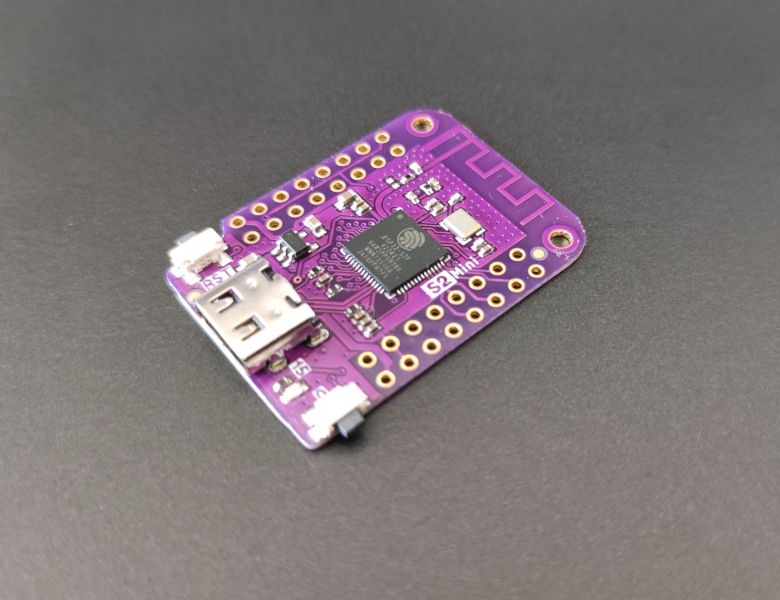
The LOLIN S2 Mini is a small (33.4 mm x 25.4 mm) development board. The form factor is almost the same as the well-known LOLIN D1 mini. This means that there is a high chance that the D1 Mini Shields could also be uses with this board.Technical details ESP32-S2FN4R2 WiFi SoC Xtensa® sin...
stuck elbow
full plume
I'm fairly certain I've always used https://circuitpython.org/board/lolin_s2_min...
you can check boot_out.txt for the exact version
slender iron
@tulip sleet did you mean to approve the samd pr?
tulip sleet
I'm doing a couple of smoke tests on a trinket
manic glacierBOT
[adafruit/circuitpython] Pull request review submitted: #10269 Shrink non-FULL builds (SAMDs mostly)
Trinket M0 is 184424 bytes here, tip of main is currently 185492, looks good! Also did some very simple smoke tests on Trinket M0.
full plume
tulip sleet
CIRCUITPY is going to remain the same size. The "ota0" partition (the "app" part...
Oh well, I was hoping for a little more CIRCUITPY space. OTOH, sounds like there have been some audio fixes that might actually be better - my main problem is that I need to use audiomixer to play multiple samples at a time (and to have volume control) . My attempts to do so with audiomp3 sounded terrible. So I switched to WAV files - which sounded much better, but they chew up way too much of the CIRCUITPY drive.
tulip sleet
full plume
Oh well, I was hoping for a little more CIRCUITPY space. OTOH, sounds like th...
you could flash a different partition .bin and achieve that. For audio, it's going to be a tight squeeze in any case, without an SD card. Maybe the extra 1.4MB would help in certain applications
@slender iron interestingly a trinket m0 with gcc14 isntead of gcc13 is 100 bytes larger
full plume
tulip sleet
you could flash a different partition .bin and achieve that. For audio, it's goi...
Yeah, that was part of the motivation for getting set up to build CircuitPython locally. But I'd really prefer to avoid any dependencies on a custom build out of my framework framework bits. I definitely intend to add some native code (ideally dynamic native modules, but not sure if those are ready yet...) but they'd mostly be optimizations, so the "user" code works (abliet potentially slower) whether or not they're using a custom firmware build. Although as far as the CIRCUITPY drive size goes, moving up to an 8 or 16MB flash controller should help far more than dropping the OTA partition if someone wants more audio.
slender iron
tulip sleet
<@252717193496756235> interestingly a trinket m0 with gcc14 isntead of gcc13 is ...
I'm not surprised. I doubt they test that per-release
jaunty juniper
on 4MB boards, the no-ota-no-uf2 partition has a ~2MB drive, with a ~2MB ota0, while the no-ota version has ~1MB drive with a 2.8MB ota0 (since it just fuses ota0 and ota1 rather than change the drive size, which avoids corrupting the drive)
tulip sleet
slender iron
I'm not surprised. I doubt they test that per-release
but metro m4 is 130 bytes smaller on gcc14
🤷♂️
after the next alpha release I'll bump the version, I think, maybe too much churn for now
full plume
Gotta go find that S3 mini, firmware build just finished. I'm used to some rather large builds - 16 cores, 96GB ram, and fast SSDs usually make them manageable - but this one had me wanting more coffee...
manic glacierBOT
Follow-up Question:
I’ve noticed that auto-reload only happens when the device is powered by battery — it does not happen when connected via USB.
Do you know why this behavior differs between USB and battery operation?
It seems intentional, but I’d love to understand the reason or logic behind this design.
manic glacierBOT
Thanks for this.
I am not so sure having both LED and LED_INVERTED is the clearest solution, but it's been the trend up to now, as @Neradoc noted, so we can leave it.
When I began testing FTP functionality, I discovered the Adafruit_CircuitPython_BLE_File_Transfer library and its examples. I tested the ble_file_transfer_stub_server.py example using the Glider app, and it worked as expected.
That example is a "stub", it doesn't actually do anything and uses a fa...
This allows audio buffers to be filled during display refresh. However, this only works during explicit refreshes though because background tasks cannot be recursive.
Also, on RP2, disable a finished audio DMA so it isn't accidentally triggered and restart the channels if needed.
full plume
lolin_s2_mini build (w/ ESP-IDF 4.51, ...) finished and runs just fine.
The lolin_s3_mini build does not - after copying in firmware.uf2 it stops booting. Can't even git back to the UF2 bootloader.
I can still go back and reinstall 9.2.7 from the beginning and it works fine (CIRCUITPY drive appears normally, USB REPL works)
But if I restart in UF2 bootloader mode (which is press-release RST/RESET followed quickly by press-release 0/BOOTLOADER - instructions are wrong on CP download page for Lolin S2/S3 mini) and then copy in the new fimware.uf2 (exact same process I used with lolin_s2_mini) it drops/reconnects USB but CIRCUITPY drive does not appear nor can Thonny find the USB REPL/console.
But this time I can still get back to the UF2 bootloader on the S3 mini.
So since the S2 Mini build worked fine, I think it's time to make clean BOARD=lolin_s3_mini and try again later...
I don't see anything obvious in the files changed (https://github.com/adafruit/circuitpython/pull/10267/files) related to either of those boards which would explain it. Although CONFIG_FREERTOS_PLACE_FUNCTIONS_INTO_FLASH=y gets added to sdkconfig-esp32s2.defaults, but sdkconfig-esp32s3.defaults remains unchanged (and does not set CONFIG_FREERTOS_PLACE_FUNCTIONS_INTO_FLASH). Guess I'll try that if the clean build still fails.
manic glacierBOT
@gamblor21 I began to encounter issues with buffer positions when using a synthio.LFO on delay_ms. In the process of working it out, I decided to implement the split buffer in stereo (1st half = left channel, 2nd half = right channel) on both delay modes (freq_shift=False/True) and always keep separate buffer positions for left and right channels. This fixes the single_channel_output problem, simplifies the code slightly, and fixes the issues I was having with the aforementioned `dela...
slender iron
@tiny peak did you try the extended back porch? my tv seems fine with a longer back porch
manic glacierBOT
With a
DEBUG=1build flashed onto a Feather Huzzah ESP32, double faulting early in startup:
I am getting the same problem on the tip of main for Feather Huzzah32, so this appears not to be a v5.4.1 problem. I'll do a bisect between there and alpha.2, which works OK.
Recent additions in #10240 throw buffer allocation errors on RP2040 devices. The exact cause is unknown, but is likely "due to the Python VM heap taking up most of the outer heap (allocated via port_malloc using tlsf)." @tannewt
The RP2040 does not support PSRAM, so port_malloc should be unnecessary in this case. All relevant code is reverted to the original implementation if compiling for an RP2040-based device.
Tested on a Waveshare RP2040-Zero and Pimoroni Pico Plus 2 with I2S audi...
With a
DEBUG=1build flashed onto a Feather Huzzah ESP32, double faulting early in startup:
I am getting the same problem on the tip ofmainfor Feather Huzzah32, so this appears not to be a v5.4.1 problem. I'll do a bisect between there and alpha.2, which works OK.
It turned out this double faulting crash only occurs with DEBUG=1 on main for Feather Huzzah ESP32. It also occurs with a DEBUG=1build on 10.0.0-alpha2.mainand10.0.0-alpha.2are fine withoutDEBUG...
tiny peak
slender iron
<@1220648290941669377> did you try the extended back porch? my tv seems fine wit...
No. wasn't aware that was a thing that could be adjusted. How did you make the change? Doesn't appear to be an argument for picodvi.Framebuffer().
manic glacierBOT
Testing now on all six boards. If it behaves like it used to, the more aggressive power management settings may cause the wifi connection to drop as the time between requests increases. But, the field values for each setting are quite different than they used to be, so they may all work. I'll update tomorrow, once they have run long enough to confirm whether wifi stays connected at each power management level (it used to fail between 5-10 minutes on Pico W with increased power management).
tiny peak
I've just been planning to use 320x240 or 640x480 with my capture card and call it good. If that gives me any trouble, I might end up getting an Extron video scaler off ebay.
I looked to see if I could find any XR1 Lite capture cards for sale. Seems that model must have been discontinued or something. Didn't find much except for a few ebay listings at higher prices than what you mentioned.
manic glacierBOT
Thanks! I should've tried the alpha release before asking. I also discovered my local CircuitPython git was a few weeks behind.
Both the 10.0.0-alpha.2 and main branch work when plugging in my RP2040 devices, even with CircuitPython, save for one...
On one of the CircuitPython devices I enabled the USB CDC data stream (usb_cdc.enable(console=True, data=True)). The configuration descriptor for this device is now 284 bytes, which exceeds the CFG_TUH_ENUMERATION_BUFSIZE=256 set in `supervis...
manic glacierBOT
This seems to be a problem with DMA-buffers being overwritten from I2S side thus corrupting memory for SPI. I managed to fix this with this change:
diff --git a/ports/espressif/common-hal/audiobusio/__init__.c b/ports/espressif/common-hal/audiobusio/__init__.c
index 226e371c5b..d07a0b521b 100644
--- a/ports/espressif/common-hal/audiobusio/__init__.c
+++ b/ports/espressif/common-hal/audiobusio/__init__.c
@@ -184,7 +184,7 @@ void port_i2s_play(i2s_t *self, mp_obj_t sample, bool loop) {
...@mortal kernel It's fishy that on ESP32 I got the double fault with DEBUG=1 on the tip of main, but without that it ran normally. So the DEBUG=1 crash may be different than the failure of #10267. Or it might be something like a storage overflow somewhere, which is provoked on #10267 and on the increased size of things due to DEBUG=1. I think it might be worth doing your tracing on both DEBUG and non-DEBUG builds to see if they are related.
I do see a hang or crash on non-DEBUG on #10267, as did you.
mortal kernel
tulip sleet
<@849815081251766292> It's fishy that on ESP32 I got the double fault with `DEBU...
It's fishy. I'm thinking the same thing you are, something's moving in memory that's tickling the bug. Based on your testing, I also think that it's only related to IDF 5.4.1 due to where things fall in memory. Hopefully JTAG will show something more definitive.
tulip sleet
I will stop working on this and move on the root certs change
I did look to see if there were any interesting changes in sdkconfig settings by doing a menuconfig to get the defaults, but I didn't see anything immediately interesting. The number of differences between the default sdkconfig and the one our builds generate is small. But it could be just one thing I missed. @slender iron what was your procedure for finding necessary sdkconfig changes/additions? I tried running some of your scripts in tools/ but didn't get that far
 candid crag
hello, I have been trying to compile the latest circuitpython firmware for the rp pico with my main.py code within a uf2. I have been following this guide and have been able to make uf2s but none have my code baked in. any help would be greatly appreciated. flashing 200 boards drag and drop is tedious https://learn.adafruit.com/building-circuitpython/build-circuitpython
tulip sleet
candid crag
hello, I have been trying to compile the latest circuitpython firmware for the r...
you can set up a single Pi Pico with what you want, and then use picotool to produce a .uf2 that is a dump of everything in the flash, including what's in CIRCUITPY
https://github.com/raspberrypi/picotool#save
https://embeddedcomputing.com/technology/open-source/create-custom-uf2-file-for-easy-circuitpython-flashing
a custom build is not needed with this technique
the uf2 will be big and will take a long time to flash
but it's a one-step thign
candid crag
thank you @tulip sleet i will give this a try
manic glacierBOT
I've not looked, but it seems that whatever
audiofilters.Filteris doing is different. That is, by moving to using anaudiofilterinstead of a per-Note filter like below, the glitches are gone, but there are odd bumps in volume at the glitch frequencies.
audiofilters.Filter uses a different code (and we have discussed removing the synth specific but I can't remember the outcome). So the Filter class won't overflow the same way synthio filters are. I am still going to try to fix the...
lone sandalBOT
b431b47 Add graphic for circuitpython.org - TheKitty
cc4b854 Delete assets/cprcuitpython-org.png - TheKitty
ab39229 Delete awesome_circuitpython.png - TheKitty
manic glacierBOT
The original issue with more aggressive power management on Pico W in #6958 was [Errno 2] No such file/directory, typically after about 5 minutes, requiring a reset to recover. The wifi connection to the AP was not lost.
I have not seen that behavior on either espressif or raspberrypi port, using any of the new power management settings (NONE, MIN, MAX) running overnight, with intervals between requests of 40 minutes and more. Also no wifi disconnections at all.
Trying to re...
slender iron
tulip sleet
I did look to see if there were any interesting changes in sdkconfig settings by...
I think it is mostly the migration guide. The scripts can help update more broadly if things are removed
manic glacierBOT
Sure! Feel free to make a PR. Thanks for the testing!
Looks more correct to me! Please make a PR. Thanks!
lone sandalBOT