#circuitpython-dev
1 messages · Page 79 of 1
 manic glacierBOT

Where do these microros-ext files come from? Can you submodule them instead?

The cardputer is already an implemented board, so I'm fine with the removal of the commented code, though the concept of auto-detecting the display is not at all a bad idea. I'm afraid I don't have the coding knowledge to edit board.c to implement that detection and adjustment myself. If you or someone else is able to write the implementation, I'm more than happy to figure out what pins are pulled in what direction by the presence of the LCD, but otherwise removal of the commented code is pro...
 tulip sleet
@slender iron do you have a few minutes for tinyusb q's?
 slender iron
yup!
 onyx hinge
@lone axle I can grab the blinka section if you want
onyx hinge

Announcing the 16GB Raspberry Pi 5 for use cases that need more capacity, available now at $120. Plus new Raspberry Pi Carbon Removal Credits.

Raspberry Pi
To help mitigate the impacts of climate change, Raspberry Pi is supporting the work of UNDO, an organisation whose mission is to permanently remove a billion tonnes of carbon dioxide from the Earth's atmosphere.

Easily search a complete list of OSHWA certified open source hardware.

Open Hardware isn't just about abstract principles. Several projects this year offered powerful demonstrations of why Open Hardware is needed.
Project Concept This project introduces the creation of a Cyberpunk-style Multi-Display Music Player by integrating UNIHIKER with Python and Tkinter to build a ...

 turbid radish
Nearly 12,000 subscribers worldwide
Yes, I rely on everyone to find good content for the community
onyx hinge
would love to hear more about the plexiglass / acrylic hand techniques, I've done VERY bad jobs the few time I've tried it myself (cutting, not even bending)
 errant grail
onyx hinge
would love to hear more about the plexiglass / acrylic hand techniques, I've don...
errant grail
onyx hinge
would love to hear more about the plexiglass / acrylic hand techniques, I've don...
I've been taking photos during the process in hopes to write a Playground Note on the technique. In this case KiCAD was used to incorporate one of LadaAda's Eagle PCB designs for the 3.5" TFT FeatherWing into a printed paper pattern that is then glued onto the plexi prior to machining. Getting an accurate pattern is key to the process.
onyx hinge
Thank you @lone axle for hosting the meeting. Happy to catch up with everyone!
errant grail
Thanks @lone axle !
 uncut nexus
@tulip sleet Do you know what chip(s) Adafruit plans to use for Matter boards?
onyx hinge
@errant grail I'll look forward to probably seeing in the newsletter in that case!
 lone axle
Thanks everyone, have a great week.
tulip sleet
uncut nexus
<@329766224093249548> Do you know what chip(s) Adafruit plans to use for Matter ...
Espressif initially. I am testing on a Metro S3
uncut nexus
Thanks!
slender iron
(matter over wifi not thread)
lone axle
Thank you! I've got it on my list to over. I've got a few other items ahead of it, but be able to in the coming days.
manic glacierBOT

I agree we should submodule somehow - microros-ext is sourced from https://github.com/micro-ROS/micro_ros_espidf_component, which I avoided including directly due to the additional requirements in the idf virtual environment, pip3 install catkin_pkg lark-parser colcon-common-extensions empy==3.3.4, and the extended build process caused by colcon fetching all the message type packages. I didn't want them clogging up Circuitpython's CI process, but @dhalbert suggested it might not be a bi...
 orchid basinBOT

I made a new firmware for the PicomoV3 and this is the corresponding doc. I also added "V2" ti the name of the version 2 to avoid confusion.
lone axle
Here is the notes document for next Tuesday’s CircuitPython Weekly Meeting. It is at the normal time of 11am Pacific / 2pm US Eastern here on Discord, but is on Tuesday instead of Monday. Add your hug reports and status updates to the document before the meeting. If you are unable to attend but would still like to contribute, feel free to add your notes and we’ll read them off during the meeting. Hope to see you there! <@&356864093652516868> https://docs.google.com/document/d/1BTOyxonN09KjzL7GsxcN7HMlbOn4yzkcDvRoX4l-op0/edit?usp=sharing

Google Docs
CircuitPython Weekly Meeting for January 21, 2025 Welcome to the CircuitPython Weekly meeting notes! Feel free to add your Hug Reports and Status Updates before the meeting, alphabetically by your username. During the meeting, we go through them in order. If you can’t make the meeting and would...
lone axle
lone axle
Here is the notes document for next Tuesday’s CircuitPython Weekly Meeting. It i...
I should have thought to ask about this in the weeds, but it slipped my mind.
Has anyone else received an email from a supply chain risk manager at NASA about the library bundle repo?
I received this the other day and then a second message following up on it from the same sender today.
Would there be a good person or place to direct this individual to for the information they're interested in about the bundle?
 tulip sleet
lone axle
I should have thought to ask about this in the weeds, but it slipped my mind.
...
tulip sleet
lone axle
I should have thought to ask about this in the weeds, but it slipped my mind.
...
send this on to management (pt)
 stuck elbow
nasa is using circuitpython?
 wraith crow
The ability for auditors to generate work always amazes me....
 solar whale
stuck elbow
nasa is using circuitpython?
solar whale
stuck elbow
nasa is using circuitpython?
I have used it to support NASA projects.
"Ground Support Equipment" -- not in flight
orchid basinBOT

Change 'appropiate' to 'appropriate'.
slender iron
lone axle
I should have thought to ask about this in the weeds, but it slipped my mind.
...
I got one for the core from a different person. Seemed legit based on linked in. Didn't spend too much time on it
 manic glacierBOT

I think it's safe to close this one. Writing to small drives/CIRCUITPY is working fine in macOS 15.2. I can't say what's happening under the covers, but writes feel responsive and reasonably fast now.
I've been running developer releases so I can't say when this really started working correctly, but the final release of 15.2 works well.
<img width="746" alt="Screenshot 2025-01-13 at 5 11 51 PM" src="https://github.com/user-attachments/assets/d1ea8869-2713-4594-a62c-438f74063ef7" />
manic glacierBOT

@romkey Thank you for following up on this. I've been installing the betas but didn't have an easy way to check the write speed.
 tiny peak
tannewt, I wrote up a playground guide walking through how to run the Zephyr shell with QT Py ESP32-S3 over either USB serial or BLE NUS with the Bluefruit Connect app. It takes a patch to get the BLE thing building, but it's an easy two-line fix.
manic glacierBOT

When we switched to the PEP 440 compatible version number "0.0.0+auto.0" instead of "0.0.0-auto.0" we didn't update the preprocess script for frozen modules, so they have been having a wrong version number ever since. Sorry :D
This PR fixes that.
before
Adafruit CircuitPython 9.2.2 on 2025-01-09; Adafruit PyPortal with samd51j20
>>> import adafruit_fakerequests
>>> adafruit_fakerequests.__version__
'0.0.0+auto.0'
... jaunty juniper
(the frozen libraries versions have only been wrong for I assume 2 and a half year without anyone noticing, it's not an emergency 😄 )
 tulip sleet
@lone axle did you see those emails from readthedocs about missing sphinx.configuration in the Bundle doc build?
lone axle
tulip sleet
<@382939733107408897> did you see those emails from readthedocs about missing `s...
I don't see any messages about that.
tulip sleet
lone axle
I don't see any messages about that.
I just forwarded one.
lone axle
tulip sleet
I just forwarded one.
Thank you. I'll check into this and submit a fix. I wonder if / how many other libraries will have that issue
tulip sleet
that's the only one I got, but I'll forward any further ones.
lone axle
@tulip sleet I opened https://github.com/adafruit/Adafruit_CircuitPython_Bundle/pull/489 to add that configuration to the bundle. However I do think we'll need to patch the rest of the libraries as well.
I'm not sure why the others haven't generated similar warning messages to be sent, but we don't have that config in our yaml for libraries either. I found this failed build for the same reason https://app.readthedocs.org/projects/adafruit-circuitpython-mpu6050/builds/26830865/ on a library that had a release made very recently. Strangely it currently has "stable" that is newer than "latest" which I don't understand. But I think our banner tag in the readme files points to latest so it shows green even though the most recent stable build failed.
 tulip sleet
lone axle
<@329766224093249548> I opened https://github.com/adafruit/Adafruit_CircuitPytho...
tulip sleet
lone axle
<@329766224093249548> I opened https://github.com/adafruit/Adafruit_CircuitPytho...
thanks - replying elsewhere
manic glacierBOT
Thanks for the copyright update. Please remove the display init code that is commented out.
I think removing this is preferred. The cardputer has its own build and displays can be init from Python too.
I don't understand the build stuff you are referring to. A README.md in microros-ext would be helpful in explaining where it came from and how to update it.
tulip sleet
@lone axle I stumbled on this while looking for something else. The gpio part of the generated file listing screenshot looks wrong, and it also includes a .md: https://learn.adafruit.com/adafruit-pyportal/internet-connect
also the Project bundle is named examples.zip; I don't remember that being the case.
lone axle
tulip sleet
also the Project bundle is named `examples.zip`; I don't remember that being the...
I think the examples.zip name is because it's pointing to an example script file in a library repo rather than a project file from the learn repo. The gpio part definitely seems wrong, I'll look into that, I'm not sure where it came from at first glance.
lone axle
tulip sleet
<@382939733107408897> I stumbled on this while looking for something else. The `...
I've opened https://github.com/circuitpython/CircuitPython_Library_Screenshot_Maker/pull/29 that fixes the esp32spi_simpletest.py screenshot by adding filtering on the subdirectory files. We already filtered main directory files down to a list of shown filetypes, the subdirectories weren't filtered previously though so gpio and it's files got included in screenshots for anything inside of esp32spi/examples/
manic glacierBOT
I have tried this with a Feather RP2350 with PSRAM installed a couple of dozen times and could not reproduce. Do you think it might have anything to do with the wifi co-processor?
manic glacierBOT
CircuitPython version
Adafruit CircuitPython 9.2.2
Code/REPL
N/A
Behavior
Hello.
I need some help installing circuitpython for this ESP32_DevKitC_v4 board I got from Aliexpress. It looks exactly like this one , but the ESP module is ESP32-wroom-32U . I was not able to flash it with the flash tool on that webpage. However, I was able to flash it with https://adafruit.github.io/...
Try this: https://circuitpython.org/board/espressif_esp32_devkitc_v4_wroom_32e/ . The title on the board description is wrong! It should be WROOM, not WROVER. I'll get that fixed.
GitHub issues are not meant for support like this. Better to use https://adafru.it/discord or https://forums.adafruit.com/viewforum.php?f=60
It does not work.
It clic "continue" after choosing the port and connecting, but this next steps goes super fast, not like my other flash with other ESP32 boards, and it indeed does nothing, the firmware is not changed.
However, I was able to flash the https://circuitpython.org/board/espressif_esp32_devkitc_v4_wroom_32e/ file with the flash tool here https://adafruit.github.io/Adafruit_WebSerial_ESPTool/ .
My board now boots with `Adafruit CircuitPython 9.2.2 on 2025-01-09; Espressif ...
Glad it works. The E vs U is just the antenna connector.
orchid basinBOT
The human-readable name of title of this board were wrong.
(Stumbled on this due to https://github.com/adafruit/circuitpython/issues/9960)
manic glacierBOT
manic glacierBOT
Looks great! Thank you!

[adafruit/circuitpython] New branch created: sparkle_motion
jaunty juniper
@lone axle hey I have a question about the use of displayio with blinka (on a Pi computer or MCP2221). Can you display an image with adafruit_imageload ? I'm bumping into errors with adafruit_imageload on a BMP (one I can PR, another I don't understand yet), is it supposed to work ? (There might be versions shenanigans ?)
stuck elbow
I think on the raspberry pi blinka is using PIL for the images?
jaunty juniper
yeah is there a way to make a TileGrid from PIL for use with Adafruit_Blinka_Displayio ?
lone axle
On Raspberry pi displayio is intended to work via https://github.com/adafruit/Adafruit_Blinka_Displayio. It should work with adafruit_imageload as far as I am aware.
The MCP2221 I am less sure about, I don't have specific experience with those expander breakouts. But if it's abstracted by Blinka I would expect it should work the same I think.
stuck elbow
but we are talking about displaying things on the monitor connected to the pi, not on an SPI display connected to the pins, right?
lone axle
I think PIL is or was used internally in Blinka_Displayio when it takes data from TileGrid / Bitmaps and sends it to the display.
I am talking about displaying things on a hardware display connected via SPI or I2C
stuck elbow
oh, I see
lone axle
to display on the HDMI monitor you need something like: https://github.com/FoamyGuy/Blinka_Displayio_PyGameDisplay but it's not updated for the newest Blinka_Displayio
jaunty juniper
ok I'll make a fix for one of the problems and open an issue for the other
manic glacierBOT

From this open issue https://github.com/adafruit/circuitpython/issues/5470 and discussions in the Adafruit discord server, it looks like the builds for the stm32H7 family have been broken for a while.
Based on my tests, it seems the problem is using the ITCM memory -- it generates a hard fault at runtime. Using the default code placement with no ITCM allows CircuitPython to run correctly.
I am still investigating what causes the hard fault -- help would be welcome -- but these changes...
lone axle
jaunty juniper
ok I'll make a fix for one of the problems and open an issue for the other
was this the other issue?
Traceback (most recent call last):
  File "/home/timc/Adafruit_CircuitPython_ILI9341/examples/imgtest.py", line 38, in <module>
    image, palette = adafruit_imageload.load(f"testimg.png")
                     ^^^^^^^^^^^^^^^^^^^^^^^^^^^^^^^^^^^^^^^
  File "/home/timc/venv_blinka/lib/python3.11/site-packages/adafruit_imageload/__init__.py", line 92, in load
    return png.load(file, bitmap=bitmap, palette=palette)
           ^^^^^^^^^^^^^^^^^^^^^^^^^^^^^^^^^^^^^^^^^^^^^^
  File "/home/timc/venv_blinka/lib/python3.11/site-packages/adafruit_imageload/png.py", line 177, in load
    bmp[x, y] = pal.convert(
                ^^^^^^^^^^^^
  File "/home/timc/Adafruit_Blinka_Displayio/displayio/_colorconverter.py", line 173, in convert
    self._convert(self._output_colorspace, input_pixel, output_pixel)
  File "/home/timc/Adafruit_Blinka_Displayio/displayio/_colorconverter.py", line 198, in _convert
    rgb888_pixel.pixel = self._convert_pixel(
                         ^^^^^^^^^^^^^^^^^^^^
  File "/home/timc/Adafruit_Blinka_Displayio/displayio/_colorconverter.py", line 210, in _convert_pixel
    pixel = clamp(pixel, 0, 0xFFFFFFFF)
            ^^^^^^^^^^^^^^^^^^^^^^^^^^^
  File "/home/timc/Adafruit_Blinka_Displayio/displayio/_helpers.py", line 27, in clamp
    return max(min(max_value, value), min_value)
               ^^^^^^^^^^^^^^^^^^^^^
TypeError: '<' not supported between instances of 'tuple' and 'int'
 austere acorn
@lilac scaffold @strange ravine
https://github.com/adafruit/circuitpython/pull/9962
I created a PR with a fix for what I identified as the H7 problem -- with this, the latest CircuitPython runs on the open MV H7 camera.
Please let me know if it works with the builds for your boards as well.
 strange ravine
yeeeeeeeeeeeeeeeeeeeaaaaaaaaahhhhhhhhh ill try it in a bit tysm
jaunty juniper
lone axle
was this the other issue?
```
Traceback (most recent call last):
File "/home/...
yep, InputPixelStruct.pixel is declared as an int but is given a tuple. Changing _colorconverter.convert so that it passes an int gets me to show the image
I also have crashes with adafruit_display_text if a Label goes off the display area now
the original reason I looked into that is somebody in help_with a few days ago noticed that adafruit_imageload can't do jpeg with blinka, because there's not jpegio. Is there a known way to make Tilegrid from say a PIL image for use with displayio, or maybe should jpegio be added to blinka or something ?
(once we fix the current state of things)
lone axle
jaunty juniper
the original reason I looked into that is somebody in help_with a few days ago n...
I would consider the addition of jpegio to blinka displayio the proper long-term solution. Ultimately it strives to be in parity with core displayio as far as I understand.
That said I do think it would be possible and fairly straight-forward on RPi to use PIL to load a jpg and then get it's data into a Bitmap object for use with TileGrid and Blinka displayio, but I don't know of any sample code that illustrates it.
jaunty juniper
yeah my solution would be to convert it to BMP with PIL on the fly and load the BMP, that seems like a good enough generic solution
manic glacierBOT
 manic glacierBOT
I don't understand the build stuff you are referring to.
Sorry, let me say that in a less confusing way. Compiling the MicroROS component installs a bunch of python package managers, is slow, and has a lot of verbose build output. To avoid adding that to Circuitpython's CI tests, I made a pre-compiled version, which is what I've included. I've recieved feedback already that that might be less easy to maintain, so I could revert back to including the original component as a submodule if y...
strange ravine
austere acorn
<@380535630939029504> <@606988156654321679>
https://github.com/adafruit/circuit...
huge

its working now, at least from what i can see
its getting late so ill do more tests tomorrow
manic glacierBOT

A set of improvements to the serial UART console.
- Corrects a crash or hang when a write is attempted to the serial UART console before it is initialized.
- Allow
serial_early_init()to be called earlier in port initialization. - Ensures that all lines written to the serial UART console are properly "cooked", i.e., line endings are translated to '\r\n'.
- Refactors serial UART console write routines.
- Adds an optional timestamp to serial UART console writes.
- Adds a macro t...
@dhalbert My lab techniques were a bit off on this one. I too have been unable to reproduce this bug. Please close it.
orchid basinBOT
manic glacierBOT

This PR implements the alarm-module for the RP2350 variant of the pico and fixes #9491.
Notes
- The PR does not use the new power-domains for the RP2350, but uses plain old sleep/dormant modes. An implementation based on powman is something for a future PR.
- This PR also reimplements light-sleep/deep-sleep for the RP2040. As @dhalbert stated in #9521: "So redefining light sleep as RAM-preserving, but not activity-preserving, might be worthwhile". With this PR, light-sleep h...
manic glacierBOT
lone axle
The patch for adding sphinx config to rtd.yaml file has been run. There were a few that failed actions afterward that I'll check in to. And there are 8 that didn't get patched because their config was newer and just slightly different enough that the patch didn't apply. I'll submit PRs to those instead of worrying about trying to patch them seperately.
It does bring up the question of a potential future patch though. In cookiecutter and the newest repos we use ubuntu-lts-latest inside of RTD build system. But in the older libraries they use ubuntu-20.04. It looks like April 2025 is the EoL for 20.04. The good news is moving to lts-latest means we shouldn't have to patch again in the future.
strange ravine
@austere acorn so ive tried circuitpython on 2 of my custom H7 boards and im getting, interesting results
on the first one it will work, kinda, the circuitpy drive takes a bit to load but is rather unstable, maybe its my computer.
on the second board it straight up doesnt work, unsure why.
ill keep testing
tulip sleet
lone axle
The patch for adding sphinx config to rtd.yaml file has been run. There were a f...
I didn't know there was lts-latest -- that's not too much churn but still pretty current.
strange ravine
no yeah its a problem with either circuitpython or my boards coz same happens when i try to use them on my main computer
lone axle
tulip sleet
I didn't know there was lts-latest -- that's not too much churn but still pretty...
I think their available options inside RTD are slightly different from actions at least. We use ubuntu-latest in the github actions containers I believe. I'm not sure if those end up on the same release cadence or not, but it will be nice to have them both onto some form of "latest" so that they're moving forward automatically even though it may mean we have to fix things for the new version occasionally.
tulip sleet
lone axle
I think their available options inside RTD are slightly different from actions a...
ah, thanks for clarifying, I thought that was a github designator. I think ubuntu-latest in github does mean lts
manic glacierBOT
Allow serial_early_init to be called earlier
Initializing the serial UART console earlier than its default can be useful when debugging inside a port-specific port_init(). Since serial_early_init() is not serially reusable, a guard is implemented that ignores additional calls to serial_early_init(). This guard also serves to prevent writing to an uninitialized UART. Here is an example from RP2's port_init():
    // Initialize RTC
    #if CIRCUITPY_RTC
common_hal_...@dhalbert This is the first part of the serial console/RAM logging changes we chatted about a few weeks back. Please have a look.
manic glacierBOT
Thank you for the fix! I'm hoping to move STM32 over to zephyr pretty quickly.
How about splitting the difference and making a separate repo for the precompiled files? That way it isn't in CP but it doesn't require building every time.
Thanks for doing this!
So this will disable some peripherals during light sleep now?
Is the RP2350 sleep current high because it doesn't use POWMAN to shutdown ram?

Thank you for adding these features, which will be very handy. I had one question about naming.
Often when I am debugging, I do not use CONSOLE_UART, but instead just use mp_printf(&mp_plat_print, ...), so that my print's are interspersed with prints from the CircuitPython program. I think I mentioned briefly about making a DEBUG_PRINTF-style macro that printed to &mp_plat_print. It would also be handy to do such logging with timestamps as well =, to &mp_plat_print.
The above coul...
Does _cb mean callback? I understand the point of this routine, but I don't understand why it's a callback (if that's what you mean).
Yes, it's a callback. The reason is that it is invoked by mp_printf's callback mechanism via console_uart_write_timestamp(). Doing this allows the timestamp to use mp_printf's numeric formatting. I could have done the same thing console_uart_write() but opted to invoke it directly to save a bit of overhead.
lone axle
It seems like Github may be experimenting with or rolling out a new "sub-issue" feature. Never seen this in the UI before that I can recall
 manic glacierBOT
Often when I am debugging, I do not use CONSOLE_UART, but instead just use mp_printf(&mp_plat_print, ...), so that my print's are interspersed with prints from the CircuitPython program. I think I mentioned briefly about making a DEBUG_PRINTF-style macro that printed to &mp_plat_print. It would also be handy to do such logging with timestamps as well =, to &mp_plat_print.
The macro wraps mp_printf() so it does intersperse with plain old console output sent to the serial UART. Likewise,...
So this will disable some peripherals during light sleep now?
To be tested, but probably yes, due to the switch to dormant-state. For light-sleep with serial-connection, there should be no change.Is the RP2350 sleep current high because it doesn't use POWMAN to shutdown ram?
I think so, dormant does nothing with other units than the cores.
tulip sleet
@mortal kernel re your PR, let's do a more interactive conversation about this.


 shut copper
https://github.com/adafruit/adabot/pull/394 . One liner to fix an exception in adabot on empty results from Read The Docs @lone axle I also did that change request for circup, but I assume you got the notification on that.
GitHub
The Read the docs get builds API can return an empty results set.
{ "count": 0, "next": null, "previous": null, "results": []...
lone axle
shut copper
https://github.com/adafruit/adabot/pull/394 . One liner to fix an exception in a...
Thank you! got both on my list to look at.
strange ravine
manic glacier
 manic glacierBOT

I'd just like to comment that this looks awesome, having ROS on CircuitPython could open up lots of opportunities. I'm currently thinking of making a CircuitPython sensor -> ROS factory utility class - so you could just set up your sensor, pass it into the class and it starts publishing on an appropriate topic - so an accelerometer+gyro would start publishing IMU messages for example.
manic glacierBOT

Web installer is nice but only updates to a fixed (latest) binary.
Please add a button to select a local binary.
manic glacierBOT
I installed Circuitpython 9.2.2 on my doit_esp32_devkit_v1 from here https://circuitpython.org/board/doit_esp32_devkit_v1/
After setting it up, everything seems to work. BUT the blue led blinks every 4 seconds.
How to disable it? And WHY is it blinking on itself?
Please ask questions like this on the Discord. This is likely the status LED. CircuitPython blinks every 5 seconds to show that no user code is running. 1 means code exited ok. 2 is an error. 3 is safe mode.
RMT is one of the most useful functions of ESP32.
It allows to send or receive pulses at precise periods.
It's a killer feature and incredibly is not supported in circuitpython.
In micropython it is supported only for sending but not for receiving.
It's a shame.
Please ask questions like this on the Discord. This is likely the status LED. CircuitPython blinks every 5 seconds to show that no user code is running. 1 means code exited ok. 2 is an error. 3 is safe mode.
I think it is DUMB. No code runnign should be doing nothing and going into low power mode.
orchid basinBOT
Hi, I believe you are talking about the installer on circuitpython.org
Here is a web version of esptool to install binaries, and a guide:
https://adafruit.github.io/Adafruit_WebSerial_ESPTool/
https://learn.adafruit.com/circuitpython-with-esp32-quick-start/web-serial-esptool
I'm not sure where it's linked to on the site. It is referenced when there's a UF2 bootloader section. Maybe we could link to it for ESP32 boards without a UF2 bootloader in particular, since it's the main way to install...
manic glacierBOT
There's no reason to be rude. You can zero out the brightness of the status LED: https://docs.circuitpython.org/en/latest/shared-bindings/supervisor/index.html#supervisor.Runtime.rgb_status_brightness
manic glacierBOT

This was one of my #circuitpython2025 requests. Filing a issue to track this.
Context:
- Being an already power efficient board compared to the other dual core ESP boards(S3, S2 etc), I thing this board would benefit from a low power connectivity solution like zigbee, as wifi is a notoriously power hungry connectivity solution.
- Adding zigbee support to the c6 would be very beneficial in battery powered use cases (for environmental mo...
manic glacierBOT

Hi!
Flashing adafruit-circuitpython-stm32f411ce_blackpill_with_flash-en_US-9.2.2.bin on a WeAct STM32F411CE BlackPill
(buyed on the official WeAct store on AliExpress) no CIRCUITPY folder appear and the MCU get stuck.
With adafruit-circuitpython-stm32f411ce_blackpill_with_flash-en_US-9.2.1.bin no problems, it works as expected.
On DFU-boot:
[mar dic 17 11:50:47 2024] usb 1-4: new full-speed USB device number 21 using xhci_hcd
[mar dic 17 11:50:47 2024] usb 1-4: New USB device found, i...
Hi,
the same happens (no CIRCUITPY folder) after flashing 9.2.2 on a VCC-GND YD ESP32-S3-DevKitC-1 N16R8 (clone).
With 9.2.1 no problems.
Thank you
manic glacierBOT

I'm experiencing the same issue (no CIRCUITPY drive after reset) with CPy-9.2.2 on two Waveshare boards
(WS ESP32-S3-Zero and WS ESP32-S3-Matrix) when plugged directly into a Linux laptop (Mint-22).
However, @dhalbert 's workaround is working for me:
plugging the boards into an intermediate USB-Hub (e.g. an HP-Dock) makes the CIRCUITPY drive appear
manic glacierBOT
CircuitPython version
Adafruit CircuitPython 9.2.2 on 2025-01-09; Ai Thinker ESP32-CAM with ESP32
Code/REPL
import microcontroller
microcontroller.cpu.temperature
Behavior
Nothing happens. no output.
P.S.
It works in micropython.
The same happens with another ESP32 board I have.
In espruino it was removed and then re-added a couple of days ago:
https://github.com/espruino/Espruino/issues/2585
Description
No response
Additional in...

I have ESP32-S3-N16R8 and same problem:
- I have installed TinyUF2 first.
- Then I have installed CircuitPython 9.2.2.
- CIRCUITPY drive appears.
- After reset, there's no drive anymore and I can't connect to the serial too.
USB hub workaround works for me 👍
manic glacierBOT
I think this is another manifestation of #9956. STM chips also use the newly refactored dwc2 driver.
@hathach this could be another testbed.
manic glacierBOT
#9971 may also be related, since STM also uses synopsys dwc2.
manic glacierBOT
There's no reason to be rude. You can zero out the brightness of the status LED: https://docs.circuitpython.org/en/latest/shared-bindings/supervisor/index.html#supervisor.Runtime.rgb_status_brightness
I didn't mean to sound rude. Sorry if it did.
@dhalbert great! I missed that! but using pulse io, how can I continuously get pulses (until there are no pulses for 10 seconds)?
What I need is an array of pulse lengths (possibly at 80Mhz or 160Mhz sampling rate/accuracy).
From the other end I receive pulses. I need to collect them all until there are no more pulses for a few seconds (end of transmission).
It's not clear how to do that from the docs.
So how to get continuously pulses and store them in an array without missing any?
The example gives a sample pulse train with the specified durations. To remove the superimposed carrier, you would set the duty cycle to max (65535). But there's a bug on Espressif we haven't yet addressed: #6799.
manic glacierBOT
This functionality was removed from ESP-IDF some time ago due to not working well at all: https://github.com/espressif/esp-idf/issues/146. It was temprature_sens_read(). Yes, that was the actual spelling.
MicroPython returns the raw temperature reading by reading some registers. Due to the the inaccuracy and instability, I think we will skip that. It would be a support burden for us.
Re https://github.com/espruino/Espruino/issues/2585: it looks like it was put back for chips that support ...
tulip sleet
@slender iron @onyx hinge Thach gave me a fix for the 9.2.2 bug of ESP32-S3 not showing up on USB ports. I tested it and it works. It is temporary in the sense that it should be fixed by ESP-IDF upstream. I will make a PR for now. I can also release a 9.2.3 today with the fix (+ other recent rather innocuous PR's). Think I should do a release?
onyx hinge
seems like it would be a nice regression to fix.
tulip sleet
Yeah - half a dozen people have reported it, and maybe more have not
slender iron
tulip sleet
<@252717193496756235> <@426200547024961539> Thach gave me a fix for the 9.2.2 bu...
yup, agreed it would be good to release
manic glacierBOT
- Fixes #9956
See https://github.com/hathach/tinyusb/issues/2943 for diagnosis and fix. Thanks @hathach for diagnosis and temporary fix, pending a probable fix in ESP-IDF.
This code is enabled only for ESP32-S3.
Tested on my own system, which manifested the bug before and now does not, with this fix.
slender iron
This doesn't cover the STM issue though right?
manic glacierBOT
Also confirmed fixed on Mac Mini that previously showed the problem.
Tested with an ESP32-S2 to confirm no regression for non-S3.
tulip sleet
slender iron
This doesn't cover the STM issue though right?
No, and I'm not even sure the cause is the same. There is a separate thing about the order of checking for AHBIDL and a delay: https://github.com/hathach/tinyusb/issues/2943. I will try that on STM32.
I tried that fix on ESP32-S3 and it didn't fix it.
manic glacierBOT
orchid basinBOT
CircuitPython.org is meant for CircuitPython. We don't want to have to support other random binaries.
manic glacierBOT
Smoke tested builds on an ESP32-C3 and Feather ESP32 V2 board
orchid basinBOT

Automated website update for release 9.2.3 by Blinka.
New boards:
- adafruit_mini_sparkle_motion
- adafruit_sparkle_motion
- m5stack_stamp_s3
Thanks for adding this!
One request to add a feature, but looks good otherwise.
tulip sleet
https://blog.adafruit.com/2025/01/17/circuitpython-9-2-3-released/
Highlights:
- Fix ESP32-S3 regression: did not connect properly to USB without an interposed hub.
- New boards: Adafruit Sparkle Motion and Mini Sparkle Motion, M5Stack StampS3.
manic glacierBOT

I'm not the best at writing docstrings, so feel free to add in some critique if you think it's needed.
Good call, and looking deeper at it, this would actually cause an issue with unsigned 16-bit sources due to while (length--) {...} above it.
manic glacierBOT
On second thought, we rely on the remaining length of the sample to calculate the ticking length (see the n variable below). In this logic branch, the sample is set to NULL and hence we tick the LFO in one fell swoop instead. In order to optimize this, we'd have to calculate n beforehand and add an additional self->sample != NULL check. I don't see this helping too much. If it's still a concern, it's simpler to just remove LFO ticking when there's no sample.
What works so far:
CircuitPython code is running fully from the QSPI flash
A special bootloader is needed to start execution.
There is a small file system on the internal flash - can edit code.py
Can use blink the on board LED and use the BOOT button in user space
orchid basinBOT
 spare jacinth
manic glacier
spare jacinth
manic glacier
looking good, lets try and build it locally 🙂
i remember tinyuf2 worked funny on my board a year(ish) ago, though
manic glacierBOT
I've taken a different approach here. Storing this value and current_delay_ms as uint32_t was an arbitrary choice, so I've instead reverted both back to floats. I've added in another pre-calculated variable for the length of one audio frame (sample) in milliseconds, and I'm checking against that determine if we need to recalculate delay buffer parameters. The minimum value of the delay is handled within recalculate_delay. Before, delays could only be manipulated by an LFO in millisecond...
 small cypress
@slender iron Hey, while I didn't see all of the stream, I think I remember you saying something about how it might be useful if you could see logs from your HomePod mini when it comes to CircuitMatter work? Did you work out how to do that? While I can't work out how to get it to throw logs into the macOS Console app like other Apple devices do, Apple have logging profiles you can install from here and then you can get it to ouput logs and export them somewhere. Have a feeling you'd probably want the "HomeThread (HomePod)" one, plus maybe the general HomePod one. You can't quite watch them in real time, but it's probably better than nothing.
https://developer.apple.com/bug-reporting/profiles-and-logs/?platform=tvos&name=homepod
manic glacierBOT

I want to avoid duplicating the code but we may have to make the 2 something passed to the function. In https://github.com/adafruit/circuitpython/blob/b7af46bda6b16b0b0e88af0b8faf884eb6338941/shared-module/synthio/__init__.c#L135 it is set to the number of synth channels versus here we have just two samples we are mixing down.
manic glacierBOT
My bad, I didn't realize there was any difference between the instances. I'll take a crack at it.
slender iron
@crude blaze MBEDTLS_BUILTIN is on anyway
slender iron
small cypress
<@252717193496756235> Hey, while I didn't see all of the stream, I think I remem...
thanks for the tip! I haven't been circuitmatter recently and got over the hump with their test iOS app instead
manic glacierBOT
I've updated it now. I've tried to maintain performance by precalculating the scale for each instance.
 crude blaze
slender iron
<@375455651050160130> MBEDTLS_BUILTIN is on anyway
crude blaze
slender iron
<@375455651050160130> MBEDTLS_BUILTIN is on anyway
hm ok, weird that you don't get the include forwarded then
orchid basinBOT
CircuitPython.org is meant for CircuitPython. We don't want to have to support other random binaries.
I didn't mean random binaries, but for example the latest or previous versions.
manic glacierBOT
The example gives a sample pulse train with the specified durations. To remove the superimposed carrier, you would set the duty cycle to max (65535). But there's a bug on Espressif we haven't yet addressed: #6799.
@dhalbert I need the opposite! I need to measure the length of incoming pulses (continously and at high speed)
Please mark this as a draft PR. The Pico-W (and probably the Pico2-W) need some more investigation. In my tests, the CYW43 did complain with messages like:
[CYW43] cyw43_kso_set(1): failed
F2 not ready
F2 not ready
[CYW43] STALL(0;129-129): timeout
There is a cyw43_enter_deep_sleep() function called from common_hal_alarm_enter_deep_sleep(), but I am missing the counterpart. Since this only sets WL_REG_ON to false, it might be simple.
Pinging @eightycc: any id...
manic glacierBOT
@bablokb The [CYW43] cyw43_kso_set(1): failed message may be occurring because simply turning off power to the WIFI radio as is done in cyw43_enter_deep_sleep() does not put the driver into a quiescent state. Similarly, properly powering the WIFI radio back up requires a sequence of operations involving an interrupt from the CYW43 that appears to be entirely missing.
I'll reproduce the failure here and get back with a more detailed analysis.
manic glacierBOT
manic glacierBOT

I got the same issue with version 9.2.3:
`import digitalio, board, time
from adafruit_hid.keyboard import Keyboard
pin0 = digitalio.DigitalInOut(board.D0)
pin0.direction = digitalio.Direction.INPUT
pin0.pull = digitalio.Pull.UP
pin4 = digitalio.DigitalInOut(board.D4)
pin4.direction = digitalio.Direction.INPUT
pin4.pull = digitalio.Pull.UP
time.sleep(0.5)
print("Pin 0: " + str(pin0.value) + ", pin 4: " + str(pin4.value))`
The output is:
Pin 0: False, pin 4:True
@juansulca, which vers...
The best source of technical specs for the CYW43439 that I've been able to find is the source code for Infineon's WHD driver: https://github.com/Infineon/wifi-host-driver.
The KSO (Keep SDIO On) bit managed by cyw43_kso_set() appears to affect operation only when the CYW43's interface is in SDIO mode. Why it's getting touched when the interface is in gSPI mode is a bit of a puzzler.
manic glacierBOT
@speedbird620 Please add
while True:
    pass
to the end of your program, or else try it line by line in the REPL.
@dhalbert, I tried. No joy.
Please enlighten me, what will "pass" change in this case?
Sorry. My bad. I connected the QT PY the wrong way.
It works now.
I am not seeing this problem with QT Py RP2040 running 9.2.3.
Adafruit CircuitPython 9.2.3 on 2025-01-17; Adafruit QT Py RP2040 with rp2040
>>> import board
>>> from digitalio import DigitalInOut, Direction, Pull
>>>
>>> pin0 = DigitalInOut(board.D0)
>>> pin0.direction = Direction.INPUT
>>> pin0.pull = Pull.UP
>>>
>>> pin4 = DigitalInOut(board.D4)
>>> pin4.direction = Direction.INPUT
>>> pin4.pull = Pull.UP
when measured with a voltmeter I am seeing 3.3V on both D0 and SCL.
D4 is th...
manic glacierBOT
Glad it's working! Could you describe what "the wrong way" was in this case? It sounds like it might have happened to more than one person.
It was an error on the PCB I designed. The button was shorting the pin to the ground whether it was pressed or not.
A simple case of Googling the symptom before performing the due diligence check. Game, set, match.
Anyways, thanks for the input.
orchid basinBOT

Typing any phrase in search bar on "Blinka" page and then removing it does not correctly display all the cards.
The underlying issue is using .split() on undefined, which prevents the function from completing.
Spotted by @FoamyGuy during th Saturday stream: https://www.youtube.com/watch?v=8czmvgN3Q70&t=360s
manic glacierBOT
In common_hal_alarm_set_deep_sleep_alarms() we're missing code for putting the CYW43439 into a quiescent state before pulling the plug on the WIFI radio by calling cyw43_enter_deep_sleep(). We're also missing code for bringing the CYW43439 back up after exiting deep sleep. That requires pretty much a complete re-initialization of the chip. There's no similar code in Micropython (i.e., powering down/up the WIFI radio), so we're on our own for an implementation.
The CYW43439 does expose ...
 thorny jay
Checking Circuit-Python.org with my filter to see the new board: https://circuitpython.org/downloads?sort-by=date-desc I was suprise to see some old board on top such as: https://circuitpython.org/board/gb_m4/

CircuitPython supported boards.
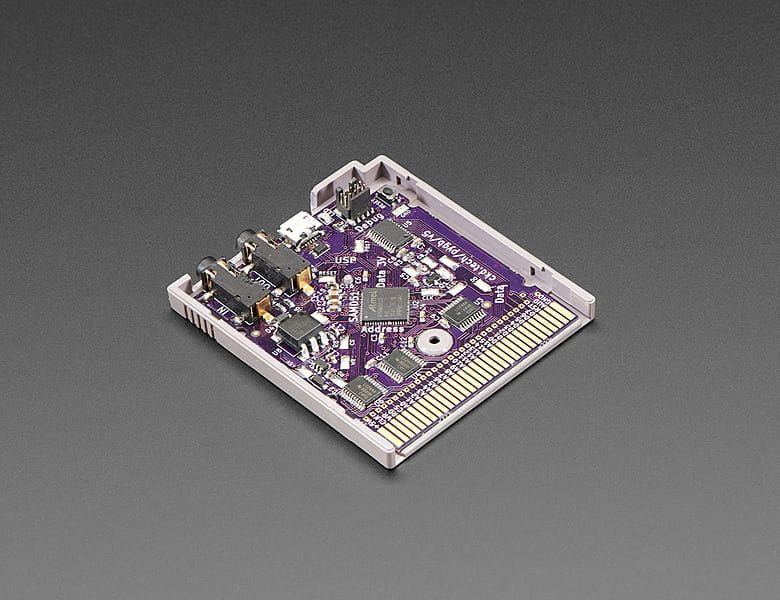
CircuitPython for Game Boy is a work in progress, check out the weekly “Show and Tell” or “Top Secret” segment on ASK AN ENGINEER or when it’s ready, the new product videos on YouTube.Links and more Twitter thread. A Python powered GameBoy-compatible cartridge with a SAMD51 - GitHub. GBIO bran...
manic glacierBOT
At first I thought it crashed.. instead it's just the serial console messed up.
Adafruit CircuitPython 9.2.2-14-gab5c17d864 on 2025-01-16; Ai Thinker ESP32-CAM with ESP32
Board ID:ai-thinker-esp32-cam
>>> import microcontroller
>>> microcontroller.cpu.frequency
240000000
>>> microcontroller.cpu.frequency=120000000
>>> microcontroller.cpu.frequency=80000000
>>>
>>> microcontroller.cpu.frequency=20000000
▒▒▒▒▒▒▒
Same happens if you set 40 Mhz
>>> import microcontroller
>>> micro...This is a "beware of the consequences" thing. As mentioned in https://docs.circuitpython.org/en/latest/shared-bindings/microcontroller/index.html#microcontroller.Processor.frequency:
Warning
Changing the frequency may cause issues with other subsystems, such as USB, PWM, and PIO. To minimize issues, set the CPU frequency before initializing other systems.
Also discussed in the original PR, #9342.
tulip sleet
thorny jay
Checking Circuit-Python.org with my filter to see the new board: https://circuit...
it's sorting by dataset.date, it looks like. There is a date_added field, but I don't know what dataset.date represents.
manic glacierBOT

This issue appears to have been resolved -- I just tried my espcamara code with CP 9.2.3 on the Waveshare boards and it works fine.
Thanks for fixing it!
The function works perfectly on WROOM-32 (devkit v1) and also on EPS32 CAM I have.
I see no burden nor a problem.
Just copy the code from micropython.... no matter if it's an internal temperature and to many it might seem "wrong". It's not on my devices. And they are pretty standard and very similar even if the esp32 cam form factor is different.
ESP32-CAM
Detecting chip type... ESP32
Chip is ESP32-D0WD-V3 (revision v3.0)
Features: WiFi, BT, Dual Core, 240MHz, VRef calibration in efuse...@dhalbert
Use
pulseio.PulseIn.
From what I understand, pulseio.PulseIn has a maxlength..
pulseio.PulseIn(pin: microcontroller.Pin, maxlen: int = 2, *, idle_state: bool = False)
So for getting all pulses let's say for 20 minutes I should set a length read pulses, store t...
As mentioned here: https://github.com/espressif/esp-idf/issues/146#issuecomment-492570221,
Unfortunately due to performance issues the temp sensor feature is no longer supported.
Espressif discontinued support of reading the ESP32 temperature (for specifically that chip). We are not going to add it back because if it's unreliable it can give faulty and misleading values.
This is a "beware of the consequences" thing.
Consequences of installing circuitpython?
Because this does not happen in micropython :P
manic glacierBOT
MicroPython, even the latest preview build does work with 20 MHz on an identical ESP32 board (I tested with Feather ESP32 V2 and HUZZAH32.
The frequency setting logic is functionally identical in MicroPython and CircuitPython, so it may have to do with how the UART is set up.
Consequences of installing circuitpython?
Because this does not happen in micropython :P
Please don´t be snarky. If you have information that it does work in MicroPython, please post that up front.
orchid basinBOT
This looks good to me. I tested successfully with a local build and confirmed it solves that problem.
Thank you!
tulip sleet
@lone axle re an "all libraries update" thing like we just did. People are noticing and a little confused (e.g. https://forums.adafruit.com/viewtopic.php?p=1042524#p1042524) that circup is updating all their libraries.
In the case of an infrastructure change like this, but no code change for the user, perhaps we should not do a huge number of releases, but simply push the change to main on the libraries. If/when I library needs a release update, the change will be incorporated.
What do you think?
manic glacierBOT
This sounds likes hundreds of millions of pulses at the proposed rate. Where are these pulses coming from? This sounds a like a logic analyzer application.
manic glacierBOT
I'm experiencing the same issue (no CIRCUITPY drive after reset) with CPy-9.2.2 on two Waveshare boards (WS ESP32-S3-Zero and WS ESP32-S3-Matrix) when plugged directly into a Linux laptop (Mint-22). However, @dhalbert 's workaround is working for me: plugging the boards into an intermediate USB-Hub (e.g. an HP-Dock) makes the CIRCUITPY drive appear
Problem is fixed with the new CPy-9.2.3 on both Waveshare boards:
CIRCUITPY appears with direct USB connections...
lone axle
tulip sleet
<@382939733107408897> re an "all libraries update" thing like we just did. Peopl...
If we don't do a release then every library will get flagged in various Library has new commits since last release within _____ report sections on https://circuitpython.org/contributing/library-infrastructure-issues which makes it a bit more difficult for me to do a real release sweep each week to catch any libraries that had PRs merged without a release made because I typically load that page and then open in new tab the ones that appear in those lists to work from.
It would be a bit difficult to try to work out which libraries actually need a release and which ones just have a change that doesn't need one.
If we can come up with some solution that makes it easy at a glance to know which libraries "really need" a release and which ones don't then I'd be okay with it. But with the current way the reports work I would prefer to make the release even though the change was minor / irrelevant for usage on device.
tulip sleet
lone axle
If we can come up with some solution that makes it easy at a glance to know whic...
I understand, thanks. I guess we could put "NO-RELEASE-NEEDED" or something like that in a commit message, but that may complicate the reporting mechanism a lot.
lone axle
tulip sleet
I understand, thanks. I guess we could put "NO-RELEASE-NEEDED" or something like...
Maybe have circup ignore updates to the patch number, and then use the convention of always increasing the minor number for any change that is intended for devices. Then we can create releases for stuff like that but circup won't prompt people to update from them.
tulip sleet
lone axle
Maybe have circup ignore updates to the patch number, and then use the conventio...
I think I would rather not do that. It's not what semver is meant to do, and it would probably raise as many support questions as the current scheme. I'm OK with all the releases. We can just announce it in some way next time.
shut copper
If there was some metadata with the library updates circup could present that to help guide the users.
manic glacierBOT
This sounds likes hundreds of millions of pulses at the proposed rate. Where are these pulses coming from? This sounds a like a logic analyzer application.
Yes. Sort of. They come from the tape port of a commodore 64.
For example, this works:
 [int(machine.time_pulse_us(machine.Pin(13), 0))>>2 for x in range(100)]

[14, 32, 65, 97, 130, 4, 16, 32, 65, 97, 130, 10, 16, 32, 64, 97, 129, 6, 16, 32, 64, 97, 130, 10, 16, 32, 65, 97, 130, 10, 16, 32, 65, 97, 130, 10, 16, 32, 65, 97, 130, 10...
Basic setup for the Waveshare ESP32-C6 with 1.47inch LCD
Board Details: https://www.waveshare.com/wiki/ESP32-C6-LCD-1.47
Seems like there are several existing projects for this, for instance, https://github.com/sweetlilmre/tapuino, that you could adapt code from.
manic glacierBOT
Adding port for espressif Waveshare ESP32-C6 LCD 1.47
Details on the board are here: https://www.waveshare.com/wiki/ESP32-C6-LCD-1.47
manic glacierBOT

I used CircuitPython with ttgo display and it worked as expected out of the box . In the case of sunton_esp32_2432S028 i used the default with the bin from here https://circuitpython.org/board/sunton_esp32_2432S028/ The text does not work as in the pic , the code i used for Bitmap is copy paste from the site
Thanks for this, I ended up tweaking and posting to https://github.com/clach04/cyd_clocks/blob/main/circuitpython/bitmap_test.py
manic glacierBOT
@eightycc thanks for your input. I will do some more analyses and tests next week. Maybe it makes more sense to put the driver into a quiescent state and leave the chip as is. Or I will try to reinitialize the chip. Although I don't really like the idea, because currently this is a lengthy process with a hard-coded delay of one whole second.
manic glacierBOT
Seems like there are several existing projects for this, for instance, https://github.com/sweetlilmre/tapuino, that you could adapt code from, if you need to go that way. I see from Wikipedia the basic data rate is about 300bps, and the signal transitions out of the port are no more than about 1 MHz. Also a bit of analog circuitry at the tape output could make things easier, it appears, and reduce the sampling requirements.
I know about that. And it's not exactly what I want to do.. also, ...
@dhalbert is seems pulseio is not implemented in esp32 micropython?
manic glacierBOT
if it's unreliable it can give faulty and misleading values.
On both my devices it's not unreliable at all!
manic glacierBOT
manic glacierBOT
@dhalbert any idea how to have a stable stream of pulse length? In every test I continue missing pulses...
but [int(machine.time_pulse_us(machine.Pin(13), 0))>>2 for x in range(100)] gives the kind of results I want.
P.S.
I don't understand why the pulse length reports is 4 times bigger than it really is. (hence the >>2).
It looks like it's measuring with a clock of 4 mhz?
Consequences of installing circuitpython?
Because this does not happen in micropython :PPlease don´t be snarky. If you have information that it does work in MicroPython, please post that up front.
I did not mean to be. Sorry.
manic glacierBOT
Because common_hal_alarm_set_deep_sleep_alarms() with its call to cyw43_enter_deep_sleep() leaves the CYW43439 in an unrecoverable state (at least with the code as it is), I'd suggest removing the call to cyw43_enter_deep_sleep() and seeing what the power consumption hit is. Just a nit to pick, but the function as is includes a hard-coded pin number.
It may be worthwhile to look into the power management features of the chip exposed by cyw43_wifi_pm() in cyw43-driver. Presently `...
manic glacierBOT
Perhaps I am blind,
but everywhere I read I should use adafruit_requests but there is no such module on esp32.
Adafruit CircuitPython 9.2.3 on 2025-01-17; ESP32 Devkit V1 with ESP32
Board ID:doit_esp32_devkit_v1
UID:4AFC21A0E74F
Modules:
>>> help('modules')
__future__        collections       max3421e          supervisor
__main__          countio           mdns              synthio
_asyncio          digitalio         memorymap         sys
_pixelmap         displayio         mic...
You have to download it from the CircuitPython libraries. It's in the official bundle at https://circuitpython.org/libraries. You'll want the bundle for 9.x and drag and drop adafruit_requests.mpy to your lib directory.
manic glacierBOT
yep.. saw them 5 minutes after my question.. thanks.
Tried it out with the changes, worked for me. Reviewed the code changes also look good. I'll let Jepler take a look at his comments before approving but looks good to me.
manic glacierBOT
Please ask support questions in https://adafru.it/discord or https://forums.adafruit.com/viewforum.php?f=60. The issues queue is for bug reports or enhancement requests. THanks.
manic glacierBOT
a separate repo for the precompiled files?
Ok, this sounds good to me. I can maintain the repo and we can revisit if another solution becomes better. I'm out for 1 week starting tomorrow but I'll implement this and the shared-bindings as soon as I get back.
manic glacierBOT
CircuitPython version
Adafruit CircuitPython 9.2.3 on 2025-01-17; ESP32 Devkit V1 with ESP32
Code/REPL
#If you save this as code.py and the run it on boot or soft boot, it will only show 0 and hitting control C will end with 0 (no pulses received)
import board,pulseio,digitalio,time
sense=digitalio.DigitalInOut(board.D14)
sense.direction=digitalio.Direction.INPUT
input("PRESS RETURN TO START\n")
sense.direction=digitalio.Direction.OUTPUT
p=pulseio.PulseIn(bo...So, I have looked more at making adafruit_httpserver work with adafruit_esp32spi, like I did a few versions ago with UniversalSocket. But by implementing the changes directly into the ESP32 library.
Added missing methods from Socket:
- 3 I haven't implemented, and "work" by being empty:
setsockopt,listen,setblocking - 2 are implemented:
binduses the ninafwstart_server()acceptgets a client socket from that server (if any)
Changes had to be made to the ESP32SPI library:
- re-add the
socknumargument to theSocket()constructor. It's not in the python socket API, but we need to be able to wrap a Socket object around a socket number returned by ninafw when getting a client connection to the server. ESP_SPIcontrol.socket_writereturns the number of bytes written, so that:Socket.sendnow returns the number of bytes written (as does sendto) to match the python socket() API.SOL_SOCKETandSO_REUSEADDRhave been added to SocketPool.
One change had to be made to the httpserver library:
- try/except the import of the
sslmodule in theservermodule.
I don't know if Nina supports opening ssl server sockets btw.
manic glacierBOT
- Fixes #9868
Changes PIO background read/write to use only DMA0, not DMA1. This is a minimal change that does not change the current use of a static IRQ handler in ports/raspberrypi/audio_dma.c. It reverts to using only DMA0, and uses two background_pio... arrays to distinguish between read and write. picodvi now works again.
If this works, then I can explore using irq_add_shared_handler() as discussed in #9868.
@timchinowsky I tried to test this using a loopback test from h...

Great, thanks for these changes, and sorry about the broken tests, I will get them going.
 crimson ferry
jaunty juniper
So, I have looked more at making adafruit_httpserver work with adafruit_esp32spi...
crimson ferry
jaunty juniper
So, I have looked more at making adafruit_httpserver work with adafruit_esp32spi...
nina does support ssl (edit: oh, server, not sure about that); fwiw the upstream nina just added an accept https://github.com/arduino/nina-fw/pull/79
it would be cool to use native ssl with esp32spi, if that’s possible
though most boards w/o wifi or eth don’t have ssl enabled
jaunty juniper
I think another thing I'll need to do is check adafruit_httpserver for memory use, it's gonna be really tight (especially as the library grew quite a bit)
jaunty juniper
are there rules for the default content of alarm.sleep_memory ? On an ESP I get zeros everywhere, on a Matrix Portal I get random data
fun fact: if adafruit_binascii is present, httserver loads it, which loads the entire library in memory because of how it's architectured (that could be optimized too), if absent it just prints a warning (maybe only in debug mode) that it's necessary for websockets
crimson ferry
reductions in memory footprint of the http server lib could help getting it to run on pico w too https://github.com/adafruit/circuitpython/issues/9003
manic glacierBOT
 manic glacierBOT
manic glacierBOT
manic glacierBOT
[adafruit/circuitpython] Pull request opened: #9982 canio: Add support for i.MX 10xx series of chips
Closes https://github.com/adafruit/circuitpython/issues/8151
First of all, I'd like to thank @qutefox for the initial work!
What I've done is:
- adapt the code to newer CP versions (notably switching from
STATICtostatic) - fixing the byte ordering (due to i.MX chips endianness, byte order was
[3,2,1,0,7,6,5,4]) - fixing filtering and masking
- fixing the reception of CAN frames (the "read" flag was never cleared, causing the code to read the same buffer indefinitely)
- Add ...
manic glacierBOT
CircuitPython version
Adafruit CircuitPython 9.2.3 on 2025-01-17; Raspberry Pi Pico 2 W with rp2350a
Code/REPL
import time
import gc

import board
import digitalio
import audiobusio
import audiomp3

import wifi
import socketpool
import ssl
import adafruit_requests

class Player:
  def __init__(self,i2s_pins):
    self._buffer  = bytearray(16384)
    self._decoder = audiomp3.MP3Decoder("dummy.mp3", self._buffer)
self._i2s = audiobusio.I2SOut(*i2s_pins...This could be due to the gSPI clock getting divided by 3 for this board. See https://github.com/micropython/micropython/pull/16057.
To eliminate this as a possibility, try changing CYW43_PIO_CLOCK_DIV_INT to 2 in ports/raspberrypi/boards/raspberry_pi_pico2_w/mpconfigboard.mk.
manic glacierBOT

@dhalbert maybe bump up tinyusb could fix this, there is a couple of dwc2 fixed since last pull from cpy https://github.com/hathach/tinyusb/pull/2901 https://github.com/hathach/tinyusb/pull/2891
manic glacierBOT
No change, this dis not help.
manic glacierBOT
@bablokb Thanks for giving that a try. I was able to reproduce on a Pimoroni Pico Plus 2W with a debug build. MP3 playback is hanging up in an interrupt loop involving isr_irq10. Looks like a bug involving PIO/DMA. I've reproduced it a few times and it always winds up here:
Thread 1 "rp2350.dap.core0" received signal SIGINT, Interrupt.
0x200005aa in isr_irq10 () at audio_dma.c:465
465	    for (size_t i = 0; i < NUM_DMA_CHANNELS; i++) {
(gdb) bt
#0 0x200005aa in isr_irq10 () at audio_d...I made a change in #9980 which was fixing a different crash involving picodvi. I don't think it would fix this, but you might try an artifact build from from that PR.
manic glacierBOT
@dhalbert The pio_i2s library relies on the background read and write features as well. The examples within that library should work as a test for these updates as well. https://github.com/relic-se/CircuitPython_PIO_I2S/tree/master/examples
manic glacierBOT
@relic-se Would you be willing to test the artifact builds here with those examples? Maybe if you are already set up to do so.
Initial Add of the Board.
Details here: https://www.waveshare.com/wiki/ESP32-C6-LCD-1.47
 dawn rampart
Hello - I am setting up a new board with a built in LCD. The driver is ST7789. I have setup the driver and display in the firmware board.c - and it uses a fourwire bus. But the board also has a microSD card and the display and sd card share the clock and MOSI lines. Every time I try to setup the SPI to the SD card, I get the error that the CLK is already taken by the display bus. If I try to point the sdcardio to look at the display bus, I get the error that that bus is a fourwire bus, not SPI - which all makes sense. Thoughts on how I might be able to use both the LCD and the SD card slot? Board files: https://github.com/bwshockley/circuitpython/tree/master/ports/espressif/boards/waveshare_esp32_c6_lcd_1_47 shows how the display is initialized.
GitHub
CircuitPython - a Python implementation for teaching coding with microcontrollers - bwshockley/circuitpython
And these are the pins in use:
 jaunty juniper
dawn rampart
Hello - I am setting up a new board with a built in LCD. The driver is ST7789. ...
jaunty juniper
dawn rampart
Hello - I am setting up a new board with a built in LCD. The driver is ST7789. ...
look at the Feather TFT boards, I believe the display shares the same SPI as board.SPI, so it's setup that way, which allows to share the bus
manic glacierBOT
Same failure with the artifact from #9980.
Adafruit CircuitPython 9.2.3-1-g5a9e682173 on 2025-01-19; Pimoroni Pico Plus 2 W with rp2350b
manic glacierBOT
- Fixes #9971.
Updates TinyUSB to fix some dwc2 issues: there was an off-by-one error in counting endpoints. This caused immediate problems on low-endpoint boards.
Tested on Feather STM32F405 and also re-tested on Metro ESP32-S3 to check for any regressions.
Thanks @hathach!
manic glacierBOT
@eightycc Thanks for the analysis. Just to learn something for the future: how do I get the backtrace? Is it automatic with creating a build with make ... DEBUG=1 and running it? But that would not start gdb I assume.
manic glacierBOT
The backtrace is from the GDB command bt. I build with DEBUG=1 to get symbols and object code that's partially optimized but not to the extent that it's too scrambled to make sense of. My test hardware is an RP2040 board running debugprobe attached to SWD and a serial port on the Pimoroni Pico Plus2W. The other tool is OpenOCD, I use the Raspberry Pi Foundation's fork. I follow the instructions in Appendix A of "Getting Started with Raspberry Raspberry Pi Pico Series".
dawn rampart
jaunty juniper
look at the Feather TFT boards, I believe the display shares the same SPI as boa...
So I tried setting this up same as the feather esp32s2. Again it seems to work to access my build in LCD, but when I try using or setting up an SPI connection for the sdCard, I get an error that the CLK pin is already in use. OR I get the error, "TypeError: spi must be of type SPI, not function"
jaunty juniper
dawn rampart
So I tried setting this up same as the feather esp32s2. Again it seems to work ...
what's your code ?
spi = board.SPI()
// Set speed to undefined (auto-detect) to avoid timing/race issue with S3 with host such as macOS
Tested with Metro ESP32-S3, works fine on direct connection and through hub. Also tested Metro ESP32-S2, which should not have been affected, and wasn't.
manic glacierBOT
Thanks!
Is there a hope that your custom bootloader might be taken back by Electrosmith, or you might collaborate with them about this? Do they have something similar?
Use the new SPDX-style headers that identify this as CircuitPtyhon, as found elsewhere.
Use the new SPDX-style headers that identify this as CircuitPtyhon, as found elsewhere.
Use the new SPDX-style headers that identify this as CircuitPtyhon, as found elsewhere.
Use the new SPDX-style headers that identify this as CircuitPtyhon, as found elsewhere.
dawn rampart
jaunty juniper
what's your code ?
```py
spi = board.SPI()
```
Well - now I'm stumped. I shouldn't work late at night I guess. I'm pretty sure I was trying to initiate spi via board.SPI() earlier and getting the error that clk was already in use, but now it seems to work fine.
stuck elbow
dawn rampart
Well - now I'm stumped. I shouldn't work late at night I guess. I'm pretty sur...
note that unless you call release_displays, it will work on the first run, but not after reload
jaunty juniper
that's a bulid with built-in display
stuck elbow
ah, sorry then
jaunty juniper
manic glacierBOT
The interrupt loop and the state of the DMA section are interesting. CircuitPython overrides isr_dma_0() with its own implementation. The loop occurs because DMA is raising the IRQ due to bits set in DMA_INTS0, specifically those for channels 7 and 10. Since CP's isr_dma_0() doesn't test any of the DMA_INTSx bits in IRQs it loops. It's strange and unexpected that DMA_INTS0 bits are set for these channels.
Thank you for the review!
I will make the required changes -- it seems I'm left with some old style files from when I started work on this.
I am not collaborating with Electrosmith, I just tackled this project as a personal challenge, after seeing a lot of people ask for CircuitPython / micropython support for the Daisy Seed board.
Electrosmith do have their own bootloader, but it is still closed source, and they seem very reluctant to share the code or any details about it. I am no...
manic glacierBOT
Updated initialization of SPI display bus in order to support using it for the SD Card as well.
CircuitPython overrides
isr_dma_0()with its own implementation.
This is not a good idea and I want to fix this. There is discussion in #9868 about this, and #9980 uses that routine. As a first step for solving #9868, I want to make DMA0 be the shared DMA used for multiple purposes. I am awaiting some reworked tests to test #9980. After that, I'll switch to using irq_add_shared_handler() for all the uses of DMA0, and re-test
I haven't looked at this issue in any detail. Is there a sim...
@relic-se if you could describe how to set up a simple test, that would be great. I see the examples programs in the library, but I'm not sure how to set them up to actually send data and test the functionality, in the simplest way possible. For instance, I'm not sure if I need to connect an I2s mic and amp to verify that it works, or whether some loopback test could be set up.
tulip sleet
<@&356864093652516868> We'll have our weekly meeting (delayed one day due to a holiday) in this channel and the CircuitPython audio channel in less than 1.5 hours, at 2pm US Eastern time / 11am US Pacific time. Add your notes: https://docs.google.com/document/d/1BTOyxonN09KjzL7GsxcN7HMlbOn4yzkcDvRoX4l-op0/edit?usp=sharing

Google Docs
CircuitPython Weekly Meeting for January 21, 2025 Welcome to the CircuitPython Weekly meeting notes! Feel free to add your Hug Reports and Status Updates before the meeting, alphabetically by your username. During the meeting, we go through them in order. If you can’t make the meeting and would ...
manic glacierBOT
Is there a simple addition to the fixed routine now that you can add?
Since the pending interrupts didn't appear in data_hw->intr, I changed the code to scan data_hw->ints0. No dice. The code sees the ints0 bit, writes it to clear it, but it remains set in the hardware. Maybe a deeper channel/irq config issue I'm not seeing?
manic glacierBOT
@dhalbert Here's a basic loopback test: https://gist.github.com/relic-se/b90aae77ec4fccb7b03826007b0e41b3. I haven't gotten around to building the fork of this PR, but I've tested it on v9.2.3 using an RP2040-Zero.
From the "I can't fix it, but I can bypass it with one of these" department: The data_hw->ints0 bits for channels 7 and 10 were coming on because something is setting the corresponding channel bits in data_hw->intf0. A combination of testing data_hw->ints0 instead of data_hw->intr and clearing any bits set in data_hw->intf0 fixes the bug. I still cannot explain how those bits got set in the first place.
void __not_in_flash_func(isr_dma_0)(void) {
for (size_t i = 0; i < NU... blissful pollen
Lurking no notes
manic glacierBOT
lone axle

GitHub
LVGL module for MicroPython. Contribute to lvgl-micropython/lvgl_micropython development by creating an account on GitHub.

GitHub
This is CircuitPython 9.2.3, the latest bugfix revision of CircuitPython, and is a new stable release.
WARNING for nRF52 boards only: If your board has an nRF52 UF2 bootloader whose version is befo...
 short tendon
@tulip sleet that's so exciting! If you are working on the Nina firmware, let me know how I can help!
lone axle
Thanks for hosting Dan! Have a great week everyone 👋
errant grail
Thanks!
 random junco
thanks for hosting Dan, have a good week all
tulip sleet
thanks for attending!
manic glacierBOT
audio_dma_load_next_block() is clobbering dma_hw->intf0 via dma_channel_set_trans_count(), but it's not its fault. It gets called by audio_dma_setup_playback() with a buffer_idx parm that selects a null DMA channel (== 16) in dma->channel[]. Why that happens is TBD.
 mortal kernel
@danh Any insight into #9983 or would you like me to keep digging?
tulip sleet
mortal kernel
@danh Any insight into #9983 or would you like me to keep digging?
sounds ike the DMA channel never got set up (16 would be used to indicate "no channel"). Maybe we should check for out of bounds and complains. Sure, go ahead, if you find it entertaining 🙂
mortal kernel
tulip sleet
sounds ike the DMA channel never got set up (16 would be used to indicate "no ch...
It's one of those bugs that's both interesting and informative. I'll keep going.
 modest hazel
is pulseio not available for the micro:bit v2? I tried modifying the makefile to "force" it and it's throwing an error undefined reference to 'pulseio_module'
slender iron
modest hazel
is pulseio not available for the micro:bit v2? I tried modifying the makefile t...
try cleaning and rebuilding
modest hazel
I did make clean at the port/nordic folder level, should I be doing that at the top level?
Also, I'm on 9.0.0
slender iron
modest hazel
I did `make clean` at the port/nordic folder level, should I be doing that at th...
provide the BOARD= too
modest hazel
okay, let me give that a whirl...
jaunty juniper
pulseio is listed on the board page https://circuitpython.org/board/microbit_v2/
is it not in there ?
modest hazel
Yeah, that's why I was confused when it didn't work
okay, that seemed to have worked, thank you!
jaunty juniper
the module is there in CP 9.2.3, what was your issue ?
modest hazel
I'm not sure why it wasn't working, but using make clean BOARD=microbit_v2 first seems to have fixed it. 🤷♂️
modest hazel
Or - maybe it didn't. The build went okay, and I moved this
CIRCUITPY_PULSEIO = 1 #force it
outside of all of the conditionals in the makefile, but when I use help(modules), pulseio isn't in the list. 😦
spare jacinth
instead of help() i would just try and import pulseio, in case the list getting printed gets messed up somehow
but im going to assume that fails as well 😬
modest hazel
Yup - module not found when I did that just now
spare jacinth
also, since makefile is more of a text language, maybe your comment is getting the value get "read" as 1 , i would also remove the comment (and maybe the spacing with equals sign) to make sure it is a verbatim 1 and not some combination of whitespace and 1
otherwise the checks on other files to see if it is enabled might fail, i think i saw at some point an issue/PR for similar issue
but most likely the issue is something else that i dont know about, this is more of a quick test than anything
modest hazel
okay, let me give that a spin.
okay, this looks promising...import pulseio now seems to be working - and that was just from moving the comment, so I think you're theory was right.
And, this seems to have solved the bigger problem I was fighting, which was getting an ultrasonic censor to work with my micro:bit, so thank you!
jaunty juniper
oh 9.0.0 why did you need 9.0.0 ?
modest hazel
I could update (and would if I needed to), but this is a custom build and 9.0.0 was where I last forked it. No other reason really.
jaunty juniper
oh in ESP32SPI we have this about settimeout:
If value is 0 socket reads will block until a message is available.
But this is what Circuitpython does (and C python)
0means non-blocking.Nonemeans block indefinitely.
also it uses time.monotonic() which is not great for measuring timeouts for projects that might want to stay running for days maybe
dawn rampart
jaunty juniper
(see https://discord.com/channels/327254708534116352/327298996332658690/13310362...
Okay - so I made the changes suggested and the firmware built on my machine just fine - loaded the firmware and everything appears to work as expected - I can access the DISPLAY as well as SPI - and the SD card together. I opened a pull request to update the board.c file in adafruit's repo and now I'm getting an error there.
boards/waveshare_esp32_c6_lcd_1_47/board.c: In function 'display_init': boards/waveshare_esp32_c6_lcd_1_47/board.c:43:28: error: implicit declaration of function 'common_hal_board_create_spi' [-Werror=implicit-function-declaration] 43 | busio_spi_obj_t *spi = common_hal_board_create_spi(0); | ^~~~~~~~~~~~~~~~~~~~~~~~~~~ boards/waveshare_esp32_c6_lcd_1_47/board.c:43:28: error: nested extern declaration of 'common_hal_board_create_spi' [-Werror=nested-externs] boards/waveshare_esp32_c6_lcd_1_47/board.c:43:28: error: initialization of 'busio_spi_obj_t *' from 'int' makes pointer from integer without a cast [-Werror=int-conversion] cc1: all warnings being treated as errors
Pull 9987
manic glacierBOT
Maybe related? I added code in #9680 to acknowledge a previous pending interrupt in state machine background write befor setting the interrupt enabled flag.. I never determined why the IRQ flag was pending, and it wasn't clear whether I was hiding a deeper problem.
tulip sleet
Here is the notes document for next Monday’s CircuitPython Weekly Meeting. It is at the normal time of 11am Pacific / 2pm US Eastern here on Discord. Add your hug reports and status updates to the document before the meeting. If you are unable to attend but would still like to contribute, feel free to add your notes and we’ll read them off during the meeting. Hope to see you there! <@&356864093652516868> https://docs.google.com/document/d/1JpgiZ0ps-KhwsvriKFn21Ss0hKLDFCD1_NPpAN1C2Vc/edit?usp=sharing
modest hazel
Hi - is there a way to get at least some of the functionality in the micro:bit v2 library working in circuitpython?
manic glacierBOT
Yes, this fixed it, thanks! I built a new version and tested with the real application as well.
manic glacierBOT
@bablokb Good to know. The root cause is missing code to handle the case where the MP3 decoder fails to synchronize with the first buffer of the stream. This leads to a cascade of errors that eventually hangs in an interrupt loop. To actually fix the bug I'm detecting the error and throwing a "DMA source error" from the player when it occurs. Your code will need to catch and retry for this case. I'll be submitting a PR shortly.
manic glacierBOT
Fixes #9983.
Add handling for errors that may occur during setup of an audio DMA player. audio_dma_setup_playback() calls audio_dma_load_next_block() to fill one or two buffers with audio source data. This PR adds preservation of the error indication in the new dma_result field in audio_dma_t and examines it in audio_dma_setup_playback(). If an error indication is present, shuts down the player and throws an "Audio source error".
For #9983, the error indication occurs frequent...
manic glacierBOT
@bablokb Please give this a try. There may be more gravel in this gearbox.
slender iron
modest hazel
Hi - is there a way to get at least some of the functionality in the micro:bit v...
You'll have to be more specific. I don't know what that library can do
modest hazel
slender iron
You'll have to be more specific. I don't know what that library can do
Anything that can utilize the LED matrix, buttons, buzzer, accelerometer, etc. that is on the micro:bit
slender iron
led matrix is tricky I think because it is directly driven
buttons, buzzer and accel should be doable from CP
manic glacierBOT
@FK-sauve Thank you for looking at these messages.
in my comments, I asked you not to expand messages when their meaning is clear in context. The French translation is already one of the largest translations, due to the verbosity of French. This can make the translation come very close to overflowing board builds that are already very full. Try to keep messages as short as possible.
(I speak French at an intermediate level, but don't have much experience with technical French idioms.)
This is expanding on the original message, please don't do this.
Don't add "BLE" in this message. That is clear from context.
Pourquoi pin et pas broche?
jaunty juniper
slender iron
led matrix is tricky I think because it is directly driven
@modest hazel maybe we could adapt the _pew library to drive the led matrix on the microbit but I never got to actually look into it. It might be as simple as changing the pins, or as complicated as swapping port-specific calls if any...
this python code attemps to show a heart
modest hazel
I had thought of that specific library - my company modified it a bit to drive an RGB8x8 SPI matrix, but we were using the Pico and i took advantage of the second processor to just handle it in the background. I don't think I have that luxury on the micro:bit
It's not an urgent need by any means, just a nice-to-have at this point. Ideally I'd like to drive it in the C-level code and just expose an API.
jaunty juniper
it runs on the pewpew which is SAMD21, so I think it should work at least as well 🤷
modest hazel
Yeah, I'm not great with the concurrent task stuff but I could probably figure it out given enough time... 😉 At least I've got a starting point!
We are still in the proof-of-concept stage so it's just a lot of exploring and low-hanging fruit stuff right now.
manic glacierBOT

CircuitPython version
Adafruit CircuitPython 9.2.3-1-g401295f6dc on 2025-01-21; LILYGO T-Deck (Plus) with ESP32S3
Code/REPL
import time
>>> time.localtime(2147483647)
struct_time(tm_year=2038, tm_mon=1, tm_mday=19, tm_hour=3, tm_min=14, tm_sec=7, tm_wday=1, tm_yday=19, tm_isdst=-1)
>>> time.localtime(2147483648)
Traceback (most recent call last):
  File "", line 1, in
OverflowError: overflow converting long int to machine word
Behavior
Yea, 1/1 of...
manic glacierBOT
I've tested this build using the example provided in the gist above. The program locks up with the following traceback:
Traceback (most recent call last):
  File "", line 16, in
  File "pio_i2s.py", line 361, in write
  File "pio_i2s.py", line 340, in write_ready
  File "pio_i2s.py", line 316, in _get_write_index
The changes in this review result in a functioning test with an error output of 0.
This should be rp2pio_statemachine_dma_complete_read.
I believe that these should be dma_hw->ints0.
manic glacierBOT

My script hard resets once every 24 hours to keep time.monotonic refreshed. The battery monitor init error happens infrequently because it only happens on boot once a day. Instead of attempting retries I just do a microcontroller.reset in the try/except loop. It ensures that the rest of the script only works if the battery monitor inits correctly. I only visually notice it happens when I see the boot screen reset twice. It's been a valid work around that has been working for months. Doesn't...
manic glacierBOT
that's right, bad copy-pasta on my part.
Thanks also for this -- I missed that when changing the arrays.
@relic-se I added your changes and rebased as well, to catch up. Could you re-test?
manic glacierBOT

Hello,
The verbosity of French is high, making it difficult to contract. I have noted the fact that the context should not be repeated, such as Bluetooth, and I am now looking for short words for this translation. Best regards, thank you for these clarifications.
Cheers,
Franck
De : Dan Halbert @.>
Envoyé : mercredi 22 janvier 2025 19:17
À : adafruit/circuitpython @.>
Cc : FK-sauve @.>; Mention @.>
Objet : Re: [adafruit/circuitpython] Translat...
manic glacierBOT
manic glacierBOT
@bablokb Please give this a try. There may be more gravel in this gearbox.
Works perfectly and the retry in case of an exception is so fast that from a user-perspective it is not noticed.
I do think there is some other error lurking around, because when I play this French url: http://icecast.radiofrance.fr/francemusiquebaroque-midfi.mp3 the playback stops about after half a second. But this seems to be handled internally (no crash) since I2SOut.playing will switch from True to `Fa...
 lone sandalBOT
 manic glacierBOT
Changes look good and test runs without a hitch!
mortal kernel
We're getting close to CircuitPython issue/pull number 10,000. Any celebrations or prizes planned?
stuck elbow
mortal kernel
We're getting close to CircuitPython issue/pull number 10,000. Any celebrations ...
closed/wontfix
jaunty juniper
I'm sure there'll be a blog post
manic glacierBOT
thanks for making the changes I requested.
manic glacierBOT
Thanks! Though I didn't follow the whole discussion this looks sensible and I didn't spot any mistakes. No testing performed.
manic glacierBOT
Thank you very much for these rewordings. I hope you feel that the readability of the messages is still OK.
orchid basinBOT
Two ESP32-S3 boards did not include "8MB Flash" in their names. Do this explicitly.
Example of user confusion: #help-with-circuitpython message
manic glacierBOT
ports/raspberrypi/audio_dma.c uses defines isr_dma_0() to handle all DMA 0 interrupts. Right now it's both audio and PIO. This is not recommended (see https://github.com/adafruit/circuitpython/issues/9868#issuecomment-2549122843). Change to use irq_add_shared_handler() to set up handlers as needed.
We should document somewhere as well which DMA irq's are ok to share and which are used exclusively. RP2040 has DMA 0 and DMA 1. RP2350 has 0 through 3.
 fleet hollow
@blissful pollen @onyx hinge Thank you for all the help on the #9776! I'm very happy to have that one buttoned up. 🚀
onyx hinge
🚀 🔉
blissful pollen
fleet hollow
<@228322543507865601> <@426200547024961539> Thank you for all the help on the #9...
Thanks for all the work you put into it! I found the lofi with a sine wave sounds a lot like original Mario 🙂
onyx hinge
I guess NES is triangle-"ish" ? https://www.linusakesson.net/music/family-bass/index.php

I connected a Family BASIC keyboard to an NES via a
bespoke adapter in order to play its unique triangle waveform live.
Here's a song played live on the Family Bass and other instruments:
https://youtu.be/Gds1EeQGMaQ
You'll find more information about the adapter here:
https://linusakesson.net/music/family-bass/index.php
Support my work:
http...
correction, one channel is a triangle
manic glacierBOT
Following the merge of #9776 , shared_bindings_synthio_lfo_tick and all synthio_block_slot_get calls will need to be moved into the buffer loop at L258, a second num_samples argument will need to be provided, and the buffer loop will need to be limited to SYNTHIO_MAX_DUR samples per iteration. See Distortion.c for a good example of this which also ticks the blocks when no sample is provided.
https://github.com/adafruit/circuitpython/blob/10cd4f091c8a3d556df781deee0b1bd870c332ab/share...
blissful pollen
@fleet hollow Which of the PRs did you want to look at next?
fleet hollow
I've got a comment on #9804 for @onyx hinge to take a stab at. I'll be working on updating #9876 to be merge ready. Both are related to changes implemented in #9776.
It's not ready yet, but I've been working a lot on https://github.com/adafruit/circuitpython/pull/9909 since I've got good hardware to test it on. It works for basic loopbacks, but otherwise I'm running into output underflow issues and problems related to audiomixer. I'd love some insight with all the buffer dma schenanigans, but it's pretty complicated.
GitHub
New class, audiobusio.I2S, which can be used to both record and playback audio over a unified I2S bus (single pair of bit clock and word select pins).
Notes:
This functionality currently relies on...
blissful pollen
Okay cool, feel free to tag me on any you want a review/test on. I'll take a look at 9909 as well to see what I see
fleet hollow
I've also been working a bit on arduino-pico lately for similar functionality. The implementation is much simpler than CircuitPython, but there might be something to glean from it. https://github.com/earlephilhower/arduino-pico/pull/2775
GitHub
I've added a bi-directional mode to the I2S library using INPUT_PULLUP as the value of direction for the constructor. Certain resources of the object have been split into input and output v...
manic glacierBOT
[adafruit/circuitpython] New branch created: sparkle_update
minor pin alias updates for sparkle motion and sparkle motion mini after being hands on with the hardware
fleet hollow
@blissful pollen I've got #9876 merged back up to main. Feel free to review/test when you get the time. 🙂
jaunty juniper
the current frozen version of requests has a bug where some sockets are not closed when some kind of exceptions happen (fixed in https://github.com/adafruit/Adafruit_CircuitPython_Requests/pull/205)
can we update it, and maybe other libraries, and make a release ?
oh that could make all of them with the RTD updates, but requests does need the fix
manic glacierBOT

Of note: I have seen i2c errors with the LC709203F device on any of the i2c transactions, not just during initialization. If your device does not catch those errors, it may crash occasionally when reading the battery state.
If anyone is interested, I have submitted a pull request to add retry logic to the Circuit Python library for this component.
manic glacierBOT
I added two small changes:
- keep WLAN alive for light-sleep/deep-sleep when connected via USB
- fix AON-wakeup for RP2350
The code from the PR is now also working for Pico-W and Pico2-W, but it is necessary that the user disables WLAN (wifi.radio.enabled = False) before switching to light-sleep (and "slow-sleep" also btw, since the CYW does not like changing clocks).
Looking at the measurements, the W variants draw a lot of current, probably more than what can be attributed...
 viscid trench
Is there a way to enable compression functionality in uzlib in CP?
I'm looking at the CIRCUITPY_ZLIB option, but i think that only enables decompression..?
austere acorn
viscid trench
Is there a way to enable compression functionality in uzlib in CP?
I'm looking a...
not implemented (yet?) https://docs.circuitpython.org/en/latest/shared-bindings/zlib/
viscid trench
Oh yeah.. Just noticed the compressor in https://github.com/adafruit/circuitpython/tree/main/lib/uzlib but it would still need an implentation

GitHub
CircuitPython - a Python implementation for teaching coding with microcontrollers - adafruit/circuitpython
blissful pollen
viscid trench
Oh yeah.. Just noticed the compressor in https://github.com/adafruit/circuitpyth...
I initially did some work on decompress but a couple years ago. If you do have any questions feel free to ask and I can see what I recall. I don't have any immediate plans to put compress in myself though.
tulip sleet
viscid trench
Is there a way to enable compression functionality in uzlib in CP?
I'm looking a...
are you compressing to a file or you need to send compressed data over a web request?
mortal kernel
@danh Here are some thought on RAM log I was hoping you could give me some feedback on:
I've been thinking about the "cooking" of line endings ('\n' -> '\r\n') that happens on some (but not all!) serial console output. I think it would be helpful to make whether or not line endings get "cooked" an attribute of the serial destination (UART, tud, BLE, etc.) instead of trying to get it right in the string to be printed. I'd like to see all serial output go through a single simplified path.
Related, it may clarify/simplify messages (including logging) to have three virtual destinations: STDOUT, STDERR, and STDLOG. Each destination would have one or more default physical destinations that could be adjusted at run time.
A feature of RAM logging is the ability to recover the log after a complete system crash. This works by walking the tlsf free blocks early in start up and reviving the ramlog_t object based on a magic number and its complement. For all ports except Espressif it's trivial to get a pointer to the tlsf heap. Espressif has its own modified version of tlsf that is buried deep in IDF that's problematic for this feature. Is it worth digging deeper into Espressif now or leave this until later?
jaunty juniper
@tulip sleet can we make a release with updated frozen libraries soon ? To get that fix in for requests (on portal boards typically) by updating 4.1.4 -> 4.1.9: https://github.com/adafruit/Adafruit_CircuitPython_Requests/pull/205
tulip sleet
jaunty juniper
<@329766224093249548> can we make a release with updated frozen libraries soon ?...
Yes, I am going to do a 9.2.4 soon with other necessary fixes. I’ll update frozen libraries too. Usually I don’t due to possible regressions, but this is important. Thanks for noticing this
jaunty juniper
thanks 👍
tulip sleet
mortal kernel
A feature of RAM logging is the ability to recover the log after a complete syst...
I think this is a good idea. You could do a scan through all of RAM looking for the magic number boundary markers without walking the free list explicitly. Then you doon’t have to mess with tlsf and are also more robust against smashes that might make scanning the list unreliable
mortal kernel
tulip sleet
I think this is a good idea. You could do a scan through all of RAM looking for ...
The reason that I start by scanning the tlsf free blocks is that I use a call to tlsf_malloc_addr() to revive the ramlog_t object. Otherwise, I have a problem of what to do with the ramlog_t once I've found it. If I call port_malloc to allocate space to copy it into, I run the risk (especially with a large ramlog_t in PSRAM) of having the newly malloc'ed area overlapping the ramlog_t I want to recover, possibly even corrupting it with block meta data from a split.
Also, the Esp hardware appears to sparsely populate RAM blocks in a larger address space, so without a cue from IDF/tlsf I won't have a clue of where to scan.
tulip sleet
mortal kernel
The reason that I start by scanning the tlsf free blocks is that I use a call to...
So how about instead of using the regular heap, allocate a single ramlog object using port_malloc(), using a size specified in settings.toml ? If no size is specified, then ramlog is not available. That will get the object off the regular heap. If the allocation is done early, it will also be at the same place all the time. Or you could remember its location in a static. Or use a magic number to find it and its size.
you have to look at the existing object to see if it was in use before initializing it.
If the ramlog object was in use (not "closed"), or something like that, then when code.py or boot.py starts, it would be available to inspect, but writes into it would not be available (until explicitly reset). DOes that make any sense? What do you do currently with the ramlog on startup? Does it get copied to the filesystem?
mortal kernel
Thanks, Dan, for the great feedback! At this stage I've been using compile-time flags to select start-up behavior of ramlog (do nothing, attempt recovery, pre-allocate ramlog_t or start logging). Putting this into settings.toml makes sense. It will delay ramlog start until later in initialization, but I think leaving the compile-time flags in place will cover cases where logging is needed early in boot. CYW43 startup is a good example of a case where earlier ramlog startup is needed.
Here's the ramlog_t object to give you an idea of how it works at the lowest level:
typedef struct _ramlog_t {
    uint32_t magic;             // Magic id number
    uint32_t c_magic;           // ...and its complement
    uint64_t last_log_time;     // Last log message time in subticks (1/32768 second)
    mp_uint_t log_buf_sz;       // Size of the log buffer in bytes
    mp_uint_t next_idx;         // Index of next byte to write in the log buffer
    bool logging_enabled;
    bool wrap_enabled;          // Wrap log buffer around when full
    bool wrapped;               // Log buffer has wrapped around since last reset
    bool prev_nl;               // Previous log byte was a '\n'
    uint8_t log_buf[];
} ramlog_t;
On top of the low-level logging, there's a ramlog binding that encapsulates the ramlog_t object, a Python singleton object RamLog, and their associated control stuff. The RamLog object implements the stream binding, so it can be unloaded by Python code and can also be used as a target for Adafruit_Logging. The binding has methods to initialize/deinitialize, reset, enable/disable, enable/disable wrapping, and so on.
Here's an example unload():
import ramlog
import storage

ramlog_obj = ramlog.RamLog()

def unload(fname: str, reset=True, enable=True) -> None:
    """Unload the RamLog to a text file."""
    # Test that filesystem is mounted rw
    if storage.getmount("/").readonly:
        print("Filesystem is mounted ro, cannot unload RamLog")
        return
    # Disable the RamLog to prepare it for unloading
    ramlog_obj.log_enable = False
    # Unload the RamLog
    log_lines = log_bytes = 0
    with open(fname, "w") as f:
        while True:
            line = ramlog_obj.readline()
            if not line:
                break
            log_bytes += f.write(line)
            log_lines += 1
    print(f"Unloaded {log_lines} lines, {log_bytes} bytes to {fname}")
    # Optionally reset/enable the RamLog
    if reset:
        ramlog_obj.reset()
    if enable:
        ramlog_obj.log_enable = True
 broken falcon
i keep running in to really disappointing memory allocation errors with the pyportals. as soon as youve added some buttons, sounds, fonts and labels to make a cool interface, requests dont work anymore (30 kb free memory to fetch a 3kb json doesnt work, everybody says due to fragmentation). now, i have at least 30 pyportals. can they be upgraded with a esp32s3 or something with a lot of ram so these projects are possible. most importantly; is there anything else one can do to increase memory (like an extra chip or something)? or a quite deep dive into memory allocation function? or request itself?
My students are going to make an assignment were they present their AIO feeds (io.loop) , get historical feed data (http requests) and the current weather forecast. thats a nice versatile project, but it seems impossible at the moment. any tips?
stuck elbow
I suppose it would be possible to write a requests-like library that uses preallocated buffers instead of allocating them dynamically, just nobody did it yet
I think I also saw in here mentioned a json library that can parse it while it's streamed, without having to download it all at once
It was this, if I remember correctly: https://docs.circuitpython.org/projects/json_stream/en/latest/
orchid basinBOT
[adafruit/circuitpython-org] Pull request opened: #1579 Fix family for spotpear_esp32c3_lcd_1_44.jpg
User had trouble using circuitpython.org installer: https://forums.adafruit.com/viewtopic.php?t=216227.
Turns out chip family designator was esp32 instead of esp32c3.
slender iron
broken falcon
i keep running in to really disappointing memory allocation errors with the pypo...
freezing libraries you use can lower memory use too
(but increase flash use)
manic glacierBOT

I propose broadening this enhancement request to include all time related functions that currently round or truncate unnecessarily.
Time related functions need not arbitrarily round time/sleep resolution. Doing so wastes cycles (maths) and makes polling less performant. A millisecond is a long time on an mcu running at 240mhz, even in an interpreter.
I disagree with the argument that "not super precise" is ok for python because of interrupts or gc -
Interrupts, scheduling of other proces...
asyncio.sleep is the most important of these, sorry I meant to include...
broken falcon
stuck elbow
It was this, if I remember correctly: https://docs.circuitpython.org/projects/js...
well, i tried that rabbithole, but we never understood how to use it. the example isnt very good and nobody knows what the chunksize should be. maybe an example for fetching historical AIO data would be nice (to use in a sparkline, e.g.).
stuck elbow
I'm sure improving the documentation would be easier than soldering extra ram.
broken falcon
broken falcon
well, i tried that rabbithole, but we never understood how to use it. the exampl...
of this format: (im going to post this in the general chat as well.
{
  "feed": {
    "id": 1958829,
    "name": "temp",
    "key": "esp32s2.temp"
  },
  "parameters": {
    "start_time": "2025-01-10T18:44:43Z",
    "end_time": "2025-01-17T18:44:43Z",
    "resolution": 60,
    "hours": 168,
    "field": "avg"
  },
  "columns": [
    "date",
    "value"
  ],
  "storage": "agg",
  "data": [
    [
      "2025-01-10T19:00:00Z",
      "20.316816416666665"
    ],
    [
      "2025-01-10T20:00:00Z",
      "20.3822235"
    ],
    [
      "2025-01-10T21:00:00Z",
      "20.414748"
    ],
    [
      "2025-01-10T22:00:00Z",
      "20.42719525"
    ],
    [
      "2025-01-10T23:00:00Z",
      "20.414236416666668"
    ],
    [
      "2025-01-11T00:00:00Z",
      "20.4240675"
    ],
    [
      "2025-01-11T01:00:00Z",
      "20.42496075"
    ],
    [
      "2025-01-11T02:00:00Z",
      "20.433898944444444"
    ],
    [
      "2025-01-11T03:00:00Z",
      "20.461606541666665"
    ],...
Look here too: https://github.com/daggaz/json-stream
that's what the CP version is modelled after
manic glacierBOT
In the current implementation of the audiodelays.Echo.mix parameter, the source audio sample is first combined with the echo sample and then mixed again with the source audio sample using the value of mix parameter. This effectively only allows you to control the level of the effect audio and not the level of the source audio (see the following graph, red=source, blue=effect).
In this update, I...
manic glacierBOT

Hi @SeanTheITGuy
I tried to flash my Spotpear ESP32C3 LCD 1.4 device with the version 9.2.3 of CircuitPython from that link:
[https://circuitpython.org/board/spotpear_esp32c3_lcd_1_44]. After a small fix on the CircuitPython site, I was able to flash it. However, it seems that the firmware makes the board rebooting over and over, with the following errors:
ESP-ROM:esp32c3-api1-20210207
Build:Feb  7 2021
rst:0xc (RTC_SW_CPU_RST),boot:0x8 (SPI_FAST_FLASH_BOOT)
Saved PC:0x4038...
@gabriel-gagnon Can confirm this is not your problem. 9.2.3 does NOT work on this board. It results in, exactly as you say, a boot loop.
I went through the older versions, and it worked up to 9.2.1, but something was introduced in 9.2.2 that causes this issue.
If you can grab 9.2.1 from there and flash, you'll most likely find it works perfectly. I'm not sure what issue might have ...
Thanks @SeanTheITGuy for your extremely fast feedback!
I'll have a try tomorrow or on Sunday.
Thank you very much!
manic glacierBOT

Added audioio support for the one esp32 board that I have (adafruit_feather_esp32_v2) but I believe it will work with other espressif boards. This is my first contribution to CircuitPython so I'm sure there will be lots of little things that I did wrong.
manic glacierBOT
manic glacierBOT
Just to make sure I understand correctly, the idea is at 0.5 both the original and effect play at full (1.0) volume, as opposed to at 0.5 they both play at 0.5 volume?
From the graphs above it seems we lose the ability to go say 70% original 30% effect? That was the original intention of the mix parameter.
I'm not familiar enough with how other synths do this so just wondering. @todbot any thoughts if you have a moment as you originally gave me the idea?
[adafruit/circuitpython] Pull request opened: #9997 bootloop fix for spotpear esp32c3 1.44 lcd board
Resolved issue related by @gabriel-gagnon in the original pull request (https://github.com/adafruit/circuitpython/pull/9201)
The Spotpear ESP32C3 1.44" LCD board would work with CircuitPython 9.2.1, but since 9.2.2 has gone into boot loop after flashing. Modifying the mpconfigboard.mk to force legacy flash layout returned functionality.
Thank you! This looks amazing for a first submission. I took a look at the code, but didn't test anything. I have a few small comments.
we'll probably want to default enable this on any supported mcu, but that's fine to do as a subsequent PR.
This (the whole #else block) is not needed. It's OK for this file to fail to compile if !SOC_DAC_SUPPORTED.
In cases where a module has SOME items that are supported, that's when we will have a function that exists to raise NotImplementedError.
can this case actually happen? I'm surprised, but maybe it can.
viscid trench
tulip sleet
are you compressing to a file or you need to send compressed data over a web req...
Actually i was trying to optimize sending data over LoRa
manic glacierBOT
This is supported in the underlying library (PIO_USB_PINOUT_DMDP)
onyx hinge
@slender iron do you have something queued up for #10000? otherwise, I have two minor PRs
onyx hinge
ding ding ding
also at some point we passed 5000 merged PRs. Amazing. https://github.com/adafruit/circuitpython/pulls?q=sort%3Aupdated-desc+is%3Apr+is%3Amerged [currently: 5143]
GitHub
CircuitPython - a Python implementation for teaching coding with microcontrollers - Pull requests · adafruit/circuitpython
manic glacierBOT
are you asking if someone can someone pass the same pin to the left and right channel arguments? if so, the answer is yes.
i couldn't figure out where to make that change. could you point me in the right direction?
Agreed. I'll take it out.
if you are asking if it makes sense to support the dual mono mode by supplying the same pin (or at all) i'm not entirely sure. i couldn't think of a better way to support it and i'm not even sure how useful this mode would be. i know it isn't exactly intuitive.
in ports/espressif/mpconfigport.h there's a section for each different IDF_TARGET. So the needed change might be
diff --git a/ports/espressif/mpconfigport.mk b/ports/espressif/mpconfigport.mk
index 06f8c87c57..310558b867 100644
--- a/ports/espressif/mpconfigport.mk
+++ b/ports/espressif/mpconfigport.mk
@@ -85,6 +85,7 @@ CIRCUITPY__EVE ?= 1
 ifeq ($(IDF_TARGET),esp32)
 # Modules
 CIRCUITPY_ALARM_TOUCH = 1
+CIRCUITPY_AUDIOIO = 1
 CIRCUITPY_RGBMATRIX = 0

# SDMMC not sup...@tannewt is passing the same pin as left & right channel supposed to be allowed? or is this something we just forgot to check in shared-bindings?
it doesn't appear to be checked because i tested it and it worked 🤷
manic glacierBOT
I'm OK with enabling it for all of the esp32 and esp32s2 boards. Hopefully it will get more use/testing/fixes that way. Oh that reminds me, these patches are on top of the 9.2.1 tag because I was unable to get a build from main (without my patches) to work on my board.
manic glacierBOT
If you are testing with the tip of main, make sure all the submodules are up to date including esp-idf. Is this a custom board or something we could try building. Does a tip-of-main build work for your board without your commits (e.g., just a clean clone of adafruit/circuitpython checked out to main). If that works try your fork brought up to main as well.
A clean clone did not work when I tried it a few weeks ago, but I'll give it another go. The board I have is the stock feather esp32 v2.
As a marker: I just did a clean build for ESP32 V2 with the current tip of main, erased the flash, and loaded it, and it worked.
manic glacierBOT
Thanks for addressing the changes I requested.
onyx hinge
huh there are only 9920 PRs+issues visible in https://github.com/adafruit/circuitpython/ -- there must be 80 that were hidden/deleted due to abuse. Or github burps and misses numbers sometimes.
manic glacierBOT
It also works for me now. Would you rather me rebase this branch on top of main or do a merge?
jaunty juniper
why does that make me want to write a script that uses the github API find out which numbers are missing ?
manic glacierBOT
For some reason when I used ffmpeg to convert some 96 khz sample rate wave files from 24 bit sample size to 16 bit it decided to use a 40 byte format chunk. This patch allows the 40 byte chunk if the existing format constraints are met. I would attach the converted files but I worry about copyright issues.
The wave files that I was converting are located at:
https://www.soundonsound.com/techniques/sos-audio-test-files-downloads.
The command that I used to perform the conversion was:
...
manic glacierBOT
It doesn't really matter to us -- whichever is easiest for you. We don't try to have a very clean commit history.
manic glacierBOT
Just to make sure I understand correctly, the idea is at 0.5 both the original and effect play at full (1.0) volume, as opposed to at 0.5 they both play at 0.5 volume?
Because the original sample is combined with the echo sample right from the get-go, it isn't possible to get both the effect and the sample at 50% volume (without an audiomixer, see comments below about levels).
Thank you for the fix. I am going to try to understand why this made the board work. It makes it match other boards that do work. But the "LEGACY" layout should not make a difference if you don't care about preserving CIRCUITPY. The partition table is replaced when the .bin is flashed.
See problems discussed in #9201 after 9.2.2 was released. Also see #9997.
Thank you for the fix. I am going to try to understand why this made the board work. It makes it match other boards that do work. But the "LEGACY" layout should not make a difference if you don't care about preserving CIRCUITPY. The partition table is replaced when the .bin is flashed.
Even more mysterious, but possibly a clue to resolving the "why", is why it worked as-was on 9.2.1 but not on 9.2.2+.
manic glacierBOT
Hi!
Actually even with CP 9.2.3 I'm having the same issue.
Thanks and regards
Tested on metro rp2350 with import go_kbd. It works in the normal & reversed pinout; and it works on any one PIO.
this also depends on https://github.com/adafruit/Pico-PIO-USB/pull/2
<details>
<summary>content of go_kbd.py</summary>
import digitalio
import board
import usb_host
import rp2pio
import array

# Force allocation on a given state machine
# Note that StateMachine() happens to allocate in the order 2, 1, 0
# (sdk pio_claim_free_sm_and_add_program_for_gpio_ran...🤯
manic glacierBOT
Even more mysterious, but possibly a clue to resolving the "why", is why it worked as-was on 9.2.1 but not on 9.2.2+.
Exactly. I hope I can reproduce this on a QT Py C3 or similar and then do a bisect.
rebased onto master and squashed the commits
@fausterix I added a fix for this post 9.2.3. Could you try the aboslute latest build from https://adafruit-circuit-python.s3.amazonaws.com/index.html?prefix=bin/stm32f411ce_blackpill_with_flash/ ?
 midnight ember
@tulip sleet pinned google doc hasn't been updated from last week. i have a hug report to write. 🙂
onyx hinge
tulip sleet
Here is the notes document for next Monday’s CircuitPython Weekly Meeting. It is...
onyx hinge
tulip sleet
Here is the notes document for next Monday’s CircuitPython Weekly Meeting. It is...
@midnight ember [I also pinned it]
midnight ember
Thank you
tulip sleet
thanks for pinning it @onyx hinge
manic glacierBOT
.. but I think it should give an error instead, possibly at the shared-bindings level.
This came up in review of #9995, which includes a special case. When fixing this, remove that code when you do.
Thank you! This looks close, but I have a few more changes to request.
I think it's our practice with adafruit boards to only add board.SPEAKER when there is a speaker on the board. It's not merely added when a pin is capable of analog output. Please remove the line.
this ifdef-guard is not needed, as this file will only be built when CIRCUITPY_AUDIOIO is enabled. Please remove it.
In the case that CIRCUITPY_AUDIOIO is incorrectly enabled on a board without SOC_DAC_SUPPORTED, it's preferable to get an error when building this file (due to an undefined symbol or unavailable header, for instance) than giving a link time error.
You can include a comment or an assertion that this only works when SOC_DAC_SUPPORTED if you like (e.g. maybe `MP_STATIC_ASSER...
OK, let's leave that code for now. I added https://github.com/adafruit/circuitpython/issues/10003 so someone will take a look at this--I think specifying the same pin for left & right channels should have been rejected before reaching the port-specific code, but I don't know if that's going to be a consensus idea.
If it would sum/mix (without overflow) the two channels, then that's useful functionality. If not, it should be an error.
manic glacierBOT
This bisects to #9928, not suprising.
manic glacierBOT
This is connected to BLE, which is enabled when CIRCUITPY_LEGACY_4MB_FLASH_LAYOUT is disabled. CIRCUITPY_BLEIO = 0 makes the problem go away. CONFIG_COMPILER_SAVE_RESTORE_LIBCALLS enabled or disabled doesn't make any difference. BINARY_BLOBS looks fine: the blob chosen is the same as before
manic glacierBOT
Thanks! Looks good now. I still haven't tested it.
manic glacierBOT

This is on @BlitzCityDIY's plate, but awaits some changes in the Arduino library.
Almost a year later, is there any update on the status of this?
manic glacierBOT

CircuitPython version
Adafruit CircuitPython 9.2.3-14-g52b5b2da1a on 2025-01-26; Adafruit Feather ESP32-S3 TFT with ESP32S3
Code/REPL
import board
import time
import array
import pulseio

f = open("/codes.txt", "r") # https://github.com/mario872/Sonic-Screwdriver/blob/main/Software/src/codes.txt
# Just moved some lines around from https://raw.githubusercontent.com/adafruit/Adafruit_Learning_System_Guides/master/CircuitPython_TVBGone/codes.txt
input() # To ma...@fausterix I added a fix for this post 9.2.3. Could you try the aboslute latest build from https://adafruit-circuit-python.s3.amazonaws.com/index.html?prefix=bin/stm32f411ce_blackpill_with_flash/ ?
Hi!
Just tested https://adafruit-circuit-python.s3.amazonaws.com/bin/stm32f411ce_blackpill_with_flash/en_US/adafruit-circuitpython-stm32f411ce_blackpill_with_flash-en_US-20250126-main-PR9996-52b5b2d.bin and it works!
Thank you!
manic glacierBOT
Hi Dan,
A short message to inform you that I am working to reduce the size of all strings to minimize the impact on the firmware size.
There is a better way to translate ‘broche or broches’ in most of the messages; in fact, we use ‘Pin’ like native English speakers. In the same spirit, for ‘microcontroller’ we use ‘board’.
We should be able to save about 100 bytes for all the translations with this request.
Best regards,
Franck
De : Dan Halbert @.***>
Envoyé : dima...
manic glacierBOT
@FK-sauve broche is fine if it's the more common usage (at least, say, when I look at French-language Arduino sites). Your grammatical changes are probably the most effective changes in terms of saving space.
The error messages are compressed when they are stored. A highly-repeated word like broche will be well-compressed.
Thank you for looking at this, since it helps a lot making the translation more complete and yet still fit on smaller boards.
tulip sleet
@onyx hinge This is an interesting, still in-process PR: https://github.com/raspberrypi/pico-sdk/pull/2209
mortal kernel
tulip sleet
<@426200547024961539> This is an interesting, still in-process PR: <https://gith...
Thanks for mentioning this one. The CYW43439, IMO, is one of the least well understood parts of the Pico ecosystem.
onyx hinge
@tulip sleet I think we get this right in StateMachine _transfer -- we loop while dma_channel_is_busy. after the loop we clear the stall bit, then way below if requested we wait until the stall mask is set.
related: you can't yet access fdebug on rp1 via the kernel ioctl api: https://github.com/raspberrypi/utils/issues/114

GitHub
Sometimes it's necessary to wait for a txstall, not just tx fifo drain, before performing some other action. For instance, to implement transmit-only SPI with a GPIO CS pin, you need to wait fo...
mortal kernel
@onyx hinge Did you have an chance to look into potential PIO clock jitter?
onyx hinge
@mortal kernel you mean this old discussion? I didn't think about it since then.
mortal kernel
I'm interested in your thoughts on it. I did get a pair of Raspberry Pi Pico 2W boards. So far I've not had a failure with either a 2 or 3 PIO divider.
onyx hinge
This program is set pins, 0 / set pins, 1. mcu is RP2350B at 150MHz. Divisor is 2. The wave is square at 37.5MHz (150/4) as expected. It only moves around by +-1 scope capture cycle.

divisor 3 is also stable & square

divisor 3.5 is unstable, with pulses of different lengths.

2.5 is stable but not square.

(2+56/256) ~ 2.2539 is very unstable

import adafruit_pioasm
import board
import rp2pio
import microcontroller

DIVISORS = [2, 2.25, 2.5, 3, 3.5]

def cycle(seq):
    while True:
        yield from seq

program = adafruit_pioasm.Program("""
    set pins, 0
    set pins, 1
""")

for divisor in cycle(DIVISORS):
    with rp2pio.StateMachine(program.assembled,
        first_set_pin = board.A0,
        set_pin_count = 1,
        frequency = int(microcontroller.cpu.frequency / divisor)) as sm:

            print(f"{divisor=} {sm.frequency=}")
            input("Hit enter to cycle frequency")
```My test program@onyx hinge Thank you! I'm surprised that 3 is stable, but it is good news.
onyx hinge
divisor=2.25 sm.frequency=66551126
Due to rounding, I think this actually tested divisor (2+65/256)
real 2.25 has a very short repeating pattern of alternation

divisor=2.249 sm.frequency=66666666
afk for a grocery (coffee beans) run
mortal kernel
In combination with the RM2 (but not the older CYW43439) any instability in the clock around 22 MHz results in the gSPI interface oscillating between CPHA=0 and CPHA=1 on CYW43 to host responses. Ouch!
manic glacierBOT
Thank’s Dan, i doesn’t know that all this stuff was compressed, I will try to use the same word as possible to save space.
Have a good day,
Franck
De : Dan Halbert @.>
Envoyé : lundi 27 janvier 2025 15:26
À : adafruit/circuitpython @.>
Cc : FK-sauve @.>; Mention @.>
Objet : Re: [adafruit/circuitpython] Translations update from Hosted Weblate (PR #9996)
@FK-sauve https://github.com/FK-sauve broche is fine if it's the more c...
@jepler if you have anything to say about frequency and size of words and messagesand compression, please chime in.
slender iron
onyx hinge
<@252717193496756235> do you have something queued up for #10000? otherwise, I h...
Nope, all good
manic glacierBOT
Can anyone confirm the neopixel works on this board?
I bought a Worldsemi WS2812B-2020 and soldered it to my board on the footprint (my board came with a missing neopixel) and so far, no luck having it run, using neopixel_simpletest.py, with pixel_pin = board.NEOPIXEL or pixel_pin = board.IO21. All I get is a small light blip from the neopixel when I connect the board to power.
Maybe I solder...
Compression by "words" is enabled for builds where translation compression level (CIRCUITPY_MESSAGE_COMPRESSION_LEVEL) is above 5. This level is not applied to all boards, because it does increase build time.
During the build, the translation compression code uses a heuristic algorithm to choose common character sequences (which need not be aligned at word boundaries, even though the code calls them "words") to represent as a node in the huffman encoding tree: It estimates the savings for...
orchid basinBOT

Web URL was a "404" dead link. Updating it to the latest valid URL.
@Timeline8 could you make the same change up in the "board_url" section of the same file that you edited? It's got the same old / non-working URL up there. (I didn't think to check the rest of the file until after I clicked approve).
onyx hinge
@lone axle @slender iron will you be able to read core & libraries sections?
lone axle
Yes, I am.
onyx hinge
<@&356864093652516868> good morning! We're about 2 hours from our weekly meeting. Take a moment to add your notes to https://docs.google.com/document/d/1JpgiZ0ps-KhwsvriKFn21Ss0hKLDFCD1_NPpAN1C2Vc/edit?usp=sharing then if you can join us in the CircuitPython voice channel at 2PM ET/11AM PT. We love hearing what you're up to!

Google Docs
CircuitPython Weekly Meeting for January 27, 2025 Welcome to the CircuitPython Weekly meeting notes! Feel free to add your Hug Reports and Status Updates before the meeting, alphabetically by your username. During the meeting, we go through them in order. If you can’t make the meeting and would ...
manic glacierBOT
Nevermind, I think my board is weird. There are several errors on it (missing neopixel package, the link and activity LED do the opposite of what they should be doing), and I just traced the neopixel input pin to the pin 28 of the ESP32-S3 chip, which is SPICS1, and not IO21, as it should be. IO21 is right next to it. I guess I will try to rework the board...
Sigh...
slender iron
onyx hinge
<@382939733107408897> <@252717193496756235> will you be able to read core & libr...
Yup! I'm around
manic glacierBOT
Conclusion :
I cut the trace and I rewired the neopixel package to pin IO21, it now works as expected, whether I call pixel_pin = board.NEOPIXEL or pixel_pin = board.IO21. The neopixel demo makes the rainbow colors.
I really do have a weird board!!
onyx hinge
@slender iron not sure if I'm overlooking something but on Metro RP2350 USB stops working when the program exits, meaning that a USB keyboard can't be used in the repl if it's set up by boot.py. This is presumably because the USB host power pin gets turned off. Is there something sensible to be done about this? One thing that crossed my mind is to add a "host power" pin to the usb_host.Port constructor, which can always be None if there's not a power control...
slender iron
onyx hinge
<@252717193496756235> not sure if I'm overlooking something but on Metro RP2350 ...
constructor makes sense to me. The other thing you can do for a built in board is have board_init() create and manage it
onyx hinge
@slender iron should I do that for metro rp2350?
slender iron
I think the connector has I2C lines we could test if they are pulled up
onyx hinge
we'd still want to support the user changing geometry or color depth but I guess you can release_displays()....
@lone axle https://github.com/adafruit/Adafruit_Blinka_Raspberry_Pi5_Piomatter/
force display: add to /boot/firmware/cmdline.txt video=HDMI-A-1:640x480M@60D (other settings are valid but this is the one I tried)
GitHub
Python package to drive HUB75 rgb matrices on pi5. Contribute to adafruit/Adafruit_Blinka_Raspberry_Pi5_Piomatter development by creating an account on GitHub.
lone axle
Thank you!
onyx hinge
please suggest modest improvements to piomatter, it is very barebones at the moment and not super friendly.
manic glacierBOT
Testing performed: This allows a plugged-in USB keyboard to be used to enter the repl with ctrl-c & type text.
jaunty juniper
is there code anywhere to read a keyboard (let's say classic 6KRO for starters) with USB host, like there is for midi ? (like adafruit_usb_host_midi)
manic glacierBOT

It seems clear that Waveshare made several iterations of this board, with key changes on the silkscreen and with pin assignments. My NeoPixel is present and functional, the silk is labeled "RGB", and it's on IO21.
Thanks @relic-se! Late to the party here, but the loopback tests in https://github.com/timchinowsky/tac5/blob/main/README.md now run as well.
tulip sleet
@onyx hinge notice I copied the raw markdown from the report and did "Paste as Markdown" to get it as googld docs formatted text in the notes. It will go back to Markdown when you do File->Download as markdown
slender iron
jaunty juniper
is there code anywhere to read a keyboard (let's say classic 6KRO for starters) ...
circuitpython should automatically inject the keystrokes as serial input
manic glacierBOT
Yup, sounds right.
I'm posting all of this in case someone else gets a weird revision of this board and is looking for answers. Hopefully, I got the only weird board they made.
I can confirm that the new firmware available here works as expected so far. I have tested the ethernet part and the espnow part and both work.
lone axle


Hackster.io
Using a PM2.5 sensor pulled from a broken "smart" air purifier, James creates a simple two-component CircuitPython-powered AQ monitor.
As a part of my prior experience dissembling “smart” air purifiers, I have had a couple of Cubic PM1003 indoor...

GitHub
This is a simple PM2.5 particulate monitor built with the Adafruit KB2040 and the Cubic PM1003 particulate sensor. - thzinc/simple-particulate-monitor

We'll get a first look at playing .wav files in CircuitPython. We'll supply some sample files and also discuss how files should be formatted. We'll cover the ways in which certain boards require some libraries and not others. We'll show code for CircuitPlayground boards (both Bluefruit and Express - import statements are different), and we'll wr...
jaunty juniper
slender iron
circuitpython should automatically inject the keystrokes as serial input
that's not what I'm talking about, I just want to fully read the keyboard, including all modifier keys, combinations, etc. Like you would to make a USB-to-BLE converter or HID remapper thing.
The "kernel driver" delivers strings and also acts on actions like ctrl-C. It's an interesting feature, especially with set_user_keymap() (even though it doesn't do unicode characters), but it's no way to read the actual keyboard inputs.
(There's also a bug I yet have to open an issue on where reading with input() or sys.stdin gives a UnicodeError when pressing left-alt + another key.)
I started writing code to read a keyboard HID reports (on host USB Feather), and it mostly works but I still have more work to do on it, and i'm afraid of missing key changes when typing a little fast. I kind of wish there was a C keyboard driver that delivers a queue of events with timestamps (for each report change), keypad style.
slender iron
jaunty juniper
that's not what I'm talking about, I just want to fully read the keyboard, inclu...
You should be able to detach from the internal driver and then manually do it. Something like keymap makes sense too.
austere acorn
agreed! 😄
smt32H750 chip, with 1 MB ram but only 128kB flash
https://electro-smith.com/products/daisy-seed
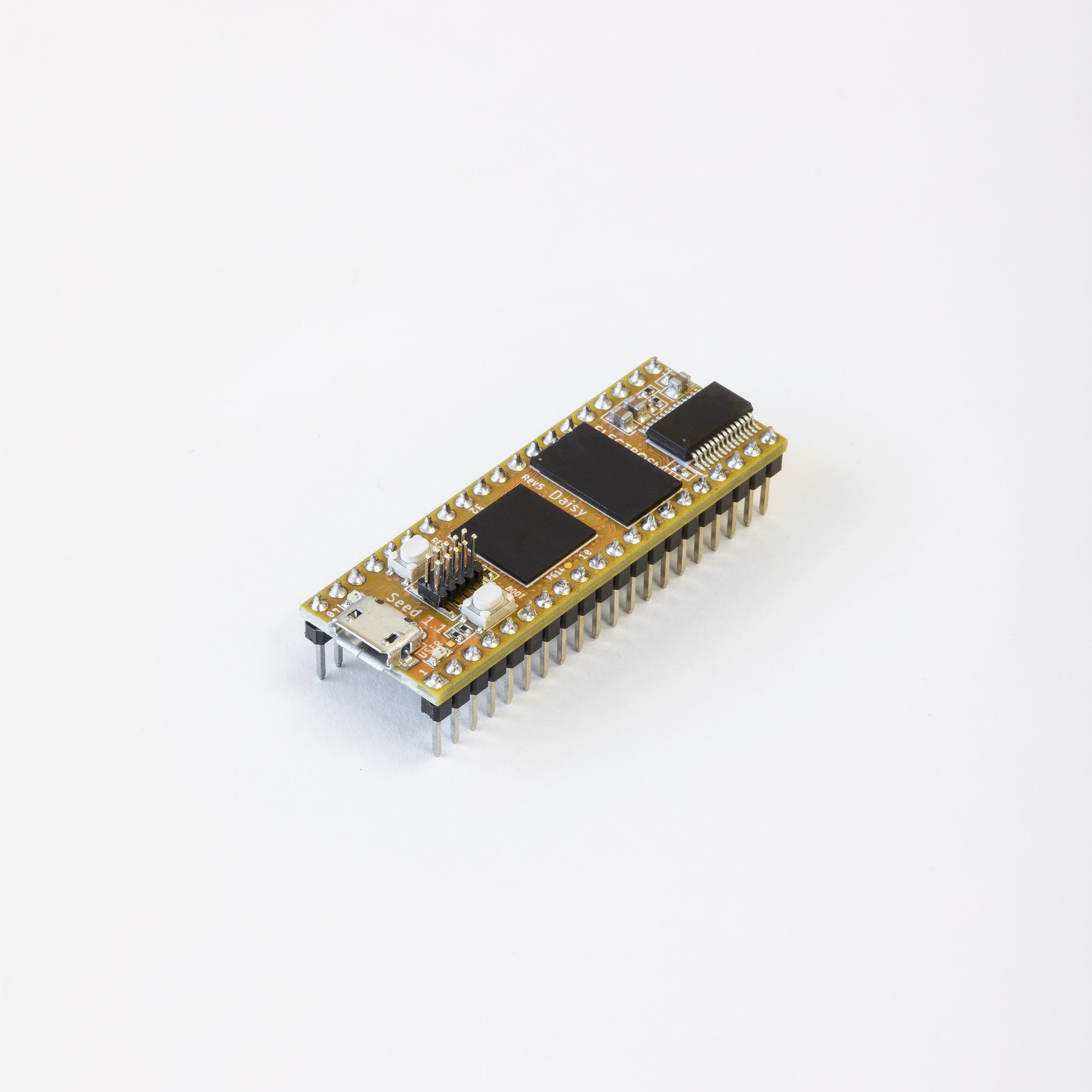
Electrosmith
Supply Chain: Stable Daisy is an embedded platform for music. It features everything you need for creating high fidelity audio hardware devices. Just plug in a USB cable and start making sound! Programming the Daisy is a breeze with support for a number of languages including C++, Arduino, and Max/MSP Gen~. To get star
All my work was getting CP to work out of the external QSPI flash
Thanks @slender iron !
I wanted to make sure if it's worth continuing, documenting and publishing my work for now.
Gotcha!
I will check it out!
People on the daisy seed discord keep asking about python support, but with the currently missing audio modules in CP, not sure how useful it would be anyway....
slender iron
I'd hope synthio would "just work" once enabled
mortal kernel
Thanks all. See ya later.
slender iron
errant grail
Thank you!
lone axle
Thanks for hosting Jeff, Have a great week everyone!
onyx hinge
👋
slender iron
austere acorn
People on the daisy seed discord keep asking about python support, but with the...
This is the DK I got for it because zephyr has a board def (that flashes to internal flash): https://docs.zephyrproject.org/latest/boards/st/stm32h750b_dk/doc/index.html
slender iron
austere acorn
I will check it out!
And this person seemed to be trying to get XIP working: https://github.com/zephyrproject-rtos/zephyr/discussions/68729
I'd expect SDRAM to "just work"
austere acorn
slender iron
And this person seemed to be trying to get XIP working: <https://github.com/zeph...
I need to look into how Zephyr works ... does it have a file system that needs to be writeable? How to edit the python code?
XiP was one thing to get going, but that makes the QSPI flash read only, and I'm not sure it can even swap modes during execution.
slender iron
zephyr doesn't have a filesystem itself usually
circuitpython needs it though. it is tricky to do both because all of the flash code does need to be loaded into ram (or maybe we figure out how to do split builds.)
manic glacierBOT

I'm happy to help with testing but do not currently have the ability to set up the build process on my machine.
manic glacierBOT
One typo, I think, but I'll approve anyway and you can fix on the next round.
orchid basinBOT
Updated board URL section towards top of page as requested. Sorry, I didn't even know the URL was in two places.
Did I do that last one correctly? It is not showing my any changes under "Files changed".
Oh sorry, I think you already did it so my edit was just pasting in the same URL again? So we can delete/close this one?
manic glacierBOT

CircuitPython version
9.2.1
Code/REPL
from adafruit_ble.advertising.standard import ProvideServicesAdvertisement
from cycling_power_service import CyclingPowerService
from adafruit_ble import BLERadio
import time

ble_radio = BLERadio()
advertisement = ProvideServicesAdvertisement(CyclingPowerService())
ble_radio.start_advertising(advertisement)

def advertise_ble():
    while True:
        print(ble_radio.connections)
if len(ble_radio.connections) >...It looks like you are allowing three connections to be established at once. Even after a connection is established you start advertising again. Is that your intention?
orchid basinBOT
Yes, I went ahead and changed in the other PR before merging. Sorry, I should have mentioned it in a comment.
Thank you.
manic glacierBOT
Yes that is correct. this is for a bike computer that should connect to a watch and a zwift server
also just tested in 9.2.3 with latest libraries and i see the same behaviour.
strange thing is that sometimes i can connect 2 devices but most of the time its only 1
i have also tried something similar to the examples
ble.stop_advertising()  # you need to do this to stop any persistent old advertisement
ble.start_advertising(advertisement)
same error will still occur
manic glacierBOT
The bug report issue template doesn't explicitly ask for the board name. Do that. (I've seen several reports recently where I had to ask for the board name.)
I also touched up the wording in a few other places.
onyx hinge
Here is the notes document for next Monday’s CircuitPython Weekly Meeting. It is at the normal time of 11am Pacific / 2pm US Eastern here on Discord. Add your hug reports and status updates to the document before the meeting. If you are unable to attend but would still like to contribute, feel free to add your notes and we’ll read them off during the meeting. Hope to see you there! <@&356864093652516868>
https://docs.google.com/document/d/1XVbpKF0WlpLap2RIqy4IgeEOFLTUaBdCRs_qWGoj1Qs/edit?usp=sharing

Google Docs
CircuitPython Weekly Meeting for February 3, 2025 Welcome to the CircuitPython Weekly meeting notes! Feel free to add your Hug Reports and Status Updates before the meeting, alphabetically by your username. During the meeting, we go through them in order. If you can’t make the meeting and would s...
onyx hinge
onyx hinge
Here is the notes document for next Monday’s CircuitPython Weekly Meeting. It is...
onyx hinge
something I tried that doesn't seem like it's going to work out: I noticed that circup takes a bit of time after downloading the bundles to unzip them. I thought maybe it would be faster if it just extracted files from the zips as needed. And Python has zipfile.Path which can work similar to pathlib.Path...
but iterating over files inside the zip file seems to be a lot slower than iterating over them in the filesystem, to the point that you might as well just unzip them.
though there could be something wrong with my WIP code too
manic glacierBOT
Hi, i have tested this on TTGO T-Display-S3 1.9 (16m8m) and the ESP32-S3-DevKitC-1-N8R2
the snippet above is an oversimplified version of what i am running for the total bike computer. With the interface and everything active it uses about 170kb (for TTGO) vs the 60kb (DevKitC) that this sketch is using.
sometimes the device allows me to connect to and then crashing at a third connection and sometimes i can just connect one device
i was using gc.mem_free() to check the memory usage is thi...
manic glacierBOT
manic glacierBOT
@dhalbert: I am still working on this, trying to fix a pin-alarm related problem. I found this piece of code while searching for a solution (see: https://github.com/adafruit/circuitpython/blame/d965980a986c44c3048fd744e7112c5dda782288/ports/raspberrypi/common-hal/alarm/pin/PinAlarm.c#L31):
    if (_not_yet_deep_sleeping) {
        // Event went off prematurely, before we went to sleep, so set it again.
        gpio_set_irq_enabled(gpio, events, false);
    } else {
// Went...I've been wanting to make circup use the json file available with each bundle release, which would remove the need to iterate over files, both to get version numbers and dependencies
(and have the json be in the zip)
manic glacierBOT
I have finished reviewing the 1001 messages for your project. I understood Jeff's remark about compression. It is delicate to apply it during translation; however, a certain effort, which you will notice, has been made to limit the vocabulary while preserving the spirit and meaning of the message.
Very instructive, Jeff. Thank you for these clarifications regarding the construction.
Wishing you a good reception,
Franck
De : Jeff Epler @.***>
Envoyé : lundi 27 janvier ...
manic glacierBOT
No doubt the folks writing the English original text would also have benefited from a little more consistency.
also note that since #10005 the USB Host on Metro RP2350 is set up once at boot time and so different configurations are harder to test. You might need to test using a different board without predefined USB host pins.
manic glacierBOT
Thanks @wtuemura!
Thanks @FK-sauve for your very thorough review of the French messages!
manic glacierBOT
The logic to do this was lost in my recent re-organization. Happily, just setting this field appropriately fixes it.
Testing performed: I was using an implementation of quadrature encoder that required being loaded at address 0. It was loaded at address 4(?) instead, because loading at higher addresses is favored, and it didn't work.
You can test with something like
import array
import rp2pio
sm = rp2pio.StateMachine(array.array('H', [0]), 0, offset=1)
assert sm.offset == 1

CircuitPython version
CP 9.2.3 on a Adafruit ESP32 Hazzah
Code/REPL
# The version is for the ESP32-S2 Feather with AHTx0 connected to onboard
# STEMMA-QT connector.
#
import os
import adafruit_connection_manager
import socketpool
import ssl
import adafruit_minimqtt.adafruit_minimqtt as MQTT
import wifi
import time
import board
import digitalio
import alarm
import busio
import adafruit_ahtx0

PUBLISH_DELAY = 60
MQTT_TOPIC = "environmentTopic"
USE_DEEP_SLEEP =...I think that watchdog timeout is intended to cause a safe mode reset, though I'd welcome correction if I'm wrong.
Even if that's the case, it looks like the documentation could be improved here, clarifying what kind of reset the watchdog produces.
By putting code in safemode.py, you can control what happens after various types of safe mode resets:
Safe mode may be handled programmatically by providing a safemode.py. safemode...
manic glacierBOT
I really don't know if the WDT code I'm using is really working. It's hard to test if connected to Mu or Thonny. That coupled to the fact that if the WiFi connects correctly you should never have a WDT event. Back in CP 7.2 days the WiFi had issues with fringe located ESP32-S2s where I'd see my loop counter go to zero and I'd know a WDT reset had occurred. However since CP 9.2.1, I update all my wifi connection logic to the new method and now I've never had a WDT event on a ESP32-S2.
This ...
tulip sleet
@slender iron when you are available could we talk about C3 problems? Thanks. Maybe you have some ideas:
- C3 DEBUG=1 builds in 9.2.1 or later (at least, could also be earlier) don't work at all. They crash early with
Guru Meditation Error: Core 0 panic'ed (Instruction access fault). Exception was unhandled. - enabling CIRCUITPY_BLEIO with ESP-IDF 5.3.2 causes a boot loop. Does not crash with 5.3.1 -- I did not test the functionality. I've been looking at the
REGISTRATION_FUNCTIONSand any changes in the CMakefile.txt for the bt component -- nothing obvious yet.
1 is kind of hindering debugging 2 🙂
manic glacierBOT
I think that watchdog timeout is intended to cause a safe mode reset, though I'd welcome correction if I'm wrong.
It seems to me that based on my testing on the ESP32-S2 back on CP 7.2 that the WDT did what it said, either RAISE or RESET. A reset always yanked the chain on the reset pin and you got a clean start up. Hence the loop counter in SRAM cleared.
I could see the Safemode being a REPL feature the way that Deep Sleep is simulated in REPL.
mortal kernel
@slender iron I've been poking around in Zephyr source to see what BLE support might be there for RP2 and came up empty. Any pointers you can share?
jaunty juniper
so I have a freshly installed Feather Huzzah 32 where the Web workflow doesn't seem to run on 9.x (whereas a V2 for example doesn't have that issue), I don't think it is purposefully disabled, can someone who has the board check ?
manic glacierBOT
With full deep sleep unconnected to USB, you could try writing to nvm from safemode.py and boot.py to capture the reasons for safemode and reset (example).
slender iron
tulip sleet
<@252717193496756235> when you are available could we talk about C3 problems? Th...
Yup! I'm at my desk now. Free except for a meeting in 45 minutes or so. (Also let ladyada know I'm free though too.)
slender iron
mortal kernel
<@252717193496756235> I've been poking around in Zephyr source to see what BLE s...
I don't see any mention on the meta-issue https://github.com/zephyrproject-rtos/zephyr/issues/53810
tulip sleet
slender iron
Yup! I'm at my desk now. Free except for a meeting in 45 minutes or so. (Also le...
np - lemme know here or elsewhere when you free up
slender iron
tulip sleet
np - lemme know here or elsewhere when you free up
can chat now if you want
tulip sleet
slender iron
can chat now if you want
if responds can interrupt
mortal kernel
slender iron
I don't see any mention on the meta-issue <https://github.com/zephyrproject-rtos...
Looks like Zephyr has gone the AIROC WiFi route as opposed to RPi SDK, but no support for the BTstack (yet?).
slender iron
mortal kernel
Looks like Zephyr has gone the AIROC WiFi route as opposed to RPi SDK, but no su...
I don't think it'd use BTStack itself. Zephyr has its own BLE host stack
manic glacierBOT
@jepler is this still a draft?
manic glacierBOT
belatedly marked as ready for review
manic glacierBOT
Thank you for doing this! I tested on a Metro ESP32-S2, with some 16k and 22050 wav files. They worked fine. One file had pretty low audio level, and I heard significant noise. I'm not sure if that's leakage or the relatively poor performance of the DAC. I tried the same on a Metro M4 with AudioOut, and it was quieter.
I also tried with an audiomp3.MP3Decoder source. That caused a Hard Fault into safe mode. The audio file is attached (zipped up)
[16000.mp3.zip](https://github.com/user...
manic glacierBOT
I tested the build artifacts on a Feather RP2040 Prop-Maker, playing I2S Audio, and a Feather RP240 DVI, doing DVI output. In both cases the PIO functionality worked fine. I did not test USB Host since you did that already, though not on an RP2040.
Thanks!
manic glacierBOT
This may be hitting assertions about audio buffer sizes. It looks like there's a limitation of 512 bytes of audio data (#define DMA_BUFFER_SIZE 512 ... uint8_t scratch_buffer[DMA_BUFFER_SIZE];) but mp3 decoding produces audio data in larger amounts.
If that's the case, the problem might also reproduce with, say, a RawSample with 4096 samples of data.
orchid basinBOT
Automated website update for release 9.2.4 by Blinka.
New boards:
- waveshare_esp32_c6_lcd_1_47
manic glacierBOT
Okay, I've been digging through the safemode documenation and on the Learn article I see an interesting statement.
https://learn.adafruit.com/circuitpython-safe-mode/safe-mode-reasons
SafeModeReason.WATCHDOG
An internal watchdog timer went off. Something is looping or taking more time than expected. This is not the watchdog timer used for microcontroller.watchdog. If microcontroller.watchdog is enabled to do a reset, it will do a regular reset; it will not go into safe mode...
manic glacierBOT
And it times out, it will yank reset and no safe mode. That seems like a bug, but all I can do for testing is put in the safemode.py and see if I can force the reset that way after a WDT happens.
As described in the doc, watchdog timers are not related to internal watchdog errors. watchdog was implemented before safemode.py. You could use WatchDogMode.RAISE (https://docs.circuitpython.org/en/latest/shared-bindings/watchdog/index.html#watchdog.WatchDogMode.RAISE) to raise an exception...
manic glacierBOT
So it sounds like this case is really a bug that the WatchDogMode.RESET is entering safemode and not resetting the ESP32. My current test is to enable the watchdog timer again and have the savemode.py to simply do a reset. So if my program is still working in the morning and my loop counter has reset then I know the workaround is working. Then it's up to you experts on how you want to fix it.
So it sounds like this case is really a bug that the
WatchDogMode.RESETis entering safemode and not resetting the ESP32.
I thought you were saying your test above that explicitly does a 70 second watchdog is not entering safemode. Maybe I'm confused. I want to emphasize that the word "watchdog" means completely different things here. SafeModeReason.WATCHDOG is for internal watchdogs that have nothing to do with wdt.
You can check for a wdt watchdog reset by looking at `micr...
manic glacierBOT
Until today, I was not aware of safemode. I used the code:
from microcontroller import watchdog as w
from watchdog import WatchDogMode
w.timeout = 70  # Set a timeout of 70 seconds
w.mode = WatchDogMode.RESET
w.feed()
to force what I thought was a real reset like a power up reset. I think it works on the ESP32-S2, but not on the ESP32. On CP 7.2 it helped me out a lot. But on CP 9.2 I've never had a WDT trigger that I know of on a ESP32-S2. I could test with or without the REPL wor...
And you are right the loop with deep sleep is 60 second and the WDT timeout is 70 sec.
Safe mode is after a real reset, but it's not a "clean reset", in the sense that it checks why the reset happened.
If you want to force a clean reset after a safemode watchdog, you can put something like this in safemode.py:
import microcontroller
microcontroller.reset()
Have you looked at https://learn.adafruit.com/circuitpython-safe-mode ? I think maybe yes.
So this is a change since CP 7.2. I'm testing the version of safemode.py you showed above now. If it works overnight connected to Thonny, then I'll test just connected to USB Power.
I guess I should implement the safemode.py on even my ESP32-S2 that don't seem to even need a WDT. The CP 9.2 wifi connect that changed, to me, is a positive and that is why my ESP32.S2 run for 45 days before the loop count rolls over to 0 instead of ever resetting by WDT.
manic glacierBOT
Interesting. I'll take a look.
tulip sleet
CircuitPython 9.2.4 released!
Highlights of this release:
- Update frozen modules, including a fix for adafruit_requests
- audiofilters: add Distortion and implement LFO ticking
- Add canio support for i.MX boards
- Fix RP2 picodvi crash
- Fix STM USB crashes
https://blog.adafruit.com/2025/01/28/circuitpython-9-2-4-released/
manic glacierBOT
manic glacierBOT
mortal kernel
slender iron
I don't think it'd use BTStack itself. Zephyr has its own BLE host stack
The naming is confusing. There's BlueKitchen's BTstack used by RaspberryPi's Pico SDK, but there is also Cypress/Infineon's BTSTACK that is used with their AIROC driver. Digging deeper, I can see that Infineon/Cypress has contributed an HCI extension driver that connects AIROC to Zephyr's HCI implementation making BTSTACK unnecessary.
manic glacierBOT
Hi, could you explicate what this is doing? I'd suggesting editing the original post.
manic glacierBOT
So in my original post I listed in the Behavior section that the reason for entering safemode was (TG1WDT_SYS_RESET). I now know this was not from my WatchDog timer code. I did the follow test.
code,py
# SPDX-FileCopyrightText: 2023 anecdata
#
# SPDX-License-Identifier: MIT
import time
import alarm

time.sleep(5)
#This sleep is needed due to a bug

from microcontroller import watchdog as w
from watchdog import WatchDogMode
w.timeout = 15
w.mode = WatchDogMode.RESET
w.feed()

time.sleep(30...This means that my WatchDog timer will reset the system if it occurs and if an internal issue sends me to safemode, my safemode.py will reset the system just like the WDT from
w.mode = WatchDogMode.RESET
Yes, that is correct. I tested on a HUZZAH32 and an ESP32-S3 with this test program (modified from yours), which prints out why the board was reset:
import time
import alarm
import microcontroller
import watchdog

# Sleep a bit so we can see the output
time.sleep(2)

print(f"{micro...so AIROC does have BLE support in Zephyr?
mortal kernel
slender iron
so AIROC does have BLE support in Zephyr?
As far as I can tell, it does. Take that with a grain of salt because I'm basing that on my reading of the code, not an actual working example. The BLE part of Zephyr on CircuitPython is coming into focus for me now. Zephyr has a generic HCI driver that interfaces by various means with a subset of the current zoo of BLE hardware implementations. CircuitPython will interface with this generic driver, obviating the need for port-specific BLE code. Am I seeing it?
 orchid cliff
Hey guys - I have an "older" Metro M4 Express. I installed 9.2.4, and it seems to be missing vectorio I had 9.1.4 on it, which does have vectorio. The download page does correctly not show it as one of the modules now... No biggie I went back to 9.1.4
tulip sleet
orchid cliff
Hey guys - I have an "older" Metro M4 Express. I installed 9.2.4, and it seems ...
we ran out of space, sorry
manic glacierBOT
orchid basinBOT
I also updated my missing boards script to include extra boards to help easily find things like misnamed board files such as with the cezerio_dev_ESP32C6.
manic glacierBOT
I confirmed this is the merge commit. It's suprisingly hard to find this, but I did eventually.
orchid basinBOT
manic glacierBOT
The documentation of the mix parameter is not super clear to me. Please check it over with an eye to whether it needs to be revised with this change, and whether it could be clearer.
You changed this but it's not actually used below:
    if (mix == MP_OBJ_NULL) {
        mix = mp_obj_new_float(MICROPY_FLOAT_CONST(0.5));
}
@tulip sleet so in https://github.com/adafruit/circuitpython/issues/10011 your conclusion is that one of the esp-idf internal watchdogs, which DOES enter safe mode, is firing? It is a bit confusing still.
(in the user's non-distilled application)
tulip sleet
onyx hinge
<@329766224093249548> so in https://github.com/adafruit/circuitpython/issues/100...
that is the user's conclusion, yes, after extended wifi use, there is an internal watchdog
it is not my conclusion. But using micrcontroller.watchdog does not trigger safe mode
i agree it was confusing. Sometimes the user posted things that did not happen, which I misread at first
that is, the user said "sometimes I get this [below], but that did not happen under circumstance X"
orchid basinBOT
slender iron
mortal kernel
As far as I can tell, it does. Take that with a grain of salt because I'm basing...
Yup, that's my hope
orchid basinBOT
.. since this word is associated with the Feather ESP32 and is shown in large letters on the bottom of the V2 board.
manic glacierBOT
DEBUG builds stopped working with ESP32-C3 boards with esp-idf 5.3.x. It causes a crash very early in startup, before main, which appears to be due to serial startup problems. See below for details.
9.1.4 works; 9.2.0-beta.0 (which starts with ESP-IDF 5.3.1) does not.
ports/espressif/esp-idf-config/sdkconfig-debug.defaults was changed between these versions to include:
CONFIG_ESP_CONSOLE_SECONDARY_NONE=y
# CONFIG_ESP_CONSOLE_SECONDARY_USB_SERIAL_JTAG is not set
Taking these away, ...
slender iron
anyone know what shell is used by python on windows from asyncio.create_subprocess_shell()?
onyx hinge
@slender iron def _start(self, args, shell, stdin, stdout, stderr, bufsize, **kwargs): self._proc = windows_utils.Popen( args, shell=shell, stdin=stdin, stdout=stdout, stderr=stderr, bufsize=bufsize, **kwargs)I tracked through several layers, and I still can't tell you, but it's whatever windows_utils.Popen(shell=True) does.
windows_utils.Popen subclasses subprocess.Popen and passes shell= through transparently
slender iron
I think I'll jam a test script into our windows CI build to test it 🙂
onyx hinge
Changed in version 3.12: Changed Windows shell search order for shell=True. The current directory and %PATH% are replaced with %COMSPEC% and %SystemRoot%\System32\cmd.exe. As a result, dropping a malicious program named cmd.exe into a current directory no longer works.
This note in the docs makes me think it's cmd.exe. https://docs.python.org/3/library/subprocess.html#subprocess.call

Python documentation
Source code: Lib/subprocess.py The subprocess module allows you to spawn new processes, connect to their input/output/error pipes, and obtain their return codes. This module intends to replace seve...
tulip sleet
cmd.exe is pretty basic, not a unixy shell at all
slender iron
it looks like it does have > support though
I really need a zephyr on windows build CI job
blissful pollen
slender iron
it looks like it does have > support though
My main dev machine is windows if you need to test / try anything out feel free to ping me
slender iron
thanks @blissful pollen. I'm getting a new windows-zephyr build going on CI
onyx hinge

qspi_without_ram example of component espressif/esp_lcd_st77903_qspi - 0.4.1
slender iron
I can't remember how much of their display stuff we use
onyx hinge
not much I don't think. but maybe the content would be a clue how to use the qspi peripheral for displays in the first place. a trail of breadcrumbs to follow
orchid cliff
tulip sleet
we ran out of space, sorry
No worries! Thank you 😀
manic glacierBOT
I've removed those defines (as well as one in audiofilters.Filter) in lieu of just using the constants in the constructor. The constructor has been updated as well.
The documentation of the
mixparameter is not super clear to me. Please check it over with an eye to whether it needs to be revised with this change, and whether it could be clearer.
The documentation of mix was actually fairly close. I've just added the expected result of 0.5 as to better represent the new implementation.
I noticed the description of decay was different between the constructor and the property. I found the constructor to better represent that property, so I updated...
manic glacierBOT
I've discovered that the frequency-shifting echo algorithm has a functionality bug in regards to how it fills the echo buffer during playback.
Currently, it pulls a sample from the echo buffer, calculates the decay, mixes in the input sample, and then iterates over the buffer from its current position to its next position (using the delay rate with bit shifting). If delay_ms is shorter than max_delay_ms, this loop may iterate over 2+ elements of the buffer. If there is data already in ...
blissful pollen
@fleet hollow just FYI hoping to look at those PRs soon / this weekend
fleet hollow
@blissful pollen It's mostly small stuff, so shouldn't be a big deal. Just getting that echo effect fine-tuned 😸
@blissful pollen By the way, I've been doing research into reverb algorithms lately. Seems like it's mostly a mix of comb and all-pass filters which require quite a bit of floating point calculations. I've successfully implemented freeverb (https://github.com/sinshu/freeverb), a public domain reverb effect from way back in 2000, on an RP2040 in arduino-pico. The most I could get out of it was mono output with a sample rate of 8000hz. Any more and I'd drop buffers. Even though it was a bit lo-fi, it still sounded really good. I think there's potential to fork that repo and convert as much of the calculations to 16/32-bit integers as possible. Granted, the RP2350 might handle it like a champ regardless.
blissful pollen
fleet hollow
<@228322543507865601> It's mostly small stuff, so shouldn't be a big deal. Just ...
Great. I was looking at my chorus effect and realized I have to look at all the fixes since I started to pull them across as well.
blissful pollen
fleet hollow
<@228322543507865601> By the way, I've been doing research into reverb algorithm...
I looked at freeverb too. The effect doesn’t seem too hard to put in place. Mostly just take ram and cpu. May need to warn people about sample rate / stereo if it really takes a lot. The teensy audio library has it built in as well.
slender iron
would it be weird to have files checked into the REPO that list the modules enabled on a board? that way the stub stuff doesn't need to generate it
manic glacierBOT
- Fixes #8561.
On RP2040, light_sleep_until_alarms() would turn off some clocks during the light sleep by clearing some bits in clocks_hw->sleep_en0 and clocks_hw->sleep_en1. Those clocks are turned off when a wfi() or wfe() happens. But light_sleep_until_alarms() failed to restore the original values of those registers after a light sleep. So the next time a wfi() or wfe() was used, even not during an explicit light sleep, those clocks would get turned off. This caused th...
slender iron
@tulip sleet have time to talk CP config this afternoon?
manic glacierBOT
I think we have diagnosed this now, and I'll close it. Let me know if you think there is still a bug to fix.
manic glacierBOT
There are complaints about pyserial's read() behavior:
- https://github.com/pyserial/pyserial/issues/285
- https://github.com/pyserial/pyserial/issues/585
- https://github.com/pyserial/pyserial/issues/425
- https://github.com/pyserial/pyserial/issues/318
- https://github.com/pyserial/pyserial/issues/267
I'm now thinking we may not necessarily want to mimic pyserial so closely. pyserial also oddly released v3.5 to pypi but did not tag the release in github, which shows the last release as...
tulip sleet
slender iron
<@329766224093249548> have time to talk CP config this afternoon?
I missed your ping somehow, but I'm still available.
jaunty juniper
slender iron
would it be weird to have files checked into the REPO that list the modules enab...
is generating it a big hassle ? It is done to update cp.org too, which is a separate workflow I believe.
it would be nice to have a static source of that information other than a file in the cp.org repo
(or the RTD docs matrix)
manic glacierBOT
- Fixes #9365
Correct the current documentation. After thinking about this, I believe it's better not to emulate the somewhat idiosyncratic behavior of pyserial. Anyway wanting a certain behavior can do that with the current API.
tulip sleet
slender iron
would it be weird to have files checked into the REPO that list the modules enab...
I think it needs to be generated automatically at some point, not by hand (too easy to get out of sync).
lone sandalBOT
 slender iron
the challenge is that it is based on the final zephyr board device tree
jaunty juniper
yeah that would require pre-commit check and something similar to make translate
slender iron
I'm thinking that I can autogenerate it, put it in boards/ and then when the CI builds the board it'll make sure it is the same
but for other uses it can just be read directly
(I'm figuring out how to fix the docs build)
without installing zephyr and doing a build
tulip sleet
is the device tree generated from CIRCUITPY_WHATEVER = ... settings?
slender iron
the device tree is generating CIRCUITPY_ setting equivalents
tulip sleet
slender iron
the device tree is generating CIRCUITPY_ setting equivalents
I would hope it's the other way round, so we aren't depending on the device tree as ground truth
slender iron
device tree is what zephyr uses for config though
tulip sleet
but can we generate the device tree from some set of our own settings, and then after that let zephyr run its own config?
we don't have to use gnu make variables, we can use something else (though I would hate for it to be kconfig)
lone sandalBOT
 tulip sleet
e.g. a .toml or .json file generates a .mk file, and/or it generates the device tree
slender iron
I'm working to get the build generating a toml file with per-module info
I can even add comments for humans about why a setting is what it is
manic glacierBOT
manic glacierBOT
https://github.com/digixx/circuitpython_nextion exists, and I see regular Pyton and Micropython libraries too. I'm closing this for now, since this won't be an Adafruit-sponsored task.
I think this is unsolvable and will close this for now.
Closing because it can be fixed by turning feature on.
Closing because there's a workaround of the original problem, and we are far ahead, with MixerVoice, etc.
Closing this because there's a reason it's not supported (to get precise frequency), and it's been documented.
There are several ways to do this in various ports, so closing the general issue. Port-specific requests could be opened.
The sep parameter was added to CPython in Python 3.8, so this is now compatible with CPython.
I may not be understanding this completely, but our (currently incomplete) switchover to use finalisers everywhere may help us. Also there've been many changes at the lower level here. So closing this. It can be reopened to be more specific.
Closing this because it's so old and so many things have changed since.
Closing due to no progress. If anyone wants to do a PR that would be fine.
manic glacierBOT
A similar issue recently came up in https://github.com/adafruit/Adafruit_CircuitPython_datetime/issues/29 and https://github.com/adafruit/Adafruit_CircuitPython_datetime/pull/30. It is better to use an int because the precision of the 30-bit floats is so limited. I think we will not fix this for the reasons given in https://github.com/adafruit/Adafruit_CircuitPython_datetime/pull/30.
Closing as stale, and no further complaints.
manic glacierBOT
io no longer includes FileIO, so the specific example is moot. #4349, which might be the same thing, is now closed.
I'm going to close this since there seem to be multiple causes for this and the mentioned versions are quite old. New reports of similar behavior are welcome.
Closing as alternative was suggested.
Tested with 9.2.4, with the test program above. Sample output:
10.573 2.05
45.391 2.048
108.878 2.048
Note now the 2 second delay rather than 1 second.
Closing due to other uses for countio.
This is now implemented by #7577
I'll say this is subsumed by #9845.

Hi,
I found that only the 2MB ESP32-C3 boards have the ALARM module built-in:
TTGO T-01C3 ESP32-C3 and ESP-C3-32S (2M).
I found /ports/espressif/mpconfigport.mk sets CIRCUITPY_ALARM = 0 for ESP32C3 [because i...
Closing due to no progress, but a PR would be welcome.
Closing because we no longer make this breakout.
@arduino12 This may be due to not enough flash space right now when other things are included (2MB builds may trim further, making room for alarm). In CircuitPython 10 we will get rid of the OTA partition and there should be room.
@ilikecake Your fixes sound good. The original issue here I think was due to ESP32-S3 problems in older versions of ESP-IDF. I'm going to close this now but we should look at your retries.
manic glacierBOT
Hi,
@dhalbert Thanks for your quick reply!
I changed it to CIRCUITPY_ALARM = 1 and compiled for the Maker Go ESP32C3 Supermini (my first time compiling circuitpython!)
And it works perfectly - got down to 7uA!
The original adafruit-circuitpython-makergo_esp32c3_supermini-en_US-9.2.4.bin is 1449kB.
With the added ALARM it became 1464kB so I think it worth it!
Attached here in case anyone wants to try (remove the ...
orchid basinBOT

Images automagically compressed by Calibre's image-actions ✨
Compression reduced images by 63.8%, saving 4.39 MB.
| Filename | Before | After | Improvement |
|---|---|---|---|
| assets/images/boards/large/adafruit_feather_rp2350.jpg | 331.80 KB | 93.66 KB | -71.8% |
| assets/images/boards/large/adafruit_mini_sparkle_motion.jpg | 169.83 KB | 120.25 KB | -29.2% |
| assets/images/boards/... |
manic glacierBOT
This is an analog amplifier. The only control available is a shutdown pin. So it doesn't really need a driver. General ADC audio in support will work with the output. On the RPi, you can use the Voice Bonnet guide for guidance.
Closing this because of its age. If the latest builds do not work on this board, let us know.
Closing this for now with no further info.
With RunMode.UF2 it works perfectly on my Feather S3+TFT. => Problem solved, we can close this ticket.
Closing as solved.
Mistake was made in the initial creation of mpconfigboard.h for this device. Resolved.
This may be related to #10002
I think this will have been fixed by #8966.
manic glacierBOT

I believe this falls into sort of a known issue or expected behavior category, so I'm fine closing it.
That being said, from absolute newest:
Adafruit CircuitPython 9.2.4-4-g5d39e467fb on 2025-01-31; Adafruit Grand Central M4 Express with samd51p20
>>> import board
>>> import pwmio
>>> a = pwmio.PWMOut(board.D8)
>>> a.deinit()
>>> a = pwmio.PWMOut(board.D8)
>>> a.deinit()
>>> a = pwmio.PWMOut(board.D7,variable_frequency=True)
>>> a.deinit()
>>> a = pwmio.PWMOut(board.D8)
Traceback (most...I was hoping the finaliser change fixed this, surprised it didn't. Maybe deinit() is not clearing stuff. Reopening. Thanks for testing.
manic glacierBOT
I took a quick look at the Grand Central pins.c and noticed that D8 is actually used by the SDIO databus as one of the SDIO_DATA lines. The SAMD common-hal sdioio/sdcard.c module has an empty never_reset function which if it had any code in it, would probably explain why ctrl-D wasn't releasing the resource. I'm guessing somewhere else in the sdioio sdcard construction the data pins are marked for no-reset and if that's the case, it might explain why a ctrl-D doesn't clear the resource. On th...
manic glacierBOT
This is now ready for review (and merging IMHO). I don't know why there is a complaint about a conflict. It references only a few lines although I change almost everything in the given file.
manic glacierBOT
I don't know why there is a complaint about a conflict in common-hal/alarm/__init__.c.
I changed that file in #10018, which was recently merged. Your PR is against an older commit of that file. So could you rebase or merge from upstream? That should clear the conflict, but check the changes. I think your rework will make that change moot, but try the test program in #10018. Thanks.
I actually integrated your recent change already. I will try a rebase and see if this resolves the issues.
Ok, seems I need a new PR since I could not push the rebased branch without deleting my upstream branch.
manic glacierBOT
The version of LWIP used by RP2 builds hangs up internally when it thinks its statically allocated pcb pool or pbuf pool is exhausted. The hang-up manifests itself as a memory error returned by tcp_write. Socket code in CP waits 50 ms and then retries the write. This retry/fail condition persists until LWIP's tcp_slowtmr fires and LWIP clears whatever internal condition made it think a pool was exhausted and continues operating normally for a few frames. tcp_slowtmr is a 500 ms periodic...
@bablokb FYI, a git push --force will replace a branch on github and will automatically update any pending pull requests.
manic glacierBOT
I finally wrapped my head around what is going on and agree. The code looks good, I will test it on hardware soon.
Side note: maybe at some point we want to revisit all of Echo to see if we can clean it up a bit. I think as the first effect we both learned a lot inside of it.
manic glacierBOT
Tried it on RP2350 works as expected. Easier to understand it all by hearing it versus trying to visualize it.
manic glacierBOT
This could be subsumed by #9845.
This could be subsumed by #9845.
I am using it for CircuitMatter on CircuitPython right now.
I'm going to close this given there is a way to do it in Python.
Closing as a dupe in favor of #9908, which has more information.
Still doesn't fitk, as tested by #8630. I think we need to give up on this for now and recommend other boards instead.
Noted as a troublesome chip on i.MX here: https://learn.adafruit.com/i2c-addresses/troublesome-chips
It would be worth retesting with 9.2.x, as a lot of the underlying I2C implementation has changed.
@latkinso42 @timchinownsky This is an old issue that may still be of interest.
Closing as unlikely, due to there being as easy workaround.
manic glacierBOT
CircuitPython version and board name
v9.2.2 thru v9.2.4
Adafruit Qt Py S2 with SRAM (product # 5700)
Code/REPL
import time
import board
import displayio
import i2cdisplaybus
import adafruit_displayio_ssd1306  # OLED
import adafruit_ahtx0  # WeAct T&H Sensor
import adafruit_sht4x  # Adafruit sensor

time.sleep(2)  # give me time to open serial window after power

# set up I2C with OLED display & AHT20 sensor
i2c = board.STEMMA_I2C()
displayio.release_displays...Thanks! Looks good now. I still haven't tested it.
manic glacierBOT
See #9965, which was prematurely closed. Copying notes from there. See the first PR for various measurements.
This PR implements the alarm-module for the RP2350 variant of the pico and fixes #9491.
Notes
- The PR does not use the new power-domains for the RP2350, but uses plain old sleep/dormant modes. An implementation based on powman is something for a future PR.
- This PR also reimplements light-sleep/deep-sleep for the RP2040. As @dhalbert stated in #9521: "So redefin...
manic glacierBOT
Re-based local modifications to the top of LWIP's main line. Performance problems still persist. Preliminary list of bugs in LWIP affecting CP:
- When a connection is first established on a TCP socket, scrambled code in
tcp_inputerroneously detects an application rejection of the first frame. This is due to bad arguments sent via the macroTCP_EVENT_RECV. The result is a delayed ACK, sometimes delayed by several hundred milliseconds. Eventually LWIP will deliver the frame and send the A...
manic glacierBOT
When a transmission is sent to a TCP socket that is smaller than the TX buffer fill level required to trigger transmission, it will linger in the buffer until a timeout occurs. This imposes a performance penalty on small transmissions and possibly also on the final part of a larger transmission. I'm thinking that this is necessary to avoid sending small fragments to LWIP, but perhaps it can be better tuned by looking at time since last fill in addition to TX fill level.
manic glacierBOT
This latest patch switches to dynamically allocating the scratch buffer and also corrects some other problems that I found. One was that the audio quality is very bad in stereo mode with the APLL clock so I switch to using the DEFAULT clock for sample rates over 19600. The DEFAULT clock cannot be used for sample rates lower than 19600. I considered adding logic to scale up sample rates below 19600 by just duplicating the samples 2^n times but I'm not sure if that is necessary. There was also ...
manic glacierBOT
Sorry for not including a description. I have edited it. Hopefully it makes sense.
manic glacierBOT
Here is a trace showing the first LWIP bug described above.
Client (192.168.1.217:42582) sends a SYN packet to begin 3-way TCP handshake:
<details>
<code>
37.179.473(00.047.302): cyw43_ll_process_packets
37.179.504(00.000.031): cyw43_read_reg_u16 BUS_FUNCTION 0x4=0xbe2020
37.179.565(00.000.061): cyw43_write_reg_u16 BUS_FUNCTION 0x4=0x2020
37.179.595(00.000.030): cyw43_read_reg_u32 BUS_FUNCTION 0x8=0x20928
37.179.626(00.000.031): bus_gspi_status 0x20928 0x104
37.179.656(00.000.030): cyw43...
manic glacierBOT
Issue #7613 was tied to BLE being in use, but I can actually reproduce something similar without using BLE.
So testing the code above on a Seeed Studio Xiao and Feather NRF52840 Express I discovered that the sleep times are related to the operating system used. I made the code a little more complex so I can see the time values when it's going well without overwhelming the logs, and see it freeze:
import time
bad = False
while True:
    t0 = time.monotonic()
    time.sleep(0.002)
t1...Is the only way to change the partition table to change a board's sdkconfig ? To build a QT PY ESP32S3 with BLE I had to change mpconfigport.mk, which I expected, but I can then set CIRCUITPY_BLEIO=1 as an argument to make without having to change the board files. Having the same flexibility for partition tables would be nice
tulip sleet
jaunty juniper
Is the only way to change the partition table to change a board's `sdkconfig` ? ...
You can set FLASH_SIZE_SDK_CONFIG. See ports/espressif/Makefile for a lot of logic involving that variable. In most cases is it set with ?= so you can override it.
jaunty juniper
ah thanks, let me try that then
jaunty juniper
tulip sleet
You can set `FLASH_SIZE_SDK_CONFIG`. See `ports/espressif/Makefile` for a lot of...
yeah FLASH_SIZE_SDKCONFIG=esp-idf-config/sdkconfig-flash-4MB-no-ota-no-uf2.defaults works thanks
combining CIRCUITPY_LEGACY_4MB_FLASH_LAYOUT=0 and UF2_BOOTLOADER=0 also works to select the 4MB-no-ota-no-uf2 variant
tulip sleet
jaunty juniper
yeah `FLASH_SIZE_SDKCONFIG=esp-idf-config/sdkconfig-flash-4MB-no-ota-no-uf2.defa...
The LEGACY stuff is mostly for C3, so it includes the no-uf2 (since C3 can't have UF2 anyway). It is tested in some nested ifs. All the S3 boards have legacy layout since they were defined before that was a choice
you could use no-uf2 but I think there's no real advantage to that
4MB-no-ota is fine