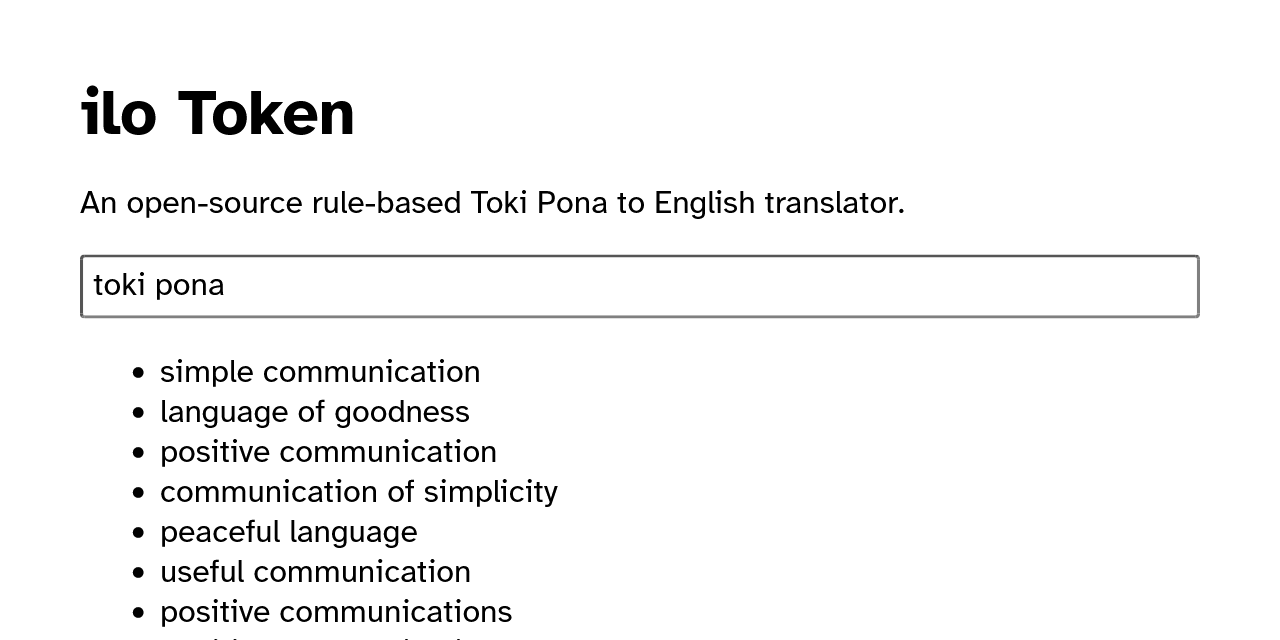
#ilo Token - Rule based toki pona to english translator
992 messages · Page 1 of 1 (latest)
 frozen bear
 narrow helm
oh, I see. by "multiple sentences" you mean multiple different translations to English stemming from the multiple English words that each toki pona word could mean.
frozen bear
yep
narrow helm
that's cool! I'd thought about this idea in the past, and I think it may turn out more accurate more often than machine learning
frozen bear
ooh, thanks
narrow helm
basically by making the human figure out context lol
frozen bear
lol yes
frozen bear
hmm, I'm considering giving this project versioning and changelog so you can track the progress for this project
 desert abyss
ah dang
 frozen bear
yep, seme is currently unrecognized because that would make the punctuation a question mark, and I don't have a mechanism for that
desert abyss
just treat all punctuation the same?
frozen bear
what do you mean?
desert abyss
If the issue would be that it makes the punctuation a question mark, there's an easy solution: ignoring punctuation beyond sentence separation is entirely possible in toki pona
frozen bear
hmm
frozen bear
oh, this translator already ignores punctuation from the input, what I mean is that having "seme" would make the output translations have question marks, and I haven't implemented that
 silver bay
@frozen bear Hi, developer of ilo Kukole here. How does this translator work? Are you parsing a sentence into parts and translating those individually then attaching them together again? Would you be interested in putting this into ilo Kukole?
silver bay
silver bay
<@428787756991381504> Hi, developer of ilo Kukole here. How does this translator...
I have tried the approach of parsing a sentence into parts (subjects, predicates, verbs within those predicates, preverbs, etc…) and the one thing that just I just couldn’t parse is prepositions. If someone can find a way to determine where and when a preposition is used consistently, a translator with that approach would be perfect.
frozen bear
silver bay
<@428787756991381504> Hi, developer of ilo Kukole here. How does this translator...
hi, yes you correctly described what it does. the parser also handles some nuances: currently, it handles "a" whether it emphasizes the single word, the whole phrase, or the whole sentence, and then it treats those as possible as interpretations that will be translated (this atm is bugged, I'll fix it later). as putting it in ilo Kukole, I'm not sure how you'd do that but feel free, it's MIT licensed
silver bay
frozen bear
hi, yes you correctly described what it does. the parser also handles some nuanc...
well… ilo Kukole is written with node.js and javascript, so in theory after it’s improved to a usable point for a full sentence it should be a drop in replacement for the most part
frozen bear
silver bay
I have tried the approach of parsing a sentence into parts (subjects, predicates...
I have something in mind when it comes to parsing predicates, but I haven't implemented it, I hope it works
silver bay
I have already written sentence parsing in javascript if you’re interested
i can dig that up if it’s useful
frozen bear
oh nice
silver bay
the one problem is simply just that i can’t consistently parse prepositions
everything else is easily possible
frozen bear
I see
silver bay
frozen bear
I see
there’s always one solution… just… parse it both ways and give all the results… but this would get really long really fast
like is “tomo tawa mi” “my car” or “a building from my perspective”? you could just… do both…
frozen bear
yep, that's what I have in mind
btw, I'm going to separate parser and translation from frontend script so that I could publish it to npm
narrow helm
silver bay
like is “tomo tawa mi” “my car” or “a building from my perspective”? you could j...
seems based; add a little note to the translation that "tawa mi" is one of those semi-lexicalized (?) phrases and that probably it means this but maybe not
 west vector
does it translate sentences or just words?
I tried "mi toki pona", translation stopped after mi.
then I tried "ona li toki", same
it seems it doesn't know about sentences with "li" ?
but keep it up, I'm looking forward to test it again in the future.
frozen bear
yep it can only translate phrases at the moment
frozen bear
this may take a lot of time to be complete
frozen bear
version 0.0.1 has been released. this is a small but substantial release where I made the word list and translation list a bit better by:
- adding missed words (ali, pali, palisa, seme, and uta)
- simplifying translation list such as deduplicating translation words that have mostly the same meaning. for example "other" and "different" are mostly similar, "different" has been removed and "other" has been kept
- adding more translation words
more details here: https://github.com/neverRare/toki-pona-translator/blob/master/CHANGELOG.md#001
you may need to force restart the webpage to see the changes: (shift + click the restart button or ctrl + shift + R)
the webpage: https://neverrare.github.io/toki-pona-translator/
next stop: fixing bugs then implementing preverbs
 frozen bear
along with preverbs, I think preverbs and extended numbering system would be easy to implement so I'll implement these soon
frozen bear
I think i'll be extra conservative about nanpa particle, it'll only accept "nanpa wan" and "nanpa tu" for now
oh, and actually, "nanpa tu wan", then "nanpa tu tu" then so on
for extended numbering system, lone "mute" and lone "ale" won't be recognized as specific number
since those are rarely recognized as specific number
hmm, should I handle X ala X construction? maybe later
frozen bear
frozen bear
for extended numbering system, lone "mute" and lone "ale" won't be recognized as...
hmm, or maybe I should for consistency, idk
frozen bear
.... there's a lot of bugs as it turns out
narrow helm
frozen bear
hmm, should I handle X ala X construction? maybe later
definitely if you can! does sound challenging :/
frozen bear
hmm, I could parse it but idk how to translate it
 rough atlas
pona pi ilo Kukole la ni li ken pona tan ni: ilo Kukole li pana e ante toki wan taso. taso, ilo ni li pana e ante toki mute
wile mi la ilo ni li kama pona 👍
 lament solar
tenpo pini la mi lukin pali e ilo sama
taso mi awen ala li pini ala
sina pini la wawa
 fickle stag
@frozen bear o, ilo li ken ala sona e toki sama ni: "o ... la ..."
o pana e kili la mi ken kipisi
somewhat uncommon structure but I've seen a number of folks use it and arrive at it independently, so it seems worth considering
frozen bear
fickle stag
<@428787756991381504> o, ilo li ken ala sona e toki sama ni: "o ... la ..."
> o...
sure thing, but ughhh, that seems like a challenge
fickle stag
When it can't parse with la there, attempt parsing both sides as their own sentences
frozen bear
I could parse it, but I'm not sure with translation
something like "please give food. then I can cut"? hmm, maybe I overestimated it lol. this is programming, it's hard to estimate difficulty
btw, ilo Kokule uses machine learning, while this translator uses more traditional programming, everything is hardcoded. I have a feeling that the ideal translator for toki pona is somewhere between machine learning and traditional programming
something like
toki pona sentence -> hardcoded translator with a bit of AI or Machine Learning for edge cases -> grammar checker through AI -> Engligh sentences
though, this is a project for another time, I don't think I'll make this in the future
fickle stag
Yeah decision tree with some basic lexing should do the job for a glosser
Being explainable is a feature, one that ML models lack
frozen bear
TIL, verbs acting like noun is called gerund, this is something I always use for this translator, things like translating "kama li" into "arriving is". I'll use the term gerund for documents like changelog
silver bay
frozen bear
btw, ilo Kokule uses machine learning, while this translator uses more tradition...
im inclined to agree, I think the first step for a toki pona translator would be to make a reliable parser to parse out the parts of a sentence to then give that to a maching learning in multiple different contexts to produce multiple english sentence outputs
ilo Kukole currently works like this
toki pona sentence -> machine learning to toki pona -> parse parts of english sentence out -> "ungenderize" english output if the toki pona input doesn't include meli or mije -> grammar checker through AI -> english sentence```but i think the ideal translator would be
toki pona sentence -> parse parts of toki pona sentence out -> translate parts of sentence individually and in multiple ways -> put them back together in multiple different ways while trying to keep english grammar intact -> grammar checker through AI -> english sentence``` rocky pulsar
concept that idk if it'll work: put all the translations through a language model to measure perplexity (inverse likelihood), then pick the one with the lowest
silver bay
i have done some work on parsing parts of speech out of a toki pona sentence

but i got stuck on prepositions
i have no good way to determine when something is a preposition and when it is not
silver bay
silver bay
the input sentence here was "sina ken pana e sona mute tawa mi li ken moku e kili." (I needed a sentence with like... everything it could possibly want to parse out of it so i rambled lol)
but is "sona mute tawa mi" "my moving much knowledge" or "much knowledge to me"? a human understands that there is no universe where "my moving much knowledge" is correct, but how do you reliably determine which it is programatically?
remove "mute" from the equation and it becomes much harder for a computer to determine if theres a preposition
rocky pulsar
silver bay
but is "sona mute tawa mi" "my moving much knowledge" or "much knowledge to me"?...
there used to be a website that compressed english text using gpt-2 but it doesn't exist anymore so i can't verify that the latter would compress to be smaller
gonna copy some random code from reddit


kinda eh i'll admit
now adjusted for length


i can't really tell how well it works tbh
sentences could help with determining that
anyway here's the code https://www.reddit.com/r/LanguageTechnology/comments/bucn53/perplexity_score_of_gpt2/
i ran it with https://colab.research.google.com/, preceded by !pip install pytorch_pretrained_bert
for multiple sentences perhaps process just translations of the first one, then the best translation of those combined with all of the second, etc
to save on computation because exponentials are fun
or perhaps instead of best 1 maybe best n
but perhaps somehow filter out similar ones?
fickle stag
silver bay
im inclined to agree, I think the first step for a toki pona translator would be...
IMO a glossing tool without ML applied is already a good baseline to help people
I know when I was in early learning, the harder parts of sentences were when they were longer and I had to try to juggle the grammar
li and pi and la and e and prepositions and prepreds
narrow helm
silver bay
but is "sona mute tawa mi" "my moving much knowledge" or "much knowledge to me"?...
not a real programmer but prepositions are inherently ambiguous, at first i would just include both options. plus a footnote that says tawa mi is one of those "semi-lexicalized" phrases that means one specific thing, so probably the correct translation is this! but maybe not, here's what it might also mean.
fickle stag
ambiguity la that's why it helps that this project aims to provide multiple outputs for a given input
frozen bear
Version 0.0.2 has been released
For this version. Major bugs related to phrase translation has been fixed. The translation lists has been updated as well.
I'm mainly procrastinating from actually implementing whole sentence translator lol.
You may need to force restart the webpage: shift + click the restart button; or ctrl + shift + R.
More about the version: https://github.com/neverRare/toki-pona-translator/blob/master/CHANGELOG.md#002
Toki Pona Translator: https://neverrare.github.io/toki-pona-translator/
 rocky pulsar
there used to be a website that compressed english text using gpt-2 but it doesn...
rocky pulsar
rocky pulsar
there used to be a website that compressed english text using gpt-2 but it doesn...
i wonder how well really tiny models would fare, since that's kinda necessary for client-side processing
what comes to mind is pythia-19m, which is 166mb by default but half of that is only used for training and half of the other half can be trimmed by going down to 16-bit (and another half if 8-bit)
there's also bert-tiny but i'm not sure how to get that to work, perhaps mask each word individually and get likelihoods from that?
frozen bear
@thorny current have a similar project. she made a toki pona parser that outputs multiple results, much like this translation tool. check it out: https://discord.com/channels/301377942062366741/1055739224487370802
frozen bear
so for noun phrase translations, there can be "(adjective) (noun)" and "(noun) of (noun)". for adjective phrase, there can be "(adverb) (adjective)". I figured there can also be "(adjective) in a (adjective) way". this is also applicable for verb phrase tho it's currently in todo list. I'll implement this later
frozen bear
frozen bear
here we have "sweetly animal-like", I believe this is a valid translation of "soweli suwi" lol, for next update or later, there will be "animal-like in a sweet/cute/innocent way"
soweli lon nasin suwi wan /toki ike
narrow helm
suggestion: instead of two translations for single/plural, use tool(s) etc.
frozen bear
this has been a second time this is suggested, sure, I'll consider this
but for now, I want to make things done
frozen bear
narrow helm
suggestion: instead of two translations for single/plural, use tool(s) etc.
there's going to be a setting to turn this on or off
narrow helm
yah it's not strictly necessary, it's just a way to cut the number of translations in half
frozen bear
whew, it's been a while
narrow helm
toki :3
frozen bear
I have so many projects. the development is going to be slow
fickle stag
pali li awen pona
frozen bear
okay, I think it's time to parse predicates, maybe I'll go simple for now, maybe not now, there's still needed to parse to phrases like preverbs, numbers, and ordinals
frozen bear
it definitely needs improvement
maybe I should use pu definition
pu and ku that is
I changed my mind, I need to work on parser and translator than to bikeshed on translation list
I'll make an assumption that a phrase can only have a single string of number words
I mean, single string of extended numbering system, so for things like "jan tu wan pona tu wan" won't be translated as "3 good 3 person", whatever this means
maybe I should ban it
only for tu and wan that is, luka may still be translated as "hand", hmm, I should also ban multiple instance of "mute" and "ale/ali"
by multiple instance, I mean something like "jan mute pona mute"
hmm, I'll try to formalize this
luka luka may still be translated as hand of hand, is it a finger?
hmm, this is quite complicated lol
of course, normally toki ponners won't say something like "jan tu wan pona tu wan" but I still need to account for it
yeah, I definitely need to formalize this before implementing it
fickle stag
frozen bear
maybe I should use pu definition
I'd just pull in linku's data
it's free, json format
 oblique idol
oh i thought this was something new
really cool idea! i can see something like this being very useful down the line
silly question, does it not know prepositions? I don't think i see that in the limitation list
frozen bear
foe now, it can only translate phrases, I should be clear about this
frozen bear
Limitations
The following are currently unrecognized (non-definitive but pedantic).
- Full sentences: It can only translate phrases for now. The following limitations pretends the translator can translate full sentences, this is because these are planned limitations.
- ...
updated the limitation list. I should have added this way before lol
frozen bear
boop
I currently have semestral break
so I think I'll develop this further
I'm going to rewrite the parser so it's more declarative
there has been an update that's just sitting there while I was away so I'm going to release it
0.1.0
- Add "(adjective) in (adjective) way" translation.
- Handle complicated phrase as error.
- Rearrange output to make adjective phrase appear first.
- Add basic "la" translation: "given X, Y" and "if X, then Y".
- Fix multiple o error being triggered when there's only one o.
- Update translation list:
- ante – change "other" into "different", "different" have broader meaning than "other".
frozen bear
oh btw, this project is at least 1 years old now! I am not proud of that
frozen bear
I'll try to make it parser combinator style, it outputs all possible interpretation so it's going to be a little different
I might also use typescript
frozen bear
I'm rewriting it and oh my god, I love this style of programming, I wish I did this earlier
frozen bear
hmm, I'm planning to implement nanpa particle. should I limit what word it follows? if I allow any words, how should I translate it?
I'd allow all number words as well as ale and pini for last
hmm, I'll limit it for now, nanpa can only be followed by number words (wan, tu, luke, mute, ale) as well as ale and pini for last
frozen bear
maybe I'll add "open" as well
narrow helm
lipu tenpo uses nanpa for "edition", which i think is really handy. "fire edition", "sky edition", etc
frozen bear
how can I translate it? we need a general way to do so
"book in position fire" "book in position sky", how does this sounds?
narrow helm
that's a pretty good compromise if you're trying to make nanpa translate to a single word only
cause "position one" etc clearly means "first" etc
sounds good
frozen bear
hmm, alright, I'll implement this
frozen bear
I'll drop the support for "a" at the moment
a tenpo pi toki pona taso li lon
kin la mi weka e nimi "anu"
frozen bear
look at this, it's so declarative!
function modifier(): Parser<Modifier> {
  return choice(
    wordFrom(CONTENTWORD, "modifier").map(
      (word) =>
        ({
          type: "word",
          word,
        } as Modifier)
    ),
    properWords().map((words) => ({
      type: "proper words",
      words,
    })),
    specificWord("pi")
      .with(fullPhrase())
      .map((phrase) => ({
        type: "pi",
        phrase,
      })),
    specificWord("nanpa")
      .with(fullPhrase())
      .map((phrase) => ({
        type: "nanpa ordinal",
        phrase,
      }))
    // TODO: cardinal modifier
  );
}
ni li wawa mute. mi ken pali kepeken tenpo lili
frozen bear
and that's where declarative programming bites, I now have infinite loop
it's now resolved
frozen bear
okay I did it, The whole parser (minus "a" and "anu") is now complete! Now all that's left is the translator
narrow helm
looks cool, ... wish i knew what those words mean cause i like programming and i'm good at it but i only know BASIC.
anyway, is there anywhere/any way i can try it out?
frozen bear
I'm going to prepare that
be warned, the parser is a little too loose, it will output things that I plan to filter out when writing the translator. Anyway, here's a way to test it out, it's a little bit convoluted:
- you'll need deno, install it
- git clone the repo
https://github.com/neverRare/toki-pona-translator.git - make a file called "test.txt" within the cloned repo, this is where you're going to input a toki pona sentence
- run
deno run --allow-read path/to/test-parser.tsbe sure to replacepath/to/test-parser.ts
oh and btw, you'll need to know how the ast is structured, you can see it here: https://github.com/neverRare/toki-pona-translator/blob/master/src/ast.ts
 west vectorBOT
frozen bear
be warned, the parser is a little too loose, it will output things that I plan t...
west vectorBOT
frozen bear
be warned, the parser is a little too loose, it will output things that I plan t...
frozen bear
west vectorBOT
frozen bear
be warned, the parser is a little too loose, it will output things that I plan t...
west vectorBOT
frozen bear
be warned, the parser is a little too loose, it will output things that I plan t...
frozen bear
I keep forgetting about "X ala X" construction, I think I can easily implement it in the parser but not for now
frozen bear
things that I've missed
- "a" particle (intentional, this particle is too flexible)
- "anu" particle
- X ala X constructions
- Extended numbering system
- Comma
- "e" particle
- "anu seme" as special suffix
Before going to making the translator, I'll finish up the parser. dang I thought I was almost complete with the parser
I'll double check to see if there's more that I've missed
@thorny current you were the one who made the parser right? I'm in the process of rewritting mine! I now use parser combinator, typescript instead of javascript, and modules to seperate out the codes into different files
 edgy treeBOT
aaaaa pona a!
 soweli Koko ᜃᜓᜓᜃᜓᜓ ↩️
[Reply to:](#1053538532993548320 message) @thorny current you were the one who made the parser right? I'm in the process of rewritting m…
mi sitelen sin e ilo sona mi a a a
frozen bear
sama a
frozen bear
a! o pali pona a
edgy treeBOT
mi pini e ni la mi o pana ala pana e ni o mu tawa sina?
frozen bear
o ni
edgy treeBOT
I can help you with that!!! I’ve made a relatively fast pre-parser grammar checker.
soweli Koko ᜃᜓᜓᜃᜓᜓ ↩️
[Reply to:](#1053538532993548320 message) be warned, the parser is a little too loose, it will output things that I plan to filter out when wr…
frozen bear
edgy tree
I can help you with that!!! I’ve made a relatively fast pre-parser grammar check...
ah don't worry, I plan on making a filter
edgy treeBOT
it’s relatively accurate too!
that’s the word I was looking for 💀
soweli Koko ᜃᜓᜓᜃᜓᜓ ↩️
[Reply to:](#1053538532993548320 message) ah don't worry, I plan on making a filter
mi lon tomo pali lon tenpo ni la mi ken ala pana e ni. taso mi lon tomo mi la mi ken ni!!!
frozen bear
ah, you said pre-parser filter, I meant I was going to make a post-parser filter. by "it's a little loose" I meant it will parse something like "ilo pi kalama suli" into "ilo (pi kalama) suli" where suli modifies ilo. it also correctly parses it, the parser takes account of all possibilities. I will filter out badly parsed AST's
edgy treeBOT
aaaa mi sona a!
soweli Koko ᜃᜓᜓᜃᜓᜓ ↩️
[Reply to:](#1053538532993548320 message) ah, you said pre-parser filter, I meant I was going to make a post-parser filter. by "it's a little …
When you get some time, could you explain how your system works?
edgy treeBOT
I’d love to compare yours to mine
Sounds good!!!
soweli Koko ᜃᜓᜓᜃᜓᜓ ↩️
[Reply to:](#1053538532993548320 message) maybe later, soon I have appointment to my doctor
frozen bear
the code is now a lot cleaner now making use of functional programming
I might put documentation comments in it to make it even more accessible
seriously, it's very functional, you won't see for loops nor while anywhere in the new code
frozen bear
edgy tree
Sounds good!!!
sorry I delayed explaining it. but I'm starting to write a page! I'm planning on using github wiki for it
parser combinator is really good especially if you're used to functional programming, but it can take a while to explain
frozen bear
@thorny current alright, I made an explanation, but it's very much incomplete, it only explains an introduction to parser combinator as well as the Output data type which represents all possible outcome of parsing, translation, etc. Later I'll make an explanation for each combinator and parser. Here's the link: https://github.com/neverRare/toki-pona-translator/wiki
edgy treeBOT
Oh!!! You’re using the same method I used!!!
soweli Koko ᜃᜓᜓᜃᜓᜓ ↩️
[Reply to:](#1053538532993548320 message) @thorny current alright, I made an explanation, but it's very much incomplete, it only explain…
edgy treeBOT
Yeah, I think!
I’ve had no formal practice doing this but
I generate “interpretations” which give each token a potential part of speech
So, something like “toki pona” returns four interpretations - both of them as interjections, one of them as an interjection and one as a content word (x2) and one where both are content words
Assuming both toki and pona can be content words and interjections.
frozen bear
can you give another example? I don't get it 😅
edgy treeBOT
Okay, okay, okay, so:
toki -> ["content", "interjection"]
pona -> ["content", "interjection"]

"toki pona"
 -> [("toki", "content"), ("pona", "content")]
 -> [("toki", "content"), ("pona", "interjection")]
 -> [("toki", "interjection"), ("pona", "content")]
 -> [("toki", "interjection"), ("pona", "interjection")]
Something like this.
frozen bear
I don't get how words become interjection. seems like a special grammar rule
edgy treeBOT
It is, I'm just giving an example.
soweli Koko ᜃᜓᜓᜃᜓᜓ ↩️
[Reply to:](#1053538532993548320 message) I don't get how words become interjection. seems like a special grammar rule
In sona toki v4 I'm rewriting a bunch of rules.
frozen bear
ahh, nice
edgy treeBOT
I've also included a filter, which lets me just
----------------------------

[Interpretation(('ContentToken', 'toki'), ('ContentToken', 'pona'))]
-> [ContentPhrase(['toki', 'pona'])]

Total interpretations: 1

----------------------------


Completed parse in 0.0s (1.0ms).
In Python, too.
(well, pypy (JIT-Compiled Python 3.9)
I need to update the sona toki repo on Github soon.
"sina ken ala ken toki tawa mi"

-> [IgnoreLiSubject('sina'), ContentPhrase(['ken', 'ala', 'ken', 'sona']), DirectObjectParticle('e'), ContentPhrase(['toki', 'mi'])]

-> [IgnoreLiSubject('sina'), VerbPhrase(['ken', 'ala', 'ken', 'sona']), DirectObjectParticle('e'), ContentPhrase(['toki', 'mi'])]

-> [IgnoreLiSubject('sina'), ContentPhrase(['ken']), YNQuestionParticle('ala'), ContentPhrase(['ken', 'sona']), DirectObjectParticle('e'), ContentPhrase(['toki', 'mi'])]
ooh, I see
edgy treeBOT
mhm!
the final thing I need to do is add all of the parser rules
specifically the condesnation rules
*condensation
then I'm done with the v4 parser!
frozen bear
what's condensation rules?
edgy treeBOT
(sans new grammar-checker, etc. might talk to jan Nikola)
again - self taught, so I don't know the proper term
soweli Koko ᜃᜓᜓᜃᜓᜓ ↩️
[Reply to:](#1053538532993548320 message) what's condensation rules?
but I take a sentence and condense tokens into meta-tokens or "token groups"
start from the base parts and combine them
frozen bear
ahh
edgy treeBOT
like alchemy, or chemistry, or any other sort of composition-related field
it's a shift-reduce parser (or so I've been told)
frozen bear
can I see the codes?
edgy treeBOT

GitHub
Yet another toki pona parser. Contribute to dayofni/sona-toki development by creating an account on GitHub.
old repo
will open the new one in an hour or so
frozen bear
ah, ping me if you do so
edgy treeBOT
will do!
narrow helm
frozen bear
be warned, the parser is a little too loose, it will output things that I plan t...
thank you for writing this, but as of now I don't have the patience for this. i'll be following progress and looking forward to seeing this fully functional tho :D
frozen bear
ah sure
frozen bear
okay, I think these are the things that I missed and hopefully I'm not missing more
- 🔲 "a" particle (intentional, this particle is too flexible)
- ✅ "anu" particle
- ✅ X ala X constructions
- ✅ Extended numbering system
- ✅ Comma
- ✅ "e" particle
- ✅ "anu seme" as special suffix
- ✅ Quotation
edgy treeBOT
oh gods the comma
soweli Koko ᜃᜓᜓᜃᜓᜓ ↩️
[Reply to:](#1053538532993548320 message) okay, I think these are the things that I missed and hopefully I'm not missing more
- 🔲 "a" particl…
don’t touch that if you wish to remain sane or your program to be fast
frozen bear
that way I've dealt with it before is to simply ignore it like it's a space
frozen bear
thanks for the warning, but I think I know how to handle it
edgy treeBOT
Let me know what you come up with! I’d love to improve how sona toki deals with them - the main issue I find is speed.
frozen bear
sure!
west vectorBOT
frozen bear
okay, I think these are the things that I missed and hopefully I'm not missing m...
frozen bear
OMG, I tried parsing a complicated sentence:
"mi la tenpo kama la ma li kama ante tan kasi pi mute lili tawa kasi pi mute suli."
and it outputs 1014468 different AST's
it's quite slow as well if you've given it complicated sentences
frozen bear
frozen bear
OMG, I tried parsing a complicated sentence:
"mi la tenpo kama la ma li kama an...
I wonder how this will looks like if I implemented a filter
I could speed it up if I implemented a filter inside the parser instead of making them separate. hmm 🤔, yeah I'll go this route
I'll still write the filters at a separate file then it'll be used by parser in different places
frozen bear
Implementation of comma: more info
- ✅ In place of period
- ✅ Before "en"
- ✅ Before "li"
- ✅ After "o" vocative
- ✅ Before "o" imperative predicate
- ✅ Before "e"
- ✅ Before prepositions
- ✅ Before or after "la"
- ✅ After "taso"
- ✅ Before "anu seme"
west vectorBOT
frozen bear
Implementation of comma: [more info](https://github.com/neverRare/toki-pona-tran...
frozen bear
frozen bear
okay, I think these are the things that I missed and hopefully I'm not missing m...
I've added quotation, not sure if i'll implement it
frozen bear
@thorny current I have just sped through implementing comma in my parser... And this explanation might be boring but uhh, I used parser combinator to define it.
For example, I have anu seme parser and I wanted for it to accept commas.
sequence(specificWord("anu"), specificWord("seme"))
I simply added optional(comma()) parser to it.
sequence(optional(comma()), specificWord("anu"), specificWord("seme"))
People might use commas in place of periods, in that case, I simply allow sentences to end in comma:
many(sequence(sentence(), match(/[.,:;!?]/)));
The code is a lot different than this btw. This is just for demonstration
As you can see, I simply defined comma in a very declarative way. I keep saying declarative so I'll explain what it is just so we're on the same page.
Imperative programming means telling your computer what to do; Declarative programming means telling your computer what you want.
Of course that just can't happen, you'll still need make something complicated for it to do something complicated. In my case, all the complexities are hidden away inside the combinator. I haven't really explained how combinators works and I'll explain it some time...
frozen bear
frozen bear
OMG, I tried parsing a complicated sentence:
"mi la tenpo kama la ma li kama an...
weird, I tested it again and now it outputs 1428 AST's, it's still very slow
I think this number is going to vary a lot everytime I make changes to the parser and will only get meaningful once I add a filter
it just dropped down to 357
frozen bear
"a" and "anu" are two things I haven't implemented in the parser, and I think I'll move on now, I'll be making:
- duplicate checker - this will check if there's duplicate AST's. this will be only used in development and wouldn't be used by the final code. this ensures our parser is as optimal as possible
- filter - since our parser is too permissive. we'll need a filter. this also speeds up our parser (that's the term I was looking for, I was using the word "too loose")
- translator - no description needed
frozen bear
there are more thins that I missed in parser lol:
- nested preverb
- preverb then preposition
frozen bear
I'm just realizing there's probably more
I'll ignore them for now
I feel compelled to implement them for whatever reason lmao
frozen bear
here's one big thing that I missed. e objects could be associated with which li predicates? I think I'll handle all possibilities since it's becoming a theme that my parser is very permissive

examples:
first: "ona li jo li pali e ilo" they have and make tools
second "jan ike li ike li pakala e ijo mi" evil person is evil and breaks my things
frozen bear
prepositions may also be associated with many li predicates, but I'll handle it the same way as objects
I'm going to assume prepositions is always followed by objects, if there's any
dang, this is hard
frozen bear
frozen bear
it just dropped down to 357
it keeps going down! it's now 223
edgy treeBOT
it is 😔
soweli Koko ᜃᜓᜓᜃᜓᜓ ↩️
[Reply to:](#1053538532993548320 message) dang, this is hard
frozen bear
"making a parser for toki pona should be easy, it have simple grammar rules!"
famous last words
edgy treeBOT
very much so
soweli Koko ᜃᜓᜓᜃᜓᜓ ↩️
[Reply to:](#1053538532993548320 message) "making a parser for toki pona should be easy, it have simple grammar rules!"
famous last words
 dull warren
https://github.com/kilipan/nasin-toki i would highly reccommend using this as a reference
GitHub
mi pana sona pi nasin toki mi lon lipu ni. Contribute to kilipan/nasin-toki development by creating an account on GitHub.
frozen bear
dull warren
https://github.com/kilipan/nasin-toki i would highly reccommend using this as a ...
this is great! thanks a lot!
frozen bear
frozen bear
here's one big thing that I missed. e objects could be associated with which li ...
the parser now have this concept and I call it "associated predicates", this makes implementing "anu" much much more complicated. Implementing "anu" is still in todo list. honestly I'm debating whether this is actually necessary and will it make a difference once we get to translator
I can implement "anu" in subject, not yet in predicate, I think I'll do that
Also, I'm planning to make two separate filters:
- the obvious filter where it will filter obvious parsing mistakes such as parsing "ilo pi kalama suli" as "ilo (pi kalama) suli", this filter is going to be tightly integrated into the parser, I think this is enough to speed up the parser
- the optional filter such as filtering multiple pi or filtering multiple seme. It will be less integrated and will be individually manageable in case I decided to support them later.
I need better names for these two filters
I think the obvious filter doesn't need a name, it's inside the parser. and optional filter will just be named "filter"
and I think I also need to take a rest, a whole day off
call it two days off
I'll leave this thread, see ya!
frozen bear
oookay, tommorrow I'll continur
west vectorBOT
dull warren
https://github.com/kilipan/nasin-toki i would highly reccommend using this as a ...
frozen bear
okay, there's a bug that prevents parsing "anu" in predicate
frozen bear
okay, I fixed it
frozen bear
I think I said I'm going to skip parsing "a", I think I'll do it, I'll implement it
frozen bear
I think I'll also implement reduplication as well
frozen bear
eh, I'll skip implementing "a"
I don't think it'll add much to the AST, I mean, if I implement it late, I'll hopefully only need to change the parser, not much will change in the translator, filter, or other part
"a" is very very flexible
frozen bear
The filter is now done, well I could add more to there but all basic filtering is done now
Now finally onto translator
Btw, the parser is so so slow, I thought adding filters would speed it up a bit, it's still slow as hell
and the error message is so unreliable
I've actually added useful error messages but the parser deals with multiple errors and it have to choose one, and it chooses bad ones lol
maybe I could aggregrate error messages, and sort them by rank
oh well, I guess these are all compromises I've chosen for speedy development
frozen bear
for translator, I think I'll just port the old code
frozen bear
the parser combinator is so versatile that most of the time, you don't need to make a lexer for it. so I did it, but I realized I need to make a lexer to be able to parse "a"
the lexer could also pre-parse some of the thing
frozen bear
here's our final-ish overview of how our translator works

it's "our" because it's MIT licensed 
frozen bear
 frozen bear
before making the lexer, I'll make the small part of the translator first
frozen bear
my next milestone will be to be on par with the old code, meaning being able to translate phrases, then I'll release it on the website (I really wish github pages supports deno for bundling, I haven't tested it lol)
frozen bear
I could add more since we have full blown parser unlike before, I could support "en", "anu", and "o" vocative
frozen bear
I need your help, we have a general way to translate "nanpa" constructions: "lipu nanpa wan" is "book in position one". what if it's an adjective? let's say "pona nanpa wan" which usually means "best". how can we translate this in general way?
"good in position one" doesn't make sense lol
hmm, or does it 🤔
frozen bear
I'll stick with "good in position one" for now
frozen bear
the code is very much ready to ship now, although I'm still figuring out how to deploy it making use github pages and deno
btw, deno only bundles the code, it doesn't serve anything so hopefully it can work in github pages
frozen bear
6 pull requests later... it is now deployed!
0.2.0
For this version. The whole code has been rewritten. The translator can now translate few more things! Although it's still not capable of translating full sentences.
- Implement translator for:
- Extended numbering system
- Reduplication
- nanpa particle
- en and anu
- o vocative like "jan Koko o"
- Add button for translating, replacing auto-translate when typing.
- (Downgrade) Drop support for "a" particle.
- (Downgrade) Error messages are now very unreliable.
- (Downgrade) Translator is somewhat slower.
- Remove Discord DM as contact option.
- Update translation list:
- tonsi – change nouns "transgender", "transgenders", "non-binary", and "non-binaries" into "transgender person", "transgender people", "non-binary person", and "non-binary people" (I DIDN'T MEAN TO OBJECTIFY THEM OMFG I'M SO SORRY 😭😭😭)
Inside update (intended for developers):
- Rewritten whole code to use TypeScript, module, and functional programming.
- Rewritten parser to use parser combinator.
- Add language codes to html.
- New wiki for contributors and thinkerers.
- Overhaul
README.md, only including build instruction. Information about the translator is now moved to wiki.
https://neverrare.github.io/toki-pona-translator/
You may need to force restart the page
west vectorBOT
frozen bear
# 0.2.0
For this version. The whole code has been rewritten. The translator can...
frozen bear
I'm proud of this one
 frozen bear
the definition list needs updating, I think that's what I'll solely do for the next update
frozen bear
for redefining definitions:
https://github.com/lipu-linku/sona/blob/main/words/translations/eng/definitions.toml

GitHub
A collaborative, open dataset for and by the Toki Pona community. - lipu-linku/sona
rocky pulsar
frozen bear
I need your help, we have a general way to translate "nanpa" constructions: "lip...
"book number one" anu seme :p
"good number one" li,, nasa lili · taso ken
rocky pulsar
frozen bear
# 0.2.0
For this version. The whole code has been rewritten. The translator can...
waw a
frozen bear
rocky pulsar
"book number one" anu seme :p
"good number one" li,, nasa lili · taso ken
I actually haven't considered that lol. although I'm still sticking to "book in position one" in order to cover "nanpa open", "nanpa pini", and other nasa things like "nanpa seli" which some people use to mean "fire edition" or something like that. "book in position fire" is a bit nasa but eh, it's the best that I've got
 sly prism
ni li wawa
 rich fulcrum
it doesn't understand X ala X yet it appears
frozen bear
ah yeah it doesn't, I should put that in limitation list to be clear
it probably recognizes X ala X as series of modifiers
rich fulcrum
yeah
rich fulcrum
taso and kepeken seem to be completely broken, nothing appears when i use them
a lot of phrases over three words break with the output being "no error provided"
actually
it happens with words that are only "of _"
soweli tomo ilo for example breaks
soweli tomo tomo does not tho
pilin and lukin should have verb forms. and pilin should also mean heart
also position words too
anpa is not treated as an adjective
er
hmm
the current definitons of anpa should be given to noka instead
hmm
nvm
but lowly, humble should be added to anpa
as well as below
yeah linku doesn't define noka as below which is strange cus its pu
so ok
frozen bear
thank you so much for testing it out
rich fulcrum
its very cool though! i like the approach
frozen bear
thanks
frozen bear
rich fulcrum
taso and kepeken seem to be completely broken, nothing appears when i use them
"taso" is intended to be only recognized as either modifier or particle at the beginning of the sentence, it cannot be a headnoun. I've tested "ijo taso" and it doesn't work, so that's a problem. I've also tested "taso pona" and it also doesn't work. grr, I'll investigate this later
I intend "kepeken" to be recognized solely as a preposition. translating preposition isn't implemented so yeah
frozen bear
rich fulcrum
a lot of phrases over three words break with the output being "no error provided...
that's a problem.
also about "no error provided", I do provide useful errors, but the parser and translator deals with so many error and it have to pick one, and it picks bad ones lol, maybe I'll aggregrate all errors and rank them by relevance
about the definition, I'm working on it! and thanks for the feedback, i'll keep these in mind
oh btw, if it doesn't output anything, not even an error, that's a problem
ah I see, if it outputs nothing not even an error, the error is logged in the console in the developer window. dang! I thought this would never happen
 frozen bear
I think using "noka" to mean "down" is a non-widespread usage. people nowadays use "anpa" instead
frozen bear
The translator gives up on the phrase "soweli tomo ilo", this should be possible! the reason it gives up is there's no adjective translation for "tomo" and "ilo", so there's no <adjective> <adjective> animal and no<adjective> animal of <noun>. Should I just use multiple "of"? With multiple "of", it would be translated to "animal of house of tool". hmmm
maybe with "and" instead? "animal of house and tool"
I don't want to use "and" because phrases can have "en", this would complicate the translation. buut, I suppose I have to resort to this, it's better to have output than none. maybe "and" will only be used if it gave up with only having a single phrase after "of"
what do ya'll think?
rocky pulsar
frozen bear
The translator gives up on the phrase "soweli tomo ilo", this should be possible...
"tool-ish house-ish animal" li pona seme tawa sina
(-ish/-like/-related)
anu "tool house animal" taso
 frozen bear
rocky pulsar
anu "tool house animal" taso
frozen bear
rocky pulsar
anu "tool house animal" taso
ni li pona mute tawa mi
frozen bear
I might use them all lol
frozen bear
rocky pulsar
anu "tool house animal" taso
I'm afraid this is going to produce ambiguity. "ilo kalama suli" would be "big sound tool", "big" can either modify just "sound" or the whole "sound tool". so that's off the list
frozen bear
frozen bear
I might use them all lol
I'm not actually going to do this, I think some form have overlapping semantic meaning:
- "tool house animal" overlaps with "animal of house and tool" - I'll choose the latter since the first one is undesired due to previous comments
- "-ish" overlaps with "-like" - I'll choose "-like" since this feels more formal
- "-related" - I think this one have extra semantics so I'll add this as well
sly prism
big sound-tool
frozen bear
a
frozen bear
hmm, in cases where there's 3 or more noun words, it gets a bit nasa: "tool-house-animal"
frozen bear
frozen bear
I'm not actually going to do this, I think some form have overlapping semantic m...
I think this setup is the least nasa
yeah, I think this is enough
frozen bear
there's grammar checker written in javascript, this could be usuable in our project: https://github.com/caderek/gramma
I'm thinking of adding options for the users:
- singular and plural options: show all, condense
thing(s), show only singular - grammar check output translations
- randomize order
frozen bear
frozen bear
there's grammar checker written in javascript, this could be usuable in our proj...
turns out this isn't pure javascript, it uses api to another server
frozen bear
ordering of adjective matters: https://www.youtube.com/watch?v=mTm1tJYr5_M

http://tomscott.com - @tomscott - The order of adjectives is one of those wonderful linguistic things that no-one really notices until it's pointed out to them.
Filmed at YouTube Space, London, and directed by Matt Gray (http://mattg.co.uk - @unnamedculprit)
narrow helm
frozen bear
I'll stick with "good in position one" for now
sounds good to me
narrow helm
frozen bear
# 0.2.0
For this version. The whole code has been rewritten. The translator can...
wawa wawa a!!
mi pali e toki musi pi kalama musi e nimi "olin sina mi" pi kon mute
ilo sina li sona e kon mute ni ale
my your love
our your love
my love of you
my love of you all
our love of you
our love of you all
your love of I
your love of me
your love of we
your love of us
frozen bear
oh wow, these are great translations, the first two is a bit eh
narrow helm
ona li ken sama nimi "love of yours and mine" "love of yours and ours"
taso ilo li kama sona e ni la ... ilo li kama sona e toki Inli. pali suli
frozen bear
I'm kinda getting burned out by this project. expect another hiatus. my semestral break is about to end anyway.
P.S I hate working on on the definition list, everytime I make changes on it, e.g. finally adding verb list, I have to edit like 120 of them, sometimes I could automate it but sometimes I have to do it manually
frozen bear
notes for future me: maybe it's better to divide the translator in to two parts: tokiponish AST into englishy AST then finally into english sentences
frozen bear
https://sona.pona.la/wiki/Reduplication this is quite useful
sona pona
Reduplication is repeating a word exactly or almost exactly to form a new word or phrase. In English, it occurs in words like "bye-bye" and "zigzag", in contrastive focus reduplication, and with "schm-".
Reduplication has often been suggested for Toki Pona, generally as an intensifier (for example, suwi suwi for "really cute"). However, it is no...
narrow helm
sona pona la. ona li sona pona ( ͡° ͜ʖ ͡°)
frozen bear
I found a better name for this project: ilo Token, from ISO codes of toki pona and english: TOK and EN. Token is also a jargon in parsing, which is fitting, I love it
I will rename it in the next update
and this will be the icon or name glyph

ilo Token - Rule based toki pona to english translator
frozen bear
you know what, I'll rename it now
0.2.1
The project has been renamed to ilo Token. The definition list has been given a huge overhaul.
- Change name to ilo Token.
- Remove unintended commas, these were found when translating "en" with more than 3 phrases.
- Remove copyright and license footer.
- Update definition list:
- It now uses latest Linku definition as the base.
- Include verbs for later use.
- Include interjection for later use.
A rule-based Toki Pona to English translator
west vectorBOT
frozen bear
# 0.2.1
The project has been renamed to ilo Token. The definition list has been...
desert abyss
 rocky pulsar
desert abyss
rocky pulsar
desert abyss
ilo li sona ala e nasin pi nimi li
frozen bear
One more update, I won't program much in the code until the summer break comes, however, I'm making quite substantial work on the wiki. come look at it! https://github.com/neverRare/ilo-token/wiki
frozen bear
real quick, I'm trying to improve the error messages, although it still sucks

 cerulean pike
narrow helm
that's cool! I'd thought about this idea in the past, and I think it may turn ou...
cerulean pike
narrow helm
that's cool! I'd thought about this idea in the past, and I think it may turn ou...
pbbpbbpbnkkkkllpkhpbbinbbpilbpnppñhbbvvbpnbnpnl
kkkpo
kj
sly prism
so true bestie
frozen bear
okay, I fixed a bug, this isn't the best error messages but eh

I could borrow some codes from telo misikeke if I really want better error messages
oh no, I found another bug
 frozen bear
I could borrow some codes from telo misikeke if I really want better error messa...
frozen bear
frozen bear
I could borrow some codes from telo misikeke if I really want better error messa...
this is now planned
frozen bear
 frozen bear
I'm going to implement a lexer, with it I will implement "a" and ucsur
frozen bear
one thing I like about developing ilo Token is I discover interesting edge cases of toki pona
here's an example, do people do this?
 desert abyss
ken
frozen bear
ni la ilo Token o sona e ni
frozen bear
===============================================================================
 Language            Files        Lines         Code     Comments       Blanks
===============================================================================
 CSS                     1           54           54            0            0
 HTML                    1          132          132            0            0
 JSON                    1           17           17            0            0
 Markdown                3          242            0          191           51
 Plain Text              1          138            0          138            0
 TypeScript             17         4465         3911          528           26
===============================================================================
 Total                  24         5048         4114          857           77
===============================================================================
ilo Token now uses telo misikeke for error messages! you can turn this off if you want real ilo Token error messages (it sucks). this will be available on next update
frozen bear
parser is a monad
it's a fucking monad
what the parser returns, at least in my case, is also a monad
everything's a monad
frozen bear
so parser is some kind of State monad
I'm being infected by Haskell, help
I should focus on implementing whats missing
but hey, with these theoretical knowledge, I'm able to make things a little more easier and a little more efficient
like now the sequence combinator is now defined in terms of monadic apply functions, instead of whatever I did there last time
I could use applicative functor instead but its only really useful if we solely use currying, typescript ain't that
damn, I wish I could use the applicative functor, people says monad is overrated
anyway, anyway, focus! I still need to implement combined glyphs, long gylphs, and "a"
frozen bear
ilo Token is quite faster now, all of those monad senanigans were for good
learn monad kids
hmm, I might experiment with making use of lazy iterators 🤔
okay, okay, focus!
I'll implement combined glyphs first
frozen bear
frozen bear
hmm, I might experiment with making use of lazy iterators 🤔
eh, I'm starting to think this is overkill
frozen bear
frozen bear
I'll implement combined glyphs first
it's done now
frozen bear
actually, I've skipped these
 frozen bear
starting to implement long glyphs!
it's all tracked here https://github.com/neverRare/ilo-token/issues/26

GitHub
combiners: headword-modifier preverb-ala verb preposition-ala object preverb-verb preposition-object combined numbers long glyph: long pi long a long X ala X long anu binary anu multiple anu anu se...
 vagrant girder
ilo ni li lukin wawa a
lament solar
frozen bear
it's all tracked here https://github.com/neverRare/ilo-token/issues/26
wait what is this
long glyphs are not grammatically relevant
frozen bear
I disagree, it can be used for disambiguation for example
edgy treeBOT
I should seriously get back to work on my parser jeez
I can't believe I haven't touched it in ~6 MONTHS
time has truly flown
this is seriously awesome, @frozen bear!
frozen bear
aww, thanks
edgy treeBOT
I think I'm going to need to catch up to date on all of the things you've been up to
And finally add those last parsing steps to my parser
Then finally (finally!!!) update to sona toki V4
and possibly change the name lol but you know it's fine for now
the backlog is getting extensive so I should get back to it soon
frozen bear
about the names, I can remember being hesitant to give it a name, it was "Toki Pona Translator", but then I found a perfect name "ilo Token", I love it so much so changed it lol. "Toki Pona Translator" sounds fucking boring, I'm glad I found a name
fickle stag
frozen bear
parser is a monad
yup!
the book Functional Programming in Scala has an entire section on deriving the monadic shape for parsers
lament solar
frozen bear
I disagree, it can be used for disambiguation for example
what would that look like
rocky pulsar
lament solar
what would that look like
"mi pana e tomo /\_ sina" li ken tu · "mi pana e tomo /\___ sina__" li ken wan taso
 upbeat salmon
rocky pulsar
"mi pana e tomo /\\\_ sina" li ken tu · "mi pana e tomo /\\\___ sina__" li ken ...
upbeat salmon
rocky pulsar
"mi pana e tomo /\\\_ sina" li ken tu · "mi pana e tomo /\\\___ sina__" li ken ...
pakala ni li lon ken toki anu seme
ante la nimi "lo"
frozen bear
I should stopmyself from starting this another project but will a tuku tiki translator would be easier or harder to make? I haven't looked much at tuku tiki. eh, I wouldn't do this, just another work
rocky pulsar
frozen bear
I should stopmyself from starting this another project but will a tuku tiki tran...
sona mi la pali lili a · nimi ale pi kulupu tawa tan kepeken li kama nimi lu · nimi ni li ken ala sama nimi pi kulupu ni ala la nasin ken li kama tu ala
frozen bear
aa, sona a
frozen bear
okay, I'll start with "a" parser. acording to sona pona: "a" is usually used to emphasize a word, a phrase, or a whole sentence
I'll do words and sentence first before phrase
frozen bear
I've considered "a" and "a a a", but I need to consider "aaaaa" as well, hmm
frozen bear
the parser is almost complete now, I'm going to make english AST now
frozen bear
preverbs are perhaps the hardest to translate
something for preverb translation https://github.com/neverRare/ilo-token/blob/master/preverbs.md
frozen bear
frozen bear
I'm kinda getting burned out by this project. expect another hiatus. my semestra...
So I've complained about editing the definition list or the dictionary before. I've reworked it again and now it's actually much cleaner and much more enjoyable to edit. look at this beauty! https://github.com/neverRare/ilo-token/blob/master/src/dictionary.ts
I've ultimately decided I should call it "dictionary" instead of "definition list" because it's cuter
frozen bear
UI design is my passion
 sly prism
wawa
frozen bear
I might redesign the UI
yeah, to make it more touch friendly, I might make it even mobile-first
frozen bear
this is much better
 rocky pulsar
waw a
frozen bear
sina pona
I should make it darkmode friendly as well
hmm, I think this is good enough
 vagrant girder
frozen bear
hmm, I think this is good enough
vagrant girder
frozen bear
hmm, I think this is good enough
remove that line under "(Help)" please
frozen bear
sure
frozen bear
the english output needs to be as unambiguous as possible
frozen bear
it's fun relearning english for this
the transphobes are right, pronouns are hard (kidding)

here are all words that translates into english pronouns
- mi
- sina
- ona
- ni
- seme
- ale (everything, anything)
- ala (nothing)
- jan (somebody)
words like everything and somebody can technically be treated as noun except they cannot have adjectives nor determiner
rocky pulsar
ijo li "something" anu seme
frozen bear
ah, nice catch
what's nice about improving ilo Token's dictionary is that such improvement can be applied into contributing to lipu Linku.
frozen bear
hmm
  ijo: [
    noun("phenomenon(s)"),
    noun("object(s)"),
    noun("matter(s)"),
  ],
I think "something" is already under "object" though
frozen bear
going to implement nasin nanpa pona
frozen bear
it's actually tricky to implement nasin nanpa pona but I've done it, its untested however, I should test it
frozen bear
yeah, it works, but I need to work on another bug
lol

my parser has a filter, it filters out multiple numbers in a single phrase, but it doesn't work
the translator is also kinda borked but its bound to be replaced by a better translator anyway
oooh I think I know what's the problem
the old translator still relies on the old unmaintained dictionary, which contains number definitions, that's why its putting numbers again on already filtered AST
to fix this, the old translator must be replaced
frozen bear
I'm going to take a break from ilo Token
desert abyss
take care!
frozen bear
thanks
frozen bear
the repository and link has been moved again: https://ilo-token.github.io/
A rule-based Toki Pona to English translator
sly prism
mi tawa e sina
west vectorBOT
frozen bear
the repository and link has been moved again: https://ilo-token.github.io/
frozen bear
because of ilo Token, I learned that there is a class of words called determiners that can be considered separate from adjectives
frozen bear
I'm tempted to implement something like this to ilo Token https://nim-ka.github.io/tpparser/
there's already the parser, it's mostly done, all it needs is a neat way to display ASTs
frozen bear
I'm going to make my own nasin for displaying AST
I'll call it nasin kulupu
it'll use bento box style grid
hmm, it is similar to sitelen sitelen
frozen bear
hmm, I'm just realizing its weakness
frozen bear
frozen bear
I'm tempted to implement something like this to ilo Token https://nim-ka.github....
I'll just copy what this does
frozen bear
#toki-ale message
ilo Token assumes modifier order doesn't matter, this is an interesting poll
aside from "ala", ordering of "ala" matters
well, the poll gets buried, I'll ask in #sona-musi
frozen bear
an ilo Token discussion #pali-nanpa message
frozen bear
there are few hurdles that I need to overcome before focusing on finally implementing translation of whole sentences
namely, rewriting the translator module that I had
edgy treeBOT
oh hey neat
 ko Koko ᜃᜓᜃᜓ ↩️
[Reply to:](#1053538532993548320 message) which is not a bad thing
I’m currently working on my parser again
frozen bear
nice!
edgy treeBOT
seems like this will not be that difficult
(to finish)
(this time)
and yeah it’s good to have some competition
more incentive to actually release sona toki v5 in a timely manner
frozen bear
yeah
I'm kindof motivated in the wrong time, I'm not planning on working on ilo Token this July cuz I wanna dedicate that time for art fight T◡T
edgy treeBOT
oh dear ;o;
frozen bear
well, its not happening yet so I could work on ilo Token for a moment
edgy treeBOT
sounds like an idea!
frozen bear
well that's funny
 edgy treeBOT
mmm
desert abyss
k
frozen bear
okay, I fixed that now
there's a settings for condensing number and tense

hmm
it can be improved

it can be further condensed but I think this is fine
fickle stag
mark "fuck" as an interjection would be good
frozen bear
ah yeah, it has double meaning
frozen bear
I'm just realizing ilo Token could be notorious to calqueing if it can translate sentences
frozen bear
I did done some measures to prevent this like "jo" doesn't have "has" or "have" in the dictionary, but I'm probably missed some
well, I'll worry about this later
frozen bear
fickle stag
mark "fuck" as an interjection would be good

GitHub
pakala can mean "fuck" but only as an expletive. it doesn't mean sex. Make sure this is clearly communicated.
will deal with this later
or perhaps it can be replaced with another expletive word
oh, and to be clear, the dictionary also contains what part of speech the words are, and this is properly used by the translator, although the translator is currently work in progress. pakala can be translated as "fuck" when it stands alone as a sentence but "mi pakala e mama sina" won't be translated to "I fuck your parent", or something like that
"I fuck up your parent", I think this is a valid translation but ehh
frozen bear
I'm starting to realize, verbs has too many conjugation, I forgot to consider singular and plural verbs
the expected complexity of this project just keeps growing
GitHub
more complexities, yay! whether the verb is singular or plural depends on whether the subject is singular and plural, grammatically, not semantically. she flies they fly This needs to be added in t...
frozen bear
this is what I'm thinking, there might be dictionaries online tailored for computers, e.g. I give it a noun and ask what's it plural form and it'll output that. I'm thinking of using that if it exists just to ease up the development
If you know such tool that doesn't require scraping, please tell me
inb4 I search up "dictionary for computer" and it gives data structures
I could just scrape some data from wiktionary but uhhh
(this might be more work than just manually encoding the conjugations and stuffs lol)
dictionaries of verb conjugation exists
but I'm not sure if they can be scrapped
west vectorBOT
frozen bear
this is what I'm thinking, there might be dictionaries online tailored for compu...
frozen bear
I might just as well scrape wiktionary, I think this is best choice for now
I can also scrape the pronunciation in case I need articles "a" and "an"
okay, api for wiktionary exists!
Wiktionary
there's no need for scraping!
ah wait, I celebrated too early lol
this only determines whether the word exists or not
dang
oh, there's a latest api update where it can query definitions, well I don't need that
west vectorBOT
frozen bear
this is what I'm thinking, there might be dictionaries online tailored for compu...
frozen bear

GitHub
Currently, we manually encode conjugations and other properties in the dictionary. Perhaps we could instead make this semi automatic by scraping wiktionary to fetch conjugations and other propertie...
frozen bear
ilo Token is becoming my own english teacher
well, I suppose this should be expected
frozen bear
pona a -> good!
pona aa -> good!!
pona aaa -> good!!!
ni li ike ala ike?
pona a -> so good
pona aa -> soo good
pona aaa -> sooo good
 dense lichen
a a a = so so so 
dense lichen
frozen bear
pona a -> so good
pona aa -> soo good
pona aaa -> sooo good
ike ala
but i always thought oh so would be a better fit
since oh is a Noise too
frozen bear
why things are taking so long: because everything is fucking generalized and toki pona has hidden complexities, we have to consider those
say for example: the "taso" in the beginning of the sentence. that's easy, just add "but" in the beginning of the sentence!
but what if it is "taso a", we can add "a" to any word right? what if its "taso ala taso"?, should we even consider this? "taso ala taso" is kinda pointless imo so I filtered that out
maybe I have overthought this
frozen bear
frozen bear
why things are taking so long: because everything is fucking generalized and tok...
another thing: so "kin" is also added and behaves the same way as "taso". "taso" translate to "but", which is a conjunction and turns the clause into a dependent clause. but we can't use the same thing with "kin" because "also" nor "too" aren't conjunction and doesn't behave like "but"!
all this to say, programming can come with unexpected complexities
I sometimes wonder if I'm kinda overachieving
I'm planning on making "kin la" and "kin" have similar translations but can have different translations
rocky pulsar
frozen bear
this is what I'm thinking, there might be dictionaries online tailored for compu...
ni anu seme li wile https://github.com/spencermountain/compromise/
GitHub
modest natural-language processing. Contribute to spencermountain/compromise development by creating an account on GitHub.
frozen bear
wtf is that website, I thought the css were broken
thanks for suggesting this tool btw
I might say, this website is innaccessible
okay, the github readme is much more better
okay, this looks very useful, thanks for this
OMG YES!

thank goodness deno supports npm
 frozen bear
okay, I'm going to rewrite phrase translator, then I'll release a new version
its been a long time when there's a new version, but this new version won't have as much new features, the rewrite is just catching up with the old code
frozen bear
I'm so glad toki pona prepositions translates to english prepositions
frozen bear
I think I'll rewrite the dictionary yet again
frozen bear
I can automate this
frozen bear
"akesi": [
    { "type": "noun", "noun": "reptile" },
    { "type": "noun", "noun": "amphibian" },
    { "type": "adjective", "adjective": "reptilian", "kind": "qualifier" },
    { "type": "adjective", "adjective": "amphibian", "kind": "qualifier" }
  ],
json is a lot uglier
  akesi: [
    noun("reptile(s)"),
    noun("amphibian(s)"),
    adjective("reptilian", "qualifier"),
    adjective("amphibian", "qualifier"),
  ],
this is what it looked before
I might create my own file format just for this
akesi:
  n reptile
  n amphibian
  adj reptilian
  adj amphibian
 worthy rivet
frozen bear
I might create my own file format just for this
worthy rivet
frozen bear
I might create my own file format just for this
please don't
frozen bear
why?
worthy rivet
frozen bear
why?
consider
<akesi>
  <ijo d="reptile(s)"/>
  <ijo d="amphibians(s)"/>
  <kule d="reptilian" k="qualifier"/>
  <kule d="amphibian" k="qualifier"/>
</akesi>
this is XML
frozen bear
hmmm
eh, I'll make one anyway
unpa:
  have(v) sex(n) with(pp)
yeah, I want something custom, so its nicer to read
olin:
  have(v) strong(adj) emotional(adj) bond(n) with(pp)
just ideas
frozen bear
this is how ilo Token translates "aaaaa"
- ahhhhh
- ohhhhh
- haaaaa
- ehhhhh
- ummmmm
- oyyyyy
this is how ilo Token translates "nnnnn"
- hmmmmm
- uhhhhh
- mmmmmm
- errrrr
- ummmmm
does this needs to be changed?
frozen bear
hmm, okay, compromise isn't working
frozen bear
frozen bear
this is how ilo Token translates "aaaaa"
- ahhhhh
- ohhhhh
- haaaaa
- ehhhhh
- u...
I changed "ahhhhh" to "aaaaah"
frozen bear
I just remembered, preverbs can be nested  , hooray for another complexity
there can be preverb preposition construction as well
"mi ken tawa tomo"
I'm glad this is already covered in the parser, now all that's left is for translator to have it
frozen bear
fickle stag
mark "fuck" as an interjection would be good
well guess what, "fuck" has been removed because its no longer in Linku. yeah I'm heavily basing from Linku
fickle stag
Oh yeah removing it is fine
Learners will pick up that kind of use from context, it's very misleading to see in a word list
frozen bear
yeah
I still need to be careful tho, like I removed "cool" from lete and epiku. I probably missed some but things can changed in the future
frozen bear
I have stumbled upon inconsistency between runtimes, namely deno and firefox
I'm going to assume this is a firefox bug, but I have to verify this
oh to be clear, deno's output is intended
I also tested it on microsoft edge and it works as intended as well
firefox

deno

edge

bug aside, a new version is almost ready! to be clear, we can't translate sentences yet
worthy rivet
frozen bear
firefox
it's the ordering that's wrong?
Make sure you aren't iterating over the keys of an object and expecting the order to be consistent -- it isn't.
frozen bear
I'm not doing that
hmm, I do iterate over object but I know they're all unrelated to the final order, lemme double check
yep
its not that
worthy rivet
frozen bear
its not that
then maybe try inserting some console.log() and comparing the intermediate outputs
frozen bear
I only tried doing it on some parts, its all correct on deno, not on firefox. I haven't gotten deep yet tho so yeah, I'll investigate it further
what's weird is that there is sort in some places, firefox doesn't seem to respect it, although sort is kinda deep in the code so there could be problem on other parts
or it is a bug in firefox itself, this is my main hypothesis
worthy rivet
frozen bear
or it is a bug in firefox itself, this is my main hypothesis
or maybe it's just unspecified behaviour, but since 99% of browsers are chromium based chrome's behaviour became the de facto standard that websites started relying on
frozen bear

I'm going to take a rest
well, I'm going to release this version first
0.3.0
This is a huge update now with better quality translations, configurable settings, UCSUR support, and expanded vocabulary!
- Reimplement the word "a". This were dropped due to parser rewrite.
- The vocabulary has been expanded to nimi ku suli plus nimi su!.
- New "dictionary mode", just enter a single word and ilo Token will output all definition from its own dictionary. This also works for particles. To bypass this and translate the word as if it is the whole sentence, just add a period.
- Implement UCSUR support! It supports:
- Cartouche with nasin sitelen kalama
- Combined glyphs
- Long glyphs
- (Deprecated characters and combiners are not supported)
- Implement nasin nanpa pona.
- Implement settings dialog. More info.
- Changes in error messages:
- All possible errors will now be listed.
- ilo Token now uses telo misikeke for error messages. This can be disabled from the settings.
- Multiline text will no longer be recognized.
- Add icons.
You may not notice this, we take good grammar for granted, but ilo Token now has generally better quality translations thanks to the following:
- It is now aware determiners are separate from adjectives. So you won't see adjectives like "nicely my", since adverbs can't modify determiners.
- It tries to ensure adjectives are in proper order. Yes this matters, it's "big red fruit" and not "red big fruit".
- Just like adjectives, determiners are also ordered, but unlike adjectives, they're also filtered (some combinations are not shown). You won't see "my your animal".
- It is aware of grammatical numbers. So you won't see "2 stick" or "1 sticks".
Inside update (intended for developers):
- Implement lexer and english AST.
- Overhaul dictionary: It is now a separate file with nicer syntax as opposed to written inside the code.
west vectorBOT
frozen bear
## 0.3.0
This is a huge update now with better quality translations, configurab...
frozen bear
mi lape

while really it's still only a phrase translator, we have come a long way, and we have necessary ingredients for translating full sentences
lament solar
frozen bear
I only tried doing it on some parts, its all correct on deno, not on firefox. I ...
ilo deno en ilo chrome li kepeken ilo pali sama pi toki js. ilo firefox taso li ante
a, o lukin kepeken ilo bun, ona li kepeken ilo pali insa ante
ken la ni kin li pana e nimi ante lon pini
ken suli nanpa wan la, pali pi ilo ff li pakala ala tawa lipu lawa nasin pi toki js, li ante lili taso
frozen bear
lament solar
a, o lukin kepeken ilo bun, ona li kepeken ilo pali insa ante
a, mi o ni a
frozen bear
lament solar
ken suli nanpa wan la, pali pi ilo ff li pakala ala tawa lipu lawa nasin pi toki...
mi o alasa sona
mi ni tu lon tenpo kama
 gilded venture
hi :3 /respectfully
frozen bear
toki
gilded venture
toks :3
so, i tried ilo Token! its actually accurate!!!
i wanna help? but i don know code :(
gilded venture
how can i possibly help! :3
frozen bear
there's the dictionary https://github.com/ilo-token/ilo-token.github.io/blob/master/dictionary/dictionary
things followed by # are ignored
maybe see how it can be improved
gilded venture
nice :D
frozen bear
idea: dictionary editor right within the website
gilded venture
ah cool!
great idea!
but how would you do that?
would it be like a text?
you do like:
dictionary: a - scream (n.) screaming (v.)(adj.)
and anybody can edit it?
worthy rivet
Github Pages doesn't allow server-side scripting
gilded venture
okay
what about this:
a editable text thing that saves itself, then ko Koko will put the text into the github thing-a-magic
worthy rivet
gilded venture
what about this:
a editable text thing that saves itself, then ko Koko will put ...
I think adding a button to open a Pr would even be technically implementable
though is probably convoluted
gilded venture
worthy rivet
I think adding a button to open a Pr would even be technically implementable
i don't follow?
sorry idk alot of code lol
worthy rivet
gilded venture
i don't follow?
PR, or pull request, is basically a request to add or change("merge") something in the github repo
frozen bear
gilded venture
what about this:
a editable text thing that saves itself, then ko Koko will put ...
yes, this is exactly what I'm thinking
this would be convenient to test out any modification without touching deno
and people would simply just send me the modification if they don't have github
plus, an added bonus would be users would be able to add nimisin, although not all nimisin can be added
 unreal anvil
this is really good, ive been tinkering with it
gilded venture
frozen bear
plus, an added bonus would be users would be able to add nimisin, although not a...
yeah!!!
frozen bear
multiple pi is surprisingly common according to this survey, well actually its "if the meaning is clear, then multiple pi is fine"
ilo Token currently blocks multiple pi, I might reconsider that
ilo Token is capable of considering many possible ways the "pi" could nest so yeah, the filter/blocker could be disabled
this wasn't the case when ilo Token was in early development, that's why it is blocked in the first place
frozen bear
so... the question now is how the translator can handle multiple pi
you know what, nvm, I'll keep it blocked for now
 frozen bear
cool concept
gilded venture
thanks
frozen bear
very preliminary document describing how ilo Token sees toki pona
https://github.com/ilo-token/ilo-token.github.io/wiki/nasin-Token
frozen bear
it was 10th december, that means ilo Token is now 2 years old, I'm not proud of that
frozen bear
will there be more rule-based translator other than this one?
 untold linden
n
 untold linden
frozen bear
will there be more rule-based translator other than this one?
untold linden
frozen bear
will there be more rule-based translator other than this one?
sona mi la jan tepo li pali e ona
taso mi sona ala e ni: ona li pana e ona tawa lipu seme
mi o toki tawa ona o alasa sona
GitHub
Contribute to tbodt/ilo-pona-pi-ante-toki development by creating an account on GitHub.
ni
mi sona ala e pona ona
rocky pulsar
frozen bear
will there be more rule-based translator other than this one?
ni li lon · taso mi sona ala e pona ona https://github.com/pabagcha/toki-pona-tools
GitHub
Translator and grammar tools developed for my bachellor's degree final project. - pabagcha/toki-pona-tools
frozen bear
rocky pulsar
ni li lon · taso mi sona ala e pona ona https://github.com/pabagcha/toki-pona-to...
mi o alasa kepeken ni
frozen bear
untold linden
https://github.com/tbodt/ilo-pona-pi-ante-toki
musi a! nasin pona a a a!
// toki Inli li ike.
Array.prototype.pana = Array.prototype.push;
Array.prototype.jo = Array.prototype.includes;
I find it amazing that this is in toki pona taso. I struggle toki pona tasoing technical stuffs
untold linden
ona li sona wawa e toki pona e nasin pi pali ilo la ona li ken ni
lament solar
frozen bear
I find it amazing that this is in toki pona taso. I struggle toki pona tasoing t...
o kama ken :)
frozen bear
mi alasa ni lon tenpo kama
frozen bear
frozen bear
musi a! nasin pona a a a!
```js
// toki Inli li ike.
Array.prototype.pana = Arra...
I just realized how rude this sounds, sorry
rocky pulsar
ni li ike seme??
frozen bear
I was laughing at their code, idk it felt rude
worthy rivet
frozen bear
musi a! nasin pona a a a!
```js
// toki Inli li ike.
Array.prototype.pana = Arra...
let kulupu = Array;
delete Array;
function lawa_sin(ijo){
    return ijo.prototype;
}

lawa_sin(kulupu).pana = lawa_sin(kulupu).push;
lawa_sin(kulupu).jo = lawa_sin(kulupu).includes;
tawa mi la ala a! lon la toki ilo mi li musi
frozen bear
on january, I might go back on working on this
gilded venture
cool
what if you just replace li with is
like, ona li pana --> he/she/it/they is give/eminate/throw
but its not that simple
i know, but what if tho
frozen bear
you guessed it right, it's not that simple
hmmm, I want the output text to be as grammatical as possible
I've already established this by reordering adjective so it's big red fruit and not red big fruit. and also by respecting grammatical number so there's no "1 sticks" or "2 stick"
also, I want ilo Token to output past, present, and future tenses
gilded venture
what if
you take the type of grammar thing (eg. noun, verb) of the first word
and then do the same with the other word
then select which "is" you pick
gilded venture
oh right yeah dangit
my toki is nasa
so like, take the "uri ng salita" thing
of both words
eg. in "mi leko"
the first word "mi" is like a pronoun
the second word "leko" or the word next to the "li" is like a verb or a adjective (refering to leko)
then it does the magic thing
where it selects which type of li (eg. is, are, etc.)
to make:
- I am a square
- I square (a thing)
I is a square
frozen bear
yeah, that's exactly what I'm going to do
So there will be:
is/are
was/were
will be
there will be also "am" as special case
oh another thing for "kama", "become/becomes", kama is the only content word that translates into english linking verb
 copper fern
frozen bear
oh another thing for "kama", "become/becomes", kama is the only content word tha...
copper fern
frozen bear
oh another thing for "kama", "become/becomes", kama is the only content word tha...
awen preverb translations to "remains" too
frozen bear
awen:
  # stay(v);
  remain(linking v); # Thanks to ilo Tani for telling me this is supposed to be a linking verb
  # wait(v);
  pause(v) [object];

  protect(v) [object];
  # keep safe(v);

  continue(v);

  continue(v) to(particle) [predicate v];
I love the dictionary
copper fern
oooo what kind of syntax is this
frozen bear
it's custom!
copper fern
that is super cool
frozen bear
thanks, yeah I'm proud of it, it makes editing the dictionary easy
copper fern
i was planning to just use something like json or toml if i ever wanted to extend my parser to translation
frozen bear
I did that at first but defining complicated definitions annoyed me
ohh, you're planning on making a rule based translator? that's nice!
by complicated definitions I mean something like this
olin:
  have(v) strong(adj opinion) emotional(adj opinion) bond(n singular) with(prep) [object];
hey, for musi purposes
for "mi li (something)"
it translates to "I is a (something)"
but dont actually dont do this
its for musi purposes
frozen bear
I've been thinking of easter eggs
ilo Token currently does the boring way by calling it an error! error messages provided by telo misikeke

that's a fun suggestion, I might actually consider that
"don't actually don't do this"
I don't get this lol
worthy rivet
frozen bear
> "don't actually don't do this"
I don't get this lol
I think they meant to say
"don't. Actually don't do this"
anu sama
worthy rivet
frozen bear
ilo Token currently does the boring way by calling it an error! error messages p...
- "mi li" wrong form of particle: expected conjugation ∅ of li since the subject is mi.
gilded venture
frozen bear
> "don't actually don't do this"
I don't get this lol
oh wait, its a suggestion!!!
sorry!!!
also i thought you'd dont like the joke i made lol
my language skills are like uhhh.... idk, random
i also thought that you'd put it as an actual feature
and the joke flew above you
sorry!!!
gilded venture
啊
frozen bear
"la" is a very versatile particle
it can be preceded by preposition "kepeken ilo la mi moku"
it can be preceded by nanpa construction "nanpa wan la mi kama lape ala"
ilo Token currently doesn't recognized the latter
 narrow goblet
may i suggest adding certain translations for certain phrases
e.g. toki a is translated as hello, hi
frozen bear
the dictionary strictly adheres to lipu Linku. ilo Token doesn't have "hello" because Linku doesn't have it
frozen bear
hmm, if you mean translating "suno pona" into "good morning", that runs the risk of lexicalization, we don't want that
translations should ideally be as bare as possible
gilded venture
huh
💥
 dense lichen
list as many mus as possible
frozen bear
that's what I did lol
just putting "mu" will make ilo Token spit all definitions
- (will) bark(ed)
- (will) cough(ed)
- (will) roar(ed)
- (will) hum(med)
- (will) quack(ed)
- (will) his
- (will) buzz(ed)
- (will) growl(ed)
- (will) yawn(ed)
- (will) screech(ed)
- (will) chirp(ed)
- (will) gobble(d)
- (will) purr(ed)
- (will) honk
- (will) burp(ed)
- (will) chomp(ed)
- bark
- cough
- roar
- hum
- ow
- quack
- hiss
- buzz
- growl
- yawn
- woof
- screech
- chirp
- hoot
- moo
- hiccup
- gobble
- purr
- baa
- honk
- tweet
- ouch
- meow
- burp
- chomp
- ribbit
- achoo
oh, that's bad, the automatic conjugation didn't worked on some verbs
oh whoops, I didn't know this would flood the chat
dense lichen
well it's your thread lol
frozen bear
gilded venture
what if, animal vocalization (n.)
I think this is an old definition, nowadays, mu is many thing now
what does linku says about this
 sour ventureBOT

mu
usage
core (pu)
definition
(animal noise or communication, onomatopoeia)
frozen bear
hmm
copper fern
frozen bear
I think this is an old definition, nowadays, mu is many thing now
i wouldn’t say it’s an old definition
it’s still the main one
mu is animate, but using it for inanimate things allows you frame them in animate ways
frozen bear
ooohhh, I seee
copper fern
if you were to refer to the mu of a waterfall for example
rather than just a kalama it frames the waterfall as more animate
frozen bear
I see
frozen bear
hehehe
copper fern
pali used to be a lot more of an antonym to moli!
frozen bear
for noun definition of mu, I think I'll just use gerund form of all verbs, so "barking", "coughing", etc. this is what I did to other verb definitions
copper fern
makes sense!
hmm actually
“i hear a moo” “i hear coughs”
oh “i hear mooing” as a mass noun thing also works yeah
frozen bear
"animal vocalization" also works I guess
"I hear animal vocalization
kinda eh, but I mean olin is "I have strong emotional bond with you"
"I respect you"
no "love" as linku dictates
hmmm
"animal vocalization" is better if I want to reduce the definition count
reducing definition count is nice, just imagine if someone input a complex sentence
dense lichen
copper fern
pali used to be a lot more of an antonym to moli!
oh that makes sense
west vectorBOT
gilded venture
what if, animal vocalization (n.)
frozen bear
lemme pin this so I remember
on another topic, I've been thinking of adding some flairs to ilo Token, nothing serious, just something fun, I've been thinking maybe splash text minecraft style, so I have prepared these:
- not Globse!
- context? who??
- 20 positive qualities!
- I know the rules, and so do... the ilo Token maintainers!
I'm a master of procrastination

 frozen bear
that works as expected
frozen bear
what do you think is wrong with it?
gilded venture
oh, i thought it will display an error message saying
"The word "Bisaya" is an untokiponized name"
or something
or
"The word "wuwojiti" is a word that violates toki pona phonology"
frozen bear
names can be untokiponized
gilded venture
ah ok
that's cool
frozen bear
maybe this needs filtering (the current version of ilo token doesn't support UCSUR)

its kinda cursed
 frozen bear
it supports ucsur but the rendering is broken
gilded venture
yea
frozen bear
ah right, this is a thing
https://github.com/ilo-token/ilo-token.github.io/issues/44

GitHub
ilo Token is designed to show first the translation that uses interesting grammatical features of Toki Pona, it also tries to respect the definition order from its dictionary. However, these seems ...
worthy rivet
frozen bear
ah right, this is a thing
https://github.com/ilo-token/ilo-token.github.io/issue...
I did some research (see github)
but since my head is exploding I will stop for now
frozen bear
thank you so much for taking your time. I'll look at this tomorrow
worthy rivet
WAIT
WAIT
@frozen bear MAGICAL DEBUGGING UTILITY
I just came up with it
var dump = "";
["map","flatMap"].forEach(pn => {let old=Array.prototype[pn];Array.prototype[pn] = function(){let ret=old.bind(this)(...arguments);dump += JSON.stringify(ret)+"\n";return ret;}});
then run the two dumps on different browsers through a diff utility
wait
hmm
slight change
Diffchecker will compare text to find the difference between two text files. Just paste your files and click Find Difference!
Looks like even the amount of times different browsers call map and flatMap are different.
Interesting.
worthy rivet
I've obtained advanced function call traces(result + stack dump) for all calls to Array.map and Array.flatMap
https://github.com/ilo-token/ilo-token.github.io/issues/44#issuecomment-2580052096
frozen bear
okay, I'm onto something now, somewhere things got reversed

my hypothesis: it is due to [].sort(), ilo Token relies on it being stable, firefox implementation might be unstable
although mdn says otherwise

so we're still searching what's the cause
frozen bear
it is sort...
ugh
well I'm not too sure yet
let's see if using custom sort will fix it
actually, lemme verify it first
frozen bear
OMFG
OMFG
turns out it was me
I've been blaming firefox lmao
but its still weird it caused runtime dependent bug
so the fix? just two characters
-      .sort((clause) => {
+      .sortBy((clause) => {
I might have discovered a way to detect what runtime you are using, and hence what browser you are using, of course there's user-agent but that can be spoofed. uhh is this a potential privacy issue?
I just reproduced it
let isFirefox = [false,true].sort(() => 1)[0];
so we're feeding the sort function an invalid comparison function
of course its going to be undefined behavior
pinging @worthy rivet you may wanna see this lol
gilded venture
wo
frozen bear
I could jump right in finally implementing an actual sentence translator. but I'm going to procrastinate, I wanna build the custom dictionary first
I've been trying to minimize the distribution code, but if we're having custom dictionary editor, there will be an npm dependency bundled in the dist code, it is a package called compromise and it is used to conjugate nouns and verbs, I wonder how huge the dist code will be
before, conjugating were part of the build process and hence it wasn't in the dist codes
frozen bear
fun fact, the toki pona parser and the dictionary parser uses the same handwritten parser library
frozen bear
OMFG what I did is scuffed
so, the reason I used deno is I wanted to be able to test the code quickly without running the browser
but there is limited options for bundler in deno due to how new it is
oh actually, bundler is unrelated
so, the npm version of compromise relies on "node:process" for some reason
wait, the bundler is related
I used https://esm.sh/ to be able to bundle npm packages
frozen bear
frozen bear
so, the npm version of compromise relies on "node:process" for some reason
I inspect the code https://esm.sh/v135/[email protected]/denonext/two.js, this is the module that relies on "node:process", it imports __Process??? from it, and I checked it further, the code seems to check it whether it is undefined or not
i guess it works fine if it is undefined
so I did this, I specified this in the import map
"node:process": "./process.ts",
and process.ts is this
export const __Process$ = undefined;
its fucking scuffed lmao
of course, the import map is separate from what deno is actually using, so deno can use "node:process" just fine
okay, I can no longer just run the html file as the code now has fetch, lemme do something first
lemme test it first
it works 🎉
going to commit this now
the dist code main.js is now 1346 kB
its unminified
frozen bear
maybe when its gzip its smaller, but idk
anyway, now onto making custom dictionary editor
frozen bear
hmm, I need a way to display errors
worthy rivet
frozen bear
so, the reason I used deno is I wanted to be able to test the code quickly witho...
why not run in the browser?
worthy rivet
frozen bear
its unminified
you really just need to ship a source map
just add a line to tsconfig.json
frozen bear
worthy rivet
why not run in the browser?
it's much faster in deno, just deno run
worthy rivet
frozen bear
it's much faster in deno, just `deno run`
with a vscode extension + tsc --watch, as soon as you save the code it's hot reloaded in the browser
frozen bear
I didn't know that
frozen bear
well, I did built a script that auto builds the dist code whenever there are changes, it doesn't auto-refreshes the browser but its good enough for me
frozen bear
worthy rivet
you really just need to ship a source map
the source mapping is broken anyway after including an npm dependency, the bundler I'm using is not yet stable
I'm doing everything to not use node.js lmao
worthy rivet
frozen bear
I'm doing everything to not use node.js lmao
tan seme a
frozen bear
this is becoming a deno shilling thread, with node.js there's too many configs, npm sucks, I hate dependency hell. I love being able to deno run without bothering to build the frontend. deno run were heavily used during parser rewrite
deno run doesn't need transpiling!
frozen bear
 worthy rivet
frozen bear
this is becoming a deno shilling thread, with node.js there's too many configs, ...
worthy rivet
frozen bear
this is becoming a deno shilling thread, with node.js there's too many configs, ...
With my simple projects(even with electron), I only touched package.json once, and set up tsconfig.json once, and I love being able to npx electron . without having to manually recompile typescript because npx tsc --watch is in the background
frozen bear
okay, I'm going to stop this here, there's no point in arguing, you're not going to convince me, I'm not gonna convince you
let's not get too off topic
frozen bear
fun fact: ilo Token follows the motherfucking website philosophy
frozen bear
ti:
  <script>alert`(`"code injection"`)`<`/`script>(n);
me when code injection
I need to sanitize it
the custom dictionary I mean
sly prism
frozen bear
fun fact: ilo Token follows the [motherfucking website](https://motherfuckingweb...
fuck yeah
And this time, someone did it properly!🖕 How many amateurish attempts did everyone have to endure before someone did it the right way?
frozen bear
in favor of decentralizing toki pona communities, I am no longer using this thread, in fact I won't use this server. I am active at a thread from conlangs from space, you may read the changelog here