#Fixing UB in random crates
1 messages · Page 1 of 1 (latest)
 manic tangle
 tough leaf
manic tangle
is there a way to print under miri without synchronization (not println!)?
tough leaf
manic tangle
is there a way to print under miri without synchronization (not println!)?
does it need to avoid sync ever, or just where you want to print?
could you write to a thread local String?
or a static mut [u8; N]
manic tangle
yeah I'm trying to debug a data race
need to know more details and println! is changing things
 haughty mica
Please complain here that debugging data races sucks https://github.com/rust-lang/miri/issues/2205
GitHub
Currently Miri throws a UB on the access that ultimately causes a data race, which is always the later one. It is not clear where the other access involved in the data race is in the source file. e...
It will encourage me to work on it
tough leaf
manic tangle
miri is detecting a data race <:ferrisWeary:797313596065185792>
can you disable the data race detector
manic tangle
no I'm using it lol
okay this works:
const EMPTY: String = String::new();
static mut PRINT_I: AtomicUsize = AtomicUsize::new(0);
static mut PRINTS: [String; 100] = [EMPTY; 100];

pub fn println(x: String) {
    unsafe {
        let i = PRINT_I.fetch_add(1, Ordering::Relaxed);
        PRINTS[i] = x;
    }
}

pub fn flush() {
    unsafe {
        for x in PRINTS.iter() {
            println!("{}", x);
        }
    }
}
yes
I mean, it's sound
actually, I need to call flush right before the data race happens 
there's no way to tell miri to keep running after a race is there
wait, can I open stdout as a File 
pub fn println(x: String) {
    unsafe {
        let mut f = std::fs::File::from_raw_fd(1);
        f.write_all(x.as_bytes()).unwrap();
        std::mem::forget(f);
    }
}

it works
 tender nimbus
manic tangle
miri is detecting a data race <:ferrisWeary:797313596065185792>
tender nimbus
manic tangle
miri is detecting a data race <:ferrisWeary:797313596065185792>
data racing to detect the data race
tender nimbus
https://twitter.com/sunshowers6/status/1550545015667011584 that's pretty cool, running each test in isolation

Super excited to announce that nextest now works with the Miri interpreter for @rustlang! Simply install the latest version of cargo-nextest, and Miri from master (nightly coming soon). Then, run:
cargo miri nextest run
 Twitter
·
tough leaf
tender nimbus
https://twitter.com/sunshowers6/status/1550545015667011584 that's pretty cool, r...
Twitter
·
tough leaf
tender nimbus
https://twitter.com/sunshowers6/status/1550545015667011584 that's pretty cool, r...
thankfully they clarified that they weren't about to spin up THREAD_COUNT miri instances at once :P
tender nimbus

tough leaf
which would oom so fast you wouldn't believe
 proper belfry
cargo-nextest is something my instinctual reaction of “just contribute to cargo” has forbade me from trying so far
but maybe I should
tender nimbus
There are many big very hard challenges around interesting this into cargo, that's why it is its own thing
proper belfry
tender nimbus
There are many big very hard challenges around interesting this into cargo, that...
Out of curiosity, what are they? Is there anything stopping them just having cargo test-next with an entirely different codebase than cargo test?
tender nimbus
I don't remember specifics
 thorny venture
proper belfry
cargo-nextest is something my instinctual reaction of “just contribute to cargo”...
thorny venture
proper belfry
cargo-nextest is something my instinctual reaction of “just contribute to cargo”...
Cargo nextest is really nice, use it. However it doesn't run doctests
proper belfry
alright, I’ll stomach it :P
thorny venture
And I think it is intended to move fast for now rather than be stuck by cargo
Eg cargo has unstable apis for ages now, and I can't use them in CI properly. Nextest just worked to get my nice junit output
proper belfry
also conrad you may be interested in the discussion starting about here <#rust-discussions-3 message>
proper belfry
thorny venture
Eg cargo has unstable apis for ages now, and I can't use them in CI properly. Ne...
fair point
it seems like we need better processes for development of tools like Cargo so experimentation can usefully happen in-tree
thorny venture
I think nextest also doesn't guarantee that your tests will work. If you have some sync in your tests it might fail because nextest is more parallel by default. Our test suite at work required fixing to use nextest
In fact, I had to debug annoying parallel test failures today. -j 1 all tests passed. In parallel a whole module of tests failed :(
The solution ended up being making a separate database table for each test 
For complicated reasons that I can't really explain but it was my whole day debugging why sometimes the test passed and sometimes it failed
manic tangle
sounds fun
thorny venture
Essentially we run background workers that process jobs in batches, we made a change that intentionally failed the batch job (which gets picked up later), but since its synced in the DB, some other tests were processing it in a different test context, so the actual test didn't detect the work being done
So we isolated the DBs so only that one test could process the jobs it scheduled
haughty mica
The only difference is that nextest runs different test targets in parallel
If your tests can't tolerate running in parallel that's mad sketch
tough leaf
test runner that runs tests concurrently with themselves to try and find tests that can't handle that
as in, running the same test twice
in parallel :P
haughty mica
cargo test already runs tests within a target in parallel, in the same process, which is super surprising to some people
tough leaf
i suppose the solution nowadays is a static mutex of () for each Thing that can't handle being run in parallel
or better yet fix your tests so you operate on isolated things
haughty mica
I think nextest breaks the static mutex trick
You can't synchronize across test targets with it
 west violet
Shmem locks
tender nimbus
tough leaf
i suppose the solution nowadays is a static mutex of () for each Thing that can'...
nextest runs each test in a separate process
haughty mica
And it's glorious
 ebon orbit
Henlo
@haughty mica https://miri.saethlin.dev/ub?crate=ferris-says&version=0.2.1 is old
ferris_says already updated their smallvec version 9 days ago
sighhh is miri not available on latest nightly again
haughty mica
Also I don't use that, just FYI
ebon orbit
haughty mica
Also I don't use that, just FYI
wdym?
haughty mica

GitHub
Tools for finding experimental UB. Contribute to saethlin/miri-tools development by creating an account on GitHub.
haughty mica
It's also possible I just need to rerun it
ebon orbit
haughty mica
I'll see what I can do
smallvec is also not tested on latest release, miri also can't seem to find UB on latest release of it
ebon orbit
haughty mica
The latest smallvec release is not on the ub page
Right but what's exactly the point of still having an older release on the UB page
ebon orbit
haughty mica
But it isn't there
 ebon orbit
i think i might be able to send a pr to update smallvec in rhai to prevent UB
haughty mica
The code that renders that page is broken, I broke it a few days ago
ebon orbit
groan tests in miri are so slow
tender nimbus
they are a lot faster than they once were
ebon orbit
haughty mica
Sounds like gimbles has a bazillion toolchains
Not that many
 tender nimbus
@haughty mica a comment on the StackCache reads:
/// This maps items to locations in the borrow stack. Any use of this still needs to do a
/// probably-cold random access into the borrow stack to figure out whatPermissionan
///SbTaggrants. We could avoid this by also storing thePermissionin the cache, but
/// most lookups into the cache are immediately followed by access of the full borrow stack anyway.
isn't this incorrect, now that Item is bit packed and therefore the whole item is stored in the stack?
tender nimbus
haughty mica
This is my second delegate 
tender nimbus
haughty mica
At work we're trying to make a short list of things to tell people not to do here, as sort of like ground rules. The most-agreed-upon one is
Don't rubber-stamp a PR just because Ben approved it
Btw I am trying to review this but English is hard
haughty mica
The nextest maintainer is a machine
tough leaf
also
do you know anything about the -Zmiri-retag-fields flag
haughty mica
Yes
tender nimbus
haughty mica
The nextest maintainer is a machine
do they also fork themselves to run in parallel?
tough leaf
should i be going and investigating the cases where the stdlib fails with it
or is that a known issue
haughty mica
Does it?
tough leaf
yes
tender nimbus
tough leaf
also
do you know anything about the `-Zmiri-retag-fields` flag
it... retags fields on non-box types
haughty mica
Please report them
tough leaf
haughty mica
I think I already ran the stdlib tests with it
haughty mica
Oh fuck yeah
tough leaf
alloc is where i expect the more spicy stuff to be in any case
haughty mica
Yeah
tough leaf
i'll let core tests run
see if anything fun is found there
either a failure or an OOM
take your pick
tough leaf
where do miri failures go, rust-lang/rust ?
haughty mica
I can't figure out how to prevent my vec-box branch from running into this so I though it was just my fault because I could have sworn the whole thing passed cleanly before
Yes probably
The flag works as intended I think
tough leaf
ralf Has Awakened (i got 2 notifs from him replying to things i'm in, trying to push them forward)
haughty mica
I can write this up and credit you if that's what you're asking
tough leaf
nah i'll do it
haughty mica
Now this is podracing
With my unix-exec branch, nextest now works perfectly with Miri
tough leaf
okay reported
https://github.com/rust-lang/rust/issues/99701
GitHub
Using https://github.com/rust-lang/miri-test-libstd, running MIRIFLAGS="-Zmiri-retag-fields" ./run-test.sh alloc --all-targets collections::vec_deque::tests::test_drain, I get run...
i didn't ping ralf because i didn't want to annoy him even though i don't think he'd mind because i just know he'll find it anyways
haughty mica
tough leaf
okay reported
https://github.com/rust-lang/rust/issues/99701
Holy shit is this a retag of the base tag as SRO???
That would be 
Ah yes, you have passed this VecDeque to a function, IT IS NOW IMMUTABLE
Oh wait
No this is so confusing
We're trying to use the base tag for writes and we can't because we got a SRO retag from a function argument
tough leaf
aren't we passing ownership of the Drain
oh
hm
drain internally is using an Iter (immutable reference)
haughty mica
probably
field retagging is rough because the span is just like "this line" and it could have recursed through who knows how much type
tough leaf
 haughty mica
l m a o
tough leaf
does
does using iter invalidate deque
haughty mica
There's no invalidation here
tough leaf
right
haughty mica
You just can't write through deque while iter exists, because normally you could invalidate iter but since it is a function argument, you cannot
I think this might be fixed by making the iterator wrap a raw slice
tough leaf
can you move the iteration logic all to a RawIter and then have the others just be thin wrappers over that
that turn a *mut T into whatever is valid for them
also iter::adapters::flatten::test_trusted_len_flatten still running
no sign of stopping
so i guess TODO: work out why that takes actually fucking hours to run under miri
let iter = [(), (), ()].iter().flat_map(|_| [(); 1000]);
assert_trusted_len(&iter);
assert_eq!(iter.size_hint(), (3000, Some(3000)));
ah
i guess that's probably it
haughty mica
Test passes now
Yeah that's it
I commented with my explanation
Someone will have fun patching this
tough leaf
Ohhh I think I get it. it's basically
pub fn foo(x: &u32, y: *mut u32) {
y.write(42);
}
where x and y alias?
and that's not okay because if you pass something as an argument it must hold until the return of the function?
haughty mica
Yes
tender nimbus
because we want funny llvm attributes
 neon tiger
we do a little optimization
tender nimbus
I was looking a bit at sled for entertainment because I've heard it's very cursed and found this gem of an issue https://github.com/spacejam/sled/issues/1407

GitHub
I get an (signal: 11, SIGSEGV: invalid memory reference) error when trying to insert into sled. I am using serde/bincode to get a Vec<u8> of my struct. Relevant code is: pub fn cache_...
neon tiger
that is pretty funny ngl
the mem::transmute paw curls a finger as it passes the size check
tender nimbus
hey fewwis can you eval ```rust
unsafe {
let mut vec = Vec::from_raw_parts(1 as *mut u8, 0, 10);
vec.push(1);
}
 small apexBOT
timeout: the monitored command dumped core
/playground/tools/entrypoint.sh: line 11:     7 Segmentation fault      timeout --signal=KILL ${timeout} "$@"
holy shit that's a segfault in Vec::push, better open an issue
tender nimbus
neon tiger
the `mem::transmute` paw curls a finger as it passes the size check
a size check on transmute simply isn't enough
we also need a vibe check
neon tiger
// in std::mem
enum Vibe {
  Inty,
  Pointery,
  Uninity
}
error[E0512]: cannot transmute between types of different vibes
 --> src/main.rs:3:5
  |
3 |     std::mem::transmute::<u64, &[u8; 8]>(0)
  |     ^^^^^^^^^^^^^^^^^^^^^^^^^^^^^^^^^^^^^^
  |
  = note: source type: `u64` (inty vibes)
  = note: target type: `&[u8; 8]` (pointery vibes)

For more information about this error, try `rustc --explain E0512`.
this would be a great addition to our memory model, since it's very vibey already
tough leaf
wait could we panic on any transmute from an integer type to a non-ZST reference
transmutes don't bless the reference with provenance
(it's fine for a ZST tho)
and if we're saying it's dereferencable....
tender nimbus
tough leaf
transmutes don't bless the reference with provenance
they should not but has this been decided?
tough leaf

GitHub
Transmuting pointers to integers (i.e., not going through the regular cast) is a problem. This is demonstrated by the following silly example: fn example(ptr: *const i32, cmp: usize) -> usiz...
this is about ptrtoint but it does say provenance is removed
tough leaf
tender nimbus
```rust
error[E0512]: cannot transmute between types of different vibes
--> src...
and i'm fairly sure if we don't emit a inttoptr on a transmute, this is currently LLVM UB
neon tiger
how do we compile from_exposed_addr?
given recent events, the answer is probably "wrongly" but how should we compile it?
tough leaf
llvm has inttoptr and ptrtoint instructions, doesn't it?
?llvmir
#![feature(strict_provenance)]

pub fn owo(x: usize) -> *const u8 {
  std::ptr::from_exposed_addr(x)
}

pub fn uwu(x: usize) -> *const u8 {
  unsafe { std::mem::transmute(x) }
}
target datalayout = "e-m:e-p270:32:32-p271:32:32-p272:64:64-i64:64-f80:128-n8:16:32:64-S128"
target triple = "x86_64-unknown-linux-gnu"

define i8* @_ZN7example3owo17h6e6f82da7fd68509E(i64 %x) unnamed_addr #0 {
  %0 = inttoptr i64 %x to i8*
  ret i8* %0
}

attributes #0 = { mustprogress nofree norecurse nosync nounwind nonlazybind readnone uwtable willreturn "probe-stack"="__rust_probestack" "target-cpu"="x86-64" }

!llvm.module.flags = !{!0, !1}

!0 = !{i32 7, !"PIC Level", i32 2}
!1 = !{i32 2, !"RtLibUseGOT", i32 1}
hmmmm
tough leaf
does a transmute do an inttoptr too?
tender nimbus
hey fewwis can you llvmir ```rust
pub fn uwu(x: usize) -> *const u8 {
unsafe { std::mem::transmute(x) }
}
target datalayout = "e-m:e-p270:32:32-p271:32:32-p272:64:64-i64:64-f80:128-n8:16:32:64-S128"
target triple = "x86_64-unknown-linux-gnu"

define i8* @_ZN7example3uwu17h0d2aef5dcb2270caE(i64 %x) unnamed_addr #0 {
  %0 = inttoptr i64 %x to i8*
  ret i8* %0
}

attributes #0 = { mustprogress nofree norecurse nosync nounwind nonlazybind readnone uwtable willreturn "probe-stack"="__rust_probestack" "target-cpu"="x86-64" }

!llvm.module.flags = !{!0, !1}

!0 = !{i32 7, !"PIC Level", i32 2}
!1 = !{i32 2, !"RtLibUseGOT", i32 1}
yeah
neon tiger
small apex
```llvm
target datalayout = "e-m:e-p270:32:32-p271:32:32-p272:64:64-i64:64-f80:1...
wait where's the uwu
tough leaf
?llvmir
pub fn uwu(x: [usize;2]) -> [*const u8; 2] {
  unsafe { std::mem::transmute(x) }
}

pub fn owo(x: [usize;2]) -> [*const u8; 2] {
  x.map(|x| x as *const u8)
}
target datalayout = "e-m:e-p270:32:32-p271:32:32-p272:64:64-i64:64-f80:128-n8:16:32:64-S128"
target triple = "x86_64-unknown-linux-gnu"

%"unwind::libunwind::_Unwind_Exception" = type { i64, void (i32, %"unwind::libunwind::_Unwind_Exception"*)*, [6 x i64] }
%"unwind::libunwind::_Unwind_Context" = type { [0 x i8] }

define void @_ZN7example3uwu17h1bbbc5917c46399fE([2 x i8*]* noalias nocapture noundef writeonly sret([2 x i8*]) dereferenceable(16) %0, [2 x i64]* noalias nocapture noundef readonly dereferenceable(16) %x) unnamed_addr #0 {
  %1 = bitcast [2 x i64]* %x to i8*
  %2 = bitcast [2 x i8*]* %0 to i8*
  call void @llvm.memcpy.p0i8.p0i8.i64(i8* noundef nonnull align 8 dereferenceable(16) %2, i8* noundef nonnull align 8 dereferenceable(16) %1, i64 16, i1 false)
  ret void
}

define void @_ZN7example3owo17h3a66012a35f73094E([2 x i8*]* noalias nocapture noundef writeonly sret([2 x i8*]) dereferenceable(16) %0, [2 x i64]* noalias nocapture noundef readonly dereferenceable(16) %x) unnamed_addr #0 personality i32 (i32, i32, i64, %"unwind::libunwind::_Unwind_Exception"*, %"unwind::libunwind::_Unwind_Context"*)* @rust_eh_personality {
  %1 = bitcast [2 x i64]* %x to <2 x i64>*
  %2 = load <2 x i64>, <2 x i64>* %1, align 8
  %3 = inttoptr <2 x i64> %2 to <2 x i8*>
  %4 = bitcast [2 x i8*]* %0 to <2 x i8*>*
  store <2 x i8*> %3, <2 x i8*>* %4, align 8, !alias.scope !2, !noalias !7
  ret void
}

declare void @llvm.memcpy.p0i8.p0i8.i64(i8* noalias nocapture writeonly, i8* noalias nocapture readonly, i64, i1 immarg) #1

declare noundef i32 @rust_eh_personality(i32, i32 noundef, i64, %"unwind::libunwind::_Unwind_Exception"*, %"unwind::libunwind::_Unwind_Context"*) unnamed_addr #2

attributes #0 = { mustprogress nofree nosync nounwind nonlazybind uwtable willreturn "probe-stack"="__rust_probestack" "target-cpu"="x86-64" }
attributes #1 = { argmemonly mustprogress nofree nounwind willreturn }
attributes
```Output too large. Godbolt link: <https://godbolt.org/z/1sPb53fWM>removed probably
for being the exact same function as owo
neon tiger
small apex
```llvm
target datalayout = "e-m:e-p270:32:32-p271:32:32-p272:64:64-i64:64-f80:1...
nice
tough leaf
they'll point to the same function
tender nimbus
deduplicated, yeah
tough leaf
now
neon tiger
so transmute already knows the types' vibes internally 
tough leaf
is this okay
does this inttoptr
or is it literally
if you are a single pointer
then we'll inttoptr you
otherwise
you're on your own
use as
neon tiger
what does bitcast do
tender nimbus
tough leaf
neon tiger
what does `bitcast` do <:ferrisThonk:379064024865701898>
presumably a pointer cast
tender nimbus
HACK(eddyb) LLVM doesn't like
bitcasts between pointers and non-pointers.
lol
neon tiger
tough leaf
presumably a pointer cast
yeah it looks like UB
to bitcast between ints and pointers
very cool hack thank you eddyb
tough leaf
so basically, uwu takes two arguments, both pointers
a pointer to the start array as a [2 x i64]*, and a pointer to the return place as a [2 x i8*]*
we cast both of those pointers to i8* so we can pass them to memcpy, then we do the memcpy
then we return
so yeah
provenance is not kept
neon tiger
I think this is related to the "LLVM IR can't implement memcpy" issue
to which the proposed solution are byte types
you could then emit bytecast for all transmutes and LLVM would do the right thing
tough leaf
well, not quite
if you want to turn a usize into a *const u8 in a way that recovers exposed provenance, you need to actively do an operation on that usize
you can't just cast it
ptr <-> int transmutes aren't UB
but integers don't hold provenance
neon tiger
tough leaf
you can't just cast it
you could bytecast it
tough leaf
does a bytecast do an implicit ptrtoint
neon tiger
the proposed semantics are that bytecast from int to ptr does ptrtoint
neon tiger
it's basically a device to select the right cast for you
tough leaf
safety: U is not larger than T
unsafe fn transmute<T>(item: T) -> U {
  let mu = ManuallyDrop::new(item);
  let p = &mu as *const ManuallyDrop<T> as *const T as *const U;
  p.read_unaligned()
}
does this do a ptrtoint?
neon tiger
depends on how you lower it
neon tiger
probably yeah
tender nimbus
i mean
tough leaf
does every read_unaligned have to magically
tender nimbus
you can transform this "addrof ptrcast read" into "a_real_transmute"
at which point there is only one place for it to happen
tender nimbus
but yeah
tough leaf
so literally all memory access goes through bytes
neon tiger
yes
unlike C, where only memory accesses at character type go through bytes
Rust has no strict aliasing after all
tough leaf
this doesn't seem sound in the general case
but i can't think of a counterexample
where it's literally impossible to confuse llvm into not inserting an inttoptr
even through, say, union reads
tough leaf
neon tiger
Rust has no strict aliasing after all
sure, but bytes have runtime types
not in the "typed memory" sense
but a uninit byte is different from a raw byte is different from a pointer byte
tender nimbus
what are you talking about exacty 522?
AM semantics?
LLVM semantics?
rust to llvmir lowering?
tough leaf
the proposal is to make LLVM always detect any form of ptr to int transmutes
as i understand it
neon tiger
tough leaf
but a uninit byte is different from a raw byte is different from a pointer byte
yes
tender nimbus
at the AM level we have
enum Byte { Int(u8), Ptr(u8, Prov), Uninit }
the memory read_unaligned is reading from is of type Int
but we want a pointer, so we need to convert it into Ptr
converting - inttoptr
neon tiger
that's exactly what the byte types are for
neon tiger
to reflect the possibility of having integer, pointer and/or padding bytes in the same type
or poison etc.
the upshoot is that pointer types need not be able to carry integers and vice-versa
neon tiger
no, we're introducing a third type in the middle
tough leaf
no, in the abstract machine
neon tiger
exactly so integers don't need to have provenance
tough leaf
if i do a ptr to int transmute, honestly, i'd expect that to be a no-op
neon tiger
what is a "no-op"?
tender nimbus
ptr2int transmute is ```rust
match byte {
Ptr(addr, _prov) => Int(addr),
_ => unreachable!(),
}
no actual physical bytes are being changed
so in that sense it is a no-op
a bunch of magic voodoo metastate is being changed
which we have decided we're fine with doing all over the place
I view the byte types as basically
#[non_exhaustive]
union Byte {
  Int,
  Pointer,
  Uninit,
  Poison,
  Undef,
  Padding,
  Null,
  Nil,
  NullButFromAnotherAddressSpace,
  MoreLLVMWaysToSpellUninit,
}
it's type erasure for typed memory
tender nimbus
https://github.com/rust-lang/rust/issues/93881#issuecomment-1193987540 wtf is going on here
😵💫
the playground doesn't display any message
it has the exact same rustc version than i have (rustc 1.62.1 (e092d0b6b 2022-07-16))
(it doesn't display any message on nightly either)
haughty mica
neon tiger
given recent events, the answer is probably "wrongly" <:ferrisWhen:6964935883889...
As an intrinsic
haughty mica
tender nimbus
<https://github.com/rust-lang/rust/issues/93881#issuecomment-1193987540> wtf is ...
That's still the bad error, no?
haughty mica
Not sure, but there was recently a PR merged to add track_caller for Miri
Might be relevant?
tender nimbus
hmm, that's weird, because the playground is broken on stable as well
haughty mica
The good news is that nextest seems to be working
The bad news is that everything takes forever now
Some crates now take more than an hour
Maybe I should cap runtime per-crate as well as per-test
tender nimbus

west violet
haughty mica
The good news is that nextest seems to be working
The bad news is that everythin...
Can you integrate JUnit output and github actions so that test failures look nice?
haughty mica
Um what
haughty mica
west violet
Can you integrate JUnit output and github actions so that test failures look nic...
Why are you asking about JUnit
west violet
Nextest has stuff for it
I assumed that's why you were using it for your miri thingy (does it have a better name?) so that you'd have machine-readable output
haughty mica
Lol no
I'm using nextest because it has per-test timeouts and process isolation for tests
west violet
I do realize that I didn't give any context for that lmao
I had an entire convo in my head and you got exactly none of it
haughty mica
All I care about is the exit code and parsing Miri diagnostics
Also I want the website to look just like your terminal would if you ran the tests yourself
tender nimbus
west violet
I assumed that's why you were using it for your miri thingy (does it have a bett...
you wanted a good name for it saethlin, here's one
west violet
Everything was fine until the Miri nation attacked
 tender nimbus
that sounds fun
west violet
Milar (Mylar) because it:
- Strengthens the ecosystem
- Stretches programs/the machines its running on
- Makes crates more reliable
haughty mica
Hmmmmmmmmmmmmmmmmm
haughty mica
Oooooooooooo
 wraith wind
Is https://github.com/petgraph/petgraph/pull/505 a good fix for https://miri.saethlin.dev/ub?crate=petgraph&version=0.6.2? I tried to make it verify the safety more statically. I'm not sure if I could safely make the slice splits _unchecked, although running the benchmarks seems to have a negligible speed difference between the original code and mine
tough leaf
wraith wind
Is <https://github.com/petgraph/petgraph/pull/505> a good fix for <https://miri....
the swap could probably be https://doc.rust-lang.org/std/primitive.slice.html#method.swap_with_slice ?
A dynamically-sized view into a contiguous sequence, [T]. Contiguous here means that elements are laid out so that every element is the same distance from its neighbors.
see if that optimises to be good enough
wraith wind
swap_with_slice is just an assert + swap_nonoverlapping, and the slice splitting already guarentees they don't overlap and are of equal length
tender nimbus
a smaller fix would be to just do some pointer arithmetic on the first pointer to get the second pointer, but this works as well if it works
wraith wind
I did try pointer.add() but Miri still gave me the same error
tender nimbus
#[cfg_attr(miri, ignore = "Can't open files with isolation")]
MIRIFLAGS="-Zmiri-disable-isolation"
tough leaf
at least in the bit of the code anyways
tough leaf
tender nimbus
`#[cfg_attr(miri, ignore = "Can't open files with isolation")]`
`MIRIFLAGS="-Zm...
or include_bytes!()
depends how big the file is
wraith wind
tough leaf
so yeah, swap_with_slice should be fine
I guess it just seems a bit redundant, although iirc there's no performance impact to never-taken branches 🤔
wraith wind
tough leaf
depends how big the file is
> wc -c tests/res/*
1999999 tests/res/graph_1000n_1000e.txt
1999999 tests/res/graph_1000n_1000e_iso.txt
  19999 tests/res/graph_100n_100e.txt
  19999 tests/res/graph_100n_100e_iso.txt
4039996 total
I think I got that from https://blog.cloudflare.com/branch-predictor/, might have misinterpreted what they meant
tender nimbus
it depends a lot, but often it is "none"
Takes too long to run in Miri
could you maybe make the graph a little smaller in miri? would that be fast enough?
tender nimbus
tender nimbus
> Takes too long to run in Miri
could you maybe make the graph a little smaller ...
(if cfg!(miri) { small } else { big })
or using #[cfg(miri)]
wraith wind
I wouldn't really know enough about the crate to change the test so that it still passes :/
 tender nimbus
i am clueless about gaphs as well
wraith wind
I disabled that one because it was 16gb of RAM and 10 minutes in on my PC which I thought seemed a bit much
tender nimbus
that is a lot indeed
but yeah try to do it safely as 522 mentioned
btw
secret rust trick
- node_adjacencies[pos..pos + old_node_capacity]
+ node_adjacencies[pos..][..old_node_capacity]
Ooh
wraith wind
wraith wind
```
> wc -c tests/res/*
1999999 tests/res/graph_1000n_1000e.txt
1999999 tests/re...
I looked away for a minute and miri ate 30gb of ram
tender nimbus

 pastel lily
yea sounds right
wraith wind
tender nimbus
it depends a lot, but often it is "none"
Building in release it seems like the assertion gets eliminated completely any way 
tender nimbus
yeah, that's also often the case
ebon orbit
tender nimbus
```diff
- node_adjacencies[pos..pos + old_node_capacity]
+ node_adjacencies[pos....
I feel like there should be a clippy lint for this?
tender nimbus
maybe
ebon orbit
?clippy
fn main() {
    let list = [1, 2, 3, 4];
    dbg!(&list[1..1 + 2]);
    dbg!(&list[1..][..2]);
}
tough leaf
it would be a subjective lint
i don't think it should be on by default
since i think it is somewhat more confusing
tender nimbus
it's a little more confusing if you learn about it the first time
but it makes code a lot nicer once you know it
pastel lily
does it behave worse for bounds checks
well
bounds checks it's still just a min and a max
but does LLVM get the same range info
does it understand that that's start..len
tender nimbus
hey fewwis can you godbolt ```rust
pub fn uwu(a: &[u8], x: usize, y: usize) -> &[u8] {
&a[x..x + y]
}
pub fn owo(a: &[u8], x: usize, y: usize) -> &[u8] {
&a[x..][..y]
}
example::uwu:
        push    rax
        mov     rax, rcx
        add     rax, rdx
        jb      .LBB0_3
        cmp     rax, rsi
        ja      .LBB0_4
        add     rdi, rdx
        mov     rax, rdi
        mov     rdx, rcx
        pop     rcx
        ret
.LBB0_3:
        lea     rcx, [rip + .L__unnamed_1]
        mov     rdi, rdx
        mov     rsi, rax
        mov     rdx, rcx
        call    qword ptr [rip + core::slice::index::slice_index_order_fail@GOTPCREL]
        ud2
.LBB0_4:
        lea     rdx, [rip + .L__unnamed_1]
        mov     rdi, rax
        call    qword ptr [rip + core::slice::index::slice_end_index_len_fail@GOTPCREL]
        ud2

example::owo:
        push    rax
        mov     rax, rsi
        sub     rsi, rdx
        jb      .LBB1_3
        cmp     rsi, rcx
        jb      .LBB1_4
        add     rdi, rdx
        mov     rax, rdi
        mov     rdx, rcx
        pop     rcx
        ret
.LBB1_3:
        lea     rcx, [rip + .L__unnamed_2]
        mov     rdi, rdx
        mov     rsi, rax
        mov     rdx, rcx
        call    qword ptr [rip + core::slice::index::slice_start_index_len_fail@GOTPCREL]
        ud2
```Output too large. Godbolt link: <https://godbolt.org/z/Ts8hf847c>smh we should be able to have two uwus
tender nimbus
basically the same
tender nimbus
pastel lily
smh we should be able to have two `uwu`s
make an rfc
"RFC 1234 More Uwu"
pastel lily
this does look interesting
uwu has a check for the range being reversed and that the end is not OOB
pastel lily
yeah
pastel lily
oh it only needs to check the end if overflow doesn't happen I guess?
hm
what is it doing
tender nimbus
tough leaf
ah, so this is actually faster
clippy/perf we got it
pastel lily
yeah
tough leaf
but like
pastel lily
uwu only does a range order (overflow) check and a end check
tough leaf
this seems actually non-optimal
pastel lily
owo does a start check for the first slice and an end check for the second
these are semantically different
that's really interesting though that it removes the start check entirely, because the end check also fails iff the range is in order
haughty mica
bstr
Pre release at least
I noticed it on the site
The one on the site is just UCG 133 but there's another use outside provenance
tender nimbus

haughty mica
Yup!
tough leaf
since we also have to lint for let _ = std::mem::uninitialized so you can't just look for calls :(
ah well
now we just need to get sign-off on "uninit u8 is UB" that would be good i think
tender nimbus

tough leaf
hmmmm
or i could make deprecated take a "future_warning" parameter
which makes it a FCW
that's weird
i'll just make a new lint
haughty mica
tough leaf
now we just need to get sign-off on "uninit u8 is UB" that would be good i think
No you don't, just add the attribute and it will be fine
Then justify the rule with the attribute
This is how we've done the rest of Rust semantics why stop now
tender nimbus
eh, why even need attributes or anything
just do it
like box
"safe code can't exercise this behaviour therefore it can't happen"
pastel lily
justify
bold assumption any Rust semantics are actually justified
 delicate crown
If anyone's looking for something to review, the not-so-vaporlang Roc opened its repo and it's got a decent amount of unsafe

GitHub
Roc is a language for making delightful software. Contribute to roc-lang/roc development by creating an account on GitHub.
tender nimbus
nothing obviously bad from skimming through it a little
delicate crown
Yeah, though they also use unsafe_op_in_unsafe. Sketchiest things to me are some weird wasm deref of int macros, but I don't know wasm well enough to say since it's a weird arch. Also this weird MU swap
https://github.com/roc-lang/roc/blob/641daab02c90b446d8dfad302a8c57c6dfab9f0d/crates/roc_std/src/lib.rs#L155
I recreated this in Miri and it didn't complain with the default settings. But also this function is sort of useless for non-safety reasons and I may make a PR removing it.

GitHub
Roc is a language for making delightful software. Contribute to roc-lang/roc development by creating an account on GitHub.
tender nimbus
couldn't they just make a ManuallyDrop self and then move out of the field
but also, mem::forget is an anti pattern
haughty mica
I'm sure they don't know that
neon tiger
most people think it's an anti-pattern because it causes leaks but the cases where you don't leak are often even worse
tender nimbus
it's an anti-pattern because whenever you need to forget something it's usually because you don't want its drop code to run
and that's often because it has been put into some kind of invalid state, or it needs to not invalidate other things
if it's in an invalid state, moving it around is sketchy. and if it needs to now invalidate other things, moving it around is sketchy.
neon tiger
stable vec_into_raw_parts when 
this is such an obvious API and the available alternatives are all terrible footguns
tender nimbus
neon tiger
stable `vec_into_raw_parts` when <:ferrisSob:586979927430135818>
 bikeshedding over stupid details
tender nimbus
tender nimbus
don't die
tender nimbus
@haughty mica have you looked into hashbrown being broken under field retagging
tender nimbus
oh lol it's actually very trivial
mem::forget
#[forbid(clippy::mem_forget)] when 
at least in unsafe code
tender nimbus
and now ci fails because of a rust windows bug
 coral trout
Fixing sb errors: 15 minutes of staring at the error to understand SB, 1 minute of actual changes.
tender nimbus
haughty mica
Do you have a fix for it?
yes, mem::forget->ManuallyDrop<T> 
tender nimbus
coral trout
Fixing sb errors: 15 minutes of staring at the error to understand SB, 1 minute ...
thanks to the nice diagnostics i immediately knew the fix. there was "pointer was invalidated by a retag" pointing at mem::forget
i've opened a pr already but pc-windows-gnu is currently broken prevent CI from passing
(the toolchain itself)
(chrisd opened up a fix pr on rust-lang/rust)
coral trout
I did spin::SpinMutex yesterday, one of the issues was that and was easy, the other was related to locks holding mut-refs instead of pointers
Which took me a bit to understand when exactly you got overlap, but once it clicked I now feel like I understand the SB model better than I did
tender nimbus
haughty mica
Ah very cool
coral trout
(Aside: I should run field-retags on my crates, I'm sus about at least one of them)
haughty mica
If they're published you can just look at them on the site
More reason to publish your stuff 😉
tender nimbus
how many crates do you run currently?
haughty mica
All of them
coral trout
How would I look for a specific crate? ctrl-f doesn't seem to do it :P
tender nimbus
haughty mica
All of them
oh lmao
that explains why my browser OOMs sometimes on the front page
neat
haughty mica
You probably need to resort to the main listing on https://miri.saethlin.dev
It is large
tender nimbus
you probably want to curl and grep it
the browser will be very sad
why do so many of those error
worse error rate than crater
 grim copper
Is there an AnyMap alternative which is more sound that we could recommend?
thorny venture
tender nimbus
there's typemap_rev
I fixed the hasher impl on mine BTW 
tender nimbus
thorny venture
I fixed the hasher impl on mine BTW <:ferrisBased:920768834930094111>
good
thorny venture
I temporarily enabled my admin powers to deploy it without asking anyone
tender nimbus

thorny venture
It's fine. People trust me almost entirely with rust related things
I'm our Rust BDFL
tender nimbus
conrad learned a new word
thorny venture
wraith wind
Having a look at https://miri.saethlin.dev/ub?crate=minimal-lexical&version=0.2.1 - a lot of the errors come from calling .as_(mut_)ptr() through Deref:
impl ops::Deref for StackVec {
    type Target = [bigint::Limb];
    #[inline]
    fn deref(&self) -> &[bigint::Limb] {
        // SAFETY: safe since `self.data[..self.len()]` must be initialized
        // and `self.len() <= self.capacity()`.
        unsafe {
            let ptr = self.data.as_ptr() as *const bigint::Limb;
            slice::from_raw_parts(ptr, self.len())
        }
    }
}
Almost all of the errors go away if I just add .as_ptr() and .as_mut_ptr() on the struct itself, but I'm not sure if that's a good fix, or if there's an issue with the deref implementation
self.data being a [MaybeUninit<u64>; 62]
haughty mica
No that sounds like the right thing to do to me
This is slice deref right?
That retags the whole slice which people often don't want
wraith wind
Yeah
tender nimbus
tender nimbus
<https://miri.saethlin.dev/?crate=stuff&version=0.2.0> <:ferrisSus:9856184584211...
@haughty mica why do so many normal crates error out like that?
tender nimbus
tender nimbus
haughty mica
I should add a kind of dashboard page so that it's obvious when I screw up like this
haughty mica
Good news is the ETA is only 17 hours
Oh wait 19 hours
22 hours
Back to 15
I really played myself here
tender nimbus
what was the problem?
tender nimbus

haughty mica
At a guess, I was dorking with the commit that I build Miri from and got too creative
Btw if you are a sicko you can view the logs of a crate with a URL like this, because this is just cloudfront+s3:
https://miri.saethlin.dev/logs/stuff/0.2.0.html
No need to load the big list of all crates, but also no ability to navigate
tender nimbus
haughty mica
"How has this crate been building for hours?"
╰ ➤ du -h target/debug/build/arpabet_cmudict-b9b99059bb1900c4/out/codegen.rs
38M    target/debug/build/arpabet_cmudict-b9b99059bb1900c4/out/codegen.rs

haughty mica
Just got a bunch of ICEs because rustdoc can't create a temp dir 😩
haughty mica
Okay I think the above situation is finally fixed
grim copper
@haughty mica how often are the tests on the ub miri website updated?
haughty mica
When I damn well feel like it
If you have a request for something just let me know and I can probably do it quickly
tender nimbus
or when the run feels really bad and errors everything forcing you to rerun
haughty mica
Yeah that happens
Usually I don't let things get older than a few days, but that's in terms of published crates not Miri versions
Running newly published crates is a lot easier than re-running the universe
grim copper
haughty mica
If you have a request for something just let me know and I can probably do it qu...
arc-swap has an update which hopefully fixes the data-race
haughty mica
grim copper
arc-swap has an update which hopefully fixes the data-race
Cool, but the maintainer hasn't published it
grim copper
haughty mica
Cool, but the maintainer hasn't published it
looks like they have - v 1.51
haughty mica
1.5.1 has been up on the site for a while
The site is rarely more than a few days behind
grim copper
 haughty mica
This again
grim copper
oh, https://miri.saethlin.dev/no-sb/ub is different
tender nimbus
no hashbrown release yet
haughty mica
Oh yeah no-sb/ub is very different
tender nimbus
grim copper
oh, https://miri.saethlin.dev/no-sb/ub is different
that one is old
haughty mica
the no-sb page is very out of date, I have like never updated it lol
I'll update it sooon
tender nimbus
it would be cool if there was some kind of "state" at least for the top crates like "fixed on master", "pr open" or whatever
but that would be effort to maintain
haughty mica
It would be a crazy amount of CPU work to do
I spend hardly any time maintaining the code for this thing, but like if you saw what this does to my power bill
grim copper
could that be done client-side?
haughty mica
Do what on client side?
haughty mica
Seeing if it's fixed would involve running Miri
grim copper
not seeing if it's fixed, more just if it's out of date (there's a new version released)
tender nimbus
for example, what's the status of the top ub crates
grim copper
inb4 compile miri to wasm and run it client side
tender nimbus
help: <5091> was created by a SharedReadOnly retag at offsets [0x18..0x30]
  --> src/lib.rs:156:42
   |
51 |                 ptr::copy_nonoverlapping(&hole_guard.v[index + 1], &mut hole_guard.v[index], 1);
   |                                          ^^^^^^^^^^^^^^^^^^^^^^^^
help: <5091> was later invalidated at offsets [0x0..0x60] by a Unique retag
  --> src/lib.rs:156:73
   |
51 |                 ptr::copy_nonoverlapping(&hole_guard.v[index + 1], &mut hole_guard.v[index], 1);
lmao classic (scopeguard)
haughty mica
grim copper
inb4 compile miri to wasm and run it client side
This is probably technically possible
haughty mica
The biggest obstacle is that Miri dynamically links to the rustc libraries
wraith wind
Exploit the users browser and upload + run miri natively
haughty mica
@grim copper updated now
grim copper
haughty mica
<@119943947043864576> updated now
cheers
grim copper
sweet, so csv looks like the next top contender
haughty mica
That one is already spoken for, sadly
tender nimbus
grim copper
sweet, so csv looks like the next top contender
updated on master
grim copper
ah
tender nimbus
just like hashbrown
tender nimbus
I can't find it, can you send a link?
tender nimbus
ah, the no-sb
haughty mica
There's a
#[allow(clippy::many_single_char_names, clippy::cast_ptr_alignment)]
Above the function
tender nimbus
oh they also do unsound tuple transmutes
of course
this crate is pretty sus
overall
grim copper
I'm more worried about the alloc-[no-]stdlib crates
looks like they're used in dropbox and they're effectively just casting uninit memory
and brotli
at least plotting is not usually connected to the internet
haughty mica
I think I fixed the alloc-no-stdlib crates? And they just didn't publish?
Or maybe not
grim copper

GitHub
These lines both read the contents of a region allocated with malloc without initializing it. They can both be detected by running cargo miri test. rust-alloc-no-stdlib/tests/lib.rs Line 395 in 487...
opened jan 30
grim copper
haughty mica
What's this abut brotli?
looks like brotli is in its reverse dependencies
haughty mica
Ah I see
Well from what I recall this is UB in the tests, not the actual code
Same as scopeguard
grim copper
yeah, but the test looks like its just using one of the allocators provided by the crate
allocate array -> write to some of it -> read from it -> UB
grim copper
seems like it?
looks like it can leak data from the stack
allocate array -> don't write to it -> read from it -> data leak
no sure why the other tests didn't fail though, so maybe there's some condition to it
I haven't looked at the details
oh wait the failing case is on the heap not the stack
even worse
eg. if you can read uninit heap memory, you could eg. read private keys out of the process that have been deallocated
haughty mica
If you feel strongly about this, talk to RustSec
The group is bigger and more active recently, I'm sure if you open an issue on rustsec/advisory-db at least pinkforest will engage with you
grim copper
I'll have to investigate it more thorougly, which I may be able to do a bit tomorrow
I'd like to at least have a somewhat working exploit POC before I go to rustsec
haughty mica
Well if it's an unsound library, exploits are not really a thing?
grim copper
???
what u mean?
also dropbox has a bug bounty, so if I can make something juicy I may be able to payout
haughty mica
A very unsound library like this may be used in a way which is completely correct
And in fact that tends to be the common case
grim copper
right yeah. An exploit would just involve using the library in a way that resembles a real-world scenario and leaking some simulated info
haughty mica
I don't think that would alter anyone's assessment of this issue
Everyone in rustsec will understand that this is use of uninitialized memory, which can be used to leak secrets
haughty mica
And it is unlikely that Dropbox will care, unless you can actually make one of their services leak a secret
tender nimbus
File a rust sec and get 10.0 critical because "we don't know if it's misused like this and have to assume the worst"
haughty mica
Okay no-sb/ub is up to date again with the top 10k crates
Wild I feel like there are at least 3 buffer overflows in here
tender nimbus
simd again?
tender nimbus

haughty mica
People do UB for strange reasons
I always run these tests with randomize-layout
And I'm looking for invalid pointer offset errors
Because any buffer overflow will probably be one of those before you get to the OOB access
tender nimbus
lol
west violet
haughty mica
At least one of them is a randomize-layout situation
Wait, I found something?
haughty mica
Yeah randomize-layout turns up a fair bit of smelly code
west violet
It was all worth it
haughty mica
Did the padding thing ever land? I don't think so right
tough leaf
GitHub
Adds randomized padding before each struct field in valid structs when -Z randomize-layout is enabled, the maximum amount of padding is decided by the -Z max-layout-multiple=<MULTIPLE> flag.
...
tender nimbus
now make it randomize fat pointers (DO NOT)
west violet
It does, actually
I got stuck on some funky ci error at some point
I was actually just looking at it
west violet
No
tender nimbus
why
west violet
...because it doesn't?
tender nimbus
but I thought std does union transmutes of fat pointers
tough leaf
tender nimbus
but I thought std does union transmutes of fat pointers
ig it's fine as long as you ensure that union has the same layout as fat pointers?
which uhhh
tough leaf
yeah i think fat pointer layout is something we just gotta specify
well
what is the current layout
tough leaf
?eval
let x: [usize; 2] = unsafe { std::mem::transmute(&[0] as &[i32]) };
x
     Running `target/debug/playground`

[93972223787100, 1]
I mean is de facto specified we won't change it and no one will
tender nimbus
haughty mica
It matters for all the old code that won't be upgraded
tender nimbus
true
it will become less important but there's still no reason to change it
so Let's Specify It
(Someone should write an RFC but it will not be me because oh god it would be worse than offsetof)
haughty mica
Lol
I'm not sure it would be
At the very least, if the same person would appear on my RFC I won't be patient at all with them
tender nimbus
a lot of people have been told that unspecified layout of repr(Rust) is great (and it is great indeed!)
i would feel that many people would immediately be opposed to specify it - though if the RFC did a good job of explaining the reasons behind it it could work
west violet
Specifying all rust layouts would be an exceedingly bad idea
Specifying slices/str, no brainer
Trait objects, ehhhhhh
We still haven't figured out trait objects fully
tender nimbus
trait objects are the interesting thing that people actually rely on though
slice fat pointers don't really make sense, we have from_raw_parts/x as *const _, x.len()
i mean we could of course specify them to be a repr c tuple but i don't think that's worth actually spending effort on since i dont think people actually rely on that
tender nimbus
west violet
We still haven't figured out trait objects fully
yet we won't change the layout of dyn fat pointers because changing it would be a Bad Idea and Break A Lot Of Things
haughty mica
Oh look it's the same time as with C++ ABI
neon tiger
tough leaf
what is the current layout
#[repr(C)]
pub struct TraitObject {
    pub data: *mut (),
    pub vtable: *mut (),
}
slice is same except vtable is len: usize
 ruby jacinth
more like rust struct Ptr<M: Metadata> { data: *mut (), meta: M, }
if its a slice, that meta is a usize, if its a trait object a ptr to vtable, if it is a normal pointer it's zero sized
west violet
Oh lordy me
This is 100% ub https://github.com/GraphiteEditor/Graphite/blob/master/node-graph/borrow_stack/src/lib.rs

GitHub
2D raster & vector editor that melds traditional layers & tools with a modern node-based procedural workflow. - Graphite/lib.rs at master · GraphiteEditor/Graphite
They alloc a pointer, throw it into a Box::from_raw() and then pop() drops a Box::from_raw() pointing into the original allocation
It also decrements the length after deallocating the element which seems uh… wrong
tender nimbus
decrementing the length afterwards is
tender nimbus
west violet
They `alloc` a pointer, throw it into a `Box::from_raw()` and then `pop()` drops...
where's the problem here?
west violet
There’s a Box<[T; N]> and it basically does drop(Box::from_raw(&boxed_array[n]))
tender nimbus
so it loses write provenance?
west violet
So you can’t deallocate a portion of an allocation
You also can’t write to said deallocated portion
west violet
It’s almost poetic
haughty mica
Where are the tests
L M A O they have the default test still in the file
Empty safety comments too 
Wait a fucking second
What does this even do
I feel like that totally-not-a-dealloc is trying to call the drop impl
All that code that uses this is commented-out
tender nimbus
west violet
Yah, I’m not really even sure what this could even do
Popping doesn’t give you the value back
tough leaf
west violet
Popping doesn’t give you the value back
pop isn't even called anywhere
(having a look at this now)
nor is get...
is this all just dead code
yes
tender nimbus
@haughty mica lmao i love the favicon

 haughty mica
It is very funny to me how some C dependencies have built setups that do not handle cgroups correctly
Yes, I do in fact have 64 cores under there, but if you spawn 64 processes you are going to get them all scheduled onto one core and you're going to like it
tender nimbus
their build setup may be older than cgroups and they've never bothered to fix it
neon tiger
blindly spawning nproc many threads is a time-honored tradition
tender nimbus
wait does nproc not respect cgroups
Print the number of processing units available to the current process, which may be less than the number of online processors
tough leaf
tender nimbus
> Print the number of processing units available to the current process, which m...
unless they're using --all
haughty mica
I could be writing down the crates that do this but eh
neon tiger
tough leaf
based on... whatever
yeah
there's a million ways to do this wrong and ignore cgroups
parse /proc/cpuinfo or whatever
tender nimbus
just parse some text files
neon tiger
linux moment
tender nimbus
average unix philosopher
tender nimbus
GitHub
This lint detects calls to a &self-taking as_ptr method, where the result is then immediately cast to a *mut T. Code like this is probably invalid, as that pointer will not have write permissio...
ruby jacinth
great, yet another lint to ignore 
ruby jacinth
tender nimbus
<:bonkmelo:827237768157331496>
if i have ```rust
struct Blah(*mut ());
impl Blah{
fn as_ptr(&self) -> *mut () {
self.0
}
}and dorust
blah.as_ptr() as *mut u8
English is not your first language right
I can't explain why but your tense choices here are odd
tender nimbus
haughty mica
English is not your first language right
yes
tender nimbus
haughty mica
I can't explain why but your tense choices here are odd
maybe they are wrong
haughty mica
Since as_ptr took a &self, the pointer won't have write permissions
In English it is common to say
Since as_ptr takes a &self, the pointer won't have write permissions
tender nimbus
yeah that does sound weird
haughty mica
I guess the idea is that you haven't made the call yet, so it's not right to use the past tense
If you were interrupting execution in the middle of the call with an error, your tenses would be correct
tender nimbus
well, you have made the call when you're doing the cast
but I guess takes makes more sense
haughty mica
You wrote the call, but you're not executing it
tender nimbus
yeah
haughty mica
Why do people have crates which hork in crater and dump gigabytes of logs
WHY
I'm uploading ASan logs and it's going very slow because
└── 100.00% [10.28 GB] ── logs
   ├── 51.55% [5.3 GB] ── clacks_mtproto
   ├── 11.69% [1.2 GB] ── pleingres
   ├── 4.68% [480.47 MB] ── ap_kcp
   ├── 0.56% [57.76 MB] ── goose
   ├── 0.35% [35.84 MB] ── braque
   ├── 0.32% [32.97 MB] ── cifar_10_loader
   ├── 0.29% [30.09 MB] ── noise_search_deps_librocksdb-sys
   ├── 0.21% [21.38 MB] ── asserhttp
   ├── 0.14% [14.27 MB] ── injrs
   ├── 0.13% [13.17 MB] ── mqf
   └── 0.10% [10.7 MB] ── fil_builtin_actors_bundle
haughty mica
At least I only need to upload this once because the crate is dead
tender nimbus
good.
haughty mica
Ok here we go https://miri.saethlin.dev/asan/ub
It needs a LOT of TLC still
For example, filtering out all the false positives due to custom stack mapping
And the "requested allocation size" crashes
And I need backtraces and diagnosis for the SIGILL crashes
Bad diagnosis
Anyway, someone should probably report all these security vulnerabilities
tender nimbus
haughty mica
If someone scrapes this with a bot and reports every crate that uses loom 
tender nimbus
time to open like 20 issues on loom

https://miri.saethlin.dev/asan/ub?crate=integer-encoding&version=3.0.4 hmm, why is this failing??
haughty mica
haughty mica
What do you mean by that?
haughty mica
Oh jorge fixed it already
... maybe
Anyway, the site is still valuable as a "do not use" flag
If they publish the fix, I'll update the site
haughty mica
lul
tender nimbus
it's unmaintained has a rustsec and no one uses it so i guess its fine
haughty mica
Oh I should add the init checks
Lot more crates about to apppear 💀
543 crates in the list now
Only 218 of those are uninit issues
Yeah I'm changing the URL
Hope nobody posted URLs anywhere yet
tender nimbus
which ones?
tough leaf
also
maybe have the root page be a landing page
haughty mica
The asan ones
tough leaf
with some text about what the site is doing and what the links are
haughty mica
Yes
Yes yes yes
This has been on my mind for a while and I would welcome a PR or a writeup by someone else
I just haven't gotten to it
haughty mica
Is it still "lol fuck your browser" though
tender nimbus
my browser (chrome) is feeling fucked
it's actually kinda usable though
just slow
haughty mica
Yeah you can thank Zurr for that
tender nimbus
after waiting a few seconds to load
haughty mica
Furiosly refreshing my URL waiting for AWS infrastructure to warm up
thorny venture
furiously refreshing my email waiting for AWS job offer to come through
haughty mica
Ah it turns out I messed up in multiple ways
Between my 0% CPU usage, open window, and lack of pants, it's getting kinda cold in here now 
thorny venture
Turn up that CPU. Also, "lack of pants" is a lot more concerning in British English
haughty mica
I'm quite aware of the different meaning in British English 
tender nimbus
haughty mica
ok my feet are kinda yellow, definitely need to get dressed
tender nimbus
haughty mica
I'm remembering that my "simple static site" actually involves a buttload of different AWS stuff
tender nimbus
it's web scale
tender nimbus
haughty mica
I just stuck a few panics into parsing paths where some terminal escape programs are like "fuck it don't handle this" and holy shit the strange stuff that's in these logs I have
For example, why does this one build script print environment variables,
Except when there are spaces,
It replaces them with 0x1F, the Unit Separator
I'm learning about most of these by reading the alacritty source code, because it helpfully documents what these all are then fully ignores most of them
Swap foreground and background colors; inconsistent emulation
Sounds like I can ignore it then!
tender nimbus
thorny venture
oh fuck oh fuck oh fuck
I decided to run my tests through miri. Doing crypto algs through miri is so slow
And it's using a lot of memory 
haughty mica
Very cool
If you're willing to share it I can add it to the benchmark suite if it is unique
thorny venture
It does 4000 iterations of pbkdf2 basically
So uhh, it makes sense that it's slow
haughty mica
Ehhhh
There's "Miri is slow" then there's all the issues I've been closing about how Miri is slow
thorny venture
I'll let it run to completion. in debug the test took 0.13s
well, it's at least 3 minutes
11 minutes and still going
miri sat at 8GB of memory 
haughty mica
Yes we need better self-profiling support for this
Can you drop the workload size here a whole bunch?
Oh count
thorny venture
sure
haughty mica
Let's try 64
The problem is that the Rust-level profiling support that exists doesn't work if you have to kill the interpreter
thorny venture
15seconds
 thorny venture
lmao ikr
thorny venture
stream ciphers still can't be represented with const generics so typenum is necessary
haughty mica
Do you have any static/once_cell stuff in here?
thorny venture
not afaik
haughty mica
I don't even see any big arrays
So this is very strange
At a guess you have the SRW pileup issue
thorny venture
It's <linear it seems. I upped the number to 256 and it went to 45s
haughty mica
That's to be expected nowadays 😉
Miri shouldn't be much worse than linear, the big nonlinearity issue was solved
thorny venture
I guess my 4096 case would take 12minutes, but I think memory was becoming an issue at that point
haughty mica
I'll look into this later. Probably need to hack up the interpreter to figure out what's going on
thorny venture
nice
haughty mica
At a guess, there is a huge borrow stack somewhere
The perf probably doesn't go to shit because the lookup cache saves you, but the GC can't fix the memory growth issue
thorny venture
Yeah I don't see how
    for _ in 1..rounds {
        let mut prfc = prf.clone();
        prfc.update(&salt);
        salt = prfc.finalize_fixed();

        xor(chunk, &salt);
    }
would cause issues 
haughty mica
You like most Rust programmers are probably not thinking about what your code looks like when compiled without any optimizations
In any case, this is a good benchmark because it looks like it stresses the retag_return_place code path a lot, which I know I made slower with the stack cache but I couldn't justify doing fiddly optimization of it then
tender nimbus
haughty mica
You like most Rust programmers are probably not thinking about what your code lo...
And even better, no one except you is thinking about what the borrow stack sizes look like
haughty mica
Well yeah
Partly because it used to be that the whole story was "borrow stacks are always huge"
tender nimbus
I would go with RustCore of the 3 just to keep the name close to Rust. But I'm infamously bad with names already so :P
@haughty mica "miri-tools" crying on the corner
haughty mica
Exactly
It's now comfortably more than just Miri too
I need to properly integrate the ASan option
tender nimbus
I just had an idea for a way to print clean borrow stacks in Miri (at least with isolation)
Have a flag that sets the "print-alloc-id" and then a function like fn miri_print_stacks() which prints the stacks for the configured alloc id
This would not have tags around for getting the alloc id
You'd have to get the alloc id from a previous run, either through the usual function or just by doing a little ub
haughty mica
You can already do this btw
miri_get_alloc_id just returns a u64, you can print it yourself
I dislike this general strategy because it doesn't work if you have nondeterministic behavior, but I agree it works most of the time
Also, thoughts on how the GC should interact with this?
Should we have another magic function to turn it off temporarily? Warn if it's on and you print stacks?
Or run the GC right before each print?
haughty mica
tough leaf
also
maybe have the root page be a landing page
root is now a landing page with a search bar. I can't get it to behave on mobile yet, but I'm sure it's just me being bad at webdev.
The page is still flipping huge. Might need to address that.
haughty mica
I'm now pulling --no-default-features and --features from [package.metadata.docs.rs]
I see there's also a thing for rustdoc-args which I am ignoring for now. Seems interesting though.
I also have an ANSI-to-HTML renderer which is good enough to handle cargo nextest run so that'll be up soon
The downside is that this has exploded runtime because I'm only enforcing a 1-minute per-test timeout
haughty mica
Any thoughts on what to do if a crate has both metadata.docs.rs and metadata.playground?
Do like a... union?
west violet
Maybe give playground precedence
haughty mica
L M A O idna has its own test harness
RIP
Your tests will just never run under Miri
Startup time is somewhere beyond 3 hours and 8 GB of memory
haughty mica
tender nimbus
> I would go with RustCore of the 3 just to keep the name close to Rust. But I'm...
You know, it kind if is tools now
Maybe that's just the copium kicking in
grim copper
haughty mica
Startup time is somewhere beyond 3 hours and 8 GB of memory
we're at 7.5GB and counting rn
haughty mica
That code for whatever reason is hitting some code path that defeats the stack cache
I'm not certain but it may be a GC interaction
Maybe that's just my paranoia
grim copper
idk, but I'm gonna run it for a few hours to see.
I'm only 1 hour in
but my desktop is reasonably beefy
tender nimbus
haughty mica
You know, it kind if is _tools_ now
haughty mica
Latest ETA update: 36 days
I should probably be more strategic than "rerun every version of every crate with nextest"
tender nimbus
tender nimbus
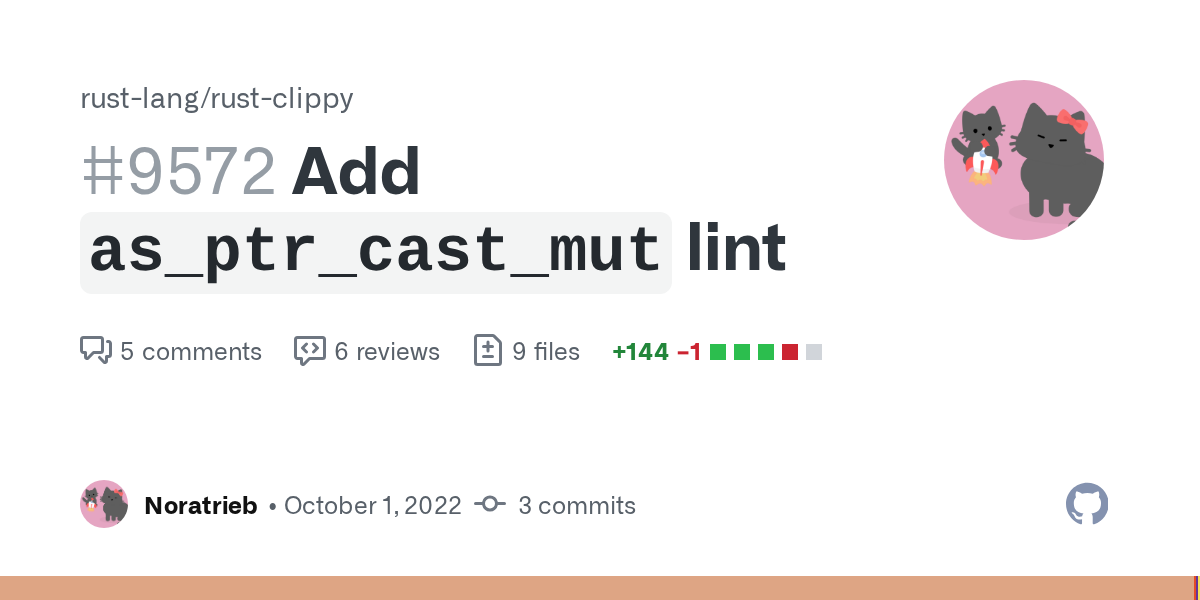
GitHub
This lint detects calls to a &self-taking as_ptr method, where the result is then immediately cast to a *mut T. Code like this is probably invalid, as that pointer will not have write permissio...
Neat
ruby jacinth
Yay, another lint to ignore everywhere
wraith wind
How would you go about fixing https://miri.saethlin.dev/ub?crate=lru&version=0.8.1? It seems to take a pointer into a Box, then insert the pointer and the box itself into a map, moving the box and invalidating the pointer, which is later dereferenced